
>Soap Boy 1 |
small refine formatting after review further |
||
| Line 1: | Line 1: | ||
The [[Mughal Empire]] had a number of imperial flags and standards. The principal imperial standard of the Mughals was known as the ''alam'' ({{lang|fa-Latn|Alam}} {{lang|fa|علم}}). It was primarily [[moss green]].<ref>http://www.bl.uk/onlinegallery/onlineex/apac/addorimss/a/zoomify55414.html</ref> It displayed a [[lion and sun]] ({{lang| | {{Short description|Banners and standards of the South Asian early modern empire}} | ||
[[File: | {{More citations needed|date=January 2024}} | ||
The [[Mughal Empire]] had a number of imperial flags and standards. The principal imperial standard of the Mughals was known as the ''alam'' ({{lang|fa-Latn|Alam}} {{lang|fa|{{nq|علم}}}}). It was primarily [[moss green]].<ref>{{Cite web |url=http://www.bl.uk/onlinegallery/onlineex/apac/addorimss/a/zoomify55414.html |title=Zoomify image: A panorama in 12 folds showing the procession of the Emperor Bahadur Shah to celebrate the feast |access-date=2013-12-18 |archive-date=2019-03-23 |archive-url=https://web.archive.org/web/20190323023533/http://www.bl.uk/onlinegallery/onlineex/apac/addorimss/a/zoomify55414.html |url-status=dead }}</ref> It displayed a [[lion and sun]] ({{lang|prs-Latn|Shēr-ō-khurshīd}} {{lang|prs|شیر و خورشید|rtl=yes}}) facing the hoist of the flag. The Mughals traced their use of the ''alam'' back to [[Timur]].<ref name="singh">{{cite book|last=Singh|first=K.V.|title=Our National Flag|publisher=Publication Division, Ministry of Information & Broadcasting, Government of India|location=New Delhi|year=1991|page=14}}</ref>[[File:Alam of the Mughal Empire.svg|thumb|Flag as seen in a ca.1840 illustration<ref>{{Cite web |title=One of six figures from the Mughal emperor's ceremonial procession on the occasion of the Id. |url=https://collections.vam.ac.uk/item/O16832/gouache-one-of-six-figures-from/one-of-six-figures-from-gouache-mazhar-ali-khan/}}</ref>]] | |||
[[File:Flag of the Mughal Empire (triangular).svg|thumb|Flag featuring "crouching lion"<ref name=":0" />]] | |||
The imperial standard was displayed to the right of the throne and also at the entrance of the Emperor's encampment and in front of the emperor during military marches.<ref name="singh" /> | The imperial standard was displayed to the right of the throne and also at the entrance of the Emperor's encampment and in front of the emperor during military marches.<ref name="singh" /> | ||
According to the ''[[Ain-i-Akbari]]'', during [[Akbar]]'s reign, whenever the emperor rode out, not less than five ''alams'' were carried along with the ''qur'' (a collection of flags and other insignia) wrapped up in scarlet cloth bags. They were unfurled on the days of festivity, and in battle.<ref>[[Heinrich Blochmann|Blochmann, H.]] (tr.) (1927, reprint 1993). ''The Ain-I Akbari by Abu'l-Fazl Allami'', Vol. I, Calcutta: The Asiatic Society, p.52</ref> [[Edward Terry (author)|Edward Terry]], chaplain to Sir [[Thomas Roe]], who came during the reign of [[Jahangir]], described in his ''Voyage to East-India'' (1655) that the royal standard, made of silk, with a crouching lion shadowing part of the body of the sun inscribed on it, was carried on an elephant whenever the emperor travelled.<ref>Foster, William (ed.) (1921) ''Early Travels in India, 1583–1619'', London: Oxford University Press, p. 306</ref><ref>{{cite book|last=Terry|first=Edward |title=A Voyage to East-India|publisher=J. Wilkie|location=London|orig-year=1655|year=1777|page=[https://archive.org/details/avoyagetoeastin00terrgoog/page/n382 347]|url=https://archive.org/details/avoyagetoeastin00terrgoog}}</ref> | According to the ''[[Ain-i-Akbari]]'', during [[Akbar]]'s reign, whenever the emperor rode out, not less than five ''alams'' were carried along with the ''qur'' (a collection of flags and other insignia) wrapped up in scarlet cloth bags. They were unfurled on the days of festivity, and in battle.<ref>[[Heinrich Blochmann|Blochmann, H.]] (tr.) (1927, reprint 1993). ''The Ain-I Akbari by Abu'l-Fazl Allami'', Vol. I, Calcutta: The Asiatic Society, p.52</ref> [[Edward Terry (author)|Edward Terry]], chaplain to Sir [[Thomas Roe]], who came during the reign of [[Jahangir]], described in his ''Voyage to East-India'' (1655) that the royal standard, made of silk, with a crouching lion shadowing part of the body of the sun inscribed on it, was carried on an elephant whenever the emperor travelled.<ref>Foster, William (ed.) (1921) ''Early Travels in India, 1583–1619'', London: Oxford University Press, p. 306</ref><ref name=":0">{{cite book|last=Terry|first=Edward |title=A Voyage to East-India|publisher=J. Wilkie|location=London|orig-year=1655|year=1777|page=[https://archive.org/details/avoyagetoeastin00terrgoog/page/n382 347]|url=https://archive.org/details/avoyagetoeastin00terrgoog}}</ref> | ||
A painting by Payag in a manuscript of the ''[[Padshah Nama|Padshahnama]]'', a chronicle on [[Shah Jahan]]'s reign, preserved in the [[Royal Library, Windsor|Royal Library, Windsor Castle]] depicted the Mughal standards as the scarlet [[pennon]]s with green borders with a passant lion and rising sun behind it.<ref name="Qandahar">{{cite web|title=The siege of Qandahar (May 1631)|url=http://www.history.upenn.edu/coursepages/hist188/18.html|work=King of the World – The Padshahnama|publisher=Department of History at the University of Pennsylvania|access-date=29 October 2010|author=Payag|location=Philadelphia|format=jpg|year=1646|at=Plate No.: 18}}</ref> Another painting in the same manuscript depicted the Mughal standards having green fields with a couchant lion and rising sun behind it.<ref name="royal procession">{{cite web|title=A royal procession|url=http://www.history.upenn.edu/coursepages/hist188/34.html|work=King of the World – The Padshahnama|publisher=Department of History at the University of Pennsylvania|access-date=29 October 2010|author='Kashmiri Painter' (attribution)|location=Philadelphia|at=Plate No.: 34|format=jpg|year=1646–1656}}</ref><ref>{{cite book|last=Divyabhanusinh|title=The Great Mughal Go Hunting Lions|url=https://books.google.com/books?id=HRhP3PGLA8kC&q=Padshahnama+Mughal+standard&pg=PA53|series=in Mahesh Rangarajan (ed.) ''Environmental Issues in India: A Reader''|year=2007|publisher=Pearson Education|isbn=978-81-317-0810-1|page=53}}</ref> | A painting by [[Payag]] in a manuscript of the ''[[Padshah Nama|Padshahnama]]'', a chronicle on [[Shah Jahan]]'s reign, preserved in the [[Royal Library, Windsor|Royal Library, Windsor Castle]] depicted the Mughal standards as the scarlet [[pennon]]s with green borders with a passant lion and rising sun behind it.<ref name="Qandahar">{{cite web|title=The siege of Qandahar (May 1631)|url=http://www.history.upenn.edu/coursepages/hist188/18.html|work=King of the World – The Padshahnama|publisher=Department of History at the University of Pennsylvania|access-date=29 October 2010|author=Payag|location=Philadelphia|format=jpg|year=1646|at=Plate No.: 18}}</ref> Another painting in the same manuscript depicted the Mughal standards having green fields with a couchant lion and rising sun behind it.<ref name="royal procession">{{cite web|title=A royal procession|url=http://www.history.upenn.edu/coursepages/hist188/34.html|work=King of the World – The Padshahnama|publisher=Department of History at the University of Pennsylvania|access-date=29 October 2010|author='Kashmiri Painter' (attribution)|location=Philadelphia|at=Plate No.: 34|format=jpg|year=1646–1656}}</ref><ref>{{cite book|last=Divyabhanusinh|title=The Great Mughal Go Hunting Lions|url=https://books.google.com/books?id=HRhP3PGLA8kC&q=Padshahnama+Mughal+standard&pg=PA53|series=in Mahesh Rangarajan (ed.) ''Environmental Issues in India: A Reader''|year=2007|publisher=Pearson Education|isbn=978-81-317-0810-1|page=53}}</ref> | ||
== | ==Seals== | ||
<gallery> | <gallery> | ||
File: | File:Detail of Babur's dynastic seal, from a Mughal land grant dating from August 1527.jpg|Seal of [[Babur]] | ||
File: | File:Detail of Babur's seal, from a folio (3a L1) of a Shahnameh manuscript likely acquired by Babur in Herat in 1506, containing the seal stamp impressions of various Mughal emperors who possessed it (cropped).jpg|Seal of Babur | ||
File: | File:Seal of Prince Humayun of the Mughal Empire, ca.1508–1530.jpg|Seal of [[Humayun]] | ||
File: | File:Official seal of Mughal emperor Akbar, from Or 14982-9, dating to 965 A.H. (1557–58 C.E.).jpg|Seal of [[Akbar]] | ||
File: | File:Official seal of Mughal emperor Akbar, from Or 14982-2, dating to 967 A.H. (1559–60 C.E.).jpg|Seal of Akbar | ||
File:Official seal of Mughal emperor Akbar, from Or 14982-1, dating to 978 A.H. (1570–71 C.E.).jpg|Seal of Akbar | |||
File:Painting composed around an impression of Jahangir's seal, displayed during the Durbar of 1911.jpg|Seal of [[Jahangir]] | |||
File:Emperor Jahangir's seal impression and shamsa, 1611–12.jpg|Seal of Jahangir | |||
File:Persian 47 Wellcome L0050349.jpg|Seal of Jahangir | |||
File: | File:Representation of Jahangir's seal, from a painting of Jahangir shooting at the head of Malik 'Ambar, ca.1616.jpg|Seal of Jahangir | ||
File:Seal | File:Seal of the Mughal emperor Jahangir, from Or 14982(10).jpg|Seal of Jahangir | ||
File:Ghulam Ali Khan | File:"Rosette Bearing the Names and Titles of Shah Jahan", Folio from the Shah Jahan Album MET DT458.jpg|Seal of [[Shah Jahan]] | ||
File:Seal of Shah Jahan.png|Seal of Shah Jahan | |||
File:Genealogical seal of Shah Jahan, 1046 A.H. (ca.1636 C.E.).png|Seal of Shah Jahan | |||
File:Genealogical seal of Shah Jahan, ca.1628 C.E.png|Seal of Shah Jahan | |||
File:Firman of Aurangzeb, India, 1689, The David Collection, Copenhagen (1) (36012492090).jpg|Seal of [[Aurangzeb]] | |||
File:Painted seal of Mughal Emperor Awrangzib Wellcome L0034099.jpg|Seal of Aurangzeb | |||
File:Rosette Bearing the Name and Title of Emperor Aurangzeb (Recto), from the Shah Jahan Album.jpeg|Seal of Aurangzeb | |||
File:Ghulam Ali Khan 018.jpg|Seal of [[Bahadur Shah Zafar]] in the first year of his reign | |||
</gallery> | </gallery> | ||
| Line 32: | Line 35: | ||
<gallery> | <gallery> | ||
File:Asafia flag of Hyderabad State.svg|[[Nizam of Hyderabad]] | File:Asafia flag of Hyderabad State.svg|[[Nizam of Hyderabad]] | ||
File: | File:Bengal subah flag (Nautical).svg|[[Bengal Subah]] (under Mughals 1576–1717) | ||
File:Bengal Subah flag (Nautical).png|[[Nawab of Bengal]] (independently 1717–1757) | |||
File: | |||
</gallery> | </gallery> | ||
| Line 47: | Line 47: | ||
File:Bhavanidas. The Emperor Aurangzeb Carried on a Palanquin ca. 1705–20 Metripolitan Museum of Art..jpg|[[Aurangzeb]] leads his final expedition (1705), leading an army of 500,000 troops (note flags in the background). | File:Bhavanidas. The Emperor Aurangzeb Carried on a Palanquin ca. 1705–20 Metripolitan Museum of Art..jpg|[[Aurangzeb]] leads his final expedition (1705), leading an army of 500,000 troops (note flags in the background). | ||
File:Battle elephant.jpg|Aurangzeb commanding his army (note triangular green flags) | File:Battle elephant.jpg|Aurangzeb commanding his army (note triangular green flags) | ||
File:One of six figures from the Mughal emperor's ceremonial procession on the occasion of the Id..jpg|An elephant with a mahout and a standard-bearer carrying a green standard with a gold sun. One of a set. | File:One of six figures from the Mughal emperor's ceremonial procession on the occasion of the Id..jpg|An elephant with a mahout and a standard-bearer carrying a green standard with a gold sun. One of a set. | ||
File:Asif tomb.jpg|Funeral of [[Asaf-ud-Daulah]] in the year 1797 under a canopy inside the Bara Imambara; (note:Flag (green) of the Mughal Empire raised higher than the Awadh flag) | |||
File:Asif tomb.jpg|Funeral of [[Asaf-ud-Daulah]] in the year 1797 under a canopy inside the Bara Imambara; (note:Flag (green) of the Mughal Empire raised higher than the Awadh flag) | |||
</gallery> | </gallery> | ||
| Line 56: | Line 54: | ||
* [[Mughal Empire]] | * [[Mughal Empire]] | ||
* [[Peacock Throne]] | * [[Peacock Throne]] | ||
* [[List of Pakistani flags]] | |||
* [[List of Indian flags#Pre-colonial states|List of Indian flags]] | * [[List of Indian flags#Pre-colonial states|List of Indian flags]] | ||
==Notes== | |||
{{notelist}} | |||
==References== | ==References== | ||
| Line 65: | Line 67: | ||
==External links== | ==External links== | ||
{{ | {{commons category-inline}} | ||
* [https://archive.org/stream/embassysirthoma01fostgoog#page/n67/mode/1up An engraving of the Mughal imperial standard] from Foster, William (ed.) ''The embassy of Sir Thomas Roe to the court of the Great Mogul, 1615–1619, as narrated in his journal and correspondence'' London: Haklyut Society, 1899 in Internet Archive website | * [https://archive.org/stream/embassysirthoma01fostgoog#page/n67/mode/1up An engraving of the Mughal imperial standard] from Foster, William (ed.) ''The embassy of Sir Thomas Roe to the court of the Great Mogul, 1615–1619, as narrated in his journal and correspondence'' London: Haklyut Society, 1899 in Internet Archive website | ||
{{Mughal Empire}} | {{Mughal Empire}} | ||
[[Category:Mughal Empire]] | |||
[[Category:Obsolete national flags]] | {{DEFAULTSORT:Mughal Empire, Flag of}} | ||
[[Category:Mughal Empire|Flag]] | |||
[[Category:Obsolete national flags|Mughal Empire]] | |||
[[Category:Flags of India]] | [[Category:Flags of India]] | ||
[[Category:Flags displaying animals]] | |||
Latest revision as of 15:27, 12 March 2026
 | This article needs additional citations for verification. (January 2024) |
The Mughal Empire had a number of imperial flags and standards. The principal imperial standard of the Mughals was known as the alam (Alam علم). It was primarily moss green.[1] It displayed a lion and sun (Shēr-ō-khurshīd شیر و خورشید) facing the hoist of the flag. The Mughals traced their use of the alam back to Timur.[2]

.svg)
The imperial standard was displayed to the right of the throne and also at the entrance of the Emperor's encampment and in front of the emperor during military marches.[2]
According to the Ain-i-Akbari, during Akbar's reign, whenever the emperor rode out, not less than five alams were carried along with the qur (a collection of flags and other insignia) wrapped up in scarlet cloth bags. They were unfurled on the days of festivity, and in battle.[5] Edward Terry, chaplain to Sir Thomas Roe, who came during the reign of Jahangir, described in his Voyage to East-India (1655) that the royal standard, made of silk, with a crouching lion shadowing part of the body of the sun inscribed on it, was carried on an elephant whenever the emperor travelled.[6][4]
A painting by Payag in a manuscript of the Padshahnama, a chronicle on Shah Jahan's reign, preserved in the Royal Library, Windsor Castle depicted the Mughal standards as the scarlet pennons with green borders with a passant lion and rising sun behind it.[7] Another painting in the same manuscript depicted the Mughal standards having green fields with a couchant lion and rising sun behind it.[8][9]
Seals[edit | edit source]
-
 Seal of Babur
 -
 Seal of Babur
 -
 Seal of Humayun
 -
 Seal of Akbar
 -
 Seal of Akbar
 -
 Seal of Akbar
 -
 Seal of Jahangir
 -
 Seal of Jahangir
 -
 Seal of Jahangir
 -
 Seal of Jahangir
 -
 Seal of Jahangir
 -
 Seal of Shah Jahan
 -
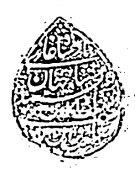 Seal of Shah Jahan
 -
 Seal of Shah Jahan
 -
 Seal of Shah Jahan
 -
 Seal of Aurangzeb
 -
 Seal of Aurangzeb
 -
 Seal of Aurangzeb
 -
 Seal of Bahadur Shah Zafar in the first year of his reign

_of_a_Shahnameh_manuscript_likely_acquired_by_Babur_in_Herat_in_1506,_containing_the_seal_stamp_impressions_of_various_Mughal_emperors_who_possessed_it_(cropped).jpg)

.jpg)
.jpg)
.jpg)


.jpg)


.png)

_(36012492090).jpg)

,_from_the_Shah_Jahan_Album.jpeg)

Flags of the subjects and vassals of the Mughal Empire[edit | edit source]
-
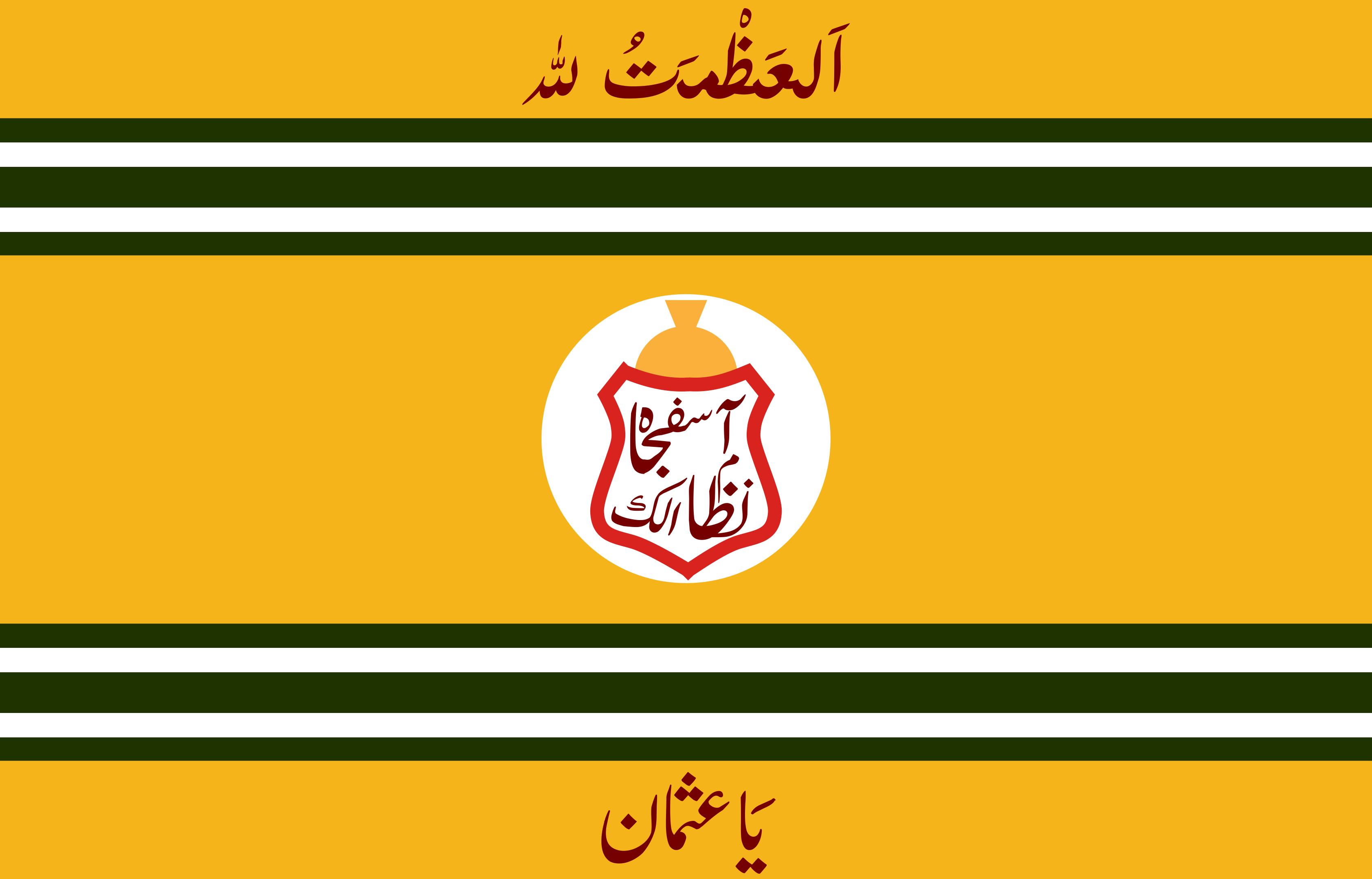
-
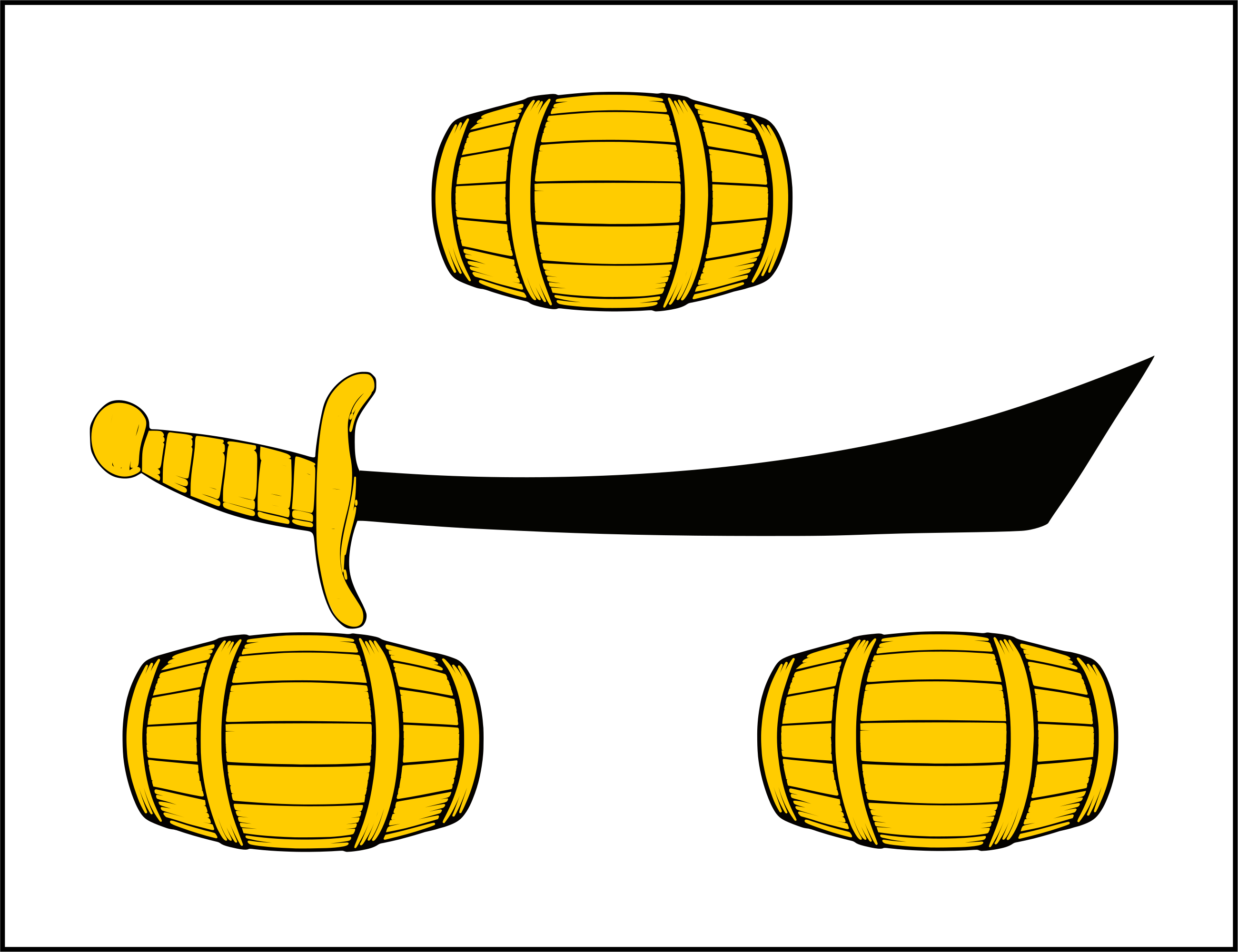 Bengal Subah (under Mughals 1576–1717)
 -
 Nawab of Bengal (independently 1717–1757)

.svg)
.png)
Historical depictions[edit | edit source]
-
 Illustrations from the 1636 Padshahnama of Shah Jahan showing Moghul Soldier & Civilian Costume. Notice the flag in the bottom of the pictures with the standing lion and the sun in a red interior color, this is a scene from the Siege of Kandahar of 1631 during Shah-Jahan's time. Notice the flag in the upper part of the picture with green interior and yellow linings.
 -
 A Mughal miniature from the Padshahnama depicting the surrender of the Safavid Persian garrison of Kandahar in 1638 to the Mughal army of Shah Jahan commanded by Kilij Khan. Notice the white flag with the rising Sun. Perhaps a flag signalling peace. As Safavid forces give the city without bloodshed.
 -
 An engraving from Edward Terry's A Voyage to East-India (1655) titled Imperial Standard of the Great Mogul (featuring the Nad-e-Ali represented by the lion, and the sun known as Aftab).
 -
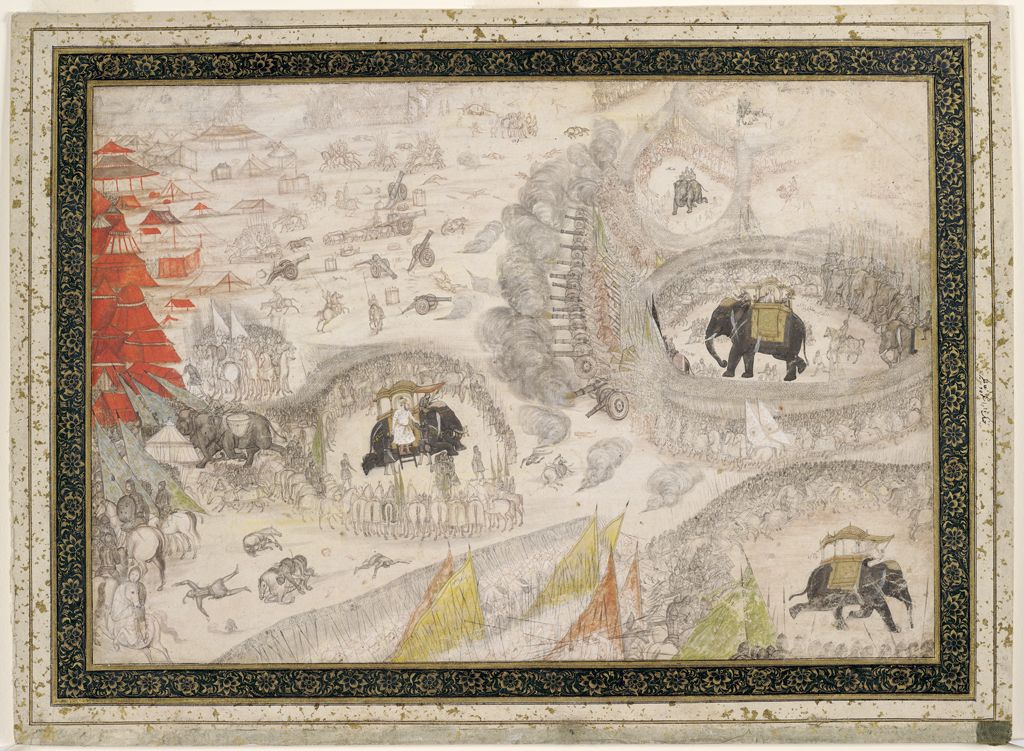 A mid-17th century painting of the Battle of Samugarh between the three sons of Shah Jahan
 -
 Aurangzeb leads his final expedition (1705), leading an army of 500,000 troops (note flags in the background).
 -
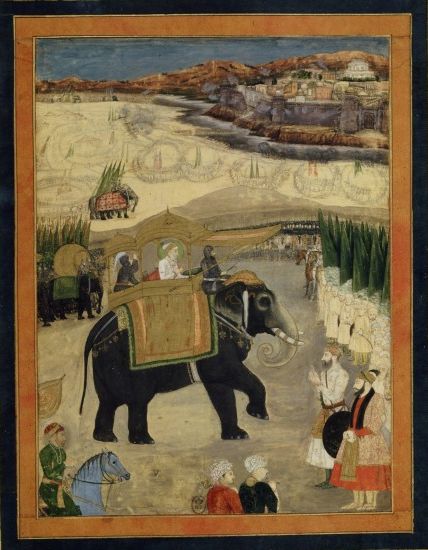 Aurangzeb commanding his army (note triangular green flags)
 -
 An elephant with a mahout and a standard-bearer carrying a green standard with a gold sun. One of a set.
 -
 Funeral of Asaf-ud-Daulah in the year 1797 under a canopy inside the Bara Imambara; (note:Flag (green) of the Mughal Empire raised higher than the Awadh flag)
.jpg)


See also[edit | edit source]
Notes[edit | edit source]
References[edit | edit source]
- ↑ "Zoomify image: A panorama in 12 folds showing the procession of the Emperor Bahadur Shah to celebrate the feast". Archived from the original on 2019-03-23. Retrieved 2013-12-18.
- ↑ 2.0 2.1 Singh, K.V. (1991). Our National Flag. New Delhi: Publication Division, Ministry of Information & Broadcasting, Government of India. p. 14.
- ↑ "One of six figures from the Mughal emperor's ceremonial procession on the occasion of the Id".
- ↑ 4.0 4.1 Terry, Edward (1777) [1655]. A Voyage to East-India. London: J. Wilkie. p. 347.
- ↑ Blochmann, H. (tr.) (1927, reprint 1993). The Ain-I Akbari by Abu'l-Fazl Allami, Vol. I, Calcutta: The Asiatic Society, p.52
- ↑ Foster, William (ed.) (1921) Early Travels in India, 1583–1619, London: Oxford University Press, p. 306
- ↑ Payag (1646). "The siege of Qandahar (May 1631)" (jpg). King of the World – The Padshahnama. Philadelphia: Department of History at the University of Pennsylvania. Plate No.: 18. Retrieved 29 October 2010.
- ↑ 'Kashmiri Painter' (attribution) (1646–1656). "A royal procession" (jpg). King of the World – The Padshahnama. Philadelphia: Department of History at the University of Pennsylvania. Plate No.: 34. Retrieved 29 October 2010.
- ↑ Divyabhanusinh (2007). The Great Mughal Go Hunting Lions. in Mahesh Rangarajan (ed.) Environmental Issues in India: A Reader. Pearson Education. p. 53. ISBN 978-81-317-0810-1.
Further reading[edit | edit source]
- Koch, Ebba (2001). Mughal Art and Imperial Ideology: Collected Essays, New Delhi: Oxford University Press.
External links[edit | edit source]
- An engraving of the Mughal imperial standard from Foster, William (ed.) The embassy of Sir Thomas Roe to the court of the Great Mogul, 1615–1619, as narrated in his journal and correspondence London: Haklyut Society, 1899 in Internet Archive website