

WikiDwarfBOT (talk | contribs) Cleanup: |
quick update |
||
| Line 1: | Line 1: | ||
{{Short description|Indus Valley | {{Short description|Indus Valley Civilisation site in Gujarat, India}} | ||
{{for|the historical Harappan | {{for|the historical Harappan Civilisation|Indus Valley Civilisation}} | ||
{{Use dmy dates|date=December 2015}} | {{Use dmy dates|date=December 2015}} | ||
{{Use Indian English|date=December 2015}} | {{Use Indian English|date=December 2015}} | ||
{{Infobox ancient site | {{Infobox ancient site | ||
| name = Dholavira | |||
| native_name = | |||
| alternate_name = | |||
| image = DHOLAVIRA SITE (24).jpg | |||
| alt = | |||
| caption = The site in 2016 | |||
| map_type = India Gujarat | |||
| relief = 2 | |||
| map_alt = | |||
| map_caption = Location in Gujarat, India | |||
| map_sizeto = | |||
| coordinates = {{Coord|23|53|18.98|N|70|12|49.09|E|type:landmark_region:IN|display=inline,title}} | |||
| location = [[Gujarat]], [[India]] | |||
| region = | |||
| type = Settlement | |||
| part_of = | |||
| length = | |||
| width = | |||
| area = {{convert|47|ha|abbr=on}} | |||
| height = | |||
| builder = | |||
| material = | |||
| built = {{circa|2650 BC}} | |||
| abandoned = {{circa|1900 BC}} | |||
| epochs = [[Periodization of the Indus Valley Civilisation|Harappa 1]] to [[Periodization of the Indus Valley Civilisation|Harappa 5]] | |||
| cultures = [[Indus Valley Civilisation]] | |||
| dependency_of = | |||
| occupants = | |||
| event = | |||
| excavations = | |||
| archaeologists = | |||
| condition = Ruined | |||
| ownership = | |||
| management = | |||
| public_access = Yes | |||
| website = | |||
<!-- DESIGNATION1 --> | | notes = <!-- DESIGNATION1 --> | ||
| designation1 = WHS | |||
| designation1_offname = Dholavira: A Harappan City | |||
| designation1_criteria = {{UNESCO WHS type|(iii)(iv)}}(iii)(iv) | |||
| designation1_date = 2021 <small>(44th [[World Heritage Committee|session]])</small> | |||
| designation1_number = [https://whc.unesco.org/en/list/1645 1645] | |||
| designation1_free1name = Region | |||
| designation1_free1value = [[List of World Heritage Sites in Southern Asia|Southern Asia]] | |||
}} | }} | ||
Dholavira' | '''Dholavira''' ({{langx|gu|ધોળાવીરા}}) is an [[archaeological site]] at [[Khadirbet]] in [[Bhachau]] Taluka of [[Kutch District]], in the state of [[Gujarat]] in [[western India]], which has taken its name from a modern-day village {{Convert|1|km||adj=pre| }} south of it. This village is {{cvt|165|km}} from [[Radhanpur]]. Also known locally as ''Kotada timba'', the site contains ruins of a city of the ancient [[Indus Valley Civilization]].<ref>{{cite news|url=http://www.thehindu.com/society/ruins-on-the-tropic-of-cancer/article19284214.ece|title=Ruins on the Tropic of Cancer|newspaper=The Hindu|date=15 July 2017|last1=Gopinath|first1=P. Krishna}}</ref> Earthquakes have repeatedly affected Dholavira, including a particularly severe one around 2600 BCE.<ref>Lal, B. B., & General, F. D. (2010). HOW DEEP ARE THE ROOTS OF INDIAN CIVILIZATION?--An archaeological and Historical Perspective.</ref> | ||
The site was initially discovered by a resident of Dholavira village, [[Shambhudan Gadhvi]], in early 1960s who made efforts to bring government attention to the location.<ref>{{Cite book|last=Arora | ==Location== | ||
Dholavira's location is on the [[Tropic of Cancer]]. It is one of the five largest Harappan sites<ref name="frontline" /> and the most prominent of archaeological sites in India belonging to the Indus Valley Civilization.<ref>{{cite web|url=https://www.cntraveller.in/story/india-via-gujarat/|title=Where does history begin?|date=19 October 2017}}</ref> It is located on [[Khadir Bet]] island in the [[Kutch Desert Wildlife Sanctuary]] in the [[Great Rann of Kutch]]. The {{Convert|47|ha|abbr=on}} quadrangular city lay between two seasonal streams, the Mansar in the north and Manhar in the south.<ref>{{cite web|last1=Centre|first1=UNESCO World Heritage|title=Dholavira: A Harappan City - UNESCO World Heritage Centre|url=https://whc.unesco.org/en/tentativelists/5892/|website=whc.unesco.org|access-date=3 June 2016|language=en}}</ref> The site was thought to be occupied from c. 2650 BCE, declining slowly after around 2100 BCE, and to have been briefly abandoned then reoccupied until c. 1450 BCE;<ref name="gregory">{{cite book|last1=Possehl|first1=Gregory L.|title=The Indus Civilization: A Contemporary Perspective|year=2002|publisher=Rowman Altamira|isbn=9780759101722|pages=17|url=https://books.google.com/books?id=pmAuAsi4ePIC&q=dholavira&pg=PA69|access-date=3 June 2016|language=en}}</ref> however, recent research suggests the beginning of occupation around 3500 BCE (pre-Harappan) and continuity until around 1800 BCE (early part of Late Harappan period).<ref>Sengupta, Torsa, et al. (2019).[https://onlinelibrary.wiley.com/doi/abs/10.1002/jqs.3178 "Did the Harappan settlement of Dholavira (India) collapse during the onset of Meghalayan stage drought?"] in ''Journal of Quaternary Science'', First published: 26 December 2019.</ref> | |||
==Discovery== | |||
The site was initially discovered by a resident of Dholavira village, [[Shambhudan Gadhvi]], in the early 1960s, who made efforts to bring government attention to the location.<ref>{{Cite book |last=[[Namit Arora]] |url=https://books.google.com/books?id=jE1tDwAAQBAJ |title=Indians: A Brief History of A Civilization |date=2021-01-18 |publisher=Penguin Random House India Private Limited |isbn=978-93-5305-287-4 |language=en}}</ref><ref>{{Cite book|last=Avikunthak|first=Ashish|url=https://books.google.com/books?id=OPw7EAAAQBAJ|title=Bureaucratic Archaeology: State, Science and Past in Postcolonial India|date=2021-10-31|publisher=Cambridge University Press|isbn=978-1-316-51239-5|language=en}}</ref><ref>{{Cite web|last=Vasa|first=Pulin|title=Nani Rayan {{!}} Read jain books online at Jainebooks.org|url=https://jainebooks.org/books/11177/nani-rayan|access-date=2022-01-25|website=jainebooks.org|language=en}}</ref> The site was "officially" discovered in 1967 or 1968 by [[J. P. Joshi]], of the [[Archaeological Survey of India]] (ASI), and is the fifth largest of eight major Harappan sites. It has been under excavation since 1990 by the ASI, which opined that "Dholavira has indeed added new dimensions to personality of Indus Valley Civilisation."<ref name=asi>{{cite web |publisher=Archaeological Survey of India |url=http://asi.nic.in/asi_exca_2007_dholavira.asp |title=Excavations-Dholavira |access-date=30 June 2012 |archive-url=https://web.archive.org/web/20110903114242/http://asi.nic.in/asi_exca_2007_dholavira.asp |archive-date=3 September 2011 |url-status=dead }}</ref> | |||
Dholavira has been marked as one of the most important [[megalith]]ic sites of Kutch, while the only other megalithic site in Kutch is the obscure village of [[Dhaneti]].<ref>{{cite book |last1=Laporte |first1=Luc |last2=Large |first2=Jean-Marc |last3=Nespoulous |first3=Laurent |last4=Scarre |first4=Chris |last5=Steimer-Herbet |first5=Tara |title=Megaliths of the World |date=22 August 2022 |publisher=Archaeopress Publishing Ltd |isbn=978-1-80327-321-1 |pages=430 |url=https://books.google.com/books?id=HO6CEAAAQBAJ&dq=Dhaneti&pg=PA420 |access-date=9 September 2025 |language=en}}</ref> | |||
The other major Harappan sites discovered so far are [[Harappa]], [[Mohenjo-daro]], [[Ganeriwala]], [[Rakhigarhi]], [[Kalibangan]], [[Rupnagar]] and [[Lothal]]. | |||
It was named as a [[UNESCO World Heritage Site]] under the name ''Dholavira: a Harappan City'' on 27 July 2021.<ref>{{cite news |title='Long overdue': Indians celebrate as Dholavira gets UNESCO World Heritage tag|url=https://indianexpress.com/article/trending/trending-in-india/indians-celebrate-as-harappan-city-dholavira-get-unesco-world-heritage-tag-7425174/|work=The Indian Express|date=27 July 2021|access-date=28 July 2021}}</ref> | It was named as a [[UNESCO World Heritage Site]] under the name ''Dholavira: a Harappan City'' on 27 July 2021.<ref>{{cite news |title='Long overdue': Indians celebrate as Dholavira gets UNESCO World Heritage tag|url=https://indianexpress.com/article/trending/trending-in-india/indians-celebrate-as-harappan-city-dholavira-get-unesco-world-heritage-tag-7425174/|work=The Indian Express|date=27 July 2021|access-date=28 July 2021}}</ref> | ||
== | ==Timeline== | ||
[[File:Dholavira-layout-en.svg|thumb|300px|Layout of Dholavira]] | [[File:Dholavira-layout-en.svg|thumb|300px|Layout of Dholavira]] | ||
[[Ravindra Singh Bisht]], the director of the Dholavira excavations, has defined the following seven stages of occupation at the site:<ref>[[Gregory Possehl|Possehl, Gregory]]. (2004). ''The Indus Civilization: A contemporary perspective'', New Delhi: Vistaar Publications, {{ISBN|81-7829-291-2}}, p.67.</ref> | [[Ravindra Singh Bisht|Ravindra Bisht]], the director of the Dholavira excavations, has defined the following seven stages of occupation at the site:<ref>[[Gregory Possehl|Possehl, Gregory]]. (2004). ''The Indus Civilization: A contemporary perspective'', New Delhi: Vistaar Publications, {{ISBN|81-7829-291-2}}, p.67.</ref> | ||
{| class="wikitable" | {| class="wikitable" | ||
|- | |- | ||
! | ! Stages | ||
! | ! Time | ||
! | ! Events | ||
|- | |- | ||
| Stage I | | Stage I | ||
| Line 106: | Line 113: | ||
==Excavations== | ==Excavations== | ||
The excavation was initiated in 1989 by the ASI under the direction of Bisht, and there were 13 field excavations between 1990 and 2005.<ref name=frontline/> The excavation brought to light urban planning and architecture, and unearthed large numbers of antiquities such as animal bones, gold, silver, terracotta ornaments, pottery and bronze vessels. Archaeologists believe | The excavation was initiated in 1989, by the ASI under the direction of Bisht, and there were 13 field excavations between 1990 and 2005.<ref name=frontline/> The excavation brought to light urban planning and architecture, and unearthed large numbers of antiquities such as animal bones, gold, silver, terracotta ornaments, pottery and bronze vessels. Archaeologists believe that Dholavira was an important centre of trade between settlements in south [[Gujarat]], [[Sindh]] and [[Punjab region|Punjab]] and Western Asia.<ref>[http://www.archaeology.org/0011/newsbriefs/aqua.html Aqua Dholavira - GUJARAT Magazine Archive]. Archaeology.org. Retrieved on 2013-07-28.</ref><ref>{{cite book|last1=McIntosh|first1=Jane|title=The Ancient Indus Valley: New Perspectives|year=2008|publisher=ABC-CLIO|isbn=9781576079072|pages=177|url=https://books.google.com/books?id=1AJO2A-CbccC&q=The+Ancient+Indus+Valley|access-date=3 June 2016|language=en}}</ref> | ||
==Architecture | ==Architecture== | ||
{{anchor | Culture }} | {{anchor | Culture }} | ||
{{see also | Periodisation of the Indus Valley Civilisation | l1= Periodisation of IVC | Pottery_in_the_Indian_subcontinent | l2= Pottery culture in Indian subcontinent | Phase (archaeology) | l3= Phases in archaeology | {{see also|Periodisation of the Indus Valley Civilisation|l1=Periodisation of IVC|Pottery_in_the_Indian_subcontinent|l2=Pottery culture in Indian subcontinent|Phase (archaeology)|l3=Phases in archaeology|Chronological dating}} | ||
Estimated to be older than the port-city of [[Lothal]],<ref>{{cite web|last1=Suman|first1=Saket|title=When history meets development|url= | Estimated to be older than the port-city of [[Lothal]],<ref>{{cite web|last1=Suman|first1=Saket|title=When history meets development|url=https://www.thestatesman.com/news/section-ii/when-history-meets-development/116415.html|website=TheStatesman|date=13 January 2016|access-date=3 June 2016}}</ref> the city of Dholavira has a rectangular shape and organization, and is spread over {{convert|22|ha|abbr=on}}. The area measures {{convert|771.1|m|abbr=on}} in length, and {{convert|616.85|m|abbr=on}} in width.<ref name="asi"/> Unlike [[Harappa]] and [[Mohenjo-daro]], the city was constructed to a pre-existing geometrical plan consisting of three divisions – the [[citadel]], the middle town, and the lower town.<ref>{{cite book|last1=McIntosh|first1=Jane|title=The Ancient Indus Valley: New Perspectives|year=2008|publisher=ABC-CLIO|isbn=9781576079072|page=174|edition=2008|url=https://books.google.com/books?id=1AJO2A-CbccC&q=The%20Ancient%20Indus%20Valley&pg=PA174|access-date=3 June 2016|language=en}}</ref> The acropolis and the middle town had been furnished with their own defence-work, gateways, built-up areas, street system, wells, and large open spaces. The acropolis is the most thoroughly fortified<ref name="asi"/> and complex area in the city, of which it appropriates the major portion of the southwestern zone. The towering "castle" stands is defended by double ramparts.<ref>{{cite book|last1=McIntosh|first1=Jane|title=The Ancient Indus Valley: New Perspectives|year=2008|publisher=ABC-CLIO|isbn=9781576079072|page=224|url=https://books.google.com/books?id=1AJO2A-CbccC&q=The%20Ancient%20Indus%20Valley&pg=PA224|access-date=3 June 2016|language=en}}</ref> Next to this stands a place called the 'bailey' where important officials lived.<ref>{{cite book|last1=McIntosh|first1=Jane|title=The Ancient Indus Valley: New Perspectives|year=2008|publisher=ABC-CLIO|isbn=9781576079072|page=226|url=https://books.google.com/books?id=1AJO2A-CbccC&q=The%20Ancient%20Indus%20Valley&pg=PA226|access-date=3 June 2016|language=en}}</ref> The city within the general fortifications accounts for {{convert|48|ha|abbr=on}}. There are extensive structure-bearing areas which are outside yet integral to the fortified settlement. Beyond the walls, another settlement has been found.<ref name="asi"/> The most striking feature of the city is that all of its buildings, at least in their present state of preservation, are built of stone, whereas most other Harappan sites, including Harappa itself and Mohenjo-Daro, are almost exclusively built of brick.<ref>{{cite book|last1=Wheeler|first1=Mortimer|title=The Indus Civilization: Supplementary Volume to the Cambridge History of India|date=2 September 1968|publisher=CUP Archive|isbn=9780521069588|page=33|edition=1968|url=https://books.google.com/books?id=9cs7AAAAIAAJ&q=Wheeler%2C%20Sir%20Mortimer.%20The%20Indus%20Civilisation&pg=PA33|access-date=3 June 2016|language=en}}</ref> Dholavira is flanked by two storm water channels; the Mansar in the north, and the Manhar in the south. In the town square, there is an area high above the ground, called the "Citadel<nowiki>''</nowiki>. | ||
===Reservoirs=== | ===Reservoirs=== | ||
{{See also|Sanitation of the Indus Valley Civilization}} | {{See also|Sanitation of the Indus Valley Civilization}} | ||
[[Image:Dholavira1.JPG|thumb|One of the water reservoirs, with steps, at Dholavira]] | [[Image:Dholavira1.JPG|thumb|One of the water reservoirs, with steps, at Dholavira]] | ||
Bisht, who retired as the Joint Director-General of the ASI, said, "The kind of efficient system of Harappans of Dholavira, developed for conservation, harvesting and storage of water speaks eloquently about their advanced hydraulic engineering, given the state of technology in the third millennium BCE."<ref name=frontline/> One of the unique features<ref>{{cite book|last=Singh|first=Upinder| author-link = Upinder Singh|title=A History of Ancient and Early Medieval India: From the Stone Age to the 12th Century|year=2008|publisher=Pearson Education India|location=New Delhi|isbn=978-813-17-1120-0|pages=155 bottom|url=https://books.google.com/books?id=H3lUIIYxWkEC}}</ref> of Dholavira is the sophisticated water conservation system<ref name=indianexpress1997>{{cite news| title=Dholavira excavations throw light on Harappan civilisation| publisher=[[Indian Express]]| date=25 June 1997 |work= United News of India| url= http://www.expressindia.com/news/ie/daily/19970625/17650493.html| archive-url=https://web.archive.org/web/20120918001611/http://www.expressindia.com/news/ie/daily/19970625/17650493.html |archive-date=18 September 2012| access-date= 15 June 2012}}</ref> of channels and reservoirs, the earliest found anywhere in the world,<ref>{{cite web |last1=Centre |first1=UNESCO World Heritage |title= Dholavira: A Harappan City - UNESCO World Heritage Centre |url= https://whc.unesco.org/en/tentativelists/5892/|website=whc.unesco.org|language=en}}</ref> built completely of stone. The city had massive reservoirs, three of which are exposed.<ref>{{cite book|last=McIntosh|first=Jane|title=The Ancient Indus Valley : New Perspectives|year=2008|publisher=ABC-CLIO|location=Santa Barbara, California|isbn=978-157-60-7907-2|page=84|url=https://books.google.com/books?id=1AJO2A-CbccC}}</ref> They were used for storing fresh water brought by rains<ref name="indianexpress1997"/> or to store water diverted from two nearby rivulets.<ref>{{cite book|last=Singh|first=Upinder|title=A History of Ancient and Early Medieval India: From the Stone Age to the 12th Century|year=2008|publisher=Pearson Education India|location=New Delhi|isbn=978-813-17-1120-0|page=155 |url=https://books.google.com/books?id=H3lUIIYxWkEC}}</ref> This clearly came in response to the desert climate and conditions of Kutch, where several years may pass without rainfall. A seasonal stream which runs in a north–south direction near the site was dammed at several points to collect water. In 1998, another reservoir was discovered in the site.<ref>{{cite news |title='Oldest dam' found |url= | Bisht, who retired as the Joint Director-General of the ASI, said, "The kind of efficient system of Harappans of Dholavira, developed for conservation, harvesting and storage of water speaks eloquently about their advanced hydraulic engineering, given the state of technology in the third millennium BCE."<ref name=frontline/> One of the unique features<ref>{{cite book|last=Singh|first=Upinder| author-link = Upinder Singh|title=A History of Ancient and Early Medieval India: From the Stone Age to the 12th Century|year=2008|publisher=Pearson Education India|location=New Delhi|isbn=978-813-17-1120-0|pages=155 bottom|url=https://books.google.com/books?id=H3lUIIYxWkEC}}</ref> of Dholavira is the sophisticated water conservation system<ref name=indianexpress1997>{{cite news| title=Dholavira excavations throw light on Harappan civilisation| publisher=[[Indian Express]]| date=25 June 1997 |work= United News of India| url= http://www.expressindia.com/news/ie/daily/19970625/17650493.html| archive-url=https://web.archive.org/web/20120918001611/http://www.expressindia.com/news/ie/daily/19970625/17650493.html |archive-date=18 September 2012| access-date= 15 June 2012}}</ref> of channels and reservoirs, the earliest found anywhere in the world,<ref>{{cite web |last1=Centre |first1=UNESCO World Heritage |title= Dholavira: A Harappan City - UNESCO World Heritage Centre |url= https://whc.unesco.org/en/tentativelists/5892/|website=whc.unesco.org|language=en}}</ref> built completely of stone. The city had massive reservoirs, three of which are exposed.<ref>{{cite book|last=McIntosh|first=Jane|title=The Ancient Indus Valley : New Perspectives|year=2008|publisher=ABC-CLIO|location=Santa Barbara, California|isbn=978-157-60-7907-2|page=84|url=https://books.google.com/books?id=1AJO2A-CbccC}}</ref> They were used for storing fresh water brought by rains<ref name="indianexpress1997"/> or to store water diverted from two nearby rivulets.<ref>{{cite book|last=Singh|first=Upinder|title=A History of Ancient and Early Medieval India: From the Stone Age to the 12th Century|year=2008|publisher=Pearson Education India|location=New Delhi|isbn=978-813-17-1120-0|page=155 |url=https://books.google.com/books?id=H3lUIIYxWkEC}}</ref> This clearly came in response to the desert climate and conditions of Kutch, where several years may pass without rainfall. A seasonal stream which runs in a north–south direction near the site was dammed at several points to collect water. In 1998, another reservoir was discovered in the site.<ref>{{cite news |title='Oldest dam' found |url=https://www.rediff.com/news/1998/apr/25dam.htm |access-date=8 November 2018 |work=Rediff.com |date=25 April 1998}}</ref> | ||
The inhabitants of Dholavira created sixteen or more reservoirs<ref name="gregory"/> of varying size during Stage III.<ref name="asi"/> Some of these took advantage of the slope of the ground within the large settlement,<ref name="asi"/> a drop of {{convert|13|m}} from northeast to northwest. Other reservoirs were excavated, some into [[rock-cut architecture|living rock]]. Recent work has revealed two large reservoirs, one to the east of the castle and one to its south, near the Annexe.<ref>[[Gregory Possehl|Possehl, Gregory]]. (2004). ''The Indus Civilization: A contemporary perspective'', New Delhi: Vistaar Publications, {{ISBN|81-7829-291-2}}, p.69.</ref> | The inhabitants of Dholavira created sixteen or more reservoirs<ref name="gregory"/> of varying size during Stage III.<ref name="asi"/> Some of these took advantage of the slope of the ground within the large settlement,<ref name="asi"/> a drop of {{convert|13|m}} from northeast to northwest. Other reservoirs were excavated, some into [[rock-cut architecture|living rock]]. Recent work has revealed two large reservoirs, one to the east of the castle and one to its south, near the Annexe.<ref>[[Gregory Possehl|Possehl, Gregory]]. (2004). ''The Indus Civilization: A contemporary perspective'', New Delhi: Vistaar Publications, {{ISBN|81-7829-291-2}}, p.69.</ref> | ||
| Line 123: | Line 130: | ||
The reservoirs are cut through stone vertically, and are about {{convert|7|m|ft|abbr=on}} deep and {{convert|79|m|ft|abbr=on}} long. They skirt the city, while the citadel and bath are centrally located on raised ground.<ref name="indianexpress1997"/> There is also a large well with a stone-cut trough connecting it to a drain meant for conducting water to a storage tank.<ref name=indianexpress1997/> The bathing tank had steps descending inwards.<ref name="indianexpress1997"/> | The reservoirs are cut through stone vertically, and are about {{convert|7|m|ft|abbr=on}} deep and {{convert|79|m|ft|abbr=on}} long. They skirt the city, while the citadel and bath are centrally located on raised ground.<ref name="indianexpress1997"/> There is also a large well with a stone-cut trough connecting it to a drain meant for conducting water to a storage tank.<ref name=indianexpress1997/> The bathing tank had steps descending inwards.<ref name="indianexpress1997"/> | ||
In October 2014, excavation began on a rectangular [[stepwell]] which measured {{cvt|73.4|m}} long, {{cvt|29.3|m}} wide, and {{cvt|10|m}} deep, making it three times bigger than the [[Great Bath of Mohenjedaro]].<ref name="The Times14">{{cite news| title= 5,000-year-old Harappan stepwell found in Kutch, bigger than Mohenjodaro's |publisher= The Times of India Mobile Site |date= 8 October 2014 | url= | In October 2014, excavation began on a rectangular [[stepwell]] which measured {{cvt|73.4|m}} long, {{cvt|29.3|m}} wide, and {{cvt|10|m}} deep, making it three times bigger than the [[Great Bath of Mohenjedaro]].<ref name="The Times14">{{cite news| title= 5,000-year-old Harappan stepwell found in Kutch, bigger than Mohenjodaro's |publisher= The Times of India Mobile Site |date= 8 October 2014 | url= https://timesofindia.indiatimes.com/india/5000-year-old-Harappan-stepwell-found-in-Kutch-bigger-than-Mohenjodaros/articleshow/44638220.cms | access-date= 3 January 2015}}</ref> | ||
[[File:Well at ancient Harappan city of Dholavira.jpg|thumb|The Well | [[File:Well at ancient Harappan city of Dholavira.jpg|thumb|The Well at ancient Harappan city of Dholavira]] | ||
===Seal making=== | ===Seal making=== | ||
Some of the seals found at Dholavira, belonging to Stage III, contained animal only figures, without any type of script. It is suggested{{by whom|date=January 2018}} that these | Some of the seals found at Dholavira, belonging to Stage III, contained animal only figures, without any type of script. It is suggested{{by whom|date=January 2018}} that these types of seals represent early conventions of Indus seal making. | ||
===Other structures and objects=== | ===Other structures and objects=== | ||
[[File:Dholavira.jpg|thumb|East gate]] | [[File:Dholavira.jpg|thumb|East gate]] | ||
A huge circular structure on the site is believed to be a grave or memorial,<ref name="indianexpress1997"/> although it contained no skeletons or other human remains. The structure consists of ten radial mud-brick walls built in the shape of a spoked wheel.<ref name=indianexpress1997/> A soft sandstone sculpture of a male with [[phallus]] erectus but head and feet below ankle truncated was found in the passageway of the eastern gate.<ref name=indianexpress1997/> Many funerary structures have been found (although all but one were devoid of skeletons),<ref name="indianexpress1997"/> as well as pottery pieces, terra cotta seals, bangles, rings, beads, and intaglio engravings.<ref name="indianexpress1997"/> | A huge circular structure on the site is believed to be a grave or memorial,<ref name="indianexpress1997"/> although it contained no skeletons or other human remains. The structure consists of ten radial mud-brick walls built in the shape of a spoked wheel.<ref name=indianexpress1997/> A soft sandstone sculpture of a male with [[phallus]] erectus but head and feet below ankle truncated was found in the passageway of the eastern gate.<ref name=indianexpress1997/> Many funerary structures have been found (although all but one were devoid of skeletons),<ref name="indianexpress1997"/> as well as pottery pieces, terra cotta seals, bangles, rings, beads, and intaglio engravings.<ref name="indianexpress1997"/> The Dancing Girl is one of the most iconic artifacts from the Harappan civilization, discovered at Mohenjo-daro. Believed to date back to around 2500 BCE, this bronze statue stands at about 10.5 centimeters tall and vividly captures the dynamic energy and grace of a youthful dancer. | ||
===Hemispherical constructions=== | ===Hemispherical constructions=== | ||
Seven hemispherical constructions were found at Dholavira, of which two were excavated in detail, which were constructed over large rock cut chambers.<ref name="asi"/> Having a circular plan, these were big hemispherical elevated mud brick constructions. One of the excavated structures was designed in the form of a spoked wheel. The other was also designed in same fashion, but as a wheel without spokes. Although they contained burial goods of pottery, no skeletons were found except for one grave, where a skeleton and a copper mirror were found.<ref name="asi"/> A necklace of steatite beads strung to a copper wire with hooks at both ends, a gold bangle, gold and other beads were also found in one of the hemispherical structures.<ref name="asi"/> | Seven hemispherical constructions were found at Dholavira, of which two were excavated in detail, which were constructed over large rock cut chambers.<ref name="asi"/> Having a circular plan, these were big hemispherical elevated mud brick constructions. One of the excavated structures was designed in the form of a spoked wheel. The other was also designed in same fashion, but as a wheel without spokes. Although they contained burial goods of pottery, no skeletons were found except for one grave, where a skeleton and a copper mirror were found.<ref name="asi"/> A necklace of steatite beads strung to a copper wire with hooks at both ends, a gold bangle, gold and other beads were also found in one of the hemispherical structures.<ref name="asi"/> | ||
The Archaeological Survey of India, which conducted the excavation, opines that these “hemispherical structures remind one of early Buddhist stupas.”<ref name="asi"/> and that "the kind of design that is of spoked wheel and unspoked wheel also remind one of the Sararata-chakra-citi and sapradhi-rata-chakra-citi mentioned in the [[Satapatha Brahmana]] and [[ | The Archaeological Survey of India, which conducted the excavation, opines that these “hemispherical structures remind one of early Buddhist stupas.”<ref name="asi"/> and that "the kind of design that is of spoked wheel and unspoked wheel also remind one of the Sararata-chakra-citi and sapradhi-rata-chakra-citi mentioned in the [[Satapatha Brahmana]] and [[Shulba Sutras]]s".<ref name="asi"/> | ||
[[File:Cicular houses Dholavira.jpg|thumb|Circular houses of Dholavira - an ancient Harappan City]] | [[File:Cicular houses Dholavira.jpg|thumb|Circular houses of Dholavira - an ancient Harappan City]] | ||
==Findings== | ==Findings== | ||
[[File:Dholavira-1.jpg|thumb|North gate]] | [[File:Dholavira-1.jpg|thumb|North gate]] | ||
Painted Indus black-on-red-ware pottery, square stamp seals, seals without Indus script, a huge signboard measuring about {{cvt|3|m}} in length, containing ten letters of Indus script. One poorly preserved | Painted Indus black-on-red-ware pottery, square stamp seals, seals without Indus script, a huge signboard measuring about {{cvt|3|m}} in length, containing ten letters of Indus script. One poorly preserved seated male figure made of stone has also been found, comparable to high quality two stone sculptures found at Harappa.<ref>{{cite book |last=Possehl |first= Gregory L. |title= The Indus civilization : a contemporary perspective |year=2002 |publisher= AltaMira Press |location= Walnut Creek, CA |isbn= 9780759101722 |page=124 |url= https://books.google.com/books?id=pmAuAsi4ePIC&q=dholavira&pg=PA69 |edition=2nd print }}</ref> Large black-slipped jars with pointed base were also found at this site. A giant bronze hammer, a big chisel, a bronze hand-held mirror, a gold wire, gold ear stud, gold globules with holes, copper celts and bangles, shell bangles, phallus-like symbols of stone, square seals with Indus inscription and signs, a circular seal, humped animals, pottery with painted motifs, goblets, dish-on-stand, perforated jars, [[Terracotta]] tumblers in good shape, architectural members made of ballast stones, grinding stones, mortars, etc., were also found at this site.<ref name=frontline/> Stone weights of different measures were also found.<ref>{{cite book |last=Singh |first=Upinder |title=A History of Ancient and Early Medieval India : from the Stone Age to the 12th century |year=2008 |publisher= Pearson Education |location=New Delhi |isbn= 9788131711200 |page= 163 |url= https://books.google.com/books?id=H3lUIIYxWkEC&q=padri}}</ref> | ||
==Coastal route== | ==Coastal route== | ||
| Line 147: | Line 154: | ||
==Language and script== | ==Language and script== | ||
The Harappans spoke an unknown language and [[Indus script|their script]] has not yet been deciphered. It is believed to have had | The Harappans spoke an unknown language and [[Indus script|their script]] has not yet been deciphered. It is believed to have had around 400 basic signs, with many variations.<ref name="Study of the Indus Script">Parpola, Asko (2005) [http://www.helsinki.fi/~aparpola/tices_50.pdf ''Study of the Indus Script'']. 50th ICES Tokyo Session.</ref> The signs may have stood both for words and for syllables.<ref name="Study of the Indus Script"/> The direction of the writing was generally from right-to-left.<ref>{{cite news|last=Mahadevan|first=Iravatham|title=Towards a scientific study of Indus Script|url=http://www.hindu.com/mag/2007/02/04/stories/2007020400260500.htm|archive-url=https://web.archive.org/web/20070206005438/http://www.hindu.com/mag/2007/02/04/stories/2007020400260500.htm|url-status=dead|archive-date=February 6, 2007|access-date=30 June 2012|newspaper=[[The Hindu]]|date=Feb 4, 2007}}</ref> Most of the inscriptions are found on seals (mostly made out of stone) and sealings (pieces of clay on which the seal was pressed down to leave its impression). Some inscriptions are also found on copper tablets, bronze implements, and small objects made of terracotta, stone and [[faience]]. The seals may have been used in trade and also for official administrative work.<ref>Kenoyer, Jonathan Mark. Indus Cities, Towns, and Villages. American Institute of Pakistan Studies, Islamabad. 1998</ref> A lot of inscribed material was found at [[Mohenjo-daro]] and other Indus Valley Civilisation sites. | ||
===Sign board=== | ===Sign board=== | ||
[[File:The 'Ten Indus Scripts' discovered near the northern gateway of the Dholavira citadel.jpg|thumb|800px|center|{{center|Ten [[Indus script|Indus characters]] from the northern gate of Dholavira, dubbed the Dholavira Signboard | [[File:The 'Ten Indus Scripts' discovered near the northern gateway of the Dholavira citadel.jpg|thumb|800px|center|{{center|Ten [[Indus script|Indus characters]] from the northern gate of Dholavira, dubbed the Dholavira Signboard}}]] | ||
The most significant discoveries at Dholavira | The most significant discoveries at Dholavira were made in one of the side rooms of the northern gateway of the city, and is generally known as the Dholavira Signboard. The Harappans had arranged and set pieces of the mineral [[gypsum]] to form ten large symbols or letters on a big wooden board.<ref>Kenoyer, Jonathan Mark. Ancient Cities of the Indus Valley Civilisation. Oxford University Press. 1998</ref> At some point, the board fell flat on its face. The wood decayed, but the arrangement of the letters survived. The letters of the signboard are comparable to large bricks that were used in nearby walls. Each sign is about {{convert|37|cm|abbr=on}} high and the board on which letters were inscribed was about {{convert|3|m|abbr=on}} long.<ref>[[Gregory Possehl|Possehl, Gregory]]. (2004). ''The Indus Civilization: A contemporary perspective'', New Delhi: Vistaar Publications, {{ISBN|81-7829-291-2}}, p.70.</ref> | ||
The inscription is one of the longest in the Indus script, with one of the symbols appearing four times, and this and its large size and public nature make it a key piece of evidence cited by scholars arguing that the Indus script represents full literacy. A four sign inscription with large letters on sandstone is also found at this site, considered first of such inscription on sandstone at any of Harappan sites.<ref name="frontline">{{cite web |last1=Subramanian |first1=T |title=The rise and fall of a Harappan city |url=https://archaeologynewsnetwork.blogspot.in/2010/06/rise-and-fall-of-harappan-city.html |archive-url=https://web.archive.org/web/20170812062930/https://archaeologynewsnetwork.blogspot.com/2010/06/rise-and-fall-of-harappan-city.html |archive-date=2017-08-12 |access-date=3 June 2016 |website=The Archaeology News Network}}</ref> | |||
In a 2025 paper published by Cambridge Engage, it's proposed that the ten signs on the board can be understood as components of an animal-drawn cart, in order of construction when read from right to left.<ref>{{cite journal |last=Pollard |first=Max Freedom |date=14 November 2025 |title=Indus Signs as Merchant Marks: Corpus Structure, Context, and Viability |journal=Cambridge Open Engage |type=Working paper |publisher=Cambridge University Press |doi=10.33774/coe-2025-n0cxj |url=https://www.cambridge.org/engage/coe/article-details/6914735f65a54c2d4acf319d |access-date=19 November 2025|doi-access=free }}</ref> | |||
==References== | ==References== | ||
{{reflist|2}} | {{reflist|2}} | ||
==External links== | ==External links== | ||
{{commons category}} | |||
*[https://web.archive.org/web/20110903114242/http://asi.nic.in/asi_exca_2007_dholavira.asp Excavations at Dholavira] in Archaeological Survey of India website | *[https://web.archive.org/web/20110903114242/http://asi.nic.in/asi_exca_2007_dholavira.asp Excavations at Dholavira] in Archaeological Survey of India website | ||
*[http://asi.nic.in/asi_exca_2007_dholavira_images.asp Dholavira Pictures] by Archaeological Survey of India website | *[http://asi.nic.in/asi_exca_2007_dholavira_images.asp Dholavira Pictures] by Archaeological Survey of India website | ||
| Line 180: | Line 190: | ||
[[Category:History of Kutch]] | [[Category:History of Kutch]] | ||
[[Category:Monuments of National Importance in Gujarat]] | [[Category:Monuments of National Importance in Gujarat]] | ||
[[Category:Indus Valley | [[Category:Indus Valley Civilisation sites]] | ||
[[Category:Uninhabited islands of India]] | [[Category:Uninhabited islands of India]] | ||
[[Category:Islands of India]] | [[Category:Islands of India]] | ||
Latest revision as of 02:15, 4 February 2026
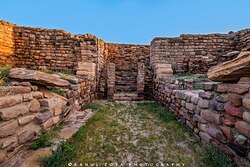
.jpg) The site in 2016 | |
Location in Gujarat, India | |
| Location | Gujarat, India |
|---|---|
| Coordinates | 23°53′18.98″N 70°12′49.09″E / 23.8886056°N 70.2136361°E |
| Type | Settlement |
| Area | 47 ha (120 acres) |
| History | |
| Founded | c. 2650 BC |
| Abandoned | c. 1900 BC |
| Periods | Harappa 1 to Harappa 5 |
| Cultures | Indus Valley Civilisation |
| Site notes | |
| Condition | Ruined |
| Public access | Yes |
| Lua error: bad argument #1 to 'mw.loadJsonData' ('Module:Designation/list' is not a valid JSON page). | |
Official name | Dholavira: A Harappan City |
| Criteria | Cultural: (iii)(iv) |
| Designated | 2021 (44th session) |
| Reference no. | 1645 |
Region | Southern Asia |


Dholavira (Gujarati: ધોળાવીરા) is an archaeological site at Khadirbet in Bhachau Taluka of Kutch District, in the state of Gujarat in western India, which has taken its name from a modern-day village 1 kilometre (0.62 mi) south of it. This village is 165 km (103 mi) from Radhanpur. Also known locally as Kotada timba, the site contains ruins of a city of the ancient Indus Valley Civilization.[1] Earthquakes have repeatedly affected Dholavira, including a particularly severe one around 2600 BCE.[2]
Location[edit | edit source]
Dholavira's location is on the Tropic of Cancer. It is one of the five largest Harappan sites[3] and the most prominent of archaeological sites in India belonging to the Indus Valley Civilization.[4] It is located on Khadir Bet island in the Kutch Desert Wildlife Sanctuary in the Great Rann of Kutch. The 47 ha (120 acres) quadrangular city lay between two seasonal streams, the Mansar in the north and Manhar in the south.[5] The site was thought to be occupied from c. 2650 BCE, declining slowly after around 2100 BCE, and to have been briefly abandoned then reoccupied until c. 1450 BCE;[6] however, recent research suggests the beginning of occupation around 3500 BCE (pre-Harappan) and continuity until around 1800 BCE (early part of Late Harappan period).[7]
Discovery[edit | edit source]
The site was initially discovered by a resident of Dholavira village, Shambhudan Gadhvi, in the early 1960s, who made efforts to bring government attention to the location.[8][9][10] The site was "officially" discovered in 1967 or 1968 by J. P. Joshi, of the Archaeological Survey of India (ASI), and is the fifth largest of eight major Harappan sites. It has been under excavation since 1990 by the ASI, which opined that "Dholavira has indeed added new dimensions to personality of Indus Valley Civilisation."[11]
Dholavira has been marked as one of the most important megalithic sites of Kutch, while the only other megalithic site in Kutch is the obscure village of Dhaneti.[12]
The other major Harappan sites discovered so far are Harappa, Mohenjo-daro, Ganeriwala, Rakhigarhi, Kalibangan, Rupnagar and Lothal.
It was named as a UNESCO World Heritage Site under the name Dholavira: a Harappan City on 27 July 2021.[13]
Timeline[edit | edit source]

Ravindra Bisht, the director of the Dholavira excavations, has defined the following seven stages of occupation at the site:[14]
| Stages | Time | Events |
|---|---|---|
| Stage I | 2650–2550 BCE | Early Harappan – Mature Harappan Transition A |
| Stage II | 2550–2500 BCE | Early Harappan – Mature Harappan Transition B |
| Stage III | 2500–2200 BCE | Mature Harappan A |
| Stage IV | 2200–2000 BCE | Mature Harappan B |
| Stage V | 2000–1900 BCE | Mature Harappan C |
| 1900–1850 BCE | Period of desertion | |
| Stage VI | 1850–1750 BCE | Posturban Harappan A |
| 1750–1650 BCE | Period of desertion | |
| Stage VII | 1650–1450 BCE | Posturban Harappan B |
Recent C14 datings and stylistic comparisons with Amri II-B period pottery show the first two phases should be termed Pre-Harappan Dholaviran Culture and re-dated as follows: Stage I (c. 3500-3200 BCE), and Stage II (c. 3200-2600 BCE).[15]
Excavations[edit | edit source]
The excavation was initiated in 1989, by the ASI under the direction of Bisht, and there were 13 field excavations between 1990 and 2005.[3] The excavation brought to light urban planning and architecture, and unearthed large numbers of antiquities such as animal bones, gold, silver, terracotta ornaments, pottery and bronze vessels. Archaeologists believe that Dholavira was an important centre of trade between settlements in south Gujarat, Sindh and Punjab and Western Asia.[16][17]
Architecture[edit | edit source]
Estimated to be older than the port-city of Lothal,[18] the city of Dholavira has a rectangular shape and organization, and is spread over 22 ha (54 acres). The area measures 771.1 m (2,530 ft) in length, and 616.85 m (2,023.8 ft) in width.[11] Unlike Harappa and Mohenjo-daro, the city was constructed to a pre-existing geometrical plan consisting of three divisions – the citadel, the middle town, and the lower town.[19] The acropolis and the middle town had been furnished with their own defence-work, gateways, built-up areas, street system, wells, and large open spaces. The acropolis is the most thoroughly fortified[11] and complex area in the city, of which it appropriates the major portion of the southwestern zone. The towering "castle" stands is defended by double ramparts.[20] Next to this stands a place called the 'bailey' where important officials lived.[21] The city within the general fortifications accounts for 48 ha (120 acres). There are extensive structure-bearing areas which are outside yet integral to the fortified settlement. Beyond the walls, another settlement has been found.[11] The most striking feature of the city is that all of its buildings, at least in their present state of preservation, are built of stone, whereas most other Harappan sites, including Harappa itself and Mohenjo-Daro, are almost exclusively built of brick.[22] Dholavira is flanked by two storm water channels; the Mansar in the north, and the Manhar in the south. In the town square, there is an area high above the ground, called the "Citadel''.
Reservoirs[edit | edit source]

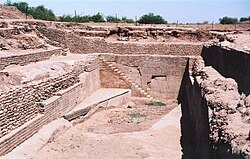
Bisht, who retired as the Joint Director-General of the ASI, said, "The kind of efficient system of Harappans of Dholavira, developed for conservation, harvesting and storage of water speaks eloquently about their advanced hydraulic engineering, given the state of technology in the third millennium BCE."[3] One of the unique features[23] of Dholavira is the sophisticated water conservation system[24] of channels and reservoirs, the earliest found anywhere in the world,[25] built completely of stone. The city had massive reservoirs, three of which are exposed.[26] They were used for storing fresh water brought by rains[24] or to store water diverted from two nearby rivulets.[27] This clearly came in response to the desert climate and conditions of Kutch, where several years may pass without rainfall. A seasonal stream which runs in a north–south direction near the site was dammed at several points to collect water. In 1998, another reservoir was discovered in the site.[28]
The inhabitants of Dholavira created sixteen or more reservoirs[6] of varying size during Stage III.[11] Some of these took advantage of the slope of the ground within the large settlement,[11] a drop of 13 metres (43 ft) from northeast to northwest. Other reservoirs were excavated, some into living rock. Recent work has revealed two large reservoirs, one to the east of the castle and one to its south, near the Annexe.[29]
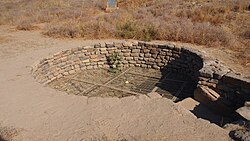
The reservoirs are cut through stone vertically, and are about 7 m (23 ft) deep and 79 m (259 ft) long. They skirt the city, while the citadel and bath are centrally located on raised ground.[24] There is also a large well with a stone-cut trough connecting it to a drain meant for conducting water to a storage tank.[24] The bathing tank had steps descending inwards.[24]
In October 2014, excavation began on a rectangular stepwell which measured 73.4 m (241 ft) long, 29.3 m (96 ft) wide, and 10 m (33 ft) deep, making it three times bigger than the Great Bath of Mohenjedaro.[30]

Seal making[edit | edit source]
Some of the seals found at Dholavira, belonging to Stage III, contained animal only figures, without any type of script. It is suggested[by whom?] that these types of seals represent early conventions of Indus seal making.
Other structures and objects[edit | edit source]

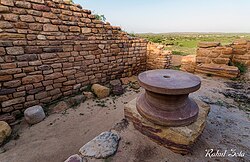
A huge circular structure on the site is believed to be a grave or memorial,[24] although it contained no skeletons or other human remains. The structure consists of ten radial mud-brick walls built in the shape of a spoked wheel.[24] A soft sandstone sculpture of a male with phallus erectus but head and feet below ankle truncated was found in the passageway of the eastern gate.[24] Many funerary structures have been found (although all but one were devoid of skeletons),[24] as well as pottery pieces, terra cotta seals, bangles, rings, beads, and intaglio engravings.[24] The Dancing Girl is one of the most iconic artifacts from the Harappan civilization, discovered at Mohenjo-daro. Believed to date back to around 2500 BCE, this bronze statue stands at about 10.5 centimeters tall and vividly captures the dynamic energy and grace of a youthful dancer.
Hemispherical constructions[edit | edit source]
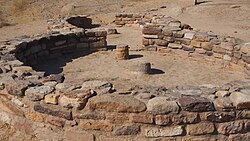
Seven hemispherical constructions were found at Dholavira, of which two were excavated in detail, which were constructed over large rock cut chambers.[11] Having a circular plan, these were big hemispherical elevated mud brick constructions. One of the excavated structures was designed in the form of a spoked wheel. The other was also designed in same fashion, but as a wheel without spokes. Although they contained burial goods of pottery, no skeletons were found except for one grave, where a skeleton and a copper mirror were found.[11] A necklace of steatite beads strung to a copper wire with hooks at both ends, a gold bangle, gold and other beads were also found in one of the hemispherical structures.[11]
The Archaeological Survey of India, which conducted the excavation, opines that these “hemispherical structures remind one of early Buddhist stupas.”[11] and that "the kind of design that is of spoked wheel and unspoked wheel also remind one of the Sararata-chakra-citi and sapradhi-rata-chakra-citi mentioned in the Satapatha Brahmana and Shulba Sutrass".[11]

Findings[edit | edit source]

Painted Indus black-on-red-ware pottery, square stamp seals, seals without Indus script, a huge signboard measuring about 3 m (9.8 ft) in length, containing ten letters of Indus script. One poorly preserved seated male figure made of stone has also been found, comparable to high quality two stone sculptures found at Harappa.[31] Large black-slipped jars with pointed base were also found at this site. A giant bronze hammer, a big chisel, a bronze hand-held mirror, a gold wire, gold ear stud, gold globules with holes, copper celts and bangles, shell bangles, phallus-like symbols of stone, square seals with Indus inscription and signs, a circular seal, humped animals, pottery with painted motifs, goblets, dish-on-stand, perforated jars, Terracotta tumblers in good shape, architectural members made of ballast stones, grinding stones, mortars, etc., were also found at this site.[3] Stone weights of different measures were also found.[32]
Coastal route[edit | edit source]
It is suggested that a coastal route existed linking Lothal and Dholavira to Sutkagan Dor on the Makran coast.[33]
Language and script[edit | edit source]
The Harappans spoke an unknown language and their script has not yet been deciphered. It is believed to have had around 400 basic signs, with many variations.[34] The signs may have stood both for words and for syllables.[34] The direction of the writing was generally from right-to-left.[35] Most of the inscriptions are found on seals (mostly made out of stone) and sealings (pieces of clay on which the seal was pressed down to leave its impression). Some inscriptions are also found on copper tablets, bronze implements, and small objects made of terracotta, stone and faience. The seals may have been used in trade and also for official administrative work.[36] A lot of inscribed material was found at Mohenjo-daro and other Indus Valley Civilisation sites.
Sign board[edit | edit source]

The most significant discoveries at Dholavira were made in one of the side rooms of the northern gateway of the city, and is generally known as the Dholavira Signboard. The Harappans had arranged and set pieces of the mineral gypsum to form ten large symbols or letters on a big wooden board.[37] At some point, the board fell flat on its face. The wood decayed, but the arrangement of the letters survived. The letters of the signboard are comparable to large bricks that were used in nearby walls. Each sign is about 37 cm (15 in) high and the board on which letters were inscribed was about 3 m (9.8 ft) long.[38]
The inscription is one of the longest in the Indus script, with one of the symbols appearing four times, and this and its large size and public nature make it a key piece of evidence cited by scholars arguing that the Indus script represents full literacy. A four sign inscription with large letters on sandstone is also found at this site, considered first of such inscription on sandstone at any of Harappan sites.[3]
In a 2025 paper published by Cambridge Engage, it's proposed that the ten signs on the board can be understood as components of an animal-drawn cart, in order of construction when read from right to left.[39]
References[edit | edit source]
- ↑ Gopinath, P. Krishna (15 July 2017). "Ruins on the Tropic of Cancer". The Hindu.
- ↑ Lal, B. B., & General, F. D. (2010). HOW DEEP ARE THE ROOTS OF INDIAN CIVILIZATION?--An archaeological and Historical Perspective.
- ↑ 3.0 3.1 3.2 3.3 3.4 Subramanian, T. "The rise and fall of a Harappan city". The Archaeology News Network. Archived from the original on 12 August 2017. Retrieved 3 June 2016.
- ↑ "Where does history begin?". 19 October 2017.
- ↑ Centre, UNESCO World Heritage. "Dholavira: A Harappan City - UNESCO World Heritage Centre". whc.unesco.org. Retrieved 3 June 2016.
- ↑ 6.0 6.1 Possehl, Gregory L. (2002). The Indus Civilization: A Contemporary Perspective. Rowman Altamira. p. 17. ISBN 9780759101722. Retrieved 3 June 2016.
- ↑ Sengupta, Torsa, et al. (2019)."Did the Harappan settlement of Dholavira (India) collapse during the onset of Meghalayan stage drought?" in Journal of Quaternary Science, First published: 26 December 2019.
- ↑ Namit Arora (18 January 2021). Indians: A Brief History of A Civilization. Penguin Random House India Private Limited. ISBN 978-93-5305-287-4.
- ↑ Avikunthak, Ashish (31 October 2021). Bureaucratic Archaeology: State, Science and Past in Postcolonial India. Cambridge University Press. ISBN 978-1-316-51239-5.
- ↑ Vasa, Pulin. "Nani Rayan | Read jain books online at Jainebooks.org". jainebooks.org. Retrieved 25 January 2022.
- ↑ 11.00 11.01 11.02 11.03 11.04 11.05 11.06 11.07 11.08 11.09 11.10 "Excavations-Dholavira". Archaeological Survey of India. Archived from the original on 3 September 2011. Retrieved 30 June 2012.
- ↑ Laporte, Luc; Large, Jean-Marc; Nespoulous, Laurent; Scarre, Chris; Steimer-Herbet, Tara (22 August 2022). Megaliths of the World. Archaeopress Publishing Ltd. p. 430. ISBN 978-1-80327-321-1. Retrieved 9 September 2025.
- ↑ "'Long overdue': Indians celebrate as Dholavira gets UNESCO World Heritage tag". The Indian Express. 27 July 2021. Retrieved 28 July 2021.
- ↑ Possehl, Gregory. (2004). The Indus Civilization: A contemporary perspective, New Delhi: Vistaar Publications, ISBN 81-7829-291-2, p.67.
- ↑ Sengupta, Torsa, et al. (2019)."Did the Harappan settlement of Dholavira (India) collapse during the onset of Meghalayan stage drought?"(Supplementary materials), in Journal of Quaternary Science, First published: 26 December 2019.
- ↑ Aqua Dholavira - GUJARAT Magazine Archive. Archaeology.org. Retrieved on 2013-07-28.
- ↑ McIntosh, Jane (2008). The Ancient Indus Valley: New Perspectives. ABC-CLIO. p. 177. ISBN 9781576079072. Retrieved 3 June 2016.
- ↑ Suman, Saket (13 January 2016). "When history meets development". TheStatesman. Retrieved 3 June 2016.
- ↑ McIntosh, Jane (2008). The Ancient Indus Valley: New Perspectives (2008 ed.). ABC-CLIO. p. 174. ISBN 9781576079072. Retrieved 3 June 2016.
- ↑ McIntosh, Jane (2008). The Ancient Indus Valley: New Perspectives. ABC-CLIO. p. 224. ISBN 9781576079072. Retrieved 3 June 2016.
- ↑ McIntosh, Jane (2008). The Ancient Indus Valley: New Perspectives. ABC-CLIO. p. 226. ISBN 9781576079072. Retrieved 3 June 2016.
- ↑ Wheeler, Mortimer (2 September 1968). The Indus Civilization: Supplementary Volume to the Cambridge History of India (1968 ed.). CUP Archive. p. 33. ISBN 9780521069588. Retrieved 3 June 2016.
- ↑ Singh, Upinder (2008). A History of Ancient and Early Medieval India: From the Stone Age to the 12th Century. New Delhi: Pearson Education India. pp. 155 bottom. ISBN 978-813-17-1120-0.
- ↑ 24.00 24.01 24.02 24.03 24.04 24.05 24.06 24.07 24.08 24.09 "Dholavira excavations throw light on Harappan civilisation". United News of India. Indian Express. 25 June 1997. Archived from the original on 18 September 2012. Retrieved 15 June 2012.
- ↑ Centre, UNESCO World Heritage. "Dholavira: A Harappan City - UNESCO World Heritage Centre". whc.unesco.org.
- ↑ McIntosh, Jane (2008). The Ancient Indus Valley : New Perspectives. Santa Barbara, California: ABC-CLIO. p. 84. ISBN 978-157-60-7907-2.
- ↑ Singh, Upinder (2008). A History of Ancient and Early Medieval India: From the Stone Age to the 12th Century. New Delhi: Pearson Education India. p. 155. ISBN 978-813-17-1120-0.
- ↑ "'Oldest dam' found". Rediff.com. 25 April 1998. Retrieved 8 November 2018.
- ↑ Possehl, Gregory. (2004). The Indus Civilization: A contemporary perspective, New Delhi: Vistaar Publications, ISBN 81-7829-291-2, p.69.
- ↑ "5,000-year-old Harappan stepwell found in Kutch, bigger than Mohenjodaro's". The Times of India Mobile Site. 8 October 2014. Retrieved 3 January 2015.
- ↑ Possehl, Gregory L. (2002). The Indus civilization : a contemporary perspective (2nd print ed.). Walnut Creek, CA: AltaMira Press. p. 124. ISBN 9780759101722.
- ↑ Singh, Upinder (2008). A History of Ancient and Early Medieval India : from the Stone Age to the 12th century. New Delhi: Pearson Education. p. 163. ISBN 9788131711200.
- ↑ Singh, Upinder (2008). A History of Ancient and Early Medieval India : from the Stone Age to the 12th century. New Delhi: Pearson Education. p. 167. ISBN 9788131711200.
- ↑ 34.0 34.1 Parpola, Asko (2005) Study of the Indus Script. 50th ICES Tokyo Session.
- ↑ Mahadevan, Iravatham (4 February 2007). "Towards a scientific study of Indus Script". The Hindu. Archived from the original on 6 February 2007. Retrieved 30 June 2012.
- ↑ Kenoyer, Jonathan Mark. Indus Cities, Towns, and Villages. American Institute of Pakistan Studies, Islamabad. 1998
- ↑ Kenoyer, Jonathan Mark. Ancient Cities of the Indus Valley Civilisation. Oxford University Press. 1998
- ↑ Possehl, Gregory. (2004). The Indus Civilization: A contemporary perspective, New Delhi: Vistaar Publications, ISBN 81-7829-291-2, p.70.
- ↑ Pollard, Max Freedom (14 November 2025). "Indus Signs as Merchant Marks: Corpus Structure, Context, and Viability". Cambridge Open Engage (Working paper). Cambridge University Press. doi:10.33774/coe-2025-n0cxj. Retrieved 19 November 2025.
External links[edit | edit source]
- Excavations at Dholavira in Archaeological Survey of India website
- Dholavira Pictures by Archaeological Survey of India website
- Jurassic Park: Forest officials stumble upon priceless discovery near Dholavira; Express news service; 8 Jan 2007; Indian Express Newspaper
- ASI's effort to put Dholavira on World Heritage map hits the roadblock; by Hitarth Pandya; 13 Feb 2009; Indian Express Newspaper
- ASI to take up excavation in Kutch's Khirasara; by Prashant Rupera, TNN; 2 November 2009; Times of India
| Andhra Pradesh |
|  |
|---|---|---|
| Arunachal Pradesh | ||
| Assam | ||
| Bihar | ||
| Chhattisgarh | ||
| Goa |
| |
| Gujarat | ||
| Haryana | ||
| Himachal Pradesh | ||
| Jammu and Kashmir | ||
| Jharkhand | ||
| Karnataka | ||
| Kerala | ||
| Madhya Pradesh | ||
| Maharashtra | ||
| Odisha | ||
| Punjab | ||
| Sikkim | ||
| Tamil Nadu | ||
| Telangana | ||
| Tripura | ||
| Uttarakhand | ||
| Uttar Pradesh | ||
| West Bengal | ||
| North |  | |
|---|---|---|
| East | ||
| Northeast | ||
| South | ||
| Central | ||
| West | ||
- Pages using the JsonConfig extension
- Articles containing Gujarati-language text
- Populated places established in the 3rd millennium BC
- Populated places disestablished in the 2nd millennium BC
- Buildings and structures completed in the 29th century BC
- Buildings and structures demolished in the 15th century BC
- World Heritage Sites in India
- 1967 archaeological discoveries
- Former populated places in India
- Archaeological sites in Gujarat
- Tourist attractions in Kutch district
- History of Kutch
- Monuments of National Importance in Gujarat
- Indus Valley Civilisation sites
- Uninhabited islands of India
- Islands of India