





Added info Tags: Visual edit Mobile edit Mobile web edit |
further expanded information after review also and fixed typos |
||
| Line 1: | Line 1: | ||
{{pp|small=yes}} | |||
{{Short description|Indo-Aryan ethno-linguistic group of Nepal and India}} | {{Short description|Indo-Aryan ethno-linguistic group of Nepal and India}} | ||
{{About|medieval and modern day Khas people|ancient Indo-Aryan group of same name|Khasas|medieval kingdom|Khasa Malla kingdom|native language of Khas people|Khas language}} | |||
{{About|medieval and modern day Khas people|ancient | {{distinguish|text = [[Khasi people]], the neighboring Austroasiatic ethnolinguistic group in the east or [[Khasia (clan)]], clan found in the Indian state of Gujarat}} | ||
{{use dmy dates|cs1-dates=ly|date=September 2023}} | |||
{{Infobox ethnic group | {{Infobox ethnic group | ||
| group = Khas | | group = Khas<br>Khashiya | ||
| native_name = | | native_name = {{nativename|ne|खस}} | ||
| | | image = Deuda dancers.jpg | ||
| image = | | image_caption = Portrait of Khas women holding hands and performing [[Deuda (genre)|Deuda]] | ||
| | | population = '''{{Circa|15.3 million|lk=yes}}'''<ref name=ethnologue1>{{cite web|url=http://www.ethnologue.com/18/language/npi/|title=Nepali (npi)|work=Ethnologue|access-date=6 October 2016}}</ref> | ||
| population = '''{{Circa| | | regions = [[Nepal]], [[India]], [[Bhutan]] | ||
| regions = [[Nepal]], [[India]], [[Bhutan | | languages = [[Nepali language|Nepali]] | ||
| languages = [[Nepali language|Nepali | | rels = [[Hinduism]] | ||
| rels = [[ | | related = [[Kumaoni people|Kumaoni]], [[Garhwali people|Garhwali]], [[Pahari people (Nepal)|Pahari]] and other [[Indo-Aryans]] | ||
| related = [[Kumaoni people]], [[Garhwali people]], [[Pahari people (Nepal)|Pahari | |||
| footnotes = | | footnotes = | ||
}} | }} | ||
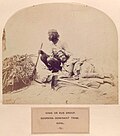
[[File:Khas or Kus group, Goorkha, dominant tribe, Nipal.jpg|thumb|Khas Tribe of Nepal]] | |||
'''Khas peoples''' or '''Khas Tribes''', ({{IPAc-en|Lang|k|ɑː|s}}; {{langx|ne|खस}}) popularly known as '''Khashiya'''<ref>{{Cite web |title=Bhunda festival in Spail, a relic of the tribal past |url=https://www.tribuneindia.com/news/features/bhunda-festival-in-spail-a-relic-of-the-tribal-past/#google_vignette |access-date=2025-02-06 |website=The Tribune |language=en}}</ref>{{#tag:ref|'''Khas Arya''' is popularly used terminology over the various media to denote the group.<ref name="Khadka">{{Cite news |last=Khadka |first=Suman |url=http://kathmandupost.ekantipur.com/printedition/news/2015-02-25/drawing-caste-lines.html |title=Drawing caste lines |date=25 Feb 2015 |newspaper=[[The Kathmandu Post]]}}</ref><ref name="thehimalayantimes.com">{{cite web |url=https://thehimalayantimes.com/nepal/khas-arya-quota-provision-civil-services-opposed/ |title=Khas Arya quota provision in civil services opposed |date=10 November 2017 |website=thehimalayantimes.com |access-date=1 May 2018}}</ref><ref name="economist.com">{{cite news |url=https://www.economist.com/news/asia/21731658-good-government-might-be-too-much-hope-nepals-election-may-last-bring-stability |title=Nepal's election may at last bring stability |newspaper=The Economist |access-date=1 May 2018}}</ref><ref name="PM briefs international community">{{cite news |url=http://kathmandupost.ekantipur.com/ampnews/2018-03-28/pm-briefs-international-community.html |title=PM briefs international community |newspaper=[[The Kathmandu Post]] |access-date=6 April 2018}}</ref><ref name="Quotable quota">{{cite web |url=https://www.nepalitimes.com/from-the-nepali-press/quotable-quota/ |title=Quotable quota |website=Nepali Times |date=23 March 2018 |access-date=1 May 2018}}</ref><ref name="indianexpress.com">{{cite web |url=http://indianexpress.com/article/opinion/columns/kp-oli-swearing-in-ceremony-nepal-elections-5119820/ |title=Next Door Nepal: Another chink in the wall |date=2 April 2018 |website=indianexpress.com |access-date=1 May 2018}}</ref><ref name="Oli in balancing avatar">{{cite web |url=http://www.myrepublica.com/news/39123/?categoryId=81 |title=Oli in balancing avatar |website=myrepublica.com |access-date=1 May 2018}}</ref><ref name="asia.nikkei.com">{{cite web |url=https://asia.nikkei.com/Politics/Nepal-seeks-unity-from-its-first-local-elections-in-20-years |title=Nepal seeks unity from its first local elections in 20 years |website=Nikkei Asian Review |access-date=1 May 2018}}</ref><ref name="thewire.in">{{cite web |title=Lessons for India From Nepal's History of Banning Cow Slaughter |website=The Wire |url=https://thewire.in/politics/lessons-for-india-from-nepal-history-of-cow-slaughter |access-date=1 May 2018}}</ref><ref name="kathmandupost.ekantipur.com">{{cite news |url=http://kathmandupost.ekantipur.com/news/2018-04-07/what-does-high-caste-chauvinism-look-like.html |title=What does high caste chauvinism look like? |newspaper=[[The Kathmandu Post]] |date=7 April 2018 |access-date=1 May 2018}}</ref> The [[Constitution of Nepal]] considers the [[Chhetri|Kshetri]]s, [[Thakuri]]s, and [[Sannyasa|Sanyasis]] (Dashnami) as "Khas" for the electoral purposes.<ref name="Constitution"/>|name="khas arya"|group="nb"}} are an [[Indo-Aryan peoples|Indo-Aryan]] [[ethno-linguistic group]] native to the [[Himalayas|Himalayan region]] of [[South Asia]], in what is now the South Asian country of [[Nepal]], as well as the [[Indian states]] of [[Uttarakhand]], [[Himachal Pradesh]], [[West Bengal]], [[Assam]] and [[Sikkim]].{{#tag:ref|Sociologist R.N. Saksena identified the [[Kanet]]s of [[Kangra Valley|Kangra]] and [[Garhwal region|Garhwal]], the Khosa of [[Jaunsar-Bawar]] and the bulk population of [[Garhwal region|Garhwal]] and [[Kumaon region|Kumaon]] (referred as "Khasia") as being descended from the [[Khasas]].{{sfn|Saksena|2019|p=109}} Historian Sir [[Marc Aurel Stein]] further identified the modern [[Khakha|Khakha Rajput]] community as the Khas people in the [[Azad Kashmir]] state of [[Pakistan]]{{sfn|Stein|1989|p=433}} and the modern [[Bomba (tribe)|Bomba clan]] in the [[Karnah]] region of [[Jammu and Kashmir (union territory)|Jammu and Kashmir]].{{sfn|Stein|1989|p=434}}|name="Khakha Rajputs-Khasha Rajput"|group="nb"}} Khas consists of many subtribes like [[Chhetri|Kshetri]], [[Thakuri]], [[Bahun]] and [[Sannyasa|Sanyasis]] and all spread across the [[Himalayas]].<ref name="Khadka">{{Cite news |last=Khadka |first=Suman |url=http://kathmandupost.ekantipur.com/printedition/news/2015-02-25/drawing-caste-lines.html |title=Drawing caste lines |date=25 Feb 2015 |newspaper=[[The Kathmandu Post]]}}</ref><ref name="thehimalayantimes.com">{{cite web |url=https://thehimalayantimes.com/nepal/khas-arya-quota-provision-civil-services-opposed/ |title=Khas Arya quota provision in civil services opposed |date=10 November 2017 |website=thehimalayantimes.com |access-date=1 May 2018}}</ref><ref name="economist.com">{{cite news |url=https://www.economist.com/news/asia/21731658-good-government-might-be-too-much-hope-nepals-election-may-last-bring-stability |title=Nepal's election may at last bring stability |newspaper=The Economist |access-date=1 May 2018}}</ref><ref name="PM briefs international community">{{cite news |url=http://kathmandupost.ekantipur.com/ampnews/2018-03-28/pm-briefs-international-community.html |title=PM briefs international community |newspaper=[[The Kathmandu Post]] |access-date=6 April 2018}}</ref><ref name="Quotable quota">{{cite web |url=https://www.nepalitimes.com/from-the-nepali-press/quotable-quota/ |title=Quotable quota |website=Nepali Times |date=23 March 2018 |access-date=1 May 2018}}</ref><ref name="indianexpress.com">{{cite web |url=http://indianexpress.com/article/opinion/columns/kp-oli-swearing-in-ceremony-nepal-elections-5119820/ |title=Next Door Nepal: Another chink in the wall |date=2 April 2018 |website=indianexpress.com |access-date=1 May 2018}}</ref><ref name="Oli in balancing avatar">{{cite web |url=http://www.myrepublica.com/news/39123/?categoryId=81 |title=Oli in balancing avatar |website=myrepublica.com |access-date=1 May 2018}}</ref><ref name="asia.nikkei.com">{{cite web |url=https://asia.nikkei.com/Politics/Nepal-seeks-unity-from-its-first-local-elections-in-20-years |title=Nepal seeks unity from its first local elections in 20 years |website=Nikkei Asian Review |access-date=1 May 2018}}</ref><ref name="thewire.in">{{cite web |title=Lessons for India From Nepal's History of Banning Cow Slaughter |website=The Wire |url=https://thewire.in/politics/lessons-for-india-from-nepal-history-of-cow-slaughter |access-date=1 May 2018}}</ref><ref name="kathmandupost.ekantipur.com">{{cite news |url=http://kathmandupost.ekantipur.com/news/2018-04-07/what-does-high-caste-chauvinism-look-like.html |title=What does high caste chauvinism look like? |newspaper=[[The Kathmandu Post]] |date=7 April 2018 |access-date=1 May 2018}}</ref>{{sfn|Hagen|Thapa|1998|p=114}} | |||
According to the [[Constitution of Nepal]], [[Bahun]], [[Chhetri|Kshetri]]s, [[Thakuri]]s, and [[Sannyasa|Sanyasis]] (Dashnami) who are citizens of Nepal should be considered as "Khas Arya" for electoral purposes.<ref name="Constitution">{{cite web |title=Part-8 Federal Legislature |publisher=Nepal Law Commission |url=https://www.lawcommission.gov.np/en/archives/888 |access-date=2019-08-05 |archive-url=https://web.archive.org/web/20210428204738/https://www.lawcommission.gov.np/en/archives/888 |archive-date=2021-04-28}}</ref> | |||
Historically, Khas were the speakers of an ancient ''Khas language'' from the [[Indo-Aryan language]] family{{sfn|Richard Burghart|1984|pp=118-119}}{{sfn|Jain|Cardona|2007|p=543}} and the earliest recorded speakers of the [[Western Pahari languages]].{{sfn|Saksena|2019|p=109}} The large portion of the Indo-Aryan speakers throughout lower Himalayas were the Masto people.{{sfn|Saklani|1998|p=71}} An [[Indo-Aryan migrations|intrusion]] of this tribe from the [[Western Himalayas|Western and Northwestern Himalayas]] into Central Himalayas is substantiated by the early linguistic evidences related to the [[Nepali language]].{{sfn|Jain|Cardona|2007|p=543}} They were also known as '''Parbatiyas/Parbates''' and are currently known as '''Paharis/Pahadis.''' (literally, "from the hills"). They were also referred to as '''Yartse''' in Tibet and are also known as Khasan by Bhotia people. The term ''Khas'' has now become obsolete, as the Khas people have adopted communal identities because of the negative stereotypes associated with the term ''Khas''. In Nepal the native speaker of [[Nepali language]] are known as Khas people.{{sfn|William Brook Northey|C. J. Morris|1928|p=123}}{{sfn|K. S. Singh|2005|p=851}}{{sfn|Dor Bahadur Bista|1991|p=48}} | |||
==Origin== | ==Origin== | ||
{{Main|Khasas}} | |||
{{Main|Khasas (Mahabharata)}} | |||
They have been connected to the [[Khasas]] mentioned in the ancient Hindu literature.{{sfn|John T Hitchcock|1978|pp=112-119}} Historian Bal Krishna Sharma and [[Dor Bahadur Bista]] speculates that the Khas | ===Indo-Aryan origin theories=== | ||
They have been connected to the [[Khasas]] mentioned in the ancient Hindu literature.{{sfn|John T Hitchcock|1978|pp=112-119}} Irish linguist Sir [[G.A. Grierson]] asserted that "..the great mass of the [[Northern Indo-Aryan languages|Aryan speaking population]] of the lower [[Himalaya]] from [[Kashmir]] to [[Darjeeling]] is inhabited by tribes descended from the ancient [[Khasas (Mahabharata)|Khasas of Mahabharata]]."{{sfn|Saklani|1998|p=71}} Historian Bal Krishna Sharma and [[Dor Bahadur Bista]] speculates that the Khas people were of [[Proto-Indo-Europeans|Indo-European origin]].{{sfn|Sharma|1999|p=181}}{{sfn|Dor Bahadur Bista|1991|p=48}} Historian [[Baburam Acharya]] speculates that Khas are a sub-clan of Aida, an "Aryas” [[clan]] that originated at Idavritt (modern day [[Kashmir]] to [[Nepal]]).{{sfn|Acharya|1975|p=199}}{{#tag:ref|Historian [[Baburam Acharya]] speculates that in the 3rd millennium BCE., there were two clans of '''[[Aryan|Arya]]''' in the northern [[Indian subcontinent]]; ''Aiḍa'' and ''Mānava''. ''Aiḍa'' who were named after their homeland ''Iḍavritt'' (modern day [[Kashmir]]), settled over [[Punjab|Panjab]] and [[Gangetic plain|Ganga-Jamuna plain]] while ''Mānava'' settled over [[Awadh]] region. [[Chandravanshi]] kings like [[Bharata (Mahabharata)|Bharata]] and [[Yudhisthir]] belonged to ''Aiḍa'' while [[Suryavansha|Suryavanshi]] kings like [[Ramachandra]] belonged to ''Mānava''. Later, ''Aiḍa'' built dominion over [[Magadha (Mahajanapada)|Magadh]] while ''Mānava'' had dominion over [[Videha]].{{sfn|Acharya|1975|p=199}}|name="arya clan"|group="nb"}} Khas were living in the ''Idavaritt'' in the 3rd millennium BCE. and the original meaning of the term ''Khas'' was [[Raja]] or [[Kshatriya]] (Yoddha).{{sfn|Acharya|1975|p=199}} He further speculates that Kashmir has been named from its local residents Khas as '''Khasmir'''.{{sfn|Acharya|1975|p=199}} In the 2nd millennium B.C.E., one group of Khas migrated towards [[Iran]] while the other group migrated east of [[Sutlej river]] settling only in the hill regions up to [[Bheri River]].{{sfn|Acharya|1975|p=200}} Historian Balkrishna Pokhrel contends that Khas were not the [[Vedic Aryan]]s but [[Indo-Iranian people|Aryans]] of the latter periods like the [[Gurjaras|Gurjara]], [[Darada]], [[Saka|Shaka]], and [[Pallava]].{{sfn|Pokhrel|1973|p=229}} He further asserts that post-Vedic Aryans were akin to Vedic Aryans in terms of [[Indo-Aryan languages|language]] and culture.{{sfn|Pokhrel|1973|p=229}} Irish linguist Sir [[George Abraham Grierson]] asserted that the Khasas were one of the warrior "Kshatriya tribe of Aryan origin" with linguistic connections to both [[Sanskrit]] and [[Iranian languages]], who lost claim to Vedichood due to non-observance of Vedic rules.{{#tag:ref|...in the extreme northwest of India, on the [[Hindu Kush]] and mountainous tracts to the south, and in Western Punjab, there was a group of tribes, one of which was called '''Khasa''', which were looked upon as Kshatriyas of [[Indo-Aryan peoples|Aryan]] origin. These spoke a language closely allied with [[Sanskrit]], but with a vocabulary partly agreeing with that of the [[Iranic peoples|Eranian]] [[Avesta]]. They were considered to have lost their claim to considerations as [[Aryans]], and to have become [[Mlechha]]s, or barbarians, owing to their non-observance of the rules for drinking and eating by [[Vedic people|Sanskritic peoples]] of India. Khasas were warlike tribe, and were well known to classical writers, who noted, as their special home, the [[Indian Caucasus]] of [[Pliny the Elder|Pliny]].{{sfn|Grierson|1916|p=17}}{{sfn|Saksena|2019|pp=108-109}}|group="nb"|name="Grierson on Khasas"}} Roman geographer [[Pliny The Elder]] described the ancient Khasas/Khasiras (referred as 'Casiri') as one of the Indian ethnicity.{{sfn|Grierson|1916|p=3}} | |||
===Saka origin theories=== | |||
Historian [[Rahul Sankrityayan]] proposes the origin of the Khasha tribe from the [[Saka|Shaka tribe]] and further identifies [[Khasas|Khashas]] and [[Saka|Shaka]]s to have been two different waves of the same race.{{sfn|Handa|2002|p=22}} The [[Indo-Scythian|Shakas were in Indian subcontinent]] before the first century BCE while the Khashas spread over the [[Himalayas]] and extensively populated the mountainous regions of Uttarakhand{{sfn|Handa|2002|p=22}} and the later waves of Shakas got diffused into them.{{sfn|Handa|2002|p=22}} Historian Omchand Handa contends that the "sun worship" among Khashas is a Shaka legacy and perhaps the standing [[Surya]] images with long boots which was commonly found at the Khasha belt of Himalaya. Some examples of it are the Bara-Aditya at [[Katarmal]] and [[Surya]] images of [[Baijnath Temple Complex|Baijnath]], [[Bageshwar]] and [[Dwarahat]].{{sfn|Handa|2002|p=22}} | |||
== History == | == History == | ||
Khasas are believed | ===Medieval history in Nepal and Uttarakhand=== | ||
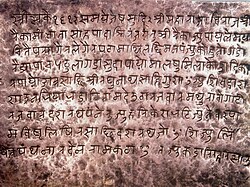
[[File:कर्तिखम्म.jpg|thumb|Stone script of Damupal near Kartikhamba in Dailekh dated 1038 (981 A.D.) is claimed to be the first stone script in Nepali Language.<ref>{{Cite book|last=Prasai|first=Dirgha Raj|chapter=History Of Nepali Language and its importance|title=Rising Nepal|date=27 Feb 2011|via=Educatenepal|url=https://www.educatenepal.com/article_archive/display/history-of-nepali-language-and-its-importance|access-date=2022-11-30|archive-url=https://web.archive.org/web/20230510112356/https://www.educatenepal.com/article_archive/display/history-of-nepali-language-and-its-importance|archive-date=2023-05-10|url-status=dead}}</ref>]] | |||
Khasas are believed to have arrived in the western reaches of Nepal at the beginning of first-millennium B.C.{{sfn|Dor Bahadur Bista|1991|p=15}} or middle of first-millennium A.D.{{sfn|Sharma|1999|p=112}} from the north-west. The earliest linguistic evidences related to [[Nepali language]] also substantiates the linguistic intrusion of an Indo-Aryan speaking Khasa tribe from the [[Western Himalayas|West or Northwest Himalayas]] into Central Himalayas at the present day regions of Western Nepal.{{sfn|Jain|Cardona|2007|p=543}} It is likely that they absorbed people from different ethnic groups during this immigration.{{sfn|John T Hitchcock|1978|p=113}} They had extensively populated the mountainous regions of [[Uttarakhand]]{{sfn|Handa|2002|p=22}} and they had entirely dominated the inner Himalayan belt up to Nepal.{{sfn|Handa|2002|p=24-25}} Previously, Khashas had strongly established themselves from [[Afghanistan]] to Nepal from ancient period and as per internal evidences, they managed the village level theocratic republics like Gram-Rajya and Mandals under various local clans and identities.{{sfn|Handa|2002|p=22}} | |||
The ruling [[Katyuri dynasty]] (700-1065 CE) of [[Kumaon region|Kumaon]] who were of Khas origin,{{sfn|Handa|2002|p=22}} was one of the ruling houses of [[Joshimath]] that claimed the [[sovereignty]] over other Gram Rajyas of the entire territory.{{sfn|Handa|2002|p=24}} The Katyuris ruled from [[Joshimath]] in the [[Alaknanda River|Alaknanda]] Valley and later they shifted their capital to [[Baijnath, Uttarakhand|Baijnath]].{{sfn|Handa|2002|pp=26-28}} They have also been connected to the medieval [[Khasa Malla kingdom]].{{sfn|John T Hitchcock|1978|pp=112-119}} The Khasa kings of West Nepal-Uttarakhand formed the famous Malla Kingdom, which ruled Humla from the eleventh century before collapsing and splintering into local chiefdoms during the fourteenth century.<ref>{{cite book |last1=Kelly |first1=Thomas L. |last2=Dunham |first2=V. Carroll |title=Hidden Himalayas |date=March 2001 |publisher=Abbeville Press |location=New York |isbn=9780789207227 |url=http://www.abbeville.com/pdf/0789207222.pdf |access-date=2016-06-14 |archive-url=https://web.archive.org/web/20060324052621/http://www.abbeville.com/pdf/0789207222.pdf |archive-date=2006-03-24 |url-status=dead}}</ref> In the initial phase, majority of Khas people became Brahmins and others became Kshatriyas.{{sfn|Sharma|1999|p=112}} | |||
[[File:Mandhata Shahi- SAKE-1612.jpg|thumb|Copper Inscription by King of [[Doti]], ''Raika'' Mandhata Shahi at [[Saka Era]] 1612 (शाके १६१२ | ===History in Kashmir === | ||
Until the 19th century, the [[Gorkha Kingdom|Gorkhali]] | [[File:Vishnu and Lakshmi Supported by Garuda, 11th century CE, Ancient Kingdom of Kashmir, Jammu and Kashmir.jpg|thumb|[[Vishnu]] and [[Lakshmi]] [[Garuda]] art at the time of the Khasha Lohara dynasty, 11th century CE, Jammu and Kashmir.]] | ||
The ruling [[Lohara dynasty]] (1003-1320 CE) of [[Kashmir]] were from the Khas tribe as per the 12th century text ''[[Rajatarangini]]'' written by the local Kashmiri Pandit historian [[Kalhana]].{{sfn|Stein|1989|p=433}}{{sfn|Thakur|1990|p=287}} Furthermore, [[Rajatarangini]] describes the rulers of Rajapuri (modern [[Rajauri]]) as the "lord of the Khasas".{{sfn|Thakur|1990|p=287}}{{sfn|Sharma|2019|p=706}} The Khasa chiefs of Rajapuri freely intermarried with [[Kshatriya]] rulers of [[Kashmir]] while the Khasa chief of Lohara, Simharaja, married a daughter of [[Hindu Shahi|Shahi Kings of Kabul]].{{sfn|Thakur|1990|p=287}} The descendants of the royal family of Rajauri later became [[Muslim Rajput]] chiefs and they retained the rulership of the territory till 19th century.{{sfn|Stein|1989|p=433}} The inhabitants of [[Karnah]] region in northwestern Kashmir, were Khasas and they were represented by the modern [[Bomba (tribe)]]{{sfn|Stein|1989|p=434}} who independently ruled the northwestern Kashmir till the [[Misl#Battles fought by Sikhs|Sikh conquest of Kashmir]].{{sfn|Stein|1989|p=434}} There was also an independent Khasa lord at the castle located in the foot of [[Banihal Pass|Banahal Pass]] in the territory of Visalata{{sfn|Stein|1989|p=433}} and Dengapala ("Thakkura Dengapala"{{sfn|Stein|1989|p=432}}) was a Khasa chief at the banks of Chandrabhaga (modern [[Chenab river]]).{{sfn|Stein|1989|p=16}} | |||
===Modern history in Nepal=== | |||
[[File:Mandhata Shahi- SAKE-1612.jpg|thumb|Copper Inscription by King of [[Doti]], ''Raika'' Mandhata Shahi at [[Saka Era]] 1612 ({{Lang|ne|शाके १६१२}}; 1747 [[Bikram Samvat]] ({{Circa|1690 – 1691}}) in old [[Khas language]] using [[Devanagari]] script]] | |||
Until the 19th century, the [[Gorkha Kingdom|Gorkhali]] referred to their country as ''Khas Desh'' (Khas country).{{sfn|Richard Burghart|1984|p=107}} As they annexed the various neighboring countries (such as Nepal or Newa of the [[Newar people]]) to the Gorkha kingdom, the terms such as ''Khas'' and ''Newar'' ceased to be used as the names of countries. The 1854 legal code (''Muluki Ain''), promulgated by the Nepali Prime Minister [[Jung Bahadur Rana]], himself a Khas,{{sfn|Dor Bahadur Bista|1991|p=37}} no longer referred to ''Khas'' as a country, rather as a ''[[jāti|jāt]]'' (species or community) within the Gorkha kingdom.{{sfn|Richard Burghart|1984|p=117}} | |||
[[File:Khas or pre-gorkha kingdom.jpg|thumb|Khas Kingdom]] | [[File:Khas or pre-gorkha kingdom.jpg|thumb|Khas Kingdom]] | ||
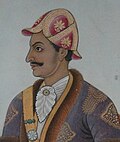
[[File:Bhimsen Thapa of Nepal (cropped).jpg|thumb|[[Mukhtiyar]] [[Bhimsen Thapa]], the widely accepted first Prime Minister of Nepal]] | [[File:Bhimsen Thapa of Nepal (cropped).jpg|thumb|[[Mukhtiyar]] [[Bhimsen Thapa]], the widely accepted first Prime Minister of Nepal]] | ||
Jung Bahadur also re-labeled | The [[Shah dynasty]] of the Gorkha Kingdom, as well as the later prime-ministerial [[Rana dynasty]], spoke the [[Khas language]] (now called the Nepali language). However, they claimed to be Rajputs of western Indian origin, rather than the native Khas Kshatriyas.{{sfn|Richard Burghart|1984|p=119}} Since outside Nepal, the Khas social status was seen as inferior to that of the Rajputs, the rulers started describing themselves as natives of the Hill country, rather than that of the Khas country. Most people, however, considered the terms ''Khas'' and ''Parbatiya'' (''Pahari/Pahadi'' or Hill people) as synonymous.{{sfn|Richard Burghart|1984|p=107}} | ||
Jung Bahadur also re-labeled the Khas ''jāt'' as [[Chhetri]] in present-day Nepal.{{sfn|Richard Burghart|1984|p=119}} Originally, the [[Brahmin]] immigrants from the [[Gangetic plain|plains]] considered the Khas as low-caste because of the latter's neglect of high-caste taboos (such as alcohol abstinence).{{sfn|Susan Thieme|2006|p=83}} The upper-class Khas people commissioned the [[Bahun]] (Brahmin) priests to initiate them into the high-caste Chhetri order and adopted high-caste manners. Other Khas families who could not afford to (or did not care to) pay the Bahun priests also attempted to assume the Chhetri status but were not recognized as such by others. They are now called Matwali (alcohol-drinker Khas) Chhetris.{{sfn|Dor Bahadur Bista|1991|p=48}} Because of the adoption of the ''Chhetri'' identity, the term ''Khas'' is rapidly becoming obsolete.{{sfn|William Brook Northey|C. J. Morris|1928|p=123}} According to [[Dor Bahadur Bista]] (1991), "the Khas have vanished from the ethnographic map of Nepal".{{sfn|Dor Bahadur Bista|1991|p=48}} | |||
Because of the adoption of the ''Chhetri'' identity, the term ''Khas'' is rapidly becoming obsolete.{{sfn|William Brook Northey|C. J. Morris|1928|p=123}} According to [[Dor Bahadur Bista]] (1991), "the Khas have vanished from the ethnographic map of Nepal".{{sfn|Dor Bahadur Bista|1991|p=48}} | |||
==Modern== | |||
===Nepal=== | |||
[[File:Jangabahadur Horse Riding Statue.jpg|thumb|[[Jang Bahadur Kunwar Rana|Jang Bahadur Rana]], de-facto ruler of Nepal and a patriarch of historical [[Rana dynasty]] (1846-1951)]] | |||
Modern-day Khas people are referred to as Hill Brahmin ([[Bahun]]), Hill Kshatriya ([[Thakuri]]/[[Chhetri]]) and Hill Dalit.{{sfn|John T Hitchcock|1978|pp=116-119}} Further, historian Pokharel adds the [[Gharti]], [[Damai]], [[Kami (caste)|Kami]], [[Sarki (ethnic group)|Sarki]], Hudka, Tamote, [[Gandarbha|Gaine]] and [[Badi people|Badi]] to the Khas communities.{{sfn|Pokhrel|1973|p=229}} In modern times, Khas people are popularly referred by the term "Khas Arya".<ref name="Khadka"/> | |||
===India-Pakistan=== | |||
In [[Kumaon District|Kumaon]] and [[Garhwal District|Garhwal]] regions of [[Uttarakhand]] in India, too, the term ''Khas'' has become obsolete. The Khas people of Kumaon termed as Kumaoni khash jimdar, after being elevated to the Rajput status by the [[Chand kings]]. During Chand rule in Kumaon, Khas and Rajput were differentiated by their sacred thread, Khas were allowed to wear only 3 thread (3 palli)sacred thread whereas Rajput used to wear 6 palli sacred thread.The term Khas is almost obsolete, and people resent being addressed as Khas because of the negative stereotypes associated with this term.{{sfn|K. S. Singh|2005|p=851}} Furthermore, the [[Kanet]]s of [[Kangra Valley|Kangra]] and [[Garhwal region|Garhwal]], Khasa of [[Jaunsar-Bawar]] and the bulk population of [[Garhwal region|Garhwal]] and [[Kumaon region|Kumaon]] (referred as "Khasia") are descended from the [[Khasas]].{{sfn|Saksena|2019|p=109}} Generally, the Khas people are referred as [[Rajput]]s or [[Kanet]]s in the [[Himachal Pradesh]].{{sfn|Manorma Sharma|1998|p=113}} According to E.T. Atkinson, the [[Jaunsar-Bawar]] is the representative Khasiya tract and it | |||
{{Blockquote|"..forms a very important links between the almost Hinduized Khasiyas of Kumaon and their [[Muslim Rajputs|brethren converts to Islam]] on the ethnical frontier of the mountains of [[Hindu Kush]] and apparently gives customs and practices of '''Khasiya race''' in full force at the present day which distinguished them thousands of years ago."{{sfn|Saksena|2019|p=109}}}} | |||
Historian Sir [[Marc Aurel Stein]] identified the modern [[Khakha|Khakha Rajputs]] of [[Azad Kashmir]] as the descendants of Khasas mentioned in the ''[[Rajatarangini]]''.{{sfn|Thakur|1990|p=287}}{{sfn|Stein|1989|p=433}} The Khasa tribe in [[Karnah]] region in northwestern Kashmir were represented by the modern [[Bomba (tribe)]].{{sfn|Stein|1989|p=434}} | |||
==Communities== | ==Communities== | ||
Historian Balkrishna Pokhrel writes the communities or caste in Khas group were hill [[Bahun]], [[Chhetri]], [[Thakuri dynasty|Thakuri]],<ref>[[Sannyasa|Sannyasi]]</ref> [[Gharti]], [[Damai]], [[Kami (caste)|Kami]], [[Sarki (ethnic group)|Sarki]], Hudka, Tamote, [[Gandarbha|Gaine]] and [[Sunar]], [[Badi (caste)|badi]], [[Lohar (caste)|luhar]], parki etc .{{sfn|Pokhrel|1973|p=229}} The tribal designation [[Khasas|Khas]] refers to in some contexts only to the alcohol drinker Khas group, i.e. Thakuri and Chhetri, but in other contexts may also include the low status (occupational Khas groups such as [[Kami (caste)|Kāmi]] (blacksmiths), [[Damai|Damāi]] (tailors), and [[Sarki (ethnic group)|Sārki]] (shoemakers and leather workers).{{sfn|Whelpton|2005|p=31}} Khas people are addressed with the term ''Khayan'' or ''Parbatiya''{{sfn|Pokhrel|1973|p=229}} or ''Partyā'', ''Parbaté'' meaning hill-dweller by [[Newar]]s.{{sfn|Whelpton|2005|p=31}} The hill Khas tribe are in large part associated with the [[Gurkha|Gorkhali]] warriors.{{sfn|Whelpton|2005|p=31}} | |||
Khas people of the [[Western Himalayas]] are considered similar to the Khas people of the [[Garhwal region|Garhwal]], [[Kumaon region|Kumaon]] and Nepal.{{sfn|Manorma Sharma|1998|p=113}} They are generally referred as [[Rajput]]s or [[Kanet]]s in the [[Himachal Pradesh]].{{sfn|Manorma Sharma|1998|p=113}} The Khasas of [[Jaunsar-Bawar]] who are represented by the Jaunsari [[Rajput]]s and [[Brahmins]]) practiced polyandrous marriages.{{sfn|Saksena|2019|pp=107,109-111}} | |||
== | ==Culture and religion== | ||
===Languages=== | |||
Irish Linguist [[George Abraham Grierson]] in his [[Linguistic Survey of India]] stated that the Khas tribe were the earliest recorded speakers of the [[Western Pahari languages]].{{sfn|Saksena|2019|p=109}} He further asserted that the Khas people made the bulk population of the [[Northern Indo-Aryan languages|Indo-Aryan speakers]] throughout the lower [[Himalaya]] from [[Kashmir]] to [[Darjeeling]].{{sfn|Saklani|1998|p=71}}{{sfn|Saksena|2019|p=109}} | |||
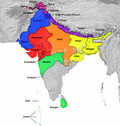
== | [[File:Major Indo-Aryan languages.png|thumb|[[Khas language]] of Nepal, belongs to the [[Northern Indo-Aryan languages|Northern Indo-Aryan language group]] as shown as ''Nepali'', in dark purple]] | ||
The Khas people of Nepal originally referred to their language as ''[[Khas language|Khas kurā]]'' (Khas speech), which was also known as ''Parbatiya'' (the language of the hill country). The Newar people used the term ''Khayan Bhaya'', ''Parbatiya''{{sfn|Pokhrel|1973|p=229}} and ''Gorkhali'' as a name for this language, Gorkhalis themselves started using this term to refer to their language at a later stage.{{sfn|Richard Burghart|1984|p=118}} In an attempt to disassociate himself with his Khas past, the Rana prime minister Jung Bahadur decreed that the term Gorkhali be used instead of ''Khas kurā'' to describe the language. Meanwhile, the [[British India]]n administrators had started using the term ''Nepal'' (after Newar) to refer to the Gorkha kingdom. In the 1930s, the Gorkha government also adopted this term to describe their country. Subsequently, the Khas language also came to be known as ''Nepali language''.{{sfn|Richard Burghart|1984|pp=118-119}} It has become a national language of Nepal and [[lingua franca]] among the majority of population of [[Gorkhaland Territorial Administration|Northern region of West Bengal]], [[Sikkim]] and [[Bhutan]].{{sfn|Pokhrel|1973|p=229}} Historian Balkrishna Pokhrel contends that the [[Khas language]] of Nepal belonged to neither the [[Iranian Languages|Iranian]] language family, nor the [[Languages of India|Indian languages]], but to the mid [[Indo-Iranian languages]].{{sfn|Pokhrel|1973|p=229}} | |||
=== | ===Music=== | ||
[[Deuda (genre)|Deuda]] song and folk dance performed on the occasion of various festivals in the [[Sudurpashchim Province|Sudurpashchim]] and [[Karnali Province|Karnali]] provinces of [[Nepal]].<ref>{{Cite web |date= |title=देउडा गीत र देउडा भाषिकाको इतिहास |url=https://sajhabisaunee.com/archives/3539 |access-date=8 May 2023 |website=Sajha Bisaunee |language=ne}}</ref> | |||
=== | ===Religion=== | ||
The majority of Khas profess [[Hinduism]]; some of them also follow [[Buddhism]] and some were also converted to [[Christianity]]. | |||
The Khas people also had their own sect of [[Shaivism]] known as Masto religion where 12 Masto gods were worshipped. These gods were said to be sons of [[Shiva]]. Masto worship was prevalent throughout all of the [[Himalayan region|Western Himalayan region]].{{Full citation needed|date=June 2025}} | |||
==Notable people== | ==Notable people== | ||
[[File:Queen Tripurasundari of Nepal.jpg|thumb|Portrait of a Khas '[[Queen Tripurasundari of Nepal]]', who ruled the country as a Queen regent in the 19th century]] | |||
===Khas | ===Medieval Khas families and dynasties=== | ||
*[[ | *[[Katyuri kings]]{{sfn|Handa|2002|p=22}} | ||
*[[Lohara dynasty]]{{sfn|Stein|1989|p=433}}{{sfn|Thakur|1990|p=287}} | |||
*[[Gurkha kingdom|Gurkha Kingdom]] | |||
*[[Vanshala Kingdom]]{{sfn|Stein|1989|loc=book viii(i), p. 144}} | |||
*[[Vishlata]]{{sfn|Stein|1989|loc=book viii, pp. 58,60,96}} | |||
=== | ===Modern Khas=== | ||
*[[Bir Bhadra Thapa]]{{sfn|Pradhan|2012|p=22}} | *[[Bir Bhadra Thapa]]{{sfn|Pradhan|2012|p=22}} | ||
*[[Amar Singh Thapa (Sardar)|Sanukaji Amar Singh Thapa]]{{sfn|Pradhan|2012|p=22}} | *[[Amar Singh Thapa (Sardar)|Sanukaji Amar Singh Thapa]]{{sfn|Pradhan|2012|p=22}} | ||
| Line 74: | Line 103: | ||
*[[Jung Bahadur Rana]]{{sfn|Dor Bahadur Bista|1991|p=37}} | *[[Jung Bahadur Rana]]{{sfn|Dor Bahadur Bista|1991|p=37}} | ||
*[[Kalu Pande]] (Kaji) {{sfn|Pradhan|2012|p=22}} | *[[Kalu Pande]] (Kaji) {{sfn|Pradhan|2012|p=22}} | ||
*[[BP Koirala]] | |||
*[[Bhanubhakta Acharya]] | |||
*[[Prithvi Narayan Shah]] | *[[Prithvi Narayan Shah]] | ||
*[[Shivaram Singh Basnyat]] (Badabir senapanti) <ref>{{Citation|title=BBBBB|date=2005-01-20|url=http://dx.doi.org/10.1201/9780203970843-60|work=Improvement of Buildings' Structural Quality by New Technologies|pages=520–522|publisher=CRC Press|doi=10.1201/9780203970843-60|isbn=978-0-429-22460-7|access-date=2021-07-02}}</ref> | *[[Shivaram Singh Basnyat]] (Badabir senapanti) <ref>{{Citation|title=BBBBB|date=2005-01-20|url=http://dx.doi.org/10.1201/9780203970843-60|work=Improvement of Buildings' Structural Quality by New Technologies|pages=520–522|publisher=CRC Press|doi=10.1201/9780203970843-60|isbn=978-0-429-22460-7|access-date=2021-07-02|url-access=subscription}}</ref> | ||
*[[Kehar Singh Basnyat]] | *[[Kehar Singh Basnyat]] | ||
*[[Damodar Pandey]] | *[[Damodar Pandey]] | ||
| Line 83: | Line 114: | ||
*[[Dhokal Singh Basnyat]] | *[[Dhokal Singh Basnyat]] | ||
*[[Rana Jang Pande]] | *[[Rana Jang Pande]] | ||
*[[Kunwar Inderjit Singh]] | |||
*[[Subarna Shamsher Rana]] | |||
*[[Sher Bahadur Thapa]] | |||
*[[Surya Bahadur Thapa]] | |||
*[[Jhalak Man Gandarbha]] | |||
==See also== | |||
==See | |||
*[[Nepali language]] | *[[Nepali language]] | ||
*[[Kumaoni language]] | |||
*[[Garhwali language]] | |||
*[[Indo-Aryan migrations]] | |||
== Notes == | == Notes == | ||
{{reflist|group=nb}} | {{reflist|group=nb|30em}} | ||
== References == | == References == | ||
{{ | {{Reflist}} | ||
==Bibliography== | ==Bibliography== | ||
{{ | {{Refbegin|30em}} | ||
*{{citation | last = Acharya| first = Baburam | editor-last = Bhandari| editor-first = Devi Prasad | title = Itihas Kaalbhanda Pahile | journal = Purnima | volume = 8| issue = 1| location = Kathmandu | date = 1975 | url = http://himalaya.socanth.cam.ac.uk/collections/journals/purnima/pdf/Purnima_08_04.pdf}} | *{{citation | last = Acharya | first = Baburam | editor-last = Bhandari | editor-first = Devi Prasad | title = Itihas Kaalbhanda Pahile | journal = Purnima | volume = 8 | issue = 1 | location = Kathmandu | date = 1975 | url = http://himalaya.socanth.cam.ac.uk/collections/journals/purnima/pdf/Purnima_08_04.pdf | access-date = 2018-10-04 | archive-date = 2024-05-13 | archive-url = https://web.archive.org/web/20240513014151/https://himalaya.socanth.cam.ac.uk/collections/journals/purnima/pdf/Purnima_08_04.pdf | url-status = dead }} | ||
*{{cite book |last=Adhikary |first=Surya Mani |title=The Khaśa kingdom: a trans-Himalayan empire of the middle age |url=https://books.google.com/books?id=cH5uAAAAMAAJ |year=1997 |publisher=Nirala |isbn=978-81-85693-50-7 }} | |||
*{{citation | last = Crooke | first = William | title = The Tribes and Castes of the North-western Provinces and Oudh, Volume 3 | publisher = Office of the Superintendent of Government Printing India | location = Calcutta | year = 1896 | isbn = | url = https://books.google.com/books?id=61Y2M9ppW64C&q=ET+Atkinson+Khasiya }} | |||
*{{Citation|author= D.R. Regmi|title= Medieval Nepal|volume= 1|publisher= Firma K.L. Mukhopadhyay|year= 1965|url= https://books.google.com/books?id=ST6QAAAAIAAJ}} | |||
* {{cite book |author=Dor Bahadur Bista |author-link=Dor Bahadur Bista |title=Fatalism and Development: Nepal's Struggle for Modernization |url=https://books.google.com/books?id=JzFROpFVYRAC&pg=PA48 |year=1991 |publisher=Orient Blackswan |isbn=978-81-250-0188-1 }} | * {{cite book |author=Dor Bahadur Bista |author-link=Dor Bahadur Bista |title=Fatalism and Development: Nepal's Struggle for Modernization |url=https://books.google.com/books?id=JzFROpFVYRAC&pg=PA48 |year=1991 |publisher=Orient Blackswan |isbn=978-81-250-0188-1 }} | ||
*{{cite book |first=George Abraham |last=Grierson |author-link=George Abraham Grierson |title=Linguistic Survey of India, Volume 9, Part 4 |volume=9 |publisher=Office of the superintendent of government printing, India |year=1916 |isbn= |url=https://books.google.com/books?id=mYtPAQAAMAAJ&q=attacori+thuni }} | |||
*{{cite book |last1=Hagen |first1=Toni |last2=Thapa |first2=Deepak |title=Toni Hagen's Nepal: The Kingdom in the Himalaya |date=1998 |publisher=Himal Books |url=https://books.google.com/books?id=9LFuAAAAMAAJ }} | |||
* {{cite book |author=John T Hitchcock |contribution=An Additional Perspective on the Nepali Caste System |editor=James F. Fisher |title=Himalayan Anthropology: The Indo-Tibetan Interface |url=https://books.google.com/books?id=B0C-IhEKrSEC&pg=PA113 |year=1978 |publisher=Walter de Gruyter |isbn=978-90-279-7700-7 }} | * {{cite book |author=John T Hitchcock |contribution=An Additional Perspective on the Nepali Caste System |editor=James F. Fisher |title=Himalayan Anthropology: The Indo-Tibetan Interface |url=https://books.google.com/books?id=B0C-IhEKrSEC&pg=PA113 |year=1978 |publisher=Walter de Gruyter |isbn=978-90-279-7700-7 }} | ||
* {{cite book |author=K. S. Singh |title=People of India: Uttar Pradesh |url=https://books.google.com/books?id=bBdWAAAAYAAJ |year=2005 |publisher=Anthropological Survey of India |isbn=978-81-7304-114-3 }} | * {{cite book |author=K. S. Singh |title=People of India: Uttar Pradesh |url=https://books.google.com/books?id=bBdWAAAAYAAJ |year=2005 |publisher=Anthropological Survey of India |isbn=978-81-7304-114-3 }} | ||
*{{citation | last = | *{{citation |last=Pokhrel |first=Balkrishna |title=Ancient Khas Culture |journal=Regmi Research Series |volume=5 |issue=12 |pages=229–236 |date=December 1, 1973 |orig-year=1962 |url=http://himalaya.socanth.cam.ac.uk/collections/journals/regmi/pdf/Regmi_05.pdf |access-date=2019-01-02 |archive-date=2024-06-25 |archive-url=https://web.archive.org/web/20240625172610/https://himalaya.socanth.cam.ac.uk/collections/journals/regmi/pdf/Regmi_05.pdf |url-status=dead }} | ||
*{{citation | last = Pradhan | first = Kumar L. | title = Thapa Politics in Nepal: With Special Reference to Bhim Sen Thapa, 1806–1839 | publisher = Concept Publishing Company | year = 2012 | isbn = 9788180698132 | location = New Delhi | page = 278 | url = https://books.google.com/books?id=7PP1yElRzIUC&q=the+assassination+of+rana+bahadur+shah }} | *{{citation |last=Pradhan |first=Kumar L. |title=Thapa Politics in Nepal: With Special Reference to Bhim Sen Thapa, 1806–1839 |publisher=Concept Publishing Company |year=2012 |isbn=9788180698132 |location=New Delhi |page=278 |url=https://books.google.com/books?id=7PP1yElRzIUC&q=the+assassination+of+rana+bahadur+shah }} | ||
* {{cite journal |author=Richard Burghart |title=The Formation of the Concept of Nation-State in Nepal |jstor=2056748 |journal=The Journal of Asian Studies |volume=44 |issue=1 |year=1984 |pages=101–125 |doi=10.2307/2056748}} | * {{cite journal |author=Richard Burghart |title=The Formation of the Concept of Nation-State in Nepal |jstor=2056748 |journal=The Journal of Asian Studies |volume=44 |issue=1 |year=1984 |pages=101–125 |doi=10.2307/2056748 |s2cid=154584368}} | ||
* {{cite book |author=Susan Thieme |title=Social Networks and Migration: Far West Nepalese Labour Migrants in Delhi |url=https://books.google.com/books?id=1SQLdsejmkQC&pg=PA83 |year=2006 |publisher=LIT Verlag Münster |isbn=978-3-8258-9246-3 }} | * {{cite book |author=Susan Thieme |title=Social Networks and Migration: Far West Nepalese Labour Migrants in Delhi |url=https://books.google.com/books?id=1SQLdsejmkQC&pg=PA83 |year=2006 |publisher=LIT Verlag Münster |isbn=978-3-8258-9246-3 }} | ||
* {{cite book |author1=William Brook Northey |author2=C. J. Morris |title=The Gurkhas: Their Manners, Customs, and Country |url=https://books.google.com/books?id=aSaX09InyIoC&pg=PA123 |year=1928 |publisher=Asian Educational Services |isbn=978-81-206-1577-9 }} | * {{cite book |author1=William Brook Northey |author2=C. J. Morris |title=The Gurkhas: Their Manners, Customs, and Country |url=https://books.google.com/books?id=aSaX09InyIoC&pg=PA123 |year=1928 |publisher=Asian Educational Services |isbn=978-81-206-1577-9 }} | ||
* {{Cite book| title | * {{Cite book | title=A History of Nepal | last1=Whelpton | first1=John | year=2005 | publisher=Cambridge University Press | isbn=978-0521804707 | url=https://books.google.com/books?id=WSo6PgAACAAJ }} | ||
* {{Cite book| title = The origin of caste system in Hinduism and its relevance in the present context| last = Sharma | first= Bal Krishna| year | * {{Cite book | title=The origin of caste system in Hinduism and its relevance in the present context | last=Sharma | first=Bal Krishna | year=1999 | publisher=Indian Society for Promoting Christian Knowledge and Samdan Publishers | isbn=9788172144968 | url=https://books.google.com/books?id=K1QqAAAAYAAJ }} | ||
*{{cite book | last = | *{{cite book |last1=Handa |first1=O. C. (Omacanda) |title=History of Uttaranchal |url=https://books.google.com/books?id=7_Ct9gzvkDQC |year=2002 |publisher=Indus Publishing |location=New Delhi |isbn=9788173871344 }} | ||
*{{ | * {{Cite book| url=https://books.google.com/books?id=iUHfBQAAQBAJ&q=The+Indo-Aryan+Languages| title=The Indo-Aryan Languages| isbn=9781135797119| last1=Jain| first1=Danesh| last2=Cardona| first2=George| date=26 July 2007| publisher=Routledge}} | ||
*{{cite book | last = Thakur | first = Laxman S. | | * {{cite book |last=Saklani |first=Dinesh Prasad |url=https://books.google.com/books?id=tK5y4iPArKQC&q=khasas |title=Ancient Communities of the Himalaya |isbn=9788173870903 |publisher=Indus Publishing |year=1998 }} | ||
*{{citation | last = Tucci | first = Giuseppe | title = Preliminary Report on Two Scientific Expeditions in Nepal | publisher = David Brown Book Company | year = | * {{cite book |last=Saksena |first=R.N. |editor=George Kurrian |chapter=Marriages and Family in the Polyandrous Khasa tribe of Jaunsar-Bawar |chapter-url=https://books.google.com/books?id=CWOEDwAAQBAJ |title=The Family in India: A Regional View |isbn=9783110886757 |publisher=Walter de Gruyter GmbH & Co |year=2019 |pages=108–118 }} | ||
{{ | * {{cite book |author=Manorma Sharma |url=https://books.google.com/books?id=CDxa5G2S0AwC&q=Tribal+Melodies+of+Himachal+Pradesh%3A+Gaddi+folk+music |title=Tribal Melodies of Himachal Pradesh: Gaddi folk music |isbn=9788170249122 |publisher=APH Publishing |year=1998 |pages= }} | ||
* {{citation |last=Sharma |first=Megha |title=The region of Kashmir in Ancient Literature with special mention to Tribes |journal=Pramana Research Journal |volume=9 |issue=6 |pages=703–707 |date=2019 |url=https://www.pramanaresearch.org/gallery/prj-p1082.pdf |issn=2249-2976 }} | |||
* {{cite book |url=https://books.google.com/books?id=ImBDAAAAYAAJ |title=Kalhana's Rajatarangini: A Chronicle of the Kings of Kasmir |volume=1 |first=Marc Aurel |last=Stein |publisher=Motilal Banarsidass |orig-year=1900a |year=1979 |chapter=Chronological and Dynastic Tables of Kalhana's Record of Kasmir Kings |isbn=978-81-208-0368-8 }} | |||
*{{cite book |first=Mark Aurel |last=Stein |title=Kalhana's Rajatarangini: a chronicle of the kings of Kasmir, Volume 2 |edition=Reprinted |publisher=Motilal Banarsidass |year=1989 |orig-year=1900 |isbn=978-81-208-0370-1 |url=https://books.google.com/books?id=KzxTkI9iAxkC |access-date=2011-07-10 }} | |||
*{{cite book |last=Thakur |first=Laxman S. |chapter=The Khasas An Early Indian Tribe |editor=K. K. Kusuman |title=A Panorama of Indian Culture: Professor A. Sreedhara Menon Felicitation Volume |chapter-url=https://books.google.com/books?id=z4JqgSUSXDsC&pg=PA285 |year=1990 |publisher=Mittal Publications |isbn=978-81-7099-214-1 |pages=285–293 }} | |||
*{{citation |last=Tucci |first=Giuseppe |title=Preliminary Report on Two Scientific Expeditions in Nepal |publisher=David Brown Book Company |year=1956 |isbn=9788857526843 |url=https://archive.org/details/in.gov.ignca.6480/ }} | |||
*{{citation |last=von Fürer-Haimendorf |first=Christoph |title=Caste and Kin in Nepal, India and Ceylon: Anthropological Studies in Hindu-Buddhist Contact Zones |publisher=Asia Publishing House |year=1966 |isbn= |url=https://books.google.com/books?id=wCTqMgEACAAJ }} | |||
{{refend}} | |||
==External links== | |||
{{Commons category|Khas people}} | |||
{{Ethnic groups in Nepal}} | {{Ethnic groups in Nepal}} | ||
| Line 119: | Line 170: | ||
[[Category:Khas people| ]] | [[Category:Khas people| ]] | ||
[[Category:Indo-Aryan peoples]] | [[Category:Indo-Aryan peoples]] | ||
[[Category:Ethnic groups in India]] | [[Category:Ethnic groups in India]] | ||
[[Category:Himalayan peoples]] | [[Category:Himalayan peoples]] | ||
[[Category:Indigenous peoples of Nepal]] | |||
[[Category:Ethnic groups in South Asia]] | |||
Revision as of 09:24, 22 January 2026
 Portrait of Khas women holding hands and performing Deuda | |
| Total population | |
| c. 15.3 million[1] | |
| Regions with significant populations | |
| Nepal, India, Bhutan | |
| Languages | |
| Nepali | |
| Religion | |
| Hinduism | |
| Related ethnic groups | |
| Kumaoni, Garhwali, Pahari and other Indo-Aryans |

Khas peoples or Khas Tribes, (English: /kɑːs/; Nepali: खस) popularly known as Khashiya[2][nb 1] are an Indo-Aryan ethno-linguistic group native to the Himalayan region of South Asia, in what is now the South Asian country of Nepal, as well as the Indian states of Uttarakhand, Himachal Pradesh, West Bengal, Assam and Sikkim.[nb 2] Khas consists of many subtribes like Kshetri, Thakuri, Bahun and Sanyasis and all spread across the Himalayas.[3][4][5][6][7][8][9][10][11][12][17]
According to the Constitution of Nepal, Bahun, Kshetris, Thakuris, and Sanyasis (Dashnami) who are citizens of Nepal should be considered as "Khas Arya" for electoral purposes.[13]
Historically, Khas were the speakers of an ancient Khas language from the Indo-Aryan language family[18][19] and the earliest recorded speakers of the Western Pahari languages.[14] The large portion of the Indo-Aryan speakers throughout lower Himalayas were the Masto people.[20] An intrusion of this tribe from the Western and Northwestern Himalayas into Central Himalayas is substantiated by the early linguistic evidences related to the Nepali language.[19] They were also known as Parbatiyas/Parbates and are currently known as Paharis/Pahadis. (literally, "from the hills"). They were also referred to as Yartse in Tibet and are also known as Khasan by Bhotia people. The term Khas has now become obsolete, as the Khas people have adopted communal identities because of the negative stereotypes associated with the term Khas. In Nepal the native speaker of Nepali language are known as Khas people.[21][22][23]
Origin
Indo-Aryan origin theories
They have been connected to the Khasas mentioned in the ancient Hindu literature.[24] Irish linguist Sir G.A. Grierson asserted that "..the great mass of the Aryan speaking population of the lower Himalaya from Kashmir to Darjeeling is inhabited by tribes descended from the ancient Khasas of Mahabharata."[20] Historian Bal Krishna Sharma and Dor Bahadur Bista speculates that the Khas people were of Indo-European origin.[25][23] Historian Baburam Acharya speculates that Khas are a sub-clan of Aida, an "Aryas” clan that originated at Idavritt (modern day Kashmir to Nepal).[26][nb 3] Khas were living in the Idavaritt in the 3rd millennium BCE. and the original meaning of the term Khas was Raja or Kshatriya (Yoddha).[26] He further speculates that Kashmir has been named from its local residents Khas as Khasmir.[26] In the 2nd millennium B.C.E., one group of Khas migrated towards Iran while the other group migrated east of Sutlej river settling only in the hill regions up to Bheri River.[27] Historian Balkrishna Pokhrel contends that Khas were not the Vedic Aryans but Aryans of the latter periods like the Gurjara, Darada, Shaka, and Pallava.[28] He further asserts that post-Vedic Aryans were akin to Vedic Aryans in terms of language and culture.[28] Irish linguist Sir George Abraham Grierson asserted that the Khasas were one of the warrior "Kshatriya tribe of Aryan origin" with linguistic connections to both Sanskrit and Iranian languages, who lost claim to Vedichood due to non-observance of Vedic rules.[nb 4] Roman geographer Pliny The Elder described the ancient Khasas/Khasiras (referred as 'Casiri') as one of the Indian ethnicity.[31]
Saka origin theories
Historian Rahul Sankrityayan proposes the origin of the Khasha tribe from the Shaka tribe and further identifies Khashas and Shakas to have been two different waves of the same race.[32] The Shakas were in Indian subcontinent before the first century BCE while the Khashas spread over the Himalayas and extensively populated the mountainous regions of Uttarakhand[32] and the later waves of Shakas got diffused into them.[32] Historian Omchand Handa contends that the "sun worship" among Khashas is a Shaka legacy and perhaps the standing Surya images with long boots which was commonly found at the Khasha belt of Himalaya. Some examples of it are the Bara-Aditya at Katarmal and Surya images of Baijnath, Bageshwar and Dwarahat.[32]
History
Medieval history in Nepal and Uttarakhand

Khasas are believed to have arrived in the western reaches of Nepal at the beginning of first-millennium B.C.[34] or middle of first-millennium A.D.[35] from the north-west. The earliest linguistic evidences related to Nepali language also substantiates the linguistic intrusion of an Indo-Aryan speaking Khasa tribe from the West or Northwest Himalayas into Central Himalayas at the present day regions of Western Nepal.[19] It is likely that they absorbed people from different ethnic groups during this immigration.[36] They had extensively populated the mountainous regions of Uttarakhand[32] and they had entirely dominated the inner Himalayan belt up to Nepal.[37] Previously, Khashas had strongly established themselves from Afghanistan to Nepal from ancient period and as per internal evidences, they managed the village level theocratic republics like Gram-Rajya and Mandals under various local clans and identities.[32]
The ruling Katyuri dynasty (700-1065 CE) of Kumaon who were of Khas origin,[32] was one of the ruling houses of Joshimath that claimed the sovereignty over other Gram Rajyas of the entire territory.[38] The Katyuris ruled from Joshimath in the Alaknanda Valley and later they shifted their capital to Baijnath.[39] They have also been connected to the medieval Khasa Malla kingdom.[24] The Khasa kings of West Nepal-Uttarakhand formed the famous Malla Kingdom, which ruled Humla from the eleventh century before collapsing and splintering into local chiefdoms during the fourteenth century.[40] In the initial phase, majority of Khas people became Brahmins and others became Kshatriyas.[35]
History in Kashmir

The ruling Lohara dynasty (1003-1320 CE) of Kashmir were from the Khas tribe as per the 12th century text Rajatarangini written by the local Kashmiri Pandit historian Kalhana.[15][41] Furthermore, Rajatarangini describes the rulers of Rajapuri (modern Rajauri) as the "lord of the Khasas".[41][42] The Khasa chiefs of Rajapuri freely intermarried with Kshatriya rulers of Kashmir while the Khasa chief of Lohara, Simharaja, married a daughter of Shahi Kings of Kabul.[41] The descendants of the royal family of Rajauri later became Muslim Rajput chiefs and they retained the rulership of the territory till 19th century.[15] The inhabitants of Karnah region in northwestern Kashmir, were Khasas and they were represented by the modern Bomba (tribe)[16] who independently ruled the northwestern Kashmir till the Sikh conquest of Kashmir.[16] There was also an independent Khasa lord at the castle located in the foot of Banahal Pass in the territory of Visalata[15] and Dengapala ("Thakkura Dengapala"[43]) was a Khasa chief at the banks of Chandrabhaga (modern Chenab river).[44]
Modern history in Nepal

Until the 19th century, the Gorkhali referred to their country as Khas Desh (Khas country).[45] As they annexed the various neighboring countries (such as Nepal or Newa of the Newar people) to the Gorkha kingdom, the terms such as Khas and Newar ceased to be used as the names of countries. The 1854 legal code (Muluki Ain), promulgated by the Nepali Prime Minister Jung Bahadur Rana, himself a Khas,[46] no longer referred to Khas as a country, rather as a jāt (species or community) within the Gorkha kingdom.[47]

.jpg)
The Shah dynasty of the Gorkha Kingdom, as well as the later prime-ministerial Rana dynasty, spoke the Khas language (now called the Nepali language). However, they claimed to be Rajputs of western Indian origin, rather than the native Khas Kshatriyas.[48] Since outside Nepal, the Khas social status was seen as inferior to that of the Rajputs, the rulers started describing themselves as natives of the Hill country, rather than that of the Khas country. Most people, however, considered the terms Khas and Parbatiya (Pahari/Pahadi or Hill people) as synonymous.[45]
Jung Bahadur also re-labeled the Khas jāt as Chhetri in present-day Nepal.[48] Originally, the Brahmin immigrants from the plains considered the Khas as low-caste because of the latter's neglect of high-caste taboos (such as alcohol abstinence).[49] The upper-class Khas people commissioned the Bahun (Brahmin) priests to initiate them into the high-caste Chhetri order and adopted high-caste manners. Other Khas families who could not afford to (or did not care to) pay the Bahun priests also attempted to assume the Chhetri status but were not recognized as such by others. They are now called Matwali (alcohol-drinker Khas) Chhetris.[23] Because of the adoption of the Chhetri identity, the term Khas is rapidly becoming obsolete.[21] According to Dor Bahadur Bista (1991), "the Khas have vanished from the ethnographic map of Nepal".[23]
Modern
Nepal

Modern-day Khas people are referred to as Hill Brahmin (Bahun), Hill Kshatriya (Thakuri/Chhetri) and Hill Dalit.[50] Further, historian Pokharel adds the Gharti, Damai, Kami, Sarki, Hudka, Tamote, Gaine and Badi to the Khas communities.[28] In modern times, Khas people are popularly referred by the term "Khas Arya".[3]
India-Pakistan
In Kumaon and Garhwal regions of Uttarakhand in India, too, the term Khas has become obsolete. The Khas people of Kumaon termed as Kumaoni khash jimdar, after being elevated to the Rajput status by the Chand kings. During Chand rule in Kumaon, Khas and Rajput were differentiated by their sacred thread, Khas were allowed to wear only 3 thread (3 palli)sacred thread whereas Rajput used to wear 6 palli sacred thread.The term Khas is almost obsolete, and people resent being addressed as Khas because of the negative stereotypes associated with this term.[22] Furthermore, the Kanets of Kangra and Garhwal, Khasa of Jaunsar-Bawar and the bulk population of Garhwal and Kumaon (referred as "Khasia") are descended from the Khasas.[14] Generally, the Khas people are referred as Rajputs or Kanets in the Himachal Pradesh.[51] According to E.T. Atkinson, the Jaunsar-Bawar is the representative Khasiya tract and it
"..forms a very important links between the almost Hinduized Khasiyas of Kumaon and their brethren converts to Islam on the ethnical frontier of the mountains of Hindu Kush and apparently gives customs and practices of Khasiya race in full force at the present day which distinguished them thousands of years ago."[14]
Historian Sir Marc Aurel Stein identified the modern Khakha Rajputs of Azad Kashmir as the descendants of Khasas mentioned in the Rajatarangini.[41][15] The Khasa tribe in Karnah region in northwestern Kashmir were represented by the modern Bomba (tribe).[16]
Communities
Historian Balkrishna Pokhrel writes the communities or caste in Khas group were hill Bahun, Chhetri, Thakuri,[52] Gharti, Damai, Kami, Sarki, Hudka, Tamote, Gaine and Sunar, badi, luhar, parki etc .[28] The tribal designation Khas refers to in some contexts only to the alcohol drinker Khas group, i.e. Thakuri and Chhetri, but in other contexts may also include the low status (occupational Khas groups such as Kāmi (blacksmiths), Damāi (tailors), and Sārki (shoemakers and leather workers).[53] Khas people are addressed with the term Khayan or Parbatiya[28] or Partyā, Parbaté meaning hill-dweller by Newars.[53] The hill Khas tribe are in large part associated with the Gorkhali warriors.[53]
Khas people of the Western Himalayas are considered similar to the Khas people of the Garhwal, Kumaon and Nepal.[51] They are generally referred as Rajputs or Kanets in the Himachal Pradesh.[51] The Khasas of Jaunsar-Bawar who are represented by the Jaunsari Rajputs and Brahmins) practiced polyandrous marriages.[54]
Culture and religion
Languages
Irish Linguist George Abraham Grierson in his Linguistic Survey of India stated that the Khas tribe were the earliest recorded speakers of the Western Pahari languages.[14] He further asserted that the Khas people made the bulk population of the Indo-Aryan speakers throughout the lower Himalaya from Kashmir to Darjeeling.[20][14]

The Khas people of Nepal originally referred to their language as Khas kurā (Khas speech), which was also known as Parbatiya (the language of the hill country). The Newar people used the term Khayan Bhaya, Parbatiya[28] and Gorkhali as a name for this language, Gorkhalis themselves started using this term to refer to their language at a later stage.[55] In an attempt to disassociate himself with his Khas past, the Rana prime minister Jung Bahadur decreed that the term Gorkhali be used instead of Khas kurā to describe the language. Meanwhile, the British Indian administrators had started using the term Nepal (after Newar) to refer to the Gorkha kingdom. In the 1930s, the Gorkha government also adopted this term to describe their country. Subsequently, the Khas language also came to be known as Nepali language.[18] It has become a national language of Nepal and lingua franca among the majority of population of Northern region of West Bengal, Sikkim and Bhutan.[28] Historian Balkrishna Pokhrel contends that the Khas language of Nepal belonged to neither the Iranian language family, nor the Indian languages, but to the mid Indo-Iranian languages.[28]
Music
Deuda song and folk dance performed on the occasion of various festivals in the Sudurpashchim and Karnali provinces of Nepal.[56]
Religion
The majority of Khas profess Hinduism; some of them also follow Buddhism and some were also converted to Christianity. The Khas people also had their own sect of Shaivism known as Masto religion where 12 Masto gods were worshipped. These gods were said to be sons of Shiva. Masto worship was prevalent throughout all of the Western Himalayan region.[full citation needed]
Notable people

Medieval Khas families and dynasties
Modern Khas
- Bir Bhadra Thapa[59]
- Sanukaji Amar Singh Thapa[59]
- Bhimsen Thapa[59]
- Jung Bahadur Rana[46]
- Kalu Pande (Kaji) [59]
- BP Koirala
- Bhanubhakta Acharya
- Prithvi Narayan Shah
- Shivaram Singh Basnyat (Badabir senapanti) [60]
- Kehar Singh Basnyat
- Damodar Pandey
- Abhiman Singh Basnyat
- Kirtiman Singh Basnyat
- Bakhtawar Singh Basnyat
- Dhokal Singh Basnyat
- Rana Jang Pande
- Kunwar Inderjit Singh
- Subarna Shamsher Rana
- Sher Bahadur Thapa
- Surya Bahadur Thapa
- Jhalak Man Gandarbha
See also
Notes
- ↑ Khas Arya is popularly used terminology over the various media to denote the group.[3][4][5][6][7][8][9][10][11][12] The Constitution of Nepal considers the Kshetris, Thakuris, and Sanyasis (Dashnami) as "Khas" for the electoral purposes.[13]
- ↑ Sociologist R.N. Saksena identified the Kanets of Kangra and Garhwal, the Khosa of Jaunsar-Bawar and the bulk population of Garhwal and Kumaon (referred as "Khasia") as being descended from the Khasas.[14] Historian Sir Marc Aurel Stein further identified the modern Khakha Rajput community as the Khas people in the Azad Kashmir state of Pakistan[15] and the modern Bomba clan in the Karnah region of Jammu and Kashmir.[16]
- ↑ Historian Baburam Acharya speculates that in the 3rd millennium BCE., there were two clans of Arya in the northern Indian subcontinent; Aiḍa and Mānava. Aiḍa who were named after their homeland Iḍavritt (modern day Kashmir), settled over Panjab and Ganga-Jamuna plain while Mānava settled over Awadh region. Chandravanshi kings like Bharata and Yudhisthir belonged to Aiḍa while Suryavanshi kings like Ramachandra belonged to Mānava. Later, Aiḍa built dominion over Magadh while Mānava had dominion over Videha.[26]
- ↑ ...in the extreme northwest of India, on the Hindu Kush and mountainous tracts to the south, and in Western Punjab, there was a group of tribes, one of which was called Khasa, which were looked upon as Kshatriyas of Aryan origin. These spoke a language closely allied with Sanskrit, but with a vocabulary partly agreeing with that of the Eranian Avesta. They were considered to have lost their claim to considerations as Aryans, and to have become Mlechhas, or barbarians, owing to their non-observance of the rules for drinking and eating by Sanskritic peoples of India. Khasas were warlike tribe, and were well known to classical writers, who noted, as their special home, the Indian Caucasus of Pliny.[29][30]
References
- ↑ "Nepali (npi)". Ethnologue. Retrieved 2016-10-06.
- ↑ "Bhunda festival in Spail, a relic of the tribal past". The Tribune. Retrieved 2025-02-06.
- ↑ 3.0 3.1 3.2 Khadka, Suman (25 February 2015). "Drawing caste lines". The Kathmandu Post.
- ↑ 4.0 4.1 "Khas Arya quota provision in civil services opposed". thehimalayantimes.com. 10 November 2017. Retrieved 2018-05-01.
- ↑ 5.0 5.1 "Nepal's election may at last bring stability". The Economist. Retrieved 2018-05-01.
- ↑ 6.0 6.1 "PM briefs international community". The Kathmandu Post. Retrieved 2018-04-06.
- ↑ 7.0 7.1 "Quotable quota". Nepali Times. 23 March 2018. Retrieved 2018-05-01.
- ↑ 8.0 8.1 "Next Door Nepal: Another chink in the wall". indianexpress.com. 2 April 2018. Retrieved 2018-05-01.
- ↑ 9.0 9.1 "Oli in balancing avatar". myrepublica.com. Retrieved 2018-05-01.
- ↑ 10.0 10.1 "Nepal seeks unity from its first local elections in 20 years". Nikkei Asian Review. Retrieved 2018-05-01.
- ↑ 11.0 11.1 "Lessons for India From Nepal's History of Banning Cow Slaughter". The Wire. Retrieved 2018-05-01.
- ↑ 12.0 12.1 "What does high caste chauvinism look like?". The Kathmandu Post. 7 April 2018. Retrieved 2018-05-01.
- ↑ 13.0 13.1 "Part-8 Federal Legislature". Nepal Law Commission. Archived from the original on 2021-04-28. Retrieved 2019-08-05.
- ↑ 14.0 14.1 14.2 14.3 14.4 14.5 Saksena 2019, p. 109.
- ↑ 15.0 15.1 15.2 15.3 15.4 15.5 Stein 1989, p. 433.
- ↑ 16.0 16.1 16.2 16.3 Stein 1989, p. 434.
- ↑ Hagen & Thapa 1998, p. 114.
- ↑ 18.0 18.1 Richard Burghart 1984, pp. 118-119.
- ↑ 19.0 19.1 19.2 Jain & Cardona 2007, p. 543.
- ↑ 20.0 20.1 20.2 Saklani 1998, p. 71.
- ↑ 21.0 21.1 William Brook Northey & C. J. Morris 1928, p. 123.
- ↑ 22.0 22.1 K. S. Singh 2005, p. 851.
- ↑ 23.0 23.1 23.2 23.3 Dor Bahadur Bista 1991, p. 48.
- ↑ 24.0 24.1 John T Hitchcock 1978, pp. 112-119.
- ↑ Sharma 1999, p. 181.
- ↑ 26.0 26.1 26.2 26.3 Acharya 1975, p. 199.
- ↑ Acharya 1975, p. 200.
- ↑ 28.0 28.1 28.2 28.3 28.4 28.5 28.6 28.7 Pokhrel 1973, p. 229.
- ↑ Grierson 1916, p. 17.
- ↑ Saksena 2019, pp. 108-109.
- ↑ Grierson 1916, p. 3.
- ↑ 32.0 32.1 32.2 32.3 32.4 32.5 32.6 32.7 Handa 2002, p. 22.
- ↑ Prasai, Dirgha Raj (27 February 2011). "History Of Nepali Language and its importance". Rising Nepal. Archived from the original on 2023-05-10. Retrieved 2022-11-30 – via Educatenepal.
- ↑ Dor Bahadur Bista 1991, p. 15.
- ↑ 35.0 35.1 Sharma 1999, p. 112.
- ↑ John T Hitchcock 1978, p. 113.
- ↑ Handa 2002, p. 24-25.
- ↑ Handa 2002, p. 24.
- ↑ Handa 2002, pp. 26-28.
- ↑ Kelly, Thomas L.; Dunham, V. Carroll (March 2001). Hidden Himalayas (PDF). New York: Abbeville Press. ISBN 9780789207227. Archived from the original (PDF) on 2006-03-24. Retrieved 2016-06-14.
- ↑ 41.0 41.1 41.2 41.3 41.4 Thakur 1990, p. 287.
- ↑ Sharma 2019, p. 706.
- ↑ Stein 1989, p. 432.
- ↑ Stein 1989, p. 16.
- ↑ 45.0 45.1 Richard Burghart 1984, p. 107.
- ↑ 46.0 46.1 Dor Bahadur Bista 1991, p. 37.
- ↑ Richard Burghart 1984, p. 117.
- ↑ 48.0 48.1 Richard Burghart 1984, p. 119.
- ↑ Susan Thieme 2006, p. 83.
- ↑ John T Hitchcock 1978, pp. 116-119.
- ↑ 51.0 51.1 51.2 Manorma Sharma 1998, p. 113.
- ↑ Sannyasi
- ↑ 53.0 53.1 53.2 Whelpton 2005, p. 31.
- ↑ Saksena 2019, pp. 107,109-111.
- ↑ Richard Burghart 1984, p. 118.
- ↑ "देउडा गीत र देउडा भाषिकाको इतिहास". Sajha Bisaunee (in नेपाली). Retrieved 2023-05-08.
- ↑ Stein 1989, book viii(i), p. 144.
- ↑ Stein 1989, book viii, pp. 58,60,96.
- ↑ 59.0 59.1 59.2 59.3 Pradhan 2012, p. 22.
- ↑ "BBBBB", Improvement of Buildings' Structural Quality by New Technologies, CRC Press, pp. 520–522, 20 January 2005, doi:10.1201/9780203970843-60, ISBN 978-0-429-22460-7, retrieved 2021-07-02
{{citation}}: CS1 maint: work parameter with ISBN (link)
Bibliography
- Acharya, Baburam (1975), Bhandari, Devi Prasad (ed.), "Itihas Kaalbhanda Pahile" (PDF), Purnima, 8 (1), Kathmandu, archived from the original (PDF) on 2024-05-13, retrieved 2018-10-04
- Adhikary, Surya Mani (1997). The Khaśa kingdom: a trans-Himalayan empire of the middle age. Nirala. ISBN 978-81-85693-50-7.
- Crooke, William (1896), The Tribes and Castes of the North-western Provinces and Oudh, Volume 3, Calcutta: Office of the Superintendent of Government Printing India
- D.R. Regmi (1965), Medieval Nepal, vol. 1, Firma K.L. Mukhopadhyay
- Dor Bahadur Bista (1991). Fatalism and Development: Nepal's Struggle for Modernization. Orient Blackswan. ISBN 978-81-250-0188-1.
- Grierson, George Abraham (1916). Linguistic Survey of India, Volume 9, Part 4. Vol. 9. Office of the superintendent of government printing, India.
- Hagen, Toni; Thapa, Deepak (1998). Toni Hagen's Nepal: The Kingdom in the Himalaya. Himal Books.
- John T Hitchcock (1978). "An Additional Perspective on the Nepali Caste System". In James F. Fisher (ed.). Himalayan Anthropology: The Indo-Tibetan Interface. Walter de Gruyter. ISBN 978-90-279-7700-7.
- K. S. Singh (2005). People of India: Uttar Pradesh. Anthropological Survey of India. ISBN 978-81-7304-114-3.
- Pokhrel, Balkrishna (1 December 1973) [1962], "Ancient Khas Culture" (PDF), Regmi Research Series, 5 (12): 229–236, archived from the original (PDF) on 2024-06-25, retrieved 2019-01-02
- Pradhan, Kumar L. (2012), Thapa Politics in Nepal: With Special Reference to Bhim Sen Thapa, 1806–1839, New Delhi: Concept Publishing Company, p. 278, ISBN 9788180698132
- Richard Burghart (1984). "The Formation of the Concept of Nation-State in Nepal". The Journal of Asian Studies. 44 (1): 101–125. doi:10.2307/2056748. JSTOR 2056748. S2CID 154584368.
- Susan Thieme (2006). Social Networks and Migration: Far West Nepalese Labour Migrants in Delhi. LIT Verlag Münster. ISBN 978-3-8258-9246-3.
- William Brook Northey; C. J. Morris (1928). The Gurkhas: Their Manners, Customs, and Country. Asian Educational Services. ISBN 978-81-206-1577-9.
- Whelpton, John (2005). A History of Nepal. Cambridge University Press. ISBN 978-0521804707.
- Sharma, Bal Krishna (1999). The origin of caste system in Hinduism and its relevance in the present context. Indian Society for Promoting Christian Knowledge and Samdan Publishers. ISBN 9788172144968.
- Handa, O. C. (Omacanda) (2002). History of Uttaranchal. New Delhi: Indus Publishing. ISBN 9788173871344.
- Jain, Danesh; Cardona, George (26 July 2007). The Indo-Aryan Languages. Routledge. ISBN 9781135797119.
- Saklani, Dinesh Prasad (1998). Ancient Communities of the Himalaya. Indus Publishing. ISBN 9788173870903.
- Saksena, R.N. (2019). "Marriages and Family in the Polyandrous Khasa tribe of Jaunsar-Bawar". In George Kurrian (ed.). The Family in India: A Regional View. Walter de Gruyter GmbH & Co. pp. 108–118. ISBN 9783110886757.
- Manorma Sharma (1998). Tribal Melodies of Himachal Pradesh: Gaddi folk music. APH Publishing. ISBN 9788170249122.
- Sharma, Megha (2019), "The region of Kashmir in Ancient Literature with special mention to Tribes" (PDF), Pramana Research Journal, 9 (6): 703–707, ISSN 2249-2976
- Stein, Marc Aurel (1979) [1900a]. "Chronological and Dynastic Tables of Kalhana's Record of Kasmir Kings". Kalhana's Rajatarangini: A Chronicle of the Kings of Kasmir. Vol. 1. Motilal Banarsidass. ISBN 978-81-208-0368-8.
- Stein, Mark Aurel (1989) [1900]. Kalhana's Rajatarangini: a chronicle of the kings of Kasmir, Volume 2 (Reprinted ed.). Motilal Banarsidass. ISBN 978-81-208-0370-1. Retrieved 2011-07-10.
- Thakur, Laxman S. (1990). "The Khasas An Early Indian Tribe". In K. K. Kusuman (ed.). A Panorama of Indian Culture: Professor A. Sreedhara Menon Felicitation Volume. Mittal Publications. pp. 285–293. ISBN 978-81-7099-214-1.
- Tucci, Giuseppe (1956), Preliminary Report on Two Scientific Expeditions in Nepal, David Brown Book Company, ISBN 9788857526843
- von Fürer-Haimendorf, Christoph (1966), Caste and Kin in Nepal, India and Ceylon: Anthropological Studies in Hindu-Buddhist Contact Zones, Asia Publishing House