{{Short description|Medieval Hindu dynasty (c. 822 -1026)}}
{{Short description|Medieval Dynasty in North Western South Asia (c. 843–1026)}}
{{Use dmy dates|date=May 2021}}
{{pp|small=yes}}
{{Use dmy dates|date=October 2025}}
{{Infobox country
{{Infobox country
| conventional_long_name = Hindu Shahis
| conventional_long_name = Hindu Shahis
| common_name = Hindu Shahis
| common_name = Shahis
| status = Empire
| status = Empire
| era = Early Middle Ages
| era = Early Middle Ages
| capital = {{ubl|[[Kabul]] (850–870)|[[Hund (village)|Udabhandapura]] (870–1001)|[[Lahore]] (1001–1026)}}
| capital = {{ubl|[[Kabul]] (843–870)|[[Hund (village)|Udabhandapura]] (870–1001){{Sfn|Mishra|1972|p=125}}|[[Nandana Fort|Nandana]] (1002–1014){{Sfn|Mishra|1972|p=185}}|[[Hastinapur|Hastika]]{{efn|Hastika is possibly [[Hastinapur]]{{Sfn|Mishra|1972|p=190}}}} (1014–1026)| Al Lahawar{{Efn|In [[Mardan District]]{{Sfn|Mishra|1972|p=256}}}} (Summer capital)}}
| year_start = c. 822 CE
| year_leader1 = {{circa|843 CE}}
| leader1 = Kallar
| year_leader2 = {{circa|850 CE}}
| leader2 = Samanta
| year_leader3 = {{circa|880 CE}}
| leader3 = Lalliya
| year_leader4 = {{circa|903 CE}}
| leader4 = Toramana
| year_leader5 = {{circa|921 CE}}
| leader5 = Bhimadeva
| year_leader6 = 964– 1001
| leader6 = [[Jayapala]]
| year_leader7 = {{circa|1002 CE}}
| leader7 = Anandapala
| year_leader8 = {{circa|1010 CE}}
| leader8 = Trilocanapala
| year_leader9 = {{circa|1021 CE}}
| leader9 = Bhimapala
| event1 = [[Battle of Peshawar (1001)]]
| date_event1 = 27 November 1001
| event2 = [[Battle of Chach]]
| date_event2 = 31 December 1008
| event3 = [[Battle of Nandana]]
| date_event3 = March 1014
| year_start = {{circa|843 CE}}
| year_end = 1026 CE
| year_end = 1026 CE
| event4 = [[Battle of River Tausi]]
| date_event4 = March 1014
| event5 = Annexed by the [[Ghaznavids]]
| date_event5 = 1026
| p1 = Turk Shahi
| p1 = Turk Shahi
| flag_p1 = Turk Shahis tamgha.png
| p2 =
| s1 = Saffarid Dynasty
| s1 = Ghaznavids
| s2 = Samanid Dynasty
| s2 =
| s3 = Ghaznavids
| s3 =
| flag_type =
| flag_type =
| image_coat = Coins of the Shahis 8th century.jpg
| image_coat =
| coa_size = 290px
| image_map = {{Continental Asia in 1000 CE|center||{{Annotation|120|85|[[File:Hindu Shahis territory.png|25px]]}}||none}}
| symbol_type = Some of the earliest coinage of the Hindu Shahis. ''Obverse'': Recumbent bull, with [[Nagari script|Nagari]] legend:<br>[[File:Nagari1035 shrii.jpg|18px]]<sub>[[File:Nagari1035 spa.jpg|15px]]</sub>[[File:Nagari1035 l.svg|15px]][[File:Nagari1035 p.svg|15px]][[File:Nagari1035 ti.jpg|13px]] ''Sri Spalapati''<br>''Reverse'': horserider with corrupted [[Bactrian script]]:<br>'''ςρι ςπaλaπaτι''' ''Sri Spalapati''<br>i.e. "Lord Commander-in-chief".{{sfn|Allchin|2019|p=458–459}}
| image_map_caption = Location of the Hindu Shahis, and contemporary polities, {{circa|1000}}
| image_map2 = {{Location map+
| image_map2 = {{Location map+
|Hindu-Kush
|Hindu Shahis
|float = center
|float = center
|width = 280<!-- DO NOT CHANGE MAP SIZE (280) AS THIS WILL DISPLACE THE LABELS -->
|border = none
|caption = [[Kabul]], first capital, with [[Udabhandapura|Hund]] and [[Lahore]], next capitals of the Hindu Shahis.<ref>{{cite book |last1=Schwartzberg |first1=Joseph E. |title=A Historical atlas of South Asia |date=1978 |publisher=University of Chicago Press |location=Chicago |page=146, map XIV.2 (j)|isbn=0226742210 |url=https://dsal.uchicago.edu/reference/schwartzberg/pager.html?object=183}}</ref> The neighboring powers are visible too.
|width = 300<!-- DO NOT CHANGE MAP SIZE (300) AS THIS WILL DISPLACE THE LABELS -->
{{location map~ |Hindu-Kush |lat=40|N |long=71.5|E |label='''''[[Principality of Ushrusana|AFSHINS]]''''' |position=left |label_size=90|mark=File:1000x1.png|marksize=0}}
}}
}}
| image_map2_caption = Territory of the Hindu Shahis with neighbouring polities circa 1000. [[Kabul]], first capital, with [[Udabhandapura|Udabhanda]] and [[Lahore]]<ref>{{cite book |last1=Schwartzberg |first1=Joseph E. |title=A Historical atlas of South Asia |date=1978 |publisher=University of Chicago Press |location=Chicago |page=146, map XIV.2 (j)|isbn=0226742210 |url=https://dsal.uchicago.edu/cgi-bin/reference/schwartzberg/query.py?display_type=image_display&object=183#gsc.tab=0}}</ref>
The '''Hindu Shahis''' (also known as '''Hindūshāhs''', '''[[Oddiyana|Odi]] Shahis''', '''Uḍi Śāhis''' or '''Brahman Shahis''',{{sfn|Sharma|2003}} 822–1026 CE) were a dynasty that held sway over the [[Kabul Valley]], [[Gandhara]] and western [[Punjab region|Punjab]] during the early medieval period in the Indian subcontinent. Details regarding past rulers can only be assembled from disparate [[chronicle]]s, coins and stone inscriptions.
== Scholarship ==
The '''Hindu Shahis''', also referred to as the '''Kabul Shahis''' and '''Uḍi Śāhis''', were a dynasty established between 843 CE and 1026 CE. Enduring multiple waves of conquests for nearly two centuries, the western frontiers of their core territory comprised the regions of [[Gandhara]] and [[Kabulistan]] in contemporary [[Khyber Pakhtunkhwa]] and [[Provinces of Afghanistan|eastern]] [[Afghanistan]], while eastern frontiers expanded to the [[Sutlej]] River, encompassing the regions of [[Punjab]] and the [[Kangra Valley]] in contemporary [[Punjab, Pakistan]], [[Punjab, India]], and [[Himachal Pradesh]]. The empire was founded by Kallar in {{circa|843 CE}} after overthrowing Lagaturman, the last [[Turk Shahis|Turk Shahi]] king.
Scholarship on Hindu Shahis{{Efn|The name is derived from Al-Biruni. Etymological origin of "Shahi" remains poorly understood; it derived either from Greek or Persian. A royal epithet, it was first used by Kushana rulers. The actual name of the dynasty—that is, how they referred to themselves or their polity—remains unknown. In general, the characteristic of Kingdoms in far-northwestern India was to designate themselves with respect to their geographic identities than familial or religious affiliations.{{sfn|Salomon|2003}}}} remain scarce.{{sfn|Khan|2017}}
Colonial scholars—[[James Prinsep]], [[Alexander Cunningham]], [[Henry Miers Elliot]], [[Edward Thomas (antiquarian)|Edward Thomas]] et al.—had published on the Hindu Shahis, primarily from a numismatic perspective.{{sfn|Rehman|1976|p=xii-xiii}} The first comprehensive volume on the subject appeared in 1972 by Yogendra Mishra, a professor in the Department of History of [[Patna University]]; he exploited the Rajatarangini meticulously but lacked in numismatics and paleography.{{sfn|Rehman|1976|p=xiii}} The next year, Deena Bandhu Pandey—Professor of Art History at [[Banaras Hindu University]]—published his doctoral dissertation but his handling of Muslim sources, coins etc. were laden with errors, primarily stemming from an exclusive dependence upon English translations of Arabic/Persian chronicles.{{sfn|Rehman|1976|p=xiii-xiv}} Both of these works are considered outdated and inaccurate, at large.{{sfn|Khan|2017}}
The history of the Hindu Shahis begins in 843 CE with Kallar deposing the last [[Turk Shahis|Turk Shahi]] ruler, Lagaturman. Samanta succeeded him, and it was during his reign that the region of [[Kabul]] was lost to the [[Persianate]] [[Saffarid dynasty]].<ref name=":1" /> Lalliya replaced Samanta soon after and re-conquered Kabul whilst also subduing the region of [[Zabulistan]].<ref name=":2" /><ref name=":3" /> He is additionally noteworthy for coming into conflict with [[Sankaravarman|Samkaravarman]] of the [[Utpala dynasty]], resulting in his victory and the latter's death in [[Hazara region|Hazara]].<ref name=":4" /> Bhimadeva, the next notable ruler, is most significant for vanquishing the [[Samanid Empire]] in Ghazni and Kabul in response to their conquests.<ref name=":5" /> Jayapala then gained control and was brought into conflict with the newly formed [[Ghaznavid Empire]], however, he was eventually defeated. During his rule and that of his son and successor, Anandapala, the kingdom of [[Lahore]] was conquered. The following Shahi rulers all resisted the Ghaznavids but were ultimately unsuccessful, resulting in the downfall of the empire in 1026 CE.
In 1979, Abdur Rehman received his [[PhD]] from [[Australian National University]] on "history, archaeology, coinage, and paleography" of the Turk Shahis and Hindu Shahis under the supervision of [[Arthur Llewellyn Basham]].{{sfn|Khan|2017}}{{sfn|Rehman|1976|p=xvi}} He has since published on the subject extensively and is considered to be an authority on the subject.{{sfn|Khan|2017}}{{sfn|Meister|2010|p=9}} In 2010, [[Michael W. Meister]]—Chair Professor of Art-History at UPenn—published a monograph on the temple-architecture of Sahis; he had worked with Rahman on multiple field investigations.{{sfn|Meister|2010|p=9}} In 2017, Ijaz Khan received his [[PhD]] from the School of Ancient History and Archaeology of [[University of Leicester]] on "Settlement Archaeology of the Hindu Shahi[s] in North-Western Pakistan."{{sfn|Khan|2017}}
== Sources ==
== Sources ==
=== Literature ===
=== Literature ===
No literature survives from Hindu Shahi courts. Unlike the case of Turk Shahis, only fragmented information can be obtained from chronicles of neighboring powers — Kashmir and [[Ghaznavids|Ghaznavi]].{{sfn|Khan|2017}}{{Efn|Rehman hypothesizes that the frontier states were splintering from the Caliphate during the rise of Hindu Shahis and had better things to worry about.}} Of the former, Kalhana's [[Rajatarangini]] (1148-1149) is the only extant source.{{sfn|Khan|2017}} Of the latter, we have Tārīkh al-Hind by [[Al-Biruni]] (c. 1030), [[Tarikh-i Bayhaqi|Tārīkh-i Bayhaqī]] by Abu'l-Faḍl Bayhaqi (c. late 11th century),{{Efn|He had another work ''Tarikh-i-Yamini'' dealing with the subject; it is lost.{{sfn|Rehman|1976|p=}}}} Zayn al-Akhbar by [[Abu Sa'id Gardezi]], and [[Tarikh Yamini|Kitab-i Yamini]] by al-Utbi (c. 1020).{{sfn|Khan|2017}}{{sfn|Rehman|1976|p=89}}{{sfn|Rehman|1976|p=}}
No literature survives from Hindu Shahi courts. Unlike the case of Turk Shahis, only fragmented information can be obtained from chronicles of neighboring powers — Kashmir and [[Ghaznavids|Ghaznavi]].{{sfn|Khan|2017}}{{Efn|Rehman hypothesizes that the frontier states were splintering from the Caliphate during the rise of Hindu Shahis and had better things to worry about.}} Of the former, Kalhana's [[Rajatarangini]] (1148-1149) is the only extant source.{{sfn|Khan|2017}} Of the latter, there are Tārīkh al-Hind by [[Al-Biruni]] (c. 1030), [[Tarikh-i Bayhaqi|Tārīkh-i Bayhaqī]] by Abu'l-Faḍl Bayhaqi (c. late 11th century),{{Efn|He had another work ''Tarikh-i-Yamini'' dealing with the subject; it is lost.{{sfn|Rehman|1976|p=}}}} Zayn al-Akhbar by [[Abu Sa'id Gardezi]], and [[Tarikh Yamini|Kitab-i Yamini]] by al-Utbi (c. 1020).{{sfn|Khan|2017}}{{sfn|Rehman|1976|p=89}}{{sfn|Rehman|1976|p=}}
=== Coins ===
=== Coins ===
The Hindu Shahis issued silver coinage which underwent wide circulation from nearby [[Sindh]]{{sfn|Flood|2018|p=38}} to northeastern Europe.{{sfn|Flood|2018|p=25}} They were first "discovered" by [[James Tod]], a British orientalist in 1822.{{sfn|Rehman|1976|p=190}} Coins exhibit progressive debasement with time, with a regular decrease of silver content, allowing for the sequencing of the coinage.{{sfn|MACDOWALL|1968}} Early issues do not mention personal names but only generic titles, thereby not matching with the names found from literature.{{sfn|Khan|2017|p=23}} The characteristic motif of a horseman on the reverse with a bull on the obverse goes back to the [[Indo-Scythian]] ruler [[Azes I]].
[[File:Coins of the Shahis 8th century.jpg|290px|thumb|right|Some of the earliest coinage of the Hindu Shahis. ''Obverse'': Recumbent bull, with [[Nagari script|Nagari]] legend:<br>[[File:Nagari1035 shrii.jpg|18px]]<sub>[[File:Nagari1035 spa.jpg|15px]]</sub>[[File:Nagari1035 l.svg|15px]] [[File:Nagari1035 p.svg|15px]] [[File:Nagari1035 ti.jpg|13px]] ''Sri Spalapati''<br>''Reverse'': horserider with corrupted [[Bactrian script]]:<br>'''ςρι ςπaλaπaτι''' ''Sri Spalapati''<br>i.e. "Lord Commander-in-chief".{{sfn|Allchin|2019|p=458–459}}]]
The Hindu Shahis issued silver [[jital coin]]age which underwent wide circulation from nearby [[Sindh]]{{sfn|Flood|2018|p=38}} to northeastern Europe.{{sfn|Flood|2018|p=25}} They were first "discovered" by [[James Tod]], a British orientalist in 1822.{{sfn|Rehman|1976|p=190}} These coins exhibit progressive debasement with time, with a regular decrease of silver content, allowing for the sequencing of the coinage.{{sfn|MACDOWALL|1968}} Early issues do not mention personal names but only generic titles, thereby not matching with the names found from literature.{{sfn|Khan|2017|p=23}} The characteristic motif of a horseman on the reverse with a bull on the obverse goes back to the [[Indo-Scythian]] ruler [[Azes I]].
=== Inscriptions and archaeology ===
=== Inscriptions and archaeology ===
A. R. Rahman of the [[Quaid-i-Azam University]] and [[Ahmad Hasan Dani]] did rudimentary field surveys in the late 1960s.{{sfn|Khan|2017}} Afterwards, the Italian Archaeological Mission in Pakistan (IAMP) have extensively surveyed the regions in and around Swat.{{sfn|Khan|2017}} In 1996, Khan and Meister obtained a license from Dept. of Archaeology for an "integrated study of Hindu-Śāhi sites"; excavation at Kafir-kot and field-surveys of the Salt Range were engaged in with aid from [[University of Pennsylvania]] and [[American Institute of Pakistan Studies]].{{sfn|Meister|2010|p=9}}
A. R. Rahman of the [[Quaid-i-Azam University]] and [[Ahmad Hasan Dani]] did rudimentary field surveys in the late 1960s.{{sfn|Khan|2017}} Afterwards, the Italian Archaeological Mission in Pakistan (IAMP) extensively surveyed the regions in and around [[Swat District|Swat]].{{sfn|Khan|2017}} In 1996, Khan and Meister obtained a license from Department of Archaeology for an "integrated study of Hindu-Śāhi sites"; excavation at [[Kafir Kot|Kafir-kot]] and field-surveys of the [[Salt Range]] were engaged in with aid from the [[University of Pennsylvania]] and the American Institute of Pakistan Studies.{{sfn|Meister|2010|p=9}}
Inscriptions remain scarce.{{sfn|Rehman|1976|p=218}} Mostly found in [[Udabhanda]], they either commemorate the commissioning of temples or are affixed at the base of idol-pedestals.{{sfn|Rehman|1976|p=218}} Of the former kind—Mir Ali Inscription, Dewal Inscription, Dewai Inscription, Ratnamanjari Inscription, Veka Inscription, Hund Stone Inscription, Kamesvaridevi Inscription, Barikot Inscription, and Isvara Inscription—most are disfigured to various extents due to use as grinding stones in medieval times and decipherable only in parts.{{sfn|Rehman|1976|p=218}}{{sfn|Khaw|2016}} The latter kind is relatively abundant but only provides snippets of trivia.{{sfn|Rehman|1976|p=218}} The language is exclusively Sharda.{{sfn|Rehman|1976|p=219}}{{Efn|Bactrian Cursive seem to have fallen out of favor with the Hindu Shahis.{{sfn|Rehman|1976|p=219}}}} A ''samvat'' is mentioned in all of them whose zero year is understood to correspond with 822 C.E. based on the Zalamkot Bilingual Inscription; it has been assumed to be initiated by Kallar on his coronation, as was typically the case for most Hindu dynasties of medieval India.{{sfn|Rehman|1976|p=241, 318}}{{sfn|Rahman|1998|p=473}} Copper land grants etc. are yet to be documented.{{sfn|Rehman|1976|p=218}}
Inscriptions remain scarce.{{sfn|Rehman|1976|p=218}} Mostly found in [[Udabhanda]], they either commemorate the commissioning of temples or are affixed at the base of idol-pedestals.{{sfn|Rehman|1976|p=218}} Of the former kind—[[Mir Ali, Pakistan|Mir Ali]] Inscription, [[Dewal Manal|Dewal]] Inscription, Dewai Inscription, Ratnamanjari Inscription, Veka Inscription, Hund Stone Inscription, Kamesvaridevi Inscription, Barikot Inscription, and Isvara Inscription—most are disfigured to various extents due to their use as grinding stones in medieval times and are decipherable only in parts.{{sfn|Rehman|1976|p=218}}{{sfn|Khaw|2016}} The latter kind is relatively abundant but only provides snippets of trivia.{{sfn|Rehman|1976|p=218}} The language is exclusively [[Sharada script|Sharda]].{{sfn|Rehman|1976|p=219}}{{Efn|Bactrian Cursive seem to have fallen out of favor with the Hindu Shahis.{{sfn|Rehman|1976|p=219}}}} A ''samvat'' is mentioned in all of them whose zero year is understood to correspond to 822 C.E. based on the Zalamkot Bilingual Inscription; it has been assumed to be initiated by Kallar on his coronation, as was typically the case for most Hindu dynasties of medieval India.{{sfn|Rehman|1976|p=241, 318}}{{sfn|Rahman|1998|p=473}} Copper land grants etc. are yet to be documented.{{sfn|Rehman|1976|p=218}}
==Origins==
==Origins==
[[File:Horseman on Hindu Shahi coinage.jpg|thumb|Horseman on a coin of Spalapati, i.e. the "War-lord". The headgear has been interpreted as a [[turban]].{{sfn|Rehman|1976|p=187 and Pl. V B.|loc="the horseman is shown wearing a turban-like head-gear with a small globule on the top"}}]]
[[File:Horseman on Hindu Shahi coinage.jpg|thumb|Horseman on a coin of Spalapati, i.e. the "War-lord". The headgear has been interpreted as a [[turban]].{{sfn|Rehman|1976|p=187 and Pl. V B.|loc="the horseman is shown wearing a turban-like head-gear with a small globule on the top"}}]]
The 10th century Arab historian [[Al-Masudi|Masudi]] mentioned that in his time the kings of [[Gandhara]] were all called "[[File:Arabic Hahaj for Hindu Shahis.jpg|15px|Arabic Hahaj for Hindu Shahis]]" (which has been variously read ''Hajaj'', ''J.haj'' or ''Ch'hach''), while the area of Gandhara itself was called "country of the ''Rahbūt''" ([[Rajputs]]).{{sfn|Rehman|1976|p=48}} Elliot transliterated the character to "Hahaj" and Cunningham had it equated to the [[Janjua|Janjua tribe/clan]], who were held to be descendants of [[Rouran Khaganate|Juan-Juan Khaganate]].{{sfn|Rehman|1976|pp=48-50}} Rahman doubts this theory and instead transliterates to "J.haj", an Arabicised form of ''[[Chhachh]]'', which is even today the name of the region around the Hindu Shahi capital of [[Hund (village)|Hund]].{{sfn|Rehman|1976|pp=48-50}} In the 10th century, this region was occupied by the tribe of the [[Gakhars]]/ [[Khokhars]], who formed a large part of the Hindu Shahi army according to the Persian historian [[Firishta]].{{sfn|Rehman|1976|pp=48-50}} It would seem therefore that the Hindu Shahis were mainly Gakhars from the region of Chhachh in Gandhara.{{sfn|Rehman|1976|pp=48-50}}
[[Al-Biruni]], an Iranian [[polyglot]] and the only contemporary source on the dynasty, described that the Hindu Shahis as [[Brahmins]].{{sfn|Rehman|1976|p=51}} However this view goes against the opinions of authors from later centuries. [[Kashmiris|Kashmiri]] historian, [[Kalhana]] in his 12th century work [[Rajatarangini]], described the Hindu Shahis of being of [[Kshatriya]] origin.{{sfn|Rehman|1976|p=51}} [[André Wink]] confirms Biruni's description of the Shahi dynasty as Brahmins.<ref name=":0">{{Cite book |last=Wink |first=André |url=https://books.google.com/books?id=bCVyhH5VDjAC&pg=PA125 |title=Al-hind: The Making of the Indo-islamic World |date=1991 |publisher=BRILL |isbn=978-90-04-09249-5 |pages=125 |language=en}}</ref>
Al-Biruni claimed that the Shahis were [[Brahmin]]s.{{sfn|Rehman|1976|p=51}} However this goes against Masudi's statement about Rajputs, as well as against Kalhana, whose contemporaneous Kshatriyas staked descent from the Hindu Shahis.{{sfn|Rehman|1976|p=51}} Rahman speculates that either their Brahmin affiliation was a late rumor floated to justify their original usurpation of the throne, or they were fallen Brahmins, who ran afoul of caste-rules while discharging royal duties.{{sfn|Rehman|1976|p=52}}
The 10th century Arab historian, [[Al-Masudi]] mentioned in his work, that in his time, the kings of [[Gandhara]] were all called "[[File:Arabic Hahaj for Hindu Shahis.jpg|15px|Arabic Hahaj for Hindu Shahis]]" (which has been variously read ''Hajaj'', ''J.haj'' or ''Ch'hach''), Elliot transliterated the character to "Hahaj" and Cunningham had it equated to the [[Janjua|Janjua tribe/clan]], who were held to be descendants of the [[Rouran Khaganate]].{{sfn|Rehman|1976|pp=48-50}} Rahman doubts this theory and instead transliterates to "J.haj", an Arabicised form of ''[[Chhachh]]'', while the area of Gandhara itself was called "country of the ''Rahbūt''" ([[Rajput|Rājpūt]]){{sfn|Rehman|1976|p=48}} which is even today the name of the region around the Hindu Shahi capital of [[Hund (village)|Hund]].{{sfn|Rehman|1976|pp=48-50}} In the 10th century, this region was occupied by the tribes of the [[Gakhars]] and [[Khokhars]], who formed a large part of the Hindu Shahi army according to the Persian historian [[Firishta]].{{sfn|Rehman|1976|pp=48-50}}
In a 2002 publication, Rahman accepted folklore among current inhabitants of Hund about pre-Muslim kings of the region belonging to the Hodi tribe, and proposed an Odi origin for the Hindu Shahi, namely the people of [[Oddiyana]] whose rulers were already known at the time of the [[Kushan Empire]] (3rd century CE) and are recorded as early as the 4th century BCE.{{sfn|Rahman|2002a|p=41}} He pointed to the famous Senvarma inscription as an evidence in support.{{sfn|Rahman|2002a|p=41}}{{Efn|For more details on the inscription (and Odi Kings), consult {{sfn|Hinüber|2003}}}} Meister found Rahman's arguments to be convincing.<ref>{{Cite journal|last=Meister|first=Michael W.|date=2005|title=The Problem of Platform Extensions at Kafirkot North|url=http://journals.uop.edu.pk/papers/AP_v16_41to48.pdf|journal=Ancient Pakistan|volume=XVI|pages=41–48}}</ref>
Abdul Rahman accepted folklore among current inhabitants of Hund about pre-Muslim kings of the region belonging to the Hodi tribe, and proposed an Odi origin for the Hindu Shahis belonging to [[Oddiyana]], a region in [[Gandhara]]. He also pointed to the famous Senvarma inscription as evidence in support and suggested '''Odi Shahis''' or '''Uḍi Śāhis''' as an accurate name for the dynasty.<ref>{{Cite journal |last=Rahman |first=Abdul |date=2002 |title=New Light on the Khingal, Turk and the Hindu Sahis |url=http://journals.uop.edu.pk/papers/AP_v15_37to42.pdf |journal=Ancient Pakistan |volume=XV |pages=37–42}}</ref><ref>{{Cite journal |last=Meister |first=Michael W. |date=2005 |title=The Problem of Platform Extensions at Kafirkot North |url=http://journals.uop.edu.pk/papers/AP_v16_41to48.pdf |journal=Ancient Pakistan |volume=XVI |pages=41–48}}</ref>{{sfn|Rahman|2002a|p=41}}{{Efn|For more details on the inscription (and Odi Kings), consult{{sfn|Hinüber|2003}}}} [[Michael W. Meister]] found Rahman's arguments to be convincing.<ref>{{Cite journal|last=Meister|first=Michael W.|date=2005|title=The Problem of Platform Extensions at Kafirkot North|url=http://journals.uop.edu.pk/papers/AP_v16_41to48.pdf|journal=Ancient Pakistan|volume=XVI|pages=41–48}}</ref>
==History==
==History==
=== Establishment (822 CE): overthrow of the Turk Shahis ===
=== Kallar: The first Hindu Shahi ===
The [[Abbasids]] led by caliph [[Al-Ma'mun]] defeated the Kabul branch of the [[Turk Shahi]]s in 815 CE who had invaded into Khorasan.{{sfn|Rehman|1976|p=85}}<ref name="MA20">{{cite book|last1=Alram|first1=Michael|url=https://books.google.com/books?id=H5AcEAAAQBAJ&pg=PA20|title="The Numismatic legacy of the Sasanians in the East" in Sasanian Iran in the Context of Late Antiquity: The Bahari Lecture Series at the University of Oxford|date=1 February 2021|publisher=BRILL|isbn=978-90-04-46066-9|pages=20–21|language=en}}</ref> Following this defeat, the Turk Shahis not only had to convert to Islam but also had to cede key cities and regions.{{sfn|Rehman|1976|p=85-86}} Another campaign against the Gandhara branch seems to have followed soon, with the Caliphate reaching as East as the [[Indus river]] and imposing a critical defeat.{{sfn|Rehman|1976|p=86}} A hefty annual tribute was to be paid in return for sovereignty rights to both territories.{{sfn|Rehman|1976|p=86}}{{efn|The tribute amounted to 1,500,000 Dirhams and 2,000 slaves per year.{{sfn|Rehman|1976|p=87}}}}
[[File:Hindu Shahis Spalapatideva type, Kabul mint.jpg|thumb|Non-debased Spalapati series (Kabul mint) — weighs between 3.1 and 3.5 g with a uniform content of 70% silver. '''''Obverse''''': Bull with [[trisula]] mark on the hump, with [[Nagari script|Nagari]] legend: [[File:Nagari1035 shrii.jpg|16px]]<sub>[[File:Nagari1035 spa.jpg|15px]]</sub>[[File:Nagari1035 l.svg|13px]][[File:Nagari1035 p.svg|13px]][[File:Nagari1035 ti.jpg|11px]][[File:Nagari1035 de.jpg|11px]][[File:Nagari1035 v.svg|13px]] ''Śri Spalapatideva'' "Lord Commander-in-Chief". '''''Reverse''''': Horseman with [[File:Nagari1035 a.svg|15px]] ''a'' in Nagari to left and symbol to right.{{sfn|Allchin|2019|p=458–459}}]]
==== Establishment ====
The Turk Shahis ended up in a precarious state and c. 822 CE, the last ruler Lagaturman was disposed by one of his ministers, a Brahmin called Kallar.{{sfn|Rehman|1976|p=87-88}} The sole description of events comes from Al-Biruni:{{efn|The passage went:<ref name="SK403">{{cite journal |last1=Kuwayama |first1=Shoshin |title=The Turki Śāhis and Relevant Brahmanical Sculptures in Afghanistan |journal=East and West |date=1976 |volume=26 |issue=3/4 |page=403 |jstor=29756318 |url=https://www.jstor.org/stable/29756318 |issn=0012-8376}}</ref>
The [[Abbasids]] led by caliph [[Al-Ma'mun]] defeated the Kabul branch of the [[Turk Shahi]]s in 815 CE who had invaded Khorasan.{{sfn|Rehman|1976|p=85}}<ref name="MA20">{{cite book|last1=Alram|first1=Michael|url=https://books.google.com/books?id=H5AcEAAAQBAJ&pg=PA20|title="The Numismatic legacy of the Sasanians in the East" in Sasanian Iran in the Context of Late Antiquity: The Bahari Lecture Series at the University of Oxford|date=1 February 2021|publisher=BRILL|isbn=978-90-04-46066-9|pages=20–21|language=en}}</ref> Following this defeat, the Turk Shahis not only had to convert to Islam but also had to cede key cities and regions.{{sfn|Rehman|1976|p=85-86}} Another campaign against the Gandhara branch seems to have followed soon, with the Caliphate reaching as far East as the [[Indus river]] and imposing a critical defeat.{{sfn|Rehman|1976|p=86}} A hefty annual tribute was to be paid in return for sovereignty rights to both territories.{{sfn|Rehman|1976|p=86}}{{efn|The tribute amounted to 1,500,000 Dirhams and 2,000 slaves per year.{{sfn|Rehman|1976|p=87}}}}
{{blockquote|The last king of this race was [[Turk Shahis|Lagatarman]] [of the Turk Shahis], and his Vazir was Kallar, a Brahman. The latter had been fortunate, in so far as he had found by accident hidden treasures, which gave him much influence and power. In consequence, the last king of this Tibetan house, after it had held the royal power for so long a period, let it by degrees slip from his hands. Besides, Lagatarman had bad manners and a worse behaviour, on account of which people complained of him greatly to the Vazir. Now the Vazir put him in chains and imprisoned him for correction, but then he himself found ruling sweet, his riches enabled him to carry out his plans, and so he occupied the royal throne. After him ruled the Brahman kings Samand (Samanta), Kamalu, Bhim (Bhima), Jaipal ([[Jayapala]]), [[Anandapala]], Tarojanapala ([[Trilochanapala]]). The latter was killed A.H. 412 (A.D. 1021), and his son Bhimapala five years later (A.D. 1026). This Hindu Shahiya dynasty is now extinct, and of the whole house there is no longer the slightest remnant in existence.|[[Al-Biruni]], ''Tārīkh al-Hind'' ("History of India").<ref name="SK403"/>}}}} Lagatarman's unbecoming manners had apparently led his subjects to lodge multiple complaints with Kallar, who having chanced upon a treasure trove, was rapidly purchasing his way to power.{{sfn|Rehman|1976|p=}} Kallar imprisoned the King for correction and became the acting regent before usurping the throne permanently.{{sfn|Rehman|1976|p=88}} The new "Hindu Shahi" dynasty was thus established in Gandhara and Kabul.{{sfn|Rehman|1976|p=91}} The Zabulistan branch of the Turk Shahis (the [[Zunbils]]), was unaffected by [[Al-Ma'mun]]'s raids and continued to rule for about two more decades, before getting embroiled in the conflict to eventual extinction.{{sfn|Rehman|1976|p=61}} None apart from Al-Biruni mentions Kallar; nothing is known about his rule or territorial extent or even his regnal dates.{{sfn|Rehman|1976|p=90, 93-94}}{{efn|Rahman cautions against a general tendency in Punjab to associate any place having an etymological similarity with Kallar to being established by the ruler; in local dialects, the word also refers to "saline soil".{{sfn|Rehman|1976|p=94}}}} It has been proposed by many historians that "Kallar" was a misreading of the name "Lalliya", a Hindu Shahi ruler who is mentioned by Kalhana in some detail but Rahman rejects the hypothesis due to a total lack of chronological reconciliation.{{sfn|Rehman|1976|p=92}}
The Turk Shahis ended up in a precarious state and in {{circa|843 CE}}, the last ruler Lagaturman was deposed by one of his ministers, a [[Brahmin]] vazir called Kallar.{{sfn|Rehman|1976|p=87-88}}<ref name="SKSK">{{cite journal |author=[[Shōshin Kuwayama|Kuwayama, Shoshin]] |title=The Turki Śāhis and Relevant Brahmanical Sculptures in Afghanistan |journal=East and West |year=1976 |volume=26 |issue=3/4 |jstor=29756318 |url=https://www.jstor.org/stable/29756318 |issn=0012-8376 |publisher=[[Italian Institute for Africa and the Orient|Istituto Italiano per l'Africa e l'Oriente]]|page=405 }}</ref> The sole description of events comes from Al-Biruni:{{efn|The passage went:{{blockquote|The last king of this race was [[Turk Shahis|Lagatarman]] [of the Turk Shahis], and his Vazir was Kallar, a Brahman. The latter had been fortunate, in so far as he had found by accident hidden treasures, which gave him much influence and power. In consequence, the last king of this Tibetan house, after it had held the royal power for so long a period, let it by degrees slip from his hands. Besides, Lagatarman had bad manners and a worse behaviour, on account of which people complained of him greatly to the Vazir. Now the Vazir put him in chains and imprisoned him for corruption, but then he himself found ruling sweet, his riches enabled him to carry out his plans, and so he occupied the royal throne. After him ruled the Brahman kings Samand (Samanta), Kamalu, Bhim (Bhima), Jaipal ([[Jayapala]]), [[Anandapala]], Tarojanapala ([[Trilochanapala]]). The latter was killed A.H. 412 (A.D. 1021), and his son Bhimapala five years later (A.D. 1026). This Hindu Shahiya dynasty is now extinct, and of the whole house there is no longer the slightest remnant in existence.|[[Al-Biruni]], ''Tārīkh al-Hind'' ("History of India").<ref name="SK403">{{cite journal |last1=Kuwayama |first1=Shoshin |title=The Turki Śāhis and Relevant Brahmanical Sculptures in Afghanistan |journal=East and West |date=1976 |volume=26 |issue=3/4 |page=403 |jstor=29756318 |url=https://www.jstor.org/stable/29756318 |issn=0012-8376}}</ref>}}}} Lagatarman's unbecoming manners had led his subjects to lodge multiple complaints with Kallar, who having chanced upon a treasure trove, was rapidly purchasing his way to power.{{sfn|Rehman|1976|p=}} Kallar imprisoned the King for corruption and became the acting regent before usurping the throne permanently.{{sfn|Rehman|1976|p=88}} The new "Hindu Shahi" dynasty was thus established in [[Gandhara]].{{sfn|Rehman|1976|p=91}} None apart from Al-Biruni mentions Kallar; nothing is known about his rule or territorial extent or even his regnal dates.{{sfn|Rehman|1976|p=90, 93-94}}[[File:Hindu Shahis Spalapatideva type, Kabul mint.jpg|thumb|Non-debased Spalapati series (Kabul mint) — weighs between 3.1 and 3.5 g with a uniform content of 70% silver. '''''Obverse''''': Bull with [[trisula]] mark on the hump, with [[Nagari script|Nagari]] legend: [[File:Nagari1035 shrii.jpg|16px]]<sub>[[File:Nagari1035 spa.jpg|15px]]</sub>[[File:Nagari1035 l.svg|13px]] [[File:Nagari1035 p.svg|13px]] [[File:Nagari1035 ti.jpg|11px]] [[File:Nagari1035 de.jpg|11px]] [[File:Nagari1035 v.svg|13px]] ''Śri Spalapatideva'' "Lord Commander-in-Chief". '''''Reverse''''': Horseman with [[File:Nagari1035 a.svg|15px]] ''a'' in Nagari to left and symbol to right.{{sfn|Allchin|2019|p=458–459}}]]Historians such as that of [[Alexander Cunningham]] suggest that coin series bearing the obverse title 'Spalapati' ('Warlord) were minted by Kallar.{{sfn|Rehman|1976|p=}} According to [[Edward Clive Bayley]]'s misreading of the corrupted remains of a Bactrian legend as Arabic numerals, he proposed that another series of coins bearing the legend 'Samanta' ('Feudatory') were also minted by Kallar.{{sfn|Rehman|1976|p=186}} He argued the 'Spalapati' series to have been minted for circulation in Persian regions of his territory and the 'Samanta' series for [[Sanskrit language|Sanskrit]]-speaking regions.{{sfn|Rehman|1976|p=186}} and it has been adduced that Kallar may have felt insecure about the legitimacy of his rule as long as the imprisoned [[Turk Shahis|Turk Shahi]] ruler Lagaturman was alive, and hence affirmed his claim to leadership by such indirect titles.{{sfn|Rehman|1976|p=92}}
In 1848, Thomas proposed that coins bearing the obverse legend "Spalapati" ("Warlord") were minted by Kallar; Cunningham accepted Thomas' arguments some 50 years later.{{sfn|Rehman|1976|p=}} In 1906, [[Vincent Arthur Smith]] relied on [[Edward Clive Bayley]]'s misreading of the corrupted remains of a Bactrian legend as Arabic numerals to propose that coins bearing the legend "Samanta" ("Feudatory") was also minted by Kallar.{{sfn|Rehman|1976|p=186}} He argued the "Spalapati" series to have been minted for circulation in Persian regions of his territory and the "Samanta" series for [[Sanskrit language|Sanskrit]]-speaking regions.{{sfn|Rehman|1976|p=186}} Mishra agreed with Smith and adduced that Kallar may have felt insecure about the legitimacy of his rule as long as the imprisoned Turk Shahi ruler Lagaturman was alive, and hence affirmed his claim to leadership by such indirect epithets.{{sfn|Rehman|1976|p=92}}
[[File:Hindu Shahis coinage in the name of Samanta Deva Kabul mint.jpg|thumb|Rather debased Samantadeva series (Kabul mint) — weighs between 2.9 and 3.9 g with a variable content of 60 to 70% silver. '''''Obverse''''': Bull with [[trisula]] mark on the hump, with [[Nagari script|Nagari]] legend: [[File:Nagari1035 shrii.jpg|16px]] [[File:Nagari1035 s.svg|15px]] [[File:Nagari1035 m.svg|15px]] [[File:Nagari1035 t.svg|13px]] [[File:Nagari1035 de.jpg|11px]] [[File:Nagari1035 v.svg|13px]] ''[[Sri|Śri]] Samantadeva''. '''''Reverse''''': Horseman with [[File:Nagari1035 bhii.jpg|15px]] ''bhī'' in [[Nagari script|Nagari]] to left and symbol to right.{{sfn|Allchin|2019|p=458–459}}]]
The 'Spalapati' series may also have been minted by the last Turk Shahi rulers instead as 'Pati Dumi', who was defeated by the [[Abbasid Caliphate|Abbasid]] Caliph [[Al-Ma'mun]], is described by [[Al-Azraqi]] and [[Al-Biruni]] as an 'Ispahbadh' ('Warlord'), equivalent to the title Spalapati.{{sfn|Rehman|1976|pp=93, 175}} Rahman therefore believes that Kallar did not initiate any changes in the currency system of the last Turk Shahis{{sfn|Rehman|1976|p=96}} and the Samanta series was minted by succeeding Hindu Shahi rulers.{{sfn|Rehman|1976|p=93}} Numismatist and historian [[Michael Alram]]'s publications take note of this view;<ref>{{Cite journal|last1=Paiman|first1=Zafar|last2=Alram|first2=Michael|date=1 January 2010|title=Tepe Narenj: A Royal Monastery on the High Ground of Kabul, with a Commentary on the Coinage|url=https://www.brepolsonline.net/doi/10.1484/J.JIAAA.1.103268|journal=Journal of Inner Asian Art and Archaeology|volume=5|pages=33–58|doi=10.1484/J.JIAAA.1.103268|issn=1783-9025|url-access=subscription}}</ref> however some scholars attribute the entirety of the bull/horserider coinage, including the Spalapati series, to the Hindu Shahis.<ref name="AM21">{{cite book |last1=Alram |first1=Michael |title="The Numismatic Legacy of the Sasanians in the East", in "Sasanian Iran in the Context of Late Antiquity: The Bahari Lecture Series at the University of Oxford" |date=1 February 2021 |publisher=BRILL |isbn=978-90-04-46066-9 |page=21, full study pages 5–21 |url=https://books.google.com/books?id=H5AcEAAAQBAJ&pg=PA21 |language=en}}</ref>
[[File:Hindu Shahis coinage in the name of Samanta Deva Kabul mint.jpg|thumb|Rather debased Samantadeva series (Kabul mint) — weighs between 2.9 and 3.9 g with a variable content of 60 to 70% silver. '''''Obverse''''': Bull with [[trisula]] mark on the hump, with [[Nagari script|Nagari]] legend: [[File:Nagari1035 shrii.jpg|16px]][[File:Nagari1035 s.svg|15px]][[File:Nagari1035 m.svg|15px]][[File:Nagari1035 t.svg|13px]][[File:Nagari1035 de.jpg|11px]][[File:Nagari1035 v.svg|13px]] ''[[Sri|Śri]] Samantadeva''. '''''Reverse''''': Horseman with [[File:Nagari1035 bhii.jpg|15px]] ''bhī'' in [[Nagari script|Nagari]] to left and symbol to right.{{sfn|Allchin|2019|p=458–459}}]]
=== Samanta ===
Rahman rejects all these hypotheses: that the horse-riding figures on the reverse of these coin series wore different headgears, they were different rulers.{{sfn|Rehman|1976|p=187}} Also, shall Smith's argument be extrapolated, Bhimadeva, an anotherwise well documented ruler, should be equated to yet another title of Kallar.{{sfn|Rehman|1976|p=}} The "Spalapati" series may actually had been minted by the last Turk Shahi rulers; "Pati Dumi", who was defeated by Ma'mun, is described by [[Al-Azraqi]] and [[Al-Biruni]] as an "Ispahbadh" ([[Persian language|Persian]]: ''Spahbad'' "Warlord"), equivalent to the title "Spalapati" (Sanskrit: ''Samarapati'' "Warlord").{{sfn|Rehman|1976|pp=93, 175}} He therefore believes that Kallar did not initiate any changes in the currency system of the last Turk Shahis{{sfn|Rehman|1976|p=96}} and the Samanta series was minted by succeding Hindu Shahi rulers.{{sfn|Rehman|1976|p=93}} Numismatist and historian [[Michael Alram]]'s publications in 2010 takes note of this view;<ref>{{Cite journal|last1=Paiman|first1=Zafar|last2=Alram|first2=Michael|date=2010-01-01|title=Tepe Narenj: A Royal Monastery on the High Ground of Kabul, with a Commentary on the Coinage|url=https://www.brepolsonline.net/doi/10.1484/J.JIAAA.1.103268|journal=Journal of Inner Asian Art and Archaeology|volume=5|pages=33–58|doi=10.1484/J.JIAAA.1.103268|issn=1783-9025}}</ref> however, as of 2021, Alram attributes the entirety of the bull/horserider coinage, including the "Spalapati" series, to the Hindu Shahis.<ref name="AM21">{{cite book |last1=Alram |first1=Michael |title="The Numismatic Legacy of the Sasanians in the East", in "Sasanian Iran in the Context of Late Antiquity: The Bahari Lecture Series at the University of Oxford" |date=1 February 2021 |publisher=BRILL |isbn=978-90-04-46066-9 |page=21, full study pages 5–21 |url=https://books.google.com/books?id=H5AcEAAAQBAJ&pg=PA21 |language=en}}</ref>
Al-Biruni notes that Samanta was the successor of Kallar and may have been his son, but their genealogical relationship is left undescribed.{{sfn|Rehman|1976|p=95}} Like in the case of Kallar, there is a total lack of information on his rule or even his actual name and he seems to have replicated the [[Turk Shahis|Turk Shahi]] system of producing no name on their coinage.<ref>{{Cite book |url=http://archive.org/details/tltd_20240114 |title=The Last Two Dynasties of The Shāhis |date=1976 |page=50}}</ref> The Samanta series prototype was followed by all future Hindu Shahi rulers and even the Muslim Ghaznavids, who succeeded the Hindu Shahis.{{sfn|Giunta|2006|p=238}}
====Samanta====
==== Loss of Kabul ====
Al-Biruni notes that Samanta was the successor of Kallar, but their precise genealogical relationship is left undescribed.{{sfn|Rehman|1976|p=95}} Like in the case of Kallar, there is a total lack of information on his rule or even his actual name.{{sfn|Rehman|1976|p=95}} D.W. Macdowall argued that Al-Biruni telescoped him from the abundance of the Samanta series of coins; however, Rahman notes that if such were indeed the case, Al-Biruni should have followed a similar course for the equally abundant Vekka series.{{sfn|Rehman|1976|p=95}}{{Efn|Interestingly, there was one Vekkadeva indeed. See note (l).}}
{{Main Article|Hindu Shahi-Saffarid wars}}
In 870 CE, [[Ya'qub ibn al-Layth al-Saffar|Ya'qub ibn al-Layth]], the founder of the recently formed [[Saffarid dynasty]] marched onto [[Kabul]]. According to the [[Tarikh-i Sistan]], the [[Saffarid dynasty|Saffarids]] had come into conflict with the [[Zunbils|zunbil dynasty]] based in modern day [[Ghazni]] and after having defeated them, a son of the Zunbils had fled into the area corresponding to [[Kabul]] resulting in Yaqub's invasion.<ref name=":1">{{Cite book |url=http://archive.org/details/tltd_20240114 |title=The Last Two Dynasties of The Shāhis |date=1976 |pages=96–101}}</ref> It has been attested to by numerous sources that [[Ya'qub ibn al-Layth al-Saffar|Ya'qub]] had brought forth idols and elephants to the [[Abbasids|Abbasid]] Caliph [[Al-Mu'tamid]] from Kabul however it not clear whether this is indicative of the city or of the [[Kabul Valley|Kabul valley]], though according to Rehman the latter was most probable.<ref>{{Cite book |url=http://archive.org/details/tltd_20240114 |title=The Last Two Dynasties of The Shāhis |date=1976 |pages=102}}</ref> The [[Rawżat aṣ-ṣafāʾ]] states that the ruler of Kabul was made prisoner though it is not clear whether this was Samanta.<ref>{{Cite book |url=http://archive.org/details/tltd_20240114 |title=The Last Two Dynasties of The Shāhis |date=1976 }}</ref> The region was in Saffarid control until 878 CE before being recaptured by Lalliya, the successor to Samanta.<ref>{{Cite book |url=http://archive.org/details/tltd_20240114 |title=The Last Two Dynasties of The Shāhis |date=1976 |page=105 }}</ref>{{multiple image
| perrow = 2
| total_width = 450
| caption_align = center
| align = right
| direction = horizontal
| header = Saffarid coinage in Kabul, with Arabic
| image2 = Coinage of the Saffarid Governor of Kabul, issued circa 870 CE on the Hindu Shahi model. Abassid dirhman weight standard, and Arabic mention adl (justice) on the obverse. Nagari "Sri Kudarayaka" on the reverse (“Khudarayaka”) Circa 895-921 CE.jpg
| caption2 =
| image1 = Statue of Amir Yaqub Laith Saffari in Zabol (cropped).jpg
| caption1 =
| footer = Statue of [[Yaqub bin Laith al-Saffar]] ([[Zabol]], Iran), conqueror of the Kabul capital of the Hindu Shahis in 870 CE, and coinage of the Saffarid Governor of Kabul after the capture of the city, issued around 870 CE in Kabul on the Hindu Shahi model. Abbasid [[dirham]] weight standard. ''Obverse'': Recumbent bull with [[Nagari script|Nagari]] legend [[File:Nagari1035 shrii.jpg|18px]] [[File:Nagari1035 khuu.jpg|10px]] [[File:Nagari1035 d.svg|13px]] [[File:Nagari1035 r.svg|13px]] [[File:Nagari1035 y.svg|13px]] [[File:Nagari1035 kah.svg|13px]] (''Śrī Khūdarayakah'', "The fortunate small [[Raja]]"), [[trisula]] mark on the hump of the bull. ''Reverse'': horseman with [[File:Nagari1035 m.svg|20px]] (''ma'') in [[Nagari script|Nagari]] to left, <big><big>'''[[:wikt:عدل|عدل]]'''</big></big> (''’adl'', "[[Justice]]") in Arabic to right.{{sfn|Flood|2018|p=25-26}}
}}
The Samanta series prototype was followed by all future Hindu Shahi rulers—and even the Muslim Ghaznavids, who succeeded the Hindu Shahis{{sfn|Giunta|2006|p=238}}—, leading Thomas to deem him as the greatest of Hindu Shahis.{{sfn|Rehman|1976|p=95}} Rahman speculates that the loss of Kabul (see below) occurred under Samanta, since Kallar would have been too old by that time.{{sfn|Rehman|1976|p=94}}
====Khudarayaka: Governor of the Kabul Valley====
It is unknown what arrangements Ya'qub made for the governance of Kabul after his victory and imprisonment of the then ruler; we only have [[Tarikh-i Sistan]] noting that Kabul was under an unnamed Ya'qub governor as late as 878/879.{{sfn|Rehman|1976|p=105}} It is speculated that this governor was some blood relation of Samanta who was favourably inclined to Islam and went on to take the title of Khudarayaka (Small King) as ascertainable from a series of coins.{{sfn|Rehman|1976|p=105-106}}{{efn|Otherwise, Ya'qub himself would have never proclaimed himself with such lowly titles while later Hindu Shahis, who regained sovereignty, won't mint in Arabic at all.{{sfn|Rehman|1976|p=106}} Further, the series matched with the distinctly lower weight standard of the Arabic dirhem as introduced after ‘Abd al- Malik's currency reforms.{{sfn|Rehman|1976|p=106}}}} As has been the case with previous rulers, there is a lack of information including about his actual name, course of rule and eventual fate.{{sfn|Rehman|1976|p=106}} The unavailability of his coins in or around Gandhara points to his lack of control over the region, which did not come into contact with Ya'qub's expeditions and were likely held by Samanta's relatives.{{sfn|Rehman|1976|p=106}}
===Loss of Kabul to Ya'qub (870 CE)===
=== Lalliya ===
In 863, the Zunbils fell on the crosshairs of [[Ya'qub ibn al-Layth al-Saffar|Ya'qub]]—an upstart military adventurer, who had recently established the [[Saffarid Empire]] and declared himself to be the Emir—as his employer-turned-foe Salih Nasr took refuge with them; a year later their combined forces were decimated by Ya'qub's relatively smaller army at Rukhkhaj.{{sfn|Rehman|1976|p=97-99}} Like the Turk Shahis, Zunbils had to convert to Islam in lieu of being allowed to be installed as vassals and even then, Kbr—the son of the-then ruler—was imprisoned to Bust.{{sfn|Rehman|1976|p=100-101}} 5 years hence, Kbr fled and recaptured Rukhkhaj temporally before being forced to flee into Kabul—in the Hindu Shahi territory—to thwart a chasing Ya'qub.{{sfn|Rehman|1976|p=101}}{{Efn|Ya'qub had to withdraw due to mountain-passes being blocked with heavy snowfalls.{{sfn|Rehman|1976|p=101}} During the return, he imposed exemplary punishments on all Turk tribes who had helped the Zunbil prince.{{sfn|Rehman|1976|p=101}}}}
{{multiple image
==== Re-conquest of Kabul and invasion of Ghazna ====
| perrow = 2
Lalliya was the first Shahi noted by [[Kalhana]], he is depicted as a great ruler with enormous strength to the standard where kings of other regions would seek shelter in his capital of [[Udabhanda]], a change from the previous capital of [[Kabul]].<ref>{{Cite book |url=http://archive.org/details/tltd_20240114 |title=The Last Two Dynasties of The Shāhis |date=1976 |page=107}}</ref> [[Ya'qub ibn al-Layth al-Saffar|Ya'qub]] is not known to have annexed or invaded the country of [[Gandhara]] and it is assumed by Rehman that it was under the kingship of Lalliya.<ref>{{Cite book |url=http://archive.org/details/tltd_20240114 |title=The Last Two Dynasties of The Shāhis |date=1976 |page=110}}</ref>
| total_width = 450
| caption_align = center
| align = right
| direction = horizontal
| header = Saffarid coinage in Kabul, with Arabic
| image2 = Coinage of the Saffarid Governor of Kabul, issued circa 870 CE on the Hindu Shahi model. Abassid dirhman weight standard, and Arabic mention adl (justice) on the obverse. Nagari "Sri Kudarayaka" on the reverse (“Khudarayaka”) Circa 895-921 CE.jpg
| caption2 =
| image1 = Statue of Amir Yaqub Laith Saffari in Zabol (cropped).jpg
| caption1 =
| footer = Statue of [[Yaqub bin Laith al-Saffar]] ([[Zabol]], Iran), conqueror of the Kabul capital of the Hindu Shahis in 870 CE, and coinage of the Saffarid Governor of Kabul after the capture of the city, issued around 870 CE in Kabul on the Hindu Shahi model. Abbasid [[dirham]] weight standard. ''Obverse'': Recumbent bull with [[Nagari script|Nagari]] legend [[File:Nagari1035 shrii.jpg|18px]][[File:Nagari1035 khuu.jpg|10px]][[File:Nagari1035 d.svg|13px]][[File:Nagari1035 r.svg|13px]][[File:Nagari1035 y.svg|13px]][[File:Nagari1035 kah.svg|13px]] (''Śrī Khūdarayakah'', "The fortunate small [[Raja]]"), [[trisula]] mark on the hump of the bull. ''Reverse'': horseman with [[File:Nagari1035 m.svg|20px]] (''ma'') in [[Nagari script|Nagari]] to left, <big><big>'''[[:wikt:عدل|عدل]]'''</big></big> (''’adl'', "[[Justice]]") in Arabic to right.{{sfn|Flood|2018|p=25-26}}
}}
Late 870, Ya'qub marched onto Kabul and had Kbr captured, chasing him across cities.{{sfn|Rehman|1976|p=101-104}} The list of cities traversed by Ya'qub in this chase and their precise sequence vary widely among sources to the extent that it is possible to doubt whether he had even conflicted with the Hindu Shahis if not for the widespread mention of his' bringing pagan idols and elephants from Kabul as a gift for the Caliphate.{{sfn|Rehman|1976|p=102-104}}
===="Khudarayaka" coinage====
Khudrayaka, the Saffarid governor of Kabul, is noted to have ended his reign in 880 CE, however it is unknown what brought about his downfall. It is assumed Lalliya was implicated as when [[Kabul]] is next mentioned in 900 CE, it is described as reverting back as Shahi territory.<ref name=":2">{{Cite book |url=http://archive.org/details/tltd_20240114 |title=The Last Two Dynasties of The Shāhis |date=1976 |page=110 }}</ref> [[Amr ibn al-Layth]] succeeded Yaqub as the Amr of the [[Saffarid dynasty]] in 879 CE. The [[Tarikh-i Sistan]] records 'two Indian kings', reconstructed as Toramana and Asata described as governors and sons of Lalliya, are stated to have taken advantage of [[Amr ibn al-Layth|Amr al-Layth]]'s preoccupation with rebellions in Khorasan and to have successfully invaded [[Ghazni]] in 900 CE, defeating the Saffarid governor named as Fardaghin, though the Tarikh does not make it clear whether it was the region of [[Zabulistan]] or of the city.<ref name=":3">{{Cite book |url=http://archive.org/details/tltd_20240114 |title=The Last Two Dynasties of The Shāhis |date=1976 |page=110-111}}</ref>
It is unknown what precise arrangements Ya'qub made for the governance of Kabul after his victory and imprisonment of the-then ruler; we only have [[Tarikh-i Sistan]] noting that Kabul was under an unnamed Ya'qub governor as late as 878/879.{{sfn|Rehman|1976|p=105}} Rahman speculates that this governor was some blood-relation of Samanta who was favorably inclined to Islam and went on to take the title of Khudarayaka (Small King) as ascertainable from a bilingual series of coins.{{sfn|Rehman|1976|p=105-106}}{{efn|Otherwise, Ya'qub himself would have never proclaimed himself with such lowly titles while later Hindu Shahis, who regained sovereignty won't mint in Arabic at all.{{sfn|Rehman|1976|p=106}} Further, the series matched with the distinctly lower weight standard of the Arabic dirhem as introduced after ‘Abd al- Malik's currency reforms.{{sfn|Rehman|1976|p=106}}}} As has been the case with previous rulers, there is a total lack of information including about his actual name or course of rule or eventual fate.{{sfn|Rehman|1976|p=106}} The unavailability of his coins in or around the Gandhara region probably points to his lack of control over those territories which did not bear the brunt of Ya'qub's expeditions — they were likely held by Samanta's relatives.{{sfn|Rehman|1976|p=106}}
===Recovery of Kabul and conflict with the Utpalas (c.900 CE)===
==== Aggression with the Utpala dynasty ====
[[Jawami ul-Hikayat]] remarks that the Logar Valley (close to Kabul) reverted to Hindu Shahis towards the end of [[Amr ibn al-Layth|Amr al-Layth]]'s reign (901), successor to Ya'qub.{{sfn|Rehman|1976|p=106-107}} So, the Hindu Shahis appear to have had regained their territories sometime between 879 and 901.{{sfn|Rehman|1976|p=}} One Lalliya was described by Kalhana as a fearsome Hindu Shahi who commanded neighboring regions yet fell meekly to [[Kashmir]] — Rahman interprets Kalhana's description as an exaggeration of the qualities of the ruler who had won back independence.{{sfn|Rehman|1976|p=107}} The capital shifted to [[Udabhanda]] probably because it was far from the Arabic frontier and easier to defend; however, a branch appears to have been installed at Kabul.{{sfn|Rehman|1976|p=}}{{Efn|The Mazar-i-Sharif Inscription (c. 960 or 981; unclear provenance) mentions one Vekkadeva, who established an image of "Śiva-Uma". Dani attributes him to this branch.<ref>{{cite journal |last1=Dani |first1=Ahmad Hasan |title=Mazar-I-Sharif Inscription of the Time of the Shahi Ruler Veka, Dated the Year 138 |journal=Proceedings of the Indian History Congress |date=2000 |volume=61 |pages=132–135 |jstor=44148087 |url=https://www.jstor.org/stable/44148087 |issn=2249-1937}}</ref>}}
Kalhana notes that Lalliya was a significant ally of the [[Gujrat, Pakistan|Gujrati]] ruler Alakhana against the machinations of the [[Utpala dynasty]], whose ruler [[Utpala dynasty#Sankaravarman|Samkaravarman]] invaded the Hindu Shahis c. 902 CE, however Kalhana further states that Lalliya's 'mighty glory outshone the kings of the north'.<ref>{{Harvard citation no brackets|Mishra|1972|p=34}}</ref> Samkaravarman was killed by a stray arrow in [[Hazara region|Hazara]], with scholars stating Lalliya's role in his death.<ref name=":4">{{Cite book |url=http://archive.org/details/tltd_20240114 |title=The Last Two Dynasties of The Shāhis |date=1976 |page=113 }}</ref> A year later, his successor [[Utpala dynasty#Gopalavarman|Gopalavarman]] re-invaded Shahi territory to depose a rebellious Shahi, and installed Lalliya's son Toramana with the new name of "Kamaluka".{{sfn|Rehman|1976|p=113-114, 117}}{{Efn|From Kalhana's description, Gopalavarman appears to have effected a regime-change to install a more docile ruler.}}
The ''[[Tarikh-i Sistan]]'' records two Indian "kings" — reconstructed by Rahman as Toramana and Asata — to have taken advantage of [[Amr ibn al-Layth|Amr al-Layth]]'s preoccupation with rebellions in Khorasan, by successfully raiding [[Ghazna]]{{efn|Likely refers to the province of [[Zabulistan]] than the city itself.}} c. 900 CE, held by one governor named Fardaghan.{{sfn|Rehman|1976|p=111, 116}} However, the ''Jawami ul-Hikayat'' portrays a different story: Kamala, the "Rai of Hindustan" launched a retaliatory raid against Fardaghan who had desecrated temples but failed to win past the latter's ingenious use of propaganda to delay a faceoff until reinforcements arrived.{{sfn|Rehman|1976|p=111-112}} Irrespective of the precise outcome, it is likely that both Toramana and Asata were Hindu Shahi governors operating under Lalliya, rather than kings in their own right.{{sfn|Rehman|1976|p=112}}
{{Quote|text=Rajat., v, 232-33: As superintendent of the treasury he (Prabhakaradeva, the prime minister of Gopalavarman - the successor of Samkaravarman ) plundered the riches of the amorous (queen) and vanquished the Sahi kingdom at Udabhanda. He bestowed the kingdom of the rebellious Sahi upon Toramana, Lilliya's son, and gave him the (new) name Kamaluka.|author=[[Kalhana]]}}
Kalhana further notes that Lalliya was a significant ally of [[Gurjaradesa|Gujarati]] ruler Alakhana against the machinations of the [[Utpala dynasty]], whose ruler [[Utpala dynasty#Samkaravarman|Samkaravarman]] eventually invaded the Hindu Shahis c. 902 CE.{{sfn|Rehman|1976|p=113}} Though successful, Samkaravarman was killed by a stray arrow on his way back to Kashmir.{{sfn|Rehman|1976|p=113}} A year later, his successor [[Utpala dynasty#Gopalavarman|Gopalavarman]] re-invaded the Hindu Shahis to depose a "pretender to the throne" (Lalliya or Asata or ?), and installed Lalliya's son Toramana with the new name of "Kamaluka".{{sfn|Rehman|1976|p=113-114, 117}}{{Efn|From Kalhana's description, Gopalavarman appears to have effected a regime-change to install a more docile ruler.}}
=== Kamaluka ===
====Kamaluka====
Nothing definite is known about the reign of the Hindu Shahi ruler Kamaluka, except that he was succeeded by his son, Bhimadeva. Concurrent to his reign, the Saffarids rapidly lost their power to the [[Samanid Empire|Samanids]]{{sfn|Rehman|1976|p=117}} and sometime after 913 CE, the power vacuum led to the rise of a friendly power in the Ghazna province, the [[Lawik dynasty]], which flourished until 962 CE and engaged in marital ties with the Hindu Shahis.{{sfn|Rehman|1976|p=118-119}} There are various unsubstantiated speculations regarding the end date of Kamaluka's reign, ranging from 900 to 950.{{sfn|Rehman|1976|p=120}}{{efn|Some have argued for the early 900s, in an attempt to squeeze Bhimadeva closer to the establishment of the dynasty, since he had minted coins of the Samanta series; Raman found the argument to lack basis, since the coins of the Samanta series would be minted by [[Mahmud of Ghazni]] as late as the early 11th century.{{sfn|Rehman|1976|p=120}}}}
Nothing definite is known about the reign of the Hindu Shahi ruler Kamaluka, except that he was succeeded by his son, Bhimadeva. Concurrent to his reign, the Saffarids rapidly lost their power to the [[Samanid Empire|Samanids]]{{sfn|Rehman|1976|p=117}} and sometime after 913 CE, the power vacuum led to the rise of a friendly power in the Ghazna province, the [[Lawik dynasty]], which flourished until 962 CE and engaged in marital ties with the Hindu Shahis.{{sfn|Rehman|1976|p=118-119}} There are various unsubstantiated speculations regarding the end date of Kamaluka's reign, ranging from 900 to 950.{{sfn|Rehman|1976|p=120}}{{efn|Some have argued for the early 900s, in an attempt to squeeze Bhimadeva closer to the establishment of the dynasty, since he had minted coins of the Samanta series; Raman found the argument to lack basis, since the coins of the Samanta series would be minted by [[Mahmud of Ghazni]] as late as the early 11th century.{{sfn|Rehman|1976|p=120}}}}
===Bhimadeva: confrontations with Alp-Tegin and loss of Kabul (964 CE)===
===Bhimadeva===
[[File:Hindu Shahi coinage Circa 950 CE Horseman right, holding banner; na in Nagari to left; trace of symbol to right. śri bhima deva on the reverse.jpg|thumb|Strongly debased Bhimadeva series — found near-exclusively in Afghanistan and weighs between 3.1 and 3.2 g. '''''Obverse''''': Recumbent bull with legend [[File:Nagari1035 shrii.jpg|16px]][[File:Nagari1035 bhii.jpg|14px]][[File:Nagari1035 m.svg|15px]][[File:Nagari1035 de.jpg|11px]][[File:Nagari1035 v.svg|13px]] ''Śri Bhīmadeva''. '''''Reverse''''': Horseman holding banner; [[File:Nagari1035 n.svg|14px]] ''na'' in Nagari to left; trace of symbol to right.{{sfn|Allchin|2019|p=458–459}}]]
[[File:Hindu Shahi coinage Circa 950 CE Horseman right, holding banner; na in Nagari to left; trace of symbol to right. śri bhima deva on the reverse.jpg|thumb|Strongly debased Bhimadeva series — found near-exclusively in Afghanistan and weighs between 3.1 and 3.2 g. '''''Obverse''''': Recumbent bull with legend [[File:Nagari1035 shrii.jpg|16px]] [[File:Nagari1035 bhii.jpg|14px]] [[File:Nagari1035 m.svg|15px]] [[File:Nagari1035 de.jpg|11px]] [[File:Nagari1035 v.svg|13px]] ''Śri Bhīmadeva''. '''''Reverse''''': Horseman holding banner; [[File:Nagari1035 n.svg|14px]] ''na'' in Nagari to left; trace of symbol to right.{{sfn|Allchin|2019|p=458–459}}]]
Mentionned as "Bhima" in Al-Biruni's list, and identified with the ''Śri Bhīmadeva'' coin series, Bhimadeva was perhaps the most accomplished ruler of the Hindu Shahis.{{sfn|Rehman|1976|p=121}} His rise to power was concurrent with the growth of neighboring Hindu powers and there might have been conflicts; [[Mahipala]] of the [[Pala Empire]] had mounted a brutal invasion to adjacent regions, though it remains unclear whether he entered into a faceoff with the Hindu Shahis.{{sfn|Rehman|1976|p=123-124}}{{efn|At the time, the Arabic frontiers were in a temporary state of disarray due to internal warfare.{{sfn|Rehman|1976|p=123}}}} This situation might have guided a marital alliance between Bhimadeva and the Utpalas of Kashmir, who would henceforth serve as an all-weather-friend of the Hindu Shahis.{{sfn|Rehman|1976|p=123}} Bhimadeva's granddaughter [[Didda]] was married off to [[Utpala dynasty|Kshemagupta]] and a temple was commissioned in their honor.{{sfn|Rehman|1976|p=124}} They had a daughter who, according to Kalhana, was married to [[Simharaja]], a [[Lohara dynasty|Lohara]] chieftain.{{sfn|Rehman|1976|p=123}}
Mentioned as 'Bhima' in [[Al-Biruni]]'s list, and identified with the ''Śri Bhīmadeva'' coin series, Bhimadeva was one of the most accomplished rulers of the Hindu Shahis alongside Lalliya.{{sfn|Rehman|1976|p=121}} His rise to power was concurrent with the growth of neighbouring Hindu kingdoms such as that of the [[Pala Empire]]. According to the Khajuraho stone inscription, the [[Kangra Valley]] was under the authority of a Shahi king assumed to be Bhimadeva, and it is further presumed that the city of Bhimanagar in present day [[Kangra, Himachal Pradesh|Kangra]] was named after him.<ref>{{Cite book |url=http://archive.org/details/tltd_20240114 |title=The Last Two Dynasties of The Shāhis |date=1976 |page=124}}</ref> The [[Rajatarangini]] states that Bhima's daughter was married to the [[Lohara dynasty]] king of Kashmir, and his grand-daughter noted as [[Didda]] became the Queen and last ruler of the [[Utpala dynasty]].<ref>{{Cite book |url=http://archive.org/details/tltd_20240114 |title=The Last Two Dynasties of The Shāhis |date=1976 |page=123-124}}</ref>
Circa 962 [[Alp-Tegin]], a rebel Turkish chief of the [[Samanid Empire]] who had lost out in a succession dispute, chose to venture out of Khorasan into the south of the [[Hindu Kush]] and attack Kabul, allegedly vowing to wage a Holy War (''[[Jihad]]'') against the "infidels" of Hind.{{sfn|Inaba|2015|p=110}} The governor of Kabul — described in sources as "son of Kabul Shah"{{Efn|Refers to the Kabul branch, in all probabilities. It remains unclear why Bhimadeva did not choose to support them at this very juncture.}} — was defeated and the son of [[Abu Ali Lawik]], who had led a unit to support the Shahis, was captured and sent back with a message of peace.{{sfn|Rehman|1976|p=}}{{sfn|Inaba|2015|p=110}} Lawik did not respond favorably and had to retreat to Ghazna proper, after being defeated by Tegin.{{sfn|Rehman|1976|p=127}} There, he was besieged and compelled to surrender unconditionally but managed to escape soon.{{sfn|Rehman|1976|p=127}}
==== Victory over the Samanid Empire ====
In the final years of Bhima's reign in c. 962, [[Alp-Tegin]], a rebel Turkish chief of the [[Samanid Empire]], had annexed the regions of [[Zabulistan]] and [[Kabul]] with the aim of waging holy war against the [[Lawik dynasty]] and the Hindu Shahis. The Lawik king fled to the Shahi domain in hopes of gaining re-inforcements to conquer the lost territory and in c. 963 Bhimadeva was successful in capturing [[Ghazni]]. This victory is engraved in the Hund Slab Inscription dated to c. 989 CE during the reign of the succeeding Shahi Jayapala.<ref name=":5">{{Cite book |url=http://archive.org/details/tltd_20240114 |title=The Last Two Dynasties of The Shāhis |date=1976 |page=128-130}}</ref>
Lawik made his way to Bhimadeva and having received additional troops, mounted a combined attack c. 963.{{sfn|Rehman|1976|p=127, 129}} Tegin's successor [[Abu Ishaq Ibrahim of Ghazna|Abu Ishaq Ibrahim]] was expelled out of Ghazna{{Efn|Ibrahim had to retreat to Bukhara.}} and Shahi-Lawik strongholds were restored in Kabul and adjacent areas.{{sfn|Rehman|1976|p=128}} This victory appears to have been commemorated in the Hund Slab Inscription (HSI):{{sfn|Rehman|1976|p=128}}
{{blockquote|[[File:Hund inscription of Jayapaladeva, in the year 146 (10th century CE).jpg|thumb|upright=0.5|left|Hund inscription of Jayapaladeva.{{sfn|Rehman|1976|p=}}]]...To the north of the Indus, which is a mass of complete merit here on earth, there is (a city) by name [[Udabhandra]], which has been made their home by learned men forming communities, just as [[Mount Meru|Meru]] (was made their home) by the immortal (gods) and other (supernatural beings)...<br>
{{blockquote|[[File:Hund inscription of Jayapaladeva, in the year 146 (10th century CE).jpg|thumb|upright=0.5|left|Hund inscription of Jayapaladeva.{{sfn|Rehman|1976|p=}}]]...To the north of the Indus, which is a mass of complete merit here on earth, there is (a city) by name [[Udabhandra]], which has been made their home by learned men forming communities, just as [[Mount Meru|Meru]] (was made their home) by the immortal (gods) and other (supernatural beings)...<br>
...Therein dwelt the chief of kings, Bhīma, of terrible valour (or with valour like that of [[Bhima|Bhīma]], the legendary hero), by whom, having conquered his enemies' troops, the earth was protected...<br>
...Therein dwelt the chief of kings, Bhīma, of terrible valour (or with valour like that of [[Bhima|Bhīma]], the legendary hero), by whom, having conquered his enemies' troops, the earth was protected...<br>
...The king of that (country) is (now) Jayapaladeva, who, through his body, origin, and birth, has become the sole hero, whose very pure fame, having left heaven, has attained the eternal abode of Brahman....<br>
...The king of that (country) is (now) Jayapaladeva, who, through his body, origin, and birth, has become the sole hero, whose very pure fame, having left heaven, has attained the eternal abode of Brahman....
|Excerpts of the Hund inscription of Jayapala (HSI), inscribed Year 146 (968 CE). Translation by Abdur Rehman.{{sfn|Rehman|1978}}}}
|Excerpts of the Hund inscription of Jayapala (HSI), inscribed Year 146 (968 CE). Translation by Abdur Rehman.{{sfn|Rehman|1978}}}}
However, the celebrations were short-lived.{{sfn|Rehman|1976|p=130}} Ibrahim returned with Samanid aid in September 964 and forced Lawik to flee.{{sfn|Rehman|1976|p=130}} Bhimadeva probably perished in this conflict or soon after.{{sfn|Rehman|1976|p=130}} The cryptic comment in the Hund Slab Inscription about how he was burnt by Shiva's desire rather than by the enemy, probably references some form of ritualistic suicide.{{sfn|Rehman|1976|p=130}}{{Efn|Rahman points to Puranic worldview, where Kings who lost battles had lost . A few decades hence, Jayapala would immolate himself to death after being defeated by Mahmud.}}
Bhima's death is chronologically placed within the span of 964 to 965 CE. The Hund Slab Inscription attributes his passing to him 'burning himself through Shivas desire but not through the terrible enemy', suggesting a ritualistic suicide, and the absence of any noted political setbacks further supports the inference that his death occurred under such circumstances. In c.965 CE [[Ghazni]] was recaptured from the [[Lawik dynasty]] by [[Abu Ishaq Ibrahim of Ghazna|Abu Ishaq]], the successor of Alp-Tegin, after Bhimas death.<ref>{{Cite book |url=http://archive.org/details/tltd_20240114 |title=The Last Two Dynasties of The Shāhis |date=1976 |page=130}}</ref>
=== A new dynasty? ===
=== Jayapala ===
Bhimadeva's successors would all have the surname of "Pala", and Muslim sources give hazy indications of a successional dispute, leading many to suggest that the same family was not ruling anymore.{{sfn|Rehman|1976|p=131-133}} Rahman disagrees that there exist sufficient evidence in favor of such a hypothesis or conclusion.{{sfn|Rehman|1976|p=131-133}}
{{See also|First Battle of Laghman|Second Battle of Laghman|Battle of Peshawar (1001)}}Bhimadeva's successors would all have the surname of "Pala", and Muslim sources give hazy indications of a successional dispute, leading many to suggest that the same family was not ruling anymore.{{sfn|Rehman|1976|p=131-133}} Rahman disagrees that there exist sufficient evidence in favour of such a hypothesis or conclusion.{{sfn|Rehman|1976|p=131-133}}
==== Vijaypaladeva: feudatory or pretender ====
One Vijayapaladeva (r. 942 or 963) is obtained from the Ratnamanjari Inscription where he is held to be the 'supreme sovereign' or '<nowiki/>''[[Maharajadhiraja]]'''.{{sfn|Khaw|2016}} Rahman proposed that Vijayapaladeva had to have either belonged to the Kabul branch or had been a local Shahi feudatory.{{sfn|Rehman|1976|p=}} Khaw disagrees and instead equates Vijayapaladeva with one Thakkana Sahi, mentioned by Kalhana as a rebel who had to be captured by Queen [[Didda]] of Kashmir.{{sfn|Khaw|2016}} For Khaw, this identification fits within the narrative of Muslim sources; Jayapala ascended only after this threat was neutralized.{{sfn|Khaw|2016}}{{Efn|Rehman claimed scholars deeming Thakkana as the successor of Bhimadeva to be in the wrong.}}
One Vijayapaladeva (r. 942 or 963) is obtained from the Ratnamanjari Inscription.{{sfn|Khaw|2016}} Mentioned to be the "supreme sovereign" (''[[Maharajadhiraja]]''), he had a prince named "Candrapala".{{sfn|Khaw|2016}} Rahman proposed Vijayapaladeva to have either belonged to the Kabul branch or be some Shahi feudatory.{{sfn|Rehman|1976|p=}} Khaw disagrees on the basis of his epithet and instead equates Vijayapaladeva with Thakkana Sahi, mentioned by Kalhana around same time.{{sfn|Khaw|2016}}{{Efn|Rehman claimed scholars deeming Thakkana as the successor of Bhimadeva to be in the wrong.}} Noted to be of a "rebellious" character, Thakkana had to be invaded by Yaśodhara—a warlord acting under the instructions of Queen Didda—and captured.{{sfn|Khaw|2016}} Thus, Khaw finds this identification to fit within the narrative of Muslim sources — Jayapala ascended only after this threat was neutralized.{{sfn|Khaw|2016}}
===Rise of the Ghaznavids (977 CE onward)===
==== Resisting the Ghaznavids ====
In 969, Ibn Hawqal noted that new taxes were imposed on residents of Kabul in addition to a "tribute", after Alp-Tegin's invasion.{{sfn|Inaba|2017|p=}} [[Bilgetegin]] succeeded Abu Ishaq Ibrahim on the occasion of his death in November 966, and ruled for about nine years, before being assasinated during his invasion of [[Gardez|Gardiz]], the last bastion of the Lawiks.{{sfn|Rehman|1976|p=133}} His successor [[Böritigin of Ghazni|Piri]] was a drunkard whose oppressive rule led the citizens of Ghazna to request the return of Lawik.{{sfn|Rehman|1976|p=133}}
[[Bilgetegin]] succeeded Abu Ishaq Ibrahim on the occasion of his death in November 966, and ruled for about nine years, before being assassinated during his invasion of [[Gardez|Gardiz]], the last bastion of the Lawiks.{{sfn|Rehman|1976|p=133}} His successor [[Böritigin of Ghazni|Piri]] was described as a drunkard whose oppressive rule led the citizens of Ghazna to request the return of Lawik.{{sfn|Rehman|1976|p=133}} Lawik mounted yet another expedition with help from the "son of Kabul Shah" and met the Muslim forces in the area of [[Charkh District|Charkh]].{{sfn|Rehman|1976|p=133-134}} Both breathed their last in the war and the Muslim forces imposed an overwhelming victory, despite their numerical inferiority.{{sfn|Rehman|1976|p=134}} [[Sabuktigin]] became the undisputed leader of the Ghazni region, as he would go on to overthrow Piri.{{sfn|Rehman|1976|p=134-135}} Kabul was lost forever and the foundation stone of the [[Ghaznavid Empire]] was cast.{{sfn|Rehman|1976|p=134-135}}
Lawik mounted yet another expedition with help from the "son of Kabul Shah" and met Muslim forces of Ghazni, Gardez, [[Lashkargah|Bost]], and [[Bamiyan]] in the area of [[Charkh District|Charkh]].{{sfn|Rehman|1976|p=133-134}} Both breathed their last in the war and the Muslim forces imposed an overwhelming victory, despite their numerical inferiority.{{sfn|Rehman|1976|p=134}} [[Sabuktigin]] became the undisputed leader of the Ghazni region, as he would go on to overthrow Piri shortly.{{sfn|Rehman|1976|p=134-135}} Kabul was lost forever and with the foundation stone of the [[Ghaznavid Empire]] being cast, the stage was laid for a perpetual conflict with the Shahis till their disintegration.{{sfn|Rehman|1976|p=134-135}}
In 986–987, Jayapala marched towards Ghazni and met with [[Sabuktigin]]'s forces at Ghuzak.{{sfn|Rehman|1976|p=135}}{{efn|The name of the place is also spelt as Baghurak and Ghurak in some Muslim histories.{{sfn|Rehman|1976|p=12, 135}}}} The war remained largely inconclusive for days before the tide turned against the Shahis: Jayapala was forced to propose a peace treaty.{{sfn|Rehman|1976|p=135-136}}{{Efn|The circumstances that led to this sudden development are described peculiarly by Utbi: a fountain of supernatural powers was intentionally polluted by Sabuktegin to raise a snowstorm of hellish proportions that blinded Jayapala's men.{{sfn|Anooshahr|2005|p=278-279}} Positivist historians have understood this to refer to a cataclysmic storm.{{sfn|Anooshahr|2005|p=279}} However, Ali Anooshahr considers the tale of the storm to reflect the description of Lake Frazdan (modern-day [[Godzareh Depression|Gaud-i Zira]]) – situated about the same area and with its source ocean [[Fraxkard]] from the ''[[Bundahishn|Greater Bundahishn]]'' — and notes that Utbi's description of the eastern frontiers was based on letters received by the Court, so he proposes that the Zoroastrian myth was still believed by the locals during the conflict and Sabuktegin had it leveraged to increase his stature before his subjects.{{sfn|Anooshahr|2005|p=289-290}}}} [[Mahmud of Ghazni|Mahmud]], son of Sabuktigin and a battle commander, wished to inflict a decisive defeat, but had to concede when Jayapala threatened to incinerate all valuables.{{sfn|Rehman|1976|p=136}}{{Efn|Al-Utbi notes Sabuktigin to have consented to the proposal "on account of the mercy he felt towards those who were his allied lords". The precise meaning is unclear.}} A war indemnity of one million Shahi dirhams and fifty war elephants was agreed upon and some frontier forts were ceded to the Ghaznavids.{{sfn|Rehman|1976|p=136}} Accordingly, Jaypala made his way back with Ghaznavid commanders who were to take charge of the ceded forts, while some of his relatives and officials were left with Sabuktigin as hostages.{{sfn|Rehman|1976|p=136}} Once Jayapala reached his own territories, he called off the treaty and threw the commanders into prison, hoping to force Sabuktigin into exchanging hostages.{{sfn|Rehman|1976|p=136}}
====Jayapala ====
Sabuktigin refused to believe that the treaty had been breached, but once it was established beyond doubt, he plundered the frontier town of [[Lamghan]]: temples were demolished and houses burnt down.{{sfn|Rehman|1976|p=136-137}} In response, Jayapala secured troops from unidentified Rajas,{{Efn|Contemporaneous Muslim sources take note of Jayapala having received aid from neighboring Indian polities; Firishta, writing over 600 years hence, would be the first chronicler to note their names: Delhi, Ajmir, Kalunjur, and Kanauj.{{sfn|Rehman|1976|p=335-336}} Rahman doubts Firishta's accuracy since neither extant literature nor extant inscriptions from these polities speak of such a grand political maneuver.{{sfn|Rehman|1976|p=336-337}}}} and met with the Ghaznavids near Kindi (modern day [[Kandibagh]]?).{{sfn|Rehman|1976|p=14, 137}} The Ghaznavids breached the enemy lines repeatedly using light attacks and followed them with an all-out assault, routing the Shahis who had to flee beyond the Indus despite their overwhelming numerical superiority.{{sfn|Rehman|1976|p=137-138}} The entire span of territory up to Peshawar was lost, and Sabuktigin installed his own tax-collectors; local tribes were ordained into Ghaznavid arms too.{{sfn|Rehman|1976|p=138}} A [[Ribat|''ribāṭ'']] was commissioned at Kindi to commemorate the victory.{{sfn|Rehman|1976|p=14}} However, Peshawar and adjacent regions returned to the Shahis sometime soon, probably during what would be a long interlude in the Ghaznavid-Shahi conflict.{{sfn|Rehman|1976|p=138}}{{efn|Ferishta mentions that Mahmud had stationed a garrison at Peshawar; this must have been either withdrawn or expelled by Jayapala.{{sfn|Rehman|1976|p=138}}}}
[[File:Mahmud of Ghazni first success.jpg|thumb|300px|The army of [[Jayapala]], surprised by a snowstorm, meets disaster in the [[Hindu-Kush]]. 20th century illustration.<ref>{{cite book |title=Hutchinson's story of the nations, containing the Egyptians, the Chinese, India, the Babylonian nation, the Hittites, the Assyrians, the Phoenicians and the Carthaginians, the Phrygians, the Lydians, and other nations of Asia Minor |publisher=London, Hutchinson |page=150 |url=https://archive.org/details/hutchinsonsstory00londuoft/page/150/mode/1up}}</ref>]]
In 986–987, Jayapala marched towards Ghazni and met with Sabuktigin's forces at Ghuzak.{{sfn|Rehman|1976|p=135}} The war remained largely inconclusive for days before a snow-storm turned the tide against the Shahis: Jayapala was forced to propose a peace treaty.{{sfn|Rehman|1976|p=135-136}}{{Efn|Al-utbi notes Sabuktigin to have consented to the proposal "on account of the mercy he felt towards those who were his allied lords". The precise meaning is unclear.}} Mahmud, son of Sabuktigin and a battle commander, wished to inflict a decisive defeat, but had to concede when Jayapala threatened to incinerate all valuables.{{sfn|Rehman|1976|p=136}} A war indemnity of one million Shahi dirhams and fifty war elephants was agreed upon and some frontier forts were ceded to the Ghaznavids.{{sfn|Rehman|1976|p=136}} Accordingly, Jaypala made his way back with a few Ghaznavi commanders who were to take charge of the ceded forts, while some of his relatives and officials were left with Sabuktigin as hostages.{{sfn|Rehman|1976|p=136}} Once Jayapala reached into his own territories, he called off the treaty and threw the commanders into prison, probably hoping to force Sabuktigin into exchanging hostages.{{sfn|Rehman|1976|p=136}}
Sabuktigin refused to believe that the treaty had been breached, but once it was established beyond doubt, he plundered the frontier town of [[Lamghan]]: temples were demolished and houses burnt down.{{sfn|Rehman|1976|p=136-137}} In response, Jayapala entered into a coalition with unidentified Rajahs,{{Efn|Rahman doubts that the alliance was some confederacy, as described in multiple Islamic sources. Neither extant literature nor extant inscriptions from neighboring Indian polities speak of such a grand political maneuver - in all likelihood, the allies were petty chieftains.}} and met with the Ghaznavids near Kindi.{{sfn|Rehman|1976|p=137}} The Ghaznavids breached the enemy lines repeatedly using light attacks and followed them with an all-out assault, routing the Shahis who had to flee beyond the Indus despite their overwhelming numerical superiority.{{sfn|Rehman|1976|p=137-138}} The entire span of territory up to Peshawar was lost, and Sabuktigin installed his own tax-collectors; local tribes were ordained into Ghaznavid arms too.{{sfn|Rehman|1976|p=138}} However, Peshawar and adjacent regions returned to Shahis, probably during a long interlude in the Ghaznavid-Shahi conflict.{{sfn|Rehman|1976|p=138}}{{efn|Ferishta mentions that Mahmud had stationed a garrison at Peshawar; this must have been either withdrawn or expelled by Jayapala.{{sfn|Rehman|1976|p=138}}}}
Circa 990–991, Mahmud would be imprisoned by his father Sabuktigin on grounds of fomenting a rebellion.{{sfn|Rehman|1976|p=138}} Jayapala probably tried to leverage the rift in his favor by promising to rescue Mahmud, marry off his daughter to him, and further, allot sufficient wealth and troops.{{sfn|Rehman|1976|p=138-139}} Mahmud did not respond favorably and noting the Shahi to be a non-muslim, proclaimed his absolute devotion to Sabuktigin and pledged to attack Jayapala upon release.{{sfn|Rehman|1976|p=139}}
Circa 990–991, Mahmud would be imprisoned by his father Sabuktigin on grounds of fomenting a rebellion.{{sfn|Rehman|1976|p=138}} Jayapala probably tried to leverage the rift in his favor by promising to rescue Mahmud, marry off his daughter to him, and further, allot sufficient wealth and troops.{{sfn|Rehman|1976|p=138-139}} Mahmud did not respond favorably and noting the Shahi to be a doggy infidel, proclaimed his absolute devotion to Sabuktigin and pledged to attack Jayapala upon release.{{sfn|Rehman|1976|p=139}} Around the same time, Jayapala was challenged by Bharat, a Rajah of [[Lahore]] who wished to wrest control of [[Nandana]], Jailam and [[Takeshar]].{{sfn|Rehman|1976|p=139}} Anandapala, then Governor of Punjab, was ordered to intercept Bharat's forces and in the ensuing battle, Bharat was imprisoned and Lahore annexed; however the nobility of Lahore pleaded on behalf of their old King, who was reinstated as a feudatory after payment of tributes.{{sfn|Rehman|1976|p=139-140}} About a year hence, Bharat's son Chandrak deposed him on the grounds of waging an ill-thought campaign against the Shahis, and became the new feudatory.{{sfn|Rehman|1976|p=140}} For reasons which are not clear, c. 998-999 (eight years after the usurpation), Jayapala declared war against Lahore on the pretext of protecting his suzerain Bharat and dispatched Anandapala.{{sfn|Rehman|1976|p=140}} Chandrak was ambushed and kidnapped around the battleground of Samutla, and Lahore was annexed by the Shahis.{{sfn|Rehman|1976|p=140-141}} Rahman speculates that the Shahis were trying to balance their losses to the Ghaznavids using any pretext.{{sfn|Rehman|1976|p=140}}
==== Annexation of Lahore ====
Around the same time, Jayapala was challenged by Bharat, a Raja of [[Lahore]] who wished to wrest control of [[Nandana]], Jailam and Takeshar.{{sfn|Rehman|1976|p=139}} Anandapala, then Governor of Punjab and son of Jayapala, was ordered to intercept Bharat's forces and in the ensuing battle, Bharat was imprisoned and Lahore annexed; however the nobility of Lahore pleaded on behalf of their old King, who was reinstated as a feudatory after payment of tributes.{{sfn|Rehman|1976|p=139-140}} About a year hence, Bharat's son Chandrak deposed him on the grounds of waging an ill-thought-out campaign against the Shahis, and became the new feudatory.{{sfn|Rehman|1976|p=140}} For reasons which are not clear, c. 998-999 (eight years after the usurpation), Jayapala declared war against Lahore on the pretext of protecting his suzerain Bharat and dispatched Anandapala.{{sfn|Rehman|1976|p=140}} Chandrak was ambushed and kidnapped around the battleground of Samutla, and Lahore was annexed by the Shahis.{{sfn|Rehman|1976|p=140-141}} Rahman speculates that the Shahis were trying to balance their losses to the Ghaznavids using any pretext.{{sfn|Rehman|1976|p=140}}
In 998, Mahmud ascended the Ghaznavid throne at Ghazni, and went on an annexation spree.{{sfn|Rehman|1976|p=141}} Soon, Mahmud turned his eyes on the Shahis, allegedly resolving to invade their territories every year.{{sfn|Rehman|1976|p=141}} In what was the last battle of his life, Jayapala met with Mahmud at Peshawar on 27 September 1001; one Shahi governor of Bardari province named Adira Afghan is held to have switched sides and aided in the safe and quick passage of Mahmud's troops across Shahi provinces.{{sfn|Rehman|1976|p=141-142}} Mahmud saw through Jayapala's tactics of delaying the conflict in the hope of receiving reinforcements and declared war immediately.{{sfn|Rehman|1976|p=142}} Soon, the Shahis were in a state of disarray with Jayapala and fifteen of his relatives taken as prisoners.{{sfn|Rehman|1976|p=142}} About one million Shahi forces were taken as slaves.{{sfn|Rehman|1976|p=143}} The war-spoils awed contemporary chroniclers: the royal necklaces alone were valued at over six million Shahi dirhams.{{sfn|Rehman|1976|p=142-143}} Mahmud continued his raid as far as [[Hund (village)|Hund]], as his forces chased fleeing troops and decimated pockets of resistance.{{sfn|Rehman|1976|p=143}} Within a few months, the entire Shahi territory to the west of the Indus had submitted to Mahmud.{{sfn|Rehman|1976|p=143}}{{efn|It was probably around this time, that some mausoleum (or tomb) was commissioned at Zalamkot by Mahmud's commander Arslan Jadhib for the fallen, which would be eventually completed in 1011. See {{sfn|Rahman|2002b}} on the Zalamkot Bilingual Inscription.}} By April 1002, Mahmud was on his way back to Ghazni.{{sfn|Rehman|1976|p=143}}
==== Death ====
In 998 CE, Mahmud ascended the Ghaznavid throne at Ghazni, and went on an annexation spree.{{sfn|Rehman|1976|p=141}} Soon, Mahmud turned his eyes on the Shahis, allegedly resolving to invade their territories every year.{{sfn|Rehman|1976|p=141}} In what was the last battle of his life, Jayapala met with Mahmud in the [[Battle of Peshawar (1001)|Battle of Peshawar]] on 27 September 1001; one Shahi governor of the Bardari province named Adira Afghan is held to have switched sides and aided in the safe and quick passage of Mahmud's troops across Shahi provinces.{{sfn|Rehman|1976|p=141-142}} Mahmud saw through Jayapala's tactics of delaying the conflict in the hope of receiving reinforcements and declared war immediately.{{sfn|Rehman|1976|p=142}} Soon, the Shahis were in a state of disarray with Jayapala and fifteen of his relatives taken as prisoners.{{sfn|Rehman|1976|p=142}} About one million Shahi forces were taken as slaves.{{sfn|Rehman|1976|p=143}} The war-spoils awed contemporary chroniclers: the royal necklaces alone were valued at over six million Shahi dirhams.{{sfn|Rehman|1976|p=142-143}} Mahmud continued his raid as far as [[Hund (village)|Hund]], as his forces chased fleeing troops and decimated pockets of resistance.{{sfn|Rehman|1976|p=143}} Within a few months, the entire Shahi territory to the west of the Indus had submitted to Mahmud.{{sfn|Rehman|1976|p=143}}{{efn|It was probably around this time, that some mausoleum (or tomb) was commissioned at Zalamkot by Mahmud's commander Arslan Jadhib for the fallen, which would be eventually completed in 1011. See{{sfn|Rahman|2002b}} on the Zalamkot Bilingual Inscription.}}
Jayapala was eventually released but Muslim chroniclers differ about the specifics.{{sfn|Rehman|1976|p=143}} Unsuri, a court-poet of Mahmud notes that he was sold in the slave market; Minhaj ad-din and al-Malik Isami adds a price of 80 dirhams/dinars.{{sfn|Rehman|1976|p=144-145}} Others like al-Ansab note that Mahmud had rejected his request for pardon but allowed him to be free in lieu of a payment of 2.5 million dirhams and 50 war-elephants around March 1002, which Rahman finds more likely.{{sfn|Rehman|1976|p=146}} Jayapala returned to Hund and immolated himself in a pyre after abdicating the throne in favor of Anandapala.{{sfn|Rehman|1976|p=146-147}}
Jayapala was eventually released but Muslim chroniclers differ about the specifics.{{sfn|Rehman|1976|p=143}} [[Unsuri]], a court-poet of Mahmud notes that he was sold in the slave market; [[Minhaj-i Siraj Juzjani|Minhaj ad-din]] and al-Malik Isami adds a price of 80 dirhams.{{sfn|Rehman|1976|p=144-145}} Others like al-Ansab note that Mahmud had rejected his request for pardon but allowed him to be free in lieu of a payment of 2.5 million dirhams and 50 war-elephants around March 1002, which Rahman finds more likely.{{sfn|Rehman|1976|p=146}} Jayapala returned to Hund and immolated himself in a pyre after abdicating the throne in favor of Anandapala.{{sfn|Rehman|1976|p=146-147}}
==== Anandapala: war and peace with Mahmud ====
=== Anandapala ===
{{South Asia in 1000|right|{{center|The Hindu Shahis and main South Asian polities in 1000, on the eve of the [[Ghaznavid Empire|Ghaznavid]] invasions of the subcontinent.<ref>{{cite book |last1=Chandra |first1=Satish |title=Medieval India: From Sultanat to the Mughals-Delhi Sultanat (1206-1526) - Part One |date=2004 |publisher=Har-Anand Publications |isbn=978-81-241-1064-5 |pages=19-20 |url=https://books.google.com/books?id=L5eFzeyjBTQC&pg=PA19 |language=en|author-link=Satish Chandra (historian)}}</ref><ref>{{cite book |last1=Schwartzberg |first1=Joseph E. |title=A Historical atlas of South Asia |date=1978 |publisher=University of Chicago Press |location=Chicago |page=32, 146|isbn=0226742210 |url=https://dsal.uchicago.edu/reference/schwartzberg/pager.html?object=069}}</ref>}}|{{Annotation|72|28|[[File:Rectangle (plain).svg|45px]]}}}}
{{South Asia in 1000|right|{{center|The Hindu Shahis and main South Asian polities in 1000, on the eve of the [[Ghaznavid Empire|Ghaznavid]] invasions of the subcontinent.<ref>{{cite book |last1=Chandra |first1=Satish |title=Medieval India: From Sultanat to the Mughals-Delhi Sultanat (1206–1526) — Part One |date=2004 |publisher=Har-Anand Publications |isbn=978-81-241-1064-5 |pages=19–20 |url=https://books.google.com/books?id=L5eFzeyjBTQC&pg=PA19 |language=en|author-link=Satish Chandra (historian)}}</ref><ref>{{cite book |last1=Schwartzberg |first1=Joseph E. |title=A Historical atlas of South Asia |date=1978 |publisher=University of Chicago Press |location=Chicago |pages=32, 146 |isbn=0226742210 |url=https://dsal.uchicago.edu/reference/schwartzberg/pager.html?object=069 |archive-date=4 December 2024 |access-date=11 May 2022 |archive-url=https://web.archive.org/web/20241204155541/https://dsal.uchicago.edu/reference/schwartzberg/pager.html?object=069 |url-status=dead }}</ref>}}|{{Annotation|70|28|[[File:Rectangle (plain).svg|45px]]}}}}
Anandapala ascended to the throne around April 1002.{{sfn|Rehman|1976|p=147}} His capital city remains unknown but was likely Nandan.{{sfn|Rehman|1976|p=147-148}}{{Efn|Some scholars have speculated it to be Lahore.}} Anandapala had entered into marital relations with Tunga, the prime-minister of [[Didda]], then-ruler of Kashmir and had at least two sons.{{sfn|Rehman|1976|p=157}} He commanded significant fame as a patron of scholars though texts from his court are not extant.{{sfn|Rehman|1976|p=157}}
Anandapala ascended to the throne around April 1002.{{sfn|Rehman|1976|p=147}} His capital city remains unknown but was likely Nandan.{{sfn|Rehman|1976|p=147-148}}{{Efn|Some scholars have speculated it to be Lahore.}} Anandapala had entered into marital relations with Tunga, the prime-minister of [[Didda]], then-ruler of Kashmir and had at least two sons.{{sfn|Rehman|1976|p=157}} He commanded significant fame as a patron of scholars though texts from his court are not extant.{{sfn|Rehman|1976|p=157}}
Circa April 1006, Mahmud requested Anandapala to consent to the passage of his trrops via his territories to reach Daud, the ruler of Multan.{{sfn|Rehman|1976|p=148}} He declined the request and even went to the extent of stationing troops on the banks of Indus to prevent Mahmud's crossing — an enraged Mahmud waged a cataclysmic war upon the Shahis and compelled Anandapala to escape to Kashmir (via [[Sodhra]]) before eventually finishing his original objective of conquering Multan.{{sfn|Rehman|1976|p=148-149}} All these territories of "Hind" were left under the governorship of a certain Sukhapala, a neo-convert.{{sfn|Rehman|1976|p=149-150}}
Circa April 1006, Mahmud requested Anandapala to consent to the passage of his troops via his territories to reach [[Fateh Daud|Daud]], the ruler of Multan.{{sfn|Rehman|1976|p=148}} He declined the request and even went to the extent of stationing troops on the banks of Indus to prevent Mahmud's crossing, an enraged Mahmud waged a cataclysmic war upon the Shahis and compelled Anandapala to escape to Kashmir before eventually finishing his original objective of conquering Multan.{{sfn|Rehman|1976|p=148-149}} All these territories of "Hind" were left under the governorship of a certain Sukhapala, a neo-convert.{{sfn|Rehman|1976|p=149-150}}
However, a couple of years hence, Sukhapala renounced Islam (c. late 1006) and declared rebellion.{{sfn|Rehman|1976|p=149-150}} At this juncture, Anandapala tried to make space for himself by promising to aid Mahmud in containing Turk rebellions at the other side of his empire; apparently, he did not want a ruler who had defeated him, to be defeated by another.{{sfn|Rehman|1976|p=150}}{{Efn|This information comes from Al-biruni, someone who had described Anandapala to have the greatest hatred for Islam.{{sfn|Rehman|1976|p=150}}}} It is unknown whether Anandapala's offer was accepted but Mahmud stalled his chase of Ilaq Khan and turned his attention to the Shahis; Sukhapala offered negligible resistance before fleeing into Kashmur from where he was captured, fined, and imprisoned to death.{{sfn|Rehman|1976|p=150}} It is likely that Anandapala was installed as the next Ghaznavid vassal.{{sfn|Rehman|1976|p=}}
However, a couple of years hence, Sukhapala renounced Islam (c. late 1006) and declared rebellion.{{sfn|Rehman|1976|p=149-150}} At this juncture, Anandapala tried to make space for himself by promising to aid Mahmud in containing Turk rebellions at the other side of his empire; apparently, he did not want a ruler who had defeated him, to be defeated by another.{{sfn|Rehman|1976|p=150}}{{Efn|This information comes from Al-biruni, someone who had described Anandapala to have the greatest hatred for Islam.{{sfn|Rehman|1976|p=150}}}} It is unknown whether Anandapala's offer was accepted but Mahmud stalled his chase of Ilaq Khan and turned his attention to the Shahis; Sukhapala offered negligible resistance before fleeing into Kashmur from where he was captured, fined, and imprisoned to death.{{sfn|Rehman|1976|p=150}} It is likely that Anandapala was installed as the next Ghaznavid vassal.{{sfn|Rehman|1976|p=}}
Circa December 1008, Mahmud mounted an invasion of Hindu Shahis for reasons which are not clear.{{sfn|Rehman|1976|p=151}} Anandapala sent a large army—probably, supplanted with neighboring troops—under the commandership of his son (Trilochanapala), who arrived in the plains of [[Chhachh|Chach]] but failed to prevent Mahmud's troops from crossing across the Indus.{{sfn|Rehman|1976|p=151}} The [[Battle of Chach]] ended with the defeat of the Hindu Shahi troops.{{sfn|Rehman|1976|p=151-152}} Mahmud chased the fugitive troops for months—seizing [[Nagarkot]] to collect his war-spoils, in the process—and even took a son of Anandapala as hostage.{{sfn|Rehman|1976|p=152-153}} Governors were installed across the conquered provinces and Mahmud would return to Ghazni, only by June of the next year.{{sfn|Rehman|1976|p=}}
C. December 1008, Mahmud mounted an invasion of Hindu Shahis for reasons which are not clear.{{sfn|Rehman|1976|p=151}} Anandapala sent a large army, supplanted with neighboring troops under the commandership of his son, Trilochanapala, who arrived in the plains of [[Chhachh|Chach]] but failed to prevent Mahmud's troops from crossing across the Indus.{{sfn|Rehman|1976|p=151}} The [[Battle of Chach]] ended with the defeat of the Hindu Shahis.{{sfn|Rehman|1976|p=151-152}} Mahmud chased the fugitive troops for months, seizing [[Nagarkot, India|Nagarkot]] to collect his war-spoils, in the process and even took a son of Anandapala as hostage.{{sfn|Rehman|1976|p=152-153}} Governors were installed across the conquered provinces and Mahmud would return to Ghazni.{{sfn|Rehman|1976|p=}}
This would be the last military conflict of Anandapala; the next year, Anandapala sent an embassy to Mahmud.{{sfn|Rehman|1976|p=155}} The proposal of peace was accepted and in return, Hindu Shahis were to accept tributary status, provide (limited) military support, guarantee passage of troops, and remit an annual tribute.{{sfn|Rehman|1976|p=155}} Mahmud send his own agents to oversee the enforcement of peace-treaty and within a year, normal trade relations had resumed.{{sfn|Rehman|1976|p=155}} The death of Anandapala is not recorded in any chronicle; however, it can be ascertained to be c. late 1010 - early 1011.{{sfn|Rehman|1976|p=156}} The fate of the son taken back to Ghazni remains unknown.
This would be the last military conflict of Anandapala; the next year, Anandapala sent an embassy to Mahmud.{{sfn|Rehman|1976|p=155}} The proposal of peace was accepted and in return, Hindu Shahis were to accept tributary status, provide (limited) military support, guarantee passage of troops, and remit an annual tribute.{{sfn|Rehman|1976|p=155}} Mahmud sent his own agents to oversee the enforcement of the peace treaty and within a year, normal trade relations had resumed.{{sfn|Rehman|1976|p=155}} The death of Anandapala is not recorded in any chronicle; however, it can be ascertained to be c. late 1010 - early 1011.{{sfn|Rehman|1976|p=156}} The fate of the son taken back to Ghazni remains unknown.
==== Trilochanapala and Bhimapala: overwhelming losses to Mahmud and disintegration ====
=== Trilochanapala and Bhimapala ===
Al-Biruni held Trilochanapala to have had a favorable attitude towards Muslim subjects, unlike his father.{{sfn|Rehman|1976|p=157}} Trilochanapala did not dishonor Anandapala's treaty, but when Mahmud wishing to march towards [[Thanesar]] via Hindu Shahi territories, he proposed that the city be spared in lieu of a negotiated peace-treaty.{{sfn|Rehman|1976|p=157-158}} Mahmud rejected the request and sacked Thanesar with an uneventful passage via Shahi territories.{{sfn|Rehman|1976|p=158}} However, as a consequence or otherwise, Trilochanapala soon stopped paying the annual tributes to Mahmud and declared war.{{sfn|Rehman|1976|p=158}}
Al-Biruni held that Trilochanapala had a favorable attitude towards Muslim subjects, unlike his father.{{sfn|Rehman|1976|p=157}} Trilochanapala did not dishonor Anandapala's treaty, but when Mahmud wished to march towards [[Thanesar]] via Hindu Shahi territories, he proposed that the city be spared in lieu of a negotiated peace treaty.{{sfn|Rehman|1976|p=157-158}} Mahmud rejected the request and sacked Thanesar with an uneventful passage via Shahi territories.{{sfn|Rehman|1976|p=158}} However, as a consequence or otherwise, Trilochanapala soon stopped paying the annual tributes to Mahmud and declared war.{{sfn|Rehman|1976|p=158}}
[[File:Mahmud of Ghazni on an elephant.jpg|thumb|[[Mahmud of Ghazni]] riding an elephant following his conquest in India.]]
[[File:Mahmud of Ghazni on an elephant.jpg|thumb|[[Mahmud of Ghazni]] riding an elephant following his conquest in India.]]
In November 1013, Mahmud progressed towards Hind to contain Trilochanapala but failed to make across the snow-laden passes.{{sfn|Rehman|1976|p=159}} Taking advantage of this delay, Trilochanapala tasked his son Bhimapala with arranging Shahi troops and went to Kashmir, where he received a battalion from king [[Sangramaraja]] of the [[Lohara dynasty]], commanded by Tunga.{{sfn|Rehman|1976|p=159}} The face-off happened in the middle of the following year.{{sfn|Rehman|1976|p=}} Bhimapala initially went about exploiting the local topography of a narrow mountain-pass in his favor, and launched stinging guerilla attacks on Mahmud's troops—to the extent of being referred to by Uth'bi as "Bhima, the Fearless", until he got confident of his numerical superiority and switched to open-warfare; in the mayhem that followed this tactical blunder, Shahis were routed and Bhima had to flee.{{sfn|Rehman|1976|p=159-160}}
In November 1013, Mahmud progressed towards Hind to contain Trilochanapala but failed to make it across the snow-laden passes.{{sfn|Rehman|1976|p=159}} Taking advantage of this delay, Trilochanapala tasked his son Bhimapala with arranging Shahi troops and went to Kashmir, where he received a battalion from king [[Sangramaraja]] of the [[Lohara dynasty]], commanded by Tunga.{{sfn|Rehman|1976|p=159}} The face-off happened in the middle of the following year.{{sfn|Rehman|1976|p=}} Bhimapala initially went about exploiting the local topography of a narrow mountain-pass in his favor, and launched stinging guerrilla attacks on Mahmud's troops—to the extent of being referred to by Uth'bi as "Bhima, the Fearless", until he got confident of his numerical superiority and switched to open-warfare; in the mayhem that followed this tactical blunder, the Shahis were routed and Bhima had to flee.{{sfn|Rehman|1976|p=159-160}}
The fortress at [[Nandana]] was sacked for war-spoils and a Ghaznavid governor was installed, while Mahmud went searching for Trilochanapala.{{sfn|Rehman|1976|p=161}} Trilochanpala, in the meantime, had set up his base with Kashmiri forces on the banks of the [[Poonch River]].{{sfn|Rehman|1976|p=162}} An initial round of success against a Ghaznavid reconnaissance party contributed to Tunga's pride and he then mounted a disastrous maneuver without consulting experienced Shahi generals, ensuring another crippling defeat coupled with a total loss of territory, west of Tausi.{{sfn|Rehman|1976|p=162}} Rahman noted this campaign to be the death-blow for the Hindu Shahis — "it was no longer a question of whether but a question of when" the Shahis would perish.{{sfn|Rehman|1976|p=162}}
The fortress at [[Nandana]] was sacked for war-spoils and a Ghaznavid governor was installed, while Mahmud went searching for Trilochanapala.{{sfn|Rehman|1976|p=161}} Trilochanpala, in the meantime, had set up his base with Kashmiri forces on the banks of the [[Poonch River]].{{sfn|Rehman|1976|p=162}} An initial round of success against a Ghaznavid reconnaissance party contributed to Tunga's pride and he then mounted a disastrous maneuver without consulting experienced Shahi generals, ensuring another crippling defeat coupled with a total loss of territory, west of Tausi.{{sfn|Rehman|1976|p=162}} Rahman noted this campaign to be the death-blow for the Hindu Shahis — "it was no longer a question of whether but a question of when" the Shahis would perish.{{sfn|Rehman|1976|p=162}}
From the outset of his rule, Trilochanapala had chosen to expand into the [[Siwalik Hills]] to make up for the territories lost in his predecessors' conflicts with the Ghaznavids: this brought him into multiple conflicts with Chandar Rai of Sharwa.{{sfn|Rehman|1976|p=162}} But the fatal encounter with Mahmud ensured that Trilochanapala had nowhere but the Siwaliks to retreat into and compelled him to enter into a peace treaty, even offering his son to be married with the daughter of Chandar.{{sfn|Rehman|1976|p=162-163}} The offer was accepted but Bhima was imprisoned when he went to bring the bride home and Chandar asked for reparations.{{sfn|Rehman|1976|p=163}} This brought an end to Trilochanapala's imperial ambitions in the Lower Himalayas for the time being though stray conflicts continued.{{sfn|Rehman|1976|p=163}}
From the outset of his rule, Trilochanapala had chosen to expand into the [[Siwalik Hills]] to make up for the territories lost in his predecessors' conflicts with the Ghaznavids: this brought him into multiple conflicts with Chandar Rai of [[Sharwa]].{{sfn|Rehman|1976|p=162}} But the fatal encounter with Mahmud ensured that Trilochanapala had nowhere but the Siwaliks to retreat into and compelled him to enter into a peace treaty, even offering his son to be married to the daughter of Chandar.{{sfn|Rehman|1976|p=162-163}} The offer was accepted but Bhima was imprisoned when he went to bring the bride home and Chandar asked for reparations.{{sfn|Rehman|1976|p=163}} This brought an end to Trilochanapala's imperial ambitions in the Lower Himalayas for the time being though stray conflicts continued.{{sfn|Rehman|1976|p=163}}
When Mahmud sacked Sharwa while returning from his [[Kanauj]] campaign (c. 1017), Trilochanapala is noted to have taken refuge with [[Bhoja|Paramara Bhoja]].{{sfn|Rehman|1976|p=163-164}} Sometime soon, significant polities in the [[Doab]] entered into treaties with one another and with the Hindu Shahis to ward off future invasions of a similar scale.{{sfn|Rehman|1976|p=164}} Mahmud did not take kindly to these alliances and returned in October 1019.{{sfn|Rehman|1976|p=164}} Trilochanapala's men were tasked by [[Vidyadhara (Chandela king)|Vidyadhara of Chandela]] to prevent Mahmud's troops from crossing across the [[Ramganga]] (somewhere around [[Bulandshahr]]) and they took positions at the eastern bank but failed to execute the task.{{sfn|Rehman|1976|p=164}} Subsequently, Trilochanapala planned to move away, probably to join Vidyadhara's forces for the main faceoff, but a swift charge by Mahmud's troops inflicted yet another resounding defeat.{{sfn|Rehman|1976|p=165}} Bulandshahr was sacked and two of his wives and daughters imprisoned.{{sfn|Rehman|1976|p=165}} He tried to enter into a peace-treaty but in vain, causing him to flee to Vidyadhara.{{sfn|Rehman|1976|p=165}} It is not known whether he made it to the camp but Vidyadhara is noted to have deserted his posts by then.{{sfn|Rehman|1976|p=166}}
When Mahmud sacked Sharwa while returning from his [[Kanauj]] campaign (c. 1017), Trilochanapala is noted to have taken refuge with [[Bhoja|Paramara Bhoja]].{{sfn|Rehman|1976|p=163-164}} Sometime soon, significant polities in the [[Doab]] entered into treaties with one another and with the Hindu Shahis to ward off future invasions of a similar scale.{{sfn|Rehman|1976|p=164}} Mahmud did not take kindly to these alliances and returned in October 1019.{{sfn|Rehman|1976|p=164}} Trilochanapala's men were tasked by [[Vidyadhara (Chandela ruler)|Vidyadhara of Chandela]] to prevent Mahmud's troops from crossing across the [[Ramganga]] (somewhere around [[Bulandshahr]]) and they took positions at the eastern bank but failed to execute the task.{{sfn|Rehman|1976|p=164}} Subsequently, Trilochanapala planned to move away, probably to join Vidyadhara's forces for the main faceoff, but a swift charge by Mahmud's troops inflicted yet another resounding defeat.{{sfn|Rehman|1976|p=165}} Bulandshahr was sacked and two of his wives and daughters imprisoned.{{sfn|Rehman|1976|p=165}} He tried to enter into a peace-treaty but in vain, causing him to flee to Vidyadhara.{{sfn|Rehman|1976|p=165}} It is not known whether he made it to the camp but Vidyadhara is noted to have deserted his posts by then.{{sfn|Rehman|1976|p=166}}
In 1021,{{efn|This date is from Al-biruni. Ibn AL-athir says that Trilochanapala perished soon after his defeat at the hands of Mahmud.}} Trilochanapala, by then a ruler of little significance in all probabilities, was assassinated by his mutinous Hindu troops for reasons unknown.{{sfn|Rehman|1976|p=166}} Bhimapala, who must have escaped the Rais sometime in between, succeeded him and continued to rule until 1026; nothing is known about his rule or territories.{{sfn|Rehman|1976|p=166-167}}
In 1021,{{efn|This date is from Al-biruni. Ibn AL-athir says that Trilochanapala perished soon after his defeat at the hands of Mahmud.}} Trilochanapala, by then a ruler of little significance in all probabilities, was assassinated by his mutinous Hindu troops for reasons unknown.{{sfn|Rehman|1976|p=166}} Bhimapala, who must have escaped the Rais sometime in between, succeeded him and continued to rule until 1026; nothing is known about his rule or territories.{{sfn|Rehman|1976|p=166-167}}
=== Aftermath ===
=== Unsuccessful renaissance ===
[[File:MassudOfGhazniCoin.jpg|thumb|[[Ghaznavid bilingual coinage]] of [[Mas'ud I of Ghazni]] (r. 1030-1040 CE), derived from Hindu Shahi designs, with the name of Mas'ud ({{lang-fa|مسعود}}) around the head of the horserider.]]
[[File:MassudOfGhazniCoin.jpg|thumb|[[Ghaznavid bilingual coinage]] of [[Mas'ud I of Ghazni]] (r. 1030-1040 CE), derived from Hindu Shahi designs, with the name of Mas'ud ({{langx|fa|مسعود}}) around the head of the horserider.]]
''Adab al-harb''—a manual of state-craft produced during the times of [[Iltutmish]], which contains a host of unique information about the Ghaznavids—note that in 1040, one Sandbal, a grandson of the Kabul Shah, marched towards Lahore seeking to utilize the [[Masʽud I of Ghazni#Death and aftermath|imprisonment of Masʽud I]] and resulting political instability to his favor.{{sfn|Rehman|1976|p=329-330}} The armies met at Qadar Jur (var. Qalachur) and the Shahis had a numerical superiority; despite, they were defeated as their troops left the battle in a state of panic as Sandbal was assassinated by a Turk archer.{{sfn|Rehman|1976|p=329-330}}<ref>{{Cite journal |last=Shafi |first=Iqbal M. |date=1938-04-01 |title=Fresh Light On The Ghaznavids |url=http://noo.rs/tyWiw |journal=Islamic Culture |language=en |volume=46 |issue=1 |pages=213-215}}</ref> He seem to have been based around the Siwaliks — many contemporary Muslim chronicles do mention a Hindu triumvirate to have unsuccessfully attacked Ghaznavids around the same time but mention only two of the names, both petty Siwalik chieftains and not Sandbal.{{sfn|Rehman|1976|p=329-330}}
''Adab al-harb''—a manual of state-craft produced during the times of [[Iltutmish]], which contains a host of unique information about the Ghaznavids—note that in 1040, one Sandbal, a grandson of the Kabul Shah, marched towards Lahore seeking to utilize the [[Masʽud I of Ghazni#Death and aftermath|imprisonment of Masʽud I]] and resulting political instability to his favor.{{sfn|Rehman|1976|p=329-330}} The armies met at Qadar Jur (var. Qalachur) and despite the Shahis having numerical superiority, they were defeated as their troops left the battle in a state of panic once Sandbal was assassinated by a Turk archer.{{sfn|Rehman|1976|p=329-330}}<ref>{{Cite journal |last=Shafi |first=Iqbal M. |date=1 April 1938 |title=Fresh Light On The Ghaznavids |url=http://noo.rs/tyWiw |journal=Islamic Culture |language=en |volume=46 |issue=1 |pages=213–215}}</ref> He seemed to have been based around the Siwaliks and might have been a Shahi heir — many contemporary Muslim chronicles do mention a Hindu triumvirate to have unsuccessfully attacked the Ghaznavids around the same time but mention only two of the names, both petty Siwalik chieftains and not Sandbal.{{sfn|Rehman|1976|p=329-330}} Some Shahis migrated into Kashmir and gained prominent positions in their court.{{sfn|Rehman|1976|p=90, 322-325}}
== Culture and architecture ==
Some Shahis migrated into Kashmir and gained prominent positions in their court.{{sfn|Rehman|1976|p=90, 322-325}}
=== Culture ===
[[Shaivism]] was practised by the Hindu Shahis and likely was also the predominant religion; Saura was practised by some subjects, as were [[Buddhism]] and [[Islam]].<ref>{{Cite journal|last=Meister|first=Michael W.|date=1 March 2007|title=Image Iconopraxis and Iconoplasty in South Asia|url=https://www.journals.uchicago.edu/doi/abs/10.1086/RESv51n1ms20167713|journal=Res: Anthropology and Aesthetics|volume=51|pages=13–32|doi=10.1086/RESv51n1ms20167713|s2cid=133267017|issn=0277-1322|url-access=subscription}}</ref>{{sfn|Rehman|1976|p=33-34}}{{sfn|Khaw|2016}} Kabul exported cotton clothing and indigo.{{sfn|Rehman|1976|p=30}} [[Ibn Hawqal]] mentions the high quality cotton and wool industries during Shahi reign in which exports to China and Khorusan were noted. Silver ore was also smelted in [[Andarab]] and mining occurring in the [[Panjshir Province|Panjshir]] region.<ref>{{Cite web |title=The last two dynasties of the Sahis: an analysis of their history, archaeology, coinage and palaeography |url=https://openresearch-repository.anu.edu.au/bitstream/1885/11229/1/Rehman_A_1976.pdf |page=30}}</ref>
== Art and Architecture ==
It is also noted that the [[Bactrian script]] during the Hindu Shahis was discontinued and instead replaced with the [[Sharada script]]. The dress customs were noted as clothing consisting of cotton outer garments, trousers and shoes with men shaving their hair and beards.<ref>{{Cite web |title=The last two dynasties of the Sahis: an analysis of their history, archaeology, coinage and palaeography |url=https://openresearch-repository.anu.edu.au/bitstream/1885/11229/1/Rehman_A_1976.pdf |pages=33–36}}</ref> A gold coin of Bhimadeva describes him as wearing a [[Dhoti]] and [[Uttariya]].<ref>{{Cite web |title=The last two dynasties of the Sahis : an analysis of their history, archaeology, coinage and palaeography |url=https://openresearch-repository.anu.edu.au/bitstream/1885/11229/1/Rehman_A_1976.pdf |page=205}}</ref>
=== Temples ===
=== Architecture ===
New temples were built inside fortresses while existing ones were extensively refurbished or repurposed.{{sfn|Meister|2010|p=}} The Gandhar-Nagara style of architecture developed distinct formulations under the Hindu Shahis.{{sfn|Meister|2010|p=}} Meister notes a typical Hindu Shahi temple to have two ground-level chambers embedded within a tower—leading to a ''[[minaret]]'' like appearance—with an [[ambulatory]] at the top, that is accessible by a stairwell.{{sfn|Meister|2010|p=12}} He dates construction of eight temples to the Hindu Shahis:{{efn|Excavations at the foundations of the Brick Temple of Kalar (1902) had located a single coin of Vekkadeva leading some to suggest a Shahi-era construction; Meiser finds the temple to be more archaic and proposes a date of c. 8th century.{{sfn|Meister|2010|p=27-28}} Dhaky is of the same opinion.{{sfn|Meister|2010|p=35}}}} one of the five temples at [[Kafir Kot]] (mid 9th c.), [[Amb Temples|two temples at Amb]] (late 9th c. and 10th c.), one at [[Gumbat]] (10th c.), one at the [[Katas Raj Temples|Katas Raj complex]] (10th c.), two temples at Bilot (late 10th c.), and one at [[Nandana]] (early 11th c.; reuse of a sacred [Buddhist - ?] site).{{sfn|Meister|2010|p=36-38}}{{Efn|For detailed description of each of these temples, consult {{sfn|Meister|2010|p=28-34}}}}{{gallery
New temples were built inside fortresses while existing ones were extensively refurbished or repurposed.{{sfn|Meister|2010|p=}} The Gandhar-[[Nagara architecture|Nagara]] style of architecture developed distinct formulations under the Hindu Shahis.{{sfn|Meister|2010|p=}} Meister notes a typical Hindu Shahi temple to have two ground-level chambers embedded within a tower leading to a ''[[minaret]]'' like appearance with an [[ambulatory]] at the top, that is accessible by a stairwell.{{sfn|Meister|2010|p=12}} He dates construction of eight temples to the Hindu Shahis, six of which are photographed below.{{sfn|Meister|2010|p=36-38}} There were also two sandstone temples at [[Malot, Islamabad|Malot]] and Shiv-Gangā (10th c.) which exhibited a blend of Shahi and Kashmiri architecture, bearing testimony to the cultural flows between the two polities.{{sfn|Meister|2010|p=57-59}}
}}[[File:Linga with face of Shiva. 9th century Afghanistan.jpg|thumb|''Ekhamukhaling'': linga with face of Shiva. 9th century Afghanistan. Art of the Hindu Shahi kingdom.{{sfn|Kossak|Lerner|1994}}]]
Besides, there were two sandstone temples at Malot and Shiv-Gangā (10th c.) which exhibited a blend of Shahi and Kashmiri architecture, bearing testimony to the cultural flows between the two polities.{{sfn|Meister|2010|p=57-59}} All of these structures are in a state of ruins and have fallen in disuse since time immemorial; except for Kafir Kot, excavations need to be carried out to understand the architectural grammar of Hindu Shahis in more detail.{{sfn|Meister|2010|p=}}
The archaeology of the Hindu Shahis remains unrecognized and poorly understood.{{sfn|Meister|2010|p=5}} Dani ascribed ruined forts to the Hindu Shahis at [[Pehure Hamlet|Pehur]], Kamala, and Bata, but without detailed reasoning.{{sfn|Rehman|1976|p=268}} Hund remains the main archaeological site.{{sfn|Rehman|1976|p=269}} Fragmentary evidence is located across the Peshawar valley.{{sfn|Meister|2010|p=4}} Excavations by Rahman et al, documented a Buddhist monastery at [[Barikot]], which was repurposed to a Hindu Shahi fort.
===Sculpture===
== Scholarship ==
Sculptures from the Hindu Shahi period are very scarce and any in-depth study is yet to be undertaken.
Scholarship on Hindu Shahis{{Efn|The name is derived from Al-Biruni. Etymological origin of "Shahi" remains poorly understood; it derived either from Greek or Persian. A royal epithet, it was first used by Kushana rulers. The actual name of the dynasty—that is, how they referred to themselves or their polity—remains unknown. In general, the characteristic of Kingdoms in far-northwestern India was to designate themselves with respect to their geographic identities than familial or religious affiliations.{{sfn|Salomon|2003}}}} remains scarce.{{sfn|Khan|2017}} [[Anti-Indian sentiment#Pakistan|Enmity towards the Hindu-majority India]] (also see [[Pakistani textbooks controversy|Pakistan textbook controversy]]) & glorification of Mahmud Sebuktegin by the Pakistani government is considered to be main reasons behind lack of scholarship on pre-Islamic regional polities of the country.<ref>{{Cite book |last=Stephen P. Cohen |url=https://archive.org/details/ideaofpakistan00cohe |title=The idea of Pakistan |date=2004 |publisher=Brookings Institution Press |others=Internet Archive |isbn=978-0-8157-1502-3 |pages=243}}</ref>
=== Forts and settlements ===
Colonial scholars—[[James Prinsep]], [[Alexander Cunningham]], [[Henry Miers Elliot]], [[Edward Thomas (antiquarian)|Edward Thomas]] et al.—had published on the Hindu Shahis, primarily from a numismatic perspective.{{sfn|Rehman|1976|p=xii-xiii}} The first comprehensive volume on the subject appeared in 1972 by Yogendra Mishra, a professor in the Department of History of [[Patna University]]; he explored the Rajatarangini meticulously but lacked in numismatics and paleography.{{sfn|Rehman|1976|p=xiii}} The next year, Deena Bandhu Pandey—Professor of Art History at [[Banaras Hindu University]]—published his doctoral dissertation but his handling of Muslim sources, coins etc. were laden with errors, primarily stemming from an exclusive dependence upon English translations of Arabic/Persian chronicles.{{sfn|Rehman|1976|p=xiii-xiv}} Both of these works are considered outdated and inaccurate, at large.{{sfn|Khan|2017}}
[[File:Linga with face of Shiva. 9th century Afghanistan.jpg|thumb|''Ekhamukhaling'': linga with face of Shiva. 9th century Afghanistan. Art of the Hindu Shahi kingdom.{{sfn|Kossak|1994}}]]
The archaeology of the Hindu Shahis remains unrecognized and poorly understood.{{sfn|Meister|2010|p=5}} Dani ascribed ruined forts to the Hindu Shahis at Pehur, Kamala, and Bata, but without detailed reasoning.{{sfn|Rehman|1976|p=268}} Hund remains the main archaeological site.{{sfn|Rehman|1976|p=269}} Fragmentary evidence is located across the Peshawar valley.{{sfn|Meister|2010|p=4}} Excavations by Rahman (and others) documented a Buddhist monastery at [[Barikot]], which was repurposed to a Hindu Shahi fort.
== Society and Economy ==
In 1979, Abdur Rehman received his [[PhD]] from [[Australian National University]] on "history, archaeology, coinage, and paleography" of the Turk Shahis and Hindu Shahis under the supervision of [[Arthur Llewellyn Basham]].{{sfn|Khan|2017}}{{sfn|Rehman|1976|p=xvi}} He has since published on the subject extensively and is considered to be an authority on the subject.{{sfn|Khan|2017}}{{sfn|Meister|2010|p=9}} In 2010, [[Michael W. Meister]]—Chair Professor of Art-History at UPenn—published a monograph on the temple-architecture of Sahis; he had worked with Rahman on multiple field investigations.{{sfn|Meister|2010|p=9}} In 2017, Ijaz Khan received his [[PhD]] from the School of Ancient History and Archaeology of the [[University of Leicester]] on "Settlement Archaeology of the Hindu Shahi[s] in North-Western Pakistan."{{sfn|Khan|2017}}
[[Shaivism]] was practiced by the Hindu Shahis and likely, was also the predominant religion; [[Saura (Hinduism)|Saura]] was practiced by some subjects, as were [[Buddhism]] and [[Islam]].<ref>{{Cite journal|last=Meister|first=Michael W.|date=2007-03-01|title=Image Iconopraxis and Iconoplasty in South Asia|url=https://www.journals.uchicago.edu/doi/abs/10.1086/RESv51n1ms20167713|journal=Res: Anthropology and Aesthetics|volume=51|pages=13–32|doi=10.1086/RESv51n1ms20167713|s2cid=133267017|issn=0277-1322}}</ref>{{sfn|Rehman|1976|p=33-34}}{{sfn|Khaw|2016}} Kabul exported cotton clothing and indigo.{{sfn|Rehman|1976|p=30}} Silver was mined at [[Panjshir Valley|Panjshir]] and smelted at [[Andarab District|Andarab]].{{sfn|Rehman|1976|p=30}}
==See also==
==See also==
* [[Pre-Ghaznavid History Of Punjab]]
* [[History of the Punjab]]
* [[History of the Punjab]]
* [[History of Pakistan]]
* [[History of Pakistan]]
* [[Turk Shahis]]
==Notes==
==Notes==
Line 251:
Line 270:
==Sources==
==Sources==
*{{Cite thesis|title=Exploring the Settlement Archaeology of the Hindu Shahi Dynasty (c. 822 CE to c. 1026 CE) in North-Western Pakistan |url=https://leicester.figshare.com/articles/thesis/Exploring_the_Settlement_Archaeology_of_the_Hindu_Shahi_Dynasty_c_822_CE_to_c_1026_CE_in_North-Western_Pakistan/10236317/1 |publisher=University of Leicester |date=2017-10-13 |language=en|first=Ijaz|last=Khan}}
{{refbegin}}
*{{Cite thesis|title=Exploring the Settlement Archaeology of the Hindu Shahi Dynasty (c. 822 CE to c. 1026 CE) in North-Western Pakistan |url=https://leicester.figshare.com/articles/thesis/Exploring_the_Settlement_Archaeology_of_the_Hindu_Shahi_Dynasty_c_822_CE_to_c_1026_CE_in_North-Western_Pakistan/10236317/1 |publisher=University of Leicester |date=13 October 2017 |language=en|first=Ijaz|last=Khan}}
*{{Cite thesis|title=The Last Two Dynasties of the Sahis: An analysis of their history, archaeology, coinage and palaeography |url=https://openresearch-repository.anu.edu.au/handle/1885/11229 |publisher=Australian National University |date=January 1976 |language=en|first=Abdur|last=Rehman}}
*{{Cite thesis|title=The Last Two Dynasties of the Sahis: An analysis of their history, archaeology, coinage and palaeography |url=https://openresearch-repository.anu.edu.au/handle/1885/11229 |publisher=Australian National University |date=January 1976 |language=en|first=Abdur|last=Rehman}}
*{{Cite thesis|title=Study and Analysis of Brāhmī and Śᾱradᾱ Inscriptions from Gandhᾱra: its Impact on Religious, Cultural and Historical Landscape of the Region |url= |publisher=University of Peshawar |date=2016 |language=en|first=Nasha Bin Rodziadi|last=Khaw}}
*{{Cite thesis|title=Study and Analysis of Brāhmī and Śᾱradᾱ Inscriptions from Gandhᾱra: its Impact on Religious, Cultural and Historical Landscape of the Region |url= |publisher=University of Peshawar |date=2016 |language=en|first=Nasha Bin Rodziadi|last=Khaw}}
Line 264:
Line 284:
*{{cite book |last1=Allchin |first1=Raymond |title=Archaeology of Afghanistan: From Earliest Times to the Timurid Period: New Edition |date=3 June 2019 |publisher=Edinburgh University Press |isbn=978-1-4744-5047-8 |language=en}}
*{{cite book |last1=Allchin |first1=Raymond |title=Archaeology of Afghanistan: From Earliest Times to the Timurid Period: New Edition |date=3 June 2019 |publisher=Edinburgh University Press |isbn=978-1-4744-5047-8 |language=en}}
*{{cite journal |last1=MACDOWALL |first1=DAVID W. |title=The Shahis of Kabul and Gandhara |journal=The Numismatic Chronicle |date=1968 |volume=8 |pages=192–194 |jstor=42666553 |url=https://www.jstor.org/stable/42666553 |issn=0078-2696}}
*{{cite journal |last1=MACDOWALL |first1=DAVID W. |title=The Shahis of Kabul and Gandhara |journal=The Numismatic Chronicle |date=1968 |volume=8 |pages=192–194 |jstor=42666553 |url=https://www.jstor.org/stable/42666553 |issn=0078-2696}}
*{{cite journal|last1=Kossak|first1=Steven|last2=Lerner|first2=Martin|date=1994|title=The Arts of South and Southeast Asia|url=https://www.metmuseum.org/art/metpublications/The_Arts_of_South_and_Southeast_Asia_The_Metropolitan_Museum_of_Art_Bulletin_v_51_no_4_Spring_1994|journal=The Metropolitan Museum of Art Bulletin|volume=51|issue=4|pages=35–37|doi=10.2307/3269200|jstor=3269200}}
*{{cite journal|last1=Kossak|first1=Steven|last2=Lerner|first2=Martin|date=1994|title=The Arts of South and Southeast Asia|url=https://www.metmuseum.org/art/metpublications/The_Arts_of_South_and_Southeast_Asia_The_Metropolitan_Museum_of_Art_Bulletin_v_51_no_4_Spring_1994|journal=The Metropolitan Museum of Art Bulletin|volume=51|issue=4|pages=35–37|doi=10.2307/3269200|jstor=3269200|url-access=subscription}}
*{{cite book |last1=Meister |first1=Michael W. |title=Temples of the Indus: Studies in the Hindu Architecture of Ancient Pakistan |date=26 July 2010 |publisher=BRILL |isbn=978-90-04-19011-5 |language=en}}
*{{cite book |last1=Meister |first1=Michael W. |title=Temples of the Indus: Studies in the Hindu Architecture of Ancient Pakistan |date=26 July 2010 |publisher=BRILL |isbn=978-90-04-19011-5 |language=en}}
*{{cite book|last1=Kim|first1=Hyun Jin|title=The Huns|date=19 November 2015|publisher=Routledge|isbn=978-1-317-34091-1|language=en}}
*{{cite book|last1=Kim|first1=Hyun Jin|title=The Huns|date=19 November 2015|publisher=Routledge|isbn=978-1-317-34091-1|language=en}}
*{{cite book|last1=Flood|first1=Finbarr B.|title=Objects of Translation: Material Culture and Medieval "Hindu-Muslim" Encounter|date=20 March 2018|publisher=Princeton University Press|isbn=978-0-691-18074-8|language=en}}
*{{cite book|last1=Flood|first1=Finbarr B.|title=Objects of Translation: Material Culture and Medieval "Hindu-Muslim" Encounter|date=20 March 2018|publisher=Princeton University Press|isbn=978-0-691-18074-8|language=en}}
*{{Cite book|last=Inaba|first=Minoru|date=2015|chapter=A Venture on the Frontier: Alptegin’s Conquest of Ghazna and its Sequel|title=Medieval Central Asia and the Persianate World|pages=108–128|doi=10.5040/9780755695133.ch-005|isbn=9780755695133}}
*{{Cite book|last=Inaba|first=Minoru|date=2015|chapter=A Venture on the Frontier: Alptegin's Conquest of Ghazna and its Sequel|title=Medieval Central Asia and the Persianate World|pages=108–128|doi=10.5040/9780755695133.ch-005|isbn=9780755695133}}
*{{Cite book|last=Inaba|first=Minoru|date=2017|chapter=Across the Hindūkush of the ʿAbbasid Period|url=https://brill.com/view/book/edcoll/9789004353046/B9789004353046_007.xml|title=The ʿAbbasid and Carolingian Empires|language=en|pages=123–150|doi=10.1163/9789004353046_007|isbn=9789004353046}}
*{{Cite book|last=Inaba|first=Minoru|date=2017|chapter=Across the Hindūkush of the ʿAbbasid Period|url=https://brill.com/view/book/edcoll/9789004353046/B9789004353046_007.xml|title=The ʿAbbasid and Carolingian Empires|language=en|pages=123–150|doi=10.1163/9789004353046_007|isbn=9789004353046}}
*{{Cite journal|last=Giunta|first=Roberta|date=2006|title=A Selection of Islamic Coins from the Excavations of Udegram, Swat|url=https://www.jstor.org/stable/29757689|journal=East and West|volume=56|issue=1/3|pages=237–262|jstor=29757689|issn=0012-8376}}
*{{Cite journal|last=Giunta|first=Roberta|date=2006|title=A Selection of Islamic Coins from the Excavations of Udegram, Swat|url=https://www.jstor.org/stable/29757689|journal=East and West|volume=56|issue=1/3|pages=237–262|jstor=29757689|issn=0012-8376}}
*{{Cite journal|last=Anooshahr|first=Ali|date=October 2018|title=The Elephant and the Sovereign: India circa 1000ce|url=https://www.cambridge.org/core/journals/journal-of-the-royal-asiatic-society/article/abs/elephant-and-the-sovereign-india-circa-1000ce/213E58CE2B0C06D9C527535DE6BB9F21|journal=Journal of the Royal Asiatic Society|language=en|volume=28|issue=4|pages=615–644|doi=10.1017/S1356186318000093|s2cid=165840777|issn=1356-1863}}
*{{Cite journal|last=Anooshahr|first=Ali|date=October 2018|title=The Elephant and the Sovereign: India circa 1000ce|url=https://www.cambridge.org/core/journals/journal-of-the-royal-asiatic-society/article/abs/elephant-and-the-sovereign-india-circa-1000ce/213E58CE2B0C06D9C527535DE6BB9F21|journal=Journal of the Royal Asiatic Society|language=en|volume=28|issue=4|pages=615–644|doi=10.1017/S1356186318000093|s2cid=165840777|issn=1356-1863|url-access=subscription}}
*{{Cite journal |last=Anooshahr |first=Ali |date=2005 |title='Utbi and the Ghaznavids at the Foot of the Mountain |url=https://www.jstor.org/stable/4311725 |journal=Iranian Studies |volume=38 |issue=2 |pages=271–291 |doi=10.1080/00210860500096337 |jstor=4311725 |s2cid=161342122 |issn=0021-0862|url-access=subscription }}
*{{Cite book|last1=Ball|first1=Warwick|title=The Archaeology of Afghanistan: From Earliest Times to the Timurid Period|last2=Bordeaux|first2=Olivier|last3=Dowall|first3=David W. Mac|last4=Sims-Williams|first4=Nicholas|last5=Taddei|first5=Maurizio|date=May 2019|publisher=Edinburgh University Press|isbn=9780748699179|editor-last=Allchin|editor-first=Raymond|edition=2|language=en|chapter=From the Kushans to the Shahis|editor-last2=Ball|editor-first2=Warwick|editor-last3=Hammond|editor-first3=Norman}}
*{{Cite book|last1=Ball|first1=Warwick|title=The Archaeology of Afghanistan: From Earliest Times to the Timurid Period|last2=Bordeaux|first2=Olivier|last3=Dowall|first3=David W. Mac|last4=Sims-Williams|first4=Nicholas|last5=Taddei|first5=Maurizio|date=May 2019|publisher=Edinburgh University Press|isbn=9780748699179|editor-last=Allchin|editor-first=Raymond|edition=2|language=en|chapter=From the Kushans to the Shahis|editor-last2=Ball|editor-first2=Warwick|editor-last3=Hammond|editor-first3=Norman}}
* {{Cite book |last=Mishra |first=Yogendra |url=https://books.google.com/books/about/The_Hindu_Sahis_of_Afghanistan_and_the_P.html?id=ux6wQ25mO0cC |title=The Hindu Sahis of Afghanistan and the Punjab, A.D. 865-1026: A Phase of Islamic Advance Into India |date=1972 |publisher=Vaishali Bhavan |language=en}}
{{refend}}
{{Gandhara}}{{Authority control}}
{{Gandhara}}
{{Authority control}}
[[Category:Medieval Afghanistan]]
[[Category:Medieval history of Afghanistan]]
[[Category:Medieval Indian dynasties]]
[[Category:Medieval Hinduism]]
[[Category:Hinduism in Afghanistan]]
[[Category:Hinduism in Afghanistan]]
[[Category:Hinduism in Khyber Pakhtunkhwa]]
[[Category:Hinduism in Punjab, Pakistan]]
[[Category:Kabul Shahi]]
[[Category:Kabul Shahi]]
[[Category:Hindu dynasties]]
[[Category:Hindu dynasties]]
[[Category:Former countries in Central Asia]]
[[Category:Former monarchies of Central Asia]]
[[Category:States and territories disestablished in the 1020s]]
Revision as of 16:00, 23 February 2026
Medieval Dynasty in North Western South Asia (c. 843–1026)
Location of the Hindu Shahis, and contemporary polities, c. 1000
Lua error in Module:Location_map/multi at line 27: Unable to find the specified location map definition: "Module:Location map/data/Hindu Shahis" does not exist.
Territory of the Hindu Shahis with neighbouring polities circa 1000. Kabul, first capital, with Udabhanda and Lahore[1]
The Hindu Shahis, also referred to as the Kabul Shahis and Uḍi Śāhis, were a dynasty established between 843 CE and 1026 CE. Enduring multiple waves of conquests for nearly two centuries, the western frontiers of their core territory comprised the regions of Gandhara and Kabulistan in contemporary Khyber Pakhtunkhwa and easternAfghanistan, while eastern frontiers expanded to the Sutlej River, encompassing the regions of Punjab and the Kangra Valley in contemporary Punjab, Pakistan, Punjab, India, and Himachal Pradesh. The empire was founded by Kallar in c. 843 CE after overthrowing Lagaturman, the last Turk Shahi king.
The history of the Hindu Shahis begins in 843 CE with Kallar deposing the last Turk Shahi ruler, Lagaturman. Samanta succeeded him, and it was during his reign that the region of Kabul was lost to the PersianateSaffarid dynasty.[6] Lalliya replaced Samanta soon after and re-conquered Kabul whilst also subduing the region of Zabulistan.[7][8] He is additionally noteworthy for coming into conflict with Samkaravarman of the Utpala dynasty, resulting in his victory and the latter's death in Hazara.[9] Bhimadeva, the next notable ruler, is most significant for vanquishing the Samanid Empire in Ghazni and Kabul in response to their conquests.[10] Jayapala then gained control and was brought into conflict with the newly formed Ghaznavid Empire, however, he was eventually defeated. During his rule and that of his son and successor, Anandapala, the kingdom of Lahore was conquered. The following Shahi rulers all resisted the Ghaznavids but were ultimately unsuccessful, resulting in the downfall of the empire in 1026 CE.
No literature survives from Hindu Shahi courts. Unlike the case of Turk Shahis, only fragmented information can be obtained from chronicles of neighboring powers — Kashmir and Ghaznavi.[11][lower-alpha 3] Of the former, Kalhana's Rajatarangini (1148-1149) is the only extant source.[11] Of the latter, there are Tārīkh al-Hind by Al-Biruni (c. 1030), Tārīkh-i Bayhaqī by Abu'l-Faḍl Bayhaqi (c. late 11th century),[lower-alpha 4] Zayn al-Akhbar by Abu Sa'id Gardezi, and Kitab-i Yamini by al-Utbi (c. 1020).[11][13][12]
Coins
Some of the earliest coinage of the Hindu Shahis. Obverse: Recumbent bull, with Nagari legend: Sri Spalapati Reverse: horserider with corrupted Bactrian script: ςρι ςπaλaπaτιSri Spalapati i.e. "Lord Commander-in-chief".[14]
The Hindu Shahis issued silver jital coinage which underwent wide circulation from nearby Sindh[15] to northeastern Europe.[16] They were first "discovered" by James Tod, a British orientalist in 1822.[17] These coins exhibit progressive debasement with time, with a regular decrease of silver content, allowing for the sequencing of the coinage.[18] Early issues do not mention personal names but only generic titles, thereby not matching with the names found from literature.[19] The characteristic motif of a horseman on the reverse with a bull on the obverse goes back to the Indo-Scythian ruler Azes I.
Inscriptions and archaeology
A. R. Rahman of the Quaid-i-Azam University and Ahmad Hasan Dani did rudimentary field surveys in the late 1960s.[11] Afterwards, the Italian Archaeological Mission in Pakistan (IAMP) extensively surveyed the regions in and around Swat.[11] In 1996, Khan and Meister obtained a license from Department of Archaeology for an "integrated study of Hindu-Śāhi sites"; excavation at Kafir-kot and field-surveys of the Salt Range were engaged in with aid from the University of Pennsylvania and the American Institute of Pakistan Studies.[20]
Inscriptions remain scarce.[21] Mostly found in Udabhanda, they either commemorate the commissioning of temples or are affixed at the base of idol-pedestals.[21] Of the former kind—Mir Ali Inscription, Dewal Inscription, Dewai Inscription, Ratnamanjari Inscription, Veka Inscription, Hund Stone Inscription, Kamesvaridevi Inscription, Barikot Inscription, and Isvara Inscription—most are disfigured to various extents due to their use as grinding stones in medieval times and are decipherable only in parts.[21][22] The latter kind is relatively abundant but only provides snippets of trivia.[21] The language is exclusively Sharda.[23][lower-alpha 5] A samvat is mentioned in all of them whose zero year is understood to correspond to 822 C.E. based on the Zalamkot Bilingual Inscription; it has been assumed to be initiated by Kallar on his coronation, as was typically the case for most Hindu dynasties of medieval India.[24][25] Copper land grants etc. are yet to be documented.[21]
Origins
Horseman on a coin of Spalapati, i.e. the "War-lord". The headgear has been interpreted as a turban.[26]
Al-Biruni, an Iranian polyglot and the only contemporary source on the dynasty, described that the Hindu Shahis as Brahmins.[27] However this view goes against the opinions of authors from later centuries. Kashmiri historian, Kalhana in his 12th century work Rajatarangini, described the Hindu Shahis of being of Kshatriya origin.[27]André Wink confirms Biruni's description of the Shahi dynasty as Brahmins.[28]
The 10th century Arab historian, Al-Masudi mentioned in his work, that in his time, the kings of Gandhara were all called "" (which has been variously read Hajaj, J.haj or Ch'hach), Elliot transliterated the character to "Hahaj" and Cunningham had it equated to the Janjua tribe/clan, who were held to be descendants of the Rouran Khaganate.[29] Rahman doubts this theory and instead transliterates to "J.haj", an Arabicised form of Chhachh, while the area of Gandhara itself was called "country of the Rahbūt" (Rājpūt)[30] which is even today the name of the region around the Hindu Shahi capital of Hund.[29] In the 10th century, this region was occupied by the tribes of the Gakhars and Khokhars, who formed a large part of the Hindu Shahi army according to the Persian historian Firishta.[29]
Abdul Rahman accepted folklore among current inhabitants of Hund about pre-Muslim kings of the region belonging to the Hodi tribe, and proposed an Odi origin for the Hindu Shahis belonging to Oddiyana, a region in Gandhara. He also pointed to the famous Senvarma inscription as evidence in support and suggested Odi Shahis or Uḍi Śāhis as an accurate name for the dynasty.[31][32][33][lower-alpha 6]Michael W. Meister found Rahman's arguments to be convincing.[35]
History
Kallar: The first Hindu Shahi
Establishment
The Abbasids led by caliph Al-Ma'mun defeated the Kabul branch of the Turk Shahis in 815 CE who had invaded Khorasan.[36][37] Following this defeat, the Turk Shahis not only had to convert to Islam but also had to cede key cities and regions.[38] Another campaign against the Gandhara branch seems to have followed soon, with the Caliphate reaching as far East as the Indus river and imposing a critical defeat.[39] A hefty annual tribute was to be paid in return for sovereignty rights to both territories.[39][lower-alpha 7]
The Turk Shahis ended up in a precarious state and in c. 843 CE, the last ruler Lagaturman was deposed by one of his ministers, a Brahmin vazir called Kallar.[41][42] The sole description of events comes from Al-Biruni:[lower-alpha 8] Lagatarman's unbecoming manners had led his subjects to lodge multiple complaints with Kallar, who having chanced upon a treasure trove, was rapidly purchasing his way to power.[12] Kallar imprisoned the King for corruption and became the acting regent before usurping the throne permanently.[44] The new "Hindu Shahi" dynasty was thus established in Gandhara.[45] None apart from Al-Biruni mentions Kallar; nothing is known about his rule or territorial extent or even his regnal dates.[46]
Non-debased Spalapati series (Kabul mint) — weighs between 3.1 and 3.5 g with a uniform content of 70% silver. Obverse: Bull with trisula mark on the hump, with Nagari legend: Śri Spalapatideva "Lord Commander-in-Chief". Reverse: Horseman with a in Nagari to left and symbol to right.[14]
Historians such as that of Alexander Cunningham suggest that coin series bearing the obverse title 'Spalapati' ('Warlord) were minted by Kallar.[12] According to Edward Clive Bayley's misreading of the corrupted remains of a Bactrian legend as Arabic numerals, he proposed that another series of coins bearing the legend 'Samanta' ('Feudatory') were also minted by Kallar.[47] He argued the 'Spalapati' series to have been minted for circulation in Persian regions of his territory and the 'Samanta' series for Sanskrit-speaking regions.[47] and it has been adduced that Kallar may have felt insecure about the legitimacy of his rule as long as the imprisoned Turk Shahi ruler Lagaturman was alive, and hence affirmed his claim to leadership by such indirect titles.[48]
Rather debased Samantadeva series (Kabul mint) — weighs between 2.9 and 3.9 g with a variable content of 60 to 70% silver. Obverse: Bull with trisula mark on the hump, with Nagari legend: Śri Samantadeva. Reverse: Horseman with bhī in Nagari to left and symbol to right.[14]
The 'Spalapati' series may also have been minted by the last Turk Shahi rulers instead as 'Pati Dumi', who was defeated by the Abbasid Caliph Al-Ma'mun, is described by Al-Azraqi and Al-Biruni as an 'Ispahbadh' ('Warlord'), equivalent to the title Spalapati.[49] Rahman therefore believes that Kallar did not initiate any changes in the currency system of the last Turk Shahis[50] and the Samanta series was minted by succeeding Hindu Shahi rulers.[51] Numismatist and historian Michael Alram's publications take note of this view;[52] however some scholars attribute the entirety of the bull/horserider coinage, including the Spalapati series, to the Hindu Shahis.[53]
Samanta
Al-Biruni notes that Samanta was the successor of Kallar and may have been his son, but their genealogical relationship is left undescribed.[54] Like in the case of Kallar, there is a total lack of information on his rule or even his actual name and he seems to have replicated the Turk Shahi system of producing no name on their coinage.[55] The Samanta series prototype was followed by all future Hindu Shahi rulers and even the Muslim Ghaznavids, who succeeded the Hindu Shahis.[56]
In 870 CE, Ya'qub ibn al-Layth, the founder of the recently formed Saffarid dynasty marched onto Kabul. According to the Tarikh-i Sistan, the Saffarids had come into conflict with the zunbil dynasty based in modern day Ghazni and after having defeated them, a son of the Zunbils had fled into the area corresponding to Kabul resulting in Yaqub's invasion.[6] It has been attested to by numerous sources that Ya'qub had brought forth idols and elephants to the Abbasid Caliph Al-Mu'tamid from Kabul however it not clear whether this is indicative of the city or of the Kabul valley, though according to Rehman the latter was most probable.[57] The Rawżat aṣ-ṣafāʾ states that the ruler of Kabul was made prisoner though it is not clear whether this was Samanta.[58] The region was in Saffarid control until 878 CE before being recaptured by Lalliya, the successor to Samanta.[59]
Saffarid coinage in Kabul, with Arabic
Statue of Yaqub bin Laith al-Saffar (Zabol, Iran), conqueror of the Kabul capital of the Hindu Shahis in 870 CE, and coinage of the Saffarid Governor of Kabul after the capture of the city, issued around 870 CE in Kabul on the Hindu Shahi model. Abbasid dirham weight standard. Obverse: Recumbent bull with Nagari legend (Śrī Khūdarayakah, "The fortunate small Raja"), trisula mark on the hump of the bull. Reverse: horseman with (ma) in Nagari to left, عدل (’adl, "Justice") in Arabic to right.[60]
Khudarayaka: Governor of the Kabul Valley
It is unknown what arrangements Ya'qub made for the governance of Kabul after his victory and imprisonment of the then ruler; we only have Tarikh-i Sistan noting that Kabul was under an unnamed Ya'qub governor as late as 878/879.[61] It is speculated that this governor was some blood relation of Samanta who was favourably inclined to Islam and went on to take the title of Khudarayaka (Small King) as ascertainable from a series of coins.[62][lower-alpha 9] As has been the case with previous rulers, there is a lack of information including about his actual name, course of rule and eventual fate.[63] The unavailability of his coins in or around Gandhara points to his lack of control over the region, which did not come into contact with Ya'qub's expeditions and were likely held by Samanta's relatives.[63]
Lalliya
Re-conquest of Kabul and invasion of Ghazna
Lalliya was the first Shahi noted by Kalhana, he is depicted as a great ruler with enormous strength to the standard where kings of other regions would seek shelter in his capital of Udabhanda, a change from the previous capital of Kabul.[64]Ya'qub is not known to have annexed or invaded the country of Gandhara and it is assumed by Rehman that it was under the kingship of Lalliya.[65]
Khudrayaka, the Saffarid governor of Kabul, is noted to have ended his reign in 880 CE, however it is unknown what brought about his downfall. It is assumed Lalliya was implicated as when Kabul is next mentioned in 900 CE, it is described as reverting back as Shahi territory.[7]Amr ibn al-Layth succeeded Yaqub as the Amr of the Saffarid dynasty in 879 CE. The Tarikh-i Sistan records 'two Indian kings', reconstructed as Toramana and Asata described as governors and sons of Lalliya, are stated to have taken advantage of Amr al-Layth's preoccupation with rebellions in Khorasan and to have successfully invaded Ghazni in 900 CE, defeating the Saffarid governor named as Fardaghin, though the Tarikh does not make it clear whether it was the region of Zabulistan or of the city.[8]
Aggression with the Utpala dynasty
Kalhana notes that Lalliya was a significant ally of the Gujrati ruler Alakhana against the machinations of the Utpala dynasty, whose ruler Samkaravarman invaded the Hindu Shahis c. 902 CE, however Kalhana further states that Lalliya's 'mighty glory outshone the kings of the north'.[66] Samkaravarman was killed by a stray arrow in Hazara, with scholars stating Lalliya's role in his death.[9] A year later, his successor Gopalavarman re-invaded Shahi territory to depose a rebellious Shahi, and installed Lalliya's son Toramana with the new name of "Kamaluka".[67][lower-alpha 10]
Rajat., v, 232-33: As superintendent of the treasury he (Prabhakaradeva, the prime minister of Gopalavarman - the successor of Samkaravarman ) plundered the riches of the amorous (queen) and vanquished the Sahi kingdom at Udabhanda. He bestowed the kingdom of the rebellious Sahi upon Toramana, Lilliya's son, and gave him the (new) name Kamaluka.
Nothing definite is known about the reign of the Hindu Shahi ruler Kamaluka, except that he was succeeded by his son, Bhimadeva. Concurrent to his reign, the Saffarids rapidly lost their power to the Samanids[68] and sometime after 913 CE, the power vacuum led to the rise of a friendly power in the Ghazna province, the Lawik dynasty, which flourished until 962 CE and engaged in marital ties with the Hindu Shahis.[69] There are various unsubstantiated speculations regarding the end date of Kamaluka's reign, ranging from 900 to 950.[70][lower-alpha 11]
Bhimadeva
Strongly debased Bhimadeva series — found near-exclusively in Afghanistan and weighs between 3.1 and 3.2 g. Obverse: Recumbent bull with legend Śri Bhīmadeva. Reverse: Horseman holding banner; na in Nagari to left; trace of symbol to right.[14]
Mentioned as 'Bhima' in Al-Biruni's list, and identified with the Śri Bhīmadeva coin series, Bhimadeva was one of the most accomplished rulers of the Hindu Shahis alongside Lalliya.[71] His rise to power was concurrent with the growth of neighbouring Hindu kingdoms such as that of the Pala Empire. According to the Khajuraho stone inscription, the Kangra Valley was under the authority of a Shahi king assumed to be Bhimadeva, and it is further presumed that the city of Bhimanagar in present day Kangra was named after him.[72] The Rajatarangini states that Bhima's daughter was married to the Lohara dynasty king of Kashmir, and his grand-daughter noted as Didda became the Queen and last ruler of the Utpala dynasty.[73]
Victory over the Samanid Empire
In the final years of Bhima's reign in c. 962, Alp-Tegin, a rebel Turkish chief of the Samanid Empire, had annexed the regions of Zabulistan and Kabul with the aim of waging holy war against the Lawik dynasty and the Hindu Shahis. The Lawik king fled to the Shahi domain in hopes of gaining re-inforcements to conquer the lost territory and in c. 963 Bhimadeva was successful in capturing Ghazni. This victory is engraved in the Hund Slab Inscription dated to c. 989 CE during the reign of the succeeding Shahi Jayapala.[10]
...To the north of the Indus, which is a mass of complete merit here on earth, there is (a city) by name Udabhandra, which has been made their home by learned men forming communities, just as Meru (was made their home) by the immortal (gods) and other (supernatural beings)...
...Therein dwelt the chief of kings, Bhīma, of terrible valour (or with valour like that of Bhīma, the legendary hero), by whom, having conquered his enemies' troops, the earth was protected...
...The king of that (country) is (now) Jayapaladeva, who, through his body, origin, and birth, has become the sole hero, whose very pure fame, having left heaven, has attained the eternal abode of Brahman....
— Excerpts of the Hund inscription of Jayapala (HSI), inscribed Year 146 (968 CE). Translation by Abdur Rehman.[74]
Bhima's death is chronologically placed within the span of 964 to 965 CE. The Hund Slab Inscription attributes his passing to him 'burning himself through Shivas desire but not through the terrible enemy', suggesting a ritualistic suicide, and the absence of any noted political setbacks further supports the inference that his death occurred under such circumstances. In c.965 CE Ghazni was recaptured from the Lawik dynasty by Abu Ishaq, the successor of Alp-Tegin, after Bhimas death.[75]
Bhimadeva's successors would all have the surname of "Pala", and Muslim sources give hazy indications of a successional dispute, leading many to suggest that the same family was not ruling anymore.[76] Rahman disagrees that there exist sufficient evidence in favour of such a hypothesis or conclusion.[76]
One Vijayapaladeva (r. 942 or 963) is obtained from the Ratnamanjari Inscription where he is held to be the 'supreme sovereign' or 'Maharajadhiraja'.[22] Rahman proposed that Vijayapaladeva had to have either belonged to the Kabul branch or had been a local Shahi feudatory.[12] Khaw disagrees and instead equates Vijayapaladeva with one Thakkana Sahi, mentioned by Kalhana as a rebel who had to be captured by Queen Didda of Kashmir.[22] For Khaw, this identification fits within the narrative of Muslim sources; Jayapala ascended only after this threat was neutralized.[22][lower-alpha 12]
Resisting the Ghaznavids
Bilgetegin succeeded Abu Ishaq Ibrahim on the occasion of his death in November 966, and ruled for about nine years, before being assassinated during his invasion of Gardiz, the last bastion of the Lawiks.[77] His successor Piri was described as a drunkard whose oppressive rule led the citizens of Ghazna to request the return of Lawik.[77] Lawik mounted yet another expedition with help from the "son of Kabul Shah" and met the Muslim forces in the area of Charkh.[78] Both breathed their last in the war and the Muslim forces imposed an overwhelming victory, despite their numerical inferiority.[79]Sabuktigin became the undisputed leader of the Ghazni region, as he would go on to overthrow Piri.[80] Kabul was lost forever and the foundation stone of the Ghaznavid Empire was cast.[80]
In 986–987, Jayapala marched towards Ghazni and met with Sabuktigin's forces at Ghuzak.[81][lower-alpha 13] The war remained largely inconclusive for days before the tide turned against the Shahis: Jayapala was forced to propose a peace treaty.[83][lower-alpha 14]Mahmud, son of Sabuktigin and a battle commander, wished to inflict a decisive defeat, but had to concede when Jayapala threatened to incinerate all valuables.[87][lower-alpha 15] A war indemnity of one million Shahi dirhams and fifty war elephants was agreed upon and some frontier forts were ceded to the Ghaznavids.[87] Accordingly, Jaypala made his way back with Ghaznavid commanders who were to take charge of the ceded forts, while some of his relatives and officials were left with Sabuktigin as hostages.[87] Once Jayapala reached his own territories, he called off the treaty and threw the commanders into prison, hoping to force Sabuktigin into exchanging hostages.[87]
Sabuktigin refused to believe that the treaty had been breached, but once it was established beyond doubt, he plundered the frontier town of Lamghan: temples were demolished and houses burnt down.[88] In response, Jayapala secured troops from unidentified Rajas,[lower-alpha 16] and met with the Ghaznavids near Kindi (modern day Kandibagh?).[91] The Ghaznavids breached the enemy lines repeatedly using light attacks and followed them with an all-out assault, routing the Shahis who had to flee beyond the Indus despite their overwhelming numerical superiority.[92] The entire span of territory up to Peshawar was lost, and Sabuktigin installed his own tax-collectors; local tribes were ordained into Ghaznavid arms too.[93] A ribāṭ was commissioned at Kindi to commemorate the victory.[94] However, Peshawar and adjacent regions returned to the Shahis sometime soon, probably during what would be a long interlude in the Ghaznavid-Shahi conflict.[93][lower-alpha 17]
Circa 990–991, Mahmud would be imprisoned by his father Sabuktigin on grounds of fomenting a rebellion.[93] Jayapala probably tried to leverage the rift in his favor by promising to rescue Mahmud, marry off his daughter to him, and further, allot sufficient wealth and troops.[95] Mahmud did not respond favorably and noting the Shahi to be a non-muslim, proclaimed his absolute devotion to Sabuktigin and pledged to attack Jayapala upon release.[96]
Annexation of Lahore
Around the same time, Jayapala was challenged by Bharat, a Raja of Lahore who wished to wrest control of Nandana, Jailam and Takeshar.[96] Anandapala, then Governor of Punjab and son of Jayapala, was ordered to intercept Bharat's forces and in the ensuing battle, Bharat was imprisoned and Lahore annexed; however the nobility of Lahore pleaded on behalf of their old King, who was reinstated as a feudatory after payment of tributes.[97] About a year hence, Bharat's son Chandrak deposed him on the grounds of waging an ill-thought-out campaign against the Shahis, and became the new feudatory.[98] For reasons which are not clear, c. 998-999 (eight years after the usurpation), Jayapala declared war against Lahore on the pretext of protecting his suzerain Bharat and dispatched Anandapala.[98] Chandrak was ambushed and kidnapped around the battleground of Samutla, and Lahore was annexed by the Shahis.[99] Rahman speculates that the Shahis were trying to balance their losses to the Ghaznavids using any pretext.[98]
Death
In 998 CE, Mahmud ascended the Ghaznavid throne at Ghazni, and went on an annexation spree.[100] Soon, Mahmud turned his eyes on the Shahis, allegedly resolving to invade their territories every year.[100] In what was the last battle of his life, Jayapala met with Mahmud in the Battle of Peshawar on 27 September 1001; one Shahi governor of the Bardari province named Adira Afghan is held to have switched sides and aided in the safe and quick passage of Mahmud's troops across Shahi provinces.[101] Mahmud saw through Jayapala's tactics of delaying the conflict in the hope of receiving reinforcements and declared war immediately.[102] Soon, the Shahis were in a state of disarray with Jayapala and fifteen of his relatives taken as prisoners.[102] About one million Shahi forces were taken as slaves.[103] The war-spoils awed contemporary chroniclers: the royal necklaces alone were valued at over six million Shahi dirhams.[104] Mahmud continued his raid as far as Hund, as his forces chased fleeing troops and decimated pockets of resistance.[103] Within a few months, the entire Shahi territory to the west of the Indus had submitted to Mahmud.[103][lower-alpha 18]
Jayapala was eventually released but Muslim chroniclers differ about the specifics.[103]Unsuri, a court-poet of Mahmud notes that he was sold in the slave market; Minhaj ad-din and al-Malik Isami adds a price of 80 dirhams.[106] Others like al-Ansab note that Mahmud had rejected his request for pardon but allowed him to be free in lieu of a payment of 2.5 million dirhams and 50 war-elephants around March 1002, which Rahman finds more likely.[107] Jayapala returned to Hund and immolated himself in a pyre after abdicating the throne in favor of Anandapala.[108]
Anandapala
Template:South Asia in 1000
Anandapala ascended to the throne around April 1002.[109] His capital city remains unknown but was likely Nandan.[110][lower-alpha 19] Anandapala had entered into marital relations with Tunga, the prime-minister of Didda, then-ruler of Kashmir and had at least two sons.[111] He commanded significant fame as a patron of scholars though texts from his court are not extant.[111]
Circa April 1006, Mahmud requested Anandapala to consent to the passage of his troops via his territories to reach Daud, the ruler of Multan.[112] He declined the request and even went to the extent of stationing troops on the banks of Indus to prevent Mahmud's crossing, an enraged Mahmud waged a cataclysmic war upon the Shahis and compelled Anandapala to escape to Kashmir before eventually finishing his original objective of conquering Multan.[113] All these territories of "Hind" were left under the governorship of a certain Sukhapala, a neo-convert.[114]
However, a couple of years hence, Sukhapala renounced Islam (c. late 1006) and declared rebellion.[114] At this juncture, Anandapala tried to make space for himself by promising to aid Mahmud in containing Turk rebellions at the other side of his empire; apparently, he did not want a ruler who had defeated him, to be defeated by another.[115][lower-alpha 20] It is unknown whether Anandapala's offer was accepted but Mahmud stalled his chase of Ilaq Khan and turned his attention to the Shahis; Sukhapala offered negligible resistance before fleeing into Kashmur from where he was captured, fined, and imprisoned to death.[115] It is likely that Anandapala was installed as the next Ghaznavid vassal.[12]
C. December 1008, Mahmud mounted an invasion of Hindu Shahis for reasons which are not clear.[116] Anandapala sent a large army, supplanted with neighboring troops under the commandership of his son, Trilochanapala, who arrived in the plains of Chach but failed to prevent Mahmud's troops from crossing across the Indus.[116] The Battle of Chach ended with the defeat of the Hindu Shahis.[117] Mahmud chased the fugitive troops for months, seizing Nagarkot to collect his war-spoils, in the process and even took a son of Anandapala as hostage.[118] Governors were installed across the conquered provinces and Mahmud would return to Ghazni.[12]
This would be the last military conflict of Anandapala; the next year, Anandapala sent an embassy to Mahmud.[119] The proposal of peace was accepted and in return, Hindu Shahis were to accept tributary status, provide (limited) military support, guarantee passage of troops, and remit an annual tribute.[119] Mahmud sent his own agents to oversee the enforcement of the peace treaty and within a year, normal trade relations had resumed.[119] The death of Anandapala is not recorded in any chronicle; however, it can be ascertained to be c. late 1010 - early 1011.[120] The fate of the son taken back to Ghazni remains unknown.
Trilochanapala and Bhimapala
Al-Biruni held that Trilochanapala had a favorable attitude towards Muslim subjects, unlike his father.[111] Trilochanapala did not dishonor Anandapala's treaty, but when Mahmud wished to march towards Thanesar via Hindu Shahi territories, he proposed that the city be spared in lieu of a negotiated peace treaty.[121] Mahmud rejected the request and sacked Thanesar with an uneventful passage via Shahi territories.[122] However, as a consequence or otherwise, Trilochanapala soon stopped paying the annual tributes to Mahmud and declared war.[122]
Mahmud of Ghazni riding an elephant following his conquest in India.
In November 1013, Mahmud progressed towards Hind to contain Trilochanapala but failed to make it across the snow-laden passes.[123] Taking advantage of this delay, Trilochanapala tasked his son Bhimapala with arranging Shahi troops and went to Kashmir, where he received a battalion from king Sangramaraja of the Lohara dynasty, commanded by Tunga.[123] The face-off happened in the middle of the following year.[12] Bhimapala initially went about exploiting the local topography of a narrow mountain-pass in his favor, and launched stinging guerrilla attacks on Mahmud's troops—to the extent of being referred to by Uth'bi as "Bhima, the Fearless", until he got confident of his numerical superiority and switched to open-warfare; in the mayhem that followed this tactical blunder, the Shahis were routed and Bhima had to flee.[124]
The fortress at Nandana was sacked for war-spoils and a Ghaznavid governor was installed, while Mahmud went searching for Trilochanapala.[125] Trilochanpala, in the meantime, had set up his base with Kashmiri forces on the banks of the Poonch River.[126] An initial round of success against a Ghaznavid reconnaissance party contributed to Tunga's pride and he then mounted a disastrous maneuver without consulting experienced Shahi generals, ensuring another crippling defeat coupled with a total loss of territory, west of Tausi.[126] Rahman noted this campaign to be the death-blow for the Hindu Shahis — "it was no longer a question of whether but a question of when" the Shahis would perish.[126]
From the outset of his rule, Trilochanapala had chosen to expand into the Siwalik Hills to make up for the territories lost in his predecessors' conflicts with the Ghaznavids: this brought him into multiple conflicts with Chandar Rai of Sharwa.[126] But the fatal encounter with Mahmud ensured that Trilochanapala had nowhere but the Siwaliks to retreat into and compelled him to enter into a peace treaty, even offering his son to be married to the daughter of Chandar.[127] The offer was accepted but Bhima was imprisoned when he went to bring the bride home and Chandar asked for reparations.[128] This brought an end to Trilochanapala's imperial ambitions in the Lower Himalayas for the time being though stray conflicts continued.[128]
When Mahmud sacked Sharwa while returning from his Kanauj campaign (c. 1017), Trilochanapala is noted to have taken refuge with Paramara Bhoja.[129] Sometime soon, significant polities in the Doab entered into treaties with one another and with the Hindu Shahis to ward off future invasions of a similar scale.[130] Mahmud did not take kindly to these alliances and returned in October 1019.[130] Trilochanapala's men were tasked by Vidyadhara of Chandela to prevent Mahmud's troops from crossing across the Ramganga (somewhere around Bulandshahr) and they took positions at the eastern bank but failed to execute the task.[130] Subsequently, Trilochanapala planned to move away, probably to join Vidyadhara's forces for the main faceoff, but a swift charge by Mahmud's troops inflicted yet another resounding defeat.[131] Bulandshahr was sacked and two of his wives and daughters imprisoned.[131] He tried to enter into a peace-treaty but in vain, causing him to flee to Vidyadhara.[131] It is not known whether he made it to the camp but Vidyadhara is noted to have deserted his posts by then.[132]
In 1021,[lower-alpha 21] Trilochanapala, by then a ruler of little significance in all probabilities, was assassinated by his mutinous Hindu troops for reasons unknown.[132] Bhimapala, who must have escaped the Rais sometime in between, succeeded him and continued to rule until 1026; nothing is known about his rule or territories.[133]
Adab al-harb—a manual of state-craft produced during the times of Iltutmish, which contains a host of unique information about the Ghaznavids—note that in 1040, one Sandbal, a grandson of the Kabul Shah, marched towards Lahore seeking to utilize the imprisonment of Masʽud I and resulting political instability to his favor.[134] The armies met at Qadar Jur (var. Qalachur) and despite the Shahis having numerical superiority, they were defeated as their troops left the battle in a state of panic once Sandbal was assassinated by a Turk archer.[134][135] He seemed to have been based around the Siwaliks and might have been a Shahi heir — many contemporary Muslim chronicles do mention a Hindu triumvirate to have unsuccessfully attacked the Ghaznavids around the same time but mention only two of the names, both petty Siwalik chieftains and not Sandbal.[134] Some Shahis migrated into Kashmir and gained prominent positions in their court.[136]
Culture and architecture
Culture
Shaivism was practised by the Hindu Shahis and likely was also the predominant religion; Saura was practised by some subjects, as were Buddhism and Islam.[137][138][22] Kabul exported cotton clothing and indigo.[139]Ibn Hawqal mentions the high quality cotton and wool industries during Shahi reign in which exports to China and Khorusan were noted. Silver ore was also smelted in Andarab and mining occurring in the Panjshir region.[140]
It is also noted that the Bactrian script during the Hindu Shahis was discontinued and instead replaced with the Sharada script. The dress customs were noted as clothing consisting of cotton outer garments, trousers and shoes with men shaving their hair and beards.[141] A gold coin of Bhimadeva describes him as wearing a Dhoti and Uttariya.[142]
Architecture
New temples were built inside fortresses while existing ones were extensively refurbished or repurposed.[143] The Gandhar-Nagara style of architecture developed distinct formulations under the Hindu Shahis.[143] Meister notes a typical Hindu Shahi temple to have two ground-level chambers embedded within a tower leading to a minaret like appearance with an ambulatory at the top, that is accessible by a stairwell.[144] He dates construction of eight temples to the Hindu Shahis, six of which are photographed below.[145] There were also two sandstone temples at Malot and Shiv-Gangā (10th c.) which exhibited a blend of Shahi and Kashmiri architecture, bearing testimony to the cultural flows between the two polities.[146]
Ekhamukhaling: linga with face of Shiva. 9th century Afghanistan. Art of the Hindu Shahi kingdom.[147]
The archaeology of the Hindu Shahis remains unrecognized and poorly understood.[148] Dani ascribed ruined forts to the Hindu Shahis at Pehur, Kamala, and Bata, but without detailed reasoning.[149] Hund remains the main archaeological site.[150] Fragmentary evidence is located across the Peshawar valley.[151] Excavations by Rahman et al, documented a Buddhist monastery at Barikot, which was repurposed to a Hindu Shahi fort.
Colonial scholars—James Prinsep, Alexander Cunningham, Henry Miers Elliot, Edward Thomas et al.—had published on the Hindu Shahis, primarily from a numismatic perspective.[154] The first comprehensive volume on the subject appeared in 1972 by Yogendra Mishra, a professor in the Department of History of Patna University; he explored the Rajatarangini meticulously but lacked in numismatics and paleography.[155] The next year, Deena Bandhu Pandey—Professor of Art History at Banaras Hindu University—published his doctoral dissertation but his handling of Muslim sources, coins etc. were laden with errors, primarily stemming from an exclusive dependence upon English translations of Arabic/Persian chronicles.[156] Both of these works are considered outdated and inaccurate, at large.[11]
In 1979, Abdur Rehman received his PhD from Australian National University on "history, archaeology, coinage, and paleography" of the Turk Shahis and Hindu Shahis under the supervision of Arthur Llewellyn Basham.[11][157] He has since published on the subject extensively and is considered to be an authority on the subject.[11][20] In 2010, Michael W. Meister—Chair Professor of Art-History at UPenn—published a monograph on the temple-architecture of Sahis; he had worked with Rahman on multiple field investigations.[20] In 2017, Ijaz Khan received his PhD from the School of Ancient History and Archaeology of the University of Leicester on "Settlement Archaeology of the Hindu Shahi[s] in North-Western Pakistan."[11]
↑Rehman hypothesizes that the frontier states were splintering from the Caliphate during the rise of Hindu Shahis and had better things to worry about.
↑He had another work Tarikh-i-Yamini dealing with the subject; it is lost.[12]
↑Bactrian Cursive seem to have fallen out of favor with the Hindu Shahis.[23]
↑For more details on the inscription (and Odi Kings), consult[34]
↑The tribute amounted to 1,500,000 Dirhams and 2,000 slaves per year.[40]
The last king of this race was Lagatarman [of the Turk Shahis], and his Vazir was Kallar, a Brahman. The latter had been fortunate, in so far as he had found by accident hidden treasures, which gave him much influence and power. In consequence, the last king of this Tibetan house, after it had held the royal power for so long a period, let it by degrees slip from his hands. Besides, Lagatarman had bad manners and a worse behaviour, on account of which people complained of him greatly to the Vazir. Now the Vazir put him in chains and imprisoned him for corruption, but then he himself found ruling sweet, his riches enabled him to carry out his plans, and so he occupied the royal throne. After him ruled the Brahman kings Samand (Samanta), Kamalu, Bhim (Bhima), Jaipal (Jayapala), Anandapala, Tarojanapala (Trilochanapala). The latter was killed A.H. 412 (A.D. 1021), and his son Bhimapala five years later (A.D. 1026). This Hindu Shahiya dynasty is now extinct, and of the whole house there is no longer the slightest remnant in existence.
— Al-Biruni, Tārīkh al-Hind ("History of India").[43]
↑Otherwise, Ya'qub himself would have never proclaimed himself with such lowly titles while later Hindu Shahis, who regained sovereignty, won't mint in Arabic at all.[63] Further, the series matched with the distinctly lower weight standard of the Arabic dirhem as introduced after ‘Abd al- Malik's currency reforms.[63]
↑From Kalhana's description, Gopalavarman appears to have effected a regime-change to install a more docile ruler.
↑Some have argued for the early 900s, in an attempt to squeeze Bhimadeva closer to the establishment of the dynasty, since he had minted coins of the Samanta series; Raman found the argument to lack basis, since the coins of the Samanta series would be minted by Mahmud of Ghazni as late as the early 11th century.[70]
↑Rehman claimed scholars deeming Thakkana as the successor of Bhimadeva to be in the wrong.
↑The name of the place is also spelt as Baghurak and Ghurak in some Muslim histories.[82]
↑The circumstances that led to this sudden development are described peculiarly by Utbi: a fountain of supernatural powers was intentionally polluted by Sabuktegin to raise a snowstorm of hellish proportions that blinded Jayapala's men.[84] Positivist historians have understood this to refer to a cataclysmic storm.[85] However, Ali Anooshahr considers the tale of the storm to reflect the description of Lake Frazdan (modern-day Gaud-i Zira) – situated about the same area and with its source ocean Fraxkard from the Greater Bundahishn — and notes that Utbi's description of the eastern frontiers was based on letters received by the Court, so he proposes that the Zoroastrian myth was still believed by the locals during the conflict and Sabuktegin had it leveraged to increase his stature before his subjects.[86]
↑Al-Utbi notes Sabuktigin to have consented to the proposal "on account of the mercy he felt towards those who were his allied lords". The precise meaning is unclear.
↑Contemporaneous Muslim sources take note of Jayapala having received aid from neighboring Indian polities; Firishta, writing over 600 years hence, would be the first chronicler to note their names: Delhi, Ajmir, Kalunjur, and Kanauj.[89] Rahman doubts Firishta's accuracy since neither extant literature nor extant inscriptions from these polities speak of such a grand political maneuver.[90]
↑Ferishta mentions that Mahmud had stationed a garrison at Peshawar; this must have been either withdrawn or expelled by Jayapala.[93]
↑It was probably around this time, that some mausoleum (or tomb) was commissioned at Zalamkot by Mahmud's commander Arslan Jadhib for the fallen, which would be eventually completed in 1011. See[105] on the Zalamkot Bilingual Inscription.
↑This information comes from Al-biruni, someone who had described Anandapala to have the greatest hatred for Islam.[115]
↑This date is from Al-biruni. Ibn AL-athir says that Trilochanapala perished soon after his defeat at the hands of Mahmud.
↑Temple D—per Meiser's designations—near the main gateway to the north. The complex has four temples.
↑Temple B, per Meiser's designations. The complex has eight temples.
↑The name is derived from Al-Biruni. Etymological origin of "Shahi" remains poorly understood; it derived either from Greek or Persian. A royal epithet, it was first used by Kushana rulers. The actual name of the dynasty—that is, how they referred to themselves or their polity—remains unknown. In general, the characteristic of Kingdoms in far-northwestern India was to designate themselves with respect to their geographic identities than familial or religious affiliations.[152]
Khaw, Nasha Bin Rodziadi (2016). Study and Analysis of Brāhmī and Śᾱradᾱ Inscriptions from Gandhᾱra: its Impact on Religious, Cultural and Historical Landscape of the Region (Thesis). University of Peshawar.
Hinüber, Oskar (2003). Beiträge zur Erklärung der Senavarma-Inschrift. Abhandlungen der Akademie der Wissenschaften und der Literatur (in Deutsch). Franz Steiner Verlag. ISBN978-3-515-08203-7.
Balogh, Dániel (12 March 2020). Hunnic Peoples in Central and South Asia: Sources for their Origin and History. Barkhuis. p. 362. ISBN978-94-93194-01-4.
Allchin, Raymond (3 June 2019). Archaeology of Afghanistan: From Earliest Times to the Timurid Period: New Edition. Edinburgh University Press. ISBN978-1-4744-5047-8.
Flood, Finbarr B. (20 March 2018). Objects of Translation: Material Culture and Medieval "Hindu-Muslim" Encounter. Princeton University Press. ISBN978-0-691-18074-8.
Inaba, Minoru (2015). "A Venture on the Frontier: Alptegin's Conquest of Ghazna and its Sequel". Medieval Central Asia and the Persianate World. pp. 108–128. doi:10.5040/9780755695133.ch-005. ISBN9780755695133.
Ball, Warwick; Bordeaux, Olivier; Dowall, David W. Mac; Sims-Williams, Nicholas; Taddei, Maurizio (May 2019). "From the Kushans to the Shahis". In Allchin, Raymond; Ball, Warwick; Hammond, Norman (eds.). The Archaeology of Afghanistan: From Earliest Times to the Timurid Period (2 ed.). Edinburgh University Press. ISBN9780748699179.





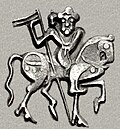

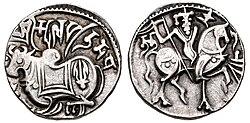






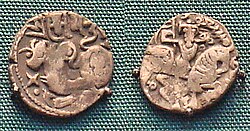


 Sri Spalapati
 " (which has been variously read Hajaj, J.haj or Ch'hach), Elliot transliterated the character to "Hahaj" and Cunningham had it equated to the Janjua tribe/clan, who were held to be descendants of the Rouran Khaganate.[29] Rahman doubts this theory and instead transliterates to "J.haj", an Arabicised form of Chhachh, while the area of Gandhara itself was called "country of the Rahbūt" (Rājpūt)[30] which is even today the name of the region around the Hindu Shahi capital of Hund.[29] In the 10th century, this region was occupied by the tribes of the Gakhars and Khokhars, who formed a large part of the Hindu Shahi army according to the Persian historian Firishta.[29]


 Śri Spalapatideva "Lord Commander-in-Chief". Reverse: Horseman with
  a in Nagari to left and symbol to right.[14]


 bhī in Nagari to left and symbol to right.[14]
.jpg)
_on_the_obverse._Nagari_%22Sri_Kudarayaka%22_on_the_reverse_(%E2%80%9CKhudarayaka%E2%80%9D)_Circa_895-921_CE.jpg)


 (Śrī Khūdarayakah, "The fortunate small Raja"), trisula mark on the hump of the bull. Reverse: horseman with
 na in Nagari to left; trace of symbol to right.[14]
.jpg)


![Kafir Kot[lower-alpha 22]](/w/images/smartcommons/thumbs/commons/9/9f/KafirKot_Temple_%28D%29_Ruins.jpg/295px-KafirKot_Temple_%28D%29_Ruins.jpg)
 Gumbat
![Bilot Fort Temple[lower-alpha 23]](/w/images/smartcommons/thumbs/commons/6/63/Bilot_Temple_B.jpg/324px-Bilot_Temple_B.jpg) Bilot Fort Temple[lower-alpha 23]
Bilot Fort Temple[lower-alpha 23]
 Malot
Malot
![Kafir Kot[lower-alpha 22]](/wiki/File:KafirKot_Temple_(D)_Ruins.jpg)

![Bilot Fort Temple[lower-alpha 23]](/wiki/File:Bilot_Temple_B.jpg)


