


Umaiordarame (talk | contribs) Content refined and expanded |
CleanupBot (talk | contribs) m Robot: Replacing encoded entity with character |
||
| Line 24: | Line 24: | ||
| subdivision_name1 = [[Karnataka]] | | subdivision_name1 = [[Karnataka]] | ||
| subdivision_name2 = Bangalore | | subdivision_name2 = Bangalore | ||
| established_title = | | established_title = <!-- Established --> | ||
| established_date = | | established_date = | ||
| founder = | | founder = | ||
| Line 55: | Line 55: | ||
| demographics1_info2 = Kannada, Tamil, Telugu, Urdu, Hindi and English | | demographics1_info2 = Kannada, Tamil, Telugu, Urdu, Hindi and English | ||
}} | }} | ||
{{More citations needed|date=June 2021}}[[File:Native Girls' School and Preaching-Room, Alasoor, Bangalore (p.184, December 1865, XXII).jpg|thumb|right|280px|Native Girls' School and Preaching-Room, Alasoor, Bangalore (p.184, 1865) | {{More citations needed|date=June 2021}}[[File:Native Girls' School and Preaching-Room, Alasoor, Bangalore (p.184, December 1865, XXII).jpg|thumb|right|280px|Native Girls' School and Preaching-Room, Alasoor, Bangalore (p.184, 1865)<ref name=Offering1864a>{{cite journal|title=Native Girls School and Preaching-Room, Alasoor, Bangalore - Bangalore Cantonment, 8 July 1865|journal=Wesleyan Juvenile Offering|date=December 1865|volume=XXII|pages=43–46|url=https://books.google.com/books?id=1VwEAAAAQAAJ|access-date=10 November 2015|publisher=Wesleyan Mission House|location=London}}</ref>]] | ||
[[File:A Street Scene in India, Outside the Wesleyan Girls School, Bangalore (January 1869, p.7, New III) - Copy.jpg|thumb|280px|A Street Scene in India, Outside the Wesleyan Girls School, Bangalore (January 1869, p.7) | [[File:A Street Scene in India, Outside the Wesleyan Girls School, Bangalore (January 1869, p.7, New III) - Copy.jpg|thumb|280px|A Street Scene in India, Outside the Wesleyan Girls School, Bangalore (January 1869, p.7)<ref name="Juvenile1869">{{cite journal|title=A Street Scene in India, Outside the Wesleyan Girls School, Bangalore|journal=The Wesleyan Juvenile Offering: A Miscellany of Missionary Information for Young Persons|date=January 1869|volume=New III|page=[https://archive.org/details/wesleyanjuvenil19socigoog/page/n17 7]|url=https://archive.org/details/wesleyanjuvenil19socigoog|access-date=24 February 2016|publisher=Wesleyan Missionary Society}}</ref>]] | ||
[[File:KITLV 92036 - Unknown - Juggernaut cart in the Ulsoor temple complex in Bangalore, India - Around 1870.tif|thumb|[[Juggernaut]] cart in the Halasuru temple complex in Bangalore, India, around 1870]] | [[File:KITLV 92036 - Unknown - Juggernaut cart in the Ulsoor temple complex in Bangalore, India - Around 1870.tif|thumb|[[Juggernaut]] cart in the Halasuru temple complex in Bangalore, India, around 1870]] | ||
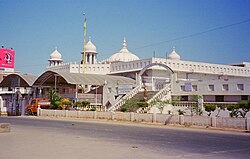
[[File:Gurudwara in Bangalore..jpg|right|thumb|Sri Guru Singh Sabha Gurudwara, Halasuru]] | [[File:Gurudwara in Bangalore..jpg|right|thumb|Sri Guru Singh Sabha Gurudwara, Halasuru]] | ||
| Line 62: | Line 62: | ||
==History and name== | ==History and name== | ||
The village of Bangalore is said to have been gifted to [[Kempe Gowda I]] (1513–1569) by the [[Vijayanagar Empire|Vijayanagara]] emperors. The Halasuru Lake was built by his successor, Kempe Gowda II, and is the only surviving tank built by the Gowda kings in Bangalore. | The village of Bangalore is said to have been gifted to [[Kempe Gowda I]] (1513–1569) by the [[Vijayanagar Empire|Vijayanagara]] emperors. The Halasuru Lake was built by his successor, Kempe Gowda II, and is the only surviving tank built by the Gowda kings in Bangalore.<ref>{{cite web|title=Halasuru Lake|url=https://www.bengaloorutourism.com/halasuru-lake.php}}</ref> The first [[British Empire|British]] military station was established in Halasuru in 1807.<ref name=History>{{usurped|[https://web.archive.org/web/20050420112152/http://www.hinduonnet.com/thehindu/mp/2005/03/22/stories/2005032200960300.htm "The birth of a cosmopolitan city"]}} The Hindu. 22 Mar. 2005</ref> | ||
There used to be a jackfruit orchard near the Halasuru Lake, and the Kannada name for [[jackfruit]] being 'Halasina Hannu', the area came to be known as ''Halasuru''. During the British colonial rule, the name was corrupted to ''Ulsoor''.{{cn|date=January 2020}} | There used to be a jackfruit orchard near the Halasuru Lake, and the Kannada name for [[jackfruit]] being 'Halasina Hannu', the area came to be known as ''Halasuru''. During the British colonial rule, the name was corrupted to ''Ulsoor''.{{cn|date=January 2020}} | ||
| Line 80: | Line 80: | ||
== Bengaluru Metro Rail == | == Bengaluru Metro Rail == | ||
There are two [[Namma Metro]] Rail stations | There are two [[Namma Metro]] Rail stations<ref>{{cite web |url=http://bmrc.co.in/RouteMap.htm |title=Bangalore Metro: Route Map |access-date=24 July 2012 |archive-date=31 July 2012 |archive-url=https://web.archive.org/web/20120731110338/http://bmrc.co.in/RouteMap.htm |url-status=dead }}</ref> in Halasuru: | ||
*Halasuru (on Old Madras Road, at the end closer to CMH Road) | *Halasuru (on Old Madras Road, at the end closer to CMH Road) | ||
*Trinity (at Trinity Circle) | *Trinity (at Trinity Circle) | ||
Latest revision as of 11:19, 22 March 2026
Halasuru
Ulsoor | |
|---|---|
neighbourhood | |
  Halasuru | |
| Coordinates: 12°58′N 77°38′E / 12.97°N 77.63°E | |
| Country | India |
| State | Karnataka |
| Metro | Bangalore |
| Languages | |
| • Official | Kannada |
| • Spoken | Kannada, Tamil, Telugu, Urdu, Hindi and English |
| Time zone | UTC+5:30 (IST) |
| PIN | 560008,560042 |
| Vehicle registration | KA-03 |
 | This article needs more citations. (June 2021) |
.jpg)
_-_Copy.jpg)

Halasuru, known as Ulsoor during the British Rule, is one of the oldest neighbourhoods in the city of Bengaluru. It is in central Bengaluru, and begins near the eastern terminus of Mahatma Gandhi Raste. It is renowned for its numerous temples and market.
History and name[edit | edit source]
The village of Bangalore is said to have been gifted to Kempe Gowda I (1513–1569) by the Vijayanagara emperors. The Halasuru Lake was built by his successor, Kempe Gowda II, and is the only surviving tank built by the Gowda kings in Bangalore.[3] The first British military station was established in Halasuru in 1807.[4]
There used to be a jackfruit orchard near the Halasuru Lake, and the Kannada name for jackfruit being 'Halasina Hannu', the area came to be known as Halasuru. During the British colonial rule, the name was corrupted to Ulsoor.[citation needed]
Location in Context[edit | edit source]
Areas of Bangalore | ||||||||||
|---|---|---|---|---|---|---|---|---|---|---|
| ||||||||||


Bengaluru Metro Rail[edit | edit source]
There are two Namma Metro Rail stations[5] in Halasuru:
- Halasuru (on Old Madras Road, at the end closer to CMH Road)
- Trinity (at Trinity Circle)
See also[edit | edit source]
References[edit | edit source]
- ↑ "Native Girls School and Preaching-Room, Alasoor, Bangalore - Bangalore Cantonment, 8 July 1865". Wesleyan Juvenile Offering. XXII. London: Wesleyan Mission House: 43–46. December 1865. Retrieved 10 November 2015.
- ↑ "A Street Scene in India, Outside the Wesleyan Girls School, Bangalore". The Wesleyan Juvenile Offering: A Miscellany of Missionary Information for Young Persons. New III. Wesleyan Missionary Society: 7. January 1869. Retrieved 24 February 2016.
- ↑ "Halasuru Lake".
- ↑ "The birth of a cosmopolitan city"[usurped] The Hindu. 22 Mar. 2005
- ↑ "Bangalore Metro: Route Map". Archived from the original on 31 July 2012. Retrieved 24 July 2012.
 | This article related to a location in Bangalore Urban district, Karnataka, India is a stub. You can help Bharatpedia by expanding it. |