


Ajay Kumar (talk | contribs) Created a new article |
No edit summary |
||
| Line 1: | Line 1: | ||
{{Short description| | {{Short description|Province of the Umayyad and Abbasid caliphates (711–861)}} | ||
{{Use dmy dates|date=April 2022}} | {{Use dmy dates|date=April 2022}} | ||
{{Use Oxford spelling|date=April 2022}} | {{Use Oxford spelling|date=April 2022}} | ||
{{Infobox country | {{Infobox former country | ||
| conventional_long_name = | | conventional_long_name = Sindh | ||
| common_name = | | common_name = | ||
| image_flag = | | image_flag = | ||
| national_anthem = | | national_anthem = | ||
| image_map = | | image_map = {{Location map+ | ||
{{Location map+ | |||
| South Asia | | South Asia | ||
| overlay_image= Map of the Caliphal Province of Sind.png | | overlay_image= Map of the Caliphal Province of Sind.png | ||
| width=290 | | width=290 <!-- DO NOT CHANGE MAP SIZE (290) AS THIS WILL DISPLACE THE LABELS --> | ||
| float = center | | float = center | ||
| border =none | | border =none | ||
| Line 19: | Line 17: | ||
| relief = yes | | relief = yes | ||
| places = | | places = | ||
{{Annotation|text-align=center|105|40|[[Karkota dynasty| | {{Annotation|text-align=center|105|40|[[Karkota dynasty|<span style="color:#4F311CFF">KARKOTAS</span>]]|font-weight=bold|font-style=normal|font-size=7|color=#000000}} | ||
{{Annotation|text-align=center|100|25|[[Patola Shahis| | {{Annotation|text-align=center|100|25|[[Patola Shahis|<span style="color:#4F311CFF">PATOLAS</span>]]|font-weight=bold|font-style=normal|font-size=7|color=#000000}} | ||
{{Annotation|text-align=center|230|5|South-Asia | {{Annotation|text-align=center|230|5|South-Asia<br />750 CE|font-weight=bold|font-style=normal|font-size=10|color=#000000}} | ||
{{Annotation|text-align=center|115|215|[[Pandyan dynasty| | {{Annotation|text-align=center|115|215|[[Pandyan dynasty|<span style="color:#4F311CFF">PANDYAS</span>]]|font-weight=bold|font-style=normal|font-size=7|color=#000000}} | ||
{{Annotation|text-align=center|115|185|[[Chola dynasty| | {{Annotation|text-align=center|115|185|[[Chola dynasty|<span style="color:#4F311CFF">CHOLAS</span>]]|font-weight=bold|font-style=normal|font-size=7|color=#000000}} | ||
{{Annotation|text-align=center|70|32|[[Turk Shahis| | {{Annotation|text-align=center|70|32|[[Turk Shahis|<span style="color:#006400FF">TURK<br />SHAHIS</span>]]|font-weight=bold|font-style=normal|font-size=7|color=#000000}} | ||
{{Annotation|text-align=center|170|45|[[Tibetan Empire| | {{Annotation|text-align=center|170|45|[[Tibetan Empire|<span style="color:#4F311CFF">TIBETAN<br/>EMPIRE</span>]]|font-weight=bold|font-style=normal|font-size=8|color=#000000}} | ||
{{Annotation|text-align=center|52|52|[[Zunbils| | {{Annotation|text-align=center|52|52|[[Zunbils|<span style="color:#006400FF">ZUNBILS</span>]]|font-weight=bold|font-style=normal|font-size=7|color=#000000}} | ||
{{Annotation|text-align=center|75|130|[[Maitrakas| | {{Annotation|text-align=center|75|130|[[Maitrakas|<span style="color:#4F311CFF">MAITRAKAS</span>]]|font-weight=bold|font-style=normal|font-size=7|color=#000000}} | ||
{{Annotation|text-align=center|115|90|[[Gurjara-Pratihara dynasty| | {{Annotation|text-align=center|115|90|[[Gurjara-Pratihara dynasty|<span style="color:#4F311CFF">GURJARA<br />PRATIHARAS</span>]]|font-weight=bold|font-style=normal|font-size=8|color=#000000}} | ||
{{Annotation|text-align=center|185|110|[[Pala Empire| | {{Annotation|text-align=center|185|110|[[Pala Empire|<span style="color:#4F311CFF">PALA<br />EMPIRE</span>]]|font-weight=bold|font-style=normal|font-size=8|color=#000000}} | ||
{{Annotation|text-align=center|95|160|[[Chalukya dynasty| | {{Annotation|text-align=center|95|160|[[Chalukya dynasty|<span style="color:#4F311CFF">CHALUKYAS</span>]]|font-weight=bold|font-style=normal|font-size=7|color=#000000}} | ||
{{Annotation|text-align=center|1|40|[[Abbasid Caliphate| | {{Annotation|text-align=center|1|40|[[Abbasid Caliphate|<span style="color:#006400FF">ABBASID<br />CALIPHATE</span>]]|font-weight=bold|font-style=normal|font-size=8|color=#000000}} | ||
{{Annotation|text-align=center|140|5|[[Tang dynasty| | {{Annotation|text-align=center|140|5|[[Tang dynasty|<span style="color:#006400FF">TANG DYNASTY</span>]]|font-weight=bold|font-style=normal|font-size=8|color=#000000}} | ||
{{Annotation|text-align=center|150|155|[[Eastern Ganga dynasty| | {{Annotation|text-align=center|150|155|[[Eastern Ganga dynasty|<span style="color:#4F311CFF">KALINGAS</span>]]|font-weight=bold|font-style=normal|font-size=7|color=#000000}} | ||
{{Annotation|text-align=center|145|135|[[Kalachuris of Tripuri| | {{Annotation|text-align=center|145|135|[[Kalachuris of Tripuri|<span style="color:#4F311CFF">KALACHURIS</span>]]|font-weight=bold|font-style=normal|font-size=7|color=#000000}} | ||
{{Annotation|262|250|[[Template:South Asia in 600 CE| | {{Annotation|262|250|[[Template:South Asia in 600 CE|<span style="color:#4F311CFF"> ◁ </span>]] [[Template:South Asia in 800 CE|<span style="color:#4F311CFF"> ▷ </span>]]|text-align=center|font-weight=bold|font-style=normal|font-size=12|color=#000000}} | ||
|caption= | |caption= | ||
}} | }} | ||
| image_map_caption = {{center|Map of Arab Sind under the [[Abbasid Caliphate]], and neighbouring polities, {{circa|750 CE}} | | image_map_caption = {{center|Map of Arab Sind under the [[Abbasid Caliphate]], and neighbouring polities, {{circa|750 CE}}<ref name="JES">{{cite book |last1=Schwartzberg |first1=Joseph E. |title=A Historical atlas of South Asia |date=1978 |publisher=University of Chicago Press |location=Chicago |page=145, map XIV.1 (e) |isbn=0226742210 |url=https://dsal.uchicago.edu/reference/schwartzberg/pager.html?object=182 |archive-date=24 February 2021 |access-date=23 February 2022 |archive-url=https://web.archive.org/web/20210224162023/https://dsal.uchicago.edu/reference/schwartzberg/pager.html?object=182 |url-status=dead }}</ref>}} | ||
| capital = [[Aror]] | | capital = [[Aror]] | ||
| religion = [[ | | government_type = [[Ummayad caliphate|Caliphal province]] | ||
| | | legislature = | ||
| title_leader = [[Governor]] | |||
| leader1 = [[Muhammad bin Qasim]] | |||
| year_leader1 = 711–715 (first) | |||
| leader2 = [[Habbari dynasty|Umar ibn'Abd al-Aziz al'Habbari]] | |||
| year_leader2 = 854–861 (last) | |||
| religion = '''[[State religion]]:'''<br />{{plainlist| | |||
[[Islam]]<br />'''Other religions''':<br />[[Religion in South Asia|Other religions in South Asia]]}} | |||
| footnotes = | | footnotes = | ||
| status = | | status = | ||
| Line 48: | Line 53: | ||
| map_width = 290px | | map_width = 290px | ||
| common_languages = [[Sindhi language|Sindhi]], [[Sanskrit]], [[Classical Arabic|Arabic]] | | common_languages = [[Sindhi language|Sindhi]], [[Sanskrit]], [[Classical Arabic|Arabic]] | ||
| | | era = [[Medieval India|Post-classical India]] | ||
| event_start = [[Muslim conquest of Sindh|Arab-Muslim conquest]] | | event_start = [[Muslim conquest of Sindh|Arab-Muslim conquest]] | ||
| event_end = [[Anarchy at Samarra]] | | event_end = [[Anarchy at Samarra]] | ||
| p1 = | | p1 = Chach dynasty | ||
| s1 = Habbari dynasty | | s1 = Habbari dynasty | ||
| s2 = Emirate of Multan | | s2 = Emirate of Multan | ||
| p2 = | | p2 = | ||
| today = [[Pakistan]]<br/>[[India]] | |||
| today = [[Pakistan]] | |||
}} | }} | ||
''' | '''Sindh''' was a province of the [[Umayyad Caliphate]] and later of the [[Abbasid Caliphate]] from around 711 CE with the [[Umayyad conquest of Sindh|Islamic conquest of Sindh]] by [[Muhammad ibn al-Qasim]], to around 854 CE with the emergence of the [[anarchy at Samarra|independent dynasties]] of the [[Habbari dynasty|Habbarid Emirate]] in [[Sindh]] proper and the [[Emirate of Multan]] in [[Punjab]]. The "Governor of Sindh" ({{Langx|ar|عامل السند|translit=‘āmil al-Sind}})<ref>Al-Ya'qubi, pp. 388, 557, 448, 599; al-Tabari, v. 32: p. 106</ref> was an official who administered the [[caliphate|caliphal]] province over what are now Sindh, southern [[Punjab, Pakistan|Punjab]] and [[Makran]] ([[Balochistan, Pakistan|Balochistan]]) in [[Pakistan]]. | ||
The governor was the chief [[Muslims|Muslim]] official in the province and was responsible for maintaining security in the region. As the leader of the provincial military, he was also in charge of carrying out campaigns against the [[Indian religions|non-Muslim]] kingdoms of India. Governors appointed to the region were selected either directly by the caliph or by an authorized subordinate, and remained in office until they either died or were dismissed. | The governor was the chief [[Muslims|Muslim]] official in the province and was responsible for maintaining security in the region. As the leader of the provincial military, he was also in charge of carrying out campaigns against the [[Indian religions|non-Muslim]] kingdoms of India. Governors appointed to the region were selected either directly by the caliph or by an authorized subordinate, and remained in office until they either died or were dismissed. | ||
==Geography== | ==Geography== | ||
Sind was a frontier province of the [[Umayyad Caliphate|Umayyad]] and Abbasid caliphates from its conquest in c. 711 until the mid-ninth century. Situated at the far eastern end of the caliphate, it consisted of the territories held by the Muslims in [[ | Sind was a frontier province of the [[Umayyad Caliphate|Umayyad]] and Abbasid caliphates from its conquest in c. 711 until the mid-ninth century. Situated at the far eastern end of the caliphate, it consisted of the territories held by the Muslims in the [[Indian subcontinent]], which at the time were centered in the [[Indus River|Indus]] region. Sind proper was bounded on the west by [[Makran]], on the northwest by [[Sistan|Sijistan]] and the district of [[Turan of Baluchistan|Turan]], on the northeast by [[Multan]], on the east by the [[Thar Desert]], on the southeast by the non-Muslim [[al-Hind|Hind]], and on the southwest by the [[Indian Ocean]].<ref>Le Strange, pp. 331–2 and Map 7; Blankinship, pp. 110–2</ref> | ||
== Conquest of Sind == | == Conquest of Sind == | ||
{{Main|Umayyad conquest of Sindh}} | {{Main|Umayyad conquest of Sindh}} | ||
[[File:Sindh campaigns 711-715 CE.png|thumb|300px|[[Muhammad ibn Qasim]]'s conquest of Sindh (711-715 CE). | [[File:Sindh campaigns 711-715 CE.png|thumb|300px|[[Muhammad ibn Qasim]]'s conquest of Sindh (711-715 CE).<br> | ||
{{legend|yellow|Desert areas ([[Registan Desert]] and [[Thar Desert]])}} | {{legend|yellow|Desert areas ([[Registan Desert]] and [[Thar Desert]])}} | ||
{{legend|#FFD700|[[Zunbils]]}} | {{legend|#FFD700|[[Zunbils]]}} | ||
| Line 76: | Line 77: | ||
{{legend|#7FFF00|[[Maitraka dynasty|Maitraka Kingdom]] (c.475–c.776 CE)}} | {{legend|#7FFF00|[[Maitraka dynasty|Maitraka Kingdom]] (c.475–c.776 CE)}} | ||
|left]] | |left]] | ||
In the history of the [[Early Muslim conquests|Muslim conquests]], Sind was a relatively late achievement, occurring almost a century after the [[Hijrah]] (start of Islamic calendar). Military raids against India had been undertaken by the Muslims as early as [[Umar]]'s reign (634–644), but the pace of expansion in the region was initially slow: in 636, an Arab naval expedition attacked [[Bharuch|Broach]], which had come under the control of the [[Chalukyas]] following the submission of Jayabhata of the [[Gurjaras of Lata]], and [[Thane|Thana]], but it was soon recalled after achieving some damage and they failed to capture these cities. | In the history of the [[Early Muslim conquests|Muslim conquests]], Sind was a relatively late achievement, occurring almost a century after the [[Hijrah]] (start of Islamic calendar). Military raids against India had been undertaken by the Muslims as early as [[Umar]]'s reign (634–644), but the pace of expansion in the region was initially slow: in 636, an Arab naval expedition attacked [[Bharuch|Broach]], which had come under the control of the [[Chalukyas]] following the submission of Jayabhata of the [[Gurjaras of Lata]], and [[Thane|Thana]], but it was soon recalled after achieving some damage and they failed to capture these cities.<ref>{{cite book |last1=Schmidt |first1=Karl J. |url=https://books.google.com/books?id=BqdzCQAAQBAJ&pg=PA36 |title=An Atlas and Survey of South Asian History |date=20 May 2015 |publisher=Routledge |isbn=978-1-317-47681-8 |edition=Reprint |location=London and New York |page=36 |language=en}}</ref><ref>{{cite book |last1=Rao |first1=M. S. Nagaraja |url=https://books.google.com/books?id=dq8cAAAAMAAJ |title=The Chalukyas of Badami: Seminar Papers |date=1978 |publisher=Mythic Society |page=193 |language=en |quote="Jayabhața, the Gurjara of Lāța, became the feudatory of the Chalukya emperor. It was in his time that an Arab fleet was despatched to Thāņa and Broach (A.D. 636), and did some damage but was recalled under the orders of Caliph Omar."}}</ref> Several governors were appointed to the Indian frontier (''{{Transliteration|ar|DIN|thaghr al-Hind}}'') and tasked with conducting campaigns in the east. Some of these expeditions were successful, but others ended in defeat and a number of governors were killed while serving there. | ||
According to Derryl N. Maclean, a link between Sind and the early partisans of Caliph [[Ali]] or proto-[[Shia Islam|Shi'ites]] could be traced to Hakim ibn Jabalah al-Abdi, a [[Companions of the Prophet|companion of the Islamic prophet Muhammad]], who traveled across Sind to [[Makran]] in 649 and presented a report on the area to the caliph. He supported Ali, and died in the [[Battle of the Camel]] alongside Sindi [[Jats]]. | According to Derryl N. Maclean, a link between Sind and the early partisans of Caliph [[Ali]] or proto-[[Shia Islam|Shi'ites]] could be traced to Hakim ibn Jabalah al-Abdi, a [[Companions of the Prophet|companion of the Islamic prophet Muhammad]], who traveled across Sind to [[Makran]] in 649 and presented a report on the area to the caliph. He supported Ali, and died in the [[Battle of the Camel]] alongside Sindi [[Jats]].<ref>M. Ishaq, "Hakim Bin Jabala - An Heroic Personality of Early Islam", Journal of the Pakistan Historical Society, pp. 145-50, (April 1955).</ref> During the reign of Ali, many Jats came under the influence of Islam.<ref>Ibn Athir, Vol. 3, pp. 45–46, 381, as cited in: S. A. N. Rezavi, "'''The Shia Muslims'''", in History of Science, Philosophy and Culture in Indian Civilization, Vol. 2, Part. 2: "Religious Movements and Institutions in Medieval India", Chapter 13, Oxford University Press (2006). {{ISBN|9780195677034}}.</ref> Harith ibn Murrah al-Abdi and Sayfi ibn Fil al-Shaybani, both officers of Ali's army, attacked Sindi bandits and chased them to [[Kingdom of Kaikan|al-Qiqan]] (present-day [[Quetta]]) in 658.<ref>Ibn Sa'd, 8:346. The raid is noted by Balâdhurî, "fatooh al-Baldan" p. 432, and Ibn Khayyât, Ta'rîkh, 1:173, 183–84, as cited in: Derryl N. Maclean, '''Religion and Society in Arab Sind.''' Pg. 126, EJ Brill: Leiden, 1989. {{ISBN|90-04-08551-3}}.</ref> Sayfi was one of the seven partisans of Ali who were beheaded alongside [[Hujr ibn 'Adi|Hujr ibn Adi al-Kindi]]<ref>Tabarî, 2:129, 143, 147, as cited in: Derryl N. Maclean, '''Religion and Society in Arab Sind''', p. 126, EJ Brill (1989) {{ISBN|90-04-08551-3}}.</ref> in 660 AD, near [[Damascus]]. | ||
In the caliphate of [[Mu'awiya I]] ({{reign|661|680}}), the region of Makran was subdued and a garrison was established there. Over the following decades, the Muslims progressed further east, conquering the district of [[Qusdar]] and raiding the areas around [[Qandabil]] and al-Qiqan. | In the caliphate of [[Mu'awiya I]] ({{reign|661|680}}), the region of Makran was subdued and a garrison was established there. Over the following decades, the Muslims progressed further east, conquering the district of [[Qusdar]] and raiding the areas around [[Qandabil]] and al-Qiqan.<ref>Gabrieli, p. 283; Wink; pp. 129, 131; al-Baladhuri, pp. 209–15; al-Ya'qubi, pp. 278, 330–1</ref> | ||
Sind was conquered in {{circa|711}} by [[Muhammad ibn Qasim|Muhammad ibn Qasim al-Thaqafi]], who had been sent to undertake a punitive expedition against [[Raja Dahir|Dahir]], the king of Sind. After marching through Makran and defeating its inhabitants, Muhammad entered Sind and attacked the port city of [[Debal|Daybul]], which fell after a siege and was partly colonized by the Muslims. Following this victory, Muhammad moved north and encountered Dahir, whom he defeated and killed. He then spent the next few years campaigning in Sind and [[Multan District|Multan]], forcing the various cities of the country to submit to him. | Sind was conquered in {{circa|711}} by [[Muhammad ibn Qasim|Muhammad ibn Qasim al-Thaqafi]], who had been sent to undertake a punitive expedition against [[Raja Dahir|Dahir]], the king of Sind. After marching through Makran and defeating its inhabitants, Muhammad entered Sind and attacked the port city of [[Debal|Daybul]], which fell after a siege and was partly colonized by the Muslims. Following this victory, Muhammad moved north and encountered Dahir, whom he defeated and killed. He then spent the next few years campaigning in Sind and [[Multan District|Multan]], forcing the various cities of the country to submit to him. | ||
This period of conquests continued until 715, when Caliph [[al-Walid I]] ({{reign|705|715}}) died; shortly after the accession of Caliph [[Sulayman ibn Abd al-Malik|Sulayman]], Muhammad was arrested and executed, and a replacement was sent by the government to take control of Sind. | This period of conquests continued until 715, when Caliph [[al-Walid I]] ({{reign|705|715}}) died; shortly after the accession of Caliph [[Sulayman ibn Abd al-Malik|Sulayman]], Muhammad was arrested and executed, and a replacement was sent by the government to take control of Sind.<ref>Gabrieli, pp. 283–92; Wink, pp. 202–7; al-Baladhuri, pp. 216–24; al-Ya'qubi, pp. 345–7, 356; ''Encyclopaedia of Islam'', s.v. "Sind" (T.W. Haig-[C.E. Bosworth])</ref> | ||
From then on, the [[Turk Shahis]] now had to face an additional Muslim threat from the southeast, as did Hindu kingdoms, especially the [[Maitrakas]] and the [[Gurjara-Pratiharas]], on their western borders, since the Caliphal province of Sind extended as far as [[Multan]], at the gates of the [[Punjab]], and would last until 854 CE as an [[Umayyad]] and then [[Abbasid]] dependency. | From then on, the [[Turk Shahis]] now had to face an additional Muslim threat from the southeast, as did Hindu kingdoms, especially the [[Maitrakas]] and the [[Gurjara-Pratiharas]], on their western borders, since the Caliphal province of Sind extended as far as [[Multan]], at the gates of the [[Punjab]], and would last until 854 CE as an [[Umayyad]] and then [[Abbasid]] dependency.<ref name="CAP148">{{cite book |last1=Petrie |first1=Cameron A. |url=https://books.google.com/books?id=YbQWEAAAQBAJ&pg=PT148-149 |title=Resistance at the Edge of Empires: The Archaeology and History of the Bannu basin from 1000 BC to AD 1200 |date=28 December 2020 |publisher=Oxbow Books |isbn=978-1-78570-304-1 |location=Oxford |page=148 |language=en}}</ref> | ||
== Umayyad period == | == Umayyad period == | ||
[[File:Umayyad Caliphate coinage temp Suleiman ibn Abd al-Malik al-Hind (possibly Multan) mint. Dated AH 97 (AD 715-6).jpg|thumb|300px| Umayyad coinage in India, from the time of the first governor of Sindh, [[Muhammad ibn Qasim]]. Minted in India "[[al-Hind]]" (possibly in the city of [[Multan]]), dated AH 97 (715-6 CE): obverse circular legend ''"in the name of Allah, struck this dirham in [[al-Hind]] ([[File:India in Abd al-Malik al-Hind coin 715 CE (detail).jpg|20px]] ''{{lang|ar|[[:ary:لهند|لهند]]}}'' l'Hind) in the year seven and ninety"''.]] | [[File:Umayyad Caliphate coinage temp Suleiman ibn Abd al-Malik al-Hind (possibly Multan) mint. Dated AH 97 (AD 715-6).jpg|thumb|300px| Umayyad coinage in India, from the time of the first governor of Sindh, [[Muhammad ibn Qasim]]. Minted in India "[[al-Hind]]" (possibly in the city of [[Multan]]), dated AH 97 (715-6 CE): obverse circular legend ''"in the name of Allah, struck this dirham in [[al-Hind]] ([[File:India in Abd al-Malik al-Hind coin 715 CE (detail).jpg|20px]] ''{{lang|ar|[[:ary:لهند|لهند]]}}'' l'Hind) in the year seven and ninety"''.]] | ||
As a result of its conquest, Sind became a province of the caliphate and governors were appointed to administer it. As the commander of a frontier province, the governor was responsible for guarding the country against external incursions, and could carry out raids into Hind (India) at his discretion. The governor's jurisdiction usually also included the neighboring regions of Makran, Turan and Multan; | As a result of its conquest, Sind became a province of the caliphate and governors were appointed to administer it. As the commander of a frontier province, the governor was responsible for guarding the country against external incursions, and could carry out raids into Hind (India) at his discretion. The governor's jurisdiction usually also included the neighboring regions of Makran, Turan and Multan;<ref>Baloch and Rafiqi, pp. 293–4</ref> in addition, any territories that he conquered in Hind were added to his area of authority.<ref>Al-Baladhuri, p. 227</ref> | ||
In the administrative hierarchy of the Umayyad Caliphate, the responsibility for selecting governors to the province was assigned to the [[List of Umayyad governors of Iraq|governor of Iraq]], or, if that position was vacant, to the governor of [[Basra]]. Unless he received specific commands from the caliph, the governor of Iraq had the authority to appoint and dismiss governors to Sind and he was in charge of supervising their activities in the province. | In the administrative hierarchy of the Umayyad Caliphate, the responsibility for selecting governors to the province was assigned to the [[List of Umayyad governors of Iraq|governor of Iraq]], or, if that position was vacant, to the governor of [[Basra]]. Unless he received specific commands from the caliph, the governor of Iraq had the authority to appoint and dismiss governors to Sind and he was in charge of supervising their activities in the province.<ref>Blankinship, pp. 62–3</ref> | ||
According to the historian [[Khalifa ibn Khayyat]], after the downfall of Muhammad ibn Qasim the responsibilities of the governor of Sind were temporarily divided between two officials, one of whom was in charge of military affairs and the other in charge of taxation. This change was soon rescinded and the next governor, [[Habib ibn al-Muhallab|Habib ibn al-Muhallab al-Azdi]], had full authority over both the fiscal and military affairs on the province. | According to the historian [[Khalifa ibn Khayyat]], after the downfall of Muhammad ibn Qasim the responsibilities of the governor of Sind were temporarily divided between two officials, one of whom was in charge of military affairs and the other in charge of taxation. This change was soon rescinded and the next governor, [[Habib ibn al-Muhallab|Habib ibn al-Muhallab al-Azdi]], had full authority over both the fiscal and military affairs on the province.<ref>Khalifah ibn Khayyat, 318</ref> | ||
[[File:Coinage of al-Hakam bin Awana al-Kalbi, Umayyad governor of Sindh (circa AH 111-123 AD 731-740).jpg|thumb|left|300px|Coinage of [[al-Hakam bin Awana al-Kalbi]], Umayyad governor of Sindh (circa AH 111-123 / AD 731-740)]] | [[File:Coinage of al-Hakam bin Awana al-Kalbi, Umayyad governor of Sindh (circa AH 111-123 AD 731-740).jpg|thumb|left|300px|Coinage of [[al-Hakam bin Awana al-Kalbi]], Umayyad governor of Sindh (circa AH 111-123 / AD 731-740)]] | ||
As a general rule, provincial governorships in the Umayyad period were held almost exclusively by Arabs, | As a general rule, provincial governorships in the Umayyad period were held almost exclusively by Arabs,<ref>Blankinship, p. 41</ref> and this trend was reflected in the appointees to Sind during this period. [[Qays–Yaman rivalry|Qaysi–Yamani tribal politics]] also played a strong role in the selection and dismissal of governors;<ref>Crone, pp. 142 ff.; Blankinship, pp. 45–6, 98; Shaban, pp. 120 ff.</ref> if the governor of Iraq was [[Qays]]i, then his governor to Sind would likely be Qaysi, and if he was [[Yaman (tribal group)|Yamani]], his selection would likely be Yamani as well. There were, however, some exceptions; [[Junayd ibn Abd al-Rahman al-Murri]] was initially appointed to Sind by a fellow Qaysi, but was allowed to retain his position for two years after the governor of Iraq was replaced with a Yamani.<ref>Al-Ya'qubi, p. 379; Khalifah ibn Khayyat, p. 359; Crone, p. 147</ref> | ||
[[File:Arab-Gujarat campaigns 724-740 CE.png|thumb|300px|right|Campaigns from the [[Caliphal province of Sind]] into [[Gujarat]] (724-740 CE). | [[File:Arab-Gujarat campaigns 724-740 CE.png|thumb|300px|right|Campaigns from the [[Caliphal province of Sind]] into [[Gujarat]] (724-740 CE). | ||
| Line 104: | Line 105: | ||
{{legend|#E0FFFF|[[Maitrakas|Maitraka Kingdom]] (c.475–c.776 CE)}} | {{legend|#E0FFFF|[[Maitrakas|Maitraka Kingdom]] (c.475–c.776 CE)}} | ||
]] | ]] | ||
The governors of Sind in the Umayyad period undertook extensive campaigns against the non-Muslim kingdoms of Hind, but with mixed results. Al-Junayd's campaigns were largely successful, but his successor [[Tamim ibn Zaid al-Utbi]] encountered difficulties and the Muslims were forced to retreat from Hind. The next governor, [[al-Hakam ibn Awana]], vigorously campaigned in Hind and initially achieved some victories, but he too experienced a reversal of fortune and was eventually killed. Raids into Hind continued after al-Hakam's death, but no major territorial gains were achieved, and the Muslim presence in | The governors of Sind in the Umayyad period undertook extensive campaigns against the non-Muslim kingdoms of Hind, but with mixed results. Al-Junayd's campaigns were largely successful, but his successor [[Tamim ibn Zaid al-Utbi]] encountered difficulties and the Muslims were forced to retreat from Hind. The next governor, [[al-Hakam ibn Awana]], vigorously campaigned in Hind and initially achieved some victories, but he too experienced a reversal of fortune and was eventually killed. Raids into Hind continued after al-Hakam's death, but no major territorial gains were achieved, and the Muslim presence in the Indian subcontinent remained largely restricted to the Indus valley region.<ref>Al-Baladhuri, pp. 225–9; Blankinship, pp. 131–4; 147–9; 186–90, 202–3; Wink, 207-9</ref> | ||
As part of his efforts to secure the Muslim position in Sind, al-Hakam constructed the military garrison of [[al-Mahfuzah]], which he made into his capital (''{{ | As part of his efforts to secure the Muslim position in Sind, al-Hakam constructed the military garrison of [[al-Mahfuzah]], which he made into his capital (''{{Transliteration|ar|DIN|miṣr}}''). Shortly after this, his lieutenant [[Amr ibn Muhammad ibn al-Qasim|Amr]], a son of Muhammad ibn Qasim, built a second city near al-Mahfuzah, which he called [[Mansura (Brahmanabad)|al-Mansura]]. This latter city eventually became the permanent administrative capital of Sind, and it served as the seat of the Umayyad and [[Abbasid]] governors.<ref>Al-Ya'qubi, pp. 380, 389; al-Baladhuri, pp. 228–9; ''Encyclopaedia of Islam'', s.v. "al-Mansura" (Y. Friedmann)</ref> | ||
The names of the caliphal governors of Sind are preserved in the histories of Khalifa ibn Khayyat and [[al-Ya'qubi]]. Some differences exist between the two authors' versions; these are noted below. The ''[[Futuh al-Buldan]]'' by [[al-Baladhuri]], which focuses on the military conquests of the early Muslim state, also contains the names of many of the governors who served in Sind. | The names of the caliphal governors of Sind are preserved in the histories of Khalifa ibn Khayyat and [[al-Ya'qubi]]. Some differences exist between the two authors' versions; these are noted below. The ''[[Futuh al-Buldan]]'' by [[al-Baladhuri]], which focuses on the military conquests of the early Muslim state, also contains the names of many of the governors who served in Sind. | ||
===List of Governors of Sindh=== | |||
{{see also|Governors of Sindh}} | |||
{| width=85% class="wikitable" | {| width=85% class="wikitable" | ||
|+ align="left" | Military governors | |+ align="left" | Military governors | ||
| Line 115: | Line 118: | ||
! width=22% | Name | ! width=22% | Name | ||
! width=8% | Years | ! width=8% | Years | ||
! width=10% | Nature of | ! width=10% | Nature of<br>termination | ||
! width=60% | Notes | ! width=60% | Notes | ||
|- | |- | ||
| Line 121: | Line 124: | ||
|align="center"|711–715 | |align="center"|711–715 | ||
|align="center"|Dismissed | |align="center"|Dismissed | ||
|Conquered Sind. Appointed by the governor of Iraq, [[al-Hajjaj ibn Yusuf al-Thaqafi]] | |Conquered Sind. Appointed by the governor of Iraq, [[al-Hajjaj ibn Yusuf al-Thaqafi]]<ref>Al-Ya'qubi, pp. 345–7, 356; Khalifah ibn Khayyat, pp. 304–7, 310, 318; al-Baladhuri, pp. 216–25; al-Tabari, v. 23: p. 149; Crone, p. 135</ref> | ||
|- | |- | ||
|[[Habib ibn al-Muhallab|Habib ibn al-Muhallab al-Azdi]] | |[[Habib ibn al-Muhallab|Habib ibn al-Muhallab al-Azdi]] | ||
|align="center"|715–717 | |align="center"|715–717 | ||
|align="center"|Dismissed(?) | |align="center"|Dismissed(?) | ||
|Appointed either by the caliph [[Sulayman ibn Abd al-Malik]] or by [[Salih ibn Abd al-Rahman]] | |Appointed either by the caliph [[Sulayman ibn Abd al-Malik]] or by [[Salih ibn Abd al-Rahman]]<ref>Al-Ya'qubi, p. 356; Khalifah ibn Khayyat, p. 318; al-Baladhuri, p. 225; Crone, p. 141. Habib either was dismissed or resigned, since he remained alive until 102/720; al-Tabari, v. 24: pp. 134–7</ref> | ||
|- | |- | ||
|[[Abd al-Malik ibn Misma]] | |[[Abd al-Malik ibn Misma]] | ||
|align="center"|from 717 | |align="center"|from 717 | ||
|align="center"|Dismissed | |align="center"|Dismissed | ||
|Not listed by al-Ya'qubi. Appointed by the governor of Basra, [[Adi ibn Artah al-Fazari]] | |Not listed by al-Ya'qubi. Appointed by the governor of Basra, [[Adi ibn Artah al-Fazari]]<ref>Khalifah ibn Khayyat, p. 322</ref> | ||
|- | |- | ||
|[[Amr ibn Muslim al-Bahili]] | |[[Amr ibn Muslim al-Bahili]] | ||
|align="center"|to 720 | |align="center"|to 720 | ||
|align="center"|Overthrown | |align="center"|Overthrown | ||
|Not listed by al-Ya'qubi. Appointed by Adi ibn Artah | |Not listed by al-Ya'qubi. Appointed by Adi ibn Artah<ref>Khalifah ibn Khayyat, pp. 322, 333; al-Baladhuri, p. 225</ref> | ||
|- | |- | ||
|[[Ubaydallah ibn Ali al-Sulami]] | |[[Ubaydallah ibn Ali al-Sulami]] | ||
|align="center"|from 721 | |align="center"|from 721 | ||
|align="center"|Dismissed | |align="center"|Dismissed | ||
|Not listed by al-Ya'qubi. Appointed by the governor of Iraq, [[Umar ibn Hubayra al-Fazari]] | |Not listed by al-Ya'qubi. Appointed by the governor of Iraq, [[Umar ibn Hubayra al-Fazari]]<ref>Khalifah ibn Khayyat, p. 333; Crone, p. 146</ref> | ||
|- | |- | ||
|[[Junayd ibn Abd al-Rahman al-Murri]] | |[[Junayd ibn Abd al-Rahman al-Murri]] | ||
|align="center"|to 726 | |align="center"|to 726 | ||
|align="center"|Dismissed | |align="center"|Dismissed | ||
|Appointed by Umar ibn Hubayra | |Appointed by Umar ibn Hubayra<ref>Al-Ya'qubi, pp. 379–80; Khalifah ibn Khayyat, pp. 333, 359; al-Baladhuri, pp. 226–7; Crone, pp. 98; 147</ref> | ||
|- | |- | ||
|[[Tamim ibn Zaid al-Utbi]] | |[[Tamim ibn Zaid al-Utbi]] | ||
|align="center"|from 726 | |align="center"|from 726 | ||
|align="center"|Died(?) | |align="center"|Died(?) | ||
|Appointed by the governor of Iraq, [[Khalid ibn Abdallah al-Qasri]] | |Appointed by the governor of Iraq, [[Khalid ibn Abdallah al-Qasri]]<ref>Al-Ya'qubi, p. 380; Khalifah ibn Khayyat, p. 359; al-Baladhuri, p. 227-8; Crone, p. 148. Al-Ya'qubi and al-Baladhuri both give his ''nisbah'' as al-'Utbi. According to Khalifah ibn Khayyat, he was dismissed from office</ref> | ||
|- | |- | ||
|[[Al-Hakam ibn Awana]] | |[[Al-Hakam ibn Awana]] | ||
|align="center"|to 740 | |align="center"|to 740 | ||
|align="center"|Killed | |align="center"|Killed | ||
|Appointed by Khalid ibn Abdallah | |Appointed by Khalid ibn Abdallah<ref>Al-Ya'qubi, pp. 380, 388–9; Khalifah ibn Khayyat, pp. 354, 359; al-Baladhuri; pp. 228–9; Crone, p. 147</ref> | ||
|- | |- | ||
|[[Amr ibn Muhammad ibn al- | |[[Amr ibn Muhammad ibn al-qasim al Thaqafi]] | ||
|align="center"|740–744 | |align="center"|740–744 | ||
|align="center"|Dismissed | |align="center"|Dismissed | ||
|Son of Muhammad ibn al-Qasim. Appointed by the governor of Iraq, [[Yusuf ibn Umar al-Thaqafi]] | |Son of Muhammad ibn al-Qasim. Appointed by the governor of Iraq, [[Yusuf ibn Umar al-Thaqafi]]<ref>Al-Ya'qubi, pp. 389–90, 399–400; Khalifah ibn Khayyat, pp. 354, 359, 366; al-Tabari, v. 26: pp. 199–200</ref> | ||
|- | |- | ||
|[[Yazid ibn Irar al-Kalbi]](?) | |[[Yazid ibn Irar al-Kalbi]](?) | ||
|align="center"|740s | |align="center"|740s | ||
|align="center"|Overthrown | |align="center"|Overthrown | ||
|Name and details of governorship given variously in the sources. See especially this note | |Name and details of governorship given variously in the sources. See especially this note<ref>In al-Ya'qubi, pp. 399–400, 407, this individual is named as Yazid ibn Irar (although the editor, p. 389, notes variant readings, including Izzan) and is said to have replaced 'Amr ibn Muhammad as governor in the reign of al-Walid ibn Yazid; he remained as governor until Mansur ibn Jumhur al-Kalbi arrived in Sind and killed him. Khalifah ibn Khayyat, p. 357, calls him Muhammad ibn Irar al-Kalbi and claims he became governor on an interim basis, after the death of al-Hakam ibn Awana; subsequently he was dismissed in 122/740 by the governor of Iraq, Yusuf ibn Umar al-Thaqafi, and replaced with Amr. All this is said to have taken place during the reign of Hisham. Al-Tabari, v. 26: pp. 199–200, calls him "Muhammad ibn Ghazzan – or Izzan – al-Kalbi" and states that he was appointed to succeed Amr in 126/744 by the governor of Iraq, Mansur ibn Jumhur al-Kalbi, in the reign of Yazid ibn al-Walid; he does not specify Muhammad's fate.</ref> | ||
|- | |- | ||
|} | |} | ||
| Line 175: | Line 178: | ||
! width=22% | Name | ! width=22% | Name | ||
! width=8% | Years | ! width=8% | Years | ||
! width=10% | Nature of | ! width=10% | Nature of<br>termination | ||
! width=60% | Notes | ! width=60% | Notes | ||
|- | |- | ||
| Line 181: | Line 184: | ||
|align="center"|715 | |align="center"|715 | ||
|align="center"|Died | |align="center"|Died | ||
|Not listed by al-Ya'qubi. Appointed by the fiscal administrator of Iraq, [[Salih ibn Abd al-Rahman]] | |Not listed by al-Ya'qubi. Appointed by the fiscal administrator of Iraq, [[Salih ibn Abd al-Rahman]]<ref>Khalifah ibn Khayyat, p. 318; al-Baladhuri, pp. 224–5; Crone, p. 96</ref> | ||
|- | |- | ||
|[[Ubaydallah ibn Abi Kabsha al-Saksaki]] | |[[Ubaydallah ibn Abi Kabsha al-Saksaki]] | ||
|align="center"|715(?) | |align="center"|715(?) | ||
|align="center"|Dismissed | |align="center"|Dismissed | ||
|Not listed by al-Ya'qubi. Brother of Yazid ibn Abi Kabshah, who he succeeded as governor | |Not listed by al-Ya'qubi. Brother of Yazid ibn Abi Kabshah, who he succeeded as governor<ref>Khalifah ibn Khayyat, p. 318</ref> | ||
|- | |- | ||
|[[Imran ibn al-Nu'man al-Kala'i]] | |[[Imran ibn al-Nu'man al-Kala'i]] | ||
|align="center"|715(?) | |align="center"|715(?) | ||
|align="center"|Unspecified | |align="center"|Unspecified | ||
|Not listed by al-Ya'qubi. Appointed by Salih ibn Abd al-Rahman | |Not listed by al-Ya'qubi. Appointed by Salih ibn Abd al-Rahman<ref>Khalifah ibn Khayyat, p. 318; Crone, p. 142</ref> | ||
|- | |- | ||
|colspan="4" | ''After Imran, fiscal and military affairs were jointly assigned to Habib ibn al-Muhallab.'' | |colspan="4" | ''After Imran, fiscal and military affairs were jointly assigned to Habib ibn al-Muhallab.'' | ||
| Line 198: | Line 201: | ||
== Abbasid period == | == Abbasid period == | ||
[[File:Coinage of Musa Barmaki, Abbasid governor of Sindh (circa AH 218-221 AD 833-836). Citing al-Mu'tasim as Abu Imam Ishaq. Uncertain mint in Sindh.jpg|thumb|300px|Coinage of [[Musa Barmaki]], Abbasid governor of Sindh (circa AH | [[File:Coinage of Musa Barmaki, Abbasid governor of Sindh (circa AH 218-221 AD 833-836). Citing al-Mu'tasim as Abu Imam Ishaq. Uncertain mint in Sindh.jpg|thumb|300px|Coinage of [[Musa Barmaki]], Abbasid governor of Sindh ({{circa}} AH 218–221; AD 833–836). Citing [[al-Mu'tasim]] as "Abu Imam Ishaq". Uncertain mint in Sindh.]] | ||
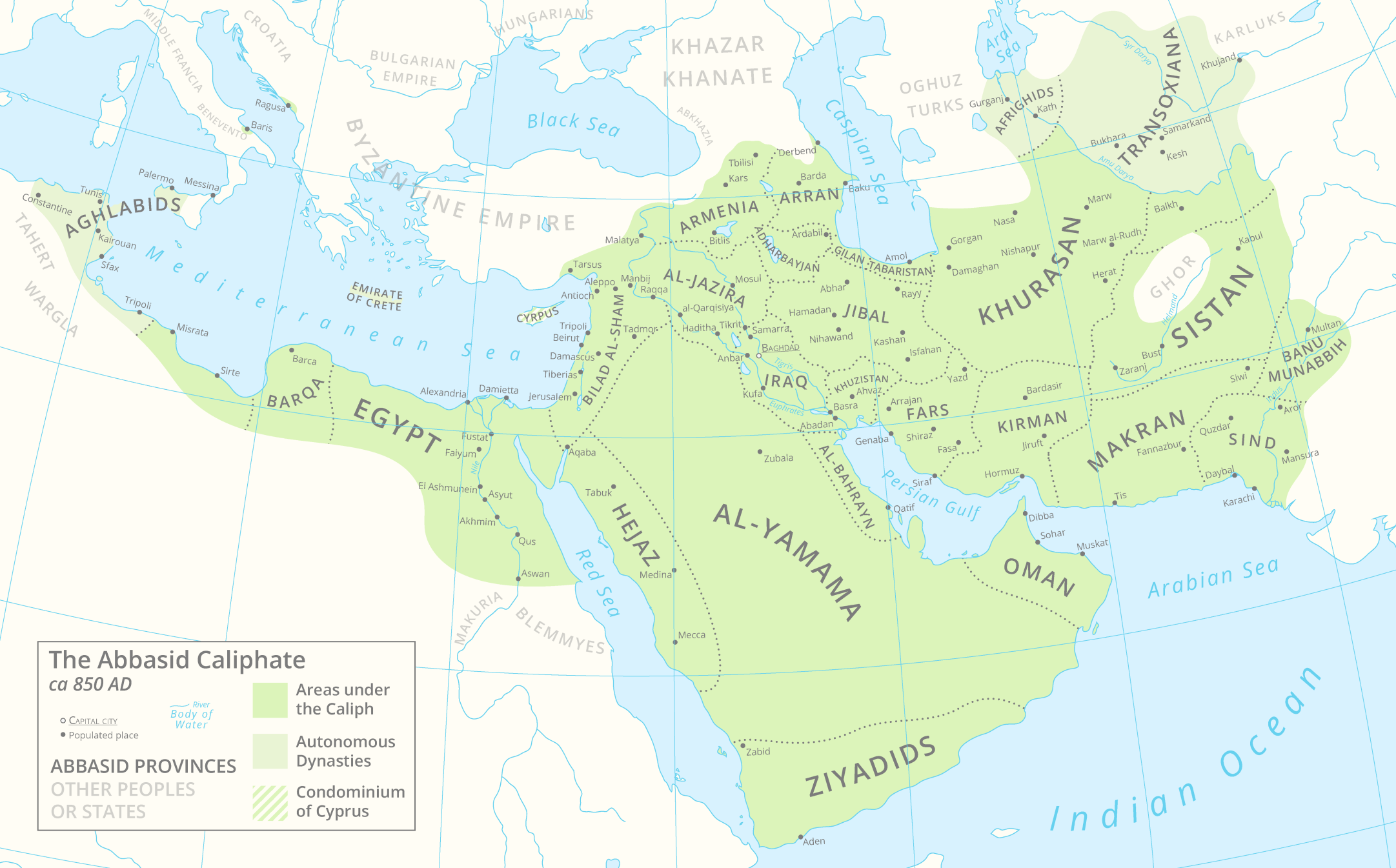
[[File:Abbasid Caliphate 850AD.png|thumb|300px|[[Abbasid Caliphate]] in the 850s CE, with location of the caliphal province of Sind in the east, and the newly arisen [[Emirate of Multan]] ("Banu Munabbih").]] | [[File:Abbasid Caliphate 850AD.png|thumb|300px|[[Abbasid Caliphate]] in the 850s CE, with location of the caliphal province of Sind in the east, and the newly arisen [[Emirate of Multan]] ("Banu Munabbih").]] | ||
At the time of the [[Abbasid Revolution]], Sind was in the hands of the anti-Umayyad rebel [[Mansur ibn Jumhur al-Kalbi]]. Following their victory over the Umayyads, the Abbasids at first left Mansur in control of the province, but this state of affairs did not last and the new dynasty sent [[Musa ibn Ka'b al-Tamimi]] to take over the region. He was able to defeat Mansur and enter Sind, | At the time of the [[Abbasid Revolution]], Sind was in the hands of the anti-Umayyad rebel [[Mansur ibn Jumhur al-Kalbi]]. Following their victory over the Umayyads, the Abbasids at first left Mansur in control of the province, but this state of affairs did not last and the new dynasty sent [[Musa ibn Ka'b al-Tamimi]] to take over the region. He was able to defeat Mansur and enter Sind,<ref name="IbnJumhur" /> thereby firmly establishing Abbasid control over the province. | ||
After the new dynasty came to power, Sind's administrative status was somewhat ambiguous, with governors being appointed either directly by the caliph or by the governor of [[Greater Khorasan|Khurasan]], [[Abu Muslim]]. | After the new dynasty came to power, Sind's administrative status was somewhat ambiguous, with governors being appointed either directly by the caliph or by the governor of [[Greater Khorasan|Khurasan]], [[Abu Muslim]].<ref>Al-Ya'qubi, pp. 407, 429; Khalifah ibn Khayyat, p. 413; al-Baladhuri, p. 230; al-Tabari, v. 27: p. 203</ref> This situation lasted only until Abu Muslim's murder in 755; thereafter, appointments to Sind were almost always handled by the caliph and the central government. | ||
In the first century of the Abbasid caliphate, governors continued to conduct raids against the non-Muslim kingdoms of Hind, and some minor gains were achieved. The historians also recorded the various struggles of the governors to maintain stability within Sind, as internecine tribal warfare, [[Alids|Alid]] partisans and disobedient Arab factions intermittently threatened the government's control over the region. Another potential source of trouble came from the governors themselves; a few of the individuals appointed to Sind attempted to rebel against the Abbasids, and had to be subdued by force of arms. In general, however, Abbasid authority in Sind remained effective during this period of their rule. | In the first century of the Abbasid caliphate, governors continued to conduct raids against the non-Muslim kingdoms of Hind, and some minor gains were achieved. The historians also recorded the various struggles of the governors to maintain stability within Sind, as internecine tribal warfare, [[Alids|Alid]] partisans and disobedient Arab factions intermittently threatened the government's control over the region. Another potential source of trouble came from the governors themselves; a few of the individuals appointed to Sind attempted to rebel against the Abbasids, and had to be subdued by force of arms. In general, however, Abbasid authority in Sind remained effective during this period of their rule.<ref>Wink, pp. 209–12; al-Baladhuri, pp. 230 ff.</ref> | ||
Under the Abbasids, Arabs continued to frequently occupy the governorship, but over time the selections became somewhat more diverse. Under the caliphs [[al-Mahdi]] (775–785) and [[Harun al-Rashid|al-Rashid]] (786–809), non-Arab clients (''[[mawali]]'') were sometimes appointed to Sind. | Under the Abbasids, Arabs continued to frequently occupy the governorship, but over time the selections became somewhat more diverse. Under the caliphs [[al-Mahdi]] (775–785) and [[Harun al-Rashid|al-Rashid]] (786–809), non-Arab clients (''[[mawali]]'') were sometimes appointed to Sind.<ref>These were Layth and Salim, as well as their respective sons. Crone, pp. 192, 194; Khalifah ibn Khayyat, pp. 441, 446, 463</ref> In the caliphate of [[al-Ma'mun]] (813–833), the governorship was given to a member of the Persian [[Barmakids|Barmakid]] family, and the province remained under their rule for a number of years.<ref>''Encyclopaedia of Islam'', s.v. "al-Baramika" (D. Sourdel)</ref> After the Barmakids, the [[Turkic peoples|Turkish]] general [[Itakh]] was given control of Sind, although he deputed the actual administration of the province to an Arab.<ref>Al-Ya'qubi, p. 585</ref> During this period several members of the prominent [[Muhallabids|Muhallabid]] family served in Sind; their combined administrations spanned over a period of more than three decades.<ref name="Muhallabid1" /><ref name="Muhallabid2" /><ref name="Muhallabid3" /><ref name="Muhallabid4" /> Under al-Rashid, a few minor members of the Abbasid family were also appointed as governors of the province.<ref name="Abbasid1" /><ref name="Abbasid2" /> | ||
{| width=85% class="wikitable" | {| width=85% class="wikitable" | ||
| Line 212: | Line 215: | ||
! width=22% | Name | ! width=22% | Name | ||
! width=8% | Years | ! width=8% | Years | ||
! width=10% | Nature of | ! width=10% | Nature of<br>termination | ||
! width=60% | Notes | ! width=60% | Notes | ||
|- | |- | ||
| Line 218: | Line 221: | ||
|align="center"|747–751 | |align="center"|747–751 | ||
|align="center"|Revolted | |align="center"|Revolted | ||
|Initially took Sind as an anti-Umayyad rebel, then confirmed as governor by the Abbasids | |Initially took Sind as an anti-Umayyad rebel, then confirmed as governor by the Abbasids<ref name="IbnJumhur">Al-Ya'qubi, pp. 407, 429; Khalifah ibn Khayyat, p. 413; al-Baladhuri, p. 230; al-Tabari, v. 28: pp. 195, 198, 203; Crone, p. 158</ref> | ||
|- | |- | ||
|[[Mughallis al-Abdi]] | |[[Mughallis al-Abdi]] | ||
|align="center"|751(?) | |align="center"|751(?) | ||
|align="center"|Killed | |align="center"|Killed | ||
|Appointed either by the caliph [[As-Saffah|al-Saffah]] or by the governor of Khurasan, [[Abu Muslim]] | |Appointed either by the caliph [[As-Saffah|al-Saffah]] or by the governor of Khurasan, [[Abu Muslim]]<ref>Al-Ya'qubi, p. 407; Khalifah ibn Khayyat, p. 413; al-Baladhuri, p. 230</ref> | ||
|- | |- | ||
|[[Musa ibn Ka'b al-Tamimi]] | |[[Musa ibn Ka'b al-Tamimi]] | ||
|align="center"|752–754 | |align="center"|752–754 | ||
|align="center"|Resigned | |align="center"|Resigned | ||
|Appointed either by al-Saffah or by Abu Muslim | |Appointed either by al-Saffah or by Abu Muslim<ref>Al-Ya'qubi, pp. 429, 448; Khalifah ibn Khayyat, pp. 413, 433; al-Baladhuri, p. 230; al-Tabari, v. 27: p. 203-04; v. 28: p. 75; Crone, p. 186</ref> | ||
|- | |- | ||
|[['Uyaynah ibn Musa al-Tamimi]] | |[['Uyaynah ibn Musa al-Tamimi]] | ||
|align="center"|754–760 | |align="center"|754–760 | ||
|align="center"|Revolted | |align="center"|Revolted | ||
|Son of Musa ibn Ka'b, who appointed him | |Son of Musa ibn Ka'b, who appointed him<ref>Al-Ya'qubi, p. 447-8; Khalifah ibn Khayyat, p. 433; al-Tabari, v. 28: pp. 75, 77–8; Crone, p. 186. According to both al-Ya'qubi and al-Tabari, 'Uyaynah's rebellion occurred in the year 142/759</ref> | ||
|- | |- | ||
|[[Umar ibn Hafs Hazarmard]] | |[[Umar ibn Hafs Hazarmard]] | ||
|align="center"|760–768 | |align="center"|760–768 | ||
|align="center"|Dismissed | |align="center"|Dismissed | ||
|Member of the [[Muhallabid]] family. Appointed by the caliph [[al-Mansur]] | |Member of the [[Muhallabid]] family. Appointed by the caliph [[al-Mansur]]<ref name="Muhallabid1">Al-Ya'qubi, p. 448; Khalifah ibn Khayyat, p. 433; al-Baladhuri, p. 231, who however places 'Umar's governorship after Hisham ibn 'Amr's; al-Tabari, v. 28: p. 78; v. 27: pp. 51–55; Crone, p. 134</ref> | ||
|- | |- | ||
|[[Hisham ibn Amr al-Taghlibi]] | |[[Hisham ibn Amr al-Taghlibi]] | ||
|align="center"|768–774 | |align="center"|768–774 | ||
|align="center"|Dismissed | |align="center"|Dismissed | ||
|Appointed by al-Mansur | |Appointed by al-Mansur<ref>Al-Ya'qubi, pp. 448–9; Khalifah ibn Khayyat, p. 433; al-Baladhuri, pp. 230–1; al-Tabari, v. 29: pp. 51, 54–6, 68, 77, 79; Crone, pp. 167–8</ref> | ||
|- | |- | ||
|[[Bistam ibn Amr al-Taghlibi]] | |[[Bistam ibn Amr al-Taghlibi]] | ||
|align="center"|774(?) | |align="center"|774(?) | ||
|align="center"|Dismissed | |align="center"|Dismissed | ||
|Not listed by al-Ya'qubi. Brother of Hisham ibn Amr, who appointed him | |Not listed by al-Ya'qubi. Brother of Hisham ibn Amr, who appointed him<ref>Khalifah ibn Khayyat, p. 433; Crone, p. 168. Al-Tabari, v. 29: pp. 180, 193, however, says that Bistam was governor after the death of Ma'bad ibn al-Khalil until the arrival of Rawh ibn Hatim to Sind, although he also claims (p. 172) that Rawh was appointed as governor immediately following Ma'bad's death. Al-Ya'qubi, p. 448, mentions Bistam as Hisham ibn Amr's deputy in al-Mansurah, but makes no mention of him as a full governor.</ref> | ||
|- | |- | ||
|[[Ma'bad ibn al-Khalil al-Tamimi]] | |[[Ma'bad ibn al-Khalil al-Tamimi]] | ||
|align="center"|774-775/6 | |align="center"|774-775/6 | ||
|align="center"|Died | |align="center"|Died | ||
|Variant name given by Ibn Khayyat. Appointed by al-Mansur | |Variant name given by Ibn Khayyat. Appointed by al-Mansur<ref>Al-Ya'qubi, p. 449; Khalifah ibn Khayyat, p. 433, where however he is named as Sa'id ibn al-Khalil (which the editor notes is a possible error); al-Tabari, v. 29: pp. 79, 80, 172. Ibn Khayyat says that he died in the reign of al-Mansur, while al-Tabari claims that he died in 159/776, in the reign of al-Mahdi.</ref> | ||
|- | |- | ||
|[[Muhammad ibn Ma'bad al-Tamimi]] | |[[Muhammad ibn Ma'bad al-Tamimi]] | ||
|align="center"|775(?) | |align="center"|775(?) | ||
|align="center"|Dismissed | |align="center"|Dismissed | ||
|Not listed by al-Ya'qubi. Son of Ma'bad ibn al-Khalil, who he succeeded as governor | |Not listed by al-Ya'qubi. Son of Ma'bad ibn al-Khalil, who he succeeded as governor<ref>Khalifah ibn Khayyat, pp. 433 (where he is named as Muhammad ibn Sa'id), 440 (where he is Muhammad ibn Ma'bad)</ref> | ||
|- | |- | ||
|[[Rawh ibn Hatim al-Muhallabi]] | |[[Rawh ibn Hatim al-Muhallabi]] | ||
|align="center"|776–778 | |align="center"|776–778 | ||
|align="center"|Dismissed | |align="center"|Dismissed | ||
|Member of the Muhallabid family. Appointed by the caliph [[al-Mahdi]] | |Member of the Muhallabid family. Appointed by the caliph [[al-Mahdi]]<ref name="Muhallabid2">al-Ya'qubi, p. 479; Khalifah ibn Khayyat, p. 441; al-Tabari, v. 29: pp. 195, 203, who however places Rawh's appointment in 160/777; Crone, p. 134</ref> | ||
|- | |- | ||
|[[Nasr ibn Muhammad al-Khuza'i]] | |[[Nasr ibn Muhammad al-Khuza'i]] | ||
|align="center"|778–781 | |align="center"|778–781 | ||
|align="center"|Died | |align="center"|Died | ||
|Appointed by al-Mahdi | |Appointed by al-Mahdi<ref>Al-Ya'qubi, pp. 479–80; Khalifah ibn Khayyat, p. 441; al-Tabari, v. 29: pp. 203, 216, 218; Crone, p. 185</ref> | ||
|- | |- | ||
|[[Al-Zubayr ibn al-'Abbas]] | |[[Al-Zubayr ibn al-'Abbas]] | ||
|align="center"|781(?) | |align="center"|781(?) | ||
|align="center"|Dismissed | |align="center"|Dismissed | ||
|Not listed by Ibn Khayyat. Never went to Sind. Appointed by al-Mahdi | |Not listed by Ibn Khayyat. Never went to Sind. Appointed by al-Mahdi<ref>Al-Ya'qubi, p. 480</ref> | ||
|- | |- | ||
|[[Sufyah ibn Amr al-Taghlibi]] (?) | |[[Sufyah ibn Amr al-Taghlibi]] (?) | ||
|align="center"|781–782 | |align="center"|781–782 | ||
|align="center"|Dismissed | |align="center"|Dismissed | ||
|Name given variously in the sources. Brother of Hisham ibn Amr. Appointed by al-Mahdi | |Name given variously in the sources. Brother of Hisham ibn Amr. Appointed by al-Mahdi<ref>Al-Ya'qubi, p. 480; Khalifah ibn Khayyat, p. 441; al-Tabari v. 29: p. 219, who all give different names for this individual; Crone, p. 168</ref> | ||
|- | |- | ||
|[[Layth ibn Tarif]] | |[[Layth ibn Tarif]] | ||
|align="center"|782–785 | |align="center"|782–785 | ||
|align="center"|Dismissed | |align="center"|Dismissed | ||
|Appointed by al-Mahdi | |Appointed by al-Mahdi<ref>Al-Ya'qubi, p. 480; Khalifah ibn Khayyat, p. 441; al-Tabari, v. 29: p. 222; Crone, p. 192</ref> | ||
|- | |- | ||
|[[Muhammad ibn Layth]] | |[[Muhammad ibn Layth]] | ||
|align="center"|785–786 | |align="center"|785–786 | ||
|align="center"|Dismissed | |align="center"|Dismissed | ||
|Not listed by al-Ya'qubi. Son of Layth ibn Tarif. Appointed during the caliphate of [[al-Hadi]] | |Not listed by al-Ya'qubi. Son of Layth ibn Tarif. Appointed during the caliphate of [[al-Hadi]]<ref>Khalifah ibn Khayyat, p. 446</ref> | ||
|- | |- | ||
|Layth ibn Tarif | |Layth ibn Tarif | ||
|align="center"|from 786 | |align="center"|from 786 | ||
|align="center"|Dismissed | |align="center"|Dismissed | ||
|Not listed by al-Ya'qubi. Re-appointed, this time by the caliph [[Harun al-Rashid|al-Rashid]] | |Not listed by al-Ya'qubi. Re-appointed, this time by the caliph [[Harun al-Rashid|al-Rashid]]<ref>Khalifah ibn Khayyat, p. 463; Crone, p. 192</ref> | ||
|- | |- | ||
|[[Salim (mawla)|Salim al-Yunusi/Burnusi]] | |[[Salim (mawla)|Salim al-Yunusi/Burnusi]] | ||
|align="center"|780s | |align="center"|780s | ||
|align="center"|Died | |align="center"|Died | ||
|Salim's ''[[Nisbat (onomastics)|nisbah]]'' is given variously in the sources. Appointed by al-Rashid | |Salim's ''[[Nisbat (onomastics)|nisbah]]'' is given variously in the sources. Appointed by al-Rashid<ref>Al-Ya'qubi, p. 493; Khalifah ibn Khayyat, p. 463; Crone, p. 194</ref> | ||
|- | |- | ||
|[[Ibrahim ibn Salim (mawla)|Ibrahim ibn Salim al-Yunusi/Burnusi]] | |[[Ibrahim ibn Salim (mawla)|Ibrahim ibn Salim al-Yunusi/Burnusi]] | ||
|align="center"|780s | |align="center"|780s | ||
|align="center"|Dismissed | |align="center"|Dismissed | ||
|Not listed by al-Ya'qubi. Son of Salim, who he succeeded as governor | |Not listed by al-Ya'qubi. Son of Salim, who he succeeded as governor<ref name="K463">Khalifah ibn Khayyat, p. 463</ref> | ||
|- | |- | ||
|[[Ishaq ibn Sulayman al-Hashimi]] | |[[Ishaq ibn Sulayman al-Hashimi]] | ||
|align="center"|from 790 | |align="center"|from 790 | ||
|align="center"|Dismissed | |align="center"|Dismissed | ||
|First cousin twice removed of al-Rashid, who appointed him | |First cousin twice removed of al-Rashid, who appointed him<ref name="Abbasid1">Al-Ya'qubi, p. 493; Khalifah ibn Khayyat, p. 463; al-Tabari, v. 30: p. 109</ref> | ||
|- | |- | ||
|[[Muhammad ibn Tayfur al-Himyari]] (?) | |[[Muhammad ibn Tayfur al-Himyari]] (?) | ||
|align="center"|790s | |align="center"|790s | ||
|align="center"|Dismissed | |align="center"|Dismissed | ||
|Name given variously in the sources. Appointed by al-Rashid | |Name given variously in the sources. Appointed by al-Rashid<ref>Al-Ya'qubi, pp. 493–4, where however he is named as Tayfur ibn 'Abdallah ibn Mansur al-Himyari; Khalifah ibn Khayyat, p. 463; p. 195</ref> | ||
|- | |- | ||
|[[Kathir ibn Salm al-Bahili]] | |[[Kathir ibn Salm al-Bahili]] | ||
|align="center"|790s | |align="center"|790s | ||
|align="center"|Dismissed | |align="center"|Dismissed | ||
|Grandson of [[Qutayba ibn Muslim]]. Deputy governor for his brother [[Sa'id ibn Salm al-Bahili|Sa'id ibn Salm]] | |Grandson of [[Qutayba ibn Muslim]]. Deputy governor for his brother [[Sa'id ibn Salm al-Bahili|Sa'id ibn Salm]]<ref>Al-Ya'qubi, p. 494; Khalifah ibn Khayyat, p. 463; Crone, p. 137</ref> | ||
|- | |- | ||
|[[Muhammad ibn Adi al-Taghlibi]] | |[[Muhammad ibn Adi al-Taghlibi]] | ||
|align="center"|790s | |align="center"|790s | ||
|align="center"|Resigned | |align="center"|Resigned | ||
|Nephew of Hisham ibn Amr. Appointed by the governor of Basra, [['Isa ibn Ja'far ibn al-Mansur al-Hashimi|'Isa ibn Ja'far al-Hashimi]] | |Nephew of Hisham ibn Amr. Appointed by the governor of Basra, [['Isa ibn Ja'far ibn al-Mansur al-Hashimi|'Isa ibn Ja'far al-Hashimi]]<ref>Al-Ya'qubi, p. 494; Khalifah ibn Khayyat, p. 463; Crone, p. 168</ref> | ||
|- | |- | ||
|[[Abd al-Rahman ibn Sulayman (governor)|Abd al-Rahman ibn Sulayman]] | |[[Abd al-Rahman ibn Sulayman (governor)|Abd al-Rahman ibn Sulayman]] | ||
|align="center"|790s | |align="center"|790s | ||
|align="center"|Resigned | |align="center"|Resigned | ||
|Appointed either by al-Rashid or by Muhammad ibn Adi | |Appointed either by al-Rashid or by Muhammad ibn Adi<ref name="Abbasid2"/> | ||
|- | |- | ||
|[[Abdallah ibn Ala al-Dabbi]] | |[[Abdallah ibn Ala al-Dabbi]] | ||
|align="center"|790s | |align="center"|790s | ||
|align="center"|Unspecified | |align="center"|Unspecified | ||
|Not listed by al-Ya'qubi. Appointed by Abd al-Rahman ibn Sulayman | |Not listed by al-Ya'qubi. Appointed by Abd al-Rahman ibn Sulayman<ref name="K463" /> | ||
|- | |- | ||
|[[Ayyub ibn Ja'far al-Hashimi]] | |[[Ayyub ibn Ja'far al-Hashimi]] | ||
|align="center"|to 800 | |align="center"|to 800 | ||
|align="center"|Died | |align="center"|Died | ||
|Second cousin once removed of al-Rashid, who appointed him | |Second cousin once removed of al-Rashid, who appointed him<ref name="Abbasid2">Al-Ya'qubi, p. 494; Khalifah ibn Khayyat, p. 463</ref> | ||
|- | |- | ||
|- | |- | ||
| Line 344: | Line 347: | ||
|align="center"|800–820 | |align="center"|800–820 | ||
|align="center"|Died | |align="center"|Died | ||
|Last governor listed by Ibn Khayyat. Member of the Muhallabid family. Appointed by al-Rashid | |Last governor listed by Ibn Khayyat. Member of the Muhallabid family. Appointed by al-Rashid<ref name="Muhallabid3">Al-Ya'qubi, pp. 494, 532; Khalifah ibn Khayyat, p. 463; al-Baladhuri, p. 231; al-Tabari, v. 30: p. 173; v. 32: p. 106; Crone, p. 135</ref> | ||
|- | |- | ||
|[[Bishr ibn Dawud al-Muhallabi]] | |[[Bishr ibn Dawud al-Muhallabi]] | ||
|align="center"|820–826 | |align="center"|820–826 | ||
|align="center"|Revolted | |align="center"|Revolted | ||
|Son of Dawud ibn Yazid, who he succeeded as governor. Confirmed in office by the caliph [[al-Ma'mun]] | |Son of Dawud ibn Yazid, who he succeeded as governor. Confirmed in office by the caliph [[al-Ma'mun]]<ref name="Muhallabid4">Al-Ya'qubi, pp. 557–8; al-Baladhuri, p. 231; al-Tabari, v. 32: pp. 106, 175, 179, 189; Crone, p. 135</ref> | ||
|- | |- | ||
|[[Hajib ibn Salih (governor)|Hajib ibn Salih]] | |[[Hajib ibn Salih (governor)|Hajib ibn Salih]] | ||
|align="center"|826 | |align="center"|826 | ||
|align="center"|Expelled | |align="center"|Expelled | ||
|Appointed by al-Ma'mun | |Appointed by al-Ma'mun<ref>Al-Ya'qubi, p. 557; al-Tabari, v. 32: p. 175</ref> | ||
|- | |- | ||
|[[Ghassan ibn Abbad]] | |[[Ghassan ibn Abbad]] | ||
|align="center"|828–831 | |align="center"|828–831 | ||
|align="center"|Resigned | |align="center"|Resigned | ||
|Appointed by al-Ma'mun | |Appointed by al-Ma'mun<ref>Al-Ya'qubi, p. 557; al-Baladhuri, p. 231; al-Tabari, v. 32: pp. 179–80, 189</ref> | ||
|- | |- | ||
|[[Musa ibn Yahya ibn Khalid al-Barmaki|Musa ibn Yahya al-Barmaki]] | |[[Musa ibn Yahya ibn Khalid al-Barmaki|Musa ibn Yahya al-Barmaki]] | ||
|align="center"|831–836 | |align="center"|831–836 | ||
|align="center"|Died | |align="center"|Died | ||
|Member of the [[Barmakid]] family. Appointed by Ghassan ibn Abbad | |Member of the [[Barmakid]] family. Appointed by Ghassan ibn Abbad<ref>Al-Ya'qubi, p. 557; al-Baladhuri, p. 231</ref> | ||
|- | |- | ||
|[[Imran ibn Musa al-Barmaki]] | |[[Imran ibn Musa al-Barmaki]] | ||
|align="center"|from 836 | |align="center"|from 836 | ||
|align="center"|Killed | |align="center"|Killed | ||
|Son of Musa ibn Yahya, who he succeeded as governor | |Son of Musa ibn Yahya, who he succeeded as governor<ref>Al-Ya'qubi, pp. 557, 585; al-Baladhuri, pp. 231–2. Al-Tabari, v. 32: p. 189, says that Imran was appointed as chief financial officer of Sind by Ghassan, and does not mention Imran's father Musa</ref> | ||
|- | |- | ||
|[[Anbasah ibn Ishaq al-Dabbi]] | |[[Anbasah ibn Ishaq al-Dabbi]] | ||
|align="center"|840s | |align="center"|840s | ||
|align="center"|Dismissed | |align="center"|Dismissed | ||
|Deputy governor for [[Itakh|Itakh al-Turki]] | |Deputy governor for [[Itakh|Itakh al-Turki]]<ref>Al-Ya'qubi, pp. 585, 593, who says that 'Anbasah was appointed in the caliphate of al-Wathiq (842–847) and stayed in Sind for nine years; al-Baladhuri, p. 218, who claims that he was governor during the reign of al-Mu'tasim (833–842)</ref> | ||
|- | |- | ||
|[[Harun ibn Abi Khalid al-Marwrudhi]] | |[[Harun ibn Abi Khalid al-Marwrudhi]] | ||
|align="center"|to 854 | |align="center"|to 854 | ||
|align="center"|Killed | |align="center"|Killed | ||
|Appointed by the caliph [[al-Mutawakkil]] | |Appointed by the caliph [[al-Mutawakkil]]<ref>Al-Ya'qubi, pp. 593, 599; al-Baladhuri, p. 219</ref> | ||
|- | |- | ||
|[[Umar ibn Abd al-Aziz al-Habbari]] | |[[Umar ibn Abd al-Aziz al-Habbari]] | ||
|align="center"|854–861 | |align="center"|854–861 <br> ([[Anarchy at Samarra|as autonomous Governor]] 861–884) | ||
|align="center"|He became autonomous during [[Anarchy at Samarra|decline of Abbasids]] and established [[Habbari dynasty]] after al-Mutawakkil assassination on 861. Died in 884 | |align="center"|He became autonomous during [[Anarchy at Samarra|decline of Abbasids]] and established [[Habbari dynasty]] after al-Mutawakkil assassination on 861. Died in 884 | ||
|Appointed by the caliph [[al-Mutawakkil]] | |Appointed by the caliph [[al-Mutawakkil]] | ||
| Line 389: | Line 392: | ||
=== Decline of Abbasid authority === | === Decline of Abbasid authority === | ||
{{Main|Anarchy at Samarra|Habbari dynasty|Emirate of Multan}} | {{Main|Anarchy at Samarra|Habbari dynasty|Emirate of Multan}} | ||
[[File:Map of the Habbarid and Multan Emirates.png|thumb|300px|Map of the [[Habbari dynasty|Habbarid Emirate]] and the [[Emirate of Multan|Multan Emirate]], which replaced the Caliphal province of Sind circa 854 CE.]] | [[File:Map of the Habbarid and Multan Emirates.png|thumb|300px|Map of the [[Habbari dynasty|Habbarid Emirate]] and the [[Emirate of Multan|Multan Emirate]], which replaced the Caliphal province of Sind circa 854 CE.]] | ||
Over the course of the mid-ninth century, Abbasid authority in Sind gradually waned. A new era in the history of the province began in 854, when Umar ibn Abd al-Aziz al-Habbari, a local Arab resident of Sind, was appointed to govern the country. Shortly after this, the central government [[Anarchy at Samarra|entered a period of crisis]] which crippled its ability to maintain its authority in the provinces; this stagnation allowed 'Umar to rule Sind without any interference from the caliphal court at [[Abbasid Samarra|Samarra]]. 'Umar ended up creating a hereditary dynasty, that of the [[Habbari dynasty|Habbarids]], which ruled in al-Mansura for almost two centuries. Although the Habbarids continued to acknowledge the Abbasids as their nominal suzerains, the effective authority of the caliph largely disappeared and the Habbarids were de facto independent. | Over the course of the mid-ninth century, Abbasid authority in Sind gradually waned. A new era in the history of the province began in 854, when Umar ibn Abd al-Aziz al-Habbari, a local Arab resident of Sind, was appointed to govern the country. Shortly after this, the central government [[Anarchy at Samarra|entered a period of crisis]] which crippled its ability to maintain its authority in the provinces; this stagnation allowed 'Umar to rule Sind without any interference from the caliphal court at [[Abbasid Samarra|Samarra]]. 'Umar ended up creating a hereditary dynasty, that of the [[Habbari dynasty|Habbarids]], which ruled in al-Mansura for almost two centuries. Although the Habbarids continued to acknowledge the Abbasids as their nominal suzerains, the effective authority of the caliph largely disappeared and the Habbarids were de facto independent.<ref>Baloch and Rafiqi, p. 294</ref> | ||
In spite of their loss of effective control over Sind, the Abbasid government continued to formally appoint governors to the province. In 871 the caliphal regent [[Abu Ahmad ibn al-Mutawakkil]] invested the [[Saffarid]] [[Ya'qub-i Laith Saffari|Ya'qub ibn al-Layth]] with the governorship of Sind. | In spite of their loss of effective control over Sind, the Abbasid government continued to formally appoint governors to the province. In 871 the caliphal regent [[Abu Ahmad ibn al-Mutawakkil]] invested the [[Saffarid]] [[Ya'qub-i Laith Saffari|Ya'qub ibn al-Layth]] with the governorship of Sind.<ref>Al-Tabari, v. 36: p. 119</ref> In 875 the general [[Masrur al-Balkhi]] was given control of most of the eastern provinces, including Sind.<ref>Al-Tabari, v. 36: p. 166</ref> Four years after this, Sind was again assigned to the Saffarids, with [[Amr Saffari|Amr ibn al-Layth]] receiving the appointment.<ref>Al-Tabari, v. 36: p. 205</ref> These appointments, however, were purely nominal, and it is unlikely that these individuals exercised any actual authority over the local rulers within the province.<ref>Wink, 211-2</ref> | ||
As the central government's authority over Sind declined, the region underwent a period of decentralization. Habbarid authority appears to have been largely restricted to Sind proper, and did not extend to Makran, Turan and Multan, which all broke away under separate dynasties. Some of the rulers in these regions also continued to nominally recognize the caliph as their ruler, but were effectively self-governing; others rejected the caliph's authority altogether and were outright independent. These minor dynasties continued to govern in their respective localities until the early eleventh century, when the [[Ghaznavids]] invaded India and annexed most of the Muslim territories in the country. | As the central government's authority over Sind declined, the region underwent a period of decentralization. Habbarid authority appears to have been largely restricted to Sind proper, and did not extend to Makran, Turan and Multan, which all broke away under separate dynasties. Some of the rulers in these regions also continued to nominally recognize the caliph as their ruler, but were effectively self-governing; others rejected the caliph's authority altogether and were outright independent. These minor dynasties continued to govern in their respective localities until the early eleventh century, when the [[Ghaznavids]] invaded India and annexed most of the Muslim territories in the country.<ref>Baloch and Rafiqi, pp. 294–6; 296 ff.</ref> | ||
== See also == | == See also == | ||
| Line 416: | Line 420: | ||
* Gabrieli, Francesco. "Muhammad ibn Qasim ath-Thaqafi and the Arab Conquest of Sind." ''East and West'' 15/3-4 (1965): 281–295. | * Gabrieli, Francesco. "Muhammad ibn Qasim ath-Thaqafi and the Arab Conquest of Sind." ''East and West'' 15/3-4 (1965): 281–295. | ||
* Khalifah ibn Khayyat. ''Tarikh Khalifah ibn Khayyat.'' Ed. Akram Diya' al-'Umari. 3rd ed. Al-Riyadh: Dar Taybah, 1985. | * Khalifah ibn Khayyat. ''Tarikh Khalifah ibn Khayyat.'' Ed. Akram Diya' al-'Umari. 3rd ed. Al-Riyadh: Dar Taybah, 1985. | ||
* {{citation |last=MacLean |first=Derryl N. |title=Religion and Society in Arab Sind |url=https://books.google.com/books?id=xxAVAAAAIAAJ&pg=PA126 |year=1989 |publisher=BRILL |isbn=90-04-08551-3}} | * {{citation |last=MacLean |first=Derryl N. |title=Religion and Society in Arab Sind |url=https://books.google.com/books?id=xxAVAAAAIAAJ&pg=PA126 |year=1989 |publisher=BRILL |isbn=90-04-08551-3}} | ||
* Shaban, M. A. ''The 'Abbasid Revolution.'' Cambridge, UK: Cambridge University Press, 1970. {{ISBN|0-521-07849-0}} | * Shaban, M. A. ''The 'Abbasid Revolution.'' Cambridge, UK: Cambridge University Press, 1970. {{ISBN|0-521-07849-0}} | ||
* {{Lands of the Eastern Caliphate}} | * {{Lands of the Eastern Caliphate}} | ||
| Line 424: | Line 428: | ||
{{History of Sindh}} | {{History of Sindh}} | ||
[[Category: | |||
[[Category: | [[Category:Sind (caliphal province)| ]] | ||
[[Category: | [[Category:8th-century establishments in India]] | ||
[[Category: | [[Category:9th-century disestablishments in India]] | ||
[[Category:States and territories established in the 710s]] | |||
[[Category:States and territories disestablished in the 9th century]] | |||
Revision as of 17:36, 28 January 2026
Sindh | |||||||||||
|---|---|---|---|---|---|---|---|---|---|---|---|
| 711–861 | |||||||||||
  South-Asia<br />750 CE | |||||||||||
| Capital | Aror | ||||||||||
| Common languages | Sindhi, Sanskrit, Arabic | ||||||||||
| Religion | State religion:<br /> Islam<br />Other religions:<br />Other religions in South Asia
| ||||||||||
| Government | Caliphal province | ||||||||||
| Governor | |||||||||||
• 711–715 (first) | Muhammad bin Qasim | ||||||||||
• 854–861 (last) | Umar ibn'Abd al-Aziz al'Habbari | ||||||||||
| Historical era | Post-classical India | ||||||||||
| 711 | |||||||||||
| 861 | |||||||||||
| |||||||||||
| Today part of | Pakistan<br/>India | ||||||||||

Sindh was a province of the Umayyad Caliphate and later of the Abbasid Caliphate from around 711 CE with the Islamic conquest of Sindh by Muhammad ibn al-Qasim, to around 854 CE with the emergence of the independent dynasties of the Habbarid Emirate in Sindh proper and the Emirate of Multan in Punjab. The "Governor of Sindh" (Script error: The function "langx" does not exist.)<ref>Al-Ya'qubi, pp. 388, 557, 448, 599; al-Tabari, v. 32: p. 106</ref> was an official who administered the caliphal province over what are now Sindh, southern Punjab and Makran (Balochistan) in Pakistan.
The governor was the chief Muslim official in the province and was responsible for maintaining security in the region. As the leader of the provincial military, he was also in charge of carrying out campaigns against the non-Muslim kingdoms of India. Governors appointed to the region were selected either directly by the caliph or by an authorized subordinate, and remained in office until they either died or were dismissed.
Geography
Sind was a frontier province of the Umayyad and Abbasid caliphates from its conquest in c. 711 until the mid-ninth century. Situated at the far eastern end of the caliphate, it consisted of the territories held by the Muslims in the Indian subcontinent, which at the time were centered in the Indus region. Sind proper was bounded on the west by Makran, on the northwest by Sijistan and the district of Turan, on the northeast by Multan, on the east by the Thar Desert, on the southeast by the non-Muslim Hind, and on the southwest by the Indian Ocean.<ref>Le Strange, pp. 331–2 and Map 7; Blankinship, pp. 110–2</ref>
Conquest of Sind

In the history of the Muslim conquests, Sind was a relatively late achievement, occurring almost a century after the Hijrah (start of Islamic calendar). Military raids against India had been undertaken by the Muslims as early as Umar's reign (634–644), but the pace of expansion in the region was initially slow: in 636, an Arab naval expedition attacked Broach, which had come under the control of the Chalukyas following the submission of Jayabhata of the Gurjaras of Lata, and Thana, but it was soon recalled after achieving some damage and they failed to capture these cities.<ref>Schmidt, Karl J. (20 May 2015). An Atlas and Survey of South Asian History (Reprint ed.). London and New York: Routledge. p. 36. ISBN 978-1-317-47681-8.</ref><ref>Rao, M. S. Nagaraja (1978). The Chalukyas of Badami: Seminar Papers. Mythic Society. p. 193. Jayabhața, the Gurjara of Lāța, became the feudatory of the Chalukya emperor. It was in his time that an Arab fleet was despatched to Thāņa and Broach (A.D. 636), and did some damage but was recalled under the orders of Caliph Omar.
</ref> Several governors were appointed to the Indian frontier (thaghr al-Hind) and tasked with conducting campaigns in the east. Some of these expeditions were successful, but others ended in defeat and a number of governors were killed while serving there.
According to Derryl N. Maclean, a link between Sind and the early partisans of Caliph Ali or proto-Shi'ites could be traced to Hakim ibn Jabalah al-Abdi, a companion of the Islamic prophet Muhammad, who traveled across Sind to Makran in 649 and presented a report on the area to the caliph. He supported Ali, and died in the Battle of the Camel alongside Sindi Jats.<ref>M. Ishaq, "Hakim Bin Jabala - An Heroic Personality of Early Islam", Journal of the Pakistan Historical Society, pp. 145-50, (April 1955).</ref> During the reign of Ali, many Jats came under the influence of Islam.<ref>Ibn Athir, Vol. 3, pp. 45–46, 381, as cited in: S. A. N. Rezavi, "The Shia Muslims", in History of Science, Philosophy and Culture in Indian Civilization, Vol. 2, Part. 2: "Religious Movements and Institutions in Medieval India", Chapter 13, Oxford University Press (2006). ISBN 9780195677034.</ref> Harith ibn Murrah al-Abdi and Sayfi ibn Fil al-Shaybani, both officers of Ali's army, attacked Sindi bandits and chased them to al-Qiqan (present-day Quetta) in 658.<ref>Ibn Sa'd, 8:346. The raid is noted by Balâdhurî, "fatooh al-Baldan" p. 432, and Ibn Khayyât, Ta'rîkh, 1:173, 183–84, as cited in: Derryl N. Maclean, Religion and Society in Arab Sind. Pg. 126, EJ Brill: Leiden, 1989. ISBN 90-04-08551-3.</ref> Sayfi was one of the seven partisans of Ali who were beheaded alongside Hujr ibn Adi al-Kindi<ref>Tabarî, 2:129, 143, 147, as cited in: Derryl N. Maclean, Religion and Society in Arab Sind, p. 126, EJ Brill (1989) ISBN 90-04-08551-3.</ref> in 660 AD, near Damascus.
In the caliphate of Mu'awiya I (r. 661–680), the region of Makran was subdued and a garrison was established there. Over the following decades, the Muslims progressed further east, conquering the district of Qusdar and raiding the areas around Qandabil and al-Qiqan.<ref>Gabrieli, p. 283; Wink; pp. 129, 131; al-Baladhuri, pp. 209–15; al-Ya'qubi, pp. 278, 330–1</ref>
Sind was conquered in c. 711 by Muhammad ibn Qasim al-Thaqafi, who had been sent to undertake a punitive expedition against Dahir, the king of Sind. After marching through Makran and defeating its inhabitants, Muhammad entered Sind and attacked the port city of Daybul, which fell after a siege and was partly colonized by the Muslims. Following this victory, Muhammad moved north and encountered Dahir, whom he defeated and killed. He then spent the next few years campaigning in Sind and Multan, forcing the various cities of the country to submit to him.
This period of conquests continued until 715, when Caliph al-Walid I (r. 705–715) died; shortly after the accession of Caliph Sulayman, Muhammad was arrested and executed, and a replacement was sent by the government to take control of Sind.<ref>Gabrieli, pp. 283–92; Wink, pp. 202–7; al-Baladhuri, pp. 216–24; al-Ya'qubi, pp. 345–7, 356; Encyclopaedia of Islam, s.v. "Sind" (T.W. Haig-[C.E. Bosworth])</ref>
From then on, the Turk Shahis now had to face an additional Muslim threat from the southeast, as did Hindu kingdoms, especially the Maitrakas and the Gurjara-Pratiharas, on their western borders, since the Caliphal province of Sind extended as far as Multan, at the gates of the Punjab, and would last until 854 CE as an Umayyad and then Abbasid dependency.<ref name="CAP148">Petrie, Cameron A. (28 December 2020). Resistance at the Edge of Empires: The Archaeology and History of the Bannu basin from 1000 BC to AD 1200. Oxford: Oxbow Books. p. 148. ISBN 978-1-78570-304-1.</ref>
Umayyad period
_mint._Dated_AH_97_(AD_715-6).jpg)
.jpg) لهند l'Hind) in the year seven and ninety".
لهند l'Hind) in the year seven and ninety".As a result of its conquest, Sind became a province of the caliphate and governors were appointed to administer it. As the commander of a frontier province, the governor was responsible for guarding the country against external incursions, and could carry out raids into Hind (India) at his discretion. The governor's jurisdiction usually also included the neighboring regions of Makran, Turan and Multan;<ref>Baloch and Rafiqi, pp. 293–4</ref> in addition, any territories that he conquered in Hind were added to his area of authority.<ref>Al-Baladhuri, p. 227</ref>
In the administrative hierarchy of the Umayyad Caliphate, the responsibility for selecting governors to the province was assigned to the governor of Iraq, or, if that position was vacant, to the governor of Basra. Unless he received specific commands from the caliph, the governor of Iraq had the authority to appoint and dismiss governors to Sind and he was in charge of supervising their activities in the province.<ref>Blankinship, pp. 62–3</ref>
According to the historian Khalifa ibn Khayyat, after the downfall of Muhammad ibn Qasim the responsibilities of the governor of Sind were temporarily divided between two officials, one of whom was in charge of military affairs and the other in charge of taxation. This change was soon rescinded and the next governor, Habib ibn al-Muhallab al-Azdi, had full authority over both the fiscal and military affairs on the province.<ref>Khalifah ibn Khayyat, 318</ref>
.jpg)
As a general rule, provincial governorships in the Umayyad period were held almost exclusively by Arabs,<ref>Blankinship, p. 41</ref> and this trend was reflected in the appointees to Sind during this period. Qaysi–Yamani tribal politics also played a strong role in the selection and dismissal of governors;<ref>Crone, pp. 142 ff.; Blankinship, pp. 45–6, 98; Shaban, pp. 120 ff.</ref> if the governor of Iraq was Qaysi, then his governor to Sind would likely be Qaysi, and if he was Yamani, his selection would likely be Yamani as well. There were, however, some exceptions; Junayd ibn Abd al-Rahman al-Murri was initially appointed to Sind by a fellow Qaysi, but was allowed to retain his position for two years after the governor of Iraq was replaced with a Yamani.<ref>Al-Ya'qubi, p. 379; Khalifah ibn Khayyat, p. 359; Crone, p. 147</ref>

The governors of Sind in the Umayyad period undertook extensive campaigns against the non-Muslim kingdoms of Hind, but with mixed results. Al-Junayd's campaigns were largely successful, but his successor Tamim ibn Zaid al-Utbi encountered difficulties and the Muslims were forced to retreat from Hind. The next governor, al-Hakam ibn Awana, vigorously campaigned in Hind and initially achieved some victories, but he too experienced a reversal of fortune and was eventually killed. Raids into Hind continued after al-Hakam's death, but no major territorial gains were achieved, and the Muslim presence in the Indian subcontinent remained largely restricted to the Indus valley region.<ref>Al-Baladhuri, pp. 225–9; Blankinship, pp. 131–4; 147–9; 186–90, 202–3; Wink, 207-9</ref>
As part of his efforts to secure the Muslim position in Sind, al-Hakam constructed the military garrison of al-Mahfuzah, which he made into his capital (miṣr). Shortly after this, his lieutenant Amr, a son of Muhammad ibn Qasim, built a second city near al-Mahfuzah, which he called al-Mansura. This latter city eventually became the permanent administrative capital of Sind, and it served as the seat of the Umayyad and Abbasid governors.<ref>Al-Ya'qubi, pp. 380, 389; al-Baladhuri, pp. 228–9; Encyclopaedia of Islam, s.v. "al-Mansura" (Y. Friedmann)</ref>
The names of the caliphal governors of Sind are preserved in the histories of Khalifa ibn Khayyat and al-Ya'qubi. Some differences exist between the two authors' versions; these are noted below. The Futuh al-Buldan by al-Baladhuri, which focuses on the military conquests of the early Muslim state, also contains the names of many of the governors who served in Sind.
List of Governors of Sindh
| Name | Years | Nature of<br>termination | Notes |
|---|---|---|---|
| Muhammad ibn Qasim al-Thaqafi | 711–715 | Dismissed | Conquered Sind. Appointed by the governor of Iraq, al-Hajjaj ibn Yusuf al-Thaqafi<ref>Al-Ya'qubi, pp. 345–7, 356; Khalifah ibn Khayyat, pp. 304–7, 310, 318; al-Baladhuri, pp. 216–25; al-Tabari, v. 23: p. 149; Crone, p. 135</ref> |
| Habib ibn al-Muhallab al-Azdi | 715–717 | Dismissed(?) | Appointed either by the caliph Sulayman ibn Abd al-Malik or by Salih ibn Abd al-Rahman<ref>Al-Ya'qubi, p. 356; Khalifah ibn Khayyat, p. 318; al-Baladhuri, p. 225; Crone, p. 141. Habib either was dismissed or resigned, since he remained alive until 102/720; al-Tabari, v. 24: pp. 134–7</ref> |
| Abd al-Malik ibn Misma | from 717 | Dismissed | Not listed by al-Ya'qubi. Appointed by the governor of Basra, Adi ibn Artah al-Fazari<ref>Khalifah ibn Khayyat, p. 322</ref> |
| Amr ibn Muslim al-Bahili | to 720 | Overthrown | Not listed by al-Ya'qubi. Appointed by Adi ibn Artah<ref>Khalifah ibn Khayyat, pp. 322, 333; al-Baladhuri, p. 225</ref> |
| Ubaydallah ibn Ali al-Sulami | from 721 | Dismissed | Not listed by al-Ya'qubi. Appointed by the governor of Iraq, Umar ibn Hubayra al-Fazari<ref>Khalifah ibn Khayyat, p. 333; Crone, p. 146</ref> |
| Junayd ibn Abd al-Rahman al-Murri | to 726 | Dismissed | Appointed by Umar ibn Hubayra<ref>Al-Ya'qubi, pp. 379–80; Khalifah ibn Khayyat, pp. 333, 359; al-Baladhuri, pp. 226–7; Crone, pp. 98; 147</ref> |
| Tamim ibn Zaid al-Utbi | from 726 | Died(?) | Appointed by the governor of Iraq, Khalid ibn Abdallah al-Qasri<ref>Al-Ya'qubi, p. 380; Khalifah ibn Khayyat, p. 359; al-Baladhuri, p. 227-8; Crone, p. 148. Al-Ya'qubi and al-Baladhuri both give his nisbah as al-'Utbi. According to Khalifah ibn Khayyat, he was dismissed from office</ref> |
| Al-Hakam ibn Awana | to 740 | Killed | Appointed by Khalid ibn Abdallah<ref>Al-Ya'qubi, pp. 380, 388–9; Khalifah ibn Khayyat, pp. 354, 359; al-Baladhuri; pp. 228–9; Crone, p. 147</ref> |
| Amr ibn Muhammad ibn al-qasim al Thaqafi | 740–744 | Dismissed | Son of Muhammad ibn al-Qasim. Appointed by the governor of Iraq, Yusuf ibn Umar al-Thaqafi<ref>Al-Ya'qubi, pp. 389–90, 399–400; Khalifah ibn Khayyat, pp. 354, 359, 366; al-Tabari, v. 26: pp. 199–200</ref> |
| Yazid ibn Irar al-Kalbi(?) | 740s | Overthrown | Name and details of governorship given variously in the sources. See especially this note<ref>In al-Ya'qubi, pp. 399–400, 407, this individual is named as Yazid ibn Irar (although the editor, p. 389, notes variant readings, including Izzan) and is said to have replaced 'Amr ibn Muhammad as governor in the reign of al-Walid ibn Yazid; he remained as governor until Mansur ibn Jumhur al-Kalbi arrived in Sind and killed him. Khalifah ibn Khayyat, p. 357, calls him Muhammad ibn Irar al-Kalbi and claims he became governor on an interim basis, after the death of al-Hakam ibn Awana; subsequently he was dismissed in 122/740 by the governor of Iraq, Yusuf ibn Umar al-Thaqafi, and replaced with Amr. All this is said to have taken place during the reign of Hisham. Al-Tabari, v. 26: pp. 199–200, calls him "Muhammad ibn Ghazzan – or Izzan – al-Kalbi" and states that he was appointed to succeed Amr in 126/744 by the governor of Iraq, Mansur ibn Jumhur al-Kalbi, in the reign of Yazid ibn al-Walid; he does not specify Muhammad's fate.</ref> |
| Name | Years | Nature of<br>termination | Notes |
|---|---|---|---|
| Yazid ibn Abi Kabsha al-Saksaki | 715 | Died | Not listed by al-Ya'qubi. Appointed by the fiscal administrator of Iraq, Salih ibn Abd al-Rahman<ref>Khalifah ibn Khayyat, p. 318; al-Baladhuri, pp. 224–5; Crone, p. 96</ref> |
| Ubaydallah ibn Abi Kabsha al-Saksaki | 715(?) | Dismissed | Not listed by al-Ya'qubi. Brother of Yazid ibn Abi Kabshah, who he succeeded as governor<ref>Khalifah ibn Khayyat, p. 318</ref> |
| Imran ibn al-Nu'man al-Kala'i | 715(?) | Unspecified | Not listed by al-Ya'qubi. Appointed by Salih ibn Abd al-Rahman<ref>Khalifah ibn Khayyat, p. 318; Crone, p. 142</ref> |
| After Imran, fiscal and military affairs were jointly assigned to Habib ibn al-Muhallab. | |||
Abbasid period
._Citing_al-Mu%27tasim_as_Abu_Imam_Ishaq._Uncertain_mint_in_Sindh.jpg)

At the time of the Abbasid Revolution, Sind was in the hands of the anti-Umayyad rebel Mansur ibn Jumhur al-Kalbi. Following their victory over the Umayyads, the Abbasids at first left Mansur in control of the province, but this state of affairs did not last and the new dynasty sent Musa ibn Ka'b al-Tamimi to take over the region. He was able to defeat Mansur and enter Sind,<ref name="IbnJumhur" /> thereby firmly establishing Abbasid control over the province.
After the new dynasty came to power, Sind's administrative status was somewhat ambiguous, with governors being appointed either directly by the caliph or by the governor of Khurasan, Abu Muslim.<ref>Al-Ya'qubi, pp. 407, 429; Khalifah ibn Khayyat, p. 413; al-Baladhuri, p. 230; al-Tabari, v. 27: p. 203</ref> This situation lasted only until Abu Muslim's murder in 755; thereafter, appointments to Sind were almost always handled by the caliph and the central government.
In the first century of the Abbasid caliphate, governors continued to conduct raids against the non-Muslim kingdoms of Hind, and some minor gains were achieved. The historians also recorded the various struggles of the governors to maintain stability within Sind, as internecine tribal warfare, Alid partisans and disobedient Arab factions intermittently threatened the government's control over the region. Another potential source of trouble came from the governors themselves; a few of the individuals appointed to Sind attempted to rebel against the Abbasids, and had to be subdued by force of arms. In general, however, Abbasid authority in Sind remained effective during this period of their rule.<ref>Wink, pp. 209–12; al-Baladhuri, pp. 230 ff.</ref>
Under the Abbasids, Arabs continued to frequently occupy the governorship, but over time the selections became somewhat more diverse. Under the caliphs al-Mahdi (775–785) and al-Rashid (786–809), non-Arab clients (mawali) were sometimes appointed to Sind.<ref>These were Layth and Salim, as well as their respective sons. Crone, pp. 192, 194; Khalifah ibn Khayyat, pp. 441, 446, 463</ref> In the caliphate of al-Ma'mun (813–833), the governorship was given to a member of the Persian Barmakid family, and the province remained under their rule for a number of years.<ref>Encyclopaedia of Islam, s.v. "al-Baramika" (D. Sourdel)</ref> After the Barmakids, the Turkish general Itakh was given control of Sind, although he deputed the actual administration of the province to an Arab.<ref>Al-Ya'qubi, p. 585</ref> During this period several members of the prominent Muhallabid family served in Sind; their combined administrations spanned over a period of more than three decades.<ref name="Muhallabid1" /><ref name="Muhallabid2" /><ref name="Muhallabid3" /><ref name="Muhallabid4" /> Under al-Rashid, a few minor members of the Abbasid family were also appointed as governors of the province.<ref name="Abbasid1" /><ref name="Abbasid2" />
| Name | Years | Nature of<br>termination | Notes |
|---|---|---|---|
| Mansur ibn Jumhur al-Kalbi | 747–751 | Revolted | Initially took Sind as an anti-Umayyad rebel, then confirmed as governor by the Abbasids<ref name="IbnJumhur">Al-Ya'qubi, pp. 407, 429; Khalifah ibn Khayyat, p. 413; al-Baladhuri, p. 230; al-Tabari, v. 28: pp. 195, 198, 203; Crone, p. 158</ref> |
| Mughallis al-Abdi | 751(?) | Killed | Appointed either by the caliph al-Saffah or by the governor of Khurasan, Abu Muslim<ref>Al-Ya'qubi, p. 407; Khalifah ibn Khayyat, p. 413; al-Baladhuri, p. 230</ref> |
| Musa ibn Ka'b al-Tamimi | 752–754 | Resigned | Appointed either by al-Saffah or by Abu Muslim<ref>Al-Ya'qubi, pp. 429, 448; Khalifah ibn Khayyat, pp. 413, 433; al-Baladhuri, p. 230; al-Tabari, v. 27: p. 203-04; v. 28: p. 75; Crone, p. 186</ref> |
| 'Uyaynah ibn Musa al-Tamimi | 754–760 | Revolted | Son of Musa ibn Ka'b, who appointed him<ref>Al-Ya'qubi, p. 447-8; Khalifah ibn Khayyat, p. 433; al-Tabari, v. 28: pp. 75, 77–8; Crone, p. 186. According to both al-Ya'qubi and al-Tabari, 'Uyaynah's rebellion occurred in the year 142/759</ref> |
| Umar ibn Hafs Hazarmard | 760–768 | Dismissed | Member of the Muhallabid family. Appointed by the caliph al-Mansur<ref name="Muhallabid1">Al-Ya'qubi, p. 448; Khalifah ibn Khayyat, p. 433; al-Baladhuri, p. 231, who however places 'Umar's governorship after Hisham ibn 'Amr's; al-Tabari, v. 28: p. 78; v. 27: pp. 51–55; Crone, p. 134</ref> |
| Hisham ibn Amr al-Taghlibi | 768–774 | Dismissed | Appointed by al-Mansur<ref>Al-Ya'qubi, pp. 448–9; Khalifah ibn Khayyat, p. 433; al-Baladhuri, pp. 230–1; al-Tabari, v. 29: pp. 51, 54–6, 68, 77, 79; Crone, pp. 167–8</ref> |
| Bistam ibn Amr al-Taghlibi | 774(?) | Dismissed | Not listed by al-Ya'qubi. Brother of Hisham ibn Amr, who appointed him<ref>Khalifah ibn Khayyat, p. 433; Crone, p. 168. Al-Tabari, v. 29: pp. 180, 193, however, says that Bistam was governor after the death of Ma'bad ibn al-Khalil until the arrival of Rawh ibn Hatim to Sind, although he also claims (p. 172) that Rawh was appointed as governor immediately following Ma'bad's death. Al-Ya'qubi, p. 448, mentions Bistam as Hisham ibn Amr's deputy in al-Mansurah, but makes no mention of him as a full governor.</ref> |
| Ma'bad ibn al-Khalil al-Tamimi | 774-775/6 | Died | Variant name given by Ibn Khayyat. Appointed by al-Mansur<ref>Al-Ya'qubi, p. 449; Khalifah ibn Khayyat, p. 433, where however he is named as Sa'id ibn al-Khalil (which the editor notes is a possible error); al-Tabari, v. 29: pp. 79, 80, 172. Ibn Khayyat says that he died in the reign of al-Mansur, while al-Tabari claims that he died in 159/776, in the reign of al-Mahdi.</ref> |
| Muhammad ibn Ma'bad al-Tamimi | 775(?) | Dismissed | Not listed by al-Ya'qubi. Son of Ma'bad ibn al-Khalil, who he succeeded as governor<ref>Khalifah ibn Khayyat, pp. 433 (where he is named as Muhammad ibn Sa'id), 440 (where he is Muhammad ibn Ma'bad)</ref> |
| Rawh ibn Hatim al-Muhallabi | 776–778 | Dismissed | Member of the Muhallabid family. Appointed by the caliph al-Mahdi<ref name="Muhallabid2">al-Ya'qubi, p. 479; Khalifah ibn Khayyat, p. 441; al-Tabari, v. 29: pp. 195, 203, who however places Rawh's appointment in 160/777; Crone, p. 134</ref> |
| Nasr ibn Muhammad al-Khuza'i | 778–781 | Died | Appointed by al-Mahdi<ref>Al-Ya'qubi, pp. 479–80; Khalifah ibn Khayyat, p. 441; al-Tabari, v. 29: pp. 203, 216, 218; Crone, p. 185</ref> |
| Al-Zubayr ibn al-'Abbas | 781(?) | Dismissed | Not listed by Ibn Khayyat. Never went to Sind. Appointed by al-Mahdi<ref>Al-Ya'qubi, p. 480</ref> |
| Sufyah ibn Amr al-Taghlibi (?) | 781–782 | Dismissed | Name given variously in the sources. Brother of Hisham ibn Amr. Appointed by al-Mahdi<ref>Al-Ya'qubi, p. 480; Khalifah ibn Khayyat, p. 441; al-Tabari v. 29: p. 219, who all give different names for this individual; Crone, p. 168</ref> |
| Layth ibn Tarif | 782–785 | Dismissed | Appointed by al-Mahdi<ref>Al-Ya'qubi, p. 480; Khalifah ibn Khayyat, p. 441; al-Tabari, v. 29: p. 222; Crone, p. 192</ref> |
| Muhammad ibn Layth | 785–786 | Dismissed | Not listed by al-Ya'qubi. Son of Layth ibn Tarif. Appointed during the caliphate of al-Hadi<ref>Khalifah ibn Khayyat, p. 446</ref> |
| Layth ibn Tarif | from 786 | Dismissed | Not listed by al-Ya'qubi. Re-appointed, this time by the caliph al-Rashid<ref>Khalifah ibn Khayyat, p. 463; Crone, p. 192</ref> |
| Salim al-Yunusi/Burnusi | 780s | Died | Salim's nisbah is given variously in the sources. Appointed by al-Rashid<ref>Al-Ya'qubi, p. 493; Khalifah ibn Khayyat, p. 463; Crone, p. 194</ref> |
| Ibrahim ibn Salim al-Yunusi/Burnusi | 780s | Dismissed | Not listed by al-Ya'qubi. Son of Salim, who he succeeded as governor<ref name="K463">Khalifah ibn Khayyat, p. 463</ref> |
| Ishaq ibn Sulayman al-Hashimi | from 790 | Dismissed | First cousin twice removed of al-Rashid, who appointed him<ref name="Abbasid1">Al-Ya'qubi, p. 493; Khalifah ibn Khayyat, p. 463; al-Tabari, v. 30: p. 109</ref> |
| Muhammad ibn Tayfur al-Himyari (?) | 790s | Dismissed | Name given variously in the sources. Appointed by al-Rashid<ref>Al-Ya'qubi, pp. 493–4, where however he is named as Tayfur ibn 'Abdallah ibn Mansur al-Himyari; Khalifah ibn Khayyat, p. 463; p. 195</ref> |
| Kathir ibn Salm al-Bahili | 790s | Dismissed | Grandson of Qutayba ibn Muslim. Deputy governor for his brother Sa'id ibn Salm<ref>Al-Ya'qubi, p. 494; Khalifah ibn Khayyat, p. 463; Crone, p. 137</ref> |
| Muhammad ibn Adi al-Taghlibi | 790s | Resigned | Nephew of Hisham ibn Amr. Appointed by the governor of Basra, 'Isa ibn Ja'far al-Hashimi<ref>Al-Ya'qubi, p. 494; Khalifah ibn Khayyat, p. 463; Crone, p. 168</ref> |
| Abd al-Rahman ibn Sulayman | 790s | Resigned | Appointed either by al-Rashid or by Muhammad ibn Adi<ref name="Abbasid2"/> |
| Abdallah ibn Ala al-Dabbi | 790s | Unspecified | Not listed by al-Ya'qubi. Appointed by Abd al-Rahman ibn Sulayman<ref name="K463" /> |
| Ayyub ibn Ja'far al-Hashimi | to 800 | Died | Second cousin once removed of al-Rashid, who appointed him<ref name="Abbasid2">Al-Ya'qubi, p. 494; Khalifah ibn Khayyat, p. 463</ref> |
| Dawud ibn Yazid al-Muhallabi | 800–820 | Died | Last governor listed by Ibn Khayyat. Member of the Muhallabid family. Appointed by al-Rashid<ref name="Muhallabid3">Al-Ya'qubi, pp. 494, 532; Khalifah ibn Khayyat, p. 463; al-Baladhuri, p. 231; al-Tabari, v. 30: p. 173; v. 32: p. 106; Crone, p. 135</ref> |
| Bishr ibn Dawud al-Muhallabi | 820–826 | Revolted | Son of Dawud ibn Yazid, who he succeeded as governor. Confirmed in office by the caliph al-Ma'mun<ref name="Muhallabid4">Al-Ya'qubi, pp. 557–8; al-Baladhuri, p. 231; al-Tabari, v. 32: pp. 106, 175, 179, 189; Crone, p. 135</ref> |
| Hajib ibn Salih | 826 | Expelled | Appointed by al-Ma'mun<ref>Al-Ya'qubi, p. 557; al-Tabari, v. 32: p. 175</ref> |
| Ghassan ibn Abbad | 828–831 | Resigned | Appointed by al-Ma'mun<ref>Al-Ya'qubi, p. 557; al-Baladhuri, p. 231; al-Tabari, v. 32: pp. 179–80, 189</ref> |
| Musa ibn Yahya al-Barmaki | 831–836 | Died | Member of the Barmakid family. Appointed by Ghassan ibn Abbad<ref>Al-Ya'qubi, p. 557; al-Baladhuri, p. 231</ref> |
| Imran ibn Musa al-Barmaki | from 836 | Killed | Son of Musa ibn Yahya, who he succeeded as governor<ref>Al-Ya'qubi, pp. 557, 585; al-Baladhuri, pp. 231–2. Al-Tabari, v. 32: p. 189, says that Imran was appointed as chief financial officer of Sind by Ghassan, and does not mention Imran's father Musa</ref> |
| Anbasah ibn Ishaq al-Dabbi | 840s | Dismissed | Deputy governor for Itakh al-Turki<ref>Al-Ya'qubi, pp. 585, 593, who says that 'Anbasah was appointed in the caliphate of al-Wathiq (842–847) and stayed in Sind for nine years; al-Baladhuri, p. 218, who claims that he was governor during the reign of al-Mu'tasim (833–842)</ref> |
| Harun ibn Abi Khalid al-Marwrudhi | to 854 | Killed | Appointed by the caliph al-Mutawakkil<ref>Al-Ya'qubi, pp. 593, 599; al-Baladhuri, p. 219</ref> |
| Umar ibn Abd al-Aziz al-Habbari | 854–861 <br> (as autonomous Governor 861–884) | He became autonomous during decline of Abbasids and established Habbari dynasty after al-Mutawakkil assassination on 861. Died in 884 | Appointed by the caliph al-Mutawakkil |
Decline of Abbasid authority

Over the course of the mid-ninth century, Abbasid authority in Sind gradually waned. A new era in the history of the province began in 854, when Umar ibn Abd al-Aziz al-Habbari, a local Arab resident of Sind, was appointed to govern the country. Shortly after this, the central government entered a period of crisis which crippled its ability to maintain its authority in the provinces; this stagnation allowed 'Umar to rule Sind without any interference from the caliphal court at Samarra. 'Umar ended up creating a hereditary dynasty, that of the Habbarids, which ruled in al-Mansura for almost two centuries. Although the Habbarids continued to acknowledge the Abbasids as their nominal suzerains, the effective authority of the caliph largely disappeared and the Habbarids were de facto independent.<ref>Baloch and Rafiqi, p. 294</ref>
In spite of their loss of effective control over Sind, the Abbasid government continued to formally appoint governors to the province. In 871 the caliphal regent Abu Ahmad ibn al-Mutawakkil invested the Saffarid Ya'qub ibn al-Layth with the governorship of Sind.<ref>Al-Tabari, v. 36: p. 119</ref> In 875 the general Masrur al-Balkhi was given control of most of the eastern provinces, including Sind.<ref>Al-Tabari, v. 36: p. 166</ref> Four years after this, Sind was again assigned to the Saffarids, with Amr ibn al-Layth receiving the appointment.<ref>Al-Tabari, v. 36: p. 205</ref> These appointments, however, were purely nominal, and it is unlikely that these individuals exercised any actual authority over the local rulers within the province.<ref>Wink, 211-2</ref>
As the central government's authority over Sind declined, the region underwent a period of decentralization. Habbarid authority appears to have been largely restricted to Sind proper, and did not extend to Makran, Turan and Multan, which all broke away under separate dynasties. Some of the rulers in these regions also continued to nominally recognize the caliph as their ruler, but were effectively self-governing; others rejected the caliph's authority altogether and were outright independent. These minor dynasties continued to govern in their respective localities until the early eleventh century, when the Ghaznavids invaded India and annexed most of the Muslim territories in the country.<ref>Baloch and Rafiqi, pp. 294–6; 296 ff.</ref>
See also
| Part of a series on |
| Sindhis |
|---|
 |
 Sindh portal |
- List of Umayyad governors of al-Andalus
- List of caliphal governors of Arminiyah
- List of caliphal governors of Egypt
- List of caliphal governors of Ifriqiyah
- List of Umayyad governors of Iraq
- List of caliphal governors of al-Madinah
Notes
References
- Al-Baladhuri, Ahmad ibn Jabir. The Origins of the Islamic State, Part II. Trans. Francis Clark Murgotten. New York: Columbia University, 1924.
- Baloch, N. A.; Rafiq, A. Q. (1998), "The Regions of Sind, Baluchistan, Multan and Kashmir" (PDF), in M. S. Asimov; C. E. Bosworth (eds.), History of Civilizations of Central Asia, Vol. IV, Part 1 — The age of achievement: A.D. 750 to the end of the fifteenth century — The historical, social and economic setting, UNESCO, pp. 297–322, ISBN 978-92-3-103467-1
- Template:The End of the Jihad State
- Template:Slaves on Horses
- The Encyclopaedia of Islam. New Ed. 12 vols. with supplement and indices. Leiden: E.J. Brill, 1960–2005.
- Gabrieli, Francesco. "Muhammad ibn Qasim ath-Thaqafi and the Arab Conquest of Sind." East and West 15/3-4 (1965): 281–295.
- Khalifah ibn Khayyat. Tarikh Khalifah ibn Khayyat. Ed. Akram Diya' al-'Umari. 3rd ed. Al-Riyadh: Dar Taybah, 1985.
- MacLean, Derryl N. (1989), Religion and Society in Arab Sind, BRILL, ISBN 90-04-08551-3
- Shaban, M. A. The 'Abbasid Revolution. Cambridge, UK: Cambridge University Press, 1970. ISBN 0-521-07849-0
- Template:Lands of the Eastern Caliphate
- Al-Tabari, Abu Ja'far Muhammad ibn Jarir. The History of al-Tabari. Ed. Ehsan Yar-Shater. 40 vols. Albany, NY: State University of New York Press, 1985–2007.
- Al-Ya'qubi, Ahmad ibn Abu Ya'qub. Historiae, Vol. 2. Ed. M. Th. Houtsma. Leiden: E. J. Brill, 1883.
- Wink, André (1996) [first published 1990], Al-Hind: The Making of the Indo-Islamic World, Vol 1: Early Medieval India and the Expansion of Islam (Third ed.), Brill, ISBN 0391041738