


WikiDwarfBOT (talk | contribs) Cleanup: |
SheldonCruce (talk | contribs) Improved structure and clarity |
||
| Line 1: | Line 1: | ||
{{ | {{Short description|Indian independence activist (1902–1979)}} | ||
{{Redirect|Loknayak|the 2004 Indian film about him|Loknayak (film)}} | {{Redirect|Loknayak|the 2004 Indian film about him|Loknayak (film)}} | ||
{{ | {{Use Indian English|date=March 2025}} | ||
{{Use dmy dates|date= | {{Use dmy dates|date=March 2025}} | ||
{{Infobox person | {{Infobox person | ||
| name = Jayaprakash Narayan | | name = Jayaprakash Narayan | ||
| birth_name = Jayaprakash Narayan Srivastava | | birth_name = Jayaprakash Narayan Srivastava | ||
| image = Jawaharlal Nehru with Jayaprakash Narayan (cropped).jpg | | image = Jawaharlal Nehru with Jayaprakash Narayan (cropped).jpg | ||
| caption = | | caption = | ||
| birth_date = {{Birth date|df=yes|1902|10|11}} | | birth_date = {{Birth date|df=yes|1902|10|11}} | ||
| death_date = {{Death date and age|df=yes|1979|10|08|1902|10|11}} | | death_date = {{Death date and age|df=yes|1979|10|08|1902|10|11}} | ||
| birth_place = Sitab Diara, [[ | | birth_place = Sitab Diara, [[Chhapra district]], [[Bengal Presidency]], [[British Raj|British India]] (now in [[Ballia district]], [[Uttar Pradesh]], [[India]])<ref name="Birthplace"/> | ||
| death_place = [[Patna]], Bihar, India | | death_place = [[Patna]], Bihar, India | ||
| occupation = {{hlist|Activist|theorist|politician}} | | occupation = {{hlist|Activist|theorist|politician}} | ||
| alma_mater = [[University of Wisconsin]] (M.A., sociology) | | alma_mater = [[University of Wisconsin]] (M.A., sociology)<br />[[Ohio State University]] (B. A., behavioural science)<br />[[University of Iowa]] (CHE, discontinued)<br />[[University of California, Berkeley|U.C. Berkeley]] (chemistry, discontinued)<ref name="indiatimes1"/><ref name="nytimes1975"/> | ||
| spouse = [[Prabhavati Devi]] | | spouse = [[Prabhavati Devi]] | ||
| relatives = [[Brajkishore Prasad]] (father-in-law) | | relatives = [[Brajkishore Prasad]] (father-in-law) | ||
| other_names = JP, Jay Prakash Narayan, ''Lok Nayak'' | | other_names = JP, Jay Prakash Narayan, ''Lok Nayak'' | ||
| movement = [[Quit India]], [[Sarvodaya]], [[JP Movement]] | | movement = [[Quit India]], [[Sarvodaya]], [[JP Movement]], [[Bihar Movement]] | ||
| party = [[Indian National Congress]] | | party = [[Indian National Congress]]<br />[[Janata Party]] | ||
| awards = {{Unbulleted_list|[[Ramon Magsaysay Award]] (1965)|[[Bharat Ratna]] (1999) (posthumously)}} | | awards = {{Unbulleted_list|[[Ramon Magsaysay Award]] (1965)|[[Bharat Ratna]] (1999) (posthumously)}} | ||
}} | }} | ||
'''Jayaprakash Narayan''' ({{Audio|Jayaprakash Narayan.ogg|listen}}; 11 October 1902 – 8 October 1979), | |||
'''Jayaprakash Narayan Srivastava''' ({{Audio|Jayaprakash Narayan.ogg|listen}}; 11 October 1902&nbsp;– 8 October 1979), also known as '''JP''' and '''''Lok Nayak''''' ([[Hindi]] for "'''People's leader'''"), was an Indian politician, theorist and [[Indian independence activist|independence activist]]. He is mainly remembered for leading the mid-1970s opposition against Prime Minister [[Indira Gandhi]] and calling for her overthrow in a "[[Bihar Movement|total revolution]]". In 1999, Narayan was posthumously awarded the [[Bharat Ratna]], India's highest civilian award, in recognition of his social service. His other awards include the [[Ramon Magsaysay Award]] for public service in 1965. | |||
==Early life== | ==Early life== | ||
Jayaprakash Narayan Srivastava was born on 11 October 1902<ref>{{cite book |title=Jayaprakash Narayan: His Life and Mission |first=Das |last=Ratan |publisher=Sarup & Sons |year=2007 |isbn=978-81-7625-734-3 |page=7 |url=https://books.google.com/books?id=rdekxv8HsvMC&q=JayaPrakash%20Narayan%20children&pg=PA7}}</ref><ref name="Devasahayam"/> in the village of Sitab Diara, [[Chhapra district]], [[Bengal Presidency]], [[British Raj|British India]] (present-day [[Ballia district]], [[Uttar Pradesh]], India).<ref name="Birthplace">The village, '''Sitabdiara''', where '''J.P. was born''' is situated beside the confluence of the river Ghaghra with the Ganga, and its site has been changing with changes in the course of the rivers. When he was born, this village lay in the '''Chapra district of Bihar''', it now belongs to the '''Ballia district of Uttar Pradesh''' {{cite book |last1=Prasad |first1=Bimal |title=A Revolutionary's Quest: Selected Writings of Jayaprakash Narayan |year=1980 |publisher=Oxford University Press |isbn=978-0-19-561204-2 |page=IX |url=https://books.google.com/books?id=mfIdAAAAMAAJ&q=Sitabdiara |language=en}}</ref>{{efn|Sitabdiara is a large village straddling two states and three districts—[[Saran district|Saran]] and [[Bhojpur district, India|Bhojpur]] in [[Bihar]], and [[Ballia district|Ballia]] in [[Uttar Pradesh]].<ref>{{cite news |url=http://www.livemint.com/Politics/7Cd1F6SGSytnijazy8dUiL/A-forgotten-heros-forgotten-legacy.html |title=A forgotten hero's forgotten legacy |url-status=live |archive-url=https://web.archive.org/web/20170816152410/http://www.livemint.com/Politics/7Cd1F6SGSytnijazy8dUiL/A-forgotten-heros-forgotten-legacy.html |archive-date=16 August 2017}}</ref>}} His house was near the banks of the flood-prone [[Ghaghara]] river; every time the river swelled, the house would be slightly damaged, eventually forcing the family to move a few kilometres away to a settlement that is now known as Jayaprakash Nagar, Uttar Pradesh.{{cn|date=November 2023}} | |||
Narayan came from a [[Kayastha]] family of [[Srivastava]] clan.<ref>{{cite book |title=Jayaprakash Narayan: A Centenary Volume |first=Sandip |last=Das |publisher=Mittal Publications |year=2005 |isbn=978-81-8324-001-7 |page=109 |url=https://books.google.com/books?id=U9U0LiT3dtMC&pg=PA239 }}</ref><ref name="Devasahayam">{{cite book |last1=Devasahayam |first1=M. G. |title=India's Second Freedom: An Untold Saga |date=2004 |publisher=Siddharth Publications |isbn=978-81-7220-157-9 |page=95 |url=https://books.google.com/books?id=ozNuAAAAMAAJ&q=jayaprakash+narayan+srivastava |language=en |access-date=5 June 2023 |quote=asked him whether Narayan was his surname. He said no and said that he was, in fact, '''Jayaprakash Narayan Srivastava'''. Jayaprakash Narayan is his name and '''Srivastava''' is his surname. Conversations centred on the community of '''Kayasthas'''}}</ref> He was the fourth child of Harsu Dayal and Phul Rani Devi. His father was a junior official in the canal department of the state government and often toured the region. When Narayan was nine years old, he left his village to enroll in the seventh class of the collegiate school at Patna.<ref>{{cite book|author1=Scarfe, Allan |author2=Scarfe, Wendy |title=J. P., His Biography|url=https://books.google.com/books?id=v5IiKlr-AnUC&pg=PR9|year=1998|publisher=Orient Blackswan|isbn=978-81-250-1021-0|page=30}}</ref> This was his first break from village life. Narayan stayed at Saraswati Bhawan, a student hostel where most of the boys were older than him and included some of Bihar's future leaders, such as its first chief minister, [[Krishna Singh (politician)|Krishna Singh]], his deputy [[Anugrah Narayan Sinha]] and several others who became politicians and academics.<ref>{{cite book|author=Bhattacharjea, Ajit |title=Jayaprakash Narayan: A Political Biography|url=https://books.google.com/books?id=hMcJAQAAIAAJ|year=1978|publisher=Vikas Publishing House|page=33|isbn=9780836401158}}</ref> | |||
In October | In October 1920, Narayan married independence activist [[Prabhavati Devi]].<ref name=Das2005p239 /> After their wedding, because Narayan was working in [[Patna]] and it was difficult for his wife to stay with him, [[Mahatma Gandhi]] invited Prabhavati to become an inmate at [[Sabarmati Ashram]] ([[Ahmedabad]]).<ref>{{cite book |title=Jayaprakash Narayan: His Life and Mission |first=Das |last=Ratan |publisher=Sarup & Sons |year=2007 |isbn=978-81-7625-734-3 |page=7 |url=https://books.google.com/books?id=rdekxv8HsvMC&q=JayaPrakash%20Narayan%20children&pg=PA18}}</ref> Jayaprakash, along with some friends, went to listen to Maulana [[Abul Kalam Azad]] speak about Gandhi's [[Non-cooperation movement (1909–22)|non-cooperation movement]] against the passing of the [[Rowlatt Act]] of 1919. Azad was a brilliant orator and his call to give up English education was "like leaves before a storm: Jayaprakash has swept away and momentarily lifted up to the skies. That brief experience of soaring up with the winds of a great idea left imprints on his inner being".<ref>{{cite book |last1=Bhatti |first1=Dr. S S |title=RECOVERY OF INDIA |date=2 August 2024 |publisher=Blue Rose Publishers |page=142 |url=https://www.google.co.in/books/edition/RECOVERY_OF_INDIA/sWQXEQAAQBAJ?hl=en&gbpv=1&dq=storm&pg=PA142 |language=en}}</ref> Inspired by Azad's words, Jayaprakash left Bihar National College with just 20 days remaining to his examinations. Jayaprakash joined the Bihar Vidyapeeth, a college founded by [[Rajendra Prasad]], and became among the first students of Gandhian Anugraha Narayan Sinha.{{citation needed|date=February 2018}} | ||
== Higher education in the United States == | == Higher education in the United States == | ||
After a | After exhausting the courses at the Vidyapeeth, Narayan decided to continue his studies in the United States.<ref name=Das2005p239>{{cite book |title=Jayaprakash Narayan: A Centenary Volume |first=Sandip |last=Das |publisher=Mittal Publications |year=2007 |isbn=978-81-8324-001-7 |page=239 |url=https://books.google.com/books?id=U9U0LiT3dtMC&pg=PA239 }}</ref> At age 20, Jayaprakash sailed aboard the cargo ship ''Janus'' while Prabhavati remained at Sabarmati. Jayaprakash reached California on 8 October 1922, and was admitted to the [[University of California, Berkeley]] (UC Berkeley) in January 1923 as a chemistry undergraduate.<ref name="ie">{{cite news |last1=Chishti |first1=Seema |title=Jayaprakash Narayan: Reluctant messiah of a turbulent time |url=http://indianexpress.com/article/explained/jayaprakash-narayan-emergency-congress-jp-movement-emergency-in-india-indira-gandhi-sampoorna-kranti-4884241/ |access-date=11 June 2018 |publisher=The India Express |date=11 October 2017}}</ref> To pay for his education, Narayan picked grapes, packed fruits at a canning factory, washed dishes, and worked as a garage mechanic. These jobs gave Narayan an insight into the difficulties of the working class.<ref name="indiatimes1"/><ref name="nytimes1975"/><ref>{{Cite journal|url=https://hdl.handle.net/2027/coo.31924064686276?urlappend=%3Bseq=739|title=Register – University of California: 1922/1923|journal=Register |publisher=University of California Press|year=1923|location=Berkeley, California|page=227|hdl=2027/coo.31924064686276?urlappend=%3Bseq=739}}</ref> While at Berkeley, Narayan, then one of 45 students from India, joined the university's Hindustan Club.<ref>{{cite news |title=Hindus Give Up Classic Studies To Turn Hands To New India's Problems of Farms and Business |url=https://www.newspapers.com/article/the-oakland-post-enquirer-hindus-give-up/169729083/ |accessdate=6 April 2025 |work=Oakland Post Enquirer |date=17 April 1923|via=Newspapers.com}}{{free access}}</ref> At the end of the semester, however, his fees doubled and he was forced to transfer to [[The University of Iowa]], where he continued his studies in applied science and his activities with the Hindustan Association of America, a national association of Indian students studying in the United States.<ref name="Narayan_chairman">{{cite news |title=Hindus Plan Convention Of Importance |url=https://www.newspapers.com/article/iowa-city-press-citizen-hindus-plan-conv/169733178/ |accessdate=6 April 2025 |work=Iowa City Press-Citizen |date=19 December 1923|via=Newspapers.com}}{{free access}}</ref><ref>{{cite news |title=Iowa Hindus To Entertain National Body |url=https://www.newspapers.com/article/iowa-city-press-citizen-iowa-hindus-to-e/169733081/ |accessdate=6 April 2025 |work=Iowa City Press-Citizen |date=24 December 1923|via=Newspapers.com}}{{free access}}</ref> Narayan chaired the association's 1923 national convention, which was held at the university at the end of December 1923.<ref name="Narayan_chairman"/><ref>{{cite news |title=Hindoo Convention Opens This Evening |url=https://dailyiowan.lib.uiowa.edu/DI/1923/di1923-12-28.pdf |work=Daily Iowan |date=28 December 1923 |accessdate=6 April 2025}}</ref> | ||
In Wisconsin, | In Wisconsin, Narayan was introduced to [[Karl Marx]]'s book ''[[Das Kapital]]''. News of the success of the [[Bolsheviks]] in the [[Russian Civil War]] made Narayan conclude [[Marxism]] was the way to alleviate the suffering of the masses. He studied books by Indian intellectuals and Communist theoreticians [[M. N. Roy]]. Narayan's paper on sociology ''Cultural Variation''<ref>Narayan, JP. Cultural variation. Diss. The Ohio State University, 1929.</ref> was declared the best of the year.<ref>{{cite web |title=Writings of Jayprakash Narayan |url=https://www.mkgandhi.org/jpnarayan/amarxism.htm |website=www.mkgandhi.org |access-date=21 January 2021}}</ref> Narayan graduated from [[University of Wisconsin]] with a MA in Sociology, and from [[Ohio State University]] with a BA in behavioural science.<ref name="indiatimes1">{{cite news |url=https://bangaloremirror.indiatimes.com/opinion/views/the-idea-of-total-revolution/articleshow/49422574.cms |title=The Idea of 'Total Revolution' |date=16 October 2015 |work=Bangalore Mirror |access-date=22 February 2021}}</ref><ref name="nytimes1975">{{cite news|url=https://www.nytimes.com/1975/03/30/archives/a-new-wave-from-the-old-india-out-of-the-past-comes-jp-narayan-a.html |title=A new wave from the old India |author=[[Khushwant Singh]] |work=[[The New York Times]] |date=30 March 1975 |access-date=22 February 2021}}</ref> While in the United States, he met [[K. B. Menon]], then teaching at [[Harvard]], ultimately persuading him to return to India and join the independence movement there.<ref>{{Cite web |last=S |first=Lekshmi Priya |date=4 August 2018 |title=This Unsung Kerala Scholar Was The Architect of the Quit India Movement in Malabar! |url=https://www.thebetterindia.com/154699/news-kerala-dr-kb-menon-independence-day/ |website=The Better India |access-date=18 February 2024}}</ref> | ||
==Politics== | ==Politics== | ||
[[File:J P Narayan.JPG|thumb|right|250px|Narayan with Israeli | [[File:J P Narayan.JPG|thumb|right|250px|Narayan with Israeli prime minister [[David Ben-Gurion]] in [[Tel Aviv]], 1958]] | ||
Having become a Marxist, Narayan returned from the US to India in late 1929.<ref>{{cite book |title=Jayaprakash Narayan: A Centenary Volume |first=Sandip |last=Das |publisher=Mittal Publications |year=2005 |isbn=978-81-8324-001-7 |page=230 |url=https://books.google.com/books?id=U9U0LiT3dtMC&pg=PA239 }}</ref> The same year, he joined the [[Indian National Congress]] (INC or Congress) on the invitation of [[Jawaharlal Nehru]]; [[Mahatma Gandhi]] became Narayan's mentor in the Congress. Narayan shared a house at Kadam Kuan in [[Patna]] with his close friend and nationalist [[Ganga Sharan Singh (Sinha)]]<ref name="Ralhan 2002 17998 at pages 73–74">{{cite book |first=O.P.|last=Ralhan | |||
|title=Encyclopaedia of Political Parties |publisher=Anmol Publications Pvt. Ltd. |year =2002 |pages =17998 (at pages 73–74) |isbn=978-81-7488-865-5}}</ref> with whom he shared a lasting friendship.<ref name="Ralhan 2002 17998 at pages 73–74"/> | |||
After being jailed in 1930 for [[civil disobedience]] against British rule, Narayan was imprisoned in [[Nasik]] Jail, where he met [[Rammanohar Lohia]], [[Minoo Masani]], [[Achyut Patwardhan]], [[Asoka Mehta]], [[Basawon Singh]], Yusuf Desai, C K Narayanaswami and other national leaders. After his release, the [[Congress Socialist Party]] (CSP), a left-wing group within the Congress, was formed with [[Narendra Deva|Acharya Narendra Deva]] as president and Narayan as general secretary.{{citation needed|date=March 2014}} | |||
When Mahatma Gandhi launched the [[Quit India Movement]] in August 1942, Narayan, along with [[Yogendra Shukla]], Suraj Narayan Singh, Gulab Chand Gupta, [[Pandit Ramnandan Mishra]], Shaligram Singh and Shyam Barthwar, scaled the wall of [[Lok Nayak Jai Prakash Narayan Central Jail]], Hazaribagh with a goal of starting an underground movement for freedom.<ref name="Srivastava 1988">{{cite book|first=N.M.P. |last=Srivastava |title=Struggle for Freedom: Some Great Indian Revolutionaries |publisher=K.P.Jayaswal Research Institute, [[Government of Bihar]], [[Patna]] |year=1988}}</ref> Many young socialist leaders like Rammanohar Lohia, Chhotubhai Puranik and [[Aruna Asaf Ali]] took part in the movement. Because Narayan was ill, [[Yogendra Shukla]] walked to [[Gaya, India|Gaya]] with Narayan on his shoulders,<ref name="Srivastava 1988"/> a distance of about {{cvt|124|km}}.<ref>[https://maps.google.co.in/maps?saddr=Hazaribagh+Central+Jail,+Hazaribagh,+Jharkhand&daddr=Gaya,+Bihar&hl=en&sll=24.400154,85.161956&sspn=1.358153,2.705383&geocode=FbyIbgEdiIAWBSE11t7IkSieBylpMaxAKZz0OTE11t7IkSieBw%3BFescegEdP7gQBSkfPBsKRCrzOTGmNL-9I7L2zg&oq=gaya&t=h&dirflg=w&mra=ltm&z=9 Distance between Hazaribagh Central Jail and Gaya]. Maps.google.co.in. Retrieved on 20 November 2018.</ref> Narayan also served as the<ref>{{cite web |url=http://www.patnadaily.com/index.php/opinions/readers-write/6819-bihar-vibhutis-legacy-drifting-into-oblivion.html |title=Bihar Vibhuti's Legacy Drifting into Oblivion?|work=Patna Daily|date=6 January 2012 |access-date=6 January 2012 |url-status=live |archive-url=https://web.archive.org/web/20120125205713/http://www.patnadaily.com/index.php/opinions/readers-write/6819-bihar-vibhutis-legacy-drifting-into-oblivion.html |archive-date=25 January 2012 }}</ref> chairman of ''Anugrah Smarak Nidhi'' (Anugrah Narayan Memorial Fund). | |||
== | == After Independence == | ||
Between 1947 and 1953, Jayaprakash Narayan was President of [[All India Railwaymen's Federation]], the largest labour union in [[Indian Railways]].<ref name="Bear">{{cite book|title= Lines of the Nation: Indian Railway Workers, Bureaucracy, and the Intimate Historical Self |url=https://books.google.com/books?id=ChDDThfsVFcC&pg=PA231|publisher = Columbia University Press|page =231|year=2007|last=Bear|first=Laura|author-link=Laura Bear|isbn = 9780231140027}}</ref> | |||
Narayan | |||
==Emergency== | |||
In the year 1975, [[Allahabad High Court]] found [[Indira Gandhi]] guilty of violating electoral laws.<ref name="A">{{cite web |title=Indian Emergency of 1975-77 |url=http://www.mtholyoke.edu/~ghosh20p/page1.html |accessdate=5 July 2009 |publisher=Mount Holyoke College |archive-date=19 May 2017 |archive-url=https://web.archive.org/web/20170519080200/http://www.mtholyoke.edu/~ghosh20p/page1.html |url-status=dead }}</ref><ref name="LOC">{{cite web |title=The Rise of Indira Gandhi |url=http://memory.loc.gov/cgi-bin/query/r?frd/cstdy:@field(DOCID+in0029) |accessdate=27 June 2009 |publisher=[[Library of Congress]] Country Studies}}</ref><ref name="UK">{{cite web |author=Kuldip Singh |date=11 April 1995 |title=OBITUARY: Morarji Desai |url=https://www.independent.co.uk/news/people/obituary-morarji-desai-1615165.html |url-access=subscription |url-status=live |archive-url=https://ghostarchive.org/archive/20220524/https://www.independent.co.uk/news/people/obituary-morarji-desai-1615165.html |archive-date=24 May 2022 |accessdate=27 June 2009 |work=[[The Independent]]}}</ref><ref name="ING">{{cite book |author=Katherine Frank |url=https://archive.org/details/indiralifeofindi00fran/page/371 |title=Indira: The Life Of Indira Nehru Gandhi |publisher=Houghton Mifflin Harcourt |year=2002 |isbn=978-0-395-73097-3 |pages=[https://archive.org/details/indiralifeofindi00fran/page/371 371]}}</ref> Narayan called for Gandhi and the CMs to resign, and the military and police to disregard unconstitutional and immoral orders.{{cn|date=November 2023}} He advocated a program of social transformation, which he termed ''Sampoorna kraanti'' (total revolution).{{cn|date=November 2023}} Immediately afterwards, Gandhi proclaimed a national [[Indian Emergency|Emergency]] on the midnight of 25 June 1975.<ref name="KS">{{cite web |date=22 March 2008 |title=Justice Sinha, who set aside Indira Gandhi's election, dies at 87 |url=http://www.expressindia.com/latest-news/aaJustice-Sinha-who-set-aside-Indira-Gandhis-election-dies-at-87/287227/ |url-status=dead |archive-url=https://web.archive.org/web/20120309151210/http://www.expressindia.com/latest-news/aaJustice-Sinha-who-set-aside-Indira-Gandhis-election-dies-at-87/287227/ |archive-date=9 March 2012 |access-date=5 July 2009 |publisher=[[The Indian Express]] }}</ref> Desai, opposition leaders, and dissenting members of Gandhi's own party were arrested that day.<ref>{{Cite web |last=Choudhary |first=Ratnadeep |date=10 April 2019 |title=Morarji Desai, the prime minister for whom time in PMO was 'tougher than prison' |url=https://theprint.in/theprint-profile/morarji-desai-the-prime-minister-for-whom-time-in-pmo-was-tougher-than-prison/218716/ |access-date=21 June 2024 |website=ThePrint |language=en-US}}</ref> | |||
Jayaprakash Narayan gathered a crowd of 100,000 people at [[Ramlila grounds]] and recited ''Rashtrakavi'' [[Ramdhari Singh 'Dinkar']]{{'s}} poem ''Singhasan Khaali Karo Ke Janata Aaati Hai''.<ref>{{cite news |url=http://www.hinduonnet.com/2001/05/16/stories/05162523.htm |title=Obligations of a lameduck |author=Harish Khare |work=[[The Hindu]] |date=16 May 2001 |access-date=2 January 2009 |url-status=usurped |archive-url=https://web.archive.org/web/20090720063610/http://www.hinduonnet.com/2001/05/16/stories/05162523.htm |archive-date=20 July 2009 |author-link=Harish Khare}}</ref> | |||
Narayan was detained at [[Chandigarh]]; he asked for one month of parole to mobilise relief in flooded parts of Bihar. His health suddenly deteriorated on 24 October 1975, and he was released on 12 November the same year.{{cn|date=November 2023}} At [[Jaslok Hospital]], Bombay, Narayan was diagnosed with kidney failure; he would be on [[kidney dialysis]] for the rest of his life.{{cn|date=November 2023}} | |||
}} | |||
In the UK, [[Surur Hoda]] launched "Free JP", a campaign for the release of Jayaprakash Narayan that was chaired by Nobel Peace Prize winner [[Philip Noel-Baker, Baron Noel-Baker|Philip Noel-Baker]].<ref>{{cite news |newspaper=The Guardian |location=London |url=https://www.theguardian.com/news/2003/jun/30/guardianobituaries.india |title=Surur Hoda: Trade unionist who spread the message of Mahatma Gandhi |first=George |last=McRobie |date=30 June 2003 |access-date=6 January 2012 |url-status=live |archive-url=https://web.archive.org/web/20130827035708/http://www.theguardian.com/news/2003/jun/30/guardianobituaries.india |archive-date=27 August 2013 }}</ref> | |||
On 18 January 1977, Indira Gandhi revoked the emergency and announced elections. The [[Janata Party]], a vehicle for the broad spectrum of the opposition to Gandhi, was formed under JP's guidance.{{Citation needed|date=January 2012}} The Janata Party was voted into power and became the first non-Congress party to form a central government.<ref>{{cite news |title=How non-BJP, non-Congress governments in India have fared in the past |url=https://www.thenewsminute.com/article/how-non-bjp-non-congress-governments-india-have-fared-past-101864 |access-date=26 December 2019 |work=thenewsminute.com |date=16 May 2019}}</ref> In the [[1977 Indian presidential election]], Narayan was proposed as President of India by [[Janata Party]] leaders but he refused and [[Neelam Sanjiva Reddy]], then [[Speaker of the Lok Sabha]], became president.{{cn|date=November 2023}} | |||
==Private life== | |||
At the age of 17, Jayaprakash was married to [[Prabhavati Devi]], daughter of lawyer and nationalist Brij Kishore Prasad in October 1919. Prabhavati was very independent and on Gandhi's invitation, went to stay at his ashram while Jayaprakash continued his studies.<ref name="Vaidya">{{cite web |url=http://www.liberalsindia.com/freedomfirst/ff452-01.html |title=Jayaprakash Narayan&nbsp;– Keeper of India's Conscience |first=Prem |last=Vaidya |publisher=LiberalsIndia.com |access-date=16 August 2012 |url-status=live|archive-url=https://web.archive.org/web/20120205195932/http://www.liberalsindia.com/freedomfirst/ff452-01.html |archive-date=5 February 2012 }}</ref> Prabhavati Devi died on 15 April 1973 after a long battle with cancer.{{cn|date=November 2023}} | |||
==Death== | ==Death== | ||
In March 1979, while he was in the hospital, Narayan's death was [[List of premature obituaries|erroneously announced]] by the Indian prime minister [[Morarji Desai]], causing a wave of national mourning, including the suspension of parliament and regular radio broadcasting, and the closure of schools and shops. When he was told about the mistake a few weeks later, Narayan smiled.<ref>{{cite web|url=https://indianexpress.com/article/opinion/editorials/march-23-1979-forty-years-ago-jp-battles|title= Jayaprakash Narayan's death announced mistakenly|website=www.indianexpress.com|access-date=9 December 2019|date= 23 March 2019}}</ref> Narayan died in Patna, Bihar,<ref>{{cite web |publisher=India Today |first=Sunanda K. |last=Datta-Ray |url=http://indiatodaygroup.com/itoday/millennium/100people/narayan.html |title=Inconvenient Prophet |archive-url=https://web.archive.org/web/20090131114958/http://indiatodaygroup.com/itoday/millennium/100people/narayan.html |archive-date=31 January 2009 |access-date=6 January 2012 |url-status=dead}}{{not in source|reason=The source does not give the date of his death, just the year.|date=November 2023}}</ref> on 8 October 1979, three days before his 77th birthday, due to the effects of diabetes and heart disease.{{cn|date=November 2023}} | |||
==Awards== | ==Awards== | ||
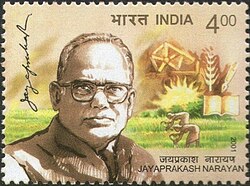
[[File:Jayaprakash Narayan 2001 stamp of India.jpg|thumb|Narayan on a 2001 stamp of India]] | [[File:Jayaprakash Narayan 2001 stamp of India.jpg|thumb|Narayan on a 2001 stamp of India]] | ||
*[[Bharat Ratna]], 1999 (Posthumous) for Public Affairs: It is India's highest civilian award. | *[[Bharat Ratna]], 1999 (Posthumous) for Public Affairs: It is India's highest civilian award.<ref name=nd>{{cite news |title=List of all Bharat Ratna award winners|url=http://www.ndtv.com/article/india/list-of-all-bharat-ratna-award-winners-81336 |work=NDTV |date=24 January 2011 |access-date=29 November 2012 |url-status=live|archive-url=https://web.archive.org/web/20130311165846/http://www.ndtv.com/article/india/list-of-all-bharat-ratna-award-winners-81336 |archive-date=11 March 2013}}</ref> | ||
*Rashtrabhushan Award of [[FIE Foundation]], [[Ichalkaranji]] | *Rashtrabhushan Award of [[FIE Foundation]], [[Ichalkaranji]]<ref name="Vaidya"/> | ||
*[[Ramon Magsaysay Award]], 1965 for Public Service. | *[[Ramon Magsaysay Award]], 1965 for Public Service. | ||
== Sites named after Jayaprakash Narayan == | == Sites named after Jayaprakash Narayan == | ||
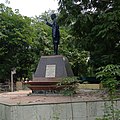
[[File:JP Narayan statue Gaya.jpg|thumb|Jayaprakash Narayan's statue near [[Mirza Ghalib College]] in [[Gaya (India)|Gaya]], [[Bihar]], India]] | [[File:JP Narayan statue Gaya.jpg|thumb|Jayaprakash Narayan's statue near [[Mirza Ghalib College]] in [[Gaya (India)|Gaya]], [[Bihar]], India]] | ||
* | <!---♦♦♦ Only add an entry to this list if it already has its own article on the English Wikipedia ♦♦♦---> | ||
* On 1 August 2015, the Chhapra-Delhi-Chhapra Weekly Express was renamed as [[Loknayak Express]] in his honour. | <!---♦♦♦ Please keep the list in alphabetical order ♦♦♦---> | ||
* [[Jay Prakash Narayan Airport]] in [[Patna]] | |||
* On 1 August 2015, the Chhapra-Delhi-Chhapra Weekly Express was renamed as [[Loknayak Express]] in his honour.<ref>{{cite web|url=http://indiarailinfo.com/blog/post/1555434|title=Blog Entry# 1555434|archive-url=https://web.archive.org/web/20151018175621/http://indiarailinfo.com/blog/post/1555434|archive-date=18 October 2015|date=1 August 2015|url-status=live|access-date=1 August 2015|publisher=India Rail}}</ref> | |||
* [[Digha-Sonpur Bridge|JP Setu the Digha-Sonpur Bridge]], a rail-road bridge across river [[Ganga]] in [[Bihar]] | * [[Digha-Sonpur Bridge|JP Setu the Digha-Sonpur Bridge]], a rail-road bridge across river [[Ganga]] in [[Bihar]] | ||
*[[Jayaprakash | *[[Jayaprakash Nagar, Bangalore|Jayaprakash Nagar]] (JP Nagar) a residential area in [[Bangalore]]. | ||
*[[Jayaprakash Nagar, Mysore|Jayaprakash Nagar]] (JP Nagar) a residential area in [[Mysore]]. | *[[Jayaprakash Nagar, Mysore|Jayaprakash Nagar]] (JP Nagar) a residential area in [[Mysore]]. | ||
*[[Lok Nayak Hospital]] (hospital in [[New Delhi]] | *[[Lok Nayak Hospital]] (hospital in [[New Delhi]]) | ||
*[[Lok Nayak Jayaprakash Narayan National Institute of Criminology & Forensic Science]] (college in [[New Delhi]]) | *[[Lok Nayak Jayaprakash Narayan National Institute of Criminology & Forensic Science]] (college in [[New Delhi]]) | ||
*JP | *[[JPN Centre of Excellence in Humanities ]] (Indian Institute of Technology [[Simrol]], [[Indore]]) | ||
*[[Loknayak Jai Prakash Institute of Technology]] (Engineering college in [[Chhapra]], [[Bihar]]). | |||
==Artistic depictions of Jayaprakash Narayan== | |||
* [[Prakash Jha]] directed a 112-minute film "[[Loknayak (film)|Loknayak]]", based on the life of Jayaprakash Narayan.<ref>{{cite news|url=https://timesofindia.indiatimes.com/city/patna/Uncensored-Loknayak-to-be-screened-soon/articleshow/890542.cms |archive-url=https://archive.today/20140208185955/http://articles.timesofindia.indiatimes.com/2004-10-19/patna/27151362_1_film-prakash-jha-prasar-bharati |url-status=live |archive-date=8 February 2014 |title=Uncensored 'Loknayak' to be screened soon |date=19 October 2004 |work=[[The Times of India]] |access-date=20 November 2018}}</ref><ref>{{cite web|url=http://www.prakashjhaproductions.com/loknayak.html |title=Loknayak |archive-url=https://web.archive.org/web/20140222014728/http://www.prakashjhaproductions.com/loknayak.html |archive-date=22 February 2014 |access-date=25 February 2021}}</ref> [[Chetan Pandit]] played the role of JP in that film.<ref>{{cite news|url=http://www.thehindu.com/todays-paper/tp-national/tp-newdelhi/i-am-fully-indebted-to-theatre/article776650.ece |title="I am fully indebted to theatre" |work=The Hindu |date=31 May 2010 |archive-url=https://web.archive.org/web/20140222035232/http://www.thehindu.com/todays-paper/tp-national/tp-newdelhi/i-am-fully-indebted-to-theatre/article776650.ece |archive-date=22 February 2014 |access-date=25 February 2021}}</ref> | |||
* [[Achyut Potdar]] played Narayan in [[ABP News]] show ''[[Pradhanmantri (TV Series)|Pradhanmantri]]'' and ''Aaj Tak Aandolan''. | |||
* [[Anupam Kher]] portrayed Narayan in the 2025 film ''[[Emergency (2025 film)|Emergency]]'' directed by [[Kangana Ranaut]].<ref>{{cite news |title=Emergency: Who's playing who? Kangana Ranaut as Indira Gandhi, Anupam Kher as Jayaprakash Narayan, and more |url=https://indianexpress.com/article/entertainment/bollywood/emergency-whos-playing-who-kangana-ranaut-as-indira-gandhi-anupam-kher-as-jayaprakash-narayan-and-more-9780239/ |work=The Indian Express |date=16 January 2025 |access-date=20 January 2025}}</ref> | |||
==See also== | |||
*[[Aklu Ram Mahto]] | |||
== | ==Footnotes== | ||
{{notelist}} | |||
==References== | ==References== | ||
{{reflist|colwidth=30em}} | {{reflist|colwidth=30em}}. | ||
==Further reading and bibliography== | ==Further reading and bibliography== | ||
| Line 128: | Line 107: | ||
*Life and Time of Jayaprakash Narayan by J S Bright Dewans Publications Lahore 1946 | *Life and Time of Jayaprakash Narayan by J S Bright Dewans Publications Lahore 1946 | ||
*J.P: His Biography, Allan and Wendy Scarfe, Orient Longmans New Delhi 1975 | *J.P: His Biography, Allan and Wendy Scarfe, Orient Longmans New Delhi 1975 | ||
*Jayaprakash Narayan - Jankranti Ke Loknayak by Dr. Riteshwar Nath Tiwari, Rajmangal Prakashan, April 2023 | |||
*Jayaprakash: Rebel Extraordinary, by Lakshmi Narayan Lal, Indian Book Company New Delhi 1975 | *Jayaprakash: Rebel Extraordinary, by Lakshmi Narayan Lal, Indian Book Company New Delhi 1975 | ||
*Loknayak Jayaprakash Narayan, by Suresh Ram Macmillan Co. Delhi 1974 | *Loknayak Jayaprakash Narayan, by Suresh Ram Macmillan Co. Delhi 1974 | ||
| Line 141: | Line 121: | ||
*War Circulars, 1–4 CSP, Lucknow | *War Circulars, 1–4 CSP, Lucknow | ||
*Inside Lahore Fort, Sahityalaya Patna 1947 | *Inside Lahore Fort, Sahityalaya Patna 1947 | ||
*Nation Building in India – JP Narayan | *Nation Building in India&nbsp;– JP Narayan | ||
*Three Basic Problems of India. From Socialism to Sarvodaya, Sarva Seva Sangh Prakashan, Varansi 1957 | *Three Basic Problems of India. From Socialism to Sarvodaya, Sarva Seva Sangh Prakashan, Varansi 1957 | ||
*A Plea for Reconstruction of Indian Polity, Sarva Seva Sangh Prakashan, | *A Plea for Reconstruction of Indian Polity, Sarva Seva Sangh Prakashan, Varanasi 1959 | ||
*Swaraj for the People, Sarva Seva Sangh Prakashan, Varansi 1961 | *Swaraj for the People, Sarva Seva Sangh Prakashan, Varansi 1961 | ||
*Sarvodaya Answer to Chinese Aggression, Sarvodaya Prachuralaya Tanjore 1963 | *Sarvodaya Answer to Chinese Aggression, Sarvodaya Prachuralaya Tanjore 1963 | ||
| Line 149: | Line 129: | ||
*Prison Diary, Samajwadi Yuvjan Sabha Calcutta 1976 and Popular Prakashan, Bombay 1977. | *Prison Diary, Samajwadi Yuvjan Sabha Calcutta 1976 and Popular Prakashan, Bombay 1977. | ||
*Towards Struggle, edited by Yusuf Meherally, Padma Publications, Bombay 1946, 47 | *Towards Struggle, edited by Yusuf Meherally, Padma Publications, Bombay 1946, 47 | ||
*Socialism, Sarvodaya and Democracy | *Socialism, Sarvodaya and Democracy edited by Bimal Prasad, Asia Publishing House Bombay 1964 | ||
*Communitarian Society and | *Communitarian Society and Panchayati Raj, edited by Brahmanand Navchetna Prakashan Varanasi 1970 | ||
*Nation-Building in India, edited by Brahmanand Navchetna Prakashan | *Nation-Building in India, edited by Brahmanand Navchetna Prakashan Varanasi 1974 | ||
*Towards Revolution, edited by Bhargava and Phadnis, Arnold-Heinemann New Delhi 1975 | *Towards Revolution, edited by Bhargava and Phadnis, Arnold-Heinemann New Delhi 1975 | ||
*J.P's Jail Life (A Collection of Personal Letters) translated by G S Bhargava, Arnold-Heinemann New Delhi 1977 | *J.P's Jail Life (A Collection of Personal Letters) translated by G S Bhargava, Arnold-Heinemann New Delhi 1977 | ||
| Line 161: | Line 141: | ||
==External links== | ==External links== | ||
{{commons category|Jayaprakash Narayan}} | |||
{{Wikiquote}} | |||
* [http://www.india-seminar.com/2001/506/506%20extract.htm A | * [http://www.india-seminar.com/2001/506/506%20extract.htm A Plea for the Reconstruction of the Indian Polity] | ||
* [http://www.mkgandhi.org/jpnarayan/total_revolution.htm Total | * [http://www.mkgandhi.org/jpnarayan/total_revolution.htm Total Revolution] | ||
* [http://www.mkgandhi.org/jpnarayan/hindu_revival.htm On Hindu | * [http://www.mkgandhi.org/jpnarayan/hindu_revival.htm On Hindu Revivalism] | ||
{{Bharat Ratna}} | {{Bharat Ratna}} | ||
| Line 185: | Line 165: | ||
[[Category:The Emergency (India)]] | [[Category:The Emergency (India)]] | ||
[[Category:Prisoners and detainees of British India]] | [[Category:Prisoners and detainees of British India]] | ||
[[Category:English-language writers | [[Category:English-language Indian writers]] | ||
[[Category: | [[Category:Indian people imprisoned during the Emergency (India)]] | ||
[[Category:Indian social reformers]] | [[Category:Indian social reformers]] | ||
[[Category:University of Iowa alumni]] | [[Category:University of Iowa alumni]] | ||
| Line 197: | Line 177: | ||
[[Category:Praja Socialist Party politicians]] | [[Category:Praja Socialist Party politicians]] | ||
[[Category:Academic staff of Bihar National College]] | [[Category:Academic staff of Bihar National College]] | ||
[[Category:Indian Marxists]] | |||
Revision as of 16:33, 16 March 2026
Jayaprakash Narayan | |
|---|---|
.jpg) | |
| Born | Jayaprakash Narayan Srivastava 11 October 1902 Sitab Diara, Chhapra district, Bengal Presidency, British India (now in Ballia district, Uttar Pradesh, India)<ref name="Birthplace"/> |
| Died | 8 October 1979 (aged 76) Patna, Bihar, India |
| Other names | JP, Jay Prakash Narayan, Lok Nayak |
| Alma mater | University of Wisconsin (M.A., sociology)<br />Ohio State University (B. A., behavioural science)<br />University of Iowa (CHE, discontinued)<br />U.C. Berkeley (chemistry, discontinued)<ref name="indiatimes1"/><ref name="nytimes1975"/> |
| Occupation |
|
| Political party | Indian National Congress<br />Janata Party |
| Movement | Quit India, Sarvodaya, JP Movement, Bihar Movement |
| Spouse(s) | Prabhavati Devi |
| Relatives | Brajkishore Prasad (father-in-law) |
| Awards |
|
Jayaprakash Narayan Srivastava ( listen (help·info); 11 October 1902 – 8 October 1979), also known as JP and Lok Nayak (Hindi for "People's leader"), was an Indian politician, theorist and independence activist. He is mainly remembered for leading the mid-1970s opposition against Prime Minister Indira Gandhi and calling for her overthrow in a "total revolution". In 1999, Narayan was posthumously awarded the Bharat Ratna, India's highest civilian award, in recognition of his social service. His other awards include the Ramon Magsaysay Award for public service in 1965.
Early life
Jayaprakash Narayan Srivastava was born on 11 October 1902<ref>Ratan, Das (2007). Jayaprakash Narayan: His Life and Mission. Sarup & Sons. p. 7. ISBN 978-81-7625-734-3.</ref><ref name="Devasahayam"/> in the village of Sitab Diara, Chhapra district, Bengal Presidency, British India (present-day Ballia district, Uttar Pradesh, India).<ref name="Birthplace">The village, Sitabdiara, where J.P. was born is situated beside the confluence of the river Ghaghra with the Ganga, and its site has been changing with changes in the course of the rivers. When he was born, this village lay in the Chapra district of Bihar, it now belongs to the Ballia district of Uttar Pradesh Prasad, Bimal (1980). A Revolutionary's Quest: Selected Writings of Jayaprakash Narayan. Oxford University Press. p. IX. ISBN 978-0-19-561204-2.</ref>[lower-alpha 1] His house was near the banks of the flood-prone Ghaghara river; every time the river swelled, the house would be slightly damaged, eventually forcing the family to move a few kilometres away to a settlement that is now known as Jayaprakash Nagar, Uttar Pradesh.[citation needed]
Narayan came from a Kayastha family of Srivastava clan.<ref>Das, Sandip (2005). Jayaprakash Narayan: A Centenary Volume. Mittal Publications. p. 109. ISBN 978-81-8324-001-7.</ref><ref name="Devasahayam">Devasahayam, M. G. (2004). India's Second Freedom: An Untold Saga. Siddharth Publications. p. 95. ISBN 978-81-7220-157-9. Retrieved 5 June 2023. asked him whether Narayan was his surname. He said no and said that he was, in fact, Jayaprakash Narayan Srivastava. Jayaprakash Narayan is his name and Srivastava is his surname. Conversations centred on the community of Kayasthas
</ref> He was the fourth child of Harsu Dayal and Phul Rani Devi. His father was a junior official in the canal department of the state government and often toured the region. When Narayan was nine years old, he left his village to enroll in the seventh class of the collegiate school at Patna.<ref>Scarfe, Allan; Scarfe, Wendy (1998). J. P., His Biography. Orient Blackswan. p. 30. ISBN 978-81-250-1021-0.</ref> This was his first break from village life. Narayan stayed at Saraswati Bhawan, a student hostel where most of the boys were older than him and included some of Bihar's future leaders, such as its first chief minister, Krishna Singh, his deputy Anugrah Narayan Sinha and several others who became politicians and academics.<ref>Bhattacharjea, Ajit (1978). Jayaprakash Narayan: A Political Biography. Vikas Publishing House. p. 33. ISBN 9780836401158.</ref>
In October 1920, Narayan married independence activist Prabhavati Devi.<ref name=Das2005p239 /> After their wedding, because Narayan was working in Patna and it was difficult for his wife to stay with him, Mahatma Gandhi invited Prabhavati to become an inmate at Sabarmati Ashram (Ahmedabad).<ref>Ratan, Das (2007). Jayaprakash Narayan: His Life and Mission. Sarup & Sons. p. 7. ISBN 978-81-7625-734-3.</ref> Jayaprakash, along with some friends, went to listen to Maulana Abul Kalam Azad speak about Gandhi's non-cooperation movement against the passing of the Rowlatt Act of 1919. Azad was a brilliant orator and his call to give up English education was "like leaves before a storm: Jayaprakash has swept away and momentarily lifted up to the skies. That brief experience of soaring up with the winds of a great idea left imprints on his inner being".<ref>Bhatti, Dr. S S (2 August 2024). RECOVERY OF INDIA. Blue Rose Publishers. p. 142.</ref> Inspired by Azad's words, Jayaprakash left Bihar National College with just 20 days remaining to his examinations. Jayaprakash joined the Bihar Vidyapeeth, a college founded by Rajendra Prasad, and became among the first students of Gandhian Anugraha Narayan Sinha.[citation needed]
Higher education in the United States
After exhausting the courses at the Vidyapeeth, Narayan decided to continue his studies in the United States.<ref name=Das2005p239>Das, Sandip (2007). Jayaprakash Narayan: A Centenary Volume. Mittal Publications. p. 239. ISBN 978-81-8324-001-7.</ref> At age 20, Jayaprakash sailed aboard the cargo ship Janus while Prabhavati remained at Sabarmati. Jayaprakash reached California on 8 October 1922, and was admitted to the University of California, Berkeley (UC Berkeley) in January 1923 as a chemistry undergraduate.<ref name="ie">Chishti, Seema (11 October 2017). "Jayaprakash Narayan: Reluctant messiah of a turbulent time". The India Express. Retrieved 11 June 2018.</ref> To pay for his education, Narayan picked grapes, packed fruits at a canning factory, washed dishes, and worked as a garage mechanic. These jobs gave Narayan an insight into the difficulties of the working class.<ref name="indiatimes1"/><ref name="nytimes1975"/><ref>"Register – University of California: 1922/1923". Register. Berkeley, California: University of California Press: 227. 1923. hdl:2027/coo.31924064686276.</ref> While at Berkeley, Narayan, then one of 45 students from India, joined the university's Hindustan Club.<ref>"Hindus Give Up Classic Studies To Turn Hands To New India's Problems of Farms and Business". Oakland Post Enquirer. 17 April 1923. Retrieved 6 April 2025 – via Newspapers.com.Template:Free access</ref> At the end of the semester, however, his fees doubled and he was forced to transfer to The University of Iowa, where he continued his studies in applied science and his activities with the Hindustan Association of America, a national association of Indian students studying in the United States.<ref name="Narayan_chairman">"Hindus Plan Convention Of Importance". Iowa City Press-Citizen. 19 December 1923. Retrieved 6 April 2025 – via Newspapers.com.Template:Free access</ref><ref>"Iowa Hindus To Entertain National Body". Iowa City Press-Citizen. 24 December 1923. Retrieved 6 April 2025 – via Newspapers.com.Template:Free access</ref> Narayan chaired the association's 1923 national convention, which was held at the university at the end of December 1923.<ref name="Narayan_chairman"/><ref>"Hindoo Convention Opens This Evening" (PDF). Daily Iowan. 28 December 1923. Retrieved 6 April 2025.</ref>
In Wisconsin, Narayan was introduced to Karl Marx's book Das Kapital. News of the success of the Bolsheviks in the Russian Civil War made Narayan conclude Marxism was the way to alleviate the suffering of the masses. He studied books by Indian intellectuals and Communist theoreticians M. N. Roy. Narayan's paper on sociology Cultural Variation<ref>Narayan, JP. Cultural variation. Diss. The Ohio State University, 1929.</ref> was declared the best of the year.<ref>"Writings of Jayprakash Narayan". www.mkgandhi.org. Retrieved 21 January 2021.</ref> Narayan graduated from University of Wisconsin with a MA in Sociology, and from Ohio State University with a BA in behavioural science.<ref name="indiatimes1">"The Idea of 'Total Revolution'". Bangalore Mirror. 16 October 2015. Retrieved 22 February 2021.</ref><ref name="nytimes1975">Khushwant Singh (30 March 1975). "A new wave from the old India". The New York Times. Retrieved 22 February 2021.</ref> While in the United States, he met K. B. Menon, then teaching at Harvard, ultimately persuading him to return to India and join the independence movement there.<ref>S, Lekshmi Priya (4 August 2018). "This Unsung Kerala Scholar Was The Architect of the Quit India Movement in Malabar!". The Better India. Retrieved 18 February 2024.</ref>
Politics

Having become a Marxist, Narayan returned from the US to India in late 1929.<ref>Das, Sandip (2005). Jayaprakash Narayan: A Centenary Volume. Mittal Publications. p. 230. ISBN 978-81-8324-001-7.</ref> The same year, he joined the Indian National Congress (INC or Congress) on the invitation of Jawaharlal Nehru; Mahatma Gandhi became Narayan's mentor in the Congress. Narayan shared a house at Kadam Kuan in Patna with his close friend and nationalist Ganga Sharan Singh (Sinha)<ref name="Ralhan 2002 17998 at pages 73–74">Ralhan, O.P. (2002). Encyclopaedia of Political Parties. Anmol Publications Pvt. Ltd. pp. 17998 (at pages 73–74). ISBN 978-81-7488-865-5.</ref> with whom he shared a lasting friendship.<ref name="Ralhan 2002 17998 at pages 73–74"/>
After being jailed in 1930 for civil disobedience against British rule, Narayan was imprisoned in Nasik Jail, where he met Rammanohar Lohia, Minoo Masani, Achyut Patwardhan, Asoka Mehta, Basawon Singh, Yusuf Desai, C K Narayanaswami and other national leaders. After his release, the Congress Socialist Party (CSP), a left-wing group within the Congress, was formed with Acharya Narendra Deva as president and Narayan as general secretary.[citation needed]
When Mahatma Gandhi launched the Quit India Movement in August 1942, Narayan, along with Yogendra Shukla, Suraj Narayan Singh, Gulab Chand Gupta, Pandit Ramnandan Mishra, Shaligram Singh and Shyam Barthwar, scaled the wall of Lok Nayak Jai Prakash Narayan Central Jail, Hazaribagh with a goal of starting an underground movement for freedom.<ref name="Srivastava 1988">Srivastava, N.M.P. (1988). Struggle for Freedom: Some Great Indian Revolutionaries. K.P.Jayaswal Research Institute, Government of Bihar, Patna.</ref> Many young socialist leaders like Rammanohar Lohia, Chhotubhai Puranik and Aruna Asaf Ali took part in the movement. Because Narayan was ill, Yogendra Shukla walked to Gaya with Narayan on his shoulders,<ref name="Srivastava 1988"/> a distance of about 124 km (77 mi).<ref>Distance between Hazaribagh Central Jail and Gaya. Maps.google.co.in. Retrieved on 20 November 2018.</ref> Narayan also served as the<ref>"Bihar Vibhuti's Legacy Drifting into Oblivion?". Patna Daily. 6 January 2012. Archived from the original on 25 January 2012. Retrieved 6 January 2012.</ref> chairman of Anugrah Smarak Nidhi (Anugrah Narayan Memorial Fund).
After Independence
Between 1947 and 1953, Jayaprakash Narayan was President of All India Railwaymen's Federation, the largest labour union in Indian Railways.<ref name="Bear">Bear, Laura (2007). Lines of the Nation: Indian Railway Workers, Bureaucracy, and the Intimate Historical Self. Columbia University Press. p. 231. ISBN 9780231140027.</ref>
Emergency
In the year 1975, Allahabad High Court found Indira Gandhi guilty of violating electoral laws.<ref name="A">"Indian Emergency of 1975-77". Mount Holyoke College. Archived from the original on 19 May 2017. Retrieved 5 July 2009.</ref><ref name="LOC">"The Rise of Indira Gandhi". Library of Congress Country Studies. Retrieved 27 June 2009.</ref><ref name="UK">Kuldip Singh (11 April 1995). "OBITUARY: Morarji Desai". The Independent. Archived from the original on 24 May 2022. Retrieved 27 June 2009.</ref><ref name="ING">Katherine Frank (2002). Indira: The Life Of Indira Nehru Gandhi. Houghton Mifflin Harcourt. pp. 371. ISBN 978-0-395-73097-3.</ref> Narayan called for Gandhi and the CMs to resign, and the military and police to disregard unconstitutional and immoral orders.[citation needed] He advocated a program of social transformation, which he termed Sampoorna kraanti (total revolution).[citation needed] Immediately afterwards, Gandhi proclaimed a national Emergency on the midnight of 25 June 1975.<ref name="KS">"Justice Sinha, who set aside Indira Gandhi's election, dies at 87". The Indian Express. 22 March 2008. Archived from the original on 9 March 2012. Retrieved 5 July 2009.</ref> Desai, opposition leaders, and dissenting members of Gandhi's own party were arrested that day.<ref>Choudhary, Ratnadeep (10 April 2019). "Morarji Desai, the prime minister for whom time in PMO was 'tougher than prison'". ThePrint. Retrieved 21 June 2024.</ref>
Jayaprakash Narayan gathered a crowd of 100,000 people at Ramlila grounds and recited Rashtrakavi Ramdhari Singh 'Dinkar''s poem Singhasan Khaali Karo Ke Janata Aaati Hai.<ref>Harish Khare (16 May 2001). "Obligations of a lameduck". The Hindu. Archived from the original on 20 July 2009. Retrieved 2 January 2009.</ref>
Narayan was detained at Chandigarh; he asked for one month of parole to mobilise relief in flooded parts of Bihar. His health suddenly deteriorated on 24 October 1975, and he was released on 12 November the same year.[citation needed] At Jaslok Hospital, Bombay, Narayan was diagnosed with kidney failure; he would be on kidney dialysis for the rest of his life.[citation needed]
In the UK, Surur Hoda launched "Free JP", a campaign for the release of Jayaprakash Narayan that was chaired by Nobel Peace Prize winner Philip Noel-Baker.<ref>McRobie, George (30 June 2003). "Surur Hoda: Trade unionist who spread the message of Mahatma Gandhi". The Guardian. London. Archived from the original on 27 August 2013. Retrieved 6 January 2012.</ref>
On 18 January 1977, Indira Gandhi revoked the emergency and announced elections. The Janata Party, a vehicle for the broad spectrum of the opposition to Gandhi, was formed under JP's guidance.[citation needed] The Janata Party was voted into power and became the first non-Congress party to form a central government.<ref>"How non-BJP, non-Congress governments in India have fared in the past". thenewsminute.com. 16 May 2019. Retrieved 26 December 2019.</ref> In the 1977 Indian presidential election, Narayan was proposed as President of India by Janata Party leaders but he refused and Neelam Sanjiva Reddy, then Speaker of the Lok Sabha, became president.[citation needed]
Private life
At the age of 17, Jayaprakash was married to Prabhavati Devi, daughter of lawyer and nationalist Brij Kishore Prasad in October 1919. Prabhavati was very independent and on Gandhi's invitation, went to stay at his ashram while Jayaprakash continued his studies.<ref name="Vaidya">Vaidya, Prem. "Jayaprakash Narayan – Keeper of India's Conscience". LiberalsIndia.com. Archived from the original on 5 February 2012. Retrieved 16 August 2012.</ref> Prabhavati Devi died on 15 April 1973 after a long battle with cancer.[citation needed]
Death
In March 1979, while he was in the hospital, Narayan's death was erroneously announced by the Indian prime minister Morarji Desai, causing a wave of national mourning, including the suspension of parliament and regular radio broadcasting, and the closure of schools and shops. When he was told about the mistake a few weeks later, Narayan smiled.<ref>"Jayaprakash Narayan's death announced mistakenly". www.indianexpress.com. 23 March 2019. Retrieved 9 December 2019.</ref> Narayan died in Patna, Bihar,<ref>Datta-Ray, Sunanda K. "Inconvenient Prophet". India Today. Archived from the original on 31 January 2009. Retrieved 6 January 2012.[failed verification]</ref> on 8 October 1979, three days before his 77th birthday, due to the effects of diabetes and heart disease.[citation needed]
Awards

- Bharat Ratna, 1999 (Posthumous) for Public Affairs: It is India's highest civilian award.<ref name=nd>"List of all Bharat Ratna award winners". NDTV. 24 January 2011. Archived from the original on 11 March 2013. Retrieved 29 November 2012.</ref>
- Rashtrabhushan Award of FIE Foundation, Ichalkaranji<ref name="Vaidya"/>
- Ramon Magsaysay Award, 1965 for Public Service.
Sites named after Jayaprakash Narayan

<!---♦♦♦ Only add an entry to this list if it already has its own article on the English Wikipedia ♦♦♦---> <!---♦♦♦ Please keep the list in alphabetical order ♦♦♦--->
- Jay Prakash Narayan Airport in Patna
- On 1 August 2015, the Chhapra-Delhi-Chhapra Weekly Express was renamed as Loknayak Express in his honour.<ref>"Blog Entry# 1555434". India Rail. 1 August 2015. Archived from the original on 18 October 2015. Retrieved 1 August 2015.</ref>
- JP Setu the Digha-Sonpur Bridge, a rail-road bridge across river Ganga in Bihar
- Jayaprakash Nagar (JP Nagar) a residential area in Bangalore.
- Jayaprakash Nagar (JP Nagar) a residential area in Mysore.
- Lok Nayak Hospital (hospital in New Delhi)
- Lok Nayak Jayaprakash Narayan National Institute of Criminology & Forensic Science (college in New Delhi)
- JPN Centre of Excellence in Humanities (Indian Institute of Technology Simrol, Indore)
- Loknayak Jai Prakash Institute of Technology (Engineering college in Chhapra, Bihar).
Artistic depictions of Jayaprakash Narayan
- Prakash Jha directed a 112-minute film "Loknayak", based on the life of Jayaprakash Narayan.<ref>"Uncensored 'Loknayak' to be screened soon". The Times of India. 19 October 2004. Retrieved 20 November 2018.
{{cite news}}: CS1 maint: deprecated archival service (link)</ref><ref>"Loknayak". Archived from the original on 22 February 2014. Retrieved 25 February 2021.</ref> Chetan Pandit played the role of JP in that film.<ref>""I am fully indebted to theatre"". The Hindu. 31 May 2010. Archived from the original on 22 February 2014. Retrieved 25 February 2021.</ref> - Achyut Potdar played Narayan in ABP News show Pradhanmantri and Aaj Tak Aandolan.
- Anupam Kher portrayed Narayan in the 2025 film Emergency directed by Kangana Ranaut.<ref>"Emergency: Who's playing who? Kangana Ranaut as Indira Gandhi, Anupam Kher as Jayaprakash Narayan, and more". The Indian Express. 16 January 2025. Retrieved 20 January 2025.</ref>
See also
Footnotes
- ↑ Sitabdiara is a large village straddling two states and three districts—Saran and Bhojpur in Bihar, and Ballia in Uttar Pradesh.<ref>"A forgotten hero's forgotten legacy". Archived from the original on 16 August 2017.</ref>
References
.
Further reading and bibliography
- Braja Kishore Prasad: The Hero of Many Battles by Sachidanand Sinha; National Book Trust, India, New Delhi; 2018; ISBN 978-81-237-8176-1
- Red Fugitive: Jayaprakash Narayan by H L Singh Dewans Publications Lahore 1946
- Life and Time of Jayaprakash Narayan by J S Bright Dewans Publications Lahore 1946
- J.P: His Biography, Allan and Wendy Scarfe, Orient Longmans New Delhi 1975
- Jayaprakash Narayan - Jankranti Ke Loknayak by Dr. Riteshwar Nath Tiwari, Rajmangal Prakashan, April 2023
- Jayaprakash: Rebel Extraordinary, by Lakshmi Narayan Lal, Indian Book Company New Delhi 1975
- Loknayak Jayaprakash Narayan, by Suresh Ram Macmillan Co. Delhi 1974
- Loknayak Jayaprakash Narayan by Farooq Argali Janata Pocket Books Delhi 1977.
- Bimal Prasad (editor). 1980. A Revolutionary's Quest: Selected Writings of Jayaprakash Narayan. Oxford University Press, Delhi ISBN 0-19-561204-3
- Jai Prakash Narain, Jayaprakash Narayan, Essential Writings, 1929–1979: A Centenary Volume, 1902–2002, Konark Publishers (2002) ISBN 81-220-0634-5
- Dr. Kawaljeet, J.P.'s Total Revolution and Humanism (Patna: Buddhiwadi Foundation, 2002). ISBN 81-86935-02-9
- Dr. Ramendra (editor), Jayaprakash Vichar Sankalan [Hindi] (Patna: Rajendra Prakashan, 1986).
- Satyabrata Rai Chowdhuri, Leftism in India: 1917–1947 (London and New Delhi: Palgrave Macmillan, 2008).
- Radhakanta Barik, Politics of the JP Movement (Radiant Publications, Delhi, 1977)
- MG Devashayam, JP Movement Emergency and India's Second Freedom (Vitasta Publishing Pvt. Ltd., New Delhi, 2012). ISBN 978-93-80828-61-9
- Why Socialism, 1936
- War Circulars, 1–4 CSP, Lucknow
- Inside Lahore Fort, Sahityalaya Patna 1947
- Nation Building in India – JP Narayan
- Three Basic Problems of India. From Socialism to Sarvodaya, Sarva Seva Sangh Prakashan, Varansi 1957
- A Plea for Reconstruction of Indian Polity, Sarva Seva Sangh Prakashan, Varanasi 1959
- Swaraj for the People, Sarva Seva Sangh Prakashan, Varansi 1961
- Sarvodaya Answer to Chinese Aggression, Sarvodaya Prachuralaya Tanjore 1963
- Face to Face, Navchetna Prakashan, Varansi 1970
- Prison Diary, Samajwadi Yuvjan Sabha Calcutta 1976 and Popular Prakashan, Bombay 1977.
- Towards Struggle, edited by Yusuf Meherally, Padma Publications, Bombay 1946, 47
- Socialism, Sarvodaya and Democracy edited by Bimal Prasad, Asia Publishing House Bombay 1964
- Communitarian Society and Panchayati Raj, edited by Brahmanand Navchetna Prakashan Varanasi 1970
- Nation-Building in India, edited by Brahmanand Navchetna Prakashan Varanasi 1974
- Towards Revolution, edited by Bhargava and Phadnis, Arnold-Heinemann New Delhi 1975
- J.P's Jail Life (A Collection of Personal Letters) translated by G S Bhargava, Arnold-Heinemann New Delhi 1977
- Towards Total Revolution, edited by Brahmanand Popular Prakashan Bombay 1978
- J P:Profile of a non-conformist, Interviews by Bhola Chatterji, Minerva Associates, Calcutta, 1979
- To All Fighters of Freedom II, A Revolutionary's Quest-selected writings of Jayprakash Narayan, edited by Bimal Prasad Oxford University Press New Delhi 1980
- Concept of Total Revolution: An Introductory Essay(JP and social change) by Bimal Prasad
External links


- Pages using the JsonConfig extension
- 1902 births
- 1979 deaths
- People from Ballia district
- Janata Party politicians
- Indian National Congress politicians from Bihar
- Indian independence activists from Bihar
- Indian pacifists
- Indian socialists
- Politicians from Patna
- The Emergency (India)
- Prisoners and detainees of British India
- English-language Indian writers
- Indian people imprisoned during the Emergency (India)
- Indian social reformers
- University of Iowa alumni
- Ohio State University alumni
- University of Wisconsin–Madison College of Letters and Science alumni
- University of California, Berkeley alumni
- Recipients of the Bharat Ratna
- Ramon Magsaysay Award winners
- Social workers from Bihar
- Praja Socialist Party politicians
- Academic staff of Bihar National College
- Indian Marxists