


m Bot: Delinking broken file(s) using script (info) |
minor update |
||
| Line 1: | Line 1: | ||
{{short description|Warrior in the epic Mahabharata}} | {{short description|Warrior in the epic Mahabharata}} | ||
{{about|the figure in the | {{about|the figure in the Hindu epic ''Mahabharata''}} | ||
{{pp|small=yes}} | |||
{{Use dmy dates|date=October 2018}} | {{Use dmy dates|date=October 2018}} | ||
{{Use Indian English|date=January 2016}} | {{Use Indian English|date=January 2016}} | ||
{{Infobox character | {{Infobox character | ||
| image = Karna in Kurukshetra.jpg | | image = Karna in Kurukshetra.jpg | ||
| image_size = 250px | |||
| alt = Karna | | alt = Karna | ||
| info-hdr = Information | | info-hdr = Information | ||
| caption = | | caption = Karna seated on a chariot during [[Kurukshetra War]], [[Pahari painting]], c. 1820 | ||
| children = [[Vrishasena]], Sushena, [[Vrishaketu]] and [[Characters in the Mahabharata#Sons of Karna|other sons]] | |||
| relatives ={{unbulleted list|[[Adhiratha]] (adoptive father)|[[Radha (Mahabharata)|Radha]] (adoptive mother)|[[Surya]] (father)|[[Kunti]] (mother)| [[Yudhishthira]], [[Bhima]], [[Arjuna]], [[Nakula]] and [[Sahadeva]] (half-brothers)|Possibly some [[Foster brothers of Karna|adoptive brothers]]{{sfn|McGrath|2004|p=132}}}} | | relatives = {{unbulleted list|[[Adhiratha]] (adoptive father)|[[Radha (Mahabharata)|Radha]] (adoptive mother)|[[Surya]] (father)|[[Kunti]] (mother)| [[Yudhishthira]], [[Bhima]], [[Arjuna]], [[Nakula]] and [[Sahadeva]] (half-brothers)|Possibly some [[Foster brothers of Karna|adoptive brothers]]{{sfn|McGrath|2004|p=132}}}} | ||
| aliases = Vasusena, Angaraja, Radheya | | aliases = Vasusena, Angaraja, Radheya | ||
| title = King of Anga | |||
| gender = Male | | gender = Male | ||
| weapon = | | weapon = [[Vijaya (bow)]] and arrows | ||
| spouses = | | spouses = <!--Please don't add names like Vrushali, Supriya, Padmavati, Urvi, etc.! Please check the note--->[[Wife of Karna|Unnamed Sūta women]]{{efn|In the Mahabharata, Karna's marital life is hardly attested and his wives are unnamed. Karna's marital details vary across adaptations of the Mahabharata, with different works assigning him different wives, like Ponnuruvi, Padmavati, Vrushali, and Supriya. | ||
}} | }} | ||
}} | }} | ||
Karna grows up to be an accomplished warrior of extraordinary abilities, a gifted speaker | '''Karna''' ([[Sanskrit]]: कर्ण, [[IAST]]: ''Karṇa''), also known as '''Vasusena''', '''Anga-Raja''', '''Sutaputra''' and '''Radheya''',{{sfn|Coulter|Turner|2013|pp=262-263}} is one of the major characters in the [[Hinduism|Hindu]] epic ''[[Mahābhārata]]''.{{sfn|McGrath|2004|pp=1-3}}{{sfn|Lemming|2005}} He is the spiritual son of [[Surya]] (the solar deity) and princess [[Kunti]] (later the Pandava queen). His birth occurred after Kunti invoked a divine boon to test its power in her youth; fearing societal stigma over her premarital motherhood, she is forced to abandon the infant in a basket on the [[Ganges]].{{sfn|Shulman|2014|pp=381-382}} He is discovered and fostered by Radha and Adhiratha Nandana,{{sfn|Coulter|Turner|2013|pp=262-263}} the ''sūta'' (charioteer) of King [[Dhritarashtra]].{{sfn|McGrath|2004|pp=1-3}} Karna grows up to be an accomplished warrior of extraordinary abilities, and a gifted speaker. He becomes a loyal friend of [[Duryodhana]]{{sfn|McGrath|2004|pp=1-3}}{{sfn|Johnson|2009}}, and is appointed the king of [[Anga]] ([[Bihar]]-[[Bengal]]){{sfn|Klostermaier|1998|pp=95-96}} by the prince.{{sfn|Coulter|Turner|2013|pp=262-263}} Karna joins the [[Kaurava]] side of the [[Kurukshetra War]], and is ultimately slain by [[Arjuna]].{{sfn|McGrath|2004|pp=1-3}}{{sfn|Lemming|2005}} | ||
He is a tragic hero in the ''Mahabharata'', in a manner similar to Aristotle's literary category of "flawed good man".{{sfn|Hiltebeitel|2011|p=457}} He meets his biological mother late in the epic then discovers that he is the older half-brother of those he is fighting against.{{sfn|Johnson|2009}} Karna is a symbol of someone who is rejected by those who should love him but do not given the circumstances, yet becomes a man of exceptional abilities willing to give his love and life as a loyal friend. His character is developed in the epic to raise and discuss major emotional and ''[[dharma]]'' (duty, ethics, moral) dilemmas.{{sfn|Shulman|2014|pp=380-389}}{{sfn|Adarkar|2005|pp=119-228, context: chapter 9}}{{sfn|Matilal|2002|pp=90-118}} His story has inspired many secondary works, poetry and dramatic plays in the Hindu arts tradition, both in India and in southeast Asia.{{sfn|Shulman|2014|pp=380-389}}{{sfn|de Bruin|Brakel-Papenyzen|1992|pp=38-39, 47-49, 53-54}}{{sfn|Terrence|1995|pp=134-135}} | |||
A regional tradition believes that Karna founded the city of [[Karnal]], in contemporary [[Haryana]].<ref>{{cite web|title=Karnal|url=http://www.karnal.gov.in/|publisher=District of Karnal|accessdate=26 November 2013}}</ref> | |||
== Nomenclature and epithets == | |||
Karṇa (कर्ण) is a word found in the Vedic literature, where it means "the ear", "chaff or husk of a grain" or the "helm or rudder".<ref name=mmwkarna/> In another context, it refers to a [[spondee]] in [[Sanskrit]] prosody.<ref name=mmwkarna>Monier Monier-Williams (2008 update), [http://www.sanskrit-lexicon.uni-koeln.de/cgi-bin/monier/serveimg.pl?file=/scans/MWScan/MWScanjpg/mw0256-karkakhaNDa.jpg कर्ण, Karna], Oxford University Press (Updated, Harvard University), page 256</ref> | |||
In the ''Mahabharata'' and the Puranas, it is the name of a warrior character.<ref name=mmwkarna/> Called Vasusena as a child by his foster parents, he became known by the name Karna because of the golden earrings of Surya he used to wear, according to the Sanskrit epics scholar David Slavitt.{{sfn|Slavitt|2015|pp=231–234}} | |||
The word Karna, states the Indologist Kevin McGrath, signifies "eared, or the ear-ringed one".{{sfn|McGrath|2004|p=31}} In section 3.290.5 of the ''Mahabharata'', Karna is described as a baby born with the ear-rings and armoured breastplate, like his father Surya.{{sfn|McGrath|2004|pp=31–32 with footnotes}} | |||
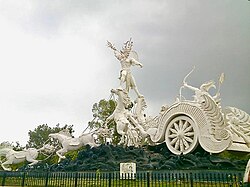
= | [[File:Karna Ghatotkacha fight sculpture, Kota Rajasthan India.jpg|thumb|upright=1.35|Karna inside the chariot fighting [[Ghatotkacha]] standing over horses, Kota, [[Rajasthan]]. This artwork – as ''Patung Satria Gatotkaca'' – is also found near the [[Denpasar]] airport, [[Bali]], Indonesia.]] | ||
Karna | The second meaning of Karna as "rudder and helm" is also an apt metaphor given Karna's role in steering the war in Book 8 of the epic, where the good Karna confronts the good Arjuna, one of the climax scenes wherein the Mahabharata authors repeatedly deploy the allegories of ocean and boat to embed layers of meanings in the poem.{{sfn|McGrath|2004|pp=39–41 with footnotes}} For example, his first entry into the Kurukshetra battlefield is presented as the ''Makara'' movement (an arrangement of soldiers in the sea-monster pattern).{{sfn|McGrath|2004|pp=39–41 with footnotes}} As Duryodhana's army crumbles each day, the sea and vessel metaphor repeatedly appears in the epic, particularly when Karna is mentioned. As a newborn, Karna's life begins in a basket without a rudder on a river, in circumstances that he neither chose nor had a say. In Book 1, again in the context of Karna, Duryodhana remarks, "the origins of heroes and rivers are indeed difficult to understand".{{sfn|McGrath|2004|pp=39–43 with footnotes}}{{refn|group=note|The Karna legend in the ''Mahabharata'' is overlaid with metaphors such as "the worlds stand in water, every taste is made of water, all the world is made of water", later that "no one perceives this world sinking in a deep sea of time, where sharks of death and age awaits".{{sfn|McGrath|2004|pp=39–43 with footnotes}}}} | ||
* Vasusena – Original name of Karna, means "born with wealth" as he was born with natural | The name Karna is also symbolically connected to the central aspect of Karna's character as the one who is intensely preoccupied with what others hear and think about him, about his fame, a weakness that others exploit to manipulate him. This "hearing" and "that which is heard", states McGrath makes "Karna" an apt name and subtle reminder of Karna's driving motivation.{{sfn|McGrath|2004|pp=2–3, 31–32 with footnote 19}}{{refn|group=note|Surya, his father, tries to persuade him to not worry about what others think and avoid getting gullibly exploited, Karna declines.<ref>{{cite book|first1=Amrita|last1=Narlikar|first2=Aruna|last2=Narlikar|title=Bargaining with a Rising India: Lessons from the Mahabharata |url=https://books.google.com/books?id=u8r6AgAAQBAJ |year=2014|publisher=Oxford University Press|isbn=978-0-19-969838-7|pages=57–58}}</ref>}} | ||
Karna was also called with many names.{{sfn|Mani|1975}} Some of them are: | |||
* Vasusena – Original name of Karna, means "born with wealth" as he was born with natural armour and earrings.<ref>{{Cite book|last=Pratap Chandra Roy|url=https://holybooks.com/wp-content/uploads/Mahabharata-VOL-1.pdf|title=The Mahabharata of Krishna-Dwaipayana Vyasa, Vol. 1 – Adi Parva |publisher=Oriental Publishing Co. |pages=264|access-date=February 21, 2021}}</ref> | |||
* Suryaputra – Son of [[Surya]] | * Suryaputra – Son of [[Surya]] | ||
* Radheya – son of Radha (Karna's adopted mother). | * Radheya – son of Radha (Karna's adopted mother). | ||
* Sutaputra – son of charioteer. | * Sutaputra – son of charioteer. | ||
* Angaraja – king of [[Anga]]. | * Angaraja – king of [[Anga]]. | ||
* Daanaveera – one | * Daanaveera – one of charitable nature or one who is exceptionally munificent (generous)<ref>{{Cite book|last1=Kotru|first1=Umesh|title=Karna The Unsung Hero of the Mahabharata|last2=Zutshi |first2=Ashutosh |date=March 2015 |publisher=Leadstart Publishing|isbn=978-93-5201-304-3 |url=https://books.google.com/books?id=tBMfCAAAQBAJ&q=Daanaveera|access-date=1 July 2020}}</ref> | ||
* Vijayadhari – holder of a bow named [[Vijaya (bow)|Vijaya]] which was gifted by Lord [[Parashurama]].<ref name=":0">{{Cite book|last1=Kotru|first1=Umesh|title=Karna The Unsung Hero of the Mahabharata|last2=Zutshi |first2=Ashutosh |date=March 2015|publisher=Leadstart Publishing | * Vijayadhari – holder of a bow named [[Vijaya (bow)|Vijaya]] which was gifted by Lord [[Parashurama]].<ref name=":0">{{Cite book|last1=Kotru|first1=Umesh|title=Karna The Unsung Hero of the Mahabharata |last2=Zutshi |first2=Ashutosh |date=March 2015 |publisher=Leadstart Publishing|isbn=978-93-5201-304-3 |url=https://books.google.com/books?id=tBMfCAAAQBAJ&q=vijaya+karna+google+book&pg=PT73 |access-date=1 July 2020}}</ref> | ||
* Vaikartana – one who belongs to solar race (related to Surya). | * Vaikartana – one who belongs to solar race (related to Surya). | ||
* Vrisha – one who is truthful in speech and kept his vows. | * Vrisha – one who is truthful in speech and kept his vows. | ||
== Mythology and sources: Mahābhārata == | == Mythology and sources: Mahābhārata == | ||
| Line 54: | Line 55: | ||
Karna appears for the first time in the ''Mahabharata'' in the verse 1.1.65 of ''Adi Parvan'' (first book) where he is briefly mentioned through the metaphor of a tree, as someone who is refusing to fight or help in the capture of Krishna.{{sfn|McGrath|2004|pp=25–26}} He is presented again in sections 1.2.127–148, and chapter 1.57 of the ''Adi Parvan''. It is here that his earrings "that make his face shine", as well as the divine breastplate (body armor) he was born with, are mentioned for the first time. This sets him apart as someone special, with gifts no ordinary mortal has.{{sfn|McGrath|2004|pp=26–27}} However, later in the epic, the generous Karna gives the "earrings and breastplate" away in charity, thereby becomes a mortal and later dies in a battle with Arjuna.{{sfn|McGrath|2004|pp=31–32 with footnotes}}{{sfn|van Buitenen|Fitzgerald|1973 |pp= 142–145}} | Karna appears for the first time in the ''Mahabharata'' in the verse 1.1.65 of ''Adi Parvan'' (first book) where he is briefly mentioned through the metaphor of a tree, as someone who is refusing to fight or help in the capture of Krishna.{{sfn|McGrath|2004|pp=25–26}} He is presented again in sections 1.2.127–148, and chapter 1.57 of the ''Adi Parvan''. It is here that his earrings "that make his face shine", as well as the divine breastplate (body armor) he was born with, are mentioned for the first time. This sets him apart as someone special, with gifts no ordinary mortal has.{{sfn|McGrath|2004|pp=26–27}} However, later in the epic, the generous Karna gives the "earrings and breastplate" away in charity, thereby becomes a mortal and later dies in a battle with Arjuna.{{sfn|McGrath|2004|pp=31–32 with footnotes}}{{sfn|van Buitenen|Fitzgerald|1973 |pp= 142–145}} | ||
The story of his unmarried mother getting the child due to her curiosity, his divine connection to the Hindu god [[Surya]],<ref>{{cite book |last1=John Garrett |title=Torah and Nondualism: Diversity, Conflict, and Synthesis |publisher=Atlantic Publishers & | The story of his unmarried mother getting the child due to her curiosity, his divine connection to the Hindu god [[Surya]],<ref>{{cite book |last1=John Garrett |title=Torah and Nondualism: Diversity, Conflict, and Synthesis |publisher=Atlantic Publishers & Distributors |page=320 |edition=1989 |url=https://books.google.com/books?id=6paBoEtkUt0C&q=birth+of+karna&pg=PA321 |access-date=13 May 2020}}</ref> then his birth appears for the first time in the epic in section 1.104.7. The epic uses glowing words to describe Karna, but the presentation here is compressed in 21 ''shlokas'' unlike the later books which expand the details.{{sfn|McGrath|2004|pp=27–28 with footnotes}} These later sections with more details on Karna's birth and childhood include 3.287, 5.142 and 15.38.{{sfn|McGrath|2004|pp=27–28 with footnotes}} According to McGrath, the early presentation of Karna in the ''Mahabharata'' is such as if the poets expect the audience to already know the story and love the character of Karna. The text does not belabour the details about Karna in the early sections, rather uses [[metaphor]]s and [[metonym]]s to colourfully remind the audience of the fabric of a character they already are assumed to be aware of.{{sfn|McGrath|2004|pp=27–28 with footnotes}} The complete narrative of his life appears for the first time in chapter 1.125.{{sfn|McGrath|2004|p=29}} | ||
===Manuscripts, many versions=== | ===Manuscripts, many versions=== | ||
The ''Mahabharata'' manuscripts exist in numerous versions, wherein the specifics and details of major characters and episodes vary, often significantly. Except for the sections containing the ''[[Bhagavad Gita]]'' which is remarkably consistent between the numerous manuscripts, the rest of the epic exists in many versions.<ref>{{cite book|first= Robert N.|last= Minor|title= Bhagavad Gita: An Exegetical Commentary|url= https://books.google.com/books?id=ru_RjwEACAAJ|year =1982|publisher= South Asia Books|isbn= 978-0-8364-0862-1|pages=L- | The ''Mahabharata'' manuscripts exist in numerous versions, wherein the specifics and details of major characters and episodes vary, often significantly. Except for the sections containing the ''[[Bhagavad Gita]]'' which is remarkably consistent between the numerous manuscripts, the rest of the epic exists in many versions.<ref>{{cite book|first= Robert N.|last= Minor|title= Bhagavad Gita: An Exegetical Commentary|url= https://books.google.com/books?id=ru_RjwEACAAJ|year =1982|publisher= South Asia Books|isbn= 978-0-8364-0862-1|pages=L-LI}}; Quote: "The current text of the Bhagavad gita is well-preserved with relatively few variant readings and none quite serious. This is especially remarkable in the light of the numerous variants for the remainder of the Mahabharata, some of which are quite serious. Secondary insertions are found in individual manuscripts of the Gita, but these are clearly secondary. The number of stanzas in the Gita is 700, a number confirmed by Shankara, and possibly deliberately chosen in order to prevent interpolations."</ref> The differences between the Northern and Southern recensions are particularly significant, with the Southern manuscripts more profuse and longer.{{sfn|McGrath|2004|pp=19–21 with footnotes}} The legends of Karna too appear in many versions, including some versions that have no support in surviving manuscripts. The manuscripts found in the [[North India|North]] and [[South India]] for the ''[[Karna Parva|Karna parvan]]'' book have "great divergence" in details, though the thematic essence is similar.{{sfn|McGrath|2004|pp=21–22}} Scholars have attempted to construct a [[critical edition]], relying mostly on a study of the Bombay edition, the Poona edition, the Calcutta edition and the south Indian editions of the ''Mahabharata'' manuscripts. The most accepted version is one prepared by scholars led by Vishnu Sukthankar at the [[Bhandarkar Oriental Research Institute]], preserved at the [[Kyoto University]], the [[Cambridge University]] and various Indian universities.{{sfn|McGrath|2004|pp=21–26 with footnotes}}<ref>[https://sanskritdocuments.org/mirrors/mahabharata/mahabharata-bori.html Critical Edition Prepared by Scholars at Bhandarkar Oriental Research Institute BORI], Muneo Tokunaga, Kyoto University (1998)</ref> | ||
== | ==Biography== | ||
=== Birth and early life === | === Birth and early life === | ||
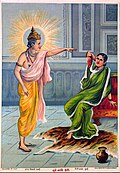
[[File:Sury gives boon to Kunti.jpg|thumb|left|[[Surya]] gives boon to [[Kunti]]]] | [[File:Sury gives boon to Kunti.jpg|thumb|left|[[Surya]] gives boon to [[Kunti]]]] | ||
According to the legend, there was a king of the [[Yadava dynasty]] named [[Shurasena]] who had a beautiful young daughter named Pritha (later [[Kunti]]). A ''[[rishi]]'' (Vedic scholar and seer) named Durvasa visited the king for a lengthy stay and was housed as his palace guest. Shurasena asked Pritha to ensure that Durvasa's stay was comfortable. On leaving, having been delighted with his stay and her diligent services, Durvasa thanked her and gave her the ''Siddha [[mantra]]'', telling her that if she ever wants, she can invoke any deity to give her a child.{{sfn|Donaldson|1987|pp=130–131, 198}}{{refn|group=note|She used the same mantra later in the Mahabharata, after Kunti is unable to have any children with her human husband, and he agrees to her using the mantra to have children. Kunti calls on god Dharma | According to the legend, there was a king of the [[Yadava|Yadava dynasty]] named [[Shurasena]] who had a beautiful young daughter named Pritha (later [[Kunti]]). A ''[[rishi]]'' (Vedic scholar and seer) named [[Durvasa]] visited the king for a lengthy stay and was housed as his palace guest. Shurasena asked Pritha to ensure that Durvasa's stay was comfortable. On leaving, having been delighted with his stay and her diligent services, Durvasa thanked her and gave her the ''Siddha [[mantra]]'', telling her that if she ever wants, she can invoke any deity to give her a child.{{sfn|Donaldson|1987|pp=130–131, 198}}{{refn|group=note|She used the same mantra later in the Mahabharata, after Kunti is unable to have any children with her human husband, and he agrees to her using the mantra to have children. Kunti calls on god Dharma to have son [[Yudhishthira]], then god Vayu to have [[Bhima]] and finally Indra to have [[Arjuna]].{{sfn|Donaldson|1987|pp=130–131, 198}}}} | ||
Teenage Pritha became curious, wondered if the mantra would really work and, as the sun rose one morning, she initiated the mantra through which she could invoke any divine God being to provide her a son. She called the sun god Surya. He came with a golden glow, dressed up in | Teenage Pritha became curious, wondered if the mantra would really work and, as the sun rose one morning, she initiated the mantra through which she could invoke any divine God being to provide her a son. She called the sun god Surya. He came with a golden glow, dressed up in jewellery and breastplate, and provided her with her first son.{{sfn|McGrath|2004|pp=31–32}}{{refn|group=note|This story appears in various forms, with different level of details in many sections of the ''Mahabharata''. A detailed version, for example, is found in sections 3.290–291 of the [[critical edition]]. The Sun-God gave her a child that came from her ear, and therefore the child was known as Karṇa.}} Pritha felt confused and ashamed, worried what everyone will think and how she will embarrass her family. At that time, according to Vedic civilization, if a girl gave birth to a child before her marriage, she would be less likely to be married. So, she put the newborn baby in a padded basket, and set it adrift in the small river Ashvanadi by the palace.{{citation needed|date=June 2020}} | ||
Later Kunti got blessed with children | Later Kunti got blessed with children Yudhishtra, Bhima, and Arjuna, using this mantra. The same mantra was used by Kunti to allow her co-wife, Madri, to conceive Nakula and Sahdeva. The Spiritual "fathers" of the five Pandavas were [[Yama|Dharma]], [[Vayu]], [[Indra]] and the twin [[Ashwini Kumaras]].<ref>{{cite web |last1=Joshi |first1=Nikul |title=Pandavas |url=https://www.worldhistory.org/Pandavas/ |website=[[World History Encyclopedia]] |date=29 July 2016 |access-date=13 May 2020}}</ref> | ||
As the adolescent mother abandons her unwanted child on the river, she laments and the epic verses describe her emotions with heartbreaking poetry, according to the Indologist Patricia Greer.{{sfn|Greer|2002|pp=209–210}} | As the adolescent mother abandons her unwanted child on the river, she laments and the epic verses describe her emotions with heartbreaking poetry, according to the Indologist Patricia Greer.{{sfn|Greer|2002|pp=209–210}} | ||
The basket floats, reaches the river | The basket floats, reaches the river [[Charmanwati]], which carries it to the [[Yamuna River]].{{sfn|Dalal|2010|pp=197–198}} The basket floats on and reaches the [[Ganges River]] and on it into the kingdom of Anga (ancient Bengal). There, it is found by a charioteer's wife Radha, who takes the baby Karna to her husband Adhiratha Nandana. They adopt him right away and name him Vasushena.{{sfn|Dalal|2010|pp=197–198}} They love him and raise him just like their own son.{{sfn|Adarkar|2001 |pp=4–5}} While he was growing up, his adopting parents let Karna know that they had found and adopted him. This knowledge affects Karna, he feels ashamed that he was abandoned, and this frames his sense of self-identity through the epic.{{sfn|McGrath|2004|pp=78–79}} | ||
Karna attends school in [[Hastinapur|Hastinapura]], where he studies martial arts under the sages [[Drona]] and [[Kripa]]. When Drona declines to teach him the knowledge of the Brahmastra weapon, Karna disguises himself as a [[Brahmin]] to become a student of [[Parashurama]], an incarnation of the god [[Vishnu]]. Upon discovering Karna's deception, Parashurama curses him, declaring that he will forget the secret of the Brahmastra at the critical moment when he wishes to use it against his enemy.<ref name=":1">{{Cite book |last=Mani |first=Vettam |url=http://archive.org/details/puranicencyclopa00maniuoft |title=Puranic encyclopaedia: A Comprehensive Dictionary with Special Reference to the Epic and Puranic Literature |date=1975 |publisher=Motilal Banarsidass |isbn=9780842608220 |place=Delhi |page=[https://archive.org/details/puranicencyclopa00maniuoft/page/346/mode/2up 346]}}</ref> | |||
The third Pandava prince Arjuna was Karna's peer and equal. At school and in episodes where his character appears, he is repeatedly rejected, subjected to ridicule and bullied for being the son of a poor family, and particularly for his low birth. The boy Karna came to be known for his solitary habits, hard work, pious yoga before Surya every day, compassion and eager generosity to help anyone in need particularly Brahmins, his gift of speech, and for the pursuit of excellence in whatever he did.{{sfn|McGrath|2004|pp=218–222 with footnotes}}{{sfn|Dalal|2010|pp=197–198}}{{sfn|Greer|2002|pp=210–212}} Karna is also known as someone who craves for respect, love and attention, who is overly sensitive to criticism, who habitually brags about his skills and martial capabilities, yet is deeply thoughtful and [[dharmic]] in critical moments of the epic.{{sfn|McGrath|2004|pp=67–68, 165–166 with footnotes}} | |||
=== Relationship with Duryodhana === | === Relationship with Duryodhana === | ||
Karna meets Duryodhana for the first time in Hastinapura during archery lessons from Drona, an event described in section 3.293 of the ''Mahabharata''.{{sfn|McGrath|2004|pp=114–116}} They become close friends not long after, when Karna and Arjuna are at a weapons trial competition. Duryodhana sees in Karna a man who is an equal of Arjuna in martial abilities, and someone to befriend to balance out Arjuna and thereby "diminish the Pandavas".{{sfn|McGrath|2004|pp=114–116}}{{sfn|Bowles|2008|pp=xxiii–xxx}} | |||
Before the competition starts, the contestants must announce theirs lineage so that men of equal ranks are placed together. After Arjuna announces his royal lineage, it is time for Karna to present his lineage.{{sfn|McGrath|2004|pp=114–116}} If Karna were to announce his charioteer lineage, it would disqualify him from competing against Arjuna. Duryodhana steps in and says Karna is an ''Arajna'' (a non-king, but also a word play on Arjuna) but announces that he is offering to anoint Karna as the king of Angas (Bengal{{sfn|Klostermaier|1998|pp=95–96}}). Once Karna is a king, states Duryodhana, Arjuna would not have the excuse to avoid Karna and not compete with the able warrior. Karna accepts the anointment, becomes a king that day. It also transforms him into a loyal friend to Duryodhana, with an eagerness to reciprocate the favour. Karna asks Duryodhana what he would want in return for the kingdom he just gave out of his empire, Duryodhana replies, "I want your endless friendship Karna".{{sfn|McGrath|2004|pp=114–116 with footnotes}} | |||
For the consecration ceremony, Karna's father arrives. Bhima, one of the Pandavas, ridicules him for his low status and calls him dog-like. The public insult of his father makes Karna hate the Pandavas.{{sfn|McGrath|2004|pp=114–116 with footnotes}} At the end of the competition, while everyone rejects Karna, Duryodhana expresses amity to Karna by "taking Karna by his hand". Karna feels Duryodhana is that friend who stood by him when everyone rejected him. Duryodhana becomes Karna's lifelong close friend. In Karna, Duryodhana finds an able man and talented commander who can help him gain and retain power over an empire. In Duryodhana, Karna finds a caring friend and resourceful supporter when almost everyone is bent on ridiculing and disowning him.{{sfn|McGrath|2004|pp=115–117 with footnotes}}{{sfn|Bowles|2008|pp=xxiii–xxx}} | |||
For the consecration ceremony, Karna's father arrives. Bhima, one of the Pandavas, ridicules him for his low status and calls him dog-like. The public insult of his father makes Karna hate the Pandavas.{{sfn|McGrath|2004|pp=114–116 with footnotes}} At the end of the competition, while everyone rejects Karna, Duryodhana expresses amity to Karna by "taking Karna by his hand". Karna feels Duryodhana is that friend who stood by him when everyone rejected him. Duryodhana becomes Karna's lifelong close friend. In Karna, Duryodhana finds an able man and talented commander who can help him gain and retain power over an empire. In Duryodhana, Karna finds a caring friend and resourceful supporter when almost everyone is bent on ridiculing and disowning him.{{sfn|McGrath|2004|pp=115–117 with footnotes}}{{sfn|Bowles|2008|pp= | |||
Karna evolves into a character who shares Duryodhana's view that Pandavas are bad and enemies, though for different reasons. Karna participates with Duryodhana in schemes to effect the downfall of the Pandavas.{{sfn|McGrath|2004|pp=115–117 with footnotes}} Duryodhana provides the goals, Karna conspires the means to get there.{{sfn|McGrath|2004|pp=116–118 with footnotes}} | Karna evolves into a character who shares Duryodhana's view that Pandavas are bad and enemies, though for different reasons. Karna participates with Duryodhana in schemes to effect the downfall of the Pandavas.{{sfn|McGrath|2004|pp=115–117 with footnotes}} Duryodhana provides the goals, Karna conspires the means to get there.{{sfn|McGrath|2004|pp=116–118 with footnotes}} | ||
In the final year of the exile of the Pandavas, Duryodhana plans to sow dissension and keep the entire empire to himself. In contrast, [[Bhisma]] and Drona suggest a conciliation and dividing the kingdom into two, half for Kauravas and other for Pandavas.{{sfn|McGrath|2004|pp=116–119 with footnotes}} Karna, in contrast, adopts the hawkish approach and becomes the first to suggest a direct confrontation in the form of the Kurukshetra war. He calls for "together we should slay the Pandavas" as the final solution. Karna persistently recommends violence and an all-out war, to settle things once and for all, by good brave warriors. Karna also accuses Bhisma and Drona as covetous materialists and dishonest in | In the final year of the exile of the Pandavas, Duryodhana plans to sow dissension and keep the entire empire to himself. In contrast, [[Bhisma]] and Drona suggest a conciliation and dividing the kingdom into two, half for Kauravas and other for Pandavas.{{sfn|McGrath|2004|pp=116–119 with footnotes}} Karna, in contrast, adopts the hawkish approach and becomes the first to suggest a direct confrontation in the form of the Kurukshetra war. He calls for "together we should slay the Pandavas" as the final solution. Karna persistently recommends violence and an all-out war, to settle things once and for all, by good brave warriors. Karna also accuses Bhisma and Drona as covetous materialists and dishonest in counselling Duryodhana with non-violent strategies.{{sfn|McGrath|2004|pp=116–120 with footnotes}} Duryodhana has evil intentions and is a bad king, but it is Karna who fuels Duryodhana's ambitions and fights his battles.{{sfn|McGrath|2004|pp=116–120 with footnotes}} | ||
Pandavas | With Duryodhana, Karna is a key participant in insulting the Pandavas and [[Draupadi]].{{sfn|McGrath|2004|pp=119–121 with footnotes}}{{sfn|van Buitenen| Fitzgerald|1975 |pp= 313–314}} He humiliates the Pandavas with his gift of speech and mocks Draupadi, then calls her a "whore" and asks Duhshasana to strip her off her clothes.{{sfn|Bowles|2008|pp=xxviii–xxix, xxxvi–xxxvii}} It is Karna's language and insults that hurt the Pandavas and Draupadi the most, a sentiment that is noted in numerous verses of the ''Mahabharata'' such as 3.13.113 and 5.93.11.{{sfn|McGrath|2004|pp=119–121 with footnotes}}{{sfn|Bowles|2008|pp=xxvi–xxx, xxxv–xxxvii}} Yet, states the ''Mahabharata'' scholar [[Alf Hiltebeitel]], "remarkably, Karna regrets his harsh words to Draupadi and Pandavas", in verse 5.139.45, where he confesses he spoke so to please Duryodhana.{{sfn|Hiltebeitel |2011|pp=458–460}} | ||
===Conquests and defeats=== | |||
Karna is portrayed in the ''Mahabharata'' as a skilled and valiant warrior, achieving several notable victories. One of his key successes was his defeat of [[Jarasandha]], the powerful king of [[Magadha]], during the [[Svayamvara|s''wayamvara'']] of the princess of [[Kalinga (Mahabharata)|Kalinga]]. Despite Jarasandha’s strength and reputation, Karna prevailed and, as a mark of respect, was gifted the territory of Malini by the defeated ruler. Additionally, Karna played a critical role during Duryodhana’s military campaigns, successfully defeating various kings like [[Drupada]] and [[Bhagadatta|Bhaggadatta]] and expanding the Kaurava domain.<ref name=":1" /> | |||
During the | Karna also faced significant defeats that revealed his limitations. During the campaign against Drupada, launched as ''Gurudakshina'' for [[Drona]], Karna and the Kauravas were unable to overcome Drupada’s forces. It was Arjuna who ultimately succeeded in capturing Drupada.<ref>{{Cite web |title=The Mahabharata, Book 1: Adi Parva: Sambhava Parva: Section CXL |url=http://www.sacred-texts.com/hin/m01/m01141.htm |access-date=2018-01-15 |website=Internet Sacred Text Archive |translator=Kisari Mohan Ganguli}}</ref> Another notable loss occurred during the Pandavas’ [[Rajasuya]] Yajna, when Karna refused an alliance with [[Bhima]], leading to a direct confrontation. Although Karna resisted fiercely, Bhima ultimately defeated him, with Karna’s divine armor (''Kavacha'') and earrings (''Kundala'') preventing his death.<ref>{{Cite web |title=The Mahabharata, Book 2: Sabha Parva: Jarasandhta-badha Parva: Section XXIX |url=https://www.sacred-texts.com/hin/m02/m02029.htm |access-date=2018-01-15 |website=Internet Sacred Text Archive |translator=Kisari Mohan Ganguli}}</ref> In the Gandharva episode during the Pandavas' exile, Karna fled from battle after Kauravas were captured by [[List of characters in the Mahabharata|Chitrasena]], the [[Gandharva]] king, after being defeated in battle.<ref>{{Cite web |title=The Mahabharata, Book 3: Vana Parva: Ghosha-yatra Parva: Section CCXXXIX |url=https://sacred-texts.com/hin/m03/m03239.htm |access-date=2024-11-26 |website=sacred-texts.com}}</ref> | ||
=== Hostilities with the Pandavas === | === Hostilities with the Pandavas === | ||
The relationship between Karna and the Pandavas, particularly Arjuna, were hostile.{{sfn|Nandy|2008|pp=131–134}} The ''Mahabharata'' mentions Karna as the main challenger of Arjuna at sporting and skills competitions.{{sfn|McGrath|2004|pp=75–79}} At martial sporting events, Arjuna and Karna were often equal,{{sfn|Winternitz|1996|pp=309–310}} though in his self-bragging style Karna once announced, states McGrath, that "he will perform any feat that Arjuna has accomplished and do it better".{{sfn|McGrath|2004|pp=76}}{{sfn|Matilal|2002|pp=117–118}}{{sfn|Lemming|2005}} | The relationship between Karna and the Pandavas, particularly Arjuna, were hostile.{{sfn|Nandy|2008|pp=131–134}} The ''Mahabharata'' mentions Karna as the main challenger of Arjuna at sporting and skills competitions.{{sfn|McGrath|2004|pp=75–79}} At martial sporting events, Arjuna and Karna were often equal,{{sfn|Winternitz|1996|pp=309–310}} though in his self-bragging style Karna once announced, states McGrath, that "he will perform any feat that Arjuna has accomplished and do it better".{{sfn|McGrath|2004|pp=76}}{{sfn|Matilal|2002|pp=117–118}}{{sfn|Lemming|2005}} | ||
At the ''svayamvara'' competition of Draupadi, where she is expected to choose her husband, both Arjuna and Karna are present. Arjuna and his brothers, however, are disguised as mendicant Brahmins.{{sfn|McGrath|2004|pp=78–79}} They use this false identity in exile because Duryodhana had attempted to kill them using various schemes, including burning the lacquer house – custom built for the Pandavas by Duryodhana | At the ''[[svayamvara]]'' competition of Draupadi, where she is expected to choose her husband, both Arjuna and Karna are present. Arjuna and his brothers, however, are disguised as mendicant Brahmins.{{sfn|McGrath|2004|pp=78–79}} They use this false identity in exile because Duryodhana had attempted to kill them using various schemes, including burning the lacquer house – custom built for the Pandavas by Duryodhana – along with the forest while they were sleeping.{{sfn|Greer|2002|pp=160–161}} There are some variations regarding Karna's participation. Some renditions show Draupadi refusing to marry Karna on account of being a ''[[Sūta]]'', while some other versions describe him failing to string the bow by the "breadth of a hair".<ref>{{cite web|url=https://archive.org/details/mahabharatha015693mbp|title=The Mahabharatha |author=Vishnu S. Sukthankar|year=1942|publisher=Bhandarkar Oriental Research Institute |place=Poona |via=Internet Archive}}</ref><ref>{{cite web|title=Interpolations in the Mahabharata|author=M. A. Mehendale |date=2001|url=https://archive.org/details/InterpolationsInTheMahabharata|via=Internet Archive}}</ref> In the end, [[Arjuna]] succeeds in the task, However Karna objects that the competition is only meant for ''Kshatriyas'', and Brahmins such as "the mendicant who just strung the bow" should not be competing for the hand of Draupadi, a Kshatriya bride. Duryodhana supports him. The gathered Kshatriyas too angrily support Karna, for they against the mixing of [[Varna (Hinduism)|varna]] (here, Brahmin-Kshatriya marriage). Arjuna maintains his calm, continues to hide his true identity, insists that he is a "Brahmin who fight". Arjuna's accomplishments and calmness win Draupadi's heart. Draupadi picks Arjuna and awards the garland to him, signify that she chooses to marry the disguised-Brahmin Arjuna.{{sfn|McGrath|2004|pp=78–82}}{{sfn|Greer|2002|pp=162–164}}{{refn|group=note|This story appears in many versions in different manuscripts and later secondary literature. In some versions, such as one published by Ramesh Chandra Dutt, Draupadi openly rejects Karna because he is the son of a charioteer (''suta''), something that angers Karna. In another version, found in South Indian texts, Krishna takes the form of a rat and severs the string and thereby prevents Karna from equaling Arjuna's feat. However, all such versions are relatively modern, and according to McGrath who quotes Vishnu Suthankar, appear in "late and inferior or conflated manuscripts". The older critical edition version shows Karna simply failed, just like he and his army ultimately fails in other battles against the Pandavas.{{sfn|McGrath|2004|pp=78–79 with footnote 15, 86–89 with footnotes}} For another version of this story in a non-critical edition of the epic, see the summary by Moriz Winternitz.{{sfn|Winternitz|1996|pp=314–316}}}}{{refn|group=note|According to the Indologist and ''Mahabharata'' scholar Mehendale, the story that Draupadi rejected Karna for being a son of "Suta" "does not occur at all in the entire Southern recension, and among the versions of the Northern recension, it does not occur in the Kashmiri, Maithili and Bengali versions". Further, even in Nepali and Devanagari Northern manuscript versions where it is found, it occurs only in a minority of them. It has therefore not been included in the critical edition of the epic that is deemed to more accurately reflect the original.{{sfn|Mehendale|2001|pp=196–197 with footnotes}}}} The varna-based discrimination and verbal insults on Arjuna, for lovely Draupadi's hand, one that Karna initiates at the time of Draupadi's ''svayamvara'' competition comes back to haunt him many times through angry Bhima and others who remind Karna that he is merely a ''suta-putra'' (son of a charioteer). Draupadi too never likes Karna thereafter.{{sfn|McGrath|2004|pp=79–81 with footnotes}} | ||
Karna fights and berates the Pandavas at the legendary gambling match during the royal consecration ritual. There, Karna uses the choicest words to insult Draupadi that takes the bitterness of Pandava for Karna to much more emotional level from what previously was a dispute about respective martial prowess.{{sfn|McGrath|2004|pp=81–83 with footnotes}}{{sfn|Hiltebeitel |2011|pp=458–459}} These are the sections of the epic when the Pandavas, Arjuna in particular, openly pledge to kill Karna.{{sfn|McGrath|2004|pp=82–85 with footnotes}} Karna retaliates with words too, stating that Arjuna's death is so near that he will "not wash his feet until Arjuna is slain".{{sfn|McGrath|2004|pp=85–86 with footnotes}} | Karna fights and berates the Pandavas at the legendary gambling match during the royal consecration ritual. There, Karna uses the choicest words to insult Draupadi that takes the bitterness of Pandava for Karna to much more emotional level from what previously was a dispute about respective martial prowess.{{sfn|McGrath|2004|pp=81–83 with footnotes}}{{sfn|Hiltebeitel |2011|pp=458–459}} These are the sections of the epic when the Pandavas, Arjuna in particular, openly pledge to kill Karna.{{sfn|McGrath|2004|pp=82–85 with footnotes}} Karna retaliates with words too, stating that Arjuna's death is so near that he will "not wash his feet until Arjuna is slain".{{sfn|McGrath|2004|pp=85–86 with footnotes}} | ||
| Line 115: | Line 111: | ||
Karna declines the offer. Karna replies that though he was born from Kunti, it was the wife of a charioteer "Radha who gave him love and sustenance", and that makes her his real mother.{{sfn|McGrath|2004|pp=142–145 with footnotes}}{{sfn|Adarkar|2001 |pp=79–80}} Similarly, it is from the love and affection and "not scripture" that he knows Adhiratha to be his real father. He is already married, says Karna, he has two sons and now grandsons, all because his father Adhiratha helped him settle into his married life.{{sfn|McGrath|2004|pp=142–145 with footnotes}} What matters most in life are the "bonds of love", according to Karna, and not power over the world. He shall betray no one, remain loyal to those who love him, including his friend Duryodhana, with whom he has been in allegiance for thirteen years. It is not "blood ties" that matter, but how someone treats you over a period of time that does. He made a promise to Duryodhana and he will keep it. It is his duty to fight Arjuna.{{sfn|McGrath|2004|pp=142–145 with footnotes}}{{sfn|Adarkar|2001 |pp=79–80}} | Karna declines the offer. Karna replies that though he was born from Kunti, it was the wife of a charioteer "Radha who gave him love and sustenance", and that makes her his real mother.{{sfn|McGrath|2004|pp=142–145 with footnotes}}{{sfn|Adarkar|2001 |pp=79–80}} Similarly, it is from the love and affection and "not scripture" that he knows Adhiratha to be his real father. He is already married, says Karna, he has two sons and now grandsons, all because his father Adhiratha helped him settle into his married life.{{sfn|McGrath|2004|pp=142–145 with footnotes}} What matters most in life are the "bonds of love", according to Karna, and not power over the world. He shall betray no one, remain loyal to those who love him, including his friend Duryodhana, with whom he has been in allegiance for thirteen years. It is not "blood ties" that matter, but how someone treats you over a period of time that does. He made a promise to Duryodhana and he will keep it. It is his duty to fight Arjuna.{{sfn|McGrath|2004|pp=142–145 with footnotes}}{{sfn|Adarkar|2001 |pp=79–80}} | ||
Krishna then went to Kunti and asked her to meet Karna and tell him that he is her first born son and the Pandavas were his brothers. Krishna left it to her to choose between Karna and her five other sons. Kunti then went to meet Karna, finds him praying. She waits. After he finished his prayers to Surya, Karna meets Kunti for the first time in his adult life. He greets her (he now already knows her to be his biological mother).{{sfn|Adarkar|2001 |pp=80–81}}{{sfn|McGrath|2004|pp=154–156 with footnotes}} With [[Namaste|folded hands]], he introduces himself as the son of Radha and Adhiratha, and inquires about the purpose of her visit. Kunti then confesses that he is her firstborn. Surya also appears and confirms Kunti's story, and suggests that he follow her.{{sfn|Adarkar|2001 |pp=80–81}}<ref>{{cite book |title=Encyclopedia of Religion |chapter=Mahabaratha |publisher=MacMillan |last=Hiltebeitel |first=Alf |year=2005}}{{ | Krishna then went to Kunti and asked her to meet Karna and tell him that he is her first born son and the Pandavas were his brothers. Krishna left it to her to choose between Karna and her five other sons. Kunti then went to meet Karna, finds him praying. She waits. After he finished his prayers to Surya, Karna meets Kunti for the first time in his adult life. He greets her (he now already knows her to be his biological mother).{{sfn|Adarkar|2001 |pp=80–81}}{{sfn|McGrath|2004|pp=154–156 with footnotes}} With [[Namaste|folded hands]], he introduces himself as the son of Radha and Adhiratha, and inquires about the purpose of her visit. Kunti then confesses that he is her firstborn. Surya also appears and confirms Kunti's story, and suggests that he follow her.{{sfn|Adarkar|2001 |pp=80–81}}<ref>{{cite book |title=Encyclopedia of Religion |chapter=Mahabaratha |publisher=MacMillan |last=Hiltebeitel |first=Alf |year=2005}}{{full citation needed|date=December 2021}}</ref><ref>{{cite journal |first=Michael |last=Witzel |author-link=Michael Witzel |year=1995 |title=Early Sanskritization: Origin and Development of the Kuru state |journal=Electronic Journal of Vedic Studies |volume=1 |issue=4 |pages=1–26 |url=http://www.ejvs.laurasianacademy.com/ejvs0104/ejvs0104article.pdf |archive-url=https://web.archive.org/web/20070611142934/http://www.ejvs.laurasianacademy.com/ejvs0104/ejvs0104article.pdf |archive-date=11 June 2007 |url-status=dead}}</ref> Karna says that though he may have been the firstborn, he never received the affection or care from her as the firstborn. "You discarded me", says Karna to Kunti, "you destroyed me in a way that no enemy could ever do to him".{{sfn|McGrath|2004|pp=154–156 with footnotes}} It is too late. He reiterates that he loves the parents who raised him, they love him, and he will remain loyal to his lifelong relationships. No one should abandon those who give respect and affection, says Karna in these ''Mahabharata'' verses. The war momentum shall continue and he aims to kill Arjuna. Karna promised to Kunti that he will not kill any of his other four half-brothers, but either "Arjuna or I" shall die and she can still say she has five sons just as she did all her life.{{sfn|Adarkar|2001 |pp=80–81}}{{sfn|McGrath|2004|pp=154–158 with footnotes}}{{sfn|Chakravarti|2007}} | ||
After these developments and pondering on Karna's life choices, the divine Krishna, as well as a host of ''Mahabharata'' heroes, in private and after his death, | After these developments and pondering on Karna's life choices, the divine Krishna, as well as a host of ''Mahabharata'' heroes, in private and after his death, honour Karna as a ''satpurusha'' (lit. "a true, honest, good man") and "the best among those who understand and uphold the ''dharma''".{{sfn|Hiltebeitel|2011|pp=457–459 with footnotes}} | ||
===Role in Kurukshetra War=== | ===Role in Kurukshetra War=== | ||
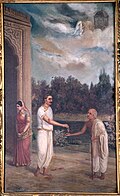
[[File:Karan offering an old poor man, bent with age and destitution, a Kavach that is embedded in his arms and is retrieved by culling with a knife.jpg|thumb|Karna offering an old poor man, bent with age and destitution, a | [[File:Karan offering an old poor man, bent with age and destitution, a Kavach that is embedded in his arms and is retrieved by culling with a knife.jpg|thumb|Karna offering an old poor man, bent with age and destitution, a Kavacha that is embedded in his arms and is retrieved by culling with a knife]]Karna was born with aspects of his divine father Surya – the earrings and armour breastplate – that made him an immortal at birth. However, despite being warned, Karna prefers to lose these natural gifts in order to uphold his reputation as the one who always gives ''[[dāna]]'' (charity), particularly to Brahmins, as being more important than his own life.{{sfn|McGrath|2004|pp=31–32, 37 with footnotes}}{{sfn|Greer|2002|pp=209–210}}{{sfn|van Buitenen| Fitzgerald|1973 |pp= 142–145}} | ||
As the battle-to-death between Karna and Arjuna becomes certain, Kunti – the mother of both, faints and later weeps in sorrow that her boys are bent on killing each other. In parallel, Arjuna's brothers and [[Indra]] – the father of Arjuna and a major Vedic deity – plan ways to make Karna mortal.{{sfn|Sharma|2007|pp=432–433}} Surya meets Karna and warns him of Indra's plan to appear disguised as a Brahmin to divest him of his earrings and breastplate, and thereby his immortality. Karna disregards this warning and says that if the king of gods Indra comes to beg before him, and if he charitably gives to Indra, it will bring him "renown and fame", then argues that "fame is more important to him than anything else".{{sfn|McGrath|2004|pp=33–35 with footnotes}} Indra appears as predicted, and Karna cuts his birthmarks of immortality with a knife, and gives the blood-soaked donation to disguised-as-a-Brahmin Indra. The leader of gods in return praises him and gives him a missile that can only be used once and will kill any mortal or immortal.{{sfn|McGrath|2004|pp=30–31, 33–35 with footnotes}} | As the battle-to-death between Karna and Arjuna becomes certain, Kunti – the mother of both, faints and later weeps in sorrow that her boys are bent on killing each other. In parallel, Arjuna's brothers and [[Indra]] – the father of Arjuna and a major Vedic deity – plan ways to make Karna mortal.{{sfn|Sharma|2007|pp=432–433}} Surya meets Karna and warns him of Indra's plan to appear disguised as a Brahmin to divest him of his earrings and breastplate, and thereby his immortality. Karna disregards this warning and says that if the king of gods Indra comes to beg before him, and if he charitably gives to Indra, it will bring him "renown and fame", then argues that "fame is more important to him than anything else".{{sfn|McGrath|2004|pp=33–35 with footnotes}} Indra appears as predicted, and Karna cuts his birthmarks of immortality with a knife, and gives the blood-soaked donation to disguised-as-a-Brahmin Indra. The leader of gods in return praises him and gives him a missile that can only be used once and will kill any mortal or immortal.{{sfn|McGrath|2004|pp=30–31, 33–35 with footnotes}} | ||
Karna keeps the Indra's missile in reserve since it could only be used once, and aims to kill Arjuna with it. By the thirteenth day of the ''Mahabharata'' war, numerous soldiers, kings, brothers and sons of Kauravas (Karna's side) and Pandavas (Arjuna's side) had been killed, many by foul means.{{sfn| | Karna keeps the Indra's missile in reserve since it could only be used once, and aims to kill Arjuna with it. By the thirteenth day of the ''Mahabharata'' war, numerous soldiers, kings, brothers and sons of Kauravas (Karna's side) and Pandavas (Arjuna's side) had been killed, many by foul means.{{sfn|Bryant|2007|pp=33–36}}{{sfn|McGrath|2004|pp=35–36 with footnotes}} The war had entered a brutal stage, according to the ''Mahabharata'' verses in sections 7.150–156. On the fourteenth day, Arjuna took revenge of his own son's death, while Bhima and his son [[Ghatotkacha]] wreaked havoc on numerous Kaurava battalions. The war that previously started after sunrise and stopped at sunset, did not stop on the fourteenth day's sunset as both armies continued a ferocious war to kill each other.{{sfn|Bryant|2007|pp=33–36}}{{sfn|McGrath|2004|pp=35–36 with footnotes}} Bhima's son Ghatotkacha had a ''rakshasha'' lineage, and his powers of illusion to confuse the enemies grew to enormous proportions as the war dragged deeper into the fifteenth night.{{sfn|McGrath|2004|pp=35–37, 129–130 with footnotes}} Duryodhana and Karna's Kaurava friends plead that they are finished unless Karna does whatever it takes to kill Ghatotkacha. Karna hurls the "Indra missile" to kill Ghatotkacha. Karna thus saves his reputation among his soldiers, launches the missile and kills Ghatotkacha. Duryodhana and Kaurava army rejoice with the death of Bhima's son Ghatotkacha, but now Karna had exhausted the weapon that gave him an advantage over Arjuna.{{sfn|Bryant|2007|pp=33–36}}{{sfn|McGrath|2004|pp=35–38 with footnotes}} | ||
===Death=== | ===Death=== | ||
[[File:Arjuna Karna final battle, Kurukshetra war, 12th-century Mahabharata relief, Hoysalesvara temple Halebidu.jpg|thumb|upright=1.9|The Karna-Arjuna final battle scene is a relief included in ''Mahabharata'' panels in many historic [[Hindu temple]]s in India and in southeast Asia such as at the [[Angkor Wat]]. Above is the scene at the 12th-century [[Hoysaleswara Temple]], Karnataka.{{sfn|Bharne|Krusche|2014|p=57}}{{refn|group=note|For a discussion of the Angkor Wat reliefs related to the ''Mahabharata'', see Silva-Vigier and Simson.{{sfn|de Silva-Vigier|von Simson|1964|pp=32–35}}}}]] | [[File:Arjuna Karna final battle, Kurukshetra war, 12th-century Mahabharata relief, Hoysalesvara temple Halebidu.jpg|thumb|upright=1.9|The Karna-Arjuna final battle scene is a relief included in ''Mahabharata'' panels in many historic [[Hindu temple]]s in India and in southeast Asia such as at the [[Angkor Wat]]. Above is the scene at the 12th-century [[Hoysaleswara Temple]], Karnataka.{{sfn|Bharne|Krusche|2014|p=57}}{{refn|group=note|For a discussion of the Angkor Wat reliefs related to the ''Mahabharata'', see Silva-Vigier and Simson.{{sfn|de Silva-Vigier|von Simson|1964|pp=32–35}}}}]] | ||
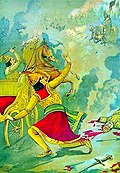
As the second last day of the war and Karna's day of death dawns, Karna asks Duryodhana to convince king Shalya to be his charioteer since he plans to kill Arjuna that day. The South Indian king considers it below his dignity to be a mere charioteer and starts insulting Karna, who retaliates with words. Duryodhana intervenes, praises both, presses Shalya to guide the chariot for the critical battle.{{sfn|McGrath|2004|pp=91–94, 130–131 with footnotes}} Ultimately Shalya agrees. Since all previous commanders of Duryodhana had been killed, he anoints Karna as the ''senapati'' (commander of all his forces) for the first time. Karna and Shalya head into the battlefield together, though they keep insulting each other's abilities and intent, lack mutual devotion and teamwork.{{sfn|McGrath|2004|pp=65–66, 93, 167–171 with footnotes}}{{sfn|Adarkar|2001 |pp=5–6, 203}} Together they reach Arjuna with Krishna. They battle that day, each showing his martial skills of attack as well as his ability to neutralize all weapons that reach their chariot.{{sfn|McGrath|2004|pp=35–38, 81, 92–97 with footnotes}} Then, the wheel of Karna's chariot gets stuck in the ground. Karna steps out of his chariot and is distracted while trying to unstick it. Arjuna – whose own son was killed by the Kauravas a day ago while he was trying to unstick his chariot's wheel – takes this moment to launch the fatal attack. Karna dies.{{sfn|McGrath|2004|pp=35–38, 81, 92, 98–99 with footnotes}}{{refn|group=note|The verses in sections 8.66–67 of the epic provide more details. For example, when the wheel gets stuck, Karna demands that Arjuna wait and fight the battle per the ''dharma'' code (rules of a "[[just war]]"). However, Arjuna reminds Karna about the time Karna did not consider the ''dharma'' code when he abused and called for an assault on the helpless Draupadi by asking Dushasana to publicly disrobe her. Arjuna refuses Karna's request, claiming Karna should not be using double standards for others and for himself.{{sfn|McGrath|2004|pp=97–98, 153 with footnotes}}}} | As the second last day of the war and Karna's day of death dawns, Karna asks Duryodhana to convince king [[Shalya]] to be his charioteer since he plans to kill Arjuna that day. The South Indian king considers it below his dignity to be a mere charioteer and starts insulting Karna, who retaliates with words. Duryodhana intervenes, praises both, presses Shalya to guide the chariot for the critical battle.{{sfn|McGrath|2004|pp=91–94, 130–131 with footnotes}} Ultimately Shalya agrees. Since all previous commanders of Duryodhana had been killed, he anoints Karna as the ''[[senapati]]'' (commander of all his forces) for the first time. Karna and Shalya head into the battlefield together, though they keep insulting each other's abilities and intent, lack mutual devotion and teamwork.{{sfn|McGrath|2004|pp=65–66, 93, 167–171 with footnotes}}{{sfn|Adarkar|2001 |pp=5–6, 203}} Together they reach Arjuna with Krishna. They battle that day, each showing his martial skills of attack as well as his ability to neutralize all weapons that reach their chariot.{{sfn|McGrath|2004|pp=35–38, 81, 92–97 with footnotes}} Then, the wheel of Karna's chariot gets stuck in the ground. Karna steps out of his chariot and is distracted while trying to unstick it. Arjuna – whose own son was killed by the Kauravas a day ago while he was trying to unstick his chariot's wheel – takes this moment to launch the fatal attack. Karna dies.{{sfn|McGrath|2004|pp=35–38, 81, 92, 98–99 with footnotes}}{{refn|group=note|The verses in sections 8.66–67 of the epic provide more details. For example, when the wheel gets stuck, Karna demands that Arjuna wait and fight the battle per the ''dharma'' code (rules of a "[[just war]]"). However, Arjuna reminds Karna about the time Karna did not consider the ''dharma'' code when he abused and called for an assault on the helpless Draupadi by asking Dushasana to publicly disrobe her. Arjuna refuses Karna's request, claiming Karna should not be using double standards for others and for himself.{{sfn|McGrath|2004|pp=97–98, 153 with footnotes}}}} | ||
[[File:Death_of_Karna.jpg|thumb|Death of Karna]] | [[File:Death_of_Karna.jpg|thumb|Death of Karna]] | ||
=== | |||
===Marital life=== | |||
{{Main|Wives of Karna}} | {{Main|Wives of Karna}} | ||
In the modern day version of the ''Mahabharata'', nine sons of Karna are mentioned—[[Vrishasena]], Chitrasena, Satyasena, Sushena, Shatrunjaya, Dvipata, Banasena, Prasena and [[Vrishaketu]] | The ''Mahabharata'' provides scarce information on Karna's marital life. In the ''[[Udyoga Parva]]'', it is mentioned that he married a [[Karna's wife|Suta woman]] chosen by Adhiratha. She is later referenced in the ''[[Stri Parva]]'' as the mother of [[Vrishasena]] and Sushena, the two most prominent sons of Karna.{{sfn|McGrath|2004|p=114}} Marital details of Karna's life are expanded and reimagined in later adaptations of the ''Mahabharata''. | ||
In the modern day version of the ''Mahabharata'', nine sons of Karna are mentioned—[[Vrishasena]], Chitrasena, Satyasena, Sushena, Shatrunjaya, Dvipata, Banasena, Prasena and [[Vrishaketu]].<ref>{{Cite book |url=https://books.google.com/books?id=OrpZAAAAMAAJ&pg=PA491|title=The Mahabharata of Krishna-Dwaipayana Vyasa. Translated Into English Prose |date=1886|publisher=Bhārata Press}}</ref>{{sfn|Valmiki|Vyasa|2018|loc=[https://books.google.com/books?id=qj9bDwAAQBAJ&q=Sushena&pg=PT5921]|p={{page needed|date=December 2021}}}}{{sfn|Valmiki|Vyasa|2018|loc=[https://books.google.com/books?id=qj9bDwAAQBAJ&q=Satyasena+Karna&pg=PT5921]|p={{page needed|date=December 2021}}}}{{sfn|Valmiki|Vyasa|2018|loc=[https://books.google.com/books?id=qj9bDwAAQBAJ&q=Vrishaketu&pg=PT5921]|p={{page needed|date=December 2021}}}} | |||
== Themes and symbolism == | == Themes and symbolism == | ||
| Line 140: | Line 138: | ||
The Karna-Arjuna story has parallels in the Vedic literature and may have emerged from these more ancient themes. According to McGrath, the Vedic mythology is loaded with the legendary and symbolism-filled conflict between Surya (sun) and Indra (clouds, thunder, rain).{{sfn|McGrath|2004|pp=16–17 with footnote 59, pp. 64–65}} Indra cripples Surya in the Vedic mythology by detaching his wheel, while Arjuna kills Karna while he tries to fix the wheel that is stuck in the ground.{{sfn|McGrath|2004|pp=16–17 with footnote 59}}{{sfn|Adarkar|2001 |pp=32–34}} As another example of parallels, Surya too has a birth mother (Night) who abandons him in the Vedic texts and he too considers his adoptive mother (Dawn) who raises him to his bright self as the true mother just like Karna.{{sfn|McGrath|2004|pp=16–17 with footnote 59}} This idea was first discussed by the philologist [[Georges Dumézil]], who remarked that similar mythology and details are found in other ancient Indo-European stories.{{sfn|Brockington|1998|p=70}}{{sfn|Allen|1999|pp=19–27}} | The Karna-Arjuna story has parallels in the Vedic literature and may have emerged from these more ancient themes. According to McGrath, the Vedic mythology is loaded with the legendary and symbolism-filled conflict between Surya (sun) and Indra (clouds, thunder, rain).{{sfn|McGrath|2004|pp=16–17 with footnote 59, pp. 64–65}} Indra cripples Surya in the Vedic mythology by detaching his wheel, while Arjuna kills Karna while he tries to fix the wheel that is stuck in the ground.{{sfn|McGrath|2004|pp=16–17 with footnote 59}}{{sfn|Adarkar|2001 |pp=32–34}} As another example of parallels, Surya too has a birth mother (Night) who abandons him in the Vedic texts and he too considers his adoptive mother (Dawn) who raises him to his bright self as the true mother just like Karna.{{sfn|McGrath|2004|pp=16–17 with footnote 59}} This idea was first discussed by the philologist [[Georges Dumézil]], who remarked that similar mythology and details are found in other ancient Indo-European stories.{{sfn|Brockington|1998|p=70}}{{sfn|Allen|1999|pp=19–27}} | ||
Karna resembles various famous characters found in Hindu texts. The attributed author of Mahabharata, the sage [[Vyasa]], was also born from an unwed union of [[Satyavati]] and sage [[Parashara]].{{sfn|Brockington|1998|p=23}} German Indologist Georg von Simson states that Karna of the ''Mahabharata'' resembles | Karna resembles various famous characters found in Hindu texts. The attributed author of Mahabharata, the sage [[Vyasa]], was also born from an unwed union of [[Satyavati]] and sage [[Parashara]].{{sfn|Brockington|1998|p=23}} German Indologist Georg von Simson states that Karna of the ''Mahabharata'' resembles [[Kumbhakarna]] of the ''Ramayana'', the demon brother of the main antagonist [[Ravana]] of the epic ''[[Ramayana]]'' in their powers to sway the war. Both Karna and Kumbhakarna did not take part in the great wars of their respective epics at the start.{{sfn|Brockington|1998|p=71}} | ||
Scholars internationally have also drawn parallels with various European mythologies. Karna's '' | Scholars internationally have also drawn parallels with various European mythologies. Karna's ''kavacha'' (breastplate armour) has been compared with that of [[Achilles]]'s [[Styx]]-coated body and with Irish warrior [[Ferdiad]]'s skin that could not be pierced. He has been compared to the Greek mythological part divine, part human character Achilles on various occasions as they both have divine powers but lack corresponding status.{{sfn|McGrath|2004|p=4}}{{sfn|Bhattacharya|2006}} | ||
===Dharma-ethics=== | ===Dharma-ethics=== | ||
[[Dharma]] is a complex concept in the Indian religions. It is not an atomistic or compartmentalized concept, rather incorporates "ways of living, ways of seeing and ways of relating to life's ultimate issues", according to Matilal.{{sfn|Matilal|2002|pp=36–37}} Of those issues, ones relating to right or wrong | [[Dharma]] is a complex concept in the Indian religions. It is not an atomistic or compartmentalized concept, rather incorporates "ways of living, ways of seeing and ways of relating to life's ultimate issues", according to Matilal.{{sfn|Matilal|2002|pp=36–37}} Of those issues, ones relating to right or wrong behaviour, duties, rights, and expectations from others are the domain of ''dharma-ethics''.{{sfn|Matilal|2002|pp=36–39, 44–46}} Karna's story raises the ''dharma-ethics'' questions both while Karna acts in the epic as well as after his death.{{sfn|Bowles|2007|pp=136–139, 393 with footnote 90}}{{sfn|Adarkar|2001 |pp=101–102, 109–112, 209–210}} These questions arise with the circumstances related to his birth and through his death. Karna chooses loyalty to his lifelong friend and "good policy based on his heart" to be of higher value than accepting Krishna's recommendation that he switch sides and become the king as the eldest son of Kunti based on ''[[dharmasastras]]''.{{sfn|McGrath|2004|pp=142–145 with footnotes}}{{sfn|Hiltebeitel|2011|pp=622–623}}{{sfn|Manikutty|2012}} According to [[Gurcharan Das]], the character of Karna in the ancient Hindu epic suggests a social debate between "inherited status" and "deserved status", a debate that remains relevant to the contemporary times.{{sfn|Das|2010|pp=180–182}} Das writes, | ||
{{ | {{Blockquote| | ||
Karna, like the other heroes in the Mahabharata, forces us to look at ourselves and at our frailties. When Karna is not allowed to train in weaponry because he is a suta, it makes one ask, ’What if my child had been denied entry into college because of her birth?’ [...] We want them [our children] to feel secure and confident about their position. We want them to be treated with respect as equals. The ''Mahabharata'' is not content simply to point out the weaknesses of human beings. It criticizes society's flaws. It raises the question whether a person's social position should be defined by birth or by some other criterion, such as accomplishment of some sort. [...] Karna challenges their traditional understanding of dharma – as inherited status – and offers a new notion of dharma as deserved status.<br> | Karna, like the other heroes in the Mahabharata, forces us to look at ourselves and at our frailties. When Karna is not allowed to train in weaponry because he is a suta, it makes one ask, ’What if my child had been denied entry into college because of her birth?’ [...] We want them [our children] to feel secure and confident about their position. We want them to be treated with respect as equals. The ''Mahabharata'' is not content simply to point out the weaknesses of human beings. It criticizes society's flaws. It raises the question whether a person's social position should be defined by birth or by some other criterion, such as accomplishment of some sort. [...] Karna challenges their traditional understanding of dharma – as inherited status – and offers a new notion of dharma as deserved status.<br> | ||
Karna has to be 'the wrong person in the wrong place' – this is what Karna symbolizes to many minds today. Life may have been unfair to Karna but he rises above pity. Despite his flaws we admire him. | Karna has to be 'the wrong person in the wrong place' – this is what Karna symbolizes to many minds today. Life may have been unfair to Karna but he rises above pity. Despite his flaws we admire him. | ||
| Line 153: | Line 151: | ||
===Circumstances and subjective morality=== | ===Circumstances and subjective morality=== | ||
As the Karna story unfolds, similar to other stories in epic,{{sfn|Matilal|2002|pp=19–35}} it raises moral dilemmas. With each dilemma, the ''Mahabharata'' presents various sides and shades of answers through the characters. According to Bimal Matilal, the characters face a "choice between irreconcilable obligations", between two good or two poor choices, where complex circumstances must be considered. These circumstances make the evaluation of the choices complicated and a decision difficult, subjective.{{sfn|Matilal|2002|pp=24–26}} When circumstances lead to a conflict between two choices that are both right in their own premises, then following one duty becomes "contrary to the duty according to the other". Under these circumstances, there is an inherent subjective weighing of one moral duty against another.{{sfn|Matilal|2002|pp=24–26}}{{sfn|Bhattacharya|1992|pp=26–34}} | As the Karna story unfolds, similar to other stories in epic,{{sfn|Matilal|2002|pp=19–35}} it raises moral dilemmas. With each dilemma, the ''Mahabharata'' presents various sides and shades of answers through the characters. According to [[Bimal Matilal]], the characters face a "choice between irreconcilable obligations", between two good or two poor choices, where complex circumstances must be considered. These circumstances make the evaluation of the choices complicated and a decision difficult, subjective.{{sfn|Matilal|2002|pp=24–26}} When circumstances lead to a conflict between two choices that are both right in their own premises, then following one duty becomes "contrary to the duty according to the other". Under these circumstances, there is an inherent subjective weighing of one moral duty against another.{{sfn|Matilal|2002|pp=24–26}}{{sfn|Bhattacharya|1992|pp=26–34}} | ||
According to the ''Mahabharata'', human conflicts such as those illustrated through Karna-Arjuna conflict are inherently complicated and come with circumstantial depth. During violence and war, where all sides are motivated in part by their own beliefs in what constitutes righteousness, coupled with anger, frustration, and fear, the circumstances are ever more complex, actions irreversible, choices difficult. The choices made by Karna and his opponents must then be reflected upon both in terms of the circumstances and the mesh of multiple relative goods or bads, by characters each with different combinations of human strengths and weaknesses.{{sfn|Matilal|2002|pp=92–98, 115–119}}{{sfn|Johnson|1998|pp=91–104}} | According to the ''Mahabharata'', human conflicts such as those illustrated through Karna-Arjuna conflict are inherently complicated and come with circumstantial depth. During violence and war, where all sides are motivated in part by their own beliefs in what constitutes righteousness, coupled with anger, frustration, and fear, the circumstances are ever more complex, actions irreversible, choices difficult. The choices made by Karna and his opponents must then be reflected upon both in terms of the circumstances and the mesh of multiple relative goods or bads, by characters each with different combinations of human strengths and weaknesses.{{sfn|Matilal|2002|pp=92–98, 115–119}}{{sfn|Johnson|1998|pp=91–104}} | ||
According to the Indologist Adam Bowles, while the Hindu '' | According to the Indologist Adam Bowles, while the Hindu ''[[Arthashastra]]'' text presents an objective analysis of situations, its ''[[dharmasutras]]'', ''dharmasastras'' and the epics attempt to deal with the more complex, subjective scenarios of life.{{sfn|Bowles|2007|pp=54–57, with footnote 57 on p. 55, 77–78, 136–140, 349–358}} The ''[[dharma]]'', according to the ''Mahabharata'' and as Karna's story illustrates, is ''sukshma'' (subtle) and subjective to circumstances.{{sfn|Das|2010|pp=124, 211–212, 248}} According to Julian Woods, these stories suggest that the difficulty is not really between "''dharma'' and ''[[adharma]]''", but rather "conflict between different ''dharmas''". No act, states Woods, on this earth "is wholly good or wholly bad".{{sfn|Woods|2014|pp=43–46, 130–132}} | ||
===Human | ===Human behaviour=== | ||
Karna and other characters in the ''Mahabharata'', like all human beings, combine a spectrum of good and bad | Karna and other characters in the ''Mahabharata'', like all human beings, combine a spectrum of good and bad behaviour, intentions and deeds. According to Das, all of the epic's characters including Karna do good deeds, foul deeds, and they are "ineradicable mixture of good and evil".{{sfn|Das|2010|pp=211–212}} With the assistance of Karna, Duryodhana plotted many evil plans against the Pandavas.<ref>{{cite encyclopedia|last=Bowker|first=John|title=The Concise Oxford Dictionary of World Religions|publisher=Oxford University Press|location=Oxford|year=2000|doi=10.1093/acref/9780192800947.001.0001|isbn=9780192800947}} {{ODNBsub}}</ref> Similarly, the Pandavas use foul means in an attempt to win a war, and Arjuna sets aside the Hindu behavioural code for "just war" when Karna becomes defenceless and distracted by his chariot's stuck wheel.{{sfn|Bhattacharya|1992|pp=77–82}}{{sfn|Das|2010|pp=175–177}} | ||
According to the ''Mahabharata'' scholar Sukthankur, as quoted by Indologist Adarkar, there are apparent contradictions in Karna's character.{{sfn|Adarkar|2001 |pp=49–50}} His | According to the ''Mahabharata'' scholar Sukthankur, as quoted by Indologist Adarkar, there are apparent contradictions in Karna's character.{{sfn|Adarkar|2001 |pp=49–50}} His behaviour reflects a "frustration complex" that makes sense in light of the circumstances of his birth and early life. Karna is a mirror with "insights into human nature" and how circumstances have the ability to shape human behaviour and one's personality. Karna is not evil, just a misfit or a rebel, an inspiring character if viewed from one set of values and an abnormal character from another set of values. Other characters in the epic, on both sides, present behaviour conflicted hues of human behaviour in difficult circumstances.{{sfn|Adarkar|2001 |pp=49–50, 108–110, 198–199}} Karna is cruel in some situations such as against Draupadi, a behaviour he himself regrets in the pages of the ''Mahabharata''.{{sfn|Bowles|2008|pp=24–25}} To the victim Draupadi, it was a violence she would never forget nor live with, and Karna's personal regrets did not balance out her sexual humiliation in public. The reader and epic's audience can empathize with his psychology, as well as the psychology and the counter-behaviour of his victims.{{sfn|Bowles|2008|pp=24–29}} | ||
According to Adarkar, the Karna story also illustrates a different paradigm, one that transcends the Oedipal theories and evolutionary models of human | According to Adarkar, the Karna story also illustrates a different paradigm, one that transcends the Oedipal theories and evolutionary models of human behaviour.{{sfn|Adarkar|2008|pp=121–122, 138–142}} The Karna narrative resonates deeply with some in part because of his "heroic steadfastness" (''dhirata''), being comfortable with who he is, his beliefs and acting according to his ''dharma'' rather than being someone who evolves and changes as he studies martial arts, or because of Krishna's advice, or Kunti's confession that Karna is her firstborn. He refuses to wear "Emperor's New Clothes", states Adarkar, and thus "being revealed as a fraud" and ever-adapting to new psychological garb.{{sfn|Adarkar|2008|pp=121–122, 138–142}} He loves the parents who adopted him, he loves his friends and heritage. Karna exemplifies a personality that does not "discard identity after identity, but rather one who thrives by accepting and steadfastly hanging on to a meaningful identity".{{sfn|Adarkar|2008|pp=140–142}} A more modern era example of Karna-like human behaviour was in [[Mahatma Gandhi]], who "after getting well-educated in a British law school and gaining international experience", steadfastly felt more empowered to embrace his heritage and culture rather than abandon or transcend it.{{sfn|Adarkar|2008|pp=140–142}} | ||
===Flawed, tragic hero=== | ===Flawed, tragic hero=== | ||
Karna is the flawed tragic hero of the Mahabharata.{{sfn|Hiltebeitel|2011|p=457 with footnote 109}} He is martially adept and equal to Arjuna as a warrior, a gifted speaker who embeds provocative insults for his opponents in front of an audience.{{sfn|McGrath|2004|pp=29–30 with footnotes}}{{sfn|Bowles|2006|pp=24–27}} He does the right thing (''dharma'') yet is cruel and mean (''adharma''). He never questions the ethics of his lifelong friend Duryodhana rather conspires and abets in Duryodhana's quest for power through the abuse of his opponents.{{sfn|Winternitz|1996|pp=310–311}}{{sfn|Hiltebeitel|2001|pp=249–250}} He complains of "''dharma'' failed him" on the day of his death, yet in his abuse of Draupadi, he himself ignores the ''dharma''. He is a victim of his circumstances beyond his choosing, as much as the cause of circumstances that victimize other flawed heroes of the epic. His life story raises compassion, sorrow with an impending sense of destruction and fear (''[[Phobos (mythology)|phobos]]'' and ''[[eleos]]'') in the audience, as any good tragic drama.{{sfn|Shulman|2014|pp=380–381}}{{sfn|Bowles|2006|pp=20–23}} According to the Indologist [[Daniel H. H. Ingalls Sr.|Daniel Ingalls]], the Karna character refutes the "''bon mot'' that Indian poets knew no tragedy" before the colonial British introduced European literature to the Indians. Karna, and many Rajput ballads, are clearly tragedies in the Aristotlean and Elizabethan sense, states Ingalls.{{sfn|Ingalls|1965|pp=16–17}} | Karna is the flawed tragic hero of the Mahabharata.{{sfn|Hiltebeitel|2011|p=457 with footnote 109}} He is martially adept and equal to Arjuna as a warrior, a gifted speaker who embeds provocative insults for his opponents in front of an audience.{{sfn|McGrath|2004|pp=29–30 with footnotes}}{{sfn|Bowles|2006|pp=24–27}} He does the right thing (''dharma'') yet is cruel and mean (''adharma''). He never questions the ethics of his lifelong friend Duryodhana rather conspires and abets in Duryodhana's quest for power through the abuse of his opponents.{{sfn|Winternitz|1996|pp=310–311}}{{sfn|Hiltebeitel|2001|pp=249–250}} He complains of "''dharma'' failed him" on the day of his death, yet in his abuse of Draupadi, he himself ignores the ''dharma''. He is a victim of his circumstances beyond his choosing, as much as the cause of circumstances that victimize other flawed heroes of the epic. His life story raises compassion, sorrow with an impending sense of destruction and fear (''[[Phobos (mythology)|phobos]]'' and ''[[eleos]]'') in the audience, as any good tragic drama.{{sfn|Shulman|2014|pp=380–381}}{{sfn|Bowles|2006|pp=20–23}} According to the Indologist [[Daniel H. H. Ingalls Sr.|Daniel Ingalls]], the Karna character refutes the "''bon mot'' that Indian poets knew no tragedy" before the colonial British introduced European literature to the Indians. Karna, and many Rajput ballads, are clearly tragedies in the [[Aristotlean]] and [[Elizabethan]] sense, states Ingalls.{{sfn|Ingalls|1965|pp=16–17}} | ||
According to Julian Woods, Karna is a "tragic antihero" of the epic. He is both generous to the Brahmins yet arrogant and cruel to the Pandavas. He bitterly opposes the Pandavas and is the pillar of support to the Kauravas, yet as he nears his fatal battle, he is also willing to accept his mistakes and recognize the good in Yudhisthira and the Pandavas he opposes.{{sfn|Woods|2014|pp=45–46}} | According to Julian Woods, Karna is a "tragic antihero" of the epic. He is both generous to the Brahmins yet arrogant and cruel to the Pandavas. He bitterly opposes the Pandavas and is the pillar of support to the Kauravas, yet as he nears his fatal battle, he is also willing to accept his mistakes and recognize the good in Yudhisthira and the Pandavas he opposes.{{sfn|Woods|2014|pp=45–46}} | ||
== Secondary literature== | == Secondary literature == | ||
The Karna story has been retold and adapted into drama, plays and dance performances in India and southeast Asia. These versions vary significantly from each other as well as the ''Mahabharata'' manuscript.{{sfn|de Bruin|Brakel-Papenyzen|1992|pp=38–40, 52–54, 59–62}}{{sfn|Zarrilli|2002|pp=100–102}}{{sfn|Miller|1985|pp=47–56}} | The Karna story has been retold and adapted into drama, plays and dance performances in India and southeast Asia. These versions vary significantly from each other as well as the ''Mahabharata'' manuscript.{{sfn|de Bruin|Brakel-Papenyzen|1992|pp=38–40, 52–54, 59–62}}{{sfn|Zarrilli|2002|pp=100–102}}{{sfn|Miller|1985|pp=47–56}} | ||
=== Literature === | === Literature === | ||
[[Rabindranath Tagore]] wrote a poem, "Karna Kunti Sangbad" based on the meeting of Karna and Kunti before the war.{{sfn|Trikha|2006|pp=134–140}} Karna also has been topic of various contemporary literary works. The Marathi books of ''Radheya'' (1973) authored by [[Ranjit Desai]] and ''Mrityunjay'' (1967) authored by [[Shivaji Sawant]] bring forth a fictionalized account of Karna's private and personal life.<ref>{{cite book | title=Indian Literature, Issues 225–227 | publisher=[[Sahitya Akademi]] | year=2005 | page=132}}</ref> Sawant also received [[Moortidevi Award]], instituted by [[Bharatiya Jnanpith]], for his work<ref>{{cite news | url= | [[Rabindranath Tagore]] wrote a poem, "Karna Kunti Sangbad" based on the meeting of Karna and Kunti before the war.{{sfn|Trikha|2006|pp=134–140}} Karna also has been topic of various contemporary literary works. The Marathi books of ''Radheya'' (1973) authored by [[Ranjit Desai]] and ''Mrityunjay'' (1967) authored by [[Shivaji Sawant]] bring forth a fictionalized account of Karna's private and personal life.<ref>{{cite book |title=Indian Literature, Issues 225–227 |publisher=[[Sahitya Akademi]] |year=2005 |page=132}}</ref> Sawant also received [[Moortidevi Award]], instituted by [[Bharatiya Jnanpith]], for his work<ref>{{cite news |title=Moortidevi Awards for two writers |place=New Delhi |date=24 February 2003 |url=https://timesofindia.indiatimes.com/city/delhi/Moortidevi-Awards-for-two-writers/articleshow/38495816.cms |url-status=live |archive-date=3 December 2013 |archive-url=https://web.archive.org/web/20131203023959/http://articles.timesofindia.indiatimes.com/2003-02-24/delhi/27267518_1_moortidevi-award-sanskriti-kannada-writer |newspaper=[[The Times of India]] |access-date=25 November 2013}}</ref> and was translated into nine languages.<ref>{{cite news |title=Shivaji Sawant's historical novels are a separate class |url=https://m.timesofindia.com/city/mumbai/Shivaji-Sawants-historical-novels-are-a-separate-class/articleshow/23001104.cms |url-status=live |archive-url=https://web.archive.org/web/20121024054420/http://articles.timesofindia.indiatimes.com/2002-09-23/mumbai/27319292_1_novel-vasant-bapat-shivaji-sawant |archive-date=24 October 2012 |author=Date, Vidyadhar |date=23 September 2002 |place=Mumbai |newspaper=[[The Times of India]] |access-date=25 November 2013}}</ref> [[Ramdhari Singh Dinkar]] in 1978 published an epic poem ''[[Rashmirathi]]'' (translation: One who rides the Chariot of light, 1952) which narrates Karna's life. The poem has later also been adapted as a play.<ref>{{cite news |url=http://dnasyndication.com/showarticle.aspx?nid=DNAHM38523 |title='Rashmirathi' takes audienc to another plane of thoughts |newspaper=[[Daily News and Analysis]] |date=14 December 2010 |access-date=3 June 2014 |last=Chaturvedi |first=Devika}}</ref> | ||
==In popular culture== | ==In popular culture== | ||
*[[Shyam Benegal]]'s 1981 film ''[[Kalyug (1981 film)|Kalyug]]'' adapted the ''[[Mahabharat]]'' as a conflict between rival business houses with [[Shashi Kapoor]] playing Karan, the character based on Karna.<ref>{{cite news|title=Vote! The Best Shashi Kapoor Film|url=http://www.rediff.com/movies/report/vote-the-best-shashi-kapoor-film/20150323.htm|access-date=18 February 2016|work=rediff.com}}</ref> | *[[Shyam Benegal]]'s 1981 film ''[[Kalyug (1981 film)|Kalyug]]'' adapted the ''[[Mahabharat]]'' as a conflict between rival business houses with [[Shashi Kapoor]] playing Karan, the character based on Karna.<ref>{{cite news|title=Vote! The Best Shashi Kapoor Film|url=http://www.rediff.com/movies/report/vote-the-best-shashi-kapoor-film/20150323.htm|access-date=18 February 2016|work=rediff.com}}</ref> | ||
*[[Rajinikanth]] played a character based on Karna in the 1991 [[Kollywood]] film ''[[Thalapathi]]''. The theme of the film is based on the friendship between Karna and [[Duryodhana]].<ref>{{cite web|last1=R|first1=Narendran|title=Vintage Movie Review: A Review on Thalapathi|url=http://www.behindwoods.com/tamil-movies-cinema-fans-Column/vintage-movie-review-a-review-on-thalapathi-thalpathi-visitor-review.html|access-date=18 February 2016|website=Behindwoods.com| | *[[Rajinikanth]] played a character based on Karna in the 1991 [[Kollywood]] film ''[[Thalapathi]]''. The theme of the film is based on the friendship between Karna and [[Duryodhana]].<ref>{{cite web|last1=R|first1=Narendran|title=Vintage Movie Review: A Review on Thalapathi|url=http://www.behindwoods.com/tamil-movies-cinema-fans-Column/vintage-movie-review-a-review-on-thalapathi-thalpathi-visitor-review.html|access-date=18 February 2016|website=Behindwoods.com|archive-date=16 October 2015|archive-url=https://web.archive.org/web/20151016015343/http://behindwoods.com/tamil-movies-cinema-fans-column/vintage-movie-review-a-review-on-thalapathi-thalpathi-visitor-review.html|url-status=dead}}</ref> | ||
*[[Ajay Devgan]] played a character based on Karna in the 2010 [[Bollywood]] film ''[[Raajneeti]]''.<ref>{{cite news | url=http://articles.economictimes.indiatimes.com/2010-06-04/news/27611875_1_ajay-devgan-raajneeti-rajneeti | title=Ajay Devgan had doubts about his role in 'Raajneeti' | newspaper=[[The Economic Times]] |place=New Delhi | date=4 June 2010 | access-date=17 July 2013}}</ref> | *[[Ajay Devgan]] played a character based on Karna in the 2010 [[Bollywood]] film ''[[Raajneeti]]''.<ref>{{cite news | url=http://articles.economictimes.indiatimes.com/2010-06-04/news/27611875_1_ajay-devgan-raajneeti-rajneeti | archive-url=https://web.archive.org/web/20131103185800/http://articles.economictimes.indiatimes.com/2010-06-04/news/27611875_1_ajay-devgan-raajneeti-rajneeti | url-status=dead | archive-date=3 November 2013 | title=Ajay Devgan had doubts about his role in 'Raajneeti' | newspaper=[[The Economic Times]] |place=New Delhi | date=4 June 2010 | access-date=17 July 2013}}</ref> | ||
*South Indian film actor [[Mohanlal]] performed Karna on the stage in ''[[Karnabharam]]'', a [[Sanskrit]] play that was premiered in [[New Delhi]] in 2001 as part of the [[Bharat Rang Mahotsav]] directed by [[Kavalam Narayana Panicker]]. The play depicts Karna's mental agony a day before the [[Kurukshetra War]], as he thinks about his past and his faith.<ref>{{cite web|url=http://www.rediff.com/entertai/2001/mar/13mohan.htm |title=Mohanlal's new obsession |work=[[rediff.com]] |date=13 March 2001 |access-date=3 December 2011}}</ref> | *South Indian film actor [[Mohanlal]] performed Karna on the stage in ''[[Karnabharam]]'', a [[Sanskrit]] play that was premiered in [[New Delhi]] in 2001 as part of the [[Bharat Rang Mahotsav]] directed by [[Kavalam Narayana Panicker]]. The play depicts Karna's mental agony a day before the [[Kurukshetra War]], as he thinks about his past and his faith.<ref>{{cite web|url=http://www.rediff.com/entertai/2001/mar/13mohan.htm |title=Mohanlal's new obsession |work=[[rediff.com]] |date=13 March 2001 |access-date=3 December 2011}}</ref> | ||
*[[Bala Devi Chandrashekar]] plays the character of Karna in the 2015 [[Bharatanatyam]] production ''Karna – Destiny's Child''.{{citation needed|date=September 2017}} | *[[Bala Devi Chandrashekar]] plays the character of Karna in the 2015 [[Bharatanatyam]] production ''Karna – Destiny's Child''.{{citation needed|date=September 2017}} | ||
| Line 200: | Line 198: | ||
|''[[Kurukshetram (1977 film)|Kurukshetram]]'' ||[[Krishnam Raju]]|| N/A | |''[[Kurukshetram (1977 film)|Kurukshetram]]'' ||[[Krishnam Raju]]|| N/A | ||
|- | |- | ||
| rowspan="2" | 1988 || rowspan="2" | ''[[Mahabharat (1988 TV series)|Mahabharat]]''||[[Pankaj Dheer]]<ref>{{cite news | url= | | rowspan="2" | 1988 || rowspan="2" | ''[[Mahabharat (1988 TV series)|Mahabharat]]''||[[Pankaj Dheer]]<ref>{{cite news | url=https://m.timesofindia.com/entertainment/bollywood/news-interviews/Its-a-scary-scenario-Pankaj-Dheer/articleshow/6232424.cms | archive-url=https://web.archive.org/web/20131104043227/http://articles.timesofindia.indiatimes.com/2010-07-30/news-interviews/28273471_1_writers-tv-industry-channels | url-status=live | archive-date=4 November 2013 | title=It's a scary scenario: Pankaj Dheer | date=30 July 2010 | access-date=17 July 2013 | newspaper=[[The Times of India]] | author=Olivera, Roshni K.}}</ref>|| rowspan="2" |[[DD National]] | ||
|- | |- | ||
|Harendra Paintal | |Harendra Paintal | ||
| Line 211: | Line 209: | ||
|- | |- | ||
| rowspan="3" |1997 | | rowspan="3" |1997 | ||
|[[Ek Aur Mahabharat]] | |''[[Ek Aur Mahabharat]]'' | ||
|[[Samar Jai Singh]] | |[[Samar Jai Singh]] | ||
|[[Zee TV]] | |[[Zee TV]] | ||
|- | |- | ||
|[[Mahabharat Katha]] | |''[[Mahabharat Katha]]'' | ||
|[[Pankaj Dheer]] | |[[Pankaj Dheer]] | ||
|[[DD National]] | |[[DD National]] | ||
|- | |- | ||
|[[Jai Hanuman (1997 TV series)|Jai Hanuman]] | |[[Jai Hanuman (1997 TV series)|''Jai Hanuman'']] | ||
|Praphulla Pandey | |Praphulla Pandey | ||
|[[DD Metro]] | |[[DD Metro]] | ||
|- | |- | ||
|2001 | |2001 | ||
|[[Draupadi (2001 TV series)|Draupadi]] | |[[Draupadi (2001 TV series)|''Draupadi'']] | ||
|[[Shahbaz Khan (actor)|Shahbaz Khan]] | |[[Shahbaz Khan (actor)|Shahbaz Khan]] | ||
|[[Sahara One]] | |[[Sahara One]] | ||
|- | |- | ||
|2002 | |2002 | ||
|Maharathi Karna | |''Maharathi Karna'' | ||
|Praphulla Pandey | |Praphulla Pandey | ||
|[[DD National]] | |[[DD National]] | ||
|- | |- | ||
|2008 | |2008 | ||
|[[Kahaani Hamaaray Mahaabhaarat Ki]] | |''[[Kahaani Hamaaray Mahaabhaarat Ki]]'' | ||
|[[Hiten Tejwani]] | |[[Hiten Tejwani]] | ||
|[[9X (TV channel)|9X]] | |[[9X (TV channel)|9X]] | ||
|- | |- | ||
| rowspan="4" | 2013 || rowspan="3" |''[[Mahabharat (2013 TV series)|Mahabharat]]''||[[Aham Sharma]]<ref>{{cite web|last1=River|first1=Trending|title=13th Indian Telly Awards | | rowspan="4" | 2013 || rowspan="3" |''[[Mahabharat (2013 TV series)|Mahabharat]]''||[[Aham Sharma]]<ref>{{cite web|last1=River|first1=Trending|title=13th Indian Telly Awards 2014– Nominees & Winners List Gallery|url=http://trendingriver.com/13th-indian-telly-awards-2014-nominees-winners-list-gallery/|access-date=15 October 2014}}</ref>|| rowspan="3" |[[STAR Plus]] | ||
|- | |- | ||
|Vidyut Xavier | |Vidyut Xavier | ||
| Line 262: | Line 260: | ||
|- | |- | ||
|2019 | |2019 | ||
|[[Kurukshetra (2019 film)|Kurukshetra]] | |[[Kurukshetra (2019 film)|''Kurukshetra'']] | ||
|[[Arjun Sarja]] | |[[Arjun Sarja]] | ||
|N/A | |||
|- | |||
|2024 | |||
|''[[Kalki 2898 AD]]'' | |||
|[[Prabhas]] | |||
|N/A | |N/A | ||
|} | |} | ||
| Line 275: | Line 278: | ||
== Bibliography == | == Bibliography == | ||
{{refbegin| | {{refbegin|30em}} | ||
* {{cite book |last=Adarkar |first=Aditya |title=Hermeneutics and Hindu Thought: Toward a Fusion of Horizons |chapter=Psychological Growth and Heroic Steadfastness in the Mahābhārata| editor1-first=Rita |editor1-last=Sherma| editor2-first=Arvind |editor2-last=Sharma |publisher=Springer Netherlands |year=2008 |pages=121–150 |isbn=978-1-4020-8191-0 |doi=10.1007/978-1-4020-8192-7_7 }} | * {{cite book |last=Adarkar |first=Aditya |title=Hermeneutics and Hindu Thought: Toward a Fusion of Horizons |chapter=Psychological Growth and Heroic Steadfastness in the Mahābhārata |editor1-first=Rita |editor1-last=Sherma |editor2-first=Arvind |editor2-last=Sharma |publisher=Springer Netherlands |year=2008 |pages=121–150 |isbn=978-1-4020-8191-0 |doi=10.1007/978-1-4020-8192-7_7}} | ||
* {{cite book|first=Aditya |last=Adarkar |editor=T. S. Rukmani |editor-link=T. S. Rukmani |title = The Mahabharata: What Is Not Here Is Nowhere Else|publisher = Munshiram Manoharlal | isbn=978-8-1215-1130-8|year = 2005}} | * {{cite book |first=Aditya |last=Adarkar |editor=T. S. Rukmani |editor-link=T. S. Rukmani |title=The Mahabharata: What Is Not Here Is Nowhere Else |publisher=Munshiram Manoharlal |isbn=978-8-1215-1130-8 |year=2005}} | ||
* {{cite book|first=Aditya |last=Adarkar|title= Karna in the Mahabharata| year=2001| publisher=University of Chicago Press |oclc= 255075356 |url= https://archive.org/details/KarnaInMahabarataAdityaAdkarThesis/page/n13}} | * {{cite book |first=Aditya |last=Adarkar |title=Karna in the Mahabharata |year=2001 |publisher=University of Chicago Press |oclc=255075356 |url=https://archive.org/details/KarnaInMahabarataAdityaAdkarThesis/page/n13}} | ||
* {{cite book|editor1-first= Johannes |editor1-last=Bronkhorst|editor2-first= Madhav |editor2-last=Deshpande| first= Nicholas |last=Allen| title=Aryan and non-Aryan in South Asia |url=https://books.google.com/books?id=EOdtAAAAMAAJ |year=1999| publisher=Harvard University Press |isbn=978-1-888789-04-1}} | * {{cite book |editor1-first=Johannes |editor1-last=Bronkhorst |editor2-first=Madhav |editor2-last=Deshpande |first=Nicholas |last=Allen |title=Aryan and non-Aryan in South Asia |url=https://books.google.com/books?id=EOdtAAAAMAAJ |year=1999 |publisher=Harvard University Press |isbn=978-1-888789-04-1}} | ||
* {{cite book|first1=Vinayak |last1=Bharne|first2=Krupali |last2=Krusche|title=Rediscovering the Hindu Temple: The Sacred Architecture and Urbanism of India |url=https://books.google.com/books?id=CGukBgAAQBAJ |year=2014|publisher=Cambridge Scholars Publishing |isbn=978-1-4438-6734-4}} | * {{cite book |first1=Vinayak |last1=Bharne |first2=Krupali |last2=Krusche |title=Rediscovering the Hindu Temple: The Sacred Architecture and Urbanism of India |url=https://books.google.com/books?id=CGukBgAAQBAJ |year=2014 |publisher=Cambridge Scholars Publishing |isbn=978-1-4438-6734-4}} | ||
* {{cite book|first=Abheda Nanda|last= Bhattacharya|title= Dharma-Adharma and Morality in Mahābhārata|url= https://books.google.com/books?id=jHcpAAAAYAAJ|year= 1992|publisher= S.S. Publishers|isbn=978-81-85396-05-7}} | * {{cite book |first=Abheda Nanda |last=Bhattacharya |title=Dharma-Adharma and Morality in Mahābhārata |url=https://books.google.com/books?id=jHcpAAAAYAAJ |year=1992 |publisher=S.S. Publishers |isbn=978-81-85396-05-7}} | ||
* {{cite journal| title= Reviewed Work: The Sanskrit Hero: Karṇa in Epic Mahābhārata by Kevin McGrath| first= Pradip |last=Bhattacharya| journal= International Journal of Hindu Studies| volume=10| number=3| year=2006| publisher=Springer| jstor=20106984}} | * {{cite journal |title=Reviewed Work: The Sanskrit Hero: Karṇa in Epic Mahābhārata by Kevin McGrath |first=Pradip |last=Bhattacharya |journal=International Journal of Hindu Studies |volume=10 |number=3 |year=2006 |publisher=Springer |jstor=20106984}} | ||
* {{cite book|first=Adam |last=Bowles |title=Mahabharata: Karna, Volume 1 |year=2006| publisher=New York University Press|isbn=978-0-8147-9981-9 |url=https://books.google.com/books?id=ribjy9g6NGMC}} | * {{cite book |first=Adam |last=Bowles |title=Mahabharata: Karna, Volume 1 |year=2006 |publisher=New York University Press |isbn=978-0-8147-9981-9 |url=https://books.google.com/books?id=ribjy9g6NGMC}} | ||
* {{cite book|first=Adam |last=Bowles |title=Mahabharata: Karna, Volume 2 |year=2008| publisher=New York University Press|isbn=978-0-8147-9995-6 |url=https://books.google.com/books?id=RMk_uwEACAAJ}} | * {{cite book |first=Adam |last=Bowles |title=Mahabharata: Karna, Volume 2 |year=2008 |publisher=New York University Press |isbn=978-0-8147-9995-6 |url=https://books.google.com/books?id=RMk_uwEACAAJ}} | ||
* {{cite book|first=Adam |last=Bowles |title=Dharma, Disorder, and the Political in Ancient India: The Āpaddharmaparvan of the Mahābhārata|url=https://books.google.com/books?id=DXvbTrzPon0C |year=2007 |publisher=BRILL Academic |isbn=978-90-04-15815-3}} | * {{cite book |first=Adam |last=Bowles |title=Dharma, Disorder, and the Political in Ancient India: The Āpaddharmaparvan of the Mahābhārata |url=https://books.google.com/books?id=DXvbTrzPon0C |year=2007 |publisher=BRILL Academic |isbn=978-90-04-15815-3}} | ||
* {{cite book|last=Brockington |first=J. L. |year=1998 |url=https://books.google.com/books?id=HR-_LK5kl18C |title=The Sanskrit Epics |publisher=Brill Academic |isbn=90-04-10260-4 |access-date=25 November 2013 }} | * {{cite book |last=Brockington |first=J. L. |year=1998 |url=https://books.google.com/books?id=HR-_LK5kl18C |title=The Sanskrit Epics |publisher=Brill Academic |isbn=90-04-10260-4 |access-date=25 November 2013}} | ||
* {{cite journal |last1=de Bruin | first1=Hanne M. |last2=Brakel-Papenyzen | first2=Clara | title=The Death of Karna: Two Sides of a Story |journal=Asian Theatre Journal |publisher=University of Hawai'i Press |volume=9 |issue=1 |year=1992 | page=38 |doi=10.2307/1124249 | jstor=1124249 }} | * {{cite journal |last1=de Bruin |first1=Hanne M. |last2=Brakel-Papenyzen |first2=Clara |title=The Death of Karna: Two Sides of a Story |journal=Asian Theatre Journal |publisher=University of Hawai'i Press |volume=9 |issue=1 |year=1992 |page=38 |doi=10.2307/1124249 |jstor=1124249 |issn = 0742-5457}} | ||
* {{cite book|first=Edwin F.|last=Bryant|author-link=Edwin F. Bryant|title=Krishna in the Mahabharata: The death of Karna, in Krishna: A Sourcebook|url=https://books.google.com/books?id=2n4VDAAAQBAJ|year=2007 |publisher=Oxford University Press|isbn=978-0-19-972431-4}} | * {{cite book |first=Edwin F. |last=Bryant |author-link=Edwin F. Bryant |title=Krishna in the Mahabharata: The death of Karna, in Krishna: A Sourcebook |url=https://books.google.com/books?id=2n4VDAAAQBAJ |year=2007 |publisher=Oxford University Press |isbn=978-0-19-972431-4}} | ||
* {{cite book|first1=J. A. B. |last1=van Buitenen|first2=James L. |last2=Fitzgerald|title=The Mahabharata, Volume 1: Book 1: The Book of the Beginning|url=https://books.google.com/books?id=i8oe5fY5_3UC|year=1973|publisher=University of Chicago Press|isbn=978-0-226-84663-7}} | * {{cite book |first1=J. A. B. |last1=van Buitenen |first2=James L. |last2=Fitzgerald |title=The Mahabharata, Volume 1: Book 1: The Book of the Beginning |url=https://books.google.com/books?id=i8oe5fY5_3UC |year=1973 |publisher=University of Chicago Press |isbn=978-0-226-84663-7}} | ||
* {{cite book|first1=J. A. B. |last1=van Buitenen|first2=James L. |last2=Fitzgerald|title=The Mahabharata, Volume 2: Book 2, The Book of Assembly; Book 3: The Book of the Forest|url=https://books.google.com/books?id=2QG_ZgsM13IC |year=1975 |publisher=University of Chicago Press|isbn=978-0-226-84664-4}} | * {{cite book |first1=J. A. B. |last1=van Buitenen |first2=James L. |last2=Fitzgerald |title=The Mahabharata, Volume 2: Book 2, The Book of Assembly; Book 3: The Book of the Forest |url=https://books.google.com/books?id=2QG_ZgsM13IC |year=1975 |publisher=University of Chicago Press |isbn=978-0-226-84664-4}} | ||
* {{cite book|first=Bishnupada |last=Chakravarti|title=Penguin Companion to the Mahabharata|url=https://books.google.com/books?id=ivQ6CwAAQBAJ |year=2007|publisher=Penguin Books |isbn=978-93-5214-170-8}} | * {{cite book |first=Bishnupada |last=Chakravarti |title=Penguin Companion to the Mahabharata |url=https://books.google.com/books?id=ivQ6CwAAQBAJ |year=2007 |publisher=Penguin Books |isbn=978-93-5214-170-8}} | ||
* {{cite book|first1=Charles Russell |last1=Coulter|first2=Patricia |last2=Turner|title=Encyclopedia of Ancient Deities|url=https://books.google.com/books?id=sEIngqiKOugC&pg=PA262|year=2013|publisher=Routledge|isbn=978-1-135-96390-3}} | * {{cite book |first1=Charles Russell |last1=Coulter |first2=Patricia |last2=Turner |title=Encyclopedia of Ancient Deities |url=https://books.google.com/books?id=sEIngqiKOugC&pg=PA262 |year=2013 |publisher=Routledge |isbn=978-1-135-96390-3}} | ||
* {{cite book|first=Roshen |last=Dalal|title=Hinduism: An Alphabetical Guide|url=https://books.google.com/books?id=DH0vmD8ghdMC|year=2010|publisher=Penguin Books|isbn=978-0-14-341421-6}} | * {{cite book |first=Roshen |last=Dalal |title=Hinduism: An Alphabetical Guide |url=https://books.google.com/books?id=DH0vmD8ghdMC |year=2010 |publisher=Penguin Books |isbn=978-0-14-341421-6}} | ||
* {{cite book|first=Gurcharan |last=Das |title=The Difficulty of Being Good: On the Subtle Art of Dharma |url= https://books.google.com/books?id=UXIvUFR3P74C |year=2010| publisher=Oxford University Press |isbn=978-0-19-977960-4}} | * {{cite book |first=Gurcharan |last=Das |title=The Difficulty of Being Good: On the Subtle Art of Dharma |url=https://books.google.com/books?id=UXIvUFR3P74C |year=2010 |publisher=Oxford University Press |isbn=978-0-19-977960-4}} | ||
* {{cite book|first=Thomas E. |last=Donaldson|title=Kamadeva's Pleasure Garden: Orissa|url=https://books.google.com/books?id=tQLWAAAAMAAJ|year=1987|publisher=Advent|isbn=978-81-7018-393-8}} | * {{cite book |first=Thomas E. |last=Donaldson |title=Kamadeva's Pleasure Garden: Orissa |url=https://books.google.com/books?id=tQLWAAAAMAAJ |year=1987 |publisher=Advent |isbn=978-81-7018-393-8}} | ||
*{{cite book|first=Nancy |last=Falk|editor-first=Rita M. |editor-last=Gross|title=Beyond Androcentrism: New Essays on Women and Religion|url=https://books.google.com/books?id=kcIoAAAAYAAJ |year=1977| publisher=Scholars Press|isbn=978-0-89130-196-7| chapter=Draupadi and the Dharma}} | *{{cite book |first=Nancy |last=Falk |editor-first=Rita M. |editor-last=Gross |title=Beyond Androcentrism: New Essays on Women and Religion |url=https://books.google.com/books?id=kcIoAAAAYAAJ |year=1977 |publisher=Scholars Press |isbn=978-0-89130-196-7 |chapter=Draupadi and the Dharma}} | ||
* {{cite book|first=Patricia M. |last=Greer|title= Karna Within the Net of the Mahabharata| year=2002| publisher=University of Virginia Press|oclc=1049048537|url=https://archive.org/details/KarnaWithinTheNetOfMahabarataReadingTheItihasaAsLiteraturePatriciaGreerThesis/page/n9}} | * {{cite book |first=Patricia M. |last=Greer |title=Karna Within the Net of the Mahabharata |year=2002 |publisher=University of Virginia Press |oclc=1049048537 |url=https://archive.org/details/KarnaWithinTheNetOfMahabarataReadingTheItihasaAsLiteraturePatriciaGreerThesis/page/n9}} | ||
* {{cite book|first=Alf |last=Hiltebeitel|author-link=Alf Hiltebeitel|title=Rethinking the Mahabharata: A Reader's Guide to the Education of the Dharma King|url=https://books.google.com/books?id=jch6VZHb07QC |year=2001 |publisher=University of Chicago Press|isbn=978-0-226-34053-1}} | * {{cite book |first=Alf |last=Hiltebeitel |author-link=Alf Hiltebeitel |title=Rethinking the Mahabharata: A Reader's Guide to the Education of the Dharma King |url=https://books.google.com/books?id=jch6VZHb07QC |year=2001 |publisher=University of Chicago Press |isbn=978-0-226-34053-1}} | ||
* {{cite book|first=Alf |last=Hiltebeitel|author-link=Alf Hiltebeitel|title=Dharma: Its Early History in Law, Religion, and Narrative|url=https://books.google.com/books?id=ZUaeAgAAQBAJ |year=2011|publisher=Oxford University Press|isbn=978-0-19-987524-5}} | * {{cite book |first=Alf |last=Hiltebeitel |author-link=Alf Hiltebeitel |title=Dharma: Its Early History in Law, Religion, and Narrative |url=https://books.google.com/books?id=ZUaeAgAAQBAJ |year=2011 |publisher=Oxford University Press |isbn=978-0-19-987524-5}} | ||
* {{cite book|first=Daniel H. H. |last=Ingalls|title=An anthology of Sanskrit court poetry: Vidyākara's "Subhāsiaratnakosa"| url=https://books.google.com/books?id=js9CAAAAIAAJ| year=1965| publisher=Harvard University Press|isbn=9780674039506}} | * {{cite book |first=Daniel H. H. |last=Ingalls |title=An anthology of Sanskrit court poetry: Vidyākara's "Subhāsiaratnakosa" |url=https://books.google.com/books?id=js9CAAAAIAAJ |year=1965 |publisher=Harvard University Press |isbn=9780674039506}} | ||
* {{cite book | first= W. J. |last=Johnson| title=A Dictionary of Hinduism | publisher=Oxford University Press | year=2009| chapter=Karna | isbn=978-0-19-861025-0 | doi= 10.1093/acref/9780198610250.001.0001}} | * {{cite book |first=W. J. |last=Johnson |title=A Dictionary of Hinduism |publisher=Oxford University Press |year=2009 |chapter=Karna |isbn=978-0-19-861025-0 |doi=10.1093/acref/9780198610250.001.0001}} | ||
* {{cite book|first=W. J. |last=Johnson|title=The Sauptikaparvan of the Mahabharata: The Massacre at Night|url=https://books.google.com/books?id=d8sYSPhSBEAC |year=1998|publisher=Oxford University Press|isbn=978-0-19-282361-8}} | * {{cite book |first=W. J. |last=Johnson |title=The Sauptikaparvan of the Mahabharata: The Massacre at Night |url=https://books.google.com/books?id=d8sYSPhSBEAC |year=1998 |publisher=Oxford University Press |isbn=978-0-19-282361-8}} | ||
* {{cite book|first=Klaus K. |last=Klostermaier|title=A concise encyclopedia of Hinduism|url=https://books.google.com/books?id=rVgRAQAAIAAJ|year=1998|publisher=Oxford Oneworld|isbn=978-1-85168-175-4}} | * {{cite book |first=Klaus K. |last=Klostermaier |title=A concise encyclopedia of Hinduism |url=https://books.google.com/books?id=rVgRAQAAIAAJ |year=1998 |publisher=Oxford Oneworld |isbn=978-1-85168-175-4}} | ||
* {{cite book | title=The Oxford Companion to World Mythology | publisher=Oxford University Press | year=2005 | isbn=978-0-19-515669-0 | doi=10.1093/acref/9780195156690.001.0001 | chapter=Karna | first=David |last=Lemming | url-access=registration | url=https://archive.org/details/oxfordcompaniont0000leem }} | * {{cite book |title=The Oxford Companion to World Mythology |publisher=Oxford University Press |year=2005 |isbn=978-0-19-515669-0 |doi=10.1093/acref/9780195156690.001.0001 |chapter=Karna |first=David |last=Lemming |url-access=registration |url=https://archive.org/details/oxfordcompaniont0000leem}} | ||
* {{cite journal | last=Manikutty | first=Sankaran | title=Why Should I Be Ethical? Some Answers from Mahabharata | journal=Journal of Human Values | publisher=SAGE Publications | volume=18 | issue=1 | year= 2012 | doi=10.1177/097168581101800103 | pages=19–32 | s2cid=145704002 }} | * {{cite journal |last=Manikutty |first=Sankaran |title=Why Should I Be Ethical? Some Answers from Mahabharata |journal=Journal of Human Values |publisher=SAGE Publications |volume=18 |issue=1 |year=2012 |doi=10.1177/097168581101800103 |pages=19–32 |s2cid=145704002}} | ||
* {{cite book|first=Bimal Krishna|last =Matilal|editor-first=Janordon |editor-last=Ganeri| title=Ethics and Epics: The Collected Essays of Bimal Krishna Matilal |url=https://books.google.com/books?id=A6PsAAAAIAAJ |year=2002|publisher=Oxford University Press|isbn=978-0-19-565511-7}} | * {{cite book |first=Bimal Krishna |last=Matilal |editor-first=Janordon |editor-last=Ganeri |title=Ethics and Epics: The Collected Essays of Bimal Krishna Matilal |url=https://books.google.com/books?id=A6PsAAAAIAAJ |year=2002 |publisher=Oxford University Press |isbn=978-0-19-565511-7}} | ||
* {{cite book|last=McGrath |first=Kevin |year=2004 |title=The Sanskrit Hero: Karna in Epic Mahābhārata |publisher=Brill Academic |isbn=90-04-13729-7 |url=https://books.google.com/books?id=YkmXk3-1j7UC |access-date=25 November 2013 }} | * {{cite book |last=McGrath |first=Kevin |year=2004 |title=The Sanskrit Hero: Karna in Epic Mahābhārata |publisher=Brill Academic |isbn=90-04-13729-7 |url=https://books.google.com/books?id=YkmXk3-1j7UC |access-date=25 November 2013}} | ||
* {{cite journal|title= Interpolations in the Mahabharata| first=M. A. |last=Mehendale| journal= Annals of the Bhandarkar Oriental Research Institute| volume= 82| number= 1/4| year=2001|publisher= Bhandarkar Oriental Research Institute| jstor= 41694638}} | * {{cite journal |title=Interpolations in the Mahabharata |first=M. A. |last=Mehendale |journal=Annals of the Bhandarkar Oriental Research Institute |volume=82 |number=1/4 |year=2001 |pages=193–212 |publisher=Bhandarkar Oriental Research Institute |jstor=41694638}} | ||
* {{cite journal| title= Karnabhara: The trial of Karna| first= Barbara Stoler |last=Miller| journal= Journal of South Asian Literature| volume=20| number=1 | year=1985| publisher= Asian Studies Center, Michigan State University| jstor= 40872709}} | * {{cite journal |title=Karnabhara: The trial of Karna |first=Barbara Stoler |last=Miller |journal=Journal of South Asian Literature |volume=20 |number=1 |year=1985 |pages=47–56 |publisher=Asian Studies Center, Michigan State University |jstor=40872709}} | ||
* {{cite book|first=Ashis |last=Nandy|title=A Very Popular Exile|url=https://books.google.com/books?id=_kEwAQAAIAAJ| year=2008| publisher=Oxford University Press|isbn=978-0-19-569322-5}} | * {{cite book |first=Ashis |last=Nandy |title=A Very Popular Exile |url=https://books.google.com/books?id=_kEwAQAAIAAJ |year=2008 |publisher=Oxford University Press |isbn=978-0-19-569322-5}} | ||
* {{cite book|first=Arvind |last=Sharma|title=Essays on the Mahābhārata |url=https://books.google.com/books?id=KnCxH85Vra4C |year=2007|publisher=Motilal Banarsidass|isbn=978-81-208-2738-7}} | * {{cite book |first=Arvind |last=Sharma |title=Essays on the Mahābhārata |url=https://books.google.com/books?id=KnCxH85Vra4C |year=2007 |publisher=Motilal Banarsidass |isbn=978-81-208-2738-7}} | ||
* {{cite book|first=David Dean |last=Shulman|title=The King and the Clown in South Indian Myth and Poetry|url=https://books.google.com/books?id=MOv_AwAAQBAJ |year=2014|publisher=Princeton University Press|isbn=978-1-4008-5775-3}} | * {{cite book |first=David Dean |last=Shulman |title=The King and the Clown in South Indian Myth and Poetry |url=https://books.google.com/books?id=MOv_AwAAQBAJ |year=2014 |publisher=Princeton University Press |isbn=978-1-4008-5775-3}} | ||
* {{cite book|first1=Anil |last1=de Silva-Vigier|first2=Otto Georg |last2=von Simson|title=Man Through His Art: War and Peace|url= https://archive.org/details/manthroughhisart02desi |url-access=registration|year=1964|publisher= New York Graphic Society|chapter=The Battle of the Mahabharata: Stone reliefs from the Temple of Angkor Vat, Cambodia 1113–1150}} | * {{cite book |first1=Anil |last1=de Silva-Vigier |first2=Otto Georg |last2=von Simson |title=Man Through His Art: War and Peace |url=https://archive.org/details/manthroughhisart02desi |url-access=registration |year=1964 |publisher=New York Graphic Society |chapter=The Battle of the Mahabharata: Stone reliefs from the Temple of Angkor Vat, Cambodia 1113–1150}} | ||
* {{cite book|first=David |last=Slavitt|title=Mahabharata|url=https://books.google.com/books?id=yHfIBgAAQBAJ |year=2015|publisher=Northwestern University Press|isbn=978-0-8101-3060-9}} | * {{cite book |first=David |last=Slavitt |title=Mahabharata |url=https://books.google.com/books?id=yHfIBgAAQBAJ |year=2015 |publisher=Northwestern University Press |isbn=978-0-8101-3060-9}} | ||
* {{cite journal|last=Terrence|first= John Thomas|title=The Death of Karna|journal= Theatre Journal| volume= 47| number=1| year= 1995|page= 134|doi= 10.2307/3208814|jstor= 3208814}} | * {{cite journal |last=Terrence |first=John Thomas |title=The Death of Karna |journal=Theatre Journal |volume=47 |number=1 |year=1995 |page=134 |doi=10.2307/3208814 |jstor=3208814}} | ||
* {{cite book|first=Pradeep |last=Trikha|title=Textuality and Inter-textuality in the Mahabharata: Myth, Meaning and Metamorphosis|url=https://books.google.com/books?id=yXylLu3qQbsC |year=2006|publisher=Sarup & Sons|isbn=978-81-7625-691-9}} | * {{cite book |first=Pradeep |last=Trikha |title=Textuality and Inter-textuality in the Mahabharata: Myth, Meaning and Metamorphosis |url=https://books.google.com/books?id=yXylLu3qQbsC |year=2006 |publisher=Sarup & Sons |isbn=978-81-7625-691-9}} | ||
* {{Cite book|last1=Valmiki|last2=Vyasa|date=2018-05-19 |url=https://books.google.com/books?id=qj9bDwAAQBAJ |title=Delphi Collected Sanskrit Epics (Illustrated)|publisher=Delphi Classics|isbn=978-1-78656-128-2}} | * {{Cite book |last1=Valmiki |last2=Vyasa |date=2018-05-19 |url=https://books.google.com/books?id=qj9bDwAAQBAJ |title=Delphi Collected Sanskrit Epics (Illustrated) |publisher=Delphi Classics |isbn=978-1-78656-128-2}} | ||
* {{cite book|last=Winternitz |first=Maurice |title=A History of Indian Literature, Volume 1 |url=https://books.google.com/books?id=FYPOVdzZ2UIC |access-date=25 November 2013 |year=1996 |publisher=Motilal Banarsidass Publication |isbn=81-208-0264-0 }} | * {{cite book |last=Winternitz |first=Maurice |title=A History of Indian Literature, Volume 1 |url=https://books.google.com/books?id=FYPOVdzZ2UIC |access-date=25 November 2013 |year=1996 |publisher=Motilal Banarsidass Publication |isbn=81-208-0264-0}} | ||
* {{cite book|first=Julian F. |last=Woods|title=Destiny and Human Initiative in the Mahabharata|url= https://books.google.com/books?id=_55QeSkb7_MC |year= 2014|publisher= State University of New York Press|isbn=978-0-7914-9058-7}} | * {{cite book |first=Julian F. |last=Woods |title=Destiny and Human Initiative in the Mahabharata |url=https://books.google.com/books?id=_55QeSkb7_MC |year=2014 |publisher=State University of New York Press |isbn=978-0-7914-9058-7}} | ||
* {{cite journal|title= Reviewed Works: Kattaikkuttu: The Flexibility of a South Indian Theatre Tradition by Hanne M. de Bruin; Karna's Death: A Play by Pukalentirrulavar by Pukalentirrulavar, Hanne M. de Bruin| first= Phillip B. |last=Zarrilli| journal= Asian Theatre Journal| volume= 19| number=1| year=2002| publisher= University of Hawai'i Press|doi= 10.1353/atj.2002.0020| jstor= 1124427|s2cid= 161376487}} | * {{cite journal |title=Reviewed Works: Kattaikkuttu: The Flexibility of a South Indian Theatre Tradition by Hanne M. de Bruin; Karna's Death: A Play by Pukalentirrulavar by Pukalentirrulavar, Hanne M. de Bruin |first=Phillip B. |last=Zarrilli |journal=Asian Theatre Journal |volume=19 |number=1 |year=2002 |publisher=University of Hawai'i Press |doi=10.1353/atj.2002.0020 |jstor=1124427 |s2cid=161376487}} | ||
{{refend}} | {{refend}} | ||
| Line 332: | Line 335: | ||
[[Category:Characters in the Mahabharata]] | [[Category:Characters in the Mahabharata]] | ||
[[Category:People related to Krishna]] | [[Category:People related to Krishna]] | ||
[[Category:Mythological kings of Anga]] | |||
[[Category:People of the Kurukshetra War]] | |||
[[Category:Children of Surya]] | |||
Revision as of 20:03, 16 March 2026
| Karna | |
|---|---|
 Karna seated on a chariot during Kurukshetra War, Pahari painting, c. 1820 | |
| Information | |
| Aliases | Vasusena, Angaraja, Radheya |
| Gender | Male |
| Title | King of Anga |
| Weapon | Vijaya (bow) and arrows |
| Spouses | Unnamed Sūta women[lower-alpha 1] |
| Children | Vrishasena, Sushena, Vrishaketu and other sons |
| Relatives | |
Karna (Sanskrit: कर्ण, IAST: Karṇa), also known as Vasusena, Anga-Raja, Sutaputra and Radheya,[2] is one of the major characters in the Hindu epic Mahābhārata.[3][4] He is the spiritual son of Surya (the solar deity) and princess Kunti (later the Pandava queen). His birth occurred after Kunti invoked a divine boon to test its power in her youth; fearing societal stigma over her premarital motherhood, she is forced to abandon the infant in a basket on the Ganges.[5] He is discovered and fostered by Radha and Adhiratha Nandana,[2] the sūta (charioteer) of King Dhritarashtra.[3] Karna grows up to be an accomplished warrior of extraordinary abilities, and a gifted speaker. He becomes a loyal friend of Duryodhana[3][6], and is appointed the king of Anga (Bihar-Bengal)[7] by the prince.[2] Karna joins the Kaurava side of the Kurukshetra War, and is ultimately slain by Arjuna.[3][4]
He is a tragic hero in the Mahabharata, in a manner similar to Aristotle's literary category of "flawed good man".[8] He meets his biological mother late in the epic then discovers that he is the older half-brother of those he is fighting against.[6] Karna is a symbol of someone who is rejected by those who should love him but do not given the circumstances, yet becomes a man of exceptional abilities willing to give his love and life as a loyal friend. His character is developed in the epic to raise and discuss major emotional and dharma (duty, ethics, moral) dilemmas.[9][10][11] His story has inspired many secondary works, poetry and dramatic plays in the Hindu arts tradition, both in India and in southeast Asia.[9][12][13]
A regional tradition believes that Karna founded the city of Karnal, in contemporary Haryana.[14]
Nomenclature and epithets
Karṇa (कर्ण) is a word found in the Vedic literature, where it means "the ear", "chaff or husk of a grain" or the "helm or rudder".[15] In another context, it refers to a spondee in Sanskrit prosody.[15]
In the Mahabharata and the Puranas, it is the name of a warrior character.[15] Called Vasusena as a child by his foster parents, he became known by the name Karna because of the golden earrings of Surya he used to wear, according to the Sanskrit epics scholar David Slavitt.[16]
The word Karna, states the Indologist Kevin McGrath, signifies "eared, or the ear-ringed one".[17] In section 3.290.5 of the Mahabharata, Karna is described as a baby born with the ear-rings and armoured breastplate, like his father Surya.[18]

The second meaning of Karna as "rudder and helm" is also an apt metaphor given Karna's role in steering the war in Book 8 of the epic, where the good Karna confronts the good Arjuna, one of the climax scenes wherein the Mahabharata authors repeatedly deploy the allegories of ocean and boat to embed layers of meanings in the poem.[19] For example, his first entry into the Kurukshetra battlefield is presented as the Makara movement (an arrangement of soldiers in the sea-monster pattern).[19] As Duryodhana's army crumbles each day, the sea and vessel metaphor repeatedly appears in the epic, particularly when Karna is mentioned. As a newborn, Karna's life begins in a basket without a rudder on a river, in circumstances that he neither chose nor had a say. In Book 1, again in the context of Karna, Duryodhana remarks, "the origins of heroes and rivers are indeed difficult to understand".[20][note 1]
The name Karna is also symbolically connected to the central aspect of Karna's character as the one who is intensely preoccupied with what others hear and think about him, about his fame, a weakness that others exploit to manipulate him. This "hearing" and "that which is heard", states McGrath makes "Karna" an apt name and subtle reminder of Karna's driving motivation.[21][note 2]
Karna was also called with many names.[23] Some of them are:
- Vasusena – Original name of Karna, means "born with wealth" as he was born with natural armour and earrings.[24]
- Suryaputra – Son of Surya
- Radheya – son of Radha (Karna's adopted mother).
- Sutaputra – son of charioteer.
- Angaraja – king of Anga.
- Daanaveera – one of charitable nature or one who is exceptionally munificent (generous)[25]
- Vijayadhari – holder of a bow named Vijaya which was gifted by Lord Parashurama.[26]
- Vaikartana – one who belongs to solar race (related to Surya).
- Vrisha – one who is truthful in speech and kept his vows.
Mythology and sources: Mahābhārata
The story of Karna is told in the Mahābhārata, one of the Sanskrit epics from the Indian subcontinent. The work is written in Classical Sanskrit and is a composite work of revisions, editing and interpolations over many centuries. The oldest parts in the surviving version of the text probably date to about 400 BCE.[27] Within Mahabharata, which follows the story within a story style of narration, the account of Karna's birth has been narrated four times.[28]
Karna appears for the first time in the Mahabharata in the verse 1.1.65 of Adi Parvan (first book) where he is briefly mentioned through the metaphor of a tree, as someone who is refusing to fight or help in the capture of Krishna.[29] He is presented again in sections 1.2.127–148, and chapter 1.57 of the Adi Parvan. It is here that his earrings "that make his face shine", as well as the divine breastplate (body armor) he was born with, are mentioned for the first time. This sets him apart as someone special, with gifts no ordinary mortal has.[30] However, later in the epic, the generous Karna gives the "earrings and breastplate" away in charity, thereby becomes a mortal and later dies in a battle with Arjuna.[18][31]
The story of his unmarried mother getting the child due to her curiosity, his divine connection to the Hindu god Surya,[32] then his birth appears for the first time in the epic in section 1.104.7. The epic uses glowing words to describe Karna, but the presentation here is compressed in 21 shlokas unlike the later books which expand the details.[33] These later sections with more details on Karna's birth and childhood include 3.287, 5.142 and 15.38.[33] According to McGrath, the early presentation of Karna in the Mahabharata is such as if the poets expect the audience to already know the story and love the character of Karna. The text does not belabour the details about Karna in the early sections, rather uses metaphors and metonyms to colourfully remind the audience of the fabric of a character they already are assumed to be aware of.[33] The complete narrative of his life appears for the first time in chapter 1.125.[34]
Manuscripts, many versions
The Mahabharata manuscripts exist in numerous versions, wherein the specifics and details of major characters and episodes vary, often significantly. Except for the sections containing the Bhagavad Gita which is remarkably consistent between the numerous manuscripts, the rest of the epic exists in many versions.[35] The differences between the Northern and Southern recensions are particularly significant, with the Southern manuscripts more profuse and longer.[36] The legends of Karna too appear in many versions, including some versions that have no support in surviving manuscripts. The manuscripts found in the North and South India for the Karna parvan book have "great divergence" in details, though the thematic essence is similar.[37] Scholars have attempted to construct a critical edition, relying mostly on a study of the Bombay edition, the Poona edition, the Calcutta edition and the south Indian editions of the Mahabharata manuscripts. The most accepted version is one prepared by scholars led by Vishnu Sukthankar at the Bhandarkar Oriental Research Institute, preserved at the Kyoto University, the Cambridge University and various Indian universities.[38][39]
Biography
Birth and early life

According to the legend, there was a king of the Yadava dynasty named Shurasena who had a beautiful young daughter named Pritha (later Kunti). A rishi (Vedic scholar and seer) named Durvasa visited the king for a lengthy stay and was housed as his palace guest. Shurasena asked Pritha to ensure that Durvasa's stay was comfortable. On leaving, having been delighted with his stay and her diligent services, Durvasa thanked her and gave her the Siddha mantra, telling her that if she ever wants, she can invoke any deity to give her a child.[40][note 3]
Teenage Pritha became curious, wondered if the mantra would really work and, as the sun rose one morning, she initiated the mantra through which she could invoke any divine God being to provide her a son. She called the sun god Surya. He came with a golden glow, dressed up in jewellery and breastplate, and provided her with her first son.[41][note 4] Pritha felt confused and ashamed, worried what everyone will think and how she will embarrass her family. At that time, according to Vedic civilization, if a girl gave birth to a child before her marriage, she would be less likely to be married. So, she put the newborn baby in a padded basket, and set it adrift in the small river Ashvanadi by the palace.[citation needed]
Later Kunti got blessed with children Yudhishtra, Bhima, and Arjuna, using this mantra. The same mantra was used by Kunti to allow her co-wife, Madri, to conceive Nakula and Sahdeva. The Spiritual "fathers" of the five Pandavas were Dharma, Vayu, Indra and the twin Ashwini Kumaras.[42]
As the adolescent mother abandons her unwanted child on the river, she laments and the epic verses describe her emotions with heartbreaking poetry, according to the Indologist Patricia Greer.[43]
The basket floats, reaches the river Charmanwati, which carries it to the Yamuna River.[44] The basket floats on and reaches the Ganges River and on it into the kingdom of Anga (ancient Bengal). There, it is found by a charioteer's wife Radha, who takes the baby Karna to her husband Adhiratha Nandana. They adopt him right away and name him Vasushena.[44] They love him and raise him just like their own son.[45] While he was growing up, his adopting parents let Karna know that they had found and adopted him. This knowledge affects Karna, he feels ashamed that he was abandoned, and this frames his sense of self-identity through the epic.[46]
Karna attends school in Hastinapura, where he studies martial arts under the sages Drona and Kripa. When Drona declines to teach him the knowledge of the Brahmastra weapon, Karna disguises himself as a Brahmin to become a student of Parashurama, an incarnation of the god Vishnu. Upon discovering Karna's deception, Parashurama curses him, declaring that he will forget the secret of the Brahmastra at the critical moment when he wishes to use it against his enemy.[47]
The third Pandava prince Arjuna was Karna's peer and equal. At school and in episodes where his character appears, he is repeatedly rejected, subjected to ridicule and bullied for being the son of a poor family, and particularly for his low birth. The boy Karna came to be known for his solitary habits, hard work, pious yoga before Surya every day, compassion and eager generosity to help anyone in need particularly Brahmins, his gift of speech, and for the pursuit of excellence in whatever he did.[48][44][49] Karna is also known as someone who craves for respect, love and attention, who is overly sensitive to criticism, who habitually brags about his skills and martial capabilities, yet is deeply thoughtful and dharmic in critical moments of the epic.[50]
Relationship with Duryodhana
Karna meets Duryodhana for the first time in Hastinapura during archery lessons from Drona, an event described in section 3.293 of the Mahabharata.[51] They become close friends not long after, when Karna and Arjuna are at a weapons trial competition. Duryodhana sees in Karna a man who is an equal of Arjuna in martial abilities, and someone to befriend to balance out Arjuna and thereby "diminish the Pandavas".[51][52]
Before the competition starts, the contestants must announce theirs lineage so that men of equal ranks are placed together. After Arjuna announces his royal lineage, it is time for Karna to present his lineage.[51] If Karna were to announce his charioteer lineage, it would disqualify him from competing against Arjuna. Duryodhana steps in and says Karna is an Arajna (a non-king, but also a word play on Arjuna) but announces that he is offering to anoint Karna as the king of Angas (Bengal[53]). Once Karna is a king, states Duryodhana, Arjuna would not have the excuse to avoid Karna and not compete with the able warrior. Karna accepts the anointment, becomes a king that day. It also transforms him into a loyal friend to Duryodhana, with an eagerness to reciprocate the favour. Karna asks Duryodhana what he would want in return for the kingdom he just gave out of his empire, Duryodhana replies, "I want your endless friendship Karna".[54]
For the consecration ceremony, Karna's father arrives. Bhima, one of the Pandavas, ridicules him for his low status and calls him dog-like. The public insult of his father makes Karna hate the Pandavas.[54] At the end of the competition, while everyone rejects Karna, Duryodhana expresses amity to Karna by "taking Karna by his hand". Karna feels Duryodhana is that friend who stood by him when everyone rejected him. Duryodhana becomes Karna's lifelong close friend. In Karna, Duryodhana finds an able man and talented commander who can help him gain and retain power over an empire. In Duryodhana, Karna finds a caring friend and resourceful supporter when almost everyone is bent on ridiculing and disowning him.[55][52]
Karna evolves into a character who shares Duryodhana's view that Pandavas are bad and enemies, though for different reasons. Karna participates with Duryodhana in schemes to effect the downfall of the Pandavas.[55] Duryodhana provides the goals, Karna conspires the means to get there.[56]
In the final year of the exile of the Pandavas, Duryodhana plans to sow dissension and keep the entire empire to himself. In contrast, Bhisma and Drona suggest a conciliation and dividing the kingdom into two, half for Kauravas and other for Pandavas.[57] Karna, in contrast, adopts the hawkish approach and becomes the first to suggest a direct confrontation in the form of the Kurukshetra war. He calls for "together we should slay the Pandavas" as the final solution. Karna persistently recommends violence and an all-out war, to settle things once and for all, by good brave warriors. Karna also accuses Bhisma and Drona as covetous materialists and dishonest in counselling Duryodhana with non-violent strategies.[58] Duryodhana has evil intentions and is a bad king, but it is Karna who fuels Duryodhana's ambitions and fights his battles.[58]
With Duryodhana, Karna is a key participant in insulting the Pandavas and Draupadi.[59][60] He humiliates the Pandavas with his gift of speech and mocks Draupadi, then calls her a "whore" and asks Duhshasana to strip her off her clothes.[61] It is Karna's language and insults that hurt the Pandavas and Draupadi the most, a sentiment that is noted in numerous verses of the Mahabharata such as 3.13.113 and 5.93.11.[59][62] Yet, states the Mahabharata scholar Alf Hiltebeitel, "remarkably, Karna regrets his harsh words to Draupadi and Pandavas", in verse 5.139.45, where he confesses he spoke so to please Duryodhana.[63]
Conquests and defeats
Karna is portrayed in the Mahabharata as a skilled and valiant warrior, achieving several notable victories. One of his key successes was his defeat of Jarasandha, the powerful king of Magadha, during the swayamvara of the princess of Kalinga. Despite Jarasandha’s strength and reputation, Karna prevailed and, as a mark of respect, was gifted the territory of Malini by the defeated ruler. Additionally, Karna played a critical role during Duryodhana’s military campaigns, successfully defeating various kings like Drupada and Bhaggadatta and expanding the Kaurava domain.[47]
Karna also faced significant defeats that revealed his limitations. During the campaign against Drupada, launched as Gurudakshina for Drona, Karna and the Kauravas were unable to overcome Drupada’s forces. It was Arjuna who ultimately succeeded in capturing Drupada.[64] Another notable loss occurred during the Pandavas’ Rajasuya Yajna, when Karna refused an alliance with Bhima, leading to a direct confrontation. Although Karna resisted fiercely, Bhima ultimately defeated him, with Karna’s divine armor (Kavacha) and earrings (Kundala) preventing his death.[65] In the Gandharva episode during the Pandavas' exile, Karna fled from battle after Kauravas were captured by Chitrasena, the Gandharva king, after being defeated in battle.[66]
Hostilities with the Pandavas
The relationship between Karna and the Pandavas, particularly Arjuna, were hostile.[67] The Mahabharata mentions Karna as the main challenger of Arjuna at sporting and skills competitions.[68] At martial sporting events, Arjuna and Karna were often equal,[69] though in his self-bragging style Karna once announced, states McGrath, that "he will perform any feat that Arjuna has accomplished and do it better".[70][71][4]
At the svayamvara competition of Draupadi, where she is expected to choose her husband, both Arjuna and Karna are present. Arjuna and his brothers, however, are disguised as mendicant Brahmins.[46] They use this false identity in exile because Duryodhana had attempted to kill them using various schemes, including burning the lacquer house – custom built for the Pandavas by Duryodhana – along with the forest while they were sleeping.[72] There are some variations regarding Karna's participation. Some renditions show Draupadi refusing to marry Karna on account of being a Sūta, while some other versions describe him failing to string the bow by the "breadth of a hair".[73][74] In the end, Arjuna succeeds in the task, However Karna objects that the competition is only meant for Kshatriyas, and Brahmins such as "the mendicant who just strung the bow" should not be competing for the hand of Draupadi, a Kshatriya bride. Duryodhana supports him. The gathered Kshatriyas too angrily support Karna, for they against the mixing of varna (here, Brahmin-Kshatriya marriage). Arjuna maintains his calm, continues to hide his true identity, insists that he is a "Brahmin who fight". Arjuna's accomplishments and calmness win Draupadi's heart. Draupadi picks Arjuna and awards the garland to him, signify that she chooses to marry the disguised-Brahmin Arjuna.[75][76][note 5][note 6] The varna-based discrimination and verbal insults on Arjuna, for lovely Draupadi's hand, one that Karna initiates at the time of Draupadi's svayamvara competition comes back to haunt him many times through angry Bhima and others who remind Karna that he is merely a suta-putra (son of a charioteer). Draupadi too never likes Karna thereafter.[80]
Karna fights and berates the Pandavas at the legendary gambling match during the royal consecration ritual. There, Karna uses the choicest words to insult Draupadi that takes the bitterness of Pandava for Karna to much more emotional level from what previously was a dispute about respective martial prowess.[81][82] These are the sections of the epic when the Pandavas, Arjuna in particular, openly pledge to kill Karna.[83] Karna retaliates with words too, stating that Arjuna's death is so near that he will "not wash his feet until Arjuna is slain".[84]
Karna is not proud of his anger and outbursts. Later, in a quieter moment with Krishna such as in section 5.139.45, and to his lifelong friend Duryodhana in section 8.1.7, Karna confides he was wrong in insulting Draupadi and the Pandavas, it is his past karma that haunts him and is a source of his private suffering.[82]
Discovery of his biological mother
Book 5 of the Mahabharata describes two meetings where Karna discovers information about his birth. The first meeting is with Krishna, the second where his biological mother Kunti comes to meet him for the first time.[85]
Krishna approaches Karna as an ambassador seeking to prevent violence and the war. Krishna starts by complimenting Karna for knowing "the Vedas and the subtlety of the dharmasastras". He then requests his support to end the cascading cycle of violence and war. Krishna tells Karna that Kunti is his biological mother and Pandavas are his half-brothers.[86][87] In section 5.138 of the epic, according to McGrath, Krishna states, "by law, Karna should be considered as the eldest born of Pandavas", that he can use this information to become the king. Through his relationship to his mother Kunti, all Vrishnis on Krishna's side will also recognize him and be his tributary, he can be the emperor with power over everyone. Yudhisthira will hold the fan for him as he sits in the throne, Bhima his umbrella, and the common wife of the Pandavas – Draupadi too – says Krishna, may marry to him.[note 7] after some time, were Karna to press his status as the eldest biological Pandava brother, end the war and rule the world.[86][87]
Karna declines the offer. Karna replies that though he was born from Kunti, it was the wife of a charioteer "Radha who gave him love and sustenance", and that makes her his real mother.[86][87] Similarly, it is from the love and affection and "not scripture" that he knows Adhiratha to be his real father. He is already married, says Karna, he has two sons and now grandsons, all because his father Adhiratha helped him settle into his married life.[86] What matters most in life are the "bonds of love", according to Karna, and not power over the world. He shall betray no one, remain loyal to those who love him, including his friend Duryodhana, with whom he has been in allegiance for thirteen years. It is not "blood ties" that matter, but how someone treats you over a period of time that does. He made a promise to Duryodhana and he will keep it. It is his duty to fight Arjuna.[86][87]
Krishna then went to Kunti and asked her to meet Karna and tell him that he is her first born son and the Pandavas were his brothers. Krishna left it to her to choose between Karna and her five other sons. Kunti then went to meet Karna, finds him praying. She waits. After he finished his prayers to Surya, Karna meets Kunti for the first time in his adult life. He greets her (he now already knows her to be his biological mother).[89][90] With folded hands, he introduces himself as the son of Radha and Adhiratha, and inquires about the purpose of her visit. Kunti then confesses that he is her firstborn. Surya also appears and confirms Kunti's story, and suggests that he follow her.[89][91][92] Karna says that though he may have been the firstborn, he never received the affection or care from her as the firstborn. "You discarded me", says Karna to Kunti, "you destroyed me in a way that no enemy could ever do to him".[90] It is too late. He reiterates that he loves the parents who raised him, they love him, and he will remain loyal to his lifelong relationships. No one should abandon those who give respect and affection, says Karna in these Mahabharata verses. The war momentum shall continue and he aims to kill Arjuna. Karna promised to Kunti that he will not kill any of his other four half-brothers, but either "Arjuna or I" shall die and she can still say she has five sons just as she did all her life.[89][93][94]
After these developments and pondering on Karna's life choices, the divine Krishna, as well as a host of Mahabharata heroes, in private and after his death, honour Karna as a satpurusha (lit. "a true, honest, good man") and "the best among those who understand and uphold the dharma".[95]
Role in Kurukshetra War

Karna was born with aspects of his divine father Surya – the earrings and armour breastplate – that made him an immortal at birth. However, despite being warned, Karna prefers to lose these natural gifts in order to uphold his reputation as the one who always gives dāna (charity), particularly to Brahmins, as being more important than his own life.[96][43][31]
As the battle-to-death between Karna and Arjuna becomes certain, Kunti – the mother of both, faints and later weeps in sorrow that her boys are bent on killing each other. In parallel, Arjuna's brothers and Indra – the father of Arjuna and a major Vedic deity – plan ways to make Karna mortal.[97] Surya meets Karna and warns him of Indra's plan to appear disguised as a Brahmin to divest him of his earrings and breastplate, and thereby his immortality. Karna disregards this warning and says that if the king of gods Indra comes to beg before him, and if he charitably gives to Indra, it will bring him "renown and fame", then argues that "fame is more important to him than anything else".[98] Indra appears as predicted, and Karna cuts his birthmarks of immortality with a knife, and gives the blood-soaked donation to disguised-as-a-Brahmin Indra. The leader of gods in return praises him and gives him a missile that can only be used once and will kill any mortal or immortal.[99]
Karna keeps the Indra's missile in reserve since it could only be used once, and aims to kill Arjuna with it. By the thirteenth day of the Mahabharata war, numerous soldiers, kings, brothers and sons of Kauravas (Karna's side) and Pandavas (Arjuna's side) had been killed, many by foul means.[100][101] The war had entered a brutal stage, according to the Mahabharata verses in sections 7.150–156. On the fourteenth day, Arjuna took revenge of his own son's death, while Bhima and his son Ghatotkacha wreaked havoc on numerous Kaurava battalions. The war that previously started after sunrise and stopped at sunset, did not stop on the fourteenth day's sunset as both armies continued a ferocious war to kill each other.[100][101] Bhima's son Ghatotkacha had a rakshasha lineage, and his powers of illusion to confuse the enemies grew to enormous proportions as the war dragged deeper into the fifteenth night.[102] Duryodhana and Karna's Kaurava friends plead that they are finished unless Karna does whatever it takes to kill Ghatotkacha. Karna hurls the "Indra missile" to kill Ghatotkacha. Karna thus saves his reputation among his soldiers, launches the missile and kills Ghatotkacha. Duryodhana and Kaurava army rejoice with the death of Bhima's son Ghatotkacha, but now Karna had exhausted the weapon that gave him an advantage over Arjuna.[100][103]
Death

As the second last day of the war and Karna's day of death dawns, Karna asks Duryodhana to convince king Shalya to be his charioteer since he plans to kill Arjuna that day. The South Indian king considers it below his dignity to be a mere charioteer and starts insulting Karna, who retaliates with words. Duryodhana intervenes, praises both, presses Shalya to guide the chariot for the critical battle.[106] Ultimately Shalya agrees. Since all previous commanders of Duryodhana had been killed, he anoints Karna as the senapati (commander of all his forces) for the first time. Karna and Shalya head into the battlefield together, though they keep insulting each other's abilities and intent, lack mutual devotion and teamwork.[107][108] Together they reach Arjuna with Krishna. They battle that day, each showing his martial skills of attack as well as his ability to neutralize all weapons that reach their chariot.[109] Then, the wheel of Karna's chariot gets stuck in the ground. Karna steps out of his chariot and is distracted while trying to unstick it. Arjuna – whose own son was killed by the Kauravas a day ago while he was trying to unstick his chariot's wheel – takes this moment to launch the fatal attack. Karna dies.[110][note 9]

Marital life
The Mahabharata provides scarce information on Karna's marital life. In the Udyoga Parva, it is mentioned that he married a Suta woman chosen by Adhiratha. She is later referenced in the Stri Parva as the mother of Vrishasena and Sushena, the two most prominent sons of Karna.[112] Marital details of Karna's life are expanded and reimagined in later adaptations of the Mahabharata.
In the modern day version of the Mahabharata, nine sons of Karna are mentioned—Vrishasena, Chitrasena, Satyasena, Sushena, Shatrunjaya, Dvipata, Banasena, Prasena and Vrishaketu.[113][114][115][116]
Themes and symbolism
Vedic and Indo-European parallelism
The Karna-Arjuna story has parallels in the Vedic literature and may have emerged from these more ancient themes. According to McGrath, the Vedic mythology is loaded with the legendary and symbolism-filled conflict between Surya (sun) and Indra (clouds, thunder, rain).[117] Indra cripples Surya in the Vedic mythology by detaching his wheel, while Arjuna kills Karna while he tries to fix the wheel that is stuck in the ground.[118][119] As another example of parallels, Surya too has a birth mother (Night) who abandons him in the Vedic texts and he too considers his adoptive mother (Dawn) who raises him to his bright self as the true mother just like Karna.[118] This idea was first discussed by the philologist Georges Dumézil, who remarked that similar mythology and details are found in other ancient Indo-European stories.[120][121]
Karna resembles various famous characters found in Hindu texts. The attributed author of Mahabharata, the sage Vyasa, was also born from an unwed union of Satyavati and sage Parashara.[122] German Indologist Georg von Simson states that Karna of the Mahabharata resembles Kumbhakarna of the Ramayana, the demon brother of the main antagonist Ravana of the epic Ramayana in their powers to sway the war. Both Karna and Kumbhakarna did not take part in the great wars of their respective epics at the start.[123]
Scholars internationally have also drawn parallels with various European mythologies. Karna's kavacha (breastplate armour) has been compared with that of Achilles's Styx-coated body and with Irish warrior Ferdiad's skin that could not be pierced. He has been compared to the Greek mythological part divine, part human character Achilles on various occasions as they both have divine powers but lack corresponding status.[124][125]
Dharma-ethics
Dharma is a complex concept in the Indian religions. It is not an atomistic or compartmentalized concept, rather incorporates "ways of living, ways of seeing and ways of relating to life's ultimate issues", according to Matilal.[126] Of those issues, ones relating to right or wrong behaviour, duties, rights, and expectations from others are the domain of dharma-ethics.[127] Karna's story raises the dharma-ethics questions both while Karna acts in the epic as well as after his death.[128][129] These questions arise with the circumstances related to his birth and through his death. Karna chooses loyalty to his lifelong friend and "good policy based on his heart" to be of higher value than accepting Krishna's recommendation that he switch sides and become the king as the eldest son of Kunti based on dharmasastras.[86][130][131] According to Gurcharan Das, the character of Karna in the ancient Hindu epic suggests a social debate between "inherited status" and "deserved status", a debate that remains relevant to the contemporary times.[132] Das writes,
Karna, like the other heroes in the Mahabharata, forces us to look at ourselves and at our frailties. When Karna is not allowed to train in weaponry because he is a suta, it makes one ask, ’What if my child had been denied entry into college because of her birth?’ [...] We want them [our children] to feel secure and confident about their position. We want them to be treated with respect as equals. The Mahabharata is not content simply to point out the weaknesses of human beings. It criticizes society's flaws. It raises the question whether a person's social position should be defined by birth or by some other criterion, such as accomplishment of some sort. [...] Karna challenges their traditional understanding of dharma – as inherited status – and offers a new notion of dharma as deserved status.
Karna has to be 'the wrong person in the wrong place' – this is what Karna symbolizes to many minds today. Life may have been unfair to Karna but he rises above pity. Despite his flaws we admire him.— Gurcharan Das, The Difficulty of Being Good: On the Subtle Art of Dharma[132] (abridged)
Circumstances and subjective morality
As the Karna story unfolds, similar to other stories in epic,[133] it raises moral dilemmas. With each dilemma, the Mahabharata presents various sides and shades of answers through the characters. According to Bimal Matilal, the characters face a "choice between irreconcilable obligations", between two good or two poor choices, where complex circumstances must be considered. These circumstances make the evaluation of the choices complicated and a decision difficult, subjective.[134] When circumstances lead to a conflict between two choices that are both right in their own premises, then following one duty becomes "contrary to the duty according to the other". Under these circumstances, there is an inherent subjective weighing of one moral duty against another.[134][135]
According to the Mahabharata, human conflicts such as those illustrated through Karna-Arjuna conflict are inherently complicated and come with circumstantial depth. During violence and war, where all sides are motivated in part by their own beliefs in what constitutes righteousness, coupled with anger, frustration, and fear, the circumstances are ever more complex, actions irreversible, choices difficult. The choices made by Karna and his opponents must then be reflected upon both in terms of the circumstances and the mesh of multiple relative goods or bads, by characters each with different combinations of human strengths and weaknesses.[136][137]
According to the Indologist Adam Bowles, while the Hindu Arthashastra text presents an objective analysis of situations, its dharmasutras, dharmasastras and the epics attempt to deal with the more complex, subjective scenarios of life.[138] The dharma, according to the Mahabharata and as Karna's story illustrates, is sukshma (subtle) and subjective to circumstances.[139] According to Julian Woods, these stories suggest that the difficulty is not really between "dharma and adharma", but rather "conflict between different dharmas". No act, states Woods, on this earth "is wholly good or wholly bad".[140]
Human behaviour
Karna and other characters in the Mahabharata, like all human beings, combine a spectrum of good and bad behaviour, intentions and deeds. According to Das, all of the epic's characters including Karna do good deeds, foul deeds, and they are "ineradicable mixture of good and evil".[141] With the assistance of Karna, Duryodhana plotted many evil plans against the Pandavas.[142] Similarly, the Pandavas use foul means in an attempt to win a war, and Arjuna sets aside the Hindu behavioural code for "just war" when Karna becomes defenceless and distracted by his chariot's stuck wheel.[143][144]
According to the Mahabharata scholar Sukthankur, as quoted by Indologist Adarkar, there are apparent contradictions in Karna's character.[145] His behaviour reflects a "frustration complex" that makes sense in light of the circumstances of his birth and early life. Karna is a mirror with "insights into human nature" and how circumstances have the ability to shape human behaviour and one's personality. Karna is not evil, just a misfit or a rebel, an inspiring character if viewed from one set of values and an abnormal character from another set of values. Other characters in the epic, on both sides, present behaviour conflicted hues of human behaviour in difficult circumstances.[146] Karna is cruel in some situations such as against Draupadi, a behaviour he himself regrets in the pages of the Mahabharata.[147] To the victim Draupadi, it was a violence she would never forget nor live with, and Karna's personal regrets did not balance out her sexual humiliation in public. The reader and epic's audience can empathize with his psychology, as well as the psychology and the counter-behaviour of his victims.[148]
According to Adarkar, the Karna story also illustrates a different paradigm, one that transcends the Oedipal theories and evolutionary models of human behaviour.[149] The Karna narrative resonates deeply with some in part because of his "heroic steadfastness" (dhirata), being comfortable with who he is, his beliefs and acting according to his dharma rather than being someone who evolves and changes as he studies martial arts, or because of Krishna's advice, or Kunti's confession that Karna is her firstborn. He refuses to wear "Emperor's New Clothes", states Adarkar, and thus "being revealed as a fraud" and ever-adapting to new psychological garb.[149] He loves the parents who adopted him, he loves his friends and heritage. Karna exemplifies a personality that does not "discard identity after identity, but rather one who thrives by accepting and steadfastly hanging on to a meaningful identity".[150] A more modern era example of Karna-like human behaviour was in Mahatma Gandhi, who "after getting well-educated in a British law school and gaining international experience", steadfastly felt more empowered to embrace his heritage and culture rather than abandon or transcend it.[150]
Flawed, tragic hero
Karna is the flawed tragic hero of the Mahabharata.[151] He is martially adept and equal to Arjuna as a warrior, a gifted speaker who embeds provocative insults for his opponents in front of an audience.[152][153] He does the right thing (dharma) yet is cruel and mean (adharma). He never questions the ethics of his lifelong friend Duryodhana rather conspires and abets in Duryodhana's quest for power through the abuse of his opponents.[154][155] He complains of "dharma failed him" on the day of his death, yet in his abuse of Draupadi, he himself ignores the dharma. He is a victim of his circumstances beyond his choosing, as much as the cause of circumstances that victimize other flawed heroes of the epic. His life story raises compassion, sorrow with an impending sense of destruction and fear (phobos and eleos) in the audience, as any good tragic drama.[156][157] According to the Indologist Daniel Ingalls, the Karna character refutes the "bon mot that Indian poets knew no tragedy" before the colonial British introduced European literature to the Indians. Karna, and many Rajput ballads, are clearly tragedies in the Aristotlean and Elizabethan sense, states Ingalls.[158]
According to Julian Woods, Karna is a "tragic antihero" of the epic. He is both generous to the Brahmins yet arrogant and cruel to the Pandavas. He bitterly opposes the Pandavas and is the pillar of support to the Kauravas, yet as he nears his fatal battle, he is also willing to accept his mistakes and recognize the good in Yudhisthira and the Pandavas he opposes.[159]
Secondary literature
The Karna story has been retold and adapted into drama, plays and dance performances in India and southeast Asia. These versions vary significantly from each other as well as the Mahabharata manuscript.[160][161][162]
Literature
Rabindranath Tagore wrote a poem, "Karna Kunti Sangbad" based on the meeting of Karna and Kunti before the war.[163] Karna also has been topic of various contemporary literary works. The Marathi books of Radheya (1973) authored by Ranjit Desai and Mrityunjay (1967) authored by Shivaji Sawant bring forth a fictionalized account of Karna's private and personal life.[164] Sawant also received Moortidevi Award, instituted by Bharatiya Jnanpith, for his work[165] and was translated into nine languages.[166] Ramdhari Singh Dinkar in 1978 published an epic poem Rashmirathi (translation: One who rides the Chariot of light, 1952) which narrates Karna's life. The poem has later also been adapted as a play.[167]
In popular culture
- Shyam Benegal's 1981 film Kalyug adapted the Mahabharat as a conflict between rival business houses with Shashi Kapoor playing Karan, the character based on Karna.[168]
- Rajinikanth played a character based on Karna in the 1991 Kollywood film Thalapathi. The theme of the film is based on the friendship between Karna and Duryodhana.[169]
- Ajay Devgan played a character based on Karna in the 2010 Bollywood film Raajneeti.[170]
- South Indian film actor Mohanlal performed Karna on the stage in Karnabharam, a Sanskrit play that was premiered in New Delhi in 2001 as part of the Bharat Rang Mahotsav directed by Kavalam Narayana Panicker. The play depicts Karna's mental agony a day before the Kurukshetra War, as he thinks about his past and his faith.[171]
- Bala Devi Chandrashekar plays the character of Karna in the 2015 Bharatanatyam production Karna – Destiny's Child.[citation needed]
Film and television
| Year | Name | Played by | Channel |
|---|---|---|---|
| 1922 | Karna | Shree Nath Patankar | N/A |
| 1964 | Karnan | Sivaji Ganesan | N/A |
| 1977 | Daana Veera Soora Karna | N. T. Rama Rao | N/A |
| Kurukshetram | Krishnam Raju | N/A | |
| 1988 | Mahabharat | Pankaj Dheer[172] | DD National |
| Harendra Paintal | |||
| 1989 | The Mahabharata | Jeffrey Kissoon | N/A |
| Lou Bihler | |||
| 1993 | Shri Krishna | Govind Khatri | DD Metro |
| 1997 | Ek Aur Mahabharat | Samar Jai Singh | Zee TV |
| Mahabharat Katha | Pankaj Dheer | DD National | |
| Jai Hanuman | Praphulla Pandey | DD Metro | |
| 2001 | Draupadi | Shahbaz Khan | Sahara One |
| 2002 | Maharathi Karna | Praphulla Pandey | DD National |
| 2008 | Kahaani Hamaaray Mahaabhaarat Ki | Hiten Tejwani | 9X |
| 2013 | Mahabharat | Aham Sharma[173] | STAR Plus |
| Vidyut Xavier | |||
| Gananay Shukla | |||
| Mahabharat | Anil Kapoor (voice) | N/A | |
| 2014 | Dharmakshetra | Aarya DharmChand Kumar | Epic |
| 2015 | Suryaputra Karn | Gautam Rode | Sony Entertainment Television |
| Vishesh Bansal | |||
| Vasant Bhatt | |||
| 2018 | Karn Sangini | Aashim Gulati | STAR Plus |
| 2019 | Kurukshetra | Arjun Sarja | N/A |
| 2024 | Kalki 2898 AD | Prabhas | N/A |
Notes
- ↑ The Karna legend in the Mahabharata is overlaid with metaphors such as "the worlds stand in water, every taste is made of water, all the world is made of water", later that "no one perceives this world sinking in a deep sea of time, where sharks of death and age awaits".[20]
- ↑ Surya, his father, tries to persuade him to not worry about what others think and avoid getting gullibly exploited, Karna declines.[22]
- ↑ She used the same mantra later in the Mahabharata, after Kunti is unable to have any children with her human husband, and he agrees to her using the mantra to have children. Kunti calls on god Dharma to have son Yudhishthira, then god Vayu to have Bhima and finally Indra to have Arjuna.[40]
- ↑ This story appears in various forms, with different level of details in many sections of the Mahabharata. A detailed version, for example, is found in sections 3.290–291 of the critical edition. The Sun-God gave her a child that came from her ear, and therefore the child was known as Karṇa.
- ↑ This story appears in many versions in different manuscripts and later secondary literature. In some versions, such as one published by Ramesh Chandra Dutt, Draupadi openly rejects Karna because he is the son of a charioteer (suta), something that angers Karna. In another version, found in South Indian texts, Krishna takes the form of a rat and severs the string and thereby prevents Karna from equaling Arjuna's feat. However, all such versions are relatively modern, and according to McGrath who quotes Vishnu Suthankar, appear in "late and inferior or conflated manuscripts". The older critical edition version shows Karna simply failed, just like he and his army ultimately fails in other battles against the Pandavas.[77] For another version of this story in a non-critical edition of the epic, see the summary by Moriz Winternitz.[78]
- ↑ According to the Indologist and Mahabharata scholar Mehendale, the story that Draupadi rejected Karna for being a son of "Suta" "does not occur at all in the entire Southern recension, and among the versions of the Northern recension, it does not occur in the Kashmiri, Maithili and Bengali versions". Further, even in Nepali and Devanagari Northern manuscript versions where it is found, it occurs only in a minority of them. It has therefore not been included in the critical edition of the epic that is deemed to more accurately reflect the original.[79]
- ↑ Draupadi is the common wife of all five Pandava brothers, including Arjuna. Krishna's suggestion is that if Karna were to declare himself as the sixth Pandava brother, Draupadi would, in time, consider him as her sixth husband.[88]
- ↑ For a discussion of the Angkor Wat reliefs related to the Mahabharata, see Silva-Vigier and Simson.[105]
- ↑ The verses in sections 8.66–67 of the epic provide more details. For example, when the wheel gets stuck, Karna demands that Arjuna wait and fight the battle per the dharma code (rules of a "just war"). However, Arjuna reminds Karna about the time Karna did not consider the dharma code when he abused and called for an assault on the helpless Draupadi by asking Dushasana to publicly disrobe her. Arjuna refuses Karna's request, claiming Karna should not be using double standards for others and for himself.[111]
- ↑ In the Mahabharata, Karna's marital life is hardly attested and his wives are unnamed. Karna's marital details vary across adaptations of the Mahabharata, with different works assigning him different wives, like Ponnuruvi, Padmavati, Vrushali, and Supriya.
References
- ↑ McGrath 2004, p. 132.
- ↑ 2.0 2.1 2.2 Coulter & Turner 2013, pp. 262-263.
- ↑ 3.0 3.1 3.2 3.3 McGrath 2004, pp. 1-3.
- ↑ 4.0 4.1 4.2 Lemming 2005.
- ↑ Shulman 2014, pp. 381-382.
- ↑ 6.0 6.1 Johnson 2009.
- ↑ Klostermaier 1998, pp. 95-96.
- ↑ Hiltebeitel 2011, p. 457.
- ↑ 9.0 9.1 Shulman 2014, pp. 380-389.
- ↑ Adarkar 2005, pp. 119-228, context: chapter 9.
- ↑ Matilal 2002, pp. 90-118.
- ↑ de Bruin & Brakel-Papenyzen 1992, pp. 38-39, 47-49, 53-54.
- ↑ Terrence 1995, pp. 134-135.
- ↑ "Karnal". District of Karnal. Retrieved 26 November 2013.
- ↑ 15.0 15.1 15.2 Monier Monier-Williams (2008 update), कर्ण, Karna, Oxford University Press (Updated, Harvard University), page 256
- ↑ Slavitt 2015, pp. 231–234.
- ↑ McGrath 2004, p. 31.
- ↑ 18.0 18.1 McGrath 2004, pp. 31–32 with footnotes.
- ↑ 19.0 19.1 McGrath 2004, pp. 39–41 with footnotes.
- ↑ 20.0 20.1 McGrath 2004, pp. 39–43 with footnotes.
- ↑ McGrath 2004, pp. 2–3, 31–32 with footnote 19.
- ↑ Narlikar, Amrita; Narlikar, Aruna (2014). Bargaining with a Rising India: Lessons from the Mahabharata. Oxford University Press. pp. 57–58. ISBN 978-0-19-969838-7.
- ↑ Mani 1975.
- ↑ Pratap Chandra Roy. The Mahabharata of Krishna-Dwaipayana Vyasa, Vol. 1 – Adi Parva (PDF). Oriental Publishing Co. p. 264. Retrieved 21 February 2021.
- ↑ Kotru, Umesh; Zutshi, Ashutosh (March 2015). Karna The Unsung Hero of the Mahabharata. Leadstart Publishing. ISBN 978-93-5201-304-3. Retrieved 1 July 2020.
- ↑ Kotru, Umesh; Zutshi, Ashutosh (March 2015). Karna The Unsung Hero of the Mahabharata. Leadstart Publishing. ISBN 978-93-5201-304-3. Retrieved 1 July 2020.
- ↑ Brockington 1998, p. 26
- ↑ McGrath 2004, p. 2.
- ↑ McGrath 2004, pp. 25–26.
- ↑ McGrath 2004, pp. 26–27.
- ↑ 31.0 31.1 van Buitenen & Fitzgerald 1973, pp. 142–145.
- ↑ John Garrett. Torah and Nondualism: Diversity, Conflict, and Synthesis (1989 ed.). Atlantic Publishers & Distributors. p. 320. Retrieved 13 May 2020.
- ↑ 33.0 33.1 33.2 McGrath 2004, pp. 27–28 with footnotes.
- ↑ McGrath 2004, p. 29.
- ↑ Minor, Robert N. (1982). Bhagavad Gita: An Exegetical Commentary. South Asia Books. pp. L–LI. ISBN 978-0-8364-0862-1.; Quote: "The current text of the Bhagavad gita is well-preserved with relatively few variant readings and none quite serious. This is especially remarkable in the light of the numerous variants for the remainder of the Mahabharata, some of which are quite serious. Secondary insertions are found in individual manuscripts of the Gita, but these are clearly secondary. The number of stanzas in the Gita is 700, a number confirmed by Shankara, and possibly deliberately chosen in order to prevent interpolations."
- ↑ McGrath 2004, pp. 19–21 with footnotes.
- ↑ McGrath 2004, pp. 21–22.
- ↑ McGrath 2004, pp. 21–26 with footnotes.
- ↑ Critical Edition Prepared by Scholars at Bhandarkar Oriental Research Institute BORI, Muneo Tokunaga, Kyoto University (1998)
- ↑ 40.0 40.1 Donaldson 1987, pp. 130–131, 198.
- ↑ McGrath 2004, pp. 31–32.
- ↑ Joshi, Nikul (29 July 2016). "Pandavas". World History Encyclopedia. Retrieved 13 May 2020.
- ↑ 43.0 43.1 Greer 2002, pp. 209–210.
- ↑ 44.0 44.1 44.2 Dalal 2010, pp. 197–198.
- ↑ Adarkar 2001, pp. 4–5.
- ↑ 46.0 46.1 McGrath 2004, pp. 78–79.
- ↑ 47.0 47.1 Mani, Vettam (1975). Puranic encyclopaedia: A Comprehensive Dictionary with Special Reference to the Epic and Puranic Literature. Delhi: Motilal Banarsidass. p. 346. ISBN 9780842608220.
- ↑ McGrath 2004, pp. 218–222 with footnotes.
- ↑ Greer 2002, pp. 210–212.
- ↑ McGrath 2004, pp. 67–68, 165–166 with footnotes.
- ↑ 51.0 51.1 51.2 McGrath 2004, pp. 114–116.
- ↑ 52.0 52.1 Bowles 2008, pp. xxiii–xxx.
- ↑ Klostermaier 1998, pp. 95–96.
- ↑ 54.0 54.1 McGrath 2004, pp. 114–116 with footnotes.
- ↑ 55.0 55.1 McGrath 2004, pp. 115–117 with footnotes.
- ↑ McGrath 2004, pp. 116–118 with footnotes.
- ↑ McGrath 2004, pp. 116–119 with footnotes.
- ↑ 58.0 58.1 McGrath 2004, pp. 116–120 with footnotes.
- ↑ 59.0 59.1 McGrath 2004, pp. 119–121 with footnotes.
- ↑ van Buitenen & Fitzgerald 1975, pp. 313–314.
- ↑ Bowles 2008, pp. xxviii–xxix, xxxvi–xxxvii.
- ↑ Bowles 2008, pp. xxvi–xxx, xxxv–xxxvii.
- ↑ Hiltebeitel 2011, pp. 458–460.
- ↑ "The Mahabharata, Book 1: Adi Parva: Sambhava Parva: Section CXL". Internet Sacred Text Archive. Translated by Kisari Mohan Ganguli. Retrieved 15 January 2018.
- ↑ "The Mahabharata, Book 2: Sabha Parva: Jarasandhta-badha Parva: Section XXIX". Internet Sacred Text Archive. Translated by Kisari Mohan Ganguli. Retrieved 15 January 2018.
- ↑ "The Mahabharata, Book 3: Vana Parva: Ghosha-yatra Parva: Section CCXXXIX". sacred-texts.com. Retrieved 26 November 2024.
- ↑ Nandy 2008, pp. 131–134.
- ↑ McGrath 2004, pp. 75–79.
- ↑ Winternitz 1996, pp. 309–310.
- ↑ McGrath 2004, pp. 76.
- ↑ Matilal 2002, pp. 117–118.
- ↑ Greer 2002, pp. 160–161.
- ↑ Vishnu S. Sukthankar (1942). "The Mahabharatha". Poona: Bhandarkar Oriental Research Institute – via Internet Archive.
- ↑ M. A. Mehendale (2001). "Interpolations in the Mahabharata" – via Internet Archive.
- ↑ McGrath 2004, pp. 78–82.
- ↑ Greer 2002, pp. 162–164.
- ↑ McGrath 2004, pp. 78–79 with footnote 15, 86–89 with footnotes.
- ↑ Winternitz 1996, pp. 314–316.
- ↑ Mehendale 2001, pp. 196–197 with footnotes.
- ↑ McGrath 2004, pp. 79–81 with footnotes.
- ↑ McGrath 2004, pp. 81–83 with footnotes.
- ↑ 82.0 82.1 Hiltebeitel 2011, pp. 458–459.
- ↑ McGrath 2004, pp. 82–85 with footnotes.
- ↑ McGrath 2004, pp. 85–86 with footnotes.
- ↑ McGrath 2004, pp. 40–41, 142–145 with footnotes.
- ↑ 86.0 86.1 86.2 86.3 86.4 86.5 McGrath 2004, pp. 142–145 with footnotes.
- ↑ 87.0 87.1 87.2 87.3 Adarkar 2001, pp. 79–80.
- ↑ Falk 1977, pp. 89–102.
- ↑ 89.0 89.1 89.2 Adarkar 2001, pp. 80–81.
- ↑ 90.0 90.1 McGrath 2004, pp. 154–156 with footnotes.
- ↑ Hiltebeitel, Alf (2005). "Mahabaratha". Encyclopedia of Religion. MacMillan.[full citation needed]
- ↑ Witzel, Michael (1995). "Early Sanskritization: Origin and Development of the Kuru state" (PDF). Electronic Journal of Vedic Studies. 1 (4): 1–26. Archived from the original (PDF) on 11 June 2007.
- ↑ McGrath 2004, pp. 154–158 with footnotes.
- ↑ Chakravarti 2007.
- ↑ Hiltebeitel 2011, pp. 457–459 with footnotes.
- ↑ McGrath 2004, pp. 31–32, 37 with footnotes.
- ↑ Sharma 2007, pp. 432–433.
- ↑ McGrath 2004, pp. 33–35 with footnotes.
- ↑ McGrath 2004, pp. 30–31, 33–35 with footnotes.
- ↑ 100.0 100.1 100.2 Bryant 2007, pp. 33–36.
- ↑ 101.0 101.1 McGrath 2004, pp. 35–36 with footnotes.
- ↑ McGrath 2004, pp. 35–37, 129–130 with footnotes.
- ↑ McGrath 2004, pp. 35–38 with footnotes.
- ↑ Bharne & Krusche 2014, p. 57.
- ↑ de Silva-Vigier & von Simson 1964, pp. 32–35.
- ↑ McGrath 2004, pp. 91–94, 130–131 with footnotes.
- ↑ McGrath 2004, pp. 65–66, 93, 167–171 with footnotes.
- ↑ Adarkar 2001, pp. 5–6, 203.
- ↑ McGrath 2004, pp. 35–38, 81, 92–97 with footnotes.
- ↑ McGrath 2004, pp. 35–38, 81, 92, 98–99 with footnotes.
- ↑ McGrath 2004, pp. 97–98, 153 with footnotes.
- ↑ McGrath 2004, p. 114.
- ↑ The Mahabharata of Krishna-Dwaipayana Vyasa. Translated Into English Prose. Bhārata Press. 1886.
- ↑ Valmiki & Vyasa 2018, p. [page needed], [1].
- ↑ Valmiki & Vyasa 2018, p. [page needed], [2].
- ↑ Valmiki & Vyasa 2018, p. [page needed], [3].
- ↑ McGrath 2004, pp. 16–17 with footnote 59, pp. 64–65.
- ↑ 118.0 118.1 McGrath 2004, pp. 16–17 with footnote 59.
- ↑ Adarkar 2001, pp. 32–34.
- ↑ Brockington 1998, p. 70.
- ↑ Allen 1999, pp. 19–27.
- ↑ Brockington 1998, p. 23.
- ↑ Brockington 1998, p. 71.
- ↑ McGrath 2004, p. 4.
- ↑ Bhattacharya 2006.
- ↑ Matilal 2002, pp. 36–37.
- ↑ Matilal 2002, pp. 36–39, 44–46.
- ↑ Bowles 2007, pp. 136–139, 393 with footnote 90.
- ↑ Adarkar 2001, pp. 101–102, 109–112, 209–210.
- ↑ Hiltebeitel 2011, pp. 622–623.
- ↑ Manikutty 2012.
- ↑ 132.0 132.1 Das 2010, pp. 180–182.
- ↑ Matilal 2002, pp. 19–35.
- ↑ 134.0 134.1 Matilal 2002, pp. 24–26.
- ↑ Bhattacharya 1992, pp. 26–34.
- ↑ Matilal 2002, pp. 92–98, 115–119.
- ↑ Johnson 1998, pp. 91–104.
- ↑ Bowles 2007, pp. 54–57, with footnote 57 on p. 55, 77–78, 136–140, 349–358.
- ↑ Das 2010, pp. 124, 211–212, 248.
- ↑ Woods 2014, pp. 43–46, 130–132.
- ↑ Das 2010, pp. 211–212.
- ↑ Bowker, John (2000). The Concise Oxford Dictionary of World Religions. Oxford: Oxford University Press. doi:10.1093/acref/9780192800947.001.0001. ISBN 9780192800947. Template:ODNBsub
- ↑ Bhattacharya 1992, pp. 77–82.
- ↑ Das 2010, pp. 175–177.
- ↑ Adarkar 2001, pp. 49–50.
- ↑ Adarkar 2001, pp. 49–50, 108–110, 198–199.
- ↑ Bowles 2008, pp. 24–25.
- ↑ Bowles 2008, pp. 24–29.
- ↑ 149.0 149.1 Adarkar 2008, pp. 121–122, 138–142.
- ↑ 150.0 150.1 Adarkar 2008, pp. 140–142.
- ↑ Hiltebeitel 2011, p. 457 with footnote 109.
- ↑ McGrath 2004, pp. 29–30 with footnotes.
- ↑ Bowles 2006, pp. 24–27.
- ↑ Winternitz 1996, pp. 310–311.
- ↑ Hiltebeitel 2001, pp. 249–250.
- ↑ Shulman 2014, pp. 380–381.
- ↑ Bowles 2006, pp. 20–23.
- ↑ Ingalls 1965, pp. 16–17.
- ↑ Woods 2014, pp. 45–46.
- ↑ de Bruin & Brakel-Papenyzen 1992, pp. 38–40, 52–54, 59–62.
- ↑ Zarrilli 2002, pp. 100–102.
- ↑ Miller 1985, pp. 47–56.
- ↑ Trikha 2006, pp. 134–140.
- ↑ Indian Literature, Issues 225–227. Sahitya Akademi. 2005. p. 132.
- ↑ "Moortidevi Awards for two writers". The Times of India. New Delhi. 24 February 2003. Archived from the original on 3 December 2013. Retrieved 25 November 2013.
- ↑ Date, Vidyadhar (23 September 2002). "Shivaji Sawant's historical novels are a separate class". The Times of India. Mumbai. Archived from the original on 24 October 2012. Retrieved 25 November 2013.
- ↑ Chaturvedi, Devika (14 December 2010). "'Rashmirathi' takes audienc to another plane of thoughts". Daily News and Analysis. Retrieved 3 June 2014.
- ↑ "Vote! The Best Shashi Kapoor Film". rediff.com. Retrieved 18 February 2016.
- ↑ R, Narendran. "Vintage Movie Review: A Review on Thalapathi". Behindwoods.com. Archived from the original on 16 October 2015. Retrieved 18 February 2016.
- ↑ "Ajay Devgan had doubts about his role in 'Raajneeti'". The Economic Times. New Delhi. 4 June 2010. Archived from the original on 3 November 2013. Retrieved 17 July 2013.
- ↑ "Mohanlal's new obsession". rediff.com. 13 March 2001. Retrieved 3 December 2011.
- ↑ Olivera, Roshni K. (30 July 2010). "It's a scary scenario: Pankaj Dheer". The Times of India. Archived from the original on 4 November 2013. Retrieved 17 July 2013.
- ↑ River, Trending. "13th Indian Telly Awards 2014– Nominees & Winners List Gallery". Retrieved 15 October 2014.
Bibliography
- Adarkar, Aditya (2008). "Psychological Growth and Heroic Steadfastness in the Mahābhārata". In Sherma, Rita; Sharma, Arvind (eds.). Hermeneutics and Hindu Thought: Toward a Fusion of Horizons. Springer Netherlands. pp. 121–150. doi:10.1007/978-1-4020-8192-7_7. ISBN 978-1-4020-8191-0.
- Adarkar, Aditya (2005). T. S. Rukmani (ed.). The Mahabharata: What Is Not Here Is Nowhere Else. Munshiram Manoharlal. ISBN 978-8-1215-1130-8.
- Adarkar, Aditya (2001). Karna in the Mahabharata. University of Chicago Press. OCLC 255075356.
- Allen, Nicholas (1999). Bronkhorst, Johannes; Deshpande, Madhav (eds.). Aryan and non-Aryan in South Asia. Harvard University Press. ISBN 978-1-888789-04-1.
- Bharne, Vinayak; Krusche, Krupali (2014). Rediscovering the Hindu Temple: The Sacred Architecture and Urbanism of India. Cambridge Scholars Publishing. ISBN 978-1-4438-6734-4.
- Bhattacharya, Abheda Nanda (1992). Dharma-Adharma and Morality in Mahābhārata. S.S. Publishers. ISBN 978-81-85396-05-7.
- Bhattacharya, Pradip (2006). "Reviewed Work: The Sanskrit Hero: Karṇa in Epic Mahābhārata by Kevin McGrath". International Journal of Hindu Studies. 10 (3). Springer. JSTOR 20106984.
- Bowles, Adam (2006). Mahabharata: Karna, Volume 1. New York University Press. ISBN 978-0-8147-9981-9.
- Bowles, Adam (2008). Mahabharata: Karna, Volume 2. New York University Press. ISBN 978-0-8147-9995-6.
- Bowles, Adam (2007). Dharma, Disorder, and the Political in Ancient India: The Āpaddharmaparvan of the Mahābhārata. BRILL Academic. ISBN 978-90-04-15815-3.
- Brockington, J. L. (1998). The Sanskrit Epics. Brill Academic. ISBN 90-04-10260-4. Retrieved 25 November 2013.
- de Bruin, Hanne M.; Brakel-Papenyzen, Clara (1992). "The Death of Karna: Two Sides of a Story". Asian Theatre Journal. 9 (1). University of Hawai'i Press: 38. doi:10.2307/1124249. ISSN 0742-5457. JSTOR 1124249.
- Bryant, Edwin F. (2007). Krishna in the Mahabharata: The death of Karna, in Krishna: A Sourcebook. Oxford University Press. ISBN 978-0-19-972431-4.
- van Buitenen, J. A. B.; Fitzgerald, James L. (1973). The Mahabharata, Volume 1: Book 1: The Book of the Beginning. University of Chicago Press. ISBN 978-0-226-84663-7.
- van Buitenen, J. A. B.; Fitzgerald, James L. (1975). The Mahabharata, Volume 2: Book 2, The Book of Assembly; Book 3: The Book of the Forest. University of Chicago Press. ISBN 978-0-226-84664-4.
- Chakravarti, Bishnupada (2007). Penguin Companion to the Mahabharata. Penguin Books. ISBN 978-93-5214-170-8.
- Coulter, Charles Russell; Turner, Patricia (2013). Encyclopedia of Ancient Deities. Routledge. ISBN 978-1-135-96390-3.
- Dalal, Roshen (2010). Hinduism: An Alphabetical Guide. Penguin Books. ISBN 978-0-14-341421-6.
- Das, Gurcharan (2010). The Difficulty of Being Good: On the Subtle Art of Dharma. Oxford University Press. ISBN 978-0-19-977960-4.
- Donaldson, Thomas E. (1987). Kamadeva's Pleasure Garden: Orissa. Advent. ISBN 978-81-7018-393-8.
- Falk, Nancy (1977). "Draupadi and the Dharma". In Gross, Rita M. (ed.). Beyond Androcentrism: New Essays on Women and Religion. Scholars Press. ISBN 978-0-89130-196-7.
- Greer, Patricia M. (2002). Karna Within the Net of the Mahabharata. University of Virginia Press. OCLC 1049048537.
- Hiltebeitel, Alf (2001). Rethinking the Mahabharata: A Reader's Guide to the Education of the Dharma King. University of Chicago Press. ISBN 978-0-226-34053-1.
- Hiltebeitel, Alf (2011). Dharma: Its Early History in Law, Religion, and Narrative. Oxford University Press. ISBN 978-0-19-987524-5.
- Ingalls, Daniel H. H. (1965). An anthology of Sanskrit court poetry: Vidyākara's "Subhāsiaratnakosa". Harvard University Press. ISBN 9780674039506.
- Johnson, W. J. (2009). "Karna". A Dictionary of Hinduism. Oxford University Press. doi:10.1093/acref/9780198610250.001.0001. ISBN 978-0-19-861025-0.
- Johnson, W. J. (1998). The Sauptikaparvan of the Mahabharata: The Massacre at Night. Oxford University Press. ISBN 978-0-19-282361-8.
- Klostermaier, Klaus K. (1998). A concise encyclopedia of Hinduism. Oxford Oneworld. ISBN 978-1-85168-175-4.
- Lemming, David (2005). "Karna". The Oxford Companion to World Mythology. Oxford University Press. doi:10.1093/acref/9780195156690.001.0001. ISBN 978-0-19-515669-0.
- Manikutty, Sankaran (2012). "Why Should I Be Ethical? Some Answers from Mahabharata". Journal of Human Values. 18 (1). SAGE Publications: 19–32. doi:10.1177/097168581101800103. S2CID 145704002.
- Matilal, Bimal Krishna (2002). Ganeri, Janordon (ed.). Ethics and Epics: The Collected Essays of Bimal Krishna Matilal. Oxford University Press. ISBN 978-0-19-565511-7.
- McGrath, Kevin (2004). The Sanskrit Hero: Karna in Epic Mahābhārata. Brill Academic. ISBN 90-04-13729-7. Retrieved 25 November 2013.
- Mehendale, M. A. (2001). "Interpolations in the Mahabharata". Annals of the Bhandarkar Oriental Research Institute. 82 (1/4). Bhandarkar Oriental Research Institute: 193–212. JSTOR 41694638.
- Miller, Barbara Stoler (1985). "Karnabhara: The trial of Karna". Journal of South Asian Literature. 20 (1). Asian Studies Center, Michigan State University: 47–56. JSTOR 40872709.
- Nandy, Ashis (2008). A Very Popular Exile. Oxford University Press. ISBN 978-0-19-569322-5.
- Sharma, Arvind (2007). Essays on the Mahābhārata. Motilal Banarsidass. ISBN 978-81-208-2738-7.
- Shulman, David Dean (2014). The King and the Clown in South Indian Myth and Poetry. Princeton University Press. ISBN 978-1-4008-5775-3.
- de Silva-Vigier, Anil; von Simson, Otto Georg (1964). "The Battle of the Mahabharata: Stone reliefs from the Temple of Angkor Vat, Cambodia 1113–1150". Man Through His Art: War and Peace. New York Graphic Society.
- Slavitt, David (2015). Mahabharata. Northwestern University Press. ISBN 978-0-8101-3060-9.
- Terrence, John Thomas (1995). "The Death of Karna". Theatre Journal. 47 (1): 134. doi:10.2307/3208814. JSTOR 3208814.
- Trikha, Pradeep (2006). Textuality and Inter-textuality in the Mahabharata: Myth, Meaning and Metamorphosis. Sarup & Sons. ISBN 978-81-7625-691-9.
- Valmiki; Vyasa (19 May 2018). Delphi Collected Sanskrit Epics (Illustrated). Delphi Classics. ISBN 978-1-78656-128-2.
- Winternitz, Maurice (1996). A History of Indian Literature, Volume 1. Motilal Banarsidass Publication. ISBN 81-208-0264-0. Retrieved 25 November 2013.
- Woods, Julian F. (2014). Destiny and Human Initiative in the Mahabharata. State University of New York Press. ISBN 978-0-7914-9058-7.
- Zarrilli, Phillip B. (2002). "Reviewed Works: Kattaikkuttu: The Flexibility of a South Indian Theatre Tradition by Hanne M. de Bruin; Karna's Death: A Play by Pukalentirrulavar by Pukalentirrulavar, Hanne M. de Bruin". Asian Theatre Journal. 19 (1). University of Hawai'i Press. doi:10.1353/atj.2002.0020. JSTOR 1124427. S2CID 161376487.
External links
| Philosophy |
|  | |||||||||||||||
|---|---|---|---|---|---|---|---|---|---|---|---|---|---|---|---|---|---|
| Texts |
| ||||||||||||||||
| Deities |
| ||||||||||||||||
| Practices |
| ||||||||||||||||
| Related | |||||||||||||||||


