

->Curbon7 m –{{Stub}}, +{{India-ethno-stub}} using StubSorter |
StaciWinslow (talk | contribs) m content update |
||
| Line 1: | Line 1: | ||
{{ | {{pp|small=yes}} | ||
{{Short description|Ethnic group of India}} | |||
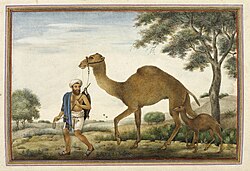
[[File:Ribari, a caste of camel-men - Tashrih al-aqvam (1825), f.345v - BL Add. 27255.jpg|thumb|Rabari, a caste of Camel Herders- ''Tashrih al-aqvam'' (1825)]] | |||
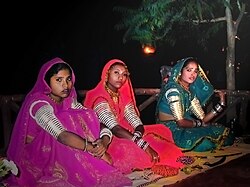
[[File:Rabari Women of Rajasthan.jpg|thumb|Rabari women wearing brightly colored ghagras (skirts), odhnis (veils), and bangles.]] | |||
== | The '''Rabari''' people (also known as Rebari, Raika, Desai and Dewasi people) are a caste group from [[Rajasthan]], [[Kutch district|Kutch]] region of [[Gujarat]], [[Maharashtra]], [[Haryana]], [[Punjab]] of India and the [[Sindh]] province of Pakistan.<ref>{{Cite journal |last=Köhler-Rollefson |first=Ilse |author-link=Ilse Kohler-Rollefson |date=1992 |title=The Raika Dromedary Breeders of Rajasthan: A Pastoral System in Crisis |url=https://www.jstor.org/stable/43123358 |journal=Nomadic Peoples |volume=30 |issue=30 |pages=74–83 |jstor=43123358 }}</ref><ref>{{Cite book |last=Chaudhary |first=Shyam Nandan |url=https://books.google.com/books?id=KBX1EJVhjGEC&q=rabari+tribe&pg=PA395 |title=Tribal Development Since Independence |date=2009 |publisher=Concept Publishing Company |isbn=978-81-8069-622-0 |pages=23 & 126|language=en}}</ref> They were traditionally camel herders but have now taken to rearing sheep and cattle.{{Citation needed|date=September 2025}} | ||
==Origin== | |||
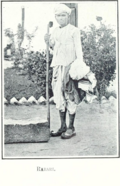
[[File:Rabari.png|thumb|Rabari from Baroda state, 1911]] | |||
Rabari claim Baluchistan as the place of their origin. According to Sigrid Westphal-Helbusch, significant migrations of Rabaris took place between 12th to 14th century, when they moved from [[Marwar]] to [[Sindh]] and [[Kutch district|Kutch]]. The migrations of Rabaris in fact follow similar paths as those of [[Rajput]]s and [[Charan]]s, two other migrant group in this region, indicating intertwined histories. Westphal-Helbusch ascribes the goddess worship traditions of Rabaris to the [[Charan]] influence.<ref>{{Cite book |last=Kothiyal |first=Tanuja |url=https://books.google.com/books?id=be-7CwAAQBAJ |title=Nomadic Narratives: A History of Mobility and Identity in the Great Indian Desert |date=2016-03-14 |publisher=Cambridge University Press |isbn=978-1-107-08031-7 |pages=126 |language=en}}</ref> | |||
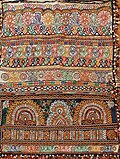
[[File:Vintage Rabari Bag Wovensouls Collection.jpg|thumb|Vintage Rabari Bag with heavy embroidery that is unique to Rabaris of Western India. Such bags are used for gifting at wedding ceremonies.]] | |||
== Tattoo Culture == | |||
Rabaris were known for their elaborate Trajva tattoos. They are usually done on the forearms, face, throat. The tattoo can have a range of meanings, including representations of fertility or skill milestones. Green sap from a nearby plant is mixed with soot to make the tattoos.<ref>{{Cite web |last=IANS |date=2023-07-27 |title=The evolution of traditional tattoos in India |url=https://www.thestatesman.com/lifestyle/the-evolution-of-traditional-tattoos-in-india-1503204979.html |access-date=2024-07-15 |website=The Statesman |language=en}}</ref> | |||
== References == | == References == | ||
| Line 13: | Line 18: | ||
== Bibliography == | == Bibliography == | ||
*{{citation |title=Literacy and Development: Ethnographic Perspectives |first=Brian V. |last=Street |publisher=Routledge |year=2002 |isbn=9781134566204 |url=https://books.google.com/books?id=HvaCAgAAQBAJ}} | |||
=== Books === | |||
* Francesco D'Orazi Flavoni. (1990) [https://search.worldcat.org/title/38081195 Rabari a Pastoral community of Kutch] | |||
* {{citation |title=Literacy and Development: Ethnographic Perspectives |first=Brian V. |last=Street |publisher=Routledge |year=2002 |isbn=9781134566204 |url=https://books.google.com/books?id=HvaCAgAAQBAJ}}.... | |||
== Further reading == | == Further reading == | ||
| Line 23: | Line 33: | ||
[[Category:Social groups of Gujarat]] | [[Category:Social groups of Gujarat]] | ||
[[Category:Maldhari communities]] | [[Category:Maldhari communities]] | ||
[[Category:Social groups of Rajasthan]] | |||
{{India-ethno-stub}} | {{India-ethno-stub}}{{Social groups of Rajasthan}} | ||
Revision as of 09:12, 11 September 2025
,_f.345v_-_BL_Add._27255.jpg)

The Rabari people (also known as Rebari, Raika, Desai and Dewasi people) are a caste group from Rajasthan, Kutch region of Gujarat, Maharashtra, Haryana, Punjab of India and the Sindh province of Pakistan.[1][2] They were traditionally camel herders but have now taken to rearing sheep and cattle.[citation needed]
Origin

Rabari claim Baluchistan as the place of their origin. According to Sigrid Westphal-Helbusch, significant migrations of Rabaris took place between 12th to 14th century, when they moved from Marwar to Sindh and Kutch. The migrations of Rabaris in fact follow similar paths as those of Rajputs and Charans, two other migrant group in this region, indicating intertwined histories. Westphal-Helbusch ascribes the goddess worship traditions of Rabaris to the Charan influence.[3]

Tattoo Culture
Rabaris were known for their elaborate Trajva tattoos. They are usually done on the forearms, face, throat. The tattoo can have a range of meanings, including representations of fertility or skill milestones. Green sap from a nearby plant is mixed with soot to make the tattoos.[4]
References
- ↑ Köhler-Rollefson, Ilse (1992). "The Raika Dromedary Breeders of Rajasthan: A Pastoral System in Crisis". Nomadic Peoples. 30 (30): 74–83. JSTOR 43123358.
- ↑ Chaudhary, Shyam Nandan (2009). Tribal Development Since Independence. Concept Publishing Company. pp. 23 & 126. ISBN 978-81-8069-622-0.
- ↑ Kothiyal, Tanuja (2016-03-14). Nomadic Narratives: A History of Mobility and Identity in the Great Indian Desert. Cambridge University Press. p. 126. ISBN 978-1-107-08031-7.
- ↑ IANS (2023-07-27). "The evolution of traditional tattoos in India". The Statesman. Retrieved 2024-07-15.
Bibliography
Books
- Francesco D'Orazi Flavoni. (1990) Rabari a Pastoral community of Kutch
- Street, Brian V. (2002), Literacy and Development: Ethnographic Perspectives, Routledge, ISBN 9781134566204....
Further reading
- Davidson, Robyn (November 1, 1997). Desert Places, pastoral nomads in India (the Rabari). Penguin. ISBN 978-0-14-026797-6.
- Mirella Ferrera, People of the world. Published by VMB publisher 13100 Vercelli, Italy 2005
- Flavoni, Francesco D'orazi (1990). Rabari: A Pastoral Community of Kutch. Indira Gandhi National Centre for Arts and Brijbasi Printers. ISBN 978-8-17107-026-8.
 | This article about an Indian ethnicity or social group is a stub. You can help Bharatpedia by expanding it. |