

m robot: Update article (please report if you notice any mistake or error in this edit) |
Silentbram (talk | contribs) m clean up |
||
| Line 1: | Line 1: | ||
{{Short description|Indian sweet}} | {{Short description|Indian sweet}} | ||
{{Use dmy dates|date=May 2022}} | {{Use dmy dates|date=May 2022}} | ||
{{Use Indian English|date=May 2022}} | {{Use Indian English|date=May 2022}} | ||
{{Infobox food | {{Infobox food | ||
| name | | name = Imarti | ||
| image | | image = JalebiIndia.jpg | ||
| image_size | | image_size = 200px | ||
| caption | | caption = | ||
| alternate_name | | alternate_name = {{ubl|Amriti|Jaangiri|Omriti}} | ||
| | | place_of_origin = India | ||
| creator = | |||
| course = [[Dessert]] | |||
| served = | |||
| main_ingredient = [[Vigna mungo|Black gram flour]], [[saffron]], [[ghee]], [[sugar]] | |||
| variations = | |||
| calories = | |||
| other = | |||
| region = [[Indian subcontinent]] | |||
| similar_dish = [[Jalebi]], [[Chhena jalebi]] | |||
}} | |||
'''Imarti''', also known as '''amriti''', '''jaangiri''', or '''omriti''', is an Indian [[Sweets from the Indian subcontinent|sweet]] made by [[Deep frying|deep-frying]] a [[Batter (cooking)|batter]] prepared with [[vigna mungo|black gram flour]] in a circular, flower-like shape, and then soaking it in sugar syrup.<ref name="TH_2020">{{Cite news|last=Khanna|first=Sangeeta|date=2019-07-12|title=Beniram is a 200-year-old shop selling amriti in Jaunpur|language=en-IN|work=The Hindu|url=https://www.thehindu.com/life-and-style/food/beniram-imarti-beniram-ki-imarti/article28400020.ece|access-date=2020-11-01|issn=0971-751X|archive-date=17 October 2020|archive-url=https://web.archive.org/web/20201017083519/https://www.thehindu.com/life-and-style/food/beniram-imarti-beniram-ki-imarti/article28400020.ece|url-status=live}}</ref> This dish is similar to ''[[jalebi]]'', which is thinner and sweeter than ''imarti''.<ref name="Difference between Jalebi & Imarti">{{cite web|title=Difference between Jalebi & imarti|url=https://timesofindia.indiatimes.com/articles/food-facts/difference-between-jalebi-amp-imarti/the-sweet-difference/photostory/60255898.cms|website=recipes.timesofindia.com|date=28 August 2017|publisher=Times Food|access-date=19 April 2020|archive-date=7 July 2018|archive-url=https://web.archive.org/web/20180707102912/https://recipes.timesofindia.com/articles/food-facts/difference-between-jalebi-amp-imarti/the-sweet-difference/photostory/60255898.cms|url-status=live}}</ref> | |||
Imarti is a popular [[iftar]] food in [[Bangladesh]], while in India, [[Jaunpur, Uttar Pradesh|Jaunpur]] in [[Uttar Pradesh]] is famous for its imartis.<ref name="deccanherald">{{cite news |last1=Keshavrao |first1=Dhanvanti |date=6 July 2013 |title=A sweet tale of an exotic dessert |url=http://www.deccanherald.com/content/342897/a-sweet-tale-exotic-dessert.html |url-status=live |archive-url=https://web.archive.org/web/20160923050433/http://www.deccanherald.com/content/342897/a-sweet-tale-exotic-dessert.html |archive-date=23 September 2016 |access-date=27 May 2015}}</ref><ref>{{Cite web|last=প্রতিবেদক|first=নিজস্ব|title=ইফতারে ঘোষপট্টির 'ডাইলের আমিত্তি'|url=https://www.prothomalo.com/bangladesh/%E0%A6%87%E0%A6%AB%E0%A6%A4%E0%A6%BE%E0%A6%B0%E0%A7%87-%E0%A6%98%E0%A7%8B%E0%A6%B7%E0%A6%AA%E0%A6%9F%E0%A7%8D%E0%A6%9F%E0%A6%BF%E0%A6%B0-%E2%80%98%E0%A6%A1%E0%A6%BE%E0%A6%87%E0%A6%B2%E0%A7%87%E0%A6%B0-%E0%A6%86%E0%A6%AE%E0%A6%BF%E0%A6%A4%E0%A7%8D%E0%A6%A4%E0%A6%BF%E2%80%99|access-date=2020-12-02|website=Prothomalo|language=bn|archive-date=18 October 2020|archive-url=https://web.archive.org/web/20201018133427/https://www.prothomalo.com/bangladesh/%E0%A6%87%E0%A6%AB%E0%A6%A4%E0%A6%BE%E0%A6%B0%E0%A7%87-%E0%A6%98%E0%A7%8B%E0%A6%B7%E0%A6%AA%E0%A6%9F%E0%A7%8D%E0%A6%9F%E0%A6%BF%E0%A6%B0-%E2%80%98%E0%A6%A1%E0%A6%BE%E0%A6%87%E0%A6%B2%E0%A7%87%E0%A6%B0-%E0%A6%86%E0%A6%AE%E0%A6%BF%E0%A6%A4%E0%A7%8D%E0%A6%A4%E0%A6%BF%E2%80%99|url-status=live}}</ref> | |||
| | |||
==Ingredients== | ==Ingredients== | ||
Imartis are made from batter made using various varieties of [[Vigna mungo|black gram flour]]—called ''urad dal''—in North India, while in [[Karnataka]], [[Tamil Nadu]], [[Andhra Pradesh]], [[Telangana]] and other parts of the [[Indian subcontinent]], ''jangiri parappu'' (jangiri black gram) is commonly used. | |||
[[Saffron]] is added to the batter to give imartis their bright orange colour. | |||
==Preparation== | ==Preparation== | ||
[[File:Amriti Frying - Dum Dum - Kolkata 2012-04-22 2207.JPG|thumb|Amriti frying in [[Kolkata, India]].]] | [[File:Amriti Frying - Dum Dum - Kolkata 2012-04-22 2207.JPG|thumb|Amriti frying in [[Kolkata, India]].]] | ||
[[Black gram]] is soaked in water a | [[Black gram]] is soaked in water for a few hours, and then stone-ground into a fine batter. The batter is poured into [[ghee]], though other oils are sometimes used. Like [[funnel cake]]s, the batter is poured into geometric patterns, although imartis are generally smaller than funnel cakes. There is often a small ring in the middle. | ||
Before frying the batter, sugar syrup is prepared and is flavored with edible [[camphor]], [[cloves]], [[cardamom]], [[kewra]] and [[saffron]]. The fried | Before frying the batter, sugar syrup is prepared and is flavored with edible [[camphor]], [[cloves]], [[cardamom]], [[kewra]] and [[saffron]]. The fried imartis are then dipped in sugar syrup until they expand in size, having soaked up a significant amount of the syrup. In Northern India, imartis are drained, and thus tend to be drier than [[jalebi]]s. Imartis can be served hot, at [[room temperature]], or cold. | ||
<gallery> | <gallery> | ||
File:Frying Amriti - Dum Dum - Kolkata 2012-04-22 2210.JPG|Frying process | File:Frying Amriti - Dum Dum - Kolkata 2012-04-22 2210.JPG|Frying process | ||
| Line 36: | Line 39: | ||
==Serving== | ==Serving== | ||
In India, | In India, Imartis are served as dessert at the end of a meal, sometimes accompanied by [[Dahi (curd)|dahi]] as a dipping. They are also distributed as sweets to relatives, guests and neighbours during celebrations, like festivals and marriages. | ||
<gallery> | <gallery> | ||
File:Jaangiri.JPG|Imartis served as dessert in Tamil Nadu | |||
File:Jaangiri.JPG| | |||
</gallery> | </gallery> | ||
| Line 55: | Line 57: | ||
{{Doughnut}} | {{Doughnut}} | ||
{{Cuisine of India}} | {{Cuisine of India}} | ||
[[Category:Indian | [[Category:Indian doughnuts]] | ||
[[Category:Pakistani desserts]] | [[Category:Pakistani desserts]] | ||
[[Category: | [[Category:Doughnuts]] | ||
[[Category:Rajasthani desserts]] | [[Category:Rajasthani desserts]] | ||
[[Category:Fritters]] | [[Category:Fritters]] | ||
Latest revision as of 07:33, 4 March 2026
 | |
| Alternative names |
|
|---|---|
| Course | Dessert |
| Region or state | Indian subcontinent |
| Main ingredients | Black gram flour, saffron, ghee, sugar |
| Similar dishes | Jalebi, Chhena jalebi |
Imarti, also known as amriti, jaangiri, or omriti, is an Indian sweet made by deep-frying a batter prepared with black gram flour in a circular, flower-like shape, and then soaking it in sugar syrup.[1] This dish is similar to jalebi, which is thinner and sweeter than imarti.[2]
Imarti is a popular iftar food in Bangladesh, while in India, Jaunpur in Uttar Pradesh is famous for its imartis.[3][4]
Ingredients[edit | edit source]
Imartis are made from batter made using various varieties of black gram flour—called urad dal—in North India, while in Karnataka, Tamil Nadu, Andhra Pradesh, Telangana and other parts of the Indian subcontinent, jangiri parappu (jangiri black gram) is commonly used.
Saffron is added to the batter to give imartis their bright orange colour.
Preparation[edit | edit source]

Black gram is soaked in water for a few hours, and then stone-ground into a fine batter. The batter is poured into ghee, though other oils are sometimes used. Like funnel cakes, the batter is poured into geometric patterns, although imartis are generally smaller than funnel cakes. There is often a small ring in the middle.
Before frying the batter, sugar syrup is prepared and is flavored with edible camphor, cloves, cardamom, kewra and saffron. The fried imartis are then dipped in sugar syrup until they expand in size, having soaked up a significant amount of the syrup. In Northern India, imartis are drained, and thus tend to be drier than jalebis. Imartis can be served hot, at room temperature, or cold.
-
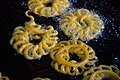 Frying process
 -
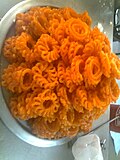 After frying


Serving[edit | edit source]
In India, Imartis are served as dessert at the end of a meal, sometimes accompanied by dahi as a dipping. They are also distributed as sweets to relatives, guests and neighbours during celebrations, like festivals and marriages.
-
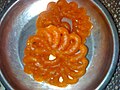 Imartis served as dessert in Tamil Nadu

See also[edit | edit source]
References[edit | edit source]
- ↑ Khanna, Sangeeta (12 July 2019). "Beniram is a 200-year-old shop selling amriti in Jaunpur". The Hindu. ISSN 0971-751X. Archived from the original on 17 October 2020. Retrieved 1 November 2020.
- ↑ "Difference between Jalebi & imarti". recipes.timesofindia.com. Times Food. 28 August 2017. Archived from the original on 7 July 2018. Retrieved 19 April 2020.
- ↑ Keshavrao, Dhanvanti (6 July 2013). "A sweet tale of an exotic dessert". Archived from the original on 23 September 2016. Retrieved 27 May 2015.
- ↑ প্রতিবেদক, নিজস্ব. "ইফতারে ঘোষপট্টির 'ডাইলের আমিত্তি'". Prothomalo (in Bengali). Archived from the original on 18 October 2020. Retrieved 2 December 2020.
External links[edit | edit source]
| Sweet |  | ||||
|---|---|---|---|---|---|
| Savory |
| ||||
| Companies | |||||
| Lists | |||||
| See also |
| ||||

| Regional cuisines |
| ||||||||||
|---|---|---|---|---|---|---|---|---|---|---|---|
| Ingredients / types of food | |||||||||||
| Preparation and cooking | |||||||||||
| Related cuisines | |||||||||||
| See also | |||||||||||


