



imported>BD2412 m Typo fixing for Wikipedia:Typo Team/moss, replaced: ,R → , R (2), ,S → , S (2), ,t → , t |
content fix |
||
| Line 1: | Line 1: | ||
{{Short description| | {{Short description|Mughal noble and Subahdar (1600–1694)}} | ||
{{ | {{Use British English|date=March 2017}} | ||
{{Use dmy dates|date=March 2017}} | {{Use dmy dates|date=March 2017}} | ||
{{Infobox | {{Infobox royalty | ||
| name = Mirza Abu-Talib Shaista Khan | |||
|name=Mirza Abu Talib | | title = [[Amir al-umara|Amir-ul-Umara]] <br /> [[Subahdar|Mughal Subahdar]] | ||
| | | image = Sháyista Khán (cropped).jpg | ||
|image= | | image_size = 300 | ||
| | | caption = Shaista Khan in {{circa}} 1650 | ||
| | | succession = 24th & 27th [[Bengal Subah|Subahdar of Bengal]] | ||
| | | reign = 30 March 1664 – 1676 | ||
| | | reign-type = 1st [[Governorship]] | ||
| | | predecessor = [[Mir Jumla II]] | ||
| | | regent = | ||
| | | reg-type = | ||
| | | successor = [[Fidai Khan Koka|Fidai Khan II]] | ||
| | | birth_name = Mirza Abu Talib | ||
| | | birth_date = 22 November 1600 | ||
| birth_place = Delhi, [[Mughal Empire]] | |||
| | | death_date = {{C.|1694}} <br /> (aged 93–94) | ||
| death_place = Delhi, Mughal Empire | |||
| issue = Buzurg Umed Khan<ref>{{cite Banglapedia |author=Hossain, AKM Yakub & Haque, AKM Khademul |article=Buzurg Umed Khan}}</ref> <br /> Abul Fatah <br /> [[Bibi Pari|Iran Dukht Rahmat Banu (Bibi Pari)]]<ref>{{cite Banglapedia |author=Hossain, AKM Yakub & Chowdhury, AM |article=Bibi Pari}}</ref> <br /> Aqidat Khan <br /> Jafar Khan <br /> Abu Nasr Khan <br /> Iradat Khan<ref>{{cite Banglapedia |author=Abdul Karim |article=Iranians, The}}</ref><br /> Khuda Banda Khan<ref>Shahnavaz Khan Aurangabadi; Beveridge, H. & Baini Prashad (translators) (1941/1952). *Maʾāṣir al-Umara of Shahnavaz Khan Aurangabadi*, Vol. 1. Asiatic Society, Calcutta. p. 816</ref> | |||
| full name = Mirza Abu-Talib Shaista Khan ibn Abu'l-Hasan Asaf Khan | |||
| father = [[Asaf Khan IV]] | |||
| mother = Diwanji Begum | |||
| occupation = Mughal Statesman | |||
| religion = [[Shia Islam]] | |||
| reign-type1 = 2nd Governorship | |||
| reign1 = 1680 – 1688 | |||
| predecessor1 = [[Muhammad Azam Shah|Azam Shah]] | |||
| successor1 = [[Ibrahim Khan II]] | |||
| reg-type1 = [[Mughal emperors|Badshah]] | |||
| regent1 = [[Aurangzeb]] | |||
| succession2 = [[Subahdar]] of [[Khandesh Subah]] | |||
| reign-type2 = Governorship | |||
| reign2 = 1658 – 1669 | |||
| reg-type2 = [[Mughal emperors|Badshah]] | |||
| regent2 = [[Aurangzeb]] | |||
| succession3 = [[Viceroy of the Deccan]] | |||
| reign-type3 = Governorship | |||
| reign3 = January 1660 – <br /> mid-January 1664 | |||
| reg-type3 = [[Mughal emperors|Badshah]] | |||
| regent3 = [[Aurangzeb]] | |||
}} | }} | ||
'''Mirza Abu Talib''' (b. 22 November 1600 – d. 1694),<ref name=hedges_meets_khan/><ref>Sir Jadunath Sarkar, ''History of Aurangzib: Mainly Based on Persian Sources'', Volume 5 (1974), p. 283</ref> better known as '''Shaista Khan''', was a general and the [[Subahdar]] of [[Mughal Bengal]]. He was maternal uncle to the [[Mughal Emperor]] [[Aurangzeb]], and acted as a key figure during his reign. Shaista Khan initially governed [[Deccan Plateau|the Deccan]], where he clashed with the [[Maratha]] ruler [[Shivaji]]. However, he was most notable for his tenure as the governor of [[Bengal]] from 1664 to 1688. Under Shaista Khan's authority, the city of [[Dhaka]] and [[Mughal Empire|Mughal]] power in the province attained their greatest heights. His achievements include construction of notable mosques such as the [[Sat Gambuj Mosque]] and masterminding the conquest of [[Chittagong]]. Shaista Khan was also responsible for sparking the [[Anglo-Mughal War (1686–1690)|Anglo-Mughal War]] with the [[East India Company|English East India Company]].<ref>{{Cite journal |title=Conflict and Cooperation in Anglo-Mughal Trade Relations during the Reign of Aurangzeb |first=Farhat |last=Hasan |journal=Journal of the Economic and Social History of the Orient |volume=34 |issue=4 |year=1991 |pages=351–360 |doi=10.1163/156852091X00058 |jstor=3632456}}</ref> | |||
==Early life== | |||
According to the diary of [[William Hedges (colonial administrator)|William Hedges]], the first governor of the [[East India Company]] in Bengal, the birthday of Shaista Khan was on 22 November.<ref name=hedges_meets_khan>{{Cite book |last=Hedges |first=Sir William |url=https://books.google.com/books?id=qGcMAAAAIAAJ |title=The Diary of William Hedges, Esq. (afterwards Sir William Hedges), During His Agency in Bengal: As Well as on His Voyage Out and Return Overland (1681-1697) |year=1887 |publisher=Hakluyt Society |language=en |pages=43–51}}</ref> | |||
Khan was of [[Persian people|Persian]] origin. His grandfather [[Mirza Ghiyas Beg]] and father [[Abu'l-Hasan Asaf Khan]] were the [[Vizier|wazirs]] of the [[Mughal emperors]] [[Jahangir]] and [[Shah Jahan]], respectively. He also had familial connections with the imperial dynasty, having been a paternal nephew of the empress [[Nur Jahan]] and the brother of the empress [[Mumtaz Mahal]]. Jahangir awarded the title of [[Mirza (noble)|Mirza]] to Shaista Khan in recognition of his family's service and position in the Mughal court.<ref name=Karim>{{cite Banglapedia |author=Abdul Karim |article=Shaista Khan}}</ref> | |||
Khan trained and served with the Mughal army and court, winning multiple promotions and being appointed governor of various provinces. He also developed a reputation as a successful military commander and grew close to his nephew, the prince [[Aurangzeb]], when the duo fought against the kingdom of [[Golconda]].<ref name=Karim/> | |||
==Confrontation with the Marathas== | ==Confrontation with the Marathas== | ||
{{main|Battle of Chakan}} | {{main|Battle of Chakan}} | ||
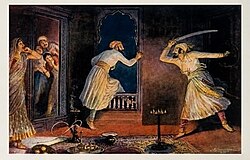
After Aurangzeb's accession to the Mughal throne in 1659, he sent Shaista Khan as viceroy of the [[Deccan Plateau|Deccan]] with a large army to enforce the treaty the Mughals had signed with the [[Adilshahi]] of [[Bijapur]]. Through the treaty the [[Adil Shahi dynasty|Adilshahi]] had ceded territory that it had previously captured from the [[Ahmadnagar Sultanate]] | After Aurangzeb's accession to the Mughal throne in 1659, he sent Shaista Khan as viceroy of the [[Deccan Plateau|Deccan]] with a large army to enforce the treaty the Mughals had signed with the [[Adilshahi]] of [[Bijapur]]. Through the treaty, the [[Adil Shahi dynasty|Adilshahi]] had ceded territory that it had previously captured from the [[Ahmadnagar Sultanate]] to the Mughals.<ref name="Gordon2007">{{cite book |author=Stewart Gordon |title=The Marathas 1600-1818 |url=https://books.google.com/books?id=iHK-BhVXOU4C&pg=PR9 |year=2007 |publisher=Cambridge University Press |isbn=978-0-521-03316-9 |pages=70–71}}</ref> However, the territory was also fiercely contested by [[Maratha]] ruler, [[Shivaji]], who had acquired a reputation after his killing of Adilshahi general [[Afzal Khan (general)|Afzal Khan]] in 1659.<ref>{{cite book |last1=Sardesai |first1=G.S. |title=New history of the Marathas. Vol. I: ShivajiRaje and his line (1600-1701) |year=1946 |publisher=Phoenix Publications |location=Bombay |pages=142–144}}</ref> In January 1660, Shaista Khan arrived at [[Aurangabad, Maharashtra|Aurangabad]] and quickly advanced, seizing [[Pune]], the centre of Shivaji's realm. He also captured the fort of [[Chakan, Maharashtra|Chakan]] and [[Kalyan, India|Kalyan]] and north [[Konkan]] after heavy fighting with the Marathas.<ref name="Majumdar2007">{{cite book |year=2007 |orig-year=First published 1974 |editor1-last=Majumdar |editor1-first=Ramesh Chandra |editor1-link=R. C. Majumdar |editor2-last=Pusalker |editor2-first=A. D. |editor3-last=Majumdar |editor3-first=A. K. |title=The History and Culture of the Indian People |title-link=The History and Culture of the Indian People |volume=VII: The Mughal Empire |location=Mumbai |publisher=Bharatiya Vidya Bhavan}}</ref>{{rp|243, 259–60}} The Marathas were banned from entering the city of [[Pune]], and [[Mughal Empire|Mughal]] distance from the locals turned out to be an error. Shaista was responsible for heavily mass destruct pune city and its innocent civilians. On the evening of 5 April 1663, a wedding party had obtained special permission for holding a procession. Shivaji and many of his nearly 400 men disguised as the bridegroom's procession members entered Pune. Others entered in small parties dressed as labourers and soldiers of Maratha generals serving under Shaista Khan. After midnight, they raided the Nawab's compound and then entered the palace in an attempt to assassinate him.<ref>{{cite book |last1=Sardesai |first1=G.S. |title=New history of the Marathas. Vol. I: Shivaji and his line (1600-1701) |year=1946 |publisher=Phoenix Publications |location=Bombay |pages=142–144}}</ref><ref>{{cite book |last=Jasper |first=Daniel |editor1-last=Vora |editor1-first=Rajendra |editor2-last=Feldhaus |editor2-first=Anne |year=2006 |chapter=Celebrating a Region through Historical Commemoration |title=Region, Culture, and Politics in India |page=239 |publisher=Manohar |isbn=978-81-7304-664-3}}</ref> | ||
[[File:Shaistekhan Surprised.jpg|thumb|250px|Shivaji (right) | [[File:Shaistekhan Surprised.jpg|thumb|250px|A 20th-century depiction of Shivaji (right) attacking Shaista Khan as he tries to flee by artist [[M.V. Dhurandhar]] ]] | ||
Aurangzeb angrily transferred Shaista Khan to Bengal, refusing to give him an audience at the time of the transfer, as was the custom.<ref>{{Cite book |last=Chandra |first=Satish |title=History of medieval India (800-1700) |url=https://archive.org/details/history-of-medieval-india-800-1700_202303/page/357/mode/1up |year=2007 |publisher=Orient Longman |isbn=978-81-250-3226-7 |page=357}}</ref> | |||
==Subahdar of Bengal== | ==Subahdar of Bengal== | ||
[[File:Charles D'Oyly06.jpg|thumb|right|250px|Construction of [[Saat Masjid]] is credited to Shaista Khan]] | [[File:Charles D'Oyly06.jpg|thumb|right|250px|Construction of [[Saat Masjid]] is credited to Shaista Khan]] | ||
On the death of Mir Jumla II in 1663, Shaista Khan was appointed the Subedar of Bengal. As governor, he encouraged trade with Europe, Southeast Asia and other parts of India. He consolidated his power by signing trade agreements with European powers. Despite his powerful position he remained loyal to Aurangzeb, often mediating trade disputes and rivalries. | On the death of Mir Jumla II in 1663, Shaista Khan was appointed the Subedar of Bengal. As governor, he encouraged trade with Europe, Southeast Asia, and other parts of India. He consolidated his power by signing trade agreements with European powers. Despite his powerful position, he remained loyal to Aurangzeb, often mediating trade disputes and rivalries. In 1666, Shaista Khan led the campaign to Chittagong and expelled the [[Portuguese Empire|Portuguese]] and Magh defenders with 300 flotillas.<ref name="Advanced Study in the History of Modern India 1707-1813">{{cite book |last1=Lal Mehta |first1=Jaswant · |title=Advanced Study in the History of Modern India 1707-1813 |year=2005 |publisher=New Dawn Press, Incorporated |isbn=9781932705546 |page=330 |url=https://books.google.com/books?id=d1wUgKKzawoC |access-date=5 June 2023 |language=en |format=Hardcover}}</ref> The Mughal forces even forced the Portuguese in [[Sandwip]] to relinquish their bases to be used as Mughal naval operation.<ref name="Advanced Study in the History of Modern India 1707-1813" /> Later, he banned the English East India Company from Bengal in 1686, beginning the Anglo-Mughal War. In 1678, Prince Muhammad Azam Shah was appointed the Subedar of Bengal. In 1680, Shaista Khan was again appointed as the Subedar of Bengal. He served his first term from 1663 to 1678 and his second term from 1680 to 1688. | ||
===Construction projects=== | ===Construction projects=== | ||
Shaista Khan encouraged the construction of modern townships and public works in Dhaka, leading to a massive urban and economic expansion. He was a patron of the arts and encouraged the construction of majestic monuments across the province, including mosques, [[mausoleum]]s and palaces that represented the finest in Indo- | Shaista Khan encouraged the construction of modern townships and public works in Dhaka, leading to a massive urban and economic expansion. He was a patron of the arts and encouraged the construction of majestic monuments across the province, including mosques, [[mausoleum]]s, and palaces that represented the finest in Indo-Saracenic and [[Mughal architecture]]. Khan greatly expanded [[Lalbagh Fort]], [[Chawk Mosque, Dhaka|Chowk Bazaar Mosque]], [[Saat Masjid]], and [[Choto Katra]]. He also supervised the construction of the mausoleum for his daughter [[Bibi Pari]]. | ||
== Conquest of Chittagong == | == Conquest of Chittagong == | ||
{{See also|Mughal conquest of Chittagong}} | |||
{{ | Upon his arrival in Bengal, Shaista Khan was faced with putting down the [[Kingdom of Mrauk U|Arakan]]ese pirates. He began by rebuilding the Mughal navy, increasing its Bengal fleet to 300 battle-ready ships within a year.<ref name="Sarkar1948p379">{{cite book |editor-last=Sarkar |editor-first=Jadunath |editor-link=Jadunath Sarkar |year=1973 |orig-year=First published 1948 |title=The History of Bengal |volume=II: Muslim Period, 1200-1757 |location=Patna |publisher=Academica Asiatica |page=379 |oclc=924890 |quote=It was Shāista Khan's task to put an end to this terror [the Arakan pirates] ... The Bengal flotilla (nawwāra) had been wofully depleted ... Shāista Khan's energy and persistence overcame every obstacle. A new navy was created, manned and equipped in a little over a year ... In a short time 300 vessels were ... ready in war-trim ... The island of Sondip ... [was] captured ... (November 1665.) A still more important gain was the seduction of the [[Firingi|Feringis]] of Chātgāon from the side of the Arakanese ... A feud had just then broken out between the Magh ruler of Chātgāon and the local Portuguese ... Shāista Khan gave their chief captain a bounty ... and their other leaders were all enlisted in the Mughal service.}}</ref> He made diplomatic efforts to gain the support of the [[Dutch East India Company]] as well as [[Portuguese India|Portugal]]. With the direct support of the Dutch army, Shaista Khan led the Mughals in an attack on the Arakanese-held Sandwip under the command of Ibn Husain, which lay in Arakanese control.<ref>{{Cite book |author-last=Sarkar |author-first=Jadunath |author-link=Jadunath Sarkar |url=https://archive.org/details/in.ernet.dli.2015.283718/page/n391/mode/2up |title=The History of Bengal. Vol. II |publisher=[[Dhaka University]] |year=1948 |page=379 |language=en |quote=The first step in the campaign was the conquest of the island of Sondip— only six hours' sail from Chatgaon (Chittagong). Dilawwar, a run-away captain of the Mughal navy, who had established himself as king here, was defeated and captured by an expedition from Dacca under admiral Ibn Husain (November 1665).}}</ref> The previous [[Siege of Hooghly]] by Shaishta Khan was considered by Saugata Bhaduri, a professor from [[Jawaharlal Nehru University]], as an attempt by the empire to threaten the Portuguese settlers in Bengal to assist them in the conquest of Chittagong.<ref name="Polycoloniality European Transactions with Bengal from the 13th to the 19th Century">{{cite book |author1=Saugata Bhaduri |title=Polycoloniality European Transactions with Bengal from the 13th to the 19th Century |year=2021 |publisher=Cambridge University Press |isbn=9789389812565 |page=195 |url=https://books.google.com/books?id=5TWcEAAAQBAJ |access-date=13 December 2023 |language=En |format=ebook |quote=Portuguese in Bengal rather than to make them an enemy of the Mughal Empire. The Mughal emperors probably understood well that the Portuguese settlers could prove useful in the wresting of Chittagong ...}}</ref> | ||
| | |||
| | |||
| | |||
| | |||
| | |||
| | |||
| | |||
| | |||
| | |||
| | |||
| | |||
| | |||
}} | |||
Mughal forces succeeded in capturing the island in November 1665.<ref name="Sarkar1948p379" /> | |||
Shaista Khan gained a considerable advantage when a conflict erupted between the Arakanese and the Portuguese. The Portuguese, led by Captain Moor, set fire to [[Kingdom of Mrauk U|Arakan]]ese fleets and fled to [[Bhulua]] where Thanadar [[Farhad Khan]] gave them refuge. Farhad then sent them off to Shaista. By promptly offering protection and support, Shaista secured the aid of the Portuguese against the Arakanese.<ref name="Sarkar1948p379" /> | Shaista Khan gained a considerable advantage when a conflict erupted between the Arakanese and the Portuguese. The Portuguese, led by Captain Moor, set fire to [[Kingdom of Mrauk U|Arakan]]ese fleets and fled to [[Bhulua]], where Thanadar [[Farhad Khan]] gave them refuge. Farhad then sent them off to Shaista. By promptly offering protection and support, Shaista secured the aid of the Portuguese against the Arakanese.<ref name="Sarkar1948p379" /> | ||
[[File:ShaistaKhan.png|thumb|left|180px|Shaista Khan in later days]] | [[File:ShaistaKhan.png|thumb|left|180px|Shaista Khan in later days]] | ||
In December 1665, Shaista Khan launched a major military campaign against [[Chittagong]], which was the mainstay of the Arakanese kingdom. The imperial fleet consisted of 288 vessels of their own and about 40 vessels of the [[Firingi]]s (Portuguese) as auxiliaries. Ibn Hussain, Shaista Khan's admiral, was asked to lead the navy, while the subahdar himself took up the responsibility of supplying provisions for the campaign. He also ordered [[Farhad Khan]] and Mir Murtaza to take the land route. The overall command was given to Buzurg Ummed Khan, a son of Shaista Khan.<ref name="Majumdar2007" />{{rp|230}} The Mughals and the Portuguese held sway in the following naval battle. The conquered territory to the western bank of Kashyapnadi ([[Kaladan | In December 1665, Shaista Khan launched a major military campaign against [[Chittagong]], which was the mainstay of the Arakanese kingdom. The imperial fleet consisted of 288 vessels of their own and about 40 vessels of the [[Firingi]]s (Portuguese) as auxiliaries. Ibn Hussain, Shaista Khan's admiral, was asked to lead the navy, while the subahdar himself took up the responsibility of supplying provisions for the campaign. He also ordered [[Farhad Khan]] and Mir Murtaza to take the land route. The overall command was given to Buzurg Ummed Khan, a son of Shaista Khan.<ref name="Majumdar2007" />{{rp|230}} The Mughals and the Portuguese held sway in the following naval battle. The conquered territory to the western bank of Kashyapnadi ([[Kaladan River]]) was placed under direct imperial administration. The name of Chittagong was changed to Islamabad, and it became the headquarters of a Mughal [[faujdar]].<ref name="Majumdar2007" />{{rp|230}} Khan also reasserted Mughal control over [[Cooch Behar]] and [[Kamarupa]]. | ||
==Personal life== | |||
According to Shaista Khan's vasiat-nama (a document registered before his death), he had seven sons and five daughters at the time.<ref>{{Cite book |author-last=Dani |author-first=Ahmad Hasan |author-link=Ahmad Hasan Dani |title=Dhaka Record of its Changing Fortunes |publisher=[[Asiatic Society of Bangladesh]] |year=2009 |isbn=9789843304445 |edition=3rd |page=71}}</ref><ref>{{Cite web |title=Shaista Khan |url=https://en.banglapedia.org/index.php?title=Shaista_Khan |access-date=2023-12-07 |website=Banglapedia |language=en |quote=He ruled Bengal with vigour, and in his administration he was assisted by his half a dozen gifted and able sons, each of whom held the charge of faujdar in one or more than one sarkar, so that one family ruled all divisions of Bengal, and ruled effectively.}}</ref> Among his daughters were Iran Dukht Begum known as Bibi Pari, Turan Dukht Begum known as Bibi Biban<ref name="g338">{{cite book |last=Islam |first=Sirajul |title=History of Bangladesh, 1704-1971: Social and cultural history |publisher=Asiatic Society of Bangladesh |date=1992 |isbn=978-984-512-337-2 |page=729}}</ref> and Shamshad Banu Begum.<ref name="n192">{{cite book |last=Ashfaque |first=Syed M. |title=Lalbagh Fort: Monuments and Museum |publisher=Department of Archaeology & Museums, Ministry of Education & Scientific Research, Government of Pakistan |date=1970 |page=13}}</ref> His oldest son, Buzurg Umed Khan, served as the governor of Allahabad. Another of Shaista Khan's sons, Khuda Banda Khan was married to a daughter of the grand vizier [[Asad Khan (Mughal noble)|Asad Khan]]. He served as a general for Muhammad Azam Shah, and fell in battle fighting Bahadur Shah I. Khuda Banda's son, who was also entitled Khuda Banda Khan, was made the Diwan of Asaf Jah I, the Nizam of Hyderabad.<ref>{{cite book |first1=H. |last1=Beveridge |first2=Baini |last2=Prashad |title=The Maāthir-ul-umarā Being Biographies of the Muhammadan and Hindu Officers of the Timurid Sovereigns of India from 1500 to about 1780 A.D. by Nawwab Samsam-ud-Daula Shah Nawaz Khan and his son Abdul Hayy – Volume II (English) |publisher=Asiatic Society of Calcutta |location=Calcutta, India |year=1952 |url=https://archive.org/details/dli.ernet.507589/page/417/mode/2up |page=816}}</ref> One of his daughters was married to [[Ruhullah Khan]], son of Khalilullah Khan of Yazd in 1660. Another daughter was married in 1678 to [[Zulfiqar Khan Nusrat Jung]], son of [[Asad Khan (Mughal noble)|Asad Khan]] and Mihr-un-Nissa Begum, daughter of [[Abu'l-Hasan Asaf Khan|Asaf Khan]].<ref>{{cite book |first1=H. |last1=Beveridge |first2=Baini |last2=Prashad |title=The Maāthir-ul-umarā Being Biographies of the Muhammadan and Hindu Officers of the Timurid Sovereigns of India from 1500 to about 1780 A.D. by Nawwab Samsam-ud-Daula Shah Nawaz Khan and his son Abdul Hayy – Volume II (English) |publisher=Asiatic Society of Calcutta |location=Calcutta, India |year=1952 |url=https://archive.org/details/dli.ernet.507589/page/81/mode/1up |pages=611, 1033}}</ref> Another daughter was married to Itiqad Khan and died in 1688.<ref>{{cite book |first=Jadunath |last=Sarkar |title=Maasir-i-Alamgiri: A History of Emperor Aurangzib-Alamgir (reign 1658-1707 AD) of Saqi Mustad Khan |publisher=Royal Asiatic Society of Bengal, Calcutta |year=1947 |p=189}}</ref> | |||
==Legacy== | ==Legacy== | ||
In his late years, Shaista Khan left [[Dhaka]] and returned to | In his late years, Shaista Khan left [[Dhaka]] and returned to Delhi. His legacy was the expansion of Dhaka into a regional centre of trade, politics and culture; a thriving and prosperous city from a small township. It is said that he made currency of Bangladesh 'Taka' so strong that eight 'mon' (around 295 kilogram) processed rice or 'chaal' could be bought with one taka.<ref>{{cite news |title=Rice price scam in Bangladesh |url=https://theindependentbd.com/arcprint/details/118808/2017-10-15 |first=Shamim |last=Zahedy |access-date=15 October 2017 |work=The Independent |location=Dhaka |date=15 October 2017 |type=Op-ed}}</ref> The [[Shaista Khan Mosque]] is a massive standing monument to Shaista Khan, built on his palace grounds. Incorporating unique elements of [[Bengal]]i and [[Mughal architecture|Mughal]] architecture, it is a major tourist attraction and a valued historical monument protected by the [[government of Bangladesh]] today.<ref>{{Cite web |title=Shaista Khan Mosque |url=https://en.banglapedia.org/index.php?title=Shaista_Khan_Mosque |access-date=2023-12-04 |website=Banglapedia |language=en}}</ref> | ||
The [[Shaista Khan Mosque]] is a massive standing monument to Shaista Khan, built on his palace grounds. Incorporating unique elements of [[Bengal]]i and [[Mughal architecture|Mughal]] architecture, it is a major tourist attraction and a valued historical monument protected by the [[ | |||
==See also== | ==See also== | ||
| Line 88: | Line 92: | ||
==References== | ==References== | ||
{{Reflist | {{Reflist}} | ||
* {{cite book |last1=Karim |first1=Abdul | | |||
* {{cite book |last1=Duff |first1=James Grant |author-link1=James Grant Duff | | ==Bibliography== | ||
* {{cite book |last1=Karim |first1=Abdul |author-link1=Abdul Karim (historian) |year=1992 |title=History of Bengal: Mughal Period |publisher=University of Rajshahi}} | |||
* {{cite book |last1=Duff |first1=James Grant |author-link1=James Grant Duff |year=1921 |orig-year=First published 1826 |url=http://ebook.lib.hku.hk/CADAL/B31419239V1/ |title=History of the Mahrattas |volume=1 |edition=Revised Annotated |location=London |publisher=Oxford University Press}} | |||
{{Authority control}} | {{Authority control}} | ||
[[Category:1600 births]] | |||
[[Category: | [[Category:1694 deaths]] | ||
[[Category: | [[Category:17th-century Iranian military personnel]] | ||
[[Category:17th-century Iranian | |||
[[Category:Indian people of Iranian descent]] | [[Category:Indian people of Iranian descent]] | ||
[[Category:Indian Shia Muslims]] | [[Category:Indian Shia Muslims]] | ||
[[Category:Dhaka]] | [[Category:Government of Dhaka]] | ||
[[Category: | [[Category:Subahdars of Bengal]] | ||
[[Category:17th-century Mughal Empire people]] | |||
[[Category:Mughal Empire]] | [[Category:Mughal generals]] | ||
[[Category: | |||
Revision as of 01:13, 15 March 2026
| Mirza Abu-Talib Shaista Khan | |||||
|---|---|---|---|---|---|
| Amir-ul-Umara Mughal Subahdar | |||||
.jpg) Shaista Khan in c. 1650 | |||||
| 24th & 27th Subahdar of Bengal | |||||
| 1st Governorship | 30 March 1664 – 1676 | ||||
| Predecessor | Mir Jumla II | ||||
| Successor | Fidai Khan II | ||||
| 2nd Governorship | 1680 – 1688 | ||||
| Predecessor | Azam Shah | ||||
| Successor | Ibrahim Khan II | ||||
| Badshah | Aurangzeb | ||||
| Subahdar of Khandesh Subah | |||||
| Governorship | 1658 – 1669 | ||||
| Badshah | Aurangzeb | ||||
| Viceroy of the Deccan | |||||
| Governorship | January 1660 – mid-January 1664 | ||||
| Badshah | Aurangzeb | ||||
| Born | Mirza Abu Talib 22 November 1600 Delhi, Mughal Empire | ||||
| Died | c. 1694 (aged 93–94) Delhi, Mughal Empire | ||||
| Issue | Buzurg Umed Khan[1] Abul Fatah Iran Dukht Rahmat Banu (Bibi Pari)[2] Aqidat Khan Jafar Khan Abu Nasr Khan Iradat Khan[3] Khuda Banda Khan[4] | ||||
| |||||
| Father | Asaf Khan IV | ||||
| Mother | Diwanji Begum | ||||
| Religion | Shia Islam | ||||
| Occupation | Mughal Statesman | ||||
Mirza Abu Talib (b. 22 November 1600 – d. 1694),[5][6] better known as Shaista Khan, was a general and the Subahdar of Mughal Bengal. He was maternal uncle to the Mughal Emperor Aurangzeb, and acted as a key figure during his reign. Shaista Khan initially governed the Deccan, where he clashed with the Maratha ruler Shivaji. However, he was most notable for his tenure as the governor of Bengal from 1664 to 1688. Under Shaista Khan's authority, the city of Dhaka and Mughal power in the province attained their greatest heights. His achievements include construction of notable mosques such as the Sat Gambuj Mosque and masterminding the conquest of Chittagong. Shaista Khan was also responsible for sparking the Anglo-Mughal War with the English East India Company.[7]
Early life
According to the diary of William Hedges, the first governor of the East India Company in Bengal, the birthday of Shaista Khan was on 22 November.[5]
Khan was of Persian origin. His grandfather Mirza Ghiyas Beg and father Abu'l-Hasan Asaf Khan were the wazirs of the Mughal emperors Jahangir and Shah Jahan, respectively. He also had familial connections with the imperial dynasty, having been a paternal nephew of the empress Nur Jahan and the brother of the empress Mumtaz Mahal. Jahangir awarded the title of Mirza to Shaista Khan in recognition of his family's service and position in the Mughal court.[8]
Khan trained and served with the Mughal army and court, winning multiple promotions and being appointed governor of various provinces. He also developed a reputation as a successful military commander and grew close to his nephew, the prince Aurangzeb, when the duo fought against the kingdom of Golconda.[8]
Confrontation with the Marathas
After Aurangzeb's accession to the Mughal throne in 1659, he sent Shaista Khan as viceroy of the Deccan with a large army to enforce the treaty the Mughals had signed with the Adilshahi of Bijapur. Through the treaty, the Adilshahi had ceded territory that it had previously captured from the Ahmadnagar Sultanate to the Mughals.[9] However, the territory was also fiercely contested by Maratha ruler, Shivaji, who had acquired a reputation after his killing of Adilshahi general Afzal Khan in 1659.[10] In January 1660, Shaista Khan arrived at Aurangabad and quickly advanced, seizing Pune, the centre of Shivaji's realm. He also captured the fort of Chakan and Kalyan and north Konkan after heavy fighting with the Marathas.[11]:243, 259–60 The Marathas were banned from entering the city of Pune, and Mughal distance from the locals turned out to be an error. Shaista was responsible for heavily mass destruct pune city and its innocent civilians. On the evening of 5 April 1663, a wedding party had obtained special permission for holding a procession. Shivaji and many of his nearly 400 men disguised as the bridegroom's procession members entered Pune. Others entered in small parties dressed as labourers and soldiers of Maratha generals serving under Shaista Khan. After midnight, they raided the Nawab's compound and then entered the palace in an attempt to assassinate him.[12][13]

Aurangzeb angrily transferred Shaista Khan to Bengal, refusing to give him an audience at the time of the transfer, as was the custom.[14]
Subahdar of Bengal

On the death of Mir Jumla II in 1663, Shaista Khan was appointed the Subedar of Bengal. As governor, he encouraged trade with Europe, Southeast Asia, and other parts of India. He consolidated his power by signing trade agreements with European powers. Despite his powerful position, he remained loyal to Aurangzeb, often mediating trade disputes and rivalries. In 1666, Shaista Khan led the campaign to Chittagong and expelled the Portuguese and Magh defenders with 300 flotillas.[15] The Mughal forces even forced the Portuguese in Sandwip to relinquish their bases to be used as Mughal naval operation.[15] Later, he banned the English East India Company from Bengal in 1686, beginning the Anglo-Mughal War. In 1678, Prince Muhammad Azam Shah was appointed the Subedar of Bengal. In 1680, Shaista Khan was again appointed as the Subedar of Bengal. He served his first term from 1663 to 1678 and his second term from 1680 to 1688.
Construction projects
Shaista Khan encouraged the construction of modern townships and public works in Dhaka, leading to a massive urban and economic expansion. He was a patron of the arts and encouraged the construction of majestic monuments across the province, including mosques, mausoleums, and palaces that represented the finest in Indo-Saracenic and Mughal architecture. Khan greatly expanded Lalbagh Fort, Chowk Bazaar Mosque, Saat Masjid, and Choto Katra. He also supervised the construction of the mausoleum for his daughter Bibi Pari.
Conquest of Chittagong
Upon his arrival in Bengal, Shaista Khan was faced with putting down the Arakanese pirates. He began by rebuilding the Mughal navy, increasing its Bengal fleet to 300 battle-ready ships within a year.[16] He made diplomatic efforts to gain the support of the Dutch East India Company as well as Portugal. With the direct support of the Dutch army, Shaista Khan led the Mughals in an attack on the Arakanese-held Sandwip under the command of Ibn Husain, which lay in Arakanese control.[17] The previous Siege of Hooghly by Shaishta Khan was considered by Saugata Bhaduri, a professor from Jawaharlal Nehru University, as an attempt by the empire to threaten the Portuguese settlers in Bengal to assist them in the conquest of Chittagong.[18]
Mughal forces succeeded in capturing the island in November 1665.[16]
Shaista Khan gained a considerable advantage when a conflict erupted between the Arakanese and the Portuguese. The Portuguese, led by Captain Moor, set fire to Arakanese fleets and fled to Bhulua, where Thanadar Farhad Khan gave them refuge. Farhad then sent them off to Shaista. By promptly offering protection and support, Shaista secured the aid of the Portuguese against the Arakanese.[16]

In December 1665, Shaista Khan launched a major military campaign against Chittagong, which was the mainstay of the Arakanese kingdom. The imperial fleet consisted of 288 vessels of their own and about 40 vessels of the Firingis (Portuguese) as auxiliaries. Ibn Hussain, Shaista Khan's admiral, was asked to lead the navy, while the subahdar himself took up the responsibility of supplying provisions for the campaign. He also ordered Farhad Khan and Mir Murtaza to take the land route. The overall command was given to Buzurg Ummed Khan, a son of Shaista Khan.[11]:230 The Mughals and the Portuguese held sway in the following naval battle. The conquered territory to the western bank of Kashyapnadi (Kaladan River) was placed under direct imperial administration. The name of Chittagong was changed to Islamabad, and it became the headquarters of a Mughal faujdar.[11]:230 Khan also reasserted Mughal control over Cooch Behar and Kamarupa.
Personal life
According to Shaista Khan's vasiat-nama (a document registered before his death), he had seven sons and five daughters at the time.[19][20] Among his daughters were Iran Dukht Begum known as Bibi Pari, Turan Dukht Begum known as Bibi Biban[21] and Shamshad Banu Begum.[22] His oldest son, Buzurg Umed Khan, served as the governor of Allahabad. Another of Shaista Khan's sons, Khuda Banda Khan was married to a daughter of the grand vizier Asad Khan. He served as a general for Muhammad Azam Shah, and fell in battle fighting Bahadur Shah I. Khuda Banda's son, who was also entitled Khuda Banda Khan, was made the Diwan of Asaf Jah I, the Nizam of Hyderabad.[23] One of his daughters was married to Ruhullah Khan, son of Khalilullah Khan of Yazd in 1660. Another daughter was married in 1678 to Zulfiqar Khan Nusrat Jung, son of Asad Khan and Mihr-un-Nissa Begum, daughter of Asaf Khan.[24] Another daughter was married to Itiqad Khan and died in 1688.[25]
Legacy
In his late years, Shaista Khan left Dhaka and returned to Delhi. His legacy was the expansion of Dhaka into a regional centre of trade, politics and culture; a thriving and prosperous city from a small township. It is said that he made currency of Bangladesh 'Taka' so strong that eight 'mon' (around 295 kilogram) processed rice or 'chaal' could be bought with one taka.[26] The Shaista Khan Mosque is a massive standing monument to Shaista Khan, built on his palace grounds. Incorporating unique elements of Bengali and Mughal architecture, it is a major tourist attraction and a valued historical monument protected by the government of Bangladesh today.[27]
See also
References
- ↑ Hossain, AKM Yakub & Haque, AKM Khademul (2012). "Buzurg Umed Khan". In Islam, Sirajul; Miah, Sajahan; Khanam, Mahfuza; Ahmed, Sabbir (eds.). Banglapedia: the National Encyclopedia of Bangladesh (Online ed.). Dhaka, Bangladesh: Banglapedia Trust, Asiatic Society of Bangladesh. ISBN 984-32-0576-6. OCLC 52727562. Retrieved 20 October 2026.
{{cite encyclopedia}}: CS1 maint: multiple names: authors list (link) - ↑ Hossain, AKM Yakub & Chowdhury, AM (2012). "Bibi Pari". In Islam, Sirajul; Miah, Sajahan; Khanam, Mahfuza; Ahmed, Sabbir (eds.). Banglapedia: the National Encyclopedia of Bangladesh (Online ed.). Dhaka, Bangladesh: Banglapedia Trust, Asiatic Society of Bangladesh. ISBN 984-32-0576-6. OCLC 52727562. Retrieved 20 October 2026.
{{cite encyclopedia}}: CS1 maint: multiple names: authors list (link) - ↑ Abdul Karim (2012). "Iranians, The". In Islam, Sirajul; Miah, Sajahan; Khanam, Mahfuza; Ahmed, Sabbir (eds.). Banglapedia: the National Encyclopedia of Bangladesh (Online ed.). Dhaka, Bangladesh: Banglapedia Trust, Asiatic Society of Bangladesh. ISBN 984-32-0576-6. OCLC 52727562. Retrieved 20 October 2026.
- ↑ Shahnavaz Khan Aurangabadi; Beveridge, H. & Baini Prashad (translators) (1941/1952). *Maʾāṣir al-Umara of Shahnavaz Khan Aurangabadi*, Vol. 1. Asiatic Society, Calcutta. p. 816
- ↑ 5.0 5.1 Hedges, Sir William (1887). The Diary of William Hedges, Esq. (afterwards Sir William Hedges), During His Agency in Bengal: As Well as on His Voyage Out and Return Overland (1681-1697). Hakluyt Society. pp. 43–51.
- ↑ Sir Jadunath Sarkar, History of Aurangzib: Mainly Based on Persian Sources, Volume 5 (1974), p. 283
- ↑ Hasan, Farhat (1991). "Conflict and Cooperation in Anglo-Mughal Trade Relations during the Reign of Aurangzeb". Journal of the Economic and Social History of the Orient. 34 (4): 351–360. doi:10.1163/156852091X00058. JSTOR 3632456.
- ↑ 8.0 8.1 Abdul Karim (2012). "Shaista Khan". In Islam, Sirajul; Miah, Sajahan; Khanam, Mahfuza; Ahmed, Sabbir (eds.). Banglapedia: the National Encyclopedia of Bangladesh (Online ed.). Dhaka, Bangladesh: Banglapedia Trust, Asiatic Society of Bangladesh. ISBN 984-32-0576-6. OCLC 52727562. Retrieved 20 October 2026.
- ↑ Stewart Gordon (2007). The Marathas 1600-1818. Cambridge University Press. pp. 70–71. ISBN 978-0-521-03316-9.
- ↑ Sardesai, G.S. (1946). New history of the Marathas. Vol. I: ShivajiRaje and his line (1600-1701). Bombay: Phoenix Publications. pp. 142–144.
- ↑ 11.0 11.1 11.2 Majumdar, Ramesh Chandra; Pusalker, A. D.; Majumdar, A. K., eds. (2007) [First published 1974]. The History and Culture of the Indian People. Vol. VII: The Mughal Empire. Mumbai: Bharatiya Vidya Bhavan.
- ↑ Sardesai, G.S. (1946). New history of the Marathas. Vol. I: Shivaji and his line (1600-1701). Bombay: Phoenix Publications. pp. 142–144.
- ↑ Jasper, Daniel (2006). "Celebrating a Region through Historical Commemoration". In Vora, Rajendra; Feldhaus, Anne (eds.). Region, Culture, and Politics in India. Manohar. p. 239. ISBN 978-81-7304-664-3.
- ↑ Chandra, Satish (2007). History of medieval India (800-1700). Orient Longman. p. 357. ISBN 978-81-250-3226-7.
- ↑ 15.0 15.1 Lal Mehta, Jaswant · (2005). Advanced Study in the History of Modern India 1707-1813 (Hardcover). New Dawn Press, Incorporated. p. 330. ISBN 9781932705546. Retrieved 5 June 2023.
- ↑ 16.0 16.1 16.2 Sarkar, Jadunath, ed. (1973) [First published 1948]. The History of Bengal. Vol. II: Muslim Period, 1200–1757. Patna: Academica Asiatica. p. 379. OCLC 924890.
It was Shāista Khan's task to put an end to this terror [the Arakan pirates] ... The Bengal flotilla (nawwāra) had been wofully depleted ... Shāista Khan's energy and persistence overcame every obstacle. A new navy was created, manned and equipped in a little over a year ... In a short time 300 vessels were ... ready in war-trim ... The island of Sondip ... [was] captured ... (November 1665.) A still more important gain was the seduction of the Feringis of Chātgāon from the side of the Arakanese ... A feud had just then broken out between the Magh ruler of Chātgāon and the local Portuguese ... Shāista Khan gave their chief captain a bounty ... and their other leaders were all enlisted in the Mughal service.
- ↑ Sarkar, Jadunath (1948). The History of Bengal. Vol. II. Dhaka University. p. 379.
The first step in the campaign was the conquest of the island of Sondip— only six hours' sail from Chatgaon (Chittagong). Dilawwar, a run-away captain of the Mughal navy, who had established himself as king here, was defeated and captured by an expedition from Dacca under admiral Ibn Husain (November 1665).
- ↑ Saugata Bhaduri (2021). Polycoloniality European Transactions with Bengal from the 13th to the 19th Century (ebook). Cambridge University Press. p. 195. ISBN 9789389812565. Retrieved 13 December 2023.
Portuguese in Bengal rather than to make them an enemy of the Mughal Empire. The Mughal emperors probably understood well that the Portuguese settlers could prove useful in the wresting of Chittagong ...
- ↑ Dani, Ahmad Hasan (2009). Dhaka Record of its Changing Fortunes (3rd ed.). Asiatic Society of Bangladesh. p. 71. ISBN 9789843304445.
- ↑ "Shaista Khan". Banglapedia. Retrieved 7 December 2023.
He ruled Bengal with vigour, and in his administration he was assisted by his half a dozen gifted and able sons, each of whom held the charge of faujdar in one or more than one sarkar, so that one family ruled all divisions of Bengal, and ruled effectively.
- ↑ Islam, Sirajul (1992). History of Bangladesh, 1704-1971: Social and cultural history. Asiatic Society of Bangladesh. p. 729. ISBN 978-984-512-337-2.
- ↑ Ashfaque, Syed M. (1970). Lalbagh Fort: Monuments and Museum. Department of Archaeology & Museums, Ministry of Education & Scientific Research, Government of Pakistan. p. 13.
- ↑ Beveridge, H.; Prashad, Baini (1952). The Maāthir-ul-umarā Being Biographies of the Muhammadan and Hindu Officers of the Timurid Sovereigns of India from 1500 to about 1780 A.D. by Nawwab Samsam-ud-Daula Shah Nawaz Khan and his son Abdul Hayy – Volume II (English). Calcutta, India: Asiatic Society of Calcutta. p. 816.
- ↑ Beveridge, H.; Prashad, Baini (1952). The Maāthir-ul-umarā Being Biographies of the Muhammadan and Hindu Officers of the Timurid Sovereigns of India from 1500 to about 1780 A.D. by Nawwab Samsam-ud-Daula Shah Nawaz Khan and his son Abdul Hayy – Volume II (English). Calcutta, India: Asiatic Society of Calcutta. pp. 611, 1033.
- ↑ Sarkar, Jadunath (1947). Maasir-i-Alamgiri: A History of Emperor Aurangzib-Alamgir (reign 1658-1707 AD) of Saqi Mustad Khan. Royal Asiatic Society of Bengal, Calcutta. p. 189.
- ↑ Zahedy, Shamim (15 October 2017). "Rice price scam in Bangladesh". The Independent (Op-ed). Dhaka. Retrieved 15 October 2017.
- ↑ "Shaista Khan Mosque". Banglapedia. Retrieved 4 December 2023.
Bibliography
- Karim, Abdul (1992). History of Bengal: Mughal Period. University of Rajshahi.
- Duff, James Grant (1921) [First published 1826]. History of the Mahrattas. Vol. 1 (Revised Annotated ed.). London: Oxford University Press.