




m Removed empty portal template using script |
m clean up |
||
| Line 1: | Line 1: | ||
{{Short description|Central religious text of Islam}} | {{Short description|Central religious text of Islam}} | ||
{{About|the central religious text of Islam||Quran (disambiguation)}} | {{About|the central religious text of Islam||Quran (disambiguation)}} | ||
{{pp-move}} | |||
{{pp-semi-indef}} | |||
{{ | |||
{{Use American English|date=July 2020}} | {{Use American English|date=July 2020}} | ||
{{Use dmy dates|date=March 2024}} | |||
{{Infobox religious text | {{Infobox religious text | ||
| religion = [[Islam]] | | religion = [[Islam]] | ||
| image = | | image = Birmingham Quran manuscript full.jpg | ||
| alt = Quran opened, resting on a stand | | alt = Quran opened, resting on a stand | ||
| language = [[Classical Arabic]] | | language = [[Classical Arabic]] | ||
| chapters = 114 | | chapters = 114 ([[List of chapters in the Quran#Table|list]])<br />''See [[sūrah]]'' | ||
| period = 610–632 CE | | period = 610–632 CE | ||
|name=The Quran< | | name = Quran | ||
}} | | caption = Two [[folio]]s of the [[Birmingham Quran manuscript]], an [[Early Quranic manuscripts|early manuscript]] written in [[Hijazi script]] on parchment [[carbon-dated]] to {{circa|568–645}}, overlapping [[Muhammad]]'s lifetime | ||
{{Quran}} | | subheader = {{Lang|ar|الْقُرْآن}} {{Transliteration|ar|al-Qurʾān}} | ||
| native_wikisource = القرآن الكريم | |||
| orig_lang_code = ar | |||
| wikisource = Quran | |||
|verses=6,348 (including the ''[[basmala]]'')<br />6,236 (excluding the ''basmala'')<br />''See [[Āyah]]''}} | |||
{{Quran|expanded=all}} | |||
The '''Quran'''{{efn|{{IPAc-en|k|U|ˈ|r|ɑː|n}}, {{Respell|kuurr|AHN|'}}; the English pronunciation varies: {{IPAc-en|k|ə|ˈ|r|ɑː|n}}, {{IPAc-en|-|ˈ|r|æ|n}}, {{IPAc-en|k|ɔː|-}}, {{IPAc-en|k|oʊ|-}};<ref>dictionary.reference.com: [http://dictionary.reference.com/browse/Koran koran]</ref> especially with the spelling ''quran'' {{IPAc-en|k|ʊ|ˈ|r|ɑː|n}}, {{IPAc-en|-|ˈ|r|æ|n}};<ref>dictionary.reference.com: [http://dictionary.reference.com/browse/Quran quran]</ref> including British English {{IPAc-en|k|ɒ|ˈ|r||ɑː|n}}.<ref>Cambridge dictionary: [http://dictionary.cambridge.org/dictionary/british/the-koran koran]</ref><ref>Cambridge dictionary: [http://dictionary.cambridge.org/dictionary/british/the-qur-an?q=qur%27an quran]</ref>}} ({{langx|ar| }}{{Lang|ar|الْقُرْآن}},{{efn|[[Classical Arabic|Quranic Arabic]]: {{Script/Arabic|الۡقُرۡءَان}}, {{transliteration|ar|al-Qurʾān}}}}{{efn|{{nowrap|{{IPA|ar|alqurˈʔaːn}}}}. The Arabic pronunciation can be [[phonemic transcription|transcribed phonemically]] as {{IPA|/al.qurˈʔaːn/}}. The actual pronunciation in [[Modern Standard Arabic|Literary Arabic]] varies regionally. The first vowel varies from {{IPAblink|o}} to {{IPAblink|ʊ}}, while the second vowel varies from {{IPAblink|æ}} to {{IPAblink|a}} to {{IPAblink|ɑ}}. For example, the pronunciation in Egypt is {{IPA|[qorˈʔɑːn]}} and in Central East Arabia {{IPA|[qʊrˈʔæːn]}}.}} {{literal translation|the recitation|the lecture}}), also [[Romanization of Arabic|romanized]] '''Qur'an''' or '''Koran''',{{efn|(English spelling) The form '''Alcoran''' (and its variants) was usual before the 19th century when it became obsolete.<ref>{{Cite OED1|Alcoran|volume=1|page=[https://archive.org/stream/oed01arch#page/210/mode/1up 210]|year=1888}}</ref><ref name="Ngram">{{Cite web |url=https://books.google.com/ngrams/graph?content=Alcoran%2CKoran%2CQuran%2C+Qur%27an&year_start=1700&year_end=2000&corpus=15&smoothing=3&direct_url=t1%3B%2CAlcoran%3B%2Cc0%3B.t1%3B%2CKoran%3B%2Cc0%3B.t1%3B%2CQuran%3B%2Cc0%3B.t1%3B%2CQur%27an%3B%2Cc0t1 |title=Google Books Ngram Viewer |website=Google Books |access-date=16 February 2021}}</ref> The form '''Koran''' was most predominant from the second half of the 18th century until the 1980s, when it has been superseded by either '''Qur'an''' or '''Quran'''.<ref name="Ngram" /><ref>{{Cite OED1|Koran|volume=5|page=[https://archive.org/stream/newenglishdict05murrmiss#page/753/mode/1up 753]|year=1901}}</ref><ref name="OED-Koran">{{OED|Koran}}</ref><ref name="OED-Quran">{{OED|Quran}}</ref> Other transliterations include ''al-Coran'', ''Coran'', ''Kuran'' and ''al-Qur'an''. The adjectives vary as well and include ''Koranic'', ''Quranic'' and ''Qur'anic'' (sometimes in lowercase).<ref name="MWD-Koran">{{MerriamWebsterDictionary|Koran}}</ref>}} is the central [[religious text]] of [[Islam]], believed by [[Muslims]] to be a [[Waḥy|revelation]] directly from [[God in Islam|God]] (''[[Allāh]]''). It is organized in 114 chapters ({{Transliteration|ar|[[sūrah]]}}, {{pl.}} {{Transliteration|ar|suwar}}) which consist of individual verses (''{{Transliteration|ar|[[āyah]]}}''). Besides its religious significance, it is widely regarded as the finest work in [[Arabic literature]],<ref>{{cite book |last=Guillaume |first=Alfred |title=Islam |publisher=Penguin books |year=1954 |location=Edinburgh |page=74 |quote=It may be affirmed that within the literature of the Arabs, wide and fecund as it is both in poetry and in elevated prose, there is nothing to compare with it.}}</ref><ref name="Alpha">{{Cite book |last1=Toropov |first1=Brandon |title=Complete Idiot's Guide to World Religions |last2=Buckles |first2=Luke |date=2004 |publisher=Alpha |isbn=978-1-59257-222-9 |location= |page=126 |oclc= |quote=Muslims believe that Muhammad's many divine encounters during his years in Mecca and Medina inspired the remainder of the Qur'an, which, nearly fourteen centuries later, remains the Arabic language's preeminent masterpiece.}}</ref><ref name="Esposito">{{Cite book |last=Esposito |first=John |title=Islam: The Straight Path |publisher=[[Oxford University Press]] |year=2010 |isbn=978-0-19-539600-3 |edition=4th |page=21 |quote=Throughout history, many Arab Christians as well have regarded it as the perfection of the Arabic language and literature.}}</ref> and has significantly influenced the [[Arabic language]]. | |||
Muslims believe the Quran was orally revealed by God to the final [[Prophets and messengers in Islam|Islamic prophet]] [[Muhammad in Islam|Muhammad]] through the [[Angel#Islam|angel]] [[Gabriel#Islam|Gabriel]] incrementally over a period of some 23 years, beginning on the [[Night of Power|Laylat al-Qadr]], when Muhammad was 40, and concluding in 632, the year of his death. Muslims regard the Quran as Muhammad's most important [[Islamic view of miracles|miracle]], a proof of his [[prophets and messengers in Islam|prophethood]], and the culmination of a series of divine messages starting with those revealed to the first Islamic prophet [[Adam in Islam|Adam]], including the [[Islamic holy books|holy books]] of the [[Torah in Islam|Torah]], [[Zabur|Psalms]], and [[Gospel in Islam|Gospel]] in Islam. The Quran is believed by Muslims to be God's own divine speech providing a complete code of conduct across all facets of life. This has led [[Schools of Islamic theology|Muslim theologians]] to fiercely debate whether the Quran was "[[Quranic createdness|created or uncreated]]". According to tradition, several of Muhammad's [[Companions of the Prophet|companions]] served as scribes, recording the revelations. Shortly after Muhammad's death, the Quran was compiled on the order of the first caliph [[Abu Bakr]] ({{Reign|632|634}}) by the companions, who had written down or memorized parts of it. Caliph [[Uthman]] ({{Reign|644|656}}) established a standard version, now known as the [[Uthmanic codex]], which is generally considered the archetype of the Quran known today. There are, however, [[Qira'at|variant readings]], with some differences in meaning. It is the object of a modern field of academic research known as [[Quranic studies]]. | |||
The Quran describes itself as a guide for humanity ({{qref|2|185|pl=y}}). It alludes to significant narratives found in the [[Biblical canon|Biblical]] and [[Apocrypha|apocryphal texts]]. While it devotes considerable space to some of these narratives, it does not quote any paragraph from these sources directly,{{efn|The absence of direct quotations in the Qurʾān of Jewish and Christian scriptures and texts is presented as the basic sign of orally transmitted Biblical knowledge. Accordingly, it is stated that “‘the author’ of the Qurʾān would have heard only descriptions or paraphrases of such texts rendered into Arabic orally, most likely from some form of the Semitic language known as Aramaic.”<ref>https://dergipark.org.tr/en/download/article-file/2323473</ref>}} but summarizes and uses [[Biblical and Quranic narratives|different versions of some in different sections]]. Islamic theorists tend to explain this situation as the Quran's focus on the [[Islamic ethics|moral lessons]] to be drawn from events. This allusive style and summarization entail many explanatory efforts ([[exegesis]]). In order to extrapolate the meaning of a particular Quranic verse, Muslims rely on [[tafsir]], or commentary rather than a direct translation of the text. Furthermore, [[hadiths]], which are valued in most [[Islamic schools and branches|Islamic schools of thought]] for their role in establishing [[Islamic laws]] and regulations, are oral traditions that were later written down and are believed to reflect the words and actions of Muhammad, serving as additional guidance alongside the Quran for most Muslims. During [[Prayer#Islam|prayers]], the Quran is recited only in Arabic. Someone who has memorized the entire Quran is called a {{transliteration|ar|[[Hafiz (Quran)|hafiz]]}}. Ideally, verses are recited with a special kind of [[Prosody (linguistics)|prosody]] reserved for this purpose called {{transliteration|ar|[[tajwid]]}}. It is a tradition for some Muslims to recite the entire Quran during the {{transliteration|ar|[[tarawih]]}} prayers throughout the [[month of Ramadan]].<ref>{{Cite news |title=Ramadan {{!}} Islam, Fasting, Timing, Traditions, Rules, Meanings, Iftar, & Eid al-Fitr {{!}} Britannica |url=https://www.britannica.com/topic/Ramadan |archive-url=https://web.archive.org/web/20260212110725/https://www.britannica.com/topic/Ramadan |archive-date=12 February 2026 |access-date=2026-02-22 |work=Encyclopedia Britannica |language=en |url-status=live }}</ref> | |||
== Etymology and meaning == | |||
The word {{transliteration|ar|ALA|qur'ān}} appears about 70 times in the Quran itself,<ref name="Wheeler2002">{{cite book |last=Wheeler |first=Brannon M. |url=https://books.google.com/books?id=qIDZIep-GIQC |title=Prophets in the Quran: An Introduction to the Quran and Muslim Exegesis |date=2002 |publisher=A&C Black |isbn=978-0-8264-4957-3 |page=2}}</ref> assuming various meanings. It is a [[verbal noun]] ([[Arabic verbs#Verbal noun (maṣdar)|{{transliteration|ar|ALA|maṣdar}}]]) of the [[Arabic language|Arabic]] verb {{transliteration|ar|ALA|qara'a}} ({{lang|ar|{{Script/Arabic|size=100%|قرأ}}}}) meaning 'he read' or 'he recited'. The [[Syriac language|Syriac]] equivalent is {{transliteration|syc|qeryānā}} ({{lang|syc|ܩܪܝܢܐ|}}), which refers to 'scripture reading' or 'lesson'.<ref name="Comprehensive Aramaic Lexicon">{{cite web |title=The Comprehensive Aramaic Lexicon |url=http://cal.huc.edu/searchroots.php?pos=N&lemma=qryn |publisher=[[Hebrew Union College – Jewish Institute of Religion]] |access-date=31 August 2013 |archive-url=https://web.archive.org/web/20171018134645/http://cal.huc.edu/searchroots.php?pos=N&lemma=qryn |archive-date=18 October 2017}}</ref> While some Western scholars consider the word to be derived from the Syriac, the majority of Muslim authorities hold the origin of the word is {{transliteration|ar|ALA|qara'a}} itself.<ref name="Britannica">{{harvnb|Nasr|2007}}</ref> Regardless, it had become an Arabic term by Muhammad's lifetime.<ref name="Britannica" /> An important meaning of the word is the 'act of reciting', as reflected in an early Quranic passage: "It is for Us to collect it and to recite it ({{transliteration|ar|ALA|qur'ānahu}})."<ref>{{qref|75|17|b=y}}</ref> | |||
In other verses, the word refers to 'an individual passage recited [by Muhammad]'. Its [[liturgy|liturgical]] context is seen in a number of passages, for example: "So when {{transliteration|ar|ALA|al-qur'ān}} is recited, listen to it and keep silent."<ref>{{qref|7|204|b=y}}</ref> The word may also assume the meaning of a codified scripture when mentioned with other scriptures such as the [[Tawrat|Torah]] and [[Injil|Gospel]].<ref>See "Ķur'an, al-", ''Encyclopedia of Islam Online'' and {{qref|9|111}}</ref> | |||
The term also has closely related [[synonym]]s that are employed throughout the Quran. Each synonym possesses its own distinct meaning, but its use may converge with that of {{transliteration|ar|ALA|qur'ān}} in certain contexts. Such terms include {{transliteration|ar|kitāb}} ('book'), {{transliteration|ar|[[ayah|āyah]]}} ('sign'), and {{transliteration|ar|[[Sura|sūrah]]}} ('scripture'); the latter two terms also denote units of revelation. In the large majority of contexts, usually with a [[definite article]] ({{transliteration|ar|al-}}), the word is referred to as the {{transliteration|ar|[[wahy|waḥy]]}} ('revelation'), that which has been "sent down" ({{transliteration|ar|[[tanzil|tanzīl]]}}) at intervals.<ref>{{qref|20|2|b=y}} cf.</ref><ref>{{qref|25|32|b=y}} cf.</ref> Other related words include: {{transliteration|ar|ALA|[[dhikr]]}} ('remembrance'), used to refer to the Quran in the sense of a reminder and warning; and {{transliteration|ar|[[hikmah|ḥikmah]]}} ('wisdom'), sometimes referring to the revelation or part of it.<ref name=Britannica />{{efn|According to Welch in the ''Encyclopedia of Islam'', the verses pertaining to the usage of the word {{transliteration|ar|hikma}} should probably be interpreted in the light of IV, 105, where it is said that "Muhammad is to judge ({{transliteration|ar|tahkum}}) mankind on the basis of the Book sent down to him."}} | |||
The Quran | The Quran describes itself as 'the discernment' ({{transliteration|ar|al-furqān}}), 'the mother book' ({{transliteration|ar|umm al-kitāb}}), 'the guide' ({{transliteration|ar|huda}}), 'the wisdom' ({{transliteration|ar|hikmah}}), 'the remembrance' ({{transliteration|ar|dhikr}}), and 'the revelation' ({{transliteration|ar|tanzīl}}; 'something sent down', signifying the descent of an object from a higher place to lower place).<ref name=Jaffer>{{cite book|first1=Abbas |last1=Jaffer |first2=Masuma |last2=Jaffer |title=Quranic Sciences|publisher=ICAS press|year=2009|isbn=978-1-904063-30-8|pages=11–15}}</ref> Another term is {{transliteration|ar|ALA|al-kitāb}} ('The Book'), though it is also used in the Arabic language for other scriptures, such as the Torah and the Gospels. The term {{transliteration|ar|[[mus'haf]]}} ('written work') is often used to refer to particular Quranic manuscripts but is also used in the Quran to identify earlier revealed books.<ref name="Britannica" /> | ||
== History == | |||
{{Main|History of the Quran|Historiography of early Islam}} | |||
=== Prophetic era === | |||
[[Sīrah|Islamic tradition]] relates that [[Muhammad in Islam|Muhammad]] received [[Muhammad's first revelation|his first revelation]] in 610 CE in the [[Jabal al-Nour|Cave of Hira]] on the [[Night of Power]]<ref name="surah al-qadr">{{qref|97|c=y}}</ref> during one of his isolated retreats to the mountains. Thereafter, he received revelations over a period of 23 years. According to {{Transliteration|ar|[[hadith]]}} (traditions ascribed to Muhammad)<ref name="handbook">{{Cite book |last1=Sandıkcı |first1=Özlem |title=Handbook of Islamic Marketing |last2=Rice |first2=Gillian |date=2011 |publisher=Edward Elgar |isbn=978-1-84980-013-6 |page=38}}</ref>{{efn|Hadith are primarily from Muhammad but some are from those closest to him. Muslim scholars have worked carefully to authenticate them; see [[Hadith studies#Evaluating authenticity]].}} and [[History of Islam|Muslim history]], after Muhammad and his followers [[Hijra (Islam)|immigrated to Medina]] and formed an independent Muslim community, he ordered many of his [[sahabah|companions]] to recite the Quran and to learn and teach the laws, which were revealed daily. It is related that some of the [[Quraysh]] who were taken prisoners at the [[Battle of Badr]] regained their freedom after they had taught some of the Muslims the simple writing of the time. Thus a group of Muslims gradually became [[Literacy|literate]]. As it was initially spoken, the Quran was recorded on tablets, bones, and the wide, flat ends of date palm fronds. Most [[Surah|suras]] (also usually transliterated as Surah) were in use amongst early Muslims since they are mentioned in numerous sayings by both [[Sunni]] and [[Shia]] sources, relating Muhammad's use of the Quran as a call to Islam, the making of prayer and the manner of recitation. However, the Quran did not exist in book form at the time of Muhammad's death in 632 at age 61–62.<ref name="Britannica" /><ref name="LivRlgP338">{{Cite book |last=Fisher |first=Mary Pat |author-link=Mary Pat Fisher |title=Living Religions: An Encyclopaedia of the World's Faiths |date=1997 |publisher=[[I.B. Tauris Publishers|I. B. Tauris Publishers]] |edition=Rev. |location=London |page=338}}</ref><ref>{{qref|17|106|b=y}}</ref><ref>{{harvnb|Tabatabae|1988|p=98}}</ref><ref name=watt>{{cite book|last=Richard Bell (Revised and Enlarged by W. Montgomery Watt)|title=Bell's introduction to the Qur'an|year=1970|publisher=Univ. Press|isbn=978-0-85224-171-4|pages=31–51}}</ref><ref name=chi>{{cite book|last=P.M. Holt, Ann K.S. Lambton and Bernard Lewis|title=The Cambridge history of Islam|year=1970|publisher=Cambridge Univ. Press|isbn=978-0-521-29135-4|page=32|edition=Reprint.}}</ref> There is agreement among scholars that Muhammad himself did not write down the revelation.<ref name=denffer>{{cite book|last=Denffer|first=Ahmad von|title=Ulum al-Qur'an: an introduction to the sciences of the Qur an|year=1985|publisher=Islamic Foundation|isbn=978-0-86037-132-8|page=37|edition=Repr.}}</ref> | |||
[[File:Iqra.jpg|thumb|200px|Traditionally believed to be [[Muhammad]]'s first revelation, [[Al-Alaq|Sura Al-Alaq]], later placed 96th in the Quranic regulations, in current writing style]] | |||
{{Transliteration|ar|[[Sahih al-Bukhari]]}} narrates Muhammad describing the revelations as, "Sometimes it is (revealed) like the ringing of a bell" and [[A'isha]] reported, "I saw the Prophet being inspired Divinely on a very cold day and noticed the sweat dropping from his forehead (as the Inspiration was over)."{{efn|"God's Apostle replied, 'Sometimes it is (revealed) like the ringing of a bell, this form of Inspiration is the hardest of all and then this state passes off after I have grasped what is inspired. Sometimes the Angel comes in the form of a man and talks to me and I grasp whatever he says.' ʻAisha added: Verily I saw the Prophet being inspired Divinely on a very cold day and noticed the Sweat dropping from his forehead (as the Inspiration was over)."<ref>{{Cite web |url=http://www.cmje.org/religious-texts/hadith/bukhari/001-sbt.php |title=Translation of Sahih Bukhari, Book 1 |archive-url=https://web.archive.org/web/20120110054749/http://www.cmje.org/religious-texts/hadith/bukhari/001-sbt.php |archive-date=10 January 2012 |website=Center for Muslim-Jewish Engagement |publisher=University of Southern California}}</ref>}} Muhammad's first revelation, according to the Quran, was accompanied with a vision. The agent of revelation is mentioned as the "one mighty in power,"<ref>{{qref|53|5|b=y}}</ref> the one who "grew clear to view when he was on the uppermost horizon. Then he drew nigh and came down till he was (distant) two bows' length or even nearer."<ref name=watt /><ref>{{qref|53|6-9|b=y}}</ref> The Islamic studies scholar Welch states in the ''[[Encyclopaedia of Islam]]'' that he believes the graphic descriptions of Muhammad's condition at these moments may be regarded as genuine, because he was severely disturbed after these revelations. According to Welch, these seizures would have been seen by those around him as convincing evidence for the superhuman origin of Muhammad's inspirations. However, Muhammad's critics accused him of being a possessed man, a [[Clairvoyant|soothsayer]], or a [[magician (paranormal)|magician]] since his experiences were similar to those claimed by such figures well known in [[Pre-Islamic Arabia|ancient Arabia]]. Welch additionally states that it remains uncertain whether these experiences occurred before or after Muhammad's initial claim of prophethood.<ref>{{Cite encyclopedia |last=Buhl |first=Fr. |orig-date=1913–1936 |date=2012 |article=Muhammad |title-link=Encyclopaedia of Islam Online |encyclopedia=Encyclopedia of Islam |edition=1 |editor-link1=Martijn Theodoor Houtsma |editor-first1=M. Th. |editor-last1=Houtsma |editor-link2=Thomas Walker Arnold |editor-first2=T. W. |editor-last2=Arnold |editor-first3=R. |editor-last3=Basset |editor-first4=R. |editor-last4=Hartmann |doi=10.1163/2214-871X_ei1_SIM_4746 |isbn=978-90-04-08265-6}} <!--url=https://referenceworks.brillonline.com/entries/encyclopaedia-of-islam-1/muhammad-SIM_4746?s.num=1&s.f.s2_parent=s.f.cluster.Encyclopaedia+of+Islam&s.q=muhammad --></ref> | |||
The Quran describes Muhammad as "{{Transliteration|ar|ummi}}",<ref>{{qref|7|157|b=y}}</ref> which is traditionally interpreted as 'illiterate', but the meaning is more complex. Medieval commentators such as [[al-Tabari]] ({{Died in|923}}) maintained that the term induced two meanings: first, the inability to read or write in general; second, the inexperience or ignorance of the previous books or scriptures (but they gave priority to the first meaning). Muhammad's illiteracy was taken as a sign of the genuineness of his prophethood. For example, according to [[Fakhr al-Din al-Razi]], if Muhammad had mastered writing and reading he possibly would have been suspected of having studied the books of the ancestors. Some scholars such as [[W. Montgomery Watt]] prefer the second meaning of {{Transliteration|ar|ummi}}—they take it to indicate unfamiliarity with earlier sacred texts.<ref name=watt /><ref>{{cite journal|last=Günther|first=Sebastian|title=Muhammad, the Illiterate Prophet: An Islamic Creed in the Quran and Quranic Exegesis|journal=Journal of Quranic Studies|year=2002|volume=4|issue=1|pages=1–26|doi=10.3366/jqs.2002.4.1.1| issn=1465-3591}}</ref> | |||
The | The final verse of the Quran was revealed on the 18th of the Islamic month of [[Dhu al-Hijjah]] in the year 10 [[Hijri year|A.H.]], a date that roughly corresponds to February or March 632. The verse was revealed after [[Event of Ghadir Khumm|the Prophet finished delivering his sermon at Ghadir Khumm]]. | ||
According to Islamic tradition, the Quran was revealed to Muhammad in seven different {{Transliteration|ar|[[ahruf]]}} (meaning letters; however, it could mean dialects, forms, styles or modes).<ref>{{Cite web |title=The Origins of the Variant Readings of the Qur'an |url=https://yaqeeninstitute.org/read/paper/the-origins-of-the-variant-readings-of-the-quran |access-date=2024-08-15 |website=Yaqeen Institute for Islamic Research |language=en}}</ref> Most Islamic scholars agree that these different {{Transliteration|ar|ahruf}} are the same Quran revealed in seven different Arabic [[dialect]]s and that they do not change the meaning of the Quran, the purpose of which was to make the Quran easy for recitation and memorization among the different Arab [[tribe]]s.<ref name=":1">{{Cite book |last=Philips |first=Abu Ameenah Bilal |title=Tafseer Soorah Al -Hujurat |publisher=International Islamic Publishing House |year=2006 |isbn=9960-9677-0-0 |edition=New Revised Edition 2 |pages=50–54}}</ref><ref name=":2">{{Cite web |date=2023-02-15 |title=Qira't and the 7 Ahruf: All You Need To Know |work=Arabian Tongue |url=https://www.arabiantongue.com/qirat-and-the-7-ahruf/ |access-date=2024-08-15 |language=en-US |archive-date=15 August 2024 |archive-url=https://web.archive.org/web/20240815070349/https://www.arabiantongue.com/qirat-and-the-7-ahruf/ |url-status=dead}}</ref><ref name=":3">{{Cite web |last=Academy |first=Ulum Al-Azhar |date=2024-08-13 |title=What Is Ahruf And Qirat? {{!}} A Full Guide - Ulum Al Azhar |url=https://ulumalazhar.com/what-is-ahruf-and-qirat/ |access-date=2024-08-15 |language=en-US}}</ref><ref name=":4">{{Cite web |title=Background of 7 Ahruf (Dialects) of the Quran |url=https://www.rizqankareem.com/introduction-to-the-quran-ndash-revelation-compilation-memorization--preservation/the-7-dialects-ahruf-in-which-the-quran-was-revealed |access-date=2024-08-15 |website=Rizqan Kareem - Most Excellent Sustenance |language=en}}</ref> While Sunni Muslims believe in the seven {{Transliteration|ar|ahruf}}, some Shia reject the idea of seven Quranic variants.<ref>{{Cite web |title=معهد الفتح الإسلامي يرحب بكم |url=https://www.alfatihonline.com/en/articles/ahruf.htm |access-date=2024-08-15 |website=www.alfatihonline.com}}</ref> A common misconception is that the seven {{Transliteration|ar|ahruf}} and the {{Transliteration|ar|[[qira'at]]}} are the same. | |||
== | === Compilation and preservation === | ||
{{ | [[File:Bifolium from the "Nurse's Qur'an" (Mushaf al-Hadina) MET DP167065.jpg|thumb|A page from the [[Nurse's Quran]], written in [[Kairouani calligraphy]]. (1020 AD)]] | ||
{{Main|Canonization of Islamic scripture|Ahruf|Qira'at}} | |||
Following Muhammad's death in 632, a number of his companions who memorized the Quran were killed in the [[Battle of al-Yamama]] by [[Musaylima]]. The first caliph, [[Abu Bakr]] ({{Reign|632|634}}), subsequently decided to collect the book in one volume so that it could be preserved.<ref name="jecampo" /> [[Zayd ibn Thabit]] ({{Died in|655}}) was the person to collect the Quran since "he used to write the Divine Inspiration for Allah's Apostle".<ref name="Donner-Companion">{{Cite encyclopedia |encyclopedia=The Cambridge Companion to the Qur'ān |publisher=Cambridge University Press |last=Donner |first=Fred |date=2006 |author-link=Fred Donner |editor-last=McAuliffe |editor-first=Jane Dammen |editor-link=Jane Dammen McAuliffe |pages=31–33 |article=The historical context}}</ref> Thus, a group of scribes, most importantly Zayd, collected the verses and produced a hand-written manuscript of the complete book. The manuscript according to Zayd remained with Abu Bakr until he died. Zayd's reaction to the task and the difficulties in collecting the Quranic material from parchments, palm-leaf stalks, thin stones (collectively known as {{Transliteration|ar|suhuf}}, any written work containing divine teachings)<ref name="demyth-62">{{cite journal |author=Roslan Abdul-Rahim |title=Demythologizing the Qur'an Rethinking Revelation Through Naskh al-Qur'an |journal=Global Journal Al-Thaqafah|date=December 2017 |volume=7 |issue=2 |issn=2232-0474 |page=62 |ref=RARDtQ2017 |doi=10.7187/GJAT122017-2 |doi-access=free}}</ref> and from men who knew it by heart is recorded in earlier narratives. In 644, Muhammad's widow [[Hafsa bint Umar]] was entrusted with the manuscript until the third caliph, [[Uthman]] ({{Reign|644|656}}),<ref name="Donner-Companion" /> requested the standard copy from her.<ref>{{cite web |title=Wat is de Koran? |url=https://koran.nl/wat-is-de-koran/ |website=Koran.nl |language=nl |date=18 February 2016}}</ref> According to historian [[Michael Cook (historian)|Michael Cook]], early Muslim narratives about the collection and compilation of the Quran sometimes contradict themselves: "Most ... make Uthman little more than an editor, but there are some in which he appears very much a collector, appealing to people to bring him any bit of the Quran they happen to possess." Some accounts also "suggest that in fact the material" Abu Bakr worked with "had already been assembled", which since he was the first caliph, would mean they were collected when Muhammad was still alive.{{sfn|Cook|2000|p=121}} | |||
</ref> | |||
[[ | Around the 650s, the Islamic expansion beyond the [[Arabian Peninsula]] and into [[Iran|Persia]], the [[Levant]] and [[North Africa]], as well as the use of the seven {{Transliteration|ar|ahruf}}, had caused some confusion and differences in the pronunciation of the Quran, and conflict was arising between different Arab tribes due to some claiming to be more superior to other Arab tribes and non-Arabs based on dialect, which Uthman noticed.<ref name=":1" /><ref name=":3" /><ref name=":2" /><ref name=":4" /> In order to preserve the sanctity of the text, he ordered a committee headed by Zayd to use Abu Bakr's copy and prepare a standard text of the Quran.<ref name="Tabatabae1988p99">{{harvnb|Tabatabae|1988|p=99}}: {{Blockquote|Since the word of God seemed threatened with alteration, the [third] caliph ordered that five of the {{lang|arb-Latn|qurrā'}} from amongst the companions, (one of them being Zayd ibn Thābit who had compiled the first volume), produce other copies from the first volume which had been prepared on the orders of the first caliph and which had been kept with Ḥafṣah, the wife of the Prophet and daughter of the second caliph. | ||
The | The other copies, already in the hands of Muslims in other areas, were collected and sent to Medina where, on orders of the Caliph, they were burnt (or, according to some historians, were destroyed by boiling). Thus several copies were made, one being kept in Medina, one in Mecca, and one each sent to Sham (a territory now divided into Syria, Lebanon, Palestine and Jordan), Kufa and Basra. | ||
The | It is said that beside these five, one copy was also sent to Yemen and one to Bahrein. These copies were called the Imam copies and served as original for all future copies. The only difference of order between these copies and the first volume was that the chapters "Spirits of War" and "Immunity" were written in one place between "The Heights" and "Jonah."}}</ref><ref name="sbukhari1">{{cite web|last=al-Bukhari|first=Muhammad|title=Sahih Bukhari, volume 6, book 61, narrations number 509 and 510|url=http://www.sahih-bukhari.com/Pages/Bukhari_6_61.php |orig-date=810–870 |website=sahih-bukhari.com|access-date=16 February 2018}}</ref> Thus, within 20 years of Muhammad's death in 632,{{sfn|Cook|2000|p=117}} the complete Quran was committed to written form as the [[Uthmanic codex]]. That text became the model from which copies were made and promulgated throughout the urban centers of the Muslim world, and other versions are believed to have been destroyed.<ref name="Tabatabae1988p99" /><ref name="rippin">{{harvnb|Rippin|2006}}: | ||
*"Poetry and Language", by [[Navid Kermani]], pp. 107–20. | |||
*For the history of compilation see "Introduction," by [[Tamara Sonn]], pp. 5–6 | |||
*For eschatology, see "Discovering (final destination)", by Christopher Buck, p. 30. | |||
*For literary structure, see "Language," by Mustansir Mir, p. 93. | |||
*For writing and printing, see "Written Transmission", by [[François Déroche]], pp. 172–87. | |||
*For recitation, see "Recitation," by [[Anna M. Gade]] pp. 481–93</ref><ref>{{cite web |first=Mohamad K. |last=Yusuff |url=http://www.irfi.org/articles/articles_251_300/zayd_ibn_thabit_and_the_glorious.htm |title=Zayd ibn Thabit and the Glorious Qur'an}}</ref>{{sfn|Cook|2000|pp=117–124}} and the six other {{Transliteration|ar|ahruf}} of the Quran fell out of use.<ref name=":1" /><ref name=":3" /><ref name=":2" /><ref name=":4" /> The present form of the Quran text is accepted by Muslim scholars to be the original version compiled by Abu Bakr.<ref name="watt" /><ref name="chi" />{{Efn|"Few have failed to be convinced that … the Quran is … the words of Muhammad, perhaps even dictated by him after their recitation."<ref name=peters-1991>{{harvnb|Peters|1991|pp=3–5}}</ref> There is some disagreement among early Muslim sources disagree over who was the first to collect the narrations. At least one source credits Salim, the freed slave of [[Abu Hudhaifah ibn al-Mughirah|Abu Hudhaifah]] with collecting the Quran into a mushaf: | |||
"It is reported... from Ibn Buraidah who said: | |||
{{blockquote |The first of those to collect the Qur'an into a mushaf ([[codex]]) was Salim, the freed slave of [[Abu Hudhaifah ibn al-Mughirah|Abu Hudhaifah]].<ref>John Gilchrist, Jam' Al-Qur'an. ''The Codification of the Qur'an Text A Comprehensive Study of the Original Collection of the Qur'an Text and the Early Surviving Qur'an Manuscripts'', [MERCSA, Mondeor, 2110 Republic of South Africa, 1989], Chapter 1. "The Initial Collection of the Qur'an Text", citing as-Suyuti, ''Al-Itqan fii Ulum al-Qur'an'', p. 135).</ref>}}}} | |||
[[File:Quran by Imam ali.JPG|thumb|Quran − in [[Mashhad]], Iran − [[Mushaf of Ali|said to be written by Ali]]]] | |||
[[Qira'at]] which is a way and method of reciting the Quran was developed sometime afterwards. There are [[Ten recitations|ten canonical recitations]] and they are not to be confused with ahruf. Shias recite the Quran according to the {{Transliteration|ar|qira'at}} of [[Hafs]] on authority of [[Aasim ibn Abi al-Najud|‘Asim]], which is the prevalent {{Transliteration|ar|qira'at}} in the Islamic world<ref>{{cite web|url=http://geocities.com/noorullahwebsite/shiites.html|archive-url=https://web.archive.org/web/20091027121038/http://geocities.com/noorullahwebsite/shiites.html|url-status=dead|archive-date=27 October 2009|title=Noorullah Website - Is the Qur'an Corrupted? Shi'ites View|date=27 October 2009}}</ref> and [[Shia view of the Quran|believe that the Quran]] was gathered and compiled by Muhammad during his lifetime.<ref name="Shirazi01">{{cite book |last=Shirazi |first=Muhammad |title=The Qur'an - When was it compiled? |year=2001 |publisher=Fountain Books |location=London, UK |pages=5, 7}}</ref><ref name="Shirazi03">{{cite book |last=Shirazi |first=Muhammad |title=The Shi'a and their Beliefs |year=2008 |publisher=Fountain Books |location=London, UK |page=29}}</ref> It is claimed that the Shia had more than 1,000 [[hadith]]s ascribed to the [[Imamah (Shia doctrine)|Shia Imams]] which indicate the distortion of the Quran<ref>{{cite journal|author1=HADDADIAN ABDORREZA|author2=MOADDAB SEYYED REZA|title=A STUDY ON TRADITIONS OF DISTORTION IN AYYASHI EXEGESIS|journal=Hadith Studies|volume=4|issue=8|pages=141–166}}</ref> and according to Etan Kohlberg, this belief about Quran was common among Shiites in the early centuries of Islam.<ref>{{cite journal|author1=Ahmad ibn Muhammad al-Sayyari|editor1-last=Kohlberg|editor1-first=Etan|editor2-last=Amir-Moezzi|editor2-first=Mohammad Ali|title=Revelation and Falsification: The Kitab al-qira'at of Ahmad b. Muhammad al-Sayyari: Critical Edition with an Introduction and Notes by Etan Kohlberg and Mohammad Ali Amir-Moezzi|journal=Texts and Studies on the Qurʼān |date=2009 |volume=4 |page=vii |url=https://archive.org/details/KitabAlQiratOfAhmadB.MuhammadAlSayyari|publisher=BRILL|issn=1567-2808}}</ref> In his view, [[Ibn Babawayh]] was the first major [[Twelver]] author "to adopt a position identical to that of the [[Sunni]]s" and the change was a result of the "rise to power of the Sunni '[[Abbasid caliphate]]," whence belief in the corruption of the Quran became untenable vis-a-vis the position of Sunni "orthodoxy".<ref>Kohlberg & Amir-Moezzi 2009, p. 24-26-27</ref> Alleged distortions have been carried out to remove any references to the rights of Ali, the Imams and their supporters and the disapproval of enemies, such as [[Umayyad dynasty|Umayyads]] and Abbasids.<ref>Kohlberg & Amir-Moezzi 2009, pp.20, 24</ref> | |||
< | |||
Other personal copies of the Quran might have existed including [[Abd Allah ibn Mas'ud|Ibn Mas'ud]]'s and [[Ubay ibn Ka'b]]'s codex, none of which exist today.<ref name="Britannica" /><ref name="Tabatabae1988p99"/><ref name="leaman">{{cite book|editor-last=Leaman|editor-first=Oliver|editor-link=Oliver Leaman|url=https://archive.org/details/quranencyclopedi2006unse|title=The Qur'an: an Encyclopedia|publisher=Routledge|year=2006|isbn=978-0-415-32639-1|location=New York|url-access=registration}} | |||
* For God in the Quran (Allah), see "Allah, | * For God in the Quran (Allah), see "Allah", by Zeki Saritoprak, pp. 33–40. | ||
* For eschatology, see "Eschatology," by Zeki Saritoprak, pp. 194–99. | * For eschatology, see "Eschatology," by Zeki Saritoprak, pp. 194–99. | ||
* For searching the Arabic text on the internet and writing, see "Cyberspace and the Qur'an, | * For searching the Arabic text on the internet and writing, see "Cyberspace and the Qur'an", by [[Andrew Rippin]], pp. 159–63. | ||
* For calligraphy, see by "Calligraphy and the Qur'an" by [[Oliver Leaman]], pp. 130–35. | * For calligraphy, see by "Calligraphy and the Qur'an" by [[Oliver Leaman]], pp. 130–35. | ||
* For translation, see "Translation and the Qur'an," by Afnan Fatani, pp. 657–69. | * For translation, see "Translation and the Qur'an," by Afnan Fatani, pp. 657–69. | ||
* For recitation, see "Art and the Qur'an" by [[Tamara Sonn]], pp. 71–81; and "Reading, | * For recitation, see "Art and the Qur'an" by [[Tamara Sonn]], pp. 71–81; and "Reading", by Stefan Wild, pp. 532–35.</ref> | ||
==Academic research== | |||
{{Main|Quranic studies|Early Quranic manuscripts}} | |||
[[Quranic studies|Academic research on the Quran]] should primarily focus on three fundamental issues and seek answers to the following questions: What is [[Canonization of Islamic scripture|the canonical text]], from what geography did it originate, and when was it written? And sub-questions regarding how the text emerged; were there [[Historical criticism|preceding texts that formed the text]], what are the cultural geography or historical determinants of [[History of the Quran|its development]], what is the development of the final text, are there variants, if so, what are the differences between them, etc. However, studies on the Quran rarely went beyond [[textual criticism]].<ref>Religions of the world Lewis M. Hopfe – 1979 "Some Muslims have suggested and practiced textual criticism of the Quran in a manner similar to that practiced by Christians and Jews on their bibles. No one has yet suggested the [[higher criticism]] of the Quran."</ref><ref>Egypt's culture wars: politics and practice – Page 278 [[Samia Mehrez]] – 2008 Middle East report: Issues 218–222; Issues 224–225 Middle East Research & Information Project, JSTOR (Organization) – 2001 Shahine filed to divorce Abu Zayd from his wife, on the grounds that Abu Zayd's textual criticism of the Quran made him an apostate, and hence unfit to marry a Muslim. Abu Zayd and his wife eventually relocated to the Netherlands</ref> Until the early 1970s, non-Muslim scholars of Islam — while not accepting traditional explanations for divine intervention— accepted the above-mentioned traditional origin story in most details.<ref name="FMDQiRS2008:30">[[#FMDQiRS2008|Donner, "Quran in Recent Scholarship", 2008]]: p.30</ref><ref name="jecampo">{{cite book|last=Campo|first=Juan E.|title=Encyclopedia of Islam|year=2009|publisher=Facts On File|isbn=978-0-8160-5454-1|pages=570–574}}</ref> Some Western scholars question the accuracy of the traditional accounts on whether the holy book existed in any form before the last decade of the seventh century ([[Patricia Crone]] and [[Michael Cook (historian)|Michael Cook]]);<ref name="Crone">Patricia Crone, Michael Cook, and Gerd R. Puin as quoted in {{cite news|url=https://www.theatlantic.com/doc/199901/koran|work=The Atlantic Monthly|title=What Is the Koran?|author=Toby Lester|date=January 1999}}</ref> and/or argue it is a "cocktail of texts", some of which may have been existent a hundred years before Muhammad, that evolved ([[Gerd R. Puin]]),<ref name="Crone"/><ref>[http://individual.utoronto.ca/fantastic/The_History_of_the_Quranic_Text_from_Revelation_to_Compilation.pdf THE HISTORY OF THE QUR’ANIC TEXT FROM REVELATION TO COMPILATION: A COMPARATIVE STUDY WITH THE OLD AND NEW TESTAMENTS] {{Webarchive|url=https://web.archive.org/web/20220427050217/http://individual.utoronto.ca/fantastic/The_History_of_the_Quranic_Text_from_Revelation_to_Compilation.pdf |date=2022-04-27 }} by Muhammad Mustafa Al-A’zami, Leicester: UK, page 12; Al-A’zami quotes a letter that was published in the Yemeni newspaper ''ath-Thawra'', 11 March 1999</ref><ref>[https://www.theguardian.com/education/2000/aug/08/highereducation.theguardian Querying the Koran] {{Webarchive|url=https://web.archive.org/web/20220408141934/https://www.theguardian.com/education/2000/aug/08/highereducation.theguardian |date=2022-04-08 }}, by Abul Taher, The Guardian, 8 August 2000 | |||
</ref> or was redacted ([[John Wansbrough|J. Wansbrough]]),<ref>Quranic Studies: Sources and Methods of Scriptural Interpretation (1977) and The Sectarian Milieu: Content and Composition of Islamic Salvation History (1978) by Wansbrough.</ref><ref>http://www.derafsh-kaviyani.com/english/quran3.html {{Webarchive|url=https://web.archive.org/web/20170905183359/http://www.derafsh-kaviyani.com/english/quran3.html |date=2017-09-05 }} (Discusses Wansbrough)</ref> to form the Quran. [[File:Birmingham_mushaf_Bismillah.png|thumb|290x290px|The [[basmala]] as written on the [[Birmingham Quran manuscript|Birmingham {{transliteration|ar|mus'haf}} manuscript]], one of the oldest surviving copies of the Quran <br /> [[Rasm]]: "ٮسم الله الرحمں الرحىم"]] [[Fred Donner]] states that:<ref>{{cite journal|last=Donner|first=Fred M.|date=2014|title=Review: Textual Criticism and Qurʾān Manuscripts, by Keith E. Small|journal=Journal of Near Eastern Studies|volume=73|issue=1|pages=166–169|doi=10.1086/674909}}</ref><blockquote>[T]here was a very early attempt to establish a uniform [[rasm|consonantal text of the Qurʾān]] from what was probably a wider and more varied group of related texts in early transmission.… After the creation of this standardized canonical text, earlier authoritative texts were suppressed, and all extant manuscripts—despite their [[Qira'at|numerous variants]]—seem to date to a time after this standard consonantal text was established.</blockquote>Although most variant readings of the text of the Quran have ceased to be transmitted, some still are.<ref name="melchert2" /><ref>Ibn Warraq, ''Which Koran? Variants, Manuscript, Linguistics'', p. 45. Prometheus Books, 2011. {{ISBN|1-59102-430-7}}</ref> There has been no [[critical text]] produced on which a scholarly reconstruction of the Quranic text could be based.{{efn|For both the claim that variant readings are still transmitted and the claim that no such critical edition has been produced, see Gilliot, C., "Creation of a fixed text"<ref>{{Cite encyclopedia |last=Gilliot |first=C. |chapter=Creation of a fixed text |editor-link=Jane Dammen McAuliffe |editor-last=McAuliffe |editor-first=Jane Dammen |encyclopedia=The Cambridge Companion to the Qur'ān |publisher=Cambridge University Press |date=2006 |page=52}}</ref>}} | |||
[[File:Blue koran sanaa.jpg|thumb|A page from the [[Sanaa manuscript]]. Possibly the oldest, best preserved and most comprehensive [[Islamic archaeology|Islamic archaeological document]] to date. The double layer reveals additions to the original text and multiple differences with today's Quran.]] | |||
In 1972, in a mosque in the city of [[Sanaa]], Yemen, manuscripts "consisting of 12,000 pieces" were discovered that were later proven to be the oldest Quranic text known to exist at the time. The [[Sanaa manuscript]]s contain [[palimpsest]]s, manuscript pages from which the text has been washed off to make the parchment reusable again—a practice which was common in ancient times due to the scarcity of writing material. However, the faint washed-off underlying text ({{Transliteration|la|scriptio inferior}}) is still barely visible.<ref name=jqs1>{{cite journal|title='The Qur'an: Text, Interpretation and Translation' Third Biannual SOAS Conference, 16–17 October 2003|journal=Journal of Qur'anic Studies|date=April 2004|volume=6|issue=1|pages=143–145|doi=10.3366/jqs.2004.6.1.143}}</ref> Studies using [[radiocarbon dating]] indicate that the parchments are dated to the period before 671 CE with a 99 percent probability.<ref name=bergmann>{{cite journal|last=Bergmann|first=Uwe|author2=Sadeghi, Behnam |title=The Codex of a Companion of the Prophet and the Qurān of the Prophet|journal=Arabica|date=September 2010|volume=57|issue=4|pages=343–436|doi=10.1163/157005810X504518}}</ref><ref name=sadeghi>{{cite journal|last=Sadeghi|first=Behnam|author2=Goudarzi, Mohsen |title=Ṣan'ā' 1 and the Origins of the Qur'ān|journal=Der Islam|date=March 2012|volume=87|issue=1–2|pages=1–129|doi=10.1515/islam-2011-0025|s2cid=164120434}}</ref> The [[Germany|German]] scholar [[Gerd R. Puin]] has been investigating these Quran fragments for years. His research team made 35,000 microfilm photographs of the manuscripts, which he dated to the early part of the 8th century. Puin has noted unconventional verse orderings, minor textual variations, and rare styles of orthography, and suggested that some of the parchments were palimpsests which had been reused. Puin believed that this implied an evolving text as opposed to a fixed one.<ref name="LESTER-1999"/> | |||
It is also possible that the content of the Quran itself may provide data regarding the date and probably nearby geography of writing of the text. Sources based on some archaeological data give the construction date of [[Masjid al-Haram]], an architectural work mentioned 16 times in the Quran, as 78 AH<ref>{{cite web | url=https://www.islamic-awareness.org/history/islam/inscriptions/haram1.html | title=An Inscription Mentioning the Rebuilding of Al-Masjid Al-Haram, 78 AH / 697-698 CE}}</ref> an additional finding that sheds light on the evolutionary history of the Quranic texts mentioned,<ref name="LESTER-1999">{{cite magazine |author-link=Toby Lester |date=1 January 1999 |title=What Is the Koran? |url=https://www.theatlantic.com/magazine/archive/1999/01/what-is-the-koran/304024/ |url-status=live |archive-url=https://web.archive.org/web/20120825233826/https://www.theatlantic.com/magazine/archive/1999/01/what-is-the-koran/304024/ |archive-date=25 August 2012 |access-date=16 May 2022 |magazine=[[The Atlantic]] |location=Washington, D.C. |issn=2151-9463 |oclc=936540106 |author-last=Lester |author-first=Toby}}</ref> which is known to continue even during the time of [[Al-Hajjaj ibn Yusuf|Hajjaj]],{{sfn|Jeffrey|1952|pp=99–120}}{{sfn|Robinson|1996|p=56}}<ref>John Wansbrough argued that ḥadīth literature is exegetical in origin, i.e., the bulk of the tradition literature is closely tied to the interpretation of the Qur'an, which he believed did not take its final form/canonised until the late eighth / early ninth century.https://www.islamic-awareness.org/history/islam/inscriptions/earlysaw</ref> in a similar situation that can be seen with [[al-Aksa]], though different suggestions have been put forward -contrary to some of the hadiths of [[Isra' and Mi'raj|Muhammad's ascension]], which indicate that these places are architectural structures<ref>"When the Quraish disbelieved me (concerning my night journey), I stood up in Al- Hijr (the unroofed portion of the Ka`ba) and Allah displayed [[Bait-ul-Maqdis]] before me, and I started to inform them (Quraish) about its signs while looking at it." .https://sunnah.com/search?q=4710</ref>- to explain.{{efn|group=Note|Arabic and Persian writers such as 10th-century geographer [[al-Muqaddasi]],<ref name="MukaddasiNasir">{{cite book |last=Le Strange |first=Guy |author-link=Guy Le Strange |title=Palestine Under the Moslems: A Description of Syria and the Holy Land from A.D. 650 to 1500. Translated from the Works of the Medieval Arab Geographers |publisher=Houghton, Mifflin |year=1890 |url=https://books.google.com/books?id=BxUyssIX-H4C&pg=RA1-PA94 |pages=96 |quote=Great confusion is introduced into the Arab descriptions of the Noble Sanctuary by the indiscriminate use of the terms Al Masjid or Al Masjid al Akså, Jami' or Jami al Aksâ; and nothing but an intimate acquaintance with the locality described will prevent a translator, ever and again, misunderstanding the text he has before him-since the native authorities use the technical terms in an extraordinarily inexact manner, often confounding the whole, and its part, under the single denomination of "Masjid." Further, the usage of various writers differs considerably on these points : Mukaddasi invariably speaks of the whole Haram Area as Al Masjid, or as Al Masjid al Aksî, "the Akså Mosque," or "the mosque," while the Main-building of the mosque, at the south end of the Haram Area, which we generally term the Aksa, he refers to as Al Mughattâ, "the Covered-part." Thus he writes "the mosque is entered by thirteen gates," meaning the gates of the Haram Area. So also "on the right of the court," means along the west wall of the Haram Area; "on the left side" means the east wall; and "at the back" denotes the northern boundary wall of the Haram Area. Nasir-i-Khusrau, who wrote in Persian, uses for the Main-building of the Aksâ Mosque the Persian word Pushish, that is, "Covered part," which exactly translates the Arabic Al Mughatta. On some occasions, however, the Akså Mosque (as we call it) is spoken of by Näsir as the Maksurah, a term used especially to denote the railed-off oratory of the Sultan, facing the Mihrâb, and hence in an extended sense applied to the building which includes the same. The great Court of the Haram Area, Nâsir always speaks of as the Masjid, or the Masjid al Akså, or again as the Friday Mosque (Masjid-i-Jum'ah). |access-date=31 July 2022 |archive-date=19 July 2023 |archive-url=https://web.archive.org/web/20230719063147/https://books.google.com/books?id=BxUyssIX-H4C&pg=RA1-PA94 |url-status=live}}</ref> 11th-century scholar [[Nasir Khusraw]],<ref name=MukaddasiNasir/> 12th-century geographer [[Muhammad al-Idrisi|al-Idrisi]]<ref>{{cite book |last1=Idrīsī |first1=Muhammad |authorlink1=Muhammad al-Idrisi |last2=Jaubert |first2=Pierre Amédée |authorlink2=Pierre Amédée Jaubert |title=Géographie d'Édrisi |publisher=à l'Imprimerie royale |year=1836 |url=https://books.google.com/books?id=BRA7AAAAcAAJ&pg=PA343 |language=fr |pages=343–344 |quote=Sous la domination musulmane il fut agrandi, et c'est (aujourd'hui) la grande mosquée connue par les Musulmans sous le nom de Mesdjid el-Acsa مسجد الأقصى. Il n'en existe pas au monde qui l'égale en grandeur, si l'on en excepte toutefois la grande mosquée de Cordoue en Andalousie; car, d'après ce qu'on rapporte, le toit de cette mosquée est plus grand que celui de la Mesdjid el-Acsa. Au surplus, l'aire de cette dernière forme un parallelogramme dont la hauteur est de deux cents brasses (ba'a), et le base de cents quatre-vingts. La moitié de cet espace, celle qui est voisin du Mihrab, est couverte d'un toit (ou plutôt d'un dôme) en pierres soutenu par plusieurs rangs de colonnes; l'autre est à ciel ouvert. Au centre de l'édifice est un grand dôme connu sous le nom de Dôme de la roche; il fut orné d'arabesques en or et d'autres beaux ouvrages, par les soins de divers califes musulmans. Le dôme est percé de quatre portes; en face de celle qui est à l'occident, on voit l'autel sur lequel les enfants d'Israël offraient leurs sacrifices; auprès de la porte orientale est l'église nommée le saint des saints, d'une construction élégante; au midi est une chapelle qui était à l'usage des Musulmans; mais les chrétiens s'en sont emparés de vive force et elle est restée en leur pouvoir jusqu'à l'époque de la composition du présent ouvrage. Ils ont converti cette chapelle en un couvent où résident des religieux de l'ordre des templiers, c'est-à-dire des serviteurs de la maison de Dieu. |access-date=31 July 2022 |archive-date=19 July 2023 |archive-url=https://web.archive.org/web/20230719063143/https://books.google.com/books?id=BRA7AAAAcAAJ&pg=PA343 |url-status=live }} Also at {{cite book |last1=Williams |first1=G. |last2=Willis |first2=R. |title=The Holy City: Historical, Topographical, and Antiquarian Notices of Jerusalem |publisher=J.W. Parker |chapter=Account of Jerusalem during the Frank Occupation, extracted from the Universal Geography of Edrisi. Climate III. sect. 5. Translated by P. Amédée Jaubert. Tome 1. pp. 341—345. |issue=v. 1 |year=1849 |chapter-url=https://books.google.com/books?id=T_sqAAAAYAAJ&pg=RA3-PA131 |ref=none |access-date=31 July 2022 |archive-date=19 July 2023 |archive-url=https://web.archive.org/web/20230719063201/https://www.google.com/books/edition/The_Holy_City/T_sqAAAAYAAJ?hl=en&gbpv=1&pg=RA3-PA131&printsec=frontcover |url-status=live}}</ref> and 15th-century Islamic scholar [[Mujir al-Din]],<ref>{{cite journal |title=The Holy Land, Jerusalem and Al-Aqsa Mosque in the Islamic Sources |journal=Journal of the Central Conference of American Rabbis |date=Fall 2000 |pages=60–68 |url=https://www.academia.edu/6338726 |author=Mustafa Abu Sway |quote=Quoting [[Mujir al-Din]]: "Verily, ‘Al-Aqsa’ is a name for the whole mosque which is surrounded by the wall, the length and width of which are mentioned here, for the building that exists in the southern part of the Mosque, and the other ones such as the Dome of the Rock and the corridors and other [buildings] are novel" |access-date=29 May 2022 |archive-date=29 May 2022 |archive-url=https://web.archive.org/web/20220529020617/https://www.academia.edu/6338726/The_Holy_Land_Jerusalem_and_Al_Aqsa_Mosque_in_the_Quran_Sunnah_and_other_Islamic_Literary_Sources_i |url-status=live}}</ref> as well as 19th-century North American and British [[Oriental studies|Orientalist scholars]] such as [[Edward Robinson (scholar)|Edward Robinson]], [[Guy Le Strange]], and [[Edward Henry Palmer]] explained that the term ''Masjid al-Aqsa'' refers to the entire esplanade plaza also known as the [[Temple Mount]] or ''Haram al-Sharif'' ('Noble Sanctuary')—i.e., the entire area including the [[Dome of the Rock]], the fountains, the [[Gates of the Temple Mount|gates]], and the [[Minarets of the Temple Mount|four minarets]]—because [[Historical reliability of the Quran|none of these buildings existed at the time when the Quran was written]].<ref>{{cite book |last=Le Strange |first=Guy |author-link=Guy Le Strange |title=Palestine Under the Moslems: A Description of Syria and the Holy Land from A.D. 650 to 1500. Translated from the Works of the Medieval Arab Geographers |publisher=Houghton, Mifflin |year=1890 |url=https://books.google.com/books?id=BxUyssIX-H4C&pg=RA1-PA89 |quote=THE AKSÀ MOSQUE. The great mosque of Jerusalem, Al Masjid al Aksà, the "Further Mosque," derives its name from the traditional Night Journey of Muhammad, to which allusion is made in the words of the Kuran (xvii. I)... the term "Mosque" being here taken to denote the whole area of the Noble Sanctuary, and not the Main-building of the Aksà only, which, in the Prophet's days, did not exist. |access-date=29 May 2022 |archive-date=19 July 2023 |archive-url=https://web.archive.org/web/20230719063144/https://books.google.com/books?id=BxUyssIX-H4C&pg=RA1-PA89 |url-status=live}}</ref><ref name="Strange 1887 pp. 247–305">{{cite journal |last=Strange |first=Guy le |title=Description of the Noble Sanctuary at Jerusalem in 1470 A.D., by Kamâl (or Shams) ad Dîn as Suyûtî |journal=Journal of the Royal Asiatic Society of Great Britain and Ireland |publisher=Royal Asiatic Society of Great Britain and Ireland |volume=19 |issue=2 |year=1887 |issn=0035-869X |jstor=25208864 |pages=247–305 |doi=10.1017/S0035869X00019420 |s2cid=163050043 |url=http://www.jstor.org/stable/25208864 |quote=…the term Masjid (whence, through the Spanish Mezquita, our word Mosque) denotes the whole of the sacred edifice, comprising the main building and the court, with its lateral arcades and minor chapels. The earliest specimen of the Arab mosque consisted of an open courtyard, within which, round its four walls, run colonades or cloisters to give shelter to the worshippers. On the side of the court towards the Kiblah (in the direction of Mekka), and facing which the worshipper must stand, the colonade, instead of being single, is, for the convenience of the increased numbers of the congregation, widened out to form the Jami' or place of assembly… coming now to the Noble Sanctuary at Jerusalem, we must remember that the term 'Masjid’ belongs not only to the Aksa mosque (more properly the Jami’ or place of assembly for prayer), but to the whole enclosure with the Dome of the Rock in the middle, and all the other minor domes and chapels.|url-access=subscription}}</ref>}} These structures, -expected to be somewhere near Muhammad-{{efn|group=Note|While "masjid" may simply be used as a place of worship, meaning a place of [[Sujud|prostration]] traditionally used for worship, it may also refer to the buildings where these acts took place. In this case, the relevant verses could be dated after the construction of these buildings. Another verse alluding to Muhammad's Miraj story can be used to conclude that these two mosques are not that far apart. In this regard, one can consider the conclusions of scholars who point to Al-Aqsa being near Mecca —in the [[Al-Ji'rana]] region—<ref>{{Cite journal |last=Grabar |first=Oleg |date=1959 |title=The Umayyad Dome of the Rock in Jerusalem |url=https://www.jstor.org/stable/4629098 |journal=Ars Orientalis |volume=3 |pages=33–62 |jstor=4629098 |issn=0571-1371}}</ref> or, conversely, the [[Revisionist school of Islamic studies]], which suggests that the birth of Islam occurred in northwestern Arabia.}} which were placed in cities like Mecca and Jerusalem, which are thousands of kilometers apart today, with interpretations [[Isra' and Mi'raj|based on narrations and miracles]], were a miracle performed under a night's journey according to the outward and literal meaning of the verse.{{qref|17|1|c=y}} (See also:[[Bakkah]]) | |||
== Contents == | |||
{{Main|List of characters and names mentioned in the Quran|Historical reliability of the Quran|List of legends in the Quran}} | |||
[[ | The Quranic content is concerned with basic Islamic beliefs including the existence of [[God in Islam|God]] and the [[Islamic eschatology|resurrection]]. Narratives of the early [[Prophets in Islam|prophets]], ethical and legal subjects, historical events of Muhammad's time, charity and [[Salat|prayer]] also appear in the Quran. The Quranic verses contain general exhortations regarding right and wrong and historical events are related to outline general moral lessons.<ref name=saeed>{{cite book|last=Saeed|first=Abdullah|title=The Qurʼan: an introduction|year=2008|publisher=Routledge|location=London|isbn=978-0-415-42124-9|page=62}}</ref> The style of the Quran has been called "[[allusive]]", with commentaries needed to explain what is being referred to—"events are referred to, but not narrated; disagreements are debated without being explained; people and places are mentioned, but rarely named."<ref name="Crone-2008">{{cite web |last1=Crone |first1=Patricia |title=What do we actually know about Mohammed? |url=https://www.opendemocracy.net/en/mohammed_3866jsp/ |website=Open Democracy |access-date=3 October 2019 |date=10 June 2008}}</ref> While [[tafsir]] in [[Ulama|Islamic sciences]] expresses the effort to understand the implied and implicit expressions of the Quran, [[fiqh]] refers to the efforts to expand the [[semantics|meaning of expressions]], especially in the verses related to [[Ahkam|the provisions]], as well as understanding it.<ref name=vogel>{{cite book|last=Vogel|first=Frank E.|title=Islamic Law and the Legal System of Saudí: Studies of Saudi Arabia|date=2000|publisher=Brill|pages=4–5|url=https://books.google.com/books?id=-PfDuvnHMGoC&q=vogel+islamic+law|isbn=9004110623}}</ref> | ||
[[File:'The Visit of the Queen of Sheba to King Solomon', oil on canvas painting by Edward Poynter, 1890, Art Gallery of New South Wales.jpg|thumb|[[Solomon]], the son of [[David]], king of [[Kingdom of Judah|Judah]], had [[Solomon's Temple|his temple]] built; which is still the subject of intercultural heritage fights today, under the name of [[Al-Aqsa]],<ref>{{Cite web |title=Surah Al-Isra – 7 |url=https://quran.com/al-isra/7 |access-date=2023-07-10 |website=Quran.com |language=en}}</ref> and placed different idols there for his multinational wives according to the [[Bible]].<ref>{{Bibleverse|1 Kings|11:1, 7–8|multi=yes}}</ref> Here he meets the legendary figure, [[Queen of Sheba|Bilqis]], by Edward Poynter, 1890.]] | |||
[[Quranic studies]] state that, in the historical context, the content of the Quran is related to [[Rabbinic]], [[Jewish-Christian]], [[Syriac Christian]] and [[Hellenistic period|Hellenic]] literature, as well as [[pre-Islamic Arabia]]. | |||
Many places, subjects and mythological figures in the [[Arabic mythology|culture of Arabs]] and many nations in their historical neighbourhoods, especially [[Biblical and Quranic narratives|Judeo-Christian stories]],<ref name="Bietenholz">{{Cite book |last=Bietenholz |first=Peter G. |title=Historia and fabula: myths and legends in historical thought from antiquity to the modern age |publisher=Brill |year=1994 |url=https://books.google.com/books?id=ZFjXaCAWoOUC&pg=PA123 |isbn=978-9004100633}}</ref> are included in the Quran with small allusions, references or sometimes small narratives such as [[Garden of Eden|jannāt ʿadn]], [[Valley of Hinnom|jahannam]], [[Seven Sleepers]], [[Queen of Sheba]] etc. The stories of [[Surah Yusuf|Yusuf and Zulaikha]], [[Moses]], [[Al Imran|Family of Amram]] (parents of [[Mary in Islam|Mary]] according to the Quran) and mysterious hero<ref>{{harvnb|Watt|1960–2007}}: "It is generally agreed both by Muslim commentators and modéra [sic] occidental scholars that Dhu ’l-Ḳarnayn [...] is to be identified with Alexander the Great." {{harvnb|Cook|2013}}: "[...] {{transliteration|ar|Dhū al-Qarnayn|italic=no}} (usually identified with Alexander the Great) [...]".</ref><ref>{{Cite book| publisher = BRILL| isbn = 978-90-04-27764-9| last = Hämeen-Anttila| first = Jaakko| title = Khwadāynāmag The Middle Persian Book of Kings| date = 17 April 2018|quote=Many Mediaeval scholars argued against the identification, though. Cf., e.g., the discussion in al-Maqrizi, ''Khabar'' §§212-232.}}</ref><ref>{{Cite book |last1=Maqrīzī |first1=Aḥmad Ibn-ʿAlī al- |title=Al-Maqrīzī's al-Ḫabar ʻan al-bašar: vol. V, section 4: Persia and its kings, part I |last2=Hämeen-Anttila |first2=Jaakko |date=2018 |publisher=Brill |isbn=978-90-04-35599-6 |series=Bibliotheca Maqriziana Opera maiora |location=Leiden Boston |pages=279–281}}</ref><ref>{{Cite book| publisher = Bloomsbury Publishing| isbn = 978-1-78673-131-9| last = Zadeh| first = Travis| title = Mapping Frontiers Across Medieval Islam: Geography, Translation and the 'Abbasid Empire| date = 28 February 2017|pages=97–98|quote=In the early history of Islam there was a lively debate over the true identity of Dhū 'l-Qarnayn. One prominent identification was with an ancient South Arabian Ḥimyarī king, generally referred to in the sources as al-Ṣaʿb b. Dhī Marāthid. [...] Indeed the association of Dhū 'l-Qarnayn with the South Arabian ruler can be traced in many early Arabic sources.}}</ref> [[Dhul-Qarnayn]] ("the man with two horns") who built a barrier against [[Gog and Magog]] that will remain until the [[end times|end of time]] are more detailed and longer stories. Apart from semi-historical events and characters such as [[King Solomon]] and [[David]], about [[Jewish history]] as well as the [[The Exodus|exodus of the Israelites from Egypt]], [[Qisas al-Anbiya|tales of the hebrew prophets accepted in Islam]], such as [[Creationism|Creation]], [[Noah in Islam|the Flood]], [[Abraham in Islam|struggle of Abraham]] with [[Nimrod]], sacrifice of [[Qurban (Islamic ritual sacrifice)|his son]] occupy a wide place in the Quran. | |||
== | Some philosophers and scholars such as [[Mohammed Arkoun]], who emphasize the mythological content of the Quran, are met with rejectionist attitudes in Islamic circles.<ref>{{cite web |last1=Fazeli |first1=Hamidreza |last2=Tali Tabasi |first2=Marziyeh |last3=Fazeli |first3=Alireza |last4=Fararooei |first4=Shokrolla |title=A Critical Study of the Quran's Theory of Mythology (A Case Study on Mohammad Arkoun's Perspectives) |url=https://www.iraqoaj.net/iasj/download/194df3cf9e25bbef |website=Iraqi Open Access Journals |access-date=5 March 2024 |page=2 |quote=After examining the verses of the Quran to find where the word mythology has been used and seeking the accordance between the meaning and context with Quran’s purpose of knowledge and guidance, including rules and educational issues, we found that the concept of myth is not acceptable in the Quran. The result of this study show that Quran is not a myth, rather the stories are factual and based on reality. |archive-date=17 February 2025 |archive-url=https://web.archive.org/web/20250217194002/https://www.iraqoaj.net/iasj/download/194df3cf9e25bbef |url-status=dead}}</ref> In response to the fact that the people mentioned do not correspond to historically known figures, some modern commentators have suggested that these figures should be understood as representative figures portraying certain characters, rather than real ones.<ref>In his Encyclopaedia of the Social Concepts of the Qur’ân he mentions that we should understand evil people like Namrud (the king who humiliated and imprisoned Abraham), Haman, Qarun and Pharaoh ‘not as historical figures, but as concepts about human beings. To give an example, Shariati expressed as his opinion that Qarun/Korah was a symbol for the economic elite, while Pharaoh was the ultimate symbol for a tyrant.https://dspace.library.uu.nl/bitstream/handle/1874/210507/doeka.pdf?sequence=2&isAllowed=y</ref> Furthermore, considering the findings of the [[revisionist school of Islamic studies]], it is clear that the expression of certain narrative concepts in the Quran that refer to places, people, and events (such as [[Quraysh]], [[Ababil (mythology)|Ababil]], and [[Abu Lahab]]) in a single word or a few short sentences will require new interpretations and meanings that differ from the traditional narrative within this framework of understanding.<ref>{{cite web | last1=Celik | first1=Ercan | title=Quraish or Qorash (Q 106): From the perspectives of Qur'an and Bible | url=https://www.academia.edu/17665835 }}</ref> (see:[[Quranic hermeneutics]]) | ||
{{Islam | | |||
=== Creation and God === | |||
{{Main|God in Islam|Tawhid}} | |||
{{Further|Quranic cosmology}} | |||
The central theme of the Quran is [[monotheism]]. God is depicted as living, eternal, omniscient and omnipotent (see, e.g., Quran {{qref|2|20|pl=y}}, {{qref|2|29|pl=y}}, {{qref|2|255|pl=y}}). He is the creator of everything, of the heavens and the earth and what is between them (see, e.g., Quran {{qref|13|16|pl=y}}, {{qref|2|253|pl=y}}, {{qref|50|38|pl=y}}, etc.). All human beings are equal in their utter dependence upon God, and their well-being depends upon their acknowledging that fact and living accordingly.<ref name=watt /><ref name=saeed /> The Quran uses [[Cosmological argument|cosmological]] and [[Contingency (philosophy)|contingency arguments]] in various verses without referring to the terms to prove the [[existence of God]]. Therefore, the [[universe]] is originated and needs an originator, and whatever exists must have a sufficient cause for its existence. Besides, the design of the universe is frequently referred to as a point of contemplation: "It is He who has created [[seven heavens]] in harmony. You cannot see any fault in God's creation; then look again: Can you see any flaw?"<ref>{{qref|67|3|b=y|pl=y}}</ref><ref>{{Cite encyclopedia |last=Saritoprak |first=Zeki |date=2006 |article=Allah |pages=33–40 |title-link=iarchive:quranencyclopedi2006unse |encyclopedia=The Qur'an: an Encyclopedia |editor-link=Oliver Leaman |editor-first=Oliver |editor-last=Leaman |location=New York |publisher=Routledge |isbn=978-0-415-32639-1}}</ref> | |||
[[File:Allah3.svg|thumb|right|180 px|The word 'Allah' in [[Arabic]] [[Islamic calligraphy|calligraphy]]. Most considered it to be derived from a [[synalepha|contraction]] of the [[Arabic definite article|definitive article]] ''al-'' and ''[[Ilah|ilāh]]'' "god" meaning "the God".<ref>D.B. Macdonald. Encyclopedia of Islam, 2nd ed, Brill. "Ilah", Vol. 3, p. 1093.</ref>]] | |||
"The Qur'ān insists that [[Muhammad]] and his followers worship the same God as the Jews ({{Qref|29|46}}). The Qur'an's Allah is the same Creator God who covenanted with [[Abraham]]". [[Francis Edward Peters]] states that the Qur'an portrays Allah as both more powerful and more remote than [[Yahweh]], and as a universal deity, unlike Yahweh who closely follows [[Israel]]ites.<ref name="Peters1">F.E. Peters, ''Islam'', p. 4, Princeton University Press, 2003</ref> However, Yahweh is never used for God in the Quran and Islamic texts, but, [[Rabb]] is an [[Arabic]] word to refers to God meaning Lord<ref name="Yuskaev2017">{{cite book |last1=Yuskaev |first1=Timur R. |title=Speaking Qur'an: An American Scripture |date=18 October 2017 |publisher=Univ of South Carolina Press |isbn=978-1-61117-795-4 |language=English |quote=Indeed, "Lord" is a direct translation of the Arabic word ''Rabb''.}}</ref> and the Quran cites in several places as in the [[Al-Fatiha]]; "All Praise and Gratitude is due to God, ''Lord'' of all the Universe". | |||
Even though Muslims do not doubt about the existence and [[tawhid|unity of God]], they may have adopted [[Schools of Islamic theology|different attitudes]] that have changed and developed throughout history regarding his [[Attributes of God in Islam|nature (attributes)]], [[Names of God in Islam|names]] and relationship with creation. In contrast with pre-Islamic Arabian [[polytheism]], as stated by [[Gerhard Böwering]], God in Islam does not have associates and companions, nor is there any kinship between God and [[jinn]].<ref name="EoQ"/> Pre Islamic Arabs believed in a blind, powerful, unstoppable and insensible fate over which man had no control. This was replaced with the Islamic belief of a powerful yet benevolent and merciful God's control over man's life.<ref name="Britannica"/> In the early periods of Islam, the concept of God was established as a [[personal deity]]<ref name="ReferenceA">Williams, W. Wesley, "A study of anthropomorphic theophany and Visio Dei in the Hebrew Bible, the Quran and early Sunni Islam", University of Michigan, March 2009</ref> [[Hayy|living in the heavens]].<ref name="youtube.com">{{Cite web |title=bir söyleşide yaptığı ilgili açıklama | website=[[YouTube]] | date=15 August 2016 |url=https://www.youtube.com/watch?v=1HrZ8Yu1m2g |archive-url=https://web.archive.org/web/20201205025925/https://www.youtube.com/watch?v=1HrZ8Yu1m2g |archive-date=5 December 2020 |access-date=15 August 2016}}</ref> This understanding developed over time under the influence of [[Islamic theology]], acquiring a transcendent character.{{Sfn|Williams|2002}} However, in contrast to this transcendent and absolute conception of God established among the elite,{{Sfn|Cook|2024|p=140–141}} the public and [[Sufis]]{{efn|'''Tajalli''' ({{langx|ar|تَجَلِّي |tajallī|manifestation}}) is the appearance and disclosure of [[God in Islam|God]] as truth in [[Sufism]].<ref>{{Cite book|url=https://books.google.com/books?id=4FBXvfLySQwC|title=Ibn 'Arabi in the Later Islamic Tradition: The Making of a Polemical Image in Medieval Islam|last=Knysh|first=Alexander D.|date=1999-01-01|publisher=SUNY Press|isbn=9780791439678|language=en}}</ref> Tajalli is believed to be a process by which God manifests himself in concrete forms.<ref>{{Cite book|url=https://books.google.com/books?id=GPT9uAypnOEC|title=Sufism and Taoism: A Comparative Study of Key Philosophical Concepts|last=Izutsu|first=Toshihiko|date=1984-01-01|publisher=University of California Press|isbn=9780520052642|language=en}}</ref>}} maintained [[Anthropomorphism and corporealism in Islam|the traditional understanding on God]]. Also actions and attributes such as coming, going, sitting, satisfaction, anger and sadness etc. similar to humans used for this God in the Quran were considered {{transliteration|ar|[[mutashabihat]]}}—"no one knows [[Bila Kayf|its interpretation]] except God" ({{qref|3|7|b=y}})—by later scholars stating that God was [[Tanzih|free from resemblance to humans]] in any way.{{efn|[[Personal God|Human qualities which are attributed to Allah]] in the Quran such as coming, going, sitting, satisfaction, anger and sadness; "Allah has equipped them with words to bring them closer to our minds; in this respect, they are like proverbs that are used to create a picture in the mind and thus help the listener to clearly understand the idea he wants to express."<ref name="The Meaning">{{Cite web |first=Allamah |last=Tabatabai |author-link=Muhammad Husayn Tabatabai |title=Al-Mizan Discourses |url=https://almizan.org/Discourses/QD21.asp|archive-url=https://web.archive.org/web/20081208164643/http://almizan.org/Discourses/QD21.asp|website=Tafsir Al-Mizan <!-– Allamah Muhammad Hussein Tabatabai --> |archive-date=8 December 2008|access-date=16 February 2021}}</ref><ref name="Tabatabaee">{{cite web|url=http://www.maaref-foundation.com/english/beliefs/quran/05.htm|title=The Qur'an Possesses Revelation and Exegesis |website=Allamah Tabatabaee |publisher=Islamic Ma'aref Foundation Institute |date=1988 |pages=37–45 |url-status=usurped|archive-url=https://web.archive.org/web/20120216015310/http://www.maaref-foundation.com/english/beliefs/quran/05.htm |archive-date=16 February 2012}}</ref>}} [[Mustafa Öztürk]] points out the following words of [[Ahmad Ibn Hanbal]] in this regard: "Whoever says that Allah is everywhere is a heretic, an infidel. He should be invited to repent, but if he does not, be killed." This understanding changes later and gives way to the understanding that "God cannot be assigned a place and He is everywhere."<ref name="youtube.com"/> | |||
=== Prophetic stories === | |||
{{Main|Qisas al-Anbiya|Manaqib|Prophets and messengers in Islam}} | |||
In Islam, God speaks to people called prophets through a kind of [[revelation]] called ''[[wahy]]'', or through [[angel]]s. ({{qref|42|51|pl=y}}) ''[[nubuwwah]]'' ({{Langx|ar|نبوة}} 'prophethood') is seen as a duty imposed by God on individuals who have some characteristics such as intelligence, honesty, fortitude and justice: "Nothing is said to you that was not said to the messengers before you, that your lord has at his Command forgiveness as well as a most Grievous Penalty."<ref>{{qref|41|43|b=y}}</ref>{{Citation needed|date=September 2024}}<!--original research--> | |||
Islam regards [[Abraham]] as a link in the chain of prophets that begins with Adam and culminates in [[Muhammad]] via [[Ishmael]]{{sfn|Levenson|2012|p=8}} and mentioned in 35 [[chapters of the Quran]], more often than any other biblical personage apart from [[Moses in Islam|Moses]].{{sfn|Peters|2003|p=9}} Muslims regard him as a ''[[hanif]]'',{{sfn|Levenson|2012|p=200}} an archetype of the perfect Muslim, and revered prophet and builder of the [[Kaaba]] in Mecca.{{sfn|Lings|2004|p=}} The Quran consistently refers to Islam as 'the religion of Abraham' ({{tlit|ar|millat Ibrahim}}).<ref>{{qref|2|135|b=y}}</ref> In Islam, [[Eid-al-Adha]] is celebrated to commemorate [[Abraham in Islam|Abraham's attempt to sacrifice his son]] by surrendering in line with his dream, ([[As-Saaffat]]; 100–107) which he accepted as the will of God.<ref name="Glasse">{{cite encyclopedia |last=Glassé |first=Cyril |title=Kaaba |encyclopedia=The Concise Encyclopedia of Islam |publisher=[[HarperSanFrancisco]], Suhail Academy |year=1991 |chapter=Abraham |pages=18–19 |url=https://books.google.com/books?id=dlPuAAAAMAAJ |isbn=0-0606-3126-0}}</ref> | |||
[[File:Edinburgh Oriental Manuscript 20 fol 9r.jpg|thumb|300px|[[Asiya]] and her servants finding baby Moses in [[the Nile]], ''[[Jami' al-tawarikh]]''; possibly [[pious fiction]]<ref name="Ox1">{{cite web |title=Moses |url=http://www.oxfordbiblicalstudies.com/article/opr/t94/e1284 |website=Oxford Biblical Studies Online}}</ref> that follows the footsteps of [[Sargon of Akkad]]'s{{efn|My mother, the high priestess, conceived; in secret she bore me, She set me in a basket of rushes, with bitumen she sealed my lid, She cast me into the river which rose over me.<ref>{{cite book |first=Timothy D. |last=Finlay |url=https://books.google.com/books?id=pOigG8qtC8oC&pg=PA236 |title=The Birth Report Genre in the Hebrew Bible |series=Forschungen zum Alten Testament |volume=12 |publisher=Mohr Siebeck |year=2005 |page=236 |isbn= 978-3-16-148745-3}}</ref>}} [[Mythology|accounts]].<ref>{{Cite book|last1=Coogan|first1=Michael David|url=https://books.google.com/books?id=4DVHJRFW3mYC&q=michael+d+coogan&pg=PR5|title=The Oxford History of the Biblical World|last2=Coogan|first2=Michael D.|date=2001|publisher=Oxford University Press|isbn=978-0-19-513937-2|quote=Many of these forms are not, and should not be considered, historically based; Moses’ birth narrative, for example, is built on folkloric motifs found throughout the ancient world.}}</ref><ref>{{cite book |title=Text, Artifact, and Image: Revealing Ancient Israelite Religion |last=Rendsburg |first=Gary A. |publisher=Brown Judaic Studies |year=2006 |isbn=978-1-930675-28-5 |page=204 |editor-last=Beckman |editor-first=Gary M. |chapter=Moses as Equal to Pharaoh |editor-last2=Lewis |editor-first2=Theodore J. |chapter-url=https://jewishstudies.rutgers.edu/docman/rendsburg/118-moses-as-equal-to-pharaoh/file|archive-url=https://web.archive.org/web/20150101135455/https://jewishstudies.rutgers.edu/docman/rendsburg/118-moses-as-equal-to-pharaoh/file|archive-date=2015-01-01}}</ref> It is a part of the [[founding myth]]s of the Israelites, which were [[Moses in Islam|widely covered in the Quran.]]]] | |||
In Islam, [[Moses in Islam|Moses]] is a prominent prophet and messenger of God and the most frequently mentioned individual in the Quran, with [[#Quranic references|his name being mentioned 136 times]] and his life being narrated and recounted more than that of any other prophet.<ref>{{cite book|title=Third Way (magazine)|page=18|url=https://books.google.com/books?id=u20z-dBo6SIC&pg=PA18|date=May 1996|last1=Ltd|first1=Hymns Ancient Modern}}{{better source needed|date=October 2024}}</ref><ref name="Keeler"/> Unlike the hundreds of references in the Quran to the stories of prophets such as Moses and [[Jesus]], it provides very little information [[Muhammad in the Quran|about Muhammad himself]],{{sfn|Bennett|1998|pp=18–19}}{{sfn|Peters|1994|p=261}} [[Companions of the Prophet|his companions]],<ref name="Watt2024">{{Cite encyclopedia |year=2024 |title=Muhammad |encyclopedia=Encyclopædia Britannica |url=https://www.britannica.com/biography/Muhammad |access-date=4 February 2023 |last1=Watt |first1=William Montgomery |author-link1=W. Montgomery Watt |last2=Sinai |first2=Nicolai |author-link2=Nicolai Sinai}}</ref> or his contemporaries. The individuals to whom the expressions used in [[Quranic counter-discourse|Quranic polemics]] belong and the contexts in which they were used are merely notes made in [[tafsir|commentaries]] written in later centuries. An exception is his slave/adopted son [[Zayd ibn Haritha al-Kalbi|Zayd]], whose name is mentioned in the verses ([[Al-Aḥzāb]];37) in the context of his -divorced- wife being taken into [[Muhammad's marriages]]. Probably the clearest biographical account of Muhammad in the Quran is the brief mention of his followers' settlement in [[Yathrib]] after their expulsion by the [[Quraysh]], and of military encounters such as the [[Battle of Badr|Muslim victory at Badr]].<ref name="Watt2024"/> | |||
Stories of the prophets in the Quran often revolve around a certain pattern, according to which a prophet is sent to a group of people, who then reject or attack him, and ultimately suffer extinction as God's punishment. However, the Quran, given its paraenetic character, does not offer a full narrative; but rather offers a parabolic reference to the doom of previous generations, assuming the audience is familiar with the told stories.<ref>Hagen, G. (2009). "From Haggadic Exegesis To Myth: Popular Stories Of The Prophets In Islam". In Sacred Tropes: Tanakh, New Testament, and Qur’an as Literature and Culture. Leiden, Niederlande: Brill. https://doi.org/10.1163/ej.9789004177529.i-536.65</ref> | |||
=== | === Ethico-religious concepts === | ||
{{ | {{Main|Enjoining good and forbidding wrong}} | ||
{{ | {{Further|Islamic views on slavery}} | ||
| | While belief in God and obedience to the prophets are the main emphasis in the prophetic stories,<ref name=toshihiko>{{cite book|last=Izutsu|first=Toshihiko|title=Ethico-religious concepts in the Qur'an |date=6 June 2007 |orig-date=2002 |publisher=McGill-Queen's University Press|isbn=978-0-7735-2427-9|page=184|edition=Repr.}}</ref> there are also non-prophetic stories in the Quran that emphasize the importance of humility and having profound-inner knowledge ([[hikmah]]) besides trusting in God. This is the main theme in the stories of [[Khidr]], [[Luqman]] and Dhul Qarnayn. According to the later ascriptions to these stories, it is possible for those with this knowledge and divine support to teach the prophets (Khidr-Moses story [[Quran 18:65–82]]) and employ [[jinn]] (Dhul Qarnayn). Those who "spend their wealth" on people who are in need because they devoted their lives to the way of Allah and whose situation is unknown because they are ashamed to ask, will be rewarded by Allah. ([[Al Baqara]]; 272-274) In the story of [[Korah|Qārūn]], the person who avoids searching for the [[afterlife]] with his wealth and becomes arrogant will be punished, arrogance befits only God. ([[Al Mutakabbir]]) Characters of the stories can be closed-mythical, (Khidr)<ref>Dalley defends traditional opinion: "The name or epithet of Atrahasis is used for the skillful god of craftmanship Kothar-wa-hasis in Ugaritic mythology, and is abbreviated to Chousor in the Greek account of Syrian origins related by Philo of Byblos. A similar abbreviation is used in the name of the Islamic sage Al-khidr..." [[Stephanie Dalley]], ''Myths from Mesopotamia: Creation, The Flood, Gilgamesh, and Others'', Oxford, revised edition 2000, p. 2 {{ISBN|0-19-283589-0}}</ref><ref>{{cite web|url=http://culturalstudies101.files.wordpress.com/2011/09/dalley_myths-from-mesopotamia_atrahasis.pdf |title=Myths from Mesopotamia – Creation, the Flood, Gilgamesh, and Others |access-date=2014-08-25 |url-status=dead |archive-url=https://web.archive.org/web/20140905020213/http://culturalstudies101.files.wordpress.com/2011/09/dalley_myths-from-mesopotamia_atrahasis.pdf |archive-date=2014-09-05}}</ref> demi-mythologic or combined characters, and it can also be seen that they are Islamized. While some believe he was a prophet, some researchers equate Luqman with the [[Alcmaeon of Croton]]<ref>{{cite journal |last1=Cole |first1=Juan |title=Dyed in Virtue: The Qur'ān and Plato's Republic |journal=Greek, Roman, and Byzantine Studies |date=2021 |volume=61 |page=582 |url=https://grbs.library.duke.edu/index.php/grbs/article/view/16591}}</ref> or [[Aesop]].<ref>{{Cite book |last=Kassis |first=Riad Aziz |url=https://books.google.com/books?id=_zvXrQ7W7PEC&pg=PA51 |title=The Book of Proverbs and Arabic Proverbial Works |publisher=Brill |year=1999 |isbn=978-90-04-11305-3 |pages=51 |language=en}}</ref> | ||
{{Multiple image | |||
| total_width = 300 | |||
| image1 = Berlin, Pertsch Persisch 1016 fol 32v Nimrud's fire doesn't hurt Ibrahim.jpg | |||
| alt1 = | |||
| image2 = Ibrahim's sacrifice of Emsaeil is stopped by Jibril delivering a sheep instead uncropped.jpg | |||
| alt2 = | |||
| | | caption1 = Islamic [[Persian miniature]] of Jibril protecting Ibrahim from [[Nimrod]]'s fire. | ||
[ | | caption2 = Sacrifice of Ibrahim's son. Quranic narratives affecting Islamic views: anti-idolatry, [[Qurban]], and circumcision. | ||
| direction = | |||
| align = left | |||
}} | }} | ||
''Commanding ma’ruf and forbidding munkar'' (Ar. ٱلْأَمْرُ بِٱلْمَعْرُوفِ وَٱلنَّهْيُ عَنِ ٱلْمُنْكَرِ) is repeated or referred to in nearly 30 verses in different contexts in the Quran and is an important part of [[Islamism|Islamist]] / [[jihadist]] [[indoctrination]] today, as well as [[Shiite]] teachings.<ref>{{cite web | url=https://iranicaonline.org/articles/amr-be-maruf | title=Welcome to Encyclopaedia Iranica}}</ref> | |||
Although a common translation of the phrase is "[[enjoining good and forbidding wrong|Enjoining good and forbidding evil]]", the words used by [[Islamic philosophy]] determining [[good and evil]] in discourses are "[[istihsan|husn]]" and "qubh". The word ma’ruf literally means "known" or what is approved because of its familiarity for a certain society and its antithesis munkar means what is disapproved because it is unknown and extraneous.<ref>T. Izutsu, Ethico-Religious Concepts in the Qur’an, London, McGillQueen’s University Press, 2002, p. 213</ref> | |||
The Quran is one of the fundamental sources of Islamic law (''[[sharia]]''). Some formal religious practices receive significant attention in the Quran including the ''[[salat]]'' and [[fasting]] in the [[Ramadan|month of Ramadan]]. As for the manner in which the prayer is to be conducted, the Quran refers to [[Ruku|prostration]].<ref name="jecampo" /><ref name="rcmartin">{{cite book |first=Farid |last=Esack |editor-last=Martin |editor-first=Richard C.|title=Encyclopedia of Islam and the Muslim world |year=2003 |publisher=Macmillan Reference |isbn=978-0-02-865603-8 |pages=568–562 |url=https://books.google.com/books?isbn=0028656032 |edition=Online-Ausg.}}</ref> The term chosen for charity, ''[[zakat]]'', literally means purification implies that it is a self-purification.<ref name="tsonn" /><ref>{{qref|9|103|b=y}}</ref> In [[fiqh]], the term [[fard]] is used for clear imperative provisions based on the Quran. However, it is not possible to say that the relevant verses are understood in the same way by all segments of Islamic commentators; For example, [[Hanafis]] accept [[Salah|5 daily prayers]] as fard. However, some religious groups such as [[Quranists]] and [[Shiites]], who do not doubt that the Quran existing today is a religious source, infer from the same verses that it is clearly ordered to pray two or three times,<ref>Zum Beispiel Sayyid Ahmad Khan. Vgl. Ahmad: ''Islamic Modernism in India and Pakistan 1857–1964''. 1967, S. 49.</ref><ref>{{cite web|title=Ek 15 – Dini Görevler: Tanrı'dan Bir Armağan|url=http://www.teslimolanlar.org/ekler.php?ekid=15|access-date=2021-05-30|website=Teslimolanlar|archive-date=5 November 2021|archive-url=https://web.archive.org/web/20211105182152/http://www.teslimolanlar.org/ekler.php?ekid=15|url-status=dead}}</ref><ref>Vgl. Birışık: "Kurʾâniyyûn" in ''Türkiye Diyanet Vakfı İslâm Ansiklopedisi''. 2002, Bd. 26, S. 429.; Yüksel; al-Shaiban; Schulte-Nafeh: ''Quran: A Reformist Translation''. 2007, S. 507.</ref><ref>{{Cite web |title=10. How Can we Observe the Sala Prayers by Following the Quran Alone? - Edip-Layth - quranix.org |url=http://quranix.org/appendix/qrt/10 |access-date=2023-08-14 |website=quranix.org}}</ref> not five times. About six verses address the way a woman should dress when in public;<ref name="bucar">{{cite book|title=Creative Conformity: The Feminist Politics of U.S. Catholic and Iranian Shi'i Women|author=Elizabeth M. Bucar|publisher=Georgetown University Press|year=2011 |url=https://books.google.com/books?id=eQVxVEldP0sC&pg=PA118|page=118|isbn=9781589017528}}</ref> Some Muslim scholars consider this verse referring to the [[Hijab]]<ref name="Hameed">{{Cite web|archive-url=https://web.archive.org/web/20230404160153/https://islamonline.net/en/is-hijab-a-quranic-commandment/|archive-date=4 April 2023|date=9 October 2003|title=Is Hijab a Qur'anic Commandment?|url=https://islamonline.net/en/is-hijab-a-quranic-commandment/ | |||
|access-date=2023-06-01|first=Shahul |last=Hameed}}</ref> while others to clothings in general.<ref name="Asra-2015">{{cite news |last1=Nomani |first1=Asra Q. |last2=Arafa |first2=Hala |title=Opinion: As Muslim women, we actually ask you not to wear the hijab in the name of interfaith solidarity |url=https://www.washingtonpost.com/news/acts-of-faith/wp/2015/12/21/as-muslim-women-we-actually-ask-you-not-to-wear-the-hijab-in-the-name-of-interfaith-solidarity/ |access-date=22 December 2022 |newspaper=Washington Post |date=21 December 2015 |language=en}}</ref>{{efn|name="bilgin"|[[Beyza Bilgin]] states that the expression 'let them put their outer coverings over themselves' in the 59th verse of [[Al-Aḥzāb|Al-Ahzab]] was revealed because they harassed women under the conditions of that day, considering them to be concubines, and commented as follows:<ref name=":0">{{Cite web |last= |date=28 May 2008 |title="Örtünmek Allah'ın emri değil" |url=http://www.haberturk.com/yasam/haber/76927-ortunmek-allahin-emri-degil |archive-url=https://web.archive.org/web/20161220131809/http://www.haberturk.com/yasam/haber/76927-ortunmek-allahin-emri-degil |archive-date=20 December 2016 |access-date=7 February 2017 |website= |publisher=haberturk.com |language=Turkish}}</ref><blockquote>In other words, veiling is a security issue that arose according to the needs of that period. These are not taken into consideration at all and are reflected as God's command. Women have been called God's command for a thousand years. Women said the same thing to their daughters and daughters-in-law.</blockquote>She said the following about covering herself in [[Salah|prayer]]:<blockquote>They tell me; 'Do you cover yourself while praying?' Of course, I cover up when I'm in congregation. I am obliged not to disturb the peace. But I also pray with my head uncovered in my own home. Because the Quran's requirement for prayer is not covering up, but ablution and turning towards the qibla. This is a thousand year old issue. It's so ingrained in us. But this should definitely not be underestimated. Because people do it thinking it is God's command. But on the other hand, we should not declare a person who does not cover up as a bad woman.<ref name=":0"/></blockquote>}} | |||
[[File:PLATE8CX.jpg|thumb|Early costumes of (Free) [[Arab people|Arab]] women; It can provide clues in understanding some of the Quranic [[Urf]] related emphases [[Enjoining good and forbidding wrong|such as ma'ruf and munkar]] as well as sunnah and [[bid'a]] on favored female dressing.{{efn|A verse that demonstrates that the Quran is not overly concerned with form is found in Surah Al-A'raf-26; "O Children of Adam! We have bestowed upon you a garment to cover your shame and adornment. But the garment of [[taqwa]] is the best of all. That is one of the signs of Allah, so that they may remember." }}{{efn|Sunnah originally meant a tradition that did not contain the definition of good and bad. Later, "good traditions" began to be referred to as sunnah and the concept of "Muhammad's sunnah" was established.<ref name="Juynboll">{{Cite encyclopedia |last=Juynboll |first=G. H. A. |date=1997 |title=Sunna |encyclopedia=Encyclopaedia of Islam |edition=2nd |publisher=Brill |editor1-first=P. |editor1-last=Bearman |editor2-first=Th. |editor2-last=Bianquis |editor3-first=C. E. |editor3-last=Bosworth |editor4-first=E. |editor4-last=van Donzel |editor5-first=W. P. |editor5-last=Heinrichs |volume=9 |pages=878–879}}</ref>}}]] | |||
Research shows that the rituals in the Quran, along with laws such as [[qisas]]<ref>{{Cite web|url=https://zh.booksc.eu/book/52479161/c42c5a|title=Conflict and Conflict Resolution in the pre-Islamic Arab Society | SADIK KIRAZLI | download|access-date=12 July 2024|archive-date=29 January 2022|archive-url=https://web.archive.org/web/20220129180325/https://zh.booksc.eu/book/52479161/c42c5a|url-status=dead}}</ref> and tax ([[zakat]]), developed as an evolution of [[pre-Islamic Arabia]]n rituals. Arabic words meaning pilgrimage ([[hajj]]), prayer ([[salāt]]) and charity (zakāt) can be seen in pre-Islamic [[safaitic|Safaitic-Arabic]] inscriptions,{{Sfn|Al-Jallad|2022|p=41–44, 68}} and this continuity can be observed in many details, especially in hajj and [[umrah]].{{Sfn|Dost|2023}} | |||
===As a source of law and judgment=== | |||
{{Main|Sharia}} | |||
{{Further|Ulu'l-amr|Political aspects of Islam}} | |||
A small number of verses in the Quran are about general rules of governance, [[Islamic inheritance jurisprudence|inheritance]], [[Marriage in Islam|marriage]], [[Hudud|crime and punishment]]. Although the Quran does not impose [[Political aspects of Islam|a specific legal-management system]], it emphasizes [[ma'ruf|custom]] in nearly 40 verses and commands [[Adl|justice]]. ([[An-Nahl]]; 90) The practices prescribed in the Quran are considered as reflections of [[Quranic hermeneutics|contextual legal understandings]], as can be clearly seen in some examples such as [[Qisas]] and [[Diya (Islam)|Diya]].<ref>{{Cite web |url=https://zh.booksc.eu/book/52479161/c42c5a |title=Conflict and Conflict Resolution in the pre-Islamic Arab Society | SADIK KIRAZLI | download |access-date=2022-01-31 |archive-date=2022-01-29 |archive-url=https://web.archive.org/web/20220129180325/https://zh.booksc.eu/book/52479161/c42c5a |url-status=dead}}</ref><ref name="tahir2009">{{Cite web | url=http://ndl.ethernet.edu.et/bitstream/123456789/61846/1/Tahir%20Wasti.pdf | title=The Application of Islamic Criminal Law in Practice | author=Tahir Wasti | website=ndl.ethernet.edu.et}}</ref> The following statement in the Quran is thought to be the general rule of [[Status of women's testimony in Islam|testimony in Islam]]ic [[Fiqh|jurisprudence]], except for crime and punishment - for example, debt, shopping, etc.; O believers! When you contract a loan for a fixed period of time, commit it to writing....with justice. Call upon two of your men to witness. If two men cannot be found, then one man and two women of your choice will witness so if one of the women forgets the other may remind her.<ref>{{Cite web |title=Surah Al-Baqarah – 282 |url=https://quran.com/en/al-baqarah/282 |access-date=2024-12-16 |website=Quran.com |language=en}}</ref>{{qref|4|11|b=y|s=y}}<ref name=davidpowers>{{cite journal |last1=Powers |first1=David S. | title=Islamic Inheritance System: A Socio-Historical Approach |journal=Arab Law Quarterly |volume=8 |issue=1 |year=1993 |pages=13–29 |jstor=3381490 |doi=10.1163/157302593X00285}}</ref> | |||
In | As a different example, in [[The Necklace Incident|the necklace story of Aisha]], called [[Asbab al-Nuzul]] for surah [[An-Nur]] :11-20 four witnesses were required for the accusation of adultery. In addition, those who made accusations that did not meet the specified conditions would be punished with 80 lashes. The jurisprudence of later periods stipulates that witnesses must be men, covering all [[hudud|hadd crimes]] and people who did not have credibility and honesty in society ([[Islamic views on slavery|slaves]], non-adl; [[fasiq|sinners]], infidels) could not testify against believers.<ref>{{cite book|last1=Peters|first1=Rudolph|title=Crime and Punishment in Islamic Law: Theory and Practice from the Sixteenth to the Twenty-First Century|date=2006|publisher=Cambridge University Press|isbn=978-0521796705|pages=53–55}}</ref> In addition, the Islamic judiciary did not require proof of the issues defined as [[tazir]].<ref name="tahir2009"/>{{rp|45|q=Oudah supports the 'medieval' classification of crimes into hudud, qisas and diyat, and tazir. The key factors that determine the classification of these crimes, he states, are the element of pardoning the accused, taking into account mitigating circumstances and the requirement of strict proof in proving the offences.}} The statement in the Quran that determines the status of slaves in community is; ''Ma malakat aymanuhum''<ref>{{URL|https://www.alhakam.org/what-is-the-meaning-of-those-whom-your-right-hand-possesses-milk-al-yamin}}</ref> meaning "[[Islamic views on slavery|those whom your right hands possess]]". The widespread use of [[history of slavery in the Muslim world|slavery in the Islamic world]] continued until the last century,{{efn|"The Caliphate in Baghdad at the beginning of the 10th Century had 7,000 black eunuchs and 4,000 white eunuchs in his palace."<ref name= "amazon1">{{cite book |title=Islam's Black Slaves: The Other Black Diaspora |url=https://archive.org/details/islamsblackslave00sega |url-access=registration |isbn = 978-0374527976|last1 = Segal|first1 = Ronald|date = 9 February 2002|publisher=Macmillan}}</ref> The [[Arab slave trade]] typically dealt in the sale of castrated male slaves. Black boys at the age of eight to twelve had their penises and scrota completely amputated. Reportedly, about two out of three boys died, but those who survived drew high prices.<ref>{{Cite journal | doi=10.1210/jcem.84.12.6206| pmid= 10599682|title = Long-Term Consequences of Castration in Men: Lessons from the Skoptzy and the Eunuchs of the Chinese and Ottoman Courts| journal=The Journal of Clinical Endocrinology & Metabolism| volume=84| issue=12| pages=4324–4331|year = 1999|last1 = Wilson|first1 = Jean D.| last2=Roehrborn| first2=Claus| doi-access=free}}</ref>}} and the unrestricted sexual use of female slaves, with a few exceptions such as they couldn't be loaned out{{efn| In Shiite jurisprudence, it is unlawful for a master of a female slave to grant a third party the use of her for sexual relations. The Shiite scholar [[Shaykh al-Tusi]] stated: ولا يجوز إعارتها للاستمتاع بها لأن البضع لا يستباح بالإعارة "It is not permissible to loan (the slave girl) for enjoyment purpose, because sexual intercourse cannot be legitimate through loaning"<ref>Shaykh al-Tusi stated in Al-Mabsut, Volume 3 page 57</ref> and the Shiite scholars al-Muhaqiq al-Kurki, [[Allamah Al-Hilli]] and Ali Asghar Merwarid made the following ruling: ولا تجوز استعارة الجواري للاستمتاع | ||
"It is not permissible to loan the slave girl for the purpose of sexual intercourse"<ref>al-Muhaqiq al-Kurki in ''Jame'a al-Maqasid'', Volume 6 page 62, Allamah al-Hilli in ''Al-Tadkira'', Volume 2 page 210 and Ali Asghar Merwarid in ''Al-Yanabi al-Fiqhya'', Volume 17 page 187</ref>}} in traditional islamic jurisprudence while stated today often that sharia provides many rights to slaves and aims to eradicate slavery over time. | |||
[[File:Slaves Zadib Yemen 13th century BNF Paris.jpg|thumb|left|13th cc slave market, Yemen. [[Mustafa Öztürk]], following in the footsteps of [[Fazlur Rahman Malik|Fazlurrahman]], argues that the verses were revealed in a [[contextualism|historical context]] and derived rulings are not among the essence and [[maqasid|aims of religion]]; Slaves and female slaves were considered property within the framework derived from the Quranic verses;<ref name="jebro">Jonathan E. Brockopp (2000), Early Mālikī Law: Ibn ʻAbd Al-Ḥakam and His Major Compendium of Jurisprudence, Brill, {{ISBN|978-9004116283}}, p. 131</ref><ref>Levy (1957) p. 77</ref> Their masters could set them free, sell them, bequeath them, share them, or rent them out.{{sfn|Levy|1957|p=77}} Öztürk adds [[Al-Sarakhsi]]'s ijtihad that the paternity of the born child in this situation could be determined by [[Lottery|draw]] and asks; is there anyone among you who can accept this understanding today?<ref>{{YouTube|id=https://www.youtube.com/watch?v=Jwl85m-bSeA |title=3 Çarpıcı Örnek: Kurban, Kölelik ve Allah Tasavvuru}}</ref>]] | |||
[[Sharia]] is a collection of laws and rules created by scholars' interpretations on the Quran and hadith collections, and has been developed over the centuries, changing according to different geographies and societies. [[Madhab|Fiqh sects]] are schools of understanding that try to determine the actions that people should do or avoid based on the Quran and hadiths. The place of hadiths in legislation is controversial; for example, in the [[Hanafi school|Hanafi sect]], in order to claim that something is [[Fard|obligatory]], that issue must be clearly expressed in the Quran. Some of these results may also indicate exaggeration of statements, generalizations taken out of context, and imperative broadening of scope.{{efn|name="bilgin"}} Of the few criminal cases listed as crimes in the Quran, only a few of them are punished by the classical books of sharia as determined by the verses of the Quran and are called [[hudud laws]]. How the verse [[Al-Ma'idah]] 33, which describes the crime of [[hirabah]], should be understood is a matter of debate even today.<ref name="AutoN0-18">{{cite journal |last1=Khasan |first1=Moh |title=From Textuality to Universality: The Evolution of Ḥirābah Crimes in Islamic Jurisprudence |journal=Al-Jami'ah: Journal of Islamic Studies |date=24 May 2021 |volume=59 |issue=1 |pages=1–32 |doi=10.14421/ajis.2021.591.1-32 |url=https://aljamiah.or.id/index.php/AJIS/article/view/59101 |access-date=16 November 2024 |language=en |issn=2338-557X|doi-access=free }}</ref> The verse talks about the punishment of criminals by killing, hanging, having their [[Cross-amputation|hands and feet cut off on opposite sides]], and being exiled from the earth, in response to an -abstract- crime such as "fighting against Allah and His Messenger". Expanding or narrowing the conditions and scope of this crime according to new situations and universal legal standards are issues that continue to be discussed today<ref name="AutoN0-18"/> such as punishing in addition to rebellion against the legitimate government on "concrete sequential criminal acts" ie massacre, robbery and rape as preconditions. | |||
Although the constitutions of most Muslim-majority states contain references to sharia, its rules are largely preserved only in family law and criminal law in some. The Islamic revival of the late 20th century [[Dawah|brought calls]] by [[Islamism|Islamic movements]] for the full implementation of sharia, including [[corporal punishment]] such as [[stoning]] for [[adultery]],<ref name=vikor>{{cite encyclopedia |first=Knut S. |last=Vikør |title=Sharīʿah |encyclopedia=The Oxford Encyclopedia of Islam and Politics |publisher=Oxford University Press |editor=Emad El-Din Shahin |year=2014 |url=http://bridgingcultures.neh.gov/muslimjourneys/items/show/226 |archive-url=https://web.archive.org/web/20140604214623/http://bridgingcultures.neh.gov/muslimjourneys/items/show/226 |archive-date=June 4, 2014}}</ref><ref name=mayer>{{cite encyclopedia |first=Ann Elizabeth |last=Mayer |title=Law. Modern Legal Reform |encyclopedia=The Oxford Encyclopedia of the Islamic World |editor=John L. Esposito |publisher=Oxford University Press |location=Oxford |year=2009 |url=http://www.oxfordislamicstudies.com/article/opr/t236/e0473 |archive-url=https://web.archive.org/web/20081121033722/http://www.oxfordislamicstudies.com/article/opr/t236/e0473 |url-status=dead |archive-date=November 21, 2008}}</ref> through a variety of propaganda methods, from civic political activities to [[Islamic terrorism|terrorism]]. | |||
== | === Eschatology === | ||
{{Main| | {{Main|Islamic eschatology}} | ||
{{Further|Garden of Eden|Jahannam}} | |||
The doctrine of the last day and [[eschatology]] (the final fate of the universe) may be considered the second great doctrine of the Quran.<ref name=watt /> It is estimated that approximately one-third of the Quran is eschatological, dealing with the afterlife in the next world and with the day of judgment at the end of time.<ref>{{Cite encyclopedia |last=Buck |first=Christopher |date=2006 |article=Discovering (final destination) |title-link=iarchive:blackwellcompani00ripp 0 |encyclopedia=The Blackwell Companion to the Qur'an |edition=2a reimpr. |veditors=Rippin A, etal |editor-link1=Andrew Rippin |publisher=Blackwell |isbn=978-1-4051-1752-4 |page=30}}</ref> The Quran does not assert a natural [[immortality]] of the human [[soul]], since man's existence is dependent on the will of God: when he wills, he causes man to die; and when he wills, he raises him to life again in a bodily [[resurrection]].<ref name=rcmartin /> | |||
[[File:Mortier, Situation du Paradise Terrestre, 1700 Cornell CUL PJM 1014 01.jpg|thumbnail|upright=0.8|Map by [[Pierre Daniel Huet]] (1700), locating [[Garden of Eden]] as described in [[Book of Genesis|Genesis]] 2:10–14:<ref>{{Bibleverse|Genesis|2:10–14|HE}}.</ref> also mentioned with the same name (jannāt ʿadn) in the Quran, with the difference is that it was not the place where [[Adam and Eve]] were sent down on earth, but the garden promised to believers after death.([[Al-Kahf]];30-31)]] | |||
In | In the Quran belief in the afterlife is often referred in conjunction with belief in God: "Believe in God and the last day"<ref name=haleem>{{cite book|last=Haleem|first=Muhammad Abdel|title=Understanding the Qur'an: themes and style|year=2005|publisher=I.B. Tauris |isbn=978-1-86064-650-8|page=82|url=https://archive.org/details/understandingqur00abde/page/82}}</ref> emphasizing what is considered impossible is easy in the sight of God. A number of [[sura]]s such as 44, 56, 75, 78, 81 and 101 are directly related to the afterlife and warn people to be prepared for the "imminent" day referred to in various ways. It is 'the Day of Judgment,' 'the Last Day,' 'the Day of Resurrection,' or simply 'the Hour.' Less frequently it is 'the Day of Distinction', 'the Day of the Gathering' or 'the Day of the Meeting'.<ref name=watt /> | ||
While most topics known as "signs of the apocalypse" in Islamic eschatology are based on non-Quranic sources, some references in the Quran were frequently understood as apocalyptic terms, such as ''[[Fitna (word)|fitna]]'',<ref name=":6">Reeves, J. C. (2005). Trajectories in Near Eastern apocalyptic: a postrabbinic Jewish apocalypse reader (No. 45). Society of Biblical Lit. p. 109</ref><ref name=":5">Cook, (2002). Studies in Muslim apocalyptic, p. 269-306</ref> ''[[Beast of the Earth|Dabba]]'', and [[Gog and Magog]].<ref name=":5" /> At the time of the [[History of Islam#Mongol conquests|Mongol conquests]], ibn Kathir identified the latter with the historical Turks and Mongols.<ref name=":5" /> The apocalyptic writings frequently feature extra-Quranic figures such as the ''[[Dajjal|Dajjāl]]'' (corresponding to [[Armilos]] and [[Anti-Christ]]) and the ''[[Mahdi|Mahdī]]''.<ref name=":5" /><ref name="Farhang Dajjal 2017">{{cite encyclopedia |author-last=Farhang |author-first=Mehrvash |year=2017 |title=Dajjāl |translator-last=Negahban |translator-first=Farzin |editor1-last=Madelung |editor1-first=Wilferd |editor2-last=Daftary |editor2-first=Farhad |encyclopedia=Encyclopaedia Islamica |location=[[Leiden]] and [[Boston]] |publisher=[[Brill Publishers]] |doi=10.1163/1875-9831_isla_COM_035982 |issn=1875-9823}}</ref><ref name=":6" /> The ''Dajjāl'' is supposed to become a cause of misguidance and causes havoc on earth, but is ultimately stopped by either the ''Mahdī'' or ''[[Jesus in Islam|ʿĪsā]]'' ([[Jesus]]) who returns to earth from heaven.<ref>Hamid, F.A. (2008). ''The Futuristic Thought of Ustaz Ashaari Muhammad of Malaysia'', p. 209, in I. Abu-Rabi' (ed.) [https://books.google.com/books?id=Sf6HxVjOLPsC ''The Blackwell Companion to Contemporary Islamic Thought'']. Malden: Blackwell Publishing, pp.195–212</ref><ref name="Cook 2021">{{cite book |last=Cook |first=David |author-link=David Cook (historian) |year=2021 |orig-date=2002 |title=Studies in Muslim Apocalyptic |location=[[Berlin]] and [[London]] |publisher=Gerlach Press |pages=93–104 |isbn=9783959941211 |oclc=238821310}}</ref> | |||
When the time of the apocalypse comes -which is told in a poetic form- the sun is rolled up, the stars fall down, seas are set on fire, mountains are moved people run away in fear and pregnant women miscarry.([[At-Takwir]] 1-7) Then a square is set up and the [[Malik|king or lord of the day]];(''māliki yawmi-d-dīn''){{efn|Qira’at: All except for ʻAsem, Al-Kesa’i, Yaʻqub and Khalaf in one of his narrations read it as '' {{verse||4}} King of the Day of Judgement''.}} comes and shows his shin;<ref>"Beware of˺ the Day the Shin ˹of Allah˺ will be bared, and the wicked will be asked to prostrate, but they will not be able to do so"{{cite web | url=https://quran.com/68?startingVerse=42 | title=Surah Al-Qalam - 1-52 }}</ref><ref>[[Sahih al-Bukhari]] 7439 In-book reference: Book 97, Hadith 65 USC-MSA web (English) reference: Vol. 9, Book 93, Hadith 532 (deprecated numbering scheme)</ref> the looks are fearful, those gathered in the square are invited to prostrate;([[Al-Qalam]] 42-43) the question asked is why [[Infanticide|the innocent female children were killed]].([[At-Takwir]] 8-9) | |||
== Text and arrangement == | |||
{{Main|List of chapters in the Quran|Āyah}} | |||
== | The Quran consists of 114 chapters of varying lengths, known as a ''[[sūrah]]''. Each sūrah consists of verses, known as ''[[āyāt]]'', which originally means a 'sign' or 'evidence' sent by God. The number of verses differs from sūrah to sūrah. An individual verse may be just a few letters or several lines. The total number of verses in the most popular [[Hafs Quran]] is 6,236;{{efn|Scholars disagree on the exact number but this is a disagreement over "the placing of the divisions between the verese, not on the text itself."{{sfn|Cook|2000|p=119}}}} however, the number varies if the ''bismillahs'' are counted separately. According to one estimate the Quran consists of 77,430 words, 18,994 unique words, 12,183 [[Word stem|stems]], 3,382 [[Lemma (morphology)|lemmas]] and 1,685 [[Root (linguistics)|roots]].<ref>{{cite web|last=Dukes|first=Kais|title=RE: Number of Unique Words in the Quran|url=http://www.mail-archive.com/[email protected]/msg00223.html|website=The Mail Archive|access-date=29 October 2012}}</ref> | ||
{{ | [[File:Bilqis, Queen of Sheba, painting, album, Safavid dynasty, Iran.jpg|thumb|Belqeys, [[Queen of Sheba]], one of the legendary figures<ref>National Geographic, issue mysteries of history, September 2018, p. 45.</ref> in [[the Bible]] whose story is told without naming in the Quran,<ref>{{cite book |first=Robert D. |last=Burrowes |year=2010 |title=Historical Dictionary of Yemen |page=319 |publisher=[[Rowman & Littlefield]] |isbn=978-0810855281}}</ref> lying in a garden, facing a hoopoe, Solomon's messenger. Persian miniature (c. 1595).]] | ||
Chapters are classified as [[Meccan sura|Meccan]] or [[Medinan sura|Medinan]], depending on whether the verses were revealed before or after the [[Hijra (Islam)|migration]] of Muhammad to the city of Medina on traditional account. However, a sūrah classified as Medinan may contain Meccan verses in it and vice versa. Sūrah names are derived from a name or a character in the text, or from the first letters or words of the sūrah. Chapters are not arranged in chronological order, rather the chapters appear to be arranged roughly in order of decreasing size.<ref>see {{cite book|title=Islam in South Asia: Revised, Enlarged and Updated Second Edition|url=https://books.google.com/books?id=ZAT1DwAAQBAJ&q=surah+arranged+theme&pg=PA580|publisher=[[Brill Publishers|BRILL]]|page=580|author=Jamal Malik|date = 6 April 2020|isbn = 978-90-04-42271-1}}</ref> Each sūrah except the ninth starts with the ''[[Basmala|Bismillah]]'' ({{lang|ar|{{Script|Arab|بِسْمِ ٱللَّٰهِ ٱلرَّحْمَٰنِ ٱلرَّحِيمِ}}}}), an Arabic phrase meaning 'In the name of God.' There are, however, still 114 occurrences of the ''Bismillah'' in the Quran, due to its presence in Quran {{qref|27|30|pl=y}} as the opening of [[Solomon in Islam|Solomon]]'s letter to the [[Queen of Sheba]].<ref>See:* "Kur`an, al-", ''Encyclopaedia of Islam Online''</ref>{{sfn|Allen|2000|p=53}} | |||
The | The ''[[Muqattaʿat]]'' ({{langx|ar|حروف مقطعات}} {{Transliteration|ar|ḥurūf muqaṭṭaʿāt}}, 'disjoined letters, disconnected letters';<ref>{{langx|ar|مقطعات|label=none}} is the plural of a participle from {{langx|ar|[https://en.wiktionary.org/wiki/قطع قطع]|label=none}}, 'to cut, break'.</ref> also 'mysterious letters')<ref name="Massey2005" /> are combinations of between one and five [[Arabic alphabet|Arabic letters]] figuring at the beginning of 29 out of the 114 chapters of the Quran just after the basmala.<ref name="Massey2005">{{Cite encyclopedia |last=Massey |first=Keith |editor-link=Jane Dammen McAuliffe |editor-last=McAuliffe |editor-first=Jane Dammen |article=Mysterious Letters |chapter-url=http://referenceworks.brillonline.com/entries/encyclopaedia-of-the-quran/mysterious-letters-EQCOM_00128 |encyclopedia=Encyclopedia of the Qurʾān |date=2002 |location=Leiden |publisher=Brill |isbn=90-04-12354-7 |doi=10.1163/1875-3922_q3_EQCOM_00128 |volume=3 |issue=205 |page=472}}</ref> The letters are also known as ''[[Fawatih|fawātih]]'' ({{lang|ar|فواتح}}), or 'openers', as they form the opening verse of their respective suras. Four surahs are named for their {{Transliteration|ar|muqatta'at}}: [[Ta-Ha|''Ṭāʾ-Hāʾ'']], [[Ya Sin|''Yāʾ-Sīn'']], [[Sad (sura)|''Ṣād'']], and [[Qaf (sura)|''Qāf'']]. Various theories have been put forward; they were a secret communication language between Allah and Muhammad, abbreviations of various names or attributes of Allah,<ref>Suyūtī, al-Durr al-manthūr, vol. 1, p. 57.</ref><ref>{{Cite book |last=Brown |first=Norman O. |author-link=Norman Oliver Brown |title=Apocalypse And/or Metamorphosis |date=1991 |publisher=University of California Press |isbn=0-520-07298-7 |page=81}}</ref> symbols of the versions of the Quran belonging to different companions, elements of a secret [[Quran code|coding system]],<ref>Rashad Khalifa, ''[http://www.masjidtucson.org/publications/books/vp/contents.html Quran: Visual Presentation of the Miracle]'', Islamic Productions International, 1982. {{ISBN|0-934894-30-2}}</ref> or expressions containing esoteric meanings.<ref name="marshall">{{cite web | title = What on earth is a disconnected letter? - Baha{{hamza}}u'llah's commentary on the disconnected letters| last = Marshall| first = Alison| access-date=19 March 2007 | url=http://bahai-library.com/marshall_disconnected_letters}}</ref> Some researchers associate them with [[Syriac sacral music|hymns used in Syrian Christianity]].<ref>{{cite book|author=Luxenberg, Christoph|title=The Syro-Aramaic Reading of the Koran: A Contribution to the Decoding of the Language of the Koran 1st Edition| year = 2009}}</ref> The phrases must have been part of these hymns or abbreviations of [[Mantra|frequently repeated introductory phrases]].<ref>{{cite book |editor1-last=Reynolds |editor1-first=Gabriel Said |title=The Quran in its Historical Context |date=2008 |publisher=Routledge |chapter=Notes on Medieval and Modern Emendations of the Qur'an|last1= Stewart |first1=Devin J. |page=234}}</ref><ref>Sedgwick, Mark (2004). Against the Modern World: Traditionalism and the Secret Intellectual History of the Twentieth Century. New York: Oxford University Press. ISBN 0-19-515297-2. P. 66.</ref> Some of them, such as Nun, were used in symbolic meanings.<ref>{{cite book|author=Islahi, Amin Ahsan|title=Taddabur-i-Quran|publisher=Faraan Foundation| year=2004| pages=82–85}}</ref> | ||
In addition of the division into chapters, there are various ways of dividing Quran into parts of approximately equal length for convenience in reading. The 30 ''[[juz']]'' (plural {{Transliteration|ar|ajzāʼ}}) can be used to read through the entire Quran in a month. A {{Transliteration|ar|juz'}} is sometimes further divided into two ''[[hizb|ḥizb]]'' (plural {{Transliteration|ar|aḥzāb}}), and each {{Transliteration|ar|hizb}} subdivided into four {{Transliteration|ar|rubʻ al-ahzab}}. The Quran is also divided into seven approximately equal parts, ''[[manzil]]'' (plural {{Transliteration|ar|manāzil}}), for it to be recited in a week.<ref name="Britannica" /> A different structure is provided by semantic units resembling paragraphs and comprising roughly ten {{Transliteration|ar|āyāt}} each. Such a section is called a ''[[ruku (Quran)|ruku]]''. | |||
The | |||
=== Literary style === | |||
{{Main|Quranic counter-discourse|Self-referential discourse of the Quran|Punishment narratives in the Quran}} | |||
{{Further|Oral-formulaic composition}} | |||
[[File:Touba3.jpg|thumb|upright=0.9|Boys studying the Quran in [[Touba]], [[Senegal]]]] | |||
The Quran's message is conveyed with various literary structures and devices. In the original Arabic, the suras and verses employ [[phonetics|phonetic]] and [[theme (literature)|thematic]] structures that assist the audience's efforts to recall the message of the text. Muslims, such as [[Mustafa Khattab|Dr. Mustafa Khattab]] in his ''The Clear Quran'' assert, according to the Quran itself, that the Quranic content and style is inimitable.<ref>{{cite book |last1=Khattab |first1=Mustafa |author1-link=Mustafa Khattab |title=The Clear Quran: A Thematic English Translation |date=2016 |publisher=Book of Signs Foundation |location=Lombard, Illinois, USA |isbn=978-0-9773009-6-9 |page=xi |edition=2nd |language=English}}</ref> | |||
The language of the Quran has been described as "rhymed prose" as it partakes of both poetry and prose; however, this description runs the risk of failing to convey the rhythmic quality of Quranic language, which is more poetic in some parts and more prose-like in others. Rhyme, while found throughout the Quran, is conspicuous in many of the earlier Meccan suras, in which relatively short verses throw the rhyming words into prominence. The effectiveness of such a form is evident for instance in [[Sura 81]], and there can be no doubt that these passages impressed the conscience of the hearers. Frequently a change of rhyme from one set of verses to another signals a change in the subject of discussion. Later sections also preserve this form but the style is more expository.<ref>{{Cite encyclopedia |last=Mir |first=Mustansir |date=2006 |title=Language |encyclopedia=The Blackwell Companion to the Qur'an |url=https://archive.org/details/blackwellcompani00ripp_0 |edition=2a reimpr. |veditors=Rippin A, etal |editor-link1=Andrew Rippin |publisher=Blackwell |isbn=978-1-4051-1752-4 |page=93}}</ref><ref>{{cite web |first1=Herman |last1=Rosenthal |first2=A. S. |last2=Waldstein |url=http://www.jewishencyclopedia.com/view.jsp?artid=369&letter=K&search=Quran |access-date=15 August 2022 |website=Jewish Encyclopedia |title=Körner, Moses B. Eliezer}}</ref> | |||
The | |||
Today, the Quranic text contains numerous expressions ('ql' meaning "say") that create the image of it as a direct divine word commanding Muhammad. In his doctoral dissertation on the textual analysis of Quranic manuscripts from the 7th-10th centuries CE, Daniel Brubaker illuminates the process of adding some of these words.<ref>Daniel Brubaker is a textual critic of Quran manuscripts of the 7th-10th centuries A.D. He defended his doctoral dissertation titled “Intentional Changes in Qurʾan Manuscripts” at Rice University in Houston in 2014. He has continued his work postdoctorally. So far, he has analyzed approximately 10,000 early Quran manuscript folios, most in person, in institutions and libraries in Paris, St. Petersburg, Oxford, Cambridge, London, Dublin, Doha, Manchester, Manama, Kuwait, Tashkent, and elsewhere. https://www.danielbrubaker.com/about/</ref> [[Michael Cook (historian)|Michael Cook]] has revealed another aspect of this phenomenon. There was no distinction between "say" or "he said" in the original texts ([[Rasm]]). However, later texts standardized the "ql" expression (which can be read as both "he said" and "say") in these texts to be read as "say" in many places.<ref name="MCKVSI2000:120">[[#MCKVSI2000|Cook, ''The Koran'', 2000]]: p.120</ref> (According to the current reading style, the word "Say" appears a total of 332 times in the Quran.) | |||
=== | The Quranic text seems to have no beginning, middle, or end, its nonlinear structure being akin to a web or net.<ref name="Britannica" /> The textual arrangement is sometimes considered to exhibit lack of continuity, absence of any chronological or thematic order and repetitiousness.{{efn|"The final process of collection and codification of the Quran text was guided by one {{sic|?|hide=y|over-|arching}} principle: God's words must not in any way be distorted or sullied by human intervention. For this reason, no serious attempt, apparently, was made to edit the numerous revelations, organize them into thematic units, or present them in chronological order... This has given rise in the past to a great deal of criticism by European and American scholars of Islam, who find the Quran disorganized, repetitive and very difficult to read."<ref name=blomm>''Approaches to the Asian Classics'', Irene Blomm, William Theodore De Bary, Columbia University Press, 1990, p. 65</ref> Samuel Pepys: "One feels it difficult to see how any mortal ever could consider this Quran as a Book written in Heaven, too good for the Earth; as a well-written book, or indeed as a book at all; and not a bewildered rhapsody; written, so far as writing goes, as badly as almost any book ever was!"<ref name=pepys>{{cite web |url=http://maxwellinstitute.byu.edu/display.php?table=review&id=21 |last=Peterson |first=Daniel C. |title=Editor's Introduction: By What Measure Shall We Mete? |date=1990 |work=FARMS Review of Books |volume=2 |issue=1 |publisher=The Neal A. Maxwell Institute for Religious Scholarship at BYU |access-date=30 September 2013 |archive-url=https://web.archive.org/web/20080304110915/http://maxwellinstitute.byu.edu/display.php?table=review&id=21 |archive-date=4 March 2008}}</ref>}} [[Michael Sells]], citing the work of the critic [[Norman O. Brown]], acknowledges Brown's observation that the seeming disorganization of Quranic literary expression—its scattered or fragmented mode of composition in Sells's phrase—is in fact a literary device capable of delivering profound effects as if the intensity of the prophetic message were shattering the vehicle of human language in which it was being communicated.<ref name="ApproachQuran">{{Citation |last=Sells |first=Michael |date=1999 |title=Approaching the Qur'ān |publisher=White Cloud Press}}</ref><ref>{{Cite journal |author-link=Norman O. Brown |last=Brown |first=Norman O |date=Winter 1983–1984 |title=The Apocalypse of Islam |journal=Social Text |publisher=Duke University Press |doi=10.2307/466329 |volume=3 |issue=8 |pages=155–71|jstor=466329 }}</ref> Sells also addresses the much-discussed repetitiveness of the Quran, seeing this, too, as a literary device. Another group of researchers explores the irregularities and repetitions mentioned in the Quranic text in a way that refutes the traditional claim that it was preserved by memorization alongside writing. According to them, an [[Oral tradition|oral period]] shaped the Quran as a text and order, and mentioned [[Oral-formulaic composition|repetitions and irregularities were remnants]] of this period.<ref name=AGBRtT2014:1-4>[[#AGBRtT2014|Bannister, "Retelling the Tale", 2014]]: p. 1-4</ref> | ||
{{ | |||
A text is [[Self-reference|self-referential]] when it speaks about itself and makes reference to itself. According to Stefan Wild, the Quran demonstrates this [[metatextuality]] by explaining, classifying, interpreting and justifying the words to be transmitted. Self-referentiality is evident in those passages where the Quran refers to itself as revelation ({{Transliteration|ar|tanzil}}), remembrance (''[[dhikr]]''), news ({{Transliteration|ar|naba'}}), criterion ({{Transliteration|ar|furqan}}) in a self-designating manner (explicitly asserting its Divinity, "And this is a blessed Remembrance that We have sent down; so are you now denying it?"),<ref>{{qref|21|50|b=y}}</ref> or in the frequent appearance of the "Say" tags, when Muhammad is commanded to speak (e.g., "Say: 'God's guidance is the true guidance'", "Say: 'Would you then dispute with us concerning God?'"). According to Wild the Quran is highly self-referential. The feature is more evident in early Meccan suras.<ref>{{cite book|editor-last=Wild|editor-first=Stefan|title=Self-referentiality in the Qur'an|year=2006|publisher=Harrassowitz|location=Wiesbaden|isbn=978-3-447-05383-9}}</ref> | |||
==== Inimitability ==== | |||
{{Main|I'jaz|Quran imitations|Islamic view of miracles}} | |||
=== | In [[Islam]], {{Transliteration|ar|’i‘jāz}} ({{langx|ar|اَلْإِعْجَازُ}}), "inimitability challenge" of the Quran in sense of feṣāḥa and [[rhetoric|belagha]] (both eloquence and rhetoric) is the doctrine which holds that the Quran has a miraculous quality, both in content and in form, that no human speech can match.<ref>Leaman, Oliver, ed. (2006). The Qur'an: an encyclopedia. Routledge. ISBN 9780415326391</ref> According to this, the Quran is a [[miracle]] and its inimitability is the proof granted to [[Muhammad]] in authentication of his prophetic status.<ref>{{cite book |last=Peters |first=F.E. |url=https://archive.org/details/monotheistsjewsc01pete |title=The Words and Will of God |publisher=[[Princeton University Press]] |year=2003 |isbn=978-0-691-11461-3 |pages=[https://archive.org/details/monotheistsjewsc01pete/page/12 12–13]}}</ref> The literary quality of the Quran has been praised by Muslim scholars and by many non-Muslim scholars.<ref name=comments>For example see comments by [[Arthur John Arberry]]: "to produce something which might be accepted as echoing however faintly the sublime rhetoric of the Arabic Koran, I have been at pains to study the intricate and richly varied rhythms which constitute the Koran's undeniable claim to rank amongst the greatest literary masterpieces of mankind'' Arberry, A.J (1955). The Koran: Interpreted. New York: Macmillan. pp. x''; [[Karen Armstrong]] : "It is as though Muhammad had created an entirely new literary form that some people were not ready for but which thrilled others. Without this experience of the Koran, it is extremely unlikely that Islam would have taken root." ''Armstrong, K (1994). A History of God.p.78''; [[Oliver Leaman]]: "the verses of the Qur'an represent its uniqueness and beauty not to mention its novelty and originality. That is why it has succeeded in convincing so many people of its truth. it imitates nothing and no one nor can it be imitated. Its style does not pall even after long periods of study and the text does not lose its freshness over time" ''Leaman, Oliver (2006). The Qur'an: an Encyclopedia.p.404'' and similar views by [[Joseph Schacht]] (1974) ''The legacy of Islam'', [[Henry Stubbe]] ''An account of the Rise and Progress of Mohammadanism (1911)'', Martin Zammit ''A Comparative Lexical Study of Qur'anic Arabic (2002)'', and [[Alfred Guillaume]] ''Islam (1990)''</ref> The doctrine of the miraculousness of the Quran is further emphasized by Muhammad's illiteracy since the unlettered prophet could not have been suspected of composing the Quran.<ref name=sophia>{{cite journal|last=Vasalou|first=Sophia|title=The Miraculous Eloquence of the Qur'an: General Trajectories and Individual Approaches|journal=Journal of Qur'anic Studies|year=2002|volume=4|issue=2|pages=23–53|doi=10.3366/jqs.2002.4.2.23}}</ref> | ||
[[ | [[File:Dresden MS Eb 445 Falnameh fol. 14v Mohammed Splits the Moon.jpg|thumb|[[Splitting of the Moon]], Muhammad with hidden face. 16th-century {{transliteration|ar|[[falnama]]}}. A possible [[idiom]], {{qref|54|1–2|c=y}} also mentioned in [[Imru' al-Qais]] poems,<ref>{{cite web | url=https://www.islamic-awareness.org/quran/sources/bbqais | title=Well, Did Muhammad Not Copy Some Verses of the Qur'an from Imru'l Qais?}}</ref> was understood as the physical disintegration and supported by [[hadith]]s<ref>{{Cite web|url=https://sunnah.com/search?q=moon+split|title=Search Results - Search Results - moon split (page 1) - Sunnah.com - Sayings and Teachings of Prophet Muhammad (صلى الله عليه و سلم)|website=sunnah.com}}</ref> despite the Quran itself denies<ref name="EoI-Muhammad">Wensinck, A.J. "Muʿd̲j̲iza". ''[[Encyclopaedia of Islam]]''. Edited by: P. Bearman, Th. Bianquis, C. E. Bosworth, E. van Donzel and W. P. Heinrichs. Brill, 2007.</ref><ref name="EoQ">Denis Gril, ''Miracles'', [[Encyclopedia of the Qur'an]], Brill, 2007.</ref> [[Islamic view of miracles|miracles]], in the traditional sense.{{efn|Mehmet Özdemir (prof.dr.) regarding [[Prophetic biography|sirah]] draws attention to the almost non-existent number of [[miracles]] (''dalāʾil al-nubuwwa'') in the first records and the hundreds of additions made in later periods.<ref>Özdemir, Mehmet, (2007). Siyer Yazıcılığı Üzerine, Milel ve Nihal, 4 (3), 129-162</ref>}}]] | ||
The Quran is widely regarded as the finest work in [[Arabic literature]].<ref>{{cite book |last=Arberry |first=Arthur |title=The Koran Interpreted |orig-date=1956 |isbn=0-684-82507-4 |location=London |page=191 |quote=It may be affirmed that within the literature of the Arabs, wide and fecund as it is both in poetry and in elevated prose, there is nothing to compare with it.}}{{clarify|reason=ISBNs didn't come into being until 1967 so a 1956 book cannot have an ISBN; there is a 1996 edition published in New York with this ISBN; same work?|date=November 2023}}</ref><ref name="Alpha"/><ref name="Esposito"/> The emergence of the Quran was an oral and aural [[poetic]]<ref>{{cite web |title=Chronology of the Qur'an According to Theodor Nöldeke and Sir William Muir (Analysis of the History of the Qur'an and Life of Mahomet) |url=https://bircu-journal.com/index.php/birci/article/download/5578/pdf |date=2024-08-31 |archive-url=https://web.archive.org/web/20240830224026/https://bircu-journal.com/index.php/birci/article/download/5578/pdf |archive-date=30 August 2024 |url-status=live |last1=Syukron |first1=Ahmad |last2=Khairiyah |first2=Nikmatul |access-date=21 February 2024}}</ref> experience; the aesthetic experience of reciting and hearing the Quran is often regarded as one of the main reasons behind conversion to Islam in the early days.<ref name="pure.ed.ac.uk">{{Cite journal | author=Siddiqui, M | year=2020 | title=Poetry, prophecy and the angelic voice: Reflections on the Divine Word | journal=Prophetic Witness and the Reimagining of the World: Poetry, Theology and Philosophy in Dialogue | volume=5 | pages=61–74 | doi=10.4324/9780367344092-6 | url=https://www.pure.ed.ac.uk/ws/portalfiles/portal/75126557/Siddiqui2018PoetryProphecyAndTheAngelicVoice.pdf | archive-url=https://web.archive.org/web/20240221094007/https://www.pure.ed.ac.uk/ws/portalfiles/portal/75126557/Siddiqui2018PoetryProphecyAndTheAngelicVoice.pdf | archive-date=2024-02-21}}</ref> [[Pre-Islamic Arabic poetry]] was an element of challenge, propaganda and warfare,<ref>{{cite web |title=WAR AND PEACE IN PRE-ISLAMIC ARABIC POETRY |url=https://www.um.edu.mt/library/oar/bitstream/123456789/51535/1/Humanitas2A7.pdf |date=2024-08-31 |archive-url=https://web.archive.org/web/20240830223120/https://www.um.edu.mt/library/oar/bitstream/123456789/51535/1/Humanitas2A7.pdf |archive-date=30 August 2024 |url-status=live |last1=FARRUGIA |first1=MARISA |access-date=21 February 2024 }}</ref> and those who incapacitated their opponents from doing the same in feṣāḥa and [[rhetoric|Belagha]] socially honored, as could be seen on [[Mu'allaqat]] poets. The etymology of the word "[[poet|shā'ir]]; (poet)" connotes the meaning of a man of inspirational knowledge, of unseen powers. `To the early Arabs poetry was ṣihr ḥalāl and the poet was a genius who had supernatural communications with the [[jinn]] or [[Ghost|spirits]], the muses who inspired him.’<ref name="pure.ed.ac.uk"/> Although pre-Islamic Arabs gave poets status associated with suprahuman beings, soothsayers and prophecies were seen as persons of lower status. Contrary to later [[hurufism|hurufic]] and recent [[Islamic attitudes towards science|scientific prophecy claims]], traditional [[miracle]] statements about the Quran hadn't focused on [[prophecies]], with a few exceptions like the Byzantine victory over the Persians<ref>{{cite web |title=THE QURANIC PROPHECY OF THE DEFEAT AND VICTORY OF THE BYZANTINES |url=https://dergipark.org.tr/tr/download/article-file/341691 |date=2024-08-31 |archive-url=https://web.archive.org/web/20240221094005/https://dergipark.org.tr/tr/download/article-file/341691 |archive-date=21 February 2024 |url-status=live |last1=EL-AWAISI |first1=Khalid |publisher=Mardin Artuklu University |access-date=21 February 2024 }}</ref> in wars that [[Roman–Persian Wars|continued for hundreds of years]] with mutual victories and defeats. | |||
The first works about the {{Transliteration|ar|’i‘jāz}} of the Quran began to appear in the 9th century in the [[Mu'tazila]] circles, which emphasized only its literary aspect, and were adopted by other religious groups.<ref>Vgl. Martin 533</ref> According to grammarian [[Abū al-Ḥasan ‘Alī ibn ‘lsā al-Rummānī|Al-Rummani]] the [[eloquence]] contained in the Quran consisted of [[Simile|tashbīh]], [[metaphor|istiʿāra]], [[paronomasia|taǧānus]], [[hyperbole|mubālaġa]], concision, clarity of speech (bayān), and [[euphony|talāʾum]]. He also added other features developed by himself; the free variation of themes (taṣrīf al-maʿānī), the implication content (taḍmīn) of the expressions and the rhyming closures (fawāṣil).<ref>Vgl. Neuwirth 177 und Grotzfeld 65.</ref> The most famous works on the doctrine of inimitability are two medieval books by the grammarian [[Abd al-Qahir al-Jurjani|Al Jurjani]] (d. 1078 CE), ''Dala’il al-i'jaz'' ('the Arguments of Inimitability') and ''Asraral-balagha'' ('the Secrets of Eloquence').<ref name=larkin>{{cite journal|last=Larkin|first=Margaret|title=The Inimitability of the Qur'an: Two Perspectives|journal=Religion & Literature|year=1988|volume=20|issue=1|pages=31–47}}</ref> Al Jurjani believed that Quran's eloquence must be a certain special quality in the manner of its stylistic arrangement and composition or a certain special way of joining words.<ref name=sophia/> [[Angelika Neuwirth]] lists the factors that led to the emergence of the doctrine of {{Transliteration|ar|’i‘jāz}}: The necessity of explaining some challenging verses in the Quran;<ref>{{qref|17|88|b=y}}</ref> In the context of the emergence of the theory of "proofs of prophecy" ([[Miracles of Muhammad|dâ'il an-nubuwwa]]) in [[Kalam|Islamic theology]], proving that the Quran is a work worthy of the emphasized superior place of Muhammad in the history of the prophets, thus gaining polemical superiority over Jews and Christians; Preservation of Arab national pride in the face of confrontation with the Iranian [[Shu'ubiyya]] movement, etc.<ref>Vgl. Neuwirth 172-175.</ref> Orientalist scholars [[Theodor Nöldeke]], [[Friedrich Schwally]] and [[John Wansbrough]], pointing out linguistic defects, held similar opinions on the Quranic text as careless and imperfect.<ref name=lm>{{cite book|editor-last=Leaman|editor-first=Oliver|title=The Qur'an: an encyclopedia|year=2006|publisher=Routledge|isbn=9780415326391|url-access=registration|url=https://archive.org/details/quranencyclopedi2006unse}}</ref> | |||
=== | == Significance in Islam == | ||
{{Islam |texts}} | |||
{{Further|Quranic createdness}} | |||
[[File:Talismanic Shirt MET ISL108.jpg|thumb|right|180px|Talismanic tunic, North India-Deccan, Metropolitan Museum]] | |||
Quran says, "We have sent down the Quran in truth, and with the truth it has come down"<ref>See:* {{harvnb|Corbin|1993|page=12}} | |||
* {{Cite book|last=Wild|first=Stefan|title=The Quʼran as Text|location=Leiden|publisher=Brill|year=1996|isbn=978-90-04-09300-3|pages=137, 138, 141, 147 |ref=none}} | |||
* {{qref|2|97|b=y}}, {{qref|17|105}}</ref> and frequently asserts in its text that it is divinely ordained.<ref name="jenssen2001">{{Cite encyclopedia |last=Jenssen |first=H. |editor-link=Jane Dammen McAuliffe |editor-last=McAuliffe |editor-first=Jane Dammen |chapter=Arabic Language |encyclopedia=Encyclopedia of the Qurʾān |date=2001 |location=Leiden |publisher=Brill |volume=1 |pages=127–35}}</ref> The Quran speaks of a written pre-text that records God's speech before it is sent down, the "preserved tablet" that is the basis of [[Predestination in Islam|the belief in fate]] also, and Muslims believe that the Quran was sent down or started to be sent down on the [[Laylat al-Qadr]].<ref name="tsonn">{{cite book|last = Sonn|first = Tamara|title = Islam: a brief history|year = 2010|publisher = Wiley-Blackwell|isbn = 978-1-4051-8093-1|edition = Second}}</ref><ref>{{qref|85|22|b=y}}</ref> | |||
Revered by pious Muslims as "the holy of holies",<ref name=AGI1954:74>[[#AGI1954|Guillaume, ''Islam'', 1954]]: p.74</ref> whose sound moves some to "tears and ecstasy",<ref name="meanings-iii">{{cite book |last1=Pickthall |first1=M.M. |title=The Glorious Qur'an |date=1981 |publisher=Iqra' Book Center|location=Chicago IL|page=vii}}</ref> it is the physical symbol of the faith, the text often used as a charm on occasions of birth, death, marriage. Traditionally, before starting [[recitation|to read the Quran]], [[Ritual purification|ablution]] is performed, one seeks refuge in Allah from the accursed [[Satan]], and the reading begins by mentioning the names of Allah, [[Rahman (name)|Rahman]] and [[Rahim]] together known as [[basmala]]. Consequently, | |||
<blockquote> It must never rest beneath other books, but always on top of them, one must never drink or smoke when it is being read aloud, and it must be listened to in silence. It is a talisman against disease and disaster.<ref name=AGI1954:74 /><ref name=iWWINaM1995:105>[[#iWWINaM1995|Ibn Warraq, ''Why I'm Not a Muslim'', 1995]]: p. 105</ref></blockquote> | |||
According to Islam, the Quran is the word of God ({{Transliteration|ar|Kalām Allāh}}). Its nature and [[Quranic createdness|whether it was created]] became a matter of fierce debate among religious scholars;<ref name="WMP1897:54">[[#WMP1897|Patton, ''Ibn Ḥanbal and the Miḥna'', 1897]]: p.54</ref><ref name="Ruthven-192">{{cite book |last1=Ruthven |first1=Malise |title=Islam in the World |date=1984 |publisher=Oxford University Press |isbn=978-0-19-530503-6 |page=192 |url=https://books.google.com/books?id=92lQfWj6_VIC&q=uncreated+quran&pg=PA192 |access-date=28 February 2019}}</ref> and with the involvement of the political authority in the discussions, some Muslim religious scholars who stood against the political stance [[mihna|faced]] [[religious persecution]] during the [[Caliphate|caliph]] [[al-Ma'mun]] period and the following years. | |||
Muslims believe that the present Quranic text corresponds to that revealed to Muhammad, and according to their interpretation of Quran {{qref|15|9|pl=y}}, it is protected from corruption ("Indeed, it is We who sent down the Quran and indeed, We will be its guardians").<ref>{{cite book|author1=Mir Sajjad Ali |author2=Zainab Rahman |title=Islam and Indian Muslims|year=2010|publisher=Kalpaz Publications|isbn=978-81-7835-805-5|page=21}}</ref> Muslims consider the Quran to be a [[Miracles of Muhammad|sign of the prophethood of Muhammad]] and the truth of the religion. For this reason, in traditional Islamic societies, great importance was given to children memorizing the Quran, and those who memorized the entire Quran were honored with the title of [[Hafiz (Quran)|hafiz]]. Even today, "millions and millions of people refer to the Koran daily to explain their actions and to justify their aspirations"{{efn|Algerian Mohammed Arkoun, Professor Emeritus of Islamic Thought at the University of Paris .<ref name="what-atlantic-1999">{{cite journal |journal=Atlantic |last1=LESTER |first1=TOBY |date= January 1999 |title=What Is the Koran? | url=https://www.theatlantic.com/magazine/archive/1999/01/what-is-the-koran/304024/ |access-date=8 April 2019}}</ref>}} or see it as the source of scientific knowledge,<ref name="Guessoum-2008">{{cite journal |last1=Guessoum |first1=Nidhal |title=ThE QUR'AN, SCIENCE, AND THE (RELATED)CONTEMPORARY MUSLIM DISCOURSE |journal=Zygon |date=June 2008 |volume=43 |issue=2 |page=411+ |url=https://www.academia.edu/1447032 |access-date=15 April 2019 |issn=0591-2385|doi=10.1111/j.1467-9744.2008.00925.x |doi-access=free }}</ref> though this has been criticized as [[pseudoscience|pseudoscientific]].<ref name="SARDAR-2008">{{cite journal |last1=SARDAR |first1=ZIAUDDIN |title=Weird science |journal=New Statesman |date=21 August 2008 |url=https://www.newstatesman.com/books/2008/08/quran-muslim-scientific |access-date=15 April 2019}}</ref> | |||
== | Muslims believe the Quran to be God's literal words,<ref name="Britannica" /> a complete code of life,<ref name="Carroll-Q-H">{{cite web |last1=Carroll |first1=Jill |title=The Quran & Hadith |url=https://www.world-religions-professor.com/quran.html |access-date=10 July 2019 |website=World Religions}}</ref> the final revelation to humanity, a work of divine guidance revealed to [[Muhammad in Islam|Muhammad]] through the [[Holy Spirit (Islam)|angel Gabriel]].<ref name = LivRlgP338 /><ref>Watton, Victor (1993), ''A student's approach to world religions: Islam'', Hodder & Stoughton, p. 1. {{ISBN|978-0-340-58795-9}}</ref><ref name="Lambert">{{cite book |last1=Lambert |first1=Gray |url=https://books.google.com/books?id=sV0mAgAAQBAJ&pg=PA287 |title=The Leaders Are Coming! |date=2013 |publisher=WestBow Press |isbn=978-1-4497-6013-7 |page=287}}</ref><ref name="Williams & Drew">{{cite book |author1=Roy H. Williams |url=https://books.google.com/books?id=mygRHh6p40kC&pg=PA143 |title=Pendulum: How Past Generations Shape Our Present and Predict Our Future |author2=Michael R. Drew |date=2012 |publisher=Vanguard Press |isbn=978-1-59315-706-7 |page=143 }}{{Dead link|date=February 2024 |bot=InternetArchiveBot |fix-attempted=yes }}</ref> On the other hand it is believed in Muslim community that full understanding of it can only be possible with the depths obtained in the basic and religious sciences that the [[ulema]] ([[imams]] in [[shia]]<ref>{{harvnb|Corbin|1993|p=30}}</ref>) might access, as "heirs of the prophets".<ref>{{cite web |title=Book 26, Hadith 1 Chapter: Regarding the virtue of knowledge |url=https://sunnah.com/abudawud:3641 |date=2024-08-31}}</ref> For this reason, direct reading of the Quran or applications based on its literal translations are considered problematic except for some groups such as [[Quranists]] thinking that the Quran is a complete and clear book;<ref>Jens Zimmermann, ''Hermeneutics: A Very Short Introduction'', Oxford University Press, 2015, pg. 90</ref> and [[tafsir]] / [[fiqh]] are brought fore to correct understandings in it. With a classical approach, scholars will discuss verses of the Quran in [[Context (linguistics)|context]] called [[asbab al-nuzul]] in islamic literature, as well as language and linguistics; will pass it through filters such as [[Muhkam and Mutashabih|muhkam and mutashabih]], [[Naskh (tafsir)|nasıkh and abrogated]]; will open the closed expressions and try to guide the believers. There is no standardization in Quran translations,<ref name="files.eric.ed.gov">{{Cite web|url=https://files.eric.ed.gov/fulltext/EJ1128456.pdf|title=Translation of the Holy Quran: A Call for Standardization}}</ref> and interpretations range from traditional scholastic, to [[Quranic literalism|literalist]]-[[salafist]] understandings to [[Esoteric interpretation of the Quran|Esoteric]]-[[Sufist]], to [[Islamic modernism|modern]] and [[secular]] [[exegesis]] according to the personal scientific depth and tendencies of scholars.<ref>{{cite web |title=Postmodernism Approach in Islamic Jurisprudence (Fiqh) |url=https://eprints.um.edu.my/6019/1/7.pdf |date=2024-08-31 |archive-url=https://web.archive.org/web/20240830223711/https://eprints.um.edu.my/6019/1/7.pdf |archive-date=30 August 2024 |url-status=live |access-date=2 May 2024 }}</ref> | ||
=== In worship === | |||
{{See also|Salah}} | |||
Surah [[Al-Fatiha]], the first chapter of the Quran, is recited in full in every [[Rak'a|rakat]] of [[salah]] and on other occasions. This sura, which consists of seven verses, is the most often recited surah of the Quran:<ref name=Britannica /> | |||
[[File:Jemaah salat tarawih.jpg|thumb|While standing in prayers, worshipers recite the first chapter of the Quran, [[al-Fatiha]], followed by any other section]] | |||
{{Listen | |||
|filename=Chapter 1, Al-Fatiha (Mujawwad) - Recitation of the Holy Qur'an.mp3 | |||
|title=''Al-Fatiha'' | |||
|pos=right | |||
|description= Recitation of Al-Fatiha in [[mujawwad]]. | |||
|format=[[Mp3]] | |||
}} | |||
{{Verse translation | lang = ar | italicsoff = yes | rtl1 = yes | |||
|{{Script|Arab|بِسْمِ ٱللَّهِ ٱلرَّحْمَٰنِ ٱلرَّحِيمِ | |||
ٱلْحَمْدُ لِلَّهِ رَبِّ ٱلْعَٰلَمِينَ | |||
ٱلرَّحْمَٰنِ ٱلرَّحِيمِ | |||
مَٰلِكِ يَوْمِ ٱلدِّينِ | |||
إِيَّاكَ نَعْبُدُ وَإِيَّاكَ نَسْتَعِينُ | |||
ٱهْدِنَا ٱلصِّرَٰطَ ٱلْمُسْتَقِيمَ | |||
صِرَٰطَ ٱلَّذِينَ أَنْعَمْتَ عَلَيْهِمْ غَيْرِ ٱلْمَغْضُوبِ عَلَيْهِمْ وَلَا ٱلضَّآلِّينَ}} | |||
|In the Name of Allah the Entirely Merciful, the Especially Merciful. | |||
[All] praise is [due] to Allah, Lord of the worlds — | |||
The Entirely Merciful, the Especially Merciful, | |||
Sovereign of the Day of Recompense. | |||
It is You we worship and You we ask for help | |||
Guide us to the straight path— | |||
The path of those upon whom You have bestowed favor, not of those who have evoked [Your] anger or of those who are astray.|attr1={{qref|1|1-7|b=y}}|attr2=''[[Sahih International]]'' English translation | |||
}} | |||
Other sections of the Quran of choice are also read in daily prayers. Sura [[Al-Ikhlāṣ]] is second in frequency of Quran recitation, for according to many early authorities, [[Muhammad]] said that ''Ikhlāṣ'' is equivalent to one-third of the whole Quran.<ref>[[Seyyed Hossein Nasr]] (2015), ''The Study Quran'', HarperCollins, p. 1578.</ref> | |||
{{Verse translation | lang = ar | italicsoff = yes | rtl1 = yes | |||
|{{Script|Arab| | |||
قُلۡ هُوَ ٱللَّهُ أَحَدٌ | |||
ٱللَّهُ ٱلصَّمَدُ | |||
لَمۡ یَلِدۡ وَلَمۡ یُولَدۡ | |||
وَلَمۡ یَكُن لَّهُۥ كُفُوًا أَحَدُۢ | |||
}} | |||
|Say, ˹O Prophet,˺ "He is God—One ˹and Indivisible˺; | |||
God—the Sustainer ˹needed by all˺. | |||
He has never had offspring, nor was He born. | |||
And there is none comparable to Him." | |||
|attr1= Surah Al-Ikhlāṣ {{qref|112|1-4}} | attr2=''[[The Clear Quran]]'' English translation | |||
}} | |||
Respect for the written text of the Quran is an important element of religious faith by many Muslims, and the Quran is treated with reverence. Based on tradition and a literal interpretation of Quran {{qref|56|79|pl=y}} ("none shall touch but those who are clean"), some Muslims believe that they must perform a ritual cleansing with water ([[wudu]] or [[ghusl]]) before touching a copy of the Quran, although this view is not universal.<ref name=Britannica /> | |||
{{ | |||
Worn-out and old copies of the Quran are wrapped in a cloth and stored indefinitely in a safe place, buried in a mosque or a Muslim cemetery, or burned and the ashes buried or scattered over water.<ref>{{cite web|url=http://www.slate.com/articles/news_and_politics/explainer/2012/02/afghan_quran_burning_protests_what_s_the_right_way_to_dispose_of_a_quran_.html|title=Afghan Quran-burning protests: What's the right way to dispose of a Quran?|website=Slate Magazine|date=22 February 2012}}</ref> While praying, the Quran is only recited in Arabic.<ref>{{Cite book |last=Street |first=Brian V. |author-link=Brian V. Street |title=Literacy and Development: Ethnographic Perspectives |date=2001 |page=193}}</ref> | |||
In Islam, most intellectual disciplines, including Islamic theology, [[Islamic philosophy|philosophy]], [[Sufism|mysticism]] and [[Fiqh|jurisprudence]], have been concerned with the Quran or have their foundation in its teachings.<ref name=Britannica /> Muslims believe that the preaching or reading of the Quran is rewarded with divine rewards variously called {{Transliteration|ar|ajr}}, ''[[thawab]]'', or {{Transliteration|ar|hasanat}}.<ref>{{cite book|last1=Sengers |first1=Erik|title=Dutch and Their Gods|date=2005|page=129}}</ref> | |||
=== In Islamic art === | |||
The Quran also inspired [[Islamic art]]s and specifically the so-called Quranic arts of [[Islamic calligraphy|calligraphy]] and [[Ottoman illumination|illumination]].<ref name=Britannica /> The Quran is never decorated with figurative images, but many Qurans have been highly decorated with decorative patterns in the margins of the page, or between the lines or at the start of suras. Islamic verses appear in many other media, on buildings and on objects of all sizes, such as [[mosque lamp]]s, metal work, [[Islamic pottery|pottery]] and single pages of calligraphy for [[muraqqa]]s or albums. | |||
<gallery widths="180px" heights="180px"> | |||
File:Brooklyn Museum - Calligraphy - 3.jpg|[[Calligraphy]], 18th century, [[Brooklyn Museum]]. | |||
File:Quran inscriptions on wall, Lodhi Gardens, Delhi.jpg|Quranic inscriptions, [[Bara Gumbad|Bara Gumbad mosque]], [[Delhi]], [[India]]. | |||
File:Mosque lamp Met 91.1.1534.jpg|Typical [[mosque lamp]], of [[enamelled glass]], with the ''[[Verse of Light|Ayat an-Nur]]'' or "Verse of Light" (24:35). | |||
File:Muhammad ibn Mustafa Izmiri - Right Side of an Illuminated Double-page Incipit - Walters W5771B - Full Page.jpg|Quran page decoration art, Ottoman period. | |||
File:Mausolées du groupe nord (Shah-i-Zinda, Samarcande) (6016470147).jpg|Quranic verses, Shahizinda mausoleum, [[Samarkand]], [[Uzbekistan]]. | |||
File:4.8-17-1990-Guld-koranside-recto-og-verso.jpg|The leaves from Quran written in gold and contoured with brown ink with a horizontal format suited to [[Kufic|classical Kufic calligraphy]], which became common under the early [[List of Abbasid caliphs|Abbasid caliphs]]. | |||
File:Quran rzabasi1.JPG|9th-century Quran in the [[Reza Abbasi Museum]] | |||
File:Shikastah script.jpg|''Shikasta nastaliq'' script, 18th–19th centuries | |||
</gallery> | |||
== | == Interpretation == | ||
{{Main|Quranic hermeneutics|Muhkam and Mutashabih}} | |||
{{ | {{Further|Historical criticism|Muqatta'at}} | ||
[[File:Iskandar (Alexander) builds a wall against Gog and Magog (CBL Per. 395.1).jpg|thumb|Mysterious personalities in the Quran ([[Al-Kahf]] 94-97); [[Dhu al-Qarnayn]], building a wall with the help of the [[jinn]]s to keep away [[Gog and Magog]]. [[Miniature art|Miniature]], [[Chester Beatty Library]].]] | |||
''[[Tafsir]]'' ({{langx|ar|تفسير|tafsīr}} {{IPAc-ar|t|a|f|'|s|I|r}}; {{langx|en|explanation}}) refers to an [[exegesis]], or commentary, of the Quran. An author of a ''tafsir'' is a ''{{Transliteration|ar|ALA|mufassir}}'' ({{langx|ar|مُفسّر}}; plural: {{langx|ar|مفسّرون|mufassirūn}}). A Quranic ''tafsir'' attempts to provide elucidation, explanation, interpretation, context or commentary for clear understanding and conviction of [[God in Islam|God]]'s will in [[Islam]].<ref name="Jo" /> In the classical approach, the [[exegesis]] of the Qur'an is built on the 7th verse of [[Al Imran]]-7; | |||
"He is the one who has sent down to you the Book. In it are verses that are sound (muhkamat), which are the foundation of the Book, and others that are assimilated (mutashabihat; resembling one another)." In classical approach verses that speak of Allah's "hand," "throne" ([[Throne of God in Islam|arsh]]), or His "sitting on throne" (istiwa) are considered mutashabih. These expressions are not believed to refer to a physical organ or action but are seen as metaphorical expressions symbolizing Allah's power, knowledge, or majesty.<ref>{{Cite web | url=https://isamveri.org/pdfdrg/D03262/2022_7/2022_7_YILMAZ.pdf | title=On Mutashabihat al-Quran: Theological Background of the Approach of the Iraqi Hanafis to the Subject | website=isamveri.org}}</ref> | |||
Principally, a ''tafsir'' deals with the issues of [[Classical Arabic|linguistics]], [[Islamic jurisprudence|jurisprudence]], and [[Islamic theology|theology]]. In terms of perspective and approach, ''tafsir'' can be broadly divided into two main categories, namely ''tafsir bi-al-ma'thur'' (lit. received tafsir), which is transmitted from the early days of Islam through the [[Islamic prophet]] [[Muhammad]] and his [[Sahaba|companion]]s, and ''tafsir bi-al-ra'y'' (lit. ''tafsir'' by opinion), which is arrived through personal reflection or [[ijtihad|independent rational thinking]].<ref name="Jo" /> | |||
[[Contextualism|Knowledge of context]] / [[Asbab al-Nuzul]]; a scholar must understand the reasons and circumstances of a revelation in order to interpret the text correctly. If a verse is isolated without knowing the context, it can be misinterpreted.<ref>{{Cite book |last=Wāḥidī |first=Abu-'l-Ḥasan ʿAlī Ibn-Aḥmad al- |title=Al-Wāḥidī's Asbāb al-nuzūl |date=2008 |publisher=Fons Vitae |others=Royal Aal al-Bayt Institute for Islamic Thought |isbn=978-1-891785-18-4 |series=Great commentaries on the Holy Qurʾan̄ |location=Louisville, KY |translator-last=Guezzou |translator-first=Mokrane}}</ref> | |||
[[ | |||
[[ | |||
[[Quranic hermeneutics]], and hermeneutics in general, refers to efforts to understand the Quran and Islamic texts through a more objective and secular approach, using universal criteria and moving beyond traditionally imposed forms. [[The Syro-Aramaic Reading of the Koran]] offers a new and compelling approach to understanding the implications of the Qur'an, based on linguistic and geographical-cultural knowledge that also coincides with the findings of historical research of the [[Revisionist school of Islamic studies|revisionist school]]. | |||
There are different characteristics and traditions for each of the ''tafsirs'' representing respective [[Islamic schools and branches|schools and doctrine]]s, such as [[Sunni Islam]], [[Shia Islam]], and [[Sufism]]. There are also general distinctions between classic ''tafsirs'' compiled by authoritative figures of [[Ulama|Muslim scholar]]ship during the [[Golden Age of Islam|formative ages of Islam]], and modern ''tafsir'' which seeks to address a wider audience, including the common people.<ref name="Jo">Mir, Mustansir. (1995). "Tafsīr". In John L. Esposito. ''The Oxford Encyclopedia of the Modern Islamic World''. Oxford: Oxford University Press.</ref> | |||
[[File:cedararz.jpg|right|thumb|A cedar in Lebanon (Lebanon's sacred tree); Translations made through modern Arabic, unaware of the [[Contextualism|socio-cultural background]] and [[etymology|etymological development of the words]] and symbols that make up the language, can turn Quranic [[Sidrat al-Muntaha]] into the [[Ziziphus spina-christi|Lote tree]].<ref>{{cite web |last1=Farooqi |first1=M.I.H. |title=Cedar or Lote-Tree in the Light of al-Quran–A Scientific Study |url=https://www.irfi.org/articles4/articles_5001_6000/cedar_or_lotetree_in_the_light.html |website=IRFI |access-date=20 February 2025}}</ref>]] | |||
=== | === Exoteric and Esoteric interpretations (''ta'wil'') === | ||
{{Main|Esoteric interpretation of the Quran}} | |||
Commentaries dealing with the ''[[Zahir (Islam)|zahir]]'' ('outward aspects') of the text are called {{Transliteration|ar|tafsir}}, (explanation) and hermeneutic and esoteric commentaries dealing with the ''[[Batin (Islam)|batin]]'' are called ''[[Esoteric interpretation of the Quran|ta'wil]]'' ('interpretation'). Commentators with an esoteric slant believe that the ultimate meaning of the Quran is known only to God.<ref name="Britannica" /> Esoteric or [[sufism|Sufi]] interpretation relates Quranic verses to the inner or esoteric (''[[Batin (Islam)|batin]]'') and metaphysical dimensions of existence and consciousness.<ref name=alangodlas>{{cite encyclopedia|last=Godlas|first=Alan|article=No tile given <!--editor: please find--> |encyclopedia=The Blackwell companion to the Qur'an|year=2008|publisher=Wiley-Blackwell|isbn=978-1-4051-8820-3|pages=350–362|edition=Paperback}}</ref> According to Sands, esoteric interpretations are more suggestive than declarative, and are [[allusion]]s ({{Transliteration|ar|isharat}}) rather than explanations (''[[tafsir]]''). They indicate possibilities as much as they demonstrate the insights of writers.<ref name=kristin>{{cite book|last=Sands|first=Kristin Zahra|title=Sufi commentaries on the Qur'an in classical Islam|year=2006|publisher=Routledge|isbn=978-0-415-36685-4|edition=1. publ., transferred to digital print.}}</ref> | |||
Shias and Sunnis as well as some [[Islamic philosophy|Muslim philosophers]] believe the meaning of the Quran is not restricted to the literal aspect.<ref name="corbin1993">{{harvnb|Corbin|1993}}</ref>{{rp|7}} In contrast, [[Bi-la kaifa|Quranic literalism]], followed by [[Salafis]] and [[Zahiri]]s, is the belief that the Quran should only be taken at its apparent meaning.<ref>{{Cite journal |last=Quraishi |first=Asifa |date=2007 |title=Interpreting the Qur'an and the Constitution: Similarities in the Use of Text, Tradition, and Reason in Islamic and American Jurisprudence |url=http://dx.doi.org/10.2139/ssrn.963142 |journal=SSRN Electronic Journal |doi=10.2139/ssrn.963142 |s2cid=143088125 |issn=1556-5068}}</ref><ref>{{Cite journal |last=Nakissa |first=Aria |date=20 May 2019 |title=The Anthropology of Islamic Law: Education, Ethics, and Legal Interpretation at Egypt's Al-Azhar |url=https://academic.oup.com/book/35028 |access-date=29 December 2023 |website=Oxford Academic |page=258 |doi=10.1093/oso/9780190932886.001.0001|isbn=978-0-19-093288-6 }}</ref> [[Henry Corbin]] narrates a [[hadith]] that goes back to [[Muhammad]]: | |||
<blockquote>The Quran possesses an external appearance and a hidden depth, an exoteric meaning and an esoteric meaning. This esoteric meaning in turn conceals an esoteric meaning. So it goes on for seven esoteric meanings.<ref name="corbin1993"/>{{rp|7}}</blockquote> | |||
According to esoteric interpreters, the inner meaning of the Quran does not eradicate or invalidate its outward meaning. Rather, it is like the soul, which gives life to the body.<ref>{{Cite web|first=Allamah |last=Tabataba'I |author-link=Muhammad Husayn Tabatabai |url=https://almizan.org/new/special/Aspects.asp|archive-url=https://web.archive.org/web/20080705110108/http://www.almizan.org/new/special/Aspects.asp|title=The Outward and Inward Aspects of the Qur'an |website=Tafseer Al-Mizan <!-– Allamah Muhammad Hussein Tabatabai -->|archive-date=5 July 2008|access-date=16 February 2021}}</ref> Corbin considers the Quran to play a part in [[Islamic philosophy]], because [[Gnosiology]] itself goes hand in hand with [[prophet#Islam|prophetology]].<ref name="corbin1993"/>{{rp|13}} | |||
==Translations== | == Translations == | ||
{{Main|Quran translations}} | {{Main|Quran translations}} | ||
{{See also|List of translations of the Quran}} | {{See also|List of translations of the Quran}} | ||
Translating the Quran has always been problematic and difficult. Many argue that the Quranic text cannot be reproduced in another language or form.<ref name="slate">{{cite web | access-date=21 November 2008 | url=http://www.slate.com/id/2204849/?from=rss | website=[[Slate (magazine)|Slate]] | last=Aslan | first=Reza|author-link=Reza Aslan| title=How To Read the Quran | date=20 November 2008}}</ref> | Translating the Quran has always been problematic and difficult. Many argue that the Quranic text cannot be reproduced in another language or form.<ref name="slate">{{cite web | access-date=21 November 2008 | url=http://www.slate.com/id/2204849/?from=rss | website=[[Slate (magazine)|Slate]] | last=Aslan | first=Reza|author-link=Reza Aslan| title=How To Read the Quran | date=20 November 2008}}</ref> An Arabic word may have a [[Polysemy|range of meanings]] depending on the context, making an accurate translation difficult.<ref name="Fatani-2006">{{Citation |last=Fatani |first=Afnan |date=2006 |chapter=Translation and the Qur'an |pages=657–69 |title=[[iarchive:quranencyclopedi2006unse|The Qur'an: an Encyclopedia]] |editor-link=Oliver Leaman |editor-first=Oliver |editor-last=Leaman |location=New York |publisher=Routledge |isbn=978-0-415-32639-1}}</ref> Moreover, one of the biggest difficulties in understanding the Quran for those who do not know [[Ancient Arabic|its language]] in the face of shifts in [[linguistics|linguistic usage]] over the centuries is [[semantic]] translations (meanings) that include the translator's contributions to the relevant text instead of literal ones. Although the author's contributions are often bracketed and shown separately, the author's individual tendencies may also come to the fore in making sense of the main text. These studies contain reflections and even distortions<ref>{{cite web |last1=Al-Jarf |first1=Reima |title=Itineraries in the Translation History of the Quran: A guide for Translation Students |url=https://files.eric.ed.gov/fulltext/ED613311.pdf |website=[[Education Resources Information Center|ERIC Institute of Education Sciences]] |access-date=22 August 2024 |location=[[University of Tartu|University of Tartu, Estonia]] |page=5 |quote=There are occasional misinterpretations, mistranslations, and even distortions. Translating the meanings of the Holy Quran has always been challenging for translators, as the Quran has an exoteric and an esoteric meaning.}}</ref><ref>{{cite web |title=Ideologic Presuppositions Behind Translation: A Case Study of the Orientalist English Translations of the Quran |url=https://www.jspt.ir/article_167055_d4455677421c8d1c8ab05b048e5fb3a9.pdf |date=2024-08-31}}</ref> caused by the region, [[Islamic sects|sect]],<ref>{{cite web |title=The ideological factor in the translation of sensitive issues from the Quran into English, Spanish and Catalan |url=https://core.ac.uk/download/pdf/19576529.pdf |date=2024-08-31 |archive-url=https://web.archive.org/web/20240822074223/https://core.ac.uk/download/pdf/19576529.pdf |archive-date=22 August 2024 |url-status=live |access-date=22 August 2024 }}</ref> education, ideology and knowledge of the people who made them, and efforts to reach the real content are drowned in the details of volumes of commentaries. These distortions can manifest themselves in many areas of belief and practices such as [[hijab]].{{efn|"Let them draw their veils over their chests" (surah-24:31) In Luxenberg's [[The Syro-Aramaic Reading of the Koran|Syro-Aramaic Reading of the Koran]], the verse instead commands women to "snap their belts around their waists." The belt was a sign of chastity in the Christian world.<ref name="chiesa.espresso.repubblica.it">{{Cite web|url=http://chiesa.espresso.repubblica.it/dettaglio.jsp?id=7025&eng=y|archiveurl=https://archive.today/20120530155649/http://chiesa.espresso.repubblica.it/dettaglio.jsp?id=7025&eng=y|url-status=dead|title=The Virgins and the Grapes: the Christian Origins of the Koran|archivedate=May 30, 2012}}</ref> According to him, the meanings of the words in the relevant part of the verse are as follows:خِمار Khimar; cummerbund, جيب jyb; sinus, sac, وَلْيَضْرِبْنَ;"let them hit"}} In fact, every new interpretation and translation of the Quran inherently involves a new semantic restructuring of it. | ||
[[File:عکس های مراسم ترتیل خوانی یا جزء خوانی یا قرائت قرآن در ایام ماه رمضان در حرم فاطمه معصومه در شهر قم 20.jpg|thumb|250px|[[Shia Islam|Shia]] Muslim girls reciting the Quran placed atop folding [[lectern]]s ([[Rehal (book rest)|''rehal'']]) during [[Ramadan]] in the city of [[Qom]], [[Iran]]]] | |||
Islamic tradition also holds that translations were made for [[Negus]] of [[Abyssinia]] and [[Byzantine]] Emperor [[Heraclius]], as both [[Muhammad's letters to the Heads-of-State|received letters by Muhammad]] containing verses from the Quran.<ref name="Fatani-2006" /> In early centuries, the permissibility of translations was not an issue, but whether one could use translations in prayer.{{citation needed|date=February 2015}} The Quran has been [[translation|translated]] into most [[Africa]]n, [[Asia]]n, and [[Europe]]an languages.<ref name =leaman /> The first translator of the Quran was [[Salman the Persian]], who translated surat ''[[al-Fatiha]]'' into [[Persian language|Persian]] during the seventh century.<ref>[[Al-Nawawi|An-Nawawi]], ''Al-Majmu{{'}}'', (Cairo: Matba'at at-Tadamun n.d.), 380.</ref> Another translation of the Quran was completed in 884 in [[Alwar]] ([[Sindh]], [[India]], now [[Pakistan]]) by the orders of Abdullah bin Umar bin Abdul Aziz on the request of the Hindu Raja Mehruk.<ref>{{cite web|title=English Translations of the Quran|date=July 2009 |archive-url=https://web.archive.org/web/20140429213509/http://www.monthlycrescent.com/understanding-the-quran/english-translations-of-the-quran/|archive-date=29 April 2014 |url=http://www.monthlycrescent.com/understanding-the-quran/english-translations-of-the-quran/ |work=Monthly Crescent}}</ref> | |||
The first fully attested complete translations of the Quran were done between the 10th and 12th centuries in [[Persian language|Persian]]. The [[Samanid Empire|Samanid]] king, [[Mansur I]] (961–976), ordered a group of scholars from [[Greater Khorasan|Khorasan]] to translate the [[Tafsir al-Tabari]], originally in Arabic, into Persian. Later in the 11th century, one of the students of [[Khwaja Abdullah Ansari|Abu Mansur Abdullah al-Ansari]] wrote a complete ''[[tafsir]]'' of the Quran in Persian. In the 12th century, [[Abu Hafs Omar al-Nasafi|Najm al-Din Abu Hafs al-Nasafi]] translated the Quran into Persian. The manuscripts of all three books have survived and have been published several times. | The first fully attested complete translations of the Quran were done between the 10th and 12th centuries in [[Persian language|Persian]]. The [[Samanid Empire|Samanid]] king, [[Mansur I]] (961–976), ordered a group of scholars from [[Greater Khorasan|Khorasan]] to translate the [[Tafsir al-Tabari]], originally in Arabic, into Persian. Later in the 11th century, one of the students of [[Khwaja Abdullah Ansari|Abu Mansur Abdullah al-Ansari]] wrote a complete ''[[tafsir]]'' of the Quran in Persian. In the 12th century, [[Abu Hafs Omar al-Nasafi|Najm al-Din Abu Hafs al-Nasafi]] translated the Quran into Persian.<ref>C.E. Bosworth. Encyclopedia of Islam 2nd ed, Brill. "Al-Tabari, Abu Djafar Muhammad b. Djarir b. Yazid", Vol. 10, p. 14.</ref> The manuscripts of all three books have survived and have been published several times. In 1936, translations in 102 languages were known.<ref name="Fatani-2006" /> In 2010, the ''[[Hürriyet Daily News and Economic Review]]'' reported that the Quran was presented in 112 languages at the 18th International Quran Exhibition in Tehran.<ref>{{Cite news | ||
In 1936, translations in 102 languages were known.<ref name=" | |||
|title = More than 300 publishers visit Quran exhibition in Iran | |title = More than 300 publishers visit Quran exhibition in Iran | ||
|newspaper = Hürriyet Daily News and Economic Review | |newspaper = Hürriyet Daily News and Economic Review | ||
| Line 286: | Line 346: | ||
}}</ref> | }}</ref> | ||
[[Robert of Ketton]]'s 1143 translation of the Quran for [[Peter the Venerable]], ''[[Lex Mahumet pseudoprophete]]'', was the first into a Western language ([[Latin]]).<ref>{{cite book |last= Bloom | first= Jonathan |author2=Blair, Sheila | year=2002 | title=Islam: A Thousand Years of Faith and Power |url= https://archive.org/details/isbn_9780300094220 |url-access= registration | publisher=Yale University Press | location=New Haven | page=[https://archive.org/details/isbn_9780300094220/page/42 42]| isbn= | [[Robert of Ketton]]'s 1143 translation of the Quran for [[Peter the Venerable]], ''[[Lex Mahumet pseudoprophete]]'', was the first into a Western language ([[Latin]]).<ref>{{cite book |last= Bloom | first= Jonathan |author2=Blair, Sheila | year=2002 | title=Islam: A Thousand Years of Faith and Power |url= https://archive.org/details/isbn_9780300094220 |url-access= registration | publisher=Yale University Press | location=New Haven | page=[https://archive.org/details/isbn_9780300094220/page/42 42]| isbn= 978-0-300-09422-0 }}</ref> | ||
[[Alexander Ross (writer)|Alexander Ross]] offered the first English version in 1649, from the French translation of | [[Alexander Ross (writer)|Alexander Ross]] offered the first English version in 1649, from the French translation of {{Lang|fr|[[L'Alcoran de Mahomet]]}} (1647) by [[Andre du Ryer]]. In 1734, [[George Sale]] produced the first scholarly translation of the Quran into English; another was produced by [[Richard Bell (Arabist)|Richard Bell]] in 1937, and yet another by [[Arthur John Arberry]] in 1955. While all these translators were non-Muslims, there have been numerous translations by Muslims: popular modern English translations by Muslims include The Oxford World Classics translation by [[Muhammad Abdel Haleem]], The Clear Quran by Mustafa Khattab, [[Sahih International]]'s translation, among various others. As with translations of the Bible, the English translators have sometimes favored archaic English words and constructions over their more modern or conventional equivalents; for example, two widely read translators, [[Abdullah Yusuf Ali]] and [[Marmaduke Pickthall]], use the plural and singular ''ye'' and ''thou'' instead of the more common ''[[you]]''.<ref>{{cite web|title=Al-i-Imran (The Family of Imran) Part 1 |website=Read Quran Online|url=http://readquranonline.info/surah003.html|access-date=21 November 2010|archive-url=https://web.archive.org/web/20101118015724/http://www.readquranonline.info/surah003.html|archive-date=18 November 2010}}</ref> | ||
As with translations of the Bible, the English translators have sometimes favored archaic English words and constructions over their more modern or conventional equivalents; for example, two widely read translators, [[Abdullah Yusuf Ali]] and [[Marmaduke Pickthall]], use the plural and singular | |||
The oldest [[Gurmukhi]] translation of the Quran Sharif has been found in village [[Lande, Punjab|Lande]]<!--Also spelled Landhe--> of [[Moga district]] of Punjab which was printed in 1911.<ref>{{cite | The oldest [[Gurmukhi]] [[Gurmukhi version of the Quran|translation of the Quran Sharif]] has been found in village [[Lande, Punjab|Lande]]<!--Also spelled Landhe--> of [[Moga district]] of Indian Punjab which was printed in 1911.<ref>{{cite news |first=Amaninder |last=Pal |date=5 May 2016 |orig-date=4 April |url=http://www.tribuneindia.com/news/punjab/gurmukhi-translation-of-quran-traced-to-moga-village/232193.html |title=Gurmukhi translation of Quran traced to Moga village |work=[[The Tribune (Chandigarh)|The Tribune]] |access-date=26 August 2016 |archive-date=6 May 2016 |archive-url=https://web.archive.org/web/20160506011533/http://www.tribuneindia.com/news/punjab/gurmukhi-translation-of-quran-traced-to-moga-village/232193.html |url-status=dead }}</ref> | ||
<gallery mode="packed" widths="200px" heights="200px"> | <gallery mode="packed" widths="200px" heights="200px"> | ||
File:Ilkhanid Quran.jpg|Arabic Quran with interlinear Persian translation from the [[Ilkhanate|Ilkhanid]] Era | Page from the Qur'an of Sultan Ibrahim (TKS EH 209).jpg|1091 Quranic text in bold script with Persian translation and commentary in a lighter script<ref>{{Cite web|author=Alya Karame|title=Qur'ans from the Eastern Islamic World between the 4th/10th and 6th/12th Centuries |url=https://era.ed.ac.uk/bitstream/handle/1842/28999/Karame2018%20text.pdf?sequence=2&isAllowed=y |website=The University of Edinburgh |page=109|language=en}}</ref> | ||
File:Alcoran de Mahomet 1647.jpg|The first printed Quran in a European vernacular language: | File:Ilkhanid Quran.jpg|Arabic Quran with interlinear Persian translation from the [[Ilkhanate|Ilkhanid]] Era | ||
File:Koran by Megerlein 1772.jpg|Title page of the first German translation (1772) of the Quran | File:Alcoran de Mahomet 1647.jpg|The first printed Quran in a European vernacular language: {{Lang|fr|[[L'Alcoran de Mahomet]]}}, [[André du Ryer]], 1647 | ||
File:Chinese quran.jpg|Verses 33 and 34 of surat [[Ya Sin|Yā Sīn]] in this Chinese translation of the Quran | File:Koran by Megerlein 1772.jpg|Title page of the first German translation (1772) of the Quran | ||
File:Chinese quran.jpg|Verses 33 and 34 of surat [[Ya Sin|Yā Sīn]] in this Chinese translation of the Quran | |||
</gallery> | </gallery> | ||
==Recitation== | == Recitation == | ||
===Rules of recitation=== | [[File:Men reading the Koran in Umayyad Mosque, Damascus, Syria.jpg|thumb|left|Men reading the Quran at the [[Umayyad Mosque]], [[Damascus]], [[Syria]]]] | ||
=== Rules of recitation === | |||
{{See also|Tajwid}} | {{See also|Tajwid}} | ||
The proper recitation of the Quran is the subject of a separate discipline named ''[[tajwid]]'' which determines in detail how the Quran should be recited, how each individual syllable is to be pronounced, the need to pay attention to the places where there should be a pause, to [[elision]]s, where the pronunciation should be long or short, where letters should be sounded together and where they should be kept separate, etc. It may be said that this discipline studies the laws and methods of the proper recitation of the Quran and covers three main areas: the proper pronunciation of [[consonant]]s and [[vowel]]s (the articulation of the Quranic [[phoneme]]s), the rules of pause in recitation and of resumption of recitation, and the musical and melodious features of recitation.<ref name=" | The proper recitation of the Quran is the subject of a separate discipline named ''[[tajwid]]'' which determines in detail how the Quran should be recited, how each individual syllable is to be pronounced, the need to pay attention to the places where there should be a pause, to [[elision]]s, where the pronunciation should be long or short, where letters should be sounded together and where they should be kept separate, etc. It may be said that this discipline studies the laws and methods of the proper recitation of the Quran and covers three main areas: the proper pronunciation of [[consonant]]s and [[vowel]]s (the articulation of the Quranic [[phoneme]]s), the rules of pause in recitation and of resumption of recitation, and the musical and melodious features of recitation.<ref name="Routledge-2006">{{Citation |date=2006 |title=[[iarchive:quranencyclopedi2006unse|The Qur'an: an Encyclopedia]] |editor-link=Oliver Leaman |editor-first=Oliver |editor-last=Leaman |location=New York |publisher=Routledge |isbn=978-0-415-32639-1}}:{{Bulleted list|"Art and the Qur'an" by [[Tamara Sonn]], pp. 71–81;|"Reading," by Stefan Wild, pp. 532–35.}}</ref> | ||
In order to avoid incorrect pronunciation, reciters follow a program of training with a qualified teacher. The two most popular texts used as references for tajwid rules are Matn al-Jazariyyah by [[Ibn al-Jazari]]<ref name="ilm-gate-jazari">{{cite web |last1=Thānawi |first1=Qāri Izhār |title=The Great Imām of Qirā'ah: Muhammad Ibn al-Jazari |url=https://www.ilmgate.org/the-great-imam-of-qiraah-muhammad-ibn-al-jazari/ |website=IlmGate |access-date=9 September 2020 |date=21 January 2019}}</ref> and Tuhfat al-Atfal by Sulayman al-Jamzuri. | In order to avoid incorrect pronunciation, reciters follow a program of training with a qualified teacher. The two most popular texts used as references for {{Transliteration|ar|tajwid}} rules are Matn al-Jazariyyah by [[Ibn al-Jazari]]<ref name="ilm-gate-jazari">{{cite web |last1=Thānawi |first1=Qāri Izhār |title=The Great Imām of Qirā'ah: Muhammad Ibn al-Jazari |url=https://www.ilmgate.org/the-great-imam-of-qiraah-muhammad-ibn-al-jazari/ |website=IlmGate |access-date=9 September 2020 |date=21 January 2019}}</ref> and Tuhfat al-Atfal by Sulayman al-Jamzuri. | ||
The recitations of a few Egyptian reciters, like [[El Minshawy]], [[Al-Hussary]], [[Abdul Basit]], [[Mustafa Ismail]], were highly influential in the development of current styles of recitation.<ref name="big41">{{Cite web|url=https://www.thedawoodibohras.com/2018/02/02/khalaf-from-hamzah-a-look-at-the-features-of-recitation-of-al-quran-by-shahzada-husain-bhaisaheb/|title=Khalaf from Hamzah – A look at the features of recitation of al-Qur'an by Shahzada Husain Bhaisaheb|date=2 | The recitations of a few Egyptian reciters, like [[El Minshawy]], [[Al-Hussary]], [[Abdul Basit 'Abd us-Samad|Abdul Basit]], [[Mustafa Ismail]], were highly influential in the development of current styles of recitation.<ref name="big41">{{Cite web|url=https://www.thedawoodibohras.com/2018/02/02/khalaf-from-hamzah-a-look-at-the-features-of-recitation-of-al-quran-by-shahzada-husain-bhaisaheb/|title=Khalaf from Hamzah – A look at the features of recitation of al-Qur'an by Shahzada Husain Bhaisaheb|date=2 February 2018|orig-date=28 September 2017|archive-url=https://web.archive.org/web/20200519004648/https://www.thedawoodibohras.com/2018/02/02/khalaf-from-hamzah-a-look-at-the-features-of-recitation-of-al-quran-by-shahzada-husain-bhaisaheb/|archive-date=19 May 2020|author=Taha Shoeb|work=The Dawoodi Bohras}}</ref><ref name=big42>{{Cite web|title=A Meeting with the Egyptian Giants, al-Minshāwī, al-Huṣrī, Muṣṭafā Ismāʿīl and ʿAbdul-Bāsit ʿAbdus-Ṣamad|work=islam21c.com|author=Ejaz Taj|url=https://www.islam21c.com/islamic-thought/shaykh-khalil-abdul-rahman-al-qari-a-quranic-legacy/|archive-url=https://web.archive.org/web/20200518025709/https://www.islam21c.com/islamic-thought/shaykh-khalil-abdul-rahman-al-qari-a-quranic-legacy/|archive-date=18 May 2020|access-date=18 May 2020|date=6 September 2018}}</ref><ref name="big44">{{cite book |editor-last1=Nooshin |editor-first1=Laundan |first1=Michael |last1=Frishkopf |date=28 December 2009|title=In Music and Play of Power in the Middle East |chapter-url=https://pdfslide.net/documents/mediated-quranic-recitation-and-the-contestation-of-islam-in-.html |chapter=Mediated Qur'anic Recitation and the Contestation of Islam in Contemporary Egypt |language=en |location=London |publisher=Routledge |isbn=978-0-7546-3457-7 |archive-url=https://web.archive.org/web/20200519171344/https://pdfslide.net/documents/mediated-quranic-recitation-and-the-contestation-of-islam-in-.html |archive-date=19 May 2020|via=pdfslide.net}}</ref>{{rp|83}} Southeast Asia is well known for world-class recitation, evidenced in the popularity of the woman reciters such as [[Maria Ulfah]] of [[Jakarta]].<ref name="Routledge-2006" /> Today, crowds fill auditoriums for public [[International Quran Recital Competition|Quran recitation competition]]s.<ref name="big43">{{Cite web|url=https://iqna.ir/en/news/3471344/best-quran-recitation-competition-for-students-planned-in-egypt|title=Best Quran Recitation Competition for Students Planned in Egypt|date=4 May 2020|website=iqna.ir|archive-date=19 May 2020|archive-url=https://web.archive.org/web/20200519023215/https://iqna.ir/en/news/3471344/best-quran-recitation-competition-for-students-planned-in-egypt}}</ref><ref name=Esposito/> | ||
There are two types of recitation: | There are generally two types of recitation (based on pace of recitation): | ||
# | # {{Transliteration|ar|Murattal}} is a recitation at moderate pace, used for study and practice. | ||
# ''[[Mujawwad]]'' refers to a | # ''[[Mujawwad]]'' refers to a slower recitation that deploys heightened technical artistry and melodic modulation, as in public performances by trained experts. It is directed to and dependent upon an audience for the {{Transliteration|ar|mujawwad}} reciter seeks to involve the listeners.<ref name="nelson">{{cite book|last=Nelson|first=Kristina|title=The art of reciting the Qur'an|year=2001|publisher=American Univ. in Cairo Press|location=Cairo [u.a.]|isbn=978-977-424-594-7|edition=New}}</ref> | ||
===Variant readings=== | === Variant readings === | ||
{{See also| | {{See also|Qira'at|Ahruf|Seven readers|Ten recitations}} | ||
[[File:Qur'an folio 11th century kufic.jpg|thumb|upright=1.15|Page of the Quran with vocalization marks]] | [[File:Qur'an folio 11th century kufic.jpg|thumb|upright=1.15|Page of the Quran with vocalization marks]] | ||
The variant readings of the Quran are one type of textual variant.<ref>{{harvnb|Rippin|2006}}:{{Bulleted list|"Written Transmission," by [[François Déroche]], pp. 172–87.|"Recitation," by Anna M. Gade, pp. 481–93}}</ref><ref>{{Cite book| last = Small| first = Keith E.| publisher = Lexington Books| isbn = 978-0-7391-4291-2| title = Textual Criticism and Qur'an Manuscripts| date = 2011 |pages=109–111}}</ref> According to Melchert (2008), the majority of disagreements have to do with vowels to supply, most of them in turn not conceivably reflecting dialectal differences and about one in eight disagreements has to do with whether to place dots above or below the line.<ref name=Melchert>{{cite journal|last=Melchert|first=Christopher|title=The Relation of the [[Ten recitations|Ten Readings]] to One Another|journal=Journal of Quranic Studies|year=2008|volume=10|issue=2|pages=73–87|doi=10.3366/e1465359109000424}}</ref> Nasser categorizes variant readings into various subtypes, including internal vowels, long vowels, [[gemination]] (''[[shaddah]]''), [[Assimilation (linguistics)|assimilation]] and [[Alternation (linguistics)|alternation]].<ref name=nasser>{{cite book|last=Hekmat Nasser|first=Shady|title=The Transmission of the Variant Readings of the Quran: The Problem of Tawatur and the Emergence of Shawdhdh|year=2012|publisher=Brill Academic Pub|isbn=978-90-04-24081-0}}</ref> | |||
It is generally stated that there are small differences between readings. However, these small changes may also include differences that may lead to serious differences in Islam, ranging from the definition of God{{efn|Qira’at: All except for ʻAsem, Al-Kesa’i, Yaʻqub and Khalaf in one of his narrations read [māliki yawmi-d-dīn(i)] as ''{{verse||4}} King of the Day of Judgement''.}} to practices such as the [[wudu|formal conditions of ablution]].<ref name="Combat">{{cite book |last1=Al-Hurr al-Amili |first1=Muhammad |title=Combat with the Self |year=2003 |publisher=Saqi Books (November 8, 2003) |isbn=978-1904063148 |url=https://books.google.com/books?id=p3g5I3nORiUC |author1-link=Al-Hurr al-Amili |access-date=19 July 2024 |archive-date=9 October 2023 |archive-url=https://web.archive.org/web/20231009193156/https://books.google.com/books?id=p3g5I3nORiUC |url-status=dead }}</ref> | |||
The first Quranic manuscripts lacked marks, enabling multiple possible recitations to be conveyed by the same written text. The 10th-century Muslim scholar from [[Baghdad]], [[Abu Bakr Ibn Mujāhid|Ibn Mujāhid]], is famous for establishing seven acceptable textual readings of the Quran. He studied various readings and their trustworthiness and chose seven 8th-century readers from the cities of [[Mecca]], [[Medina]], [[Kufa]], [[Basra]] and [[Damascus]]. Ibn Mujahid did not explain why he chose [[seven readers]], rather than six or ten, but this may be related to a prophetic tradition (Muhammad's saying) reporting that the Quran had been revealed in seven ''[[ahruf]]''. Today, the most popular readings are those transmitted by [[Hafs|Ḥafṣ]] (d. 796) and [[Warsh]] (d. 812) which are according to two of Ibn Mujahid's reciters, [[Aasim ibn Abi al-Najud]] (Kufa, d. 745) and [[Nafiʽ al-Madani]] (Medina, d. 785), respectively. The influential standard [[History of the Quran#1924 Cairo edition|Quran of Cairo]] uses an elaborate system of modified vowel-signs and a set of additional symbols for minute details and is based on ʻAsim's recitation, the 8th-century recitation of Kufa. This edition has become the standard for modern printings of the Quran.<ref name=rippin /><ref name=melchert2>{{cite journal|last=Melchert|first=Christopher|title=Ibn Mujahid and the Establishment of Seven Qur'anic Readings|journal=Studia Islamica|year=2000|issue=91|pages=5–22|doi=10.2307/1596266|jstor=1596266}}</ref> Occasionally, an early Quran shows compatibility with a particular reading. A Syrian manuscript from the 8th century is shown to have been written according to the reading of [[Ibn Amir ad-Dimashqi]].<ref name=dutton>{{cite journal|last=Dutton|first=Yasin|title=An Early Mushaf According To The Reading Of Ibn ʻAmir|journal=Journal of Qur'anic Studies|year=2001|volume=3|issue=2|pages=71–89|doi=10.3366/jqs.2001.3.1.71}}</ref> Another study suggests that this manuscript bears the vocalization of [[homs|himsi]] region.<ref name=rabb>{{cite journal|last=Rabb|first=Intisar |author-link=Intisar A. Rabb |title=Non-Canonical Readings of the Qur'an: Recognition and Authenticity (The Ḥimṣī Reading)|journal=Journal of Qur'anic Studies|year=2006|volume=8|issue=2|pages=88–127|doi=10.3366/jqs.2006.8.2.84}}</ref> | |||
According to [[Ibn Taymiyyah]] vocalization markers indicating specific vowel sounds ([[Arabic diacritics|''tashkeel'']]) were introduced into the text of the Quran during the lifetimes of the last [[Companions of the Prophet|Sahabah]].<ref name="Ibn Taymiyyah" /> | |||
==Writing and printing== | == Writing and printing == | ||
===Writing=== | === Writing === | ||
{{ | {{Main|Islamic calligraphy}} | ||
In the beginning, the Quran was not written with dots or [[Arabic diacritics|tashkeel]]. These features were added to the text during the lifetimes of the last of the [[Companions of the Prophet|Sahabah]].<ref name=" | Before printing was widely adopted in the 19th century, the Quran was transmitted in manuscripts made by [[Islamic calligraphy|calligraphers]] and copyists. The earliest manuscripts were written in ''[[Hijazi script|Ḥijāzī]]''-typescript. The ''Hijazi'' style manuscripts nevertheless confirm that transmission of the Quran in writing began at an early stage. Probably in the ninth century, scripts began to feature thicker strokes, which are traditionally known as ''[[Kufic]]'' scripts. Toward the end of the ninth century, new scripts began to appear in copies of the Quran and replace earlier scripts. The reason for discontinuation in the use of the earlier style was that it took too long to produce and the demand for copies was increasing. Copyists would therefore choose simpler writing styles. Beginning in the 11th century, the styles of writing employed were primarily the ''[[Naskh (script)|naskh]]'', ''[[muhaqqaq]]'', ''[[rayḥānī]]'' and, on rarer occasions, the ''[[thuluth]]'' script. ''Naskh'' was in very widespread use. In North Africa and Iberia, the ''[[Maghrebi script|Maghribī]]'' style was popular. More distinct is the ''Bihari'' script which was used solely in the north of India. ''[[Nastaʿlīq script|Nastaʻlīq]]'' style was also rarely used in Persian world.<ref name="Déroche-2006">{{Cite encyclopedia |author-link=François Déroche |last=Déroche |first=François |date=2006 |article=Written Transmission |encyclopedia=The Blackwell Companion to the Qur'an |title-link=iarchive:blackwellcompani00ripp 0 |edition=2a reimpr. |editor-last1=Rippin |editor-first1=Andrew |editor-link1=Andrew Rippin |display-editors=etal |publisher=Blackwell |isbn=978-1-4051-1752-4 |pages=172–87}}</ref><ref>{{Cite book |author-link1=Peter Riddell |last1=Riddell |first1=Peter G. |last2=Street |first2=Tony |last3=Johns |first3=Anthony Hearle |date=1997 |url=https://books.google.com/books?id=H3nHpsDBm6QC&pg=PA170 |title=Islam: essays on scripture, thought and society: a festschrift in honour of Anthony H. Johns |pages=170–74 |location=Leiden |publisher=Brill |isbn=978-90-04-10692-5}}</ref> | ||
In the beginning, the Quran was not written with dots or [[Arabic diacritics|tashkeel]]. These features were added to the text during the lifetimes of the last of the [[Companions of the Prophet|Sahabah]].<ref name="Ibn Taymiyyah">{{Cite book |last=Ibn Taymiyyah |first=Ahmed <!-- |last=ابن تيمية|first=أحمد| --> |url=https://shamela.ws/book/7289/6619 |title=Majmoo' al-Fatawa |publisher=[[King Fahd Complex for the Printing of the Holy Quran]] |year=2004 |volume=12 |publication-place=Madinah, Saudi Arabia |pages=576–578 |language=Arabic |script-title= |trans-title=}}</ref> Since it would have been too costly for most Muslims to purchase a manuscript, copies of the Quran were held in mosques in order to make them accessible to people. These copies frequently took the form of a series of 30 parts or ''juzʼ''. In terms of productivity, the Ottoman copyists provide the best example. This was in response to widespread demand, unpopularity of printing methods and for aesthetic reasons.<ref>{{cite book |first=Suraiya |last=Faroqhi |url=https://books.google.com/books?id=cQ8ZLZh9WjwC&pg=PA95 |title=Subjects of the Sultan: culture and daily life in the Ottoman Empire |pages=134–136 |publisher=I.B. Tauris |date=2005 |isbn=978-1-85043-760-4}}</ref><ref name="MatbaaBosworth1989"/> | |||
Whilst the majority of Islamic scribes were men, some women also worked as scholars and copyists; one such woman who made a copy of this text was the Moroccan jurist, [[Amina, bint al-Hajj ʿAbd al-Latif]].<ref>{{Cite encyclopedia |last=James |first=David |editor-first1=Emmanuel K |editor-first2=Henry Louis |editor-last1=Akyeampong |editor-last2=Gates |title=Amina bint al-Hajj ʿAbd al-Latif |date=1 January 2011 |url=https://www.oxfordreference.com/view/10.1093/acref/9780195382075.001.0001/acref-9780195382075-e-0171 |encyclopedia=Dictionary of African Biography |publisher=Oxford University Press |language=en |doi=10.1093/acref/9780195382075.001.0001 |isbn=978-0-19-538207-5 |access-date=1 July 2022}}</ref> | |||
<gallery mode="packed" widths="200" heights="200"> | <gallery mode="packed" widths="200" heights="200"> | ||
File:Brooklyn Museum - Folio from the "Blue" Qur'an.jpg|Folio from the "Blue" Quran | File:Brooklyn Museum - Folio from the "Blue" Qur'an.jpg|Folio from the [[Blue Quran|"Blue" Quran]] at the [[Brooklyn Museum]] | ||
File:Folio from a Koran (8th-9th century).jpg|'' | File:Folio from a Koran (8th-9th century).jpg|''Kufic'' script, eighth or ninth century | ||
File:Qur'anic Manuscript - Maghribi script.jpg|[[Maghrebi script|'' | File:Qur'anic Manuscript - Maghribi script.jpg|[[Maghrebi script|''Maghribi'' script]], 13th–14th centuries | ||
File:Muhaqqaq script.gif|'' | File:Muhaqqaq script.gif|''[[Muhaqqaq]]'' script, 14th–15th centuries | ||
</gallery> | </gallery> | ||
===Printing=== | === Printing === | ||
[[File:Quran divided into 6 books.jpg|thumb|Quran divided into | [[File:Quran divided into 6 books.jpg|thumb|Quran divided into six books, published by Dar Ibn Kathir, Damascus-Beirut]] | ||
[[Woodcut|Wood-block printing]] of extracts from the Quran is on record as early as the 10th century.<ref>{{cite web|url=http://www.muslimheritage.com/topics/default.cfm?ArticleID=940|title=Muslim Printing Before Gutenberg|website=muslimheritage.com}}</ref> | [[Woodcut|Wood-block printing]] of extracts from the Quran is on record as early as the 10th century.<ref>{{cite web|url=http://www.muslimheritage.com/topics/default.cfm?ArticleID=940|title=Muslim Printing Before Gutenberg|website=muslimheritage.com|archive-url=https://web.archive.org/web/20150315075541/http://www.muslimheritage.com/topics/default.cfm?ArticleID=940|archive-date=2015-03-15}}</ref> | ||
Arabic [[movable type]] printing was ordered by [[Pope Julius II]] ( | Arabic [[movable type]] printing was ordered by [[Pope Julius II]] ({{Reign|1503|1512}}) for distribution among [[Middle Eastern Christians]].<ref>{{harvnb|Krek|1979|p=203}}</ref> The first complete Quran printed with movable type was produced in [[Venice]] in 1537–1538 for the [[Ottoman Empire|Ottoman]] market by [[Paganino Paganini]] and Alessandro Paganini.<ref>{{Cite web|url=https://archive.aramcoworld.com/issue/200802/east.meets.west.in.venice.htm|archive-url=https://web.archive.org/web/20131102232102/http://www.saudiaramcoworld.com/issue/200802/east.meets.west.in.venice.htm|title=Saudi Aramco World: East Meets West in Venice|archive-date=2 November 2013|website=archive.aramcoworld.com|access-date=16 February 2021}}</ref><ref name="Nuovo">{{cite journal |last1=Nuovo |first1=Angela |title=A Lost Arabic Koran Rediscovered |journal=The Library |date=1990 |volume=s6-12 |issue=4 |pages=273–292 |doi=10.1093/library/s6-12.4.273}}</ref> But this Quran was not used as it contained a large number of errors.<ref name="madainpaganini">{{cite web |title=Paganini Quran |url=https://madainproject.com/paganini_quran |archive-url=https://web.archive.org/web/20200506131717/https://madainproject.com/paganini_quran |archive-date=6 May 2020 |website=Madain Project |access-date=6 May 2020}}</ref> Two more editions include the [[Hinckelmann edition]] published by the pastor [[Abraham Hinckelmann]] in [[Hamburg]] in 1694,<ref>{{Cite web|url=https://exhibitions.cul.columbia.edu/exhibits/show/quran/qurans/printed|title=The Quran in East and West: Manuscripts and Printed Books|website=Columbia University Libraries Online Exhibitions|language=en-US|access-date=3 April 2017}}</ref> and the edition by the Italian priest [[Louis Maracci|Ludovico Maracci]] in [[Padua]] in 1698 with Latin translation and commentary.<ref>{{Cite web|url=https://exhibitions.cul.columbia.edu/exhibits/show/quran/item/6131|title=Alcorani textus universus ex correctioribus Arabum exemplaribus summa fide, atque pulcherrimis characteribus descriptus, vol. 2, p. i|website=Columbia University Libraries Online Exhibitions|language=en-US|access-date=3 April 2017}}</ref> | ||
Printed copies of the Quran during this period met with strong opposition from [[Ulama|Muslim legal scholars]]: printing anything in Arabic was prohibited in the [[Ottoman empire]] between 1483 and 1726—initially, even on penalty of death.<ref> | Printed copies of the Quran during this period met with strong opposition from [[Ulama|Muslim legal scholars]]: printing anything in Arabic was prohibited in the [[Ottoman empire]] between 1483 and 1726—initially, even on penalty of death.<ref>{{Cite book |author-link=Suraiya Faroqhi |last=Faroqhi |first=Suraiya |date=2005 |url=https://books.google.com/books?id=cQ8ZLZh9WjwC&pg=PA95 |title=Subjects of the Sultan: culture and daily life in the Ottoman Empire |publisher=I.B. Tauris |isbn=978-1-85043-760-4 |pages=134–36}}</ref><ref name="MatbaaBosworth1989">{{Cite encyclopedia |editor-link=Clifford Edmund Bosworth |editor-last=Bosworth |editor-first=Clifford Edmund |date=1989 |chapter-url=https://books.google.com/books?id=PvwUAAAAIAAJ&pg=PA803 |article=Matba'a |encyclopedia=The Encyclopaedia of Islam: Fascicules 111–112 : Masrah Mawlid |location=Leiden |publisher=E. J. Brill |page=803|isbn=90-04-09239-0 }}</ref><ref>{{harvnb|Watson|1968|p=435}}; {{harvnb|Clogg|1979|p=67}}</ref> The Ottoman ban on printing in Arabic script was lifted in 1726 for non-religious texts only upon the request of [[Ibrahim Muteferrika]], who printed his first book in 1729. Except for books in Hebrew and European languages, which were unrestricted, very few books, and no religious texts, were printed in the Ottoman Empire for another century.{{efn|"the major Ottoman printing houses published a combined total of only 142 books in more than a century of printing between 1727 and 1838. When taken in conjunction with the fact that only a minuscule number of copies of each book were printed, this statistic demonstrates that the introduction of the printing press did not transform Ottoman cultural life until the emergence of vibrant print media in the middle of the nineteenth century"<ref>{{Cite book |first=Şükrü |last=Hanioğlu |title=A Brief History of the Late Ottoman Empire |publisher=Princeton University Press |date=2010}}</ref>}} | ||
In 1786, [[Catherine the Great]] of Russia, sponsored a printing press for "Tatar and Turkish orthography" in [[Saint Petersburg]], with one Mullah Osman Ismail responsible for producing the Arabic types. A Quran was printed with this press in 1787, reprinted in 1790 and 1793 in Saint Petersburg, and in 1803 in [[Kazan Governorate|Kazan]].{{ | In 1786, [[Catherine the Great]] of Russia, sponsored a printing press for "Tatar and Turkish orthography" in [[Saint Petersburg]], with one Mullah Osman Ismail responsible for producing the Arabic types. A Quran was printed with this press in 1787, reprinted in 1790 and 1793 in Saint Petersburg, and in 1803 in [[Kazan Governorate|Kazan]].{{efn|"at imperial expense, a 'Tatar and Turkish Typography' was established in St. Petersburg; a domestic scholar, Mullah Osman Ismail, was responsible for the manufacture of the types. One of the first products of this printing house was the Qur'ān. Through the doctor and writer, Johann Georg v. Zimmermann (d. 1795), who was befriended by Catherine II, a copy of the publication arrived in the Göttingen University library. Its director, the philologist Christian Gottlob Heyne (d. 1812), presented the work immediately in the ''Göttingische Anzeigen von gelehrten Sachen'' (28 July 1788); therein he pointed especially to the beauty of the Arabic types. To the Arabic text marginal glosses have been added that consist predominantly of reading variants. The imprint was reproduced unchanged in 1790 and 1793 in St. Petersburg (cf. Schnurrer, Bibliotheca arabica, no. 384); later, after the transfer of the printing house to Kazan, editions appeared in different formats and with varying presentation<ref>{{Cite encyclopedia |author=Dorn |editor-link=Jane Dammen McAuliffe |editor-last=McAuliffe |editor-first=Jane Dammen |article=Chronologisches Verzeichnis, 371 |encyclopedia=Encyclopedia of the Qurʾān |date=2002 |location=Leiden |publisher=Brill |isbn=90-04-12354-7 |volume=3 |page=251}}</ref>}} The first edition printed in Iran appeared in [[Qajar Iran|Tehran]] (1828), a translation in Turkish was printed in Cairo in 1842, and the first officially sanctioned Ottoman edition was finally printed in [[Constantinople]] between 1875 and 1877 as a two-volume set, during the [[First Constitutional Era]].<ref>{{Cite book|title=The Palgrave Dictionary of Transnational History: From the mid-19th century to the present day |last1=Iriye |first1=A. |last2=Saunier |first2=P. |publisher=Springer |year=2009 |isbn=978-1-349-74030-7 |page=627}}</ref><ref>{{Cite book|title=The Politics of Language and Nationalism in Modern Central Europe|last=Kamusella|first=T.|publisher=Springer|year=2012|isbn=978-0-230-58347-4|pages=265–266}}</ref> | ||
[[Gustav Leberecht Flügel|Gustav Flügel]] published an edition of the Quran in 1834 in [[Leipzig]], which remained authoritative in Europe for close to a century, until Cairo's [[Al-Azhar University]] published an [[1924 Cairo edition|edition of the Quran in 1924]]. This edition was the result of a long preparation, as it standardized Quranic orthography, and it remains the basis of later editions.<ref name=" | [[Gustav Leberecht Flügel|Gustav Flügel]] published an [[Flügel edition|edition of the Quran]] in 1834 in [[Leipzig]], which remained authoritative in Europe for close to a century, until Cairo's [[Al-Azhar University]] published an [[1924 Cairo edition|edition of the Quran in 1924]]. This edition was the result of a long preparation, as it standardized Quranic orthography, and it remains the basis of later editions.<ref name="Déroche-2006" /> | ||
==Criticism== | == Criticism == | ||
{{ | {{Main|Criticism of the Quran}} | ||
Regarding the claim of divine origin, critics refer to | Regarding the claim of divine origin, critics{{Who|date=April 2025}} refer to pre-existing sources, not only taken from the Bible, supposed to be older revelations of God, but also from [[Heresy in Christianity|heretic]], [[Apocryphia|Apocryphic]] and [[talmud]]ic sources, such as the [[Syriac Infancy Gospel]] and [[Gospel of James]].{{Citation needed|date=April 2025}} The Quran acknowledges that accusations of borrowing popular ancient fables were being made against Muhammad.<ref>{{Qref|25|5|b=y}}</ref> | ||
== Relationship with other literature == | |||
Some non-Muslim groups such as the [[Baháʼí Faith]] and [[Druze]] view the Quran as holy. In the Baháʼí Faith, the Quran is accepted as authentic revelation from God along with the revelations of the other world religions, Islam being viewed as a stage within the divine process of [[Progressive revelation (Baháʼí)|progressive revelation]]. [[Baháʼu'lláh|Bahá'u'lláh]], the Prophet-Founder of the Baháʼí Faith, wrote about the Quran.<ref>{{Cite web |title=The Kitáb-i-Íqán |website=Bahá'í Reference Library |url=https://www.bahai.org/library/authoritative-texts/bahaullah/kitab-i-iqan/5#335712027 |access-date=6 August 2021}}</ref> [[Unitarian Universalism|Unitarian Universalists]] may also seek inspiration from the Quran. It has been suggested that the Quran has some narrative similarities to the [[Diatessaron]], [[Gospel of James|Protoevangelium of James]], [[Infancy Gospel of Thomas]], [[Gospel of Pseudo-Matthew]] and the [[Syriac Infancy Gospel|Arabic Infancy Gospel]].<ref>{{Cite encyclopedia |last=Griffith |first=Signey |date=2008 |title=Christian Lore and the Arabic Qur'an |article-url=https://books.google.com/books?id=DbtkpgGn4CEC&dq=apocrypha+qur%27an+Diatessaron&pg=PA112 |encyclopedia=The Qurʼān in its Historical Context |editor-link=Gabriel Said Reynolds |editor-first=Gabriel S. |editor-last=Reynolds |publisher=Psychology Press |page=112 |isbn=978-0-203-93960-4}}</ref><ref>{{Cite encyclopedia |title=New Catholic Encyclopedia |title-link=New Catholic Encyclopaedia |volume=7 |location=Washington, DC |publisher=[[Catholic University of America]] |date=1967 |page=677}}</ref> One scholar has suggested that the Diatessaron, as a [[gospel harmony]], may have led to the conception that the Christian Gospel is one text.<ref>{{Cite book |first=Ibn |last=Rawandi |author-link=Ibn Rawandi |date=2002 |article=On pre-Islamic Christian strophic poetical texts in the Koran |title-link=What the Koran Really Says |title=What the Koran Really Says: Language, Text and Commentary |editor-first=Ibn |editor-last=Warraq |publisher=Prometheus |isbn=978-1-57392-945-5}}</ref> | |||
=== Relationship with Jewish and Christian texts === | |||
==Relationship with | |||
{{See also|Biblical and Quranic narratives}} | {{See also|Biblical and Quranic narratives}} | ||
[[File:Jonah and the Whale, Folio from a Jami al-Tavarikh (Compendium of Chronicles).jpg|thumb|upright=1.3|[[Jonah]] and the giant fish in the ''[[Jami' al-tawarikh]]'', [[Metropolitan Museum]]. A common folktale{{sfn|Ziolkowski|2007|page=78}} finds its place in the {{qref|37|139|c=y}} as well as in [[book of Jonah|other sacred texts]] and can be traced in [[Oannes (mythology)|Oannes]], Indian yogi [[Matsyendranatha]], and the Greek hero [[Jason]].]] | |||
The Quran attributes its relationship with former books (the [[Torah in Islam|Torah, or ''Tawrāh'']] and the [[Gospel in Islam|Gospel, or ''ʾInjīl'']]) to their unique origin, saying all of them have been revealed by Allah,<ref>{{cite book |author1-link=Ibn Kathir |title=Tafseer Ibn Kathir (Abridged) |publisher=Darussalam |location=Riyadh, Saudi Arabia |page=109 |url=https://ia803109.us.archive.org/33/items/tafseeribnkaseervol2/Tafseer%20Ibn%20Kaseer%20-%20Vol%202_text.pdf |access-date=31 January 2026}}</ref> through it asserts that Jews and Christians have corrupted it through falsification and alteration ([[Tahrif|''Taḥrīf'']]).<ref>{{cite journal |last=Cuciniello |first=Antonio |date=2021 |title=The Prophetic Figure of Jesus in the Qur'ānic Text |url=https://www.jstor.org/stable/27119588 |journal=Aevum |volume=95 |issue=2 |page=284 |doi=10.26350/000193_000101 |issn=0001-9593 |jstor=27119588 |url-access=registration |quote="the Qur'ān affirms that the Jews and the Christians corrupted their Scriptures through falsification (taḥrīf) and alteration (tabdīl)"}}</ref><ref>{{cite journal |last=Saleh |first=Walid A. |author-link=Walid Saleh |year=2016 |title=Narratives of Tampering in the Earliest Commentaries on the Qurʾān |journal=Al-Masāq |volume=28 |issue=1 |page=102 |doi=10.1080/09503110.2016.1152821 |quote=the scholarly consensus is that the Qurʾān does indeed make the charge that Jewish and Christian scriptures have been textually corrupted.}}</ref> | |||
{{ | According to [[Christoph Luxenberg]] (in ''[[The Syro-Aramaic Reading of the Koran]]'') the Quran's language was similar to the [[Syriac language]].<ref>{{cite book |last=Luxenberg |first=Christoph |title=The Syro-Aramaic reading of the Koran: a contribution to the decoding of the language of the Koran |publisher=H. Schiler |location=Berlin |year=2007 |isbn=978-3-89930-088-8}}</ref> The Quran recounts stories of many of the people and events recounted in [[Judaism|Jewish]] and [[Christianity|Christian]] sacred books ([[Hebrew Bible|Tanakh]], [[Bible]]) and devotional literature ([[Apocrypha]], [[Midrash]]), although it differs in many details. [[Adam]], [[Enoch]], [[Noah]], [[Hud (prophet)|Eber]], [[Shelah (son of Judah)|Shelah]], [[Abraham]], [[Lot (biblical person)|Lot]], [[Ishmael]], [[Isaac]], [[Jacob]], [[Joseph (Genesis)|Joseph]], [[Job (biblical figure)|Job]], [[Jethro (biblical figure)|Jethro]], [[David]], [[Solomon]], [[Elijah]], [[Elisha]], [[Jonah]], [[Aaron]], [[Moses]], [[Zechariah (New Testament figure)|Zechariah]], [[John the Baptist]] and [[Jesus]] are mentioned in the Quran as prophets of God (see [[Prophets and messengers in Islam|Prophets of Islam]]). In fact, [[Moses in Islam|Moses]] is mentioned more in the Quran than any other individual.<ref name=Keeler>{{Cite encyclopedia |first=Annabel |last=Keeler |chapter=Moses from a Muslim Perspective |editor-last1=Solomon |editor-first1=Norman |editor-last2=Harries |editor-first2=Richard |editor-last3=Winter |editor-first3=Tim |chapter-url=https://books.google.com/books?id=9A4JZ8CSJJwC&q=Moses&pg=PA55 |encyclopedia=Abraham's children: Jews, Christians and Muslims in conversation |publisher=T&T Clark |date=2005 |pages=55–66 |isbn=978-0-567-08171-1 |archive-url=https://web.archive.org/web/20160429081221/https://books.google.com/books?id=9A4JZ8CSJJwC&pg=PA55 |archive-date=29 April 2016}}</ref> Jesus is mentioned more often in the Quran than Muhammad (by name—Muhammad is often alluded to as "The Prophet" or "The Apostle"), while [[Mary in Islam|Mary]] is mentioned in the Quran more than in the [[New Testament]].<ref>{{Cite book |author-link=John Esposito |last=Esposito |first=John L |date=2010 |title=The Future of Islam |url=https://archive.org/details/futureofislam0000espo/page/40 |location=US |publisher=Oxford University Press |isbn=978-0-19-516521-0 |page=40 |quote=Christians are often surprised to discover that Jesus is mentioned by name in the Quran more than Muhammad and that Mary is mentioned more times in the Quran than in the New Testament. Both Jesus and Mary play important roles not only in the Quran but also in Muslim piety and spirituality.}}</ref> | ||
The | === Relationship with Arab writing === | ||
After the Quran, and the general rise of Islam, the [[Arabic alphabet]] developed rapidly into an art form.<ref name =leaman /> The Arabic grammarian [[Sibawayh]] wrote one of the earliest books on Arabic grammar, referred to as "Al-Kitab", which relied heavily on the language in the Quran. [[Wadad Kadi]], Professor of Near Eastern Languages and Civilizations at [[University of Chicago]], and Mustansir Mir, Professor of Islamic studies at [[Youngstown State University]], state that the Quran exerted a particular influence on Arabic literature's diction, themes, metaphors, motifs and symbols and added new expressions and new meanings to old, pre-Islamic words that would become ubiquitous.<ref>{{Cite encyclopedia |last1=Kadi |first1=Wadad |author-link1=Wadad Kadi |last2=Mir |first2=Mustansir |editor-link=Jane Dammen McAuliffe |editor-last=McAuliffe |editor-first=Jane Dammen |article=Literature and the Quran |encyclopedia=Encyclopedia of the Qurʾān |date=2002 |location=Leiden |publisher=Brill |isbn=90-04-12354-7 |volume=3 |pages=213, 216}}</ref> | |||
==See also== | == See also == | ||
{{Div col | {{Portal|Islam|Book|Middle Ages}} | ||
{{Div col}} | |||
* [[List of chapters in the Quran]] | * [[List of chapters in the Quran]] | ||
* [[List of translations of the Quran]] | * [[List of translations of the Quran]] | ||
* [[Quran translations]] | |||
* [[Historical reliability of the Quran]] | |||
* [[Quran and miracles]] | * [[Quran and miracles]] | ||
* [[Quran code]] | * [[Quran code]] | ||
* [[Quran | * [[Criticism of the Quran]] | ||
* [[Violence in the Quran]] | * [[Violence in the Quran]] | ||
* [[Women in the Quran]] | * [[Women in the Quran]] | ||
* [[Digital Quran]] | |||
* ''[[The True Furqan]]'' | |||
* [[Qira'at]] | |||
* [[Hadith]] | |||
* [[Hadith al-Thaqalayn]] | |||
* [[Islamic schools and branches]] | |||
* [[Schools of Islamic theology]] | |||
* [[Attempted imitations of the Quran]] | |||
{{Div col end}} | {{Div col end}} | ||
== Notes == | |||
{{Notelist}} | |||
== References == | |||
=== Citations === | |||
==References== | |||
===Citations=== | |||
{{Reflist}} | {{Reflist}} | ||
=== | === Sources === | ||
*{{cite book|first=Nidhal |last=Guessoum|title=Islam's Quantum Question: Reconciling Muslim Tradition and Modern Science|page=174|publisher=I.B. Tauris|isbn=978- | * {{Cite book |last=Al-Jallad |first=Ahmad |url=https://brill.com/display/title/61413 |title=The Religion and Rituals of the Nomads of Pre-Islamic Arabia: A Reconstruction Based on the Safaitic Inscriptions |date=2022 |publisher=Brill|isbn=978-90-04-50427-1 }} | ||
*{{cite book | | * {{Cite book|last=Allen|first=Roger|title=An Introduction to Arabic literature|year=2000|publisher=Cambridge University Press|isbn=978-0-521-77657-8}} | ||
* {{Cite book |last=Bennett |first=Clinton |author-link=Clinton Bennett |url=https://books.google.com/books?id=-VTIkkcUFHQC&pg=PA182 |title=In search of Muhammad |publisher=Continuum |year=1998 |isbn=978-0-304-70401-9}} | |||
* {{cite book |last1=Bentlage |first1=Björn |url=https://books.google.com/books?id=ZtY6DQAAQBAJ |title=Religious Dynamics under the Impact of Imperialism and Colonialism: A Sourcebook |last2=Eggert |first2=Marion |last3=Krämer |first3=Hans-Martin |last4=Reichmuth |first4=Stefan |publisher=Brill |year=2016 |isbn=9789004329003 |author4-link=Stefan Reichmuth (academic)}} | |||
* {{cite book| last1 = Berlin| first1 = Adele| title = The Oxford Dictionary of the Jewish Religion| chapter = Cosmology and creation| editor1-last = Berlin| editor1-first = Adele| editor2-last = Grossman| editor2-first = Maxine| year = 2011| publisher = Oxford University Press| isbn =9780199730049| chapter-url = https://books.google.com/books?id=hKAaJXvUaUoC&q=Bible+Cosmology&pg=PA189}} | |||
* {{cite journal |last=Clogg |first=Richard |date=1979 |title=An Attempt to Revive Turkish Printing in Istanbul in 1779 |journal=International Journal of Middle East Studies |volume=10 |number=1 |pages=67–70 |doi=10.1017/s0020743800053320 |s2cid=159835641}} | |||
* {{cite encyclopedia|last1=Cook|first1=David B.|author1-link=David Cook (historian)|date=2013|title=Gog and Magog|editor1-last=Fleet|editor1-first=Kate|editor2-last=Krämer|editor2-first=Gudrun|editor2-link=Gudrun Krämer|editor3-last=Matringe|editor3-first=Denis|editor4-last=Nawas|editor4-first=John|editor5-last=Rowson|editor5-first=Everett|editor5-link=Everett K. Rowson|encyclopedia=Encyclopaedia of Islam, Three|doi=10.1163/1573-3912_ei3_COM_27495}} | |||
* {{cite book |last1=Cook |first1=Michael |author-link=Michael Cook (historian) |title=The Koran; A Very Short Introduction |date=2000 |publisher=Oxford University Press |isbn=978-0-19-285344-8 |url=https://archive.org/details/koranveryshorti00cook |url-access=registration |access-date=24 September 2019 }} | |||
* {{Cite book |last=Cook |first=Michael |title=A History of the Muslim World |date=2024 |publisher=Princeton University Press}} | |||
* {{Cite book|last=Corbin|first=Henry|author-link=Henry Corbin|title=History of Islamic Philosophy |translator-first1=Liadain |translator-last1=Sherrard |translator-first2=Philip |translator-last2=Sherrard |translator-link2=Philip Sherrard |location=London |publisher=Kegan Paul International in association with [[The Institute of Ismaili Studies|Islamic Publications for The Institute of Ismaili Studies]]|year=1993|orig-date=1964 (in French)|isbn=978-0-7103-0416-2}} | |||
* {{Cite journal |last=Dost |first=Suleyman |date=2023 |title=Pilgrimage in Pre-Islamic Arabia: Continuity and Rupture from Epigraphic Texts to the Qur'an |url=https://www.degruyter.com/document/doi/10.1515/mill-2023-0003/html |journal=Millennium |volume=20 |issue=1 |pages=15–32|doi=10.1515/mill-2023-0003 }} | |||
* {{cite book|first=Nidhal |last=Guessoum|title=Islam's Quantum Question: Reconciling Muslim Tradition and Modern Science|page=174|publisher=I.B. Tauris|isbn=978-1-84885-517-5|date=2011}} | |||
* {{Cite book |last=Jeffrey |first=Arthur |title=The Qur'an as Scripture |publisher=Russell F. Moore Company |year=1952 |location=New York}} | |||
* {{cite book |last=Levenson |first=Jon Douglas | author-link= Jon D. Levenson |title=Inheriting Abraham: The Legacy of the Patriarch in Judaism, Christianity, and Islam |year=2012 |publisher=Princeton University Press |url= https://books.google.com/books?id=EUO2Mhd-drcC&q=Inheriting+Abraham |isbn=978-0691155692 }} | |||
* {{cite book | last=Levy |first=Reuben | title=The Social Structure of Islam | url=https://archive.org/details/socialstructureo0000levy_p7w6 | url-access=registration | location = UK | publisher=Cambridge University Press | year = 1957}} | |||
* {{cite book|last=Lings|first=Martin |title=Mecca: From Before Genesis Until Now|url=https://books.google.com/books?id=1JAwAAAAYAAJ|year=2004|publisher=Archetype|isbn=978-1-901383-07-2}} | |||
* {{cite journal |first=Miroslav |last=Krek |date=1979 |title=The Enigma of the First Arabic Book Printed from Movable Type |journal=Journal of Near Eastern Studies |volume=38 |number=3 |pages=203–212 |doi=10.1086/372742|s2cid=162374182 }} | |||
* {{Cite book|last=Nasr|first=Seyyed Hossein|author-link=Seyyed Hossein Nasr|title=Islam: Religion, History and Civilization|location=San Francisco|publisher=Harper|date=2003|isbn=978-0-06-050714-5|url=https://archive.org/details/islamreligionhis00nasr_0}} | |||
* {{Cite encyclopedia |last=Nasr |first=Seyyed Hossein |author-link=Seyyed Hossein Nasr |title=Qurʾān |year=2007 |encyclopedia=Encyclopædia Britannica Online |url=http://www.britannica.com/eb/article-68890/Quran |access-date=4 November 2007}} | |||
* {{Cite journal|last=Peters|first=Francis E.|author-link=Francis Edward Peters|title=The Quest of the Historical Muhammad|journal=[[International Journal of Middle East Studies]]|volume=23|issue=3|pages=291–315|date=August 1991|doi=10.1017/S0020743800056312|s2cid=162433825 }} | |||
* {{Cite book |last=Peters |first=F. E. |url=https://books.google.com/books?id=FS8W4fEXJpsC |title=Muhammad and the Origins of Islam |publisher=State University of New York Press |year=1994 |isbn=978-1-4384-1597-0}} | |||
* {{cite book|editor-last1=Rippin |editor-first1=Andrew |editor-link1=Andrew Rippin |display-editors=etal |title=The Blackwell companion to the Qur'an |year=2006 |publisher=Blackwell |isbn=978-1-4051-1752-4 |url=https://archive.org/details/blackwellcompani00ripp_0}} | |||
* {{Cite book |last=Robinson |first=Neal |title=Discovering the Qur'an: A Contemporary Approach to a Veiled Text |year=1996 |publisher=SCM Press}} | |||
* {{Cite book|last=Tabatabae|first=Mohammad Hosayn|author-link=Muhammad Husayn Tabatabai|title=The Qur'an in Islam: Its Impact and Influence on the Life of Muslims|publisher=Routledge|year=1988|isbn=978-0-7103-0266-3|url-access=registration|url=https://archive.org/details/quraninislamitsi0000taba}} | |||
* {{cite encyclopedia|last1=Watt|first1=W. Montgomery|author1-link=W. Montgomery Watt|date=1960–2007|title=al-Iskandar|editor1-last=Bearman|editor1-first=P.|editor1-link=Peri Bearman|editor2-last=Bianquis|editor2-first=Th.|editor2-link=Thierry Bianquis|editor3-last=Bosworth|editor3-first=C.E.|editor3-link=Clifford Edmund Bosworth|editor4-last=van Donzel|editor4-first=E.|editor4-link=Emeri Johannes van Donzel|editor5-last=Heinrichs|editor5-first=W.P.|editor5-link=Wolfhart Heinrichs|encyclopedia=Encyclopaedia of Islam, Second Edition|doi=10.1163/1573-3912_islam_SIM_3630}} | |||
* {{cite journal |last=Watson |first=William J. |date=1968 |title=İbrāhīm Müteferriḳa and Turkish Incunabula |journal=Journal of the American Oriental Society |volume=88 |number=3 |pages=435–441 |doi=10.2307/596868 |jstor=596868}} | |||
* {{Cite journal |last=Williams |first=Wesley |date=2002 |title=Aspects of the Creed of Imam Ahmad ibn Hanbal: A Study of Anthropomorphism in Early Islamic Discourse |url=https://www.academia.edu/5259388 |journal=International Journal of Middle East Studies |volume=34 |issue=3 |pages=441–463|doi=10.1017/S0020743802003021 }} | |||
* {{cite book|last=Ziolkowski|first=Jan M.|year=2007|title=Fairy Tales from Before Fairy Tales: The Medieval Latin Past of Wonderful Lies|url=https://books.google.com/books?id=mJ12yPfBL4IC&q=Lucian%27s+True+Story+and+the+Book+of+Jonah&pg=PA80|location=Ann Arbor, Michigan|publisher=University of Michigan Press|isbn=978-0-472-03379-9}} | |||
==Further reading== | == Further reading == | ||
{{refbegin | {{refbegin}} | ||
===Introductory texts=== | === Introductory texts === | ||
* {{Cite book|publisher=Edinburgh University Press|isbn=978-0-7486-0597-2|last1=Bell|first1=Richard|first2=William Montgomery |last2=Watt|title=Bell's introduction to the Qurʼān|year=1970|author-link1=Richard Bell (Arabist)}} | |||
* {{Cite book|publisher=Edinburgh University Press|isbn=978-0-7486-0597-2| | |||
* {{cite book|last=Hawting|first=G.R.|title=Approaches to the Qur'ān|year=1993|publisher=Routledge|isbn=978-0-415-05755-4|edition=1}} | * {{cite book|last=Hawting|first=G.R.|title=Approaches to the Qur'ān|year=1993|publisher=Routledge|isbn=978-0-415-05755-4|edition=1}} | ||
* {{cite book|last=Hixon|first=Lex|title=The heart of the Qurʼan : an introduction to Islamic spirituality|year=2003|publisher=Quest | * {{cite book|last=Hixon|first=Lex|title=The heart of the Qurʼan: an introduction to Islamic spirituality|year=2003|publisher=Quest|isbn=978-0-8356-0822-0|edition=2}} | ||
* {{Cite book|edition=Second|publisher=University Of Chicago Press|isbn=978-0-226-70286-5|last=Rahman|first=Fazlur|author-link=Fazlur Rahman Malik|title=Major Themes of the Qur'an|year=2009|orig-date=1989}} | |||
* {{Cite book |last=Robinson |first=Neal |author-link1=Neal Robinson (scholar) |date=2002 |title=Discovering the Qur'an |publisher=Georgetown University Press |isbn=978-1-58901-024-6}} | |||
* {{Cite book |author-link=Michael Sells |last=Sells |first=Michael |date=15 November 1999 |title=Approaching the Qur'ān: The Early Revelations |edition=Book & CD |publisher=White Cloud Press |isbn=978-1-883991-26-5}} | |||
* {{Cite book|last=Wild|first=Stefan|title=The Quʼran as Text|location=Leiden|publisher=Brill|year=1996|isbn=978-90-04-09300-3}} | |||
* {{Cite book|edition=Second|publisher=University Of Chicago Press|isbn=978-0-226-70286-5|last=Rahman|first=Fazlur|title=Major Themes of the Qur'an|year=2009 | |||
* {{ | |||
* | |||
* {{Cite book|last=Wild|first=Stefan|title=The Quʼran as Text|publisher=Brill|year=1996|isbn=978-90-04-09300-3}} | |||
===Traditional Quranic commentaries (tafsir)=== | === Traditional Quranic commentaries (tafsir) === | ||
{{ | {{Main|List of tafsir works}} | ||
* | * {{Cite book |author=Al-Tabari |author-link=Al-Tabari |chapter=Jāmiʻ al-bayān ʻan taʼwīl al-qurʼān |orig-date=Cairo 1955–69 |others=transl. J. Cooper (ed.) |title=The Commentary on the Qurʼān |publisher=Oxford University Press |date=1987 |isbn=978-0-19-920142-6}} | ||
* {{Cite book|last=Tabatabae|first=Sayyid Mohammad Hosayn|author-link= | * {{Cite book|last=Tabatabae|first=Sayyid Mohammad Hosayn|author-link=Muhammad Husayn Tabatabai|title=Tafsir al-Mizan|title-link=Tafsir al-Mizan}} | ||
===Topical studies=== | === Topical studies === | ||
* {{Cite book|publisher=Cambridge University Press|isbn=978-0-521-36470-6|last=McAuliffe|first=Jane Dammen|title=Qurʼānic Christians: an analysis of classical and modern exegesis|location=New York|year=1991|author-link=Jane Dammen McAuliffe}} | * {{Cite book|publisher=Cambridge University Press|isbn=978-0-521-36470-6|last=McAuliffe|first=Jane Dammen|title=Qurʼānic Christians: an analysis of classical and modern exegesis|location=New York|year=1991|author-link=Jane Dammen McAuliffe}} | ||
* {{ | * {{Cite book|last1=Siljander|first1=Mark D.|first2=John David|last2=Mann|title=A Deadly Misunderstanding: a Congressman's Quest to Bridge the Muslim-Christian Divide|location=New York|publisher=Harper One|year=2008|isbn=978-0-06-143828-8}} | ||
* Stowasser | * {{Cite book |last=Stowasser |first=Barbara Freyer |title=Women in the Qur'an, Traditions and Interpretation |publisher=Oxford University Press |edition=Reprint |date=1 June 1996 |isbn=978-0-19-511148-4}} | ||
===Literary criticism=== | === Literary criticism === | ||
* {{Cite book|edition=First|publisher=UK Islamic Academy|isbn=978-1-872531-65-6|author=M.M. Al-Azami|title=The History of The Qur'anic Text: From Revelation to Compilation: A Comparative Study with the Old and New Testaments|year=2003|author-link=M. M. Al-Azami}} | * {{Cite book|edition=First|publisher=UK Islamic Academy|isbn=978-1-872531-65-6|author=M.M. Al-Azami|title=The History of The Qur'anic Text: From Revelation to Compilation: A Comparative Study with the Old and New Testaments|year=2003|author-link=M. M. Al-Azami}} | ||
* | * {{Cite book |editor-link=Issa J. Boullata |editor-last=Boullata |editor-first=Issa J |date=2000 |url=https://books.google.com/books?id=SdgaD-7C6TkC |title=Literary Structures of Religious Meaning in the Qur'ān |publisher=Curzon Press |isbn=0-7007-1256-9}}. | ||
* | * {{Cite book |author-link=Gunter Luling |last=Luling |first=Gunter |date=2003 |title=A challenge to Islam for reformation: the rediscovery and reliable reconstruction of a comprehensive pre-Islamic Christian hymnal hidden in the Koran under earliest Islamic reinterpretations |location=New Delhi |publisher=Motilal Banarsidass |isbn=978-81-208-1952-8}} | ||
* | * {{Cite book |author-link=Christoph Luxenberg |last=Luxenberg |first=Christoph |orig-date=2004 |title-link=The Syro-Aramaic Reading of the Koran |title=The Syro-Aramaic Reading of the Koran: a contribution to the decoding of the language of the Koran |location=Berlin |publisher=Verlag Hans Schiler |date=2007 |isbn=978-3-89930-088-8}} | ||
* | * {{Cite book |author-link=Gerd R. Puin |last=Puin |first=Gerd R. |chapter=Observations on Early Qur'an Manuscripts in Sana'a' |title=The Qurʾan as Text |editor-first=Stefan |editor-last=Wild |location=Leiden|publisher=E.J. Brill |date=1996 |pages=107–111}} | ||
* {{Cite book |author-link=John Wansbrough |last=Wansbrough |first=John |title=Quranic Studies |publisher=Oxford University Press |date=1977}} | |||
* {{ | |||
===Encyclopedias=== | === Encyclopedias === | ||
* {{Cite book|edition=First|publisher=Brill Academic Publishers|isbn=978-90-04-11465-4| | * {{Cite book|edition=First|publisher=Brill Academic Publishers|isbn=978-90-04-11465-4|veditors=McAuliffe JD, etal |editor-link1=Jane Dammen McAuliffe |title=Encyclopaedia of the Qur'an|date=2001 <!--2001-2006-->|title-link=Encyclopaedia of the Qur'an}} | ||
* {{Cite book|edition=First|publisher=Routledge|isbn=978-0-415-77529-8| | * {{Cite book|edition=First|publisher=Routledge|isbn=978-0-415-77529-8|veditors=Leaman O, etal |editor-link1=Oliver Leaman |title=The Qur'an: An Encyclopedia|date=2005}} | ||
* {{Cite book|edition=First|publisher=Center for Islamic Sciences|isbn=978-1-926620-00-8| | * {{Cite book|edition=First|publisher=Center for Islamic Sciences|isbn=978-1-926620-00-8|veditors=Iqbal M, etal <!-- Muzaffar Iqbal --> |title=The Integrated Encyclopedia of the Qur'an|date=2013|url=http://www.iequran.com}} | ||
===Academic journals=== | === Academic journals === | ||
* {{ | * ''[[Journal of Qur'anic Studies]]'' ({{ISSN|1465-3591}}), published by the [[School of Oriental and African Studies]] | ||
* ''[http://jqrs.qurancomplex.gov.sa/en/ Journal of Qur'anic Research and Studies]'', published by King Fahd Qur'an Printing Complex | |||
{{refend}} | {{refend}} | ||
==External links== | == External links == | ||
{{Sister project links}} | {{Sister project links}} | ||
=== | === Reference material === | ||
* [https:// | * [https://www.bl.uk/sacred-texts/themes/islam The British Library: Discovering Sacred Texts – Islam] {{Webarchive|url=https://web.archive.org/web/20220317225853/https://www.bl.uk/sacred-texts/themes/islam |date=17 March 2022 }} | ||
=== Manuscripts === | |||
===Manuscripts=== | |||
* [http://cudl.lib.cam.ac.uk/collections/islamic Several digitised Qurans in the Cambridge University Digital Library] | * [http://cudl.lib.cam.ac.uk/collections/islamic Several digitised Qurans in the Cambridge University Digital Library] | ||
* [http://openn.library.upenn.edu/Data/0031/html/2017_232_1.html 2017-232-1 al-Qurʼān. / القرآن at OPenn] | * [http://openn.library.upenn.edu/Data/0031/html/2017_232_1.html 2017-232-1 al-Qurʼān. / القرآن at OPenn] | ||
* [https://corpuscoranicum.de/en/verse-navigator/sura/1/verse/1/manuscripts Digitised Manuscripts Sorted by Verses at Corpus Coranicum] | |||
=== | === Quran browsers and translation === | ||
* {{ | * [http://quranmajeedpdf.com/ Quran Pdf] {{Webarchive|url=https://web.archive.org/web/20230723090712/https://www.quranmajeedpdf.com/ |date=23 July 2023 }} | ||
* [https://www. | * [http://al-quran.info/ Al-Quran.info] {{Webarchive|url=https://web.archive.org/web/20090129090725/http://al-quran.info/ |date=29 January 2009 }} | ||
* [https://web.archive.org/web/20210113112342/https://quran-archive.org/ Quran Archive – Texts and Studies on the Quran] | |||
* [https://www.perseus.tufts.edu/hopper/text?doc=Perseus%3atext%3a2002.02.0006 Quran text and translation] at [[Tufts University]] | |||
* [http://tanzil.net/ Tanzil – Online Quran Navigator] | |||
* [http://quran.com/ Quran.com] | |||
* [https://previous.quran.com/1 Previous.quran.com] – By clicking Settings and selecting The Bridges’ translation by Fadel Soliman, words that have significant variants among the ten canonical [[qira'at]] are highlighted in red, together with a footnote listing the readers or transmitters and an English translation for each of the variant readings | |||
* [http://www.yabiladi.com/coran/ Multilingual Quran (Arabic, English, French, German, Dutch, Spanish, Italian)] | |||
* [https://www.uni-frankfurt.de/44967176/Koran-Transliteration.pdf Latin script transliterated Qur'an. Hans Zirker. University of Frankfurt.] | |||
{{Characters and names in the Quran}} | {{Characters and names in the Quran}} | ||
{{Islam topics|state=collapsed}} | {{Islam topics|state=collapsed}} | ||
{{Religious books}} | {{Religious books}} | ||
{{Authority control}} | {{Authority control}} | ||
[[Category:Quran | [[Category:Quran]] | ||
[[Category:7th-century books]] | [[Category:7th-century books]] | ||
[[Category:Islamic theology]] | [[Category:Islamic theology]] | ||
[[Category:Islamic texts]] | [[Category:Islamic texts]] | ||
[[Category:Medieval literature]] | [[Category:Medieval literature]] | ||
[[Category:Islamic terminology]] | [[Category:Islamic terminology]] | ||
[[Category:Literature about literature]] | |||
[[Category:Miracles attributed to Muhammad]] | [[Category:Miracles attributed to Muhammad]] | ||
[[Category:7th-century Arabic-language books]] | |||
Latest revision as of 21:08, 13 March 2026
| Quran | |
|---|---|
| الْقُرْآن al-Qurʾān | |
 Two folios of the Birmingham Quran manuscript, an early manuscript written in Hijazi script on parchment carbon-dated to c. 568–645, overlapping Muhammad's lifetime | |
| Information | |
| Religion | Islam |
| Language | Classical Arabic |
| Period | 610–632 CE |
| Chapters | 114 (list) See sūrah |
| Verses | 6,348 (including the basmala) 6,236 (excluding the basmala) See Āyah |
Template:Quran The Quran[lower-alpha 1] (Arabic: الْقُرْآن,[lower-alpha 2][lower-alpha 3] lit. 'the recitation' or 'the lecture'), also romanized Qur'an or Koran,[lower-alpha 4] is the central religious text of Islam, believed by Muslims to be a revelation directly from God (Allāh). It is organized in 114 chapters (sūrah, Template:Pl. suwar) which consist of individual verses (āyah). Besides its religious significance, it is widely regarded as the finest work in Arabic literature,[11][12][13] and has significantly influenced the Arabic language.
Muslims believe the Quran was orally revealed by God to the final Islamic prophet Muhammad through the angel Gabriel incrementally over a period of some 23 years, beginning on the Laylat al-Qadr, when Muhammad was 40, and concluding in 632, the year of his death. Muslims regard the Quran as Muhammad's most important miracle, a proof of his prophethood, and the culmination of a series of divine messages starting with those revealed to the first Islamic prophet Adam, including the holy books of the Torah, Psalms, and Gospel in Islam. The Quran is believed by Muslims to be God's own divine speech providing a complete code of conduct across all facets of life. This has led Muslim theologians to fiercely debate whether the Quran was "created or uncreated". According to tradition, several of Muhammad's companions served as scribes, recording the revelations. Shortly after Muhammad's death, the Quran was compiled on the order of the first caliph Abu Bakr (r. 632–634) by the companions, who had written down or memorized parts of it. Caliph Uthman (r. 644–656) established a standard version, now known as the Uthmanic codex, which is generally considered the archetype of the Quran known today. There are, however, variant readings, with some differences in meaning. It is the object of a modern field of academic research known as Quranic studies.
The Quran describes itself as a guide for humanity (Template:Qref). It alludes to significant narratives found in the Biblical and apocryphal texts. While it devotes considerable space to some of these narratives, it does not quote any paragraph from these sources directly,[lower-alpha 5] but summarizes and uses different versions of some in different sections. Islamic theorists tend to explain this situation as the Quran's focus on the moral lessons to be drawn from events. This allusive style and summarization entail many explanatory efforts (exegesis). In order to extrapolate the meaning of a particular Quranic verse, Muslims rely on tafsir, or commentary rather than a direct translation of the text. Furthermore, hadiths, which are valued in most Islamic schools of thought for their role in establishing Islamic laws and regulations, are oral traditions that were later written down and are believed to reflect the words and actions of Muhammad, serving as additional guidance alongside the Quran for most Muslims. During prayers, the Quran is recited only in Arabic. Someone who has memorized the entire Quran is called a hafiz. Ideally, verses are recited with a special kind of prosody reserved for this purpose called tajwid. It is a tradition for some Muslims to recite the entire Quran during the tarawih prayers throughout the month of Ramadan.[15]
Etymology and meaning[edit | edit source]
The word qur'ān appears about 70 times in the Quran itself,[16] assuming various meanings. It is a verbal noun (maṣdar) of the Arabic verb qara'a ({{safesubst:ifsubst|1=|2= }قرأ</ span>) meaning 'he read' or 'he recited'. The Syriac equivalent is qeryānā (ܩܪܝܢܐ), which refers to 'scripture reading' or 'lesson'.[17] While some Western scholars consider the word to be derived from the Syriac, the majority of Muslim authorities hold the origin of the word is qara'a itself.[18] Regardless, it had become an Arabic term by Muhammad's lifetime.[18] An important meaning of the word is the 'act of reciting', as reflected in an early Quranic passage: "It is for Us to collect it and to recite it (qur'ānahu)."[19]
In other verses, the word refers to 'an individual passage recited [by Muhammad]'. Its liturgical context is seen in a number of passages, for example: "So when al-qur'ān is recited, listen to it and keep silent."[20] The word may also assume the meaning of a codified scripture when mentioned with other scriptures such as the Torah and Gospel.[21]
The term also has closely related synonyms that are employed throughout the Quran. Each synonym possesses its own distinct meaning, but its use may converge with that of qur'ān in certain contexts. Such terms include kitāb ('book'), āyah ('sign'), and sūrah ('scripture'); the latter two terms also denote units of revelation. In the large majority of contexts, usually with a definite article (al-), the word is referred to as the waḥy ('revelation'), that which has been "sent down" (tanzīl) at intervals.[22][23] Other related words include: dhikr ('remembrance'), used to refer to the Quran in the sense of a reminder and warning; and ḥikmah ('wisdom'), sometimes referring to the revelation or part of it.[18][lower-alpha 6]
The Quran describes itself as 'the discernment' (al-furqān), 'the mother book' (umm al-kitāb), 'the guide' (huda), 'the wisdom' (hikmah), 'the remembrance' (dhikr), and 'the revelation' (tanzīl; 'something sent down', signifying the descent of an object from a higher place to lower place).[24] Another term is al-kitāb ('The Book'), though it is also used in the Arabic language for other scriptures, such as the Torah and the Gospels. The term mus'haf ('written work') is often used to refer to particular Quranic manuscripts but is also used in the Quran to identify earlier revealed books.[18]
History[edit | edit source]
Prophetic era[edit | edit source]
Islamic tradition relates that Muhammad received his first revelation in 610 CE in the Cave of Hira on the Night of Power[25] during one of his isolated retreats to the mountains. Thereafter, he received revelations over a period of 23 years. According to hadith (traditions ascribed to Muhammad)[26][lower-alpha 7] and Muslim history, after Muhammad and his followers immigrated to Medina and formed an independent Muslim community, he ordered many of his companions to recite the Quran and to learn and teach the laws, which were revealed daily. It is related that some of the Quraysh who were taken prisoners at the Battle of Badr regained their freedom after they had taught some of the Muslims the simple writing of the time. Thus a group of Muslims gradually became literate. As it was initially spoken, the Quran was recorded on tablets, bones, and the wide, flat ends of date palm fronds. Most suras (also usually transliterated as Surah) were in use amongst early Muslims since they are mentioned in numerous sayings by both Sunni and Shia sources, relating Muhammad's use of the Quran as a call to Islam, the making of prayer and the manner of recitation. However, the Quran did not exist in book form at the time of Muhammad's death in 632 at age 61–62.[18][27][28][29][30][31] There is agreement among scholars that Muhammad himself did not write down the revelation.[32]

Sahih al-Bukhari narrates Muhammad describing the revelations as, "Sometimes it is (revealed) like the ringing of a bell" and A'isha reported, "I saw the Prophet being inspired Divinely on a very cold day and noticed the sweat dropping from his forehead (as the Inspiration was over)."[lower-alpha 8] Muhammad's first revelation, according to the Quran, was accompanied with a vision. The agent of revelation is mentioned as the "one mighty in power,"[34] the one who "grew clear to view when he was on the uppermost horizon. Then he drew nigh and came down till he was (distant) two bows' length or even nearer."[30][35] The Islamic studies scholar Welch states in the Encyclopaedia of Islam that he believes the graphic descriptions of Muhammad's condition at these moments may be regarded as genuine, because he was severely disturbed after these revelations. According to Welch, these seizures would have been seen by those around him as convincing evidence for the superhuman origin of Muhammad's inspirations. However, Muhammad's critics accused him of being a possessed man, a soothsayer, or a magician since his experiences were similar to those claimed by such figures well known in ancient Arabia. Welch additionally states that it remains uncertain whether these experiences occurred before or after Muhammad's initial claim of prophethood.[36]
The Quran describes Muhammad as "ummi",[37] which is traditionally interpreted as 'illiterate', but the meaning is more complex. Medieval commentators such as al-Tabari (Template:Died in) maintained that the term induced two meanings: first, the inability to read or write in general; second, the inexperience or ignorance of the previous books or scriptures (but they gave priority to the first meaning). Muhammad's illiteracy was taken as a sign of the genuineness of his prophethood. For example, according to Fakhr al-Din al-Razi, if Muhammad had mastered writing and reading he possibly would have been suspected of having studied the books of the ancestors. Some scholars such as W. Montgomery Watt prefer the second meaning of ummi—they take it to indicate unfamiliarity with earlier sacred texts.[30][38]
The final verse of the Quran was revealed on the 18th of the Islamic month of Dhu al-Hijjah in the year 10 A.H., a date that roughly corresponds to February or March 632. The verse was revealed after the Prophet finished delivering his sermon at Ghadir Khumm.
According to Islamic tradition, the Quran was revealed to Muhammad in seven different ahruf (meaning letters; however, it could mean dialects, forms, styles or modes).[39] Most Islamic scholars agree that these different ahruf are the same Quran revealed in seven different Arabic dialects and that they do not change the meaning of the Quran, the purpose of which was to make the Quran easy for recitation and memorization among the different Arab tribes.[40][41][42][43] While Sunni Muslims believe in the seven ahruf, some Shia reject the idea of seven Quranic variants.[44] A common misconception is that the seven ahruf and the qira'at are the same.
Compilation and preservation[edit | edit source]
_MET_DP167065.jpg)
Following Muhammad's death in 632, a number of his companions who memorized the Quran were killed in the Battle of al-Yamama by Musaylima. The first caliph, Abu Bakr (r. 632–634), subsequently decided to collect the book in one volume so that it could be preserved.[45] Zayd ibn Thabit (Template:Died in) was the person to collect the Quran since "he used to write the Divine Inspiration for Allah's Apostle".[46] Thus, a group of scribes, most importantly Zayd, collected the verses and produced a hand-written manuscript of the complete book. The manuscript according to Zayd remained with Abu Bakr until he died. Zayd's reaction to the task and the difficulties in collecting the Quranic material from parchments, palm-leaf stalks, thin stones (collectively known as suhuf, any written work containing divine teachings)[47] and from men who knew it by heart is recorded in earlier narratives. In 644, Muhammad's widow Hafsa bint Umar was entrusted with the manuscript until the third caliph, Uthman (r. 644–656),[46] requested the standard copy from her.[48] According to historian Michael Cook, early Muslim narratives about the collection and compilation of the Quran sometimes contradict themselves: "Most ... make Uthman little more than an editor, but there are some in which he appears very much a collector, appealing to people to bring him any bit of the Quran they happen to possess." Some accounts also "suggest that in fact the material" Abu Bakr worked with "had already been assembled", which since he was the first caliph, would mean they were collected when Muhammad was still alive.[49]
Around the 650s, the Islamic expansion beyond the Arabian Peninsula and into Persia, the Levant and North Africa, as well as the use of the seven ahruf, had caused some confusion and differences in the pronunciation of the Quran, and conflict was arising between different Arab tribes due to some claiming to be more superior to other Arab tribes and non-Arabs based on dialect, which Uthman noticed.[40][42][41][43] In order to preserve the sanctity of the text, he ordered a committee headed by Zayd to use Abu Bakr's copy and prepare a standard text of the Quran.[50][51] Thus, within 20 years of Muhammad's death in 632,[52] the complete Quran was committed to written form as the Uthmanic codex. That text became the model from which copies were made and promulgated throughout the urban centers of the Muslim world, and other versions are believed to have been destroyed.[50][53][54][55] and the six other ahruf of the Quran fell out of use.[40][42][41][43] The present form of the Quran text is accepted by Muslim scholars to be the original version compiled by Abu Bakr.[30][31][lower-alpha 9]

Qira'at which is a way and method of reciting the Quran was developed sometime afterwards. There are ten canonical recitations and they are not to be confused with ahruf. Shias recite the Quran according to the qira'at of Hafs on authority of ‘Asim, which is the prevalent qira'at in the Islamic world[58] and believe that the Quran was gathered and compiled by Muhammad during his lifetime.[59][60] It is claimed that the Shia had more than 1,000 hadiths ascribed to the Shia Imams which indicate the distortion of the Quran[61] and according to Etan Kohlberg, this belief about Quran was common among Shiites in the early centuries of Islam.[62] In his view, Ibn Babawayh was the first major Twelver author "to adopt a position identical to that of the Sunnis" and the change was a result of the "rise to power of the Sunni 'Abbasid caliphate," whence belief in the corruption of the Quran became untenable vis-a-vis the position of Sunni "orthodoxy".[63] Alleged distortions have been carried out to remove any references to the rights of Ali, the Imams and their supporters and the disapproval of enemies, such as Umayyads and Abbasids.[64]
Other personal copies of the Quran might have existed including Ibn Mas'ud's and Ubay ibn Ka'b's codex, none of which exist today.[18][50][65]
Academic research[edit | edit source]
Academic research on the Quran should primarily focus on three fundamental issues and seek answers to the following questions: What is the canonical text, from what geography did it originate, and when was it written? And sub-questions regarding how the text emerged; were there preceding texts that formed the text, what are the cultural geography or historical determinants of its development, what is the development of the final text, are there variants, if so, what are the differences between them, etc. However, studies on the Quran rarely went beyond textual criticism.[66][67] Until the early 1970s, non-Muslim scholars of Islam — while not accepting traditional explanations for divine intervention— accepted the above-mentioned traditional origin story in most details.[68][45] Some Western scholars question the accuracy of the traditional accounts on whether the holy book existed in any form before the last decade of the seventh century (Patricia Crone and Michael Cook);[69] and/or argue it is a "cocktail of texts", some of which may have been existent a hundred years before Muhammad, that evolved (Gerd R. Puin),[69][70][71] or was redacted (J. Wansbrough),[72][73] to form the Quran.

Rasm: "ٮسم الله الرحمں الرحىم"
Fred Donner states that:[74]
[T]here was a very early attempt to establish a uniform consonantal text of the Qurʾān from what was probably a wider and more varied group of related texts in early transmission.… After the creation of this standardized canonical text, earlier authoritative texts were suppressed, and all extant manuscripts—despite their numerous variants—seem to date to a time after this standard consonantal text was established.
Although most variant readings of the text of the Quran have ceased to be transmitted, some still are.[75][76] There has been no critical text produced on which a scholarly reconstruction of the Quranic text could be based.[lower-alpha 10]

In 1972, in a mosque in the city of Sanaa, Yemen, manuscripts "consisting of 12,000 pieces" were discovered that were later proven to be the oldest Quranic text known to exist at the time. The Sanaa manuscripts contain palimpsests, manuscript pages from which the text has been washed off to make the parchment reusable again—a practice which was common in ancient times due to the scarcity of writing material. However, the faint washed-off underlying text (scriptio inferior) is still barely visible.[78] Studies using radiocarbon dating indicate that the parchments are dated to the period before 671 CE with a 99 percent probability.[79][80] The German scholar Gerd R. Puin has been investigating these Quran fragments for years. His research team made 35,000 microfilm photographs of the manuscripts, which he dated to the early part of the 8th century. Puin has noted unconventional verse orderings, minor textual variations, and rare styles of orthography, and suggested that some of the parchments were palimpsests which had been reused. Puin believed that this implied an evolving text as opposed to a fixed one.[81]
It is also possible that the content of the Quran itself may provide data regarding the date and probably nearby geography of writing of the text. Sources based on some archaeological data give the construction date of Masjid al-Haram, an architectural work mentioned 16 times in the Quran, as 78 AH[82] an additional finding that sheds light on the evolutionary history of the Quranic texts mentioned,[81] which is known to continue even during the time of Hajjaj,[83][84][85] in a similar situation that can be seen with al-Aksa, though different suggestions have been put forward -contrary to some of the hadiths of Muhammad's ascension, which indicate that these places are architectural structures[86]- to explain.[lower-alpha 11] These structures, -expected to be somewhere near Muhammad-[lower-alpha 12] which were placed in cities like Mecca and Jerusalem, which are thousands of kilometers apart today, with interpretations based on narrations and miracles, were a miracle performed under a night's journey according to the outward and literal meaning of the verse.Template:Qref (See also:Bakkah)
Contents[edit | edit source]
The Quranic content is concerned with basic Islamic beliefs including the existence of God and the resurrection. Narratives of the early prophets, ethical and legal subjects, historical events of Muhammad's time, charity and prayer also appear in the Quran. The Quranic verses contain general exhortations regarding right and wrong and historical events are related to outline general moral lessons.[93] The style of the Quran has been called "allusive", with commentaries needed to explain what is being referred to—"events are referred to, but not narrated; disagreements are debated without being explained; people and places are mentioned, but rarely named."[94] While tafsir in Islamic sciences expresses the effort to understand the implied and implicit expressions of the Quran, fiqh refers to the efforts to expand the meaning of expressions, especially in the verses related to the provisions, as well as understanding it.[95]

Quranic studies state that, in the historical context, the content of the Quran is related to Rabbinic, Jewish-Christian, Syriac Christian and Hellenic literature, as well as pre-Islamic Arabia. Many places, subjects and mythological figures in the culture of Arabs and many nations in their historical neighbourhoods, especially Judeo-Christian stories,[98] are included in the Quran with small allusions, references or sometimes small narratives such as jannāt ʿadn, jahannam, Seven Sleepers, Queen of Sheba etc. The stories of Yusuf and Zulaikha, Moses, Family of Amram (parents of Mary according to the Quran) and mysterious hero[99][100][101][102] Dhul-Qarnayn ("the man with two horns") who built a barrier against Gog and Magog that will remain until the end of time are more detailed and longer stories. Apart from semi-historical events and characters such as King Solomon and David, about Jewish history as well as the exodus of the Israelites from Egypt, tales of the hebrew prophets accepted in Islam, such as Creation, the Flood, struggle of Abraham with Nimrod, sacrifice of his son occupy a wide place in the Quran.
Some philosophers and scholars such as Mohammed Arkoun, who emphasize the mythological content of the Quran, are met with rejectionist attitudes in Islamic circles.[103] In response to the fact that the people mentioned do not correspond to historically known figures, some modern commentators have suggested that these figures should be understood as representative figures portraying certain characters, rather than real ones.[104] Furthermore, considering the findings of the revisionist school of Islamic studies, it is clear that the expression of certain narrative concepts in the Quran that refer to places, people, and events (such as Quraysh, Ababil, and Abu Lahab) in a single word or a few short sentences will require new interpretations and meanings that differ from the traditional narrative within this framework of understanding.[105] (see:Quranic hermeneutics)
Creation and God[edit | edit source]
The central theme of the Quran is monotheism. God is depicted as living, eternal, omniscient and omnipotent (see, e.g., Quran Template:Qref, Template:Qref, Template:Qref). He is the creator of everything, of the heavens and the earth and what is between them (see, e.g., Quran Template:Qref, Template:Qref, Template:Qref, etc.). All human beings are equal in their utter dependence upon God, and their well-being depends upon their acknowledging that fact and living accordingly.[30][93] The Quran uses cosmological and contingency arguments in various verses without referring to the terms to prove the existence of God. Therefore, the universe is originated and needs an originator, and whatever exists must have a sufficient cause for its existence. Besides, the design of the universe is frequently referred to as a point of contemplation: "It is He who has created seven heavens in harmony. You cannot see any fault in God's creation; then look again: Can you see any flaw?"[106][107]

"The Qur'ān insists that Muhammad and his followers worship the same God as the Jews (Template:Qref). The Qur'an's Allah is the same Creator God who covenanted with Abraham". Francis Edward Peters states that the Qur'an portrays Allah as both more powerful and more remote than Yahweh, and as a universal deity, unlike Yahweh who closely follows Israelites.[109] However, Yahweh is never used for God in the Quran and Islamic texts, but, Rabb is an Arabic word to refers to God meaning Lord[110] and the Quran cites in several places as in the Al-Fatiha; "All Praise and Gratitude is due to God, Lord of all the Universe".
Even though Muslims do not doubt about the existence and unity of God, they may have adopted different attitudes that have changed and developed throughout history regarding his nature (attributes), names and relationship with creation. In contrast with pre-Islamic Arabian polytheism, as stated by Gerhard Böwering, God in Islam does not have associates and companions, nor is there any kinship between God and jinn.[111] Pre Islamic Arabs believed in a blind, powerful, unstoppable and insensible fate over which man had no control. This was replaced with the Islamic belief of a powerful yet benevolent and merciful God's control over man's life.[18] In the early periods of Islam, the concept of God was established as a personal deity[112] living in the heavens.[113] This understanding developed over time under the influence of Islamic theology, acquiring a transcendent character.[114] However, in contrast to this transcendent and absolute conception of God established among the elite,[115] the public and Sufis[lower-alpha 13] maintained the traditional understanding on God. Also actions and attributes such as coming, going, sitting, satisfaction, anger and sadness etc. similar to humans used for this God in the Quran were considered mutashabihat—"no one knows its interpretation except God" (Template:Qref)—by later scholars stating that God was free from resemblance to humans in any way.[lower-alpha 14] Mustafa Öztürk points out the following words of Ahmad Ibn Hanbal in this regard: "Whoever says that Allah is everywhere is a heretic, an infidel. He should be invited to repent, but if he does not, be killed." This understanding changes later and gives way to the understanding that "God cannot be assigned a place and He is everywhere."[113]
Prophetic stories[edit | edit source]
In Islam, God speaks to people called prophets through a kind of revelation called wahy, or through angels. (Template:Qref) nubuwwah (Arabic: نبوة 'prophethood') is seen as a duty imposed by God on individuals who have some characteristics such as intelligence, honesty, fortitude and justice: "Nothing is said to you that was not said to the messengers before you, that your lord has at his Command forgiveness as well as a most Grievous Penalty."[120][citation needed]
Islam regards Abraham as a link in the chain of prophets that begins with Adam and culminates in Muhammad via Ishmael[121] and mentioned in 35 chapters of the Quran, more often than any other biblical personage apart from Moses.[122] Muslims regard him as a hanif,[123] an archetype of the perfect Muslim, and revered prophet and builder of the Kaaba in Mecca.[124] The Quran consistently refers to Islam as 'the religion of Abraham' (Template:Tlit).[125] In Islam, Eid-al-Adha is celebrated to commemorate Abraham's attempt to sacrifice his son by surrendering in line with his dream, (As-Saaffat; 100–107) which he accepted as the will of God.[126]

In Islam, Moses is a prominent prophet and messenger of God and the most frequently mentioned individual in the Quran, with his name being mentioned 136 times and his life being narrated and recounted more than that of any other prophet.[131][132] Unlike the hundreds of references in the Quran to the stories of prophets such as Moses and Jesus, it provides very little information about Muhammad himself,[133][134] his companions,[135] or his contemporaries. The individuals to whom the expressions used in Quranic polemics belong and the contexts in which they were used are merely notes made in commentaries written in later centuries. An exception is his slave/adopted son Zayd, whose name is mentioned in the verses (Al-Aḥzāb;37) in the context of his -divorced- wife being taken into Muhammad's marriages. Probably the clearest biographical account of Muhammad in the Quran is the brief mention of his followers' settlement in Yathrib after their expulsion by the Quraysh, and of military encounters such as the Muslim victory at Badr.[135]
Stories of the prophets in the Quran often revolve around a certain pattern, according to which a prophet is sent to a group of people, who then reject or attack him, and ultimately suffer extinction as God's punishment. However, the Quran, given its paraenetic character, does not offer a full narrative; but rather offers a parabolic reference to the doom of previous generations, assuming the audience is familiar with the told stories.[136]
Ethico-religious concepts[edit | edit source]
While belief in God and obedience to the prophets are the main emphasis in the prophetic stories,[137] there are also non-prophetic stories in the Quran that emphasize the importance of humility and having profound-inner knowledge (hikmah) besides trusting in God. This is the main theme in the stories of Khidr, Luqman and Dhul Qarnayn. According to the later ascriptions to these stories, it is possible for those with this knowledge and divine support to teach the prophets (Khidr-Moses story Quran 18:65–82) and employ jinn (Dhul Qarnayn). Those who "spend their wealth" on people who are in need because they devoted their lives to the way of Allah and whose situation is unknown because they are ashamed to ask, will be rewarded by Allah. (Al Baqara; 272-274) In the story of Qārūn, the person who avoids searching for the afterlife with his wealth and becomes arrogant will be punished, arrogance befits only God. (Al Mutakabbir) Characters of the stories can be closed-mythical, (Khidr)[138][139] demi-mythologic or combined characters, and it can also be seen that they are Islamized. While some believe he was a prophet, some researchers equate Luqman with the Alcmaeon of Croton[140] or Aesop.[141]


Commanding ma’ruf and forbidding munkar (Ar. ٱلْأَمْرُ بِٱلْمَعْرُوفِ وَٱلنَّهْيُ عَنِ ٱلْمُنْكَرِ) is repeated or referred to in nearly 30 verses in different contexts in the Quran and is an important part of Islamist / jihadist indoctrination today, as well as Shiite teachings.[142]
Although a common translation of the phrase is "Enjoining good and forbidding evil", the words used by Islamic philosophy determining good and evil in discourses are "husn" and "qubh". The word ma’ruf literally means "known" or what is approved because of its familiarity for a certain society and its antithesis munkar means what is disapproved because it is unknown and extraneous.[143]
The Quran is one of the fundamental sources of Islamic law (sharia). Some formal religious practices receive significant attention in the Quran including the salat and fasting in the month of Ramadan. As for the manner in which the prayer is to be conducted, the Quran refers to prostration.[45][144] The term chosen for charity, zakat, literally means purification implies that it is a self-purification.[145][146] In fiqh, the term fard is used for clear imperative provisions based on the Quran. However, it is not possible to say that the relevant verses are understood in the same way by all segments of Islamic commentators; For example, Hanafis accept 5 daily prayers as fard. However, some religious groups such as Quranists and Shiites, who do not doubt that the Quran existing today is a religious source, infer from the same verses that it is clearly ordered to pray two or three times,[147][148][149][150] not five times. About six verses address the way a woman should dress when in public;[151] Some Muslim scholars consider this verse referring to the Hijab[152] while others to clothings in general.[153][lower-alpha 16]

Research shows that the rituals in the Quran, along with laws such as qisas[156] and tax (zakat), developed as an evolution of pre-Islamic Arabian rituals. Arabic words meaning pilgrimage (hajj), prayer (salāt) and charity (zakāt) can be seen in pre-Islamic Safaitic-Arabic inscriptions,[157] and this continuity can be observed in many details, especially in hajj and umrah.[158]
As a source of law and judgment[edit | edit source]
A small number of verses in the Quran are about general rules of governance, inheritance, marriage, crime and punishment. Although the Quran does not impose a specific legal-management system, it emphasizes custom in nearly 40 verses and commands justice. (An-Nahl; 90) The practices prescribed in the Quran are considered as reflections of contextual legal understandings, as can be clearly seen in some examples such as Qisas and Diya.[159][160] The following statement in the Quran is thought to be the general rule of testimony in Islamic jurisprudence, except for crime and punishment - for example, debt, shopping, etc.; O believers! When you contract a loan for a fixed period of time, commit it to writing....with justice. Call upon two of your men to witness. If two men cannot be found, then one man and two women of your choice will witness so if one of the women forgets the other may remind her.[161]Template:Qref[162]
As a different example, in the necklace story of Aisha, called Asbab al-Nuzul for surah An-Nur :11-20 four witnesses were required for the accusation of adultery. In addition, those who made accusations that did not meet the specified conditions would be punished with 80 lashes. The jurisprudence of later periods stipulates that witnesses must be men, covering all hadd crimes and people who did not have credibility and honesty in society (slaves, non-adl; sinners, infidels) could not testify against believers.[163] In addition, the Islamic judiciary did not require proof of the issues defined as tazir.[160]:45 The statement in the Quran that determines the status of slaves in community is; Ma malakat aymanuhum[164] meaning "those whom your right hands possess". The widespread use of slavery in the Islamic world continued until the last century,[lower-alpha 19] and the unrestricted sexual use of female slaves, with a few exceptions such as they couldn't be loaned out[lower-alpha 20] in traditional islamic jurisprudence while stated today often that sharia provides many rights to slaves and aims to eradicate slavery over time.

Sharia is a collection of laws and rules created by scholars' interpretations on the Quran and hadith collections, and has been developed over the centuries, changing according to different geographies and societies. Fiqh sects are schools of understanding that try to determine the actions that people should do or avoid based on the Quran and hadiths. The place of hadiths in legislation is controversial; for example, in the Hanafi sect, in order to claim that something is obligatory, that issue must be clearly expressed in the Quran. Some of these results may also indicate exaggeration of statements, generalizations taken out of context, and imperative broadening of scope.[lower-alpha 16] Of the few criminal cases listed as crimes in the Quran, only a few of them are punished by the classical books of sharia as determined by the verses of the Quran and are called hudud laws. How the verse Al-Ma'idah 33, which describes the crime of hirabah, should be understood is a matter of debate even today.[173] The verse talks about the punishment of criminals by killing, hanging, having their hands and feet cut off on opposite sides, and being exiled from the earth, in response to an -abstract- crime such as "fighting against Allah and His Messenger". Expanding or narrowing the conditions and scope of this crime according to new situations and universal legal standards are issues that continue to be discussed today[173] such as punishing in addition to rebellion against the legitimate government on "concrete sequential criminal acts" ie massacre, robbery and rape as preconditions.
Although the constitutions of most Muslim-majority states contain references to sharia, its rules are largely preserved only in family law and criminal law in some. The Islamic revival of the late 20th century brought calls by Islamic movements for the full implementation of sharia, including corporal punishment such as stoning for adultery,[174][175] through a variety of propaganda methods, from civic political activities to terrorism.
Eschatology[edit | edit source]
The doctrine of the last day and eschatology (the final fate of the universe) may be considered the second great doctrine of the Quran.[30] It is estimated that approximately one-third of the Quran is eschatological, dealing with the afterlife in the next world and with the day of judgment at the end of time.[176] The Quran does not assert a natural immortality of the human soul, since man's existence is dependent on the will of God: when he wills, he causes man to die; and when he wills, he raises him to life again in a bodily resurrection.[144]

In the Quran belief in the afterlife is often referred in conjunction with belief in God: "Believe in God and the last day"[178] emphasizing what is considered impossible is easy in the sight of God. A number of suras such as 44, 56, 75, 78, 81 and 101 are directly related to the afterlife and warn people to be prepared for the "imminent" day referred to in various ways. It is 'the Day of Judgment,' 'the Last Day,' 'the Day of Resurrection,' or simply 'the Hour.' Less frequently it is 'the Day of Distinction', 'the Day of the Gathering' or 'the Day of the Meeting'.[30]
While most topics known as "signs of the apocalypse" in Islamic eschatology are based on non-Quranic sources, some references in the Quran were frequently understood as apocalyptic terms, such as fitna,[179][180] Dabba, and Gog and Magog.[180] At the time of the Mongol conquests, ibn Kathir identified the latter with the historical Turks and Mongols.[180] The apocalyptic writings frequently feature extra-Quranic figures such as the Dajjāl (corresponding to Armilos and Anti-Christ) and the Mahdī.[180][181][179] The Dajjāl is supposed to become a cause of misguidance and causes havoc on earth, but is ultimately stopped by either the Mahdī or ʿĪsā (Jesus) who returns to earth from heaven.[182][183]
When the time of the apocalypse comes -which is told in a poetic form- the sun is rolled up, the stars fall down, seas are set on fire, mountains are moved people run away in fear and pregnant women miscarry.(At-Takwir 1-7) Then a square is set up and the king or lord of the day;(māliki yawmi-d-dīn)[lower-alpha 21] comes and shows his shin;[184][185] the looks are fearful, those gathered in the square are invited to prostrate;(Al-Qalam 42-43) the question asked is why the innocent female children were killed.(At-Takwir 8-9)
Text and arrangement[edit | edit source]
The Quran consists of 114 chapters of varying lengths, known as a sūrah. Each sūrah consists of verses, known as āyāt, which originally means a 'sign' or 'evidence' sent by God. The number of verses differs from sūrah to sūrah. An individual verse may be just a few letters or several lines. The total number of verses in the most popular Hafs Quran is 6,236;[lower-alpha 22] however, the number varies if the bismillahs are counted separately. According to one estimate the Quran consists of 77,430 words, 18,994 unique words, 12,183 stems, 3,382 lemmas and 1,685 roots.[187]

Chapters are classified as Meccan or Medinan, depending on whether the verses were revealed before or after the migration of Muhammad to the city of Medina on traditional account. However, a sūrah classified as Medinan may contain Meccan verses in it and vice versa. Sūrah names are derived from a name or a character in the text, or from the first letters or words of the sūrah. Chapters are not arranged in chronological order, rather the chapters appear to be arranged roughly in order of decreasing size.[190] Each sūrah except the ninth starts with the Bismillah ({{safesubst:ifsubst|1=|2= }بِسْمِ ٱللَّٰهِ ٱلرَّحْمَٰنِ ٱلرَّحِيمِ</ span>), an Arabic phrase meaning 'In the name of God.' There are, however, still 114 occurrences of the Bismillah in the Quran, due to its presence in Quran Template:Qref as the opening of Solomon's letter to the Queen of Sheba.[191][192]
The Muqattaʿat (Arabic: حروف مقطعات ḥurūf muqaṭṭaʿāt, 'disjoined letters, disconnected letters';[193] also 'mysterious letters')[194] are combinations of between one and five Arabic letters figuring at the beginning of 29 out of the 114 chapters of the Quran just after the basmala.[194] The letters are also known as fawātih (فواتح), or 'openers', as they form the opening verse of their respective suras. Four surahs are named for their muqatta'at: Ṭāʾ-Hāʾ, Yāʾ-Sīn, Ṣād, and Qāf. Various theories have been put forward; they were a secret communication language between Allah and Muhammad, abbreviations of various names or attributes of Allah,[195][196] symbols of the versions of the Quran belonging to different companions, elements of a secret coding system,[197] or expressions containing esoteric meanings.[198] Some researchers associate them with hymns used in Syrian Christianity.[199] The phrases must have been part of these hymns or abbreviations of frequently repeated introductory phrases.[200][201] Some of them, such as Nun, were used in symbolic meanings.[202]
In addition of the division into chapters, there are various ways of dividing Quran into parts of approximately equal length for convenience in reading. The 30 juz' (plural ajzāʼ) can be used to read through the entire Quran in a month. A juz' is sometimes further divided into two ḥizb (plural aḥzāb), and each hizb subdivided into four rubʻ al-ahzab. The Quran is also divided into seven approximately equal parts, manzil (plural manāzil), for it to be recited in a week.[18] A different structure is provided by semantic units resembling paragraphs and comprising roughly ten āyāt each. Such a section is called a ruku.
Literary style[edit | edit source]

The Quran's message is conveyed with various literary structures and devices. In the original Arabic, the suras and verses employ phonetic and thematic structures that assist the audience's efforts to recall the message of the text. Muslims, such as Dr. Mustafa Khattab in his The Clear Quran assert, according to the Quran itself, that the Quranic content and style is inimitable.[203]
The language of the Quran has been described as "rhymed prose" as it partakes of both poetry and prose; however, this description runs the risk of failing to convey the rhythmic quality of Quranic language, which is more poetic in some parts and more prose-like in others. Rhyme, while found throughout the Quran, is conspicuous in many of the earlier Meccan suras, in which relatively short verses throw the rhyming words into prominence. The effectiveness of such a form is evident for instance in Sura 81, and there can be no doubt that these passages impressed the conscience of the hearers. Frequently a change of rhyme from one set of verses to another signals a change in the subject of discussion. Later sections also preserve this form but the style is more expository.[204][205]
Today, the Quranic text contains numerous expressions ('ql' meaning "say") that create the image of it as a direct divine word commanding Muhammad. In his doctoral dissertation on the textual analysis of Quranic manuscripts from the 7th-10th centuries CE, Daniel Brubaker illuminates the process of adding some of these words.[206] Michael Cook has revealed another aspect of this phenomenon. There was no distinction between "say" or "he said" in the original texts (Rasm). However, later texts standardized the "ql" expression (which can be read as both "he said" and "say") in these texts to be read as "say" in many places.[207] (According to the current reading style, the word "Say" appears a total of 332 times in the Quran.)
The Quranic text seems to have no beginning, middle, or end, its nonlinear structure being akin to a web or net.[18] The textual arrangement is sometimes considered to exhibit lack of continuity, absence of any chronological or thematic order and repetitiousness.[lower-alpha 23] Michael Sells, citing the work of the critic Norman O. Brown, acknowledges Brown's observation that the seeming disorganization of Quranic literary expression—its scattered or fragmented mode of composition in Sells's phrase—is in fact a literary device capable of delivering profound effects as if the intensity of the prophetic message were shattering the vehicle of human language in which it was being communicated.[210][211] Sells also addresses the much-discussed repetitiveness of the Quran, seeing this, too, as a literary device. Another group of researchers explores the irregularities and repetitions mentioned in the Quranic text in a way that refutes the traditional claim that it was preserved by memorization alongside writing. According to them, an oral period shaped the Quran as a text and order, and mentioned repetitions and irregularities were remnants of this period.[212]
A text is self-referential when it speaks about itself and makes reference to itself. According to Stefan Wild, the Quran demonstrates this metatextuality by explaining, classifying, interpreting and justifying the words to be transmitted. Self-referentiality is evident in those passages where the Quran refers to itself as revelation (tanzil), remembrance (dhikr), news (naba'), criterion (furqan) in a self-designating manner (explicitly asserting its Divinity, "And this is a blessed Remembrance that We have sent down; so are you now denying it?"),[213] or in the frequent appearance of the "Say" tags, when Muhammad is commanded to speak (e.g., "Say: 'God's guidance is the true guidance'", "Say: 'Would you then dispute with us concerning God?'"). According to Wild the Quran is highly self-referential. The feature is more evident in early Meccan suras.[214]
Inimitability[edit | edit source]
In Islam, ’i‘jāz (Arabic: اَلْإِعْجَازُ), "inimitability challenge" of the Quran in sense of feṣāḥa and belagha (both eloquence and rhetoric) is the doctrine which holds that the Quran has a miraculous quality, both in content and in form, that no human speech can match.[215] According to this, the Quran is a miracle and its inimitability is the proof granted to Muhammad in authentication of his prophetic status.[216] The literary quality of the Quran has been praised by Muslim scholars and by many non-Muslim scholars.[217] The doctrine of the miraculousness of the Quran is further emphasized by Muhammad's illiteracy since the unlettered prophet could not have been suspected of composing the Quran.[218]

The Quran is widely regarded as the finest work in Arabic literature.[223][12][13] The emergence of the Quran was an oral and aural poetic[224] experience; the aesthetic experience of reciting and hearing the Quran is often regarded as one of the main reasons behind conversion to Islam in the early days.[225] Pre-Islamic Arabic poetry was an element of challenge, propaganda and warfare,[226] and those who incapacitated their opponents from doing the same in feṣāḥa and Belagha socially honored, as could be seen on Mu'allaqat poets. The etymology of the word "shā'ir; (poet)" connotes the meaning of a man of inspirational knowledge, of unseen powers. `To the early Arabs poetry was ṣihr ḥalāl and the poet was a genius who had supernatural communications with the jinn or spirits, the muses who inspired him.’[225] Although pre-Islamic Arabs gave poets status associated with suprahuman beings, soothsayers and prophecies were seen as persons of lower status. Contrary to later hurufic and recent scientific prophecy claims, traditional miracle statements about the Quran hadn't focused on prophecies, with a few exceptions like the Byzantine victory over the Persians[227] in wars that continued for hundreds of years with mutual victories and defeats.
The first works about the ’i‘jāz of the Quran began to appear in the 9th century in the Mu'tazila circles, which emphasized only its literary aspect, and were adopted by other religious groups.[228] According to grammarian Al-Rummani the eloquence contained in the Quran consisted of tashbīh, istiʿāra, taǧānus, mubālaġa, concision, clarity of speech (bayān), and talāʾum. He also added other features developed by himself; the free variation of themes (taṣrīf al-maʿānī), the implication content (taḍmīn) of the expressions and the rhyming closures (fawāṣil).[229] The most famous works on the doctrine of inimitability are two medieval books by the grammarian Al Jurjani (d. 1078 CE), Dala’il al-i'jaz ('the Arguments of Inimitability') and Asraral-balagha ('the Secrets of Eloquence').[230] Al Jurjani believed that Quran's eloquence must be a certain special quality in the manner of its stylistic arrangement and composition or a certain special way of joining words.[218] Angelika Neuwirth lists the factors that led to the emergence of the doctrine of ’i‘jāz: The necessity of explaining some challenging verses in the Quran;[231] In the context of the emergence of the theory of "proofs of prophecy" (dâ'il an-nubuwwa) in Islamic theology, proving that the Quran is a work worthy of the emphasized superior place of Muhammad in the history of the prophets, thus gaining polemical superiority over Jews and Christians; Preservation of Arab national pride in the face of confrontation with the Iranian Shu'ubiyya movement, etc.[232] Orientalist scholars Theodor Nöldeke, Friedrich Schwally and John Wansbrough, pointing out linguistic defects, held similar opinions on the Quranic text as careless and imperfect.[233]
Significance in Islam[edit | edit source]
| Part of a series on |
| Islam |
|---|
|
|
|

Quran says, "We have sent down the Quran in truth, and with the truth it has come down"[234] and frequently asserts in its text that it is divinely ordained.[235] The Quran speaks of a written pre-text that records God's speech before it is sent down, the "preserved tablet" that is the basis of the belief in fate also, and Muslims believe that the Quran was sent down or started to be sent down on the Laylat al-Qadr.[145][236]
Revered by pious Muslims as "the holy of holies",[237] whose sound moves some to "tears and ecstasy",[238] it is the physical symbol of the faith, the text often used as a charm on occasions of birth, death, marriage. Traditionally, before starting to read the Quran, ablution is performed, one seeks refuge in Allah from the accursed Satan, and the reading begins by mentioning the names of Allah, Rahman and Rahim together known as basmala. Consequently,
It must never rest beneath other books, but always on top of them, one must never drink or smoke when it is being read aloud, and it must be listened to in silence. It is a talisman against disease and disaster.[237][239]
According to Islam, the Quran is the word of God (Kalām Allāh). Its nature and whether it was created became a matter of fierce debate among religious scholars;[240][241] and with the involvement of the political authority in the discussions, some Muslim religious scholars who stood against the political stance faced religious persecution during the caliph al-Ma'mun period and the following years.
Muslims believe that the present Quranic text corresponds to that revealed to Muhammad, and according to their interpretation of Quran Template:Qref, it is protected from corruption ("Indeed, it is We who sent down the Quran and indeed, We will be its guardians").[242] Muslims consider the Quran to be a sign of the prophethood of Muhammad and the truth of the religion. For this reason, in traditional Islamic societies, great importance was given to children memorizing the Quran, and those who memorized the entire Quran were honored with the title of hafiz. Even today, "millions and millions of people refer to the Koran daily to explain their actions and to justify their aspirations"[lower-alpha 25] or see it as the source of scientific knowledge,[244] though this has been criticized as pseudoscientific.[245]
Muslims believe the Quran to be God's literal words,[18] a complete code of life,[246] the final revelation to humanity, a work of divine guidance revealed to Muhammad through the angel Gabriel.[27][247][248][249] On the other hand it is believed in Muslim community that full understanding of it can only be possible with the depths obtained in the basic and religious sciences that the ulema (imams in shia[250]) might access, as "heirs of the prophets".[251] For this reason, direct reading of the Quran or applications based on its literal translations are considered problematic except for some groups such as Quranists thinking that the Quran is a complete and clear book;[252] and tafsir / fiqh are brought fore to correct understandings in it. With a classical approach, scholars will discuss verses of the Quran in context called asbab al-nuzul in islamic literature, as well as language and linguistics; will pass it through filters such as muhkam and mutashabih, nasıkh and abrogated; will open the closed expressions and try to guide the believers. There is no standardization in Quran translations,[253] and interpretations range from traditional scholastic, to literalist-salafist understandings to Esoteric-Sufist, to modern and secular exegesis according to the personal scientific depth and tendencies of scholars.[254]
In worship[edit | edit source]
Surah Al-Fatiha, the first chapter of the Quran, is recited in full in every rakat of salah and on other occasions. This sura, which consists of seven verses, is the most often recited surah of the Quran:[18]


{{safesubst:ifsubst|1=|2= }بِسْمِ ٱللَّهِ ٱلرَّحْمَٰنِ ٱلرَّحِيمِ |
In the Name of Allah the Entirely Merciful, the Especially Merciful. |
| —Template:Qref | —Sahih International English translation |
Other sections of the Quran of choice are also read in daily prayers. Sura Al-Ikhlāṣ is second in frequency of Quran recitation, for according to many early authorities, Muhammad said that Ikhlāṣ is equivalent to one-third of the whole Quran.[255]
{{safesubst:ifsubst|1=|2= }قُلۡ هُوَ ٱللَّهُ أَحَدٌ |
Say, ˹O Prophet,˺ "He is God—One ˹and Indivisible˺; |
| —Surah Al-Ikhlāṣ Template:Qref | —The Clear Quran English translation |
Respect for the written text of the Quran is an important element of religious faith by many Muslims, and the Quran is treated with reverence. Based on tradition and a literal interpretation of Quran Template:Qref ("none shall touch but those who are clean"), some Muslims believe that they must perform a ritual cleansing with water (wudu or ghusl) before touching a copy of the Quran, although this view is not universal.[18]
Worn-out and old copies of the Quran are wrapped in a cloth and stored indefinitely in a safe place, buried in a mosque or a Muslim cemetery, or burned and the ashes buried or scattered over water.[256] While praying, the Quran is only recited in Arabic.[257]
In Islam, most intellectual disciplines, including Islamic theology, philosophy, mysticism and jurisprudence, have been concerned with the Quran or have their foundation in its teachings.[18] Muslims believe that the preaching or reading of the Quran is rewarded with divine rewards variously called ajr, thawab, or hasanat.[258]
In Islamic art[edit | edit source]
The Quran also inspired Islamic arts and specifically the so-called Quranic arts of calligraphy and illumination.[18] The Quran is never decorated with figurative images, but many Qurans have been highly decorated with decorative patterns in the margins of the page, or between the lines or at the start of suras. Islamic verses appear in many other media, on buildings and on objects of all sizes, such as mosque lamps, metal work, pottery and single pages of calligraphy for muraqqas or albums.
-
 Calligraphy, 18th century, Brooklyn Museum.
 -

-

-
 Quran page decoration art, Ottoman period.
 -
 Quranic verses, Shahizinda mausoleum, Samarkand, Uzbekistan.
 -
 The leaves from Quran written in gold and contoured with brown ink with a horizontal format suited to classical Kufic calligraphy, which became common under the early Abbasid caliphs.
 -
 9th-century Quran in the Reza Abbasi Museum
 -
 Shikasta nastaliq script, 18th–19th centuries


_(6016470147).jpg)


Interpretation[edit | edit source]
_builds_a_wall_against_Gog_and_Magog_(CBL_Per._395.1).jpg)
Tafsir (Arabic: تفسير, romanized: tafsīr [[Help:IPA/Arabic|[[[:Template:C-ar]]Template:C-arLua error: expandTemplate: template "C-ar" does not exist.]]]; English: explanation) refers to an exegesis, or commentary, of the Quran. An author of a tafsir is a mufassir (Arabic: مُفسّر; plural: Arabic: مفسّرون, romanized: mufassirūn). A Quranic tafsir attempts to provide elucidation, explanation, interpretation, context or commentary for clear understanding and conviction of God's will in Islam.[259] In the classical approach, the exegesis of the Qur'an is built on the 7th verse of Al Imran-7;
"He is the one who has sent down to you the Book. In it are verses that are sound (muhkamat), which are the foundation of the Book, and others that are assimilated (mutashabihat; resembling one another)." In classical approach verses that speak of Allah's "hand," "throne" (arsh), or His "sitting on throne" (istiwa) are considered mutashabih. These expressions are not believed to refer to a physical organ or action but are seen as metaphorical expressions symbolizing Allah's power, knowledge, or majesty.[260]
Principally, a tafsir deals with the issues of linguistics, jurisprudence, and theology. In terms of perspective and approach, tafsir can be broadly divided into two main categories, namely tafsir bi-al-ma'thur (lit. received tafsir), which is transmitted from the early days of Islam through the Islamic prophet Muhammad and his companions, and tafsir bi-al-ra'y (lit. tafsir by opinion), which is arrived through personal reflection or independent rational thinking.[259]
Knowledge of context / Asbab al-Nuzul; a scholar must understand the reasons and circumstances of a revelation in order to interpret the text correctly. If a verse is isolated without knowing the context, it can be misinterpreted.[261]
Quranic hermeneutics, and hermeneutics in general, refers to efforts to understand the Quran and Islamic texts through a more objective and secular approach, using universal criteria and moving beyond traditionally imposed forms. The Syro-Aramaic Reading of the Koran offers a new and compelling approach to understanding the implications of the Qur'an, based on linguistic and geographical-cultural knowledge that also coincides with the findings of historical research of the revisionist school.
There are different characteristics and traditions for each of the tafsirs representing respective schools and doctrines, such as Sunni Islam, Shia Islam, and Sufism. There are also general distinctions between classic tafsirs compiled by authoritative figures of Muslim scholarship during the formative ages of Islam, and modern tafsir which seeks to address a wider audience, including the common people.[259]

Exoteric and Esoteric interpretations (ta'wil)[edit | edit source]
Commentaries dealing with the zahir ('outward aspects') of the text are called tafsir, (explanation) and hermeneutic and esoteric commentaries dealing with the batin are called ta'wil ('interpretation'). Commentators with an esoteric slant believe that the ultimate meaning of the Quran is known only to God.[18] Esoteric or Sufi interpretation relates Quranic verses to the inner or esoteric (batin) and metaphysical dimensions of existence and consciousness.[263] According to Sands, esoteric interpretations are more suggestive than declarative, and are allusions (isharat) rather than explanations (tafsir). They indicate possibilities as much as they demonstrate the insights of writers.[264]
Shias and Sunnis as well as some Muslim philosophers believe the meaning of the Quran is not restricted to the literal aspect.[265]:7 In contrast, Quranic literalism, followed by Salafis and Zahiris, is the belief that the Quran should only be taken at its apparent meaning.[266][267] Henry Corbin narrates a hadith that goes back to Muhammad:
The Quran possesses an external appearance and a hidden depth, an exoteric meaning and an esoteric meaning. This esoteric meaning in turn conceals an esoteric meaning. So it goes on for seven esoteric meanings.[265]:7
According to esoteric interpreters, the inner meaning of the Quran does not eradicate or invalidate its outward meaning. Rather, it is like the soul, which gives life to the body.[268] Corbin considers the Quran to play a part in Islamic philosophy, because Gnosiology itself goes hand in hand with prophetology.[265]:13
Translations[edit | edit source]
Translating the Quran has always been problematic and difficult. Many argue that the Quranic text cannot be reproduced in another language or form.[269] An Arabic word may have a range of meanings depending on the context, making an accurate translation difficult.[270] Moreover, one of the biggest difficulties in understanding the Quran for those who do not know its language in the face of shifts in linguistic usage over the centuries is semantic translations (meanings) that include the translator's contributions to the relevant text instead of literal ones. Although the author's contributions are often bracketed and shown separately, the author's individual tendencies may also come to the fore in making sense of the main text. These studies contain reflections and even distortions[271][272] caused by the region, sect,[273] education, ideology and knowledge of the people who made them, and efforts to reach the real content are drowned in the details of volumes of commentaries. These distortions can manifest themselves in many areas of belief and practices such as hijab.[lower-alpha 26] In fact, every new interpretation and translation of the Quran inherently involves a new semantic restructuring of it.

Islamic tradition also holds that translations were made for Negus of Abyssinia and Byzantine Emperor Heraclius, as both received letters by Muhammad containing verses from the Quran.[270] In early centuries, the permissibility of translations was not an issue, but whether one could use translations in prayer.[citation needed] The Quran has been translated into most African, Asian, and European languages.[65] The first translator of the Quran was Salman the Persian, who translated surat al-Fatiha into Persian during the seventh century.[275] Another translation of the Quran was completed in 884 in Alwar (Sindh, India, now Pakistan) by the orders of Abdullah bin Umar bin Abdul Aziz on the request of the Hindu Raja Mehruk.[276]
The first fully attested complete translations of the Quran were done between the 10th and 12th centuries in Persian. The Samanid king, Mansur I (961–976), ordered a group of scholars from Khorasan to translate the Tafsir al-Tabari, originally in Arabic, into Persian. Later in the 11th century, one of the students of Abu Mansur Abdullah al-Ansari wrote a complete tafsir of the Quran in Persian. In the 12th century, Najm al-Din Abu Hafs al-Nasafi translated the Quran into Persian.[277] The manuscripts of all three books have survived and have been published several times. In 1936, translations in 102 languages were known.[270] In 2010, the Hürriyet Daily News and Economic Review reported that the Quran was presented in 112 languages at the 18th International Quran Exhibition in Tehran.[278]
Robert of Ketton's 1143 translation of the Quran for Peter the Venerable, Lex Mahumet pseudoprophete, was the first into a Western language (Latin).[279] Alexander Ross offered the first English version in 1649, from the French translation of L'Alcoran de Mahomet (1647) by Andre du Ryer. In 1734, George Sale produced the first scholarly translation of the Quran into English; another was produced by Richard Bell in 1937, and yet another by Arthur John Arberry in 1955. While all these translators were non-Muslims, there have been numerous translations by Muslims: popular modern English translations by Muslims include The Oxford World Classics translation by Muhammad Abdel Haleem, The Clear Quran by Mustafa Khattab, Sahih International's translation, among various others. As with translations of the Bible, the English translators have sometimes favored archaic English words and constructions over their more modern or conventional equivalents; for example, two widely read translators, Abdullah Yusuf Ali and Marmaduke Pickthall, use the plural and singular ye and thou instead of the more common you.[280]
The oldest Gurmukhi translation of the Quran Sharif has been found in village Lande of Moga district of Indian Punjab which was printed in 1911.[281]
-
![1091 Quranic text in bold script with Persian translation and commentary in a lighter script[282]](https://upload.wikimedia.org/wikipedia/commons/a/ac/Page_from_the_Qur%27an_of_Sultan_Ibrahim_%28TKS_EH_209%29.jpg?utm_source=commons.wikimedia.org&utm_campaign=imageinfo&utm_content=original) 1091 Quranic text in bold script with Persian translation and commentary in a lighter script[282]
1091 Quranic text in bold script with Persian translation and commentary in a lighter script[282] -
 Arabic Quran with interlinear Persian translation from the Ilkhanid Era
 -
 The first printed Quran in a European vernacular language: L'Alcoran de Mahomet, André du Ryer, 1647
 -
 Title page of the first German translation (1772) of the Quran
 -
 Verses 33 and 34 of surat Yā Sīn in this Chinese translation of the Quran
![1091 Quranic text in bold script with Persian translation and commentary in a lighter script[282]](/wiki/File:Page_from_the_Qur%27an_of_Sultan_Ibrahim_(TKS_EH_209).jpg)


Recitation[edit | edit source]

Rules of recitation[edit | edit source]
The proper recitation of the Quran is the subject of a separate discipline named tajwid which determines in detail how the Quran should be recited, how each individual syllable is to be pronounced, the need to pay attention to the places where there should be a pause, to elisions, where the pronunciation should be long or short, where letters should be sounded together and where they should be kept separate, etc. It may be said that this discipline studies the laws and methods of the proper recitation of the Quran and covers three main areas: the proper pronunciation of consonants and vowels (the articulation of the Quranic phonemes), the rules of pause in recitation and of resumption of recitation, and the musical and melodious features of recitation.[283]
In order to avoid incorrect pronunciation, reciters follow a program of training with a qualified teacher. The two most popular texts used as references for tajwid rules are Matn al-Jazariyyah by Ibn al-Jazari[284] and Tuhfat al-Atfal by Sulayman al-Jamzuri.
The recitations of a few Egyptian reciters, like El Minshawy, Al-Hussary, Abdul Basit, Mustafa Ismail, were highly influential in the development of current styles of recitation.[285][286][287]:83 Southeast Asia is well known for world-class recitation, evidenced in the popularity of the woman reciters such as Maria Ulfah of Jakarta.[283] Today, crowds fill auditoriums for public Quran recitation competitions.[288][13]
There are generally two types of recitation (based on pace of recitation):
- Murattal is a recitation at moderate pace, used for study and practice.
- Mujawwad refers to a slower recitation that deploys heightened technical artistry and melodic modulation, as in public performances by trained experts. It is directed to and dependent upon an audience for the mujawwad reciter seeks to involve the listeners.[289]
Variant readings[edit | edit source]

The variant readings of the Quran are one type of textual variant.[290][291] According to Melchert (2008), the majority of disagreements have to do with vowels to supply, most of them in turn not conceivably reflecting dialectal differences and about one in eight disagreements has to do with whether to place dots above or below the line.[292] Nasser categorizes variant readings into various subtypes, including internal vowels, long vowels, gemination (shaddah), assimilation and alternation.[293]
It is generally stated that there are small differences between readings. However, these small changes may also include differences that may lead to serious differences in Islam, ranging from the definition of God[lower-alpha 27] to practices such as the formal conditions of ablution.[294]
The first Quranic manuscripts lacked marks, enabling multiple possible recitations to be conveyed by the same written text. The 10th-century Muslim scholar from Baghdad, Ibn Mujāhid, is famous for establishing seven acceptable textual readings of the Quran. He studied various readings and their trustworthiness and chose seven 8th-century readers from the cities of Mecca, Medina, Kufa, Basra and Damascus. Ibn Mujahid did not explain why he chose seven readers, rather than six or ten, but this may be related to a prophetic tradition (Muhammad's saying) reporting that the Quran had been revealed in seven ahruf. Today, the most popular readings are those transmitted by Ḥafṣ (d. 796) and Warsh (d. 812) which are according to two of Ibn Mujahid's reciters, Aasim ibn Abi al-Najud (Kufa, d. 745) and Nafiʽ al-Madani (Medina, d. 785), respectively. The influential standard Quran of Cairo uses an elaborate system of modified vowel-signs and a set of additional symbols for minute details and is based on ʻAsim's recitation, the 8th-century recitation of Kufa. This edition has become the standard for modern printings of the Quran.[53][75] Occasionally, an early Quran shows compatibility with a particular reading. A Syrian manuscript from the 8th century is shown to have been written according to the reading of Ibn Amir ad-Dimashqi.[295] Another study suggests that this manuscript bears the vocalization of himsi region.[296]
According to Ibn Taymiyyah vocalization markers indicating specific vowel sounds (tashkeel) were introduced into the text of the Quran during the lifetimes of the last Sahabah.[297]
Writing and printing[edit | edit source]
Writing[edit | edit source]
Before printing was widely adopted in the 19th century, the Quran was transmitted in manuscripts made by calligraphers and copyists. The earliest manuscripts were written in Ḥijāzī-typescript. The Hijazi style manuscripts nevertheless confirm that transmission of the Quran in writing began at an early stage. Probably in the ninth century, scripts began to feature thicker strokes, which are traditionally known as Kufic scripts. Toward the end of the ninth century, new scripts began to appear in copies of the Quran and replace earlier scripts. The reason for discontinuation in the use of the earlier style was that it took too long to produce and the demand for copies was increasing. Copyists would therefore choose simpler writing styles. Beginning in the 11th century, the styles of writing employed were primarily the naskh, muhaqqaq, rayḥānī and, on rarer occasions, the thuluth script. Naskh was in very widespread use. In North Africa and Iberia, the Maghribī style was popular. More distinct is the Bihari script which was used solely in the north of India. Nastaʻlīq style was also rarely used in Persian world.[298][299]
In the beginning, the Quran was not written with dots or tashkeel. These features were added to the text during the lifetimes of the last of the Sahabah.[297] Since it would have been too costly for most Muslims to purchase a manuscript, copies of the Quran were held in mosques in order to make them accessible to people. These copies frequently took the form of a series of 30 parts or juzʼ. In terms of productivity, the Ottoman copyists provide the best example. This was in response to widespread demand, unpopularity of printing methods and for aesthetic reasons.[300][301]
Whilst the majority of Islamic scribes were men, some women also worked as scholars and copyists; one such woman who made a copy of this text was the Moroccan jurist, Amina, bint al-Hajj ʿAbd al-Latif.[302]
-
 Folio from the "Blue" Quran at the Brooklyn Museum
 -
 Kufic script, eighth or ninth century
 -
 Maghribi script, 13th–14th centuries
 -
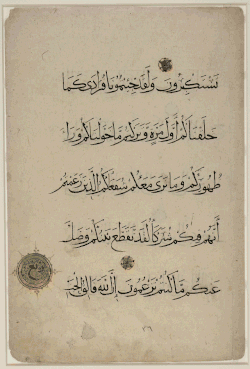 Muhaqqaq script, 14th–15th centuries

.jpg)


Printing[edit | edit source]

Wood-block printing of extracts from the Quran is on record as early as the 10th century.[303]
Arabic movable type printing was ordered by Pope Julius II (r. 1503–1512) for distribution among Middle Eastern Christians.[304] The first complete Quran printed with movable type was produced in Venice in 1537–1538 for the Ottoman market by Paganino Paganini and Alessandro Paganini.[305][306] But this Quran was not used as it contained a large number of errors.[307] Two more editions include the Hinckelmann edition published by the pastor Abraham Hinckelmann in Hamburg in 1694,[308] and the edition by the Italian priest Ludovico Maracci in Padua in 1698 with Latin translation and commentary.[309]
Printed copies of the Quran during this period met with strong opposition from Muslim legal scholars: printing anything in Arabic was prohibited in the Ottoman empire between 1483 and 1726—initially, even on penalty of death.[310][301][311] The Ottoman ban on printing in Arabic script was lifted in 1726 for non-religious texts only upon the request of Ibrahim Muteferrika, who printed his first book in 1729. Except for books in Hebrew and European languages, which were unrestricted, very few books, and no religious texts, were printed in the Ottoman Empire for another century.[lower-alpha 28]
In 1786, Catherine the Great of Russia, sponsored a printing press for "Tatar and Turkish orthography" in Saint Petersburg, with one Mullah Osman Ismail responsible for producing the Arabic types. A Quran was printed with this press in 1787, reprinted in 1790 and 1793 in Saint Petersburg, and in 1803 in Kazan.[lower-alpha 29] The first edition printed in Iran appeared in Tehran (1828), a translation in Turkish was printed in Cairo in 1842, and the first officially sanctioned Ottoman edition was finally printed in Constantinople between 1875 and 1877 as a two-volume set, during the First Constitutional Era.[314][315]
Gustav Flügel published an edition of the Quran in 1834 in Leipzig, which remained authoritative in Europe for close to a century, until Cairo's Al-Azhar University published an edition of the Quran in 1924. This edition was the result of a long preparation, as it standardized Quranic orthography, and it remains the basis of later editions.[298]
Criticism[edit | edit source]
Regarding the claim of divine origin, critics[who?] refer to pre-existing sources, not only taken from the Bible, supposed to be older revelations of God, but also from heretic, Apocryphic and talmudic sources, such as the Syriac Infancy Gospel and Gospel of James.[citation needed] The Quran acknowledges that accusations of borrowing popular ancient fables were being made against Muhammad.[316]
Relationship with other literature[edit | edit source]
Some non-Muslim groups such as the Baháʼí Faith and Druze view the Quran as holy. In the Baháʼí Faith, the Quran is accepted as authentic revelation from God along with the revelations of the other world religions, Islam being viewed as a stage within the divine process of progressive revelation. Bahá'u'lláh, the Prophet-Founder of the Baháʼí Faith, wrote about the Quran.[317] Unitarian Universalists may also seek inspiration from the Quran. It has been suggested that the Quran has some narrative similarities to the Diatessaron, Protoevangelium of James, Infancy Gospel of Thomas, Gospel of Pseudo-Matthew and the Arabic Infancy Gospel.[318][319] One scholar has suggested that the Diatessaron, as a gospel harmony, may have led to the conception that the Christian Gospel is one text.[320]
Relationship with Jewish and Christian texts[edit | edit source]
.jpg)
The Quran attributes its relationship with former books (the Torah, or Tawrāh and the Gospel, or ʾInjīl) to their unique origin, saying all of them have been revealed by Allah,[322] through it asserts that Jews and Christians have corrupted it through falsification and alteration (Taḥrīf).[323][324]
According to Christoph Luxenberg (in The Syro-Aramaic Reading of the Koran) the Quran's language was similar to the Syriac language.[325] The Quran recounts stories of many of the people and events recounted in Jewish and Christian sacred books (Tanakh, Bible) and devotional literature (Apocrypha, Midrash), although it differs in many details. Adam, Enoch, Noah, Eber, Shelah, Abraham, Lot, Ishmael, Isaac, Jacob, Joseph, Job, Jethro, David, Solomon, Elijah, Elisha, Jonah, Aaron, Moses, Zechariah, John the Baptist and Jesus are mentioned in the Quran as prophets of God (see Prophets of Islam). In fact, Moses is mentioned more in the Quran than any other individual.[132] Jesus is mentioned more often in the Quran than Muhammad (by name—Muhammad is often alluded to as "The Prophet" or "The Apostle"), while Mary is mentioned in the Quran more than in the New Testament.[326]
Relationship with Arab writing[edit | edit source]
After the Quran, and the general rise of Islam, the Arabic alphabet developed rapidly into an art form.[65] The Arabic grammarian Sibawayh wrote one of the earliest books on Arabic grammar, referred to as "Al-Kitab", which relied heavily on the language in the Quran. Wadad Kadi, Professor of Near Eastern Languages and Civilizations at University of Chicago, and Mustansir Mir, Professor of Islamic studies at Youngstown State University, state that the Quran exerted a particular influence on Arabic literature's diction, themes, metaphors, motifs and symbols and added new expressions and new meanings to old, pre-Islamic words that would become ubiquitous.[327]
See also[edit | edit source]
- List of chapters in the Quran
- List of translations of the Quran
- Quran translations
- Historical reliability of the Quran
- Quran and miracles
- Quran code
- Criticism of the Quran
- Violence in the Quran
- Women in the Quran
- Digital Quran
- The True Furqan
- Qira'at
- Hadith
- Hadith al-Thaqalayn
- Islamic schools and branches
- Schools of Islamic theology
- Attempted imitations of the Quran
Notes[edit | edit source]
- ↑ /kʊˈrɑːn/, kuurr-AHN; the English pronunciation varies: /kəˈrɑːn/, /-ˈræn/, /kɔː-/, /koʊ-/;[1] especially with the spelling quran /kʊˈrɑːn/, /-ˈræn/;[2] including British English /kɒˈrɑːn/.[3][4]
- ↑ Quranic Arabic: {{safesubst:ifsubst|1=|2= }الۡقُرۡءَان</ span> , al-Qurʾān
- ↑ Arabic pronunciation: [alqurˈʔaːn]. The Arabic pronunciation can be transcribed phonemically as /al.qurˈʔaːn/. The actual pronunciation in Literary Arabic varies regionally. The first vowel varies from [o] to [ʊ], while the second vowel varies from [æ] to [a] to [ɑ]. For example, the pronunciation in Egypt is [qorˈʔɑːn] and in Central East Arabia [qʊrˈʔæːn].
- ↑ (English spelling) The form Alcoran (and its variants) was usual before the 19th century when it became obsolete.[5][6] The form Koran was most predominant from the second half of the 18th century until the 1980s, when it has been superseded by either Qur'an or Quran.[6][7][8][9] Other transliterations include al-Coran, Coran, Kuran and al-Qur'an. The adjectives vary as well and include Koranic, Quranic and Qur'anic (sometimes in lowercase).[10]
- ↑ The absence of direct quotations in the Qurʾān of Jewish and Christian scriptures and texts is presented as the basic sign of orally transmitted Biblical knowledge. Accordingly, it is stated that “‘the author’ of the Qurʾān would have heard only descriptions or paraphrases of such texts rendered into Arabic orally, most likely from some form of the Semitic language known as Aramaic.”[14]
- ↑ According to Welch in the Encyclopedia of Islam, the verses pertaining to the usage of the word hikma should probably be interpreted in the light of IV, 105, where it is said that "Muhammad is to judge (tahkum) mankind on the basis of the Book sent down to him."
- ↑ Hadith are primarily from Muhammad but some are from those closest to him. Muslim scholars have worked carefully to authenticate them; see Hadith studies#Evaluating authenticity.
- ↑ "God's Apostle replied, 'Sometimes it is (revealed) like the ringing of a bell, this form of Inspiration is the hardest of all and then this state passes off after I have grasped what is inspired. Sometimes the Angel comes in the form of a man and talks to me and I grasp whatever he says.' ʻAisha added: Verily I saw the Prophet being inspired Divinely on a very cold day and noticed the Sweat dropping from his forehead (as the Inspiration was over)."[33]
- ↑ "Few have failed to be convinced that … the Quran is … the words of Muhammad, perhaps even dictated by him after their recitation."[56] There is some disagreement among early Muslim sources disagree over who was the first to collect the narrations. At least one source credits Salim, the freed slave of Abu Hudhaifah with collecting the Quran into a mushaf:
"It is reported... from Ibn Buraidah who said:
The first of those to collect the Qur'an into a mushaf (codex) was Salim, the freed slave of Abu Hudhaifah.[57]
- ↑ For both the claim that variant readings are still transmitted and the claim that no such critical edition has been produced, see Gilliot, C., "Creation of a fixed text"[77]
- ↑ Arabic and Persian writers such as 10th-century geographer al-Muqaddasi,[87] 11th-century scholar Nasir Khusraw,[87] 12th-century geographer al-Idrisi[88] and 15th-century Islamic scholar Mujir al-Din,[89] as well as 19th-century North American and British Orientalist scholars such as Edward Robinson, Guy Le Strange, and Edward Henry Palmer explained that the term Masjid al-Aqsa refers to the entire esplanade plaza also known as the Temple Mount or Haram al-Sharif ('Noble Sanctuary')—i.e., the entire area including the Dome of the Rock, the fountains, the gates, and the four minarets—because none of these buildings existed at the time when the Quran was written.[90][91]
- ↑ While "masjid" may simply be used as a place of worship, meaning a place of prostration traditionally used for worship, it may also refer to the buildings where these acts took place. In this case, the relevant verses could be dated after the construction of these buildings. Another verse alluding to Muhammad's Miraj story can be used to conclude that these two mosques are not that far apart. In this regard, one can consider the conclusions of scholars who point to Al-Aqsa being near Mecca —in the Al-Ji'rana region—[92] or, conversely, the Revisionist school of Islamic studies, which suggests that the birth of Islam occurred in northwestern Arabia.
- ↑ Tajalli (Arabic: تَجَلِّي, romanized: tajallī, lit. 'manifestation') is the appearance and disclosure of God as truth in Sufism.[116] Tajalli is believed to be a process by which God manifests himself in concrete forms.[117]
- ↑ Human qualities which are attributed to Allah in the Quran such as coming, going, sitting, satisfaction, anger and sadness; "Allah has equipped them with words to bring them closer to our minds; in this respect, they are like proverbs that are used to create a picture in the mind and thus help the listener to clearly understand the idea he wants to express."[118][119]
- ↑ My mother, the high priestess, conceived; in secret she bore me, She set me in a basket of rushes, with bitumen she sealed my lid, She cast me into the river which rose over me.[128]
- ↑ 16.0 16.1 Beyza Bilgin states that the expression 'let them put their outer coverings over themselves' in the 59th verse of Al-Ahzab was revealed because they harassed women under the conditions of that day, considering them to be concubines, and commented as follows:[154]
She said the following about covering herself in prayer:In other words, veiling is a security issue that arose according to the needs of that period. These are not taken into consideration at all and are reflected as God's command. Women have been called God's command for a thousand years. Women said the same thing to their daughters and daughters-in-law.
They tell me; 'Do you cover yourself while praying?' Of course, I cover up when I'm in congregation. I am obliged not to disturb the peace. But I also pray with my head uncovered in my own home. Because the Quran's requirement for prayer is not covering up, but ablution and turning towards the qibla. This is a thousand year old issue. It's so ingrained in us. But this should definitely not be underestimated. Because people do it thinking it is God's command. But on the other hand, we should not declare a person who does not cover up as a bad woman.[154]
- ↑ A verse that demonstrates that the Quran is not overly concerned with form is found in Surah Al-A'raf-26; "O Children of Adam! We have bestowed upon you a garment to cover your shame and adornment. But the garment of taqwa is the best of all. That is one of the signs of Allah, so that they may remember."
- ↑ Sunnah originally meant a tradition that did not contain the definition of good and bad. Later, "good traditions" began to be referred to as sunnah and the concept of "Muhammad's sunnah" was established.[155]
- ↑ "The Caliphate in Baghdad at the beginning of the 10th Century had 7,000 black eunuchs and 4,000 white eunuchs in his palace."[165] The Arab slave trade typically dealt in the sale of castrated male slaves. Black boys at the age of eight to twelve had their penises and scrota completely amputated. Reportedly, about two out of three boys died, but those who survived drew high prices.[166]
- ↑ In Shiite jurisprudence, it is unlawful for a master of a female slave to grant a third party the use of her for sexual relations. The Shiite scholar Shaykh al-Tusi stated: ولا يجوز إعارتها للاستمتاع بها لأن البضع لا يستباح بالإعارة "It is not permissible to loan (the slave girl) for enjoyment purpose, because sexual intercourse cannot be legitimate through loaning"[167] and the Shiite scholars al-Muhaqiq al-Kurki, Allamah Al-Hilli and Ali Asghar Merwarid made the following ruling: ولا تجوز استعارة الجواري للاستمتاع "It is not permissible to loan the slave girl for the purpose of sexual intercourse"[168]
- ↑ Qira’at: All except for ʻAsem, Al-Kesa’i, Yaʻqub and Khalaf in one of his narrations read it as 4 King of the Day of Judgement.
- ↑ Scholars disagree on the exact number but this is a disagreement over "the placing of the divisions between the verese, not on the text itself."[186]
- ↑ "The final process of collection and codification of the Quran text was guided by one over-arching principle: God's words must not in any way be distorted or sullied by human intervention. For this reason, no serious attempt, apparently, was made to edit the numerous revelations, organize them into thematic units, or present them in chronological order... This has given rise in the past to a great deal of criticism by European and American scholars of Islam, who find the Quran disorganized, repetitive and very difficult to read."[208] Samuel Pepys: "One feels it difficult to see how any mortal ever could consider this Quran as a Book written in Heaven, too good for the Earth; as a well-written book, or indeed as a book at all; and not a bewildered rhapsody; written, so far as writing goes, as badly as almost any book ever was!"[209]
- ↑ Mehmet Özdemir (prof.dr.) regarding sirah draws attention to the almost non-existent number of miracles (dalāʾil al-nubuwwa) in the first records and the hundreds of additions made in later periods.[222]
- ↑ Algerian Mohammed Arkoun, Professor Emeritus of Islamic Thought at the University of Paris .[243]
- ↑ "Let them draw their veils over their chests" (surah-24:31) In Luxenberg's Syro-Aramaic Reading of the Koran, the verse instead commands women to "snap their belts around their waists." The belt was a sign of chastity in the Christian world.[274] According to him, the meanings of the words in the relevant part of the verse are as follows:خِمار Khimar; cummerbund, جيب jyb; sinus, sac, وَلْيَضْرِبْنَ;"let them hit"
- ↑ Qira’at: All except for ʻAsem, Al-Kesa’i, Yaʻqub and Khalaf in one of his narrations read [māliki yawmi-d-dīn(i)] as 4 King of the Day of Judgement.
- ↑ "the major Ottoman printing houses published a combined total of only 142 books in more than a century of printing between 1727 and 1838. When taken in conjunction with the fact that only a minuscule number of copies of each book were printed, this statistic demonstrates that the introduction of the printing press did not transform Ottoman cultural life until the emergence of vibrant print media in the middle of the nineteenth century"[312]
- ↑ "at imperial expense, a 'Tatar and Turkish Typography' was established in St. Petersburg; a domestic scholar, Mullah Osman Ismail, was responsible for the manufacture of the types. One of the first products of this printing house was the Qur'ān. Through the doctor and writer, Johann Georg v. Zimmermann (d. 1795), who was befriended by Catherine II, a copy of the publication arrived in the Göttingen University library. Its director, the philologist Christian Gottlob Heyne (d. 1812), presented the work immediately in the Göttingische Anzeigen von gelehrten Sachen (28 July 1788); therein he pointed especially to the beauty of the Arabic types. To the Arabic text marginal glosses have been added that consist predominantly of reading variants. The imprint was reproduced unchanged in 1790 and 1793 in St. Petersburg (cf. Schnurrer, Bibliotheca arabica, no. 384); later, after the transfer of the printing house to Kazan, editions appeared in different formats and with varying presentation[313]
References[edit | edit source]
Citations[edit | edit source]
- ↑ dictionary.reference.com: koran
- ↑ dictionary.reference.com: quran
- ↑ Cambridge dictionary: koran
- ↑ Cambridge dictionary: quran
- ↑ "Alcoran". Oxford English Dictionary. Vol. 1 (1st ed.). Oxford University Press. 1888. p. 210.
- ↑ 6.0 6.1 "Google Books Ngram Viewer". Google Books. Retrieved 16 February 2021.
- ↑ "Koran". Oxford English Dictionary. Vol. 5 (1st ed.). Oxford University Press. 1901. p. 753.
- ↑ "Koran". Oxford English Dictionary (Online ed.). Oxford University Press. Template:OEDsub
- ↑ "Quran". Oxford English Dictionary (Online ed.). Oxford University Press. Template:OEDsub
- ↑ Template:MerriamWebsterDictionary
- ↑ Guillaume, Alfred (1954). Islam. Edinburgh: Penguin books. p. 74.
It may be affirmed that within the literature of the Arabs, wide and fecund as it is both in poetry and in elevated prose, there is nothing to compare with it.
- ↑ 12.0 12.1 Toropov, Brandon; Buckles, Luke (2004). Complete Idiot's Guide to World Religions. Alpha. p. 126. ISBN 978-1-59257-222-9.
Muslims believe that Muhammad's many divine encounters during his years in Mecca and Medina inspired the remainder of the Qur'an, which, nearly fourteen centuries later, remains the Arabic language's preeminent masterpiece.
- ↑ 13.0 13.1 13.2 Esposito, John (2010). Islam: The Straight Path (4th ed.). Oxford University Press. p. 21. ISBN 978-0-19-539600-3.
Throughout history, many Arab Christians as well have regarded it as the perfection of the Arabic language and literature.
- ↑ https://dergipark.org.tr/en/download/article-file/2323473
- ↑ "Ramadan | Islam, Fasting, Timing, Traditions, Rules, Meanings, Iftar, & Eid al-Fitr | Britannica". Encyclopedia Britannica. Archived from the original on 12 February 2026. Retrieved 22 February 2026.
- ↑ Wheeler, Brannon M. (2002). Prophets in the Quran: An Introduction to the Quran and Muslim Exegesis. A&C Black. p. 2. ISBN 978-0-8264-4957-3.
- ↑ "The Comprehensive Aramaic Lexicon". Hebrew Union College – Jewish Institute of Religion. Archived from the original on 18 October 2017. Retrieved 31 August 2013.
- ↑ 18.00 18.01 18.02 18.03 18.04 18.05 18.06 18.07 18.08 18.09 18.10 18.11 18.12 18.13 18.14 Nasr 2007
- ↑ Template:Qref
- ↑ Template:Qref
- ↑ See "Ķur'an, al-", Encyclopedia of Islam Online and Template:Qref
- ↑ Template:Qref cf.
- ↑ Template:Qref cf.
- ↑ Jaffer, Abbas; Jaffer, Masuma (2009). Quranic Sciences. ICAS press. pp. 11–15. ISBN 978-1-904063-30-8.
- ↑ Template:Qref
- ↑ Sandıkcı, Özlem; Rice, Gillian (2011). Handbook of Islamic Marketing. Edward Elgar. p. 38. ISBN 978-1-84980-013-6.
- ↑ 27.0 27.1 Fisher, Mary Pat (1997). Living Religions: An Encyclopaedia of the World's Faiths (Rev. ed.). London: I. B. Tauris Publishers. p. 338.
- ↑ Template:Qref
- ↑ Tabatabae 1988, p. 98
- ↑ 30.0 30.1 30.2 30.3 30.4 30.5 30.6 Richard Bell (Revised and Enlarged by W. Montgomery Watt) (1970). Bell's introduction to the Qur'an. Univ. Press. pp. 31–51. ISBN 978-0-85224-171-4.
- ↑ 31.0 31.1 P.M. Holt, Ann K.S. Lambton and Bernard Lewis (1970). The Cambridge history of Islam (Reprint. ed.). Cambridge Univ. Press. p. 32. ISBN 978-0-521-29135-4.
- ↑ Denffer, Ahmad von (1985). Ulum al-Qur'an: an introduction to the sciences of the Qur an (Repr. ed.). Islamic Foundation. p. 37. ISBN 978-0-86037-132-8.
- ↑ "Translation of Sahih Bukhari, Book 1". Center for Muslim-Jewish Engagement. University of Southern California. Archived from the original on 10 January 2012.
- ↑ Template:Qref
- ↑ Template:Qref
- ↑ Buhl, Fr. (2012) [1913–1936]. "Muhammad". In Houtsma, M. Th.; Arnold, T. W.; Basset, R.; Hartmann, R. (eds.). Encyclopedia of Islam (1 ed.). doi:10.1163/2214-871X_ei1_SIM_4746. ISBN 978-90-04-08265-6.
- ↑ Template:Qref
- ↑ Günther, Sebastian (2002). "Muhammad, the Illiterate Prophet: An Islamic Creed in the Quran and Quranic Exegesis". Journal of Quranic Studies. 4 (1): 1–26. doi:10.3366/jqs.2002.4.1.1. ISSN 1465-3591.
- ↑ "The Origins of the Variant Readings of the Qur'an". Yaqeen Institute for Islamic Research. Retrieved 15 August 2024.
- ↑ 40.0 40.1 40.2 Philips, Abu Ameenah Bilal (2006). Tafseer Soorah Al -Hujurat (New Revised Edition 2 ed.). International Islamic Publishing House. pp. 50–54. ISBN 9960-9677-0-0.
- ↑ 41.0 41.1 41.2 "Qira't and the 7 Ahruf: All You Need To Know". Arabian Tongue. 15 February 2023. Archived from the original on 15 August 2024. Retrieved 15 August 2024.
- ↑ 42.0 42.1 42.2 Academy, Ulum Al-Azhar (13 August 2024). "What Is Ahruf And Qirat? | A Full Guide - Ulum Al Azhar". Retrieved 15 August 2024.
- ↑ 43.0 43.1 43.2 "Background of 7 Ahruf (Dialects) of the Quran". Rizqan Kareem - Most Excellent Sustenance. Retrieved 15 August 2024.
- ↑ "معهد الفتح الإسلامي يرحب بكم". www.alfatihonline.com. Retrieved 15 August 2024.
- ↑ 45.0 45.1 45.2 Campo, Juan E. (2009). Encyclopedia of Islam. Facts On File. pp. 570–574. ISBN 978-0-8160-5454-1.
- ↑ 46.0 46.1 Donner, Fred (2006). "The historical context". In McAuliffe, Jane Dammen (ed.). The Cambridge Companion to the Qur'ān. Cambridge University Press. pp. 31–33.
- ↑ Roslan Abdul-Rahim (December 2017). "Demythologizing the Qur'an Rethinking Revelation Through Naskh al-Qur'an". Global Journal Al-Thaqafah. 7 (2): 62. doi:10.7187/GJAT122017-2. ISSN 2232-0474.
- ↑ "Wat is de Koran?". Koran.nl (in Nederlands). 18 February 2016.
- ↑ Cook 2000, p. 121.
- ↑ 50.0 50.1 50.2 Tabatabae 1988, p. 99:
Since the word of God seemed threatened with alteration, the [third] caliph ordered that five of the qurrā' from amongst the companions, (one of them being Zayd ibn Thābit who had compiled the first volume), produce other copies from the first volume which had been prepared on the orders of the first caliph and which had been kept with Ḥafṣah, the wife of the Prophet and daughter of the second caliph.
The other copies, already in the hands of Muslims in other areas, were collected and sent to Medina where, on orders of the Caliph, they were burnt (or, according to some historians, were destroyed by boiling). Thus several copies were made, one being kept in Medina, one in Mecca, and one each sent to Sham (a territory now divided into Syria, Lebanon, Palestine and Jordan), Kufa and Basra.
It is said that beside these five, one copy was also sent to Yemen and one to Bahrein. These copies were called the Imam copies and served as original for all future copies. The only difference of order between these copies and the first volume was that the chapters "Spirits of War" and "Immunity" were written in one place between "The Heights" and "Jonah."
- ↑ al-Bukhari, Muhammad. "Sahih Bukhari, volume 6, book 61, narrations number 509 and 510". sahih-bukhari.com. Retrieved 16 February 2018.
- ↑ Cook 2000, p. 117.
- ↑ 53.0 53.1 Rippin 2006:
- "Poetry and Language", by Navid Kermani, pp. 107–20.
- For the history of compilation see "Introduction," by Tamara Sonn, pp. 5–6
- For eschatology, see "Discovering (final destination)", by Christopher Buck, p. 30.
- For literary structure, see "Language," by Mustansir Mir, p. 93.
- For writing and printing, see "Written Transmission", by François Déroche, pp. 172–87.
- For recitation, see "Recitation," by Anna M. Gade pp. 481–93
- ↑ Yusuff, Mohamad K. "Zayd ibn Thabit and the Glorious Qur'an".
- ↑ Cook 2000, pp. 117–124.
- ↑ Peters 1991, pp. 3–5
- ↑ John Gilchrist, Jam' Al-Qur'an. The Codification of the Qur'an Text A Comprehensive Study of the Original Collection of the Qur'an Text and the Early Surviving Qur'an Manuscripts, [MERCSA, Mondeor, 2110 Republic of South Africa, 1989], Chapter 1. "The Initial Collection of the Qur'an Text", citing as-Suyuti, Al-Itqan fii Ulum al-Qur'an, p. 135).
- ↑ "Noorullah Website - Is the Qur'an Corrupted? Shi'ites View". 27 October 2009. Archived from the original on 27 October 2009.
- ↑ Shirazi, Muhammad (2001). The Qur'an - When was it compiled?. London, UK: Fountain Books. pp. 5, 7.
- ↑ Shirazi, Muhammad (2008). The Shi'a and their Beliefs. London, UK: Fountain Books. p. 29.
- ↑ HADDADIAN ABDORREZA; MOADDAB SEYYED REZA. "A STUDY ON TRADITIONS OF DISTORTION IN AYYASHI EXEGESIS". Hadith Studies. 4 (8): 141–166.
- ↑ Ahmad ibn Muhammad al-Sayyari (2009). Kohlberg, Etan; Amir-Moezzi, Mohammad Ali (eds.). "Revelation and Falsification: The Kitab al-qira'at of Ahmad b. Muhammad al-Sayyari: Critical Edition with an Introduction and Notes by Etan Kohlberg and Mohammad Ali Amir-Moezzi". Texts and Studies on the Qurʼān. 4. BRILL: vii. ISSN 1567-2808.
- ↑ Kohlberg & Amir-Moezzi 2009, p. 24-26-27
- ↑ Kohlberg & Amir-Moezzi 2009, pp.20, 24
- ↑ 65.0 65.1 65.2 Leaman, Oliver, ed. (2006). The Qur'an: an Encyclopedia. New York: Routledge. ISBN 978-0-415-32639-1.
- For God in the Quran (Allah), see "Allah", by Zeki Saritoprak, pp. 33–40.
- For eschatology, see "Eschatology," by Zeki Saritoprak, pp. 194–99.
- For searching the Arabic text on the internet and writing, see "Cyberspace and the Qur'an", by Andrew Rippin, pp. 159–63.
- For calligraphy, see by "Calligraphy and the Qur'an" by Oliver Leaman, pp. 130–35.
- For translation, see "Translation and the Qur'an," by Afnan Fatani, pp. 657–69.
- For recitation, see "Art and the Qur'an" by Tamara Sonn, pp. 71–81; and "Reading", by Stefan Wild, pp. 532–35.
- ↑ Religions of the world Lewis M. Hopfe – 1979 "Some Muslims have suggested and practiced textual criticism of the Quran in a manner similar to that practiced by Christians and Jews on their bibles. No one has yet suggested the higher criticism of the Quran."
- ↑ Egypt's culture wars: politics and practice – Page 278 Samia Mehrez – 2008 Middle East report: Issues 218–222; Issues 224–225 Middle East Research & Information Project, JSTOR (Organization) – 2001 Shahine filed to divorce Abu Zayd from his wife, on the grounds that Abu Zayd's textual criticism of the Quran made him an apostate, and hence unfit to marry a Muslim. Abu Zayd and his wife eventually relocated to the Netherlands
- ↑ Donner, "Quran in Recent Scholarship", 2008: p.30
- ↑ 69.0 69.1 Patricia Crone, Michael Cook, and Gerd R. Puin as quoted in Toby Lester (January 1999). "What Is the Koran?". The Atlantic Monthly.
- ↑ THE HISTORY OF THE QUR’ANIC TEXT FROM REVELATION TO COMPILATION: A COMPARATIVE STUDY WITH THE OLD AND NEW TESTAMENTS Archived 2022-04-27 at the Wayback Machine by Muhammad Mustafa Al-A’zami, Leicester: UK, page 12; Al-A’zami quotes a letter that was published in the Yemeni newspaper ath-Thawra, 11 March 1999
- ↑ Querying the Koran Archived 2022-04-08 at the Wayback Machine, by Abul Taher, The Guardian, 8 August 2000
- ↑ Quranic Studies: Sources and Methods of Scriptural Interpretation (1977) and The Sectarian Milieu: Content and Composition of Islamic Salvation History (1978) by Wansbrough.
- ↑ http://www.derafsh-kaviyani.com/english/quran3.html Archived 2017-09-05 at the Wayback Machine (Discusses Wansbrough)
- ↑ Donner, Fred M. (2014). "Review: Textual Criticism and Qurʾān Manuscripts, by Keith E. Small". Journal of Near Eastern Studies. 73 (1): 166–169. doi:10.1086/674909.
- ↑ 75.0 75.1 Melchert, Christopher (2000). "Ibn Mujahid and the Establishment of Seven Qur'anic Readings". Studia Islamica (91): 5–22. doi:10.2307/1596266. JSTOR 1596266.
- ↑ Ibn Warraq, Which Koran? Variants, Manuscript, Linguistics, p. 45. Prometheus Books, 2011. ISBN 1-59102-430-7
- ↑ Gilliot, C. (2006). "Creation of a fixed text". In McAuliffe, Jane Dammen (ed.). The Cambridge Companion to the Qur'ān. Cambridge University Press. p. 52.
- ↑ "'The Qur'an: Text, Interpretation and Translation' Third Biannual SOAS Conference, 16–17 October 2003". Journal of Qur'anic Studies. 6 (1): 143–145. April 2004. doi:10.3366/jqs.2004.6.1.143.
- ↑ Bergmann, Uwe; Sadeghi, Behnam (September 2010). "The Codex of a Companion of the Prophet and the Qurān of the Prophet". Arabica. 57 (4): 343–436. doi:10.1163/157005810X504518.
- ↑ Sadeghi, Behnam; Goudarzi, Mohsen (March 2012). "Ṣan'ā' 1 and the Origins of the Qur'ān". Der Islam. 87 (1–2): 1–129. doi:10.1515/islam-2011-0025. S2CID 164120434.
- ↑ 81.0 81.1 Lester, Toby (1 January 1999). "What Is the Koran?". The Atlantic. Washington, D.C. ISSN 2151-9463. OCLC 936540106. Archived from the original on 25 August 2012. Retrieved 16 May 2022.
- ↑ "An Inscription Mentioning the Rebuilding of Al-Masjid Al-Haram, 78 AH / 697-698 CE".
- ↑ Jeffrey 1952, pp. 99–120.
- ↑ Robinson 1996, p. 56.
- ↑ John Wansbrough argued that ḥadīth literature is exegetical in origin, i.e., the bulk of the tradition literature is closely tied to the interpretation of the Qur'an, which he believed did not take its final form/canonised until the late eighth / early ninth century.https://www.islamic-awareness.org/history/islam/inscriptions/earlysaw
- ↑ "When the Quraish disbelieved me (concerning my night journey), I stood up in Al- Hijr (the unroofed portion of the Ka`ba) and Allah displayed Bait-ul-Maqdis before me, and I started to inform them (Quraish) about its signs while looking at it." .https://sunnah.com/search?q=4710
- ↑ 87.0 87.1 Le Strange, Guy (1890). Palestine Under the Moslems: A Description of Syria and the Holy Land from A.D. 650 to 1500. Translated from the Works of the Medieval Arab Geographers. Houghton, Mifflin. p. 96. Archived from the original on 19 July 2023. Retrieved 31 July 2022.
Great confusion is introduced into the Arab descriptions of the Noble Sanctuary by the indiscriminate use of the terms Al Masjid or Al Masjid al Akså, Jami' or Jami al Aksâ; and nothing but an intimate acquaintance with the locality described will prevent a translator, ever and again, misunderstanding the text he has before him-since the native authorities use the technical terms in an extraordinarily inexact manner, often confounding the whole, and its part, under the single denomination of "Masjid." Further, the usage of various writers differs considerably on these points : Mukaddasi invariably speaks of the whole Haram Area as Al Masjid, or as Al Masjid al Aksî, "the Akså Mosque," or "the mosque," while the Main-building of the mosque, at the south end of the Haram Area, which we generally term the Aksa, he refers to as Al Mughattâ, "the Covered-part." Thus he writes "the mosque is entered by thirteen gates," meaning the gates of the Haram Area. So also "on the right of the court," means along the west wall of the Haram Area; "on the left side" means the east wall; and "at the back" denotes the northern boundary wall of the Haram Area. Nasir-i-Khusrau, who wrote in Persian, uses for the Main-building of the Aksâ Mosque the Persian word Pushish, that is, "Covered part," which exactly translates the Arabic Al Mughatta. On some occasions, however, the Akså Mosque (as we call it) is spoken of by Näsir as the Maksurah, a term used especially to denote the railed-off oratory of the Sultan, facing the Mihrâb, and hence in an extended sense applied to the building which includes the same. The great Court of the Haram Area, Nâsir always speaks of as the Masjid, or the Masjid al Akså, or again as the Friday Mosque (Masjid-i-Jum'ah).
- ↑ Idrīsī, Muhammad; Jaubert, Pierre Amédée (1836). Géographie d'Édrisi (in français). à l'Imprimerie royale. pp. 343–344. Archived from the original on 19 July 2023. Retrieved 31 July 2022.
Sous la domination musulmane il fut agrandi, et c'est (aujourd'hui) la grande mosquée connue par les Musulmans sous le nom de Mesdjid el-Acsa مسجد الأقصى. Il n'en existe pas au monde qui l'égale en grandeur, si l'on en excepte toutefois la grande mosquée de Cordoue en Andalousie; car, d'après ce qu'on rapporte, le toit de cette mosquée est plus grand que celui de la Mesdjid el-Acsa. Au surplus, l'aire de cette dernière forme un parallelogramme dont la hauteur est de deux cents brasses (ba'a), et le base de cents quatre-vingts. La moitié de cet espace, celle qui est voisin du Mihrab, est couverte d'un toit (ou plutôt d'un dôme) en pierres soutenu par plusieurs rangs de colonnes; l'autre est à ciel ouvert. Au centre de l'édifice est un grand dôme connu sous le nom de Dôme de la roche; il fut orné d'arabesques en or et d'autres beaux ouvrages, par les soins de divers califes musulmans. Le dôme est percé de quatre portes; en face de celle qui est à l'occident, on voit l'autel sur lequel les enfants d'Israël offraient leurs sacrifices; auprès de la porte orientale est l'église nommée le saint des saints, d'une construction élégante; au midi est une chapelle qui était à l'usage des Musulmans; mais les chrétiens s'en sont emparés de vive force et elle est restée en leur pouvoir jusqu'à l'époque de la composition du présent ouvrage. Ils ont converti cette chapelle en un couvent où résident des religieux de l'ordre des templiers, c'est-à-dire des serviteurs de la maison de Dieu.
Also at Williams, G.; Willis, R. (1849). "Account of Jerusalem during the Frank Occupation, extracted from the Universal Geography of Edrisi. Climate III. sect. 5. Translated by P. Amédée Jaubert. Tome 1. pp. 341—345.". The Holy City: Historical, Topographical, and Antiquarian Notices of Jerusalem. J.W. Parker. Archived from the original on 19 July 2023. Retrieved 31 July 2022. - ↑ Mustafa Abu Sway (Fall 2000). "The Holy Land, Jerusalem and Al-Aqsa Mosque in the Islamic Sources". Journal of the Central Conference of American Rabbis: 60–68. Archived from the original on 29 May 2022. Retrieved 29 May 2022.
Quoting Mujir al-Din: "Verily, 'Al-Aqsa' is a name for the whole mosque which is surrounded by the wall, the length and width of which are mentioned here, for the building that exists in the southern part of the Mosque, and the other ones such as the Dome of the Rock and the corridors and other [buildings] are novel"
- ↑ Le Strange, Guy (1890). Palestine Under the Moslems: A Description of Syria and the Holy Land from A.D. 650 to 1500. Translated from the Works of the Medieval Arab Geographers. Houghton, Mifflin. Archived from the original on 19 July 2023. Retrieved 29 May 2022.
THE AKSÀ MOSQUE. The great mosque of Jerusalem, Al Masjid al Aksà, the "Further Mosque," derives its name from the traditional Night Journey of Muhammad, to which allusion is made in the words of the Kuran (xvii. I)... the term "Mosque" being here taken to denote the whole area of the Noble Sanctuary, and not the Main-building of the Aksà only, which, in the Prophet's days, did not exist.
- ↑ Strange, Guy le (1887). "Description of the Noble Sanctuary at Jerusalem in 1470 A.D., by Kamâl (or Shams) ad Dîn as Suyûtî". Journal of the Royal Asiatic Society of Great Britain and Ireland. 19 (2). Royal Asiatic Society of Great Britain and Ireland: 247–305. doi:10.1017/S0035869X00019420. ISSN 0035-869X. JSTOR 25208864. S2CID 163050043.
…the term Masjid (whence, through the Spanish Mezquita, our word Mosque) denotes the whole of the sacred edifice, comprising the main building and the court, with its lateral arcades and minor chapels. The earliest specimen of the Arab mosque consisted of an open courtyard, within which, round its four walls, run colonades or cloisters to give shelter to the worshippers. On the side of the court towards the Kiblah (in the direction of Mekka), and facing which the worshipper must stand, the colonade, instead of being single, is, for the convenience of the increased numbers of the congregation, widened out to form the Jami' or place of assembly… coming now to the Noble Sanctuary at Jerusalem, we must remember that the term 'Masjid' belongs not only to the Aksa mosque (more properly the Jami' or place of assembly for prayer), but to the whole enclosure with the Dome of the Rock in the middle, and all the other minor domes and chapels.
- ↑ Grabar, Oleg (1959). "The Umayyad Dome of the Rock in Jerusalem". Ars Orientalis. 3: 33–62. ISSN 0571-1371. JSTOR 4629098.
- ↑ 93.0 93.1 Saeed, Abdullah (2008). The Qurʼan: an introduction. London: Routledge. p. 62. ISBN 978-0-415-42124-9.
- ↑ Crone, Patricia (10 June 2008). "What do we actually know about Mohammed?". Open Democracy. Retrieved 3 October 2019.
- ↑ Vogel, Frank E. (2000). Islamic Law and the Legal System of Saudí: Studies of Saudi Arabia. Brill. pp. 4–5. ISBN 9004110623.
- ↑ "Surah Al-Isra – 7". Quran.com. Retrieved 10 July 2023.
- ↑ 1 Kings 11:1, 7–8
- ↑ Bietenholz, Peter G. (1994). Historia and fabula: myths and legends in historical thought from antiquity to the modern age. Brill. ISBN 978-9004100633.
- ↑ Watt 1960–2007: "It is generally agreed both by Muslim commentators and modéra [sic] occidental scholars that Dhu ’l-Ḳarnayn [...] is to be identified with Alexander the Great." Cook 2013: "[...] Dhū al-Qarnayn (usually identified with Alexander the Great) [...]".
- ↑ Hämeen-Anttila, Jaakko (17 April 2018). Khwadāynāmag The Middle Persian Book of Kings. BRILL. ISBN 978-90-04-27764-9.
Many Mediaeval scholars argued against the identification, though. Cf., e.g., the discussion in al-Maqrizi, Khabar §§212-232.
- ↑ Maqrīzī, Aḥmad Ibn-ʿAlī al-; Hämeen-Anttila, Jaakko (2018). Al-Maqrīzī's al-Ḫabar ʻan al-bašar: vol. V, section 4: Persia and its kings, part I. Bibliotheca Maqriziana Opera maiora. Leiden Boston: Brill. pp. 279–281. ISBN 978-90-04-35599-6.
- ↑ Zadeh, Travis (28 February 2017). Mapping Frontiers Across Medieval Islam: Geography, Translation and the 'Abbasid Empire. Bloomsbury Publishing. pp. 97–98. ISBN 978-1-78673-131-9.
In the early history of Islam there was a lively debate over the true identity of Dhū 'l-Qarnayn. One prominent identification was with an ancient South Arabian Ḥimyarī king, generally referred to in the sources as al-Ṣaʿb b. Dhī Marāthid. [...] Indeed the association of Dhū 'l-Qarnayn with the South Arabian ruler can be traced in many early Arabic sources.
- ↑ Fazeli, Hamidreza; Tali Tabasi, Marziyeh; Fazeli, Alireza; Fararooei, Shokrolla. "A Critical Study of the Quran's Theory of Mythology (A Case Study on Mohammad Arkoun's Perspectives)". Iraqi Open Access Journals. p. 2. Archived from the original on 17 February 2025. Retrieved 5 March 2024.
After examining the verses of the Quran to find where the word mythology has been used and seeking the accordance between the meaning and context with Quran's purpose of knowledge and guidance, including rules and educational issues, we found that the concept of myth is not acceptable in the Quran. The result of this study show that Quran is not a myth, rather the stories are factual and based on reality.
- ↑ In his Encyclopaedia of the Social Concepts of the Qur’ân he mentions that we should understand evil people like Namrud (the king who humiliated and imprisoned Abraham), Haman, Qarun and Pharaoh ‘not as historical figures, but as concepts about human beings. To give an example, Shariati expressed as his opinion that Qarun/Korah was a symbol for the economic elite, while Pharaoh was the ultimate symbol for a tyrant.https://dspace.library.uu.nl/bitstream/handle/1874/210507/doeka.pdf?sequence=2&isAllowed=y
- ↑ Celik, Ercan. "Quraish or Qorash (Q 106): From the perspectives of Qur'an and Bible".
- ↑ Template:Qref
- ↑ Saritoprak, Zeki (2006). "Allah". In Leaman, Oliver (ed.). The Qur'an: an Encyclopedia. New York: Routledge. pp. 33–40. ISBN 978-0-415-32639-1.
- ↑ D.B. Macdonald. Encyclopedia of Islam, 2nd ed, Brill. "Ilah", Vol. 3, p. 1093.
- ↑ F.E. Peters, Islam, p. 4, Princeton University Press, 2003
- ↑ Yuskaev, Timur R. (18 October 2017). Speaking Qur'an: An American Scripture. Univ of South Carolina Press. ISBN 978-1-61117-795-4.
Indeed, "Lord" is a direct translation of the Arabic word Rabb.
- ↑ 111.0 111.1 Denis Gril, Miracles, Encyclopedia of the Qur'an, Brill, 2007.
- ↑ Williams, W. Wesley, "A study of anthropomorphic theophany and Visio Dei in the Hebrew Bible, the Quran and early Sunni Islam", University of Michigan, March 2009
- ↑ 113.0 113.1 "bir söyleşide yaptığı ilgili açıklama". YouTube. 15 August 2016. Archived from the original on 5 December 2020. Retrieved 15 August 2016.
- ↑ Williams 2002.
- ↑ Cook 2024, p. 140–141.
- ↑ Knysh, Alexander D. (1 January 1999). Ibn 'Arabi in the Later Islamic Tradition: The Making of a Polemical Image in Medieval Islam. SUNY Press. ISBN 9780791439678.
- ↑ Izutsu, Toshihiko (1 January 1984). Sufism and Taoism: A Comparative Study of Key Philosophical Concepts. University of California Press. ISBN 9780520052642.
- ↑ Tabatabai, Allamah. "Al-Mizan Discourses". Tafsir Al-Mizan <!-– Allamah Muhammad Hussein Tabatabai -->. Archived from the original on 8 December 2008. Retrieved 16 February 2021.
- ↑ "The Qur'an Possesses Revelation and Exegesis". Allamah Tabatabaee. Islamic Ma'aref Foundation Institute. 1988. pp. 37–45. Archived from the original on 16 February 2012.
- ↑ Template:Qref
- ↑ Levenson 2012, p. 8.
- ↑ Peters 2003, p. 9.
- ↑ Levenson 2012, p. 200.
- ↑ Lings 2004.
- ↑ Template:Qref
- ↑ Glassé, Cyril (1991). "Abraham". Kaaba. The Concise Encyclopedia of Islam. HarperSanFrancisco, Suhail Academy. pp. 18–19. ISBN 0-0606-3126-0.
- ↑ "Moses". Oxford Biblical Studies Online.
- ↑ Finlay, Timothy D. (2005). The Birth Report Genre in the Hebrew Bible. Forschungen zum Alten Testament. Vol. 12. Mohr Siebeck. p. 236. ISBN 978-3-16-148745-3.
- ↑ Coogan, Michael David; Coogan, Michael D. (2001). The Oxford History of the Biblical World. Oxford University Press. ISBN 978-0-19-513937-2.
Many of these forms are not, and should not be considered, historically based; Moses' birth narrative, for example, is built on folkloric motifs found throughout the ancient world.
- ↑ Rendsburg, Gary A. (2006). "Moses as Equal to Pharaoh". In Beckman, Gary M.; Lewis, Theodore J. (eds.). Text, Artifact, and Image: Revealing Ancient Israelite Religion. Brown Judaic Studies. p. 204. ISBN 978-1-930675-28-5. Archived from the original on 1 January 2015.
- ↑ Ltd, Hymns Ancient Modern (May 1996). Third Way (magazine). p. 18.[better source needed]
- ↑ 132.0 132.1 Keeler, Annabel (2005). "Moses from a Muslim Perspective". In Solomon, Norman; Harries, Richard; Winter, Tim (eds.). Abraham's children: Jews, Christians and Muslims in conversation. T&T Clark. pp. 55–66. ISBN 978-0-567-08171-1. Archived from the original on 29 April 2016.
- ↑ Bennett 1998, pp. 18–19.
- ↑ Peters 1994, p. 261.
- ↑ 135.0 135.1 Watt, William Montgomery; Sinai, Nicolai (2024). "Muhammad". Encyclopædia Britannica. Retrieved 4 February 2023.
- ↑ Hagen, G. (2009). "From Haggadic Exegesis To Myth: Popular Stories Of The Prophets In Islam". In Sacred Tropes: Tanakh, New Testament, and Qur’an as Literature and Culture. Leiden, Niederlande: Brill. https://doi.org/10.1163/ej.9789004177529.i-536.65
- ↑ Izutsu, Toshihiko (6 June 2007) [2002]. Ethico-religious concepts in the Qur'an (Repr. ed.). McGill-Queen's University Press. p. 184. ISBN 978-0-7735-2427-9.
- ↑ Dalley defends traditional opinion: "The name or epithet of Atrahasis is used for the skillful god of craftmanship Kothar-wa-hasis in Ugaritic mythology, and is abbreviated to Chousor in the Greek account of Syrian origins related by Philo of Byblos. A similar abbreviation is used in the name of the Islamic sage Al-khidr..." Stephanie Dalley, Myths from Mesopotamia: Creation, The Flood, Gilgamesh, and Others, Oxford, revised edition 2000, p. 2 ISBN 0-19-283589-0
- ↑ "Myths from Mesopotamia – Creation, the Flood, Gilgamesh, and Others" (PDF). Archived from the original (PDF) on 5 September 2014. Retrieved 25 August 2014.
- ↑ Cole, Juan (2021). "Dyed in Virtue: The Qur'ān and Plato's Republic". Greek, Roman, and Byzantine Studies. 61: 582.
- ↑ Kassis, Riad Aziz (1999). The Book of Proverbs and Arabic Proverbial Works. Brill. p. 51. ISBN 978-90-04-11305-3.
- ↑ "Welcome to Encyclopaedia Iranica".
- ↑ T. Izutsu, Ethico-Religious Concepts in the Qur’an, London, McGillQueen’s University Press, 2002, p. 213
- ↑ 144.0 144.1 Esack, Farid (2003). Martin, Richard C. (ed.). Encyclopedia of Islam and the Muslim world (Online-Ausg. ed.). Macmillan Reference. pp. 568–562. ISBN 978-0-02-865603-8.
- ↑ 145.0 145.1 Sonn, Tamara (2010). Islam: a brief history (Second ed.). Wiley-Blackwell. ISBN 978-1-4051-8093-1.
- ↑ Template:Qref
- ↑ Zum Beispiel Sayyid Ahmad Khan. Vgl. Ahmad: Islamic Modernism in India and Pakistan 1857–1964. 1967, S. 49.
- ↑ "Ek 15 – Dini Görevler: Tanrı'dan Bir Armağan". Teslimolanlar. Archived from the original on 5 November 2021. Retrieved 30 May 2021.
- ↑ Vgl. Birışık: "Kurʾâniyyûn" in Türkiye Diyanet Vakfı İslâm Ansiklopedisi. 2002, Bd. 26, S. 429.; Yüksel; al-Shaiban; Schulte-Nafeh: Quran: A Reformist Translation. 2007, S. 507.
- ↑ "10. How Can we Observe the Sala Prayers by Following the Quran Alone? - Edip-Layth - quranix.org". quranix.org. Retrieved 14 August 2023.
- ↑ Elizabeth M. Bucar (2011). Creative Conformity: The Feminist Politics of U.S. Catholic and Iranian Shi'i Women. Georgetown University Press. p. 118. ISBN 9781589017528.
- ↑ Hameed, Shahul (9 October 2003). "Is Hijab a Qur'anic Commandment?". Archived from the original on 4 April 2023. Retrieved 1 June 2023.
- ↑ Nomani, Asra Q.; Arafa, Hala (21 December 2015). "Opinion: As Muslim women, we actually ask you not to wear the hijab in the name of interfaith solidarity". Washington Post. Retrieved 22 December 2022.
- ↑ 154.0 154.1 ""Örtünmek Allah'ın emri değil"" (in Turkish). haberturk.com. 28 May 2008. Archived from the original on 20 December 2016. Retrieved 7 February 2017.
{{cite web}}: CS1 maint: unrecognized language (link) - ↑ Juynboll, G. H. A. (1997). "Sunna". In Bearman, P.; Bianquis, Th.; Bosworth, C. E.; van Donzel, E.; Heinrichs, W. P. (eds.). Encyclopaedia of Islam. Vol. 9 (2nd ed.). Brill. pp. 878–879.
- ↑ "Conflict and Conflict Resolution in the pre-Islamic Arab Society | SADIK KIRAZLI | download". Archived from the original on 29 January 2022. Retrieved 12 July 2024.
- ↑ Al-Jallad 2022, p. 41–44, 68.
- ↑ Dost 2023.
- ↑ "Conflict and Conflict Resolution in the pre-Islamic Arab Society | SADIK KIRAZLI | download". Archived from the original on 29 January 2022. Retrieved 31 January 2022.
- ↑ 160.0 160.1 Tahir Wasti. "The Application of Islamic Criminal Law in Practice" (PDF). ndl.ethernet.edu.et.
- ↑ "Surah Al-Baqarah – 282". Quran.com. Retrieved 16 December 2024.
- ↑ Powers, David S. (1993). "Islamic Inheritance System: A Socio-Historical Approach". Arab Law Quarterly. 8 (1): 13–29. doi:10.1163/157302593X00285. JSTOR 3381490.
- ↑ Peters, Rudolph (2006). Crime and Punishment in Islamic Law: Theory and Practice from the Sixteenth to the Twenty-First Century. Cambridge University Press. pp. 53–55. ISBN 978-0521796705.
- ↑ www
.alhakam .org /what-is-the-meaning-of-those-whom-your-right-hand-possesses-milk-al-yamin - ↑ Segal, Ronald (9 February 2002). Islam's Black Slaves: The Other Black Diaspora. Macmillan. ISBN 978-0374527976.
- ↑ Wilson, Jean D.; Roehrborn, Claus (1999). "Long-Term Consequences of Castration in Men: Lessons from the Skoptzy and the Eunuchs of the Chinese and Ottoman Courts". The Journal of Clinical Endocrinology & Metabolism. 84 (12): 4324–4331. doi:10.1210/jcem.84.12.6206. PMID 10599682.
- ↑ Shaykh al-Tusi stated in Al-Mabsut, Volume 3 page 57
- ↑ al-Muhaqiq al-Kurki in Jame'a al-Maqasid, Volume 6 page 62, Allamah al-Hilli in Al-Tadkira, Volume 2 page 210 and Ali Asghar Merwarid in Al-Yanabi al-Fiqhya, Volume 17 page 187
- ↑ Jonathan E. Brockopp (2000), Early Mālikī Law: Ibn ʻAbd Al-Ḥakam and His Major Compendium of Jurisprudence, Brill, ISBN 978-9004116283, p. 131
- ↑ Levy (1957) p. 77
- ↑ Levy 1957, p. 77.
- ↑ 3 Çarpıcı Örnek: Kurban, Kölelik ve Allah Tasavvuru at YouTube
- ↑ 173.0 173.1 Khasan, Moh (24 May 2021). "From Textuality to Universality: The Evolution of Ḥirābah Crimes in Islamic Jurisprudence". Al-Jami'ah: Journal of Islamic Studies. 59 (1): 1–32. doi:10.14421/ajis.2021.591.1-32. ISSN 2338-557X. Retrieved 16 November 2024.
- ↑ Vikør, Knut S. (2014). "Sharīʿah". In Emad El-Din Shahin (ed.). The Oxford Encyclopedia of Islam and Politics. Oxford University Press. Archived from the original on 4 June 2014.
- ↑ Mayer, Ann Elizabeth (2009). "Law. Modern Legal Reform". In John L. Esposito (ed.). The Oxford Encyclopedia of the Islamic World. Oxford: Oxford University Press. Archived from the original on 21 November 2008.
- ↑ Buck C (2006). "Discovering (final destination)". In Rippin A, et al. (eds.). The Blackwell Companion to the Qur'an (2a reimpr. ed.). Blackwell. p. 30. ISBN 978-1-4051-1752-4.
- ↑ Genesis 2:10–14.
- ↑ Haleem, Muhammad Abdel (2005). Understanding the Qur'an: themes and style. I.B. Tauris. p. 82. ISBN 978-1-86064-650-8.
- ↑ 179.0 179.1 Reeves, J. C. (2005). Trajectories in Near Eastern apocalyptic: a postrabbinic Jewish apocalypse reader (No. 45). Society of Biblical Lit. p. 109
- ↑ 180.0 180.1 180.2 180.3 Cook, (2002). Studies in Muslim apocalyptic, p. 269-306
- ↑ Farhang, Mehrvash (2017). "Dajjāl". In Madelung, Wilferd; Daftary, Farhad (eds.). Encyclopaedia Islamica. Translated by Negahban, Farzin. Leiden and Boston: Brill Publishers. doi:10.1163/1875-9831_isla_COM_035982. ISSN 1875-9823.
- ↑ Hamid, F.A. (2008). The Futuristic Thought of Ustaz Ashaari Muhammad of Malaysia, p. 209, in I. Abu-Rabi' (ed.) The Blackwell Companion to Contemporary Islamic Thought. Malden: Blackwell Publishing, pp.195–212
- ↑ Cook, David (2021) [2002]. Studies in Muslim Apocalyptic. Berlin and London: Gerlach Press. pp. 93–104. ISBN 9783959941211. OCLC 238821310.
- ↑ "Beware of˺ the Day the Shin ˹of Allah˺ will be bared, and the wicked will be asked to prostrate, but they will not be able to do so""Surah Al-Qalam - 1-52".
- ↑ Sahih al-Bukhari 7439 In-book reference: Book 97, Hadith 65 USC-MSA web (English) reference: Vol. 9, Book 93, Hadith 532 (deprecated numbering scheme)
- ↑ Cook 2000, p. 119.
- ↑ Dukes, Kais. "RE: Number of Unique Words in the Quran". The Mail Archive. Retrieved 29 October 2012.
- ↑ National Geographic, issue mysteries of history, September 2018, p. 45.
- ↑ Burrowes, Robert D. (2010). Historical Dictionary of Yemen. Rowman & Littlefield. p. 319. ISBN 978-0810855281.
- ↑ see Jamal Malik (6 April 2020). Islam in South Asia: Revised, Enlarged and Updated Second Edition. BRILL. p. 580. ISBN 978-90-04-42271-1.
- ↑ See:* "Kur`an, al-", Encyclopaedia of Islam Online
- ↑ Allen 2000, p. 53.
- ↑ مقطعات is the plural of a participle from قطع, 'to cut, break'.
- ↑ 194.0 194.1 Massey, Keith (2002). "Mysterious Letters". In McAuliffe, Jane Dammen (ed.). Encyclopedia of the Qurʾān. Vol. 3. Leiden: Brill. p. 472. doi:10.1163/1875-3922_q3_EQCOM_00128. ISBN 90-04-12354-7.
- ↑ Suyūtī, al-Durr al-manthūr, vol. 1, p. 57.
- ↑ Brown, Norman O. (1991). Apocalypse And/or Metamorphosis. University of California Press. p. 81. ISBN 0-520-07298-7.
- ↑ Rashad Khalifa, Quran: Visual Presentation of the Miracle, Islamic Productions International, 1982. ISBN 0-934894-30-2
- ↑ Marshall, Alison. "What on earth is a disconnected letter? - Baha[[:Template:Hamza]]u'llah's commentary on the disconnected letters". Retrieved 19 March 2007.
{{cite web}}: URL–wikilink conflict (help) - ↑ Luxenberg, Christoph (2009). The Syro-Aramaic Reading of the Koran: A Contribution to the Decoding of the Language of the Koran 1st Edition.
- ↑ Stewart, Devin J. (2008). "Notes on Medieval and Modern Emendations of the Qur'an". In Reynolds, Gabriel Said (ed.). The Quran in its Historical Context. Routledge. p. 234.
- ↑ Sedgwick, Mark (2004). Against the Modern World: Traditionalism and the Secret Intellectual History of the Twentieth Century. New York: Oxford University Press. ISBN 0-19-515297-2. P. 66.
- ↑ Islahi, Amin Ahsan (2004). Taddabur-i-Quran. Faraan Foundation. pp. 82–85.
- ↑ Khattab, Mustafa (2016). The Clear Quran: A Thematic English Translation (2nd ed.). Lombard, Illinois, USA: Book of Signs Foundation. p. xi. ISBN 978-0-9773009-6-9.
- ↑ Mir M (2006). "Language". In Rippin A, et al. (eds.). The Blackwell Companion to the Qur'an (2a reimpr. ed.). Blackwell. p. 93. ISBN 978-1-4051-1752-4.
- ↑ Rosenthal, Herman; Waldstein, A. S. "Körner, Moses B. Eliezer". Jewish Encyclopedia. Retrieved 15 August 2022.
- ↑ Daniel Brubaker is a textual critic of Quran manuscripts of the 7th-10th centuries A.D. He defended his doctoral dissertation titled “Intentional Changes in Qurʾan Manuscripts” at Rice University in Houston in 2014. He has continued his work postdoctorally. So far, he has analyzed approximately 10,000 early Quran manuscript folios, most in person, in institutions and libraries in Paris, St. Petersburg, Oxford, Cambridge, London, Dublin, Doha, Manchester, Manama, Kuwait, Tashkent, and elsewhere. https://www.danielbrubaker.com/about/
- ↑ Cook, The Koran, 2000: p.120
- ↑ Approaches to the Asian Classics, Irene Blomm, William Theodore De Bary, Columbia University Press, 1990, p. 65
- ↑ Peterson, Daniel C. (1990). "Editor's Introduction: By What Measure Shall We Mete?". FARMS Review of Books. The Neal A. Maxwell Institute for Religious Scholarship at BYU. Archived from the original on 4 March 2008. Retrieved 30 September 2013.
- ↑ Sells, Michael (1999), Approaching the Qur'ān, White Cloud Press
- ↑ Brown, Norman O (Winter 1983–1984). "The Apocalypse of Islam". Social Text. 3 (8). Duke University Press: 155–71. doi:10.2307/466329. JSTOR 466329.
- ↑ Bannister, "Retelling the Tale", 2014: p. 1-4
- ↑ Template:Qref
- ↑ Wild, Stefan, ed. (2006). Self-referentiality in the Qur'an. Wiesbaden: Harrassowitz. ISBN 978-3-447-05383-9.
- ↑ Leaman, Oliver, ed. (2006). The Qur'an: an encyclopedia. Routledge. ISBN 9780415326391
- ↑ Peters, F.E. (2003). The Words and Will of God. Princeton University Press. pp. 12–13. ISBN 978-0-691-11461-3.
- ↑ For example see comments by Arthur John Arberry: "to produce something which might be accepted as echoing however faintly the sublime rhetoric of the Arabic Koran, I have been at pains to study the intricate and richly varied rhythms which constitute the Koran's undeniable claim to rank amongst the greatest literary masterpieces of mankind Arberry, A.J (1955). The Koran: Interpreted. New York: Macmillan. pp. x; Karen Armstrong : "It is as though Muhammad had created an entirely new literary form that some people were not ready for but which thrilled others. Without this experience of the Koran, it is extremely unlikely that Islam would have taken root." Armstrong, K (1994). A History of God.p.78; Oliver Leaman: "the verses of the Qur'an represent its uniqueness and beauty not to mention its novelty and originality. That is why it has succeeded in convincing so many people of its truth. it imitates nothing and no one nor can it be imitated. Its style does not pall even after long periods of study and the text does not lose its freshness over time" Leaman, Oliver (2006). The Qur'an: an Encyclopedia.p.404 and similar views by Joseph Schacht (1974) The legacy of Islam, Henry Stubbe An account of the Rise and Progress of Mohammadanism (1911), Martin Zammit A Comparative Lexical Study of Qur'anic Arabic (2002), and Alfred Guillaume Islam (1990)
- ↑ 218.0 218.1 Vasalou, Sophia (2002). "The Miraculous Eloquence of the Qur'an: General Trajectories and Individual Approaches". Journal of Qur'anic Studies. 4 (2): 23–53. doi:10.3366/jqs.2002.4.2.23.
- ↑ "Well, Did Muhammad Not Copy Some Verses of the Qur'an from Imru'l Qais?".
- ↑ "Search Results - Search Results - moon split (page 1) - Sunnah.com - Sayings and Teachings of Prophet Muhammad (صلى الله عليه و سلم)". sunnah.com.
- ↑ Wensinck, A.J. "Muʿd̲j̲iza". Encyclopaedia of Islam. Edited by: P. Bearman, Th. Bianquis, C. E. Bosworth, E. van Donzel and W. P. Heinrichs. Brill, 2007.
- ↑ Özdemir, Mehmet, (2007). Siyer Yazıcılığı Üzerine, Milel ve Nihal, 4 (3), 129-162
- ↑ Arberry, Arthur. The Koran Interpreted. London. p. 191. ISBN 0-684-82507-4.
It may be affirmed that within the literature of the Arabs, wide and fecund as it is both in poetry and in elevated prose, there is nothing to compare with it.
[clarification needed] - ↑ Syukron, Ahmad; Khairiyah, Nikmatul (31 August 2024). "Chronology of the Qur'an According to Theodor Nöldeke and Sir William Muir (Analysis of the History of the Qur'an and Life of Mahomet)". Archived from the original on 30 August 2024. Retrieved 21 February 2024.
- ↑ 225.0 225.1 Siddiqui, M (2020). "Poetry, prophecy and the angelic voice: Reflections on the Divine Word" (PDF). Prophetic Witness and the Reimagining of the World: Poetry, Theology and Philosophy in Dialogue. 5: 61–74. doi:10.4324/9780367344092-6. Archived from the original (PDF) on 21 February 2024.
- ↑ FARRUGIA, MARISA (31 August 2024). "WAR AND PEACE IN PRE-ISLAMIC ARABIC POETRY" (PDF). Archived (PDF) from the original on 30 August 2024. Retrieved 21 February 2024.
- ↑ EL-AWAISI, Khalid (31 August 2024). "THE QURANIC PROPHECY OF THE DEFEAT AND VICTORY OF THE BYZANTINES". Mardin Artuklu University. Archived from the original on 21 February 2024. Retrieved 21 February 2024.
- ↑ Vgl. Martin 533
- ↑ Vgl. Neuwirth 177 und Grotzfeld 65.
- ↑ Larkin, Margaret (1988). "The Inimitability of the Qur'an: Two Perspectives". Religion & Literature. 20 (1): 31–47.
- ↑ Template:Qref
- ↑ Vgl. Neuwirth 172-175.
- ↑ Leaman, Oliver, ed. (2006). The Qur'an: an encyclopedia. Routledge. ISBN 9780415326391.
- ↑ See:* Corbin 1993, p. 12
- Wild, Stefan (1996). The Quʼran as Text. Leiden: Brill. pp. 137, 138, 141, 147. ISBN 978-90-04-09300-3.
- Template:Qref, Template:Qref
- ↑ Jenssen, H. (2001). "Arabic Language". In McAuliffe, Jane Dammen (ed.). Encyclopedia of the Qurʾān. Vol. 1. Leiden: Brill. pp. 127–35.
- ↑ Template:Qref
- ↑ 237.0 237.1 Guillaume, Islam, 1954: p.74
- ↑ Pickthall, M.M. (1981). The Glorious Qur'an. Chicago IL: Iqra' Book Center. p. vii.
- ↑ Ibn Warraq, Why I'm Not a Muslim, 1995: p. 105
- ↑ Patton, Ibn Ḥanbal and the Miḥna, 1897: p.54
- ↑ Ruthven, Malise (1984). Islam in the World. Oxford University Press. p. 192. ISBN 978-0-19-530503-6. Retrieved 28 February 2019.
- ↑ Mir Sajjad Ali; Zainab Rahman (2010). Islam and Indian Muslims. Kalpaz Publications. p. 21. ISBN 978-81-7835-805-5.
- ↑ LESTER, TOBY (January 1999). "What Is the Koran?". Atlantic. Retrieved 8 April 2019.
- ↑ Guessoum, Nidhal (June 2008). "ThE QUR'AN, SCIENCE, AND THE (RELATED)CONTEMPORARY MUSLIM DISCOURSE". Zygon. 43 (2): 411+. doi:10.1111/j.1467-9744.2008.00925.x. ISSN 0591-2385. Retrieved 15 April 2019.
- ↑ SARDAR, ZIAUDDIN (21 August 2008). "Weird science". New Statesman. Retrieved 15 April 2019.
- ↑ Carroll, Jill. "The Quran & Hadith". World Religions. Retrieved 10 July 2019.
- ↑ Watton, Victor (1993), A student's approach to world religions: Islam, Hodder & Stoughton, p. 1. ISBN 978-0-340-58795-9
- ↑ Lambert, Gray (2013). The Leaders Are Coming!. WestBow Press. p. 287. ISBN 978-1-4497-6013-7.
- ↑ Roy H. Williams; Michael R. Drew (2012). Pendulum: How Past Generations Shape Our Present and Predict Our Future. Vanguard Press. p. 143. ISBN 978-1-59315-706-7.[permanent dead link]
- ↑ Corbin 1993, p. 30
- ↑ "Book 26, Hadith 1 Chapter: Regarding the virtue of knowledge". 31 August 2024.
- ↑ Jens Zimmermann, Hermeneutics: A Very Short Introduction, Oxford University Press, 2015, pg. 90
- ↑ "Translation of the Holy Quran: A Call for Standardization" (PDF).
- ↑ "Postmodernism Approach in Islamic Jurisprudence (Fiqh)" (PDF). 31 August 2024. Archived (PDF) from the original on 30 August 2024. Retrieved 2 May 2024.
- ↑ Seyyed Hossein Nasr (2015), The Study Quran, HarperCollins, p. 1578.
- ↑ "Afghan Quran-burning protests: What's the right way to dispose of a Quran?". Slate Magazine. 22 February 2012.
- ↑ Street, Brian V. (2001). Literacy and Development: Ethnographic Perspectives. p. 193.
- ↑ Sengers, Erik (2005). Dutch and Their Gods. p. 129.
- ↑ 259.0 259.1 259.2 Mir, Mustansir. (1995). "Tafsīr". In John L. Esposito. The Oxford Encyclopedia of the Modern Islamic World. Oxford: Oxford University Press.
- ↑ "On Mutashabihat al-Quran: Theological Background of the Approach of the Iraqi Hanafis to the Subject" (PDF). isamveri.org.
- ↑ Wāḥidī, Abu-'l-Ḥasan ʿAlī Ibn-Aḥmad al- (2008). Al-Wāḥidī's Asbāb al-nuzūl. Great commentaries on the Holy Qurʾan̄. Translated by Guezzou, Mokrane. Royal Aal al-Bayt Institute for Islamic Thought. Louisville, KY: Fons Vitae. ISBN 978-1-891785-18-4.
- ↑ Farooqi, M.I.H. "Cedar or Lote-Tree in the Light of al-Quran–A Scientific Study". IRFI. Retrieved 20 February 2025.
- ↑ Godlas, Alan (2008). "No tile given". The Blackwell companion to the Qur'an (Paperback ed.). Wiley-Blackwell. pp. 350–362. ISBN 978-1-4051-8820-3.
- ↑ Sands, Kristin Zahra (2006). Sufi commentaries on the Qur'an in classical Islam (1. publ., transferred to digital print. ed.). Routledge. ISBN 978-0-415-36685-4.
- ↑ 265.0 265.1 265.2 Corbin 1993
- ↑ Quraishi, Asifa (2007). "Interpreting the Qur'an and the Constitution: Similarities in the Use of Text, Tradition, and Reason in Islamic and American Jurisprudence". SSRN Electronic Journal. doi:10.2139/ssrn.963142. ISSN 1556-5068. S2CID 143088125.
- ↑ Nakissa, Aria (20 May 2019). "The Anthropology of Islamic Law: Education, Ethics, and Legal Interpretation at Egypt's Al-Azhar". Oxford Academic: 258. doi:10.1093/oso/9780190932886.001.0001. ISBN 978-0-19-093288-6. Retrieved 29 December 2023.
- ↑ Tabataba'I, Allamah. "The Outward and Inward Aspects of the Qur'an". Tafseer Al-Mizan <!-– Allamah Muhammad Hussein Tabatabai -->. Archived from the original on 5 July 2008. Retrieved 16 February 2021.
- ↑ Aslan, Reza (20 November 2008). "How To Read the Quran". Slate. Retrieved 21 November 2008.
- ↑ 270.0 270.1 270.2 Fatani, Afnan (2006), "Translation and the Qur'an", in Leaman, Oliver (ed.), The Qur'an: an Encyclopedia, New York: Routledge, pp. 657–69, ISBN 978-0-415-32639-1
- ↑ Al-Jarf, Reima. "Itineraries in the Translation History of the Quran: A guide for Translation Students" (PDF). ERIC Institute of Education Sciences. University of Tartu, Estonia. p. 5. Retrieved 22 August 2024.
There are occasional misinterpretations, mistranslations, and even distortions. Translating the meanings of the Holy Quran has always been challenging for translators, as the Quran has an exoteric and an esoteric meaning.
- ↑ "Ideologic Presuppositions Behind Translation: A Case Study of the Orientalist English Translations of the Quran" (PDF). 31 August 2024.
- ↑ "The ideological factor in the translation of sensitive issues from the Quran into English, Spanish and Catalan" (PDF). 31 August 2024. Archived (PDF) from the original on 22 August 2024. Retrieved 22 August 2024.
- ↑ "The Virgins and the Grapes: the Christian Origins of the Koran".
{{cite web}}: CS1 maint: deprecated archival service (link) - ↑ An-Nawawi, Al-Majmu', (Cairo: Matba'at at-Tadamun n.d.), 380.
- ↑ "English Translations of the Quran". Monthly Crescent. July 2009. Archived from the original on 29 April 2014.
- ↑ C.E. Bosworth. Encyclopedia of Islam 2nd ed, Brill. "Al-Tabari, Abu Djafar Muhammad b. Djarir b. Yazid", Vol. 10, p. 14.
- ↑ "More than 300 publishers visit Quran exhibition in Iran". Hürriyet Daily News and Economic Review. 12 August 2010.
- ↑ Bloom, Jonathan; Blair, Sheila (2002). Islam: A Thousand Years of Faith and Power. New Haven: Yale University Press. p. 42. ISBN 978-0-300-09422-0.
- ↑ "Al-i-Imran (The Family of Imran) Part 1". Read Quran Online. Archived from the original on 18 November 2010. Retrieved 21 November 2010.
- ↑ Pal, Amaninder (5 May 2016) [4 April]. "Gurmukhi translation of Quran traced to Moga village". The Tribune. Archived from the original on 6 May 2016. Retrieved 26 August 2016.
- ↑ Alya Karame. "Qur'ans from the Eastern Islamic World between the 4th/10th and 6th/12th Centuries" (PDF). The University of Edinburgh. p. 109.
- ↑ 283.0 283.1 Leaman, Oliver, ed. (2006), The Qur'an: an Encyclopedia, New York: Routledge, ISBN 978-0-415-32639-1:
- "Art and the Qur'an" by Tamara Sonn, pp. 71–81;
- "Reading," by Stefan Wild, pp. 532–35.
- ↑ Thānawi, Qāri Izhār (21 January 2019). "The Great Imām of Qirā'ah: Muhammad Ibn al-Jazari". IlmGate. Retrieved 9 September 2020.
- ↑ Taha Shoeb (2 February 2018) [28 September 2017]. "Khalaf from Hamzah – A look at the features of recitation of al-Qur'an by Shahzada Husain Bhaisaheb". The Dawoodi Bohras. Archived from the original on 19 May 2020.
- ↑ Ejaz Taj (6 September 2018). "A Meeting with the Egyptian Giants, al-Minshāwī, al-Huṣrī, Muṣṭafā Ismāʿīl and ʿAbdul-Bāsit ʿAbdus-Ṣamad". islam21c.com. Archived from the original on 18 May 2020. Retrieved 18 May 2020.
- ↑ Frishkopf, Michael (28 December 2009). "Mediated Qur'anic Recitation and the Contestation of Islam in Contemporary Egypt". In Nooshin, Laundan (ed.). In Music and Play of Power in the Middle East. London: Routledge. ISBN 978-0-7546-3457-7. Archived from the original on 19 May 2020 – via pdfslide.net.
- ↑ "Best Quran Recitation Competition for Students Planned in Egypt". iqna.ir. 4 May 2020. Archived from the original on 19 May 2020.
- ↑ Nelson, Kristina (2001). The art of reciting the Qur'an (New ed.). Cairo [u.a.]: American Univ. in Cairo Press. ISBN 978-977-424-594-7.
- ↑ Rippin 2006:
- "Written Transmission," by François Déroche, pp. 172–87.
- "Recitation," by Anna M. Gade, pp. 481–93
- ↑ Small, Keith E. (2011). Textual Criticism and Qur'an Manuscripts. Lexington Books. pp. 109–111. ISBN 978-0-7391-4291-2.
- ↑ Melchert, Christopher (2008). "The Relation of the Ten Readings to One Another". Journal of Quranic Studies. 10 (2): 73–87. doi:10.3366/e1465359109000424.
- ↑ Hekmat Nasser, Shady (2012). The Transmission of the Variant Readings of the Quran: The Problem of Tawatur and the Emergence of Shawdhdh. Brill Academic Pub. ISBN 978-90-04-24081-0.
- ↑ Al-Hurr al-Amili, Muhammad (2003). Combat with the Self. Saqi Books (November 8, 2003). ISBN 978-1904063148. Archived from the original on 9 October 2023. Retrieved 19 July 2024.
- ↑ Dutton, Yasin (2001). "An Early Mushaf According To The Reading Of Ibn ʻAmir". Journal of Qur'anic Studies. 3 (2): 71–89. doi:10.3366/jqs.2001.3.1.71.
- ↑ Rabb, Intisar (2006). "Non-Canonical Readings of the Qur'an: Recognition and Authenticity (The Ḥimṣī Reading)". Journal of Qur'anic Studies. 8 (2): 88–127. doi:10.3366/jqs.2006.8.2.84.
- ↑ 297.0 297.1 Ibn Taymiyyah, Ahmed (2004). Majmoo' al-Fatawa (in Arabic). Vol. 12. Madinah, Saudi Arabia: King Fahd Complex for the Printing of the Holy Quran. pp. 576–578.
{{cite book}}: CS1 maint: unrecognized language (link) - ↑ 298.0 298.1 Déroche, François (2006). "Written Transmission". In Rippin, Andrew; et al. (eds.). The Blackwell Companion to the Qur'an (2a reimpr. ed.). Blackwell. pp. 172–87. ISBN 978-1-4051-1752-4.
- ↑ Riddell, Peter G.; Street, Tony; Johns, Anthony Hearle (1997). Islam: essays on scripture, thought and society: a festschrift in honour of Anthony H. Johns. Leiden: Brill. pp. 170–74. ISBN 978-90-04-10692-5.
- ↑ Faroqhi, Suraiya (2005). Subjects of the Sultan: culture and daily life in the Ottoman Empire. I.B. Tauris. pp. 134–136. ISBN 978-1-85043-760-4.
- ↑ 301.0 301.1 Bosworth, Clifford Edmund, ed. (1989). "Matba'a". The Encyclopaedia of Islam: Fascicules 111–112 : Masrah Mawlid. Leiden: E. J. Brill. p. 803. ISBN 90-04-09239-0.
- ↑ James, David (1 January 2011). "Amina bint al-Hajj ʿAbd al-Latif". In Akyeampong, Emmanuel K; Gates, Henry Louis (eds.). Dictionary of African Biography. Oxford University Press. doi:10.1093/acref/9780195382075.001.0001. ISBN 978-0-19-538207-5. Retrieved 1 July 2022.
- ↑ "Muslim Printing Before Gutenberg". muslimheritage.com. Archived from the original on 15 March 2015.
- ↑ Krek 1979, p. 203
- ↑ "Saudi Aramco World: East Meets West in Venice". archive.aramcoworld.com. Archived from the original on 2 November 2013. Retrieved 16 February 2021.
- ↑ Nuovo, Angela (1990). "A Lost Arabic Koran Rediscovered". The Library. s6-12 (4): 273–292. doi:10.1093/library/s6-12.4.273.
- ↑ "Paganini Quran". Madain Project. Archived from the original on 6 May 2020. Retrieved 6 May 2020.
- ↑ "The Quran in East and West: Manuscripts and Printed Books". Columbia University Libraries Online Exhibitions. Retrieved 3 April 2017.
- ↑ "Alcorani textus universus ex correctioribus Arabum exemplaribus summa fide, atque pulcherrimis characteribus descriptus, vol. 2, p. i". Columbia University Libraries Online Exhibitions. Retrieved 3 April 2017.
- ↑ Faroqhi, Suraiya (2005). Subjects of the Sultan: culture and daily life in the Ottoman Empire. I.B. Tauris. pp. 134–36. ISBN 978-1-85043-760-4.
- ↑ Watson 1968, p. 435; Clogg 1979, p. 67
- ↑ Hanioğlu, Şükrü (2010). A Brief History of the Late Ottoman Empire. Princeton University Press.
- ↑ Dorn (2002). "Chronologisches Verzeichnis, 371". In McAuliffe, Jane Dammen (ed.). Encyclopedia of the Qurʾān. Vol. 3. Leiden: Brill. p. 251. ISBN 90-04-12354-7.
- ↑ Iriye, A.; Saunier, P. (2009). The Palgrave Dictionary of Transnational History: From the mid-19th century to the present day. Springer. p. 627. ISBN 978-1-349-74030-7.
- ↑ Kamusella, T. (2012). The Politics of Language and Nationalism in Modern Central Europe. Springer. pp. 265–266. ISBN 978-0-230-58347-4.
- ↑ Template:Qref
- ↑ "The Kitáb-i-Íqán". Bahá'í Reference Library. Retrieved 6 August 2021.
- ↑ Griffith, Signey (2008). "Christian Lore and the Arabic Qur'an". In Reynolds, Gabriel S. (ed.). The Qurʼān in its Historical Context. Psychology Press. p. 112. ISBN 978-0-203-93960-4.
- ↑ New Catholic Encyclopedia. Vol. 7. Washington, DC: Catholic University of America. 1967. p. 677.
- ↑ Rawandi, Ibn (2002). "On pre-Islamic Christian strophic poetical texts in the Koran". In Warraq, Ibn (ed.). What the Koran Really Says: Language, Text and Commentary. Prometheus. ISBN 978-1-57392-945-5.
- ↑ Ziolkowski 2007, p. 78.
- ↑ Tafseer Ibn Kathir (Abridged) (PDF). Riyadh, Saudi Arabia: Darussalam. p. 109. Retrieved 31 January 2026.
- ↑ Cuciniello, Antonio (2021). "The Prophetic Figure of Jesus in the Qur'ānic Text". Aevum. 95 (2): 284. doi:10.26350/000193_000101. ISSN 0001-9593. JSTOR 27119588.
the Qur'ān affirms that the Jews and the Christians corrupted their Scriptures through falsification (taḥrīf) and alteration (tabdīl)
- ↑ Saleh, Walid A. (2016). "Narratives of Tampering in the Earliest Commentaries on the Qurʾān". Al-Masāq. 28 (1): 102. doi:10.1080/09503110.2016.1152821.
the scholarly consensus is that the Qurʾān does indeed make the charge that Jewish and Christian scriptures have been textually corrupted.
- ↑ Luxenberg, Christoph (2007). The Syro-Aramaic reading of the Koran: a contribution to the decoding of the language of the Koran. Berlin: H. Schiler. ISBN 978-3-89930-088-8.
- ↑ Esposito, John L (2010). The Future of Islam. US: Oxford University Press. p. 40. ISBN 978-0-19-516521-0.
Christians are often surprised to discover that Jesus is mentioned by name in the Quran more than Muhammad and that Mary is mentioned more times in the Quran than in the New Testament. Both Jesus and Mary play important roles not only in the Quran but also in Muslim piety and spirituality.
- ↑ Kadi, Wadad; Mir, Mustansir (2002). "Literature and the Quran". In McAuliffe, Jane Dammen (ed.). Encyclopedia of the Qurʾān. Vol. 3. Leiden: Brill. pp. 213, 216. ISBN 90-04-12354-7.
Sources[edit | edit source]
- Al-Jallad, Ahmad (2022). The Religion and Rituals of the Nomads of Pre-Islamic Arabia: A Reconstruction Based on the Safaitic Inscriptions. Brill. ISBN 978-90-04-50427-1.
- Allen, Roger (2000). An Introduction to Arabic literature. Cambridge University Press. ISBN 978-0-521-77657-8.
- Bennett, Clinton (1998). In search of Muhammad. Continuum. ISBN 978-0-304-70401-9.
- Bentlage, Björn; Eggert, Marion; Krämer, Hans-Martin; Reichmuth, Stefan (2016). Religious Dynamics under the Impact of Imperialism and Colonialism: A Sourcebook. Brill. ISBN 9789004329003.
- Berlin, Adele (2011). "Cosmology and creation". In Berlin, Adele; Grossman, Maxine (eds.). The Oxford Dictionary of the Jewish Religion. Oxford University Press. ISBN 9780199730049.
- Clogg, Richard (1979). "An Attempt to Revive Turkish Printing in Istanbul in 1779". International Journal of Middle East Studies. 10 (1): 67–70. doi:10.1017/s0020743800053320. S2CID 159835641.
- Cook, David B. (2013). "Gog and Magog". In Fleet, Kate; Krämer, Gudrun; Matringe, Denis; Nawas, John; Rowson, Everett (eds.). Encyclopaedia of Islam, Three. doi:10.1163/1573-3912_ei3_COM_27495.
- Cook, Michael (2000). The Koran; A Very Short Introduction. Oxford University Press. ISBN 978-0-19-285344-8. Retrieved 24 September 2019.
- Cook, Michael (2024). A History of the Muslim World. Princeton University Press.
- Corbin, Henry (1993) [1964 (in French)]. History of Islamic Philosophy. Translated by Sherrard, Liadain; Sherrard, Philip. London: Kegan Paul International in association with Islamic Publications for The Institute of Ismaili Studies. ISBN 978-0-7103-0416-2.
- Dost, Suleyman (2023). "Pilgrimage in Pre-Islamic Arabia: Continuity and Rupture from Epigraphic Texts to the Qur'an". Millennium. 20 (1): 15–32. doi:10.1515/mill-2023-0003.
- Guessoum, Nidhal (2011). Islam's Quantum Question: Reconciling Muslim Tradition and Modern Science. I.B. Tauris. p. 174. ISBN 978-1-84885-517-5.
- Jeffrey, Arthur (1952). The Qur'an as Scripture. New York: Russell F. Moore Company.
- Levenson, Jon Douglas (2012). Inheriting Abraham: The Legacy of the Patriarch in Judaism, Christianity, and Islam. Princeton University Press. ISBN 978-0691155692.
- Levy, Reuben (1957). The Social Structure of Islam. UK: Cambridge University Press.
- Lings, Martin (2004). Mecca: From Before Genesis Until Now. Archetype. ISBN 978-1-901383-07-2.
- Krek, Miroslav (1979). "The Enigma of the First Arabic Book Printed from Movable Type". Journal of Near Eastern Studies. 38 (3): 203–212. doi:10.1086/372742. S2CID 162374182.
- Nasr, Seyyed Hossein (2003). Islam: Religion, History and Civilization. San Francisco: Harper. ISBN 978-0-06-050714-5.
- Nasr, Seyyed Hossein (2007). "Qurʾān". Encyclopædia Britannica Online. Retrieved 4 November 2007.
- Peters, Francis E. (August 1991). "The Quest of the Historical Muhammad". International Journal of Middle East Studies. 23 (3): 291–315. doi:10.1017/S0020743800056312. S2CID 162433825.
- Peters, F. E. (1994). Muhammad and the Origins of Islam. State University of New York Press. ISBN 978-1-4384-1597-0.
- Rippin, Andrew; et al., eds. (2006). The Blackwell companion to the Qur'an. Blackwell. ISBN 978-1-4051-1752-4.
- Robinson, Neal (1996). Discovering the Qur'an: A Contemporary Approach to a Veiled Text. SCM Press.
- Tabatabae, Mohammad Hosayn (1988). The Qur'an in Islam: Its Impact and Influence on the Life of Muslims. Routledge. ISBN 978-0-7103-0266-3.
- Watt, W. Montgomery (1960–2007). "al-Iskandar". In Bearman, P.; Bianquis, Th.; Bosworth, C.E.; van Donzel, E.; Heinrichs, W.P. (eds.). Encyclopaedia of Islam, Second Edition. doi:10.1163/1573-3912_islam_SIM_3630.
- Watson, William J. (1968). "İbrāhīm Müteferriḳa and Turkish Incunabula". Journal of the American Oriental Society. 88 (3): 435–441. doi:10.2307/596868. JSTOR 596868.
- Williams, Wesley (2002). "Aspects of the Creed of Imam Ahmad ibn Hanbal: A Study of Anthropomorphism in Early Islamic Discourse". International Journal of Middle East Studies. 34 (3): 441–463. doi:10.1017/S0020743802003021.
- Ziolkowski, Jan M. (2007). Fairy Tales from Before Fairy Tales: The Medieval Latin Past of Wonderful Lies. Ann Arbor, Michigan: University of Michigan Press. ISBN 978-0-472-03379-9.
Further reading[edit | edit source]
Introductory texts[edit | edit source]
- Bell, Richard; Watt, William Montgomery (1970). Bell's introduction to the Qurʼān. Edinburgh University Press. ISBN 978-0-7486-0597-2.
- Hawting, G.R. (1993). Approaches to the Qur'ān (1 ed.). Routledge. ISBN 978-0-415-05755-4.
- Hixon, Lex (2003). The heart of the Qurʼan: an introduction to Islamic spirituality (2 ed.). Quest. ISBN 978-0-8356-0822-0.
- Rahman, Fazlur (2009) [1989]. Major Themes of the Qur'an (Second ed.). University Of Chicago Press. ISBN 978-0-226-70286-5.
- Robinson, Neal (2002). Discovering the Qur'an. Georgetown University Press. ISBN 978-1-58901-024-6.
- Sells, Michael (15 November 1999). Approaching the Qur'ān: The Early Revelations (Book & CD ed.). White Cloud Press. ISBN 978-1-883991-26-5.
- Wild, Stefan (1996). The Quʼran as Text. Leiden: Brill. ISBN 978-90-04-09300-3.
Traditional Quranic commentaries (tafsir)[edit | edit source]
- Al-Tabari (1987) [Cairo 1955–69]. "Jāmiʻ al-bayān ʻan taʼwīl al-qurʼān". The Commentary on the Qurʼān. transl. J. Cooper (ed.). Oxford University Press. ISBN 978-0-19-920142-6.
- Tabatabae, Sayyid Mohammad Hosayn. Tafsir al-Mizan.
Topical studies[edit | edit source]
- McAuliffe, Jane Dammen (1991). Qurʼānic Christians: an analysis of classical and modern exegesis. New York: Cambridge University Press. ISBN 978-0-521-36470-6.
- Siljander, Mark D.; Mann, John David (2008). A Deadly Misunderstanding: a Congressman's Quest to Bridge the Muslim-Christian Divide. New York: Harper One. ISBN 978-0-06-143828-8.
- Stowasser, Barbara Freyer (1 June 1996). Women in the Qur'an, Traditions and Interpretation (Reprint ed.). Oxford University Press. ISBN 978-0-19-511148-4.
Literary criticism[edit | edit source]
- M.M. Al-Azami (2003). The History of The Qur'anic Text: From Revelation to Compilation: A Comparative Study with the Old and New Testaments (First ed.). UK Islamic Academy. ISBN 978-1-872531-65-6.
- Boullata, Issa J, ed. (2000). Literary Structures of Religious Meaning in the Qur'ān. Curzon Press. ISBN 0-7007-1256-9..
- Luling, Gunter (2003). A challenge to Islam for reformation: the rediscovery and reliable reconstruction of a comprehensive pre-Islamic Christian hymnal hidden in the Koran under earliest Islamic reinterpretations. New Delhi: Motilal Banarsidass. ISBN 978-81-208-1952-8.
- Luxenberg, Christoph (2007) [2004]. The Syro-Aramaic Reading of the Koran: a contribution to the decoding of the language of the Koran. Berlin: Verlag Hans Schiler. ISBN 978-3-89930-088-8.
- Puin, Gerd R. (1996). "Observations on Early Qur'an Manuscripts in Sana'a'". In Wild, Stefan (ed.). The Qurʾan as Text. Leiden: E.J. Brill. pp. 107–111.
- Wansbrough, John (1977). Quranic Studies. Oxford University Press.
Encyclopedias[edit | edit source]
- McAuliffe JD, et al., eds. (2001). Encyclopaedia of the Qur'an (First ed.). Brill Academic Publishers. ISBN 978-90-04-11465-4.
- Leaman O, et al., eds. (2005). The Qur'an: An Encyclopedia (First ed.). Routledge. ISBN 978-0-415-77529-8.
- Iqbal M, et al., eds. (2013). The Integrated Encyclopedia of the Qur'an (First ed.). Center for Islamic Sciences. ISBN 978-1-926620-00-8.
Academic journals[edit | edit source]
- Journal of Qur'anic Studies (ISSN 1465-3591), published by the School of Oriental and African Studies
- Journal of Qur'anic Research and Studies, published by King Fahd Qur'an Printing Complex
External links[edit | edit source]
Reference material[edit | edit source]
- The British Library: Discovering Sacred Texts – Islam Archived 17 March 2022 at the Wayback Machine
Manuscripts[edit | edit source]
- Several digitised Qurans in the Cambridge University Digital Library
- 2017-232-1 al-Qurʼān. / القرآن at OPenn
- Digitised Manuscripts Sorted by Verses at Corpus Coranicum
Quran browsers and translation[edit | edit source]
- Quran Pdf Archived 23 July 2023 at the Wayback Machine
- Al-Quran.info Archived 29 January 2009 at the Wayback Machine
- Quran Archive – Texts and Studies on the Quran
- Quran text and translation at Tufts University
- Tanzil – Online Quran Navigator
- Quran.com
- Previous.quran.com – By clicking Settings and selecting The Bridges’ translation by Fadel Soliman, words that have significant variants among the ten canonical qira'at are highlighted in red, together with a footnote listing the readers or transmitters and an English translation for each of the variant readings
- Multilingual Quran (Arabic, English, French, German, Dutch, Spanish, Italian)
- Latin script transliterated Qur'an. Hans Zirker. University of Frankfurt.
Template:Characters and names in the Quran
Islam topics | |||||||||||||
|---|---|---|---|---|---|---|---|---|---|---|---|---|---|
| |||||||||||||
| |||||||||||||
| |||||||||||||
| |||||||||||||
