


m Removed empty portal template using script |
minor changes |
||
| Line 1: | Line 1: | ||
{{Short description| | {{Short description|Ninth Sikh guru from 1665 to 1675}} | ||
{{Infobox religious biography | {{Infobox religious biography | ||
| religion = [[Sikhism]] | | religion = [[Sikhism]] | ||
| name = Guru Tegh Bahadur | | name = Guru Tegh Bahadur | ||
| image = Contemporary painting of Guru Tegh Bahadur by Ahsan, ca.1667–68 (detail).jpg | |||
| image = Guru | |||
| alt = | | alt = | ||
| caption = | | caption = A mid-17th-century portrait of Guru Tegh Bahadur painted by Ahsan, the viceregal painter of Shaista Khan, governor of Bengal, circa 1668–69 | ||
| birth_name = | | birth_name = Tyag Mal | ||
| birth_date = {{Birth-date| | | birth_date = {{Birth-date| 1 April 1621}} | ||
| birth_place = [[Amritsar]], [[ | | birth_place = [[Amritsar]], [[Subah of Lahore|Lahore Subah]], [[Mughal Empire]] <br /> {{small|(present-day [[Punjab, India|Punjab]], [[India]])}} | ||
| death_date = {{Death-date and age| | | death_date = <!-- Death date, not commemoration date --> {{Death-date and age| 11 November 1675| 1 April 1621}} | ||
| death_place = [[Delhi]], [[Mughal Empire]] (present-day [[India]]) | | death_place = [[Old Delhi|Delhi]], [[Mughal Empire]] <br /> {{small|(present-day [[India]])}} | ||
| death_cause = [[Decapitation |Execution by decapitation]] | | death_cause = [[Decapitation|Execution by decapitation]] | ||
| period = | | period = 1664–1675 | ||
| known_for = * Hymns to Guru Granth Sahib | | known_for = * Hymns to Guru Granth Sahib | ||
* | * Executed under the reign of Mughal Emperor [[Aurangzeb]].<ref name="pslf" /><ref>Gill, Sarjit S., and Charanjit Kaur (2008), "Gurdwara and its politics: Current debate on Sikh identity in Malaysia", SARI: Journal Alam dan Tamadun Melayu, Vol. 26 (2008), pages 243–255, Quote: "Guru Tegh Bahadur died in order to protect the freedom of India from invading Mughals."</ref><ref name=cs2013/><ref name=sg2007>{{cite book|last=Gandhi|first=Surjit|title=History of Sikh gurus retold|publisher=Atlantic Publishers|year=2007|isbn=978-81-269-0858-5|pages=653–91}}</ref> | ||
* Founder of [[Anandpur Sahib]] | * Founder of [[Anandpur Sahib]] | ||
| spouse = [[Mata Gujri]] | | spouse = [[Mata Gujri]] | ||
| children = [[Guru Gobind Singh]] | | children = [[Guru Gobind Singh]] | ||
| Line 25: | Line 21: | ||
| predecessor = [[Guru Har Krishan]] | | predecessor = [[Guru Har Krishan]] | ||
| successor = [[Guru Gobind Singh]] | | successor = [[Guru Gobind Singh]] | ||
| battles = [[Early Mughal-Sikh Wars]]<br>[[Battle of Kartarpur]] (1635) Skirmish Of Dhubri (1669) | |||
| battles = [[Battle of Kartarpur]] | | native_name = ਗੁਰੂ ਤੇਗ਼ ਬਹਾਦਰ | ||
| native_name_lang = pa | |||
| signature = Authentic signature (neeshan) of Guru Tegh Bahadur.jpg | |||
| signature_size = 80px | |||
| other_name = Ninth Master<br>Ninth Nanak<br>''Srisht-di-Chadar'' ("Shield of The World")<br>''Dharam-di-Chadar'' ("Shield of [[Dharma]]")<br>''Hind-di-Chadar'' ("Shield of [[Hindustan|India]]") | |||
}} | }} | ||
[[File: Guru Teg bahadur ji.jpg|thumb|Interior view of [[Gurdwara Sis Ganj Sahib]]|456x456px]] | [[File: Guru Teg bahadur ji.jpg|thumb|Interior view of [[Gurdwara Sis Ganj Sahib]]|456x456px]] | ||
'''Guru Tegh Bahadur''' ([[ | '''Guru Tegh Bahadur''' ([[Punjabi language|Punjabi]]: ਗੁਰੂ ਤੇਗ਼ ਬਹਾਦਰ <small>([[Gurmukhi]])</small>; {{IPA|pa|gʊɾuː t̯eːɣ bəɦaːd̯ʊɾᵊ}}; 1 April 1621 – 11 November 1675)<ref>{{cite book|title=Textual Sources for the Study of Sikhism|year=1984|publisher=Manchester University Press|pages=32–33|url=https://books.google.com/books?id=Mj28AAAAIAAJ|author=W. H. McLeod|access-date=14 November 2013|isbn=9780719010637|archive-date=18 February 2020|archive-url=https://web.archive.org/web/20200218101303/https://books.google.com/books?id=Mj28AAAAIAAJ|url-status=live}}</ref><ref>{{cite web|title=The Ninth Master Guru Tegh Bahadur (1621–1675)|url=http://www.sikhs.org/guru9.htm|website=sikhs.org|access-date=23 November 2014|archive-date=7 January 2019|archive-url=https://web.archive.org/web/20190107050930/http://www.sikhs.org/guru9.htm|url-status=live}}</ref> was the ninth of ten [[Sikh gurus|gurus]] who founded the [[Sikhism|Sikh religion]] and was the leader of Sikhs from 1665 until his [[Decapitation|beheading]] in 1675. He was born in [[Amritsar]], [[Punjab]], India in 1621 and was the youngest son of [[Guru Hargobind Sahib|Guru Hargobind]], the sixth Sikh guru. Considered a principled and fearless warrior, he was a learned spiritual scholar and a poet whose 115 hymns are included in the [[Sri Guru Granth Sahib|Guru Granth Sahib]], which is the main text of Sikhism. | ||
Guru Tegh Bahadur was executed | Guru Tegh Bahadur was executed on the orders of [[Aurangzeb]], the sixth [[Mughal Empire|Mughal]] emperor, in [[Delhi]], India.<ref name="cs2013">{{cite book|last=Seiple|first=Chris|title=The Routledge handbook of religion and security|publisher=Routledge|year=2013|isbn=978-0-415-66744-9|location=New York|page=96}}</ref><ref name="bbcgtb">{{cite web|url=http://www.bbc.co.uk/religion/religions/sikhism/people/teghbahadur.shtml|title=Religions – Sikhism: Guru Tegh Bahadur|publisher=[[BBC]]|access-date=20 October 2016|archive-date=14 April 2017|archive-url=https://web.archive.org/web/20170414075330/http://www.bbc.co.uk/religion/religions/sikhism/people/teghbahadur.shtml|url-status=live}}</ref><ref name="fenech4">{{cite book|author1=Pashaura Singh|author2=Louis E. Fenech|title=The Oxford Handbook of Sikh Studies|url=https://books.google.com/books?id=8I0NAwAAQBAJ|year=2014|publisher=Oxford University Press|isbn=978-0-19-969930-8|pages=236–238|access-date=12 June 2017|archive-date=4 May 2019|archive-url=https://web.archive.org/web/20190504190932/https://books.google.com/books?id=8I0NAwAAQBAJ|url-status=live}};<br />{{cite journal | last=Fenech | first=Louis E. | title=Martyrdom and the Execution of Guru Arjan in Early Sikh Sources | journal=Journal of the American Oriental Society | publisher= American Oriental Society | ||
| volume=121 | issue=1 | year=2001 |doi=10.2307/606726 | pages=20–31| jstor=606726 }};<br>{{cite journal | last=Fenech | first=Louis E. | title=Martyrdom and the Sikh Tradition | journal=Journal of the American Oriental Society | publisher=American Oriental Society | volume=117 | issue=4 | year=1997 | doi=10.2307/606445 | pages=623–642| jstor=606445 }};<br>{{cite journal | last=McLeod | first=Hew | title=Sikhs and Muslims in the Punjab | journal=South Asia: Journal of South Asian Studies | publisher=Taylor & Francis | volume=22 | issue=sup001 | year=1999 | issn=0085-6401 | doi=10.1080/00856408708723379 | pages=155–165}}</ref> Sikh holy premises [[Gurudwara Sis Ganj Sahib]] and [[Gurdwara Rakab Ganj Sahib]] in Delhi mark the places of execution and cremation of Guru Tegh Bahadur.<ref name="singharakab">{{cite book|author=H. S. Singha|title=The Encyclopedia of Sikhism (over 1000 Entries)|url=https://books.google.com/books?id=gqIbJz7vMn0C |year=2000|publisher=Hemkunt Press|isbn=978-81-7010-301-1|page=169}}</ref> His martyrdom | | volume=121 | issue=1 | year=2001 |doi=10.2307/606726 | pages=20–31| jstor=606726 }};<br />{{cite journal | last=Fenech | first=Louis E. | title=Martyrdom and the Sikh Tradition | journal=Journal of the American Oriental Society | publisher=American Oriental Society | volume=117 | issue=4 | year=1997 | doi=10.2307/606445 | pages=623–642| jstor=606445 }};<br />{{cite journal | last=McLeod | first=Hew | title=Sikhs and Muslims in the Punjab | journal=South Asia: Journal of South Asian Studies | publisher=Taylor & Francis | volume=22 | issue=sup001 | year=1999 | issn=0085-6401 | doi=10.1080/00856408708723379 | pages=155–165}}</ref> Sikh holy premises [[Gurudwara Sis Ganj Sahib]] and [[Gurdwara Rakab Ganj Sahib]] in Delhi mark the places of execution and cremation of Guru Tegh Bahadur.<ref name="singharakab">{{cite book|author=H. S. Singha|title=The Encyclopedia of Sikhism (over 1000 Entries)|url=https://books.google.com/books?id=gqIbJz7vMn0C|year=2000|publisher=Hemkunt Press|isbn=978-81-7010-301-1|page=169|access-date=30 October 2016|archive-date=20 September 2020|archive-url=https://web.archive.org/web/20200920113541/https://books.google.com/books?id=gqIbJz7vMn0C|url-status=live}}</ref> His day of martyrdom (''Shaheedi Divas'') is commemorated in India every year on 24 November.<ref name="nesbitt122">{{cite book|author=Eleanor Nesbitt|title=Sikhism: a Very Short Introduction|url=https://books.google.com/books?id=XebnCwAAQBAJ|year=2016|publisher=Oxford University Press|isbn=978-0-19-874557-0|pages=6, 122–123|access-date=9 March 2017|archive-date=9 March 2017|archive-url=https://web.archive.org/web/20170309075522/https://books.google.com/books?id=XebnCwAAQBAJ|url-status=live}}</ref> | ||
Historical sources differ on the reasons for the conflict between Guru Tegh Bahadur and Aurangzeb, and the subsequent execution of the Guru. Sikh accounts state that the Guru defended the freedom and rights of non-Muslims against the intolerant policies of Aurangzeb, while Mughal ones state that the Guru was forcibly collecting taxes from non-Muslims in the Punjab region. In addition, members of the Guru's family who were pretenders to the position of the guruship played a role in instigating Aurangzeb's hostility to the Guru.<ref>{{Cite book |last=Torri |first=Michelguglielmo |url=https://www.google.co.in/books/edition/A_History_of_India/L9k5EQAAQBAJ?hl=en&gbpv=1&dq=guru+tegh+bahadur&pg=PA351&printsec=frontcover |title=A History of India Volume 1: From the First Human Settlements to the Mughal Empire |date=2025-02-25 |publisher=Boydell & Brewer |isbn=978-1-83765-144-3 |pages=351 |language=en}}</ref><ref>{{Cite book|title=Historical Dictionary of Sikhism|url=https://www.google.co.in/books/edition/Historical_Dictionary_of_Sikhism/xajcAwAAQBAJ?hl=en&gbpv=1&dq=tegh+bahadur+execution&pg=PA305&printsec=frontcover|publisher=Bloomsbury Publishing PLC|date=2014-06-11|isbn=978-1-4422-3601-1|language=en|first=Louis E.|last=Fenech|first2=W. H.|last2=McLeod|pages=305|quote=According to Muslim sources he was taken as a brigand. Sikh sources, however, vigorously resist this claim.}}</ref> | |||
==Biography== | ==Biography== | ||
Guru Tegh Bahadur was the youngest son of | ===Early life=== | ||
Guru Tegh Bahadur was born ''Tyag Mal'' (Tīāg Mal) ({{langx|pa|ਤਿਆਗ ਮਲ}}) in Amritsar on 1 April 1621. He was the youngest son of Guru Hargobind, the sixth guru.<ref name=":3" /><ref name=":5">{{Cite book |last1=Bhatia |first1=H.S. |url=https://archive.org/details/encyclopaedichis0000unse_f4o8/page/26/mode/2up?view=theater&q=%22April+1%22 |title=The Sikh Gurus and Sikhism |last2=Bakshi |first2=S.R. |publisher=Deep & Deep Publications |year=2000 |isbn=8176291307 |pages=}}</ref>{{Rp|page=27}} His family belonged to the [[Sodhi]] clan of [[Khatri|Khatris]]. Hargobind had one daughter, Bibi Viro, and five sons: Baba Gurditta, Suraj Mal, Ani Rai, Atal Rai, and Tyag Mal.<ref>{{Cite book |last=McLeod |first=W. H. |url=https://books.google.com/books?id=vgixwfeCyDAC&pg=PA88 |title=The A to Z of Sikhism |date=2009-07-24 |publisher=Scarecrow Press |isbn=978-0-8108-6344-6 |pages=88 |language=en}}</ref> He gave Tyag Mal the name ''Tegh Bahadur'' (Brave Sword) after Tyag Mal showed valor in the [[Battle of Kartarpur]] against the Mughals.<ref name=":3">{{cite book |author1=William Owen Cole |url=https://books.google.com/books?id=zIC_MgJ5RMUC&pg=PA34 |title=The Sikhs: Their Religious Beliefs and Practices |author2=Piara Singh Sambhi |publisher=Sussex Academic Press |year=1995 |isbn=978-1-898723-13-4 |pages=32–35 |access-date=23 November 2016 |archive-url=https://web.archive.org/web/20200528230214/https://books.google.com/books?id=zIC_MgJ5RMUC&pg=PA34%2F |archive-date=28 May 2020 |url-status=live}}</ref> | |||
Tegh Bahadur was brought up in the Sikh culture and trained in [[archery]] and [[horsemanship]]. He was also taught the old classics such as the [[Vedas]], the [[Upanishads]], and the [[Puranas]].<ref>{{cite book |author=H.S. Singha |url=https://books.google.com/books?id=nRodBu9seiIC&pg=PA21 |title=Sikh Studies |publisher=Hemkunt Press |year=2005 |isbn=978-81-7010-245-8 |pages=21–22 |access-date=28 June 2018 |archive-url=https://web.archive.org/web/20190504192024/https://books.google.com/books?id=nRodBu9seiIC&pg=PA21 |archive-date=4 May 2019 |url-status=live}}</ref> He was married on 3 February 1632 to [[Mata Gujri|Gujri]].{{Citation needed|date=September 2025}} | |||
Guru | In the 1640s, nearing his death, Guru Hargobind and his wife Nanaki moved to his ancestral village of [[Baba Bakala|Bakala]] in [[Amritsar district]], together with Tegh Bahadur and Gujri. After Hargobind's death, Tegh Bahadur continued to live in Bakala with his wife and mother.<ref name=gandhi621>{{cite book|last=Gandhi|first=Surjit|title=History of Sikh gurus retold|publisher=Atlantic Publishers|year=2007|isbn=978-81-269-0858-5|pages=621–22}}</ref> | ||
=== | ===Installation as Guru of Sikhs=== | ||
In | In March 1664, [[Guru Har Krishan]] contracted [[smallpox]]. When his followers asked who would lead them after him, he said, "''[[Baba Bakala]]''", meaning his successor was to be found in Bakala. Taking advantage of the ambiguity in the words of the dying guru, many installed themselves in Bakala, claiming to be the new guru. Sikhs were puzzled to see so many claimants.<ref name=mk1992/><ref name="hss2000">{{cite book|last=Singha|first=H.S.|title=The encyclopedia of Sikhism|publisher=Hemkunt Publishers|year=2000|isbn=978-81-7010-301-1|page=85}}</ref> | ||
[[File:Fresco depicting Bhai Makhan Shah Labana finding Guru Tegh Bahadur, with a young-lad and Mata Nanaki, from Gurdwara Baba Bakala (2).png|thumb|Fresco depicting [[Makhan Shah Labana|Bhai Makhan Shah Labana]] finding Guru Tegh Bahadur, with [[Mata Nanaki]], from [[Gurdwara Baba Bakala Sahib|Gurdwara Baba Bakala]]]] | |||
Sikh tradition has a legend about how Tegh Bahadur was selected as the ninth guru. A wealthy trader named [[Makhan Shah Labana]] had vowed to give 500 gold coins to the Sikh Guru upon escaping a shipwreck some time ago, and he came to Bakala in search of the ninth guru. He met each claimant he could find, making his obeisance and offering them two gold coins in the belief that the right guru would know of his silent promise to give them 500 coins. Every "guru" he met accepted the two gold coins and bid him farewell. Then he discovered that Tegh Bahadur also lived at Bakala. Makhan Shah gave Tegh Bahadur the usual offering of two gold coins. Tegh Bahadur blessed him and remarked that his offering was short of the promised five hundred. Makhan Shah made good the difference and ran upstairs. He began shouting from the rooftop, "''Guru ladho re, Guru ladho re''", meaning "I have found the Guru, I have found the Guru".<ref name=mk1992>{{cite book|last=Kohli|first=Mohindar|title=Guru Tegh Bahadur: testimony of conscience|publisher=Sahitya Akademi|year=1992|isbn=978-81-7201-234-2|pages=13–15}}</ref> | |||
In August 1664, a Sikh congregation led by Diwan Dargha Mal, son of a well-known devotee of Har Krishan, arrived in Bakala and appointed Tegh Bahadur as the ninth guru of Sikhs.<ref>{{Cite book |last1=Singh |first1=Fauja |title=Guru Tegh Bahadur: Martyr and Teacher |last2=Talib |first2=Gurbachan Singh |publisher=Punjabi University |year=1975 |pages=24–26}}</ref> | |||
In | |||
As had been the custom among Sikhs after the execution of [[Guru Arjan]] by Mughal Emperor Jahangir, Guru Tegh Bahadur was surrounded by armed bodyguards,<ref>{{cite book|author=H.R. Gupta|isbn=9788121502764|title=History of the Sikhs: The Sikh Gurus, 1469–1708|year=1994|volume=1|page=188}}</ref> but he otherwise lived an austere life.<ref name=mk37>{{cite book|last=Kohli|first=Mohindar|title=Guru Tegh Bahadur : testimony of conscience|publisher=Sahitya Akademi|year=1992|isbn=978-81-7201-234-2|pages=37–41}}</ref> | |||
=== Journeys === | |||
Guru Tegh Bahadur traveled extensively in different parts of the [[Indian subcontinent]], including [[Dhaka]] and [[Assam]], to preach the teachings of [[Guru Nanak]], the first Sikh guru. The places he visited and stayed in became sites of Sikh temples.<ref>{{cite book|last=Singha|first=H.S.|title=The encyclopedia of Sikhism|publisher=Hemkunt Publishers|year=2000|isbn=978-81-7010-301-1|pages=139–40}}</ref> During his travels, he started a number of community water wells and ''langars'' (community kitchens for the poor).<ref name="ps189">{{cite book|last=Singh|first=Prithi|title=The history of Sikh gurus|publisher=Lotus Press|year=2006|isbn=978-81-8382-075-2|pages=187–89}}</ref><ref name="rp88">{{cite book|last=Pruthi|first=Raj|title=Sikhism and Indian civilization|year=2004|isbn=978-81-7141-879-4|page=88|publisher=Discovery Publishing House }}</ref> | |||
Tegh Bahadur visited the towns of Mathura, Agra, Allahabad and Varanasi.<ref name="nsxviii">{{cite book |author=Gobind Singh (Translated by Navtej Sarna) |title=Zafarnama |publisher=Penguin Books |year=2011 |isbn=978-0-670-08556-9 |pages=xviii–xix}}</ref> His son, [[Guru Gobind Singh]], who would be the tenth Sikh guru, was born in [[Patna]] in 1666 while he was away in [[Dhubri]], Assam, where the [[Gurdwara Sri Guru Tegh Bahadur Sahib]] now stands. While in Assam, it is claimed by Sikh accounts that the guru brokered peace between [[Ram Singh I|Raja Ram Singh]] and the Ahom ruler [[Supangmung|Raja Chakradhwaj Singha]] (Supangmung).<ref>{{Cite book |last1=Singh |first1=Dharam |title=Guru Tegh Bahadur: His Life, Travel and Message |last2=Singh |first2=Paramvir |publisher=Publications Division Ministry of Information & Broadcasting |year=2022 |isbn=9789354095832 |quote=There took place one battle between the opposing forces of Ram Singh and the Ahom king, named Chakradhwaj, but it remained inconclusive. According to Sikh chronicles, the Guru was able to arrange a truce between the opposing forces and opened the way for a negotiated settlement. The Guru succeeded in bringing about a rapprochement between them and thus more bloodshed was avoided. To celebrate the happy conclusion, soldiers of Ram Singh's camp raised a high mound on the bank of the Brahmputra, each soldier contributing five shields of earth. On the top of this mound now stands Thara Sahib or Damdama Sahib ...}}</ref><ref name="ps189" /><ref>{{cite book |last=Kohli |first=Mohindar |title=Guru Tegh Bahadur: testimony of conscience |publisher=Sahitya Akademi |year=1992 |isbn=978-81-7201-234-2 |pages=25–27}}</ref> | |||
After his visit to Assam, Bengal, and Bihar, Guru Tegh Bahadur visited Rani Champa of [[Bilaspur, Himachal Pradesh|Bilaspur]], who offered to give the Guru a piece of land in her state. The Guru bought the site for 500 [[rupees]]. There, he founded the city of [[Anandpur Sahib]] in the foothills of the Himalayas.<ref name="bbcgtb" /><ref>{{cite book|last=Singha|first=H.S.|title=The encyclopedia of Sikhism|publisher=Hemkunt Publishers|year=2000|isbn=978-81-7010-301-1|page=21}}</ref> In 1672, Tegh Bahadur traveled in and around the Malwa region to meet the masses as the persecution of [[Kafir|non-Muslim]]s reached new heights.<ref>{{cite book|last=Singh|first=Prithi|title=The history of Sikh gurus|publisher=Lotus Press|year=2006|isbn=978-81-8382-075-2|pages=121–24}}</ref> | |||
Guru Tegh Bahadur | |||
==Execution== | |||
{{ | === Narrative === | ||
'' | Many scholars identify the traditional Sikh narrative as follows: A congregation of Hindu [[Pandit|Pandits]] from [[Kashmir Subah|Kashmir]] requested help against Aurangzeb's persecutions and oppressive policies, and Guru Tegh Bahadur decided to protect their rights.<ref>{{cite book |last1=Jerryson |first1=Michael |url=https://books.google.com/books?id=pfjtDwAAQBAJ&pg=PA684 |title=Religious Violence Today: Faith and Conflict in the Modern World [2 Volumes] |year=2020 |isbn=9781440859915 |page=684|publisher=Abc-Clio }}</ref> According to Trilochan Singh in ''Guru Tegh Bahadur: Prophet and Martyr'', the convoy of Kashmiri Pandits who tearfully pleaded with the Guru at [[Anandpur Sahib|Anandpur]] were 500 in number and were led by a certain Pandit Kirpa Ram, who recounted tales of religious oppression under the governorship of [[Iftikhar Khan (governor)|Iftikhar Khan]].<ref name=":22">{{Cite book |last=Singh |first=Trilochan |title=Guru Tegh Bahadur, Prophet and Martyr: A Biography |publisher=Gurdwara Parbandhak Committee |year=1967 |pages=293–300 |chapter=Chapter XXII}}</ref> The Kashmiri Pandits decided to meet with the Guru after they first sought the assistance of [[Shiva]] at the [[Amarnath Temple|Amarnath shrine]], where one of them is said to have had a dream where Shiva instructed the Pandits to seek out the ninth Sikh guru for assistance in their plight and hence a group was formed for carrying out the task.<ref name=":22" /> Guru Tegh Bahadur left from his base at Makhowal to confront the persecution of [[Kashmiri Hindus|Kashmiri Pandits]] by Mughal officials but was arrested at Ropar and put to jail in Sirhind.<ref name="Grewal1998p71">{{cite book |author=J. S. Grewal |url=https://archive.org/details/sikhsofpunjab0000grew |title=The Sikhs of the Punjab |publisher=Cambridge University Press |year=1998 |isbn=978-0-521-63764-0 |pages=[https://archive.org/details/sikhsofpunjab0000grew/page/71 71]–73 |url-access=registration}}</ref><ref>{{cite book |author=Purnima Dhavan |url=https://books.google.com/books?id=q0ZpAgAAQBAJ |title=When Sparrows Became Hawks: The Making of the Sikh Warrior Tradition, 1699–1799 |publisher=Oxford University Press |year=2011 |isbn=978-0-19-987717-1 |pages=33, 36–37 |access-date=24 August 2018 |archive-url=https://web.archive.org/web/20190504223455/https://books.google.com/books?id=q0ZpAgAAQBAJ |archive-date=4 May 2019 |url-status=live}}</ref> Four months later, in November 1675, he was transferred to Delhi and asked to perform a miracle to prove his nearness to God or convert to Islam.<ref name="Grewal1998p71" /> The Guru declined, and three of his colleagues, who had been arrested with him, were tortured to death in front of him: [[Bhai Mati Das]] was sawn in two, [[Bhai Dayala|Bhai Dayal Das]] was thrown into a cauldron of boiling liquid, and [[Bhai Sati Das]] was cut into pieces.<ref name="Grewal1998p71" /><ref name=":5" />{{Rp|page=48}} Thereafter on 11 November, Tegh Bahadur was publicly beheaded in Chandni Chowk, a market square close to the Red Fort, on the orders of Aurangzeb.<ref name="Grewal1998p71" /><ref name="SinghFenech2014p236">{{cite book |author1=Pashaura Singh |url=https://books.google.com/books?id=7YwNAwAAQBAJ |title=The Oxford Handbook of Sikh Studies |publisher=Oxford University Press |year=2014 |isbn=978-0-19-100411-7 |editor=Louis E. Fenech |pages=236–238 |access-date=24 August 2018 |archive-url=https://web.archive.org/web/20190504171425/https://books.google.com/books?id=7YwNAwAAQBAJ |archive-date=4 May 2019 |url-status=live}}</ref><ref name="cs2013" /> | ||
=== Historiography === | |||
[[File:Painting depicting the execution of Guru Tegh Bahadur.jpg|thumb|Painting depicting the execution of Guru Tegh Bahadur in [[Chandni Chowk]], [[Old Delhi|Delhi]].]] | |||
[[File:Head of Guru Tegh Bahadar is brought to Anandpur by Sikhs.jpg|thumb|Fresco art depicting head of Guru Tegh Bahadar being brought to Anandpur by Sikhs]] | |||
The primary nucleus of Sikh narratives remains the ''[[Bachittar Natak]]'', a memoir of Guru Gobind Singh, Guru Tegh Bahadur's son, dated between late 1680s and late 1690s.<ref name=":0">{{Cite journal |last=Fenech |first=Louis E. |date=1997 |title=Martyrdom and the Sikh Tradition |url=https://www.jstor.org/stable/606445 |url-status=live |journal=Journal of the American Oriental Society |volume=117 |issue=4 |pages=633 |doi=10.2307/606445 |issn=0003-0279 |jstor=606445 |archive-url=https://web.archive.org/web/20181006000554/https://www.jstor.org/stable/606445 |archive-date=6 October 2018 |access-date=2 December 2017|url-access=subscription }}</ref><ref name=":1">{{Cite book|last=Grewal|first=J. S.|title=Guru Gobind Singh (1666–1708): Master of the White Hawk|publisher=Oxford University Press|year=2020|isbn=9780199494941|pages=9–10|chapter=New Perspectives and Sources}}</ref><ref>{{Cite book |last1=Doniger |first1=Wendy |url=https://books.google.com/books?id=FdgWBgAAQBAJ&pg=PA261 |title=Pluralism and Democracy in India: Debating the Hindu Right |last2=Nussbaum |first2=Martha Craven |date=2015 |publisher=Oxford University Press |isbn=978-0-19-539553-2 |pages=261 |language=en}}</ref>{{efn|The authorship is disputed. While [[W. H. McLeod]] considered the work to be Guru Gobind Singh's, [[Gurinder Singh Mann]] and [[Purnima Dhavan]] concluded it to be the work of multiple court poets; there is a rough consensus to date the text.<ref name=":1" />}} Guru Tegh Bahadur's son and successor recalled the Guru's execution:<ref name="sur">{{cite book|url=https://books.google.com/books?id=JHVmEAAAQBAJ&pg=PT379|title=Medieval Panjab in Transition Authority, Resistance and Spirituality C.1500 – C.1700|last1=Singh|first1=Surinder|isbn=9781000609448|page=384|year=2022|publisher=Routledge }}</ref><ref>{{Cite book |last=Singh |first=Trilochan |title=Guru Tegh Bahadur, Prophet and Martyr: A Biography |publisher=Gurdwara Parbandhak Committee |year=1967 |pages=311 |chapter=Chapter XXIV}}</ref> | |||
{{Blockquote|In this dark age, Tegh Bahadur performed a great act of chivalry (''saka'') for the sake of the frontal mark and sacred thread. He offered all he had for the holy. He gave up his head, but did not utter a sigh. He suffered martyrdom for the sake of religion. He laid down his head, but not his honor. Real men of God do not perform tricks like showmen. Having broken the pitcher on the head of the Emperor of Delhi, he departed to the world of God. No one has ever performed a deed like him. At his departure, the whole world mourned, while the heavens hailed it as a victory.|[[Guru Gobind Singh]]|title=''Bachittar Natak: Apni Katha''}} | |||
More Sikh accounts of Guru Tegh Bahadur's execution, all claiming to be sourced from the "testimony of trustworthy Sikhs", only started emerging in around the late eighteenth century, and are thus, often conflicting, according to historian [[Satish Chandra (historian)|Satish Chandra]].<ref name="sc2001" /> | |||
Persian and Mughal sources<ref>{{Cite book |last=Grewal |first=J.S. |url=https://books.google.com/books?id=9yj-OwAACAAJ |title=Sikh History From Persian Sources |year=2001 |publisher=Indian History Congress |isbn=978-81-89487-18-8 |pages=12–13 |language=en |quote=Most of the non Sikh sources mention Guru Tegh Bahadur's militancy as the reason for Aurangzeb's action. By contrast, the Sikh sources dwell exclusively on the religious dimension of the situation.}}</ref> maintain that the Guru was a bandit<ref name=":0" /> whose plunder and rapine of Punjab along with his rebellious activities precipitated his execution.<ref>{{Cite book |last=Chandavarkar |first=Rajnayaran |url=https://books.google.com/books?id=yH4hAwAAQBAJ&pg=PA192 |title=History, Culture and the Indian City |date=2009-09-03 |publisher=Cambridge University Press |isbn=978-1-139-48044-4 |pages=192 |language=en |quote=In another, the historian Satish Chandra pointed out that the 'official explanation' for the execution of the Sikh Guru Tegh Bahadur by the Mughal court was that he had 'resorted to plunder and rapine'.}}</ref> According to Chandra, the earliest Persian source to chronicle his execution is ''Siyar-ul-Mutakhkherin'' by [[Ghulam Hussain Khan|Ghulam Husain Khan]] c. 1782, where Tegh Bahadur's (alleged) oppression of subjects is held to have incurred Aurangzeb's wrath:<ref name="sc2001">{{cite web|last1=Chandra|first1=Satish|title=Guru Tegh Bahadur's martyrdom|url=http://www.thehindu.com/thehindu/2001/10/16/stories/05162524.htm|url-status=dead|archive-url=https://web.archive.org/web/20020228135707/http://thehindu.com/thehindu/2001/10/16/stories/05162524.htm|archive-date=28 February 2002|access-date=20 October 2016|work=[[The Hindu]]}}</ref> | |||
{{Blockquote|Tegh Bahadur, the eighth successor of (Guru) Nanak became a man of authority with a large number of followers. (In fact) several thousand persons used to accompany him as he moved from place to place. His contemporary Hafiz Adam, a faqir belonging to the group of Shaikh Ahmad Sirhindi's followers, had also come to have a large number of murids and followers. Both these men (Guru Tegh Bahadur and Hafiz Adam) used to move about in Punjab, adopting a habit of coercion and extortion. Tegh Bahadur used to collect money from Hindus and Hafiz Adam from Muslims. The royal ''waqia navis'' (news reporter and intelligence agent) wrote to the Emperor Alamgir [Aurangzeb]... of their manner of activity, adding that if their authority increased they could become even refractory.|Ghulam Husain|Siyar-ul-Mutakhkherin}} | |||
Chandra cautions against taking Ghulam Husain's argument at face value, as Ghulam Husain was a relative of [[Alivardi Khan]] — one of the closest confidantes of Aurangzeb — and might have been providing an "official justification".<ref name="sc2001" /><ref>{{Cite web|title=Siyar-ul-Mutakhkherin – Banglapedia|url=https://en.banglapedia.org/index.php?title=Siyar-ul-Mutakhkherin|access-date=2021-09-18|website=en.banglapedia.org|archive-date=18 September 2021|archive-url=https://web.archive.org/web/20210918151706/https://en.banglapedia.org/index.php?title=Siyar-ul-Mutakhkherin|url-status=live}}</ref> Also, the Guru's alleged association with Hafiz Adam is anachronistic. Chandra further writes that Ghulam Husain's account places Guru Tegh Bahadur's confinement and execution in Lahore, while Sikh tradition places it in Delhi, and Chandra finds no reason to reject said tradition.<ref name="sc2001" /> | |||
The Sikh ''sakhis'' (traditional accounts)<ref name=":2">{{Cite book |last=Dogra |first=R. C. |url=http://archive.org/details/encyclopaediaofs0000dogr |title=Encyclopaedia of Sikh religion and culture |date=1995 |publisher=New Delhi : Vikas Pub. House |others=Internet Archive |isbn=978-0-7069-8368-5 |pages=407}}</ref> written during the eighteenth century indirectly support the narrative in the Persian sources, saying that "the Guru was in violent opposition to the Muslim rulers of the country" in response to the dogmatic policies implemented by Aurangzeb.<ref name="ha">{{Cite book |last=Chandra |first=Satish |url=https://books.google.com/books?id=0Rm9MC4DDrcC&pg=PA296 |title=Medieval India: From Sultanat to the Mughals Part - II |date=2005 |publisher=Har-Anand Publications |isbn=978-81-241-1066-9 |pages=296 |language=en}}</ref> Both Persian and Sikh sources agree that Guru Tegh Bahadur militarily opposed the Mughal state and was therefore targeted for execution in accordance with Aurangzeb's zeal for punishing enemies of the state.<ref>{{Cite book |last=Truschke |first=Audrey |url=https://books.google.com/books?id=oUUkDwAAQBAJ&pg=PT48 |title=Aurangzeb: The Life and Legacy of India's Most Controversial King |date=2017-05-16 |publisher=Stanford University Press |isbn=978-1-5036-0259-5 |pages=48 |language=en}}</ref> | |||
Bhimsen, a contemporary chronicler of Guru Gobind Singh, wrote (c.1708){{sfn|Grewal|2001|p=105}} that the successors of Guru Nanak maintained extravagant lifestyles, and some of them, including Tegh Bahadur, rebelled against the state: Tegh Bahadur proclaimed himself [[Padishah|Padshah]] and acquired a large following, as a result, Aurangzeb had him executed. Muhammad Qasim's ''Ibratnama,'' written in 1723,{{sfn|Grewal|2001|p=110}} claimed Tegh Bahadur's religious inclinations along with his life of splendor and conferral of sovereignty by his followers had him condemned and executed.{{sfn|Grewal|2001|p=13}} | |||
Chronicler [[Sohan Lal Suri]], the court historian of [[Ranjit Singh]], in his magisterial ''[[Umdat-ut-Tawarikh|Umdat ut Tawarikh]]'' (c. 1805) chose to reiterate Ghulam Husain Khan's argument at large: he states that the Guru gained thousands of followers of soldiers and horsemen during his travels between 1672 and 1673 in southern Punjab, essentially having a nomadic army, and provided shelter to rebels who were resistant to Mughal representatives. Aurangzeb was warned about such activity as a cause of concern that could possibly lead to insurrection or rebellion and to eliminate the threat of the Guru at the earliest opportunity.<ref name="sur" /><ref name="sc2001" /> | |||
Sikh | Chandra writes that in contrast to this dominating theme in Sikh literature, some pre-modern Sikh accounts had laid the blame on an acrimonious succession dispute: Ram Rai, elder brother of [[Guru Har Krishan]], was held to have instigated Aurangzeb against Tegh Bahadur by suggesting that he prove his spiritual greatness by performing miracles at the Court.<ref name="sc2001" />{{Efn|[[Bute Shah|Ghulam Muhiuddin Bute Shah]] in his ''Tarikh- i-Punjab'' reiterates this narrative.}} | ||
[[File:Detail of a mural from Gurdwara Baba Atal Rai depicting Guru Tegh Bahadar and a young Guru Gobind Singh receiving a delegation of Kashmiri Pandits whom petition their help against religious persecution.jpg|thumb|Detail of a mural from Gurdwara Baba Atal Rai depicting Guru Tegh Bahadar and a young Guru Gobind Singh (then known as Gobind Das or Gobind Rai) receiving a delegation of Kashmiri Pandits whom petition their help against religious persecution of Kashmiri Hindus by the Mughal Empire. This fresco has since been lost.]] | |||
=== Scholarly analysis === | |||
Satish Chandra expresses doubt about the authenticity of these meta-narratives, centered on miracles — Aurangzeb was not a believer in them, according to Chandra. He further expresses doubt pertaining to the narrative of the persecution of Hindus in Kashmir within Sikh accounts, remarking that no contemporary sources mentioned the persecution of Hindus there.<ref name="ha" /><ref name="sc2001" /><ref>{{cite book|last=Mir|first=Farina|url=https://archive.org/details/socialspacelangu00mirf|title=The social space of language vernacular culture in British colonial Punjab|publisher=University of California Press|year=2010|isbn=978-0-520-26269-0|location=Berkeley|pages=[https://archive.org/details/socialspacelangu00mirf/page/n221 207]–37|url-access=limited}}</ref> | |||
Louis E. Fenech refuses to pass any judgement, in light of the paucity of primary sources; however, he notes that these Sikh accounts had coded martyrdom into the events, with an aim to elicit pride rather than trauma in readers. He further argues that Tegh Bahadur sacrificed himself for the sake of his own faith, saying that the ''janju'' and ''tilak'' mentioned in a passage in the Bachittar Natak refer to Tegh Bahadur's own sacred thread and frontal mark.<ref name=":0" /><ref>{{Cite book|last=Fenech|first=Louis E.|title=The Sikh Ẓafar-nāmah of Guru Gobind Singh: A Discursive Blade in the Heart of the Mughal Empire|publisher=Oxford University Press|year=2013|isbn=9780199931439|pages=108|chapter=The Historiography of the Ẓafar-nāmah}}</ref><ref>{{Cite book |last=Grewal |first=J. S. |title=Guru Gobind Singh (1666–1708): Master of the White Hawk |publisher=Oxford University Press |year=2020 |isbn=9780199494941 |chapter=New Perspectives and Sources |quote=Fenech argues that the twentieth-century Tat Khalsa wrongly treated the martyrdom of Guru Tegh Bahadur as a sacrifice to save Hinduism. In his view, the tilak and janju in the passage under consideration refer to the frontal mark and the sacred thread of Guru Tegh Bahadur himself. In other words, Guru Tegh Bahadur sacrificed his life for the sake of his own faith.}}</ref> | |||
[[Barbara D. Metcalf|Barbara Metcalf]] notes that Tegh Bahadur's familial ties to Dara Shikoh (Aurangzeb summoned both Guru Har Rai and later Guru Har Krishan to his court to account for their rumored support to Shikoh), along with his proselytization and being a military organizer, invoked both political and Islamic justifications for the execution.<ref>{{Cite book |last1=Metcalf |first1=Barbara D. |url=https://books.google.com/books?id=jGCBNTDv7acC&pg=PA21 |title=A Concise History of India |last2=Metcalf |first2=Thomas R. |date=2002 |publisher=Cambridge University Press |isbn=978-0-521-63974-3 |pages=21 |language=en}}</ref>[[File:Aurangzeb sitting on his throne, receiving the news of the martyrdom of Guru Tegh Bahadur and the Guru’s companions, Bhai Mati Das and Bhai Dayala Das at Delhi’s Chandi Chowk.jpg|thumb|[[Aurangzeb]] sitting on his throne, receiving the news of the martyrdom of Guru Tegh Bahadur and the Guru’s companions, [[Bhai Mati Das]] and [[Bhai Dayala|Bhai Dayala Das]] at Delhi’s [[Chandni Chowk|Chandi Chowk]]. Painting by Basahatullah, court painter of the [[Maharaja]] of [[Nabha State|Nabha]], circa 19th century.]] | |||
==Legacy and memorials== | ==Legacy and memorials== | ||
[[File:Gurdwara Rakabganj Sahib, Delhi.jpg|thumb|[[Gurdwara Rakab Ganj Sahib]], Delhi|300x300px]] | [[File:Gurdwara Rakabganj Sahib, Delhi.jpg|thumb|[[Gurdwara Rakab Ganj Sahib]], Delhi|300x300px]] | ||
[[Guru | Guru Tegh Bahadur composed 116 hymns in 15 ''[[Raga|ragas]]'' (musical measures),<ref name="mk37" /> and these were included in the [[Guru Granth Sahib]] (pages 219–1427) by his son, Guru Gobind Singh.<ref name="mahalla">{{cite book |author=Tegh Bahadur (Translated by Gopal Singh) |title=Mahalla nawan: compositions of Guru Tegh Bahādur-the ninth guru (from Sri Guru Granth Sahib): Bāṇī Gurū Tega Bahādara |publisher=Allied Publishers |year=2005 |isbn=978-81-7764-897-3 |pages=xxviii–xxxiii, 15–27}}</ref><ref>{{cite book |last=Singh |first=Prithi |title=The history of Sikh gurus |publisher=Lotus Press |year=2006 |isbn=978-81-8382-075-2 |page=170}}</ref> They cover a wide range of spiritual topics, including human attachments, the body, the mind, sorrow, dignity, service, death, and deliverance.<ref>{{Cite web |date=2022-11-23 |title=Guru Tegh Bahadur's Martyrdom Day 2022: 8 powerful quotes by the ninth Sikh Guru |url=https://www.hindustantimes.com/lifestyle/festivals/guru-tegh-bahadur-s-martyrdom-day-2022-8-powerful-quotes-by-the-ninth-sikh-guru-101669217215300.html |access-date=2022-11-24 |website=Hindustan Times |language=en}}</ref> | ||
Guru Tegh Bahadur built the city of Anandpur Sahib and was responsible for saving a faction of [[Kashmiri Pandits]], who were being persecuted by the Mughals.<ref name="pslf">{{cite book|author=Pashaura Singh and Louis Fenech|title=The Oxford handbook of Sikh studies|publisher=Oxford University Press|year=2014|isbn=978-0-19-969930-8|location=Oxford, UK|pages=236–245, 444–446, Quote: "This second martyrdom helped to make 'human rights and freedom of conscience' central to its identity." Quote: "This is the reputed place where several Kashmiri Pandits came seeking protection from Aurangzeb's army."}}</ref><ref name="cs2013" /> | |||
After the execution of Guru Tegh Bahadur by Mughal Emperor Aurangzeb, a number of Sikh [[gurudwaras]] were built in his and his associates' memory. The [[Gurdwara Sis Ganj Sahib]] in [[Chandni Chowk]], Delhi, was built over where he was beheaded.<ref name="skc">SK Chatterji (1975), Sri Guru Tegh Bahadur and the Sis Ganj Gurdwara, Sikh Review, 23(264): 100–09</ref><ref name=":4">{{Cite web |last=John |first=Rachel |date=2019-11-24 |title=Guru Tegh Bahadur — the ninth Sikh guru who sacrificed himself for religious freedom |url=https://theprint.in/theprint-profile/guru-tegh-bahadur-the-ninth-sikh-guru-who-sacrificed-himself-for-religious-freedom/324938/ |access-date=2023-01-25 |website=ThePrint |language=en-US}}</ref> [[Gurdwara Rakab Ganj Sahib]], also in Delhi, is built where one of Guru Tegh Bahadur's disciples burned his house down to cremate the Guru's body.<ref name="singharakab" /><ref name=":4" /> | |||
Gurdwara Sisganj Sahib in Punjab marks the site where, in November 1675, the head of the martyred Guru Tegh Bahadur was cremated after being brought there by Bhai Jaita (renamed [[Bhai Jiwan Singh]] according to [[Sikh rites]]) in defiance of the Mughal authority of Aurangzeb.<ref>Harbans Singh (1992), "History of Gurdwara Sis Ganj Sahib", in ''Encyclopedia of Sikhism, Volume 1'', pg. 547</ref> | |||
The execution of Guru Tegh Bahadur hardened the resolve of Sikhs against Muslim rule and persecution. Pashaura Singh states that "if the martyrdom of [[Guru Arjan]] had helped bring the Sikh Panth together, Guru Tegh Bahadur's martyrdom helped to make the protection of human rights central to its [[Sikh]] identity".<ref name="cs2013" /> Wilfred Smith stated that "the attempt to forcibly convert the ninth Guru to an externalized, impersonal Islam clearly made an indelible impression on the martyr's nine-year-old son, Gobind, who reacted slowly but deliberately by eventually organizing the Sikh group into a distinct, formal, symbol-patterned community". It inaugurated the Khalsa identity.<ref name="ws1981">{{cite book |author=Wilfred Smith |url=https://archive.org/details/onunderstandingi0000smit/page/191 |title=On Understanding Islam: Selected Studies |publisher=Walter De Gruyter |year=1981 |isbn=978-9027934482 |page=[https://archive.org/details/onunderstandingi0000smit/page/191 191]}}</ref> | |||
The execution hardened the resolve of Sikhs against Muslim rule and | |||
In one of his poetic works, the classical Punjabi poet [[Bulleh Shah]], referred to Guru Tegh Bahadur as "[[Ghazi (warrior)|Ghazi]]", an honorific title for a warrior.<ref>{{Cite book |last=Bullhe Shāh,?-1758? |title=Sufi lyrics |date=2015 |others=C. Shackle, Inc OverDrive |isbn=978-0-674-25966-9 |location=Cambridge, Massachusetts |oclc=1240164691}}</ref> Chandra Sain Sainapati, a court poet of [[Guru Gobind Singh]], described Tegh Bahadur as "Srisht ki Chadar" (protector of humanity). More recent titles given to Tegh Bahadur include ''Dharam di Chadar'' (protector of [[dharma]]) and ''Hind di Chadar'' (protector of India or Hinduism), though Harinder Singh of the Sikh Research Institute argues these titles are reductive.<ref>{{Cite news |last=Singh |first=Harmeet Shah |date=21 April 2022 |title=The legacy of Guru Teg Bahadar and its revisionism |url=https://www.indiatoday.in/news-analysis/story/legacy-guru-teg-bahadar-sikh-guru-1940109-2022-04-21 |access-date=25 November 2025 |work=[[India Today]]}}</ref> | |||
''' | |||
In India, 24 November is observed as Guru Tegh Bahadur's Martyrdom Day (''Shaheedi Diwas'').<ref>{{Cite web |last=NEWS |first=SA |date=2022-11-24 |title=Guru Tegh Bahadur Martyrdom Day 2022: Revelation From Guru Granth Sahib Ji |url=https://news.jagatgururampalji.org/guru-tegh-bahadur-martyrdom-day/ |access-date=2022-11-24 |website=SA News Channel |language=en-US}}</ref> In certain parts of India, this day of the year is a public holiday.<ref>{{cite web |title=Letter from Administration of Dadra and Nagar Haveli, U.T. |url=http://www.dnh.nic.in/Docs/14Dec2015/HolidayNotification2016.pdf |url-status=dead |archive-url=https://web.archive.org/web/20160806124235/http://www.dnh.nic.in/Docs/14Dec2015/HolidayNotification2016.pdf |archive-date=6 August 2016 |access-date=20 October 2016 |website=Dnh.nic.in}}</ref><ref>{{cite web |title=LIST OF RESTRICTED HOLIDAYS 2016 |url=http://arunachalipr.gov.in/GH_Restricted.htm |url-status=dead |archive-url=https://web.archive.org/web/20161108090922/http://arunachalipr.gov.in/GH_Restricted.htm |archive-date=8 November 2016 |access-date=20 October 2016 |website=Arunachalipr.gov.in}}</ref><ref>{{cite web |date=13 June 2016 |title=HP Government – Holidays – Government of Himachal Pradesh, India |url=http://himachal.nic.in/en-IN/holidays-2016.html |url-status=live |archive-url=https://web.archive.org/web/20161101172904/http://himachal.nic.in/en-IN/holidays-2016.html |archive-date=1 November 2016 |access-date=20 October 2016 |website=Himachal.nic.in}}</ref> Guru Tegh Bahadur is remembered for giving up his life to protect the freedom of the oppressed to practice their own religion.<ref name="pslf" /><ref name="cs2013" /><ref name="bbcgtb" /> | |||
== Gallery == | |||
<gallery> | |||
File:Guru Tegh Bahadur, fresco from Qila Mubarak.jpg|Guru Tegh Bahadur, fresco from Qila Mubarak. | |||
File:Portrait of Guru Tegh Bahadur in the Pahari style.jpg|Portrait of Guru Tegh Bahadur in the Pahari style. | |||
File:Guru Tegh Bahadur, the Ninth Sikh Guru.jpg|18th century painting of Guru Tegh Bahadur. | |||
File:A 19th century painting depicting Guru Tegh Bahadur.jpg|19th century painting depicting Guru Tegh Bahadur. | |||
File:Guru Tegh Bahadur, Pahari painting.png|Guru Tegh Bahadur, Pahari painting. Gouache on paper. | |||
File:Guru Tegh Bahadur painting from the family workshop of Nainsukh of Guler.jpg|Guru Tegh Bahadur painting from the family workshop of Nainsukh of Guler. | |||
File:Portrait of Guru Tegh Bahadur.jpg|Portrait of Guru Tegh Bahadur from the last quarter of the 19th century. | |||
</gallery> | |||
==Notes== | ==Notes== | ||
{{ | {{Notelist}} | ||
==References== | ==References== | ||
| Line 154: | Line 132: | ||
==External links== | ==External links== | ||
{{Wikiquote}} | {{Wikiquote}} | ||
{{Portal|India|Biography|Punjab}} | |||
;Peer reviewed publications on Guru Tegh Bahadur | ;Peer reviewed publications on Guru Tegh Bahadur | ||
*[https://web.archive.org/web/20151117023122/http://books.sikhbookclub.com/2013/pdfbook/Guru_Tegh_Bahadur_Divine_Poet_Saviour_And_Martyr_By_Ranbir_Singh.pdf Guru Tegh Bahadur] Ranbir Singh (1975) | *[https://web.archive.org/web/20151117023122/http://books.sikhbookclub.com/2013/pdfbook/Guru_Tegh_Bahadur_Divine_Poet_Saviour_And_Martyr_By_Ranbir_Singh.pdf Guru Tegh Bahadur] Ranbir Singh (1975) | ||
*[https://www.jstor.org/stable/606560 Non-Canonical Compositions Attributed to the Seventh and Ninth Sikh Gurus], Jeevan Singh Deol, Journal of the American Oriental Society, 121(2): 193–203, (Apr. | *[https://www.jstor.org/stable/606560 Non-Canonical Compositions Attributed to the Seventh and Ninth Sikh Gurus], Jeevan Singh Deol, Journal of the American Oriental Society, 121(2): 193–203, (Apr. – Jun., 2001) | ||
{{s-start}} | {{s-start}} | ||
| Line 178: | Line 155: | ||
[[Category:1675 deaths]] | [[Category:1675 deaths]] | ||
[[Category:Sikh gurus|Tegh]] | [[Category:Sikh gurus|Tegh]] | ||
[[Category: People executed for refusing to convert to Islam]] | [[Category:People executed for refusing to convert to Islam]] | ||
[[Category: Executed Indian people]] | [[Category:Executed Indian people]] | ||
[[Category: | [[Category:17th-century Indian philosophers]] | ||
[[Category:17th-century executions | [[Category:17th-century executions by the Mughal Empire]] | ||
[[Category: | [[Category:People from Amritsar]] | ||
[[Category: | [[Category:Indian city founders]] | ||
[[Category: | [[Category:Sikhs executed by the Mughal Empire]] | ||
[[Category: Sikh martyrs]] | [[Category:Sikh martyrs]] | ||
Latest revision as of 09:16, 20 February 2026
Guru Tegh Bahadur | |
|---|---|
ਗੁਰੂ ਤੇਗ਼ ਬਹਾਦਰ | |
.jpg) A mid-17th-century portrait of Guru Tegh Bahadur painted by Ahsan, the viceregal painter of Shaista Khan, governor of Bengal, circa 1668–69 | |
| Personal | |
| Born | Tyag Mal 1 April 1621 |
| Died | 11 November 1675 (aged 54) |
| Cause of death | Execution by decapitation |
| Religion | Sikhism |
| Spouse | Mata Gujri |
| Children | Guru Gobind Singh |
| Parents | Guru Hargobind and Mata Nanaki |
| Known for | |
| Other names | Ninth Master Ninth Nanak Srisht-di-Chadar ("Shield of The World") Dharam-di-Chadar ("Shield of Dharma") Hind-di-Chadar ("Shield of India") |
| Signature | _of_Guru_Tegh_Bahadur.jpg) |
| Military service | |
| Battles/wars | Early Mughal-Sikh Wars Battle of Kartarpur (1635) Skirmish Of Dhubri (1669) |
| Religious career | |
| Period in office | 1664–1675 |
| Predecessor | Guru Har Krishan |
| Successor | Guru Gobind Singh |

Guru Tegh Bahadur (Punjabi: ਗੁਰੂ ਤੇਗ਼ ਬਹਾਦਰ (Gurmukhi); Punjabi pronunciation: [gʊɾuː t̯eːɣ bəɦaːd̯ʊɾᵊ]; 1 April 1621 – 11 November 1675)[5][6] was the ninth of ten gurus who founded the Sikh religion and was the leader of Sikhs from 1665 until his beheading in 1675. He was born in Amritsar, Punjab, India in 1621 and was the youngest son of Guru Hargobind, the sixth Sikh guru. Considered a principled and fearless warrior, he was a learned spiritual scholar and a poet whose 115 hymns are included in the Guru Granth Sahib, which is the main text of Sikhism.
Guru Tegh Bahadur was executed on the orders of Aurangzeb, the sixth Mughal emperor, in Delhi, India.[3][7][8] Sikh holy premises Gurudwara Sis Ganj Sahib and Gurdwara Rakab Ganj Sahib in Delhi mark the places of execution and cremation of Guru Tegh Bahadur.[9] His day of martyrdom (Shaheedi Divas) is commemorated in India every year on 24 November.[10]
Historical sources differ on the reasons for the conflict between Guru Tegh Bahadur and Aurangzeb, and the subsequent execution of the Guru. Sikh accounts state that the Guru defended the freedom and rights of non-Muslims against the intolerant policies of Aurangzeb, while Mughal ones state that the Guru was forcibly collecting taxes from non-Muslims in the Punjab region. In addition, members of the Guru's family who were pretenders to the position of the guruship played a role in instigating Aurangzeb's hostility to the Guru.[11][12]
Biography[edit | edit source]
Early life[edit | edit source]
Guru Tegh Bahadur was born Tyag Mal (Tīāg Mal) (Punjabi: ਤਿਆਗ ਮਲ) in Amritsar on 1 April 1621. He was the youngest son of Guru Hargobind, the sixth guru.[13][14](p27) His family belonged to the Sodhi clan of Khatris. Hargobind had one daughter, Bibi Viro, and five sons: Baba Gurditta, Suraj Mal, Ani Rai, Atal Rai, and Tyag Mal.[15] He gave Tyag Mal the name Tegh Bahadur (Brave Sword) after Tyag Mal showed valor in the Battle of Kartarpur against the Mughals.[13]
Tegh Bahadur was brought up in the Sikh culture and trained in archery and horsemanship. He was also taught the old classics such as the Vedas, the Upanishads, and the Puranas.[16] He was married on 3 February 1632 to Gujri.[citation needed]
In the 1640s, nearing his death, Guru Hargobind and his wife Nanaki moved to his ancestral village of Bakala in Amritsar district, together with Tegh Bahadur and Gujri. After Hargobind's death, Tegh Bahadur continued to live in Bakala with his wife and mother.[17]
Installation as Guru of Sikhs[edit | edit source]
In March 1664, Guru Har Krishan contracted smallpox. When his followers asked who would lead them after him, he said, "Baba Bakala", meaning his successor was to be found in Bakala. Taking advantage of the ambiguity in the words of the dying guru, many installed themselves in Bakala, claiming to be the new guru. Sikhs were puzzled to see so many claimants.[18][19]
.png)
Sikh tradition has a legend about how Tegh Bahadur was selected as the ninth guru. A wealthy trader named Makhan Shah Labana had vowed to give 500 gold coins to the Sikh Guru upon escaping a shipwreck some time ago, and he came to Bakala in search of the ninth guru. He met each claimant he could find, making his obeisance and offering them two gold coins in the belief that the right guru would know of his silent promise to give them 500 coins. Every "guru" he met accepted the two gold coins and bid him farewell. Then he discovered that Tegh Bahadur also lived at Bakala. Makhan Shah gave Tegh Bahadur the usual offering of two gold coins. Tegh Bahadur blessed him and remarked that his offering was short of the promised five hundred. Makhan Shah made good the difference and ran upstairs. He began shouting from the rooftop, "Guru ladho re, Guru ladho re", meaning "I have found the Guru, I have found the Guru".[18]
In August 1664, a Sikh congregation led by Diwan Dargha Mal, son of a well-known devotee of Har Krishan, arrived in Bakala and appointed Tegh Bahadur as the ninth guru of Sikhs.[20]
As had been the custom among Sikhs after the execution of Guru Arjan by Mughal Emperor Jahangir, Guru Tegh Bahadur was surrounded by armed bodyguards,[21] but he otherwise lived an austere life.[22]
Journeys[edit | edit source]
Guru Tegh Bahadur traveled extensively in different parts of the Indian subcontinent, including Dhaka and Assam, to preach the teachings of Guru Nanak, the first Sikh guru. The places he visited and stayed in became sites of Sikh temples.[23] During his travels, he started a number of community water wells and langars (community kitchens for the poor).[24][25]
Tegh Bahadur visited the towns of Mathura, Agra, Allahabad and Varanasi.[26] His son, Guru Gobind Singh, who would be the tenth Sikh guru, was born in Patna in 1666 while he was away in Dhubri, Assam, where the Gurdwara Sri Guru Tegh Bahadur Sahib now stands. While in Assam, it is claimed by Sikh accounts that the guru brokered peace between Raja Ram Singh and the Ahom ruler Raja Chakradhwaj Singha (Supangmung).[27][24][28]
After his visit to Assam, Bengal, and Bihar, Guru Tegh Bahadur visited Rani Champa of Bilaspur, who offered to give the Guru a piece of land in her state. The Guru bought the site for 500 rupees. There, he founded the city of Anandpur Sahib in the foothills of the Himalayas.[7][29] In 1672, Tegh Bahadur traveled in and around the Malwa region to meet the masses as the persecution of non-Muslims reached new heights.[30]
Execution[edit | edit source]
Narrative[edit | edit source]
Many scholars identify the traditional Sikh narrative as follows: A congregation of Hindu Pandits from Kashmir requested help against Aurangzeb's persecutions and oppressive policies, and Guru Tegh Bahadur decided to protect their rights.[31] According to Trilochan Singh in Guru Tegh Bahadur: Prophet and Martyr, the convoy of Kashmiri Pandits who tearfully pleaded with the Guru at Anandpur were 500 in number and were led by a certain Pandit Kirpa Ram, who recounted tales of religious oppression under the governorship of Iftikhar Khan.[32] The Kashmiri Pandits decided to meet with the Guru after they first sought the assistance of Shiva at the Amarnath shrine, where one of them is said to have had a dream where Shiva instructed the Pandits to seek out the ninth Sikh guru for assistance in their plight and hence a group was formed for carrying out the task.[32] Guru Tegh Bahadur left from his base at Makhowal to confront the persecution of Kashmiri Pandits by Mughal officials but was arrested at Ropar and put to jail in Sirhind.[33][34] Four months later, in November 1675, he was transferred to Delhi and asked to perform a miracle to prove his nearness to God or convert to Islam.[33] The Guru declined, and three of his colleagues, who had been arrested with him, were tortured to death in front of him: Bhai Mati Das was sawn in two, Bhai Dayal Das was thrown into a cauldron of boiling liquid, and Bhai Sati Das was cut into pieces.[33][14](p48) Thereafter on 11 November, Tegh Bahadur was publicly beheaded in Chandni Chowk, a market square close to the Red Fort, on the orders of Aurangzeb.[33][35][3]
Historiography[edit | edit source]


The primary nucleus of Sikh narratives remains the Bachittar Natak, a memoir of Guru Gobind Singh, Guru Tegh Bahadur's son, dated between late 1680s and late 1690s.[36][37][38][lower-alpha 1] Guru Tegh Bahadur's son and successor recalled the Guru's execution:[39][40]
In this dark age, Tegh Bahadur performed a great act of chivalry (saka) for the sake of the frontal mark and sacred thread. He offered all he had for the holy. He gave up his head, but did not utter a sigh. He suffered martyrdom for the sake of religion. He laid down his head, but not his honor. Real men of God do not perform tricks like showmen. Having broken the pitcher on the head of the Emperor of Delhi, he departed to the world of God. No one has ever performed a deed like him. At his departure, the whole world mourned, while the heavens hailed it as a victory.
— Guru Gobind Singh, Bachittar Natak: Apni Katha
More Sikh accounts of Guru Tegh Bahadur's execution, all claiming to be sourced from the "testimony of trustworthy Sikhs", only started emerging in around the late eighteenth century, and are thus, often conflicting, according to historian Satish Chandra.[41]
Persian and Mughal sources[42] maintain that the Guru was a bandit[36] whose plunder and rapine of Punjab along with his rebellious activities precipitated his execution.[43] According to Chandra, the earliest Persian source to chronicle his execution is Siyar-ul-Mutakhkherin by Ghulam Husain Khan c. 1782, where Tegh Bahadur's (alleged) oppression of subjects is held to have incurred Aurangzeb's wrath:[41]
Tegh Bahadur, the eighth successor of (Guru) Nanak became a man of authority with a large number of followers. (In fact) several thousand persons used to accompany him as he moved from place to place. His contemporary Hafiz Adam, a faqir belonging to the group of Shaikh Ahmad Sirhindi's followers, had also come to have a large number of murids and followers. Both these men (Guru Tegh Bahadur and Hafiz Adam) used to move about in Punjab, adopting a habit of coercion and extortion. Tegh Bahadur used to collect money from Hindus and Hafiz Adam from Muslims. The royal waqia navis (news reporter and intelligence agent) wrote to the Emperor Alamgir [Aurangzeb]... of their manner of activity, adding that if their authority increased they could become even refractory.
— Ghulam Husain, Siyar-ul-Mutakhkherin
Chandra cautions against taking Ghulam Husain's argument at face value, as Ghulam Husain was a relative of Alivardi Khan — one of the closest confidantes of Aurangzeb — and might have been providing an "official justification".[41][44] Also, the Guru's alleged association with Hafiz Adam is anachronistic. Chandra further writes that Ghulam Husain's account places Guru Tegh Bahadur's confinement and execution in Lahore, while Sikh tradition places it in Delhi, and Chandra finds no reason to reject said tradition.[41]
The Sikh sakhis (traditional accounts)[45] written during the eighteenth century indirectly support the narrative in the Persian sources, saying that "the Guru was in violent opposition to the Muslim rulers of the country" in response to the dogmatic policies implemented by Aurangzeb.[46] Both Persian and Sikh sources agree that Guru Tegh Bahadur militarily opposed the Mughal state and was therefore targeted for execution in accordance with Aurangzeb's zeal for punishing enemies of the state.[47]
Bhimsen, a contemporary chronicler of Guru Gobind Singh, wrote (c.1708)[48] that the successors of Guru Nanak maintained extravagant lifestyles, and some of them, including Tegh Bahadur, rebelled against the state: Tegh Bahadur proclaimed himself Padshah and acquired a large following, as a result, Aurangzeb had him executed. Muhammad Qasim's Ibratnama, written in 1723,[49] claimed Tegh Bahadur's religious inclinations along with his life of splendor and conferral of sovereignty by his followers had him condemned and executed.[50]
Chronicler Sohan Lal Suri, the court historian of Ranjit Singh, in his magisterial Umdat ut Tawarikh (c. 1805) chose to reiterate Ghulam Husain Khan's argument at large: he states that the Guru gained thousands of followers of soldiers and horsemen during his travels between 1672 and 1673 in southern Punjab, essentially having a nomadic army, and provided shelter to rebels who were resistant to Mughal representatives. Aurangzeb was warned about such activity as a cause of concern that could possibly lead to insurrection or rebellion and to eliminate the threat of the Guru at the earliest opportunity.[39][41]
Chandra writes that in contrast to this dominating theme in Sikh literature, some pre-modern Sikh accounts had laid the blame on an acrimonious succession dispute: Ram Rai, elder brother of Guru Har Krishan, was held to have instigated Aurangzeb against Tegh Bahadur by suggesting that he prove his spiritual greatness by performing miracles at the Court.[41][lower-alpha 2]

Scholarly analysis[edit | edit source]
Satish Chandra expresses doubt about the authenticity of these meta-narratives, centered on miracles — Aurangzeb was not a believer in them, according to Chandra. He further expresses doubt pertaining to the narrative of the persecution of Hindus in Kashmir within Sikh accounts, remarking that no contemporary sources mentioned the persecution of Hindus there.[46][41][51]
Louis E. Fenech refuses to pass any judgement, in light of the paucity of primary sources; however, he notes that these Sikh accounts had coded martyrdom into the events, with an aim to elicit pride rather than trauma in readers. He further argues that Tegh Bahadur sacrificed himself for the sake of his own faith, saying that the janju and tilak mentioned in a passage in the Bachittar Natak refer to Tegh Bahadur's own sacred thread and frontal mark.[36][52][53]
Barbara Metcalf notes that Tegh Bahadur's familial ties to Dara Shikoh (Aurangzeb summoned both Guru Har Rai and later Guru Har Krishan to his court to account for their rumored support to Shikoh), along with his proselytization and being a military organizer, invoked both political and Islamic justifications for the execution.[54]

Legacy and memorials[edit | edit source]

Guru Tegh Bahadur composed 116 hymns in 15 ragas (musical measures),[22] and these were included in the Guru Granth Sahib (pages 219–1427) by his son, Guru Gobind Singh.[55][56] They cover a wide range of spiritual topics, including human attachments, the body, the mind, sorrow, dignity, service, death, and deliverance.[57]
Guru Tegh Bahadur built the city of Anandpur Sahib and was responsible for saving a faction of Kashmiri Pandits, who were being persecuted by the Mughals.[1][3]
After the execution of Guru Tegh Bahadur by Mughal Emperor Aurangzeb, a number of Sikh gurudwaras were built in his and his associates' memory. The Gurdwara Sis Ganj Sahib in Chandni Chowk, Delhi, was built over where he was beheaded.[58][59] Gurdwara Rakab Ganj Sahib, also in Delhi, is built where one of Guru Tegh Bahadur's disciples burned his house down to cremate the Guru's body.[9][59]
Gurdwara Sisganj Sahib in Punjab marks the site where, in November 1675, the head of the martyred Guru Tegh Bahadur was cremated after being brought there by Bhai Jaita (renamed Bhai Jiwan Singh according to Sikh rites) in defiance of the Mughal authority of Aurangzeb.[60]
The execution of Guru Tegh Bahadur hardened the resolve of Sikhs against Muslim rule and persecution. Pashaura Singh states that "if the martyrdom of Guru Arjan had helped bring the Sikh Panth together, Guru Tegh Bahadur's martyrdom helped to make the protection of human rights central to its Sikh identity".[3] Wilfred Smith stated that "the attempt to forcibly convert the ninth Guru to an externalized, impersonal Islam clearly made an indelible impression on the martyr's nine-year-old son, Gobind, who reacted slowly but deliberately by eventually organizing the Sikh group into a distinct, formal, symbol-patterned community". It inaugurated the Khalsa identity.[61]
In one of his poetic works, the classical Punjabi poet Bulleh Shah, referred to Guru Tegh Bahadur as "Ghazi", an honorific title for a warrior.[62] Chandra Sain Sainapati, a court poet of Guru Gobind Singh, described Tegh Bahadur as "Srisht ki Chadar" (protector of humanity). More recent titles given to Tegh Bahadur include Dharam di Chadar (protector of dharma) and Hind di Chadar (protector of India or Hinduism), though Harinder Singh of the Sikh Research Institute argues these titles are reductive.[63]
In India, 24 November is observed as Guru Tegh Bahadur's Martyrdom Day (Shaheedi Diwas).[64] In certain parts of India, this day of the year is a public holiday.[65][66][67] Guru Tegh Bahadur is remembered for giving up his life to protect the freedom of the oppressed to practice their own religion.[1][3][7]
Gallery[edit | edit source]
-
 Guru Tegh Bahadur, fresco from Qila Mubarak.
 -
 Portrait of Guru Tegh Bahadur in the Pahari style.
 -
 18th century painting of Guru Tegh Bahadur.
 -
 19th century painting depicting Guru Tegh Bahadur.
 -
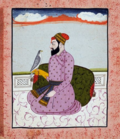 Guru Tegh Bahadur, Pahari painting. Gouache on paper.
 -
 Guru Tegh Bahadur painting from the family workshop of Nainsukh of Guler.
 -
 Portrait of Guru Tegh Bahadur from the last quarter of the 19th century.


Notes[edit | edit source]
- ↑ The authorship is disputed. While W. H. McLeod considered the work to be Guru Gobind Singh's, Gurinder Singh Mann and Purnima Dhavan concluded it to be the work of multiple court poets; there is a rough consensus to date the text.[37]
- ↑ Ghulam Muhiuddin Bute Shah in his Tarikh- i-Punjab reiterates this narrative.
References[edit | edit source]
- ↑ 1.0 1.1 1.2 Pashaura Singh and Louis Fenech (2014). The Oxford handbook of Sikh studies. Oxford, UK: Oxford University Press. pp. 236–245, 444–446, Quote: "This second martyrdom helped to make 'human rights and freedom of conscience' central to its identity." Quote: "This is the reputed place where several Kashmiri Pandits came seeking protection from Aurangzeb's army.". ISBN 978-0-19-969930-8.
- ↑ Gill, Sarjit S., and Charanjit Kaur (2008), "Gurdwara and its politics: Current debate on Sikh identity in Malaysia", SARI: Journal Alam dan Tamadun Melayu, Vol. 26 (2008), pages 243–255, Quote: "Guru Tegh Bahadur died in order to protect the freedom of India from invading Mughals."
- ↑ 3.0 3.1 3.2 3.3 3.4 3.5 Seiple, Chris (2013). The Routledge handbook of religion and security. New York: Routledge. p. 96. ISBN 978-0-415-66744-9.
- ↑ Gandhi, Surjit (2007). History of Sikh gurus retold. Atlantic Publishers. pp. 653–91. ISBN 978-81-269-0858-5.
- ↑ W. H. McLeod (1984). Textual Sources for the Study of Sikhism. Manchester University Press. pp. 32–33. ISBN 9780719010637. Archived from the original on 18 February 2020. Retrieved 14 November 2013.
- ↑ "The Ninth Master Guru Tegh Bahadur (1621–1675)". sikhs.org. Archived from the original on 7 January 2019. Retrieved 23 November 2014.
- ↑ 7.0 7.1 7.2 "Religions – Sikhism: Guru Tegh Bahadur". BBC. Archived from the original on 14 April 2017. Retrieved 20 October 2016.
- ↑ Pashaura Singh; Louis E. Fenech (2014). The Oxford Handbook of Sikh Studies. Oxford University Press. pp. 236–238. ISBN 978-0-19-969930-8. Archived from the original on 4 May 2019. Retrieved 12 June 2017.;
Fenech, Louis E. (2001). "Martyrdom and the Execution of Guru Arjan in Early Sikh Sources". Journal of the American Oriental Society. 121 (1). American Oriental Society: 20–31. doi:10.2307/606726. JSTOR 606726.;
Fenech, Louis E. (1997). "Martyrdom and the Sikh Tradition". Journal of the American Oriental Society. 117 (4). American Oriental Society: 623–642. doi:10.2307/606445. JSTOR 606445.;
McLeod, Hew (1999). "Sikhs and Muslims in the Punjab". South Asia: Journal of South Asian Studies. 22 (sup001). Taylor & Francis: 155–165. doi:10.1080/00856408708723379. ISSN 0085-6401. - ↑ 9.0 9.1 H. S. Singha (2000). The Encyclopedia of Sikhism (over 1000 Entries). Hemkunt Press. p. 169. ISBN 978-81-7010-301-1. Archived from the original on 20 September 2020. Retrieved 30 October 2016.
- ↑ Eleanor Nesbitt (2016). Sikhism: a Very Short Introduction. Oxford University Press. pp. 6, 122–123. ISBN 978-0-19-874557-0. Archived from the original on 9 March 2017. Retrieved 9 March 2017.
- ↑ Torri, Michelguglielmo (25 February 2025). A History of India Volume 1: From the First Human Settlements to the Mughal Empire. Boydell & Brewer. p. 351. ISBN 978-1-83765-144-3.
- ↑ Fenech, Louis E.; McLeod, W. H. (11 June 2014). Historical Dictionary of Sikhism. Bloomsbury Publishing PLC. p. 305. ISBN 978-1-4422-3601-1.
According to Muslim sources he was taken as a brigand. Sikh sources, however, vigorously resist this claim.
- ↑ 13.0 13.1 William Owen Cole; Piara Singh Sambhi (1995). The Sikhs: Their Religious Beliefs and Practices. Sussex Academic Press. pp. 32–35. ISBN 978-1-898723-13-4. Archived from the original on 28 May 2020. Retrieved 23 November 2016.
- ↑ 14.0 14.1 Bhatia, H.S.; Bakshi, S.R. (2000). The Sikh Gurus and Sikhism. Deep & Deep Publications. ISBN 8176291307.
- ↑ McLeod, W. H. (24 July 2009). The A to Z of Sikhism. Scarecrow Press. p. 88. ISBN 978-0-8108-6344-6.
- ↑ H.S. Singha (2005). Sikh Studies. Hemkunt Press. pp. 21–22. ISBN 978-81-7010-245-8. Archived from the original on 4 May 2019. Retrieved 28 June 2018.
- ↑ Gandhi, Surjit (2007). History of Sikh gurus retold. Atlantic Publishers. pp. 621–22. ISBN 978-81-269-0858-5.
- ↑ 18.0 18.1 Kohli, Mohindar (1992). Guru Tegh Bahadur: testimony of conscience. Sahitya Akademi. pp. 13–15. ISBN 978-81-7201-234-2.
- ↑ Singha, H.S. (2000). The encyclopedia of Sikhism. Hemkunt Publishers. p. 85. ISBN 978-81-7010-301-1.
- ↑ Singh, Fauja; Talib, Gurbachan Singh (1975). Guru Tegh Bahadur: Martyr and Teacher. Punjabi University. pp. 24–26.
- ↑ H.R. Gupta (1994). History of the Sikhs: The Sikh Gurus, 1469–1708. Vol. 1. p. 188. ISBN 9788121502764.
- ↑ 22.0 22.1 Kohli, Mohindar (1992). Guru Tegh Bahadur : testimony of conscience. Sahitya Akademi. pp. 37–41. ISBN 978-81-7201-234-2.
- ↑ Singha, H.S. (2000). The encyclopedia of Sikhism. Hemkunt Publishers. pp. 139–40. ISBN 978-81-7010-301-1.
- ↑ 24.0 24.1 Singh, Prithi (2006). The history of Sikh gurus. Lotus Press. pp. 187–89. ISBN 978-81-8382-075-2.
- ↑ Pruthi, Raj (2004). Sikhism and Indian civilization. Discovery Publishing House. p. 88. ISBN 978-81-7141-879-4.
- ↑ Gobind Singh (Translated by Navtej Sarna) (2011). Zafarnama. Penguin Books. pp. xviii–xix. ISBN 978-0-670-08556-9.
- ↑ Singh, Dharam; Singh, Paramvir (2022). Guru Tegh Bahadur: His Life, Travel and Message. Publications Division Ministry of Information & Broadcasting. ISBN 9789354095832.
There took place one battle between the opposing forces of Ram Singh and the Ahom king, named Chakradhwaj, but it remained inconclusive. According to Sikh chronicles, the Guru was able to arrange a truce between the opposing forces and opened the way for a negotiated settlement. The Guru succeeded in bringing about a rapprochement between them and thus more bloodshed was avoided. To celebrate the happy conclusion, soldiers of Ram Singh's camp raised a high mound on the bank of the Brahmputra, each soldier contributing five shields of earth. On the top of this mound now stands Thara Sahib or Damdama Sahib ...
- ↑ Kohli, Mohindar (1992). Guru Tegh Bahadur: testimony of conscience. Sahitya Akademi. pp. 25–27. ISBN 978-81-7201-234-2.
- ↑ Singha, H.S. (2000). The encyclopedia of Sikhism. Hemkunt Publishers. p. 21. ISBN 978-81-7010-301-1.
- ↑ Singh, Prithi (2006). The history of Sikh gurus. Lotus Press. pp. 121–24. ISBN 978-81-8382-075-2.
- ↑ Jerryson, Michael (2020). Religious Violence Today: Faith and Conflict in the Modern World [2 Volumes]. Abc-Clio. p. 684. ISBN 9781440859915.
- ↑ 32.0 32.1 Singh, Trilochan (1967). "Chapter XXII". Guru Tegh Bahadur, Prophet and Martyr: A Biography. Gurdwara Parbandhak Committee. pp. 293–300.
- ↑ 33.0 33.1 33.2 33.3 J. S. Grewal (1998). The Sikhs of the Punjab. Cambridge University Press. pp. 71–73. ISBN 978-0-521-63764-0.
- ↑ Purnima Dhavan (2011). When Sparrows Became Hawks: The Making of the Sikh Warrior Tradition, 1699–1799. Oxford University Press. pp. 33, 36–37. ISBN 978-0-19-987717-1. Archived from the original on 4 May 2019. Retrieved 24 August 2018.
- ↑ Pashaura Singh (2014). Louis E. Fenech (ed.). The Oxford Handbook of Sikh Studies. Oxford University Press. pp. 236–238. ISBN 978-0-19-100411-7. Archived from the original on 4 May 2019. Retrieved 24 August 2018.
- ↑ 36.0 36.1 36.2 Fenech, Louis E. (1997). "Martyrdom and the Sikh Tradition". Journal of the American Oriental Society. 117 (4): 633. doi:10.2307/606445. ISSN 0003-0279. JSTOR 606445. Archived from the original on 6 October 2018. Retrieved 2 December 2017.
- ↑ 37.0 37.1 Grewal, J. S. (2020). "New Perspectives and Sources". Guru Gobind Singh (1666–1708): Master of the White Hawk. Oxford University Press. pp. 9–10. ISBN 9780199494941.
- ↑ Doniger, Wendy; Nussbaum, Martha Craven (2015). Pluralism and Democracy in India: Debating the Hindu Right. Oxford University Press. p. 261. ISBN 978-0-19-539553-2.
- ↑ 39.0 39.1 Singh, Surinder (2022). Medieval Panjab in Transition Authority, Resistance and Spirituality C.1500 – C.1700. Routledge. p. 384. ISBN 9781000609448.
- ↑ Singh, Trilochan (1967). "Chapter XXIV". Guru Tegh Bahadur, Prophet and Martyr: A Biography. Gurdwara Parbandhak Committee. p. 311.
- ↑ 41.0 41.1 41.2 41.3 41.4 41.5 41.6 Chandra, Satish. "Guru Tegh Bahadur's martyrdom". The Hindu. Archived from the original on 28 February 2002. Retrieved 20 October 2016.
- ↑ Grewal, J.S. (2001). Sikh History From Persian Sources. Indian History Congress. pp. 12–13. ISBN 978-81-89487-18-8.
Most of the non Sikh sources mention Guru Tegh Bahadur's militancy as the reason for Aurangzeb's action. By contrast, the Sikh sources dwell exclusively on the religious dimension of the situation.
- ↑ Chandavarkar, Rajnayaran (3 September 2009). History, Culture and the Indian City. Cambridge University Press. p. 192. ISBN 978-1-139-48044-4.
In another, the historian Satish Chandra pointed out that the 'official explanation' for the execution of the Sikh Guru Tegh Bahadur by the Mughal court was that he had 'resorted to plunder and rapine'.
- ↑ "Siyar-ul-Mutakhkherin – Banglapedia". en.banglapedia.org. Archived from the original on 18 September 2021. Retrieved 18 September 2021.
- ↑ Dogra, R. C. (1995). Encyclopaedia of Sikh religion and culture. Internet Archive. New Delhi : Vikas Pub. House. p. 407. ISBN 978-0-7069-8368-5.
- ↑ 46.0 46.1 Chandra, Satish (2005). Medieval India: From Sultanat to the Mughals Part - II. Har-Anand Publications. p. 296. ISBN 978-81-241-1066-9.
- ↑ Truschke, Audrey (16 May 2017). Aurangzeb: The Life and Legacy of India's Most Controversial King. Stanford University Press. p. 48. ISBN 978-1-5036-0259-5.
- ↑ Grewal 2001, p. 105.
- ↑ Grewal 2001, p. 110.
- ↑ Grewal 2001, p. 13.
- ↑ Mir, Farina (2010). The social space of language vernacular culture in British colonial Punjab. Berkeley: University of California Press. pp. 207–37. ISBN 978-0-520-26269-0.
- ↑ Fenech, Louis E. (2013). "The Historiography of the Ẓafar-nāmah". The Sikh Ẓafar-nāmah of Guru Gobind Singh: A Discursive Blade in the Heart of the Mughal Empire. Oxford University Press. p. 108. ISBN 9780199931439.
- ↑ Grewal, J. S. (2020). "New Perspectives and Sources". Guru Gobind Singh (1666–1708): Master of the White Hawk. Oxford University Press. ISBN 9780199494941.
Fenech argues that the twentieth-century Tat Khalsa wrongly treated the martyrdom of Guru Tegh Bahadur as a sacrifice to save Hinduism. In his view, the tilak and janju in the passage under consideration refer to the frontal mark and the sacred thread of Guru Tegh Bahadur himself. In other words, Guru Tegh Bahadur sacrificed his life for the sake of his own faith.
- ↑ Metcalf, Barbara D.; Metcalf, Thomas R. (2002). A Concise History of India. Cambridge University Press. p. 21. ISBN 978-0-521-63974-3.
- ↑ Tegh Bahadur (Translated by Gopal Singh) (2005). Mahalla nawan: compositions of Guru Tegh Bahādur-the ninth guru (from Sri Guru Granth Sahib): Bāṇī Gurū Tega Bahādara. Allied Publishers. pp. xxviii–xxxiii, 15–27. ISBN 978-81-7764-897-3.
- ↑ Singh, Prithi (2006). The history of Sikh gurus. Lotus Press. p. 170. ISBN 978-81-8382-075-2.
- ↑ "Guru Tegh Bahadur's Martyrdom Day 2022: 8 powerful quotes by the ninth Sikh Guru". Hindustan Times. 23 November 2022. Retrieved 24 November 2022.
- ↑ SK Chatterji (1975), Sri Guru Tegh Bahadur and the Sis Ganj Gurdwara, Sikh Review, 23(264): 100–09
- ↑ 59.0 59.1 John, Rachel (24 November 2019). "Guru Tegh Bahadur — the ninth Sikh guru who sacrificed himself for religious freedom". ThePrint. Retrieved 25 January 2023.
- ↑ Harbans Singh (1992), "History of Gurdwara Sis Ganj Sahib", in Encyclopedia of Sikhism, Volume 1, pg. 547
- ↑ Wilfred Smith (1981). On Understanding Islam: Selected Studies. Walter De Gruyter. p. 191. ISBN 978-9027934482.
- ↑ Bullhe Shāh,?-1758? (2015). Sufi lyrics. C. Shackle, Inc OverDrive. Cambridge, Massachusetts. ISBN 978-0-674-25966-9. OCLC 1240164691.
{{cite book}}: CS1 maint: location missing publisher (link) CS1 maint: numeric names: authors list (link) - ↑ Singh, Harmeet Shah (21 April 2022). "The legacy of Guru Teg Bahadar and its revisionism". India Today. Retrieved 25 November 2025.
- ↑ NEWS, SA (24 November 2022). "Guru Tegh Bahadur Martyrdom Day 2022: Revelation From Guru Granth Sahib Ji". SA News Channel. Retrieved 24 November 2022.
- ↑ "Letter from Administration of Dadra and Nagar Haveli, U.T." (PDF). Dnh.nic.in. Archived from the original (PDF) on 6 August 2016. Retrieved 20 October 2016.
- ↑ "LIST OF RESTRICTED HOLIDAYS 2016". Arunachalipr.gov.in. Archived from the original on 8 November 2016. Retrieved 20 October 2016.
- ↑ "HP Government – Holidays – Government of Himachal Pradesh, India". Himachal.nic.in. 13 June 2016. Archived from the original on 1 November 2016. Retrieved 20 October 2016.
External links[edit | edit source]

- Peer reviewed publications on Guru Tegh Bahadur
- Guru Tegh Bahadur Ranbir Singh (1975)
- Non-Canonical Compositions Attributed to the Seventh and Ninth Sikh Gurus, Jeevan Singh Deol, Journal of the American Oriental Society, 121(2): 193–203, (Apr. – Jun., 2001)
| Preceded by Guru Har Krishan |
Sikh Guru 20 March 1665 – 24 November 1675 |
Succeeded by Guru Gobind Singh |
| Family | |
|---|---|
| The Leader | |
| The Soldier | |
| The Saint | |
| Associates | |
| Opponents |
|
| Places | |
| Gurudwaras | |
 Sikhism portal Sikhism portal | |
- Pages using the JsonConfig extension
- Pages with Punjabi IPA
- 1621 births
- 1675 deaths
- Sikh gurus
- People executed for refusing to convert to Islam
- Executed Indian people
- 17th-century Indian philosophers
- 17th-century executions by the Mughal Empire
- People from Amritsar
- Indian city founders
- Sikhs executed by the Mughal Empire
- Sikh martyrs