


No edit summary Tags: Mobile edit Mobile web edit |
Map link update. Tags: Mobile edit Mobile web edit |
||
| Line 1: | Line 1: | ||
{{Short description|Ancient Indian dynasty}} | {{Short description|Ancient Indian dynasty}} | ||
{{Infobox country | {{Infobox country | ||
| conventional_long_name = Maha-Meghavahana Dynasty<br />Mahāmēghabāhana | | conventional_long_name = Maha-Meghavahana Dynasty<br />Mahāmēghabāhana | ||
| Line 9: | Line 7: | ||
| year_end = 4th century CE | | year_end = 4th century CE | ||
| p1 = Maurya Empire | | p1 = Maurya Empire | ||
| flag_p1 = | | flag_p1 = Ashoka Maurya Empire.png | ||
| p2 = Satavahanas | | p2 = Satavahanas | ||
| flag_p2 = Map_of_the_Satavahanas.png | | flag_p2 = Map_of_the_Satavahanas.png | ||
| Line 27: | Line 25: | ||
| area_km2 = | | area_km2 = | ||
| area_rank = | | area_rank = | ||
| image_map = Map of the Maha-Meghavahanas.png | | image_map = Map of the Maha-Meghavahanas-min.png | ||
| image_map_alt = Map of the Maha-Megavahanas. | | image_map_alt = Map of the Maha-Megavahanas. | ||
| image_map_caption = Map of the Maha-Meghavahanas, circa 20 BCE.<ref>{{cite book |last1=Schwartzberg |first1=Joseph E. |title=A Historical atlas of South Asia |date=1978 |publisher=University of Chicago Press |location=Chicago |page=145, map XIV.1 (f)|isbn=0226742210 |url=https://dsal.uchicago.edu/reference/schwartzberg/pager.html?object=182}}</ref> | | image_map_caption = Map of the Maha-Meghavahanas, circa 20 BCE.<ref>{{cite book |last1=Schwartzberg |first1=Joseph E. |title=A Historical atlas of South Asia |date=1978 |publisher=University of Chicago Press |location=Chicago |page=145, map XIV.1 (f)|isbn=0226742210 |url=https://dsal.uchicago.edu/reference/schwartzberg/pager.html?object=182}}</ref> | ||
Revision as of 07:47, 2 December 2023
Maha-Meghavahana Dynasty Mahāmēghabāhana | |||||||||||||||
|---|---|---|---|---|---|---|---|---|---|---|---|---|---|---|---|
| 1st century BC–4th century CE | |||||||||||||||
| Error creating thumbnail: File missing Map of the Maha-Meghavahanas, circa 20 BCE.[1] | |||||||||||||||
| Religion | Jainism | ||||||||||||||
| Government | Monarchy | ||||||||||||||
| Maharajadhiraj (Emperor) | |||||||||||||||
• 1st c. BC-unkown | Mahameghvahan | ||||||||||||||
| Historical era | Classical India | ||||||||||||||
• Established | 1st century BC | ||||||||||||||
• Disestablished | 4th century CE | ||||||||||||||
| |||||||||||||||
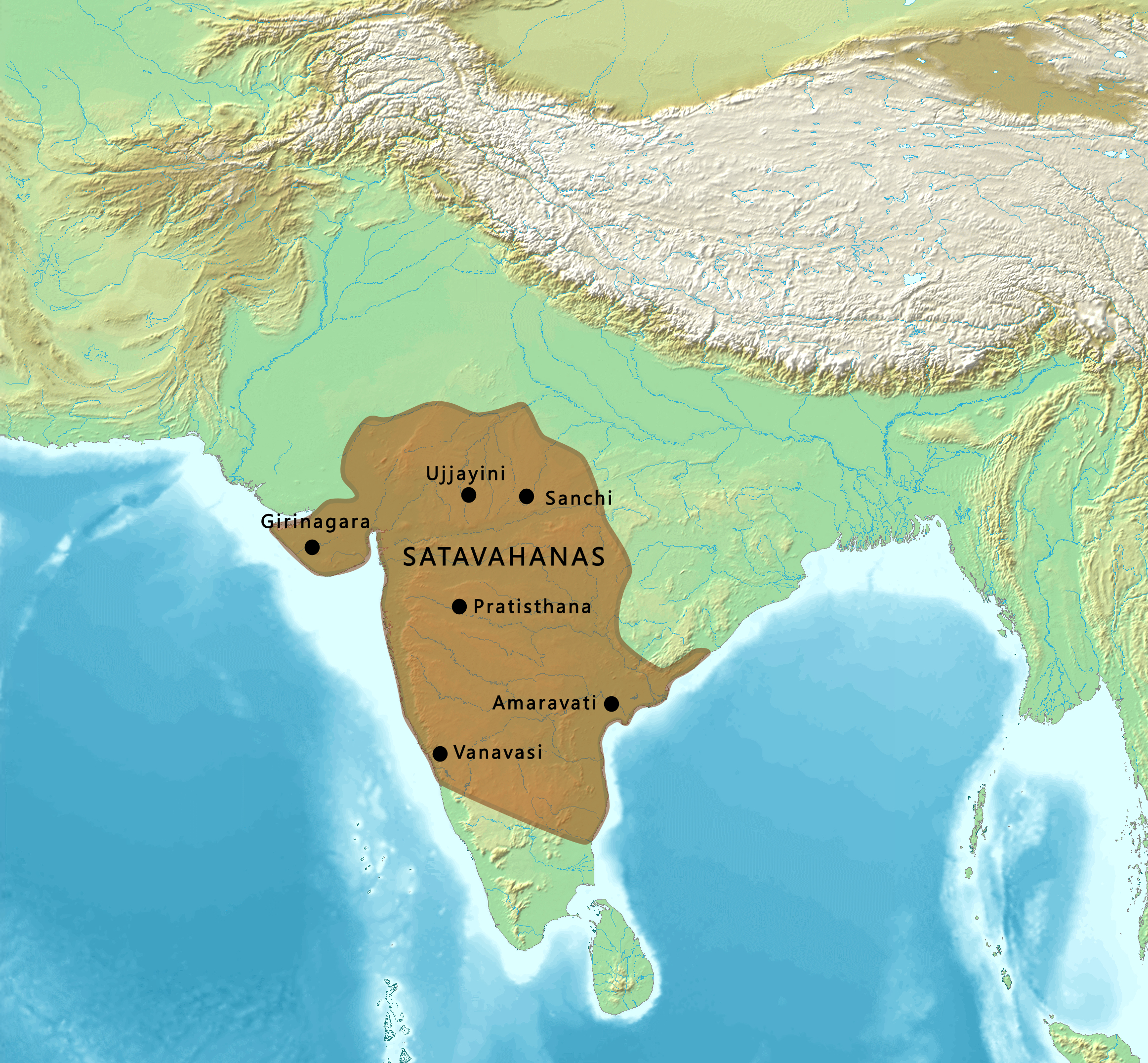
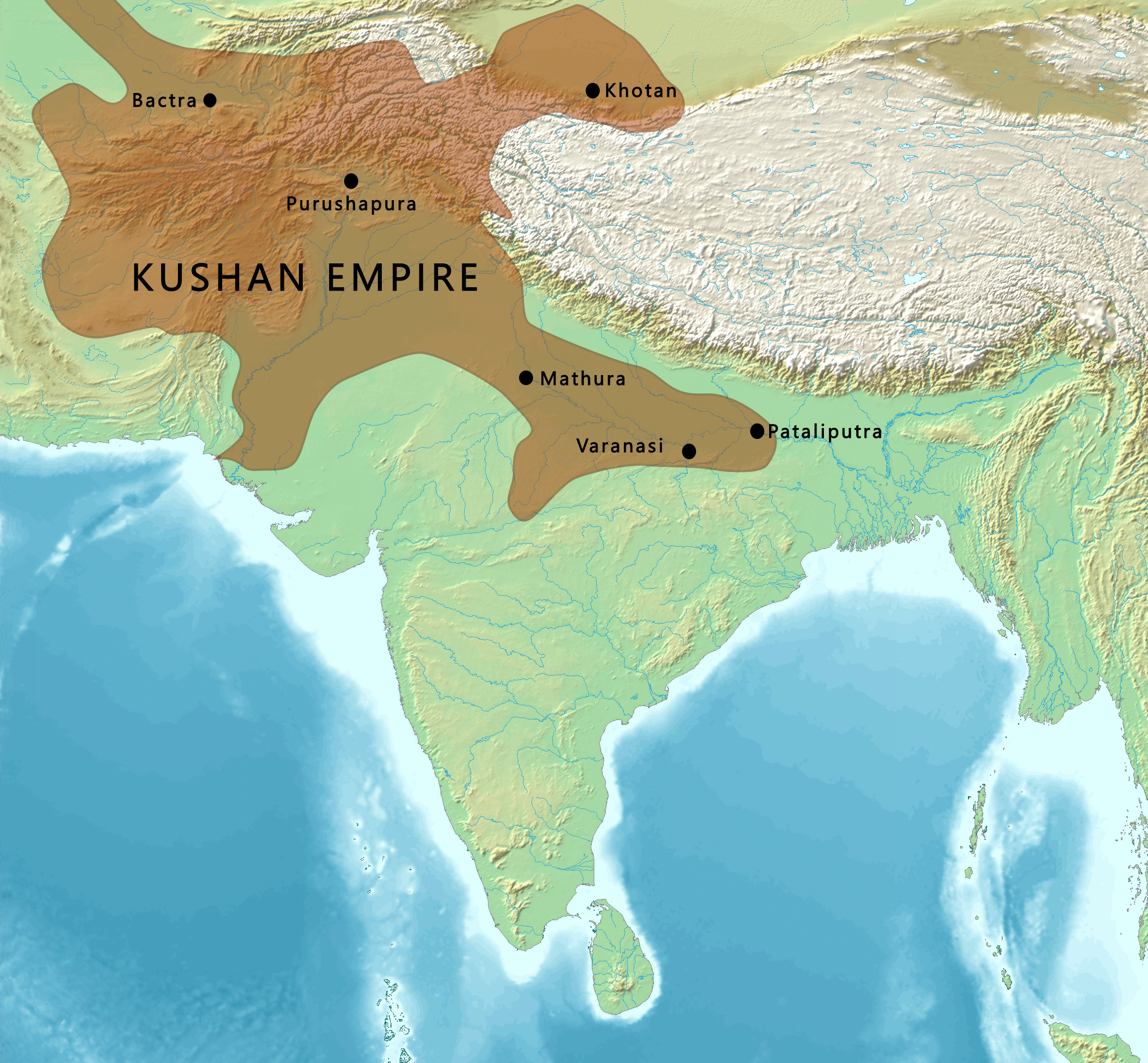


The Mahameghavahana dynasty (IAST:Mahā-Mēgha-Vāhana;, 1st century BC to early 4th century CE[2][3]) was an ancient Indian dynasty of Kalinga after the decline of the Maurya Empire.[4] In the 1st c. B.C., a king of Chedi, Mahameghavahana conquered Kalinga and Kosala.[5] They belonged to the Chedi/Chandel clan of the Chandravansh.[6][7][8] [9][10][11][12][13]
The dynasty was established Kalinga in the 1st century by a ruler Mahameghavahana from the Chedi/Chandel clan. 3rd one was Chakravartin Kharavela or Bhikshurajvarman, he drove out the Indo-Greek ruler Demetrius I from India.[14][15] He humiliated Mauryans and conquered Pushyamitra Shunga,[16] Satavahanas, Musikas, Bhojakas, Rastrikas and Pandyas. His empire had extensive trade with Sri Lanka, Cambodia, Myanmar, Thailand and Indonesia.[17] He patronised Jainism, but did not discriminate against other religions.[18][19] South Kosala was later conquered by Gautamiputra Satakarni of the Satavahana dynasty in the early part of the 2nd century CE and remained in their possession up to the second half of the 2nd century CE. It was during the second and third century CE, the Meghas or Meghavahanas reappeared in the political scene and regained their suzerainty over South Kosala. Samudragupta during his Daksinapatha expedition, defeated Mahendra of Kosala who probably belonged to the Megha dynasty. As a result, the South Kosala during the fourth century A.D, became a part of the Gupta empire.[2][20]
List of rulers
The Hathigumpha inscription describes the following Rulers.[21] It does not directly mention the relationship between Mahameghavahana and Kharavela, or the number of kings between them.[22] Indraji interpreted the inscription to create the following hypothetical family tree:[21]
Architecture
Udayagiri and Khandagiri Caves is the most prominent example of Mahameghavahana dynasty work. These caves were built in 2nd century BCE during the rule of King Kharavela. Udayagiri means "Sunrise Hill" and has 18 caves while Khandagiri (means "Broken Hill") has 15 caves. The Hathigumpha cave ("Elephant Cave") has the Hathigumpha inscription, written by Raja Kharavela, the king of Kalinga in India, during the 2nd century BCE. The Hathigumpha inscription consists of seventeen lines incised in deep cut Brahmi letters starting with Jain Namokar Mantra. In Udayagiri, Hathigumpha (cave 14) and Ganeshagumpha (cave 10) are especially well known due to art treasures of their sculptures and reliefs as well as due to their historical importance. Rani ka Naur (Queen's Palace cave, cave 1) is also an extensively carved cave and elaborately embellished with sculptural friezes. Khandagiri offers a fine view back over Bhubaneswar from its summit. The Ananta cave (cave 3) depicts carved figures of women, elephants, athletes, and geese carrying flowers.
-
 Udayagiri
 -
 Ganesha Gumpha (cave no-10), Udayagiri
 -
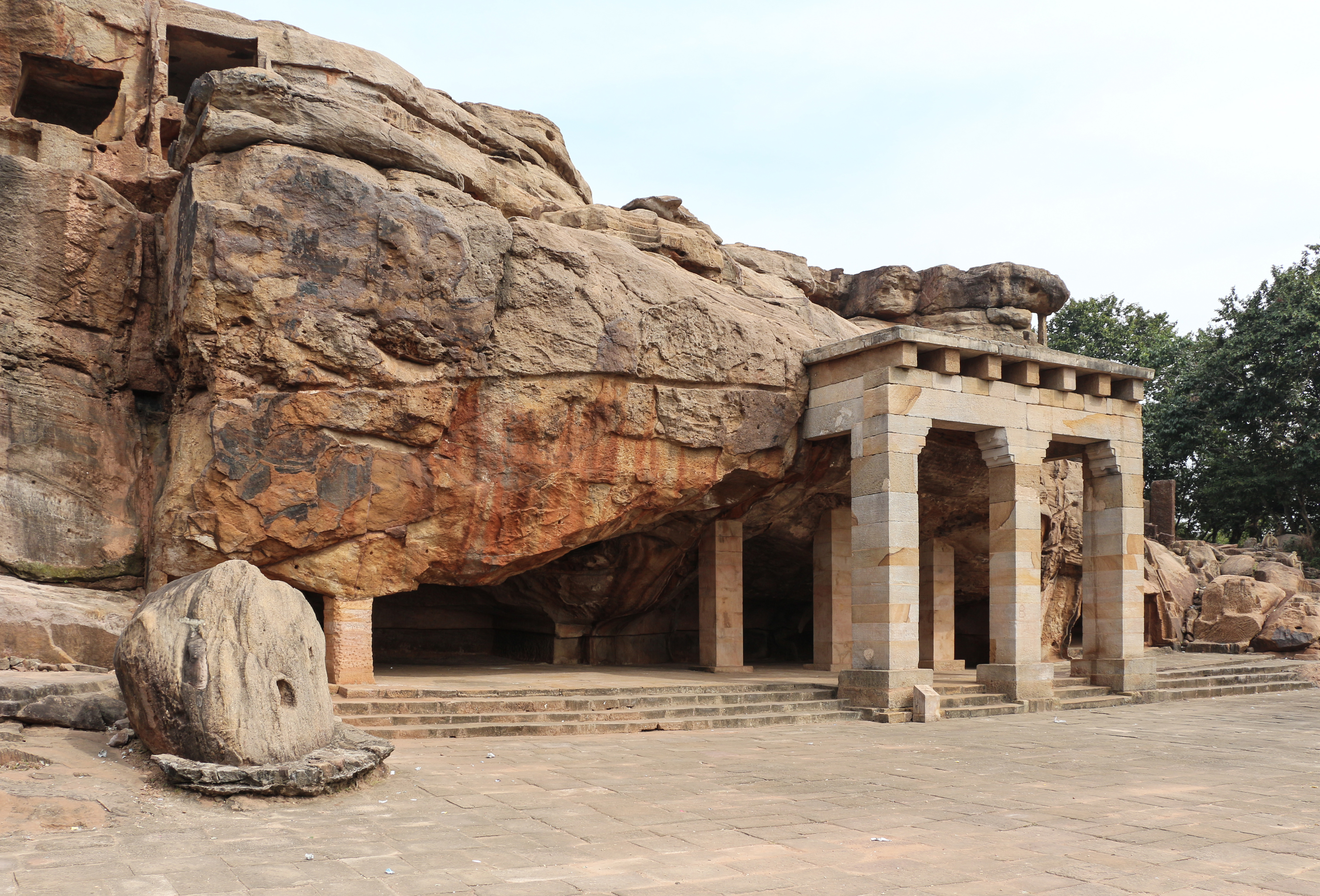 Hathi Gumpha (cave no-14), Udayagiri
 -

-
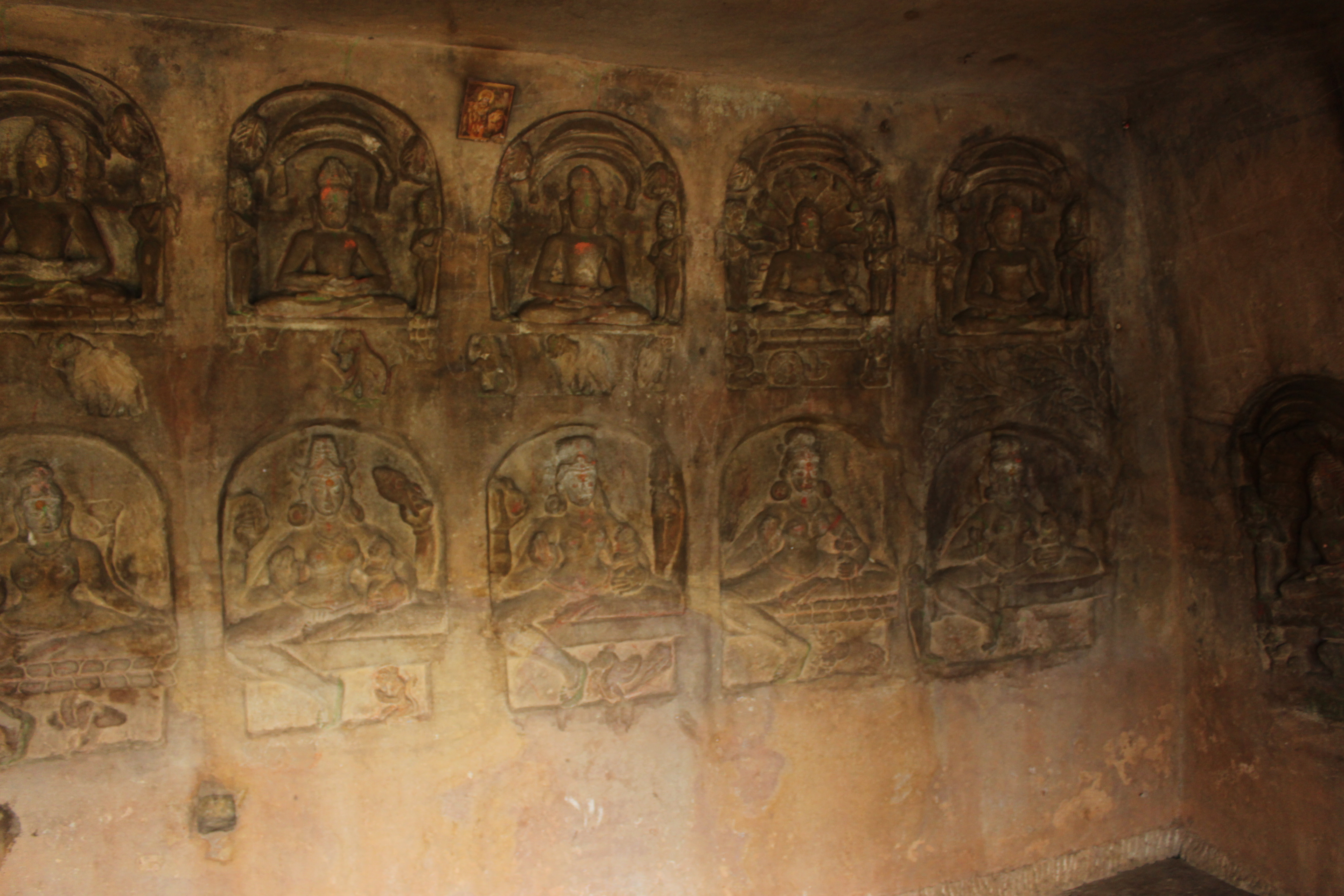 Carving of Tirthankaras & Goddesses inside Navamuni Gumpha
 -
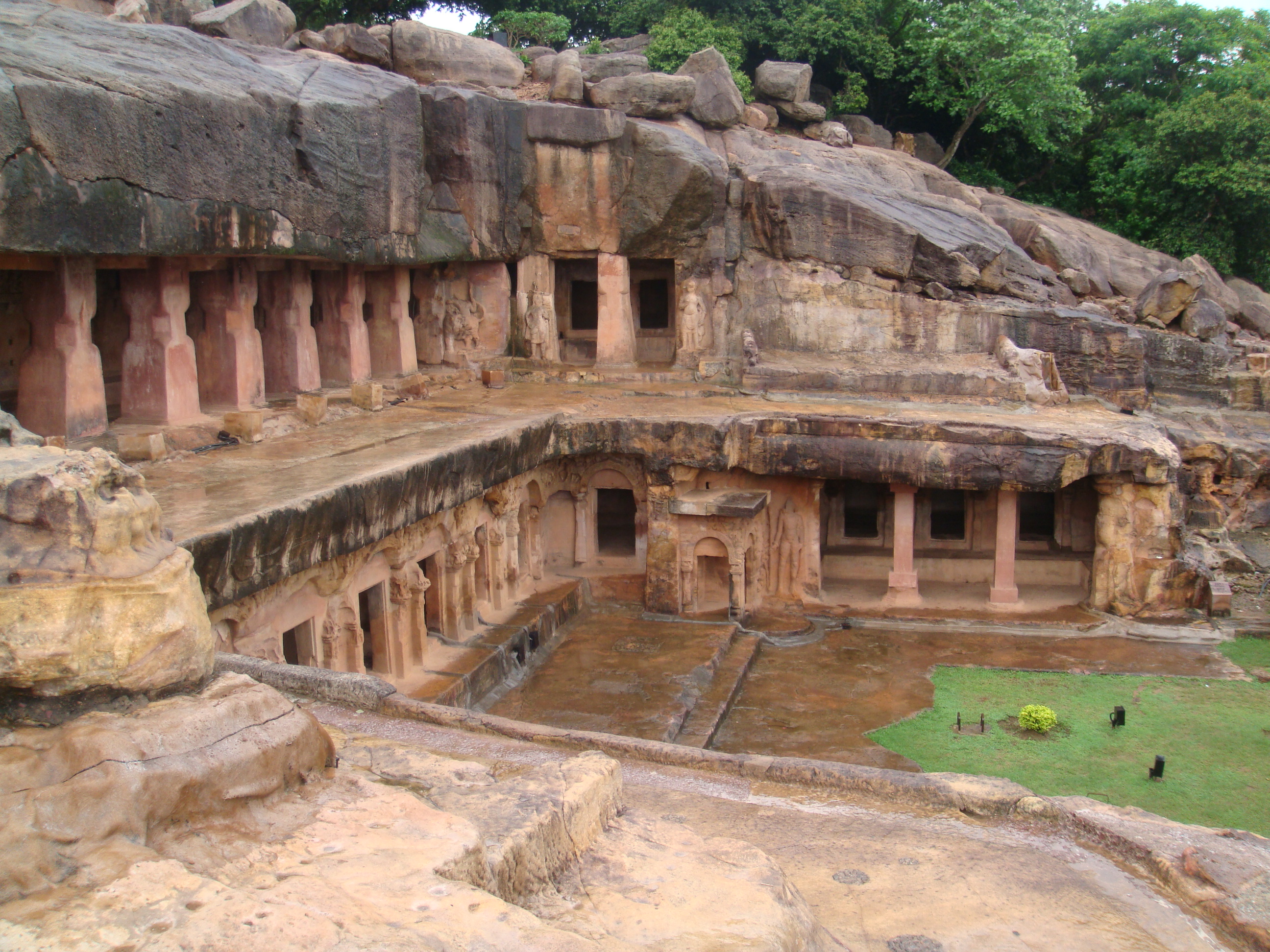 Udaygiri Stone Caves
 -
Carving of Jain Tirthanakars
-
 Sarpa Gumpha (cave no-13), Udayagiri


References
- ↑ Schwartzberg, Joseph E. (1978). A Historical atlas of South Asia. Chicago: University of Chicago Press. p. 145, map XIV.1 (f). ISBN 0226742210.
- ↑ 2.0 2.1 Sahu, J. K. (1977). "The Meghas of Kosala". Proceedings of the Indian History Congress. 38: 49–54. ISSN 2249-1937. JSTOR 44139050.
- ↑ Sahu, J.K. (1977). "The Meghas of Kosala" (PDF). shodhganga.
- ↑ For a map of their territory see: Schwartzberg, Joseph E. (1978). A Historical atlas of South Asia. Chicago: University of Chicago Press. p. 145, map XIV.1 (f). ISBN 0226742210.
- ↑ L Bhagawandas Gandhi (1927). Tribes in Ancient India.
- ↑ Taṇḍana, Premanārāyaṇa (1962). ब्रजभाषा सूर-कोश: Nirdeśaka Dīnadayālu Gupta (in हिन्दी). Lakhanaū Viśvavidyālaya.
- ↑ Dikshit, R. K. (1976). The Candellas of Jejākabhukti. Abhinav Publications. ISBN 978-81-7017-046-4.
- ↑ Verma, Dr Shyam Bahadur (2010-01-01). Prabhat Brihat Hindi Shabdakosh (Vol-1): Bestseller Book by Dr Shyam Bahadur Verma: Prabhat Brihat Hindi Shabdakosh) (in हिन्दी). Prabhat Prakashan. ISBN 978-81-7315-769-1.
- ↑ Kapoor, Badrinath (2006-09-01). Brihat Pramanik Hindi Kosh (in हिन्दी). Lokbharti Prakashan. ISBN 978-81-8031-057-7.
- ↑ Thakur ‘Bipin’, Dr Bindeshwari Prasad. BHARTIYA SANSKRITI KE GAKAAR PRATEEK (in हिन्दी). Sarv Bhasha Trust. ISBN 978-93-93605-21-4.
- ↑ Ramesh Chandra Majumdar (1951). The History and Culture of the Indian People: The age of imperial unity; 2d ed. 1953. Bharatiya Vidya Bhavan.
- ↑ Society, Bihar and Orissa Research (1917). Journal of the Bihar and Orissa Research Society. The Society.
- ↑ Journal of the Andhra Historical Research Society. Andhra Historical Research Society. 1946.
- ↑ C.S.Natarajan (2018-02-13). National Words: A Solution to the National Language Problem of India (in हिन्दी). Notion Press. ISBN 978-1-948147-14-9.
- ↑ Sanyal, Sanjeev (2020-09-14). Incredible History of the Indian Ocean. Penguin Random House India Private Limited. ISBN 978-93-5305-962-0.
- ↑ Das, Manmatha Nath (1949). Glimpses Of Kalinga History.
- ↑ Das, Manmatha Nath (1949). Glimpses Of Kalinga History.
- ↑ Hampa Nagarajaiah (1999). A History of the Early Ganga Monarchy and Jainism. Ankita Pustaka. p. 10. ISBN 978-81-87321-16-3.
- ↑ Kailash Chand Jain (2010). History of Jainism. D. K. Print World (P) Limited. p. 437. ISBN 978-81-246-0547-9.
- ↑ Sahu, J.K. "The Meghas of Kosala" (PDF). shodhganga.
- ↑ 21.0 21.1 Bhagwanlal Indraji (1885). "The Hâtigumphâ and three other inscriptions in the Udayagiri caves near Cuttack". Proceedings of the Leyden International Oriental Congress for 1883. pp. 144–180.
- ↑ Sailendra Nath Sen (1999). Ancient Indian History and Civilization. New Age International. pp. 176–177. ISBN 978-81-224-1198-0.


