



imported>Gotitbro Undid revision 1034091450 by 65.28.70.107 (talk) per ref |
WikiDwarfBOT (talk | contribs) Cleanup: Source modification. Information added. |
||
| Line 1: | Line 1: | ||
{{short description|17th Mughal Emperor (r. 1760-1788, 1788-1806)}} | |||
{{more citations needed|date=January 2020}} | {{more citations needed|date=January 2020}} | ||
{{Use Indian English|date=July 2016}} | {{Use Indian English|date=July 2016}} | ||
{{Use dmy dates|date=October 2020}} | {{Use dmy dates|date=October 2020}} | ||
{{Infobox royalty | {{Infobox royalty | ||
|name = Shah Alam II | | name = Shah Alam II | ||
|title = | | title = [[Padishah]]<br />[[Imperial and royal titles of the Mughal emperors|Al-Sultan Al-Azam]] | ||
|image = | | image = Ali Gauhar of India.jpg | ||
|caption = Shah Alam II | | caption = Shah Alam II enthroned, c. 1797 | ||
|succession = 17th [[ | | succession = 17th [[Mughal Emperor]] | ||
|reign-type = 1st reign | | reign-type = 1st reign | ||
|reign = 10 October 1760 – {{nowrap|31 July 1788}} | | reign = 10 October 1760 – {{nowrap|31 July 1788}} | ||
|predecessor = [[Shah Jahan III]] | | predecessor = [[Shah Jahan III]] | ||
|successor = [[ | | successor = [[Jahan Shah IV|Shah Jahan IV]] | ||
|reign-type1 = 2nd reign | | reign-type1 = 2nd reign | ||
|reign1 = 16 October 1788 – {{nowrap|19 November 1806}} | | reign1 = 16 October 1788 – {{nowrap|19 November 1806}} | ||
|predecessor1 = [[ | | predecessor1 = [[Jahan Shah IV|Shah Jahan IV]] | ||
|successor1 = [[Akbar II| | | successor1 = [[Akbar II]] | ||
|birth_date = {{birth date|1728|6|25|df=y}} | | issue-type = Issue | ||
|birth_place = [[Shahjahanabad]], [[Subah (province)|Subah]] of [[Delhi]], [[Mughal Empire]]<br><small>(present-day [[Old Delhi]], [[Delhi]], [[India]])</small> | | dynasty = [[File:Timurid.svg|25px]] [[Timurid dynasty]] | ||
|death_date = {{death date and age|1806|11|19|1728|6|25|df=y}} | | module = {{Infobox military person | ||
|death_place = [[Shahjahanabad]], [[Subah (province)|Subah]] of [[Delhi]], [[Mughal Empire]] | | embed = yes | ||
|issue = | | battles = [[Third Battle of Panipat]] <br>[[Bengal War]] <br> [[Battle of Delhi (1764)]] <br> [[Battle of Buxar]] <br> [[Capture of Delhi (1771)|Battle of Delhi (1771)]] <br> [[Battle of Delhi (1783)]] <br> [[Siege of Delhi (1804)]] | ||
|full name = 'Abdu'llah Jalal ud-din Abu'l Muzaffar Ham ud-din Muhammad 'Ali Gauhar Shah-i-'Alam II | }} | ||
|father = [[Alamgir II]] | | birth_name = Mirza Ali Gauhar | ||
|mother = Zinat Mahal | | birth_date = {{birth date|1728|6|25|df=y}} | ||
|religion = [[Sunni Islam]] | | birth_place = [[Shahjahanabad]], [[Subah (province)|Subah]] of [[Delhi]], [[Mughal Empire]]<br><small>(present-day [[Old Delhi]], [[Delhi]], [[India]])</small> | ||
|image_size = | | death_date = {{death date and age|1806|11|19|1728|6|25|df=y}} | ||
|spouses = | | death_place = [[Shahjahanabad]], [[Subah (province)|Subah]] of [[Delhi]], [[Mughal Empire]] | ||
|house = [[Mughal dynasty| | | issue = {{unbulletedlist|[[Akbar II]]|[[Mirza Jawan Bakht (born 1749)|Mirza Jahandar Shah]]<ref name="Assembly1936">{{cite book | author = India. Legislature. Legislative Assembly | date = 1936 | title = The Legislative Assembly Debates: (Official Report), Volume 1 | publisher = Government of India Press | pages =108}}</ref><ref name="AlamSubrahmanyam2012">{{cite book | author1 = Muzaffar Alam | author2 = Sanjay Subrahmanyam | date = 2012 | title = Writing the Mughal World: Studies on Culture and Politics | publisher = Columbia University Press | pages = 462 | isbn = 978-0-231-15811-4}}</ref>|Mirza Jahan Shah, Farkhunda Akhtar<ref name="Gupta1944">{{cite book | author = Hari Ram Gupta | date = 1944 | title = A History of the Sikhs, from Nadir Shah's Invasion to the Rise of Ranjit Singh, 1739-1799: Cis-Sutlej Sikhs, 1769-1799 | edition = 2 | publisher = Minerva Book Shop | pages =79}}</ref>|Mirza Kabiruddin|Mirza Sulaiman Shikoh<ref name="Assembly1936"/> |Mirza Sikandar Shikoh<ref name="Assembly1936"/>|Mirza Izzat Baksh<ref name="BurkeQuraishi1995">{{cite book | author1 = S. M. Burke | author2 = Salim al-Din Quraishi | date = 1995 | title = Bahadur Shah: The Last Moghul Emperor of India | publisher = Sang-e-Meel | pages = 36}}</ref>|Mirza Jamshed Bakht<ref name="Chenoy1998">{{cite book | author = Shama Mitra Chenoy | date = 1998 | title = Shahjahanabad, a City of Delhi, 1638-1857 | publisher = Munshiram Manoharlal Publishers | pages = 82| isbn = 9788121508025}}</ref>|Begum Jan Begum<ref name="University of Dacca1943">{{cite book | date = 1943 | title = The Dacca University Studies, Volumes 6-7 | publisher = University of Dacca | pages = 30}}</ref>|Aziz-un-Nissa Begum<ref name="University of Dacca1943"/>|Rufa-ul-Nissa Begum<ref name="Department of Modern Indian History1982">{{cite book | date = 1982 | title = Journal of Indian History, Volume 60 | publisher = Department of Modern Indian History | pages = 62}}</ref>|Aliat-un-Nissa Begum<ref name="The Association1999"/>|Saadat-un-Nissa Begum<ref name="The Association1999"/>|Akbarabadi Begum<ref name="The Association1999"/>|Dil Afroz Banu Begum<ref name="The Association1999"/>}} | ||
|burial_place = [[ | | full name = 'Abdu'llah Jalal ud-din Abu'l Muzaffar Ham ud-din Muhammad 'Mirza Ali Gauhar Shah-i-'Alam II (عبدالله جلال الدین ابوالمظفر هم الدین محمد میرزا علی گوهر شاه علم دوم) | ||
| father = [[Alamgir II]] | |||
| mother = Zinat Mahal | |||
| religion = [[Sunni Islam]] {{small|([[Hanafi]])}} | |||
| image_size = 270 | |||
| spouses = {{unbulletedlist|Taj Mahal<ref name="Umar1998">{{cite book | author = Muhammad Umar | date = 1998 | title = Muslim Society in Northern India During the Eighteenth Century | publisher = Available with the author | pages = 411| isbn = 9788121508308}}</ref>|Jamil-un-Nissa Begum<ref name="The Association1999">{{cite book | date = 1999 | title = The Genealogist, Volumes 13-14 | publisher = The Association | pages = 70, 81, 82}}</ref><ref name="Gupta1947">{{cite book | editor = Pratul Chandra Gupta | author1 = Antoine Louis Henri de Polier | author2 = Polier (colonel de, Antoine-Louis-Henri) | date = 1947 | title = Shah Alam II and His Court: A Narrative of the Transactions at the Court of Delhy from the Year 1771 to the Present Time | publisher = S.C. Sarkar and sons | pages = 71}}</ref>|Mubarak Mahal<ref name="Sarkar1971">{{cite book | author = Sir Jadunath Sarkar | date = 1971 | title = 1754-1771 (Panipat). 3d ed. 1966, 1971 printing | publisher = Orient Longman | pages = 381}}</ref>|Murad Bakht Begum<ref name="Guha1962">{{cite book | author = J. P. Guha | date = 1962 | title = Delhi; a Handbook for Travellers | publisher = R. & K Publishing House | pages = 34}}</ref>|Qudsia Begum<ref name="Department of Modern Indian History1982">{{cite book | date = 1982 | title = Journal of Indian History, Volume 60 | publisher = Department of Modern Indian History | pages = 62}}</ref>|Azizan, Malika-i-Alam<ref name="Umar2001">{{cite book | author = Muhammad Umar | date = 2001 | title = Urban Culture in Northern India During the Eighteenth Century | publisher = Munshiram Manoharlal | pages = 185}}</ref>|Shahabadi Mahal<ref name="خدا بخش اورينٹل پبلک لائبريرى،1999">{{cite book | date = 1999 | title = تاريخ هند عهد وسظى، غير مطبوعه مآخز: جنوبى ايشيائ علاقائ سمينار منعقده ٢٢-٢٦ مارچ ٨٨٩١ كے مقالات | publisher = خدا بخش اورينٹل پبلک لائبريرى، | pages = 91}}</ref>|Nawab Mahal<ref name="خدا بخش اورينٹل پبلک لائبريرى،1999"/>|Nazakat Mahal<ref name="Verma1997">{{cite book | author = Bhagwati Sharan Verma | date = 1997 | title = Art, Archaeology And, Culture of Eastern India: Dr. B.S. Verma Felicitation Volume | publisher = Bihar Puravid Parishad | pages = 264}}</ref>|}} | |||
| house = [[Mughal dynasty|House of Babur]] | |||
| burial_place = [[Moti Masjid (Mehrauli)|Moti Masjid]], [[Mehrauli]], Delhi | |||
}} | }} | ||
{{Mughal}} | {{Mughal}} | ||
'''Shah Alam II''', | '''Shah Alam II''' ([[Persian language|Persian]]: شاه عالم دوم) ({{IPA-fa|ʃɑːh ɑːlam}}; 25 June 1728 – 19 November 1806), also known by his birth name '''Ali Gohar''' (or '''Ali Gauhar'''), was the seventeenth [[Mughal Emperor]] and the son of [[Alamgir II]].<ref>Dalrymple, W. (2019),''The Anarchy'' p89, London: Bloomsbury</ref> Shah Alam II became the emperor of a crumbling [[Mughal Empire]]. His power was so depleted during his reign that it led to a saying in the [[Persian language]], ''Sultanat-e-Shah Alam, Az Dilli ta Palam'', meaning, 'The empire of Shah Alam is from Delhi to Palam', [[Palam, Delhi|Palam]] being a suburb of Delhi.<ref>{{Google books |id=vJ4HFt5S8CcC |page=4 |title=Delhi, Past and Present }}</ref><ref>{{Google books |id=NbUB_ACAR5QC |page=512 |title=History of Islam }}</ref> | ||
Shah Alam faced many invasions, mainly by the [[Emir of Afghanistan]], [[Ahmed Shah Abdali]], which led to the [[Third Battle of Panipat]] between the [[Maratha Empire]], who maintained suzerainty over Mughal affairs in Delhi and the [[Afghans]] led by Abdali. In 1760, the invading forces of Abdali were driven away by the Marathas, led by [[Sadashivrao Bhau]], who deposed [[Shah Jahan III]], the puppet Mughal emperor of [[Imad-ul-Mulk | Shah Alam faced many invasions, mainly by the [[Durrani dynasty#List of rulers|Emir of Afghanistan]], [[Ahmed Shah Abdali]], which led to the [[Third Battle of Panipat]] (1761) between the [[Maratha Empire]], who maintained suzerainty over Mughal affairs in Delhi and the [[Durrani Empire|Afghans]] led by Abdali. In 1760, the invading forces of Abdali were driven away by the Marathas, led by [[Sadashivrao Bhau]], who deposed [[Shah Jahan III]], the puppet Mughal emperor of [[Imad-ul-Mulk]], and installed Shah Alam II as the rightful emperor (1760{{Snd}}1772).<ref>{{Google books |id=d1wUgKKzawoC |page=140 |title=Advanced Study in the History of Modern India 1707–1813 }}</ref><ref>{{cite book | url = http://www.columbia.edu/itc/mealac/pritchett/00islamlinks/ikram/part2_19.html | chapter = XIX. A Century of Political Decline: 1707–1803 | title = Muslim Civilization in India | publisher = New York: Columbia University Press | year = 1964 | author = S. M. Ikram | editor = Ainslie T. Embree | editor-link = Ainslie T. Embree | access-date = 5 November 2011 }}</ref> | ||
Shah Alam II was considered the only and rightful emperor, but he was unable to return to Delhi until 1772, under the protection of the [[Maratha]] general [[Mahadaji Shinde]]. He also fought against the [[ | Shah Alam II was considered the only and rightful emperor, but he was unable to return to Delhi until 1772, under the protection of the [[Maratha]] general [[Mahadaji Shinde]]. He also fought against the [[East India Company]] at the [[Battle of Buxar]] (1764). In 1788, when he was a prisoner of [[Ghulam Kadir|Ghulam Qadir]], he was blinded. | ||
Shah Alam II authored his own ''[[Diwan (poetry)|Diwan]]'' of poems and was known by the pen-name ''Aftab''. His poems were guided, compiled and collected by Mirza Fakhir Makin.<ref>{{Google books |id=qjJmzdJFOHwC |page=40 |title=Dictionary of Indo-Persian Literature }}</ref> | Shah Alam II authored his own ''[[Diwan (poetry)|Diwan]]'' of poems and was known by the pen-name ''Aftab''. His poems were guided, compiled and collected by Mirza Fakhir Makin.<ref>{{Google books |id=qjJmzdJFOHwC |page=40 |title=Dictionary of Indo-Persian Literature }}</ref> | ||
| Line 45: | Line 52: | ||
==Early life== | ==Early life== | ||
Ali Gohar was born to | Ali Gohar was born to [[Shahzada (title)|Shahzada]] (Prince) [[Alamgir II|Aziz-ud-Din]], son of the deposed Mughal Emperor [[Jahandar Shah]], on 25 June 1728. Alongside his father, he grew up in semi-captivity in the Salatin quarters of the [[Red Fort]]. However, unlike the majority of Mughal princes growing up in similar circumstances, he is not recorded to have become a decadent prince by the time his father became emperor, and therefore was naturally given high appointments in the course of his father's reign. | ||
Upon his father's accession, he became the | Upon his father's accession, he became the [[Wali al-Ahd]] ([[Crown Prince]]) of the empire, and became his father's principal agent, though almost all power lay in the Wazir [[Imad-ul-Mulk]]'s hand. His quarrels with that amir, and fear for his own life, caused him to flee from Delhi in 1758. | ||
==Escape from Delhi== | === Escape from Delhi === | ||
Prince Ali Gauhar, afterwards Emperor Shah Alam II, had been the heir apparent of his father [[Alamgir II]]. Prince Ali Gauhar's father had been appointed [[Mughal Emperor]] by [[Vizier]] [[ | Prince Ali Gauhar, afterwards Emperor Shah Alam II, had been the heir apparent of his father [[Alamgir II]]. Prince Ali Gauhar's father had been appointed [[Mughal Emperor]] by [[Vizier]] [[Imad-ul-Mulk]] and Maratha [[Peshwa]]'s cousin [[Sadashivrao Bhau]].<ref>{{Google books |id=4j_VLlGqVSoC |page=767 |title=Mughal Empire in India: A Systematic Study Including Source Material, Volume 3 }}</ref> | ||
Prince Ali Gauhar organized a militia and made a daring escape from Delhi | Prince Ali Gauhar organized a militia and made a daring escape from Delhi. He appeared in the Eastern Subah in 1759, hoping to strengthen his position by attempting to regaining control over [[Bengal Subah|Bengal]], [[Bihar]] and [[Odisha]]. | ||
Very soon however, [[Najib-ud-Daula]] | Very soon however, [[Najib-ud-Daula]] forced the usurper [[Imad-ul-Mulk]] to flee from the capital by gathering a large [[Mughal Army]] outside Delhi. He used the army to depose the recreant [[Shah Jahan III]]. [[Najib-ud-Daula]] and Muslim nobles then planned to defeat the Marathas by maintaining correspondence with the powerful [[Ahmad Shah Durrani]]. After Durrani decisively defeated the Marathas, he nominated Ali Gauhar as the emperor under the name Shah Alam II.<ref name="Sharma1999">{{cite book|author=S.R. Sharma|title=Mughal empire in India: a systematic study including source material |url={{Google books |plainurl=yes |id=4j_VLlGqVSoC |page=769 }} |access-date=30 March 2012|date=1 January 1999|publisher=Atlantic Publishers & Dist|isbn=978-81-7156-819-2|pages=769–}}</ref> | ||
==Bengal War== | === Bengal War === | ||
In 1760, after Shah Alam's militia gaining control over pockets in [[Bengal]], [[Bihar]] and parts of [[Odisha]], Prince Ali Gauhar and his Mughal Army of 30,000 intended to overthrow [[Mir Jafar]] and [[Imad-ul-Mulk]] after they tried to capture or kill him by advancing towards [[Awadh]] and [[Patna]] in 1759. But the conflict soon involved the intervention of the assertive [[East India Company]]. | |||
The Mughals clearly intended to recapture their breakaway [[Eastern Subah]] led by Prince Ali Gauhar, who was accompanied by a [[Militia]] consisting of persons like Muhammad Quli Khan, Kadim Husein, Kamgar Khan, Hidayat Ali, Mir Afzal and [[Ghulam Husain Tabatabai]]. Their forces were reinforced by the forces of [[Shuja-ud-Daula]], [[Najib-ud-Daula]] and Ahmad Khan Bangash. The Mughals were also joined by [[Jean Law de Lauriston|Jean Law]] and 200 Frenchmen and waged a campaign against the British during the [[Seven Years' War]].<ref name="O`malley">{{cite book|author=L.S.S. O`malley|title=Bihar and Orissa District Gazetteers Patna|year=1924|url={{Google books |plainurl=yes |id=a-QaOP5nK-MC |page=32 }} |access-date=30 March 2012|publisher=Concept Publishing Company|isbn=978-81-7268-121-0|pages=32–}}</ref> | |||
The Mughals clearly intended to recapture their breakaway [[Eastern Subah]] led by Prince Ali Gauhar, who was accompanied by a [[Militia]] consisting of persons like Muhammad Quli Khan, Kadim Husein, Kamgar Khan, Hidayat Ali, Mir Afzal and [[Ghulam Husain Tabatabai]]. Their forces were reinforced by the forces of [[Shuja-ud-Daula]], [[Najib-ud-Daula]] and Ahmad | |||
Prince Ali Gauhar successfully advanced as far as Patna, which he later besieged with a combined army of over 40,000 in order to capture or kill Ramnarian a sworn enemy of the Mughals. Mir Jafar was in terror at the near demise of his cohort and sent his own son [[Mir Sadiq Ali Khan|Miran]] to relieve Ramnarian and retake Patna. Mir Jafar also implored the aid of [[Robert Clive]], but it was Major [[John Caillaud]], who dispersed Prince Ali Gauhar's army in 1761 after four major battles including [[Battle of Patna]], [[Battle of Sirpur]], [[Battle of Birpur]] and [[Battle of Siwan]]. | Prince Ali Gauhar successfully advanced as far as Patna, which he later besieged with a combined army of over 40,000 in order to capture or kill Ramnarian a sworn enemy of the Mughals. Mir Jafar was in terror at the near demise of his cohort and sent his own son [[Mir Sadiq Ali Khan|Miran]] to relieve Ramnarian and retake Patna. Mir Jafar also implored the aid of [[Robert Clive]], but it was Major [[John Caillaud]], who dispersed Prince Ali Gauhar's army in 1761 after four major battles including [[Battle of Patna]], [[Battle of Sirpur]], [[Battle of Birpur]] and [[Battle of Siwan]]. | ||
After negotiations assuring peace Shah Alam II was escorted by the British to meet [[Mir Qasim]] the new [[Nawab of Bengal]], who was nominated after the sudden death of Miran. Mir Qasim soon had the Mughal Emperor's investiture as [[Subedar]] of Bengal, Bihar and Odisha, and agreed to pay an annual revenue of 2.4 million ''dam''. Shah Alam II then retreated to [[Allahabad]] was protected by the [[Shuja-ud-Daula]], [[Nawab of Awadh]] from 1761 until 1764. Meanwhile, Mir Qasim's relations with the | After negotiations assuring peace Shah Alam II was escorted by the British to meet [[Mir Qasim]] the new [[Nawab of Bengal]], who was nominated after the sudden death of Miran. Mir Qasim soon had the Mughal Emperor's investiture as [[Subedar]] of Bengal, Bihar and Odisha, and agreed to pay an annual revenue of 2.4 million ''dam''. Shah Alam II then retreated to [[Allahabad]] was protected by the [[Shuja-ud-Daula]], [[Nawab of Awadh]] from 1761 until 1764. Meanwhile, Mir Qasim's relations with the East India company began to worsen. He initiated reforms that withdrew the tax exemption enjoyed by the [[East India Company]], he also ousted Ramnarian a sworn enemy of the Mughal Empire and created [[Firelock]] manufacturing factories at Patna with the sole purpose of giving advantage to the newly reformed Mughal Army. | ||
Angered by these developments the East India Company sought his ouster. Court intrigues encouraged by the East India | Angered by these developments the East India Company sought his ouster. Court intrigues encouraged by the East India Company forced Mir Qasim to leave Bengal, Bihar and Odisha. Mir Qasim on his part encouraged Shuja-ud-Daula the [[Nawab of Awadh]] and Shah Alam II to engage the British. | ||
<gallery> | <gallery> | ||
File:Ghází al-Dín Xán ʿImád al-Mulk.jpg|[[ | File:Ghází al-Dín Xán ʿImád al-Mulk.jpg|[[Imad-ul-Mulk]] was the regent imposed by the [[Maratha Confederacy]] in 1757, who assassinated [[Alamgir II]] and prominent members of the imperial family, within the Maratha controlled city of [[Delhi]]; Shah Alam II managed to escape to safety with the [[Nawab of Awadh]].<ref>{{cite web|url=http://www.britannica.com/biography/Alamgir-II|title=ʿĀlamgīr II - Mughal emperor|access-date=27 July 2018}}</ref> | ||
File:Mir Jafar and his son Miran delivering the Treaty of 1757 to William Watts.jpg|[[Mir Jafar]], his son Miran and Ramnarian refused to submit to Shah Alam II, who initiated the [[Bengal War]] causing the eventual intervention of the [[ | File:Mir Jafar and his son Miran delivering the Treaty of 1757 to William Watts.jpg|[[Mir Jafar]], his son Miran and Ramnarian refused to submit to Shah Alam II, who initiated the [[Bengal War]] causing the eventual intervention of the [[East India Company]]. | ||
</gallery> | </gallery> | ||
== | == Emperor from Allahabad == | ||
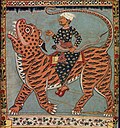
[[File:Pir Gazi and his tiger in Sundarbans.jpg|thumb|[[Mughal painting|Mughal]] era illustration of [[Pir Gazi|Pir Ghazi]] of [[Bengal]], during the 18th century. ]] | [[File:Pir Gazi and his tiger in Sundarbans.jpg|thumb|[[Mughal painting|Mughal]] era illustration of [[Pir Gazi|Pir Ghazi]] of [[Bengal]], during the 18th century. ]] | ||
| Line 82: | Line 87: | ||
{{main|Battle of Buxar}} | {{main|Battle of Buxar}} | ||
The '''Battle of Buxar''' was fought on 22 October 1764 between the combined armies of [[Mir Qasim]], the [[Nawab of Bengal]]; [[Shuja-ud-Daula]] the [[Nawab of Awadh]]; the [[Mughal Emperor]] Shah Alam II and the forces under the command of the [[ | The '''Battle of Buxar''' was fought on 22 October 1764 between the combined armies of [[Mir Qasim]], the [[Nawab of Bengal]]; [[Shuja-ud-Daula]] the [[Nawab of Awadh]]; the [[Mughal Emperor]] Shah Alam II and the forces under the command of the [[East India Company]] led by [[Hector Munro, 8th of Novar|Hector Munro]].<ref>''A Dictionary of Modern Indian History (1707–1947)'', Parshotam Mehra, {{ISBN|0-19-561552-2}}, 1985 ed., Oxford University Press</ref> The battle fought at [[Buxar]], a town located on the bank of the [[Ganges|Ganges river]] then within the territory of [[Bengal]], was a decisive victory for the East India Company. | ||
<gallery> | <gallery> | ||
| Line 90: | Line 95: | ||
</gallery> | </gallery> | ||
=== | ===Treaty of Allahabad=== | ||
Soon after the [[Battle of Buxar]], Shah Alam II, a sovereign who had just been defeated by the British, sought their protection by signing the [[Treaty of Allahabad]] in the year 1765. Shah Alam II was forced to grant the ''Diwani'' (right to collect revenue) of [[Bengal]] (which included [[Bihar]] and [[Odisha]]) to the [[ | {{See main|Treaty of Allahabad}} | ||
Soon after the [[Battle of Buxar]], Shah Alam II, a sovereign who had just been defeated by the British, sought their protection by signing the [[Treaty of Allahabad]] in the year 1765. Shah Alam II was forced to grant the ''Diwani'' (right to collect revenue) of [[Bengal]] (which included [[Bihar]] and [[Odisha]]) to the [[East India Company]] in return for an annual tribute of 2.6 million rupees to be paid by the company from the collected revenue. Tax exempt status was also restored to the company. The company further secured for the districts of Kora and Allahabad which allowed the [[East India Company]] to collect tax from more than 20 million people. East India Company thus became the Imperial tax collector in the former Mughal province of [[Bengal]] (which included [[Bihar]] and Northern [[Odisha]]). East India Company appointed a deputy [[Nawab]] Muhammad Reza Khan to collect revenue on behalf of the company. | |||
<gallery> | <gallery> | ||
File:Shah 'Alam conveying the grant of the Diwani to Lord Clive.jpg|Shah Alam II granting [[Robert Clive]] the "[[Dewan|Diwani]] rights of [[Bengal]], [[Behar]] and [[Odisha]]" in return for the annexed territories of the [[Nawab of Awadh]] after the [[Battle of Buxar]], on 12 August 1765 at the [[Benares]]. | File:Shah 'Alam conveying the grant of the Diwani to Lord Clive.jpg|Shah Alam II granting [[Robert Clive]] the "[[Dewan|Diwani]] rights of [[Bengal]], [[Behar]] and [[Odisha]]" in return for the annexed territories of the [[Nawab of Awadh]] after the [[Battle of Buxar]], on 12 August 1765 at the [[Benares]]. | ||
File:Portrait of East India Company official.jpg|A member of the [[ | File:Portrait of East India Company official.jpg|A member of the [[East India Company]] enjoying a [[Durbar (court)|Durbar]]. | ||
</gallery> | </gallery> | ||
| Line 102: | Line 108: | ||
Shah Alam II's absence from Delhi was due to the terms of the treaty he had signed with the British. But his son and heir apparent Prince [[Mirza Jawan Bakht (born 1749)|Mirza Jawan Bakht]] and [[Najib-ul-Daula]], represented the emperor for the next 12 years in Delhi. | Shah Alam II's absence from Delhi was due to the terms of the treaty he had signed with the British. But his son and heir apparent Prince [[Mirza Jawan Bakht (born 1749)|Mirza Jawan Bakht]] and [[Najib-ul-Daula]], represented the emperor for the next 12 years in Delhi. | ||
==Bengal Famine== | === Bengal Famine === | ||
The [[Bengal famine of 1770 | The [[Great Bengal famine of 1770]] was a massive catastrophe that signalled the end of the [[Mughal Empire]] and disorder in the [[Indian Subcontinent]]. By the time the famine occurred it became very clear that the [[Mughal Empire]] was no longer a major political power, not only in the general world but also within [[South Asia]]. | ||
By the time the famine occurred it became very clear that the [[Mughal Empire]] was no longer a major political power, not only in the general world but also within [[South Asia]]. | |||
==Return to Delhi== | ==Return to Delhi== | ||
Shah Alam II resided in the fort of Allahabad for six years. [[Warren Hastings]], the head of East India | Shah Alam II resided in the fort of Allahabad for six years. [[Warren Hastings]], the head of East India Company got appointed as the first Governor of Bengal in 1774. This was the period of "Dual rule" where East India Company enacted laws to maximise collection of revenue and the Mughal Emperor appointed Nawab looked after other affairs of the province. East India Company later discontinued the tribute of 2.6 million Rupees and later also handed over the districts of [[Allahabad]] and [[Kora Jahanabad|Kora]] to the [[Nawab of Awadh]]. These measures amounted to a repudiation of the company's vassalage to the emperor as Diwan (tax collector). In 1793 East India Company was strong enough and abolished Nizamat (local rule) completely and annexed Bengal. Weakened Shah Alam II agreed to the consultation of the East India Company, who advised him never to trust the [[Maratha]]s. | ||
In the year 1771 the [[Maratha]]s under [[Mahadaji Shinde]] returned to northern India and even captured [[Delhi]]. Shah Alam II, was escorted by Mahadaji Shinde and left Allahabad in May 1771 and in January 1772 reached Delhi. Along with the Marathas they undertook to win the crown lands of Rohilkhand and defeated [[Zabita Khan]], capturing the fort of Pathargarh with its treasure. | In the year 1771 the [[Maratha]]s under [[Mahadaji Shinde]] returned to northern India and even captured [[Delhi]]. Shah Alam II, was escorted by Mahadaji Shinde and left Allahabad in May 1771 and in January 1772 reached Delhi. Along with the Marathas they undertook to win the crown lands of Rohilkhand and defeated [[Zabita Khan]], capturing the [[Pathargarh Fort|fort of Pathargarh]] with its treasure. | ||
The emperor returned to the throne in Delhi in 1772, under the protection of the [[Maratha]] general [[Mahadaji Shinde]].<ref>{{cite book|url=https://books.google.com/books?id=uPq640stHJ0C&q=1771+scindia&pg=PA8 |title=The Great Maratha Mahadaji Shinde - N. G. Rathod - Google Books |isbn=9788185431529 |access-date=2017-02-09|last1=Rathod |first1=N. G. |year=1994 }}</ref> The emperor became a client of the Maratha whose [[Peshwa]] demanded tribute, which the Moguls are known to have paid so as to avoid any further conflict with the Confederacy. | The emperor returned to the throne in Delhi in 1772, under the protection of the [[Maratha]] general [[Mahadaji Shinde]].<ref>{{cite book|url=https://books.google.com/books?id=uPq640stHJ0C&q=1771+scindia&pg=PA8 |title=The Great Maratha Mahadaji Shinde - N. G. Rathod - Google Books |isbn=9788185431529 |access-date=2017-02-09|last1=Rathod |first1=N. G. |year=1994 }}</ref> The emperor became a client of the Maratha whose [[Peshwa]] demanded tribute, which the Moguls are known to have paid so as to avoid any further conflict with the Confederacy. | ||
| Line 117: | Line 121: | ||
In the year 1787, an embassy of [[Vijay Singh of Marwar|Vijay Singh]] from [[Jodhpur]] presented itself to the Mughal Emperor Shah Alam II, bringing homage and the golden key of the Fortress of [[Ajmer]].<ref>{{Google books |id=HYrcODgieDIC |page=6 |title=The Fall of the Moghul Empire of Hindustan }}</ref> | In the year 1787, an embassy of [[Vijay Singh of Marwar|Vijay Singh]] from [[Jodhpur]] presented itself to the Mughal Emperor Shah Alam II, bringing homage and the golden key of the Fortress of [[Ajmer]].<ref>{{Google books |id=HYrcODgieDIC |page=6 |title=The Fall of the Moghul Empire of Hindustan }}</ref> | ||
After killing [[Ghulam Kadir|Ghulam Qadir]] and restoring Shah Alam II to the throne, a [[Maratha Empire|Maratha]] garrison permanently occupied [[Delhi]] in 1788 and ruled on north India for next two decades until they were usurped by the [[ | After killing [[Ghulam Kadir|Ghulam Qadir]] and restoring Shah Alam II to the throne, a [[Maratha Empire|Maratha]] garrison permanently occupied [[Delhi]] in 1788 and ruled on north India for next two decades until they were usurped by the [[East India Company]] in the [[Second Anglo-Maratha War]].<ref name="books.google.co.in">{{cite book|url=https://books.google.com/books?id=aqqBPS1TDUgC&pg=PA28|title=Delhi, the Capital of India|first=John|last=Capper|date=27 July 1997|publisher=Asian Educational Services|isbn=9788120612822|access-date=27 July 2018|via=Google Books}}</ref> | ||
<gallery> | <gallery> | ||
| Line 126: | Line 130: | ||
===Reformation of the Mughal Army=== | ===Reformation of the Mughal Army=== | ||
One of his first acts was to strengthen and raise a new [[Mughal Army]], under the command of [[Mirza Najaf Khan]]. This new army consisted of infantrymen who successfully utilised both [[Flintlock]]s and [[Talwar]]s in combat formations,<ref>{{cite book|author=Kaushik Roy|title=War, Culture, Society in Early Modern South Asia, 1740–1849|date=30 March 2011|url={{Google books |plainurl=yes |id=zp0FbTniNaYC |page=29 }} |access-date=30 March 2012|publisher=Taylor & Francis|isbn=978-1-136-79087-4|pages=29–}}</ref> they | One of his first acts was to strengthen and raise a new [[Mughal Army]], under the command of [[Mirza Najaf Khan]]. This new army consisted of infantrymen who successfully utilised both [[Flintlock]]s and [[Talwar]]s in combat formations,<ref>{{cite book|author=Kaushik Roy|title=War, Culture, Society in Early Modern South Asia, 1740–1849|date=30 March 2011|url={{Google books |plainurl=yes |id=zp0FbTniNaYC |page=29 }} |access-date=30 March 2012|publisher=Taylor & Francis|isbn=978-1-136-79087-4|pages=29–}}</ref> they used elephants for transportation and were less dependent on artillery and cavalry. [[Mirza Najaf Khan]] is also known to have introduced the more-effective [[Firelock]] muskets through his collaboration with [[Mir Qasim]], the [[Nawab of Bengal]].<ref>{{cite book|author=Kaushik Roy|title=War, Culture, Society in Early Modern South Asia, 1740–1849|date=30 March 2011|url={{Google books |plainurl=yes |id=zp0FbTniNaYC |page=30 }} |access-date=30 March 2012|publisher=Taylor & Francis|isbn=978-1-136-79087-4|pages=30–}}</ref> | ||
<gallery> | <gallery> | ||
| Line 134: | Line 138: | ||
</gallery> | </gallery> | ||
==Foreign relations== | === Foreign relations === | ||
[[File:Shah Alam II, Mughal emperor of india, reviewing the East India Companys troops.jpg|thumb|[[Mughal Emperor]] Shah Alam II negotiates with the [[ | [[File:Shah Alam II, Mughal emperor of india, reviewing the East India Companys troops.jpg|thumb|[[Mughal Emperor]] Shah Alam II negotiates with the [[East India Company]], after the arrival of [[Pierre André de Suffren|Suffren]].]] | ||
Shah Alam II, was well supported by [[Jean Law de Lauriston]] and 200 [[French people|Frenchmen]] during his campaign to regain the Eastern Subahs (during the [[Seven Years' War]]). The brainchild of the campaign was [[Ghulam Husain Tabatabai]], who had gained much administrative and military experience from both the French and the [[Netherlands|Dutch]]. | Shah Alam II, was well supported by [[Jean Law de Lauriston]] and 200 [[French people|Frenchmen]] during his campaign to regain the Eastern Subahs (during the [[Seven Years' War]]). The brainchild of the campaign was [[Ghulam Husain Tabatabai]], who had gained much administrative and military experience from both the French and the [[Netherlands|Dutch]]. | ||
After Shah Alam II's defeat in the [[Battle of Buxar]], the [[France|French]] once again reached out to emperor under [[Pierre André de Suffren]] in the year 1781, who initiated a plan to capture [[Bombay]] and [[Surat]] from the [[Maratha Confederacy]] and the [[Kingdom of Great Britain|British]], with the co-operation of [[Mirza Najaf Khan]], this action would eventually lead to [[Asaf Jah II]] to join Shah Alam II and the French and assist Hyder Ali to capture [[Madras]] from the [[ | After Shah Alam II's defeat in the [[Battle of Buxar]], the [[France|French]] once again reached out to emperor under [[Pierre André de Suffren]] in the year 1781, who initiated a plan to capture [[Bombay]] and [[Surat]] from the [[Maratha Confederacy]] and the [[Kingdom of Great Britain|British]], with the co-operation of [[Mirza Najaf Khan]], this action would eventually lead to [[Asaf Jah II]] to join Shah Alam II and the French and assist Hyder Ali to capture [[Madras]] from the [[East India Company]].<ref>{{cite web|url=https://www.google.ae/search?q=suffren+letter+shah+alam&oq=suffren+letter+shah+alam&aqs=chrome..69i57.5079j0j7&sourceid=chrome&es_sm=93&ie=UTF-8#tbm=bks&q=de+Suffren+and+shah+alam|title=suffren letter shah alam - Google Search|website=www.google.ae|access-date=27 July 2018}}</ref> The internal conflicts within the Mughal imperial court would not allow the emperor to make such a bold move against the British. | ||
<gallery> | <gallery> | ||
| Line 145: | Line 149: | ||
</gallery> | </gallery> | ||
==Jat victories== | |||
[[Jats]] rose in retaliation of religious intolerance pursued by [[Aurangzeb]].<ref name=AH1/> The [[Hindu Jats|Jat]] kingdom of [[Bharatpur State|Bharatpur]] waged many wars against the Mughal Delhi and in the 17th and 18th century carried out numerous campaigns in Mughal territories including Agra.<ref name="Unit1973">{{cite book | title=The Gazetteer of India: History and culture | year=1973 | publisher=Publications Division, Ministry of Information and Broadcasting, India | oclc = 186583361 | page = 348 }}</ref> Mughals were defeated by [[Maratha]]s in 1757; and Mughal possessions and territories were under the annexation of the Jats led by Suraj Mal. | [[Jats]] rose in retaliation of religious intolerance pursued by [[Aurangzeb]].<ref name=AH1/> The [[Hindu Jats|Jat]] kingdom of [[Bharatpur State|Bharatpur]] waged many wars against the Mughal Delhi and in the 17th and 18th century carried out numerous campaigns in Mughal territories including Agra.<ref name="Unit1973">{{cite book | title=The Gazetteer of India: History and culture | year=1973 | publisher=Publications Division, Ministry of Information and Broadcasting, India | oclc = 186583361 | page = 348 }}</ref> Mughals were defeated by [[Maratha]]s in 1757; and Mughal possessions and territories were under the annexation of the Jats led by Suraj Mal. | ||
During one massive assault, Jats sieged Agra in 1761, after 20 days on 12 June 1761 the [[Mughal Empire|Mughal forces]] at [[Agra]] surrendered to Jats.<ref name=AH1/> Jats plundered the city and carried the bounty, including the two great [[silver]] doors to the entrance of the famous [[Taj Mahal]]. which were carried off and melted down by [[Suraj Mal]] in 1764.<ref>{{cite web|url=http://www.sscnet.ucla.edu/southasia/Culture/Archit/TajM.html|title=Manas: Culture, Architecture of India, Taj Mahal|website=www.sscnet.ucla.edu|access-date=27 July 2018}}</ref> | During one massive assault, Jats sieged Agra in 1761, after 20 days on 12 June 1761 the [[Mughal Empire|Mughal forces]] at [[Agra]] surrendered to Jats.<ref name=AH1/> Jats plundered the city and carried the bounty, including the two great [[silver]] doors to the entrance of the famous [[Taj Mahal]]. which were carried off and melted down by [[Suraj Mal]] in 1764.<ref>{{cite web|url=http://www.sscnet.ucla.edu/southasia/Culture/Archit/TajM.html|archive-url=https://web.archive.org/web/19991006091033/http://www.sscnet.ucla.edu/southasia/Culture/Archit/TajM.html|url-status=dead|archive-date=6 October 1999|title=Manas: Culture, Architecture of India, Taj Mahal|website=www.sscnet.ucla.edu|access-date=27 July 2018}}</ref> | ||
Suraj Mal's son [[Jawahar Singh]], further extended the Jat power in [[Northern India]] and captured the territory in [[Doab]], [[Ballabgarh]] and [[Agra]].<ref>{{Google books |id=CctFMm9HSH8C |page=9 |title=The Province of Agra: Its History and Administration }}</ref> Jats kept Agra fort and other territories closer to Delhi under their control from 1761 till 1774 CE.<ref name=AH1>[https://books.google.com/books?id=CctFMm9HSH8C | Suraj Mal's son [[Jawahar Singh]], further extended the Jat power in [[Northern India]] and captured the territory in [[Doab]], [[Ballabgarh]] and [[Agra]].<ref>{{Google books |id=CctFMm9HSH8C |page=9 |title=The Province of Agra: Its History and Administration }}</ref> Jats kept Agra fort and other territories closer to Delhi under their control from 1761 till 1774 CE.<ref name=AH1>[https://books.google.com/books?id=CctFMm9HSH8C&dq=jat+rule+over+agra&pg=PA9 The province of Agra, Author: Dharma Bhanu Srivastava, page 8-10]</ref> | ||
==Sikh Victories== | |||
Sikhs had been in perpetual war against Mughal intolerance specially after beheading of the Sikh Guru - [[Guru Teg Bahadur]] by the Mughals. Simmering Sikhs rose once again in the year 1764 and overran the [[Mughal (tribe)|Mughal]] [[Faujdar]] of Sirhind, [[Zain Khan Sirhindi]], who fell in battle and ever since the Sikhs perpetually raided and took the bounties from the lands as far as [[Delhi]] practically every year | Sikhs had been in perpetual war against Mughal intolerance specially after beheading of the Sikh Guru - [[Guru Teg Bahadur]] by the Mughals. Simmering Sikhs rose once again in the year 1764 and overran the [[Mughal (tribe)|Mughal]] [[Faujdar]] of Sirhind, [[Zain Khan Sirhindi]], who fell in battle and ever since the Sikhs perpetually raided and took the bounties from the lands as far as [[Delhi]] practically every year. | ||
The Marathas took Delhi in | The Marathas [[Capture of Delhi (1771)|took Delhi]] in 1771 before Shah Alam II arrived. [[Mirza Najaf Khan]] had restored a sense of order to the Mughal finances and administration and particularly reformed the [[Mughal Army]]. In 1777 [[Mirza Najaf Khan]] decisively defeated [[Zabita Khan]]'s forces and repelled the Sikhs after halting their raids. | ||
In 1778, after a Sikh incursion into Delhi, Shah Alam ordered their defeat by appointing, the [[Mughal Empire|Mughal]] [[Grand Vizier]], Majad-ud-Daula marched with 20,000 Mughal troops against the Sikh army into hostile territories, this action led to the defeat of the [[Mughal Army]] at [[Muzzaffargarh]] and later at [[Ganaur|Ghanaur]], due to the mounted casualties Shah Alam II reappointed [[Mirza Najaf Khan]], who soon died of natural circumstances leaving the Mughal Empire weaker than ever. | In 1778, after a Sikh incursion into Delhi, Shah Alam ordered their defeat by appointing, the [[Mughal Empire|Mughal]] [[Grand Vizier]], Majad-ud-Daula marched with 20,000 Mughal troops against the Sikh army into hostile territories, this action led to the defeat of the [[Mughal Army]] at [[Muzzaffargarh]] and later at [[Ganaur|Ghanaur]], due to the mounted casualties Shah Alam II reappointed [[Mirza Najaf Khan]], who soon died of natural circumstances leaving the Mughal Empire weaker than ever. | ||
| Line 172: | Line 167: | ||
In the year 1779, Mirza Najaf Khan carefully advanced his forces who successfully routed the treasonous [[Zabita Khan]] and his Sikh allies who lost more than 5,000 men in a single battle and never returned to threaten the [[Mughal Empire]] during the commander Mirza Najaf Khan's lifetime. Najaf Khan as prime minister, granted sovereign rights to the Sikhs as agreement.<ref>{{cite book|last=Gupta|first=Hari Ram|title=History of the Sikhs: Vol. III: Sikh Domination of the Mughal Empire|year=2010|publisher=Munshiram Manoharlal Publishers|location=New Delhi|isbn=9788121502139}}</ref> | In the year 1779, Mirza Najaf Khan carefully advanced his forces who successfully routed the treasonous [[Zabita Khan]] and his Sikh allies who lost more than 5,000 men in a single battle and never returned to threaten the [[Mughal Empire]] during the commander Mirza Najaf Khan's lifetime. Najaf Khan as prime minister, granted sovereign rights to the Sikhs as agreement.<ref>{{cite book|last=Gupta|first=Hari Ram|title=History of the Sikhs: Vol. III: Sikh Domination of the Mughal Empire|year=2010|publisher=Munshiram Manoharlal Publishers|location=New Delhi|isbn=9788121502139}}</ref> | ||
In the year 1783, [[Begum Samru|Farzana Zeb un-Nissa]] had saved Delhi from a possible invasion by a force of 30,000 Sikh troops, under [[Baghel Singh]], | In the year 1783, [[Begum Samru|Farzana Zeb un-Nissa]] had saved Delhi from a possible invasion by a force of 30,000 Sikh troops, under [[Baghel Singh]], [[Jassa Singh Ramgarhia]] and [[Jassa Singh Ahluwalia]]. | ||
Mughal empire disintegrated to such an extent that Shah Alam II was only left with Delhi city to rule. In 1783, [[Jassa Singh Ahluwalia]] and [[Baghel Singh]] laid siege to the city. After entering Red fort, [[Jassa Singh Ahluwalia]] sat on the Mughal throne on behest of Baghel Singh and a title of Badshah Singh was given to him. [[Begum Samru]] requested [[Baghel Singh]] to show mercy on Shah Alam II. Baghel Singh accepted and stated his demands such as 30,000 of his troops to stay in Delhi and the Mughal Empire would pay for their maintenance. Other demands were the construction of at least 5 Gurdwaras and annual tax payment of 13.5%. The demands were agreed upon by Shah Alam II with a written agreement. Since Sikhs refused to accept authority of the Mughal court due to politics, [[Mahadji Scindia|Mahadji Shinde]] was given the regency with an agreement that Sikhs will not plunder the crown lands and they will be paid 1/3 of the Delhi revenue annually instead.<ref name="Jawandha 2010 207">{{cite book|last=Jawandha|first=Nahar|title=Glimpses of Sikhism|year=2010|publisher=Sanbun Publishers|location=New Delhi|isbn=9789380213255|page=207}}</ref> | |||
==Downfall== | ==Downfall== | ||
[[File:Silver rupee coin of Shah Alam II.jpg|thumb|left|A silver [[Rupee]] struck in the name of Shah Alam]] | [[File:Silver rupee coin of Shah Alam II.jpg|thumb|left|A silver [[Rupee]] struck in the name of Shah Alam]] | ||
After the defeats at [[Muzaffargarh]] and later at Ghanaur, [[Majad-ud-Daula]] was arrested by the orders of Shah Alam II, who then recalled [[Mirza Najaf Khan]]. This led to the former [[Grand Vizier]]'s arrest for causing miscalculations and collaborating with the enemies of the emperor. The traitor was imprisoned and a sum of two million ''dam'' in stolen revenue recovered from him. It was Shah Alam II's poor judgement and vacillation that led to his own downfall. [[Mirza Najaf Khan]] had given the Mughal Empire breathing space by having a powerful, well managed army in its own right. In 1779 the newly reformed [[Mughal Army]] decisively defeated [[Zabita Khan]] | After the defeats at [[Muzaffargarh]] and later at Ghanaur, [[Majad-ud-Daula]] was arrested by the orders of Shah Alam II, who then recalled [[Mirza Najaf Khan]]. This led to the former [[Grand Vizier]]'s arrest for causing miscalculations and collaborating with the enemies of the emperor. The traitor was imprisoned and a sum of two million ''dam'' in stolen revenue recovered from him. It was Shah Alam II's poor judgement and vacillation that led to his own downfall. [[Mirza Najaf Khan]] had given the Mughal Empire breathing space by having a powerful, well managed army in its own right. In 1779 the newly reformed [[Mughal Army]] decisively defeated [[Zabita Khan]], the rebels lost 5,000 men including their leader and therefore did not return during the lifetime of [[Mirza Najaf Khan]] {{Citation needed|date=October 2020}}. Unfortunately upon the general's death, Shah Alam's bad judgement prevailed. The dead man's nephew, Mirza Shafi whose valour had been proven during various occasions, was not appointed commander in chief. Shah Alam II instead appointed worthless individuals whose loyalty and record were questionable at best {{Citation needed|date=October 2020}}. They were soon quarrelling over petty matters. Even the corrupt and treasonous former Grand Vizier, Majad-ud-Daula was restored to his former office, he later colluded with the Sikhs and reduced the size of the [[Mughal Army]] from over 20,000 to only 5,000 thus bringing the Mughal Emperor Shah Alam II at the mercy of his enemies.<ref name="Islam2008">{{cite book|author=Misbah Islam|title=Decline of Muslim States and Societies|url={{Google books |plainurl=yes |id=cBVpaCu7XA8C |page=392 }} |access-date=30 March 2012|date=30 June 2008|publisher=Xlibris Corporation|isbn=978-1-4363-1012-3|pages=392–}}</ref>{{Self-published inline|certain=yes|date=December 2017}} | ||
{{quote box|width=25%|quote=''The respect toward the house of [[Timur]] is so strong that even though the whole subcontinent has been withdrawn from its authority, that no ordinary prince ever intends to take the title of sovereign...and Shah Alam II is still seated on the Mughal throne, and everything is still done in his name.''|source='''[[Benoît de Boigne]]''', (1790). | {{quote box|width=25%|quote=''The respect toward the house of [[Timur]] is so strong that even though the whole subcontinent has been withdrawn from its authority, that no ordinary prince ever intends to take the title of sovereign...and Shah Alam II is still seated on the Mughal throne, and everything is still done in his name.''|source='''[[Benoît de Boigne]]''', (1790). | ||
| Line 193: | Line 184: | ||
===Client of Mahadji Shinde=== | ===Client of Mahadji Shinde=== | ||
Thankful for his intervention, he honoured [[Mahadji Shinde]] with the titles of ''Vakil-ul-Mutlaq'' (Regent of the Empire) and ''Amir-ul-Amara'' (Head of the Amirs). | Thankful for his intervention, he honoured [[Mahadji Shinde]] with the titles of ''Vakil-ul-Mutlaq'' (Regent of the Empire) and ''Amir-ul-Amara'' (Head of the Amirs). He made a deal with the [[Peshwa]] granting tribute to [[Pune]] in return for the protection provided [[Mahadji Shinde]] of the Maratha Confederacy. | ||
After killing Ghulam Qadir and restoring Shah Alam II to the throne, a [[Maratha Empire|Maratha]] garrison permanently occupied [[Delhi]] in 1788 and ruled on north India for next | |||
After killing Ghulam Qadir and restoring Shah Alam II to the throne, a [[Maratha Empire|Maratha]] garrison permanently occupied [[Delhi]] in 1788 and ruled on north India for next two decades until they were usurped by the [[East India Company]] following the [[Second Anglo-Maratha War]] in 1803.<ref name="books.google.co.in"/> | |||
== | ==Second reign== | ||
[[File:Recent photograph of the tombs of the Mughal Emperors Shah Alam II and Akbar Shah II.jpg|thumb|200px|The tomb of Shah Alam II, in [[Mehrauli]], [[Delhi]].]] | [[File:Recent photograph of the tombs of the Mughal Emperors Shah Alam II and Akbar Shah II.jpg|thumb|200px|The tomb of Shah Alam II, in [[Mehrauli]], [[Delhi]].]] | ||
The French threat in Europe and its possible repercussions in India caused the British to strive to regain the custody of Shah Alam II. The British feared that the French military officers might overthrow Maratha power and use the authority of the Mughal emperor to further French ambition in India. | The French threat in Europe and its possible repercussions in India caused the British to strive to regain the custody of Shah Alam II. The British feared that the French military officers might overthrow Maratha power and use the authority of the Mughal emperor to further French ambition in India. | ||
Shah Alam II also corresponded with [[Hyder Ali]] and later with his son [[Tipu Sultan]] during their conflicts with the [[ | Shah Alam II also corresponded with [[Hyder Ali]] and later with his son [[Tipu Sultan]] during their conflicts with the [[East India Company]] during the [[Anglo-Mysore Wars]] and was very well informed about the expansionist agenda of the British. | ||
After the [[Battle of Delhi (1803)]], during the [[Second Anglo-Maratha War]], on 14 September 1803 British troops entered Delhi ending the Maratha rule on the Mughals, bringing Shah Alam, then a blind old man, seated under a tattered canopy, under British protection. The Mughal Emperor no longer had the military power to enforce his will, but he commanded respect as a dignified member of the House of [[Timur]] in the length and breadth of the country.{{citation needed|date=February 2018}} The [[Nawab]]s and [[Subedar]]s still sought formal sanction of the [[Mughal Emperor]] on their accession and valued the titles he bestowed upon them. They struck coins and read the ''[[khutba]]'' (Friday sermons) in his name. The Marathas in 1804 under [[Yashwantrao Holkar]] tried to snatch Delhi from the British in [[Siege of Delhi (1804)]], but failed. | After the [[Battle of Delhi (1803)]], during the [[Second Anglo-Maratha War]], on 14 September 1803 British troops entered Delhi ending the Maratha rule on the Mughals, bringing Shah Alam, then a blind old man, seated under a tattered canopy, under British protection. The Mughal Emperor no longer had the military power to enforce his will, but he commanded respect as a dignified member of the House of [[Timur]] in the length and breadth of the country.{{citation needed|date=February 2018}} The [[Nawab]]s and [[Subedar]]s still sought formal sanction of the [[Mughal Emperor]] on their accession and valued the titles he bestowed upon them. They struck coins and read the ''[[khutba]]'' (Friday sermons) in his name. The Marathas in 1804 under [[Yashwantrao Holkar]] tried to snatch Delhi from the British in [[Siege of Delhi (1804)]], but failed. | ||
| Line 209: | Line 201: | ||
Shah Alam II died of natural causes on 19 November 1806. | Shah Alam II died of natural causes on 19 November 1806. | ||
His grave lies next to the [[dargah]] of the 13th century Sufi saint | His grave lies in a marble enclosure adjoined to the [[Moti Masjid (Mehrauli)|Moti Masjid]], next to the [[dargah]] of the 13th century Sufi saint [[Qutbuddin Bakhtiar Kaki]], in [[Mehrauli]], [[Delhi]]. Also in the enclosure are the tombs of [[Bahadur Shah I]] (also known as [[Shah Alam I]]), and [[Akbar Shah II]].<ref name=":0">{{Cite book |last=Dadlani |first=Chanchal B. |url=https://www.worldcat.org/oclc/1024165136 |title=From stone to paper: architecture as history in the late Mughal Empire |year=2018 |isbn=978-0-300-23317-9 |location=New Haven [CT] |pages=63 |oclc=1024165136}}</ref> | ||
==In popular culture== | ==In popular culture== | ||
| Line 222: | Line 214: | ||
==See also== | ==See also== | ||
*[[Mirza Najaf Khan]] | *[[Mirza Najaf Khan]] | ||
*[[Shuja-ud-Daula]] | *[[Shuja-ud-Daula]] | ||
| Line 240: | Line 232: | ||
{{s-start}} | {{s-start}} | ||
{{s-hou|[[Timurid | {{s-hou|[[Timurid dynasty]]||1728||1806}} | ||
{{s-reg|}} | {{s-reg|}} | ||
{{s-bef|before=[[Shah Jahan III]]}} | {{s-bef|before=[[Shah Jahan III]]}} | ||
Revision as of 09:27, 22 July 2023
 | This article needs more citations. (January 2020) |
| Shah Alam II | |||||
|---|---|---|---|---|---|
| Padishah Al-Sultan Al-Azam | |||||
 Shah Alam II enthroned, c. 1797 | |||||
| 17th Mughal Emperor | |||||
| 1st reign | 10 October 1760 – 31 July 1788 | ||||
| Predecessor | Shah Jahan III | ||||
| Successor | Shah Jahan IV | ||||
| 2nd reign | 16 October 1788 – 19 November 1806 | ||||
| Predecessor | Shah Jahan IV | ||||
| Successor | Akbar II | ||||
| Born | Mirza Ali Gauhar 25 June 1728 Shahjahanabad, Subah of Delhi, Mughal Empire (present-day Old Delhi, Delhi, India) | ||||
| Died | 19 November 1806 (aged 78) Shahjahanabad, Subah of Delhi, Mughal Empire | ||||
| Burial | Moti Masjid, Mehrauli, Delhi | ||||
| Spouses | |||||
| Issue |
| ||||
| |||||
| House | House of Babur | ||||
| Dynasty |  Timurid dynasty Timurid dynasty | ||||
| Father | Alamgir II | ||||
| Mother | Zinat Mahal | ||||
| Religion | Sunni Islam (Hanafi) | ||||
| Military career | |||||
| Battles/wars | Third Battle of Panipat Bengal War Battle of Delhi (1764) Battle of Buxar Battle of Delhi (1771) Battle of Delhi (1783) Siege of Delhi (1804) | ||||
| Mughal emperors | ||||||||||||||||||||||||||||||||||||||||||||||
|---|---|---|---|---|---|---|---|---|---|---|---|---|---|---|---|---|---|---|---|---|---|---|---|---|---|---|---|---|---|---|---|---|---|---|---|---|---|---|---|---|---|---|---|---|---|---|
|
||||||||||||||||||||||||||||||||||||||||||||||
Shah Alam II (Persian: شاه عالم دوم) (Template:IPA-fa; 25 June 1728 – 19 November 1806), also known by his birth name Ali Gohar (or Ali Gauhar), was the seventeenth Mughal Emperor and the son of Alamgir II.[16] Shah Alam II became the emperor of a crumbling Mughal Empire. His power was so depleted during his reign that it led to a saying in the Persian language, Sultanat-e-Shah Alam, Az Dilli ta Palam, meaning, 'The empire of Shah Alam is from Delhi to Palam', Palam being a suburb of Delhi.[17][18]
Shah Alam faced many invasions, mainly by the Emir of Afghanistan, Ahmed Shah Abdali, which led to the Third Battle of Panipat (1761) between the Maratha Empire, who maintained suzerainty over Mughal affairs in Delhi and the Afghans led by Abdali. In 1760, the invading forces of Abdali were driven away by the Marathas, led by Sadashivrao Bhau, who deposed Shah Jahan III, the puppet Mughal emperor of Imad-ul-Mulk, and installed Shah Alam II as the rightful emperor (1760 – 1772).[19][20]
Shah Alam II was considered the only and rightful emperor, but he was unable to return to Delhi until 1772, under the protection of the Maratha general Mahadaji Shinde. He also fought against the East India Company at the Battle of Buxar (1764). In 1788, when he was a prisoner of Ghulam Qadir, he was blinded.
Shah Alam II authored his own Diwan of poems and was known by the pen-name Aftab. His poems were guided, compiled and collected by Mirza Fakhir Makin.[21]
Shah Alam also penned famous book Ajaib-ul-Qasas which is considered one of the earliest and prominent book of prose in Urdu.
Early life
Ali Gohar was born to Shahzada (Prince) Aziz-ud-Din, son of the deposed Mughal Emperor Jahandar Shah, on 25 June 1728. Alongside his father, he grew up in semi-captivity in the Salatin quarters of the Red Fort. However, unlike the majority of Mughal princes growing up in similar circumstances, he is not recorded to have become a decadent prince by the time his father became emperor, and therefore was naturally given high appointments in the course of his father's reign.
Upon his father's accession, he became the Wali al-Ahd (Crown Prince) of the empire, and became his father's principal agent, though almost all power lay in the Wazir Imad-ul-Mulk's hand. His quarrels with that amir, and fear for his own life, caused him to flee from Delhi in 1758.
Escape from Delhi
Prince Ali Gauhar, afterwards Emperor Shah Alam II, had been the heir apparent of his father Alamgir II. Prince Ali Gauhar's father had been appointed Mughal Emperor by Vizier Imad-ul-Mulk and Maratha Peshwa's cousin Sadashivrao Bhau.[22]
Prince Ali Gauhar organized a militia and made a daring escape from Delhi. He appeared in the Eastern Subah in 1759, hoping to strengthen his position by attempting to regaining control over Bengal, Bihar and Odisha.
Very soon however, Najib-ud-Daula forced the usurper Imad-ul-Mulk to flee from the capital by gathering a large Mughal Army outside Delhi. He used the army to depose the recreant Shah Jahan III. Najib-ud-Daula and Muslim nobles then planned to defeat the Marathas by maintaining correspondence with the powerful Ahmad Shah Durrani. After Durrani decisively defeated the Marathas, he nominated Ali Gauhar as the emperor under the name Shah Alam II.[23]
Bengal War
In 1760, after Shah Alam's militia gaining control over pockets in Bengal, Bihar and parts of Odisha, Prince Ali Gauhar and his Mughal Army of 30,000 intended to overthrow Mir Jafar and Imad-ul-Mulk after they tried to capture or kill him by advancing towards Awadh and Patna in 1759. But the conflict soon involved the intervention of the assertive East India Company.
The Mughals clearly intended to recapture their breakaway Eastern Subah led by Prince Ali Gauhar, who was accompanied by a Militia consisting of persons like Muhammad Quli Khan, Kadim Husein, Kamgar Khan, Hidayat Ali, Mir Afzal and Ghulam Husain Tabatabai. Their forces were reinforced by the forces of Shuja-ud-Daula, Najib-ud-Daula and Ahmad Khan Bangash. The Mughals were also joined by Jean Law and 200 Frenchmen and waged a campaign against the British during the Seven Years' War.[24]
Prince Ali Gauhar successfully advanced as far as Patna, which he later besieged with a combined army of over 40,000 in order to capture or kill Ramnarian a sworn enemy of the Mughals. Mir Jafar was in terror at the near demise of his cohort and sent his own son Miran to relieve Ramnarian and retake Patna. Mir Jafar also implored the aid of Robert Clive, but it was Major John Caillaud, who dispersed Prince Ali Gauhar's army in 1761 after four major battles including Battle of Patna, Battle of Sirpur, Battle of Birpur and Battle of Siwan.
After negotiations assuring peace Shah Alam II was escorted by the British to meet Mir Qasim the new Nawab of Bengal, who was nominated after the sudden death of Miran. Mir Qasim soon had the Mughal Emperor's investiture as Subedar of Bengal, Bihar and Odisha, and agreed to pay an annual revenue of 2.4 million dam. Shah Alam II then retreated to Allahabad was protected by the Shuja-ud-Daula, Nawab of Awadh from 1761 until 1764. Meanwhile, Mir Qasim's relations with the East India company began to worsen. He initiated reforms that withdrew the tax exemption enjoyed by the East India Company, he also ousted Ramnarian a sworn enemy of the Mughal Empire and created Firelock manufacturing factories at Patna with the sole purpose of giving advantage to the newly reformed Mughal Army.
Angered by these developments the East India Company sought his ouster. Court intrigues encouraged by the East India Company forced Mir Qasim to leave Bengal, Bihar and Odisha. Mir Qasim on his part encouraged Shuja-ud-Daula the Nawab of Awadh and Shah Alam II to engage the British.
-
![Imad-ul-Mulk was the regent imposed by the Maratha Confederacy in 1757, who assassinated Alamgir II and prominent members of the imperial family, within the Maratha controlled city of Delhi; Shah Alam II managed to escape to safety with the Nawab of Awadh.[25]](/w/images/smartcommons/thumbs/commons/9/92/Gh%C3%A1z%C3%AD_al-D%C3%ADn_X%C3%A1n_%CA%BFIm%C3%A1d_al-Mulk.jpg/85px-Gh%C3%A1z%C3%AD_al-D%C3%ADn_X%C3%A1n_%CA%BFIm%C3%A1d_al-Mulk.jpg) Imad-ul-Mulk was the regent imposed by the Maratha Confederacy in 1757, who assassinated Alamgir II and prominent members of the imperial family, within the Maratha controlled city of Delhi; Shah Alam II managed to escape to safety with the Nawab of Awadh.[25]
Imad-ul-Mulk was the regent imposed by the Maratha Confederacy in 1757, who assassinated Alamgir II and prominent members of the imperial family, within the Maratha controlled city of Delhi; Shah Alam II managed to escape to safety with the Nawab of Awadh.[25] -
 Mir Jafar, his son Miran and Ramnarian refused to submit to Shah Alam II, who initiated the Bengal War causing the eventual intervention of the East India Company.
![Imad-ul-Mulk was the regent imposed by the Maratha Confederacy in 1757, who assassinated Alamgir II and prominent members of the imperial family, within the Maratha controlled city of Delhi; Shah Alam II managed to escape to safety with the Nawab of Awadh.[25]](/wiki/File:Gh%C3%A1z%C3%AD_al-D%C3%ADn_X%C3%A1n_%CA%BFIm%C3%A1d_al-Mulk.jpg)

Emperor from Allahabad

Shah Alam II was acknowledged emperor by the Durrani Empire. His declared reign extended to the 24 Parganas of the Sundarbans,[26] Mir Qasim, Nawabs of Bengal and Murshidabad (and Bihar),[26]Raja of Banares,[27] Nizam of Hyderabad, Nawab of Ghazipur, Sahib of Punjab, Hyder Ali's Mysore,[27] Nawab of Kadapa and Nawab of Kurnool, Nawab of the Carnatic of Arcot and Nellore,[28] Nawab of Junagarh, Rohilkhand of Lower Doab, Rohilkhand of Upper Doab, and Nawab of Bhawalpur.
Battle of Buxar
The Battle of Buxar was fought on 22 October 1764 between the combined armies of Mir Qasim, the Nawab of Bengal; Shuja-ud-Daula the Nawab of Awadh; the Mughal Emperor Shah Alam II and the forces under the command of the East India Company led by Hector Munro.[29] The battle fought at Buxar, a town located on the bank of the Ganges river then within the territory of Bengal, was a decisive victory for the East India Company.
-
 Shuja-ud-Daula served as the leading Nawab Vizier of the Mughal Empire, during the Third Battle of Panipat and the Battle of Buxar
 -
 Nawab of Bengal, Mir Qasim defected to Shah Alam II.
 -
 Mirza Najaf Khan, the commander-in-chief of the Mughal Army.


Treaty of Allahabad
Template:See main Soon after the Battle of Buxar, Shah Alam II, a sovereign who had just been defeated by the British, sought their protection by signing the Treaty of Allahabad in the year 1765. Shah Alam II was forced to grant the Diwani (right to collect revenue) of Bengal (which included Bihar and Odisha) to the East India Company in return for an annual tribute of 2.6 million rupees to be paid by the company from the collected revenue. Tax exempt status was also restored to the company. The company further secured for the districts of Kora and Allahabad which allowed the East India Company to collect tax from more than 20 million people. East India Company thus became the Imperial tax collector in the former Mughal province of Bengal (which included Bihar and Northern Odisha). East India Company appointed a deputy Nawab Muhammad Reza Khan to collect revenue on behalf of the company.
-
 Shah Alam II granting Robert Clive the "Diwani rights of Bengal, Behar and Odisha" in return for the annexed territories of the Nawab of Awadh after the Battle of Buxar, on 12 August 1765 at the Benares.
 -
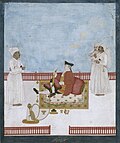 A member of the East India Company enjoying a Durbar.


Absence from Delhi
Shah Alam II's absence from Delhi was due to the terms of the treaty he had signed with the British. But his son and heir apparent Prince Mirza Jawan Bakht and Najib-ul-Daula, represented the emperor for the next 12 years in Delhi.
Bengal Famine
The Great Bengal famine of 1770 was a massive catastrophe that signalled the end of the Mughal Empire and disorder in the Indian Subcontinent. By the time the famine occurred it became very clear that the Mughal Empire was no longer a major political power, not only in the general world but also within South Asia.
Return to Delhi
Shah Alam II resided in the fort of Allahabad for six years. Warren Hastings, the head of East India Company got appointed as the first Governor of Bengal in 1774. This was the period of "Dual rule" where East India Company enacted laws to maximise collection of revenue and the Mughal Emperor appointed Nawab looked after other affairs of the province. East India Company later discontinued the tribute of 2.6 million Rupees and later also handed over the districts of Allahabad and Kora to the Nawab of Awadh. These measures amounted to a repudiation of the company's vassalage to the emperor as Diwan (tax collector). In 1793 East India Company was strong enough and abolished Nizamat (local rule) completely and annexed Bengal. Weakened Shah Alam II agreed to the consultation of the East India Company, who advised him never to trust the Marathas.
In the year 1771 the Marathas under Mahadaji Shinde returned to northern India and even captured Delhi. Shah Alam II, was escorted by Mahadaji Shinde and left Allahabad in May 1771 and in January 1772 reached Delhi. Along with the Marathas they undertook to win the crown lands of Rohilkhand and defeated Zabita Khan, capturing the fort of Pathargarh with its treasure.
The emperor returned to the throne in Delhi in 1772, under the protection of the Maratha general Mahadaji Shinde.[30] The emperor became a client of the Maratha whose Peshwa demanded tribute, which the Moguls are known to have paid so as to avoid any further conflict with the Confederacy.
In the year 1787, an embassy of Vijay Singh from Jodhpur presented itself to the Mughal Emperor Shah Alam II, bringing homage and the golden key of the Fortress of Ajmer.[31]
After killing Ghulam Qadir and restoring Shah Alam II to the throne, a Maratha garrison permanently occupied Delhi in 1788 and ruled on north India for next two decades until they were usurped by the East India Company in the Second Anglo-Maratha War.[32]
-
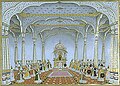 The Royal Chamber in the Public Audience Hall in the Middle of Yazdah Darreh, with the Ruler, Alam Bahador Badshah, and the Great Commanders, a page from the Lady Coote Album.
 -
 A Firman issued by the Mughal Emperor Shah Alam II, dated 1776.


Reformation of the Mughal Army
One of his first acts was to strengthen and raise a new Mughal Army, under the command of Mirza Najaf Khan. This new army consisted of infantrymen who successfully utilised both Flintlocks and Talwars in combat formations,[33] they used elephants for transportation and were less dependent on artillery and cavalry. Mirza Najaf Khan is also known to have introduced the more-effective Firelock muskets through his collaboration with Mir Qasim, the Nawab of Bengal.[34]
-
 The newly reestablished Mughal Army during the reign of Shah Alam II.
 -
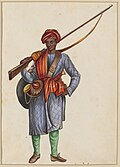 A Mughal infantryman.
 -
 Large Mughal Army encampments during the reign of the Mughal Emperor Shah Alam II.


Foreign relations

Shah Alam II, was well supported by Jean Law de Lauriston and 200 Frenchmen during his campaign to regain the Eastern Subahs (during the Seven Years' War). The brainchild of the campaign was Ghulam Husain Tabatabai, who had gained much administrative and military experience from both the French and the Dutch.
After Shah Alam II's defeat in the Battle of Buxar, the French once again reached out to emperor under Pierre André de Suffren in the year 1781, who initiated a plan to capture Bombay and Surat from the Maratha Confederacy and the British, with the co-operation of Mirza Najaf Khan, this action would eventually lead to Asaf Jah II to join Shah Alam II and the French and assist Hyder Ali to capture Madras from the East India Company.[35] The internal conflicts within the Mughal imperial court would not allow the emperor to make such a bold move against the British.
-
 Pierre André de Suffren ally of Hyder Ali and also Shah Alam II.
 -
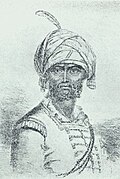 Hyder Ali was bestowed the title Shams ul-Mulk and Amir ud-Daula by Shah Alam II, his pro-French policies were a continuation of the Mughal Empire's policies during the Seven Years' War.


Jat victories
Jats rose in retaliation of religious intolerance pursued by Aurangzeb.[36] The Jat kingdom of Bharatpur waged many wars against the Mughal Delhi and in the 17th and 18th century carried out numerous campaigns in Mughal territories including Agra.[37] Mughals were defeated by Marathas in 1757; and Mughal possessions and territories were under the annexation of the Jats led by Suraj Mal.
During one massive assault, Jats sieged Agra in 1761, after 20 days on 12 June 1761 the Mughal forces at Agra surrendered to Jats.[36] Jats plundered the city and carried the bounty, including the two great silver doors to the entrance of the famous Taj Mahal. which were carried off and melted down by Suraj Mal in 1764.[38]
Suraj Mal's son Jawahar Singh, further extended the Jat power in Northern India and captured the territory in Doab, Ballabgarh and Agra.[39] Jats kept Agra fort and other territories closer to Delhi under their control from 1761 till 1774 CE.[36]
Sikh Victories
Sikhs had been in perpetual war against Mughal intolerance specially after beheading of the Sikh Guru - Guru Teg Bahadur by the Mughals. Simmering Sikhs rose once again in the year 1764 and overran the Mughal Faujdar of Sirhind, Zain Khan Sirhindi, who fell in battle and ever since the Sikhs perpetually raided and took the bounties from the lands as far as Delhi practically every year.
The Marathas took Delhi in 1771 before Shah Alam II arrived. Mirza Najaf Khan had restored a sense of order to the Mughal finances and administration and particularly reformed the Mughal Army. In 1777 Mirza Najaf Khan decisively defeated Zabita Khan's forces and repelled the Sikhs after halting their raids.
In 1778, after a Sikh incursion into Delhi, Shah Alam ordered their defeat by appointing, the Mughal Grand Vizier, Majad-ud-Daula marched with 20,000 Mughal troops against the Sikh army into hostile territories, this action led to the defeat of the Mughal Army at Muzzaffargarh and later at Ghanaur, due to the mounted casualties Shah Alam II reappointed Mirza Najaf Khan, who soon died of natural circumstances leaving the Mughal Empire weaker than ever.
In the year 1779, Mirza Najaf Khan carefully advanced his forces who successfully routed the treasonous Zabita Khan and his Sikh allies who lost more than 5,000 men in a single battle and never returned to threaten the Mughal Empire during the commander Mirza Najaf Khan's lifetime. Najaf Khan as prime minister, granted sovereign rights to the Sikhs as agreement.[40]
In the year 1783, Farzana Zeb un-Nissa had saved Delhi from a possible invasion by a force of 30,000 Sikh troops, under Baghel Singh, Jassa Singh Ramgarhia and Jassa Singh Ahluwalia.
Mughal empire disintegrated to such an extent that Shah Alam II was only left with Delhi city to rule. In 1783, Jassa Singh Ahluwalia and Baghel Singh laid siege to the city. After entering Red fort, Jassa Singh Ahluwalia sat on the Mughal throne on behest of Baghel Singh and a title of Badshah Singh was given to him. Begum Samru requested Baghel Singh to show mercy on Shah Alam II. Baghel Singh accepted and stated his demands such as 30,000 of his troops to stay in Delhi and the Mughal Empire would pay for their maintenance. Other demands were the construction of at least 5 Gurdwaras and annual tax payment of 13.5%. The demands were agreed upon by Shah Alam II with a written agreement. Since Sikhs refused to accept authority of the Mughal court due to politics, Mahadji Shinde was given the regency with an agreement that Sikhs will not plunder the crown lands and they will be paid 1/3 of the Delhi revenue annually instead.[41]
Downfall

After the defeats at Muzaffargarh and later at Ghanaur, Majad-ud-Daula was arrested by the orders of Shah Alam II, who then recalled Mirza Najaf Khan. This led to the former Grand Vizier's arrest for causing miscalculations and collaborating with the enemies of the emperor. The traitor was imprisoned and a sum of two million dam in stolen revenue recovered from him. It was Shah Alam II's poor judgement and vacillation that led to his own downfall. Mirza Najaf Khan had given the Mughal Empire breathing space by having a powerful, well managed army in its own right. In 1779 the newly reformed Mughal Army decisively defeated Zabita Khan, the rebels lost 5,000 men including their leader and therefore did not return during the lifetime of Mirza Najaf Khan [citation needed]. Unfortunately upon the general's death, Shah Alam's bad judgement prevailed. The dead man's nephew, Mirza Shafi whose valour had been proven during various occasions, was not appointed commander in chief. Shah Alam II instead appointed worthless individuals whose loyalty and record were questionable at best [citation needed]. They were soon quarrelling over petty matters. Even the corrupt and treasonous former Grand Vizier, Majad-ud-Daula was restored to his former office, he later colluded with the Sikhs and reduced the size of the Mughal Army from over 20,000 to only 5,000 thus bringing the Mughal Emperor Shah Alam II at the mercy of his enemies.[42][self-published source]
Benoît de Boigne, (1790).
,_the_blind_mughal_Emperor,_seated_on_a_golden_throne..jpg)
Prisoner of Ghulam Qadir
Nawab Majad-ud-Daula was followed by a known enemy of the Mughals, the grandson of Najib Khan, Ghulam Qadir, with his Sikh allies forced Shah Alam II to appoint him as the Grand Vizier of the Mughal Empire. Ghulam Qadir ravaged the palaces in search of the Mughal treasure believed to be worth Rs. 250 million. Unable to locate such a sum and angered by the Mughal Emperor's attempts to eliminate him and his Sikh allies, Ghulam Qadir himself blinded Shah Alam II with an Afghani knife on 10 August 1788.[42] Ghulam Qadir behaved with brutality to the emperor and his family. Three servants and two water-carriers who tried to help the bleeding emperor were beheaded and according to one account, Ghulam Qadir would pull the beard of the elderly Mughal Emperor. After ten weeks, during which Ghulam Qadir stripped the princesses of the royal family naked and forced them to dance naked before him (after which they jumped into Yamuna river to drown) and the honour of the royal family and prestige of the Mughal Empire reached its lowest ebb, Mahadaji Shinde intervened and killed Ghulam Qadir, taking possession of Delhi on 2 October 1788. He restored Shah Alam II to the throne and acted as his protector.[43] Mahadaji Shinde sent the ears and eyes of Ghulam Qadir to Shah Alam.[44]
Client of Mahadji Shinde
Thankful for his intervention, he honoured Mahadji Shinde with the titles of Vakil-ul-Mutlaq (Regent of the Empire) and Amir-ul-Amara (Head of the Amirs). He made a deal with the Peshwa granting tribute to Pune in return for the protection provided Mahadji Shinde of the Maratha Confederacy.
After killing Ghulam Qadir and restoring Shah Alam II to the throne, a Maratha garrison permanently occupied Delhi in 1788 and ruled on north India for next two decades until they were usurped by the East India Company following the Second Anglo-Maratha War in 1803.[32]
Second reign

The French threat in Europe and its possible repercussions in India caused the British to strive to regain the custody of Shah Alam II. The British feared that the French military officers might overthrow Maratha power and use the authority of the Mughal emperor to further French ambition in India.
Shah Alam II also corresponded with Hyder Ali and later with his son Tipu Sultan during their conflicts with the East India Company during the Anglo-Mysore Wars and was very well informed about the expansionist agenda of the British.
After the Battle of Delhi (1803), during the Second Anglo-Maratha War, on 14 September 1803 British troops entered Delhi ending the Maratha rule on the Mughals, bringing Shah Alam, then a blind old man, seated under a tattered canopy, under British protection. The Mughal Emperor no longer had the military power to enforce his will, but he commanded respect as a dignified member of the House of Timur in the length and breadth of the country.[citation needed] The Nawabs and Subedars still sought formal sanction of the Mughal Emperor on their accession and valued the titles he bestowed upon them. They struck coins and read the khutba (Friday sermons) in his name. The Marathas in 1804 under Yashwantrao Holkar tried to snatch Delhi from the British in Siege of Delhi (1804), but failed.
Death
Shah Alam II died of natural causes on 19 November 1806.
His grave lies in a marble enclosure adjoined to the Moti Masjid, next to the dargah of the 13th century Sufi saint Qutbuddin Bakhtiar Kaki, in Mehrauli, Delhi. Also in the enclosure are the tombs of Bahadur Shah I (also known as Shah Alam I), and Akbar Shah II.[45]
In popular culture
- In the 1994 Hindi TV series The Great Maratha, Shah Alam's character was portrayed by Rishabh Shukla.
Gallery
-
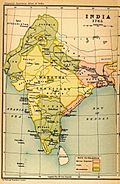 Map of India in 1765, before the fall of Nawabs and Princely states nominally allied to the emperor (mainly in Green).
 -
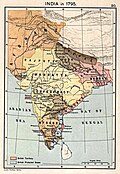 Map of India in 1795, 11 years before the death of Shah Alam II
 -
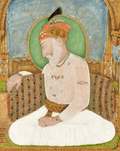 Blind Mughal Emperor Shah Alam II sits at throne of Delhi


See also
References
- ↑ Muhammad Umar (1998). Muslim Society in Northern India During the Eighteenth Century. Available with the author. p. 411. ISBN 9788121508308.
- ↑ 2.0 2.1 2.2 2.3 2.4 The Genealogist, Volumes 13-14. The Association. 1999. pp. 70, 81, 82.
- ↑ Antoine Louis Henri de Polier; Polier (colonel de, Antoine-Louis-Henri) (1947). Pratul Chandra Gupta (ed.). Shah Alam II and His Court: A Narrative of the Transactions at the Court of Delhy from the Year 1771 to the Present Time. S.C. Sarkar and sons. p. 71.
- ↑ Sir Jadunath Sarkar (1971). 1754-1771 (Panipat). 3d ed. 1966, 1971 printing. Orient Longman. p. 381.
- ↑ J. P. Guha (1962). Delhi; a Handbook for Travellers. R. & K Publishing House. p. 34.
- ↑ 6.0 6.1 Journal of Indian History, Volume 60. Department of Modern Indian History. 1982. p. 62.
- ↑ Muhammad Umar (2001). Urban Culture in Northern India During the Eighteenth Century. Munshiram Manoharlal. p. 185.
- ↑ 8.0 8.1 تاريخ هند عهد وسظى، غير مطبوعه مآخز: جنوبى ايشيائ علاقائ سمينار منعقده ٢٢-٢٦ مارچ ٨٨٩١ كے مقالات. خدا بخش اورينٹل پبلک لائبريرى،. 1999. p. 91.
- ↑ Bhagwati Sharan Verma (1997). Art, Archaeology And, Culture of Eastern India: Dr. B.S. Verma Felicitation Volume. Bihar Puravid Parishad. p. 264.
- ↑ 10.0 10.1 10.2 India. Legislature. Legislative Assembly (1936). The Legislative Assembly Debates: (Official Report), Volume 1. Government of India Press. p. 108.
- ↑ Muzaffar Alam; Sanjay Subrahmanyam (2012). Writing the Mughal World: Studies on Culture and Politics. Columbia University Press. p. 462. ISBN 978-0-231-15811-4.
- ↑ Hari Ram Gupta (1944). A History of the Sikhs, from Nadir Shah's Invasion to the Rise of Ranjit Singh, 1739-1799: Cis-Sutlej Sikhs, 1769-1799 (2 ed.). Minerva Book Shop. p. 79.
- ↑ S. M. Burke; Salim al-Din Quraishi (1995). Bahadur Shah: The Last Moghul Emperor of India. Sang-e-Meel. p. 36.
- ↑ Shama Mitra Chenoy (1998). Shahjahanabad, a City of Delhi, 1638-1857. Munshiram Manoharlal Publishers. p. 82. ISBN 9788121508025.
- ↑ 15.0 15.1 The Dacca University Studies, Volumes 6-7. University of Dacca. 1943. p. 30.
- ↑ Dalrymple, W. (2019),The Anarchy p89, London: Bloomsbury
- ↑ Delhi, Past and Present, p. 4, at Google Books
- ↑ History of Islam, p. 512, at Google Books
- ↑ Advanced Study in the History of Modern India 1707–1813, p. 140, at Google Books
- ↑ S. M. Ikram (1964). "XIX. A Century of Political Decline: 1707–1803". In Ainslie T. Embree (ed.). Muslim Civilization in India. New York: Columbia University Press. Retrieved 5 November 2011.
{{cite book}}: CS1 maint: publisher location (link) - ↑ Dictionary of Indo-Persian Literature, p. 40, at Google Books
- ↑ Mughal Empire in India: A Systematic Study Including Source Material, Volume 3, p. 767, at Google Books
- ↑ S.R. Sharma (1 January 1999). Mughal empire in India: a systematic study including source material. Atlantic Publishers & Dist. pp. 769–. ISBN 978-81-7156-819-2. Retrieved 30 March 2012.
- ↑ L.S.S. O`malley (1924). Bihar and Orissa District Gazetteers Patna. Concept Publishing Company. pp. 32–. ISBN 978-81-7268-121-0. Retrieved 30 March 2012.
- ↑ "ʿĀlamgīr II - Mughal emperor". Retrieved 27 July 2018.
- ↑ 26.0 26.1 Imperial Gazetteer of India vol. IV 1908, p. 9
- ↑ 27.0 27.1 Imperial Gazetteer of India vol. IV 1908, p. 10
- ↑ Imperial Gazetteer of India vol. IV 1908, p. 11
- ↑ A Dictionary of Modern Indian History (1707–1947), Parshotam Mehra, ISBN 0-19-561552-2, 1985 ed., Oxford University Press
- ↑ Rathod, N. G. (1994). The Great Maratha Mahadaji Shinde - N. G. Rathod - Google Books. ISBN 9788185431529. Retrieved 9 February 2017.
- ↑ The Fall of the Moghul Empire of Hindustan, p. 6, at Google Books
- ↑ 32.0 32.1 Capper, John (27 July 1997). Delhi, the Capital of India. Asian Educational Services. ISBN 9788120612822. Retrieved 27 July 2018 – via Google Books.
- ↑ Kaushik Roy (30 March 2011). War, Culture, Society in Early Modern South Asia, 1740–1849. Taylor & Francis. pp. 29–. ISBN 978-1-136-79087-4. Retrieved 30 March 2012.
- ↑ Kaushik Roy (30 March 2011). War, Culture, Society in Early Modern South Asia, 1740–1849. Taylor & Francis. pp. 30–. ISBN 978-1-136-79087-4. Retrieved 30 March 2012.
- ↑ "suffren letter shah alam - Google Search". www.google.ae. Retrieved 27 July 2018.
- ↑ 36.0 36.1 36.2 The province of Agra, Author: Dharma Bhanu Srivastava, page 8-10
- ↑ The Gazetteer of India: History and culture. Publications Division, Ministry of Information and Broadcasting, India. 1973. p. 348. OCLC 186583361.
- ↑ "Manas: Culture, Architecture of India, Taj Mahal". www.sscnet.ucla.edu. Archived from the original on 6 October 1999. Retrieved 27 July 2018.
- ↑ The Province of Agra: Its History and Administration, p. 9, at Google Books
- ↑ Gupta, Hari Ram (2010). History of the Sikhs: Vol. III: Sikh Domination of the Mughal Empire. New Delhi: Munshiram Manoharlal Publishers. ISBN 9788121502139.
- ↑ Jawandha, Nahar (2010). Glimpses of Sikhism. New Delhi: Sanbun Publishers. p. 207. ISBN 9789380213255.
- ↑ 42.0 42.1 Misbah Islam (30 June 2008). Decline of Muslim States and Societies. Xlibris Corporation. pp. 392–. ISBN 978-1-4363-1012-3. Retrieved 30 March 2012.
- ↑ Marathas and the Marathas Country: The Marathas, p. 159, at Google Books
- ↑ Dalrymple, William (2019). The Anarchy. United Kingdom: Bloomsbury publishing. ISBN 978-1-5266-1850-4.
- ↑ Dadlani, Chanchal B. (2018). From stone to paper: architecture as history in the late Mughal Empire. New Haven [CT]. p. 63. ISBN 978-0-300-23317-9. OCLC 1024165136.
{{cite book}}: CS1 maint: location missing publisher (link)
- William Francklin (1798). The History of the reign of Shah-Aulum (Shah Alam), the present emperor of Hindostaun. Cooper & Graham, London.
- Shah Alam II (1728–1806)
- The Fall of the Moghul Empire of Hindustan – World Wide School
- Marathas and the English Company 1707–1800
Further reading
- Shah Alam Nama. Bibliotheca Indica. 1912.
Shah Alam II Born: 1728 Died: 1806
| ||
| Regnal titles | ||
|---|---|---|
| Preceded by Shah Jahan III |
Mughal Emperor 1759–1806 |
Succeeded by Mahmud Shah Bahadur in 1788 |
| Preceded by Mahmud Shah Bahadur in 1788 |
Succeeded by Akbar Shah II | |