



imported>DaxServer Undid revision 1041407429 by 58.182.176.169 (talk) Unsourced, add cols in See also, move portal down per MOS:LAYOUT |
No edit summary |
||
| Line 1: | Line 1: | ||
{{Short description|The 9 planets of vedic astrology}} | {{Short description|The 9 planets of vedic astrology}} | ||
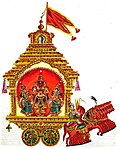
[[File:Navagraha.jpg|thumb|200px|''Navagraha'', a [[Raja Ravi Varma]] painting (sun at the center)]] | [[File:Navagraha.jpg|thumb|200px|''Navagraha'', a [[Raja Ravi Varma]] painting (sun at the center)]] | ||
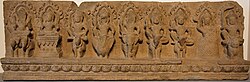
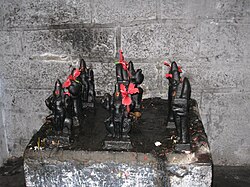
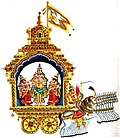
'''Navagraha''' are nine heavenly bodies and deities that influence human life on Earth | '''Navagraha''' are nine heavenly bodies and deities that influence human life on Earth according to [[Hinduism]] and [[Hindu astrology]].<ref name="dalalnavagr">{{cite book|author=Roshen Dalal|url=https://books.google.com/books?id=DH0vmD8ghdMC|title=Hinduism: An Alphabetical Guide|publisher=Penguin Books|year=2010|isbn=978-0-14-341421-6|pages=280}}</ref> The term is derived from ''nava'' ({{lang-sa|नव}} "nine") and ''graha'' ({{lang-sa|ग्रह}} "planet, seizing, laying hold of, holding"). Note that [[Earth|the Earth]], [[Uranus]], [[Neptune]] and [[Pluto]] are excluded from the Navagraha,<ref>Sanskrit-English Dictionary by Monier-Williams, 1899</ref>. However, [[Sun|the Sun]] and [[Moon]] are part of the Navagraha. | ||
In [[astrology]], the term ''planet'' originally applied only to the five planets visible to the [[naked eye]] and excluded [[Earth]]. The term was later broadened, particularly in the [[Post-classical history|Middle Ages]], to include the sun and the moon (sometimes referred to as "lights"), making a total of seven planets. The [[Seven days of the week#Hindu tradition|seven days of the week]] in the [[Hindu calendar]] also correspond with the [[seven classical planets]], and are [[Names of the days of the week#Hindu tradition|named accordingly]] in most languages of the [[Indian subcontinent]]. Most [[Hindu temples]] around the world have a designated place dedicated to Navagraha worship. | |||
==Planets, celestial bodies and lunar nodes== | ==Planets, celestial bodies and lunar nodes== | ||
| Line 8: | Line 10: | ||
!No. | !No. | ||
!Image | !Image | ||
!Name | !Name | ||
!Western equivalent | !Western equivalent | ||
!Day | !Day | ||
| Line 14: | Line 16: | ||
|1. | |1. | ||
|[[File:Surya graha.JPG|90px]] | |[[File:Surya graha.JPG|90px]] | ||
|[[Surya]], | |[[Surya]], [[Aditya]] | ||
|[[Sun]] | |[[Sun]] | ||
|[[Sunday]] | |[[Sunday]] | ||
|- | |- | ||
|2. | |2. | ||
|[[File:Chandra graha.JPG|90px]] | |[[File:Chandra graha.JPG|90px]] | ||
|[[Chandra]], Soma | |[[Chandra]], [[Soma (deity)|Soma]] | ||
|[[Moon]] | |[[Moon]] | ||
|[[Monday]] | |[[Monday]] | ||
|- | |- | ||
|3. | |3. | ||
|[[File:Angraka graha.JPG|90px]] | |||
|[[Mangala]] | |||
|[[Mars]] | |||
|[[Tuesday]] | |||
|- | |||
|4. | |||
|[[File:Budha graha.JPG|90px]] | |[[File:Budha graha.JPG|90px]] | ||
|[[Budha]] | |[[Budha]] | ||
|[[Mercury (planet)|Mercury]] | |[[Mercury (planet)|Mercury]] | ||
|[[Wednesday]] | |[[Wednesday]] | ||
|- | |- | ||
|5. | |5. | ||
|[[File: | |[[File:Brihaspati graha.JPG|90px]] | ||
|[[ | |[[Bṛhaspati]], Guru | ||
|[[ | |[[Jupiter]] | ||
|[[ | |[[Thursday]] | ||
|- | |- | ||
|6. | |6. | ||
|[[File: | |[[File:Shukra graha.JPG|90px]] | ||
|[[ | |[[Shukra]] | ||
|[[ | |[[Venus]] | ||
|[[ | |[[Friday]] | ||
|- | |- | ||
|7. | |7. | ||
|[[File:Shani graha.JPG|90px]] | |[[File:Shani graha.JPG|90px]] | ||
|[[Shani]] | |[[Shani]] | ||
|[[Saturn]] | |[[Saturn]] | ||
|[[Saturday]] | |[[Saturday]] | ||
|- | |- | ||
|8. | |8. | ||
| Line 67: | Line 69: | ||
|} | |} | ||
== Carnatic | == Carnatic music == | ||
[[Muthuswami Dikshitar]], a [[Carnatic music]] composer from southern India composed the [[Navagraha Kritis]] in praise of the nine ''grahas''.<ref>{{Cite web|title=Dikshitar: Navagraha|url=http://www.medieval.org/music/world/carnatic/lyrics/navagraha.html|access-date=2020-06-12|website=www.medieval.org}}</ref> Each song is a prayer to one of the nine planets. The [[sahitya]] (lyrics) of the songs reflect a profound knowledge of the [[mantra]] and [[jyotisha]] [[Shastra|sastras]]. | [[Muthuswami Dikshitar]], a [[Carnatic music]] composer from southern India composed the [[Navagraha Kritis]] in praise of the nine ''grahas''.<ref>{{Cite web|title=Dikshitar: Navagraha|url=http://www.medieval.org/music/world/carnatic/lyrics/navagraha.html|access-date=2020-06-12|website=www.medieval.org}}</ref> Each song is a prayer to one of the nine planets. The [[sahitya]] (lyrics) of the songs reflect a profound knowledge of the [[mantra]] and [[jyotisha]] [[Shastra|sastras]]. | ||
Revision as of 23:33, 14 January 2023

Navagraha are nine heavenly bodies and deities that influence human life on Earth according to Hinduism and Hindu astrology.[1] The term is derived from nava (Sanskrit: नव "nine") and graha (Sanskrit: ग्रह "planet, seizing, laying hold of, holding"). Note that the Earth, Uranus, Neptune and Pluto are excluded from the Navagraha,[2]. However, the Sun and Moon are part of the Navagraha.
In astrology, the term planet originally applied only to the five planets visible to the naked eye and excluded Earth. The term was later broadened, particularly in the Middle Ages, to include the sun and the moon (sometimes referred to as "lights"), making a total of seven planets. The seven days of the week in the Hindu calendar also correspond with the seven classical planets, and are named accordingly in most languages of the Indian subcontinent. Most Hindu temples around the world have a designated place dedicated to Navagraha worship.
Planets, celestial bodies and lunar nodes
| No. | Image | Name | Western equivalent | Day |
|---|---|---|---|---|
| 1. | 
|
Surya, Aditya | Sun | Sunday |
| 2. | 
|
Chandra, Soma | Moon | Monday |
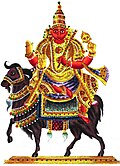
| 3. | 
|
Mangala | Mars | Tuesday |
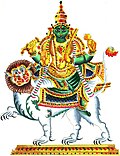
| 4. | 
|
Budha | Mercury | Wednesday |
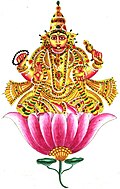
| 5. | 
|
Bṛhaspati, Guru | Jupiter | Thursday |
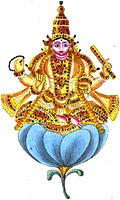
| 6. | 
|
Shukra | Venus | Friday |
| 7. | 
|
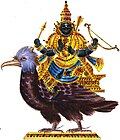
Shani | Saturn | Saturday |
| 8. | 
|
Rahu | Ascending node of the Moon | |
| 9. | 
|
Ketu | Descending node of the Moon |
Carnatic music
Muthuswami Dikshitar, a Carnatic music composer from southern India composed the Navagraha Kritis in praise of the nine grahas.[3] Each song is a prayer to one of the nine planets. The sahitya (lyrics) of the songs reflect a profound knowledge of the mantra and jyotisha sastras.
See also
Notes
- ↑ Sanskrit-English Dictionary by Monier-Williams, 1899
- ↑ "Dikshitar: Navagraha". www.medieval.org. Retrieved 2020-06-12.
 | ||
Hindu deities and texts | ||
|---|---|---|
| Gods |  | |
| Goddesses | ||
| Other deities | ||
| Texts | ||

_-_The_Noun_Project.svg) | This mythology-related article is a stub. You can help Bharatpedia by expanding it. |