



>Kridha →See also: - Added Kusum Sarovar |
ImportMaster (talk | contribs) robot: Create/update articles in Category:Hindu gods. |
||
| Line 4: | Line 4: | ||
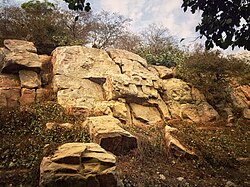
[[File:Govardhan hill, Govardhan.jpg|thumb|Govardhan hill, Govardhan.]] | [[File:Govardhan hill, Govardhan.jpg|thumb|Govardhan hill, Govardhan.]] | ||
''' | '''Govardhan Hill''' ({{lang-sa|गोवर्धन पर्वत}}; {{IAST|Govardhana Parvata}}; Pronunciation: [[Help:IPA/Hindi and Urdu|[ɡoʋəɾdʱən]]]), also called '''Mount Govardhana''' and '''Giriraj''', is a sacred [[Hinduism|Hindu]] site in the [[Mathura district]] of [[Uttar Pradesh]], [[India]] on an 8 km long hill located in the area of [[Govardhan]] and [[Radha Kund]],<ref name="Prasad">{{cite book|author=Dev Prasad|title=Krishna: A Journey through the Lands & Legends of Krishna|url=https://books.google.com/books?id=o0_5caqiUH0C&pg=PT147|date=27 January 2015|publisher=Jaico Publishing House|isbn=978-81-8495-170-7|pages=PT 147}}</ref><ref name="Keene">{{cite book|author=Henry George Keene|title=A Handbook for Visitors to Agra and Its Neighbourhood|url=https://archive.org/details/ahandbookforvis05keengoog|year=1878|publisher=Thacker, Spink|pages=[https://archive.org/details/ahandbookforvis05keengoog/page/n95 71]–72}}</ref> which is about {{convert|21|km|mile}} from [[Vrindavan]].<ref>{{cite web|url=https://goo.gl/maps/RDnZE2sX2p72 |title=Vrindavan to Radha Kund |website=Google mpas |access-date=7 April 2017}}</ref> It is the sacred centre of [[Braj]] and is identified as a natural form of [[Krishna]], the [[Govardhana Shila]].<ref>David L. Haberman, ''River of Love in an Age of Pollution: The Yamuna River of Northern India'', Page 264 {{ISBN|0-520-24789-2}}</ref><ref>{{cite book|author1=Kapila D. Silva|author2=Neel Kamal Chapagain|title=Asian Heritage Management: Contexts, Concerns, and Prospects|url=https://books.google.com/books?id=3ofDt_8kyYcC&pg=PA179|year=2013|publisher=Routledge|isbn=978-0-415-52054-6|page=178}}</ref> | ||
==Etymology== | ==Etymology== | ||
The name 'Govardhana' has two primary translations. In the literal meaning, 'Go' translates to 'cows', and 'vardhana' translates to 'nourishment'. Another meaning of 'Go' is 'the senses' and 'vardhana' can also mean 'to increase' - thus the name is also translated by devotees of Krishna as 'that which increases the senses' in their attraction to Krishna. In this connection, it is believed that the personality of Govardhan blesses the devotee by increasing his devotion ([[bhakti]]). | The name 'Govardhana' has two primary translations. In the literal meaning, 'Go' translates to 'cows', and 'vardhana' translates to 'nourishment'. Another meaning of 'Go' is 'the senses' and 'vardhana' can also mean 'to increase' - thus the name is also translated by devotees of Krishna as 'that which increases the senses' in their attraction to Krishna. In this connection, it is believed that the personality of Govardhan blesses the devotee by increasing his devotion ([[bhakti]]). | ||
== Geography == | == Geography == | ||
| Line 13: | Line 13: | ||
== Background == | == Background == | ||
Govardhan Hill is considered a sacred site because it is the setting for many legends relating to the life of Lord Krishna, the deity believed to be embodied in the earth of the hill. Krishna and his brother [[ | Govardhan Hill is considered a sacred site because it is the setting for many legends relating to the life of Lord Krishna, the deity believed to be embodied in the earth of the hill. Krishna and his brother [[Balarama]] are said to have spent many happy hours roaming among its shade providing groves, pools, caves and lush cow-pastures. An Eden-like sanctuary, the area's waterfalls, garden-grove (''van''), arbour (''nikunj''), water tank (''kund''), and flora are depicted in scenes of Krishna's adventures with [[Radha]].<ref name="Silva pp. 178–179">{{cite book|author1=Kapila D. Silva|author2=Neel Kamal Chapagain|title=Asian Heritage Management: Contexts, Concerns, and Prospects|url=https://books.google.com/books?id=3ofDt_8kyYcC&pg=PA179|year=2013|publisher=Routledge|isbn=978-0-415-52054-6|pages=178–179}}</ref> | ||
== | ==Temples== | ||
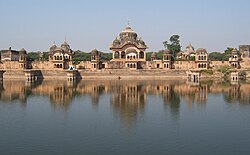
[[File:Kusuma Sarovar Ghat.jpg|thumb|upright=1.35|[[Kusum Sarovar]] ("Lake of Flowers"), one of the holy sites on Govardhan Hill]] | [[File:Kusuma Sarovar Ghat.jpg|thumb|upright=1.35|[[Kusum Sarovar]] ("Lake of Flowers"), one of the holy sites on Govardhan Hill]] | ||
| Line 25: | Line 25: | ||
* Giriraj Temple<ref>{{cite news|url=http://zeenews.india.com/travel/here-lord-krishna-lifted-govardhan-hill-this-can-be-your-travel-guide-to-reach-giriraj-temple_1955285.htm |title=Here Lord Krishna lifted Govardhan hill—This can be your travel guide to reach Giriraj Temple! | author=Ritika Handoo |date=2 December 2016 |website=ZeeNews |access-date=7 April 2017}}</ref> | * Giriraj Temple<ref>{{cite news|url=http://zeenews.india.com/travel/here-lord-krishna-lifted-govardhan-hill-this-can-be-your-travel-guide-to-reach-giriraj-temple_1955285.htm |title=Here Lord Krishna lifted Govardhan hill—This can be your travel guide to reach Giriraj Temple! | author=Ritika Handoo |date=2 December 2016 |website=ZeeNews |access-date=7 April 2017}}</ref> | ||
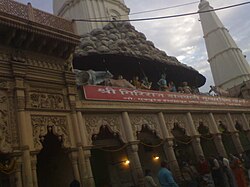
[[File:आशीष™ गोवर्धन.jpg|thumb|Govardhan Giriraj Temple, [[Mathura]] dedicated to Krishna]] | [[File:आशीष™ गोवर्धन.jpg|thumb|Govardhan Giriraj Temple, [[Mathura]] dedicated to Krishna]]. The Giriraji is dressed as Shrinathji every night as it is believed Shrinathji comes to Govardhan every night. | ||
*Shri Mahaprabhuji Baithakji- The Baithak of Mahaprabhuji Shri Vallabhacharya, that is in front Giriraj Temple. | |||
* Shri Chaitanya Temple, built of red sandstone and adorned with paintings of Krishna and Radha<ref name="Spiritual sojourn">{{cite news|url=http://www.moneylife.in/article/spiritual-soujourn-in-govardhan/42258.html |title=Spiritual Sojourn (sic) in Govardhan | author=Amit Sengupta | * Shri Chaitanya Temple, built of red sandstone and adorned with paintings of Krishna and Radha<ref name="Spiritual sojourn">{{cite news|url=http://www.moneylife.in/article/spiritual-soujourn-in-govardhan/42258.html |title=Spiritual Sojourn (sic) in Govardhan | author=Amit Sengupta | ||
|date=16 June 2015 |access-date=7 April 2017}}</ref> | |date=16 June 2015 |access-date=7 April 2017}}</ref> | ||
* Radha Kund Temple<ref name="Spiritual sojourn" /> | * [[Radha Kund]] Temple<ref name="Spiritual sojourn"/> | ||
* Mansi Ganga Lake<ref name="Spiritual sojourn" /> | * Mansi Ganga Lake<ref name="Spiritual sojourn"/> | ||
* Danghati Temple<ref name="Spiritual sojourn" /> | * Danghati Temple<ref name="Spiritual sojourn" />[[File:Mansi Ganga near shri Girraj Mandir ,Mathura - panoramio.jpg|right|thumb|Mansi Ganga]] | ||
== Legends == | == Legends == | ||
There are legends of Krishna’s saving the hill from a flood, | There are legends of Krishna’s saving the hill from a flood, dalliances with [[gopi]]s (cow-herders)’, and interactions with demons and gods. Artwork has been created of the hill represented as a bull and a peacock, Krishna in a cave, the hill as a mountain of food, depicted in the floods brought on by [[Indra]], and with the [[Yamuna River]].<ref name="Silva pp. 178–179" /> | ||
According to the Giriraj Chalisa (a forty verse hymn dedicated to Govardhan Hill) Govardhan in human form, went to [[Vrindavan]] with [[Pulastya]] and decided to stay there evermore. The sight of Govardhan Hill and [[Yamuna River]] in [[Vrindavan]] attracted the demigods who took forms of trees, | According to the Giriraj Chalisa (a forty verse hymn dedicated to Govardhan Hill) Govardhan in human form, went to [[Vrindavan]] with [[Pulastya]] and decided to stay there evermore. The sight of Govardhan Hill and [[Yamuna River]] in [[Vrindavan]] attracted the demigods who took forms of trees, deer, and monkeys to live in Vrindavan. | ||
===The lifting of Govardhan=== | ===The lifting of Govardhan=== | ||
| Line 47: | Line 48: | ||
{{Main|Govardhan Puja}} | {{Main|Govardhan Puja}} | ||
Govardhan Puja is celebrated on the day after [[Diwali]]. It is the day upon which Lord Krishna defeated Indra, the deity of thunder and rain. As per the story, Krishna saw huge preparations for the annual offering to [[Indra]] and questions his father Nanda about it. He debated with the villagers about what their 'dharma' truly was. They were farmers, they should do their duty and concentrate on farming and protection of their cattle. He continued to say that all human beings should merely do their 'dharma', to the best of their ability and not pray or conduct sacrifices for natural phenomenon. The villagers were convinced by Krishna, and did not proceed with the special | Govardhan Puja is celebrated on the day after [[Diwali]]. It is the day upon which Lord Krishna defeated Indra, the deity of thunder and rain. As per the story, Krishna saw huge preparations for the annual offering to [[Indra]] and questions his father Nanda about it. He debated with the villagers about what their 'dharma' truly was. They were farmers, they should do their duty and concentrate on farming and protection of their cattle. He continued to say that all human beings should merely do their 'dharma', to the best of their ability and not pray or conduct sacrifices for natural phenomenon. The villagers were convinced by [[Krishna]], and did not proceed with the special [[Puja (Hinduism)|puja]]. Indra was then angered, and flooded the village. Krishna then lifted Mt Govardhan and held it up as protection to the people and cattle from the rain. Indra finally accepted defeat and recognized Krishna as the victor. He offered his prayers and left to his heavenly kingdom. According to some sources, the destructive cloud sent by Indra is [[Sāṁvartaka]].<ref>{{Cite book |last=Prabhupada |first=His Divine Grace A. C. Bhaktivedanta Swami |url=https://books.google.com/books?id=htVhBAAAQBAJ&q=S%C4%81%E1%B9%81vartaka |title=Krsna, the Supreme Personality of Godhead |publisher=The Bhaktivedanta Book Trust |isbn=978-91-7149-558-7 |language=en}}</ref> This aspect of Krishna's life is mostly glossed over, but it actually set up on the basis of the karma-focused philosophy later detailed in the [[Bhagavad Gita]].<ref>{{Cite web|url=https://bhagavadgita.io/chapter/3/?page=1|title=Bhagavad Gita Chapter 3 - Karma Yoga|website=Bhagavad Gita|language=en-US|access-date=2018-06-08}}</ref> | ||
The incident represented the downfall of [[Indra]], and a new beginning in Hindu philosophy, from a more sacrifice-oriented worship to a more spiritual plane of thought.{{Cn|date=December 2022}} | |||
==Recent development== | ==Recent development== | ||
In 2018, the [[Uttar Pradesh]] Chief Minister [[Yogi Adityanath]] declared Govardhan as a pilgrimage centre | In 2018, the [[Uttar Pradesh]] Chief Minister [[Yogi Adityanath]] declared Govardhan as a pilgrimage centre along with [[Mathura]], [[Baldev Assembly constituency|Baldev]], [[Nandgaon, Uttar Pradesh|Nandgaon]], [[Radha Kund]], and [[Gokul]].<ref>{{Cite web|url=https://m.timesofindia.com/city/agra/five-more-places-declared-as-teerth-sthals-in-mathura/articleshow/63431972.cms|title = Five more places declared as 'teerth sthals' in Mathura | Agra News - Times of India|website = [[The Times of India]]}}</ref> The Yogi Adityanath Government has also planned to rejuvenate Govardhan Parvat with [[Dvapara Yuga]] flora such as [[Neolamarckia cadamba|kadamb]], karoli, tamal, pakkad, and tilkan.<ref>{{cite web|first1=Rohan|last1=Dua|date=4 January 2018|access-date=2020-04-13|title=With ancient flora, UP plans to revive Govardhan Parvat|url=https://timesofindia.indiatimes.com/city/lucknow/with-ancient-flora-up-plans-to-revive-govardhan-parvat/articleshow/62359189.cms|website=[[The Times of India]]}}</ref> | ||
==See also== | ==See also== | ||
*[[Kusum Sarovar]] | *[[Kusum Sarovar]] | ||
*[[Vrindavan]] | *[[Vrindavan]] | ||
*[[Govardhana | *[[Govardhana Shila]] | ||
*[[Govardhan Puja]] | *[[Govardhan Puja]] | ||
| Line 73: | Line 69: | ||
==External links== | ==External links== | ||
{{commons category-inline|Govardhan Hill}} | {{commons category-inline|Govardhan Hill}} | ||
* [https://www.girigovardhan.com/srila-prabhupada-explains-govardhana-puja/ Srila Prabhupada explains Govardhana Puja] {{ | * [https://www.girigovardhan.com/srila-prabhupada-explains-govardhana-puja/ Srila Prabhupada explains Govardhana Puja] {{Webarchive|url=https://web.archive.org/web/20180505065623/https://www.girigovardhan.com/srila-prabhupada-explains-govardhana-puja/ |date=5 May 2018 }} | ||
* http://www.icompositions.com/music/song.php?sid= | * http://www.icompositions.com/music/song.php?sid=199187Ballad of Govardhana {{Webarchive|url=https://web.archive.org/web/20141229034236/http://www.icompositions.com/music/song.php?sid=199187 |date=29 December 2014 }} | ||
* [http://www.icompositions.com/music/song.php?sid=170073 Ballad of Govardhana Hill] {{ | * [http://www.icompositions.com/music/song.php?sid=170073 Ballad of Govardhana Hill] {{Webarchive|url=https://web.archive.org/web/20141229052324/http://www.icompositions.com/music/song.php?sid=170073 |date=29 December 2014 }} | ||
* [http://www.thedivineindia.com/govardhan-dham/5809 The Story of Govardhan] | * [http://www.thedivineindia.com/govardhan-dham/5809 The Story of Govardhan] | ||
* [http://krishnabhumi.in/blog/the-story-of-shri-krishna-lifting-govardhan-hill/ krishna story lifting govardhan parvat] | * [http://krishnabhumi.in/blog/the-story-of-shri-krishna-lifting-govardhan-hill/ krishna story lifting govardhan parvat] | ||
* [http://www.vrindavan-dham.com/govardhan-photogallery/ Pictures of Govardhan Hill] {{ | * [http://www.vrindavan-dham.com/govardhan-photogallery/ Pictures of Govardhan Hill] {{Webarchive|url=https://web.archive.org/web/20151117025651/http://www.vrindavan-dham.com/govardhan-photogallery/ |date=17 November 2015 }} | ||
* [http://www.radhavallabh.com/places.html Exclusive video of Parikrama of Govardhan Hill] | * [http://www.radhavallabh.com/places.html Exclusive video of Parikrama of Govardhan Hill] | ||
Latest revision as of 00:58, 15 December 2022

Govardhan Hill (Sanskrit: गोवर्धन पर्वत; Govardhana Parvata; Pronunciation: [ɡoʋəɾdʱən]), also called Mount Govardhana and Giriraj, is a sacred Hindu site in the Mathura district of Uttar Pradesh, India on an 8 km long hill located in the area of Govardhan and Radha Kund,[1][2] which is about 21 kilometres (13 mi) from Vrindavan.[3] It is the sacred centre of Braj and is identified as a natural form of Krishna, the Govardhana Shila.[4][5]
Etymology[edit | edit source]
The name 'Govardhana' has two primary translations. In the literal meaning, 'Go' translates to 'cows', and 'vardhana' translates to 'nourishment'. Another meaning of 'Go' is 'the senses' and 'vardhana' can also mean 'to increase' - thus the name is also translated by devotees of Krishna as 'that which increases the senses' in their attraction to Krishna. In this connection, it is believed that the personality of Govardhan blesses the devotee by increasing his devotion (bhakti).
Geography[edit | edit source]
Govardhan Hill, stretching from Radha Kund to south of Govardhan, is a long ridge that, at its highest, stands 100 feet (30 m) above the surrounding land. At the southern end of the hill is the village of Punchari, while at the crest stand the villages of Aanyor and Jatipura.[6] The parikarma path of Govardhan hill is intersected by some part of district Bharatpur of Rajasthan.
Background[edit | edit source]
Govardhan Hill is considered a sacred site because it is the setting for many legends relating to the life of Lord Krishna, the deity believed to be embodied in the earth of the hill. Krishna and his brother Balarama are said to have spent many happy hours roaming among its shade providing groves, pools, caves and lush cow-pastures. An Eden-like sanctuary, the area's waterfalls, garden-grove (van), arbour (nikunj), water tank (kund), and flora are depicted in scenes of Krishna's adventures with Radha.[6]
Temples[edit | edit source]

The buildings and other structures on the Hill date from the sixteenth century. As of 2013[update], there is no known archaeological evidence of any remains of greater age.[7]
A few of the sites include:
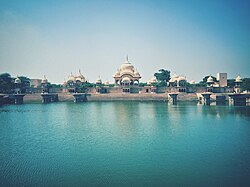
- The sandstone monument and lake of Kusum Sarovar.[1][2]

- Giriraj Temple[8]

. The Giriraji is dressed as Shrinathji every night as it is believed Shrinathji comes to Govardhan every night.
- Shri Mahaprabhuji Baithakji- The Baithak of Mahaprabhuji Shri Vallabhacharya, that is in front Giriraj Temple.
- Shri Chaitanya Temple, built of red sandstone and adorned with paintings of Krishna and Radha[9]
- Radha Kund Temple[9]
- Mansi Ganga Lake[9]
- Danghati Temple[9]

Mansi Ganga

Legends[edit | edit source]
There are legends of Krishna’s saving the hill from a flood, dalliances with gopis (cow-herders)’, and interactions with demons and gods. Artwork has been created of the hill represented as a bull and a peacock, Krishna in a cave, the hill as a mountain of food, depicted in the floods brought on by Indra, and with the Yamuna River.[6]
According to the Giriraj Chalisa (a forty verse hymn dedicated to Govardhan Hill) Govardhan in human form, went to Vrindavan with Pulastya and decided to stay there evermore. The sight of Govardhan Hill and Yamuna River in Vrindavan attracted the demigods who took forms of trees, deer, and monkeys to live in Vrindavan.
The lifting of Govardhan[edit | edit source]


Govardhan Puja is celebrated on the day after Diwali. It is the day upon which Lord Krishna defeated Indra, the deity of thunder and rain. As per the story, Krishna saw huge preparations for the annual offering to Indra and questions his father Nanda about it. He debated with the villagers about what their 'dharma' truly was. They were farmers, they should do their duty and concentrate on farming and protection of their cattle. He continued to say that all human beings should merely do their 'dharma', to the best of their ability and not pray or conduct sacrifices for natural phenomenon. The villagers were convinced by Krishna, and did not proceed with the special puja. Indra was then angered, and flooded the village. Krishna then lifted Mt Govardhan and held it up as protection to the people and cattle from the rain. Indra finally accepted defeat and recognized Krishna as the victor. He offered his prayers and left to his heavenly kingdom. According to some sources, the destructive cloud sent by Indra is Sāṁvartaka.[10] This aspect of Krishna's life is mostly glossed over, but it actually set up on the basis of the karma-focused philosophy later detailed in the Bhagavad Gita.[11]
The incident represented the downfall of Indra, and a new beginning in Hindu philosophy, from a more sacrifice-oriented worship to a more spiritual plane of thought.[citation needed]
Recent development[edit | edit source]
In 2018, the Uttar Pradesh Chief Minister Yogi Adityanath declared Govardhan as a pilgrimage centre along with Mathura, Baldev, Nandgaon, Radha Kund, and Gokul.[12] The Yogi Adityanath Government has also planned to rejuvenate Govardhan Parvat with Dvapara Yuga flora such as kadamb, karoli, tamal, pakkad, and tilkan.[13]
See also[edit | edit source]
References[edit | edit source]
- ↑ 1.0 1.1 Dev Prasad (27 January 2015). Krishna: A Journey through the Lands & Legends of Krishna. Jaico Publishing House. pp. PT 147. ISBN 978-81-8495-170-7.
- ↑ 2.0 2.1 Henry George Keene (1878). A Handbook for Visitors to Agra and Its Neighbourhood. Thacker, Spink. pp. 71–72.
- ↑ "Vrindavan to Radha Kund". Google mpas. Retrieved 7 April 2017.
- ↑ David L. Haberman, River of Love in an Age of Pollution: The Yamuna River of Northern India, Page 264 ISBN 0-520-24789-2
- ↑ Kapila D. Silva; Neel Kamal Chapagain (2013). Asian Heritage Management: Contexts, Concerns, and Prospects. Routledge. p. 178. ISBN 978-0-415-52054-6.
- ↑ 6.0 6.1 6.2 Kapila D. Silva; Neel Kamal Chapagain (2013). Asian Heritage Management: Contexts, Concerns, and Prospects. Routledge. pp. 178–179. ISBN 978-0-415-52054-6.
- ↑ Kapila D. Silva; Neel Kamal Chapagain (2013). Asian Heritage Management: Contexts, Concerns, and Prospects. Routledge. p. 180. ISBN 978-0-415-52054-6.
- ↑ Ritika Handoo (2 December 2016). "Here Lord Krishna lifted Govardhan hill—This can be your travel guide to reach Giriraj Temple!". ZeeNews. Retrieved 7 April 2017.
- ↑ 9.0 9.1 9.2 9.3 Amit Sengupta (16 June 2015). "Spiritual Sojourn (sic) in Govardhan". Retrieved 7 April 2017.
- ↑ Prabhupada, His Divine Grace A. C. Bhaktivedanta Swami. Krsna, the Supreme Personality of Godhead. The Bhaktivedanta Book Trust. ISBN 978-91-7149-558-7.
- ↑ "Bhagavad Gita Chapter 3 - Karma Yoga". Bhagavad Gita. Retrieved 8 June 2018.
- ↑ "Five more places declared as 'teerth sthals' in Mathura | Agra News - Times of India". The Times of India.
- ↑ Dua, Rohan (4 January 2018). "With ancient flora, UP plans to revive Govardhan Parvat". The Times of India. Retrieved 13 April 2020.
Further reading[edit | edit source]
- Rajasekhara Dasa (2001). Govardhana Hill: India's Most Sacred Mountain. Vedanta Vision Publications. ISBN 978-1-310-32111-5.
External links[edit | edit source]
- Srila Prabhupada explains Govardhana Puja Archived 5 May 2018 at the Wayback Machine
- http://www.icompositions.com/music/song.php?sid=199187Ballad of Govardhana Archived 29 December 2014 at the Wayback Machine
- Ballad of Govardhana Hill Archived 29 December 2014 at the Wayback Machine
- The Story of Govardhan
- krishna story lifting govardhan parvat
- Pictures of Govardhan Hill Archived 17 November 2015 at the Wayback Machine
- Exclusive video of Parikrama of Govardhan Hill
27°30′37.93″N 77°28′33.98″E / 27.5105361°N 77.4761056°E
Hindu deities and texts | ||
|---|---|---|
| Gods |  | |
| Goddesses | ||
| Other deities | ||
| Texts | ||
| Forms |  | |
|---|---|---|
| Consorts | ||
| Other relatives | ||
| Worship | ||
| Holy sites | ||
| Epigraphy | ||
| Texts | ||
| See also | ||