



m robot: Create/upgrade articles. If there is a mistake please report on my talk page. |
m robot: Create/update articles. If there is a mistake please report on my talk page. |
||
| Line 1: | Line 1: | ||
{{Short description|Pakistani general (died in 2004)}} | {{Short description|Pakistani general (died in 2004)}} | ||
{{pp-semi-indef|small=yes}} | |||
{{Use dmy dates|date=July 2022}} | {{Use dmy dates|date=July 2022}} | ||
{{Infobox officeholder | {{Infobox officeholder | ||
| Line 54: | Line 55: | ||
Niazi's [[area of responsibility]] comprised the defense of East Pakistan from [[India]] during the war in 1971, and authors and critics within the [[Pakistan Armed Forces|Pakistani military]] held him morally responsible for his decision to unilaterally surrender the Pakistani Eastern Command, which resulted in the war's end in a decisive Indian victory as well as the independence of Bangladesh.<ref>{{cite book |last1=Joura |first1=J. S. |year=2011 |title=A Blessed Life |url=https://books.google.com/books?id=5wM5AjsdXvYC&pg=PA109 |location=New Delhi |publisher=Sanbun Publishers |pages=109–110 |isbn=9788170103851}}</ref><ref name="Partridge Publishing, Bhattacharya">{{cite book|last1=Bhattacharya|first1=Brigadier Samir|title=NOTHING BUT!|date=2014|publisher=Partridge Publishing|location=India|isbn=9781482817201|url=https://books.google.com/books?id=M4mZAgAAQBAJ&q=a+a+k+niazi&pg=PA170|access-date=8 January 2017|language=en}}</ref>{{rp|170}}<ref>{{cite book |date=2010 |chapter=The Cold War and the Nuclear Age, 1945–2008 |editor-last1=Tucker |editor-first1=Spencer C. |editor-link1=Spencer C. Tucker |title=A Global Chronology of Conflict: From the Ancient World to the Modern Middle East [6 volumes]: From the Ancient World to the Modern Middle East |chapter-url=https://books.google.com/books?id=h5_tSnygvbIC&pg=PA2475 |location=Denver, CO |publisher=ABC-CLIO |page=2475 |isbn=978-1-85109-672-5}}</ref> | Niazi's [[area of responsibility]] comprised the defense of East Pakistan from [[India]] during the war in 1971, and authors and critics within the [[Pakistan Armed Forces|Pakistani military]] held him morally responsible for his decision to unilaterally surrender the Pakistani Eastern Command, which resulted in the war's end in a decisive Indian victory as well as the independence of Bangladesh.<ref>{{cite book |last1=Joura |first1=J. S. |year=2011 |title=A Blessed Life |url=https://books.google.com/books?id=5wM5AjsdXvYC&pg=PA109 |location=New Delhi |publisher=Sanbun Publishers |pages=109–110 |isbn=9788170103851}}</ref><ref name="Partridge Publishing, Bhattacharya">{{cite book|last1=Bhattacharya|first1=Brigadier Samir|title=NOTHING BUT!|date=2014|publisher=Partridge Publishing|location=India|isbn=9781482817201|url=https://books.google.com/books?id=M4mZAgAAQBAJ&q=a+a+k+niazi&pg=PA170|access-date=8 January 2017|language=en}}</ref>{{rp|170}}<ref>{{cite book |date=2010 |chapter=The Cold War and the Nuclear Age, 1945–2008 |editor-last1=Tucker |editor-first1=Spencer C. |editor-link1=Spencer C. Tucker |title=A Global Chronology of Conflict: From the Ancient World to the Modern Middle East [6 volumes]: From the Ancient World to the Modern Middle East |chapter-url=https://books.google.com/books?id=h5_tSnygvbIC&pg=PA2475 |location=Denver, CO |publisher=ABC-CLIO |page=2475 |isbn=978-1-85109-672-5}}</ref> | ||
After being [[Prisoners of war during the Indo-Pakistani War of 1971|taken and held as a prisoner of war by the Indian military]], he was repatriated to [[Pakistan]] on 30 April 1975 as part of the [[Delhi Agreement]]. He was dishonourably discharged from his military service at the [[Hamoodur Rahman Commission|War Enquiry Commission]] led by [[Hamoodur Rahman]].<ref name="News Review on South Asia and Indian Ocean">{{cite book |date=1983 |title=News Review on South Asia and Indian Ocean |url=https://books.google.com/books?id=rZAgAQAAMAAJ&q=Niazi+dismissed |publisher=Institute for Defence Studies & Analyses |page=620}}</ref> The Commission leveled accusations against him for [[Human rights in East Pakistan|human rights violations in East Pakistan]] and the supervision of smuggling efforts during the Bangladesh Liberation War; he was held responsible for Pakistan's military failure during the course of the conflict.<ref name= genwatch>{{cite web|url=http://www.gendercide.org/case_bangladesh.html |title=Gendercide Watch |publisher=Gendercide.org |access-date=10 November | After being [[Prisoners of war during the Indo-Pakistani War of 1971|taken and held as a prisoner of war by the Indian military]], he was repatriated to [[Pakistan]] on 30 April 1975 as part of the [[Delhi Agreement]]. He was dishonourably discharged from his military service at the [[Hamoodur Rahman Commission|War Enquiry Commission]] led by [[Hamoodur Rahman]].<ref name="News Review on South Asia and Indian Ocean">{{cite book |date=1983 |title=News Review on South Asia and Indian Ocean |url=https://books.google.com/books?id=rZAgAQAAMAAJ&q=Niazi+dismissed |publisher=Institute for Defence Studies & Analyses |page=620}}</ref> The Commission leveled accusations against him for [[Human rights in East Pakistan|human rights violations in East Pakistan]] and the supervision of smuggling efforts during the Bangladesh Liberation War; he was held responsible for Pakistan's military failure during the course of the conflict.<ref name= genwatch>{{cite web|url=http://www.gendercide.org/case_bangladesh.html |title=Gendercide Watch |publisher=Gendercide.org |access-date=10 November 2011}}</ref><ref name="The Indian Express, Hamid Mir">{{cite news |last1=Mir |first1=Hamid |author-link1=Hamid Mir |date=16 December 2014 |title=Forty-three years of denial |url=http://indianexpress.com/article/opinion/columns/forty-three-years-of-denial/ |work=The Indian Express |location=Noida, India |type=Opinion |access-date=8 January 2017}}</ref><ref name="Khaled Ahmed, Express Tribune">{{cite news |last1=Ahmed |first1=Khalid |date=7 July 2012 |title='Genetic engineering' in East Pakistan |url=http://tribune.com.pk/story/405014/genetic-engineering-in-east-pakistan/ |work=The Express Tribune |location=Islamabad, Pakistan |access-date=8 January 2017}}</ref> Niazi, however, rejected these allegations and sought a [[Judge Advocate General Branch (Pakistan)|military court-martial]] while insisting that he had acted according to the orders of the [[General Headquarters (Pakistan Army)|Pakistan Army GHQ]] in [[Rawalpindi]]; the court-martial was never granted.<ref name="The Indian Express, Hamid Mir"/> | ||
After the war, he remained active in [[Politics of Pakistan|Pakistani politics]] and supported an [[Conservatism in Pakistan|ultra-conservative agenda]] under the [[Pakistan National Alliance]] against the government of [[Zulfikar Ali Bhutto|Zulfiqar Ali Bhutto]] in the 1970s.<ref name="Brig. (retd) A.R. Siddiqui, Dawn Newspapers, 2004" /> | After the war, he remained active in [[Politics of Pakistan|Pakistani politics]] and supported an [[Conservatism in Pakistan|ultra-conservative agenda]] under the [[Pakistan National Alliance]] against the government of [[Zulfikar Ali Bhutto|Zulfiqar Ali Bhutto]] in the 1970s.<ref name="Brig. (retd) A.R. Siddiqui, Dawn Newspapers, 2004" /> | ||
In 1999, he authored the book ''Betrayal of East Pakistan'', in which he provided his "own true version of the events of that fateful year".<ref name="Betrayal">{{cite book|last1=Khan.|first1=Niazi, Amir Abdullah|title=The betrayal of East Pakistan|date=1999|publisher=Oxford University Press, Karachi University|location=Karachi, Sindh, Pakistan|isbn=978-0195792751}}</ref> Niazi died in [[Lahore]], [[Punjab, Pakistan|Punjab]], Pakistan, on 1 February 2004.<ref name="Daily Star, AH Jafforullah">{{cite news |last1=Jaffor Ullah |first1=A H |date=6 February 2004 |title=On General Niazi's departure |url=http://archive.thedailystar.net/2004/02/06/d40206150495.htm |work=The Daily Star |location=Dhaka |access-date=8 January | In 1999, he authored the book ''Betrayal of East Pakistan'', in which he provided his "own true version of the events of that fateful year".<ref name="Betrayal">{{cite book|last1=Khan.|first1=Niazi, Amir Abdullah|title=The betrayal of East Pakistan|date=1999|publisher=Oxford University Press, Karachi University|location=Karachi, Sindh, Pakistan|isbn=978-0195792751}}</ref> Niazi died in [[Lahore]], [[Punjab, Pakistan|Punjab]], Pakistan, on 1 February 2004.<ref name="Daily Star, AH Jafforullah">{{cite news |last1=Jaffor Ullah |first1=A H |date=6 February 2004 |title=On General Niazi's departure |url=http://archive.thedailystar.net/2004/02/06/d40206150495.htm |work=The Daily Star |location=Dhaka |access-date=8 January 2017}}</ref> | ||
==Biography== | ==Biography== | ||
| Line 71: | Line 72: | ||
| archive-url = https://web.archive.org/web/20090514072227/http://www.timesonline.co.uk/tol/comment/obituaries/article1042752.ece | | archive-url = https://web.archive.org/web/20090514072227/http://www.timesonline.co.uk/tol/comment/obituaries/article1042752.ece | ||
| archive-date = 14 May 2009 | | archive-date = 14 May 2009 | ||
| access-date=9 July 2011 }}</ref><ref>{{cite web|title=General A A K Niazi|url=http://www.mianwalionline.com/personalities/genniazi/AAKNiazi.shtml|website=www.mianwalionline.com|access-date=8 January | | access-date=9 July 2011 }}</ref><ref>{{cite web|title=General A A K Niazi|url=http://www.mianwalionline.com/personalities/genniazi/AAKNiazi.shtml|website=www.mianwalionline.com|access-date=8 January 2017}}</ref> After matriculating from a local high-school in Mianwali, he joined the [[British Indian Army]] as an "Y cadet" in 1941 as he was selected for an emergency commission in the army.<ref name="Partridge Publishing, Bhattacharya" />{{rp|12}} | ||
He received training in Officers Training School, [[Bangalore]] and [[Fatehgarh]]'s [[Rajput Regiment]]'s training centre; he was commissioned as an Emergency Commissioned Officer (ECO) in the rank of second lieutenant during the [[Second World War|World War II]] on 8 March 1942 (following a 6 months training) into the 4/7 Rajput Regiment (4th Battalion of the [[7th Rajput Regiment]]) which was then a part of the [[161st Indian Infantry Brigade]] led by [[Brigadier (United Kingdom)|Brigadier]] D.F.W. Warren.<ref name="Partridge Publishing, Bhattacharya" />{{rp|12}}<ref name="Oxford University Press, Fair">{{cite book |last1=Fair |first1=C. Christine |date=2014 |title=Fighting to the End: The Pakistan Army's Way of War |url=https://books.google.com/books?id=jjaTAwAAQBAJ&pg=PA230 |publisher=Oxford University Press |pages=230–231 |isbn=978-0-19-989270-9}}</ref> | He received training in Officers Training School, [[Bangalore]] and [[Fatehgarh]]'s [[Rajput Regiment]]'s training centre; he was commissioned as an Emergency Commissioned Officer (ECO) in the rank of second lieutenant during the [[Second World War|World War II]] on 8 March 1942 (following a 6 months training) into the 4/7 Rajput Regiment (4th Battalion of the [[7th Rajput Regiment]]) which was then a part of the [[161st Indian Infantry Brigade]] led by [[Brigadier (United Kingdom)|Brigadier]] D.F.W. Warren.<ref name="Partridge Publishing, Bhattacharya" />{{rp|12}}<ref name="Oxford University Press, Fair">{{cite book |last1=Fair |first1=C. Christine |date=2014 |title=Fighting to the End: The Pakistan Army's Way of War |url=https://books.google.com/books?id=jjaTAwAAQBAJ&pg=PA230 |publisher=Oxford University Press |pages=230–231 |isbn=978-0-19-989270-9}}</ref> | ||
| Line 84: | Line 85: | ||
Lt. Niazi's gallantry had impressed his British commanders in the [[GHQ India]] and they wanted to award him the [[Distinguished Service Order]], but his rank was not high enough for such a decoration.<ref name="Times online of the United Kingdom"/> During the campaign, Brigadier D.F.W. Warren, commander of the 161st Indian Infantry Brigade of the British Army, gave Niazi the soubriquet "Tiger" for his part in a ferocious fight with the Japanese.<ref name="Times online of the United Kingdom"/> After the conflict, the [[British Government]] decorated Lt. Niazi with the [[Military Cross]] for leadership, judgement, quick thinking and calmness under pressure in action along the border with [[Burma]].<ref name="Military Cross2">{{cite web |title=Page 4570 {{!}} Supplement 36730, 3 October 1944 {{!}} London Gazette {{!}} The Gazette |url=https://www.thegazette.co.uk/London/issue/36730/supplement/4570 |website=www.thegazette.co.uk}}</ref><ref name="Times online of the United Kingdom"/><ref name="Partridge Publishing, Bhattacharya" />{{rp|12}} | Lt. Niazi's gallantry had impressed his British commanders in the [[GHQ India]] and they wanted to award him the [[Distinguished Service Order]], but his rank was not high enough for such a decoration.<ref name="Times online of the United Kingdom"/> During the campaign, Brigadier D.F.W. Warren, commander of the 161st Indian Infantry Brigade of the British Army, gave Niazi the soubriquet "Tiger" for his part in a ferocious fight with the Japanese.<ref name="Times online of the United Kingdom"/> After the conflict, the [[British Government]] decorated Lt. Niazi with the [[Military Cross]] for leadership, judgement, quick thinking and calmness under pressure in action along the border with [[Burma]].<ref name="Military Cross2">{{cite web |title=Page 4570 {{!}} Supplement 36730, 3 October 1944 {{!}} London Gazette {{!}} The Gazette |url=https://www.thegazette.co.uk/London/issue/36730/supplement/4570 |website=www.thegazette.co.uk}}</ref><ref name="Times online of the United Kingdom"/><ref name="Partridge Publishing, Bhattacharya" />{{rp|12}} | ||
On 15 December 1944, [[Lord Wavell]], [[Viceroy of India]], flew to Imphal and knighted General Slim and his corps commanders [[Montagu Stopford|Stopford]], [[Geoffry Scoones|Scoones]], and [[Philip Christison|Christison]] in the presence of [[Lord Mountbatten]].<ref>{{cite web |url=https://www.iwm.org.uk/collections/item/object/1060042420 |title=Investiture on the Imphal plain: Viceroy Wavell Knights Slim, Christison, Scoones and Stopford |website=Imperial War Museum |access-date=6 October | On 15 December 1944, [[Lord Wavell]], [[Viceroy of India]], flew to Imphal and knighted General Slim and his corps commanders [[Montagu Stopford|Stopford]], [[Geoffry Scoones|Scoones]], and [[Philip Christison|Christison]] in the presence of [[Lord Mountbatten]].<ref>{{cite web |url=https://www.iwm.org.uk/collections/item/object/1060042420 |title=Investiture on the Imphal plain: Viceroy Wavell Knights Slim, Christison, Scoones and Stopford |website=Imperial War Museum |access-date=6 October 2018}}</ref><ref>{{London Gazette| issue=36720| date=26 September 1944|page=4473| supp=y}}</ref> Only two British Indian Army officers were chosen to be decorated at that ceremony— one was Lt. Niazi and the other was Major [[Sam Manekshaw]] of the [[Frontier Force Regiment]].<ref name="Sarmila Bose at the Times of Bombay">{{cite web | ||
| last =Bose | | last =Bose | ||
| first =Sarmila | | first =Sarmila | ||
| Line 92: | Line 93: | ||
| date =15 November 2010 | | date =15 November 2010 | ||
| url=http://www.timesofbombay.com/tag/amir-abdullah-khan-niazi/ | | url=http://www.timesofbombay.com/tag/amir-abdullah-khan-niazi/ | ||
| access-date=9 July 2011 }}{{dead link|date=May | | access-date=9 July 2011 }}{{dead link|date=May 2016}}</ref> | ||
After the end of World War II, in 1945, from an Emergency Commissioned Officer, Niazi was granted a regular commission of the British Indian Army, and he got his service number as IC0-906 (Indian Commissioned Officer-906);<ref name="Partridge Publishing, Bhattacharya" />{{rp|12}} he was promoted as [[Captain (land)|captain]] and sent to attend the [[Pakistan Command and Staff College|Command and Staff College]] in [[Quetta]] which he graduated with a [[Staff (military)|staff course]] degree under then-Lt. Col. [[Yahya Khan]].<ref name="Partridge Publishing, Bhattacharya" />{{rp|12}} | After the end of World War II, in 1945, from an Emergency Commissioned Officer, Niazi was granted a regular commission of the British Indian Army, and he got his service number as IC0-906 (Indian Commissioned Officer-906);<ref name="Partridge Publishing, Bhattacharya" />{{rp|12}} he was promoted as [[Captain (land)|captain]] and sent to attend the [[Pakistan Command and Staff College|Command and Staff College]] in [[Quetta]] which he graduated with a [[Staff (military)|staff course]] degree under then-Lt. Col. [[Yahya Khan]].<ref name="Partridge Publishing, Bhattacharya" />{{rp|12}} | ||
| Line 102: | Line 103: | ||
In 1947 the United Kingdom, through the [[Indian Independence Act 1947]], announced their intention of [[Partition of India|partitioning British India]] amid the failure of the [[1946 Cabinet Mission to India]]. After the creation of [[Pakistan]] in August 1947, Major Niazi decided to opt for [[Pakistani citizenship]] and joined the newly established [[Pakistan Army]] where his [[Service number|S/No]] was redesigned as PA–477 by the [[Ministry of Defence (Pakistan)|Ministry of Defence]] of Pakistan and he joined the [[Punjab Regiment (Pakistan)|Punjab Regiment]].<ref name="Partridge Publishing, Bhattacharya" />{{rp|12}} He continued serving at the Command and Staff College in Quetta and briefly completed his tenure as an instructor.<ref>{{cite journal |last1=Sehgal |first1=Ikram ul-Majeed |title=Unknown |url=https://books.google.com/books?id=D6XfAAAAMAAJ&q=Amir+Abdullah+Khan+Niazi |journal=Defence Journal |year=2002 |volume=6 |page=24}}</ref> | In 1947 the United Kingdom, through the [[Indian Independence Act 1947]], announced their intention of [[Partition of India|partitioning British India]] amid the failure of the [[1946 Cabinet Mission to India]]. After the creation of [[Pakistan]] in August 1947, Major Niazi decided to opt for [[Pakistani citizenship]] and joined the newly established [[Pakistan Army]] where his [[Service number|S/No]] was redesigned as PA–477 by the [[Ministry of Defence (Pakistan)|Ministry of Defence]] of Pakistan and he joined the [[Punjab Regiment (Pakistan)|Punjab Regiment]].<ref name="Partridge Publishing, Bhattacharya" />{{rp|12}} He continued serving at the Command and Staff College in Quetta and briefly completed his tenure as an instructor.<ref>{{cite journal |last1=Sehgal |first1=Ikram ul-Majeed |title=Unknown |url=https://books.google.com/books?id=D6XfAAAAMAAJ&q=Amir+Abdullah+Khan+Niazi |journal=Defence Journal |year=2002 |volume=6 |page=24}}</ref> | ||
His career in the army progressed well. In the rank of Lt. Col. he served as commanding officer of two battalions in West Pakistan and one in East Pakistan.<ref name="BD Government">{{cite web|last1=BD Government|first1=BD Government|title=BANGABHABAN – The President House of Bangladesh|url=http://bangabhaban.gov.bd/Homes/banglahistory_submenu/12/51|website=bangabhaban.gov.bd|publisher=BD Government|access-date=8 January 2017|archive-url=https://web.archive.org/web/20161207084118/http://bangabhaban.gov.bd/Homes/banglahistory_submenu/12/51|archive-date=7 December 2016|url-status=dead}}</ref> In 1961, he was promoted as [[Brigadier]] and offered discussion on [[infiltration tactics]] at the Command and Staff College.<ref name="Oxford University Press, Fair" /> Subsequently, he published an article on infiltration and promoted talks on military-supported local rebellion against the enemy.<ref name="Oxford University Press, Fair" /> He served as the commander of 51st Infantry Brigade in [[Karachi]] and was decorated with the ''[[Sitara-i-Khidmat]]'' (lit. Service Star) for his contributions and service with the army. His leadership credentials had led him to be appointed [[Martial law|martial law administrator]] of both [[Karachi]] and [[Lahore]] to maintain control of law in the cities of [[West Pakistan]] during this time.<ref>{{cite news |title=The Rediff Interview with Lt Gen A A Khan Niazi |url=http://www.rediff.com/news/2004/feb/02inter1.htm |newspaper=[[Rediff]] |date=2 February | His career in the army progressed well. In the rank of Lt. Col. he served as commanding officer of two battalions in West Pakistan and one in East Pakistan.<ref name="BD Government">{{cite web|last1=BD Government|first1=BD Government|title=BANGABHABAN – The President House of Bangladesh|url=http://bangabhaban.gov.bd/Homes/banglahistory_submenu/12/51|website=bangabhaban.gov.bd|publisher=BD Government|access-date=8 January 2017|archive-url=https://web.archive.org/web/20161207084118/http://bangabhaban.gov.bd/Homes/banglahistory_submenu/12/51|archive-date=7 December 2016|url-status=dead}}</ref> In 1961, he was promoted as [[Brigadier]] and offered discussion on [[infiltration tactics]] at the Command and Staff College.<ref name="Oxford University Press, Fair" /> Subsequently, he published an article on infiltration and promoted talks on military-supported local rebellion against the enemy.<ref name="Oxford University Press, Fair" /> He served as the commander of 51st Infantry Brigade in [[Karachi]] and was decorated with the ''[[Sitara-i-Khidmat]]'' (lit. Service Star) for his contributions and service with the army. His leadership credentials had led him to be appointed [[Martial law|martial law administrator]] of both [[Karachi]] and [[Lahore]] to maintain control of law in the cities of [[West Pakistan]] during this time.<ref>{{cite news |title=The Rediff Interview with Lt Gen A A Khan Niazi |url=http://www.rediff.com/news/2004/feb/02inter1.htm |newspaper=[[Rediff]] |date=2 February 2004}}</ref> Shortly after, he was appointed as the commandant of School of Infantry and Tactics in [[Quetta]]. | ||
Brigadier Niazi went on to participate in the [[Indo-Pakistani War of 1965]], the second war with India.<ref>{{cite book |last1=Singh |first1=Lt Gen Harbakhsh |title=War Despatches: Indo–Pak Conflict 1965 |url=https://books.google.com/books?id=rQknTVv0AT0C&pg=RA9-PA2 |publisher=Lancer Publishers LLC |page=2 |isbn=978-1-935501-59-6}}</ref> He was appointed as the commander of 14th Paratroopers Brigade under 7th Infantry Division (then commanded by Maj. Gen. [[Yahya Khan]]), which later became part of the [[12th Infantry Division (Pakistan)|12th Infantry Division]] under Maj. Gen. [[Akhtar Hussain Malik]]; Niazi commanded the 1st Infantry Brigade in [[Pakistan-occupied Kashmir]] for a brief period but later was reappointed as the commander of 14th Para Brigade in [[Zafarwal]] sector, he gained public notability when he participated in the famous [[Battle of Chawinda]] tank battle against the Indian Army which halted the Indians troops rotation.<ref name="Asiaweek Limited">{{cite magazine |date=1982 |title=Asia Week: A.A.K. Niazi- The Man who Lost East Pakistan |url=https://books.google.com/books?id=7XcMAQAAMAAJ&q=armoured+brigade |magazine=Asiaweek |pages=6–7}}</ref> His role in a tank battle led him to be decorated with the [[Hilal-i-Jurat|Hilal-e-Jurat]] by the [[President of Pakistan]].<ref name="Asiaweek Limited" /> After the war he was again took command of the School of Infantry and Tactics. | Brigadier Niazi went on to participate in the [[Indo-Pakistani War of 1965]], the second war with India.<ref>{{cite book |last1=Singh |first1=Lt Gen Harbakhsh |title=War Despatches: Indo–Pak Conflict 1965 |url=https://books.google.com/books?id=rQknTVv0AT0C&pg=RA9-PA2 |publisher=Lancer Publishers LLC |page=2 |isbn=978-1-935501-59-6}}</ref> He was appointed as the commander of 14th Paratroopers Brigade under 7th Infantry Division (then commanded by Maj. Gen. [[Yahya Khan]]), which later became part of the [[12th Infantry Division (Pakistan)|12th Infantry Division]] under Maj. Gen. [[Akhtar Hussain Malik]]; Niazi commanded the 1st Infantry Brigade in [[Pakistan-occupied Kashmir]] for a brief period but later was reappointed as the commander of 14th Para Brigade in [[Zafarwal]] sector, he gained public notability when he participated in the famous [[Battle of Chawinda]] tank battle against the Indian Army which halted the Indians troops rotation.<ref name="Asiaweek Limited">{{cite magazine |date=1982 |title=Asia Week: A.A.K. Niazi- The Man who Lost East Pakistan |url=https://books.google.com/books?id=7XcMAQAAMAAJ&q=armoured+brigade |magazine=Asiaweek |pages=6–7}}</ref> His role in a tank battle led him to be decorated with the [[Hilal-i-Jurat|Hilal-e-Jurat]] by the [[President of Pakistan]].<ref name="Asiaweek Limited" /> After the war he was again took command of the School of Infantry and Tactics. | ||
| Line 136: | Line 137: | ||
According to the testimonies provided by Major-General [[Rao Farman Ali|Farman Ali]] in the War Enquiry Commission, Niazi's morale collapsed as early as 7 December and he cried frantically over the progress report presented to Governor Abdul Motaleb.<ref name="Yale University Press, Jones">{{cite book |last1=Jones |first1=Owen Bennett |year=2002 |title=Pakistan: Eye of the Storm |url=https://archive.org/details/pakistaneyeofsto00benn |url-access=registration |page=[https://archive.org/details/pakistaneyeofsto00benn/page/183 183] |publisher=Yale University Press |isbn=978-0-300-10147-8}}</ref>{{rp|183}} Niazi ultimately blamed Lieutenant-General Tikka Khan for the army's oppressive strategy.<ref>{{cite book |last1=Gerlach |first1=Christian |year=2010 |title=Extremely Violent Societies: Mass Violence in the Twentieth-Century World |url=https://books.google.com/books?id=48N-XbOltMEC&pg=PA142 |publisher=Cambridge University Press |page=142 |isbn=978-1-139-49351-2}}</ref> Major accusations were also directed toward Lieutenant-General [[Sahabzada Yaqub Khan|Yakob Ali Khan]], Admiral [[Syed Mohammad Ahsan|S. M. Ahsan]] and Major-General Ali for aggravating the crisis, but Niazi had to bear most responsibility for all that happened in the East.{{citation needed|date=October 2021}} | According to the testimonies provided by Major-General [[Rao Farman Ali|Farman Ali]] in the War Enquiry Commission, Niazi's morale collapsed as early as 7 December and he cried frantically over the progress report presented to Governor Abdul Motaleb.<ref name="Yale University Press, Jones">{{cite book |last1=Jones |first1=Owen Bennett |year=2002 |title=Pakistan: Eye of the Storm |url=https://archive.org/details/pakistaneyeofsto00benn |url-access=registration |page=[https://archive.org/details/pakistaneyeofsto00benn/page/183 183] |publisher=Yale University Press |isbn=978-0-300-10147-8}}</ref>{{rp|183}} Niazi ultimately blamed Lieutenant-General Tikka Khan for the army's oppressive strategy.<ref>{{cite book |last1=Gerlach |first1=Christian |year=2010 |title=Extremely Violent Societies: Mass Violence in the Twentieth-Century World |url=https://books.google.com/books?id=48N-XbOltMEC&pg=PA142 |publisher=Cambridge University Press |page=142 |isbn=978-1-139-49351-2}}</ref> Major accusations were also directed toward Lieutenant-General [[Sahabzada Yaqub Khan|Yakob Ali Khan]], Admiral [[Syed Mohammad Ahsan|S. M. Ahsan]] and Major-General Ali for aggravating the crisis, but Niazi had to bear most responsibility for all that happened in the East.{{citation needed|date=October 2021}} | ||
General Niazi, along with his deputy Rear-Admiral [[Mohammad Shariff]], nervously tried reassessing the situation to halt the Indian Army's penetration by directing joint army-navy operations with no success.<ref name="Major-General Tajammul Hussain Malik, GOC of 203 Mountain Division">{{cite web|last=Malik|first=Major-General Tajammul Hussain|title=The Surrender|url=http://pakistan-observer.blogspot.com/2010/10/major-general-tajammul-hussain-malik.html|publisher=Major-General Tajammul Hussain Malik, GOC of 203 Mountain Division|access-date=21 December | General Niazi, along with his deputy Rear-Admiral [[Mohammad Shariff]], nervously tried reassessing the situation to halt the Indian Army's penetration by directing joint army-navy operations with no success.<ref name="Major-General Tajammul Hussain Malik, GOC of 203 Mountain Division">{{cite web|last=Malik|first=Major-General Tajammul Hussain|title=The Surrender|url=http://pakistan-observer.blogspot.com/2010/10/major-general-tajammul-hussain-malik.html|publisher=Major-General Tajammul Hussain Malik, GOC of 203 Mountain Division|access-date=21 December 2011}}</ref><ref name="Soviet History">{{cite web|title=History: A SOVIET INTELLIGENCE OPERATIVE ON BANGLADESH WAR|url=http://military-history-pictures.blogspot.com/2012/03/soviet-intelligence-operative-on.html|website=History|publisher=Soviet History|access-date=5 January 2017|date=16 March 2012|archive-url=https://web.archive.org/web/20170105181358/http://military-history-pictures.blogspot.com/2012/03/soviet-intelligence-operative-on.html|archive-date=5 January 2017|url-status=dead}}</ref> The Pakistani military combat units found themselves involved in a [[guerrilla war]] with the Mukti Bahini under [[M. A. G. Osmani|Atul Osmani]], and were unprepared and untrained for such warfare.<ref name="The Osmany Memorial Trust">{{cite book |last=Raja |first=Dewan Mohammad Tasawwar |date=2010 |title=O General My General (Life and Works of General M A G Osmany) |publisher=The Osmany Memorial Trust |pages=35–109 |isbn=978-984-8866-18-4}}</ref> | ||
On 9 December, the [[Indian Government]] accepted the [[sovereignty]] of [[Bangladesh]] and extended its diplomatic mission to the [[Provisional Government of Bangladesh]].<ref>{{cite book |last1=Preston |first1=Ian |title=A Political Chronology of Central, South and East Asia |url=https://books.google.com/books?id=TtwTXyM65J4C&pg=PA16 |publisher=Psychology Press |page=16 |isbn=978-1-85743-114-8|year=2001 }}</ref> This eventually led Governor Abdul Motaleb to resign from his post and he took refuge with his entire cabinet at the Red Cross shelter at the [[InterContinental Dhaka|Inter-Continental Dacca]] on 14 December.<ref name="BD Government" /> | On 9 December, the [[Indian Government]] accepted the [[sovereignty]] of [[Bangladesh]] and extended its diplomatic mission to the [[Provisional Government of Bangladesh]].<ref>{{cite book |last1=Preston |first1=Ian |title=A Political Chronology of Central, South and East Asia |url=https://books.google.com/books?id=TtwTXyM65J4C&pg=PA16 |publisher=Psychology Press |page=16 |isbn=978-1-85743-114-8|year=2001 }}</ref> This eventually led Governor Abdul Motaleb to resign from his post and he took refuge with his entire cabinet at the Red Cross shelter at the [[InterContinental Dhaka|Inter-Continental Dacca]] on 14 December.<ref name="BD Government" /> | ||
| Line 145: | Line 146: | ||
<ref name="Oxford University Press, Kapur"/> Niazi then once again appealed for a cease-fire, but Manekshaw set a deadline for surrender, failing which Dhaka would come under siege.<ref name="Sarmila Bose at the Times of Bombay"/> | <ref name="Oxford University Press, Kapur"/> Niazi then once again appealed for a cease-fire, but Manekshaw set a deadline for surrender, failing which Dhaka would come under siege.<ref name="Sarmila Bose at the Times of Bombay"/> | ||
Subsequently, the Indian Army began encircling Dhaka and Lieutenant-General Jagjit Singh Aurora sent a message through Major-General [[JFR Jacob|Rafael Jacob]] that issued an ultimatum to surrender in a "30-minutes" time window on 16 December 1971.<ref name="Sify, Sengupta">{{cite web|last1=Sengupta|first1=Ramananda|title=1971 War: 'I will give you 30 minutes'|url=http://www.sify.com/news/1971-war-i-will-give-you-30-minutes-news-columns-jmqlV0fcjjasi.html|archive-url=https://web.archive.org/web/20141215140830/http://www.sify.com/news/1971-war-i-will-give-you-30-minutes-news-columns-jmqlV0fcjjasi.html|url-status=dead|archive-date=15 December 2014|website=Sify|publisher=Sify, Sengupta|access-date=24 December | Subsequently, the Indian Army began encircling Dhaka and Lieutenant-General Jagjit Singh Aurora sent a message through Major-General [[JFR Jacob|Rafael Jacob]] that issued an ultimatum to surrender in a "30-minutes" time window on 16 December 1971.<ref name="Sify, Sengupta">{{cite web|last1=Sengupta|first1=Ramananda|title=1971 War: 'I will give you 30 minutes'|url=http://www.sify.com/news/1971-war-i-will-give-you-30-minutes-news-columns-jmqlV0fcjjasi.html|archive-url=https://web.archive.org/web/20141215140830/http://www.sify.com/news/1971-war-i-will-give-you-30-minutes-news-columns-jmqlV0fcjjasi.html|url-status=dead|archive-date=15 December 2014|website=Sify|publisher=Sify, Sengupta|access-date=24 December 2016}}</ref> Niazi agreed to surrender and sent a message to Manekshaw despite many army officers declined to obey, although they were legally bound.<ref name="Story Of Pakistan">{{cite web|title=Fall of Dhaka 1971|url=http://storyofpakistan.com/fall-of-dhaka-1971|website=Story Of Pakistan|publisher=Story Of Pakistan|access-date=8 January 2017|date=4 June 2002}}</ref> The Indian Army commanders, Lieutenant General [[Sagat Singh]], Lieutenant General J.S. Aurora, and Major-General Rafael Farj Jacob arrived at Dhaka via helicopter with the surrender documents.<ref name="Sify, Sengupta"/> | ||
The surrender took place at [[Ramna Race Course]], in Dhaka at local time 16:31 on 16 December 1971. Niazi signed the Instrument of Surrender and handed over his personal weapon to J. S. Aurora in the presence of Indian and Bangladesh force commanders. With Niazi, nearly 90,000 personnel of the Eastern Command surrendered to the joint Indian and Bangladesh Army.<ref name="Orton2010">{{cite book |last=Orton |first=Anna |date=2010 |title=India's Borderland Disputes: China, Pakistan, Bangladesh, and Nepal |url=https://books.google.com/books?id=0RBOnS8KsgcC&pg=PA117 |publisher=Epitome Books |page=117 |isbn=978-93-80297-15-6}}</ref> | The surrender took place at [[Ramna Race Course]], in Dhaka at local time 16:31 on 16 December 1971. Niazi signed the Instrument of Surrender and handed over his personal weapon to J. S. Aurora in the presence of Indian and Bangladesh force commanders. With Niazi, nearly 90,000 personnel of the Eastern Command surrendered to the joint Indian and Bangladesh Army.<ref name="Orton2010">{{cite book |last=Orton |first=Anna |date=2010 |title=India's Borderland Disputes: China, Pakistan, Bangladesh, and Nepal |url=https://books.google.com/books?id=0RBOnS8KsgcC&pg=PA117 |publisher=Epitome Books |page=117 |isbn=978-93-80297-15-6}}</ref> | ||
| Line 152: | Line 153: | ||
{{Main|Delhi Agreement|l1=Transfer of Population Under the Terms of the Delhi Agreement}} | {{Main|Delhi Agreement|l1=Transfer of Population Under the Terms of the Delhi Agreement}} | ||
Niazi, who was repatriated to Pakistan, was handed over to Lieutenant-General Abdul Hamid, then corps commander of the [[IV Corps (Pakistan)|IV Corps]], by Indian Army from the [[Wagah|Wagha checkpoint]] in [[Lahore District]], Punjab, in April 1975, in a symbolic gesture of the last war prisoner held by India.<ref name="News Review on South Asia and Indian Ocean"/>{{rp|620}} Upon arriving in Lahore, he immediately refrained from speaking to news media correspondents, and was immediately taken under the custody of the Pakistan Army's [[Pakistan Army Corps of Military Police|Military Police]] (MP) who shifted him via helicopter to [[Lahore Cantonment]] where he was detained despite his strong protests.<ref name="Partridge Publishing, Bhattacharya" />{{rp|170}} He was immediately dismissed from his military commission and his [[Awards and decorations of the Pakistan Armed Forces|war honours]] were withdrawn from him.<ref name="dj7.8">{{cite journal |last1=Sehgal |first1=Ikram ul-Majeed |date=2002 |title=Unknown |url=https://books.google.com/books?id=NaffAAAAMAAJ&q=aak+niazi+pension |journal=Defence Journal |volume=7 |issue=8 |page=49 |access-date=9 January | Niazi, who was repatriated to Pakistan, was handed over to Lieutenant-General Abdul Hamid, then corps commander of the [[IV Corps (Pakistan)|IV Corps]], by Indian Army from the [[Wagah|Wagha checkpoint]] in [[Lahore District]], Punjab, in April 1975, in a symbolic gesture of the last war prisoner held by India.<ref name="News Review on South Asia and Indian Ocean"/>{{rp|620}} Upon arriving in Lahore, he immediately refrained from speaking to news media correspondents, and was immediately taken under the custody of the Pakistan Army's [[Pakistan Army Corps of Military Police|Military Police]] (MP) who shifted him via helicopter to [[Lahore Cantonment]] where he was detained despite his strong protests.<ref name="Partridge Publishing, Bhattacharya" />{{rp|170}} He was immediately dismissed from his military commission and his [[Awards and decorations of the Pakistan Armed Forces|war honours]] were withdrawn from him.<ref name="dj7.8">{{cite journal |last1=Sehgal |first1=Ikram ul-Majeed |date=2002 |title=Unknown |url=https://books.google.com/books?id=NaffAAAAMAAJ&q=aak+niazi+pension |journal=Defence Journal |volume=7 |issue=8 |page=49 |access-date=9 January 2017}}</ref> | ||
Subsequently, he was placed in [[solitary confinement]] for sometime, though he was later released.<ref>{{cite book |last1=Kortenaar |first1=Neil Ten |title=Self, Nation, Text in Salman Rushdie's "Midnight's Children" |url=https://books.google.com/books?id=WFahzmx_ZigC&pg=PA285 |publisher=McGill-Queen's Press – MQUP |page=285 |isbn=978-0-7735-2621-1|year=2005 }}</ref> Being the last to return supported his reputation as a "soldier's general", but did not shield him from the scorn he faced in Pakistan, where he was blamed for the surrender. Bhutto discharged Niazi after stripping him of his military rank, the pension usually accorded to retired soldiers, and his military decorations.<ref name="Orton2010" /> He was dismissed from the service in July 1975.{{rp|144}}<ref name="Springer, Rizvi" /> | Subsequently, he was placed in [[solitary confinement]] for sometime, though he was later released.<ref>{{cite book |last1=Kortenaar |first1=Neil Ten |title=Self, Nation, Text in Salman Rushdie's "Midnight's Children" |url=https://books.google.com/books?id=WFahzmx_ZigC&pg=PA285 |publisher=McGill-Queen's Press – MQUP |page=285 |isbn=978-0-7735-2621-1|year=2005 }}</ref> Being the last to return supported his reputation as a "soldier's general", but did not shield him from the scorn he faced in Pakistan, where he was blamed for the surrender. Bhutto discharged Niazi after stripping him of his military rank, the pension usually accorded to retired soldiers, and his military decorations.<ref name="Orton2010" /> He was dismissed from the service in July 1975.{{rp|144}}<ref name="Springer, Rizvi" /> | ||
| Line 163: | Line 164: | ||
{{anchor|Pursuit for Court-Martial}} | {{anchor|Pursuit for Court-Martial}} | ||
In 1982, Niazi was summoned and confessed to the [[Hamoodur Rahman Commission|War Enquiry Commission]] led by Chief Justice [[Hamoodur Rahman]] and the [[Supreme Court of Pakistan]] on the events involving the secession of East Pakistan in April 1975.<ref name="D'Costa">{{cite book |last1=D'Costa |first1=Bina |title=Nationbuilding, Gender and Crimes in South Asia |url=https://books.google.com/books?id=ivzKjY5LncIC&pg=PA79 |publisher=Routledge |page=79 |isbn=978-0-415-56566-0|year=2011 }}</ref> The War Commission leveled accusations against him of several kinds of ethical misconduct during his tenure in East Pakistan. The Commission opined that Niazi supervised the [[betel leaf]] and imported ''[[paan]]'' using an official aircraft, from East Pakistan to Pakistan.<ref name="Routledge, Abbas">{{cite book |last1=Abbas |first1=Hassan |title=Pakistan's Drift into Extremism: Allah, the Army, and America's War on Terror: Allah, the Army, and America's War on Terror |date=26 March 2015 |url=https://books.google.com/books?id=N3GsBwAAQBAJ&pg=PT95 |publisher=Routledge |page=xcx |isbn=978-1-317-46327-6}}</ref><ref name="Dawn, Sattar">{{cite news|last1=Sattar|first1=Babar|title=Bigoted and smug|url=http://www.dawn.com/news/1075770|access-date=9 January 2017|work=Dawn|date=23 December | In 1982, Niazi was summoned and confessed to the [[Hamoodur Rahman Commission|War Enquiry Commission]] led by Chief Justice [[Hamoodur Rahman]] and the [[Supreme Court of Pakistan]] on the events involving the secession of East Pakistan in April 1975.<ref name="D'Costa">{{cite book |last1=D'Costa |first1=Bina |title=Nationbuilding, Gender and Crimes in South Asia |url=https://books.google.com/books?id=ivzKjY5LncIC&pg=PA79 |publisher=Routledge |page=79 |isbn=978-0-415-56566-0|year=2011 }}</ref> The War Commission leveled accusations against him of several kinds of ethical misconduct during his tenure in East Pakistan. The Commission opined that Niazi supervised the [[betel leaf]] and imported ''[[paan]]'' using an official aircraft, from East Pakistan to Pakistan.<ref name="Routledge, Abbas">{{cite book |last1=Abbas |first1=Hassan |title=Pakistan's Drift into Extremism: Allah, the Army, and America's War on Terror: Allah, the Army, and America's War on Terror |date=26 March 2015 |url=https://books.google.com/books?id=N3GsBwAAQBAJ&pg=PT95 |publisher=Routledge |page=xcx |isbn=978-1-317-46327-6}}</ref><ref name="Dawn, Sattar">{{cite news|last1=Sattar|first1=Babar|title=Bigoted and smug|url=http://www.dawn.com/news/1075770|access-date=9 January 2017|work=Dawn|date=23 December 2013}}</ref> | ||
The Commission indicted him for corruption and [[moral turpitude]] while noting his bullying of junior officers who opposed his orders.<ref>{{cite book |last1=Singh |first1=Maj Gen (retd) Randhir |date=1999 |title=A Talent for War: The Military Biography of Lt Gen Gandu Singh |url=https://books.google.com/books?id=3SM7AgAAQBAJ&pg=PT157 |location=New Delhi |publisher=Vij Books India Pvt Ltd|page=contents |isbn=9789382652236}}</ref> Niazi tried placing the blame on the Yahya administration, his military adviser Maj. Gen. [[Rao Farman Ali|Farman Ali]], [[Vice Admiral Syed Mohammad Ahsan|Admiral S.M. Ahsan]], Lieutenant-General [[Sahabzada Yaqub Khan|Yakob Ali]], and the military establishment. The Commission partially accepted his claims by critically noting that General Niazi was a Supreme Commander of the Eastern Command, and that he was responsible for everything that happened in the East."{{citation needed|date=October 2021}} Though he showed no regrets, Niazi refused to accept responsibility for the Breakup of East Pakistan and squarely blamed President Yahya.<ref name="Skyhorse Publishing, Inc., Cloughley">{{cite book |last1=Cloughley |first1=Brian |title=A History of the Army: Wars and Insurrections |date=5 January 2016 |url=https://books.google.com/books?id=JE1kCwAAQBAJ&pg=PT243 |publisher=Skyhorse Publishing, Inc. |page=contents |isbn=978-1-63144-039-7}}</ref> The Commission endorsed his claims that Yahya was to blame, but noted that Niazi was the Commander who lost the East.<ref name="Skyhorse Publishing, Inc., Cloughley"/> | The Commission indicted him for corruption and [[moral turpitude]] while noting his bullying of junior officers who opposed his orders.<ref>{{cite book |last1=Singh |first1=Maj Gen (retd) Randhir |date=1999 |title=A Talent for War: The Military Biography of Lt Gen Gandu Singh |url=https://books.google.com/books?id=3SM7AgAAQBAJ&pg=PT157 |location=New Delhi |publisher=Vij Books India Pvt Ltd|page=contents |isbn=9789382652236}}</ref> Niazi tried placing the blame on the Yahya administration, his military adviser Maj. Gen. [[Rao Farman Ali|Farman Ali]], [[Vice Admiral Syed Mohammad Ahsan|Admiral S.M. Ahsan]], Lieutenant-General [[Sahabzada Yaqub Khan|Yakob Ali]], and the military establishment. The Commission partially accepted his claims by critically noting that General Niazi was a Supreme Commander of the Eastern Command, and that he was responsible for everything that happened in the East."{{citation needed|date=October 2021}} Though he showed no regrets, Niazi refused to accept responsibility for the Breakup of East Pakistan and squarely blamed President Yahya.<ref name="Skyhorse Publishing, Inc., Cloughley">{{cite book |last1=Cloughley |first1=Brian |title=A History of the Army: Wars and Insurrections |date=5 January 2016 |url=https://books.google.com/books?id=JE1kCwAAQBAJ&pg=PT243 |publisher=Skyhorse Publishing, Inc. |page=contents |isbn=978-1-63144-039-7}}</ref> The Commission endorsed his claims that Yahya was to blame, but noted that Niazi was the Commander who lost the East.<ref name="Skyhorse Publishing, Inc., Cloughley"/> | ||
| Line 169: | Line 170: | ||
The Commission recommended a [[court-martial]] be held by the [[Judge Advocate General Branch (Pakistan)|Judge Advocate General]] that would indict Niazi for serious breaches of military discipline and the military code.<ref name="Yale University Press, Jones" />{{rp|185}} No such court-martial took place,<ref>{{cite book |last1=Tripathi |first1=Salil |year=2016 |title=The Colonel Who Would Not Repent: The Bangladesh War and Its Unquiet Legacy |url=https://books.google.com/books?id=DyTUCwAAQBAJ&pg=PT190 |publisher=Yale University Press |page=179 |isbn=978-0-300-22102-2}}</ref> but nonetheless, he was politically maligned and indicted with the war crimes that took place in East Pakistan. Niazi did not accept the Commission's inquiries and fact-findings, believing that the Commission had no understanding of military matters.<ref name="Ashgate, Faruqi">{{cite book |last1=Faruqui |first1=Ahmad |year=2003 |title=Rethinking the National Security: The Price of Strategic Hyopia |url=https://books.google.com/books?id=ElHfAAAAMAAJ&q=Niazi+did+not+accept+commission |publisher=Ashgate |pages=68–70 |isbn=978-0-7546-1497-5}}</ref> Niazi claimed that a court-martial would have besmirched the names of those who later rose to great heights, and that he was being used as a scapegoat.<ref name="Ashgate, Faruqi"/> | The Commission recommended a [[court-martial]] be held by the [[Judge Advocate General Branch (Pakistan)|Judge Advocate General]] that would indict Niazi for serious breaches of military discipline and the military code.<ref name="Yale University Press, Jones" />{{rp|185}} No such court-martial took place,<ref>{{cite book |last1=Tripathi |first1=Salil |year=2016 |title=The Colonel Who Would Not Repent: The Bangladesh War and Its Unquiet Legacy |url=https://books.google.com/books?id=DyTUCwAAQBAJ&pg=PT190 |publisher=Yale University Press |page=179 |isbn=978-0-300-22102-2}}</ref> but nonetheless, he was politically maligned and indicted with the war crimes that took place in East Pakistan. Niazi did not accept the Commission's inquiries and fact-findings, believing that the Commission had no understanding of military matters.<ref name="Ashgate, Faruqi">{{cite book |last1=Faruqui |first1=Ahmad |year=2003 |title=Rethinking the National Security: The Price of Strategic Hyopia |url=https://books.google.com/books?id=ElHfAAAAMAAJ&q=Niazi+did+not+accept+commission |publisher=Ashgate |pages=68–70 |isbn=978-0-7546-1497-5}}</ref> Niazi claimed that a court-martial would have besmirched the names of those who later rose to great heights, and that he was being used as a scapegoat.<ref name="Ashgate, Faruqi"/> | ||
In 1998, he authored a book, ''[[The Betrayal of East Pakistan]]'', which was a record of the events that led to 16 December 1971.<ref name="Brig. (retd) A.R. Siddiqui, Dawn Newspapers, 2004" />{{failed verification|date=August | In 1998, he authored a book, ''[[The Betrayal of East Pakistan]]'', which was a record of the events that led to 16 December 1971.<ref name="Brig. (retd) A.R. Siddiqui, Dawn Newspapers, 2004" />{{failed verification|date=August 2017}}<!-- Cited source says the reverse, it wasn't a sober record. Either way, may not be said in Wikipedia's voice. --> In 2001, he appeared on ''[[Views On News]]'', and was interviewed by Dr. [[Shahid Masood]] at [[ARY News]] shortly before his death.<ref>{{cite web|title=TV SHOWS|url=http://www.drshahidmasood.com/about/|website=Dr. Shahid Masood|access-date=9 January 2017}}</ref> | ||
==Death and legacy== | ==Death and legacy== | ||
Revision as of 11:40, 5 November 2022


Lieutenant General Amir Abdullah Khan Niazi HJ & Bar SPk SK MC (1915 – 1 February 2004) was a Pakistan Army general. During the Bangladesh Liberation War and the Indo-Pakistani War of 1971, he commanded the Pakistani Eastern Command in East Pakistan (now Bangladesh), he signed the instrument of surrender as in 16 Dec. '71 his forces had to surrender to the Indian Army's Eastern Command's commander Lieutenant General Jagjit Singh Aurora by the order of the then President of Pakistan Yahya Khan.[1]
Niazi's area of responsibility comprised the defense of East Pakistan from India during the war in 1971, and authors and critics within the Pakistani military held him morally responsible for his decision to unilaterally surrender the Pakistani Eastern Command, which resulted in the war's end in a decisive Indian victory as well as the independence of Bangladesh.[2][3]:170[4]
After being taken and held as a prisoner of war by the Indian military, he was repatriated to Pakistan on 30 April 1975 as part of the Delhi Agreement. He was dishonourably discharged from his military service at the War Enquiry Commission led by Hamoodur Rahman.[5] The Commission leveled accusations against him for human rights violations in East Pakistan and the supervision of smuggling efforts during the Bangladesh Liberation War; he was held responsible for Pakistan's military failure during the course of the conflict.[6][7][8] Niazi, however, rejected these allegations and sought a military court-martial while insisting that he had acted according to the orders of the Pakistan Army GHQ in Rawalpindi; the court-martial was never granted.[7]
After the war, he remained active in Pakistani politics and supported an ultra-conservative agenda under the Pakistan National Alliance against the government of Zulfiqar Ali Bhutto in the 1970s.[1]
In 1999, he authored the book Betrayal of East Pakistan, in which he provided his "own true version of the events of that fateful year".[9] Niazi died in Lahore, Punjab, Pakistan, on 1 February 2004.[10]
Biography
Early life and British Indian Army career
Khan was born in Mianwali, British India, in 1915, into a mixed Punjabi and Pashtun family. His village, Balo Khel, is located on the eastern bank of the Indus River.[3]:12[11][12] After matriculating from a local high-school in Mianwali, he joined the British Indian Army as an "Y cadet" in 1941 as he was selected for an emergency commission in the army.[3]:12
He received training in Officers Training School, Bangalore and Fatehgarh's Rajput Regiment's training centre; he was commissioned as an Emergency Commissioned Officer (ECO) in the rank of second lieutenant during the World War II on 8 March 1942 (following a 6 months training) into the 4/7 Rajput Regiment (4th Battalion of the 7th Rajput Regiment) which was then a part of the 161st Indian Infantry Brigade led by Brigadier D.F.W. Warren.[3]:12[13]
World War II and Burma campaigns
On 11 June 1942, Lt. Niazi was stationed in the Kekrim Hills located in regions of Assam-Manipur to participate in the Burma front.[11] That spring, he was part of the 14th Army of the British Indian Army commanded by General William Slim.[11]
During this period, the 14th Army had halted the offense against the Imperial Japanese Army at the Battle of Imphal and elsewhere in bitterly fought battles along the Burma front.[11] His valor of actions were commendable and General Slim described his gallantry in a lengthy report to General Headquarters, India, about his judgment of the best course of action.[11] They agreed on Niazi's skill in completely surprising the enemy, his leadership, coolness under fire, and his ability to change tactics, create diversions, extricate his wounded men.[11] At the Burma front in 1944, Lt. Niazi impressed his superior officers when he commanded a platoon that initiated an offence against the Imperial Japanese Army at the Bauthi-Daung tunnels.[11]
Lt. Niazi's gallantry had impressed his British commanders in the GHQ India and they wanted to award him the Distinguished Service Order, but his rank was not high enough for such a decoration.[11] During the campaign, Brigadier D.F.W. Warren, commander of the 161st Indian Infantry Brigade of the British Army, gave Niazi the soubriquet "Tiger" for his part in a ferocious fight with the Japanese.[11] After the conflict, the British Government decorated Lt. Niazi with the Military Cross for leadership, judgement, quick thinking and calmness under pressure in action along the border with Burma.[14][11][3]:12
On 15 December 1944, Lord Wavell, Viceroy of India, flew to Imphal and knighted General Slim and his corps commanders Stopford, Scoones, and Christison in the presence of Lord Mountbatten.[15][16] Only two British Indian Army officers were chosen to be decorated at that ceremony— one was Lt. Niazi and the other was Major Sam Manekshaw of the Frontier Force Regiment.[17]
After the end of World War II, in 1945, from an Emergency Commissioned Officer, Niazi was granted a regular commission of the British Indian Army, and he got his service number as IC0-906 (Indian Commissioned Officer-906);[3]:12 he was promoted as captain and sent to attend the Command and Staff College in Quetta which he graduated with a staff course degree under then-Lt. Col. Yahya Khan.[3]:12
Pakistan Army: from major to lieutenant general
In 1947 the United Kingdom, through the Indian Independence Act 1947, announced their intention of partitioning British India amid the failure of the 1946 Cabinet Mission to India. After the creation of Pakistan in August 1947, Major Niazi decided to opt for Pakistani citizenship and joined the newly established Pakistan Army where his S/No was redesigned as PA–477 by the Ministry of Defence of Pakistan and he joined the Punjab Regiment.[3]:12 He continued serving at the Command and Staff College in Quetta and briefly completed his tenure as an instructor.[18]
His career in the army progressed well. In the rank of Lt. Col. he served as commanding officer of two battalions in West Pakistan and one in East Pakistan.[19] In 1961, he was promoted as Brigadier and offered discussion on infiltration tactics at the Command and Staff College.[13] Subsequently, he published an article on infiltration and promoted talks on military-supported local rebellion against the enemy.[13] He served as the commander of 51st Infantry Brigade in Karachi and was decorated with the Sitara-i-Khidmat (lit. Service Star) for his contributions and service with the army. His leadership credentials had led him to be appointed martial law administrator of both Karachi and Lahore to maintain control of law in the cities of West Pakistan during this time.[20] Shortly after, he was appointed as the commandant of School of Infantry and Tactics in Quetta.
Brigadier Niazi went on to participate in the Indo-Pakistani War of 1965, the second war with India.[21] He was appointed as the commander of 14th Paratroopers Brigade under 7th Infantry Division (then commanded by Maj. Gen. Yahya Khan), which later became part of the 12th Infantry Division under Maj. Gen. Akhtar Hussain Malik; Niazi commanded the 1st Infantry Brigade in Pakistan-occupied Kashmir for a brief period but later was reappointed as the commander of 14th Para Brigade in Zafarwal sector, he gained public notability when he participated in the famous Battle of Chawinda tank battle against the Indian Army which halted the Indians troops rotation.[22] His role in a tank battle led him to be decorated with the Hilal-e-Jurat by the President of Pakistan.[22] After the war he was again took command of the School of Infantry and Tactics.
On 18 October 1966, he was promoted as Major-General and made General Officer Commanding (GOC) of the 8th Infantry Division, stationed in Sialkot, Punjab, Pakistan.[23] On 22 June 1969, Major-General Niazi was made GOC of 10th Infantry Division, stationed in Lahore, Punjab, Pakistan. On 2 April 1971, he was promoted to Lieutenant General, and his initial appointment in this rank was the commander of IV Corps,[citation needed] though he never took command of this corps as his appointment was immediately changed and he was to take command of the Eastern Command in East Pakistan.
East Pakistan
Eastern Command in 1971 war

Lieutenant-General Niazi volunteered for transfer to East Pakistan when Lieutenant-General Bahadur Sher Khan declined the post.[1] There were two other generals who had also refused postings in the East. However, Niazi said "yes" without necessarily realizing the risks involved and how to counter them.[1]
After General Tikka Khan had initiated the Operation Searchlight military crackdown in March 1971, many officers had declined to be stationed in the East and Niazi arrived in Dhaka on 4 April 1971 to assume the Eastern Command from Tikka Khan.[24] Furthermore, the mass killing of Bengali intellectuals in 1971 at the University of Dhaka had made the East Pakistani people hostile towards the Pakistani military, which made it hard for Niazi to overcome the situation.[25] On 10/11 April 1971, he headed a meeting of his senior commanders to assess the situation but, according to eyewitnesses, he used abusive language aimed at the Bengali rebels.[24] From May through August 1971, the Indian Army trained Mukti Bahini led Operation Jackpot, a series of counter guerrilla campaigns against the Eastern Command, and Niazi began taking countermeasures against the Bengali rebellion.[26] By June 1971, he sent reports on the rebellion and noted that 30,000 insurgents were hurriedly trained by India at the India-East Pakistan border.[26] In August 1971, Niazi formulated a plan to defend the borders from the advancing Indian Army based on a "fortress concept" which mean converting the border towns and villages into a stronghold.[27]
By September 1971, he was appointed the martial law administrator in order to provide his support to Governor Abdul Motaleb Malik who appointed a civilian cabinet.[28] On the issue of the 1971 East Pakistan genocide, Niazi had reportedly told his public relations officer and press secretary, Major Siddique Salik, that "we will have to account every single rape and killing when back in (West) Pakistan. God never spares the Tyrant."[29][30]
The Government of East Pakistan appointed Niazi as commander of the Eastern Command, and Major-General Rao Farman Ali as their military adviser for the East Pakistan Rifles and Pakistan Marines.[28] In October 1971, he created and deployed two ad hoc divisions to strengthen the defence of the East from further infiltration.[27]
In November 1971, General Abdul Hamid Khan, the Chief of Staff, warned him of an imminent Indian attack on the East and advised him to redeploy the Eastern Command on a tactical and political base ground but this was not implemented due to shortage of time.[31]:303–304 In a public message, Niazi was praised by Abdul Hamid Khan saying: "The whole nation is proud of you and you have their full support".[32]
No further orders or clarification was issued in regards to the orders as Niazi had been caught unawares when the Indian Army planned to launch a full assault on East Pakistan.[31]:303 On 3 December 1971, the Pakistan Air Force (PAF) launched Operation Chengiz Khan, the pre-emptive PAF air-strikes on Indian Air Force bases that officially led to start of the Indo-Pakistani War of 1971, the third war with India.[31]:304 According to Krishna Chandra Sagar, Niazi was surprisingly not aware of the attack and had no prior knowledge of the attack.[31]:304
Credibility of this claim is given by Niazi's press secretary and public relations officer, then-Major Siddique Salik, who wrote in Witness to Surrender, that Niazi's chief of staff Brigadier Baqir Siddiqi reportedly scolded him of not notifying Niazi and his staff of an aerial attack on India.[33]
Surrendering of Eastern Command

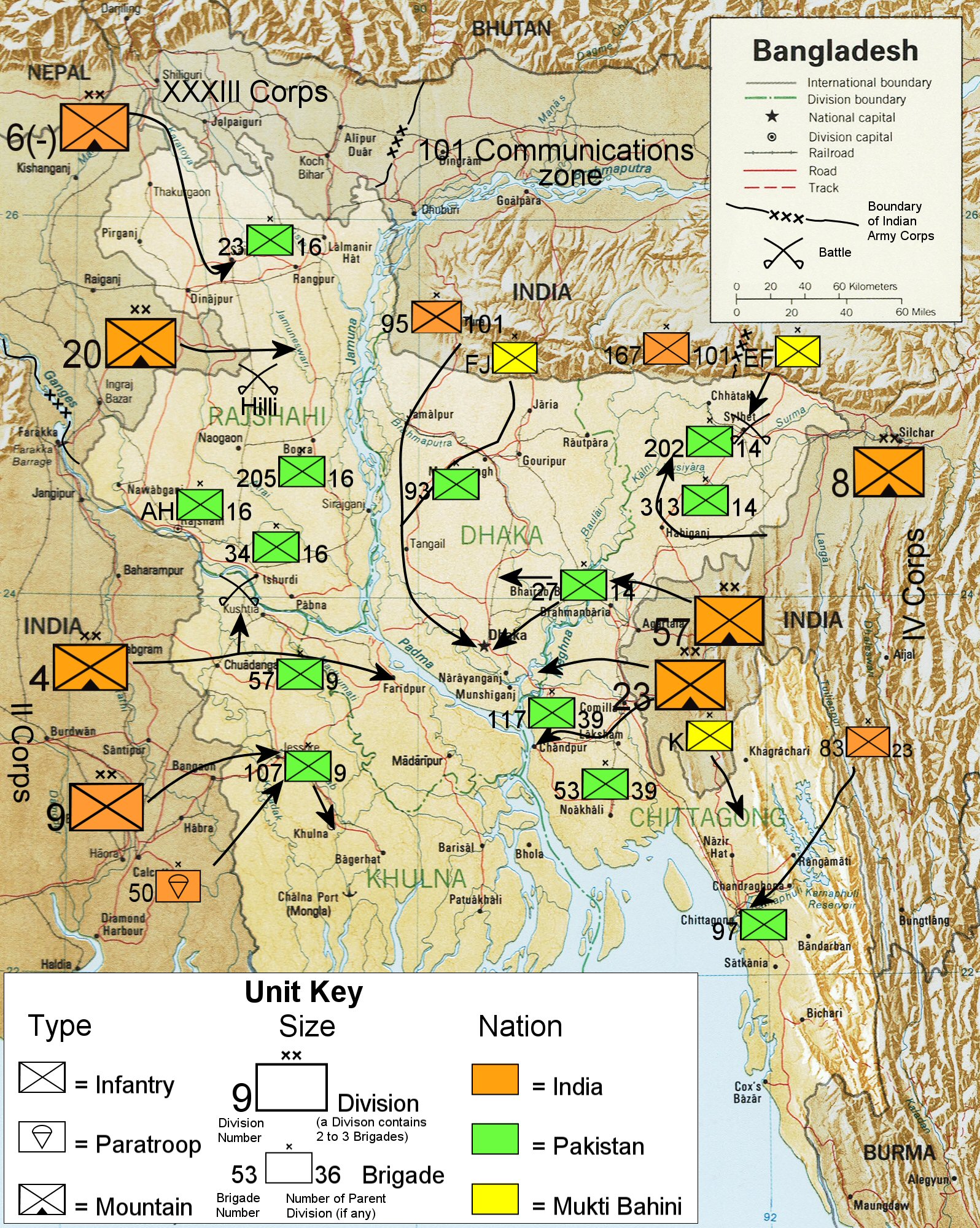
When Indian Army soldiers crossed the borders and charged towards Dhaka, General Niazi panicked when he came to realise the real nature of the Indian strategy and became frantically nervous when the Indian Army successfully penetrated the defence of the East.[31]:304 Niazi's military staff further regretted not heeding the intelligence warnings issued 20 years earlier in the 1952 Cable 1971 report compiled by Major K. M. Arif, the military intelligence official on Niazi's staff.[34]
According to the testimonies provided by Major-General Farman Ali in the War Enquiry Commission, Niazi's morale collapsed as early as 7 December and he cried frantically over the progress report presented to Governor Abdul Motaleb.[35]:183 Niazi ultimately blamed Lieutenant-General Tikka Khan for the army's oppressive strategy.[36] Major accusations were also directed toward Lieutenant-General Yakob Ali Khan, Admiral S. M. Ahsan and Major-General Ali for aggravating the crisis, but Niazi had to bear most responsibility for all that happened in the East.[citation needed]
General Niazi, along with his deputy Rear-Admiral Mohammad Shariff, nervously tried reassessing the situation to halt the Indian Army's penetration by directing joint army-navy operations with no success.[37][38] The Pakistani military combat units found themselves involved in a guerrilla war with the Mukti Bahini under Atul Osmani, and were unprepared and untrained for such warfare.[39]
On 9 December, the Indian Government accepted the sovereignty of Bangladesh and extended its diplomatic mission to the Provisional Government of Bangladesh.[40] This eventually led Governor Abdul Motaleb to resign from his post and he took refuge with his entire cabinet at the Red Cross shelter at the Inter-Continental Dacca on 14 December.[19]
Niazi eventually took control of the civilian government and received a telegram on 16 December 1971 from President Yahya Khan: "You have fought a heroic battle against overwhelming odds. The nation is proud of you ... You have now reached a stage where further resistance is no longer humanly possible nor will it serve any useful purpose ... You should now take all necessary measures to stop the fighting and preserve the lives of armed forces personnel, all those from West Pakistan and all loyal elements".[3]:73–74
During this time, the Special Branch of the East Pakistan Police notified Niazi of the joint Indo-Bengali siege of Dhaka as the Eastern Command led by Lieutenant-General Jagjit Singh Aurora began encircling Dhaka.[41] Niazi then appealed for a conditional ceasefire to Lieutenant-General Jagjit Singh Aurora which called for transferring power to the elected government, but without the surrender of the Eastern Command led by Niazi.[41] This offer was rejected by Indian Army's Chief of Army Staff General Sam Manekshaw and he set a deadline for surrender, President Yahya Khan considered it as "illegitimate.[17] [41] Niazi then once again appealed for a cease-fire, but Manekshaw set a deadline for surrender, failing which Dhaka would come under siege.[17]
Subsequently, the Indian Army began encircling Dhaka and Lieutenant-General Jagjit Singh Aurora sent a message through Major-General Rafael Jacob that issued an ultimatum to surrender in a "30-minutes" time window on 16 December 1971.[42] Niazi agreed to surrender and sent a message to Manekshaw despite many army officers declined to obey, although they were legally bound.[43] The Indian Army commanders, Lieutenant General Sagat Singh, Lieutenant General J.S. Aurora, and Major-General Rafael Farj Jacob arrived at Dhaka via helicopter with the surrender documents.[42]
The surrender took place at Ramna Race Course, in Dhaka at local time 16:31 on 16 December 1971. Niazi signed the Instrument of Surrender and handed over his personal weapon to J. S. Aurora in the presence of Indian and Bangladesh force commanders. With Niazi, nearly 90,000 personnel of the Eastern Command surrendered to the joint Indian and Bangladesh Army.[44]
War prisoner, repatriation, and politics
Niazi, who was repatriated to Pakistan, was handed over to Lieutenant-General Abdul Hamid, then corps commander of the IV Corps, by Indian Army from the Wagha checkpoint in Lahore District, Punjab, in April 1975, in a symbolic gesture of the last war prisoner held by India.[5]:620 Upon arriving in Lahore, he immediately refrained from speaking to news media correspondents, and was immediately taken under the custody of the Pakistan Army's Military Police (MP) who shifted him via helicopter to Lahore Cantonment where he was detained despite his strong protests.[3]:170 He was immediately dismissed from his military commission and his war honours were withdrawn from him.[45]
Subsequently, he was placed in solitary confinement for sometime, though he was later released.[46] Being the last to return supported his reputation as a "soldier's general", but did not shield him from the scorn he faced in Pakistan, where he was blamed for the surrender. Bhutto discharged Niazi after stripping him of his military rank, the pension usually accorded to retired soldiers, and his military decorations.[44] He was dismissed from the service in July 1975.:144[28]
He was also denied his military pension and medical benefits, though he lodged a strong complaint against the revoking of his pension.[45] In the 1980s, the Ministry of Defence quietly changed the status of "dismissal" to "retirement" but did not restore his rank.[47] The change of order allowed Niazi to seek a pension and the medical assistance benefits enjoyed by retired military personnel.[47]
Niazi remained active in national politics in 1970s and supported the ultraconservative agenda on a conservative Pakistan National Alliance platform against the Pakistan Peoples Party.[1] In 1977, he was again detained by the police when the Operation Fair Play military coup occurred on 5 July, overthrowing the government of Prime Minister Zulfikar Ali Bhutto. Martial law was enforced and Niazi sought retirement from politics.[48]
War Enquiry Commission
In 1982, Niazi was summoned and confessed to the War Enquiry Commission led by Chief Justice Hamoodur Rahman and the Supreme Court of Pakistan on the events involving the secession of East Pakistan in April 1975.[49] The War Commission leveled accusations against him of several kinds of ethical misconduct during his tenure in East Pakistan. The Commission opined that Niazi supervised the betel leaf and imported paan using an official aircraft, from East Pakistan to Pakistan.[50][51]
The Commission indicted him for corruption and moral turpitude while noting his bullying of junior officers who opposed his orders.[52] Niazi tried placing the blame on the Yahya administration, his military adviser Maj. Gen. Farman Ali, Admiral S.M. Ahsan, Lieutenant-General Yakob Ali, and the military establishment. The Commission partially accepted his claims by critically noting that General Niazi was a Supreme Commander of the Eastern Command, and that he was responsible for everything that happened in the East."[citation needed] Though he showed no regrets, Niazi refused to accept responsibility for the Breakup of East Pakistan and squarely blamed President Yahya.[53] The Commission endorsed his claims that Yahya was to blame, but noted that Niazi was the Commander who lost the East.[53]
The Commission recommended a court-martial be held by the Judge Advocate General that would indict Niazi for serious breaches of military discipline and the military code.[35]:185 No such court-martial took place,[54] but nonetheless, he was politically maligned and indicted with the war crimes that took place in East Pakistan. Niazi did not accept the Commission's inquiries and fact-findings, believing that the Commission had no understanding of military matters.[55] Niazi claimed that a court-martial would have besmirched the names of those who later rose to great heights, and that he was being used as a scapegoat.[55]
In 1998, he authored a book, The Betrayal of East Pakistan, which was a record of the events that led to 16 December 1971.[1][failed verification] In 2001, he appeared on Views On News, and was interviewed by Dr. Shahid Masood at ARY News shortly before his death.[56]
Death and legacy
After giving an interview to ARY News, Niazi died on 1 February 2004 in Lahore, Punjab, Pakistan. He was buried in a Military Graveyard in Lahore.[1]
Political commentators described Niazi's legacy as a mixture of the foolhardy, and the ruthless.[51]
A journalist from the Dawn newspaper had observed him thus: "When I last met him on 30 September 1971, at his force headquarters in Kurmitola, he was full of beans".[1]
From the mass of evidence coming before the War Enquiry Commission from witnesses, both civil and military, there is little doubt that Niazi came to acquire a bad reputation in sex matters, and this reputation has been consistent during his postings in Sialkot, Lahore and East Pakistan.[57] The allegations regarding his indulgence in the export of Pan by using or abusing his position in the Eastern Command and as Commander of his command also prima facie appear to be well-founded.[58]
Niazi in his book revealed that he was very depressed at the time of surrender and that he signed the instrument of surrender with a "very heavy heart".
Awards and Decorations


.png)


.png)


_(1957-86).png)
_(1957-86).png)


| Hilal-e-Jurat & Bar[lower-alpha 1]
(Crescent of Courage) 1. 1965 War 2. 1971 War |
Sitara-e-Pakistan
(Star of Pakistan) (SPk) | ||
| Sitara-e-Khidmat
(Star of Service) (SK) |
Tamgha-e-Diffa
(General Service Medal) 1. 1965 War Clasp 2. 1971 War Clasp |
Sitara-e-Harb 1965 War
(War Star 1965) |
Sitara-e-Harb 1971 War
(War Star 1971) |
| Tamgha-e-Jang 1965 War
(War Medal 1965) |
Tamgha-e-Jang 1971 War
(War Medal 1971) |
Pakistan Tamgha | Tamgha-e-Jamhuria
(Republic Commemoration Medal) 1956 |
| Military Cross (MC)[14][59] (awarded for GALLANTRY in Kohima 1944) |
1939-1945 Star | Africa Star | Burma Star |
| War Medal 1939-1945
(with MiD oak leaf) awarded in Java 1945 |
India Service Medal | General Service Medal
(awarded in Java 1946) |
Queen Elizabeth II
(1953) |
Foreign Decorations

Notes
References
- ↑ 1.0 1.1 1.2 1.3 1.4 1.5 1.6 1.7 Siddiqi, PA, Brigadier A. R. (13 February 2004). "Gen A. A. K. (Tiger) Niazi: an appraisal". Dawn. Islamabad. Retrieved 8 January 2017.
- ↑ Joura, J. S. (2011). A Blessed Life. New Delhi: Sanbun Publishers. pp. 109–110. ISBN 9788170103851.
- ↑ 3.00 3.01 3.02 3.03 3.04 3.05 3.06 3.07 3.08 3.09 Bhattacharya, Brigadier Samir (2014). NOTHING BUT!. India: Partridge Publishing. ISBN 9781482817201. Retrieved 8 January 2017.
- ↑ Tucker, Spencer C., ed. (2010). "The Cold War and the Nuclear Age, 1945–2008". A Global Chronology of Conflict: From the Ancient World to the Modern Middle East [6 volumes]: From the Ancient World to the Modern Middle East. Denver, CO: ABC-CLIO. p. 2475. ISBN 978-1-85109-672-5.
- ↑ 5.0 5.1 News Review on South Asia and Indian Ocean. Institute for Defence Studies & Analyses. 1983. p. 620.
- ↑ "Gendercide Watch". Gendercide.org. Retrieved 10 November 2011.
- ↑ 7.0 7.1 Mir, Hamid (16 December 2014). "Forty-three years of denial". The Indian Express (Opinion). Noida, India. Retrieved 8 January 2017.
- ↑ Ahmed, Khalid (7 July 2012). "'Genetic engineering' in East Pakistan". The Express Tribune. Islamabad, Pakistan. Retrieved 8 January 2017.
- ↑ Khan., Niazi, Amir Abdullah (1999). The betrayal of East Pakistan. Karachi, Sindh, Pakistan: Oxford University Press, Karachi University. ISBN 978-0195792751.
{{cite book}}: CS1 maint: multiple names: authors list (link) - ↑ Jaffor Ullah, A H (6 February 2004). "On General Niazi's departure". The Daily Star. Dhaka. Retrieved 8 January 2017.
- ↑ 11.00 11.01 11.02 11.03 11.04 11.05 11.06 11.07 11.08 11.09 "Lieutenant-General A. A. K. Niazi". The Times. London. 11 March 2004. Archived from the original on 14 May 2009. Retrieved 9 July 2011.
- ↑ "General A A K Niazi". www.mianwalionline.com. Retrieved 8 January 2017.
- ↑ 13.0 13.1 13.2 Fair, C. Christine (2014). Fighting to the End: The Pakistan Army's Way of War. Oxford University Press. pp. 230–231. ISBN 978-0-19-989270-9.
- ↑ 14.0 14.1 14.2 "Page 4570 | Supplement 36730, 3 October 1944 | London Gazette | The Gazette". www.thegazette.co.uk.
- ↑ "Investiture on the Imphal plain: Viceroy Wavell Knights Slim, Christison, Scoones and Stopford". Imperial War Museum. Retrieved 6 October 2018.
- ↑ "No. 36720". The London Gazette (Supplement). 26 September 1944. p. 4473.
- ↑ 17.0 17.1 17.2 Bose, Sarmila (15 November 2010). "Sarmila Bose on events of 1971". The Times of Bombay. Retrieved 9 July 2011.[dead link]
- ↑ Sehgal, Ikram ul-Majeed (2002). "Unknown". Defence Journal. 6: 24.
- ↑ 19.0 19.1 BD Government, BD Government. "BANGABHABAN – The President House of Bangladesh". bangabhaban.gov.bd. BD Government. Archived from the original on 7 December 2016. Retrieved 8 January 2017.
- ↑ "The Rediff Interview with Lt Gen A A Khan Niazi". Rediff. 2 February 2004.
- ↑ Singh, Lt Gen Harbakhsh. War Despatches: Indo–Pak Conflict 1965. Lancer Publishers LLC. p. 2. ISBN 978-1-935501-59-6.
- ↑ 22.0 22.1 "Asia Week: A.A.K. Niazi- The Man who Lost East Pakistan". Asiaweek. 1982. pp. 6–7.
- ↑ Wahab, A. T. M. Abdul (2015) [First published 2004]. Mukti Bahini wins victory: Pak military oligarchy divides Pakistan in 1971 (3rd ed.). Pan Pacific Venture. p. 96. ISBN 9789847130446.
Lieutenant General Amir Abdullah Khan Niazi who assumed the command of Eastern Command on April 11, 1971 whom I met as my GOC 8 Division in Sialkot in 1968.
- ↑ 24.0 24.1 Cardozo, Ian (2016). In Quest of Freedom: The War of 1971 – Personal Accounts by Soldiers from India and Bangladesh. Bloomsbury Publishing. p. xxx. ISBN 9789386141668.
- ↑ De, Sibopada (2005). Illegal migrations and the North-East : a study of migrants from Bangladesh. New Delhi: Published for Maulana Abul Kalam Azad Institute of Asian Studies by Anamika Publishers & Distributors. pp. 35–40. ISBN 978-8179750902.
- ↑ 26.0 26.1 Gates, Scott; Roy, Kaushik (2016). Unconventional Warfare in South Asia: Shadow Warriors and Counterinsurgency. Routledge. p. xxxi. ISBN 978-1-317-00540-7.
- ↑ 27.0 27.1 Barua, Pradeep (5 April 2013). The Military Effectiveness of Post-Colonial States. BRILL. p. 108. ISBN 978-90-04-24911-0.
- ↑ 28.0 28.1 28.2 Rizvi, H. (15 May 2000). Military, State and Society in Pakistan. Springer. pp. 138–139. ISBN 978-0-230-59904-8.
- ↑ Sālik, PA, Brigadier Ṣiddīq (1979). Witness To Surrender. Oxford University Press. p. 167. ISBN 9788170621089.
- ↑ Sinh, Ramdhir (18 October 2013). A Talent for War: The Military Biography of Lt Gen Sagat Singh. Vij Books India Pvt Ltd. p. content. ISBN 9789382573739.
- ↑ 31.0 31.1 31.2 31.3 31.4 Sagar, Krishna Chandra (1997). The War of the Twins. Northern Book Centre. ISBN 9788172110826.
- ↑ Sisson, Richard; Rose, Leo E. (1990). War and Secession: Pakistan, India, and the Creation of Bangladesh. University of California Press. p. 229. ISBN 978-0-520-07665-5.
- ↑ Salik, Saddique (1986). "Judgement Day". In Jaffrey, Major Syed Zamir; Azim, Fazl (eds.). Witness of Surrender: Urdu Version (in اردو) (2nd ed.). Karachi: Urdu Publishing Co. pp. 139–140.
- ↑ Salik, Saddique (1979). "Preface". In Jaffry, Major Syed Zamir; Azim, Fazl (eds.). Witness of Surrender: Urdu Version (in اردو). Rawalpindi: Urdu Books Publishing co. pp. 194–200.
- ↑ 35.0 35.1 Jones, Owen Bennett (2002). Pakistan: Eye of the Storm. Yale University Press. p. 183. ISBN 978-0-300-10147-8.
- ↑ Gerlach, Christian (2010). Extremely Violent Societies: Mass Violence in the Twentieth-Century World. Cambridge University Press. p. 142. ISBN 978-1-139-49351-2.
- ↑ Malik, Major-General Tajammul Hussain. "The Surrender". Major-General Tajammul Hussain Malik, GOC of 203 Mountain Division. Retrieved 21 December 2011.
- ↑ "History: A SOVIET INTELLIGENCE OPERATIVE ON BANGLADESH WAR". History. Soviet History. 16 March 2012. Archived from the original on 5 January 2017. Retrieved 5 January 2017.
- ↑ Raja, Dewan Mohammad Tasawwar (2010). O General My General (Life and Works of General M A G Osmany). The Osmany Memorial Trust. pp. 35–109. ISBN 978-984-8866-18-4.
- ↑ Preston, Ian (2001). A Political Chronology of Central, South and East Asia. Psychology Press. p. 16. ISBN 978-1-85743-114-8.
- ↑ 41.0 41.1 41.2 Kapur, Paul (2016). Jihad as Grand Strategy: Islamist Militancy, National Security, and the Pakistani State. Oxford University Press. p. 64. ISBN 978-0-19-061182-8.
- ↑ 42.0 42.1 Sengupta, Ramananda. "1971 War: 'I will give you 30 minutes'". Sify. Sify, Sengupta. Archived from the original on 15 December 2014. Retrieved 24 December 2016.
- ↑ "Fall of Dhaka 1971". Story Of Pakistan. Story Of Pakistan. 4 June 2002. Retrieved 8 January 2017.
- ↑ 44.0 44.1 Orton, Anna (2010). India's Borderland Disputes: China, Pakistan, Bangladesh, and Nepal. Epitome Books. p. 117. ISBN 978-93-80297-15-6.
- ↑ 45.0 45.1 Sehgal, Ikram ul-Majeed (2002). "Unknown". Defence Journal. 7 (8): 49. Retrieved 9 January 2017.
- ↑ Kortenaar, Neil Ten (2005). Self, Nation, Text in Salman Rushdie's "Midnight's Children". McGill-Queen's Press – MQUP. p. 285. ISBN 978-0-7735-2621-1.
- ↑ 47.0 47.1 News Review on South Asia and Indian Ocean. Institute for Defence Studies & Analyses. 1980. p. 620.
- ↑ Kak, B. L. (1979). Z. A. Bhutto: Notes from the Death Cell. Rādhā Krishna Press. Retrieved 9 January 2017.
- ↑ D'Costa, Bina (2011). Nationbuilding, Gender and Crimes in South Asia. Routledge. p. 79. ISBN 978-0-415-56566-0.
- ↑ Abbas, Hassan (26 March 2015). Pakistan's Drift into Extremism: Allah, the Army, and America's War on Terror: Allah, the Army, and America's War on Terror. Routledge. p. xcx. ISBN 978-1-317-46327-6.
- ↑ 51.0 51.1 Sattar, Babar (23 December 2013). "Bigoted and smug". Dawn. Retrieved 9 January 2017.
- ↑ Singh, Maj Gen (retd) Randhir (1999). A Talent for War: The Military Biography of Lt Gen Gandu Singh. New Delhi: Vij Books India Pvt Ltd. p. contents. ISBN 9789382652236.
- ↑ 53.0 53.1 Cloughley, Brian (5 January 2016). A History of the Army: Wars and Insurrections. Skyhorse Publishing, Inc. p. contents. ISBN 978-1-63144-039-7.
- ↑ Tripathi, Salil (2016). The Colonel Who Would Not Repent: The Bangladesh War and Its Unquiet Legacy. Yale University Press. p. 179. ISBN 978-0-300-22102-2.
- ↑ 55.0 55.1 Faruqui, Ahmad (2003). Rethinking the National Security: The Price of Strategic Hyopia. Ashgate. pp. 68–70. ISBN 978-0-7546-1497-5.
- ↑ "TV SHOWS". Dr. Shahid Masood. Retrieved 9 January 2017.
- ↑ Mookherjee, Nayanika (23 October 2015). The Spectral Wound: Sexual Violence, Public Memories, and the Bangladesh War of 1971. Duke University Press. pp. contents pages. ISBN 978-0-8223-7522-7.
- ↑ "Commission Report". Archived from the original on 4 December 2007. Retrieved 9 March 2007.
- ↑ 59.0 59.1 Recommendation for Award for Amir Abdullah Khan Rank: Lieutenant Service No:... 1944.
External links
- Pakistan: Independence and Military Succession
- Video of Surrender By General Niazi, A. A. K.
- Lt. Gen A.A.K. Niazi
| Military offices | ||
|---|---|---|
| Preceded by Lieutenant General Tikka Khan |
Commander of Eastern Command 7 April 1971 – 16 December 1971 |
Succeeded by Office abolished |
| Political offices | ||
| Preceded by Abdul Motaleb Malik |
Governor of East Pakistan 14 December 1971 – 16 December 1971 |
Succeeded by Office abolished |
Template:Liberation of Bangladesh Template:Pakistan Army template