|
|
| Line 1: |
Line 1: |
| {{short description|Capital and largest city of the Russian Federation}}
| |
| {{redirect|Moskva|the guided missile cruiser|Russian cruiser Moskva{{!}}Russian cruiser ''Moskva''|other uses|Moscow (disambiguation)|and|Moskva (disambiguation)}}
| |
| {{pp-move-indef}}
| |
| {{pp-vandalism|small=yes}}
| |
| {{Use mdy dates|date=March 2022}}
| |
| {{Infobox Russian federal subject | | {{Infobox Russian federal subject |
| |en_name = Moscow | | |en_name=Moscow |
| |ru_name = Москва | | |ru_name=Mосква |
| |image_skyline ={{multiple image | | |image_skyline=MSK Collage 2015.png |
| | perrow = 1/2/2/2/1
| | |image_caption=Clockwise, from top right: [[Spasskaya Tower]] of the [[Moscow Kremlin]]; [[Moscow International Business Center|MIBC]]; [[Red Square]], [[Saint Basil's Cathedral]]; [[Bolshoi Theatre]]; [[Moscow State University]]; and [[Cathedral of Christ the Saviour]]. |
| | border = infobox
| | |image_map=Map of Russia - Moscow.svg |
| | total_width = 300
| | |coordinates={{coord|55|45|N|37|37|E|type:adm1st_region:RU|display=inline,title}} |
| | image1 = Saint Basil's Cathedral and the Red Square.jpg
| |
| | image2 = Moscow-Bolshoi-Theare-1.jpg | |
| | image3 = Moscow State University.jpg
| |
| | image4 = Business Centre of Moscow 2.jpg
| |
| | image5 = Cathedral of Christ the Saviour-1.jpg
| |
| | image6 = Moscow_International_Business_Center7.jpg
| |
| | color = white
| |
| | footer = '''From top to bottom and left to right:''' [[Red Square]] with the [[Kremlin]] on the left, [[Saint Basil's Cathedral]] on the right and [[Ostankino Tower]] in the background; the [[Bolshoi Theatre]]; [[Moscow State University]]; the [[Moscow International Business Center]] at night; the [[Cathedral of Christ the Savior]]; view along the [[Moskva (river)|Moskva River]].}}
| |
| |image_map=Russia Moscow locator map.svg | |
| |coordinates={{Coord|55|45|21|N|37|37|2|E|type:adm1st_region:RU-MOS|display=inline,title}} | |
| |image_coa= Coat of Arms of Moscow.svg | | |image_coa= Coat of Arms of Moscow.svg |
| |coa_caption=[[Coat of arms of Moscow|Coat of arms]] | | |coa_caption=[[Coat of arms of Moscow|Coat of arms]] |
| |image_flag=Flag of Moscow.svg | | |image_flag=Flag of Moscow, Russia.svg |
| |flag_caption=[[Flag of Moscow|Flag]] | | |flag_caption=[[Flag of Moscow|Flag]] |
| |anthem="[[Moya Moskva|My Moscow]]"<br><center>[[File:My Moscow.ogg]] | | |anthem="[[Moya Moskva|My Moscow]]" |
| | |holiday=The second weekend of September |
| | |holiday_ref=<ref>{{cite web|title=Holidays and significant dates of Moscow |url=http://old.mos.ru/wps/portal/EnglishVersion?documentId=119125 |work=Moscow City Government |accessdate=September 29, 2010 |url-status=dead |archiveurl=https://web.archive.org/web/20110823153912/http://old.mos.ru/wps/portal/EnglishVersion?documentId=119125 |archivedate=August 23, 2011 }}</ref> |
| <!--POLITICAL STATUS--> | | <!--POLITICAL STATUS--> |
| |political_status={{ubl|[[Capital city]]|[[Federal cities of Russia|Federal city]]}} | | |political_status=Federal city |
| |political_status_link=
| | |political_status_link=Federal cities of Russia |
| |federal_district=[[Central Federal District|Central]] | | |federal_district=[[Central Federal District|Central]] |
| |economic_region=[[Central economic region|Central]] | | |economic_region=[[Central economic region|Central]] |
| |population_total={{increase}} 12,593,000<ref>{{Cite web|url=https://www.macrotrends.net/cities/22299/moscow/population#:~:text=The%20current%20metro%20area%20population,a%200.44%25%20increase%20from%202020.|title = Moscow, Russia Metro Area Population 1950–2021 |website=macrotrends.com}}</ref> | | |pop_2019census=12630289 |
| |population_urban={{increase}} 17,125,000
| | |pop_2019census_rank=1st |
| |population_metro={{increase}} 20,004,462<ref>[[Moscow metropolitan area]]</ref>
| |
| |pop_2010census_rank=1st | |
| |pop_density_as_of=2015 | | |pop_density_as_of=2015 |
| |pop_density_ref=<ref>{{cite web|url=http://www.gks.ru/free_doc/new_site/perepis2010/croc/perepis_itogi1612.htm|title=ВПН-2010|website=www.gks.ru|access-date=June 17, 2015|archive-date=June 1, 2015|archive-url=https://web.archive.org/web/20150601051814/http://www.gks.ru/free_doc/new_site/perepis2010/croc/perepis_itogi1612.htm|url-status=dead}}</ref> | | |pop_density_ref=<ref>{{cite web|url=http://www.gks.ru/free_doc/new_site/perepis2010/croc/perepis_itogi1612.htm|title=ВПН-2010|website=www.gks.ru|access-date=2018-05-04|archive-date=2018-03-17|archive-url=https://web.archive.org/web/20180317181747/http://www.gks.ru/free_doc/new_site/perepis2010/croc/perepis_itogi1612.htm|url-status=live}}</ref> |
| | |pop_2010census_ref= |
| |pop_latest_date=2017 | | |pop_latest_date=2017 |
| |pop_latest_ref=<ref name="2017Est">{{cite web |publisher=[[Goskomstat|Rosstat]] |url=http://www.gks.ru/free_doc/new_site/population/demo/Popul2017.xls |language=ru |title=Archived copy |access-date=August 4, 2017 |archive-date=June 5, 2019 |archive-url=https://web.archive.org/web/20190605235655/http://www.gks.ru/free_doc/new_site/population/demo/Popul2017.xls |url-status=dead }}</ref><ref>{{cite web |url=http://demographia.com/db-worldua.pdf |title=Demographia World Urban Areas |edition=17th |publisher=Demographia |date=June 7, 2021 |access-date=September 21, 2021 |url-status=live}}</ref> | | |pop_latest_ref=<ref name="2017Est">[[Goskomstat|Rosstat]]. [http://www.gks.ru/free_doc/new_site/population/demo/Popul2017.xls] {{Webarchive|url=https://web.archive.org/web/20190605235655/http://www.gks.ru/free_doc/new_site/population/demo/Popul2017.xls |date=2019-06-05 }} {{ru icon}}</ref><ref>{{cite web|url=http://www.citypopulation.de/world/Agglomerations.html|title=Major Agglomerations of the World – Population Statistics and Maps|author=|date=|work=citypopulation.de|access-date=2010-02-15|archive-date=2010-07-04|archive-url=https://web.archive.org/web/20100704112702/http://www.citypopulation.de/world/Agglomerations.html|url-status=live}}</ref> |
| |area_km2=2561.5 | | |area_km2=2511 |
| |area_km2_ref=<ref name="InfostatArea">{{cite web |title=Общая площадь Москвы в длинну и ширину |url=https://rosinfostat.ru/ploshhad-moskvy/ |publisher=RosInfoStat}}</ref> | | |area_km2_ref=<ref>{{cite web|url=http://mos.ru/press-center/press_releases/index.php?id_4=19417&afrom_4=25.10.2010&ato_4=03.08.2011|title=О совместных предложениях Правительства Москвы и Правительства Московской области по изменению границ столицы Российской Федерации – города Москвы|publisher=Mos.ru|date=October 25, 2010|accessdate=July 9, 2014|archive-date=August 3, 2011|archive-url=https://www.webcitation.org/60fj6q8Tc?url=http://mos.ru/press-center/press_releases/index.php?id_4=19417|url-status=live}}</ref> |
| | |area_km2_rank=83rd |
| |elevation = 156 | | |elevation = 156 |
| |established_date=1147 | | |established_date=1147 |
| |established_title=First mentioned
| | |established_date_ref=<ref name="dolgorukiy">{{cite web|url=http://faculty.oxy.edu/richmond/csp8/history_of_moscow.htm |title=The History of Moscow |publisher=Occidental College |last=Comins-Richmond |first=Walter |accessdate=July 3, 2006 |url-status=dead |archiveurl=https://web.archive.org/web/20060517163858/http://faculty.oxy.edu/richmond/csp8/history_of_moscow.htm |archivedate=May 17, 2006 }}</ref> |
| |established_date_ref=<ref name="dolgorukiy">{{cite web|url=http://faculty.oxy.edu/richmond/csp8/history_of_moscow.htm |title=The History of Moscow |publisher=Occidental College |last=Comins-Richmond |first=Walter |access-date=July 3, 2006 |url-status=dead |archive-url=https://web.archive.org/web/20060517163858/http://faculty.oxy.edu/richmond/csp8/history_of_moscow.htm |archive-date=May 17, 2006 }}</ref> | |
| |license_plates=77, 177, 777; 97, 197, 797; 99, 199, 799 | | |license_plates=77, 177, 777; 97, 197, 797; 99, 199, 799 |
| |ISO=RU-MOW | | |ISO=RU-MOW |
| Line 50: |
Line 36: |
| |gov_as_of = 2011 | | |gov_as_of = 2011 |
| |leader_title=[[Mayor of Moscow|Mayor]] | | |leader_title=[[Mayor of Moscow|Mayor]] |
| |leader_title_ref=<ref name="mayor">{{cite web|url=http://old.mos.ru/wps/portal/EnglishVersion?rubricId=14107 |title=The Moscow City Mayor |publisher=Government of Moscow |access-date=March 18, 2010 |url-status=dead |archive-url=https://web.archive.org/web/20110823154527/http://old.mos.ru/wps/portal/EnglishVersion?rubricId=14107 |archive-date=August 23, 2011 }}</ref> | | |leader_title_ref=<ref name="mayor">{{cite web|url=http://old.mos.ru/wps/portal/EnglishVersion?rubricId=14107 |title=The Moscow City Mayor |publisher=Government of Moscow |accessdate=March 18, 2010 |url-status=dead |archiveurl=https://web.archive.org/web/20110823154527/http://old.mos.ru/wps/portal/EnglishVersion?rubricId=14107 |archivedate=August 23, 2011 }}</ref> |
| |leader_name=[[Sergey Sobyanin]] | | |leader_name=[[Sergey Sobyanin]] |
| |leader_name_ref=<ref name="mayor"/> | | |leader_name_ref=<ref name="mayor"/> |
| |legislature = [[Moscow City Duma|City Duma]] | | |legislature = [[Moscow City Duma|City Duma]] |
| |legislature_ref=<ref>{{cite web|title=The Moscow Statute |url=http://old.mos.ru/wps/portal/EnglishVersion?rubricId=14215&documentId=118572 |work=Moscow City Duma |publisher=Moscow City Government |access-date=September 29, 2010 |date=June 28, 1995 |quote=The supreme and exclusive legislative (representative) body of the state power in Moscow is the Moscow City Duma. |url-status=dead |archive-url=https://web.archive.org/web/20110823154646/http://old.mos.ru/wps/portal/EnglishVersion?rubricId=14215&documentId=118572 |archive-date=August 23, 2011 }}</ref> | | |legislature_ref=<ref>{{cite web|title=The Moscow Statute |url=http://old.mos.ru/wps/portal/EnglishVersion?rubricId=14215&documentId=118572 |work=Moscow City Duma |publisher=Moscow City Government |accessdate=September 29, 2010 |date=June 28, 1995 |quote=The supreme and exclusive legislative (representative) body of the state power in Moscow is the Moscow City Duma. |url-status=dead |archiveurl=https://web.archive.org/web/20110823154646/http://old.mos.ru/wps/portal/EnglishVersion?rubricId=14215&documentId=118572 |archivedate=August 23, 2011 }}</ref> |
| |website=[https://www.mos.ru/en mos.ru] | | |website=https://www.mos.ru/en |
| |website_ref
| |
| |date=July 2014 | | |date=July 2014 |
| }} | | }}{{Distinguish|Moscow Oblast}}{{redirect|Moskva|other uses|Moscow (disambiguation)|and|Moskva (disambiguation)}}'''Moscow''' ({{IPAc-en|ˈ|m|ɒ|s|k|oʊ}} {{respell|MOS|koh}}, <small>[[American English|US]] chiefly</small> {{IPAc-en|ˈ|m|ɒ|s|k|aʊ}} {{respell|MOS|kow}};<ref>{{cite book|title=Longman Pronunciation Dictionary|last=Wells|first=John C.|publisher=Longman|year=2008|isbn=978-1-4058-8118-0|edition=3rd}}</ref><ref>{{cite book|title=Cambridge English Pronouncing Dictionary|last=Roach|first=Peter|publisher=Cambridge University Press|year=2011|isbn=978-0-521-15253-2|edition=18th|place=Cambridge}}</ref> {{lang-rus|Москва|links=no|r=Moskva|p=mɐskˈva|a=Москва.ogg}}) is the [[Capital city|capital]] and [[List of cities and towns in Russia by population|largest city]] of [[Russia]]. The city is on the [[Moskva (river)|Moskva River]] in [[Central Russia]]. It has a [[population]] of around 13 million people in the [[city limits]],<ref name="2021Census">{{cite web|title=Оценка численности постоянного населения по субъектам Российской Федерации|url=https://rosstat.gov.ru/storage/mediabank/tab-5_VPN-2020.xlsx|publisher=[[Federal State Statistics Service (Russia)|Federal State Statistics Service]]|accessdate=1 September 2022}}</ref> over 17 million people in the urban area,<ref name="Urban">{{cite web|title=Demographia World Urban Areas|url=http://www.demographia.com/db-worldua.pdf|access-date=July 22, 2020|publisher=Demographia}}</ref> and over 20 million people in the [[Moscow metropolitan area|metropolitan area]].<ref name="Megapolis">{{cite web|last=Akishin|first=Alexander|date=August 17, 2017|title=A 3-Hour Commute: A Close Look At Moscow The Megapolis|url=https://strelkamag.com/en/article/moscow-agglomeration|url-status=dead|archive-url=https://web.archive.org/web/20210417121056/https://strelkamag.com/en/article/moscow-agglomeration|archive-date=April 17, 2021|access-date=May 23, 2020|work=Strelka Mag}}</ref> The city has an [[area]] of {{Convert|2511|km2|mi2|abbr=|sp=us}}. Moscow's [[urban area]] has an area of {{Convert|5891|km2|mi2|abbr=|sp=us}}.<ref name="Urban" /> Moscow's [[metropolitan area]] has an area of over {{Convert|26000|km2|mi2|abbr=|sp=us}}.<ref name="Megapolis" /> Moscow is one of the [[List of largest cities|world's largest cities]]. It is the [[List of European cities by population within city limits|most populous city]] that is only in [[Europe]]. It is also the largest [[List of urban areas in Europe|urban]] and [[List of metropolitan areas in Europe|metropolitan area]] in Europe<ref name="Urban" /><ref name="Megapolis" /> and the largest city by land area on the European continent.<ref name="Planète Énergies">{{Cite web|date=September 11, 2017|title=Moscow, a City Undergoing Transformation|url=https://www.planete-energies.com/en/medias/close/moscow-city-undergoing-transformation|access-date=May 27, 2020|work=Planète Énergies}}</ref> |
|
| |
|
| '''Moscow''' ({{IPAc-en|ˈ|m|ɒ|s|k|oʊ}} {{respell|MOS|koh}}, <small>[[American English|US]] chiefly</small> {{IPAc-en|ˈ|m|ɒ|s|k|aʊ}} {{respell|MOS|kow}};<ref>{{cite book|last=Wells|first=John C.|year=2008|title=Longman Pronunciation Dictionary|edition=3rd|publisher=Longman|isbn=978-1-4058-8118-0}}</ref><ref>{{cite book|last=Roach|first=Peter|year=2011|title=Cambridge English Pronouncing Dictionary|edition=18th|place=Cambridge|publisher=Cambridge University Press|isbn=978-0-521-15253-2}}</ref> {{lang-rus|links=no|Москва|r=Moskva|p=mɐskˈva|a=Москва.ogg}}) is the [[Capital city|capital]] and [[List of cities and towns in Russia by population|largest city]] of [[Russia]]. The city stands on the [[Moskva (river)|Moskva River]] in [[Central Russia]], with a population estimated at 12.4 million residents within the city limits,<ref name=est.2020>{{cite web|title=Russia: Central'nyj Federal'nyj Okrug - Central Federal District|url=https://www.citypopulation.de/en/russia/cities/central/|publisher=City Population.de|date=August 8, 2020|access-date=September 1, 2020}}</ref> over 17 million residents in the urban area,<ref name="Urban">{{cite web|url=http://www.demographia.com/db-worldua.pdf|title=Demographia World Urban Areas|publisher=Demographia|access-date=July 22, 2020}}</ref> and over 20 million residents in the [[Moscow metropolitan area|metropolitan area]].<ref name="Megapolis">{{cite web|url=https://strelkamag.com/en/article/moscow-agglomeration|title=A 3-Hour Commute: A Close Look At Moscow The Megapolis|work=Strelka Mag|first=Alexander |last=Akishin|date=August 17, 2017|access-date=May 23, 2020|archive-date=April 17, 2021|archive-url=https://web.archive.org/web/20210417121056/https://strelkamag.com/en/article/moscow-agglomeration|url-status=dead}}</ref> The city covers an area of {{Convert|2511|km2|mi2|abbr=|sp=us}}, while the urban area covers {{Convert|5891|km2|mi2|abbr=|sp=us}},<ref name="Urban"/> and the metropolitan area covers over {{Convert|26000|km2|mi2|abbr=|sp=us}}.<ref name="Megapolis"/> Moscow is among the [[List of largest cities|world's largest cities]]; being the [[List of European cities by population within city limits|most populous city]] entirely in Europe, the largest [[List of urban areas in Europe|urban]] and [[List of metropolitan areas in Europe|metropolitan area]] in Europe,<ref name="Urban"/><ref name="Megapolis"/> and the largest city by land area on the European continent.<ref name="Planète Énergies">{{Cite web|url=https://www.planete-energies.com/en/medias/close/moscow-city-undergoing-transformation|title=Moscow, a City Undergoing Transformation|work=Planète Énergies|date=September 11, 2017|access-date=May 27, 2020}}</ref>
| | It was first wrote about in 1147. Moscow grew to become a powerful city that was the capital of the [[Grand Duchy of Moscow]]. Moscow stayed the [[Politics|political]] and [[Economy|economic]] center of the country when the [[Tsardom of Russia]] was made. When the Tsardom turned into the [[Russian Empire]], the capital was moved from Moscow to [[Saint Petersburg]] which lowered the [[influence]] of the city. The capital was moved back to Moscow after the [[October Revolution]]. This brought the city back as the political center of the [[Russian Soviet Federative Socialist Republic|Russian SFSR]] and then the [[Soviet Union]].<ref>[[1977 Constitution of the Soviet Union]] - Section VIII, Article 172: "The Capital of the Union of Soviet Socialist Republics is the city of Moscow."</ref> After the [[dissolution of the Soviet Union]], Moscow stayed the capital city of the new [[Russian Federation]]. |
|
| |
|
| First documented in 1147, Moscow grew to become a prosperous and powerful city that served as the capital of the [[Grand Duchy of Moscow|Grand Duchy that bears its name]]. When the Grand Duchy of Moscow evolved into the [[Tsardom of Russia]], Moscow still remained as the political and economic center for most of the Tsardom's history. When the Tsardom was reformed into the [[Russian Empire]], the capital was moved from Moscow to [[Saint Petersburg]] diminishing the influence of the city. The capital was then moved back to Moscow following the [[October Revolution]] and the city was brought back as the political center of the [[Russian Soviet Federative Socialist Republic|Russian SFSR]] and then the [[Soviet Union]].<ref>[[1977 Constitution of the Soviet Union]] - Section VIII, Article 172: "The Capital of the Union of Soviet Socialist Republics is the city of Moscow."</ref> In the aftermath of the [[dissolution of the Soviet Union]], Moscow remained as the capital city of the contemporary and newly established [[Russia|Russian Federation]].
| | Moscow is the [[North|northernmost]] and [[Cold|coldest]] [[megacity]] in the world. It has a history that goes through eight [[centuries]]. Moscow is a [[Federal cities of Russia|federal city]] of Russia since 1993<ref>{{cite web|title=A glimpse into history|url=https://www.mos.ru/en/city/about/|url-status=dead|archive-url=https://web.archive.org/web/20211007105652/https://www.mos.ru/en/city/about/|archive-date=October 7, 2021|access-date=September 21, 2021|website=mos.ru}}</ref> that is the political, economic, [[Culture|cultural]], and [[Science|scientific]] center of Russia and [[Eastern Europe]]. Moscow has one of the world's [[List of cities by GDP|largest urban economies]] as an [[Global city|alpha world city]].<ref>According to the [[Globalization and World Cities Research Network]]</ref><ref>{{cite journal|last1=Brade|first1=Isolde|last2=Rudolph|first2=Robert|date=2004|title=Moscow, the Global City? The Position of the Russian Capital within the European System of Metropolitan Areas|journal=Area|publisher=[[Wiley (publisher)|Wiley]]|volume=36|pages=69–80|doi=10.1111/j.0004-0894.2004.00306.x|jstor=20004359|number=1}}</ref> The city is one of the fastest-growing [[Tourist attraction|tourist destinations]] in the world,<ref>According to the [[Most visited places in the world|MasterCard Global Destination Cities Index]].</ref> and it is one of Europe's [[List of cities by international visitors|most visited cities]]. Moscow is home to the [[List of cities by number of billionaires|seventh-highest number of billionaires]] of any city in the world.<ref>{{Cite news|last=McEvoy|first=Jemima|title=Where The Richest Live: The Cities With The Most Billionaires 2022|language=en|website=Forbes|url=https://www.forbes.com/sites/jemimamcevoy/2022/04/05/where-the-richest-live-the-cities-with-the-most-billionaires-2022/|access-date=2022-07-06}}</ref> The [[Moscow International Business Center]] is one of the largest [[Financial center|financial centers]] in Europe and the world. Moscow has most of [[List of tallest buildings in Europe|Europe's tallest skyscrapers]]. Moscow was the host city of the [[1980 Summer Olympics]], and one of the host cities of the [[2018 FIFA World Cup]].<ref>{{Cite web|title=FIFA World Cup kicks off in Russia|url=https://www.newindianexpress.com/sport/football/fifa-world-cup-2018/fifa-worldcup-2018-news/2018/jun/14/fifa-world-cup-kicks-off-in-russia-1828219.html|access-date=March 20, 2021|website=The New Indian Express}}</ref> |
|
| |
|
| The northernmost and coldest [[megacity]] in the world, with a history that spans eight centuries, Moscow is governed as a [[Federal cities of Russia|federal city]] (since 1993)<ref>{{cite web |url=https://www.mos.ru/en/city/about/ |title=A glimpse into history |website=mos.ru |access-date=September 21, 2021 |url-status=live}}</ref> that serves as the political, economic, cultural, and scientific center of Russia and [[Eastern Europe]]. As an [[global city|alpha world city]],<ref>According to the [[Globalization and World Cities Research Network]]</ref> Moscow has one of the world's [[List of cities by GDP|largest urban economies]].<ref>{{cite journal |last1= Brade|first1=Isolde |last2=Rudolph |first2=Robert |title=Moscow, the Global City? The Position of the Russian Capital within the European System of Metropolitan Areas |journal=Area |jstor=20004359 |volume=36 |number=1 |pages=69–80 |publisher=[[Wiley (publisher)|Wiley]] |date=2004|doi=10.1111/j.0004-0894.2004.00306.x }}</ref> The city is one of the fastest-growing tourist destinations in the world,<ref>According to the [[Most visited places in the world|MasterCard Global Destination Cities Index]].</ref> and is one of Europe's [[List of cities by international visitors|most visited cities]]. Moscow is home to the [[List of cities by number of billionaires|fourth-highest number of billionaires]] of any city in the world,<ref>{{cite web|first=John |last=Hyatt|url=https://www.forbes.com/sites/johnhyatt/2021/04/06/worlds-richest-cities-the-top-10-cities-billionaires-call-home/|title=Beijing Overtakes New York City As City With Most Billionaires: Forbes 2021 List|work=Forbes|access-date=August 9, 2021}}</ref> and has the highest number of billionaires of any city in Europe. The [[Moscow International Business Center]] is one of the largest [[financial centre|financial center]]s in Europe and the world, and features some of [[List of tallest buildings in Europe|Europe's tallest skyscrapers]]. Moscow was the host city of the [[1980 Summer Olympics]], and one of the host cities of the [[2018 FIFA World Cup]].<ref>{{Cite web|title=FIFA World Cup kicks off in Russia|url=https://www.newindianexpress.com/sport/football/fifa-world-cup-2018/fifa-worldcup-2018-news/2018/jun/14/fifa-world-cup-kicks-off-in-russia-1828219.html|access-date=March 20, 2021|website=The New Indian Express}}</ref>
| | Moscow is the home of many [[Russians|Russian]] [[Artist|artists]], [[Scientist|scientists]], and [[Sportsperson|sportspeople]]. The city also has [[wikt:several|several]] [[UNESCO]] [[World Heritage Site|World Heritage Sites]]. Moscow is well known for its [[Russian architecture]]. This includes its historic [[Red Square]], and buildings such as the [[Saint Basil's Cathedral]] and the [[Moscow Kremlin]]. The Moscow Kremlin is the seat of power of the [[Government of Russia]]. Moscow is home to many [[List of companies of Russia|Russian companies]] in different [[industries]]. It has a large transit network, which includes [[Moscow Airport (disambiguation)#Commercial passenger and cargo traffic airports|four international airports]]<!--intentional link to the DAB page-->, ten [[railway]] terminals, a [[Trams in Moscow|tram system]], a [[Moscow Monorail|monorail system]], and the [[Moscow Metro]]. The Moscow Metro is the busiest [[metro]] system in Europe. It is one of the largest [[rapid transit]] systems in the world. The city has over 40 percent of its land covered by greenery. This makes it one of the greenest cities in Europe and the world.<ref name="Planète Énergies2" /><ref>{{Cite web|title=Moscow parks|url=https://bridgetomoscow.com/curious-fact-moscow-parks|access-date=May 27, 2020|work=Bridge To Moscow}}</ref> |
|
| |
|
| As the historic core of Russia, Moscow serves as the home of numerous Russian artists, scientists, and sports figures due to the presence of its various museums, academic and political institutions, and theaters. The city is home to several UNESCO [[World Heritage Site]]s, and is well known for its display of [[Russian architecture]], particularly its historic [[Red Square]], and buildings such as the [[Saint Basil's Cathedral]] and the [[Moscow Kremlin]], of which the latter serves as the seat of power of the [[Government of Russia]]. Moscow is home to many [[List of companies of Russia|Russian companies]] in numerous industries and is served by a comprehensive transit network, which includes [[Moscow Airport (disambiguation)#Commercial passenger and cargo traffic airports|four international airports]]<!--intentional link to DAB page-->, ten railway terminals, a [[Trams in Moscow|tram system]], a [[Moscow Monorail|monorail system]], and most notably the [[Moscow Metro]], the busiest metro system in Europe, and one of the largest [[rapid transit]] systems in the world. The city has over 40 percent of its territory covered by greenery, making it one of the greenest cities in Europe and the world.<ref name="Planète Énergies"/><ref>{{Cite web|url=https://bridgetomoscow.com/curious-fact-moscow-parks|title=Moscow parks|work=Bridge To Moscow|access-date=May 27, 2020}}</ref>
| | A person from Moscow is [[Demonym|called]] a "{{lang|ru|москвич}}" (''moskvich'') for male or "{{lang|ru|москвич}}ка" (''moskvichka'') for female. In [[English language|English]], people from Moscow are called ''Muscovites''. |
| | |
| ==Etymology==
| |
| The name of the city is thought to be derived from the name of the [[Moskva River]].<ref name="Vasmer">{{Vasmer|Москва}}</ref><ref name="Smol">{{cite book |last1=Smolitskaya |first1=G.P. |title=Toponimicheskyi slovar' Tsentral'noy Rossii |script-title=ru:Топонимический словарь Центральной России |date=2002 |pages=211–2017 |language=ru}}</ref> There have been proposed several theories of the origin of the name of the river. Finno-Ugric [[Volga Finns|Merya]] and [[Muroma]] people, who were among the several pre-Slavic tribes which originally inhabited the area, called the river supposedly ''Mustajoki'', in English: ''Black river''. It has been suggested that the name of the city derives from this term.<ref>{{Cite book|title=Ruotsin itämaa|last=Tarkiainen|first=Kari|publisher=Svenska litteratursällskapet i Finland|year=2010|isbn=978-951-583-212-2|location=Helsinki|page=19}}</ref><ref>{{Cite web|url=http://study.com/academy/lesson/early-east-slavic-tribes-in-russia.html|title=Early East Slavic Tribes in Russia|website=Study.com|language=en|access-date=December 10, 2018}}</ref>
| |
| | |
| The most linguistically well-grounded and widely accepted is from the Proto-Balto-Slavic root *''mŭzg''-/''muzg''- from the [[Proto-Indo-European]] *''{{PIE|meu}}''- "wet",<ref name="Smol" /><ref name="Trubach">{{cite book |editor-last=Trubachyov |editor-first=O.N. |editor-link=Oleg Trubachyov |title=Etimologicheskyi slovar' slavyanskikh yazykov |script-title=ru:Этимологический словарь славянских языков |date=1994 |at=V. 20: pp. 19–20, 197, 202–203; V. 21: pp. 12, 19–20, 76–79 |language=ru}}</ref><ref>{{cite book |last1=Pokorny |first1=Julius |author-link=Julius Pokorny |title=Indogermanisches etymologisches Wörterbuch |chapter=meu |chapter-url=http://www.utexas.edu/cola/centers/lrc/ielex/U/P1312.html |url-status=dead |archive-url=https://web.archive.org/web/20160310064838/http://www.utexas.edu/cola/centers/lrc/ielex/U/P1312.html |archive-date=March 10, 2016 }}</ref> so the name ''Moskva'' might signify a river at a wetland or a marsh.<ref name="Vasmer" /> Its [[cognate]]s include {{lang-ru|музга}}, {{lang|ru-Latn|muzga}} "pool, puddle", {{lang-lt|mazgoti}} and {{lang-lv|mazgāt}} "to wash", {{lang-sa|májjati}} "to drown", {{lang-la|mergō}} "to dip, immerse".<ref name="Vasmer" /><ref name="Trubach" /> In many Slavic countries Moskov is a surname, most common in [[Bulgaria]], Russia, [[Ukraine]] and [[North Macedonia]].<ref>{{Cite web|url=https://forebears.io/surnames/moskov|title=Moskov Surname Meaning, Origins & Distribution|website=forebears.io|access-date=December 10, 2018}}</ref> Additionally, there are similarly named places in [[Poland]] like [[Mozgawa]].<ref name="Vasmer" /><ref name="Smol" /><ref name="Trubach" />
| |
| | |
| The original [[Old East Slavic|Old Russian]] form of the name is reconstructed as *{{lang|orv|Москы}}, *{{lang|orv-Latn|Mosky}},<ref name=Vasmer/><ref name=Smol/> hence it was one of a few Slavic [[wikt:Category:Proto-Slavic v-stem nouns|''ū''-stem nouns]]. As with other nouns of that declension, it had been undergoing a morphological transformation at the early stage of the development of the language, as a result the first written mentions in the 12th century were {{lang|orv|Московь}}, {{lang|orv-Latn|Moskovĭ}} ([[accusative case]]), {{lang|orv|Москви}}, {{lang|orv-Latn|Moskvi}} ([[locative case]]), {{lang|orv|Москвe/Москвѣ}}, {{lang|orv-Latn|Moskve/Moskvě}} ([[genitive case]]).<ref name=Vasmer/><ref name=Smol/> From the latter forms came the modern Russian name {{lang|ru|Москва}}, {{lang|ru-Latn|Moskva}}, which is a result of [[morphological leveling|morphological generalisation]] with the numerous Slavic [[wikt:Category:Proto-Slavic hard a-stem nouns|''ā''-stem nouns]].
| |
| | |
| However, the form ''Moskovĭ'' has left some traces in many other languages, such as {{lang-en|Moscow}}, {{lang-de|Moskau}}, {{lang-fr|Moscou}}, {{lang-ka|მოსკოვი}}, {{lang-lv|Maskava}}, [[Ottoman Turkish language|Ottoman Turkish]]: {{lang|ota-Latn|Moskov}}, {{lang-ba|Мәскәү}}, {{lang-tt|Mäskäw}}, {{lang-pt
| |
| |Moscovo}}, {{lang|kk-latn|Mäskew}}, [[Finnish language|Finnish]] ''Moskova'', {{lang-cv|Мускав}}, {{lang|cv-latn|Muskav}}, {{lang|cv-latn|Muskav}}, etc. In a similar manner the Latin name {{lang|la|Moscovia}} has been formed, later it became a colloquial name for Russia used in Western Europe in the 16th–17th centuries. From it as well came English ''Muscovy'' and ''muscovite''.<ref>{{Cite web|url=https://geology.com/minerals/muscovite.shtml|title=Muscovite|website=geology.com|first=Hobart|last=King
| |
| |access-date=March 28, 2020}}</ref>
| |
| | |
| Various other theories (of [[Celtic languages|Celtic]], [[Iranian languages|Iranian]], [[Languages of the Caucasus|Caucasic]] origins), having little or no scientific ground, are now largely rejected by contemporary linguists.<ref name=Vasmer/><ref name=Smol/>
| |
| | |
| ===Other names===
| |
| Moscow has acquired a number of [[epithet]]s, most referring to its size and preeminent status within the nation: The ''[[Moscow, third Rome|Third Rome]]'' ({{lang|ru|Третий Рим}}), the ''Whitestone One'' ({{lang|ru|Белокаменная}}), the ''First Throne'' ({{lang|ru|Первопрестольная}}), the ''Forty Soroks'' ({{lang|ru|Сорок Сороков}}) ("sorok" meaning both "forty, a great many" and "a district or parish" in [[Old East Slavic|Old Russian]]). Moscow is also one of the twelve [[Hero City (Soviet Union)|Hero Cities]]. The [[demonym]] for a Moscow resident is "{{lang|ru|москвич}}" (''moskvich'') for male or "{{lang|ru|москвич}}ка" (''moskvichka'') for female, rendered in English as ''Muscovite''. The name "Moscow" is abbreviated "MSK" ({{lang|ru|МСК}} in Russian).{{Citation needed|date=February 2021}}
| |
| | |
| ==History==
| |
| {{main|History of Moscow|Timeline of Moscow}}
| |
| | |
| ===Prehistory===
| |
| Archaeological digs show that the site of today's Moscow and the surrounding area have been inhabited since time immemorial. Among the earliest finds are relics of the Lyalovo culture, which experts assign to the [[Neolithic]] period, the last phase of the [[Stone Age]].<ref>{{cite web|url=https://www.mos.ru/en/news/item/22507073/|title=The origins of Moscow: What archaeological finds, chronicles and urban legends tell us|work=[[Mos.ru]]|date=April 5, 2017|access-date=November 12, 2020}}</ref>
| |
| | |
| They confirm that the first inhabitants of the area were hunters and gatherers. Around 950 AD, two Slavic tribes, [[Vyatichi]] and [[Krivichi]], settled here. Possibly the Vyatichi formed the core of Moscow's indigenous population.<ref>{{cite web|url=http://www.moskau.ru/moskau/lexikon/geschichte_moskaus_vom_dorf_zur_metropole_3.html|title=History of Moscow - from village to metropolis|work=moskau.ru|access-date=November 12, 2020|archive-date=May 24, 2012|archive-url=https://web.archive.org/web/20120524051043/http://www.moskau.ru/moskau/lexikon/geschichte_moskaus_vom_dorf_zur_metropole_3.html|url-status=dead}}</ref>
| |
| | |
| ===Early history (1147–1284)===
| |
| {{further|Kievan Rus'|Vladimir-Suzdal}}
| |
| | |
| [[File:Kyivan Rus' 1220-1240.png|thumb|upright=0.85|[[Vladimir-Suzdal]], a principality on the northeastern periphery of [[Kievan Rus']], grew into the Grand Duchy of Moscow.]]
| |
| | |
| The first known reference to Moscow dates from 1147 as a meeting place of [[Yuri Dolgoruky]] and [[Sviatoslav Olgovich]]. At the time it was a minor town on the western border of Vladimir-Suzdal Principality. The chronicle says, "Come, my brother, to Moskov" ({{lang|ru|Приди ко мне, брате, в Москов}}).<ref>{{cite web|url=https://www.bbc.com/russian/features-39352451|title=Начало Москвы: пир после убийства|website=BBC News Russian|date=April 11, 2017}}</ref>
| |
| | |
| In 1156, Knyaz [[Yuri Dolgorukiy]] fortified the town with a timber fence and a moat. In the course of the [[Mongol invasion of Kievan Rus']], the Mongols under [[Batu Khan]] burned the city to the ground and killed its inhabitants.{{Citation needed|date=February 2020}} | |
| | |
| The timber fort ''na Moskvě'' "on the Moscow River" was inherited by [[Daniel of Moscow|Daniel]], the youngest son of [[Alexander Nevsky]], in the 1260s, at the time considered the least valuable of his father's possessions.
| |
| Daniel was still a child at the time, and the big fort was governed by {{transliteration|ru|tiuns}} (deputies), appointed by Daniel's paternal uncle, [[Yaroslav of Tver]].{{Citation needed|date=February 2020}}
| |
| | |
| Daniel came of age in the 1270s and became involved in the power struggles of the principality with lasting success, siding with his brother [[Dmitry of Pereslavl|Dmitry]] in his bid for the rule of [[Novgorod]]. From 1283 he acted as the ruler of an independent principality alongside Dmitry, who became Grand Duke of Vladimir.
| |
| Daniel has been credited with founding the first Moscow monasteries, dedicated to the Lord's Epiphany and to Saint Daniel.<ref>{{Cite book|last=Bronnitsky.)|first=Tikhon (Bishop of|url=https://books.google.com/books?id=9-_VAAAAMAAJ&q=history+of+Lord's+Epiphany+monastery+and+to+Saint+Daniel|title=The Orthodox Shrines of Moscow|date=1997|publisher=Publishing House of the Moscow Patriarchate|language=en}}</ref>
| |
| | |
| ===Grand Duchy (1283–1547)===
| |
| {{main|Grand Duchy of Moscow}}
| |
| | |
| {|class="graytable" style="text-align:center"
| |
| |+
| |
| | style="width:33%;"|[[File:Kremlenagrad.jpg|350px]]
| |
| | style="width:33%;"|[[File:Facial Chronicle - b.10, p.049 - Tokhtamysh at Moscow.jpg|150px]]
| |
| | style="width:33%;"|[[File:Mikhail Feodorovich Izbranie.jpg|310px]]
| |
| |-
| |
| |The [[Moscow Kremlin]] in the late 16th century
| |
| |The [[Siege of Moscow (1382)|Siege of Moscow]]
| |
| |[[Red Square]]
| |
| |}
| |
| | |
| Daniel ruled Moscow as Grand Duke until 1303 and established it as a prosperous city that would eclipse its parent principality of Vladimir by the 1320s.
| |
| | |
| On the right bank of the Moskva River, at a distance of {{convert|5|mi|km|0|spell=in|order=flip}} from the Kremlin, not later than in 1282, Daniel founded the first monastery with the wooden church of St. Daniel-Stylite, which is now the Danilov Monastery. Daniel died in 1303, at the age of 42. Before his death, he became a monk and, according to his will, was buried in the cemetery of the St. Daniel Monastery.
| |
| | |
| Moscow was quite stable and prosperous for many years and attracted a large number of refugees from across Russia. The Rurikids maintained large landholdings by practicing [[primogeniture]], whereby all land was passed to the eldest sons, rather than dividing it up among all sons. By 1304, [[Yury of Moscow]] contested with [[Mikhail of Tver]] for the throne of the principality of [[Vladimir, Russia|Vladimir]]. [[Ivan I of Russia|Ivan I]] eventually defeated [[Tver]] to become the sole collector of taxes for the [[Mongol]] rulers, making Moscow the capital of [[Vladimir-Suzdal]]. By paying high tribute, Ivan won an important concession from the [[Khan (title)|Khan]].
| |
| | |
| [[File:Andronikov Monastery 18.jpg|thumb|Spassky Cathedral (Moscow's oldest extant building), built c. 1357|alt=|left]]
| |
| | |
| While the Khan of the [[Golden Horde]] initially attempted to limit Moscow's influence, when the growth of the [[Grand Duchy of Lithuania]] began to threaten all of Russia, the Khan strengthened Moscow to counterbalance Lithuania, allowing it to become one of the most powerful cities in Russia. In 1380, prince [[Dmitry Donskoy]] of Moscow led a united Russian army to an important victory over the Mongols in the [[Battle of Kulikovo]]. Afterward, Moscow took the leading role in liberating Russia from Mongol domination. In 1480, [[Ivan III of Russia|Ivan III]] had [[Great standing on the Ugra river|finally broken the Russians free]] from [[Tatar]] control, and Moscow became the capital of an empire that would eventually encompass all of Russia and [[Siberia]], and parts of many other lands.
| |
| | |
| [[File:Вид на Спасскую башню от Исторического музея.jpg|thumb|upright|The [[Spasskaya Tower]], built in 1491|alt=]]
| |
| | |
| In 1462 Ivan III, (1440–1505) became Grand Prince of Moscow (then part of the medieval Muscovy state). He began fighting the Tatars, enlarged the territory of Muscovy, and enriched his capital city. By 1500 it had a population of 100,000 and was one of the largest cities in the world. He conquered the far larger principality of Novgorod to the north, which had been allied to the hostile Lithuanians. Thus he enlarged the territory sevenfold, from {{convert|430,000|to|2,800,000|km2|sqmi|abbr=off}}. He took control of the ancient "[[Novgorod Chronicle]]" and made it a propaganda vehicle for his regime.<ref>J. L. I. Fennell, ''Ivan the Great of Moscow'' (1961) p. 354</ref><ref>Sergei M. Soloviev, and John J. Windhausen, eds. ''History of Russia. Vol. 8: Russian Society in the Age of Ivan III'' (1979)</ref>
| |
| | |
| The original [[Moscow Kremlin]] was built in the 14th century. It was reconstructed by Ivan, who in the 1480s invited architects from [[Renaissance Italy]], such as [[Petrus Antonius Solarius]], who designed the new Kremlin wall and its towers, and [[Marco Ruffo]] who designed the new palace for the prince. The Kremlin walls as they now appear are those designed by Solarius, completed in 1495. The Kremlin's Great Bell Tower was built in 1505–08 and augmented to its present height in 1600.
| |
| | |
| A trading settlement, or ''posad'', grew up to the east of the Kremlin, in the area known as ''Zaradye'' (Зарядье). In the time of Ivan III, the [[Red Square]], originally named the Hollow Field (Полое поле) appeared.
| |
| | |
| In 1508–1516, the Italian architect [[Aloisio the New|Aleviz Fryazin (Novy)]] arranged for the construction of a moat in front of the eastern wall, which would connect the [[Moskva River|Moskva]] and [[Neglinnaya River|Neglinnaya]] and be filled in with water from Neglinnaya. This moat, known as the Alevizov moat and having a length of {{convert|541|m|ft|abbr=off}}, width of {{convert|36|m|ft|abbr=off}}, and a depth of {{convert|9.5|to(-)|13|m|ft|abbr=off}} was lined with limestone and, in 1533, fenced on both sides with low, {{convert|4|m|ft|spell=in|abbr=off|adj=mid|-thick}} cogged-brick walls.{{anchor|Tsardom}}
| |
| | |
| ===Tsardom (1547–1721)===
| |
| {{further|Tsardom of Russia}}
| |
| [[File:Moscow StBasilCathedral d28.jpg|thumb|left|[[Saint Basil's Cathedral]], built in 1561]]
| |
| | |
| In the 16th and 17th centuries, the three circular defenses were built: [[Kitay-gorod]] (Китай-город), the White City (Белый город) and the Earthen City (Земляной город). However, in 1547, two fires destroyed much of the town, and in 1571 the [[Crimean Tatars]] [[Russo-Crimean Wars|captured Moscow]], burning everything except the Kremlin.<ref>"''[https://books.google.com/books?id=i85noYD9C0EC&pg=PA260&dq&hl=en#v=onepage&q=&f=false The Unending Frontier: An Environmental History of the Early Modern World]''". John F. Richards (2006). [[University of California Press]]. p. 260. {{ISBN|0-520-24678-0}}</ref> The annals record that only 30,000 of 200,000 inhabitants survived.
| |
| [[File:Расцвет Кремля. Всехсвятский мост и Кремль в конце XVII века. 1922, бумага на картоне, уголь, акварель, карандаш.jpg|thumb|View of 17th-century Moscow (1922 drawing by [[Apollinary Vasnetsov]])]]
| |
| | |
| The [[Khanate of Crimea|Crimean Tatars]] attacked again in 1591, but this time were held back by new defense walls, built between 1584 and 1591 by a craftsman named [[Fyodor Kon]]. In 1592, an outer earth rampart with 50 towers was erected around the city, including an area on the right bank of the Moscow River. As an outermost line of defense, a chain of strongly fortified monasteries was established beyond the ramparts to the south and east, principally the [[Novodevichy Convent]] and [[Donskoy Monastery|Donskoy]], [[Danilov Monastery|Danilov]], [[Simonov Monastery|Simonov]], [[Novospassky Monastery|Novospasskiy]], and [[Andronikov Monastery|Andronikov]] monasteries, most of which now house museums. From its ramparts, the city became poetically known as ''Bielokamennaya'', the "White-Walled." The city's limits as marked by the ramparts built in 1592 are now marked by the [[Garden Ring]].
| |
| | |
| Three square gates existed on the eastern side of the Kremlin wall, which in the 17th century, were known as Konstantino-Eleninsky, Spassky, Nikolsky (owing their names to the icons of Constantine and Helen, the Saviour and St. Nicholas that hung over them). The last two were directly opposite the Red Square, while the Konstantino-Elenensky gate was located behind Saint Basil's Cathedral.
| |
| | |
| [[File:Polish plan of Moscow 1610.PNG|thumb|"Sigismundian" Plan of Moscow (1610), named after [[Sigismund III of Poland]], is the last city plan compiled before the destruction of the city in 1612 by [[Polish–Muscovite War (1605–1618)|retreating Polish troops]] and subsequent changes to the street network. Orientation: north is at the right, west at the top]]
| |
| | |
| The [[Russian famine of 1601–03]] killed perhaps 100,000 in Moscow. From 1610 through 1612, troops of the [[Polish–Lithuanian Commonwealth]] occupied Moscow, as its ruler [[Sigismund III Vasa|Sigismund III]] tried to take the Russian throne. In 1612, the people of [[Nizhny Novgorod]] and other Russian cities conducted by prince [[Dmitry Pozharsky]] and [[Kuzma Minin]] rose against the Polish occupants, [[Time of Troubles|besieged the Kremlin, and expelled them]]. In 1613, the [[Zemsky sobor]] elected [[Michael I of Russia|Michael Romanov]] tsar, establishing the [[Romanov dynasty]]. The 17th century was rich in popular risings, such as the liberation of Moscow from the Polish–Lithuanian invaders (1612), the [[Salt Riot]] (1648), the [[Copper Riot]] (1662), and the [[Moscow Uprising of 1682]].
| |
| | |
| During the first half of the 17th century, the population of Moscow doubled from roughly 100,000 to 200,000. It expanded beyond its ramparts in the later 17th century. It is estimated, that in the middle of the 17th century, 20% of Moscow suburb's inhabitants were from the [[Grand Duchy of Lithuania]], practically all of them being driven from their homeland to Moscow by Muscovite invaders.<ref>{{Cite book|last=Абецедарский|first=Л. С.|title=Белоруссия и Россия|year=1978|location=Москва|pages=213|language=ru}}</ref> By 1682, there were 692 households established north of the ramparts, by [[Ukrainians]] and [[Belarusians]] abducted from their hometowns in the course of the [[Russo-Polish War (1654–1667)]]. These new outskirts of the city came to be known as the ''Meshchanskaya [[sloboda]]'', after Ruthenian ''meshchane'' "town people". The term ''meshchane'' (мещане) acquired pejorative connotations in 18th-century Russia and today means "petty bourgeois" or "narrow-minded philistine".<ref>П.В.Сытин, "Из истории московских улиц", М, 1948, p. 296.</ref>
| |
| | |
| The entire city of the late 17th century, including the [[sloboda]]s that grew up outside the city ramparts, are contained within what is today Moscow's [[Central Administrative Okrug]].
| |
| | |
| Numerous disasters befell the city. The [[Black Death|plague]] epidemics ravaged Moscow in 1570–1571, 1592 and 1654–1656.<ref>''[https://books.google.com/books?id=IcljzNyv4EgC&pg=PA17&dq&hl=en#v=onepage&q=&f=false Bubonic Plague in Early Modern Russia: Public Health and Urban Disaster]''. John T. Alexander (2002). [[Oxford University Press US]]. p. 17. {{ISBN|0-19-515818-0}}</ref> The plague killed upwards of 80% of the people in 1654–55. Fires burned out much of the wooden city in 1626 and 1648.<ref>M.S. Anderson, ''Peter the Great'' (1978) p. 13</ref>
| |
| In 1712 [[Peter I of Russia|Peter the Great]] moved his government to the newly built [[Saint Petersburg]] on the Baltic coast. Moscow ceased to be Russia's capital, except for a brief period from 1728 to 1732 under the influence of the [[Supreme Privy Council]].
| |
| | |
| ===Empire (1721–1917)===
| |
| {{main|Moscow Governorate}}
| |
| {{further|Russian Empire}}
| |
| {{Panorama
| |
| |image=File:Круговая панорама Москвы со Спасской башни Кремля.jpg
| |
| |fullwidth=12569
| |
| |fullheight=600
| |
| |caption={{center|A [[Panorama|panoramic]] view of Moscow from the [[Spasskaya Tower]] in 1819–1823}}
| |
| |alt=Panorama of Moscow in 1819-1823
| |
| |height=175
| |
| }}
| |
| [[File:Moscou. Le Kremlin LOC ppmsca.52725.jpg|thumb|left|upright=1.05|[[Moskva (river)|Moskva]] riverfront in the 19th century]]
| |
| After losing the status as the capital of the empire, the population of Moscow at first decreased, from 200,000 in the 17th century to 130,000 in 1750. But after 1750, the population grew more than tenfold over the remaining duration of the Russian Empire, reaching 1.8 million by 1915. The [[1770–1772 Russian plague]] killed up to 100,000 people in Moscow.<ref>{{cite journal | last=Melikishvili | first=Alexander | year=2006 | volume=36 | pages=19–31 | journal=Critical Reviews in Microbiology | title=Genesis of the anti-plague system: the Tsarist period | issue=1 | url=http://cns.miis.edu/antiplague/pdfs/melikishvili.pdf | doi=10.1080/10408410500496763 | citeseerx=10.1.1.204.1976 | pmid=16610335 | s2cid=7420734 | access-date=March 22, 2020 | archive-url=https://web.archive.org/web/20091123034404/http://cns.miis.edu/antiplague/pdfs/melikishvili.pdf | archive-date=November 23, 2009 | url-status=dead }}</ref>
| |
| | |
| [[File:Kniznije lavki.jpg|thumb|Bookshops at the [[Novospassky Bridge]] in the 17th century, by [[Apollinary Vasnetsov]]]]
| |
| | |
| By 1700, the building of cobbled roads had begun. In November 1730, the permanent street light was introduced, and by 1867 many streets had a gaslight. In 1883, near the Prechistinskiye Gates, arc lamps were installed. In 1741 Moscow was surrounded by a barricade {{convert|25|mi|km|order=flip}} long, the Kamer-Kollezhskiy barrier, with 16 gates at which customs tolls were collected. Its line is traced today by a number of streets called ''val'' (“ramparts”).
| |
| Between 1781 and 1804 the Mytischinskiy water pipe (the first in Russia) was built. In 1813, following the destruction of much of the city during the French occupation, a Commission for the Construction of the City of Moscow was established. It launched a great program of rebuilding, including a partial replanning of the city-centre. Among many buildings constructed or reconstructed at this time was the [[Grand Kremlin Palace]] and the [[Kremlin Armoury]], the [[Moscow University]], the [[Moscow Manege]] (Riding School), and the [[Bolshoi Theatre]]. In 1903 the Moskvoretskaya water supply was completed.
| |
| | |
| In the early 19th century, the Arch of Konstantino-Elenensky gate was paved with bricks, but the Spassky Gate was the main front gate of the Kremlin and used for royal entrances. From this gate, wooden and (following the 17th-century improvements) stone bridges stretched across the moat. Books were sold on this bridge and stone platforms were built nearby for guns – "raskats". The [[Tsar Cannon]] was located on the platform of the [[Lobnoye mesto]].
| |
| | |
| The road connecting Moscow with St. Petersburg, now the [[M10 highway (Russia)|M10 highway]], was completed in 1746, its Moscow end following the old [[Tver]] road, which had existed since the 16th century. It became known as ''[[Leningradsky Prospekt|Peterburskoye Schosse]]'' after it was paved in the 1780s. [[Petrovsky Palace]] was built in 1776–1780 by [[Matvey Kazakov]].
| |
| | |
| [[File:Fireofmoscow.jpg|thumb|Napoleon retreating from the city during the [[Fire of Moscow (1812)|Fire of Moscow]], after the failed [[French Invasion of Russia]]]]
| |
| When [[Napoleon I of France|Napoleon]] [[Napoleon's invasion of Russia|invaded]] Russia in 1812, the Moscovites were evacuated. It is suspected that the [[Fire of Moscow (1812)|Moscow fire]] was principally the effect of Russian sabotage. Napoleon's ''[[Grande Armée]]'' was forced to retreat and was nearly annihilated by the devastating Russian winter and sporadic attacks by Russian military forces. As many as 400,000 of Napoleon's soldiers died during this time.<ref>"''[https://books.google.com/books?id=ZQqQz3VjlxcC&pg=PA29&dq&hl=en#v=onepage&q=&f=false The Russian Army of the Napoleonic Wars]''". Albert Seaton, Michael Youens (1979). p. 29. {{ISBN|0-88254-167-6}}</ref>
| |
| | |
| [[File:Alekseev Illuminciy na Sobornoy pl v chest koronacii Alexandra I.jpg|thumb|left|[[Cathedral Square, Moscow|Cathedral Square]] during the coronation of [[Alexander I of Russia|Alexander I]], 1802, by [[Fyodor Alekseyev]]]]
| |
| [[Moscow State University]] was established in 1755. Its main building was reconstructed after the 1812 fire by [[Domenico Giliardi]]. The ''[[Moskovskiye Vedomosti]]'' newspaper appeared from 1756, originally in weekly intervals, and from 1859 as a daily newspaper.
| |
| | |
| The [[Arbat Street]] had been in existence since at least the 15th century, but it was developed into a prestigious area during the 18th century. It was destroyed in the fire of 1812 and was rebuilt completely in the early 19th century.
| |
| | |
| In the 1830s, general [[Alexander Bashilov]] planned the first regular grid of city streets north from Petrovsky Palace. [[Khodynka Field|Khodynka field]] south of the highway was used for military training. Smolensky Rail station (forerunner of present-day [[Belorussky Rail Terminal]]) was inaugurated in 1870. [[Sokolniki Park]], in the 18th century the home of the tsar's falconers well outside Moscow, became contiguous with the expanding city in the later 19th century and was developed into a public municipal park in 1878. The suburban [[Savyolovsky Rail Terminal]] was built in 1902. In January 1905, the institution of the City Governor, or [[Mayor]], was officially introduced in Moscow, and Alexander Adrianov became Moscow's first official mayor.
| |
| | |
| When [[Catherine the Great|Catherine II]] came to power in 1762, the city's filth and the smell of sewage were depicted by observers as a symptom of disorderly lifestyles of lower-class Russians recently arrived from the farms. Elites called for improving sanitation, which became part of Catherine's plans for increasing control over social life. National political and military successes from 1812 through 1855 calmed the critics and validated efforts to produce a more enlightened and stable society. There was less talk about the smell and the poor conditions of public health. However, in the wake of Russia's failures in the Crimean War in 1855–56, confidence in the ability of the state to maintain order in the slums eroded, and demands for improved public health put filth back on the agenda.<ref>Alexander M. Martin, "Sewage and the City: Filth, Smell, and Representations of Urban Life in Moscow, 1770–1880", ''Russian Review'' (2008) 67#2 pp. 243–274.</ref>
| |
| | |
| ===Soviet period (1917–1991)===
| |
| [[File:Plan of Moscow 1917.jpg|upright|thumb|City plan of Moscow, 1917]]
| |
| {{external media
| |
| | align = right
| |
| | video1 = [https://www.youtube.com/watch?v=bsLRYMM3ORs Song from the Soviet film]
| |
| }}
| |
| | |
| In November 1917, upon learning of [[October Revolution|the uprising happening in Petrograd]], Moscow's [[Bolshevik]]s [[Moscow Bolshevik Uprising|also began their uprising]]. On November 2 (15), 1917, after heavy fighting, [[Soviet power]] was established in Moscow.<ref>[http://www.aha.ru/~mausoleu/documents/moscow_1.htm Revolutionary history. Moscow]</ref>
| |
| | |
| Then [[Vladimir Lenin]], fearing possible foreign invasion, moved the capital from Petrograd ([[Saint Petersburg]]) back to Moscow on March 12, 1918.<ref name="prlib">{{cite web|url=https://www.prlib.ru/en/history/619089|title=Moscow becomes the capital of the Soviet State|access-date=March 12, 2019|date=2018|publisher=Presidential Library}}</ref> The Kremlin once again became the seat of power and the political centre of the new state.
| |
| | |
| [[Russian cultural heritage register#Denial of heritage (1917–1941)|With the change in values imposed by communist ideology]], the tradition of preservation of cultural heritage was broken. Independent preservation societies, even those that defended only secular landmarks such as Moscow-based OIRU were disbanded by the end of the 1920s. A new anti-religious campaign, launched in 1929, coincided with the collectivization of peasants; the destruction of churches in the cities peaked around 1932. In 1937 several letters were written to the [[Central Committee of the Communist Party of the Soviet Union]] to rename Moscow to "Stalindar" or "Stalinodar," one from an elderly pensioner whose dream was to "live in Stalinodar" and had selected the name to represent the "gift" (dar) of the genius of Stalin.<ref>Sarah Davies, Popular Opinion in Stalin's Russia: Terror, Propaganda and Dissent, 1934–1941</ref> Stalin rejected this suggestion, and after it was suggested again to him by [[Nikolai Yezhov]], he was outraged, saying "What do I need this for?". This was following Stalin banning the renaming of places in his name in 1936.<ref>Simon Montefiore, The Court of the Red Tsar</ref>
| |
| | |
| During [[World War II]], the [[USSR|Soviet]] State Committee of Defence and the General Staff of the [[Red Army]] were located in Moscow. In 1941, 16 divisions of the national volunteers (more than 160,000 people), 25 battalions (18,000 people), and four engineering regiments were formed among the Muscovites. Between October 1941 and January 1942, the German [[Army Group Centre]] was stopped at the outskirts of the city and then driven off in the course of the [[Battle of Moscow]]. Many factories were evacuated, together with much of the government, and from October 20 the city was declared to be in a state of siege. Its remaining inhabitants built and manned antitank defenses, while the city was bombarded from the air. On May 1, 1944, a medal "For the defence of Moscow" and in 1947 another medal "In memory of the 800th anniversary of Moscow" was instituted.
| |
| | |
| Both [[German casualties in World War II|German]] and [[World War II casualties of the Soviet Union|Soviet casualties]] during the battle of Moscow have been a subject of debate, as various sources provide somewhat different estimates. Total casualties between September 30, 1941, and January 7, 1942, are estimated to be between 248,000 and 400,000 for the [[Wehrmacht]] and between 650,000 and 1,280,000 for the Red Army.<ref>''Moscow Encyclopedia'', ed. Great Russian Encyclopedia, Moscow, 1997, entry "Battle of Moscow"</ref><ref>Great Soviet Encyclopedia, Moscow, 1973–78, entry "Battle of Moscow 1941–42"</ref><ref>John Erickson, ''Barbarossa: The Axis and the Allies'', table 12.4</ref>
| |
| | |
| [[File:Stalin's funeral procession entering Manezhnaya Square from Okhotny Ryad.jpg|thumb|Funeral procession at the funeral of Joseph Stalin, 1953]]
| |
| {{external media
| |
| | align = left
| |
| | video1 = [https://www.youtube.com/watch?v=f9p20dxtTkY Stalins USSR in 1953]
| |
| }}
| |
| | |
| During the postwar years, there was a serious housing crisis, solved by the invention of [[Tower block|high-rise apartments]]. There are over 11,000 of these standardised and prefabricated apartment blocks, housing the majority of Moscow's population, making it by far the city with the most high-rise buildings.<ref name="hrranking">{{cite web|url=http://www.emporis.com/statistics/skyline-ranking|title=Skyline Ranking|website=Emporis}}</ref> Apartments were built and partly furnished in the factory before being raised and stacked into tall columns. The popular Soviet-era comic film ''[[Irony of Fate]]'' parodies this construction method.
| |
| | |
| The city of [[Zelenograd]] was built in 1958 at {{convert|37|km|abbr=off}} from the city centre to the north-west, along with the [[Leningradskoye Shosse]], and incorporated as one of Moscow's [[Administrative divisions of Moscow|administrative okrugs]]. [[Moscow State University]] moved to its campus on [[Sparrow Hills]] in 1953.
| |
| | |
| [[Russian cultural heritage register#Khrushchev's offensive (1959–1964)|In 1959 Nikita Khrushchev launched his anti-religious campaign]]. By 1964 over 10 thousand churches out of 20 thousand were shut down (mostly in rural areas) and many were demolished. Of 58 monasteries and convents operating in 1959, only sixteen remained by 1964; of Moscow's fifty churches operating in 1959, thirty were closed and six demolished.
| |
| [[File:Parade outside of Hotel Moscow 1964.jpg|thumb|left|Soviet parade outside [[Four Seasons Hotel Moscow|Hotel Moskva]] on the [[Manezhnaya Square, Moscow|Manezhnaya Square]], 1964]]
| |
| On May 8, 1965, due to the actual 20th [[Victory Day (9 May)|anniversary of the victory]] in [[World War II]], Moscow was awarded a title of the [[Hero City (Soviet Union)|Hero City]]. In 1980 it hosted the [[1980 Summer Olympics|Summer Olympic Games]].
| |
| [[File:RIAN archive 31612 Celebrating Victory Day on Red Square.jpg|thumb|[[Victory Day (9 May)|Victory Day]] celebration on Red Square, May 9, 1975]]
| |
| The MKAD (ring road) was opened in 1961. It had four lanes running {{convert|109|km|abbr=off}} along the city borders. The MKAD marked the administrative boundaries of the city of Moscow until the 1980s when outlying suburbs beyond the ring road began to be incorporated. In 1980, it hosted the [[1980 Summer Olympics|Summer Olympic Games]], which were boycotted by the [[United States]] and several other Western countries due to the Soviet Union's involvement in [[Afghanistan]] in late 1979. In 1991 Moscow was the scene of a [[Soviet coup attempt of 1991|coup attempt]] by conservative communists opposed to the [[Perestroika|liberal reforms]] of [[Mikhail Gorbachev]].
| |
| | |
| ===Recent history (1991–present)===
| |
| [[File:Zaryadye Park1.jpg|thumb|View of the Floating bridge in [[Zaryadye Park]], with the [[Red Square]] and the [[Moscow Kremlin]] in the distance]]
| |
| [[File:Tverskaya Street2.jpg|thumb|[[Tverskaya Street]], the main radial street in the city]]
| |
| When the USSR was dissolved in the same year, Moscow remained the capital of the Russian SFSR (on December 25, 1991, the Russian SFSR was renamed the [[Russian Federation]]). Since then, a market economy has emerged in Moscow, producing an explosion of Western-style retailing, services, architecture, and lifestyles.
| |
| | |
| The city has continued to grow during the 1990s to 2000s, its population rising from below nine to above ten million. Mason and Nigmatullina argue that Soviet-era urban-growth controls (before 1991) produced controlled and sustainable metropolitan development, typified by the greenbelt built in 1935. Since then, however, there has been a dramatic growth of low-density suburban sprawl, created by heavy demand for single-family dwellings as opposed to crowded apartments. In 1995–1997 the MKAD ring road was widened from the initial four to ten lanes.
| |
| | |
| In December 2002 [[Bulvar Dmitriya Donskogo]] became the first Moscow Metro station that opened beyond the limits of MKAD. The [[Third Ring Road (Moscow)|Third Ring Road]], intermediate between the early 19th-century [[Garden Ring]] and the Soviet-era outer ring road, was completed in 2004. The greenbelt is becoming more and more fragmented, and satellite cities are appearing at the fringe. Summer dachas are being converted into year-round residences, and with the proliferation of automobiles there is heavy traffic congestion.<ref>Robert J. Mason and Liliya Nigmatullina, "Suburbanization and Sustainability in Metropolitan Moscow," ''Geographical Review'' (2011) 101#3 pp. 316–333.</ref> Multiple old churches and other examples of architectural heritage that had been demolished during the Stalin era have been restored, such as the [[Cathedral of Christ the Saviour]].
| |
| In 2010s Moscow's Administration has launched some long duration projects like the ''Moja Ulitsa'' (in English: ''My Street'') urban redevelopment program<ref>{{cite web|url=https://www.rbth.com/politics_and_society/2016/11/04/city-of-the-future-moscow-gets-a-much-needed-makeover_644341|title=City of the future: Moscow gets a much-needed makeover|first=special to|last=RBTH|date=November 4, 2016}}</ref> or the Residency renovation one.<ref>{{cite news|url=https://www.theguardian.com/cities/2017/oct/31/moscow-residents-vote-russia-demolition-rehousing|title=The wrecking ball swings at Moscow – a photo essay|first=Chris|last=Leslie|newspaper=The Guardian|date=October 31, 2017|via=www.theguardian.com}}</ref>
| |
| | |
| By its territorial expansion on July 1, 2012, southwest into the [[Moscow Oblast]] the area of the capital more than doubled, going from {{convert|1091|to|2511|km2|sp=us}}, resulting in Moscow becoming the largest city on the European continent by area; it also gained an additional population of 233,000 people.<ref name="Merger2">{{cite web|url=http://www.itar-tass.com/en/c32/461491.html|title=Expansion of Moscow borders to help it develop harmonically: mayor, Itar-tass, July 1, 2012|date=July 1, 2012|publisher=Itar-tass.com|url-status=dead|archive-url=https://web.archive.org/web/20131113003818/http://www.itar-tass.com/en/c32/461491.html|archive-date=November 13, 2013|access-date=July 9, 2014}}</ref><ref name="Mos.ru">{{cite web|url=http://www.mos.ru/about/history/|title=Moscow city government official site|publisher=Mos.ru|access-date=July 9, 2014|archive-date=July 20, 2014|archive-url=https://web.archive.org/web/20140720113907/http://www.mos.ru/about/history/|url-status=dead}}</ref> The annexed territory was officially named ''Новая Москва'' (New Moscow).
| |
|
| |
|
| ==Geography== | | ==Geography== |
| ===Location===
| |
| [[File:Moscow by Sentinel-2, 2020-05-11.jpg|thumb|Satellite view of Moscow and its nearby suburbs]]
| |
| Moscow is situated on the banks of the [[Moskva River]], which flows for just over {{convert|500|km|0|abbr=on}} through the [[East European Plain]] in central Russia. [[List of bridges in Moscow|49 bridges]] span the river and its canals within the city's limits. The [[elevation]] of Moscow at the All-Russia Exhibition Center (VVC), where the leading Moscow weather station is situated, is {{convert|156|m|ft|abbr=off}}. [[Teplostan Upland]] is the city's highest point at {{convert|255|m|ft|abbr=off}}.<ref>{{cite web|url=http://www.darwin.museum.ru/expos/oopt/?t=40 |script-title=ru:Памятник природы "Высшая точка Москвы – 255 м над уровнем моря (Теплый Стан)" |publisher=www.darwin.museum.ru |access-date=April 29, 2009 |language=ru |url-status=dead |archive-url=https://web.archive.org/web/20070825190425/http://darwin.museum.ru/expos/oopt/?t=40 |archive-date=August 25, 2007 }}</ref> The width of Moscow city (not limiting [[MKAD]]) from west to east is {{convert|39.7|km|1|abbr=on}}, and the length from north to south is {{convert|51.8|km|1|abbr=on}}.
| |
|
| |
| ===Time===
| |
| {{Main|Moscow Time}}
| |
| Moscow serves as the reference point for the time zone used in most of [[European Russia]], [[Belarus]] and the [[Republic of Crimea]]. The areas operate in what is referred to in international standards as ''Moscow Standard Time (MSK, {{lang|ru|МСК}})'', which is 3 hours ahead of [[UTC]], or [[UTC+3]]. [[Daylight saving time]] is no longer observed. According to the geographical [[longitude]] the average [[solar noon]] in Moscow occurs at 12:30.<ref>{{cite web|title=Time in Moscow, Russia|url=http://dateandtime.info/city.php?id=524901|access-date=March 31, 2018}}</ref>
| |
|
| |
| ===Climate===
| |
| {{Main|Climate of Moscow}}
| |
| [[File:Moscow, VDNKh, Central Alley after rain (30580970263).jpg|left|thumb|[[Exhibition of Achievements of National Economy|VDNKh]] after rain]]
| |
| Moscow has a [[humid continental climate]] ([[Köppen climate classification|Köppen]]: ''Dfb'') with long, cold (although average by Russian standards) winters usually lasting from mid-November to the end of March, and warm summers. More extreme continental climates at the same latitude- such as parts of [[Eastern Canada]] or [[Siberia]]- have much colder winters than Moscow, suggesting that there is still significant moderation from the [[Atlantic Ocean]] despite the fact that Moscow is far from the sea. Weather can fluctuate widely, with temperatures ranging from {{convert|−25|C}} in the city and {{convert|−30|C}} in the suburbs to above {{convert|5|C}} in the winter, and from {{convert|10|to|35|C}} in the summer.<ref>{{cite web|url=http://pogoda.ru.net/monitor.php?id=27612&month=6&year=2010 |script-title=ru:Погода и Климат – Климатический монитор: погода в Москве |trans-title=The weather in Moscow. The air temperature and rainfall. June 2010|publisher=Pogoda.ru.net |language= ru|access-date=March 12, 2013}}</ref>
| |
| [[File:Петровский путевой дворец (зима, 2018).jpg|thumb|upright|[[Petrovsky Palace]] on [[Leningradsky Avenue]] in winter]]
| |
| Typical high temperatures in the warm months of June, July, and August are around a comfortable {{convert|20|to|26|C}}, but during heat waves (which can occur between May and September), daytime high temperatures often exceed {{convert|30|C}}, sometimes for a week or two at a time. In the winter, average temperatures normally drop to approximately {{convert|−10|C}}, though almost every winter there are periods of warmth with day temperatures rising above {{convert|0|C}}, and periods of cooling with night temperatures falling below {{convert|−20|C}}. These periods usually last about a week or two. The growing season in Moscow normally lasts for 156 days usually around May 1 to October 5.<ref>{{Cite web|url=https://weatherspark.com/y/100524/Average-Weather-in-Moscow-Russia-Year-Round|title = Average Weather in Moscow, Russia, Year Round - Weather Spark}}</ref>
| |
|
| |
| The highest temperature ever recorded was {{convert|38.2|C}}<ref>{{cite web |url=http://www.pogoda.ru.net/monitor.php?id=27612&month=7&year=2010 |title=Climate monitoring|access-date=July 27, 2006}}</ref> at the [[VVC weather station]] and {{convert|39.0|C}} in the center of Moscow and [[Domodedovo airport]] on July 29, 2010, during the unusual [[2010 Northern Hemisphere summer heat waves]]. Record high temperatures were recorded for January, March, April, May, July, August, November, and December in 2007–2014.<ref name="pogoda (data)">{{cite web |url=http://www.pogoda.ru.net/climate/27612.htm|title=Pogoda.ru.net|access-date=December 15, 2012|language=ru}}</ref> The average July temperature from 1981 to 2010 is {{convert|19.2|C}}. The lowest ever recorded temperature was {{convert|−42.1|C}} in January 1940. Snow, which is present for about five months a year, often begins to fall mid-October, while snow cover lies in November and melts at the beginning of April.
| |
|
| |
| On average, Moscow has 1731 hours of sunshine per year, varying from a low of 8% in December to 52% from May to August.<ref>{{cite web|url=http://meteoweb.ru/2014/pss2014.php|title=Sunshine hours in 2014 and averages |language=ru|access-date=November 15, 2015}}</ref> This large annual variation is due to convective cloud formation. In the winter, moist air from the Atlantic condenses in the cold continental interior, resulting in very overcast conditions. However, this same continental influence results in considerably sunnier summers than oceanic cities of similar latitude such as [[Edinburgh]]. Between 2004 and 2010, the average was between 1800 and 2000 hours with a tendency to more sunshine in summer months, up to a record 411 hours in July 2014, 79% of possible sunshine. December 2017 was the darkest month in Moscow since records began, with only six minutes of sunlight.<ref>{{Cite news|url=https://www.nytimes.com/2018/01/17/world/europe/moscow-darkness-sunlight.html|title=Moscow Got 6 Minutes of Sunlight in December|last=Luxmoore|first=Matthew|date=2018|work=The New York Times|access-date=February 22, 2018|language=en-US|issn=0362-4331}}</ref><ref>{{Cite news|url=https://www.bbc.com/news/world-42722931|title=How to survive in Moscow without sunshine|date=2018|work=BBC News|access-date=February 22, 2018|language=en-GB}}</ref>
| |
|
| |
| Temperatures in the centre of Moscow are often significantly higher than in the outskirts and nearby suburbs, especially in winter. For example, if the average February temperature in the north-east of Moscow is {{convert|−6.7|C}}, in the suburbs it is about {{convert|−9|C}}.<ref>{{cite web|url=http://www.pogodaiklimat.ru/climate/27532.htm|title=Climate of Vladimir |language=ru|access-date=November 15, 2015}}</ref> The temperature difference between the centre of Moscow and nearby areas of [[Moscow Oblast]] can sometimes be more than {{convert|10|C-change}} on frosty winter nights.
| |
| {{Clear}}
| |
| <!---IMPORTANT NOTE: Moscow is large and naturally has different records at different points. For records for All-Russia Exhibition Centre|VVC (VDNKh) weather station), see [[Climate of Moscow]]--->
| |
| {{Moscow weatherbox}}
| |
|
| |
| ====Climate change====
| |
| Below is the 1961–1990 normals table. The annual temperature rose from {{convert|5.0|C}}<ref name=thermograph /> to {{convert|5.8|C}} in the new 1981–2010 normals. In 2019, the average annual temperature reached a record high of {{convert|7.8|C}}<ref>{{Cite web|url=http://www.pogodaiklimat.ru/history/27612.htm|title=Температура воздуха и осадки по месяцам и годам: Москва (город Москва, Россия)|website=www.pogodaiklimat.ru}}</ref>
| |
|
| |
| {{Weather box
| |
| |location = Moscow ([[VVC weather station|VVC]]) normals 1961–1990
| |
| |collapsed=yes
| |
| |metric first = Yes
| |
| |single line = Yes
| |
| |Jan high C = −6.3
| |
| |Feb high C = −4.2
| |
| |Mar high C = 1.5
| |
| |Apr high C = 10.4
| |
| |May high C = 18.4
| |
| |Jun high C = 21.7
| |
| |Jul high C = 23.1
| |
| |Aug high C = 21.5
| |
| |Sep high C = 15.4
| |
| |Oct high C = 8.2
| |
| |Nov high C = 1.1
| |
| |Dec high C = −3.5
| |
| |year high C= 8.9
| |
| |Jan mean C = −9.3
| |
| |Feb mean C = −7.7
| |
| |Mar mean C = −2.2
| |
| |Apr mean C = 5.8
| |
| |May mean C = 13.1
| |
| |Jun mean C = 16.6
| |
| |Jul mean C = 18.2
| |
| |Aug mean C = 16.4
| |
| |Sep mean C = 11.1
| |
| |Oct mean C = 5.1
| |
| |Nov mean C = −1.2
| |
| |Dec mean C = −6.1
| |
| |year mean C= 5.0
| |
| |Jan low C = −12.3
| |
| |Feb low C = −11.1
| |
| |Mar low C = −5.6
| |
| |Apr low C = 1.7
| |
| |May low C = 7.6
| |
| |Jun low C = 11.5
| |
| |Jul low C = 13.5
| |
| |Aug low C = 12.0
| |
| |Sep low C = 7.1
| |
| |Oct low C = 2.0
| |
| |Nov low C = −3.3
| |
| |Dec low C = −8.6
| |
| |year low C= 1.2
| |
|
| |
| |source 1 = <ref name="thermograph">
| |
| {{cite web
| |
| |url=http://worldweather.wmo.int/107/c00206.htm
| |
| |title=WMO averages
| |
| |access-date=January 12, 2011
| |
| }}</ref><ref>
| |
| {{cite web
| |
| |url=http://meteoinfo.ru/climate/klimatgorod/3001-2010-02-25-12-47-50
| |
| |title=VVC info
| |
| |access-date=April 3, 2018
| |
| |language=ru}}</ref><ref name="Climate">
| |
| {{cite web
| |
| |url=http://pogoda.ru.net/monitor.php?id=27612
| |
| |access-date=January 12, 2011
| |
| |title=Climate monitor 2005–2011
| |
| |language=ru
| |
| }}</ref><ref name="Meteoweb">
| |
| {{cite web
| |
| |url=http://meteoweb.ru/cl006-7.php
| |
| |title=Average monthly Sunshine hours
| |
| |access-date=January 12, 2011
| |
| |publisher= Meteoweb.ru
| |
| |language=ru
| |
| }}</ref>
| |
| |date=January 2011
| |
| }}
| |
|
| |
| Recent changes in Moscow's regional climate, since it is in the mid-latitudes of the northern hemisphere, are often cited by climate scientists as evidence of [[global warming]]{{citation needed|date=April 2020}}, though by definition, climate change is global, not regional. During the summer, extreme heat is often observed in the city (2001, 2002, 2003, [[2010 Northern Hemisphere summer heat wave|2010]], 2011, [[Heat waves of 2021#June|2021]]). Along with a southern part of [[Central Federal District|Central Russia]],<ref>{{cite web|url=http://www.weatheronline.co.uk/weather/maps/city?FMM=9&FYY=2006&LMM=8&LYY=2016&WMO=34123&CONT=euro®ION=0006&LAND=RS&ART=TEM&R=0&NOREGION=1&LEVEL=162&LANG=en&MOD=tab|title=Temperature – Voronezh – Climate Robot Russia|work=weatheronline.co.uk}}</ref><ref>{{cite web|url=http://www.weatheronline.co.uk/weather/maps/city?FMM=9&FYY=2006&LMM=8&LYY=2016&WMO=27947&CONT=euro®ION=0006&LAND=RS&ART=TEM&R=0&NOREGION=1&LEVEL=162&LANG=en&MOD=tab|title=Temperature – Tambov – Climate Robot Russia|work=weatheronline.co.uk}}</ref> after recent years of hot summer seasons, the climate of the city gets [[Humid continental climate#Koppen Dfa|hot-summer classification]] trends. Winter also became significantly milder: for example, the average January temperature in the early 1900s was {{convert|-12.0|C}}, while now it is about {{convert|−7.0|C}}.<ref>{{cite web |url=https://gezily.com/moskovada-nerede-kalinir |title=where to stay in moscow |publisher=Gezily |access-date=November 12, 2020 |archive-date=November 17, 2020 |archive-url=https://web.archive.org/web/20201117141540/https://gezily.com/moskovada-nerede-kalinir |url-status=dead }}</ref> At the end of January–February it is often colder, with frosts reaching {{convert|−30.0|C}} a few nights per year (2006, 2010, 2011, 2012, and 2013).
| |
|
| |
| The last decade was the warmest in the history of meteorological observations of Moscow. Temperature changes in the city are depicted in the table below:
| |
| {{Weather box
| |
| |location=Moscow (2009–2018, [[VVC weather station|VVC]])
| |
| |collapsed=
| |
| |metric first=yes
| |
| |single line=yes
| |
| |Jan high C= −6.0
| |
| |Feb high C= −3.6
| |
| |Mar high C= 2.4
| |
| |Apr high C= 11.4
| |
| |May high C= 20.1
| |
| |Jun high C= 22.6
| |
| |Jul high C= 25.8
| |
| |Aug high C= 23.9
| |
| |Sep high C= 16.7
| |
| |Oct high C= 7.9
| |
| |Nov high C= 2.1
| |
| |Dec high C= −2.4
| |
| |year high C=10.2
| |
| |Jan mean C= −7.9
| |
| |Feb mean C= −6.0
| |
| |Mar mean C= −1.0
| |
| |Apr mean C= 6.9
| |
| |May mean C= 14.7
| |
| |Jun mean C= 17.6
| |
| |Jul mean C= 20.7
| |
| |Aug mean C= 18.9
| |
| |Sep mean C= 12.9
| |
| |Oct mean C= 5.5
| |
| |Nov mean C= 0.7
| |
| |Dec mean C= −3.9
| |
| |year mean C= 6.6
| |
| |Jan low C= −9.7
| |
| |Feb low C= −8.3
| |
| |Mar low C= −4.5
| |
| |Apr low C= 2.3
| |
| |May low C= 9.4
| |
| |Jun low C= 12.5
| |
| |Jul low C= 15.6
| |
| |Aug low C= 13.8
| |
| |Sep low C= 9.1
| |
| |Oct low C= 3.1
| |
| |Nov low C= −0.7
| |
| |Dec low C= −5.4
| |
| |year low C= 3.1
| |
| |Jan sun= 37
| |
| |Feb sun= 65
| |
| |Mar sun= 142
| |
| |Apr sun= 213
| |
| |May sun= 274
| |
| |Jun sun= 299
| |
| |Jul sun= 323
| |
| |Aug sun= 242
| |
| |Sep sun= 171
| |
| |Oct sun= 88
| |
| |Nov sun= 33
| |
| |Dec sun= 14
| |
| |source 1= weatheronline.co.uk<ref>{{cite web
| |
| |url=https://www.weatheronline.co.uk/weather/maps/city?LANG=en&PLZ=_____&PLZN=_____&WMO=27612&CONT=euro&R=0&LEVEL=162®ION=0006&LAND=RS&MOD=tab&ART=TEM&NOREGION=1&FMM=1&FYY=2009&LMM=12&LYY=2018
| |
| |title=Temperature – Moscow
| |
| |website=WeatherOnline
| |
| |access-date=January 5, 2021}}</ref>
| |
| |date=January 2021
| |
| }}
| |
|
| |
| {| class="wikitable" style="margin: 1em auto;"
| |
| |-
| |
| ! colspan="8" |Wind direction in Moscow from 2002 to 2012 (average values)
| |
| |-
| |
| |North
| |
| |Northeast
| |
| |East
| |
| |South East
| |
| |Southern
| |
| |Southwest
| |
| |West
| |
| |Northwest
| |
| |-
| |
| |15%
| |
| |6.8%
| |
| |7.8%
| |
| |12.2%
| |
| |12.6%
| |
| |14.6%
| |
| |16.4%
| |
| |14.5%
| |
| |-
| |
| | colspan="8" | ''Source: [http://world-weather.ru/archive/russia/moscow/ world-weather.ru]''
| |
| |}
| |
|
| |
| ==Demographics==
| |
|
| |
| ===Population===
| |
| {{See also|Ethnic groups in Moscow}}
| |
| {{Historical populations
| |
| |1897|1038625
| |
| |1926|2019500
| |
| |1939|4137000
| |
| |1959|5032000
| |
| |1970|6941961
| |
| |1979|7830509
| |
| |1989|8967332<!--with the entities in jurisdiction; a federal subject equivalent-->
| |
| |2002|10382754<!--of the federal subject-->
| |
| |2010|11503501<!--of the federal subject-->
| |
| |2018|12506468
| |
| |2021|12593000
| |
| |footnote=Population size may be affected by changes in administrative divisions.
| |
| }}
| |
| {{Image frame
| |
| |content={{Graph:Chart
| |
| | width=400
| |
| | height=200
| |
| | type=area
| |
| | colors=#99B2CC
| |
| | xAxisMin=1350|xAxisMax=2018
| |
| | xAxisTitle=Year
| |
| | x= 1350, 1400, 1600, 1638, 1710, 1725, 1738, 1750, 1775, 1785, 1800, 1811, 1813, 1825, 1830, 1835, 1840, 1847, 1852, 1856, 1858, 1859, 1863, 1864, 1868, 1871, 1886, 1891, 1897, 1900, 1902, 1907, 1908, 1912, 1913, 1914, 1915, 1917, 1920, 1923, 1926, 1928, 1931, 1936, 1939, 1956, 1959, 1967, 1970, 1972, 1973, 1975, 1976, 1979, 1982, 1985, 1986, 1987, 1989, 1990, 1991, 1992, 1993, 1994, 1995, 1996, 1997, 1998, 1999, 2000, 2001, 2002, 2003, 2004, 2005, 2006, 2007, 2008, 2009, 2010, 2011, 2012, 2013, 2014, 2015, 2016, 2018
| |
| | yAxisFormat=s | yGrid=
| |
| | yAxisTitle=Population
| |
| | y= 30000, 40000, 100000, 200000, 160000, 145000, 138400, 130000, 161000, 188700, 250000, 270200, 215000, 241500, 305600, 335800, 349100, 353300, 373800, 368800, 377800, 379300, 462500, 351600, 416400, 601969, 753459, 822400, 1039000, 1175000, 1174700, 1345700, 1359200, 1617157, 1563100, 1762700, 1817000, 1854400, 1028200, 1542900, 2080000, 2127200, 2781300, 3641500, 4131633, 4839000, 5045905, 6422000, 6941961, 7151000, 7255000, 7862000, 7658000, 7830509, 8111000, 8652000, 8527000, 8815000, 8769117, 8880124, 9017415, 9067808, 9066025, 9066612, 9085457, 9246727, 9411236, 9604297, 9783242, 9932932, 10114203, 10269900, 10386903, 10535681, 10726429, 10923762, 11091428, 11186851, 11281631, 11503501, 11776764, 11856578, 11979529, 12108257, 12197596, 12330126, 12506468
| |
| }}
| |
| |caption=Population of Moscow by year
| |
| }}
| |
| According to the results of the 2010 Census, the population of Moscow was 11,503,501;<ref name="2014 objectively assess">{{ru-pop-ref|2010Census}}</ref> up from 10,382,754 recorded in the [[Russian Census (2002)|2002 Census]].<ref name="2002Census">{{ru-pop-ref|2002Census}}</ref>
| |
|
| |
| {| class="wikitable"
| |
| |-
| |
| ! style="text-align:center;" colspan="3"| Ethnic groups in Moscow, 2010 census<ref name="2014 objectively assess"/>
| |
| (excluding migrant workers and illegal immigrants)
| |
| |-
| |
| ! [[Ethnic groups in Russia|Ethnicity]]
| |
| !Population !! Percentage
| |
| |-
| |
| | [[Russians]]
| |
| |9,930,410|| 91.6%
| |
| |-
| |
| | [[Ukrainians]]
| |
| |154,104|| 1.4%
| |
| |-
| |
| | [[Tatars]]
| |
| |149,043|| 1.4%
| |
| |-
| |
| | [[Armenians]]
| |
| |106,466 || 1.0%
| |
| |-
| |
| | [[Azerbaijanis]]
| |
| |57,123 || 0.5%
| |
| |-
| |
| | [[Jews]]
| |
| |53,145 || 0.5%
| |
| |-
| |
| | [[Belarusians]]
| |
| |39,225 || 0.4%
| |
| |-
| |
| | [[Georgians]]
| |
| |38,934 || 0.4%
| |
| |-
| |
| | [[Uzbeks]]
| |
| |35,595 || 0.3%
| |
| |-
| |
| | [[Tajiks]]
| |
| |27,280 || 0.2%
| |
| |-
| |
| | [[Moldovans]]
| |
| |21,699 || 0.2%
| |
| |-
| |
| | Others
| |
| | 234,804|| 2.2%
| |
| |}
| |
| * 668,409 people were registered from administrative databases, and could not declare an ethnicity. It is estimated that the proportion of ethnicities in this group is the same as that of the declared group.<ref>{{cite web|url=http://www.perepis-2010.ru/news/detail.php?ID=6936|title=Перепись-2010: русских становится больше|publisher=Perepis-2010.ru|date=December 19, 2011|access-date=February 10, 2012|archive-date=December 25, 2018|archive-url=https://web.archive.org/web/20181225111852/http://www.gks.ru/free_doc/new_site/perepis2010/croc/perepis_itogi1612.htm|url-status=dead}}</ref>
| |
|
| |
| The official population of Moscow is based on those holding "[[Resident registration in Russia|permanent residency]]". According to Russia's Federal Migration Service, Moscow holds 1.8 million official "guests" who have temporary residency on the basis of visas or other documentation, giving a legal population of 13.3 million. The number of [[Illegal immigration in Russia|Illegal immigrants]], the vast majority originating from [[Central Asia]], is estimated to be an additional 1 million people,<ref>{{cite web|url=http://www.rg.ru/2009/02/09/migrant.html |title="Российская газета" о мигрантах в Москве |publisher=Rg.ru |access-date=December 22, 2010}}</ref> giving a total population of about 14.3 million.
| |
|
| |
| Total fertility rate:<ref>{{cite web |url=https://www.fedstat.ru/indicator/43697 |title=Суммарный коэффициент рождаемости |publisher=fedstat.ru |access-date=October 28, 2020 |archive-date=October 31, 2020 |archive-url=https://web.archive.org/web/20201031054741/https://www.fedstat.ru/indicator/43697 |url-status=dead }}</ref>
| |
| * 2010 - 1.25
| |
| * 2014 - 1.34
| |
| * 2015 - 1.41
| |
| * 2016 - 1.46
| |
| * 2017 - 1.38
| |
| * 2018 - 1.41
| |
| * 2019 - 1.50
| |
| * 2020 - 1.47
| |
| ** Births (2016): 145,252 (11.8 per 1000)
| |
| ** Deaths (2016): 123,623 (10.0 per 1000)
| |
|
| |
| ===Religion===
| |
| {{Bar box
| |
| |title=Religion in Moscow (2020)<ref>{{cite web|title=Об оскорблении религиозных чувств|url=https://fom.ru/TSennosti/14494|publisher=Фонд Общественное Мнение, ФОМ (Public Opinion Foundation)|language=ru|date=November 17, 2020|access-date=April 21, 2021}}</ref><ref>{{cite web|title=Об оскорблении религиозных чувств|url=https://fom.ru/posts/download/14494|publisher=Фонд Общественное Мнение, ФОМ (Public Opinion Foundation)|language=ru|date=November 17, 2020|access-date=April 21, 2021}}</ref>
| |
| |float=left
| |
| |bars=
| |
| {{Bar percent|[[Russian Orthodox Church|Russian Orthodoxy]]|DarkOrchid|55}}
| |
| {{Bar percent|[[Atheism]] and [[irreligion]]|Black|28}}
| |
| {{Bar percent|[[Islam in Russia|Islam]]|Green|8}}
| |
| {{Bar percent|Other religions|Red|3}}
| |
| {{Bar percent|Other [[Christianity in Russia|Christians]]|DeepSkyBlue|2}}
| |
| {{Bar percent|Undeclared|Gray|4}}
| |
| }}
| |
| {{multiple image|align = right|perrow = 2|total_width=350
| |
| | image1 = Moscow July 2011-6a.jpg |width1=530|height1=400
| |
| | image2 = Moscow Immaculate Conception Church asv2019-06 img1.jpg|width2=500|height2=400
| |
| | image3 = Московская хоральная синагога.jpg |width3=530|height3=400
| |
| | image4 = Moscow Cathedral Mosque 01-2016.jpg|width4=500|height4=400
| |
| | footer = Clockwise from left: The [[Cathedral of Christ the Saviour]], demolished during the Soviet period and reconstructed from 1990–2000; [[Cathedral of the Immaculate Conception (Moscow)|Cathedral of the Immaculate Conception]]; [[Moscow Cathedral Mosque]]; and [[Moscow Choral Synagogue]]
| |
| }}
| |
| [[Christianity|Christians]] form the majority of the city's population; most of whom adhere [[Russian Orthodox Church]]. The [[Patriarch of Moscow and all Rus'|Patriarch of Moscow]] serves as the head of the church and resides in the [[Danilov Monastery]]. Moscow was called the "city of 40 times 40 churches"—prior to 1917. Moscow is Russia's capital of [[Eastern Orthodox Church|Eastern Orthodox Christianity]], which has been the [[Religion in Russia|country's traditional religion]].
| |
|
| |
| Other religions practiced in Moscow include [[Buddhism in Russia|Buddhism]], [[Hinduism in Russia|Hinduism]], [[Islam in Russia|Islam]], [[Judaism]], [[Yazidism]], and [[Rodnovery]]. The Moscow Mufti Council claimed that [[Muslims]] numbered around 1.5 million of 10.5 million of the city's population in 2010;<ref name="Spie">{{cite magazine|author=Maxim Kireev|title=Planned Mosque Sparks Controversy in Russia|url=http://www.spiegel.de/international/world/0,1518,723799,00.html|magazine=[[Der Spiegel]]}}</ref> There are four [[mosque]]s in the city.<ref>{{cite news|author=Kiran Moodley|title=Eid al-Fitr 2015: Drone shows huge crowds celebrating the end of Ramadan in Moscow|url=https://www.independent.co.uk/news/world/europe/eid-alfitr-2015-drone-shows-huge-crowds-celebrating-the-end-of-ramadan-in-moscow-10395950.html|newspaper=[[The Independent]]|access-date=February 12, 2016}}</ref>
| |
|
| |
| ==Cityscape==
| |
| {{See also|List of tallest buildings in Moscow}}
| |
|
| |
| ===Architecture===
| |
| [[File:Saint Basil's Cathedral in Moscow.jpg|thumb|left|[[Saint Basil's Cathedral]] in Moscow, a masterpiece of [[Russian architecture]]]]
| |
| [[File:Museo Estatal de Historia, Moscú, Rusia, 2016-10-03, DD 49.jpg|thumb|left|The [[State Historical Museum]], an example of the [[Russian Revival architecture|Neo-Russian style]]]]
| |
| [[File:Moscow July 2011-7a.jpg|thumb|The [[Cathedral of Christ the Saviour]], an example of [[Neo-Byzantine architecture in the Russian Empire|Neo-Byzantine architecture]]]]
| |
| Moscow's architecture is world-renowned. Moscow is the site of [[Saint Basil's Cathedral]], with its elegant [[onion dome]]s, as well as the [[Cathedral of Christ the Savior]] and the [[Seven Sisters (Moscow)|Seven Sisters]]. The first Kremlin was built in the middle of the 12th century.
| |
|
| |
| Medieval Moscow's design was of concentric walls and intersecting radial thoroughfares. This layout, as well as Moscow's rivers, helped shape Moscow's design in subsequent centuries.
| |
|
| |
| The Kremlin was rebuilt in the 15th century. Its towers and some of its churches were built by Italian architects, lending the city some of the aurae of the renaissance. From the end of the 15th century, the city was embellished by masonry structures such as monasteries, palaces, walls, towers, and churches.
| |
|
| |
| The city's appearance had not changed much by the 18th century. Houses were made of pine and spruce logs, with shingled roofs plastered with sod or covered by birch bark. The rebuilding of Moscow in the second half of the 18th century was necessitated by constant fires and the needs of the nobility. Much of the wooden city was replaced by buildings in the classical style.<ref>{{cite book|title=The architecture and planning of classical Moscow: a cultural history|url=https://archive.org/details/bub_gb_STn96Qeg3D4C|last=Schmidt|first=Albert J|publisher=American Philosophical Society|date=April 1, 1989|pages=[https://archive.org/details/bub_gb_STn96Qeg3D4C/page/n24 5]–25}}</ref>
| |
|
| |
| For much of its architectural history, Moscow was dominated by Orthodox churches. However, the overall appearance of the city changed drastically during Soviet times, especially as a result of [[Joseph Stalin]]'s large-scale effort to "modernize" Moscow. Stalin's plans for the city included a network of broad avenues and roadways, some of them over ten lanes wide, which, while greatly simplifying movement through the city, were constructed at the expense of a great number of historical buildings and districts. Among the many casualties of Stalin's demolitions was the [[Sukharev Tower]], a longtime city landmark, as well as mansions and commercial buildings The city's newfound status as the capital of a deeply [[secular]] nation, made religiously significant buildings especially vulnerable to demolition. Many of the city's churches, which in most cases were some of Moscow's oldest and most prominent buildings, were destroyed; some notable examples include the [[Kazan Cathedral, Moscow|Kazan Cathedral]] and the Cathedral of Christ the Savior. During the 1990s, both were rebuilt. Many smaller churches, however, were lost.<ref>{{cite journal|title=onlinelibrary.wiley.com|journal=City & Society|volume=10|pages=269–314|publisher=onlinelibrary.wiley.com|date=June 28, 2008|doi=10.1525/city.1998.10.1.269|last1=Khazanov|first1=Anatoly M.|s2cid=145807994|url=https://semanticscholar.org/paper/c9b88d750ffa1f82dd10b89d5e49f9aabfbb7cba}}</ref>
| |
| [[File:0169 - Moskau 2015 - Roter Platz (25795529393).jpg|thumb|[[GUM (department store)|GUM]] department store, facing the [[Red Square]]]]
| |
| [[File:Ostankino Tower, 2015.JPG|thumb|left|upright|[[Ostankino Tower]], the tallest freestanding structure in Europe, and the [[List of tallest freestanding structures in the world|eighth-tallest in the world]]]]
| |
| While the later Stalinist period was characterized by the curtailing of creativity and architectural innovation, the earlier post-revolutionary years saw a plethora of radical new buildings created in the city. Especially notable were the constructivist architects associated with [[VKHUTEMAS]], responsible for such landmarks as Lenin's Mausoleum. Another prominent architect was [[Vladimir Shukhov]], famous for Shukhov Tower, just one of many [[Hyperboloid structure|hyperboloid towers]] designed by Shukhov. It was built between 1919 and 1922 as a transmission tower for a Russian broadcasting company.<ref name="stako">{{cite web|url=http://www.stako.ru/static.php?&id=mem_shukhov&lang=eng&data=mem_shukhov |publisher=Melnikov Institute |title=Memorial |access-date=July 6, 2006 |url-status=dead |archive-url=https://web.archive.org/web/20080527154019/http://www.stako.ru/static.php?&id=mem_shukhov&lang=eng&data=mem_shukhov |archive-date=May 27, 2008 }}</ref> Shukhov also left a lasting legacy to the [[Constructivism (art)|Constructivist]] architecture of early Soviet Russia. He designed spacious elongated shop galleries, most notably the [[GUM (department store)|GUM]] department store on [[Red Square]],<ref name="stako"/> bridged with innovative metal-and-glass vaults.
| |
| [[File:Moscow, Hotel Ukraina (30585861673).jpg|One of the [[Seven Sisters (Moscow)|Seven Sisters]], [[Radisson Royal Hotel, Moscow|Hotel Ukraina]], is the [[List of tallest buildings in Europe|tallest hotel in Europe]], and one of the [[List of tallest hotels|tallest hotels in the world]]|thumb]]
| |
| [[File:Zhivopisny Bridge1.jpg|thumb|left|[[Zhivopisny Bridge]], the highest cable-stayed bridge in Europe]]
| |
| Perhaps the most recognizable contributions of the Stalinist period are the so-called [[Seven Sisters (Moscow)|Seven Sisters]], seven massive skyscrapers scattered throughout the city at about an equal distance from the Kremlin. A defining feature of Moscow's skyline, their imposing form was allegedly inspired by the [[Manhattan Municipal Building]] in [[New York City]], and their style—with intricate exteriors and a large central spire—has been described as [[Stalinist architecture|Stalinist Gothic architecture]]. All seven towers can be seen from most high points in the city; they are among the tallest constructions in central Moscow apart from the [[Ostankino Tower]], which, when it was completed in 1967, was the highest free-standing land structure in the world and today remains the world's seventy-second tallest, ranking among buildings such as the [[Burj Khalifa]] in Dubai, [[Taipei 101]] in Taiwan and the [[CN Tower]] in Toronto.<ref>[[List of tallest buildings in the world]]</ref>
| |
|
| |
| The Soviet goal of providing housing for every family, and the rapid growth of Moscow's population, led to the construction of large, monotonous housing blocks. Most of these date from the post-Stalin era and the styles are often named after the leader then in power (Brezhnev, Khrushchev, etc.). They are usually badly maintained.
| |
|
| |
| Although the city still has some five-story apartment buildings constructed before the mid-1960s, more recent apartment buildings are usually at least nine floors tall, and have [[elevator]]s. It is estimated that Moscow has over twice as many elevators as New York City and four times as many as [[Chicago]]. Moslift, one of the city's major elevator operating companies, has about 1500 elevator mechanics on call, to release residents trapped in elevators.<ref>{{citation|url=https://www.newyorker.com/online/blogs/culture/2012/12/the-elevator-rescue-teams-of-moscow.html
| |
| |date=December 4, 2012
| |
| |title=The Elevator-Rescue Teams of Moscow
| |
| |first=Sally|last= McGrane
| |
| |magazine=The New Yorker}}</ref>
| |
|
| |
| [[Stalinist architecture|Stalinist-era buildings]], mostly found in the central part of the city, are massive and usually ornamented with [[Socialist realism]] motifs that imitate [[classical architecture|classical]] themes. However, small churches—almost always [[Eastern Orthodox]]– found across the city provide glimpses of its past. The Old [[Arbat Street]], a tourist street that was once the heart of a bohemian area, preserves most of its buildings from prior to the 20th century. Many buildings found off the main streets of the inner city (behind the Stalinist [[façade]]s of [[Tverskaya Street]], for example) are also examples of [[Bourgeoisie|bourgeois]] architecture typical of Tsarist times. [[Ostankino Palace]], [[Kuskovo]], [[Uzkoye]] and other large estates just outside Moscow originally belong to nobles from the Tsarist era, and some [[:Template: Cloisters of Moscow|convents, and monasteries]], both inside and outside the city, are open to Muscovites and tourists.
| |
|
| |
| [[File:Москва, Россия (Unsplash -kgrPSetNW8).jpg|thumb|Modern methods of skyscraper construction were implemented in the city for the first time with the ambitious [[Moscow International Business Center|MIBC]].]]
| |
| Attempts are being made to restore many of the city's best-kept examples of pre-Soviet architecture. These restored structures are easily spotted by their bright new colors and spotless façades. There are a few examples of notable, early Soviet [[avant-garde]] work too, such as the house of the architect [[Konstantin Melnikov]] in the Arbat area. Many of these restorations were criticized for alleged disrespect of historical authenticity. [[Facadism]] is also widely practiced.<ref>{{cite web|url=http://www.maps-moscow.com/index.php?chapter_id=204&data_id=92&do=view_single |title=Moscow Architecture Preservation Society |publisher=Maps-moscow.com |date=April 17, 2006 |access-date=May 5, 2009 |url-status=dead |archive-url=https://web.archive.org/web/20080111182743/http://www.maps-moscow.com/index.php?chapter_id=204&data_id=92&do=view_single |archive-date=January 11, 2008 }}</ref> Later examples of interesting Soviet architecture are usually marked by their impressive size and the semi-[[Modernist]] styles employed, such as with the [[Novy Arbat]] project, familiarly known as "false teeth of Moscow" and notorious for the wide-scale disruption of a historic area in central Moscow involved in the project.
| |
| [[File:Borovitskaya square1.jpg|thumb|left|Borovitskaya square, [[Monument to Vladimir the Great]] and [[Pashkov House]]]]
| |
| Plaques on house exteriors will inform passers-by that a well-known personality once lived there. Frequently, the plaques are dedicated to Soviet celebrities not well known outside (or often, like with decorated generals and revolutionaries, now both inside) of Russia. There are also many "museum houses" of famous Russian writers, composers, and artists in the city.
| |
|
| |
| Moscow's skyline is quickly modernizing, with several new towers under construction.
| |
| In recent years, the city administration has been widely criticized for heavy destruction that has affected many historical buildings. As much as a third of historic Moscow has been destroyed in the past few years<ref>{{cite magazine|url=http://www.newstatesman.com/arts-and-culture/2007/11/moscow-russia-buildings|title=Appetite for destruction|magazine=New Statesman|date=November 29, 2007|access-date=May 5, 2009}}</ref> to make space for luxury apartments and hotels.<ref>{{cite web|url=http://www.zagraevsky.com/moscow_engl.htm |title=Dr. Sergey Zagraevsky. Photogallery of the most serious violations of historical environment of Moscow in the last decade |publisher=Zagraevsky.com |access-date=December 22, 2010}}</ref> Other historical buildings, including such landmarks as the 1930 Moskva hotel and the 1913 department store Voyentorg, have been razed and reconstructed anew, with the inevitable loss of historical value. Critics blame the government for not enforcing conservation laws: in the last 12 years, more than 50 buildings with monument status were torn down, several of those dating back to the 17th century.<ref>{{cite web|url=http://www.gif.ru/eng/news/maps-third/|title=Art of Russia – The third bulletin of the Moscow Architectural Preservation Society (MAPS)|publisher=Gif.ru|date=July 13, 2004|access-date=May 5, 2009|archive-date=July 19, 2011|archive-url=https://web.archive.org/web/20110719044427/http://www.gif.ru/eng/news/maps-third/|url-status=dead}}</ref> Some critics also wonder if the money used for the reconstruction of razed buildings could not be used for the renovation of decaying structures, which include many works by architect Konstantin Melnikov<ref>{{cite news|author=Close |url=http://arts.guardian.co.uk/features/story/0,,1580263,00.html |title=Eastern blocks|access-date=May 5, 2009|location=London |date=September 29, 2005|work=The Guardian}}</ref> and [[Mayakovskaya (Moscow Metro)|Mayakovskaya]] metro station.
| |
|
| |
| Some organizations, such as Moscow Architecture Preservation Society<ref>{{Cite web|url=http://www.maps-moscow.com/index.php?chapter_id=204&data_id=92&do=view_single|archiveurl=https://web.archive.org/web/20080111182743/http://www.maps-moscow.com/index.php?chapter_id=204&data_id=92&do=view_single|url-status=dead|title=Moscow Architecture Preservation Society<!-- Bot generated title -->|archivedate=January 11, 2008}}</ref> and Save Europe's Heritage,<ref>{{cite web|url=http://www.savebritainsheritage.org/english/english.htm|archive-url=https://web.archive.org/web/20081102100135/http://www.savebritainsheritage.org/english/english.htm|url-status=dead|archive-date=November 2, 2008|title=Save Europe's Heritage|date=November 2, 2008}}</ref> are trying to draw the international public attention to these problems.<ref>{{cite web|url=http://www.rferl.org/featuresarticle/2007/05/82C2116A-568F-4413-A9AF-5528525AEE75.html |title=[Russia: Moscow's Architectural Heritage Under Threat] – [Radio Free Europe / Radio Liberty © 2008]|publisher=Rferl.org|date=May 22, 2007|access-date=May 5, 2009}}</ref>
| |
|
| |
| {|class="graytable" style="text-align:center"
| |
| |+
| |
| | style="width:33%;"|[[File:Panoramic view of Moscow4.jpg|550px]]
| |
| | style="width:33%;"|[[File:Panoramic view of Moscow3.jpg|550px]]
| |
| |-
| |
| |Panoramic view of Moscow
| |
| |Panoramic view of Moscow
| |
| |}
| |
|
| |
| ===Parks and landmarks===
| |
| {{See also|List of Moscow tourist attractions}}
| |
| {{wide image|Panorama 360 Red Square edit.jpg|1500px|align-cap=center|[[Red Square]] is a [[World Heritage Site]].}}
| |
|
| |
| There are 96 parks and 18 gardens in Moscow, including four [[botanical garden]]s. There are {{convert|450|km2|sqmi}} of green zones besides {{convert|100|km2|sqmi}} of forests.<ref name="mosru-stats">{{cite web|url=http://www.mos.ru/wps/portal/!ut/p/c0/04_SB8K8xLLM9MSSzPy8xBz9SP0o83hXN1e3QHMPIwMDl1BLAyM_y5AAEy8zQwMnI_3InNT0xORK_Qj9KDMkdaauxiB1JkD1fkYG_ob6BTmuigB2wqj-?nID=6_EFEFQ7H2005E302N94DU9N20O1&cID=6_EFEFQ7H2005E302N94DU9N20O1&rubricId=1716&documentId=42215 |script-title=ru:СТОЛИЦА РОССИЙСКОЙ ФЕДЕРАЦИИ В ЗЕРКАЛЕ ЦИФР, ФАКТОВ И СОБЫТИЙ |publisher=Moscow government |access-date=April 28, 2010 |language=ru }} {{dead link|date=March 2018|bot=medic}}{{cbignore|bot=medic}}</ref> Moscow is a very green city, if compared to other cities of comparable size in Western Europe and North America; this is partly due to a history of having green "yards" with trees and grass, between residential buildings. There are on average {{convert|27|m2|sp=us}} of parks per person in Moscow compared with 6 for [[Paris]], 7.5 in [[London]] and 8.6 in New York.<ref name="greendress">{{in lang|ru}} [http://www.screen.ru/moscow/zelen.htm Green dress of Moscow]</ref>
| |
| [[File:Moscow Gorky Park main portal 08-2016 img1.jpg|thumb|[[Gorky Park (Moscow)|Gorky Park]]|alt=]]
| |
| [[Gorky Park (Moscow)|Gorky Park]] (officially the [[Gorky Park (Moscow)|Central Park of Culture and Rest]] named after [[Maxim Gorky]]), was founded in 1928. The main part ({{convert|689,000|m2|acre|disp=or|abbr=off}})<ref name="greendress"/> along the Moskva river contains [[Architectural glossary#Estrade|estrades]], children's attractions (including the ''Observation Wheel'' water ponds with boats and water bicycles), dancing, tennis courts and other sports facilities. It borders the [[Neskuchny Garden]] ({{convert|408,000|m2|acre|disp=or|abbr=off}}), the oldest park in Moscow and a former imperial residence, created as a result of the integration of three estates in the 18th century. The Garden features the Green Theater, one of the largest open amphitheaters in Europe, able to hold up to 15 thousand people.<ref>{{cite web|url=http://mosday.ru/photos/?neskuchniy |title=Neskuchniy Garden|publisher=Mosday.ru|access-date=June 10, 2012}}</ref> Several parks include a section known as a "Park of Culture and Rest", sometimes alongside a much wilder area (this includes parks such as Izmaylovsky, Fili and Sokolniki). Some parks are designated as Forest Parks (lesopark).
| |
|
| |
| [[File:Island of Dreams2.jpg|thumb|[[Dream Island (amusement park)|Dream Island]], the largest indoor theme park in Europe]]
| |
| [[Izmaylovsky Park]], created in 1931, is one of the largest urban parks in the world along with [[Richmond Park]] in London. Its area of {{convert|15.34|km2|sqmi}} is six times greater than that of [[Central Park]] in New York.<ref name="greendress"/>
| |
|
| |
| [[File:Novodevichy Convent Night.jpg|thumb|[[Novodevichy Convent]] is a [[World Heritage Site]].|alt=]]<nowiki> </nowiki>[[Sokolniki Park]], named after the [[falcon]] hunting that occurred there in the past, is one of the oldest parks in Moscow and has an area of {{convert|6|km2|sqmi}}. A central circle with a large fountain is surrounded by birch, maple, and elm tree alleys. A labyrinth composed of green paths lies beyond the park's ponds.
| |
|
| |
| [[Losiny Ostrov National Park]] ("Elk Island" National Park), with a total area of more than {{convert|116|km2|sqmi}}, borders Sokolniki Park and was Russia's first national park. It is quite wild, and is also known as the "city taiga" – elk can be seen there.
| |
| [[File:Церковь Вознесения Господня в Коломенском (19.08.2018).jpg|thumb|upright|The Church of Ascension in [[Kolomenskoye]] is a [[World Heritage Site]].]]
| |
| Tsytsin Main [[Moscow Botanical Garden of Academy of Sciences|Botanical Garden of Academy of Sciences]], founded in 1945 is the largest in Europe.<ref>{{in lang|ru}} [http://www.gbsad.ru/ The Official Site of the Main Moscow Botanical Garden] {{Webarchive|url=https://web.archive.org/web/20120624024714/http://www.gbsad.ru/ |date=June 24, 2012 }}. Retrieved on July 18, 2006.</ref> It covers the territory of {{convert|3.61|km2|sqmi}} bordering the All-Russia Exhibition Center and contains a live exhibition of more than 20 thousand species of plants from around the world, as well as a lab for scientific research. It contains a rosarium with 20 thousand rose bushes, a dendrarium, and an oak forest, with the average age of trees exceeding 100 years. There is a greenhouse taking up more than {{convert|5,000|m2|0|abbr=off}} of land.<ref name="greendress"/>
| |
|
| |
| The All-Russian Exhibition Center (Всероссийский выставочный центр), formerly known as the All-Union Agricultural Exhibition (VSKhV) and later [[VDNKh (Russia)|Exhibition of Achievements of the National Economy]] (VDNKh), though officially named a "permanent trade show", is one of the most prominent examples of Stalinist-era monumental architecture. Among the large spans of a recreational park, areas are scores of elaborate pavilions, each representing either a branch of Soviet industry and science or a USSR republic. Even though during the 1990s it was, and for some part still is, misused as a gigantic shopping center (most of the pavilions are rented out for small businesses), it still retains the bulk of its architectural landmarks, including two monumental fountains (''[[The Stone Flower Fountain|Stone Flower]]'' and ''Friendship of Nations'') and a 360 degrees panoramic cinema. In 2014 the park returned to the name Exhibition of Achievements of National Economy, and in the same year, huge renovation works had been started.<ref>{{cite web|url=http://vdnh.ru/en/about/|title=About VDNH|work=vdnh.ru|access-date=June 25, 2016|archive-date=November 12, 2015|archive-url=https://web.archive.org/web/20151112200308/http://vdnh.ru/en/about/|url-status=dead}}</ref>
| |
|
| |
| ''Lilac Park'', founded in 1958, has a permanent sculpture display and a large rosarium. Moscow has always been a popular destination for tourists. Some of the more famous attractions include the city's UNESCO World Heritage Site, Moscow Kremlin and Red Square,<ref>UNESCO considers the Moscow Kremlin and Red Square to be part of a single World Heritage Site. See also [https://whc.unesco.org/en/list/545 UNESCO's profile] on this site.</ref> which was built between the 14th and 17th centuries.<ref>{{cite web |url=https://whc.unesco.org/en/list/545 |title=Kremlin and Red Square, Moscow|access-date=July 15, 2006| publisher=UNESCO |work=World Heritage List}}</ref> The [[Kolomenskoye#The White Column of Kolomenskoye|Church of the Ascension]] at Kolomenskoye, which dates from 1532, is also a UNESCO World Heritage Site and another popular attraction.<ref>{{cite web |url=https://whc.unesco.org/en/list/634 |title=Church of the Ascension, Kolomenskoye|access-date=July 15, 2006|publisher=UNESCO|work=World Heritage List}}</ref>
| |
|
| |
| Near the [[Tretyakov Gallery|new Tretyakov Gallery]] there is a sculpture garden, Museon, often called "[[the graveyard of fallen monuments]]" that displays statues of the former Soviet Union that were removed from their place after its dissolution.
| |
|
| |
| Other attractions include the [[Moscow Zoo]], a zoological garden in two sections (the valleys of two streams) linked by a bridge, with nearly a thousand species and more than 6,500 specimens.<ref name="moszoo">{{cite web|url=http://www.moscowzoo.ru|title=General Information|publisher=Moscow Zoo|access-date=July 15, 2006}}</ref> Each year, the zoo attracts more than 1.2 million visitors.<ref name="moszoo"/> Many of Moscow's parks and landscaped gardens are protected natural environments.
| |
|
| |
| {|class="graytable" style="text-align:center"
| |
| |+
| |
| | style="width:33%;"|[[File:Zaryadye31.jpg|350px]]
| |
| | style="width:33%;"|[[File:GL(176155)(10).webp|350px]]
| |
| | style="width:33%;"|[[File:Victory park on Poklonnaya Hill1.jpg|350px]]
| |
| |-
| |
| |[[Zaryadye Park]]
| |
| |[[VDNKh (Russia)|VDNKh]]
| |
| |Victory park on [[Poklonnaya Hill]]
| |
| |}
| |
|
| |
| == Moscow rings ==
| |
| Moscow's road system is centered roughly on the Kremlin at the heart of the city. From there, roads generally span outwards to intersect with a sequence of circular roads ("rings").
| |
|
| |
| # The first and innermost major ring, Bulvarnoye Koltso ([[Boulevard Ring]]), was built at the former location of the 16th-century city wall around what used to be called [[Bely Gorod]] (White Town).<ref name="golden-ring">{{cite web|url=http://www.moscow-city.ru/download/source/Golden_Ring_Engl.pdf/8-11.pdf |title=Along the Moscow Golden Ring |publisher=Moscow, Russia Tourist Information center |access-date=July 5, 2006 |url-status=dead |archive-url=https://web.archive.org/web/20060723084926/http://www.moscow-city.ru/download/source/Golden_Ring_Engl.pdf/8-11.pdf |archive-date=July 23, 2006 }}</ref> The Bulvarnoye Koltso is technically not a ring; it does not form a complete circle, but instead a [[horseshoe]]-like arc that begins at the Cathedral of Christ the Savior and ends at the [[Yauza River]].
| |
| # The second primary ring, located outside the bell end of the Boulevard Ring, is the Sadovoye Koltso ([[Garden Ring]]). Like the Boulevard Ring, the Garden Ring follows the path of a 16th-century wall that used to encompass part of Moscow.<ref name="golden-ring" /> [[File:ISS-38 Nighttime image of Moscow, Russia.jpg|thumb|upright=1.3|Moscow as viewed from the [[International Space Station]], January 29, 2014]]
| |
| # The [[Third Ring Road (Moscow)|Third Ring Road]], was completed in 2003 as a high-speed [[freeway]].
| |
| # The Fourth Transport Ring, another freeway, was planned, but cancelled in 2011. A system of chordal highways will replace it.
| |
|
| |
| Aside from the aforementioned hierarchy, line 5 of [[Moscow Metro]] is a circle-shaped [[Loop line (railway)|looped]] subway line (hence the name ''Koltsevaya Liniya'', literally "ring line"), which is located between the ''Sadovoye Koltso'' and Third Transport Ring.
| |
|
| |
| Two modern overlapping lines of Moscow Metro form "two hearts":
| |
| * Line 14. Since September 10, 2016, ''[[Moscow Central Circle]]'' renovated railroad (former ''Moskovskaya Okruzhnaya Zheleznaya Doroga'') was introduced as Line 14 of [[Moscow Metro]]. The cone-shaped railroad initially opened in 1908 (freight-only railway from 1934 until the 2016 reopening).
| |
| * Line 11. Another circle metro line - ''Big Circle Line'' (''[[Bolshaya Koltsevaya line|Bolshaya Koltsevaya Liniya]]'') is under construction and will be finished in 2023. [[Kakhovskaya (Moscow Metro)|Kakhovskaya]]-[[Savyolovskaya (Bolshaya Koltsevaya line)|Savyolovskaya]] western half of the line was launched in late 2021.
| |
|
| |
| The outermost ring within Moscow is the [[Moscow Ring Road]] (often called ''MKAD'', acronym word for Russian ''Московская Кольцевая Автомобильная Дорога''), which forms the cultural boundary of the city, was established in the 1950s. It is to note the method of building the road (usage of ground elevation instead of concrete columns throughout the whole way) formed a wall-like barrier that obstacles building roads under the MKAD highway itself).
| |
| * Before 2012 expansion of Moscow, MKAD was considered an approximate border for Moscow boundaries.
| |
|
| |
| Outside Moscow, some of the roads encompassing the city continue to follow this circular pattern seen inside city limits, with the notable examples of ''Betonka'' roads (highways A107 and A108), originally made of concrete pads.
| |
|
| |
| In order to reduce transit traffic on MKAD, the new ring road (called ''CKAD'' - ''Centralnaya Koltsevaya Avtomobilnaya Doroga'', ''Central Ring Road'') is under construction now.
| |
|
| |
| ===Transport rings in Moscow===
| |
| {| class="wikitable sortable"
| |
| ! Length
| |
| ! Name
| |
| ! Type
| |
| |-
| |
| | 9 km || [[Boulevard Ring]] – Bulvarnoye Koltso (not a full ring) || Road
| |
| |-
| |
| | 16 km || [[Garden Ring]] – Sadovoye Koltso ("B") || Road
| |
| |-
| |
| | 19 km || [[Koltsevaya line]] (Line 5) || Metro
| |
| |-
| |
| | 35 km || [[Third Ring Road (Moscow)|Third Ring Road]] – Third Transport Ring – Tretye Transportnoye Koltso (TTK) || Road
| |
| |-
| |
| | 54 km || [[Little Ring of the Moscow Railway]], re-opened as [[Moscow Central Ring]] (MCC) – Line 14 || Railway
| |
| |-
| |
| | 20.2 km || [[Bolshaya Koltsevaya line]] – Line 11 || Metro
| |
| |-
| |
| | 109 km || [[Moscow Automobile Ring Road]] – Moskovskaya Koltsevaya Avtomobilnaya Doroga (MKAD) || Road
| |
| |}
| |
|
| |
| ==Culture==
| |
|
| |
| [[File:Moscow at night (19940510886).jpg|thumb|[[Tretyakov Gallery]]]]
| |
| One of the most notable art museums in Moscow is the [[Tretyakov Gallery]], which was founded by [[Pavel Tretyakov]], a wealthy patron of the arts who donated a large private collection to the city.<ref>{{cite web |url=http://www.tretyakovgallery.ru/en/ |title=The Official site of the Tretyakov Gallery |publisher=Tretyakovgallery.ru |access-date=June 11, 2012 |archive-date=December 21, 2012 |archive-url=https://archive.today/20121221163028/http://www.tretyakovgallery.ru/en/ |url-status=dead }}</ref> The Tretyakov Gallery is split into two buildings. The Old Tretyakov gallery, the original gallery in the [[Tretyakov Gallery|Tretyakovskaya]] area on the south bank of the Moskva River, houses works in the classic Russian tradition.<ref name="trety">{{cite web|url=http://www.tretyakovgallery.ru/english/about.shtml |title=About The State Tretyakov Gallery |access-date=July 10, 2006 |publisher=The State Tretyakov Gallery |url-status=dead |archive-url=https://web.archive.org/web/20070927110355/http://www.tretyakovgallery.ru/english/about.shtml |archive-date=September 27, 2007 }}</ref> The works of famous pre-[[October Revolution|Revolutionary]] painters, such as [[Ilya Repin]], as well as the works of early Russian [[icon painting|icon painters]] can be found here. Visitors can even see rare originals by early 15th-century [[iconography|iconographer]] [[Andrei Rublev]].<ref name="trety"/>
| |
| The New Tretyakov gallery, created in Soviet times, mainly contains the works of Soviet artists, as well as of a few contemporary paintings, but there is some overlap with the Old Tretyakov Gallery for early 20th-century art. The new gallery includes a small reconstruction of [[Vladimir Tatlin]]'s famous ''[[Tatlin's Tower|Monument to the Third International]]'' and a mixture of other avant-garde works by artists like [[Kazimir Malevich]] and [[Wassily Kandinsky]]. Socialist realism features can also be found within the halls of the New Tretyakov Gallery.
| |
|
| |
| [[File:Gmii.jpg|thumb|The [[Pushkin Museum|Pushkin Museum of Fine Arts]]|alt=]]
| |
|
| |
| Another art museum in the city of Moscow is the [[Pushkin Museum|Pushkin Museum of Fine Arts]], which was founded by, among others, the father of [[Marina Tsvetaeva]]. The Pushkin Museum is similar to the [[British Museum]] in London in that its halls are a cross-section of exhibits on world civilisations, with many copies of ancient sculptures. However, it also hosts paintings from every major Western era; works by [[Claude Monet]], [[Paul Cézanne]], and [[Pablo Picasso]] are present in the museum's collection.
| |
|
| |
| The [[State Historical Museum]] of Russia (Государственный Исторический музей) is a museum of Russian history located between Red Square and [[Manezhnaya Square, Moscow|Manege Square]] in Moscow. Its exhibitions range from relics of the prehistoric tribes inhabiting present-day Russia, through priceless artworks acquired by members of the Romanov dynasty. The total number of objects in the museum's collection numbers is several million. The [[Polytechnical Museum]],<ref>See also: {{in lang|ru}} [http://eng.polymus.ru/rv/ The Official Site of the Polytechnical Museum] {{Webarchive|url=https://web.archive.org/web/20060716112000/http://eng.polymus.ru/rv/ |date=July 16, 2006 }} Retrieved on July 23, 2006. ([http://eng.polymus.ru/rv/ English version] {{Webarchive|url=https://web.archive.org/web/20060716112000/http://eng.polymus.ru/rv/ |date=July 16, 2006 }})</ref> founded in 1872 is the largest technical museum in Russia, offering a wide array of historical inventions and technological achievements, including humanoid automata from the 18th century and the first Soviet computers. Its collection contains more than 160,000 items.<ref>{{cite web|url=http://eng.polymus.ru/?s=19&lvl=1|title=The Museum Collections|publisher=Polytechnical Museum|access-date=August 4, 2006}}</ref> The Borodino Panorama<ref>{{cite web|url=http://www.1812panorama.ru/ |title=The official site of Borodino Panorama museum |publisher=1812panorama.ru |access-date=June 11, 2012}}</ref> museum located on Kutuzov Avenue provides an opportunity for visitors to experience being on a battlefield with a 360° [[diorama]]. It is a part of the large historical memorial commemorating the victory in the Patriotic War of 1812 over Napoleon's army, that includes also the [[Triumphal Arch of Moscow|triumphal arch]], erected in 1827. There is also a military history museum that includes statues, and military hardware.{{multiple image|
| |
| | total_width = 400
| |
| | align = left
| |
| | direction =
| |
| | width =
| |
| | image1 = Здание Большого театра ночью.jpg
| |
| | width1 = 1250
| |
| | caption1 =
| |
| | image2 = Inside_Moscow_Bolshoi_Theatre.jpg
| |
| | width2 = 2230
| |
| | caption2 =
| |
| | footer_align = center
| |
| | footer = The [[Bolshoi Theatre]]
| |
| }}
| |
|
| |
| Moscow is the heart of the Russian performing arts, including [[Russian ballet|ballet]] and film, with 68 museums<ref>{{cite web|url =http://mkrf.ru/upload/stats-web/index.html#|archive-url =http://webarchive.loc.gov/all/20150702180223/http://mkrf.ru/upload/stats-web/index.html|url-status=dead|archive-date =July 2, 2015|title =Russian Ministry of Culture official statistics}}</ref> 103<ref>{{cite web|url =http://mkrf.ru/upload/stats-web/index.html#|archive-url =http://webarchive.loc.gov/all/20150702180223/http://mkrf.ru/upload/stats-web/index.html|url-status=dead|archive-date =July 2, 2015|title =Russian Ministry of Culture official stats|access-date =December 2, 2015}}</ref> theaters, 132 cinemas and 24 concert halls. Among Moscow's theaters and ballet studios is the [[Bolshoi Theatre]] and the Malyi Theatre<ref>{{cite web|url=https://www.moscovery.com/state-academic-maly-theatre/|title=State Academic Maly Theatre|date=July 8, 2016}}</ref> as well as [[Vakhtangov Theatre]] and [[Moscow Art Theatre]].
| |
|
| |
| The Moscow International Performance Arts Center,<ref>{{cite web|url=http://www.mmdm.ru/en|title=The Official Site of the Moscow International Performance Arts Centre|publisher=Mmdm.ru|access-date=June 11, 2012|archive-url=https://web.archive.org/web/20120513131136/http://www.mmdm.ru/en/|archive-date=May 13, 2012|url-status=dead}}</ref> opened in 2003, also known as [[Moscow International House of Music]], is known for its performances in classical music. It has the largest [[Organ (music)|organ]] in Russia installed in Svetlanov Hall.
| |
|
| |
| There are also two large circuses in Moscow: [[Moscow State Circus]] and [[Moscow Circus on Tsvetnoy Boulevard]]<ref>See also: {{in lang|ru}} [http://www.circusnikulin.ru/ The Official Site of the Moscow Nikulun Circus] {{webarchive|url=https://web.archive.org/web/20060717153240/http://www.circusnikulin.ru/ |date=July 17, 2006 }}. Retrieved on July 17, 2006.</ref> named after [[Yuri Nikulin]].
| |
|
| |
| [[Memorial Museum of Cosmonautics]] under the [[Monument to the Conquerors of Space]] at the end of [[Cosmonauts Alley]] is the central memorial place for the Russian space officials.
| |
|
| |
| The [[Mosfilm]] studio was at the heart of many classic films, as it is responsible for both artistic and mainstream productions.<ref>{{cite web|url=http://www.mosfilm.ru/index.php?File=units/eng/history.htm&Style=text&Lang=eng |title=History of the Mosfilm concern studios foundation |publisher=MosFilm |access-date=July 10, 2006 |url-status=dead |archive-url=https://web.archive.org/web/20070927063958/http://www.mosfilm.ru/index.php?File=units%2Feng%2Fhistory.htm&Style=text&Lang=eng |archive-date=September 27, 2007 }}</ref> However, despite the continued presence and reputation of internationally renowned Russian filmmakers, the once prolific native studios are much quieter. Rare and historical films may be seen in the Salut cinema, where films from the Museum of Cinema<ref>{{cite web|url=http://www.museikino.ru/ |title=The Official Site of the Museum of Cinema |language=ru |publisher=Museikino.ru |access-date=June 11, 2012}}</ref> collection are shown regularly.
| |
|
| |
| The [[Shchusev State Museum of Architecture]] is the national museum of Russian architecture by the name of the architect [[Alexey Shchusev]] near the Kremlin area.
| |
|
| |
| Moscow will get its own branch of the Hermitage Museum in 2024, with authorities having agreed upon the final project, to be executed by Hani Rashid, co-founder of New York-based 'Asymptote Architecture' - the same bureau that's behind the city's stock market building, the Busan-based World Business Center Solomon Tower and the Strata Tower in Abu-Dhabi.<ref>{{cite web |url=https://www.rbth.com/arts/334157-moscow-own-hermitage-museum |title=Moscow is getting its own Hermitage Museum! (PICS) |last=Sinelschikova |first=Yekaterina |work=Russia Beyond |date=September 2, 2021 |access-date=September 21, 2021 |url-status=live}}</ref>
| |
|
| |
|
| ==Sports==
| |
| {{See also|Football in Moscow}}
| |
| [[File:LuzhnikiStadium.jpg|thumb|left|The [[Luzhniki Stadium]] hosted the [[1980 Summer Olympics]] and the [[2018 FIFA World Cup Final]].]]
| |
| [[File:Moscow 05-2017 img48 Olimpiysky Arena.jpg|thumb|[[Olympic Stadium (Moscow)|SC Olimpiyskiy]] was built for the [[1980 Summer Olympics]].]]
| |
| Over 500 Olympic sports champions lived in the city by 2005.<ref>{{cite news|url=http://news.bbc.co.uk/sport1/hi/other_sports/olympics_2012/4626831.stm |title=The mood in Moscow|work=BBC News|date=July 3, 2005|access-date=December 22, 2010}}</ref> Moscow is home to 63 stadiums (besides eight football and eleven light athletics maneges), of which [[Luzhniki Stadium]] is the largest and the 4th biggest in Europe (it hosted the [[1998–99 UEFA Cup]], [[2007–08 UEFA Champions League]] finals, the [[1980 Summer Olympics]], and the [[2018 FIFA World Cup]] with 7 games total, including the [[2018 FIFA World Cup Final|final]]). Forty other sports complexes are located within the city, including 24 with artificial ice. The [[Olympic Stadium (Moscow arena)|Olympic Stadium]] was the world's first indoor arena for [[bandy]] and hosted the [[Bandy World Championship]] twice.<ref>Archived at [https://ghostarchive.org/varchive/youtube/20211211/cwttEMCM-Y8 Ghostarchive]{{cbignore}} and the [https://web.archive.org/web/20110125202043/http://www.youtube.com/watch?v=cwttEMCM-Y8 Wayback Machine]{{cbignore}}: {{cite web|url=https://www.youtube.com/watch?v=cwttEMCM-Y8 |title=Russia grabs World Bandy Championship |publisher=YouTube |access-date=June 15, 2010}}{{cbignore}}</ref> Moscow was again the host of the competition in 2010, this time in [[Ice Palace Krylatskoye|Krylatskoye]].<ref>{{cite web|url=https://translate.google.com/translate?hl=en&sl=ru&u=http://www.rusbandy.ru/stadium/2/&prev=/search%3Fq%3Dhttp://www.rusbandy.ru/stadium/2/%26hl%3Den%26tbo%3Dd%26biw%3D1024%26bih%3D545&sa=X&ei=qyW7UPq6KKri4QS03YE4&ved=0CC4Q7gEwAA |title=Google Translate |publisher=Translate.google.se |access-date=March 12, 2013}}</ref> That arena has also hosted the [[World Speed Skating Championships]]. There are also seven [[horse racing]] tracks in Moscow,<ref name="mosru-stats" /> of which [[Central Moscow Hippodrome]],<ref>See also: {{in lang|ru}} [http://www.cmh.ru/ The Official Site of the Central Moscow Hippodrome]</ref> founded in 1834, is the largest.
| |
| [[File:CSKA Arena (Quintin Soloviev).jpg|thumb|[[CSKA Arena]] during a game of [[Kontinental Hockey League|KHL]], considered to be the second-best ice hockey league in the world]]
| |
| Moscow was the host city of the [[1980 Summer Olympics]], with the [[yachting]] events being held at [[Tallinn]], in present-day [[Estonia]]. Large sports facilities and the main international airport, Sheremetyevo Terminal 2, were built in preparation for the 1980 Summer Olympics. Moscow had made a bid for the [[2012 Summer Olympics]]. However, when final voting commenced on July 6, 2005, Moscow was the first city to be eliminated from further rounds. The Games were awarded to [[2012 Summer Olympics|London]].
| |
|
| |
|
| The most titled [[ice hockey]] team in the Soviet Union and in the world, [[HC CSKA Moscow]] comes from Moscow. Other big ice hockey clubs from Moscow are [[HC Dynamo Moscow]], which was the second most titled team in the Soviet Union, and [[HC Spartak Moscow]].
| | It is by the [[Moskva River]] in the [[Moscow Oblast]], in the European part of Russia. Moscow sits on the center of three parts of [[Earth]]'s crust.<ref>{{cite web|url=http://english.pravda.ru/russia/economics/01-10-2009/109618-moscow-0|title=Underground Roads, Boulevards and Malls To Be Built Underneath Moscow|accessdate=2009-10-05|date=2009-10-01|publisher=Pravda.ru|archive-date=2009-10-13|archive-url=https://web.archive.org/web/20091013130638/http://english.pravda.ru/russia/economics/01-10-2009/109618-moscow-0|url-status=live}}</ref> It was once the capital of the [[Soviet Union]] (1918-1991), [[Russian Empire]], Tsardom of Russia and the Grand Duchy of Moscow (1480-1703). It is the place of the Moscow Kremlin, one of the [[World Heritage Site]]s in the city, which is the home of the [[President of Russia]]. The Russian parliament (the State Duma and the Federation Council of Russia (Federation Council) and the Government of Russia also are in Moscow. |
|
| |
|
| The most titled Soviet, Russian, and one of the most titled [[Euroleague]] clubs, is the [[basketball]] club from Moscow [[PBC CSKA Moscow]]. Moscow hosted the [[EuroBasket]] in 1953 and 1965. | | The city has a [[humid continental climate]]. The [[winter]] (usually cold) is lasting from mid-[[November]] to the end of [[March]]. The average temperature in winter is about −10 °C (−14 °F). The [[summer]] is usually warm or even hot with temperature ranging from 15 to 35 °C (50 to 95 °F) . |
| | |
| Moscow had more winners at the [[USSR Chess Championship|USSR]] and [[Russian Chess Championship]] than any other city.
| |
| | |
| The most titled [[volleyball]] team in the Soviet Union and in Europe ([[CEV Champions League]]) is [[VC CSKA Moscow]].
| |
| | |
| In [[Association football|football]], [[FC Spartak Moscow]] has won more championship titles in the [[Russian Premier League]] than any other team. They were second only to [[FC Dynamo Kyiv]] in [[Soviet Top League|Soviet times]]. [[PFC CSKA Moscow]] became the first Russian football team to win a [[UEFA]] title, the [[2004–05 UEFA Cup|UEFA Cup]] (present-day [[UEFA Europa League]]). [[FC Lokomotiv Moscow]], [[FC Dynamo Moscow]] and [[FC Torpedo Moscow]] are other professional football teams also based in Moscow.
| |
| | |
| <gallery widths="230" heights="160">
| |
| File:Открытие Банк Арена (23.08.2021).jpg|[[Otkrytiye Arena]], home of [[FC Spartak Moscow]]
| |
| File:Arena CSKA.jpg|[[VEB Arena]], home of [[PFC CSKA Moscow]]
| |
| File:VTB Arena8.jpg|[[VTB Arena]], home of [[FC Dynamo Moscow]] and [[HC Dynamo Moscow]]
| |
| File:Lokomotiv Stadium.jpg|[[RZD Arena]], home of [[FC Lokomotiv Moscow]]
| |
| </gallery>
| |
| Moscow houses other prominent football, ice hockey, and basketball teams. Because sports organisations in the Soviet Union were once highly centralized, two of the best Union-level teams represented defence and law-enforcing agencies: the Armed Forces ([[CSKA Moscow|CSKA]]) and the Ministry of Internal Affairs ([[Dynamo Sports Club|Dinamo]]). There were army and police teams in most major cities. As a result, Spartak, CSKA, and Dinamo were among the best-funded teams in the USSR.
| |
| | |
| The [[Irina Viner-Usmanova Gymnastics Palace]] is located in the [[Luzhniki Olympic Complex|Luzniki Olympic Complex]]. The building works started in 2017 and the opening ceremony took place on June 18, 2019. The investor of the Palace is the billionaire [[Alisher Usmanov]], husband of the former gymnast and gymnastics coach [[Irina Viner-Usmanova]]. The total surface of the building is 23,500 m<sup>2</sup>, which include 3 fitness rooms, locker rooms, rooms reserved for referees and coaches, saunas, a canteen, a cafeteria, 2 ball halls, a Medical center, a hall reserved for journalists, and a hotel for athletes.<ref>See also: [http://en.investmoscow.ru/calendar-of-events/2019-06/21sergey-sobyanin-otkryl-dvorets-gimnastiki-v-luzhnikakh/Article about the Palace of Gymnastics on the Moscow Investment Portal] {{Dead link|date=August 2019 |bot=InternetArchiveBot |fix-attempted=yes }}</ref>
| |
| | |
| Because of Moscow's cold local climate, [[winter sport]]s have a following. Many of Moscow's large parks offer marked trails for skiing and frozen ponds for skating.
| |
| [[File:2018 World Cup Final - France v Croatia - 1st Half.jpg|thumb|The [[Luzhniki Stadium]] in Moscow, which hosted games of the [[2018 FIFA World Cup]]]]
| |
| Moscow hosts the annual [[Kremlin Cup]], a popular tennis tournament on both the [[Women's Tennis Association|WTA]] and [[Association of Tennis Professionals|ATP]] tours. It is one of the ten Tier-I events on the women's tour and a host of Russian players feature every year.
| |
| | |
| [[Olympic Stadium (Moscow)|SC Olimpiyskiy]] hosted the [[Eurovision Song Contest 2009]], the first and so far the only [[Eurovision Song Contest]] arranged in Russia.
| |
| | |
| [[Slava Moscow]] is a professional [[rugby union|rugby]] club, competing in the national [[Professional Rugby League]]. Former [[rugby league]] heavyweights [[RC Lokomotiv Moscow|RC Lokomotiv]] have entered the same league {{As of|2011|lc=y}}. The Luzhniki Stadium also hosted the [[2013 Rugby World Cup Sevens]].
| |
| | |
| In bandy, one of the most successful clubs in the world is 20 times [[Russian Bandy Super League|Russian League]] champions [[Dynamo Moscow Bandy Club|Dynamo Moscow]]. They have also won the [[Bandy World Cup|World Cup]] thrice and [[European Cup (bandy)|European Cup]] six times.
| |
| | |
| [[MFK Dinamo Moskva]] is one of the major [[futsal]] clubs in Europe, having won the [[UEFA Futsal Champions League|Futsal Champions League]] title once.
| |
| | |
| When Russia was selected to host the [[2018 FIFA World Cup]], the Luzhniki Stadium got an increased capacity, by almost 10,000 new seats, in addition to a further two stadiums that have been built: the [[VTB Arena|Dynamo Stadium]], and the [[Otkrytiye Arena|Spartak Stadium]], although the first one later was dismissed from having World Cup matches.
| |
| | |
| ===Football clubs===
| |
| {| class="wikitable"
| |
| |-
| |
| ! Club !! Founded !! League !! League Rank !! Stadium
| |
| |-
| |
| | [[FC Spartak Moskva|Spartak Moscow]] || 1922 || [[Russian Football Premier League|Premier League]] || 1st || [[Otkrytiye Arena]]
| |
| |-
| |
| | [[PFC CSKA Moskva|CSKA Moscow]] || 1911 || [[Russian Football Premier League|Premier League]] || 1st || [[VEB Arena]]
| |
| |-
| |
| | [[FC Lokomotiv Moskva|Lokomotiv Moscow]] || 1923 || [[Russian Football Premier League|Premier League]] || 1st || [[RZD Arena]]
| |
| |-
| |
| | [[FC Dynamo Moscow|Dynamo Moscow]] || 1923 || [[Russian Football Premier League|Premier League]] || 1st || [[VTB Arena]]
| |
| |-
| |
| | [[FC Veles Moscow|Veles Moscow]] || 2016 || [[Russian Football National League|FNL]] || 2nd || Avangard Stadium
| |
| |-
| |
| | [[FC Torpedo Moscow|Torpedo Moscow]] || 1924 || [[Russian Football National League|FNL]] || 2nd || [[Eduard Streltsov Stadium]]
| |
| |-
| |
| | [[FC Rodina Moscow|Rodina Moscow]] || 2015 || [[Russian Football National League 2|FNL-2]] || 3rd || Spartakovets Stadium
| |
| |}
| |
| | |
| ==Entertainment==
| |
| {{See also|List of shopping malls in Moscow}}
| |
| [[File:Arbat Street in MSK.jpg|thumb|right|[[Arbat Street]], in the historical centre of Moscow]]
| |
| The city is full of clubs, restaurants, and bars. [[Tverskaya Street]] is also one of the busiest shopping streets in Moscow.
| |
| | |
| The adjoining [[Tretyakovsky Proyezd]], also south of Tverskaya Street, in [[Kitai-gorod]], is host to upmarket boutique stores such as [[Bulgari]], [[Tiffany & Co.]], [[Armani]], [[Prada]] and [[Bentley]].<ref name="go-mag">{{cite news|url=http://www.go-magazine.ru/articles/show/497 |title=Go Magazine |newspaper=The Moscow Times |access-date=February 20, 2007 |url-status=dead |archive-url=https://web.archive.org/web/20070220063958/http://www.go-magazine.ru/articles/show/497 |archive-date=February 20, 2007 }}</ref> [[Nightlife]] in Moscow has moved on since Soviet times and today the city has many of the world's largest [[nightclubs]].<ref>{{cite web|url=https://www.themoscowtimes.com/2019/06/13/moscow-city-that-never-sleeps-a65948|title=Moscow: The City That Never Sleeps|date=June 3, 2019|publisher=The Moscow Times}}</ref> Clubs, bars, creative spaces and restaurants-turned-into-dancefloors are flooding Moscow streets with new openings every year. The hottest area is located around the old chocolate factory, where bars, nightclubs, galleries, cafés and restaurants are placed.<ref>{{cite web |url= https://www.n1ght.com/en/blog/article/moscow-nightlife-best-party-spots |title= Moscow Nightlife: The Best Party Spots |date= November 19, 2015 |url-status=dead |archive-url= https://web.archive.org/web/20151124231936/https://www.n1ght.com/en/blog/article/moscow-nightlife-best-party-spots |archive-date= November 24, 2015 |df= mdy-all }}</ref>
| |
| | |
| [[Dream Island (amusement park)|Dream Island]] is an amusement park in Moscow that opened on February 29, 2020.<ref>{{cite news | url=https://iz.ru/703885/2018-02-03/park-ostrov-mechty-otkroetsia-v-moskve-v-2019-godu | title=Парк "Остров мечты" откроется в Москве в 2019 году | date=February 3, 2018 | language=ru | newspaper=Izvestia| access-date=September 9, 2018 }}</ref><ref>{{Cite web|url=https://www.themeparx.com/dream-island-moscow/|title=Dream Island Moscow|website=Theme Park Construction Board}}</ref> It is the largest indoor theme park in Europe.
| |
| The park covers 300,000 square meters. During the park's construction, 150 acres of nature trees unique and rare animals and birds and plants on the peninsula were destroyed. The appearance is in the style of a fairytale castle similar to Disneyland. The park has 29 unique attractions with many rides, as well as pedestrian malls with fountains and cycle paths. The complex includes a landscaped park along with a concert hall, a cinema, a hotel, a children's sailing school, restaurants, and shops.
| |
| | |
| ==Authorities==
| |
| ===Moscow authorities===
| |
| {{See also|Government of Moscow|Mayor of Moscow|Moscow City Duma|Charter of the city of Moscow}}
| |
| [[File:Tverskaya13 Moscow 06-2015.jpg|thumb|[[Government of Moscow]]]]
| |
| According to the [[Constitution of Russia|Constitution of the Russian Federation]], Moscow is an independent [[federal subject]] of the [[Russia|Russian Federation]], the so-called [[Federal cities of Russia|city of federal importance]].
| |
| | |
| The [[Mayor of Moscow]] is the leading official in the executive, leading the [[Government of Moscow]], which is the highest organ of executive power.
| |
| The Moscow City Duma is the [[City Duma]] ([[city council]] or local [[parliament]]) and local laws must be approved by it. It includes 45 members who are elected for a five-year term on [[Electoral district|Single-mandate constituency]] basis.
| |
| | |
| From 2006 to 2012, direct elections of the mayor were not held due to changes in the [[Charter of the city of Moscow]], the mayor was appointed by presidential decree. The first direct elections from the time of the [[2003 Moscow mayoral election|2003 vote]] were to be held after the expiration of the current mayor in 2015, however, in connection with his resignation of his own free will, they took place in [[2013 Moscow mayoral election|September 2013]].
| |
| | |
| Local administration is carried out through eleven prefectures, uniting the districts of Moscow into administrative districts on a territorial basis, and 125 regional administrations. According to the law "On the organization of local self-government in the city of Moscow", since the beginning of 2003, the executive bodies of local self-government are municipalities, representative bodies are municipal assemblies, whose members are elected in accordance with the Charter of the intracity municipality.
| |
| | |
| ===Federal authorities===
| |
| {{See also|White House (Moscow)|State Duma}}
| |
| [[File:Дом правительства РФ.jpg|thumb|[[White House (Moscow)|The House of the Government of the Russian Federation]]]]
| |
| | |
| In Moscow, as in a city endowed with the [[Constitution of Russia|Constitution of the Russian Federation]], the legislative, executive, and judicial federal authorities of the country are located, with the exception of the [[Constitutional Court of Russia|Constitutional Court of the Russian Federation]], which has been located in [[Saint Petersburg]] since 2008.
| |
| | |
| The supreme executive authority - the [[Government of Russia|Government of the Russian Federation]] - is located in the [[White House (Moscow)|House of the Government of the Russian Federation]] on [[:ru:Краснопресненская набережная|Krasnopresnenskaya embankment]] in the center of Moscow. The [[State Duma]] sits on [[:ru:Охотный Ряд|Okhotny Ryad]]. The [[Federation Council (Russia)|Federation Council]] is located in a building on [[:ru:Улица Большая Дмитровка|Bolshaya Dmitrovka]]. The [[Supreme Court of Russia|Supreme Court of the Russian Federation]] and the [[Supreme Court of Arbitration of Russia|Supreme Court of Arbitration of the Russian Federation]] are also located in Moscow.
| |
| | |
| In addition, the [[Moscow Kremlin]] is the official residence of the President of the Russian Federation. The president's working residence in the Kremlin is located in the [[Kremlin Senate|Senate Palace]].
| |
| | |
| === Safety ===
| |
| [[File:Police bmw.jpg|thumb|A [[BMW 5 Series]] of the [[Moscow City Police|Moscow Police]] on patrol]]
| |
| According to the ranking of the safest cities made by [[Economist Intelligence Unit|The Economist]] Moscow occupies the 37th position with a score of 68,5 points percent.<ref>{{Cite web|url=https://www.nec.com/en/global/ad/safecitiesindex2019/index.html|title=Safe Cities Index 2019 | NEC|website=www.nec.com}}</ref> The general level of crime is quite low.<ref>{{Cite web|url=https://www.numbeo.com/crime/in/Moscow|title=Crime in Moscow|website=www.numbeo.com}}</ref> More than 170,000 surveillance cameras in Moscow are connected to the facial recognition system. The authorities recognized the successful two-month experiment with automatic recognition of faces, gender, and age of people in real-time - and then they deployed the system to the whole city. The network of video surveillance unites access video cameras (95% of residential apartment buildings in the capital), cameras in the territory and in buildings of schools and kindergartens, at the [[Moscow Central Circle|MCC]] stations, stadiums, public transport stops, and bus stations, in parks, underground passages.<ref>{{Cite web|url=https://geeks-world.github.io/articles/407023/index.html|title=In Moscow, the face recognition system will work through CCTV cameras|access-date=April 17, 2020|archive-url=https://web.archive.org/web/20200623084209/https://geeks-world.github.io/articles/407023/index.html|archive-date=June 23, 2020|url-status=dead}}</ref>
| |
| | |
| The emergency numbers are the same as in all the other regions of Russia: 112 is the Single Emergency Number, 101 is the number of the Fire Service and [[Ministry of Emergency Situations (Russia)|Ministry of Emergency Situations]], 102 is the [[Police of Russia|Police]] one, 103 is the ambulance one, 104 is the Emergency Gas number.<ref>{{Cite web|url=https://www.mos.ru/en/news/item/26869073/|title=Ambulance, police and Emergencies Ministry: Who to call in case of emergency|date=September 2, 2017|website=Moscow City Web Site|access-date=April 17, 2020|archive-date=February 17, 2022|archive-url=https://web.archive.org/web/20220217091140/https://www.mos.ru/en/news/item/26869073/|url-status=dead}}</ref> Moscow's EMS is the second most efficient one among the world's megacities, as reported by PwC during the presentation of the international study Analysis of EMS Efficiency in Megacities of the World.<ref>{{Cite web|url=https://www.mos.ru/en/news/item/63830073/|title=Moscow's EMS ranks as the second most efficient in the world|date=October 24, 2019|website=Moscow City Web Site|access-date=April 17, 2020|archive-date=February 17, 2022|archive-url=https://web.archive.org/web/20220217091142/https://www.mos.ru/en/news/item/63830073/|url-status=dead}}</ref>
| |
| | |
| ==Administrative divisions==
| |
| {{Main|Administrative divisions of Moscow}}
| |
| {| border=1 align="right" class="wikitable" style="margin-left: 1em; font-size: 95%;"
| |
| ! style="padding-left:50px; background:#ccf" | Federal city of Moscow
| |
| | width="50px" | [[File:Coat of Arms of Moscow.svg|50px|Coat of arms of Moscow]]
| |
| |-
| |
| | '''City administrative divisions'''<br /> || 12
| |
| |-
| |
| | '''City districts'''<br /> || 125
| |
| |-
| |
| | '''City settlements'''<br />|| 21
| |
| |}
| |
| [[File:Moscow territory 1922 1995.gif|thumb|Territorial change of Moscow from 1922 to 1995]]
| |
| {|
| |
| |-
| |
| |Colspan=2|Moscow is divided into '''12 administrative districts''':
| |
| |rowspan=3|[[File:Msk all districts.svg|left|320px]]
| |
| |-
| |
| |
| |
| # [[Central Administrative Okrug]]
| |
| # [[Northern Administrative Okrug]]
| |
| # [[North-Eastern Administrative Okrug]]
| |
| # [[Eastern Administrative Okrug]]
| |
| # [[South-Eastern Administrative Okrug]]
| |
| # [[Southern Administrative Okrug]]
| |
| # [[South-Western Administrative Okrug]]
| |
| # [[Western Administrative Okrug]]
| |
| # [[North-Western Administrative Okrug]]
| |
| # [[Zelenogradsky Administrative Okrug]]
| |
| # [[Novomoskovsky Administrative Okrug]]
| |
| # [[Troitsky Administrative Okrug]]
| |
| |}
| |
| | |
| The entire city of Moscow is headed by one mayor ([[Sergey Sobyanin]]). The city of Moscow is divided into twelve administrative okrugs and 125 districts.
| |
| | |
| The Russian capital's town-planning development began to show as early as the 12th century when the city was founded. The central part of Moscow grew by consolidating with suburbs in line with medieval principles of urban development when strong fortress walls would gradually spread along the circle streets of adjacent new settlements. The first circular defence walls set the trajectory of Moscow's rings, laying the groundwork for the future planning of the Russian capital.
| |
| | |
| The following fortifications served as the city's circular defense boundaries at some point in history: the Kremlin walls, Zemlyanoy Gorod (Earthwork Town), the Kamer-Kollezhsky Rampart, the Garden Ring, and the small railway ring. The Moscow Ring Road (MKAD) has been Moscow's boundary since 1960. Also in the form of a circle are the main Moscow subway line, the Ring Line, and the so-called Third Automobile Ring, which was completed in 2005. Hence, the characteristic radial-circle planning continues to define Moscow's further development. However, contemporary Moscow has also engulfed a number of territories outside the MKAD, such as Solntsevo, Butovo, and the town of [[Zelenograd]]. A part of [[Moscow Oblast]]'s territory was merged into Moscow on July 1, 2012; as a result, Moscow is no longer fully surrounded by Moscow Oblast and now also has a border with [[Kaluga Oblast]].<ref name="Merger">Official website of the Government of Moscow. [http://www.mos.ru/about/borders/ Draft of adopted measures of the capital and oblast governments with regards to the expansion of the borders of Moscow] {{Webarchive|url=https://www.webcitation.org/614uoXgfG?url=http://www.mos.ru/about/borders/ |date=August 20, 2011 }} {{in lang|ru}}</ref> In all, Moscow gained about {{convert|1500|km2|sp=us}} and 230,000 inhabitants. Moscow's Mayor Sergey Sobyanin lauded the expansion that will help Moscow and the neighboring region, a "mega-city" of twenty million people, to develop "harmonically."<ref name="Merger2"/>
| |
| | |
| All administrative okrugs and districts have their own [[coat of arms|coats of arms]] and flags as well as individual heads of the area.
| |
| | |
| In addition to the districts, there are Territorial Units with Special Status. These usually include areas with small or no permanent populations. Such is the case with the All-Russia Exhibition Centre, the [[Moscow Botanical Garden of Academy of Sciences|Botanical Garden]], large parks, and industrial zones. In recent years, some territories have been merged with different districts. There are no ethnic-specific regions in Moscow, as in the [[Chinatown]]s that exist in some [[North America]]n and [[East Asia]]n cities. And although districts are not designated by income, as with most cities, those areas that are closer to the city center, metro stations or green zones are considered more prestigious.<ref>{{cite web|script-title=ru:Цены на Квартиры в Москве по Административным Районам и Станциям Метро|url=http://www.metrinfo.ru/area/|work=Metrinfo.ru|access-date=September 27, 2010|language=ru}}</ref>
| |
| | |
| Moscow also hosts some of the government bodies of [[Moscow Oblast]], although the city itself is not a part of the oblast.<ref name="MoscowO">According to Article 24 of the Charter of Moscow Oblast, the government bodies of the oblast are located in the city of Moscow and throughout the territory of Moscow Oblast. However, Moscow is not officially named the administrative centre of the oblast.</ref>
| |
|
| |
|
| ==Economy== | | ==Economy== |
| {{See also|Economy of Russia}}
| |
|
| |
| ===Overview===
| |
| {|class="toc" style="float:right; font-size:90%; text-align:center; margin:1em;"
| |
| |-
| |
| | colspan="6" style="background:tan;"|'''Largest private companies based<br />in Moscow '''<br />(ranked by 2019 revenues)<br />
| |
| |- style="background:#ccc;"
| |
| || '''Moscow'''|||| style="background:#ccc;"|'''corporation'''|||| style="background:#ccc;"|'''Russia'''
| |
| |-
| |
| | 1||||[[Lukoil]]||||1
| |
| |-
| |
| | 2|||| [[X5 Retail Group]]|||||3
| |
| |-
| |
| | 3||||[[Novatek]]||||6
| |
| |-
| |
| | 4||||[[Nornickel]]||||9
| |
| |-
| |
| | 5|||| [[Rusal|UC Rusal]]||||11
| |
| |-
| |
| | 6|||| [[Sibur]]||||13
| |
| |-
| |
| | 7|||| [[Siberian Coal Energy Company|SUEK]]||||15
| |
| |-
| |
| | 8||||[[MTS (network provider)|MTS]]||||17
| |
| |-
| |
| | 9||||[[Metalloinvest]]|||||18
| |
| |-
| |
| | 10||||[[EuroChem]]||||21
| |
| |-
| |
| | 11||||[[MegaFon]]||||22
| |
| |-
| |
| | 12||||[[M.video]]||||24
| |
| |-
| |
| | 13||||[[OAO TMK|TMK]]||||25
| |
| |-
| |
| | 14||||[[Mechel]]||||26
| |
| |-
| |
| |colspan="5"|'''Source:''' ''Forbes''<ref>{{Cite web|url=https://www.forbes.ru//rating/383547-200-krupneyshih-chastnyh-kompaniy-rossii-2019-reyting-forbes|title=200 крупнейших частных компаний России — 2019. Рейтинг Forbes | Бизнес|date=September 16, 2019|website=Forbes.ru}}</ref>
| |
| |}
| |
| [[File:Business Centre of Moscow 2.jpg|thumb|[[Moscow International Business Center]], one of the largest financial centres of Europe and the world|alt=|left]]
| |
| Moscow has one of the [[List of cities by GDP|largest municipal economies in Europe]] and it accounts more than one-fifth of Russia's [[gross domestic product]] (GDP).<ref>{{cite news|last=Arkhipov|first=Ilya |url=https://www.bloomberg.com/news/2010-09-28/medvedev-fires-moscow-s-mayor-yury-luzhkov-citing-a-loss-of-confidence-.html|title=Medvedev Fires Moscow Mayor Luzhkov After Conflict|newspaper=Bloomberg.com |publisher=Bloomberg L.P.|date=September 28, 2010|access-date=December 22, 2010}}</ref> {{As of|2020}}, the [[Gross Regional Product|GRP]] of Moscow reached almost ₽20 trillion<ref>{{cite web |url= https://rosstat.gov.ru/storage/mediabank/VRP.xlsx
| |
| |title= Валовой региональный продукт по субъектам Российской Федерации в 2016-2020гг.* (в текущих ценах; миллионов рублей) |publisher= rosstat.gov.ru}}</ref><ref>{{cite web|url=https://www.statista.com/statistics/412824/euro-to-ruble-average-annual-exchange-rate/ |title=• EUR RUB average annual exchange rate 1999–2020 | Statistic |publisher=Statista.com |access-date=September 26, 2017}}</ref> [[EUR|€]]220 billion (~US$810 billion in Purchasing Power<ref name="imf.org">{{Cite web | url= https://www.imf.org/en/Publications/WEO/weo-database/2021/April/weo-report?c=512,914,612,614,311,213,911,314,193,122,912,313,419,513,316,913,124,339,638,514,218,963,616,223,516,918,748,618,624,522,622,156,626,628,228,924,233,632,636,634,238,662,960,423,935,128,611,321,243,248,469,253,642,643,939,734,644,819,172,132,646,648,915,134,652,174,328,258,656,654,336,263,268,532,944,176,534,536,429,433,178,436,136,343,158,439,916,664,826,542,967,443,917,544,941,446,666,668,672,946,137,546,674,676,548,556,678,181,867,682,684,273,868,921,948,943,686,688,518,728,836,558,138,196,278,692,694,962,142,449,564,565,283,853,288,293,566,964,182,359,453,968,922,714,862,135,716,456,722,942,718,724,576,936,961,813,726,199,733,184,524,361,362,364,732,366,144,146,463,528,923,738,578,537,742,866,369,744,186,925,869,746,926,466,112,111,298,927,846,299,582,487,474,754,698,&s=PPPEX,&sy=2020&ey=2026&ssm=0&scsm=1&scc=0&ssd=1&ssc=0&sic=0&sort=country&ds=.&br=1 | title=Report for Selected Countries and Subjects}}</ref>) and €17,000 per capita(~US$64,000 per capita in Purchasing Power).
| |
| [[File:Moscow Exhacnge main building.jpg|thumb|upright|[[Moscow Exchange]]]]
| |
| Moscow has the lowest unemployment rate of all [[federal subjects of Russia]], standing at just 1% in 2010, compared to the national average of 7%. The average gross monthly wage in the city is ₽60,000<ref>{{cite web|author=Александр Мелешенко |url=https://rg.ru/2015/11/12/zarplata.html |title=Дожить до зарплаты: Сколько сегодня получают москвичи?|publisher=Rg.ru |date=June 21, 2012 |access-date=September 26, 2017}}</ref> ([[US$]]2,500 in Purchasing Power<ref name="autogenerated1">{{cite web|url=http://www.imf.org/external/pubs/ft/weo/2017/01/weodata/weorept.aspx?pr.x=22&pr.y=8&sy=2018&ey=2018&scsm=1&ssd=1&sort=country&ds=.&br=1&c=922&s=PPPEX&grp=0&a= |title=Report for Selected Countries and Subjects |publisher=Imf.org |date=September 14, 2006 |access-date=September 26, 2017}}</ref>), which is almost twice the national average of ₽34,000<ref>{{cite web|url=http://www.gks.ru/wps/wcm/connect/rosstat_main/rosstat/en/main/ |title=FSSS. Main |publisher=Gks.ru |date=October 18, 2013 |access-date=September 26, 2017}}</ref> ([[US$]]1,400 in Purchasing Power<ref name="autogenerated1"/>), and the highest among the federal subjects of Russia.
| |
|
| |
| Moscow is home to the [[List of cities by number of billionaires|third-highest number of billionaires]] of any city in the world,<ref>{{cite web|author=Giacomo Tognini|url=https://www.forbes.com/sites/giacomotognini/2020/04/07/worlds-richest-cities-the-top-10-cities-where-most-billionaires-call-home-2020/|title=World's Richest Cities: The Top 10 Cities Billionaires Call Home|work=Forbes|access-date=May 25, 2020}}</ref> and has the highest number of billionaires of any city in Europe. It is the financial center of Russia and home to the country's largest banks and many of its largest companies, such as oil giant [[Rosneft]]. Moscow accounts for 17% of retail sales in Russia and for 13% of all construction activity in the country.<ref name="bofit_42_2010">{{cite web |url=http://www.bof.fi/NR/rdonlyres/A0C226F8-3D3F-4B6F-8AA3-B621E963D4CC/0/w201042.pdf |archive-url=https://www.webcitation.org/5tmjrHFzM?url=http://www.bof.fi/NR/rdonlyres/A0C226F8-3D3F-4B6F-8AA3-B621E963D4CC/0/w201042.pdf |archive-date=October 27, 2010 |title=BOFIT Weekly 42/2010 |publisher=Bank of Finland's Institute for Economies in Transition |date=October 22, 2010 |url-status=dead |access-date=October 23, 2010 }}</ref><ref>{{cite web|url=http://www.gks.ru/gis/tables%5CUROV-7.htm |publisher=Federal Service on State Statistics |title=Average monthly salaries |access-date=September 7, 2007 |url-status=dead |archive-url=https://web.archive.org/web/20070824030354/http://www.gks.ru/gis/tables/UROV-7.htm |archive-date=August 24, 2007 }}</ref> Since the [[1998 Russian financial crisis]], business sectors in Moscow have shown exponential rates of growth. Many new business centers and office buildings have been built in recent years, but Moscow still experiences shortages in office space. As a result, many former industrial and research facilities are being reconstructed to become suitable for office use. Overall, economic stability has improved in recent years; nonetheless, crime and corruption still hinder business development.
| |
|
| |
| ===Industry===
| |
| Primary [[Industry (economics)|industries]] in Moscow include the [[chemical industry|chemical]], [[metallurgy]], [[Food industry|food]], [[textile]], [[furniture]], [[energy production]], [[software development]] and [[machine]]ry industries.
| |
|
| |
| The [[Mil Moscow Helicopter Plant]] is one of the world's leading producers of military and civil helicopters. [[Khrunichev State Research and Production Space Center]] produces various space equipment, including modules for space stations [[Mir]], [[Salyut]] and the [[International Space Station|ISS]] as well as [[Proton (rocket)|Proton launch vehicles]] and military [[ICBM]]s. [[Sukhoi]], [[Ilyushin]], [[Mikoyan]], [[Tupolev]] and [[Yakovlev]] aircraft design bureaus also situated in Moscow. [[NPO Energomash]], producing the [[rocket engine]]s for Russian and American space programs, as well as [[Lavochkin]] design bureau, which built [[fighter plane]]s during WWII, but switched to [[space probe]]s since the [[Space Race]], are in nearby [[Khimki]], an independent city in [[Moscow Oblast]] that have largely been enclosed by Moscow from its sides. Automobile plants [[ZiL]] and [[AZLK]], as well as the Voitovich Rail Vehicle plant, are situated in Moscow and [[Metrovagonmash]] metro wagon plant is located just outside the city limits. The [[Poljot|Poljot Moscow watch factory]] produces military, professional and sport watches well known in Russia and abroad. [[Yuri Gagarin]] in his trip into space used "Shturmanskie" produced by this factory.
| |
|
| |
| The Electrozavod factory was the first transformer factory in Russia. The Kristall distillery<ref>{{cite web|url=http://eng.kristall.ru/|title=The Official Site of the Moscow Cristall distillery|publisher=Eng.kristall.ru|access-date=June 11, 2012|url-status=dead|archive-url=https://web.archive.org/web/20120528082514/http://eng.kristall.ru/|archive-date=May 28, 2012}}</ref> is the oldest distillery in Russia producing [[vodka]] types, including "[[Stolichnaya]]" while wines are produced at Moscow wine plants, including the Moscow Interrepublican Vinery.<ref>See also: {{in lang|ru}} [http://www.mmvz.ru/ The Official Site of the Moscow Interrepublican Vinery]. Retrieved on July 7, 2006.</ref> The Moscow Jewelry Factory<ref>See also: {{in lang|ru}} [http://www.miuz.ru/ The Official Site of the Moscow Jewelry Factory]. Retrieved on July 7, 2006.</ref> and the Jewellerprom<ref>See also: {{in lang|ru}} [https://web.archive.org/web/20100218032111/http://www.jewellerprom.ru/ The Official Site of the Experimental Moscow Jewelry Atelier Jewellerprom]. Retrieved on July 7, 2006,</ref> are producers of jewelry in Russia; Jewellerprom used to produce the exclusive [[Order of Victory]], awarded to those aiding the Soviet Union's Red Army during World War II.
| |
|
| |
| There are other industries located just outside the city of Moscow, as well as microelectronic industries in Zelenograd, including [[Ruselectronics]] companies.
| |
|
| |
| Gazprom, the largest extractor of [[natural gas]] in the world and the largest [[Economy of Russia|Russian company]], has head offices also in Moscow, as well as other oil, gas, and electricity companies.
| |
|
| |
| Moscow hosts headquarters of the many of [[telecommunication]] and [[Technology company|technology]] companies, including [[1C Company|1C]], [[ABBYY]], [[Beeline (brand)|Beeline]], [[Kaspersky Lab]], [[Mail.Ru|Mail.Ru Group]], [[MegaFon]], [[MTS (network provider)|MTS]], [[Rambler (portal)|Rambler&Co]], [[Rostelecom]], [[Yandex]], and [[Yota]].
| |
|
| |
| Some industry is being transferred out of the city to improve the ecological state of the city.
| |
|
| |
| ===Cost of living===
| |
| {{See also|Hotels in Moscow}}
| |
| [[File:Moscow 09-13 img11 Tretyakovsky Passage.jpg|thumb|upright|[[Tretyakovsky Proyezd]]]]
| |
| [[File:2019-07-25-3032-Moscow-Nikolskaya-Street.jpg|thumb|[[Nikolskaya Street]]|alt=|left]]
| |
| During [[Soviet Union|Soviet]] times, apartments were lent to people by the government according to the square meters-per-person norm (some groups, including people's artists, heroes, and prominent scientists had bonuses according to their honors). [[Private ownership]] of apartments was limited until the 1990s when people were permitted to secure property rights to their inhabited places. Since the Soviet era, estate owners have had to pay the service charge for their residences, a fixed amount based on persons per living area.
| |
|
| |
| The price of [[real estate]] in Moscow continues to rise. Today, one could expect to pay $4,000 on average per square meter (11 sq ft) on the outskirts of the city<ref>{{cite web|url=http://waybackmachine.org/*/http://rus.intermark.ru/about-us/press/mt_20_10/ |title=US$4,500 for a Square Meter of Apartment Space. The Moscow Times|publisher=Waybackmachine.org|date=July 19, 2011|access-date=June 10, 2012}}</ref> or US$6,500–$8,000 per square meter in a prestigious district. The price sometimes may exceed US$40,000 per square meter in a flat.<ref>{{Cite web|url=https://regnum.ru/news/643249.html|title=Преодолен абсолютный рекорд роста цен на недвижимость: московский стройкомплекс в зеркале СМИ|website=ИА REGNUM}}</ref><ref>{{cite news|last=Humphries |first=Conor |title=Dividing the Spoils of the Boom |url=http://www.stroi.ru/eng/default.aspx?d=5&dr=901&m=13 |archive-url=https://web.archive.org/web/20070817152833/http://www.stroi.ru/eng/default.aspx?d=5&dr=901&m=13 |archive-date=August 17, 2007 |newspaper=The Moscow Times |date=June 20, 2006|access-date=July 14, 2006}}</ref><ref>{{cite web |url=http://mosday.ru/info/article.php?realty-2006 |title=Costs of realty in Moscow (2006) |publisher=Mosday.ru |language=ru }}</ref> It costs about US$1,200 per month to rent a one-bedroom apartment and about US$1,000 per month for a studio in the center of Moscow.
| |
|
| |
| A typical one-bedroom apartment is about {{convert|30|m2|sqft|spell=in|lk=out|abbr=off}}, a typical two-bedroom apartment is {{convert|45|m2|sqft|spell=in|abbr=off}}, and a typical three-bedroom apartment is {{convert|70|m2|sqft|spell=in|abbr=off}}. Many cannot move out of their apartments, especially if a family lives in a two-room apartment originally granted by the state during the Soviet era. Some city residents have attempted to cope with the cost of living by renting their apartments while staying in [[dacha]]s (country houses) outside the city.
| |
|
| |
| In 2006, Mercer Human Resources Consulting named Moscow the world's [[List of most expensive cities for expatriate employees|most expensive city for expatriate employees]], ahead of perennial winner Tokyo, due to the stable [[Russian ruble]] as well as increasing housing prices within the city.<ref>{{cite news |url=https://money.cnn.com/2006/06/23/pf/expensive_cities/index.htm |last=Sahadi|first=Jeanne|date=June 23, 2006|access-date=July 4, 2006 |publisher=CNNMoney|title=World's most expensive cities}}</ref> Moscow also ranked first in the 2007 edition and 2008 edition of the survey. However, Tokyo has overtaken Moscow as the most expensive city in the world, placing Moscow at third behind Osaka in second place.<ref name="mercer.com">{{cite web|url=http://www.mercer.com/costoflivingpr#Top_50 |title=Worldwide Cost of Living survey 2009|publisher=Mercer.com|date=July 7, 2009|access-date=June 15, 2010 |url-status=dead |archive-url=https://web.archive.org/web/20100615061034/http://www.mercer.com/costoflivingpr|archive-date=June 15, 2010}}</ref>
| |
|
| |
| In 2008, Moscow ranked top on the [[list of most expensive cities]] for the third year in a row.<ref>{{Cite web|url=http://www.msn.com/en-us/money|archiveurl=https://web.archive.org/web/20080805100832/http://realestate.msn.com/buying/Article_forbes.aspx?cp-documentid=8839818>1=35000|url-status=dead|title=Stock Quotes, Business News and Data from Stock Markets | MSN Money|archivedate=August 5, 2008|website=www.msn.com}}</ref>
| |
|
| |
| In 2014, according to ''Forbes'', Moscow was ranked the 9th most expensive city in the world. ''Forbes'' ranked Moscow the 2nd most expensive city the year prior.<ref>{{cite web|url=https://www.forbes.com/sites/deborahljacobs/2014/07/10/the-most-expensive-cities-in-the-world/|title=The Most Expensive Cities In The World|first=Deborah L.|last=Jacobs|work=forbes.com}}</ref>
| |
|
| |
| In 2019 the Economist Intelligence Unit's Worldwide Cost of Living survey put Moscow to 102nd place in the biannual ranking of 133 most expensive cities.<ref>{{cite web|url=https://www.themoscowtimes.com/2019/03/19/moscow-nose-dives-in-global-living-cost-rankings-a64863|title=Moscow Nose-Dives in Global Living Cost Rankings|work=[[The Moscow Times]]|date=March 19, 2019|access-date=September 30, 2020}}</ref> ECA International's Cost of Living 2019 Survey ranked Moscow at number 120 among 482 locations worldwide.<ref>{{cite web|url=https://www.eca-international.com/news/june-2019/europe-falls-behind-usa-in-cost-of-living|title=Europe falls behind USA in cost of living|work=[[ECA International]]|date=June 13, 2019|access-date=September 30, 2020}}</ref>
| |
|
| |
| ===Public utilities===
| |
| ====Heating====
| |
| The heating of buildings in Moscow, like in other cities in Russia is done using [[District heating|central heating system]]. Before 2004, state [[unitary enterprise]]s were responsible to produce and supply heat to the clients by the operation of heating stations and heating distribution system of Mosgorteplo, Mosteploenergo, and Teploremontnaladka which gave service to the [[District heating substation|heating substations]] in the [[Administrative divisions of Moscow|north-eastern part]] of the city. Clients were divided between the various enterprises based on their geographical location. A major reform launched in 2004 consolidated the various companies under the umbrella of MIPC which became the municipal heat supplier. Its subsidiaries were the newly transformed Joint-stock companies. The city's main source of heating is the power station of Mosenergo which was reformed in 2005, when around ten subsidiaries were separated from it. One of the newly independent companies was the District Heating Network Company (MTK) ({{lang-ru|Московская теплосетевая компания}}). In 2007 the [[Government of Moscow]] bought controlling stakes in the company.<ref>[Andrey Kovalev, Liliana Proskuryakova. "Innovation in Russian District Heating: Opportunities, Barriers, Mechanisms", pp. 45-46]</ref>
| |
|
| |
| ====City services====
| |
| “Our city” is a geo-information portal created in 2011 under the mayor of Moscow Sergei Sobyanin with the aim of building a constructive dialogue between Moscow residents and the city's executive authorities. The portal is being developed by the State Public Institution “New Management Technologies” together with the Moscow Department of Information Technologies. In its 10 years of operation, more than 1.7 million users have joined the portal, and during this time it has become an effective tool for monitoring the state of urban infrastructure.<ref>{{Cite web|url=https://foreignaffairs.co.nz/2021/09/25/mil-osi-submissions-russia-how-the-portal-of-the-government-of-moscow-our-city-helps-to-solve-problems-in-the-field-of-urban-economy/|title=MIL-OSI Submissions: Russia – How the portal of the Government of Moscow "Our City" helps to solve problems in the field of urban economy | ForeignAffairs.co.nz|access-date=October 5, 2021|archive-date=October 5, 2021|archive-url=https://web.archive.org/web/20211005094106/https://foreignaffairs.co.nz/2021/09/25/mil-osi-submissions-russia-how-the-portal-of-the-government-of-moscow-our-city-helps-to-solve-problems-in-the-field-of-urban-economy/|url-status=dead}}</ref>
| |
|
| |
|
| ==Education==
| | Moscow has a large economic infrastructure. It is home to the most [[billionares|billionaires]] in the world.<ref>{{cite web |accessdate=2008-03-05 |publisher=RIA Novsoti |title=Moscow becomes world's billionaire capital — Forbes |url=http://en.rian.ru/russia/20080306/100793187.html |archive-date=2008-03-09 |archive-url=https://web.archive.org/web/20080309211111/http://en.rian.ru/russia/20080306/100793187.html |url-status=live }}</ref> In 2008 Moscow was named the world's most expensive city for non-Russian workers for the third year in a row.<ref>{{Cite web |url=http://www.mercer.com/summary.htm?idContent=1095320&originUrl=%2Fhome.jhtml |title=Mercer's 2008 Cost of Living survey highlights |access-date=2021-05-21 |archive-date=2012-10-26 |archive-url=https://web.archive.org/web/20121026044645/http://www.mercer.com/summary.htm?idContent=1095320&originUrl=%2Fhome.jhtml |url-status=live }}</ref> In 2009, however, Moscow went down to third after [[Tokyo]] and [[Osaka]] came in first and second.<ref name="mercer.com">{{Cite web |url=http://www.mercer.com/costoflivingpr#Top_50 |title=All press releases press contacts | Mercer Global |access-date=2010-02-15 |archive-date=2011-07-25 |archive-url=https://web.archive.org/web/20110725215323/http://www.mercer.com/costoflivingpr#Top_50 |url-status=live }}</ref> |
| {{Further|Education in Russia}}
| |
| [[File:МГУ, вид с воздуха.jpg|thumb|[[Moscow State University]]|alt=|left]]
| |
| There are 1,696 high schools in Moscow, as well as 91 colleges.<ref name="mosru-stats"/> Besides these, there are 222 institutions of higher education, including 60 state universities<ref name="mosru-stats"/> and the [[Moscow State University|Lomonosov Moscow State University]], which was founded in 1755.<ref name="msu-history">{{cite web|url=http://www.msu.ru/en/info/history.html|title=MSU History|publisher=Moscow State University|access-date=July 6, 2006}}</ref> The main university building located in Vorobyovy Gory ([[Sparrow Hills]]) is {{convert|240|m|ft}} tall and when completed, was the tallest building on the continent.<ref>{{cite book|title=Is Progress Speeding Up?: Our Multiplying Multitudes of Blessings|last=Templeton |first=John Marks|year=1997|isbn=978-1-890151-02-7|page=99}}</ref> The university has over 30,000 [[Undergraduate education|undergraduate]] and 7,000 [[Postgraduate education|postgraduate]] students, who have a choice of twenty-nine faculties and 450 departments for study. Additionally, approximately 10,000 high school students take courses at the university, while over two thousand researchers work. The Moscow State University library contains over nine million books, making it one of the largest libraries in all of Russia. Its acclaim throughout the international academic community has meant that over 11,000 international students have graduated from the university, with many coming to Moscow to become fluent in the [[Russian language]].<ref>''Russian Regional Economic and Business Atlas Volume 2: Strategic Investment and Business Information'' {{ISBN|1-57751-030-5}} p. 41</ref>
| |
|
| |
|
| The [[I.M. Sechenov First Moscow State Medical University]] named after [[Ivan Sechenov]] or formerly known as [[Moscow Medical Academy]] (1stMSMU) is a medical university situated in Moscow, Russia. It was founded in 1785 as the faculty of the Moscow State University. It is a Russian Federal Agency for Health and Social Development. It is one of the largest medical universities in Russia and Europe. More than 9200 students are enrolled in 115 academic departments. It offers courses for post-graduate studies. | | == History == |
| | The city is named after the river (old {{lang-ru|гра́д Моско́в}}, which means "the city next to the Moskva River"). The beginning of the name is not known, but some people have a few ideas. One is that the name might be from a very old [[Finnish language|Finnic]] language, in which it means "dark" and "cloudy". In 12th century tribes of [[Vyatichi]] and [[Krivichs]] lived on that land. The first Russian reference to Moscow is from 1147 when [[Yuri Dolgoruki]] called upon the prince of Novgorod-Severski to "come to me, brother, to Moscow."<ref>{{cite web |url=http://faculty.oxy.edu/richmond/csp8/history_of_moscow.htm |title=The History of Moscow |publisher=Occidental College |last=Comins-Richmond |first=Walter |accessdate=2006-07-03 |archive-date=2006-05-17 |archive-url=https://web.archive.org/web/20060517163858/http://faculty.oxy.edu/richmond/csp8/history_of_moscow.htm |url-status=live }}</ref> |
|
| |
|
| [[File:Pirogov Russian National Research Medical University Frontal View.jpg|thumb|[[Pirogov Russian National Research Medical University]]|alt=|left]] | | Nine years later, in 1156, Prince [[Yuri Dolgoruki]] ordered the building of a wooden wall, which had to be redone many times, to go around the growing city.<ref>{{cite web |url=http://russia.nypl.org/events/Kremlin.html |title=Russia Engages the World: The Building of the Kremlin, 1156–1516 |publisher=The New York Public Library |accessdate=2006-07-03 |archive-date=2006-10-14 |archive-url=https://web.archive.org/web/20061014200343/http://russia.nypl.org/events/Kremlin.html |url-status=live }}</ref> After the attack of 1237–1238, when the [[Mongol Empire|Mongols]] burned the city to the ground and killed its people living there, Moscow grew back and became the capital of the Vladimir-Suzdal principality (an amount of land ruled by a prince) in 1327.<ref name="golden-ring">{{cite web |url=http://www.moscow-city.ru/download/source/Golden_Ring_Engl.pdf/8-11.pdf |title=Along the Moscow Golden Ring |publisher=Moscow,Russia Tourist Information centre |accessdate=2006-07-05 |archive-date=2006-07-23 |archive-url=https://web.archive.org/web/20060723084926/http://www.moscow-city.ru/download/source/Golden_Ring_Engl.pdf/8-11.pdf |url-status=live }}</ref> Its good place on the start of the [[Volga River]] helped the city to grow slowly bigger and bigger. Moscow turned into a peaceful and rich principality, known as the Grand Duchy of Moscow, for many years and a large number of people from across Russia moved to live there. |
|
| |
|
| The [[Pirogov Russian National Research Medical University]] (formerly known as [[Russian State Medical University]]) is a medical higher education institution in Moscow, Russia founded in 1906. It is fully accredited and recognized by Russia's Ministry of Education and Science and is currently under the authority of the Ministry of Health and Social Development. Named after Russian surgeon and pedagogue [[Nikolay Pirogov|N.I. Pirogov]] (1810-1888), it is one of the largest medical institutions and the first university in Russia to allow women to acquire degrees.
| | Under Ivan I the city replaced [[Tver]] as a political center of Vladimir-Suzdal and became the only collector of taxes for the Mongol-Tatar rulers. By paying high taxes, Ivan worked out an important deal with the Khan. Unlike other principalities, Moscow was not divided among his sons but was passed whole to his oldest. However, Moscow did not like the Mongol rule. In 1380, prince [[Dmitry Donskoy]] of Moscow led a Russian army to an important victory over the [[Tatars]] in the Battle of Kulikovo. Only two years later Moscow was raided by the Khan Tokhtamysh. In 1480, Ivan III finally broke the Russians free from Tatar control, allowing Moscow to become the center of power in Russia.<ref>{{cite web |url=http://www.iusb.edu/~journal/2002/vogel_2/vogel.html |title=The Mongol Connection: Mongol Influences on the Development of Moscow |last=Vogel |first=Michael |publisher=Indiana University South Bend |accessdate=2006-07-03 |archive-date=2007-10-13 |archive-url=https://web.archive.org/web/20071013011006/http://www.iusb.edu/~journal/2002/vogel_2/vogel.html |url-status=dead }}</ref> Under Ivan III the city became the capital of an empire that would eventually include all of Russia and other countries. |
|
| |
|
| Moscow is one of the financial centers of the [[Russian Federation]] and [[Commonwealth of Independent States|CIS]] countries and is known for its business schools. Among them are the [[Financial University under the Government of the Russian Federation]]; [[Plekhanov Russian University of Economics]]; [[The State University of Management]], and the [[National Research University - Higher School of Economics]]. They offer undergraduate degrees in management, finance, accounting, marketing, real estate, and economic theory, as well as Masters programs and [[MBA]]s. Most of them have branches in other regions of Russia and countries around the world.
| | In 1571, the [[Crimea]]n Tatars raided Moscow, burning everything but the [[Moscow Kremlin|Kremlin]].<ref>{{Cite news |url=http://www.economist.com/cities/printStory.cfm?obj_id=9141603&city_id=MCW |title=Moscow — Historical background |newspaper=[[The Economist]] |access-date=2010-02-15 |archive-date=2007-10-11 |archive-url=https://web.archive.org/web/20071011214606/http://economist.com/cities/printStory.cfm?obj_id=9141603&city_id=MCW |url-status=live }}</ref> |
| [[File:Moscow MSTU Bauman main building asv2021-08.jpg|thumb|The main building of the [[Bauman Moscow State Technical University]]]] | |
| [[Bauman Moscow State Technical University]], founded in 1830, is located in the center of Moscow and provides 18,000 undergraduate and 1,000 postgraduate students with an education in science and engineering, offering technical degrees.<ref>{{cite web|url=http://www.bmstu.ru/mstu/English|last=Fedorov|first=I.B.|publisher=МГТУ им.Н.Э.Баумана (Bauman Moscow State Technical University)|title=General (English)|access-date=July 6, 2006|archive-date=July 6, 2006|archive-url=https://web.archive.org/web/20060706130144/http://www.bmstu.ru/mstu/English/|url-status=dead}}</ref>
| |
| [[File:Moscow 05-2017 img41 Conservatory.jpg|thumb|The [[Moscow Conservatory]] building|alt=|left]]
| |
|
| |
|
| The [[Moscow Conservatory]],<ref>{{cite web|url=http://www.mosconsv.ru/ |title=The Official Site of the Moscow Conservatory |publisher=Mosconsv.ru |access-date=June 11, 2012}}</ref> founded in 1866, is a prominent music school in Russia whose graduates include [[Sergei Rachmaninoff|Sergey Rachmaninoff]], [[Alexander Scriabin]], [[Aram Khachaturian]], [[Mstislav Rostropovich]], and [[Alfred Schnittke]].
| | In 1609 the [[Sweden|Swedish]] army, led by Count Jacob De la Gardie and Evert Horn, marched from Veliky Novgorod toward Moscow to help [[Tsar]] Vasili Shuiski. They entered Moscow in 1610 and stopped the revolution against the Tsar, but left early in 1611. After that the Polish invaded. During the Polish–Muscovite War (1605–1618) hetman (army commander) Stanisław Żółkiewski entered Moscow after he defeated the Russians in the Battle of Klushino. The 17th century had lots of revolutions, such as the Salt Riot (1648), the Copper Riot (1662), and the Moscow Uprising of 1682. |
| [[File:Vgik.jpg|thumb|The [[Gerasimov Institute of Cinematography|Russian State Institute of Cinematography]], the world's oldest<br />[[film school]]|alt=|left]]
| |
|
| |
|
| The [[Gerasimov Institute of Cinematography|Gerasimov All-Russian State Institute of Cinematography]], abbreviated as VGIK, is the world's oldest educational institution in [[Cinematography]], founded by [[Vladimir Gardin]] in 1919. | | The [[Black Death|plague]] of 1654–1656 killed half the population of Moscow.<ref>{{Cite web |url=http://cns.miis.edu/research/antiplague/pdfs/melikishvili.pdf |title=Genesis of the Anti-Plague System: The Tsarist Period |access-date=2010-02-16 |archive-date=2008-10-28 |archive-url=https://web.archive.org/web/20081028220655/http://cns.miis.edu/research/antiplague/pdfs/melikishvili.pdf |url-status=dead }}</ref> The city stopped being Russia’s capital in 1712, after the building of [[Saint Petersburg]] by [[Peter I of Russia|Peter the Great]] near the [[Baltic Sea|Baltic coast]] in 1703. The Plague of 1771 was the last big plague in central Russia, killing 100,000 people in Moscow alone. During the [[French invasion of Russia]] in 1812, the Muscovites burned the city and ran away, as [[Napoleon I of France|Napoleon]]’s army was coming near to the city on 14 September. Napoleon’s army, which was very [[Hunger|hungry]] and cold, had to leave and was nearly destroyed by the freezing Russian winter and some attacks by the army. |
| [[Sergei Eisenstein]], [[Vsevolod Pudovkin]], and [[Aleksey Batalov]] were among its most distinguished professors and [[Mikhail Vartanov]], [[Sergei Parajanov]], [[Andrei Tarkovsky]], [[Nikita Mikhalkov]], [[Eldar Ryazanov]], [[Alexander Sokurov]], [[Yuriy Norshteyn]], [[Aleksandr Petrov (animator)|Aleksandr Petrov]], [[Vasily Shukshin]], [[Konrad Wolf]] among graduates. | |
|
| |
|
| [[Moscow State Institute of International Relations]], founded in 1944, remains Russia's best- known school of international relations and diplomacy, with six schools focused on international relations. Approximately 4,500 students make up the university's student body and over 700,000 Russian and foreign-language books—of which 20,000 are considered rare—can be found in the library of the Moscow State Institute of International Relations.<ref>{{cite web|url=http://www.mgimo.ru/showcontent.asp?UID={7F81DBB2-6EEE-4796-B2DF-7230433C5C41} |title=Facts and Figures |publisher=MGIMO (Moscow State Institute of International Relations) |access-date=July 6, 2006 |url-status=dead |archive-url=https://web.archive.org/web/20070927201220/http://www.mgimo.ru/showcontent.asp?UID=%7B7F81DBB2-6EEE-4796-B2DF-7230433C5C41%7D |archive-date=September 27, 2007 }}</ref> | | [[File:Moscow clad in snow - Moscou sur la neige - Москва в снежном убранстве - Москва в снегу (1908), noaudio.ogv|thumb|250px|thumbtime=432|Moscow (Russian Empire) in 1908]] |
|
| |
|
| Other institutions are the [[Moscow Institute of Physics and Technology]], also known as [[Phystech]], the [[Fyodorov Eye Microsurgery Complex]], founded in 1988 by Russian eye surgeon [[Svyatoslav Fyodorov]], the [[Moscow Aviation Institute]], the Moscow Motorway Institute (State Technical University), and the [[Moscow Engineering Physics Institute]]. [[Moscow Institute of Physics and Technology]] has taught numerous [[Nobel Prize]] winners, including [[Pyotr Kapitsa]], [[Nikolay Semyonov]], [[Lev Landau]] and [[Alexander Prokhorov]], while the [[Moscow Engineering Physics Institute]] is known for its research in [[nuclear physics]].<ref>{{cite web |url=http://www.icra.it/Icranet/Members/struc_russia2.htm |title=Moscow State Engineering Physics Institute (MEPhI) |publisher=International Centre for Relativistic Astrophysics|access-date=August 4, 2006}}</ref> The highest Russian military school is the [[Combined Arms Academy of the Armed Forces of the Russian Federation]].
| | [[File:Fire of Moscow 1812.jpg|thumb|right|French invasion of Russia in 1812, Fire of Moscow, painting of Smirnov A.F., 1813]] |
|
| |
|
| Although Moscow has a number of famous Soviet-era higher educational institutions, most of which are more oriented towards engineering or the fundamental sciences, in recent years Moscow has seen a growth in the number of commercial and private institutions that offer classes in business and management. Many state institutions have expanded their education scope and introduced new courses or departments. Institutions in Moscow, as well as the rest of post-Soviet Russia, have begun to offer new international certificates and postgraduate degrees, including the [[Master of Business Administration]]. [[Student exchange program]]s with numerous countries, specially with the rest of Europe, have also become widespread in Moscow's universities, while schools within the Russian capital also offer seminars, lectures, and courses for corporate employees and businessmen.
| | In January 1905, Alexander Adrianov became Moscow’s first mayor. After the [[Russian Revolution of 1917]], on 12 March 1918<ref>[https://query.nytimes.com/mem/archive-free/pdf?_r=1&res=9A02E0DF103BEE3ABC4E52DFB5668383609EDE LENINE’S MIGRATION A QUEER SCENE] {{Webarchive|url=https://web.archive.org/web/20170912150025/https://query.nytimes.com/mem/archive-free/pdf?_r=1&res=9A02E0DF103BEE3ABC4E52DFB5668383609EDE |date=2017-09-12 }}, ''[[The New York Times]]'', March 16, 1918</ref> Moscow became the capital of the [[Soviet Union]].<ref name="embassy-geo">{{cite web |url=http://www.russianembassy.org/RUSSIA/GEOGRAF.HTM |title=Geographi |publisher=The Russian Embassy |accessdate=2009-03-08 |archive-date=2001-02-17 |archive-url=https://web.archive.org/web/20010217061146/http://www.russianembassy.org/RUSSIA/GEOGRAF.HTM |url-status=live }}</ref> During [[World War II]] (known in Russia as the Great Patriotic War), after the [[Operation Barbarossa|German invasion]] of the USSR, the Soviet State Defense Group and commanders of the [[Red Army]] were placed in Moscow. |
| [[File:Moscow 1152 (14384525084).jpg|thumb|upright|[[Russian Academy of Sciences]]]] | | [[File:Red Square in Moscow (1801) by Fedor Alekseev.jpg|left|thumb|Red Square, painting of [[Fedor Alekseev]], 1802]] |
| Moscow is one of the largest science centers in Russia. The headquarters of the [[Russian Academy of Sciences]] are located in Moscow as well as research and applied science institutions. The [[Kurchatov Institute]], Russia's leading research and development institution in the fields of nuclear energy, where the first [[nuclear reactor]] in Europe was built, the [[Landau Institute for Theoretical Physics]], [[Institute for Theoretical and Experimental Physics]], [[Institute for Physical Problems|Kapitza Institute for Physical Problems]] and [[Steklov Institute of Mathematics]] are all situated in Moscow.
| |
|
| |
|
| There are 452 libraries in the city, including 168 for children.<ref name="mosru-stats"/> The [[Russian State Library]],<ref>{{cite web|url=http://rsl.ru/index.php?lang=en |title=The official homepage of the Russian State Library |publisher=Rsl.ru |access-date=June 11, 2012}}</ref> founded in 1862, is the national library of Russia. The library is home to over {{convert|275|km|0|abbr=on}} of shelves and 42 million items, including over 17 million books and serial volumes, 13 million journals, 350,000 music scores and sound records, and 150,000 maps, making it the largest library in Russia and one of the largest in the world. Items in 247 languages account for 29% of the collection.<ref>{{cite web |url=http://leninka.ru/index.php?doc=950 |script-title=ru:Краткая статистическая справка|publisher=Russian State Library|access-date=August 4, 2006|date=January 1, 2006|language=ru}}</ref><ref>{{cite web|url=http://rsl.ru/index.php?f=2|title=Stacks|publisher=The Russian State Library|access-date=August 4, 2006}}</ref>
| | In 1941, 16 groups of national volunteers (more than 160,000 people), twenty-five [[battalion]]s (18,500 people) and four engineering [[regiment]]s were created among the Muscovites. That November, the German Army was stopped at the edge of the city and then driven off in the [[Battle of Moscow]]. Many factories were moved away, and much of the government was too, and from 20 October the city was declared to be under [[siege]]. Its people who stayed built and used anti-tank defences, and the city was bombed from the air. [[Joseph Stalin]] (the leader of Russia) did not leave the city, so the general staff remained in the city as well. Even with a siege going on, the construction of the [[Moscow Metro]] system continued through the war, and by the end of the war a few new metro lines were open. |
| | [[File:Map of Moscow 1784.jpg|right|thumb|Map of Moscow, 1784]] |
|
| |
|
| The State Public Historical Library, founded in 1863, is the largest library specialising in [[Russian history]]. Its collection contains four million items in 112 languages (including 47 languages of the former USSR), mostly on Russian and world history, [[heraldry]], [[numismatics]], and the [[history of science]].<ref>{{Cite web|url=http://www.shpl.ru/shpage.php?menu=1&h=le|archiveurl=https://web.archive.org/web/20060823161550/http://www.shpl.ru/shpage.php?menu=1&h=le|url-status=dead|title=Official site of the State Public Historical Library|archivedate=August 23, 2006}}</ref>
| | On 1 May 1944, a medal ''For the defence of Moscow'' and in 1947 another medal ''In memory of the 800th year of Moscow'' were given to Moscow. In commemoration of the 20th anniversary of the victory over [[Nazi Germany]], on 8 May 1965, Moscow became one of twelve Soviet cities awarded the title of [[Hero City]]. |
|
| |
|
| In regard to primary and secondary education, in 2011, [[Clifford J. Levy]] of ''[[The New York Times]]'' wrote, "Moscow has some strong public schools, but the system as a whole is dispiriting, in part because it is being corroded by the corruption that is a post-Soviet scourge. Parents often pay bribes to get their children admitted to better public schools. There are additional payoffs for good grades."<ref name="Levy1">{{cite news|first=Clifford J.|last=Levy|author-link=Clifford J. Levy|title=My Family's Experiment in Extreme Schooling |work=[[The New York Times]]|date=September 15, 2011|url=https://www.nytimes.com/2011/09/18/magazine/my-familys-experiment-in-extreme-schooling.html?pagewanted=all|access-date=May 21, 2012}}</ref> | | In 1980, Moscow hosted the [[1980 Summer Olympics|Summer Olympic Games]], which the [[United States]] and several other countries did not go to because of the Soviet Union's war in [[Afghanistan]] in the end of 1979. In 1991, Moscow was the scene of a failed overthrow attempt by government members opposed to [[Mikhail Gorbachev]]. When the USSR ended in the same year, Moscow continued to be the capital of Russia. |
|
| |
|
| ==Transportation==
| | Since then, the beginning of a [[market economy]] in Moscow has caused an explosion of Western-style stores, services, [[architecture]], and lifestyles. In 1998, it hosted the first [[World Youth Games]]. |
| {{Main|Transportation in Moscow}}
| |
|
| |
|
| | == Transportation == |
| ===Metro=== | | ===Metro=== |
| {{Main|Moscow Metro}}
| | [[Moscow Metro|Moscow metro]] is one of the largest and the beautiful ones in the World. It was opened for passengers in 1935. |
| [[File:Moscow metro ring railway map en sb future.svg|thumb|[[Moscow Metro]] route map with planned stations]]
| |
| [[File:Moscow MayakovskayaMetroStation 0943.jpg|left|thumb|upright=1.1|[[Mayakovskaya (Moscow Metro)|Mayakovskaya]] station opened in 1938.]]
| |
| The [[Moscow Metro]] system is famous for its art, [[mural]]s, [[mosaic]]s, and ornate [[chandelier]]s. It started operation in 1935 and immediately became the centrepiece of the transportation system. More than that it was a Stalinist device to awe and reward the populace, and give them an appreciation of Soviet realist art. It became the prototype for future Soviet large-scale technologies. [[Lazar Kaganovich]] was in charge; he designed the subway so that citizens would absorb the values and ethos of Stalinist civilisation as they rode. The artwork of the 13 original stations became nationally and internationally famous. For example, the Sverdlov Square subway station featured porcelain bas-reliefs depicting the daily life of the Soviet peoples, and the bas-reliefs at the Dynamo Stadium sports complex glorified sports and the physical prowess of the powerful new "Homo Sovieticus" (Soviet man).<ref>Isabel Wünsche, "Homo Sovieticus: The Athletic Motif in the Design of the Dynamo Metro Station", ''Studies in the Decorative Arts'' (2000) 7#2 pp. 65–90</ref>
| |
| | |
| The metro was touted as the symbol of the new social order—a sort of Communist cathedral of engineering modernity.<ref>Andrew Jenks, "A Metro on the Mount", ''Technology & Culture'' (2000) 41#4 pp. 697–723</ref> Soviet workers did the labour and the artwork, but the main engineering designs, routes, and construction plans were handled by specialists recruited from the London Underground. The Britons called for tunneling instead of the "cut-and-cover" technique, the use of escalators instead of lifts, and designed the routes and the rolling stock.<ref>Michael Robbins, "London Underground and Moscow Metro", ''Journal of Transport History'', (1997) 18#1 pp. 45–53.</ref> The paranoia of Stalin and the NKVD was evident when the secret police arrested numerous British engineers for espionage—that is for gaining an in-depth knowledge of the city's physical layout. Engineers for the Metropolitan Vickers Electrical Company were given a show trial and deported in 1933, ending the role of British business in the USSR.<ref>Gordon W. Morrell, "Redefining Intelligence and Intelligence-Gathering: The Industrial Intelligence Centre and the Metro-Vickers Affair, Moscow 1933", ''Intelligence and National Security'' (1994) 9#3 pp. 520–533.</ref>
| |
| | |
| Today, the Moscow Metro comprises twelve lines, mostly underground with a total of 203 stations. The Metro is one of the deepest subway systems in the world; for instance, the [[Park Pobedy (Moscow Metro)|Park Pobedy]] station, completed in 2003, at {{convert|84|m}} underground, has the longest escalators in Europe. The Moscow Metro is the busiest metro system in Europe, as well as [[Metro systems by annual passenger rides|one of the world's busiest]] metro systems, serving about ten million passengers daily (300,000,000 people every month).<ref name="metro">{{cite web|url=http://www.mosmetro.ru/pages/page_0.php?id_page=99|language=ru|script-title=ru:Московский метрополитен|url-status=dead|archive-url=https://web.archive.org/web/20060714154607/http://www.mosmetro.ru/pages/page_0.php?id_page=99|archive-date=July 14, 2006|access-date=July 4, 2006}}</ref> Facing serious transportation problems, Moscow has plans for expanding its Metro. In 2016, the authorities launched a [[Moscow Central Circle|new circle metro railway]] that contributed to solving transportation issues, namely daily congestion at Koltsevaya Line.<ref>{{cite web|url=https://rbth.com/politics_and_society/2016/09/09/how-moscows-new-light-rail-system-will-make-life-easier-for-passengers_628517|title=How Moscow's new light rail system will make life easier for passengers|last=RBTH|first=special to|date=September 9, 2016}}</ref>
| |
| | |
| Due to the treatment of Metro stations as possible canvas for art, characterized by the fact that workers of Moscow would get to see them every day, many Stalin-era metro stations were built in different "custom" designs (where each station's design would be, initially, a massive installation on a certain theme. For example, [[Elektrozavodskaya (Arbatsko–Pokrovskaya line)|Elektrozavodskaya]] station was themed solely after nearby lightbulb factory and ceramic ribbed lightbulb sockets);<ref>{{cite web|url=https://www.railway-technology.com/features/moscow-metro-stations/|title=The people's palace: exploring Moscow Metro's evolving designs|work=RailwayTechnology|date=December 10, 2018|access-date=September 30, 2020}}</ref> the tradition of "Grand Designs" and, basically, decorating metro stations as single-themed installations, was restored in late 1979.
| |
| | |
| More recently, Moscow mayor Sergei Sobyanin has introduced comforts ranging from [[WiFi]] and [[USB]] ports and [[Apple Pay]] — while opening new stations at a breakneck pace. Moscow's metro is one of the world's busiest, handling 2.6 billion passengers in 2019.<ref>{{cite news |url=https://www.ft.com/content/4e02625c-ef1e-4ee0-bb3b-6fc7ea044f40 |title=The people's subway: the Soviet Union's ornate metros in pictures |work=Financial Times |last=Seddon |first=Max |date=February 13, 2021 |access-date=September 21, 2021 |url-access=subscription}}</ref>
| |
| | |
| In the Russian capital, there are over 21.5 thousand Wi-Fi access points, in student dormitories, in parks, cultural and sports institutions, and within the Garden Ring and the Third Transport Ring. From September 2020 to August 2021, 1,700 new access points to urban Wi-Fi were launched in Moscow.<ref>{{cite web |url=https://www.totaltele.com/511683/Online-city-17-thousand-new-Wi-Fi-access-points-have-been-installed-in-Moscow-in-a-year |title=Online city: 1.7 thousand new Wi-Fi access points have been installed in Moscow in a year |publisher=Total Telecom |date=November 16, 2021 |access-date=January 9, 2022 |url-status=live}}</ref> The structure of the Wi-Fi network allows citizens to use the Internet without re-authorization.<ref>{{cite web |url=https://foreignaffairs.co.nz/2021/06/29/mil-osi-submissions-russian-federation-city-wi-fi-network-is-available-in-four-more-student-dormitories-in-moscow/ |title=MIL-OSI Submissions: Russian Federation – City Wi-Fi network is available in four more student dormitories in Moscow |work=foreignaffairs.co.nz |date=June 29, 2021 |access-date=September 21, 2021 |url-status=dead |archive-date=August 3, 2021 |archive-url=https://web.archive.org/web/20210803170655/https://foreignaffairs.co.nz/2021/06/29/mil-osi-submissions-russian-federation-city-wi-fi-network-is-available-in-four-more-student-dormitories-in-moscow/ }}</ref>
| |
| | |
| ===Monorail===
| |
| [[File:Monorail Moskau - Einfahrt in Station Telezentrum.jpg|thumb|Two trains of the [[Moscow Monorail]]]]
| |
| {{Main|Moscow Monorail}}
| |
| | |
| The Moscow Metro operates a short [[Moscow Monorail|monorail line]] (line 13). The line connects [[Timiryazevskaya (Serpukhovsko-Timiryazevskaya Line)|Timiryazevskaya]] metro station and [[Ulitsa Sergeya Eisensteina]], passing close to [[Exhibition of Achievements of National Economy|VDNH]] (and Line 6 Metro station "V.D.N.Kh."). The line opened in 2004. It accepts overgound interchanges, no additional fare is needed if a ride was spent at Moscow Metro within previous 90 minutes.
| |
| | |
| ===Bus, trolleybus and electric bus===
| |
| {{main|Electric buses in Moscow}}
| |
| [[File:Выход 500-го электробуса на линию в Москве (09).jpg|thumb|left|Moscow has the [[Electric buses in Moscow|largest fleet of electric buses]] in Europe, with 500 operating {{as of|October 2020|lc=y}}.<ref name="Trolleybus">{{cite web|title=В Москве вышел на линию 500-й электробус|url=https://www.mos.ru/mayor/themes/2299/6851050/|website=[[Mos.ru]]|access-date=October 8, 2020|language=ru|date=October 8, 2020}}</ref>]]
| |
| As Metro stations outside the city center are far apart in comparison to other cities, up to {{convert|4|km}}, a bus network radiates from each station to the surrounding residential zones. Moscow has a bus terminal for long-range and intercity passenger buses ([[Moscow Central Bus Terminal|Central Bus Terminal]]) with a daily turnover of about 25 thousand passengers serving about 40% of long-range bus routes in Moscow.<ref>See also: {{in lang|ru}} [http://www.kvartirant.ru/news/?news_id=10891&date=12.05.2006&date2=2006-05-12] Realty news. Retrieved on July 22, 2006.</ref>
| |
| | |
| Every major street in the city is served by at least one bus route. Many of these routes are doubled by a [[trolleybus]] route and have trolley wires over them.
| |
| | |
| With the total line length of almost {{convert|600|km|abbr=off}} of a single wire, 8 depots, 104 routes, and 1740 vehicles, the Moscow trolleybus system was the [[Trolleybus usage by country|largest in the world]]. But municipal authority, headed by Sergey Sobyanin, began to destroy the trolleybus system in Moscow in 2014 due the planned replacement of trolleybuses by electric buses. In 2018 Moscow trolleybus system has only 4 depots and dozens of kilometers of unused wires. Almost all trolleybus wires inside Garden Ring (Sadovoe Koltso) were cut in 2016–2017 due to the reconstruction of central streets ("Moya Ulitsa"). Opened on November 15, 1933, it is also the world's 6th oldest operating trolleybus system.
| |
| | |
| In 2018 the vehicle companies [[Kamaz]] and [[GAZ]] have won the [[Mosgortrans]] tender for delivering 200 [[electric bus]]es and 62 ultra-fast charging stations to the city transport system. The manufacturers will be responsible for the quality and reliable operation of the buses and charging stations for the next 15 years. The city will be procuring only electric buses as of 2021, replacing the diesel bus fleet gradually. According to expectations, Moscow will become the leader amongst the European cities in terms of electric and gas fuel share in public transport by 2019.<ref>{{Cite web|url=http://rusautonews.com/2018/09/04/first-electric-buses-have-started-operating-in-moscow-in-regular-transport|title=First electric buses have started operating in Moscow in regular transport|date=September 4, 2018}}</ref>
| |
| | |
| All bus stations and terminals of Moscow are now connected to free Wi-Fi. One may use it in international bus stations Salaryevo, South Gate and North Gate, and in bus terminals Varshavskaya and Orekhovo. As much as 48 hot spots were installed there.<ref>{{cite web |url=https://www.totaltele.com/511819/All-Moscow-Bus-Stations-and-Terminals-Connected-to-Free-Wi-Fi |title=All Moscow Bus Stations and Terminals Connected to Free Wi-Fi |publisher=Total Telecom |date=November 30, 2021 |access-date=January 9, 2022 |url-status=live}}</ref>
| |
| | |
| ===Moscow cable car===
| |
| [[File:Moscow Cable Car.jpg|thumb|Cable cars passing across the [[Moskva River]] and the [[Luzhniki Stadium]]]]
| |
| {{Main|Moskva River cable car}}
| |
| On November 26, 2018, the [[mayor of Moscow]] [[Sergey Sobyanin]] took part in the ceremony to open the [[Moskva River cable car|cable car]] above the [[Moskva River]]. The cable car will connect the [[Luzhniki Olympic Complex|Luzhniki sports complex]] with [[Sparrow Hills]] and Kosygin Street.
| |
| | |
| The journey from the well-known viewpoint on Vorobyovy Gory to [[Luzhniki Stadium]] will last for five minutes instead of 20 minutes that one would have to spend on the same journey by car. The cable car will work every day from 11 a.m. till 11 p.m.
| |
| | |
| The cable car is {{convert|720|m|sp=us}} long. It was built to transport 1,600 passengers per hour in all weathers. There are 35 closed capsules designed by Porsche Design Studio to transport passengers. The booths are equipped with media screens, LED lights, hooks for bikes, skis, and snowboards. Passengers will also be able to use audio guides in English, German, Chinese and Russian.
| |
| | |
| ===Tram===
| |
| {{main|Trams in Moscow}}
| |
| [[File:Moscow TverZastava Vityaz asv2018-09.jpg|thumb|left|A Vityaz-M tram passing by the [[Tverskaya Zastava Square]]]]
| |
| | |
| Moscow has an extensive tram system, which first opened in 1899.<ref>{{cite web|url= https://moscowseasons.com/en/news/the-long-trip-to-vityaz-or-the-story-of-the-moscow-tram-system/|title=The long trip to Vityaz or the story of the Moscow tram system
| |
| |website=MoscowSeasons|date=September 22, 2018|access-date=March 29, 2020}}</ref> The newest line was built in 1984. Its daily usage by Muscovites is low, making up for approximately 5% of trips because many vital connections in the network have been withdrawn. Trams still remain important in some districts as feeders to Metro stations. The trams also provide important cross-links between metro lines, for example between [[Universitet (Moscow Metro)|Universitet station]] of [[Sokolnicheskaya Line]] (#1 red line) and [[Profsoyuznaya (Moscow Metro)|Profsoyuznaya station]] of [[Kaluzhsko-Rizhskaya Line]] (#6 orange line) or between [[Voykovskaya (Moscow Metro)|Voykovskaya]] and [[Strogino (Moscow Metro)|Strogino]]. Some routes used to connect downtown with sleep districts, like route 3.
| |
| [[File:Moscow tram map 2022-04.svg|thumb|Tram map of Moscow]]
| |
| There are three tram networks in the city:
| |
| | |
| * Krasnopresnenskoye depot network with the westernmost point at Strogino (depot location) and the easternmost point near platform Dmitrovskaya. This network became separated in 1973, but until 1997 it could easily have been reconnected by about {{convert|1|km|chain|0|spell=on|abbr=off}} of track and three switches. The network has the highest usage in Moscow and no weak points based on turnover except to-depot lane (passengers serviced by bus) and tram ring at Dmitrovskaya (because now it is neither a normal transfer point nor a repair terminal).
| |
| * The Apakov depot services the south-western part from the Varshavsky lane – Simferopolsky boulevard in the east to the Universitet station in the west and Boulevard lane at the center. This network is connected only by the four-way Dubininskaya and Kozhevnicheskaya streets. A second connection by Vostochnaya (Eastern) street was withdrawn in 1987 due to a fire at the Dinamo plant and has not been recovered, and remains lost (Avtozavodsky bridge) at 1992. The network may be serviced anyway by another depot (now route 35, 38).
| |
| * Main three depot networks with railway gate and tram-repair plant.
| |
| | |
| In addition, tram advocates have suggested that the new rapid transit services (metro to City, Butovo light metro, Monorail) would be more effective as at-grade tram lines and that the problems with trams are only due to poor management and operation, not the technical properties of trams. New tram models have been developed for the Moscow network despite the lack of expansion.
| |
| | |
| ===Taxi===
| |
| Commercial taxi services and [[route taxi]]s are in widespread use. In the mid-2010s, service platforms such as [[Yandex.Taxi]], [[Uber]] and [[Gett]] displaced many private drivers and small service providers and were in 2015 servicing more than 50% of all taxi orders in Moscow.<ref>{{cite web|url=http://top.rbc.ru/money/20/07/2015/55ad01229a794778050020f6|title=Гонки на такси: на чем быстрее и дешевле ездить|work=rbc.ru|url-status=dead|archive-url=https://web.archive.org/web/20150724134238/http://top.rbc.ru/money/20/07/2015/55ad01229a794778050020f6|archive-date=July 24, 2015}}</ref><ref>[http://i.rbc.ru/publication/analytic/otsifrovannye_shashki_kak_tehnologii_perekroili Оцифрованные шашки: как технологии перекроили рынок такси / РБК Инновации<!-- Bot generated title -->] {{webarchive|url=https://web.archive.org/web/20150805050244/http://i.rbc.ru/publication/analytic/otsifrovannye_shashki_kak_tehnologii_perekroili|date=August 5, 2015}}</ref>
| |
| | |
| Russian tech firm Yandex is testing self-driving taxis in Moscow. Yandex's fleet of around 170 driverless cars has travelled more than 14 million kilometres. Robotaxis will available through the company's Yandex.Go application in Yasenevo district.<ref>{{Cite news|url=https://www.reuters.com/business/autos-transportation/russian-tech-firm-yandex-test-self-driving-taxis-moscow-this-year-2021-09-08/|title = Russian tech firm Yandex to test self-driving taxis in Moscow this year|newspaper = Reuters|date = September 8, 2021}}</ref>
| |
| | |
| ===Railway===
| |
| [[File:Komsomolskaya square as seen from Leningradskaya hotel in winter (2014) -Вид на Комсомольскую площадь из гостиницы Ленинградская - panoramio.jpg|thumb|[[Komsomolskaya Square (Moscow)|Komsomolskaya Square]] known as ''Three Station Square'' thanks to three ornate rail terminal situated there: [[Moscow Passazhirskaya railway station|Leningradsky]], [[Moscow Yaroslavskaya railway station|Yaroslavsky]], and [[Moscow Kazanskaya railway station|Kazansky]]]] Several train stations serve the city. Moscow's ten rail terminals (or {{transliteration|ru|vokzals}}) are:
| |
| | |
| *[[Belorussky Rail Terminal]]
| |
| *[[Kazansky Rail Terminal]]
| |
| *[[Kiyevsky Rail Terminal]]
| |
| *[[Kursky Rail Terminal]]
| |
| *[[Leningradsky Rail Terminal]]
| |
| *[[Paveletsky Rail Terminal]]
| |
| *[[Rizhsky Rail Terminal]]
| |
| *[[Savyolovsky Rail Terminal]]
| |
| *[[Yaroslavsky Rail Terminal]]
| |
| *[[Vostochny Railway Terminal (Moscow)|Vostochny railway Terminal]]
| |
| | |
| [[File:Bullet-Train.jpg|thumb|The high-speed [[Sapsan]] train links Moscow with [[Saint Petersburg]].]]
| |
| The terminals are located close to the city center, along with the metro ringline 5 or close to it, and connect to a metro line to the centre of town. Each station handles trains from different parts of Europe and Asia.<ref name="mostimestrain">{{cite news |url=http://www.themoscowtimes.com/travel/arriving/bytrain.html |archive-url=https://web.archive.org/web/20060708154220/http://www.themoscowtimes.com/travel/arriving/bytrain.html|archive-date=July 8, 2006|newspaper=The Moscow Times|title=Getting to Russia: Arriving by Train|access-date=July 3, 2006}}</ref> There are many smaller railway stations in Moscow. As train tickets are cheap, they are the preferred mode of travel for Russians, especially when departing to Saint Petersburg, Russia's second-largest city. Moscow is the western terminus of the [[Trans-Siberian Railway]], which traverses nearly {{convert|9300|km}} of Russian territory to [[Vladivostok]] on the [[Pacific Ocean|Pacific]] coast.
| |
| | |
| Suburbs and satellite cities are connected by commuter [[elektrichka]] (electric rail) network. Elektrichkas depart from each of these terminals to the nearby (up to {{convert|140|km|mi|0|disp=or|abbr=on}}) large railway stations.
| |
| | |
| During the 2010s, the [[Little Ring of the Moscow Railway]] was converted to be used for frequent passenger service; it is fully integrated with Moscow Metro; the passenger service started on September 10, 2016. A connecting railway line on the North side of the town connects Belorussky terminal with other railway lines. This is used by some suburban trains.
| |
| | |
| ==== Moscow Central Circle ====
| |
| [[File:MCC_12LUZH_7041_PLAT.jpg|thumb|left|"Lastochka" train on "[[Luzhniki (Moscow Central Circle)|Luzhniki]]" station (Line 14)]]
| |
| The [[Little Ring of the Moscow Railway|Moskovskaya Okruzhnaya Zheleznaya Doroga]] formed a ring around the now-downtown Moscow since 1903, but only served as a non-electrified, fueled locomotive-only railway prior to reconstruction into MCC in 2010's.
| |
| | |
| The [[Moscow Central Circle]] is a {{convert|54|km|mi|adj = mid|-long}} [[Urban rail transit|urban-metro railway]] orbital line that encircles historical Moscow. It was built alongside [[Little Ring of the Moscow Railway]], taking some of its tracks into itself as well. M.C.C. was opened for passenger use on September 10, 2016. MOZD is integrated as "Line 14 of Moscow Metro", and, while using railway-sized trains, can be perceived as "S-train-design circle line".
| |
| | |
| The line is operated by the [[Moscow Government]] owned company MKZD through the [[Moscow Metro]], with the [[Government of Russia|Federal Government]] owned [[Russian Railways]] selected as the operation subcontractor. The track infrastructure and most platforms are owned by Russian Railways, while MKZD owns most station buildings. However, in ''S-bahn'' way, Moscow unified tickets "Ediniiy" and "Troika" are accepted by MCC stations. There is one zero-fee interchange for any ticket used on Moscow Metro station less than 90 minutes before entering an MCC station (and vice versa: a passenger of MCC gets 1 free interchange to Moscow Metro within 90 minutes after entering MCC station)
| |
| | |
| ==== Moscow Central Diameters ====
| |
| [[File:EG2Tv arrives to Belorussky rail terminal (platform 4).jpg|thumb|left|An [[Ivolga (train)|EG2Tv]] train arriving at the [[Moscow Belorussky railway station]]]]
| |
| [[File:Moscow Central Diameters - passenger scheme1.jpg|thumb|Map of the [[Moscow Central Diameters]]]]
| |
| Another system, which forms "genuine ''S-Bahn''" as in "suburbia-city-suburbia"-designed railway, is the [[Moscow Central Diameters]], a pass-through railways system, created by constructing bypasses from "vokzals" final stations (e.g. by avoiding the central stations of already existing Moscow Railway, used for both intercity and urban-suburban travel before)<ref>{{Cite web|url=https://www.railway-technology.com/news/moscow-central-diameters-opened-public/|title=Moscow Central Diameters, Russia, opens to the public|date=November 25, 2019}}</ref> and forming a train line across Moscow's centre.
| |
| | |
| Out of 5 projected lines, the first 2 lines were completed and launched on 2019-11-21 (e.g. November 21, 2019).
| |
| | |
| While using the same rails as "regular" suburban trains to vokzals, MCD trains ("''[[Ivolga (train)|Ivolga]]''" model) got distinguishing features (shape; red cabin, different windows, lesser amount of seats; big red "MЦΔ" train logo).
| |
| | |
| ===Roads===
| |
| [[File:Площадь Тверская Застава (вид сверху).jpg|thumb|Intersection at [[Tverskaya Zastava Square]]]]
| |
| There are over 2.6 million cars in the city daily. Recent years have seen growth in the number of cars, which have caused traffic jams and lack of parking space to become major problems.
| |
| | |
| The Moscow Ring Road (MKAD), along with the [[Third Ring Road (Moscow)|Third Transport Ring]] and the canceled Fourth Transport Ring, is one of only three freeways that run within Moscow city limits. Several other roadway systems form [[concentric circles]] around the city.
| |
| | |
| ===Air===
| |
| There are five primary commercial airports serving Moscow: [[Sheremetyevo International Airport|Sheremetyevo]] (SVO), [[Domodedovo International Airport|Domodedovo]] (DME), [[Vnukovo International Airport|Vnukovo]] (VKO), [[Zhukovsky International Airport|Zhukovsky]] (ZIA), [[Ostafyevo International Airport|Ostafyevo]] (OSF).
| |
| [[File:Airbus A319-112, CSA - Czech Airlines AN2166020.jpg|thumb|left|Sheremetyevo, the [[List of the busiest airports in Russia|busiest airport in Russia]], is ranked as the [[List of the busiest airports in Europe|fifth-busiest airport]] in Europe.]]
| |
| Sheremetyevo International Airport is the most globally connected, handling 60% of all international flights.<ref name="4airports">{{cite news|url=http://www.go-russia.com/angela.php|title=Moscow Airports|date=October 7, 2007|access-date=October 7, 2007|url-status=dead|archive-url=https://web.archive.org/web/20071011092857/http://go-russia.com/angela.php|archive-date=October 11, 2007|publisher=Go-Russia}}</ref> It is also a home to all [[SkyTeam]] members, and the main hub for [[Aeroflot]] (itself a member of SkyTeam). Domodedovo International Airport is the leading airport in Russia in terms of passenger throughput and is the primary gateway to long-haul domestic and CIS destinations and its international traffic rivals Sheremetyevo. It is a hub for [[S7 airlines]], and most of [[OneWorld]] and [[Star Alliance]] members use Domodedovo as their international hub. Vnukovo International Airport handles flights of [[Turkish Airlines]], [[Wizz Air]] and others. Ostafyevo International Airport caters primarily to business aviation.
| |
| | |
| Moscow's airports vary in distances from the MKAD beltway: Domodedovo is the farthest at {{convert|22|km|0|abbr=on}}; Vnukovo is {{convert|11|km|0|abbr=on}}; Sheremetyevo is {{convert|10|km|0|abbr=on}}; and Ostafievo, the nearest, is about {{convert|8|km|mi}} from MKAD.<ref name="4airports"/>
| |
| | |
| There are a number of smaller airports close to Moscow (19 in Moscow Oblast) such as [[Myachkovo Airport]], that are intended for private aircraft, helicopters and charters.<ref>{{Cite web|url=https://www.sostav.ru/news/2004/08/18/72/|title=Аэропорт сменил хозяев. "Мячково" будет развивать компания "Финпромко"|website=www.sostav.ru}}</ref>
| |
| | |
| ===Water===
| |
| Moscow has two passenger terminals, ([[South River Terminal]] and [[North River Terminal]] or Rechnoy vokzal), on the river and regular ship routes and cruises along the [[Moskva River|Moskva]] and [[Oka River|Oka]] rivers, which are used mostly for entertainment. The [[North River Terminal]], built in 1937, is the main hub for long-range river routes. There are three freight ports serving Moscow.
| |
| | |
| ===Sharing system===
| |
| {{See also|Carsharing in Moscow}}
| |
| [[File:Каршеринг в Москве (Яндекс.Драйв).jpg|thumb|{{As of|2020}}, Moscow has the [[Carsharing in Moscow|largest fleet of carsharing vehicles]] in the world, with more than 30,000 cars.<ref name="Carsharing">{{cite web|url=https://stroi.mos.ru/city_news/moskva-vyshla-v-mirovyie-lidiery-po-parku-karshieringha|title=Москва вышла в мировые лидеры по парку каршеринга|date=January 10, 2020|work=stroi.mos.ru|access-date=October 18, 2020}}</ref>]]
| |
| Moscow has different vehicle sharing options that are sponsored by the local government. There are several [[car sharing]] companies which are in charge of providing cars to the population. To drive the automobiles, the user has to book them through the app of the owning company. In 2018 the mayor [[Sergey Sobyanin]] said Moscow's car sharing system has become the biggest in Europe in terms of vehicle fleet.<ref>{{cite web|url=https://www.themoscowtimes.com/2018/03/09/moscows-car-sharing-market-becomes-biggest-in-europe-mayor-says-a60762|title=Moscow's Car Sharing Market Becomes Biggest in Europe, Mayor Says|date=March 9, 2018|website=[[The Moscow Times]]|access-date=April 21, 2019}}</ref> Every day about 25,000 people use this service. In the end of the same year Moscow carsharing became the second in the world in therms of fleet with 16.5K available vehicles.<ref>{{cite web|url=https://www.bloomberg.com/news/articles/2019-02-08/here-is-the-future-of-car-sharing-and-carmakers-should-be-terrified|title=Here Is the Future of Car Sharing, and Carmakers Should Be Terrified|date=February 8, 2019|website=[[Bloomberg News|Bloomberg]]|access-date=June 7, 2019}}</ref> Another sharing system is [[bike sharing]] (''[[Velobike]]'') of a fleet formed by 3000 traditional and electrical bicycles.<ref>{{cite web|url=https://velobike.ru/en/|title=Велобайк|website=velobike.ru}}</ref> The ''Delisamokat'' is a new sharing service that provides electrical scooters.<ref>{{cite web|url=https://delisamokat.ru/en/|title=Delisamokat|website=delisamokat.ru|access-date=May 20, 2018|archive-url=https://web.archive.org/web/20180521024358/https://delisamokat.ru/en|archive-date=May 21, 2018|url-status=dead}}</ref> There are companies that provide different vehicles to the population in proximity to Moscow's big parks.
| |
| | |
| ===Future development===
| |
| [[File:Перспективное новое строительство в Москва-Сити (2020).jpg|thumb|left|The 2020 development concept of [[Moscow International Business Center]] and its adjacent territory implies the construction of even more skyscrapers during the period of 2020–2027.<ref>{{cite web|title=Собянин назвал сроки реализации проекта развития "Большого Сити"|url=https://rg.ru/2020/09/16/reg-cfo/sobianin-nazval-sroki-realizacii-proekta-razvitiia-bolshogo-siti.html|publisher=[[Rossiyskaya Gazeta]]|author=Любовь Проценко, Сергей Михеев|date=September 16, 2020|access-date=December 4, 2020}}</ref><ref>{{cite web|title=Собянин обещал достроить "Большой Сити" через семь лет|url=https://realty.rbc.ru/news/5f620ab99a794772c9fe4682|publisher=[[Rbc.ru]]|author=Вера Лунькова|date=September 16, 2020|access-date=December 4, 2020}}</ref>]]
| |
| | |
| In 1992, the Moscow government began planning a projected new part of central Moscow, the [[Moscow International Business Center]], with the goal of creating a zone, the first in Russia, and in all of Eastern Europe,<ref>{{cite news|date=December 23, 2005|script-title=ru:Москва-Сити начинается строительство Города столиц|language=ru|agency=Lenta.ru|url=http://lenta.ru/news/2005/12/23/city/|access-date=May 24, 2009}}</ref> that will combine business activity, living space and entertainment. Situated in [[Presnensky District]] and located at the Third Ring, the Moscow City area is under intense development. The construction of the MIBC takes place on the Krasnopresnenskaya embankment. The whole project takes up to {{convert|1|km2|acre|spell=in|abbr=off}}. The area is the only spot in downtown Moscow that can accommodate a project of this magnitude. Today, most of the buildings there are old factories and industrial complexes.
| |
| | |
| The [[Federation Tower]], completed in 2016, is the [[List of tallest buildings in Europe|second-tallest building in Europe]]. It is planned to include a [[water park]] and other recreational facilities; business, office, entertainment, and residential buildings, a transport network and a [[City Hall and City Duma|new site for the Moscow government]]. The construction of four new metro stations in the territory has been completed, two of which have opened and two others are reserved for future metro lines crossing MIBC, some additional stations were planned.
| |
| * A rail shuttle service, directly connecting [[Moscow International Business Center|MIBC]] with the [[Sheremetyevo International Airport]] is also planned.
| |
| | |
| Major thoroughfares through MIBC are the [[Third Ring Road (Moscow)|Third Ring]] and [[Kutuzovsky Prospekt]].
| |
| | |
| Three metro stations were initially planned for the [[Filyovskaya Line]]. The station Delovoi Tsentr opened in 2005 and was later renamed [[Vystavochnaya]] in 2009. The branch extended to the [[Mezhdunarodnaya (Moscow Metro)|Mezhdunarodnaya]] station in 2006, and all work on the third station, Dorogomilovskaya (between [[Kiyevskaya (Filyovskaya)|Kiyevskaya]] and Delovoi Tsentr), has been postponed. There are plans to extend the branch as far as the [[Savyolovskaya (Serpukhovsko–Timiryazevskaya line)|Savyolovskaya]] station, on the [[Serpukhovsko-Timiryazevskaya Line]]. Line 4 of Moscow Metro had the longest time intervals between train arrivals (approximately 8 minutes for Mezhdunarodnaya and Vystavochnaya branch of line 4) throughout the 2010s. However, Vystavochnaya has been expanded with Line 8A platforms (segment of future Line 11), and Mezhdunarodnaya has been upgraded with [[Moscow Central Circle|line 14]] platform.
| |
| | |
| The cellphone service provider MTS announced on March 5, 2021, that they would begin the country's first pilot [[5G]] network in Moscow. 14 hotspots were positioned across the city's main tourist attractions, including Lubyanka Square near Red Square, the Moscow City financial district and the VDNKh exhibition center.<ref>{{cite web |url=https://www.themoscowtimes.com/2021/03/05/russias-mts-launches-pilot-5g-network-in-moscow-hotspots-a73164 |title=Russia's MTS Launches Pilot 5G Network in Moscow Hotspots |work=Moscow Times |date=March 5, 2021 |access-date=September 27, 2021 |url-status=live}}</ref>
| |
| | |
| ==Media==
| |
| {{see also|Media of Russia}}
| |
| | |
| Moscow is home to nearly all of Russia's nationwide [[Television in Russia|television networks]], [[radio station]]s, newspapers, and magazines.
| |
| | |
| ===Newspapers===
| |
| {{Further|List of newspapers in Russia}}
| |
| English-language media include ''[[The Moscow Times]]'' and ''[[Moscow News]]'', which are, respectively, the largest<ref>{{cite news|url=http://www.themoscowtimes.com/doc/Adv.html |newspaper=The Moscow Times |title=Advertising Information |access-date=July 6, 2006 |url-status=dead |archive-url=https://web.archive.org/web/20060706182233/http://www.themoscowtimes.com/doc/Adv.html |archive-date=July 6, 2006 }}</ref> and oldest English-language weekly newspapers in all of Russia. ''[[Kommersant]]'', ''[[Vedomosti]]'' and ''[[Novaya Gazeta]]'' are Russian-language media headquartered in Moscow. ''Kommersant'' and ''Vedomosti'' are among the country's leading and oldest Russian-language business newspapers.
| |
| | |
| ===TV and radio===
| |
| {{see also|Television in Russia}}
| |
| [[File:2019-07-28-3422-Moscow.jpg|thumb|The [[Russian Television and Radio Broadcasting Network|RTRN]] building]]
| |
| | |
| Other media in Moscow include the ''[[Echo of Moscow]]'', the first Soviet and Russian private news radio and information agency, and [[NTV (Russia)|NTV]], one of the first privately owned Russian television stations. The total number of radio stations in Moscow in the FM band is near 50.
| |
| | |
| '''Moscow television networks:'''
| |
| {|cellpadding="10"
| |
| |- style="vertical-align:top;"
| |
| |
| |
| * [[Channel One (Russia)|Channel One]]
| |
| * [[Russia-1 (TV channel)|Russia-1]]
| |
| * [[Russia-2 (TV channel)|Russia-2]]
| |
| * [[NTV (Russia)|NTV]]
| |
| * [[TV Tsentr]]
| |
| * [[Petersburg – Channel 5|Channel 5]]
| |
| * [[Kultura (TV channel)|Rossiya Kultura]]
| |
| * [[Russia-24 (TV channel)|Russia-24]]
| |
| ||
| |
| * [[Public Television of Russia]]
| |
| * [[REN TV]]
| |
| * [[STS (TV channel)|STS]]
| |
| * [[TNT (Russia)|TNT]]
| |
| * [[TV-3 (Russia)|TV-3]]
| |
| * [[Zvezda (TV channel)|Zvezda]]
| |
| * [[Domashny]]
| |
| * [[Carousel (TV channel)|Carousel]]
| |
| ||
| |
| * [[Peretz (TV channel, Russia)|Peretz]]
| |
| * [[Euronews]]
| |
| * [[2×2 (TV channel)|2x2]]
| |
| * [[Pyatnica! (TV channel, Russia)|Pyatnica!]]
| |
| * [[Disney Channel (Russia)|Disney Channel]]
| |
| * [[RBC TV|RBC]]
| |
| * [[Moscow 24 (TV channel)|Moskva 24]]
| |
| * [[Dozhd]]
| |
| ||
| |
| * [[RU.TV]]
| |
| * [[Petersburg – Channel 5]]
| |
| |}
| |
| | |
| '''Moscow radio stations:'''
| |
| {|cellpadding="10"
| |
| |- style="vertical-align:top;"
| |
| |
| |
| * "Russian (Russkoye) Radio"
| |
| * "[[Europa Plus]]"
| |
| * "DFM"
| |
| * "NRJ (Russia)"
| |
| * "[[Radio Maximum]]"
| |
| * "Voice of Russia (in English)"
| |
| * "Radio Freedom (Svoboda)"
| |
| * "Megapolis FM"
| |
| * "Radio Kultura (Culture)"
| |
| * "Pioneer FM"
| |
| * "Zvezda"
| |
| * "Komsomolskaya Pravda"
| |
| * "Orpheus"
| |
| * "Monte Carlo"
| |
| * "Love Radio"
| |
| * "The Main" Главная
| |
| ||
| |
| * "Govorit Moskva"
| |
| * "Radio Dacha"
| |
| * "[[Nashe Radio]]"
| |
| * "Radio 7"
| |
| * "Humor FM"
| |
| * "Retro FM"
| |
| * "Ultra"
| |
| * "Keks FM"
| |
| * "Carnival"
| |
| * "Dobrye Pesni (Good Songs)"
| |
| * "Voyage FM"
| |
| * "Kino FM"
| |
| * "Finam FM"
| |
| * "First Popular"
| |
| * "Politseiskaya Volna (Police Wave)"
| |
| ||
| |
| * "Radio Sport"
| |
| * "[[Radio Rossii]]"
| |
| * "Radio Podmoskovye"
| |
| * "Radiocompany Moscow"
| |
| * "UFM"
| |
| * "Mayak"
| |
| * "Business FM"
| |
| * "Autoradio"
| |
| * "Moya Semia (My Family)"
| |
| * "XFM"
| |
| * "Fresh Radio"
| |
| * "Silver Rain"
| |
| * "Chanson"
| |
| * "[[M-Radio]]"
| |
| * "Orphey"
| |
| ||
| |
| * "[[Echo of Moscow]]"
| |
| * "Radio Jazz"
| |
| * "Classic Radio"
| |
| * "Vesti FM"
| |
| * "City FM"
| |
| * "Relax FM"
| |
| * "Kommersant FM"
| |
| * "Rock FM"
| |
| * "Children's Radio"
| |
| * "Radio Alla"
| |
| * "Best FM"
| |
| * "Next FM"
| |
| * "Hit FM"
| |
| * "Radio Record"
| |
| * "Capital FM Moscow"
| |
| |}
| |
| | |
| ==Notable people==
| |
| {{main|List of people from Moscow}}
| |
| {{further|Category:People from Moscow}}
| |
| | |
| <gallery mode="packed" heights="150">
| |
| File: Portrait of Alexander Pushkin (Orest Kiprensky, 1827).PNG|[[Alexander Pushkin]], the founder of modern [[Russian literature]] was born in Moscow in 1799.
| |
| File:Vasily Perov - Портрет Ф.М.Достоевского - Google Art Project.jpg|[[Fyodor Dostoyevsky]] was born in Moscow in 1821.
| |
| File:Joseph Kreutzinger - Portrait of Count Alexander Suvorov - WGA12281.jpg|[[Alexander Suvorov]] was born in Moscow in 1730.
| |
| File:Peter de Grote.jpg|[[Peter the Great]] was born in Moscow in 1672.
| |
| </gallery>
| |
| | |
| ==International relations==
| |
| {{See also|List of twin towns and sister cities in Russia}}
| |
| | |
| ===Twin towns – sister cities===
| |
| Moscow is [[sister city|twinned]] with:
| |
| {{div col|colwidth=20em}}
| |
| *[[Almaty]], Kazakhstan<ref name=kazakhstan>{{cite web |title=Есть ли побратимы у Актау и других городов Казахстана|url=https://tumba.kz/zhizn-regiona/11-zhizn-regiona/43012-Est_li_pobratimy_u_Aktau_i_drugih_gorodov_Kazahstan.html|website=tumba.kz|publisher=Tumba|language=ru|date=May 4, 2019|access-date=November 30, 2020}}</ref>
| |
| *[[Ankara]], Turkey<ref>{{cite web |title=Sister Cities of Ankara|url=https://www.ankara.bel.tr/en/foreign-relations-department/sister-cities-of-ankara|website=ankara.bel.tr|publisher=Ankara|access-date=February 2, 2020}}</ref>
| |
| *[[Baku]], Azerbaijan<ref>{{cite web |title=Bakının qardaşlaşdığı şəhərlər - SİYAHI|url=https://modern.az/az/news/96318|website=modern.az|publisher=Modern.az|language=az|date=February 16, 2016|access-date=June 26, 2020}}</ref>
| |
| *[[Bangkok]], Thailand<ref>{{cite web |title=Moscow|url=http://iad.bangkok.go.th/en/showsister_cities?id=32|publisher=Bangkok Metropolitan Administration|access-date=November 11, 2020}}</ref>
| |
| *[[Beijing]], China<ref>{{cite web|title=Sister Cities|url=http://www.ebeijing.gov.cn/Sister_Cities_2017/|website=ebeijing.gov.cn|publisher=Beijing|access-date=February 2, 2020|archive-date=February 2, 2020|archive-url=https://web.archive.org/web/20200202081742/http://www.ebeijing.gov.cn/Sister_Cities_2017/|url-status=dead}}</ref>
| |
| *[[Berlin]], Germany<ref>{{cite web |title=Städtepartnerschaften|url=https://www.berlin.de/rbmskzl/politik/internationales/staedtepartnerschaften/|website=berlin.de|publisher=Berlin|language=de|access-date=February 2, 2020}}</ref>
| |
| *[[Bucharest]], Romania<ref>{{cite web |title=Cu cine este înfrăţit Bucureştiul?|url=https://adevarul.ro/news/bucuresti/cu-infratit-bucurestiult-1_50bdf86b7c42d5a663d0ec3e/index.html|website=adevarul.ro|publisher=Adevărul|language=ro|date=February 21, 2011|access-date=February 3, 2020}}</ref>
| |
| *[[Buenos Aires]], Argentina<ref>{{cite web |title=Convenios Internacionales|url=https://www.buenosaires.gob.ar/internacionalesycooperacion/relacionesbilaterales/convenios|website=buenosaires.gob.ar|publisher=Buenos Aires|language=es|access-date=February 14, 2020}}</ref>
| |
| *[[Chicago]], United States<ref>{{cite web |title=Sister Cities|url=http://www.chicagosistercities.com/sister-cities/|website=chicagosistercities.com|publisher=Chicago Sister Cities|access-date=February 2, 2020}}</ref>
| |
| *[[Cusco]], Peru<ref>{{cite web |title=Ciudades Hermanas de Cusco|url=https://www.aatccusco.com/ciudades_hermanas.php|website=aatccusco.com|publisher=Asociación de Agencias de Turismo del Cusco|language=es|access-date=February 18, 2020}}</ref>
| |
| *[[Dubai]], United Arab Emirates<ref>{{cite web |title=بحضور عمدة مدينة فرانكفورت إزاحة الستار عن النصب التذكاري|url=https://www.moccae.gov.ae/ar/media-center/news/9/3/2014/%D8%A8%D8%AD%D8%B6%D9%88%D8%B1-%D8%B9%D9%85%D8%AF%D8%A9-%D9%85%D8%AF%D9%8A%D9%86%D8%A9-%D9%81%D8%B1%D8%A7%D9%86%D9%83%D9%81%D9%88%D8%B1%D8%AA-%D8%A5%D8%B2%D8%A7%D8%AD%D8%A9-%D8%A7%D9%84%D8%B3%D8%AA%D8%A7%D8%B1-%D8%B9%D9%86-%D8%A7%D9%84%D9%86%D8%B5%D8%A8-%D8%A7%D9%84%D8%AA%D8%B0%D9%83%D8%A7%D8%B1%D9%8A.aspx|website=moccae.gov.ae|publisher=Ministry of Climate Change and Environment of United Arab Emirates|language=ar|date=March 9, 2014|access-date=February 16, 2021}}</ref>
| |
| *[[Ganja, Azerbaijan|Ganja]], Azerbaijan<ref>{{cite web |title=Gədəbəy şəhəri ilə ABŞ-ın Oklahoma şatatının Stilluater (Stillwater) şəhəri arasında qardaşlaşma memorandumu imzalanıb|url=https://anews.az/az/gedebey-seheri-ile-amerika-birlesmis-statlarinin-oklahoma-seheri-arasinda-qardaslasma-memorandumu-imzalanib-fotolar/|website=anews.az|publisher=Azerbaijan News|language=az|date=November 9, 2019|access-date=June 26, 2020}}</ref>
| |
| *[[Ho Chi Minh City]], Vietnam<ref>{{cite web |title=Các địa phương kết nghĩa với TPHCM|url=http://www.mofahcm.gov.vn/vi/hoptac_qt/nr041014110554/|website=mofahcm.gov.vn|publisher=Foreign affairs in Ho Chi Minh City|language=vi|access-date=April 13, 2020}}</ref>
| |
| *[[Jakarta]], Indonesia<ref>{{cite web |title=Djarot to visit Moscow to extend sister city agreement|url=https://www.thejakartapost.com/news/2017/08/02/djarot-to-visit-moscow-to-extend-sister-city-agreement.html|website=thejakartapost.com|publisher=The Jakarta Post|date=August 2, 2017|access-date=April 13, 2020}}</ref>
| |
| *[[Kharkiv]], Ukraine<ref>{{cite web |title=Міста-партнери|url=https://www.city.kharkov.ua/uk/o-xarkove/goroda-partneryi.html|website=city.kharkov.ua|publisher=Kharkiv|language=uk|access-date=February 5, 2020}}</ref>
| |
| *[[Ljubljana]], Slovenia<ref>{{cite web |title=Intercity cooperation|url=https://www.ljubljana.si/en/about-ljubljana/international-cooperation/intercity-cooperation/|website=ljubljana.si|publisher=Mestna občina Ljubljana|access-date=February 2, 2020}}</ref>
| |
| *[[London]], United Kingdom<ref>{{cite web |title=Indulge Your Wanderlust With A Trip To London's Twin Cities|url=https://secretldn.com/londons-twin-cities/|website=secretldn.com|publisher=Secret London|date=October 8, 2017|access-date=April 30, 2020}}</ref>
| |
| *[[Manila]], Philippines<ref>{{cite web |title=Manila, Bacoor sign sister city accord|url=https://news.mb.com.ph/2017/08/16/manila-bacoor-sign-sister-city-accord/|website=news.mb.com.ph|publisher=Manila Bulletin|date=August 16, 2017|access-date=February 18, 2020}}</ref>
| |
| *[[New Delhi]], India<ref>{{cite web |title=Twin-cities celebrate India-Russia connect|url=https://www.rbth.com/articles/2012/01/26/twin-cities_celebrate_india-russia_connect_14631|website=rbth.com|publisher=Russia Beyond|date=January 26, 2012|access-date=February 18, 2020}}</ref>
| |
| *[[Nur-Sultan]], Kazakhstan<ref name=kazakhstan/>
| |
| *[[Prague]], Czech Republic<ref>{{cite web|title=Partnerská města HMP|url=http://zahranicnivztahy.praha.eu/jnp/cz/partnerska_mesta/index.html|website=zahranicnivztahy.praha.eu|publisher=Prague|language=cs|access-date=February 2, 2020|archive-date=June 25, 2013|archive-url=https://web.archive.org/web/20130625205859/http://zahranicnivztahy.praha.eu/jnp/cz/partnerska_mesta/index.html|url-status=dead}}</ref>
| |
| *[[Pyongyang]], North Korea<ref>{{cite book|last=Corfield|first=Justin|title=Historical Dictionary of Pyongyang|chapter-url=https://books.google.com/books?id=a46gFDWr3aMC&pg=PA196|year=2013|publisher=Anthem Press|location=London|isbn=978-0-85728-234-7|page=196|chapter=Sister Cities}}</ref>
| |
| *[[Rasht]], Iran<ref>{{cite web|title=About city|url=http://www.gums.ac.ir/velayat/5555/About-City.aspx|website=gums.ac.ir|publisher=Guilan University of Medical Sciences|access-date=June 18, 2020|archive-date=August 7, 2017|archive-url=https://web.archive.org/web/20170807025249/http://www.gums.ac.ir/velayat/5555/About-City.aspx|url-status=dead}}</ref>
| |
| *[[Reykjavík]], Iceland<ref>{{cite web |title=Minnisblað|url=https://reykjavik.is/sites/default/files/skjol_borgarstjornarfundur/180914_minnisblad_reykjavikurborg_endurskodun_stefnu_i_erlendum_samskiptum.pdf|website=reykjavik.is|publisher=Reykjavík|page=3|language=is|date=September 14, 2018|access-date=June 11, 2020}}</ref>
| |
| *[[Riga]], Latvia<ref>{{cite web|title=Riga Twin Cities|url=https://www.riga.lv/en/riga-twin-cities|website=riga.lv|publisher=Riga|access-date=November 30, 2020}}</ref>
| |
| *[[Seoul]], South Korea<ref>{{cite web |title=Sister and Friendship Cities|url=http://english.seoul.go.kr/policy/international-exchange/sister-cities/|website=seoul.go.kr|publisher=Seoul Metropolitan Government|access-date=November 30, 2020}}</ref>
| |
| *[[Tallinn]], Estonia<ref>{{cite web |title=Tallinna suhted teiste linnadega|url=https://www.tallinn.ee/est/valissuhted/Tallinna-suhted-teiste-linnadega|website=tallinn.ee|publisher=Tallinn|language=et|access-date=February 3, 2020}}</ref>
| |
| *[[Tashkent]], Uzbekistan<ref>{{cite web |title=Ну, здравствуй, брат! Города-побратимы Ташкента|url=http://vot.uz/article/2015/11/10/neobratimi%D0%B5-pobratimi|website=vot.uz|publisher=The Voice of Tashkent|language=ru|date=November 10, 2015|access-date=November 15, 2020}}</ref>
| |
| *[[Tehran]], Iran<ref>{{cite web |title=گذری بر خواهرخوانده تهران در شرق اروپا|url=https://www.isna.ir/news/96122915736/%DA%AF%D8%B0%D8%B1%DB%8C-%D8%A8%D8%B1-%D8%AE%D9%88%D8%A7%D9%87%D8%B1%D8%AE%D9%88%D8%A7%D9%86%D8%AF%D9%87-%D8%AA%D9%87%D8%B1%D8%A7%D9%86-%D8%AF%D8%B1-%D8%B4%D8%B1%D9%82-%D8%A7%D8%B1%D9%88%D9%BE%D8%A7|website=isna.ir|publisher=Iranian Students' News Agency|language=fa|date=March 21, 2018|access-date=June 18, 2020}}</ref>
| |
| *[[Tokyo]], Japan<ref>{{cite web |title=Sister Cities(States) of Tokyo|url=https://www.metro.tokyo.lg.jp/ENGLISH/ABOUT/LINKS/sister.htm|website=metro.tokyo.lg.jp|publisher=Tokyo Metropolitan Government|access-date=February 12, 2020}}</ref>
| |
| *[[Ulaanbaatar]], Mongolia<ref>{{cite web |title=Улаанбаатар хоттой ах, дүү хотууд|url=https://about.barilga.mn/n/946/|website=barilga.mn|publisher=Barilga|language=mn|access-date=November 11, 2020}}</ref>
| |
| *[[Vilnius]], Lithuania<ref>{{cite web |title=Miestai partneriai|url=http://www.ivilnius.lt/pazink/apie-vilniu/miestai-partneriai|website=ivilnius.lt|publisher=Vilnius|language=lt|access-date=February 3, 2020}}</ref>
| |
| {{div col end}}
| |
| | |
| ===Cooperation agreements===
| |
| Moscow has cooperation agreements with:
| |
| {{div col|colwidth=20em}}
| |
| * [[Bangkok]], Thailand (1997)<ref>{{cite web|title= Protocol of friendly ties between the cities of Bangkok and Moscow|date= June 19, 1997|url= http://iad.bangkok.go.th/sites/default/files/Moscow.pdf|author1= Bangkok Metropolitan Administration|author2= City of Moscow|access-date= August 3, 2016|archive-date= August 5, 2019|archive-url= https://web.archive.org/web/20190805065125/http://iad.bangkok.go.th/sites/default/files/Moscow.pdf|url-status= dead}}</ref>
| |
| * [[Lisbon]], Portugal (1997)<ref>{{cite web|title=Acordos de Cooperação e/ou Amizade|url=https://www.lisboa.pt/municipio/relacoes-internacionais/acordos/acordos-de-cooperacao-e/ou-amizade|website=lisboa.pt|publisher=Lisboa|language=pt|access-date=February 3, 2020|archive-date=February 3, 2020|archive-url=https://web.archive.org/web/20200203073440/https://www.lisboa.pt/municipio/relacoes-internacionais/acordos/acordos-de-cooperacao-e/ou-amizade|url-status=dead}}</ref>
| |
| * [[Madrid]], Spain (2006)<ref>{{cite web |title=Agreements with cities|url=https://www.madrid.es/vgn-ext-templating/v/index.jsp?vgnextoid=76957c275129a310VgnVCM2000000c205a0aRCRD&vgnextchannel=ce069e242ab26010VgnVCM100000dc0ca8c0RCRD&vgnextfmt=default&idCapitulo=7182437|website=madrid.es|publisher=Madrid|access-date=February 3, 2020}}</ref>
| |
| * [[Tel Aviv]], Israel (2001)<ref>{{cite web |title=ערים שותפות|url=https://www.tel-aviv.gov.il/About/Pages/Partnerships.aspx|website=tel-aviv.gov.il|publisher=Tel Aviv|language=he|access-date=February 12, 2020}}</ref>
| |
| * [[Tunis]], Tunisia (1998)<ref>{{cite web |title=Coopération internationale|url=http://www.commune-tunis.gov.tn/publish/content/article.asp?id=771|website=commune-tunis.gov.tn|publisher=Tunis|language=fr|access-date=February 5, 2020}}</ref>
| |
| * [[Yerevan]], Armenia (1995)<ref>{{cite web |title=Partner cities|url=https://www.yerevan.am/en/partner/partner-cities/|website=yerevan.am|publisher=Yerevan|access-date=February 3, 2020}}</ref>
| |
| {{div col end}}
| |
|
| |
|
| ===Former twin towns and sister cities=== | | ===Trams=== |
| * [[Brno]], Czech Republic (terminated due to the [[2022 Russian invasion of Ukraine|Russian invasion of Ukraine]])<ref>{{cite web| url = https://www.praguemorning.cz/brno-ends-partnerships-with-russian-cities/ |title=Brno Ends Partnerships With Russian Cities | access-date = March 6, 2022}}</ref>
| | The first electric tram began operating in 1899. |
| * [[Düsseldorf]], Germany (suspended due to the Russian invasion of Ukraine)<ref>{{cite web |title=Düsseldorf legt Städtepartnerschaft mit Moskau auf Eis|url=https://www.rtl.de/cms/duesseldorf-legt-staedtepartnerschaft-mit-moskau-auf-eis-4925998.html|language=de}}</ref><ref>{{cite web |title=Weltweite Kontakte: Türöffner für Bürger, Wirtschaft und Kultur|url=https://www.duesseldorf.de/internationales/partnerschaften.html|website=duesseldorf.de|publisher=Düsseldorf|language=de|access-date=February 3, 2020}}</ref>
| | === Buses=== |
| * [[Kyiv]], Ukraine<ref>{{cite web |title=Kyiv and Moscow - no longer twin cities |url=https://old.qha.com.ua/en/society/kyiv-and-moscow-no-longer-twin-cities/137143/ |website=QHA |access-date=December 22, 2021 |language=en}}</ref>
| | === Trolleys === |
| * [[Warsaw]], Poland (terminated due to the Russian invasion of Ukraine)<ref>{{cite web| url = https://tvn24.pl/tvnwarszawa/najnowsze/warszawa-rada-warszawy-potepia-atak-rosji-na-ukraine-i-zrywa-wspolprace-z-rosyjskimi-miastami-5621996|language=pl |title=Rada Warszawy: najważniejszym zadaniem jest stworzyć uchodźcom drugi dom | access-date = March 6, 2022}}</ref>
| | The Moscow trolley system was the largest in the World before ending of 2010s. In 2020 it was closed. |
|
| |
|
| ==See also== | | == Sister cities == |
| {{div col|colwidth=20em}} | | Moscow has many [[sister cities]]: |
| * [[List of churches in Moscow]] | | * {{flagicon|Algeria}} '''[[Algiers]]''', [[Algeria]] |
| * [[List of Moscow tourist attractions]] | | * {{flagicon|Kazakhstan}} '''[[Almaty]]''', [[Kazakhstan]]<ref>{{Cite web |url=http://www.almaty.freenet.kz/symbol.htm |title=Almaty official site |access-date=2010-02-15 |archive-date=2009-03-04 |archive-url=https://web.archive.org/web/20090304013748/http://www.almaty.freenet.kz/symbol.htm |url-status=dead }}</ref> |
| * [[List of museums in Moscow]] | | * {{flagicon|Jordan}} '''[[Amman]]''', [[Jordan]] |
| * [[List of shopping malls in Moscow]] | | * {{flagicon|Turkey}} '''[[Ankara]]''', [[Turkey]] |
| * [[Mayor of Moscow]] | | * {{flagicon|Kazakhstan}} '''[[Astana]]''', [[Kazakhstan]] |
| * [[Moscow Millionaire Fair]] | | * {{flagicon|Greece}} '''[[Athens]]''', [[Greece]] |
| {{div col end}} | | * {{flagicon|Azerbaijan}} '''[[Baku]]''', [[Azerbaijan]] |
| | * {{flagicon|Thailand}} '''[[Bangkok]]''', [[Thailand]] |
| | * {{flagicon|Bosnia and Herzegovina}} '''[[Banja Luka]]''', [[Bosnia and Herzegovina]] |
| | * {{flagicon|People's Republic of China}} '''[[Beijing]]''', [[People's Republic of China|China]] |
| | * {{flagicon|Lebanon}} '''[[Beirut]]''', [[Lebanon]] |
| | * {{flagicon|Serbia}} '''[[Belgrade]]''', [[Serbia]] |
| | * {{flagicon|Germany}} '''[[Berlin]]''', [[Germany]] |
| | * {{flagicon|Belgium}} '''[[Brussels]]''', [[Belgium]] |
| | * {{flagicon|Romania}} '''[[Bucharest]]''', [[Romania]] |
| | * {{flagicon|Egypt}} '''[[Cairo]]''', [[Egypt]] |
| | * {{flagicon|United States}} '''[[Chicago]]''', [[United States]] |
| | * {{flagicon|Peru}} '''[[Cusco]]''', [[Peru]] |
| | * {{flagicon|India}} '''[[Delhi]]''', [[India]] |
| | * {{flagicon|Ukraine}} '''[[Donetsk]]''', [[Ukraine]] |
| | * {{flagicon|United Arab Emirates}} '''[[Dubai]]''', [[United Arab Emirates]] |
| | * {{flagicon|Tajikistan}} '''[[Dushanbe]]''', [[Tajikistan]] |
| | * {{flagicon|Germany}} '''[[Düsseldorf]]''', [[Germany]]<ref name="Düsseldorf">{{cite web |url=http://www.amazingdusseldorf.com/community-local/people/twin-towns.html |title=Twin Towns |publisher=www.amazingdusseldorf.com |accessdate=2010-02-15 |archive-date=2014-10-17 |archive-url=https://web.archive.org/web/20141017104519/http://www.amazingdusseldorf.com/community-local/people/twin-towns.html |url-status=live }}</ref> |
| | * {{flagicon|Azerbaijan}} '''[[Ganja, Azerbaijan|Ganja]]''', [[Azerbaijan]] |
| | * {{flagicon|Vietnam}} '''[[Hanoi]]''', [[Vietnam]] |
| | * {{flagicon|Cuba}} '''[[Havana]]''', [[Cuba]] |
| | * {{flagicon|Vietnam}} '''[[Ho Chi Minh City]]''', [[Vietnam]] |
| | * {{flagicon|Germany}} '''[[Ingolstadt]]''', [[Germany]] |
| | * {{flagicon|Latvia}} '''[[Jelgava]]''', [[Latvia]] |
| | * {{flagicon|Ukraine}} '''[[Kharkiv]]''', [[Ukraine]] |
| | * {{flagicon|Russia}} '''[[Kolomna]]''', [[Russia]] |
| | * {{flagicon|Poland}} '''[[Kraków]]''', [[Poland]] |
| | * {{flagicon|France}} '''[[Limoges]]''', [[France]] |
| | * {{flagicon|Slovenia}} '''[[Ljubljana]]''', [[Slovenia]] |
| | * {{flagicon|United Kingdom}}{{flagicon|England}} '''[[London]]''', [[England]], [[United Kingdom]] |
| | * {{flagicon|Spain}} '''[[Madrid]]''', [[Spain]] |
| | * {{flagicon|Philippines}} '''[[Manila]]''', [[Philippines]]<ref name="Manila.Gov">{{cite web|title=Sister Cities of Manila|url=http://www.manila.gov.ph/localgovt.htm#sistercities|url-status=dead|archive-url=https://web.archive.org/web/20130724041827/http://www.manila.gov.ph/localgovt.htm#sistercities|archive-date=2013-07-24|publisher=City Government of Manila|accessdate=2010-02-15}}</ref> |
| | * {{flagicon|Russia}} '''[[Naryan-Mar]]''', [[Russia]] |
| | * {{flagicon|Cyprus}} '''[[Nicosia]]''', [[Cyprus]] |
| | * {{flagicon|France}} '''[[Paris]]''', [[France]] |
| | * {{flagicon|Montenegro}} '''[[Podgorica]]''', [[Montenegro]] |
| | * {{flagicon|Czech Republic}} '''[[Prague]]''', [[Czech Republic]]<ref name="Prague Partner Cities">{{cite web|title=Prague Partner Cities|url=http://magistrat.praha-mesto.cz/72647_Partnerska-mesta|url-status=live|archive-url=https://web.archive.org/web/20110523163632/http://magistrat.praha-mesto.cz/72647_Partnerska-mesta|archive-date=2011-05-23|language=Czech|accessdate=2010-02-15}}</ref> |
| | * {{flagicon|North Korea}} '''[[Pyongyang]]''', [[North Korea]] |
| | * {{flagicon|Iran}} '''[[Rasht]]''', [[Iran]] |
| | * {{flagicon|Iceland}} '''[[Reykjavík]]''', [[Iceland]]<ref>[http://www.diplomatrus.com/article.php?id=1071&PHPSESSID=1d432b8ba8416b3494009601b57893a2&l=eng Moscow and Reykjavik sister cities. ] {{Webarchive|url=https://web.archive.org/web/20090107011545/http://www.diplomatrus.com/article.php?id=1071&PHPSESSID=1d432b8ba8416b3494009601b57893a2&l=eng |date=2009-01-07 }}. Retrieved on 2010-02-15</ref> |
| | * {{flagicon|Latvia}} '''[[Riga]]''', [[Latvia]] |
| | * {{flagicon|South Korea}} '''[[Seoul]]''', [[South Korea]] |
| | * {{flagicon|Estonia}} '''[[Tallinn]]''', [[Estonia]] |
| | * {{flagicon|Israel}} '''[[Tel Aviv]]''', [[Israel]] |
| | * {{flagicon|Iran}} '''[[Tehran]]''', [[Iran]] |
| | * {{flagicon|Albania}} '''[[Tirana]]''', [[Albania]]<ref name="International relations">{{cite web |url=http://www.tirana.gov.al/common/images/International%20Relations.pdf |title=Twinning Cities: International Relations |accessdate=2010-02-15 |work=Municipality of Tirana |publisher=www.tirana.gov.al |archive-date=2011-10-10 |archive-url=https://web.archive.org/web/20111010042121/http://www.tirana.gov.al/common/images/International%20Relations.pdf |url-status=live }}</ref><ref>Twinning Cities: International Relations. Municipality of Tirana. www.tirana.gov.al. Retrieved on 2010-02-15.</ref> |
| | * {{flagicon|Japan}} '''[[Tokyo]]''', [[Japan]] |
| | * {{flagicon|Tunisia}} '''[[Tunis]]''', [[Tunisia]]<ref name="Tunis">{{cite web|url=http://www.commune-tunis.gov.tn/fr/mairie_cooperation1.htm|title=Cooperation Internationale|publisher=© 2003–2009 City of Tunis Portal|language=French|accessdate=2010-02-15|archive-date=2008-05-08|archive-url=https://web.archive.org/web/20080508191341/http://www.commune-tunis.gov.tn/fr/mairie_cooperation1.htm|url-status=live}}</ref> |
| | * {{flagicon|Mongolia}} '''[[Ulanbaatar|Ulaanbaatar]]''', [[Mongolia]] |
| | * {{flagicon|France}} '''[[Valenciennes]]''', [[France]] |
| | * {{flagicon|Austria}} '''[[Vienna]]''', [[Austria]] |
| | * {{flagicon|Poland}} '''[[Warsaw]]''', [[Poland]]<ref name="Warsaw">{{cite web |author= |url=http://um.warszawa.pl/v_syrenka/new/index.php?dzial=aktualnosci&ak_id=3284&kat=11 |title=Miasta partnerskie Warszawy |work=um.warszawa.pl |publisher=Biuro Promocji Miasta |pages= |page= |date=2005-05-04 |accessdate=2010-02-15 |archive-date=2007-10-11 |archive-url=https://web.archive.org/web/20071011111033/http://um.warszawa.pl/v_syrenka/new/index.php?dzial=aktualnosci&ak_id=3284&kat=11 |url-status=live }}</ref> |
| | * {{flagicon|Armenia}} '''[[Yerevan]]''', [[Armenia]] |
|
| |
|
| ==References== | | == Related pages == |
| {{reflist}}
| |
|
| |
|
| ==External links==
| | *[[List of cities and towns in Russia by population]] |
| {{Sister project links|Moscow|voy=Moscow}}
| |
| * {{Commons category-inline}}
| |
| * {{official website|https://www.mos.ru/en/}}
| |
| * [https://strelkamag.com/ru/article/moscow-housing-map Interactive map of housing in Moscow from 1785-2018] | |
| * [https://web.archive.org/web/20170722083414/http://en.travel2moscow.com/ Travel2moscow.com – Official Moscow Guide]
| |
| * [https://web.archive.org/web/20120505061015/http://mos.ru/en/index.php Official Moscow Administration Site]
| |
| *{{in lang|ru}} [http://xn--80adxhks.xn--h1akdx.xn--80aswg/ Informational website of Moscow]
| |
| *[http://historic-cities.huji.ac.il/russia/moscow/moscow.html Old maps of Moscow], Eran Laor Cartographic Collection, The [[National Library of Israel]], in [http://historic-cities.huji.ac.il/historic_cities.html Historic Cities Research Project]
| |
|
| |
|
| {{Subdivisions of Russia}}
| | == References == |
| {{List of European capitals by region}} | | {{Commons category|Moscow}} |
| {{Hero Cities}}
| | {{Wikivoyage||Moscow}} |
| {{Golden Ring}}
| |
| {{Capitals of Russia}}
| |
| {{World's most populated urban areas}} | |
| {{Megacities}}
| |
| {{Portal bar|Geography|Russia|Europe}}
| |
| {{Authority control}}
| |
| {{Use mdy dates|date=March 2022}}
| |
|
| |
|
| | {{Reflist}}{{Subdivisions of Russia}}{{European capitals}}{{Hero Cities of the Soviet Union}}{{authority control}} |
| [[Category:Moscow| ]] | | [[Category:Moscow| ]] |
| [[Category:12th-century establishments in Russia]] | | [[Category:Capital cities in Russia]] |
| [[Category:Capitals in Europe]] | | [[Category:Olympic cities]] |
| [[Category:Moskovsky Uyezd]] | | [[Category:1140s establishments]] |
| [[Category:Populated places established in the 12th century]]
| | [[Category:Round cities]] |
| [[Category:Federal cities of Russia]] | |


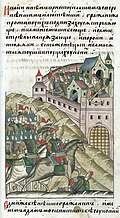

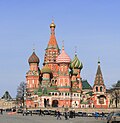
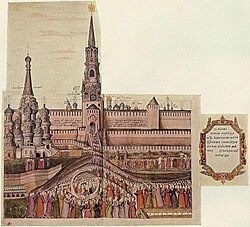
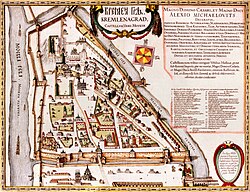
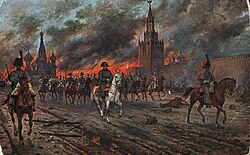
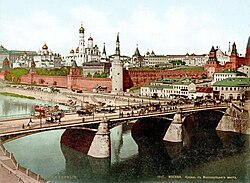
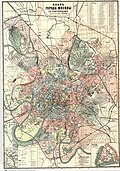

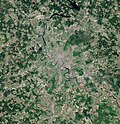


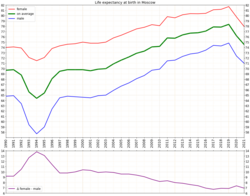
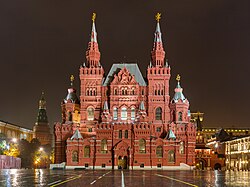
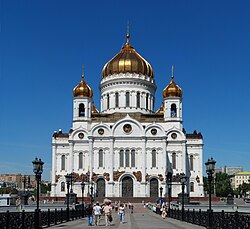

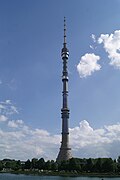

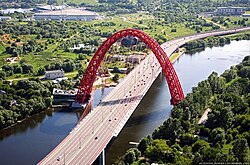

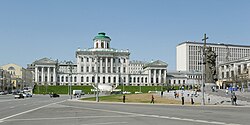
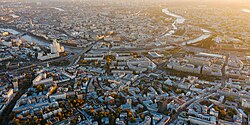
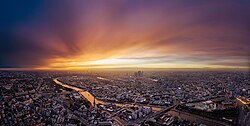

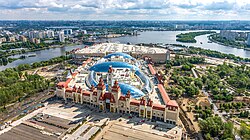
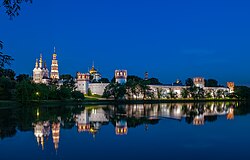

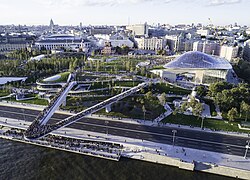
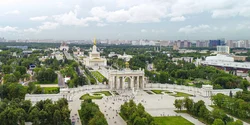


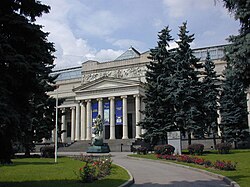
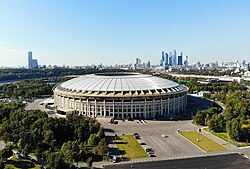


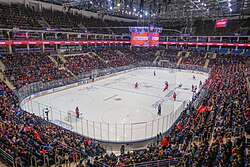
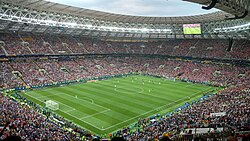
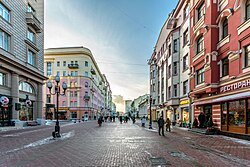
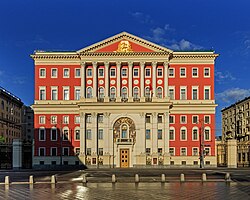
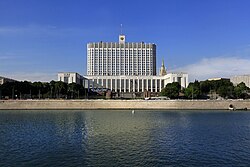
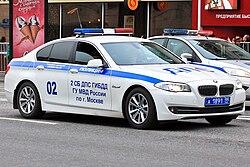
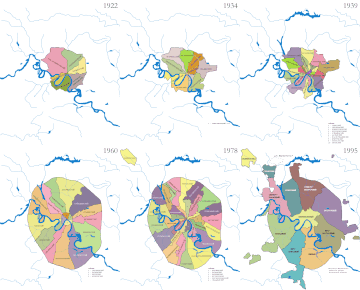


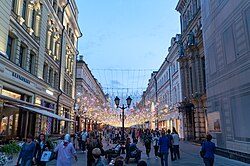


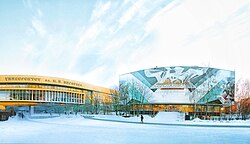

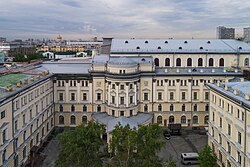
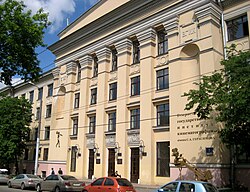
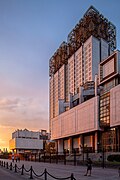
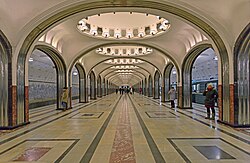


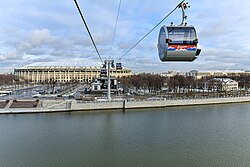


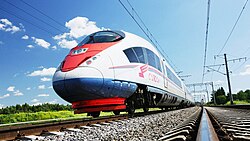
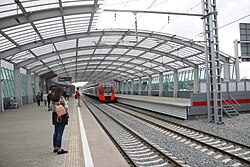

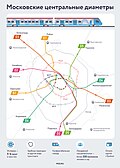


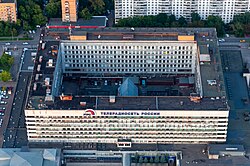
 [[:Media:Москва.ogg|]] (help·info)) is the capital and largest city of Russia. The city is on the Moskva River in Central Russia. It has a population of around 13 million people in the city limits,[3] over 17 million people in the urban area,[4] and over 20 million people in the metropolitan area.[5] The city has an area of 2,511 square kilometers (970 sq mi). Moscow's urban area has an area of 5,891 square kilometers (2,275 sq mi).[4] Moscow's metropolitan area has an area of over 26,000 square kilometers (10,000 sq mi).[5] Moscow is one of the world's largest cities. It is the most populous city that is only in Europe. It is also the largest urban and metropolitan area in Europe[4][5] and the largest city by land area on the European continent.[6]

_by_Fedor_Alekseev.jpg)

 Algiers, Algeria
 Almaty, Kazakhstan[28]
 Amman, Jordan
 Ankara, Turkey
 Athens, Greece
 Baku, Azerbaijan
 Bangkok, Thailand
 Banja Luka, Bosnia and Herzegovina
 Beijing, China
 Beirut, Lebanon
 Belgrade, Serbia
 Berlin, Germany
 Brussels, Belgium
 Bucharest, Romania
 Cairo, Egypt
 Chicago, United States
 Cusco, Peru
 Delhi, India
 Donetsk, Ukraine
 Dubai, United Arab Emirates
 Dushanbe, Tajikistan
 Hanoi, Vietnam
 Havana, Cuba
 Jelgava, Latvia
 Kolomna, Russia
 Kraków, Poland
 Limoges, France
 Ljubljana, Slovenia
 London, England, United Kingdom
 Madrid, Spain
 Manila, Philippines[30]
 Nicosia, Cyprus
 Podgorica, Montenegro
 Prague, Czech Republic[31]
 Pyongyang, North Korea
 Rasht, Iran
 Reykjavík, Iceland[32]
 Seoul, South Korea
 Tallinn, Estonia
 Tel Aviv, Israel
 Tirana, Albania[33][34]
 Tokyo, Japan
 Tunis, Tunisia[35]
 Ulaanbaatar, Mongolia
 Vienna, Austria
 Yerevan, Armenia