




>Lancepark additions |
robot: Update article (please report if you notice any mistake or error in this edit) |
||
| Line 1: | Line 1: | ||
{{For|the villages in West Bengal|Deula, | {{For|the villages in West Bengal|Deula, Magrahat|Deula, Medinipur}} | ||
{{Use dmy dates|date=July 2019}} | {{Use dmy dates|date=July 2019}} | ||
[[Image:Simplified schema of Kalinga architecture.jpg|thumb|right|400px|Simplified schema of a Kalinga architecture temple]] | [[Image:Simplified schema of Kalinga architecture.jpg|thumb|right|400px|Simplified schema of a Kalinga architecture temple]] | ||
'''Deula''' ({{Lang-or|ଦେଉଳ}} ''deuḷa'') is an architectural element in a [[Hindu temple]] in the [[Kalinga architecture]] style of the [[Odisha]]n temples in Eastern India.<ref>{{cite web |url=http://www.indoarch.org/arch_glossary.php |title=Architecture on the Indian Subcontinent - Glossary |publisher= |accessdate=2007-01-26 }}</ref> Sometimes the whole temple is also referred to as ''Deula''. The word "deula" in [[Odia language]] means a building structure built with a particular style that is seen in most of the temples from Odisha. ''Deul'' is also used in English, though the [[deul]] temples are also of a different form in the [[Manbhum]] region of Western Bengal. | '''Deula''' ({{Lang-or|ଦେଉଳ}} ''deuḷa'') is an architectural element in a [[Hindu temple]] in the [[Kalinga architecture]] style of the [[Odisha]]n temples in Eastern India.<ref>{{cite web |url=http://www.indoarch.org/arch_glossary.php |title=Architecture on the Indian Subcontinent - Glossary |publisher= |accessdate=2007-01-26 }}</ref> Sometimes the whole temple is also referred to as ''Deula''. The word "deula" in [[Odia language]] means a building structure built with a particular style that is seen in most of the temples from Odisha.<ref name="Fergusson pp. 92–116">{{cite book | last=Fergusson | first=James | title=History of Indian and Eastern Architecture | chapter=ORISSA | publisher=Cambridge University Press | publication-place=Cambridge | doi=10.1017/cbo9781139814638.007 | pages=92–116}}</ref> ''Deul'' is also used in English, though the [[deul]] temples are also of a different form in the [[Manbhum]] region of Western Bengal. | ||
There are three types of ''Deulas'':<ref>http://orissa.gov.in/e-magazine/Orissareview/nov2005/engpdf/Orissan_Temple_Architecture.pdf p. 45-47</ref> In terms of the general north Indian terminology, the Rekha Deula (rekha deul) is the sanctuary and the tower over it, respectively the [[garbhagriha]] and the [[shikhara]], the Pidha Deula (pida deul) is the [[mandapa]] where the faithful are present. The Khakhara deula is an alternative form of tower over the sanctuary, which in shape resembles the oblong [[gopuram]] temple gatehouses in southern [[Dravidian architecture]]. | There are three types of ''Deulas'':<ref>http://orissa.gov.in/e-magazine/Orissareview/nov2005/engpdf/Orissan_Temple_Architecture.pdf p. 45-47</ref> In terms of the general north Indian terminology, the Rekha Deula (rekha deul) is the sanctuary and the tower over it, respectively the [[garbhagriha]] and the [[shikhara]], the Pidha Deula (pida deul) is the [[mandapa]] where the faithful are present. The Khakhara deula is an alternative form of tower over the sanctuary, which in shape resembles the oblong [[gopuram]] temple gatehouses in southern [[Dravidian architecture]]. | ||
Revision as of 16:50, 14 June 2022

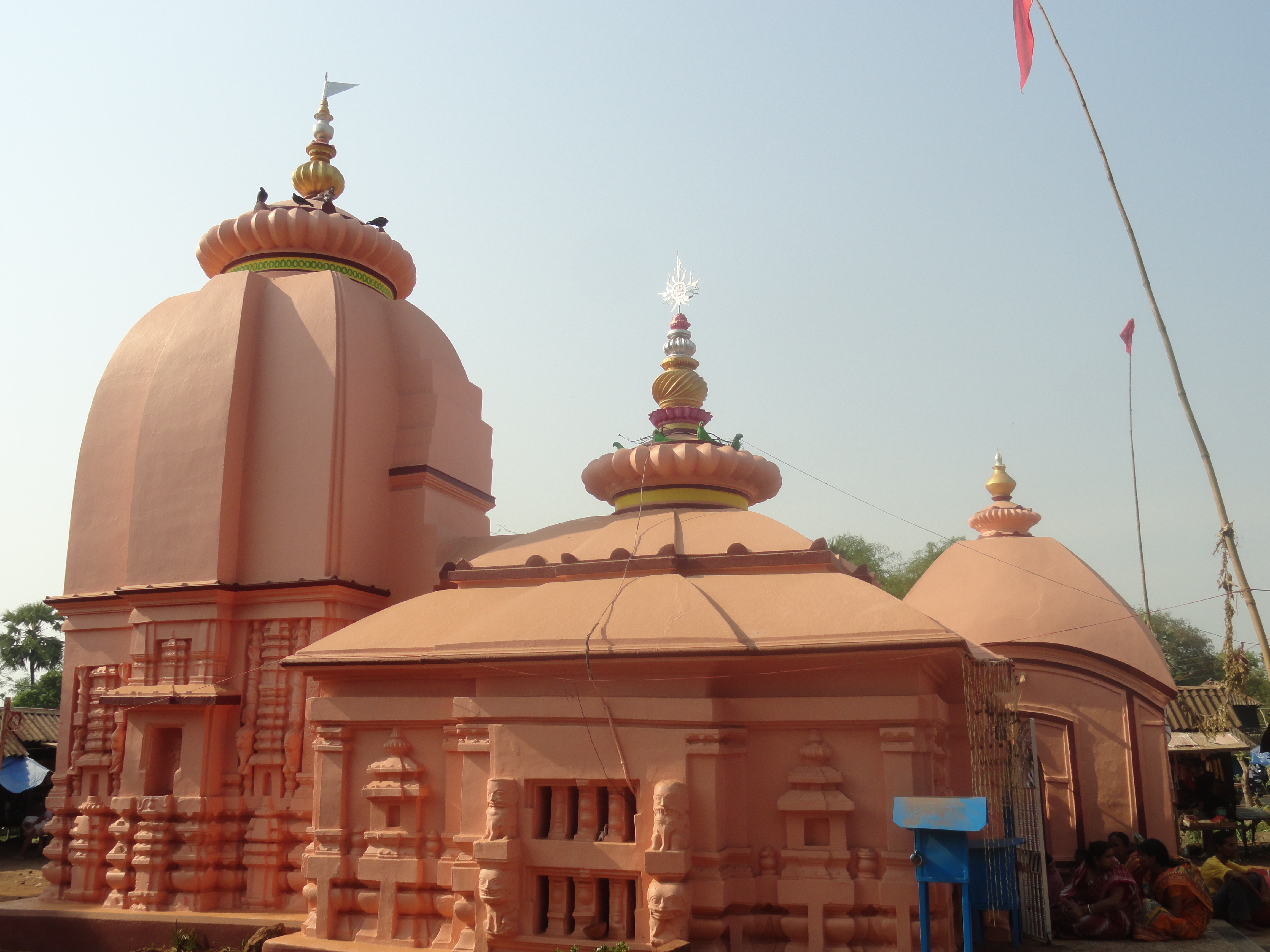
Deula (Odia: ଦେଉଳ deuḷa) is an architectural element in a Hindu temple in the Kalinga architecture style of the Odishan temples in Eastern India.[1] Sometimes the whole temple is also referred to as Deula. The word "deula" in Odia language means a building structure built with a particular style that is seen in most of the temples from Odisha.[2] Deul is also used in English, though the deul temples are also of a different form in the Manbhum region of Western Bengal.
There are three types of Deulas:[3] In terms of the general north Indian terminology, the Rekha Deula (rekha deul) is the sanctuary and the tower over it, respectively the garbhagriha and the shikhara, the Pidha Deula (pida deul) is the mandapa where the faithful are present. The Khakhara deula is an alternative form of tower over the sanctuary, which in shape resembles the oblong gopuram temple gatehouses in southern Dravidian architecture.
Rekha Deula


Rekha in Odia means a straight line. It is a tall building with a shape of sugar loaf, looking like a Shikhara. It covers and protects the sanctum sanctorum (Garbhagriha). Examples :
- The Shikhara of the Lingaraja Temple in Bhubaneswar
- The Shikhara of the Jagannath temple in Puri
- Jagannath Temple in Nayagarh
- Uttaresvara Siva Temple in Bhubaneswar
- The Shikhara of Yameshwar Temple in Bhubaneswar
- The Shikhara of the Shantinath Shiva Temple at Shihar village near Jayrambati, Bankura, West Bengal
Pidha Deula

It is a square building, typically with a pyramid-shaped roof, rather like the vimana towers over the sanctuaries of temples in southern Dravidian architecture. For the halls or service rooms of the temple. Examples
- The jaga mohan (assembly hall) of the Sun temple in Konârak
- The jaga mohan of Yameshwar Temple in Bhubaneswar
- The jaga mohan of the Shantinath Shiva Temple in Jayrambati, Bankura, West Bengal
- Digambara Jaina Temple, Khandagiri in Bhubaneswar
Khakhara deula

Khakara deula is a rectangular building with a truncated pyramid-shaped roof, like the gopuras. The name comes from Khakharu (gourd) because of the shape of the roof. The temples of the feminine deities as Shakti are temple of that type. Examples :
- Baitala Deula, Bhubaneswar (dedicated to Chamunda)
- Varahi Deula, Chaurasi, Puri district (dedicated to Varahi)
- Brahmi temple, Chaurasi
- Kedar Gouri, Bhubaneswar
- Narayani Temple, Khalikote (dedicated to Durga)
- Durga Temple, Banki
References
- ↑ "Architecture on the Indian Subcontinent - Glossary". Retrieved 26 January 2007.
- ↑ Fergusson, James. "ORISSA". History of Indian and Eastern Architecture. Cambridge: Cambridge University Press. pp. 92–116. doi:10.1017/cbo9781139814638.007.
- ↑ http://orissa.gov.in/e-magazine/Orissareview/nov2005/engpdf/Orissan_Temple_Architecture.pdf p. 45-47
External links
- http://orissa.gov.in/e-magazine/Orissareview/nov2005/engpdf/Orissan_Temple_Architecture.pdf
- http://www.indoarch.org/arch_glossary.php
| Dance |
| ||||||
|---|---|---|---|---|---|---|---|
| Music | |||||||
| Play, theatre and puppetry |
| ||||||
| Wedding | |||||||
| Festivals | |||||||
| Martial arts | |||||||
| Handlooms | |||||||
| Arts and Handicrafts |
| ||||||
| Architecture | |||||||
| Calendar (Panjika) | |||||||

 | This article about an Indian Hindu place of worship is a stub. You can help Bharatpedia by expanding it. |