





ImportMaster (talk | contribs) robot: Creating new article from Special:WantedPages |
m robot: Update article (please report if you notice any mistake or error in this edit) |
||
| Line 1: | Line 1: | ||
{{ | {{Short description|Eastern region of Asia}} | ||
[[ | {{Other uses}} | ||
{{pp-move-indef}} | |||
{{Infobox Continent | |||
|title = East Asia | |||
|image = East Asia (orthographic projection).svg | |||
|area = {{convert|11840000|km2|sqmi|abbr=on}} ([[List of continents by area|3rd]]) | |||
|population = 1.6 billion (2020; [[List of continents by population|4th]]) | |||
|density = {{convert|141.9|km2|sqmi|abbr=on}} | |||
|GDP_nominal = $28 trillion (2022)<ref name="IMFWEOCN">{{cite web |url=https://www.imf.org/en/Publications/WEO/weo-database/2020/October/weo-report?c=924,532,158,542,546,948,528,&s=NGDPD,PPPGDP,&sy=2020&ey=2020&ssm=0&scsm=1&scc=0&ssd=1&ssc=0&sic=0&sort=subject&ds=.&br=1 | |||
|title=World Economic Outlook Database |date=October 2020 |website=International Monetary Fund |access-date=10 November 2020}}</ref> | |||
|GDP_PPP = $40 trillion (2022)<ref name="IMF" /> | |||
|GDP_per_capita = $17,500 (nominal)<ref name="IMFWEOCN" /> | |||
|demonym = [[East Asian people|East Asian]] | |||
|countries = {{collapsible list | |||
| list_style = text-align:left; | |||
| title = [[List of sovereign states and dependent territories in Asia|6 states]]<ref name="Kort 2005 7"/><ref name="RAND"/><ref name="DEU"/><ref name="NO"/> | |||
| 1 = {{CHN}} | |||
| 2 = {{JPN}} | |||
| 3 = {{MGL}} | |||
| 4 = {{PRK}} | |||
| 5 = {{KOR}} | |||
| 6 = {{TWN}} | |||
}} | |||
|dependencies = {{collapsible list | |||
| list_style = text-align:left; | |||
| title = [[Special administrative regions of China|2 autonomous dependencies]] | |||
| 1 = {{HKG}} ([[China]]) | |||
| 2 = {{MAC}} ([[China]]) | |||
}} | |||
|languages = | |||
{{Plainlist| | |||
* [[Chinese language|Chinese]] | |||
* [[Japanese language|Japanese]] | |||
* [[Korean language|Korean]] | |||
* [[Mongolian language|Mongolian]] | |||
* [[Tibetic languages|Tibetan]] | |||
* [[Languages of East Asia|Others]] | |||
}} | |||
|time = [[UTC+7]], [[UTC+8]] & [[UTC+9]] | |||
|cities = [[List of cities in East, South and Southeast Asia by population|List of urban areas]]:<ref>{{cite web|url=http://www.demographia.com/db-worldua.pdf|title=Demographia.com}}</ref><br>{{hlist|[[Beijing]] |[[Busan]]|[[Hong Kong]]|[[Macau]] |[[Osaka]]|[[Pyongyang]] |[[Seoul]] |[[Shanghai]] |[[Shenzhen]]|[[Tokyo]] |[[Yokohama]] |[[Ulaanbaatar]]|[[Taipei]] }} | |||
|m49 = <code>030</code> – Eastern Asia<br /><code>142</code> – [[Asia]]<br /><code>001</code> – [[World]] | |||
}} | |||
{{Chinese | |||
| t = 東亞/東亞細亞 | |||
| s = 东亚/东亚细亚 | |||
| order = st | |||
| p = Dōngyǎ/Dōngyà ''or'' Dōng Yǎxìyǎ/Dōng Yàxìyà | |||
| w = Tung<sup>1</sup>-ya<sup>3</sup> | |||
| j = dung1 aa3 | |||
| poj = Tang-a | |||
| gan = Tung1 nga3 | |||
| wuu = ton<sup>平</sup> ia<sup>去</sup> | |||
| h = dung<sup>24</sup> a<sup>31</sup> | |||
| tib = ཨེ་ཤ་ཡ་ཤར་མ་ | |||
| mon = Зүүн Ази <br />{{MongolUnicode|ᠵᠡᠭᠦᠨ ᠠᠽᠢ}} | |||
| monr = Dzuun Azi | |||
| uig = شەرقىي ئاسىي | |||
| kana = ひがしアジア/とうあ | |||
| shinjitai = 東亜細亜(東アジア)/東亜 | |||
| kyujitai = 東亞細亞/東亞 | |||
| revhep = Higashi Ajia/Tō-A | |||
| kunrei = Higasi Azia/Tou-A | |||
| hanja = 東아시아/東亞細亞/東亞 | |||
| hangul = 동아시아/동아세아/동아 | |||
| rr = Dong Asia/Dong Asea/Dong A | |||
| c = | |||
| mi = | |||
| ci = | |||
| altname = | |||
| uly = sherqiy asiy | |||
}} | |||
'''East Asia''' | '''East Asia''' is the [[east]]ern [[region]] of [[Asia]], which is defined in both [[Geography|geographical]] and [[culture|ethno-cultural]] terms.<ref name=encarta-east-asia>{{cite web | ||
|url = http://encarta.msn.com/dictionary_1861672714/East_Asia.html | |||
|title = East Asia | |||
|access-date = 2008-01-12 | |||
|work = [[Encarta]] | |||
|publisher = Microsoft | |||
|quote = the countries and regions of Mainland China, Hong Kong, Macau, Taiwan, Mongolia, South Korea, North Korea and Japan. | |||
|archive-url = https://web.archive.org/web/20091109184354/http://encarta.msn.com/dictionary_1861672714/East_Asia.html | |||
|archive-date=2009-11-09 | |||
|url-status=dead | |||
}}</ref><ref>{{Cite book |title=Modern East Asia: An Introductory History |last=Miller |first=David Y. |publisher=Routledge |year=2007 |isbn=978-0765618221 |pages=xxi–xxiv }}</ref> The modern [[State (polity)|state]]s of East Asia include [[China]], [[Japan]], [[Mongolia]], [[North Korea]], [[South Korea]], and [[Taiwan]].<ref name="Kort 2005 7">{{cite book |title=The Handbook Of East Asia |last=Kort |first=Michael |publisher=Lerner Publishing Group |year=2005 |isbn=978-0761326724 |page=[https://archive.org/details/handbookofeastas0000kort/page/7 7] |url=https://archive.org/details/handbookofeastas0000kort/page/7 }}</ref><ref name="RAND">{{cite web |title=East Asia |url=https://www.rand.org/topics/east-asia.html |website=rand.org |publisher=[[RAND Corporation]] |access-date=12 August 2021 |url-status=live |archive-url=https://web.archive.org/web/20110102093024/http://www.rand.org:80/topics/east-asia.html |archive-date=2011-01-02 }}</ref><ref name="DEU">{{cite web |title=Tasks of German foreign policy-East Asia |url=https://www.auswaertiges-amt.de/blob/231800/756f9f7a0ea08ba707759d3b052e6682/konzeptostasien-data.pdf |website=auswaertiges-amt.de |publisher=[[German Federal Foreign Office]] |date= May 2002|archive-url= https://web.archive.org/web/20211219095024/https://www.auswaertiges-amt.de/blob/231800/756f9f7a0ea08ba707759d3b052e6682/konzeptostasien-data.pdf|archive-date=19 December 2021|access-date=12 August 2021 |url-status=dead}}</ref><ref name="NO">{{cite web |title=Countries of Asia |url=https://www.nationsonline.org/oneworld/asia.htm#East-Asia |website=nationsonline.org |publisher=Nations Online |access-date=12 August 2021 |url-status=live |archive-url=https://web.archive.org/web/20010701135048/http://www.nationsonline.org:80/oneworld/asia.htm |archive-date=2001-07-01 }}</ref><!--<ref>{{Cite web |url=https://www1.essex.ac.uk/armedcon/world/asia/east_asia/default.htm |title=Country Profiles: East Asia |website=Children and Armed Conflict Unit at the University of Essex }}</ref><ref>{{Cite web |title=East Asia |url = https://link.springer.com/journal/12140 |publisher=Springer Netherlands }}</ref><ref>{{cite web |url = http://www.dictionary.com/browse/east-asia |title=East Asia |website=Dictionary.com }}</ref><ref name="encarta-east-asia"/><ref>{{cite web |url = https://asiasociety.org/china-korea-and-japan-forgiveness-and-mourning |title=China, Korea and Japan: Forgiveness and Mourning |last=Seybolt |first= Peter J. |website=Center for Asian Studies |publisher=Center for Asian Studies }}</ref><ref name="Asian History Module Learning">{{cite book |title=Asian History Module Learning |publisher=Rex Bookstore Inc. |year= 2002 |isbn=978-9712331244 |page=186 }}</ref><ref name="Salkind 2008 56">{{cite book |title=Encyclopedia of Educational Psychology |url=https://archive.org/details/encyclopediaeduc00salk |url-access=limited |last=Salkind |first=Neil J. |publisher=Sage Publications |year=2008 |isbn = 978-1412916882 |page=[https://archive.org/details/encyclopediaeduc00salk/page/n85 56] }}</ref><ref>{{cite book |title=A History of East Asia: From the Origins of Civilization to the Twenty-First Century |last=Holcombe |first= Charles |publisher=Cambridge University Press |year=2010 |isbn=978-0521731645 |page = 3 }}</ref><ref>{{Cite web |url=https://www.worldatlas.com/articles/which-countries-are-part-of-east-asia.html |title=Which Countries Are Part of East Asia?|last=Kiprop |first= Victor |website=World Atlas}}</ref><ref>{{Cite web |url=https://www.amnesty.org/en/countries/asia-and-the-pacific/sub-regions/east-asia/ |title=East Asia |website=Amnesty International}}</ref><ref>{{cite book |title=Wastewater Sludge |last = Spinosa |first=Ludovico |publisher=Iwa Publishing |year=2007 |isbn=978-1843391425 |page=57 }}</ref><ref>{{cite book |title=Neoliberal Australia and US Imperialism in East Asia |last = Paul |first=Erik |publisher=Palgrave Macmillan |year=2012 |isbn=978-1137272775 |page=114}}</ref><ref>{{cite book |title=Solution-Focused Brief Therapy: A Multicultural Approach |last = Kim |first=Johnny |publisher= Sage Publications |year=2013 |isbn=978-1452256672 |page=55}}</ref><ref>{{Cite book |title = East Asian Development Model: Twenty-first century perspectives |last= Shiping |first= Hua |last2=Hu |first2= Amelia |publisher=Routledge |year=2014 |isbn=978-0415737272 |edition=1st |publication-date = 2014-12-09 |page=3 }}</ref><ref>{{Cite book |title = The Global Prehistory of Human Migration |last=Ness |first=Immanuel |last2= Bellwood |first2= Peter |publisher=Wiley-Blackwell |year=2014 |isbn= 978-1118970591|edition=1st |publication-date = 2014-11-10 |page=217 }}</ref><ref>{{cite book |title=Public Administration in East Asia: Mainland China, Japan, South Korea, Taiwan |last = Berman |first=Evan M. |publisher= CRC Press |year=2010 |isbn=978-1420051902 |page=10}}</ref><ref>{{cite book |title = Sanitation, Latrines and Intestinal Parasites in Past Populations |last= Mitchell |first=Piers D. |publisher= Routledge|year=2015 |isbn=978-1472449078|page = 150}}</ref><ref>{{cite book |title = Christianities in Asia |last= Phan |first=Peter |publisher= Wiley-Blackwell|year=2010 |isbn= 978-1405160902|page = xxiii}}</ref>--> China, North Korea, South Korea and Taiwan are all unrecognised by at least one other East Asian state due to severe ongoing [[War|political tensions]] in the region, specifically the [[division of Korea]] and the [[political status of Taiwan]]. [[Hong Kong]] and [[Macau]], two small coastal [[Dependent territory|quasi-dependent territories]] located in the south of China, are officially highly autonomous but are under ''de jure'' Chinese sovereignty. [[Economy of Japan|Japan]], [[Economy of Taiwan|Taiwan]], [[Economy of South Korea|South Korea]], [[Economy of China|Mainland China]], [[Economy of Hong Kong|Hong Kong]], and [[Economy of Macau|Macau]] are among the world's largest and most prosperous economies.<ref>{{Cite web |title=East Asia in the 21st Century {{!}} Boundless World History |url=https://courses.lumenlearning.com/boundless-worldhistory/chapter/east-asia-in-the-21st-century/ |access-date=2019-11-25 |website=courses.lumenlearning.com}}</ref> East Asia borders [[Siberia]] and the [[Russian Far East]] to the north, [[Southeast Asia]] to the south, [[South Asia]] to the southwest, and [[Central Asia]] to the west. To the east is the [[Pacific Ocean]] and to the southeast is [[Micronesia]] (a Pacific Ocean island group, classified as part of [[Oceania]]). | |||
East Asia, especially [[History of China|Chinese civilization]], is regarded as one of the earliest [[Cradle of civilization#China|cradles of civilization]]. Other ancient civilizations in East Asia that still exist as independent countries in the present day include the [[History of Japan|Japanese]], [[History of Korea|Korean]] and [[History of Mongolia|Mongolian]] civilizations. Various other civilizations existed as separate [[Polity|political entities]] in East Asia in the past but have since been absorbed into neighbouring civilizations in the present day, such as [[History of Tibet|Tibet]], [[Baiyue]], [[History of Manchuria|Manchuria]], [[History of the Ryukyu Islands|Ryukyu]] and [[Ainu people|Ainu]] among many others. Taiwan has a relatively young [[History of Taiwan|history]] in the region after the [[Prehistory of Taiwan|prehistoric era]]; originally, it was a major site of [[Austronesian peoples|Austronesian]] civilization prior to [[colonisation]] by [[Europe]]an colonial powers and China from the 17th century onward.<!--<ref>{{cite book |title = Towards a Sustainable Asia: The Cultural Perspectives |url = https://archive.org/details/towardssustainab00libg_856 |url-access = limited |author = Association of Academies of Sciences in Asia |publisher=Springer |year=2012 |isbn= 978-3642166686 |page=[https://archive.org/details/towardssustainab00libg_856/page/n32 17] }}</ref><ref>{{Cite book |title = Ethnic Groups of North, East, and Central Asia: An Encyclopedia |last= Minahan |first= James B. |publisher=ABC-CLIO |year=2014 |isbn=978-1610690171 |pages = xx–xxvi }}</ref>--> For thousands of years, China was the leading civilization in the region, exerting influence on its neighbours.<ref>{{Cite book |title = Relational, Networked and Collaborative Approaches to Public Diplomacy: The Connective Mindshift |last1= Zaharna |first1= R.S. |last2=Arsenault |first2= Amelia |last3= Fisher |first3= Ali |publisher=Routledge |year=2013 |isbn=978-0415636070 |edition=1st |publication-date = 2013-05-01 |page=93 }}</ref><ref>{{cite book |title = A History of East Asia: From the Origins of Civilization to the Twenty-First Century |last= Holcombe |first=Charles |publisher=Cambridge University Press |year=2017 |isbn=978-1107544895 |page=13 }}</ref><ref>{{Cite book |title=A Companion to Chinese History |last=Szonyi |first=Michael |publisher=Wiley-Blackwell |year=2017 |isbn=978-1118624609 |page = 90 }}</ref> Historically, societies in East Asia have fallen within the [[Chinese cultural sphere|Chinese sphere of influence]], and East Asian vocabulary and scripts are often derived from [[Classical Chinese]] and [[Chinese character|Chinese script]]. The [[Chinese calendar]] serves as the root from which many other East Asian calendars are derived. Major [[East Asian religions|religions in East Asia]] include [[East Asian Buddhism|Buddhism]] (mostly [[Mahayana Buddhism|Mahayana]]<ref>{{cite book |title = Nature Across Cultures: Views of Nature and the Environment in Non-Western Cultures |last= Selin |first= Helaine |publisher= Springer|year=2010 |isbn= 978-9048162710|page = 350}}</ref>), [[Confucianism]] and [[Neo-Confucianism]], [[Taoism]], [[Ancestor veneration in China|Ancestral worship]], and [[Chinese folk religion]] in Mainland China, Hong Kong, Macau and Taiwan, [[Shintoism]] in Japan, and [[Christianity in Korea|Christianity]], and [[Korean shamanism|Sindoism]] in Korea.<ref name="Salkind 2008 56">{{cite book |title=Encyclopedia of Educational Psychology |url=https://archive.org/details/encyclopediaeduc00salk |url-access=limited |last=Salkind |first=Neil J. |publisher=Sage Publications |year=2008 |isbn = 978-1412916882 |page=[https://archive.org/details/encyclopediaeduc00salk/page/n85 56] }}</ref><ref>{{cite book|first = Chongho |last = Kim|title = Korean Shamanism: The Cultural Paradox|date = 2003|publisher = Ashgate |isbn = 9780754631859}}</ref><ref>Andreas Anangguru Yewangoe, "Theologia crucis in Asia", 1987 Rodopi</ref> [[Mongolian shamanism|Tengerism]] and [[Tibetan Buddhism]] are prevalent among [[Mongols]] and [[Tibetan people|Tibetans]] while other religions such as [[Manchu shamanism|Shamanism]] are widespread among the indigenous populations of northeastern China such as the [[Manchu people|Manchus]].<ref>{{cite book|last = Heissig|first = Walther|date= 2000|page = 46|title = The Religions of Mongolia|translator-first = Geoffrey |translator-last =Samuel|publisher = Kegan Paul International|isbn = 9780710306852}}</ref>{{sfnb |Elliott |2001|p=235}}{{sfnb|Shirokogorov|1929|p=204}} Major [[Languages of East Asia|languages in East Asia]] include [[Mandarin Chinese]], [[Japanese language|Japanese]], and [[Korean language|Korean]]. Major [[East Asian people|ethnic groups of East Asia]] include the [[Han Chinese|Han]] (mainland China, Hong Kong, Macau, Taiwan), [[Yamato people|Yamato]] (Japan) and [[Koreans]] (North Korea, South Korea). [[Mongol people|Mongol]]s, although not as populous as the previous three ethnic groups, constitute the majority of Mongolia's population. There are 76 officially-recognised [[Minority group|minority]] or [[Indigenous peoples|indigenous]] ethnic groups in East Asia; 55 native to [[List of ethnic groups in China|mainland China]] (including [[Hui people|Hui]], Manchus, [[Mongols in China|Chinese Mongols]], Tibetans, [[Uyghurs]] and [[Zhuang people|Zhuang]] in the [[Autonomous regions of China|frontier regions]]), 16 native to the [[Geography of Taiwan|island of Taiwan]] (collectively known as [[Taiwanese indigenous peoples]]), one native to the [[Geography of Japan|major Japanese island]] of [[Hokkaido]] (the [[Ainu people|Ainu]]) and four native to [[Demographics of Mongolia#Ethnicity and languages|Mongolia]] ([[Turkic peoples]]). [[Ryukyuan people]] are an unrecognised ethnic group indigenous to the [[Ryukyu Islands]] in southern Japan, which stretch from [[Kyushu |Kyushu Island]] (Japan) to Taiwan. There are also several unrecognised indigenous ethnic groups in mainland China and Taiwan. | |||
== | [[East Asian people]] comprise around {{#expr:{{replace|{{UN_Population|Eastern Asia}}|,||}}/1e9 round 1}} billion people, making up about 38% of the population in Continental Asia and 20.5% of the global population.<ref name="Spinosa 2007 57">{{cite book |title=Wastewater Sludge |last= Spinosa |first=Ludovico |publisher= Iwa Publishing |year= 2007 |isbn= 978-1843391425 |page=57}}</ref><ref>{{cite journal |author1= Wang, Yuchen |author2= Lu Dongsheng |author3= Chung Yeun-Jun |author4 = Xu Shuhua |title = Genetic structure, divergence and admixture of Han Chinese, Japanese and Korean populations |journal = Hereditas |volume= 155 |page = 19 |year=2018 |url= |doi = 10.1186/s41065-018-0057-5 |pmid= 29636655 |pmc= 5889524 }}</ref><ref>{{cite journal |last1=Wang |first1=Yuchen |last2= Lu |first2=Dongsheng |last3=Chung |first3=Yeun-Jun |last4=Xu |first4=Shuhua |title=Genetic structure, divergence and admixture of Han Chinese, Japanese and Korean populations |journal=Hereditas |volume=155 |page=19 |publication-date=April 6, 2018 |doi=10.1186/s41065-018-0057-5 |pmid=29636655 |pmc=5889524 |year=2018 }}</ref> The region is home to major world metropolises such as [[Beijing]], [[Hong Kong]], [[Seoul]], [[Shanghai]], [[Taipei]], and [[Tokyo]]. Although the coastal and riparian areas of the region form one of the world's most populated places, the population in [[Mongolia]] and [[Western China]], both landlocked areas, is very sparsely distributed, with Mongolia having the [[List of sovereign states and dependent territories by population density|lowest population density of a sovereign state]]. The overall [[population density]] of the region is {{convert|133|PD/km2}}, about three times the world average of {{convert|45|/km2|abbr=on}}.{{When|date=May 2020}}{{Citation needed|date=May 2020}} | ||
{| class="wikitable sortable" | ==History== | ||
|- style=" | {{Main|History of East Asia}} | ||
! [[ | |||
! [[List of countries by area|Area]] | China was the first region settled in East Asia and was undoubtedly the core of East Asian civilization from where other parts of East Asia were formed.<ref>{{Cite book|last=Walker|first=Hugh Dyson|url=https://books.google.com/books?id=GBvRs-za0CIC&q=east+asia+history&pg=RA1-PR5|title=East Asia: A New History|date=2012-11-20|publisher=AuthorHouse|isbn=978-1-4772-6517-8|language=en}}</ref> The various other regions in East Asia were selective in the Chinese influences they adopted into their local customs. Historian [[Ping-ti Ho]] famously labeled Chinese civilization as the "Cradle of Eastern Civilization", in parallel with the "[[Cradle of civilization|Cradle of Middle Eastern Civilization]]" along the [[Fertile Crescent]] encompassing [[Mesopotamia]] and [[Ancient Egypt]]<ref>{{Cite book|last=Holcombe|first=Charles|url=https://books.google.com/books?id=kYKlDQAAQBAJ&q=east+asia+history&pg=PA12|title=A History of East Asia|date=2017-01-11|publisher=Cambridge University Press|isbn=978-1-107-11873-7|language=en}}</ref> as well as the [[Cradle of civilization|Cradle of Western Civilization]] encompassing [[Ancient Greece]] {{efn|See<ref name="EllynMcGinnis2004">{{cite book|author1=Maura Ellyn|author2=Maura McGinnis|title=Greece: A Primary Source Cultural Guide|url=https://books.google.com/books?id=N69iOTtVHGYC&pg=PT8|year=2004|publisher=The Rosen Publishing Group|isbn=978-0-8239-3999-2|page=8}}</ref><ref name="FindlingPelle2004">{{cite book|author1=John E. Findling|author2=Kimberly D. Pelle|title=Encyclopedia of the Modern Olympic Movement|url=https://books.google.com/books?id=QmXi_-Jujj0C&pg=PR23|year=2004|publisher=Greenwood Publishing Group|isbn=978-0-313-32278-5|page=23}}</ref><ref name="ThompsonMullin">{{cite book|author1=Wayne C. Thompson|author2=Mark H. Mullin|title=Western Europe, 1983|year=1983|url=https://books.google.com/books?id=serMXIpALD0C|publisher=Stryker-Post Publications|page=337|isbn=9780943448114|quote=for ancient Greece was the cradle of Western culture ...}}</ref><ref name="Copleston2003">{{cite book|author=Frederick Copleston|title=History of Philosophy Volume 1: Greece and Rome|url=https://books.google.com/books?id=Y08L-MC36JUC&pg=PA13|date=1 June 2003|publisher=A&C Black|isbn=978-0-8264-6895-6|page=13|quote=PART I PRE-SOCRATIC PHILOSOPHY CHAPTER II THE CRADLE OF WESTERN THOUGHT: }}</ref><ref name="Iozzo2001">{{cite book|author=Mario Iozzo|title=Art and History of Greece: And Mount Athos|url=https://books.google.com/books?id=Q51-HAiZQwMC&pg=PA7|year=2001|publisher=Casa Editrice Bonechi|isbn=978-88-8029-435-1|page=7|quote=The capital of Greece, one of the world's most glorious cities and the cradle of Western culture,}}</ref><ref name="Melotti2011">{{cite book|author=Marxiano Melotti|title=The Plastic Venuses: Archaeological Tourism in Post-Modern Society|url=https://books.google.com/books?id=jgIrBwAAQBAJ&pg=PA188|date=25 May 2011|publisher=Cambridge Scholars Publishing|isbn=978-1-4438-3028-7|page=188|quote=In short, Greece, despite having been the cradle of Western culture, was then an “other” space separate from the West.}}</ref><ref>{{cite book|title=Library Journal|url=https://books.google.com/books?id=TFZVAAAAYAAJ|date=April 1972|publisher=Bowker|volume=97|page=1588|quote=Ancient Greece: Cradle of Western Culture (Series), disc. 6 strips with 3 discs, range: 44–60 fr., 17–18 min}}</ref><ref name="Burstein2002">{{cite book|author=Stanley Mayer Burstein|title=Current Issues and the Study of Ancient History|url=https://books.google.com/books?id=17xmAAAAMAAJ|year=2002|publisher=Regina Books|isbn=978-1-930053-10-6|page=15|quote=and making Egypt play the same role in African education and culture that Athens and Greece do in Western culture.}}</ref><ref name="Jr.2015">{{cite book|author=Murray Milner, Jr.|title=Elites: A General Model|url=https://books.google.com/books?id=MvYlBgAAQBAJ&pg=PA62|date=8 January 2015|publisher=John Wiley & Sons|isbn=978-0-7456-8950-0|page=62|quote=Greece has long been considered the seedbed or cradle of Western civilization.}}</ref><ref name="Aa.Vv.2011">{{cite book|title=Slavica viterbiensia 003: Periodico di letterature e culture slave della Facoltà di Lingue e Letterature Straniere Moderne dell'Università della Tuscia|url=https://books.google.com/books?id=f9fTPUTPPhkC&pg=PA148|date=10 November 2011|publisher=Gangemi Editore spa|isbn=978-88-492-6909-3|page=148|quote=The Special Case of Greece The ancient Greece was a cradle of the Western culture,}}</ref><ref name="Covert2011">{{cite book|author=Kim Covert|title=Ancient Greece: Birthplace of Democracy|url=https://books.google.com/books?id=KVMYJNvUiYkC&pg=PP5|date=1 July 2011|publisher=Capstone|isbn=978-1-4296-6831-6|page=5|quote=Ancient Greece is often called the cradle of western civilization. ... Ideas from literature and science also have their roots in ancient Greece.}}</ref>}} and [[Ancient Rome]] {{efn|<ref>{{cite book|title=Rome: the cradle of western civilisation as illustrated by existing monuments |author=Henry Turner Inman |isbn=9781177738538 }}</ref><ref>{{cite book|url=https://www.amazon.co.uk/Birth-Western-Civilisation-Greece-Rome/dp/B0013K3FW6 |title=The Birth Of Western Civilisation, Greece & Rome |author=Michael Ed. Grant |website=Amazon.co.uk |access-date=4 January 2016|publisher=Thames & Hudson |year=1964 }}</ref><ref>{{cite web|url=http://www.abebooks.com/9780500040034/Birth-Western-Civilization-Greece-Rome-0500040036/plp |title=9780500040034: The Birth of Western Civilization: Greece and Rome |author=HUXLEY, George |display-authors=etal |website=AbeBooks.com |access-date=4 January 2016}}</ref><ref>{{cite web|url=http://www.geographicus.com/P/AntiqueMap/AncientCities-bradford-1835 |title=Athens. Rome. Jerusalem and Vicinity. Peninsula of Mt. Sinai.: Geographicus Rare Antique Maps |website=Geographicus.com |access-date=4 January 2016}}</ref><ref>{{cite web |url=http://file104.filthbooks.org/6kln6_the-story-of-western-civilization-greece-and-rome-build-great-civilizati.pdf |title=Download This PDF eBooks Free |website=File104.filthbooks.org |access-date=4 January 2016 |url-status=dead |archive-url=https://web.archive.org/web/20160107211225/http://file104.filthbooks.org/6kln6_the-story-of-western-civilization-greece-and-rome-build-great-civilizati.pdf |archive-date=7 January 2016 }}</ref>}} | ||
! [[List of countries by population|Population]] | |||
! [[List of countries by population density|Population density]]<br />per | Chinese civilization existed for about 1500 years before other East Asian civilizations emerged into history, Imperial China would exert much of its cultural, economic, technological, and political muscle onto its neighbours.<ref name="Ball 2005 104">{{cite book |title = The Transformation of Security in the Asia/Pacific Region |last= Ball |first=Desmond |publisher=Routledge |year=2005 |isbn=978-0714646619|page = 104}}</ref><ref>{{cite book |title=East Asia: A New History |last=Walker |first=Hugh Dyson |publisher=AuthorHouse |year=2012 |page=119 }}</ref><ref name="Amy Chua, Jed Rubenfeld 2014 121">{{cite book |title=The Triple Package: How Three Unlikely Traits Explain the Rise and Fall of Cultural Groups in America |publisher=Penguin Press HC |author1=Amy Chua |author2 = Jed Rubenfeld |year=2014 |page=121 |isbn=978-1594205460 }}</ref><ref name="Kang 2012 33–34" /> Succeeding Chinese dynasties exerted enormous influence across East Asia culturally, economically, politically and militarily for over two millennia.<ref name="Kang 2012 33–34">{{Cite book |title=East Asia Before the West: Five Centuries of Trade and Tribute |last=Kang |first=David C. |publisher=Columbia University Press |year=2012 |isbn=978-0231153195 |pages=33–34}}</ref><ref>{{Cite book |title=World History: Journeys from Past to Present |last1=Goucher |first1=Candice |last2=Walton |first2=Linda |publisher=Routledge |year=2012 |isbn=978-0415670029 |publication-date=September 11, 2012 |page=232 }}</ref><ref name="2000years">{{cite book|last1=Smolnikov|first1=Sergey|title=Great Power Conduct and Credibility in World Politics|year=2018|url=https://books.google.com/books?id=3LJZDwAAQBAJ&q=pax+sinica+han+dynasty&pg=PA112|isbn=9783319718859}}</ref> The [[Tributary system of China|Imperial Chinese tributary system]] shaped much of East Asia's history for over two millennia due to Imperial China's economic and cultural influence over the region, and thus played a huge role in the history of East Asia in particular.<ref>{{cite book |title=Daily Lives of Civilians in Wartime Asia: From the Taiping Rebellion to the Vietnam War |url=https://archive.org/details/dailylivescivili00lone |url-access=limited |last= Lone |first= Stewart |publisher=Greenwood |year=2007 |isbn=978-0313336843 |page = [https://archive.org/details/dailylivescivili00lone/page/n29 3] }}</ref><ref name="Warren I. Cohen 2000">[[Warren I. Cohen]]. ''East Asia at the Center : Four Thousand Years of Engagement with the World.'' (New York: Columbia University Press, 2000. {{ISBN|0231101082}}</ref><ref name="Amy Chua, Jed Rubenfeld 2014 121" /> Imperial China's cultural preeminence not only led the country to become East Asia's first literate nation in the entire region, it also supplied Japan and Korea with Chinese loanwords and linguistic influences rooted in their writing systems.<ref>{{Cite book |title=Chinese |last=Norman |first=Jerry |publisher=Cambridge University Press |year=1988 |isbn=978-0521296533 |page=17 }}</ref> | ||
! [[List of countries by Human Development Index|HDI]] | |||
! [[Capital (political)|Capital]] | Under [[Emperor Wu of Han]], the [[Han dynasty]] made China the regional power in East Asia, projecting much of its imperial power on its neighbours.<ref name="Kang 2012 33–34"/><ref>{{cite book |title = East Asia at the Center : Four Thousand Years of Engagement with the World |url = https://archive.org/details/eastasiaatcenter00cohe |url-access = limited |last= Cohen |first=Warren |publisher=Columbia University Press |year=2000 |isbn=978-0231101080|page = [https://archive.org/details/eastasiaatcenter00cohe/page/n73 60]}}</ref> Han China hosted the largest unified population in East Asia, the most literate and urbanised as well as being the most economically developed, as well as the most technologically and culturally advanced civilization in the region at the time.<ref>{{cite book |title=Day of Empire: How Hyperpowers Rise to Global Dominance--and Why They Fall |last=Chua |first= Amy |publisher=Anchor |year=2009 |isbn=978-1400077410 |page=62 }}</ref><ref>{{cite book |title=East and Southeast Asia 2012 |last=Leibo |first=Steve |publisher=Stryker Post |year=2012 |isbn=978-1610488853 |page=[https://archive.org/details/isbn_9781610488853/page/19 19] |url=https://archive.org/details/isbn_9781610488853/page/19 }}</ref> Cultural and religious interaction between the Chinese and other regional East Asian dynasties and kingdoms occurred. China's impact and influence on Korea began with the Han dynasty's [[Han conquest of Gojoseon|northeastern expansion]] in 108 BC when the Han Chinese conquered the northern part of the Korean peninsula and established a province called [[Lelang Commandery|Lelang]]. Chinese influence would soon take root in Korea through the inclusion of the Chinese writing system, monetary system, rice culture, and Confucian political institutions.<ref>{{cite book |title=Maritime Taiwan: Historical Encounters with the East and the West |last= Tsai |first= Henry |date = 2009-02-15 |publisher= Routledge |isbn = 978-0765623287 |page = 3 }}</ref> Jomon society in ancient Japan incorporated wet-rice cultivation and metallurgy through its contact with Korea. Starting from the fourth century AD, Japan incorporated the [[Chinese writing system]] which evolved into [[Kanji]] by the fifth century AD and has become a significant part of the [[Japanese writing system]].<ref>{{cite book |title=Foreigners in Japan: A Historical Perspective |last= Kshetry |first= Gopal |date = 2008 |publisher=Xlibris Corp |isbn = 978-1425770495 |page = 30 }}</ref> Utilizing the Chinese writing system allowed the Japanese to conduct their daily activities, maintain historical records and give form to various ideas, thoughts, and philosophies.<ref>{{cite book |title=Foreigners in Japan: A Historical Perspective |last= Kshetry |first= Gopal |date = 2008 |publisher=Xlibris Corp |isbn = 978-1425770495 |page = 31 }}</ref> During the [[Tang dynasty]], China exerted its greatest influence on East Asia as various aspects of Chinese culture spread to Japan and Korea.<ref name="lockard1999p2-3">{{Cite journal|last=Lockard|first=Craig|date=1999|title=Tang Civilization and the Chinese Centuries|url=http://www.columbia.edu/itc/ealac/moerman/fall2000/edit/pdfs/wk5/tangci.pdf|journal=Encarta Historical Essays|pages=2–3}}</ref><ref name="lockard1999p7">{{Cite journal|last=Lockard|first=Craig|date=1999|title=Tang Civilization and the Chinese Centuries|url=http://www.columbia.edu/itc/ealac/moerman/fall2000/edit/pdfs/wk5/tangci.pdf|journal=Encarta Historical Essays|pages=7}}</ref> As full-fledged medieval East Asian states were established, Korea by the fourth century AD and Japan by the seventh century AD, Japan and Korea actively began to incorporate Chinese influences such as [[Confucianism]], the use of [[Written Chinese|written Han characters]], [[Chinese architecture|Chinese style architecture]], state institutions, [[Chinese philosophy|political philosophies]], religion, urban planning, and various [[History of science and technology in China|scientific and technological]] methods into their culture and society through direct contacts with Tang China and succeeding Chinese dynasties.<ref name="lockard1999p2-3" /><ref name="lockard1999p7" /><ref>{{cite book |title=The Oxford Companion to Archaeology |last=Fagan |first=Brian M. |publisher=Oxford University Press |year=1999 |isbn=978-0195076189 |page=362 }}</ref> Drawing inspiration from the Tang political system, Prince [[Emperor Tenji|Naka no oe]] launched the [[Taika Reform]] in 645 AD where he radically transformed Japan's political bureaucracy into a more centralised bureaucratic empire.<ref name="lockard1999p8">{{Cite journal|last=Lockard|first=Craig|date=1999|title=Tang Civilization and the Chinese Centuries|url=http://www.columbia.edu/itc/ealac/moerman/fall2000/edit/pdfs/wk5/tangci.pdf|journal=Encarta Historical Essays|pages=8}}</ref> The Japanese also adopted Mahayana Buddhism, Chinese style architecture, and the imperial court's rituals and ceremonies, including the orchestral music and state dances had Tang influences. Written Chinese gained prestige and aspects of Tang culture such as [[Tang poetry|poetry]], [[Chinese calligraphy|calligraphy]], and [[Landscape painting#China|landscape painting]] became widespread.<ref name="lockard1999p8" /> During the [[Nara period]], Japan began to aggressively import Chinese culture and styles of government which included Confucian protocol that served as a foundation for Japanese culture as well as political and social philosophy.<ref>{{cite book|last=Lockard|first=Craig A.|title=Societies Networks And Transitions: Volume B From 600 To 1750|year=2009|publisher=Wadsworth|isbn=978-1-4390-8540-0|pages=290–291}}</ref><ref name=Tang6>{{cite book|last1=Embree|first1=Ainslie|last2=Gluck|first2=Carol|title=Asia in Western and World History: A Guide for Teaching|publisher=M.E. Sharpe|year=1997|url=https://archive.org/details/asiainwesternwor00ains|url-access=registration|page=[https://archive.org/details/asiainwesternwor00ains/page/352 352]|quote=Japan culture tang dynasty.|isbn=9781563242656}}</ref> The Japanese also created laws adopted from the Chinese legal system that was used to govern in addition to the [[kimono]], which was inspired from the [[Hanfu|Chinese robe]] (hanfu) during the eighth century AD.<ref>{{cite book |title=Foreigners in Japan: A Historical Perspective |last= Kshetry |first= Gopal |date = 2008 |publisher=Xlibris Corp |isbn = 978-1425770495 |page = 32 }}</ref> For many centuries, most notably from the 7th to the 14th centuries, China stood as East Asia's most advanced civilization and foremost military and economic power exerting its influence as the transmission of advanced Chinese cultural practices and ways of thinking greatly shaped the region up until the nineteenth century.<ref>{{cite book |title = China, Japan, Korea: Culture and Customs |last= Brown |first=John |publisher=Createspace Independent |year=2006 |isbn=978-1419648939 |page = 33 }}</ref><ref>{{Cite journal |url=https://www.foreignaffairs.com/articles/china/2018-02-13/life-chinas-asia |title=Life in China's Asia: What Regional Hegemony Would Look Like |last=Lind |first= Jennifer |date=February 13, 2018 |journal=Foreign Affairs}}</ref><ref>{{Cite journal|last=Lockard|first=Craig|date=1999|title=Tang Civilization and the Chinese Centuries|url=http://www.columbia.edu/itc/ealac/moerman/fall2000/edit/pdfs/wk5/tangci.pdf|journal=Encarta Historical Essays}}</ref><ref name="Ellington 2009 21">{{cite book |title=Japan (Nations in Focus) |last=Ellington |first=Lucien |year=2009 |page=21 }}</ref> | ||
As East Asia's connections with Europe and the Western world strengthened during the late nineteenth century, China's power began to decline.<ref name="Ball 2005 104"/><ref>John M. Roberts (1997). ''[https://books.google.com/books?id=3QZXvUhGwhAC A Short History of the World]''. Oxford University Press. p. 272. {{ISBN|0-19-511504-X}}.</ref> By the mid-nineteenth century, the weakening [[Qing dynasty]] became fraught with political corruption, obstacles and stagnation that was incapable of rejuvenating itself as a world power in contrast to the industrializing Imperial European colonial powers and a rapidly modernizing Japan.<ref>{{Cite book |title=Political Systems of East Asia: China, Korea, and Japan |last=Hayes |first=Louis D |publisher=Greenlight |year=2009 |isbn=978-0765617866 |pages=xi}}</ref><ref>{{Cite book |title=Political Systems of East Asia: China, Korea, and Japan |last=Hayes |first=Louis D |publisher=Greenlight |year=2009 |isbn=978-0765617866 |pages=15}}</ref> The U.S. Commodore [[Matthew C. Perry]] would [[Bakumatsu|open Japan to Western ways]], and the country would expand in earnest after the 1860s.<ref name="Tindall 2009 926">{{Cite book |title=America: A Narrative History |last1= Tindall |first1=George Brown |last2=Shi |first2= David E. |publisher= W. W. Norton & Company |year=2009 |isbn=978-0393934083 |edition=1st |publication-date=November 16, 2009 |page=926}}</ref><ref name="April 2007 163">{{Cite book |title=Diversity: New Realities in a Changing World |url=https://archive.org/details/diversitynewreal00apri |url-access=limited |last1= April |first1= K. |last2=Shockley |first2=M. |publisher=Palgrave Macmillan |year= 2007 |isbn=978-0230001336 |publication-date=February 6, 2007 |pages=[https://archive.org/details/diversitynewreal00apri/page/n187 163]}}</ref><ref>{{cite book |title = East Asia at the Center : Four Thousand Years of Engagement with the World |url = https://archive.org/details/eastasiaatcenter00cohe |url-access = limited |last= Cohen |first=Warren |publisher=Columbia University Press |year=2000 |isbn=978-0231101080|page = [https://archive.org/details/eastasiaatcenter00cohe/page/n286 286] }}</ref> Around the same time, Japan with its [[Meiji Restoration|rush to modernity]] transformed itself from an isolated feudal samurai state into East Asia's first industrialised nation in the modern era.<ref name="Batty 2005">{{cite video |title=Japan's War in Colour |date = 2005-01-17 |last=Batty |first=David |type=documentary |publisher=TWI |year=2005 }}</ref><ref name="Asian History Module Learning">{{cite book |title=Asian History Module Learning |publisher=Rex Bookstore Inc. |year= 2002 |isbn=978-9712331244 |page=186 }}</ref><ref name="April 2007 163" /> The modern and militarily powerful Japan would galvanise its position in the Orient as East Asia's greatest power with a global mission poised to advance to lead the entire world.<ref name="Batty 2005"/><ref name="Goldman 2000 3">{{Cite book |title=Diversity: New Realities in a Changing World |last1= Goldman |first1= Merie |last2=Gordon |first2=Andrew |publisher=Harvard University Press |year= 2000 |isbn=978-0674000971 |publication-date=August 15, 2000 |pages=3}}</ref> By the early 1900s, the [[Empire of Japan|Japanese empire]] succeeded in asserting itself as East Asia's most dominant power.<ref name="Goldman 2000 3"/> With its newly found international status, Japan would begin to challenge the European colonial powers and inextricably took on a more active geopolitical position in East Asia and world affairs at large.<ref>{{cite book |title = East Asia at the Center : Four Thousand Years of Engagement with the World |url = https://archive.org/details/eastasiaatcenter00cohe |url-access = limited |last= Cohen |first=Warren |publisher=Columbia University Press |year=2000 |isbn=978-0231101080|page = [https://archive.org/details/eastasiaatcenter00cohe/page/n273 273] }}</ref> Flexing its nascent political and military might, Japan soundly defeated the stagnant Qing dynasty during the [[First Sino-Japanese War]] as well as vanquishing imperial rival [[Russo-Japanese War|Russia]] in 1905; the first major military victory in the modern era of an East Asian power over a European one.<ref>{{Cite book |title = East Asian Development Model: Twenty-first century perspectives |last1= Shiping |first1= Hua |last2=Hu |first2= Amelia |publisher=Routledge |year=2014 |isbn=978-0415737272 |edition=1st |publication-date = 2014-12-09 |pages=78–79}}</ref><ref>{{Cite book |title = China's Rise and Regional Integration in East Asia: Hegemony or community? |last1=Lee |first1=Yong Wook |last2= Key |first2= Young Son |publisher=Routledge |year=2014 |isbn= 978-0313350825 |edition=1st |publication-date = March 14, 2014|page=45 }}</ref><ref>{{cite encyclopedia|url=https://www.britannica.com/EBchecked/topic/546176/Sino-Japanese-War|title=Sino-Japanese War (1894–95)|encyclopedia=[[Encyclopædia Britannica]]|access-date=12 November 2012}}</ref><ref>{{cite web |url = https://www.nakasendoway.com/the-japanese-economy/ |title = The Japanese Economy |website = Walk Japan |date = 2010-12-16 }}</ref><ref name="Tindall 2009 926"/> Its hegemony was the heart of an empire that would include [[Taiwan under Japanese rule|Taiwan]] and [[Japanese occupation of Korea|Korea]].<ref name="Batty 2005" /> During World War II, Japanese expansionism with its imperialist aspirations through the [[Greater East Asia Co-Prosperity Sphere]] would incorporate Korea, Taiwan, much of eastern China and Manchuria, Hong Kong, and Southeast Asia under its control establishing itself as a maritime colonial power in East Asia.<ref>{{Cite book |title=America: A Narrative History |last1= Tindall |first1=George Brown |last2=Shi |first2= David E. |publisher= W. W. Norton & Company |year=2009 |isbn=978-0393934083 |edition=1st |publication-date=November 16, 2009 |page=1147 }}</ref> After a century of exploitation by the European and Japanese colonialists, post-colonial East Asia saw the [[Defeat of Japan|defeat]] and [[Occupied Japan|occupation of Japan]] by the victorious Allies as well as the division of China and [[Division of Korea|Korea]] during the [[Cold War]]. The Korean peninsula became independent but then it was divided into [[Partition of Korea|two rival states]], while Taiwan became the main territory of de facto state [[Government of Republic of China|Republic of China]] after the latter lost Mainland China to the [[People's Republic of China]] in the [[Chinese Civil War]]. During the latter half of the twentieth century, the region would see the [[Japanese post-war economic miracle|post war economic miracle of Japan]], which ushered in three decades of unprecedented growth, only to experience an [[Lost Decade (Japan)|economic slowdown during the 1990s]], but nonetheless Japan continues to remain a global economic power. East Asia would also see the economic rise of [[Miracle of the Han River|South Korea]] and [[Taiwan Miracle|Taiwan]], and the integration of [[Economy of Mainland China|Mainland China into the global economy]] through its entry in the [[China and the World Trade Organization|World Trade Organization]] while enhancing its emerging international status as a [[Potential superpowers#China|potential world power]].<ref name="Kort 2005 7"/><ref>{{Cite book |title= Encyclopedia of World Trade: From Ancient Times to the Present |last1= Northrup |first1= Cynthia Clark |last2= Bentley |first2= Jerry H. |last3= Eckes Jr. |first3= Alfred E. |publisher= Routledge |year= 2004 |isbn= 978-0765680587 |page= [https://archive.org/details/encyclopediaofwo0000unse_d8h7/page/297 297] |url= https://archive.org/details/encyclopediaofwo0000unse_d8h7/page/297 }}</ref><ref name="Paul 2012 114">{{cite book |title=Neoliberal Australia and US Imperialism in East Asia |last = Paul |first=Erik |publisher=Palgrave Macmillan |year=2012 |isbn=978-1137272775 |page=114}}</ref> Although there have been no wars in East Asia for decades, the stability of the region remains fragile because of North Korea's [[North Korea and weapons of mass destruction|nuclear program]]. | |||
==Definitions== | |||
[[File:Central Asia borders4.png|thumb|upright=1.35|Three sets of possible boundaries for the [[Central Asia]] region that overlap with conceptions of East Asia<!--DO NOT REMOVE There is an overlap between the concepts of East Asia and Central Asia that needs to be illustrated here.-->]] | |||
In common usage, the term "East Asia" typically refers to a region including [[Greater China]], [[Japan]], and [[Korea]].<ref>{{Cite web |url=https://www.imb.org/wp-content/uploads/2016/09/Introducing_EAP_Booklet_09_2016_10.pdf |title=Introducing East Asian Peoples |date=September 10, 2016 |website=International Mission Board}}</ref><ref>Gilbet Rozman (2004), ''Northeast Asia's stunted regionalism: bilateral distrust in the shadow of globalization''. Cambridge University Press, pp. 3-4</ref><ref>"[https://www.reuters.com/article/us-technology-patents-idUSTRE7184CN20110209 Northeast Asia dominates patent filing growth]." Retrieved on August 8, 2001.</ref><ref>"[http://www.iie.com/publications/papers/schott1001-1.pdf Paper: Economic Integration in Northeast Asia] {{Webarchive|url=https://web.archive.org/web/20160304190723/http://www.iie.com/publications/papers/schott1001-1.pdf |date=2016-03-04 }}." Retrieved on August 8, 2011.</ref><ref name="Spinosa 2007 57"/><ref>{{cite book |title=Solution-Focused Brief Therapy: A Multicultural Approach |last=Kim |first=Johnny S. |publisher=Sage Publications |year=2013 |isbn=978-1452256672 |page=55 }}</ref><ref>{{Cite book |title = East Asian Development Model: Twenty-first century perspectives |last1= Shiping |first1= Hua |last2=Hu |first2= Amelia |publisher=Routledge |year=2014 |isbn=978-0415737272 |edition=1st |publication-date = 2014-12-09 |page=3 }}</ref><ref>{{Cite book |title = The Global Prehistory of Human Migration |last1=Ness |first1=Immanuel |last2= Bellwood |first2= Peter |publisher=Wiley-Blackwell |year=2014 |isbn= 978-1118970591|edition=1st |publication-date = 2014-11-10 |page=217 }}</ref><ref>{{cite book |title=The Handbook Of East Asia |last=Kort |first=Michael |publisher=21st Century |year=2003 |isbn=978-0761326724 |page=[https://archive.org/details/handbookofeastas0000kort/page/7 7–9] |url=https://archive.org/details/handbookofeastas0000kort/page/7 }}</ref><ref>{{cite book |title=Wastewater Sludge |last = Spinosa |first=Ludovico |publisher=Iwa Publishing |year=2007 |isbn=978-1843391425 |page=57 }}</ref><ref name="Paul 2012 114"/> | |||
[[China]], [[Japan]], and [[Korea]] represent the three core countries and civilizations of traditional East Asia - as they once shared a common written language, culture, as well as sharing [[Confucianism|Confucian]] philosophical tenets and the Confucian societal value system once instituted by [[Imperial China]].<ref name="Prescott 2015 3">{{Cite book |title = East Asia in the World: An Introduction |last=Prescott |first= Anne |publisher=Routledge |year=2015 |isbn=978-0765643223 |pages =3 }}</ref><ref>{{cite book |title=Economic Development in Twentieth-Century East Asia: The International Context |url=https://archive.org/details/economicdevelopm00ikeo |url-access=limited |last=Ikeo |first=Aiko |publisher= Routledge |year=1996 |isbn=978-0415149006 |page=[https://archive.org/details/economicdevelopm00ikeo/page/n15 1] }}</ref><ref name="Yoshimatsu 2014 1">{{cite book |title=Comparing Institution-Building in East Asia: Power Politics, Governance, and Critical Junctures |last=Yoshimatsu |first=H. |publisher=Palgrave Macmillan |year=2014 |isbn=978-1137370549 |page=1 }}</ref><ref>{{cite book |title=Routledge Handbook of Memory and Reconciliation in East Asia |last= Kim |first= Mikyoung |publisher= Routledge |year=2015 |isbn= 978-0415835138 }}</ref><ref name="Hazen 2005 1">{{cite book |title=Building Area Studies Collections |last1= Hazen |first1= Dan |last2=Spohrer |first2=James H. |publisher=Otto Harrassowitz |year=2005 |isbn=978-3447055123 |publication-date = 2005-12-31 |page=130 }}</ref> Other usages define Mainland China, Hong Kong, Macau, Japan, North Korea, South Korea and Taiwan as countries that constitute East Asia based on their geographic proximity as well as historical and modern cultural and economic ties, particularly with Japan and Korea having strong cultural influences that originated from China.<ref name="Prescott 2015 3"/><ref name="Hazen 2005 1" /><ref>{{cite book |title=Economic Development: A Regional, Institutional, and Historical Approach |last1=Grabowski |first1=Richard |last2=Self |first2=Sharmistha |last3=Shields |first3=William |publisher=Routledge |year=2012 |isbn= 978-0765633538 |edition=2nd |publication-date=September 25, 2012 |page=59 }}</ref><ref>{{Cite web |url = https://www.bluebackglobal.com/east-asia-market-overview/ |title=East Asia is the World's Largest Economy at $29.6 Trillion USD, Including 4 of the Top 25 Countries Globally |last= Ng |first=Arden |website=Blueback |date=4 February 2019 }}</ref><ref>{{Cite book |title=Through the Eyes of the Pack |last=Currie |first=Lorenzo |publisher=Xlibris Corp |year= 2013 |isbn=978-1493145171 |page = 163 }}</ref><ref>{{cite book |title=Handbook for Asian Studies Specialists: A Guide to Research Materials and Collection Building Tools |last= Asato |first= Noriko |publisher= Libraries Unlimited |year=2013 |isbn=978-1598848427 |page=1 }}</ref> Some scholars include [[Vietnam]] as part of East Asia as it has been considered part of the greater [[Chinese cultural sphere|Chinese sphere of influence]]. Mongolia is geographically north of Mainland China yet Confucianism and the Chinese writing system and culture had limited impact on Mongolian society. Thus, Mongolia is sometimes grouped with Central Asian countries such as Turkmenistan, Kyrgyzstan, and Kazakhstan.<ref name="Prescott 2015 6">{{Cite book |title = East Asia in the World: An Introduction |last=Prescott |first= Anne |publisher=Routledge |year=2015 |isbn=978-0765643223 |pages =6}}</ref><ref name="Miller 2007 xi">{{cite book |title=Modern East Asia: An Introductory History |last=Miller |first=David Y. |publisher=Routledge |year=2007 |isbn=978-0765618221 |page=xi }}</ref> [[Xinjiang]] ([[East Turkestan]]) and [[Tibet]] are sometimes seen as part of Central Asia.<ref>{{cite book |last1=Cummings |first1=Sally N. |title=Understanding Central Asia: Politics and Contested Transformations |date=2013 |publisher=Routledge |isbn=978-1-134-43319-3 |url=https://books.google.com/books?id=SRafuiRUJaMC&q=humboldt+central+asia+definition&pg=PT28 |language=en}}</ref><ref>{{cite book |last1=Saez |first1=Lawrence |title=The South Asian Association for Regional Cooperation (SAARC): An emerging collaboration architecture |date=2012 |publisher=Routledge |isbn=978-1-136-67108-1 |url=https://books.google.com/books?id=yTzKWI42uR4C&q=humboldt+central+asia+Afghanistan&pg=PA35 |language=en}}</ref><ref>{{cite book |last1=Cornell |first1=Svante E. |title=Modernization and Regional Cooperation in Central Asia: A New Spring? |publisher=Central Asia-Caucasus Institute and the Silk Road Studies |url=http://silkroadstudies.org/resources/1811CA-Regional.pdf}}</ref> Certain Japanese islands are associated with Oceania due to non-continental geology, distance from mainland Asia or biogeographical similarities with [[Micronesia]].<ref name="realm">{{cite book |last1=Todd |first1=Ian |title=Island Realm: A Pacific Panorama |date=1974 |publisher=Angus & Robertson |page=190 |isbn=9780207127618 |url=https://www.google.com.au/books/edition/Island_Realm/gcEJAQAAIAAJ?hl=en&gbpv=1&bsq=%22French+language+cultures%22+1974+pacific&dq=%22French+language+cultures%22+1974+pacific&printsec=frontcover |access-date=2 February 2022 |quote=[we] can further define the word ''culture'' to mean ''language''. Thus we have the French language part of Oceania, the Spanish part and the Japanese part. The Japanese culture groups of Oceania are the Bonin Islands, the Marcus Islands and the Volcano Islands. These three clusters, lying south and south-east of Japan, are inhabited either by Japanese or by people who have now completely fused with the Japanese race. Therefore they will not be taken into account in the proposed comparison of the policies of non - Oceanic cultures towards Oceanic peoples. On the eastern side of the Pacific are a number of Spanish language culture groups of islands. Two of them, the Galapagos and Easter Island, have been dealt with as separate chapters in this volume. Only one of the dozen or so Spanish culture island groups of Oceania has an Oceanic population — the Polynesians of Easter Island. The rest are either uninhabited or have a Spanish - Latin - American population consisting of people who migrated from the mainland. Therefore, the comparisons which follow refer almost exclusively to the English and French language cultures.}}</ref><ref name="class">{{cite web |last1=Udvardy |first1=Miklos D.F. |title=A Classification of the Biogeographical Provinces of the World |url=https://fnad.org/Documentos/A%20Classification%20of%20the%20Biogeographical%20Provinces%20of%20the%20World%20Miklos%20D.F.%20Udvardy.pdf |publisher=UNESCO |access-date=7 March 2022}}</ref><ref name="global">{{cite web |title=Oceania Military Guide |url=https://www.globalsecurity.org/military/world/oceania/index.html |website=GlobalSecurity.org |access-date=6 January 2022}}</ref> | |||
Broader and looser definitions by international organisations such as the [[World Bank]] refer to the "three major Northeast Asian economies, i.e. [[China|Mainland China]], [[Japan]], and [[South Korea]]", as well as [[Mongolia]], [[North Korea]], the [[Russian Far East]] and [[Siberia]].<ref>{{cite web |title=Integration of Markets vs. Integration by Agreements|first1=Nathalie|last1=Aminian|first2=K.C.|last2=Fung|first3=Francis|last3=Ng|work=Policy Research Working Paper|number=4546|publisher=[[World Bank]] |url = http://www-wds.worldbank.org/servlet/WDSContentServer/WDSP/IB/2008/03/04/000158349_20080304084358/Rendered/PDF/wps4546.pdf }}</ref> The [[Council on Foreign Relations]] includes the Russia Far East, [[Mongolia]], and [[Nepal]].<ref name="Northeast Asia">"[http://www.cfr.org/region/478/northeast_asia.html Northeast Asia]." ''[[Council on Foreign Relations]]''. Retrieved on August 10, 2009.</ref> The World Bank also acknowledges the roles of sub-national or [[List of states with limited recognition|''de facto'' states]], such as [[Hong Kong]], [[Macau]], and [[Taiwan]]. The Economic Research Institute for Northeast Asia defines the region as "China, Japan, [[Korean Peninsula|the Korea]]s, Nepal, Mongolia, and eastern regions of the [[Russia|Russian Federation]]".<ref>{{cite book|title=Japan and Russia in Northeast Asia: Partners in the 21st Century|author=Economic Research Institute for Northeast Asia|publisher=Greenwood Publishing Group|year=1999|page=248}}</ref> | |||
[[File:Map_of_East_Asia.png|thumb|upright=1.15|The countries of East Asia also form the core of Northeast Asia, which itself is a broader region.]] | |||
[[File:East Asia map of Köppen climate classification.svg|thumb|upright=1.15|East Asia map of Köppen climate classification.]] | |||
[[File:Location-Asia-UNsubregions.png|thumb|upright=1.15|right|[[UNSD]] geoscheme for Asia based on statistic convenience rather than implying any assumption regarding political or other affiliation of countries or territories:<ref name="auto">{{cite web |url = http://millenniumindicators.un.org/unsd/methods/m49/m49regin.htm |title=United Nations Statistics Division – Standard Country and Area Codes Classifications (M49) |publisher=[[United Nations Statistics Division]] |access-date=2010-07-24 |date = 2015-05-06 }}</ref> | |||
{{legend|#0000E0|[[North Asia]]}} | |||
{{legend|#E000E0|[[Central Asia]]}} | |||
{{legend|#00E000|[[Western Asia]]}} | |||
{{legend|#E00000|[[South Asia]]}} | |||
{{legend|#FFFF20|'''East Asia'''}} | |||
{{legend|#FFC000|[[Southeast Asia]]}}]] | |||
The [[United Nations Statistics Division|UNSD]] definition of East Asia is based on statistical convenience,<ref name="auto" /> but also other common definitions of East Asia contain the Mainland China, Hong Kong, Macau, Mongolia, North Korea, South Korea, Taiwan and Japan.<ref name=encarta-east-asia/><ref name="UN regions">{{cite web |title = Composition of macro geographical (continental) regions, geographical sub-regions, and selected economic and other groupings |publisher = United Nations Statistics Division |date = 11 February 2013 |url = http://unstats.un.org/unsd/methods/m49/m49regin.htm |access-date = 28 May 2013 }}</ref> | |||
=== Alternative definitions === | |||
In business and economics, "East Asia" is sometimes used to refer to the geographical area covering ten [[Southeast Asia]]n countries in [[ASEAN]], [[Greater China]], Japan and Korea. However, in this context, the term "Far East" is used by the Europeans to cover ASEAN countries and the countries in East Asia. However, being a Eurocentric term, [[Far East]] describes the region's geographical position in relation to Europe rather than its location within Asia. Alternatively, the term "[[Asia-Pacific|Asia Pacific Region]]" is often used in describing East Asia, Southeast Asia as well as [[Oceania]].{{citation needed|date=November 2020}} | |||
Observers preferring a broader definition of "East Asia" often use the term [[Northeast Asia]] to refer to China, the Korean Peninsula, and Japan, with [[Southeast Asia]] covering the ten [[ASEAN]] countries. This usage, which is seen in economic and diplomatic discussions, is at odds with the historical meanings of both "East Asia" and "Northeast Asia".<ref>{{cite book|author=Christopher M. Dent|year=2008|title=East Asian regionalism|url=https://archive.org/details/eastasianregiona00dent|url-access=limited|publisher=London: Routledge|pages=[https://archive.org/details/eastasianregiona00dent/page/n22 1]–8}}</ref><ref>Charles Harvie, Fukunari Kimura, and Hyun-Hoon Lee (2005), ''New East Asian regionalism''. Cheltenham and Northamton: Edward Elgar, pp. 3–6.</ref><ref>Peter J. Katzenstein and Takashi Shiraishi (2006), ''Beyond Japan: the dynamics of East Asian regionalism''. Ithaca: Cornell University Press, pp. 1–33</ref> The [[Council on Foreign Relations]] of the United States defines Northeast Asia as Japan and Korea.<ref name="Northeast Asia"/> | |||
==Economy== | |||
{{Main|Economy of East Asia}} | |||
{| class="wikitable sortable" | |||
!class="unsortable" | [[Customs territory]] | |||
! data-sort-type="number" | [[List of countries by GDP (nominal)|GDP nominal]]<br />billions of USD (2021)<ref name="IMF">{{cite web |url = https://www.imf.org/en/Publications/WEO/weo-database/2020/October/weo-report?c=924,532,158,542,546,948,528,&s=NGDPD,PPPGDP,NGDPDPC,PPPPC,&sy=2020&ey=2025&ssm=0&scsm=1&scc=0&ssd=1&ssc=0&sic=0&sort=country&ds=.&br=1 |title=World Economic Outlook Database, October 2020 |publisher=IMF}}</ref> | |||
! data-sort-type="number" | [[List of countries by GDP (nominal) per capita|GDP nominal per capita]]<br />USD (2021)<ref name="IMF"/> | |||
! data-sort-type="number" | [[List of countries by GDP (PPP)|GDP PPP]]<br />billions of USD (2021)<ref name="IMF"/> | |||
! data-sort-type="number" | [[List of countries by GDP (PPP) per capita|GDP PPP per capita]]<br />USD (2021)<ref name="IMF"/> | |||
|- | |||
| {{CHN}} | |||
| style="text-align:right;" | 16,642.318 | |||
| style="text-align:right;" | 11,819 | |||
| style="text-align:right;" | 26,656.766 | |||
| style="text-align:right;" | 17,205.654 | |||
|- | |||
| {{HKG}}<ref>Listed as "Hong Kong SAR" by IMF</ref> | |||
| style="text-align:right;" | 368.633 | |||
| style="text-align:right;" | 49,036 | |||
| style="text-align:right;" | 472.395 | |||
| style="text-align:right;" | 58,165.200 | |||
|- | |||
| {{MAC}}<ref>Listed as "Macao SAR" by IMF</ref> | |||
| style="text-align:right;" | 39.449 | |||
| style="text-align:right;" | 58,004 | |||
| style="text-align:right;" | 61.623 | |||
| style="text-align:right;" | 58,930.534 | |||
|- | |||
| {{JPN}} | |||
| style="text-align:right;" | 5,378.136 | |||
| style="text-align:right;" | 42,928 | |||
| style="text-align:right;" | 5,585.786 | |||
| style="text-align:right;" | 41,636.628 | |||
|- | |||
| {{MNG}} | |||
| style="text-align:right;" | 14.233 | |||
| style="text-align:right;" | 4,172 | |||
| style="text-align:right;" | 42.412 | |||
| style="text-align:right;" | 12,259.059 | |||
|- | |||
| {{PRK}} | |||
| style="text-align:right;" | N/A | |||
| style="text-align:right;" | N/A | |||
| style="text-align:right;" | N/A | |||
| style="text-align:right;" | N/A | |||
|- | |||
| {{KOR}} | |||
| style="text-align:right;" | 1,806.707 | |||
| style="text-align:right;" | 34,866 | |||
| style="text-align:right;" | 2,436.875 | |||
| style="text-align:right;" | 44,292.194 | |||
|- | |||
| {{TWN}} | |||
| style="text-align:right;" | 759.104 | |||
| style="text-align:right;" | 32,123 | |||
| style="text-align:right;" | 1,403.663 | |||
| style="text-align:right;" | 54,019.882 | |||
|- | |||
! East Asia | |||
! $25,008.59 | |||
! $14,858 | |||
! $36,659.52 | |||
! $21,779.585 | |||
|} | |||
==Territorial and regional data== | |||
===Etymology=== | |||
{| class=wikitable | |||
! rowspan=2 | Flag !! colspan=2 | Common Name !! colspan=2 | Official Name !! colspan=4 | ISO 3166 Country Codes<ref>{{cite web |url = https://www.iso.org/iso-3166-country-codes.html |title=Country codes |website=iso.org}}</ref> | |||
|- | |||
! [[Exonym and endonym|Exonym]] !! [[Exonym and endonym|Endonym]] !! [[Exonym and endonym|Exonym]] !! [[Exonym and endonym|Endonym]] !! ISO Short Name !! Alpha-2 Code !! Alpha-3 Code !! Numeric | |||
|- | |||
| {{flagdeco|CHN}} || [[China]] || align=center | {{lang|zh-cn|[[wikt:中国|中国]]}} || People's Republic of China || {{lang|zh-cn|中华人民共和国}} || China || CN || CHN || 156 | |||
|- | |||
| {{flagdeco|HKG}} || [[Hong Kong]] || align=center | {{lang|zh|[[wikt:香港|香港]]}} || Hong Kong Special Administrative Region<br />of the People's Republic of China || {{lang|zh-hk|中華人民共和國香港特別行政區}} || Hong Kong || HK || HKG || 344 | |||
|- | |||
| {{flagdeco|MAC}} || [[Macau]] || align=center | {{lang|zh-hk|[[wikt:澳門|澳門]]}} || Macao Special Administrative Region<br />of the People's Republic of China || {{lang|zh-hk|中華人民共和國澳門特別行政區}} || Macao || MO || MAC || 446 | |||
|- | |||
| {{flagdeco|JPN}} || [[Japan]] || align=center | {{lang|ja|[[wikt:日本|日本]]}} || Japan || {{lang|ja|日本国}} || Japan || JP || JPN || 392 | |||
|- | |||
| {{flagdeco|MNG}} || [[Mongolia]] || align=center | {{lang|mn|[[wikt:Монгол улс|Монгол улс]] / {{MongolUnicode|ᠮᠣᠩᠭᠣᠯ<br />ᠤᠯᠤᠰ}}}} || Mongolia || {{lang|mn|Монгол Улс}}({{MongolUnicode|ᠮᠣᠩᠭᠣᠯ<br />ᠤᠯᠤᠰ}})|| Mongolia || MN || MNG || 496 | |||
|- | |||
| {{flagdeco|PRK}} || [[North Korea]] || align=center | {{lang|ko|[[wikt:조선|조선]]}} || Democratic People's Republic of Korea || {{lang|ko|조선민주주의인민공화국}} || Korea (the Democratic People's Republic of) || KP || PRK || 408 | |||
|- | |||
| {{flagdeco|KOR}} || [[South Korea]] || align=center | {{lang|ko|[[wikt:한국|한국]]}} || Republic of Korea || {{lang|ko|대한민국}} || Korea (the Republic of) || KR || KOR || 410 | |||
|- | |||
| {{flagdeco|TWN}} || [[Taiwan]]<ref>From 1949 to 1971, the ROC was referred as "China" or "Nationalist China".</ref> || align=center | {{lang|zh-tw|[[wikt:臺灣|臺灣]] / [[wikt:台灣|台灣]]}} || Republic of China (Taiwan) || {{lang|zh-tw|中華民國}} || Taiwan <ref>{{cite web |url=https://www.iso.org/iso-3166-country-codes.html |title=Country codes |website=iso.org}}</ref> || TW || TWN || 158 | |||
|} | |||
===Demographics=== | |||
{| class="wikitable sortable" style="text-align:center" | |||
! class="unsortable" | State/Territory | |||
! [[List of countries by area|Area]] km<sup>2</sup> | |||
! [[List of countries by population|Population]]{{UN_Population|ref}} <br /> ({{UN_Population|Year}}) | |||
! [[List of countries by population density|Population density]] <br /> per km<sup>2</sup> | |||
! [[List of countries by Human Development Index|HDI]]<ref>{{cite web|url=http://www.hdr.undp.org/en/2018-update|title={{!}} Human Development Reports|website=www.hdr.undp.org|language=en|access-date=2018-10-14}}</ref> | |||
! class="unsortable" | [[Capital (political)|Capital/Administrative Centre]] | |||
|- | |- | ||
| style="text-align:left;" | {{flag|China}} | | style="text-align:left;" | {{flag|PRC|name=China}} | ||
| | | style="text-align:right;" | 9,640,011{{efn|Includes all area which under PRC's government control {{cn-span|(excluding "[[South Tibet]]" and disputed islands).|date=November 2021}}}} | ||
| | | style="text-align:right;" | {{UN_Population|China}}{{efn|name=un-twn|A note by the United Nations: "For statistical purposes, the data for China do not include Hong Kong and Macao, Special Administrative Regions (SAR) of China, and [[Taiwan, China|Taiwan Province of China]]."{{UN_Population|ref}} | ||
| | }} | ||
| | | style="text-align:right;" | 138 | ||
| style="text-align:right;" | 0.761 | |||
| style="text-align:left;" | [[Beijing]] | | style="text-align:left;" | [[Beijing]] | ||
|- | |- | ||
| style="text-align:left;" | {{ | | style="text-align:left;" | {{HKG}} | ||
| | | style="text-align:right;" | 1,104 | ||
| | | style="text-align:right;" | {{UN_Population|China, Hong Kong SAR}} | ||
| | | style="text-align:right;" | 6,390 | ||
| | | style="text-align:right;" | 0.949 | ||
| style="text-align:left;" | [[Hong Kong]] | | style="text-align:left;" | [[Hong Kong]] | ||
|- | |- | ||
| style="text-align:left;" | {{ | | style="text-align:left;" | {{MAC}} | ||
| align=" | | style="text-align:right;" | 30 | ||
| | | style="text-align:right;" | {{UN_Population|China, Macao SAR}} | ||
| | | style="text-align:right;" | 18,662 | ||
| | | style="text-align:right;" | 0.914 | ||
| style="text-align:left;" | [[Macao]] | |||
|- | |||
| style="text-align:left;" | {{JPN}} | |||
| style="text-align:right;" | 377,930 | |||
| style="text-align:right;" | {{UN_Population|Japan}} | |||
| style="text-align:right;" | 337 | |||
| style="text-align:right;" | 0.919 | |||
| style="text-align:left;" | [[Tokyo]] | | style="text-align:left;" | [[Tokyo]] | ||
|- | |- | ||
| style="text-align:left;" | {{ | | style="text-align:left;" | {{MNG}} | ||
| style="text-align:right;" | 1,564,100 | |||
| style="text-align:right;" | {{UN_Population|Mongolia}} | |||
| style="text-align:right;" | 2 | |||
| style="text-align:right;" | 0.737 | |||
| style="text-align: | |||
| style="text-align: | |||
| | |||
| | |||
| style="text-align:left;" | [[Ulaanbaatar]] | | style="text-align:left;" | [[Ulaanbaatar]] | ||
|- | |- | ||
| style="text-align:left;" | {{ | | style="text-align:left;" | {{PRK}} | ||
| | | style="text-align:right;" | 120,538 | ||
| | | style="text-align:right;" | {{UN_Population|Dem. People's Republic of Korea}} | ||
| | | style="text-align:right;" | 198 | ||
| | | style="text-align:right;" | 0.733 | ||
| style="text-align:left;" | [[Pyongyang]] | | style="text-align:left;" | [[Pyongyang]]<ref>Seoul was the ''de jure'' capital of the DPRK from 1948 to 1972.</ref> | ||
|- | |- | ||
| style="text-align:left;" | {{ | | style="text-align:left;" | {{KOR}} | ||
| | | style="text-align:right;" | 100,210 | ||
| | | style="text-align:right;" | {{UN_Population|Republic of Korea}} | ||
| | | style="text-align:right;" | 500 | ||
| | | style="text-align:right;" | 0.916 | ||
| style="text-align:left;" | [[Seoul]] | | style="text-align:left;" | [[Seoul]] | ||
|- | |- | ||
| style="text-align:left;" | {{ | | style="text-align:left;" | {{TWN}} | ||
| | | style="text-align:right;" | 36,197 | ||
| | | style="text-align:right;" | 23,196,178 | ||
| | | style="text-align:right;" | 639 | ||
| | | style="text-align:right;" | 0.916 | ||
| style="text-align:left;" | [[Taipei]] | | style="text-align:left;" | [[Taipei]]<ref>Taipei is the ROC's seat of government by regulation. Constitutionally, {{cn-span|there is no official capital|date=November 2021}} appointed for the ROC.</ref> | ||
|- | |||
!East Asia | |||
!11,840,000 | |||
!1,683,205,624 | |||
!141 | |||
!{{Increase}}0.856 (''<span style="color:green">very high</span>'') | |||
|} | |} | ||
===Ethnic groups=== | |||
{{Main|East Asian people|Ethnic groups of East Asia}} | |||
{| class="wikitable sortable" | |||
! class="unsortable" | Ethnicity | |||
! class="unsortable" | Native name | |||
! Population | |||
! class="unsortable" | Language(s) | |||
! class="unsortable" | Writing system(s) | |||
! class="unsortable" | Major states/territories* | |||
! class="unsortable" | Traditional attire | |||
|- | |||
| [[Han Chinese|Han]]/[[Chinese people|Chinese]] | |||
| {{lang|zh-hant|漢族}} or {{lang|zh-hans|汉族}} | |||
| style="text-align:right;" | 1,313,345,856<ref name="ciastat">{{Cite web |url=https://www.cia.gov/library/publications/the-world-factbook/geos/ch.html |title=CIA Factbook |access-date=2018-03-17 |archive-date=2016-10-13 |archive-url=https://web.archive.org/web/20161013030611/https://www.cia.gov/library/publications/the-world-factbook/geos/ch.html |url-status=dead }}</ref> | |||
| [[Chinese language|Chinese]] ([[Mandarin Chinese|Mandarin]], [[Min Chinese|Min]], [[Wu Chinese|Wu]], [[Yue Chinese|Yue]], [[Jin Chinese|Jin]], [[Gan Chinese|Gan]], [[Hakka Chinese|Hakka]], [[Xiang Chinese|Xiang]], [[Huizhou Chinese|Huizhou]], [[Pinghua]], etc.) | |||
| [[Simplified Han characters]], [[Traditional Han characters]] | |||
| {{flagicon|CHN}} {{flagicon|TWN}} {{flagicon|HKG}}{{cn|reason=No statistics on the number of Han people.|date=November 2021}} {{flagicon|JPN}} {{flagicon|MAC}}{{cn|reason=No statistics on the number of Han people.|date=November 2021}} {{flagicon|ROK}} {{flagicon|PRK}} | |||
| [[File:Hanfu man and lady.jpg|upright=0.45|thumb]] | |||
|- | |||
| [[Yamato people|Yamato]]/[[Japanese people|Japanese]] | |||
| {{lang|ja|大和民族}} | |||
| style="text-align:right;" | 125,117,000<ref>{{cite web |url = http://www.stat.go.jp/data/jinsui/pdf/201612.pdf | script-title =ja:人口推計 – 平成 28年 12月 報 }}</ref> | |||
| [[Japanese language|Japanese]] | |||
| Han characters ([[Kanji]]), Katakana, Hiragana | |||
| {{flagicon|JPN}} | |||
| [[File:Shinto married couple.jpg|upright=0.45|thumb]] | |||
|- | |||
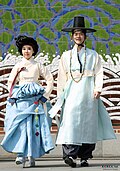
| [[Korean people|Korean]] | |||
| {{lang|ko-kp|조선족 (朝鮮族)}} <br /> {{lang|ko-kr|한민족 (韓民族)}} | |||
| style="text-align:right;" | 79,432,225{{citation needed|date=July 2018}} | |||
| [[Korean language|Korean]] | |||
| Hangul, Han characters ([[Hanja]]) | |||
| {{flagicon|ROK}} {{flagicon|PRK}} {{flagicon|CHN}} {{flagicon|JPN}} | |||
| [[File:Hanbok (female and male).jpg|upright=0.45|thumb]] | |||
|- | |||
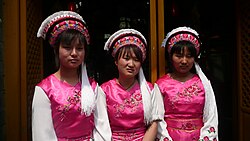
| [[Bai people|Bai]] | |||
| {{lang|zh|白族}} | |||
| style="text-align:right;" | 1,858,063 | |||
| [[Bai language|Bai]], [[Southwestern Mandarin]] | |||
| Simplified Han characters, Latin script | |||
| {{flagicon|CHN}} | |||
| [[File:Bai 5.JPG|upright=0.45|thumb]] | |||
|- | |||
| [[Hui people|Hui]] | |||
| {{lang|zh|回族}} | |||
| style="text-align:right;" | 10,586,087{{citation needed|date=July 2018}} | |||
| [[Northwestern Mandarin]], other Chinese Dialects, [[Huihui language]], etc. | |||
| Simplified Han characters{{efn|The Hui people also use the Arabic alphabet in the religious field.}} | |||
| {{flagicon|CHN}} | |||
| [[File:HuiChineseMuslim3.jpg|upright=0.45|thumb]] | |||
|- | |||
| [[Mongol]]s | |||
| {{lang|mn|Монголчууд}} {{MongolUnicode|ᠮᠣᠩᠭᠣᠯᠴᠤᠳ}} <br />Монгол/{{MongolUnicode|ᠮᠣᠩᠭᠣᠯ}} | |||
| style="text-align:right;" | 8,942,528 | |||
| [[Mongolian language|Mongolian]] | |||
| [[Mongol script]], [[Cyrillic script]] | |||
| {{flagicon|CHN}} {{flagicon|MGL}} {{flagicon|RUS}} | |||
| [[File:Mongolian Musician.jpg|upright=0.45|thumb]] | |||
|- | |||
| [[Zhuang people|Zhuang]] | |||
| {{lang|zh-hans|壮族}}/{{lang|za|Bouxcuengh}} | |||
| style="text-align:right;" | 18,000,000 | |||
| [[Zhuang languages|Zhuang]], [[Southwestern Mandarin]], etc. | |||
| Simplified Han characters, [[Latin script]] | |||
| {{flagicon|CHN}} | |||
| [[File:Zhuang's beautiful maiden in Chongzuo Fusui.jpg|upright=0.45|thumb]] | |||
|- | |||
| [[Uyghurs]] | |||
| {{lang|zh|维吾尔族}}/ئۇيغۇر | |||
| style="text-align:right;”| 15,000,000+<ref>{{cite web|url=http://www.xjtj.gov.cn/sjcx/tjnj_3415/2016xjtjnj/rkjy/201707/t20170714_539450.html|title=新疆维吾尔自治区统计局|website=www.xjtj.gov.cn|access-date=2018-09-11|archive-date=2019-03-31|archive-url=https://web.archive.org/web/20190331173944/http://www.xjtj.gov.cn/sjcx/tjnj_3415/2016xjtjnj/rkjy/201707/t20170714_539450.html|url-status=dead}}</ref> | |||
| [[Uyghur language|Uyghur]] | |||
| [[Arabic alphabet]], [[Latin script]] | |||
| {{flagicon|CHN}}{{efn|The [[Khotons]] also in {{flagicon|MGL}}.}} | |||
| [[File:Uyghur-elders-sunday-market-Kashgar.jpg|upright=0.45|thumb]] | |||
|- | |||
| [[Manchu]]s | |||
| {{lang|zh-hans|满族}}/{{ManchuSibeUnicode|ᠮᠠᠨᠵᡠ}} | |||
| style="text-align:right;" | 10,422,873{{citation needed|date=July 2018}} | |||
| [[Northeastern Mandarin]], [[Manchu language]] | |||
| Simplified Han characters, Mongol script | |||
| {{flagicon|CHN}} | |||
| [[File:Akšan.jpg|upright=0.45|thumb]] | |||
|- | |||
| [[Hmong people|Hmong]]/[[Miao people|Miao]] | |||
| {{lang|zh|苗族}}/Ghaob Xongb/Hmub/Mongb | |||
| style="text-align:right;" | 9,426,007{{citation needed|date=July 2018}} | |||
| [[Hmong language|Hmong/Miao]], [[Southwestern Mandarin]] | |||
| Latin script, Simplified Han characters | |||
| {{flagicon|CHN}} | |||
| [[File:贵州黔东南苗族女性(a Miao woman in Qiandongnan,Guizhou).jpg|upright=0.45|thumb]] | |||
|- | |||
| [[Tibetans]] | |||
| {{lang|zh|藏族}}/{{bo-textonly|བོད་པ་}} | |||
| style="text-align:right;" | 6,500,000 | |||
| Tibetan, Rgyal Rong, Rgu, etc. | |||
| [[Tibetan script]] | |||
| {{flagicon|CHN}} | |||
| [[File:People of Tibet46.jpg|upright=0.45|thumb]] | |||
|- | |||
| [[Yi people|Yi]] | |||
| {{lang|zh|彝族}}/{{lang|ii|ꆈꌠ}} | |||
| style="text-align:right;" | 8,714,393 | |||
| Various [[Loloish languages|Loloish]], Southwestern Mandarin | |||
| [[Yi script]], Simplified Han characters | |||
| {{flagicon|CHN}} | |||
| [[File:Ethnic Yi China Costume.jpg|upright=0.45|thumb]] | |||
|- | |||
| [[Tujia people|Tujia]] | |||
| {{lang|zh|土家族}} | |||
| style="text-align:right;" | 8,353,912 | |||
| [[Tujia language|Northern Tujia]], Southern Tujia | |||
| Simplified Han characters | |||
| {{flagicon|CHN}} | |||
| [[File:Tujia women.jpg|upright=0.45|thumb]] | |||
|- | |||
| [[Kam people|Kam]] | |||
| {{lang|zh|侗族}}/Gaeml | |||
| style="text-align:right;" | 2,879,974 | |||
| [[Kam language|Gaeml]] | |||
| Simplified Han characters, Latin script | |||
| {{flagicon|CHN}} | |||
| [[File:Ethic Dong Liping Guizhou China.jpg|upright=0.45|thumb]] | |||
|- | |||
| [[Tu people|Tu]] | |||
| {{lang|zh|土族}}/Monguor | |||
| style="text-align:right;" | 289,565 | |||
| [[Monguor language|Tu]], Northwestern Mandarin | |||
| Simplified Han characters | |||
| {{flagicon|CHN}} | |||
| [[File:Nadun Picture 1.jpg|upright=0.45|thumb]] | |||
|- | |||
| [[Daur people|Daur]] | |||
| {{lang|zh-hans|达斡尔族}}/{{MongolUnicode|ᠳᠠᠭᠤᠷ}} | |||
| style="text-align:right;" | 131,992 | |||
| [[Daur language|Daur]], Northeastern Mandarin | |||
| Mongol script, Simplified Han characters | |||
| {{flagicon|CHN}} {{flagicon|MGL}} | |||
| [[File:Daur woman smiling.jpg|upright=0.45|thumb]] | |||
|- | |||
| [[Indigenous Taiwanese|Indigenous Taiwanese Peoples]] | |||
| {{lang|zh|臺灣原住民}}/ {{lang|zh-cn|高山族}}/ {{lang|ami|Yincomin}}/ {{lang|pwn|Kasetaivang}}/ {{lang|pyu|Inanuwayan}} | |||
| style="text-align:right;" | 533,600 | |||
| [[Austronesian languages]] ([[Amis language|Amis]], [[Yami language|Yami]]), etc. | |||
| Latin script, Traditional Han characters | |||
| {{flagicon|TWN}} | |||
| | |||
[[File:Tao1.jpg|upright=0.45|thumb]] | |||
|- | |||
| [[Ryukyuan people|Ryukyuan]] | |||
| {{lang|ryu|琉球民族}} | |||
| style="text-align:right;" | 1,900,000 | |||
| [[Japanese language|Japanese]]<br />[[Ryukyuan languages|Ryukyuan]] | |||
| Han characters ([[Kanji]]), Katakana, Hiragana | |||
| {{flagicon|JPN}} {{flagicon|TWN}} | |||
| [[File:Five men wearing Ryukyuan Dress.JPG|upright=0.45|thumb]] | |||
|- | |||
| [[Ainu people|Ainu]] | |||
| {{lang|ain|アイヌ}}/ {{lang|ain|Aynu}}/ {{lang|ain|Айну}} | |||
| style="text-align:right;" | 200,000 | |||
| [[Japanese language|Japanese]] <br /> [[Ainu languages|Ainu]]<ref>{{cite book |editor-last=Gordon |editor-first=Raymond G. Jr. |year=2005 |title=Ethnologue: Languages of the World |edition=15th |location=Dallas |publisher=SIL International |isbn=978-1-55671-159-6 |oclc=224749653}}</ref> | |||
| Han characters ([[Kanji]]), Katakana, Hiragana | |||
| {{flagicon|JPN}} | |||
| [[File:AinuSan.jpg|upright=0.45|thumb]] | |||
|} | |||
* Note: The order of states/territories follows the population ranking of each ethnicity, within East Asia only. | |||
==East Asian culture== | |||
{{Main|Culture of East Asia}} | |||
{{Main category|East Asian culture}} | |||
===Overview=== | |||
The culture of East Asia has largely been [[sinicization|influence]]d by [[Chinese culture|China]], as it was the civilization that had the most dominant influence in the region throughout the ages that ultimately laid the foundation for East Asian civilization.<ref>{{Cite book |title=Asia Civilizations: Ancient to 1800 AD |last= Lim |first= SK |publisher=ASIAPAC |isbn=978-9812295941 |page=56|date= 2011-11-01 }}</ref> The vast knowledge and ingenuity of Chinese civilization and the classics of Chinese literature and culture were seen as the foundations for a civilised life in East Asia. [[Imperial China]] served as a vehicle through which the adoption of Confucian ethical philosophy, Chinese calendar system, political and legal systems, architectural style, diet, terminology, institutions, religious beliefs, [[Imperial examination#East|imperial examination]]s that emphasised a knowledge of Chinese classics, political philosophy and cultural value systems, as well as historically sharing a common [[Written Chinese|writing system]] reflected in the histories of [[Japanese writing system|Japan]] and [[Korean writing system|Korea]].<ref name="Goscha 2016">{{Cite book |title=The Penguin History of Modern Vietnam: A History |last= Goscha |first= Christopher |publisher= Allen Lane |year=2016 |isbn= 978-1846143106}}</ref><ref name="Kang 2012 33–34"/><ref>{{cite book | title=The Triple Package: How Three Unlikely Traits Explain the Rise and Fall of Cultural Groups in America | publisher=Penguin Press HC |author1 = Amy Chua |author2 = Jed Rubenfeld | year=2014 |page=122 |isbn=978-1594205460}}</ref><ref name="Walker 2012 2">{{cite book |title=East Asia: A New History |last=Walker |first=Hugh Dyson |publisher=AuthorHouse |year=2012 |page=2}}</ref><ref>{{Cite book |title=China's Cosmopolitan Empire: The Tang Dynasty |last=Lewis |first=Mark Edward |publisher=Belknap Press |year=2012 |isbn= 978-0674064010 |publication-date=April 9, 2012 |page=156}}</ref><ref name="Reischauer">{{Cite journal |jstor = 20038053|title = The Sinic World in Perspective|journal = Foreign Affairs|volume = 52|issue = 2|pages = 341–348|last1 = Reischauer|first1 = Edwin O.|year = 1974|doi = 10.2307/20038053}}</ref><ref>{{Cite book |title=Asia Civilizations: Ancient to 1800 AD |last= Lim |first= SK |publisher=ASIAPAC |isbn=978-9812295941 |page=89|date= 2011-11-01 }}</ref><ref>{{cite book |title=Redesigning Asian Business: In the Aftermath of Crisis |last= Richter |first=Frank-Jurgen |publisher=Quorum Books |year=2002 |isbn=978-1567205251 |page=15}}</ref><ref name="Hazen 2005 1"/> The Imperial Chinese tributary system was the bedrock of network of trade and foreign relations between China and its East Asian tributaries, which helped to shape much of East Asian affairs during the ancient and medieval eras. Through the tributary system, the various dynasties of Imperial China facilitated frequent economic and cultural exchange that influenced the cultures of Japan and Korea and drew them into a [[Sinocentrism|Chinese international order]].<ref>{{harvnb|Vohra|1999|p=22}}</ref><ref name="Amy Chua, Jed Rubenfeld 2014 121–122">{{cite book | title=The Triple Package: How Three Unlikely Traits Explain the Rise and Fall of Cultural Groups in America |publisher=Penguin Press HC |author1 = Amy Chua |author2 = Jed Rubenfeld |year=2014 |pages=121–122 |isbn=978-1594205460}}</ref> The Imperial Chinese tributary system shaped much of East Asia's foreign policy and trade for over two millennia due to Imperial China's economic and cultural dominance over the region, and thus played a huge role in the history of East Asia in particular.<ref name="Warren I. Cohen 2000"/><ref name="Amy Chua, Jed Rubenfeld 2014 121–122"/> The relationship between China and its cultural influence on East Asia has been compared to the historical influence of [[Greco-Roman civilization]] on [[Europe]] and the [[Western culture|Western World]].<ref name="Reischauer"/><ref name="Walker 2012 2"/><ref name="Amy Chua, Jed Rubenfeld 2014 121–122"/><ref name="Goscha 2016"/> | |||
===Religions=== | |||
{{Main|East Asian religions}} | |||
{{Pie chart | |||
|thumb = right | |||
|caption = Religion in East Asia (2020)<ref>{{Cite web|url=https://www.pewforum.org/2015/04/02/religious-projection-table/2020/percent/all/|title=Religious Composition by Country, 2010-2050|website=www.pewforum.org|date=2 April 2015|access-date=2020-10-18}}</ref> | |||
|label1 = Buddhism | |||
|value1 = 52.10 | |||
|color1 = Gold | |||
|label2 = [[Chinese Folk Religion|Folk Religion]] | |||
|value2 = 19.65 | |||
|color2 = Red | |||
|label3 = [[Irreligion|No Religion]] | |||
|value3 = 19.62 | |||
|color3 = Grey | |||
|label4 = [[Christianity]] | |||
|value4 = 5.56 | |||
|color4 = DodgerBlue | |||
|label5 = [[Islam]] | |||
|value5 = 1.57 | |||
|color5 = Green | |||
|label6 = [[Hinduism]] | |||
|value6 = 0.01 | |||
|color6 = Darkorange | |||
|label7 = Other | |||
|value7 = 1.43 | |||
|color7 = Chartreuse | |||
}} | |||
{| class="wikitable sortable" | |||
! class="unsortable" | Religion | |||
! class="unsortable" | Native name | |||
!Creator/Current Leader | |||
!Founded Time | |||
! class="unsortable" | Main Denomination | |||
! class="unsortable" | Major book | |||
! class="unsortable" | Type | |||
! Est. Followers | |||
! class="unsortable" | Ethnic groups | |||
! class="unsortable" | States/territories | |||
|- | |||
| [[Chinese folk religion]] | |||
| {{lang|zh-hant|中國民間信仰}} or {{lang|zh-hant|中国民间信仰}} | |||
|Spontaneous formation | |||
|5000 years from now{{citation needed|date=November 2020}} | |||
|[[Chinese salvationist religions|Salvationist]], [[Chinese shamanism|Wuism]], [[Nuo folk religion|Nuo]] | |||
| [[Chinese classics]], [[Huangdi Sijing]], [[baojuan|precious scrolls]], etc. | |||
| Prehistoric,pantheism,and polytheism | |||
| style="text-align:right;" | ~900,000,000<ref>{{cite journal |last=Wenzel-Teuber |first=Katharina |year=2012 |title=People's Republic of China: Religions and Churches Statistical Overview 2011 |journal=Religions & Christianity in Today's China |volume=II |number=3 |pages=29–54 |url=http://www.china-zentrum.de/fileadmin/downloads/rctc/2012-3/RCTC_2012-3.29-54_Wenzel-Teuber_Statistical_Overview_2011.pdf |issn=2192-9289 |archive-url=https://web.archive.org/web/20170427151725/http://www.china-zentrum.de/fileadmin/downloads/rctc/2012-3/RCTC_2012-3.29-54_Wenzel-Teuber_Statistical_Overview_2011.pdf |archive-date=27 April 2017}}</ref><ref name=CZ20172>{{cite journal |last=Wenzel-Teuber |first=Katharina |year=2017 |title=Statistics on Religions and Churches in the People's Republic of China – Update for the Year 2016 |journal=Religions & Christianity in Today's China |volume=VII |number=2 |pages=26–53 |url=http://www.china-zentrum.de/fileadmin/downloads/rctc/2017-2/RCTC_2017-2.26-53_Wenzel-Teuber__Statistics_on_Religions_and_Churches_in_the_PRC_%E2%80%93_Update_for_the_Year_2016.pdf |archive-url=https://web.archive.org/web/20170722112103/http://www.china-zentrum.de/fileadmin/downloads/rctc/2017-2/RCTC_2017-2.26-53_Wenzel-Teuber__Statistics_on_Religions_and_Churches_in_the_PRC_%E2%80%93_Update_for_the_Year_2016.pdf |archive-date=22 July 2017}}</ref> | |||
| Han, [[Miao folk religion|Hmong]], [[Qiang folk religion|Qiang]], Tujia (worship of the same ancestor-gods) | |||
| {{flagicon|CHN}} {{flagicon|HKG}} {{flagicon|MAC}} {{flagicon|TWN}} | |||
|- | |||
| [[Taoism]] | |||
| {{lang|zh|道教}} | |||
|[[Zhang Daoling]], was considered the founder of Taoism by Taoists. He founded [[Zhengyi Dao|Zhengyi, the earliest denomination of Taoism]]. Zhang Daoling reformed the Chinese folk religion from [[Szechuan]], into a real, organised, and regulated religion, in 125A.D.. [[Wang Chongyang]] founded the [[Quanzhen School|Quanzhen Denomination]]. Tale says Wang Chongyang met two Gods, [[Lü Dongbin]] and [[Han Zhongli]], during [[Jin dynasty (1115–1234)]] in 1159. He then get started to study Taoism himself. Three years later, he finished his studying, and founded Quanzhen. The new leader of Zhengyi need to be the son or paternal nephew of the previous leader, confirmed by the court of Zhengyi, in [[Mount Longhu]], [[Jiangxi]]. Also beginning from the Song Dynasty, the leaders of Zhengyi get started to be confirmed and titled by the Emperor of China. In 1949, the 63th leader, Zhang Enfu, fled to Taiwan with [[Chiang Kai-shek]], leader of the [[Kuomintang]], died in 1969 in Taipei. The Kuomintang Authority titled his cousin Zhang Yuanxian as the 64th leader, while the Court of Zhengyi back in Jiangxi argued that the oracle already foreseen the leadership will end at the 63th generation. Zhang Yuanxian died in 2008, only left a daughter as heir. Meanwhile, the Kuomintang Authority didn't confirmed the next leader. On the other hand, in Mainland China, Zhang Enfu's second daughter's son, Lu Jintao, changes his surname to Zhang, and get in charge of the Court of Zhengyi currently. For the leader of Quanzhen, the last (18th) leader (1335-1362) was Wanyan Deming, titled by the Emperor of Yuan Dynasty. Wanyan Deming was a Jurchen Taoist, the Wanyan family was the imperial house of Jin Dynasty. There is no official leader of Quanzhen after Wanyan Deming anymore.{{citation needed|date=November 2020}} | |||
|125 A.D. [[Eastern Han dynasty]]{{citation needed|date=November 2020}} | |||
| [[Zhengyi Dao|Zhengyi]], [[Quanzhen School|Quanzhen]] | |||
| [[Tao Te Ching]] | |||
| Pantheism, polytheism | |||
| style="text-align:right;" | ~20,000,000<ref name="CZ20172"/> | |||
| Han, Zhuang, Hmong, Yao, Qiang, Tujia | |||
| {{flagicon|CHN}} {{flagicon|HKG}} {{flagicon|MAC}} {{flagicon|TWN}} | |||
|- | |||
| [[East Asian Buddhism]]/[[Chinese Buddhism]] | |||
| {{lang|zh-hant|漢傳佛教}} or {{lang|zh-hans|汉传佛教}} | |||
|The Emperor of the Eastern Han Dynasty, [[Emperor Ming of Han|Liu Zhuang]], made a dream about the Buddha occasionally, then sent people to the [[Western Regions]] to Introduce Buddhism to the Capital, [[Chang'an]], in 67 A.D. In 384 A.D., during the [[Eastern Jin dynasty]], Indian [[Mālānanda]] introduced the [[Chinese Buddhism]] to [[Baekje]]. In 552 A.D., [[King Seong of Baekje]] offered Buddhism to the [[Emperor Kinmei|Emperor Kinmei of Japan]].{{citation needed|date=November 2020}} | |||
|67 A.D. [[Eastern Han dynasty]] | |||
| Mahayana | |||
| [[Diamond Sutra]] | |||
| Non-God, Dualism. | |||
| style="text-align:right;" | ~300,000,000 | |||
| Han, Koreans, Yamato | |||
| {{flagicon|CHN}} {{flagicon|HKG}} {{flagicon|MAC}} {{flagicon|JPN}} {{flagicon|PRK}} {{flagicon|KOR}} {{flagicon|TWN}} | |||
|- | |||
| [[Tibetan Buddhism]] | |||
| {{lang|zh-hans|藏传佛教}}/{{bo-textonly|བོད་བརྒྱུད་ནང་བསྟན།}} | |||
|[[Tonpa Shenrab Miwoche]], Prince of the Ancient Xang Xung Kingdom. | |||
|1800 years ago | |||
| Mahayana, [[Bon]] | |||
| [[Anuttarayoga Tantra]] | |||
| Non-God | |||
| style="text-align:right;" | ~10,000,000 | |||
| Tibetans, Manchus, Mongols | |||
| {{flagicon|CHN}} {{flagicon|MNG}} | |||
|- | |||
| [[Shamanism]]{{efn|almost [[Manchu shamanism|Manchu]], [[Mongolian shamanism|Mongolian]]}} | |||
| {{lang|zh-hans|萨满教}} or {{lang|mn|Бөө мөргөл}} | |||
|Spontaneous formation | |||
|Prehistoric period | |||
| | |||
| N/A | |||
| Prehistoric, polytheism, and pantheism | |||
| style="text-align:right;" | N/A | |||
| Manchus, Mongols, Oroqens | |||
| {{flagicon|CHN}} {{flagicon|MNG}} | |||
|- | |||
| [[Shintoism]] | |||
| {{lang|zh|神道}} | |||
|Spontaneous formation | |||
|[[Jōmon period]] | |||
| [[Shinto sects and schools|Shinto sects]] | |||
| [[Kojiki]], [[Nihon Shoki]] | |||
| Prehistoric,pantheism,and polytheism | |||
| style="text-align:right;" | N/A | |||
| Yamato | |||
| {{flagicon|JPN}} | |||
|- | |||
| [[Korean Shamanism|Shindo/Muism]] | |||
| {{lang|ko|신도}} or {{lang|ko|무교}} | |||
|Spontaneous formation | |||
|900 years ago | |||
| Shindo sects | |||
| N/A | |||
| Prehistoric,pantheism,and polytheism | |||
| style="text-align:right;" | N/A | |||
| Koreans | |||
| {{flagicon|PRK}} {{flagicon|KOR}} | |||
|- | |||
| [[Ryukyuan religion]] | |||
| {{lang|ja|琉球神道}} or {{lang|ja|ニライカナイ信仰}} | |||
|Spontaneous formation | |||
|N/A | |||
| N/A | |||
| N/A | |||
| Prehistoric,pantheism,and polytheism | |||
| style="text-align:right;" | N/A | |||
| Ryukyuans | |||
| {{flagicon|JPN}} ({{flagicon|Okinawa}}) | |||
|} | |||
===Festivals=== | |||
{{Unreferenced section|date=November 2020}} | |||
{| class="wikitable" | |||
! Festival | |||
! Native Name | |||
! Other name | |||
! Calendar | |||
! Date | |||
! [[Gregorian calendar|Gregorian]] date | |||
! Activity | |||
! Religious practices | |||
! Food | |||
! Major ethnicities | |||
! Major states/territories | |||
|- | |||
| [[Lunar New Year]] | |||
| {{lang|zh-hant|農曆新年}}/{{lang|zh-hans|农历新年}} or {{lang|zh-hant|春節}}/{{lang|zh-hans|春节}} | |||
| Spring Festival | |||
| [[Chinese calendar|Chinese]] | |||
| Month 1 Day 1 | |||
| 21 Jan–20 Feb | |||
| Family Reunion, Ancestors Worship, Tomb Sweeping, Fireworks | |||
| Worship the King of Gods | |||
| [[Nian gao]] | |||
| Han, Manchus etc. | |||
| {{flagicon|CHN}} {{flagicon|HKG}} {{flagicon|MAC}} {{flagicon|MNG}} {{flagicon|TWN}} | |||
|- | |||
| [[Korean New Year]] | |||
| {{lang|ko|설날}} or {{lang|ko|설}} | |||
| Seollal | |||
| [[Korean calendar|Korean]] | |||
| Month 1 Day 1 | |||
| 21 Jan–20 Feb | |||
| Ancestors Worship, Family Reunion, Tomb Sweeping | |||
| N/A | |||
| [[Tteokguk]] | |||
| Koreans | |||
| {{flagicon|PRK}} {{flagicon|KOR}} | |||
|- | |||
| [[Losar]] or [[Tsagaan Sar]] | |||
| {{lang|zh|藏历新年}}/{{bo-textonly|ལོ་གསར་}} or {{lang|zh|查干萨日}}/{{lang|mn|Цагаан сар}} | |||
| White Moon | |||
| [[Tibetan calendar|Tibetan]], [[Mongolian calendar|Mongolian]] | |||
| Month 1 Day 1 | |||
| 25 Jan – 2 Mar | |||
| Family Reunion, Ancestors Worship, Tomb Sweeping, Fireworks | |||
| N/A | |||
| [[Chhaang]] or [[Buuz]] | |||
| Tibetans, Mongols, [[Tu people|Tu]] etc. | |||
| {{flagicon|CHN}} {{flagicon|MNG}} | |||
|- | |||
| [[New Year]] | |||
| {{lang|zh|元旦}} | |||
| Yuan Dan | |||
| Gregorian | |||
| 1 Jan | |||
| 1 Jan | |||
| Fireworks | |||
| N/A | |||
| N/A | |||
| N/A | |||
| {{flagicon|CHN}} {{flagicon|HKG}} {{flagicon|MAC}} {{flagicon|JPN}} {{flagicon|MNG}} {{flagicon|PRK}} {{flagicon|KOR}} {{flagicon|TWN}} | |||
|- | |||
| [[Lantern Festival]] | |||
| {{lang|zh-hant|元宵節}} or {{lang|zh-hans|元宵节}} | |||
| Upper Yuan Festival ({{lang|zh-hans|上元节}}) | |||
| Chinese | |||
| Month 1 Day 15 | |||
| 4 Feb – 6 Mar | |||
| Lanterns Expo, Ancestors Worship, Tomb Sweeping | |||
| Birthdate of the God of Sky-officer | |||
| Yuanxiao | |||
| Han | |||
| {{flagicon|CHN}} {{flagicon|HKG}} {{flagicon|MAC}} {{flagicon|TWN}} | |||
|- | |||
| [[Daeboreum]] | |||
| {{lang|ko|대보름}} or {{lang|ko|정월 대보름}} | |||
| Great Full Moon | |||
| [[Korean calendar|Korean]] | |||
| Month 1 Day 15 | |||
| 4 Feb – 6 Mar | |||
| Greeting of the moon, kite-flying, [[Jwibulnori]], eating [[Nut (fruit)|nuts]] ([[Bureom]]) | |||
| Bonfires (daljip taeugi) | |||
| [[Ogok-bap]], [[namul]], nuts | |||
| Korean | |||
| {{flagicon|PRK}} {{flagicon|KOR}} | |||
|- | |||
|[[Cold Food Festival|Hanshi Festival]] | |||
|{{lang|zh-hant|寒食節}} or {{lang|zh-hans|寒食节}} | |||
| Cold Food Festival | |||
| [[Solar term]] | |||
| Traditionally, on the 105th day after the [[Winter solstice]]. Revised to 1 day before the Qingming Festival by [[Johann Adam Schall von Bell]] (Chinese: 汤若望) during the [[Qing dynasty]]. | |||
| April 3–5 | |||
| Ancestors Worship, Tomb Sweeping, No cooking hot meal/setting fire, Cold food only. [[Cuju]], etc. (People used to mix this one with the Qingming Festival due to their close dates) | |||
| In Memory of a loyal Ancient named [[Jie Zhitui]] (Chinese: 介子推), ordered by the Monarch of the [[Jin (Chinese state)]], [[Duke Wen of Jin]] (Chinese: 重耳) | |||
| Cold Food, e.g. [[Qingtuan]] | |||
| Han, Koreans, Mongols | |||
| {{flagicon|CHN}} {{flagicon|HKG}} {{flagicon|MAC}} {{flagicon|PRK}} {{flagicon|KOR}} {{flagicon|TWN}} | |||
|- | |||
|[[Qingming Festival]] | |||
|{{lang|zh-hant|清明節}} or {{lang|zh-hans|清明节}} | |||
|Tomb Sweeping Day | |||
|[[Solar term]] | |||
|15th day after the [[March equinox|Vernal Equinox]]. Just 1 day after the Hanshi Festival, but in much higher repute. | |||
|April 4-6th | |||
|Ancestors Worship, Tomb Sweeping, [[Excursion]], Planting trees, Flying kites, [[Tug of war]], [[Cuju]], etc. (Almost the same with the Hanshi Festival's, due to their close dates) | |||
|Burning [[Hell money]] for deceased family members. Planting willow brances to keep ghosts away from houses. | |||
|Boiled eggs | |||
|Han, Koreans, Mongols | |||
|{{flagicon|CHN}} {{flagicon|HKG}} {{flagicon|MAC}} {{flagicon|PRK}} {{flagicon|KOR}} {{flagicon|TWN}} | |||
|- | |||
| [[Dragon Boat Festival]] | |||
| {{lang|zh-hant|端午節}} or {{lang|zh-hans|端午节}} or {{lang|ko|단오}} | |||
| Duanwu Festival / [[Dano (Korean festival)|Dano (Surit-nal)]] | |||
| [[Chinese calendar|Chinese]] / [[Korean calendar|Korean]] | |||
| Month 5 Day 5 | |||
| | |||
| Driving poisons & plague away. (China - Dragon Boat Race, Wearing coloured lines, Hanging felon herb on the front door.) / (Korea - Washing hair with iris water, [[ssireum]]) | |||
| Worship various Gods | |||
| [[Zongzi]] / Surichwitteok (rice cake with herbs) | |||
| Han, Koreans, Yamato | |||
| {{flagicon|CHN}} {{flagicon|HKG}} {{flagicon|MAC}} {{flagicon|PRK}} {{flagicon|KOR}} {{flagicon|JPN}} {{flagicon|TWN}} | |||
|- | |||
| [[Ghost Festival]] | |||
| {{lang|zh-hant|中元節}} or {{lang|zh-hans|中元节}} or {{lang|ko|백중}} | |||
| Mid Yuan Festival | |||
| Chinese | |||
| Month 7 Day 15 | |||
| | |||
| Ancestors Worship, Tomb Sweeping | |||
| Birthdate of the God of Earth-officer | |||
| | |||
| Han, Koreans, Yamato | |||
| {{flagicon|CHN}} {{flagicon|HKG}} {{flagicon|MAC}} {{flagicon|PRK}} {{flagicon|KOR}} {{flagicon|JPN}} {{flagicon|TWN}} | |||
|- | |||
| [[Mid-Autumn Festival]] | |||
| {{lang|zh-hant|中秋節}} or {{lang|zh-hans|中秋节}} | |||
| {{lang|zh|中秋祭}} | |||
| Chinese | |||
| Month 8 Day 15 | |||
| | |||
| Family Reunion, Enjoying Moon view | |||
| Worship the Moon Goddess | |||
| [[Mooncake]] | |||
| Han | |||
| {{flagicon|CHN}} {{flagicon|HKG}} {{flagicon|MAC}} {{flagicon|TWN}} | |||
|- | |||
| [[Chuseok]] | |||
| {{lang|ko|추석}} or {{lang|ko|한가위}} | |||
| Hangawi | |||
| [[Korean calendar|Korean]] | |||
| Month 8 Day 15 | |||
| | |||
| Family Reunion, Ancestors Worship, Tomb Sweeping, Enjoying Moon view | |||
| N/A | |||
| [[Songpyeon]], Torantang (Taro soup) | |||
| Koreans | |||
| {{flagicon|PRK}} {{flagicon|KOR}} | |||
|- | |||
| [[Tsukimi]] | |||
| {{lang|ja|月見}} or {{lang|ja|お月見}} | |||
| Tsukimi or Otsukimi | |||
| [[Gregorian Calendar|Gregorian]] | |||
| Month 8 Day 15 | |||
| | |||
| Family Reunion, Enjoying Moon view | |||
| Worship the Moon | |||
| [[Dango|Tsukimi Dango]], [[Sweet Potato]] | |||
| Yamato | |||
| {{flagicon|JPN}} <sup>*</sup> | |||
|- | |||
| Double Ninth Festival | |||
| {{lang|zh-hant|重陽節}} or {{lang|zh-hans|重阳节}} | |||
| Double Positive Festival | |||
| Chinese | |||
| Month 9 Day 09 | |||
| | |||
| Climbing Mountain, Taking care of elderly, Wearing Cornus. | |||
| Worship various Gods | |||
| | |||
| Han, Korean, Yamato | |||
| {{flagicon|CHN}} {{flagicon|HKG}} {{flagicon|MAC}} {{flagicon|PRK}} {{flagicon|KOR}} {{flagicon|JPN}} {{flagicon|TWN}}<sup>*</sup> | |||
|- | |||
| Lower Yuan Festival | |||
| {{lang|zh-hant|下元節}} or {{lang|zh-hans|下元节}} | |||
| N/A | |||
| Chinese | |||
| Month 10 Day 15 | |||
| | |||
| Ancestors Worship, Tomb Sweeping | |||
| Birthdate of the God of Water-officer | |||
| Ciba | |||
| Han | |||
| {{flagicon|CHN}} {{flagicon|HKG}} {{flagicon|MAC}} {{flagicon|TWN}} | |||
|- | |||
| Dongzhi Festival | |||
| {{lang|zh|冬至}} or {{lang|ko|동지}} or {{lang|ja|冬至}} | |||
| N/A | |||
| Gregorian | |||
| Between Dec 21 and Dec 23 | |||
| Between Dec 21 and Dec 23 | |||
| Ancestors Worship, Rites to dispel bad spirits | |||
| N/A | |||
| [[Tangyuan (food)|Tangyuan]], [[Patjuk]], [[Zenzai]], [[Kabocha]] | |||
| Han, Koreans, Yamato | |||
| {{flagicon|CHN}} {{flagicon|HKG}} {{flagicon|MAC}} {{flagicon|PRK}} {{flagicon|KOR}} {{flagicon|JPN}} {{flagicon|TWN}} | |||
|- | |||
| Small New Year | |||
| {{lang|zh|小年}} | |||
| Jizao ({{lang|zh|祭灶}}) | |||
| Chinese | |||
| Month 12 Day 23 | |||
| | |||
| Cleaning Houses | |||
| Worship the God of Hearth | |||
| [[tanggua]] | |||
| Han, Mongols | |||
| {{flagicon|CHN}} {{flagicon|HKG}} {{flagicon|MAC}} {{flagicon|MNG}} {{flagicon|TWN}} | |||
|} | |||
<nowiki>*</nowiki>Japan switched the date to the [[Gregorian calendar]] after the Meiji Restoration. | |||
<br> | |||
<nowiki>*</nowiki>Not always on that Gregorian date, sometimes April 4. | |||
==Collaboration== | |||
===East Asian Youth Games=== | |||
{{Unreferenced section|date=November 2020}} | |||
{{Main|East Asian Youth Games}} | |||
Formerly the [[East Asian Games]], it is a [[multi-sport event]] organised by the East Asian Games Association (EAGA) and held every four years since [[2019 East Asian Youth Games|2019]] among athletes from East Asian countries and territories of the [[Olympic Council of Asia]] (OCA), as well as the Pacific island of [[Guam]], which is a member of the [[Oceania National Olympic Committees]]. | |||
It is one of five Regional Games of the OCA. The others are the [[Central Asian Games]], the [[Southeast Asian Games]] (SEA Games), the [[South Asian Games]] and the [[West Asian Games]]. | |||
===Free trade agreements=== | |||
{{Unreferenced section|date=November 2020}} | |||
{| class="wikitable" | |||
! Name of agreement | |||
! Parties | |||
! Leaders at the time | |||
! Negotiation begins | |||
! Signing date | |||
! Starting time | |||
! Current status | |||
|- | |||
| China–South Korea FTA | |||
| {{flagicon|CHN}} {{flagicon|KOR}} | |||
| [[Xi Jinping]], [[Park Geun-hye]] | |||
| May, 2012 | |||
| Jun 01, 2015 | |||
| Dec 30, 2015 | |||
| Enforced | |||
|- | |||
| China–Japan–South Korea FTA | |||
| {{flagicon|CHN}} {{flagicon|JPN}} {{flagicon|KOR}} | |||
| [[Xi Jinping]], [[Shinzō Abe]], [[Park Geun-hye]] | |||
| Mar 26, 2013 | |||
| N/A | |||
| N/A | |||
| 10 round negotiation | |||
|- | |||
| Japan-Mongolia EPA | |||
| {{flagicon|JPN}} {{flagicon|MNG}} | |||
| [[Shinzō Abe]], [[Tsakhiagiin Elbegdorj]] | |||
| <nowiki>-</nowiki> | |||
| Feb 10, 2015 | |||
| <nowiki>-</nowiki> | |||
| Enforced | |||
|- | |||
| China-Mongolia FTA | |||
| {{flagicon|CHN}} {{flagicon|MNG}} | |||
| [[Xi Jinping]], [[Tsakhiagiin Elbegdorj]] | |||
| N/A | |||
| N/A | |||
| N/A | |||
| Officially proposed | |||
|- | |||
| China-HK CEPA | |||
| {{flagicon|CHN}} {{flagicon|HKG}} | |||
| [[Jiang Zemin]], [[Tung Chee-hwa]] | |||
| <nowiki>-</nowiki> | |||
| Jun 29, 2003 | |||
| <nowiki>-</nowiki> | |||
| Enforced | |||
|- | |||
| China-Macau CEPA | |||
| {{flagicon|CHN}} {{flagicon|MAC}} | |||
| [[Jiang Zemin]], [[Edmund Ho|Edmund Ho Hau-wah]] | |||
| <nowiki>-</nowiki> | |||
| Oct 18, 2003 | |||
| <nowiki>-</nowiki> | |||
| Enforced | |||
|- | |||
| Hong Kong-Macau CEPA | |||
| {{flagicon|HKG}} {{flagicon|MAC}} | |||
| [[Carrie Lam]], [[Fernando Chui]] | |||
| Oct 09, 2015 | |||
| N/A | |||
| N/A | |||
| Negotiating | |||
|- | |||
| [[Economic Cooperation Framework Agreement|ECFA]] | |||
| {{flagicon|CHN}} {{flagicon|TWN}} | |||
| [[Hu Jintao]], [[Ma Ying-jeou]] | |||
| Jan 26, 2010 | |||
| Jun 29, 2010 | |||
| Aug 17, 2010 | |||
| Enforced | |||
|- | |||
| CSSTA (Based on ECFA) | |||
| {{flagicon|CHN}} {{flagicon|TWN}} | |||
| [[Xi Jinping]], [[Ma Ying-jeou]] | |||
| Mar, 2011 | |||
| Jun 21, 2013 | |||
| N/A | |||
| Abolished | |||
|- | |||
| CSGTA (Based on ECFA) | |||
| {{flagicon|CHN}} {{flagicon|TWN}} | |||
| [[Hu Jintao]], [[Ma Ying-jeou]] | |||
| Feb 22, 2011 | |||
| N/A | |||
| N/A | |||
| Suspended | |||
|} | |||
===Military alliances=== | |||
{| class="wikitable" | |||
! Name | |||
! Abbr. | |||
! Parties within the region | |||
|- | |||
| [[Shanghai Cooperation Organisation]] | |||
| SCO | |||
| {{flagicon|CHN}} ({{flagicon|HKG}} {{flagicon|MAC}}) {{flagicon|RUS}} | |||
|- | |||
| General Security of Military Information Agreement | |||
| GSOMIA | |||
| {{flagicon|JPN}} {{flagicon|KOR}} | |||
|- | |||
| [[Sino-North Korean Mutual Aid and Cooperation Friendship Treaty]] | |||
| - | |||
| {{flagicon|CHN}} ({{flagicon|HKG}} {{flagicon|MAC}}) {{flagicon|PRK}} | |||
|- | |||
| [[Treaty of Mutual Cooperation and Security between the United States and Japan]] | |||
| - | |||
| {{flagicon|USA}} {{flagicon|JPN}} | |||
|- | |||
| [[Mutual Defense Treaty Between the United States and the Republic of Korea]] | |||
| - | |||
| {{flagicon|USA}} {{flagicon|KOR}} | |||
|- | |||
| [[Taiwan Relations Act]] ([[Sino-American Mutual Defense Treaty]] before 1980) | |||
| TRA (SAMDT) | |||
| {{flagicon|USA}} {{flagicon|TWN}} | |||
|- | |||
| [[Major non-NATO ally]] ([[Foreign relations of NATO|Global Partners]] of [[NATO]]) | |||
| - | |||
| {{flagicon|NATO}} {{flagicon|USA}} {{flagicon|JPN}} {{flagicon|KOR}} {{flagicon|TWN}}<ref name="Kan2009">{{cite book|author=Shirley Kan|title=Taiwan: Major U.S. Arms Sales Since 1990|url=https://books.google.com/books?id=fJSHhOZo_j8C&pg=PA52|date=December 2009|publisher=DIANE Publishing|isbn=978-1-4379-2041-3|page=52}}</ref> | |||
|} | |||
==Major cities== | |||
{{Main|Cities of East Asia}} | |||
{{Largest urban areas of East Asia}} | |||
<gallery mode="packed" style="text-align: center;" caption="" heights="110px" perrow="3"> | |||
File:Tokyo Station City (234809375).jpeg|[[Tokyo]] is the capital of Japan and the largest city in the world, both in [[List of metropolitan areas by population|metropolitan population]] and [[List of cities by GDP#List of cities in the world by GDP|economy]]. | |||
File:Taipei Skyline 2021.jpg|[[Taipei]] is the capital, financial centre of Taiwan and anchors a major high-tech industrial area in Taiwan. | |||
File:Namdaemun-ro, Seoul.jpg|[[Seoul]] is the capital of South Korea, leading global technology hub. | |||
File:Lujiazui 2016.jpg|[[Shanghai]] is the largest city in China. | |||
File:Parkview Green and CBD skyline (20210927131419).jpg|[[Beijing]] is the capital of the People's Republic of China. | |||
File:Osaka Umeda Sky Building Panoramablick 05.jpg|[[Osaka]] is the second largest metropolitan area in Japan. | |||
File:Guangzhou skyline.jpg|[[Guangzhou]] is one of the most important cities in southern China. It has a history of over 2,200 years and was a major terminus of the maritime Silk Road and continues to serve as a major port and transportation hub today. | |||
File:Nagoya Night View.jpg|[[Nagoya]] is the third largest metropolitan area in Japan. Nagoya is famous as the location of [[Lexus]] headquarters. | |||
File:Kyoto, Japan (Unsplash UIN-pFfJ7c).jpg|[[Kyoto]] was the imperial capital of Japan for eleven centuries. | |||
File:UB downtown.jpg|[[Ulaanbaatar]] is the capital of Mongolia with a population of 1 million as of 2008. | |||
File:Hong Kong Night view from Victoria Peak.jpg|[[Hong Kong]] is one of the [[Financial centre|global financial centres]] and is known as a cosmopolitan metropolis. | |||
File:Pyongyang City - Ryugyong Hotel in Background (13913572409).jpg|[[Pyongyang]] is the capital of North Korea, and is a metropolis on the [[Korean Peninsula]]. | |||
File:Xian city wall 2.JPG|[[Xi'an]] or [[Chang'an]] is the oldest of the Four Great Ancient Capitals of China, having held the position under several of the most important dynasties. It has a significant cultural influence in East Asia. | |||
File:Pass over Eastern Asia to Philippine Sea and Guam.ogv|Pass of the ISS over Mongolia, looking out west towards the Pacific Ocean, China, and Japan. As the video progresses, you can see major cities along the coast and the Japanese islands on the [[Philippine Sea]]. The island of [[Guam]] can be seen further down the pass into the Philippine Sea, and the pass ends just to the east of New Zealand. A lightning storm can be seen as light pulses near the end of the video. | |||
</gallery> | |||
==See also== | ==See also== | ||
* [[ | {{Portal|Geography|Asia|China|Hong Kong|Japan|North Korea|South Korea|Taiwan | ||
* [[ | }} | ||
* [[South Asia]] | <!-- {{main|Outline of East Asia|Index of East Asia-related articles}} --> | ||
* [[ | * [[China–Japan–South Korea trilateral summit]] | ||
* [[East Asia Summit]] | |||
* [[East Asia–United States relations]] | |||
* [[East Asian Community]] | |||
* [[East Asian languages]] | |||
* [[East Asian studies]] | |||
* [[East Asian cultural sphere]] | |||
==Notes== | |||
{{notelist}} | |||
==References== | |||
{{reflist}} | |||
==Further reading== | |||
* Church, Peter. ''A short history of South-East Asia'' (John Wiley & Sons, 2017). | |||
* Clyde, Paul H., and Burton F. Beers. ''The Far East: A History of Western Impacts and Eastern Responses, 1830-1975'' (1975) [https://archive.org/details/in.ernet.dli.2015.283180 online 3rd edition 1958] | |||
* Crofts, Alfred. ''A history of the Far East'' (1958) [https://archive.org/details/historyoffareast0000crof online free to borrow] | |||
* Dennett, Tyler. ''Americans in Eastern Asia'' (1922) [https://archive.org/details/americansineast01denngoog/page/n644 online free] | |||
* Ebrey, Patricia Buckley, and Anne Walthall. ''East Asia: A cultural, social, and political history'' (Cengage Learning, 2013). | |||
* Embree, Ainslie T., ed. ''Encyclopedia of Asian history'' (1988) | |||
**[https://archive.org/details/encyclopediaofas0003unse/page/n5/mode/2up vol. 1 online]; [https://archive.org/details/encyclopediaofas0002unse/page/n5/mode/2up vol 2 online]; [https://archive.org/details/encyclopediaofas0003unse_l9c1/page/n5/mode/2up vol 3 online]; [https://archive.org/details/encyclopediaofas0000embr vol 4 online] | |||
* Fairbank, John K., Edwin Reischauer, and Albert M. Craig. ''East Asia: The great tradition'' and ''East Asia: The modern transformation'' (1960) [2 vol 1960] [https://archive.org/search.php?query=creator%3A%28Reischauer%2C%20Fairbank%2C%29 online free to borrow], famous textbook. | |||
* Flynn, Matthew J. ''China Contested: Western Powers in East Asia'' (2006), for secondary schools | |||
* Gelber, Harry. ''The dragon and the foreign devils: China and the world, 1100 BC to the present'' (2011). | |||
* Green, Michael J. ''By more than providence: grand strategy and American power in the Asia Pacific since 1783'' (2017) a major scholarly survey [https://www.amazon.com/More-Than-Providence-American-East-Relations/dp/0231180438/ excerpt] | |||
* Hall, D.G.E. ''History of South East Asia'' (Macmillan International Higher Education, 1981). | |||
* Holcombe, Charles. ''A History of East Asia'' (2d ed. Cambridge UP, 2017). [https://www.amazon.com/History-East-Asia-Civilization-Twenty-First/dp/1107544890/ excerpt] | |||
* Iriye, Akira. ''After Imperialism; The Search for a New Order in the Far East 1921-1931.'' (1965). | |||
* Jensen, Richard, Jon Davidann, and Yoneyuki Sugita, eds. ''Trans-Pacific Relations: America, Europe, and Asia in the Twentieth Century'' (Praeger, 2003), 304 pp [https://www.cambridge.org/core/journals/journal-of-asian-studies/article/trans-pacific-relations-america-europe-and-asia-in-the-twentieth-century-edited-by-jensenrichard-and-davidannjonsugitayoneyuki-westport-conn-praeger-2003-xvi-304-pp-6995-cloth/22A4DB3E0B917B3AE00A780351F3B775 online review] | |||
* Keay, John. ''Empire's End: A History of the Far East from High Colonialism to Hong Kong'' (Scribner, 1997). [https://archive.org/details/empiresendhistor00keay online free to borrow] | |||
* Levinson, David, and Karen Christensen, eds. ''Encyclopedia of Modern Asia''. (6 vol. Charles Scribner's Sons, 2002). | |||
* Mackerras, Colin. ''Eastern Asia: an introductory history'' (Melbourne: Longman Cheshire, 1992). | |||
* Macnair, Harley F. & Donald Lach. ''Modern Far Eastern International Relations.'' (2nd ed 1955) [https://archive.org/details/in.ernet.dli.2015.125746 1950 edition online free], 780pp; focus on 1900-1950. | |||
* Miller, David Y. ''Modern East Asia: An Introductory History'' (Routledge, 2007) | |||
* Murphey, Rhoads. ''East Asia: A New History'' (1996) | |||
* Norman, Henry. ''The Peoples and Politics of the Far East: Travels and studies in the British, French, Spanish and Portuguese colonies, Siberia, China, Japan, Korea, Siam and Malaya'' (1904) [https://archive.org/details/peoplesandpolit05normgoog online] | |||
* Paine, S. C. M. ''The Wars for Asia, 1911-1949'' (2014) [https://www.amazon.com/Wars-Asia-1911-1949-S-Paine/dp/1107697476/ excerpt] | |||
* Prescott, Anne. ''East Asia in the World: An Introduction'' (Routledge, 2015) | |||
* Ring, George C. ''Religions of the Far East: Their History to the Present Day'' (Kessinger Publishing, 2006). | |||
* Szpilman, Christopher W. A., Sven Saaler. "Japan and Asia" in ''Routledge Handbook of Modern Japanese History'' (2017) [https://www.routledgehandbooks.com/doi/10.4324/9781315746678.ch3 online] | |||
* Steiger, G. Nye. ''A history of the Far East'' (1936). | |||
* Vinacke, Harold M. ''A History of the Far East in Modern Times'' (1964) [https://archive.org/download/dli.bengal.10689.12563/10689.12563_text.pdf online free] | |||
* Vogel, Ezra. ''China and Japan: Facing History'' (2019) [https://www.amazon.com/China-Japan-Ezra-F-Vogel/dp/0674916573/ excerpt] | |||
* Woodcock, George. ''The British in the Far East'' (1969) [https://archive.org/details/britishinfareast0000wood online] | |||
== External links == | ==External links== | ||
{{commons category}} | {{commons category|Eastern Asia}} | ||
{{Wiktionary}} | |||
{{Wikivoyage|East Asia}} | {{Wikivoyage|East Asia}} | ||
<!-- {{Wikipedia-Books}} --> | |||
* [http://www.welt-atlas.de/datenbank/karten/karte-0-9016.gif High resolution map of East Asian region] | |||
{{Asia | {{Asia topics}} | ||
{{East Asian topics |state = expanded}} | |||
{{Geographic location | |||
| Centre = East Asia | |||
| North = [[North Asia]] | |||
| Northeast = [[North Asia]]<br />[[Pacific Ocean]] | |||
| East = [[Pacific Ocean]] | |||
| Southeast = [[South China Sea]] | |||
| South = [[South Asia]]<br />[[Southeast Asia]] | |||
| Southwest = [[South Asia]] | |||
| West = [[Central Asia]] | |||
| Northwest = [[North Asia]]<br />[[Central Asia]] | |||
}} | |||
{{Authority control}} | |||
[[Category:East Asia| ]] | [[Category:East Asia| ]] | ||
[[Category:Regions of Asia]] | |||
[[Category:Regions of Eurasia]] | |||
[[Category:Asia-Pacific]] | |||
[[Category:Articles containing Mongolian script text]] | |||
[[Category:Articles containing video clips]] | |||
Revision as of 11:11, 26 June 2022
| East Asia |
|---|
East Asia is the eastern region of Asia, which is defined in both geographical and ethno-cultural terms.[1][2] The modern states of East Asia include China, Japan, Mongolia, North Korea, South Korea, and Taiwan.[3][4][5][6] China, North Korea, South Korea and Taiwan are all unrecognised by at least one other East Asian state due to severe ongoing political tensions in the region, specifically the division of Korea and the political status of Taiwan. Hong Kong and Macau, two small coastal quasi-dependent territories located in the south of China, are officially highly autonomous but are under de jure Chinese sovereignty. Japan, Taiwan, South Korea, Mainland China, Hong Kong, and Macau are among the world's largest and most prosperous economies.[7] East Asia borders Siberia and the Russian Far East to the north, Southeast Asia to the south, South Asia to the southwest, and Central Asia to the west. To the east is the Pacific Ocean and to the southeast is Micronesia (a Pacific Ocean island group, classified as part of Oceania).
East Asia, especially Chinese civilization, is regarded as one of the earliest cradles of civilization. Other ancient civilizations in East Asia that still exist as independent countries in the present day include the Japanese, Korean and Mongolian civilizations. Various other civilizations existed as separate political entities in East Asia in the past but have since been absorbed into neighbouring civilizations in the present day, such as Tibet, Baiyue, Manchuria, Ryukyu and Ainu among many others. Taiwan has a relatively young history in the region after the prehistoric era; originally, it was a major site of Austronesian civilization prior to colonisation by European colonial powers and China from the 17th century onward. For thousands of years, China was the leading civilization in the region, exerting influence on its neighbours.[8][9][10] Historically, societies in East Asia have fallen within the Chinese sphere of influence, and East Asian vocabulary and scripts are often derived from Classical Chinese and Chinese script. The Chinese calendar serves as the root from which many other East Asian calendars are derived. Major religions in East Asia include Buddhism (mostly Mahayana[11]), Confucianism and Neo-Confucianism, Taoism, Ancestral worship, and Chinese folk religion in Mainland China, Hong Kong, Macau and Taiwan, Shintoism in Japan, and Christianity, and Sindoism in Korea.[12][13][14] Tengerism and Tibetan Buddhism are prevalent among Mongols and Tibetans while other religions such as Shamanism are widespread among the indigenous populations of northeastern China such as the Manchus.[15][16][17] Major languages in East Asia include Mandarin Chinese, Japanese, and Korean. Major ethnic groups of East Asia include the Han (mainland China, Hong Kong, Macau, Taiwan), Yamato (Japan) and Koreans (North Korea, South Korea). Mongols, although not as populous as the previous three ethnic groups, constitute the majority of Mongolia's population. There are 76 officially-recognised minority or indigenous ethnic groups in East Asia; 55 native to mainland China (including Hui, Manchus, Chinese Mongols, Tibetans, Uyghurs and Zhuang in the frontier regions), 16 native to the island of Taiwan (collectively known as Taiwanese indigenous peoples), one native to the major Japanese island of Hokkaido (the Ainu) and four native to Mongolia (Turkic peoples). Ryukyuan people are an unrecognised ethnic group indigenous to the Ryukyu Islands in southern Japan, which stretch from Kyushu Island (Japan) to Taiwan. There are also several unrecognised indigenous ethnic groups in mainland China and Taiwan.
East Asian people comprise around 1.7 billion people, making up about 38% of the population in Continental Asia and 20.5% of the global population.[18][19][20] The region is home to major world metropolises such as Beijing, Hong Kong, Seoul, Shanghai, Taipei, and Tokyo. Although the coastal and riparian areas of the region form one of the world's most populated places, the population in Mongolia and Western China, both landlocked areas, is very sparsely distributed, with Mongolia having the lowest population density of a sovereign state. The overall population density of the region is 133 inhabitants per square kilometre (340/sq mi), about three times the world average of 45/km2 (120/sq mi).[when?][citation needed]
History
China was the first region settled in East Asia and was undoubtedly the core of East Asian civilization from where other parts of East Asia were formed.[21] The various other regions in East Asia were selective in the Chinese influences they adopted into their local customs. Historian Ping-ti Ho famously labeled Chinese civilization as the "Cradle of Eastern Civilization", in parallel with the "Cradle of Middle Eastern Civilization" along the Fertile Crescent encompassing Mesopotamia and Ancient Egypt[22] as well as the Cradle of Western Civilization encompassing Ancient Greece [lower-alpha 1] and Ancient Rome [lower-alpha 2]
Chinese civilization existed for about 1500 years before other East Asian civilizations emerged into history, Imperial China would exert much of its cultural, economic, technological, and political muscle onto its neighbours.[39][40][41][42] Succeeding Chinese dynasties exerted enormous influence across East Asia culturally, economically, politically and militarily for over two millennia.[42][43][44] The Imperial Chinese tributary system shaped much of East Asia's history for over two millennia due to Imperial China's economic and cultural influence over the region, and thus played a huge role in the history of East Asia in particular.[45][46][41] Imperial China's cultural preeminence not only led the country to become East Asia's first literate nation in the entire region, it also supplied Japan and Korea with Chinese loanwords and linguistic influences rooted in their writing systems.[47]
Under Emperor Wu of Han, the Han dynasty made China the regional power in East Asia, projecting much of its imperial power on its neighbours.[42][48] Han China hosted the largest unified population in East Asia, the most literate and urbanised as well as being the most economically developed, as well as the most technologically and culturally advanced civilization in the region at the time.[49][50] Cultural and religious interaction between the Chinese and other regional East Asian dynasties and kingdoms occurred. China's impact and influence on Korea began with the Han dynasty's northeastern expansion in 108 BC when the Han Chinese conquered the northern part of the Korean peninsula and established a province called Lelang. Chinese influence would soon take root in Korea through the inclusion of the Chinese writing system, monetary system, rice culture, and Confucian political institutions.[51] Jomon society in ancient Japan incorporated wet-rice cultivation and metallurgy through its contact with Korea. Starting from the fourth century AD, Japan incorporated the Chinese writing system which evolved into Kanji by the fifth century AD and has become a significant part of the Japanese writing system.[52] Utilizing the Chinese writing system allowed the Japanese to conduct their daily activities, maintain historical records and give form to various ideas, thoughts, and philosophies.[53] During the Tang dynasty, China exerted its greatest influence on East Asia as various aspects of Chinese culture spread to Japan and Korea.[54][55] As full-fledged medieval East Asian states were established, Korea by the fourth century AD and Japan by the seventh century AD, Japan and Korea actively began to incorporate Chinese influences such as Confucianism, the use of written Han characters, Chinese style architecture, state institutions, political philosophies, religion, urban planning, and various scientific and technological methods into their culture and society through direct contacts with Tang China and succeeding Chinese dynasties.[54][55][56] Drawing inspiration from the Tang political system, Prince Naka no oe launched the Taika Reform in 645 AD where he radically transformed Japan's political bureaucracy into a more centralised bureaucratic empire.[57] The Japanese also adopted Mahayana Buddhism, Chinese style architecture, and the imperial court's rituals and ceremonies, including the orchestral music and state dances had Tang influences. Written Chinese gained prestige and aspects of Tang culture such as poetry, calligraphy, and landscape painting became widespread.[57] During the Nara period, Japan began to aggressively import Chinese culture and styles of government which included Confucian protocol that served as a foundation for Japanese culture as well as political and social philosophy.[58][59] The Japanese also created laws adopted from the Chinese legal system that was used to govern in addition to the kimono, which was inspired from the Chinese robe (hanfu) during the eighth century AD.[60] For many centuries, most notably from the 7th to the 14th centuries, China stood as East Asia's most advanced civilization and foremost military and economic power exerting its influence as the transmission of advanced Chinese cultural practices and ways of thinking greatly shaped the region up until the nineteenth century.[61][62][63][64]
As East Asia's connections with Europe and the Western world strengthened during the late nineteenth century, China's power began to decline.[39][65] By the mid-nineteenth century, the weakening Qing dynasty became fraught with political corruption, obstacles and stagnation that was incapable of rejuvenating itself as a world power in contrast to the industrializing Imperial European colonial powers and a rapidly modernizing Japan.[66][67] The U.S. Commodore Matthew C. Perry would open Japan to Western ways, and the country would expand in earnest after the 1860s.[68][69][70] Around the same time, Japan with its rush to modernity transformed itself from an isolated feudal samurai state into East Asia's first industrialised nation in the modern era.[71][72][69] The modern and militarily powerful Japan would galvanise its position in the Orient as East Asia's greatest power with a global mission poised to advance to lead the entire world.[71][73] By the early 1900s, the Japanese empire succeeded in asserting itself as East Asia's most dominant power.[73] With its newly found international status, Japan would begin to challenge the European colonial powers and inextricably took on a more active geopolitical position in East Asia and world affairs at large.[74] Flexing its nascent political and military might, Japan soundly defeated the stagnant Qing dynasty during the First Sino-Japanese War as well as vanquishing imperial rival Russia in 1905; the first major military victory in the modern era of an East Asian power over a European one.[75][76][77][78][68] Its hegemony was the heart of an empire that would include Taiwan and Korea.[71] During World War II, Japanese expansionism with its imperialist aspirations through the Greater East Asia Co-Prosperity Sphere would incorporate Korea, Taiwan, much of eastern China and Manchuria, Hong Kong, and Southeast Asia under its control establishing itself as a maritime colonial power in East Asia.[79] After a century of exploitation by the European and Japanese colonialists, post-colonial East Asia saw the defeat and occupation of Japan by the victorious Allies as well as the division of China and Korea during the Cold War. The Korean peninsula became independent but then it was divided into two rival states, while Taiwan became the main territory of de facto state Republic of China after the latter lost Mainland China to the People's Republic of China in the Chinese Civil War. During the latter half of the twentieth century, the region would see the post war economic miracle of Japan, which ushered in three decades of unprecedented growth, only to experience an economic slowdown during the 1990s, but nonetheless Japan continues to remain a global economic power. East Asia would also see the economic rise of South Korea and Taiwan, and the integration of Mainland China into the global economy through its entry in the World Trade Organization while enhancing its emerging international status as a potential world power.[3][80][81] Although there have been no wars in East Asia for decades, the stability of the region remains fragile because of North Korea's nuclear program.
Definitions

In common usage, the term "East Asia" typically refers to a region including Greater China, Japan, and Korea.[82][83][84][85][18][86][87][88][89][90][81]
China, Japan, and Korea represent the three core countries and civilizations of traditional East Asia - as they once shared a common written language, culture, as well as sharing Confucian philosophical tenets and the Confucian societal value system once instituted by Imperial China.[91][92][93][94][95] Other usages define Mainland China, Hong Kong, Macau, Japan, North Korea, South Korea and Taiwan as countries that constitute East Asia based on their geographic proximity as well as historical and modern cultural and economic ties, particularly with Japan and Korea having strong cultural influences that originated from China.[91][95][96][97][98][99] Some scholars include Vietnam as part of East Asia as it has been considered part of the greater Chinese sphere of influence. Mongolia is geographically north of Mainland China yet Confucianism and the Chinese writing system and culture had limited impact on Mongolian society. Thus, Mongolia is sometimes grouped with Central Asian countries such as Turkmenistan, Kyrgyzstan, and Kazakhstan.[100][101] Xinjiang (East Turkestan) and Tibet are sometimes seen as part of Central Asia.[102][103][104] Certain Japanese islands are associated with Oceania due to non-continental geology, distance from mainland Asia or biogeographical similarities with Micronesia.[105][106][107]
Broader and looser definitions by international organisations such as the World Bank refer to the "three major Northeast Asian economies, i.e. Mainland China, Japan, and South Korea", as well as Mongolia, North Korea, the Russian Far East and Siberia.[108] The Council on Foreign Relations includes the Russia Far East, Mongolia, and Nepal.[109] The World Bank also acknowledges the roles of sub-national or de facto states, such as Hong Kong, Macau, and Taiwan. The Economic Research Institute for Northeast Asia defines the region as "China, Japan, the Koreas, Nepal, Mongolia, and eastern regions of the Russian Federation".[110]


The UNSD definition of East Asia is based on statistical convenience,[111] but also other common definitions of East Asia contain the Mainland China, Hong Kong, Macau, Mongolia, North Korea, South Korea, Taiwan and Japan.[1][112]
Alternative definitions
In business and economics, "East Asia" is sometimes used to refer to the geographical area covering ten Southeast Asian countries in ASEAN, Greater China, Japan and Korea. However, in this context, the term "Far East" is used by the Europeans to cover ASEAN countries and the countries in East Asia. However, being a Eurocentric term, Far East describes the region's geographical position in relation to Europe rather than its location within Asia. Alternatively, the term "Asia Pacific Region" is often used in describing East Asia, Southeast Asia as well as Oceania.[citation needed]
Observers preferring a broader definition of "East Asia" often use the term Northeast Asia to refer to China, the Korean Peninsula, and Japan, with Southeast Asia covering the ten ASEAN countries. This usage, which is seen in economic and diplomatic discussions, is at odds with the historical meanings of both "East Asia" and "Northeast Asia".[113][114][115] The Council on Foreign Relations of the United States defines Northeast Asia as Japan and Korea.[109]
Economy
| Customs territory | GDP nominal billions of USD (2021)[116] |
GDP nominal per capita USD (2021)[116] |
GDP PPP billions of USD (2021)[116] |
GDP PPP per capita USD (2021)[116] |
|---|---|---|---|---|
 China China
|
16,642.318 | 11,819 | 26,656.766 | 17,205.654 |
| Template:HKG[117] | 368.633 | 49,036 | 472.395 | 58,165.200 |
 Macau[118] Macau[118]
|
39.449 | 58,004 | 61.623 | 58,930.534 |
 Japan Japan
|
5,378.136 | 42,928 | 5,585.786 | 41,636.628 |
 Mongolia Mongolia
|
14.233 | 4,172 | 42.412 | 12,259.059 |
 North Korea North Korea
|
N/A | N/A | N/A | N/A |
 South Korea South Korea
|
1,806.707 | 34,866 | 2,436.875 | 44,292.194 |
 Taiwan Taiwan
|
759.104 | 32,123 | 1,403.663 | 54,019.882 |
| East Asia | $25,008.59 | $14,858 | $36,659.52 | $21,779.585 |
Territorial and regional data
Etymology
| Flag | Common Name | Official Name | ISO 3166 Country Codes[119] | |||||
|---|---|---|---|---|---|---|---|---|
| Exonym | Endonym | Exonym | Endonym | ISO Short Name | Alpha-2 Code | Alpha-3 Code | Numeric | |
|
China | 中国 | People's Republic of China | 中华人民共和国 | China | CN | CHN | 156 |
 |
Hong Kong | 香港 | Hong Kong Special Administrative Region of the People's Republic of China |
中華人民共和國香港特別行政區 | Hong Kong | HK | HKG | 344 |
|
Macau | 澳門 | Macao Special Administrative Region of the People's Republic of China |
中華人民共和國澳門特別行政區 | Macao | MO | MAC | 446 |
|
Japan | 日本 | Japan | 日本国 | Japan | JP | JPN | 392 |
|
Mongolia | Монгол улс / Template:MongolUnicode | Mongolia | Монгол Улс(Template:MongolUnicode) | Mongolia | MN | MNG | 496 |
|
North Korea | 조선 | Democratic People's Republic of Korea | 조선민주주의인민공화국 | Korea (the Democratic People's Republic of) | KP | PRK | 408 |
|
South Korea | 한국 | Republic of Korea | 대한민국 | Korea (the Republic of) | KR | KOR | 410 |
|
Taiwan[120] | 臺灣 / 台灣 | Republic of China (Taiwan) | 中華民國 | Taiwan [121] | TW | TWN | 158 |
Demographics
| State/Territory | Area km2 | Population[122][123] (2018) |
Population density per km2 |
HDI[124] | Capital/Administrative Centre |
|---|---|---|---|---|---|
| China
|
9,640,011[lower-alpha 3] | 1,427,647,786[lower-alpha 4] | 138 | 0.761 | Beijing |
| Template:HKG | 1,104 | 7,371,730 | 6,390 | 0.949 | Hong Kong |
| Macau
|
30 | 631,636 | 18,662 | 0.914 | Macao |
| Japan
|
377,930 | 127,202,192 | 337 | 0.919 | Tokyo |
| Mongolia
|
1,564,100 | 3,170,216 | 2 | 0.737 | Ulaanbaatar |
| North Korea
|
120,538 | 25,549,604 | 198 | 0.733 | Pyongyang[125] |
| South Korea
|
100,210 | 51,171,706 | 500 | 0.916 | Seoul |
| Taiwan
|
36,197 | 23,196,178 | 639 | 0.916 | Taipei[126] |
| East Asia | 11,840,000 | 1,683,205,624 | 141 |  0.856 (very high) 0.856 (very high)
|
Ethnic groups
| Ethnicity | Native name | Population | Language(s) | Writing system(s) | Major states/territories* | Traditional attire |
|---|---|---|---|---|---|---|
| Han/Chinese | 漢族 or 汉族 | 1,313,345,856[127] | Chinese (Mandarin, Min, Wu, Yue, Jin, Gan, Hakka, Xiang, Huizhou, Pinghua, etc.) | Simplified Han characters, Traditional Han characters | [citation needed] [citation needed] Template:Country data ROKScript error: The function "pwarning" does not exist.
|
|
| Yamato/Japanese | 大和民族 | 125,117,000[128] | Japanese | Han characters (Kanji), Katakana, Hiragana |
|
 |
| Korean | 조선족 (朝鮮族) 한민족 (韓民族) |
79,432,225[citation needed] | Korean | Hangul, Han characters (Hanja) | Template:Country data ROKScript error: The function "pwarning" does not exist.
|
.jpg) |
| Bai | 白族 | 1,858,063 | Bai, Southwestern Mandarin | Simplified Han characters, Latin script |
|
 |
| Hui | 回族 | 10,586,087[citation needed] | Northwestern Mandarin, other Chinese Dialects, Huihui language, etc. | Simplified Han characters[lower-alpha 5] |
|
 |
| Mongols | Монголчууд Template:MongolUnicode Монгол/Template:MongolUnicode |
8,942,528 | Mongolian | Mongol script, Cyrillic script | 
|
 |
| Zhuang | 壮族/Bouxcuengh | 18,000,000 | Zhuang, Southwestern Mandarin, etc. | Simplified Han characters, Latin script |
|
 |
| Uyghurs | 维吾尔族/ئۇيغۇر | 15,000,000+[129] | Uyghur | Arabic alphabet, Latin script | [lower-alpha 6]
|
 |
| Manchus | 满族/Template:ManchuSibeUnicode | 10,422,873[citation needed] | Northeastern Mandarin, Manchu language | Simplified Han characters, Mongol script |
|
 |
| Hmong/Miao | 苗族/Ghaob Xongb/Hmub/Mongb | 9,426,007[citation needed] | Hmong/Miao, Southwestern Mandarin | Latin script, Simplified Han characters |
|
 |
| Tibetans | 藏族/བོད་པ་ | 6,500,000 | Tibetan, Rgyal Rong, Rgu, etc. | Tibetan script |
|
 |
| Yi | 彝族/ꆈꌠ | 8,714,393 | Various Loloish, Southwestern Mandarin | Yi script, Simplified Han characters |
|
 |
| Tujia | 土家族 | 8,353,912 | Northern Tujia, Southern Tujia | Simplified Han characters |
|
 |
| Kam | 侗族/Gaeml | 2,879,974 | Gaeml | Simplified Han characters, Latin script |
|
 |
| Tu | 土族/Monguor | 289,565 | Tu, Northwestern Mandarin | Simplified Han characters |
|
 |
| Daur | 达斡尔族/Template:MongolUnicode | 131,992 | Daur, Northeastern Mandarin | Mongol script, Simplified Han characters |
|
 |
| Indigenous Taiwanese Peoples | 臺灣原住民/ 高山族/ Yincomin/ Kasetaivang/ Inanuwayan | 533,600 | Austronesian languages (Amis, Yami), etc. | Latin script, Traditional Han characters |
|
 |
| Ryukyuan | 琉球民族 | 1,900,000 | Japanese Ryukyuan |
Han characters (Kanji), Katakana, Hiragana |
|
 |
| Ainu | アイヌ/ Aynu/ Айну | 200,000 | Japanese Ainu[130] |
Han characters (Kanji), Katakana, Hiragana |
|
 |
- Note: The order of states/territories follows the population ranking of each ethnicity, within East Asia only.
East Asian culture
Overview
The culture of East Asia has largely been influenced by China, as it was the civilization that had the most dominant influence in the region throughout the ages that ultimately laid the foundation for East Asian civilization.[131] The vast knowledge and ingenuity of Chinese civilization and the classics of Chinese literature and culture were seen as the foundations for a civilised life in East Asia. Imperial China served as a vehicle through which the adoption of Confucian ethical philosophy, Chinese calendar system, political and legal systems, architectural style, diet, terminology, institutions, religious beliefs, imperial examinations that emphasised a knowledge of Chinese classics, political philosophy and cultural value systems, as well as historically sharing a common writing system reflected in the histories of Japan and Korea.[132][42][133][134][135][136][137][138][95] The Imperial Chinese tributary system was the bedrock of network of trade and foreign relations between China and its East Asian tributaries, which helped to shape much of East Asian affairs during the ancient and medieval eras. Through the tributary system, the various dynasties of Imperial China facilitated frequent economic and cultural exchange that influenced the cultures of Japan and Korea and drew them into a Chinese international order.[139][140] The Imperial Chinese tributary system shaped much of East Asia's foreign policy and trade for over two millennia due to Imperial China's economic and cultural dominance over the region, and thus played a huge role in the history of East Asia in particular.[46][140] The relationship between China and its cultural influence on East Asia has been compared to the historical influence of Greco-Roman civilization on Europe and the Western World.[136][134][140][132]
Religions
- Buddhism (52.1%)
- Folk Religion (19.6%)
- No Religion (19.6%)
- Christianity (5.56%)
- Islam (1.57%)
- Hinduism (0.01%)
- Other (1.43%)
| Religion | Native name | Creator/Current Leader | Founded Time | Main Denomination | Major book | Type | Est. Followers | Ethnic groups | States/territories |
|---|---|---|---|---|---|---|---|---|---|
| Chinese folk religion | 中國民間信仰 or 中国民间信仰 | Spontaneous formation | 5000 years from now[citation needed] | Salvationist, Wuism, Nuo | Chinese classics, Huangdi Sijing, precious scrolls, etc. | Prehistoric,pantheism,and polytheism | ~900,000,000[142][143] | Han, Hmong, Qiang, Tujia (worship of the same ancestor-gods) |
|
| Taoism | 道教 | Zhang Daoling, was considered the founder of Taoism by Taoists. He founded Zhengyi, the earliest denomination of Taoism. Zhang Daoling reformed the Chinese folk religion from Szechuan, into a real, organised, and regulated religion, in 125A.D.. Wang Chongyang founded the Quanzhen Denomination. Tale says Wang Chongyang met two Gods, Lü Dongbin and Han Zhongli, during Jin dynasty (1115–1234) in 1159. He then get started to study Taoism himself. Three years later, he finished his studying, and founded Quanzhen. The new leader of Zhengyi need to be the son or paternal nephew of the previous leader, confirmed by the court of Zhengyi, in Mount Longhu, Jiangxi. Also beginning from the Song Dynasty, the leaders of Zhengyi get started to be confirmed and titled by the Emperor of China. In 1949, the 63th leader, Zhang Enfu, fled to Taiwan with Chiang Kai-shek, leader of the Kuomintang, died in 1969 in Taipei. The Kuomintang Authority titled his cousin Zhang Yuanxian as the 64th leader, while the Court of Zhengyi back in Jiangxi argued that the oracle already foreseen the leadership will end at the 63th generation. Zhang Yuanxian died in 2008, only left a daughter as heir. Meanwhile, the Kuomintang Authority didn't confirmed the next leader. On the other hand, in Mainland China, Zhang Enfu's second daughter's son, Lu Jintao, changes his surname to Zhang, and get in charge of the Court of Zhengyi currently. For the leader of Quanzhen, the last (18th) leader (1335-1362) was Wanyan Deming, titled by the Emperor of Yuan Dynasty. Wanyan Deming was a Jurchen Taoist, the Wanyan family was the imperial house of Jin Dynasty. There is no official leader of Quanzhen after Wanyan Deming anymore.[citation needed] | 125 A.D. Eastern Han dynasty[citation needed] | Zhengyi, Quanzhen | Tao Te Ching | Pantheism, polytheism | ~20,000,000[143] | Han, Zhuang, Hmong, Yao, Qiang, Tujia |
|
| East Asian Buddhism/Chinese Buddhism | 漢傳佛教 or 汉传佛教 | The Emperor of the Eastern Han Dynasty, Liu Zhuang, made a dream about the Buddha occasionally, then sent people to the Western Regions to Introduce Buddhism to the Capital, Chang'an, in 67 A.D. In 384 A.D., during the Eastern Jin dynasty, Indian Mālānanda introduced the Chinese Buddhism to Baekje. In 552 A.D., King Seong of Baekje offered Buddhism to the Emperor Kinmei of Japan.[citation needed] | 67 A.D. Eastern Han dynasty | Mahayana | Diamond Sutra | Non-God, Dualism. | ~300,000,000 | Han, Koreans, Yamato |
|
| Tibetan Buddhism | 藏传佛教/བོད་བརྒྱུད་ནང་བསྟན། | Tonpa Shenrab Miwoche, Prince of the Ancient Xang Xung Kingdom. | 1800 years ago | Mahayana, Bon | Anuttarayoga Tantra | Non-God | ~10,000,000 | Tibetans, Manchus, Mongols |
|
| Shamanism[lower-alpha 7] | 萨满教 or Бөө мөргөл | Spontaneous formation | Prehistoric period | N/A | Prehistoric, polytheism, and pantheism | N/A | Manchus, Mongols, Oroqens |
| |
| Shintoism | 神道 | Spontaneous formation | Jōmon period | Shinto sects | Kojiki, Nihon Shoki | Prehistoric,pantheism,and polytheism | N/A | Yamato |
|
| Shindo/Muism | 신도 or 무교 | Spontaneous formation | 900 years ago | Shindo sects | N/A | Prehistoric,pantheism,and polytheism | N/A | Koreans |
|
| Ryukyuan religion | 琉球神道 or ニライカナイ信仰 | Spontaneous formation | N/A | N/A | N/A | Prehistoric,pantheism,and polytheism | N/A | Ryukyuans | (Template:Country data OkinawaScript error: The function "pwarning" does not exist.)
|
Festivals
 |
| Festival | Native Name | Other name | Calendar | Date | Gregorian date | Activity | Religious practices | Food | Major ethnicities | Major states/territories |
|---|---|---|---|---|---|---|---|---|---|---|
| Lunar New Year | 農曆新年/农历新年 or 春節/春节 | Spring Festival | Chinese | Month 1 Day 1 | 21 Jan–20 Feb | Family Reunion, Ancestors Worship, Tomb Sweeping, Fireworks | Worship the King of Gods | Nian gao | Han, Manchus etc. |
|
| Korean New Year | 설날 or 설 | Seollal | Korean | Month 1 Day 1 | 21 Jan–20 Feb | Ancestors Worship, Family Reunion, Tomb Sweeping | N/A | Tteokguk | Koreans |
|
| Losar or Tsagaan Sar | 藏历新年/ལོ་གསར་ or 查干萨日/Цагаан сар | White Moon | Tibetan, Mongolian | Month 1 Day 1 | 25 Jan – 2 Mar | Family Reunion, Ancestors Worship, Tomb Sweeping, Fireworks | N/A | Chhaang or Buuz | Tibetans, Mongols, Tu etc. |
|
| New Year | 元旦 | Yuan Dan | Gregorian | 1 Jan | 1 Jan | Fireworks | N/A | N/A | N/A |
|
| Lantern Festival | 元宵節 or 元宵节 | Upper Yuan Festival (上元节) | Chinese | Month 1 Day 15 | 4 Feb – 6 Mar | Lanterns Expo, Ancestors Worship, Tomb Sweeping | Birthdate of the God of Sky-officer | Yuanxiao | Han |
|
| Daeboreum | 대보름 or 정월 대보름 | Great Full Moon | Korean | Month 1 Day 15 | 4 Feb – 6 Mar | Greeting of the moon, kite-flying, Jwibulnori, eating nuts (Bureom) | Bonfires (daljip taeugi) | Ogok-bap, namul, nuts | Korean |
|
| Hanshi Festival | 寒食節 or 寒食节 | Cold Food Festival | Solar term | Traditionally, on the 105th day after the Winter solstice. Revised to 1 day before the Qingming Festival by Johann Adam Schall von Bell (Chinese: 汤若望) during the Qing dynasty. | April 3–5 | Ancestors Worship, Tomb Sweeping, No cooking hot meal/setting fire, Cold food only. Cuju, etc. (People used to mix this one with the Qingming Festival due to their close dates) | In Memory of a loyal Ancient named Jie Zhitui (Chinese: 介子推), ordered by the Monarch of the Jin (Chinese state), Duke Wen of Jin (Chinese: 重耳) | Cold Food, e.g. Qingtuan | Han, Koreans, Mongols |
|
| Qingming Festival | 清明節 or 清明节 | Tomb Sweeping Day | Solar term | 15th day after the Vernal Equinox. Just 1 day after the Hanshi Festival, but in much higher repute. | April 4-6th | Ancestors Worship, Tomb Sweeping, Excursion, Planting trees, Flying kites, Tug of war, Cuju, etc. (Almost the same with the Hanshi Festival's, due to their close dates) | Burning Hell money for deceased family members. Planting willow brances to keep ghosts away from houses. | Boiled eggs | Han, Koreans, Mongols |
|
| Dragon Boat Festival | 端午節 or 端午节 or 단오 | Duanwu Festival / Dano (Surit-nal) | Chinese / Korean | Month 5 Day 5 | Driving poisons & plague away. (China - Dragon Boat Race, Wearing coloured lines, Hanging felon herb on the front door.) / (Korea - Washing hair with iris water, ssireum) | Worship various Gods | Zongzi / Surichwitteok (rice cake with herbs) | Han, Koreans, Yamato |
| |
| Ghost Festival | 中元節 or 中元节 or 백중 | Mid Yuan Festival | Chinese | Month 7 Day 15 | Ancestors Worship, Tomb Sweeping | Birthdate of the God of Earth-officer | Han, Koreans, Yamato |
| ||
| Mid-Autumn Festival | 中秋節 or 中秋节 | 中秋祭 | Chinese | Month 8 Day 15 | Family Reunion, Enjoying Moon view | Worship the Moon Goddess | Mooncake | Han |
| |
| Chuseok | 추석 or 한가위 | Hangawi | Korean | Month 8 Day 15 | Family Reunion, Ancestors Worship, Tomb Sweeping, Enjoying Moon view | N/A | Songpyeon, Torantang (Taro soup) | Koreans |
| |
| Tsukimi | 月見 or お月見 | Tsukimi or Otsukimi | Gregorian | Month 8 Day 15 | Family Reunion, Enjoying Moon view | Worship the Moon | Tsukimi Dango, Sweet Potato | Yamato | *
| |
| Double Ninth Festival | 重陽節 or 重阳节 | Double Positive Festival | Chinese | Month 9 Day 09 | Climbing Mountain, Taking care of elderly, Wearing Cornus. | Worship various Gods | Han, Korean, Yamato | *
| ||
| Lower Yuan Festival | 下元節 or 下元节 | N/A | Chinese | Month 10 Day 15 | Ancestors Worship, Tomb Sweeping | Birthdate of the God of Water-officer | Ciba | Han |
| |
| Dongzhi Festival | 冬至 or 동지 or 冬至 | N/A | Gregorian | Between Dec 21 and Dec 23 | Between Dec 21 and Dec 23 | Ancestors Worship, Rites to dispel bad spirits | N/A | Tangyuan, Patjuk, Zenzai, Kabocha | Han, Koreans, Yamato |
|
| Small New Year | 小年 | Jizao (祭灶) | Chinese | Month 12 Day 23 | Cleaning Houses | Worship the God of Hearth | tanggua | Han, Mongols |
|
*Japan switched the date to the Gregorian calendar after the Meiji Restoration.
*Not always on that Gregorian date, sometimes April 4.
Collaboration
East Asian Youth Games
|
Formerly the East Asian Games, it is a multi-sport event organised by the East Asian Games Association (EAGA) and held every four years since 2019 among athletes from East Asian countries and territories of the Olympic Council of Asia (OCA), as well as the Pacific island of Guam, which is a member of the Oceania National Olympic Committees.
It is one of five Regional Games of the OCA. The others are the Central Asian Games, the Southeast Asian Games (SEA Games), the South Asian Games and the West Asian Games.
Free trade agreements
|
| Name of agreement | Parties | Leaders at the time | Negotiation begins | Signing date | Starting time | Current status |
|---|---|---|---|---|---|---|
| China–South Korea FTA |
|
Xi Jinping, Park Geun-hye | May, 2012 | Jun 01, 2015 | Dec 30, 2015 | Enforced |
| China–Japan–South Korea FTA |
|
Xi Jinping, Shinzō Abe, Park Geun-hye | Mar 26, 2013 | N/A | N/A | 10 round negotiation |
| Japan-Mongolia EPA |
|
Shinzō Abe, Tsakhiagiin Elbegdorj | - | Feb 10, 2015 | - | Enforced |
| China-Mongolia FTA |
|
Xi Jinping, Tsakhiagiin Elbegdorj | N/A | N/A | N/A | Officially proposed |
| China-HK CEPA |
|
Jiang Zemin, Tung Chee-hwa | - | Jun 29, 2003 | - | Enforced |
| China-Macau CEPA |
|
Jiang Zemin, Edmund Ho Hau-wah | - | Oct 18, 2003 | - | Enforced |
| Hong Kong-Macau CEPA |
|
Carrie Lam, Fernando Chui | Oct 09, 2015 | N/A | N/A | Negotiating |
| ECFA |
|
Hu Jintao, Ma Ying-jeou | Jan 26, 2010 | Jun 29, 2010 | Aug 17, 2010 | Enforced |
| CSSTA (Based on ECFA) |
|
Xi Jinping, Ma Ying-jeou | Mar, 2011 | Jun 21, 2013 | N/A | Abolished |
| CSGTA (Based on ECFA) |
|
Hu Jintao, Ma Ying-jeou | Feb 22, 2011 | N/A | N/A | Suspended |
Military alliances
| Name | Abbr. | Parties within the region |
|---|---|---|
| Shanghai Cooperation Organisation | SCO | ( )
|
| General Security of Military Information Agreement | GSOMIA |
|
| Sino-North Korean Mutual Aid and Cooperation Friendship Treaty | - | ( )
|
| Treaty of Mutual Cooperation and Security between the United States and Japan | - | 
|
| Mutual Defense Treaty Between the United States and the Republic of Korea | - |
|
| Taiwan Relations Act (Sino-American Mutual Defense Treaty before 1980) | TRA (SAMDT) |
|
| Major non-NATO ally (Global Partners of NATO) | - | Template:Country data NATOScript error: The function "pwarning" does not exist. [144]
|
Major cities
Template:Largest urban areas of East Asia
-
 Tokyo is the capital of Japan and the largest city in the world, both in metropolitan population and economy.
 -
 Taipei is the capital, financial centre of Taiwan and anchors a major high-tech industrial area in Taiwan.
 -
 Seoul is the capital of South Korea, leading global technology hub.
 -
 Shanghai is the largest city in China.
 -
 Beijing is the capital of the People's Republic of China.
 -
 Osaka is the second largest metropolitan area in Japan.
 -
 Guangzhou is one of the most important cities in southern China. It has a history of over 2,200 years and was a major terminus of the maritime Silk Road and continues to serve as a major port and transportation hub today.
 -

-
 Kyoto was the imperial capital of Japan for eleven centuries.
 -
 Ulaanbaatar is the capital of Mongolia with a population of 1 million as of 2008.
 -
 Hong Kong is one of the global financial centres and is known as a cosmopolitan metropolis.
 -
 Pyongyang is the capital of North Korea, and is a metropolis on the Korean Peninsula.
 -

-
Pass of the ISS over Mongolia, looking out west towards the Pacific Ocean, China, and Japan. As the video progresses, you can see major cities along the coast and the Japanese islands on the Philippine Sea. The island of Guam can be seen further down the pass into the Philippine Sea, and the pass ends just to the east of New Zealand. A lightning storm can be seen as light pulses near the end of the video.
.jpeg)


.jpg)


.jpg)


.jpg)

See also
- China–Japan–South Korea trilateral summit
- East Asia Summit
- East Asia–United States relations
- East Asian Community
- East Asian languages
- East Asian studies
- East Asian cultural sphere
Notes
- ↑ See[23][24][25][26][27][28][29][30][31][32][33]
- ↑ [34][35][36][37][38]
- ↑ Includes all area which under PRC's government control Template:Cn-span
- ↑ A note by the United Nations: "For statistical purposes, the data for China do not include Hong Kong and Macao, Special Administrative Regions (SAR) of China, and Taiwan Province of China."[122][123]
- ↑ The Hui people also use the Arabic alphabet in the religious field.
- ↑ The Khotons also in .
- ↑ almost Manchu, Mongolian
References
- ↑ 1.0 1.1 "East Asia". Encarta. Microsoft. Archived from the original on 2009-11-09. Retrieved 2008-01-12.
the countries and regions of Mainland China, Hong Kong, Macau, Taiwan, Mongolia, South Korea, North Korea and Japan.
- ↑ Miller, David Y. (2007). Modern East Asia: An Introductory History. Routledge. pp. xxi–xxiv. ISBN 978-0765618221.
- ↑ 3.0 3.1 Kort, Michael (2005). The Handbook Of East Asia. Lerner Publishing Group. p. 7. ISBN 978-0761326724.
- ↑ "East Asia". rand.org. RAND Corporation. Archived from the original on 2011-01-02. Retrieved 12 August 2021.
- ↑ "Tasks of German foreign policy-East Asia" (PDF). auswaertiges-amt.de. German Federal Foreign Office. May 2002. Archived from the original (PDF) on 19 December 2021. Retrieved 12 August 2021.
- ↑ "Countries of Asia". nationsonline.org. Nations Online. Archived from the original on 2001-07-01. Retrieved 12 August 2021.
- ↑ "East Asia in the 21st Century | Boundless World History". courses.lumenlearning.com. Retrieved 2019-11-25.
- ↑ Zaharna, R.S.; Arsenault, Amelia; Fisher, Ali (2013). Relational, Networked and Collaborative Approaches to Public Diplomacy: The Connective Mindshift (1st ed.). Routledge (published 2013-05-01). p. 93. ISBN 978-0415636070.
- ↑ Holcombe, Charles (2017). A History of East Asia: From the Origins of Civilization to the Twenty-First Century. Cambridge University Press. p. 13. ISBN 978-1107544895.
- ↑ Szonyi, Michael (2017). A Companion to Chinese History. Wiley-Blackwell. p. 90. ISBN 978-1118624609.
- ↑ Selin, Helaine (2010). Nature Across Cultures: Views of Nature and the Environment in Non-Western Cultures. Springer. p. 350. ISBN 978-9048162710.
- ↑ Salkind, Neil J. (2008). Encyclopedia of Educational Psychology. Sage Publications. p. 56. ISBN 978-1412916882.
- ↑ Kim, Chongho (2003). Korean Shamanism: The Cultural Paradox. Ashgate. ISBN 9780754631859.
- ↑ Andreas Anangguru Yewangoe, "Theologia crucis in Asia", 1987 Rodopi
- ↑ Heissig, Walther (2000). The Religions of Mongolia. Translated by Samuel, Geoffrey. Kegan Paul International. p. 46. ISBN 9780710306852.
- ↑ Elliott (2001), p. 235.
- ↑ Shirokogorov (1929), p. 204.
- ↑ 18.0 18.1 Spinosa, Ludovico (2007). Wastewater Sludge. Iwa Publishing. p. 57. ISBN 978-1843391425.
- ↑ Wang, Yuchen; Lu Dongsheng; Chung Yeun-Jun; Xu Shuhua (2018). "Genetic structure, divergence and admixture of Han Chinese, Japanese and Korean populations". Hereditas. 155: 19. doi:10.1186/s41065-018-0057-5. PMC 5889524. PMID 29636655.
- ↑ Wang, Yuchen; Lu, Dongsheng; Chung, Yeun-Jun; Xu, Shuhua (2018). "Genetic structure, divergence and admixture of Han Chinese, Japanese and Korean populations". Hereditas. 155 (published April 6, 2018): 19. doi:10.1186/s41065-018-0057-5. PMC 5889524. PMID 29636655.
- ↑ Walker, Hugh Dyson (2012-11-20). East Asia: A New History. AuthorHouse. ISBN 978-1-4772-6517-8.
- ↑ Holcombe, Charles (2017-01-11). A History of East Asia. Cambridge University Press. ISBN 978-1-107-11873-7.
- ↑ Maura Ellyn; Maura McGinnis (2004). Greece: A Primary Source Cultural Guide. The Rosen Publishing Group. p. 8. ISBN 978-0-8239-3999-2.
- ↑ John E. Findling; Kimberly D. Pelle (2004). Encyclopedia of the Modern Olympic Movement. Greenwood Publishing Group. p. 23. ISBN 978-0-313-32278-5.
- ↑ Wayne C. Thompson; Mark H. Mullin (1983). Western Europe, 1983. Stryker-Post Publications. p. 337. ISBN 9780943448114.
for ancient Greece was the cradle of Western culture ...
- ↑ Frederick Copleston (1 June 2003). History of Philosophy Volume 1: Greece and Rome. A&C Black. p. 13. ISBN 978-0-8264-6895-6.
PART I PRE-SOCRATIC PHILOSOPHY CHAPTER II THE CRADLE OF WESTERN THOUGHT:
- ↑ Mario Iozzo (2001). Art and History of Greece: And Mount Athos. Casa Editrice Bonechi. p. 7. ISBN 978-88-8029-435-1.
The capital of Greece, one of the world's most glorious cities and the cradle of Western culture,
- ↑ Marxiano Melotti (25 May 2011). The Plastic Venuses: Archaeological Tourism in Post-Modern Society. Cambridge Scholars Publishing. p. 188. ISBN 978-1-4438-3028-7.
In short, Greece, despite having been the cradle of Western culture, was then an "other" space separate from the West.
- ↑ Library Journal. Vol. 97. Bowker. April 1972. p. 1588.
Ancient Greece: Cradle of Western Culture (Series), disc. 6 strips with 3 discs, range: 44–60 fr., 17–18 min
- ↑ Stanley Mayer Burstein (2002). Current Issues and the Study of Ancient History. Regina Books. p. 15. ISBN 978-1-930053-10-6.
and making Egypt play the same role in African education and culture that Athens and Greece do in Western culture.
- ↑ Murray Milner, Jr. (8 January 2015). Elites: A General Model. John Wiley & Sons. p. 62. ISBN 978-0-7456-8950-0.
Greece has long been considered the seedbed or cradle of Western civilization.
- ↑ Slavica viterbiensia 003: Periodico di letterature e culture slave della Facoltà di Lingue e Letterature Straniere Moderne dell'Università della Tuscia. Gangemi Editore spa. 10 November 2011. p. 148. ISBN 978-88-492-6909-3.
The Special Case of Greece The ancient Greece was a cradle of the Western culture,
- ↑ Kim Covert (1 July 2011). Ancient Greece: Birthplace of Democracy. Capstone. p. 5. ISBN 978-1-4296-6831-6.
Ancient Greece is often called the cradle of western civilization. ... Ideas from literature and science also have their roots in ancient Greece.
- ↑ Henry Turner Inman. Rome: the cradle of western civilisation as illustrated by existing monuments. ISBN 9781177738538.
- ↑ Michael Ed. Grant (1964). The Birth Of Western Civilisation, Greece & Rome. Thames & Hudson. Retrieved 4 January 2016.
{{cite book}}:|website=ignored (help) - ↑ HUXLEY, George; et al. "9780500040034: The Birth of Western Civilization: Greece and Rome". AbeBooks.com. Retrieved 4 January 2016.
- ↑ "Athens. Rome. Jerusalem and Vicinity. Peninsula of Mt. Sinai.: Geographicus Rare Antique Maps". Geographicus.com. Retrieved 4 January 2016.
- ↑ "Download This PDF eBooks Free" (PDF). File104.filthbooks.org. Archived from the original (PDF) on 7 January 2016. Retrieved 4 January 2016.
- ↑ 39.0 39.1 Ball, Desmond (2005). The Transformation of Security in the Asia/Pacific Region. Routledge. p. 104. ISBN 978-0714646619.
- ↑ Walker, Hugh Dyson (2012). East Asia: A New History. AuthorHouse. p. 119.
- ↑ 41.0 41.1 Amy Chua; Jed Rubenfeld (2014). The Triple Package: How Three Unlikely Traits Explain the Rise and Fall of Cultural Groups in America. Penguin Press HC. p. 121. ISBN 978-1594205460.
- ↑ 42.0 42.1 42.2 42.3 Kang, David C. (2012). East Asia Before the West: Five Centuries of Trade and Tribute. Columbia University Press. pp. 33–34. ISBN 978-0231153195.
- ↑ Goucher, Candice; Walton, Linda (2012). World History: Journeys from Past to Present. Routledge (published September 11, 2012). p. 232. ISBN 978-0415670029.
- ↑ Smolnikov, Sergey (2018). Great Power Conduct and Credibility in World Politics. ISBN 9783319718859.
- ↑ Lone, Stewart (2007). Daily Lives of Civilians in Wartime Asia: From the Taiping Rebellion to the Vietnam War. Greenwood. p. 3. ISBN 978-0313336843.
- ↑ 46.0 46.1 Warren I. Cohen. East Asia at the Center : Four Thousand Years of Engagement with the World. (New York: Columbia University Press, 2000. ISBN 0231101082
- ↑ Norman, Jerry (1988). Chinese. Cambridge University Press. p. 17. ISBN 978-0521296533.
- ↑ Cohen, Warren (2000). East Asia at the Center : Four Thousand Years of Engagement with the World. Columbia University Press. p. 60. ISBN 978-0231101080.
- ↑ Chua, Amy (2009). Day of Empire: How Hyperpowers Rise to Global Dominance--and Why They Fall. Anchor. p. 62. ISBN 978-1400077410.
- ↑ Leibo, Steve (2012). East and Southeast Asia 2012. Stryker Post. p. 19. ISBN 978-1610488853.
- ↑ Tsai, Henry (2009-02-15). Maritime Taiwan: Historical Encounters with the East and the West. Routledge. p. 3. ISBN 978-0765623287.
- ↑ Kshetry, Gopal (2008). Foreigners in Japan: A Historical Perspective. Xlibris Corp. p. 30. ISBN 978-1425770495.
- ↑ Kshetry, Gopal (2008). Foreigners in Japan: A Historical Perspective. Xlibris Corp. p. 31. ISBN 978-1425770495.
- ↑ 54.0 54.1 Lockard, Craig (1999). "Tang Civilization and the Chinese Centuries" (PDF). Encarta Historical Essays: 2–3.
- ↑ 55.0 55.1 Lockard, Craig (1999). "Tang Civilization and the Chinese Centuries" (PDF). Encarta Historical Essays: 7.
- ↑ Fagan, Brian M. (1999). The Oxford Companion to Archaeology. Oxford University Press. p. 362. ISBN 978-0195076189.
- ↑ 57.0 57.1 Lockard, Craig (1999). "Tang Civilization and the Chinese Centuries" (PDF). Encarta Historical Essays: 8.
- ↑ Lockard, Craig A. (2009). Societies Networks And Transitions: Volume B From 600 To 1750. Wadsworth. pp. 290–291. ISBN 978-1-4390-8540-0.
- ↑ Embree, Ainslie; Gluck, Carol (1997). Asia in Western and World History: A Guide for Teaching. M.E. Sharpe. p. 352. ISBN 9781563242656.
Japan culture tang dynasty.
- ↑ Kshetry, Gopal (2008). Foreigners in Japan: A Historical Perspective. Xlibris Corp. p. 32. ISBN 978-1425770495.
- ↑ Brown, John (2006). China, Japan, Korea: Culture and Customs. Createspace Independent. p. 33. ISBN 978-1419648939.
- ↑ Lind, Jennifer (February 13, 2018). "Life in China's Asia: What Regional Hegemony Would Look Like". Foreign Affairs.
- ↑ Lockard, Craig (1999). "Tang Civilization and the Chinese Centuries" (PDF). Encarta Historical Essays.
- ↑ Ellington, Lucien (2009). Japan (Nations in Focus). p. 21.
- ↑ John M. Roberts (1997). A Short History of the World. Oxford University Press. p. 272. ISBN 0-19-511504-X.
- ↑ Hayes, Louis D (2009). Political Systems of East Asia: China, Korea, and Japan. Greenlight. pp. xi. ISBN 978-0765617866.
- ↑ Hayes, Louis D (2009). Political Systems of East Asia: China, Korea, and Japan. Greenlight. p. 15. ISBN 978-0765617866.
- ↑ 68.0 68.1 Tindall, George Brown; Shi, David E. (2009). America: A Narrative History (1st ed.). W. W. Norton & Company (published November 16, 2009). p. 926. ISBN 978-0393934083.
- ↑ 69.0 69.1 April, K.; Shockley, M. (2007). Diversity: New Realities in a Changing World. Palgrave Macmillan (published February 6, 2007). pp. 163. ISBN 978-0230001336.
- ↑ Cohen, Warren (2000). East Asia at the Center : Four Thousand Years of Engagement with the World. Columbia University Press. p. 286. ISBN 978-0231101080.
- ↑ 71.0 71.1 71.2 Batty, David (2005-01-17). Japan's War in Colour (documentary). TWI.
{{cite AV media}}: CS1 maint: date and year (link) - ↑ Asian History Module Learning. Rex Bookstore Inc. 2002. p. 186. ISBN 978-9712331244.
- ↑ 73.0 73.1 Goldman, Merie; Gordon, Andrew (2000). Diversity: New Realities in a Changing World. Harvard University Press (published August 15, 2000). p. 3. ISBN 978-0674000971.
- ↑ Cohen, Warren (2000). East Asia at the Center : Four Thousand Years of Engagement with the World. Columbia University Press. p. 273. ISBN 978-0231101080.
- ↑ Shiping, Hua; Hu, Amelia (2014). East Asian Development Model: Twenty-first century perspectives (1st ed.). Routledge (published 2014-12-09). pp. 78–79. ISBN 978-0415737272.
- ↑ Lee, Yong Wook; Key, Young Son (2014). China's Rise and Regional Integration in East Asia: Hegemony or community? (1st ed.). Routledge (published March 14, 2014). p. 45. ISBN 978-0313350825.
- ↑ "Sino-Japanese War (1894–95)". Encyclopædia Britannica. Retrieved 12 November 2012.
- ↑ "The Japanese Economy". Walk Japan. 2010-12-16.
- ↑ Tindall, George Brown; Shi, David E. (2009). America: A Narrative History (1st ed.). W. W. Norton & Company (published November 16, 2009). p. 1147. ISBN 978-0393934083.
- ↑ Northrup, Cynthia Clark; Bentley, Jerry H.; Eckes Jr., Alfred E. (2004). Encyclopedia of World Trade: From Ancient Times to the Present. Routledge. p. 297. ISBN 978-0765680587.
- ↑ 81.0 81.1 Paul, Erik (2012). Neoliberal Australia and US Imperialism in East Asia. Palgrave Macmillan. p. 114. ISBN 978-1137272775.
- ↑ "Introducing East Asian Peoples" (PDF). International Mission Board. September 10, 2016.
- ↑ Gilbet Rozman (2004), Northeast Asia's stunted regionalism: bilateral distrust in the shadow of globalization. Cambridge University Press, pp. 3-4
- ↑ "Northeast Asia dominates patent filing growth." Retrieved on August 8, 2001.
- ↑ "Paper: Economic Integration in Northeast Asia Archived 2016-03-04 at the Wayback Machine." Retrieved on August 8, 2011.
- ↑ Kim, Johnny S. (2013). Solution-Focused Brief Therapy: A Multicultural Approach. Sage Publications. p. 55. ISBN 978-1452256672.
- ↑ Shiping, Hua; Hu, Amelia (2014). East Asian Development Model: Twenty-first century perspectives (1st ed.). Routledge (published 2014-12-09). p. 3. ISBN 978-0415737272.
- ↑ Ness, Immanuel; Bellwood, Peter (2014). The Global Prehistory of Human Migration (1st ed.). Wiley-Blackwell (published 2014-11-10). p. 217. ISBN 978-1118970591.
- ↑ Kort, Michael (2003). The Handbook Of East Asia. 21st Century. p. 7–9. ISBN 978-0761326724.
- ↑ Spinosa, Ludovico (2007). Wastewater Sludge. Iwa Publishing. p. 57. ISBN 978-1843391425.
- ↑ 91.0 91.1 Prescott, Anne (2015). East Asia in the World: An Introduction. Routledge. p. 3. ISBN 978-0765643223.
- ↑ Ikeo, Aiko (1996). Economic Development in Twentieth-Century East Asia: The International Context. Routledge. p. 1. ISBN 978-0415149006.
- ↑ Yoshimatsu, H. (2014). Comparing Institution-Building in East Asia: Power Politics, Governance, and Critical Junctures. Palgrave Macmillan. p. 1. ISBN 978-1137370549.
- ↑ Kim, Mikyoung (2015). Routledge Handbook of Memory and Reconciliation in East Asia. Routledge. ISBN 978-0415835138.
- ↑ 95.0 95.1 95.2 Hazen, Dan; Spohrer, James H. (2005). Building Area Studies Collections. Otto Harrassowitz (published 2005-12-31). p. 130. ISBN 978-3447055123.
- ↑ Grabowski, Richard; Self, Sharmistha; Shields, William (2012). Economic Development: A Regional, Institutional, and Historical Approach (2nd ed.). Routledge (published September 25, 2012). p. 59. ISBN 978-0765633538.
- ↑ Ng, Arden (4 February 2019). "East Asia is the World's Largest Economy at $29.6 Trillion USD, Including 4 of the Top 25 Countries Globally". Blueback.
- ↑ Currie, Lorenzo (2013). Through the Eyes of the Pack. Xlibris Corp. p. 163. ISBN 978-1493145171.
- ↑ Asato, Noriko (2013). Handbook for Asian Studies Specialists: A Guide to Research Materials and Collection Building Tools. Libraries Unlimited. p. 1. ISBN 978-1598848427.
- ↑ Prescott, Anne (2015). East Asia in the World: An Introduction. Routledge. p. 6. ISBN 978-0765643223.
- ↑ Miller, David Y. (2007). Modern East Asia: An Introductory History. Routledge. p. xi. ISBN 978-0765618221.
- ↑ Cummings, Sally N. (2013). Understanding Central Asia: Politics and Contested Transformations. Routledge. ISBN 978-1-134-43319-3.
- ↑ Saez, Lawrence (2012). The South Asian Association for Regional Cooperation (SAARC): An emerging collaboration architecture. Routledge. ISBN 978-1-136-67108-1.
- ↑ Cornell, Svante E. Modernization and Regional Cooperation in Central Asia: A New Spring? (PDF). Central Asia-Caucasus Institute and the Silk Road Studies.
- ↑ Todd, Ian (1974). Island Realm: A Pacific Panorama. Angus & Robertson. p. 190. ISBN 9780207127618. Retrieved 2 February 2022.
[we] can further define the word culture to mean language. Thus we have the French language part of Oceania, the Spanish part and the Japanese part. The Japanese culture groups of Oceania are the Bonin Islands, the Marcus Islands and the Volcano Islands. These three clusters, lying south and south-east of Japan, are inhabited either by Japanese or by people who have now completely fused with the Japanese race. Therefore they will not be taken into account in the proposed comparison of the policies of non - Oceanic cultures towards Oceanic peoples. On the eastern side of the Pacific are a number of Spanish language culture groups of islands. Two of them, the Galapagos and Easter Island, have been dealt with as separate chapters in this volume. Only one of the dozen or so Spanish culture island groups of Oceania has an Oceanic population — the Polynesians of Easter Island. The rest are either uninhabited or have a Spanish - Latin - American population consisting of people who migrated from the mainland. Therefore, the comparisons which follow refer almost exclusively to the English and French language cultures.
- ↑ Udvardy, Miklos D.F. "A Classification of the Biogeographical Provinces of the World" (PDF). UNESCO. Retrieved 7 March 2022.
- ↑ "Oceania Military Guide". GlobalSecurity.org. Retrieved 6 January 2022.
- ↑ Aminian, Nathalie; Fung, K.C.; Ng, Francis. "Integration of Markets vs. Integration by Agreements" (PDF). Policy Research Working Paper. World Bank.
- ↑ 109.0 109.1 "Northeast Asia." Council on Foreign Relations. Retrieved on August 10, 2009.
- ↑ Economic Research Institute for Northeast Asia (1999). Japan and Russia in Northeast Asia: Partners in the 21st Century. Greenwood Publishing Group. p. 248.
- ↑ 111.0 111.1 "United Nations Statistics Division – Standard Country and Area Codes Classifications (M49)". United Nations Statistics Division. 2015-05-06. Retrieved 2010-07-24.
- ↑ "Composition of macro geographical (continental) regions, geographical sub-regions, and selected economic and other groupings". United Nations Statistics Division. 11 February 2013. Retrieved 28 May 2013.
- ↑ Christopher M. Dent (2008). East Asian regionalism. London: Routledge. pp. 1–8.
{{cite book}}: CS1 maint: publisher location (link) - ↑ Charles Harvie, Fukunari Kimura, and Hyun-Hoon Lee (2005), New East Asian regionalism. Cheltenham and Northamton: Edward Elgar, pp. 3–6.
- ↑ Peter J. Katzenstein and Takashi Shiraishi (2006), Beyond Japan: the dynamics of East Asian regionalism. Ithaca: Cornell University Press, pp. 1–33
- ↑ 116.0 116.1 116.2 116.3 "World Economic Outlook Database, October 2020". IMF.
- ↑ Listed as "Hong Kong SAR" by IMF
- ↑ Listed as "Macao SAR" by IMF
- ↑ "Country codes". iso.org.
- ↑ From 1949 to 1971, the ROC was referred as "China" or "Nationalist China".
- ↑ "Country codes". iso.org.
- ↑ 122.0 122.1 ""World Population prospects – Population division"". population.un.org. United Nations Department of Economic and Social Affairs, Population Division. Retrieved November 9, 2019.
- ↑ 123.0 123.1 ""Overall total population" – World Population Prospects: The 2019 Revision" (xslx). population.un.org (custom data acquired via website). United Nations Department of Economic and Social Affairs, Population Division. Retrieved November 9, 2019.
- ↑ "| Human Development Reports". www.hdr.undp.org. Retrieved 2018-10-14.
- ↑ Seoul was the de jure capital of the DPRK from 1948 to 1972.
- ↑ Taipei is the ROC's seat of government by regulation. Constitutionally, Template:Cn-span appointed for the ROC.
- ↑ "CIA Factbook". Archived from the original on 2016-10-13. Retrieved 2018-03-17.
- ↑ 人口推計 – 平成 28年 12月 報 (PDF).
- ↑ "新疆维吾尔自治区统计局". www.xjtj.gov.cn. Archived from the original on 2019-03-31. Retrieved 2018-09-11.
- ↑ Gordon, Raymond G. Jr., ed. (2005). Ethnologue: Languages of the World (15th ed.). Dallas: SIL International. ISBN 978-1-55671-159-6. OCLC 224749653.
- ↑ Lim, SK (2011-11-01). Asia Civilizations: Ancient to 1800 AD. ASIAPAC. p. 56. ISBN 978-9812295941.
- ↑ 132.0 132.1 Goscha, Christopher (2016). The Penguin History of Modern Vietnam: A History. Allen Lane. ISBN 978-1846143106.
- ↑ Amy Chua; Jed Rubenfeld (2014). The Triple Package: How Three Unlikely Traits Explain the Rise and Fall of Cultural Groups in America. Penguin Press HC. p. 122. ISBN 978-1594205460.
- ↑ 134.0 134.1 Walker, Hugh Dyson (2012). East Asia: A New History. AuthorHouse. p. 2.
- ↑ Lewis, Mark Edward (2012). China's Cosmopolitan Empire: The Tang Dynasty. Belknap Press (published April 9, 2012). p. 156. ISBN 978-0674064010.
- ↑ 136.0 136.1 Reischauer, Edwin O. (1974). "The Sinic World in Perspective". Foreign Affairs. 52 (2): 341–348. doi:10.2307/20038053. JSTOR 20038053.
- ↑ Lim, SK (2011-11-01). Asia Civilizations: Ancient to 1800 AD. ASIAPAC. p. 89. ISBN 978-9812295941.
- ↑ Richter, Frank-Jurgen (2002). Redesigning Asian Business: In the Aftermath of Crisis. Quorum Books. p. 15. ISBN 978-1567205251.
- ↑ Vohra 1999, p. 22
- ↑ 140.0 140.1 140.2 Amy Chua; Jed Rubenfeld (2014). The Triple Package: How Three Unlikely Traits Explain the Rise and Fall of Cultural Groups in America. Penguin Press HC. pp. 121–122. ISBN 978-1594205460.
- ↑ "Religious Composition by Country, 2010-2050". www.pewforum.org. 2 April 2015. Retrieved 2020-10-18.
- ↑ Wenzel-Teuber, Katharina (2012). "People's Republic of China: Religions and Churches Statistical Overview 2011" (PDF). Religions & Christianity in Today's China. II (3): 29–54. ISSN 2192-9289. Archived from the original (PDF) on 27 April 2017.
- ↑ 143.0 143.1 Wenzel-Teuber, Katharina (2017). "Statistics on Religions and Churches in the People's Republic of China – Update for the Year 2016" (PDF). Religions & Christianity in Today's China. VII (2): 26–53. Archived from the original (PDF) on 22 July 2017.
- ↑ Shirley Kan (December 2009). Taiwan: Major U.S. Arms Sales Since 1990. DIANE Publishing. p. 52. ISBN 978-1-4379-2041-3.
Further reading
- Church, Peter. A short history of South-East Asia (John Wiley & Sons, 2017).
- Clyde, Paul H., and Burton F. Beers. The Far East: A History of Western Impacts and Eastern Responses, 1830-1975 (1975) online 3rd edition 1958
- Crofts, Alfred. A history of the Far East (1958) online free to borrow
- Dennett, Tyler. Americans in Eastern Asia (1922) online free
- Ebrey, Patricia Buckley, and Anne Walthall. East Asia: A cultural, social, and political history (Cengage Learning, 2013).
- Embree, Ainslie T., ed. Encyclopedia of Asian history (1988)
- Fairbank, John K., Edwin Reischauer, and Albert M. Craig. East Asia: The great tradition and East Asia: The modern transformation (1960) [2 vol 1960] online free to borrow, famous textbook.
- Flynn, Matthew J. China Contested: Western Powers in East Asia (2006), for secondary schools
- Gelber, Harry. The dragon and the foreign devils: China and the world, 1100 BC to the present (2011).
- Green, Michael J. By more than providence: grand strategy and American power in the Asia Pacific since 1783 (2017) a major scholarly survey excerpt
- Hall, D.G.E. History of South East Asia (Macmillan International Higher Education, 1981).
- Holcombe, Charles. A History of East Asia (2d ed. Cambridge UP, 2017). excerpt
- Iriye, Akira. After Imperialism; The Search for a New Order in the Far East 1921-1931. (1965).
- Jensen, Richard, Jon Davidann, and Yoneyuki Sugita, eds. Trans-Pacific Relations: America, Europe, and Asia in the Twentieth Century (Praeger, 2003), 304 pp online review
- Keay, John. Empire's End: A History of the Far East from High Colonialism to Hong Kong (Scribner, 1997). online free to borrow
- Levinson, David, and Karen Christensen, eds. Encyclopedia of Modern Asia. (6 vol. Charles Scribner's Sons, 2002).
- Mackerras, Colin. Eastern Asia: an introductory history (Melbourne: Longman Cheshire, 1992).
- Macnair, Harley F. & Donald Lach. Modern Far Eastern International Relations. (2nd ed 1955) 1950 edition online free, 780pp; focus on 1900-1950.
- Miller, David Y. Modern East Asia: An Introductory History (Routledge, 2007)
- Murphey, Rhoads. East Asia: A New History (1996)
- Norman, Henry. The Peoples and Politics of the Far East: Travels and studies in the British, French, Spanish and Portuguese colonies, Siberia, China, Japan, Korea, Siam and Malaya (1904) online
- Paine, S. C. M. The Wars for Asia, 1911-1949 (2014) excerpt
- Prescott, Anne. East Asia in the World: An Introduction (Routledge, 2015)
- Ring, George C. Religions of the Far East: Their History to the Present Day (Kessinger Publishing, 2006).
- Szpilman, Christopher W. A., Sven Saaler. "Japan and Asia" in Routledge Handbook of Modern Japanese History (2017) online
- Steiger, G. Nye. A history of the Far East (1936).
- Vinacke, Harold M. A History of the Far East in Modern Times (1964) online free
- Vogel, Ezra. China and Japan: Facing History (2019) excerpt
- Woodcock, George. The British in the Far East (1969) online
External links
Template:Asia topics Template:East Asian topics
Places adjacent to East Asia | |
|---|---|