










WikiDwarfBOT (talk | contribs) m →Other websites: Replace {{Source}} tag |
m robot: Update article (please report if you notice any mistake or error in this edit) |
||
| Line 1: | Line 1: | ||
{{ | {{Short description|University in Warsaw, Poland}} | ||
[[ | {{Infobox university | ||
[[ | | name = University of Warsaw | ||
The '''University of Warsaw''' ( | | native_name = Uniwersytet Warszawski | ||
| latin_name = Universitas Varsoviensis | |||
| image = POL University of Warsaw logo.svg | |||
| image_upright = .8 | |||
| motto = | |||
| established = 19 November 1816 ({{Years ago|1816|11|19}} years ago) | |||
| former_names = Royal University of Warsaw <small>(1816–1863)</small><br />Imperial University of Warsaw <small>(1863–1919)</small><br />Józef Piłsudski University of Warsaw <small>(1935–1945)</small> | |||
| type = [[Public university|Public]] | |||
| endowment = [[Polish złoty|PLN]] 1,700,000,000<ref>{{cite web |title=Finansowanie badań |url=http://www.uw.edu.pl/badania/finansowanie-badan/ |publisher=Uw.edu.pl |archive-url=https://web.archive.org/web/20140617015118/http://www.uw.edu.pl/badania/finansowanie-badan/ |archive-date=2014-06-17 |url-status=dead }}</ref> (approx. [[USD]] 373,000,000) | |||
| administrative_staff = 3.800 (2017) | |||
| faculty = 3.900 | |||
| rector = [[Alojzy Nowak]] | |||
| total_staff = 7.678 | |||
| students = 40,300<ref>{{cite web|url=http://en.uw.edu.pl/about-university/facts-and-figures/|title=University of Warsaw – Facts and figures|website=en.uw.edu.pl}}</ref> | |||
| undergrad = 44,400 (2017) | |||
| postgrad = 3,000 (2017) | |||
| doctoral = 2.435 (2020) | |||
| city = [[Warsaw]] | |||
| state = | |||
| postalcode = 00-927 Warszawa | |||
| country = Poland | |||
| campus = Urban | |||
| campus_size = {{Convert|55000|m²}} | |||
| language = [[Polish language|Polish]], [[English language|English]] | |||
| free_label = | |||
| free = | |||
| colors = {{Color box|#00447C}}{{Color box|#0092CD}}{{Color box|#FFFFFF}}{{Color box|#000000}}{{Color box|#B1B3B6}}{{Color box|#808285}}{{Color box|#001745}} | |||
| sporting_affiliations = [[University Sports Association of Poland]] | |||
| sports_nickname = AZS Uniwersytetu Warszawskiego | |||
| affiliations = [[European University Association|EUA]], [[Socrates-Erasmus]], [[European Association for International Education|EAIE]], [[Institutional Network of the Universities from the Capitals of Europe|UNICA]] | |||
| footnotes = | |||
| website = [http://en.uw.edu.pl/ www.uw.edu.pl] | |||
}} | |||
{{Infobox university rankings | |||
| ARWU_W =401-500 | ARWU_W_year =2021 | ARWU_W_ref =<ref>{{Cite web|url=http://www.shanghairanking.com/rankings/arwu/2021|title = ShanghaiRanking's Academic Ranking of World Universities}}</ref> | |||
| QS_W =308 | QS_W_year =2022 | QS_W_ref =<ref>{{Cite web|url=https://www.topuniversities.com/university-rankings/world-university-rankings/2022|title=QS World University Rankings 2022|website=Top Universities}}</ref> | |||
| THE_W =601-800 | THE_W_year =2022 | THE_W_ref =<ref>{{Cite web|url=https://www.timeshighereducation.com/world-university-rankings/2022/world-ranking#!/page/0/length/25/locations/POL/sort_by/rank/sort_order/asc/cols/stats|title=World University Rankings|date=20 August 2022}}</ref> | |||
| USNWR_W =344 | USNWR_W_year =2022 | USNWR_W_ref =<ref>https://www.usnews.com/education/best-global-universities/poland {{Bare URL inline|date=January 2022}}</ref> | |||
}} | |||
The '''University of Warsaw''' ({{lang-pl|Uniwersytet Warszawski}}, {{lang-la|Universitas Varsoviensis}}) is a [[public university]] in [[Warsaw]], [[Poland]]. Established in 1816, it is the largest institution of higher learning in the country offering 37 different fields of study as well as 100 specializations in [[humanities]], technical, and the [[natural science]]s.<ref name="uw.edu">{{cite web | url=http://www.uw.edu.pl/o_uw/ | title=About Us | publisher=Uniwersytet Warszawski, Warsaw | work=University of Warsaw (UW) homepage | year=2012 | access-date=September 9, 2012 | author=Redakcja | language=pl, en | url-status=dead | archive-url=https://web.archive.org/web/20120912055843/http://www.uw.edu.pl/o_uw/ | archive-date=September 12, 2012 }}</ref> | |||
The University of Warsaw consists of 126 buildings and educational complexes with over 18 faculties: [[biology]], [[chemistry]], [[journalism]] and political science, [[philosophy]] and [[sociology]], [[physics]], [[geography]] and regional studies, [[geology]], [[history]], applied [[linguistics]] and [[philology]], [[Polish language]], [[pedagogy]], [[economics]], [[law]] and [[public administration]], [[psychology]], applied [[social sciences]], management and [[mathematics]], [[computer science]] and [[mechanics]]. | |||
The University of Warsaw is one of the top Polish universities. It was ranked by [[Media in Poland|Perspektywy]] magazine as best Polish university in 2010, 2011, 2014, and 2016.<ref>University Ranking at ''Perspektywy.pl'' [http://www.perspektywy.pl/index.php?option=com_content&task=view&id=3821&Itemid=835 Ranking uczelni akademickich 2011 with index.] {{in lang|pl}}.</ref><ref>University Ranking at ''Perspektywy.pl'' [http://www.perspektywy.pl/portal/index.php?option=com_content&view=article&id=1593:rsw2014&catid=139&Itemid=287&idRanking=1 Ranking uczelni akademickich 2014] {{in lang|pl}}</ref><ref>{{Cite web|url=http://www.perspektywy.pl/RSW2016/ranking-uczelni-akademickich|title=Ranking Uczelni Akademickich – Ranking Szkół Wyższych PERSPEKTYWY 2016|website=www.perspektywy.pl|language=pl|access-date=2017-06-03}}</ref> International rankings such as [[ARWU]] and University Web Ranking ranked the university as the best Polish higher level institution in 2012.<ref>University Ranking [http://www.4icu.org/topEurope/ Best Universities in Europe 2012] {{in lang|pl}}.</ref> | |||
== History == | == History == | ||
=== 1816- | === Beginnings under Alexander I (1816–1918) === | ||
[[File:Warszawa, ul. Krakowskie Przedmieście 26, 28 20170517 001.jpg|thumb|right|260px|Main gate on [[Krakowskie Przedmieście]]]] | |||
In 1795, the [[partitions of Poland]] left [[Warsaw]] with access only to the [[Academy of Vilnius]] when the oldest and most influential Polish academic center, the [[Jagiellonian University]] in [[Kraków]], became part of the Austrian [[Habsburg monarchy]]. In 1815, the newly established semi-autonomous [[polity]] of [[Congress Poland]] found itself without a university at all, as Vilnius was incorporated into the [[Russian Empire]]. In 1816, [[Alexander I of Russia|Alexander I]] permitted the Polish authorities to create a university, comprising five departments: Law and Administration, Medicine, Philosophy, Theology, and Art and Humanities. The university soon grew to 800 students and 50 professors. After most of the students and professors took part in the [[November Uprising|November 1830 Uprising]] the university was closed down; it was again closed after the failed [[January Uprising]] of 1863.<ref>{{Cite web|url=http://www.uw.edu.pl/o_uw/historia/1816p.html|archive-url=https://web.archive.org/web/20130109040344/http://www.uw.edu.pl/o_uw/historia/1816p.html |url-status=dead |title=University of Warsaw history (1816–1831), homepage.|archive-date=January 9, 2013}}</ref> As a consequence, all [[Polish language|Polish-language]] schools were prohibited by the Imperial Russian government which controlled Congress Poland. During its short existence, the university educated thousands of students, many of whom became part of the backbone of the Polish [[intelligentsia]].<ref>{{Cite web|url=http://www.uw.edu.pl/o_uw/historia/1857p.html|archive-url=https://web.archive.org/web/20130109040355/http://www.uw.edu.pl/o_uw/historia/1857p.html |url-status=dead |title=University of Warsaw history (1857–1869), homepage.|archive-date=January 9, 2013}}</ref> | |||
[[File:Uni15 DSC1114.JPG|thumb|right|Main University campus]] | |||
In 1915, during the [[First World War]], Warsaw was seized by [[German Empire]] and the occupying German authorities allowed a certain degree of liberalization to gain military support from the Poles. In accordance with the concept of ''[[Mitteleuropa]]'', the Germans permitted several Polish social and educational societies to be recreated, including the University of Warsaw. The Polish language was reintroduced, but, in order to maintain Polish patriotic movement in control, the number of lecturers was kept low. No limits on the number of students; between 1915 and 1918 the number of alumni rose from a mere 1,000 to over 4,500.<ref>{{Cite web|url=http://www.uw.edu.pl/o_uw/historia/1915p.html|archive-url=https://web.archive.org/web/20130109040417/http://www.uw.edu.pl/o_uw/historia/1915p.html |url-status=dead |title=University of Warsaw history (1915–1918), homepage.|archive-date=January 9, 2013}}</ref> | |||
=== Second Polish Republic (1918–1939) === | |||
[[File:Warsaw University Astronomical Observatory.jpg|thumb|upright|200px|The Warsaw University Observatory {{Obscode|060}} in 2010]] | |||
After Poland [[Independence of Poland Regained#Recovery of Statehood|regained its independence]] in 1918, the University of Warsaw began to grow very quickly. It was reformed; all the important posts (the [[Rector (academia)|rector]], [[senate]], deans and councils) became democratically elected, and the state spent considerable amounts of money to modernize and equip it. Many professors returned from exile and cooperated in the effort. By the late 1920s the level of education in Warsaw had reached that of western Europe.<ref name="ReferenceA">{{Cite web|url=http://www.uw.edu.pl/o_uw/historia/1918p.html|archive-url=https://web.archive.org/web/20130109040428/http://www.uw.edu.pl/o_uw/historia/1918p.html |url-status=dead |title=University of Warsaw history (1918–1935), homepage.|archive-date=January 9, 2013}}</ref> | |||
By the beginning of the 1930s the University of Warsaw had become the largest university in Poland, with over 250 lecturers and 10,000 students. However, the financial problems of the newly reborn state did not allow for free education, and students had to pay a tuition fee for their studies (an average monthly salary, for a year). Also, the number of [[scholarship]]s was very limited, and only approximately 3% of students were able to get one. Despite these economic problems, the University of Warsaw grew rapidly. New [[Faculty (division)|departments]] were opened, and the main [[campus]] was expanded.<ref name="ReferenceA"/> After the death of [[Józef Piłsudski]] the Senate of the University of Warsaw changed its name to "Józef Piłsudski University of Warsaw" (''Uniwersytet Warszawski im. Józefa Piłsudskiego''). The ''[[Sanacja]]'' government proceeded to limit the autonomy of the universities. Professors and students remained divided for the rest of the 1930s as the system of segregated seating for Jewish students, known as [[ghetto benches]], was implemented customarily, not institutionally; comparable to the era of the [[Civil rights movement]] in the United States.{{citation needed|date=December 2012}} | |||
=== World War II (1939–1945) === | |||
{{further|Underground Education in Poland During World War II}} | |||
[[File:Warsaw 1944 by Lubicz - Stolica 004.jpg|thumb|University main gate, July 1944, when campus served as German [[military barracks]]]] | |||
After the [[Invasion of Poland (1939)|Polish Defensive War]] of 1939 the German authorities of the [[General Government]] closed all the institutions of higher education in Poland. The equipment and most of the laboratories were taken to Germany and divided amongst the [[List of universities in Germany|German universities]] while the main campus of the University of Warsaw was turned into [[military barracks]].<ref>{{cite web |url=http://www.uw.edu.pl/o_uw/historia/1939p.html |title=University of Warsaw history (1939–1944) |publisher=Uw.edu.pl |language=pl |archive-url=https://web.archive.org/web/20130109040450/http://www.uw.edu.pl/o_uw/historia/1939p.html |archive-date=2013-01-09 |url-status=dead }}</ref> | |||
German racial theories assumed that no education of Poles was needed and the whole nation was to be turned into uneducated [[serf]]s of the German race. Education in Polish was banned and punished with death. However, many professors organized the so-called "Secret University of Warsaw" (''Tajny Uniwersytet Warszawski''). The lectures were held in small groups in private apartments and the attendants were constantly risking discovery and death. However, the net of underground faculties spread rapidly and by 1944 there were more than 300 lecturers and 3,500 students at various courses.{{citation needed|date=December 2012}} | |||
Many students took part in the [[Warsaw Uprising]] as soldiers of the [[Armia Krajowa]] and [[Szare Szeregi]]. The German-held campus of the university was turned into a fortified area with bunkers and [[machine gun]] nests. It was located close to the buildings occupied by the German garrison of Warsaw. Heavy fights for the campus started on the first day of the Uprising, but the partisans were not able to break through the gates. Several assaults were bloodily repelled and the campus remained in German hands until the end of the fights. During the uprising and the occupation 63 professors were killed, either during fights or as an effect of German policy of extermination of Polish [[intelligentsia]]. The university lost 60% of its buildings during the fighting in 1944. A large part of the collection of priceless works of art and books donated to the university was either destroyed or transported to Germany, never to return. | |||
=== Post-war and the People's Republic (1945–1989) === | |||
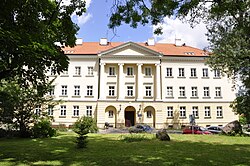
[[File:Kazimierz Palace.JPG|thumb|right|[[Kazimierz Palace]], the university [[Rector (academia)|rectorate]]]] | |||
After World War II it was not clear whether the university would be restored or whether Warsaw itself would be rebuilt. However, many professors who had survived the war returned, and began organizing the university from scratch. In December 1945, lectures resumed for almost 4,000 students in the ruins of the campus, and the buildings were gradually rebuilt. Until the late 1940s the university remained relatively independent. However, soon the communist authorities started to impose political controls, and the period of [[Stalinism in Poland|Stalinism]] started. Many professors were arrested by the [[Urząd Bezpieczeństwa|Urząd Bezpieczeństwa (Secret Police)]], the books were [[censorship|censored]] and ideological criteria in employment of new lecturers and admission of students were introduced. On the other hand, education in Poland became free of charge and the number of young people to receive the state [[scholarship]]s reached 60% of all the students. After [[Władysław Gomułka]]'s rise to power in 1956, a brief period of liberalization ensued, though communist ideology still played a major role in most faculties (especially in such faculties as history, law, economics, and political science). International cooperation was resumed and the level of education rose.<ref>{{Cite web|url=http://www.uw.edu.pl/o_uw/historia/1945p.html|archive-url=https://web.archive.org/web/20130109040501/http://www.uw.edu.pl/o_uw/historia/1945p.html |url-status=dead |title=University of Warsaw history (1945–1956), homepage.|archive-date=January 9, 2013}}</ref> | |||
By mid-1960s the government started to suppress freedom of thought, which led to increasing unrest among the students. A political struggle within the communist party prompted [[Zenon Kliszko]] to ban the production of ''[[Dziady (poem)|Dziady]]'' by [[Mickiewicz]] at the [[National Theatre in Warsaw|Teatr Narodowy]], leading to [[1968 Polish political crisis]] coupled with anti-Zionist and anti-democratic campaign and the outbreak of student demonstrations in Warsaw, which were brutally crushed – not by police, but by the [[ORMO]] ''reserve militia'' squads of plain-clothed workers.<ref name="ipn.gov-1">{{cite web | url=http://www.ipn.gov.pl/ftp/wystawy/marzec68_w_krakowie/content/index_eng.html | title=March '68 | publisher=[[Institute of National Remembrance]] | work=Exhibition | access-date=June 2, 2012 | pages=1–2. ''Introduction'', followed by scans of articles | quote=The Voluntary Reserves of the Citizens' Militia (armed with cable and truncheons) beating the students, were met with shouts of "Gestapo!", "Gestapo!"}}</ref> As a result, a large number of students and professors were expelled from the university. Nonetheless, the university remained the centre of free thought and education. What professors could not say during lectures, they expressed during informal meetings with their students. Many of them became leaders and prominent members of the [[Solidarity (Polish trade union)|Solidarity]] movement and other societies of the democratic opposition which led to the [[collapse of communism]]. The scientists working at the University of Warsaw were also among the most prominent printers of books forbidden by [[censorship]].<ref>{{Cite web|url=http://www.uw.edu.pl/o_uw/historia/1956p.html|archive-url=https://web.archive.org/web/20130109040512/http://www.uw.edu.pl/o_uw/historia/1956p.html |url-status=dead |title=University of Warsaw history (1956–1989), homepage.|archive-date=January 9, 2013}}</ref> | |||
===Third Polish Republic (1989–present)=== | |||
In 1999, a new [[University of Warsaw Library]] building was opened in [[Powiśle, Warsaw|Powiśle]].<ref name="guidebook">{{cite book |title=University of Warsaw Main Sites, Facts and Figures Guidebook |url=https://www.uw.edu.pl/wp-content/uploads/2018/01/uw_miejsca_fakty_liczby_przewodnik_2018.pdf |year=2018 |isbn=978-83-235-3014-5|last1=Łukaszewska |first1=Katarzyna |last2=Swatowska |first2=Anna |last3=Bieńko |first3=Katarzyna |last4=Korzekwa-Józefowicz |first4=Anna |last5=Laska |first5=Olga }}</ref>{{rp|43}} After Poland joined the [[European Union]] in 2004, the university obtained additional funds from the [[European Structural and Investment Funds]] for the construction of additional buildings including the Biological and Chemical Research Centre, Centre of New Technologies, and a new building for the Faculty of Physics.<ref name="guidebook"/>{{rp|5}} | |||
== Campus == | |||
{{unreferenced section|date=November 2017}} | |||
University of Warsaw owns a total of 126 buildings. Further construction and a vigorous renovation program are underway at the main campus. The university is spread out over the city, though most of the buildings are concentrated in two areas. | |||
===Main campus=== | |||
[[File:buw1.jpg|thumb|[[Warsaw University Library]], on ''ulica Dobra'']] | |||
[[File:C12 W 24.jpg|thumb|[[Nowy Świat-Uniwersytet metro station]] next to the main campus]] | |||
The main campus of the University of Warsaw is in the city center, adjacent to the [[Krakowskie Przedmieście]] street. It comprises several historic [[palace]]s, most of which had been nationalized in the 19th century. The chief buildings include: | |||
* [[Kazimierzowski Palace]] (''Pałac Kazimierzowski'') – the seat of the [[Rector (academia)|rector]] and the [[Senate]]; | |||
* [[:pl:Pałac Uruskich|Uruski Palace]] (''Pałac Uruskich'') – left side of main gate entrance, houses the Department of Geography and Regional Studies | |||
* the Old Library (''Stary BUW'') – since recent refurbishment, a secondary lecture building; | |||
* the Main School (''Szkoła Główna'') – former seat of the Main School until the [[January Uprising|January 1863 Uprising]], later the faculty of biology; now, since its refurbishment, the seat of the Institute of archaeology; | |||
* ''[[Auditorium Maximum, Warsaw|Auditorium Maximum]]'' – the main lecture hall, with seats for several hundred students. | |||
The [[Warsaw University Library]] building is a short walk downhill from the main campus, in the [[Powiśle, Warsaw|Powiśle]] neighborhood. | |||
===Natural sciences campus=== | |||
The second important campus is located near [[Stefan Banach|Banacha]] and [[Louis Pasteur|Pasteura]] streets. It is home to the departments of chemistry, physics, biology, mathematics, computer science, and geology, and contains several other university buildings such as the Interdisciplinary Centre for Mathematical and Computational Modelling, the Environmental Heavy Ion Laboratory that houses a cyclotron and a facility for the production of [[positron emission tomography|PET]] radiopharmaceuticals, and a sports facility. Several new buildings have been constructed within this campus in recent years, and the Department of Physics moved here from its previous location at Hoża Street. | |||
Together with buildings of other institutions, such as the Institute of Experimental Biology, Radium Institute and the [[Medical University of Warsaw]], the campus is part of an almost contiguous area of scientific and educational facilities covering approximately {{convert|43|hectare|abbr=on}}. | |||
== Faculties == | |||
[[File:University of Warsaw Main Campus, Warsaw, Poland, 2019, 03.jpg|thumb|Collegium Novum]] | |||
{{Div col}} | |||
# Liberal Arts | |||
# Applied Linguistics<ref>{{cite web|url=http://www.wls.uw.edu.pl/|title=Strona Wydziału Lingwistyki Stosowanej|website=www.wls.uw.edu.pl}}</ref> | |||
# Applied Social Sciences and Resocialization<ref>{{cite web|url=https://irk.uw.edu.pl/en-gb/offer/PODYPL2021/units/34000000/|website=www.irk.uw.edu.pl|title=Select registration - IRK }}</ref> | |||
# Biology<ref>{{cite web|url=http://www.biol.uw.edu.pl |title=Strona Wydziału Biologii UW |publisher=Biol.uw.edu.pl |access-date=2012-07-15}}</ref> | |||
# Chemistry<ref>{{cite web |url=http://www.chem.uw.edu.pl/index_en.htm |title=Archived copy |access-date=2004-05-03 |url-status=dead |archive-url=https://web.archive.org/web/20040401171108/http://www.chem.uw.edu.pl/index_en.htm |archive-date=2004-04-01 }}</ref> | |||
# Economic Sciences<ref>{{cite web|url=http://www.wne.uw.edu.pl |title=Wydział Nauk Ekonomicznych – Uniwersytet Warszawski |publisher=Wne.uw.edu.pl |access-date=2012-07-15}}</ref> | |||
# Education | |||
# Geography and Regional Studies<ref>{{cite web|url=http://www.wgsr.uw.edu.pl/ |title=Wydział Geografii i Studiów Regionalnych Uniwersytetu Warszawskiego |language=pl |publisher=Wgsr.uw.edu.pl |access-date=2012-07-15}}</ref> | |||
# Geology<ref>{{cite web|url=http://www.geo.uw.edu.pl/ |title=Wydział Geologii Uniwersytetu Warszawskiego |language=pl |publisher=Geo.uw.edu.pl |access-date=2012-07-15}}</ref> | |||
# History<ref>{{cite web|url=http://www.wh.uw.edu.pl/ |title=Wydział Historyczny UW |publisher=Wh.uw.edu.pl |access-date=2012-07-15}}</ref> | |||
# Law and Administration<ref>{{cite web|url=http://en.wpia.uw.edu.pl/ |title=Faculty of Law and Administration |publisher=En.wpia.uw.edu.pl |access-date=2012-07-15}}</ref> | |||
# Journalism, Information and Bibliology | |||
# Management<ref>{{cite web|author=Marcin Jędra |url=http://www.wz.uw.edu.pl/ |title=Wydział Zarządzania Uniwersytetu Warszawskiego, zarządzanie, studia podyplomowe, studia licencjackie, studia magisterskie |publisher=Wz.uw.edu.pl |date=2012-05-26 |access-date=2012-07-15}}</ref> | |||
# Mathematics, Informatics, and Mechanics<ref>{{cite web |url=http://www.mimuw.edu.pl/english/ |title=Wydział MIM UW – Strona główna |publisher=Mimuw.edu.pl |access-date=2012-07-15 |archive-url=https://web.archive.org/web/20080907003300/http://www.mimuw.edu.pl/english/ |archive-date=2008-09-07 |url-status=dead }}</ref> | |||
# Modern Languages | |||
# Oriental Studies<ref>[http://www.orient.uw.edu.pl/ Wydział Orientalistyczny] {{in lang|pl}}</ref> | |||
# Philosophy and Sociology<ref>[https://web.archive.org/web/20070730180237/http://weber.is.uw.edu.pl/ang/index.htm Instytut Socjologii Uniwersytet Warszawski], 2005. The ''Internet Archive''. {{in lang|en}}</ref> | |||
# Physics<ref>[http://www.fuw.edu.pl/ Faculty of Physics University of Warsaw] {{in lang|en}}</ref> | |||
# Political Science and International Studies<ref>{{cite web|url=http://wnpism.uw.edu.pl |title=Wydział Nauk Politycznych i Studiów Międzynarodowych – Strona główna |publisher=wnpism.uw.edu.pl |access-date=2017-02-05}}</ref> | |||
# Polish Studies | |||
# Psychology<ref>[http://www.psychologia.pl/ Psychologia.pl] {{in lang|pl}} and [http://www.psychology.pl Psychology.pl] {{in lang|en}}</ref> | |||
{{div col end}} | |||
=== Other institutes === | |||
{{div col}} | |||
* American Studies Center | |||
* British Studies Centre | |||
* Centre de Civilisation Française et [[French language|d'Études Francophones]] auprès de l'Université de Varsovie | |||
* Centre for Archaeological Research at [[Novae (fortress)|Novae]] | |||
* Centre for Environmental Study | |||
* Centre for Europe | |||
* Centre for European Regional and Local Studies (EUROREG)<ref>{{cite web|url=http://www.euroreg.uw.edu.pl/index.php?l=eng&p=maineng |title=Centre for European Regional and Local Studies (EUROREG) |publisher=Euroreg.uw.edu.pl |access-date=2013-01-05}}</ref> | |||
* Centre for Foreign Language Teaching | |||
* Centre for Inter-Faculty Individual Studies in the Humanities<ref>{{cite web|url=http://www.mish.uw.edu.pl/ |title=Kolegium MISH UW |publisher=Mish.uw.edu.pl |date=2007-09-30 |access-date=2012-07-15}}</ref> | |||
* Centre for [[Latin America|Latin-American]] Studies (CESLA) | |||
* Centre for Open Multimedia Education | |||
* Centre for the Study of Classical Tradition in Poland and East-Central Europe | |||
* Centre of Studies in Territorial Self-Government and Local Development | |||
* Chaire UNESCO du Developpement Durable de l`Universite de Vaersovie | |||
* Comité Polonais de l'Alliance Français | |||
* Digital Economy Lab (DELab) – joint institute with [[Google]]<ref>{{cite web|url=http://www.uw.edu.pl/delab/ |title=Digital Economy Lab (DELab) |date=2 April 2014 |language=pl |publisher=uw.edu.pl |access-date=2014-04-15}}</ref> | |||
* Erasmus of Rotterdam Chair | |||
* Heavy Ion Laboratory | |||
* Individual Inter-faculty Studies in Mathematics and Natural Sciences<ref>{{cite web|url=http://www.mismap.uw.edu.pl/index.php?sekcja=infokand_&css=zolty.css&lang=en& |title=MISMaP – MiÄ™dzywydziaÅ'owe Indywidualne Studia Matematyczno-Przyrodnicze UW – MISMaP |publisher=Mismap.uw.edu.pl |access-date=2011-10-07}}</ref> | |||
* Institute of Americas and Europe | |||
* Institute of International Relations – host of [[GMAPIR]] | |||
* The Robert B.Zajonc Institute for Social Studies<ref>{{cite web|url=http://www.iss.uw.edu.pl/ |title=Witamy w ISS |language=pl |publisher=Iss.uw.edu.pl |access-date=2012-07-15}}</ref> | |||
* Inter-faculty Study Programme in Environmental Protection | |||
* Interdisciplinary Centre for Behavioural Genetics | |||
* Interdisciplinary Centre for Mathematical and Computational Modelling<ref>{{cite web |url=http://www.icm.edu.pl/eng/ |title=Strona Główna |publisher=icm.edu.pl |access-date=2012-07-15 |archive-url=https://web.archive.org/web/20080222064528/http://www.icm.edu.pl/eng/ |archive-date=2008-02-22 |url-status=dead }}</ref> | |||
* Physical Education and Sports Centre | |||
* [[Polish Centre of Mediterranean Archaeology]] | |||
* University Centre for Technology Transfer | |||
* University College of English Language Teacher Education | |||
* University of Warsaw for Foreign Language Teacher Training and European Education | |||
{{div col end}} | |||
== Institutions == | |||
* Academic Radio Kampus 97,1 FM<ref>{{Cite web|url=http://radiokampus.waw.pl/o_radiu/informacje_1.html|title=O Radiu - Radio Kampus 97,1 FM #SAMESZTOSY}}</ref> | |||
* Institute of Information Science and Book Studies<ref>[https://web.archive.org/web/20081215024334/http://www.lis.uw.edu.pl/uk/hist.htm History of the Institute.] The ''Internet Archive''. {{in lang|en}}</ref> | |||
* The Institute of Polish Language and Culture 'Polonicum'<ref>[http://www.polonicum.uw.edu.pl/indexa.html Polonicum.uw.edu.pl] {{webarchive |url=https://web.archive.org/web/20040405123014/http://www.polonicum.uw.edu.pl/indexa.html |date=April 5, 2004 }}</ref> | |||
* University of Warsaw Libraries<ref>[http://buwcd.buw.uw.edu.pl/english/index_eng.htm Buwcd.buw.uw.edu.pl] {{webarchive |url=https://web.archive.org/web/20040406210023/http://buwcd.buw.uw.edu.pl/english/index_eng.htm |date=April 6, 2004 }}</ref> | |||
== Notable alumni == | |||
[[File:Tadeusz Borowski.jpg|thumb|130px|[[Tadeusz Borowski]]]] | |||
[[File:Chopin, by Wodzinska.JPG|thumb|130px|[[Frédéric Chopin]]]] | |||
[[File:Leonid Hurwicz.jpg|thumb|130px|[[Leonid Hurwicz]]]] | |||
[[File:Leszek Kolakowski 1971.jpg|thumb|130px|[[Leszek Kolakowski]]]] | |||
[[File:Prus 002.jpg|thumb|130px|[[Bolesław Prus]]]] | |||
[[File:Rosz 007b.jpg|thumb|189x189px|[[Ireneusz Roszkowski]]]] | |||
[[File:AlfredTarski1968.jpeg|thumb|130px|[[Alfred Tarski]]]] | |||
[[File:Olga Tokarczuk-9739.jpg|thumb|175x175px|[[Olga Tokarczuk]]]] | |||
[[File:1908-kl-t-zamenhof.jpg|thumb|185x185px|[[Ludwik Zamenhof]]]] | |||
* [[Jerzy Andrzejewski]] (1909–1983), author | |||
* [[Krzysztof Kamil Baczyński]] (1921–1944), poet, [[Home Army]] soldier killed in the [[Warsaw Uprising]] | |||
* [[Menachem Begin]] (1913–1992), 6th [[Prime Minister of Israel]] (1977–1983), [[Nobel Peace Prize]] winner (1978) | |||
* [[Adam Bodnar]] (born 1977), lawyer, human rights activist, Polish Ombudsman | |||
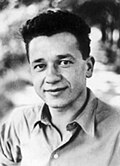
* [[Tadeusz Borowski]] (1922–1951), poet, writer | |||
* [[Kazimierz Brandys]] (1916–2000), writer | |||
* [[Marian Brandys]] (1912–1998), writer, journalist | |||
* [[Frédéric Chopin]] (1810–1849), pianist, composer | |||
* [[Włodzimierz Cimoszewicz]] (born 1950), politician, [[Prime Minister of Poland]] (1996–1997), [[Marshal of the Sejm]] (2005) | |||
* [[Tomasz Dietl]] (born 1950), physicist | |||
* [[Samuel Eilenberg]] (1913–1998), mathematician, computer scientist, art collector | |||
* [[Barbara Engelking]] (born 1962), sociologist | |||
* [[Joseph Epstein]] (1911–1944), communist leader of French resistance | |||
* [[Lech Gardocki]] (born 1944) lawyer, judge, former First President of the [[Supreme Court of Poland]] | |||
* [[Marek Gazdzicki]] (born 1956), nuclear physicist | |||
* [[Bronisław Geremek]] (1932–2008), historian, politician | |||
* [[Małgorzata Gersdorf]] (born 1952), lawyer, first President of the [[Supreme Court of Poland]] | |||
* [[Maciej Gliwicz]] (born 1939), biologist | |||
* [[Witold Gombrowicz]] (1904–1969), writer | |||
* [[Hanna Gronkiewicz-Waltz]] (born 1952), politician, President of the [[National Bank of Poland]] (1992–2001), [[Mayor of Warsaw]] (2006–2018) | |||
* [[Jan T. Gross]] (born 1947), historian, writer, [[Princeton University]] professor | |||
* [[Zofia Helman]] (born 1937), musicologist | |||
* [[Gustaw Herling-Grudziński]] (1919–2000), journalist, writer, [[Gulag]] survivor | |||
* [[Leonid Hurwicz]] (1917–2008), economist, mathematician, [[Nobel Prize in Economics]] winner (2007) | |||
* [[Maria Janion]] (1926-2020), literary critic | |||
* [[Monika Jaruzelska]] (born 1963) fashion designer, journalist, daughter of former [[President of Poland|Polish President]] [[Wojciech Jaruzelski]] | |||
* [[Jerzy Jedlicki]] (1930–2018), historian of ideas, anti-communist activist | |||
* [[Jarosław Kaczyński]] (born 1949), politician, [[Prime Minister of Poland]] (2006–2007) | |||
* [[Lech Kaczyński]] (1949–2010), politician, [[Mayor of Warsaw]] (2002–2005), [[President of Poland]] (2005–2010) | |||
* [[Andrzej Kalwas]] (born 1936), lawyer, businessman, and former Polish [[Ministry of Justice (Poland)|Minister of Justice]] | |||
* [[Aleksander Kamiński]] (1903–1978), writer, leader of [[Polish Scouting and Guiding Association]] | |||
* [[Ryszard Kapuściński]] (1932–2007), writer and journalist | |||
* [[Mieczysław Karłowicz]] (1876–1909), composer | |||
* [[Jan Karski]] (1914–2000), Polish resistance fighter | |||
* [[Zofia Kielan-Jaworowska]] (1925–2015), paleobiologist | |||
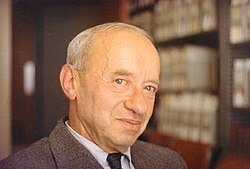
* [[Leszek Kołakowski]] (1927–2009), philosopher, historian of philosophy | |||
* [[Bronisław Komorowski]] (born 1952), politician, [[Marshal of the Sejm]] (2007–2010), [[President of Poland]] (2010–2015) | |||
* [[Alpha Oumar Konaré]], (born 1946), 3rd President of Mali (1992–2002) | |||
* [[Wojciech Kopczuk]], [[Columbia University]] economist | |||
* [[Janusz Korwin-Mikke]] (born 1942), [[conservative-liberal]] politician and journalist | |||
* [[Marek Kotański]] (1942–2002), psychologist and streetworker | |||
* [[Jacek Kuroń]] (1934–2004), historian, author, social worker, and politician | |||
* [[Jan Józef Lipski]] (1926–1991), literature historian, politician | |||
* [[Ewa Łętowska]] (born 1940), lawyer, first [[Polish Ombudsman|Polish Ombudsman for Citizen Rights]] | |||
* [[Jerzy Łojek]] (1932–1986), historian, writer | |||
* [[Pawel Maciag]] (born 1978), lawyer, university professor in New York, diplomat, and journalist | |||
* [[Olga Malinkiewicz]] (born 1982), physicist | |||
* [[Tadeusz Mazowiecki]] (1927–2013), author, social worker, journalist, [[Prime Minister of Poland]] (1989–1991) | |||
* [[Adam Michnik]] (born 1946), journalist | |||
* [[Karol Modzelewski]] (1937–2019), historian, politician | |||
* [[Mirosław Nahacz]] (1984–2007), novelist, screenwriter<ref name=Sajewicz>{{cite web |last1=Sajewicz |first1=Natalia |title=Mirosław Nahacz |url=https://culture.pl/pl/tworca/miroslaw-nahacz |website=Culture.pl |access-date= 2020-04-18 |language=pl |date=May 2017}}</ref> | |||
* [[Jerzy Neyman]] (1894–1981), mathematician, statistician, [[University of California]] professor | |||
* [[Jan Olszewski]] (1930-2019), lawyer, politician, [[Prime Minister of Poland]] (1991–1992) | |||
* [[Janusz Onyszkiewicz]] (born 1937), politician | |||
* [[Maria Ossowska]] (1896–1974), sociologist | |||
* [[Bolesław Piasecki]] (1915–1979), politician | |||
* [[Bohdan Paczyński]] (1940–2007), astronomer | |||
*[[Rafał Pankowski]] (born 1976), sociologist and political scientist | |||
* [[Longin Pastusiak]] (born 1935), politician, [[Marshal of the Senate of the Republic of Poland]] (2001–2005) | |||
* [[Krzysztof Piesiewicz]] (born 1945), lawyer, screenwriter | |||
* [[Moshe Prywes]] (1914–1998), Israeli physician and educator; first President of [[Ben-Gurion University of the Negev]] | |||
* [[Adam Przeworski]] (born 1940), political scientist, [[New York University]] professor | |||
* [[Bolesław Prus]] (1847–1912), writer | |||
* [[Emanuel Ringelblum]] (1900–1944), historian, founder [[Emanuel Ringelblum Archives]] of [[Warsaw Ghetto]]<ref name=holo>[http://www.holocaustresearchproject.org/ghettos/ringleblum.html Emanuel Ringelblum: The Creator of “Oneg Shabbat”] Holocaust Research Project.</ref> | |||
* [[Ireneusz Roszkowski]] (1910–1996), precursor of prenatal medicine | |||
* [[Józef Rotblat]] (1908–2005), physicist, [[Nobel Peace Prize]] winner (1995) | |||
* [[Stefan Sarnowski]] (1939-2014), philosopher | |||
* [[Stanisław Sedlaczek]] (1892–1941), social worker, leader of [[Polish Scouting and Guiding Association]] | |||
* [[Yitzhak Shamir]] (1915–2012), 7th [[Prime Minister of Israel]] (1983–1984 and 1986–1992) | |||
* [[Wacław Sierpiński]] (1882–1969), mathematician | |||
* [[Andrzej Sobolewski]] (born 1951), physicist | |||
* [[Dmitry Strelnikoff]] (born 1969), Russian writer, biologist, journalist for the media | |||
* [[Kazimiera Szczuka]] (born 1966), literary critic, feminist, [[LGBT rights]] activist, television personality | |||
* [[Marzena Ozarek Szilke]], archaeologist, anthropologist and paleopathologist | |||
* [[Adam Szymczyk]] (born 1970), art critic and curator | |||
* [[Magdalena Środa]] (born 1957), philosopher and feminist | |||
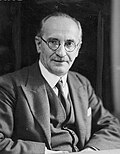
* [[Alfred Tarski]] (1902–1982), logician, mathematician, member of the [[Lwów-Warsaw school of logic]] | |||
* [[Władysław Tatarkiewicz]] (1886–1980), philosopher, historian of esthetics | |||
* [[Olga Tokarczuk]] (born 1962), writer, essayist, psychologist, [[Nobel Prize in Literature]] winner (2018) | |||
* [[Rafał Trzaskowski]] (born 1972), politician, academic teacher, [[Mayor of Warsaw]] | |||
* [[Julian Tuwim]] (1894–1953), poet and writer | |||
* [[Alfred Twardecki]] (born 1962), archaeologist, historian of antiquity, museologist | |||
* [[Andrzej Udalski]] (born 1957), astronomer and astrophysicist | |||
* [[Mordkhe Veynger]] (1890–1929), Soviet-Jewish linguist | |||
* [[Andrzej Kajetan Wróblewski]] (born 1933), experimental physicist | |||
* [[Janusz Andrzej Zajdel]] (1938–1985), physicist and science-fiction writer | |||
* [[L. L. Zamenhof|Ludwik Zamenhof]] (1859–1917), physician, inventor of [[Esperanto]] | |||
* [[Paweł Zarzeczny]] (1961–2017), sports journalist, columnist and TV personality | |||
* [[Anna Zawadzka]] (1919–2004), social worker, leader of [[Polish Scouting and Guiding Association]] | |||
* [[Maciej Zembaty]] (1944–2011), poet, writer, translator of [[Leonard Cohen]]'s works | |||
* [[Rafał A. Ziemkiewicz]] (born 1964), writer | |||
* [[Florian Znaniecki]] (1882–1958), philosopher and sociologist | |||
== Notable staff == | |||
[[File:Zigmunt Bauman na 20 Forumi vydavciv(Cropped).jpg|thumb|130px|[[Zygmunt Bauman]]]] | |||
[[File:Jan Łukasiewicz.jpg|thumb|130px|[[Jan Łukasiewicz]]]] | |||
[[File:Yefim Karskiy.jpg|thumb|130px|[[Yefim Karskiy]]]] | |||
[[File:Kazimierz Michałowski MNW 03.jpg|thumb|130px|[[Kazimierz Michałowski]]]] | |||
[[File:Wacław Sierpiński.jpg|thumb|130px|[[Wacław Sierpiński]]]] | |||
[[File:Jerzy Szacki 2004.jpg|thumb|130px|[[Jerzy Szacki]]]] | |||
=== Professors === | |||
* [[Osman Achmatowicz]] (1899–1988), chemist, rector of the [[Technical University of Łódź]] (1946–1953) | |||
* [[Szymon Askenazy]] (1866–1935), historian | |||
* [[Maria Ludwika Bernhard]] (1908–1998), archaeologist | |||
* [[Karol Borsuk]] (1905–1982), mathematician | |||
* [[Franciszek Bujak]] (1919–1921) historian | |||
* [[Jan Niecisław Baudouin de Courtenay]] (1845–1929), linguist, introduced the concept of a [[phoneme]] | |||
* [[Zygmunt Bauman]] (1925–2017), sociologist | |||
* [[Tomasz Dietl]] (born 1950), physisct, Laureate of Agilient Technologies Europhysics Prize of The European Physical Society (2005) | |||
* [[Benedykt Dybowski]] (1833–1930), biologist and explorer of [[Siberia]] and [[Lake Baikal|Baikal]] area | |||
* [[Michel Foucault]] (1926–1984), French philosopher, at the university dean-faculty of the French Centre 1958–1959 | |||
* [[Stanisław Grabski]] (1871–1949), economist | |||
* [[Henryk Jabłoński]] (1909–2003), historian, nominal head of state of Poland (1972–1985) | |||
* [[Feliks Pawel Jarocki]] (1790–1865), zoologist | |||
* [[Barbara Jaruzelska]] (1931–2017), philologist and German studies professor, [[First Lady of Poland]] (1985–1990) | |||
* [[Jerzy Kolendo]] (1955-1983), classical archaeologist and historian | |||
* [[Leszek Kołakowski]] (1927–2009), philosopher | |||
* [[Kazimierz Kuratowski]] (1896–1980), mathematician | |||
* [[Joachim Lelewel]] (1786–1861), historian, politician and freedom fighter | |||
* [[Antoni Leśniowski]] (1867–1940), surgeon and medic, one of the discoverers of [[Crohn's disease]] | |||
* [[Edward Lipiński]] (1888–1986), economist, founder of the [[Główny Urząd Statystyczny|Main Statistical Office]] | |||
* [[Jan Łukasiewicz]] (1878–1956), mathematician and logician | |||
* [[Mieczysław Maneli]] (1922–1994), [[jurist]] | |||
* [[Leszek Marks]] (born 1951), geologist | |||
* [[Kazimierz Michałowski]] (1901–1981), archaeologist, explorer of [[Deir el Bahari]] and [[Faras, Egypt|Faras]] | |||
* [[Andrzej Mostowski]] (1913–1975), mathematician | |||
* [[Maria Ossowska]] (1896–1974), sociologist | |||
* [[Stanisław Ossowski]] (1897–1963), sociologist | |||
* [[Grigol Peradze]] (1899–1942), Orthodox theologian | |||
* [[Leon Petrażycki]] (1867–1931), [[jurist]], philosopher and logician, one of the founders of [[sociology of law]] | |||
* [[Ladislaus Pilars de Pilar]] (1874–1952), literature professor, poet and entrepreneur | |||
* [[Adam Podgórecki]] (1925–1998), [[sociology of law|sociologist of law]] | |||
* [[Henryk Samsonowicz]] (1930–2021), historian, rector (1980–1982) | |||
* [[Wacław Sierpiński]] (1882–1969), mathematician | |||
* [[Alfred Sokołowski]] (1849–1924), physician and a pioneer in [[tuberculosis]] treatment | |||
* [[Hélène Sparrow]] (1891–1970), bacteriologist and public health pioneer, especially typhus | |||
* [[Andrzej K. Tarkowski]] (born 1933), zoologist, Laureate of [[Japan Prize]] (2002) | |||
* [[Tadeusz Wałek-Czarnecki]] (1889–1949), professor of Ancient History | |||
* [[Nikolay Yakovlevich Sonin]] (1849–1915), mathematician | |||
* [[Jan Strelau]] (born 1931), psychologist | |||
* [[Jerzy Szacki]] (1929–2016), sociologist and historian | |||
* [[Stanisław Thugutt]] (1873–1941), politician, rector (1919–1920) | |||
* [[Ewa Wipszycka]] (born 1933), historian and papyrologist | |||
* [[Władysław Witwicki]] (1878–1948), psychologist, philosopher, translator and artist | |||
* [[Włodzimierz Zonn]] (1905–1985), astronomer | |||
=== Rectors === | |||
{{div col}} | |||
# Wojciech Szweykowski (1818–1831) | |||
# Józef Karol Skrodzki (1831) | |||
# [[Józef Mianowski]] (1862–1869) | |||
# Piotr Ławrowski (1869–1873) | |||
# Nikołaj Błagowieszczański (1874–1884) | |||
# Nikołaj Ławrowski (1884–1890) | |||
# Michaił Szałfiejew (1895) | |||
# Pawieł Kowalewski (1896) | |||
# Grigorij Zenger (1896) | |||
# Michaił Szałfiejew (1898) | |||
# Grigorij Uljanow (1899–1903) | |||
# Piotr Ziłow (1904) | |||
# [[Yefim Karskiy]] (1905–1911) | |||
# Wasilij Kudrewiecki (1911–1912) | |||
# Iwan Trepicyn (1913) | |||
# Siergiej Wiechow (1914–1915) | |||
# [[Józef Brudziński]] (1915–1917) | |||
# Antoni Kostanecki (1917–1919) | |||
# [[Stanisław Thugutt]] (1919–1920) | |||
# Jan Karol Kochanowski (1920–1921) | |||
# Jan Mazurkiewicz (1921–1922) | |||
# [[Jan Łukasiewicz]] (1922–1923) | |||
# Ignacy Koschembahr-Łyskowski (1923–1924) | |||
# [[Franciszek Krzyształowicz]] (1924–1925) | |||
# Stefan Pieńkowski (1925–1926) | |||
# Bolesław Hryniewiecki (1926–1927) | |||
# Antoni Szlagowski (1927–1928) | |||
# Gustaw Przychocki (1928–1929) | |||
# Tadeusz Brzeski (1929–1930) | |||
# [[Mieczysław Michałowicz]] (1930–1931) | |||
# [[Jan Łukasiewicz]] (1931–1932) | |||
# Józef Ujejski (1932–1933) | |||
# Stefan Pieńkowski (1933–1936) | |||
# Włodzimierz Antoniewicz (1936–1939) | |||
# Jerzy Modrakowski (1939) | |||
# Stefan Pieńkowski (1945–1947) | |||
# Franciszek Czubalski (1947–1949) | |||
# Jan Wasilkowski (1949–1952) | |||
# Stanisław Turski (1952–1969) | |||
# Zygmunt Rybicki (1969–1980) | |||
# [[Henryk Samsonowicz]] (1980–1982) | |||
# Kazimierz Albin Dobrowolski (1982–1985) | |||
# ''Rector electus'' Klemens Szaniawski (1984) | |||
# Grzegorz Białkowski (1985–1989) | |||
# [[Andrzej Kajetan Wróblewski]] (1989–1993) | |||
# Włodzimierz Siwiński (1993–1999) | |||
# Piotr Węgleński (1999–2005) | |||
# [[Katarzyna Chałasińska-Macukow]] (2005–2012) | |||
# Marcin Pałys (2012–2020) | |||
# [[Alojzy Nowak]] (since 2020) | |||
{{div col end}} | |||
===Staff=== | |||
[[File:Czeslaw Milosz 3 ap.tif|thumb|right|130px|[[Czesław Miłosz]]]] | |||
* [[Czesław Miłosz]] – janitor at [[Warsaw University Library]] during World War II; recipient of 1980 [[Nobel Prize in Literature]].<ref>{{cite book | last = Haven | first = Cynthia L. | title = Czesław Miłosz: Conversations | publisher = University Press of Mississippi | year = 2006 | url = https://books.google.com/books?id=r-fXgmb5EmEC&pg=PR1 | pages = XXV| isbn = 9781578068296 }}</ref> | |||
== See also == | |||
* [[List of modern universities in Europe (1801–1945)]] | |||
* [[Open access in Poland]] | |||
* [[Warsaw school of history|Warsaw School of History]] ([[Szymon Askenazy|Askenazy]] school) | |||
* [[Warsaw School of Mathematics]] | |||
* [[Main building of Warsaw University (Rostov-on-Don)]] | |||
== Notes == | |||
{{Reflist|30em}} | |||
== | == External links == | ||
{{ | {{Commons category|University of Warsaw}} | ||
* {{Official website|http://www.uw.edu.pl/en/ }} | |||
* [http://www.samorzad.uw.edu.pl/ The WU Students Association] | |||
* [http://www.buw.uw.edu.pl/ Website of The University New Library] | |||
{{Universities in Poland}} | |||
{{UNICA}} | |||
{{Coord|52|14|25|N|21|1|9|E|source:plwiki_region:PL_scale:10000|display=title}} | |||
{{Authority control}} | |||
{{ | {{DEFAULTSORT:Warsaw, University of}} | ||
[[Category:University of Warsaw| ]] | |||
[[Category:Educational institutions established in 1816]] | |||
[[Category:1816 establishments in the Russian Empire]] | |||
[[Category:1810s establishments in Poland]] | |||
Revision as of 23:38, 23 June 2022
Uniwersytet Warszawski | |
 | |
| Latin: Universitas Varsoviensis | |
Former names | Royal University of Warsaw (1816–1863) Imperial University of Warsaw (1863–1919) Józef Piłsudski University of Warsaw (1935–1945) |
|---|---|
| Type | Public |
| Established | 19 November 1816 (Template:Years ago years ago) |
| Endowment | PLN 1,700,000,000[1] (approx. USD 373,000,000) |
| Rector | Alojzy Nowak |
Academic staff | 3.900 |
Administrative staff | 3.800 (2017) |
| Students | 40,300[2] |
| Undergraduates | 44,400 (2017) |
| Postgraduates | 3,000 (2017) |
| 2.435 (2020) | |
| Location | , 00-927 Warszawa , Poland |
| Campus | Urban |
| Language | Polish, English |
| Colors | |
| Nickname | AZS Uniwersytetu Warszawskiego |
Sporting affiliations | University Sports Association of Poland |
| Website | www.uw.edu.pl |
| University rankings | |
|---|---|
| Global – Overall | |
| ARWU World[3] | 401-500 (2021) |
| QS World[4] | 308 (2022) |
| THE World[5] | 601-800 (2022) |
| USNWR Global[6] | 344 (2022) |
The University of Warsaw (Polish: Uniwersytet Warszawski, Latin: Universitas Varsoviensis) is a public university in Warsaw, Poland. Established in 1816, it is the largest institution of higher learning in the country offering 37 different fields of study as well as 100 specializations in humanities, technical, and the natural sciences.[7]
The University of Warsaw consists of 126 buildings and educational complexes with over 18 faculties: biology, chemistry, journalism and political science, philosophy and sociology, physics, geography and regional studies, geology, history, applied linguistics and philology, Polish language, pedagogy, economics, law and public administration, psychology, applied social sciences, management and mathematics, computer science and mechanics.
The University of Warsaw is one of the top Polish universities. It was ranked by Perspektywy magazine as best Polish university in 2010, 2011, 2014, and 2016.[8][9][10] International rankings such as ARWU and University Web Ranking ranked the university as the best Polish higher level institution in 2012.[11]
History
Beginnings under Alexander I (1816–1918)

In 1795, the partitions of Poland left Warsaw with access only to the Academy of Vilnius when the oldest and most influential Polish academic center, the Jagiellonian University in Kraków, became part of the Austrian Habsburg monarchy. In 1815, the newly established semi-autonomous polity of Congress Poland found itself without a university at all, as Vilnius was incorporated into the Russian Empire. In 1816, Alexander I permitted the Polish authorities to create a university, comprising five departments: Law and Administration, Medicine, Philosophy, Theology, and Art and Humanities. The university soon grew to 800 students and 50 professors. After most of the students and professors took part in the November 1830 Uprising the university was closed down; it was again closed after the failed January Uprising of 1863.[12] As a consequence, all Polish-language schools were prohibited by the Imperial Russian government which controlled Congress Poland. During its short existence, the university educated thousands of students, many of whom became part of the backbone of the Polish intelligentsia.[13]

In 1915, during the First World War, Warsaw was seized by German Empire and the occupying German authorities allowed a certain degree of liberalization to gain military support from the Poles. In accordance with the concept of Mitteleuropa, the Germans permitted several Polish social and educational societies to be recreated, including the University of Warsaw. The Polish language was reintroduced, but, in order to maintain Polish patriotic movement in control, the number of lecturers was kept low. No limits on the number of students; between 1915 and 1918 the number of alumni rose from a mere 1,000 to over 4,500.[14]
Second Polish Republic (1918–1939)

After Poland regained its independence in 1918, the University of Warsaw began to grow very quickly. It was reformed; all the important posts (the rector, senate, deans and councils) became democratically elected, and the state spent considerable amounts of money to modernize and equip it. Many professors returned from exile and cooperated in the effort. By the late 1920s the level of education in Warsaw had reached that of western Europe.[15]
By the beginning of the 1930s the University of Warsaw had become the largest university in Poland, with over 250 lecturers and 10,000 students. However, the financial problems of the newly reborn state did not allow for free education, and students had to pay a tuition fee for their studies (an average monthly salary, for a year). Also, the number of scholarships was very limited, and only approximately 3% of students were able to get one. Despite these economic problems, the University of Warsaw grew rapidly. New departments were opened, and the main campus was expanded.[15] After the death of Józef Piłsudski the Senate of the University of Warsaw changed its name to "Józef Piłsudski University of Warsaw" (Uniwersytet Warszawski im. Józefa Piłsudskiego). The Sanacja government proceeded to limit the autonomy of the universities. Professors and students remained divided for the rest of the 1930s as the system of segregated seating for Jewish students, known as ghetto benches, was implemented customarily, not institutionally; comparable to the era of the Civil rights movement in the United States.[citation needed]
World War II (1939–1945)

After the Polish Defensive War of 1939 the German authorities of the General Government closed all the institutions of higher education in Poland. The equipment and most of the laboratories were taken to Germany and divided amongst the German universities while the main campus of the University of Warsaw was turned into military barracks.[16]
German racial theories assumed that no education of Poles was needed and the whole nation was to be turned into uneducated serfs of the German race. Education in Polish was banned and punished with death. However, many professors organized the so-called "Secret University of Warsaw" (Tajny Uniwersytet Warszawski). The lectures were held in small groups in private apartments and the attendants were constantly risking discovery and death. However, the net of underground faculties spread rapidly and by 1944 there were more than 300 lecturers and 3,500 students at various courses.[citation needed]
Many students took part in the Warsaw Uprising as soldiers of the Armia Krajowa and Szare Szeregi. The German-held campus of the university was turned into a fortified area with bunkers and machine gun nests. It was located close to the buildings occupied by the German garrison of Warsaw. Heavy fights for the campus started on the first day of the Uprising, but the partisans were not able to break through the gates. Several assaults were bloodily repelled and the campus remained in German hands until the end of the fights. During the uprising and the occupation 63 professors were killed, either during fights or as an effect of German policy of extermination of Polish intelligentsia. The university lost 60% of its buildings during the fighting in 1944. A large part of the collection of priceless works of art and books donated to the university was either destroyed or transported to Germany, never to return.
Post-war and the People's Republic (1945–1989)

After World War II it was not clear whether the university would be restored or whether Warsaw itself would be rebuilt. However, many professors who had survived the war returned, and began organizing the university from scratch. In December 1945, lectures resumed for almost 4,000 students in the ruins of the campus, and the buildings were gradually rebuilt. Until the late 1940s the university remained relatively independent. However, soon the communist authorities started to impose political controls, and the period of Stalinism started. Many professors were arrested by the Urząd Bezpieczeństwa (Secret Police), the books were censored and ideological criteria in employment of new lecturers and admission of students were introduced. On the other hand, education in Poland became free of charge and the number of young people to receive the state scholarships reached 60% of all the students. After Władysław Gomułka's rise to power in 1956, a brief period of liberalization ensued, though communist ideology still played a major role in most faculties (especially in such faculties as history, law, economics, and political science). International cooperation was resumed and the level of education rose.[17]
By mid-1960s the government started to suppress freedom of thought, which led to increasing unrest among the students. A political struggle within the communist party prompted Zenon Kliszko to ban the production of Dziady by Mickiewicz at the Teatr Narodowy, leading to 1968 Polish political crisis coupled with anti-Zionist and anti-democratic campaign and the outbreak of student demonstrations in Warsaw, which were brutally crushed – not by police, but by the ORMO reserve militia squads of plain-clothed workers.[18] As a result, a large number of students and professors were expelled from the university. Nonetheless, the university remained the centre of free thought and education. What professors could not say during lectures, they expressed during informal meetings with their students. Many of them became leaders and prominent members of the Solidarity movement and other societies of the democratic opposition which led to the collapse of communism. The scientists working at the University of Warsaw were also among the most prominent printers of books forbidden by censorship.[19]
Third Polish Republic (1989–present)
In 1999, a new University of Warsaw Library building was opened in Powiśle.[20]:43 After Poland joined the European Union in 2004, the university obtained additional funds from the European Structural and Investment Funds for the construction of additional buildings including the Biological and Chemical Research Centre, Centre of New Technologies, and a new building for the Faculty of Physics.[20]:5
Campus
 |
University of Warsaw owns a total of 126 buildings. Further construction and a vigorous renovation program are underway at the main campus. The university is spread out over the city, though most of the buildings are concentrated in two areas.
Main campus


The main campus of the University of Warsaw is in the city center, adjacent to the Krakowskie Przedmieście street. It comprises several historic palaces, most of which had been nationalized in the 19th century. The chief buildings include:
- Kazimierzowski Palace (Pałac Kazimierzowski) – the seat of the rector and the Senate;
- Uruski Palace (Pałac Uruskich) – left side of main gate entrance, houses the Department of Geography and Regional Studies
- the Old Library (Stary BUW) – since recent refurbishment, a secondary lecture building;
- the Main School (Szkoła Główna) – former seat of the Main School until the January 1863 Uprising, later the faculty of biology; now, since its refurbishment, the seat of the Institute of archaeology;
- Auditorium Maximum – the main lecture hall, with seats for several hundred students.
The Warsaw University Library building is a short walk downhill from the main campus, in the Powiśle neighborhood.
Natural sciences campus
The second important campus is located near Banacha and Pasteura streets. It is home to the departments of chemistry, physics, biology, mathematics, computer science, and geology, and contains several other university buildings such as the Interdisciplinary Centre for Mathematical and Computational Modelling, the Environmental Heavy Ion Laboratory that houses a cyclotron and a facility for the production of PET radiopharmaceuticals, and a sports facility. Several new buildings have been constructed within this campus in recent years, and the Department of Physics moved here from its previous location at Hoża Street.
Together with buildings of other institutions, such as the Institute of Experimental Biology, Radium Institute and the Medical University of Warsaw, the campus is part of an almost contiguous area of scientific and educational facilities covering approximately 43 hectares (110 acres).
Faculties

- Liberal Arts
- Applied Linguistics[21]
- Applied Social Sciences and Resocialization[22]
- Biology[23]
- Chemistry[24]
- Economic Sciences[25]
- Education
- Geography and Regional Studies[26]
- Geology[27]
- History[28]
- Law and Administration[29]
- Journalism, Information and Bibliology
- Management[30]
- Mathematics, Informatics, and Mechanics[31]
- Modern Languages
- Oriental Studies[32]
- Philosophy and Sociology[33]
- Physics[34]
- Political Science and International Studies[35]
- Polish Studies
- Psychology[36]
Other institutes
- American Studies Center
- British Studies Centre
- Centre de Civilisation Française et d'Études Francophones auprès de l'Université de Varsovie
- Centre for Archaeological Research at Novae
- Centre for Environmental Study
- Centre for Europe
- Centre for European Regional and Local Studies (EUROREG)[37]
- Centre for Foreign Language Teaching
- Centre for Inter-Faculty Individual Studies in the Humanities[38]
- Centre for Latin-American Studies (CESLA)
- Centre for Open Multimedia Education
- Centre for the Study of Classical Tradition in Poland and East-Central Europe
- Centre of Studies in Territorial Self-Government and Local Development
- Chaire UNESCO du Developpement Durable de l`Universite de Vaersovie
- Comité Polonais de l'Alliance Français
- Digital Economy Lab (DELab) – joint institute with Google[39]
- Erasmus of Rotterdam Chair
- Heavy Ion Laboratory
- Individual Inter-faculty Studies in Mathematics and Natural Sciences[40]
- Institute of Americas and Europe
- Institute of International Relations – host of GMAPIR
- The Robert B.Zajonc Institute for Social Studies[41]
- Inter-faculty Study Programme in Environmental Protection
- Interdisciplinary Centre for Behavioural Genetics
- Interdisciplinary Centre for Mathematical and Computational Modelling[42]
- Physical Education and Sports Centre
- Polish Centre of Mediterranean Archaeology
- University Centre for Technology Transfer
- University College of English Language Teacher Education
- University of Warsaw for Foreign Language Teacher Training and European Education
Institutions
- Academic Radio Kampus 97,1 FM[43]
- Institute of Information Science and Book Studies[44]
- The Institute of Polish Language and Culture 'Polonicum'[45]
- University of Warsaw Libraries[46]
Notable alumni


- Jerzy Andrzejewski (1909–1983), author
- Krzysztof Kamil Baczyński (1921–1944), poet, Home Army soldier killed in the Warsaw Uprising
- Menachem Begin (1913–1992), 6th Prime Minister of Israel (1977–1983), Nobel Peace Prize winner (1978)
- Adam Bodnar (born 1977), lawyer, human rights activist, Polish Ombudsman
- Tadeusz Borowski (1922–1951), poet, writer
- Kazimierz Brandys (1916–2000), writer
- Marian Brandys (1912–1998), writer, journalist
- Frédéric Chopin (1810–1849), pianist, composer
- Włodzimierz Cimoszewicz (born 1950), politician, Prime Minister of Poland (1996–1997), Marshal of the Sejm (2005)
- Tomasz Dietl (born 1950), physicist
- Samuel Eilenberg (1913–1998), mathematician, computer scientist, art collector
- Barbara Engelking (born 1962), sociologist
- Joseph Epstein (1911–1944), communist leader of French resistance
- Lech Gardocki (born 1944) lawyer, judge, former First President of the Supreme Court of Poland
- Marek Gazdzicki (born 1956), nuclear physicist
- Bronisław Geremek (1932–2008), historian, politician
- Małgorzata Gersdorf (born 1952), lawyer, first President of the Supreme Court of Poland
- Maciej Gliwicz (born 1939), biologist
- Witold Gombrowicz (1904–1969), writer
- Hanna Gronkiewicz-Waltz (born 1952), politician, President of the National Bank of Poland (1992–2001), Mayor of Warsaw (2006–2018)
- Jan T. Gross (born 1947), historian, writer, Princeton University professor
- Zofia Helman (born 1937), musicologist
- Gustaw Herling-Grudziński (1919–2000), journalist, writer, Gulag survivor
- Leonid Hurwicz (1917–2008), economist, mathematician, Nobel Prize in Economics winner (2007)
- Maria Janion (1926-2020), literary critic
- Monika Jaruzelska (born 1963) fashion designer, journalist, daughter of former Polish President Wojciech Jaruzelski
- Jerzy Jedlicki (1930–2018), historian of ideas, anti-communist activist
- Jarosław Kaczyński (born 1949), politician, Prime Minister of Poland (2006–2007)
- Lech Kaczyński (1949–2010), politician, Mayor of Warsaw (2002–2005), President of Poland (2005–2010)
- Andrzej Kalwas (born 1936), lawyer, businessman, and former Polish Minister of Justice
- Aleksander Kamiński (1903–1978), writer, leader of Polish Scouting and Guiding Association
- Ryszard Kapuściński (1932–2007), writer and journalist
- Mieczysław Karłowicz (1876–1909), composer
- Jan Karski (1914–2000), Polish resistance fighter
- Zofia Kielan-Jaworowska (1925–2015), paleobiologist
- Leszek Kołakowski (1927–2009), philosopher, historian of philosophy
- Bronisław Komorowski (born 1952), politician, Marshal of the Sejm (2007–2010), President of Poland (2010–2015)
- Alpha Oumar Konaré, (born 1946), 3rd President of Mali (1992–2002)
- Wojciech Kopczuk, Columbia University economist
- Janusz Korwin-Mikke (born 1942), conservative-liberal politician and journalist
- Marek Kotański (1942–2002), psychologist and streetworker
- Jacek Kuroń (1934–2004), historian, author, social worker, and politician
- Jan Józef Lipski (1926–1991), literature historian, politician
- Ewa Łętowska (born 1940), lawyer, first Polish Ombudsman for Citizen Rights
- Jerzy Łojek (1932–1986), historian, writer
- Pawel Maciag (born 1978), lawyer, university professor in New York, diplomat, and journalist
- Olga Malinkiewicz (born 1982), physicist
- Tadeusz Mazowiecki (1927–2013), author, social worker, journalist, Prime Minister of Poland (1989–1991)
- Adam Michnik (born 1946), journalist
- Karol Modzelewski (1937–2019), historian, politician
- Mirosław Nahacz (1984–2007), novelist, screenwriter[47]
- Jerzy Neyman (1894–1981), mathematician, statistician, University of California professor
- Jan Olszewski (1930-2019), lawyer, politician, Prime Minister of Poland (1991–1992)
- Janusz Onyszkiewicz (born 1937), politician
- Maria Ossowska (1896–1974), sociologist
- Bolesław Piasecki (1915–1979), politician
- Bohdan Paczyński (1940–2007), astronomer
- Rafał Pankowski (born 1976), sociologist and political scientist
- Longin Pastusiak (born 1935), politician, Marshal of the Senate of the Republic of Poland (2001–2005)
- Krzysztof Piesiewicz (born 1945), lawyer, screenwriter
- Moshe Prywes (1914–1998), Israeli physician and educator; first President of Ben-Gurion University of the Negev
- Adam Przeworski (born 1940), political scientist, New York University professor
- Bolesław Prus (1847–1912), writer
- Emanuel Ringelblum (1900–1944), historian, founder Emanuel Ringelblum Archives of Warsaw Ghetto[48]
- Ireneusz Roszkowski (1910–1996), precursor of prenatal medicine
- Józef Rotblat (1908–2005), physicist, Nobel Peace Prize winner (1995)
- Stefan Sarnowski (1939-2014), philosopher
- Stanisław Sedlaczek (1892–1941), social worker, leader of Polish Scouting and Guiding Association
- Yitzhak Shamir (1915–2012), 7th Prime Minister of Israel (1983–1984 and 1986–1992)
- Wacław Sierpiński (1882–1969), mathematician
- Andrzej Sobolewski (born 1951), physicist
- Dmitry Strelnikoff (born 1969), Russian writer, biologist, journalist for the media
- Kazimiera Szczuka (born 1966), literary critic, feminist, LGBT rights activist, television personality
- Marzena Ozarek Szilke, archaeologist, anthropologist and paleopathologist
- Adam Szymczyk (born 1970), art critic and curator
- Magdalena Środa (born 1957), philosopher and feminist
- Alfred Tarski (1902–1982), logician, mathematician, member of the Lwów-Warsaw school of logic
- Władysław Tatarkiewicz (1886–1980), philosopher, historian of esthetics
- Olga Tokarczuk (born 1962), writer, essayist, psychologist, Nobel Prize in Literature winner (2018)
- Rafał Trzaskowski (born 1972), politician, academic teacher, Mayor of Warsaw
- Julian Tuwim (1894–1953), poet and writer
- Alfred Twardecki (born 1962), archaeologist, historian of antiquity, museologist
- Andrzej Udalski (born 1957), astronomer and astrophysicist
- Mordkhe Veynger (1890–1929), Soviet-Jewish linguist
- Andrzej Kajetan Wróblewski (born 1933), experimental physicist
- Janusz Andrzej Zajdel (1938–1985), physicist and science-fiction writer
- Ludwik Zamenhof (1859–1917), physician, inventor of Esperanto
- Paweł Zarzeczny (1961–2017), sports journalist, columnist and TV personality
- Anna Zawadzka (1919–2004), social worker, leader of Polish Scouting and Guiding Association
- Maciej Zembaty (1944–2011), poet, writer, translator of Leonard Cohen's works
- Rafał A. Ziemkiewicz (born 1964), writer
- Florian Znaniecki (1882–1958), philosopher and sociologist
Notable staff
.jpg)


Professors
- Osman Achmatowicz (1899–1988), chemist, rector of the Technical University of Łódź (1946–1953)
- Szymon Askenazy (1866–1935), historian
- Maria Ludwika Bernhard (1908–1998), archaeologist
- Karol Borsuk (1905–1982), mathematician
- Franciszek Bujak (1919–1921) historian
- Jan Niecisław Baudouin de Courtenay (1845–1929), linguist, introduced the concept of a phoneme
- Zygmunt Bauman (1925–2017), sociologist
- Tomasz Dietl (born 1950), physisct, Laureate of Agilient Technologies Europhysics Prize of The European Physical Society (2005)
- Benedykt Dybowski (1833–1930), biologist and explorer of Siberia and Baikal area
- Michel Foucault (1926–1984), French philosopher, at the university dean-faculty of the French Centre 1958–1959
- Stanisław Grabski (1871–1949), economist
- Henryk Jabłoński (1909–2003), historian, nominal head of state of Poland (1972–1985)
- Feliks Pawel Jarocki (1790–1865), zoologist
- Barbara Jaruzelska (1931–2017), philologist and German studies professor, First Lady of Poland (1985–1990)
- Jerzy Kolendo (1955-1983), classical archaeologist and historian
- Leszek Kołakowski (1927–2009), philosopher
- Kazimierz Kuratowski (1896–1980), mathematician
- Joachim Lelewel (1786–1861), historian, politician and freedom fighter
- Antoni Leśniowski (1867–1940), surgeon and medic, one of the discoverers of Crohn's disease
- Edward Lipiński (1888–1986), economist, founder of the Main Statistical Office
- Jan Łukasiewicz (1878–1956), mathematician and logician
- Mieczysław Maneli (1922–1994), jurist
- Leszek Marks (born 1951), geologist
- Kazimierz Michałowski (1901–1981), archaeologist, explorer of Deir el Bahari and Faras
- Andrzej Mostowski (1913–1975), mathematician
- Maria Ossowska (1896–1974), sociologist
- Stanisław Ossowski (1897–1963), sociologist
- Grigol Peradze (1899–1942), Orthodox theologian
- Leon Petrażycki (1867–1931), jurist, philosopher and logician, one of the founders of sociology of law
- Ladislaus Pilars de Pilar (1874–1952), literature professor, poet and entrepreneur
- Adam Podgórecki (1925–1998), sociologist of law
- Henryk Samsonowicz (1930–2021), historian, rector (1980–1982)
- Wacław Sierpiński (1882–1969), mathematician
- Alfred Sokołowski (1849–1924), physician and a pioneer in tuberculosis treatment
- Hélène Sparrow (1891–1970), bacteriologist and public health pioneer, especially typhus
- Andrzej K. Tarkowski (born 1933), zoologist, Laureate of Japan Prize (2002)
- Tadeusz Wałek-Czarnecki (1889–1949), professor of Ancient History
- Nikolay Yakovlevich Sonin (1849–1915), mathematician
- Jan Strelau (born 1931), psychologist
- Jerzy Szacki (1929–2016), sociologist and historian
- Stanisław Thugutt (1873–1941), politician, rector (1919–1920)
- Ewa Wipszycka (born 1933), historian and papyrologist
- Władysław Witwicki (1878–1948), psychologist, philosopher, translator and artist
- Włodzimierz Zonn (1905–1985), astronomer
Rectors
- Wojciech Szweykowski (1818–1831)
- Józef Karol Skrodzki (1831)
- Józef Mianowski (1862–1869)
- Piotr Ławrowski (1869–1873)
- Nikołaj Błagowieszczański (1874–1884)
- Nikołaj Ławrowski (1884–1890)
- Michaił Szałfiejew (1895)
- Pawieł Kowalewski (1896)
- Grigorij Zenger (1896)
- Michaił Szałfiejew (1898)
- Grigorij Uljanow (1899–1903)
- Piotr Ziłow (1904)
- Yefim Karskiy (1905–1911)
- Wasilij Kudrewiecki (1911–1912)
- Iwan Trepicyn (1913)
- Siergiej Wiechow (1914–1915)
- Józef Brudziński (1915–1917)
- Antoni Kostanecki (1917–1919)
- Stanisław Thugutt (1919–1920)
- Jan Karol Kochanowski (1920–1921)
- Jan Mazurkiewicz (1921–1922)
- Jan Łukasiewicz (1922–1923)
- Ignacy Koschembahr-Łyskowski (1923–1924)
- Franciszek Krzyształowicz (1924–1925)
- Stefan Pieńkowski (1925–1926)
- Bolesław Hryniewiecki (1926–1927)
- Antoni Szlagowski (1927–1928)
- Gustaw Przychocki (1928–1929)
- Tadeusz Brzeski (1929–1930)
- Mieczysław Michałowicz (1930–1931)
- Jan Łukasiewicz (1931–1932)
- Józef Ujejski (1932–1933)
- Stefan Pieńkowski (1933–1936)
- Włodzimierz Antoniewicz (1936–1939)
- Jerzy Modrakowski (1939)
- Stefan Pieńkowski (1945–1947)
- Franciszek Czubalski (1947–1949)
- Jan Wasilkowski (1949–1952)
- Stanisław Turski (1952–1969)
- Zygmunt Rybicki (1969–1980)
- Henryk Samsonowicz (1980–1982)
- Kazimierz Albin Dobrowolski (1982–1985)
- Rector electus Klemens Szaniawski (1984)
- Grzegorz Białkowski (1985–1989)
- Andrzej Kajetan Wróblewski (1989–1993)
- Włodzimierz Siwiński (1993–1999)
- Piotr Węgleński (1999–2005)
- Katarzyna Chałasińska-Macukow (2005–2012)
- Marcin Pałys (2012–2020)
- Alojzy Nowak (since 2020)
Staff
- Czesław Miłosz – janitor at Warsaw University Library during World War II; recipient of 1980 Nobel Prize in Literature.[49]
See also
- List of modern universities in Europe (1801–1945)
- Open access in Poland
- Warsaw School of History (Askenazy school)
- Warsaw School of Mathematics
- Main building of Warsaw University (Rostov-on-Don)
Notes
- ↑ "Finansowanie badań". Uw.edu.pl. Archived from the original on 2014-06-17.
- ↑ "University of Warsaw – Facts and figures". en.uw.edu.pl.
- ↑ "ShanghaiRanking's Academic Ranking of World Universities".
- ↑ "QS World University Rankings 2022". Top Universities.
- ↑ "World University Rankings". 20 August 2022.
- ↑ https://www.usnews.com/education/best-global-universities/poland [bare URL]
- ↑ Redakcja (2012). "About Us". University of Warsaw (UW) homepage (in polski and English). Uniwersytet Warszawski, Warsaw. Archived from the original on September 12, 2012. Retrieved September 9, 2012.
- ↑ University Ranking at Perspektywy.pl Ranking uczelni akademickich 2011 with index. (in Polish).
- ↑ University Ranking at Perspektywy.pl Ranking uczelni akademickich 2014 (in Polish)
- ↑ "Ranking Uczelni Akademickich – Ranking Szkół Wyższych PERSPEKTYWY 2016". www.perspektywy.pl (in polski). Retrieved 2017-06-03.
- ↑ University Ranking Best Universities in Europe 2012 (in Polish).
- ↑ "University of Warsaw history (1816–1831), homepage". Archived from the original on January 9, 2013.
- ↑ "University of Warsaw history (1857–1869), homepage". Archived from the original on January 9, 2013.
- ↑ "University of Warsaw history (1915–1918), homepage". Archived from the original on January 9, 2013.
- ↑ 15.0 15.1 "University of Warsaw history (1918–1935), homepage". Archived from the original on January 9, 2013.
- ↑ "University of Warsaw history (1939–1944)" (in polski). Uw.edu.pl. Archived from the original on 2013-01-09.
- ↑ "University of Warsaw history (1945–1956), homepage". Archived from the original on January 9, 2013.
- ↑ "March '68". Exhibition. Institute of National Remembrance. pp. 1–2. Introduction, followed by scans of articles. Retrieved June 2, 2012.
The Voluntary Reserves of the Citizens' Militia (armed with cable and truncheons) beating the students, were met with shouts of "Gestapo!", "Gestapo!"
- ↑ "University of Warsaw history (1956–1989), homepage". Archived from the original on January 9, 2013.
- ↑ 20.0 20.1 Łukaszewska, Katarzyna; Swatowska, Anna; Bieńko, Katarzyna; Korzekwa-Józefowicz, Anna; Laska, Olga (2018). University of Warsaw Main Sites, Facts and Figures Guidebook (PDF). ISBN 978-83-235-3014-5.
- ↑ "Strona Wydziału Lingwistyki Stosowanej". www.wls.uw.edu.pl.
- ↑ "Select registration - IRK". www.irk.uw.edu.pl.
- ↑ "Strona Wydziału Biologii UW". Biol.uw.edu.pl. Retrieved 2012-07-15.
- ↑ "Archived copy". Archived from the original on 2004-04-01. Retrieved 2004-05-03.
{{cite web}}: CS1 maint: archived copy as title (link) - ↑ "Wydział Nauk Ekonomicznych – Uniwersytet Warszawski". Wne.uw.edu.pl. Retrieved 2012-07-15.
- ↑ "Wydział Geografii i Studiów Regionalnych Uniwersytetu Warszawskiego" (in polski). Wgsr.uw.edu.pl. Retrieved 2012-07-15.
- ↑ "Wydział Geologii Uniwersytetu Warszawskiego" (in polski). Geo.uw.edu.pl. Retrieved 2012-07-15.
- ↑ "Wydział Historyczny UW". Wh.uw.edu.pl. Retrieved 2012-07-15.
- ↑ "Faculty of Law and Administration". En.wpia.uw.edu.pl. Retrieved 2012-07-15.
- ↑ Marcin Jędra (2012-05-26). "Wydział Zarządzania Uniwersytetu Warszawskiego, zarządzanie, studia podyplomowe, studia licencjackie, studia magisterskie". Wz.uw.edu.pl. Retrieved 2012-07-15.
- ↑ "Wydział MIM UW – Strona główna". Mimuw.edu.pl. Archived from the original on 2008-09-07. Retrieved 2012-07-15.
- ↑ Wydział Orientalistyczny (in Polish)
- ↑ Instytut Socjologii Uniwersytet Warszawski, 2005. The Internet Archive. (in English)
- ↑ Faculty of Physics University of Warsaw (in English)
- ↑ "Wydział Nauk Politycznych i Studiów Międzynarodowych – Strona główna". wnpism.uw.edu.pl. Retrieved 2017-02-05.
- ↑ Psychologia.pl (in Polish) and Psychology.pl (in English)
- ↑ "Centre for European Regional and Local Studies (EUROREG)". Euroreg.uw.edu.pl. Retrieved 2013-01-05.
- ↑ "Kolegium MISH UW". Mish.uw.edu.pl. 2007-09-30. Retrieved 2012-07-15.
- ↑ "Digital Economy Lab (DELab)" (in polski). uw.edu.pl. 2 April 2014. Retrieved 2014-04-15.
- ↑ "MISMaP – MiÄ™dzywydziaÅ'owe Indywidualne Studia Matematyczno-Przyrodnicze UW – MISMaP". Mismap.uw.edu.pl. Retrieved 2011-10-07.
- ↑ "Witamy w ISS" (in polski). Iss.uw.edu.pl. Retrieved 2012-07-15.
- ↑ "Strona Główna". icm.edu.pl. Archived from the original on 2008-02-22. Retrieved 2012-07-15.
- ↑ "O Radiu - Radio Kampus 97,1 FM #SAMESZTOSY".
- ↑ History of the Institute. The Internet Archive. (in English)
- ↑ Polonicum.uw.edu.pl Archived April 5, 2004, at the Wayback Machine
- ↑ Buwcd.buw.uw.edu.pl Archived April 6, 2004, at the Wayback Machine
- ↑ Sajewicz, Natalia (May 2017). "Mirosław Nahacz". Culture.pl (in polski). Retrieved 2020-04-18.
- ↑ Emanuel Ringelblum: The Creator of “Oneg Shabbat” Holocaust Research Project.
- ↑ Haven, Cynthia L. (2006). Czesław Miłosz: Conversations. University Press of Mississippi. pp. XXV. ISBN 9781578068296.