



→Religion: Linking to the article of the proposed predecessor of Mitra/Mithra. |
m robot: Update article (please report if you notice any mistake or error in this edit) |
||
| Line 1: | Line 1: | ||
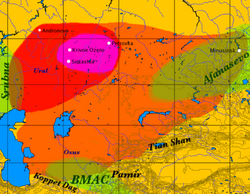
[[File:Andronovo culture.png|thumb|The [[Sintashta-Petrovka]] culture (''red'') | {{Short description|Historical group of Indo-European peoples}} | ||
[[File:Andronovo culture.png|thumb|The [[Sintashta-Petrovka]] culture (''red'') expanded into the [[Andronovo culture]] (''orange'') in the [[2nd millennium BC]], overlapping the [[Bactria–Margiana Archaeological Complex|Oxus civilization]] (''green'') in the south; it includes the area of the earliest [[chariot]]s (''pink'').]] | |||
{{Indo-European topics}} | {{Indo-European topics}} | ||
'''Indo-Iranian peoples''', also known as '''Indo-Iranic peoples''' by scholars,<ref name="Dashti2012">{{cite book |author=Naseer Dashti |title=The Baloch and Balochistan: A historical account from the Beginning to the fall of the Baloch State |url = https://books.google.com/books?id=3fxYAAAAQBAJ |date=8 October 2012|publisher=Trafford Publishing|isbn=978-1-4669-5897-5}}</ref> and sometimes as '''Arya''' or '''[[Aryan]]s''' from their self-designation, were a group of [[Indo-European peoples]] who brought the [[Indo-Iranian languages]], a major branch of the [[Indo-European languages|Indo-European language family]], to major parts of [[Eurasia]] in the second part of the 3rd millennium BC. They eventually branched out into [[Iranian peoples]] and [[Indo-Aryan peoples]]. | '''Indo-Iranian peoples''', also known as '''Indo-Iranic peoples''' by scholars,<ref name="Dashti2012">{{cite book |author=Naseer Dashti |title=The Baloch and Balochistan: A historical account from the Beginning to the fall of the Baloch State |url = https://books.google.com/books?id=3fxYAAAAQBAJ |date=8 October 2012|publisher=Trafford Publishing|isbn=978-1-4669-5897-5}}</ref> and sometimes as '''Arya''' or '''[[Aryan]]s''' from their self-designation, were a group of [[Indo-European peoples]] who brought the [[Indo-Iranian languages]], a major branch of the [[Indo-European languages|Indo-European language family]], to major parts of [[Eurasia]] in the second part of the 3rd millennium BC. They eventually branched out into [[Iranian peoples]] and [[Indo-Aryan peoples]], predominantly in the [[Subregion|geographical subregion]] of [[United Nations geoscheme for Asia#Southern_Asia|Southern Asia]]. | ||
==Nomenclature== | ==Nomenclature== | ||
The term ''[[Aryan]]'' has been used | The term ''[[Aryan]]'' has long been used to denote the ''Indo-Iranians'', because ''Arya'' is indeed the self-designation of the ancient speakers of the [[Indo-Iranian languages]], specifically the [[Iranian peoples|Iranian]] and the [[Indo-Aryan peoples]], collectively known as the Indo-Iranians.<ref>The "Aryan" Language, Gherardo Gnoli, Instituto Italiano per l'Africa e l'Oriente, Roma, 2002.</ref><ref>. Schmitt, "Aryans" in Encyclopedia Iranica: Excerpt:"The name "Aryan" (OInd. ā́rya-, Ir. *arya- [with short a-], in Old Pers. ariya-, Av. airiia-, etc.) is the self-designation of the peoples of Ancient India and Ancient Iran who spoke Aryan languages, in contrast to the "non-Aryan" peoples of those "Aryan" countries (cf. OInd. an-ā́rya-, Av. an-airiia-, etc.), and lives on in ethnic names like Alan (Lat. Alani, NPers. īrān, Oss. Ir and Iron.". Also accessed online: [http://www.iranicaonline.org/articles/aryans] in May, 2010</ref> Some scholars now use the term Indo-Iranian to refer to this group, though the term "Aryan" remains widely used by most scholars, such as [[Josef Wiesehofer]],<ref>Wiesehofer, Joseph: ''Ancient Persia''. New York: 1996. I.B. Tauris. Recommends the use by scholars of the term Aryan to describe the Eastern, not the Western, branch of the Indo-European peoples (see "Aryan" in index)</ref> [[Will Durant]],<ref>Durant, Will: ''Our Oriental Heritage''. New York: 1954. Simon and Schuster. According to Will Durant on Page 286: "the name Aryan first appears in the [name] ''Harri'', one of the tribes of the [[Mitanni]]. In general it was the self-given appellation of the tribes living near or coming from the [southern] shores of the [[Caspian sea]]. The term is properly applied today chiefly to the [[Mitanni]]ans, [[Hittites]], [[Medes]], [[Persian people|Persians]], and [[Indo-Aryans|Vedic Hindus]], i.e., only to the ''eastern'' branch of the Indo-European peoples, whose ''western'' branch populated [[Europe]]."</ref> and Jaakko Häkkinen.<ref name="Häkkinen2012a">{{cite book |last=Häkkinen|first=Jaakko|title=Per Urales ad Orientem (Festschrift for Juha Janhunen on the occasion of his 60th birthday on 12 February 2012) |year=2012|publisher=Finno-Ugric Society|location=Helsinki|isbn=978-952-5667-34-9 |url = http://www.sgr.fi/sust/sust264/sust264_hakkinenj.pdf |editor=Tiina Hyytiäinen |editor2=Lotta Jalava |editor3=Janne Saarikivi |editor4=Erika Sandman|access-date=12 November 2013 |chapter=Early contacts between Uralic and Yukaghir }}</ref><ref name="Häkkinen 2012b">{{cite web |last=Häkkinen|first=Jaakko|title=Problems in the method and interpretations of the computational phylogenetics based on linguistic data – An example of wishful thinking: Bouckaert et al. 2012|url=http://www.elisanet.fi/alkupera/Problems_of_phylogenetics.pdf|work=Jaakko Häkkisen puolikuiva alkuperäsivusto|publisher=Jaakko Häkkinen|access-date=12 November 2013|date=23 September 2012}}</ref> [[Population genetics|Population geneticist]] [[Luigi Luca Cavalli-Sforza]], in his 1994 book ''The History and Geography of Human Genes'', also uses the term Aryan to describe the Indo-Iranians.<ref>{{Citation |first1= Luigi Luca |last1= Cavalli-Sforza |author-link= Luigi Luca Cavalli-Sforza |first2= Paolo |last2= Menozzi |first3= Alberto |last3= Piazza |title= The History and Geography of Human Genes |year= 1994 |publisher= [[Princeton University Press]] |location= [[Princeton, New Jersey]] |isbn= 978-0-691-08750-4 |page = See "Aryan" in index }}</ref> | ||
==Origin== | ==History== | ||
===Origin=== | |||
The early Indo-Iranians are commonly identified with the descendants of the [[Proto-Indo-Europeans]] known as the [[Sintashta culture]] and the subsequent [[Andronovo culture]] within the broader Andronovo horizon, and their homeland with an area of the [[Eurasian steppe]] that borders the [[Ural River]] on the west, the [[Tian Shan]] on the east (where the Indo-Iranians took over the area occupied by the earlier [[Afanasevo culture]]), and [[Transoxiana]] and the [[Hindu Kush]] on the south.{{sfn|Anthony|2007|p=49}} | The early Indo-Iranians are commonly identified with the descendants of the [[Proto-Indo-Europeans]] known as the [[Sintashta culture]] and the subsequent [[Andronovo culture]] within the broader Andronovo horizon, and their homeland with an area of the [[Eurasian steppe]] that borders the [[Ural River]] on the west, the [[Tian Shan]] on the east (where the Indo-Iranians took over the area occupied by the earlier [[Afanasevo culture]]), and [[Transoxiana]] and the [[Hindu Kush]] on the south.{{sfn|Anthony|2007|p=49}} | ||
| Line 14: | Line 17: | ||
Historical linguists broadly estimate that a continuum of Indo-Iranian languages probably began to diverge by 2000 BC, if not earlier,<ref name=jpm>{{Harvcolnb|Mallory|1989}}</ref>{{rp|38–39}} preceding both the [[Vedic civilization|Vedic]] and [[Iranian people|Iranian]] cultures. The earliest recorded forms of these languages, [[Vedic Sanskrit]] and [[Gathas|Gathic]] [[Avestan]], are remarkably similar, descended from the common [[Proto-Indo-Iranian language]]. The origin and earliest relationship between the [[Nuristani languages]] and that of the Iranian and [[Indo-Aryans|Indo-Aryan]] groups is not completely clear. | Historical linguists broadly estimate that a continuum of Indo-Iranian languages probably began to diverge by 2000 BC, if not earlier,<ref name=jpm>{{Harvcolnb|Mallory|1989}}</ref>{{rp|38–39}} preceding both the [[Vedic civilization|Vedic]] and [[Iranian people|Iranian]] cultures. The earliest recorded forms of these languages, [[Vedic Sanskrit]] and [[Gathas|Gathic]] [[Avestan]], are remarkably similar, descended from the common [[Proto-Indo-Iranian language]]. The origin and earliest relationship between the [[Nuristani languages]] and that of the Iranian and [[Indo-Aryans|Indo-Aryan]] groups is not completely clear. | ||
==Expansion== | ===Expansion=== | ||
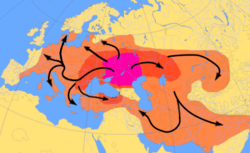
[[File:IE expansion.png|300px|thumb|Indo-European migrations c. 4000 to 1000 BC according to the [[Kurgan hypothesis]]. Magenta indicates the assumed ''[[Proto-Indo-European Urheimat hypotheses|Urheimat]]'' ([[Samara culture]], [[Sredny Stog culture]]), red the area which may have been settled by Indo-European-speaking peoples up to c. 2500 BC, and orange the area to 1000 BC.<ref>Christopher I. Beckwith (2009), ''Empires of the Silk Road'', Oxford University Press, p.30</ref>]] | [[File:IE expansion.png|300px|thumb|Indo-European migrations c. 4000 to 1000 BC according to the [[Kurgan hypothesis]]. Magenta indicates the assumed ''[[Proto-Indo-European Urheimat hypotheses|Urheimat]]'' ([[Samara culture]], [[Sredny Stog culture]]), red the area which may have been settled by Indo-European-speaking peoples up to c. 2500 BC, and orange the area to 1000 BC.<ref>Christopher I. Beckwith (2009), ''Empires of the Silk Road'', Oxford University Press, p.30</ref>]] | ||
[[File:Indo-Iranian origins.png|thumb|right|300px|Archaeological cultures associated with [[Indo-Iranian migration]]s (after [[Encyclopedia of Indo-European Culture|EIEC]]). The Andronovo, [[BMAC]] and Yaz cultures have often been associated with Indo-Iranian migrations. The [[Gandhara grave culture|GGC]], Cemetery H, Copper Hoard and [[Painted Grey Ware culture|PGW]] cultures are candidates for cultures associated with Indo-Aryan movements.]] | [[File:Indo-Iranian origins.png|thumb|right|300px|Archaeological cultures associated with [[Indo-Iranian migration]]s (after [[Encyclopedia of Indo-European Culture|EIEC]]). The Andronovo, [[BMAC]] and Yaz cultures have often been associated with Indo-Iranian migrations. The [[Gandhara grave culture|GGC]], Cemetery H, Copper Hoard and [[Painted Grey Ware culture|PGW]] cultures are candidates for cultures associated with Indo-Aryan movements.]] | ||
<!-- Deleted image removed: [[File:Arqaim.jpg|thumb|275px|[[Arkaim]] in [[Russia]] is believed to have been constructed by [[Indo-Iranian]] tribes some 4000 years ago.<ref> Gening, V.F. The Cemetery at Sintashta and the Early Indo-Iranian People. Journal of Indo-European Studies 7, 1979, 1–29; cf. Gening, Mogil'nik Sintashta i problema rannikh Indoiranskikh plemen. Sovietskaya Arkheologiya 1977, 53–73 </ref>]] --> | <!-- Deleted image removed: [[File:Arqaim.jpg|thumb|275px|[[Arkaim]] in [[Russia]] is believed to have been constructed by [[Indo-Iranian]] tribes some 4000 years ago.<ref> Gening, V.F. The Cemetery at Sintashta and the Early Indo-Iranian People. Journal of Indo-European Studies 7, 1979, 1–29; cf. Gening, Mogil'nik Sintashta i problema rannikh Indoiranskikh plemen. Sovietskaya Arkheologiya 1977, 53–73 </ref>]] --> | ||
===First wave – Indo-Aryans=== | ====First wave – Indo-Aryans==== | ||
{{main|Indo-European migrations}} | {{main|Indo-European migrations}} | ||
Two-wave models of Indo-Iranian expansion have been proposed by Burrow (1973){{sfn|Burrow|1973}} and {{Harvtxt|Parpola|1999}}. The Indo-Iranians and their expansion are strongly associated with the [[Proto-Indo-Europeans|Proto-Indo-European]] invention of the [[chariot]]. It is assumed that this expansion spread from the [[Proto-Indo-European homeland]] north of the [[Caspian sea]] south to the [[Caucasus]], [[Central Asia]], the Iranian plateau, and the [[Indian subcontinent]]. {{main|Indo-Aryan | Two-wave models of Indo-Iranian expansion have been proposed by Burrow (1973){{sfn|Burrow|1973}} and {{Harvtxt|Parpola|1999}}. The Indo-Iranians and their expansion are strongly associated with the [[Proto-Indo-Europeans|Proto-Indo-European]] invention of the [[chariot]]. It is assumed that this expansion spread from the [[Proto-Indo-European homeland]] north of the [[Caspian sea]] south to the [[Caucasus]], [[Central Asia]], the Iranian plateau, and the [[Indian subcontinent]]. {{main|Indo-Aryan migrations}} | ||
====The Mitanni of Anatolia==== | =====The Mitanni of Anatolia===== | ||
{{main|Mitanni}} | {{main|Mitanni}} | ||
The Mitanni, a people known in eastern [[Anatolia]] from about 1500 BC, were of possibly of mixed origins: a [[Hurrian]]-speaking majority was supposedly dominated by a non-Anatolian, [[Indo-Aryan peoples|Indo-Aryan]] elite.<ref name=mm>{{Harvcolnb|Mallory|Mair|2000}}</ref>{{rp|257}} There is linguistic evidence for such a [[superstrate]], in the form of: | The Mitanni, a people known in eastern [[Anatolia]] from about 1500 BC, were of possibly of mixed origins: a [[Hurrian]]-speaking majority was supposedly dominated by a non-Anatolian, [[Indo-Aryan peoples|Indo-Aryan]] elite.<ref name=mm>{{Harvcolnb|Mallory|Mair|2000}}</ref>{{rp|257}} There is linguistic evidence for such a [[superstrate]], in the form of: | ||
| Line 31: | Line 34: | ||
In particular, Kikkuli's text includes words such as ''aika'' "one" (i.e. a cognate of the Indo-Aryan ''eka''), ''tera'' "three" (''tri''), ''panza'' "five" (''pancha''), ''satta'' "seven", (''sapta''), ''na'' "nine" (''nava''), and ''vartana'' "turn around", in the context of a horse race (Indo-Aryan ''vartana''). In a treaty between the Hittites and the Mitanni, the [[Ashvins|Ashvin]] deities [[Mitra]], [[Varuna]], [[Indra]], and [[Nasatya]] are invoked. These [[loanwords]] tend to connect the Mitanni superstrate to Indo-Aryan rather than [[Iranian languages]] – i.e. the early Iranian word for "one" was ''aiva''.<ref>{{cite book |last1=Bachenheimer |first1=Avi |title=Old Persian: Dictionary, Glossary and Concordance |date=4 October 2018 |publisher=John Wiley and Sons |page=129 |url=https://books.google.com/books?id=i_tyDwAAQBAJ |access-date=31 August 2019}}</ref> | In particular, Kikkuli's text includes words such as ''aika'' "one" (i.e. a cognate of the Indo-Aryan ''eka''), ''tera'' "three" (''tri''), ''panza'' "five" (''pancha''), ''satta'' "seven", (''sapta''), ''na'' "nine" (''nava''), and ''vartana'' "turn around", in the context of a horse race (Indo-Aryan ''vartana''). In a treaty between the Hittites and the Mitanni, the [[Ashvins|Ashvin]] deities [[Mitra]], [[Varuna]], [[Indra]], and [[Nasatya]] are invoked. These [[loanwords]] tend to connect the Mitanni superstrate to Indo-Aryan rather than [[Iranian languages]] – i.e. the early Iranian word for "one" was ''aiva''.<ref>{{cite book |last1=Bachenheimer |first1=Avi |title=Old Persian: Dictionary, Glossary and Concordance |date=4 October 2018 |publisher=John Wiley and Sons |page=129 |url=https://books.google.com/books?id=i_tyDwAAQBAJ |access-date=31 August 2019}}</ref> | ||
====Indian subcontinent – Vedic culture==== | =====Indian subcontinent – Vedic culture===== | ||
The standard model for the entry of the Indo-European languages into the Indian subcontinent is that this first wave went over the Hindu Kush, either into the headwaters of the [[Indus River|Indus]] and later the [[Ganges]]. The earliest stratum of [[Vedic Sanskrit]], preserved only in the [[Rigveda]], is assigned to roughly 1500 BC.<ref name="mm"/>{{rp|258}}<ref>[ | The standard model for the entry of the Indo-European languages into the Indian subcontinent is that this first wave went over the Hindu Kush, either into the headwaters of the [[Indus River|Indus]] and later the [[Ganges]]. The earliest stratum of [[Vedic Sanskrit]], preserved only in the [[Rigveda]], is assigned to roughly 1500 BC.<ref name="mm"/>{{rp|258}}<ref>[https://www.britannica.com/eb/article-9063686 Rigveda – Britannica Online Encyclopedia<!-- Bot generated title -->]</ref> From the Indus, the [[Indo-Aryan languages]] spread from c. 1500 BC to c. 500 BC, over the northern and central parts of the subcontinent, sparing the extreme south. The [[Indo-Aryans]] in these areas established several powerful kingdoms and principalities in the region, from south eastern [[Afghanistan]] to the doorstep of [[Bengal]]. The most powerful of these kingdoms were the post-Rigvedic Kuru (in Kurukshetra and the Delhi area) and their allies the Pañcālas further east, as well as [[Gandhara]] and later on, about the time of the [[Gautama Buddha|Buddha]], the kingdom of [[Kosala]] and the quickly expanding realm of [[Magadha]]. The latter lasted until the 4th century BC, when it was conquered by [[Chandragupta Maurya]] and formed the center of the [[Mauryan empire]]. | ||
In eastern [[Afghanistan]] and | In eastern [[Afghanistan]] and some western regions of [[Pakistan]], [[Indo-Aryan languages]] were eventually replaced by [[Eastern Iranian languages]]. Most Indo-Aryan languages, however, were and still are prominent in the rest of the [[Indian subcontinent]]. Today, Indo-Aryan languages are spoken in [[India]], [[Pakistan]], [[Bangladesh]], [[Nepal]], [[Sri Lanka]], Fiji, [[Suriname]] and the [[Maldives]]. | ||
=== Second wave – Iranians === | ==== Second wave – Iranians ==== | ||
The second wave is interpreted as the Iranian wave.<ref name="jpm" />{{rp|42–43}} | The second wave is interpreted as the Iranian wave.<ref name="jpm" />{{rp|42–43}} | ||
The first Iranians to reach the [[Black Sea]] may have been the [[Cimmerians]] in the 8th century BC, although their linguistic affiliation is uncertain. They were followed by the [[Scythians]], who are considered a western branch of the Central Asian [[Saka]]s. [[Sarmatians|Sarmatian]] tribes, of whom the best known are the [[Roxolani]] (Rhoxolani), [[Iazyges]] (Jazyges) and the [[Alani]] (Alans), followed the Scythians westwards into Europe in the late centuries BC and the 1st and 2nd centuries AD (The [[Age of Migrations]]). The populous Sarmatian tribe of the [[Massagetae]], dwelling near the Caspian Sea, were known to the early rulers of Persia in the [[Achaemenid Empire|Achaemenid]] Period. At their greatest reported extent, around 1st century AD, the Sarmatian tribes ranged from the [[Vistula River]] to the mouth of the [[Danube]] and eastward to the [[Volga]], bordering the shores of the [[Black Sea|Black]] and [[Caspian Sea|Caspian]] seas as well as the [[Caucasus]] to the south.{{NoteTag|[[Apollonius of Rhodes|Apollonius]] (''[[Argonautica]]'', iii) envisaged the ''Sauromatai'' as the bitter foe of King [[Aietes]] of [[Colchis]] (modern [[Georgia (country)|Georgia]]).}} In the east, the Saka occupied several areas in Xinjiang, from Khotan to Tumshuq. | The first Iranians to reach the [[Black Sea]] may have been the [[Cimmerians]] in the 8th century BC, although their linguistic affiliation is uncertain. They were followed by the [[Scythians]], who are considered a western branch of the Central Asian [[Saka]]s. [[Sarmatians|Sarmatian]] tribes, of whom the best known are the [[Roxolani]] (Rhoxolani), [[Iazyges]] (Jazyges) and the [[Alans|Alani]] (Alans), followed the Scythians westwards into Europe in the late centuries BC and the 1st and 2nd centuries AD (The [[Age of Migrations]]). The populous Sarmatian tribe of the [[Massagetae]], dwelling near the Caspian Sea, were known to the early rulers of Persia in the [[Achaemenid Empire|Achaemenid]] Period. At their greatest reported extent, around 1st century AD, the Sarmatian tribes ranged from the [[Vistula River]] to the mouth of the [[Danube]] and eastward to the [[Volga]], bordering the shores of the [[Black Sea|Black]] and [[Caspian Sea|Caspian]] seas as well as the [[Caucasus]] to the south.{{NoteTag|[[Apollonius of Rhodes|Apollonius]] (''[[Argonautica]]'', iii) envisaged the ''Sauromatai'' as the bitter foe of King [[Aietes]] of [[Colchis]] (modern [[Georgia (country)|Georgia]]).}} In the east, the Saka occupied several areas in Xinjiang, from Khotan to Tumshuq. | ||
The [[Medes|Medians]], [[Persian people|Persians]] and [[Parthia]]ns begin to appear on the [[Iranian plateau]] from c. 800 BC, and the [[Achaemenid]]s replaced [[Elamite]] rule from 559 BC. Around the first millennium AD, Iranian groups began to settle on the eastern edge of the Iranian plateau, on the mountainous frontier of northwestern and western [[Pakistan]], displacing the earlier [[Indo-Aryans]] from the area. | The [[Medes|Medians]], [[Persian people|Persians]] and [[Parthia]]ns begin to appear on the [[Iranian plateau]] from c. 800 BC, and the [[Achaemenid]]s replaced [[Elamite]] rule from 559 BC. Around the first millennium AD, Iranian groups began to settle on the eastern edge of the Iranian plateau, on the mountainous frontier of northwestern and western [[Pakistan]], displacing the earlier [[Indo-Aryans]] from the area. | ||
| Line 55: | Line 58: | ||
*** Alekseyevka (1200–1000 BC) | *** Alekseyevka (1200–1000 BC) | ||
** [[Bactria-Margiana Archaeological Complex]] (2200–1700 BC) | ** [[Bactria-Margiana Archaeological Complex]] (2200–1700 BC) | ||
** [[Srubna culture]] ( | ** [[Srubna culture]] (1800–1200 BC) | ||
** [[Abashevo culture]] (1700–1500 BC) | ** [[Abashevo culture]] (1700–1500 BC) | ||
** [[Yaz culture]] (1500–1100 BC) | ** [[Yaz culture]] (1500–1100 BC) | ||
| Line 61: | Line 64: | ||
** [[Ochre Coloured Pottery culture]] (2000–1500 BCE) | ** [[Ochre Coloured Pottery culture]] (2000–1500 BCE) | ||
** [[Cemetery H culture]] (1900–1300 BC) | ** [[Cemetery H culture]] (1900–1300 BC) | ||
** [[Swat culture]] ( | ** [[Swat culture]] (1400–800 BC) | ||
** [[Painted Gray Ware culture]] (1200–600 BC) | ** [[Painted Gray Ware culture]] (1200–600 BC) | ||
* | * Iranian Plateau | ||
** Early West Iranian Grey Ware (1500–1000 BC) | ** Early West Iranian Grey Ware (1500–1000 BC) | ||
** [[Late West Iranian Buff Ware]] (900–700 BC) | ** [[Late West Iranian Buff Ware]] (900–700 BC) | ||
| Line 99: | Line 102: | ||
|1700–1400 BC | |1700–1400 BC | ||
|early Swat culture | |early Swat culture | ||
|Proto-Rigvedic | |Proto-Rigvedic | ||
|- | |- | ||
|1700–1500 BC | |1700–1500 BC | ||
| Line 137: | Line 140: | ||
==Religion== | ==Religion== | ||
{{See also|Ancient Iranian religion|Historical Vedic religion|Proto-Indo-European religion}} | {{See also|Ancient Iranian religion|Historical Vedic religion|Proto-Indo-European religion}} | ||
Despite the introduction of later [[Hinduism| | Despite the introduction of later [[Hinduism|Vedic]] and [[Zoroastrianism|Zoroastrian]] scriptures, Indo-Iranians shared a common inheritance of concepts including the universal force ''*Hṛta-'' ([[Sanskrit]] ''[[rta]]'', [[Avestan]] ''[[asha]]''), the sacred plant and drink ''*sawHma-'' (Sanskrit ''[[Soma (drink)|Soma]]'', Avestan ''[[Haoma]]'') and gods of social order such as ''*[[mitra]]-'' (Sanskrit ''[[Mitra]]'', Avestan and Old Persian ''[[Mithra]]'', ''Miθra'') and ''*bʰaga-'' (Sanskrit ''[[Bhaga]]'', Avestan and Old Persian ''Baga''). Proto-Indo-Iranian religion is an archaic offshoot of [[Indo-European religion]]. From the various and dispersed Indo-Iranian cultures, a set of common ideas may be reconstructed from which a common, unattested proto-Indo-Iranian source may be deduced.<ref name="Gnoli">{{cite web |url=http://www.iranicaonline.org/articles/indo-iranian-religion |title=INDO-IRANIAN RELIGION |last=Gnoli |first=Gherardo |date=March 29, 2012 |website=[[Encyclopædia Iranica]] |access-date=July 10, 2018 }}</ref> | ||
The pre-Islamic religion of the [[Nuristanis|Nuristani people]] and extant religion of the [[ | The pre-Islamic religion of the [[Nuristanis|Nuristani people]] and extant religion of the [[Kalash people]], is mostly based on the original religion of the Indo-Iranians, some of which are shared with [[Shinto]], one of the national religions of [[Japan]], which has some Indo-Iranian influence owing to contact presumably in the steppes of [[Central Asia]] at around 2000 BCE. In Shinto, traces of these can be seen in the myth of the storm god [[Susanoo-no-Mikoto|Susanoo]] slaying a serpent [[Yamata-no-Orochi]] and in the myth of the dawn goddess [[Ame-no-Uzume]].<ref>{{cite book|last=Witzel|first=Michael|title=The Origin of the World's Mythologies|year=2012}}</ref><ref>{{cite book|last=Witzel|first=Michael|title=Vala and Iwato: The Myth of the Hidden Sun in India, Japan, and beyond|year=2005|url=https://www.onmarkproductions.com/monkey-mythology-compare-india-japan-by-michael-witzel.pdf}}</ref><ref name="people.fas.harvard.edu">{{cite web|url=http://www.people.fas.harvard.edu/~witzel/KalashaReligion.pdf|author=[[Michael Witzel]]|access-date=14 March 2022|title=Kalash Religion|via=[[Harvard University|HUIT]]|archive-url=https://web.archive.org/web/20220217221646/https://www.people.fas.harvard.edu/~witzel/KalashaReligion.pdf|archive-date=17 February 2022|url-status=live}}</ref> | ||
===Development=== | ===Development=== | ||
Beliefs developed in different ways as cultures separated and evolved. For example, the cosmo-mythology of the peoples that remained on the Central Asian [[steppes]] and the Iranian plateau is to a great degree unlike that of the Indians, focused more on groups of deities (''*daiva'' and ''*asura'') and less on the divinities individually.{{citation needed|date=November 2013}} Indians were less conservative{{Citation needed|date=October 2008}} than Iranians in their treatment of their divinities, so that some deities were conflated with others or, conversely, aspects of a single divinity developed into divinities in their own right. By the time of [[Zoroaster]], Iranian culture had also been subject to the upheavals of the Iranian Heroic Age (late Iranian Bronze Age, 1800–800 BC{{Citation needed|date=October 2008}}), an influence that the Indo-Aryans were not subject to.{{citation needed|date=May 2020}} | Beliefs developed in different ways as cultures separated and evolved. For example, the cosmo-mythology of the peoples that remained on the Central Asian [[steppes]] and the Iranian plateau is to a great degree unlike that of the Indians, focused more on groups of deities (''*daiva'' and ''*asura'') and less on the divinities individually.{{citation needed|date=November 2013}} Indians were less conservative{{Citation needed|date=October 2008}} than Iranians in their treatment of their divinities, so that some deities were conflated with others or, conversely, aspects of a single divinity developed into divinities in their own right. By the time of [[Zoroaster]], Iranian culture had also been subject to the upheavals of the Iranian Heroic Age (late Iranian Bronze Age, 1800–800 BC{{Citation needed|date=October 2008}}), an influence that the Indo-Aryans were not subject to.{{citation needed|date=May 2020}} | ||
Sometimes certain myths developed in altogether different ways. The [[Rigveda|Rig-Vedic]] [[Sarasvati]] is linguistically and functionally cognate with Avestan [[Aredvi Sura Anahita|*Haraxvaitī Ārəduuī Sūrā Anāhitā]]{{Citation needed|date=July 2010}}. In the Rig-Veda (6,61,5–7) she battles a serpent called Vritra, who has hoarded all of the Earth's water. In contrast, in early portions of the Avesta, Iranian *Harahvati ''is'' the world-river that flows down from the mythical central Mount Hara. But *Harahvati does no battle — she is blocked by an obstacle (Avestan for obstacle: '' | Sometimes certain myths developed in altogether different ways. The [[Rigveda|Rig-Vedic]] [[Sarasvati]] is linguistically and functionally cognate with Avestan [[Aredvi Sura Anahita|*Haraxvaitī Ārəduuī Sūrā Anāhitā]]{{Citation needed|date=July 2010}}. In the Rig-Veda (6,61,5–7) she battles a serpent called Vritra, who has hoarded all of the Earth's water. In contrast, in early portions of the Avesta, Iranian *Harahvati ''is'' the world-river that flows down from the mythical central Mount Hara. But *Harahvati does no battle — she is blocked by an obstacle (Avestan for obstacle: ''vərəθra'') placed there by [[Angra Mainyu]].<ref name="Gnoli"/> | ||
===Cognate terms=== | ===Cognate terms=== | ||
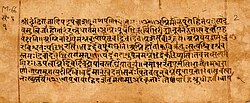
[[File:1500-1200 BCE Rigveda, manuscript page sample i, Mandala 1, Hymn 1 (Sukta 1), Adhyaya 1, lines 1.1.1 to 1.1.9, Sanskrit, Devanagari.jpg|thumb|right|300px|''Rigveda'' manuscript page (1.1.1-9)]] | [[File:1500-1200 BCE Rigveda, manuscript page sample i, Mandala 1, Hymn 1 (Sukta 1), Adhyaya 1, lines 1.1.1 to 1.1.9, Sanskrit, Devanagari.jpg|thumb|right|300px|''Rigveda'' manuscript page (1.1.1-9)]] | ||
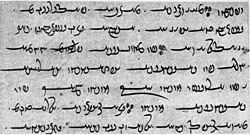
[[Image:Bodleian J2 fol 175 Y 28 1.jpg|thumb|250px|Yasna 28.1 (Bodleian MS J2)]] | [[Image:Bodleian J2 fol 175 Y 28 1.jpg|thumb|250px|Yasna 28.1 (Bodleian MS J2)]] | ||
The following is a list of [[cognate]] terms that may be gleaned from comparative linguistic analysis of the [[Rigveda]] and [[Avesta]]. Both collections are from the period after the proposed date of separation (c. 2nd millennium BC) of the Proto-Indo-Iranians into their respective Indic and Iranian branches.<ref name="Gnoli"/><ref name=Mmm>{{cite book |last1=Muesse |first1=Mark W. |title=The Hindu Traditions: A Concise Introduction |date=2011 |publisher=Fortress Press |isbn=978-1-4514-1400-4 | | The following is a list of [[cognate]] terms that may be gleaned from comparative linguistic analysis of the [[Rigveda]] and [[Avesta]]. Both collections are from the period after the proposed date of separation (c. 2nd millennium BC) of the Proto-Indo-Iranians into their respective Indic and Iranian branches.<ref name="Gnoli"/><ref name=Mmm>{{cite book |last1=Muesse |first1=Mark W. |title=The Hindu Traditions: A Concise Introduction |date=2011 |publisher=Fortress Press |isbn=978-1-4514-1400-4 |pages=30–38 |url=https://books.google.com/books?id=VlQBfbwk7CwC&q=hinduism+and+zoroastrianism&pg=PA30 |access-date=21 January 2021 |language=en}}</ref><ref name=Ror>{{cite book |last1=Griswold |first1=H. D. |last2=Griswold |first2=Hervey De Witt |title=The Religion of the Ṛigveda |date=1971 |publisher=Motilal Banarsidass Publishe |isbn=978-81-208-0745-7|url=https://books.google.com/books?id=Vhkt5K1fw2wC&q=dev+asura+arya+persian&pg=PA21 |pages=1–21 |access-date=21 January 2021}}</ref> | ||
{| class="wikitable collapsible sortable" cellpadding=2 cellspacing=2 | {| class="wikitable collapsible sortable" cellpadding=2 cellspacing=2 | ||
| Line 165: | Line 168: | ||
| ''[[rta]]'' || ''[[asha|asha/arta]]'' || "active truth", extending to "order" & "righteousness"<ref name=Ror/><ref name=Mmm/> | | ''[[rta]]'' || ''[[asha|asha/arta]]'' || "active truth", extending to "order" & "righteousness"<ref name=Ror/><ref name=Mmm/> | ||
|- | |- | ||
| ''[[atharvan]]'' || '' | | ''[[atharvan]]'' || ''āθrauuan, aθaurun'' ''[[Atar]]''|| "priest"<ref name=Mmm/> <!-- Controversial: athravan is not related to Avestan fire (Boyce, Gershevitch, Humbach, Bailey,...). See also Boyce, Encyclopedia Iranica: | ||
"Attempts have been made to connect the term [Athravan] with Avestan ''atar-'' "fire" (not attested in ); but these have been prompted by what is probably a mistaken assumption of the importance of fire in the ancient Indo-Iranian ." --> | "Attempts have been made to connect the term [Athravan] with Avestan ''atar-'' "fire" (not attested in ); but these have been prompted by what is probably a mistaken assumption of the importance of fire in the ancient Indo-Iranian ." --> | ||
|- | |- | ||
| Line 174: | Line 177: | ||
| ''[[Manu (Hinduism)|manu]]'' || ''manu'' || "man"<ref name=Ror/> | | ''[[Manu (Hinduism)|manu]]'' || ''manu'' || "man"<ref name=Ror/> | ||
|- | |- | ||
| ''[[Mitra (Vedic)|mitra]]'' || ''[[mithra]], | | ''[[Mitra (Vedic)|mitra]]'' || ''[[mithra]], miθra'' || "oath, covenant"<ref name=Ror/><ref name=Mmm/> | ||
|- | |- | ||
| ''[[asura]]'' || ''[[ahura]]'' || another class of spirits<ref name=Ror/><ref name=Mmm/> | | ''[[asura]]'' || ''[[ahura]]'' || another class of spirits<ref name=Ror/><ref name=Mmm/> | ||
| Line 188: | Line 191: | ||
| ''[[Tapati]]'' || ''tapaiti'' || Possible fire/solar goddess; see [[Tabiti]] (a possibly Hellenised [[Scythian]] theonym). Cognate with Latin ''tepeo'' and several other terms.<ref name=Ost/> | | ''[[Tapati]]'' || ''tapaiti'' || Possible fire/solar goddess; see [[Tabiti]] (a possibly Hellenised [[Scythian]] theonym). Cognate with Latin ''tepeo'' and several other terms.<ref name=Ost/> | ||
|- | |- | ||
| ''[[Vrtra]]-/Vr̥tragʰná/Vritraban'' || ''verethra, | | ''[[Vrtra]]-/Vr̥tragʰná/Vritraban'' || ''verethra, vərəθra'' (cf. [[Verethragna]], Vərəθraγna) || "obstacle"<ref name=Ror/><ref name=Mmm/> | ||
|- | |- | ||
| ''[[Yama]]'' || ''[[Jamshid|Yima]]'' || son of the solar deity Vivasvant/Vīuuahuuant<ref name=Ror/> | | ''[[Yama]]'' || ''[[Jamshid|Yima]]'' || son of the solar deity Vivasvant/Vīuuahuuant<ref name=Ror/> | ||
| Line 200: | Line 203: | ||
| ''Amarattya'' || ''[[Ameretat]]'' || "immortality"<ref name=Ror/> | | ''Amarattya'' || ''[[Ameretat]]'' || "immortality"<ref name=Ror/> | ||
|- | |- | ||
| ''Póṣa'' || ''[[Apaosha]]'' || " | | ''Póṣa'' || ''[[Apaosha]]'' || "demon of drought"<ref name=Ror/> | ||
|- | |- | ||
| ''Ashman''|| ''[[Asman]]'' || " | | ''Ashman''|| ''[[Asman]]'' || "sky, highest heaven"<ref name=Ost/> | ||
|- | |- | ||
| ''[[Angiras (sage)|Angira]]'' ''[[Manyu (deity)|Manyu]]''|| ''[[Ahriman|Angra Mainyu]]''|| " | | ''[[Angiras (sage)|Angira]]'' ''[[Manyu (deity)|Manyu]]''|| ''[[Ahriman|Angra Mainyu]]''|| "destructive/evil spirit, spirit, temper, ardour, passion, anger, teacher of divine knowledge"<ref name=Ror/> | ||
|- | |- | ||
| ''[[Manyu (deity)|Manyu]]'' || ''Maniyu'' || " | | ''[[Manyu (deity)|Manyu]]'' || ''Maniyu'' || "anger, wrath"<ref name=Ror/> | ||
|- | |- | ||
| ''Sarva'' || ''Sarva'' || " | | ''Sarva'' || ''Sarva'' || "[[Rudra]], Vedic god of wind, [[Shiva]]"<ref name=Ost/> | ||
|- | |- | ||
| ''[[Madhu]]'' || ''Madu'' || " | | ''[[Madhu]]'' || ''Madu'' || "honey"<ref name=Ror/> | ||
|- | |- | ||
| ''[[Bhoot (ghost)|Bhuta]]'' || ''Buiti'' || " | | ''[[Bhoot (ghost)|Bhuta]]'' || ''Buiti'' || "ghost"<ref name=Ror/> | ||
|- | |- | ||
| ''[[Mantra]]'' || ''Manthra'' || " | | ''[[Mantra]]'' || ''Manthra'' || "sacred spell"<ref name=Ror/> | ||
|- | |- | ||
| ''Aramati'' || ''[[Spenta Armaiti|Armaiti]]'' || " | | ''Aramati'' || ''[[Spenta Armaiti|Armaiti]]'' || "piety" | ||
|- | |- | ||
| ''Amrita'' || ''Amesha'' || " | | ''Amrita'' || ''Amesha'' || "nectar of immortality"<ref name=Ror/> | ||
|- | |- | ||
| ''Amrita Spanda'' (अमृत स्पन्द)|| ''[[Amesha Spenta]]'' || " | | ''Amrita Spanda'' (अमृत स्पन्द)|| ''[[Amesha Spenta]]'' || "holy nectar of immortality" | ||
|- | |- | ||
| ''Sumati'' || ''Humata'' || " | | ''Sumati'' || ''Humata'' || "good thought"<ref name=Ost/><ref name=Ror/> | ||
|- | |- | ||
| ''Sukta'' || ''Hukhta'' || " | | ''Sukta'' || ''Hukhta'' || "good word"<ref name=Ror/> | ||
|- | |- | ||
| ''[[:wikt:नराशंस|Narasamsa]]'' || ''Nairyosangha'' || " | | ''[[:wikt:नराशंस|Narasamsa]]'' || ''Nairyosangha'' || "praised man"<ref name=Ror/> | ||
|- | |- | ||
| ''[[Vayu]]'' || ''Vaiiu'' || " | | ''[[Vayu]]'' || ''Vaiiu'' || "wind"<ref name=Ror/> | ||
|- | |- | ||
| ''[[Vajra]]'' || ''Vazra'' || " | | ''[[Vajra]]'' || ''Vazra'' || "bolt"<ref name=Ror/> | ||
|- | |- | ||
| ''[[Ushas]]'' || ''Ushah'' || " | | ''[[Ushas]]'' || ''Ushah'' || "dawn"<ref name=Ror/> | ||
|- | |- | ||
| ''Ahuti'' || ''azuiti'' || " | | ''Ahuti'' || ''azuiti'' || "offering"<ref name=Ror/> | ||
|- | |- | ||
| ''púraṁdhi'' || ''purendi''<ref name=Ror/> || | | ''púraṁdhi'' || ''purendi''<ref name=Ror/> || | ||
|- | |- | ||
| ''[[bhaga]]'' || ''baga'' || | | ''[[bhaga]]'' || ''baga'' || "lord, patron, wealth, prosperity, sharer/distributor of good fortune"<ref name=Ror/> | ||
|- | |- | ||
| ''Usij'' || ''Usij'' || | | ''Usij'' || ''Usij'' || "priest"<ref name=Ror/> | ||
|- | |- | ||
| ''[[trita]]'' || ''thrita'' || | | ''[[trita]]'' || ''thrita'' || "the third"<ref name=Ror/> | ||
|- | |- | ||
| ''[[Hindu calendar|Mas]]'' || ''[[Mah]]'' || | | ''[[Hindu calendar|Mas]]'' || ''[[Mah]]'' || "moon, month"<ref name=Ror/> | ||
|- | |- | ||
| ''Vivasvant'' || ''Vivanhvant'' || | | ''Vivasvant'' || ''Vivanhvant'' || "lighting up, matutinal"<ref name=Ror/> | ||
|- | |- | ||
| ''Druh'' || ''Druj'' || | | ''Druh'' || ''Druj'' || "Evil spirit"<ref name=Ror/> | ||
|- | |- | ||
| ''Ahi Dasaka'' || ''[[Zahhak|Azhi Dahaka]]'' || | | ''Ahi Dasaka'' || ''[[Zahhak|Azhi Dahaka]]'' || "biting serpent"<ref>{{cite book |last1=Braga |first1=Teófilo |title=Formação do Amadis de Gaula |date=2013 |publisher=Imprensa Portugueza |page=36 |url=https://books.google.com/books?id=1_8FAAAAQAAJ&q=ahi+dasaka&pg=PA19 |access-date=6 February 2021 |language=pt-BR}}</ref> | ||
|- | |- | ||
|} | |} | ||
| Line 262: | Line 265: | ||
==See also== | ==See also== | ||
* [[ | * [[Proto-Indo-Iranian language]] | ||
* [[Proto-Dravidian language]] | * [[Proto-Dravidian language]] | ||
* [[Satemization]] | * [[Satemization]] | ||
| Line 299: | Line 302: | ||
{{refend}} | {{refend}} | ||
== | == Bibliography == | ||
* | |||
* Guarino-Vignon, P., Marchi, N., Bendezu-Sarmiento, J. ''et al.'' Genetic continuity of Indo-Iranian speakers since the Iron Age in southern Central Asia. ''Sci Rep'' '''12,''' 733 (2022). <nowiki>https://doi.org/10.1038/s41598-021-04144-4</nowiki> | |||
* Vasil'ev, I. B., P. F. Kuznetsov, and A. P. Semenova. "Potapovo Burial Ground of the Indo-Iranic Tribes on the Volga (from original:"Potapovskii kurgannyi mogil'nik indoiranskikh plemen na Volge") (1994). | |||
== External links == | == External links == | ||
Revision as of 16:07, 23 June 2022

| Part of a series on |
| Indo-European topics |
|---|
 |
Indo-Iranian peoples, also known as Indo-Iranic peoples by scholars,[1] and sometimes as Arya or Aryans from their self-designation, were a group of Indo-European peoples who brought the Indo-Iranian languages, a major branch of the Indo-European language family, to major parts of Eurasia in the second part of the 3rd millennium BC. They eventually branched out into Iranian peoples and Indo-Aryan peoples, predominantly in the geographical subregion of Southern Asia.
Nomenclature
The term Aryan has long been used to denote the Indo-Iranians, because Arya is indeed the self-designation of the ancient speakers of the Indo-Iranian languages, specifically the Iranian and the Indo-Aryan peoples, collectively known as the Indo-Iranians.[2][3] Some scholars now use the term Indo-Iranian to refer to this group, though the term "Aryan" remains widely used by most scholars, such as Josef Wiesehofer,[4] Will Durant,[5] and Jaakko Häkkinen.[6][7] Population geneticist Luigi Luca Cavalli-Sforza, in his 1994 book The History and Geography of Human Genes, also uses the term Aryan to describe the Indo-Iranians.[8]
History
Origin
The early Indo-Iranians are commonly identified with the descendants of the Proto-Indo-Europeans known as the Sintashta culture and the subsequent Andronovo culture within the broader Andronovo horizon, and their homeland with an area of the Eurasian steppe that borders the Ural River on the west, the Tian Shan on the east (where the Indo-Iranians took over the area occupied by the earlier Afanasevo culture), and Transoxiana and the Hindu Kush on the south.[9]
Based on its use by Indo-Aryans in Mitanni and Vedic India, its prior absence in the Near East and Harappan India, and its 19th–20th century BC attestation at the Andronovo site of Sintashta, Kuzmina (1994) argues that the chariot corroborates the identification of Andronovo as Indo-Iranian.[note 1] Anthony & Vinogradov (1995) dated a chariot burial at Krivoye Lake to about 2000 BC, and a Bactria-Margiana burial that also contains a foal has recently been found, indicating further links with the steppes.[13]
Historical linguists broadly estimate that a continuum of Indo-Iranian languages probably began to diverge by 2000 BC, if not earlier,[14]:38–39 preceding both the Vedic and Iranian cultures. The earliest recorded forms of these languages, Vedic Sanskrit and Gathic Avestan, are remarkably similar, descended from the common Proto-Indo-Iranian language. The origin and earliest relationship between the Nuristani languages and that of the Iranian and Indo-Aryan groups is not completely clear.
Expansion


First wave – Indo-Aryans
Two-wave models of Indo-Iranian expansion have been proposed by Burrow (1973)[16] and Parpola (1999). The Indo-Iranians and their expansion are strongly associated with the Proto-Indo-European invention of the chariot. It is assumed that this expansion spread from the Proto-Indo-European homeland north of the Caspian sea south to the Caucasus, Central Asia, the Iranian plateau, and the Indian subcontinent.
The Mitanni of Anatolia
The Mitanni, a people known in eastern Anatolia from about 1500 BC, were of possibly of mixed origins: a Hurrian-speaking majority was supposedly dominated by a non-Anatolian, Indo-Aryan elite.[17]:257 There is linguistic evidence for such a superstrate, in the form of:
- a horse training manual written by a Mitanni man named Kikkuli, which was used by the Hittites, an Indo-European Anatolian people;
- the names of Mitanni rulers and;
- the names of gods invoked by these rulers in treaties.
In particular, Kikkuli's text includes words such as aika "one" (i.e. a cognate of the Indo-Aryan eka), tera "three" (tri), panza "five" (pancha), satta "seven", (sapta), na "nine" (nava), and vartana "turn around", in the context of a horse race (Indo-Aryan vartana). In a treaty between the Hittites and the Mitanni, the Ashvin deities Mitra, Varuna, Indra, and Nasatya are invoked. These loanwords tend to connect the Mitanni superstrate to Indo-Aryan rather than Iranian languages – i.e. the early Iranian word for "one" was aiva.[18]
Indian subcontinent – Vedic culture
The standard model for the entry of the Indo-European languages into the Indian subcontinent is that this first wave went over the Hindu Kush, either into the headwaters of the Indus and later the Ganges. The earliest stratum of Vedic Sanskrit, preserved only in the Rigveda, is assigned to roughly 1500 BC.[17]:258[19] From the Indus, the Indo-Aryan languages spread from c. 1500 BC to c. 500 BC, over the northern and central parts of the subcontinent, sparing the extreme south. The Indo-Aryans in these areas established several powerful kingdoms and principalities in the region, from south eastern Afghanistan to the doorstep of Bengal. The most powerful of these kingdoms were the post-Rigvedic Kuru (in Kurukshetra and the Delhi area) and their allies the Pañcālas further east, as well as Gandhara and later on, about the time of the Buddha, the kingdom of Kosala and the quickly expanding realm of Magadha. The latter lasted until the 4th century BC, when it was conquered by Chandragupta Maurya and formed the center of the Mauryan empire.
In eastern Afghanistan and some western regions of Pakistan, Indo-Aryan languages were eventually replaced by Eastern Iranian languages. Most Indo-Aryan languages, however, were and still are prominent in the rest of the Indian subcontinent. Today, Indo-Aryan languages are spoken in India, Pakistan, Bangladesh, Nepal, Sri Lanka, Fiji, Suriname and the Maldives.
Second wave – Iranians
The second wave is interpreted as the Iranian wave.[14]:42–43 The first Iranians to reach the Black Sea may have been the Cimmerians in the 8th century BC, although their linguistic affiliation is uncertain. They were followed by the Scythians, who are considered a western branch of the Central Asian Sakas. Sarmatian tribes, of whom the best known are the Roxolani (Rhoxolani), Iazyges (Jazyges) and the Alani (Alans), followed the Scythians westwards into Europe in the late centuries BC and the 1st and 2nd centuries AD (The Age of Migrations). The populous Sarmatian tribe of the Massagetae, dwelling near the Caspian Sea, were known to the early rulers of Persia in the Achaemenid Period. At their greatest reported extent, around 1st century AD, the Sarmatian tribes ranged from the Vistula River to the mouth of the Danube and eastward to the Volga, bordering the shores of the Black and Caspian seas as well as the Caucasus to the south.[note 2] In the east, the Saka occupied several areas in Xinjiang, from Khotan to Tumshuq.
The Medians, Persians and Parthians begin to appear on the Iranian plateau from c. 800 BC, and the Achaemenids replaced Elamite rule from 559 BC. Around the first millennium AD, Iranian groups began to settle on the eastern edge of the Iranian plateau, on the mountainous frontier of northwestern and western Pakistan, displacing the earlier Indo-Aryans from the area.
In Eastern Europe, the Iranians were eventually decisively assimilated (e.g. Slavicisation) and absorbed by the Proto-Slavic population of the region,[20][21][22][23] while in Central Asia, the Turkic languages marginalized the Iranian languages as a result of the Turkic expansion of the early centuries AD. Extant major Iranian languages are Persian, Pashto, Kurdish, and Balochi besides numerous smaller ones. Ossetian, primarily spoken in North Ossetia and South Ossetia, is a direct descendant of Alanic, and by that the only surviving Sarmatian language of the once wide-ranging East Iranian dialect continuum that stretched from Eastern Europe to the eastern parts of Central Asia.
Archaeology
Archaeological cultures associated with Indo-Iranian expansion include:
- Europe
- Poltavka culture (2700–2100 BC)
- Central Asia
- Andronovo horizon (2200–1000 BC)
- Sintashta-Petrovka-Arkaim (2200–1600 BC)
- Alakul (2100–1400 BC)
- Fedorovo (1400–1200 BC)
- Alekseyevka (1200–1000 BC)
- Bactria-Margiana Archaeological Complex (2200–1700 BC)
- Srubna culture (1800–1200 BC)
- Abashevo culture (1700–1500 BC)
- Yaz culture (1500–1100 BC)
- Andronovo horizon (2200–1000 BC)
- Indian subcontinent
- Ochre Coloured Pottery culture (2000–1500 BCE)
- Cemetery H culture (1900–1300 BC)
- Swat culture (1400–800 BC)
- Painted Gray Ware culture (1200–600 BC)
- Iranian Plateau
- Early West Iranian Grey Ware (1500–1000 BC)
- Late West Iranian Buff Ware (900–700 BC)
Parpola (1999) suggests the following identifications:
| Date range | Archaeological culture | Identification suggested by Parpola |
|---|---|---|
| 2800–2000 BC | late Catacomb and Poltavka cultures | late PIE to Proto–Indo-Iranian |
| 2000–1800 BC | Srubna and Abashevo cultures | Proto-Iranian |
| 2000–1800 BC | Petrovka-Sintashta | Proto–Indo-Aryan |
| 1900–1700 BC | BMAC | "Proto-Dasa" Indo-Aryans establishing themselves in the existing BMAC settlements, defeated by "Proto-Rigvedic" Indo-Aryans around 1700 |
| 1900–1400 BC | Cemetery H | Indian Dasa |
| 1800–1000 BC | Alakul-Fedorovo | Indo-Aryan, including "Proto–Sauma-Aryan" practicing the Soma cult |
| 1700–1400 BC | early Swat culture | Proto-Rigvedic |
| 1700–1500 BC | late BMAC | "Proto–Sauma-Dasa", assimilation of Proto-Dasa and Proto–Sauma-Aryan |
| 1500–1000 BC | Early West Iranian Grey Ware | Mitanni-Aryan (offshoot of "Proto–Sauma-Dasa") |
| 1400–800 BC | late Swat culture and Punjab, Painted Grey Ware | late Rigvedic |
| 1400–1100 BC | Yaz II-III, Seistan | Proto-Avestan |
| 1100–1000 BC | Gurgan Buff Ware, Late West Iranian Buff Ware | Proto-Persian, Proto-Median |
| 1000–400 BC | Iron Age cultures of Xinjiang | Proto-Saka |
Language

The Indo-European language spoken by the Indo-Iranians in the late 3rd millennium BC was a Satem language still not removed very far from the Proto-Indo-European language, and in turn only removed by a few centuries from Vedic Sanskrit of the Rigveda. The main phonological change separating Proto-Indo-Iranian from Proto–Indo-European is the collapse of the ablauting vowels *e, *o, *a into a single vowel, Proto–Indo-Iranian *a (but see Brugmann's law). Grassmann's law and Bartholomae's law were also complete in Proto-Indo-Iranian, as well as the loss of the labiovelars (kw, etc.) to k, and the Eastern Indo-European (Satem) shift from palatized k' to ć, as in Proto–Indo-European *k'ṃto- > Indo-Iran. *ćata- > Sanskrit śata-, Old Iran. sata "100".
Among the sound changes from Proto-Indo-Iranian to Indo-Aryan is the loss of the voiced sibilant *z, among those to Iranian is the de-aspiration of the PIE voiced aspirates.
Religion
Despite the introduction of later Vedic and Zoroastrian scriptures, Indo-Iranians shared a common inheritance of concepts including the universal force *Hṛta- (Sanskrit rta, Avestan asha), the sacred plant and drink *sawHma- (Sanskrit Soma, Avestan Haoma) and gods of social order such as *mitra- (Sanskrit Mitra, Avestan and Old Persian Mithra, Miθra) and *bʰaga- (Sanskrit Bhaga, Avestan and Old Persian Baga). Proto-Indo-Iranian religion is an archaic offshoot of Indo-European religion. From the various and dispersed Indo-Iranian cultures, a set of common ideas may be reconstructed from which a common, unattested proto-Indo-Iranian source may be deduced.[24]
The pre-Islamic religion of the Nuristani people and extant religion of the Kalash people, is mostly based on the original religion of the Indo-Iranians, some of which are shared with Shinto, one of the national religions of Japan, which has some Indo-Iranian influence owing to contact presumably in the steppes of Central Asia at around 2000 BCE. In Shinto, traces of these can be seen in the myth of the storm god Susanoo slaying a serpent Yamata-no-Orochi and in the myth of the dawn goddess Ame-no-Uzume.[25][26][27]
Development
Beliefs developed in different ways as cultures separated and evolved. For example, the cosmo-mythology of the peoples that remained on the Central Asian steppes and the Iranian plateau is to a great degree unlike that of the Indians, focused more on groups of deities (*daiva and *asura) and less on the divinities individually.[citation needed] Indians were less conservative[citation needed] than Iranians in their treatment of their divinities, so that some deities were conflated with others or, conversely, aspects of a single divinity developed into divinities in their own right. By the time of Zoroaster, Iranian culture had also been subject to the upheavals of the Iranian Heroic Age (late Iranian Bronze Age, 1800–800 BC[citation needed]), an influence that the Indo-Aryans were not subject to.[citation needed]
Sometimes certain myths developed in altogether different ways. The Rig-Vedic Sarasvati is linguistically and functionally cognate with Avestan *Haraxvaitī Ārəduuī Sūrā Anāhitā[citation needed]. In the Rig-Veda (6,61,5–7) she battles a serpent called Vritra, who has hoarded all of the Earth's water. In contrast, in early portions of the Avesta, Iranian *Harahvati is the world-river that flows down from the mythical central Mount Hara. But *Harahvati does no battle — she is blocked by an obstacle (Avestan for obstacle: vərəθra) placed there by Angra Mainyu.[24]
Cognate terms
,_Adhyaya_1,_lines_1.1.1_to_1.1.9,_Sanskrit,_Devanagari.jpg)

The following is a list of cognate terms that may be gleaned from comparative linguistic analysis of the Rigveda and Avesta. Both collections are from the period after the proposed date of separation (c. 2nd millennium BC) of the Proto-Indo-Iranians into their respective Indic and Iranian branches.[24][28][29]
| Vedic Sanskrit | Avestan | Common meaning |
|---|---|---|
| āp | āp | "water," āpas "the Waters"[29] |
| Apam Napat, Apām Napāt | Apām Napāt | the "water's offspring"[29] |
| aryaman | airyaman | "Arya-hood" (lit:** "member of Arya community")[29] |
| Asura Mahata/Medha (असुर महत/मेधा) | Ahura Mazda | "The Supreme Lord, Lord of Wisdom"[30][31] |
| rta | asha/arta | "active truth", extending to "order" & "righteousness"[29][28] |
| atharvan | āθrauuan, aθaurun Atar | "priest"[28] |
| ahi | azhi, (aži) | "dragon, snake", "serpent"[29] |
| daiva, deva | daeva, (daēuua) | a class of divinities |
| manu | manu | "man"[29] |
| mitra | mithra, miθra | "oath, covenant"[29][28] |
| asura | ahura | another class of spirits[29][28] |
| sarvatat | Hauruuatāt | "intactness", "perfection"[32][33] |
| Sarasvatī (Ārdrāvī śūrā anāhitā, आर्द्रावी शूरा अनाहिता) | Haraxvaitī (Ārəduuī Sūrā Anāhitā) | a controversial (generally considered mythological) river, a river goddess[34][35] |
| sauma, soma | haoma | a plant, deified[29][28] |
| svar | hvar, xvar | the Sun, also cognate to Greek helios, Latin sol, Engl. Sun[32] |
| Tapati | tapaiti | Possible fire/solar goddess; see Tabiti (a possibly Hellenised Scythian theonym). Cognate with Latin tepeo and several other terms.[32] |
| Vrtra-/Vr̥tragʰná/Vritraban | verethra, vərəθra (cf. Verethragna, Vərəθraγna) | "obstacle"[29][28] |
| Yama | Yima | son of the solar deity Vivasvant/Vīuuahuuant[29] |
| yajña | yasna, object: yazata | "worship, sacrifice, oblation"[29][28] |
| Gandharva | Gandarewa | "heavenly beings"[29] |
| Nasatya | Nanghaithya | "twin Vedic gods associated with the dawn, medicine, and sciences"[29] |
| Amarattya | Ameretat | "immortality"[29] |
| Póṣa | Apaosha | "demon of drought"[29] |
| Ashman | Asman | "sky, highest heaven"[32] |
| Angira Manyu | Angra Mainyu | "destructive/evil spirit, spirit, temper, ardour, passion, anger, teacher of divine knowledge"[29] |
| Manyu | Maniyu | "anger, wrath"[29] |
| Sarva | Sarva | "Rudra, Vedic god of wind, Shiva"[32] |
| Madhu | Madu | "honey"[29] |
| Bhuta | Buiti | "ghost"[29] |
| Mantra | Manthra | "sacred spell"[29] |
| Aramati | Armaiti | "piety" |
| Amrita | Amesha | "nectar of immortality"[29] |
| Amrita Spanda (अमृत स्पन्द) | Amesha Spenta | "holy nectar of immortality" |
| Sumati | Humata | "good thought"[32][29] |
| Sukta | Hukhta | "good word"[29] |
| Narasamsa | Nairyosangha | "praised man"[29] |
| Vayu | Vaiiu | "wind"[29] |
| Vajra | Vazra | "bolt"[29] |
| Ushas | Ushah | "dawn"[29] |
| Ahuti | azuiti | "offering"[29] |
| púraṁdhi | purendi[29] | |
| bhaga | baga | "lord, patron, wealth, prosperity, sharer/distributor of good fortune"[29] |
| Usij | Usij | "priest"[29] |
| trita | thrita | "the third"[29] |
| Mas | Mah | "moon, month"[29] |
| Vivasvant | Vivanhvant | "lighting up, matutinal"[29] |
| Druh | Druj | "Evil spirit"[29] |
| Ahi Dasaka | Azhi Dahaka | "biting serpent"[36] |
Genetics
R1a1a (R-M17 or R-M198) is the sub-clade most commonly associated with Indo-European speakers. Most discussions purportedly of R1a origins are actually about the origins of the dominant R1a1a (R-M17 or R-M198) sub-clade. Data so far collected indicates that there are two widely separated areas of high frequency, one in the northern Indian subcontinent, and the other in Eastern Europe, around Poland and Ukraine.[citation needed] The historical and prehistoric possible reasons for this are the subject of on-going discussion and attention amongst population geneticists and genetic genealogists, and are considered to be of potential interest to linguists and archaeologists also.
Out of 10 human male remains assigned to the Andronovo horizon from the Krasnoyarsk region, 9 possessed the R1a Y-chromosome haplogroup and one C-M130 haplogroup (xC3). mtDNA haplogroups of nine individuals assigned to the same Andronovo horizon and region were as follows: U4 (2 individuals), U2e, U5a1, Z, T1, T4, H, and K2b.
A 2004 study also established that during the Bronze Age/Iron Age period, the majority of the population of Kazakhstan (part of the Andronovo culture during the Bronze Age), was of west Eurasian origin (with mtDNA haplogroups such as U, H, HV, T, I and W), and that prior to the 13th–7th century BC, all Kazakh samples belonged to European lineages.[37]
See also
- Proto-Indo-Iranian language
- Proto-Dravidian language
- Satemization
- Ariana
- Aryavarta
- Dravidian peoples
- Aryanization
- Indo-Aryan migrations
Notes
- ↑ Klejn (1974), as cited in Bryant 2001:206, acknowledges the Iranian identification of the Andronovo culture, but finds the Andronovo culture too late[clarification needed] for an Indo-Iranian identification, giving a later date for the start of the Andronovo culture "in the 16th or 17th century BC, whereas the Aryans appeared in the Near East not later than the 15th to 16th century BCE.[10] Klejn (1974, p.58) further argues that "these [latter] regions contain nothing reminiscent of Timber-Frame Andronovo materials."[10] Brentjes (1981) also gives a later dating for the Andronovo culture.[11] Bryant further refers to Lyonnet (1993) and Francfort (1989), who point to the absence of archaeological remains of the Andronovans south of the Hindu Kush.[11] Bosch-Gimpera (1973) and Hiebert (1998) argue that there also no Andronovo remains in Iran,[11] but Hiebert "agrees that the expansion of the BMAC people to the Iranian plateau and the Indus Valley borderlands at the beginning of the second millennium BCE is 'the best candidate for an archaeological correlate of the introduction of Indo-Iranian speakers to Iran and South Asia' (Hiebert 1995:192)".[12] Sarianidi states that the Andronovo tribes "penetrated to a minimum extent".[11]
- ↑ Apollonius (Argonautica, iii) envisaged the Sauromatai as the bitter foe of King Aietes of Colchis (modern Georgia).
References
Citations
- ↑ Naseer Dashti (8 October 2012). The Baloch and Balochistan: A historical account from the Beginning to the fall of the Baloch State. Trafford Publishing. ISBN 978-1-4669-5897-5.
- ↑ The "Aryan" Language, Gherardo Gnoli, Instituto Italiano per l'Africa e l'Oriente, Roma, 2002.
- ↑ . Schmitt, "Aryans" in Encyclopedia Iranica: Excerpt:"The name "Aryan" (OInd. ā́rya-, Ir. *arya- [with short a-], in Old Pers. ariya-, Av. airiia-, etc.) is the self-designation of the peoples of Ancient India and Ancient Iran who spoke Aryan languages, in contrast to the "non-Aryan" peoples of those "Aryan" countries (cf. OInd. an-ā́rya-, Av. an-airiia-, etc.), and lives on in ethnic names like Alan (Lat. Alani, NPers. īrān, Oss. Ir and Iron.". Also accessed online: [1] in May, 2010
- ↑ Wiesehofer, Joseph: Ancient Persia. New York: 1996. I.B. Tauris. Recommends the use by scholars of the term Aryan to describe the Eastern, not the Western, branch of the Indo-European peoples (see "Aryan" in index)
- ↑ Durant, Will: Our Oriental Heritage. New York: 1954. Simon and Schuster. According to Will Durant on Page 286: "the name Aryan first appears in the [name] Harri, one of the tribes of the Mitanni. In general it was the self-given appellation of the tribes living near or coming from the [southern] shores of the Caspian sea. The term is properly applied today chiefly to the Mitannians, Hittites, Medes, Persians, and Vedic Hindus, i.e., only to the eastern branch of the Indo-European peoples, whose western branch populated Europe."
- ↑ Häkkinen, Jaakko (2012). "Early contacts between Uralic and Yukaghir". In Tiina Hyytiäinen; Lotta Jalava; Janne Saarikivi; Erika Sandman (eds.). Per Urales ad Orientem (Festschrift for Juha Janhunen on the occasion of his 60th birthday on 12 February 2012) (PDF). Helsinki: Finno-Ugric Society. ISBN 978-952-5667-34-9. Retrieved 12 November 2013.
- ↑ Häkkinen, Jaakko (23 September 2012). "Problems in the method and interpretations of the computational phylogenetics based on linguistic data – An example of wishful thinking: Bouckaert et al. 2012" (PDF). Jaakko Häkkisen puolikuiva alkuperäsivusto. Jaakko Häkkinen. Retrieved 12 November 2013.
- ↑ Cavalli-Sforza, Luigi Luca; Menozzi, Paolo; Piazza, Alberto (1994), The History and Geography of Human Genes, Princeton, New Jersey: Princeton University Press, p. See "Aryan" in index, ISBN 978-0-691-08750-4
- ↑ Anthony 2007, p. 49.
- ↑ 10.0 10.1 Bryant 2001, p. 206.
- ↑ 11.0 11.1 11.2 11.3 Bryant 2001, p. 207.
- ↑ Parpola 2015, p. 76.
- ↑ Anthony & Vinogradov (1995); Kuzmina (1994), Klejn (1974), and Brentjes (1981), as cited in Bryant (2001:206)
- ↑ 14.0 14.1 Mallory 1989
- ↑ Christopher I. Beckwith (2009), Empires of the Silk Road, Oxford University Press, p.30
- ↑ Burrow 1973.
- ↑ 17.0 17.1 Mallory & Mair 2000
- ↑ Bachenheimer, Avi (4 October 2018). Old Persian: Dictionary, Glossary and Concordance. John Wiley and Sons. p. 129. Retrieved 31 August 2019.
- ↑ Rigveda – Britannica Online Encyclopedia
- ↑ Brzezinski, Richard; Mielczarek, Mariusz (2002). The Sarmatians, 600 BC-AD 450. Osprey Publishing. p. 39.
(..) Indeed, it is now accepted that the Sarmatians merged in with pre-Slavic populations.
- ↑ Adams, Douglas Q. (1997). Encyclopedia of Indo-European Culture. Taylor & Francis. p. 523.
(..) In their Ukrainian and Polish homeland the Slavs were intermixed and at times overlain by Germanic speakers (the Goths) and by Iranian speakers (Scythians, Sarmatians, Alans) in a shifting array of tribal and national configurations.
- ↑ Atkinson, Dorothy; et al. (1977). Women in Russia. Stanford University Press. p. 3.
(..) Ancient accounts link the Amazons with the Scythians and the Sarmatians, who successively dominated the south of Russia for a millennium extending back to the seventh century B.C. The descendants of these peoples were absorbed by the Slavs who came to be known as Russians.
- ↑ Slovene Studies. Vol. 9–11. Society for Slovene Studies. 1987. p. 36.
(..) For example, the ancient Scythians, Sarmatians (amongst others), and many other attested but now extinct peoples were assimilated in the course of history by Proto-Slavs.
- ↑ 24.0 24.1 24.2 Gnoli, Gherardo (March 29, 2012). "INDO-IRANIAN RELIGION". Encyclopædia Iranica. Retrieved July 10, 2018.
- ↑ Witzel, Michael (2012). The Origin of the World's Mythologies.
- ↑ Witzel, Michael (2005). Vala and Iwato: The Myth of the Hidden Sun in India, Japan, and beyond (PDF).
- ↑ Michael Witzel. "Kalash Religion" (PDF). Archived (PDF) from the original on 17 February 2022. Retrieved 14 March 2022 – via HUIT.
- ↑ 28.0 28.1 28.2 28.3 28.4 28.5 28.6 28.7 Muesse, Mark W. (2011). The Hindu Traditions: A Concise Introduction. Fortress Press. pp. 30–38. ISBN 978-1-4514-1400-4. Retrieved 21 January 2021.
- ↑ 29.00 29.01 29.02 29.03 29.04 29.05 29.06 29.07 29.08 29.09 29.10 29.11 29.12 29.13 29.14 29.15 29.16 29.17 29.18 29.19 29.20 29.21 29.22 29.23 29.24 29.25 29.26 29.27 29.28 29.29 29.30 29.31 29.32 29.33 29.34 29.35 29.36 Griswold, H. D.; Griswold, Hervey De Witt (1971). The Religion of the Ṛigveda. Motilal Banarsidass Publishe. pp. 1–21. ISBN 978-81-208-0745-7. Retrieved 21 January 2021.
- ↑ The Sacred Books of the East: The Zend-Avesta, pt. I. Clarendon Press. 1880. p. LVIII. Retrieved 12 February 2021.
- ↑ Mani, Chandra Mauli (2005). A Journey Through India's Past. Northern Book Centre. p. 10. ISBN 978-81-7211-194-6. Retrieved 15 February 2021.
- ↑ 32.0 32.1 32.2 32.3 32.4 32.5 Muir, John (1874). Original Sanskrit Texts on the Origin and History of the People of India, Their Religion and Institutions. Oricntal Publishers and Distributors. p. 224. Retrieved 3 February 2021.
- ↑ Bonar, Horatius (1884). The Life and Work of the Rev. G. Theophilus Dodds: Missionary in Connection with the McAll Mission, France. R. Carter. p. 425. Retrieved 3 February 2021.
- ↑ Kainiraka, Sanu (2016). From Indus to Independence - A Trek Through Indian History: Vol I Prehistory to the Fall of the Mauryas. Vij Books India Pvt Ltd. ISBN 978-93-85563-14-0. Retrieved 3 February 2021.
- ↑ Kala, Aporva (2015). Alchemist of the East. Musk Deer Publishing. ISBN 978-93-84439-66-8. Retrieved 3 February 2021.
- ↑ Braga, Teófilo (2013). Formação do Amadis de Gaula (in português do Brasil). Imprensa Portugueza. p. 36. Retrieved 6 February 2021.
- ↑ Lalueza-Fox, C.; Sampietro, M. L.; Gilbert, M. T.; Castri, L.; Facchini, F.; Pettener, D.; Bertranpetit, J. (2004). "Unravelling migrations in the steppe: Mitochondrial DNA sequences from ancient central Asians". Proceedings. Biological Sciences. 271 (1542): 941–947. doi:10.1098/rspb.2004.2698. PMC 1691686. PMID 15255049.
Sources
- Anthony, David W. (2007), The Horse The Wheel And Language. How Bronze-Age Riders From the Eurasian Steppes Shaped The Modern World, Princeton University Press
- Bryant, Edwin (2001), The Quest for the Origins of Vedic Culture: The Indo-Aryan Migration Debate, Oxford University Press, ISBN 978-0-19-513777-4
- Burrow, T. (1973), "The Proto-Indoaryans", Journal of the Royal Asiatic Society of Great Britain and Ireland, 105 (2): 123–140, doi:10.1017/S0035869X00130837, JSTOR 25203451
- Diakonoff, Igor M.; Kuz'mina, E. E.; Ivantchik, Askold I. (1995), "Two Recent Studies of Indo-Iranian Origins", Journal of the American Oriental Society, vol. 115, no. 3, American Oriental Society, pp. 473–477, doi:10.2307/606224, JSTOR 606224.
- Jones-Bley, K.; Zdanovich, D. G. (eds.), Complex Societies of Central Eurasia from the 3rd to the 1st Millennium BC, 2 vols, JIES Monograph Series Nos. 45, 46, Washington D.C. (2002), ISBN 0-941694-83-6, ISBN 0-941694-86-0.
- Kuz'mina, Elena Efimovna (1994), Откуда пришли индоарии? (Whence came the Indo-Aryans), Moscow: Российская академия наук (Russian Academy of Sciences).
- Kuz'mina, Elena Efimovna (2007), Mallory, James Patrick (ed.), The Origin of the Indo-Iranians, Leiden Indo-European Etymological Dictionary Series, Leiden: Brill
- Mallory, J.P. (1989), In Search of the Indo-Europeans: Language, Archaeology, and Myth, London: Thames & Hudson.
- Mallory, J. P.; Adams, Douglas Q. (1997), "Indo-Iranian Languages", Encyclopedia of Indo-European Culture, Fitzroy Dearborn.
- Mallory, J. P.; Mair, Victor H. (2000), The Tarim Mummies: Ancient China and the Mystery of the Earliest People from the West, London: Thames & Hudson.
- Parpola, Asko (1999), "The formation of the Aryan branch of Indo-European", in Blench, Roger; Spriggs, Matthew (eds.), Archaeology and Language, vol. III: Artefacts, languages and texts, London and New York: Routledge.
- Sulimirski, Tadeusz (1970), Daniel, Glyn (ed.), The Sarmatians, Ancient People and Places, Thames & Hudson, ISBN 0-500-02071-X
- Witzel, Michael (2000), "The Home of the Aryans" (PDF), in Hintze, A.; Tichy, E. (eds.), Anusantatyai. Fs. für Johanna Narten zum 70. Geburtstag, Dettelbach: J.H. Roell, pp. 283–338.
- Chopra, R. M., "Indo-Iranian Cultural Relations Through The Ages", Iran Society, Kolkata, 2005.
Bibliography
- Guarino-Vignon, P., Marchi, N., Bendezu-Sarmiento, J. et al. Genetic continuity of Indo-Iranian speakers since the Iron Age in southern Central Asia. Sci Rep 12, 733 (2022). https://doi.org/10.1038/s41598-021-04144-4
- Vasil'ev, I. B., P. F. Kuznetsov, and A. P. Semenova. "Potapovo Burial Ground of the Indo-Iranic Tribes on the Volga (from original:"Potapovskii kurgannyi mogil'nik indoiranskikh plemen na Volge") (1994).
External links
- The Origin of the Pre-Imperial Iranian People by Oric Basirov (2001)
- The Origin of the Indo-Iranians Elena E. Kuz'mina. Edited by J.P. Mallory (2007)