

>GreenC bot Rescued 1 archive link. Wayback Medic 2.5 |
imported>Kailash29792 added Category:Films directed by C. Pullaiah using HotCat |
||
| Line 8: | Line 8: | ||
| image = Lava Kusa.JPG | | image = Lava Kusa.JPG | ||
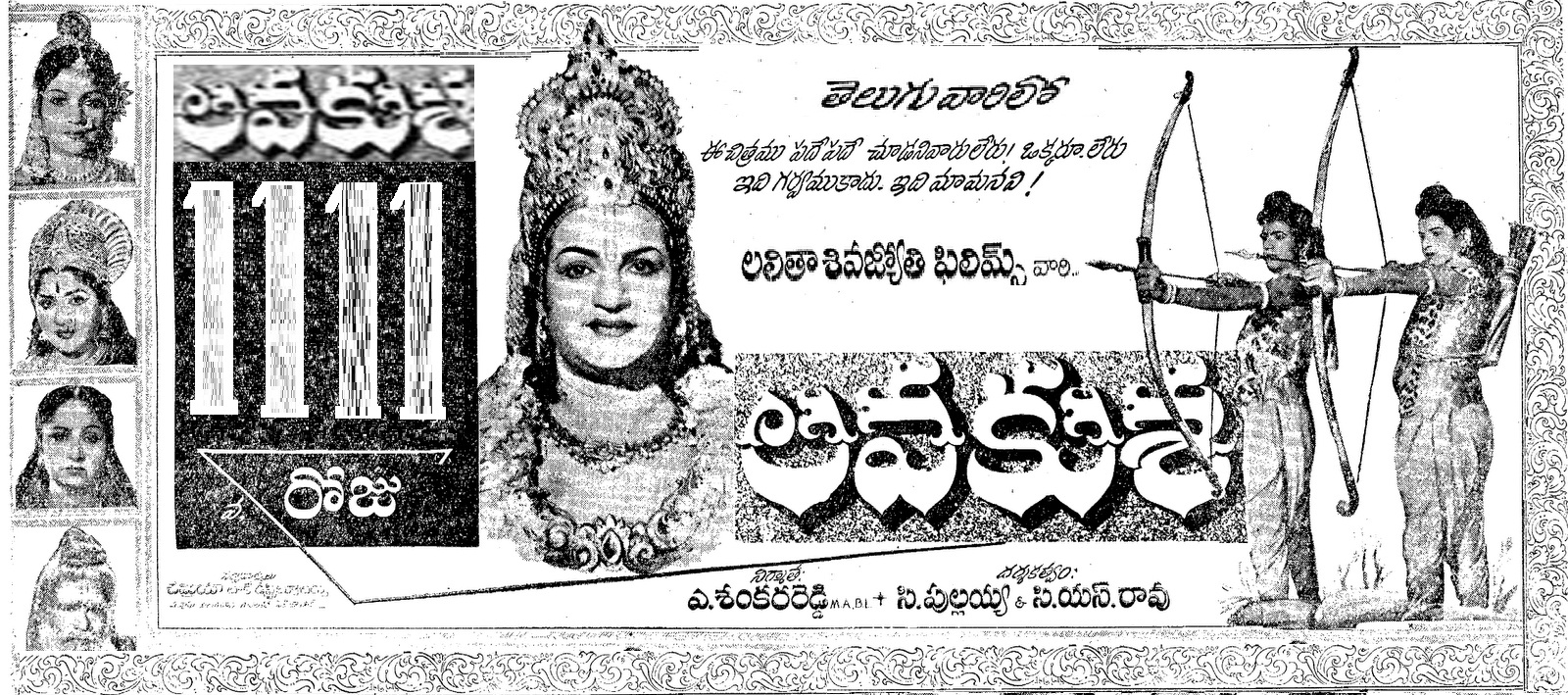
| caption = Theatrical release poster | | caption = Theatrical release poster | ||
| director = [[C. Pullaiah]] | | director = {{ubl|[[C. Pullaiah]]|[[C. S. Rao]]}} | ||
| producer = A. Sankara Reddy | | producer = A. Sankara Reddy | ||
| writer = Sadasivabrahmam (Telugu dialogues) | | writer = {{ubl|Sadasivabrahmam (Telugu dialogues)|A. K. Velan (Tamil dialogues)}} | ||
| screenplay = [[C. Pullaiah]] | | screenplay = {{ubl|[[C. Pullaiah]]|[[C. S. Rao]]}} | ||
| story = | | story = | ||
| based_on = [[Uttararamacarita|Uttara Ramayana]] | | based_on = [[Uttararamacarita|Uttara Ramayana]] | ||
| starring = [[N. T. Rama Rao]] | | starring = {{ubl|[[N. T. Rama Rao]]|[[Anjali Devi]]|[[T. L. Kanta Rao]]}} | ||
| narrator = | | narrator = | ||
| music = [[Ghantasala (singer)|Ghantasala]] | | music = [[Ghantasala (singer)|Ghantasala]] | ||
| Line 24: | Line 24: | ||
| runtime = 208 min | | runtime = 208 min | ||
| country = India | | country = India | ||
| language = Telugu | | language = {{ubl|Telugu|Tamil}} | ||
| budget = | | budget = | ||
| gross = | | gross = | ||
}} | }} | ||
'''''Lava Kusa''''' (also spelled as '''''Lava Kusha''''') is a 1963 Indian [[ | '''''Lava Kusa''''' (also spelled as '''''Lava Kusha''''') is a 1963 Indian [[Hindu mythological film]] directed by [[C. S. Rao]] and his father [[C. Pullaiah]]. The film's script was written by [[Samudrala Raghavacharya]]. The film was produced by Sankara Reddy under Lalita Sivajyothi Films. The film was shot in both [[Telugu language|Telugu]] and [[Tamil language|Tamil]] languages with the same title, but with slight differences in the cast. The film was a remake of 1934 film of same name which was also directed by C. Pullaiah. The story is an adaptation of the [[Uttara Kanda]] from [[Ramayana]]. It revolves around the roles of Lava and Kusa, sons of Rama (N. T. R.) and Seetha (Anjali Devi). The Telugu version stars Kanta Rao, Shoban Babu, S. Varalakshmi, Kaikala Satyanarayana in supporting roles, replaced in that order by M. R. Radha and Manorama in the Tamil counterpart. | ||
Production began in 1958 but was stopped due to financial constraints. When it restarted, [[C. Pullaiah]]'s health was deteriorating, so his son C. S. Rao took over. The soundtrack features 27 songs, with the musical score primarily composed by Ghantasala and KV Mahadevan, and the lyrics by Vempati Sadasiva and Samudrala Raghavacharya (Telugu) and Maruthakasi (Tamil). The Telugu version of ''Lava Kusa'' was released on 29 March 1963, while the Tamil version was released the following month, on 19 April. The former won the [[National Film Award for Best Feature Film in Telugu]] for that year. It was also dubbed in [[Kannada]], and later in [[Hindi]] in 1974. This film was later remade with the title ''[[Sri Rama Rajyam]]'' in 2011. | Production began in 1958 but was stopped due to financial constraints. When it restarted, [[C. Pullaiah]]'s health was deteriorating, so his son C. S. Rao took over. The soundtrack features 27 songs, with the musical score primarily composed by Ghantasala and KV Mahadevan, and the lyrics by Vempati Sadasiva and Samudrala Raghavacharya (Telugu) and Maruthakasi (Tamil). The Telugu version of ''Lava Kusa'' was released on 29 March 1963, while the Tamil version was released the following month, on 19 April. The former won the [[National Film Award for Best Feature Film in Telugu]] for that year. It was also dubbed in [[Kannada]], and later in [[Hindi]] in 1974. This film was later remade with the title ''[[Sri Rama Rajyam]]'' in 2011. | ||
| Line 46: | Line 44: | ||
!Tamil | !Tamil | ||
|- | |- | ||
| [[Lord Rama]] ||! colspan="2" |[[N. T. Rama Rao]] | | [[Lord Rama]] ||! colspan="2" |[[N. T. Rama Rao]] | ||
|- | |- | ||
| [[Goddess Sita]] ||! colspan="2" |[[Anjali Devi]] | | [[Goddess Sita]] ||! colspan="2" |[[Anjali Devi]] | ||
|- | |- | ||
| [[Valmiki]] ||! colspan="2" | [[Chittoor V. Nagaiah]] | | [[Valmiki]] ||! colspan="2" | [[Chittoor V. Nagaiah]] | ||
|- | |- | ||
| [[Lava (Ramayana)|Lava]] ||Master Nagaraju || Master Uma | | [[Lava (Ramayana)|Lava]] ||Master Nagaraju || Master Uma | ||
|- | |- | ||
| [[Kusha (Ramayana)|Kusa]] || Master Subrahmanyam || Master Murali | | [[Kusha (Ramayana)|Kusa]] || Master Subrahmanyam || Master Murali | ||
|- | |- | ||
| [[Lakshmana]] || [[Kanta Rao]] || [[Gemini Ganesan]]<ref name="songbook">{{cite web | url=https://drive.google.com/file/d/0B7JevgDCLbuNZVlzMzNfeTFROFU/view | title=லவகுசா [முழுநீள கேவாகலர்] |trans-title=Lavakusa [Gevacolor Feature] | publisher=Lalitha Sivajothi Films | access-date=19 October 2016 | type=songbook | language=ta | archive-url=https://web.archive.org/web/20170407102224/https://drive.google.com/file/d/0B7JevgDCLbuNZVlzMzNfeTFROFU/view | archive-date=7 April 2017}} [https://archive.org/details/Lavakusa_201610 Alt URL]</ref> | | [[Lakshmana]] || [[Kanta Rao]] || [[Gemini Ganesan]]<ref name="songbook">{{cite web | url=https://drive.google.com/file/d/0B7JevgDCLbuNZVlzMzNfeTFROFU/view | title=லவகுசா [முழுநீள கேவாகலர்] |trans-title=Lavakusa [Gevacolor Feature] | publisher=Lalitha Sivajothi Films | access-date=19 October 2016 | type=songbook | language=ta | archive-url=https://web.archive.org/web/20170407102224/https://drive.google.com/file/d/0B7JevgDCLbuNZVlzMzNfeTFROFU/view | archive-date=7 April 2017}} [https://archive.org/details/Lavakusa_201610 Alt URL]</ref> | ||
|- | |- | ||
| [[Bharata (Ramayana)|Bharata]] ||[[Kaikala Satyanarayana]] || | | [[Bharata (Ramayana)|Bharata]] ||[[Kaikala Satyanarayana]] || | ||
|- | |- | ||
| [[Shatrughna]] ||[[Sobhan Babu]] || | | [[Shatrughna]] ||[[Sobhan Babu]] || | ||
|- | |- | ||
| [[Kausalya]] ||! colspan="2" | [[P. Kannamba]] | | [[Kausalya]] ||! colspan="2" | [[P. Kannamba]] | ||
|- | |- | ||
| [[Shanta]] ||! colspan="2" |Sandhya | | [[Shanta]] ||! colspan="2" |Sandhya | ||
|- | |- | ||
| [[Bhudevi]] || ! colspan="2" |[[S. Varalakshmi]] | | [[Bhudevi]] || ! colspan="2" |[[S. Varalakshmi]] | ||
|- | |- | ||
| [[Anjaneya]] ||Sando Krishna || | | [[Anjaneya]] ||Sando Krishna || | ||
|- | |- | ||
| Valmiki's disciple ||[[Ramana Reddy]] || | | Valmiki's disciple ||[[Ramana Reddy]] || | ||
|- | |- | ||
| Wife of Valmiki's disciple || [[Suryakantam (actress)|Suryakantam]] || | | Wife of Valmiki's disciple || [[Suryakantam (actress)|Suryakantam]] || | ||
|- | |- | ||
| Washerman || [[Relangi Venkata Ramaiah|Relangi]] || [[M. R. Radha]] | | Washerman || [[Relangi Venkata Ramaiah|Relangi]] || [[M. R. Radha]] | ||
|- | |- | ||
| Wife of washerman || [[Girija (actress)|Girija]] || [[Manorama (Tamil actress)|Manorama]] | | Wife of washerman || [[Girija (actress)|Girija]] || [[Manorama (Tamil actress)|Manorama]] | ||
|- | |- | ||
| Dancer (Special appearance) || ! colspan="2" |[[Sukumari]] | | Dancer (Special appearance) || ! colspan="2" |[[Sukumari]] | ||
|- | |- | ||
| ||Sivarama Krishnaiah || | | ||Sivarama Krishnaiah || | ||
|} | |} | ||
== Production == | == Production == | ||
=== Development === | === Development === | ||
A. Sankara Reddy wished to produce a film based on the [[Indian epic poetry|Hindu epic]] ''[[Ramayana]]'' with [[N. T. Rama Rao]] and [[Anjali Devi]] in the lead roles after watching them play the roles of [[Rama]] and [[Sita]] in the song "Murisenu Lokamu" from ''Charanadasi'', the Telugu version of the 1956 Tamil language film ''[[Mathar Kula Manickam]]''. [[C. Pullaiah]], who was planning to remake his 1934 Telugu language directorial ''Lava Kusa'', agreed to direct it for Sankara Reddy's Lalitha Sivajyothi films.<ref name="TH BFP">{{cite | A. Sankara Reddy wished to produce a film based on the [[Indian epic poetry|Hindu epic]] ''[[Ramayana]]'' with [[N. T. Rama Rao]] and [[Anjali Devi]] in the lead roles after watching them play the roles of [[Rama]] and [[Sita]] in the song "Murisenu Lokamu" from ''Charanadasi'', the Telugu version of the 1956 Tamil language film ''[[Mathar Kula Manickam]]''. [[C. Pullaiah]], who was planning to remake his 1934 Telugu language directorial ''Lava Kusa'', agreed to direct it for Sankara Reddy's Lalitha Sivajyothi films.<ref name="TH BFP">{{cite news|url=http://www.thehindu.com/todays-paper/tp-features/tp-fridayreview/LAVA-KUSA-1963/article17032693.ece |title=Lava Kusa (1963) |work=The Hindu |date=13 January 2017 |access-date=18 January 2017 |last=Narasimham |first=M. L. |archive-url=https://web.archive.org/web/20170118065455/http://www.thehindu.com/todays-paper/tp-features/tp-fridayreview/LAVA-KUSA-1963/article17032693.ece |archive-date=18 January 2017}}</ref> The remake, also titled ''Lava Kusa'',<ref name="TH BFP" /> is the first full-length colour film of Telugu cinema.<ref name="TOI 50">{{cite web|url=http://timesofindia.indiatimes.com/entertainment/telugu/movies/news/celebrating-50-years-of-LavaKusa/articleshow/19614981.cms |title=Celebrating 50 years of Lava Kusa |work=The Times of India |date=18 April 2013 |access-date=14 January 2017 |last=Kavirayani |first=Suresh |archive-url=https://web.archive.org/web/20170114065546/http://timesofindia.indiatimes.com/entertainment/telugu/movies/news/celebrating-50-years-of-LavaKusa/articleshow/19614981.cms |archive-date=14 January 2017}}</ref> Writer [[Vempati Sadasivabrahmam]], who worked with Pullaiah for ''Charanadasi'', was chosen to write the remake's script.<ref name="TH BFP" /> During the process, Sadasivabrahmam stayed faithful to the screenplay and the dialogue written for the original by Vallabhajosyula Ramanamurthy and [[Balijepalli Lakshmikantham]] respectively.<ref name="TH BFP" /> | ||
The production costs escalated because of Sankara Reddy's decision to make the film in colour. The film's production commenced in 1958 and got stuck due to lack of funds after completion of one-third of the planned portions.<ref name="TH BFP"/> After five years, Sundarlal Nahata offered to provide funds in lieu of the film's distribution rights and [[B. Nagi Reddy]] provided studio facilities. By then, Pullaiah's health deteriorated and Sankara Reddy approached [[Bommireddy Narasimha Reddy]] to complete the film. Narasimha Reddy advised him to consider Pullaiah's son [[C. S. Rao]].<ref name="TH BFP"/> Rao was reluctant, opining that nothing dramatic was left for him to film. Pullaiah convinced Rao to take up the task, stating that the emotional scenes in Rama’s palace were of equal importance to the story.<ref name="TH BFP"/> | The production costs escalated because of Sankara Reddy's decision to make the film in colour. The film's production commenced in 1958 and got stuck due to lack of funds after completion of one-third of the planned portions.<ref name="TH BFP" /> After five years, Sundarlal Nahata offered to provide funds in lieu of the film's distribution rights and [[B. Nagi Reddy]] provided studio facilities. By then, Pullaiah's health deteriorated and Sankara Reddy approached [[Bommireddy Narasimha Reddy]] to complete the film. Narasimha Reddy advised him to consider Pullaiah's son [[C. S. Rao]].<ref name="TH BFP" /> Rao was reluctant, opining that nothing dramatic was left for him to film. Pullaiah convinced Rao to take up the task, stating that the emotional scenes in Rama’s palace were of equal importance to the story.<ref name="TH BFP" /> | ||
=== Casting === | === Casting === | ||
''Lava Kusa'' was filmed as a bilingual in [[Telugu language|Telugu]] and [[Tamil language|Tamil]] languages with differences in casting.<ref name="TH BFP"/> Anaparthi Nagaraju and Viyyuri Subrahmanyam were cast as [[Lava (Ramayana)|Lava]] and [[Kusha (Ramayana)|Kusa]] respectively in Telugu.<ref name="lavakusa felicit rjy">{{cite | ''Lava Kusa'' was filmed as a bilingual in [[Telugu language|Telugu]] and [[Tamil language|Tamil]] languages with differences in casting.<ref name="TH BFP" /> Anaparthi Nagaraju and Viyyuri Subrahmanyam were cast as [[Lava (Ramayana)|Lava]] and [[Kusha (Ramayana)|Kusa]] respectively in Telugu.<ref name="lavakusa felicit rjy">{{cite news|url=http://www.thehindu.com/news/national/andhra-pradesh/lavakusa-bemoan-fall-in-values/article8434573.ece |title='Lava-Kusa' bemoan fall in values |work=The Hindu |date=5 April 2016 |access-date=14 January 2017 |last=Bhaskar |first=B. V. S. |archive-url=https://web.archive.org/web/20170114062935/http://www.thehindu.com/news/national/andhra-pradesh/lavakusa-bemoan-fall-in-values/article8434573.ece |archive-date=14 January 2017}}</ref> For the Tamil version, they were replaced by Baby Uma and Master Murali.<ref name="TH BFP" /> Subrahmanyam was cast after the makers saw him perform the same character in a play staged in Kakinada. He was a nine year old when the filming began and was 14 when the film released.<ref name="TOI 50" /> Unlike Subrahmanyam, Nagaraju acted in a few films before ''Lava Kusa''; Pullaiah offered him the role after observing his work. Nagaraju was eight years old when the filming began.<ref name="TOI 50" /> | ||
[[Kanta Rao (Telugu actor)|Kanta Rao]] was cast for the role of [[Lakshmana]]. When the actor was being diagnosed for [[eosinophilia]] and became obese, he was offered the role of [[Shatrughna]].<ref name="kantarao">{{cite web |url=http://www.thehindu.com/lf/2005/03/17/stories/2005031703860200.htm |title='Kathula' Kantha Rao on the mark |date=17 March 2005 |access-date=25 January 2017 |last=Subramanyam |first=M. V. |url-status=dead |archive-url=https://web.archive.org/web/20170517072132/http://www.thehindu.com/lf/2005/03/17/stories/2005031703860200.htm |work=[[The Hindu]] |archive-date=17 May 2017}}</ref> Rama Rao insisted Sankara Reddy to let Kanta Rao play Lakshmana,<ref name="kantarao"/> and [[Sobhan Babu]] was signed to play Shatrughna.<ref name="TH BFP"/> [[Kaikala Satyanarayana]], [[Chittor V. Nagaiah]], and Sando Krishna were chosen to play the roles of [[Bharata (Ramayana)|Bharata]], [[Valmiki]], and [[Hanuman|Anjaneya]] respectively.<ref name="TH BFP"/> | [[Kanta Rao (Telugu actor)|Kanta Rao]] was cast for the role of [[Lakshmana]]. When the actor was being diagnosed for [[eosinophilia]] and became obese, he was offered the role of [[Shatrughna]].<ref name="kantarao">{{cite web |url=http://www.thehindu.com/lf/2005/03/17/stories/2005031703860200.htm |title='Kathula' Kantha Rao on the mark |date=17 March 2005 |access-date=25 January 2017 |last=Subramanyam |first=M. V. |url-status=dead |archive-url=https://web.archive.org/web/20170517072132/http://www.thehindu.com/lf/2005/03/17/stories/2005031703860200.htm |work=[[The Hindu]] |archive-date=17 May 2017}}</ref> Rama Rao insisted Sankara Reddy to let Kanta Rao play Lakshmana,<ref name="kantarao" /> and [[Sobhan Babu]] was signed to play Shatrughna.<ref name="TH BFP" /> [[Kaikala Satyanarayana]], [[Chittor V. Nagaiah]], and Sando Krishna were chosen to play the roles of [[Bharata (Ramayana)|Bharata]], [[Valmiki]], and [[Hanuman|Anjaneya]] respectively.<ref name="TH BFP" /> | ||
=== Filming === | === Filming === | ||
{{quote box | {{quote box | ||
| quote = The shooting took place at a big mango orchard near [[Chennai]]. We used to wake up at 4 am and head to the sets. We would be ready with all our make-up on by 7 am. Both of us used to undergo an hour's training everyday. We even had to learn ''viluvidya'' (arrow fighting). I still remember how we used to call our trainer, Sharma master. He painstakingly taught us the art of shooting arrows. | | quote = The shooting took place at a big mango orchard near [[Chennai]]. We used to wake up at 4 am and head to the sets. We would be ready with all our make-up on by 7 am. Both of us used to undergo an hour's training everyday. We even had to learn ''viluvidya'' (arrow fighting). I still remember how we used to call our trainer, Sharma master. He painstakingly taught us the art of shooting arrows. | ||
| source = {{mdash}}Nagaraju, in an interview with ''The Times of India'' in April 2013.<ref name="TOI 50"/> | | source = {{mdash}}Nagaraju, in an interview with ''The Times of India'' in April 2013.<ref name="TOI 50" /> | ||
| align = right | | align = right | ||
| width = 35% | | width = 35% | ||
}} | }} | ||
Pullaiah made Nagaraju and Subrahmanyam undergo training for an hour everyday and memorise the dialogues and lyrics of the songs.<ref name="TOI 50"/> Filming used to begin by 7:00 AM and would go on till 9:00 PM. However, the duo was relieved an hour before to ensure that they could sleep properly.<ref name="TOI 50"/> According to them, Rama Rao and Anjali Devi were "committed to the core".<ref name="lavakusa felicit rjy"/> When none of the crowns designed for him were suitable, Rama Rao used the one he used in ''Charanadasi'' which costed {{INR}}140.<ref name="TH BFP"/> In a particular scene, Nagaraju was supposed to cry and glycerine was used. When it turned out to be ineffective, Anjali Devi slapped him and the scene was filmed. After its completion, she had to console him for almost fifteen minutes.<ref name="TOI 50"/> | Pullaiah made Nagaraju and Subrahmanyam undergo training for an hour everyday and memorise the dialogues and lyrics of the songs.<ref name="TOI 50" /> Filming used to begin by 7:00 AM and would go on till 9:00 PM. However, the duo was relieved an hour before to ensure that they could sleep properly.<ref name="TOI 50" /> According to them, Rama Rao and Anjali Devi were "committed to the core".<ref name="lavakusa felicit rjy" /> When none of the crowns designed for him were suitable, Rama Rao used the one he used in ''Charanadasi'' which costed {{INR}}140.<ref name="TH BFP" /> In a particular scene, Nagaraju was supposed to cry and glycerine was used. When it turned out to be ineffective, Anjali Devi slapped him and the scene was filmed. After its completion, she had to console him for almost fifteen minutes.<ref name="TOI 50" /> | ||
The climax sequences were filmed first, and because of delay in the film's production, the child artistes looked much aged in the earlier portions.<ref name="TOI 50"/> When the scene of Rama embracing his sons was filmed, Pullaiah arranged two small tables and asked Rama Rao to hug Nagaraju and Subrahmanyam, who were standing on them. The duo stated that this incident was an example of Pullaiah's respect towards the lead character and the state of technology in use.<ref name="lavakusa felicit rjy"/> Pullaiah’s associate G. V. R. Seshagiri Rao pointed to him that a pregnant Sita running towards Valmiki would look awkward, and the scene was reshot.<ref name="TH BFP"/> | The climax sequences were filmed first, and because of delay in the film's production, the child artistes looked much aged in the earlier portions.<ref name="TOI 50" /> When the scene of Rama embracing his sons was filmed, Pullaiah arranged two small tables and asked Rama Rao to hug Nagaraju and Subrahmanyam, who were standing on them. The duo stated that this incident was an example of Pullaiah's respect towards the lead character and the state of technology in use.<ref name="lavakusa felicit rjy" /> Pullaiah’s associate G. V. R. Seshagiri Rao pointed to him that a pregnant Sita running towards Valmiki would look awkward, and the scene was reshot.<ref name="TH BFP" /> | ||
== Soundtrack == | == Soundtrack == | ||
| Line 113: | Line 111: | ||
{{Tracklist | {{Tracklist | ||
| headline | | headline = Track list | ||
| extra_column | | extra_column = Singer(s) | ||
| total_length | | total_length = | ||
| title1 | | title1 = Sri Vidyam Jagatam Dhatri (Shlokam) | ||
| lyrics1 = Vempati Sadasiva | | lyrics1 = Vempati Sadasiva | ||
| extra1 | | extra1 = [[Ghantasala Venkateswara Rao]] | ||
| length1 = 01:14 | | length1 = 01:14 | ||
| title2 | | title2 = Saptashva Rathamarudham Prachandam Kashyapatmajam (Shlokam) | ||
| lyrics2 = | | lyrics2 = | ||
| extra2 | | extra2 = Ghantasala Venkateswara Rao | ||
| length2 = 01:29 | | length2 = 01:29 | ||
| title3 | | title3 = Navajyotyo (Poem) | ||
| lyrics3 = | | lyrics3 = | ||
| extra3 | | extra3 = [[Ghantasala (singer)|Ghantasala]] | ||
| length3 = 01:06 | | length3 = 01:06 | ||
| title4 | | title4 = Intaku Bunivachchi Vachiyimpaka Podune | ||
| lyrics4 = Vempati Sadasiva | | lyrics4 = Vempati Sadasiva | ||
| extra4 | | extra4 = Ghantasala Venkateswara Rao | ||
| length4 = 01:21 | | length4 = 01:21 | ||
| title5 | | title5 = Jaya Jaya Rama Srirama | ||
| lyrics5 = [[Samudrala Raghavacharya]] | | lyrics5 = [[Samudrala Raghavacharya]] | ||
| extra5 | | extra5 = [[J. V. Raghavulu]], Sarojini | ||
| length5 = 01:18 | | length5 = 01:18 | ||
| title6 | | title6 = Ramanna Ramudu Kodanda Ramudu | ||
| lyrics6 = Samudrala Raghavacharya | | lyrics6 = Samudrala Raghavacharya | ||
| extra6 | | extra6 = [[P. Susheela]], [[K. Jamuna Rani]] | ||
| length6 = 04:15 | | length6 = 04:15 | ||
| title7 | | title7 = Virise Challani Vennela Marala Eenadu Maa Kannula | ||
| lyrics7 = Samudrala Raghavacharya | | lyrics7 = Samudrala Raghavacharya | ||
| extra7 | | extra7 = S. Janaki | ||
| length7 = 02:50 | | length7 = 02:50 | ||
| title8 | | title8 = Ravanu Ni Samharinchi Raghuramudu (Poem) | ||
| lyrics8 = Samudrala Raghavacharya | | lyrics8 = Samudrala Raghavacharya | ||
| extra8 | | extra8 = Ghantasala Venkateswara Rao | ||
| length8 = 01:21 | | length8 = 01:21 | ||
| title9 | | title9 = Vollanori Maamaa Nee Pillani | ||
| lyrics9 = | | lyrics9 = | ||
| extra9 | | extra9 = Ghantasala Venkateswara Rao, [[Jikki]], J. V. Raghavulu, Swarnalata | ||
| length9 = 03:37 | | length9 = 03:37 | ||
| title10 | | title10 = Ye Mahaniya Sadhvi Jagadeka Pavitrata (Poem) | ||
| lyrics10 = | | lyrics10 = | ||
| extra10 | | extra10 = Ghantasala Venkateswara Rao | ||
| length10 = 01:10 | | length10 = 01:10 | ||
| title11 | | title11 = Ye Nimishaniki Yemi Jaruguno Evaruuhinchedaru | ||
| lyrics11 = | | lyrics11 = Kosaraju | ||
| extra11 | | extra11 = Ghantasala Venkateswara Rao | ||
| length11 = 04:00 | | length11 = 04:00 | ||
| title12 | | title12 = Jagadabhi Ramudu Sriraamude | ||
| lyrics12 = Samudrala Raghavacharya | | lyrics12 = Samudrala Raghavacharya | ||
| extra12 | | extra12 = Ghantasala Venkateswara Rao, P. Leela,P Sheela, Mallik | ||
| length12 = 03:51 | | length12 = 03:51 | ||
| title13 | | title13 = Enduke Naa Meeda Kopam Emite Ni Paritaapam | ||
| lyrics13 = | | lyrics13 = | ||
| extra13 | | extra13 = [[Pithapuram Nageswara Rao]], Swarnalata | ||
| length13 = 02:40 | | length13 = 02:40 | ||
| title14 | | title14 = Ramakathanu Vinarayyaa Ihapara Sukhamulanosage | ||
| lyrics14 = | | lyrics14 = Samudrala Raghavacharya | ||
| extra14 | | extra14 = P. Leela ,P Suseela | ||
| length14 = 04:28 | | length14 = 04:28 | ||
| title15 | | title15 = Vurake Kanniru Nimpa Kaaranam Eemamma | ||
| lyrics15 = Samudrala Raghavacharya | | lyrics15 = Samudrala Raghavacharya | ||
| extra15 | | extra15 = P. Leela, P Leela | ||
| length15 = 03:00 | | length15 = 03:00 | ||
| title16 | | title16 = Vinudu Vinudu Ramayana Gaatha Vinudee Manasara | ||
| lyrics16 = | | lyrics16 = Samudrala Raghavacharya | ||
| extra16 | | extra16 = P. Leela, p suseela | ||
| length16 = 04:14 | | length16 = 04:14 | ||
| title17 | | title17 = Sriraamuni Charitamunu Telipedamamma | ||
| lyrics17 = | | lyrics17 = Samudrala Raghavacharya | ||
| extra17 | | extra17 = P. Leela, P Suseela | ||
| length17 = 05:35 | | length17 = 05:35 | ||
| title18 | | title18 = Sriraghavam Dasharathatmajam Aprameyam | ||
| lyrics18 = | | lyrics18 = | ||
| extra18 | | extra18 = P. Leela, P Susheela | ||
| length18 = 04:07 | | length18 = 04:07 | ||
| title19 | | title19 = Srirama Sugunadhama Jayarama Parandhama | ||
| lyrics19 = Samudrala Raghavacharya | | lyrics19 = Samudrala Raghavacharya | ||
| extra19 | | extra19 = P. Leela, PSussela | ||
| length19 = 03:01 | | length19 = 03:01 | ||
| title20 | | title20 = Sandehinchaku Mammu Raghuramu Premanu Sitamma | ||
| lyrics20 = | | lyrics20 = Kosaraju | ||
| extra20 | | extra20 = Ghantasala Venkateswara Rao | ||
| length20 = 03:07 | | length20 = 03:07 | ||
| title21 | | title21 = Ashwamedha Yagaaniki Jayamu Jayamu Jayamu | ||
| lyrics21 = | | lyrics21 = Samudrala Raghavacharya | ||
| extra21 | | extra21 = Ghantasala Venkateswara Rao, Madhavapeddi, Raghavulu, Rani, Sarojini | ||
| length21 = 03:24 | | length21 = 03:24 | ||
| title22 | | title22 = Savanaashwambu idi Veeramaata yagu Kausalya (Poem) | ||
| lyrics22 = | | lyrics22 = Samudrala Raghavacharya | ||
| extra22 | | extra22 = P. Susheela | ||
| length22 = 01:15 | | length22 = 01:15 | ||
| title23 | | title23 = Hreemkaraasana (Poem) | ||
| lyrics23 = | | lyrics23 = | ||
| extra23 | | extra23 = P. Susheela | ||
| length23 = 01:33 | | length23 = 01:33 | ||
| title24 | | title24 = Leru Kushalavula Saati Sari Veerulu Dharunilo | ||
| lyrics24 = | | lyrics24 = Vempati Sadasiva | ||
| extra24 | | extra24 = P. Leela, P Suseela | ||
| length24 = 02:33 | | length24 = 02:33 | ||
| title25 | | title25 = Stree Balavrudhula Tega | ||
| lyrics25 = | | lyrics25 = Samudrala Raghavacharya | ||
| extra25 | | extra25 = Ghantasala, P. Leela, Suseela | ||
| length25 = 01:18 | | length25 = 01:18 | ||
| title26 | | title26 = Sriraama Parandhamaa Jayarama Parandhama | ||
| lyrics26 = | | lyrics26 = Samudrala Raghavacharya | ||
| extra26 | | extra26 = [[P. Leela]], Jamuna Rani,P Suseela | ||
| length26 = 02:25 | | length26 = 02:25 | ||
| title27 | | title27 = Thandri Pampunanegi | ||
| lyrics27 = | | lyrics27 = Samudrala Raghavacharya | ||
| extra27 | | extra27 = Ghantasala, P. Leela, P Susheela | ||
| length27 = 02:36 | | length27 = 02:36 | ||
| title28 | | title28 = Takkani Balakundani | ||
| lyrics28 = | | lyrics28 = Samudrala Raghavacharya | ||
| extra28 | | extra28 = [[P. Leela]] | ||
| length28 = 00:40 or 02:36 | | length28 = 00:40 or 02:36 | ||
| title29 | | title29 = Rangaru Bangaru | ||
| lyrics29 = | | lyrics29 = Samudrala Raghavacharya | ||
| extra29 | | extra29 = Ghantasala | ||
| length29 = 01:41 | | length29 = 01:41 | ||
| title30 | | title30 = Veyara Debba | ||
| lyrics30 = Samudrala Raghavacharya | | lyrics30 = Samudrala Raghavacharya | ||
| extra30 | | extra30 = Ghantasala & [[Jikki]] | ||
| length30 = 03:17 | | length30 = 03:17 | ||
| title31 | | title31 = Ramaswamy Padambujambulambu | ||
| lyrics31 = | | lyrics31 = | ||
| extra31 | | extra31 = P. Susheela | ||
| length31 = 05:59 | | length31 = 05:59 | ||
| title32 | | title32 = Raajada Rajadharmamada Ramudu | ||
| lyrics32 = | | lyrics32 = | ||
| extra32 | | extra32 = S. Varalakshmi | ||
| length32 = 01:28 | | length32 = 01:28 | ||
| title33 | | title33 = Prathi Dinamenu | ||
| lyrics33 = | | lyrics33 = | ||
| extra33 | | extra33 = Ghantasala | ||
| length33 = 01:24 | | length33 = 01:24 | ||
| title34 | | title34 = Ninu Dattadriki Cherakunda | ||
| lyrics34 = | | lyrics34 = | ||
| extra34 | | extra34 = P. Leela | ||
| length34 = 01:31 | | length34 = 01:31 | ||
| title35 | | title35 = Kannularaga Tudisari | ||
| lyrics35 = | | lyrics35 = | ||
| extra35 | | extra35 = P. Susheela | ||
| length35 = 01:02 | | length35 = 01:02 | ||
| title36 | | title36 = Kadagine Manokkaya | ||
| lyrics36 = | | lyrics36 = | ||
| extra36 | | extra36 = P. Susheela | ||
| length36 = 00:57 | | length36 = 00:57 | ||
| title37 | | title37 = Edhi Mana Ashramambu | ||
| lyrics37 = | | lyrics37 = | ||
| extra37 | | extra37 = Ghantasala | ||
| length37 = 01:35 | | length37 = 01:35 | ||
| title38 | | title38 = Aapavaada Dooshi | ||
| lyrics38 = | | lyrics38 = | ||
| extra38 | | extra38 = P. Susheela | ||
| length38 = 01:54 | | length38 = 01:54 | ||
}} | }} | ||
| Line 346: | Line 344: | ||
| length17 = 05:35 | | length17 = 05:35 | ||
| title18 = Sreeraghavam Dasharathathmajam Aprameyam | | title18 = Sreeraghavam Dasharathathmajam Aprameyam | ||
| lyrics18 = | | lyrics18 = | ||
| extra18 = [[P. Leela]] & [[P. Suseela]] | | extra18 = [[P. Leela]] & [[P. Suseela]] | ||
| length18 = 04:07 | | length18 = 04:07 | ||
| Line 366: | Line 364: | ||
| length22 = 01:15 | | length22 = 01:15 | ||
| title23 = Hreemkaraasana (Poem) | | title23 = Hreemkaraasana (Poem) | ||
| lyrics23 = | | lyrics23 = | ||
| extra23 = P. Susheela | | extra23 = P. Susheela | ||
| length23 = 01:33 | | length23 = 01:33 | ||
| Line 398: | Line 396: | ||
| length30 = 03:17 | | length30 = 03:17 | ||
| title31 = Ramaswamy Padambujambulambu | | title31 = Ramaswamy Padambujambulambu | ||
| lyrics31 = | | lyrics31 = | ||
| extra31 = P. Susheela | | extra31 = P. Susheela | ||
| length31 = 05:59 | | length31 = 05:59 | ||
| title32 = Raajada Rajadharmamada Ramudu | | title32 = Raajada Rajadharmamada Ramudu | ||
| lyrics32 = | | lyrics32 = | ||
| extra32 = S. Varalakshmi | | extra32 = S. Varalakshmi | ||
| length32 = 01:28 | | length32 = 01:28 | ||
| title33 = Prathi Dinamenu | | title33 = Prathi Dinamenu | ||
| lyrics33 = | | lyrics33 = | ||
| extra33 = Ghantasala | | extra33 = Ghantasala | ||
| length33 = 01:24 | | length33 = 01:24 | ||
| title34 = Ninu Dattadriki Cherakunda | | title34 = Ninu Dattadriki Cherakunda | ||
| lyrics34 = | | lyrics34 = | ||
| extra34 = P. Leela | | extra34 = P. Leela | ||
| length34 = 01:31 | | length34 = 01:31 | ||
| title35 = Kannularaga Tudisari | | title35 = Kannularaga Tudisari | ||
| lyrics35 = | | lyrics35 = | ||
| extra35 = P. Susheela | | extra35 = P. Susheela | ||
| length35 = 01:02 | | length35 = 01:02 | ||
| title36 = Kadagine Manokkaya | | title36 = Kadagine Manokkaya | ||
| lyrics36 = | | lyrics36 = | ||
| extra36 = P. Susheela | | extra36 = P. Susheela | ||
| length36 = 00:57 | | length36 = 00:57 | ||
| title37 = Edhi Mana Ashramambu | | title37 = Edhi Mana Ashramambu | ||
| lyrics37 = | | lyrics37 = | ||
| extra37 = Ghantasala | | extra37 = Ghantasala | ||
| length37 = 01:35 | | length37 = 01:35 | ||
| title38 = Aapavaada Dooshi | | title38 = Aapavaada Dooshi | ||
| lyrics38 = | | lyrics38 = | ||
| extra38 = P. Susheela | | extra38 = P. Susheela | ||
| length38 = 01:54 | | length38 = 01:54 | ||
| Line 432: | Line 430: | ||
== Box-office and Impact == | == Box-office and Impact == | ||
The film ran for 75 weeks uninterruptedly. This is an unbroken record.<ref name="idle" /><ref name="ReferenceA">{{cite web|url=http://www.indiaglitz.com/lava-kusha-completes-50-years-telugu-news-92266.html|title=Telugu Cinema News | The film ran for 75 weeks uninterruptedly. This is an unbroken record.<ref name="idle" /><ref name="ReferenceA">{{cite web|url=http://www.indiaglitz.com/lava-kusha-completes-50-years-telugu-news-92266.html|title=Telugu Cinema News – Telugu Movie Reviews – Telugu Movie Trailers – IndiaGlitz Telugu|website=IndiaGlitz.com}}</ref> It was released in 26 centres and had a 100-day run in all the centers, which was a record and ran 150 days in all those centers and 175-day run in 18 centres. Due to the huge demand for the film from other centres in Andhra Pradesh, most prints had to be shifted to other centres. It had run for 100 days in 62 centres and 175-day run in 18 centres, grossing more than 1 crore.<ref>{{cite web|url=http://www.telugucineblitz.blogspot.in/2010/03/lava-kusha-1963.html|title=Lava Kusa (1963)|website=www.telugucineblitz.blogspot.in}}</ref><ref>{{cite web|url=http://timesofindia.indiatimes.com/entertainment/telugu/movies/news/celebrating-50-years-of-LavaKusa/articleshow/19614981.cms|title=celebrating 50 years of LavaKusa – Times of India}}</ref> It ran over 1111 days <ref>https://nataratnakalamandir.files.wordpress.com/2015/01/lava-kusa-1963-ntr-anjali-devi-telugucinemasongs-lyrics-copy.jpg</ref> | ||
== Awards == | == Awards == | ||
| Line 441: | Line 439: | ||
''Lava Kusa'' is considered a classic of Telugu cinema. In January 2007, M. L. Narasimham of ''The Hindu'' listed ''Lava Kusa'' with ''[[Mala Pilla]]'' (1938), ''[[Raithu Bidda]]'' (1939), ''[[Vara Vikrayam (film)|Vara Vikrayam]]'' (1939), ''[[Bhakta Potana]]'' (1942), ''[[Shavukaru]]'' (1950), ''[[Malliswari (1951 film)|Malliswari]]'' (1951), ''[[Peddamanushulu]]'' (1954), and ''[[Mayabazar]]'' (1955) as films impacting society and Telugu cinema.<ref>{{cite web|url=http://www.thehindu.com/todays-paper/tp-features/tp-fridayreview/reliving-the-reel-and-the-real/article2271205.ece |title=Reliving the reel and the real |work=The Hindu |date=19 January 2007 |access-date=18 October 2015 |first=M. L. |last=Narasimham |archive-url=https://web.archive.org/web/20150204141847/http://www.thehindu.com/todays-paper/tp-features/tp-fridayreview/reliving-the-reel-and-the-real/article2271205.ece |archive-date= 4 February 2015 |url-status=dead }}</ref> Rama Rao reprised the role of Rama in a number of films over a two-decade career.{{efn|Rama Rao reprised the role of Rama in various unrelated films such as ''[[Sampoorna Ramayanam (1958 film)|Sampoorna Ramayanam]]'' (1958), ''[[Sri Ramanjaneya Yuddham]]'' (1975) and ''[[Sri Rama Pattabhishekam]]'' (1978)<ref name="idle">{{cite web|url=http://www.idlebrain.com/celeb/starow/sow-ntr.html |title=Telugu cinema celebrity — Nandamuri Taraka Rama Rao |publisher=Idlebrain |access-date=18 October 2015 |url-status=dead |archive-url=https://web.archive.org/web/20160414015815/http://www.idlebrain.com/celeb/starow/sow-ntr.html |archive-date=14 April 2016 }}</ref>}} | ''Lava Kusa'' is considered a classic of Telugu cinema. In January 2007, M. L. Narasimham of ''The Hindu'' listed ''Lava Kusa'' with ''[[Mala Pilla]]'' (1938), ''[[Raithu Bidda]]'' (1939), ''[[Vara Vikrayam (film)|Vara Vikrayam]]'' (1939), ''[[Bhakta Potana]]'' (1942), ''[[Shavukaru]]'' (1950), ''[[Malliswari (1951 film)|Malliswari]]'' (1951), ''[[Peddamanushulu]]'' (1954), and ''[[Mayabazar]]'' (1955) as films impacting society and Telugu cinema.<ref>{{cite web|url=http://www.thehindu.com/todays-paper/tp-features/tp-fridayreview/reliving-the-reel-and-the-real/article2271205.ece |title=Reliving the reel and the real |work=The Hindu |date=19 January 2007 |access-date=18 October 2015 |first=M. L. |last=Narasimham |archive-url=https://web.archive.org/web/20150204141847/http://www.thehindu.com/todays-paper/tp-features/tp-fridayreview/reliving-the-reel-and-the-real/article2271205.ece |archive-date= 4 February 2015 |url-status=dead }}</ref> Rama Rao reprised the role of Rama in a number of films over a two-decade career.{{efn|Rama Rao reprised the role of Rama in various unrelated films such as ''[[Sampoorna Ramayanam (1958 film)|Sampoorna Ramayanam]]'' (1958), ''[[Sri Ramanjaneya Yuddham]]'' (1975) and ''[[Sri Rama Pattabhishekam]]'' (1978)<ref name="idle">{{cite web|url=http://www.idlebrain.com/celeb/starow/sow-ntr.html |title=Telugu cinema celebrity — Nandamuri Taraka Rama Rao |publisher=Idlebrain |access-date=18 October 2015 |url-status=dead |archive-url=https://web.archive.org/web/20160414015815/http://www.idlebrain.com/celeb/starow/sow-ntr.html |archive-date=14 April 2016 }}</ref>}} | ||
During a programme ''Telugu Cinema Prasthanam'' organised by the film society of Visakhapatnam, writer include actor Ravi Kondala Rao placed ''Lava Kusa'' among other cult films like ''[[Raja Harishchandra]]'' (1913), ''[[Bhakta Prahlada (1932 film)|Bhakta Prahlada]]'' (1932), ''Mala Pilla (1938)'', ''[[Devadasu (1953 film)|Devadasu]]'' (1953), and ''[[Pathala Bhairavi]]'' during a speech on the role of Telugu cinema in the hundred years of Indian cinema.<ref>{{cite news|url=http://www.thehindu.com/todays-paper/tp-in-school/call-to-promote-good-cinema/article4263409.ece |title=Call to promote good cinema |newspaper=The Hindu |date=2 January 2013 |access-date=28 May 2015 |archive-url=https://web.archive.org/web/20150528122347/http://www.thehindu.com/todays-paper/tp-in-school/call-to-promote-good-cinema/article4263409.ece |archive-date=28 May 2015 |url-status=dead }}</ref> Bapu used ''Lava Kusa''{{'s}} storyline in his 2011 film, ''[[Sri Rama Rajyam]]''.<ref name="sify">{{cite web | url=http://www.sify.com/movies/bapus-lava-kusa-with-balakrishna-news-telugu-kkgu9riibhdsi.html | archive-url=https://web.archive.org/web/20150612150148/http://www.sify.com/movies/bapus-lava-kusa-with-balakrishna-news-telugu-kkgu9riibhdsi.html | url-status=dead | archive-date=12 June 2015 | title=Bapu's Lava Kusa with Balakrishna | publisher=Sify | access-date=18 October 2015}}</ref> Debutant Jaya Sreesivan named his 2015 comedy film as ''Lava Kusa'' which had no similarity with the film.<ref>{{cite web | url=http://www.123telugu.com/reviews/lava-kusa-telugu-movie-review.html | title=Lava Kusa Telugu Movie Review | publisher=123 Telugu | access-date=18 October 2015}}</ref> | During a programme ''Telugu Cinema Prasthanam'' organised by the film society of Visakhapatnam, writer include actor Ravi Kondala Rao placed ''Lava Kusa'' among other cult films like ''[[Raja Harishchandra]]'' (1913), ''[[Bhakta Prahlada (1932 film)|Bhakta Prahlada]]'' (1932), ''Mala Pilla (1938)'', ''[[Devadasu (1953 film)|Devadasu]]'' (1953), and ''[[Pathala Bhairavi]]'' during a speech on the role of Telugu cinema in the hundred years of Indian cinema.<ref>{{cite news|url=http://www.thehindu.com/todays-paper/tp-in-school/call-to-promote-good-cinema/article4263409.ece |title=Call to promote good cinema |newspaper=The Hindu |date=2 January 2013 |access-date=28 May 2015 |archive-url=https://web.archive.org/web/20150528122347/http://www.thehindu.com/todays-paper/tp-in-school/call-to-promote-good-cinema/article4263409.ece |archive-date=28 May 2015 |url-status=dead }}</ref> Bapu used ''Lava Kusa''{{'s}} storyline in his 2011 film, ''[[Sri Rama Rajyam]]''.<ref name="sify">{{cite web | url=http://www.sify.com/movies/bapus-lava-kusa-with-balakrishna-news-telugu-kkgu9riibhdsi.html | archive-url=https://web.archive.org/web/20150612150148/http://www.sify.com/movies/bapus-lava-kusa-with-balakrishna-news-telugu-kkgu9riibhdsi.html | url-status=dead | archive-date=12 June 2015 | title=Bapu's Lava Kusa with Balakrishna | publisher=Sify | access-date=18 October 2015}}</ref> Debutant Jaya Sreesivan named his 2015 comedy film as ''Lava Kusa'' which had no similarity with the film.<ref>{{cite web | url=http://www.123telugu.com/reviews/lava-kusa-telugu-movie-review.html | title=Lava Kusa Telugu Movie Review | date=13 June 2015 | publisher=123 Telugu | access-date=18 October 2015}}</ref> | ||
== Notes == | == Notes == | ||
| Line 455: | Line 453: | ||
{{Films based on the Ramayana}} | {{Films based on the Ramayana}} | ||
[[Category: | [[Category:1960s multilingual films]] | ||
[[Category:Tamil-language films]] | [[Category:1960s Tamil-language films]] | ||
[[Category: | [[Category:1960s Telugu-language films]] | ||
[[Category:1963 films]] | [[Category:1963 films]] | ||
[[Category: | [[Category:Best Telugu Feature Film National Film Award winners]] | ||
[[Category:Films based on the Ramayana]] | [[Category:Films based on the Ramayana]] | ||
[[Category:Films directed by C. Pullaiah]] | |||
[[Category:Films directed by C. S. Rao]] | |||
[[Category:Films scored by Ghantasala]] | [[Category:Films scored by Ghantasala]] | ||
[[Category:Films scored by K. V. Mahadevan]] | [[Category:Films scored by K. V. Mahadevan]] | ||
[[Category: | [[Category:Hindu mythological films]] | ||
[[Category: | [[Category:Indian epic films]] | ||
[[Category: | [[Category:Indian films]] | ||
[[Category: | [[Category:Indian multilingual films]] | ||
[[Category: | [[Category:Tamil-language films]] | ||
[[Category:Telugu-language films]] | |||
Revision as of 13:48, 26 August 2021
| Lava Kusa | |
|---|---|
 Theatrical release poster | |
| Directed by | |
| Written by |
|
| Screenplay by | |
| Based on | Uttara Ramayana |
| Produced by | A. Sankara Reddy |
| Starring | |
| Cinematography | P. L. Rai |
| Edited by | A. Sanjeevi |
| Music by | Ghantasala |
Production company | Lalita Sivajyoti Films |
Release date |
|
Running time | 208 min |
| Country | India |
| Languages |
|
Lava Kusa (also spelled as Lava Kusha) is a 1963 Indian Hindu mythological film directed by C. S. Rao and his father C. Pullaiah. The film's script was written by Samudrala Raghavacharya. The film was produced by Sankara Reddy under Lalita Sivajyothi Films. The film was shot in both Telugu and Tamil languages with the same title, but with slight differences in the cast. The film was a remake of 1934 film of same name which was also directed by C. Pullaiah. The story is an adaptation of the Uttara Kanda from Ramayana. It revolves around the roles of Lava and Kusa, sons of Rama (N. T. R.) and Seetha (Anjali Devi). The Telugu version stars Kanta Rao, Shoban Babu, S. Varalakshmi, Kaikala Satyanarayana in supporting roles, replaced in that order by M. R. Radha and Manorama in the Tamil counterpart.
Production began in 1958 but was stopped due to financial constraints. When it restarted, C. Pullaiah's health was deteriorating, so his son C. S. Rao took over. The soundtrack features 27 songs, with the musical score primarily composed by Ghantasala and KV Mahadevan, and the lyrics by Vempati Sadasiva and Samudrala Raghavacharya (Telugu) and Maruthakasi (Tamil). The Telugu version of Lava Kusa was released on 29 March 1963, while the Tamil version was released the following month, on 19 April. The former won the National Film Award for Best Feature Film in Telugu for that year. It was also dubbed in Kannada, and later in Hindi in 1974. This film was later remade with the title Sri Rama Rajyam in 2011.
Plot
This movie is based on Uttara Kanda which is the later part of Ramayana written by Valmiki Maharshi. It depicts the lives of Lava and Kusa, the sons of Sita and Rama. The story depicts Sri Rama Pattabhishekam and the brief period of Rama Rajyam, Rama sending Seeta exile on hearing the accusations of a washerman, Birth of Lava and Kusa, their visit to Ayodhya, Ashwamedha Yagna and conflict between Rama and his sons and Pattabhishekam of Lava and Kusa and Rama finally ending his Avatar.
Cast
| Character | Actors in Language | |
|---|---|---|
| Telugu | Tamil | |
| Lord Rama | N. T. Rama Rao | |
| Goddess Sita | Anjali Devi | |
| Valmiki | Chittoor V. Nagaiah | |
| Lava | Master Nagaraju | Master Uma |
| Kusa | Master Subrahmanyam | Master Murali |
| Lakshmana | Kanta Rao | Gemini Ganesan[1] |
| Bharata | Kaikala Satyanarayana | |
| Shatrughna | Sobhan Babu | |
| Kausalya | P. Kannamba | |
| Shanta | Sandhya | |
| Bhudevi | S. Varalakshmi | |
| Anjaneya | Sando Krishna | |
| Valmiki's disciple | Ramana Reddy | |
| Wife of Valmiki's disciple | Suryakantam | |
| Washerman | Relangi | M. R. Radha |
| Wife of washerman | Girija | Manorama |
| Dancer (Special appearance) | Sukumari | |
| Sivarama Krishnaiah | ||
Production
Development
A. Sankara Reddy wished to produce a film based on the Hindu epic Ramayana with N. T. Rama Rao and Anjali Devi in the lead roles after watching them play the roles of Rama and Sita in the song "Murisenu Lokamu" from Charanadasi, the Telugu version of the 1956 Tamil language film Mathar Kula Manickam. C. Pullaiah, who was planning to remake his 1934 Telugu language directorial Lava Kusa, agreed to direct it for Sankara Reddy's Lalitha Sivajyothi films.[2] The remake, also titled Lava Kusa,[2] is the first full-length colour film of Telugu cinema.[3] Writer Vempati Sadasivabrahmam, who worked with Pullaiah for Charanadasi, was chosen to write the remake's script.[2] During the process, Sadasivabrahmam stayed faithful to the screenplay and the dialogue written for the original by Vallabhajosyula Ramanamurthy and Balijepalli Lakshmikantham respectively.[2]
The production costs escalated because of Sankara Reddy's decision to make the film in colour. The film's production commenced in 1958 and got stuck due to lack of funds after completion of one-third of the planned portions.[2] After five years, Sundarlal Nahata offered to provide funds in lieu of the film's distribution rights and B. Nagi Reddy provided studio facilities. By then, Pullaiah's health deteriorated and Sankara Reddy approached Bommireddy Narasimha Reddy to complete the film. Narasimha Reddy advised him to consider Pullaiah's son C. S. Rao.[2] Rao was reluctant, opining that nothing dramatic was left for him to film. Pullaiah convinced Rao to take up the task, stating that the emotional scenes in Rama’s palace were of equal importance to the story.[2]
Casting
Lava Kusa was filmed as a bilingual in Telugu and Tamil languages with differences in casting.[2] Anaparthi Nagaraju and Viyyuri Subrahmanyam were cast as Lava and Kusa respectively in Telugu.[4] For the Tamil version, they were replaced by Baby Uma and Master Murali.[2] Subrahmanyam was cast after the makers saw him perform the same character in a play staged in Kakinada. He was a nine year old when the filming began and was 14 when the film released.[3] Unlike Subrahmanyam, Nagaraju acted in a few films before Lava Kusa; Pullaiah offered him the role after observing his work. Nagaraju was eight years old when the filming began.[3]
Kanta Rao was cast for the role of Lakshmana. When the actor was being diagnosed for eosinophilia and became obese, he was offered the role of Shatrughna.[5] Rama Rao insisted Sankara Reddy to let Kanta Rao play Lakshmana,[5] and Sobhan Babu was signed to play Shatrughna.[2] Kaikala Satyanarayana, Chittor V. Nagaiah, and Sando Krishna were chosen to play the roles of Bharata, Valmiki, and Anjaneya respectively.[2]
Filming
—Nagaraju, in an interview with The Times of India in April 2013.[3]
Pullaiah made Nagaraju and Subrahmanyam undergo training for an hour everyday and memorise the dialogues and lyrics of the songs.[3] Filming used to begin by 7:00 AM and would go on till 9:00 PM. However, the duo was relieved an hour before to ensure that they could sleep properly.[3] According to them, Rama Rao and Anjali Devi were "committed to the core".[4] When none of the crowns designed for him were suitable, Rama Rao used the one he used in Charanadasi which costed ₹140.[2] In a particular scene, Nagaraju was supposed to cry and glycerine was used. When it turned out to be ineffective, Anjali Devi slapped him and the scene was filmed. After its completion, she had to console him for almost fifteen minutes.[3]
The climax sequences were filmed first, and because of delay in the film's production, the child artistes looked much aged in the earlier portions.[3] When the scene of Rama embracing his sons was filmed, Pullaiah arranged two small tables and asked Rama Rao to hug Nagaraju and Subrahmanyam, who were standing on them. The duo stated that this incident was an example of Pullaiah's respect towards the lead character and the state of technology in use.[4] Pullaiah’s associate G. V. R. Seshagiri Rao pointed to him that a pregnant Sita running towards Valmiki would look awkward, and the scene was reshot.[2]
Soundtrack
Telugu songs
Soundtrack was composed by Ghantasala and lyrics by Vempati Sadasivabrahmam, Samudrala Raghavacharya & Kosaraju Raghavaiah.[6]
All the tunes for all the songs for both languages are the same. The film has 37 songs and Poems (Padyam), many are very popular and memorable.
| Track list | |||||||||
|---|---|---|---|---|---|---|---|---|---|
| No. | Title | Singer(s) | Length | ||||||
| 1. | "Sri Vidyam Jagatam Dhatri (Shlokam)" | Ghantasala Venkateswara Rao | 01:14 | ||||||
| 2. | "Saptashva Rathamarudham Prachandam Kashyapatmajam (Shlokam)" | Ghantasala Venkateswara Rao | 01:29 | ||||||
| 3. | "Navajyotyo (Poem)" | Ghantasala | 01:06 | ||||||
| 4. | "Intaku Bunivachchi Vachiyimpaka Podune" | Ghantasala Venkateswara Rao | 01:21 | ||||||
| 5. | "Jaya Jaya Rama Srirama" | J. V. Raghavulu, Sarojini | 01:18 | ||||||
| 6. | "Ramanna Ramudu Kodanda Ramudu" | P. Susheela, K. Jamuna Rani | 04:15 | ||||||
| 7. | "Virise Challani Vennela Marala Eenadu Maa Kannula" | S. Janaki | 02:50 | ||||||
| 8. | "Ravanu Ni Samharinchi Raghuramudu (Poem)" | Ghantasala Venkateswara Rao | 01:21 | ||||||
| 9. | "Vollanori Maamaa Nee Pillani" | Ghantasala Venkateswara Rao, Jikki, J. V. Raghavulu, Swarnalata | 03:37 | ||||||
| 10. | "Ye Mahaniya Sadhvi Jagadeka Pavitrata (Poem)" | Ghantasala Venkateswara Rao | 01:10 | ||||||
| 11. | "Ye Nimishaniki Yemi Jaruguno Evaruuhinchedaru" | Ghantasala Venkateswara Rao | 04:00 | ||||||
| 12. | "Jagadabhi Ramudu Sriraamude" | Ghantasala Venkateswara Rao, P. Leela,P Sheela, Mallik | 03:51 | ||||||
| 13. | "Enduke Naa Meeda Kopam Emite Ni Paritaapam" | Pithapuram Nageswara Rao, Swarnalata | 02:40 | ||||||
| 14. | "Ramakathanu Vinarayyaa Ihapara Sukhamulanosage" | P. Leela ,P Suseela | 04:28 | ||||||
| 15. | "Vurake Kanniru Nimpa Kaaranam Eemamma" | P. Leela, P Leela | 03:00 | ||||||
| 16. | "Vinudu Vinudu Ramayana Gaatha Vinudee Manasara" | P. Leela, p suseela | 04:14 | ||||||
| 17. | "Sriraamuni Charitamunu Telipedamamma" | P. Leela, P Suseela | 05:35 | ||||||
| 18. | "Sriraghavam Dasharathatmajam Aprameyam" | P. Leela, P Susheela | 04:07 | ||||||
| 19. | "Srirama Sugunadhama Jayarama Parandhama" | P. Leela, PSussela | 03:01 | ||||||
| 20. | "Sandehinchaku Mammu Raghuramu Premanu Sitamma" | Ghantasala Venkateswara Rao | 03:07 | ||||||
| 21. | "Ashwamedha Yagaaniki Jayamu Jayamu Jayamu" | Ghantasala Venkateswara Rao, Madhavapeddi, Raghavulu, Rani, Sarojini | 03:24 | ||||||
| 22. | "Savanaashwambu idi Veeramaata yagu Kausalya (Poem)" | P. Susheela | 01:15 | ||||||
| 23. | "Hreemkaraasana (Poem)" | P. Susheela | 01:33 | ||||||
| 24. | "Leru Kushalavula Saati Sari Veerulu Dharunilo" | P. Leela, P Suseela | 02:33 | ||||||
| 25. | "Stree Balavrudhula Tega" | Ghantasala, P. Leela, Suseela | 01:18 | ||||||
| 26. | "Sriraama Parandhamaa Jayarama Parandhama" | P. Leela, Jamuna Rani,P Suseela | 02:25 | ||||||
| 27. | "Thandri Pampunanegi" | Ghantasala, P. Leela, P Susheela | 02:36 | ||||||
| 28. | "Takkani Balakundani" | P. Leela | 00:40 or 02:36 | ||||||
| 29. | "Rangaru Bangaru" | Ghantasala | 01:41 | ||||||
| 30. | "Veyara Debba" | Ghantasala & Jikki | 03:17 | ||||||
| 31. | "Ramaswamy Padambujambulambu" | P. Susheela | 05:59 | ||||||
| 32. | "Raajada Rajadharmamada Ramudu" | S. Varalakshmi | 01:28 | ||||||
| 33. | "Prathi Dinamenu" | Ghantasala | 01:24 | ||||||
| 34. | "Ninu Dattadriki Cherakunda" | P. Leela | 01:31 | ||||||
| 35. | "Kannularaga Tudisari" | P. Susheela | 01:02 | ||||||
| 36. | "Kadagine Manokkaya" | P. Susheela | 00:57 | ||||||
| 37. | "Edhi Mana Ashramambu" | Ghantasala | 01:35 | ||||||
| 38. | "Aapavaada Dooshi" | P. Susheela | 01:54 | ||||||
Tamil songs
Soundtrack was composed by K. V. Mahadevan and Ghantasala and lyrics by A. Maruthakasi.[7]
| Track list | |||||||||
|---|---|---|---|---|---|---|---|---|---|
| No. | Title | Singer(s) | Length | ||||||
| 1. | "Sri Vidyam Jagatam Dhatri (Shlokam)" | Ghantasala | 01:14 | ||||||
| 2. | "Saptashva Rathamarudham Prachandam Kashyapatmajam (Shlokam)" | Ghantasala | |||||||
| 3. | "Navajyotyo (Poem)" | Ghantasala | 01:06 | ||||||
| 4. | "Intaku Bunivachchi Vachiyimpaka Podune" | Ghantasala Venkateswara Rao | |||||||
| 5. | "Jaya Jaya Raamaa Sree Raama" | J. V. Raghavulu & Udutha Sarojini | 01:18 | ||||||
| 6. | "Ramanna Ramudu Kodanda Ramudu" | P. Susheela, Jamuna Rani | |||||||
| 7. | "Udhayam Aaanadhe Vennilaa" | S. Janaki | 02:18 | ||||||
| 8. | "Ilangaiyar Kon Thanai Azhitthu" | Ghantasala | 01:21 | ||||||
| 9. | "Vollanori Maamaa Nee Pillani" | Ghantasala Venkateswara Rao, Jikki, J. V. Raghavulu, Swarnalata | 03:37 | ||||||
| 10. | "Ye Mahaniya Sadhvi Jagadeka Pavitrata (Poem)" | Ghantasala Venkateswara Rao | 01:10 | ||||||
| 11. | "Indrum Illai Andrum Illai Endrume Illai" | T. M. Soundararajan | 04:00 | ||||||
| 12. | "Thiruvalar Naayagan Sree Raamane" | Ghantasala, P. Leela, P. Suseela & K. Rani | 03:01 | ||||||
| 13. | "Thappu Thappunu Thuniyai Thuvaichu" | Thiruchi Loganathan & L. R. Eswari | 03:17 | ||||||
| 14. | "Jagam Pugazhum Punniya Kadhai 1" | P. Leela & P. Suseela | 03:50 | ||||||
| 15. | "Maari Pol Kanneer Sindha" | P. Leela & P. Suseela | 01:52 | ||||||
| 16. | "Jagam Pugazhum Punniya Kadhai 2" | P. Leela & P. Suseela | 03:15 | ||||||
| 17. | "Jagam Pugazhum Punniya Kadhai 3" | P. Leela & P. Suseela | 05:35 | ||||||
| 18. | "Sreeraghavam Dasharathathmajam Aprameyam" | P. Leela & P. Suseela | 04:07 | ||||||
| 19. | "Raama Suguna Seelaa" | P. Leela & P. Suseela | 03:01 | ||||||
| 20. | "Sandhegam Ennamma" | Ghantasala | 03:07 | ||||||
| 21. | "Vetri Murasu Olikka Seiyyum Aswamedha Yaagaam" | V. N. Sundharam & K. Rani | 03:24 | ||||||
| 22. | "Veera Maadhaa Kausalyaa Dhevi Petra" | P. Suseela | 01:15 | ||||||
| 23. | "Hreemkaraasana (Poem)" | P. Susheela | 01:33 | ||||||
| 24. | "Eedu Inai Namakku Edhu Indha Boomiyil" | P. Leela & P. Suseela | 02:33 | ||||||
| 25. | "Stree Balavrudhula Tega" | Ghantasala, P. Susheela, P. Leela | |||||||
| 26. | "Sriraama Parandhamaa Jayarama Parandhama" | A. P. Komala, K. Rani & J. V. Raghavulu | 02:25 | ||||||
| 27. | "Thandri Pampunanegi" | Ghantasala, P. Susheela, P. Leela | 02:36 | ||||||
| 28. | "Takkani Balakundani" | P. Leela | 00:40 | ||||||
| 29. | "Ponggum Olimayame" | Seerkazhi Govindarajan | 01:41 or 03:01 | ||||||
| 30. | "Thappu Thappunu Thuniyai Thuvaichu" | Thiruchi Loganathan & L. R. Eswari | 03:17 | ||||||
| 31. | "Ramaswamy Padambujambulambu" | P. Susheela | 05:59 | ||||||
| 32. | "Raajada Rajadharmamada Ramudu" | S. Varalakshmi | 01:28 | ||||||
| 33. | "Prathi Dinamenu" | Ghantasala | 01:24 | ||||||
| 34. | "Ninu Dattadriki Cherakunda" | P. Leela | 01:31 | ||||||
| 35. | "Kannularaga Tudisari" | P. Susheela | 01:02 | ||||||
| 36. | "Kadagine Manokkaya" | P. Susheela | 00:57 | ||||||
| 37. | "Edhi Mana Ashramambu" | Ghantasala | 01:35 | ||||||
| 38. | "Aapavaada Dooshi" | P. Susheela | 01:54 | ||||||
Box-office and Impact
The film ran for 75 weeks uninterruptedly. This is an unbroken record.[8][9] It was released in 26 centres and had a 100-day run in all the centers, which was a record and ran 150 days in all those centers and 175-day run in 18 centres. Due to the huge demand for the film from other centres in Andhra Pradesh, most prints had to be shifted to other centres. It had run for 100 days in 62 centres and 175-day run in 18 centres, grossing more than 1 crore.[10][11] It ran over 1111 days [12]
Awards
- National Film Award for Best Feature Film in Telugu[13]
- Rashtrapati Award- best acting N. T. Rama Rao, Anjali Devi, and Tadepalli Lakshmi Kanta Rao.[14]
Legacy
Lava Kusa is considered a classic of Telugu cinema. In January 2007, M. L. Narasimham of The Hindu listed Lava Kusa with Mala Pilla (1938), Raithu Bidda (1939), Vara Vikrayam (1939), Bhakta Potana (1942), Shavukaru (1950), Malliswari (1951), Peddamanushulu (1954), and Mayabazar (1955) as films impacting society and Telugu cinema.[15] Rama Rao reprised the role of Rama in a number of films over a two-decade career.[lower-alpha 1]
During a programme Telugu Cinema Prasthanam organised by the film society of Visakhapatnam, writer include actor Ravi Kondala Rao placed Lava Kusa among other cult films like Raja Harishchandra (1913), Bhakta Prahlada (1932), Mala Pilla (1938), Devadasu (1953), and Pathala Bhairavi during a speech on the role of Telugu cinema in the hundred years of Indian cinema.[16] Bapu used Lava Kusa's storyline in his 2011 film, Sri Rama Rajyam.[17] Debutant Jaya Sreesivan named his 2015 comedy film as Lava Kusa which had no similarity with the film.[18]
Notes
- ↑ Rama Rao reprised the role of Rama in various unrelated films such as Sampoorna Ramayanam (1958), Sri Ramanjaneya Yuddham (1975) and Sri Rama Pattabhishekam (1978)[8]
References
- ↑ "லவகுசா [முழுநீள கேவாகலர்]" [Lavakusa [Gevacolor Feature]] (songbook) (in தமிழ்). Lalitha Sivajothi Films. Archived from the original on 7 April 2017. Retrieved 19 October 2016. Alt URL
- ↑ 2.00 2.01 2.02 2.03 2.04 2.05 2.06 2.07 2.08 2.09 2.10 2.11 2.12 Narasimham, M. L. (13 January 2017). "Lava Kusa (1963)". The Hindu. Archived from the original on 18 January 2017. Retrieved 18 January 2017.
- ↑ 3.0 3.1 3.2 3.3 3.4 3.5 3.6 3.7 Kavirayani, Suresh (18 April 2013). "Celebrating 50 years of Lava Kusa". The Times of India. Archived from the original on 14 January 2017. Retrieved 14 January 2017.
- ↑ 4.0 4.1 4.2 Bhaskar, B. V. S. (5 April 2016). "'Lava-Kusa' bemoan fall in values". The Hindu. Archived from the original on 14 January 2017. Retrieved 14 January 2017.
- ↑ 5.0 5.1 Subramanyam, M. V. (17 March 2005). "'Kathula' Kantha Rao on the mark". The Hindu. Archived from the original on 17 May 2017. Retrieved 25 January 2017.
- ↑ "Lava Kusa by Ghantasala — Telugu". Saregama. Retrieved 18 October 2015.
- ↑ "Lava Kusa Tamil". Saregama. Retrieved 18 October 2015.
- ↑ 8.0 8.1 "Telugu cinema celebrity — Nandamuri Taraka Rama Rao". Idlebrain. Archived from the original on 14 April 2016. Retrieved 18 October 2015.
- ↑ "Telugu Cinema News – Telugu Movie Reviews – Telugu Movie Trailers – IndiaGlitz Telugu". IndiaGlitz.com.
- ↑ "Lava Kusa (1963)". www.telugucineblitz.blogspot.in.
- ↑ "celebrating 50 years of LavaKusa – Times of India".
- ↑ https://nataratnakalamandir.files.wordpress.com/2015/01/lava-kusa-1963-ntr-anjali-devi-telugucinemasongs-lyrics-copy.jpg
- ↑ "11th National Film Awards". International Film Festival of India. Retrieved 13 September 2011.
{{cite web}}: CS1 maint: deprecated archival service (link) - ↑ Ramachandran, T.M. (1973). Film world. Vol. 9.
- ↑ Narasimham, M. L. (19 January 2007). "Reliving the reel and the real". The Hindu. Archived from the original on 4 February 2015. Retrieved 18 October 2015.
- ↑ "Call to promote good cinema". The Hindu. 2 January 2013. Archived from the original on 28 May 2015. Retrieved 28 May 2015.
- ↑ "Bapu's Lava Kusa with Balakrishna". Sify. Archived from the original on 12 June 2015. Retrieved 18 October 2015.
- ↑ "Lava Kusa Telugu Movie Review". 123 Telugu. 13 June 2015. Retrieved 18 October 2015.
External links
- Pages using the JsonConfig extension
- Pages using infobox film with nonstandard dates
- 1960s multilingual films
- 1960s Tamil-language films
- 1960s Telugu-language films
- 1963 films
- Best Telugu Feature Film National Film Award winners
- Films based on the Ramayana
- Films directed by C. Pullaiah
- Films directed by C. S. Rao
- Films scored by Ghantasala
- Films scored by K. V. Mahadevan
- Hindu mythological films
- Indian epic films
- Indian films
- Indian multilingual films
- Tamil-language films
- Telugu-language films