




imported>Elinruby →Reign: Ce |
|||
| Line 1: | Line 1: | ||
{{short description|Last | {{short description|Last ruling Maharaja of Jammu and Kashmir princely state in India}} | ||
{{other uses|}} | {{other uses|}} | ||
{{Multiple issues| | |||
{{refimprove|date=November 2015}} | {{refimprove|date=November 2015}} | ||
{{Copy edit|date=August 2021}} | |||
}} | |||
{{Use dmy dates|date=January 2020}} | {{Use dmy dates|date=January 2020}} | ||
{{Use Indian English|date=June 2016}} | {{Use Indian English|date=June 2016}} | ||
| Line 7: | Line 10: | ||
| name = Hari Singh | | name = Hari Singh | ||
| image = Hari Singh 1931.jpg | | image = Hari Singh 1931.jpg | ||
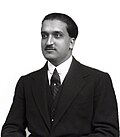
| | | caption = Hari Singh in 1931 | ||
| succession = [[ | | succession = [[Maharaja of Jammu and Kashmir]] | ||
| reign = 23 September 1925 — 17 November 1952 | | reign = 23 September 1925 — 17 November 1952 | ||
| predecessor = [[Pratap Singh of Jammu and Kashmir|Pratap Singh]] | | predecessor = [[Pratap Singh of Jammu and Kashmir|Pratap Singh]] | ||
| successor = Monarchy abolished | | coronation = 29 March 1926<ref>[https://www.alamy.com/coronation-of-sir-hari-singh-as-the-maharajah-of-kashmir-29-march-1926-image359836764.html Coronation of Sir Hari Singh as the Maharajah of Kashmir . 29 March 1926]</ref> | ||
| regent = [[Karan Singh]] ( | | successor = ''Monarchy abolished'' | ||
| issue = [[Karan Singh]] | | regent = [[Karan Singh]] (1949–1952) | ||
| | | issue = [[Karan Singh]] | ||
| spouses = {{Plainlist| | |||
* {{marriage|Sri Lal Kunverba Sahiba|1913|1915|end={{abbr|d.|died}}}} | |||
* {{marriage|Rani Sahiba Chamba|1915|1920|end={{abbr|d.|died}}}} | |||
* {{marriage|Dhanvant Kunveri Baiji|1923|end={{abbr|d.|died}}}} | |||
* {{marriage|Tara Devi|1928|1950|end={{abbr|sep.|separated}}}} | |||
}} | |||
| house = [[Dogra dynasty|Dogra]] | | house = [[Dogra dynasty|Dogra]] | ||
| father = | | father = Amar Singh | ||
| mother = | | mother = Bhotiali Chib | ||
| birth_date = {{birth date|df=yes|1895|9|23}} | | birth_date = {{birth date|df=yes|1895|9|23}} | ||
| birth_place = [[Jammu]], [[Jammu and Kashmir (princely state)|Jammu and Kashmir]], | | birth_place = [[Jammu]], [[Jammu and Kashmir (princely state)|Jammu and Kashmir]],(present-day [[Jammu and Kashmir (union territory)|Jammu and Kashmir]], [[India]]) | ||
| death_date = {{death date and age |df=yes|1961|4|26 |1895|9|23}} | | death_date = {{death date and age |df=yes|1961|4|26 |1895|9|23}} | ||
| death_place = [[ | | death_place = [[Bombay]], [[Maharashtra]], India (present-day [[Mumbai]]) | ||
| religion = [[Hinduism]]{{sfn|Rai|2004}} | | religion = [[Hinduism]]{{sfn|Mridu Rai, Hindu Rulers, Muslim Subjects|2004}} | ||
| signature = | | signature = | ||
}} | }} | ||
[[ | [[Maharaja]] '''Sir Hari Singh''' {{post-nominals|country=GBR|GCSI|GCIE|GCVO}} (23 September 1895 – 26 April 1961) was the last ruling [[Maharaja]] of the [[princely state]] of [[Jammu and Kashmir (princely state)|Jammu and Kashmir]]. | ||
Born in the city of Jammu in 1895, Singh was the son of Amar Singh and Bhotiali Chib. His father, who was the heir to his brother [[Pratap Singh of Jammu and Kashmir|Pratap Singh]], died in 1909, making him the heir to the throne. In 1923, following his uncle's death, he became the new Maharaja of Jammu and Kashmir. He married four times, and his fourth wife bore him a son, [[Karan Singh]]. After [[Indian Independence Act 1947|Indian Independence]] in 1947, he wanted Jammu and Kashmir to remain an independent kingdom, but was forced to accede to the [[Dominion of India]], to get the support of Indian troops against an invasion by Pakistani forces. | |||
Singh remained the titular Maharaja of the state until 1952, when the monarchy was abolished by the Indian government. After spending his final days in [[Bombay]], he died on 26 April 1961. As per his will, his ashes were brought to Jammu and spread all over Jammu and Kashmir and immersed in the [[Tawi River]] at Jammu. | |||
Singh was also a controversial figure due to his involvement in a blackmail scandal by a prostitute in Paris in 1921, the [[1931 Kashmir agitation|agitation in Kashmir]] against his government in 1931, and the [[1947 Poonch rebellion|rebellion against him in Poonch]] in 1947. | |||
==Early life== | |||
[[File:Amar_Mahal_Museum,_Jammu.jpg|thumb|left|[[Amar Mahal Palace]], the birthplace of Hari Singh]] | |||
[[File: | |||
Hari Singh was born on 23 September 1895 at the palace of [[Amar Mahal]], [[Jammu]], the only surviving son of Raja Amar Singh Jamwal,<ref>General Sir Raja Amar Singh Jamwal : 14 January 1865 – 26 March 1909</ref> the brother of Maharaja [[Pratap Singh of Jammu and Kashmir|Pratap Singh]], then the [[Maharaja of Jammu and Kashmir]] in a [[Dogra]] [[Rajput]] family. Since the Maharaja had no issue, Hari Singh was heir to the throne of Jammu and Kashmir. | |||
In 1903, Hari Singh served as a [[page of honour]] to [[George Curzon, 1st Marquess Curzon of Kedleston|Lord Curzon]] at the grand [[Delhi Durbar]]. At the age of thirteen, he was sent to [[Mayo College]] in [[Ajmer]]. A year later, in 1909, his father died, and the British took a keen interest in his education and appointed Major H. K. Brar as his guardian. After Mayo College, Hari Singh went to the British-run [[Imperial Cadet Corps]] at [[Dehradun]] for military training.{{citation needed|date=February 2017}} | |||
=== | Maharaja Pratap Singh appointed him as the commander-in-chief of the [[Jammu and Kashmir State Forces|State Forces]] in 1915.<ref name="snedden">{{cite book |title=Understanding Kashmir and Kashmiris |first=Christopher |last=Snedden |publisher=Oxford University Press |year=2015 |isbn=978-1-84904-342-7 |page=128 |url=https://books.google.com/books?id=s5KMCwAAQBAJ&pg=PA128}}</ref> | ||
==Personal life== | |||
[[File:Sir Hari Singh Bahadur, Maharaja of Jammu and Kashmir, 1920.jpg|thumb|upright=0.7|Hari Singh in 1920]] | |||
Hari Singh payed £300,000 to a prostitute who blackmailed him in Paris in 1921. That issue resulted in a court case in London in 1924 during which the [[India Office]] tried to keep his name out of proceedings by arranging for him to be referred to as Mr. A.<ref name="snedden"/> | |||
Singh was known as a lavish spender of money. The funeral of his uncle and former ruler [[Pratap Singh of Jammu and Kashmir|Pratap Singh]] is believed to have expended much gold and jewelry in the funeral pyre.<ref name=KashmirLife>[https://kashmirlife.net/kashmirs-last-maharaja-1413 Kashmir’s Last Maharaja], Kashmir Life, 2 May 2011.</ref> | |||
===Marriages=== | |||
[[File:The Maharaja and Maharani of Kashmir.jpg|thumb|Hari Singh with his fourth wife Maharani Tara Devi, 1950]] | |||
Singh married four times as his first three wives failed to give birth to his heirs. Each of them died within a few years of childlessness allowing Hari Singh to immediately take a new bride. With his last wife, Tara Devi Sahiba of [[Kangra District|Kangra]], he had a son, [[Karan Singh]].<ref name=KashmirLife/>{{sfn|Mufti, Kashmir in Sickness and in Health|2013|p=157}} | |||
< | {| class="wikitable" | ||
|- | |||
! No. !! Name !! Date of marriage !! Fate of marriage !! Issue and fate | |||
|- | |||
| 1 ||Rani Sri Lal Kunverba Sahiba | |||
|7 May 1913 | |||
| Ended with her death ||Died during pregnancy in 1915. No issue. | |||
|- | |||
| 2 ||Rani Sahiba Chamba | |||
|8 November 1915 | |||
| Ended with her death||Died 31 January 1920. No issue. | |||
|- | |||
| 3 ||[[Maharani]] Dhanvant Kunveri Baiji Sahiba | |||
|30 April 1923 | |||
| Ended with her death || Died young. No issue. | |||
|- | |||
| 4 ||[[Maharani]] Tara Devi Sahiba of Kangra | |||
| 1928 || Separated ||Separated in 1950. Died in 1967.<br> Mother of [[Karan Singh]] | |||
|- | |||
|} | |||
==Reign== | |||
[[File: | [[File:An Indian Durbar in 1926.webm|thumb|A film of the coronation of Maharaja Hari Singh at [[Mubarak Mandi Palace|Mubark Mandi palace]] in Jammu in 1926]] | ||
[[ | |||
[[ | Following the death of his uncle Pratap Singh in 1925, Hari Singh ascended the throne of Jammu and Kashmir. He made primary education compulsory in the state, introduced laws prohibiting child marriage, and opened places of worship to the low [[Caste system in India|caste]]s.<ref>{{Cite book|title = IS God DEAD?????|url = https://books.google.com/books?id=nQniAgAAQBAJ&pg=PA25|publisher = Partridge Publishing|date = 1 February 2014|isbn = 978-1-48281-823-9 |first=Ragubhir Lal |last=Anand |page=26}}</ref> | ||
[[ | The Seal of Maharaja Hari Singh had a Crown at the top. A ''[[Katar (dagger)|katar]]'' or ceremonial dagger sat below the crown. Two soldiers held flags. An image of the sun was between them, to symbolise his [[Suryavansha|Rajput lineage]] from Lord [[Surya]], the [[Hindu pantheon|Hindu]] [[Solar deity|Sun God]]. | ||
[[ | |||
[[ | |||
[[ | |||
<gallery class="center" widths="200px"> | |||
Seal of Maharaja Hari Singh on the cover of the Civil List.jpg|Seal of Maharaja Hari Singh as printed on the Civil List of his government | |||
</gallery> | |||
In 1930, Hari Singh attended the [[Round Table Conferences (India)|First Round Table Conference]] in London. He suggested that the Indian [[Princely state]]s would join an “All India Federation” and pleaded for equal status for Indians in the British Commonwealth of Nations.<ref name=table/> While replying to the inaugural address by [[George V|King-Emperor George V]], Hari Singh said: {{quote|"I must express our deep gratitude to His Most Gracious Majesty for the cordial welcome tendered to us and I pray that providence may grant us the vision and the will to realize the hopes expressed in the inspiring words uttered this morning by our beloved Emperor. This is the first occasion on which the Princes of India meet in person at a Conference Table along with the representatives of British India and His Majesty's Government to discuss the political future of India. ... I feel deeply gratified at the progress which has been made with the scheme of an All-India Federation as worked out in the Report of the Federal Structure Sub-Committee. But ever since the idea of a Federation was taken up in this Conference, some surprise has been expressed in various quarters in India and in England at the willingness of the Princes to join an All-India Federation. It is said that Princes have forced the pace and that in any case they should have opposed a Federation with British India. I have never disguised from my friends, my warm support of the idea of an All-India Federation".<ref name=table>{{Cite news|title=Remember Maharaja Hari Singh|url=https://www.dailyexcelsior.com/remember-maharaja-hari-singh/|publisher=Daily Excellsior|access-date=23 September 2017}}</ref>}} | |||
{{ | |||
=== Partition and accession === | |||
[[File:The last Maharaja of Kashmir.jpg|thumb|The last Maharaja of Kashmir]] | |||
In 1947, after India gained independence from British rule, Jammu and Kashmir could have joined India, joined Pakistan, or remained independent.{{citation needed|date=July 2015}} Hari Singh originally manoeuvred to maintain his independence by playing off both India and Pakistan. Pashtun tribesmen from Pakistan then invaded Kashmir and defeated Hari Singh's forces. Hari Singh appealed to India for help.<ref>{{Cite web|url=http://www.jammu-kashmir.com/documents/harisingh47.html|title=Maharaja Hari Singh's Letter to Mountbatten|website=www.jammu-kashmir.com|access-date=10 January 2020}}</ref> Although the Indian Prime Minister Nehru was ready to send troops, the [[Governor-General of India]], [[Lord Mountbatten of Burma]], advised the Maharaja to accede to India before India could send its troops. Hence, considering the emergency situation, the Maharaja signed the [[Instrument_of_Accession_(Jammu_and_Kashmir)|Instrument of Accession]] on 26 October 1947, joining the whole of his princely state (including [[Jammu]], [[Kashmir]], [[Northern Areas]], [[Ladakh]], [[Trans-Karakoram Tract]] and [[Aksai Chin]]), to the [[Dominion of India]].<ref>{{Cite book|title=India after Gandhi : the history of the world's largest democracy|last=Ramachandra.|first=Guha|date=1 January 2008|publisher=Harper Perennial|isbn=978-0060958589|oclc=474262656}}</ref><ref>Justice A. S. Anand, ''The Constitution of Jammu & Kashmir'' (5th edition, 2006), [https://books.google.com/books?id=wSXRUwNnMB0C&pg=PA67 page 67]</ref><ref>[http://www.parliament.uk/commons/lib/research/rp2004/rp04-028.pdf Kashmir, Research Paper 04/28 by Paul Bowers, House of Commons Library, United Kingdom.] {{webarchive|url=https://web.archive.org/web/20040728194805/http://www.parliament.uk/commons/lib/research/rp2004/rp04-028.pdf |date=28 July 2004 }}, page 46, 30 March 2004</ref> These events triggered the [[Indo-Pakistani War of 1947|first Indo-Pakistan War]]. | |||
Pressure from [[Nehru]] and [[Sardar Patel]] eventually compelled Hari Singh to appoint his son and heir, [[Yuvraj]] (Crown Prince) [[Karan Singh]], as Prince Regent of Jammu and Kashmir in 1949, although he remained the titular Maharaja of the state until 1952, when the monarchy was abolished by Nehru's government. He was also forced to appoint the popular Kashmiri leader [[Sheikh Abdullah]] as the prime minister of Kashmir. He had a contentious relationship with both Nehru and Abdullah.<ref name="Ramachandra. 92">{{Cite book|title=India after Gandhi : the history of the world's largest democracy|last=Ramachandra.|first=Guha|date=1 January 2008|publisher=Harper Perennial|isbn=978-0060958589|pages=92|oclc=474262656}}</ref> Karan Singh was appointed 'Sadr-e-Riyasat' ('Head of State') in 1952 and [[Governor of Jammu and Kashmir|Governor of the State]] in 1964.<ref name="Ramachandra. 92"/> Abdullah would later be dismissed from his position as prime minister of Kashmir and jailed by Karan Singh.<ref>{{Cite book|title=India after Gandhi : the history of the world's largest democracy|last=Ramachandra.|first=Guha|date=1 January 2008|publisher=Harper Perennial|isbn=978-0060958589|pages=262|oclc=474262656}}</ref> | |||
==Final years and death== | |||
Nehru and Abdullah conspired to banish Singh from Jammu and Kashmir and forced him to live in exile in Bombay. Singh spent his final days in [[Bombay]]. He died on 26 April 1961, after fourteen years of his banishment. As per his will, his ashes were brought to Jammu and spread all over Jammu and Kashmir and immersed in the [[Tawi River]] at [[Jammu]].<ref>[https://economictimes.indiatimes.com/news/politics-and-nation/dynasty-clash-in-kashmir-hari-singhs-grandson-ajatshatru-challenges-abdullahs/articleshow/18963571.cms Dynasty clash in Kashmir: Hari Singh's grandson Ajatshatru challenges Abdullahs], The Economic Times, 14 March 2013.</ref> | |||
==Legacy and memorials== | |||
===Tributes and memorials=== | |||
Jammu Municipal Corporation erected a statue of Maharaja Hari Singh in standing posture near Bagh-e-Bahu Police Station adjoining junction crossings linking Gujjar Nagar Tawi Bridge, University, Bagh-e-Bahu, Narwal<ref>{{Cite news|title=City's statues in a sorry state|url=https://www.dailyexcelsior.com/citys-statues-in-a-sorry-state/|publisher=[[Daily Excelsior]]|access-date= 27 April 2014}}</ref> | * In 2007, Chief Minister [[Ghulam Nabi Azad]] inaugurated the 'Hari Singh Janana Park' for women. It is landscaped by Gardens and Floriculture Department at New Secretariat. | ||
* On 1 April 2012, the occasion of Ramanavmi, Union Minister Ghulam Nabi Azad and MP [[Karan Singh]] unveiled a statue of Hari Singh near the Tawi bridge in Jammu.<ref>{{Cite web|title=Maharaja's Statue unveiled.|url=https://m.tribuneindia.com/2012/20120402/jmtrib.htm|work=The Tribune|access-date=2 April 2012}}</ref> | |||
* Jammu Municipal Corporation erected a statue of Maharaja Hari Singh in standing posture near Bagh-e-Bahu Police Station adjoining junction crossings linking Gujjar Nagar Tawi Bridge, University, Bagh-e-Bahu, Narwal<ref>{{Cite news|title=City's statues in a sorry state|url=https://www.dailyexcelsior.com/citys-statues-in-a-sorry-state/|publisher=[[Daily Excelsior]]|access-date= 27 April 2014}}</ref> | |||
Hari Singh | * On 16 May 2018, Chief Minister [[Mehbooba Mufti]] inaugurated 'Maharaja Hari Singh Park' and a statue of Hari Singh in sitting posture.<ref>{{Cite news|title=JDA sold Maharaja Hari Singh Park!|url=https://m.jagran.com/jammu-and-kashmir/jammu-jammu-development-authority-sold-maharaja-hari-singh-park-18705820.html|publisher=Dainik Jagran|access-date=2 December 2018}}</ref> | ||
* On 23 September 2019, the Amar Kshatriya Rajput Sabha (AKRS) installed a life-sized statue of Hari Singh on his 119th birthday at [[Samba]] district, near Veer Bhoomi Park.<ref>{{Cite web|title=Maharaja Hari Singh's statue unveiled on his 119th Birthday anniversary|url=http://www.earlytimes.in/newsdet.aspx?q=112539|publisher=Early Times|access-date=23 September 2019}}</ref> | |||
* On 23 September 2020, an audio-video song album in [[Dogri]] was released highlighting social reforms introduced by Hari Singh from 1930 onwards.<ref>{{Cite web|title=Album on Maharaja Hari Singh released|url=https://m.tribuneindia.com/news/j-k/album-on-hari-singh-released-145790|publisher=Tribune|access-date=24 September 2020}}</ref> | |||
==Titles and honours== | |||
===Title and style=== | |||
[[File:Titles of Maharaja Hari singh and Yuvraj Karan Singh.jpg|thumb|Titles of Maharaja Hari Singh and Yuvraj Karan Singh on the first page of his Civil List of 1945]] | |||
As Maharaja, Hari Singh's full style was: | |||
<div style="padding: 1px; text-align:left; margin:left; border:1px solid #7BA05B; color:#000000; width:55%;">{{quote|Lieutenant-General His Highness Raj Rajeshwar Maharajadhiraj Maharaja Shri Hari Singhji Bahadur Indar Mahindar, Sipar-i-Saltanat-i-Inglishia, GCSI, GCIE, GCVO, LLD}}</div> | |||
===Honours=== | |||
* 1903: [[File:Med.DelhiDurbar1903.png|50px]] Delhi Durbar Medal | |||
* 1911: [[File:GeorgeVICoronationRibbon.png|50px]] Delhi Durbar Medal | |||
* 1922: Prince of Wales Visit Medal | |||
* 1929: [[File:Order of the Indian Empire Ribbon.svg|50px]] [[Knight Grand Commander of the Order of the Indian Empire]] (GCIE) (KCIE in 1918) | |||
* 1930: [[File:Cavaliere di Gran Croce OCI Kingdom BAR.svg|50px]] Grand Cross of the [[Order of the Crown of Italy]] | |||
* 1933: [[File:ImperialOrderCrownIndiaRibbon.gif|50px]] [[Knight Grand Commander of the Order of the Star of India]] (GCSI) | |||
* 1935: [[File:GeorgeVSilverJubileum-ribbon.png|50px]] [[King George V Silver Jubilee Medal]] | |||
* 1937: [[File:UK King George VI Coronation Medal ribbon.svg|50px]] [[King George VI Coronation Medal]] | |||
* 1938: [[File:Legion Honneur GO ribbon.svg|50px]] Grand Officer of the [[Legion d'Honneur]] | |||
* 1945: [[File:39-45 Star BAR.svg|50px]] [[1939-1945 Star]] | |||
* 1945: [[File:Africa Star BAR.svg|50px]] [[Africa Star]] | |||
* 1945: [[File:War Medal 39-45 BAR.svg|50px]] [[War Medal 1939-1945]] | |||
* 1945: [[File:India Service Medal BAR.svg|50px]] [[India Service Medal]] | |||
* 1946: [[File:Royal Victorian Order ribbon sm.jpg|50px]] [[Knight Grand Cross of the Royal Victorian Order]] (GCVO) (KCVO in 1922) | |||
* 1947: [[File:Indian Independence medal 1947.svg|50px]] [[Indian Independence Medal]] | |||
===Honorary degrees=== | |||
* 1938: Hon. [[LL.D]] from [[Panjab University|Punjab University]] | |||
{{Clear}} | |||
==References== | ==References== | ||
{{reflist}} | {{reflist|30em}} | ||
==Bibliography== | ==Bibliography== | ||
* {{citation |first=Mridu |last=Rai |title=Hindu Rulers, Muslim Subjects: Islam, Rights, and the History of Kashmir | publisher=C. Hurst & Co |year=2004 |isbn=1850656614}} | * {{citation |first=Mridu |last=Rai |title=Hindu Rulers, Muslim Subjects: Islam, Rights, and the History of Kashmir | publisher=C. Hurst & Co |year=2004 |isbn=1850656614 |ref={{sfnref|Mridu Rai, Hindu Rulers, Muslim Subjects|2004}}}} | ||
* {{citation |last=Mufti |first=Gulzar |title=Kashmir in Sickness and in Health |url=https://books.google.com/books?id=AoAcAgAAQBAJ&pg=PT171 |year=2013 |publisher=Partridge Publishing India |isbn=978-1-4828-0998-5}} | * {{citation |last=Mufti |first=Gulzar |title=Kashmir in Sickness and in Health |url=https://books.google.com/books?id=AoAcAgAAQBAJ&pg=PT171 |year=2013 |publisher=Partridge Publishing India |isbn=978-1-4828-0998-5 |ref={{sfnref|Mufti, Kashmir in Sickness and in Health|2013}}}} | ||
==External links== | ==External links== | ||
{{Portal|India|Politics}} | {{Portal|India|Politics}} | ||
{{commons category}} | |||
* [https://web.archive.org/web/20100612114256/http://jammukashmir.nic.in/govt/cntit1.htm#1 Proclamation of 1 May 1951 on Jammu & Kashmir Constituent Assembly by Yuvraj (Crown Prince) Karan Singh (Son of Maharajah Hari Singh) from the Official website of Government of Jammu and Kashmir, India] | * [https://web.archive.org/web/20100612114256/http://jammukashmir.nic.in/govt/cntit1.htm#1 Proclamation of 1 May 1951 on Jammu & Kashmir Constituent Assembly by Yuvraj (Crown Prince) Karan Singh (Son of Maharajah Hari Singh) from the Official website of Government of Jammu and Kashmir, India] | ||
* [http://www.lib.berkeley.edu/SSEAL/SouthAsia/kashmir.html ''Conflict in Kashmir: Selected Internet Resources by the Library, University of California, Berkeley, USA'' | * [http://www.lib.berkeley.edu/SSEAL/SouthAsia/kashmir.html ''Conflict in Kashmir: Selected Internet Resources by the Library, University of California, Berkeley, USA''; [[University of California at Berkeley]] Library Bibliographies and Web-Bibliographies list] | ||
* {{cite web|url=http://newstodaynet.com/2006sud/06jan/1201ss1.htm |title=Salutations to Guruji Golwalkar – IV|author=V Sundaram|archive-url=https://web.archive.org/web/20081204190403/http://newstodaynet.com/2006sud/06jan/1201ss1.htm|archive-date=4 December 2008}} The role of Shri Guruji Golwalkar (Sarsanghchalak of the [[Rashtriya Swayamsevak Sangh]] – RSS) | * {{cite web|url=http://newstodaynet.com/2006sud/06jan/1201ss1.htm |title=Salutations to Guruji Golwalkar – IV|author=V Sundaram|archive-url=https://web.archive.org/web/20081204190403/http://newstodaynet.com/2006sud/06jan/1201ss1.htm|archive-date=4 December 2008}} The role of Shri Guruji Golwalkar (Sarsanghchalak of the [[Rashtriya Swayamsevak Sangh]] – RSS) | ||
* [https://web.archive.org/web/20140911151945/http://www.niticentral.com/2013/01/13/nehru-abdullah-betrayed-raja-hari-singh-37857.html Nehru, Abdullah betrayed Maharaja Hari Singh] | * [https://web.archive.org/web/20140911151945/http://www.niticentral.com/2013/01/13/nehru-abdullah-betrayed-raja-hari-singh-37857.html Nehru, Abdullah betrayed Maharaja Hari Singh] | ||
* [https://www.tribuneindia.com/news/archive/features/banished-from-his-own-land-818375 Banished from his own land] | * [https://www.tribuneindia.com/news/archive/features/banished-from-his-own-land-818375 Banished from his own land] | ||
{{s-start}} | |||
{{s-hou|[[Dogra dynasty]]||23 September 1895||26 April 1961}} | |||
{{s-reg|}} | |||
{{s-bef|before=[[Pratap Singh of Jammu and Kashmir|Pratap Singh]]<br><small>(as Maharaja of Jammu and Kashmir)</small>}} | |||
{{s-ttl|title=[[Maharaja of Jammu and Kashmir]]|years=1925–1952}} | |||
{{s-aft|after=[[Republic of India]] [[Karan Singh]] as titular Maharajah of Jammu and Kashmir}} | |||
{{s-end}} | |||
{{Indian civil servants}} | |||
{{Authority control}} | {{Authority control}} | ||
Revision as of 11:43, 30 August 2021
 | This article has multiple issues. Please help improve it or discuss these issues on the talk page. (Learn how and when to remove these template messages)
|


| Hari Singh | |
|---|---|
 Hari Singh in 1931 | |
| Maharaja of Jammu and Kashmir | |
| Reign | 23 September 1925 — 17 November 1952 |
| Coronation | 29 March 1926[1] |
| Predecessor | Pratap Singh |
| Successor | Monarchy abolished |
| Regent | Karan Singh (1949–1952) |
| Born | 23 September 1895 Jammu, Jammu and Kashmir,(present-day Jammu and Kashmir, India) |
| Died | 26 April 1961 (aged 65) Bombay, Maharashtra, India (present-day Mumbai) |
| Spouses | Sri Lal Kunverba Sahiba
( m. 1913; d. 1915)Rani Sahiba Chamba
( m. 1915; d. 1920)Dhanvant Kunveri Baiji
( m. 1923, d. )Tara Devi
( m. 1928; sep. 1950) |
| Issue | Karan Singh |
| House | Dogra |
| Father | Amar Singh |
| Mother | Bhotiali Chib |
| Religion | Hinduism[2] |
Maharaja Sir Hari Singh GCSI GCIE GCVO (23 September 1895 – 26 April 1961) was the last ruling Maharaja of the princely state of Jammu and Kashmir.
Born in the city of Jammu in 1895, Singh was the son of Amar Singh and Bhotiali Chib. His father, who was the heir to his brother Pratap Singh, died in 1909, making him the heir to the throne. In 1923, following his uncle's death, he became the new Maharaja of Jammu and Kashmir. He married four times, and his fourth wife bore him a son, Karan Singh. After Indian Independence in 1947, he wanted Jammu and Kashmir to remain an independent kingdom, but was forced to accede to the Dominion of India, to get the support of Indian troops against an invasion by Pakistani forces.
Singh remained the titular Maharaja of the state until 1952, when the monarchy was abolished by the Indian government. After spending his final days in Bombay, he died on 26 April 1961. As per his will, his ashes were brought to Jammu and spread all over Jammu and Kashmir and immersed in the Tawi River at Jammu.
Singh was also a controversial figure due to his involvement in a blackmail scandal by a prostitute in Paris in 1921, the agitation in Kashmir against his government in 1931, and the rebellion against him in Poonch in 1947.
Early life

Hari Singh was born on 23 September 1895 at the palace of Amar Mahal, Jammu, the only surviving son of Raja Amar Singh Jamwal,[3] the brother of Maharaja Pratap Singh, then the Maharaja of Jammu and Kashmir in a Dogra Rajput family. Since the Maharaja had no issue, Hari Singh was heir to the throne of Jammu and Kashmir.
In 1903, Hari Singh served as a page of honour to Lord Curzon at the grand Delhi Durbar. At the age of thirteen, he was sent to Mayo College in Ajmer. A year later, in 1909, his father died, and the British took a keen interest in his education and appointed Major H. K. Brar as his guardian. After Mayo College, Hari Singh went to the British-run Imperial Cadet Corps at Dehradun for military training.[citation needed]
Maharaja Pratap Singh appointed him as the commander-in-chief of the State Forces in 1915.[4]
Personal life

Hari Singh payed £300,000 to a prostitute who blackmailed him in Paris in 1921. That issue resulted in a court case in London in 1924 during which the India Office tried to keep his name out of proceedings by arranging for him to be referred to as Mr. A.[4]
Singh was known as a lavish spender of money. The funeral of his uncle and former ruler Pratap Singh is believed to have expended much gold and jewelry in the funeral pyre.[5]
Marriages

Singh married four times as his first three wives failed to give birth to his heirs. Each of them died within a few years of childlessness allowing Hari Singh to immediately take a new bride. With his last wife, Tara Devi Sahiba of Kangra, he had a son, Karan Singh.[5][6]
| No. | Name | Date of marriage | Fate of marriage | Issue and fate |
|---|---|---|---|---|
| 1 | Rani Sri Lal Kunverba Sahiba | 7 May 1913 | Ended with her death | Died during pregnancy in 1915. No issue. |
| 2 | Rani Sahiba Chamba | 8 November 1915 | Ended with her death | Died 31 January 1920. No issue. |
| 3 | Maharani Dhanvant Kunveri Baiji Sahiba | 30 April 1923 | Ended with her death | Died young. No issue. |
| 4 | Maharani Tara Devi Sahiba of Kangra | 1928 | Separated | Separated in 1950. Died in 1967. Mother of Karan Singh |
Reign
Following the death of his uncle Pratap Singh in 1925, Hari Singh ascended the throne of Jammu and Kashmir. He made primary education compulsory in the state, introduced laws prohibiting child marriage, and opened places of worship to the low castes.[7]
The Seal of Maharaja Hari Singh had a Crown at the top. A katar or ceremonial dagger sat below the crown. Two soldiers held flags. An image of the sun was between them, to symbolise his Rajput lineage from Lord Surya, the Hindu Sun God.
-
 Seal of Maharaja Hari Singh as printed on the Civil List of his government

In 1930, Hari Singh attended the First Round Table Conference in London. He suggested that the Indian Princely states would join an “All India Federation” and pleaded for equal status for Indians in the British Commonwealth of Nations.[8] While replying to the inaugural address by King-Emperor George V, Hari Singh said:
"I must express our deep gratitude to His Most Gracious Majesty for the cordial welcome tendered to us and I pray that providence may grant us the vision and the will to realize the hopes expressed in the inspiring words uttered this morning by our beloved Emperor. This is the first occasion on which the Princes of India meet in person at a Conference Table along with the representatives of British India and His Majesty's Government to discuss the political future of India. ... I feel deeply gratified at the progress which has been made with the scheme of an All-India Federation as worked out in the Report of the Federal Structure Sub-Committee. But ever since the idea of a Federation was taken up in this Conference, some surprise has been expressed in various quarters in India and in England at the willingness of the Princes to join an All-India Federation. It is said that Princes have forced the pace and that in any case they should have opposed a Federation with British India. I have never disguised from my friends, my warm support of the idea of an All-India Federation".[8]
Partition and accession

In 1947, after India gained independence from British rule, Jammu and Kashmir could have joined India, joined Pakistan, or remained independent.[citation needed] Hari Singh originally manoeuvred to maintain his independence by playing off both India and Pakistan. Pashtun tribesmen from Pakistan then invaded Kashmir and defeated Hari Singh's forces. Hari Singh appealed to India for help.[9] Although the Indian Prime Minister Nehru was ready to send troops, the Governor-General of India, Lord Mountbatten of Burma, advised the Maharaja to accede to India before India could send its troops. Hence, considering the emergency situation, the Maharaja signed the Instrument of Accession on 26 October 1947, joining the whole of his princely state (including Jammu, Kashmir, Northern Areas, Ladakh, Trans-Karakoram Tract and Aksai Chin), to the Dominion of India.[10][11][12] These events triggered the first Indo-Pakistan War.
Pressure from Nehru and Sardar Patel eventually compelled Hari Singh to appoint his son and heir, Yuvraj (Crown Prince) Karan Singh, as Prince Regent of Jammu and Kashmir in 1949, although he remained the titular Maharaja of the state until 1952, when the monarchy was abolished by Nehru's government. He was also forced to appoint the popular Kashmiri leader Sheikh Abdullah as the prime minister of Kashmir. He had a contentious relationship with both Nehru and Abdullah.[13] Karan Singh was appointed 'Sadr-e-Riyasat' ('Head of State') in 1952 and Governor of the State in 1964.[13] Abdullah would later be dismissed from his position as prime minister of Kashmir and jailed by Karan Singh.[14]
Final years and death
Nehru and Abdullah conspired to banish Singh from Jammu and Kashmir and forced him to live in exile in Bombay. Singh spent his final days in Bombay. He died on 26 April 1961, after fourteen years of his banishment. As per his will, his ashes were brought to Jammu and spread all over Jammu and Kashmir and immersed in the Tawi River at Jammu.[15]
Legacy and memorials
Tributes and memorials
- In 2007, Chief Minister Ghulam Nabi Azad inaugurated the 'Hari Singh Janana Park' for women. It is landscaped by Gardens and Floriculture Department at New Secretariat.
- On 1 April 2012, the occasion of Ramanavmi, Union Minister Ghulam Nabi Azad and MP Karan Singh unveiled a statue of Hari Singh near the Tawi bridge in Jammu.[16]
- Jammu Municipal Corporation erected a statue of Maharaja Hari Singh in standing posture near Bagh-e-Bahu Police Station adjoining junction crossings linking Gujjar Nagar Tawi Bridge, University, Bagh-e-Bahu, Narwal[17]
- On 16 May 2018, Chief Minister Mehbooba Mufti inaugurated 'Maharaja Hari Singh Park' and a statue of Hari Singh in sitting posture.[18]
- On 23 September 2019, the Amar Kshatriya Rajput Sabha (AKRS) installed a life-sized statue of Hari Singh on his 119th birthday at Samba district, near Veer Bhoomi Park.[19]
- On 23 September 2020, an audio-video song album in Dogri was released highlighting social reforms introduced by Hari Singh from 1930 onwards.[20]
Titles and honours
Title and style

As Maharaja, Hari Singh's full style was:
Lieutenant-General His Highness Raj Rajeshwar Maharajadhiraj Maharaja Shri Hari Singhji Bahadur Indar Mahindar, Sipar-i-Saltanat-i-Inglishia, GCSI, GCIE, GCVO, LLD
Honours
- 1903:
 Delhi Durbar Medal
 - 1911:
 Delhi Durbar Medal
 - 1922: Prince of Wales Visit Medal
- 1929:
 Knight Grand Commander of the Order of the Indian Empire (GCIE) (KCIE in 1918)
 - 1930:
 Grand Cross of the Order of the Crown of Italy
 - 1933:
 Knight Grand Commander of the Order of the Star of India (GCSI)
 - 1935:
 King George V Silver Jubilee Medal
 - 1937:
 King George VI Coronation Medal
 - 1938:
 Grand Officer of the Legion d'Honneur
 - 1945:
 1939-1945 Star
 - 1945:
 Africa Star
 - 1945:
 War Medal 1939-1945
 - 1945:
 India Service Medal
 - 1946:
 Knight Grand Cross of the Royal Victorian Order (GCVO) (KCVO in 1922)
 - 1947:
 Indian Independence Medal


Honorary degrees
- 1938: Hon. LL.D from Punjab University
References
- ↑ Coronation of Sir Hari Singh as the Maharajah of Kashmir . 29 March 1926
- ↑ Mridu Rai, Hindu Rulers, Muslim Subjects 2004.
- ↑ General Sir Raja Amar Singh Jamwal : 14 January 1865 – 26 March 1909
- ↑ 4.0 4.1 Snedden, Christopher (2015). Understanding Kashmir and Kashmiris. Oxford University Press. p. 128. ISBN 978-1-84904-342-7.
- ↑ 5.0 5.1 Kashmir’s Last Maharaja, Kashmir Life, 2 May 2011.
- ↑ Mufti, Kashmir in Sickness and in Health 2013, p. 157.
- ↑ Anand, Ragubhir Lal (1 February 2014). IS God DEAD?????. Partridge Publishing. p. 26. ISBN 978-1-48281-823-9.
- ↑ 8.0 8.1 "Remember Maharaja Hari Singh". Daily Excellsior. Retrieved 23 September 2017.
- ↑ "Maharaja Hari Singh's Letter to Mountbatten". www.jammu-kashmir.com. Retrieved 10 January 2020.
- ↑ Ramachandra., Guha (1 January 2008). India after Gandhi : the history of the world's largest democracy. Harper Perennial. ISBN 978-0060958589. OCLC 474262656.
- ↑ Justice A. S. Anand, The Constitution of Jammu & Kashmir (5th edition, 2006), page 67
- ↑ Kashmir, Research Paper 04/28 by Paul Bowers, House of Commons Library, United Kingdom. Archived 28 July 2004 at the Wayback Machine, page 46, 30 March 2004
- ↑ 13.0 13.1 Ramachandra., Guha (1 January 2008). India after Gandhi : the history of the world's largest democracy. Harper Perennial. p. 92. ISBN 978-0060958589. OCLC 474262656.
- ↑ Ramachandra., Guha (1 January 2008). India after Gandhi : the history of the world's largest democracy. Harper Perennial. p. 262. ISBN 978-0060958589. OCLC 474262656.
- ↑ Dynasty clash in Kashmir: Hari Singh's grandson Ajatshatru challenges Abdullahs, The Economic Times, 14 March 2013.
- ↑ "Maharaja's Statue unveiled". The Tribune. Retrieved 2 April 2012.
- ↑ "City's statues in a sorry state". Daily Excelsior. Retrieved 27 April 2014.
- ↑ "JDA sold Maharaja Hari Singh Park!". Dainik Jagran. Retrieved 2 December 2018.
- ↑ "Maharaja Hari Singh's statue unveiled on his 119th Birthday anniversary". Early Times. Retrieved 23 September 2019.
- ↑ "Album on Maharaja Hari Singh released". Tribune. Retrieved 24 September 2020.
Bibliography
- Rai, Mridu (2004), Hindu Rulers, Muslim Subjects: Islam, Rights, and the History of Kashmir, C. Hurst & Co, ISBN 1850656614
- Mufti, Gulzar (2013), Kashmir in Sickness and in Health, Partridge Publishing India, ISBN 978-1-4828-0998-5
External links

- Proclamation of 1 May 1951 on Jammu & Kashmir Constituent Assembly by Yuvraj (Crown Prince) Karan Singh (Son of Maharajah Hari Singh) from the Official website of Government of Jammu and Kashmir, India
- Conflict in Kashmir: Selected Internet Resources by the Library, University of California, Berkeley, USA; University of California at Berkeley Library Bibliographies and Web-Bibliographies list
- V Sundaram. "Salutations to Guruji Golwalkar – IV". Archived from the original on 4 December 2008. The role of Shri Guruji Golwalkar (Sarsanghchalak of the Rashtriya Swayamsevak Sangh – RSS)
- Nehru, Abdullah betrayed Maharaja Hari Singh
- Banished from his own land
Hari Singh Born: 23 September 1895 Died: 26 April 1961
| ||
| Regnal titles | ||
|---|---|---|
| Preceded by Pratap Singh (as Maharaja of Jammu and Kashmir) |
Maharaja of Jammu and Kashmir 1925–1952 |
Succeeded by Republic of India Karan Singh as titular Maharajah of Jammu and Kashmir |


- Pages using the JsonConfig extension
- Articles needing additional references from November 2015
- Dethroned monarchs
- Rajput rulers
- Knights Grand Commander of the Order of the Star of India
- Knights Grand Commander of the Order of the Indian Empire
- Knights Grand Cross of the Royal Victorian Order
- 1895 births
- 1961 deaths
- Maharajas of Jammu and Kashmir
- Indian Hindus
- Indian knights
- Hindu monarchs
- 20th-century Indian royalty