



Adarshatva (talk | contribs) |
Adarshatva (talk | contribs) Endangered languages |
||
| Line 372: | Line 372: | ||
Pashto ({{Lang|ps|{{Lang|ps|پښتو}}}}) constitutes an Iranian language serving as the first language for over 18.15% of Pakistanis, with primary concentration in Khyber Pakhtunkhwa, alongside ethnic Pashtun populations in northern Balochistan and urban centers including Islamabad, Rawalpindi, and notably Karachi,<ref name="pbs">{{cite web|author=Sharmeen Obaid-Chinoy|date=17 July 2009|title=Karachi's Invisible Enemy |url=https://www.pbs.org/frontlineworld/rough/2009/07/karachis_invisi.html|access-date=24 August 2010|publisher=PBS}}</ref><ref name="The National">{{cite web|date=24 August 2009|title=In a city of ethnic friction, more tinder|url=http://www.thenational.ae/apps/pbcs.dll/article?AID=/20090825/FOREIGN/708249931|archive-url=https://web.archive.org/web/20100116211443/http://www.thenational.ae/|archive-date=16 January 2010|access-date=24 August 2010|publisher=The National}}</ref><ref name="tribune.com.pk">{{cite magazine|date=28 August 2010|title=Columnists {{pipe}} The Pakhtun in Karachi|url=http://tribune.com.pk/story/43827/the-pakhtun-in-karachi/|access-date=8 September 2011|magazine=Time}}</ref><ref name="thefridaytimes.com">[http://www.thefridaytimes.com/beta2/tft/article.php?issue=20110715&page=5] {{Webarchive|url=https://archive.today/20121209085408/http://www.thefridaytimes.com/beta2/tft/article.php?issue=20110715&page=5|date=9 December 2012}}, thefridaytimes</ref> which potentially hosts the world's largest Pashtun population.<ref>{{Cite journal |last=Lieven|first=Anatol |date=2021-05-04|title=An Afghan Tragedy: The Pashtuns, the Taliban and the State |journal=Survival|volume=63|issue=3|pages=7–36|doi=10.1080/00396338.2021.1930403|s2cid=235219004 |issn=0039-6338|doi-access=free}}</ref> Three principal dialect patterns exist within Pashto classification: the Northern (Peshawar) variety known as Pakhto, and the southern dialect spoken near Quetta. | Pashto ({{Lang|ps|{{Lang|ps|پښتو}}}}) constitutes an Iranian language serving as the first language for over 18.15% of Pakistanis, with primary concentration in Khyber Pakhtunkhwa, alongside ethnic Pashtun populations in northern Balochistan and urban centers including Islamabad, Rawalpindi, and notably Karachi,<ref name="pbs">{{cite web|author=Sharmeen Obaid-Chinoy|date=17 July 2009|title=Karachi's Invisible Enemy |url=https://www.pbs.org/frontlineworld/rough/2009/07/karachis_invisi.html|access-date=24 August 2010|publisher=PBS}}</ref><ref name="The National">{{cite web|date=24 August 2009|title=In a city of ethnic friction, more tinder|url=http://www.thenational.ae/apps/pbcs.dll/article?AID=/20090825/FOREIGN/708249931|archive-url=https://web.archive.org/web/20100116211443/http://www.thenational.ae/|archive-date=16 January 2010|access-date=24 August 2010|publisher=The National}}</ref><ref name="tribune.com.pk">{{cite magazine|date=28 August 2010|title=Columnists {{pipe}} The Pakhtun in Karachi|url=http://tribune.com.pk/story/43827/the-pakhtun-in-karachi/|access-date=8 September 2011|magazine=Time}}</ref><ref name="thefridaytimes.com">[http://www.thefridaytimes.com/beta2/tft/article.php?issue=20110715&page=5] {{Webarchive|url=https://archive.today/20121209085408/http://www.thefridaytimes.com/beta2/tft/article.php?issue=20110715&page=5|date=9 December 2012}}, thefridaytimes</ref> which potentially hosts the world's largest Pashtun population.<ref>{{Cite journal |last=Lieven|first=Anatol |date=2021-05-04|title=An Afghan Tragedy: The Pashtuns, the Taliban and the State |journal=Survival|volume=63|issue=3|pages=7–36|doi=10.1080/00396338.2021.1930403|s2cid=235219004 |issn=0039-6338|doi-access=free}}</ref> Three principal dialect patterns exist within Pashto classification: the Northern (Peshawar) variety known as Pakhto, and the southern dialect spoken near Quetta. | ||
== Endangered languages == | |||
[[File:Minor_languages_of_Pakistan_as_of_the_1998_census.png|thumb|Map showing some of the minor languages in Pakistan as of 1998.]] | |||
Other languages spoken by linguistic minorities include those enumerated below, with speaker communities ranging from a few dozen to tens of thousands. Several of these languages face grave risk of extinction, potentially having no speakers remaining.[43] The United Nations Educational, Scientific and Cultural Organisation has established five gradations of language endangerment, spanning from "'''safe'''" (not endangered) to "'''extinct'''": | |||
*'''Vulnerable''' - "most children speak the language, but its usage may be confined to specific domains (e.g., home)" | |||
*'''Definitely endangered''' – "children no longer acquire the language as mother tongue within the household" | |||
*'''Severely endangered''' – "the language is spoken by grandparents and elderly generations; while the parental generation may comprehend it, they do not speak it to children or among themselves" | |||
*'''Critically endangered''' – "the youngest speakers are grandparents and seniors, and they utilize the language partially and infrequently" | |||
*'''Extinct''' – "there are no remaining speakers; included in the Atlas if presumably extinct since the 1950s" | |||
The language endangerment classifications presented below draw from findings in the third edition of the Atlas of the World's Languages in Danger (2010), previously known as the Red Book of Endangered Languages, alongside data from the online edition of the same publication, both issued by UNESCO. | |||
{| class="sortable wikitable" align="center" style="font-size:90%" | |||
|+ | |||
!Language | |||
!Status | |||
!Comments | |||
!ISO 639-3 | |||
|- | |||
|<!--Language-->[[Balti language|Balti]] | |||
|data-sort-value="4_vulnerable"|<!--Status-->Vulnerable<ref name="UNESCO" /> | |||
|<!--Comments-->Also spoken in: India | |||
|<!--ISO 639-3-->bft | |||
|- | |||
|<!--Language-->[[Bashkarik language|Bashkarik]] | |||
|data-sort-value="3_definitely_endangered"|<!--Status-->Definitely endangered<ref name="UNESCO" /> | |||
|<!--Comments--> | |||
|<!--ISO 639-3-->gwc, xka | |||
|- | |||
|<!--Language-->[[Badeshi language|Badeshi]] | |||
|data-sort-value="1_critically_endangered"|<!--Status-->Critically endangered<ref name="UNESCO" /> | |||
|<!--Comments--> Only three speakers remaining as of 2018.<ref>{{cite web | url=https://www.bbc.com/news/world-asia-43194056 | title=Badeshi: Only three people speak this 'extinct' language | date=26 February 2018 }}</ref> | |||
|<!--ISO 639-3-->bdz | |||
|- | |||
|<!--Language-->[[Bateri language|Bateri]] | |||
|data-sort-value="3_definitely_endangered"|<!--Status-->Definitely endangered<ref name="UNESCO" /> | |||
|<!--Comments--> | |||
|<!--ISO 639-3-->btv | |||
|- | |||
|<!--Language-->[[Bhadravahi language|Bhadravahi]] | |||
|data-sort-value="3_definitely_endangered"|<!--Status-->Definitely endangered<ref name="UNESCO" /> | |||
|<!--Comments-->Also spoken in: India | |||
|<!--ISO 639-3-->bhd | |||
|- | |||
|<!--Language-->[[Brahui language|Brahui]] | |||
|data-sort-value="4_vulnerable"|<!--Status-->Vulnerable<ref name="UNESCO" /> | |||
|<!--Comments-->Also spoken in: Afghanistan | |||
|<!--ISO 639-3-->brh | |||
|- | |||
|<!--Language-->[[Burushaski language|Burushaski]] | |||
|data-sort-value="4_vulnerable"|<!--Status-->Vulnerable<ref name="UNESCO" /> | |||
|<!--Comments--> | |||
|<!--ISO 639-3-->bsk | |||
|- | |||
|<!--Language-->[[Chilisso language|Chilisso]] | |||
|data-sort-value="2_severely_endangered"|<!--Status-->Severely endangered<ref name="UNESCO" /> | |||
|<!--Comments--> | |||
|<!--ISO 639-3-->clh | |||
|- | |||
|<!--Language-->[[Dameli language|Dameli]] | |||
|data-sort-value="2_severely_endangered"|<!--Status-->Severely endangered<ref name="UNESCO" /> | |||
|<!--Comments--> | |||
|<!--ISO 639-3-->dml | |||
|- | |||
|<!--Language-->[[Domaaki language|Domaaki]] | |||
|data-sort-value="2_severely_endangered"|<!--Status-->Severely endangered<ref name="UNESCO" /> | |||
|<!--Comments--> | |||
|<!--ISO 639-3-->dmk | |||
|- | |||
|<!--Language-->[[Gawar-Bati language|Gawar-Bati]] | |||
|data-sort-value="3_definitely_endangered"|<!--Status-->Definitely endangered<ref name="UNESCO" /> | |||
|<!--Comments-->Also spoken in: Afghanistan | |||
|<!--ISO 639-3-->gwt | |||
|- | |||
|<!--Language-->[[Gowro language|Gowro]] | |||
|data-sort-value="2_severely_endangered"|<!--Status-->Severely endangered<ref name="UNESCO" /> | |||
|<!--Comments--> | |||
|<!--ISO 639-3-->gwf | |||
|- | |||
|<!--Language-->[[Jadgali language|Jadgali]] | |||
|data-sort-value="3_definitely_endangered"|<!--Status--><!-- Definitely endangered<ref name="UNESCO" /> --> | |||
|<!--Comments--> | |||
|<!--ISO 639-3-->jdg | |||
|- | |||
|<!--Language-->[[Kalasha-mun|Kalasha language]] | |||
|data-sort-value="2_severely_endangered"|<!--Status-->Severely endangered<ref name="UNESCO" /> | |||
|<!--Comments--> Not to be confused with [[Kalasha-ala language|Kalasha-ala]] | |||
|<!--ISO 639-3-->kls | |||
|- | |||
|<!--Language-->[[Kalkoti language|Kalkoti]] | |||
|data-sort-value="2_severely_endangered"|<!--Status-->Severely endangered<ref name="UNESCO" /> | |||
|<!--Comments--> | |||
|<!--ISO 639-3--> | |||
|- | |||
|<!--Language-->Kati ([[Kamkata-viri language|Kamkata-viri]],<br />[[Kata-vari dialect|Kata-vari]], [[Kamviri dialect|Kamviri]]) | |||
|data-sort-value="3_definitely_endangered"|<!--Status-->Definitely endangered<ref name="UNESCO" /> | |||
|<!--Comments-->Also spoken in: Afghanistan | |||
|<!--ISO 639-3-->bsh, xvi | |||
|- | |||
|<!--Language-->[[Khowar language|Khowar]] | |||
|data-sort-value="4_vulnerable"|<!--Status-->Vulnerable<ref name="UNESCO" /> | |||
|<!--Comments--> | |||
|<!--ISO 639-3-->khw | |||
|- | |||
|<!--Language-->[[Kundal Shahi language|Kundal Shahi]] | |||
|data-sort-value="3_definitely_endangered"|<!--Status-->Definitely endangered<ref name="UNESCO" /> | |||
|<!--Comments-->Also spoken in: India | |||
|<!--ISO 639-3--> | |||
|- | |||
|<!-- Language -->[[Kutchi language|Kutchi]]||<!-- Status -->Vulnerable<ref name=UNESCO />||<!-- Comments -->Also spoken in: India<!--ISO 639-3 -->||<!-- Speakers-->kfr | |||
|- | |||
|<!--Language-->[[Maiya language|Maiya]] | |||
|data-sort-value="4_vulnerable"|<!--Status-->Vulnerable<ref name="UNESCO" /> | |||
|<!--Comments--> | |||
|<!--ISO 639-3-->mvy | |||
|- | |||
|<!--Language-->[[Ormuri language|Ormuri]] | |||
|data-sort-value="3_definitely_endangered"|<!--Status-->Definitely endangered<ref name="UNESCO" /> | |||
|<!--Comments-->Also spoken in: Afghanistan | |||
|<!--ISO 639-3-->oru | |||
|- | |||
|<!--Language-->[[Phalura language|Phalura]] | |||
|data-sort-value="3_definitely_endangered"|<!--Status-->Definitely endangered<ref name="UNESCO" /> | |||
|<!--Comments--> | |||
|<!--ISO 639-3-->phl | |||
|- | |||
|<!--Language-->[[Purik language|Purik]] | |||
|data-sort-value="4_vulnerable"|<!--Status-->Vulnerable<ref name="UNESCO" /> | |||
|<!--Comments-->Also spoken in: India | |||
|<!--ISO 639-3-->prx | |||
|- | |||
|<!--Language-->[[Savi language|Savi]] | |||
|data-sort-value="3_definitely_endangered"|<!--Status-->Definitely endangered<ref name="UNESCO" /> | |||
|<!--Comments-->Also spoken in: Afghanistan | |||
|<!--ISO 639-3-->sdg | |||
|- | |||
|<!--Language-->[[Spiti language|Spiti]] | |||
|data-sort-value="4_vulnerable"|<!--Status-->Vulnerable<ref name="UNESCO" /> | |||
|<!--Comments-->Also spoken in: India | |||
|<!--ISO 639-3-->spt | |||
|- | |||
|<!--Language-->[[Torwali language|Torwali]] | |||
|data-sort-value="3_definitely_endangered"|<!--Status-->Definitely endangered<ref name="UNESCO" /> | |||
|<!--Comments--> | |||
|<!--ISO 639-3-->trw | |||
|- | |||
|<!--Language-->[[Ushojo language|Ushojo]] | |||
|data-sort-value="3_definitely_endangered"|<!--Status-->Definitely endangered<ref name="UNESCO" /> | |||
|<!--Comments--> | |||
|<!--ISO 639-3-->ush | |||
|- | |||
|<!--Language-->[[Wakhi language|Wakhi]] | |||
|data-sort-value="3_definitely_endangered"|<!--Status-->Definitely endangered<ref name="UNESCO" /> | |||
|<!--Comments-->Also spoken in: China, Tajikistan, Afghanistan | |||
|<!--ISO 639-3-->wbl | |||
|- | |||
|<!--Language-->[[Yidgha language|Yidgha]] | |||
|data-sort-value="3_definitely_endangered"|<!--Status-->Definitely endangered<ref name="UNESCO" /> | |||
|<!--Comments--> | |||
|<!--ISO 639-3-->ydg | |||
|- | |||
|<!--Language-->[[Zangskari language|Zangskari]] | |||
|data-sort-value="3_definitely_endangered"|<!--Status-->Definitely endangered<ref name="UNESCO" /> | |||
|<!--Comments-->Also spoken in: India | |||
|<!--ISO 639-3-->zau | |||
|- | |||
|} | |||
==References== | ==References== | ||
Revision as of 13:38, 7 June 2026
| Languages of Pakistan | |
|---|---|
 Dominant mother tongue in the districts of Pakistan as of the Census of Pakistan 2017 | |
| Official |
|
| National | Urdu[lower-alpha 3] |
| Regional | Over 70 regional languages |
| Signed | Pakistani Sign Language |
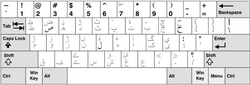
| Keyboard layout | |


Pakistan is a linguistically diverse country where over 70 languages serve as mother tongues.[2][3] Most of these languages fall under the Indo-Iranian branch of the Indo-European language family.[4][5] While Urdu holds the status of national language, it shares official recognition with English and functions as the primary medium for communication across different ethnic communities. Several regional languages also serve as first languages for Pakistan’s various ethnolinguistic groups. The 2023 census records languages with over a million speakers each as Punjabi, Pashto, Sindhi, Saraiki, Urdu, Balochi, Hindko, Brahui, and the Kohistani languages. The census, however, does not include data from the Pakistan-occupied Kashmi (Gilgit-Baltistan and Azad Kashmir, which may affect the reported figures for Shina and Balti). Approximately 60 local languages have fewer than 10 lakh speakers.[6][7]
List of languages
Ethnologue's 2022 edition documents 80 established languages in Pakistan, comprising 68 indigenous and 12 non-indigenous varieties. Language vitality assessments classify four as 'institutional', twenty-four as 'developing', thirty as 'vigorous', fifteen as 'in trouble', and four as 'dying'.[6]
| Language | Province[lower-alpha 4] | Language group |
|---|---|---|
| Aer | Sindh | Indo-Aryan |
| Badeshi | Khyber Pakhtunkwa | Iranian |
| Bagri | Punjab, Sindh | Indo-Aryan |
| Balochi, Makrani | Balochistan | Iranian |
| Balochi, Rakhshani | Balochistan | Iranian |
| Balochi, Sulaimani | Balochistan, Punjab, Sindh | Iranian |
| Balti | Gilgit-Baltistan | Sino-Tibetan |
| Bateri | Khyber Pakhtunkwa | Indo-Aryan |
| Bhaya | Sindh | Indo-Aryan |
| Brahui | Balochistan, Sindh | Dravidian |
| Burushaski | Gilgit-Baltistan | Isolate |
| Chilisso | Khyber Pakhtunkwa | Indo-Aryan |
| Dameli | Khyber Pakhtunkwa | Indo-Aryan |
| Dari | Khyber Pakhtunkwa | Iranian |
| Dehwari | Balochistan | Iranian |
| Dhatki | Sindh | Indo-Aryan |
| Domaaki | Gilgit-Baltistan | Indo-Aryan |
| English | Federal co-official | Germanic |
| Gawar-Bati | Khyber Pakhtunkwa | Indo-Aryan |
| Gawri | Khyber Pakhtunkwa | Indo-Aryan |
| Ghera | Sindh | Indo-Aryan |
| Goaria | Sindh | Indo-Aryan |
| Gowro | Khyber Pakhtunkwa | Indo-Aryan |
| Gujarati | Sindh | Indo-Aryan |
| Gujari | Azad Kashmir, Gilgit-Baltistan, Khyber Pakhtunkwa, Punjab |
Indo-Aryan |
| Gurgula | Sindh | Indo-Aryan |
| Haryanvi aka Rangri | Sindh, Punjab | Indo-Aryan |
| Hazaragi | Balochistan | Iranian |
| Hindko, Northern | Azad Kashmir, Khyber Pakhtunkwa | Indo-Aryan |
| Hindko, Southern | Khyber Pakhtunkwa, Punjab | Indo-Aryan |
| Jadgali | Balochistan, Sindh | Indo-Aryan |
| Jandavra | Sindh | Indo-Aryan |
| Jogi | Sindh | Indo-Aryan |
| Kabutra | Sindh | Indo-Aryan |
| Kacchi | Sindh | Indo-Aryan |
| Kalasha | Khyber Pakhtunkwa | Indo-Aryan |
| Kalkoti | Khyber Pakhtunkwa | Indo-Aryan |
| Kamviri | Khyber Pakhtunkwa | Iranian |
| Kashmiri | Azad Kashmir | Indo-Aryan |
| Kati | Khyber Pakhtunkwa | Iranian |
| Khetrani | Balochistan | Indo-Aryan |
| Khowar | Gilgit-Baltistan, Khyber Pakhtunkwa | Indo-Aryan |
| Kyrgyz | Chitral, Hunza | Turkic |
| Kohistani, Indus | Khyber Pakhtunkwa | Indo-Aryan |
| Koli, Kachi | Sindh | Indo-Aryan |
| Koli, Parkari | Sindh | Indo-Aryan |
| Koli, Wadiyari | Sindh | Indo-Aryan |
| Kutchi | Sindh | Indo-Aryan |
| Kundal Shahi | Azad Kashmir | Indo-Aryan |
| Lasi | Balochistan | Indo-Aryan |
| Loarki | Sindh | Indo-Aryan |
| Mankiyali | Khyber Pakhtunkwa | Indo-Aryan |
| Marwari | Punjab, Sindh | Indo-Aryan |
| Mewati | Punjab, Sindh | Indo-Aryan |
| Memoni | Sindh | Indo-Aryan |
| Oadki | Punjab, Sindh | Indo-Aryan |
| Ormuri | Khyber Pakhtunkwa | Iranian |
| Pahari-Pothwari | Azad Kashmir, Punjab | Indo-Aryan |
| Pakistan Sign Language | Throughout | Indo-Pakistani Sign Language |
| Palula | Khyber Pakhtunkwa | Indo-Aryan |
| Pashto, Central | Balochistan, Khyber Pakhtunkwa, Punjab | Iranian |
| Pashto, Northern | Khyber Pakhtunkwa, Punjab | Iranian |
| Pashto, Southern | Balochistan, Khyber Pakhtunkwa, Punjab | Iranian |
| Punjabi | Punjab, Sindh | Indo-Aryan |
| Saraiki | Balochistan, Khyber Pakhtunkwa, Punjab, Sindh | Indo-Aryan |
| Sarikoli | Khyber Pakhtunkwa, Gilgit-Baltistan | Iranian |
| Savi | Khyber Pakhtunkwa | Indo-Aryan |
| Shina | Azad Kashmir, Gilgit-Baltistan, Khyber Pakhtunkwa | Indo-Aryan |
| Shina, Kohistani | Khyber Pakhtunkwa | Indo-Aryan |
| Sindhi | Sindh, Balochistan | Indo-Aryan |
| Sindhi Bhil | Sindh | Indo-Aryan |
| Torwali | Khyber Pakhtunkwa | Indo-Aryan |
| Urdu | Sindh, Punjab, Azad Kashmir , Islamabad | Indo-Aryan |
| Ushojo | Khyber Pakhtunkwa | Indo-Aryan |
| Vaghri | Sindh | Indo-Aryan |
| Wakhi | Gilgit-Baltistan, Khyber Pakhtunkwa | Iranian |
| Waneci | Balochistan | Iranian |
| Waziri | Khyber Pakhtunkwa | Iranian |
| Yadgha | Khyber Pakhtunkwa | Iranian |
Statistics


| Rank | Language | 1951 census[lower-alpha 5] | 1961 census[lower-alpha 5] | 1972 census | 1981 census[11] | 1998 census[12][13] | 2017 census[14] | 2023 census[9] |
|---|---|---|---|---|---|---|---|---|
| 1 | Punjabi | 67.08% | 66.39% | ... | 48.17% | 44.15% | 38.78% | 36.98% |
| 2 | Pashto | 8.16% | 8.47% | ... | 13.15% | 15.42% | 18.24% | 18.15% |
| 3 | Sindhi | 12.85% | 12.59% | ... | 11.77% | 14.1% | 14.57% | 14.31% |
| 4 | Saraiki | ... | ... | ... | 9.84% | 10.53% | 12.19% | 12.00% |
| 5 | Urdu | 7.05% | 7.57% | ... | 7.60% | 7.57% | 7.08% | 9.25% |
| 6 | Balochi | 3.04% | 2.49% | ... | 3.02% | 3.57% | 3.02% | 3.38% |
| 7 | Hindko | ... | ... | ... | 2.43% | ... | 2.44% | 2.32% |
| 8 | Brahui | 0.70% | 0.93% | ... | 1.21% | ... | 1.24% | 1.16% |
| 9 | Mewati | ... | ... | ... | ... | ... | ... | 0.46% |
| 10 | Kohistani | ... | ... | ... | ... | ... | ... | 0.43% |
| 11 | Kashmiri | ... | ... | ... | ... | ... | 0.17% | 0.11% |
| 12 | Shina | ... | ... | ... | ... | ... | ... | 0.05% |
| 13 | Balti | ... | ... | ... | ... | ... | ... | 0.02% |
| 14 | Kalasha | ... | ... | ... | ... | ... | ... | 0.003% |
| 15 | Others | 1.12% | 1.56% | ... | 2.81% | 4.66% | 2.27% | 1.38% |
* Saraiki and Hindko were included with Punjabi until the 1981 census.
*Census data for the Pakistani administered territories of Gilgit-Baltistan and Azad Kashmir not available as of 2024.
Official languages
Urdu (official language)

Urdu (اردو) functions as Pakistan's national language (قومی زبان) and serves as the country's lingua franca in big cities. The 2023 census reveals that merely 9.25% of Pakistanis indicated Urdu as their mother tongue. Nevertheless, it enjoys widespread comprehension and usage as a second language throughout Pakistan, while also representing national identity for all Pakistanis.[15][16]
In Pakistan's educational framework, Urdu instruction remains compulsory up to the higher secondary level across both English and Urdu medium school systems. This educational policy has generated millions of Urdu speakers who utilize it as a second language, despite their native tongues being among Pakistan's other languages. As a result, Urdu has absorbed vocabulary from various regional Pakistani languages,[17] while certain Urdu terminologies have also been incorporated into Pakistan's regional languages.[18][19]
English (co-official language)
English functions as a co-official language in Pakistan and finds extensive application within the executive, legislative, and judicial branches, alongside limited usage in the officer ranks of Pakistan's armed forces. The nation's Constitution and legal statutes were originally composed in English and are presently undergoing translation into local languages. Additionally, English serves as a medium of instruction in educational institutions including schools, colleges, and universities. English is widely regarded as facilitating social advancement, with its usage increasingly prevalent in upper social strata where it commonly coexists with native Pakistani languages. In 2015, announcements were made regarding initiatives to promote Urdu in official contexts, yet Pakistan's Minister of Planning Ahsan Iqbal clarified that "Urdu will be a second medium of language and all official business will be bilingual," while also indicating that English would be taught alongside Urdu in educational institutions. [20]
Major regional languages
Punjabi

Punjabi (پنجابی), written in Shahmukhi, represents an Indo-Aryan language predominantly spoken throughout Pakistan's Punjab province, with the Majhi dialect serving as the prominent variant and being written in the Shahmukhi script. Punjabi emerges as Pakistan's most extensively spoken language, functioning as a mother tongue for approximately 36.98% of Pakistanis. The language maintains significant presence among the overseas Pakistani diaspora, particularly in Canada, the United Kingdom, and the United States. Punjabi distinguishes itself within both the Indo-Aryan languages and the broader Indo-European language family through its distinctive employment of lexical tone.Cite error: Closing </ref> missing for <ref> tag[21][22][23] which potentially hosts the world's largest Pashtun population.[24] Three principal dialect patterns exist within Pashto classification: the Northern (Peshawar) variety known as Pakhto, and the southern dialect spoken near Quetta.
Endangered languages

Other languages spoken by linguistic minorities include those enumerated below, with speaker communities ranging from a few dozen to tens of thousands. Several of these languages face grave risk of extinction, potentially having no speakers remaining.[43] The United Nations Educational, Scientific and Cultural Organisation has established five gradations of language endangerment, spanning from "safe" (not endangered) to "extinct":
- Vulnerable - "most children speak the language, but its usage may be confined to specific domains (e.g., home)"
- Definitely endangered – "children no longer acquire the language as mother tongue within the household"
- Severely endangered – "the language is spoken by grandparents and elderly generations; while the parental generation may comprehend it, they do not speak it to children or among themselves"
- Critically endangered – "the youngest speakers are grandparents and seniors, and they utilize the language partially and infrequently"
- Extinct – "there are no remaining speakers; included in the Atlas if presumably extinct since the 1950s"
The language endangerment classifications presented below draw from findings in the third edition of the Atlas of the World's Languages in Danger (2010), previously known as the Red Book of Endangered Languages, alongside data from the online edition of the same publication, both issued by UNESCO.
| Language | Status | Comments | ISO 639-3 |
|---|---|---|---|
| Balti | Vulnerable[25] | Also spoken in: India | bft |
| Bashkarik | Definitely endangered[25] | gwc, xka | |
| Badeshi | Critically endangered[25] | Only three speakers remaining as of 2018.[26] | bdz |
| Bateri | Definitely endangered[25] | btv | |
| Bhadravahi | Definitely endangered[25] | Also spoken in: India | bhd |
| Brahui | Vulnerable[25] | Also spoken in: Afghanistan | brh |
| Burushaski | Vulnerable[25] | bsk | |
| Chilisso | Severely endangered[25] | clh | |
| Dameli | Severely endangered[25] | dml | |
| Domaaki | Severely endangered[25] | dmk | |
| Gawar-Bati | Definitely endangered[25] | Also spoken in: Afghanistan | gwt |
| Gowro | Severely endangered[25] | gwf | |
| Jadgali | jdg | ||
| Kalasha language | Severely endangered[25] | Not to be confused with Kalasha-ala | kls |
| Kalkoti | Severely endangered[25] | ||
| Kati (Kamkata-viri, Kata-vari, Kamviri) |
Definitely endangered[25] | Also spoken in: Afghanistan | bsh, xvi |
| Khowar | Vulnerable[25] | khw | |
| Kundal Shahi | Definitely endangered[25] | Also spoken in: India | |
| Kutchi | Vulnerable[25] | Also spoken in: India | kfr |
| Maiya | Vulnerable[25] | mvy | |
| Ormuri | Definitely endangered[25] | Also spoken in: Afghanistan | oru |
| Phalura | Definitely endangered[25] | phl | |
| Purik | Vulnerable[25] | Also spoken in: India | prx |
| Savi | Definitely endangered[25] | Also spoken in: Afghanistan | sdg |
| Spiti | Vulnerable[25] | Also spoken in: India | spt |
| Torwali | Definitely endangered[25] | trw | |
| Ushojo | Definitely endangered[25] | ush | |
| Wakhi | Definitely endangered[25] | Also spoken in: China, Tajikistan, Afghanistan | wbl |
| Yidgha | Definitely endangered[25] | ydg | |
| Zangskari | Definitely endangered[25] | Also spoken in: India | zau |
References
- ↑ "Article: 251 National language". Retrieved 23 July 2018.
- ↑ Ashraf, Hina (22 March 2022). "The ambivalent role of Urdu and English in multilingual Pakistan: a Bourdieusian study". Language Policy. 22 (1): 25–48. doi:10.1007/s10993-022-09623-6. ISSN 1573-1863. PMC 8939399. PMID 35340722.
- ↑ Ashraf, Muhammad Azeem; Turner, David A.; Laar, Rizwan Ahmed (January 2021). "Multilingual Language Practices in Education in Pakistan: The Conflict Between Policy and Practice". SAGE Open. 11 (1): 215824402110041. doi:10.1177/21582440211004140. ISSN 2158-2440. S2CID 232484396.
- ↑ Rengel, Marian (15 December 2003). Pakistan: A Primary Source Cultural Guide. The Rosen Publishing Group, Inc. p. 38. ISBN 978-0-8239-4001-1.
- ↑ Kachru, Braj B.; Kachru, Yamuna; Sridhar, S. N. (27 March 2008). Language in South Asia. Cambridge University Press. p. 34. ISBN 978-1-139-46550-2.
- ↑ 6.0 6.1 6.2 Eberhard, Simons & Fennig 2022.
- ↑ "Endangered Languages Project - Torwali - Challenges to the linguistic diversity of North Pakistan". www.endangeredlanguages.com. Retrieved 11 June 2023.
- ↑ Statistical Year Book 2020 (PDF). Muzaffarabad: AJ&K Bureau Of Statistics. pp. 131, 140. Archived (PDF) from the original on 9 October 2022. Retrieved 3 March 2022.
- ↑ 9.0 9.1 "Population by Mother Tongue, Sex and Rural/Urban, Census–2023" (PDF). pbs.gov.pk. Pakistan Bureau Statistics. Archived from the original (PDF) on 20 December 2024.
- ↑ "India - Population, Vol-1, Pakistan - Census 1961". censusindia.gov.in. pp. 30–39.
- ↑ Division, Population Census Organisation Statistics; Pakistan, Government of; Islamabad (December 1981). 1981 Census Report of Pakistan. Population Census Organisation Statistics Division, Government of Pakistan, Islamabad.
- ↑ "POPULATION BY MOTHER TONGUE" (PDF). Pakistan Bureau of Statistics. Archived from the original (PDF) on 16 September 2016.
- ↑ Ilahi, Mazhar (2014). "Legislative Drafting in Plain Urdu Language for the Islamic Republic of Pakistan". European Journal of Law Reform (in Nederlands). 16 (3): 597–609. doi:10.5553/EJLR/138723702014016003005. ISSN 1387-2370.
- ↑ "TABLE 11 - POPULATION BY MOTHER TONGUE, SEX AND RURAL/ URBAN" (PDF). Pakistan Bureau of Statistics.
- ↑ "PAKISTAN". Official U.S. Marine Corps. Archived from the original on 31 January 2022. Retrieved 10 May 2022.
- ↑ The World Factbook. Central Intelligence Agency. 1992. p. 264.
- ↑ Ahmad, Aijazuddin (2009). Geography of the South Asian Subcontinent: A Critical Approach. Concept Publishing Company. ISBN 978-81-8069-568-1.
- ↑ Hock, Hans Henrich; Bashir, Elena (24 May 2016). The Languages and Linguistics of South Asia: A Comprehensive Guide. Walter de Gruyter GmbH & Co KG. ISBN 978-3-11-042330-3.
- ↑ Raj, Ali (30 April 2017). "The case for Urdu as Pakistan's official language". Herald Magazine. Archived from the original on 28 October 2019. Retrieved 28 October 2019.
- ↑ "Pakistan to replace English with Urdu as official language – The Express Tribune". The Express Tribune. 29 July 2015. Retrieved 5 January 2016.
- ↑ "In a city of ethnic friction, more tinder". The National. 24 August 2009. Archived from the original on 16 January 2010. Retrieved 24 August 2010.
- ↑ "Columnists | The Pakhtun in Karachi". Time. 28 August 2010. Retrieved 8 September 2011.
- ↑ [1] Archived 9 December 2012 at Archive.today, thefridaytimes
- ↑ Lieven, Anatol (4 May 2021). "An Afghan Tragedy: The Pashtuns, the Taliban and the State". Survival. 63 (3): 7–36. doi:10.1080/00396338.2021.1930403. ISSN 0039-6338. S2CID 235219004.
- ↑ 25.00 25.01 25.02 25.03 25.04 25.05 25.06 25.07 25.08 25.09 25.10 25.11 25.12 25.13 25.14 25.15 25.16 25.17 25.18 25.19 25.20 25.21 25.22 25.23 25.24 25.25 25.26 25.27 25.28 Cite error: Invalid
<ref>tag; no text was provided for refs namedUNESCO - ↑ "Badeshi: Only three people speak this 'extinct' language". 26 February 2018.
- ↑ 1.0 1.1 Urdu and English have official status all around the country under the provisions of the Pakistani constitution
- ↑ Sindh's official language is Sindhi. It is the only province in the country that has its own official language, alongside the nationally official languages Urdu and English
- ↑ Under the provisions of the Pakistani constitution, Urdu has status as the 'national language'[1]
- ↑ Excluding large urban centres
- ↑ 5.0 5.1 Only include statistics for West Pakistan[10]
- ↑ The linguistic breakdown in the four provinces and ICT is as per 2023 census. For Azad Jammu and Kashmir, see the 2020 official survey.[8] For Gilgit Baltistan see Backstrom & Radloff 1992. For Gilgit Baltistan specifically, see also the languages of Gilgit Baltistan.