



Adarshatva (talk | contribs) Statistics |
Adarshatva (talk | contribs) No edit summary |
||
| Line 183: | Line 183: | ||
== Statistics == | == Statistics == | ||
[[File:Pakistan_Tehsil_wise_linguistic_map.jpg|thumb|Most spoken language in each Pakistani subdivision (''[[tehsil]]''){{NoteTag|The linguistic breakdown in the four provinces and ICT is as per 2023 census. For Azad Jammu and Kashmir, see the 2020 official survey.<ref>{{Cite book|url=https://www.pndajk.gov.pk/uploadfiles/downloads/Statistical%20Year%20Book%202020.pdf |archive-url=https://ghostarchive.org/archive/20221009/https://www.pndajk.gov.pk/uploadfiles/downloads/Statistical%20Year%20Book%202020.pdf |archive-date=9 October 2022 |url-status=live|access-date=3 March 2022|title=Statistical Year Book 2020| place = Muzaffarabad| publisher = AJ&K Bureau Of Statistics| pages = 131, 140}}</ref> For Gilgit Baltistan see {{harvnb|Backstrom|Radloff|1992}}. For Gilgit Baltistan specifically, see also the [[Gilgit-Baltistan#Languages|languages of Gilgit Baltistan]].}}|350x350px]] | [[File:Pakistan_Tehsil_wise_linguistic_map.jpg|thumb|Most spoken language in each Pakistani subdivision (''[[tehsil]]''){{NoteTag|The linguistic breakdown in the four provinces and ICT is as per 2023 census. For Azad Jammu and Kashmir, see the 2020 official survey.<ref>{{Cite book|url=https://www.pndajk.gov.pk/uploadfiles/downloads/Statistical%20Year%20Book%202020.pdf |archive-url=https://ghostarchive.org/archive/20221009/https://www.pndajk.gov.pk/uploadfiles/downloads/Statistical%20Year%20Book%202020.pdf |archive-date=9 October 2022 |url-status=live|access-date=3 March 2022|title=Statistical Year Book 2020| place = Muzaffarabad| publisher = AJ&K Bureau Of Statistics| pages = 131, 140}}</ref> For Gilgit Baltistan see {{harvnb|Backstrom|Radloff|1992}}. For Gilgit Baltistan specifically, see also the [[Gilgit-Baltistan#Languages|languages of Gilgit Baltistan]].}}|350x350px]] | ||
{{Pie chart|thumb=right|caption=Languages of Pakistan (2023 census)<ref name="2023 census">{{cite web |title=Population by Mother Tongue, Sex and Rural/Urban, Census–2023 |url=https://www.pbs.gov.pk/sites/default/files/population/2023/tables/national/table_11.pdf |archive-url=https://web.archive.org/web/20241220005033/https://www.pbs.gov.pk/sites/default/files/population/2023/tables/national/table_11.pdf |archive-date=20 December 2024|website=pbs.gov.pk |publisher=[[Pakistan Bureau Statistics]]}}</ref>|label1=[[Punjabi language|Punjabi]]|value1=36.98|color1=Red|label2=[[Pashto]]|value2=18.15|color2=Yellow|label3=[[Sindhi language|Sindhi]]|value3=14.31|color3=Purple|label4=[[Saraiki language|Saraiki]]|value4=12.00|color4=Orange|label5=[[Urdu]]|value5=9.25|color5=Green|label6=[[Balochi language|Balochi]]|value6=3.38|color6=Blue|label7=[[Hindko]]|value7=2.32|color7=Lime|label8=[[Brahui language|Brahui]]|value8=1.16|color8=Violet|label9=[[Mewati language|Mewati]]|value9=0.46|color9=Black|value10=0.43|label10=[[Kohistani language|Kohistani]]|value11=0.11|value12=0.05|label11=[[Kashmiri language|Kashmiri]]|label12=[[Shina language|Shina]]|value13=0.02|label13=[[Balti language|Balti]]|value14=0.003|label14=[[Kalasha language|Kalasha]]|value15=1.38|label15=Others|color10=Brown|color11=Aqua|color12=Pink|color14=White|color15=Grey}} | {{Pie chart|thumb=right|caption=Languages of Pakistan (2023 census)<ref name="2023 census">{{cite web |title=Population by Mother Tongue, Sex and Rural/Urban, Census–2023 |url=https://www.pbs.gov.pk/sites/default/files/population/2023/tables/national/table_11.pdf |archive-url=https://web.archive.org/web/20241220005033/https://www.pbs.gov.pk/sites/default/files/population/2023/tables/national/table_11.pdf |archive-date=20 December 2024|website=pbs.gov.pk |publisher=[[Pakistan Bureau Statistics]]}}</ref>|label1=[[Punjabi language|Punjabi]]|value1=36.98|color1=Red|label2=[[Pashto]]|value2=18.15|color2=Yellow|label3=[[Sindhi language|Sindhi]]|value3=14.31|color3=Purple|label4=[[Saraiki language|Saraiki]]|value4=12.00|color4=Orange|label5=[[Urdu]]|value5=9.25|color5=Green|label6=[[Balochi language|Balochi]]|value6=3.38|color6=Blue|label7=[[Hindko]]|value7=2.32|color7=Lime|label8=[[Brahui language|Brahui]]|value8=1.16|color8=Violet|label9=[[Mewati language|Mewati]]|value9=0.46|color9=Black|value10=0.43|label10=[[Kohistani language|Kohistani]]|value11=0.11|value12=0.05|label11=[[Kashmiri language|Kashmiri]]|label12=[[Shina language|Shina]]|value13=0.02|label13=[[Balti language|Balti]]|value14=0.003|label14=[[Kalasha language|Kalasha]]|value15=1.38|label15=Others|color10=Brown|color11=Aqua|color12=Pink|color14=White|color15=Grey}} | ||
[[File:Second Largest mother tongue in Pakistan by district.jpg|center|thumb|Second Largest mother tongue in Pakistan by district]] | [[File:Second Largest mother tongue in Pakistan by district.jpg|center|thumb|Second Largest mother tongue in Pakistan by district]] | ||
Revision as of 11:20, 7 June 2026
| Languages of Pakistan | |
|---|---|
 Dominant mother tongue in the districts of Pakistan as of the Census of Pakistan 2017 | |
| Official |
|
| National | Urdu[lower-alpha 3] |
| Regional | Over 70 regional languages |
| Signed | Pakistani Sign Language |
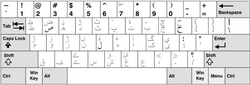
| Keyboard layout | |


Pakistan is a linguistically diverse country where over 70 languages serve as mother tongues.[2][3] Most of these languages fall under the Indo-Iranian branch of the Indo-European language family.[4][5] While Urdu holds the status of national language, it shares official recognition with English and functions as the primary medium for communication across different ethnic communities. Several regional languages also serve as first languages for Pakistan’s various ethnolinguistic groups. The 2023 census records languages with over a million speakers each as Punjabi, Pashto, Sindhi, Saraiki, Urdu, Balochi, Hindko, Brahui, and the Kohistani languages. The census, however, does not include data from the Pakistan-occupied Kashmi (Gilgit-Baltistan and Azad Kashmir, which may affect the reported figures for Shina and Balti). Approximately 60 local languages have fewer than 10 lakh speakers.[6][7]
List of languages
Ethnologue's 2022 edition documents 80 established languages in Pakistan, comprising 68 indigenous and 12 non-indigenous varieties. Language vitality assessments classify four as 'institutional', twenty-four as 'developing', thirty as 'vigorous', fifteen as 'in trouble', and four as 'dying'.[6]
| Language | Province[lower-alpha 4] | Language group |
|---|---|---|
| Aer | Sindh | Indo-Aryan |
| Badeshi | Khyber Pakhtunkwa | Iranian |
| Bagri | Punjab, Sindh | Indo-Aryan |
| Balochi, Makrani | Balochistan | Iranian |
| Balochi, Rakhshani | Balochistan | Iranian |
| Balochi, Sulaimani | Balochistan, Punjab, Sindh | Iranian |
| Balti | Gilgit-Baltistan | Sino-Tibetan |
| Bateri | Khyber Pakhtunkwa | Indo-Aryan |
| Bhaya | Sindh | Indo-Aryan |
| Brahui | Balochistan, Sindh | Dravidian |
| Burushaski | Gilgit-Baltistan | Isolate |
| Chilisso | Khyber Pakhtunkwa | Indo-Aryan |
| Dameli | Khyber Pakhtunkwa | Indo-Aryan |
| Dari | Khyber Pakhtunkwa | Iranian |
| Dehwari | Balochistan | Iranian |
| Dhatki | Sindh | Indo-Aryan |
| Domaaki | Gilgit-Baltistan | Indo-Aryan |
| English | Federal co-official | Germanic |
| Gawar-Bati | Khyber Pakhtunkwa | Indo-Aryan |
| Gawri | Khyber Pakhtunkwa | Indo-Aryan |
| Ghera | Sindh | Indo-Aryan |
| Goaria | Sindh | Indo-Aryan |
| Gowro | Khyber Pakhtunkwa | Indo-Aryan |
| Gujarati | Sindh | Indo-Aryan |
| Gujari | Azad Kashmir, Gilgit-Baltistan, Khyber Pakhtunkwa, Punjab |
Indo-Aryan |
| Gurgula | Sindh | Indo-Aryan |
| Haryanvi aka Rangri | Sindh, Punjab | Indo-Aryan |
| Hazaragi | Balochistan | Iranian |
| Hindko, Northern | Azad Kashmir, Khyber Pakhtunkwa | Indo-Aryan |
| Hindko, Southern | Khyber Pakhtunkwa, Punjab | Indo-Aryan |
| Jadgali | Balochistan, Sindh | Indo-Aryan |
| Jandavra | Sindh | Indo-Aryan |
| Jogi | Sindh | Indo-Aryan |
| Kabutra | Sindh | Indo-Aryan |
| Kacchi | Sindh | Indo-Aryan |
| Kalasha | Khyber Pakhtunkwa | Indo-Aryan |
| Kalkoti | Khyber Pakhtunkwa | Indo-Aryan |
| Kamviri | Khyber Pakhtunkwa | Iranian |
| Kashmiri | Azad Kashmir | Indo-Aryan |
| Kati | Khyber Pakhtunkwa | Iranian |
| Khetrani | Balochistan | Indo-Aryan |
| Khowar | Gilgit-Baltistan, Khyber Pakhtunkwa | Indo-Aryan |
| Kyrgyz | Chitral, Hunza | Turkic |
| Kohistani, Indus | Khyber Pakhtunkwa | Indo-Aryan |
| Koli, Kachi | Sindh | Indo-Aryan |
| Koli, Parkari | Sindh | Indo-Aryan |
| Koli, Wadiyari | Sindh | Indo-Aryan |
| Kutchi | Sindh | Indo-Aryan |
| Kundal Shahi | Azad Kashmir | Indo-Aryan |
| Lasi | Balochistan | Indo-Aryan |
| Loarki | Sindh | Indo-Aryan |
| Mankiyali | Khyber Pakhtunkwa | Indo-Aryan |
| Marwari | Punjab, Sindh | Indo-Aryan |
| Mewati | Punjab, Sindh | Indo-Aryan |
| Memoni | Sindh | Indo-Aryan |
| Oadki | Punjab, Sindh | Indo-Aryan |
| Ormuri | Khyber Pakhtunkwa | Iranian |
| Pahari-Pothwari | Azad Kashmir, Punjab | Indo-Aryan |
| Pakistan Sign Language | Throughout | Indo-Pakistani Sign Language |
| Palula | Khyber Pakhtunkwa | Indo-Aryan |
| Pashto, Central | Balochistan, Khyber Pakhtunkwa, Punjab | Iranian |
| Pashto, Northern | Khyber Pakhtunkwa, Punjab | Iranian |
| Pashto, Southern | Balochistan, Khyber Pakhtunkwa, Punjab | Iranian |
| Punjabi | Punjab, Sindh | Indo-Aryan |
| Saraiki | Balochistan, Khyber Pakhtunkwa, Punjab, Sindh | Indo-Aryan |
| Sarikoli | Khyber Pakhtunkwa, Gilgit-Baltistan | Iranian |
| Savi | Khyber Pakhtunkwa | Indo-Aryan |
| Shina | Azad Kashmir, Gilgit-Baltistan, Khyber Pakhtunkwa | Indo-Aryan |
| Shina, Kohistani | Khyber Pakhtunkwa | Indo-Aryan |
| Sindhi | Sindh, Balochistan | Indo-Aryan |
| Sindhi Bhil | Sindh | Indo-Aryan |
| Torwali | Khyber Pakhtunkwa | Indo-Aryan |
| Urdu | Sindh, Punjab, Azad Kashmir , Islamabad | Indo-Aryan |
| Ushojo | Khyber Pakhtunkwa | Indo-Aryan |
| Vaghri | Sindh | Indo-Aryan |
| Wakhi | Gilgit-Baltistan, Khyber Pakhtunkwa | Iranian |
| Waneci | Balochistan | Iranian |
| Waziri | Khyber Pakhtunkwa | Iranian |
| Yadgha | Khyber Pakhtunkwa | Iranian |
Statistics


| Rank | Language | 1951 census[lower-alpha 5] | 1961 census[lower-alpha 5] | 1972 census | 1981 census[11] | 1998 census[12][13] | 2017 census[14] | 2023 census[9] |
|---|---|---|---|---|---|---|---|---|
| 1 | Punjabi | 67.08% | 66.39% | ... | 48.17% | 44.15% | 38.78% | 36.98% |
| 2 | Pashto | 8.16% | 8.47% | ... | 13.15% | 15.42% | 18.24% | 18.15% |
| 3 | Sindhi | 12.85% | 12.59% | ... | 11.77% | 14.1% | 14.57% | 14.31% |
| 4 | Saraiki | ... | ... | ... | 9.84% | 10.53% | 12.19% | 12.00% |
| 5 | Urdu | 7.05% | 7.57% | ... | 7.60% | 7.57% | 7.08% | 9.25% |
| 6 | Balochi | 3.04% | 2.49% | ... | 3.02% | 3.57% | 3.02% | 3.38% |
| 7 | Hindko | ... | ... | ... | 2.43% | ... | 2.44% | 2.32% |
| 8 | Brahui | 0.70% | 0.93% | ... | 1.21% | ... | 1.24% | 1.16% |
| 9 | Mewati | ... | ... | ... | ... | ... | ... | 0.46% |
| 10 | Kohistani | ... | ... | ... | ... | ... | ... | 0.43% |
| 11 | Kashmiri | ... | ... | ... | ... | ... | 0.17% | 0.11% |
| 12 | Shina | ... | ... | ... | ... | ... | ... | 0.05% |
| 13 | Balti | ... | ... | ... | ... | ... | ... | 0.02% |
| 14 | Kalasha | ... | ... | ... | ... | ... | ... | 0.003% |
| 15 | Others | 1.12% | 1.56% | ... | 2.81% | 4.66% | 2.27% | 1.38% |
* Saraiki and Hindko were included with Punjabi until the 1981 census.
*Census data for the Pakistani administered territories of Gilgit-Baltistan and Azad Kashmir not available as of 2024.
References
- ↑ "Article: 251 National language". Retrieved 23 July 2018.
- ↑ Ashraf, Hina (22 March 2022). "The ambivalent role of Urdu and English in multilingual Pakistan: a Bourdieusian study". Language Policy. 22 (1): 25–48. doi:10.1007/s10993-022-09623-6. ISSN 1573-1863. PMC 8939399. PMID 35340722.
- ↑ Ashraf, Muhammad Azeem; Turner, David A.; Laar, Rizwan Ahmed (January 2021). "Multilingual Language Practices in Education in Pakistan: The Conflict Between Policy and Practice". SAGE Open. 11 (1): 215824402110041. doi:10.1177/21582440211004140. ISSN 2158-2440. S2CID 232484396.
- ↑ Rengel, Marian (15 December 2003). Pakistan: A Primary Source Cultural Guide. The Rosen Publishing Group, Inc. p. 38. ISBN 978-0-8239-4001-1.
- ↑ Kachru, Braj B.; Kachru, Yamuna; Sridhar, S. N. (27 March 2008). Language in South Asia. Cambridge University Press. p. 34. ISBN 978-1-139-46550-2.
- ↑ 6.0 6.1 6.2 Eberhard, Simons & Fennig 2022.
- ↑ "Endangered Languages Project - Torwali - Challenges to the linguistic diversity of North Pakistan". www.endangeredlanguages.com. Retrieved 11 June 2023.
- ↑ Statistical Year Book 2020 (PDF). Muzaffarabad: AJ&K Bureau Of Statistics. pp. 131, 140. Archived (PDF) from the original on 9 October 2022. Retrieved 3 March 2022.
- ↑ 9.0 9.1 "Population by Mother Tongue, Sex and Rural/Urban, Census–2023" (PDF). pbs.gov.pk. Pakistan Bureau Statistics. Archived from the original (PDF) on 20 December 2024.
- ↑ "India - Population, Vol-1, Pakistan - Census 1961". censusindia.gov.in. pp. 30–39.
- ↑ Division, Population Census Organisation Statistics; Pakistan, Government of; Islamabad (December 1981). 1981 Census Report of Pakistan. Population Census Organisation Statistics Division, Government of Pakistan, Islamabad.
- ↑ "POPULATION BY MOTHER TONGUE" (PDF). Pakistan Bureau of Statistics. Archived from the original (PDF) on 16 September 2016.
- ↑ Ilahi, Mazhar (2014). "Legislative Drafting in Plain Urdu Language for the Islamic Republic of Pakistan". European Journal of Law Reform (in Nederlands). 16 (3): 597–609. doi:10.5553/EJLR/138723702014016003005. ISSN 1387-2370.
- ↑ "TABLE 11 - POPULATION BY MOTHER TONGUE, SEX AND RURAL/ URBAN" (PDF). Pakistan Bureau of Statistics.
- ↑ 1.0 1.1 Urdu and English have official status all around the country under the provisions of the Pakistani constitution
- ↑ Sindh's official language is Sindhi. It is the only province in the country that has its own official language, alongside the nationally official languages Urdu and English
- ↑ Under the provisions of the Pakistani constitution, Urdu has status as the 'national language'[1]
- ↑ Excluding large urban centres
- ↑ 5.0 5.1 Only include statistics for West Pakistan[10]
Cite error: <ref> tags exist for a group named "note", but no corresponding <references group="note"/> tag was found