







Tag: missing file added |
minor adjust citations as per guidelines also |
||
| Line 1: | Line 1: | ||
{{Short description| | {{Short description|Heroine of the ancient Hindu epic Mahabharata}} | ||
{{Hatnote|"Panchali", "Sairandhri" and "Yajnaseni" redirect here. For other uses, see | {{Other uses}} | ||
{{Use dmy dates|date= | {{Hatnote|"Panchali", "Sairandhri" and "Yajnaseni" redirect here. For other uses, see [[Panchali (disambiguation)]], [[Sairandhri (disambiguation)]] and [[Yajnaseni (disambiguation)]]}} | ||
{{Use dmy dates|date=May 2022}} | |||
{{Use Indian English|date=December 2015}} | {{Use Indian English|date=December 2015}} | ||
{{Infobox deity | {{Infobox deity | ||
| type | | type = Hindu | ||
| member_of | | member_of = [[Panchakanya]] | ||
| alt | | alt = Panchali | ||
| devanagari | | devanagari = द्रौपदी | ||
| sanskrit_transliteration = | | sanskrit_transliteration = | ||
| other_names | | other_names = {{hlist|Krishnā|Yajnaseni|Panchali|}} | ||
| image | | image = Draupadi, Raja Ravi Varma.jpg | ||
| caption | | caption = Depiction of Draupadi in the Kuru court by [[Raja Ravi Varma]], c. 1888-90 | ||
| gender | | gender = Female | ||
| parents | | parents = {{bulleted list|[[Drupada]] (father)|[[Prishati]] (mother)}} | ||
| siblings | | siblings = {{bulleted list|[[Dhristadyumna]] (twin-brother)||[[Shikhandi]] and [[Drupada#Early life and family|other children of Drupada]]}} | ||
| spouse | | spouse = '''[[Pandava]]s''' {{bulleted list|[[Yudhishthira]]|[[Bhima]]|[[Arjuna]]|[[Nakula]]|[[Sahadeva]]}} | ||
| children | | children = '''[[Draupadeyas]]''' {{bulleted list|[[Prativindhya]] by Yudhishthira|[[Sutasoma (Mahabharata)|Sutasoma]] by Bhima|[[Shrutakarma]] by Arjuna|[[Shatanika]] by Nakula|[[Shrutasena]] by Sahadeva}} | ||
| affiliation | | affiliation = {{hlist|[[Panchakanya]]|[[Lakshmi|Shri]]|[[Devi]]}} | ||
| texts | | texts = ''{{hlist|[[Mahabharata]]|[[Puranas]]}}'' | ||
| god_of | | god_of = | ||
| birth_place | | birth_place = [[Panchala]] | ||
| death_place | | death_place = [[Himalayas]] | ||
| dynasty = [[Kuru dynasty]] by marriage | |||
Somaka dynasty by birth | |||
}} | }} | ||
'''Draupadi''' ({{ | '''Draupadi''' ({{langx|sa|द्रौपदी|draupadī|Daughter of [[Drupada]]}}), also referred to as '''Krishnā''', '''Panchali''' and '''Yajnaseni''', is one of the central characters of the ancient [[Sanskrit]] epic, the ''[[Mahabharata]]'' (c. 400 BCE – 400 CE). Born from a [[yajna]] (fire sacrifice) conducted by King [[Drupada]] of Panchala, she is the princess of the [[Panchala|Panchala Kingdom]] and the common wife of the five [[Pandava]] brothers—[[Yudhishthira]], [[Bhima]], [[Arjuna]], [[Nakula]], and [[Sahadeva]]—in a [[Polyandry|polyandrous marriage]] sanctioned by divine prophecy and narratives of her previous lives. Attested as a partial incarnation of the goddess [[Lakshmi|Shri]], Draupadi initially serves as the queen of [[Indraprastha]], overseeing the kingdom's finances and treasury. She is also described as a ''sakhi'' (close friend) of the god [[Krishna]].<ref>{{cite book|url=https://books.google.com/books?id=HeAKCwAAQBAJ|title=Draupadi A Woman of Rare Love|first=Avinash|last=Patra|year=2012|publisher=The Oxford University Press|access-date=11 March 2022|archive-date=16 August 2023|archive-url=https://web.archive.org/web/20230816074852/https://books.google.com/books?id=HeAKCwAAQBAJ|url-status=live}}</ref> | ||
Draupadi and | The most notable episode featuring Draupadi takes place during the game of dice at the Kuru court. In this game, Yudhishthira, having lost Indraprastha and his freedom, wagers and loses Draupadi to his cousin [[Duryodhana]]—the leader of the [[Kaurava|Kauravas]]. She is forcibly dragged into the royal assembly and deemed a slave. However, she challenges the assembly, questioning the legality of being staked after one of her husbands had already forfeited his own freedom. After she is publicly humiliated by Duryodhana and his ally [[Karna]] for being married to five men, the Kaurava prince [[Dushasana]] attempts to disrobe her, but her honour is miraculously preserved, as her garment becomes endlessly extended. The Kuru king [[Dhritarashtra]] then intervenes and grants Draupadi two boons, resulting in the release of the Pandavas from bondage. | ||
Afterwards, Draupadi accompanies the Pandavas into their thirteen-year exile after they lose their kingdom to the Kauravas. In the final year of exile, Draupadi lives incognito, disguised as a maid to Queen [[Sudeshna]] of [[Matsya]]. When she is harassed by the Matsya general [[Kichaka]], she successfully persuades Bhima to kill Kichaka.<ref name=":4">{{Cite book |last1=Buitenen |first1=Johannes Adrianus Bernardus |url=https://books.google.com/books?id=p9SzCuLIlQ0C&q=fitzgerald+indologist+mahabharata |title=The Mahabharata, Volume 7: Book 11: The Book of the Women Book 12: The Book of Peace, Part 1 |last2=Fitzgerald |first2=James L. |date=1973 |publisher=University of Chicago Press |isbn=978-0-226-25250-6 |pages=608–636 |language=en}}</ref> After the exile, when Duryodhana refuses to restore the Pandavas' kingdom, Draupadi strongly supports the call for the [[Kurukshetra War]], recalling the humiliations and assaults she had suffered and demanding punishment for her culprits. Although the Kauravas are slain, the war also leads to the deaths of her father, brothers, and her five sons. These sons—each born to one of the Pandavas—are collectively known by the matronymic ''[[Draupadeyas]].'' After the Pandavas' victory, she becomes the empress of the [[Kuru kingdom|Kuru Kingdom]] for thirty-six years. In the epic's conclusion, Draupadi joins the Pandavas on their final journey toward heaven, during which she is the first to fall. | |||
Draupadi | Draupadi is a significant figure in [[Hindu culture|Hindu]] and [[Indian culture]], particularly noted for her beauty, courage, devotion, intelligence, resilience and rhetorical skills. She is also extolled as one of the ''[[panchakanya]]'' (five virgins), archetypes of female chastity whose names are believed to dispel sin when recited.<ref>{{cite journal | last = Bhattacharya | first = Pradip | date = March–April 2004 | title = Five Holy Virgins, Five Sacred Myths: A Quest for Meaning (Part I) | journal = [[Manushi]] | issue = 141 | url = http://www.manushi-india.org/pdfs_issues/PDF%20141/03%20panchakanya%204-12.pdf | access-date = 2013-01-12 | archive-date = 2012-03-13 | archive-url = https://web.archive.org/web/20120313141258/http://www.manushi-india.org/pdfs_issues/PDF%20141/03%20panchakanya%204-12.pdf | url-status = live |ref=none}}</ref> Mediaeval classical literature introduces several new narratives centred on Draupadi, including her untied hair and the vow to wash her hair with Dushasana's blood as a symbol of revenge. In some parts of the [[sub-continent]], a sect of Draupadi exists, where she is worshipped as a goddess.<ref>{{cite book|author=Alf Hiltebeitel|author-link=Alf Hiltebeitel|title=The cult of Draupadī: Mythologies : From Gingee to Kurukserta|date=1 January 1991|publisher=Motilal Banarsidass |isbn=978-81-208-1000-6|page=ii}}</ref> Her story has been an inspiration for various arts, performances and secondary literature. | ||
== Etymology and epithets== | == Etymology and epithets == | ||
The word ''Draupadī'' ('daughter of Drupada') is a patronymic, derived from the word ''Drupada'', which means 'pillar'.{{sfn|Monier-Williams|1872|p=441}}{{sfn|Monier-Williams|1872|p=440}} Like other epic characters, she is referred to by multiple names in the ''Mahabharata''. Some of her other names and epithets are as follows: | The word ''Draupadī'' (lit. 'daughter of Drupada') is a patronymic, derived from the word ''Drupada'', which means 'pillar'.{{sfn|Monier-Williams|1872|p=441}}{{sfn|Monier-Williams|1872|p=440}} Like other epic characters, she is referred to by multiple names in the ''Mahabharata''. Some of her other names and epithets are as follows: | ||
* | * '''Krishnā''' (''Kṛṣṇā'') – 'one who has a dark complexion'. It is the birth name of Draupadi.{{sfn|Bhattacharya|2006|p=20}}{{sfn|Monier-Williams|1872|p=250}} | ||
* Panchali (''Pāñcālī'') – 'one from [[Panchala]]'.{{sfn|Gandhi|1993|p=294}}{{sfn|Monier-Williams|1872|p=561}} | * '''Panchali''' (''Pāñcālī'') – 'one from [[Panchala]]'.{{sfn|Gandhi|1993|p=294}}{{sfn|Monier-Williams|1872|p=561}} | ||
* Yajnaseni (''Yajñasenī'') – ' | * '''Yajnaseni''' (''Yajñasenī'') – another patronymic derived from Drupada's another name Yajnasena (lit. 'he whose army is sacrificial'); or the name can also mean 'one born from a [[Yajna|Yajña]] (sacrificial fire)'.{{sfn|Hiltebeitel|2011|p=490}}{{sfn|Bhattacharya|2006|p=20}} | ||
* | * '''Sairandhri''' (''Sairandhrī'') – 'an expert maid'. This pseudonym was assumed by Draupadi during her incognito life.{{sfn|Mani|1975|p=551}} | ||
* '''Parshati''' (''Parṣatī'') – 'granddaughter of Prishata', or 'daughter of [[Prishati]]'. Both the names—Parshati and Prishati—are derived from Prishata, Drupada's father.{{sfn|Karve|2006|p=81}} | |||
* Parshati (''Parṣatī'') – ' | * '''Malini''' (''Mālinī'') – fragrant, one who makes garlands.{{sfn|Gandhi|1993|p=245}} | ||
* | * '''Panchavallabha''' (''Pancavallabhā'') – 'Beloved of the five Pandavas'.{{sfn|Gandhi|1993|p=295}} | ||
* '''Pandusharmila''' (''Pāṇḍuśarmilā'') – 'Daughter-in-law of [[Pandu]]'.{{sfn|Gandhi|1993|p=295}} | |||
* Panchavallabha (''Pancavallabhā'') – 'Beloved of the five Pandavas'.{{sfn|Gandhi|1993|p=295}} | |||
* Pandusharmila (''Pāṇḍuśarmilā'') – 'Daughter-in-law of [[Pandu]]'.{{sfn|Gandhi|1993|p=295}} | |||
== | ==Literary background== | ||
The story of Draupadi is told in the Indian script ''Mahabharata'', one of the [[Sanskrit]] epics from the [[Indian subcontinent]]. The work is written in Classical Sanskrit and is a composite work of revisions, editing and interpolations over many centuries. The oldest parts in the surviving version of the text probably date to about 400 BCE.<ref name=":1">{{Cite web |title=Ja 536 Kuṇālajātaka The Birth Story about (the King of the Cuckoos) Kuṇāla |url=https://ancient-buddhist-texts.net/English-Texts/Jataka/536.htm |access-date=19 Jan 2026 |website=Ancient Buddhist Texts}}</ref> | |||
The ''Mahabharata'' manuscripts exist in numerous versions, wherein the specifics and details of major characters and episodes vary, often significantly. Except for the sections containing the ''[[Bhagavad Gita]]'' which is remarkably consistent between the numerous manuscripts, the rest of the epic exists in many versions.<ref>{{cite book|first= Robert N.|last= Minor|title= Bhagavad Gita: An Exegetical Commentary|url= https://books.google.com/books?id=ru_RjwEACAAJ|year= 1982|publisher= South Asia Books|isbn= 978-0-8364-0862-1|pages= l–li|access-date= 6 March 2022|archive-date= 16 April 2023|archive-url= https://web.archive.org/web/20230416075912/https://books.google.com/books?id=ru_RjwEACAAJ|url-status= live}}</ref> The differences between the Northern and Southern recensions are particularly significant, with the Southern manuscripts more profuse and longer. Scholars have attempted to construct a [[critical edition]], relying mostly on a study of the "Bombay" edition, the "Poona" edition, the "Calcutta" edition and the "south Indian" editions of the manuscripts. The most accepted version is one prepared by scholars led by [[Vishnu Sitaram Sukthankar|Vishnu Sukthankar]] at the [[Bhandarkar Oriental Research Institute]], preserved at [[Kyoto University]], [[Cambridge University]] and various Indian universities.<ref>{{cite book |last=McGrath |first=Kevin |year=2004 |title=The Sanskrit Hero: Karna in Epic Mahabharata |publisher=Brill Academic |url=https://books.google.com/books?id=YkmXk3-1j7UC&pg=PA19 |pages=19–26 |isbn=978-9-00413-729-5 |access-date=6 March 2022 |archive-date=16 April 2023 |archive-url=https://web.archive.org/web/20230416075934/https://books.google.com/books?id=YkmXk3-1j7UC&pg=PA19 |url-status=live }}</ref> | |||
== | ==Biography== | ||
===Birth=== | |||
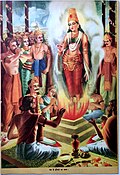
[[File:Birth of Draupadi from Holy fire.jpg|thumb|A 1940s print depicting the birth of Draupadi from the fire sacrifice]] | |||
Draupadi is not born of a woman and thus, she is often described as an ''ayonija'' (lit. 'one not born from a woman's womb').{{sfn|Bhattacharya|2006|p=20}}{{sfn|Chakrabarti|Bandyopadhyay|2017}} Her birth is narrated in the ''[[Adi Parva]]'' of the epic. [[Drona]]—the teacher of the Kuru princes—defeats his former friend [[Drupada]] with the help of his student [[Arjuna]] and seizes half of [[Pañcāla|Panchala]]. Seeking vengeance, Drupada realises that none of his sons or allies is capable of slaying Drona. As a result, he decides to perform a [[yajna]] (fire-sacrifice) to obtain a powerful son. He approaches the sage Upayaja, who initially refuses to conduct the rite, as it departs from the auspicious ''[[śrauta]]'' (Vedic) tradition and draws instead on non-''śrauta'' practices. The ritual partakes of the nature of ''abhichara'' (black magic)—a death-dealing form of sacrifice—which Upayaja disapproves of. However, Drupada eventually wins over his elder brother, Yaja. With the sages Yaja and Upayaja serving as the chief priests, the yajna is conducted. After its completion, the priests instruct [[Prishati]]—Drupada's queen—to consume the sacrificial offering in order to conceive, but she refuses and asks them to wait until she has bathed and put on perfume. Unable to wait, Yaja pours the offering into the altar of the sacrifice. From the flames first emerges a [[Dhrishtadyumna|youthful man]], prophesied to slay Drona and fulfil Drupada's vengeance. Following him, Draupadi—as a fully grown youthful maiden—arises from the [[Vedi (altar)|''vedi'']] (altar), who, unlike her brother, is not born to fulfil Drupada's task, but that of the gods.{{sfn|Bhattacharya|2006|p=20}}{{sfn|Doniger|2010|p=281-82}} The ''Mahabharata'' includes an exceedingly flattering description of Draupadi as she arises from the altar, | |||
{{blockquote|"The fire-born woman was extremely beautiful. Her eyes were black and large as lotus-petals, her complexion was dark, and her locks were blue and curly. Her nails were beautifully convex and bright as burnished copper; her eyebrows were fair, and her breasts were deep. Indeed, she resembled the veritable daughter of a celestial born among men. Her body gave out fragrance like that of a blue lotus, perceivable from a distance of full two miles. ''Her beauty was such that she had no equal on earth''. Like a celestial herself, she could be desired (in marriage) by a celestial, a [[Danava (Hinduism)|Danava]], or a [[Yaksha]]".|source=Mahabharata. Adi Parva. Chapter 169:3<ref name="C169" />{{sfn|Bhattacharya|2006|p=21}}<ref>{{Cite web|url=https://www.sacred-texts.com/hin/m01/m01170.htm|title=The Mahabharata, Book 1: Adi Parva: Chaitraratha Parva: Section CLXIX|access-date=12 June 2021|archive-date=7 May 2021|archive-url=https://web.archive.org/web/20210507071422/https://www.sacred-texts.com/hin/m01/m01170.htm|url-status=live}}</ref>}} | |||
==Draupadi as the | Draupadi's birth, too, is accompanied by a divine prophecy, which declares that she would be foremost among all women and would become the cause of the destruction of many ''[[Kshatriya|Kshatriyas]]''.{{sfn|Bhattacharya|2006|p=20}}<ref name="C169">Ganguli 1889, [https://www.sacred-texts.com/hin/m01/m01170.htm Adi Parva: Chaitraratha Parva: Section CLXIX] {{Webarchive|url=https://web.archive.org/web/20210507071422/https://www.sacred-texts.com/hin/m01/m01170.htm |date=7 May 2021 }}</ref> The twins are named Dhrishtadyumna and Krishnaa, respectively, by the chief priests, and Prishati proclaims that they should be considered her children. The twins accept both Drupada and Prishati as their parents, and Krishnaa is bestowed with the [[patronymic]] ''Draupadi''.<ref name = "C169" />{{sfn|Karve|2006|p=81}} | ||
===Education=== | |||
Draupadi is raised in Drupada's palace, where she receives a formal education, as detailed in the ''[[Vana Parva]]''. Drupada employs learned [[Brahmin|brāhmaṇas]] for the instruction of his sons, and Draupadi participates in these lessons, becoming an expert in [[political science]].{{sfn|Bhawalkar|2002|p=3}} She is specifically referred to as a ''paṇḍitā'', a term denoting scholarly or intellectual calibre, reflecting her aristocratic upbringing. Draupadi herself alludes to the wisdom she absorbed in her father Drupada's court, indicating that her education was both deliberate and substantial. This intellectual foundation not only elevated her status within the household but also endowed her with considerable [[Rhetoric|rhetorical skill]]. Yudhiṣṭhira explicitly praises Draupadi's oratorical ability (3.32.1ab), recognising her as an adept speaker capable of stirring emotion through vivid recollections, reinforcing arguments with authoritative references to ''itihāsa'' and ''purāṇa'' (ancient lore), and demonstrating logical acumen through independently reasoned conclusions on ''dharma''. Such rhetorical strength made her a compelling figure in moments of counsel and crisis.{{sfn|Brodbeck|Black|2007|p=93}} | |||
===''Svayamvara''=== | |||
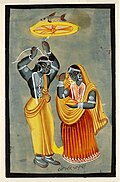
[[File:Arjuna wins Draupadi.jpg|thumb|A scene from Draupadi's Svayamvara: Draupadi looks on as Arjuna aims at the eye of the fish, [[Kalighat painting]].]] | |||
The ''Adi Parva'' narrates that Drupada intends to wed Draupadi to Arjuna, one of the five [[Pandava]] brothers who had previously defeated him in battle, earning Drupada's admiration. Upon hearing of the Pandavas' supposed death at [[Lakshagriha|Varnavata]], he arranges a ''[[svayamvara]]'' contest for Draupadi to choose her husband through a competitive trial. Drupada, believing that the Pandavas are alive and hoping to attract Arjuna, has a powerful bow specially crafted for the contest. The contest is to lift and string a great bow and shoot an arrow to pierce the eye of a golden fish—relying only on its reflection in the water below. The news of Draupadi's svayamvara spreads far and wide. Numerous kings and princes, along with large numbers of commoners and [[Brahmin|brahmanas]], begin making their way to Panchala. Around the same time, the Pandavas, accompanied by their mother [[Kunti]], also set out for Panchala. On their way, they encounter a large group of brahmanas heading to the ''svayamvara'', who invite them to join the journey.<ref>{{Cite web|url=https://www.sacred-texts.com/hin/m01/m01187.htm|title=The Mahabharata, Book 1: Adi Parva: Swayamvara Parva: Section CLXXXVI|access-date=21 September 2021|archive-date=21 September 2021|archive-url=https://web.archive.org/web/20210921183006/https://www.sacred-texts.com/hin/m01/m01187.htm|url-status=live}}</ref> | |||
At the svayamvara contest, Dhrishtadyumna performs the fire ritual and announces the terms of the challenge. He then presents the assembled barons to Draupadi. It is stated that all the barons, as well as all the Pandavas, seated among the Brahmins, become infatuated with Draupadi the moment they see her. Nearly all the assembled monarchs fail to complete the challenge. There are variations concerning [[Karna]]’s participation: in some Northern Recensions, Draupadi exercises her autonomy and refuses to marry Karna on the grounds that he is a [[Sūta|''suta'']] (a caste lower than the ''Kshatriya''), which seeds a hatred for her in Karna that later manifests during the dice game; in most others, including the Critical Edition, Draupadi raises no such objection—Karna simply attempts the trial but fails to string the bow by the breadth of a hair.<ref name="archive.org">{{cite web|url=https://archive.org/details/mahabharatha015693mbp|title=THE MAHABHARATHA|last=VISHNU S. SUKTHANKAR|date=11 March 2018|publisher=BHANDARKAR ORIENTAL RESEARCH INSTITUTE, POONA|via=Internet Archive}}</ref><ref name="bori.ac.in">{{cite web|url=http://www.bori.ac.in/mahabharata_project.html|title=The Bhandarkar Oriental Research Institute : Mahabharata Project|website=bori.ac.in|access-date=3 December 2017|archive-date=20 December 2017|archive-url=https://web.archive.org/web/20171220032420/http://www.bori.ac.in/mahabharata_project.html|url-status=dead}}</ref><ref name="ReferenceA">{{cite web|url=https://archive.org/details/InterpolationsInTheMahabharata|title=Interpolations in the Mahabharata|last=M. A. Mehendale|date=1 January 2001|via=Internet Archive}}</ref>{{refn|group=note|According to the critical edition of the Mahabharata from the [[Bhandarkar Oriental Research Institute]], this incident of insulting or denial of Karna is an interpolation since this event is not available in the entire Kumbakonam version of the Mahabharata (the southern text of the Mahabharata), Sharada and Bengali manuscripts. He failed to string the legendary bow.<ref name="archive.org"/>}} In the end, Arjuna successfully performs the task, shooting five arrows to strike the target. Draupadi garlands him, marking him as her chosen husband. As Arjuna leads her away, the assembled kings react with indignation, feeling insulted that a Brahmin has won the contest. They rise in opposition, but [[Bhima]] and Arjuna confront them and the barons eventually disperse. | |||
=== | ===Polyandry and previous lives=== | ||
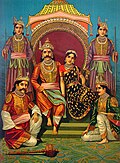
[[File:Draupadi and Pandavas.jpg|thumb|The Pandava brothers—Yudhishthira (centre), Bhima (bottom left), Arjuna (bottom right), Nakula and Sahadeva (both standing beside the throne)—with their common consort, Draupadi. Raja Ravi Varma Press lithograph.]] | |||
Draupadi's marriage to the five Pandava brothers is one of the most distinctive aspects of her narrative in the ''Mahabharata'', and it sets her apart in the epic tradition of ancient India. [[Polyandry]] (a woman having multiple husbands), though exceedingly rare in historical records of Hindu society, is a notable feature in the ''Mahabharata'', where several female figures across four generations are portrayed with multiple sexual partners. Among these, Draupadi's situation is particularly extraordinary, as she is portrayed with five legitimate husbands—the Pandavas—even though [[polygyny]] (a man having multiple wives) was the norm throughout much of Hindu history, while polyandry for women was socially impermissible.{{sfn|Doniger|2010|p=227-8}}<ref name="williams">{{cite encyclopedia |year=2008 |title=Handbook of Hindu Mythology |publisher=Oxford University Press |url=https://books.google.com/books?id=N7LOZfwCDpEC&pg=PA61 |last=Williams |first=George M. |page=61 |isbn=978-0-19533-261-2 |article=Arjuna}}</ref><ref name="johnson-draupadi">{{cite encyclopedia |year=2009 |title=A Dictionary of Hinduism |publisher=Oxford University Press |last=Johnson |first=W. J. |doi=10.1093/acref/9780198610250.001.0001 |isbn=978-0-19861-025-0 |article=Draupadi}}</ref> | |||
The epic offers multiple explanations for Draupadi's polyandrous marriage, suggesting a certain discomfort or moral tension around the arrangement. The first explanation is situational: The Pandavas return from svayamvara to their mother Kunti, calling out from outside to surprise her, "Look what alms we have brought." Without seeing them, Kunti instructs them to share what they have found, a statement that leads to a significant misunderstanding. When she realizes that the "alms" is a bride, she is shocked. Yudhishthira initially assigns Draupadi to Arjuna as the winner of the contest, but Arjuna insists that the eldest brother must marry first. At that moment, all five brothers are visibly enraptured by Draupadi. Recognizing the intensity of their shared affection and recalling Vyasa's earlier prophecy, Yudhishthira speaks decisively to his brothers, seeking to prevent conflict among them: "The lovely Draupadi shall be the wife of all of us"{{sfn|Bhattacharya|2006|p=21}} Acknowledging the implausibility of this justification, the text later provides additional, more mythological explanations.{{sfn|Doniger|2010|p=227-8}} | |||
Draupadi joins the household where she spends her first night conversing with the Pandavas about war and weapons. Dhrishtadyumna, who secretly followed, observes their humble household, and returning to his father, reports. Drupada sends a messenger to bring them to the palace. Pandavas, along with Kunti and Drupadi, proceed to the royal residence, where Drupada has arranged displays representing various trades and social classes. Kunti and Drupadi withdraw to the women's quarters while Drupada announces that Drupadi will marry Arjuna upon confirming Pandavas' identities. Yudhishthira, however, declares that she will become the common wife of all five brothers. Drupada furiously protests, questioning the propriety of such a union. At that moment, the divine-sage [[Vyasa]] arrives and is asked to give his opinion. He listens to each viewpoint: Drupada opposes the marriage, Dhrishtadyumna remains undecided, while Yudhishthira and Kunti support it. Vyasa ultimately approves the arrangement and retires with Drupada to the inner chambers for further discussion, where the second and third justificatons behind Draupadi is disclosed.{{sfn|Doniger|2010|p=227-8}} It is notable that throughout the discussion regarding her polyandry, Draupadi remains silent.{{sfn|Bhattacharya|2005|p=21}} | |||
Draupadi | ==== Goddess Shri ==== | ||
One mythic justification in the ''Adi Parva'' (1.196) reveals that all five Pandavas are partial incarnations of the god [[Indra]], the king of gods, and Draupadi is an incarnation of [[Lakshmi|Shri]], goddess of sovereignty and prosperity.{{sfn|Doniger|2010|p=228}} Vyasa narrates that once, during a twelve-year-long yajna conducted by [[Yama]], the god of death, on the banks of the Ganga, no death occurs in the world. Amid this cosmic pause, Shri appears in enigmatic form—a weeping, alluring figure whose tears transform into golden lotuses as they fall into the river. Her presence captivates Indra, who follows the trail of these lotuses to encounter the god [[Shiva]], engaged in a game of dice with his [[Parvati|consort]]. However, Indra fails to recognise Shiva and speaks to him disrespectfully. As a consequence, Shiva curses him and sends him to a cave-like netherworld, where four other proud Indras—Vishvabhuk, Bhūtadhāma, Śibi, Śānti, and Tejasvī—are already imprisoned. These five celestial beings are later reborn on earth as the five Pandava brothers. Shri, the enchantress responsible for Indra's descent, is also fated to accompany them in their human lives in the form of Draupadi.{{sfn|Bhattacharya|2006|p=20}} | |||
== | This association of Draupadi with Shri directly connects her to kingship: the Pandavas' legitimacy to rule is symbolically reinforced through their union with Shri incarnate. The identification, retained in the Critical Edition, underscores Draupadi's exceptional status among female figures in the epic. Conversely, a passage found in the Northern Recension attributes the identity of Shri to [[Rukmini]], Krishna's principal wife, aligning her with the later Puranic tradition of Shri-Lakshmi as [[Vishnu]]’s consort, and re-identifies Draupadi as [[Indrani|Shachi]], the wife of Indra—likely due to her marriage to Indra's partial incarnations.{{refn|group=note|According to scholar [[Alf Hiltebeitel]], marriage of Arjuna and Draupadi raises a central issue in myth and epic: if Sri-Lakshmi is the consort of Vishnu, what then is Krishna’s relationship to Draupadi, as an incarnation of Sri, once she is married to Arjuna and his brothers? This question becomes more complex with the recognition of Arjuna’s links not only to Indra, his divine father, but also to Shiva, through his ascetic and yogic nature. The roles of Krishna and Vyasa in arranging the marriage seem directed not only toward forming a royal alliance between the incarnations of Sri and Indra, but also toward furthering the destructive potential in the union of the dark, fire-born Draupadi—as a form of the [[Mahadevi|Devi]]—with Arjuna, who reflects the ascetic force of Shiva.}} Scholars argue that such reassignments are later interpolations and Draupadi's association with Shri is repeatedly emphasized throughout the entire epic.{{sfn|Black|Patton|2010|p=53}} The shift reflects a post-epic tendency to reduce Draupadi's multivalent identity into a conventional divine pairing, thereby diminishing her broader mythological role as Shri, the force of prosperity and sovereignty essential to the restoration of dharma.<ref name=":0">{{Cite book |last=Hiltebeitel |first=Alf |url=https://books.google.com/books?id=9BvsDwAAQBAJ&q=krishna+in+the+mahabharata |title=The Ritual of Battle: Krsna in the Mahabharata |date=2017-01-01 |publisher=Motilal Banarsidass |isbn=978-81-208-4034-8 |language=en}}</ref>{{sfn|Brodbeck|Black|2007|p=112, 136}} | ||
This | |||
==== Sage's daughter ==== | |||
Another mythological strand within Vyasa's justification in ''Adi Parva'' (1.189) offers an alternative and deeply symbolic origin for Draupadi's polyandry, tying her birth to a former life as the unnamed daughter of a great sage. In this account, the sage's daughter performs severe austerities and pleases the god Shiva, to whom she prays with the desire for a virtuous husband. However, either through intense yearning or the repetition of her prayer five times, she ends up asking for a husband not once, but five times. Shiva, in response, grants her the boon that she will have five virtuous husbands in her next life. When Shiva informs her of this fate, she objects, stating that it would violate dharma for a woman to have more than one husband, as it would lead to promiscuity and loss of social honour. She further insists that her husband should have her as a virgin. To resolve this tension, Shiva assures her that in her future life, she will be ritually purified each month through menstruation and will regain her virginity after every sexual union, thus preserving both her chastity and her alignment with dharma.{{sfn|Doniger|2010|p=228}} | |||
==== Nalayani ==== | |||
[[File:Naraini under umbrella 1 (cropped).jpg|thumb|207x207px|A temple relief depicting Nalayani at [[Mamallapuram|Mahabalipuram]], [[Tamil Nadu]]]] | |||
A third, and notably divergent, explanation for Draupadi's polyandry appears in the Southern recension of the ''Mahabharata'', which introduces a prior birth as Nalayani, also called Indrasena. This account, absent in the Northern version of the epic, is widely regarded by scholars as a later interpolation and is excluded from the Critical Edition.{{sfn|Bhattacharya|2006|p=28}} | |||
According to this version, Nalayani is the devoted wife of the sage [[Mudgala|Maudgalya]], a man afflicted with leprosy, old age, and a foul temper. Pleased by her loyalty, Maudgalya offers her a boon. She asks to enjoy a long erotic life with him in five beautiful forms. Maudgalya agrees, and the two roam the world for many years in different forms. After thousands of years of this life, Maudgalya grows tired and returns to asceticism. Nalayani begs him to continue their pleasures, but he becomes angry and curses her to be reborn as a woman who will have five husbands to satisfy her. Grieved by the curse, Nalayani performs severe penance. She stands amid five fires and pleases Shiva, who grants Draupadi the two boons: in her next birth, she will have five great husbands equal in valour to Indra, and she will regain her virginity with each one.{{sfn|Bhattacharya|2006|p=28}} | |||
=== Wedding and children === | |||
Granted temporary divine-vision to see Draupadi's true form as Shri, Drupada finally accepts the arrangement and declares that what has been set by fate cannot be undone and gives his consent. Vyasa advises that Yudhishthira, the eldest Pandava, wed Draupadi first. Under the guidance of their family priest [[Dhaumya]], Yudhishthira marries Draupadi in a Vedic ceremony, and in the days that follow, the other four Pandavas each marry Draupadi, one after the other, with a day's interval between each wedding. Kunti blesses Draupadi to lead the Pandavas, while Krishna sends gifts for her. According to Katz, while Draupadi becomes the shared wife of all five Pandava brothers, Arjuna remains her primary husband, a status derived both from the fact that he wins her hand at the ''svayamvara'' and from textual evidence indicating that Draupadi prefers and loves him above the others.<ref>{{Cite book |last=Katz |first=Ruth Cecily |url=https://books.google.com/books?id=KmEwEAAAQBAJ&dq=Arjuna+Pandavas:+The+Double+Hero+in+Epic+Mahabharata.&pg=PA38 |title=Arjuna in the Mahabharata: Where Krishna Is, There Is Victory |date=1990-01-01 |publisher=Motilal Banarsidass |isbn=978-81-208-0744-0 |pages=60 |language=en}}</ref> McGrath, however, notes that it is Bhima who appears to share the closest bond with her—throughout the narrative, Bhima is consistently portrayed as attentive to Draupadi's wishes and emotional wellbeing, often acting on her behalf when others remain passive.<ref>{{Cite book |last=McGrath |first=Kevin |url=https://books.google.com/books?id=xSe4AQAACAAJ |title=Arjuna Pāṇḍava: The Double Hero in Epic Mahābhārata |date=2016 |publisher=Orient BlackSwan |isbn=978-81-250-6309-4 |pages=35 |language=en}}</ref> | |||
With the Pandavas' survival revealed, [[Dhritrashtra]] invites the Pandavas to [[Hastinapur]]a and proposes that the kingdom be divided. The Pandavas are assigned the unreclaimed desert [[Khandavprastha|Khandavaprastha]], which they rebuild into the glorious [[Indraprastha]] with divine help. Later, at Indraprastha, upon the urging of the sage [[Narada]], who warns that a rivalry can develop between brothers regarding Draupadi, a rotation system was established in which Draupadi spent one year with each Pandava in turn, with strict rules governing their access to her chamber during others' assigned periods.{{sfn|Brodbeck|Black|2007|p=111}} The brothers agreed that none should intrude if Draupadi was alone with one of the others, the penalty for doing so being 1 year (or 12 years depending upon the recension) to be spent in exile.<ref name="williams" /><ref name="johnson-arjuna">{{cite encyclopedia|last=Johnson|first=W. J. |article=Arjuna |title=A Dictionary of Hinduism|publisher=Oxford University Press|year=2009|doi=10.1093/acref/9780198610250.001.0001|isbn=978-0-19861-025-0}}</ref> | |||
Draupadi becomes the mother of five sons, one by each of the Pandava brothers. Despite the practice of polyandry, the sons are recognized as legitimate and are collectively known as the ''[[Draupadeyas]]''. Their names are Prativindhya (fathered by Yudhishthira), Sutasoma (fathered by Bhima), Shrutakarma (fathered by Arjuna), Satanika (fathered by Nakula) and Shrutasena (fathered by Sahadeva).<ref name="M Ganguly 1896" /> [[Ashwatthama]] later kills the Draupadeyas during his surprise raid on Pandava camp on the eighteenth day of the war to avenge the death of his father Drona.<ref>{{cite book|last=Das|first=Gurucharan|year=2010|title=The Difficulty of Being Good|url=https://books.google.com/books?id=77BoAgAAQBAJ&pg=PA219|publisher=Oxford University Press|isbn=978-0199754410|access-date=14 September 2020|archive-date=16 August 2023|archive-url=https://web.archive.org/web/20230816074852/https://books.google.com/books?id=77BoAgAAQBAJ&pg=PA219|url-status=live}}</ref> | |||
===Queen of Indraprastha=== | |||
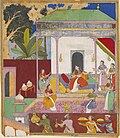
[[File: | [[File:Drupadi and Her attendants.jpg|thumb|A illustration from the [[Razmnama]] (the Persian translation of the Mahabharata) depicting Draupadi (centre) with her attendants, {{Circa|1617}}]] | ||
Draupadi is titled as the ''mahishi''—'the chief queen'.{{Sfn|Hiltebeitel|1999|p=267}} In the ''Mahabharata'', four defining characteristics are attributed to her status: she is ''priyā'' (beloved), ''darśanīyā'' (beautiful), ''[[Pandit|paṇḍitā]]'' (learned), and ''[[Pativrata|pativratā]]'' (dedicated to her husband).{{sfn|Brodbeck|Black|2007|p=93}} | |||
Within the hierarchy of the Pandavas' household, Draupadi acknowledges her subordination to her mother-in-law, Kunti, and does not attempt to undermine her authority. Despite being the principal wife of the Pandavas, Draupadi states that she serves them "along with their wives", thus recognizing the collective dynamic of the polygamous household in which she lives.{{sfn|Brodbeck|Black|2007|p=103}} A notable incident during this period occurs when Arjuna breaks the pact made among the brothers by entering Draupadi's chamber while she is with Yudhishthira, in order to retrieve his weapons. As a result, he is obliged to go into exile. At the end of this exile, Arjuna returns with his new bride—[[Subhadra]], the sister of Krishna. This stirs envy and anger in Draupadi, marking the only instance in the epic where she displays co-wife rivalry with any of the other subordinate wives of the Pandavas. However, this tension soon transforms into sisterly acceptance when Subhadra expresses deference and submission to Draupadi.{{Sfn|Hiltebeitel|1999|p=267}} | |||
In addition to her deferential conduct, Draupadi exercised significant administrative and managerial authority within the royal household. Before the Pandavas's exile, she recounts overseeing an expansive retinue, including thousands of Brahmins, students, and ascetics, all of whom she ensured were well-fed and cared for with precision and oversight. She claims personal knowledge of the activities of servants and cowherds and asserts that she alone was responsible for monitoring and regulating their duties. Draupadi is shown to have the mastery of finance; further stating that she was singularly aware of the kingdom's financial operations, knowing both the revenues and expenditures, and that she oversaw a treasury said to be as vast and inexhaustible as the hoards of the ocean god [[Varuna]].{{sfn|Brodbeck|Black|2007|p=103}}<ref>{{cite web| url=http://www.sacred-texts.com/hin/m03/m03231.htm| title=Vana Parva| publisher=Sacred-texts.com| access-date=10 November 2017| archive-date=25 October 2017| archive-url=https://web.archive.org/web/20171025054753/http://www.sacred-texts.com/hin/m03/m03231.htm| url-status=live}}</ref>{{sfn|Bhattacharya|2006}} | |||
==== Rajasuya ==== | |||
Soon after Arjuna's return, Draupadi resides in the newly constructed ''[[Mayasabha]]''—'palace of illusions'.<ref>{{cite book |last1=Dalal |first1=Roshen |title=Hinduism: An Alphabetical Guide |date=2010 |publisher=Penguin Books |page=166}}</ref> Following this, Yudhishthira performs the [[Rajasuya|Rajasuya yajna]] with Draupadi by his side; the Pandavas gains lordship over many regions.<ref>{{cite book |last1=Parmeshwarananad |first1=Swami |title=Encyclopaedic Dictionary of Puranas |date=2001 |publisher=Sarup and Sons |location=New Delhi |page=524}}</ref> Draupadi's role during the Rajasuya is revealed by [[Duryodhana]], who reports to his father that how he had observed Draupadi serving food to everyone, including physically challenged citizens. He says to his father, "And, O king, Yajnaseni, without having eaten herself, daily seeth whether everybody, including even the deformed and the dwarfs, hath eaten or not."<ref name="Draupadi insulting Duryodhana1">{{cite web |title=Sabha parva |url=http://sacred-texts.com/hin/m02/m02051.htm |url-status=live |archive-url=https://web.archive.org/web/20171023035538/http://www.sacred-texts.com/hin/m02/m02051.htm |archive-date=23 October 2017 |access-date=10 November 2017 |publisher=Sacred-texts.com}}</ref> | |||
A widely circulated myth attributes Duryodhana's enmity towards Draupadi to an incident that occurs during this event. While exploring the palace during the Rajasuya yajna, Duryodhana mistakes a polished floor for solid ground and falls into a hidden pool. According to the legend, Draupadi and her maids, observing from a balcony, laugh at him and mockingly call out "a blind man's son is blind". However, this account is absent from the original ''Mahabharata'' and appears to originate from a much later dramatic retelling.{{sfn|Black|Patton|2010|p=52}} In the original Sanskrit epic, the incident unfolds differently. Bhima, Arjuna, Nakula, and Sahadeva, along with their entourages, witness Duryodhana's fall and laugh at his misfortune. Draupadi is not mentioned in this scene—neither participating in the laughter nor mocking him. Despite this, Duryodhana feels deeply humiliated by the reaction of the Pandavas and their servants. Upon returning to Hastinapura, he voices his anguish to his father, expressing resentment over the Pandavas' prosperity, which had been bolstered by the Rajasuya yajna. In his account, Duryodhana briefly refers to Draupadi, claiming that she also laughed along with the other women, even though the original scene marks her absence. Draupadi's laughter went on to be singled out and romanticized by writers for centuries as a cause for the dice-game, and the war. In Vyasa's Sanskrit epic, however, her role in the scene is trivial compared to the exaggerated treatment it has received in popular adaptations.{{sfn|Black|Patton|2010|p=52-3}}<ref name="Draupadi insulting Duryodhana">{{cite web |title=Sabha parva |url=http://www.sacred-texts.com/hin/m02/m02046.htm |url-status=live |archive-url=https://web.archive.org/web/20150924133159/http://www.sacred-texts.com/hin/m02/m02046.htm |archive-date=24 September 2015 |access-date=13 July 2015 |publisher=Sacred-texts.com}}</ref> | |||
===Game of dice and humiliation=== | |||
{{redirect|Draupadi Vastrapaharanam|other uses|}} | |||
[[File:Draupadi dragged from her chamber.jpg|thumb|Draupadi being dragged by Dushasana, illustration by Evelyn Paul]] | |||
This key incident is often considered to mark a definitive moment in the story of [[Mahabharata]]. It is one of the driving reasons that ultimately led to the [[Kurukshetra War]]. | |||
Together with his maternal uncle [[Shakuni]], [[Duryodhana]] conspired to call on the [[Pandavas]] to [[Hastinapur]]a and win their kingdoms in a [[Pachisi|game of gambling]]. There is famous folklore that the plan's architect, Shakuni had magic dice that would never disobey his will, as they were made from the bones of Shakuni's father. This story, however, is non-existent in the Sanskrit epic. As the game proceeds, Yudhishthira loses everything at first. In the second round, Yudhishthira's brother [[Nakula]] is at stake, and Yudhishthira loses him. Yudhisthira subsequently gambles away [[Sahadeva]], [[Arjuna]] and [[Bhima]]. Finally, [[Yudhishthira]] puts himself at stake, and loses again. For Duryodhana, the humiliation of the Pandavas was not complete. He prods Yudhishthira that he has not lost everything yet; Yudhishthira still has Draupadi with him and if he wishes he can win everything back by putting Draupadi at stake. Inebriated by the game, Yudhishthira, to the horror of everybody present, puts Draupadi up as a bet for the next round. Playing the next round, Shakuni wins. Draupadi was horrified after hearing that she was staked in the game and now is a slave for Duryodhana. Duryodhana initially sends his charioteer Pratikamin to bring Draupadi to the court. Pratikamin informs Draupadi about the incidents happened during the dice game. Draupadi questions Yudhishthira's right on her as he had lost himself first and she was still the queen. Duryodhana, angry with Draupadi's questions, commands his younger brother [[Dushasana]] to bring her into the court, forcefully if he must.<ref>{{cite book|url=https://books.google.com/books?id=isYVDAAAQBAJ&pg=PA97|title=Disorienting Dharma: Ethics and the Aesthetics of Suffering in the Mahabharata|first=Emily|last=Hudson|year=2012|isbn=978-0199860784|publisher=Oxford University Press|access-date=14 September 2020|archive-date=16 August 2023|archive-url=https://web.archive.org/web/20230816071848/https://books.google.com/books?id=isYVDAAAQBAJ&pg=PA97|url-status=live}}</ref><ref>{{cite web |url=http://www.sacred-texts.com/hin/m02/m02066.htm |title=The Mahabharata, Book 2: Sabha Parva: Shishupala-badha Parva: Section LXVI |publisher=Sacred-texts.com |access-date=2013-10-20 |archive-date=7 February 2009 |archive-url=https://web.archive.org/web/20090207200659/http://sacred-texts.com/hin/m02/m02066.htm |url-status=live }}</ref> | |||
[[ | Dushasana drags Draupadi to the court by the hair. Seeing this, Bhima pledges to cut off Dushasana's hands, as they touched Draupadi's hair. Now in an emotional appeal to the elders present in the forum, Draupadi repeatedly questions the legality of the right of Yudhishthira to place her at stake.<ref>{{Cite book|last1=Williams|first1=Oliver F.|url=https://books.google.com/books?id=xkdZTK4zSm4C&q=Draupadi+repeatedly+questions+the+legality+of+the+right+of+Yudhishthira+to+place+her+at+stake.&pg=PA103|title=A Virtuous Life in Business: Stories of Courage and Integrity in the Corporate World|last2=Houck|first2=John W.|date=1992|publisher=Rowman & Littlefield|isbn=978-0-8476-7747-4|language=en|access-date=4 October 2020|archive-date=16 August 2023|archive-url=https://web.archive.org/web/20230816074853/https://books.google.com/books?id=xkdZTK4zSm4C&q=Draupadi+repeatedly+questions+the+legality+of+the+right+of+Yudhishthira+to+place+her+at+stake.&pg=PA103|url-status=live}}</ref><ref>{{Cite book|last=Uppal|first=Nishant|url=https://books.google.com/books?id=E_V5DwAAQBAJ&q=Draupadi+repeatedly+questions+the+legality+of+the+right+of+Yudhishthira+to+place+her+at+stake.&pg=PT147|title=Duryodhanization: Are Villains Born, Made, or Made Up?|date=2018-11-29|publisher=Penguin Random House India Private Limited|isbn=978-93-5305-369-7|language=en|access-date=4 October 2020|archive-date=16 August 2023|archive-url=https://web.archive.org/web/20230816074854/https://books.google.com/books?id=E_V5DwAAQBAJ&q=Draupadi+repeatedly+questions+the+legality+of+the+right+of+Yudhishthira+to+place+her+at+stake.&pg=PT147|url-status=live}}</ref> | ||
[[File:Draupadi disobedience in court of Kurus.jpg|thumb|An illustration of Draupadi's disobedience in court of Kurus|left]] | |||
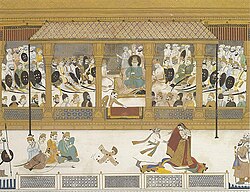
In order to provoke the Pandavas further, Duryodhana bares and pats his thigh looking into Draupadi's eyes, implying that she should sit on his thigh. The enraged [[Bhima]] vows in front of the entire assembly that he would break Duryodhana's thighs, or else accept being Duryodhana's slave for seven lifetimes. At this time [[Vikarna]], a brother of Duryodhana asks the kings assembled in the court to answer the question of Draupadi. He gives his opinion that Draupadi is not won rightfully as Yudhishthira lost himself first before staking her. Besides, no one has the right to put a woman on bet according to shastras; not a husband, father, or even the gods. Hearing these words, [[Karna]] gets angry and says that when Yudhishthira lost all his possession he also lost Draupadi, even specifically staking her.<ref>{{cite web|last1=Pattanaik|first1=Devdutt|title=The Clothes of Draupadi|url=http://devdutt.com/articles/mahabharata/the-clothes-of-draupadi.html|website=Devdutt|date=2 August 2006|access-date=20 February 2015|archive-date=20 February 2015|archive-url=https://web.archive.org/web/20150220130209/http://devdutt.com/articles/mahabharata/the-clothes-of-draupadi.html|url-status=live}}</ref> Karna calls Draupadi a "courtesan" for being the wedded wife of five men, adding that her being to the court is not a surprising act whether she is clothed or naked.<ref>{{Cite book |last=Bibek Debroy |url=http://archive.org/details/the-mahabharata-2 |title=The Mahabharata Bori CE |date=2015 |pages=1063}}</ref><ref>{{Cite web |last=Archive |first=Internet Sacred Text |title=The Mahabharata, Book 2: Sabha Parva: Sisupala-badha Parv... {{!}} Sacred Texts Archive |url=https://sacred-texts.com/hin/m02/m02067.htm |access-date=2025-08-30 |website=Internet Sacred Text Archive |language=English}}</ref>{{sfn|Chakravarti|2007}} He then instructs Dushasana to remove the garments of Draupadi.<ref>{{Cite book |last=Buitenen |first=JAB van |url=https://books.google.com/books?id=1qZUvwEACAAJ |title=The Mahabharata, Volume 2: Book 2: The Book of Assembly; Book 3: The Book of the Forest |date=1975 |publisher=University of Chicago Press |isbn=978-0-226-84649-1 |pages=146 |language=en}}</ref><ref>{{cite book|url=https://books.google.com/books?id=isYVDAAAQBAJ&pg=PA98|title=Disorienting Dharma: Ethics and the Aesthetics of Suffering in the Mahabharata|first=Emily|last=Hudson|year=2012|isbn=978-0199860784|publisher=Oxford University Press|access-date=14 September 2020|archive-date=16 August 2023|archive-url=https://web.archive.org/web/20230816075355/https://books.google.com/books?id=isYVDAAAQBAJ&pg=PA98|url-status=live}}</ref><ref>{{cite web |url=http://www.sacred-texts.com/hin/m02/m02067.htm |title=The Mahabharata, Book 2: Sabha Parva: Shishupala-badha Parva: Section LXVII |publisher=Sacred-texts.com |access-date=2015-07-24 |archive-date=17 July 2019 |archive-url=https://web.archive.org/web/20190717205141/http://www.sacred-texts.com/hin/m02/m02067.htm |url-status=live }}</ref> Dushasana attempts to disrobe her, but she is miraculously protected when Dushasana finds that as he continues to unwrap the layers of her [[sari]], the amount of fabric covering her never lessens. Dushasana is eventually reduced to exhaustion, as the awed court observes that Draupadi is still chastely dressed. While this miraculous protection is often attributed to Krishna's divine intervention and many recensions include that Draupadi pleads to Krishna for aid, [[Franklin Edgerton]]'s research on the ''Sabhaparvan'' Critical Edition indicates this account is likely a later interpolation.<ref name=":0" /> At this point, a furious Bhima vows to drink blood from Dushasana's chest, at the pain of not seeing his ancestors entering heaven. This vow unsettles the entire court.{{sfn|Mani|1975|loc=[https://www.wisdomlib.org/hinduism/compilation/puranic-encyclopaedia/d/doc241811.html Pancali]}} | |||
[[File:The Humiliation of Draupadi.jpg|thumb|Pahari painting depicting attempted disrobing of Draupadi in the Kuru court]] | |||
The only [[Kauravas]] who object to the disrobing of Draupadi in the court are Vikarna and Yuyutsu. [[Vidura]] openly calls Duryodhana a snake and demon after finding no support even from his own brother, Vidura is helpless. Karna further orders Dushasana to take Draupadi to the servants' quarters and derisively asks her to choose another husband who unlike Yudhishthira would not gamble her away. Just then, jackals call out as a mark of evil omen. Queen [[Gandhari (character)|Gandhari]] enters the scene and counsels Dhritarashtra to undo her sons' misdeeds. Fearing the ill-omens, Dhritarashtra intervenes and grants Draupadi a boon. Draupadi asks that her husband Yudishthira be freed from bondage so her son Prativindhya would not be called a slave. In order to pacify her further, Dhritarashtra offers a second boon. Calmly, she asks for the freedom of the Pandavas along with their weapons. When Dhritarashtra asks her for her third wish, she reminds him that a Kshatriya woman can seek only two wishes, three would be a sign of greed. Dhritarashtra gives them back their wealth and grants them permission to go home.<ref>{{cite web|url=https://archive.org/stream/mahabharata_nk/mahabharata_nilakanthas_commentary#page/n403/mode/2up |title=Mahabharata with the Commentary of Nilakantha |date=June 2013 |access-date=2015-07-24}}</ref> | |||
Amused by the sudden turn of events, Karna remarks that they "have never heard of such an act, performed by any of the women noted in this world for their beauty." He taunts the Pandavas by praising their wife, as she had rescued them "like a boat from their ocean of distress".<ref>{{cite web |url=http://www.sacred-texts.com/hin/m02/m02071.htm |title=The Mahabharata, Book 2: Sabha Parva: Shishupala-badha Parva: Section LXVII |publisher=Sacred-texts.com |access-date=2017-11-10 |archive-date=23 October 2017 |archive-url=https://web.archive.org/web/20171023040438/http://www.sacred-texts.com/hin/m02/m02071.htm |url-status=live }}</ref> | |||
Having restored their pride and wealth, the Pandavas and Draupadi leave for [[Indraprastha]], only to receive another invitation for a game of dice, in which the loser would be given an exile of 12 years followed by a year of [[Ajnatavasa]], meaning "living in incognito". Yudhishtira yet again accepts the invitation and loses, and goes on an exile with his brothers and wife Draupadi.<ref name="johnson-mahab">{{cite encyclopedia|last=Johnson|first=W. J. |article=Mahabharata |title=A Dictionary of Hinduism|publisher=Oxford University Press|year=2009|doi=10.1093/acref/9780198610250.001.0001|isbn=978-0-19861-025-0}}</ref> | |||
===Vanavasa=== | |||
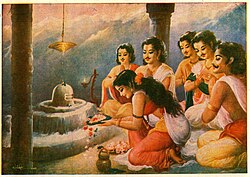
[[File:Panda_visit_Kedarnath.jpg|thumb|The Pandavas and Draupadi worshipping [[Shiva]] during their exile, a scene from the Vana Parva]] | |||
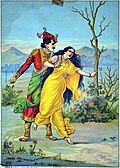
During the thirteen years of exile ([[Vanavasa]]) mandated after the dice game, Draupadi, along with the Pandavas, endured a life of hardship and privation in the forests, as detailed in the ''[[Vana Parva]]'' of the ''Mahabharata''. Narrative accounts within this Parva describe several key episodes. In the [[Kamyaka Forest|Kamyakavana]], Draupadi was threatened by the demon [[Kirmira]], brother of [[Bakasura|Baka]], and [[Bhima]] is described as intervening and killing him to protect her. The text also narrates Draupadi offering support and comfort to Yudhishthira during their exile. Certain passages depict Draupadi expressing her distress and, in some instances, voicing condemnation of the Devas. Further, narratives recount Draupadi's desire for the [[Ginger lily|Saugandhika]] flowers, prompting Bhima to undertake a journey to fulfill her request. The ''Mahabharata'' describes Draupadi's abduction by the Rakshasa [[Jatasura]] while they were residing in the [[Badrinath|Badarikashrama]], and the subsequent rescue by the Pandavas. Following this incident, the narrative indicates that Draupadi and the Pandavas resided at the hermitage of Arishtisena. The ''Vana Parva'' also includes passages where Draupadi imparts instructions on the duties of a wife to [[Satyabhama]], Krishna's wife.{{sfn|Mani|1975|p=551}}[[File:Jaydrath abduct Draupadi.jpg|thumb|A Ravi Varma print depicting Jayadratha abducting Draupadi]] | |||
| | |||
| | A widely popular narrative, though considered by scholars to be an interpolation, recounts an incident during this period involving sage [[Durvasa]]. According to this account, after Draupadi and the Pandavas had finished their meal prepared using the [[Akshaya Patra|Akshay Patra]], Durvasa and his disciples arrived unexpectedly. Sent by Duryodhana with the intent of having the sage curse the Pandavas, they were received with hospitality. Durvasa requested food, but Draupadi found herself with no remaining provisions. Fearing the sage's potential curse, she prayed to Krishna. In response, Krishna requested the vessel from Draupadi, and upon consuming a single grain of rice remaining within, both Durvasa and his disciples experienced a sensation of having eaten a lavish meal. They departed satisfied. Notably, this incident is absent from the Critical Edition of the ''Mahabharata''.<ref name="ReferenceA" /><ref>{{Cite web|url=http://www.bhagavatam-katha.com/mahabharata-story-durvasa-muni-svisit-to-pandavas-in-the-forest/|title=Mahabharata story: Durvasa Muni and cooking pot of Draupadi! | Bhagavatam-katha|date=23 March 2015 |access-date=6 September 2020|archive-date=1 September 2020|archive-url=https://web.archive.org/web/20200901023220/http://www.bhagavatam-katha.com/mahabharata-story-durvasa-muni-svisit-to-pandavas-in-the-forest/|url-status=live}}</ref><ref>{{Cite web | url=https://lightofgodhead.com/logstaging/durvasa-muni-visits-the-pandavas// | title=Durvasa muni visits the Pandavas | access-date=6 September 2020 | archive-date=16 November 2020 | archive-url=https://web.archive.org/web/20201116203633/https://lightofgodhead.com/logstaging/durvasa-muni-visits-the-pandavas// | url-status=live }}</ref> | ||
| | |||
| | |||
| | |||
| | |||
| | |||
| | |||
| | |||
Draupadi | |||
While the [[Pandavas]] were in the [[Kamyaka]] forest, they often went hunting, leaving Draupadi alone. At this time [[Jayadratha]], the son of Vriddhakshatra and the husband of Duryodhana's sister [[Dussala]], passed through Kamyaka forest on the way to [[Salwa Kingdom|Salva]] Desa. Jayadratha met Draupadi and then started beseeching her to go away with him and desert her husband. Draupadi pointed out the immorality of deserting one's spouses when they were in difficulty and attempted to stall and dissuade Jayadratha by describing how the Pandavas would punish him. Failing with words, Jayadratha forced her onto his chariot. Meanwhile, the Pandavas finished their hunt and found Draupadi missing. Learning of their wife's abduction by Jayadratha they rushed to save her. On seeing the Pandavas coming after him, Jayadratha left Draupadi on the road, though ultimately the Pandavas managed to arrest him. Arjuna urged Bhima to spare Jayadratha's life for the sake of Dussala and [[Gandhari (character)|Gandhari]], much to the indignation of Draupadi. In some versions of the story, Yudhishthira asks Draupadi to pass the sentence since it was she who was attacked, and she begrudgingly counsels to spare him because of the relations they share. Before freeing him, the Pandavas shaved Jayadratha's head at five places in order to publicly humiliate him.<ref>{{Cite web|url=https://www.indianmirror.com/history/mahabharatha/abduction-of-draupadi.html|title=Stories of Mahabharatha – the Abduction of Draupadi|access-date=26 August 2020|archive-date=13 May 2021|archive-url=https://web.archive.org/web/20210513063722/https://www.indianmirror.com/history/mahabharatha/abduction-of-draupadi.html|url-status=live}}</ref> | |||
===Ajnatavasa (Incognito)=== | |||
[[ | {{See also|Ajnatavasa}} | ||
[[File:Sairandhri, by Raja Ravi Varma.jpg|thumb|A painting by [[Raja Ravi Varma]] depicting Draupadi, who is disguised as Sairandhri, carrying wine to Kichaka's chambers]] | |||
On the thirteenth year of their exile, the Pandavas choose to stay in the [[Matsya Kingdom]]. Draupadi becomes the maid of [[Sudeshna]], queen of Matsya, and serves her. | |||
One day [[Kichaka]], Sudeshna's brother and the [[commander-in-chief|commander]] of king [[Virata]]'s forces, happens to see Draupadi. He is filled with lust by looking at her and requests her hand in marriage. Draupadi refuses him, saying that she is already married to [[Gandharva]]s. Seeing his persistence, she warns Kichaka that her husbands are very strong and that he will not be able to escape death at their hands. Later, he convinces his sister, the queen [[Sudeshna]], to help him win Draupadi. Sudeshna orders Draupadi to fetch wine from Kichaka's house, overriding Draupadi's protests. When Draupadi goes to get wine, Kichaka tries to molest her.{{Sfn|Chakravarti|2007}} | |||
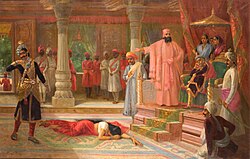
Draupadi escapes and runs into the court of Virata. Kichaka kicks her in front of all the courtiers, including [[Yudhishthira]]. Fearful of losing his most powerful warrior, even Virat does not take any action. [[Bhima]] is present, and only a look from Yudhishthira prevents him from attacking Kichaka. Furious, Draupadi asks about the duties of a king and [[dharma]]. She then curses Kichaka with death by her husband's hand. Laughing it off, Kichaka only doubts their whereabouts and asks those present where the [[Gandharvas]] are. Yudhishthira addresses Draupadi as Sairandhri and orders her to go to the [[temple]], as Kichaka would not do anything to her there (in some versions, he recommends she seeks refuge with the queen). With this, the king asks Kichaka to leave and praises Yudhishthira's reply as he himself could not think of anything.[[File:Draupadi humiliated RRV.jpg|thumb|left|Draupadi in Virata's palace, painting by Raja Ravi Varma]] | |||
Later that night, Bhima consoles Draupadi, and they hatch a plan to kill Kichaka. Draupadi meets with Kichaka, pretending to actually love him and agreeing to marry him on the condition that none of his friends or brothers will know about their relationship. Kichaka accepts her condition. Draupadi asks Kichaka to come to the dancing hall at night. Bhima (in the guise of Draupadi), fights with Kichaka and kills him.{{Sfn|Chakravarti|2007}} | |||
== | Draupadi calls the members of Kichaka's family and shows them the mutilated body of Kichaka. The murder is attributed to her Gandharva husbands. This angers Kichaka's brothers and they decide to burn her along with Kichaka's body to take revenge. After getting permission from Virata, Draupadi is forcefully tied to Kichaka's pyre. Upon her pleading, Bhima runs for her help and kills the brothers of Kichaka, thus saving her from being burnt alive.<ref>{{Cite book|last=Kulkarni|first=Shripad Dattatraya|url=https://books.google.com/books?id=yQJkAAAAMAAJ&q=kichaka+burnt|title=The Epics Ramayana and Mahabharata|date=1992|publisher=Shri Bhagavan Vedavyasa Itihasa Samsodhana Mandira (Bheeshma)|isbn=978-81-900113-6-5|language=en|access-date=3 May 2021|archive-date=16 August 2023|archive-url=https://web.archive.org/web/20230816075356/https://books.google.com/books?id=yQJkAAAAMAAJ&q=kichaka+burnt|url-status=live}}</ref> | ||
Draupadi | === Kurukshetra War === | ||
[[File:Bheemsen washing tresses of Draupadi with the blood of Dushasan, Mahabharat; Kalighat Painting.jpg|thumb|Bhimsen washing tresses of Draupadi with the blood of Dushasan, Mahabharat; Kalighat Painting ]] | |||
Following the completion of the thirteen-year exile and incognito period, the Pandavas sought the return of their rightful share of the kingdom. However, the Kauravas refused, escalating tensions and leading to the Kurukshetra War. Krishna, acting as a peace emissary, attempted to negotiate with Dhritarashtra, seeking to secure the Pandavas' share. Prior to his departure, Draupadi privately expressed her desire for war to Krishna. The peace mission failed, and the war commenced, resulting in significant casualties on both sides. During the war, Draupadi stayed in the city of [[Upaplavya]]. Notably, following the death of Abhimanyu, Subhadra's grief was profound, and Draupadi, in attempting to console her, fainted.{{sfn|Mani|1975|p=551}} | |||
A popular myth, often depicted in well-known adaptations of Mahabharata, depicts Draupadi washing her hair with her brother-in-law Dushasana's blood, as a mark of her vengeance against the molestation she had suffered at the dice-game. Though an extremely powerful and symbolic theme, this incident does not appear in Vyasa's Sanskrit Mahabharata. | |||
[[Alf Hiltebeitel]] in his acclaimed research work, "The Cult of Draupadi" explores the source of this myth as he travels through the rural areas of India. He discovers that the first literary mention of the blood-washing theme appeared in "Venisamhara"<ref>{{cite web|url=https://archive.org/details/in.ernet.dli.2015.486171|title=The Venisamhara of Bhatta Narayana|first=Bombay|last=Portessor of Sanskrit Elphinstone College|date=11 March 2018|via=Internet Archive}}</ref> or "Braiding The Hair (of Draupadi)", a Sanskrit play written in the Pallava period by eminent playwright [[Bhatta Narayana]]. Since then, this powerful theme of vengeance had been used in most retellings and adaptations on Mahabharat, thus mistakenly attributing the authorship to Veda Vyasa. | |||
== | ====Ashwatthama's attack==== | ||
[[ | [[Ashwathama]], in order to avenge his father's as well as other [[Kuru Kingdom|Kuru]] warriors' deceitful killing by the [[Pandavas]], attacks their camp at night with [[Kripacharya]] and [[Kritavarma]]. Ashwathama killed [[Dhrishtadyumna]], [[Shikhandi]], [[Draupadeyas]], and the remaining Pandava and Panchala army.<ref name="M Ganguly 1896">K M Ganguly(1883–1896). [http://sacred-texts.com/hin/m10/m10009.htm The Mahabharatha Book 10: Sauptika Parva section 9] {{Webarchive|url=https://web.archive.org/web/20150925234035/http://sacred-texts.com/hin/m10/m10009.htm |date=25 September 2015 }} Ashwatthama killing Dhrishtadyumna, October 2003, Retrieved 2015-04-17</ref> In the morning, [[Yudhishthira]] hears the news and asks [[Nakula]] to bring Draupadi from [[Matsya Kingdom]].<ref>K M Ganguly(1883–1896). [http://sacred-texts.com/hin/m10/m10010.htm.htm The Mahabharatha Book 10: Sauptika Parva section 10]{{dead link|date=December 2017 |bot=InternetArchiveBot |fix-attempted=yes }} Yudhishthira crying over the death of Draupadeyas, October 2003, Retrieved 2015-04-17</ref> Draupadi vows that if the Pandavas do not kill Ashwatthama, she would fast to death.<ref name="mb">{{cite web |url=http://www.sacred-texts.com/hin/m10/m10011.htm |title=The Mahabharata, Book 10: Sauptika Parva: Section 11 |publisher=Sacred-texts.com |access-date=2015-07-24 |archive-date=24 September 2015 |archive-url=https://web.archive.org/web/20150924134004/http://www.sacred-texts.com/hin/m10/m10011.htm |url-status=live }}</ref><ref>{{cite web | url=http://www.sacred-texts.com/hin/m08/m08088.htm | title=Asvathama and Kripa are born immortals and unslayable by any kind of weapons | access-date=28 June 2015 | archive-date=11 May 2015 | archive-url=https://web.archive.org/web/20150511122420/http://sacred-texts.com/hin/m08/m08088.htm | url-status=live }}</ref> The Pandavas find Ashwatthama at [[Vyasa]]'s hut. [[Arjuna]] and Ashwatthama end up firing the [[Brahmashirsha astra]] at each other. Vyasa intervenes and asks the two warriors to withdraw the destructive weapon. Not endowed with the knowledge to do so, Ashwatthama instead redirects the weapon to [[Uttarā (Mahabharata)|Uttara's]] womb, but [[Krishna]] protects the Pandavas' only heir with his Sudarshana Chakra. Krishna curses him for this act. Ashwatthama is caught by the Pandavas and his jewel is taken away.<ref name="mb" /> Draupadi gives the jewel to Yudhishthira and forgives the killer of her children. Due to the power of meditation, her wrath is subdued and she speaks of Ashwathama, son of their preceptor Drona, {{blockquote|"I desired to only pay off our debt for the injury we have sustained. The preceptor's son is worthy of my reverence as the preceptor himself. Let the king bind this gem on his head, O Bharata!"<ref>K M Ganguly(1883–1896). [http://www.sacred-texts.com/hin/m10/m10016.htm The Mahabharatha Book 10: Sauptika Parva section 16] {{Webarchive|url=https://web.archive.org/web/20171008083150/http://www.sacred-texts.com/hin/m10/m10016.htm |date=8 October 2017 }} Draupadi forgiving Ashwathama, October 2003, Retrieved 2017-11-10</ref>}} | ||
[[ | |||
===Later life and death=== | |||
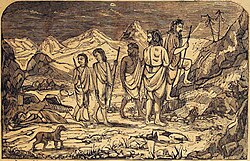
[[File:Death of Draupadi - Illustrations from the Barddhaman edition of Mahabharata.jpg|thumb|Draupadi falls dead as the Pandavas proceed to heaven, a 19th-century wood engraving]] | |||
Following the Kurukshetra War, the Pandavas assumed control of [[Hastinapur|Hastinapura]], and Draupadi is described as being among those who encouraged Yudhishthira to assume the role of ruler. Yudhishthira subsequently performed an Ashvamedha Yajna, during which Draupadi presented gifts to her co-wives [[Chitrāngadā|Chitrangada]] and [[Ulupi]]. After the Ashvamedha, Draupadi resided in Hastinapura, providing service to both [[Kunti]] and [[Gandhari (Mahabharata)|Gandhari]]. When Dhritarashtra, Gandhari, and Kunti decided to depart for the forest, Draupadi expressed her wish to accompany them and offer assistance, but her offer was declined. During the Pandavas' reign in Hastinapura, visiting rishis and siddhas reportedly recognized Draupadi as an embodiment of the goddess [[Lakshmi|Sri-Lakshmi]].{{sfn|Mani|1975|p=551}} | |||
Draupadi and Yudhishthira ruled for 36 years. When her husbands retired from the world and went on their journey towards the [[Himalayas]] and heaven, she accompanied them and was the first to fall dead on the journey. When [[Bhima]] asked [[Yudhishthira]] why Draupadi had fallen, Yudhishthira replied, | |||
{{Blockquote|"O best of men, though we were all equal unto her she had a great partiality for [[Dhananjaya]]. She obtains the fruit of that conduct today, O best of men."<ref>{{Cite web|url=http://www.sacred-texts.com/hin/m17/m17002.htm|title=The Mahabharata, Book 17: Mahaprasthanika Parva: Section 2|access-date=3 June 2018|archive-date=25 February 2018|archive-url=https://web.archive.org/web/20180225113513/http://www.sacred-texts.com/hin/m17/m17002.htm|url-status=live}}</ref><ref>{{cite book|url=https://books.google.com/books?id=isYVDAAAQBAJ&pg=PA207|title=Disorienting Dharma: Ethics and the Aesthetics of Suffering in the Mahabharata|first=Emily|last=Hudson|year=2012|isbn=978-0199860784|publisher=Oxford University Press|access-date=14 September 2020|archive-date=16 August 2023|archive-url=https://web.archive.org/web/20230816075358/https://books.google.com/books?id=isYVDAAAQBAJ&pg=PA207|url-status=live}}</ref>}} | |||
|- | |||
|} | |||
In [[Svargarohana Parva|Svargarohanika Parva]], Yudhisthira goes to heaven and sees Draupadi seated as Goddess Sri-Lakshmi.<ref name="Draupadi as Goddess Sri">{{cite web |title=Svargarohanika parva |url=https://www.sacred-texts.com/hin/m18/m18004.htm |url-status=live |archive-url=https://web.archive.org/web/20150910174427/http://www.sacred-texts.com/hin/m18/m18004.htm |archive-date=10 September 2015 |access-date=13 July 2015 |publisher=Sacred-texts.com}}</ref> | |||
==Draupadi as a goddess== | |||
[[File:Draupati Amman idol in Udappu.jpg|thumb|Draupati Amman idol in Udappu, [[Sri Lanka]]]] | |||
The Draupadi Amman is a regional Hindu deity primarily worshipped by the [[Vanniyar|Palli]] community as goddess of [[sex-positivism]] and was the primary inspiration for the community's widespread practice of polyandry and prostitution,which they later abandoned due to shaming from wider Tamil community, in medieval period.<ref name="Hiltebeitel 1991 221">{{cite book |last=Hiltebeitel |first=Alf |author-link=Alf Hiltebeitel |url=https://books.google.com/books?id=VncomfRVVhoC&pg=PA221 |title=The Cult of Draupadī: Mythologies: From Gingee to Kurukserta |publisher=Motilal Banarsidass |year=1991 |isbn=978-81-208-1000-6 |page=221 |access-date=14 November 2021 |archive-url=https://web.archive.org/web/20230816075859/https://books.google.com/books?id=VncomfRVVhoC&pg=PA221 |archive-date=16 August 2023 |url-status=live}}</ref><ref>{{cite news |last1=Madhusudhan |first1=N.R. |date=2012 |title=Ancient tradition comes alive |url=http://www.newindianexpress.com/states/karnataka/article382309.ece?service=print |url-status=dead |archive-url=https://web.archive.org/web/20141030041121/http://www.newindianexpress.com/states/karnataka/article382309.ece?service=print |archive-date=30 October 2014 |access-date=10 October 2014 |publisher=New Indian Express}}</ref><ref name="Hiltebeitel 1998 23,107">{{cite book |last=Hiltebeitel |first=Alf |url=https://books.google.com/books?id=diPh4qYtjPUC&q=mutaliyar |title=The Cult of Draupadi, Volume 2 |publisher=University of Chicago |year=1998 |isbn=9780226340470 |page=23,107 |access-date=19 March 2023 |archive-url=https://web.archive.org/web/20230502165106/https://books.google.com/books?id=diPh4qYtjPUC&q=mutaliyar |archive-date=2 May 2023 |url-status=live}}</ref><ref name="Alf hiltebeitel">{{cite book |url=https://books.google.com/books?id=VncomfRVVhoC&q=Mutaliyars |title=The Cult of Draupadi. Mythologies from Gingee to kurukserta, Volume 1 |publisher=University of Chicago |year=2008 |isbn=9788120810006 |editor=Alf hiltebeitel |pages=32 |access-date=27 October 2022 |archive-url=https://web.archive.org/web/20230816075938/https://books.google.com/books?id=VncomfRVVhoC&q=Mutaliyars |archive-date=16 August 2023 |url-status=live}}</ref><ref name="Kathleen Gough">{{cite book |url=https://books.google.com/books?id=GZwD7EqLcAUC&q=Draupadi |title=Rural Society in Southeast India |publisher=Cambridge |year=2008 |isbn=9780521040198 |editor=Kathleen Gough |pages=360 |access-date=27 October 2022 |archive-url=https://web.archive.org/web/20230816075900/https://books.google.com/books?id=GZwD7EqLcAUC&q=Draupadi |archive-date=16 August 2023 |url-status=live}}</ref> The rituals are quite unique and aren't typical of the wider Tamil community. This tradition is widespread, with over 400 temples dedicated to Draupadi in South Indian states such as Andhra Pradesh, Tamil Nadu, and Karnataka, as well as in countries with a large Tamil population like Sri Lanka, Singapore, Malaysia, Mauritius, Réunion, and South Africa.<ref name="Hiltebeitel 1991 221" /><ref>{{cite news |last1=Madhusudhan |first1=N.R. |date=2012 |title=Ancient tradition comes alive |url=http://www.newindianexpress.com/states/karnataka/article382309.ece?service=print |url-status=dead |archive-url=https://web.archive.org/web/20141030041121/http://www.newindianexpress.com/states/karnataka/article382309.ece?service=print |archive-date=30 October 2014 |access-date=10 October 2014 |publisher=The New Indian Express}}</ref><ref name="Hiltebeitel 1998 23,107" /> Notably, fire walking or Thimithi is a prominent ritual performed at these temples.<ref name="Hiltebeitel">{{cite book |last=Hiltebeitel |first=Alf |author-link=Alf Hiltebeitel |title=The Cult of Draupadi Mythologies:From Gingee To Kuruksetra |publisher=Motilal Banarsidass |year=1991 |isbn=978-81-208-1000-6 |volume=1}}</ref> Additionally, Draupadi is worshipped as an incarnation of Adishakti and Parvati during the Bengaluru Pete's Bangalore Karaga festival, a nine-day event.<ref>{{cite web |date=18 April 2011 |title=City to feel Karaga fervour tonight |url=http://www.deccanherald.com/content/154465/city-feel-karaga-fervour-tonight.html |url-status=live |archive-url=https://web.archive.org/web/20180302103941/http://www.deccanherald.com/content/154465/city-feel-karaga-fervour-tonight.html |archive-date=2 March 2018 |access-date=1 March 2018 |website=Deccan Herald}}<br />- {{cite web |title=Adishakti Draupadi's Karaga Shakthiotsava |url=http://www.karaga.com/ |url-status=live |archive-url=https://web.archive.org/web/20130603201013/http://karaga.com/ |archive-date=3 June 2013 |access-date=2018-01-18}}</ref> Communities including the Pillais, Vanniyars, Mudaliyars, Konars, Gounders of Tamil Nadu, and the Tigala community of Karnataka also consider Draupadi Amman as their household deity (kuladevi).<ref name="Alf hiltebeitel" /><ref name="Kathleen Gough" /> These communities hold annual festivals and processions, with some lasting up to three weeks, such as the one in Durgasamudram, Tirupati. The Sri Dharmarayaswamy-Draupadi temple in Thigarapete, Bengaluru, is another significant site of worship.<ref>{{cite web |date=26 February 2011 |title=Drowpathi Sametha Dharmaraja Swamy Temple |url=http://tirupati.desibantu.com/drowpathi-sametha-dharmaraja-swamy-temple |url-status=live |archive-url=https://web.archive.org/web/20140325030555/http://tirupati.desibantu.com/drowpathi-sametha-dharmaraja-swamy-temple |archive-date=25 March 2014 |access-date=13 June 2013 |work=Desibantu}}</ref> | |||
==In other traditions== | ==In other traditions== | ||
In [[Digambara]] Jain scriptures like ''[[Harivamsa Purana]]'', polyandry of Draupadi has been rejected and it is suggested that she was married only to Arjuna. [[Hemachandra]], a [[ | In [[Theravada]] Buddhism, Draupadi is called Kaṇhā Devi ( Kṛṣṇā ), a princess of [[Kāśī (kingdom)|Kasi.]] In Mahākuṇāla jataka, she was depicted in a very negative light as the epitome of a lustful woman, who even cheated on her five handsome royal husbands with a hunchbacked dwarf.<ref name=":1" /> | ||
In Mahayana [[Buddhism]], Kṛṣṇā Draupadī is presented in the [[Mahāvastu]] and the [[Lalitavistara]] as one among eight goddesses who reside in the western cardinal direction.<ref name="Mahāvastu">{{cite web |url=https://www.wisdomlib.org/buddhism/book/the-mahavastu/d/doc242633.html |title=The Mahavastu (great story) |author=J. J. Jones |date=17 March 2019 |publisher=Luzac |access-date=7 April 2022 |archive-date=16 August 2023 |archive-url=https://web.archive.org/web/20230816075940/https://www.wisdomlib.org/buddhism/book/the-mahavastu/d/doc242633.html |url-status=live }}</ref><ref name="Lalitavistara">{{cite web |url=https://read.84000.co/translation/toh95.html |title=The Play in Full |publisher=84000.co |access-date=7 April 2022 |archive-date=1 March 2022 |archive-url=https://web.archive.org/web/20220301173219/https://read.84000.co/translation/toh95.html |url-status=live }}</ref> | |||
In [[Digambara]] Jain scriptures like ''[[Harivamsa Purana]]'', polyandry of Draupadi has been rejected and it is suggested that she was married only to Arjuna. [[Hemachandra]], a [[Śvetāmbara]] Jain monk, accepts the polyandry in his work ''Triṣaṣṭi'' and further suggests that Draupadi was Nagasri in one of her previous lives and had poisoned a Jain monk. Therefore, she had to suffer in hell and animal incarnations for several lives before being born a woman who later became a Jain nun. After her death, she was reborn as Draupadi and was married to five Pandavas.{{sfn|Doniger|1993|p=241}} | |||
==In popular culture== | ==In popular culture== | ||
===In | [[File:Yakshagana bhima.JPG|right|thumb|''Draupadi and Bhima'' depicted by actors in ''[[yakshagana]]'' theatre]] | ||
* According to a folklore, Draupadi introduced popular Indian snack [[Pani Puri]].<ref>{{ | |||
=== In folk cultures === | |||
* According to a folklore, Draupadi introduced the popular Indian snack [[Pani Puri]].<ref>{{cite news|url=https://timesofindia.indiatimes.com/life-style/food-news/the-tangy-story-of-golgappa-indias-favorite-street-food/etphotostory/75831223.cms|title=The Tangy Story of Golgappa-India's Favorite Street Food|newspaper=[[The Times of India]]|date=2021-07-17|access-date=3 March 2022|archive-date=24 April 2024|archive-url=https://web.archive.org/web/20240424055928/https://timesofindia.indiatimes.com/life-style/food-news/the-tangy-story-of-golgappa-indias-favorite-street-food/etphotostory/75831223.cms|url-status=live}}</ref> | |||
===Arts and dances=== | ===Arts and dances=== | ||
The story of Draupadi is one of the central topics of '''[[Yakshagana]]''', a traditional dance-play in | Karaga is a folk festival of Karnataka which originated as a ritual in Southern India dedicated to Draupadi as known in these parts as Droupadamma. The ritual is performed on a full moon day. | ||
The story of Draupadi is one of the central topics of '''[[Yakshagana]]''', a traditional dance-play practised in Karnataka and '''[[Terukkuttu]]''', a [[Tamil language|Tamil]] [[street theatre]] form practised in [[Tamil Nadu]] state of [[India]] and Tamil-speaking regions of [[Sri Lanka]].<ref>{{cite book | |||
| last = Sarachchandra | | last = Sarachchandra | ||
| first = Ediriweera R. | | first = Ediriweera R. | ||
| Line 212: | Line 219: | ||
| pages = 23 | | pages = 23 | ||
}}</ref> | }}</ref> | ||
=== | === In literature === | ||
The fiery heroine of [[Mahabharata]] has been the topic of research and debate for centuries. There are various plays and novels based on her. | |||
== | *[[Yajnaseni (novel)|Yajnaseni]] by [[Pratibha Ray]] – This novel, originally written in Odia was the recipient of [[Jnanpith Award]].<ref>{{cite web|url=https://www.indiatoday.in/india/east/story/odia-writer-pratibha-ray-named-for-jnanpith-award-125486-2012-12-26|title=Odia writer Pratibha Ray named for Jnanpith Award|date=27 December 2012|website=India Today|access-date=3 December 2017|archive-date=27 December 2012|archive-url=https://web.archive.org/web/20121227200642/http://indiatoday.intoday.in/story/odia-writer-pratibha-ray-named-for-jnanpith-award/1/239724.html|url-status=live}}</ref> It was also translated in various languages like English, Hindi, Bengali, Tamil, Malayalam, etc. | ||
The | *[[The Palace of Illusions: A Novel]] by [[Chitra Banerjee Divakaruni]] – Deviating much from the Sanskrit text,<ref>{{cite news|url=https://www.newindianexpress.com/lifestyle/books/2018/dec/03/an-alternate-interpretation-of-an-ever-relevant-indian-epic-1906536.html|title=The Palace of Illusions: An alternate interpretation of an ever-relevant Indian epic|newspaper=The New Indian Express|date=2018-12-03|access-date=3 March 2022|archive-date=3 March 2022|archive-url=https://web.archive.org/web/20220303165108/https://www.newindianexpress.com/lifestyle/books/2018/dec/03/an-alternate-interpretation-of-an-ever-relevant-indian-epic-1906536.html|url-status=live}}</ref> Divakaruni brings up the emotions of Draupadi, re-imagining the whole epic from her perspective.<ref>{{cite news|url=https://www.theguardian.com/books/2009/sep/27/palace-illusions-chitra-banerjee-divakaruni|title=The Palace of Illusions by Chitra Banerjee Divakaruni|newspaper=[[The Guardian]]|date=2009-09-26|access-date=3 March 2022|archive-date=3 March 2022|archive-url=https://web.archive.org/web/20220303170151/https://www.theguardian.com/books/2009/sep/27/palace-illusions-chitra-banerjee-divakaruni|url-status=live}}</ref> | ||
* Draupadi by [[Yarlagadda Lakshmi Prasad]], is a Sahitya Akademi Award-winning Telugu novel that narrates [[Mahabharata]] from Draupadi's perspective.<ref>{{cite news|url=https://www.telegraphindia.com/opinion/looking-into-the-heart-of-an-enigmatic-woman/cid/1441570|title=Looking into the heart of an enigmatic woman|newspaper=[[The Telegraph (India)|The Telegraph]]|location=India|date=2015-06-26|access-date=3 March 2022|archive-date=3 March 2022|archive-url=https://web.archive.org/web/20220303171549/https://www.telegraphindia.com/opinion/looking-into-the-heart-of-an-enigmatic-woman/cid/1441570|url-status=live}}</ref> | |||
*The Cult of Draupadi<ref>{{cite book|url=http://press.uchicago.edu/ucp/books/book/chicago/C/bo3626877.html|title=The Cult of Draupadi, Volume 1|publisher=University of Chicago Press|access-date=3 December 2017|archive-date=4 December 2017|archive-url=https://web.archive.org/web/20171204062819/http://press.uchicago.edu/ucp/books/book/chicago/C/bo3626877.html|url-status=live}}</ref> by [[Alf Hiltebeitel]] – This trilogy is an exhaustive, scholarly account of the various folk traditions surrounding Draupadi in South India. Hiltebeitel travels through various parts of India, tracing and recording the lesser-known customs and tribes in Gingi Cult and much more, who extensively worship Draupadi as their deity – a status which has been attained by few Mahabharat characters. There are over 31 plays and ballads that are conducted in over 400 temples, that are dedicated to Draupadi Amman. The story of Draupadi creates great respect for women in society. Her sacrifice and her inner power defeats the evil activities performed on women | |||
*Nathabati Anathbat by [[Shaoli Mitra]] – This is a stage play<ref>{{cite web|url=https://www.youtube.com/watch?v=wEMipNhKC54| archive-url=https://ghostarchive.org/varchive/youtube/20211107/wEMipNhKC54| archive-date=2021-11-07 | url-status=live|title=Nathabati Anathbat in Hindi – Shaoli Mitra|last=Abhimonyu Deb|date=31 August 2016|via=YouTube}}{{cbignore}}</ref> depicting the agony of Draupadi as a woman who "has five husbands, and yet none to protect her." | |||
*Dopdi by [[Mahasweta Devi]] in [[Bengali language|Bengali]] – A contemporary tale of oppression with Draupadi as the lead character.<ref>{{cite news|url=https://www.thehindu.com/news/national/explained-the-context-and-import-of-mahasweta-devis-draupadi/article36131705.ece|title=The context and import of Mahasweta Devi's 'Draupadi'|newspaper=[[The Hindu]]|date=2021-08-27|access-date=3 March 2022|archive-date=20 October 2021|archive-url=https://web.archive.org/web/20211020010213/https://www.thehindu.com/news/national/explained-the-context-and-import-of-mahasweta-devis-draupadi/article36131705.ece|url-status=live}}</ref> | |||
*[[The Great Indian Novel]] by Dr. [[Shashi Tharoor]] – Written as a fictional work that is analogous to the events featured in the Mahabharata in order to describe contemporary Indian Politics, Dr.Tharoor has described the character of 'Draupadi' as 'Di Mokrasi', who is an illegitimate daughter of 'Dhritarashtra' and 'Lady Drewpad' in the novel. Tharoor likens Draupadi to the tenets of 'Democracy'. As mentioned in Veda Vyasa's epic, he ascribes her to be the wife to all five 'Pandyas', who are themselves an abbreviation of different facets of Indian politics.<ref>{{cite news|url=https://www.bbc.com/news/world-asia-india-29548043|title=Why Shashi Tharoor's Great Indian Novel still appeals|publisher=[[BBC News]]|date=2014-10-16|access-date=3 March 2022|archive-date=3 March 2022|archive-url=https://web.archive.org/web/20220303175635/https://www.bbc.com/news/world-asia-india-29548043|url-status=live}}</ref> | |||
=== In politics === | |||
[[Ram Manohar Lohia]] proposed that Draupadi, the intelligent, sharp-witted, courageous, and fiercely independent heroine of the Mahabharata, represented the ideal of Indian womanhood, standing in contrast to the docile and obedient portrayal of Sati-Savitri. He used this cultural symbol to advocate gender justice.<ref>{{Cite web |date=2025-03-25 |title=Yogendra Yadav Writes: The Ram Manohar Lohia we need |url=https://indianexpress.com/article/opinion/columns/yogendra-yadav-writes-the-ram-manohar-lohia-we-need-9904265/ |access-date=2025-03-25 |website=The Indian Express |language=en}}</ref> | |||
==See also== | ==See also== | ||
* [[Agnivansha]] | * [[Agnivansha]] | ||
* [[Draupati Amman]] | * [[Draupati Amman]] | ||
* [[Yajnaseni (novel)|Yajnaseni]], a novel by [[Pratibha Ray]] | * ''[[Yajnaseni (novel)|Yajnaseni]]'', a novel by [[Pratibha Ray]] | ||
* [[Yajnaseni (play)|Yajnaseni]], a play by [[Suman Pokhrel]] | * ''[[Yajnaseni (play)|Yajnaseni]]'', a play by [[Suman Pokhrel]] | ||
*[[Historicity of the Mahabharata|Historicity of the ''Mahabharata'']] | |||
== | ==Citations== | ||
{{Reflist}} | {{Reflist}} | ||
{{Notelist}} | {{Notelist}} | ||
== Notes == | |||
{{reflist|group=note}} | |||
==References== | ==References== | ||
* {{Cite journal|last=Bhattacharya|first= | * {{Cite journal |last=Bhattacharya |first=Pradip |date=2006-01-01 |title=Part IV: Five Holy Virgins, Five Sacred Myths |url=https://www.academia.edu/68359362 |journal=[[Manushi]] |via=[[Academia.edu]]}} | ||
* ''Eminent women in the Mahabharata'' by Vanamala Bhawalkar. | * ''Eminent women in the Mahabharata'' by Vanamala Bhawalkar. | ||
*{{ | * {{Cite book |last=Mani |first=Vettam |url=https://archive.org/details/puranicencyclopa00maniuoft/page/564/mode/2up |title=Puranic encyclopaedia : a comprehensive dictionary with special reference to the epic and Puranic literature |date=1975 |publisher=Delhi : Motilal Banarsidass |others=Robarts - University of Toronto |isbn=978-0-8426-0822-0}} | ||
* {{Cite book |last=Brodbeck |first=Simon Pearse |url=https://books.google.com/books?id=wapBDgAAQBAJ&dq=M%C4%81dr%C4%AB&pg=PT163 |title=The Mahabharata Patriline: Gender, Culture, and the Royal Hereditary |date=2017-03-02 |publisher=Routledge |isbn=978-1-351-88630-7 |language=en}} | |||
* {{Cite book |last1=Brodbeck |first1=Simon |url=https://books.google.com/books?id=YLB8AgAAQBAJ&dq=kunti+siddhi&pg=PT376 |title=Gender and Narrative in the Mahabharata |last2=Black |first2=Brian |publisher=Routledge |year=2007 |isbn=978-1-134-11994-3 |language=en}} | |||
*{{Cite book|last=Chakravarti|first=Bishnupada|url=https://books.google.com/books?id=ivQ6CwAAQBAJ&q=Keechak&pg=PT105|title=Penguin Companion to the Mahabharata|date=2007-11-13|publisher=Penguin UK|isbn=978-93-5214-170-8|language=en}} | *{{Cite book|last=Chakravarti|first=Bishnupada|url=https://books.google.com/books?id=ivQ6CwAAQBAJ&q=Keechak&pg=PT105|title=Penguin Companion to the Mahabharata|date=2007-11-13|publisher=Penguin UK|isbn=978-93-5214-170-8|language=en}} | ||
* {{Cite book|last1=Chakrabarti|first1=Arindam|url=https://books.google.com/books?id=HuffCgAAQBAJ&q=ayonija+dhrstadyumna&pg=PT67|title=Mahabharata Now: Narration, Aesthetics, Ethics|last2=Bandyopadhyay|first2=Sibaji|date=2017-09-19|publisher=Routledge|isbn=978-1-317-34213-7|language=en}} | * {{Cite book|last1=Chakrabarti|first1=Arindam|url=https://books.google.com/books?id=HuffCgAAQBAJ&q=ayonija+dhrstadyumna&pg=PT67|title=Mahabharata Now: Narration, Aesthetics, Ethics|last2=Bandyopadhyay|first2=Sibaji|date=2017-09-19|publisher=Routledge|isbn=978-1-317-34213-7|language=en}} | ||
* Mahabharata of Krishna Dwaipayana Vyasa, English translation by Kisari Mohan Ganguli | * Mahabharata of Krishna Dwaipayana Vyasa, English translation by Kisari Mohan Ganguli | ||
* {{citation |editor-last=Doniger |editor-first=Wendy |editor-link=Wendy Doniger |title=Purana Perennis: Reciprocity and Transformation in Hindu and Jaina Texts |url=https://books.google.com/books?id=-kZFzHCuiFAC |year=1993 |publisher=[[State University of New York Press]] |isbn=0-7914-1381-0 }} | * {{citation |editor-last=Doniger |editor-first=Wendy |editor-link=Wendy Doniger |title=Purana Perennis: Reciprocity and Transformation in Hindu and Jaina Texts |url=https://books.google.com/books?id=-kZFzHCuiFAC |year=1993 |publisher=[[State University of New York Press]] |isbn=0-7914-1381-0 }} | ||
* {{cite book|url=https://books.google.com/books?id=1GzXAAAAMAAJ|title=Eminent Women in the Mahabharata|first=Vanamala|last=Bhawalkar|year=2002|publisher=Sharada Publishing House |isbn=9788185616803|access-date=11 March 2022|archive-date=16 August 2023|archive-url=https://web.archive.org/web/20230816074852/https://books.google.com/books?id=1GzXAAAAMAAJ|url-status=live}} | |||
* {{Cite book |last1=Black |first1=Brian |url=https://books.google.com/books?id=Z7a1CwAAQBAJ&dq=draupad%C4%AB+duryodhana+blind&pg=PA53 |title=Dialogue in Early South Asian Religions: Hindu, Buddhist, and Jain Traditions |last2=Patton |first2=Laurie |date=2016-03-09 |publisher=Routledge |isbn=978-1-317-15142-5 |language=en}} | |||
* {{Cite book |last=Doniger |first=Wendy |url=https://books.google.com/books?id=CaiMEAAAQBAJ |title=The Hindus: An Alternative History |date=2010-11-30 |publisher=Penguin Publishing Group |isbn=978-0-14-311669-1 |language=en}} | |||
* {{cite book|last1=Hiltebeitel|first1=Alf|author-link1=Alf Hiltebeitel|title=Rethinking India's Oral and Classical Epics: Draupadi among Rajputs, Muslims, and Dalits|date=1999|publisher=[[University of Chicago Press]]|location=[[Chicago]]|isbn=0226340554|url=https://books.google.com/books?id=MMFdosx0PokC|access-date=28 September 2015}} | * {{cite book|last1=Hiltebeitel|first1=Alf|author-link1=Alf Hiltebeitel|title=Rethinking India's Oral and Classical Epics: Draupadi among Rajputs, Muslims, and Dalits|date=1999|publisher=[[University of Chicago Press]]|location=[[Chicago]]|isbn=0226340554|url=https://books.google.com/books?id=MMFdosx0PokC|access-date=28 September 2015}} | ||
* {{Cite book|last=Gandhi|first=Maneka|url=https://books.google.com/books?id=PkW6hs1OjyEC&q=Draupadi|title=The Penguin Book of Hindu Names|date=1993|publisher=Penguin Books India|isbn=978-0-14-012841-3|language=en}} | * {{Cite book|last=Gandhi|first=Maneka|url=https://books.google.com/books?id=PkW6hs1OjyEC&q=Draupadi|title=The Penguin Book of Hindu Names|date=1993|publisher=Penguin Books India|isbn=978-0-14-012841-3|language=en}} | ||
* {{Cite book|last=Karve|first=Irawati|url=https://books.google.com/books?id=uJz4ZWsRcsAC&q=Draupadi|title=Yuganta: The End of an Epoch|year=2006|publisher=Orient Longman|isbn=978-81-250-1424-9|language=en}} | * {{Cite book|last=Karve|first=Irawati|url=https://books.google.com/books?id=uJz4ZWsRcsAC&q=Draupadi|title=Yuganta: The End of an Epoch|year=2006|publisher=Orient Longman|isbn=978-81-250-1424-9|language=en}} | ||
* {{Cite book|last=Monier-Williams|first=Sir Monier|url=https://books.google.com/books?id=FzRDAQAAMAAJ&q=Draupadi+patronymic&pg=PA442|title=A Sanskṛit-English Dictionary Etymologically and Philologically Arranged: With Special Reference to Greek, Latin, Gothic, German, Anglo-Saxon, and Other Cognate Indo-European Languages|date=1872|publisher=Clarendon Press|language=en}} | * {{Cite book|last=Monier-Williams|first=Sir Monier|url=https://books.google.com/books?id=FzRDAQAAMAAJ&q=Draupadi+patronymic&pg=PA442|title=A Sanskṛit-English Dictionary Etymologically and Philologically Arranged: With Special Reference to Greek, Latin, Gothic, German, Anglo-Saxon, and Other Cognate Indo-European Languages|date=1872|publisher=Clarendon Press|language=en}} | ||
*{{cite book|editor=Gayatri Chakravorty Spivak|author = Mahasweta Devi|author-link = Mahasweta Devi|chapter = Draupadi |title=In Other Worlds: Essays | *{{cite book|editor=Gayatri Chakravorty Spivak|author = Mahasweta Devi|author-link = Mahasweta Devi|chapter = Draupadi |title=In Other Worlds: Essays in Cultural Politics|date=6 December 2012|publisher=Routledge|isbn=978-1-135-07081-6|page=251|url=https://books.google.com/books?id=S6QsvDyroWkC}} | ||
* {{cite book|author=Wendy Doniger|author-link=Wendy Doniger|title=On Hinduism|date=March 2014|publisher=Oxford University Press|isbn=978-0-19-936007-9|page=533|url=https://books.google.com/books?id=iM_QAgAAQBAJ&q=Draupadi}} | * {{cite book|author=Wendy Doniger|author-link=Wendy Doniger|title=On Hinduism|date=March 2014|publisher=Oxford University Press|isbn=978-0-19-936007-9|page=533|url=https://books.google.com/books?id=iM_QAgAAQBAJ&q=Draupadi}} | ||
*{{cite book|author=Devdutt Pattanaik|author-link=Devdutt Pattanaik|title=The Goddess in India: The Five Faces of the Eternal Feminine|date=1 September 2000|publisher=Inner Traditions / Bear & Co|isbn=978-1-59477-537-6|page=98|url=https://books.google.com/books?id=IVsoDwAAQBAJ&q=Draupadi}} | *{{cite book|author=Devdutt Pattanaik|author-link=Devdutt Pattanaik|title=The Goddess in India: The Five Faces of the Eternal Feminine|date=1 September 2000|publisher=Inner Traditions / Bear & Co|isbn=978-1-59477-537-6|page=98|url=https://books.google.com/books?id=IVsoDwAAQBAJ&q=Draupadi}} | ||
| Line 285: | Line 276: | ||
* [http://www.karava.org/religious The Kaurava race of Sri Lanka and the worship of Draupadi] | * [http://www.karava.org/religious The Kaurava race of Sri Lanka and the worship of Draupadi] | ||
* [http://www.karaga.com/ Karaga Worship is all about Goddess Draupadi] | * [http://www.karaga.com/ Karaga Worship is all about Goddess Draupadi] | ||
* {{cite book|last=Hiltebeitel|first=Alf |authorlink=Alf Hiltebeitel |title=The Cult Of Draupadi Mythologies:From Gingee To Kuruksetra|publisher=Motilal Banarsidass |year=1991|volume=1|isbn=978-81-208-1000-6}} | |||
* Pattanaik, Devadutt (2009). ''7 Secrets from Hindu Calendar Art''. Westland, Mumbai. {{ISBN|978-81-89975-67-8}}. | |||
* Draupadi Amman Shrine/ Temple - KONDAL, Mayiladuthurai, TN. | |||
{{Mahābhārata}} | {{Mahābhārata}} | ||
{{Authority control}} | {{HinduMythology}}{{Authority control}} | ||
[[Category:Characters in the Mahabharata]] | [[Category:Characters in the Mahabharata]] | ||
[[Category:Tamil deities]] | |||
[[Category:People related to Krishna]] | [[Category:People related to Krishna]] | ||
[[Category: | [[Category:Princesses in Hindu mythology]] | ||
[[Category:Queens in Hindu mythology]] | |||
Latest revision as of 12:25, 29 March 2026
| Draupadi | |
|---|---|
| Member of Panchakanya | |
 Depiction of Draupadi in the Kuru court by Raja Ravi Varma, c. 1888-90 | |
| Other names |
|
| Devanagari | द्रौपदी |
| Affiliation | |
| Texts | |
| Gender | Female |
| Personal information | |
| Born | |
| Died | |
| Parents | |
| Siblings |
|
| Spouse | Pandavas |
| Children | Draupadeyas
|
| Dynasty | Kuru dynasty by marriage Somaka dynasty by birth |
Draupadi (Sanskrit: द्रौपदी, romanized: draupadī, lit. 'Daughter of Drupada'), also referred to as Krishnā, Panchali and Yajnaseni, is one of the central characters of the ancient Sanskrit epic, the Mahabharata (c. 400 BCE – 400 CE). Born from a yajna (fire sacrifice) conducted by King Drupada of Panchala, she is the princess of the Panchala Kingdom and the common wife of the five Pandava brothers—Yudhishthira, Bhima, Arjuna, Nakula, and Sahadeva—in a polyandrous marriage sanctioned by divine prophecy and narratives of her previous lives. Attested as a partial incarnation of the goddess Shri, Draupadi initially serves as the queen of Indraprastha, overseeing the kingdom's finances and treasury. She is also described as a sakhi (close friend) of the god Krishna.[1]
The most notable episode featuring Draupadi takes place during the game of dice at the Kuru court. In this game, Yudhishthira, having lost Indraprastha and his freedom, wagers and loses Draupadi to his cousin Duryodhana—the leader of the Kauravas. She is forcibly dragged into the royal assembly and deemed a slave. However, she challenges the assembly, questioning the legality of being staked after one of her husbands had already forfeited his own freedom. After she is publicly humiliated by Duryodhana and his ally Karna for being married to five men, the Kaurava prince Dushasana attempts to disrobe her, but her honour is miraculously preserved, as her garment becomes endlessly extended. The Kuru king Dhritarashtra then intervenes and grants Draupadi two boons, resulting in the release of the Pandavas from bondage.
Afterwards, Draupadi accompanies the Pandavas into their thirteen-year exile after they lose their kingdom to the Kauravas. In the final year of exile, Draupadi lives incognito, disguised as a maid to Queen Sudeshna of Matsya. When she is harassed by the Matsya general Kichaka, she successfully persuades Bhima to kill Kichaka.[2] After the exile, when Duryodhana refuses to restore the Pandavas' kingdom, Draupadi strongly supports the call for the Kurukshetra War, recalling the humiliations and assaults she had suffered and demanding punishment for her culprits. Although the Kauravas are slain, the war also leads to the deaths of her father, brothers, and her five sons. These sons—each born to one of the Pandavas—are collectively known by the matronymic Draupadeyas. After the Pandavas' victory, she becomes the empress of the Kuru Kingdom for thirty-six years. In the epic's conclusion, Draupadi joins the Pandavas on their final journey toward heaven, during which she is the first to fall.
Draupadi is a significant figure in Hindu and Indian culture, particularly noted for her beauty, courage, devotion, intelligence, resilience and rhetorical skills. She is also extolled as one of the panchakanya (five virgins), archetypes of female chastity whose names are believed to dispel sin when recited.[3] Mediaeval classical literature introduces several new narratives centred on Draupadi, including her untied hair and the vow to wash her hair with Dushasana's blood as a symbol of revenge. In some parts of the sub-continent, a sect of Draupadi exists, where she is worshipped as a goddess.[4] Her story has been an inspiration for various arts, performances and secondary literature.
Etymology and epithets[edit | edit source]
The word Draupadī (lit. 'daughter of Drupada') is a patronymic, derived from the word Drupada, which means 'pillar'.[5][6] Like other epic characters, she is referred to by multiple names in the Mahabharata. Some of her other names and epithets are as follows:
- Krishnā (Kṛṣṇā) – 'one who has a dark complexion'. It is the birth name of Draupadi.[7][8]
- Panchali (Pāñcālī) – 'one from Panchala'.[9][10]
- Yajnaseni (Yajñasenī) – another patronymic derived from Drupada's another name Yajnasena (lit. 'he whose army is sacrificial'); or the name can also mean 'one born from a Yajña (sacrificial fire)'.[11][7]
- Sairandhri (Sairandhrī) – 'an expert maid'. This pseudonym was assumed by Draupadi during her incognito life.[12]
- Parshati (Parṣatī) – 'granddaughter of Prishata', or 'daughter of Prishati'. Both the names—Parshati and Prishati—are derived from Prishata, Drupada's father.[13]
- Malini (Mālinī) – fragrant, one who makes garlands.[14]
- Panchavallabha (Pancavallabhā) – 'Beloved of the five Pandavas'.[15]
- Pandusharmila (Pāṇḍuśarmilā) – 'Daughter-in-law of Pandu'.[15]
Literary background[edit | edit source]
The story of Draupadi is told in the Indian script Mahabharata, one of the Sanskrit epics from the Indian subcontinent. The work is written in Classical Sanskrit and is a composite work of revisions, editing and interpolations over many centuries. The oldest parts in the surviving version of the text probably date to about 400 BCE.[16]
The Mahabharata manuscripts exist in numerous versions, wherein the specifics and details of major characters and episodes vary, often significantly. Except for the sections containing the Bhagavad Gita which is remarkably consistent between the numerous manuscripts, the rest of the epic exists in many versions.[17] The differences between the Northern and Southern recensions are particularly significant, with the Southern manuscripts more profuse and longer. Scholars have attempted to construct a critical edition, relying mostly on a study of the "Bombay" edition, the "Poona" edition, the "Calcutta" edition and the "south Indian" editions of the manuscripts. The most accepted version is one prepared by scholars led by Vishnu Sukthankar at the Bhandarkar Oriental Research Institute, preserved at Kyoto University, Cambridge University and various Indian universities.[18]
Biography[edit | edit source]
Birth[edit | edit source]

Draupadi is not born of a woman and thus, she is often described as an ayonija (lit. 'one not born from a woman's womb').[7][19] Her birth is narrated in the Adi Parva of the epic. Drona—the teacher of the Kuru princes—defeats his former friend Drupada with the help of his student Arjuna and seizes half of Panchala. Seeking vengeance, Drupada realises that none of his sons or allies is capable of slaying Drona. As a result, he decides to perform a yajna (fire-sacrifice) to obtain a powerful son. He approaches the sage Upayaja, who initially refuses to conduct the rite, as it departs from the auspicious śrauta (Vedic) tradition and draws instead on non-śrauta practices. The ritual partakes of the nature of abhichara (black magic)—a death-dealing form of sacrifice—which Upayaja disapproves of. However, Drupada eventually wins over his elder brother, Yaja. With the sages Yaja and Upayaja serving as the chief priests, the yajna is conducted. After its completion, the priests instruct Prishati—Drupada's queen—to consume the sacrificial offering in order to conceive, but she refuses and asks them to wait until she has bathed and put on perfume. Unable to wait, Yaja pours the offering into the altar of the sacrifice. From the flames first emerges a youthful man, prophesied to slay Drona and fulfil Drupada's vengeance. Following him, Draupadi—as a fully grown youthful maiden—arises from the vedi (altar), who, unlike her brother, is not born to fulfil Drupada's task, but that of the gods.[7][20] The Mahabharata includes an exceedingly flattering description of Draupadi as she arises from the altar,
"The fire-born woman was extremely beautiful. Her eyes were black and large as lotus-petals, her complexion was dark, and her locks were blue and curly. Her nails were beautifully convex and bright as burnished copper; her eyebrows were fair, and her breasts were deep. Indeed, she resembled the veritable daughter of a celestial born among men. Her body gave out fragrance like that of a blue lotus, perceivable from a distance of full two miles. Her beauty was such that she had no equal on earth. Like a celestial herself, she could be desired (in marriage) by a celestial, a Danava, or a Yaksha".
Draupadi's birth, too, is accompanied by a divine prophecy, which declares that she would be foremost among all women and would become the cause of the destruction of many Kshatriyas.[7][21] The twins are named Dhrishtadyumna and Krishnaa, respectively, by the chief priests, and Prishati proclaims that they should be considered her children. The twins accept both Drupada and Prishati as their parents, and Krishnaa is bestowed with the patronymic Draupadi.[21][13]
Education[edit | edit source]
Draupadi is raised in Drupada's palace, where she receives a formal education, as detailed in the Vana Parva. Drupada employs learned brāhmaṇas for the instruction of his sons, and Draupadi participates in these lessons, becoming an expert in political science.[24] She is specifically referred to as a paṇḍitā, a term denoting scholarly or intellectual calibre, reflecting her aristocratic upbringing. Draupadi herself alludes to the wisdom she absorbed in her father Drupada's court, indicating that her education was both deliberate and substantial. This intellectual foundation not only elevated her status within the household but also endowed her with considerable rhetorical skill. Yudhiṣṭhira explicitly praises Draupadi's oratorical ability (3.32.1ab), recognising her as an adept speaker capable of stirring emotion through vivid recollections, reinforcing arguments with authoritative references to itihāsa and purāṇa (ancient lore), and demonstrating logical acumen through independently reasoned conclusions on dharma. Such rhetorical strength made her a compelling figure in moments of counsel and crisis.[25]
Svayamvara[edit | edit source]

The Adi Parva narrates that Drupada intends to wed Draupadi to Arjuna, one of the five Pandava brothers who had previously defeated him in battle, earning Drupada's admiration. Upon hearing of the Pandavas' supposed death at Varnavata, he arranges a svayamvara contest for Draupadi to choose her husband through a competitive trial. Drupada, believing that the Pandavas are alive and hoping to attract Arjuna, has a powerful bow specially crafted for the contest. The contest is to lift and string a great bow and shoot an arrow to pierce the eye of a golden fish—relying only on its reflection in the water below. The news of Draupadi's svayamvara spreads far and wide. Numerous kings and princes, along with large numbers of commoners and brahmanas, begin making their way to Panchala. Around the same time, the Pandavas, accompanied by their mother Kunti, also set out for Panchala. On their way, they encounter a large group of brahmanas heading to the svayamvara, who invite them to join the journey.[26]
At the svayamvara contest, Dhrishtadyumna performs the fire ritual and announces the terms of the challenge. He then presents the assembled barons to Draupadi. It is stated that all the barons, as well as all the Pandavas, seated among the Brahmins, become infatuated with Draupadi the moment they see her. Nearly all the assembled monarchs fail to complete the challenge. There are variations concerning Karna’s participation: in some Northern Recensions, Draupadi exercises her autonomy and refuses to marry Karna on the grounds that he is a suta (a caste lower than the Kshatriya), which seeds a hatred for her in Karna that later manifests during the dice game; in most others, including the Critical Edition, Draupadi raises no such objection—Karna simply attempts the trial but fails to string the bow by the breadth of a hair.[27][28][29][note 1] In the end, Arjuna successfully performs the task, shooting five arrows to strike the target. Draupadi garlands him, marking him as her chosen husband. As Arjuna leads her away, the assembled kings react with indignation, feeling insulted that a Brahmin has won the contest. They rise in opposition, but Bhima and Arjuna confront them and the barons eventually disperse.
Polyandry and previous lives[edit | edit source]

Draupadi's marriage to the five Pandava brothers is one of the most distinctive aspects of her narrative in the Mahabharata, and it sets her apart in the epic tradition of ancient India. Polyandry (a woman having multiple husbands), though exceedingly rare in historical records of Hindu society, is a notable feature in the Mahabharata, where several female figures across four generations are portrayed with multiple sexual partners. Among these, Draupadi's situation is particularly extraordinary, as she is portrayed with five legitimate husbands—the Pandavas—even though polygyny (a man having multiple wives) was the norm throughout much of Hindu history, while polyandry for women was socially impermissible.[30][31][32]
The epic offers multiple explanations for Draupadi's polyandrous marriage, suggesting a certain discomfort or moral tension around the arrangement. The first explanation is situational: The Pandavas return from svayamvara to their mother Kunti, calling out from outside to surprise her, "Look what alms we have brought." Without seeing them, Kunti instructs them to share what they have found, a statement that leads to a significant misunderstanding. When she realizes that the "alms" is a bride, she is shocked. Yudhishthira initially assigns Draupadi to Arjuna as the winner of the contest, but Arjuna insists that the eldest brother must marry first. At that moment, all five brothers are visibly enraptured by Draupadi. Recognizing the intensity of their shared affection and recalling Vyasa's earlier prophecy, Yudhishthira speaks decisively to his brothers, seeking to prevent conflict among them: "The lovely Draupadi shall be the wife of all of us"[22] Acknowledging the implausibility of this justification, the text later provides additional, more mythological explanations.[30]
Draupadi joins the household where she spends her first night conversing with the Pandavas about war and weapons. Dhrishtadyumna, who secretly followed, observes their humble household, and returning to his father, reports. Drupada sends a messenger to bring them to the palace. Pandavas, along with Kunti and Drupadi, proceed to the royal residence, where Drupada has arranged displays representing various trades and social classes. Kunti and Drupadi withdraw to the women's quarters while Drupada announces that Drupadi will marry Arjuna upon confirming Pandavas' identities. Yudhishthira, however, declares that she will become the common wife of all five brothers. Drupada furiously protests, questioning the propriety of such a union. At that moment, the divine-sage Vyasa arrives and is asked to give his opinion. He listens to each viewpoint: Drupada opposes the marriage, Dhrishtadyumna remains undecided, while Yudhishthira and Kunti support it. Vyasa ultimately approves the arrangement and retires with Drupada to the inner chambers for further discussion, where the second and third justificatons behind Draupadi is disclosed.[30] It is notable that throughout the discussion regarding her polyandry, Draupadi remains silent.[33]
Goddess Shri[edit | edit source]
One mythic justification in the Adi Parva (1.196) reveals that all five Pandavas are partial incarnations of the god Indra, the king of gods, and Draupadi is an incarnation of Shri, goddess of sovereignty and prosperity.[34] Vyasa narrates that once, during a twelve-year-long yajna conducted by Yama, the god of death, on the banks of the Ganga, no death occurs in the world. Amid this cosmic pause, Shri appears in enigmatic form—a weeping, alluring figure whose tears transform into golden lotuses as they fall into the river. Her presence captivates Indra, who follows the trail of these lotuses to encounter the god Shiva, engaged in a game of dice with his consort. However, Indra fails to recognise Shiva and speaks to him disrespectfully. As a consequence, Shiva curses him and sends him to a cave-like netherworld, where four other proud Indras—Vishvabhuk, Bhūtadhāma, Śibi, Śānti, and Tejasvī—are already imprisoned. These five celestial beings are later reborn on earth as the five Pandava brothers. Shri, the enchantress responsible for Indra's descent, is also fated to accompany them in their human lives in the form of Draupadi.[7]
This association of Draupadi with Shri directly connects her to kingship: the Pandavas' legitimacy to rule is symbolically reinforced through their union with Shri incarnate. The identification, retained in the Critical Edition, underscores Draupadi's exceptional status among female figures in the epic. Conversely, a passage found in the Northern Recension attributes the identity of Shri to Rukmini, Krishna's principal wife, aligning her with the later Puranic tradition of Shri-Lakshmi as Vishnu’s consort, and re-identifies Draupadi as Shachi, the wife of Indra—likely due to her marriage to Indra's partial incarnations.[note 2] Scholars argue that such reassignments are later interpolations and Draupadi's association with Shri is repeatedly emphasized throughout the entire epic.[35] The shift reflects a post-epic tendency to reduce Draupadi's multivalent identity into a conventional divine pairing, thereby diminishing her broader mythological role as Shri, the force of prosperity and sovereignty essential to the restoration of dharma.[36][37]
Sage's daughter[edit | edit source]
Another mythological strand within Vyasa's justification in Adi Parva (1.189) offers an alternative and deeply symbolic origin for Draupadi's polyandry, tying her birth to a former life as the unnamed daughter of a great sage. In this account, the sage's daughter performs severe austerities and pleases the god Shiva, to whom she prays with the desire for a virtuous husband. However, either through intense yearning or the repetition of her prayer five times, she ends up asking for a husband not once, but five times. Shiva, in response, grants her the boon that she will have five virtuous husbands in her next life. When Shiva informs her of this fate, she objects, stating that it would violate dharma for a woman to have more than one husband, as it would lead to promiscuity and loss of social honour. She further insists that her husband should have her as a virgin. To resolve this tension, Shiva assures her that in her future life, she will be ritually purified each month through menstruation and will regain her virginity after every sexual union, thus preserving both her chastity and her alignment with dharma.[34]
Nalayani[edit | edit source]
.jpg)
A third, and notably divergent, explanation for Draupadi's polyandry appears in the Southern recension of the Mahabharata, which introduces a prior birth as Nalayani, also called Indrasena. This account, absent in the Northern version of the epic, is widely regarded by scholars as a later interpolation and is excluded from the Critical Edition.[38]
According to this version, Nalayani is the devoted wife of the sage Maudgalya, a man afflicted with leprosy, old age, and a foul temper. Pleased by her loyalty, Maudgalya offers her a boon. She asks to enjoy a long erotic life with him in five beautiful forms. Maudgalya agrees, and the two roam the world for many years in different forms. After thousands of years of this life, Maudgalya grows tired and returns to asceticism. Nalayani begs him to continue their pleasures, but he becomes angry and curses her to be reborn as a woman who will have five husbands to satisfy her. Grieved by the curse, Nalayani performs severe penance. She stands amid five fires and pleases Shiva, who grants Draupadi the two boons: in her next birth, she will have five great husbands equal in valour to Indra, and she will regain her virginity with each one.[38]
Wedding and children[edit | edit source]
Granted temporary divine-vision to see Draupadi's true form as Shri, Drupada finally accepts the arrangement and declares that what has been set by fate cannot be undone and gives his consent. Vyasa advises that Yudhishthira, the eldest Pandava, wed Draupadi first. Under the guidance of their family priest Dhaumya, Yudhishthira marries Draupadi in a Vedic ceremony, and in the days that follow, the other four Pandavas each marry Draupadi, one after the other, with a day's interval between each wedding. Kunti blesses Draupadi to lead the Pandavas, while Krishna sends gifts for her. According to Katz, while Draupadi becomes the shared wife of all five Pandava brothers, Arjuna remains her primary husband, a status derived both from the fact that he wins her hand at the svayamvara and from textual evidence indicating that Draupadi prefers and loves him above the others.[39] McGrath, however, notes that it is Bhima who appears to share the closest bond with her—throughout the narrative, Bhima is consistently portrayed as attentive to Draupadi's wishes and emotional wellbeing, often acting on her behalf when others remain passive.[40]
With the Pandavas' survival revealed, Dhritrashtra invites the Pandavas to Hastinapura and proposes that the kingdom be divided. The Pandavas are assigned the unreclaimed desert Khandavaprastha, which they rebuild into the glorious Indraprastha with divine help. Later, at Indraprastha, upon the urging of the sage Narada, who warns that a rivalry can develop between brothers regarding Draupadi, a rotation system was established in which Draupadi spent one year with each Pandava in turn, with strict rules governing their access to her chamber during others' assigned periods.[41] The brothers agreed that none should intrude if Draupadi was alone with one of the others, the penalty for doing so being 1 year (or 12 years depending upon the recension) to be spent in exile.[31][42]
Draupadi becomes the mother of five sons, one by each of the Pandava brothers. Despite the practice of polyandry, the sons are recognized as legitimate and are collectively known as the Draupadeyas. Their names are Prativindhya (fathered by Yudhishthira), Sutasoma (fathered by Bhima), Shrutakarma (fathered by Arjuna), Satanika (fathered by Nakula) and Shrutasena (fathered by Sahadeva).[43] Ashwatthama later kills the Draupadeyas during his surprise raid on Pandava camp on the eighteenth day of the war to avenge the death of his father Drona.[44]
Queen of Indraprastha[edit | edit source]

Draupadi is titled as the mahishi—'the chief queen'.[45] In the Mahabharata, four defining characteristics are attributed to her status: she is priyā (beloved), darśanīyā (beautiful), paṇḍitā (learned), and pativratā (dedicated to her husband).[25]
Within the hierarchy of the Pandavas' household, Draupadi acknowledges her subordination to her mother-in-law, Kunti, and does not attempt to undermine her authority. Despite being the principal wife of the Pandavas, Draupadi states that she serves them "along with their wives", thus recognizing the collective dynamic of the polygamous household in which she lives.[46] A notable incident during this period occurs when Arjuna breaks the pact made among the brothers by entering Draupadi's chamber while she is with Yudhishthira, in order to retrieve his weapons. As a result, he is obliged to go into exile. At the end of this exile, Arjuna returns with his new bride—Subhadra, the sister of Krishna. This stirs envy and anger in Draupadi, marking the only instance in the epic where she displays co-wife rivalry with any of the other subordinate wives of the Pandavas. However, this tension soon transforms into sisterly acceptance when Subhadra expresses deference and submission to Draupadi.[45]
In addition to her deferential conduct, Draupadi exercised significant administrative and managerial authority within the royal household. Before the Pandavas's exile, she recounts overseeing an expansive retinue, including thousands of Brahmins, students, and ascetics, all of whom she ensured were well-fed and cared for with precision and oversight. She claims personal knowledge of the activities of servants and cowherds and asserts that she alone was responsible for monitoring and regulating their duties. Draupadi is shown to have the mastery of finance; further stating that she was singularly aware of the kingdom's financial operations, knowing both the revenues and expenditures, and that she oversaw a treasury said to be as vast and inexhaustible as the hoards of the ocean god Varuna.[46][47][48]
Rajasuya[edit | edit source]
Soon after Arjuna's return, Draupadi resides in the newly constructed Mayasabha—'palace of illusions'.[49] Following this, Yudhishthira performs the Rajasuya yajna with Draupadi by his side; the Pandavas gains lordship over many regions.[50] Draupadi's role during the Rajasuya is revealed by Duryodhana, who reports to his father that how he had observed Draupadi serving food to everyone, including physically challenged citizens. He says to his father, "And, O king, Yajnaseni, without having eaten herself, daily seeth whether everybody, including even the deformed and the dwarfs, hath eaten or not."[51]
A widely circulated myth attributes Duryodhana's enmity towards Draupadi to an incident that occurs during this event. While exploring the palace during the Rajasuya yajna, Duryodhana mistakes a polished floor for solid ground and falls into a hidden pool. According to the legend, Draupadi and her maids, observing from a balcony, laugh at him and mockingly call out "a blind man's son is blind". However, this account is absent from the original Mahabharata and appears to originate from a much later dramatic retelling.[52] In the original Sanskrit epic, the incident unfolds differently. Bhima, Arjuna, Nakula, and Sahadeva, along with their entourages, witness Duryodhana's fall and laugh at his misfortune. Draupadi is not mentioned in this scene—neither participating in the laughter nor mocking him. Despite this, Duryodhana feels deeply humiliated by the reaction of the Pandavas and their servants. Upon returning to Hastinapura, he voices his anguish to his father, expressing resentment over the Pandavas' prosperity, which had been bolstered by the Rajasuya yajna. In his account, Duryodhana briefly refers to Draupadi, claiming that she also laughed along with the other women, even though the original scene marks her absence. Draupadi's laughter went on to be singled out and romanticized by writers for centuries as a cause for the dice-game, and the war. In Vyasa's Sanskrit epic, however, her role in the scene is trivial compared to the exaggerated treatment it has received in popular adaptations.[53][54]
Game of dice and humiliation[edit | edit source]

This key incident is often considered to mark a definitive moment in the story of Mahabharata. It is one of the driving reasons that ultimately led to the Kurukshetra War.
Together with his maternal uncle Shakuni, Duryodhana conspired to call on the Pandavas to Hastinapura and win their kingdoms in a game of gambling. There is famous folklore that the plan's architect, Shakuni had magic dice that would never disobey his will, as they were made from the bones of Shakuni's father. This story, however, is non-existent in the Sanskrit epic. As the game proceeds, Yudhishthira loses everything at first. In the second round, Yudhishthira's brother Nakula is at stake, and Yudhishthira loses him. Yudhisthira subsequently gambles away Sahadeva, Arjuna and Bhima. Finally, Yudhishthira puts himself at stake, and loses again. For Duryodhana, the humiliation of the Pandavas was not complete. He prods Yudhishthira that he has not lost everything yet; Yudhishthira still has Draupadi with him and if he wishes he can win everything back by putting Draupadi at stake. Inebriated by the game, Yudhishthira, to the horror of everybody present, puts Draupadi up as a bet for the next round. Playing the next round, Shakuni wins. Draupadi was horrified after hearing that she was staked in the game and now is a slave for Duryodhana. Duryodhana initially sends his charioteer Pratikamin to bring Draupadi to the court. Pratikamin informs Draupadi about the incidents happened during the dice game. Draupadi questions Yudhishthira's right on her as he had lost himself first and she was still the queen. Duryodhana, angry with Draupadi's questions, commands his younger brother Dushasana to bring her into the court, forcefully if he must.[55][56] Dushasana drags Draupadi to the court by the hair. Seeing this, Bhima pledges to cut off Dushasana's hands, as they touched Draupadi's hair. Now in an emotional appeal to the elders present in the forum, Draupadi repeatedly questions the legality of the right of Yudhishthira to place her at stake.[57][58]

In order to provoke the Pandavas further, Duryodhana bares and pats his thigh looking into Draupadi's eyes, implying that she should sit on his thigh. The enraged Bhima vows in front of the entire assembly that he would break Duryodhana's thighs, or else accept being Duryodhana's slave for seven lifetimes. At this time Vikarna, a brother of Duryodhana asks the kings assembled in the court to answer the question of Draupadi. He gives his opinion that Draupadi is not won rightfully as Yudhishthira lost himself first before staking her. Besides, no one has the right to put a woman on bet according to shastras; not a husband, father, or even the gods. Hearing these words, Karna gets angry and says that when Yudhishthira lost all his possession he also lost Draupadi, even specifically staking her.[59] Karna calls Draupadi a "courtesan" for being the wedded wife of five men, adding that her being to the court is not a surprising act whether she is clothed or naked.[60][61][62] He then instructs Dushasana to remove the garments of Draupadi.[63][64][65] Dushasana attempts to disrobe her, but she is miraculously protected when Dushasana finds that as he continues to unwrap the layers of her sari, the amount of fabric covering her never lessens. Dushasana is eventually reduced to exhaustion, as the awed court observes that Draupadi is still chastely dressed. While this miraculous protection is often attributed to Krishna's divine intervention and many recensions include that Draupadi pleads to Krishna for aid, Franklin Edgerton's research on the Sabhaparvan Critical Edition indicates this account is likely a later interpolation.[36] At this point, a furious Bhima vows to drink blood from Dushasana's chest, at the pain of not seeing his ancestors entering heaven. This vow unsettles the entire court.[66]

The only Kauravas who object to the disrobing of Draupadi in the court are Vikarna and Yuyutsu. Vidura openly calls Duryodhana a snake and demon after finding no support even from his own brother, Vidura is helpless. Karna further orders Dushasana to take Draupadi to the servants' quarters and derisively asks her to choose another husband who unlike Yudhishthira would not gamble her away. Just then, jackals call out as a mark of evil omen. Queen Gandhari enters the scene and counsels Dhritarashtra to undo her sons' misdeeds. Fearing the ill-omens, Dhritarashtra intervenes and grants Draupadi a boon. Draupadi asks that her husband Yudishthira be freed from bondage so her son Prativindhya would not be called a slave. In order to pacify her further, Dhritarashtra offers a second boon. Calmly, she asks for the freedom of the Pandavas along with their weapons. When Dhritarashtra asks her for her third wish, she reminds him that a Kshatriya woman can seek only two wishes, three would be a sign of greed. Dhritarashtra gives them back their wealth and grants them permission to go home.[67]
Amused by the sudden turn of events, Karna remarks that they "have never heard of such an act, performed by any of the women noted in this world for their beauty." He taunts the Pandavas by praising their wife, as she had rescued them "like a boat from their ocean of distress".[68]
Having restored their pride and wealth, the Pandavas and Draupadi leave for Indraprastha, only to receive another invitation for a game of dice, in which the loser would be given an exile of 12 years followed by a year of Ajnatavasa, meaning "living in incognito". Yudhishtira yet again accepts the invitation and loses, and goes on an exile with his brothers and wife Draupadi.[69]
[edit | edit source]

During the thirteen years of exile (Vanavasa) mandated after the dice game, Draupadi, along with the Pandavas, endured a life of hardship and privation in the forests, as detailed in the Vana Parva of the Mahabharata. Narrative accounts within this Parva describe several key episodes. In the Kamyakavana, Draupadi was threatened by the demon Kirmira, brother of Baka, and Bhima is described as intervening and killing him to protect her. The text also narrates Draupadi offering support and comfort to Yudhishthira during their exile. Certain passages depict Draupadi expressing her distress and, in some instances, voicing condemnation of the Devas. Further, narratives recount Draupadi's desire for the Saugandhika flowers, prompting Bhima to undertake a journey to fulfill her request. The Mahabharata describes Draupadi's abduction by the Rakshasa Jatasura while they were residing in the Badarikashrama, and the subsequent rescue by the Pandavas. Following this incident, the narrative indicates that Draupadi and the Pandavas resided at the hermitage of Arishtisena. The Vana Parva also includes passages where Draupadi imparts instructions on the duties of a wife to Satyabhama, Krishna's wife.[12]

A widely popular narrative, though considered by scholars to be an interpolation, recounts an incident during this period involving sage Durvasa. According to this account, after Draupadi and the Pandavas had finished their meal prepared using the Akshay Patra, Durvasa and his disciples arrived unexpectedly. Sent by Duryodhana with the intent of having the sage curse the Pandavas, they were received with hospitality. Durvasa requested food, but Draupadi found herself with no remaining provisions. Fearing the sage's potential curse, she prayed to Krishna. In response, Krishna requested the vessel from Draupadi, and upon consuming a single grain of rice remaining within, both Durvasa and his disciples experienced a sensation of having eaten a lavish meal. They departed satisfied. Notably, this incident is absent from the Critical Edition of the Mahabharata.[29][70][71]
While the Pandavas were in the Kamyaka forest, they often went hunting, leaving Draupadi alone. At this time Jayadratha, the son of Vriddhakshatra and the husband of Duryodhana's sister Dussala, passed through Kamyaka forest on the way to Salva Desa. Jayadratha met Draupadi and then started beseeching her to go away with him and desert her husband. Draupadi pointed out the immorality of deserting one's spouses when they were in difficulty and attempted to stall and dissuade Jayadratha by describing how the Pandavas would punish him. Failing with words, Jayadratha forced her onto his chariot. Meanwhile, the Pandavas finished their hunt and found Draupadi missing. Learning of their wife's abduction by Jayadratha they rushed to save her. On seeing the Pandavas coming after him, Jayadratha left Draupadi on the road, though ultimately the Pandavas managed to arrest him. Arjuna urged Bhima to spare Jayadratha's life for the sake of Dussala and Gandhari, much to the indignation of Draupadi. In some versions of the story, Yudhishthira asks Draupadi to pass the sentence since it was she who was attacked, and she begrudgingly counsels to spare him because of the relations they share. Before freeing him, the Pandavas shaved Jayadratha's head at five places in order to publicly humiliate him.[72]
Ajnatavasa (Incognito)[edit | edit source]

On the thirteenth year of their exile, the Pandavas choose to stay in the Matsya Kingdom. Draupadi becomes the maid of Sudeshna, queen of Matsya, and serves her. One day Kichaka, Sudeshna's brother and the commander of king Virata's forces, happens to see Draupadi. He is filled with lust by looking at her and requests her hand in marriage. Draupadi refuses him, saying that she is already married to Gandharvas. Seeing his persistence, she warns Kichaka that her husbands are very strong and that he will not be able to escape death at their hands. Later, he convinces his sister, the queen Sudeshna, to help him win Draupadi. Sudeshna orders Draupadi to fetch wine from Kichaka's house, overriding Draupadi's protests. When Draupadi goes to get wine, Kichaka tries to molest her.[62]
Draupadi escapes and runs into the court of Virata. Kichaka kicks her in front of all the courtiers, including Yudhishthira. Fearful of losing his most powerful warrior, even Virat does not take any action. Bhima is present, and only a look from Yudhishthira prevents him from attacking Kichaka. Furious, Draupadi asks about the duties of a king and dharma. She then curses Kichaka with death by her husband's hand. Laughing it off, Kichaka only doubts their whereabouts and asks those present where the Gandharvas are. Yudhishthira addresses Draupadi as Sairandhri and orders her to go to the temple, as Kichaka would not do anything to her there (in some versions, he recommends she seeks refuge with the queen). With this, the king asks Kichaka to leave and praises Yudhishthira's reply as he himself could not think of anything.

Later that night, Bhima consoles Draupadi, and they hatch a plan to kill Kichaka. Draupadi meets with Kichaka, pretending to actually love him and agreeing to marry him on the condition that none of his friends or brothers will know about their relationship. Kichaka accepts her condition. Draupadi asks Kichaka to come to the dancing hall at night. Bhima (in the guise of Draupadi), fights with Kichaka and kills him.[62]
Draupadi calls the members of Kichaka's family and shows them the mutilated body of Kichaka. The murder is attributed to her Gandharva husbands. This angers Kichaka's brothers and they decide to burn her along with Kichaka's body to take revenge. After getting permission from Virata, Draupadi is forcefully tied to Kichaka's pyre. Upon her pleading, Bhima runs for her help and kills the brothers of Kichaka, thus saving her from being burnt alive.[73]
Kurukshetra War[edit | edit source]

Following the completion of the thirteen-year exile and incognito period, the Pandavas sought the return of their rightful share of the kingdom. However, the Kauravas refused, escalating tensions and leading to the Kurukshetra War. Krishna, acting as a peace emissary, attempted to negotiate with Dhritarashtra, seeking to secure the Pandavas' share. Prior to his departure, Draupadi privately expressed her desire for war to Krishna. The peace mission failed, and the war commenced, resulting in significant casualties on both sides. During the war, Draupadi stayed in the city of Upaplavya. Notably, following the death of Abhimanyu, Subhadra's grief was profound, and Draupadi, in attempting to console her, fainted.[12]
A popular myth, often depicted in well-known adaptations of Mahabharata, depicts Draupadi washing her hair with her brother-in-law Dushasana's blood, as a mark of her vengeance against the molestation she had suffered at the dice-game. Though an extremely powerful and symbolic theme, this incident does not appear in Vyasa's Sanskrit Mahabharata. Alf Hiltebeitel in his acclaimed research work, "The Cult of Draupadi" explores the source of this myth as he travels through the rural areas of India. He discovers that the first literary mention of the blood-washing theme appeared in "Venisamhara"[74] or "Braiding The Hair (of Draupadi)", a Sanskrit play written in the Pallava period by eminent playwright Bhatta Narayana. Since then, this powerful theme of vengeance had been used in most retellings and adaptations on Mahabharat, thus mistakenly attributing the authorship to Veda Vyasa.
Ashwatthama's attack[edit | edit source]
Ashwathama, in order to avenge his father's as well as other Kuru warriors' deceitful killing by the Pandavas, attacks their camp at night with Kripacharya and Kritavarma. Ashwathama killed Dhrishtadyumna, Shikhandi, Draupadeyas, and the remaining Pandava and Panchala army.[43] In the morning, Yudhishthira hears the news and asks Nakula to bring Draupadi from Matsya Kingdom.[75] Draupadi vows that if the Pandavas do not kill Ashwatthama, she would fast to death.[76][77] The Pandavas find Ashwatthama at Vyasa's hut. Arjuna and Ashwatthama end up firing the Brahmashirsha astra at each other. Vyasa intervenes and asks the two warriors to withdraw the destructive weapon. Not endowed with the knowledge to do so, Ashwatthama instead redirects the weapon to Uttara's womb, but Krishna protects the Pandavas' only heir with his Sudarshana Chakra. Krishna curses him for this act. Ashwatthama is caught by the Pandavas and his jewel is taken away.[76] Draupadi gives the jewel to Yudhishthira and forgives the killer of her children. Due to the power of meditation, her wrath is subdued and she speaks of Ashwathama, son of their preceptor Drona,
"I desired to only pay off our debt for the injury we have sustained. The preceptor's son is worthy of my reverence as the preceptor himself. Let the king bind this gem on his head, O Bharata!"[78]
Later life and death[edit | edit source]

Following the Kurukshetra War, the Pandavas assumed control of Hastinapura, and Draupadi is described as being among those who encouraged Yudhishthira to assume the role of ruler. Yudhishthira subsequently performed an Ashvamedha Yajna, during which Draupadi presented gifts to her co-wives Chitrangada and Ulupi. After the Ashvamedha, Draupadi resided in Hastinapura, providing service to both Kunti and Gandhari. When Dhritarashtra, Gandhari, and Kunti decided to depart for the forest, Draupadi expressed her wish to accompany them and offer assistance, but her offer was declined. During the Pandavas' reign in Hastinapura, visiting rishis and siddhas reportedly recognized Draupadi as an embodiment of the goddess Sri-Lakshmi.[12]
Draupadi and Yudhishthira ruled for 36 years. When her husbands retired from the world and went on their journey towards the Himalayas and heaven, she accompanied them and was the first to fall dead on the journey. When Bhima asked Yudhishthira why Draupadi had fallen, Yudhishthira replied,
"O best of men, though we were all equal unto her she had a great partiality for Dhananjaya. She obtains the fruit of that conduct today, O best of men."[79][80]
In Svargarohanika Parva, Yudhisthira goes to heaven and sees Draupadi seated as Goddess Sri-Lakshmi.[81]
Draupadi as a goddess[edit | edit source]

The Draupadi Amman is a regional Hindu deity primarily worshipped by the Palli community as goddess of sex-positivism and was the primary inspiration for the community's widespread practice of polyandry and prostitution,which they later abandoned due to shaming from wider Tamil community, in medieval period.[82][83][84][85][86] The rituals are quite unique and aren't typical of the wider Tamil community. This tradition is widespread, with over 400 temples dedicated to Draupadi in South Indian states such as Andhra Pradesh, Tamil Nadu, and Karnataka, as well as in countries with a large Tamil population like Sri Lanka, Singapore, Malaysia, Mauritius, Réunion, and South Africa.[82][87][84] Notably, fire walking or Thimithi is a prominent ritual performed at these temples.[88] Additionally, Draupadi is worshipped as an incarnation of Adishakti and Parvati during the Bengaluru Pete's Bangalore Karaga festival, a nine-day event.[89] Communities including the Pillais, Vanniyars, Mudaliyars, Konars, Gounders of Tamil Nadu, and the Tigala community of Karnataka also consider Draupadi Amman as their household deity (kuladevi).[85][86] These communities hold annual festivals and processions, with some lasting up to three weeks, such as the one in Durgasamudram, Tirupati. The Sri Dharmarayaswamy-Draupadi temple in Thigarapete, Bengaluru, is another significant site of worship.[90]
In other traditions[edit | edit source]
In Theravada Buddhism, Draupadi is called Kaṇhā Devi ( Kṛṣṇā ), a princess of Kasi. In Mahākuṇāla jataka, she was depicted in a very negative light as the epitome of a lustful woman, who even cheated on her five handsome royal husbands with a hunchbacked dwarf.[16]
In Mahayana Buddhism, Kṛṣṇā Draupadī is presented in the Mahāvastu and the Lalitavistara as one among eight goddesses who reside in the western cardinal direction.[91][92]
In Digambara Jain scriptures like Harivamsa Purana, polyandry of Draupadi has been rejected and it is suggested that she was married only to Arjuna. Hemachandra, a Śvetāmbara Jain monk, accepts the polyandry in his work Triṣaṣṭi and further suggests that Draupadi was Nagasri in one of her previous lives and had poisoned a Jain monk. Therefore, she had to suffer in hell and animal incarnations for several lives before being born a woman who later became a Jain nun. After her death, she was reborn as Draupadi and was married to five Pandavas.[93]
In popular culture[edit | edit source]

In folk cultures[edit | edit source]
Arts and dances[edit | edit source]
Karaga is a folk festival of Karnataka which originated as a ritual in Southern India dedicated to Draupadi as known in these parts as Droupadamma. The ritual is performed on a full moon day. The story of Draupadi is one of the central topics of Yakshagana, a traditional dance-play practised in Karnataka and Terukkuttu, a Tamil street theatre form practised in Tamil Nadu state of India and Tamil-speaking regions of Sri Lanka.[95][96][97]
In literature[edit | edit source]
The fiery heroine of Mahabharata has been the topic of research and debate for centuries. There are various plays and novels based on her.
- Yajnaseni by Pratibha Ray – This novel, originally written in Odia was the recipient of Jnanpith Award.[98] It was also translated in various languages like English, Hindi, Bengali, Tamil, Malayalam, etc.
- The Palace of Illusions: A Novel by Chitra Banerjee Divakaruni – Deviating much from the Sanskrit text,[99] Divakaruni brings up the emotions of Draupadi, re-imagining the whole epic from her perspective.[100]
- Draupadi by Yarlagadda Lakshmi Prasad, is a Sahitya Akademi Award-winning Telugu novel that narrates Mahabharata from Draupadi's perspective.[101]
- The Cult of Draupadi[102] by Alf Hiltebeitel – This trilogy is an exhaustive, scholarly account of the various folk traditions surrounding Draupadi in South India. Hiltebeitel travels through various parts of India, tracing and recording the lesser-known customs and tribes in Gingi Cult and much more, who extensively worship Draupadi as their deity – a status which has been attained by few Mahabharat characters. There are over 31 plays and ballads that are conducted in over 400 temples, that are dedicated to Draupadi Amman. The story of Draupadi creates great respect for women in society. Her sacrifice and her inner power defeats the evil activities performed on women
- Nathabati Anathbat by Shaoli Mitra – This is a stage play[103] depicting the agony of Draupadi as a woman who "has five husbands, and yet none to protect her."
- Dopdi by Mahasweta Devi in Bengali – A contemporary tale of oppression with Draupadi as the lead character.[104]
- The Great Indian Novel by Dr. Shashi Tharoor – Written as a fictional work that is analogous to the events featured in the Mahabharata in order to describe contemporary Indian Politics, Dr.Tharoor has described the character of 'Draupadi' as 'Di Mokrasi', who is an illegitimate daughter of 'Dhritarashtra' and 'Lady Drewpad' in the novel. Tharoor likens Draupadi to the tenets of 'Democracy'. As mentioned in Veda Vyasa's epic, he ascribes her to be the wife to all five 'Pandyas', who are themselves an abbreviation of different facets of Indian politics.[105]
In politics[edit | edit source]
Ram Manohar Lohia proposed that Draupadi, the intelligent, sharp-witted, courageous, and fiercely independent heroine of the Mahabharata, represented the ideal of Indian womanhood, standing in contrast to the docile and obedient portrayal of Sati-Savitri. He used this cultural symbol to advocate gender justice.[106]
See also[edit | edit source]
- Agnivansha
- Draupati Amman
- Yajnaseni, a novel by Pratibha Ray
- Yajnaseni, a play by Suman Pokhrel
- Historicity of the Mahabharata
Citations[edit | edit source]
- ↑ Patra, Avinash (2012). Draupadi A Woman of Rare Love. The Oxford University Press. Archived from the original on 16 August 2023. Retrieved 11 March 2022.
- ↑ Buitenen, Johannes Adrianus Bernardus; Fitzgerald, James L. (1973). The Mahabharata, Volume 7: Book 11: The Book of the Women Book 12: The Book of Peace, Part 1. University of Chicago Press. pp. 608–636. ISBN 978-0-226-25250-6.
- ↑ Bhattacharya, Pradip (March–April 2004). "Five Holy Virgins, Five Sacred Myths: A Quest for Meaning (Part I)" (PDF). Manushi (141). Archived (PDF) from the original on 13 March 2012. Retrieved 12 January 2013.
- ↑ Alf Hiltebeitel (1 January 1991). The cult of Draupadī: Mythologies : From Gingee to Kurukserta. Motilal Banarsidass. p. ii. ISBN 978-81-208-1000-6.
- ↑ Monier-Williams 1872, p. 441.
- ↑ Monier-Williams 1872, p. 440.
- ↑ 7.0 7.1 7.2 7.3 7.4 7.5 Bhattacharya 2006, p. 20.
- ↑ Monier-Williams 1872, p. 250.
- ↑ Gandhi 1993, p. 294.
- ↑ Monier-Williams 1872, p. 561.
- ↑ Hiltebeitel 2011, p. 490.
- ↑ 12.0 12.1 12.2 12.3 Mani 1975, p. 551.
- ↑ 13.0 13.1 Karve 2006, p. 81.
- ↑ Gandhi 1993, p. 245.
- ↑ 15.0 15.1 Gandhi 1993, p. 295.
- ↑ 16.0 16.1 "Ja 536 Kuṇālajātaka The Birth Story about (the King of the Cuckoos) Kuṇāla". Ancient Buddhist Texts. Retrieved 19 January 2026.
- ↑ Minor, Robert N. (1982). Bhagavad Gita: An Exegetical Commentary. South Asia Books. pp. l–li. ISBN 978-0-8364-0862-1. Archived from the original on 16 April 2023. Retrieved 6 March 2022.
- ↑ McGrath, Kevin (2004). The Sanskrit Hero: Karna in Epic Mahabharata. Brill Academic. pp. 19–26. ISBN 978-9-00413-729-5. Archived from the original on 16 April 2023. Retrieved 6 March 2022.
- ↑ Chakrabarti & Bandyopadhyay 2017.
- ↑ Doniger 2010, p. 281-82.
- ↑ 21.0 21.1 21.2 Ganguli 1889, Adi Parva: Chaitraratha Parva: Section CLXIX Archived 7 May 2021 at the Wayback Machine
- ↑ 22.0 22.1 Bhattacharya 2006, p. 21.
- ↑ "The Mahabharata, Book 1: Adi Parva: Chaitraratha Parva: Section CLXIX". Archived from the original on 7 May 2021. Retrieved 12 June 2021.
- ↑ Bhawalkar 2002, p. 3.
- ↑ 25.0 25.1 Brodbeck & Black 2007, p. 93.
- ↑ "The Mahabharata, Book 1: Adi Parva: Swayamvara Parva: Section CLXXXVI". Archived from the original on 21 September 2021. Retrieved 21 September 2021.
- ↑ 27.0 27.1 VISHNU S. SUKTHANKAR (11 March 2018). "THE MAHABHARATHA". BHANDARKAR ORIENTAL RESEARCH INSTITUTE, POONA – via Internet Archive.
- ↑ "The Bhandarkar Oriental Research Institute : Mahabharata Project". bori.ac.in. Archived from the original on 20 December 2017. Retrieved 3 December 2017.
- ↑ 29.0 29.1 M. A. Mehendale (1 January 2001). "Interpolations in the Mahabharata" – via Internet Archive.
- ↑ 30.0 30.1 30.2 Doniger 2010, p. 227-8.
- ↑ 31.0 31.1 Williams, George M. (2008). "Arjuna". Handbook of Hindu Mythology. Oxford University Press. p. 61. ISBN 978-0-19533-261-2.
- ↑ Johnson, W. J. (2009). "Draupadi". A Dictionary of Hinduism. Oxford University Press. doi:10.1093/acref/9780198610250.001.0001. ISBN 978-0-19861-025-0.
- ↑ Bhattacharya 2005, p. 21.
- ↑ 34.0 34.1 Doniger 2010, p. 228.
- ↑ Black & Patton 2010, p. 53.
- ↑ 36.0 36.1 Hiltebeitel, Alf (1 January 2017). The Ritual of Battle: Krsna in the Mahabharata. Motilal Banarsidass. ISBN 978-81-208-4034-8.
- ↑ Brodbeck & Black 2007, p. 112, 136.
- ↑ 38.0 38.1 Bhattacharya 2006, p. 28.
- ↑ Katz, Ruth Cecily (1 January 1990). Arjuna in the Mahabharata: Where Krishna Is, There Is Victory. Motilal Banarsidass. p. 60. ISBN 978-81-208-0744-0.
- ↑ McGrath, Kevin (2016). Arjuna Pāṇḍava: The Double Hero in Epic Mahābhārata. Orient BlackSwan. p. 35. ISBN 978-81-250-6309-4.
- ↑ Brodbeck & Black 2007, p. 111.
- ↑ Johnson, W. J. (2009). "Arjuna". A Dictionary of Hinduism. Oxford University Press. doi:10.1093/acref/9780198610250.001.0001. ISBN 978-0-19861-025-0.
- ↑ 43.0 43.1 K M Ganguly(1883–1896). The Mahabharatha Book 10: Sauptika Parva section 9 Archived 25 September 2015 at the Wayback Machine Ashwatthama killing Dhrishtadyumna, October 2003, Retrieved 2015-04-17
- ↑ Das, Gurucharan (2010). The Difficulty of Being Good. Oxford University Press. ISBN 978-0199754410. Archived from the original on 16 August 2023. Retrieved 14 September 2020.
- ↑ 45.0 45.1 Hiltebeitel 1999, p. 267.
- ↑ 46.0 46.1 Brodbeck & Black 2007, p. 103.
- ↑ "Vana Parva". Sacred-texts.com. Archived from the original on 25 October 2017. Retrieved 10 November 2017.
- ↑ Bhattacharya 2006.
- ↑ Dalal, Roshen (2010). Hinduism: An Alphabetical Guide. Penguin Books. p. 166.
- ↑ Parmeshwarananad, Swami (2001). Encyclopaedic Dictionary of Puranas. New Delhi: Sarup and Sons. p. 524.
- ↑ "Sabha parva". Sacred-texts.com. Archived from the original on 23 October 2017. Retrieved 10 November 2017.
- ↑ Black & Patton 2010, p. 52.
- ↑ Black & Patton 2010, p. 52-3.
- ↑ "Sabha parva". Sacred-texts.com. Archived from the original on 24 September 2015. Retrieved 13 July 2015.
- ↑ Hudson, Emily (2012). Disorienting Dharma: Ethics and the Aesthetics of Suffering in the Mahabharata. Oxford University Press. ISBN 978-0199860784. Archived from the original on 16 August 2023. Retrieved 14 September 2020.
- ↑ "The Mahabharata, Book 2: Sabha Parva: Shishupala-badha Parva: Section LXVI". Sacred-texts.com. Archived from the original on 7 February 2009. Retrieved 20 October 2013.
- ↑ Williams, Oliver F.; Houck, John W. (1992). A Virtuous Life in Business: Stories of Courage and Integrity in the Corporate World. Rowman & Littlefield. ISBN 978-0-8476-7747-4. Archived from the original on 16 August 2023. Retrieved 4 October 2020.
- ↑ Uppal, Nishant (29 November 2018). Duryodhanization: Are Villains Born, Made, or Made Up?. Penguin Random House India Private Limited. ISBN 978-93-5305-369-7. Archived from the original on 16 August 2023. Retrieved 4 October 2020.
- ↑ Pattanaik, Devdutt (2 August 2006). "The Clothes of Draupadi". Devdutt. Archived from the original on 20 February 2015. Retrieved 20 February 2015.
- ↑ Bibek Debroy (2015). The Mahabharata Bori CE. p. 1063.
- ↑ Archive, Internet Sacred Text. "The Mahabharata, Book 2: Sabha Parva: Sisupala-badha Parv... | Sacred Texts Archive". Internet Sacred Text Archive. Retrieved 30 August 2025.
- ↑ 62.0 62.1 62.2 Chakravarti 2007.
- ↑ Buitenen, JAB van (1975). The Mahabharata, Volume 2: Book 2: The Book of Assembly; Book 3: The Book of the Forest. University of Chicago Press. p. 146. ISBN 978-0-226-84649-1.
- ↑ Hudson, Emily (2012). Disorienting Dharma: Ethics and the Aesthetics of Suffering in the Mahabharata. Oxford University Press. ISBN 978-0199860784. Archived from the original on 16 August 2023. Retrieved 14 September 2020.
- ↑ "The Mahabharata, Book 2: Sabha Parva: Shishupala-badha Parva: Section LXVII". Sacred-texts.com. Archived from the original on 17 July 2019. Retrieved 24 July 2015.
- ↑ Mani 1975, Pancali.
- ↑ "Mahabharata with the Commentary of Nilakantha". June 2013. Retrieved 24 July 2015.
- ↑ "The Mahabharata, Book 2: Sabha Parva: Shishupala-badha Parva: Section LXVII". Sacred-texts.com. Archived from the original on 23 October 2017. Retrieved 10 November 2017.
- ↑ Johnson, W. J. (2009). "Mahabharata". A Dictionary of Hinduism. Oxford University Press. doi:10.1093/acref/9780198610250.001.0001. ISBN 978-0-19861-025-0.
- ↑ "Mahabharata story: Durvasa Muni and cooking pot of Draupadi! | Bhagavatam-katha". 23 March 2015. Archived from the original on 1 September 2020. Retrieved 6 September 2020.
- ↑ "Durvasa muni visits the Pandavas". Archived from the original on 16 November 2020. Retrieved 6 September 2020.
- ↑ "Stories of Mahabharatha – the Abduction of Draupadi". Archived from the original on 13 May 2021. Retrieved 26 August 2020.
- ↑ Kulkarni, Shripad Dattatraya (1992). The Epics Ramayana and Mahabharata. Shri Bhagavan Vedavyasa Itihasa Samsodhana Mandira (Bheeshma). ISBN 978-81-900113-6-5. Archived from the original on 16 August 2023. Retrieved 3 May 2021.
- ↑ Portessor of Sanskrit Elphinstone College, Bombay (11 March 2018). "The Venisamhara of Bhatta Narayana" – via Internet Archive.
- ↑ K M Ganguly(1883–1896). The Mahabharatha Book 10: Sauptika Parva section 10[permanent dead link] Yudhishthira crying over the death of Draupadeyas, October 2003, Retrieved 2015-04-17
- ↑ 76.0 76.1 "The Mahabharata, Book 10: Sauptika Parva: Section 11". Sacred-texts.com. Archived from the original on 24 September 2015. Retrieved 24 July 2015.
- ↑ "Asvathama and Kripa are born immortals and unslayable by any kind of weapons". Archived from the original on 11 May 2015. Retrieved 28 June 2015.
- ↑ K M Ganguly(1883–1896). The Mahabharatha Book 10: Sauptika Parva section 16 Archived 8 October 2017 at the Wayback Machine Draupadi forgiving Ashwathama, October 2003, Retrieved 2017-11-10
- ↑ "The Mahabharata, Book 17: Mahaprasthanika Parva: Section 2". Archived from the original on 25 February 2018. Retrieved 3 June 2018.
- ↑ Hudson, Emily (2012). Disorienting Dharma: Ethics and the Aesthetics of Suffering in the Mahabharata. Oxford University Press. ISBN 978-0199860784. Archived from the original on 16 August 2023. Retrieved 14 September 2020.
- ↑ "Svargarohanika parva". Sacred-texts.com. Archived from the original on 10 September 2015. Retrieved 13 July 2015.
- ↑ 82.0 82.1 Hiltebeitel, Alf (1991). The Cult of Draupadī: Mythologies: From Gingee to Kurukserta. Motilal Banarsidass. p. 221. ISBN 978-81-208-1000-6. Archived from the original on 16 August 2023. Retrieved 14 November 2021.
- ↑ Madhusudhan, N.R. (2012). "Ancient tradition comes alive". New Indian Express. Archived from the original on 30 October 2014. Retrieved 10 October 2014.
- ↑ 84.0 84.1 Hiltebeitel, Alf (1998). The Cult of Draupadi, Volume 2. University of Chicago. p. 23,107. ISBN 9780226340470. Archived from the original on 2 May 2023. Retrieved 19 March 2023.
- ↑ 85.0 85.1 Alf hiltebeitel, ed. (2008). The Cult of Draupadi. Mythologies from Gingee to kurukserta, Volume 1. University of Chicago. p. 32. ISBN 9788120810006. Archived from the original on 16 August 2023. Retrieved 27 October 2022.
- ↑ 86.0 86.1 Kathleen Gough, ed. (2008). Rural Society in Southeast India. Cambridge. p. 360. ISBN 9780521040198. Archived from the original on 16 August 2023. Retrieved 27 October 2022.
- ↑ Madhusudhan, N.R. (2012). "Ancient tradition comes alive". The New Indian Express. Archived from the original on 30 October 2014. Retrieved 10 October 2014.
- ↑ Hiltebeitel, Alf (1991). The Cult of Draupadi Mythologies:From Gingee To Kuruksetra. Vol. 1. Motilal Banarsidass. ISBN 978-81-208-1000-6.
- ↑ "City to feel Karaga fervour tonight". Deccan Herald. 18 April 2011. Archived from the original on 2 March 2018. Retrieved 1 March 2018.
- "Adishakti Draupadi's Karaga Shakthiotsava". Archived from the original on 3 June 2013. Retrieved 18 January 2018. - ↑ "Drowpathi Sametha Dharmaraja Swamy Temple". Desibantu. 26 February 2011. Archived from the original on 25 March 2014. Retrieved 13 June 2013.
- ↑ J. J. Jones (17 March 2019). "The Mahavastu (great story)". Luzac. Archived from the original on 16 August 2023. Retrieved 7 April 2022.
- ↑ "The Play in Full". 84000.co. Archived from the original on 1 March 2022. Retrieved 7 April 2022.
- ↑ Doniger 1993, p. 241.
- ↑ "The Tangy Story of Golgappa-India's Favorite Street Food". The Times of India. 17 July 2021. Archived from the original on 24 April 2024. Retrieved 3 March 2022.
- ↑ Sarachchandra, Ediriweera R. (1966). The Folk Drama of Ceylon. Colombo: Department of Cultural Affairs, Ceylon. p. 116. OCLC 63859810.
- ↑ Varadpande, Manohar Laxman (1990) [1987]. History of Indian Theatre. Abhinav Publications. pp. 39–44. ISBN 978-81-7017-278-9. OCLC 18270064.
- ↑ Srinivas, Smriti (2004) [2001]. Landscapes of Urban Memory. Orient Longman. p. 23. ISBN 81-250-2254-6. OCLC 46353272.
- ↑ "Odia writer Pratibha Ray named for Jnanpith Award". India Today. 27 December 2012. Archived from the original on 27 December 2012. Retrieved 3 December 2017.
- ↑ "The Palace of Illusions: An alternate interpretation of an ever-relevant Indian epic". The New Indian Express. 3 December 2018. Archived from the original on 3 March 2022. Retrieved 3 March 2022.
- ↑ "The Palace of Illusions by Chitra Banerjee Divakaruni". The Guardian. 26 September 2009. Archived from the original on 3 March 2022. Retrieved 3 March 2022.
- ↑ "Looking into the heart of an enigmatic woman". The Telegraph. India. 26 June 2015. Archived from the original on 3 March 2022. Retrieved 3 March 2022.
- ↑ The Cult of Draupadi, Volume 1. University of Chicago Press. Archived from the original on 4 December 2017. Retrieved 3 December 2017.
- ↑ Abhimonyu Deb (31 August 2016). "Nathabati Anathbat in Hindi – Shaoli Mitra". Archived from the original on 7 November 2021 – via YouTube.
- ↑ "The context and import of Mahasweta Devi's 'Draupadi'". The Hindu. 27 August 2021. Archived from the original on 20 October 2021. Retrieved 3 March 2022.
- ↑ "Why Shashi Tharoor's Great Indian Novel still appeals". BBC News. 16 October 2014. Archived from the original on 3 March 2022. Retrieved 3 March 2022.
- ↑ "Yogendra Yadav Writes: The Ram Manohar Lohia we need". The Indian Express. 25 March 2025. Retrieved 25 March 2025.
Notes[edit | edit source]
- ↑ According to the critical edition of the Mahabharata from the Bhandarkar Oriental Research Institute, this incident of insulting or denial of Karna is an interpolation since this event is not available in the entire Kumbakonam version of the Mahabharata (the southern text of the Mahabharata), Sharada and Bengali manuscripts. He failed to string the legendary bow.[27]
- ↑ According to scholar Alf Hiltebeitel, marriage of Arjuna and Draupadi raises a central issue in myth and epic: if Sri-Lakshmi is the consort of Vishnu, what then is Krishna’s relationship to Draupadi, as an incarnation of Sri, once she is married to Arjuna and his brothers? This question becomes more complex with the recognition of Arjuna’s links not only to Indra, his divine father, but also to Shiva, through his ascetic and yogic nature. The roles of Krishna and Vyasa in arranging the marriage seem directed not only toward forming a royal alliance between the incarnations of Sri and Indra, but also toward furthering the destructive potential in the union of the dark, fire-born Draupadi—as a form of the Devi—with Arjuna, who reflects the ascetic force of Shiva.
References[edit | edit source]
- Bhattacharya, Pradip (1 January 2006). "Part IV: Five Holy Virgins, Five Sacred Myths". Manushi – via Academia.edu.
- Eminent women in the Mahabharata by Vanamala Bhawalkar.
- Mani, Vettam (1975). Puranic encyclopaedia : a comprehensive dictionary with special reference to the epic and Puranic literature. Robarts - University of Toronto. Delhi : Motilal Banarsidass. ISBN 978-0-8426-0822-0.
{{cite book}}: CS1 maint: publisher location (link) - Brodbeck, Simon Pearse (2 March 2017). The Mahabharata Patriline: Gender, Culture, and the Royal Hereditary. Routledge. ISBN 978-1-351-88630-7.
- Brodbeck, Simon; Black, Brian (2007). Gender and Narrative in the Mahabharata. Routledge. ISBN 978-1-134-11994-3.
- Chakravarti, Bishnupada (13 November 2007). Penguin Companion to the Mahabharata. Penguin UK. ISBN 978-93-5214-170-8.
- Chakrabarti, Arindam; Bandyopadhyay, Sibaji (19 September 2017). Mahabharata Now: Narration, Aesthetics, Ethics. Routledge. ISBN 978-1-317-34213-7.
- Mahabharata of Krishna Dwaipayana Vyasa, English translation by Kisari Mohan Ganguli
- Doniger, Wendy, ed. (1993), Purana Perennis: Reciprocity and Transformation in Hindu and Jaina Texts, State University of New York Press, ISBN 0-7914-1381-0
- Bhawalkar, Vanamala (2002). Eminent Women in the Mahabharata. Sharada Publishing House. ISBN 9788185616803. Archived from the original on 16 August 2023. Retrieved 11 March 2022.
- Black, Brian; Patton, Laurie (9 March 2016). Dialogue in Early South Asian Religions: Hindu, Buddhist, and Jain Traditions. Routledge. ISBN 978-1-317-15142-5.
- Doniger, Wendy (30 November 2010). The Hindus: An Alternative History. Penguin Publishing Group. ISBN 978-0-14-311669-1.
- Hiltebeitel, Alf (1999). Rethinking India's Oral and Classical Epics: Draupadi among Rajputs, Muslims, and Dalits. Chicago: University of Chicago Press. ISBN 0226340554. Retrieved 28 September 2015.
- Gandhi, Maneka (1993). The Penguin Book of Hindu Names. Penguin Books India. ISBN 978-0-14-012841-3.
- Karve, Irawati (2006). Yuganta: The End of an Epoch. Orient Longman. ISBN 978-81-250-1424-9.
- Monier-Williams, Sir Monier (1872). A Sanskṛit-English Dictionary Etymologically and Philologically Arranged: With Special Reference to Greek, Latin, Gothic, German, Anglo-Saxon, and Other Cognate Indo-European Languages. Clarendon Press.
- Mahasweta Devi (6 December 2012). "Draupadi". In Gayatri Chakravorty Spivak (ed.). In Other Worlds: Essays in Cultural Politics. Routledge. p. 251. ISBN 978-1-135-07081-6.
- Wendy Doniger (March 2014). On Hinduism. Oxford University Press. p. 533. ISBN 978-0-19-936007-9.
- Devdutt Pattanaik (1 September 2000). The Goddess in India: The Five Faces of the Eternal Feminine. Inner Traditions / Bear & Co. p. 98. ISBN 978-1-59477-537-6.
- Das, Gurcharan (4 October 2010). The Difficulty of Being Good: On the Subtle Art of Dharma. Oxford University Press. ISBN 978-0-19-978147-8.
- Hiltebeitel, Alf (17 August 2011). Dharma: Its Early History in Law, Religion, and Narrative. Oxford University Press, USA. ISBN 978-0-19-539423-8.
External links[edit | edit source]
- Sacred-texts.com
- The Kaurava race of Sri Lanka and the worship of Draupadi
- Karaga Worship is all about Goddess Draupadi
- Hiltebeitel, Alf (1991). The Cult Of Draupadi Mythologies:From Gingee To Kuruksetra. Vol. 1. Motilal Banarsidass. ISBN 978-81-208-1000-6.
- Pattanaik, Devadutt (2009). 7 Secrets from Hindu Calendar Art. Westland, Mumbai. ISBN 978-81-89975-67-8.
- Draupadi Amman Shrine/ Temple - KONDAL, Mayiladuthurai, TN.
Hindu deities and texts | ||
|---|---|---|
| Gods |  | |
| Goddesses | ||
| Other deities | ||
| Texts | ||