






CleanupBot (talk | contribs) m →Hunting and diet: clean up |
m small changes |
||
| Line 1: | Line 1: | ||
{{Short description|Tiger population on the Indian subcontinent}} | {{Short description|Tiger population on the Indian subcontinent}} | ||
{{About|a tiger population|other uses | {{About|a tiger population|other uses|Bengal tiger (disambiguation)}} | ||
{{Redirect|Royal Bengal tiger|the 2014 film|The Royal Bengal Tiger}} | |||
{{Use Indian English|date=August 2022}} | {{Use Indian English|date=August 2022}} | ||
{{Use dmy dates|date=August 2022}} | {{Use dmy dates|date=August 2022}} | ||
{{Population taxobox | {{Population taxobox | ||
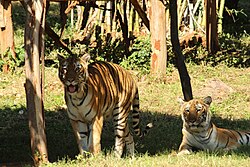
| image = | | image = Bengal tiger in Sanjay Dubri Tiger Reserve December 2024 by Tisha Mukherjee 11.jpg | ||
| image_caption = | | image_caption = Bengal tiger in [[Sanjay National Park]] | ||
| genus = Panthera | | genus = Panthera | ||
| species = tigris | | species = tigris | ||
| Line 15: | Line 16: | ||
<!--The wording of the first sentence is the result of the RFC [[Talk:Bengal tiger#Request for comment on the first sentence of articles about subpopulations)]]. Do not change it without new consensus. --> | <!--The wording of the first sentence is the result of the RFC [[Talk:Bengal tiger#Request for comment on the first sentence of articles about subpopulations)]]. Do not change it without new consensus. --> | ||
The '''Bengal tiger''' is a [[population]] of the ''[[Panthera tigris tigris]]'' subspecies | The '''Bengal tiger''' is a [[Population (biology)|population]] of the ''[[Panthera tigris tigris]]'' subspecies. It ranks among the largest of wild cats. It is distributed from [[India]], southern [[Nepal]], [[Bangladesh]], [[Bhutan]] to [[Southwestern China]]. Its historical range extended to the [[Indus Basin]] until the early 19th century, and it is thought to have been present in the [[Indian subcontinent]] since the [[Late Pleistocene]] about 12,000 to 16,500 years ago. It is threatened by [[poaching]], [[habitat loss]] and [[habitat fragmentation]]. | ||
As of 2022, the Bengal tiger population was estimated at 3,167–3,682 individuals in India, 316–355 individuals in Nepal, 131 individuals in Bhutan and around 125 individuals in Bangladesh. It is the national animal of India and Bangladesh. | |||
==Taxonomy== | ==Taxonomy== | ||
''Felis tigris'' was the [[scientific name]] used by [[Carl Linnaeus]] in 1758 for the tiger.<ref name="Linn1758">{{Cite book |author=Linnaeus, C. |year=1758 |title=Caroli Linnæi Systema naturæ per regna tria naturæ, secundum classes, ordines, genera, species, cum characteribus, differentiis, synonymis, locis. Tomus I |edition=decima, reformata |location=Holmiae |publisher=Laurentius Salvius |chapter=''Felis tigris'' |page=41 |chapter-url=https://archive.org/stream/mobot31753000798865#page/41/mode/2up}}</ref> It was subordinated to the [[genus]] ''Panthera'' by [[Reginald Innes Pocock]] in 1929. [[Bengal]] is the traditional [[Type (biology)|type]] locality of the species and the [[nominate subspecies]] ''Panthera tigris tigris''.<ref name=Pocock1929>{{Cite journal |author=Pocock, R. I. |year=1929 |title=Tigers |journal=Journal of the Bombay Natural History Society |volume=33 |issue=3 |pages=505–541 |url=https://archive.org/details/journalofbomb33341929bomb/page/n133}}</ref> | ''Felis tigris'' was the [[scientific name]] used by [[Carl Linnaeus]] in 1758 for the tiger.<ref name="Linn1758">{{Cite book |author=Linnaeus, C. |year=1758 |title=Caroli Linnæi Systema naturæ per regna tria naturæ, secundum classes, ordines, genera, species, cum characteribus, differentiis, synonymis, locis. Tomus I |edition=decima, reformata |location=Holmiae |publisher=Laurentius Salvius |chapter=''Felis tigris'' |page=41 |chapter-url=https://archive.org/stream/mobot31753000798865#page/41/mode/2up}}</ref> It was subordinated to the [[genus]] ''Panthera'' by [[Reginald Innes Pocock]] in 1929. [[Bengal]] is the traditional [[Type (biology)|type]] locality of the species and the [[nominate subspecies]] ''Panthera tigris tigris''.<ref name=Pocock1929>{{Cite journal |author=Pocock, R. I. |year=1929 |title=Tigers |journal=Journal of the Bombay Natural History Society |volume=33 |issue=3 |pages=505–541 |url=https://archive.org/details/journalofbomb33341929bomb/page/n133}}</ref> | ||
The [[Valid name (zoology)|validity]] of several tiger subspecies in continental Asia was questioned in 1999. [[Morphology (biology)|Morphologically]], tigers from different regions vary little, and [[gene flow]] between populations in those regions is considered to have been possible during the [[Pleistocene]]. Therefore, it was proposed to recognise only two subspecies as valid, namely ''P. t. tigris'' in mainland Asia, and [[Javan tiger|''P. t. sondaica'']] in the [[Greater Sunda Islands]] and possibly in [[Sundaland]].<ref name= | The [[Valid name (zoology)|validity]] of several tiger subspecies in continental Asia was questioned in 1999. [[Morphology (biology)|Morphologically]], tigers from different regions vary little, and [[gene flow]] between populations in those regions is considered to have been possible during the [[Pleistocene]]. Therefore, it was proposed to recognise only two subspecies as valid, namely ''P. t. tigris'' in mainland Asia, and [[Javan tiger|''P. t. sondaica'']] in the [[Greater Sunda Islands]] and possibly in [[Sundaland]].<ref name=Kitchener1999>{{Cite book |last=Kitchener |first=A. |title=Riding the Tiger: Tiger Conservation in Human-Dominated Landscapes |date=1999 |publisher=Cambridge University Press |isbn=978-0-521-64835-6 |editor1-last=Seidensticker |editor1-first=J. |pages=19–39 |chapter=Tiger distribution, phenotypic variation and conservation issues |editor2-last=Christie |editor2-first=S. |editor3-last=Jackson |editor3-first=P. |chapter-url=http://www.nfwf.org/AM/Template.cfm?Section=Home&CONTENTID=3060&TEMPLATE=/CM/ContentDisplay.cfm |archive-url=https://web.archive.org/web/20120423162028/http://www.nfwf.org/AM/Template.cfm?Section=Home |archive-date=23 April 2012 }}</ref> The [[nominate subspecies]] ''P. t. tigris'' constitutes two [[clade]]s: the northern clade comprises the Siberian and Caspian tiger populations, and the southern clade all remaining continental tiger populations.<ref>{{Cite journal |title=Planning tiger recovery: Understanding intraspecific variation for effective conservation |last1=Wilting |first1=A. |last2=Courtiol |first2=A. |first3=P. |last3=Christiansen |first4=J. |last4=Niedballa |first5=A. K. |last5=Scharf |first6=L. |last6=Orlando |first7=N. |last7=Balkenhol |first8=H. |last8=Hofer |first9=S.|last9=Kramer-Schadt |first10=J. |last10=Fickel |first11=A. C. |last11=Kitchener |display-authors=5 |year=2015 |volume=11 |issue=5: e1400175 |doi=10.1126/sciadv.1400175 |pmid = 26601191|pmc=4640610 |journal=Science Advances |article-number=e1400175 |bibcode=2015SciA....1E0175W}}</ref> The [[extinct]] and living tiger [[Population (biology)|population]]s in continental Asia have been subsumed to ''P. t. tigris'' since the revision of felid taxonomy in 2017.<ref name=catsg>{{Cite journal |author1=Kitchener, A. C. |author2=Breitenmoser-Würsten, C. |author3=Eizirik, E. |author4=Gentry, A. |author5=Werdelin, L. |author6=Wilting, A. |author7=Yamaguchi, N. |author8=Abramov, A. V. |author9=Christiansen, P. |author10=Driscoll, C. |author11=Duckworth, J. W. |author12=Johnson, W. |author13=Luo, S.-J. |author14=Meijaard, E. |author15=O'Donoghue, P. |author16=Sanderson, J. |author17=Seymour, K. |author18=Bruford, M. |author19=Groves, C. |author20=Hoffmann, M. |author21=Nowell, K. |author22=Timmons, Z. |author23=Tobe, S. |name-list-style=amp |year=2017 |title=A revised taxonomy of the Felidae: The final report of the Cat Classification Task Force of the IUCN Cat Specialist Group |journal=Cat News |issue=Special Issue 11 |pages=66–68 |url=https://repository.si.edu/bitstream/handle/10088/32616/A_revised_Felidae_Taxonomy_CatNews.pdf?sequence=1&isAllowed=y}}</ref> | ||
Results of a genetic analysis of 32 tiger samples indicate that the Bengal tiger samples grouped into a different [[clade]] than the Siberian tiger samples.<ref name="Liu_al2018">{{Cite journal |last1=Liu |first1=Y.-C. |first2=X. |last2=Sun |first3=C. |last3=Driscoll |first4=D. G. |last4=Miquelle |first5=X. |last5=Xu |first6=P. |last6=Martelli |first7=O. |last7=Uphyrkina |first8=J. L. D. |last8=Smith |first9=S. J. |last9= | === Phylogeny === | ||
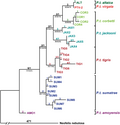
[[File:Tiger phylogenetic relationships.png|thumb|Phylogenetic relationship of tiger populations]] | |||
Results of a genetic analysis of 32 tiger samples indicate that the Bengal tiger samples grouped into a different [[clade]] than the Siberian tiger samples.<ref name="Liu_al2018">{{Cite journal |last1=Liu |first1=Y.-C. |first2=X. |last2=Sun |first3=C. |last3=Driscoll |first4=D. G. |last4=Miquelle |first5=X. |last5=Xu |first6=P. |last6=Martelli |first7=O. |last7=Uphyrkina |first8=J. L. D. |last8=Smith |first9=S. J. |last9=O'Brien |first10=S.-J. |last10=Luo |display-authors=5 |title=Genome-wide evolutionary analysis of natural history and adaptation in the world's tigers |journal=Current Biology |volume=28 |issue=23 |year=2018 |pages=3840–3849 |doi=10.1016/j.cub.2018.09.019 |pmid=30482605|doi-access=free |bibcode=2018CBio...28E3840L }}</ref> | |||
===Genetic ancestry=== | ===Genetic ancestry=== | ||
The Bengal tiger is defined by three distinct [[mitochondrial]] [[nucleotide]] sites and 12 unique [[Microsatellite (genetics)|microsatellite]] alleles. The pattern of [[genetic variation]] in the Bengal tiger corresponds to the premise that it arrived in India approximately 12,000 years ago.<ref>{{Cite journal |author=Kitchener, A. C. |author2=Dugmore, A. J. |year=2000 |title=Biogeographical change in the tiger, ''Panthera tigris''|journal= Animal Conservation |volume=3 |pages= 113–124|doi=10.1111/j.1469-1795.2000.tb00236.x|issue=2|s2cid=86096562 }}</ref> This is consistent with the lack of tiger [[fossil]]s from the Indian subcontinent prior to the late Pleistocene, and the absence of tigers from [[Sri Lanka]], which was separated from the subcontinent by [[sea level rise|rising sea levels]] in the early [[Holocene]].<ref name= | The Bengal tiger is defined by three distinct [[mitochondrial]] [[nucleotide]] sites and 12 unique [[Microsatellite (genetics)|microsatellite]] alleles. The pattern of [[genetic variation]] in the Bengal tiger corresponds to the premise that it arrived in India approximately 12,000 years ago.<ref>{{Cite journal |author=Kitchener, A. C. |author2=Dugmore, A. J. |year=2000 |title=Biogeographical change in the tiger, ''Panthera tigris''|journal= Animal Conservation |volume=3 |pages= 113–124|doi=10.1111/j.1469-1795.2000.tb00236.x|issue=2|bibcode=2000AnCon...3..113K |s2cid=86096562 }}</ref> This is consistent with the lack of tiger [[fossil]]s from the Indian subcontinent prior to the late Pleistocene, and the absence of tigers from [[Sri Lanka]], which was separated from the subcontinent by [[sea level rise|rising sea levels]] in the early [[Holocene]].<ref name=Luo2004>{{Cite journal |last1=Luo |first1=S. J. |last2=Kim |first2=J. |last3=Johnson |first3=W. E. |last4=van der Walt |first4=J. |last5=Martenson |first5=J. |last6=Yuhki |first6=N. |last7=Miquelle |first7=D. G. |last8=Uphyrkina |first8=O. |last9=Goodrich |first9=J. M. |last10=Quigley |first10=H. B. |last11=Tilson |first11=R. |last12=Brady |first12=G. |last13=Martelli |first13=P. |last14=Subramaniam |first14=V. |last15=McDougal |first15=C. |last16=Hean |first16=S. |last17=Huang |first17=S. |last18=Pan |first18=W. |last19=Karanth |first19=U. |last20=Sunquist |first20=M. |last21=Smith |first21=J. L. D. |last22=O'Brien |first22=S. J. |name-list-style=amp |year=2004 |title=Phylogeography and Genetic Ancestry of Tigers (''Panthera tigris'') |journal=PLOS Biology |volume=2 |issue=12 |article-number=e442 |doi=10.1371/journal.pbio.0020442 |pmid=15583716 |pmc=534810 |doi-access=free}}</ref> | ||
==Characteristics== | ==Characteristics== | ||
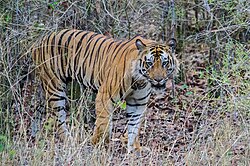
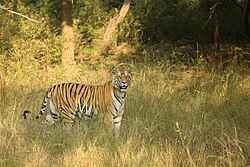
[[File:Bandhavgarh National Park.jpg|thumb|A tiger in [[Bandhavgarh National Park]], Madhya Pradesh]] | |||
The Bengal tiger's coat is yellow to light orange, with stripes ranging from dark brown to black; the belly and the interior parts of the limbs are white, and the tail is orange with black rings. The [[white tiger]] is a [[recessive]] [[Mutants|mutant]], which is reported in the wild from time to time in [[Assam]], Bengal, [[Bihar]] | The Bengal tiger's coat is yellow to light orange, with stripes ranging from dark brown to black; the belly and the interior parts of the limbs are white, and the tail is orange with black rings. The [[white tiger]] is a [[recessive]] [[Mutants|mutant]], which is reported in the wild from time to time in [[Assam]], Bengal, [[Bihar]] and especially in the former [[Rewa (princely state)|State of Rewa]]. However, it is not an occurrence of [[albinism]]. In fact, only one fully authenticated case of a true albino tiger is known, and there are no confirmed cases of black tigers, except for a possible specimen examined in [[Chittagong]] in 1846.<ref name=McDougal1977>{{Cite book |last=McDougal |first=C. |year=1977 |title=The Face of the Tiger |publisher=Rivington Books and André Deutsch |location=London}}</ref> Fourteen Bengal tiger skins in the collection of the [[Natural History Museum, London]] have 21–29 stripes.<ref name=Kitchener1999/> | ||
Another [[recessive]] mutant is the [[golden tiger]] that has a pale golden fur with red-brown stripes.<ref>{{cite journal |author1=Xu, X. |author2=Dong, G. X. |author3=Schmidt-Küntzel, A. |author4=Zhang, X. L. |author5=Zhuang, Y. |author6=Fang, R. |author7=Sun, X. |author8=Hu, X.S. |author9=Zhang, T. Y. |author10=Yang, H. D. |author11=Zhang, D. L. |author12=Marker, L. |author13=Jiang, Z.-F. |author14=Li, R. |author15=Luo, S.-J. |year=2017 |title=The genetics of tiger pelage color variations |journal=Cell Research |volume=27 |issue=7 |pages=954–957 |doi=10.1038/cr.2017.32 |pmid=28281538 |pmc=5518981 |url=https://www.luo-lab.org/publications/Xu17-CellRes-GoldenTiger.pdf}}</ref> The mutants are very rare in nature.<ref>{{cite | Another [[recessive]] mutant is the [[golden tiger]] that has a pale golden fur with red-brown stripes.<ref>{{cite journal |author1=Xu, X. |author2=Dong, G. X. |author3=Schmidt-Küntzel, A. |author4=Zhang, X. L. |author5=Zhuang, Y. |author6=Fang, R. |author7=Sun, X. |author8=Hu, X.S. |author9=Zhang, T. Y. |author10=Yang, H. D. |author11=Zhang, D. L. |author12=Marker, L. |author13=Jiang, Z.-F. |author14=Li, R. |author15=Luo, S.-J. |year=2017 |title=The genetics of tiger pelage color variations |journal=Cell Research |volume=27 |issue=7 |pages=954–957 |doi=10.1038/cr.2017.32 |pmid=28281538 |pmc=5518981 |url=https://www.luo-lab.org/publications/Xu17-CellRes-GoldenTiger.pdf}}</ref> The mutants are very rare in nature.<ref>{{cite conference |author=Singh, L. A. K. |date=2000 |title=Colour aberration in tiger: its biological and conservation implications |conference=National Seminar "Tiger Tiger", 4–5 August 2000 |place=Calcutta |publisher=Indian Museum |url=https://www.academia.edu/7819624}}</ref> | ||
The greatest skull length of a tiger is {{Cvt|351|mm}} in males and {{Cvt|293|mm}} in females.<ref>{{Cite book |author1=Kitchener, A. |name-list-style=amp |author2=Yamaguchi, N. |year=2010 |orig- | The greatest skull length of a tiger is {{Cvt|351|mm}} in males and {{Cvt|293|mm}} in females.<ref>{{Cite book |author1=Kitchener, A. |name-list-style=amp |author2=Yamaguchi, N. |year=2010 |orig-date=First published 1987 |title=Tigers of the World |edition=2nd |publisher=Academic Press |editor1=Tilson, R. |editor2=Nyhus, P.J. |chapter=What is a tiger? Biogeography, Morphology, and Taxonomy |page=55 |doi=10.1016/B978-0-8155-1570-8.00004-9 |chapter-url=https://www.researchgate.net/publication/266794969 |isbn=978-0-8155-1570-8}}</ref> It has exceptionally stout teeth. Its canines are {{Cvt|7.5|to|10|cm}} long and thus the longest among all cats.<ref name=S&S02>{{Cite book |last1=Sunquist |first1=M. |last2=Sunquist |first2=F. |title=Wild Cats of the World |year=2002 |publisher=University of Chicago Press |isbn=978-0-22-677999-7 |pages=343–372 |chapter=Tiger ''Panthera tigris'' (Linnaeus, 1758) |chapter-url=https://books.google.com/books?id=IF8nDwAAQBAJ&pg=PA344}}</ref> | ||
===Body weight and size=== | ===Body weight and size=== | ||
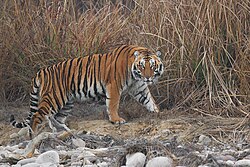
Males and female Bengal tigers in Panna Tiger Reserve reach a head-to-body length of {{Cvt|183|-|211|cm}} and {{Cvt|164|-|193|cm}} respectively, including a tail about {{Cvt|85|-|110|cm}} long. Total length ranges from {{Cvt|283|to|311|cm}} for male tigers and {{Cvt|255|-|285|cm}} for female tigers.<ref name=BookletOnTigerBodyGrowth2021>{{Cite book |author1=Sharma, U. K. |author2= | [[File:Bengal Tiger looking at us in Jim Corbett National Park.jpg|thumb|A male tiger in Jim Corbett National Park, Uttarakhand]] | ||
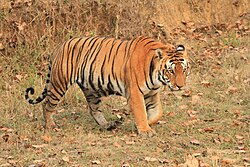
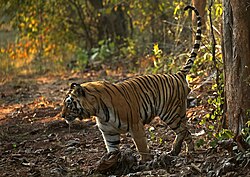
[[File:Tiger (India) 665.jpg|thumb|A tiger in Kanha National Park, Madhya Pradesh]] | |||
The Bengal tiger ranks among the biggest wild cats alive.<ref name=Mazak1981>{{Cite journal |author=Mazák, V. |year=1981 |title=''Panthera tigris'' |journal=Mammalian Species |issue=152 |pages=1–8 |doi=10.2307/3504004 |jstor=3504004 |doi-access=free |bibcode=1981MamSp.152....1M }}</ref> | |||
Males and female Bengal tigers in Panna Tiger Reserve reach a head-to-body length of {{Cvt|183|-|211|cm}} and {{Cvt|164|-|193|cm}} respectively, including a tail about {{Cvt|85|-|110|cm}} long. Total length ranges from {{Cvt|283|to|311|cm}} for male tigers and {{Cvt|255|-|285|cm}} for female tigers.<ref name=BookletOnTigerBodyGrowth2021>{{Cite book |author1=Sharma, U. K. |author2=Tr, V. |author3=Gupta, S. K. |date=2021 |title=Booklet on Growth Data of Physical Characteristics and Use of Tranquilization/Antidote Drugs, Induction Time, Reversal Time for Free Ranging Royal Bengal Tiger (''Panthera tigris'') |publisher=Panna Tiger Reserve |place=Panna, Madhya Pradesh |url=https://www.pannatigerreserve.in/BOOKLET%20ON%20TIGER%20BODY%20GROWTH%20.pdf}}</ref> They typically range from {{Cvt|90|-|110|cm}} in shoulder height.<ref name=Karanth03>{{Cite journal |author=Karanth, K. U. |year=2003 |title=Tiger ecology and conservation in the Indian subcontinent |journal=Journal of the Bombay Natural History Society |volume=100 |issue=2–3 |pages=169–189 |archive-date=10 March 2012 |url=http://www.nfwf.org/AM/Template.cfm?Section=Home&TEMPLATE=/CM/ContentDisplay.cfm&CONTENTID=8073 |archive-url=https://web.archive.org/web/20120310174120/http://www.nfwf.org/AM/Template.cfm?Section=Home&TEMPLATE=%2FCM%2FContentDisplay.cfm&CONTENTID=8073}}</ref> | |||
Subadult males weigh between {{Cvt|130|and|170|kg}} and reach {{Cvt|200| | Subadult males weigh between {{Cvt|130|and|170|kg}} and reach {{Cvt|200|-|260|kg}} when adult; subadult females weigh {{Cvt|80|-|100|kg}} and reach between {{Cvt|110|and|180|kg}} when adult.<ref name=Jhala2017>{{Cite journal |author1=Sadhu, A. |author2=Jayam, P.P.C. |author3=Qureshi, Q. |author4=Shekhawat, R. S. |author5=Sharma, S. |author6=Jhala, Y. V. |name-list-style=amp |date=2017 |journal=BMC Zoology |volume=2 |issue=16 |title=Demography of a small, isolated tiger (''Panthera tigris tigris'') population in a semi-arid region of western India. Appendix 1: Field Guide for Ageing Tigers |doi=10.1186/s40850-017-0025-y |s2cid= 23235257 |url=https://www.researchgate.net/publication/322963058 |doi-access=free}}</ref> In central India, 42 adult male Bengal tigers weighed on average {{Cvt|190|kg}} with a range of {{Cvt|167|-|234|kg}}; their total length was {{Cvt|282|cm}} with a range of {{Cvt|267|-|312|cm}}, and their average shoulder height was {{Cvt|99|cm}}; 39 adult female Bengal tigers weighed an average of {{Cvt|132|kg}} with a maximum of {{Cvt|156|kg}} and an average total length of {{Cvt|254|cm}} ranging from {{Cvt|239|to|277|cm}}.<ref name=Brander1923>{{Cite book |last=Brander |first=A. A. D. |date=1923 |title=Wild Animals in Central India |location=London |publisher=Edwin Arnold & Co. |url=https://archive.org/details/in.ernet.dli.2015.284797}}</ref> | ||
Several scientists indicated that adult male Bengal tigers in the [[Terai]] consistently attain more than {{Cvt|227|kg}} of body weight. Seven adult males captured in [[Chitwan National Park]] in the early 1970s had an average weight of {{Cvt|235|kg}} ranging from {{Cvt|200|to|261|kg}}, and that of the females | Several scientists indicated that adult male Bengal tigers in the [[Terai]] consistently attain more than {{Cvt|227|kg}} of body weight. Seven adult males captured in [[Chitwan National Park]] in the early 1970s had an average weight of {{Cvt|235|kg}} ranging from {{Cvt|200|to|261|kg}}, and that of the females averaged {{Cvt|140|kg}} ranging from {{Cvt|116|to|164|kg}}.<ref>{{Cite journal |author1=Smith, J. L. D. |author2=Sunquist, M. E. |author3=Tamang, K. M. |author4=Rai, P. B. |date=1983 |title=A technique for capturing and immobilizing tigers |journal=The Journal of Wildlife Management |volume=47 |issue=1 |pages=255–259 |jstor=3808080 |doi=10.2307/3808080}}</ref> Two male tigers captured in Chitwan National Park in the 1980s exceeded weights of {{Cvt|270|kg}} and are the largest free ranging tigers reported to date.<ref>{{Cite book |last=Dinerstein |first=E. |year=2003 |title=Return of the Unicorns: Natural History and Conservation of the Greater-One Horned Rhinoceros |chapter=Ecosystem Dynamics |pages=43–46 |chapter-url=https://books.google.com/books?id=o6HuJQBmtksC&pg=PA44 |publisher=Columbia University Press |isbn=978-0-231-08450-5}}</ref> | ||
The smallest recorded weights for Bengal tigers are from the Bangladesh Sundarbans, where adult females weigh {{Cvt|75| | The smallest recorded weights for Bengal tigers are from the Bangladesh Sundarbans, where adult females weigh {{Cvt|75|-|80|kg}}.<ref name=Barlow10>{{Cite journal |author1=Barlow, A. |author2=Mazák, J. |author3=Ahmad, I. U. |author4=Smith, J. L. D. |title=A preliminary investigation of Sundarbans tiger morphology |journal=[[Mammalia (journal)|Mammalia]] |year=2010 |volume=74 |pages=329–331 |issue=3 |doi=10.1515/mamm.2010.040 |s2cid=84134909}}</ref> | ||
Three tigresses from the Bangladesh Sundarbans had a mean weight of {{Cvt|76.7|kg}}. The oldest female weighed {{Cvt|75|kg}} and was in a relatively poor condition at the time of capture. Their skulls and body weights were distinct from those of tigers in other habitats, indicating that they may have adapted to the unique conditions of the mangrove habitat. Their small sizes are probably due to a combination of intense intraspecific competition and small size of prey available to tigers in the Sundarbans, compared to the larger deer and other prey available to tigers in other parts.<ref name=Sundarbans>{{Cite thesis |last1=Barlow |first1=A. C. D. |title=The Sundarbans Tiger – Adaptation, population status, and Conflict management |type=PhD thesis |year=2009 |url=http://www.carnivoreconservation.org/files/thesis/barlow_2009_phd.pdf | Three tigresses from the Bangladesh Sundarbans had a mean weight of {{Cvt|76.7|kg}}. The oldest female weighed {{Cvt|75|kg}} and was in a relatively poor condition at the time of capture. Their skulls and body weights were distinct from those of tigers in other habitats, indicating that they may have adapted to the unique conditions of the mangrove habitat. Their small sizes are probably due to a combination of intense intraspecific competition and small size of prey available to tigers in the Sundarbans, compared to the larger deer and other prey available to tigers in other parts.<ref name=Sundarbans>{{Cite thesis |last1=Barlow |first1=A. C. D. |title=The Sundarbans Tiger – Adaptation, population status, and Conflict management |type=PhD thesis |year=2009 |publisher=[[University of Minnesota]] |location=Minneapolis |url=http://www.carnivoreconservation.org/files/thesis/barlow_2009_phd.pdf}}</ref> | ||
The very large "[[Leeds Tiger]]" on display at [[Leeds City Museum]], shot in 1860 near [[Mussoorie]], had a body length of {{Cvt|12|ft|2|in|cm|order=flip}} at death. Two tigers shot in [[Kumaon District]] and near [[Oude]] at the end of the 19th century allegedly measured more than {{Cvt|12|ft|cm|order=flip}}. But at the time, sportsmen had not yet adopted a standard system of measurement; some measured [[wikt:peg|'between the pegs']] while others measured 'over the curves'.<ref>{{Cite book |author=Sterndale, R. A. |year=1884 |chapter-url=http://www.gutenberg.org/files/19550/19550-h/19550-h.htm#201 |chapter=''Felis Tigris'' No. 201 |title=Natural History of the Mammalia of India and Ceylon |publisher=Thacker, Spink and Co. |location=Calcutta}}</ref> The greatest length of a tiger skull measured {{Cvt|16.25|in| | The very large "[[Leeds Tiger]]" on display at [[Leeds City Museum]], shot in 1860 near [[Mussoorie]], had a body length of {{Cvt|12|ft|2|in|cm|order=flip}} at death. Two tigers shot in [[Kumaon District]] and near [[Oude]] at the end of the 19th century allegedly measured more than {{Cvt|12|ft|cm|order=flip}}. But at the time, sportsmen had not yet adopted a standard system of measurement; some measured [[wikt:peg|'between the pegs']] while others measured 'over the curves'.<ref>{{Cite book |author=Sterndale, R. A. |year=1884 |chapter-url=http://www.gutenberg.org/files/19550/19550-h/19550-h.htm#201 |chapter=''Felis Tigris'' No. 201 |title=Natural History of the Mammalia of India and Ceylon |publisher=Thacker, Spink and Co. |location=Calcutta}}</ref> The greatest length of a tiger skull measured {{Cvt|16.25|in|cm|order=flip}} "over the bone"; this one was shot in the vicinity of [[Nagina]] in northern India.<ref name=Hewett&Hewett>{{Cite book |author1=Hewett, J. P. |author2=Hewett Atkinson, L. |title=Jungle trails in northern India: reminiscences of hunting in India |publisher=Metheun and Company Limited |location=London |year=1938 |chapter=Visits to India after Retirement |pages=177–183 |chapter-url=https://archive.org/details/in.ernet.dli.2015.209125/page/n225}}</ref> | ||
In the beginning of the 20th century, a male tiger was shot in central India with a head and body length of {{Cvt|221|cm}} between pegs, a chest girth of {{Cvt|150|cm}}, a shoulder height of {{Cvt|109|cm}} and a tail length of {{Cvt|81|cm|in}}, which was perhaps bitten off by a rival male. This specimen could not be weighed, but it was estimated to weigh about {{Cvt|272|kg}}.<ref name=Brander1923/> A male weighing {{Cvt|570|lb|kg|0|order=flip}} was shot in northern India in the 1930s.<ref name= | In the beginning of the 20th century, a male tiger was shot in central India with a head and body length of {{Cvt|221|cm}} between pegs, a chest girth of {{Cvt|150|cm}}, a shoulder height of {{Cvt|109|cm}} and a tail length of {{Cvt|81|cm|in}}, which was perhaps bitten off by a rival male. This specimen could not be weighed, but it was estimated to weigh about {{Cvt|272|kg}}.<ref name=Brander1923/> A male weighing {{Cvt|570|lb|kg|0|order=flip}} was shot in northern India in the 1930s.<ref name=Hewett&Hewett/> A male tiger shot in Nepal weighed {{Cvt|320|kg}} and measured {{Cvt|10|ft|9|in|cm|order=flip}} 'over the curves'.<ref>{{Cite book|author=Smythies, E. A. |title=Big game shooting in Nepal |publisher=Thacker, Spink |place=Calcutta |page=36 |year=1942}}</ref> | ||
The heaviest wild tiger was possibly a | The heaviest wild tiger was possibly a male killed in 1967 in the foothills of the Himalayas that measured {{Cvt|323|cm}} between pegs and {{Cvt|338|cm}} over curves; it weighed {{Cvt|388.7|kg}} after eating a buffalo calf. Without eating the calf, it would have likely weighed about {{Cvt|324.3|kg}}.<ref name=Wood1983>{{Cite book |last=Wood |first=G. L. |year=1982 |title=The Guinness Book of Animal Facts and Feats |publisher=Guinness Superlatives |location=Enfield, Middlesex |isbn=978-0-85112-235-9 |page=33}}</ref> In the Central Provinces of India, a male tiger shot weighed {{Cvt|317|kg}} and measured {{Cvt|9|ft|11|in|order=flip}}.<ref>{{Cite book |author=Ward, R. |title=Records Of Big Game |publisher=Rowland Ward, Ltd. |page=493 |year=1907 |url=https://archive.org/details/in.ernet.dli.2015.221504/page/n511/mode/2up}}</ref> | ||
The Bengal tiger rivals the [[Siberian tiger]] in average weight.<ref name=Slaght2005>{{Cite book |author1=Slaght, J. C. |author2=Miquelle, D. G. |author3=Nikolaev, I. G. |author4=Goodrich, J. M. |author5=Smirnov, E. N. |author6=Traylor-Holzer, K. |author7=Christie, S. |author8=Arjanova, T. |author9=Smith, J. L. D. |author10=Karanth, K. U. |year=2005 |chapter=Chapter 6. | The Bengal tiger rivals the [[Siberian tiger]] in average weight.<ref name=Slaght2005>{{Cite book |author1=Slaght, J. C. |author2=Miquelle, D. G. |author3=Nikolaev, I. G. |author4=Goodrich, J. M. |author5=Smirnov, E. N. |author6=Traylor-Holzer, K. |author7=Christie, S. |author8=Arjanova, T. |author9=Smith, J. L. D. |author10=Karanth, K. U. |year=2005 |chapter=Chapter 6. Who's king of the beasts? Historical and contemporary data on the body weight of wild and captive Amur tigers in comparison with other subspecies |title=Tigers in Sikhote-Alin Zapovednik: Ecology and Conservation |editor1=D. G. Miquelle |editor2=Smirnov, E. N. |editor3=Goodrich, J.M. |publisher=PSP |location=Vladivostok, Russia |chapter-url=http://fishowls.com/Slaght%20et%20al%202005.pdf |pages=25–35 |language=ru}}</ref> | ||
==Distribution and habitat== | ==Distribution and habitat== | ||
In 1982, a sub-[[fossil]] right middle [[Phalanx bone|phalanx]] was found in a prehistoric [[midden]] near [[Kuruwita]] in [[Sri Lanka]], which is dated to about 16,500 years ago and tentatively considered to be of a tiger. Tigers appear to have arrived in Sri Lanka during a [[pluvial]] period, during which sea levels were depressed, evidently prior to the last [[glacial maximum]] about 20,000 years ago.<ref>{{Cite journal |author1=Manamendra-Arachchi, K. |author2=Pethiyagoda, R. |author3=Dissanayake, R. |author4=Meegaskumbura, M. |year=2005 |url=http://rmbr.nus.edu.sg/rbz/biblio/s12/s12rbz423-434.pdf |title=A second extinct big cat from the late Quaternary of Sri Lanka |journal=The Raffles Bulletin of Zoology |volume=2005 |issue=Supplement No. 12 |pages=423–434 |access-date=25 April 2009 |archive-date=25 December 2018 |archive-url=https://web.archive.org/web/20181225033149/http://rmbr.nus.edu.sg/rbz/biblio/s12/s12rbz423-434.pdf%20 | The Bengal tiger's historical range covered the [[Indus Basin|Indus River valley]] until the early 19th century, almost all of [[India]], eastern [[Pakistan]], southern [[Nepal]], [[Bangladesh]], [[Bhutan]], and southwestern [[China]]. The modern tiger inhabits India, Bangladesh, Nepal, Bhutan, and southwestern China.<ref name=Luo2004/> | ||
It is estimated to have been present in the [[Indian subcontinent]] since the [[Late Pleistocene]], for about 12,000 to 16,500 years.<ref>{{Cite journal |last1=Kitchener |first1=A. C. |last2=Dugmore |first2=A. J. |name-list-style=amp |year=2000 |title=Biogeographical change in the tiger, ''Panthera tigris'' |journal=Animal Conservation |volume=3 |issue=2 |pages=113–124 |doi=10.1111/j.1469-1795.2000.tb00236.x |bibcode=2000AnCon...3..113K |s2cid=86096562 }}</ref><ref>{{Cite journal |last1=Cooper |first1=D. M. |last2=Dugmore |first2=A. J. |last3=Gittings |first3=B. M. |last4=Scharf |first4=A. K. |last5=Wilting |first5=A. |last6=Kitchener |first6=A. C. |name-list-style=amp |year=2016 |title=Predicted Pleistocene–Holocene rangeshifts of the tiger (''Panthera tigris'') |journal=Diversity and Distributions |volume=22 |issue=11 |pages=1–13 |doi=10.1111/ddi.12484 |bibcode=2016DivDi..22.1199C |doi-access=free}}</ref> | |||
Results of a [[phylogeography|phylogeographic]] study using 134 samples from tigers across the global range suggest that the historical northeastern distribution limit of the Bengal tiger is the region in the [[Chittagong Hills]] and [[Brahmaputra River]] basin, bordering the historical range of the [[Indochinese tiger]].<ref name= | In 1982, a sub-[[fossil]] right middle [[Phalanx bone|phalanx]] was found in a prehistoric [[midden]] near [[Kuruwita]] in [[Sri Lanka]], which is dated to about 16,500 years ago and tentatively considered to be of a tiger. Tigers appear to have arrived in Sri Lanka during a [[pluvial]] period, during which sea levels were depressed, evidently prior to the last [[glacial maximum]] about 20,000 years ago.<ref>{{Cite journal |author1=Manamendra-Arachchi, K. |author2=Pethiyagoda, R. |author3=Dissanayake, R. |author4=Meegaskumbura, M. |year=2005 |url=http://rmbr.nus.edu.sg/rbz/biblio/s12/s12rbz423-434.pdf |title=A second extinct big cat from the late Quaternary of Sri Lanka |journal=The Raffles Bulletin of Zoology |volume=2005 |issue=Supplement No. 12 |pages=423–434 |access-date=25 April 2009 |archive-date=25 December 2018 |archive-url=https://web.archive.org/web/20181225033149/http://rmbr.nus.edu.sg/rbz/biblio/s12/s12rbz423-434.pdf%20 }}</ref> The tiger probably arrived too late in southern India to colonise Sri Lanka, which earlier had been connected to India by a [[land bridge]].<ref name=Pocock1929/> | ||
In the Indian subcontinent, tigers inhabit [[tropics|tropical]] moist [[evergreen forests]], [[tropical dry forest]]s, tropical and subtropical moist [[deciduous forest]]s, [[mangroves]], subtropical and temperate upland forests, and [[alluvial]] grasslands. The latter habitat once covered a huge swath of grassland, riverine and moist semi-deciduous forests along the major river system of the [[Gangetic plain|Gangetic]] and [[Brahmaputra River|Brahmaputra plains]], but has now been largely converted to agricultural land or severely [[Environmental degradation|degraded]]. | Results of a [[phylogeography|phylogeographic]] study using 134 samples from tigers across the global range suggest that the historical northeastern distribution limit of the Bengal tiger is the region in the [[Chittagong Hills]] and [[Brahmaputra River]] basin, bordering the historical range of the [[Indochinese tiger]].<ref name=Luo2004/><ref name=Luo10>{{Cite journal |author=Luo, S.J. |author2=Johnson, W. E. |author3=O'Brien, S. J. |year=2010 |title=Applying molecular genetic tools to tiger conservation |journal=Integrative Zoology |volume=5 |issue=4 |pages=351–362|pmid=21392353 |doi=10.1111/j.1749-4877.2010.00222.x|pmc=6984346}}</ref> | ||
In the Indian subcontinent, Bengal tigers inhabit [[tropics|tropical]] moist [[evergreen forests]], [[tropical dry forest]]s, tropical and subtropical moist [[deciduous forest]]s, [[mangroves]], subtropical and temperate upland forests, and [[alluvial]] grasslands. The latter habitat once covered a huge swath of grassland, riverine and moist semi-deciduous forests along the major river system of the [[Gangetic plain|Gangetic]] and [[Brahmaputra River|Brahmaputra plains]], but has now been largely converted to agricultural land or severely [[Environmental degradation|degraded]]. The best examples of this habitat type are limited to a few blocks at the base of the outer foothills of the [[Himalayas]] including the ''Tiger Conservation Units'' (TCUs) [[Rajaji National Park|Rajaji]]-[[Corbett National Park|Corbett]]-[[Pilibhit Tiger Reserve|Pilibhit]], [[Bardia National Park|Bardia]]-[[Banke National Park|Banke]], and the transboundary TCUs [[Chitwan National Park|Chitwan]]-[[Parsa National Park|Parsa]]-[[Valmiki National Park|Valmiki]], [[Dudhwa Tiger Reserve|Dudhwa]]-[[Kailali District|Kailali]] and [[Shuklaphanta National Park|Shuklaphanta]]-[[Kishanpur Wildlife Sanctuary|Kishanpur]]. Tiger densities in these TCUs are high, in part because of the extraordinary biomass of [[ungulate]] prey.<ref name=Wikramanayake1999>{{Cite book |author1=Wikramanayake, E.D. |author2=Dinerstein, E. |author3=Robinson, J.G. |author4=Karanth, K.U. |author5=Rabinowitz, A. |author6=Olson, D. |author7=Mathew, T. |author8=Hedao, P. |author9=Connor, M. |author10=Hemley, G. |author11=Bolze, D. |display-authors=5 |date=1999 |chapter=Where can tigers live in the future? A framework for identifying high-priority areas for the conservation of tigers in the wild |chapter-url=http://www.nfwf.org/AM/Template.cfm?Section=Riding_The_Tiger1&template=%2FCM%2FContentDisplay.cfm&ContentID=3062 |editor1-last=Seidensticker |editor1-first=J. |editor2-last=Christie |editor2-first=S. |editor3-last=Jackson |editor3-first=P. |title=Riding the Tiger: Tiger Conservation in Human-Dominated Landscapes |publisher=Cambridge University Press |pages=255–272 |isbn=978-0-521-64835-6 |archive-url=https://web.archive.org/web/20120310110401/http://www.nfwf.org/AM/Template.cfm?Section=Riding_The_Tiger1&template=%2FCM%2FContentDisplay.cfm&ContentID=3062 |archive-date=10 March 2012}}</ref> | |||
In Pakistan, [[Khairpur (princely state)|Khairpur]] was the last stronghold of the tiger by the late 19th century; the last individuals were shot in 1906 in [[Bahawalpur (princely state)|Bahawalpur]] in the [[Indus River]]ine jungles.<ref>{{Cite book |author=Roberts, T.J. |year=1977 |title=The Mammals of Pakistan |location=London and Tonbridge |publisher=Ernest Benn Limited |pages=155–156 |chapter=''Panthera tigris''}}</ref> | In Pakistan, [[Khairpur (princely state)|Khairpur]] was the last stronghold of the tiger by the late 19th century; the last individuals were shot in 1906 in [[Bahawalpur (princely state)|Bahawalpur]] in the [[Indus River]]ine jungles.<ref>{{Cite book |author=Roberts, T.J. |year=1977 |title=The Mammals of Pakistan |location=London and Tonbridge |publisher=Ernest Benn Limited |pages=155–156 |chapter=''Panthera tigris''}}</ref> | ||
| Line 65: | Line 70: | ||
===India=== | ===India=== | ||
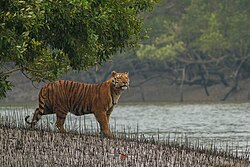
[[File: | [[File:Sundarban Tiger.jpg|thumb|A tiger in Sundarban National Park]] | ||
In the 20th century, Indian censuses of wild tigers relied on the individual identification of footprints known as pug marks – a method that has been criticised as deficient and inaccurate. [[Camera trap]]s are now being used in many sites.<ref>{{Cite journal |last1=Karanth |first1=K. U. |author1-link=K. Ullas Karanth |last2=Nichols |first2=J. D. |last3=Seidensticker |first3=J. |last4=Dinerstein |first4=E. |last5=Smith |first5=J. L. D. |last6=McDougal |first6=C. |last7=Johnsingh |first7=A. J. T. |author7-link=A. J. T. Johnsingh |last8=Chundawat |first8=R. S. |last9=Thapar |first9=V. |author9-link=Valmik Thapar |display-authors=5 |year=2003 |title=Science deficiency in conservation practice: the monitoring of tiger populations in India |journal=Animal Conservation |volume=6 |issue=2 |pages=141–146 |url=http://www.snowleopardnetwork.org/bibliography/Karanth_et_al_2003.pdf |doi=10.1017/S1367943003003184 |s2cid=55280343 |access-date=23 October 2011 |archive-date=9 July 2020 |archive-url=https://web.archive.org/web/20200709153859/https://www.snowleopardnetwork.org/bibliography/Karanth_et_al_2003.pdf | [[File:A mother and cub....JPG|thumb|A tigress with her cub in Bandipur National Park]] | ||
In the 20th century, Indian censuses of wild tigers relied on the individual identification of footprints known as pug marks – a method that has been criticised as deficient and inaccurate. [[Camera trap]]s are now being used in many sites.<ref>{{Cite journal |last1=Karanth |first1=K. U. |author1-link=K. Ullas Karanth |last2=Nichols |first2=J. D. |last3=Seidensticker |first3=J. |last4=Dinerstein |first4=E. |last5=Smith |first5=J. L. D. |last6=McDougal |first6=C. |last7=Johnsingh |first7=A. J. T. |author7-link=A. J. T. Johnsingh |last8=Chundawat |first8=R. S. |last9=Thapar |first9=V. |author9-link=Valmik Thapar |display-authors=5 |year=2003 |title=Science deficiency in conservation practice: the monitoring of tiger populations in India |journal=Animal Conservation |volume=6 |issue=2 |pages=141–146 |url=http://www.snowleopardnetwork.org/bibliography/Karanth_et_al_2003.pdf |doi=10.1017/S1367943003003184 |bibcode=2003AnCon...6..141K |s2cid=55280343 |access-date=23 October 2011 |archive-date=9 July 2020 |archive-url=https://web.archive.org/web/20200709153859/https://www.snowleopardnetwork.org/bibliography/Karanth_et_al_2003.pdf }}</ref> | |||
Good tiger habitats in subtropical and [[temperate forest]]s include the ''Tiger Conservation Units'' (TCUs) [[Manas National Park|Manas]]-[[Namdapha National Park|Namdapha]]. TCUs in [[tropical dry forest]] include [[Hazaribag Wildlife Sanctuary]], [[Nagarjunsagar-Srisailam Tiger Reserve]], [[Kanha National Park|Kanha]]-[[Indravati National Park|Indravati]] corridor, [[Geography of Odisha#Forests|Orissa dry forests]], [[Panna National Park]], [[Melghat Tiger Reserve]] and [[Ratapani Tiger Reserve]]. The TCUs in tropical moist [[deciduous forest]] are probably some of the most productive habitats for tigers and their prey, and include [[Kaziranga National Park|Kaziranga]]-[[Meghalaya]], [[Kanha National Park|Kanha]]-[[Pench National Park|Pench]], [[Simlipal Tiger Reserve|Simlipal]] and [[Indravati Tiger Reserve]]s. The TCUs in tropical moist [[evergreen forest]]s represent the less common tiger habitats, being largely limited to the upland areas and wetter parts of the [[Western Ghats]], and include the tiger reserves of [[Periyar Tiger Reserve|Periyar]], [[Kalakad-Mundathurai Tiger Reserve|Kalakad-Mundathurai]], [[Bandipur Tiger Reserve|Bandipur]] and [[Parambikulam Wildlife Sanctuary]].<ref name=Wikramanayake1999/> | |||
During a tiger census in 2008, camera trap and sign surveys using [[GIS]] were employed to estimate site-specific densities of tiger, co-predators and prey. Based on the result of these surveys, the total tiger population was estimated at 1,411 individuals ranging from 1,165 to 1,657 adult and sub-adult tigers of more than 1.5 years of age. Across India, six landscape complexes were surveyed that host tigers and have the potential to be connected. These landscapes comprise the following:<ref name="jhala2008">{{Cite report |title=Status of the Tigers, Co-predators, and Prey in India |editor1=[[Yadvendradev Vikramsinh Jhala|Jhala, Y. V.]] |editor2=Gopal, R. |editor3=Qureshi, Q. |publisher=National Tiger Conservation Authority, Govt. of India, New Delhi; Wildlife Institute of India, Dehradun |year=2008 |series=TR 08/001 |url=http://projecttiger.nic.in/whtsnew/status_of_tigers_in_india_2008.pdf |archive-date=2 June 2013 |archive-url=https://web.archive.org/web/20130602124630/http://projecttiger.nic.in/whtsnew/status_of_tigers_in_india_2008.pdf}}</ref> | |||
* in the [[Sivaliks]]–[[Gangetic plain|Gangetic flood plain]] landscape there are six populations with an estimated population size of 259 to 335 individuals in an area of {{Cvt|5080|km2}} of forested habitats, which are located in Rajaji and Corbett National Parks, in the connected habitats of [[Dudhwa National Park|Dudhwa-Kheri]]-[[Pilibhit Tiger Reserve|Pilibhit]], in Suhelwa Tiger Reserve, in [[Sohagi Barwa Sanctuary]] and in [[Valmiki National Park]]; | |||
* in the [[Central India]]n highlands there are 17 populations with an estimated population size of 437 to 661 individuals in an area of {{Cvt|48610|km2}} of forested habitats, which are located in the landscapes of Kanha-Pench, [[Satpura National Park|Satpura]]-[[Melghat Tiger Reserve|Melghat]], [[Sanjay National Park|Sanjay]]-[[Palamau Tiger Reserve|Palamau]], [[Navegaon National Park|Navegaon]]-Indravati; isolated populations are supported in the tiger reserves of [[Bandhavgarh Tiger Reserve|Bandhavgarh]], [[Tadoba-Andhari Tiger Reserve|Tadoba]], Simlipal and the national parks of Panna, [[Ranthambore National Park|Ranthambore]]–[[Kuno Wildlife Sanctuary|Kuno–Palpur]]–[[Madhav National Park|Madhav]] and [[Saranda forest|Saranda]]; | |||
* in the [[Eastern Ghats]] landscape there is a single population with an estimated population size of 49 to 57 individuals in a {{Cvt|7772|km2}} habitat in three separate forest blocks located in the [[Srivenkateshwara National Park]], [[Nagarjunsagar-Srisailam Tiger Reserve|Nagarjunasagar Tiger Reserve]] and the adjacent proposed Gundla Brahmeshwara National Park, and forest patches in the [[tehsil]]s of [[Kanigiri]], [[Badvel]], [[Udayagiri, Andhra Pradesh|Udayagiri]] and [[Giddalur]]; | |||
* in the [[Western Ghats]] landscape there are seven populations with an estimated population size of 336 to 487 individuals in a forested area of {{Cvt|21435|km2}} in three major landscape units [[Periyar Tiger Reserve|Periyar]]-[[Kalakad-Mundathurai Tiger Reserve|Kalakad-Mundathurai]], Bandipur-[[Parambikulam Wildlife Sanctuary|Parambikulam]]-[[Sathyamangalam Wildlife Sanctuary|Sathyamangalam]]-[[Mudumalai National Park|Mudumalai]]-[[Indira Gandhi National Park|Anamalai]]-[[Mukurthi National Park|Mukurthi]] and [[Anshi National Park|Anshi]]-[[Kudremukh National Park|Kudremukh]]-[[Dandeli Wildlife Sanctuary|Dandeli]]; | |||
* in the [[Brahmaputra River|Brahmaputra]] flood plains and northeastern hills tigers live in an area of {{Cvt|4230|km2}} in several patchy and fragmented forests; | |||
* in the [[Sundarbans National Park]] tigers live in about {{Cvt|1586|km2}} of mangrove forest. | |||
[[Manas National Park|Manas]]-[[Namdapha National Park|Namdapha]], [[Orang National Park|Orang]]-[[Laokhowa Wildlife Sanctuary|Laokhowa]] and [[Kaziranga National Park|Kaziranga]]-[[Meghalaya]] are ''Tiger Conservation Units'' in northeastern India, stretching over at least {{Cvt|14500|km2}} across several [[protected area]]s.<ref name="Wikramanayake1999"/> Tigers are also present in [[Pakke Tiger Reserve]].<ref>{{Cite book |author=Chauhan, D. S. |name-list-style=amp |author2=Singh, R. |author3=Mishra, S. |author4=Dadda, T. |author5=Goyal, S.P. |year=2006 |title=Estimation of tiger population in an intensive study area of Pakke Tiger Reserve, Arunachal Pradesh, India |location=Dehradun, India |publisher=Wildlife Institute of India |url=https://www.researchgate.net/publication/264348762}}</ref> In the [[Mishmi Hills]], tigers were recorded in 2017 up to an elevation of {{Cvt|3,630|m}} in snow.<ref>{{Cite journal |author1=Adhikarimayum, A. S. |name-list-style=amp |author2=Gopi, G. V. |year=2018 |title=First photographic record of tiger presence at higher elevations of the Mishmi Hills in the Eastern Himalayan Biodiversity Hotspot, Arunachal Pradesh, India |journal=Journal of Threatened Taxa |volume=10 |issue=13 |pages=12833–12836 |doi=10.11609/jott.4381.10.13.12833-12836|doi-access=free}}</ref> | |||
Ranthambore National Park hosts India's westernmost tiger population.<ref name=Jhala2017/> The [[Dangs' Forest]] in southeastern [[Gujarat]] is potential tiger habitat.<ref name=Jhala2011/> | |||
In May 2018, a tiger was recorded in Sahyadri Tiger Reserve for the first time in eight years.<ref>{{Cite news |last=Kulkarni |first=D. |title=Sahyadri Tiger Reserve camera traps evidence of tigers first time in 8 years |work=[[Daily News and Analysis]] |url=https://www.dnaindia.com/mumbai/report-sahyadri-tiger-reserve-camera-traps-evidence-of-tigers-first-time-in-8-years-2629246 |date=2018 |access-date=11 July 2019}}</ref> | In May 2018, a tiger was recorded in Sahyadri Tiger Reserve for the first time in eight years.<ref>{{Cite news |last=Kulkarni |first=D. |title=Sahyadri Tiger Reserve camera traps evidence of tigers first time in 8 years |work=[[Daily News and Analysis]] |url=https://www.dnaindia.com/mumbai/report-sahyadri-tiger-reserve-camera-traps-evidence-of-tigers-first-time-in-8-years-2629246 |date=2018 |access-date=11 July 2019}}</ref> | ||
In February 2019, a tiger was sighted in Gujarat's [[Lunavada]] area in [[Mahisagar district]], and found dead shortly afterwards.<ref>{{Cite news |last=Kaushik |first=H. |title=Tiger that trekked from MP to Gujarat died of starvation: Post-mortem report |newspaper=[[The Times of India]] |url=https://timesofindia.indiatimes.com/articleshow/68327799.cms |date=2019 |access-date=17 March 2019}}</ref> Officials assumed that it originated in [[Ratapani Tiger Reserve]] and travelled about {{Cvt|300|km}} over two years. It probably died of starvation. In May 2019, camera traps recorded tigers in [[Mhadei Wildlife Sanctuary]] and [[Bhagwan Mahaveer Sanctuary and Mollem National Park]], the first records in [[Goa]] since 2013.<ref>{{Cite news |last=Kamat |first=P. |title=Tiger spotted at Goa's only national park |date=2019 |work=[[The Hindu]] |url=https://www.thehindu.com/news/national/other-states/tiger-spotted-at-goas-only-national-park/article27175027.ece |access-date=9 July 2019}}</ref><ref>{{Cite news |last=Sayed |first=N. |title=Goa's new visitor: Big cat at Molem national park |work=The Times of India|date=2019 |url=https://timesofindia.indiatimes.com/city/goa/spotted-camera-trap-captures-tigers-presence-in-goa/articleshow/69388596.cms |access-date=9 July 2019}}</ref> | In February 2019, a tiger was sighted in Gujarat's [[Lunavada]] area in [[Mahisagar district]], and found dead shortly afterwards.<ref>{{Cite news |last=Kaushik |first=H. |title=Tiger that trekked from MP to Gujarat died of starvation: Post-mortem report |newspaper=[[The Times of India]] |url=https://timesofindia.indiatimes.com/articleshow/68327799.cms |date=2019 |access-date=17 March 2019}}</ref> Officials assumed that it originated in [[Ratapani Tiger Reserve]] and travelled about {{Cvt|300|km}} over two years. It probably died of starvation. In May 2019, camera traps recorded tigers in [[Mhadei Wildlife Sanctuary]] and [[Bhagwan Mahaveer Sanctuary and Mollem National Park]], the first records in [[Goa]] since 2013.<ref>{{Cite news |last=Kamat |first=P. |title=Tiger spotted at Goa's only national park |date=2019 |work=[[The Hindu]] |url=https://www.thehindu.com/news/national/other-states/tiger-spotted-at-goas-only-national-park/article27175027.ece |access-date=9 July 2019}}</ref><ref>{{Cite news |last=Sayed |first=N. |title=Goa's new visitor: Big cat at Molem national park |work=The Times of India|date=2019 |url=https://timesofindia.indiatimes.com/city/goa/spotted-camera-trap-captures-tigers-presence-in-goa/articleshow/69388596.cms |access-date=9 July 2019}}</ref> | ||
The tigers in the [[Sundarbans]] in India and Bangladesh are the only ones in the world inhabiting [[mangrove]] forests.<ref name=Jhala2011>{{Cite report |author1=Jhala, Y. V. |author2=Qureshi, Q. |author3=Sinha, P. R. |year=2011 |title=Status of tigers, co-predators and prey in India, 2010. TR 2011/003 pp-302 |location=New Delhi, Dehradun |publisher=National Tiger Conservation Authority, Govt. of India, and Wildlife Institute of India |author1-link=Yadvendradev Vikramsinh Jhala |url=http://www.projecttiger.nic.in/whtsnew/Tiger_Status_oct_2010.pdf |archive-url=https://web.archive.org/web/20120120232451/http://www.projecttiger.nic.in/whtsnew/Tiger_Status_oct_2010.pdf | The tigers in the [[Sundarbans]] in India and Bangladesh are the only ones in the world inhabiting [[mangrove]] forests.<ref name=Jhala2011>{{Cite report |author1=Jhala, Y. V. |author2=Qureshi, Q. |author3=Sinha, P. R. |year=2011 |title=Status of tigers, co-predators and prey in India, 2010. TR 2011/003 pp-302 |location=New Delhi, Dehradun |publisher=National Tiger Conservation Authority, Govt. of India, and Wildlife Institute of India |author1-link=Yadvendradev Vikramsinh Jhala |url=http://www.projecttiger.nic.in/whtsnew/Tiger_Status_oct_2010.pdf |archive-url=https://web.archive.org/web/20120120232451/http://www.projecttiger.nic.in/whtsnew/Tiger_Status_oct_2010.pdf |archive-date=20 January 2012}}</ref> The population in the Indian Sundarbans was estimated as 86–90 individuals in 2018.<ref name=Jhala2019/> | ||
As of 2014, the Indian tiger population was estimated to range over an area of {{Cvt|89164|km2}} and number 2,226 adult and subadult tigers older than one year. About 585 tigers were present in the Western Ghats, where [[Radhanagari Wildlife Sanctuary|Radhanagari]] and [[Sahyadri Tiger Reserve]]s were newly established. The largest population resided in [[Corbett Tiger Reserve]] with about 215 tigers. The Central Indian tiger population is fragmented and depends on [[wildlife corridor]]s that facilitate connectivity between protected areas.<ref name=Jhala2015>{{Cite book |editor=Jhala, Y. V. |editor2=Qureshi, Q. |editor3=Gopal, R. |year=2015 |title=The status of tigers, copredators & prey in India 2014. TR2015/021 |publisher=National Tiger Conservation Authority & Wildlife Institute of India |location=New Delhi, Dehradun |url=https://www.researchgate.net/publication/271133744}}</ref> By 2018, the population had increased to an estimated 2,603–3,346 individuals.<ref name=Jhala2019>{{Cite report |author=Jhala, Y.V. |author-link=Yadvendradev Vikramsinh Jhala |author2=Qureshi, Q. |author3=Nayak, A.K. |name-list-style=amp |year=2020 |title=Status of tigers, co-predators and prey in India 2018 |publisher=National Tiger Conservation Authority, Government of India, Wildlife Institute of India |location=New Delhi, Dehradun |url=http://moef.gov.in/wp-content/uploads/2020/07/Tiger-Status-Report-2018_For-Web_compressed_compressed.pdf}}</ref> As of 2022, the Indian population was estimated to comprise 3,167–3,682 individuals.<ref name=Qureshi2023>{{cite book |author1=Qureshi, Q. |author2=Jhala, Y. V. |author3=Yadav, S. P. |author4=Mallick, A. |name-list-style=amp |year=2023 |title=Status of tigers, co-predators and prey in India 2022 |publisher=National Tiger Conservation Authority & Wildlife Institute of India |location=New Delhi, Dehradun |url=https://wii.gov.in/images//images/documents/publications/statu_tiger_copredators-2022.pdf |access-date=18 February 2024 |archive-date=5 May 2024 |archive-url=https://web.archive.org/web/20240505145403/https://wii.gov.in/images//images/documents/publications/statu_tiger_copredators-2022.pdf |url-status=live}}</ref> | |||
===Bangladesh=== | ===Bangladesh=== | ||
In Bangladesh, tigers are now relegated to the forests of the [[Sundarbans]] and the [[Chittagong Hill Tracts]].<ref name="Khan">{{Cite thesis |last=Khan |first=M. M. H. |year=2004 |title=Ecology and conservation of the Bengal tiger in the Sundarbans Mangrove forest of Bangladesh |publisher=The [[University of Cambridge]] |location=Cambridge |type=PhD thesis |url=http://www.carnivoreconservation.org/files/thesis/khan_2004_phd.pdf}}</ref> The Chittagong forest is contiguous with tiger habitat in India and [[Myanmar]], but the tiger population is of unknown status.<ref>{{Cite book |author1=Sanderson, E. |author2=Forrest, F. |author3=Loucks, C. |author4=Ginsberg, J. |author5=Dinerstein, E. |author6=Seidensticker, J. |author7=Leimgruber, P. |author8=Songer, M. |author9=Heydlauff, A. |author10= | In Bangladesh, tigers are now relegated to the forests of the [[Sundarbans]] and the [[Chittagong Hill Tracts]].<ref name="Khan">{{Cite thesis |last=Khan |first=M. M. H. |year=2004 |title=Ecology and conservation of the Bengal tiger in the Sundarbans Mangrove forest of Bangladesh |publisher=The [[University of Cambridge]] |location=Cambridge |type=PhD thesis |url=http://www.carnivoreconservation.org/files/thesis/khan_2004_phd.pdf}}</ref> The Chittagong forest is contiguous with tiger habitat in India and [[Myanmar]], but the tiger population is of unknown status.<ref>{{Cite book |author1=Sanderson, E. |author2=Forrest, F. |author3=Loucks, C. |author4=Ginsberg, J. |author5=Dinerstein, E. |author6=Seidensticker, J. |author7=Leimgruber, P. |author8=Songer, M. |author9=Heydlauff, A. |author10=O'Brien, T. |author11=Bryja, G. |author12=Klenzendorf, S. |author13=Wikramanayake, E. |display-authors=5 |year=2010 |orig-date=First published 1987 |chapter-url=https://repository.si.edu/bitstream/handle/10088/11080/nzp_9_Sanderson.pdf?sequence=1 |chapter=Setting priorities for the conservation and recovery of wild tigers: 2005–2015 |title=Tigers of the World: The Science, Politics and Conservation of ''Panthera tigris'' |edition=2nd |page=154 |editor1=Tilson, R. |editor2=Nyhus, P. J. |publisher=Academic Press |isbn=978-0-8155-1133-5}}</ref> | ||
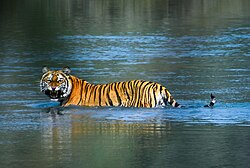
As of 2004, population estimates in Bangladesh ranged from 200 to 419 individuals, most of them in the Sundarbans.<ref name="Khan" /> This region is the only mangrove habitat in this [[bioregion]], where tigers survive, swimming between islands in the delta to hunt prey.<ref name="Wikramanayake1999"/> Bangladesh's Forest Department is raising mangrove plantations supplying forage for [[spotted deer]]. Since 2001, [[afforestation]] has continued on a small scale in the Sundarbans.<ref name=gtrp11>{{Cite book |author=Global Tiger Initiative |year=2011 |title=Global Tiger Recovery Program 2010–2022 |location=Washington |publisher=Global Tiger Initiative Secretariat |archive-date=26 August 2011 |url=http://www.globaltigerinitiative.org/download/St_Petersburg/GTRP_Nov11_Final_Version_Eng.pdf | As of 2004, population estimates in Bangladesh ranged from 200 to 419 individuals, most of them in the Sundarbans.<ref name="Khan" /> This region is the only mangrove habitat in this [[bioregion]], where tigers survive, swimming between islands in the delta to hunt prey.<ref name="Wikramanayake1999"/> Bangladesh's Forest Department is raising mangrove plantations supplying forage for [[spotted deer]]. Since 2001, [[afforestation]] has continued on a small scale in the Sundarbans.<ref name=gtrp11>{{Cite book |author=Global Tiger Initiative |year=2011 |title=Global Tiger Recovery Program 2010–2022 |location=Washington |publisher=Global Tiger Initiative Secretariat |archive-date=26 August 2011 |url=http://www.globaltigerinitiative.org/download/St_Petersburg/GTRP_Nov11_Final_Version_Eng.pdf |archive-url=https://web.archive.org/web/20110826004608/http://www.globaltigerinitiative.org/download/St_Petersburg/GTRP_Nov11_Final_Version_Eng.pdf}}</ref> | ||
From October 2005 to January 2007, the first [[camera trap]] survey was conducted across six sites in the Bangladesh Sundarbans to estimate tiger population density. The average of these six sites provided an estimate of 3.7 tigers per {{Cvt|100|km2 | From October 2005 to January 2007, the first [[camera trap]] survey was conducted across six sites in the Bangladesh Sundarbans to estimate tiger population density. The average of these six sites provided an estimate of 3.7 tigers per {{Cvt|100|km2}}. Since the Bangladesh Sundarbans is an area of {{Cvt|5770|km2}}, it was inferred that the total tiger population comprised approximately 200 individuals.<ref>{{Cite journal |author=Khan, M. |title=Population and prey of the Bengal Tiger ''Panthera tigris tigris'' (Linnaeus, 1758) (Carnivora: Felidae) in the Sundarbans, Bangladesh |journal=Journal of Threatened Taxa |year=2012 |volume=4 |issue=2 |pages=2370–2380 |doi=10.11609/jott.o2666.2370-80 |doi-access=free}}</ref> | ||
Home ranges of adult female tigers were recorded comprising between {{Cvt|12|and|14|km2 | Home ranges of adult female tigers were recorded comprising between {{Cvt|12|and|14|km2}}, which would indicate an approximate carrying capacity of 150 adult females.<ref name=Barlow10/><ref>{{Cite journal |author=Barlow, A. |author2=Smith, J. L. D. |author3=Ahmad, I. U. |author4=Hossain, A. N. |author5=Rahman, M. |author6=Howlader, A. |name-list-style=amp |title=Female tiger ''Panthera tigris'' home range size in the Bangladesh Sundarbans: the value of this mangrove ecosystem for the species' conservation |journal=Oryx |year=2011 |volume=45 |issue=1 |pages=125–128 |doi=10.1017/S0030605310001456|doi-access=free |bibcode=2011Oryx...45..125B }}</ref> The small home range of adult female tigers and consequent high density of tigers in this habitat type relative to other areas may be related to both the high density of prey and the small size of the Sundarban tigers.<ref name=Barlow10/> | ||
Since 2007, tiger monitoring surveys have been carried out every year by [[WildTeam]] in the Bangladesh Sundarbans to monitor changes in the Bangladesh tiger population and assess the effectiveness of conservation actions. This survey measures changes in the frequency of tiger track sets along the sides of tidal waterways as an index of relative tiger abundance across the Sundarbans landscape.<ref>{{Cite journal |author=Barlow, A. |author2=Ahmed, M. I. U. |author3=Rahman, M. M. |author4=Howlader, A. |author5=Smith, A. C. |author6=Smith, J. L. D. |name-list-style=amp |title=Linking monitoring and intervention for improved management of tigers in the Sundarbans of Bangladesh |journal=Biological Conservation |year=2008 |volume=14 |pages=2032–2040 |doi=10.1016/j.biocon.2008.05.018 |issue=8}}</ref> | Since 2007, tiger monitoring surveys have been carried out every year by [[WildTeam]] in the Bangladesh Sundarbans to monitor changes in the Bangladesh tiger population and assess the effectiveness of conservation actions. This survey measures changes in the frequency of tiger track sets along the sides of tidal waterways as an index of relative tiger abundance across the Sundarbans landscape.<ref>{{Cite journal |author=Barlow, A. |author2=Ahmed, M. I. U. |author3=Rahman, M. M. |author4=Howlader, A. |author5=Smith, A. C. |author6=Smith, J. L. D. |name-list-style=amp |title=Linking monitoring and intervention for improved management of tigers in the Sundarbans of Bangladesh |journal=Biological Conservation |year=2008 |volume=14 |pages=2032–2040 |doi=10.1016/j.biocon.2008.05.018 |issue=8|bibcode=2008BCons.141.2032B }}</ref> | ||
By 2009, the tiger population in the Bangladesh Sundarbans was estimated as 100–150 adult females or 335–500 tigers overall. Female home ranges, recorded using [[Global Positioning System]] collars, were some of the smallest recorded for tigers, indicating that the Bangladesh Sundarbans could have one of the highest densities and largest populations of tigers anywhere in the world. They are isolated from the next tiger population by a distance of up to {{Cvt|300|km | By 2009, the tiger population in the Bangladesh Sundarbans was estimated as 100–150 adult females or 335–500 tigers overall. Female home ranges, recorded using [[Global Positioning System]] collars, were some of the smallest recorded for tigers, indicating that the Bangladesh Sundarbans could have one of the highest densities and largest populations of tigers anywhere in the world. They are isolated from the next tiger population by a distance of up to {{Cvt|300|km}}. Information is lacking on many aspects of Sundarbans tiger ecology, including relative abundance, population status, spatial dynamics, habitat selection, life history characteristics, taxonomy, genetics, and disease. There is also no monitoring program in place to track changes in the tiger population over time, and therefore no way of measuring the response of the population to conservation activities or threats. Most studies have focused on the tiger-human conflict in the area, but two studies in the Sundarbans East Wildlife sanctuary documented habitat-use patterns of tigers, and abundances of tiger prey, and another study investigated tiger parasite load. Some major threats to tigers have been identified. The tigers living in the Sundarbans are threatened by [[habitat destruction]], prey depletion, highly aggressive and rampant [[intraspecific competition]], tiger-human conflict, and direct tiger loss.<ref name=Sundarbans/> | ||
By 2017, this population was estimated at 84–158 individuals.<ref>{{Cite journal |author1=Aziz, M. A. |author2=Tollington, S. |author3=Barlow, A. |author4=Greenwood, C. |author5=Goodrich, J. M. |author6=Smith, O. |author7=Shamsuddoha, M. |author8=Islam, M. A. |author9=Groombridge, J. J. |name-list-style=amp |year=2017 |title=Using non-invasively collected genetic data to estimate density and population size of tigers in the Bangladesh Sundarbans |journal=Global Ecology and Conservation |volume=12 |pages=272–282 |doi=10.1016/j.gecco.2017.09.002 |doi-access=free|bibcode=2017GEcoC..12..272A }}</ref> | |||
As of 2018, 114 individuals were estimated to live in the country.<ref>{{cite report |title=Global Tiger Recovery Program (2023–34) |publisher=Global Tiger Forum and the Global Tiger Initiative Council |url=https://globaltigerforum.org/global-tiger-recovery-program-2-0-2023-34/ |date=2023 |access-date=8 April 2024 |archive-date=8 April 2024 |archive-url=https://web.archive.org/web/20240408150606/https://globaltigerforum.org/global-tiger-recovery-program-2-0-2023-34/ |url-status=live}}</ref> | |||
A rising sea-level due to [[climate change]] is projected to cause a severe loss of suitable habitat for this population in the following decades, around 50% by 2050 and 100% by 2070.<ref>{{Cite journal |author1=Mukul, S. A. |author2=Alamgir, M. |author3=Sohel, M. S. I. |author4=Pert, P. L. |author5=Herbohn, J. |author6=Turton, S. M. |author7=Khan, M. S. I.|author8=Munim, S. A.|author9=Reza, A. A. |author10=Laurance, W. F. |name-list-style=amp |year=2019 |title=Combined effects of climate change and sea-level rise project dramatic habitat loss of the globally endangered Bengal tiger in the Bangladesh Sundarbans |journal=Science of the Total Environment |volume=663 |pages=830–840 |doi=10.1016/j.scitotenv.2019.01.383 |pmid=30738263 |bibcode=2019ScTEn.663..830M|s2cid=73418836}}</ref> | |||
A rising sea-level due to [[climate change]] is projected to cause a severe loss of suitable habitat for this population in the following decades, around 50% by 2050 and 100% by 2070.<ref>{{Cite journal |author1=Mukul, S. A. |author2=Alamgir, M. |author3=Sohel, M. S. I. |author4=Pert, P. L. |author5=Herbohn, J. |author6=Turton, S. M. |author7=Khan, M. S. I.|author8=Munim, S. A.|author9=Reza, A. A. |author10=Laurance, W. F. |name-list-style=amp |year=2019 |title=Combined effects of climate change and sea-level rise project dramatic habitat loss of the globally endangered Bengal tiger in the Bangladesh Sundarbans |journal=Science of the Total Environment |volume=663 |pages=830–840 |doi=10.1016/j.scitotenv.2019.01.383 |pmid=30738263 |bibcode=2019ScTEn.663..830M|s2cid=73418836 }}</ref> | |||
===Nepal=== | ===Nepal=== | ||
[[File:King George V Hunting in Nepal in 1911 (3).jpg|thumb|Tigers killed by King [[George V]] in Nepal in 1911]] | [[File:King George V Hunting in Nepal in 1911 (3).jpg|thumb|Tigers killed by King [[George V]] in Nepal in 1911]] | ||
The tiger population in the Terai of Nepal is split into three isolated subpopulations that are separated by cultivation and densely settled habitat. The largest population lives in [[Chitwan National Park]] and in the adjacent [[Parsa National Park]] encompassing an area of {{ | [[File:Bengal Tiger in Bardiya National Park.jpg|thumb|Bengal tiger in Bardia National Park]] | ||
The tiger population in the Terai of Nepal is split into three isolated subpopulations that are separated by cultivation and densely settled habitat. The largest population lives in [[Chitwan National Park]] and in the adjacent [[Parsa National Park]] encompassing an area of {{Cvt|2543|km2}} of prime lowland forest. To the west, the Chitwan population is isolated from the one in [[Bardiya National Park]] and adjacent unprotected habitat farther west, extending to within {{Cvt|15|km}} of the Shuklaphanta Wildlife Reserve, which harbours the smallest population.<ref>{{Cite journal |author1=Smith, J. L. D. |author2=Ahern, S. C. |author3=McDougal, C. |name-list-style=amp |year=1998 |title=Landscape Analysis of Tiger Distribution and Habitat Quality in Nepal |journal=Conservation Biology |volume=12 |issue=6 |pages=1338–1346 |doi=10.1111/j.1523-1739.1998.97068.x|bibcode=1998ConBi..12.1338S }}</ref> | |||
From February to June 2013, a camera trapping survey was carried out in the [[Terai Arc Landscape]], across an area of {{ | From February to June 2013, a camera trapping survey was carried out in the [[Terai Arc Landscape]], across an area of {{Cvt|4841|km2}} in 14 districts. The country's tiger population was estimated at 163–235 breeding adults comprising 102–152 tigers in the Chitwan-Parsa protected areas, 48–62 in Bardiya-[[Banke National Park]]s and 13–21 in [[Shuklaphanta National Park]].<ref>{{Cite report |author1=Dhakal, M. |name-list-style=amp |author2=Karki (Thapa), M. |author3=Jnawali, S. R. |author4=Subedi, N. |author5=Pradhan, N. M. B. |author6=Malla, S. |author7=Lamichhane, B. R. |author8=Pokheral, C. P. |author9=Thapa, G. J. |author10=Oglethorpe, J. |author11=Subba, S. A. |author12=Bajracharya, P. R. |author13=Yadav, H. |year=2014 |title=Status of Tigers and Prey in Nepal |work=Department of National Parks and Wildlife Conservation |location=Kathmandu, Nepal |url=https://www.researchgate.net/publication/265966616}}</ref> | ||
Between November 2017 and April 2018, the third nationwide survey for tiger and prey was conducted in the Terai Arc Landscape; the country's population was estimated at 220–274 tigers.<ref name=DNPWC2018>{{Cite report |author1=Poudyal, L. |name-list-style=amp |author2=Yadav, B. |author3=Ranabhat, R. |author4=Maharjan, S. |author5=Malla, S. |author6=Lamichhane, B.R. |author7=Subba, S. |author8=Koirala, S. |author9=Shrestha, S. |author10=Gurung, A. |author11=Paudel, U. |author12=Bhatt, T. |author13=Giri, S. |year=2018 |title=Status of Tigers and Prey in Nepal |location=Kathmandu, Nepal |publisher=Department of National Parks and Wildlife Conservation & Department of Forests and Soil Conservation, Ministry of Forests and Environment}}</ref> | Between November 2017 and April 2018, the third nationwide survey for tiger and prey was conducted in the Terai Arc Landscape; the country's population was estimated at 220–274 tigers.<ref name=DNPWC2018>{{Cite report |author1=Poudyal, L. |name-list-style=amp |author2=Yadav, B. |author3=Ranabhat, R. |author4=Maharjan, S. |author5=Malla, S. |author6=Lamichhane, B.R. |author7=Subba, S. |author8=Koirala, S. |author9=Shrestha, S. |author10=Gurung, A. |author11=Paudel, U. |author12=Bhatt, T. |author13=Giri, S. |year=2018 |title=Status of Tigers and Prey in Nepal |location=Kathmandu, Nepal |publisher=Department of National Parks and Wildlife Conservation & Department of Forests and Soil Conservation, Ministry of Forests and Environment}}</ref> | ||
As of 2022, 316–355 individuals were estimated to live in the country.<ref>{{cite book |author1=DNPWC |author2=DFSC |name-list-style=amp |year=2022 |title=Status of Tigers and Prey in Nepal 2022 |location=Kathmandu, Nepal |publisher=Department of National Parks and Wildlife Conservation and Department of Forests and Soil Conservation. Ministry of Forests and Environment |url=https://dnpwc.gov.np/media/files/Status_of_Tigers_Ic2ylSC.pdf |access-date=6 August 2022 |archive-date=8 April 2023 |archive-url=https://web.archive.org/web/20230408104009/https://dnpwc.gov.np/media/files/Status_of_Tigers_Ic2ylSC.pdf |url-status=live}}</ref> | |||
===Bhutan=== | ===Bhutan=== | ||
In Bhutan, tigers have been documented in 17 of 18 [[Dzongkhag|districts]]. They inhabit the subtropical [[Himalaya]]n foothills at an elevation of {{ | In Bhutan, tigers have been documented in 17 of 18 [[Dzongkhag|districts]]. They inhabit the subtropical [[Himalaya]]n foothills at an elevation of {{Cvt|200|m}} in the south to over {{Cvt|3000|m}} in the temperate forests in the north. Their stronghold appears to be the country's central belt between the [[Mo River]] in the west and the Kulong River in the east ranging in elevation from {{Cvt|2000|to|3500|m}}.<ref>{{Cite journal |author1=Dorji, D. P. |author2=Santiapillai, C. |name-list-style=amp |year=1989 |title=The Status, Distribution and Conservation of the Tiger ''Panthera tigris'' in Bhutan |journal=Biological Conservation |volume=48 |pages=311–319 |doi=10.1016/0006-3207(89)90105-5 |issue=4 |bibcode=1989BCons..48..311D |archive-date=24 March 2012 |url=http://www.panthera.org/sites/default/files/Dorji%20&%20Santiapillai%201989%20Tiger%20status%20in%20Bhutan_Biological%20Conservation.pdf |archive-url=https://web.archive.org/web/20120324044614/http://www.panthera.org/sites/default/files/Dorji%20%26%20Santiapillai%201989%20Tiger%20status%20in%20Bhutan_Biological%20Conservation.pdf}}</ref> By 2015, Bhutan's tiger population was estimated at 103 individuals.<ref name="sangay05">{{Cite book |author1=Sangay, T. |author2=Wangchuk, T. |name-list-style=amp |year=2005 |title=Tiger Action Plan for Bhutan 2006–2015 |location=Thimphu |publisher=Nature Conservation Division, Department of Forests, Ministry of Agriculture, Royal Government of Bhutan and WWF Bhutan Programme}}</ref> | ||
[[Royal Manas National Park|Royal Manas]] and [[Jigme Singye Wangchuck National Park]]s form the largest contiguous tiger conservation area in Bhutan representing subtropical to alpine habitat types.<ref>{{Cite journal |author1=Wang, S.W. |name-list-style=amp |author2=Macdonald, D.W. |year=2009 |title=The use of camera traps for estimating tiger and leopard populations in the high altitude mountains of Bhutan |journal=Biological Conservation |volume=142 |issue=3 |pages=606–613 |doi=10.1016/j.biocon.2008.11.023 }}</ref> | [[Royal Manas National Park|Royal Manas]] and [[Jigme Singye Wangchuck National Park]]s form the largest contiguous tiger conservation area in Bhutan representing subtropical to alpine habitat types.<ref>{{Cite journal |author1=Wang, S.W. |name-list-style=amp |author2=Macdonald, D.W. |year=2009 |title=The use of camera traps for estimating tiger and leopard populations in the high altitude mountains of Bhutan |journal=Biological Conservation |volume=142 |issue=3 |pages=606–613 |doi=10.1016/j.biocon.2008.11.023 |bibcode=2009BCons.142..606W }}</ref> | ||
In 2010, [[camera trap]]s recorded a tiger pair at elevations of {{ | In 2010, [[camera trap]]s recorded a tiger pair at elevations of {{Cvt|3000|to|4100|m}}. As of 2015, the tiger population in Bhutan was estimated at 89 to 124 individuals in a survey area of {{Cvt|28225|km2}}.<ref>{{Cite report |author=Dorji, S. |name-list-style=amp |author2=Thinley, P. |author3=Tempa, T. |author4=Wangchuk, N. |author5=Tandin |author6=Namgyel, U. |author7=Tshewang, S. |date=2015 |title=Counting the Tigers in Bhutan: Report on the National Tiger Survey of Bhutan 2014 – 2015 |location=Thimphu, Bhutan |publisher=Department of Forests and Park Services, Ministry of Agriculture and Forests |url=https://www.researchgate.net/publication/326294374}}</ref> | ||
In 2008, a tiger was recorded at an elevation of {{ | In 2008, a tiger was recorded at an elevation of {{Cvt|4200|m}} in [[Jigme Dorji National Park]], which is the highest elevation record of a tiger known to date.<ref>{{Cite journal |author1=Jigme, K. |name-list-style=amp |author2=Tharchen, L. |year=2012 |title=Camera-trap records of tigers at high altitudes in Bhutan |journal=Cat News |issue=56 |pages=14–15}}</ref> In 2017, a tiger was recorded for the time in [[Bumdeling Wildlife Sanctuary]]. It probably used a [[wildlife corridor]] to reach northeastern Bhutan.<ref>{{Cite journal |year=2020 |author1=Thinley, P. |name-list-style=amp |author2=Dendup, T. |author3=Rajaratnam, R. |author4=Vernes, K. |author5=Tempa, K. |author6=Chophel, T. |author7=Norbu, L. |title=Tiger reappearance in Bhutan's Bumdeling Wildlife Sanctuary: a case for maintaining effective corridors and metapopulations |journal=Animal Conservation |volume=23 |issue=6 |pages=629–631 |doi=10.1111/acv.12580 |bibcode=2020AnCon..23..629T |doi-access=free}}</ref> | ||
Bhutan's tiger population was estimated at 90 individuals comprising 60 females and 30 males with a [[population density]] estimate of 0.19–0.31 tigers per {{Cvt|100|km2}} by March 2015.<ref name=Tempa_al2019>{{Cite journal |author1=Tempa, T. |name-list-style=amp |author2=Hebblewhite, M. |author3=Goldberg, J.F. |author4=Norbu, N. |author5=Wangchuk, T.R. |author6=Xiao, W. |author7=Mills, L.S. |year=2019 |title=The spatial distribution and population density of Tigers in mountainous terrain of Bhutan |journal=Biological Conservation |volume=238 | | Bhutan's tiger population was estimated at 90 individuals comprising 60 females and 30 males with a [[population density]] estimate of 0.19–0.31 tigers per {{Cvt|100|km2}} by March 2015.<ref name=Tempa_al2019>{{Cite journal |author1=Tempa, T. |name-list-style=amp |author2=Hebblewhite, M. |author3=Goldberg, J.F. |author4=Norbu, N. |author5=Wangchuk, T.R. |author6=Xiao, W. |author7=Mills, L.S. |year=2019 |title=The spatial distribution and population density of Tigers in mountainous terrain of Bhutan |journal=Biological Conservation |volume=238 |article-number=108192 |doi=10.1016/j.biocon.2019.07.037 |bibcode=2019BCons.23808192T |s2cid=202847357 |url=https://www.umt.edu/research/millslab/publications/tempa-bhutan-tigers-2019.pdf}}</ref> As of 2022, the population was estimated at 131 individuals.<ref>{{Cite news |date=2023 |title=National Tiger Survey 2021–22 |publisher=Government of Bhutan |author=Department of Forests and Park Services |place=Thimphu}}</ref> | ||
===China=== | ===China=== | ||
| Line 126: | Line 134: | ||
==Ecology and behaviour== | ==Ecology and behaviour== | ||
[[File:Majestic Queen.jpg|thumb|A tigress in Bandhavgarh National Park]] | |||
[[File:Tiger Tadoba NP.jpg|thumb|A tiger marking territory in [[Tadoba National Park]]]] | |||
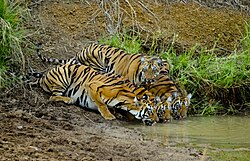
[[File:Tiger Drinking Pond Mudumalai Mar21 DSC01310.jpg|thumb|A tiger drinking from a pond in [[Mudumalai National Park]]]] | |||
The basic social unit of the tiger is composed of a female and her offspring. Adult animals congregate only temporarily when special conditions permit, such as plentiful supplies of food. Otherwise, they lead solitary lives, hunting individually for the forest and grassland animals upon which they prey. Resident adults of either sex maintain home ranges, confining their movements to definite habitats within which they satisfy their needs and those of their cubs, which include prey, water and shelter. In this site, they also maintain contact with other tigers, especially those of the opposite sex. Those sharing the same ground are well aware of each other's movements and activities.<ref name="McDougal1977"/> In [[Chitwan National Park]], [[Radio telemetry|radio-collared]] subadult tigers started [[Dispersal (ecology)|dispersing]] from their natal areas earliest at the age of 19 months. Of the 14 subadults studied, the four females stayed closer to their mother's home range than the 10 males. The latter dispersed between {{Cvt|9.5|and|65.7|km}}. None of them crossed open cultivated areas that were more than {{Cvt|10|km}} wide, but moved through prime alluvial and forested habitat.<ref>{{Cite journal |last=Smith |first=J. L. D. |year=1993 |title=The role of dispersal in structuring the Chitwan tiger population |volume=124 |journal=Behaviour |issue=3 |pages=165–195 |doi=10.1163/156853993X00560}}</ref> | The basic social unit of the tiger is composed of a female and her offspring. Adult animals congregate only temporarily when special conditions permit, such as plentiful supplies of food. Otherwise, they lead solitary lives, hunting individually for the forest and grassland animals upon which they prey. Resident adults of either sex maintain home ranges, confining their movements to definite habitats within which they satisfy their needs and those of their cubs, which include prey, water and shelter. In this site, they also maintain contact with other tigers, especially those of the opposite sex. Those sharing the same ground are well aware of each other's movements and activities.<ref name="McDougal1977"/> In [[Chitwan National Park]], [[Radio telemetry|radio-collared]] subadult tigers started [[Dispersal (ecology)|dispersing]] from their natal areas earliest at the age of 19 months. Of the 14 subadults studied, the four females stayed closer to their mother's home range than the 10 males. The latter dispersed between {{Cvt|9.5|and|65.7|km}}. None of them crossed open cultivated areas that were more than {{Cvt|10|km}} wide, but moved through prime alluvial and forested habitat.<ref>{{Cite journal |last=Smith |first=J. L. D. |year=1993 |title=The role of dispersal in structuring the Chitwan tiger population |volume=124 |journal=Behaviour |issue=3 |pages=165–195 |doi=10.1163/156853993X00560}}</ref> | ||
| Line 134: | Line 143: | ||
The home ranges occupied by adult male residents tend to be mutually exclusive, even though one of these residents may tolerate a transient or sub-adult male at least for a time. A male tiger keeps a large territory in order to include the home ranges of several females within its bounds, so that he may maintain [[mating]] rights with them. Spacing among females is less complete. Typically there is partial overlap with neighbouring female residents. They tend to have core areas, which are more exclusive, at least for most of the time. Home ranges of both males and females are not stable. The shift or alteration of a home range by one animal is correlated with a shift of another. Shifts from less suitable habitat to better ones are made by animals that are already resident. New animals become residents only as vacancies occur when a former resident moves out or dies. There are more places for resident females than for resident males.<ref name="McDougal1977"/> | The home ranges occupied by adult male residents tend to be mutually exclusive, even though one of these residents may tolerate a transient or sub-adult male at least for a time. A male tiger keeps a large territory in order to include the home ranges of several females within its bounds, so that he may maintain [[mating]] rights with them. Spacing among females is less complete. Typically there is partial overlap with neighbouring female residents. They tend to have core areas, which are more exclusive, at least for most of the time. Home ranges of both males and females are not stable. The shift or alteration of a home range by one animal is correlated with a shift of another. Shifts from less suitable habitat to better ones are made by animals that are already resident. New animals become residents only as vacancies occur when a former resident moves out or dies. There are more places for resident females than for resident males.<ref name="McDougal1977"/> | ||
During seven years of camera trapping, tracking, and observational data in Chitwan National Park, six to nine breeding tigers, two to sixteen non-breeding tigers, and six to twenty young tigers of less than one year of age were detected in the study area of {{Cvt|100|km2}}. One of the resident females left her territory to one of her female offspring and took over an adjoining area by displacing another female; and a displaced female managed to re-establish herself in a neighbouring territory made vacant by the death of the resident. Of 11 resident females, 7 were still alive at the end of the study period, two disappeared after losing their territories to rivals, and two died. The initial loss of two resident males and subsequent take over of their home ranges by new males caused social instability for two years. Of four resident males, one was still alive and three were displaced by rivals. Five litters of cubs were killed by infanticide, two litters died because they were too young to fend for themselves when their mothers died. One juvenile tiger was presumed dead after being photographed with severe injuries from a deer [[snare trap|snare]]. The remaining young lived long enough to reach dispersal age, two of them becoming residents in the study area.<ref>{{Cite journal |last1=Barlow |first1=A. C. D. |last2=McDougal |first2=C. |last3=Smith |first3=J. L. D. |last4=Gurung |first4=B. |last5=Bhatta |first5=S. R. |last6=Kumal |first6=S. |last7=Mahato |first7=B. |last8=Tamang |first8=D. B. |name-list-style=amp |year=2009 |title=Temporal Variation in Tiger (''Panthera tigris'') Populations and Its Implications for Monitoring |journal=Journal of Mammalogy |volume=90 |issue=2 |pages= 472–478 |doi=10.1644/07-MAMM-A-415.1|doi-access=free}}</ref> | During seven years of camera trapping, tracking, and observational data in Chitwan National Park, six to nine breeding tigers, two to sixteen non-breeding tigers, and six to twenty young tigers of less than one year of age were detected in the study area of {{Cvt|100|km2}}. One of the resident females left her territory to one of her female offspring and took over an adjoining area by displacing another female; and a displaced female managed to re-establish herself in a neighbouring territory made vacant by the death of the resident. Of 11 resident females, 7 were still alive at the end of the study period, two disappeared after losing their territories to rivals, and two died. The initial loss of two resident males and subsequent take over of their home ranges by new males caused social instability for two years. Of four resident males, one was still alive and three were displaced by rivals. Five litters of cubs were killed by infanticide, two litters died because they were too young to fend for themselves when their mothers died. One juvenile tiger was presumed dead after being photographed with severe injuries from a deer [[snare trap|snare]]. The remaining young lived long enough to reach dispersal age, two of them becoming residents in the study area.<ref>{{Cite journal |last1=Barlow |first1=A. C. D. |last2=McDougal |first2=C. |last3=Smith |first3=J. L. D. |last4=Gurung |first4=B. |last5=Bhatta |first5=S. R. |last6=Kumal |first6=S. |last7=Mahato |first7=B. |last8=Tamang |first8=D. B. |name-list-style=amp |year=2009 |title=Temporal Variation in Tiger (''Panthera tigris'') Populations and Its Implications for Monitoring |journal=Journal of Mammalogy |volume=90 |issue=2 |pages= 472–478 |doi=10.1644/07-MAMM-A-415.1|doi-access=free |bibcode=2009JMamm..90..472B }}</ref> | ||
===Hunting and diet=== | ===Hunting and diet=== | ||
The Bengal tiger is a [[carnivore]] and prefers hunting large [[ungulate]]s such as [[gaur]], [[Sambar (deer)|sambar]], [[chital]], [[barasingha]], [[water buffalo]], [[nilgai]], [[serow]] and [[takin]]. Medium-sized prey includes [[wild boar]], [[Indian hog deer]], [[Indian muntjac]] and [[northern plains gray langur]]. Small prey such as [[Indian crested porcupine|porcupine]], [[hare]] and [[peafowl]] form a small part of its diet. Because of the encroachment of humans into tiger habitat, it also preys on domestic livestock.<ref>{{Cite journal |author=Bagchi, S. |author2=Goyal, S. P. |author3=Sankar, K. |name-list-style=amp |year=2003 |title=Prey abundance and prey selection by tigers (''Panthera tigris'') in a semi-arid, dry deciduous forest in western India |journal=Journal of Zoology |volume=260 |pages=285–290 |doi=10.1017/S0952836903003765 |issue=3 |bibcode=2003JZoo..260..285B |url=http://sumantabagchi.weebly.com/uploads/1/0/0/6/10062513/bagchi_et_al_j_zool_2003_tiger_diet.pdf |citeseerx=10.1.1.694.7051}}</ref><ref name=Andheria2007>{{Cite journal |author=Andheria, A. P. |author2=Karanth, K. U. |author3=Kumar, N. S. |name-list-style=amp |year=2007 |title=Diet and prey profiles of three sympatric large carnivores in Bandipur Tiger Reserve, India |journal=Journal of Zoology |volume=273 |issue=2 |pages=169–175 |doi=10.1111/j.1469-7998.2007.00310.x |url=https://www.conservationindia.org/wp-content/files_mf/51.-Andheria-et-al_2007_Journal-of-Zoology_Dietprey.pdf}}</ref><ref>{{Cite journal |author=Biswas, S. |author2=Sankar, K. |name-list-style=amp |year=2002 |title=Prey abundance and food habit of tigers (''Panthera tigris tigris'') in Pench National Park, Madhya Pradesh, India |journal=[[Journal of Zoology]] |volume=256 |pages=411–420 |doi=10.1017/S0952836902000456 |issue=3}}</ref><ref>{{Cite journal |author=Wegge, P. |author2=Odden, M. |author3=Pokharel, C. Pd. |author4=Storaasc, T. |name-list-style=amp |year=2009 |title=Predator–prey relationships and responses of ungulates and their predators to the establishment of protected areas: A case study of tigers, leopards and their prey in Bardia National Park, Nepal |journal=Biological Conservation |volume=142 |issue=1 | pages=189–202 |doi=10.1016/j.biocon.2008.10.020 |bibcode=2009BCons.142..189W |url=https://www.researchgate.net/publication/222562975}}</ref><ref>{{Cite report |last1=Prachi |first1=M. |last2=Kulkarni |first2=J. |name-list-style=amp |year=2006 |title=Monitoring of Tiger and prey population dynamics in Melghat Tiger Reserve, Maharashtra, India |publisher=Envirosearch |location=Pune}}</ref> | |||
The tiger is a [[carnivore]] and prefers hunting large [[ungulate]]s such as [[gaur]], [[Sambar (deer)|sambar]], [[chital]], [[barasingha]], [[water buffalo]], [[nilgai]], [[serow]] and [[takin]]. Medium-sized prey includes [[wild boar]], [[Indian hog deer]], [[Indian muntjac]] and [[northern plains gray langur]]. Small prey such as [[porcupine]], [[hare]] and [[peafowl]] form a small part of its diet. Because of the encroachment of humans into tiger habitat, it also preys on domestic livestock.<ref>{{Cite journal |author=Bagchi, S. |author2=Goyal, S. P. |author3=Sankar, K. |name-list-style=amp |year=2003 |title=Prey abundance and prey selection by tigers (''Panthera tigris'') in a semi-arid, dry deciduous forest in western India |journal=Journal of Zoology |volume=260 |pages=285–290 |doi=10.1017/S0952836903003765 |issue=3 |url=http://sumantabagchi.weebly.com/uploads/1/0/0/6/10062513/bagchi_et_al_j_zool_2003_tiger_diet.pdf |citeseerx=10.1.1.694.7051}}</ref><ref name= | |||
Bengal tigers occasionally hunt and kill predators such as [[Indian leopard]], [[mugger crocodile]], [[Asian black bear]], [[sloth bear]] and [[dhole]]. They generally do not attack adult [[Indian elephant]] and [[Indian rhinoceros]], but such extraordinarily rare events have been recorded.<ref name=Mazak1981/> In [[Kaziranga National Park]], tigers killed 20 rhinoceros in 2007.<ref>{{Cite news |author=Dutta, P. |date=2008 |url=http://www.telegraphindia.com/1080313/jsp/northeast/story_9012303.jsp |title=Trouble for rhino from poacher and Bengal tiger |newspaper=The Telegraph India |access-date=20 September 2014 |archive-url=https://web.archive.org/web/20140927093927/http://www.telegraphindia.com/1080313/jsp/northeast/story_9012303.jsp |archive-date=27 September 2014 | [[File:RANTHAMBORE TIGER RESERVE.jpg|thumb|A tiger attacking a [[Sambar deer]] in Ranthambore National Park]] | ||
[[File:Tiger chasing a wild Pig.jpg|thumb|Tiger chasing a wild boar in Tadoba Andhari Tiger Reserve]] | |||
[[File:Tiger taking its kill in bushes.jpg|thumb|Tiger with kill in Ranthambore National Park]] | |||
Bengal tigers occasionally hunt and kill predators such as [[Indian leopard]], [[mugger crocodile]], [[Asian black bear]], [[sloth bear]], and [[dhole]]. They generally do not attack adult [[Indian elephant]] and [[Indian rhinoceros]], but such extraordinarily rare events have been recorded.<ref name=Mazak1981/><ref name=Geptner1972>{{Cite book |author1=Heptner, V. G. |author2=Sludskij, A. A. |name-list-style=amp |orig-date=1972 |year=1992 |title=Mlekopitajuščie Sovetskogo Soiuza. Moskva: Vysšaia Škola |trans-title=Mammals of the Soviet Union. Volume II, Part 2. Carnivora (Hyaenas and Cats) |publisher=Smithsonian Institution and the National Science Foundation |location=Washington DC |chapter=Tiger |chapter-url=https://archive.org/stream/mammalsofsov221992gept#page/94/mode/2up |pages=95–202}}</ref> In [[Kaziranga National Park]], tigers killed 20 rhinoceros in 2007.<ref>{{Cite news |author=Dutta, P. |date=2008 |url=http://www.telegraphindia.com/1080313/jsp/northeast/story_9012303.jsp |title=Trouble for rhino from poacher and Bengal tiger |newspaper=The Telegraph India |access-date=20 September 2014 |archive-url=https://web.archive.org/web/20140927093927/http://www.telegraphindia.com/1080313/jsp/northeast/story_9012303.jsp |archive-date=27 September 2014 }}</ref> In 2011 and 2014, two instances of Bengal tigers killing adult elephants were recorded; in [[Jim Corbett National Park]] on a 20-year-old elephant cow, and another on a 28-year-old sick elephant in [[Kaziranga National Park]]; the latter was eaten by several tigers at once.<ref>{{Cite book|last=Huckelbridge|first=D. |title=No Beast So Fierce |date=2019 |publisher=HarperCollins Publishers |location=New York |isbn=978-0-06-267884-3 |pages=19–20}}</ref> A [[king cobra]] (''Ophiophagus hannah''), an [[Indian cobra]] (''Naja naja''),<ref>{{Cite journal |author=Pandit, P. K. |journal=Tigerpaper |volume=XXXIX |issue=1 |url=http://www.fao.org/3/a-am998e.pdf |date=2012 |title=Sundarban Tiger − a new prey species of estuarine crocodile at Sundarban Tiger Reserve, India |pages=1–5}}</ref> [[Asian water monitor]], [[rhesus macaque]], [[fish]], [[crabs]], and very rarely [[fishing cat]]s and [[turtles]] were found in the stomachs and scat of tigers in the Sundarbans.<ref name=mukherjee>{{Cite journal |last1=Mukherjee |first1=S. |last2=Sarkar |first2=N. S. |name-list-style=amp |date=2013 |title=The range of prey size of the Royal Bengal Tiger of the Sundarbans |journal=Journal of Ecosystems |volume=2013 |pages=3–5 |doi=10.1155/2013/351756 |doi-access=free |quote=The tiger of Sundarbans is the World-renowned Royal Bengal Tiger (Panthera tigris tigris)}}</ref> One in Chitwan National Park has been reported to have hunted three [[gharial]]s.<ref>{{Cite news |author=Joshi, A.R. |date=2022 |title=In Nepal, endangered tiger kills critically endangered gharial. What does it mean? |work=Mongabay |url=https://news.mongabay.com/2022/09/in-nepal-endangered-tiger-kills-critically-endangered-gharial-what-does-it-mean}}</ref> | |||
Results of scat analyses indicate that the tigers in Nagarahole National Park preferred prey weighing more than {{Cvt|176|kg}} and that on average tiger prey weighed {{Cvt|91.5|kg}}. The prey species included chital, sambar, wild pig and gaur. Gaur remains were found in 44.8% of all tiger scat samples, sambar remains in 28.6%, wild pig remains in 14.3% and chital remains in 10.4% of all scat samples.<ref name="K&S95">{{Cite journal |last1=Karanth |first1=K. U. |last2=Sunquist |first2=M. E. |name-list-style=amp |date=1995 |title=Prey selection by tiger, leopard and dhole in tropical forests |journal=Journal of Animal Ecology |volume=64 |issue=4 |pages=439–450 |doi=10.2307/5647 |jstor=5647}}</ref> In Bandipur National Park, gaur and sambar together also constituted 73% of tiger diet.<ref name= | Results of scat analyses indicate that the Bengal tigers in Nagarahole National Park preferred prey weighing more than {{Cvt|176|kg}} and that on average tiger prey weighed {{Cvt|91.5|kg}}. The prey species included chital, sambar, wild pig and gaur. Gaur remains were found in 44.8% of all tiger scat samples, sambar remains in 28.6%, wild pig remains in 14.3% and chital remains in 10.4% of all scat samples.<ref name="K&S95">{{Cite journal |last1=Karanth |first1=K. U. |last2=Sunquist |first2=M. E. |name-list-style=amp |date=1995 |title=Prey selection by tiger, leopard and dhole in tropical forests |journal=Journal of Animal Ecology |volume=64 |issue=4 |pages=439–450 |doi=10.2307/5647 |jstor=5647|bibcode=1995JAnEc..64..439K}}</ref> In Bandipur National Park, gaur and sambar together also constituted 73% of tiger diet.<ref name=Andheria2007/> | ||
In most cases, tigers approach their victim from the side or behind from as close a distance as possible and grasp the prey's throat to kill it. Then they drag the carcass into cover, occasionally over several hundred metres, to consume it. The nature of the tiger's hunting method and prey availability results in a "feast or famine" feeding style: they often consume {{Cvt|18|-|40|kg}} of meat at one time.<ref name=Mazak1981 /> In one study, tigresses from [[Nepal]] made about 40–50 kills a year and ate a minimum of {{ | In most cases, Bengal tigers approach their victim from the side or behind from as close a distance as possible and grasp the prey's throat to kill it. Then they drag the carcass into cover, occasionally over several hundred metres, to consume it. The nature of the tiger's hunting method and prey availability results in a "feast or famine" feeding style: they often consume {{Cvt|18|-|40|kg}} of meat at one time.<ref name=Mazak1981 /> In one study, tigresses from [[Nepal]] made about 40–50 kills a year and ate a minimum of {{Cvt|5|-|6.3|kg}} of meat a day. Two males made about 40–50 kills in a year and ate {{Cvt|6.3|-|7.8|kg}} of meat a day at the least.<ref>{{cite magazine |author=Sunquist, M.E. |title=The social organization of Tigers (''Panthera tigris'') in Royal Chitawan National Park, Nepal |magazine=Smithsonian Contributions to Zoology |issue=336 |url=https://repository.si.edu/bitstream/handle/10088/6316/SCtZ-0336-Lo_res.pdf?sequence=2&isAllowed=y}}</ref> | ||
If injured, old or weak, or when its regular prey species become scarce, tigers often attack humans and become [[man-eater]]s.<ref name="mazak1996">{{Cite book |author=Mazak, V. |year=1996 |title=Der Tiger | If injured, old or weak, or when its regular prey species become scarce, Bengal tigers often attack humans and become [[Man-eating animal|man-eater]]s.<ref name="mazak1996">{{Cite book |author=Mazak, V. |year=1996 |title=Der Tiger ''Panthera tigris'' |location=Magdeburg, Heidelberg, Berlin, Oxford |publisher=Westarp Wissenschaften |isbn=978-3-89432-759-0}}</ref> | ||
===Reproduction and lifecycle=== | ===Reproduction and lifecycle=== | ||
[[File: | [[File:Tigers of Tadoba.jpg|thumb|A tigress with her cubs in Tadoba Andhari Tiger Reserve]] | ||
The tiger in India has no definite mating and birth seasons. Most young are born in December and April.<ref name= | [[File:Flying Princess (cropped).jpg|thumb|Female cubs playing in Ranthambore Tiger Reserve]] | ||
The tiger in India has no definite mating and birth seasons. Most young are born in December and April.<ref name=Brander1923/> Young have also been observed in March, May, October and November.<ref>{{Cite book |author=Sanderson, G. P. |year=1912 |url=https://archive.org/details/thirteenyearsamosf00sand |title=Thirteen years among the wild beasts of India: their haunts and habits from personal observations; with an account of the modes of capturing and taming elephants |publisher=John Grant |location=Edinburgh}}</ref> In the 1960s, certain aspects of tiger behaviour at [[Kanha National Park]] indicated that the peak of sexual activity was from November to about February, with some [[mating]] probably occurring throughout the year.<ref name=schaller1967>{{Cite book |author=Schaller, G. |year=1967 |url=https://books.google.com/books?id=KOVGHXfod0wC |title=The Deer and the Tiger: A Study of Wildlife in India |publisher=Chicago University Press |location=Chicago |isbn=978-0-226-73657-0}}</ref> | |||
Males reach maturity at 4–5 years of age, and females at 3–4 years. | Males reach maturity at 4–5 years of age, and females at 3–4 years. The female comes into [[estrus]] at intervals of about 3–9 weeks, and is receptive for 3–6 days. After a [[gestation]] period of 104–106 days, 1–4 cubs are born in a shelter situated in tall grass, thick bush or in caves. Newborn cubs weigh {{Cvt|780|to|1600|g}} and they have a thick woolly fur that is shed after 3.5–5 months. Their eyes and ears are closed. Their milk teeth start to erupt at about 2–3 weeks after birth, and are slowly replaced by permanent dentition from 8.5 to 9.5 weeks of age onwards. They suckle for 3–6 months, and begin to eat small amounts of solid food at about 2 months of age. At this time, they follow their mother on her hunting expeditions and begin to take part in hunting at 5–6 months of age. At the age of 2–3 years, they slowly start to separate from the family group and become transient, looking out for an area where they can establish their own home range. Young males move farther away from their native home range than young females. Once the family group has split, the mother comes into heat again.<ref name=Mazak1981 /> | ||
==Threats== | ==Threats== | ||
None of the ''Tiger Conservation Landscapes'' within the Bengal tiger range is large enough to support an effective population size of 250 individuals. Habitat losses and the extremely large-scale incidences of [[poaching]] are serious threats to the species' survival.<ref name=iucn/> | None of the ''Tiger Conservation Landscapes'' within the Bengal tiger range is large enough to support an effective population size of 250 individuals. Habitat losses and the extremely large-scale incidences of [[poaching]] are serious threats to the species' survival.<ref name=iucn>{{cite iucn |author=Goodrich, J. |author2=Wibisono, H. |author3=Miquelle, D. |author4=Lynam, A.J. |author5=Sanderson, E. |author6=Chapman, S. |author7=Gray, T.N.E. |author8=Chanchani, P. |author9=Harihar, A. |year=2022 |title=''Panthera tigris'' |article-number=e.T15955A214862019 |doi=10.2305/IUCN.UK.2022-1.RLTS.T15955A214862019.en}}</ref> | ||
The [[Forest Rights Act]] passed by the Indian government in 2006 grants some of India's most impoverished communities the right to own and live in the forests, which likely brings them into conflict with wildlife and under-resourced, under-trained, ill-equipped forest department staff. In the past, evidence showed that humans and tigers cannot co-exist.<ref>{{Cite news |last=Buncombe |first=A. |date=31 October 2007 |title=The face of a doomed species |url=https://www.independent.co.uk/environment/nature/the-face-of-a-doomed-species-398373.html |newspaper=The Independent}}</ref> | The [[Forest Rights Act]] passed by the Indian government in 2006 grants some of India's most impoverished communities the right to own and live in the forests, which likely brings them into conflict with wildlife and under-resourced, under-trained, ill-equipped forest department staff. In the past, evidence showed that humans and tigers cannot co-exist.<ref>{{Cite news |last=Buncombe |first=A. |date=31 October 2007 |title=The face of a doomed species |url=https://www.independent.co.uk/environment/nature/the-face-of-a-doomed-species-398373.html |newspaper=The Independent}}</ref> | ||
===Poaching=== | ===Poaching=== | ||
The most significant immediate threat to the existence of wild tiger populations is the [[Wildlife trade#Illegal wildlife trade|illegal wildlife trade]] in poached skins and body parts between India, Nepal and China. The governments of these countries have failed to implement adequate enforcement response, and wildlife crime remained a low priority in terms of political commitment and investment for years. There are well-organised gangs of professional poachers, who move from place to place and set up camp in vulnerable areas. Skins are rough-cured in the field and handed over to dealers, who send them for further treatment to Indian [[Tanning (leather)|tanning]] centres. Buyers choose the skins from dealers or tanneries and smuggle them through a complex interlinking network to markets outside India, mainly in China. Other factors contributing to their loss are [[urbanisation]] and revenge killing. Farmers blame tigers for killing cattle and shoot them. Their skins and body parts may however become a part of the illegal trade.<ref name= | The most significant immediate threat to the existence of wild tiger populations is the [[Wildlife trade#Illegal wildlife trade|illegal wildlife trade]] in poached skins and body parts between India, Nepal and China. The governments of these countries have failed to implement adequate enforcement response, and wildlife crime remained a low priority in terms of political commitment and investment for years. There are well-organised gangs of professional poachers, who move from place to place and set up camp in vulnerable areas. Skins are rough-cured in the field and handed over to dealers, who send them for further treatment to Indian [[Tanning (leather)|tanning]] centres. Buyers choose the skins from dealers or tanneries and smuggle them through a complex interlinking network to markets outside India, mainly in China. Other factors contributing to their loss are [[urbanisation]] and revenge killing. Farmers blame tigers for killing cattle and shoot them. Their skins and body parts may however become a part of the illegal trade.<ref name=eia2006>{{Cite report |author=Banks, D. |name-list-style=amp |author2=Lawson, S. |author3=Wright, B. |year=2006 |title=Skinning the Cat: Crime and Politics of the Big Cat Skin Trade |location=London |publisher=Environmental Investigation Agency, Wildlife Protection Society of India |url=http://www.wpsi-india.org/images/EIA-WPSI_Skinning_The_Cat.pdf}}</ref> In Bangladesh, tigers are killed by professional poachers, local hunters, trappers and villagers. Each group of people has different motives for killing tigers, ranging from profit and excitement to safety concerns; and has access to the illegal wildlife trade in body parts.<ref>{{Cite journal |author1=Saif, S. |author2=Rahman, H. M. T. |author3=MacMillan, D. C. |name-list-style=amp |year=2016 |title=Who is killing the tiger ''Panthera tigris'' and why? |journal=Oryx |volume=52 |pages=1–9 |doi=10.1017/S0030605316000491 |doi-access=free}}</ref><ref>{{Cite journal |author1=Saif, S. |author2=Russell, A. M. |author3=Nodie, S. I. |author4=Inskip, C. |author5=Lahann, P. |author6=Barlow, A. |author7=Barlow Greenwood, C. |author8=Islam, M. A. |author9=MacMillan, D. C. |name-list-style=amp |year=2016 |title=Local usage of Tiger parts and its role in Tiger killing in the Bangladesh Sundarbans |journal=Human Dimensions of Wildlife |volume=21 |issue=2 |pages=95–110 |doi=10.1080/10871209.2015.1107786 |bibcode=2016HDW....21...95S |s2cid=147189479}}</ref> | ||
The illicit demand for bones and body parts from wild tigers for use in [[Traditional Chinese medicine#Animal substances|Traditional Chinese medicine]] is the reason for the unrelenting poaching pressure on tigers on the Indian subcontinent. For at least a thousand years, tiger bones have been an ingredient in traditional medicines that are prescribed as a muscle strengthener and treatment for [[rheumatism]] and body pain.<ref>{{Cite book |author1=Hemley, G. |author2=Mills, J. A. |name-list-style=amp |date=1999 |chapter=The beginning of the end of tigers in trade? |editor1-last=Seidensticker |editor1-first=J. |editor2-last=Christie |editor2-first=S. |editor3-last=Jackson |editor3-first=P. |title=Riding the Tiger: Tiger Conservation in Human-Dominated Landscapes |publisher=Cambridge University Press |location=Cambridge |isbn=978-0-521-64835-6}}</ref> | The illicit demand for bones and body parts from wild tigers for use in [[Traditional Chinese medicine#Animal substances|Traditional Chinese medicine]] is the reason for the unrelenting poaching pressure on tigers on the Indian subcontinent. For at least a thousand years, tiger bones have been an ingredient in traditional medicines that are prescribed as a muscle strengthener and treatment for [[rheumatism]] and body pain.<ref>{{Cite book |author1=Hemley, G. |author2=Mills, J. A. |name-list-style=amp |date=1999 |chapter=The beginning of the end of tigers in trade? |editor1-last=Seidensticker |editor1-first=J. |editor2-last=Christie |editor2-first=S. |editor3-last=Jackson |editor3-first=P. |title=Riding the Tiger: Tiger Conservation in Human-Dominated Landscapes |publisher=Cambridge University Press |location=Cambridge |isbn=978-0-521-64835-6}}</ref> | ||
Between 1994 and 2009, the [[Wildlife Protection Society of India]] has documented 893 cases of tigers killed in India, which is just a fraction of the actual poaching and trade in tiger parts during those years.<ref>{{Cite web |publisher=Wildlife Protection Society of India |date=2009 |url=http://www.wpsi-india.org/statistics/index.php |title=WPSI's Tiger Poaching Statistics}}</ref> | Between 1994 and 2009, the [[Wildlife Protection Society of India]] has documented 893 cases of tigers killed in India, which is just a fraction of the actual poaching and trade in tiger parts during those years.<ref>{{Cite web |publisher=Wildlife Protection Society of India |date=2009 |url=http://www.wpsi-india.org/statistics/index.php |title=WPSI's Tiger Poaching Statistics}}</ref> | ||
In 2004, all the tigers in India's [[Sariska Tiger Reserve]] were killed by poachers.<ref>{{Cite journal |author=Sankar, K. |author2=Qureshi, Q. |author3=Nigam, P. |author4=Malik, P. K. |author5=Sinha, P. R. |author6=Mehrotra, R. N. |author7=Gopal, R. |author8=Bhattacharjee, S. |author9=Mondal, K. |author10=Shilpi Gupta |name-list-style=amp |year=2010 |title=Monitoring of reintroduced tigers in Sariska Tiger Reserve, Western India: preliminary findings on home range, prey selection and food habits |journal=Tropical Conservation Science |volume=3 |issue=3 |pages=301–318 |doi=10.1177/194008291000300305 |doi-access=free}}</ref> In 2007, police in [[Allahabad]] raided a meeting of suspected poachers, traders and couriers. One of the arrested persons was the biggest buyer of Indian tiger parts who sold them to Chinese buyers, using women from a nomadic tribe as couriers.<ref>{{Cite news |last=Banerjee |first=B. |date=2007 |title=Tiger Poaching Ring Busted by Indian Police|url=http://news.nationalgeographic.com/news/2007/12/071206-AP-india-tiger.html |work=National Geographic Society News |agency=Associated Press}}</ref> In 2009, none of the 24 tigers residing in the [[Panna Tiger Reserve]] were left because of excessive poaching.<ref>{{Cite news |last=Ali |first=F. M. |date=2009 |title=Indian tiger park has no tigers |work=BBC News |url= | In 2004, all the tigers in India's [[Sariska Tiger Reserve]] were killed by poachers.<ref>{{Cite journal |author=Sankar, K. |author2=Qureshi, Q. |author3=Nigam, P. |author4=Malik, P. K. |author5=Sinha, P. R. |author6=Mehrotra, R. N. |author7=Gopal, R. |author8=Bhattacharjee, S. |author9=Mondal, K. |author10=Shilpi Gupta |name-list-style=amp |year=2010 |title=Monitoring of reintroduced tigers in Sariska Tiger Reserve, Western India: preliminary findings on home range, prey selection and food habits |journal=Tropical Conservation Science |volume=3 |issue=3 |pages=301–318 |doi=10.1177/194008291000300305 |doi-access=free}}</ref> In 2007, police in [[Prayagraj|Allahabad]] raided a meeting of suspected poachers, traders and couriers. One of the arrested persons was the biggest buyer of Indian tiger parts who sold them to Chinese buyers, using women from a nomadic tribe as couriers.<ref>{{Cite news |last=Banerjee |first=B. |date=2007 |title=Tiger Poaching Ring Busted by Indian Police|url=http://news.nationalgeographic.com/news/2007/12/071206-AP-india-tiger.html |archive-url=https://web.archive.org/web/20071208160208/http://news.nationalgeographic.com/news/2007/12/071206-AP-india-tiger.html |archive-date=8 December 2007 |work=National Geographic Society News |agency=Associated Press}}</ref> In 2009, none of the 24 tigers residing in the [[Panna Tiger Reserve]] were left because of excessive poaching.<ref>{{Cite news |last=Ali |first=F. M. |date=2009 |title=Indian tiger park has no tigers |work=BBC News |url=https://news.bbc.co.uk/2/hi/south_asia/8150382.stm}}</ref> | ||
In November 2011, two tigers were found dead in [[Maharashtra]]: a male tiger was trapped and killed in a wire snare; a tigress died of electrocution after chewing at an electric cable supplying power to a water pump; another dead tigress found in Kanha Tiger Reserve landscape was suspected to have been poisoned.<ref>{{Cite journal |author=Wildlife Watch Group |date=2011 |title=Central India Loses Four Tigers, including the Legendary B2 |journal=Wildlife Times |issue=20 |page=9 |url=http://citesnepal.org/download.php?id=20}}</ref> In 2021, Bangladeshi police arrested a poacher suspected of killing 70 Bengal tigers during a period of 20 years.<ref>{{Cite | In November 2011, two tigers were found dead in [[Maharashtra]]: a male tiger was trapped and killed in a wire snare; a tigress died of electrocution after chewing at an electric cable supplying power to a water pump; another dead tigress found in Kanha Tiger Reserve landscape was suspected to have been poisoned.<ref>{{Cite journal |author=Wildlife Watch Group |date=2011 |title=Central India Loses Four Tigers, including the Legendary B2 |journal=Wildlife Times |issue=20 |page=9 |url=http://citesnepal.org/download.php?id=20}}</ref> In 2021, Bangladeshi police arrested a poacher suspected of killing 70 Bengal tigers during a period of 20 years.<ref>{{Cite news |agency=Agence France Presse |date=2021 |title=Poacher suspected of killing 70 Bengal tigers captured after 20-year pursuit |work=[[The Guardian]] |url=http://www.theguardian.com/environment/2021/jun/01/poacher-suspected-of-killing-70-bengal-tigers-captured-after-20-year-pursuit|url-status=live |archive-date=1 June 2021 |access-date=3 June 2021 |archive-url=https://web.archive.org/web/20210601111039/https://www.theguardian.com/environment/2021/jun/01/poacher-suspected-of-killing-70-bengal-tigers-captured-after-20-year-pursuit}}</ref> | ||
Between January 2020 and June 2025, seizures in India, Nepal and Bangladesh comprised 332 tigers, including 313 tigers in India alone.<ref>{{Cite report |author1=Wong, R. |author2=Krishnasamy, K. |date=2025 |title=Beyond Skin and Bones: A 25-Year Analysis of Tiger Seizures from 2000 to June 2025 |publisher=TRAFFIC |place=Petaling Jaya, Selangor, Malaysia |name-list-style=amp |url=https://www.traffic.org/site/assets/files/29537/full_report_skin_and_bones_2025_v6_highres.pdf}}</ref> | |||
===Human–tiger conflict=== | ===Human–tiger conflict=== | ||
| Line 175: | Line 189: | ||
In Nepal, the incidence of man-eating tigers has been only sporadic. In Chitwan National Park no cases were recorded before 1980. In the following few years, 13 people have been killed and eaten in the park and its environs. In the majority of cases, man-eating appeared to have been related to an intra-specific competition among male tigers.<ref name=mcdougal1987 /> | In Nepal, the incidence of man-eating tigers has been only sporadic. In Chitwan National Park no cases were recorded before 1980. In the following few years, 13 people have been killed and eaten in the park and its environs. In the majority of cases, man-eating appeared to have been related to an intra-specific competition among male tigers.<ref name=mcdougal1987 /> | ||
An interview survey with 499 local people in Chitwan revealed that lower caste Hindus and people with less than eight years of formal education had negative attitudes to the tiger; most of them owned livestock and had heard about tigers attacking people and livestock.<ref>{{Cite journal |author1=Carter, N.H. |author2=Riley, S.J. |author3=Shortridge, A. |author4=Shrestha, B.K. |author5=Liu, J. |date=2014 |title=Spatial assessment of attitudes toward Tigers in Nepal |journal=Ambio |volume=43 |issue=2 |pages=125–137 |doi=10.1007/s13280-013-0421-7 |pmc=3906475 |pmid=23836312}}</ref> | An interview survey with 499 local people in Chitwan revealed that lower caste Hindus and people with less than eight years of formal education had negative attitudes to the tiger; most of them owned livestock and had heard about tigers attacking people and livestock.<ref>{{Cite journal |author1=Carter, N.H. |author2=Riley, S.J. |author3=Shortridge, A. |author4=Shrestha, B.K. |author5=Liu, J. |date=2014 |title=Spatial assessment of attitudes toward Tigers in Nepal |journal=Ambio |volume=43 |issue=2 |pages=125–137 |doi=10.1007/s13280-013-0421-7 |pmc=3906475 |pmid=23836312|bibcode=2014Ambio..43..125C }}</ref> | ||
In December 2012, a tiger was shot by the [[Kerala Forest Department]] on a [[coffee plantation]] on the fringes of the [[Wayanad Wildlife Sanctuary]]. Chief Wildlife Warden of Kerala ordered the hunt for the animal after mass protests erupted as the tiger had been carrying away livestock. The Forest Department had constituted a special task force to capture the animal with the assistance of a 10-member Special Tiger Protection Force and two trained [[Indian elephant]]s from the [[Bandipur Tiger Reserve]] in [[Karnataka]].<ref>{{Cite news |title=Straying tiger meets with a bloody end |url=http://www.thehindu.com/news/national/kerala/straying-tiger-meets-with-a-bloody-end/article4159420.ece |newspaper=The Hindu |date=3 December 2012}}</ref><ref>{{Cite news |last=Manoj |first=E. M. |date=3 December 2012|title=Tiger gone, but tension simmers |url=http://www.thehindu.com/news/national/kerala/tiger-gone-but-tension-simmers/article4159442.ece |newspaper=The Hindu}}</ref> | In December 2012, a tiger was shot by the [[Kerala Forest Department]] on a [[coffee plantation]] on the fringes of the [[Wayanad Wildlife Sanctuary]]. Chief Wildlife Warden of Kerala ordered the hunt for the animal after mass protests erupted as the tiger had been carrying away livestock. The Forest Department had constituted a special task force to capture the animal with the assistance of a 10-member Special Tiger Protection Force and two trained [[Indian elephant]]s from the [[Bandipur Tiger Reserve]] in [[Karnataka]].<ref>{{Cite news |title=Straying tiger meets with a bloody end |url=http://www.thehindu.com/news/national/kerala/straying-tiger-meets-with-a-bloody-end/article4159420.ece |newspaper=The Hindu |date=3 December 2012}}</ref><ref>{{Cite news |last=Manoj |first=E. M. |date=3 December 2012|title=Tiger gone, but tension simmers |url=http://www.thehindu.com/news/national/kerala/tiger-gone-but-tension-simmers/article4159442.ece |newspaper=The Hindu}}</ref> | ||
| Line 181: | Line 195: | ||
==Conservation efforts== | ==Conservation efforts== | ||
{{Main|Tiger conservation}} | {{Main|Tiger conservation}} | ||
An area of special interest lies in the "Terai Arc Landscape" in the [[Himalaya]]n foothills of northern India and southern Nepal, where 11 [[protected area]]s composed of dry forest foothills and tall-grass savannas harbour tigers in a {{Convert| | An area of special interest lies in the "Terai Arc Landscape" in the [[Himalaya]]n foothills of northern India and southern Nepal, where 11 [[protected area]]s composed of dry forest foothills and tall-grass savannas harbour tigers in a {{Convert|49,000|km2|mi2}} landscape. The goals are to manage tigers as a single [[metapopulation]], the dispersal of which between core refuges can help maintain genetic, demographic, and ecological integrity, and to ensure that species and [[habitat conservation]] becomes mainstreamed into the rural development agenda. In Nepal a community-based tourism model has been developed with a strong emphasis on sharing benefits with local people and on the regeneration of degraded forests. The approach has been successful in reducing poaching, restoring habitats, and creating a local constituency for conservation.<ref name="future">{{cite book |last1=Damania |first1=R. |last2=Seidensticker |first2=J. |last3=Whitten |first3=T. |last4=Sethi |first4=G. |last5=Mackinnon |first5=K. |last6=Kiss |first6=A. |last7=Kushlin |first7=A. |year=2008 |url=http://si-pddr.si.edu/dspace/bitstream/10088/7930/1/986D8887-2F38-44FE-96A2-A59C8FAE96BE.pdf |title=A Future for Wild Tigers |publisher=The [[World Bank]] |location=[[Washington, D.C.]] |isbn=978-0-8213-6792-6 |access-date=24 September 2010 |archive-date=15 May 2013 |archive-url=https://web.archive.org/web/20130515021654/http://si-pddr.si.edu/dspace/bitstream/10088/7930/1/986D8887-2F38-44FE-96A2-A59C8FAE96BE.pdf }}</ref> | ||
[[World Wide Fund for Nature|WWF]] partnered with [[Leonardo DiCaprio]] to form a global campaign, "Save Tigers Now", with the ambitious goal of building political, financial and public support to double the wild tiger population by 2022.<ref>{{Cite web|url=http://www.savetigersnow.org/solutions|title=WWF and leonardo partner to protect Tiger Habitat through Save Tigers Now|access-date=30 October 2012|publisher=SaveTigersNow.org | The [[World Wide Fund for Nature|WWF]] partnered with [[Leonardo DiCaprio]] to form a global campaign, "Save Tigers Now", with the ambitious goal of building political, financial and public support to double the wild tiger population by 2022.<ref>{{Cite web|url=http://www.savetigersnow.org/solutions|title=WWF and leonardo partner to protect Tiger Habitat through Save Tigers Now|access-date=30 October 2012|publisher=SaveTigersNow.org|archive-url=https://web.archive.org/web/20121130014219/http://www.savetigersnow.org/solutions|archive-date=30 November 2012}}</ref> ''Save Tigers Now'' started its campaign in 12 different WWF Tiger priority landscapes, since May 2010.<ref>{{Cite news|url=http://worldwildlife.org/press_releases/world-wildlife-fund-announces-partnership-with-leonardo-dicaprio-to-save-tigers-now|year=2010|title=Global Tiger Conservation initiative kick started Conservation Campaign in 2010|access-date=30 October 2012|publisher=World Wild Fund|archive-date=19 April 2021|archive-url=https://web.archive.org/web/20210419160257/https://www.worldwildlife.org/press-releases/world-wildlife-fund-announces-partnership-with-leonardo-dicaprio-to-save-tigers-now}}</ref> | ||
This population of tigers has been assessed at the local level in several countries. It is listed as [[Endangered]] in Nepal,<ref>{{cite book |author1=Jnawali, S.R. |author2=Baral, H.S. |author3=Lee, S. |author4=Acharya, K.P. |author5=Upadhyay, G.P. |author6=Pandey, M. |author7=Shrestha, R. |author8=Joshi, D. |author9=Laminchhane, B.R. |author10=Griffiths, J. |author11=Khatiwada, A.P. |author12=Subedi, N. |author13=Amin, R. |year=2011 |title=The Status of Nepal Mammals |series=The National Red List Series |publisher=Department of National Parks and Wildlife Conservation |location=Kathmandu, Nepal |name-list-style=amp |isbn= | This population of tigers has been assessed at the local level in several countries. It is listed as [[Endangered]] in Nepal,<ref>{{cite book |author1=Jnawali, S.R. |author2=Baral, H.S. |author3=Lee, S. |author4=Acharya, K.P. |author5=Upadhyay, G.P. |author6=Pandey, M. |author7=Shrestha, R. |author8=Joshi, D. |author9=Laminchhane, B.R. |author10=Griffiths, J. |author11=Khatiwada, A.P. |author12=Subedi, N. |author13=Amin, R. |year=2011 |title=The Status of Nepal Mammals |series=The National Red List Series |publisher=Department of National Parks and Wildlife Conservation |location=Kathmandu, Nepal |name-list-style=amp |isbn=978-0-900881-60-2 |chapter=''Panthera tigris'' (Mazak, 1968), Subspecies ''Panthera tigris tigris'' (Linnaeus, 1758) |pages=73–74 |url=https://awsassets.panda.org/downloads/nepal_redlist_low_09_06_2012_1.pdf}}</ref> India,<ref>{{cite web|url=http://faunaofindia.nic.in/PDFVolumes/spb/023/index.pdf|title=Fauna of India}}</ref> and Bhutan,<ref>{{cite web|url=https://bt.chm-cbd.net/sites/bt/files/inline-files/Biodiversity%20Userlist_0.pdf|title=Biodiversity of Bhutan|website=bt.chm-cbd.net}}</ref> While Bangladesh<ref>{{cite web|url=https://portals.iucn.org/library/sites/library/files/documents/RL-549.3-003-v.2.pdf|title=Red List Of Bangladesh|website=portals.iucn.org}}</ref> and China<ref>{{cite journal |title=Red List of China's Vertebrates |date=2016 |journal=Biodiversity Science |volume=24 |issue=5 |pages=500–551 |author1=Jiang, Z. |author2=Jiang, J. |author3=Wang, Y. |author4=Zhang, E. |doi=10.17520/biods.2016076 |url=https://www.researchgate.net/publication/304016077|doi-access=free }}</ref> list it as [[Critically Endangered]]. | ||
In April 2023, India signed a memorandum of understanding with [[Cambodia]] to assist the country with the tiger's [[Species reintroduction|reintroduction]]. At least {{cvt|90|acre|ha}} of the [[Cardamom Mountains]] of [[Tatai Wildlife Sanctuary]] could be used to host tigers that are imported from India.<ref>{{cite news |last=Patil |first=Apoorva |title=India and Cambodia Sign Pact For Tiger Translocation As Project Tiger Completes 50 Years |newspaper=India Times |url=https://www.indiatimes.com/explainers/news/india-and-cambodia-sign-pact-for-tiger-translocation-as-project-tiger-completes-50-years-597174.html |date=2023-04-11 |access-date=2023-05-09}}</ref> The last tiger in Cambodia was photographed in 2007 by a camera trap. In 2016, the Cambodian government declared that the [[Indochinese tiger]] population was "functionally extinct".<ref>{{cite news |last=Roy |first=Esha |title=50 years of Project Tiger: India considers translocating a few big cats to Cambodia |newspaper=The [[Indian Express]] |location=[[New Delhi]] |url=https://indianexpress.com/article/india/50-years-of-project-tiger-india-considers-translocating-a-few-big-cats-to-cambodia-8517687/ |date=2023-03-26 |access-date=2023-05-09}}</ref><ref>{{cite news |author=Explained Desk |title=Why some tigers from India may be sent to Cambodia |newspaper=The Indian Express |location=New Delhi |url=https://indianexpress.com/article/explained/explained-climate/why-cambodia-wants-tigers-from-india-8519092/ |date=2023-03-27 |access-date=2023-05-09}}</ref> | |||
===In India=== | ===In India=== | ||
{{Main|Project Tiger}} | {{Main|Project Tiger}} | ||
In 1973, [[Project Tiger]] was launched aiming at ensuring a viable tiger population in the country and preserving areas of biological importance as a natural heritage for the people. The project's task force visualised these [[Tiger reserves in India|tiger reserves]] as breeding nuclei, from which surplus animals would disperse to adjacent forests. The selection of areas for the reserves represented as close as possible the diversity of [[ecosystem]]s across the tiger's distribution in the country. Funds and commitment were mustered to support the intensive program of habitat protection and rehabilitation under the project. By the late 1980s, the initial nine reserves covering an area of {{Convert|9115|km2|sqmi}} had been increased to 15 reserves covering an area of {{Convert|24700|km2|sqmi}}. More than 1100 tigers were estimated to inhabit the reserves by 1984.<ref>Panwar, H. S. (1987). [https://books.google.com/books?id=YdC-wfyZwZEC&lpg=PP1&pg=PA110 "Project Tiger: The reserves, the tigers, and their future"]. In: Tilson, R. L., Seal, U. S., Minnesota Zoological Garden, IUCN/SSC Captive Breeding Group, IUCN/SSC Cat Specialist Group. ''Tigers of the world: the biology, biopolitics, management, and conservation of an endangered species''. Noyes Publications, Park Ridge, N.J., pp. 110–117, {{ISBN|0815511337}}.</ref><ref>[https://web.archive.org/web/20140822212341/http://projecttiger.nic.in/content/107_1_Background.aspx Background]. National Tiger Conservation Authority, Government of India</ref> | In 1973, [[Project Tiger]] was launched aiming at ensuring a viable tiger population in the country and preserving areas of biological importance as a natural heritage for the people. The project's task force visualised these [[Tiger reserves in India|tiger reserves]] as breeding nuclei, from which surplus animals would disperse to adjacent forests. The selection of areas for the reserves represented as close as possible the diversity of [[ecosystem]]s across the tiger's distribution in the country. Funds and commitment were mustered to support the intensive program of habitat protection and rehabilitation under the project. By the late 1980s, the initial nine reserves covering an area of {{Convert|9115|km2|sqmi}} had been increased to 15 reserves covering an area of {{Convert|24700|km2|sqmi}}. More than 1100 tigers were estimated to inhabit the reserves by 1984.<ref>Panwar, H. S. (1987). [https://books.google.com/books?id=YdC-wfyZwZEC&lpg=PP1&pg=PA110 "Project Tiger: The reserves, the tigers, and their future"]. In: Tilson, R. L., Seal, U. S., Minnesota Zoological Garden, IUCN/SSC Captive Breeding Group, IUCN/SSC Cat Specialist Group. ''Tigers of the world: the biology, biopolitics, management, and conservation of an endangered species''. Noyes Publications, Park Ridge, N.J., pp. 110–117, {{ISBN|0815511337}}.</ref><ref>[https://web.archive.org/web/20140822212341/http://projecttiger.nic.in/content/107_1_Background.aspx Background]. National Tiger Conservation Authority, Government of India</ref> | ||
Through this initiative the population decline was reversed initially, but has resumed in recent years; India's tiger population decreased from 3,642 in the 1990s to just over 1,400 from 2002 to 2008.<ref>Ramesh, R. (2008). [https://www.theguardian.com/environment/2008/feb/13/endangeredspecies.india?gusrc=rss&feed=environment "Indian wild tiger numbers almost halve"]. ''Guardian News and Media Limited''.</ref> | Through this initiative the population decline was reversed initially, but has resumed in recent years; India's tiger population decreased from 3,642 in the 1990s to just over 1,400 from 2002 to 2008.<ref>Ramesh, R. (2008). [https://www.theguardian.com/environment/2008/feb/13/endangeredspecies.india?gusrc=rss&feed=environment "Indian wild tiger numbers almost halve"]. ''Guardian News and Media Limited''.</ref> | ||
The Indian [[Wildlife Protection Act of 1972]] enables government agencies to take strict measures so as to ensure the conservation of the Bengal tigers. The [[Wildlife Institute of India]] estimates showed that tiger numbers had fallen in [[Madhya Pradesh]] by 61%, [[Maharashtra]] by 57%, and [[Rajasthan]] by 40%. The government's first tiger census, conducted under the Project Tiger initiative begun in 1973, counted 1,827 tigers in the country that year. Using that methodology, the government observed a steady population increase, reaching 3,700 tigers in 2002. However, the use of more reliable and independent censusing technology including [[camera trap]]s for the 2007–2008 all-India census has shown that the numbers were in fact less than half than originally claimed by the Forest Department.<ref>{{Cite news |title=Just 1,411 tigers in India |author=Sethi, N. |url= | The Indian [[Wildlife Protection Act of 1972]] enables government agencies to take strict measures so as to ensure the conservation of the Bengal tigers. The [[Wildlife Institute of India]] estimates showed that tiger numbers had fallen in [[Madhya Pradesh]] by 61%, [[Maharashtra]] by 57%, and [[Rajasthan]] by 40%. The government's first tiger census, conducted under the Project Tiger initiative begun in 1973, counted 1,827 tigers in the country that year. Using that methodology, the government observed a steady population increase, reaching 3,700 tigers in 2002. However, the use of more reliable and independent censusing technology including [[camera trap]]s for the 2007–2008 all-India census has shown that the numbers were in fact less than half than originally claimed by the Forest Department.<ref>{{Cite news |title=Just 1,411 tigers in India |author=Sethi, N. |url=https://timesofindia.indiatimes.com/home/environment/flora-fauna/Just-1411-tigers-in-India/articleshow/2777803.cms |archive-url=https://web.archive.org/web/20110811044737/http://articles.timesofindia.indiatimes.com/2008-02-13/flora-fauna/27773614_1_tiger-population-sariska-tiger-numbers |url-status=live |archive-date=11 August 2011 |year=2008 |work=[[The Times of India]] | access-date=3 March 2009}}</ref> | ||
Following the revelation that only 1,411 Bengal tigers existed in the wild in India, down from 3,600 in 2003, the Indian government set up eight new [[tiger reserve]]s.<ref>Sharma, A. (2008). [http://news.nationalgeographic.com/news/2008/02/080213-AP-india-disap.html article "India Reports Sharp Decline in Wild Tigers"]. ''National Geographic News'', 13 February 2008.</ref> Because of dwindling tiger numbers, the Indian government has pledged [[US$]]153 million to further fund the Project Tiger initiative, set up a Tiger Protection Force to combat poachers, and fund the relocation of up to 200,000 villagers to minimise human-tiger interaction.<ref>{{Cite news |title=Tigers flown by helicopter to Sariska reserve to lift numbers in western India |url=http://www.timesonline.co.uk/tol/news/world/asia/article4272945.ece |newspaper=The Times |location=London |year=2008 | access-date=26 April 2010 | first=J. | last=Page}}</ref> Indian tiger scientists have called for use of technology in the conservation efforts.<ref>{{Cite news |title=The great Panna cover-up |url=http://www.ndtv.com/news/india/panna-lost-tigers-elevated-officials-21192.php# |work=NDTV |year=2010| access-date=29 April 2009}}</ref> | Following the revelation that only 1,411 Bengal tigers existed in the wild in India, down from 3,600 in 2003, the Indian government set up eight new [[tiger reserve]]s.<ref>Sharma, A. (2008). [https://web.archive.org/web/20080219013427/http://news.nationalgeographic.com/news/2008/02/080213-AP-india-disap.html article "India Reports Sharp Decline in Wild Tigers"]. ''National Geographic News'', 13 February 2008.</ref> Because of dwindling tiger numbers, the Indian government has pledged [[US$]]153 million to further fund the Project Tiger initiative, set up a Tiger Protection Force to combat poachers, and fund the relocation of up to 200,000 villagers to minimise human-tiger interaction.<ref>{{Cite news |title=Tigers flown by helicopter to Sariska reserve to lift numbers in western India |url=http://www.timesonline.co.uk/tol/news/world/asia/article4272945.ece |archive-url=https://web.archive.org/web/20100605073300/http://www.timesonline.co.uk/tol/news/world/asia/article4272945.ece |archive-date=5 June 2010 |newspaper=The Times |location=London |year=2008 | access-date=26 April 2010 | first=J. | last=Page}}</ref> Indian tiger scientists have called for use of technology in the conservation efforts.<ref>{{Cite news |title=The great Panna cover-up |url=http://www.ndtv.com/news/india/panna-lost-tigers-elevated-officials-21192.php# |work=NDTV |year=2010| access-date=29 April 2009}}</ref> | ||
In 2022, [[Ranipur Wildlife Sanctuary]] was declared as the 54th tiger reserve.<ref>{{Cite news |url=https://newsonair.com/2022/10/01/uttar-pradesh-gears-up-for-its-fourth-tiger-reserve-in-chitrakoot/ |title=Uttar Pradesh gears up for its fourth tiger reserve in Chitrakoot |publisher=News on Air |date=2022}}</ref> | In 2022, [[Ranipur Wildlife Sanctuary]] was declared as the 54th tiger reserve.<ref>{{Cite news |url=https://newsonair.com/2022/10/01/uttar-pradesh-gears-up-for-its-fourth-tiger-reserve-in-chitrakoot/ |title=Uttar Pradesh gears up for its fourth tiger reserve in Chitrakoot |publisher=News on Air |date=2022}}</ref> | ||
In January 2008, the Government of India launched a dedicated anti-poaching force composed of experts from Indian police, forest officials and various other environmental agencies.<ref>{{Cite news |title=India launches anti-poaching force to curb tiger, wildlife trade |work=The Earth Times |year=2008 |url=http://www.monstersandcritics.com/science/nature/news/article_1388051.php/India_launches_anti-poaching_force_to_curb_tiger_wildlife_trade | In January 2008, the Government of India launched a dedicated anti-poaching force composed of experts from Indian police, forest officials and various other environmental agencies.<ref>{{Cite news |title=India launches anti-poaching force to curb tiger, wildlife trade |work=The Earth Times |year=2008 |url=http://www.monstersandcritics.com/science/nature/news/article_1388051.php/India_launches_anti-poaching_force_to_curb_tiger_wildlife_trade |archive-url=https://web.archive.org/web/20130523195421/http://www.monstersandcritics.com/science/nature/news/article_1388051.php/India_launches_anti-poaching_force_to_curb_tiger_wildlife_trade |archive-date=23 May 2013}}</ref> [[Ranthambore National Park]] is often cited as a major success by Indian officials against poaching.<ref>{{Cite news |title=Tigers galore in Ranthambhore National Park |year=2009 |author=Sebastian, S. |url=http://www.hindu.com/2009/03/11/stories/2009031152382000.htm| archive-url=https://web.archive.org/web/20090311163809/http://www.hindu.com/2009/03/11/stories/2009031152382000.htm | work=[[The Hindu]] |archive-date=11 March 2009}}</ref> | ||
Kuno-Palpur in Madhya Pradesh was supposed receive [[Asiatic lion]]s from Gujarat. Since no lion | Kuno-Palpur in Madhya Pradesh was supposed to receive [[Asiatic lion]]s from Gujarat. Since no [[lion]]s have been transferred from Gujarat to Madhya Pradesh so far, it may be used as a sanctuary for the tiger instead where it could help keep down the leopard population that targets the main prey of [[Cheetah reintroduction in India|reintroduced cheetahs]].<ref>{{Cite news |author=Sharma, R. |newspaper=[[The Times of India]] |title=Tired of Gujarat reluctance on Gir lions, MP to release tigers in Kuno |url=https://timesofindia.indiatimes.com/city/bhopal/tired-of-gujarat-reluctance-on-gir-lions-mp-to-release-tigers-in-kuno/articleshow/61937836.cms |date=2017 |access-date=27 January 2018}}</ref><ref name="HT 2017">{{Cite news |newspaper=[[Hindustan Times]] |title=Stalemate on translocation of Gir lions Kuno Palpur in Madhya Pradesh to be used as tiger habitat now |url=https://www.hindustantimes.com/bhopal/stalemate-on-translocation-of-gir-lionskuno-palpur-in-madhya-pradesh-to-be-used-as-tiger-habitat-now/story-hX8ELtxSSL4I8GeLTh6xYI.html |date=2017 |access-date=27 January 2018}}</ref> | ||
=== In captivity === | === In captivity === | ||
Bengal tigers have been captive bred since 1880 and widely crossed with tigers from other range countries.<ref>{{Cite journal |last1=Luo |first1=S. |last2=Johnson |first2=W. E. |last3=Martenson |first3=J. |last4=Antunes |first4=A. |last5=Martelli |first5=P. |last6=Uphyrkina |first6=O. |last7=Traylor-Holzer |first7=K. |last8=Smith |first8=J. L. D. |last9=O'Brien |first9=S. J. |display-authors=5 |year=2008 |title=Subspecies Genetic Assignments of Worldwide Captive Tigers Increase Conservation Value of Captive Populations |journal=Current Biology |volume=18 |issue=8 |pages=592–596 |pmid=18424146 |doi=10.1016/j.cub.2008.03.053 |doi-access=free}}</ref> | [[File:Great Indian Tiger 3 at Indira Gandhi Zoological Park, Visakhapatnam.jpg|thumb|Captive tigers at [[Indira Gandhi Zoological Park]]]] | ||
Bengal tigers have been captive bred since 1880 and widely crossed with tigers from other range countries.<ref>{{Cite journal |last1=Luo |first1=S. |last2=Johnson |first2=W. E. |last3=Martenson |first3=J. |last4=Antunes |first4=A. |last5=Martelli |first5=P. |last6=Uphyrkina |first6=O. |last7=Traylor-Holzer |first7=K. |last8=Smith |first8=J. L. D. |last9=O'Brien |first9=S. J. |display-authors=5 |year=2008 |title=Subspecies Genetic Assignments of Worldwide Captive Tigers Increase Conservation Value of Captive Populations |journal=Current Biology |volume=18 |issue=8 |pages=592–596 |pmid=18424146 |doi=10.1016/j.cub.2008.03.053 |doi-access=free|bibcode=2008CBio...18..592L}}</ref> | |||
In July 1976, [[Billy Arjan Singh]] acquired a hand-reared tigress from [[Twycross Zoo]] in the [[United Kingdom]], and [[Reintroduction|reintroduced]] her to the wild in [[Dudhwa National Park]] with the permission of India's then Prime Minister [[Indira Gandhi]].<ref>{{Cite book |author=Singh, A. |year=1981 |title=Tara, a tigress |location=London and New York |publisher=Quartet Books |isbn= | In July 1976, [[Billy Arjan Singh]] acquired a hand-reared tigress from [[Twycross Zoo]] in the [[United Kingdom]], and [[Reintroduction|reintroduced]] her to the wild in [[Dudhwa National Park]] with the permission of India's then Prime Minister [[Indira Gandhi]].<ref>{{Cite book |author=Singh, A. |year=1981 |title=Tara, a tigress |location=London and New York |publisher=Quartet Books |isbn=0-7043-2282-X}}</ref> In the 1990s, some tigers from this area were observed to have the typical appearance of Siberian tigers, namely a large head, pale fur, white complexion, and wide stripes, and were suspected to be Siberian–Bengal tiger [[Hybrid (biology)|hybrids]]. Tiger hair samples from the national park were analysed using [[Mitochondrial DNA|mitochondrial]] sequence analysis. Results revealed that the tigers in question had a Bengal tiger [[mitochondrial]] [[haplotype]] indicating that their mother was a Bengal tiger.<ref>{{Cite journal |author=Shankaranarayanan, P. |author2=Singh, L. |name-list-style=amp |year=1998 |url=http://www.iisc.ernet.in/~currsci/nov10/articles18.htm |title=Mitochondrial DNA sequence divergence among big cats and their hybrids |journal=Current Science |volume=75 |issue=9 |pages=919–923 |access-date=18 September 2007 |archive-date=12 July 2016 |archive-url=https://web.archive.org/web/20160712160934/http://www.iisc.ernet.in/~currsci/nov10/articles18.htm }}</ref> Skin, hair and blood samples from 71 tigers collected in Indian zoos, in the [[Indian Museum, Kolkata]] and including two samples from Dudhwa National Park were used for a [[Microsatellite (genetics)|microsatellite]] analysis that revealed that two tigers had [[allele]]s in two [[Locus (genetics)|loci]] contributed by Bengal and Siberian tigers.<ref name=Shankaranarayanan1997>{{Cite journal |author1=Shankaranarayanan, P. |author2=Banerjee, M. |author3=Kacker, R. K. |author4=Aggarwal, R. K. |author5=Singh, L. |name-list-style=amp |year=1997 |url=http://www.freewebs.com/hmgrgcb/publication/Elec%20shankar%20et%20al%201997.pdf |title=Genetic variation in Asiatic lions and Indian tigers |journal=Electrophoresis |volume=18 |issue=9 |pages=1693–1700 |doi=10.1002/elps.1150180938 |pmid=9378147|s2cid=41046139}}</ref> | ||
However, samples of two hybrid specimens constituted a too small sample base to conclusively assume that ''Tara'' was the source of the Siberian tiger genes.<ref>{{Cite magazine |last=Menon |first=S. |date=1997 |title=Tainted Royalty |url=http://www.india-today.com/itoday/17111997/wild.html |magazine=India Today |access-date=9 July 2014 |archive-url=https://web.archive.org/web/20080630013849/http://www.india-today.com/itoday/17111997/wild.html |archive-date=30 June 2008 | However, samples of two hybrid specimens constituted a too small sample base to conclusively assume that ''Tara'' was the source of the Siberian tiger genes.<ref>{{Cite magazine |last=Menon |first=S. |date=1997 |title=Tainted Royalty |url=http://www.india-today.com/itoday/17111997/wild.html |magazine=India Today |access-date=9 July 2014 |archive-url=https://web.archive.org/web/20080630013849/http://www.india-today.com/itoday/17111997/wild.html |archive-date=30 June 2008}}</ref> | ||
Indian zoos bred tigers for the first time at the [[Alipore Zoo]] in [[Kolkata]]. The 1997 International Tiger Studbook lists the global [[captivity (animal)|captive]] population of Bengal tigers at 210 individuals that are all kept in Indian zoos, except for one female in North America. Completion of the Indian Bengal Tiger Studbook is a necessary prerequisite to establishing a captive management program for tigers in India.<ref>{{Cite report |author=Srivastav, A. |name-list-style=amp |author2=Malviya, M. |author3=Tyagi, P.C. |author4=Nigam, P. |year=2011 |title=Indian National Studbook of Bengal Tiger (''Panthera tigris tigris'') |location=New Delhi, Dehradun |publisher=Central Zoo Authority, Wildlife Institute of India |url=http://cza.nic.in/uploads/documents/studbooks/english/Bengal%20Tiger%20Studbook%202011.pdf}}</ref> | Indian zoos bred tigers for the first time at the [[Alipore Zoo]] in [[Kolkata]]. The 1997 International Tiger Studbook lists the global [[captivity (animal)|captive]] population of Bengal tigers at 210 individuals that are all kept in Indian zoos, except for one female in North America. Completion of the Indian Bengal Tiger Studbook is a necessary prerequisite to establishing a captive management program for tigers in India.<ref>{{Cite report |author=Srivastav, A. |name-list-style=amp |author2=Malviya, M. |author3=Tyagi, P.C. |author4=Nigam, P. |year=2011 |title=Indian National Studbook of Bengal Tiger (''Panthera tigris tigris'') |location=New Delhi, Dehradun |publisher=Central Zoo Authority, Wildlife Institute of India |url=http://cza.nic.in/uploads/documents/studbooks/english/Bengal%20Tiger%20Studbook%202011.pdf}}</ref> | ||
| Line 216: | Line 231: | ||
===In Nepal=== | ===In Nepal=== | ||
The government aimed at doubling the country's tiger population by 2022 at the Global Tiger Summit in 2010. The tiger population reached 355 in 2022, almost tripling the population of 121 in 2009.<ref>{{Cite web |date=2022 | In May 2010, [[Banke National Park]] was established with an area of {{Cvt|550|km2}}.<ref>{{Cite news |last=Bhushal |first=R. P. |year=2010 |title=Nod to Banke National Park |work=[[The Himalayan Times]] |url=http://www.thehimalayantimes.com/rssReference.php?headline=Nod+to+Banke+National+Park&NewsID=244047 |access-date=25 September 2010 |archive-date=18 December 2014 |archive-url=https://web.archive.org/web/20141218003640/http://www.thehimalayantimes.com/rssReference.php?headline=Nod+to+Banke+National+Park&NewsID=244047 }}</ref> | ||
The government aimed at doubling the country's tiger population by 2022 at the Global Tiger Summit in 2010. The tiger population reached 355 in 2022, almost tripling the population of 121 in 2009.<ref>{{Cite web |date=2022 |title=Tigers have nearly tripled in Nepal, but at what cost? |url=https://www.nationalgeographic.com/animals/article/tigers-have-nearly-tripled-in-nepal-but-at-what-cost |archive-url=https://web.archive.org/web/20220729120531/https://www.nationalgeographic.com/animals/article/tigers-have-nearly-tripled-in-nepal-but-at-what-cost |archive-date=29 July 2022 |access-date=2022-10-31 |website=National Geographic}}</ref><ref>{{Cite web |last=Sottile |first=Z. |date=2022 |title=Nepal has nearly tripled its wild tiger population since 2009 |url=https://www.cnn.com/2022/07/31/world/nepal-wild-tiger-population-scn-trnd/index.html |access-date=2022-10-31 |website=CNN |language=en}}</ref> | |||
==="Re-wilding" project in South Africa=== | ==="Re-wilding" project in South Africa=== | ||
In 2000, the Bengal tiger re-wilding project ''Tiger Canyons'' was started by [[John Varty]], who together with the zoologist [[Dave Salmoni]] trained captive-bred tiger cubs how to stalk, hunt, associate hunting with food and regain their predatory instincts. They claimed that once the tigers proved that they can sustain themselves in the wild, they would be released into a free-range sanctuary of [[South Africa]] to fend for themselves.<ref>{{Cite web |year=2001 |title=Meet the Tiger Men: John Varty |url=http://dsc.discovery.com/convergence/tigers/trainers/trainers_02.html |website=Discovery Channel | In 2000, the Bengal tiger re-wilding project ''Tiger Canyons'' was started by [[John Varty]], who together with the zoologist [[Dave Salmoni]] trained captive-bred tiger cubs how to stalk, hunt, associate hunting with food and regain their predatory instincts. They claimed that once the tigers proved that they can sustain themselves in the wild, they would be released into a free-range sanctuary of [[South Africa]] to fend for themselves.<ref>{{Cite web |year=2001 |title=Meet the Tiger Men: John Varty |url=http://dsc.discovery.com/convergence/tigers/trainers/trainers_02.html |website=Discovery Channel |archive-url=https://web.archive.org/web/20080603034011/http://dsc.discovery.com/convergence/tigers/trainers/trainers_02.html |archive-date=3 June 2008}}</ref> | ||
The project has received controversy after accusations by their investors and conservationists of manipulating the behaviour of the tigers for the purpose of a film production, ''[[Living with Tigers]]'', with the tigers believed to be unable to hunt.<ref name= | The project has received controversy after accusations by their investors and conservationists of manipulating the behaviour of the tigers for the purpose of a film production, ''[[Living with Tigers]]'', with the tigers believed to be unable to hunt.<ref name=envirolink>{{Cite web |title=Tiger Film a Fraud, says The Chinese Tigers South African Trust |url=http://lists.envirolink.org/pipermail/ar-news/Week-of-Mon-20030901/005990.html |date=2003 |agency=PR Newswire |archive-url=https://web.archive.org/web/20110727084010/http://lists.envirolink.org/pipermail/ar-news/Week-of-Mon-20030901/005990.html |archive-date=27 July 2011}}</ref><ref name=wildeye>{{Cite web|title=Discovery Film Proclaimed A Fraud; Broadcaster to be Sued |url=http://www.wildeye.co.uk/wildlife-film/Wfn/wfn56.htm |website=Wildlife Film News 56 |date=February 2004 |access-date=27 August 2011 |archive-url=https://web.archive.org/web/20090607012741/http://www.wildeye.co.uk/wildlife-film/Wfn/wfn56.htm |archive-date=7 June 2009}}</ref> Stuart Bray, who had originally invested a large sum of money in the project, claimed that he and his wife, Li Quan, watched the film crew "[chase] the prey up against the fence and into the path of the tigers just for the sake of dramatic footage."<ref name=envirolink/><ref name=wildeye/> | ||
The four tigers involved in this project have been confirmed to be crossbred Siberian–Bengal tigers, which should neither be used for breeding nor being released into the [[Karoo]]. Tigers that are not genetically pure will not be able to participate in the tiger [[Species Survival Plan]], as they are not used for breeding, and are not allowed to be released into the wild.<ref name= | The four tigers involved in this project have been confirmed to be crossbred Siberian–Bengal tigers, which should neither be used for breeding nor being released into the [[Karoo]]. Tigers that are not genetically pure will not be able to participate in the tiger [[Species Survival Plan]], as they are not used for breeding, and are not allowed to be released into the wild.<ref name=arrick2007>{{Cite web |author1=Arrick, A. |author2= Mckinney, K. |date=2007 |url=http://www.tylerpaper.com/apps/pbcs.dll/article?AID=/20070813/NEWS01/708130305 |title=Purrrfect Breed? |archive-url=https://web.archive.org/web/20090111090603/http://www.tylerpaper.com/apps/pbcs.dll/article?AID=%2F20070813%2FNEWS01%2F708130305 |archive-date=11 January 2009 |work=TylerPaper }}</ref> | ||
==In culture== | ==In culture== | ||
{{Multiple image |align=right |direction=vertical |image1=Uttama coin.png |caption1=An early silver coin of [[Uththama Chola]] found in Sri Lanka showing the tiger emblem of the Cholas | {{main|Cultural depictions of tigers}} | ||
{{Multiple image | |||
| align = right | |||
| direction = vertical | |||
| image1 = Uttama coin.png | |||
| caption1 = An early silver coin of [[Uththama Chola]] found in Sri Lanka showing the tiger emblem of the Cholas<ref>{{Cite book |author=Nilakanta Sastri, K. A. |year=2003 |title=A history of South India: from prehistoric times to the fall of Vijayanagar |location=New Delhi |publisher=Oxford University Press |edition=Fourth |isbn=0-19-560686-8}}</ref><ref>{{Cite book |author1=Chopra, P. N. |author2=Ravindran, T. K. |author3=Subrahmanian, N. |name-list-style=amp |title=History of South India; Ancient, Medieval and Modern |year=2003 |page=31 |publisher=S. Chand & Company Ltd |location=New Delhi |isbn=978-81-219-0153-6}}</ref> | |||
| image2 = Shiva Pashupati.jpg | |||
| caption2 = The ''Pashupati'' seal with tiger to right of the seated divine figure ''Pashupati'' | |||
}} | |||
The tiger is one of the animals displayed on the [[Pashupati seal]] of the [[Indus Valley | The tiger is one of the animals displayed on the [[Pashupati seal]] of the [[Indus Valley Civilisation]].<ref>{{cite news |last1=Pattanaik |first1=Devdutt |title=The real Pashupati {{!}} Pashupati and the Harappan seal |url=https://www.thehindu.com/society/history-and-culture/pashupati-and-the-harappan-seal/article65070760.ece |access-date=3 December 2024 |work=[[The Hindu]] |date=25 February 2022 |archive-url=https://web.archive.org/web/20220228000841/https://www.thehindu.com/society/history-and-culture/pashupati-and-the-harappan-seal/article65070760.ece |archive-date=28 February 2022 |language=en-IN |url-status=live |url-access=subscription}}</ref> The tiger crest is the emblem on [[Chola dynasty|Chola]] coins. The presence on many coins of a tiger, a fish, and a bow suggests they are Chola issues. The latter two emblems are of the [[Pandyan dynasty|Pandya]] and [[Chera dynasty|Chera]] dynasties respectively, and Chola copper plate inscriptions showing the three together indicate that the Cholas had achieved political supremacy over them.<ref>{{Cite book |author=Singh, U. |author-link=Upinder Singh |year=2008 |title=A History of Ancient and Early Medieval India: From the Stone Age to the 12th Century |url=https://books.google.com/books?id=H3lUIIYxWkEC&pg=PA54 |publisher=Pearson Education |page=54 |isbn=978-81-317-1120-0}}</ref> | ||
The tiger is the [[List of national animals|national animal]] of Bangladesh and India. Bangladeshi banknotes feature a tiger. The political party [[Muslim League (Pakistan)|Muslim League]] of Pakistan uses the tiger as its election symbol.<ref name=Jackson1999>{{Cite book |last=Jackson |first=P. |date=1999 |chapter=The tiger in human consciousness and its significance in crafting solutions for tiger conservation |chapter-url=https://books.google.com/books?id=dbQ8AAAAIAAJ&pg=PA50 |editor1-last=Seidensticker |editor1-first=J. |editor2-last=Christie |editor2-first=S. |editor3-last=Jackson |editor3-first=P. |title=Riding the Tiger: Tiger Conservation in Human-Dominated Landscapes |publisher=Cambridge University Press |location=Cambridge |pages=50–54 |isbn=978-0-521-64835-6}}</ref> | |||
[[Tipu Sultan]], who ruled [[Kingdom of Mysore|Mysore]] in late 18th-century India, was also a great admirer of the animal. The famed 18th-century [[automaton]], [[Tipu's Tiger]] was also created for him.<ref>{{Cite journal |last=Brittlebank |first=K. |date=May 1995 |title=Sakti and Barakat: The Power of Tipu's Tiger. An Examination of the Tiger Emblem of Tipu Sultan of Mysore |journal=Modern Asian Studies |volume=29 |issue=2 |pages=257–269 |doi=10.1017/S0026749X00012725 |jstor=312813|s2cid=145790819 }}</ref> The tiger was the dynastic symbol of this dynasty.<ref name=Sramek2006>{{Cite journal |last1=Sramek |first1=J. |date=2006 |title='Face Him Like a Briton': Tiger Hunting, Imperialism, and British Masculinity in Colonial India, 1800–1875 |journal=Victorian Studies |volume=48 |issue=4 |pages=659–680 <!-- |doi=10.1353/vic.2007.0035 broken --> |doi=10.2979/vic.2006.48.4.659 |jstor=4618910|s2cid=145632352 }}</ref> | [[Tipu Sultan]], who ruled [[Kingdom of Mysore|Mysore]] in late 18th-century India, was also a great admirer of the animal. The famed 18th-century [[automaton]], [[Tipu's Tiger]] was also created for him.<ref>{{Cite journal |last=Brittlebank |first=K. |date=May 1995 |title=Sakti and Barakat: The Power of Tipu's Tiger. An Examination of the Tiger Emblem of Tipu Sultan of Mysore |journal=Modern Asian Studies |volume=29 |issue=2 |pages=257–269 |doi=10.1017/S0026749X00012725 |jstor=312813|s2cid=145790819 }}</ref> The tiger was the dynastic symbol of this dynasty.<ref name=Sramek2006>{{Cite journal |last1=Sramek |first1=J. |date=2006 |title='Face Him Like a Briton': Tiger Hunting, Imperialism, and British Masculinity in Colonial India, 1800–1875 |journal=Victorian Studies |volume=48 |issue=4 |pages=659–680 <!-- |doi=10.1353/vic.2007.0035 broken --> |doi=10.2979/vic.2006.48.4.659 |jstor=4618910|s2cid=145632352}}</ref> | ||
During the [[Indian Rebellion of 1857]], [[Punch (magazine)|Punch]] ran a political cartoon showing the Indian rebels as a tiger attacking a victim.<ref name=Carter_1893_Medals>{{Cite book |location=London |title=War medals of the British army, and how they were won |url=https://archive.org/details/warmedalsofbriti00cartrich |last=Carter |first=T. |author-link=Thomas Carter (writer) |edition=Revised, enlarged <!--|publisher=Norie and Wilson -->|publisher=W. H. Long |year=1893 |ol=14047956M}}</ref> | |||
===In arts=== | ===In arts=== | ||
[[File:The British Lion's Vengeance on the Bengal Tiger.jpg|thumb|''The British Lion's Vengeance on the Bengal Tiger'', Punch cartoon from 1857]] | [[File:The British Lion's Vengeance on the Bengal Tiger.jpg|thumb|''The British Lion's Vengeance on the Bengal Tiger'', Punch cartoon from 1857]] | ||
* The main antagonist of ''[[The Jungle Book]]'', [[Shere Khan]], is a Bengal tiger | * The main antagonist of ''[[The Jungle Book]]'' story collection [[The Jungle Book (franchise)|and related media franchise]], [[Shere Khan]], is a Bengal tiger <ref>{{Cite book |author=Kipling, R. |author-link=Rudyard Kipling |year=1910 |title=The Jungle Book |location=London |publisher=Macmillan}}</ref> | ||
* The ''[[Man-Eaters of Kumaon]]'' is based on man-eating tigers and [[Indian leopard|leopards]] in [[Kumaon Division]].<ref name= | * The ''[[Man-Eaters of Kumaon]]'' is based on man-eating tigers and [[Indian leopard|leopards]] in [[Kumaon Division]].<ref name=Corbett1944>{{Cite book |author=Corbett, J. |year=1944 |title=Man-Eaters of Kumaon |location=Bombay |publisher=Oxford University Press }}</ref> | ||
* In the fantasy adventure novel ''[[Life of Pi]]'' and in its 2012 [[Life of Pi (film)|film adaptation]], a Bengal tiger named Richard Parker is the lead character.<ref>{{Cite book |author=Martel, Y. |year=2001 |title=Life of Pi |location=Toronto |publisher=Knopf Canada |edition=First |isbn=0-676-97376-0}}</ref> | * In the fantasy adventure novel ''[[Life of Pi]]'' and in its 2012 [[Life of Pi (film)|film adaptation]], a Bengal tiger named Richard Parker is the lead character.<ref>{{Cite book |author=Martel, Y. |year=2001 |title=Life of Pi |location=Toronto |publisher=Knopf Canada |edition=First |isbn=0-676-97376-0}}</ref> | ||
* The ''[[Bengal Tiger at the Baghdad Zoo]]'' is based on a real story of a tiger that escaped from [[Baghdad Zoo]] in 2003 and haunts the streets of Baghdad seeking the meaning of life.<ref name="Tiger_at_the_zoo">{{Cite web |url=http://www.centertheatregroup.org/tickets/productiondetail.aspx?id=11438 |title=Bengal Tiger at the Baghdad Zoo |website=centertheatregroup.org |publisher=Center Theatre Group |access-date=3 July 2010 | * The ''[[Bengal Tiger at the Baghdad Zoo]]'' is based on a real story of a tiger that escaped from [[Baghdad Zoo]] in 2003 and haunts the streets of Baghdad seeking the meaning of life.<ref name="Tiger_at_the_zoo">{{Cite web |url=http://www.centertheatregroup.org/tickets/productiondetail.aspx?id=11438 |title=Bengal Tiger at the Baghdad Zoo |website=centertheatregroup.org |publisher=Center Theatre Group |access-date=3 July 2010 |archive-url=https://web.archive.org/web/20100412134352/http://www.centertheatregroup.org/tickets/productiondetail.aspx?id=11438 |archive-date=12 April 2010}}</ref><ref name="Nordland2008">{{Cite web |url=http://www.newsweek.com/tigers-return-baghdad-88163 |title=Tigers Return to Baghdad |website=[[Newsweek]] |author=Nordland, Rod |date=7 August 2008 |access-date=1 March 2015}}</ref><ref>{{Cite news |author=Itzkoff, D. |date=2008 |title=N.E.A. Gives Grants to Seven Productions |newspaper=The New York Times |url=https://www.nytimes.com/2008/10/28/theater/28arts-NEAGIVESGRAN_BRF.html?ref=arts}}</ref> | ||
* The ''[[Lost Land of the Tiger]]'' is a documentary by the [[BBC Natural History Unit|BBC]] on tigers in Bhutan.<ref name= | * The ''[[Lost Land of the Tiger]]'' is a documentary by the [[BBC Natural History Unit|BBC]] on tigers in Bhutan.<ref name=BBC2010Lost>{{Cite web |title=BBC team discovers "lost" tigers |publisher=BBC Press Office |date=2010 |url=https://www.bbc.co.uk/pressoffice/pressreleases/stories/2010/09_september/20/tiger.shtml |access-date=1 March 2011}}</ref> | ||
* The 2014 [[Cinema of India|Indian film]] ''[[Roar (2014 film)|Roar – Tigers of the Sundarbans]]'' is about a white Bengal tigress in the Sundarbans.<ref>{{Cite AV media |title=Roar: Tigers of the Sundarbans |people=Sadanah, K. /director |date=2014 |medium=Motion picture |location=Mumbai |publisher=Abiz Rizvi Film}}</ref> | * The 2014 [[Cinema of India|Indian film]] ''[[Roar (2014 film)|Roar – Tigers of the Sundarbans]]'' is about a white Bengal tigress in the Sundarbans.<ref>{{Cite AV media |title=Roar: Tigers of the Sundarbans |people=Sadanah, K. /director |date=2014 |medium=Motion picture |location=Mumbai |publisher=Abiz Rizvi Film}}</ref> | ||
===Notable individuals=== | ===Notable individuals=== | ||
Notable Bengal tigers include the [[ | Notable Bengal tigers include the [[Man-eating animal|man-eating]] [[Tigers of Chowgarh]], [[Chuka man-eating tiger]], the [[Bachelor of Powalgarh]] and [[Thak man-eater]],<ref>{{Cite book |author=Corbett, J. |year=1944 |title=Man-Eaters of Kumaon |location=London |publisher=Oxford University Press |url=https://archive.org/stream/maneatersofkumao029903mbp/maneatersofkumao029903mbp}}</ref> [[Tiger of Segur]], [[Tiger of Mundachipallam]], and the Wily Tiger of Mundachipallam.<ref>{{Cite book |author=Anderson, K. |year=1955 |title=Nine Man-Eaters and One Rogue |location=New York |publisher=Dutton}}</ref> | ||
==See also== | ==See also== | ||
{{ | * {{Hlist|[[Panthera tigris tigris|Mainland Asian tiger]] populations: [[Caspian tiger]] | [[Indochinese tiger]] | [[Malayan tiger]] | [[Siberian tiger]] | [[South China tiger]]}} | ||
* {{Hlist|[[Sunda Island tiger]] populations: [[Javan tiger]] | [[Sumatran tiger]] | [[Bali tiger]] | [[Bornean tiger]]}} | |||
* | |||
* {{Hlist|Prehistoric tigers: ''[[Panthera tigris soloensis]]'' | ''[[Panthera tigris trinilensis]]'' | ''[[Panthera tigris acutidens]]''}} | * {{Hlist|Prehistoric tigers: ''[[Panthera tigris soloensis]]'' | ''[[Panthera tigris trinilensis]]'' | ''[[Panthera tigris acutidens]]''}} | ||
* [[Holocene extinction]] | * [[Holocene extinction]] | ||
| Line 281: | Line 280: | ||
==Further reading== | ==Further reading== | ||
* {{Cite journal |last1=Schnitzler |first1=A. |last2=Hermann |first2=L. |title=Chronological distribution of the tiger ''Panthera tigris'' and the Asiatic lion ''Panthera leo persica'' in their common range in Asia |journal=[[Mammal Review]] |volume=49 |issue=4 |pages=340–353 |doi=10.1111/mam.12166 |date=2019|s2cid=202040786 }} | * {{Cite journal |last1=Schnitzler |first1=A. |last2=Hermann |first2=L. |title=Chronological distribution of the tiger ''Panthera tigris'' and the Asiatic lion ''Panthera leo persica'' in their common range in Asia |journal=[[Mammal Review]] |volume=49 |issue=4 |pages=340–353 |doi=10.1111/mam.12166 |date=2019|bibcode=2019MamRv..49..340S |s2cid=202040786 }} | ||
==External links== | ==External links== | ||
* {{Cite web |url=http://www.catsg.org/index.php?id=564 |publisher=Cat Specialist Group |title=''Panthera t. tigris'' |access-date=16 December 2014 |archive-date=29 November 2016 |archive-url=https://web.archive.org/web/20161129022055/http://www.catsg.org/index.php?id=564 }} | |||
* {{Cite web |url=http://www.wild-team.org |publisher=WildTeam |title=Tiger conservation in the Bangladesh Sundarbans |access-date=26 May 2021 |archive-date=6 October 2020 |archive-url=https://web.archive.org/web/20201006142656/http://wild-team.org/ }} | |||
* {{Cite web |url=http://www.catsg.org/index.php?id=564 | | * {{Cite web |title=Bengal Tiger |url=http://www.panthera.org/species/tiger/subspecies#Bengal |archive-date=24 September 2015 |archive-url=https://web.archive.org/web/20150924064701/http://www.panthera.org/species/tiger/subspecies#Bengal |publisher=Panthera |access-date=24 October 2011}} | ||
* {{Cite web |url=http://www.wild-team.org | | * {{Cite news |author=Li, Yingqing & Hou, Liqiang |date=2019 |title=Bengal tigers found in Tibet, with plenty of prey |url=https://www.chinadaily.com.cn/a/201908/08/WS5d4b646ea310cf3e355647c2.html |newspaper=China Daily}} | ||
* {{Cite web |url=http://www.panthera.org/species/tiger/subspecies#Bengal | * {{Cite news |title=The four faces of the Bengal tiger |url=https://www.theguardian.com/environment/gallery/2009/apr/15/bengal-tigers-faces-photography?lightbox=1 |newspaper=The Guardian}} | ||
* {{Cite news |title=Bengal tigers found in Tibet, with plenty of prey | * {{Cite web |title=Himalayan black bear killed by tiger |url=https://bigcatrescue.org/himalayan-bear-killed-by-tiger/ |publisher=Big Cat Rescue |date=12 November 2009 }} | ||
* {{Cite news |url=https://www.theguardian.com/environment/gallery/2009/apr/15/bengal-tigers-faces-photography?lightbox=1 | | |||
* {{Cite web |url=https://bigcatrescue.org/himalayan-bear-killed-by-tiger/ | | |||
{{Panthers in India}} | {{Panthers in India}} | ||
{{Symbols of India}} | {{Symbols of India}} | ||
{{Symbols of Bangladesh}} | {{Symbols of Bangladesh}} | ||
{{Taxonbar|from=Q80952}} | {{Taxonbar|from=Q80952}} | ||
{{Authority control}} | {{Authority control}} | ||
[[Category: | [[Category:Bengal tiger| ]] | ||
[[Category:Mammals | [[Category:Articles containing video clips]] | ||
[[Category:Environment of West Bengal]] | |||
[[Category:Felidae of India]] | |||
[[Category:Mammals described in 1758]] | |||
[[Category:Mammals of Bangladesh]] | [[Category:Mammals of Bangladesh]] | ||
[[Category:Mammals of Bhutan]] | |||
[[Category:Mammals of Nepal]] | [[Category:Mammals of Nepal]] | ||
[[Category: | [[Category:National symbols of Bangladesh]] | ||
[[Category:Sundarbans]] | [[Category:Sundarbans]] | ||
[[Category: | [[Category:Animal taxa named by Carl Linnaeus]] | ||
[[Category:Tiger color morphs]] | |||
[[Category: | [[Category:Tigers]] | ||
[[Category:Tigers | |||
Latest revision as of 23:42, 2 May 2026
The Bengal tiger is a population of the Panthera tigris tigris subspecies. It ranks among the largest of wild cats. It is distributed from India, southern Nepal, Bangladesh, Bhutan to Southwestern China. Its historical range extended to the Indus Basin until the early 19th century, and it is thought to have been present in the Indian subcontinent since the Late Pleistocene about 12,000 to 16,500 years ago. It is threatened by poaching, habitat loss and habitat fragmentation.
As of 2022, the Bengal tiger population was estimated at 3,167–3,682 individuals in India, 316–355 individuals in Nepal, 131 individuals in Bhutan and around 125 individuals in Bangladesh. It is the national animal of India and Bangladesh.
Taxonomy[edit | edit source]
Felis tigris was the scientific name used by Carl Linnaeus in 1758 for the tiger.[1] It was subordinated to the genus Panthera by Reginald Innes Pocock in 1929. Bengal is the traditional type locality of the species and the nominate subspecies Panthera tigris tigris.[2]
The validity of several tiger subspecies in continental Asia was questioned in 1999. Morphologically, tigers from different regions vary little, and gene flow between populations in those regions is considered to have been possible during the Pleistocene. Therefore, it was proposed to recognise only two subspecies as valid, namely P. t. tigris in mainland Asia, and P. t. sondaica in the Greater Sunda Islands and possibly in Sundaland.[3] The nominate subspecies P. t. tigris constitutes two clades: the northern clade comprises the Siberian and Caspian tiger populations, and the southern clade all remaining continental tiger populations.[4] The extinct and living tiger populations in continental Asia have been subsumed to P. t. tigris since the revision of felid taxonomy in 2017.[5]
Phylogeny[edit | edit source]

Results of a genetic analysis of 32 tiger samples indicate that the Bengal tiger samples grouped into a different clade than the Siberian tiger samples.[6]
Genetic ancestry[edit | edit source]
The Bengal tiger is defined by three distinct mitochondrial nucleotide sites and 12 unique microsatellite alleles. The pattern of genetic variation in the Bengal tiger corresponds to the premise that it arrived in India approximately 12,000 years ago.[7] This is consistent with the lack of tiger fossils from the Indian subcontinent prior to the late Pleistocene, and the absence of tigers from Sri Lanka, which was separated from the subcontinent by rising sea levels in the early Holocene.[8]
Characteristics[edit | edit source]

The Bengal tiger's coat is yellow to light orange, with stripes ranging from dark brown to black; the belly and the interior parts of the limbs are white, and the tail is orange with black rings. The white tiger is a recessive mutant, which is reported in the wild from time to time in Assam, Bengal, Bihar and especially in the former State of Rewa. However, it is not an occurrence of albinism. In fact, only one fully authenticated case of a true albino tiger is known, and there are no confirmed cases of black tigers, except for a possible specimen examined in Chittagong in 1846.[9] Fourteen Bengal tiger skins in the collection of the Natural History Museum, London have 21–29 stripes.[3] Another recessive mutant is the golden tiger that has a pale golden fur with red-brown stripes.[10] The mutants are very rare in nature.[11]
The greatest skull length of a tiger is 351 mm (13.8 in) in males and 293 mm (11.5 in) in females.[12] It has exceptionally stout teeth. Its canines are 7.5 to 10 cm (3.0 to 3.9 in) long and thus the longest among all cats.[13]
Body weight and size[edit | edit source]

_665.jpg)
The Bengal tiger ranks among the biggest wild cats alive.[14] Males and female Bengal tigers in Panna Tiger Reserve reach a head-to-body length of 183–211 cm (72–83 in) and 164–193 cm (65–76 in) respectively, including a tail about 85–110 cm (33–43 in) long. Total length ranges from 283 to 311 cm (111 to 122 in) for male tigers and 255–285 cm (100–112 in) for female tigers.[15] They typically range from 90–110 cm (35–43 in) in shoulder height.[16]
Subadult males weigh between 130 and 170 kg (290 and 370 lb) and reach 200–260 kg (440–570 lb) when adult; subadult females weigh 80–100 kg (180–220 lb) and reach between 110 and 180 kg (240 and 400 lb) when adult.[17] In central India, 42 adult male Bengal tigers weighed on average 190 kg (420 lb) with a range of 167–234 kg (368–516 lb); their total length was 282 cm (111 in) with a range of 267–312 cm (105–123 in), and their average shoulder height was 99 cm (39 in); 39 adult female Bengal tigers weighed an average of 132 kg (291 lb) with a maximum of 156 kg (344 lb) and an average total length of 254 cm (100 in) ranging from 239 to 277 cm (94 to 109 in).[18] Several scientists indicated that adult male Bengal tigers in the Terai consistently attain more than 227 kg (500 lb) of body weight. Seven adult males captured in Chitwan National Park in the early 1970s had an average weight of 235 kg (518 lb) ranging from 200 to 261 kg (441 to 575 lb), and that of the females averaged 140 kg (310 lb) ranging from 116 to 164 kg (256 to 362 lb).[19] Two male tigers captured in Chitwan National Park in the 1980s exceeded weights of 270 kg (600 lb) and are the largest free ranging tigers reported to date.[20]
The smallest recorded weights for Bengal tigers are from the Bangladesh Sundarbans, where adult females weigh 75–80 kg (165–176 lb).[21] Three tigresses from the Bangladesh Sundarbans had a mean weight of 76.7 kg (169 lb). The oldest female weighed 75 kg (165 lb) and was in a relatively poor condition at the time of capture. Their skulls and body weights were distinct from those of tigers in other habitats, indicating that they may have adapted to the unique conditions of the mangrove habitat. Their small sizes are probably due to a combination of intense intraspecific competition and small size of prey available to tigers in the Sundarbans, compared to the larger deer and other prey available to tigers in other parts.[22]
The very large "Leeds Tiger" on display at Leeds City Museum, shot in 1860 near Mussoorie, had a body length of 371 cm (12 ft 2 in) at death. Two tigers shot in Kumaon District and near Oude at the end of the 19th century allegedly measured more than 370 cm (12 ft). But at the time, sportsmen had not yet adopted a standard system of measurement; some measured 'between the pegs' while others measured 'over the curves'.[23] The greatest length of a tiger skull measured 41.3 cm (16.25 in) "over the bone"; this one was shot in the vicinity of Nagina in northern India.[24]
In the beginning of the 20th century, a male tiger was shot in central India with a head and body length of 221 cm (87 in) between pegs, a chest girth of 150 cm (59 in), a shoulder height of 109 cm (43 in) and a tail length of 81 cm (32 in), which was perhaps bitten off by a rival male. This specimen could not be weighed, but it was estimated to weigh about 272 kg (600 lb).[18] A male weighing 259 kg (570 lb) was shot in northern India in the 1930s.[24] A male tiger shot in Nepal weighed 320 kg (710 lb) and measured 328 cm (10 ft 9 in) 'over the curves'.[25] The heaviest wild tiger was possibly a male killed in 1967 in the foothills of the Himalayas that measured 323 cm (127 in) between pegs and 338 cm (133 in) over curves; it weighed 388.7 kg (857 lb) after eating a buffalo calf. Without eating the calf, it would have likely weighed about 324.3 kg (715 lb).[26] In the Central Provinces of India, a male tiger shot weighed 317 kg (699 lb) and measured 3.02 m (9 ft 11 in).[27]
The Bengal tiger rivals the Siberian tiger in average weight.[28]
Distribution and habitat[edit | edit source]
The Bengal tiger's historical range covered the Indus River valley until the early 19th century, almost all of India, eastern Pakistan, southern Nepal, Bangladesh, Bhutan, and southwestern China. The modern tiger inhabits India, Bangladesh, Nepal, Bhutan, and southwestern China.[8] It is estimated to have been present in the Indian subcontinent since the Late Pleistocene, for about 12,000 to 16,500 years.[29][30] In 1982, a sub-fossil right middle phalanx was found in a prehistoric midden near Kuruwita in Sri Lanka, which is dated to about 16,500 years ago and tentatively considered to be of a tiger. Tigers appear to have arrived in Sri Lanka during a pluvial period, during which sea levels were depressed, evidently prior to the last glacial maximum about 20,000 years ago.[31] The tiger probably arrived too late in southern India to colonise Sri Lanka, which earlier had been connected to India by a land bridge.[2] Results of a phylogeographic study using 134 samples from tigers across the global range suggest that the historical northeastern distribution limit of the Bengal tiger is the region in the Chittagong Hills and Brahmaputra River basin, bordering the historical range of the Indochinese tiger.[8][32] In the Indian subcontinent, Bengal tigers inhabit tropical moist evergreen forests, tropical dry forests, tropical and subtropical moist deciduous forests, mangroves, subtropical and temperate upland forests, and alluvial grasslands. The latter habitat once covered a huge swath of grassland, riverine and moist semi-deciduous forests along the major river system of the Gangetic and Brahmaputra plains, but has now been largely converted to agricultural land or severely degraded. The best examples of this habitat type are limited to a few blocks at the base of the outer foothills of the Himalayas including the Tiger Conservation Units (TCUs) Rajaji-Corbett-Pilibhit, Bardia-Banke, and the transboundary TCUs Chitwan-Parsa-Valmiki, Dudhwa-Kailali and Shuklaphanta-Kishanpur. Tiger densities in these TCUs are high, in part because of the extraordinary biomass of ungulate prey.[33]
In Pakistan, Khairpur was the last stronghold of the tiger by the late 19th century; the last individuals were shot in 1906 in Bahawalpur in the Indus Riverine jungles.[34]
India[edit | edit source]


In the 20th century, Indian censuses of wild tigers relied on the individual identification of footprints known as pug marks – a method that has been criticised as deficient and inaccurate. Camera traps are now being used in many sites.[35]
Good tiger habitats in subtropical and temperate forests include the Tiger Conservation Units (TCUs) Manas-Namdapha. TCUs in tropical dry forest include Hazaribag Wildlife Sanctuary, Nagarjunsagar-Srisailam Tiger Reserve, Kanha-Indravati corridor, Orissa dry forests, Panna National Park, Melghat Tiger Reserve and Ratapani Tiger Reserve. The TCUs in tropical moist deciduous forest are probably some of the most productive habitats for tigers and their prey, and include Kaziranga-Meghalaya, Kanha-Pench, Simlipal and Indravati Tiger Reserves. The TCUs in tropical moist evergreen forests represent the less common tiger habitats, being largely limited to the upland areas and wetter parts of the Western Ghats, and include the tiger reserves of Periyar, Kalakad-Mundathurai, Bandipur and Parambikulam Wildlife Sanctuary.[33]
During a tiger census in 2008, camera trap and sign surveys using GIS were employed to estimate site-specific densities of tiger, co-predators and prey. Based on the result of these surveys, the total tiger population was estimated at 1,411 individuals ranging from 1,165 to 1,657 adult and sub-adult tigers of more than 1.5 years of age. Across India, six landscape complexes were surveyed that host tigers and have the potential to be connected. These landscapes comprise the following:[36]
- in the Sivaliks–Gangetic flood plain landscape there are six populations with an estimated population size of 259 to 335 individuals in an area of 5,080 km2 (1,960 sq mi) of forested habitats, which are located in Rajaji and Corbett National Parks, in the connected habitats of Dudhwa-Kheri-Pilibhit, in Suhelwa Tiger Reserve, in Sohagi Barwa Sanctuary and in Valmiki National Park;
- in the Central Indian highlands there are 17 populations with an estimated population size of 437 to 661 individuals in an area of 48,610 km2 (18,770 sq mi) of forested habitats, which are located in the landscapes of Kanha-Pench, Satpura-Melghat, Sanjay-Palamau, Navegaon-Indravati; isolated populations are supported in the tiger reserves of Bandhavgarh, Tadoba, Simlipal and the national parks of Panna, Ranthambore–Kuno–Palpur–Madhav and Saranda;
- in the Eastern Ghats landscape there is a single population with an estimated population size of 49 to 57 individuals in a 7,772 km2 (3,001 sq mi) habitat in three separate forest blocks located in the Srivenkateshwara National Park, Nagarjunasagar Tiger Reserve and the adjacent proposed Gundla Brahmeshwara National Park, and forest patches in the tehsils of Kanigiri, Badvel, Udayagiri and Giddalur;
- in the Western Ghats landscape there are seven populations with an estimated population size of 336 to 487 individuals in a forested area of 21,435 km2 (8,276 sq mi) in three major landscape units Periyar-Kalakad-Mundathurai, Bandipur-Parambikulam-Sathyamangalam-Mudumalai-Anamalai-Mukurthi and Anshi-Kudremukh-Dandeli;
- in the Brahmaputra flood plains and northeastern hills tigers live in an area of 4,230 km2 (1,630 sq mi) in several patchy and fragmented forests;
- in the Sundarbans National Park tigers live in about 1,586 km2 (612 sq mi) of mangrove forest.
Manas-Namdapha, Orang-Laokhowa and Kaziranga-Meghalaya are Tiger Conservation Units in northeastern India, stretching over at least 14,500 km2 (5,600 sq mi) across several protected areas.[33] Tigers are also present in Pakke Tiger Reserve.[37] In the Mishmi Hills, tigers were recorded in 2017 up to an elevation of 3,630 m (11,910 ft) in snow.[38] Ranthambore National Park hosts India's westernmost tiger population.[17] The Dangs' Forest in southeastern Gujarat is potential tiger habitat.[39]
In May 2018, a tiger was recorded in Sahyadri Tiger Reserve for the first time in eight years.[40] In February 2019, a tiger was sighted in Gujarat's Lunavada area in Mahisagar district, and found dead shortly afterwards.[41] Officials assumed that it originated in Ratapani Tiger Reserve and travelled about 300 km (190 mi) over two years. It probably died of starvation. In May 2019, camera traps recorded tigers in Mhadei Wildlife Sanctuary and Bhagwan Mahaveer Sanctuary and Mollem National Park, the first records in Goa since 2013.[42][43]
The tigers in the Sundarbans in India and Bangladesh are the only ones in the world inhabiting mangrove forests.[39] The population in the Indian Sundarbans was estimated as 86–90 individuals in 2018.[44]
As of 2014, the Indian tiger population was estimated to range over an area of 89,164 km2 (34,426 sq mi) and number 2,226 adult and subadult tigers older than one year. About 585 tigers were present in the Western Ghats, where Radhanagari and Sahyadri Tiger Reserves were newly established. The largest population resided in Corbett Tiger Reserve with about 215 tigers. The Central Indian tiger population is fragmented and depends on wildlife corridors that facilitate connectivity between protected areas.[45] By 2018, the population had increased to an estimated 2,603–3,346 individuals.[44] As of 2022, the Indian population was estimated to comprise 3,167–3,682 individuals.[46]
Bangladesh[edit | edit source]
In Bangladesh, tigers are now relegated to the forests of the Sundarbans and the Chittagong Hill Tracts.[47] The Chittagong forest is contiguous with tiger habitat in India and Myanmar, but the tiger population is of unknown status.[48]
As of 2004, population estimates in Bangladesh ranged from 200 to 419 individuals, most of them in the Sundarbans.[47] This region is the only mangrove habitat in this bioregion, where tigers survive, swimming between islands in the delta to hunt prey.[33] Bangladesh's Forest Department is raising mangrove plantations supplying forage for spotted deer. Since 2001, afforestation has continued on a small scale in the Sundarbans.[49] From October 2005 to January 2007, the first camera trap survey was conducted across six sites in the Bangladesh Sundarbans to estimate tiger population density. The average of these six sites provided an estimate of 3.7 tigers per 100 km2 (39 sq mi). Since the Bangladesh Sundarbans is an area of 5,770 km2 (2,230 sq mi), it was inferred that the total tiger population comprised approximately 200 individuals.[50] Home ranges of adult female tigers were recorded comprising between 12 and 14 km2 (4.6 and 5.4 sq mi), which would indicate an approximate carrying capacity of 150 adult females.[21][51] The small home range of adult female tigers and consequent high density of tigers in this habitat type relative to other areas may be related to both the high density of prey and the small size of the Sundarban tigers.[21]
Since 2007, tiger monitoring surveys have been carried out every year by WildTeam in the Bangladesh Sundarbans to monitor changes in the Bangladesh tiger population and assess the effectiveness of conservation actions. This survey measures changes in the frequency of tiger track sets along the sides of tidal waterways as an index of relative tiger abundance across the Sundarbans landscape.[52] By 2009, the tiger population in the Bangladesh Sundarbans was estimated as 100–150 adult females or 335–500 tigers overall. Female home ranges, recorded using Global Positioning System collars, were some of the smallest recorded for tigers, indicating that the Bangladesh Sundarbans could have one of the highest densities and largest populations of tigers anywhere in the world. They are isolated from the next tiger population by a distance of up to 300 km (190 mi). Information is lacking on many aspects of Sundarbans tiger ecology, including relative abundance, population status, spatial dynamics, habitat selection, life history characteristics, taxonomy, genetics, and disease. There is also no monitoring program in place to track changes in the tiger population over time, and therefore no way of measuring the response of the population to conservation activities or threats. Most studies have focused on the tiger-human conflict in the area, but two studies in the Sundarbans East Wildlife sanctuary documented habitat-use patterns of tigers, and abundances of tiger prey, and another study investigated tiger parasite load. Some major threats to tigers have been identified. The tigers living in the Sundarbans are threatened by habitat destruction, prey depletion, highly aggressive and rampant intraspecific competition, tiger-human conflict, and direct tiger loss.[22] By 2017, this population was estimated at 84–158 individuals.[53] As of 2018, 114 individuals were estimated to live in the country.[54]
A rising sea-level due to climate change is projected to cause a severe loss of suitable habitat for this population in the following decades, around 50% by 2050 and 100% by 2070.[55]
Nepal[edit | edit source]
.jpg)

The tiger population in the Terai of Nepal is split into three isolated subpopulations that are separated by cultivation and densely settled habitat. The largest population lives in Chitwan National Park and in the adjacent Parsa National Park encompassing an area of 2,543 km2 (982 sq mi) of prime lowland forest. To the west, the Chitwan population is isolated from the one in Bardiya National Park and adjacent unprotected habitat farther west, extending to within 15 km (9.3 mi) of the Shuklaphanta Wildlife Reserve, which harbours the smallest population.[56]
From February to June 2013, a camera trapping survey was carried out in the Terai Arc Landscape, across an area of 4,841 km2 (1,869 sq mi) in 14 districts. The country's tiger population was estimated at 163–235 breeding adults comprising 102–152 tigers in the Chitwan-Parsa protected areas, 48–62 in Bardiya-Banke National Parks and 13–21 in Shuklaphanta National Park.[57] Between November 2017 and April 2018, the third nationwide survey for tiger and prey was conducted in the Terai Arc Landscape; the country's population was estimated at 220–274 tigers.[58] As of 2022, 316–355 individuals were estimated to live in the country.[59]
Bhutan[edit | edit source]
In Bhutan, tigers have been documented in 17 of 18 districts. They inhabit the subtropical Himalayan foothills at an elevation of 200 m (660 ft) in the south to over 3,000 m (9,800 ft) in the temperate forests in the north. Their stronghold appears to be the country's central belt between the Mo River in the west and the Kulong River in the east ranging in elevation from 2,000 to 3,500 m (6,600 to 11,500 ft).[60] By 2015, Bhutan's tiger population was estimated at 103 individuals.[61]
Royal Manas and Jigme Singye Wangchuck National Parks form the largest contiguous tiger conservation area in Bhutan representing subtropical to alpine habitat types.[62] In 2010, camera traps recorded a tiger pair at elevations of 3,000 to 4,100 m (9,800 to 13,500 ft). As of 2015, the tiger population in Bhutan was estimated at 89 to 124 individuals in a survey area of 28,225 km2 (10,898 sq mi).[63]
In 2008, a tiger was recorded at an elevation of 4,200 m (13,800 ft) in Jigme Dorji National Park, which is the highest elevation record of a tiger known to date.[64] In 2017, a tiger was recorded for the time in Bumdeling Wildlife Sanctuary. It probably used a wildlife corridor to reach northeastern Bhutan.[65]
Bhutan's tiger population was estimated at 90 individuals comprising 60 females and 30 males with a population density estimate of 0.19–0.31 tigers per 100 km2 (39 sq mi) by March 2015.[66] As of 2022, the population was estimated at 131 individuals.[67]
China[edit | edit source]
The presence of the Bengal tiger in southeastern Tibet Autonomous Region, China was investigated in 1995 when the loss of livestock was high in Mêdog County due to a large predator. Tiger paw prints were found on pastures around several villages.[68] One tiger was shot in 1996, and about 4–5 tigers were reported by officials in the area by 1999.[69] About 8–12 tigers were thought to remain in this area a decade later.[70] A camera trapping and interview survey during 2013–2018 in nine potential sites in Mêdog County revealed that only 1–3 non-resident individuals might be entering the area south of the Yarlung Tsangpo river, but only during the dry season from October to March.[71] In early 2019, a Bengal tiger was photographed twice at an elevation of 2,000 m (6,600 ft) in a broadleaved forest in Yarlung Tsangpo Grand Canyon National Nature Reserve.[72]
Ecology and behaviour[edit | edit source]


The basic social unit of the tiger is composed of a female and her offspring. Adult animals congregate only temporarily when special conditions permit, such as plentiful supplies of food. Otherwise, they lead solitary lives, hunting individually for the forest and grassland animals upon which they prey. Resident adults of either sex maintain home ranges, confining their movements to definite habitats within which they satisfy their needs and those of their cubs, which include prey, water and shelter. In this site, they also maintain contact with other tigers, especially those of the opposite sex. Those sharing the same ground are well aware of each other's movements and activities.[9] In Chitwan National Park, radio-collared subadult tigers started dispersing from their natal areas earliest at the age of 19 months. Of the 14 subadults studied, the four females stayed closer to their mother's home range than the 10 males. The latter dispersed between 9.5 and 65.7 km (5.9 and 40.8 mi). None of them crossed open cultivated areas that were more than 10 km (6.2 mi) wide, but moved through prime alluvial and forested habitat.[73]
In the Panna Tiger Reserve, an adult radio-collared male tiger moved 1.7 to 10.5 km (1.1 to 6.5 mi) between locations on successive days in winter, and 1 to 13.9 km (0.62 to 8.64 mi) in summer. His home range was about 200 km2 (77 sq mi) in summer and 110 km2 (42 sq mi) in winter. Included in his home range were the much smaller home ranges of two females, a tigress with cubs and a subadult tigress. They occupied home ranges of 16 to 31 km2 (6.2 to 12.0 sq mi).[74]
The home ranges occupied by adult male residents tend to be mutually exclusive, even though one of these residents may tolerate a transient or sub-adult male at least for a time. A male tiger keeps a large territory in order to include the home ranges of several females within its bounds, so that he may maintain mating rights with them. Spacing among females is less complete. Typically there is partial overlap with neighbouring female residents. They tend to have core areas, which are more exclusive, at least for most of the time. Home ranges of both males and females are not stable. The shift or alteration of a home range by one animal is correlated with a shift of another. Shifts from less suitable habitat to better ones are made by animals that are already resident. New animals become residents only as vacancies occur when a former resident moves out or dies. There are more places for resident females than for resident males.[9]
During seven years of camera trapping, tracking, and observational data in Chitwan National Park, six to nine breeding tigers, two to sixteen non-breeding tigers, and six to twenty young tigers of less than one year of age were detected in the study area of 100 km2 (39 sq mi). One of the resident females left her territory to one of her female offspring and took over an adjoining area by displacing another female; and a displaced female managed to re-establish herself in a neighbouring territory made vacant by the death of the resident. Of 11 resident females, 7 were still alive at the end of the study period, two disappeared after losing their territories to rivals, and two died. The initial loss of two resident males and subsequent take over of their home ranges by new males caused social instability for two years. Of four resident males, one was still alive and three were displaced by rivals. Five litters of cubs were killed by infanticide, two litters died because they were too young to fend for themselves when their mothers died. One juvenile tiger was presumed dead after being photographed with severe injuries from a deer snare. The remaining young lived long enough to reach dispersal age, two of them becoming residents in the study area.[75]
Hunting and diet[edit | edit source]
The Bengal tiger is a carnivore and prefers hunting large ungulates such as gaur, sambar, chital, barasingha, water buffalo, nilgai, serow and takin. Medium-sized prey includes wild boar, Indian hog deer, Indian muntjac and northern plains gray langur. Small prey such as porcupine, hare and peafowl form a small part of its diet. Because of the encroachment of humans into tiger habitat, it also preys on domestic livestock.[76][77][78][79][80]


Bengal tigers occasionally hunt and kill predators such as Indian leopard, mugger crocodile, Asian black bear, sloth bear, and dhole. They generally do not attack adult Indian elephant and Indian rhinoceros, but such extraordinarily rare events have been recorded.[14][81] In Kaziranga National Park, tigers killed 20 rhinoceros in 2007.[82] In 2011 and 2014, two instances of Bengal tigers killing adult elephants were recorded; in Jim Corbett National Park on a 20-year-old elephant cow, and another on a 28-year-old sick elephant in Kaziranga National Park; the latter was eaten by several tigers at once.[83] A king cobra (Ophiophagus hannah), an Indian cobra (Naja naja),[84] Asian water monitor, rhesus macaque, fish, crabs, and very rarely fishing cats and turtles were found in the stomachs and scat of tigers in the Sundarbans.[85] One in Chitwan National Park has been reported to have hunted three gharials.[86]
Results of scat analyses indicate that the Bengal tigers in Nagarahole National Park preferred prey weighing more than 176 kg (388 lb) and that on average tiger prey weighed 91.5 kg (202 lb). The prey species included chital, sambar, wild pig and gaur. Gaur remains were found in 44.8% of all tiger scat samples, sambar remains in 28.6%, wild pig remains in 14.3% and chital remains in 10.4% of all scat samples.[87] In Bandipur National Park, gaur and sambar together also constituted 73% of tiger diet.[77]
In most cases, Bengal tigers approach their victim from the side or behind from as close a distance as possible and grasp the prey's throat to kill it. Then they drag the carcass into cover, occasionally over several hundred metres, to consume it. The nature of the tiger's hunting method and prey availability results in a "feast or famine" feeding style: they often consume 18–40 kg (40–88 lb) of meat at one time.[14] In one study, tigresses from Nepal made about 40–50 kills a year and ate a minimum of 5–6.3 kg (11–14 lb) of meat a day. Two males made about 40–50 kills in a year and ate 6.3–7.8 kg (14–17 lb) of meat a day at the least.[88]
If injured, old or weak, or when its regular prey species become scarce, Bengal tigers often attack humans and become man-eaters.[89]
Reproduction and lifecycle[edit | edit source]

.jpg)
The tiger in India has no definite mating and birth seasons. Most young are born in December and April.[18] Young have also been observed in March, May, October and November.[90] In the 1960s, certain aspects of tiger behaviour at Kanha National Park indicated that the peak of sexual activity was from November to about February, with some mating probably occurring throughout the year.[91]
Males reach maturity at 4–5 years of age, and females at 3–4 years. The female comes into estrus at intervals of about 3–9 weeks, and is receptive for 3–6 days. After a gestation period of 104–106 days, 1–4 cubs are born in a shelter situated in tall grass, thick bush or in caves. Newborn cubs weigh 780 to 1,600 g (28 to 56 oz) and they have a thick woolly fur that is shed after 3.5–5 months. Their eyes and ears are closed. Their milk teeth start to erupt at about 2–3 weeks after birth, and are slowly replaced by permanent dentition from 8.5 to 9.5 weeks of age onwards. They suckle for 3–6 months, and begin to eat small amounts of solid food at about 2 months of age. At this time, they follow their mother on her hunting expeditions and begin to take part in hunting at 5–6 months of age. At the age of 2–3 years, they slowly start to separate from the family group and become transient, looking out for an area where they can establish their own home range. Young males move farther away from their native home range than young females. Once the family group has split, the mother comes into heat again.[14]
Threats[edit | edit source]
None of the Tiger Conservation Landscapes within the Bengal tiger range is large enough to support an effective population size of 250 individuals. Habitat losses and the extremely large-scale incidences of poaching are serious threats to the species' survival.[92]
The Forest Rights Act passed by the Indian government in 2006 grants some of India's most impoverished communities the right to own and live in the forests, which likely brings them into conflict with wildlife and under-resourced, under-trained, ill-equipped forest department staff. In the past, evidence showed that humans and tigers cannot co-exist.[93]
Poaching[edit | edit source]
The most significant immediate threat to the existence of wild tiger populations is the illegal wildlife trade in poached skins and body parts between India, Nepal and China. The governments of these countries have failed to implement adequate enforcement response, and wildlife crime remained a low priority in terms of political commitment and investment for years. There are well-organised gangs of professional poachers, who move from place to place and set up camp in vulnerable areas. Skins are rough-cured in the field and handed over to dealers, who send them for further treatment to Indian tanning centres. Buyers choose the skins from dealers or tanneries and smuggle them through a complex interlinking network to markets outside India, mainly in China. Other factors contributing to their loss are urbanisation and revenge killing. Farmers blame tigers for killing cattle and shoot them. Their skins and body parts may however become a part of the illegal trade.[94] In Bangladesh, tigers are killed by professional poachers, local hunters, trappers and villagers. Each group of people has different motives for killing tigers, ranging from profit and excitement to safety concerns; and has access to the illegal wildlife trade in body parts.[95][96]
The illicit demand for bones and body parts from wild tigers for use in Traditional Chinese medicine is the reason for the unrelenting poaching pressure on tigers on the Indian subcontinent. For at least a thousand years, tiger bones have been an ingredient in traditional medicines that are prescribed as a muscle strengthener and treatment for rheumatism and body pain.[97]
Between 1994 and 2009, the Wildlife Protection Society of India has documented 893 cases of tigers killed in India, which is just a fraction of the actual poaching and trade in tiger parts during those years.[98] In 2004, all the tigers in India's Sariska Tiger Reserve were killed by poachers.[99] In 2007, police in Allahabad raided a meeting of suspected poachers, traders and couriers. One of the arrested persons was the biggest buyer of Indian tiger parts who sold them to Chinese buyers, using women from a nomadic tribe as couriers.[100] In 2009, none of the 24 tigers residing in the Panna Tiger Reserve were left because of excessive poaching.[101] In November 2011, two tigers were found dead in Maharashtra: a male tiger was trapped and killed in a wire snare; a tigress died of electrocution after chewing at an electric cable supplying power to a water pump; another dead tigress found in Kanha Tiger Reserve landscape was suspected to have been poisoned.[102] In 2021, Bangladeshi police arrested a poacher suspected of killing 70 Bengal tigers during a period of 20 years.[103]
Between January 2020 and June 2025, seizures in India, Nepal and Bangladesh comprised 332 tigers, including 313 tigers in India alone.[104]
Human–tiger conflict[edit | edit source]
The Indian subcontinent has served as a stage for intense confrontations between tigers and people. At the beginning of the 19th century tigers were so numerous, that the killing of tigers was officially rewarded in many localities. The Terai region supported large numbers of tigers that were pushed into marginal habitat after the 1950s, when the conversion of natural habitat for paddy fields increased. Marauding tigers began to take a toll of human life in areas bordering cultivation. They are thought to have followed domestic livestock that wintered in the plains when they returned to the hills in the spring, and then being left without prey when the herds dispersed back to their respective villages. These tigers were the old, the young and the disabled. All suffered from some disability, mainly caused either by gunshot wounds or porcupine quills.[105]
In the Sundarbans, 10 out of 13-man-eaters recorded in the 1970s were males, and they accounted for 86% of the victims. These man-eaters have been grouped into the confirmed or dedicated ones who go hunting especially for human prey; and the opportunistic ones, who do not search for humans but will, if they encounter a man, attack, kill and devour him. In areas where opportunistic man-eaters were found, the killing of humans was correlated with their availability, most victims being claimed during the honey-gathering season.[106] Tigers in the Sunderbans presumably attacked humans who entered their territories in search of wood, honey or fish, thus causing them to defend their territories. The number of tiger attacks on humans may be higher outside suitable areas for tigers, where numerous people are present, but with little wild prey for tigers.[107]
In Nepal, the incidence of man-eating tigers has been only sporadic. In Chitwan National Park no cases were recorded before 1980. In the following few years, 13 people have been killed and eaten in the park and its environs. In the majority of cases, man-eating appeared to have been related to an intra-specific competition among male tigers.[105] An interview survey with 499 local people in Chitwan revealed that lower caste Hindus and people with less than eight years of formal education had negative attitudes to the tiger; most of them owned livestock and had heard about tigers attacking people and livestock.[108]
In December 2012, a tiger was shot by the Kerala Forest Department on a coffee plantation on the fringes of the Wayanad Wildlife Sanctuary. Chief Wildlife Warden of Kerala ordered the hunt for the animal after mass protests erupted as the tiger had been carrying away livestock. The Forest Department had constituted a special task force to capture the animal with the assistance of a 10-member Special Tiger Protection Force and two trained Indian elephants from the Bandipur Tiger Reserve in Karnataka.[109][110]
Conservation efforts[edit | edit source]
An area of special interest lies in the "Terai Arc Landscape" in the Himalayan foothills of northern India and southern Nepal, where 11 protected areas composed of dry forest foothills and tall-grass savannas harbour tigers in a 49,000 square kilometres (19,000 sq mi) landscape. The goals are to manage tigers as a single metapopulation, the dispersal of which between core refuges can help maintain genetic, demographic, and ecological integrity, and to ensure that species and habitat conservation becomes mainstreamed into the rural development agenda. In Nepal a community-based tourism model has been developed with a strong emphasis on sharing benefits with local people and on the regeneration of degraded forests. The approach has been successful in reducing poaching, restoring habitats, and creating a local constituency for conservation.[111]
The WWF partnered with Leonardo DiCaprio to form a global campaign, "Save Tigers Now", with the ambitious goal of building political, financial and public support to double the wild tiger population by 2022.[112] Save Tigers Now started its campaign in 12 different WWF Tiger priority landscapes, since May 2010.[113]
This population of tigers has been assessed at the local level in several countries. It is listed as Endangered in Nepal,[114] India,[115] and Bhutan,[116] While Bangladesh[117] and China[118] list it as Critically Endangered.
In April 2023, India signed a memorandum of understanding with Cambodia to assist the country with the tiger's reintroduction. At least 90 acres (36 ha) of the Cardamom Mountains of Tatai Wildlife Sanctuary could be used to host tigers that are imported from India.[119] The last tiger in Cambodia was photographed in 2007 by a camera trap. In 2016, the Cambodian government declared that the Indochinese tiger population was "functionally extinct".[120][121]
In India[edit | edit source]
In 1973, Project Tiger was launched aiming at ensuring a viable tiger population in the country and preserving areas of biological importance as a natural heritage for the people. The project's task force visualised these tiger reserves as breeding nuclei, from which surplus animals would disperse to adjacent forests. The selection of areas for the reserves represented as close as possible the diversity of ecosystems across the tiger's distribution in the country. Funds and commitment were mustered to support the intensive program of habitat protection and rehabilitation under the project. By the late 1980s, the initial nine reserves covering an area of 9,115 square kilometres (3,519 sq mi) had been increased to 15 reserves covering an area of 24,700 square kilometres (9,500 sq mi). More than 1100 tigers were estimated to inhabit the reserves by 1984.[122][123]
Through this initiative the population decline was reversed initially, but has resumed in recent years; India's tiger population decreased from 3,642 in the 1990s to just over 1,400 from 2002 to 2008.[124]
The Indian Wildlife Protection Act of 1972 enables government agencies to take strict measures so as to ensure the conservation of the Bengal tigers. The Wildlife Institute of India estimates showed that tiger numbers had fallen in Madhya Pradesh by 61%, Maharashtra by 57%, and Rajasthan by 40%. The government's first tiger census, conducted under the Project Tiger initiative begun in 1973, counted 1,827 tigers in the country that year. Using that methodology, the government observed a steady population increase, reaching 3,700 tigers in 2002. However, the use of more reliable and independent censusing technology including camera traps for the 2007–2008 all-India census has shown that the numbers were in fact less than half than originally claimed by the Forest Department.[125]
Following the revelation that only 1,411 Bengal tigers existed in the wild in India, down from 3,600 in 2003, the Indian government set up eight new tiger reserves.[126] Because of dwindling tiger numbers, the Indian government has pledged US$153 million to further fund the Project Tiger initiative, set up a Tiger Protection Force to combat poachers, and fund the relocation of up to 200,000 villagers to minimise human-tiger interaction.[127] Indian tiger scientists have called for use of technology in the conservation efforts.[128] In 2022, Ranipur Wildlife Sanctuary was declared as the 54th tiger reserve.[129]
In January 2008, the Government of India launched a dedicated anti-poaching force composed of experts from Indian police, forest officials and various other environmental agencies.[130] Ranthambore National Park is often cited as a major success by Indian officials against poaching.[131]
Kuno-Palpur in Madhya Pradesh was supposed to receive Asiatic lions from Gujarat. Since no lions have been transferred from Gujarat to Madhya Pradesh so far, it may be used as a sanctuary for the tiger instead where it could help keep down the leopard population that targets the main prey of reintroduced cheetahs.[132][133]
In captivity[edit | edit source]

Bengal tigers have been captive bred since 1880 and widely crossed with tigers from other range countries.[134]
In July 1976, Billy Arjan Singh acquired a hand-reared tigress from Twycross Zoo in the United Kingdom, and reintroduced her to the wild in Dudhwa National Park with the permission of India's then Prime Minister Indira Gandhi.[135] In the 1990s, some tigers from this area were observed to have the typical appearance of Siberian tigers, namely a large head, pale fur, white complexion, and wide stripes, and were suspected to be Siberian–Bengal tiger hybrids. Tiger hair samples from the national park were analysed using mitochondrial sequence analysis. Results revealed that the tigers in question had a Bengal tiger mitochondrial haplotype indicating that their mother was a Bengal tiger.[136] Skin, hair and blood samples from 71 tigers collected in Indian zoos, in the Indian Museum, Kolkata and including two samples from Dudhwa National Park were used for a microsatellite analysis that revealed that two tigers had alleles in two loci contributed by Bengal and Siberian tigers.[137] However, samples of two hybrid specimens constituted a too small sample base to conclusively assume that Tara was the source of the Siberian tiger genes.[138]
Indian zoos bred tigers for the first time at the Alipore Zoo in Kolkata. The 1997 International Tiger Studbook lists the global captive population of Bengal tigers at 210 individuals that are all kept in Indian zoos, except for one female in North America. Completion of the Indian Bengal Tiger Studbook is a necessary prerequisite to establishing a captive management program for tigers in India.[139]
In Bangladesh[edit | edit source]
WildTeam is working with local communities and the Bangladesh Forest Department to reduce human-tiger conflict in the Bangladesh Sundarbans. For over 100 years people, tigers, and livestock have been injured and killed in the conflict; in recent decades up to 50 people, 80 livestock, and 3 tigers have been killed in a year. Now, through WildTeam's work, there is a boat-based Tiger Response team that provides first aid, transport, and body retrieval support for people being killed in the forest by tigers. WildTeam has also set up 49 volunteer Village Response Teams that are trained to save tigers that have strayed into the village areas and would be otherwise killed. These village teams are made up of over 350 volunteers, who are also now supporting anti-poaching work and conservation education/awareness activities. WildTeam also works to empower local communities to access the government funds for compensating the loss/injury of livestock and people from the conflict. To monitor the conflict and assess the effectiveness of actions, WildTeam have also set up a human-tiger conflict data collection and reporting system.
In Nepal[edit | edit source]
In May 2010, Banke National Park was established with an area of 550 km2 (210 sq mi).[140] The government aimed at doubling the country's tiger population by 2022 at the Global Tiger Summit in 2010. The tiger population reached 355 in 2022, almost tripling the population of 121 in 2009.[141][142]
"Re-wilding" project in South Africa[edit | edit source]
In 2000, the Bengal tiger re-wilding project Tiger Canyons was started by John Varty, who together with the zoologist Dave Salmoni trained captive-bred tiger cubs how to stalk, hunt, associate hunting with food and regain their predatory instincts. They claimed that once the tigers proved that they can sustain themselves in the wild, they would be released into a free-range sanctuary of South Africa to fend for themselves.[143]
The project has received controversy after accusations by their investors and conservationists of manipulating the behaviour of the tigers for the purpose of a film production, Living with Tigers, with the tigers believed to be unable to hunt.[144][145] Stuart Bray, who had originally invested a large sum of money in the project, claimed that he and his wife, Li Quan, watched the film crew "[chase] the prey up against the fence and into the path of the tigers just for the sake of dramatic footage."[144][145]
The four tigers involved in this project have been confirmed to be crossbred Siberian–Bengal tigers, which should neither be used for breeding nor being released into the Karoo. Tigers that are not genetically pure will not be able to participate in the tiger Species Survival Plan, as they are not used for breeding, and are not allowed to be released into the wild.[146]
In culture[edit | edit source]


The tiger is one of the animals displayed on the Pashupati seal of the Indus Valley Civilisation.[149] The tiger crest is the emblem on Chola coins. The presence on many coins of a tiger, a fish, and a bow suggests they are Chola issues. The latter two emblems are of the Pandya and Chera dynasties respectively, and Chola copper plate inscriptions showing the three together indicate that the Cholas had achieved political supremacy over them.[150]
The tiger is the national animal of Bangladesh and India. Bangladeshi banknotes feature a tiger. The political party Muslim League of Pakistan uses the tiger as its election symbol.[151] Tipu Sultan, who ruled Mysore in late 18th-century India, was also a great admirer of the animal. The famed 18th-century automaton, Tipu's Tiger was also created for him.[152] The tiger was the dynastic symbol of this dynasty.[153] During the Indian Rebellion of 1857, Punch ran a political cartoon showing the Indian rebels as a tiger attacking a victim.[154]
In arts[edit | edit source]

- The main antagonist of The Jungle Book story collection and related media franchise, Shere Khan, is a Bengal tiger [155]
- The Man-Eaters of Kumaon is based on man-eating tigers and leopards in Kumaon Division.[156]
- In the fantasy adventure novel Life of Pi and in its 2012 film adaptation, a Bengal tiger named Richard Parker is the lead character.[157]
- The Bengal Tiger at the Baghdad Zoo is based on a real story of a tiger that escaped from Baghdad Zoo in 2003 and haunts the streets of Baghdad seeking the meaning of life.[158][159][160]
- The Lost Land of the Tiger is a documentary by the BBC on tigers in Bhutan.[161]
- The 2014 Indian film Roar – Tigers of the Sundarbans is about a white Bengal tigress in the Sundarbans.[162]
Notable individuals[edit | edit source]
Notable Bengal tigers include the man-eating Tigers of Chowgarh, Chuka man-eating tiger, the Bachelor of Powalgarh and Thak man-eater,[163] Tiger of Segur, Tiger of Mundachipallam, and the Wily Tiger of Mundachipallam.[164]
See also[edit | edit source]
- Prehistoric tigers: Panthera tigris soloensis
- Panthera tigris trinilensis
- Panthera tigris acutidens
- Holocene extinction
References[edit | edit source]
- ↑ Linnaeus, C. (1758). "Felis tigris". Caroli Linnæi Systema naturæ per regna tria naturæ, secundum classes, ordines, genera, species, cum characteribus, differentiis, synonymis, locis. Tomus I (decima, reformata ed.). Holmiae: Laurentius Salvius. p. 41.
- ↑ 2.0 2.1 Pocock, R. I. (1929). "Tigers". Journal of the Bombay Natural History Society. 33 (3): 505–541.
- ↑ 3.0 3.1 Kitchener, A. (1999). "Tiger distribution, phenotypic variation and conservation issues". In Seidensticker, J.; Christie, S.; Jackson, P. (eds.). Riding the Tiger: Tiger Conservation in Human-Dominated Landscapes. Cambridge University Press. pp. 19–39. ISBN 978-0-521-64835-6. Archived from the original on 23 April 2012.
- ↑ Wilting, A.; Courtiol, A.; Christiansen, P.; Niedballa, J.; Scharf, A. K.; et al. (2015). "Planning tiger recovery: Understanding intraspecific variation for effective conservation". Science Advances. 11 (5: e1400175) e1400175. Bibcode:2015SciA....1E0175W. doi:10.1126/sciadv.1400175. PMC 4640610. PMID 26601191.
- ↑ Kitchener, A. C.; Breitenmoser-Würsten, C.; Eizirik, E.; Gentry, A.; Werdelin, L.; Wilting, A.; Yamaguchi, N.; Abramov, A. V.; Christiansen, P.; Driscoll, C.; Duckworth, J. W.; Johnson, W.; Luo, S.-J.; Meijaard, E.; O'Donoghue, P.; Sanderson, J.; Seymour, K.; Bruford, M.; Groves, C.; Hoffmann, M.; Nowell, K.; Timmons, Z. & Tobe, S. (2017). "A revised taxonomy of the Felidae: The final report of the Cat Classification Task Force of the IUCN Cat Specialist Group" (PDF). Cat News (Special Issue 11): 66–68.
- ↑ Liu, Y.-C.; Sun, X.; Driscoll, C.; Miquelle, D. G.; Xu, X.; et al. (2018). "Genome-wide evolutionary analysis of natural history and adaptation in the world's tigers". Current Biology. 28 (23): 3840–3849. Bibcode:2018CBio...28E3840L. doi:10.1016/j.cub.2018.09.019. PMID 30482605.
- ↑ Kitchener, A. C.; Dugmore, A. J. (2000). "Biogeographical change in the tiger, Panthera tigris". Animal Conservation. 3 (2): 113–124. Bibcode:2000AnCon...3..113K. doi:10.1111/j.1469-1795.2000.tb00236.x. S2CID 86096562.
- ↑ 8.0 8.1 8.2 Luo, S. J.; Kim, J.; Johnson, W. E.; van der Walt, J.; Martenson, J.; Yuhki, N.; Miquelle, D. G.; Uphyrkina, O.; Goodrich, J. M.; Quigley, H. B.; Tilson, R.; Brady, G.; Martelli, P.; Subramaniam, V.; McDougal, C.; Hean, S.; Huang, S.; Pan, W.; Karanth, U.; Sunquist, M.; Smith, J. L. D. & O'Brien, S. J. (2004). "Phylogeography and Genetic Ancestry of Tigers (Panthera tigris)". PLOS Biology. 2 (12) e442. doi:10.1371/journal.pbio.0020442. PMC 534810. PMID 15583716.
- ↑ 9.0 9.1 9.2 McDougal, C. (1977). The Face of the Tiger. London: Rivington Books and André Deutsch.
- ↑ Xu, X.; Dong, G. X.; Schmidt-Küntzel, A.; Zhang, X. L.; Zhuang, Y.; Fang, R.; Sun, X.; Hu, X.S.; Zhang, T. Y.; Yang, H. D.; Zhang, D. L.; Marker, L.; Jiang, Z.-F.; Li, R.; Luo, S.-J. (2017). "The genetics of tiger pelage color variations" (PDF). Cell Research. 27 (7): 954–957. doi:10.1038/cr.2017.32. PMC 5518981. PMID 28281538.
- ↑ Singh, L. A. K. (2000). Colour aberration in tiger: its biological and conservation implications. National Seminar "Tiger Tiger", 4–5 August 2000. Calcutta: Indian Museum.
- ↑ Kitchener, A. & Yamaguchi, N. (2010) [First published 1987]. "What is a tiger? Biogeography, Morphology, and Taxonomy". In Tilson, R. & Nyhus, P.J. (eds.). Tigers of the World (2nd ed.). Academic Press. p. 55. doi:10.1016/B978-0-8155-1570-8.00004-9. ISBN 978-0-8155-1570-8.
- ↑ Sunquist, M.; Sunquist, F. (2002). "Tiger Panthera tigris (Linnaeus, 1758)". Wild Cats of the World. University of Chicago Press. pp. 343–372. ISBN 978-0-22-677999-7.
- ↑ 14.0 14.1 14.2 14.3 Mazák, V. (1981). "Panthera tigris". Mammalian Species (152): 1–8. Bibcode:1981MamSp.152....1M. doi:10.2307/3504004. JSTOR 3504004.
- ↑ Sharma, U. K.; Tr, V.; Gupta, S. K. (2021). Booklet on Growth Data of Physical Characteristics and Use of Tranquilization/Antidote Drugs, Induction Time, Reversal Time for Free Ranging Royal Bengal Tiger (Panthera tigris) (PDF). Panna, Madhya Pradesh: Panna Tiger Reserve.
- ↑ Karanth, K. U. (2003). "Tiger ecology and conservation in the Indian subcontinent". Journal of the Bombay Natural History Society. 100 (2–3): 169–189. Archived from the original on 10 March 2012.
- ↑ 17.0 17.1 Sadhu, A.; Jayam, P.P.C.; Qureshi, Q.; Shekhawat, R. S.; Sharma, S. & Jhala, Y. V. (2017). "Demography of a small, isolated tiger (Panthera tigris tigris) population in a semi-arid region of western India. Appendix 1: Field Guide for Ageing Tigers". BMC Zoology. 2 (16). doi:10.1186/s40850-017-0025-y. S2CID 23235257.
- ↑ 18.0 18.1 18.2 Brander, A. A. D. (1923). Wild Animals in Central India. London: Edwin Arnold & Co.
- ↑ Smith, J. L. D.; Sunquist, M. E.; Tamang, K. M.; Rai, P. B. (1983). "A technique for capturing and immobilizing tigers". The Journal of Wildlife Management. 47 (1): 255–259. doi:10.2307/3808080. JSTOR 3808080.
- ↑ Dinerstein, E. (2003). "Ecosystem Dynamics". Return of the Unicorns: Natural History and Conservation of the Greater-One Horned Rhinoceros. Columbia University Press. pp. 43–46. ISBN 978-0-231-08450-5.
- ↑ 21.0 21.1 21.2 Barlow, A.; Mazák, J.; Ahmad, I. U.; Smith, J. L. D. (2010). "A preliminary investigation of Sundarbans tiger morphology". Mammalia. 74 (3): 329–331. doi:10.1515/mamm.2010.040. S2CID 84134909.
- ↑ 22.0 22.1 Barlow, A. C. D. (2009). The Sundarbans Tiger – Adaptation, population status, and Conflict management (PDF) (PhD thesis). Minneapolis: University of Minnesota.
- ↑ Sterndale, R. A. (1884). "Felis Tigris No. 201". Natural History of the Mammalia of India and Ceylon. Calcutta: Thacker, Spink and Co.
- ↑ 24.0 24.1 Hewett, J. P.; Hewett Atkinson, L. (1938). "Visits to India after Retirement". Jungle trails in northern India: reminiscences of hunting in India. London: Metheun and Company Limited. pp. 177–183.
- ↑ Smythies, E. A. (1942). Big game shooting in Nepal. Calcutta: Thacker, Spink. p. 36.
- ↑ Wood, G. L. (1982). The Guinness Book of Animal Facts and Feats. Enfield, Middlesex: Guinness Superlatives. p. 33. ISBN 978-0-85112-235-9.
- ↑ Ward, R. (1907). Records Of Big Game. Rowland Ward, Ltd. p. 493.
- ↑ Slaght, J. C.; Miquelle, D. G.; Nikolaev, I. G.; Goodrich, J. M.; Smirnov, E. N.; Traylor-Holzer, K.; Christie, S.; Arjanova, T.; Smith, J. L. D.; Karanth, K. U. (2005). "Chapter 6. Who's king of the beasts? Historical and contemporary data on the body weight of wild and captive Amur tigers in comparison with other subspecies" (PDF). In D. G. Miquelle; Smirnov, E. N.; Goodrich, J.M. (eds.). Tigers in Sikhote-Alin Zapovednik: Ecology and Conservation (in русский). Vladivostok, Russia: PSP. pp. 25–35.
- ↑ Kitchener, A. C. & Dugmore, A. J. (2000). "Biogeographical change in the tiger, Panthera tigris". Animal Conservation. 3 (2): 113–124. Bibcode:2000AnCon...3..113K. doi:10.1111/j.1469-1795.2000.tb00236.x. S2CID 86096562.
- ↑ Cooper, D. M.; Dugmore, A. J.; Gittings, B. M.; Scharf, A. K.; Wilting, A. & Kitchener, A. C. (2016). "Predicted Pleistocene–Holocene rangeshifts of the tiger (Panthera tigris)". Diversity and Distributions. 22 (11): 1–13. Bibcode:2016DivDi..22.1199C. doi:10.1111/ddi.12484.
- ↑ Manamendra-Arachchi, K.; Pethiyagoda, R.; Dissanayake, R.; Meegaskumbura, M. (2005). "A second extinct big cat from the late Quaternary of Sri Lanka". The Raffles Bulletin of Zoology. 2005 (Supplement No. 12): 423–434. Archived from the original (PDF) on 25 December 2018. Retrieved 25 April 2009.
- ↑ Luo, S.J.; Johnson, W. E.; O'Brien, S. J. (2010). "Applying molecular genetic tools to tiger conservation". Integrative Zoology. 5 (4): 351–362. doi:10.1111/j.1749-4877.2010.00222.x. PMC 6984346. PMID 21392353.
- ↑ 33.0 33.1 33.2 33.3 Wikramanayake, E.D.; Dinerstein, E.; Robinson, J.G.; Karanth, K.U.; Rabinowitz, A.; et al. (1999). "Where can tigers live in the future? A framework for identifying high-priority areas for the conservation of tigers in the wild". In Seidensticker, J.; Christie, S.; Jackson, P. (eds.). Riding the Tiger: Tiger Conservation in Human-Dominated Landscapes. Cambridge University Press. pp. 255–272. ISBN 978-0-521-64835-6. Archived from the original on 10 March 2012.
- ↑ Roberts, T.J. (1977). "Panthera tigris". The Mammals of Pakistan. London and Tonbridge: Ernest Benn Limited. pp. 155–156.
- ↑ Karanth, K. U.; Nichols, J. D.; Seidensticker, J.; Dinerstein, E.; Smith, J. L. D.; et al. (2003). "Science deficiency in conservation practice: the monitoring of tiger populations in India" (PDF). Animal Conservation. 6 (2): 141–146. Bibcode:2003AnCon...6..141K. doi:10.1017/S1367943003003184. S2CID 55280343. Archived from the original (PDF) on 9 July 2020. Retrieved 23 October 2011.
- ↑ Jhala, Y. V.; Gopal, R.; Qureshi, Q., eds. (2008). Status of the Tigers, Co-predators, and Prey in India (PDF) (Report). TR 08/001. National Tiger Conservation Authority, Govt. of India, New Delhi; Wildlife Institute of India, Dehradun. Archived from the original (PDF) on 2 June 2013.
- ↑ Chauhan, D. S.; Singh, R.; Mishra, S.; Dadda, T. & Goyal, S.P. (2006). Estimation of tiger population in an intensive study area of Pakke Tiger Reserve, Arunachal Pradesh, India. Dehradun, India: Wildlife Institute of India.
- ↑ Adhikarimayum, A. S. & Gopi, G. V. (2018). "First photographic record of tiger presence at higher elevations of the Mishmi Hills in the Eastern Himalayan Biodiversity Hotspot, Arunachal Pradesh, India". Journal of Threatened Taxa. 10 (13): 12833–12836. doi:10.11609/jott.4381.10.13.12833-12836.
- ↑ 39.0 39.1 Jhala, Y. V.; Qureshi, Q.; Sinha, P. R. (2011). Status of tigers, co-predators and prey in India, 2010. TR 2011/003 pp-302 (PDF) (Report). New Delhi, Dehradun: National Tiger Conservation Authority, Govt. of India, and Wildlife Institute of India. Archived from the original (PDF) on 20 January 2012.
- ↑ Kulkarni, D. (2018). "Sahyadri Tiger Reserve camera traps evidence of tigers first time in 8 years". Daily News and Analysis. Retrieved 11 July 2019.
- ↑ Kaushik, H. (2019). "Tiger that trekked from MP to Gujarat died of starvation: Post-mortem report". The Times of India. Retrieved 17 March 2019.
- ↑ Kamat, P. (2019). "Tiger spotted at Goa's only national park". The Hindu. Retrieved 9 July 2019.
- ↑ Sayed, N. (2019). "Goa's new visitor: Big cat at Molem national park". The Times of India. Retrieved 9 July 2019.
- ↑ 44.0 44.1 Jhala, Y.V.; Qureshi, Q. & Nayak, A.K. (2020). Status of tigers, co-predators and prey in India 2018 (PDF) (Report). New Delhi, Dehradun: National Tiger Conservation Authority, Government of India, Wildlife Institute of India.
- ↑ Jhala, Y. V.; Qureshi, Q.; Gopal, R., eds. (2015). The status of tigers, copredators & prey in India 2014. TR2015/021. New Delhi, Dehradun: National Tiger Conservation Authority & Wildlife Institute of India.
- ↑ Qureshi, Q.; Jhala, Y. V.; Yadav, S. P. & Mallick, A. (2023). Status of tigers, co-predators and prey in India 2022 (PDF). New Delhi, Dehradun: National Tiger Conservation Authority & Wildlife Institute of India. Archived (PDF) from the original on 5 May 2024. Retrieved 18 February 2024.
- ↑ 47.0 47.1 Khan, M. M. H. (2004). Ecology and conservation of the Bengal tiger in the Sundarbans Mangrove forest of Bangladesh (PDF) (PhD thesis). Cambridge: The University of Cambridge.
- ↑ Sanderson, E.; Forrest, F.; Loucks, C.; Ginsberg, J.; Dinerstein, E.; et al. (2010) [First published 1987]. "Setting priorities for the conservation and recovery of wild tigers: 2005–2015" (PDF). In Tilson, R.; Nyhus, P. J. (eds.). Tigers of the World: The Science, Politics and Conservation of Panthera tigris (2nd ed.). Academic Press. p. 154. ISBN 978-0-8155-1133-5.
- ↑ Global Tiger Initiative (2011). Global Tiger Recovery Program 2010–2022 (PDF). Washington: Global Tiger Initiative Secretariat. Archived from the original (PDF) on 26 August 2011.
- ↑ Khan, M. (2012). "Population and prey of the Bengal Tiger Panthera tigris tigris (Linnaeus, 1758) (Carnivora: Felidae) in the Sundarbans, Bangladesh". Journal of Threatened Taxa. 4 (2): 2370–2380. doi:10.11609/jott.o2666.2370-80.
- ↑ Barlow, A.; Smith, J. L. D.; Ahmad, I. U.; Hossain, A. N.; Rahman, M. & Howlader, A. (2011). "Female tiger Panthera tigris home range size in the Bangladesh Sundarbans: the value of this mangrove ecosystem for the species' conservation". Oryx. 45 (1): 125–128. Bibcode:2011Oryx...45..125B. doi:10.1017/S0030605310001456.
- ↑ Barlow, A.; Ahmed, M. I. U.; Rahman, M. M.; Howlader, A.; Smith, A. C. & Smith, J. L. D. (2008). "Linking monitoring and intervention for improved management of tigers in the Sundarbans of Bangladesh". Biological Conservation. 14 (8): 2032–2040. Bibcode:2008BCons.141.2032B. doi:10.1016/j.biocon.2008.05.018.
- ↑ Aziz, M. A.; Tollington, S.; Barlow, A.; Greenwood, C.; Goodrich, J. M.; Smith, O.; Shamsuddoha, M.; Islam, M. A. & Groombridge, J. J. (2017). "Using non-invasively collected genetic data to estimate density and population size of tigers in the Bangladesh Sundarbans". Global Ecology and Conservation. 12: 272–282. Bibcode:2017GEcoC..12..272A. doi:10.1016/j.gecco.2017.09.002.
- ↑ Global Tiger Recovery Program (2023–34) (Report). Global Tiger Forum and the Global Tiger Initiative Council. 2023. Archived from the original on 8 April 2024. Retrieved 8 April 2024.
- ↑ Mukul, S. A.; Alamgir, M.; Sohel, M. S. I.; Pert, P. L.; Herbohn, J.; Turton, S. M.; Khan, M. S. I.; Munim, S. A.; Reza, A. A. & Laurance, W. F. (2019). "Combined effects of climate change and sea-level rise project dramatic habitat loss of the globally endangered Bengal tiger in the Bangladesh Sundarbans". Science of the Total Environment. 663: 830–840. Bibcode:2019ScTEn.663..830M. doi:10.1016/j.scitotenv.2019.01.383. PMID 30738263. S2CID 73418836.
- ↑ Smith, J. L. D.; Ahern, S. C. & McDougal, C. (1998). "Landscape Analysis of Tiger Distribution and Habitat Quality in Nepal". Conservation Biology. 12 (6): 1338–1346. Bibcode:1998ConBi..12.1338S. doi:10.1111/j.1523-1739.1998.97068.x.
- ↑ Dhakal, M.; Karki (Thapa), M.; Jnawali, S. R.; Subedi, N.; Pradhan, N. M. B.; Malla, S.; Lamichhane, B. R.; Pokheral, C. P.; Thapa, G. J.; Oglethorpe, J.; Subba, S. A.; Bajracharya, P. R. & Yadav, H. (2014). Status of Tigers and Prey in Nepal. Department of National Parks and Wildlife Conservation (Report). Kathmandu, Nepal.
- ↑ Poudyal, L.; Yadav, B.; Ranabhat, R.; Maharjan, S.; Malla, S.; Lamichhane, B.R.; Subba, S.; Koirala, S.; Shrestha, S.; Gurung, A.; Paudel, U.; Bhatt, T. & Giri, S. (2018). Status of Tigers and Prey in Nepal (Report). Kathmandu, Nepal: Department of National Parks and Wildlife Conservation & Department of Forests and Soil Conservation, Ministry of Forests and Environment.
- ↑ DNPWC & DFSC (2022). Status of Tigers and Prey in Nepal 2022 (PDF). Kathmandu, Nepal: Department of National Parks and Wildlife Conservation and Department of Forests and Soil Conservation. Ministry of Forests and Environment. Archived (PDF) from the original on 8 April 2023. Retrieved 6 August 2022.
- ↑ Dorji, D. P. & Santiapillai, C. (1989). "The Status, Distribution and Conservation of the Tiger Panthera tigris in Bhutan" (PDF). Biological Conservation. 48 (4): 311–319. Bibcode:1989BCons..48..311D. doi:10.1016/0006-3207(89)90105-5. Archived from the original (PDF) on 24 March 2012.
- ↑ Sangay, T. & Wangchuk, T. (2005). Tiger Action Plan for Bhutan 2006–2015. Thimphu: Nature Conservation Division, Department of Forests, Ministry of Agriculture, Royal Government of Bhutan and WWF Bhutan Programme.
- ↑ Wang, S.W. & Macdonald, D.W. (2009). "The use of camera traps for estimating tiger and leopard populations in the high altitude mountains of Bhutan". Biological Conservation. 142 (3): 606–613. Bibcode:2009BCons.142..606W. doi:10.1016/j.biocon.2008.11.023.
- ↑ Dorji, S.; Thinley, P.; Tempa, T.; Wangchuk, N.; Tandin; Namgyel, U. & Tshewang, S. (2015). Counting the Tigers in Bhutan: Report on the National Tiger Survey of Bhutan 2014 – 2015 (Report). Thimphu, Bhutan: Department of Forests and Park Services, Ministry of Agriculture and Forests.
- ↑ Jigme, K. & Tharchen, L. (2012). "Camera-trap records of tigers at high altitudes in Bhutan". Cat News (56): 14–15.
- ↑ Thinley, P.; Dendup, T.; Rajaratnam, R.; Vernes, K.; Tempa, K.; Chophel, T. & Norbu, L. (2020). "Tiger reappearance in Bhutan's Bumdeling Wildlife Sanctuary: a case for maintaining effective corridors and metapopulations". Animal Conservation. 23 (6): 629–631. Bibcode:2020AnCon..23..629T. doi:10.1111/acv.12580.
- ↑ Tempa, T.; Hebblewhite, M.; Goldberg, J.F.; Norbu, N.; Wangchuk, T.R.; Xiao, W. & Mills, L.S. (2019). "The spatial distribution and population density of Tigers in mountainous terrain of Bhutan" (PDF). Biological Conservation. 238 108192. Bibcode:2019BCons.23808192T. doi:10.1016/j.biocon.2019.07.037. S2CID 202847357.
- ↑ Department of Forests and Park Services (2023). "National Tiger Survey 2021–22". Thimphu: Government of Bhutan.
- ↑ Qiu, M.; Zhang, M. & Liu, W. (1997). "A preliminary study on the Bengal tiger (Panthera tigris tigris) in Namcha Barwa, southeastern Tibet". Acta Theriologica Sinica. 17 (1): 1–7.
- ↑ Zhang, E.; Schaller, G.B.; Zhi, L. & Zhang, H. (2002). "Tiger predation on livestock in Gedang, Medog, southeast Tibet". Acta Theriologica Sinica. 22 (2): 81–85.
- ↑ Luo, S.J. (2010). "The status of the tiger in China" (PDF). Cat News. Special Issue (5): 10–13.
- ↑ Yuan, W.; Wulin, L.; Feng, L.; Sheng, L.; Xuelin, Z.; Zhigang, J.; Limin, F. & Bingzhang, L. (2019). "Investigation on the population of wild Bengal tiger (Panthera tigris tigris) in Medog, Tibet". Acta Theriologica Sinica. 39 (5): 504–513. doi:10.16829/j.slxb.150265.
- ↑ Li, X.; Bleisch, W.V.; Liu, X. & Jiang, X. (2021). "Camera-trap surveys reveal high diversity of mammals and pheasants in Medog, Tibet". Oryx. 55 (2): 177–180. doi:10.1017/S0030605319001467.
- ↑ Smith, J. L. D. (1993). "The role of dispersal in structuring the Chitwan tiger population". Behaviour. 124 (3): 165–195. doi:10.1163/156853993X00560.
- ↑ Chundawat, T. S.; Gogate, N.; Johnsingh, A. J. T. (1999). "Tigers in Panna: preliminary results from an Indian tropical dry forest". In Seidensticker, J.; Christie, S.; Jackson, P. (eds.). Riding the Tiger: Tiger Conservation in Human-Dominated Landscapes. Cambridge University Press. pp. 123–129. ISBN 978-0-521-64835-6.
- ↑ Barlow, A. C. D.; McDougal, C.; Smith, J. L. D.; Gurung, B.; Bhatta, S. R.; Kumal, S.; Mahato, B. & Tamang, D. B. (2009). "Temporal Variation in Tiger (Panthera tigris) Populations and Its Implications for Monitoring". Journal of Mammalogy. 90 (2): 472–478. Bibcode:2009JMamm..90..472B. doi:10.1644/07-MAMM-A-415.1.
- ↑ Bagchi, S.; Goyal, S. P. & Sankar, K. (2003). "Prey abundance and prey selection by tigers (Panthera tigris) in a semi-arid, dry deciduous forest in western India" (PDF). Journal of Zoology. 260 (3): 285–290. Bibcode:2003JZoo..260..285B. CiteSeerX 10.1.1.694.7051. doi:10.1017/S0952836903003765.
- ↑ 77.0 77.1 Andheria, A. P.; Karanth, K. U. & Kumar, N. S. (2007). "Diet and prey profiles of three sympatric large carnivores in Bandipur Tiger Reserve, India" (PDF). Journal of Zoology. 273 (2): 169–175. doi:10.1111/j.1469-7998.2007.00310.x.
- ↑ Biswas, S. & Sankar, K. (2002). "Prey abundance and food habit of tigers (Panthera tigris tigris) in Pench National Park, Madhya Pradesh, India". Journal of Zoology. 256 (3): 411–420. doi:10.1017/S0952836902000456.
- ↑ Wegge, P.; Odden, M.; Pokharel, C. Pd. & Storaasc, T. (2009). "Predator–prey relationships and responses of ungulates and their predators to the establishment of protected areas: A case study of tigers, leopards and their prey in Bardia National Park, Nepal". Biological Conservation. 142 (1): 189–202. Bibcode:2009BCons.142..189W. doi:10.1016/j.biocon.2008.10.020.
- ↑ Prachi, M. & Kulkarni, J. (2006). Monitoring of Tiger and prey population dynamics in Melghat Tiger Reserve, Maharashtra, India (Report). Pune: Envirosearch.
- ↑ Heptner, V. G. & Sludskij, A. A. (1992) [1972]. "Tiger". Mlekopitajuščie Sovetskogo Soiuza. Moskva: Vysšaia Škola [Mammals of the Soviet Union. Volume II, Part 2. Carnivora (Hyaenas and Cats)]. Washington DC: Smithsonian Institution and the National Science Foundation. pp. 95–202.
- ↑ Dutta, P. (2008). "Trouble for rhino from poacher and Bengal tiger". The Telegraph India. Archived from the original on 27 September 2014. Retrieved 20 September 2014.
- ↑ Huckelbridge, D. (2019). No Beast So Fierce. New York: HarperCollins Publishers. pp. 19–20. ISBN 978-0-06-267884-3.
- ↑ Pandit, P. K. (2012). "Sundarban Tiger − a new prey species of estuarine crocodile at Sundarban Tiger Reserve, India" (PDF). Tigerpaper. XXXIX (1): 1–5.
- ↑ Mukherjee, S. & Sarkar, N. S. (2013). "The range of prey size of the Royal Bengal Tiger of the Sundarbans". Journal of Ecosystems. 2013: 3–5. doi:10.1155/2013/351756.
The tiger of Sundarbans is the World-renowned Royal Bengal Tiger (Panthera tigris tigris)
- ↑ Joshi, A.R. (2022). "In Nepal, endangered tiger kills critically endangered gharial. What does it mean?". Mongabay.
- ↑ Karanth, K. U. & Sunquist, M. E. (1995). "Prey selection by tiger, leopard and dhole in tropical forests". Journal of Animal Ecology. 64 (4): 439–450. Bibcode:1995JAnEc..64..439K. doi:10.2307/5647. JSTOR 5647.
- ↑ Sunquist, M.E. "The social organization of Tigers (Panthera tigris) in Royal Chitawan National Park, Nepal" (PDF). Smithsonian Contributions to Zoology. No. 336.
- ↑ Mazak, V. (1996). Der Tiger Panthera tigris. Magdeburg, Heidelberg, Berlin, Oxford: Westarp Wissenschaften. ISBN 978-3-89432-759-0.
- ↑ Sanderson, G. P. (1912). Thirteen years among the wild beasts of India: their haunts and habits from personal observations; with an account of the modes of capturing and taming elephants. Edinburgh: John Grant.
- ↑ Schaller, G. (1967). The Deer and the Tiger: A Study of Wildlife in India. Chicago: Chicago University Press. ISBN 978-0-226-73657-0.
- ↑ Goodrich, J.; Wibisono, H.; Miquelle, D.; Lynam, A.J.; Sanderson, E.; Chapman, S.; Gray, T.N.E.; Chanchani, P.; Harihar, A. (2022). "Panthera tigris". IUCN Red List of Threatened Species. 2022 e.T15955A214862019. doi:10.2305/IUCN.UK.2022-1.RLTS.T15955A214862019.en.
- ↑ Buncombe, A. (31 October 2007). "The face of a doomed species". The Independent.
- ↑ Banks, D.; Lawson, S. & Wright, B. (2006). Skinning the Cat: Crime and Politics of the Big Cat Skin Trade (PDF) (Report). London: Environmental Investigation Agency, Wildlife Protection Society of India.
- ↑ Saif, S.; Rahman, H. M. T. & MacMillan, D. C. (2016). "Who is killing the tiger Panthera tigris and why?". Oryx. 52: 1–9. doi:10.1017/S0030605316000491.
- ↑ Saif, S.; Russell, A. M.; Nodie, S. I.; Inskip, C.; Lahann, P.; Barlow, A.; Barlow Greenwood, C.; Islam, M. A. & MacMillan, D. C. (2016). "Local usage of Tiger parts and its role in Tiger killing in the Bangladesh Sundarbans". Human Dimensions of Wildlife. 21 (2): 95–110. Bibcode:2016HDW....21...95S. doi:10.1080/10871209.2015.1107786. S2CID 147189479.
- ↑ Hemley, G. & Mills, J. A. (1999). "The beginning of the end of tigers in trade?". In Seidensticker, J.; Christie, S. & Jackson, P. (eds.). Riding the Tiger: Tiger Conservation in Human-Dominated Landscapes. Cambridge: Cambridge University Press. ISBN 978-0-521-64835-6.
- ↑ "WPSI's Tiger Poaching Statistics". Wildlife Protection Society of India. 2009.
- ↑ Sankar, K.; Qureshi, Q.; Nigam, P.; Malik, P. K.; Sinha, P. R.; Mehrotra, R. N.; Gopal, R.; Bhattacharjee, S.; Mondal, K. & Shilpi Gupta (2010). "Monitoring of reintroduced tigers in Sariska Tiger Reserve, Western India: preliminary findings on home range, prey selection and food habits". Tropical Conservation Science. 3 (3): 301–318. doi:10.1177/194008291000300305.
- ↑ Banerjee, B. (2007). "Tiger Poaching Ring Busted by Indian Police". National Geographic Society News. Associated Press. Archived from the original on 8 December 2007.
- ↑ Ali, F. M. (2009). "Indian tiger park has no tigers". BBC News.
- ↑ Wildlife Watch Group (2011). "Central India Loses Four Tigers, including the Legendary B2". Wildlife Times (20): 9.
- ↑ "Poacher suspected of killing 70 Bengal tigers captured after 20-year pursuit". The Guardian. Agence France Presse. 2021. Archived from the original on 1 June 2021. Retrieved 3 June 2021.
- ↑ Wong, R. & Krishnasamy, K. (2025). Beyond Skin and Bones: A 25-Year Analysis of Tiger Seizures from 2000 to June 2025 (PDF) (Report). Petaling Jaya, Selangor, Malaysia: TRAFFIC.
- ↑ 105.0 105.1 McDougal, C. (1987). "The man-eating tigers in geographical historical perspective". In Tilson, R. L.; Seal, U. S. (eds.). Tigers of the World: The Biology, Biopolitics, Management, and Conservation of an Endangered Species. New Jersey: Noyes Publications. pp. 435–448. ISBN 978-0-8155-1133-5.
- ↑ Hendrichs, H. (1975). "The status of the tiger (Panthera tigris) in the Sundarbans Mangrove". Säugetierkundliche Mitteilungen. 23: 161–199.
- ↑ Jackson, P. (1985). "Man-eaters". International Wildlife. 15: 4–11.
- ↑ Carter, N.H.; Riley, S.J.; Shortridge, A.; Shrestha, B.K.; Liu, J. (2014). "Spatial assessment of attitudes toward Tigers in Nepal". Ambio. 43 (2): 125–137. Bibcode:2014Ambio..43..125C. doi:10.1007/s13280-013-0421-7. PMC 3906475. PMID 23836312.
- ↑ "Straying tiger meets with a bloody end". The Hindu. 3 December 2012.
- ↑ Manoj, E. M. (3 December 2012). "Tiger gone, but tension simmers". The Hindu.
- ↑ Damania, R.; Seidensticker, J.; Whitten, T.; Sethi, G.; Mackinnon, K.; Kiss, A.; Kushlin, A. (2008). A Future for Wild Tigers (PDF). Washington, D.C.: The World Bank. ISBN 978-0-8213-6792-6. Archived from the original (PDF) on 15 May 2013. Retrieved 24 September 2010.
- ↑ "WWF and leonardo partner to protect Tiger Habitat through Save Tigers Now". SaveTigersNow.org. Archived from the original on 30 November 2012. Retrieved 30 October 2012.
- ↑ "Global Tiger Conservation initiative kick started Conservation Campaign in 2010". World Wild Fund. 2010. Archived from the original on 19 April 2021. Retrieved 30 October 2012.
- ↑ Jnawali, S.R.; Baral, H.S.; Lee, S.; Acharya, K.P.; Upadhyay, G.P.; Pandey, M.; Shrestha, R.; Joshi, D.; Laminchhane, B.R.; Griffiths, J.; Khatiwada, A.P.; Subedi, N. & Amin, R. (2011). "Panthera tigris (Mazak, 1968), Subspecies Panthera tigris tigris (Linnaeus, 1758)". The Status of Nepal Mammals (PDF). The National Red List Series. Kathmandu, Nepal: Department of National Parks and Wildlife Conservation. pp. 73–74. ISBN 978-0-900881-60-2.
- ↑ "Fauna of India" (PDF).
- ↑ "Biodiversity of Bhutan" (PDF). bt.chm-cbd.net.
- ↑ "Red List Of Bangladesh" (PDF). portals.iucn.org.
- ↑ Jiang, Z.; Jiang, J.; Wang, Y.; Zhang, E. (2016). "Red List of China's Vertebrates". Biodiversity Science. 24 (5): 500–551. doi:10.17520/biods.2016076.
- ↑ Patil, Apoorva (11 April 2023). "India and Cambodia Sign Pact For Tiger Translocation As Project Tiger Completes 50 Years". India Times. Retrieved 9 May 2023.
- ↑ Roy, Esha (26 March 2023). "50 years of Project Tiger: India considers translocating a few big cats to Cambodia". The Indian Express. New Delhi. Retrieved 9 May 2023.
- ↑ Explained Desk (27 March 2023). "Why some tigers from India may be sent to Cambodia". The Indian Express. New Delhi. Retrieved 9 May 2023.
- ↑ Panwar, H. S. (1987). "Project Tiger: The reserves, the tigers, and their future". In: Tilson, R. L., Seal, U. S., Minnesota Zoological Garden, IUCN/SSC Captive Breeding Group, IUCN/SSC Cat Specialist Group. Tigers of the world: the biology, biopolitics, management, and conservation of an endangered species. Noyes Publications, Park Ridge, N.J., pp. 110–117, ISBN 0815511337.
- ↑ Background. National Tiger Conservation Authority, Government of India
- ↑ Ramesh, R. (2008). "Indian wild tiger numbers almost halve". Guardian News and Media Limited.
- ↑ Sethi, N. (2008). "Just 1,411 tigers in India". The Times of India. Archived from the original on 11 August 2011. Retrieved 3 March 2009.
- ↑ Sharma, A. (2008). article "India Reports Sharp Decline in Wild Tigers". National Geographic News, 13 February 2008.
- ↑ Page, J. (2008). "Tigers flown by helicopter to Sariska reserve to lift numbers in western India". The Times. London. Archived from the original on 5 June 2010. Retrieved 26 April 2010.
- ↑ "The great Panna cover-up". NDTV. 2010. Retrieved 29 April 2009.
- ↑ "Uttar Pradesh gears up for its fourth tiger reserve in Chitrakoot". News on Air. 2022.
- ↑ "India launches anti-poaching force to curb tiger, wildlife trade". The Earth Times. 2008. Archived from the original on 23 May 2013.
- ↑ Sebastian, S. (2009). "Tigers galore in Ranthambhore National Park". The Hindu. Archived from the original on 11 March 2009.
- ↑ Sharma, R. (2017). "Tired of Gujarat reluctance on Gir lions, MP to release tigers in Kuno". The Times of India. Retrieved 27 January 2018.
- ↑ "Stalemate on translocation of Gir lions Kuno Palpur in Madhya Pradesh to be used as tiger habitat now". Hindustan Times. 2017. Retrieved 27 January 2018.
- ↑ Luo, S.; Johnson, W. E.; Martenson, J.; Antunes, A.; Martelli, P.; et al. (2008). "Subspecies Genetic Assignments of Worldwide Captive Tigers Increase Conservation Value of Captive Populations". Current Biology. 18 (8): 592–596. Bibcode:2008CBio...18..592L. doi:10.1016/j.cub.2008.03.053. PMID 18424146.
- ↑ Singh, A. (1981). Tara, a tigress. London and New York: Quartet Books. ISBN 0-7043-2282-X.
- ↑ Shankaranarayanan, P. & Singh, L. (1998). "Mitochondrial DNA sequence divergence among big cats and their hybrids". Current Science. 75 (9): 919–923. Archived from the original on 12 July 2016. Retrieved 18 September 2007.
- ↑ Shankaranarayanan, P.; Banerjee, M.; Kacker, R. K.; Aggarwal, R. K. & Singh, L. (1997). "Genetic variation in Asiatic lions and Indian tigers" (PDF). Electrophoresis. 18 (9): 1693–1700. doi:10.1002/elps.1150180938. PMID 9378147. S2CID 41046139.
- ↑ Menon, S. (1997). "Tainted Royalty". India Today. Archived from the original on 30 June 2008. Retrieved 9 July 2014.
- ↑ Srivastav, A.; Malviya, M.; Tyagi, P.C. & Nigam, P. (2011). Indian National Studbook of Bengal Tiger (Panthera tigris tigris) (PDF) (Report). New Delhi, Dehradun: Central Zoo Authority, Wildlife Institute of India.
- ↑ Bhushal, R. P. (2010). "Nod to Banke National Park". The Himalayan Times. Archived from the original on 18 December 2014. Retrieved 25 September 2010.
- ↑ "Tigers have nearly tripled in Nepal, but at what cost?". National Geographic. 2022. Archived from the original on 29 July 2022. Retrieved 31 October 2022.
- ↑ Sottile, Z. (2022). "Nepal has nearly tripled its wild tiger population since 2009". CNN. Retrieved 31 October 2022.
- ↑ "Meet the Tiger Men: John Varty". Discovery Channel. 2001. Archived from the original on 3 June 2008.
- ↑ 144.0 144.1 "Tiger Film a Fraud, says The Chinese Tigers South African Trust". PR Newswire. 2003. Archived from the original on 27 July 2011.
- ↑ 145.0 145.1 "Discovery Film Proclaimed A Fraud; Broadcaster to be Sued". Wildlife Film News 56. February 2004. Archived from the original on 7 June 2009. Retrieved 27 August 2011.
- ↑ Arrick, A.; Mckinney, K. (2007). "Purrrfect Breed?". TylerPaper. Archived from the original on 11 January 2009.
- ↑ Nilakanta Sastri, K. A. (2003). A history of South India: from prehistoric times to the fall of Vijayanagar (Fourth ed.). New Delhi: Oxford University Press. ISBN 0-19-560686-8.
- ↑ Chopra, P. N.; Ravindran, T. K. & Subrahmanian, N. (2003). History of South India; Ancient, Medieval and Modern. New Delhi: S. Chand & Company Ltd. p. 31. ISBN 978-81-219-0153-6.
- ↑ Pattanaik, Devdutt (25 February 2022). "The real Pashupati | Pashupati and the Harappan seal". The Hindu. Archived from the original on 28 February 2022. Retrieved 3 December 2024.
- ↑ Singh, U. (2008). A History of Ancient and Early Medieval India: From the Stone Age to the 12th Century. Pearson Education. p. 54. ISBN 978-81-317-1120-0.
- ↑ Jackson, P. (1999). "The tiger in human consciousness and its significance in crafting solutions for tiger conservation". In Seidensticker, J.; Christie, S.; Jackson, P. (eds.). Riding the Tiger: Tiger Conservation in Human-Dominated Landscapes. Cambridge: Cambridge University Press. pp. 50–54. ISBN 978-0-521-64835-6.
- ↑ Brittlebank, K. (May 1995). "Sakti and Barakat: The Power of Tipu's Tiger. An Examination of the Tiger Emblem of Tipu Sultan of Mysore". Modern Asian Studies. 29 (2): 257–269. doi:10.1017/S0026749X00012725. JSTOR 312813. S2CID 145790819.
- ↑ Sramek, J. (2006). "'Face Him Like a Briton': Tiger Hunting, Imperialism, and British Masculinity in Colonial India, 1800–1875". Victorian Studies. 48 (4): 659–680. doi:10.2979/vic.2006.48.4.659. JSTOR 4618910. S2CID 145632352.
- ↑ Carter, T. (1893). War medals of the British army, and how they were won (Revised, enlarged ed.). London: W. H. Long. OL 14047956M.
- ↑ Kipling, R. (1910). The Jungle Book. London: Macmillan.
- ↑ Corbett, J. (1944). Man-Eaters of Kumaon. Bombay: Oxford University Press.
- ↑ Martel, Y. (2001). Life of Pi (First ed.). Toronto: Knopf Canada. ISBN 0-676-97376-0.
- ↑ "Bengal Tiger at the Baghdad Zoo". centertheatregroup.org. Center Theatre Group. Archived from the original on 12 April 2010. Retrieved 3 July 2010.
- ↑ Nordland, Rod (7 August 2008). "Tigers Return to Baghdad". Newsweek. Retrieved 1 March 2015.
- ↑ Itzkoff, D. (2008). "N.E.A. Gives Grants to Seven Productions". The New York Times.
- ↑ "BBC team discovers "lost" tigers". BBC Press Office. 2010. Retrieved 1 March 2011.
- ↑ Sadanah, K. /director (2014). Roar: Tigers of the Sundarbans (Motion picture). Mumbai: Abiz Rizvi Film.
- ↑ Corbett, J. (1944). Man-Eaters of Kumaon. London: Oxford University Press.
- ↑ Anderson, K. (1955). Nine Man-Eaters and One Rogue. New York: Dutton.
Further reading[edit | edit source]
- Schnitzler, A.; Hermann, L. (2019). "Chronological distribution of the tiger Panthera tigris and the Asiatic lion Panthera leo persica in their common range in Asia". Mammal Review. 49 (4): 340–353. Bibcode:2019MamRv..49..340S. doi:10.1111/mam.12166. S2CID 202040786.
External links[edit | edit source]
- "Panthera t. tigris". Cat Specialist Group. Archived from the original on 29 November 2016. Retrieved 16 December 2014.
- "Tiger conservation in the Bangladesh Sundarbans". WildTeam. Archived from the original on 6 October 2020. Retrieved 26 May 2021.
- "Bengal Tiger". Panthera. Archived from the original on 24 September 2015. Retrieved 24 October 2011.
- Li, Yingqing & Hou, Liqiang (2019). "Bengal tigers found in Tibet, with plenty of prey". China Daily.
{{cite news}}: CS1 maint: multiple names: authors list (link) - "The four faces of the Bengal tiger". The Guardian.
- "Himalayan black bear killed by tiger". Big Cat Rescue. 12 November 2009.
| Constitutional | (Flag) (National Emblem) (Motto) (National Anthem) (National Song) |   |
|---|---|---|
| Flora and Fauna | (Animal) (Bird) (Flower) (Tree) (Fruit) (Heritage animal) (Aquatic animal) (Reptile) (River) | |
| Days | ||
| Others | ||

| Main symbols | (national anthem) (national march) (national flag) (national language) | |
|---|---|---|
| Monuments and Memorials | (1952, martyr monument) (1971, national monument) (1971, martyr monument) (1971, independence monument) | |
| People | (Father of the Nation) (National poet) (National hero) (National crown) | |
| Flora and fauna | (national tree) (national bird) (national flower) (national animal) (national fruit) (national fish) | |
| Other symbols | ||

