








Ajay Kumar (talk | contribs) Created a new article Tag: self-published-blog |
basic cleaned up structure to improve readability |
||
| Line 1: | Line 1: | ||
{{short description|Hindu | {{short description|Hindu deity}} | ||
{{other}} | {{other uses}} | ||
{{Use dmy dates|date=April 2016}} | {{Use dmy dates|date=April 2016}} | ||
{{use Indian English|date=April 2016}} | {{use Indian English|date=April 2016}} | ||
{{Infobox deity | {{Infobox deity | ||
| type = Hindu | | type = Hindu | ||
| image = | | image = Shiva as Bhairava LACMA M.70.42.4 (2 of 7).jpg | ||
| caption = 12th | | caption = South Indian depiction of Bhairava riding on his [[vahana]] (dog), 12th century | ||
| mantra = | | mantra = {{IAST|Oṁ Bhairavāya Namaḥ}} | ||
| affiliation = [[Shiva]] | | affiliation = [[Shiva]] | ||
| weapon = [[Trishula]], [[Khaṭvāṅga]], [[Sword]], [[Kapala]], [[Sickle]], [[Vajra]], [[Noose]], [[Pinaka (Hinduism)|Pinaka bow]], [[Pashupatastra|Pashupatastra | | weapon = [[Trishula]], [[Khaṭvāṅga]], [[Sword]], [[Kapala]], [[Sickle]], [[Vajra]], [[Noose]], [[Pinaka (Hinduism)|Pinaka bow]], [[Pashupatastra|Pashupatastra | ||
arrow]], [[Vajra|Pestle]] and [[Damaru]] | arrow]], [[Vajra|Pestle]] and [[Damaru]] | ||
| consort = [[Bhairavi]] | | consort = [[Bhairavi]], [[Kali]] | ||
| mount = [[Dog]] | | mount = [[Dog]] | ||
| festivals = [[Bhairava Ashtami]] | | festivals = [[Bhairava Ashtami]] | ||
| number = [[33 (number)|33]] | | number = [[33 (number)|33]] | ||
| day = Tuesday | | day = Monday, Tuesday, or Sunday | ||
}} | }} | ||
{{Contains special characters|Indic}} | {{Contains special characters|Indic}} | ||
{{Saivism}} | {{Saivism}} | ||
[[File:muthappan.jpg|thumb|right|[[Muthappan]], Kaalabhairavan worshipped in ancestral form through [[Theyyam]] form, in the northern region of [[Kerala]], [[South India]]. ]] | |||
'''Bhairava''' ({{langx|sa|भैरव}}, {{lit|frightful}}), or '''Kāla Bhairava''', is a [[Shaivism|Shaivite]] and [[Vajrayana|Vajrayāna]] deity worshipped by [[Hindu deities|Hindus]] and [[Buddhism|Buddhists]]. In [[Shaivism]], he is a powerful manifestation, or avatar, of [[Shiva]].<ref name="k1">Kramrisch, Stella (1994). ''The Presence of Śiva''. Princeton, NJ: Princeton University Press. p. 471. {{ISBN|0691019304}}</ref><ref>{{cite book|title=India through the ages|url=https://archive.org/details/indiathroughages00mada/page/76|last=Gopal|first=Madan|year= 1990| page= 76|editor=Gautam, K.S. |publisher=Publication Division, Ministry of Information and Broadcasting, Government of India}}</ref><ref>{{cite web|url=http://www.philhine.org.uk/writings/tt_wrathful.html|title=Bhairava: The Wrathful|access-date=13 May 2015|archive-url=https://web.archive.org/web/20150213012725/http://www.philhine.org.uk/writings/tt_wrathful.html|archive-date=13 February 2015}}</ref> In the tradition of [[Kashmir Shaivism]], Bhairava represents the Supreme Reality, synonymous to [[Para Brahman]].<ref name="s1" /><ref name="Tantra Illuminated">{{Cite book |last=Wallis |first=Christopher D. |url=https://books.google.com/books?id=H0YwDwAAQBAJ&dq=trika+++bhairava&pg=PT228 |title=Tantra Illuminated: The Philosophy, History, and Practice of a Timeless Tradition |date=2013-08-15 |publisher=Mattamayura Press |isbn=978-0-9897613-6-9 |language=en}}</ref> Generally in Hinduism, Bhairava is also called '''Daṇḍapāni''' ("[he who holds the] danda in [his] hand"), as he holds a rod or ''danda'' to punish sinners, and '''Śvāśva''', meaning, "he whose vehicle is a dog".<ref name="Sehgal1999">{{Cite book|last= Sehgal |first= Sunil|title= Encyclopaedia of Hinduism: C-G, Volume 2|publisher= Sarup & Sons |year=1999|isbn=978-81-7625-064-1|pages=491–492}}</ref> In [[Vajrayana]] Buddhism, he is considered a [[Fierce deities|fierce emanation]] of [[boddhisatva]] [[Mañjuśrī]], and also called [[Heruka]], [[Vajrabhairava]], Mahākāla and [[Yamantaka]].<ref>Whalen-Bridge, John; Storhoff, Gary (2009). [https://web.archive.org/web/20150911080216/http://www.ahandfulofleaves.org/documents/The%20Emergence%20of%20Buddhist%20American%20Literature_Whalen-Bridge_Storhoff.pdf ''The Emergence of Buddhist American Literature'']. State University of New York Press. p. 170. {{ISBN|978-1-4384-2659-4}}.</ref><ref>Davidson, Ronald M. (2003) ''Indian Esoteric Buddhism: A Social History of the Tantric Movement''. Columbia University Press. p. 211. {{ISBN|0231126190}}</ref> | |||
Bhairava is worshipped throughout [[India]], [[Nepal]], [[Indonesia]], [[Sri Lanka]], and [[Japan]], as well as in [[Tibetan Buddhism]].<ref>{{cite Q|Q55879169|last=Johnson|first=W. J}} {{ODNBsub}}</ref><ref>{{cite Q|Q55919026|title=Bhairava}} {{ODNBsub}}</ref> | |||
== Etymology == | == Etymology == | ||
Bhairava originates from the word ''bhīru'', which means "fearsome". Bhairava means "terribly fearsome form". It is also known as one who destroys fear or one who is beyond fear | Bhairava originates from the word ''bhīru'', which means "fearsome". Bhairava means "terribly fearsome form". It is also known as one who destroys fear or one who is beyond fear.<ref>[[#Hiltebeitel|Hiltebeitel]]</ref>{{Full citation needed|date=May 2023}} | ||
==Hinduism== | ==Hinduism== | ||
=== Legend === | === Legend === | ||
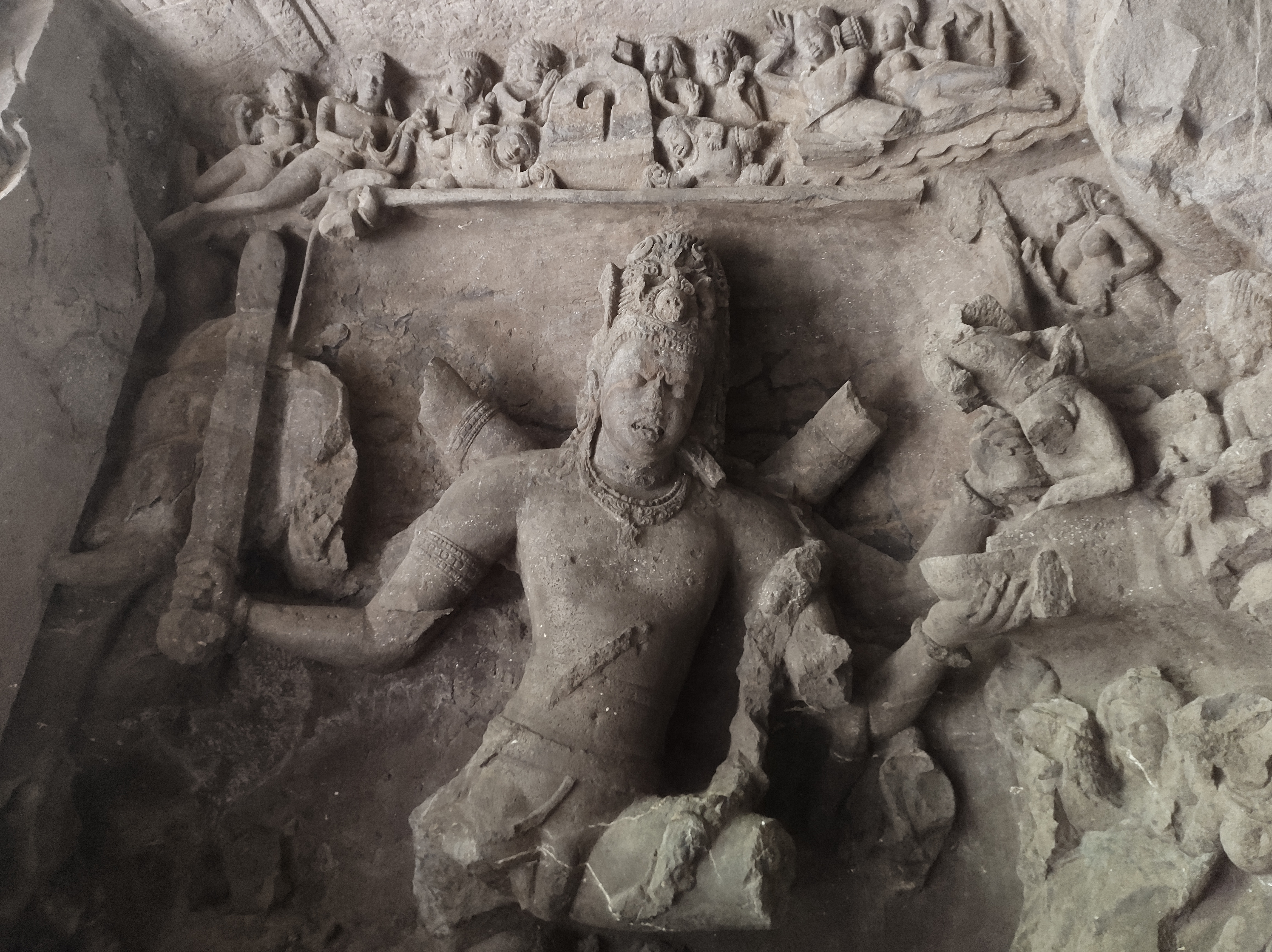
[[File: | [[File:Shiva Slaying Andhaka sculpture in Cave 1 of Elephanta Caves.jpg|thumb|left|Bhairava depicted in [[Elephanta Caves]], mid-5th century]] | ||
[[File: | [[File:Shivalinga LACMA M.91.10 (6 of 8).jpg|thumb|left|Mahakala Bhairava depicted on a chaturmukha (four-faced) ''[[lingam]]'', 10th century]] | ||
[[File:Ancient Indian stone sculpture Indian Museum Kolkata 20.jpg|thumb|Dancing Bhairava, [[Bengal]], 12th century]] | |||
The legend of the origin of Bhairava is traced back to a conversation between [[Brahma]] and [[Vishnu]] described in the [[Shiva Purana]].<ref>The Śiva Purana, ''Śatarudra Samhita'', chapter 8, ''The Śiva Purana'', part III (English translation), Motilal banarsidass Publishers Private Limited, Delhi, reprint edition (2002), pp. 1097–1103.</ref> | |||
Shiva manifested as a [[Jyotirlinga|pillar of light]] to settle the dispute of superiority between Brahma and Vishnu. Brahma dishonestly proclaimed his victory, stating that he had discovered the higher end of the pillar of light. To punish him for his dishonesty and arrogance, Shiva produced Bhairava from the region between his brows. When Bhairava sought instruction from Shiva, the deity directed him to "worship Brahma with his sharp-pointed quick-moving sword". Bhairava decapitated the fifth head of Brahma for uttering the falsehood. Vishnu interceded on Brahma's behalf and sought mercy, and the two deities then worshipped Shiva.<ref>{{Cite book |last=Shastri |first=J. L. |url=https://books.google.com/books?id=4kbmDwAAQBAJ&dq=Dear%2C+here+is+Brahm%C4%81%2C+the+first+deity+of+the+universe&pg=PA58 |title=The Siva Purana Part 1: Ancient Indian Tradition and Mythology Volume 1 |date=2000-01-01 |publisher=Motilal Banarsidass |isbn=978-81-208-3868-0 |pages=57–60 |language=en}}</ref> | |||
Having committed the sin of ''[[brahmahatya]]'' (the murder of a [[Brahmin]]) by decapitating Brahma, Bhairava was pursued by the terrible female personification of the sin. The skull of Brahma was still attached to his hand. To expiate himself of the sin, Bhairava roamed the [[Trailokya|three worlds]]. He visited [[Vaikuntha]], where he was honoured by Vishnu and [[Lakshmi]]. When Bhairava visited [[Varanasi|Kashi]], the city of the liberated, Brahmahatya left him, and the skull of Brahma was released from his hand.<ref>{{Cite book |last=Shastri |first=J. L. |url=https://books.google.com/books?id=bFbsDwAAQBAJ&dq=Under+this+pretext,+I+am+waiting+upon+the+bull-bannered+deity&pg=PA1103 |title=The Siva Purana Part 3: Ancient Indian Tradition and Mythology Volume 3 |date=2014-01-01 |publisher=Motilal Banarsidass |isbn=978-81-208-3870-3 |pages=1103–1109 |language=en}}</ref> | |||
In another legend, Brahma is regarded to have stated to Vishnu to worship him as the supreme creator of the universe. Noting that both Shiva and he had [[Panchamukha|five heads]], Brahma came to believe that he was identical to Shiva and was equal to his powers. When his arrogance started to affect his role in the universe, Shiva threw a lock of his hair from his head. This assumed the form of Bhairava, who decapitated one of Brahma's heads. When the skull ([[kapala]]) of Brahma was held in the hand of Bhairava, the creator deity's ego was destroyed and he became enlightened. In the form of Bhairava, Shiva is said to guard each of the [[Shakta pithas]] (A group of temples dedicated to the goddess Shakti). Each Shakta pitha is accompanied by a temple dedicated to Bhairava, except [[Kamakhya Temple]].<ref>{{cite Q|Q55879169|author= Johnson W. J.}}</ref><ref>Chalier-Visuvalingam, Elizabeth. "Bhairava's Royal Brahmanicide: The Problem of the Mahābrāhmaṇa", pp. 157–229 in [[#Hiltebeitel|Hiltebeitel]]</ref> | |||
=== Depiction === | === Depiction === | ||
[[File: | [[File:Karnataka, periodo hoyasala, bhairava, xii secolo 01.jpg|thumb|12th-century Bhairava sculpture, [[Karnataka]]]] | ||
[[File:KITLV A314 - Tjandi Singasari, KITLV 37877.tiff|thumb|Indonesian stone Bhairava, from the syncretic Hindu-Buddhist [[Singhasari temple]] in [[East Java]], Indonesia]] | |||
In [[Kashmir Shaivism]], Bhairava is the ultimate form of manifestation. | |||
===Trika System=== | ===Trika System=== | ||
[[Trika]] | [[Trika]] or [[Kashmiri Shaivism]] names the Absolute Reality ([[Para Brahman]]) as Bhairava. The [[Vijñāna Bhairava Tantra]] is a key Tantra text of the [[Trika]] System. Cast as a discourse between the god Bhairava and his consort [[Bhairavi]] it briefly presents 112 Tantric meditation methods or centering techniques ([[Dharana]]). The text is a chapter from the Rudrayamala Tantra, a Bhairava Agama. Bhairavi, the goddess, asks Bhairava to reveal the essence of the way to realization of the highest reality. In his answer Bhairava describes 112 ways to enter into the universal and transcendental state of consciousness. References to it appear throughout the literature of Trika, Kashmir Shaivism, indicating that it was considered to be an important text in the schools of Kashmir Shaiva philosophy and Trika.<ref name=s1>{{cite book | last=Singh | first=J. | title=Vijnanabhairava, Or Divine Consciousness: A Treasury of 112 Types of Yoga | publisher=Motilal Banarsidass | series=Tantra Series | year=2002 | isbn=978-81-208-0820-1 | url=https://books.google.com/books?id=2R2iSiMbuVwC&pg=PA1 | page=1}}</ref><ref name="Tantra Illuminated"/> | ||
===List of Bhairavas=== | ===List of Bhairavas=== | ||
[[File:Trikala Bhairava from Odisha, Eastern Ganga Dynasty, Clevelandart 1958.208.jpg|thumb|''"Trikala Bhairava"'', Eastern Ganga Dynasty, 10th century.]] | [[File:Trikala Bhairava from Odisha, Eastern Ganga Dynasty, Clevelandart 1958.208.jpg|thumb|''"Trikala Bhairava"'', Eastern Ganga Dynasty, 10th century.]] | ||
The list of | The list of manifestations of Lord Bhairava: | ||
{{Div col|colwidth=15em}} | {{Div col|colwidth=15em}} | ||
* | * Batuka Bhairava | ||
* | * Kāla Bhairava | ||
* Akshobhya Bhairava | * Akshobhya Bhairava | ||
* | * Asithanga Bhairava | ||
* | * Ruru Bhairava | ||
* | * Chanda Bhairava | ||
* | * Krodha Bhairava | ||
* Bagh Bhairava | * Bagh Bhairava | ||
* | * Unmatta Bhairava | ||
* | * Kapala Bhairava | ||
* | * Bheeshana Bhairava | ||
* | * Samhara Bhairava | ||
* | * Umananda Bhairava | ||
* Bhoothnath [[Vetal]] / [[Betal]] Bhairava | * Bhoothnath [[Vetal]] / [[Betal]] Bhairava | ||
* Chakrapani | * Chakrapani Bhairava | ||
* | * Sadyojata Mahakala Bhairava | ||
* | * Svacchanda Bhairava | ||
* | * Swarnakarshana Bhairava | ||
* | * Mahakala Bhairava | ||
* Panchamukhi Hanubhairava | |||
* | * Matang Bhairava | ||
* | * Kabandha Bhairava | ||
* | |||
* Maharudra | * Maharudra | ||
* | * Ekavaktra Bhairava | ||
* | * Tryambaka Bhairava | ||
* Panchavaktra Bhairava | |||
* Kameshwara Bhairava | |||
* Akasha Bhairava | |||
* Pashupati Bhairava | |||
* Sharabeshwara | |||
* Nilakantha Bhairava | |||
* Martanda Bhairava | |||
* Matang Bhairava | * Matang Bhairava | ||
* | * ParaBhairava or Parama Bhairava | ||
* | * Khechara Bhairava | ||
* | * Prekshatha Bhairava | ||
* Pachali Bhairava | * Pachali Bhairava | ||
* Patal Bhairava | * Patal Bhairava | ||
* | * Vajra Hasta Bhairava | ||
* | * Pracandha Bhairava | ||
* | * Bayankara Bhairava | ||
* | * Kalagni Bhairava | ||
* | * Narayan Bhairava | ||
* | * Vishalaksha Bhairava | ||
* | * Chirithan Bhairava | ||
* | * Sarvananda Bhairava | ||
* | * Karala Bhairava | ||
* Shai Bhairava | * Shai Bhairava | ||
* | * Nirbaya Bhairava | ||
* | * Kshetrapala Bhairava | ||
* | * Swayambhunath Bhairava | ||
* | * Bhaktapur Bhairava | ||
* | * Swet Bhairava | ||
* | * Siddha Bhairava | ||
* | * Hayagriva Bhairava | ||
* | * Bishitha Bhairava | ||
* | * Pralaya Bhairava | ||
* | * Raktanga Bhairava | ||
* | * Apra Rupa Bhairava | ||
* | * Mantra Nayaka Bhairava | ||
* | * Rudra Bhairava | ||
* | * Trinetra Bhairava | ||
* | * Tripurantaka Bhairava | ||
* | * Varada Bhairava | ||
* Ishana Bhairava | |||
* Vikranta Bhairava | |||
* Runda Maala Bhairava | |||
* Vimocanā | * Vimocanā | ||
* Viśveśvara | * Viśveśvara | ||
* Veerbhadra | |||
{{Div col end}} | {{Div col end}} | ||
| Line 140: | Line 132: | ||
[[File:Thangka Depicting Vajrabhairava, ca. 1740, Sotheby's.jpg|thumb|Thangka Depicting Vajrabhairava, c. 1740s.]] | [[File:Thangka Depicting Vajrabhairava, ca. 1740, Sotheby's.jpg|thumb|Thangka Depicting Vajrabhairava, c. 1740s.]] | ||
Buddhism also adopted Bhairava (Tibetan: 'Jigs byed; Chinese: Buwei) as a deity and a [[dharmapala]] or dharma protector.<ref>{{cite book | last1=Buswell | first1=Robert E. | Buddhism also adopted Bhairava (Tibetan: 'Jigs byed; Chinese: Buwei) as a deity and a [[dharmapala]] or dharma protector.<ref>{{cite book | last1=Buswell | first1=Robert E. Jr. | last2=Lopez | first2=Donald S. Jr. | title=The Princeton dictionary of Buddhism | publication-place=Princeton, NJ | date=2013 | isbn=978-1-4008-4805-8 | oclc=859536678 | chapter = Bhairava}}</ref> The various buddhist forms of Bhairava (variously called [[Heruka]]s, Vajrabhairava, [[Mahākāla]] and [[Yamantaka]]) are considered [[fierce deities]] and [[yidam]]s (tantric meditational deity) in [[Tibetan Buddhism]]. They also have their own set of [[Buddhist tantra]]s, the ''Vajrabhairava tantras.''<ref>Siklós, Bulcsu (1996) ''The Vajrabhairava tantras: Tibetan and Mongolian versions'', English translation and annotations, Institute of Buddhist Studies.</ref> According to Tibetan tradition, these tantras were revealed to Lalitavajra in [[Oddiyana]] in the tenth century.<ref>Kapstein, Matthew (2009) ''Buddhism Between Tibet and China''. Wisdom Publicationsv. p. 307. {{ISBN|0861715810}}</ref> | ||
These texts play a particularly important role in the [[Sarma (Tibetan Buddhism)|Sarma]] (new translation) traditions of Tibetan Buddhism, especially among the [[Gelug]] school where Vajrabhairava is one of the three central highest yoga tantra practices of the lineage.<ref name=":0">{{cite book|author=Skorupski, Tadeusz|url=https://www.academia.edu/15726724 |title=The Buddhist Forum|date=15 September 2015 |volume =4|pages=186–187}}</ref> | |||
Bhairava - Mahakala is also popular in [[Mongolia]] as a protector deity and was also popular among the [[Manchu people|Manchus]].<ref name=":0" /> | |||
The deity is also central to [[Newar Buddhism]]. The tantric practices associated with Bhairava focus on the transformation of anger and hatred into understanding.<ref>Huntington, John C. and Bangdel, Dina (2003) ''The Circle of Bliss: Buddhist Meditational Art''. Serindia Pubns. p. 468. {{ISBN|1932476016}}</ref> | |||
==Worship== | ==Worship== | ||
{{See also|Bhairava Ashtami}} | {{See also|Bhairava Ashtami}} | ||
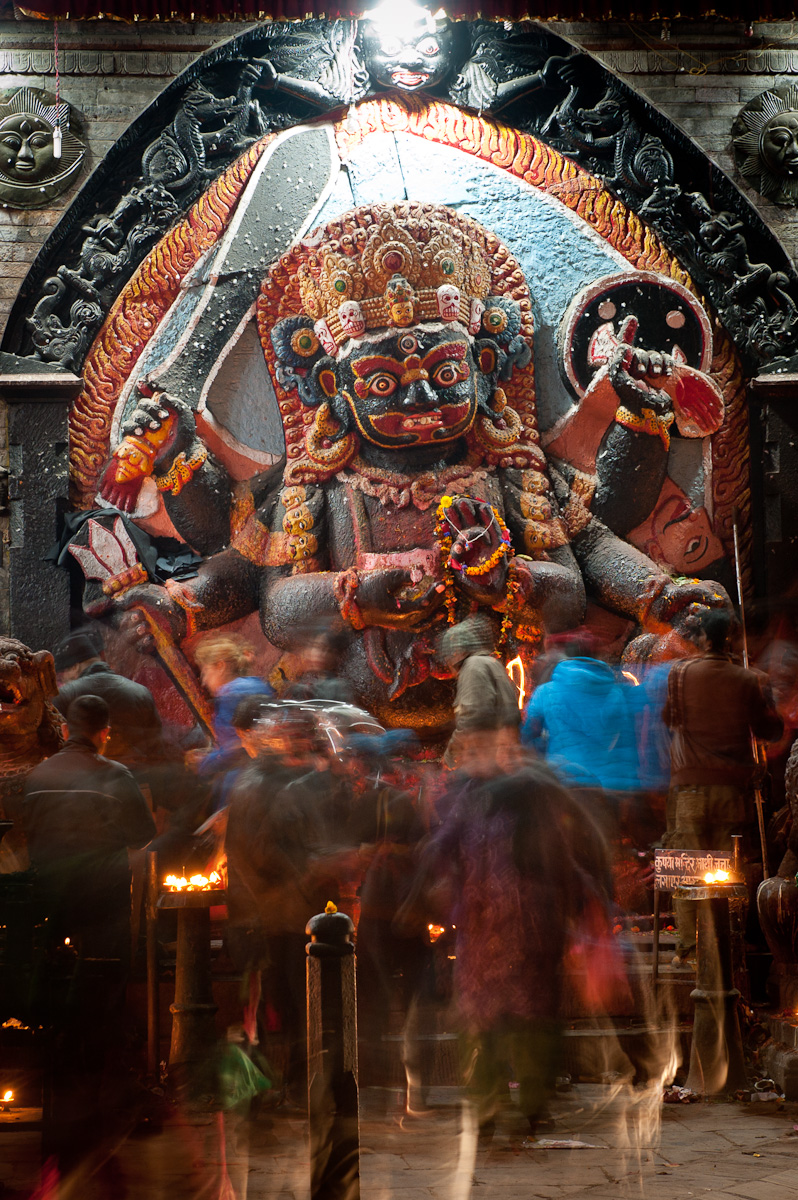
[[File:Kala Bhairava in the night.JPG | [[File:Kala Bhairava in the night.JPG|thumb|[[Kaal Bhairav, Kathmandu|Kala Bhairava]] attended by devotees in Durbar Square, [[Kathmandu|Kathmandu, Nepal]]|354x354px]] | ||
Temples or [[shrine]]s to Bhairava are present within or near most [[Jyotirlinga]] temples. There are also the sacred twelve shrines dedicated to [[Shiva]] which can be found all across India including the [[Kashi Vishwanath Temple]], [[Varanasi]] and the [[Kal Bhairav temple, Ujjain|Kal Bhairava temple, Ujjain]]. The Patal Bhairava and Vikrant Bhairava shrines are located in [[Ujjain]] as well.<ref>{{cite book |title=Hindu Pilgrimage: A Journey Through the Holy Places of Hindus All Over India|author= Bansal, Sunita Pant |publisher=Pustak Mahal|year= 2008|isbn=978-81-223-0997-3 |url=https://books.google.com/books?id=lzPCOVQGP3wC&pg=PT94 }}</ref><ref>{{cite book |title=Banaras: City of Light|author=Diana L. Eck |author-link=Diana L. Eck|publisher=Taylor & Francis|year=1982|isbn=0-7102-0236-9 |pages=192–3 |url=https://books.google.com/books?id=cM09AAAAIAAJ&pg=PA193 }}</ref> | |||
Gorat Kashmiris are known to worship Bhairava during [[Maha Shivaratri|Shivratri]].<ref>{{cite book |title=The Castes and Tribes of H.E.H. the Nizam's Dominions, Vol. 1|author=Ul Hassan, Syed Siraj |publisher=Asian Educational Services|year=1920|isbn= | Gorat Kashmiris are known to worship Bhairava during [[Maha Shivaratri|Shivratri]].<ref>{{cite book |title=The Castes and Tribes of H.E.H. the Nizam's Dominions, Vol. 1|author=Ul Hassan, Syed Siraj |publisher=Asian Educational Services|year=1920|isbn=81-206-0488-1 |page=482 |url=https://books.google.com/books?id=lYSd-3yL9h0C&pg=PA482 }}</ref> The renowned Hindu reformer, [[Adi Sankara]] composed a hymn on ''Kala Bhairava'' called ''"Sri Kalabhairava Ashtakam"'' in the city of [[Varanasi|Kashi]].<ref>{{cite web|url=http://hindubhakti.blogspot.com/2011/08/kala-bhairava-ashtakam.html|title=Hindu Bhakti|work=hindubhakti.blogspot.com|date=27 August 2011|access-date=14 April 2015}}</ref> | ||
==Observances== | ==Observances== | ||
| Line 158: | Line 154: | ||
}} | }} | ||
''[[Bhairava Ashtami]]'', commemorating the day ''Kala Bhairava'' appeared on earth, is celebrated on [[Krishna paksha]] [[Ashtami]] of the [[Margashirsh]]a month of the [[Hindu calendar]]. It is a day filled with special prayers and rituals.<ref>{{cite book |title=Religious Basis Of Hindu Beliefs|author =Dwivedi, Bhojraj |publisher=Diamond Pocket Books |year= 2006|isbn= | ''[[Bhairava Ashtami]]'', commemorating the day ''Kala Bhairava'' appeared on earth, is celebrated on [[Krishna paksha]] [[Ashtami]] of the [[Margashirsh]]a month of the [[Hindu calendar]]. It is a day filled with special prayers and rituals.<ref>{{cite book |title=Religious Basis Of Hindu Beliefs|author =Dwivedi, Bhojraj |publisher=Diamond Pocket Books |year= 2006|isbn=81-288-1239-4 |page=172 |url=https://books.google.com/books?id=7wmqKuHFWWgC&q=Kal+Bhairav&pg=PA172}}</ref> | ||
Kalashtami, also known as Kaal Ashtami, is a significant Hindu observance dedicated to Lord Kaal Bhairav one of the forms of bhairava. This festival is celebrated every month on the Ashtami Tithi (eighth day) of Krishna Paksha, the waning phase of the moon. The day is marked by fasting, special prayers, and rituals aimed at seeking blessings from Lord Bhairav for protection and spiritual growth.{{Citation needed|date=April 2025}} | |||
== Significance of Kalashtami == | |||
* '''Devotion to Lord Kaal Bhairav''': Kalashtami is primarily focused on worshipping Lord Kaal Bhairav, who is revered for his role as a protector against negativity and evil forces. Devotees believe that his blessings can help alleviate the effects of black magic and other malevolent influences.<ref>{{Cite web |title=Kalashtami 2025: Masik Kalashtami dates, timings, and rituals guide |url=https://www.moneycontrol.com/religion/kalashtami-2025-masik-kalashtami-dates-timings-and-rituals-guide-article-12895350.html }}</ref> | |||
* '''Spiritual Growth''': Observing this day is thought to foster spiritual development, enabling devotees to connect more deeply with their spiritual selves and overcome fears related to death. It is also believed that worshipping Kaal Bhairav can lead to material and spiritual prosperity.<ref>{{Cite web |title=Kalashtami 2024: Date, time, rituals, significance and benefits of observing this fast in September |date=23 September 2024 |url=https://www.hindustantimes.com/lifestyle/festivals/kalashtami-2024-date-time-rituals-significance-and-benefits-of-observing-this-fast-in-september-101727087545838.html }}</ref> | |||
* '''Kaal Bhairav Jayanti''': Among the various Kalashtami observances, the most significant is Kaal Bhairav Jayanti (or Bhairava Ashtami), celebrated in North India during the month of Margashirsha (December-January) and in South India during Kartik. This day commemorates the manifestation of Lord Shiva as Kaal Bhairav.<ref>{{Cite web |title=Kaal Bhairav Jayanti {{!}} Kalashtami Festival Celebration in 2025 |url=https://www.rudraksha-ratna.com/articles/kalashtami }}</ref> | |||
== Rituals and practices == | |||
{{More citations needed section|date=April 2025}} | |||
The rituals for Kalashtami typically include: | |||
# '''Early Morning Rituals''': Devotees wake up early, take a holy bath, and clean their homes and puja areas. | |||
# '''Lighting a Diya''': A diya (lamp) made with mustard oil is lit in front of Lord Kaal Bhairav's idol or picture, symbolizing the connection with divine energy. | |||
# '''Offering Prasad''': Special offerings, including Meetha Rott (sweet bread), halwa, milk, and sometimes liquor, are made to Lord Bhairav during the puja. | |||
# '''Recitation of Mantras''': Chanting specific mantras like the Kaal Bhairav Ashtakam is recommended to invoke blessings and remove obstacles from life. | |||
# '''Visiting Temples''': Many devotees visit temples dedicated to Kaal Bhairav to perform rituals and offer prayers collectively.<ref>{{Cite web |title=Kalashtami February 2025: Date, Timings, Rituals and Significance |website=[[The Times of India]] |date=20 February 2025 |url=https://timesofindia.indiatimes.com/religion/rituals-puja/kalashtami-february-2025-date-time-puja-rituals-and-significance/articleshow/118355530.cms }}</ref> | |||
Kalashtami serves as a vital occasion for devotees to reaffirm their faith in Lord Kaal Bhairav while engaging in practices that promote spiritual well-being and protection against negative energies. | |||
==Iconography== | ==Iconography== | ||
Bhairava is depicted as being ornamented with a range of twisted serpents, which serve as earrings, bracelets, anklets, and sacred thread ([[yajnopavita]]). He wears a tiger skin and a ritual apron composed of human bones.<ref name="ASIA-SI">[http://www.asia.si.edu/collections/singleObject.cfm?ObjectId=27267 Bhairava statuette] {{Webarchive|url=https://web.archive.org/web/20110130031628/http://www.asia.si.edu/collections/singleObject.cfm?ObjectId=27267 |date=30 January 2011 }} in copper from 15th–16th century Nepal, in collection of [[Smithsonian Institution]]. Accessed August 11, 2007.</ref> Bhairava has a [[Dogs in religion|dog]] ([[ | [[File:Rakta Bhairava.jpg|thumb|Rakta Bhairava]] | ||
Bhairava is depicted as being ornamented with a range of twisted serpents, which serve as earrings, bracelets, anklets, and sacred thread (''[[yajnopavita]]''). He wears a tiger skin and a ritual apron composed of human bones.<ref name="ASIA-SI">[http://www.asia.si.edu/collections/singleObject.cfm?ObjectId=27267 Bhairava statuette] {{Webarchive|url=https://web.archive.org/web/20110130031628/http://www.asia.si.edu/collections/singleObject.cfm?ObjectId=27267 |date=30 January 2011 }} in copper from 15th–16th century Nepal, in collection of [[Smithsonian Institution]]. Accessed August 11, 2007.</ref> Bhairava has a [[Dogs in religion|dog]] (''[[shvana]]'') as his divine ''[[vahana]]'' (vehicle). [[Bhairavi]] is a fierce and terrifying aspect of the [[Devi]] who is virtually indistinguishable from [[Kali]], with the exception of her particular identification as the consort of Bhairava.<ref>Christ, Carol P. (1989). "Symbols of Goddess and God in Feminist Theology", in Carl Olson (Ed.) ''The Book of the Goddess: Past and Present''. New York: Crossroads. {{ISBN|1577662733}}</ref><ref>{{cite journal | last=Dalmiya | first=Vrinda | title=Loving Paradoxes: A Feminist Reclamation of the Goddess Kali | journal=Hypatia |jstor=3810514 | volume=15 | issue=1 | year=2000 | doi=10.1111/j.1527-2001.2000.tb01082.x | pages=125–150| s2cid=143596725 }}</ref> | |||
Bhairava himself has eight manifestations | Bhairava himself has eight manifestations called the [[Ashta Bhairavar|Ashta Bhairava]]:<ref>{{Cite book |url=http://archive.org/details/vdocuments.mx_the-kubjika-upanishad-egbert-forsten-56885839dd6b9 |title=vdocuments.mx_the-kubjika-upanishad-egbert-forsten-56885839dd6b9 |pages=7}}</ref> | ||
* | * Asitāṅga Bhairava | ||
* Ruru Bhairava | * Ruru Bhairava | ||
* | * Chaṇḍa Bhairava | ||
* Krodha Bhairava | * Krodha Bhairava | ||
* | * Unmatta Bhairava | ||
* | *Kapala Bhairava | ||
* | * Bhīṣaṇa Bhairava | ||
* | * Saṃhāra Bhairava | ||
Kala Bhairava is conceptualized as the ''guru-natha'' (teacher and lord) of the planetary deity [[Shani]] (Saturn).<ref>[https://web.archive.org/web/20170907165306/http://m.dinamalar.com/temple_detail.php?id=2699 பைரவரைப் போற்றும் தேவாரப் பதிகம்]</ref><ref>[https://temple.dinamalar.com/Slogandetails.php?id=2062 பைரவர்]</ref> | |||
Bhairava is known as Bhairavar or Vairavar in [[Tamil language|Tamil]], where he is often presented as a [[Grama devata]] or village guardian who safeguards the devotee in eight directions (''ettu tikku''). Known in [[Sinhala language|Sinhalese]] as Bahirawa, he is said to protect treasures. | Bhairava is known as Bhairavar or Vairavar in [[Tamil language|Tamil]], where he is often presented as a [[Grama devata|''grama'' ''devata'']] or village guardian who safeguards the devotee in eight directions (''ettu tikku''). Known in [[Sinhala language|Sinhalese]] as Bahirawa, he is said to protect treasures. He is the main deity worshipped by the [[Aghori|Aghora sect]].<ref>Harper, Katherine Anne, and Brown, Robert L. (Eds) (2002). ''The Roots of Tantra''. Albany: State University of New York Press.</ref> | ||
<gallery widths=" | <gallery widths="200" heights="200"> | ||
File:Swetabhairabadhkl.jpg|Dancer dressed as Shveta Bhairava from [[Bhaktapur]], [[Nepal]]. | |||
File:Swetabhairabadhkl.jpg|Dancer dressed as | |||
</gallery> | </gallery> | ||
==Temples== | ==Temples== | ||
{{main|List of Bhairava temples}} | {{main|List of Bhairava temples}} | ||
[[File: | '''Thennaga Kasi Bairavar Temple''' is a Hindu temple dedicated to Lord Bairavar, a fierce form of Lord Shiva. It is located in Erode, Tamil Nadu, India. This temple is renowned for its unique architectural style and spiritual significance. | ||
[[File:इन्द्र.jpg|thumb|297x297px|A woman worshipping [[Swet Bhairav|Sweta Bhairava]] in [[Kathmandu]], Nepal]] | |||
Bhairava is an important deity of the [[Newar]]s. All the traditional settlements of Newars have at least one temple of Bhairava. Most of the temples of Bhairava in [[Nepal]] are maintained by Newar priests. There are several Bhairava temples in the [[Kathmandu]] valley.<ref>{{cite book|title=Encyclopedia of Hinduism|chapter=Hindus in Nepal|page= 554|editor1=Cush, Denise |editor2=Robinson, Catherine |editor3=York, Michael |year=2012|publisher= Routledge|isbn= | Bhairava is an important deity of the [[Newar]]s of Nepal. All the traditional settlements of Newars have at least one temple of Bhairava. Most of the temples of Bhairava in [[Nepal]] are maintained by Tantric Newar priests. There are several Bhairava temples in the [[Kathmandu]] valley and other old newar settlements out of valley like Panauti,Banepa, Dhulikhel,Palpa and Pokhara.There are Different Jatras and chariot processions held each year in different newar towns and cities Dedicated to lord Bhairava and these Bhairava jatras are celebrated and continued from several hundreds of years in Nepal.Kalbhairava,Aakash bhairava, Shwet bhairava, Batuk bhairava, Pachali bhairava, aananda bhairava,Unmatta bhairava,mashaan bhairava,Baag bhairava, haygribha bhairava and Kritimukha Bhairava are Bhairavas widely worshipped and believed as the guardians of the Newar settlements.<ref>{{cite book|title=Encyclopedia of Hinduism|chapter=Hindus in Nepal|page= 554|editor1=Cush, Denise |editor2=Robinson, Catherine |editor3=York, Michael |year=2012|publisher= Routledge|isbn=978-1-135-18979-2}}</ref> | ||
In south [[Karnataka]], Lord ''Sri Kalabhairaveshwara'' is present as ''Kshetra Palaka'' in [[Adichunchanagiri Hills|Sri Adichunchanagiri Hills]].<ref>{{cite web|url=http://shaligramrudraksha.com/?page_id=2024|title=Bhairav Temple – Lord Bhairo Baba|work=shaligramrudraksha.com|access-date=14 April 2015|archive-url=https://web.archive.org/web/20150315002356/http://shaligramrudraksha.com/?page_id=2024|archive-date=15 March 2015 | In south [[Karnataka]], Lord ''Sri Kalabhairaveshwara'' is present as ''Kshetra Palaka'' in [[Adichunchanagiri Hills|Sri Adichunchanagiri Hills]].<ref>{{cite web|url=http://shaligramrudraksha.com/?page_id=2024|title=Bhairav Temple – Lord Bhairo Baba|work=shaligramrudraksha.com|access-date=14 April 2015|archive-url=https://web.archive.org/web/20150315002356/http://shaligramrudraksha.com/?page_id=2024|archive-date=15 March 2015}}</ref> | ||
''Kala Bhairava'' temples can also be found around [[ | ''Kala Bhairava'' temples can also be found around ''[[Shakta pithas]]''. It is said that Shiva allocated the job of guarding each of the 52 ''Shakta pithas'' to one Bhairava. There are said to be 52 forms of Bhairava, which are considered a manifestation of Shiva himself. Traditionally, ''Kala Bhairava'' is the ''[[Grama devata]]'' in the rural villages of [[Maharashtra]], where he is referred to as "Bhairava/Bhairavnath" and "Bairavar". In Karnataka, Lord Bhairava is the supreme God for the Hindu community commonly referred to as [[Vokkaliga]]s ([[Gowda (caste)|Gowdas]]). Especially in the Jogi Vokkaliga, he is considered the caretaker and punisher.<ref>{{cite book | title=Bhairava in Banaras: Negotiating Sacred Space and Religious Identity |author1=Chalier-Visuvalingam, Elizabeth |author2=Sunthar Visuvalingam |name-list-style=amp | year=2006 | place=Wiesbaden, Germany|publisher= Harrassowitz}}</ref> [[Shri Kala Bhairava Nath Swami Temple]] of [[Madhya Pradesh]] is also popular. | ||
==See also== | ==See also== | ||
* | * {{Annotated link|Adichunchanagiri Hills}} | ||
* | * {{Annotated link|Akash Bhairav}} | ||
* | * {{Annotated link|Bhairab Naach}} | ||
* | * {{Annotated link|Kshetrapala}} | ||
* | * {{Annotated link|Muthappan}} | ||
* | * {{Annotated link|Sirkazhi}} | ||
==References== | ==References== | ||
{{reflist}} | <ref>{{cite book |last=Parry |first=Jonathan |title=Death and the Regeneration of Life |date=1982 |publisher=Cambridge University Press |isbn=978-0-521-24875-4 |pages=74–110 |chapter=Sacrificial death and the necrophagous ascetic |doi=10.1017/cbo9780511607646.004}}</ref><ref>{{cite journal |last=Parry |first=J.P. |year=1981 |title=Death and cosmogony in Kashi |journal=Contributions to Indian Sociology |volume=15 |issue=1–2 |pages=337–365 |doi=10.1177/006996678101500118 |s2cid=143517233}}</ref><ref>Erndl, Kathleen M. "Rapist or Bodyguard, Demon or Devotee: Images of Bhairo in the Mythology and Cult of Vaiṣṇo Devī", pp. 239–25 in [[Bhairava#Hiltebeitel|Hiltebeitel]]</ref><ref>Sukul, Kubernath (1977). ''Vārānasī Vaibhava. Patna, India: Bihar Rastrabhasa Parisad''</ref><ref>Lorenzen, David (1972). ''The Kāpālikas and Kālāmukhas: Two Lost Śaiva Sects''. Delhi: Thomson</ref><ref>Eck, Diana L. (1983) ''Banaras: City of Light''. London: Routledge and Kegan Paul.</ref>{{reflist}} | ||
==Cited sources== | ==Cited sources== | ||
*{{cite book|ref=Hiltebeitel|editor=Hiltebeitel, Alf|year=1989|title=Criminal Gods and Demon Devotees: Essays on the Guardians of Popular Hinduism|place=Albany|publisher=State University of New York Press|isbn= | *{{cite book|ref=Hiltebeitel|editor=Hiltebeitel, Alf|year=1989|title=Criminal Gods and Demon Devotees: Essays on the Guardians of Popular Hinduism|place=Albany|publisher=State University of New York Press|isbn=0-88706-982-7}} | ||
==External links== | ==External links== | ||
| Line 216: | Line 232: | ||
[[Category:Dogs in Hinduism]] | [[Category:Dogs in Hinduism]] | ||
[[Category:Forms of Shiva]] | [[Category:Forms of Shiva]] | ||
[[Category: | [[Category:Jain minor deities]] | ||
[[Category:Hindu tantric deities]] | [[Category:Hindu tantric deities]] | ||
[[Category:Mythological dogs]] | [[Category:Mythological dogs]] | ||
[[Category:Newar]] | [[Category:Newar]] | ||
[[Category:Night gods]] | [[Category:Night gods]] | ||
[[Category:Deities of wine and beer]] | |||
Latest revision as of 20:44, 27 March 2026
| Bhairava | |
|---|---|
.jpg) South Indian depiction of Bhairava riding on his vahana (dog), 12th century | |
| Affiliation | Shiva |
| Mantra | Oṁ Bhairavāya Namaḥ |
| Weapon | Trishula, Khaṭvāṅga, Sword, Kapala, Sickle, Vajra, Noose, Pinaka bow, Pashupatastra arrow, Pestle and Damaru |
| Day | Monday, Tuesday, or Sunday |
| Number | 33 |
| Mount | Dog |
| Festivals | Bhairava Ashtami |
| Consort | Bhairavi, Kali |

| Part of a series on |
| Shaivism |
|---|
 |
 Hinduism portal Hinduism portal |

Bhairava (Script error: The function "langx" does not exist., lit. 'frightful'), or Kāla Bhairava, is a Shaivite and Vajrayāna deity worshipped by Hindus and Buddhists. In Shaivism, he is a powerful manifestation, or avatar, of Shiva.[1][2][3] In the tradition of Kashmir Shaivism, Bhairava represents the Supreme Reality, synonymous to Para Brahman.[4][5] Generally in Hinduism, Bhairava is also called Daṇḍapāni ("[he who holds the] danda in [his] hand"), as he holds a rod or danda to punish sinners, and Śvāśva, meaning, "he whose vehicle is a dog".[6] In Vajrayana Buddhism, he is considered a fierce emanation of boddhisatva Mañjuśrī, and also called Heruka, Vajrabhairava, Mahākāla and Yamantaka.[7][8]
Bhairava is worshipped throughout India, Nepal, Indonesia, Sri Lanka, and Japan, as well as in Tibetan Buddhism.[9][10]
Etymology[edit | edit source]
Bhairava originates from the word bhīru, which means "fearsome". Bhairava means "terribly fearsome form". It is also known as one who destroys fear or one who is beyond fear.[11][full citation needed]
Hinduism[edit | edit source]
Legend[edit | edit source]

.jpg)

The legend of the origin of Bhairava is traced back to a conversation between Brahma and Vishnu described in the Shiva Purana.[12]
Shiva manifested as a pillar of light to settle the dispute of superiority between Brahma and Vishnu. Brahma dishonestly proclaimed his victory, stating that he had discovered the higher end of the pillar of light. To punish him for his dishonesty and arrogance, Shiva produced Bhairava from the region between his brows. When Bhairava sought instruction from Shiva, the deity directed him to "worship Brahma with his sharp-pointed quick-moving sword". Bhairava decapitated the fifth head of Brahma for uttering the falsehood. Vishnu interceded on Brahma's behalf and sought mercy, and the two deities then worshipped Shiva.[13]
Having committed the sin of brahmahatya (the murder of a Brahmin) by decapitating Brahma, Bhairava was pursued by the terrible female personification of the sin. The skull of Brahma was still attached to his hand. To expiate himself of the sin, Bhairava roamed the three worlds. He visited Vaikuntha, where he was honoured by Vishnu and Lakshmi. When Bhairava visited Kashi, the city of the liberated, Brahmahatya left him, and the skull of Brahma was released from his hand.[14]
In another legend, Brahma is regarded to have stated to Vishnu to worship him as the supreme creator of the universe. Noting that both Shiva and he had five heads, Brahma came to believe that he was identical to Shiva and was equal to his powers. When his arrogance started to affect his role in the universe, Shiva threw a lock of his hair from his head. This assumed the form of Bhairava, who decapitated one of Brahma's heads. When the skull (kapala) of Brahma was held in the hand of Bhairava, the creator deity's ego was destroyed and he became enlightened. In the form of Bhairava, Shiva is said to guard each of the Shakta pithas (A group of temples dedicated to the goddess Shakti). Each Shakta pitha is accompanied by a temple dedicated to Bhairava, except Kamakhya Temple.[15][16]
Depiction[edit | edit source]

File:KITLV A314 - Tjandi Singasari, KITLV 37877.tiff
In Kashmir Shaivism, Bhairava is the ultimate form of manifestation.
Trika System[edit | edit source]
Trika or Kashmiri Shaivism names the Absolute Reality (Para Brahman) as Bhairava. The Vijñāna Bhairava Tantra is a key Tantra text of the Trika System. Cast as a discourse between the god Bhairava and his consort Bhairavi it briefly presents 112 Tantric meditation methods or centering techniques (Dharana). The text is a chapter from the Rudrayamala Tantra, a Bhairava Agama. Bhairavi, the goddess, asks Bhairava to reveal the essence of the way to realization of the highest reality. In his answer Bhairava describes 112 ways to enter into the universal and transcendental state of consciousness. References to it appear throughout the literature of Trika, Kashmir Shaivism, indicating that it was considered to be an important text in the schools of Kashmir Shaiva philosophy and Trika.[4][5]
List of Bhairavas[edit | edit source]

The list of manifestations of Lord Bhairava:
- Batuka Bhairava
- Kāla Bhairava
- Akshobhya Bhairava
- Asithanga Bhairava
- Ruru Bhairava
- Chanda Bhairava
- Krodha Bhairava
- Bagh Bhairava
- Unmatta Bhairava
- Kapala Bhairava
- Bheeshana Bhairava
- Samhara Bhairava
- Umananda Bhairava
- Bhoothnath Vetal / Betal Bhairava
- Chakrapani Bhairava
- Sadyojata Mahakala Bhairava
- Svacchanda Bhairava
- Swarnakarshana Bhairava
- Mahakala Bhairava
- Panchamukhi Hanubhairava
- Matang Bhairava
- Kabandha Bhairava
- Maharudra
- Ekavaktra Bhairava
- Tryambaka Bhairava
- Panchavaktra Bhairava
- Kameshwara Bhairava
- Akasha Bhairava
- Pashupati Bhairava
- Sharabeshwara
- Nilakantha Bhairava
- Martanda Bhairava
- Matang Bhairava
- ParaBhairava or Parama Bhairava
- Khechara Bhairava
- Prekshatha Bhairava
- Pachali Bhairava
- Patal Bhairava
- Vajra Hasta Bhairava
- Pracandha Bhairava
- Bayankara Bhairava
- Kalagni Bhairava
- Narayan Bhairava
- Vishalaksha Bhairava
- Chirithan Bhairava
- Sarvananda Bhairava
- Karala Bhairava
- Shai Bhairava
- Nirbaya Bhairava
- Kshetrapala Bhairava
- Swayambhunath Bhairava
- Bhaktapur Bhairava
- Swet Bhairava
- Siddha Bhairava
- Hayagriva Bhairava
- Bishitha Bhairava
- Pralaya Bhairava
- Raktanga Bhairava
- Apra Rupa Bhairava
- Mantra Nayaka Bhairava
- Rudra Bhairava
- Trinetra Bhairava
- Tripurantaka Bhairava
- Varada Bhairava
- Ishana Bhairava
- Vikranta Bhairava
- Runda Maala Bhairava
- Vimocanā
- Viśveśvara
- Veerbhadra
Buddhism[edit | edit source]

Buddhism also adopted Bhairava (Tibetan: 'Jigs byed; Chinese: Buwei) as a deity and a dharmapala or dharma protector.[17] The various buddhist forms of Bhairava (variously called Herukas, Vajrabhairava, Mahākāla and Yamantaka) are considered fierce deities and yidams (tantric meditational deity) in Tibetan Buddhism. They also have their own set of Buddhist tantras, the Vajrabhairava tantras.[18] According to Tibetan tradition, these tantras were revealed to Lalitavajra in Oddiyana in the tenth century.[19]
These texts play a particularly important role in the Sarma (new translation) traditions of Tibetan Buddhism, especially among the Gelug school where Vajrabhairava is one of the three central highest yoga tantra practices of the lineage.[20]
Bhairava - Mahakala is also popular in Mongolia as a protector deity and was also popular among the Manchus.[20]
The deity is also central to Newar Buddhism. The tantric practices associated with Bhairava focus on the transformation of anger and hatred into understanding.[21]
Worship[edit | edit source]

Temples or shrines to Bhairava are present within or near most Jyotirlinga temples. There are also the sacred twelve shrines dedicated to Shiva which can be found all across India including the Kashi Vishwanath Temple, Varanasi and the Kal Bhairava temple, Ujjain. The Patal Bhairava and Vikrant Bhairava shrines are located in Ujjain as well.[22][23]
Gorat Kashmiris are known to worship Bhairava during Shivratri.[24] The renowned Hindu reformer, Adi Sankara composed a hymn on Kala Bhairava called "Sri Kalabhairava Ashtakam" in the city of Kashi.[25]
Observances[edit | edit source]
 | This section has multiple issues. Please help improve it or discuss these issues on the talk page. (Learn how and when to remove these template messages)
Template:One source section
|
![[icon]](/wiki/File:Wiki_letter_w_cropped.svg)
Bhairava Ashtami, commemorating the day Kala Bhairava appeared on earth, is celebrated on Krishna paksha Ashtami of the Margashirsha month of the Hindu calendar. It is a day filled with special prayers and rituals.[26]
Kalashtami, also known as Kaal Ashtami, is a significant Hindu observance dedicated to Lord Kaal Bhairav one of the forms of bhairava. This festival is celebrated every month on the Ashtami Tithi (eighth day) of Krishna Paksha, the waning phase of the moon. The day is marked by fasting, special prayers, and rituals aimed at seeking blessings from Lord Bhairav for protection and spiritual growth.[citation needed]
Significance of Kalashtami[edit | edit source]
- Devotion to Lord Kaal Bhairav: Kalashtami is primarily focused on worshipping Lord Kaal Bhairav, who is revered for his role as a protector against negativity and evil forces. Devotees believe that his blessings can help alleviate the effects of black magic and other malevolent influences.[27]
- Spiritual Growth: Observing this day is thought to foster spiritual development, enabling devotees to connect more deeply with their spiritual selves and overcome fears related to death. It is also believed that worshipping Kaal Bhairav can lead to material and spiritual prosperity.[28]
- Kaal Bhairav Jayanti: Among the various Kalashtami observances, the most significant is Kaal Bhairav Jayanti (or Bhairava Ashtami), celebrated in North India during the month of Margashirsha (December-January) and in South India during Kartik. This day commemorates the manifestation of Lord Shiva as Kaal Bhairav.[29]
Rituals and practices[edit | edit source]
 | This section needs additional citations for verification. (April 2025) |
The rituals for Kalashtami typically include:
- Early Morning Rituals: Devotees wake up early, take a holy bath, and clean their homes and puja areas.
- Lighting a Diya: A diya (lamp) made with mustard oil is lit in front of Lord Kaal Bhairav's idol or picture, symbolizing the connection with divine energy.
- Offering Prasad: Special offerings, including Meetha Rott (sweet bread), halwa, milk, and sometimes liquor, are made to Lord Bhairav during the puja.
- Recitation of Mantras: Chanting specific mantras like the Kaal Bhairav Ashtakam is recommended to invoke blessings and remove obstacles from life.
- Visiting Temples: Many devotees visit temples dedicated to Kaal Bhairav to perform rituals and offer prayers collectively.[30]
Kalashtami serves as a vital occasion for devotees to reaffirm their faith in Lord Kaal Bhairav while engaging in practices that promote spiritual well-being and protection against negative energies.
Iconography[edit | edit source]

Bhairava is depicted as being ornamented with a range of twisted serpents, which serve as earrings, bracelets, anklets, and sacred thread (yajnopavita). He wears a tiger skin and a ritual apron composed of human bones.[31] Bhairava has a dog (shvana) as his divine vahana (vehicle). Bhairavi is a fierce and terrifying aspect of the Devi who is virtually indistinguishable from Kali, with the exception of her particular identification as the consort of Bhairava.[32][33]
Bhairava himself has eight manifestations called the Ashta Bhairava:[34]
- Asitāṅga Bhairava
- Ruru Bhairava
- Chaṇḍa Bhairava
- Krodha Bhairava
- Unmatta Bhairava
- Kapala Bhairava
- Bhīṣaṇa Bhairava
- Saṃhāra Bhairava
Kala Bhairava is conceptualized as the guru-natha (teacher and lord) of the planetary deity Shani (Saturn).[35][36]
Bhairava is known as Bhairavar or Vairavar in Tamil, where he is often presented as a grama devata or village guardian who safeguards the devotee in eight directions (ettu tikku). Known in Sinhalese as Bahirawa, he is said to protect treasures. He is the main deity worshipped by the Aghora sect.[37]

Temples[edit | edit source]
Thennaga Kasi Bairavar Temple is a Hindu temple dedicated to Lord Bairavar, a fierce form of Lord Shiva. It is located in Erode, Tamil Nadu, India. This temple is renowned for its unique architectural style and spiritual significance.

Bhairava is an important deity of the Newars of Nepal. All the traditional settlements of Newars have at least one temple of Bhairava. Most of the temples of Bhairava in Nepal are maintained by Tantric Newar priests. There are several Bhairava temples in the Kathmandu valley and other old newar settlements out of valley like Panauti,Banepa, Dhulikhel,Palpa and Pokhara.There are Different Jatras and chariot processions held each year in different newar towns and cities Dedicated to lord Bhairava and these Bhairava jatras are celebrated and continued from several hundreds of years in Nepal.Kalbhairava,Aakash bhairava, Shwet bhairava, Batuk bhairava, Pachali bhairava, aananda bhairava,Unmatta bhairava,mashaan bhairava,Baag bhairava, haygribha bhairava and Kritimukha Bhairava are Bhairavas widely worshipped and believed as the guardians of the Newar settlements.[38]
In south Karnataka, Lord Sri Kalabhairaveshwara is present as Kshetra Palaka in Sri Adichunchanagiri Hills.[39]
Kala Bhairava temples can also be found around Shakta pithas. It is said that Shiva allocated the job of guarding each of the 52 Shakta pithas to one Bhairava. There are said to be 52 forms of Bhairava, which are considered a manifestation of Shiva himself. Traditionally, Kala Bhairava is the Grama devata in the rural villages of Maharashtra, where he is referred to as "Bhairava/Bhairavnath" and "Bairavar". In Karnataka, Lord Bhairava is the supreme God for the Hindu community commonly referred to as Vokkaligas (Gowdas). Especially in the Jogi Vokkaliga, he is considered the caretaker and punisher.[40] Shri Kala Bhairava Nath Swami Temple of Madhya Pradesh is also popular.
See also[edit | edit source]
- Adichunchanagiri Hills
- Akash Bhairav
- Bhairab Naach
- Kshetrapala – Tutelary guardian deity in Indian religions
- Muthappan – Deity
- Sirkazhi
References[edit | edit source]
- ↑ Kramrisch, Stella (1994). The Presence of Śiva. Princeton, NJ: Princeton University Press. p. 471. ISBN 0691019304
- ↑ Gopal, Madan (1990). Gautam, K.S. (ed.). India through the ages. Publication Division, Ministry of Information and Broadcasting, Government of India. p. 76.
- ↑ "Bhairava: The Wrathful". Archived from the original on 13 February 2015. Retrieved 13 May 2015.
- ↑ 4.0 4.1 Singh, J. (2002). Vijnanabhairava, Or Divine Consciousness: A Treasury of 112 Types of Yoga. Tantra Series. Motilal Banarsidass. p. 1. ISBN 978-81-208-0820-1.
- ↑ 5.0 5.1 Wallis, Christopher D. (15 August 2013). Tantra Illuminated: The Philosophy, History, and Practice of a Timeless Tradition. Mattamayura Press. ISBN 978-0-9897613-6-9.
- ↑ Sehgal, Sunil (1999). Encyclopaedia of Hinduism: C-G, Volume 2. Sarup & Sons. pp. 491–492. ISBN 978-81-7625-064-1.
- ↑ Whalen-Bridge, John; Storhoff, Gary (2009). The Emergence of Buddhist American Literature. State University of New York Press. p. 170. ISBN 978-1-4384-2659-4.
- ↑ Davidson, Ronald M. (2003) Indian Esoteric Buddhism: A Social History of the Tantric Movement. Columbia University Press. p. 211. ISBN 0231126190
- ↑ Template:ODNBsub
- ↑ Template:ODNBsub
- ↑ Hiltebeitel
- ↑ The Śiva Purana, Śatarudra Samhita, chapter 8, The Śiva Purana, part III (English translation), Motilal banarsidass Publishers Private Limited, Delhi, reprint edition (2002), pp. 1097–1103.
- ↑ Shastri, J. L. (1 January 2000). The Siva Purana Part 1: Ancient Indian Tradition and Mythology Volume 1. Motilal Banarsidass. pp. 57–60. ISBN 978-81-208-3868-0.
- ↑ Shastri, J. L. (1 January 2014). The Siva Purana Part 3: Ancient Indian Tradition and Mythology Volume 3. Motilal Banarsidass. pp. 1103–1109. ISBN 978-81-208-3870-3.
- ↑
- ↑ Chalier-Visuvalingam, Elizabeth. "Bhairava's Royal Brahmanicide: The Problem of the Mahābrāhmaṇa", pp. 157–229 in Hiltebeitel
- ↑ Buswell, Robert E. Jr.; Lopez, Donald S. Jr. (2013). "Bhairava". The Princeton dictionary of Buddhism. Princeton, NJ. ISBN 978-1-4008-4805-8. OCLC 859536678.
{{cite book}}: CS1 maint: location missing publisher (link) - ↑ Siklós, Bulcsu (1996) The Vajrabhairava tantras: Tibetan and Mongolian versions, English translation and annotations, Institute of Buddhist Studies.
- ↑ Kapstein, Matthew (2009) Buddhism Between Tibet and China. Wisdom Publicationsv. p. 307. ISBN 0861715810
- ↑ 20.0 20.1 Skorupski, Tadeusz (15 September 2015). The Buddhist Forum. Vol. 4. pp. 186–187.
- ↑ Huntington, John C. and Bangdel, Dina (2003) The Circle of Bliss: Buddhist Meditational Art. Serindia Pubns. p. 468. ISBN 1932476016
- ↑ Bansal, Sunita Pant (2008). Hindu Pilgrimage: A Journey Through the Holy Places of Hindus All Over India. Pustak Mahal. ISBN 978-81-223-0997-3.
- ↑ Diana L. Eck (1982). Banaras: City of Light. Taylor & Francis. pp. 192–3. ISBN 0-7102-0236-9.
- ↑ Ul Hassan, Syed Siraj (1920). The Castes and Tribes of H.E.H. the Nizam's Dominions, Vol. 1. Asian Educational Services. p. 482. ISBN 81-206-0488-1.
- ↑ "Hindu Bhakti". hindubhakti.blogspot.com. 27 August 2011. Retrieved 14 April 2015.
- ↑ Dwivedi, Bhojraj (2006). Religious Basis Of Hindu Beliefs. Diamond Pocket Books. p. 172. ISBN 81-288-1239-4.
- ↑ "Kalashtami 2025: Masik Kalashtami dates, timings, and rituals guide".
- ↑ "Kalashtami 2024: Date, time, rituals, significance and benefits of observing this fast in September". 23 September 2024.
- ↑ "Kaal Bhairav Jayanti | Kalashtami Festival Celebration in 2025".
- ↑ "Kalashtami February 2025: Date, Timings, Rituals and Significance". The Times of India. 20 February 2025.
- ↑ Bhairava statuette Archived 30 January 2011 at the Wayback Machine in copper from 15th–16th century Nepal, in collection of Smithsonian Institution. Accessed August 11, 2007.
- ↑ Christ, Carol P. (1989). "Symbols of Goddess and God in Feminist Theology", in Carl Olson (Ed.) The Book of the Goddess: Past and Present. New York: Crossroads. ISBN 1577662733
- ↑ Dalmiya, Vrinda (2000). "Loving Paradoxes: A Feminist Reclamation of the Goddess Kali". Hypatia. 15 (1): 125–150. doi:10.1111/j.1527-2001.2000.tb01082.x. JSTOR 3810514. S2CID 143596725.
- ↑ vdocuments.mx_the-kubjika-upanishad-egbert-forsten-56885839dd6b9. p. 7.
- ↑ பைரவரைப் போற்றும் தேவாரப் பதிகம்
- ↑ பைரவர்
- ↑ Harper, Katherine Anne, and Brown, Robert L. (Eds) (2002). The Roots of Tantra. Albany: State University of New York Press.
- ↑ Cush, Denise; Robinson, Catherine; York, Michael, eds. (2012). "Hindus in Nepal". Encyclopedia of Hinduism. Routledge. p. 554. ISBN 978-1-135-18979-2.
- ↑ "Bhairav Temple – Lord Bhairo Baba". shaligramrudraksha.com. Archived from the original on 15 March 2015. Retrieved 14 April 2015.
- ↑ Chalier-Visuvalingam, Elizabeth & Sunthar Visuvalingam (2006). Bhairava in Banaras: Negotiating Sacred Space and Religious Identity. Wiesbaden, Germany: Harrassowitz.
- ↑ Parry, Jonathan (1982). "Sacrificial death and the necrophagous ascetic". Death and the Regeneration of Life. Cambridge University Press. pp. 74–110. doi:10.1017/cbo9780511607646.004. ISBN 978-0-521-24875-4.
- ↑ Parry, J.P. (1981). "Death and cosmogony in Kashi". Contributions to Indian Sociology. 15 (1–2): 337–365. doi:10.1177/006996678101500118. S2CID 143517233.
- ↑ Erndl, Kathleen M. "Rapist or Bodyguard, Demon or Devotee: Images of Bhairo in the Mythology and Cult of Vaiṣṇo Devī", pp. 239–25 in Hiltebeitel
- ↑ Sukul, Kubernath (1977). Vārānasī Vaibhava. Patna, India: Bihar Rastrabhasa Parisad
- ↑ Lorenzen, David (1972). The Kāpālikas and Kālāmukhas: Two Lost Śaiva Sects. Delhi: Thomson
- ↑ Eck, Diana L. (1983) Banaras: City of Light. London: Routledge and Kegan Paul.
Cited sources[edit | edit source]
- Hiltebeitel, Alf, ed. (1989). Criminal Gods and Demon Devotees: Essays on the Guardians of Popular Hinduism. Albany: State University of New York Press. ISBN 0-88706-982-7.
External links[edit | edit source]
- Shri Kala Bhairava Mandir, New Delhi Archived 29 January 2017 at the Wayback Machine
| Deities |  | ||||||
|---|---|---|---|---|---|---|---|
| Texts | |||||||
| Mantra/Stotra | |||||||
| Philosophical traditions | |||||||
| Jyotirlingas | |||||||
| Temples |
| ||||||
| Traditional observances | |||||||
