


m Removed empty portal template using script |
adjusted lead for accuracy |
||
| Line 1: | Line 1: | ||
{{Short description| | {{Short description|Prime Minister of Pakistan (1990–1993; 1997–1999; 2013–2017)}} | ||
{{Pakistani name|Nawaz|Sharif}} | |||
{{pp-blp|small=yes}} | |||
{{Use Pakistani English|date=September 2021}} | {{Use Pakistani English|date=September 2021}} | ||
{{Use dmy dates|date=December 2019}} | {{Use dmy dates|date=December 2019}} | ||
{{Infobox officeholder | {{Infobox officeholder | ||
| name = Nawaz Sharif | | name = Nawaz Sharif | ||
| image = PrimeMinisterNawazSharif.jpg | | image = PrimeMinisterNawazSharif.jpg | ||
| caption = | | caption = Official portrait, {{circa|2013}} | ||
| | | office1 = [[Prime Minister of Pakistan]] | ||
| president1 = [[Asif Ali Zardari]]<br />[[Mamnoon Hussain]] | |||
| | | term_start1 = 5 June 2013 | ||
| | | term_end1 = 28 July 2017 | ||
| | | predecessor1 = [[Mir Hazar Khan Khoso]] {{small|([[Caretaker Prime Minister of Pakistan|caretaker]])}} | ||
| | | successor1 = [[Shahid Khaqan Abbasi]] | ||
| | | president2 = [[Farooq Leghari]]<br />[[Wasim Sajjad]] {{small|(''acting'')}} <br />[[Muhammad Rafiq Tarar|Rafiq Tarar]] | ||
| | | term_start2 = 17 February 1997 | ||
| | | term_end2 = 12 October 1999 | ||
| | | predecessor2 = [[Malik Meraj Khalid]] {{small|([[Caretaker Prime Minister of Pakistan|''caretaker'']])}} | ||
| | | successor2 = [[Pervez Musharraf]] {{small|(as ''Chief Executive'')}} | ||
| | | president3 = [[Ghulam Ishaq Khan]] | ||
| | | term_start3 = 6 November 1990 | ||
| | | term_end3 = 18 July 1993 | ||
| | | predecessor3 = [[Ghulam Mustafa Jatoi]] {{small|(''caretaker'')}} | ||
| | | successor3 = [[Moeenuddin Ahmad Qureshi]] {{small|([[Caretaker Prime Minister of Pakistan|''caretaker'']])}} | ||
| | | office4 = [[Leader of the Opposition (Pakistan)|Leader of the Opposition]] | ||
| | | term_start4 = 19 October 1993 | ||
| | | term_end4 = 5 November 1996 | ||
| | | primeminister4 = [[Benazir Bhutto]] | ||
| | | predecessor4 = Benazir Bhutto | ||
| | | successor4 = Benazir Bhutto | ||
| | | office5 = [[Pakistan Muslim League (N)|President of Pakistan Muslim League (N)]] | ||
| | | term_start5 = 28 May 2024 | ||
| | | term_end5 = | ||
| | | predecessor5 = [[Shehbaz Sharif]] | ||
| | | successor5 = | ||
| | | term_start6 = 27 July 2011 | ||
| | | term_end6 = 13 March 2018 | ||
| | | predecessor6 = [[Javed Hashmi]] | ||
| | | successor6 = [[Sardar Yaqoob]] {{small|(interim)}} | ||
| | | term_start7 = 6 October 1993 | ||
| | | term_end7 = 12 October 1999 | ||
| | | predecessor7 = ''Office established'' | ||
| | | successor7 = [[Kulsoom Nawaz]] | ||
| | | office8 = 9th [[List of Chief Ministers of Punjab (Pakistan)|Chief Minister of Punjab]] | ||
| | | governor8 = [[Ghulam Jilani Khan]]<br />[[Sajjad Hussain Qureshi]]<br />[[Tikka Khan]] | ||
| | | term_start8 = 9 April 1985 | ||
| | | term_end8 = 13 August 1990 | ||
| | | predecessor8 = [[Sadiq Hussain Qureshi]] | ||
| | | successor8 = [[Ghulam Haider Wyne]] | ||
| | | office9 = Member of the [[National Assembly of Pakistan]] | ||
| | | term_start9 = 29 February 2024 | ||
| birth_name = Mian Muhammad Nawaz Sharif | | birth_name = Mian Muhammad Nawaz Sharif | ||
| birth_date = {{birth date and age|df=y|1949|12|25}} | | birth_date = {{birth date and age|df=y|1949|12|25}} | ||
| birth_place = [[Lahore]], [[West | | birth_place = [[Lahore]], [[West Punjab]], [[Dominion of Pakistan|Pakistan]] | ||
| death_date = | | death_date = | ||
| death_place = | | death_place = | ||
| party = [[Pakistan Muslim League (N)]] <small>( | | party = {{flagicon image|PMLN_2021_Flag.png}} [[Pakistan Muslim League (N)]] <small>(1993–present)</small> | ||
| otherparty = [[Pakistan Muslim League]] <small>( | | otherparty = {{flagicon image|Flag_of_the_Pakistan_Muslim_League.svg}} [[Pakistan Muslim League]] <small>(1976–1988)</small> <br />{{flagicon image|Flag_of_IJI.svg}} [[Islami Jamhuri Ittihad]] <small>(1988–1993)</small> | ||
| spouse = {{marriage| | | spouse = {{marriage|Kulsoom Nawaz|1971|2018|end=died}} | ||
| relatives = See [[Sharif family]] | | relatives = See [[Sharif family]] | ||
| children = 4 (including [[Maryam Nawaz]]) | | children = 4 (including [[Maryam Nawaz]]) | ||
| alma_mater = [[Government College University (Lahore)|Govt. College | | alma_mater = [[Government College University (Lahore)|Govt. College University]]<br />[[University of the Punjab]] | ||
| signature = Nawaz Sharif signature.png | | signature = Nawaz Sharif signature.png | ||
| native_name = {{nobold|{{nq|نواز شریف}}}} | |||
| native_name_lang = ur | |||
| constituency9 = [[NA-130 Lahore-XIV]] | |||
| predecessor9 = [[Waheed Alam Khan]] | |||
| term_start10 = 1 June 2013 | |||
| term_end10 = 28 July 2017 | |||
| constituency10 = [[NA-130 Lahore-XIV|NA-120 Lahore-III]] | |||
| predecessor10 = [[Bilal Yasin]] | |||
| successor10 = Kulsoom Nawaz | |||
| term_end11 = 1997 | |||
| term_start12 = 3 November 1990 | |||
| term_end12 = 12 October 1999 | |||
| constituency12 = [[NA-130 Lahore-XIV|NA-95 Lahore-IV]] | |||
| office13 = Provincial Minister for Finance of Punjab | |||
| term_start13 = 1981 | |||
| term_end13 = 1985 | |||
| predecessor12 = [[Mian Muhammad Azhar]] | |||
| successor12 = [[Muhammad Pervaiz Malik]] | |||
| appointer13 = [[General Zia-ul-Haq]] | |||
| office14 = Member of the [[Provincial Assembly of Punjab]] | |||
| term_start14 = 1980 | |||
| term_end14 = 1990 | |||
| constituency14 = PP-105 Lahore-XII | |||
}} | }} | ||
{{Nawaz Sharif | {{Nawaz Sharif Sidebar}} | ||
'''Mian Muhammad Nawaz Sharif''' | '''Mian Muhammad Nawaz Sharif'''{{Efn|[[Punjabi language|Punjabi]], {{langx|ur|میاں محمد نواز شریف}}}} (born 25 December 1949) is a Pakistani politician and businessman who served as the [[prime minister of Pakistan]] for three non-consecutive terms, first serving from 1990 to 1993, then from 1997 to 1999 and later from 2013 to 2017. He is the [[List of prime ministers of Pakistan#List of prime ministers by length of term|longest-serving prime minister]] in the country's history, having served a total of more than 9 years across three tenures, with each term ending in his ousting. | ||
Born into the | Born into the middle-class [[Sharif family]] in [[Lahore|Lahore, Punjab]], Nawaz is the son of [[Muhammad Sharif]], the founder of [[Ittefaq Group|Ittefaq]] and [[Sharif Group|Sharif]] groups. Nawaz studied business at [[Government College University (Lahore)|Government College]] and law at the [[University of the Punjab|University of Punjab]]. Nawaz entered into politics in 1981, when he was appointed by [[Zia ul Haq|President Zia]] as the [[Finance department, Punjab (Pakistan)|minister of finance]] for the province of [[Punjab, Pakistan|Punjab]]. Backed by a loose coalition of conservatives, Nawaz was elected as the [[Chief Minister of Punjab (Pakistan)|chief minister of Punjab]] in 1985 and re-elected after the end of [[martial law]] in 1988. | ||
Before | Before the [[1990 Pakistani general election|1990 election]], Nawaz was appointed as the head of the conservative [[Islami Jamhuri Ittihad]], founded by Lt General [[Hamid Gul]], and became the 12th prime minister of Pakistan with the help of [[General Mirza Aslam Beg]] and [[Asad Durrani]]. After being ousted in 1993, when President [[Ghulam Ishaq Khan]] dissolved the [[National Assembly of Pakistan|National Assembly]], Nawaz served as the [[Leader of the Opposition (Pakistan)|leader of the opposition]] to the government of [[Benazir Bhutto]] from 1993 to 1996. He returned to the premiership after the [[Pakistan Muslim League (N)]] (PML-N) was elected in [[1997 Pakistani general elections|1997]], and served until his removal [[1999 Pakistani coup d'état|in 1999 by military takeover]] by [[Pervez Musharraf|General Pervez Musharraf]]. Imprisoned and subject to trial after the coup, Sharif avoided the death penalty as a result of pressure from US president [[Bill Clinton]]. He struck a deal with the [[The Establishment (Pakistan)|military establishment]], which was brokered by [[King Fahd]] of [[Saudi Arabia]], and went into exile for a period of ten years. In 2007, he violated the agreement and attempted to return to Pakistan but was deported. | ||
After | After more than a decade, he returned to politics in 2011 and led his party to victory for the third time [[2013 Pakistani general election|in 2013]]. In 2017, Nawaz was again removed from office by the [[Supreme Court of Pakistan]] following the [[Panama Papers case]]. In 2018, the Pakistani Supreme Court disqualified Nawaz from holding public office, and he was also sentenced to ten years in prison by an [[National Accountability Bureau|accountability court]]. In 2019, he went to London for medical treatment on bail. He was declared an absconder by a Pakistani court for his failure to return in four weeks; however, the [[Islamabad High Court]] later granted him protective bail in the [[Avenfield Case|Avenfield]] and Al-Azizia cases. In 2023, after four years of exile, he returned to Pakistan and was subsequently acquitted in the Avenfield and Al-Azizia Steel Mills cases by the Islamabad High Court. | ||
He has been a member of the [[National Assembly of Pakistan]] since 29 February 2024. Sharif's victory in NA-130, which is widely regarded as one of Pakistan's most competitive constituencies, has been called into question. An examination of Form 45 conducted by the Pattan Development Organisation and an investigation by [[Geo News|Geo TV]]'s Election Cell showed manipulated vote counts, altered turnout statistics, and modified official documents which substantiated claims by the opposition that the election result was tampered with. The evidence suggests the election was rigged in Sharif's favour, undermining the legitimate victory of his opponent [[Yasmin Rashid]].<ref>{{cite news|url=https://www.geo.tv/latest/589484|title=Election 2024: One year later, controversies refuse to rest|publisher=Geo Election Cell|date=8 February 2025|website=[[Geo News|GEO TV]]}}</ref> He has been serving as Patron-in-Chief of the Lahore Heritage Revival Authority since 16 March 2025.<ref>{{Cite web |last= |first= |date=2025-03-16 |title=Nawaz Sharif appointed Patron-in-Chief of Lahore Authority for Heritage Revival |url=https://tribune.com.pk/story/2534585/nawaz-sharif-to-oversee-lahores-heritage-restoration |access-date=2025-03-17 |website=The Express Tribune |language=en}}</ref><ref>{{Cite web |date=2025-03-16 |title=Nawaz Sharif Appointed Patron-In-Chief Of Lahore Heritage Revival Authority |url=https://www.pakistantoday.com.pk/2025/03/16/nawaz-sharif-appointed-patron-in-chief-of-lahore-heritage-revival-authority/ |access-date=2025-03-17 |language=en-US}}</ref> | |||
==Early life and education== | ==Early life and education== | ||
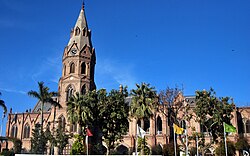
[[File:Government College University, Lahore2.jpg|thumb|upright=1.2|[[Government College University (Lahore)|Government College University]], where Sharif studied business]] | [[File:Government College University, Lahore2.jpg|thumb|upright=1.2|[[Government College University (Lahore)|Government College University]], where Sharif studied business]] | ||
Nawaz was born in [[Lahore | Nawaz was born in [[Lahore|Lahore, Punjab]], on 25 December 1949.<ref>{{Cite web |title=Nawaz Sharif |url=https://www.britannica.com/biography/Nawaz-Sharif |access-date=2022-08-12 |website=www.britannica.com |language=en}}</ref><ref name="Lieven">{{cite book |last=Lieven |first=Anatol |author-link=Anatol Lieven |title=Pakistan: A Hard Country |edition=1st |publisher=PublicAffairs |publication-place=New York |year=2011 |isbn=978-1-61039-021-7 |oclc=787850771 |url={{Google books |id=0hUBAwAAQBAJ |plainurl=yes |page=PA244}} |page=244}}</ref> The [[Sharif family]] are [[Kashmiris in Punjab|Punjabi-speaking Kashmiris]].<ref name="Lieven"/> His father, [[Muhammad Sharif]], was an upper-middle-class businessman and industrialist whose family had emigrated from [[Anantnag district|Anantnag]] in Kashmir for business. They settled in the village of [[Jati Umra (Amritsar)|Jati Umra]] in [[Amritsar district]], Punjab, at the beginning of the twentieth century. His mother's family came from [[Pulwama]].<ref name="indianexpress">{{cite news |url=http://www.indianexpress.com/news/as-nawaz-sharif-becomes-pm-kashmir-gets-voice-in-pakistan-power-circuit/1125778/ |title=As Nawaz Sharif becomes PM, Kashmir gets voice in Pakistan power circuit |work=The Indian Express |date=6 June 2013 |access-date=14 June 2013 |first=Muzamil |last=Jaleel}}</ref> After the creation of Pakistan in 1947, Nawaz's parents migrated from Amritsar to Lahore.<ref name="Lieven"/> His father followed the teachings of the [[Ahl-i Hadith]].<ref>{{cite book |last=Lieven |first=Anatol |title=Pakistan: A Hard Country |publisher=PublicAffairs |year=2011 |isbn=978-1-61039-021-7 |page=275 |url=https://books.google.com/books?id=fEZt49MVZIAC&pg=PA244 }}{{Dead link|date=February 2023 |bot=InternetArchiveBot |fix-attempted=yes }}</ref> Though the [[Sharif family]] are known to have strong [[Barelvi]] thoughts.<ref>{{Cite web|url=https://www.thenews.com.pk/print/232489-The-Sharifs-and-the-religious-right|title=The Sharifs and the religious right|last=Warraich|first=Sohail|date=26 September 2017|website=www.thenews.com.pk|language=en|access-date=8 August 2025}}</ref> His family owns [[Ittefaq Group]], a multimillion-dollar steel conglomerate,<ref name="baker">{{cite book |title=Capitalism's Achilles heel: Dirty Money and How to Renew the Free-market System |last=Baker |first=Raymond |year=2005 |publisher=John Wiley and Sons |isbn=978-0-471-64488-0 |pages=[https://archive.org/details/capitalismsachil00raym/page/82 82]–83 |url=https://archive.org/details/capitalismsachil00raym |url-access=registration |access-date=20 October 2011}}</ref> and [[Sharif Group]], a conglomerate with holdings in agriculture, transport and sugar mills.<ref>{{Cite web|url=http://www.sharifgroupn.com/index.php?option=com_content&view=article&id=55&Itemid=53|title=About Us|website=www.sharifgroupn.com|language=en-gb|access-date=13 April 2018}}</ref> He has two younger brothers: [[Shehbaz Sharif]] and the late [[Abbas Sharif]], both of whom are politicians.<ref>{{Cite web |date=2013-01-11 |title=Abbas Sharif passes away |url=https://www.dawn.com/2013/01/11/abbas-sharif-passes-away/ |access-date=2022-08-12 |website=[[Dawn (newspaper)|Dawn]] |language=en}}</ref> | ||
Nawaz went to [[St. Anthony's High School (Lahore)|Saint Anthony High School]]. He graduated from the [[Government College University, Lahore|Government College University]] (GCU) with an [[Bachelors of Arts|art]] and [[ | Nawaz went to [[St. Anthony's High School (Lahore)|Saint Anthony High School]]. He graduated from the [[Government College University, Lahore|Government College University]] (GCU) with an [[Bachelors of Arts|art]] and [[Bachelor of Business Administration|business degree]] and then received a [[Bachelors of Law|law degree]] from the Law College of [[University of the Punjab|Punjab University]] in [[Lahore]].<ref name="countrystudy">{{cite book |title=Pakistan A Country Study |year=2004 |publisher=Kessinger Publishing |isbn=978-1-4191-3994-9 |page=250 |url=https://books.google.com/books?id=0f4XYCTuMRoC&pg=PA250 |access-date=20 October 2011}}</ref><ref>{{cite news |last=Ghauri |first=Irfan |date=6 June 2013 |title=Nawaz Sharif: A political history |work=[[The Express Tribune]] |url=http://tribune.com.pk/story/559625/nawaz-sharif-a-political-history/ |access-date=13 June 2013}}</ref> | ||
== | [[Kulsoom Nawaz|Kulsoom]], the wife of Nawaz Sharif, had two sisters and a brother. On her mother's side, she was the granddaughter of the famous wrestler, [[The Great Gama]] (born Ghulam Mohammad Baksh Butt). Kulsoom married Nawaz Sharif in April 1970, and together they have four children: [[Maryam Nawaz|Maryam]], Asma, Hassan, and Hussain.{{fact|date=November 2025}} | ||
Nawaz Sharif attempted to play cricket in 1973 but was dismissed for a [[Duck (cricket)|duck]] on the first ball he faced while playing for the [[Pakistan Railways cricket team|Railways team]] against [[Pakistan International Airlines cricket team|Pakistan International Airlines]].<ref>{{cite web|url=https://www.espncricinfo.com/cricketers/nawaz-sharif-42259|title=Nawaz Sharif|website=[[ESPNCricinfo]]|access-date=31 March 2025}}</ref> | |||
[[Imran Khan]] in his book, ''[[Pakistan: A Personal History]]'', recalled an incident before a [[1987 Cricket World Cup]] warm-up match against the [[West Indies cricket team|West Indies]] at [[Gaddafi Stadium]]. "A few moments before the match started, the cricket board secretary told me that the Chief Minister of Punjab, Nawaz Sharif, would be captaining the team that day," he observed. Although he thought he would not play, Imran was shocked to see that Sharif had walked out to do the toss with [[Viv Richards]] in full cricket whites, which included a cricket helmet. Sharif insisted to open the batting. Although [[Mudassar Nazar]] was completely ready in protective cricket gear, Sharif was ready to bat with pads, a floppy hat, and "a smile." Imran, concerned for Sharif's safety against the West Indies' formidable pace attack, asked if an ambulance was ready. The match was played on 4 October in 1987.<ref>{{cite news|url=https://www.financialexpress.com/sports/when-nawaz-sharif-captained-pakistan-against-west-indies-in-1987-imran-khan-enquired-if-an-ambulance-was-ready/1260167/lite/|title=When Nawaz Sharif captained Pakistan against West Indies in 1987, Imran Khan enquired if an ambulance was ready|date=27 July 2018|first=Manas|last=Tawari|website=[[The Financial Express (India)]]}}</ref> After five bouncers against him, the bowler bowled the sixth ball, which knocked his stumps over as it went through. "The CM was stupefied and most reluctant to leave the ground," [[Ramiz Raja]] recalled.<ref>{{cite news|url=https://www.livemint.com/Leisure/3oRdRiKlsjjF7nl9PBI76K/Its-a-different-ball-game.html|title=It's a different ball game|newspaper=[[Mint (newspaper)|Mint]]|date=18 September 2014|first=Ayaz|last=Memon}}</ref> | |||
==Political career in Punjab== | |||
===Early political career=== | ===Early political career=== | ||
Nawaz | Nawaz faced considerable financial challenges when his family's steel business was affected by the [[Nationalization in Pakistan|nationalisation policies]] implemented by former Prime Minister [[Zulfikar Ali Bhutto]]. This experience prompted him to pursue a career in politics,<ref name="Lieven"/> where he initially focused on the objective of restoring control over the steel plants that were significant to his family. In the late 1970s, he joined [[Asghar Khan]]'s [[Tehreek-e-Istiqlal]], which was a notable political movement at the time. His capabilities were soon recognized by [[General Zia ul-Haq]], who appointed him as the Finance Minister of Punjab.<ref>{{cite news|url=https://www.brecorder.com/news/3614876|title=Nawaz emerges as countrys popular leader|date=16 March 2009|work=[[Brecorder]]}}</ref> By 1976, Nawaz also became a member of the [[Pakistan Muslim League]] (PML), a conservative party with deep roots in the Punjab province, contributing to the political landscape of the region. | ||
In May 1980, [[Ghulam Jilani Khan]], the recently appointed military governor of | In May 1980, [[Ghulam Jilani Khan]], the recently appointed military [[Governor of Punjab, Pakistan|governor of Punjab]] and a former Director-General of the [[Inter-Services Intelligence]] (ISI), was seeking new urban leaders; he quickly promoted Nawaz, making him [[finance minister]].<ref name=chaudry>{{cite book |last=Chaudry |first=Aminullah |title=The Army in Pakistan's Politics |date=2009 |url=https://books.google.com/books?id=pCiZiwsUW9EC&pg=PA14 |page=14|publisher=AuthorHouse |isbn=978-1-4678-9762-4 }}</ref> In 1981, Nawaz joined the [[Government of Punjab, Pakistan|Punjab Advisory Council]]<ref name="countrystudy"/> under Khan.<ref name=chaudry/> | ||
During the 1980s, Nawaz gained influence as a supporter of General | During the 1980s, Nawaz gained influence as a supporter of General Zia-ul-Haq's [[Military dictatorship in Pakistan|military government]]. Zia-ul-Haq agreed to return the steel industry to Nawaz, who convinced the general to denationalise and deregulate industries to improve the economy.<ref name="Lieven"/> Within Punjab, Nawaz privatised government-owned industries and presented development-oriented budgets to the military government.<ref name="countrystudy"/> These policies raised financial capital and helped increase the [[standard of living]] and [[purchasing power]] in the province, which in turn improved law and order and extended Khan's rule.<ref name="Lieven"/> Punjab was the richest province and received more federal funding than the other [[provinces of Pakistan]], contributing to [[Economic inequality|economical inequality]].<ref name="Lieven"/> | ||
Nawaz invested | Nawaz invested in [[Saudi Arabia]] and other oil-rich [[Arab]] countries to rebuild his steel empire.<ref name="The Brooklyn Institution">{{cite book |title=The Idea of Pakistan |year=2004 |publisher=The Brooklyn Institution |location=Massachusetts |isbn=0-8157-1502-1 |pages=82–86 |chapter-url=https://books.google.com/books?id=-78yjVybQfkC&q=mahbub+ul+haq+and+Bhutto&pg=PA81 |first1=Stephen Philips |last1=Cohen|first2=Stanley|last2=Wolpert |access-date=6 September 2012 |chapter=The State of Pakistan: Bhutto's Economic Experiments}}</ref><ref>{{Cite news|url=http://www.business-standard.com/article/opinion/the-business-empire-of-pakistan-prime-minister-nawaz-sharif-116010100105_1.html|title=Aditi Phadnis: Inside the Sharif family|last=Phadnis|first=Aditi|date=1 January 2016|work=Business Standard India|access-date=13 April 2018}}</ref> According to personal accounts and his time spent with Nawaz, American historian [[Stephen P. Cohen]] states in his 2004 book ''Idea of Pakistan'': "Nawaz Sharif never forgave <!--Zulfikar Ali Bhutto-->Bhutto after his steel empire was lost [...]<!--into the hands of Bhutto; and--> even after [Bhutto's] [[Zulfikar Ali Bhutto#Death sentence and appeal|terrible end]], Nawaz publicly refused to forgive the soul of Bhutto or the [[Pakistan Peoples Party]]."<ref name="The Brooklyn Institution"/> | ||
===Chief Minister of Punjab=== | ===Chief Minister of Punjab=== | ||
In 1985, Khan nominated Nawaz as Chief Minister of Punjab, against the wishes of Prime Minister [[Muhammad Khan Junejo]].<ref name=chaudry/> With the backing of the army, Nawaz secured a landslide victory in the [[1985 Pakistani general election|1985 elections]].<ref name="Lieven"/> Because of his popularity, he received the nickname "Lion of the Punjab".<ref name="lion"/> Nawaz built ties with the senior army generals who sponsored his government.<ref name="countrystudy"/> He maintained an alliance with General [[Rahimuddin Khan]], Chairman | {{Main|First Nawaz Sharif provincial government}} | ||
In 1985, Khan nominated Nawaz as Chief Minister of Punjab, against the wishes of Prime Minister [[Muhammad Khan Junejo]].<ref name=chaudry/> With the backing of the army, Nawaz secured a landslide victory in the [[1985 Pakistani general election|1985 elections]].<ref name="Lieven"/> Because of his popularity, he received the nickname "Lion of the Punjab".<ref name="lion"/> Nawaz built ties with the senior army generals who sponsored his government.<ref name="countrystudy"/> He maintained an alliance with General [[Rahimuddin Khan]], [[Chairman Joint Chiefs of Staff Committee]]. Nawaz also had close ties with Lieutenant-General (retired) [[Hamid Gul]], the Director-General of ISI.<ref name="Lieven"/> | |||
As chief minister, Nawaz stressed welfare and development activities and the maintenance of law and order.<ref name="countrystudy"/> Khan beautified Lahore, extended military infrastructure, and silenced political opposition, while Nawaz expanded economic infrastructure to benefit the army, his own business interests, and the people of Punjab.<ref name="countrystudy"/> In 1988, General Zia [[Muhammad Zia-ul-Haq#Dismissal of the Junejo government and call for new elections|dismissed the government]] of Junejo and called for new elections.<ref name="countrystudy"/> However, Zia retained Nawaz as the Chief Minister of Punjab | As chief minister, Nawaz stressed welfare and development activities and the maintenance of law and order.<ref name="countrystudy"/> Khan beautified Lahore, extended military infrastructure, and silenced political opposition, while Nawaz expanded economic infrastructure to benefit the army, his own business interests, and the people of Punjab.<ref name="countrystudy"/> In 1988, General Zia [[Muhammad Zia-ul-Haq#Dismissal of the Junejo government and call for new elections|dismissed the government]] of Junejo and called for new elections.<ref name="countrystudy"/> However, Zia retained Nawaz as the Chief Minister of Punjab, and until [[Death of Zia-ul-Haq|his death]], continued to support Nawaz.<ref name="countrystudy"/> | ||
== 1988 elections == | |||
{{Main|1988 Pakistani general election | {{Main|1988 Pakistani general election|Second Nawaz Sharif provincial government}} | ||
After General Zia's death in August 1988, his political party – [[Pakistan Muslim League (F)|Pakistan Muslim League]] – split into two factions.<ref name="encyclo">{{cite book |title=The Far East and Australasia |year=2003 |publisher=Europa Publications |location=London |isbn=978-1-85743-133-9 |page=1166 |url=https://books.google.com/books?id=e5Az1lGCJwQC&pg=PA1166 |access-date=19 October 2011}}</ref> Nawaz led the Zia-loyalist Fida Group against the Prime Minister's Junejo's [[Pakistan Muslim League (J)]].<ref name="encyclo" /> The Fida Group later took on the mantle of the PML while the Junejo Group became known as the JIP.<ref name="encyclo" /> The two parties along with seven other right-wing conservative and religious parties united with encouragement and funding from the ISI to form the [[Islami Jamhuri Ittihad]] (IJI).<ref name="encyclo" /> The IJI received {{currency|15|PKR}} million from Zia loyalists in the ISI,<ref name="ISI">{{YouTube|noqoI0tqLt4|IJI was made & Funded By ISI}} (24 July 2009). Retrieved 5 August 2012.</ref> with a substantial role played by Nawaz's ally Gul.<ref name="Lieven" /> The alliance was led by Nawaz and [[Ghulam Mustafa Jatoi]] and opposed [[Benazir Bhutto]]'s [[Pakistan Peoples Party]] (PPP) in the elections.<ref name="encyclo" /> The IJI gained a majority in Punjab, and Nawaz was re-elected as the chief minister.<ref name="encyclo" /> | |||
In December 1989, Nawaz decided to remain in the provincial Punjab Assembly rather than hold a seat in the National Assembly.<ref>{{cite news |last=Weintraub |first=Richard |date=1 December 1988 |title=Bhutto Likely To Be Named Premier Today; Pakistani Opponent Drops Out of Race |newspaper=[[The Washington Post]] |url=https://pqasb.pqarchiver.com/washingtonpost/access/73646551.html?dids=73646551:73646551&FMT=ABS&FMTS=ABS:FT&type=current&date=Dec+01%2C+1988&author=Richard+M.+Weintraub&pub=The+Washington+Post+%28pre-1997+Fulltext%29&desc=Bhutto+Likely+To+Be+Named+Premier+Today%3B+Pakistani+Opponent+Drops+Out+of+Race&pqatl=google |archive-url=https://archive.today/20120718074258/http://pqasb.pqarchiver.com/washingtonpost/access/73646551.html?dids=73646551:73646551&FMT=ABS&FMTS=ABS:FT&type=current&date=Dec+01,+1988&author=Richard+M.+Weintraub&pub=The+Washington+Post+(pre-1997+Fulltext)&desc=Bhutto+Likely+To+Be+Named+Premier+Today;+Pakistani+Opponent+Drops+Out+of+Race&pqatl=google |archive-date=18 July 2012 |access-date=18 October 2011 }}</ref> In early 1989, the PPP government attempted to unseat Nawaz through a [[Motion of no confidence|no-confidence motion]] in the Punjab Assembly,<ref name="encyclo"/> which they lost by a vote of 152 to 106.<ref name="encyclo"/> | |||
== Prime Minister (1990-1993) == | |||
{{Main|1990 Pakistani general election|First Nawaz Sharif ministry|Mehrangate}} | |||
===Conservative policies=== | Nawaz Sharif became the 12th Prime Minister of Pakistan on 6 November 1990, succeeding Benazir Bhutto, securing a majority in the National Assembly after the [[1990 Pakistani general election|general election]]. His rise to power was the result of an election marred with controversy, with his victory orchestrated with the backing of [[President Ghulam Ishaq Khan]] and senior military officials—including Generals [[Mirza Aslam Beg|Aslam Beg]], [[Hamid Gul]],<ref>{{cite news|url=https://www.geo.tv/latest/129491|title=From Mehrangate to Panamagate|website=[[Geo News]]|date=1 February 2017|quote=After the plane crash that killed Zia ul Haq and the top military leadership in August 1988, his close confidant and then chief of the Inter-Service Intelligence (ISI), General Hameed Gul, utilised the political cell of the agency (created under Bhutto's premiership in the 70s) to counter the surging popularity of Bhutto's daughter, Benazir, who won the first election after Zia's death in November 1988. He helped create a cocktail of political parties under the banner of Islami Jamhoori Ittehad which was led by Mian Nawaz Sharif. He was able to undermine and eventually dethrone the Pakistan People’s Party government within 18 months of election. Benazir accused the establishment of conspiring against her party.}}</ref> and [[Asad Durrani]], the head of the [[Inter-Services Intelligence]], who worked to buy the loyalties of politicians using funds from the country's foreign exchange reserves.<ref>{{cite web|url=https://www.theguardian.com/world/2012/mar/09/former-isi-chief-1990-pakistan-election|title=Former ISI chief says army money used to influence 1990 Pakistan election|date=9 March 2012|work=The Guardian}}</ref><ref name="dawn.com">{{cite news|url=https://www.dawn.com/news/760219|title=Hamid Gul accepts responsibility for creating IJI|date=30 October 2012|publisher=[[Dawn (newspaper)|Dawn]]}}</ref> Support also came from powerful drug barons such as [[Ayub Afridi (drug lord)|Haji Ayub Afridi]],<ref>{{cite book|url=https://books.google.com/books?id=RSIuDwAAQBAJ&dq=Mirza%20Iqbal%20Beg%20sharif%20drug&pg=PT203|title=Kashmir and Neighbours: Tale, Terror, Truce|author=[[Türkkaya Ataöv]]|year=2017 |publisher=Routledge |isbn=978-1-351-75569-6 }}</ref> Haji Mirza Iqbal Beg, and Sharif's own brother-in-law, Sohail Zia Butt.<ref>{{cite book|url=https://books.google.com/books?id=NvdEAAAAYAAJ&q=%22nawaz%20sharif%22%20%22sohail%22|title=Gangs: An International Approach|year=2000|page=379|author=Sean Grennan |publisher=Prentice Hall |isbn=978-0-13-324856-2 }}</ref><ref>{{cite book|url=https://books.google.com/books?id=RSIuDwAAQBAJ&dq=Mirza%20Iqbal%20Beg%20sharif%20drug&pg=PT205|title=Kashmir and Neighbours: Tale, Terror, Truce|page=205|author=[[Türkkaya Ataöv]]|year=2017 |publisher=Routledge |isbn=978-1-351-75569-6 }}</ref> Sharif continued to maintain his ties with Iqbal Beg, who was arrested and subsequently released on bail as a result of his association with Sharif.<ref>{{cite book|url=https://books.google.com/books?id=gdVNL2_DUtYC&dq=%22nawaz+sharif%22+beg+bail&pg=PA206|title=Contemporary Pakistan: Political Processes, Conflicts and Crises|page=206|year=2003|author=Veena Kukreja |isbn=978-0-7619-9683-5 }}</ref> In 1996, [[Asghar Khan]] filed a lawsuit challenging the results of the 1990 elections, following the discovery of the [[Mehran bank scandal]]. Nearly two decades later in 2012, Generals Aslam Beg, Durrani, and Gul, along with banker Yunus Habib, admitted their involvement in manipulating the election.<ref>{{cite news|url=https://www.dawn.com/news/701288|title=Money arranged at behest of Ghulam Ishaq, Aslam Beg: Habib|date=9 March 2012|first=Nasir|last=Iqbal|website=[[Dawn (newspaper)|Dawn]]}}</ref> Later that year, the Supreme Court ruled in favour of petitioner [[Asghar Khan]], agreed that the election was rigged, and ordered legal action against those responsible.<ref>{{cite news|url=https://www.dawn.com/news/757862|title=1990 election was rigged, rules SC|date=19 October 2012|website=[[Dawn (newspaper)|Dawn]]}}</ref><ref>{{cite news|url=https://www.thenews.com.pk/print/413571|title=Asghar Khan case: SC passed conclusive judgment in October 2012|date=2 January 2019|newspaper=[[The News International]]}}</ref><ref>{{cite news|url=https://www.dawn.com/news/1458641|title=Asghar vs Aslam|date=20 January 2019|author=Asad Rahim Khan|website=[[Dawn (newspaper)|Dawn]]}}</ref> As of 2025, no one has been held accountable. | ||
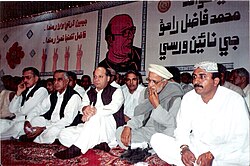
[[File:Death anniversary of Fazil Rahoo.jpg|thumb|upright=1.2|Nawaz meeting with conservative intellectuals of Pakistan in Sindh Province, {{circa|1990s}}.]] | |||
Nawaz had campaigned on a conservative platform and vowed to reduce government corruption.<ref name=Dorling>{{cite book |last=John |first=Wilson |author2=Vikram Sood and Akmal Hussain |title=Pakistan: the struggle within |publisher=Dorling Kindersley (Pvt) Ltd., India, and the Library of Congress |year=2009 |location=New Delhi and Washington, D.C. |page=220 |chapter=§Pakistan's economy in historical perspective: The Growth, Power and Poverty |url=https://books.google.com/books?id=XfI-hEI8a9wC |isbn=978-81-317-2504-7}}</ref> He introduced an economy based on [[Privatization in Pakistan|privatisation]] and [[Economic liberalisation in Pakistan|economic liberalisation]] to reverse the nationalisation by Zulfikar Bhutto,<ref name="The Brooklyn Institution"/> notably for banks and industries.<ref name=Dorling/> He legalised foreign money exchange to be transacted through private money exchangers.<ref name=Dorling/> His privatisation policies were continued by both Benazir Bhutto in the mid-1990s and [[Shaukat Aziz]] in the 2000s.<ref name=Dorling/> He also improved the nation's infrastructure and spurred the growth of digital telecommunication.<ref name=Dorling/> | |||
=== Conservative policies === | |||
[[File:Death anniversary of Fazil Rahoo.jpg|thumb|upright=1.2|Nawaz meeting with conservative [[Sindhis|Sindhi]] intellectuals of Pakistan in Sindh Province, {{circa|1990s}}.]] | |||
Nawaz continued the simultaneous Islamization and conservatism of Pakistan society,<ref name=Dorling/> a policy begun by Zia. Reforms were made to introduce [[fiscal conservatism]], [[supply-side economics]], [[bioconservatism]] and [[religious conservatism]] in Pakistan.<ref name=Dorling/> | Nawaz continued the simultaneous Islamization and conservatism of Pakistan society,<ref name=Dorling/> a policy begun by Zia. Reforms were made to introduce [[fiscal conservatism]], [[supply-side economics]], [[bioconservatism]] and [[religious conservatism]] in Pakistan.<ref name=Dorling/> | ||
Nawaz intensified Zia's controversial [[Zia-ul-Haq's Islamization|Islamization]] policies, and introduced Islamic | Nawaz intensified Zia's controversial [[Zia-ul-Haq's Islamization|Islamization]] policies, and introduced Islamic laws such as the [[Shariat]] Ordinance and [[Pakistan Bait-ul-Mal|Bait-ul-Maal]] (to help poor orphans, widows, etc.) to drive the country on the model of an [[Islamic state|Islamic]] [[welfare state]].<ref name=Dorling/> Moreover, he gave tasks to the [[Ministry of Religious Affairs (Pakistan)|Ministry of Religion]] to prepare reports and recommendations for steps taken toward Islamization. He ensured the establishment of three committees:<ref name=Dorling/> | ||
* Ittehad-e-bain-ul-Muslemeen ({{ | * Ittehad-e-bain-ul-Muslemeen ({{langx|en|Unity of Muslims Bloc}}) | ||
* Nifaz-e-Shariat Committee ({{ | * Nifaz-e-Shariat Committee ({{langx|en|[[Sharia]] Establishment Committee}}) | ||
* Islamic Welfare Committee | * Islamic Welfare Committee | ||
Nawaz extended membership of [[Economic Cooperation Organization]] (ECO) to all Central Asian | Nawaz extended membership of the [[Economic Cooperation Organization]] (ECO) to all Central Asian countries to unite them into a Muslim bloc.<ref name=Dorling/> Nawaz included [[Environmental issues in Pakistan|environmentalism]] in his government platform, and established the [[Pakistan Environmental Protection Agency]] in 1997.<ref name="Electronic Government of Pakistan and EPA">{{cite web |title=Pakistan Environmental Protection Agency |url=http://www.environment.gov.pk/aboutus/Brief-Pak-EPA.pdf |work=Electronic Government of Pakistan |publisher=Electronic Government of Pakistan and EPA |access-date=28 October 2011 |archive-url=https://web.archive.org/web/20110626235215/http://www.environment.gov.pk/aboutus/Brief-Pak-EPA.pdf |archive-date=26 June 2011 }}</ref> | ||
===Conflicts{{anchor|Domestic issues}}=== | === Conflicts{{anchor|Domestic issues}} === | ||
{{Main|Operation Blue Fox|Operation Desert Storm|Operation Clean-up|Politics of Karachi|Economy of Karachi|Civil-military operations}} | {{Main|Operation Blue Fox|Operation Desert Storm|Operation Clean-up|Politics of Karachi|Economy of Karachi|Civil-military operations}} | ||
Nawaz challenged former [[Chief of Army Staff (Pakistan)|Chief of Army Staff]] General [[Mirza Aslam Beg]] over the [[1991 Gulf War]].<ref name=Taurus/> Under the direction of Beg, Pakistan Armed Forces participated in [[Operation Desert Storm]] and the [[Special | {{BLP sources section|date=September 2025}} | ||
Following the imposition and passing of [[United Nations Security Council Resolution 660|Resolution 660]], [[United Nations Security Council Resolution 661|661]], and [[United Nations Security Council Resolution 665|665]], Nawaz sided with the United Nations on the [[Iraqi invasion of Kuwait]].<ref name=Taurus>{{cite book |last=Shah |first=Mehtab Ali |title=The foreign policy of Pakistan: ethnic impacts on diplomac |publisher=I.B. Taurus Ltd. |year=1997 |location=New York City |page=280 |chapter=Pakistan and Gulf Region |url=https://books.google.com/books?id=7czT4fipTyoC |isbn=1-86064-169-5 |access-date=24 May 2013}}</ref> Nawaz's government criticised Iraq for invading the fellow Muslim country, which strained Pakistan's [[Iraq-Pakistan relations|relationships]] with Iraq.<ref name=Taurus/> This continued as Pakistan sought to strengthen [[Pakistan-Iran relations|its relations with Iran]]. This policy continued under Benazir Bhutto and Pervez Musharraf until the removal of [[Saddam Hussein]] in 2003.<ref name=Taurus/> Nawaz raised the issue of Kashmir in international forums and established [[Kashmir Solidarity Day]] as a national holiday and worked toward a [[peaceful transition of power|peaceful transfer of power]] in Afghanistan to curb the rampant trading of illicit drugs and weapons across the border.<ref name=Dorling/>{{citation needed|date=July 2022}} | |||
Nawaz challenged former [[Chief of Army Staff (Pakistan)|Chief of Army Staff]] General [[Mirza Aslam Beg]] over the [[1991 Gulf War]].<ref name=Taurus/> Under the direction of Beg, Pakistan Armed Forces participated in [[Operation Desert Storm]] and the [[Special Service Group|Army Special Service Group]] and the [[Special Service Group (Navy)|Naval Special Service Group]] were deployed to [[Saudi Arabia]] to provide security for the [[Saudi royal family]].<ref name=Taurus/> | |||
Nawaz faced difficulty working with the PPP and the [[Mutahidda Qaumi Movement]] (MQM), a potent force in Karachi.<ref name="The News International">{{cite web |last=Mir |first=Amir |date=2 September 2009 |title=MQM shifts blame for 1992 operation from military to Nawaz |url=http://www.thenews.com.pk/TodaysPrintDetail.aspx?ID=24255&Cat=13&dt=9/2/2009 |archive-url=https://web.archive.org/web/20151018164913/http://www.thenews.com.pk/TodaysPrintDetail.aspx?ID=24255&Cat=13&dt=9/2/2009 |archive-date=18 October 2015 |access-date=27 October 2011 |work=[[The News International]]}}</ref> The MQM and the PPP opposed Nawaz due to his focus on beautifying Punjab and Kashmir while neglecting Sindh,<ref name="The News International"/> and the MQM also opposed Nawaz's conservatism. Although the MQM had formed the government with Nawaz,<ref name="The News International"/> the political tensions between liberalism and conservatism erupted into conflict by renegade factions in 1992.<ref name="The News International"/> | |||
To end the fighting between PML-N and MQM, Nawaz's party passed a resolution to launch [[Operation Clean-up|a paramilitary operation]]<ref name="The News International" /> under command of Chief of Army Staff General [[Asif Nawaz Janjua]].<ref name="Taurus" /> Violence erupted in Karachi in 1992 and brought the economy to a halt.<ref name="The News International" /> During this time, Benazir Bhutto and the centre-left PPP remained neutral,<ref name="The News International" /> but her brother [[Murtaza Bhutto]] exerted pressure which suspended the operation.<ref name="The News International" /> The period of 1992–1994 is considered{{by whom|date=January 2019}} the bloodiest in the history of the city, with many people missing.{{citation needed|date=December 2023}} | |||
=== Economy === | |||
===Industrialization and privatisation=== | ==== Industrialization and privatisation ==== | ||
Nawaz had campaigned on a conservative platform<ref name=Dorling/> and after assuming office announced his economic policy under the National Economic Reconstruction Programme (NERP).<ref name=Dorling/> This programme introduced an extreme level of the Western-styled [[Capitalism|capitalist economic]]s.<ref name=Dorling/> | Nawaz had campaigned on a conservative platform<ref name=Dorling/> and after assuming office announced his economic policy under the National Economic Reconstruction Programme (NERP).<ref name=Dorling/> This programme introduced an extreme level of the Western-styled [[Capitalism|capitalist economic]]s.<ref name=Dorling/> | ||
Unemployment had limited Pakistan's economic growth and Nawaz believed that only privatisation could solve this problem.<ref name=Dorling/> Nawaz introduced an economy based on [[Privatization in Pakistan|privatisation]] and [[Economic liberalisation in Pakistan|economic liberalisation]],<ref name="The Brooklyn Institution"/> notably for banks and industries.<ref name=Dorling/> According to the US Department of State, this followed a vision of "turning Pakistan into a [South] [[South Korea|Korea]] by encouraging greater private saving and investment to accelerate economic growth."<ref name="US Department of State :Case Study">{{cite web | Unemployment had limited Pakistan's economic growth and Nawaz believed that only privatisation could solve this problem.<ref name=Dorling/> Nawaz introduced an economy based on [[Privatization in Pakistan|privatisation]] and [[Economic liberalisation in Pakistan|economic liberalisation]],<ref name="The Brooklyn Institution"/> notably for banks and industries.<ref name=Dorling/> According to the US Department of State, this followed a vision of "turning Pakistan into a [South] [[South Korea|Korea]] by encouraging greater private saving and investment to accelerate economic growth."<ref name="US Department of State :Case Study">{{cite web |title=The Government of Nawaz Sharif |url=http://www.country-data.com/cgi-bin/query/r-9877.html |publisher=United States Government – US Department of State |access-date=1 June 2012 |date=April 1994 |quote=Benazir and the PPP, criticized Sharif's efforts at privatization, calling them the "loot and plunder" of Pakistan and saying his plan favored large investors and ran roughshod over labor}}</ref> | ||
The privatisation programme reversed the [[Nationalization in Pakistan|nationalisation]] by Zulfikar Ali Bhutto<ref name="The Brooklyn Institution"/> and the PPP in the 1970s.<ref name="Tripod nuclues">{{cite web | The privatisation programme reversed the [[Nationalization in Pakistan|nationalisation]] by Zulfikar Ali Bhutto<ref name="The Brooklyn Institution"/> and the PPP in the 1970s.<ref name="Tripod nuclues">{{cite web |url=http://richpaki.tripod.com/masterstroke.htm |publisher=Tripod nucleus |access-date=1 June 2012 |title=Mian Mohammad Mansha and Nawaz Sharif- }}</ref> By 1993, around 115 nationalised industries were opened to private ownership,<ref name="Tripod nuclues"/> including the [[National Development Finance Corporation]], [[Pakistan National Shipping Corporation]], [[National Electric Power Regulatory Authority]], [[Pakistan International Airlines]] (PIA), [[Pakistan Telecommunication Company Ltd|Pakistan Telecommunication Corporation]], and [[Pakistan State Oil]].<ref name=Dorling/> This boosted the economy<ref name=Dorling/> but a lack of competition in bidding allowed the rise of business oligarchs and further widened the [[wealth gap]], contributing to political instability.<ref name="Tripod nuclues"/> Former science advisor Dr. [[Mubashir Hassan]] called Nawaz's privatisation "unconstitutional".<ref name="The News International, Parliament Lounge"/> The PPP held that nationalisation policy was given constitutional status by [[Parliament of Pakistan|parliament]], and that privatisation policies were illegal and had taken place without parliamentary approval.<ref name="The News International, Parliament Lounge"/> | ||
[[File:Pakistan gdp growth rate.svg|thumb|upright=1.2|Privatization programme reached the {{abbr|GDP|gross domestic product}} growth rate to 7.57% (1992) but dropped at 4.37% (1993; 1998).{{inconsistent|date=January 2019|figures in caption do not match chart.}}]] | [[File:Pakistan gdp growth rate.svg|thumb|upright=1.2|Privatization programme reached the {{abbr|GDP|gross domestic product}} growth rate to 7.57% (1992) but dropped at 4.37% (1993; 1998).{{inconsistent|date=January 2019|figures in caption do not match chart.}}]] | ||
Nawaz initiated several large-scale projects to stimulate the economy, such as the [[Ghazi-Barotha Hydropower Project]].<ref name=Dorling/> However, unemployment remained a challenge. In an attempt to counter this, Nawaz imported thousands of privatised [[Yellow cab|Yellow-cab taxis]] for young Pakistanis, but few of the loans were repaid and Nawaz was forced to pay for them through his steel industry.<ref name=Dorling/> Nawaz's projects were not evenly distributed, focusing on Punjab and [[Azad Kashmir|Kashmir | Nawaz initiated several large-scale projects to stimulate the economy, such as the [[Ghazi-Barotha Hydropower Project]].<ref name=Dorling/> However, unemployment remained a challenge. In an attempt to counter this, Nawaz imported thousands of privatised [[Yellow cab|Yellow-cab taxis]] for young Pakistanis, but few of the loans were repaid and Nawaz was forced to pay for them through his steel industry.<ref name=Dorling/> Nawaz's projects were not evenly distributed, focusing on Punjab and [[Azad Kashmir|Kashmir province]], the base of his support,<ref name="The News International, Parliament Lounge">{{cite web |title=Nawaz has derailed politically: Mubashar |url=http://www.thenews.com.pk/TodaysPrintDetail.aspx?ID=67479&Cat=5 |work=Parliament Media Lounge |access-date=14 September 2011 |archive-date=13 October 2013 |archive-url=https://web.archive.org/web/20131013175122/http://www.thenews.com.pk/TodaysPrintDetail.aspx?ID=67479&Cat=5 }}</ref> with lesser efforts in [[Khyber Pakhtunkhwa|Khyber]] and [[Balochistan, Pakistan|Balochistan]] provinces, and no benefits from industrialization in [[Sindh]] province.<ref name=Dorling/> After intense criticism from the PPP and MQM, Nawaz completed the [[Orangi]] Cottage Industrial Zone in Karachi<ref name=Dorling/> but this did not repair his reputation in Sindh.<ref name=Dorling/> Opponents accused Nawaz of using political influence to build factories for himself and his business,<ref name=Dorling/> for expanding the Armed Forces' secretive [[Fauji Foundation|industrial conglomerate]] and bribing generals.<ref name="The News International, Parliament Lounge"/> | ||
===Science policy=== | === Science policy === | ||
While privatising industry, Nawaz took steps for intense government control of [[science in Pakistan]], and placed projects under his authorisation.<ref name="Atta-oul-Kasmie at the Jang News Cell"/> In 1991, Nawaz founded and authorised the [[Pakistan Antarctic Programme]] under the scientific directions of [[National Institute of Oceanography (Pakistan)|National Institute of Oceanography]] (NIO), with the [[Pakistan Navy]]'s Weapons Engineering Division, and first established the [[Jinnah Antarctic Station]] and Polar Research Cell. In 1992, Pakistan became an associate member of the [[Scientific Committee on Antarctic Research]]. | While privatising industry, Nawaz took steps for intense government control of [[science in Pakistan]], and placed projects under his authorisation.<ref name="Atta-oul-Kasmie at the Jang News Cell"/> In 1991, Nawaz founded and authorised the [[Pakistan Antarctic Programme]] under the scientific directions of [[National Institute of Oceanography (Pakistan)|National Institute of Oceanography]] (NIO), with the [[Pakistan Navy]]'s Weapons Engineering Division, and first established the [[Jinnah Antarctic Station]] and Polar Research Cell. In 1992, Pakistan became an associate member of the [[Scientific Committee on Antarctic Research]]. | ||
On 28 July 1997, Nawaz declared 1997 a year of science in Pakistan and personally allotted funds for the 22nd INSC College on Theoretical Physics. In 1999, Nawaz signed the executive decree, declaring 28 May as the National Science Day in Pakistan. | On 28 July 1997, Nawaz declared 1997 a year of science in Pakistan and personally allotted funds for the 22nd INSC College on Theoretical Physics. In 1999, Nawaz signed the executive decree, declaring 28 May as the National Science Day in Pakistan.{{Citation needed|date=September 2025}} | ||
===Nuclear policy=== | === Nuclear policy === | ||
Nawaz made the nuclear weapons and energy programme one of his top priorities.<ref name="Atta-oul-Kasmie at the Jang News Cell"/><ref name=NTI1990>{{cite web | Nawaz made the nuclear weapons and energy programme one of his top priorities.<ref name="Atta-oul-Kasmie at the Jang News Cell"/><ref name=NTI1990>{{cite web |title=Nuclear Chronology |url=http://www.nti.org/e_research/profiles/Pakistan/Nuclear/chronology_1990.html |archive-url=https://web.archive.org/web/20101108072529/http://www.nti.org/e_research/profiles/Pakistan/Nuclear/chronology_1990.html |archive-date=8 November 2010 |publisher=NTI Publications |year=1990 |access-date=2 December 2011|quote=The peaceful [atomic] programme of which... it would be accelerated to accommodate growing [nuclear] [e]nergy needs and to make up for rising [oil] prices. And, of course, (Pakistan) will to construct new nuclear power plants.}}</ref> He expanded the [[Energy policy of Pakistan|nuclear energy]] program, and continued an [[Pakistan and its Nuclear Deterrent Program|atomic programme]]<ref name=Dorling/><ref name="Atta-oul-Kasmie at the Jang News Cell"/> while following a [[Policy of deliberate ambiguity|policy of deliberate nuclear ambiguity]].<ref name=NTI1990/> | ||
This resulted in a nuclear crisis with the United States which tightened its embargo on Pakistan in December 1990 and reportedly offered substantial economic aid to halt the country's uranium enrichment programme.<ref name="Atta-oul-Kasmie at the Jang News Cell"/><ref name=NTI1990/> Responding to US embargo, Nawaz announced that Pakistan had no atomic bomb, and would sign the [[Nuclear Nonproliferation Treaty]] if India did as well.<ref name=NTI1990/> The embargo blocked plans for a French-built nuclear power plant, so Nawaz's advisors intensively lobbied the [[International Atomic Energy Agency]] (IAEA), which allowed China to establish [[Chashma Nuclear Power Plant|CHASNUPP-I]] nuclear power plant and upgrade [[KANUPP|KANUPP-I]].<ref name="Atta-oul-Kasmie at the Jang News Cell"/> | This resulted in a nuclear crisis with the United States which tightened its embargo on Pakistan in December 1990 and reportedly offered substantial economic aid to halt the country's uranium enrichment programme.<ref name="Atta-oul-Kasmie at the Jang News Cell"/><ref name=NTI1990/> Responding to US embargo, Nawaz announced that Pakistan had no atomic bomb, and would sign the [[Nuclear Nonproliferation Treaty]] if India did as well.<ref name=NTI1990/> The embargo blocked plans for a French-built nuclear power plant, so Nawaz's advisors intensively lobbied the [[International Atomic Energy Agency]] (IAEA), which allowed China to establish [[Chashma Nuclear Power Plant|CHASNUPP-I]] nuclear power plant and upgrade [[KANUPP|KANUPP-I]].<ref name="Atta-oul-Kasmie at the Jang News Cell"/> | ||
| Line 152: | Line 189: | ||
Nawaz's nuclear policy was considered less aggressive towards India with its focus on public usage through [[Nuclear power in Pakistan|nuclear power]] and [[Nuclear medicine in Pakistan|medicine]], viewed as a continuation of the US [[Atoms for Peace]] programme.{{by whom|date=January 2019}} In 1993, Nawaz established the [[KANUPP Institute of Nuclear Power Engineering|Institute of Nuclear Engineering]] (INE) to promote his policy for the peaceful use of nuclear energy. | Nawaz's nuclear policy was considered less aggressive towards India with its focus on public usage through [[Nuclear power in Pakistan|nuclear power]] and [[Nuclear medicine in Pakistan|medicine]], viewed as a continuation of the US [[Atoms for Peace]] programme.{{by whom|date=January 2019}} In 1993, Nawaz established the [[KANUPP Institute of Nuclear Power Engineering|Institute of Nuclear Engineering]] (INE) to promote his policy for the peaceful use of nuclear energy. | ||
===Co-operatives societies scandal=== | ==== Co-operatives societies scandal ==== | ||
Nawaz suffered a major loss of political support from the co-operatives societies scandal.<ref name=Dorling/> These societies accept deposits from members and can legally make loans only to members for purposes to the benefit of the membership.<ref name=Dorling/> However, mismanagement led to a collapse affecting millions of Pakistanis in 1992.<ref name=Dorling/> In Punjab and Kashmir, around 700,000 people lost their savings, and it was discovered that billions of rupees had been granted to the [[Ittefaq Group|Ittefaq Group of Industries]] – Nawaz's steel mill. Although the loans were hurriedly repaid, Nawaz's reputation was severely damaged.<ref name=Dorling/> | Nawaz suffered a major loss of political support from the co-operatives societies scandal.<ref name=Dorling/> These societies accept deposits from members and can legally make loans only to members for purposes to the benefit of the membership.<ref name=Dorling/> However, mismanagement led to a collapse affecting millions of Pakistanis in 1992.<ref name=Dorling/> In Punjab and Kashmir, around 700,000 people lost their savings, and it was discovered that billions of rupees had been granted to the [[Ittefaq Group|Ittefaq Group of Industries]] – Nawaz's steel mill. Although the loans were hurriedly repaid, Nawaz's reputation was severely damaged.<ref name=Dorling/> | ||
===Constitutional crisis and resignation{{anchor|1993 constitutional crisis}}=== | === Constitutional crisis and resignation{{anchor|1993 constitutional crisis}} === | ||
Nawaz had developed serious issues of authority with conservative President Ghulam Ishaq Khan, who had raised Nawaz to prominence during the Zia dictatorship.<ref name=APH>{{cite book |last=Dutt |first=Sanjay |title=Inside Pakistan: 52 years oulook |publisher=A.P.H. Publishing | Nawaz had developed serious issues of authority with conservative President Ghulam Ishaq Khan, who had raised Nawaz to prominence during the Zia dictatorship.<ref name=APH>{{cite book |last=Dutt |first=Sanjay |title=Inside Pakistan: 52 years oulook |publisher=A.P.H. Publishing Corp. |year=2009 |location=New Delhi |chapter=1993 Elections |chapter-url=https://books.google.com/books?id=QGzRA-3zxfsC&pg=PA267 |isbn=978-81-7648-157-1}}</ref> On 18 April, ahead of the [[1993 Pakistani general election|1993 Parliamentary election]], Khan used his [[Eighth Amendment to the Constitution of Pakistan|reserve powers]] (58-2b) to dissolve the National Assembly, and with the support of the army appointed [[Balakh Sher Mazari|Mir Balakh Sher]] as [[Interim Prime Minister|interim prime minister]]. Nawaz refused to accept this act and raised a challenge at the [[Supreme Court of Pakistan]]. On 26 May, the Supreme Court ruled 10–1 that the presidential order was unconstitutional, that the president could dissolve the assembly only if a constitutional breakdown had occurred and that the government's incompetence or corruption was irrelevant.<ref name=APH/> [[Syed Sajjad Ali Shah|Justice Syed Sajjad Ali Shah]] was the only dissenting judge; he was later appointed the [[Chief Justice of Pakistan|13th Chief Justice of Pakistan]] by Benazir Bhutto.<ref>''Judges & Generals in Pakistan Vol-I'' by Inam R Sehri, [2012] pp. 153–154; GHP Ltd UK</ref> | ||
Issues of authority continued. In July 1993, under pressure from the armed forces, Nawaz resigned under an agreement that also removed President Khan from power. [[Chairman Joint Chiefs of Staff Committee (Pakistan)|Chairman of the Joint Chiefs of Staff Committee]] General [[Shamim Alam Khan | Issues of authority continued. In July 1993, under pressure from the armed forces, Nawaz resigned under an agreement that also removed President Khan from power. [[Chairman Joint Chiefs of Staff Committee (Pakistan)|Chairman of the Joint Chiefs of Staff Committee]] General [[Shamim Alam Khan]] and the Chief of Army Staff General [[Abdul Waheed Kakar]] forced Khan to resign from the presidency and ended the political standoff. Under the close scrutiny of the Pakistan Armed Forces, an interim and transitional government was formed and new parliamentary election was held after three months.<ref name=APH/> | ||
==Parliamentary opposition (1993–1996)== | == Parliamentary opposition (1993–1996) == | ||
{{See also|1993 Pakistani general election}} | {{See also|1993 Pakistani general election}} | ||
Following [[1993 Pakistani general election|1993 elections]], the PPP returned to power under Benazir Bhutto. Nawaz offered his full co-operation as [[Leader of the Opposition (Pakistan)|Leader of the Opposition]] but soon the PPP and PML-N held parliament locked in dispute. Bhutto found it difficult to act effectively in the face of opposition from Nawaz, and also faced problems in her political stronghold of Sindh Province from her younger brother [[Murtaza Bhutto]].<ref name=APH/> | Following the [[1993 Pakistani general election|1993 elections]], the PPP returned to power under Benazir Bhutto. Nawaz offered his full co-operation as [[Leader of the Opposition (Pakistan)|Leader of the Opposition]] but soon the PPP and PML-N held parliament locked in dispute. Bhutto found it difficult to act effectively in the face of opposition from Nawaz, and also faced problems in her political stronghold of Sindh Province from her younger brother [[Murtaza Bhutto]].<ref name=APH/> | ||
Nawaz and Murtaza Bhutto formed the Nawaz-Bhutto axis and worked to undermine Benazir Bhutto's government, tapping an anti-corruption wave in Pakistan. They accused the government of corruption with major state corporations and slowing economic progress. In 1994 and 1995 they made a "train march" from Karachi to Peshawar, making critical speeches to huge crowds. Nawaz organised strikes throughout Pakistan in September and October 1994. The death of Murtaza Bhutto in 1996, which allegedly involved Benazir's spouse, led to demonstrations in Sindh and the government lost control of the province. Benazir Bhutto became widely unpopular across the country and was ousted in October 1996.<ref name=APH/> | Nawaz and Murtaza Bhutto formed the Nawaz-Bhutto axis and worked to undermine Benazir Bhutto's government, tapping an anti-corruption wave in Pakistan. They accused the government of corruption with major state corporations and slowing economic progress. In 1994 and 1995 they made a "train march" from Karachi to Peshawar, making critical speeches to huge crowds. Nawaz organised strikes throughout Pakistan in September and October 1994. The death of Murtaza Bhutto in 1996, which allegedly involved Benazir's spouse, [[Asif Ali Zardari]], led to demonstrations in Sindh and the government lost control of the province. Benazir Bhutto became widely unpopular across the country and was ousted in October 1996.<ref name=APH/> | ||
== | == Prime Minister (1997–1999) == | ||
{{Main|1997 Pakistani general election|Second Nawaz Sharif ministry}} | |||
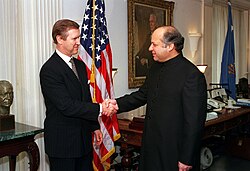
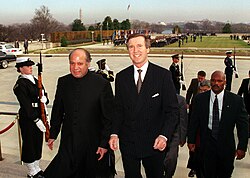
[[File:Sharif meets Cohen in 1998.jpg|thumb|upright=1.2|US Defense Secretary [[William Cohen|William S. Cohen]] with Nawaz (1998)]] | |||
By 1996, continuous large-scale corruption by the government of Benazir Bhutto had deteriorated the country's economy, which was nearing failure.<ref name=Mittal/> In the [[1997 Pakistani general election|1997 parliamentary elections]], Nawaz and the PML-N won an overwhelming victory, with an [[exclusive mandate]] from across Pakistan.<ref name=Mittal>{{Cite book |last=Akbar |first=M.K |title=Pakistan Today |place=New Delhi, India |publisher=Mittal Publications |chapter=Pakistan Under Nawaz Sharif |page=230 |chapter-url=https://books.google.com/books?id=g6D8xkFgTwEC&pg=PA1 |isbn=81-7099-700-3 |date=1998}}</ref><ref name="Story of Pakistan (Part III)">{{cite web |url=http://www.storyofpakistan.com/person.asp?perid=P027&Pg=3 |title=Mian Muhammad Nawaz Sharif [Born 1949] (Part-III) |work=Story of Pakistan Directorate |publisher=Story of Pakistan (Part III) |access-date=7 February 2012 |archive-url=https://web.archive.org/web/20120126175010/http://www.storyofpakistan.com/person.asp?perid=P027&Pg=3 |archive-date=26 January 2012 }}</ref> It was hoped that Nawaz would deliver on promises to provide a stable conservative government and improve overall conditions.<ref name=Mittal/> Nawaz was sworn as prime minister on 17 February.<ref name="bbc profile">{{cite news |url=http://news.bbc.co.uk/2/hi/south_asia/6959782.stm |title=Profile: Nawaz Sharif |date=12 March 2009 |access-date=13 June 2009 |work=BBC News}}</ref> | |||
Nawaz | Nawaz had formed an alliance with [[Altaf Hussain (Pakistani politician)|Altaf Hussain]] of the MQM which fell apart following the assassination of [[Hakim Said]].<ref name="The News International"/> Nawaz then removed the MQM from parliament and assumed control of Karachi while MQM was forced underground.<ref name="The News International"/> This led Nawaz to claim an exclusive mandate, and for the first time Nawaz and the PML-N had the control of Sindh, Balochistan, Northwest Frontier, Kashmir and Punjab.<ref name="The News International"/> With a [[supermajority]], Nawaz's new government [[Thirteenth Amendment to the Constitution of Pakistan|amended]] the constitution to restrict the [[Eighth Amendment to the Constitution of Pakistan|powers]] of the president to dismiss governments.<ref>{{Cite book |url=https://books.google.com/books?id=o6-wZP7Tz8YC&q=pakistan+13th+amendment&pg=PA3 |title=Emergency Powers and the Courts in India and Pakistan |last=Omar |first=Imtiaz |year= 2002 |publisher=Martinus Nijhoff Publishers |isbn=90-411-1775-X |language=en}}</ref> With the passing of the [[Fourteenth Amendment to the Constitution of Pakistan|14th amendment]], Nawaz emerged as the most powerful elected prime minister in the country.<ref name=Mittal/> | ||
===Atomic policy=== | Nawaz's popularity peaked in May 1998<ref name="British Broadcasting Corporation">{{cite web |last=Qureshi |first=Natalya |title=Pakistan goes nuclear |publisher=BBC}}</ref> after conducting the country's first [[Chagai-I|nuclear weapons tests]] in response to tests by India.<ref name="United States Institute of Peace">{{cite book |last1=Schaffer |first1=Howard B. |last2=Schaffer |first2=Teresita C. |title=How Pakistan negotiates with the United States: riding the roller coaster |date=2011 |publisher=United States Institute of Peace |location=Washington, D.C. |isbn=978-1-60127-075-7 |chapter-url=https://books.google.com/books?id=axT9i-FhO0UC&q=Jehangir+Karamat&pg=PA103 |access-date=7 January 2015 |chapter=§Pakistan's politicians |url-access=registration |url=https://archive.org/details/howpakistannegot0000scha }}</ref> When Western countries suspended [[foreign aid]], Nawaz froze the country's [[foreign currency reserves]] and economic conditions worsened.<ref name="nuclearweaponarchive" /><ref>{{cite web |url=http://www.storyofpakistan.com/articletext.asp?artid=A091&Pg=2 |title=Pakistan: A Nuclear power |work=Story of Pakistan |archive-url=https://web.archive.org/web/20111104121828/http://www.storyofpakistan.com/articletext.asp?artid=A091&Pg=2 |archive-date=4 November 2011 }}</ref> The country became embroiled in conflicts on two borders and Nawaz's long-standing relationships with the military establishment fell apart, so that by mid-1999 few approved of his policies.<ref name="Shahid Masood; According to me.">{{cite web |publisher=GEO Television |author=Shahid Masood |title=former Army intelligence officer and general for making an example of Musharraf}}</ref> | ||
During the 1997 elections, Nawaz promised to follow his policy of nuclear ambiguity while using nuclear energy to stimulate the economy.<ref name="NTI publications, September 1997">{{cite web | | |||
=== Atomic policy === | |||
During the 1997 elections, Nawaz promised to follow his policy of nuclear ambiguity while using nuclear energy to stimulate the economy.<ref name="NTI publications, September 1997">{{cite web |author=Shahid Ahmed Khan |title=Nuclear Chronology |quote=Nawaz Sharif acknowledged his country's nuclear capability on 7 September 1997 |url=http://www.nti.org/e_research/profiles/Pakistan/Nuclear/chronology_2000.html |archive-url=https://web.archive.org/web/20101108072216/http://www.nti.org/e_research/profiles/Pakistan/Nuclear/chronology_2000.html |archive-date=8 November 2010 |work=NTI publications |access-date=2 December 2011}}{{year missing|date=January 2019}}</ref> However, on 7 September, before a state visit to the US, Nawaz acknowledged in a [[Network Television Marketing|STN News]] interview that the country had had an atomic bomb since 1978. Nawaz maintained that: | |||
{{blockquote|text=The issue of [atomic] capability is an established fact. [H]ence the debate on this [atomic] [i]ssue should come to an end [...] Since 1972, [P]akistan had progressed significantly, and we have left that [developmental] stage far behind. Pakistan will not be made a "hostage" to India by signing the CTBT before [India].|author=Nawaz Sharif, 7 September 1997<ref name="NTI publications, September 1997"/>}} | {{blockquote|text=The issue of [atomic] capability is an established fact. [H]ence the debate on this [atomic] [i]ssue should come to an end [...] Since 1972, [P]akistan had progressed significantly, and we have left that [developmental] stage far behind. Pakistan will not be made a "hostage" to India by signing the CTBT before [India].|author=Nawaz Sharif, 7 September 1997<ref name="NTI publications, September 1997"/>}} | ||
On 1 December, Nawaz told the ''[[Daily Jang]]'' and ''[[The News International]]'' that Pakistan would immediately become a party of the [[Comprehensive Nuclear-Test-Ban Treaty]] (CTBT) if India signed and ratified it first.<ref name="NTI publications, September 1997"/> Under his leadership, the nuclear program had become a vital part of Pakistan's economic policy.<ref name="Atta-oul-Kasmie at the Jang News Cell">{{cite web | | On 1 December, Nawaz told the ''[[Daily Jang]]'' and ''[[The News International]]'' that Pakistan would immediately become a party of the [[Comprehensive Nuclear-Test-Ban Treaty]] (CTBT) if India signed and ratified it first.<ref name="NTI publications, September 1997"/> Under his leadership, the nuclear program had become a vital part of Pakistan's economic policy.<ref name="Atta-oul-Kasmie at the Jang News Cell">{{cite web |author=Atta-oul-Kasmie |title=Nuclear History: Zulfikar Bhutto's Programme under Nawaz, Benazir, Musharraf and Gillani; an overview |publisher=Atta-oul-Kasmie at the Jang News Cell}}</ref> | ||
====1998 nuclear crisis==== | ==== 1998 nuclear crisis ==== | ||
{{Main|Chagai-I|Chagai-II}} | {{Main|Chagai-I|Chagai-II}} | ||
In May 1998, soon after [[Pokhran-II|Indian nuclear tests]], Nawaz vowed that his country would make a suitable reply.<ref name=Dawn>{{cite news |author=Bureau Report |title=All aspects of N-test evaluated |url=http://www.lib.virginia.edu/area-studies/SouthAsia/SAserials/Dawn/1998/16May98.html#paki |newspaper=Dawn Media's Dawn Wire Service |date=16 May 1998 |access-date=8 November 2014}}</ref> On 14 May, Leader of the Opposition Benazir Bhutto and MQM called for nuclear tests, followed by calls from the public.<ref name=Rai/> When India tested its nuclear weapons the second time, it caused a great alarm in Pakistan and pressure mounted on Nawaz. On 15 May, Nawaz put the armed forces on high-alert and called a [[National Security Council of Pakistan|National Security Council]] meeting,<ref name=Rai/> discussing the financial, diplomatic, military, strategic and national security concerns.<ref name=Rai>{{cite web |last=Azam |first=Rai Muhammad Saleh |title=When Mountains Move: The Story of Chagai |work=[[The Nation (Pakistani newspaper)|The Nation]] |date=June 2000 |url=http://www.defencejournal.com/2000/june/chagai.htm |access-date=8 November 2014 | In May 1998, soon after [[Pokhran-II|Indian nuclear tests]], Nawaz vowed that his country would make a suitable reply.<ref name=Dawn>{{cite news |author=Bureau Report |title=All aspects of N-test evaluated |url=http://www.lib.virginia.edu/area-studies/SouthAsia/SAserials/Dawn/1998/16May98.html#paki |newspaper=Dawn Media's Dawn Wire Service |date=16 May 1998 |access-date=8 November 2014 |archive-date=17 December 2020 |archive-url=https://web.archive.org/web/20201217140219/https://asianstudies.github.io/area-studies/SouthAsia/SAserials/Dawn/1998/16May98.html#paki }}</ref> On 14 May, Leader of the Opposition Benazir Bhutto and MQM called for nuclear tests, followed by calls from the public.<ref name=Rai/> When India tested its nuclear weapons the second time, it caused a great alarm in Pakistan and pressure mounted on Nawaz. On 15 May, Nawaz put the armed forces on high-alert and called a [[National Security Council of Pakistan|National Security Council]] meeting,<ref name=Rai/> discussing the financial, diplomatic, military, strategic and national security concerns.<ref name=Rai>{{cite web |last=Azam |first=Rai Muhammad Saleh |title=When Mountains Move: The Story of Chagai |work=[[The Nation (Pakistani newspaper)|The Nation]] |date=June 2000 |url=http://www.defencejournal.com/2000/june/chagai.htm |access-date=8 November 2014 |archive-url=https://web.archive.org/web/20120401181303/http://www.defencejournal.com/2000/june/chagai.htm |archive-date=1 April 2012 }}</ref> Only [[Finance Minister of Pakistan|Treasure Minister]] [[Sartaj Aziz]] opposed the tests, due to the economic recession, low [[Foreign-exchange reserves|foreign exchange reserves]], and [[economic sanctions]].<ref name=Rai/> | ||
Nawaz was initially hesitant of the economic impact of nuclear testing,<ref name=Pervez/> | Nawaz was initially hesitant of the economic impact of nuclear testing,<ref name=Pervez/> | ||
| Line 192: | Line 231: | ||
On 18 May, Nawaz ordered the [[Pakistan Atomic Energy Commission]] (PAEC) to make preparation for the tests,<ref name=Rai/> and put military forces on high alert to provide support.<ref name=nuclearweaponarchive>{{cite web |last=Sublette |first=Carey |title=Pakistan's Nuclear Weapons Program:1998: The Year of Testing |url=http://nuclearweaponarchive.org/Pakistan/PakTests.html |work=Nuclear weapon archive and the Federation of Pakistan Atomic Scientists and Bulletin of the Atomic Scientists, United States |access-date=1 November 2011}}</ref> On 21 May, Nawaz authorised nuclear weapon tests in Balochistan.<ref name=Pervez/> | On 18 May, Nawaz ordered the [[Pakistan Atomic Energy Commission]] (PAEC) to make preparation for the tests,<ref name=Rai/> and put military forces on high alert to provide support.<ref name=nuclearweaponarchive>{{cite web |last=Sublette |first=Carey |title=Pakistan's Nuclear Weapons Program:1998: The Year of Testing |url=http://nuclearweaponarchive.org/Pakistan/PakTests.html |work=Nuclear weapon archive and the Federation of Pakistan Atomic Scientists and Bulletin of the Atomic Scientists, United States |access-date=1 November 2011}}</ref> On 21 May, Nawaz authorised nuclear weapon tests in Balochistan.<ref name=Pervez/> | ||
On 27 May, the day before testing, the ISI detected Israeli F-16 fighters conducting exercises and received intelligence that they had orders to attack Pakistan's nuclear facilities on behalf of India.<ref name="Pakistan Link">{{cite news | | On 27 May, the day before testing, the ISI detected Israeli F-16 fighters conducting exercises and received intelligence that they had orders to attack Pakistan's nuclear facilities on behalf of India.<ref name="Pakistan Link">{{cite news |author=Shafik H. Hashmi |title=The Nuclear Danger in South Asia |url=http://pakistanlink.org/Commentary/2006/March06/03/02.HTM |access-date=1 November 2012 |work=Pakistan Link |date=6 March 2006}}</ref> Nawaz scrambled the [[Pakistan Air Force]] and had nuclear bombs prepared for deployment. According to political scientist Shafik H. Hashmi, the US and other nations assured Nawaz that Pakistan was safe; the Israeli attack never materialized.<ref name="Pakistan Link"/> | ||
On 28 and 30 May 1998, Pakistan successfully carried out its nuclear tests, codenamed [[Chagai-I]] and [[Chagai-II]].<ref name=nuclearweaponarchive/><ref name=Rai/> Following these test, Nawaz appeared on [[Pakistan Television Corporation|national television]] and stated: | On 28 and 30 May 1998, Pakistan successfully carried out its nuclear tests, codenamed [[Chagai-I]] and [[Chagai-II]].<ref name=nuclearweaponarchive/><ref name=Rai/> Following these test, Nawaz appeared on [[Pakistan Television Corporation|national television]] and stated: | ||
| Line 198: | Line 237: | ||
{{blockquote|text=If [Pakistan] had wanted, she would have conducted nuclear tests 15–20 years ago [...] but the abject poverty of the people of the region dissuaded [... Pakistan] from doing so. But the [w]orld, instead of putting pressure on [India ...] not to take the destructive road [...] imposed all kinds of sanctions on [Pakistan] for no fault [...] If [Japan] had its own nuclear capability [...] Hiroshima and Nagasaki would not have suffered atomic destruction at the hands of the [United States.]|author=Nawaz Sharif, 30 May 1998|source=televised on [[Pakistan Television|PTV]]<ref name="DawnWire"/>}} | {{blockquote|text=If [Pakistan] had wanted, she would have conducted nuclear tests 15–20 years ago [...] but the abject poverty of the people of the region dissuaded [... Pakistan] from doing so. But the [w]orld, instead of putting pressure on [India ...] not to take the destructive road [...] imposed all kinds of sanctions on [Pakistan] for no fault [...] If [Japan] had its own nuclear capability [...] Hiroshima and Nagasaki would not have suffered atomic destruction at the hands of the [United States.]|author=Nawaz Sharif, 30 May 1998|source=televised on [[Pakistan Television|PTV]]<ref name="DawnWire"/>}} | ||
Nawaz's political prestige reached its peak when the country went nuclear.<ref name="British Broadcasting Corporation"/> Despite the intense international criticism and decline in foreign investment and trade, Nawaz's domestic popularity increased, as the tests made Pakistan the first Muslim country and seventh nation to become a [[Nuclear weapon state|nuclear power]].<ref name=Rai/> Editorials were full of praise for the country's leadership and advocated the development of [[Pakistan and its Nuclear Deterrent Program|nuclear deterrence]].<ref name="British Broadcasting Corporation"/> Leader of the Opposition Benazir Bhutto congratulated Nawaz for his "bold decision" in spite of the economic outcomes,<ref name="DawnWire">{{cite news | Nawaz's political prestige reached its peak when the country went nuclear.<ref name="British Broadcasting Corporation"/> Despite the intense international criticism and decline in foreign investment and trade, Nawaz's domestic popularity increased, as the tests made Pakistan the first Muslim country and seventh nation to become a [[Nuclear weapon state|nuclear power]].<ref name=Rai/> Editorials were full of praise for the country's leadership and advocated the development of [[Pakistan and its Nuclear Deterrent Program|nuclear deterrence]].<ref name="British Broadcasting Corporation"/> Leader of the Opposition Benazir Bhutto congratulated Nawaz for his "bold decision" in spite of the economic outcomes,<ref name="DawnWire">{{cite news |title=Politicians hail N-explosions |url=http://www.lib.virginia.edu/area-studies/SouthAsia/SAserials/Dawn/1998/30May98.html#poli |access-date=16 November 2011 |newspaper=Dawn |date=30 May 1998 |archive-date=9 June 2012 |archive-url=https://web.archive.org/web/20120609132105/http://www.lib.virginia.edu/area-studies/SouthAsia/SAserials/Dawn/1998/30May98.html#poli }}</ref> and felt that the tests erased doubts and fears which troubled the nation since the [[Indo-Pakistani war of 1971]].<ref>{{cite web |last=Bhutto |first=Benazir |title=Pakistan's nuclear tests in 1998. |publisher=GEO Television}}</ref> In India, opposition leaders in [[Indian parliament|parliament]] blamed the government for starting a nuclear arms race.<ref name=nuclearweaponarchive/> Nawaz and Indian prime minister [[Atal Bihari Vajpayee]] were awarded an [[Ig Nobel]] prize for their "aggressively peaceful explosions of atomic bombs".<ref>{{cite web |url=http://www.improbable.com/ig/miscellaneous/ig-98.html |title=The 1998 Ig Nobel Prize Ceremony |work=[[Annals of Improbable Research]] |date=27 November 1998 |access-date=24 May 2013}}</ref> | ||
=== | === Economy === | ||
Nawaz built Pakistan's first major motorway, the [[M2 motorway (Pakistan)|M2 Motorway]] (3MM), called the [[German autobahns|Autobahn]] of South Asia.<ref name=Dorling/> This public-private project was completed in November 1997 at a cost of US$989.12 million.<ref name=Dorling/> His critics questioned the layout of the highway, its excessive length, its distance from important cities, and the absence of link roads with important towns. It also appropriated funds designated for the Peshawar–Karachi Indus Highway, benefiting Punjab and Kashmir at the cost of other provinces. There was particular dissatisfaction in Sindh and Balochistan Provinces, and Nawaz faced a lack of capital investment to finance additional projects.<ref name=Dorling/> Nawaz loosened foreign exchange restrictions and opened [[Karachi Stock Exchange]] to foreign capital, but the government remained short of funds for investments.<ref name=Dorling/> | Nawaz built Pakistan's first major motorway, the [[M2 motorway (Pakistan)|M2 Motorway]] (3MM), called the [[German autobahns|Autobahn]] of South Asia.<ref name=Dorling/> This public-private project was completed in November 1997 at a cost of US$989.12 million.<ref name=Dorling/> His critics questioned the layout of the highway, its excessive length, its distance from important cities, and the absence of link roads with important towns. It also appropriated funds designated for the Peshawar–Karachi Indus Highway, benefiting Punjab and Kashmir at the cost of other provinces. There was particular dissatisfaction in Sindh and Balochistan Provinces, and Nawaz faced a lack of capital investment to finance additional projects.<ref name=Dorling/> Nawaz loosened foreign exchange restrictions and opened [[Karachi Stock Exchange]] to foreign capital, but the government remained short of funds for investments.<ref name=Dorling/> | ||
| Line 207: | Line 246: | ||
By the end of Nawaz's second term, the economy was in turmoil. The government faced serious structural issues and financial problems; inflation and foreign debt stood at an all-time high, and unemployment in Pakistan had reached its highest point. Pakistan had debts of US$32bn against reserves of little more than $1bn. The [[International Monetary Fund]] (IMF) had suspended aid, demanding the country's finances be resolved. Nawaz continued to meddle with the stock exchange markets with devastating effects.<ref name="Shahid Masood; According to me."/> By the time he was deposed, the country was heading for financial default. | By the end of Nawaz's second term, the economy was in turmoil. The government faced serious structural issues and financial problems; inflation and foreign debt stood at an all-time high, and unemployment in Pakistan had reached its highest point. Pakistan had debts of US$32bn against reserves of little more than $1bn. The [[International Monetary Fund]] (IMF) had suspended aid, demanding the country's finances be resolved. Nawaz continued to meddle with the stock exchange markets with devastating effects.<ref name="Shahid Masood; According to me."/> By the time he was deposed, the country was heading for financial default. | ||
===Foreign policy=== | ''[[The Express Tribune]]'' claimed on 20 April 2015 that Sharif's administration misled the [[International Monetary Fund]] (IMF) over the tax charged on the issuance of bonus shares, as what should have been the largest source of income tax stood at a mere {{currency|1|PKR}} billion. The government had told the IMF that it levied a 10% tax, which would generate revenue equal to 0.1% of {{abbr|GDP|gross domestic product}} or {{currency|29|PKR}} billion.<ref>{{cite web |date=20 April 2015 |title=Bonus shares: Government misleads IMF on tax rate |url=http://tribune.com.pk/story/873127/bonus-shares-government-misleads-imf-on-tax-rate/ |access-date=8 January 2016 |work=The Express Tribune}}</ref> | ||
=== Foreign policy === | |||
{{See also|Pakistan - European Union relations|Pakistan-Turkey relations|Pakistan-Iran relations|Pakistan-South Korea relations|Pakistan-Saudi Arabia relations|Pakistan - Israeli relations}} | {{See also|Pakistan - European Union relations|Pakistan-Turkey relations|Pakistan-Iran relations|Pakistan-South Korea relations|Pakistan-Saudi Arabia relations|Pakistan - Israeli relations}} | ||
In February 1997, Nawaz met with [[President of the People's Republic of China|Chinese President]] [[Jiang Zemin]] and Premier [[Li Peng]] to discuss economic cooperation.<ref name=social>{{cite web |last=Edward |first=Job |title=Nawaz Sharif: Foreign Policy of Pakistan |work=Current Social |url=http://www.currentsocial.com/pakistan/nawaz-sharif-foreign-policy-pakistan.html |archive-url=https://web.archive.org/web/20110929092418/http://www.currentsocial.com/pakistan/nawaz-sharif-foreign-policy-pakistan.html |archive-date=29 September 2011}}</ref> Two conferences were organised in Beijing and Hong Kong to promote Chinese investment in Pakistan.<ref name=social/> | |||
Nawaz | |||
In 1997, Nawaz signed a trilateral free trade agreement with Malaysia and Singapore,<ref name=social/> which was followed by collaboration in defence.<ref name=social/> One of the core issues was Malaysia's agreement on sharing its space technology with Pakistan.<ref name=social/> Both Malaysia and Singapore assured their support for Pakistan to join [[Asia–Europe Meeting]],<ref name=social/> though Pakistan and India were not parties to the treaty until 2008.<ref name=social/> | In 1997, Nawaz signed a trilateral free trade agreement with Malaysia and Singapore,<ref name=social/> which was followed by collaboration in defence.<ref name=social/> One of the core issues was Malaysia's agreement on sharing its space technology with Pakistan.<ref name=social/> Both Malaysia and Singapore assured their support for Pakistan to join [[Asia–Europe Meeting]],<ref name=social/> though Pakistan and India were not parties to the treaty until 2008.<ref name=social/> | ||
[[File:Nawaz Sharif with William Cohen, 981203-D-9880W-117.jpg|thumb|upright=1.2|Nawaz in Washington D.C. with | [[File:Nawaz Sharif with William Cohen, 981203-D-9880W-117.jpg|thumb|upright=1.2|Nawaz in Washington D.C., with William S. Cohen in 1998]] | ||
In January 1998, Nawaz signed bilateral economic agreements with South Korean President [[Kim Young-sam]].<ref name=social/> Nawaz urged [[North Korea]] to make peace and improve its ties with South Korea; causing a division in Pakistan–North Korean relations.<ref name=social/> In April 1998, Nawaz went on to visit Italy, Germany, Poland, and Belgium to promote economic ties.<ref name=social/> He signed a number of agreements to enlarge economic co-operation with Italy and Belgium, and an agreement with the European Union (EU) for the protection of intellectual, industrial and commercial property rights.<ref name=social/> | In January 1998, Nawaz signed bilateral economic agreements with South Korean President [[Kim Young-sam]].<ref name=social/> Nawaz urged [[North Korea]] to make peace and improve its ties with South Korea; causing a division in Pakistan–North Korean relations.<ref name=social/> In April 1998, Nawaz went on to visit Italy, Germany, Poland, and Belgium to promote economic ties.<ref name=social/> He signed a number of agreements to enlarge economic co-operation with Italy and Belgium, and an agreement with the European Union (EU) for the protection of intellectual, industrial and commercial property rights.<ref name=social/> | ||
However, Nawaz's diplomatic efforts seemed to have gone to waste after conducting nuclear tests in May 1998. Widespread international criticism brought Pakistan's reputation to a low since the [[Indo-Pakistani war of 1971]].<ref name=social/> Pakistan failed to gather any support from its allies at the UN,<ref name=social/> and trade agreements were repealed by the US, Europe, and Asian bloc.<ref name=social/> Pakistan was accused of allowing nuclear proliferation.<ref name=social/> In June 1998, Nawaz authorised a secret meeting between Pakistan and Israel's ambassadors to the UN and US, and assured Israeli Prime Minister [[Benjamin Netanyahu]] that Pakistan would not transfer nuclear technology or materials to Iran or other Middle Eastern countries.<ref name="NTI publications, September 1997"/> Israel responded with concerns that Iranian Foreign Minister [[Kamal Kharazi | However, Nawaz's diplomatic efforts seemed to have gone to waste after conducting nuclear tests in May 1998. Widespread international criticism brought Pakistan's reputation to a low since the [[Indo-Pakistani war of 1971]].<ref name=social/> Pakistan failed to gather any support from its allies at the UN,<ref name=social/> and trade agreements were repealed by the US, Europe, and Asian bloc.<ref name=social/> Pakistan was accused of allowing nuclear proliferation.<ref name=social/> In June 1998, Nawaz authorised a secret meeting between Pakistan and Israel's ambassadors to the UN and US, and assured Israeli Prime Minister [[Benjamin Netanyahu]] that Pakistan would not transfer nuclear technology or materials to Iran or other Middle Eastern countries.<ref name="NTI publications, September 1997"/> Israel responded with concerns that Iranian Foreign Minister [[Kamal Kharazi]]'s visit to Pakistan shortly after the May 1998 nuclear weapons tests was a sign that Pakistan was preparing to sell nuclear technology to Iran.<ref name="NTI publications, September 1997"/> | ||
In 1998, India and Pakistan made an agreement recognising the principle of building an environment of peace and security and resolving all bilateral conflicts.<ref name="LD">[http://www.usip.org/files/file/resources/collections/peace_agreements/ip_lahore19990221.pdf The Lahore Declaration] {{Webarchive|url=https://web.archive.org/web/20120121170349/http://www.usip.org/files/file/resources/collections/peace_agreements/ip_lahore19990221.pdf |date=21 January 2012 }}. (PDF) usip.org. Retrieved 5 August 2012.</ref> On 19 February 1999, [[Prime minister of India|Indian Premier]] [[Atal Bihari Vajpayee]] paid a historic state visit to Pakistan, travelling on the inaugural [[Delhi–Lahore Bus]] connecting the Indian capital with Pakistan's major cultural city of Lahore.<ref name="LD" /> On 21 February, the prime ministers signed a bilateral agreement with a [[memorandum of understanding]] to ensure nuclear-free safety in South Asia, which became known as the [[Lahore Declaration]].<ref name="LD" /> The agreement was widely popular in both countries,<ref name="LD" /> where it was felt that development of nuclear weapons brought added responsibility and promoted the importance of confidence-building measures to avoid accidental or unauthorised use of nuclear weapons.<ref name="LD" /> Some Western observers compared the treaty to the cold war [[Strategic Arms Limitation Talks]].<ref name="VQ">[http://www.rediff.com/news/1999/feb/20bus1.htm Vajpayee drives across the border into Pakistan and history]. Rediff.com (20 February 1999). Retrieved 5 August 2012.</ref> | In 1998, India and Pakistan made an agreement recognising the principle of building an environment of peace and security and resolving all bilateral conflicts.<ref name="LD">[http://www.usip.org/files/file/resources/collections/peace_agreements/ip_lahore19990221.pdf The Lahore Declaration] {{Webarchive|url=https://web.archive.org/web/20120121170349/http://www.usip.org/files/file/resources/collections/peace_agreements/ip_lahore19990221.pdf |date=21 January 2012 }}. (PDF) usip.org. Retrieved 5 August 2012.</ref> On 19 February 1999, [[Prime minister of India|Indian Premier]] [[Atal Bihari Vajpayee]] paid a historic state visit to Pakistan, travelling on the inaugural [[Delhi–Lahore Bus]] connecting the Indian capital with Pakistan's major cultural city of Lahore.<ref name="LD" /> On 21 February, the prime ministers signed a bilateral agreement with a [[memorandum of understanding]] to ensure nuclear-free safety in South Asia, which became known as the [[Lahore Declaration]].<ref name="LD" /> The agreement was widely popular in both countries,<ref name="LD" /> where it was felt that development of nuclear weapons brought added responsibility and promoted the importance of confidence-building measures to avoid accidental or unauthorised use of nuclear weapons.<ref name="LD" /> Some Western observers compared the treaty to the cold war [[Strategic Arms Limitation Talks]].<ref name="VQ">[http://www.rediff.com/news/1999/feb/20bus1.htm Vajpayee drives across the border into Pakistan and history]. Rediff.com (20 February 1999). Retrieved 5 August 2012.</ref> | ||
===Constitutional amendments=== | === Constitutional amendments === | ||
{{Main|Thirteenth Amendment to the Constitution of Pakistan|Fourteenth Amendment to the Constitution of Pakistan}} | {{Main|Thirteenth Amendment to the Constitution of Pakistan|Fourteenth Amendment to the Constitution of Pakistan|Fifteenth Amendment to the Constitution of Pakistan|Sixteenth Amendment to the Constitution of Pakistan}} | ||
In late August 1998, Nawaz proposed a law to establish a legal system based on Islamic principles.<ref>[https://query.nytimes.com/gst/fullpage.html?res=9A02E2DB1E3CF93AA1575BC0A96E958260 Pakistan Premier Proposes an Islamic Society Based on Koran – NYTimes.com]. ''The New York Times'' (29 August 1998). Retrieved 15 January 2011.</ref> His proposal came a week after the 10-year commemorations of the late president [[Zia ul-Haq]]. After his cabinet removed some of its controversial aspects,<ref>[http://www.indianexpress.com/res/web/pIe/ie/daily/19981009/28250644.html Sharif goes ahead with Shariat; 2 more generals quit]{{dead link|date=November 2017 |bot=InternetArchiveBot |fix-attempted=yes }}. ''The Indian Express''. (9 October 1998). Retrieved 15 January 2011.</ref><ref>[http://www.indianexpress.com/res/web/pIe/ie/daily/19980906/24950304.html Nawaz to go ahead with Islamisation Bill] {{webarchive|url=https://web.archive.org/web/20090606234411/http://www.indianexpress.com/res/web/pIe/ie/daily/19980906/24950304.html |date=6 June 2009 }}. ''The Indian Express''. (6 September 1998). Retrieved 15 January 2011.</ref> the National Assembly approved and passed the bill on 10 October 1998 by a vote of 151 to 16.<ref name="BBC News South Asia">{{cite news |url=http://news.bbc.co.uk/2/hi/south_asia/189735.stm |title=South Asia Pakistan parliament approves Islamic law |date=9 October 1998 |access-date=8 July 2010 |publisher=BBC News South Asia}}</ref> With a majority in parliament, Nawaz reverted the [[semi-presidential system]] in favour of a more [[Parliamentary republic|parliamentary system]].<ref name="BBC News South Asia"/> With these amendments, Nawaz became the country's strongest freely | |||
In late August 1998, Nawaz proposed a law to establish a legal system based on Islamic principles.<ref>[https://query.nytimes.com/gst/fullpage.html?res=9A02E2DB1E3CF93AA1575BC0A96E958260 Pakistan Premier Proposes an Islamic Society Based on Koran – NYTimes.com]. ''The New York Times'' (29 August 1998). Retrieved 15 January 2011.</ref> His proposal came a week after the 10-year commemorations of the late president [[Zia ul-Haq]]. After his cabinet removed some of its controversial aspects,<ref>[http://www.indianexpress.com/res/web/pIe/ie/daily/19981009/28250644.html Sharif goes ahead with Shariat; 2 more generals quit]{{dead link|date=November 2017 |bot=InternetArchiveBot |fix-attempted=yes }}. ''The Indian Express''. (9 October 1998). Retrieved 15 January 2011.</ref><ref>[http://www.indianexpress.com/res/web/pIe/ie/daily/19980906/24950304.html Nawaz to go ahead with Islamisation Bill] {{webarchive|url=https://web.archive.org/web/20090606234411/http://www.indianexpress.com/res/web/pIe/ie/daily/19980906/24950304.html |date=6 June 2009 }}. ''The Indian Express''. (6 September 1998). Retrieved 15 January 2011.</ref> the National Assembly approved and passed the bill on 10 October 1998 by a vote of 151 to 16.<ref name="BBC News South Asia">{{cite news |url=http://news.bbc.co.uk/2/hi/south_asia/189735.stm |title=South Asia Pakistan parliament approves Islamic law |date=9 October 1998 |access-date=8 July 2010 |publisher=BBC News South Asia}}</ref> With a majority in parliament, Nawaz reverted the [[semi-presidential system]] in favour of a more [[Parliamentary republic|parliamentary system]].<ref name="BBC News South Asia"/> With these amendments, Nawaz became the country's strongest freely elected prime minister.<ref name="BBC News South Asia"/> However, these amendments failed to achieve a two-thirds majority in the Senate, which remained under the control of the PPP. Weeks later, parliament was suspended by a military coup and [[Legal Framework Order, 2002]] (2002 LFO) returned the country to a semi-presidential system for another decade. | |||
Nawaz's [[Fourteenth Amendment to the Constitution of Pakistan|Fourteenth Amendment]] consolidated his power by preventing legislators and lawmakers from dissenting or voting against their own parties,<ref name="Lancer Publishers">{{cite book | | Nawaz's [[Fourteenth Amendment to the Constitution of Pakistan|Fourteenth Amendment]] consolidated his power by preventing legislators and lawmakers from dissenting or voting against their own parties,<ref name="Lancer Publishers">{{cite book |author=Ravi Shekhar Narain Singh Singh |title=The Military Factor in Pakistan Nawaz Sharif and Military |year=2008 |publisher=Lancer Publishers |location=Frankfort, Illinois |isbn=978-0-9815378-9-4 |pages=80–89 |url=https://books.google.com/books?id=wCm2DFZblOYC&pg=PA83}}</ref> and prohibited judicial appeal for offenders.<ref name="Lancer Publishers"/> Legislators from different parties challenged this with the [[Supreme Court of Pakistan|Supreme Court]], infuriating Nawaz.<ref name="Lancer Publishers"/> He openly criticised [[Chief Justice of Pakistan|Chief Justice]] [[Syed Sajjad Ali Shah|Sajad Alishah]], inviting a notice of contempt.<ref name="Lancer Publishers"/> At the urging of the military and president, Nawaz agreed the solve the conflict amicably but remained determined to oust Alishah.<ref name="Lancer Publishers"/> | ||
====1997 Constitutional crisis==== | ==== 1997 Constitutional crisis ==== | ||
{{Main|1997 Storming of the Supreme Court of Pakistan}} | |||
Nawaz manipulated the ranks of senior judges, deposing two judges close to Alishah.<ref name="Lancer Publishers"/> The deposed judges challenged Nawaz's orders on procedural grounds by filing a petition at [[Quetta High Court]] on 26 November 1997.<ref name="Lancer Publishers"/> Alishah was restrained by his fellow judges from adjudicating in the case against the prime minister.<ref name="Lancer Publishers"/> On 28 November, Nawaz appeared in the Supreme Court and justified his actions, citing evidence against the two deposed judges.<ref name="Lancer Publishers"/> Alishah suspended the decision of Quetta High Court, but soon the [[Peshawar High Court]] issued similar orders removing Alishah's closest judges.<ref name="Lancer Publishers"/> The associate chief justice of Peshawar High Court, Justice [[Saeeduzzaman Siddiqui]], declared himself acting chief justice.<ref name="Lancer Publishers"/> | Nawaz manipulated the ranks of senior judges, deposing two judges close to Alishah.<ref name="Lancer Publishers"/> The deposed judges challenged Nawaz's orders on procedural grounds by filing a petition at [[Quetta High Court]] on 26 November 1997.<ref name="Lancer Publishers"/> Alishah was restrained by his fellow judges from adjudicating in the case against the prime minister.<ref name="Lancer Publishers"/> On 28 November, Nawaz appeared in the Supreme Court and justified his actions, citing evidence against the two deposed judges.<ref name="Lancer Publishers"/> Alishah suspended the decision of Quetta High Court, but soon the [[Peshawar High Court]] issued similar orders removing Alishah's closest judges.<ref name="Lancer Publishers"/> The associate chief justice of Peshawar High Court, Justice [[Saeeduzzaman Siddiqui]], declared himself acting chief justice.<ref name="Lancer Publishers"/> | ||
Alishah continued to assert his authority and persisted in hearing Nawaz's case.<ref name="Lancer Publishers"/> On 30 November, Nawaz's cabinet ministers and a large number of supporters entered the Supreme Court building, disrupting the proceedings.<ref name="Lancer Publishers"/> The chief justice requested the military police, and subsequently struck down the [[Thirteenth Amendment to the Constitution of Pakistan|Thirteenth Amendment]], restoring the power of the president.<ref name="Lancer Publishers"/> However, the military-backed Nawaz refused to obey the president's orders to remove him.<ref name="Lancer Publishers"/> Nawaz forced President [[Farooq Leghari]] to resign, and appointed [[Wasim Sajjad]] as acting president,<ref name="Lancer Publishers"/> then ousted Alishah to end the constitutional crisis.<ref name="Lancer Publishers"/> | Alishah continued to assert his authority and persisted in hearing Nawaz's case.<ref name="Lancer Publishers"/> On 30 November, Nawaz's cabinet ministers and a large number of [[1997 Storming of the Supreme Court of Pakistan|supporters entered the Supreme Court building, disrupting the proceedings]].<ref name="Lancer Publishers"/> The chief justice requested the military police, and subsequently struck down the [[Thirteenth Amendment to the Constitution of Pakistan|Thirteenth Amendment]], restoring the power of the president.<ref name="Lancer Publishers"/> However, the military-backed Nawaz refused to obey the president's orders to remove him.<ref name="Lancer Publishers"/> Nawaz forced President [[Farooq Leghari]] to resign, and appointed [[Wasim Sajjad]] as acting president,<ref name="Lancer Publishers"/> then ousted Alishah to end the constitutional crisis.<ref name="Lancer Publishers"/> | ||
On 29 November 2006, Nawaz and the PML-N issued a formal apology for their actions to Alishah and Leghari.<ref name="Pakistan Herald; 2006">{{cite web | On 29 November 2006, Nawaz and the PML-N issued a formal apology for their actions to Alishah and Leghari.<ref name="Pakistan Herald; 2006">{{cite web |title=Nawaz Sharif apologizes to Supreme Court |url=http://www.pakistanherald.com/newprofile.aspx?hofid=7 |work=Pakistan Herald |year=2006 |access-date=8 December 2011 |archive-url=https://web.archive.org/web/20120101063431/http://www.pakistanherald.com/newprofile.aspx?hofid=7 |archive-date=1 January 2012 }}</ref> A written apology was presented to Alishah at his residence and later, his party issued a [[white paper]] in Parliament formally apologising for their wrongdoing.<ref name="Pakistan Tribune">{{cite web |title=PML-N apologizes the nation on attack at the SCP |url=http://paktribune.com/news/PML-N-apologizes-the-nation-on-attack-at-the-SCP-161516.html |work=Pakistan Tribune |date=26 November 2006 |access-date=8 December 2011 |archive-date=26 June 2013 |archive-url=https://web.archive.org/web/20130626223437/http://paktribune.com/news/PML-N-apologizes-the-nation-on-attack-at-the-SCP-161516.html |url-status=dead }}</ref> | ||
===Policy on anti-terrorism=== | === Policy on anti-terrorism === | ||
Nawaz passed the controversial [[anti-terrorism legislation#Pakistan|Anti-Terrorist Act]] on 17 August 1997, which established [[Anti Terrorism Court of Pakistan|Anti-Terrorism Courts]].<ref name=Mittal/> The Supreme Court later rendered the Act unconstitutional. However, Nawaz made amendments and received the permission of the Supreme Court to establish these courts.<ref name=Mittal/> | Nawaz passed the controversial [[anti-terrorism legislation#Pakistan|Anti-Terrorist Act]] on 17 August 1997, which established [[Anti Terrorism Court of Pakistan|Anti-Terrorism Courts]].<ref name=Mittal/> The Supreme Court later rendered the Act unconstitutional. However, Nawaz made amendments and received the permission of the Supreme Court to establish these courts.<ref name=Mittal/> | ||
===Relations with the military=== | === Relations with the military === | ||
{{Main|Kargil | {{Main|Kargil War|1999 Pakistani Breguet 1150 Atlantic shootdown|Revolt of the Admiral}} | ||
From 1981 until 1999, Nawaz enjoyed extremely cordial relations with the Pakistan Armed Forces, and was the only senior civilian leader to have friendly relations with the military establishment during that period.<ref name="Lieven"/> However, when [[Chief of Army Staff (Pakistan)|Chief of Army Staff]] General [[Jehangir Karamat]] advocated for a [[National Security Council of Pakistan|National Security Council]], Nawaz interpreted this as a conspiracy to return the military to an active political role.<ref name="Lieven"/>{{clarify|date=January 2019|reason=Under nuclear testing, it states Sharif called a National Security Council meeting on 15 May 1998, but this section makes it sound like this council did not exist until 1999.}} | |||
In October 1998, three months before the end of his term, [[Dismissal of General Jehangir Karamat|Karamat was forced to resign]].<ref name="Lieven"/> This was controversial even within Nawaz's cabinet<ref name=OUP>{{cite book |last=Aziz |first=Sartaj |title=Between Dreams and Realities: Some Milestones in Pakistan's History |year=2009 |publisher=Oxford University Press |location=Karachi, Pakistan |isbn=978-0-19-547718-4 |page=408 |url=http://www.dailytimes.com.pk/default.asp?page=2009\08\09\story_9-8-2009_pg3_5}}</ref> and was seen as the least-popular moment of Nawaz's administration.<ref name="Rosen Publications">{{cite book |author=Daniel E. Harmon |title=Pervez Musharraf: President of Pakistan |year=2008 |publisher=Rosen Publications |location=United Kingdom |isbn=978-1-4270-9208-3 |pages=[https://archive.org/details/pervezmusharrafp0000harm/page/65 65]–66 |url=https://archive.org/details/pervezmusharrafp0000harm|url-access=registration }}</ref> Military lawyers and civilian law experts saw this as unconstitutional and a violation of [[Pakistan Armed Forces#Military justice system|military justice code]].<ref name="Rosen Publications"/> However, Media Minister [[Syed Mushahid Hussain]] felt that Pakistan was "finally becoming a normal democratic society", not beholden to its military.<ref name="CELIA W. DUGGER - Pakistan affairs desk">{{cite news |title=Pakistani Premier Prevails in Clash With General |url=https://www.nytimes.com/1998/10/20/world/pakistani-premier-prevails-in-clash-with-general.html?pagewanted=all&src=pm |work=[[The New York Times]] |first=Celia W. |last=Dugger |access-date=8 December 2011 |date=20 October 1998}}</ref> | |||
In August, India shot down a Pakistan Navy reconnaissance aircraft in the [[Atlantique Incident]], killing 16 naval officers,{{Citation needed|date=April 2022}} <ref name="Najam Sethi, Deputy Director of the News Intelligence Unit">{{cite web |last=Sethi |first=Najam |title=Nawaz Sharif: A man between enemies |publisher=News Intelligence Unit}}</ref> the greatest number of combat casualties for the navy since the [[Indo-Pakistani Naval War of 1971]].<ref name="Najam Sethi, Deputy Director of the News Intelligence Unit"/> Nawaz failed to gain foreign support against India for the incident, which newly appointed [[Chief of Naval Staff (Pakistan)|Chief of Naval Staff]] Admiral [[Abdul Aziz Mirza]] viewed as a lack of support for the navy in wartime.<ref name="Najam Sethi, Deputy Director of the News Intelligence Unit"/> Nawaz further lost the confidence of the [[Pakistan Marines|Marines]] for failing to defend the navy at the [[International Court of Justice]] (ICJ) in September.<ref name="Najam Sethi, Deputy Director of the News Intelligence Unit"/> Relations with the [[Pakistan Air Force|Air Force]] likewise deteriorated, when [[Chief of Air Staff (Pakistan)|Chief of Air Staff]] General [[Parvaiz Mehdi Qureshi]] accused the | Nawaz promoted General [[Pervez Musharraf]] to replace Karamat,<ref name="Lieven"/> also making Musharraf [[Chairman Joint Chiefs of Staff Committee (Pakistan)|Chairman of the Joint Chiefs]] despite his lack of seniority.<ref name="Lieven"/> [[Admiral Fasih Bokhari]] resigned as [[Chief of Naval Staff (Pakistan)|Chief of Naval Staff]] in protest.<ref name="Lieven"/> Bokhari lodged a protest against the [[Kargil War|Kargil debacle]] and called for the court-martial of Musharraf,<ref name="Pakistan Tribune"/><ref name="CNS">{{cite web |title=Admiral Bokhari might accepted by PML-N as NAB chief |url=http://paktribune.com/news/Admiral-Bokhari-might-accepted-by-PML-N-as-NAB-chief-244337.html |date=13 October 2011 |access-date=18 May 2012 |archive-date=14 October 2011 |archive-url=https://web.archive.org/web/20111014042203/http://paktribune.com/news/Admiral-Bokhari-might-accepted-by-PML-N-as-NAB-chief-244337.html |url-status=dead }}</ref> who Nawaz said acted alone.<ref>{{cite news |url=http://www.hindu.com/2007/09/10/stories/2007091059781400.htm |archive-url=https://web.archive.org/web/20070916211110/http://www.hindu.com/2007/09/10/stories/2007091059781400.htm |archive-date=16 September 2007 |title=Sharif admits he let down Vajpayee on Kargil conflict |date=10 September 2007 |access-date=6 October 2007 |newspaper=[[The Hindu]] |location=Chennai, India}}</ref>{{explain|date=January 2019}} | ||
In August, India shot down a Pakistan Navy reconnaissance aircraft in the [[Atlantique Incident]], killing 16 naval officers,{{Citation needed|date=April 2022}}<ref name="Najam Sethi, Deputy Director of the News Intelligence Unit">{{cite web |last=Sethi |first=Najam |title=Nawaz Sharif: A man between enemies |publisher=News Intelligence Unit}}</ref> the greatest number of combat casualties for the navy since the [[Indo-Pakistani Naval War of 1971]].<ref name="Najam Sethi, Deputy Director of the News Intelligence Unit"/> Nawaz failed to gain foreign support against India for the incident, which newly appointed [[Chief of Naval Staff (Pakistan)|Chief of Naval Staff]] Admiral [[Abdul Aziz Mirza]] viewed as a lack of support for the navy in wartime.<ref name="Najam Sethi, Deputy Director of the News Intelligence Unit"/> Nawaz further lost the confidence of the [[Pakistan Marines|Marines]] for failing to defend the navy at the [[International Court of Justice]] (ICJ) in September.<ref name="Najam Sethi, Deputy Director of the News Intelligence Unit"/> Relations with the [[Pakistan Air Force|Air Force]] likewise deteriorated, when [[Chief of Air Staff (Pakistan)|Chief of Air Staff]] General [[Parvaiz Mehdi Qureshi]] accused the prime minister of not consulting the air force in matters critical to national security.<ref name="The Pakistan Air Force Directorate for Civil-Military co-operation">{{cite web |last=Tufail |first=Major Kaisar |title=Kargil Conflict and Pakistan Air Force |date=28 January 2009 |url=http://kaiser-aeronaut.blogspot.com/2009/01/kargil-conflict-and-pakistan-air-force.html |publisher=The Pakistan Air Force Directorate for Civil-Military cooperation |access-date=27 October 2011}}</ref><ref name="Najam Sethi, Deputy Director of the News Intelligence Unit"/> | |||
Two months later, after steadily worsening relations with the Armed Forces, Nawaz was deposed by Musharraf and martial law was established throughout the country.<ref name="Najam Sethi, Deputy Director of the News Intelligence Unit"/> | Two months later, after steadily worsening relations with the Armed Forces, Nawaz was deposed by Musharraf and martial law was established throughout the country.<ref name="Najam Sethi, Deputy Director of the News Intelligence Unit"/> | ||
==Coup, trial and exile{{anchor|Military coup}}== | == Coup, trial, and exile{{anchor|Military coup}} == | ||
{{Further|1999 Pakistani coup d'état}} | {{Further|1999 Pakistani coup d'état}} | ||
The simultaneous conflicts in the [[Kargil war]] with [[India]] and [[Civil war in Afghanistan (1996–2001)|Afghanistan's civil war]], along with economical turmoil, turned public opinion against Nawaz and his policies. On 12 October 1999, Nawaz attempted to remove [[Pervez Musharraf|Musharraf]] for military failures and replace him with General [[Ziauddin Butt]]. Nawaz's mindset was to remove the Chairman Joint Chiefs and the Chief of Army Staff first, then depose the other armed forces chiefs who had destroyed his credibility. Musharraf, who was in [[Sri Lanka]], attempted to return on a [[Pakistan International Airways|PIA]] commercial flight. | The simultaneous conflicts in the [[Kargil war]] with [[India]] and [[Civil war in Afghanistan (1996–2001)|Afghanistan's civil war]], along with economical turmoil, turned public opinion against Nawaz and his policies. On 12 October 1999, Nawaz attempted to remove [[Pervez Musharraf|Musharraf]] for military failures and replace him with General [[Ziauddin Butt]]. Nawaz's mindset was to remove the Chairman Joint Chiefs and the Chief of Army Staff first, then depose the other armed forces chiefs who had destroyed his credibility. Musharraf, who was in [[Sri Lanka]], attempted to return on a [[Pakistan International Airways|PIA]] commercial flight. | ||
Nawaz ordered the [[Sindh Police|Sindh Police Force]] to arrest [[Pervez Musharraf|Musharraf]]. Fearing a ''coup d'état'', he further ordered the [[Jinnah Terminal]] to be sealed to prevent the landing of the airliner. The A300 aircraft was ordered to land at [[Nawabshah Airport]] (now Shaheed Benazirabad Airport). There, | Nawaz ordered the [[Sindh Police|Sindh Police Force]] to arrest [[Pervez Musharraf|Musharraf]]. Fearing a ''coup d'état'', he further ordered the [[Jinnah Terminal]] to be sealed to prevent the landing of the airliner. The A300 aircraft was ordered to land at [[Nawabshah Airport]] (now Shaheed Benazirabad Airport). There, Musharraf contacted top Pakistan Army generals who took over the country and ousted Nawaz's administration. Nawaz was taken to [[Adiala Jail]] for trial by a military judge.<ref name="Coup"/> Musharraf later assumed control of the government as chief executive. A single protest was held by Sardar Mohsin Abbasi in front of the [[Supreme Court of Pakistan|Supreme Court]] on 17 October on the first hearing of Nawaz. | ||
[[Raja Zafar-ul-Haq]], Sir Anjam Khan, Zafer Ali Shah and Sardar Mohsin Abbasi were the only supporters left after the first six months. Many of Nawaz's cabinet ministers and his constituents were divided during the court proceedings and remained neutral. Dissidents such as [[Chaudhry Shujaat Hussain]] remained quiet and later formed [[Pakistan Muslim League (Q)]] (PML-Q), splitting Nawaz's party into small factions. The military police initiated massive arrests of the PML workers and party leaders, who were held in Sindh and Punjab police prisons.<ref name="Coup">{{cite news |url=https://www.pbs.org/newshour/bb/asia/july-dec99/pakistan_10-12.html |title=Coup in Pakistan |date=12 October 1999 |access-date=13 June 2009}}</ref> | [[Raja Zafar-ul-Haq]], Sir Anjam Khan, Zafer Ali Shah and Sardar Mohsin Abbasi were the only supporters left after the first six months. Many of Nawaz's cabinet ministers and his constituents were divided during the court proceedings and remained neutral. Dissidents such as [[Chaudhry Shujaat Hussain]] remained quiet and later formed [[Pakistan Muslim League (Q)]] (PML-Q), splitting Nawaz's party into small factions. The military police initiated massive arrests of the PML workers and party leaders, who were held in Sindh and Punjab police prisons.<ref name="Coup">{{cite news |url=https://www.pbs.org/newshour/bb/asia/july-dec99/pakistan_10-12.html |title=Coup in Pakistan |date=12 October 1999 |access-date=13 June 2009 |archive-date=26 December 2008 |archive-url=https://web.archive.org/web/20081226095323/http://www.pbs.org/newshour/bb/asia/july-dec99/pakistan_10-12.html }}</ref> | ||
The military placed Nawaz on trial for "kidnapping, attempted murder, hijacking and terrorism and corruption".<ref name="Independent">{{cite web | The military placed Nawaz on trial for "kidnapping, attempted murder, hijacking and terrorism and corruption".<ref name="Independent">{{cite web |title=Sharif may face death penalty for hijacking |url=http://www.highbeam.com/doc/1P2-5046205.html |archive-url=https://web.archive.org/web/20130510090539/http://www.highbeam.com/doc/1P2-5046205.html |archive-date=10 May 2013 |work=The Independent |date=20 January 2000}}</ref><ref name="BBC">{{cite news |title=Pakistan after the coup: Special report |url=http://news.bbc.co.uk/2/hi/south_asia/472968.stm |access-date=17 November 2011 |publisher=BBC |date=12 October 2000}}</ref> In a speedy trial, the military court convicted Nawaz and gave him a life sentence.<ref name=BBC/> Reports surfaced that Nawaz had nearly been sentenced to execution.<ref name=Independent/><ref name="WikiLeaks">{{cite web |title=We [Saudi Arabia] are not the observers, but are the main players of Pakistan's politics.... |work=Geo Television Network |publisher=WikiLeaks: United States Diplomatic Cables Leak: Pakistan–Saudi Arabia relations.}}</ref> His leading defence lawyer, [[Iqbal Raad]], was gunned down in Karachi in mid-March.<ref name="trial4"/> Nawaz's defence team blamed the military for providing inadequate protection.<ref name="trial4">McCarthy, Rory (11 March 2000). [https://www.theguardian.com/world/2000/mar/11/pakistan.rorymccarthy Gunmen Shoot Dead Lawyer of Deposed Pakistani Leader Sharif]. Guardian News.</ref> The military court proceedings were widely accused of being a [[show trial]].<ref>Smith, Alex Duval (12 November 1999). [https://www.independent.co.uk/news/world/asia/cook-warning-over-show-trial-for-sharif-740015.html Cook Warning over Show Trial for Sharif]. The Independent.</ref><ref>[https://www.theguardian.com/world/1999/nov/12/pakistan Cook Warns against Pakistan 'Show Trial']. Guardian (12 November 1999).</ref><ref>[https://www.theguardian.com/world/1999/nov/22/pakistan.guardianleaders Show Trial in Pakistan]. Guardian News (22 November 1999).</ref> | ||
Nawaz was also tried for [[tax evasion]] on the purchase of a helicopter worth US$1 million. The [[Lahore High Court]] agreed to acquit him if he could prove his innocence, but Nawaz was unable to cite any substantial evidence. He was ordered to pay a fine of US$400,000 on grounds of [[tax evasion]], and he was sentenced to 14 years of imprisonment.<ref name=BBC-Asia>{{cite news | Nawaz was also tried for [[tax evasion]] on the purchase of a helicopter worth US$1 million. The [[Lahore High Court]] agreed to acquit him if he could prove his innocence, but Nawaz was unable to cite any substantial evidence. He was ordered to pay a fine of US$400,000 on grounds of [[tax evasion]], and he was sentenced to 14 years of imprisonment.<ref name=BBC-Asia>{{cite news |title=Sharif convicted of corruption |publisher=BBC |date=22 June 2000}}</ref> | ||
Pakistan and Saudi Arabia, under Nawaz and King Fahd, had enjoyed extremely close business and cultural relations that is sometimes attributed as a | Pakistan and Saudi Arabia, under Nawaz and King Fahd, had enjoyed extremely close business and cultural relations that is sometimes attributed as a special relationship.<ref name=WikiLeaks/> Saudi Arabia was shocked at the news of the coup.<ref name=WikiLeaks/> Amid pressure by Fahd and US President [[Bill Clinton]], the military court avoided a death sentence for Sharif.<ref name=WikiLeaks/> Fahd had expressed concern that the death sentence would provoke intense ethnic violence in Pakistan as had happened in the 1980s<ref name=WikiLeaks/> following the execution of [[Zulfikar Ali Bhutto]].<ref name=Independent/> Under an agreement facilitated by Saudi Arabia, Nawaz was placed in exile for the next 10 years,<ref name=WikiLeaks/> and agreed not to take part in politics in Pakistan for 21 years. He also forfeited property worth US$8.3 million (£5.7 million) and paid a fine of US$500,000.<ref>{{cite news |url=https://www.theguardian.com/world/2000/dec/11/pakistan.saudiarabia |location=London |work=The Guardian |first=Luke |last=Harding |title=Pakistan frees Sharif to exile in Saudi Arabia |date=11 December 2000}}</ref> Musharraf wrote in [[In the Line of Fire: A Memoir|his memoirs]] that, without the intervention of Fahd, Sharif would have been executed.<ref>{{cite book |last=Musharraf |first=Pervez |title=In The Line of Fire: A Memoir |year=2006 |publisher=Free Press |location=Pakistan |isbn=0-7432-8344-9 |pages=[https://archive.org/details/inlineoffirememo00mush/page/268 268–290] |url=https://archive.org/details/inlineoffirememo00mush/page/268 }}</ref> Nawaz travelled to [[Jeddah]], Saudi Arabia, where he was taken to a residence managed and controlled by the Saudi government,<ref name=WikiLeaks/> and provided a Saudi loan to establish a steel mill.<ref name=WikiLeaks/> | ||
==Return to Pakistan== | In late 2005, when Pakistan and [[Israel]] began discussions, ''[[Al Jazeera]]'' reported that Sharif had said he had no objections with Pakistan establishing relations with Israel.<ref>{{cite news|url=https://www.aljazeera.com/news/2005/9/1/pakistan-israel-open-talks|title=Pakistan, Israel open talks|quote=Former Pakistan Prime Minister Nawaz Sharif too had said he had no objections in his country establishing relations with Israel, the Aljazeera correspondent said.|date=1 September 2005|newspaper=[[Al Jazeera]]}}</ref> | ||
===Failed attempt in Islamabad=== | |||
The Supreme Court of Pakistan ruled on 23 August 2007 that Nawaz and his brother, [[Shehbaz Sharif]], were free to return to Pakistan. Both vowed to return soon.<ref name="asianews">[https://archive.today/20130102064355/http://www.channelnewsasia.com/stories/afp_asiapacific/view/298441/1/.html Pakistan court orders arrest of Sharif's brother]. Channel NewsAsia (7 September 2007). Retrieved 15 January 2011.</ref><ref name="factbox">[http://uk.reuters.com/article/uk-pakistan-sharif-idUKL3086457420070830 FACTBOX-Five Facts on Nawaz Sharif]. Reuters.co.uk. (30 August 2007).</ref> On 8 September, Lebanese politician [[Saad Hariri]] and Saudi intelligence chief [[Prince Muqrin bin Abdul-Aziz]] held an unprecedented joint press conference at Army Combatant Generals Headquarters (GHQ) to discuss how Nawaz's return would affect relations. Muqrin expressed hope that Nawaz would continue with the agreement to not return for 10 years, but said "these little things do not affect relations".<ref name="DTagreement">[http://www.dailytimes.com.pk/default.asp?page=2007%5C09%5C09%5Cstory_9-9-2007_pg1_1 Leading News Resource of Pakistan]. Daily Times (9 September 2007). Retrieved 15 January 2011.</ref> | == Return to Pakistan and national politics == | ||
=== Failed attempt in Islamabad === | |||
The Supreme Court of Pakistan ruled on 23 August 2007 that Nawaz and his brother, [[Shehbaz Sharif]], were free to return to Pakistan. Both vowed to return soon.<ref name="asianews">[https://archive.today/20130102064355/http://www.channelnewsasia.com/stories/afp_asiapacific/view/298441/1/.html Pakistan court orders arrest of Sharif's brother]. Channel NewsAsia (7 September 2007). Retrieved 15 January 2011.</ref><ref name="factbox">[https://web.archive.org/web/20160106044507/http://uk.reuters.com/article/uk-pakistan-sharif-idUKL3086457420070830 FACTBOX-Five Facts on Nawaz Sharif]. Reuters.co.uk. (30 August 2007).</ref> On 8 September, Lebanese politician [[Saad Hariri]] and Saudi intelligence chief [[Prince Muqrin bin Abdul-Aziz]] held an unprecedented joint press conference at Army Combatant Generals Headquarters (GHQ) to discuss how Nawaz's return would affect relations. Muqrin expressed hope that Nawaz would continue with the agreement to not return for 10 years, but said "these little things do not affect relations".<ref name="DTagreement">[http://www.dailytimes.com.pk/default.asp?page=2007%5C09%5C09%5Cstory_9-9-2007_pg1_1 Leading News Resource of Pakistan]. Daily Times (9 September 2007). Retrieved 15 January 2011.</ref> | |||
Two days later, Nawaz returned from exile in London<ref name="DTagreement"/> to [[Islamabad]]. He was prevented from leaving the aeroplane and he was deported to Jeddah, Saudi Arabia, within hours.<ref>Haider, Kamran (16 September 2007). [https://www.reuters.com/article/us-pakistan-opposition-idUSL1628623820070916 Opposition to resign over Musharraf re-election bid]. Reuters.com.</ref> His political career appeared to be over.<ref name="bbc profile"/> | Two days later, Nawaz returned from exile in London<ref name="DTagreement"/> to [[Islamabad]]. He was prevented from leaving the aeroplane and he was deported to Jeddah, Saudi Arabia, within hours.<ref>Haider, Kamran (16 September 2007). [https://www.reuters.com/article/us-pakistan-opposition-idUSL1628623820070916 Opposition to resign over Musharraf re-election bid]. Reuters.com.</ref> His political career appeared to be over.<ref name="bbc profile"/> | ||
===Successful return in Lahore=== | === Successful return in Lahore === | ||
Musharraf went to Saudi Arabia on 20 November 2007, the first time he left Pakistan since implementing the emergency rule.<ref name="perlez"/> | Musharraf went to Saudi Arabia on 20 November 2007, the first time he left Pakistan since implementing the emergency rule.<ref name="perlez"/> He attempted to convince Saudi Arabia to prevent Nawaz from returning until after the January 2008 elections.<ref name="perlez"/> Nawaz had become more politically relevant after the return to Pakistan of Benazir Bhutto, who had also been exiled.<ref name="perlez"/> Saudi Arabia suggested that if Pakistan had allowed a democratic-socialist woman leader, Bhutto, to return to the country, then the conservative Nawaz should be permitted to return as well.<ref name="perlez">Perlez, Jane (20 November 2007). [https://www.nytimes.com/2007/11/20/world/asia/20iht-20pakistan.2.8407525.html Musharraf in Saudi Arabia for Talks on Rival Sharif]. ''The New York Times''.</ref> | ||
Nawaz returned to Pakistan five days later. Thousands of supporters whistled and cheered as they hoisted Nawaz and his brother on their shoulders.<ref name="NYTreturn">Gall, Carlotta (25 November 2007). [https://www.nytimes.com/2007/11/25/world/asia/25iht-25pakistan.4.8472959.html Former Prime Minister Nawaz Sharif Returns to Pakistan]. ''The New York Times''.</ref> After an 11-hour procession from the airport, he reached a mosque where he offered prayers as well as criticism against Musharraf.<ref>[http://www.heraldsun.com.au/news/world/sharif-returns-from-exile/story-e6frf7mf-1111114969491 Nawaz Sharif's Homecoming Puts Heat on Pervez Musharraf]. Herald Sun (27 November 2007).</ref> His return to Pakistan allowed only one day to register for elections, setting the stage for an overnight shift of the political scene.<ref name="NYTreturn" /> | Nawaz returned to Pakistan five days later. Thousands of supporters whistled and cheered as they hoisted Nawaz and his brother on their shoulders.<ref name="NYTreturn">Gall, Carlotta (25 November 2007). [https://www.nytimes.com/2007/11/25/world/asia/25iht-25pakistan.4.8472959.html Former Prime Minister Nawaz Sharif Returns to Pakistan]. ''The New York Times''.</ref> After an 11-hour procession from the airport, he reached a mosque where he offered prayers as well as criticism against Musharraf.<ref>[http://www.heraldsun.com.au/news/world/sharif-returns-from-exile/story-e6frf7mf-1111114969491 Nawaz Sharif's Homecoming Puts Heat on Pervez Musharraf]. Herald Sun (27 November 2007).</ref> His return to Pakistan allowed only one day to register for elections, setting the stage for an overnight shift of the political scene.<ref name="NYTreturn" /> | ||
===2008 | === 2008 general elections === | ||
{{See also|2008 Pakistani general election|Assassination of Benazir Bhutto}} | {{See also|2008 Pakistani general election|Assassination of Benazir Bhutto}} | ||
Nawaz called for the boycott of the January 2008 elections because he believed the poll would not be fair, given a state of emergency imposed by Musharraf. Nawaz and the PML-N decided to participate in the parliamentary elections after 33 opposition groups, including Bhutto's PPP, met in Lahore but failed to reach a joint position.<ref>McGivering, Jill. (7 December 2007) [http://news.bbc.co.uk/2/hi/south_asia/7133473.stm South Asia | Sharif not to fight election ban]. BBC News. Retrieved 15 January 2011.</ref> He campaigned for the restoration of the independent judges removed by emergency government decree and Musharraf's departure.<ref>[http://news.bbc.co.uk/2/hi/south_asia/7135535.stm South Asia | Sharif's party 'to contest polls']. BBC News (9 December 2007). Retrieved 15 January 2011.</ref><ref>[http://www.upi.com/Top_News/2008/01/04/Sharif-seeks-to-lead-Pakistan-opposition/UPI-88671199490123 Sharif Seeks to Lead Pakistan Opposition]. UPI.com (4 January 2008).</ref> | Nawaz called for the boycott of the January 2008 elections because he believed the poll would not be fair, given a [[2007 Pakistani state of emergency|state of emergency imposed by Musharraf]]. Nawaz and the PML-N decided to participate in the parliamentary elections after 33 opposition groups, including Bhutto's PPP, met in Lahore but failed to reach a joint position.<ref>McGivering, Jill. (7 December 2007) [http://news.bbc.co.uk/2/hi/south_asia/7133473.stm South Asia | Sharif not to fight election ban]. BBC News. Retrieved 15 January 2011.</ref> He campaigned for the restoration of the independent judges removed by emergency government decree and Musharraf's departure.<ref>[http://news.bbc.co.uk/2/hi/south_asia/7135535.stm South Asia | Sharif's party 'to contest polls']. BBC News (9 December 2007). Retrieved 15 January 2011.</ref><ref>[http://www.upi.com/Top_News/2008/01/04/Sharif-seeks-to-lead-Pakistan-opposition/UPI-88671199490123 Sharif Seeks to Lead Pakistan Opposition]. UPI.com (4 January 2008).</ref> | ||
Bhutto's assassination led to the postponement of the elections to 18 February 2008.<ref name="bowring">Bowring, Philip (7 January 2008). [https://www.nytimes.com/2008/01/07/opinion/07iht-edbowring.1.9053478.html Bowring: Pakistan's Way Forward]. ''The New York Times''.</ref> Nawaz condemned Bhutto's assassination and called it the "gloomiest day in Pakistan's history".<ref>[http://news.bbc.co.uk/2/hi/south_asia/7161660.stm South Asia | Reactions to Bhutto assassination]. BBC News (27 December 2007). Retrieved 15 January 2011.</ref> As the elections approached, the country faced a rise in attacks by militants.<ref name="cbs"/> Nawaz accused Musharraf of ordering anti-terror operations that had left the country "drowned in blood".<ref name="cbs"/> Pakistan's government urged opposition leaders to refrain from holding rallies ahead of the elections, citing an escalating terrorist threat.<ref name="cbs"/> The PML-N rejected this, accusing officials of campaign interference.<ref name="cbs">[ | [[Assassination of Benazir Bhutto|Bhutto's assassination]] led to the postponement of the elections to 18 February 2008.<ref name="bowring">Bowring, Philip (7 January 2008). [https://www.nytimes.com/2008/01/07/opinion/07iht-edbowring.1.9053478.html Bowring: Pakistan's Way Forward]. ''The New York Times''.</ref> Nawaz condemned Bhutto's assassination and called it the "gloomiest day in Pakistan's history".<ref>[http://news.bbc.co.uk/2/hi/south_asia/7161660.stm South Asia | Reactions to Bhutto assassination]. BBC News (27 December 2007). Retrieved 15 January 2011.</ref> As the elections approached, the country faced a rise in attacks by militants.<ref name="cbs"/> Nawaz accused Musharraf of ordering anti-terror operations that had left the country "drowned in blood".<ref name="cbs"/> Pakistan's government urged opposition leaders to refrain from holding rallies ahead of the elections, citing an escalating terrorist threat.<ref name="cbs"/> The PML-N rejected this, accusing officials of campaign interference.<ref name="cbs">[https://www.cbsnews.com/news/militants-overrun-pakistan-army-base/ Militants Overrun Pakistan Army Base]. CBS News (16 January 2008).</ref> | ||
On 25 January, Musharraf attempted British mediation to reconcile with the Nawaz brothers but failed.<ref>[https://web.archive.org/web/20080706061358/http://www.atimes.com/atimes/South_Asia/JA19Df07.html Asia Times Online :: South Asia news, business and economy from India and Pakistan]. ''Asia Times Online''. (19 January 2008). Retrieved 5 August 2012.</ref> The elections were dominated | On 25 January, Musharraf attempted British mediation to reconcile with the Nawaz brothers but failed.<ref>[https://web.archive.org/web/20080706061358/http://www.atimes.com/atimes/South_Asia/JA19Df07.html Asia Times Online :: South Asia news, business and economy from India and Pakistan]. ''Asia Times Online''. (19 January 2008). Retrieved 5 August 2012.</ref> The elections were dominated by the PPP, boosted by the death of Bhutto, and PML-N. In the 342-seat National Assembly, PPP received 86 seats; the PML-N, 66; and the PML-Q, which backed Musharraf, 40.<ref>[http://edition.cnn.com/2008/WORLD/asiapcf/02/21/pakistan/index.html Pakistan leaders agree on coalition]. CNN (21 February 2008). Retrieved 5 August 2012.</ref> | ||
==In opposition (2008–2013)== | === In opposition (2008–2013) === | ||
Nawaz's party had joined a coalition with the PPP, led by its new leader Asif Ali Zardari | Nawaz's party had joined a coalition with the PPP, led by its new leader [[Asif Ali Zardari]] but the alliance was strained by differences.<ref name="reuters"/> Nawaz won much public support for his uncompromising stand,<ref name="reuters"/> and the coalition successfully forced Musharraf's resignation from the presidency. After the coalition's collapse, Nawaz pressured Zardari to reinstate the judges Musharraf removed during emergency rule. This led to the courts absolving Nawaz's criminal record so that he could re-enter parliament.<ref>{{cite news |url=https://www.economist.com/news/2009/11/13/worryingly-fragile |title=Pakistan has a chance to become more stable. Don't bet on it |last=James |first=Astill |newspaper=[[The Economist]] |date=13 November 2009 |access-date=24 May 2013}}</ref> | ||
===By-elections=== | ==== By-elections ==== | ||
In the June 2008 by-elections, Nawaz's party won 91 | In the June 2008 by-elections, Nawaz's party won 91 National Assembly seats and 180 provincial assembly seats in the Punjab.<ref>[http://www.app.com.pk/election/ Election 2008 Results] {{Webarchive|url=https://web.archive.org/web/20130619103223/http://www.app.com.pk/election/ |date=19 June 2013 }}. app.com.pk</ref> Election for the Lahore seat was postponed due to questions of Nawaz's eligibility to contest.<ref name="reuters">[https://www.reuters.com/article/idUSISL159890 Sharif's party does well in Pakistani by-elections]. Reuters (27 June 2008). Retrieved 5 August 2012.</ref><ref name="xinhua">{{cite web |url=http://news.xinhuanet.com/english/2008-06/27/content_8449844.htm |title=Pakistan ruling coalition sweeps by-elections |agency=[[Xinhua News Agency]] |editor=An Lu |date=27 June 2008 |access-date=24 May 2013 |archive-url=https://web.archive.org/web/20130918002452/http://news.xinhuanet.com/english/2008-06/27/content_8449844.htm |archive-date=18 September 2013 }}</ref> | ||
===Musharraf impeachment=== | ==== Musharraf impeachment ==== | ||
{{Main| | {{Main|Effort to impeach Pervez Musharraf}} | ||
The coalition government agreed on 7 August 2008 to impeach Musharraf. Zardari and Nawaz sent a formal request for him to step down. A charge sheet had been drafted and was to be presented to parliament.<ref>[https://www.theguardian.com/world/2008/aug/07/pakistan1 Pakistan: President Musharraf faces impeachment | guardian.co.uk]. ''The Guardian''. Retrieved 15 January 2011.</ref> It included Musharraf's first seizure of power in 1999 and his second in November 2007, when he declared an emergency as a means of being re-elected president.<ref name="exit" /> The charge-sheet also listed some of Musharraf's contributions to the "[[Pakistan in the war on terror|war on terror]]".<ref name="exit">[https://www.economist.com/asia/2008/08/21/exit-the-president Pakistan: Exit the president]. The Economist. Retrieved 5 August 2012.</ref> | |||
The National Assembly was summoned four days later to discuss impeachment proceedings.<ref name="Kamran">{{cite news |last=Haider |first=Kamran |url=https://www.reuters.com/article/topNews/idUSISL15267920080807 |title=Pakistan coalition to move for Musharraf impeachment |work=[[Reuters]] |date=8 August 2008 |access-date=15 September 2012}}</ref> On 18 August, Musharraf resigned as President of Pakistan due to mounting political pressure. On 19 August, Musharraf defended his nine-year rule in an hour-long speech.<ref>[http://edition.cnn.com/2008/WORLD/asiapcf/08/07/pakistan.impeach/ Pakistan coalition to pursue Musharraf impeachment]. CNN (7 August 2008). Retrieved 15 January 2011.</ref> | The National Assembly was summoned four days later to discuss impeachment proceedings.<ref name="Kamran">{{cite news |last=Haider |first=Kamran |url=https://www.reuters.com/article/topNews/idUSISL15267920080807 |title=Pakistan coalition to move for Musharraf impeachment |work=[[Reuters]] |date=8 August 2008 |access-date=15 September 2012}}</ref> On 18 August, Musharraf resigned as President of Pakistan due to mounting political pressure. On 19 August, Musharraf defended his nine-year rule in an hour-long speech.<ref>[http://edition.cnn.com/2008/WORLD/asiapcf/08/07/pakistan.impeach/ Pakistan coalition to pursue Musharraf impeachment]. CNN (7 August 2008). Retrieved 15 January 2011.</ref> | ||
| Line 298: | Line 345: | ||
Nawaz claimed that Musharraf was responsible for the crisis in the nation. "Musharraf pushed the country's economy 20 years back after imposing martial law in the country and ousting the democratic government".<ref>[http://www.thenews.com.pk/Todays-News-13-14956-Pakistan-has-become-a-beggar-state-Nawaz Pakistan has become a beggar state: Nawaz]. The News (29 May 2012). Retrieved 29 May 2012.</ref> | Nawaz claimed that Musharraf was responsible for the crisis in the nation. "Musharraf pushed the country's economy 20 years back after imposing martial law in the country and ousting the democratic government".<ref>[http://www.thenews.com.pk/Todays-News-13-14956-Pakistan-has-become-a-beggar-state-Nawaz Pakistan has become a beggar state: Nawaz]. The News (29 May 2012). Retrieved 29 May 2012.</ref> | ||
=== | ==== Long March ==== | ||
Musharraf had [[Suspension of Iftikhar Muhammad Chaudhry|dismissed 60 judges and Chief Justice Iftikhar Chaudhry]] under the state of emergency in March 2007, in a failed bid to remain in power.<ref name="exit"/> Sharif had championed the cause of the judges since their dismissal, and he and Zardari had supported the reinstatement of judges in their campaigns (see [[Lawyers' Movement]]).<ref name="lion"/> However, the new coalition government had failed to restore the judges, leading to its collapse in late 2008.<ref name="lion"/> Zardari feared that Chaudhry would undo all edicts instated by Musharraf including an amnesty that Zardari had received from corruption charges.<ref name="lion"/> | |||
[[File:Nawaz-Sharif-Long-March-on-Ferozpur-Road-lahore-on-March-15-2009.jpg|thumb|upright=1.2|Long March led by Sharif moving through [[Ferozepur Road]], Lahore.]] | [[File:Nawaz-Sharif-Long-March-on-Ferozpur-Road-lahore-on-March-15-2009.jpg|thumb|upright=1.2|Long March led by Sharif moving through [[Ferozepur Road]], Lahore.]] | ||
On 25 February 2009, the Supreme Court disqualified Nawaz Sharif and his brother Shehbaz Sharif, the Chief Minister of Punjab, from holding public office. | On 25 February 2009, the Supreme Court disqualified Nawaz Sharif and his brother Shehbaz Sharif, the Chief Minister of Punjab, from holding public office. Lawyers and citizen's groups, civil activists, and a coalition of political parties were planning to take to the streets in a protest march.<ref>{{Cite news |last=Garrels |first=Anne |date=2009-03-12 |title=Despite Ban, Protests Begin In Pakistan |url=https://www.npr.org/2009/03/12/101777027/despite-ban-protests-begin-in-pakistan |access-date=2025-11-07 |work=[[NPR]] |language=en}}</ref> Zardari attempted to place Nawaz under house arrest,<ref name="lion"/> but the Punjab police left his residence after an angry crowd gathered outside. The police decision to lift his confinement was very likely in response to an army command according to [[The Economist|''The Economist'']].<ref name="lion"/> Nawaz, with a large contingent of SUVs, began leading a march to [[Islamabad]] but ended the march in [[Gujranwala]].<ref name="lion"/> In a televised speech on 16 March, Prime Minister [[Yusuf Raza Gilani]] promised to reinstate Chaudhry after receiving pressure from Pakistan's army, American and British envoys, and internal protests. PPP made a secret agreement to restore the PML government in the Punjab. Nawaz then called off the "long march".<ref name="lion">{{Cite news |title=The lion unleashed |newspaper=[[The Economist]] |url=https://www.economist.com/asia/2009/03/16/the-lion-unleashed |access-date=2022-08-12 |issn=0013-0613}}</ref> | ||
Zardari attempted to place Nawaz under house arrest,<ref name="lion"/> but the Punjab police left his residence after an angry crowd gathered outside. The police decision to lift his confinement was very likely in response to an army command.<ref name="lion"/> | |||
The PPP-led government continued to survive. A senior PML-N leader said "95% of the members of the PML(N) were against becoming part of the lawyers' movement, but after the [Supreme Court] verdict, the PML(N) had no other choice".<ref>Imtiaz Hussain (4 November 2011). [http://www.thenews.com.pk/TodaysPrintDetail.aspx?ID=10073&Cat=13 Mirza says PTI's rally an indicator of change]. ''The News International''. Retrieved 5 August 2012.</ref> | The PPP-led government continued to survive. A senior PML-N leader said "95% of the members of the PML(N) were against becoming part of the lawyers' movement, but after the [Supreme Court] verdict, the PML(N) had no other choice".<ref>Imtiaz Hussain (4 November 2011). [http://www.thenews.com.pk/TodaysPrintDetail.aspx?ID=10073&Cat=13 Mirza says PTI's rally an indicator of change]. ''The News International''. Retrieved 5 August 2012.</ref> | ||
===Removal of bar on third term=== | ==== Removal of bar on third term ==== | ||
The [[Eighteenth Amendment to the Constitution of Pakistan|18th Amendment]] passed in Parliament on 8 April 2010, removing the bar which allowed prime ministers to serve a maximum of two terms in office. This made Nawaz eligible to again become prime minister | The [[Eighteenth Amendment to the Constitution of Pakistan|18th Amendment]] passed in Parliament on 8 April 2010, removing the bar which allowed prime ministers to serve a maximum of two terms in office. This made Nawaz eligible to again become prime minister,<ref>{{Cite web |title=The 18th Amendment and Pakistan's Political Transitions |url=https://www.americanprogress.org/article/the-18th-amendment-and-pakistans-political-transitions/ |access-date=2022-08-12 |website=Center for American Progress |date=19 April 2010 |language=en}}</ref> which he did in 2013. | ||
==2013 Pakistan general election== | === 2013 Pakistan general election === | ||
{{Main|2013 Pakistani general election | {{Main|2013 Pakistani general election|Third Nawaz Sharif ministry}} | ||
===Khan–Sharif rivalry=== | ==== Khan–Sharif rivalry ==== | ||
Between 2011 and 2013, Nawaz and [[Imran Khan]] began to engage each other in a bitter feud. The rivalry between the two leaders grew in late 2011 when Khan addressed a large crowd at [[Minar-e-Pakistan]] in Lahore. The two began to blame each other for many political reasons.<ref>{{cite web |url=http://www.geo.tv/GeoDetail.aspx?ID=98529 |title=Nawaz Sharif says Imran, Zardari are on the same side |publisher=[[Geo TV]] |date=16 April 2013 |access-date=24 May 2013 | Between 2011 and 2013, Nawaz and [[Imran Khan]] began to engage each other in a bitter feud. The rivalry between the two leaders grew in late 2011 when Khan addressed a large crowd at [[Minar-e-Pakistan]] in Lahore. The two began to blame each other for many political reasons.<ref>{{cite web |url=http://www.geo.tv/GeoDetail.aspx?ID=98529 |title=Nawaz Sharif says Imran, Zardari are on the same side |publisher=[[Geo News|Geo TV]] |date=16 April 2013 |access-date=24 May 2013 |archive-url=https://web.archive.org/web/20130430174836/http://www.geo.tv/GeoDetail.aspx?ID=98529 |archive-date=30 April 2013 }}</ref><ref>{{Cite web |last1=Ali |first1=Z. |last2=Manan |first2=Abdul |date=2013-01-17 |title=Votes bring real change, not dharna: Nawaz Sharif |url=http://tribune.com.pk/story/495632/votes-bring-real-change-not-dharna-nawaz-sharif |access-date=2022-08-12 |website=[[The Express Tribune]] |language=en}}</ref> | ||
From 26 April 2013, in the run up to the [[2013 Pakistani general election|2013 elections]], both the [[Pakistan Muslim League (N)|PML-N]] and the [[Pakistan Tehreek-e-Insaf]] (PTI) vehemently criticised each other. Khan was accused of personally attacking Nawaz and was given notice by the [[Election Commission of Pakistan]], though Khan denied it.<ref>{{cite web |url= | From 26 April 2013, in the run up to the [[2013 Pakistani general election|2013 elections]], both the [[Pakistan Muslim League (N)|PML-N]] and the [[Pakistan Tehreek-e-Insaf]] (PTI) vehemently criticised each other. Khan was accused of personally attacking Nawaz and was given notice by the [[Election Commission of Pakistan]], though Khan denied it.<ref>{{cite web |date=27 April 2013 |title=ECP takes notice of Imran Khan's 'Personal attack' on Nawaz Sharif |url=https://tribune.com.pk/story/541262/ecp-takes-notice-of-imran-khans-personal-attack-on-nawaz-sharif |access-date=24 May 2013 |work=[[The Express Tribune]]}}</ref><ref>{{Cite web |date=23 April 2013 |title=Imran throws down gauntlet to Nawaz, invites him to debate |url=https://www.geo.tv/latest/58428-imran-throws-down-gauntlet-to-nawaz-invites-him-to-debate |access-date=2022-08-12 |website=[[Geo News]] |language=en}}</ref> | ||
==== Policies ==== | |||
{{blockquote|It is only through your vote that you can bring change for prosperity, to strengthen the country's borders, end terrorism, improve education, and get land reforms and put Sindh and Pakistan on a path to progress.|author=Nawaz Sharif}} | {{blockquote|It is only through your vote that you can bring change for prosperity, to strengthen the country's borders, end terrorism, improve education, and get land reforms and put Sindh and Pakistan on a path to progress.|author=Nawaz Sharif}} | ||
Nawaz campaigned on a promise to end [[loadshedding]], construct motorways and Peshawar–Karachi [[high-speed rail]].<ref>{{cite web |url=http://dawn.com/2013/05/13/nawaz-sharif-and-bullet-train/ |title=Nawaz Sharif and bullet train |work=Dawn |author=Ansari |date=13 May 2013 |access-date=24 May 2013}}</ref> He also promised to construct a third port in [[Keti Bandar]] on the southern coast of [[Thatta District]].<ref>{{cite web |url=http://app.com.pk/en_/index.php?option=com_content&task=view&id=233595&Itemid=2 |title=Nawaz promises construction of port, preferential development of Thatta |publisher=[[Associated Press of Pakistan]] (APP) |date=13 May 2013 |access-date=24 May 2013 | Nawaz campaigned on a promise to end [[loadshedding]], construct motorways and Peshawar–Karachi [[high-speed rail]].<ref>{{cite web |url=http://dawn.com/2013/05/13/nawaz-sharif-and-bullet-train/ |title=Nawaz Sharif and bullet train |work=Dawn |author=Ansari |date=13 May 2013 |access-date=24 May 2013}}</ref> He also promised to construct a third port in [[Keti Bandar]] on the southern coast of [[Thatta District]].<ref>{{cite web |url=http://app.com.pk/en_/index.php?option=com_content&task=view&id=233595&Itemid=2 |title=Nawaz promises construction of port, preferential development of Thatta |publisher=[[Associated Press of Pakistan]] (APP) |date=13 May 2013 |access-date=24 May 2013 |archive-url=https://web.archive.org/web/20140413145939/http://app.com.pk/en_/index.php?option=com_content&task=view&id=233595&Itemid=2 |archive-date=13 April 2014 }}</ref> Just prior to the election, Nawaz confirmed he had a long telephone conversation with Indian Prime Minister [[Manmohan Singh]], suggesting a desire to improve diplomatic relations.<ref>{{cite news |url=https://www.economist.com/news/leaders/21578059-building-normal-relationship-india-should-be-nawaz-sharifs-priority-hope-fractured |title=Building a normal relationship with India should be Nawaz Sharif's priority |newspaper=The Economist |date=18 May 2013 |access-date=24 May 2013}}</ref> | ||
===Results=== | ==== Results ==== | ||
{{See also|Go Nawaz Go}} | |||
[[File:Prime Minister Nawaz Sharif addressing huge gathering in Sangla Hill, Pakistan.jpg|thumb|upright=1.2|Sharif addressing a rally at [[Sangla Hill]].]] | [[File:Prime Minister Nawaz Sharif addressing huge gathering in Sangla Hill, Pakistan.jpg|thumb|upright=1.2|Sharif addressing a rally at [[Sangla Hill]].]] | ||
The [[Election Commission of Pakistan]] announced that the PML-N had won 124 seats in Parliament. Needing 13 additional seats to form a majority, Sharif held talks with elected [[Independent (politician)|independent candidates]] to form a coalition.<ref>{{cite web |url=http://www.english.rfi.fr/asia-pacific/20130513-nawaz-sharif-recruit-independents-avoid-new-pakistan-coalition-government |title=Nawaz Sharif to recruit independents to avoid new Pakistan coalition government |publisher=[[Radio France Internationale]] (rfi) |first=Tony |last=Cross |location=Lahore |date=13 May 2013 |access-date=24 May 2013}}</ref> Eight days later, 18 independent candidates joined the party, allowing PML-N to form the government without the agreement of another political party.<ref name="Nawaz Sharif's party gets majority in Pakistani Parliament" /> Nawaz stated that he wanted to take his oath as prime minister on 28 May, the fifteenth anniversary of the [[Chagai-I]] nuclear tests.<ref>{{cite web |url=http://www.deccanchronicle.com/130516/news-world/article/nawaz-sharif-be-nuclear-pm |title=Nawaz Sharif to be nuclear PM |work=[[Deccan Chronicle]] (DC) |first=Shafqat |last=Ali |date=16 May 2013 |access-date=24 May 2013 | [[File:Pakistanprotests2014.webm|thumb|upright=1.2|right|Voice of America reports on opposition protests against Nawaz Sharif in late 2014.]] | ||
The [[Election Commission of Pakistan]] announced that the PML-N had won 124 seats in Parliament. Needing 13 additional seats to form a majority, Sharif held talks with elected [[Independent (politician)|independent candidates]] to form a coalition.<ref>{{cite web |url=http://www.english.rfi.fr/asia-pacific/20130513-nawaz-sharif-recruit-independents-avoid-new-pakistan-coalition-government |title=Nawaz Sharif to recruit independents to avoid new Pakistan coalition government |publisher=[[Radio France Internationale]] (rfi) |first=Tony |last=Cross |location=Lahore |date=13 May 2013 |access-date=24 May 2013}}</ref> Eight days later, 18 independent candidates joined the party, allowing PML-N to form the government without the agreement of another political party.<ref name="Nawaz Sharif's party gets majority in Pakistani Parliament">{{cite news |date=19 May 2013 |title=Nawaz Sharif's party gets majority in Pakistan Parliament |work=[[The Times of India]] |url=https://timesofindia.indiatimes.com/world/pakistan/Nawaz-Sharifs-party-gets-majority-in-Pakistan-Parliament/articleshow/20137880.cms |access-date=24 May 2013 |url-status=live |archive-url=https://web.archive.org/web/20130609082852/http://articles.timesofindia.indiatimes.com/2013-05-19/pakistan/39369640_1_pml-n-national-assembly-pakistan-tehrik-e-insaf |archive-date=9 June 2013}}</ref> Nawaz stated that he wanted to take his oath as prime minister on 28 May, the fifteenth anniversary of the [[Chagai-I]] nuclear tests.<ref>{{cite web |url=http://www.deccanchronicle.com/130516/news-world/article/nawaz-sharif-be-nuclear-pm |title=Nawaz Sharif to be nuclear PM |work=[[Deccan Chronicle]] (DC) |first=Shafqat |last=Ali |date=16 May 2013 |access-date=24 May 2013 |archive-url=https://web.archive.org/web/20130610120218/http://www.deccanchronicle.com/130516/news-world/article/nawaz-sharif-be-nuclear-pm |archive-date=10 June 2013 }}</ref>{{update inline|date=January 2019|would be better to state if he did take the oath that day, if this can be sourced.}} | |||
On 27 June 2014, Khan announced that PTI would march on 14 August in protest of the government, alleging that the 2013 elections had been rigged.<ref>{{cite web |url=http://www.nation.com.pk/lahore/10-Jul-2014/pti-to-go-for-azadi-march |title=PTI to go for Azadi March |work=[[The Nation (Pakistan)|The Nation]] |first=Jawad R |last=Awan |date=10 July 2014 |access-date=4 September 2014}}</ref> On 6 August 2014, Khan demanded the assemblies be dissolved and the resignations of the election commission and prime minister, claiming that [[Azadi March 2014 (anti-government movement)|the march]] would be the "biggest political protest in the history of the country."<ref>{{cite web |url=http://tribune.com.pk/story/744883/build-up-to-azadi-march-throwing-down-the-gauntlet-imran-asks-pm-to-quit/ |title=Build-up to Azadi March: Throwing down the gauntlet, Imran asks PM to quit |work=The Express Tribune |first=Peer |last=Mohammad |date=6 August 2014 |access-date=4 September 2014}}</ref> PTI began their march from Lahore on 14 August and reached Islamabad on 16 August.<ref name="the_news_day3_updates">{{cite news |url=http://www.thenews.com.pk/article-156917-Live-Updates-(Day-3):-Imran-says-Tsunami-can-storm-into-PM-House- |title=Live Updates (Day 3): Imran says Tsunami can storm into PM House |work=The News International |date=16 August 2014 |access-date=17 August 2014}}</ref> Khan accused Nawaz of plundering the national wealth, and called on the public to withhold taxes and payment of utility bills to force the government to resign.<ref name="KhanProtests">{{cite news |title=Mass civil disobedience call issued by Imran Khan's party to unseat government |url=http://www.pakistantelegraph.com/index.php/sid/224867665 |date=18 August 2014 |access-date=19 August 2014 |work=Pakistan Telegraph}}</ref> In protest of alleged election rigging, the PTI's lawmakers announced their resignation from the National Assembly, and the Punjab and Sindh assemblies.<ref name="express_tribune_day5">{{cite news |url=http://tribune.com.pk/story/750314/islamabad-sit-in-updates-qadri-rejects-talks-with-government/ |title=Islamabad sit-in updates: New 'Awami parliament' to convene at 5pm on Tuesday, announces Qadri |work=The Express Tribune |date=18 August 2014 |access-date=18 August 2014}}</ref> PML-N attempted to negotiate a settlement with Khan and his party's backers to break the political deadlock.<ref name="SharifSupport">{{cite news |title=Parliament backs embattled Pakistan PM Sharif |url=http://www.pakistantelegraph.com/index.php/sid/225325025 |date=2 September 2014 |access-date=3 September 2014 |work=Pakistan Telegraph}}</ref> On 22 August 2014, Khan and his fellow 33 PTI lawmakers resigned from the National Assembly. He called for a caretaker government to be formed of non-politicians, and for fresh elections.<ref name="PTIresignations">{{cite news |title=Imran Khan resigns from National Assembly with party members to intensify pressure on Sharif government |url=http://www.pakistannews.net/index.php/sid/225005185 |date=22 August 2014 |access-date=22 August 2014 |publisher=Pakistan News.Net}}</ref> | |||
== Prime Minister (2013–2017) == | |||
{{Main|Third Nawaz Sharif ministry}} | |||
Nawaz was sworn in for an unprecedented third term as prime minister on 7 June 2013. | Nawaz was sworn in for an unprecedented third term as prime minister on 7 June 2013. | ||
He faced numerous challenges, including bringing an end to [[Drone attacks in Pakistan|US drone strikes]] and [[Terrorism in Pakistan|Taliban attacks]] while also tackling a crippled [[Economy of Pakistan|economy]]. Speculation was rife that the new government would need a bailout from the [[International Monetary Fund]] to restore economic stability.<ref>{{cite news |url=https://www.bbc.co.uk/news/world-asia-22810280 |work=BBC News |title=Pakistan cabinet led by PM Nawaz Sharif sworn in |date=7 June 2013}}</ref> | He faced numerous challenges, including bringing an end to [[Drone attacks in Pakistan|US drone strikes]] and [[Terrorism in Pakistan|Taliban attacks]] while also tackling a crippled [[Economy of Pakistan|economy]]. Speculation was rife that the new government would need a bailout from the [[International Monetary Fund]] to restore economic stability.<ref>{{cite news |url=https://www.bbc.co.uk/news/world-asia-22810280 |work=BBC News |title=Pakistan cabinet led by PM Nawaz Sharif sworn in |date=7 June 2013}}</ref> | ||
===Social policy=== | === Social policy === | ||
Nawaz's third term moved from social conservatism to [[social centrism]].<ref>{{cite web |url=http://tribune.com.pk/story/996337/nawaz-sharifs-shift-to-the-centre/ |title=Nawaz Sharif's shift to the centre |website=The Express Tribune |date=22 November 2015 |language=en-US| access-date = 29 February 2016}}</ref><ref>{{cite web |url=http://www.dawn.com/news/1219337 |title=Religious leaders criticise PM for calling Pakistan 'liberal' |last=Kakakhel |first=Suhail |date=13 November 2015 |website=Dawn |location=Pakistan| access-date = 29 February 2016}}</ref><ref>{{cite web |url=http://tribune.com.pk/story/1060018/nawaz-sharif-the-liberal/ |title=Nawaz Sharif the liberal? |website=The Express Tribune |date=5 March 2016 |language=en-US|access-date=6 March 2016}}</ref> In 2016, he called the future of Pakistan as one underpinned as an "educated, progressive, forward looking and an enterprising nation".<ref>{{cite web |url=http://tribune.com.pk/story/989453/will-stand-by-you-against-injustice-pm-tells-hindu-community/ |title=Will stand by you against injustice, PM tells Hindu community |website=The Express Tribune |date=11 November 2015 |language=en-US| access-date = 29 February 2016}}</ref> In January 2016 he backed the [[Government of Punjab, Pakistan|Punjab government]] policy of banning [[Tablighi Jamaat]] from preaching in educational institutions and in February he enacted a law to provide a helpline for women to report domestic abuse, despite the criticism of conservative religious parties.<ref>{{cite web |url=http://tribune.com.pk/story/1056246/religious-parties-flay-women-protection-bill-back-page/ |title=Women protection bill will cause divisions within families and increase divorce rate: JUI-F chief |website=The Express Tribune |date=28 February 2016 |language=en-US| access-date = 29 February 2016}}</ref> | |||
Nawaz's third term moved from social conservatism to [[social centrism]].<ref>{{cite web |url=http://tribune.com.pk/story/996337/nawaz-sharifs-shift-to-the-centre/ |title=Nawaz Sharif's shift to the centre | |||
Nawaz's government hanged [[Mumtaz Qadri]] on 29 February 2016. Qadri had fatally shot [[Salman Taseer]] over his opposition to [[Blasphemy laws in Pakistan|blasphemy laws]].<ref>{{cite web |url=http://tribune.com.pk/story/1056319/mumtaz-qadri-executed-at-adiala-jail/ |title=Salmaan Taseer's killer Mumtaz Qadri executed |website=The Express Tribune |date=28 February 2016 |language=en-US| access-date = 29 February 2016}}</ref> According to [[BBC News]], the move to hang Qadri was an indication of the government's growing confidence in taming the street power of religious groups.<ref>{{cite news |url=https://www.bbc.com/news/world-asia-35684452 |title=Salman Taseer murder: Pakistan hangs Mumtaz Qadri |work=BBC News |language=en-GB| access-date = 29 February 2016}}</ref> To the disliking of religious conservatives, Nawaz promised that the perpetrators of [[honour killing]]s would be 'punished very severely'.<ref>{{Cite news |url=https://www.theguardian.com/world/2016/feb/22/pakistan-honour-killings-nawaz-sharif |title=Pakistan PM promises tougher stance on 'honour' killings |last=Boone |first=Jon |date=22 February 2016 |newspaper=The Guardian |language=en-GB |issn=0261-3077| access-date = 29 February 2016}}</ref> In March 2016, ''[[The Washington Post]]'' reported that Nawaz was defying Pakistan's powerful clergy by unblocking access to YouTube, pushing to end child marriage, enacting a landmark domestic violence bill, and overseeing the execution of Qadri.<ref>{{Cite news |url=https://www.washingtonpost.com/world/pakistans-prime-minister-is-defying-the-clerics--very-carefully/2016/03/08/a6ecea88-e450-11e5-a6f3-21ccdbc5f74e_story.html?postshare=6271457543695980&tid=ss_tw |title=Pakistan's prime minister is defying the clerics – very carefully |last=Craig |first=Tim |date=8 March 2016 |newspaper=The Washington Post |language=en-US |issn=0190-8286|access-date=10 March 2016}}</ref><ref>{{cite web |url=http://thewire.in/2016/03/05/the-significance-of-some-recent-developments-in-pakistan-23963/ |title=The Significance of Some Recent Developments in Pakistan |website=The Wire |access-date=17 March 2016 |archive-url=https://web.archive.org/web/20160311145243/http://thewire.in/2016/03/05/the-significance-of-some-recent-developments-in-pakistan-23963/ |archive-date=11 March 2016 }}</ref> | |||
Around 2,000 far-right [[Islamic fundamentalism|Islamic fundamentist]] protesters led by [[Sunni Tehreek]] staged a sit-in at [[D-Chowk (Islamabad)|D-Chowk]] in front of the parliament in Islamabad on 27 March 2016, causing a partial shutdown of the capital. The protestors demanded the implementation of [[sharia]] in the country and declaring Qadri a martyr. The protestors burned cars and a public transit station and injured journalists and bystanders.<ref>{{cite web |author1=Haseeb Bhatti |author2=Imtiaz Ali |author3=Irfan Haider |date=27 March 2016 |title=Nearly 2,000 pro-Qadri protesters continue sit-in outside Parliament |url=http://www.dawn.com/news/1248261 |access-date=29 March 2016 |website=Dawn |location=Pakistan}}</ref><ref>{{Cite news |url=http://www.dawn.com/news/1248261 |title=Nearly 2,000 pro-Qadri protesters continue sit-in outside Parliament |date=27 March 2016 |newspaper=Dawn |location=Pakistan|access-date=5 January 2017}}</ref> In response, Nawaz addressed the nation, stating that those "fanning the fire of hatred" would be dealt with under the law.<ref>{{Cite news |url=http://www.dawn.com/news/1248875 |title=Red Zone sit-in by pro-Qadri demonstrators ends after successful negotiations |date=30 March 2016 |newspaper=Dawn |location=Pakistan|access-date=5 January 2017}}</ref> The government called in the army to enforce order.<ref>{{cite web |author1=Kashif Abbasi |author2=Ikram Junaidi |date=28 March 2016 |title=Violent mobs catch law enforcers off guard |url=http://www.dawn.com/news/1248362 |access-date=29 March 2016 |website=Dawn |location=Pakistan}}</ref> By 29 March the crowd had shrunk to 700 protestors,<ref>{{cite web |date=29 March 2016 |title=Around 700 pro-Qadri protesters remain in Islamabad's Red Zone |url=http://www.dawn.com/news/1248676/around-700-pro-qadri-protesters-remain-in-islamabads-red-zone |access-date=29 March 2016 |website=Dawn |location=Pakistan}}</ref> and the protest ended on 30 March after the government promised not to amend the blasphemy laws.<ref>{{cite web |date=30 March 2016 |title=D-Chowk protesters call off sit-in after 'successful negotiations' with govt |url=http://tribune.com.pk/story/1075471/pro-qadri-supporters-remain-defiant-despite-govt-ultimatum/ |access-date=30 March 2016 |website=The Express Tribune |language=en-US}}</ref> | |||
{{blockquote|text = Nation's future lies in democratic, liberal Pakistan where the private sector thrives and no one is left behind |author=Nawaz Sharif<ref>{{cite web |url=http://www.thenews.com.pk/print/15541-nations-future-lies-in-democratic-liberal-pakistan-says-nawaz |title=Nation's future lies in democratic, liberal Pakistan, says Nawaz |website=The News International |date=5 November 2015 |access-date=1 March 2016}}</ref>}} | |||
Nawaz's government declared that the Hindu festivals [[Diwali]] and [[Holi]], and the Christian festival of Easter, were officially public holidays. [[Time (magazine)|''Time Magazine'']] called this a "significant step for the country's beleaguered religious minorities."<ref>{{cite news |url=https://time.com/4260751/pakistan-diwali-easter-holi-festival-public-holidays/ |title=Pakistan to Make Hindu, Christian Festivals Public Holidays |last=Iyengar |first=Rishi |magazine=Time|access-date=17 March 2016}}</ref> On 6 December 2016, Nawaz approved the renaming of [[Quaid-i-Azam University]]'s (QAU) physics centre to the Professor Abdus Salam Center for Physics after Pakistani physicist and Nobel laureate [[Abdus Salam]]. Nawaz also established the ''Professor Abdus Salam Fellowship'' to fully fund five Pakistani doctoral students in physics.<ref>{{Cite news |url=http://www.dawn.com/news/1300636 |title=PM Nawaz orders QAU's physics centre to be renamed after Dr Abdus Salam |date=5 December 2016 |newspaper=Dawn |location=Pakistan|access-date=20 December 2016}}</ref> In response, the [[Council of Islamic Ideology]] criticised Nawaz's move, Salam being an [[Ahmadiyya|Ahmadi]], claiming that "changing the department's name would not set the right precedent."<ref>{{Cite news |url=http://www.dawn.com/news/1301636 |title=CII decries naming QAU physics centre after Dr Abdus Salam |date=10 December 2016 |newspaper=Dawn |location=Pakistan|access-date=5 January 2017}}</ref>{{explain|date=January 2019|What is the significance of the name change?}} | |||
Nawaz, in a | Nawaz stressed the need for operation Zarb-e-Qalam to fight societal extremism and intolerance through the power of "writers, poets and intellectuals".<ref>{{cite web |url=https://www.thenews.com.pk/latest/176989-PM-calls-for-operation-Zarb-e-Qalam-against-extremism-intolerance |title=PM calls for operation Zarb-e-Qalam against extremism, intolerance |website=The News International|date=5 January 2017 |access-date=5 January 2017}}</ref> Addressing the Pakistan Academy of Literature, Nawaz said that "in a society where flowers of poetry and literature bloom, the diseases of extremism, intolerance, disunity and sectarianism are not born". Nawaz also announced a {{currency|500|PKR}} million endowment fund for the promotion of art and literary activities in Pakistan.<ref>{{Cite news |url=http://www.dawn.com/news/1306581/ |title=PM Nawaz announces Rs 500m 'Zarb-i-Qalam' endowment fund to counter extremism |date=5 January 2017 |newspaper=Dawn |location=Pakistan|access-date=5 January 2017}}</ref> On 9 January 2017, the government denied visas for international preachers for the Tablighi Jamaat conference in Lahore. [[Jamia Binoria]] criticised the government's decisions.<ref>{{Cite news |url=http://tribune.com.pk/story/1288663/tableeghi-jamat-gathering-govt-accused-denying-visas-5000-preachers/ |title=Tableeghi Jamat gathering: Govt accused of denying visas to 5,000 preachers|date=9 January 2017 |newspaper=The Express Tribune |language=en-US|access-date=9 January 2017}}</ref> | ||
=== | Nawaz, in a March 2017 address at [[Jamia Naeemia Lahore|Jamia Naeemia]], urged Islamic scholars to spread the true teachings of Islam and take a firm stand against those who are causing disunity among Muslims. Nawaz called for a "progressive and prosperous Muslim world", and asked the "religious scholars to [...] take the war against these terrorists to its logical end."<ref>{{Cite news |url=https://tribune.com.pk/story/1352715/pm-nawaz-urges-religious-scholars-spread-true-teachings-islam/ |title=PM Nawaz urges religious scholars to spread 'true teachings' of Islam |date=11 March 2017 |work=The Express Tribune|access-date=12 March 2017 |language=en-US}}</ref> | ||
{{See also| | |||
On 7 April 2016, ''[[The Express Tribune]]'' claimed that Nawaz's multibillion-rupee health insurance plan seemed to be failing because of poor planning, claiming that the basic health infrastructure doesn't allow for such a plan.<ref>{{cite web |date=7 April 2016 |title=Health insurance plan – unimplemented |url=http://tribune.com.pk/story/1080610/health-insurance-plan-unimplemented/ |access-date=8 April 2016 |website=The Express Tribune |language=en-US}}</ref><ref>{{cite web |date=5 April 2016 |title=PM's health scheme beset by serious setbacks |url=http://tribune.com.pk/story/1079418/pms-health-scheme-beset-by-serious-setbacks/ |access-date=8 April 2016 |website=The Express Tribune |language=en-US}}</ref>{{relevance inline|date=January 2019|This is a criticism of the program, not of the person. This belongs under domestic policy, if it belongs in the article at all.}} | |||
=== Economy === | |||
{{See also|2013–14 Pakistan federal budget|2014–15 Pakistan federal budget|2015–16 Pakistan federal budget|2016–17 Pakistan federal budget}} | |||
{{Overly detailed|section=yes|date=January 2019|reason=Most of the following sections are about Pakistan's economic history, with very little about Sharif or his economic policy. Most of the following paragraphs have no mention of Sharif, or only a passing mention of Sharif or his administration. To be included in his biography, this should be relevant to Sharif himself, his notable accomplishments, etc. Most of this should be deleted or moved to another article, like Economy of Pakistan.}} | {{Overly detailed|section=yes|date=January 2019|reason=Most of the following sections are about Pakistan's economic history, with very little about Sharif or his economic policy. Most of the following paragraphs have no mention of Sharif, or only a passing mention of Sharif or his administration. To be included in his biography, this should be relevant to Sharif himself, his notable accomplishments, etc. Most of this should be deleted or moved to another article, like Economy of Pakistan.}} | ||
{| class="wikitable sortable | {| class="wikitable sortable floatright" | ||
|- | |- | ||
!Fiscal Year!!GDP growth!!Inflation rate | !Fiscal Year!!GDP growth!!Inflation rate | ||
|- | |- | ||
|2013–14<ref>{{cite web |url=http://tribune.com.pk/story/712940/dars-2013-budget-speech-the-highs-and-the-very-low-lows/ |title=Dar's 2013 budget speech – the highs and the very low lows |date=25 May 2014 |work=The Express Tribune |access-date=8 January 2016}}</ref>||{{increase}} 4.14%<ref name="finance201314">{{cite web|url=http://finance.gov.pk/survey/chapters_14/Highlights_ES_201314.pdf|title= | |2013–14<ref>{{cite web |url=http://tribune.com.pk/story/712940/dars-2013-budget-speech-the-highs-and-the-very-low-lows/ |title=Dar's 2013 budget speech – the highs and the very low lows |date=25 May 2014 |work=The Express Tribune |access-date=8 January 2016}}</ref>||{{increase}} 4.14%<ref name="finance201314">{{cite web|url=http://finance.gov.pk/survey/chapters_14/Highlights_ES_201314.pdf|title=Highlights of Pakistan Economic Survey 2013–14|access-date=3 March 2016|archive-date=26 February 2015|archive-url=https://web.archive.org/web/20150226021056/http://www.finance.gov.pk/survey/chapters_14/Highlights_ES_201314.pdf}}</ref>|| {{decrease|10}} 8.5%<ref>{{cite web |url=http://tribune.com.pk/story/736178/fy14-fdi-clocks-in-at-1-63-billion-up-11-99/ |title=FY14: FDI clocks in at $1.63 billion, up 11.99% |date=16 July 2014 |work=The Express Tribune |access-date=8 January 2016}}</ref> | ||
|- | |- | ||
|2014–15||{{increase}} 4.24%||{{decrease|10}} 4.8%<ref name="tribune.com.pk">{{cite web |url=http://tribune.com.pk/story/897720/economic-survey-2014-15-ishaq-dar-unveils-countrys-economic-report-card/ |title=Economic Survey 2014–15: Ishaq Dar touts economic growth amidst missed targets |date=4 June 2015 |work=The Express Tribune}}</ref> | |2014–15||{{increase}} 4.24%||{{decrease|10}} 4.8%<ref name="tribune.com.pk">{{cite web |url=http://tribune.com.pk/story/897720/economic-survey-2014-15-ishaq-dar-unveils-countrys-economic-report-card/ |title=Economic Survey 2014–15: Ishaq Dar touts economic growth amidst missed targets |date=4 June 2015 |work=The Express Tribune}}</ref> | ||
| Line 365: | Line 415: | ||
|} | |} | ||
The country's economy faced many challenges including energy shortages, [[hyperinflation]], mild economic growth, high debt and a large budget deficit. Shortly after taking power in 2013, Nawaz received a US$6.6 billion loan from the | The country's economy faced many challenges including energy shortages, [[hyperinflation]], mild economic growth, high debt and a large budget deficit. Shortly after taking power in 2013, Nawaz received a US$6.6 billion [[Pakistan and the International Monetary Fund|loan from the International Monetary Fund]] (IMF) to avoid a balance-of-payments crisis. Lower oil prices, higher remittances and increased [[consumer spending]] pushed growth toward a seven-year high of 4.3 percent in {{abbr|FY|fiscal year}}2014–15.<ref>{{cite web |url=http://www.strategicforesight.com/inner-articles.php?id=300 |title=Articles |publisher=strategicforesight.com |access-date=8 January 2016}}</ref> | ||
[[Asian Development Bank]] attributed gradual growth in economy to the continued low prices for oil and other commodities, the expected pick-up in growth in the advanced economies, and some alleviation of power shortages.<ref name=":0">{{cite web |title=Pakistan: Economy |url=http://www.adb.org/countries/pakistan/economy |website=Asian Development Bank|access-date = 11 February 2016 |language=en | [[Asian Development Bank]] attributed gradual growth in economy to the continued low prices for oil and other commodities, the expected pick-up in growth in the advanced economies, and some alleviation of power shortages.<ref name=":0">{{cite web |title=Pakistan: Economy |url=http://www.adb.org/countries/pakistan/economy |website=Asian Development Bank|access-date = 11 February 2016 |language=en}}</ref> However, the [[sovereign debt]] of Pakistan increased dramatically, with total debts and liabilities swelled to {{currency|22.5|PKR}} trillion (or US$73 billion) by August 2016.<ref>{{Cite news |url=http://tribune.com.pk/story/1173193/pakistans-debt-pile-soars-rs22-5tr/ |title=Pakistan's debt pile soars to Rs 22.5tr |date=31 August 2016 |newspaper=The Express Tribune |language=en-US|access-date=24 December 2016}}</ref> Nawaz's administration issued a five-year $500-million Eurobond in 2015 at 8.25% interest and in September 2016, it also raised $1 billion by floating Sukuk (Islamic bonds) at 5.5%.<ref>{{Cite news |url=http://tribune.com.pk/story/1272143/floated-last-year-expensive-eurobond-issue-no-early-return-clause/ |title=Expensive Eurobond issue has no early return clause |date=23 December 2016 |newspaper=The Express Tribune |language=en-US|access-date=24 December 2016}}</ref> | ||
The Sharif administration negotiated free trade agreements (FTAs) to expand [[trade liberalisation]], notably with [[Turkey-Pakistan Free Trade Agreement|Turkey]], [[South Korea-Pakistan Free Trade Agreement|South Korea]], Iran,<ref>{{Cite news |url=http://www.dawn.com/news/1234061 |title=Pakistan eyes free trade pact with Iran |date=20 January 2016 |newspaper=Dawn |location=Pakistan|access-date=24 December 2016}}</ref> and Thailand, and an expansion of the FTA with Malaysia. | The Sharif administration negotiated free trade agreements (FTAs) to expand [[trade liberalisation]], notably with [[Turkey-Pakistan Free Trade Agreement|Turkey]], [[South Korea-Pakistan Free Trade Agreement|South Korea]], Iran,<ref>{{Cite news |url=http://www.dawn.com/news/1234061 |title=Pakistan eyes free trade pact with Iran |date=20 January 2016 |newspaper=Dawn |location=Pakistan|access-date=24 December 2016}}</ref> and Thailand, and an expansion of the FTA with Malaysia. | ||
[[File:Prime Minister Nawaz Sharif is discussing further extension of Sangla hill interchange with his federal Minister Ch. Berjees Tahir.jpg|thumb|upright=1.2|Sharif along with his cabinet members [[Barjees Tahir]] and [[Saira Afzal Tarar]].]] | [[File:Prime Minister Nawaz Sharif is discussing further extension of Sangla hill interchange with his federal Minister Ch. Berjees Tahir.jpg|thumb|upright=1.2|Sharif along with his cabinet members [[Barjees Tahir]] and [[Saira Afzal Tarar]].]] | ||
According to the Pakistan Institute of Legislative Development and Transparency (PILDAT), the quality of governance had 'marginally improved' during Nawaz's first year in power within an overall score of 44%. It scored highest in disaster-preparedness, merit-based recruitment, and foreign policy management, while it received the lowest scores on poverty alleviation and transparency.<ref>{{cite web |url=http://tribune.com.pk/story/882893/pml-ns-first-year-governance-ratings-up-slightly-says-pildat/ |title=PML-N's first year: Governance ratings up slightly, says PILDAT |date=8 May 2015 |work=The Express Tribune |access-date=8 January 2016}}</ref> | According to the [[Pakistan Institute of Legislative Development and Transparency]] (PILDAT), the quality of governance had 'marginally improved' during Nawaz's first year in power within an overall score of 44%. It scored highest in disaster-preparedness, merit-based recruitment, and foreign policy management, while it received the lowest scores on poverty alleviation and transparency.<ref>{{cite web |url=http://tribune.com.pk/story/882893/pml-ns-first-year-governance-ratings-up-slightly-says-pildat/ |title=PML-N's first year: Governance ratings up slightly, says PILDAT |date=8 May 2015 |work=The Express Tribune |access-date=8 January 2016}}</ref> | ||
On 4 July 2013, the IMF and Pakistan reached a provisional agreement on a US$5.3 billion bailout package to bolster Pakistan's flagging economy and its perilously low foreign exchange reserves, which was contrary to an election promise not to take any more loans.<ref>{{cite news |url=https://www.nytimes.com/2013/07/05/world/asia/imf-and-pakistan-agree-to-5-3-billion-bailout.html |work=The New York Times |first1=Declan |last1=Walsh |first2=Salman |last2=Masood |title=I.M.F. and Pakistan Agree to a $5.3 Billion Bailout |date=4 July 2013}}</ref> On 4 September, IMF approved another $6.7 billion loan package over a three-year period. IMF demanded Pakistan conduct economic reforms, including privatising 31 state-owned companies.<ref>{{cite web |url=http://paktribune.com/news/Pakistan-accepts-tough-IMF-conditions-for-66-billion-bailout-package-262837.html |title=Pakistan accepts tough IMF conditions for $6.6 billion bailout package |work=Paktribune |access-date=8 January 2016}}</ref> | On 4 July 2013, the IMF and Pakistan reached a provisional agreement on a US$5.3 billion bailout package to bolster Pakistan's flagging economy and its perilously low foreign exchange reserves, which was contrary to an election promise not to take any more loans.<ref>{{cite news |url=https://www.nytimes.com/2013/07/05/world/asia/imf-and-pakistan-agree-to-5-3-billion-bailout.html |work=The New York Times |first1=Declan |last1=Walsh |first2=Salman |last2=Masood |title=I.M.F. and Pakistan Agree to a $5.3 Billion Bailout |date=4 July 2013}}</ref> On 4 September, IMF approved another $6.7 billion loan package over a three-year period. IMF demanded Pakistan conduct economic reforms, including privatising 31 state-owned companies.<ref>{{cite web |url=http://paktribune.com/news/Pakistan-accepts-tough-IMF-conditions-for-66-billion-bailout-package-262837.html |title=Pakistan accepts tough IMF conditions for $6.6 billion bailout package |work=Paktribune |access-date=8 January 2016 |archive-date=6 January 2016 |archive-url=https://web.archive.org/web/20160106044505/http://paktribune.com/news/Pakistan-accepts-tough-IMF-conditions-for-66-billion-bailout-package-262837.html |url-status=dead }}</ref> | ||
Business confidence in Pakistan reached a three-year high in May 2014 backed by increasing foreign reserves which crossed US$15 billion by mid-2014. In May 2014, IMF stated that inflation had dropped to 13% (compared to 25% in 2008), foreign reserves were in a better position and that the current account deficit had come down to 3% of GDP.<ref>{{cite web |url=http://tribune.com.pk/story/16085/pakistans-economy-improving-imf/ |title=Pakistan's economy improving: IMF |work=The Express Tribune |access-date=8 January 2016}}</ref> ''[[Standard & Poor's]]'' and ''[[Moody's Corporation]]'' changed Pakistan's long-term rating to 'stable outlook'.<ref>{{cite web |url=http://tribune.com.pk/story/690149/foreign-currency-reserves-cross-10b-mark/ |title=Foreign currency reserves cross $10b mark |date=2 April 2014 |work=The Express Tribune |access-date=8 January 2016}}</ref><ref>{{cite web |url=http://tribune.com.pk/story/689676/outlook-stable-sp-affirms-pakistans-ratings-at-b-b/ |title=Outlook stable: S&P affirms Pakistan's ratings at 'B-/B' |date=1 April 2014 |work=The Express Tribune |access-date=8 January 2016}}</ref><ref>{{cite web |url=http://tribune.com.pk/story/735581/improving-inflows-moodys-changes-pakistans-rating-outlook-to-stable/ |title=Improving inflows: Moody's changes Pakistan's rating outlook to 'stable' |date=14 July 2014 |work=The Express Tribune |access-date=8 January 2016}}</ref> The [[World Bank]] stated on 9 April 2014 that Pakistan's economy was at a turning point, with projected GDP growth approaching 4%, driven by manufacturing and service sectors, better energy availability, and early revival of investor confidence.<ref>{{cite web |url=http://www.worldbank.org/en/news/feature/2014/04/09/pakistan-dvelopment-update-economy-gradually-improving |title=Pakistan Development Update: Economy Gradually Improving |publisher=World Bank |access-date=8 January 2016}}</ref> | Business confidence in Pakistan reached a three-year high in May 2014 backed by increasing foreign reserves which crossed US$15 billion by mid-2014. In May 2014, IMF stated that inflation had dropped to 13% (compared to 25% in 2008), foreign reserves were in a better position and that the current account deficit had come down to 3% of GDP.<ref>{{cite web |url=http://tribune.com.pk/story/16085/pakistans-economy-improving-imf/ |title=Pakistan's economy improving: IMF |work=The Express Tribune |date=25 May 2010 |access-date=8 January 2016}}</ref> ''[[Standard & Poor's]]'' and ''[[Moody's Corporation]]'' changed Pakistan's long-term rating to 'stable outlook'.<ref>{{cite web |url=http://tribune.com.pk/story/690149/foreign-currency-reserves-cross-10b-mark/ |title=Foreign currency reserves cross $10b mark |date=2 April 2014 |work=The Express Tribune |access-date=8 January 2016}}</ref><ref>{{cite web |url=http://tribune.com.pk/story/689676/outlook-stable-sp-affirms-pakistans-ratings-at-b-b/ |title=Outlook stable: S&P affirms Pakistan's ratings at 'B-/B' |date=1 April 2014 |work=The Express Tribune |access-date=8 January 2016}}</ref><ref>{{cite web |url=http://tribune.com.pk/story/735581/improving-inflows-moodys-changes-pakistans-rating-outlook-to-stable/ |title=Improving inflows: Moody's changes Pakistan's rating outlook to 'stable' |date=14 July 2014 |work=The Express Tribune |access-date=8 January 2016}}</ref> The [[World Bank]] stated on 9 April 2014 that Pakistan's economy was at a turning point, with projected GDP growth approaching 4%, driven by manufacturing and service sectors, better energy availability, and early revival of investor confidence.<ref>{{cite web |url=http://www.worldbank.org/en/news/feature/2014/04/09/pakistan-dvelopment-update-economy-gradually-improving |title=Pakistan Development Update: Economy Gradually Improving |publisher=World Bank |access-date=8 January 2016}}</ref> | ||
In FY2015, industrial growth slowed due to power shortages,<ref name=":0" /> as Sharif's administration failed to make adequate reforms in energy, taxation, and public sector enterprises.<ref>{{cite web |url=http://tribune.com.pk/story/858431/do-more-modest-economic-expansion-likely-this-year-too/ |title=Do more: Modest economic expansion likely this year too |date=25 March 2015 |work=The Express Tribune |access-date=8 January 2016}}</ref> On 3 May, ''[[The Economist]]'' gave Sharif's administration partial credit for the economy's new stability, having upheld its agreements with the IMF. Standard & Poor revised Pakistan's credit rating from 'stable' to 'positive', noting the government's efforts towards fiscal consolidation, improvement in external financing conditions, and stronger capital inflows.<ref>{{cite web |url=http://www.dawn.com/news/1180130/ |title=S&P improves Pakistan's credit-rating outlook, GDP growth projections |work=Dawn |date=5 May 2015 |location=Pakistan |access-date=8 January 2016}}</ref> | In FY2015, industrial growth slowed due to power shortages,<ref name=":0" /> as Sharif's administration failed to make adequate reforms in energy, taxation, and public sector enterprises.<ref>{{cite web |url=http://tribune.com.pk/story/858431/do-more-modest-economic-expansion-likely-this-year-too/ |title=Do more: Modest economic expansion likely this year too |date=25 March 2015 |work=The Express Tribune |access-date=8 January 2016}}</ref> On 3 May, ''[[The Economist]]'' gave Sharif's administration partial credit for the economy's new stability, having upheld its agreements with the IMF. Standard & Poor revised Pakistan's credit rating from 'stable' to 'positive', noting the government's efforts towards fiscal consolidation, improvement in external financing conditions, and stronger capital inflows.<ref>{{cite web |url=http://www.dawn.com/news/1180130/ |title=S&P improves Pakistan's credit-rating outlook, GDP growth projections |work=Dawn |date=5 May 2015 |location=Pakistan |access-date=8 January 2016}}</ref> | ||
| Line 382: | Line 432: | ||
[[File:Secretary Kerry Addresses Afghanistan President Ghani and Pakistan Prime Minister Sharif During Trilateral Meeting With Vice President Biden on Sidelines of World Economic Forum in Switzerland (23890500733).jpg|thumb|upright=1.2| | [[File:Secretary Kerry Addresses Afghanistan President Ghani and Pakistan Prime Minister Sharif During Trilateral Meeting With Vice President Biden on Sidelines of World Economic Forum in Switzerland (23890500733).jpg|thumb|upright=1.2| | ||
Nawaz at a trilateral meeting with [[Joe Biden]] during the [[World Economic Forum]] in Switzerland.]] | Nawaz at a trilateral meeting with [[Joe Biden]] during the [[World Economic Forum]] in Switzerland.]] | ||
During a trip to Pakistan on 10 February 2016, World Bank Group's president [[Jim Yong Kim]] applauded the economic policies of Nawaz's government. He claimed that Pakistan's economic outlook had become more stable.<ref>{{cite web |title=World Bank chief pushes Pakistan to keep up momentum | During a trip to Pakistan on 10 February 2016, World Bank Group's president [[Jim Yong Kim]] applauded the economic policies of Nawaz's government. He claimed that Pakistan's economic outlook had become more stable.<ref>{{cite web |title=World Bank chief pushes Pakistan to keep up momentum |url=http://tribune.com.pk/story/1043623/economic-reforms-wb-chief-pushes-pakistan-to-keep-up-momentum/ |website=The Express Tribune|date=9 February 2016 |access-date = 11 February 2016 |language=en-US}}</ref> On 19 March, Nawaz approved tax incentives in an attempt to attract new automotive manufacturing plants to the country.<ref>{{cite web |url=http://tribune.com.pk/story/1068402/long-awaited-auto-policy-approved-door-wide-open-for-new-entrant/ |title=Auto policy approved, door wide open for new entrant |website=The Express Tribune |date=18 March 2016 |language=en-US|access-date=19 March 2016}}</ref> In November 2016, the government announced that [[Renault]] was expected to start assembling cars in Pakistan by 2018.<ref>{{Cite news |url=http://www.dawn.com/news/1294029/ |title=Renault to start assembling cars in Pakistan by 2018, says Board of Investment |date=3 November 2016 |newspaper=Dawn |location=Pakistan|access-date=3 November 2016}}</ref><ref>{{Cite news |url=http://www.dawn.com/news/1256681 |title=Pakistan woos Renault and Nissan in push for auto investment |agency=Reuters |date=6 May 2016 |newspaper=Dawn |location=Pakistan|access-date=3 November 2016}}</ref> | ||
On 8 April 2016, following lobbying by international development groups, the government changed its methodology for measuring poverty. The poverty line was moved from {{currency|2350|PKR}} to {{currency|3030|PKR}} per adult per month, which increased the poverty ratio from 9.3% to 29.5%.<ref>{{cite web |url=http://tribune.com.pk/story/1080732/poverty-definition-revised-numbers-out-three-out-of-every-10-pakistanis-are-poor/ |title=Three of every 10 Pakistanis officially poor | On 8 April 2016, following lobbying by international development groups, the government changed its methodology for measuring poverty. The poverty line was moved from {{currency|2350|PKR}} to {{currency|3030|PKR}} per adult per month, which increased the poverty ratio from 9.3% to 29.5%.<ref>{{cite web |url=http://tribune.com.pk/story/1080732/poverty-definition-revised-numbers-out-three-out-of-every-10-pakistanis-are-poor/ |title=Three of every 10 Pakistanis officially poor |website=The Express Tribune |date=7 April 2016 |language=en-US|access-date=8 April 2016}}</ref> A PILDAT survey claimed that the quality of governance had improved, though it was still weak for transparency.<ref>{{cite web |url=http://tribune.com.pk/story/1083018/pildat-scorecard-2014-15-quality-of-governance-improves-at-federal-level/ |title=PILDAT scorecard 2014–15: Quality of governance improves at federal level |website=The Express Tribune |date=11 April 2016 |language=en-US|access-date=14 April 2016}}</ref> [[Fred Hochberg]], head of the [[Export–Import Bank of the United States]] visited Pakistan on 14 April and said that he "sees a lot of opportunities to expand its exposure to Pakistan."<ref>{{cite web |url=http://tribune.com.pk/story/1084216/exploring-the-market-exim-bank-of-us-has-renewed-interest-in-pakistan/ |title=Exim Bank of US has renewed interest in Pakistan |website=The Express Tribune |date=13 April 2016 |language=en-US|access-date=14 April 2016}}</ref> | ||
On 9 May, the [[World Bank]]'s Pakistan Development Report stated that the current account was in a healthy position, but that Pakistan's export competitiveness has diminished due to protectionist policies, poor infrastructure, and high transaction costs for trade. Consequently, Pakistan's exports-to-GDP ratio had been declining for the last two decades.<ref>{{cite web |url=http://tribune.com.pk/story/1099549/export-competitiveness-addressing-structural-issues/ |title= | On 9 May, the [[World Bank]]'s Pakistan Development Report stated that the current account was in a healthy position, but that Pakistan's export competitiveness has diminished due to protectionist policies, poor infrastructure, and high transaction costs for trade. Consequently, Pakistan's exports-to-GDP ratio had been declining for the last two decades.<ref>{{cite web |url=http://tribune.com.pk/story/1099549/export-competitiveness-addressing-structural-issues/ |title=Pakistan is world's seventh most restrictive and protected economy |date=9 May 2016 |website=The Express Tribune |language=en-US|access-date=9 May 2016}}</ref> | ||
On 15 December 2016, Pakistan became a signatory of the [[Organisation for Economic Co-operation and Development]]'s (OECD) [[Convention on Mutual Administrative Assistance in Tax Matters]], aimed at curbing tax evasion.<ref>{{cite web |url=http://tribune.com.pk/story/1182304/tax-matters-pakistan-officially-becomes-signatory-oecd-convention/ |title=Tax matters: Pakistan officially becomes signatory of OECD Convention | On 15 December 2016, Pakistan became a signatory of the [[Organisation for Economic Co-operation and Development]]'s (OECD) [[Convention on Mutual Administrative Assistance in Tax Matters]], aimed at curbing tax evasion.<ref>{{cite web |url=http://tribune.com.pk/story/1182304/tax-matters-pakistan-officially-becomes-signatory-oecd-convention/ |title=Tax matters: Pakistan officially becomes signatory of OECD Convention |date=15 September 2016 |language=en-US|access-date=15 September 2016}}</ref> In his 2016 book, ''The Rise and Fall of Nations'', [[Ruchir Sharma]] stated that Pakistan's economy was at a 'take-off' stage and the future outlook to 2020 was 'very good'.<ref>{{cite web|url=http://tns.thenews.com.pk/pakistans-economy-ready-takeoff/#.V9_EsZN95Z3|title=Pakistan's economy ready for takeoff |website=The News International|access-date=19 September 2016|archive-url=https://web.archive.org/web/20170806060828/http://tns.thenews.com.pk/pakistans-economy-ready-takeoff/#.V9_EsZN95Z3|archive-date=6 August 2017}}</ref> | ||
On 24 October 2016, months after the Sharif government concluded a US$6.4 billion three-year programmes, IMF managing director [[Christine Lagarde]] visited Pakistan, during which she maintained Pakistan was "out of the economic crisis". She added that continued efforts were needed to bring more people under taxation and to ensure that all paid their fair share.<ref>{{Cite news |url=http://www.dawn.com/news/1291982 |title=Pakistan out of economic crisis but needs to widen tax net, says IMF's Lagarde |last=Khan |first=Sanaullah |date=24 October 2016 |newspaper=Dawn |location=Pakistan|access-date=26 October 2016}}</ref> The 2017 [[Ease of doing business index]] recognised Pakistan as one of the ten countries making the biggest improvements to business regulations.<ref>{{Cite news |url=http://tribune.com.pk/story/1210727/pakistan-4-places-ease-business-index/ |title=Pakistan up 4 places in Ease of Doing Business index | On 24 October 2016, months after the Sharif government concluded a US$6.4 billion three-year programmes, IMF managing director [[Christine Lagarde]] visited Pakistan, during which she maintained Pakistan was "out of the economic crisis". She added that continued efforts were needed to bring more people under taxation and to ensure that all paid their fair share.<ref>{{Cite news |url=http://www.dawn.com/news/1291982 |title=Pakistan out of economic crisis but needs to widen tax net, says IMF's Lagarde |last=Khan |first=Sanaullah |date=24 October 2016 |newspaper=Dawn |location=Pakistan|access-date=26 October 2016}}</ref> The 2017 [[Ease of doing business index]] recognised Pakistan as one of the ten countries making the biggest improvements to business regulations.<ref>{{Cite news |url=http://tribune.com.pk/story/1210727/pakistan-4-places-ease-business-index/ |title=Pakistan up 4 places in Ease of Doing Business index |date=26 October 2016 |newspaper=The Express Tribune |language=en-US|access-date=26 October 2016}}</ref> | ||
[[File:ChinaPakistanEconomicCorridor.png|thumb|upright=1.2|On 1 November 2016, Pakistan and China began trade under the | [[File:ChinaPakistanEconomicCorridor.png|thumb|upright=1.2|On 1 November 2016, Pakistan and China began trade under the China–Pakistan Economic Corridor project.<ref>{{Cite news |url=http://www.dawn.com/news/1293574 |title=First trade activity under CPEC kicks off |last=Nagri |first=Jamil |date=1 November 2016 |newspaper=Dawn |location=Pakistan|access-date=3 November 2016}}</ref>]] | ||
Hundreds of Chinese trucks loaded with goods rolled into the | Hundreds of Chinese trucks loaded with goods rolled into the dry port in [[Gilgit-Baltistan]] on 1 November as the first shipment of the [[China–Pakistan Economic Corridor]].<ref>{{Cite news |url=http://tribune.com.pk/story/1216912/first-chinese-shipment-rolls-sost-dry-port-g-b/ |title=First Chinese shipment rolls into Sost dry port in Gilgit-Baltistan |date=1 November 2016 |newspaper=The Express Tribune |language=en-US|access-date=3 November 2016}}</ref>{{relevance inline|date=January 2019|This is something that happened. How is it relevant to Sharif's economic policy?}} | ||
The government announced plans to restructure PIA, which sought to become more competitive by leasing newer and more efficient aircraft. PIA was split into two companies: a holding group would retain some {{currency|250|PKR}} billion in debt and excess personnel, and a "new" PIA would hold the lucrative landing rights and new aircraft. The government planned to sell a 26% stake in the new PIA to a strategic partner. In February 2016, Pakistan International Airlines Corporation (PIAC) | The government announced plans to restructure PIA, which sought to become more competitive by leasing newer and more efficient aircraft. PIA was split into two companies: a holding group would retain some {{currency|250|PKR}} billion in debt and excess personnel, and a "new" PIA would hold the lucrative landing rights and new aircraft. The government planned to sell a 26% stake in the new PIA to a strategic partner. In February 2016, Pakistan International Airlines Corporation (PIAC) was to be converted into a public limited company as Pakistan International Airlines Company Limited (PIACL) to make way for privatisation, however, this trigged an eight-day union strike.<ref>{{cite web |title=PIA employees end strike, resume flight operations nationwide |url=http://www.dawn.com/news/1238419 |website=Dawn |location=Pakistan |date=9 February 2016|access-date = 11 February 2016}}</ref>{{update inline|date=January 2019|a couple years old. Did the conversion happen?}} On 23 December 2016, a Chinese consortium won the bid for a 40% stake in the [[Pakistan Stock Exchange|PSX]] with an offer of US$85.5 million.<ref>{{Cite news |url=http://tribune.com.pk/story/1272125/buy-chinese-consortium-wins-bid-40-stake-psx/ |title=Chinese consortium wins bid for 40% stake in PSX |date=23 December 2016 |newspaper=The Express Tribune |language=en-US|access-date=24 December 2016}}</ref> | ||
====Communications and development==== | ==== Communications and development ==== | ||
{{further|Rawalpindi-Islamabad Metrobus|Quaid-e-Azam Solar Park|New Islamabad International Airport|China-Pakistan Economic Corridor}} | {{further|Rawalpindi-Islamabad Metrobus|Quaid-e-Azam Solar Park|New Islamabad International Airport|China-Pakistan Economic Corridor}} | ||
Upon assuming office, Nawaz launched the Public Sector Development Programme (PSDP) which constructed major projects to stimulate the economy. This included [[Diamer-Bhasha Dam]], [[Dasu Dam]], [[M4 motorway (Pakistan)|Faisalabad-Khanewal M-4 Motorway]], [[Rawalpindi-Islamabad Metrobus Service]] and | Upon assuming office, Nawaz launched the Public Sector Development Programme (PSDP) which constructed major projects to stimulate the economy. This included [[Diamer-Bhasha Dam]], [[Dasu Dam]], [[M4 motorway (Pakistan)|Faisalabad-Khanewal M-4 Motorway]], [[Rawalpindi-Islamabad Metrobus Service]] and [[Lahore–Karachi Motorway]].<ref>{{cite web |url=http://www.app.com.pk/en_/index.php?option=com_content&task=view&id=270136&Itemid=2 |title=Associated Press of Pakistan (Pakistan's Premier News Agency) |publisher=app.com.pk |access-date=8 January 2016 |archive-url=https://web.archive.org/web/20160106044505/http://www.app.com.pk/en_/index.php?option=com_content&task=view&id=270136&Itemid=2 |archive-date=6 January 2016 }}</ref> Nawaz also approved feasibility studies for numerous other projects.<ref>{{cite web |url=http://www.nation.com.pk/business/24-May-2014/govt-prioritises-mega-development-projects-in-psdp |title=Govt prioritises mega development projects in PSDP |date=24 May 2014 |work=The Nation |access-date=8 January 2016}}</ref> During FY2014–15, Nawaz's government announced additional PSDP funding from {{currency|425|PKR}} to {{currency|525|PKR}} billion.<ref>{{cite web |url=http://tribune.com.pk/story/387630/info-what-is-the-public-sector-development-programme/ |title=Info: What is the Public Sector Development Programme? |date=2 June 2012 |work=The Express Tribune |access-date=8 January 2016}}</ref><ref>{{cite web |url=http://tribune.com.pk/story/716945/psdp-size-increased-to-rs525-billion/ |title=Budget 2014–15: PSDP size increased to Rs 525 billion |date=3 June 2014 |work=The Express Tribune |access-date=8 January 2016}}</ref> The government allocated {{currency|73|PKR}} billion of PSDP funds for the [[China-Pakistan Economic Corridor]], including the Lahore-Karachi Motorway.<ref>{{cite web |url=http://www.thenews.com.pk/Todays-News-3-252518-Govt-allocates-Rs73-billion-for-Pakistan-China-trade-corridor |title= Latest News Breaking, Pakistan News |work=The News International |access-date=8 January 2016}}</ref> | ||
''[[The Economist]]'', writing in January 2017, criticised Nawaz's spending on infrastructure, explaining that it sat unused as "the economic boom it was meant to trigger has never arrived." Regarding the China–Pakistan Economic Corridor, the magazine wrote that "critics fear the country will struggle to pay back the debt, especially if foreign-exchange earnings from exports continue to dwindle" further adding that "It may not concern Mr. Sharif unduly if the next generation of roads is as deserted as the last."<ref>{{Cite news |date=21 January 2017 |title=Pakistan's misguided obsession with infrastructure |url=https://www.economist.com/news/asia/21715032-government-building-more-airports-roads-and-railways-even-though-existing-ones-are?fsrc=scn/tw_ec/pakistan_s_misguided_obsession_with_infrastructure |access-date=20 January 2017 |newspaper=The Economist |issn=0013-0613}}</ref> | |||
====Pakistan Vision 2025=== | On 24 April 2014, mobile companies [[Mobilink]], [[Telenor Pakistan|Telenor]], [[Ufone]] and [[Zong (mobile network)|Zong]] won auctions for 3G and 4G mobile spectrum licenses, raising US$1.112 billion. Nawaz stated that {{currency|260|PKR}} billion will be collected in annual revenue from the licenses, while the technology would create millions of jobs in the service sector.<ref>{{cite web |url=http://tribune.com.pk/story/711612/3g-4g-service-rs260b-tax-will-be-collected-in-treasury-every-year-says-nawaz/ |title=3G, 4G service: Rs260b tax will be collected in treasury every year, says Nawaz |date=22 May 2014 |work=The Express Tribune |access-date=8 January 2016}}</ref> Nawaz also launched the [[Prime Minister's Youth Programme]], providing a {{currency|20|PKR}} billion fund for interest-free loans, skills development and provision of laptop computers under the [[Prime Minister's Laptop Scheme]]. | ||
In August 2014, the Sharif administration unveiled an ambitious programme to enhance exports to US$150 billion by 2025.<ref>{{cite web |url=http://articles.economictimes.indiatimes.com/2014-08-11/news/52687324_1_programme-exports-development-fund |title=Pakistan launches Visions 2025 program for fast-track development |work=timesofindia-economictimes |access-date=8 January 2016}}</ref> | |||
=== Imran Khan protests === | |||
[[Imran Khan]] began mobilising workers on 29 October 2016 to lockdown [[Islamabad]], demanding Nawaz's resignation and a corruption inquiry. In response, the Sharif government placed a citywide ban on gatherings and arrested hundreds of opposition activists. The government also arrested scores of [[Pakistan Tehreek-e-Insaf]] workers and closed the motorway leading from [[Khyber Pakhtunkhwa]]. On 1 November, Khan ceased protests after the [[Supreme Court of Pakistan|Supreme Court]] said it would form a judicial commission to probe allegations stemming from the "Panama Papers" leaks about the Sharif family's offshore wealth.<ref>{{Cite news |date=1 November 2016 |title=Pakistan's Imran Khan backs off from threat to shut down capital |url=https://www.reuters.com/article/us-pakistan-politics-protests-idUSKBN12W3AI |access-date=1 November 2016 |work=Reuters}}</ref> In the first week of January, four Pakistani activists known on social media for their secular leftist views went missing.<ref>{{Cite news |date=9 January 2017 |title=Pakistan: 4 Leftist social media activists go missing in a week, according to NGO, relatives |url=http://indianexpress.com/article/world/salman-haider-waqas-goraya-asim-saeed-ahmed-raza-naseer-pakistan-4-leftist-social-media-activists-vanish-in-a-week-according-to-ngo-relatives-4465708/ |access-date=9 January 2017 |newspaper=The Indian Express}}</ref> | |||
=== Pakistan Vision 2025 === | |||
{{Main|Pakistan Vision 2025}} | |||
In August 2014, the Sharif administration unveiled an ambitious programme to enhance exports to US$150 billion by 2025.<ref>{{cite web |url=http://articles.economictimes.indiatimes.com/2014-08-11/news/52687324_1_programme-exports-development-fund |archive-url=https://web.archive.org/web/20140814043023/http://articles.economictimes.indiatimes.com/2014-08-11/news/52687324_1_programme-exports-development-fund |url-status=dead |archive-date=14 August 2014 |title=Pakistan launches Visions 2025 program for fast-track development |work=timesofindia-economictimes |access-date=8 January 2016}}</ref> According to the ''[[Daily Times (Pakistan)|Daily Times]]'', the Vision 2025 is based on seven pillars: putting people first; developing human and social capital; achieving sustained, indigenous and inclusive growth; governance, institutional reform and modernisation of the [[public sector]]; energy, water and food security; private-sector-led growth and entrepreneurship, developing a competitive knowledge economy through value addition and modernisation of transportation infrastructure and greater regional connectivity.<ref>{{cite web |url=http://www.dailytimes.com.pk/national/30-May-2014/nec-approves-seven-pillar-pakistan-vision-2025 |title=NEC approves seven-pillar 'Pakistan Vision 2025' |work=Daily Times |location=Pakistan |access-date=8 January 2016 |archive-url=https://web.archive.org/web/20160106044505/http://www.dailytimes.com.pk/national/30-May-2014/nec-approves-seven-pillar-pakistan-vision-2025 |archive-date=6 January 2016 }}</ref>{{clarify|date=January 2019|reason=This lists six things. There needs to be another semicolon to create a seventh.}} | |||
{{blockquote|text=Considering the existing political challenges faced by Sharif and shaky democratic process in the country, ownership of the rather flawed Vision 2025 is another major concern. The question is will future political setups continue to work on this plan to make it a reality, in case of any change of guard at the center? Each successive government in Pakistan has historically made a U-turn from its predecessor's policies. If this trend prevails, then the Vision 2025 will fail to translate into action.|source=[[Arab News]], 18 August 2014<ref>{{cite news |url=http://www.arabnews.com/news/columns/617286 |title=A reality check on Vision 2025 |newspaper=arabnews.com |access-date=8 January 2016}}</ref>}} | {{blockquote|text=Considering the existing political challenges faced by Sharif and shaky democratic process in the country, ownership of the rather flawed Vision 2025 is another major concern. The question is will future political setups continue to work on this plan to make it a reality, in case of any change of guard at the center? Each successive government in Pakistan has historically made a U-turn from its predecessor's policies. If this trend prevails, then the Vision 2025 will fail to translate into action.|source=[[Arab News]], 18 August 2014<ref>{{cite news |url=http://www.arabnews.com/news/columns/617286 |title=A reality check on Vision 2025 |newspaper=arabnews.com |access-date=8 January 2016}}</ref>}} | ||
=== Nuclear power policy === | |||
In November 2013, Nawaz broke ground on a US$9.59 billion nuclear power complex in [[Karachi]], designed to produce 2200 [[Megawatt|MW]] of electricity.<ref>{{cite news |url=https://www.nytimes.com/2013/11/27/world/asia/pakistan-breaks-ground-on-nuclear-power-plant-project-with-china.html |title=Pakistan breaks ground on nuclear power plant project with China |work=The New York Times |access-date=28 September 2014 |first1=Salman |last1=Masood |first2=Chris |last2=Buckley |date=26 November 2013}}</ref> During the groundbreaking ceremony, Nawaz stated that Pakistan would construct six nuclear power plants during his term in office.<ref>{{cite web |url=http://news.oneindia.in/international/pakistan-to-build-six-n-power-plants-nawaz-sharif-1348100.html |title=Pakistan to build six n-power plants: Nawaz Sharif |date=26 November 2013 |publisher=[[Oneindia.in]] |access-date=28 September 2014 |archive-date=26 July 2014 |archive-url=https://web.archive.org/web/20140726234704/http://news.oneindia.in/international/pakistan-to-build-six-n-power-plants-nawaz-sharif-1348100.html }}</ref> He went on to say that Pakistan has plans to construct a total of 32 nuclear power plants by 2050, which will generate more than 40,000 MW.<ref>{{cite web |url=http://www.thenews.com.pk/Todays-News-3-235039-32-nuclear-plants-to-produce-40000MW-PAEC |title=Nuclear plants to produce 40000MW PAEC |last=Haider |first=Mehtab |date=27 February 2014 |work=The News International |access-date=28 September 2014}}</ref> In February 2014, Nawaz confirmed to the IAEA that all future civilian nuclear power plants and research reactors will voluntarily be put under IAEA safeguards.<ref>{{cite web |url=http://news.xinhuanet.com/english/world/2014-03/11/c_133178363.htm |title=Pakistan's nuclear plants, reactors under IAEA safeguards, PM tells IAEA chief |agency=[[Xinhuanet|Xinhua News Agency]] |date=11 March 2014 |access-date=28 September 2014 |archive-url=https://web.archive.org/web/20151018164913/http://news.xinhuanet.com/english/world/2014-03/11/c_133178363.htm |archive-date=18 October 2015 }}</ref> | |||
In November 2013, Nawaz broke ground on a US$9.59 billion nuclear power complex in [[Karachi]], designed to produce 2200 [[Megawatt|MW]] of electricity.<ref>{{cite news |url=https://www.nytimes.com/2013/11/27/world/asia/pakistan-breaks-ground-on-nuclear-power-plant-project-with-china.html |title=Pakistan breaks ground on nuclear power plant project with China |work=The New York Times |access-date=28 September 2014 |first1=Salman |last1=Masood |first2=Chris |last2=Buckley |date=26 November 2013}}</ref> During the groundbreaking ceremony, Nawaz stated that Pakistan would construct six nuclear power plants during his term in office.<ref>{{cite web |url=http://news.oneindia.in/international/pakistan-to-build-six-n-power-plants-nawaz-sharif-1348100.html |title=Pakistan to build six n-power plants: Nawaz Sharif |date=26 November 2013 |publisher=[[Oneindia.in]] |access-date=28 September 2014}}</ref> He went on to say that Pakistan has plans to construct a total of 32 nuclear power plants by 2050, which will generate more than 40,000 MW.<ref>{{cite web |url=http://www.thenews.com.pk/Todays-News-3-235039-32-nuclear-plants-to-produce-40000MW-PAEC |title=Nuclear plants to produce 40000MW PAEC |last=Haider |first=Mehtab |date=27 February 2014 |work=The News International |access-date=28 September 2014}}</ref> In February 2014, Nawaz confirmed to the IAEA that all future civilian nuclear power plants and research reactors will voluntarily be put under IAEA safeguards.<ref>{{cite web |url=http://news.xinhuanet.com/english/world/2014-03/11/c_133178363.htm |title=Pakistan's nuclear plants, reactors under IAEA safeguards, PM tells IAEA chief |agency=[[Xinhuanet|Xinhua News Agency]] |date=11 March 2014 |access-date=28 September 2014 | |||
Nawaz attended the [[2014 Nuclear Security Summit]], and stated that Pakistan was giving nuclear security the highest importance.<ref>{{cite web |url=http://pmo.gov.pk/pm_speech_details.php?speech_id=31a |title=Prime Minister's Office, Islamabad, Pakistan |publisher=pmo.gov.pk |access-date=8 January 2016}}</ref> | Nawaz attended the [[2014 Nuclear Security Summit]], and stated that Pakistan was giving nuclear security the highest importance.<ref>{{cite web |url=http://pmo.gov.pk/pm_speech_details.php?speech_id=31a |title=Prime Minister's Office, Islamabad, Pakistan |publisher=pmo.gov.pk |access-date=8 January 2016}}</ref> | ||
====FATA | === FATA reform === | ||
[[File:Federally Administered Tribal Areas in Pakistan.svg|thumb|upright=1.2|On 4 March 2017, Sharif's administration approved the merger of [[FATA]] (red) with [[Khyber Pakhtunkhwa]].<ref>{{Cite news |url=https://www.dawn.com/news/1318198 |title=Fata's merger |date=4 March 2017 |work=Dawn |location=Pakistan|access-date=7 March 2017 |language=en}}</ref> ]] | |||
On 3 March 2017, Nawaz's cabinet approved a set of steps to be taken for the proposed merger of the [[Federally Administered Tribal Areas]] (FATA) with [[Khyber Pakhtunkhwa]], along with a 10-year {{currency|110|PKR}} billion development-reform package. Under the reform project, the jurisdiction of the Supreme Court and the [[Peshawar High Court]] will be extended to the FATA region.<ref>{{Cite news |url=https://www.dawn.com/news/1318095/cabinet-approves-steps-for-fatas-merger-with-khyber-pakhtunkhwa |title=Cabinet approves steps for Fata's merger with Khyber Pakhtunkhwa |date=3 March 2017 |work=Dawn |location=Pakistan|access-date=7 March 2017 |language=en}}</ref> | On 3 March 2017, Nawaz's cabinet approved a set of steps to be taken for the proposed merger of the [[Federally Administered Tribal Areas]] (FATA) with [[Khyber Pakhtunkhwa]], along with a 10-year {{currency|110|PKR}} billion development-reform package. Under the reform project, the jurisdiction of the Supreme Court and the [[Peshawar High Court]] will be extended to the FATA region.<ref>{{Cite news |url=https://www.dawn.com/news/1318095/cabinet-approves-steps-for-fatas-merger-with-khyber-pakhtunkhwa |title=Cabinet approves steps for Fata's merger with Khyber Pakhtunkhwa |date=3 March 2017 |work=Dawn |location=Pakistan|access-date=7 March 2017 |language=en}}</ref> | ||
===National security and defence policy=== | === National security and defence policy === | ||
{{further|2014 Peshawar school massacre|Pakistan Day Parade 2015|National Action Plan (Pakistan)|Cabinet Committee on National Security}} | |||
{{further|2014 Peshawar school massacre|Pakistan Day Parade 2015|National Action Plan (Pakistan)}} | |||
On 9 September 2013, Nawaz proposed a [[Civil military relations|civil-military partnership]],<ref>{{cite news |url=http://www.business-standard.com/article/international/nawaz-sharif-chairs-all-party-meeting-113090900192_1.html |title=Nawaz Sharif chairs All Party Meeting |date=9 September 2013 |work=Business Standard |access-date=8 January 2016|agency=Press Trust of India }}</ref> and immediately reestablished the [[National Security Council (Pakistan)|National Security Council]] with [[Sartaj Aziz]] as his [[National Security Advisor (Pakistan)|National Security Advisor]] (NSA).<ref name="Bloomberg, 2013">{{cite news |last1=Harris |first1=Hanif |title=Cabinet appointed by Sharif |url=https://www.bloomberg.com/news/2013-06-08/dar-appointed-pakistan-s-finance-minister-as-growth-falters.html |access-date=10 January 2015 |agency=Bloomberg |publisher=Bloomberg, 2013 |date=7 June 2013}}</ref> Nawaz also reconstituted the [[Cabinet Committee on National Security]] (C<sup>2</sup>NS), with military representation in the political body.<ref name="Harvard University Press">{{cite book |last1=Shah |first1=Aqil |title=The Armed Forces and Democracy |date=2014 |publisher=Harvard University Press |location=Harvard, U.S |isbn=978- | On 9 September 2013, Nawaz proposed a [[Civil military relations|civil-military partnership]],<ref>{{cite news |url=http://www.business-standard.com/article/international/nawaz-sharif-chairs-all-party-meeting-113090900192_1.html |title=Nawaz Sharif chairs All Party Meeting |date=9 September 2013 |work=Business Standard |access-date=8 January 2016|agency=Press Trust of India }}</ref> and immediately reestablished the [[National Security Council (Pakistan)|National Security Council]] with [[Sartaj Aziz]] as his [[National Security Advisor (Pakistan)|National Security Advisor]] (NSA).<ref name="Bloomberg, 2013">{{cite news |last1=Harris |first1=Hanif |title=Cabinet appointed by Sharif |url=https://www.bloomberg.com/news/2013-06-08/dar-appointed-pakistan-s-finance-minister-as-growth-falters.html |access-date=10 January 2015 |agency=Bloomberg |publisher=Bloomberg, 2013 |date=7 June 2013}}</ref> Nawaz also reconstituted the [[Cabinet Committee on National Security]] (C<sup>2</sup>NS), with military representation in the political body.<ref name="Harvard University Press">{{cite book |last1=Shah |first1=Aqil |title=The Armed Forces and Democracy |date=2014 |publisher=Harvard University Press |location=Harvard, U.S |isbn=978-0-674-41977-3 |chapter-url=https://books.google.com/books?id=ShihAwAAQBAJ&pg=PA285 |access-date=7 January 2015 |chapter=Conclusion}}</ref> According to political scientist and civic-military relations expert Aqil Shah, Nawaz finally did exactly what former [[Chairman Joint Chiefs of Staff Committee|chairman joint chiefs]] [[Jehangir Karamat]] had called for in 1998.<ref name="Harvard University Press" /> | ||
In September 2013, Nawaz announced that Pakistan would open unconditional talks with the Taliban, declaring them stakeholders rather than terrorists. The PML-N's conservative hardliners also chose to blame the US and [[NATO]] for causing terrorism in Pakistan. However, | In September 2013, Nawaz announced that Pakistan would open unconditional talks with the [[Pakistani Taliban]], declaring them stakeholders rather than terrorists. The PML-N's conservative hardliners also chose to blame the US and [[NATO]] for causing terrorism in Pakistan. However, Pakistani Taliban's Supreme Council demanded a cease-fire, to also include the release of all imprisoned militants and the withdrawal of the [[Pakistani military]] from all [[FATA|tribal regions]]. Former and current government officials criticised Nawaz for not providing clear leadership on how to handle the more than 40 militant groups, many of them comprising violent [[Islamic extremists]].<ref>{{cite news |title=Prime Minister Nawaz Sharif's effort to seek peace with Pakistani Taliban off to rocky start |url=https://www.washingtonpost.com/world/asia_pacific/prime-minister-nawaz-sharifs-effort-to-seek-peace-with-pakistani-taliban-off-to-rocky-start/2013/09/19/a621f69e-20a2-11e3-a358-1144dee636dd_story.html |newspaper=The Washington Post |date=19 September 2013 |first1=Tim |last1=Craig}}</ref> | ||
On 15 September, just six days after Nawaz's proposal for talks with the Taliban, a roadside bomb killed [[Major-General]] Sanaullah Khan, a lieutenant colonel and another soldier in the [[Upper Dir]] district near the Afghanistan border. Taliban spokesman Shahidullah Shahid claimed responsibility for the bombing. On the same day, seven more soldiers were killed in four separate attacks.<ref>{{cite news |url=https://www.reuters.com/article/us-pakistan-violence-idUSBRE98E05E20130915 |work=Reuters |title=Taliban bomb kills Pakistani general, two other soldiers |date=15 September 2013}}</ref> In a press release, [[Chairman of the Joint Chiefs of Staff Committee|Chairman joint chiefs]] General [[Khalid Shameem Wynne]] and [[Chief of Army Staff (Pakistan)|chief of army staff]] General [[Ashfaq Parvez Kayani]], who had earlier warned Nawaz not to adopt a surrender strategy, publicly warned the government that the military would not allow the Taliban to set conditions for peace. General Kayani stated: "No-one should have any misgivings that we would let terrorists coerce us into accepting their terms."<ref>{{cite news |url=https://www.bbc.co.uk/news/world-asia-24211003 |work=BBC News |title=How it went wrong for Nawaz Sharif |date=25 September 2013}}</ref><ref>{{cite web |url=http://tribune.com.pk/story/605353/quest-for-peace-fitting-rejoinder-to-taliban-dictates/ |title=Quest for peace: Fitting rejoinder to Taliban dictates |date=17 September 2013 |work=The Express Tribune |access-date=8 January 2016}}</ref> | On 15 September, just six days after Nawaz's proposal for talks with the Taliban, a roadside bomb killed [[Major-General]] [[Sanaullah Khan Niazi|Sanaullah Khan]], a lieutenant colonel and another soldier in the [[Upper Dir]] district near the Afghanistan border. Taliban spokesman [[Shahidullah Shahid]] claimed responsibility for the bombing. On the same day, seven more soldiers were killed in four separate attacks.<ref>{{cite news |url=https://www.reuters.com/article/us-pakistan-violence-idUSBRE98E05E20130915 |work=Reuters |title=Taliban bomb kills Pakistani general, two other soldiers |date=15 September 2013}}</ref> In a press release, [[Chairman of the Joint Chiefs of Staff Committee|Chairman joint chiefs]] General [[Khalid Shameem Wynne]] and [[Chief of Army Staff (Pakistan)|chief of army staff]] General [[Ashfaq Parvez Kayani]], who had earlier warned Nawaz not to adopt a surrender strategy, publicly warned the government that the military would not allow the Taliban to set conditions for peace. General Kayani stated: "No-one should have any misgivings that we would let terrorists coerce us into accepting their terms."<ref>{{cite news |url=https://www.bbc.co.uk/news/world-asia-24211003 |work=BBC News |title=How it went wrong for Nawaz Sharif |date=25 September 2013}}</ref><ref>{{cite web |url=http://tribune.com.pk/story/605353/quest-for-peace-fitting-rejoinder-to-taliban-dictates/ |title=Quest for peace: Fitting rejoinder to Taliban dictates |date=17 September 2013 |work=The Express Tribune |access-date=8 January 2016}}</ref> | ||
{{blockquote|text=Pakistan desires peace and tranquility both within and outside its borders so that the much needed socio-economic development goals are achieved. We cannot afford to be distracted in fulfilling our national objectives. At the same [time] Pakistan will never compromise on its sovereignty and independence.|author=Nawaz Sharif, addressing the [[Pakistan Navy War College|Pakistan Naval War College]]<ref>{{cite web |url=http://pmo.gov.pk/pm_speech_details.php?speech_id=43 |title=Prime Minister's Office, Islamabad, Pakistan |publisher=pmo.gov.pk |access-date=8 January 2016}}</ref>}} | {{blockquote|text=Pakistan desires peace and tranquility both within and outside its borders so that the much needed socio-economic development goals are achieved. We cannot afford to be distracted in fulfilling our national objectives. At the same [time] Pakistan will never compromise on its sovereignty and independence.|author=Nawaz Sharif, addressing the [[Pakistan Navy War College|Pakistan Naval War College]]<ref>{{cite web |url=http://pmo.gov.pk/pm_speech_details.php?speech_id=43 |title=Prime Minister's Office, Islamabad, Pakistan |publisher=pmo.gov.pk |access-date=8 January 2016}}</ref>}} | ||
Seven members of the | Seven members of the Pakistani Taliban conducted a [[2014 Peshawar school massacre|terrorist attack on a public school]] in the city of [[Peshawar]] on 16 December, killing over 130 children in Pakistan's deadliest terrorist attack. In response to the attack, Nawaz – with consultation from all political parties – devised a 20-point [[National Action Plan (Pakistan)|National Action Plan]] which included continued execution of convicted terrorists, [[Twenty-first Amendment to the Constitution of Pakistan|establishment of special military courts]] for two years and regulation of [[madrasa]]s.<ref>{{cite web |url=http://tribune.com.pk/story/811947/fight-against-terrorism-defining-moment/ |title=Fight against terrorism: Defining moment |date=1 April 2014 |work=The Express Tribune |access-date=8 January 2016}}</ref> | ||
Based on the National Action Plan, the government made 32,347 arrests in 28,826 operations conducted across the country from 24 December 2014 to 25 March 2015. During the same period, Pakistan deported 18,855 Afghan refugees while the Federal Investigation Agency (FIA) registered 64 cases for money transfer through [[ | Based on the National Action Plan, the government made 32,347 arrests in 28,826 operations conducted across the country from 24 December 2014 to 25 March 2015. During the same period, Pakistan deported 18,855 Afghan refugees while the Federal Investigation Agency (FIA) registered 64 cases for money transfer through [[hawala]], arrested 83 people and recovered {{currency|101.7|PKR}} million. In total, 351 actionable calls were received on the anti-terror helpline and [[National Database and Registration Authority]] verified 59.47 million {{abbr|SIMs|subscriber identity modules}}.<ref>{{cite web |url=http://tribune.com.pk/story/860426/32347-arrested-28826-operations-conducted-under-nap-report/ |title=32,347 arrested, 28,826 operations conducted under NAP: report |date=28 March 2015 |work=The Express Tribune |access-date=8 January 2016}}</ref> On 28 March 2016, a [[2016 Lahore suicide bombing|suicide attack]] by the [[Jamaat-ul-Ahrar]] at a park in Lahore killed 70 people on the evening of [[Easter Sunday]].<ref>{{cite web |url=http://www.aljazeera.com/news/2016/03/lahore-bombing-outpouring-grief-solidarity-reactions-world-leaders-160328103820435.html |title=Lahore bombing: Outpouring of grief and solidarity |publisher=Al Jazeera|access-date=30 March 2016}}</ref> Analysts believed that Nawaz's desire to maintain stability in Punjab led him to turn a blind eye towards groups operating there. Following the attack, Pakistan detained more than 5,000 suspects and made 216 arrests.<ref>{{cite web |url=http://www.aljazeera.com/news/2016/03/pakistan-conducts-sweeping-raids-lahore-bombing-160329163347901.html |title=Pakistan conducts sweeping raids after Lahore bombing |publisher=Al Jazeera|access-date=30 March 2016}}</ref> | ||
====Karachi operation==== | ==== Karachi operation ==== | ||
The Sharif government launched a | The Sharif government launched a [[Pakistan Rangers]]-led operation on 5 September 2013 in [[Karachi]], aimed at removing crime and terrorism from the metropolis. During the first phase, which lasted until 10 August 2015, Rangers were reported to have conducted 5,795 raids during which they had apprehended 10,353 suspects and recovered 7,312 weapons. Prominent among the raids were 11 March raid on the [[Muttahida Qaumi Movement – Pakistan|Muttahida Qaumi Movement]] (MQM) headquarters [[Nine Zero]]<ref name="Tribune21March2015">{{cite web |url=http://tribune.com.pk/story/856692/come-what-may-karachi-operation-will-continue-says-nawaz/ |title=Come what may: Karachi operation will continue, says Nawaz |date=21 March 2015 |work=The Express Tribune |access-date=8 January 2016}}</ref> and the offices of Sindh Building Control Authority (SBCA). The first phase also saw a total of 826 terrorists, 334 target killers, and 296 extortionists arrested. The Rangers expanded their mandate to kidnappers, and arrested 82 abductors and secured the release of 49 captives. The report stated that targeted killing in the city had dropped by over 80%.<ref>{{cite web |url=http://tribune.com.pk/story/935314/fist-stage-of-karachi-security-operation-complete-rangers/ |title=First stage of Karachi security operation complete: Rangers |newspaper=The Express Tribune |date=9 August 2015 |language=en-US|access-date=4 September 2016}}</ref><ref>{{cite web |url=http://www.dawn.com/news/1256790 |title=Rangers vow to follow rules in Karachi operation |date=7 May 2016|access-date=4 September 2016}}</ref><ref>{{cite web |url=http://www.dawn.com/news/1217067 |title=Rangers launch 'next phase' of Karachi operation |date=3 November 2015|access-date=4 September 2016}}</ref> On 23 August 2016, officials claimed that they had arrested 654 target killers affiliated with the Muttahida Qaumi Movement's (MQM) armed wing since 4 September 2013.<ref>{{cite web |url=http://www.dawn.com/news/1279474 |title=Rangers claim arrest of 654 MQM-affiliated target killers involved in 5,863 incidents |last=Ali |first=Imtiaz |date=23 August 2016|access-date=4 September 2016}}</ref> | ||
{{blockquote|text=Karachi will be made a crime-free city and the operation will continue to achieve the objective. We are going ahead without being deterred by the incidents happening there. The crime rate of extortion and kidnapping is falling down in the city.|author=Nawaz Sharif<ref name="Tribune21March2015"/>}} | {{blockquote|text=Karachi will be made a crime-free city and the operation will continue to achieve the objective. We are going ahead without being deterred by the incidents happening there. The crime rate of extortion and kidnapping is falling down in the city.|author=Nawaz Sharif<ref name="Tribune21March2015"/>}} | ||
====Operation Zarb-e-Azb==== | ==== Operation Zarb-e-Azb ==== | ||
{{Main|Operation Zarb-e-Azb#Counter-retaliation|Operation Zarb-e-Azb|l1=Counter-retaliation}} | {{Main|Operation Zarb-e-Azb#Counter-retaliation|Operation Zarb-e-Azb|l1 = Counter-retaliation}} | ||
[[File:Nawazshariflondon (cropped).jpg|thumb|upright=1.2|180px|Sharif at the conference on Afghanistan in London]] | [[File:Nawazshariflondon (cropped).jpg|thumb|upright=1.2|180px|Sharif at the conference on Afghanistan in London]] | ||
Negotiations with the | Negotiations with the Pakistani Taliban collapsed after the execution of 23 [[Frontier Corps]] by the Taliban on 17 February 2014, and relations worsened with the Taliban's [[2014 Jinnah International Airport attack]].<ref name="aje">{{cite news |title=Heavy fighting reported at Karachi airport |url=http://www.aljazeera.com/news/asia/2014/06/heavy-fighting-reported-at-karachi-airport-201468185852200231.html |publisher=[[Al Jazeera English|Al Jazeera]] |access-date=8 June 2014 |date=8 June 2014 |archive-url=https://web.archive.org/web/20140706122510/http://www.aljazeera.com/news/asia/2014/06/heavy-fighting-reported-at-karachi-airport-201468185852200231.html |archive-date=6 July 2014 }}</ref> [[Operation Zarb-e-Azb]] was formally launched on 15 June 2014 after the Sharif administration prepared for a three-front offensive:<ref name="autogenerated1">{{cite news |author=آصف فاروقی بی بی سی اردو ڈاٹ کام، اسلام آباد |url=http://www.bbc.co.uk/urdu/pakistan/2014/06/140615_preperation_waziristan_operation_tim.shtml |title=پاکستان – BBC Urdu – 'حکومت نے آپریشن کے لیے 3 محاذوں پر تیاری کی' |publisher=BBC |date=1 January 1970 |access-date=16 June 2014 |archive-url=https://web.archive.org/web/20140617190616/http://www.bbc.co.uk/urdu/pakistan/2014/06/140615_preperation_waziristan_operation_tim.shtml |archive-date=17 June 2014 }}</ref> isolating targeted militant groups, obtaining support from the political parties, and protecting civilians from reprisals.<ref name="autogenerated1" /> The [[2014 Wagah border suicide attack]] has been the deadliest retaliation against the operation so far.<ref>[https://www.economist.com/news/asia/21631112-nawaz-sharif-weakening-and-looks-unable-improve-relations-india-wearing-thin Wearing thin: Nawaz Sharif is weakening, and looks unable to improve relations with India], ''The Economist''.</ref> | ||
===Foreign policy=== | === Foreign policy === | ||
{{See also|List of international prime ministerial trips made by Nawaz Sharif}} | |||
====Neighbouring countries==== | ==== Neighbouring countries ==== | ||
Nawaz launched 'peaceful neighbourhood' initiative to improve Pakistan's ties with India, [[Afghanistan]], [[Iran]] and China.<ref>{{cite web |url=http://nation.com.pk/columns/26-May-2014/a-peaceful-neighbourhood |title=A peaceful neighbourhood |date=26 May 2014 |work=The Nation |access-date=8 January 2016}}</ref> On 12 May 2014, Nawaz met Iranian President [[Hassan Rouhani]] amid tensions over the February kidnapping of five Iranian soldiers by extremists who took them into Pakistan.<ref>{{cite news |url=http://www.arabnews.com/news/569401 |title=Nawaz Sharif visits Iran amid tensions |newspaper=arabnews.com |access-date=8 January 2016}}</ref> | Nawaz launched 'peaceful neighbourhood' initiative to improve Pakistan's ties with India, [[Afghanistan]], [[Iran]] and China.<ref>{{cite web |url=http://nation.com.pk/columns/26-May-2014/a-peaceful-neighbourhood |title=A peaceful neighbourhood |date=26 May 2014 |work=The Nation |access-date=8 January 2016}}</ref> On 12 May 2014, Nawaz met Iranian President [[Hassan Rouhani]] amid tensions over the February kidnapping of five Iranian soldiers by extremists who took them into Pakistan.<ref>{{cite news |url=http://www.arabnews.com/news/569401 |title=Nawaz Sharif visits Iran amid tensions |newspaper=arabnews.com |access-date=8 January 2016}}</ref> | ||
{{blockquote|text=The cultural affinity among our peoples is a huge asset. Shared geography and history have culminated in a unique synthesis of cultures and traditions. We must therefore, place our people at the centre of the SAARC processes. SAARC must capture the imagination of our peoples and contribute to creating strong and mutually beneficial bonds.|author=Nawaz Sharif, addressing the [[18th SAARC summit|18th South Asian Association of Regional Cooperation summit]]<ref>{{cite web |url=http://pmo.gov.pk/pm_speech_details.php?speech_id=47 |title=Prime Minister's Office, Islamabad, Pakistan |publisher=pmo.gov.pk |access-date=8 January 2016}}</ref>}} | {{blockquote|text=The cultural affinity among our peoples is a huge asset. Shared geography and history have culminated in a unique synthesis of cultures and traditions. We must therefore, place our people at the centre of the SAARC processes. SAARC must capture the imagination of our peoples and contribute to creating strong and mutually beneficial bonds.|author=Nawaz Sharif, addressing the [[18th SAARC summit|18th South Asian Association of Regional Cooperation summit]]<ref>{{cite web |url=http://pmo.gov.pk/pm_speech_details.php?speech_id=47 |title=Prime Minister's Office, Islamabad, Pakistan |publisher=pmo.gov.pk |access-date=8 January 2016}}</ref>}} | ||
On 27 October 2016, Nawaz hosted the 15th ministerial meeting of [[Central Asia Regional Economic Cooperation Program]] (CAREC), and proposed an Open Skies Agreement between the countries.<ref>{{Cite news |url=http://www.dawn.com/news/1292450/pm-stresses-cooperation-for-poverty-reduction |title=PM stresses cooperation for poverty reduction | On 27 October 2016, Nawaz hosted the 15th ministerial meeting of [[Central Asia Regional Economic Cooperation Program]] (CAREC), and proposed an Open Skies Agreement between the countries.<ref>{{Cite news |url=http://www.dawn.com/news/1292450/pm-stresses-cooperation-for-poverty-reduction |title=PM stresses cooperation for poverty reduction |date=27 October 2016 |newspaper=Dawn |location=Pakistan|access-date=29 October 2016}}</ref> | ||
====China==== | ===== China ===== | ||
[[File:Eight Pakistan Air Force JF-17s escort Air China Boeing 747-400.jpg|left|thumb|upright=1.2|[[Xi Jinping]] was welcomed by eight JF-17s upon entering Pakistani airspace, 2015.]] | [[File:Eight Pakistan Air Force JF-17s escort Air China Boeing 747-400.jpg|left|thumb|upright=1.2|[[Xi Jinping]] was welcomed by eight JF-17s upon entering Pakistani airspace, 2015.]] | ||
Chinese Premier [[Li Keqiang]] was the first world leader to visit Pakistan and congratulate Nawaz on his 2013 electoral victory.<ref>{{cite web |url=http://www.thenews.com.pk/article-101959-Chinese-PM-begins-Pakistan-visit |title= | Chinese Premier [[Li Keqiang]] was the first world leader to visit Pakistan and congratulate Nawaz on his 2013 electoral victory.<ref>{{cite web |url=http://www.thenews.com.pk/article-101959-Chinese-PM-begins-Pakistan-visit |title=Latest News Breaking, Pakistan News |work=The News International |access-date=8 January 2016}}</ref> Upon return to Beijing, Li announced investment of US$31.5 billion in Pakistan, mainly in energy, infrastructure and a port expansion for [[Gwadar]], the terminus of the [[China–Pakistan Economic Corridor]]. According to ''[[The Express Tribune]]'', Sharif's government had charged the army with providing fool-proof security to Chinese officials in [[Balochistan, Pakistan|Balochistan]] to address Beijing's concerns regarding investment in the province, which was to receive 38% of the funds.<ref>{{cite web |url=http://tribune.com.pk/story/683281/balochistan-to-receive-big-slice-of-chinese-funds/ |title=Balochistan to receive big slice of Chinese funds |date=16 March 2014 |work=The Express Tribune |access-date=8 January 2016}}</ref> | ||
On 8 November 2014, Nawaz led a delegation to Beijing and signed agreements for Chinese investment reportedly worth about $46 billion.<ref>{{cite | On 8 November 2014, Nawaz led a delegation to Beijing and signed agreements for Chinese investment reportedly worth about $46 billion.<ref>{{cite news |url=http://timesofindia.indiatimes.com/world/china/China-Pakistan-ink-20-pacts-boost-ties/articleshow/45080979.cms |title=China, Pakistan ink 20 pacts, boost ties |work=The Times of India |date=8 November 2014 |access-date=8 January 2016}}</ref> Nawaz also announced Pakistan would aid China it its fight against the [[East Turkestan Islamic Movement]].<ref>{{cite web |url=https://news.yahoo.com/pakistan-says-help-china-fight-xinjiang-militants-095215573.html |title=Pakistan says will help China fight Xinjiang militants |date=8 November 2014 |work=Yahoo News |access-date=8 January 2016}}</ref> On 24 June 2015 and again on 1 April 2016 China blocked India's move in the UN to ban [[Jaish-e-Mohammed]] chief [[Masood Azhar]]; the Chinese action was in "consultation" with Pakistan.<ref>{{cite web |url=http://tribune.com.pk/story/1077054/china-again-blocks-indias-bid-at-un-to-ban-jem-chief-masood-azhar/ |title=China again blocks India's move at UN to ban JeM chief Masood Azhar |website=The Express Tribune |date=April 2016 |language=en-US|access-date=1 April 2016}}</ref><ref>{{cite web |url=http://tribune.com.pk/story/908754/china-blocks-indias-anti-pakistan-move-in-un/ |title=China blocks India's anti-Pakistan move in UN |website=The Express Tribune |date=24 June 2015 |language=en-US|access-date=1 April 2016}}</ref>{{explain|date=January 2019|too cryptic}} On 25 June 2016, Pakistan became a full member of [[Shanghai Cooperation Organisation]].<ref>{{cite web |url=http://indianexpress.com/article/world/world-news/pakistan-joins-sco-as-full-member-at-tashkent-2875304/ |title=Pakistan joins SCO as full member at Tashkent |date=25 June 2016|access-date=27 June 2016}}</ref> On 4 September 2016, Pakistan's cabinet was given approval to negotiate a long-term defence agreement with China.<ref>{{cite web |url=http://tribune.com.pk/story/1175690/cabinet-gives-nod-security-pact-china/ |title=Pakistan's cabinet gives nod for security pact with China |website= The Express Tribune |date=4 September 2016 |language=en-US|access-date=4 September 2016}}</ref> | ||
====India==== | ===== India ===== | ||
{{further|First | {{further|First oath of office ceremony of Narendra Modi}} | ||
[[File: | [[File:The Prime Minister, Shri Narendra Modi warmly received by the Prime Minister of Pakistan, Mr. Nawaz Sharif, at Lahore, Pakistan on December 25, 2015 (3).jpg|thumb|upright=1.2|Indian Prime minister [[Narendra Modi]] received by PM Nawaz Sharif during former's unprecedented surprise visit to [[Lahore]] in 2015.]] | ||
Nawaz launched talks with India to liberalize their trade relationship,<ref>{{cite web |url=https://thediplomat.com/2013/12/india-pakistan-relations-a-2013-retrospective-and-2014-prospectus/ |title=India-Pakistan Relations: A 2013 Retrospective and 2014 Prospectus |author=Ankit Panda, The Diplomat |work=The Diplomat |access-date=8 January 2016}}</ref> and gained | Nawaz launched talks with India to liberalize their trade relationship,<ref>{{cite web |url=https://thediplomat.com/2013/12/india-pakistan-relations-a-2013-retrospective-and-2014-prospectus/ |title=India-Pakistan Relations: A 2013 Retrospective and 2014 Prospectus |author=Ankit Panda, The Diplomat |work=The Diplomat |access-date=8 January 2016}}</ref> and gained an agreement of Non-Discriminatory Market Access on Reciprocal Basis (NDMARB) status for the two countries on 26 March 2014. However, ''[[The Times of India]]'' reported that Pakistan's military pressured Nawaz to stop trade liberalisation with India.<ref>{{cite news |url=http://timesofindia.indiatimes.com/india/Pak-army-stopped-Nawaz-Sharif-govt-from-trade-deal-India/articleshow/32699101.cms |title=Pak army stopped Nawaz Sharif govt from trade deal: India |work=The Times of India |date=26 March 2014 |access-date=8 January 2016}}</ref> Nawaz attended 26 May 2014 [[first oath of office ceremony of Narendra Modi]] as prime minister, the first time that a prime minister from one state attended the inauguration of their counterpart. They agreed to further cooperate on trade.<ref>{{cite news |url=https://www.bbc.com/news/world-asia-27554193 |title=Pakistan PM Sharif to go to Modi inauguration in India |work=BBC News |access-date=8 January 2016}}</ref><ref>{{cite news |url=http://timesofindia.indiatimes.com/india/Terror-dominates-Narendra-Modi-Nawaz-Sharif-talks-in-Delhi/articleshow/35630307.cms |title=Terror dominates Narendra Modi-Nawaz Sharif talks in Delhi |work=The Times of India |date=27 May 2014 |access-date=8 January 2016}}</ref> | ||
In October 2014, 20 civilians were killed and thousands forced to flee their homes when Pakistani and Indian security forces began shelling in Kashmir, each side blaming the other for the incident.<ref>{{cite news |url=https://www.nytimes.com/2014/10/07/world/asia/cross-border-fighting-kills-civilians-in-kashmir.html |title=India and Pakistan Trade Blame in Kashmir Deaths |date=7 October 2014 |work=The New York Times |access-date=8 January 2016}}</ref> The following month, Nawaz blamed India for an inflexible approach towards resolving the [[Kashmir dispute]].<ref>{{cite web |url=http://tribune.com.pk/story/794212/kashmir-issue-pm-nawaz-accuses-india-of-inflexibility/ |title=Kashmir issue: PM Nawaz accuses India of inflexibility |date=20 November 2014 |work=The Express Tribune |access-date=8 January 2016}}</ref> According to [[Barkha Dutt]] during the 2015 [[SAARC]] Summit, Nawaz and Modi held a secret meeting.<ref>{{cite web |url=http://www.dawn.com/news/1223705/sharif-modi-had-deniable-secret-meeting-in-kathmandu-book |title=Sharif, Modi had deniable secret meeting in Kathmandu: book | In October 2014, 20 civilians were killed and thousands forced to flee their homes when [[2014–2015 India–Pakistan border skirmishes|Pakistani and Indian security forces began shelling in Kashmir]], each side blaming the other for the incident.<ref>{{cite news |url=https://www.nytimes.com/2014/10/07/world/asia/cross-border-fighting-kills-civilians-in-kashmir.html |title=India and Pakistan Trade Blame in Kashmir Deaths |date=7 October 2014 |work=The New York Times |access-date=8 January 2016}}</ref> The following month, Nawaz blamed India for an inflexible approach towards resolving the [[Kashmir dispute]].<ref>{{cite web |url=http://tribune.com.pk/story/794212/kashmir-issue-pm-nawaz-accuses-india-of-inflexibility/ |title=Kashmir issue: PM Nawaz accuses India of inflexibility |date=20 November 2014 |work=The Express Tribune |access-date=8 January 2016}}</ref> According to [[Barkha Dutt]] during the 2015 [[SAARC]] Summit, Nawaz and Modi held a secret meeting.<ref>{{cite web |url=http://www.dawn.com/news/1223705/sharif-modi-had-deniable-secret-meeting-in-kathmandu-book |title=Sharif, Modi had deniable secret meeting in Kathmandu: book |date=2 December 2015 |website=Dawn |location=Pakistan|access-date=19 March 2016}}</ref> | ||
On 10 December 2015, during the Heart of Asia conference, Pakistan and India announced that they were resuming dialogue on outstanding issues, ending a two-year stalemate.<ref>{{cite web |url=http://www.dawn.com/news/1225402 |title=Breakthrough at 'Heart of Asia': Pakistan, India to resume 'comprehensive' talks |last=Syed |first=Baqir Sajjad |date=10 December 2015 |website=Dawn |location=Pakistan|access-date=19 March 2016}}</ref> On 1 April 2015, Modi made his first visit to Pakistan in a surprise stopover in [[Lahore]] to meet Nawaz on his birthday.<ref>{{cite web |url=http://www.aljazeera.com/news/2015/12/india-pm-modi-surprise-pakistan-visit-151225123932346.html |title=India PM Modi makes surprise Pakistan visit |publisher=Al Jazeera|access-date=19 March 2016}}</ref> Modi and Nawaz held a brief meeting at [[Raiwind Palace]]. Modi also attended the wedding ceremony of Nawaz's granddaughter.<ref>{{cite news |url=http://www.dawn.com/news/1228735 |title=Modi returns to India after surprise Pakistan visit |last=Haider |first= | On 10 December 2015, during the Heart of Asia conference, Pakistan and India announced that they were resuming dialogue on outstanding issues, ending a two-year stalemate.<ref>{{cite web |url=http://www.dawn.com/news/1225402 |title=Breakthrough at 'Heart of Asia': Pakistan, India to resume 'comprehensive' talks |last=Syed |first=Baqir Sajjad |date=10 December 2015 |website=Dawn |location=Pakistan|access-date=19 March 2016}}</ref> On 1 April 2015, Modi made his first visit to Pakistan in a surprise stopover in [[Lahore]] to meet Nawaz on his birthday.<ref>{{cite web |url=http://www.aljazeera.com/news/2015/12/india-pm-modi-surprise-pakistan-visit-151225123932346.html |title=India PM Modi makes surprise Pakistan visit |publisher=Al Jazeera|access-date=19 March 2016}}</ref> Modi and Nawaz held a brief meeting at [[Raiwind Palace]]. Modi also attended the wedding ceremony of Nawaz's granddaughter.<ref>{{cite news |url=http://www.dawn.com/news/1228735 |title=Modi returns to India after surprise Pakistan visit |last=Haider |first=Irfan|date=25 December 2015|website=Dawn|location=Pakistan|access-date=19 March 2016}}</ref><ref>{{cite news |url=https://www.bbc.com/news/world-asia-35178594 |title=India PM Modi in surprise Pakistan visit |work=BBC News |language=en-GB|access-date=19 March 2016}}</ref> | ||
[[Balochistan, Pakistan|Balochistan]]'s Home Minister [[Sarfraz Bugti]] announced on 25 March 2016 that they had arrested an Indian naval intelligence officer working for [[Research and Analysis Wing]] (RAW).<ref>{{cite web |url=http://tribune.com.pk/story/1072455/terror-purge-forces-nab-indian-spy-in-balochistan/ |title='RAW officer' arrested in Balochistan | [[Balochistan, Pakistan|Balochistan]]'s Home Minister [[Sarfraz Bugti]] announced on 25 March 2016 that they had arrested an Indian naval intelligence officer working for [[Research and Analysis Wing]] (RAW).<ref>{{cite web |url=http://tribune.com.pk/story/1072455/terror-purge-forces-nab-indian-spy-in-balochistan/ |title='RAW officer' arrested in Balochistan |website=The Express Tribune |date=24 March 2016 |language=en-US|access-date=29 March 2016}}</ref> [[Kulbhushan Jadhav]] was alleged to be involved in financially supporting terrorists and to have also confessed to his involvement in the unrest in [[Karachi]].<ref>{{cite web |url=http://tribune.com.pk/story/1071787/raw-officer-arrested-in-balochistan/ |title='RAW officer' arrested in Balochistan |website=The Express Tribune |date=24 March 2016 |language=en-US|access-date=29 March 2016}}</ref> The same day, [[India's Ministry of External Affairs]] stated that Jadhav had had no involvement with the government since his early retirement from the Indian Navy.<ref>{{cite web |url=http://mea.gov.in/media-briefings.htm?dtl/26565/Official_Spokespersons_response_to_a_query_regarding_purported_arrest_of_an_Indian_in_Balochistan |title=Official Spokesperson's response to a query regarding purported arrest of an Indian in Balochistan |publisher=mea.gov.in|access-date=29 March 2016}}</ref> India also demanded consular access for him.<ref>{{cite web |url=http://tribune.com.pk/story/1072621/detained-raw-officer-retired-prematurely-from-indian-navy-says-new-delhi/ |title=Detained 'RAW' officer retired prematurely from Indian navy, says New Delhi |website=The Express Tribune |date=25 March 2016 |language=en-US|access-date=29 March 2016}}</ref><ref>{{cite web |url=http://tribune.com.pk/story/1072557/pakistan-summons-indian-envoy-over-raw-officer-nabbed-in-balochistan/ |title=Pakistan summons Indian envoy over 'RAW officer' nabbed in Balochistan |website=The Express Tribune |date=25 March 2016 |language=en-US|access-date=29 March 2016}}</ref> On 29 March 2016, Sharif's government released a six-minute video of Jadhav apparently confessing to the RAW's involvement in the country.<ref>{{cite web |url=http://tribune.com.pk/story/1074880/dg-ispr-information-minister-to-hold-joint-presser-today/ |title=Detained Indian spy confesses to RAW's involvement in Balochistan |website=The Express Tribune |date=29 March 2016 |language=en-US|access-date=29 March 2016}}</ref><ref>{{cite web |url=http://www.dawn.com/news/1248669/govt-airs-video-of-indian-spy-admitting-involvement-in-balochistan-insurgency |title=Govt airs video of Indian spy admitting involvement in Balochistan insurgency |date=29 March 2016 |website=Dawn |location=Pakistan|access-date=29 March 2016}}</ref> On 1 April, Pakistan further said that security agencies had arrested several suspects believed to be working for RAW.<ref>{{cite web |url=http://tribune.com.pk/story/1076870/yadavs-confession-fresh-spy-suspects-detained-amid-diplomatic-offensive/ |title=Yadav's confession: Fresh spy suspects detained amid diplomatic offensive |website=The Express Tribune |date=31 March 2016 |language=en-US|access-date=1 April 2016}}</ref> | ||
[[File:Kashmir 2016.png|thumb|upright=1.2|A screenshot of 2016 Kashmir unrest.]] | [[File:Kashmir 2016.png|thumb|upright=1.2|A screenshot of [[2016–2017 Kashmir unrest|2016 Kashmir unrest.]]]] | ||
Relations between India and Pakistan escalated with the killing of [[ | Relations between India and Pakistan escalated with the killing of Kashmiri militant [[Burhan Wani]] by Indian security forces on 8 July 2016.<ref>{{cite news |url=http://timesofindia.indiatimes.com/india/Pakistan-fomenting-trouble-but-Modi-will-solve-Kashmir-issue-Mehbooba-Mufti/articleshow/53886822.cms |title=Pakistan fomenting trouble, but Modi will solve Kashmir issue: Mehbooba Mufti|website=[[The Times of India]]|date=27 August 2016 |access-date=22 September 2016}}</ref> [[2016–2017 Kashmir unrest|Anti-Indian protests]] started in all 10 districts of [[Jammu and Kashmir (state)|Indian-administered Kashmir]]. The unrest led to a standstill in bilateral relations. Indian Home Minister [[Rajnath Singh]] accused Pakistan of backing unrest in Kashmir.<ref>{{Cite news |url=http://www.thehindu.com/opinion/lead/happymon-jacob-on-jammu-and-kashmir-violent-clashes-living-in-denial-on-kashmir/article8845083.ece |title=Living in denial on Kashmir |last=Jacob |first=Happymon |date=14 July 2016 |newspaper=The Hindu |language=en-IN |issn=0971-751X|access-date=22 September 2016}}</ref> Tensions reached a boiling point [[2016 Uri attack|when militants attacked]] an army base in the Indian-controlled side of Kashmir and killed 18 soldiers.<ref>{{Cite news |url=https://www.nytimes.com/2016/09/22/world/asia/kashmir-india-pakistan-unrest.html |title=Kashmir Crisis Poses Major Test for India's Leader, Narendra Modi |last1=Anand |first1=Geeta |date=21 September 2016 |last2=Kumar |first2=Hari |newspaper=The New York Times |issn=0362-4331|access-date=22 September 2016}}</ref> Indian army military operations head Lieutenant-General [[Ranbir Singh (general)|Ranbir Singh]] claimed that there was evidence the attackers were members of an Islamist militant group in Pakistan.<ref>{{cite web |url=https://www.thenews.com.pk/print/151185-World-leaders-condemn-IHK-attack |title=World leaders condemn IHK attack |website=The News International|date=20 September 2016 |access-date=22 September 2016}}</ref><ref>{{cite web |url=https://www.cnbc.com/2016/09/20/modi-news-india-pakistan-tensions-mount-after-attack-in-kashmir.html |title=As India-Pakistan tensions mount after Kashmir attack, what's next? |last=Chandran |first=Nyshka |date=21 September 2016 |publisher=CNBC|access-date=22 September 2016}}</ref> | ||
Addressing the [[UNGA|UN General Assembly]] on 22 September 2016, Nawaz demanded an independent inquiry and a UN fact-finding mission to investigate [[extrajudicial killing]] and [[human rights abuses in Jammu and Kashmir]].<ref>{{cite web |url=http://tribune.com.pk/story/1186163/nawaz-demand-un-led-probe-kashmir-abuses/ |title=Nawaz demands UN-led probe into Kashmir abuses | Addressing the [[UNGA|UN General Assembly]] on 22 September 2016, Nawaz demanded an independent inquiry and a UN fact-finding mission to investigate [[extrajudicial killing]] and [[human rights abuses in Jammu and Kashmir]].<ref>{{cite web |url=http://tribune.com.pk/story/1186163/nawaz-demand-un-led-probe-kashmir-abuses/ |title=Nawaz demands UN-led probe into Kashmir abuses |website=The Express Tribune |date=22 September 2016 |language=en-US|access-date=22 September 2016}}</ref><ref>{{cite web |url=http://tribune.com.pk/story/1186190/kashmir-dispute-chinese-premier-endorses-pakistans-stance/ |title=Kashmir dispute: Chinese premier endorses Pakistan's stance |website=The Express Tribune |date=22 September 2016 |language=en-US|access-date=22 September 2016}}</ref>{{blockquote|text= We demand immediate release of all Kashmiri political prisoners; an end to the curfew; freedom for the Kashmiris to demonstrate peacefully; urgent medical help for the injured; and abrogation of India's draconian laws|author=Nawaz Sharif}}<ref name="UN-quote-tribune">{{cite web |last1=Rana |first1=Aamir Ilyas |title=Nawaz demands UN-led probe into Kashmir abuses |url=https://tribune.com.pk/story/1186163/nawaz-demand-un-led-probe-kashmir-abuses/ |website=tribune.com.pk |date=21 September 2016 |publisher=The Tribune |access-date=8 February 2019}}</ref> | ||
India's junior foreign minister [[M. J. Akbar]] criticised Nawaz for glorifying Wani.<ref>{{cite web |url=http://indianexpress.com/article/india/india-news-india/glorification-of-wani-self-incrimination-by-pak-mj-akbar-on-nawaz-sharifs-speech-3043146/ |title=Glorification of Burhan Wani self incrimination by Pak: MJ Akbar on Nawaz Sharif's speech |date=22 September 2016|access-date=23 September 2016}}</ref><ref>{{cite web |url=http://tribune.com.pk/story/1186695/india-vexed-nawaz-hailing-wani/ |title=India vexed by Nawaz hailing of Wani |website =The Express Tribune |date=23 September 2016 |language=en-US|access-date=23 September 2016}}</ref> | |||
====United States==== | On 13 May 2018, after his ouster as prime minister, during an interview with newspaper ''[[Dawn (newspaper)|Dawn]]'',<ref name=":3" /> Sharif questioned Pakistan's inaction in preventing the [[2008 Mumbai attacks]], which was perpetrated by Pakistani terror outfit [[Lashkar-e-Taiba]].<ref name="NDTV_Nawaz">{{cite web |url=https://www.ndtv.com/india-news/nawaz-sharif-admits-pak-terrorists-carried-out-26-11-mumbai-attacks-1851224 |title=Nawaz Sharif Admits Pak Terrorists Carried Out 26/11 Mumbai Attacks |date=12 May 2018 |publisher=NDTV |access-date=12 May 2018 |archive-date=12 May 2018 |archive-url=https://web.archive.org/web/20180512153850/https://www.ndtv.com/india-news/nawaz-sharif-admits-pak-terrorists-carried-out-26-11-mumbai-attacks-1851224 |url-status=live}}</ref><ref>{{cite news |url=https://www.nytimes.com/2018/10/05/world/asia/pakistan-journalist-treason-military.html |title=Treason Trial for Pakistani Journalist Signals New Pressure on Media |date=5 October 2018 |newspaper=[[The New York Times]] |access-date=22 September 2019 |quote=In the interview, Mr. Sharif appeared to reinforce India's accusation that Pakistan's military aided the militants who carried out the 2008 Mumbai attacks, which killed more than 160 locals and foreign tourists. |archive-date=27 September 2019 |archive-url=https://web.archive.org/web/20190927195328/https://www.nytimes.com/2018/10/05/world/asia/pakistan-journalist-treason-military.html |url-status=live}}</ref> The remarks were heavily condemned and rejected by Pakistan’s National Security Committee, who stated that it was misleading, and that many political figures describing Sharif's statements had hurt national interests.<ref>{{cite web | access-date=2023-11-14 | url=https://www.aljazeera.com/news/2018/5/14/pakistans-ex-pm-nawaz-sharif-slammed-for-mumbai-attack-comments | title=Ex-Pakistan PM Sharif slammed for Mumbai attack remark | date=2018-05-14 | last=Hashim | first=Asad | language=en | quote=Last week, Sharif told local newspaper Dawn that Pakistan needed to act against anti-India armed groups that are operating on its soil, a claim India has often made and which Pakistan has long officially denied. | url-status=live | website=Al Jazeera | archive-date=9 October 2023 | archive-url=https://web.archive.org/web/20231009150752/https://www.aljazeera.com/news/2018/5/14/pakistans-ex-pm-nawaz-sharif-slammed-for-mumbai-attack-comments}}</ref> | ||
===== Afghanistan ===== | |||
Nawaz greeted Afghan President [[Ashraf Ghani]] on 15 November 2014 and pledged his support to the Afghan president over his attempt to bring the Taliban to the negotiating table. ''[[Al Jazeera Media Network|Al Jazeera]]'' reported that "the leaders also pledged to begin a new era of economic co-operation, with Ghani saying three days of talks had ended 13 years of testy relations".<ref name="al-jazeera-quote">{{cite web |title=Pakistan PM backs Afghan talks with Taliban |url=https://www.aljazeera.com/news/southasia/2014/11/pakistan-afghanistan-major-trade-deal-2014111510925406153.html |website=www.aljazeera.com |publisher=Al Jazeera |access-date=8 February 2019}}</ref> The two countries also signed a trade deal aimed at doubling trade between the Kabul and Islamabad to US$5 billion by 2017, while also pledging to work together on a power import project and [[Trans-Afghanistan Pipeline]].<ref>{{cite web |url=http://www.aljazeera.com/news/southasia/2014/11/pakistan-afghanistan-major-trade-deal-2014111510925406153.html |title=Pakistan PM backs Afghan talks with Taliban |publisher=Al Jazeera |access-date=8 January 2016}}</ref> During the visit Nawaz and Ghani also watched a cricket match between the two countries.<ref>{{cite web |url=http://tribune.com.pk/story/791556/afghan-president-arrives-at-pm-house/ |title=PM Nawaz envisions strong, comprehensive partnership with Afghanistan |date=15 November 2014 |work=The Express Tribune |access-date=8 January 2016}}</ref>{{relevance inline|date=January 2019}} During June 2016, cross-[[Afghanistan–Pakistan border skirmishes|border shootings between Afghan and Pakistani]] forces left three people dead after tensions escalated over Pakistan's construction of fences across the [[Durand Line]].<ref>{{cite web |url=http://www.aljazeera.com/news/2016/06/tension-prevails-pakistan-afghanistan-border-160617060503604.html |title=Tension prevails at Pakistan-Afghanistan border |publisher=Al Jazeera|access-date=27 June 2016}}</ref> On 20 June, Pakistan completed the construction of a {{convert|1100|km|mi|adj=mid|-long}} [[Afghanistan–Pakistan border barrier|trench along the border in Balochistan]].<ref>{{cite web |url=http://tribune.com.pk/story/1126353/1100km-trench-built-alongside-pak-afghan-border-balochistan/ |title=1,100km trench built alongside Pak-Afghan border in Balochistan |website =The Express Tribune |date=20 June 2016 |language=en-US|access-date=27 June 2016}}</ref> | |||
==== United States ==== | |||
[[File:Nawazobama.jpg|thumb|upright=1.2|right|President Obama and Prime Minister Nawaz Sharif of Pakistan in 2014]] | [[File:Nawazobama.jpg|thumb|upright=1.2|right|President Obama and Prime Minister Nawaz Sharif of Pakistan in 2014]] | ||
Nawaz paid an official visit to [[Washington, D.C.]] from 20 to 23 October 2013. He and [[Barack Obama]] committed to strengthening relations and advancing shared interests for a prosperous Pakistan. ''[[Voice of America]]'' reported that the US released more than US$1.6 billion in military and economic aid that was suspended when relations suffered over the covert raid that killed | [[File:Pakistani Prime Minister Sharif Shakes Hands With Secretary Kerry Before Bilateral Meeting in Islamabad.jpg|thumb|Sharif with U.S. Secretary of State [[John Kerry]] during a bilateral meeting in Islamabad, 2015]] | ||
Nawaz paid an official visit to [[Washington, D.C.]] from 20 to 23 October 2013. He and [[Barack Obama]] committed to strengthening relations and advancing shared interests for a prosperous Pakistan. ''[[Voice of America]]'' reported that the US released more than US$1.6 billion in military and economic aid that was suspended when relations suffered over the [[Killing of Osama bin Laden|covert raid that killed Osama bin Laden in 2011]].<ref>{{cite web |url=https://www.voanews.com/a/pakistani-pm-meets-kerry-at-start-of-visit/1773492.html |title=Pakistani PM Sharif Starts US Visit |work=VOA |date=20 October 2013 |access-date=8 January 2016}}</ref> | |||
On Pakistan's request the United States temporarily stopped [[ | On Pakistan's request the United States temporarily stopped [[American drone strikes in Pakistan|drone strikes in north-western Pakistan]].<ref>{{cite news |url=https://www.washingtonpost.com/world/national-security/us-curtails-drone-strikes-in-pakistan-as-officials-there-seek-peace-talks-with-taliban/2014/02/04/1d63f52a-8dd8-11e3-833c-33098f9e5267_story.html |title=U.S. curtails drone strikes in Pakistan as officials there seek peace talks with Taliban |last=DeYoung |first=Karen |date=4 February 2014 |newspaper=The Washington Post |access-date=8 January 2016}}</ref> In March 2016, as one of Sharif's foreign policy successes, the [[United States Senate]] blocked a bid to derail the sale of [[F-16 Falcon]]s to Pakistan by [[Senate Foreign Relations Committee]] Chairman [[Bob Corker]], who continued to vow to block the use of US funds to finance the deal.<ref>{{cite web |url=http://www.dawn.com/news/1246026/lockheed-staves-off-f-16-production-line-closure-as-it-waits-on-pakistans-orders |title=Lockheed staves off F-16 production line closure as it waits on Pakistan's orders |agency=Reuters |date=16 March 2016 |website=Dawn |location=Pakistan|access-date=17 March 2016}}</ref><ref>{{cite web |url=http://www.dawn.com/news/1240117/india-should-not-be-concerned-over-f-16-sale-to-pakistan-says-pentagon |title=India should not be concerned over F-16 sale to Pakistan, says Pentagon |date=17 February 2016 |website=Dawn |location=Pakistan|access-date=17 March 2016}}</ref> | ||
{{blockquote|text= We will extend every help to Pakistan so that it can eliminate terror from its soil.|author=President Barack Obama, following the [[2016 Lahore suicide bombing]]<ref>{{cite web |url=http://tribune.com.pk/story/1075669/condolences-for-lahore-obama-believes-pakistan-will-win-terror-war/ |title=Obama believes Pakistan will win terror war |date=31 March 2016 |work=The Express Tribune}}</ref>}} | {{blockquote|text= We will extend every help to Pakistan so that it can eliminate terror from its soil.|author=President Barack Obama, following the [[2016 Lahore suicide bombing]]<ref>{{cite web |url=http://tribune.com.pk/story/1075669/condolences-for-lahore-obama-believes-pakistan-will-win-terror-war/ |title=Obama believes Pakistan will win terror war |date=31 March 2016 |work=The Express Tribune}}</ref>}} | ||
US Senator [[John McCain]] travelled to Pakistan on 26 July 2016 to discuss counterterrorism efforts in the region. In the ''[[Financial Times]]'', McCain called upon the US and Pakistani leaders not to "allow ambivalence and suspicion to fester", adding that "common interests in counterterrorism, nuclear security and regional stability are too important and too urgent". He also called upon the [[Obama administration]] to "make clear its enduring commitment to Pakistan's stability and economic growth."<ref>{{Cite news |url=http://tribune.com.pk/story/1150967/ignoring-pakistan-will-dangerous-us-john-mccain/ |title=Ignoring Pakistan will be dangerous for US: John McCain | US Senator [[John McCain]] travelled to Pakistan on 26 July 2016 to discuss counterterrorism efforts in the region. In the ''[[Financial Times]]'', McCain called upon the US and Pakistani leaders not to "allow ambivalence and suspicion to fester", adding that "common interests in counterterrorism, nuclear security and regional stability are too important and too urgent". He also called upon the [[Obama administration]] to "make clear its enduring commitment to Pakistan's stability and economic growth."<ref>{{Cite news |url=http://tribune.com.pk/story/1150967/ignoring-pakistan-will-dangerous-us-john-mccain/ |title=Ignoring Pakistan will be dangerous for US: John McCain |date=28 July 2016 |newspaper=The Express Tribune |language=en-US|access-date=3 December 2016}}</ref> McCain also visited [[Miramshah]] in [[North Waziristan]].<ref>{{cite web |date=2016-07-26 |title=America ignores Pakistan at its peril |url=https://www.ft.com/content/d97ccbe8-527e-11e6-9664-e0bdc13c3bef |archive-url=https://ghostarchive.org/archive/20221210/https://www.ft.com/content/d97ccbe8-527e-11e6-9664-e0bdc13c3bef |archive-date=10 December 2022 |url-access=subscription |url-status=live |access-date=3 December 2016 |website=Financial Times}}</ref>{{relevance inline|date=January 2019|What does this have to do with Sharif's foreign policy?}} | ||
Republican Congressmen [[Ted Poe]] and [[Dana Rohrabacher]] moved a bill in the US Congress on 21 September to designate Pakistan as a [[State Sponsors of Terrorism|state sponsor of terrorism]].<ref>{{Cite news |url=http://tribune.com.pk/story/1185650/us-lawmakers-move-bill-designate-pakistan-terrorist-state/ |title=US lawmakers move bill to designate Pakistan a terrorist state | Republican Congressmen [[Ted Poe]] and [[Dana Rohrabacher]] moved a bill in the US Congress on 21 September to designate Pakistan as a [[State Sponsors of Terrorism|state sponsor of terrorism]].<ref>{{Cite news |url=http://tribune.com.pk/story/1185650/us-lawmakers-move-bill-designate-pakistan-terrorist-state/ |title=US lawmakers move bill to designate Pakistan a terrorist state |date=21 September 2016 |newspaper=The Express Tribune |language=en-US|access-date=3 December 2016}}</ref> McCain assured former Pakistani President [[Asif Ali Zardari]] that the bill would not pass, and that its sponsors represented a small minority.<ref>{{Cite news |url=http://www.dawn.com/news/1285963 |title=Small minority behind anti-Pakistan bill |date=25 September 2016 |newspaper=Dawn |location=Pakistan|access-date=3 December 2016}}</ref>{{relevance inline|date=January 2019|What does this have to do with Sharif's foreign policy?}} | ||
Nawaz called president-elect [[Donald Trump]] on 1 December 2016 to congratulate him. The statement released by Nawaz's office quoted Trump calling Nawaz a "terrific guy", adding that Pakistan is a "fantastic country, fantastic place".<ref>{{cite news |url=https://www.bbc.com/news/world-asia-38165878 |title=That 'tremendous' call between Trump and Pakistan's PM Nawaz Sharif |date=1 December 2016 |work=BBC News |language=en-GB|access-date=1 December 2016}}</ref> [[Trump Tower]] put out a statement saying that they "had a productive conversation about how the United States and Pakistan will have a strong working relationship in the future."<ref>{{cite news |url=http://www.cnn.com/2016/12/01/politics/donald-trump-nawaz-sharif-phone-call/index.html |title=Donald Trump reportedly praises Pakistan's 'terrific' PM |author1=Joshua Berlinger |author2=Sophia Saifi |publisher=CNN|access-date=1 December 2016}}</ref> On 3 December, ''[[Dawn (newspaper)|Dawn]]'' reported that a US National Defence Authorisation Act was set to be approved by the [[United States Congress|US Congress]] which would recognise Pakistan as a key strategic partner and pledge more than US$900 million in economic and other assistance to the country; half of that would be dependent on Pakistan's commitment to fighting all terrorist groups, including the [[Haqqani network]].<ref>{{Cite news |url=http://www.dawn.com/news/1300171/ |title=US bill pledges $900m to Pakistan, links half of amount to certification |date=3 December 2016 |newspaper=Dawn |location=Pakistan|access-date=3 December 2016}}</ref> | Nawaz called president-elect [[Donald Trump]] on 1 December 2016 to congratulate him. The statement released by Nawaz's office quoted Trump calling Nawaz a "terrific guy", adding that Pakistan is a "fantastic country, fantastic place".<ref>{{cite news |url=https://www.bbc.com/news/world-asia-38165878 |title=That 'tremendous' call between Trump and Pakistan's PM Nawaz Sharif |date=1 December 2016 |work=BBC News |language=en-GB|access-date=1 December 2016}}</ref> [[Trump Tower]] put out a statement saying that they "had a productive conversation about how the United States and Pakistan will have a strong working relationship in the future."<ref>{{cite news |url=http://www.cnn.com/2016/12/01/politics/donald-trump-nawaz-sharif-phone-call/index.html |title=Donald Trump reportedly praises Pakistan's 'terrific' PM |author1=Joshua Berlinger |author2=Sophia Saifi |publisher=CNN|access-date=1 December 2016}}</ref> On 3 December, ''[[Dawn (newspaper)|Dawn]]'' reported that a US National Defence Authorisation Act was set to be approved by the [[United States Congress|US Congress]] which would recognise Pakistan as a key strategic partner and pledge more than US$900 million in economic and other assistance to the country; half of that would be dependent on Pakistan's commitment to fighting all terrorist groups, including the [[Haqqani network]].<ref>{{Cite news |url=http://www.dawn.com/news/1300171/ |title=US bill pledges $900m to Pakistan, links half of amount to certification |date=3 December 2016 |newspaper=Dawn |location=Pakistan|access-date=3 December 2016}}</ref> | ||
====Europe==== | ==== Europe ==== | ||
[[File:Pakistan Prime Minister Nawaz Sharif (14100158723).jpg|thumb|upright=1.2|left|[[British Foreign Secretary]] [[William Hague]] with Nawaz in London]] | [[File:Pakistan Prime Minister Nawaz Sharif (14100158723).jpg|thumb|upright=1.2|left|[[British Foreign Secretary]] [[William Hague]] with Nawaz in London]] | ||
[[File:Nawaz Sharif and Vladimir Putin, Ufa.jpg|thumb|upright=1.2|right|Nawaz with [[Vladimir Putin]]]] | [[File:Nawaz Sharif and Vladimir Putin, Ufa.jpg|thumb|upright=1.2|right|Nawaz with [[Vladimir Putin]]]] | ||
Nawaz visited London on 30 April 2014 and met [[David Cameron]] and other officials, and delivered a keynote address at the Pakistan Investment Conference. According to Cameron's staff, the leaders agreed to work together to support critical economic reforms for Pakistan, particularly to increase the tax-to-GDP ratio towards 15%, and welcomed the developing relationship between the [[Federal Board of Revenue]] and [[HM Revenue and Customs]] to support this.<ref>{{cite web |url=https://www.gov.uk/government/news/pakistans-prime-minister-nawaz-sharif-visited-the-uk-this-week |title=Pakistan's Prime Minister Nawaz Sharif visited the UK this week |work=gov.uk |access-date=8 January 2016}}</ref> On 11 November 2014, Nawaz visited [[Berlin]] where he met with [[German Chancellor]] [[Angela Merkel]]. According to [[Deutsche Welle]], during the meeting Nawaz argued for more German investment, particularly in the energy sector, but Merkel expressed wariness over the security situation in Pakistan.<ref>{{cite web |url=http://www.dw.de/pakistan-pm-sharif-and-merkel-talk-trade-terrorism/a-18057269 |title=Pakistan PM Sharif and Merkel talk trade, terrorism |work=DW.COM |access-date=8 January 2016}}</ref> | Nawaz visited London on 30 April 2014 and met [[David Cameron]] and other officials, and delivered a keynote address at the Pakistan Investment Conference. According to Cameron's staff, the leaders agreed to work together to support critical economic reforms for Pakistan, particularly to increase the tax-to-GDP ratio towards 15%, and welcomed the developing relationship between the [[Federal Board of Revenue]] and [[HM Revenue and Customs]] to support this.<ref>{{cite web |url=https://www.gov.uk/government/news/pakistans-prime-minister-nawaz-sharif-visited-the-uk-this-week |title=Pakistan's Prime Minister Nawaz Sharif visited the UK this week |work=gov.uk |access-date=8 January 2016}}</ref> On 11 November 2014, Nawaz visited [[Berlin]] where he met with [[German Chancellor]] [[Angela Merkel]]. According to [[Deutsche Welle]], during the meeting Nawaz argued for more German investment, particularly in the energy sector, but Merkel expressed wariness over the security situation in Pakistan.<ref>{{cite web |url=http://www.dw.de/pakistan-pm-sharif-and-merkel-talk-trade-terrorism/a-18057269 |title=Pakistan PM Sharif and Merkel talk trade, terrorism |work=DW.COM |access-date=8 January 2016}}</ref> | ||
In 2014, during the visit of Russian Defence Minister [[Sergey Shoygu]], Pakistan and Russia signed an agreement on military cooperation. Shoygu held in-depth talks with Nawaz, who promised to promote multi-dimensional relations with Russia.<ref>{{cite web |url=http://tribune.com.pk/story/794295/pakistan-russia-sign-military-cooperation-agreement/ |title=Pakistan, Russia sign 'milestone' military cooperation pact |date=20 November 2014 |work=The Express Tribune |access-date=8 January 2016}}</ref> The meeting came months after Russia had lifted an embargo on supplying weapons and military hardware to Pakistan, starting with [[Mil Mi-24]] helicopters.{{citation needed|date=December 2020}} As a sign of improving ties, Russian forces arrived in Pakistan on 23 September 2016 to participate in joint military exercises.<ref>{{cite web |url=http://tribune.com.pk/story/1186889/russian-forces-arrive-pakistan-first-ever-joint-military-exercise/ |title=Russian forces arrive in Pakistan for first-ever joint military exercise | In 2014, during the visit of Russian Defence Minister [[Sergey Shoygu]], Pakistan and Russia signed an agreement on military cooperation. Shoygu held in-depth talks with Nawaz, who promised to promote multi-dimensional relations with Russia.<ref>{{cite web |url=http://tribune.com.pk/story/794295/pakistan-russia-sign-military-cooperation-agreement/ |title=Pakistan, Russia sign 'milestone' military cooperation pact |date=20 November 2014 |work=The Express Tribune |access-date=8 January 2016}}</ref> The meeting came months after Russia had lifted an embargo on supplying weapons and military hardware to Pakistan, starting with [[Mil Mi-24]] helicopters.{{citation needed|date=December 2020}} As a sign of improving ties, Russian forces arrived in Pakistan on 23 September 2016 to participate in joint military exercises.<ref>{{cite web |url=http://tribune.com.pk/story/1186889/russian-forces-arrive-pakistan-first-ever-joint-military-exercise/ |title=Russian forces arrive in Pakistan for first-ever joint military exercise |website=The Express Tribune |date=23 September 2016 |language=en-US|access-date=23 September 2016}}</ref> | ||
====Muslim world==== | ==== Muslim world ==== | ||
[[File:Hassan Rouhani in meeting with Pakistani Prime Minister Nawaz Sharif in Saadabad Palace 05.jpg|thumb|upright=1.2|Sharif met with Iranian President [[Hassan Rouhani]] in [[Saadabad Palace]].]] | [[File:Hassan Rouhani in meeting with Pakistani Prime Minister Nawaz Sharif in Saadabad Palace 05.jpg|thumb|upright=1.2|Sharif met with Iranian President [[Hassan Rouhani]] in [[Saadabad Palace]].]] | ||
Nawaz is said to enjoy exceptionally close ties with senior members of the [[Saudi royal family]]. ''[[Pakistan Today]]'' reported on 2 April 2014 that Pakistan will sell [[JF-17 Thunder]] jets to Saudi Arabia, after the kingdom had given a grant of US$1.5 billion to Pakistan in early 2014.<ref>{{cite web |url=http://www.pakistantoday.com.pk/2014/04/02/national/pakistan-to-return-saudi-arbias-favor-with-arms-combat-aircrafts/ |title=Pakistan to return Saudi favor with arms, combat {{sic |nolink=y|aircrafts}}|work=Pakistan Today|access-date=8 January 2016}}</ref><ref>{{cite web |url=http://tribune.com.pk/story/682409/reavealed-it-was-saudi-arabia-that-loaned-pakistan-1-5-billion-to-shore-up-reserves/ |title=Revealed: It was Saudi Arabia that loaned Pakistan $1.5 billion to shore up reserves |date=13 March 2014 |work=The Express Tribune |access-date=8 January 2016}}</ref> | Nawaz is said to enjoy exceptionally close ties with senior members of the [[Saudi royal family]]. ''[[Pakistan Today]]'' reported on 2 April 2014 that Pakistan will sell [[JF-17 Thunder]] jets to Saudi Arabia, after the kingdom had given a grant of US$1.5 billion to Pakistan in early 2014.<ref>{{cite web |url=http://www.pakistantoday.com.pk/2014/04/02/national/pakistan-to-return-saudi-arbias-favor-with-arms-combat-aircrafts/ |title=Pakistan to return Saudi favor with arms, combat {{sic |nolink=y|aircrafts}}|work=Pakistan Today|access-date=8 January 2016}}</ref><ref>{{cite web |url=http://tribune.com.pk/story/682409/reavealed-it-was-saudi-arabia-that-loaned-pakistan-1-5-billion-to-shore-up-reserves/ |title=Revealed: It was Saudi Arabia that loaned Pakistan $1.5 billion to shore up reserves |date=13 March 2014 |work=The Express Tribune |access-date=8 January 2016}}</ref> | ||
Saudi Arabia's Crown Prince Salman bin Abdulaziz al-Saud arrived in Pakistan on 15 February to meet Nawaz and vowed to enhance work between the two countries.<ref>{{cite web|url=http://english.alarabiya.net/en/News/middle-east/2014/02/15/Saudi-crown-prince-visits-Pakistan-meets-president.html|title=Saudi crown prince visits Pakistan, meets president|date=14 February 2014|publisher=Al Arabiya}}</ref> Sharif travelled to Saudi Arabia for the last 10 days of [[Ramadan]]. King Abdullah said on 26 July that Saudi Arabia would always stand by Pakistan, its leadership and people, after an hour-long meeting with Nawaz at his [[Riyadh]]. Nawaz also met [[Muqrin bin Abdulaziz Al Saud]], while [[Salman | Saudi Arabia's Crown Prince Salman bin Abdulaziz al-Saud arrived in Pakistan on 15 February to meet Nawaz and vowed to enhance work between the two countries.<ref>{{cite web|url=http://english.alarabiya.net/en/News/middle-east/2014/02/15/Saudi-crown-prince-visits-Pakistan-meets-president.html|title=Saudi crown prince visits Pakistan, meets president|date=14 February 2014|publisher=Al Arabiya}}</ref> Sharif travelled to Saudi Arabia for the last 10 days of [[Ramadan]]. King Abdullah said on 26 July that Saudi Arabia would always stand by Pakistan, its leadership and people, after an hour-long meeting with Nawaz at his [[Riyadh]]. Nawaz also met [[Muqrin bin Abdulaziz|Muqrin bin Abdulaziz Al Saud]], while [[Salman of Saudi Arabia]] referred to Pakistan as his second home.<ref>{{cite news |url=http://www.arabnews.com/news/607811 |title=Saudi Arabia will always stand by Pakistan, says King Abdullah |newspaper=arabnews.com |access-date=8 January 2016}}</ref> | ||
''[[Al-Monitor]]'' reported on 15 March 2015 that the Salman of Saudi Arabia wanted firm assurances from Nawaz that Pakistan would align itself with Saudi Arabia and its Sunni Arab allies against [[Iran]], especially in the [[Saudi-led intervention in the Yemeni civil war|proxy war underway in Yemen]]. Salman specifically wanted a Pakistani military contingent to deploy to the kingdom to defend the borders. Nawaz promised closer counter-terrorism and military co-operation but no troops for the immediate future.<ref>{{cite web |url=http://www.al-monitor.com/pulse/originals/2015/03/saudi-pakistan-yemen-taliban-iran-sunni-salman.html# |title=Pakistan declines to join Saudi Arabia's anti-Iran alliance |work=Al-Monitor |date=15 March 2015 |access-date=8 January 2016}}</ref> On 11 January 2016, [[Time (magazine)|''Time'']] stated that a high-level Saudi delegation including [[Adel al-Jubeir]] and [[Mohammed bin Salman]] had travelled to Islamabad to seek Pakistan's inclusion in the 34-country "Islamic military alliance". However, Nawaz struck a more conciliatory tone, suggesting that Islamabad would mediate between Saudi Arabia and Iran.<ref>{{cite news |url=https://time.com/4174835/pakistan-iran-saudi-arabia-sunni-shiite/ |title=Pakistan Caught Between Iran and Saudi Arabia |last=Waraich |first=Omar |magazine=Time|access-date=19 March 2016}}</ref> On 19 January 2016, Nawaz and Chief of Army Staff [[Raheel Sharif]] embarked on a peace mission to Riyadh and Tehran to reduce tensions which had escalated with the execution of [[Nimr al-Nimr|Sheikh Nimr]] On 16 March 2016, [[Zee News]] claimed that Saudi Arabia was creating a military alliance of Islamic countries along the lines of the [[NATO]], and wished Pakistan to lead it. [[Islamic Military Counter Terrorism Coalition]] was eventually created and led by Raheel.<ref>{{cite web |url=http://zeenews.india.com/news/world/saudi-arabia-mulls-nato-like-military-alliance-of-muslim-countries-asks-pakistan-to-lead_1866276.html |title=Saudi Arabia mulls NATO-like military alliance of Muslim countries, asks Pakistan to lead |date=16 March 2016 |agency=Zee News|access-date=19 March 2016}}</ref><ref>{{cite web |url=http://www.dawn.com/news/1239517 |title=Pakistan joins 'Thunder of the North' military exercise in Saudi Arabia |agency=AFP |date=14 February 2016 |website=Dawn |location=Pakistan|access-date=19 March 2016}}</ref> | |||
Nawaz supported the [[Saudi-led intervention in Bahrain]] and in his visit to Saudi Arabia he reassured that he would "help devise a new battle plan for Saudi intervention in the country."<ref>{{cite web|last1=Alam|first1=Kamal|title=Saudi Arabia Has Devastated Pakistan's History of Religious Tolerance and Diversity|url=http://muftah.org/saudi-arabia-has-devastated-pakistans-history-of-religious-tolerance-and-diversity/#.Vu2mYeJ97IU|website=Muftah|access-date=14 July 2018|archive-date=15 July 2018|archive-url=https://web.archive.org/web/20180715064439/https://muftah.org/saudi-arabia-has-devastated-pakistans-history-of-religious-tolerance-and-diversity/#.Vu2mYeJ97IU}}</ref> | |||
== Post-premiership == | |||
=== Panama Papers case === | |||
{{Main|Panama Papers case}} | |||
The Avenfield case or the [[Panama Papers case]] pertains to the ownership of four luxury apartments in London. The case emerged from the [[Panama Papers|Panama Papers leak]], which revealed significant overseas assets held by the Sharif family. According to the Panama Papers, documents leaked in 2016 from law firm [[Mossack Fonseca]], Nawaz's family holds millions of dollars' worth of property and companies in the UK and around the world.<ref>{{cite web |url=http://fusion.net/story/287227/famous-presidents-shell-companies-trove/ |title=Here are the famous politicos in 'the Wikileaks of the mega-rich' |work=Fusion |access-date=3 April 2016 |archive-url=https://web.archive.org/web/20160403235226/http://fusion.net/story/287227/famous-presidents-shell-companies-trove/ |archive-date=3 April 2016 }}</ref> Although they do not name Nawaz Sharif or his younger brother [[Shehbaz Sharif]], they link in-laws of Shehbaz Sharif and children of Nawaz Sharif to numerous offshore companies.<ref name="pklist">{{cite news |date=4 April 2016 |title=Panama Papers: List of Pakistani politicians, businessmen who own companies abroad |work=[[Pakistan Today]] |url=https://archive.pakistantoday.com.pk/2016/04/04/panama-papers-list-of-pakistani-politicians-businessmen-who-own-companies-abroad/ |access-date=17 April 2016 |archive-date=31 July 2021 |archive-url=https://web.archive.org/web/20210731210443/https://archive.pakistantoday.com.pk/2016/04/04/panama-papers-list-of-pakistani-politicians-businessmen-who-own-companies-abroad/ }}</ref><ref name="pk">{{cite news |last=Cheema |first=Umar |date=4 April 2016 |title=The Panama Papers: Pages From Pakistan |url=http://cirp.pk/index.php/2016/04/04/the-panama-papers-pages-from-pakistan/ |access-date=6 April 2016 |archive-url=https://web.archive.org/web/20160406024911/http://cirp.pk/index.php/2016/04/04/the-panama-papers-pages-from-pakistan/ |archive-date=6 April 2016}}</ref> | |||
On 15 April 2016, the government announced an investigation by an inquiry commission of all Pakistanis named in the documents. Opposition politicians said a judge, not a retired judge, should investigate. Various judges [[judicial disqualification|recused]] themselves. In addition, on 19 April, army chief General [[Raheel Sharif]] warned that across-the-board accountability was needed.<ref name="in">{{cite news |last=Ghauri |first=Irfan |date=15 April 2016 |title=All Pakistanis named in Panama Papers face probe |work=[[The Express Tribune]] |url=http://tribune.com.pk/story/1084862/offshore-irregularities-all-pakistanis-named-in-leaks-face-probe/ |access-date=18 April 2016}}</ref> | |||
The court announced its decision on 28 July 2017 and disqualified Nawaz from holding public office, stating that he had been dishonest in not disclosing his employment in the Dubai-based Capital FZE company in his nomination papers.<ref>{{cite web |last=Bhatti |first=Haseeb |date=28 July 2017 |title=Nawaz Sharif steps down as PM after SC's disqualification verdict |url=https://www.dawn.com/news/1348191 |access-date=12 August 2022 |work=[[Dawn (newspaper)|Dawn]]}}</ref> The court also ordered [[National Accountability Bureau]] to file a reference against Nawaz and his family on corruption charges.<ref>{{cite news |url=https://en.dailypakistan.com.pk/headline/panama-case-verdict-pakistan-supreme-court-disqualifies-pm-nawaz-sharif/ |title=Panama Case verdict: Pakistan Supreme Court disqualifies PM Nawaz Sharif |work=[[Daily Pakistan]] |date=28 July 2017 |access-date=28 July 2017 |archive-date=26 December 2018 |archive-url=https://web.archive.org/web/20181226141835/https://en.dailypakistan.com.pk/headline/panama-case-verdict-pakistan-supreme-court-disqualifies-pm-nawaz-sharif/ |url-status=dead }}</ref><ref>{{cite news |last1=Rasmussen |first1=Sune Engel |date=28 July 2017 |title=Pakistani court removes PM Nawaz Sharif from office in Panama Papers case |work=[[The Guardian]] |url=https://www.theguardian.com/world/2017/jul/28/pakistani-court-disqualifies-pm-nawaz-sharif-from-office |access-date=28 July 2017}}</ref><ref>{{cite news |title=Supreme Court's complete order in Panama Papers case |url=https://www.dawn.com/news/1348209/supreme-courts-complete-order-in-panama-papers-case |access-date=28 July 2017 |work=DAWN.COM |date=28 July 2017 |language=en}}</ref><ref>{{Cite web |date=2017-07-28 |title=Panama Papers hearing highlights: Pakistan PM Nawaz Sharif steps down after SC ruling |url=https://indianexpress.com/article/pakistan/panama-papers-hearing-live-updates-prime-minister-nawaz-sharif-verdict-pakistan-supreme-court-4770732/ |access-date=2022-08-12 |website=[[The Indian Express]] |language=en}}</ref> | |||
Nawaz | |||
{{cite news |url= | |||
{{ | |||
In 2018, the Pakistani Supreme Court ruled in ''[[Sami Ullah Baloch v. Abdul Karim Nousherwani]]'' that Nawaz would be disqualified from holding public office for life due to his involvement in the Panama Papers case of 2017.<ref name="Editorial">{{Cite news |author=Sayeed |first1=Saad |last2=Hassan |first2=Syed Raza |date=13 April 2018 |title=Pakistan bars former PM Sharif from holding office for life |language=en-US |work=[[Reuters]] |url=https://www.reuters.com/article/us-pakistan-sharif/pakistan-bars-former-pm-sharif-from-holding-office-for-life-idUSKBN1HK0PG |access-date=13 April 2018}}</ref><ref name="Bloomberg.com">{{Cite news |last1=Haider |first1=Kamran |last2=Dilawar |first2=Ismail |date=13 April 2018 |title=Pakistan Court Orders Lifetime Political Ban Against Sharif |language=en |work=[[Bloomberg News]] |url=https://www.bloomberg.com/news/articles/2018-04-13/pakistan-court-orders-lifetime-political-ban-against-sharif |access-date=13 April 2018}}</ref> On 6 July 2018, the Federal Judicial Complex of Pakistan sentenced Nawaz to ten years in prison. Nawaz's daughter [[Maryam Nawaz]] and her husband [[Safdar Awan]] were given prison sentences of seven years and one year, respectively. The two were subsequently arrested on their arrival in Lahore on 13 July and imprisoned in the [[Central Jail Rawalpindi|Adiala Jail]].<ref name="geo.tv">{{Cite news |last1=Amir |first1=Amina |last2=Yousafzai |first2=Ayaz Akbar |last3=Khan |first3=Azam |last4=Shah |first4=Murtaza Ali |last5=Zaidi |first5=Qamber |date=6 July 2018 |title=Nawaz Sharif sentenced to 10 years, Maryam 7 in Avenfield reference |language=en-US |work=[[Geo News]] |url=https://www.geo.tv/latest/201862-nawaz-sharif-sentenced-to-10-years-maryam-7-in-avenfield-reference |access-date=6 July 2018}}</ref> Nawaz and Maryam were also fined £2 million and £8 million, respectively.<ref>{{Cite news |date=6 July 2018 |title=Pakistan ex-PM given 10-year jail term |language=en-GB |work=[[BBC News]] |url=https://www.bbc.co.uk/news/world-asia-44737793 |access-date=6 July 2018}}</ref><ref name="Avenfields">{{Cite web |title=Explainer: What is the Avenfield apartments case? |url=https://www.geo.tv/latest/305560-explainer-what-is-the-avenfield-apartments-case |access-date=2024-05-30 |website=www.geo.tv |date=September 2020 |language=en}}</ref> | |||
However, the [[Islamabad High Court]] (IHC) later suspended their sentences, citing several issues with the conviction. The IHC noted that the [[National Accountability Bureau]] (NAB) did not specify Sharif's exact income or sources of income in its reference. The evidence provided lacked proper verification, and there was no clear determination of the value of the Avenfield Apartments at the time of their acquisition. Additionally, the IHC found no evidence connecting Maryam Nawaz Sharif to the alleged conspiracy with her father.<ref name="Avenfields" /> | |||
=== Al-Azizia Steel Mills case === | |||
This case involves allegations that Nawaz Sharif received funds from his son's company in Saudi Arabia, Al-Azizia Steel Mills, which were not declared. In December 2018, Nawaz Sharif was sentenced to seven years in prison by an accountability court and fined Rs1.5 billion and US$25 million. He was also disqualified from holding any public office for 10 years following his release from prison.<ref>{{Cite web |last=Imran |first=Dawn com {{!}} Javed Hussain {{!}} Mohammad |date=2018-12-24 |title=Nawaz Sharif handed 7 years in Al-Azizia reference, taken to Adiala jail |url=https://www.dawn.com/news/1452815 |access-date=2024-05-30 |website=DAWN.COM |language=en}}</ref> | |||
However, the Islamabad High Court nullified this conviction in a 2023 ruling. Sharif, maintains that the charges were politically motivated.<ref>{{cite web | |||
|url=https://www.occrp.org/en/daily/18312-pakistan-court-overturns-ex-pm-nawaz-sharif-s-last-graft-conviction | |||
|title=Pakistan Court Overturns ex-PM Nawaz Sharif's Last Graft Conviction | |||
|author=Haroon Janjua | |||
|date=15 December 2023 | |||
|website=Organized Crime and Corruption Reporting Project (OCCRP) | |||
|access-date=31 May 2024 | |||
}}</ref> | |||
=== Flagship Investments case === | |||
This case was also related to the Panama Papers and involved accusations that Nawaz Sharif owned undisclosed assets through a number of companies including Flagship Investments. However, Nawaz Sharif was acquitted in this case in December 2018, as the accountability court found insufficient evidence to convict him. The National Accountability Bureau (NAB) could not establish Sharif's relationship with 16 companies involved in the corruption reference.<ref>{{Cite web |date=2008-02-14 |title=Detailed verdict in Flagship Investment reference released |url=https://dunyanews.tv/en/Pakistan/472228-Nawaz-Sharif-NAB-Flagship-reference |access-date=2024-05-30 |website=Dunya News |language=en}}</ref> | |||
== | === Hudaibiya Paper Mills money laundering case === | ||
Finance Minister [[Ishaq Dar]], a close associate and relative of the Sharif family, provided a confessional statement to a magistrate, claiming the Sharif brothers utilized Hudaibiya Paper Mills for money laundering in the late 1990s. Dar subsequently retracted his statement, asserting it was made under duress.<ref>{{Cite news |date=2017-11-28 |title=Supreme Court seeks complete record of Hudaibiya Paper Mills case |url=https://arynews.tv/supreme-court-hudaibiya/ |access-date=2024-05-30 |work=ARY News |language=en-US}}</ref> | |||
=== Acquittal from cases and moving to London === | |||
Reports claimed that Nawaz suffered four [[angina]] attacks and his family complained that the [[Imran Khan government]] was not allowing him time for medical treatment. The Islamabad High Court (IHC) granted him bail on humanitarian grounds in October 2019, and Nawaz went to London for medical treatment.<ref name=":3">{{Cite web |last=Rashid |first=Sohail |date=2020-12-03 |title=Avenfield, Al-Azizia cases: Nawaz declared absconder, surety money forfeited |url=http://www.samaaenglish.tv/news/2192344 |access-date=2022-08-12 |website=[[Samaa TV]] |language=en}}</ref><ref>{{Cite web |date=2020-11-10 |title=Sharif declared absconder in another case |url=https://tribune.com.pk/story/2271752/sharif-declared-absconder-in-another-case |access-date=2023-08-09 |website=The Express Tribune |language=en}}</ref> Later in March, he was granted bail for a period of six weeks by the Supreme Court to continue pursuing his health treatment.<ref>{{Cite news |date=2019-03-26 |title=Pakistan's top court grants bail to former PM Sharif on medical grounds |language=en |work=[[Reuters]] |url=https://www.reuters.com/article/pakistan-politics-idUSL8N21D240 |access-date=2022-08-12}}</ref> After failing to return to Pakistan when his bail expired, the IHC declared him an absconder.<ref name=":3" /> He currently faces non-bailable arrest warrants for the Al-Azizia corruption case.<ref>{{Cite web |date=15 September 2020 |title=IHC issues non-bailable arrest warrants for Nawaz Sharif |url=https://www.geo.tv/latest/308038-islamabad-ihc-issues-non-bailable-arrest-warrant-for-nawaz-sharif |access-date=2022-08-12 |website=[[Geo News]] |language=en}}</ref> However, soon after his brother [[Shehbaz Sharif]] came to power as prime minister after a [[No-confidence motion against Imran Khan|vote of no confidence]] was brought against former premier [[Imran Khan]], there were changes in the senior leadership of the National Accountability Bureau, and Nawaz Sharif was acquitted in some 40-year old cases and declared a "political victim" in others.<ref>{{Cite news |date=2023-06-24 |title=Pakistan court acquits former PM Nawaz Sharif in 37-year-old 'bribe' case |work=The Times of India |url=https://timesofindia.indiatimes.com/world/pakistan/pakistan-court-acquits-former-pm-nawaz-sharif-in-37-year-old-bribe-case/articleshow/101243382.cms?from=mdr |access-date=2023-08-09 |issn=0971-8257}}</ref><ref>{{Cite web |date=2023-07-06 |title=Plot Allotment Case: Court verdict reveals Nawaz was 'victim of political vendetta' |url=https://www.pakistantoday.com.pk/2023/07/06/nawaz-acquittal-in-plot-allotment-case-result-of-forced-allegations-court/ |access-date=2023-08-09 |language=en-US}}</ref> | |||
=== Allegations of rigging in 2024 election === | |||
{{Further information|Allegations of rigging in the 2024 Pakistani general election}} | |||
After Nawaz returned to Pakistan from London, he regained leadership over the [[Pakistan Muslim League (N)]] and launched an election campaign for a fourth term as Prime Minister in the [[2024 Pakistani general election]], allegedly using the [[Pakistan Armed Forces]]’ support against the rival [[Pakistan Tehreek-e-Insaf]] (PTI).<ref>{{Cite news |last=Shahzad |first=Asif |date=15 January 2024 |title=Party of Pakistan's Ex-PM Nawaz Sharif launches election campaign |url=https://www.reuters.com/world/asia-pacific/party-pakistans-ex-pm-nawaz-sharif-launches-election-campaign-2024-01-15/ |work=Reuters}}</ref> | |||
He ran for a seat in the [[National Assembly of Pakistan|National Assembly]] from [[NA-130 Lahore-XIV]] against jailed PTI senior [[Yasmin Rashid]]. She officially gained 104,485 votes and lost her seat to Nawaz, who gained 179,310 according to the [[Election Commission of Pakistan|ECP]], though major [[Allegations of rigging in the 2024 Pakistani general election|allegations of rigging]] surfaced for the constituency, as Rashid claimed she won the seat against Nawaz by a large margin. Yasmin Rashid stated that Nawaz had officially won the seat due to rigging committed by him, and had added 74,000 votes to his name in a form of major election manipulation.<ref name="arynews.tv">{{Cite web |last= |first= |date=2024-08-03 |title=Nawaz Sharif won NA-130 by 74,000 bogus votes: Yasmin Rashid's counsel |url=https://arynews.tv/nawaz-sharif-got-74000-bogus-votes-na130-yasmin-rashids-lawyer/ |access-date=2024-10-02 |website=ARY NEWS |language=en-US}}</ref> The civil society organization, PATTAN concluded that NA-130 would face the worst rigging prior to the elections and stated that the ECP had rigged the election in ‘historic rigging’ in favor of Nawaz using pre-prepared [[Form 47]]s.<ref name="arynews.tv"/><ref>{{Cite web |last= |first= |date=2024-07-31 |title=Nawaz Sharif secured NA-130 seat through historic 'rigging': PATTAN |url=https://arynews.tv/nawaz-sharif-secured-na-130-seat-through-historic-rigging-pattan/ |access-date=2024-10-02 |website=ARY NEWS |language=en-US}}</ref><ref>{{Cite web |title=Jailed Pakistan candidate says she defeated Nawaz Sharif |url=https://www.aljazeera.com/program/newsfeed/2024/2/13/jailed-candidate-says-she-defeated-nawaz-sharif |access-date=2024-10-02 |website=Al Jazeera |language=en}}</ref> His party failed to win a [[Majority rule|simple majority]] and hence formed a [[coalition government]] under Nawaz's younger brother, [[Shehbaz Sharif]]. | |||
=== Political engagement on Balochistan === | |||
In March 2025, Defence Minister [[Khawaja Asif]] stated that Nawaz Sharif was prepared to assist in addressing the [[Insurgency in Balochistan|deteriorating situation in Balochistan]].<ref>{{Cite web |title=Asif backs Nawaz's role in resolving Balochistan issue |url=https://www.thenews.com.pk/latest/1295581-asif-backs-nawazs-role-in-resolving-balochistan-issue |access-date=2025-04-11 |website=www.thenews.com.pk |date=26 March 2025 |language=en}}</ref> On 9 April, a high-level delegation from the [[National Party (Pakistan)|National Party (NP)]], led by party president [[Abdul Malik Baloch|Dr. Abdul Malik Baloch]], met with Nawaz Sharif and senior Pakistan Muslim League (N) leaders in Lahore.<ref>{{Cite web |title=National Party delegation to meet Nawaz today over Balochistan crisis |url=https://www.thenews.com.pk/print/1299501-national-party-delegation-to-meet-nawaz-today-over-balochistan-crisis |access-date=2025-04-11 |website=www.thenews.com.pk |date=9 April 2025 |language=en}}</ref> The delegation urged Sharif to use his influence within the federal government to address the crisis in the province. Particular concern was raised over the [[Balochistan National Party (Mengal)]]'s ongoing sit-in protest and the recent arrests of women activists affiliated with the [[Baloch Yakjehti Committee]], including its central organizer, [[Mahrang Baloch|Dr. Mahrang Baloch]].<ref name=":4">{{Cite web |last=KHAN |first=RAMEEZ |date=2025-04-10 |title=Nawaz urged to lead in finding solution to Balochistan issue |url=https://tribune.com.pk/story/2538996/nawaz-urged-to-lead-in-finding-solution-to-balochistan-issue |access-date=2025-04-11 |website=The Express Tribune |language=en}}</ref> Following the meeting, senior PML-N leader [[Khawaja Saad Rafique]] confirmed that Sharif had agreed to engage with regional political stakeholders to help address the situation.<ref name=":4" /> | |||
[[ | ==Personal life== | ||
Nawaz married [[Kulsoom Nawaz]] in April 1971.<ref>{{cite news |url=http://timesofindia.indiatimes.com/Cities/Nawaz_Sharifs_wife_operated_in_Delhi/rssarticleshow/2502914.cms |title=Nawaz Sharif's wife operated in Delhi |work=The Times of India |access-date=4 January 2011 |date=30 October 2007}}</ref><ref>{{Cite news |date=2018-09-11 |title=Kulsoom Nawaz: Ex-Pakistan PM's wife dies in London |language=en-GB |work=[[BBC News]] |url=https://www.bbc.com/news/world-asia-45485734 |access-date=2022-08-12}}</ref> They have two sons and two daughters. His eldest daughter, [[Maryam Nawaz]], has served as the [[chief minister of Punjab, Pakistan|chief minister of Punjab]] since 2024.<ref>{{Cite web |date=12 August 2022 |title=Another key assignment planned for Maryam |url=https://www.thenews.com.pk/print/981594-another-key-assignment-planned-for-maryam |access-date=2022-08-12 |website=[[The News International]] |language=en}}</ref> Maryam is married to politician [[Muhammad Safdar Awan]].<ref name="TheNews">{{cite news |url=http://www.thenews.com.pk/Todays-News-2-215819-Maryam-Nawaz-made-chief-of-PMs-Youth-Programme |title=PM Appoints Daughter as Chairperson of Youth Program |work=The News International |date=23 November 2013 |access-date=12 December 2013 |archive-date=26 November 2013 |archive-url=https://web.archive.org/web/20131126025854/http://www.thenews.com.pk/Todays-News-2-215819-Maryam-Nawaz-made-chief-of-PMs-Youth-Programme }}</ref> His other daughter, Asma Nawaz, is married to Ali Dar, son of [[Ishaq Dar]], Pakistan's former [[finance minister]] and current [[Minister for Foreign Affairs (Pakistan)|Minister for Foreign Affairs]].<ref name="indianexpress"/><ref>{{cite news |url=http://gulfnews.com/wedding-bells-for-nawaz-son-daughter-1.323632 |title=Wedding bells for Nawaz son, daughter |work=Gulf News |date=29 May 2004 |access-date=23 November 2013 |first=Abdullah |last=Iqbal |archive-url=https://web.archive.org/web/20140313081757/http://gulfnews.com/wedding-bells-for-nawaz-son-daughter-1.323632 |archive-date=13 March 2014 }}</ref> His elder son, [[Hussain Nawaz]], is a businessman based in Saudi Arabia and currently resides in Jeddah.<ref>{{Cite web |last=Shah |first=Murtaza Ali |date=27 April 2022 |title=Nawaz Sharif's sons deny Saudi travel news |url=https://www.thenews.com.pk/print/953692-nawaz-sharif-s-sons-deny-saudi-travel-news |access-date=2022-08-12 |website=[[The News International]] |language=en}}</ref> His younger son, [[Sharif family#Family members|Hassan Nawaz]], is also a businessman and lives in London.<ref>{{Cite web |last=Malik |first=Hasnaat |date=2017-01-10 |title=SC questions where Hassan Nawaz got money from to establish business right after completing studies |url=http://tribune.com.pk/story/1289967/sc-questions-hassan-nawaz-got-money-establish-business-right-completing-studies |access-date=2022-08-12 |website=[[The Express Tribune]] |language=en}}</ref> | |||
Nawaz underwent [[Open-Heart Surgery|open heart surgery]] in May 2016 in London. It was his second open-heart operation.<ref>{{cite news |last1=Masood |first1=Salman |date=27 May 2016 |title=Pakistan Leader Will Undergo Open-Heart Surgery for 2nd Time |website=[[The New York Times]] |url=https://www.nytimes.com/2016/05/28/world/asia/pakistan-nawaz-sharif-open-heart-surgery.html |access-date=30 May 2016}}</ref><ref>{{cite web |last1=Bokhari |first1=Farhan |date=30 May 2016 |title=Pakistan PM Nawaz Sharif to undergo heart surgery in London |url=https://next.ft.com/content/7f7d45d8-263b-11e6-83e4-abc22d5d108c |access-date=30 May 2016 |website=[[Financial Times]]}}</ref> | |||
==Wealth== | |||
The growth of Pakistan's industry, which occurred under President [[Ayub Khan (general)|Ayub Khan]] during the 1960s,<ref name="The News International, 2012"> | The growth of Pakistan's industry, which occurred under President [[Ayub Khan (general)|Ayub Khan]] during the 1960s,<ref name="The News International, 2012"> | ||
{{cite web |url=http://www.thenews.com.pk/NewsDetail.aspx?ID=17347 |title=Nawaz spoke Bal Thakeray's language |work=The News International |date=20 June 2011 |author=Web Edition |access-date=15 September 2012}}</ref> was destroyed by the [[Nationalization in Pakistan|nationalisation program]] instituted by | {{cite web |url=http://www.thenews.com.pk/NewsDetail.aspx?ID=17347 |title=Nawaz spoke Bal Thakeray's language |work=The News International |date=20 June 2011 |author=Web Edition |access-date=15 September 2012}}</ref> was destroyed by the [[Nationalization in Pakistan|nationalisation program]] instituted by Prime Minister [[Zulfiqar Ali Bhutto]], to halt [[capital flight]] from the country to Eastern Europe.<ref name="The News International, 2012"/> This program included nationalisation of the Sharif family's [[Ittefaq Group]] and many other large enterprises.<ref>{{cite web |title=Nawaz received heated criticism for remarking the legendary Prime minister Zulfikar Ali Bhutto |work=The News Intelligence Unit |publisher=The News Intelligence (1989 report)}}</ref> | ||
In 2011, Nawaz's assets were worth Rs 166 million, which increased to Rs 1.82 billion by 2013.<ref>{{cite web |last1=KHAN |first1=IFTIKHAR A. |last2=ALI |first2=KALBE |title=The mystery of Raiwind palace ownership |url=http://www.dawn.com/news/1078082 |website=Dawn |location=Pakistan |access-date=8 January 2016 |date=3 January 2014}}</ref> In 2012 his net income was Rs. 12.4 million ([[Dollar sign|$]]1.24 million).<ref>{{cite web |url=http://www.dawn.com/news/1014984 |title=Leaders' wealth – Shahbaz richer than Nawaz |last=Khan |first=Iftikhar A. |date=31 May 2013 |website=Dawn |location=Pakistan|access-date=6 March 2016}}</ref> He was one of five billionaires elected to Pakistan's [[National Assembly]] in 2013.<ref>{{cite web |url=http://www.dawn.com/news/1076465/pm-sharif-among-billionaire-lawmakers |title=PM Sharif among billionaire lawmakers |author=Iftikhar A. Khan – Kalbe Ali |work=Dawn |date=26 December 2013 |location=Pakistan |access-date=8 January 2016}}</ref> In 2015, his declared assets slightly decreased to {{currency|1.75|PKR}} billion ([[Dollar sign|$]]17.5 million).<ref>{{cite web |url=http://www.dawn.com/news/1155704 |title=ECP releases Parliamentarians' list of assets |last=Akbar |first=Ali |date=8 January 2015 |website=Dawn |location=Pakistan|access-date=6 March 2016}}</ref> As of 2017 his net worth is over {{currency|1|PKR}} billion.<ref name="nw 2017">{{cite web |author1=Hassan Faisal Saidi |title=Game of Throes |url=https://www.thenews.com.pk/latest/217066-Game-of-Throes |website=[[The News International]] |access-date=23 August 2017 |date=17 July 2017}}</ref> | |||
According to the [[Election Commission of Pakistan]], Nawaz is one of the wealthiest men in Pakistan, with an estimated net worth of at least {{PKRConvert|1.75|b|nolink=no|to=USD|year=2017}}.<ref>{{Cite web |date=2017-10-07 |title=Just how much does Nawaz Sharif own, according to himself? |url=https://www.dawn.com/news/1361680 |access-date=2022-08-12 |website=[[Dawn (newspaper)|Dawn]] |language=en}}</ref> Most of his wealth originates from his businesses in [[steel]] construction.<ref>{{Cite web |date=2016-11-25 |title=PML-N papers: How the Gulf Steel Mills were born |url=http://www.dawn.com/news/1298567 |access-date=2022-08-12 |website=[[Dawn (newspaper)|Dawn]] |language=en}}</ref> | |||
The personal residence of the Sharif family, [[Raiwind Palace]], is located in [[Jati Umra (Lahore)|Jati Umra]], [[Raiwind]], on the outskirts of Lahore.<ref>{{Cite web |last=Burke |first=Jason |date=1999-10-29 |title=Army throws open first family's palace |url=http://www.theguardian.com/world/1999/oct/29/pakistan.jasonburke |access-date=2022-08-12 |website=[[The Guardian]] |language=en}}</ref> He also has a residence in [[Jeddah]], Saudi Arabia, known as the Sharif Villa, where he lived during his years in exile.<ref>{{cite news |last=Almotawa |first=Abdul Rahman |date=7 August 2002 |title=Sharif surfs the Net to catch up on news |work=[[Arab News]] |url=http://www.arabnews.com/node/223170 |access-date=5 August 2013}}</ref> | |||
==Public image== | |||
Jon Boone wrote in ''[[The Guardian]]'' in 2013, that following his attempts to enact [[Sharia Law]] in the late 1990s, Nawaz had adopted a more centrist position by seeking diplomatic and trade relations with India which encouraged support from left-leaning Pakistanis.<ref>{{Cite news |url=https://www.theguardian.com/world/2013/mar/19/nawaz-sharif-pakistan-elections-prime-minister |title=Nawaz Sharif in the driving seat in battle to be Pakistan's PM |last=Boone |first=Jon |date=19 March 2013 |newspaper=The Guardian |language=en-GB |issn=0261-3077|access-date=20 January 2017}}</ref> In another column, ''[[The Guardian]]'' described Nawaz's first two terms in the 1990s as authoritarian and clouded by allegations of corruption, but that "old foes and longstanding friends say Nawaz is a changed man" from when he originally entered politics "to defend family [business] interests".<ref name=":1">{{Cite news |url=https://www.theguardian.com/world/2013/may/17/nawaz-sharif-pakistan-profile |title=Nawaz Sharif: rightwing tycoon who has won over liberals – for now |last=Boone |first=Jon |date=17 May 2013 |newspaper=The Guardian |language=en-GB |issn=0261-3077|access-date=20 January 2017}}</ref> | |||
Tim Craig, writing in March 2016 for ''[[The Washington Post]]'', described Nawaz's move away from [[social conservatism]] as "traced to Sharif's ambitious economic agenda, the influence his [[Maryam Nawaz|42-year-old daughter]] has over him, and his awareness that Pakistan remains the butt of jokes".<ref name="washingtonpost.com">{{cite news |url=https://www.washingtonpost.com/world/pakistans-prime-minister-is-defying-the-clerics--very-carefully/2016/03/08/a6ecea88-e450-11e5-a6f3-21ccdbc5f74e_story.html |title=Pakistan's prime minister is defying the clerics – very carefully |newspaper=The Washington Post|access-date=20 January 2017}}</ref> [[Afrasiab Khattak]] summarized the shift by stating "[Nawaz] knows extremism is not good for business".<ref name="washingtonpost.com"/> Nawaz's advisor [[Miftah Ismail]] described him as "a very religious guy", adding however "he is perfectly okay with other people not being religious".<ref name="washingtonpost.com"/> Writing for ''[[The Express Tribune]]'' in 2016, Fahd Hussain stated that Nawaz will likely will face "blowback from its natural allies among the clergy", adding that with "the bulk of the Punjab conservative voter[s] [remaining] in the Nawaz camp", that Nawaz is eyeing the "liberal, progressive, left-of-centre voters".<ref>{{Cite news |url=http://tribune.com.pk/story/1060018/nawaz-sharif-the-liberal/ |title=Nawaz Sharif the liberal?|date=5 March 2016 |newspaper=The Express Tribune |language=en-US|access-date=20 January 2017}}</ref> | |||
Leftist senator [[Raza Rabbani]] claimed that Nawaz "has always had these rightwing leanings", adding that "the temptation was there in the past to appease his rightwing Islamist constituency".<ref name=":1" /> [[Mushahid Hussain Syed]], a former member of Nawaz's cabinet, described Nawaz's religious leanings: "he is quite a good Muslim in terms of belief and basic rituals like prayer and going to Mecca" adding however, "in cultural terms he is quite relaxed. He likes music and movies and has a good sense of humour. He is not your average type of serious, sulking fundo."<ref name=":1"/> [[Mohammed Hanif]], writing in 2013, claimed that "if Nawaz weren't from the dominant province [[Punjab, Pakistan|Punjab]], where most of the army elite comes from, if he didn't represent the trading and business classes of Punjab, he would still be begging forgiveness for his sins in Saudi".<ref>{{Cite news |url=https://www.theguardian.com/world/2013/may/13/pakistan-elections-nawaz-sharif-imran-khan |title=Pakistan elections: how Nawaz Sharif beat Imran Khan and what happens next |last=Hanif |first=Mohammed |date=13 May 2013 |newspaper=The Guardian |language=en-GB |issn=0261-3077|access-date=20 January 2017}}</ref> | |||
Author Edward A. Gargan, writing in November 1991, described Nawaz's government as "bedeviled by gossip, barraged by accusations of venality, castigated by the opposition and threatened by a final rupture of cordiality with the United States".<ref name=":2">{{Cite news |url=https://www.nytimes.com/1991/11/19/world/divided-pakistan-torn-by-lawlessness-and-scandal.html |title=Divided Pakistan Torn by Lawlessness and Scandal |last=Gargan |first=Edward A. |date=19 November 1991 |newspaper=The New York Times |issn=0362-4331|access-date=20 January 2017}}</ref> The same year [[Najam Sethi]] described Nawaz's government as "corrupt, absolutely, astronomically corrupt, including the prime minister".<ref name=":2" /> In 2009, ''[[The New York Times]]'' wrote that "[[Benazir Bhutto|Bhutto]] and her Pakistan Peoples Party were considered more amenable allies for Washington" adding that "more nationalistic and religiously oriented, [Nawaz] and his party, the Pakistan Muslim League-N, have traditionally found common cause with the religious parties".<ref name="nytimes.com">{{Cite news |url=https://www.nytimes.com/2009/03/25/world/asia/25sharif.html |title=U.S. Weighs Sharif as Partner in Pakistan |last=Perlez |first=Jane |date=24 March 2009 |newspaper=The New York Times |issn=0362-4331|access-date=20 January 2017}}</ref> [[Pervez Hoodbhoy]] described Nawaz as "a reflection of Pakistani society" adding that "he is silent on what matters most: the [[Insurgency in Khyber Pakhtunkhwa|insurgency]]. What we need is a leader."<ref name="nytimes.com"/> [[Celia W. Dugger]], writing in 1999, described Sharif's [[Raiwind Palace]] as "walls paneled in silken fabrics and rococo chairs laden with so much gold leaf they looked like they belonged in the court of [[Louis XIV of France|Louis XIV]] or a bordello", drawing comparison between Nawaz's lifestyle and that of the "[[Mughals]]".<ref>{{Cite news |url=https://www.nytimes.com/1999/10/31/world/amid-pakistani-poverty-opulent-palace-of-ex-premier.html |title=Amid Pakistani Poverty, Opulent Palace of Ex-Premier |last=Dugger |first=Celia W. |date=31 October 1999 |newspaper=The New York Times |issn=0362-4331|access-date=20 January 2017}}</ref> | |||
== In popular culture == | |||
In | * In the 1995 Pakistani series ''[[Zard Dopehar]]'', the character "Malik Meharban Ali" portrayed by [[Shujaat Hashmi]], a Lahori industrialist who rises in politics, was based on Nawaz Sharif. | ||
* In the 2026 Indian film ''[[Dhurandhar: The Revenge]]'' he is portrayed by actor [[Mashhoor Amrohi]].<ref>{{Cite web |access-date=24 March 2026 |title=Mashhoor Amrohi on transforming into Nawab Shafiq for 'Dhurandhar: The Revenge': 'Some are saying that it’s AI' |url=https://timesofindia.indiatimes.com/entertainment/hindi/bollywood/news/mashhoor-amrohi-on-transforming-into-nawab-shafiq-for-dhurandhar-the-revenge-some-are-saying-that-its-ai/articleshow/129768374.cms |publisher=[[The Times of India]]}}</ref> | |||
== Books == | |||
Nawaz has published the following books:<ref>{{Cite web |title=Profile |url=https://openlibrary.org/authors/OL2472980A/Nava%CC%84z_Shari%CC%84f |archive-url=https://web.archive.org/web/20240401062707/https://openlibrary.org/authors/OL2472980A/Nava%CC%84z_Shari%CC%84f |archive-date=1 April 2024 |website=[[Open Library]]}}</ref> | |||
*''[[Model Town, Lahore|Model Town]] Ka Beta'' [The Son of Model Town], Model Town Publications, 2000, 298 p. <small>Autobiography</small> | |||
*''Ghaddar Kaun? Nawaz Sharif Ki Kahani Un Ki Zabani'' [The Traitor Within: The Nawaz Sharif Story In His Own Words], Sagar Publications, 2006, 456 p. | |||
== | == See also == | ||
* [[Muhammad Nawaz Sharif University of Agriculture]] | * [[Electoral history of Nawaz Sharif]] | ||
* [[MNS University of Agriculture|Muhammad Nawaz Sharif University of Agriculture]] | |||
* [[Muhammad Nawaz Sharif University of Engineering & Technology]] | * [[Muhammad Nawaz Sharif University of Engineering & Technology]] | ||
* [[Nawaz Sharif Medical College]] | * [[Nawaz Sharif Medical College]] | ||
* [[Nawaz Sharif Kidney Hospital Swat]] | |||
* [[Nawaz Sharif Park]] | |||
* [[Dawn leaks]] | |||
== | == Notes == | ||
{{Notelist}} | |||
==References== | ==References== | ||
| Line 574: | Line 661: | ||
* {{cite news |url=http://news.bbc.co.uk/1/hi/world/south_asia/472836.stm |title=BBC: Profile of Nawaz Sharif |work=BBC News |date=11 December 2000 |access-date=15 September 2012}} | * {{cite news |url=http://news.bbc.co.uk/1/hi/world/south_asia/472836.stm |title=BBC: Profile of Nawaz Sharif |work=BBC News |date=11 December 2000 |access-date=15 September 2012}} | ||
* {{cite news |url=http://news.bbc.co.uk/2/hi/south_asia/7014433.stm |title=BBC, Timeline: Pakistan's political rivals |work=BBC News |date=26 September 2007 |access-date=15 September 2012}} | * {{cite news |url=http://news.bbc.co.uk/2/hi/south_asia/7014433.stm |title=BBC, Timeline: Pakistan's political rivals |work=BBC News |date=26 September 2007 |access-date=15 September 2012}} | ||
* {{cite web |url=http://www.storyofpakistan.com/person.asp?perid=P027&Pg=1 |title=Nawaz Sharif becomes Prime Minister |publisher=Story of Pakistan |access-date=15 September 2012 | * {{cite web |url=http://www.storyofpakistan.com/person.asp?perid=P027&Pg=1 |title=Nawaz Sharif becomes Prime Minister |publisher=Story of Pakistan |access-date=15 September 2012 |archive-url=https://web.archive.org/web/20120319194637/http://www.storyofpakistan.com/person.asp?perid=P027&Pg=1 |archive-date=19 March 2012 }} | ||
* {{cite web |url=http://www.pmln.com.pk/ |title=Pakistan Muslim League (Nawaz Group) Pakistan |publisher=[[Pakistan Muslim League (N)|PML-N]] |access-date=15 September 2012 | * {{cite web |url=http://www.pmln.com.pk/ |title=Pakistan Muslim League (Nawaz Group) Pakistan |publisher=[[Pakistan Muslim League (N)|PML-N]] |access-date=15 September 2012 |archive-url=https://web.archive.org/web/20120608093035/http://www.pmln.com.pk/ |archive-date=8 June 2012 }} | ||
* {{cite web |url=http://elections.com.pk/candidatedetails.php?id=6880 |title=PML N – Nawaz Sharif's Profile |publisher=elections.com.pk |access-date=15 September 2012 | * {{cite web |url=http://elections.com.pk/candidatedetails.php?id=6880 |title=PML N – Nawaz Sharif's Profile |publisher=elections.com.pk |access-date=15 September 2012 |archive-url=https://web.archive.org/web/20120920005059/http://elections.com.pk/candidatedetails.php?id=6880 |archive-date=20 September 2012 }} | ||
* {{cite news |url=https://www.cbc.ca/news/world/embattled-musharraf-resigns-as-pakistan-s-president-1.732943 |title=Nawaz Sharif in 2008 |publisher=Canadian Broadcasting Corporation |date=18 August 2008 |access-date=15 September 2012}} | * {{cite news |url=https://www.cbc.ca/news/world/embattled-musharraf-resigns-as-pakistan-s-president-1.732943 |title=Nawaz Sharif in 2008 |publisher=Canadian Broadcasting Corporation |date=18 August 2008 |access-date=15 September 2012}} | ||
* {{cite news |url=http://topics.nytimes.com/top/reference/timestopics/people/s/nawaz_sharif/index.html |title=Nawaz Sharif |work=[[The New York Times]] |date=20 July 2009 |access-date=15 September 2012 |first1=Helene |last1=Cooper |first2=Mark |last2=Mazzetti}} | * {{cite news |url=http://topics.nytimes.com/top/reference/timestopics/people/s/nawaz_sharif/index.html |title=Nawaz Sharif |work=[[The New York Times]] |date=20 July 2009 |access-date=15 September 2012 |first1=Helene |last1=Cooper |first2=Mark |last2=Mazzetti}} | ||
| Line 582: | Line 669: | ||
==External links== | ==External links== | ||
* {{webarchive |url=http://webarchive.loc.gov/all/20110708070933/http://www.pmln.org/ |title=PML(N) |date=8 July 2011}} | * {{webarchive |url=http://webarchive.loc.gov/all/20110708070933/http://www.pmln.org/ |title=PML(N) |date=8 July 2011}} | ||
* {{cite news |url=http://www.espncricinfo.com/pakistan/content/player/42259.html |title=Profile of Nawaz Sharif |work=[[ESPNcricinfo]]}} | * {{cite news |url=http://www.espncricinfo.com/pakistan/content/player/42259.html |title=Profile of Nawaz Sharif |work=[[ESPNcricinfo]]}} | ||
| Line 639: | Line 725: | ||
{{Nawaz Sharif}} | {{Nawaz Sharif}} | ||
{{Navboxes|list= | |||
{{Pakistan Muslim League (N)}} | |||
{{PakistaniPMs}} | {{PakistaniPMs}} | ||
{{Foreign Minister of Pakistan}} | {{Foreign Minister of Pakistan}} | ||
| Line 646: | Line 734: | ||
{{Leader of the Opposition (Pakistan)}} | {{Leader of the Opposition (Pakistan)}} | ||
{{Chief Minister of Punjab, Pakistan}} | {{Chief Minister of Punjab, Pakistan}} | ||
}} | |||
{{Subject bar|auto=1|Pakistan|Punjab}} | |||
{{Authority control}} | {{Authority control}} | ||
| Line 654: | Line 743: | ||
[[Category:Living people]] | [[Category:Living people]] | ||
[[Category:Businesspeople from Lahore]] | [[Category:Businesspeople from Lahore]] | ||
[[Category:Chief | [[Category:Chief ministers of Punjab, Pakistan]] | ||
[[Category: | [[Category:Ministers of defence of Pakistan]] | ||
[[Category:Expelled members of the National Assembly of Pakistan]] | [[Category:Expelled members of the National Assembly of Pakistan]] | ||
[[Category: | [[Category:Ministers for foreign affairs of Pakistan]] | ||
[[Category:Government College University, Lahore alumni]] | [[Category:Government College University, Lahore alumni]] | ||
[[Category:Honorary Knights Grand Cross of the Order of St Michael and St George]] | [[Category:Honorary Knights Grand Cross of the Order of St Michael and St George]] | ||
[[Category:Leaders of the | [[Category:Leaders of the opposition (Pakistan)]] | ||
[[Category:Leaders ousted by a coup]] | [[Category:Leaders ousted by a coup]] | ||
[[Category:Overturned convictions in Pakistan]] | [[Category:Overturned convictions in Pakistan]] | ||
| Line 676: | Line 765: | ||
[[Category:Pakistani MNAs 1997–1999]] | [[Category:Pakistani MNAs 1997–1999]] | ||
[[Category:Pakistani MNAs 2013–2018]] | [[Category:Pakistani MNAs 2013–2018]] | ||
[[Category:Pakistani MNAs 2024–2029]] | |||
[[Category:Pakistani people of Kashmiri descent]] | [[Category:Pakistani people of Kashmiri descent]] | ||
[[Category:Pakistani political party founders]] | [[Category:Pakistani political party founders]] | ||
| Line 686: | Line 776: | ||
[[Category:Politicians from Lahore]] | [[Category:Politicians from Lahore]] | ||
[[Category:Presidents of the Pakistan Muslim League (N)]] | [[Category:Presidents of the Pakistan Muslim League (N)]] | ||
[[Category:Prime | [[Category:Prime ministers of Pakistan]] | ||
[[Category:Punjab MPAs 1985–1988]] | [[Category:Punjab MPAs 1985–1988]] | ||
[[Category:Punjab MPAs 1988–1990]] | [[Category:Punjab MPAs 1988–1990]] | ||
[[Category:Punjab University Law College alumni]] | [[Category:Punjab University Law College alumni]] | ||
[[Category:St. Anthony's High School, Lahore alumni]] | [[Category:St. Anthony's High School, Lahore alumni]] | ||
[[Category:Sharif family|Nawaz]] | [[Category:Sharif family|Nawaz]] | ||
[[Category:Pakistan Muslim League (N) MNAs]] | [[Category:Pakistan Muslim League (N) MNAs]] | ||
[[Category:Pakistan Muslim League (N) MPAs (Punjab)]] | [[Category:Pakistan Muslim League (N) MPAs (Punjab)]] | ||
[[Category:Finance | [[Category:Finance ministers of Punjab, Pakistan]] | ||
[[Category:Heads of government who were later imprisoned]] | [[Category:Heads of state and government who were later imprisoned]] | ||
[[Category:People barred from public office]] | |||
[[Category:People from Lahore]] | |||
[[Category:People named in the Panama Papers]] | |||
[[Category:Ig Nobel laureates]] | |||
[[Category:Inmates of Central Jail Rawalpindi]] | |||
Latest revision as of 18:57, 29 March 2026
Nawaz Sharif | |
|---|---|
نواز شریف | |
 Official portrait, c. 2013 | |
| Prime Minister of Pakistan | |
| In office 5 June 2013 – 28 July 2017 | |
| President | Asif Ali Zardari Mamnoon Hussain |
| Preceded by | Mir Hazar Khan Khoso (caretaker) |
| Succeeded by | Shahid Khaqan Abbasi |
| In office 17 February 1997 – 12 October 1999 | |
| President | Farooq Leghari Wasim Sajjad (acting) Rafiq Tarar |
| Preceded by | Malik Meraj Khalid (caretaker) |
| Succeeded by | Pervez Musharraf (as Chief Executive) |
| In office 6 November 1990 – 18 July 1993 | |
| President | Ghulam Ishaq Khan |
| Preceded by | Ghulam Mustafa Jatoi (caretaker) |
| Succeeded by | Moeenuddin Ahmad Qureshi (caretaker) |
| Leader of the Opposition | |
| In office 19 October 1993 – 5 November 1996 | |
| Prime Minister | Benazir Bhutto |
| Preceded by | Benazir Bhutto |
| Succeeded by | Benazir Bhutto |
| President of Pakistan Muslim League (N) | |
| Assumed office 28 May 2024 | |
| Preceded by | Shehbaz Sharif |
| In office 27 July 2011 – 13 March 2018 | |
| Preceded by | Javed Hashmi |
| Succeeded by | Sardar Yaqoob (interim) |
| In office 6 October 1993 – 12 October 1999 | |
| Preceded by | Office established |
| Succeeded by | Kulsoom Nawaz |
| 9th Chief Minister of Punjab | |
| In office 9 April 1985 – 13 August 1990 | |
| Governor | Ghulam Jilani Khan Sajjad Hussain Qureshi Tikka Khan |
| Preceded by | Sadiq Hussain Qureshi |
| Succeeded by | Ghulam Haider Wyne |
| Member of the National Assembly of Pakistan | |
| Assumed office 29 February 2024 | |
| Preceded by | Waheed Alam Khan |
| Constituency | NA-130 Lahore-XIV |
| In office 1 June 2013 – 28 July 2017 | |
| Preceded by | Bilal Yasin |
| Succeeded by | Kulsoom Nawaz |
| Constituency | NA-120 Lahore-III |
| In office 3 November 1990 – 12 October 1999 | |
| Preceded by | Mian Muhammad Azhar |
| Succeeded by | Muhammad Pervaiz Malik |
| Constituency | NA-95 Lahore-IV |
| Provincial Minister for Finance of Punjab | |
| In office 1981–1985 | |
| Appointed by | General Zia-ul-Haq |
| Member of the Provincial Assembly of Punjab | |
| In office 1980–1990 | |
| Constituency | PP-105 Lahore-XII |
| Personal details | |
| Born | Mian Muhammad Nawaz Sharif 25 December 1949 Lahore, West Punjab, Pakistan |
| Political party |  Pakistan Muslim League (N) (1993–present) Pakistan Muslim League (N) (1993–present) |
| Other political affiliations |  Pakistan Muslim League (1976–1988) Pakistan Muslim League (1976–1988)  Islami Jamhuri Ittihad (1988–1993) Islami Jamhuri Ittihad (1988–1993) |
| Spouse(s) | Kulsoom Nawaz
( m. 1971; died 2018) |
| Children | 4 (including Maryam Nawaz) |
| Relatives | See Sharif family |
| Alma mater | Govt. College University University of the Punjab |
| Signature |  |
Mian Muhammad Nawaz Sharif[lower-alpha 1] (born 25 December 1949) is a Pakistani politician and businessman who served as the prime minister of Pakistan for three non-consecutive terms, first serving from 1990 to 1993, then from 1997 to 1999 and later from 2013 to 2017. He is the longest-serving prime minister in the country's history, having served a total of more than 9 years across three tenures, with each term ending in his ousting.
Born into the middle-class Sharif family in Lahore, Punjab, Nawaz is the son of Muhammad Sharif, the founder of Ittefaq and Sharif groups. Nawaz studied business at Government College and law at the University of Punjab. Nawaz entered into politics in 1981, when he was appointed by President Zia as the minister of finance for the province of Punjab. Backed by a loose coalition of conservatives, Nawaz was elected as the chief minister of Punjab in 1985 and re-elected after the end of martial law in 1988.
Before the 1990 election, Nawaz was appointed as the head of the conservative Islami Jamhuri Ittihad, founded by Lt General Hamid Gul, and became the 12th prime minister of Pakistan with the help of General Mirza Aslam Beg and Asad Durrani. After being ousted in 1993, when President Ghulam Ishaq Khan dissolved the National Assembly, Nawaz served as the leader of the opposition to the government of Benazir Bhutto from 1993 to 1996. He returned to the premiership after the Pakistan Muslim League (N) (PML-N) was elected in 1997, and served until his removal in 1999 by military takeover by General Pervez Musharraf. Imprisoned and subject to trial after the coup, Sharif avoided the death penalty as a result of pressure from US president Bill Clinton. He struck a deal with the military establishment, which was brokered by King Fahd of Saudi Arabia, and went into exile for a period of ten years. In 2007, he violated the agreement and attempted to return to Pakistan but was deported.
After more than a decade, he returned to politics in 2011 and led his party to victory for the third time in 2013. In 2017, Nawaz was again removed from office by the Supreme Court of Pakistan following the Panama Papers case. In 2018, the Pakistani Supreme Court disqualified Nawaz from holding public office, and he was also sentenced to ten years in prison by an accountability court. In 2019, he went to London for medical treatment on bail. He was declared an absconder by a Pakistani court for his failure to return in four weeks; however, the Islamabad High Court later granted him protective bail in the Avenfield and Al-Azizia cases. In 2023, after four years of exile, he returned to Pakistan and was subsequently acquitted in the Avenfield and Al-Azizia Steel Mills cases by the Islamabad High Court.
He has been a member of the National Assembly of Pakistan since 29 February 2024. Sharif's victory in NA-130, which is widely regarded as one of Pakistan's most competitive constituencies, has been called into question. An examination of Form 45 conducted by the Pattan Development Organisation and an investigation by Geo TV's Election Cell showed manipulated vote counts, altered turnout statistics, and modified official documents which substantiated claims by the opposition that the election result was tampered with. The evidence suggests the election was rigged in Sharif's favour, undermining the legitimate victory of his opponent Yasmin Rashid.[1] He has been serving as Patron-in-Chief of the Lahore Heritage Revival Authority since 16 March 2025.[2][3]
Early life and education[edit | edit source]

Nawaz was born in Lahore, Punjab, on 25 December 1949.[4][5] The Sharif family are Punjabi-speaking Kashmiris.[5] His father, Muhammad Sharif, was an upper-middle-class businessman and industrialist whose family had emigrated from Anantnag in Kashmir for business. They settled in the village of Jati Umra in Amritsar district, Punjab, at the beginning of the twentieth century. His mother's family came from Pulwama.[6] After the creation of Pakistan in 1947, Nawaz's parents migrated from Amritsar to Lahore.[5] His father followed the teachings of the Ahl-i Hadith.[7] Though the Sharif family are known to have strong Barelvi thoughts.[8] His family owns Ittefaq Group, a multimillion-dollar steel conglomerate,[9] and Sharif Group, a conglomerate with holdings in agriculture, transport and sugar mills.[10] He has two younger brothers: Shehbaz Sharif and the late Abbas Sharif, both of whom are politicians.[11]
Nawaz went to Saint Anthony High School. He graduated from the Government College University (GCU) with an art and business degree and then received a law degree from the Law College of Punjab University in Lahore.[12][13]
Kulsoom, the wife of Nawaz Sharif, had two sisters and a brother. On her mother's side, she was the granddaughter of the famous wrestler, The Great Gama (born Ghulam Mohammad Baksh Butt). Kulsoom married Nawaz Sharif in April 1970, and together they have four children: Maryam, Asma, Hassan, and Hussain.[citation needed]
Nawaz Sharif attempted to play cricket in 1973 but was dismissed for a duck on the first ball he faced while playing for the Railways team against Pakistan International Airlines.[14]
Imran Khan in his book, Pakistan: A Personal History, recalled an incident before a 1987 Cricket World Cup warm-up match against the West Indies at Gaddafi Stadium. "A few moments before the match started, the cricket board secretary told me that the Chief Minister of Punjab, Nawaz Sharif, would be captaining the team that day," he observed. Although he thought he would not play, Imran was shocked to see that Sharif had walked out to do the toss with Viv Richards in full cricket whites, which included a cricket helmet. Sharif insisted to open the batting. Although Mudassar Nazar was completely ready in protective cricket gear, Sharif was ready to bat with pads, a floppy hat, and "a smile." Imran, concerned for Sharif's safety against the West Indies' formidable pace attack, asked if an ambulance was ready. The match was played on 4 October in 1987.[15] After five bouncers against him, the bowler bowled the sixth ball, which knocked his stumps over as it went through. "The CM was stupefied and most reluctant to leave the ground," Ramiz Raja recalled.[16]
Political career in Punjab[edit | edit source]
Early political career[edit | edit source]
Nawaz faced considerable financial challenges when his family's steel business was affected by the nationalisation policies implemented by former Prime Minister Zulfikar Ali Bhutto. This experience prompted him to pursue a career in politics,[5] where he initially focused on the objective of restoring control over the steel plants that were significant to his family. In the late 1970s, he joined Asghar Khan's Tehreek-e-Istiqlal, which was a notable political movement at the time. His capabilities were soon recognized by General Zia ul-Haq, who appointed him as the Finance Minister of Punjab.[17] By 1976, Nawaz also became a member of the Pakistan Muslim League (PML), a conservative party with deep roots in the Punjab province, contributing to the political landscape of the region.
In May 1980, Ghulam Jilani Khan, the recently appointed military governor of Punjab and a former Director-General of the Inter-Services Intelligence (ISI), was seeking new urban leaders; he quickly promoted Nawaz, making him finance minister.[18] In 1981, Nawaz joined the Punjab Advisory Council[12] under Khan.[18]
During the 1980s, Nawaz gained influence as a supporter of General Zia-ul-Haq's military government. Zia-ul-Haq agreed to return the steel industry to Nawaz, who convinced the general to denationalise and deregulate industries to improve the economy.[5] Within Punjab, Nawaz privatised government-owned industries and presented development-oriented budgets to the military government.[12] These policies raised financial capital and helped increase the standard of living and purchasing power in the province, which in turn improved law and order and extended Khan's rule.[5] Punjab was the richest province and received more federal funding than the other provinces of Pakistan, contributing to economical inequality.[5]
Nawaz invested in Saudi Arabia and other oil-rich Arab countries to rebuild his steel empire.[19][20] According to personal accounts and his time spent with Nawaz, American historian Stephen P. Cohen states in his 2004 book Idea of Pakistan: "Nawaz Sharif never forgave Bhutto after his steel empire was lost [...] even after [Bhutto's] terrible end, Nawaz publicly refused to forgive the soul of Bhutto or the Pakistan Peoples Party."[19]
Chief Minister of Punjab[edit | edit source]
In 1985, Khan nominated Nawaz as Chief Minister of Punjab, against the wishes of Prime Minister Muhammad Khan Junejo.[18] With the backing of the army, Nawaz secured a landslide victory in the 1985 elections.[5] Because of his popularity, he received the nickname "Lion of the Punjab".[21] Nawaz built ties with the senior army generals who sponsored his government.[12] He maintained an alliance with General Rahimuddin Khan, Chairman Joint Chiefs of Staff Committee. Nawaz also had close ties with Lieutenant-General (retired) Hamid Gul, the Director-General of ISI.[5]
As chief minister, Nawaz stressed welfare and development activities and the maintenance of law and order.[12] Khan beautified Lahore, extended military infrastructure, and silenced political opposition, while Nawaz expanded economic infrastructure to benefit the army, his own business interests, and the people of Punjab.[12] In 1988, General Zia dismissed the government of Junejo and called for new elections.[12] However, Zia retained Nawaz as the Chief Minister of Punjab, and until his death, continued to support Nawaz.[12]
1988 elections[edit | edit source]
After General Zia's death in August 1988, his political party – Pakistan Muslim League – split into two factions.[22] Nawaz led the Zia-loyalist Fida Group against the Prime Minister's Junejo's Pakistan Muslim League (J).[22] The Fida Group later took on the mantle of the PML while the Junejo Group became known as the JIP.[22] The two parties along with seven other right-wing conservative and religious parties united with encouragement and funding from the ISI to form the Islami Jamhuri Ittihad (IJI).[22] The IJI received ₨15 million from Zia loyalists in the ISI,[23] with a substantial role played by Nawaz's ally Gul.[5] The alliance was led by Nawaz and Ghulam Mustafa Jatoi and opposed Benazir Bhutto's Pakistan Peoples Party (PPP) in the elections.[22] The IJI gained a majority in Punjab, and Nawaz was re-elected as the chief minister.[22]
In December 1989, Nawaz decided to remain in the provincial Punjab Assembly rather than hold a seat in the National Assembly.[24] In early 1989, the PPP government attempted to unseat Nawaz through a no-confidence motion in the Punjab Assembly,[22] which they lost by a vote of 152 to 106.[22]
Prime Minister (1990-1993)[edit | edit source]
Nawaz Sharif became the 12th Prime Minister of Pakistan on 6 November 1990, succeeding Benazir Bhutto, securing a majority in the National Assembly after the general election. His rise to power was the result of an election marred with controversy, with his victory orchestrated with the backing of President Ghulam Ishaq Khan and senior military officials—including Generals Aslam Beg, Hamid Gul,[25] and Asad Durrani, the head of the Inter-Services Intelligence, who worked to buy the loyalties of politicians using funds from the country's foreign exchange reserves.[26][27] Support also came from powerful drug barons such as Haji Ayub Afridi,[28] Haji Mirza Iqbal Beg, and Sharif's own brother-in-law, Sohail Zia Butt.[29][30] Sharif continued to maintain his ties with Iqbal Beg, who was arrested and subsequently released on bail as a result of his association with Sharif.[31] In 1996, Asghar Khan filed a lawsuit challenging the results of the 1990 elections, following the discovery of the Mehran bank scandal. Nearly two decades later in 2012, Generals Aslam Beg, Durrani, and Gul, along with banker Yunus Habib, admitted their involvement in manipulating the election.[32] Later that year, the Supreme Court ruled in favour of petitioner Asghar Khan, agreed that the election was rigged, and ordered legal action against those responsible.[33][34][35] As of 2025, no one has been held accountable.
Nawaz had campaigned on a conservative platform and vowed to reduce government corruption.[36] He introduced an economy based on privatisation and economic liberalisation to reverse the nationalisation by Zulfikar Bhutto,[19] notably for banks and industries.[36] He legalised foreign money exchange to be transacted through private money exchangers.[36] His privatisation policies were continued by both Benazir Bhutto in the mid-1990s and Shaukat Aziz in the 2000s.[36] He also improved the nation's infrastructure and spurred the growth of digital telecommunication.[36]
Conservative policies[edit | edit source]

Nawaz continued the simultaneous Islamization and conservatism of Pakistan society,[36] a policy begun by Zia. Reforms were made to introduce fiscal conservatism, supply-side economics, bioconservatism and religious conservatism in Pakistan.[36]
Nawaz intensified Zia's controversial Islamization policies, and introduced Islamic laws such as the Shariat Ordinance and Bait-ul-Maal (to help poor orphans, widows, etc.) to drive the country on the model of an Islamic welfare state.[36] Moreover, he gave tasks to the Ministry of Religion to prepare reports and recommendations for steps taken toward Islamization. He ensured the establishment of three committees:[36]
- Ittehad-e-bain-ul-Muslemeen (English: Unity of Muslims Bloc)
- Nifaz-e-Shariat Committee (English: Sharia Establishment Committee)
- Islamic Welfare Committee
Nawaz extended membership of the Economic Cooperation Organization (ECO) to all Central Asian countries to unite them into a Muslim bloc.[36] Nawaz included environmentalism in his government platform, and established the Pakistan Environmental Protection Agency in 1997.[37]
Conflicts[edit | edit source]
 |
Following the imposition and passing of Resolution 660, 661, and 665, Nawaz sided with the United Nations on the Iraqi invasion of Kuwait.[38] Nawaz's government criticised Iraq for invading the fellow Muslim country, which strained Pakistan's relationships with Iraq.[38] This continued as Pakistan sought to strengthen its relations with Iran. This policy continued under Benazir Bhutto and Pervez Musharraf until the removal of Saddam Hussein in 2003.[38] Nawaz raised the issue of Kashmir in international forums and established Kashmir Solidarity Day as a national holiday and worked toward a peaceful transfer of power in Afghanistan to curb the rampant trading of illicit drugs and weapons across the border.[36][citation needed]
Nawaz challenged former Chief of Army Staff General Mirza Aslam Beg over the 1991 Gulf War.[38] Under the direction of Beg, Pakistan Armed Forces participated in Operation Desert Storm and the Army Special Service Group and the Naval Special Service Group were deployed to Saudi Arabia to provide security for the Saudi royal family.[38]
Nawaz faced difficulty working with the PPP and the Mutahidda Qaumi Movement (MQM), a potent force in Karachi.[39] The MQM and the PPP opposed Nawaz due to his focus on beautifying Punjab and Kashmir while neglecting Sindh,[39] and the MQM also opposed Nawaz's conservatism. Although the MQM had formed the government with Nawaz,[39] the political tensions between liberalism and conservatism erupted into conflict by renegade factions in 1992.[39]
To end the fighting between PML-N and MQM, Nawaz's party passed a resolution to launch a paramilitary operation[39] under command of Chief of Army Staff General Asif Nawaz Janjua.[38] Violence erupted in Karachi in 1992 and brought the economy to a halt.[39] During this time, Benazir Bhutto and the centre-left PPP remained neutral,[39] but her brother Murtaza Bhutto exerted pressure which suspended the operation.[39] The period of 1992–1994 is considered[by whom?] the bloodiest in the history of the city, with many people missing.[citation needed]
Economy[edit | edit source]
Industrialization and privatisation[edit | edit source]
Nawaz had campaigned on a conservative platform[36] and after assuming office announced his economic policy under the National Economic Reconstruction Programme (NERP).[36] This programme introduced an extreme level of the Western-styled capitalist economics.[36]
Unemployment had limited Pakistan's economic growth and Nawaz believed that only privatisation could solve this problem.[36] Nawaz introduced an economy based on privatisation and economic liberalisation,[19] notably for banks and industries.[36] According to the US Department of State, this followed a vision of "turning Pakistan into a [South] Korea by encouraging greater private saving and investment to accelerate economic growth."[40]
The privatisation programme reversed the nationalisation by Zulfikar Ali Bhutto[19] and the PPP in the 1970s.[41] By 1993, around 115 nationalised industries were opened to private ownership,[41] including the National Development Finance Corporation, Pakistan National Shipping Corporation, National Electric Power Regulatory Authority, Pakistan International Airlines (PIA), Pakistan Telecommunication Corporation, and Pakistan State Oil.[36] This boosted the economy[36] but a lack of competition in bidding allowed the rise of business oligarchs and further widened the wealth gap, contributing to political instability.[41] Former science advisor Dr. Mubashir Hassan called Nawaz's privatisation "unconstitutional".[42] The PPP held that nationalisation policy was given constitutional status by parliament, and that privatisation policies were illegal and had taken place without parliamentary approval.[42]

Nawaz initiated several large-scale projects to stimulate the economy, such as the Ghazi-Barotha Hydropower Project.[36] However, unemployment remained a challenge. In an attempt to counter this, Nawaz imported thousands of privatised Yellow-cab taxis for young Pakistanis, but few of the loans were repaid and Nawaz was forced to pay for them through his steel industry.[36] Nawaz's projects were not evenly distributed, focusing on Punjab and Kashmir province, the base of his support,[42] with lesser efforts in Khyber and Balochistan provinces, and no benefits from industrialization in Sindh province.[36] After intense criticism from the PPP and MQM, Nawaz completed the Orangi Cottage Industrial Zone in Karachi[36] but this did not repair his reputation in Sindh.[36] Opponents accused Nawaz of using political influence to build factories for himself and his business,[36] for expanding the Armed Forces' secretive industrial conglomerate and bribing generals.[42]
Science policy[edit | edit source]
While privatising industry, Nawaz took steps for intense government control of science in Pakistan, and placed projects under his authorisation.[43] In 1991, Nawaz founded and authorised the Pakistan Antarctic Programme under the scientific directions of National Institute of Oceanography (NIO), with the Pakistan Navy's Weapons Engineering Division, and first established the Jinnah Antarctic Station and Polar Research Cell. In 1992, Pakistan became an associate member of the Scientific Committee on Antarctic Research.
On 28 July 1997, Nawaz declared 1997 a year of science in Pakistan and personally allotted funds for the 22nd INSC College on Theoretical Physics. In 1999, Nawaz signed the executive decree, declaring 28 May as the National Science Day in Pakistan.[citation needed]
Nuclear policy[edit | edit source]
Nawaz made the nuclear weapons and energy programme one of his top priorities.[43][44] He expanded the nuclear energy program, and continued an atomic programme[36][43] while following a policy of deliberate nuclear ambiguity.[44]
This resulted in a nuclear crisis with the United States which tightened its embargo on Pakistan in December 1990 and reportedly offered substantial economic aid to halt the country's uranium enrichment programme.[43][44] Responding to US embargo, Nawaz announced that Pakistan had no atomic bomb, and would sign the Nuclear Nonproliferation Treaty if India did as well.[44] The embargo blocked plans for a French-built nuclear power plant, so Nawaz's advisors intensively lobbied the International Atomic Energy Agency (IAEA), which allowed China to establish CHASNUPP-I nuclear power plant and upgrade KANUPP-I.[43]
Nawaz's nuclear policy was considered less aggressive towards India with its focus on public usage through nuclear power and medicine, viewed as a continuation of the US Atoms for Peace programme.[by whom?] In 1993, Nawaz established the Institute of Nuclear Engineering (INE) to promote his policy for the peaceful use of nuclear energy.
Co-operatives societies scandal[edit | edit source]
Nawaz suffered a major loss of political support from the co-operatives societies scandal.[36] These societies accept deposits from members and can legally make loans only to members for purposes to the benefit of the membership.[36] However, mismanagement led to a collapse affecting millions of Pakistanis in 1992.[36] In Punjab and Kashmir, around 700,000 people lost their savings, and it was discovered that billions of rupees had been granted to the Ittefaq Group of Industries – Nawaz's steel mill. Although the loans were hurriedly repaid, Nawaz's reputation was severely damaged.[36]
Constitutional crisis and resignation[edit | edit source]
Nawaz had developed serious issues of authority with conservative President Ghulam Ishaq Khan, who had raised Nawaz to prominence during the Zia dictatorship.[45] On 18 April, ahead of the 1993 Parliamentary election, Khan used his reserve powers (58-2b) to dissolve the National Assembly, and with the support of the army appointed Mir Balakh Sher as interim prime minister. Nawaz refused to accept this act and raised a challenge at the Supreme Court of Pakistan. On 26 May, the Supreme Court ruled 10–1 that the presidential order was unconstitutional, that the president could dissolve the assembly only if a constitutional breakdown had occurred and that the government's incompetence or corruption was irrelevant.[45] Justice Syed Sajjad Ali Shah was the only dissenting judge; he was later appointed the 13th Chief Justice of Pakistan by Benazir Bhutto.[46]
Issues of authority continued. In July 1993, under pressure from the armed forces, Nawaz resigned under an agreement that also removed President Khan from power. Chairman of the Joint Chiefs of Staff Committee General Shamim Alam Khan and the Chief of Army Staff General Abdul Waheed Kakar forced Khan to resign from the presidency and ended the political standoff. Under the close scrutiny of the Pakistan Armed Forces, an interim and transitional government was formed and new parliamentary election was held after three months.[45]
Parliamentary opposition (1993–1996)[edit | edit source]
Following the 1993 elections, the PPP returned to power under Benazir Bhutto. Nawaz offered his full co-operation as Leader of the Opposition but soon the PPP and PML-N held parliament locked in dispute. Bhutto found it difficult to act effectively in the face of opposition from Nawaz, and also faced problems in her political stronghold of Sindh Province from her younger brother Murtaza Bhutto.[45]
Nawaz and Murtaza Bhutto formed the Nawaz-Bhutto axis and worked to undermine Benazir Bhutto's government, tapping an anti-corruption wave in Pakistan. They accused the government of corruption with major state corporations and slowing economic progress. In 1994 and 1995 they made a "train march" from Karachi to Peshawar, making critical speeches to huge crowds. Nawaz organised strikes throughout Pakistan in September and October 1994. The death of Murtaza Bhutto in 1996, which allegedly involved Benazir's spouse, Asif Ali Zardari, led to demonstrations in Sindh and the government lost control of the province. Benazir Bhutto became widely unpopular across the country and was ousted in October 1996.[45]
Prime Minister (1997–1999)[edit | edit source]

By 1996, continuous large-scale corruption by the government of Benazir Bhutto had deteriorated the country's economy, which was nearing failure.[47] In the 1997 parliamentary elections, Nawaz and the PML-N won an overwhelming victory, with an exclusive mandate from across Pakistan.[47][48] It was hoped that Nawaz would deliver on promises to provide a stable conservative government and improve overall conditions.[47] Nawaz was sworn as prime minister on 17 February.[49]
Nawaz had formed an alliance with Altaf Hussain of the MQM which fell apart following the assassination of Hakim Said.[39] Nawaz then removed the MQM from parliament and assumed control of Karachi while MQM was forced underground.[39] This led Nawaz to claim an exclusive mandate, and for the first time Nawaz and the PML-N had the control of Sindh, Balochistan, Northwest Frontier, Kashmir and Punjab.[39] With a supermajority, Nawaz's new government amended the constitution to restrict the powers of the president to dismiss governments.[50] With the passing of the 14th amendment, Nawaz emerged as the most powerful elected prime minister in the country.[47]
Nawaz's popularity peaked in May 1998[51] after conducting the country's first nuclear weapons tests in response to tests by India.[52] When Western countries suspended foreign aid, Nawaz froze the country's foreign currency reserves and economic conditions worsened.[53][54] The country became embroiled in conflicts on two borders and Nawaz's long-standing relationships with the military establishment fell apart, so that by mid-1999 few approved of his policies.[55]
Atomic policy[edit | edit source]
During the 1997 elections, Nawaz promised to follow his policy of nuclear ambiguity while using nuclear energy to stimulate the economy.[56] However, on 7 September, before a state visit to the US, Nawaz acknowledged in a STN News interview that the country had had an atomic bomb since 1978. Nawaz maintained that:
The issue of [atomic] capability is an established fact. [H]ence the debate on this [atomic] [i]ssue should come to an end [...] Since 1972, [P]akistan had progressed significantly, and we have left that [developmental] stage far behind. Pakistan will not be made a "hostage" to India by signing the CTBT before [India].
— Nawaz Sharif, 7 September 1997[56]
On 1 December, Nawaz told the Daily Jang and The News International that Pakistan would immediately become a party of the Comprehensive Nuclear-Test-Ban Treaty (CTBT) if India signed and ratified it first.[56] Under his leadership, the nuclear program had become a vital part of Pakistan's economic policy.[43]
1998 nuclear crisis[edit | edit source]
In May 1998, soon after Indian nuclear tests, Nawaz vowed that his country would make a suitable reply.[57] On 14 May, Leader of the Opposition Benazir Bhutto and MQM called for nuclear tests, followed by calls from the public.[58] When India tested its nuclear weapons the second time, it caused a great alarm in Pakistan and pressure mounted on Nawaz. On 15 May, Nawaz put the armed forces on high-alert and called a National Security Council meeting,[58] discussing the financial, diplomatic, military, strategic and national security concerns.[58] Only Treasure Minister Sartaj Aziz opposed the tests, due to the economic recession, low foreign exchange reserves, and economic sanctions.[58]
Nawaz was initially hesitant of the economic impact of nuclear testing,[59] and observed the international reaction to India's tests, where an embargo had no economic effect.[59] Failure to conduct the tests would put the credibility of Pakistan's nuclear deterrence in doubt,[58] which was emphasized when Indian Home Minister Lal Kishanchand Advani and Defence Minister George Fernandes gloated and belittled Pakistan, angering Nawaz.[59]
On 18 May, Nawaz ordered the Pakistan Atomic Energy Commission (PAEC) to make preparation for the tests,[58] and put military forces on high alert to provide support.[53] On 21 May, Nawaz authorised nuclear weapon tests in Balochistan.[59]
On 27 May, the day before testing, the ISI detected Israeli F-16 fighters conducting exercises and received intelligence that they had orders to attack Pakistan's nuclear facilities on behalf of India.[60] Nawaz scrambled the Pakistan Air Force and had nuclear bombs prepared for deployment. According to political scientist Shafik H. Hashmi, the US and other nations assured Nawaz that Pakistan was safe; the Israeli attack never materialized.[60]
On 28 and 30 May 1998, Pakistan successfully carried out its nuclear tests, codenamed Chagai-I and Chagai-II.[53][58] Following these test, Nawaz appeared on national television and stated:
If [Pakistan] had wanted, she would have conducted nuclear tests 15–20 years ago [...] but the abject poverty of the people of the region dissuaded [... Pakistan] from doing so. But the [w]orld, instead of putting pressure on [India ...] not to take the destructive road [...] imposed all kinds of sanctions on [Pakistan] for no fault [...] If [Japan] had its own nuclear capability [...] Hiroshima and Nagasaki would not have suffered atomic destruction at the hands of the [United States.]
Nawaz's political prestige reached its peak when the country went nuclear.[51] Despite the intense international criticism and decline in foreign investment and trade, Nawaz's domestic popularity increased, as the tests made Pakistan the first Muslim country and seventh nation to become a nuclear power.[58] Editorials were full of praise for the country's leadership and advocated the development of nuclear deterrence.[51] Leader of the Opposition Benazir Bhutto congratulated Nawaz for his "bold decision" in spite of the economic outcomes,[61] and felt that the tests erased doubts and fears which troubled the nation since the Indo-Pakistani war of 1971.[62] In India, opposition leaders in parliament blamed the government for starting a nuclear arms race.[53] Nawaz and Indian prime minister Atal Bihari Vajpayee were awarded an Ig Nobel prize for their "aggressively peaceful explosions of atomic bombs".[63]
Economy[edit | edit source]
Nawaz built Pakistan's first major motorway, the M2 Motorway (3MM), called the Autobahn of South Asia.[36] This public-private project was completed in November 1997 at a cost of US$989.12 million.[36] His critics questioned the layout of the highway, its excessive length, its distance from important cities, and the absence of link roads with important towns. It also appropriated funds designated for the Peshawar–Karachi Indus Highway, benefiting Punjab and Kashmir at the cost of other provinces. There was particular dissatisfaction in Sindh and Balochistan Provinces, and Nawaz faced a lack of capital investment to finance additional projects.[36] Nawaz loosened foreign exchange restrictions and opened Karachi Stock Exchange to foreign capital, but the government remained short of funds for investments.[36]
Due to economic pressures, Nawaz halted the national space programme. This forced the Space Research Commission to delay the launch of its satellite, Badr-II(B), which was completed in 1997. This caused frustration among the scientific community who criticised Nawaz's inability to promote science. Senior scientists and engineers attributed this to "Nawaz's personal corruption" that affected national security.
By the end of Nawaz's second term, the economy was in turmoil. The government faced serious structural issues and financial problems; inflation and foreign debt stood at an all-time high, and unemployment in Pakistan had reached its highest point. Pakistan had debts of US$32bn against reserves of little more than $1bn. The International Monetary Fund (IMF) had suspended aid, demanding the country's finances be resolved. Nawaz continued to meddle with the stock exchange markets with devastating effects.[55] By the time he was deposed, the country was heading for financial default.
The Express Tribune claimed on 20 April 2015 that Sharif's administration misled the International Monetary Fund (IMF) over the tax charged on the issuance of bonus shares, as what should have been the largest source of income tax stood at a mere ₨1 billion. The government had told the IMF that it levied a 10% tax, which would generate revenue equal to 0.1% of GDP or ₨29 billion.[64]
Foreign policy[edit | edit source]
In February 1997, Nawaz met with Chinese President Jiang Zemin and Premier Li Peng to discuss economic cooperation.[65] Two conferences were organised in Beijing and Hong Kong to promote Chinese investment in Pakistan.[65]
In 1997, Nawaz signed a trilateral free trade agreement with Malaysia and Singapore,[65] which was followed by collaboration in defence.[65] One of the core issues was Malaysia's agreement on sharing its space technology with Pakistan.[65] Both Malaysia and Singapore assured their support for Pakistan to join Asia–Europe Meeting,[65] though Pakistan and India were not parties to the treaty until 2008.[65]

In January 1998, Nawaz signed bilateral economic agreements with South Korean President Kim Young-sam.[65] Nawaz urged North Korea to make peace and improve its ties with South Korea; causing a division in Pakistan–North Korean relations.[65] In April 1998, Nawaz went on to visit Italy, Germany, Poland, and Belgium to promote economic ties.[65] He signed a number of agreements to enlarge economic co-operation with Italy and Belgium, and an agreement with the European Union (EU) for the protection of intellectual, industrial and commercial property rights.[65]
However, Nawaz's diplomatic efforts seemed to have gone to waste after conducting nuclear tests in May 1998. Widespread international criticism brought Pakistan's reputation to a low since the Indo-Pakistani war of 1971.[65] Pakistan failed to gather any support from its allies at the UN,[65] and trade agreements were repealed by the US, Europe, and Asian bloc.[65] Pakistan was accused of allowing nuclear proliferation.[65] In June 1998, Nawaz authorised a secret meeting between Pakistan and Israel's ambassadors to the UN and US, and assured Israeli Prime Minister Benjamin Netanyahu that Pakistan would not transfer nuclear technology or materials to Iran or other Middle Eastern countries.[56] Israel responded with concerns that Iranian Foreign Minister Kamal Kharazi's visit to Pakistan shortly after the May 1998 nuclear weapons tests was a sign that Pakistan was preparing to sell nuclear technology to Iran.[56]
In 1998, India and Pakistan made an agreement recognising the principle of building an environment of peace and security and resolving all bilateral conflicts.[66] On 19 February 1999, Indian Premier Atal Bihari Vajpayee paid a historic state visit to Pakistan, travelling on the inaugural Delhi–Lahore Bus connecting the Indian capital with Pakistan's major cultural city of Lahore.[66] On 21 February, the prime ministers signed a bilateral agreement with a memorandum of understanding to ensure nuclear-free safety in South Asia, which became known as the Lahore Declaration.[66] The agreement was widely popular in both countries,[66] where it was felt that development of nuclear weapons brought added responsibility and promoted the importance of confidence-building measures to avoid accidental or unauthorised use of nuclear weapons.[66] Some Western observers compared the treaty to the cold war Strategic Arms Limitation Talks.[67]
Constitutional amendments[edit | edit source]
In late August 1998, Nawaz proposed a law to establish a legal system based on Islamic principles.[68] His proposal came a week after the 10-year commemorations of the late president Zia ul-Haq. After his cabinet removed some of its controversial aspects,[69][70] the National Assembly approved and passed the bill on 10 October 1998 by a vote of 151 to 16.[71] With a majority in parliament, Nawaz reverted the semi-presidential system in favour of a more parliamentary system.[71] With these amendments, Nawaz became the country's strongest freely elected prime minister.[71] However, these amendments failed to achieve a two-thirds majority in the Senate, which remained under the control of the PPP. Weeks later, parliament was suspended by a military coup and Legal Framework Order, 2002 (2002 LFO) returned the country to a semi-presidential system for another decade.
Nawaz's Fourteenth Amendment consolidated his power by preventing legislators and lawmakers from dissenting or voting against their own parties,[72] and prohibited judicial appeal for offenders.[72] Legislators from different parties challenged this with the Supreme Court, infuriating Nawaz.[72] He openly criticised Chief Justice Sajad Alishah, inviting a notice of contempt.[72] At the urging of the military and president, Nawaz agreed the solve the conflict amicably but remained determined to oust Alishah.[72]
1997 Constitutional crisis[edit | edit source]
Nawaz manipulated the ranks of senior judges, deposing two judges close to Alishah.[72] The deposed judges challenged Nawaz's orders on procedural grounds by filing a petition at Quetta High Court on 26 November 1997.[72] Alishah was restrained by his fellow judges from adjudicating in the case against the prime minister.[72] On 28 November, Nawaz appeared in the Supreme Court and justified his actions, citing evidence against the two deposed judges.[72] Alishah suspended the decision of Quetta High Court, but soon the Peshawar High Court issued similar orders removing Alishah's closest judges.[72] The associate chief justice of Peshawar High Court, Justice Saeeduzzaman Siddiqui, declared himself acting chief justice.[72]
Alishah continued to assert his authority and persisted in hearing Nawaz's case.[72] On 30 November, Nawaz's cabinet ministers and a large number of supporters entered the Supreme Court building, disrupting the proceedings.[72] The chief justice requested the military police, and subsequently struck down the Thirteenth Amendment, restoring the power of the president.[72] However, the military-backed Nawaz refused to obey the president's orders to remove him.[72] Nawaz forced President Farooq Leghari to resign, and appointed Wasim Sajjad as acting president,[72] then ousted Alishah to end the constitutional crisis.[72]
On 29 November 2006, Nawaz and the PML-N issued a formal apology for their actions to Alishah and Leghari.[73] A written apology was presented to Alishah at his residence and later, his party issued a white paper in Parliament formally apologising for their wrongdoing.[74]
Policy on anti-terrorism[edit | edit source]
Nawaz passed the controversial Anti-Terrorist Act on 17 August 1997, which established Anti-Terrorism Courts.[47] The Supreme Court later rendered the Act unconstitutional. However, Nawaz made amendments and received the permission of the Supreme Court to establish these courts.[47]
Relations with the military[edit | edit source]
From 1981 until 1999, Nawaz enjoyed extremely cordial relations with the Pakistan Armed Forces, and was the only senior civilian leader to have friendly relations with the military establishment during that period.[5] However, when Chief of Army Staff General Jehangir Karamat advocated for a National Security Council, Nawaz interpreted this as a conspiracy to return the military to an active political role.[5][clarification needed]
In October 1998, three months before the end of his term, Karamat was forced to resign.[5] This was controversial even within Nawaz's cabinet[75] and was seen as the least-popular moment of Nawaz's administration.[76] Military lawyers and civilian law experts saw this as unconstitutional and a violation of military justice code.[76] However, Media Minister Syed Mushahid Hussain felt that Pakistan was "finally becoming a normal democratic society", not beholden to its military.[77]
Nawaz promoted General Pervez Musharraf to replace Karamat,[5] also making Musharraf Chairman of the Joint Chiefs despite his lack of seniority.[5] Admiral Fasih Bokhari resigned as Chief of Naval Staff in protest.[5] Bokhari lodged a protest against the Kargil debacle and called for the court-martial of Musharraf,[74][78] who Nawaz said acted alone.[79][further explanation needed]
In August, India shot down a Pakistan Navy reconnaissance aircraft in the Atlantique Incident, killing 16 naval officers,[citation needed][80] the greatest number of combat casualties for the navy since the Indo-Pakistani Naval War of 1971.[80] Nawaz failed to gain foreign support against India for the incident, which newly appointed Chief of Naval Staff Admiral Abdul Aziz Mirza viewed as a lack of support for the navy in wartime.[80] Nawaz further lost the confidence of the Marines for failing to defend the navy at the International Court of Justice (ICJ) in September.[80] Relations with the Air Force likewise deteriorated, when Chief of Air Staff General Parvaiz Mehdi Qureshi accused the prime minister of not consulting the air force in matters critical to national security.[81][80]
Two months later, after steadily worsening relations with the Armed Forces, Nawaz was deposed by Musharraf and martial law was established throughout the country.[80]
Coup, trial, and exile[edit | edit source]
The simultaneous conflicts in the Kargil war with India and Afghanistan's civil war, along with economical turmoil, turned public opinion against Nawaz and his policies. On 12 October 1999, Nawaz attempted to remove Musharraf for military failures and replace him with General Ziauddin Butt. Nawaz's mindset was to remove the Chairman Joint Chiefs and the Chief of Army Staff first, then depose the other armed forces chiefs who had destroyed his credibility. Musharraf, who was in Sri Lanka, attempted to return on a PIA commercial flight.
Nawaz ordered the Sindh Police Force to arrest Musharraf. Fearing a coup d'état, he further ordered the Jinnah Terminal to be sealed to prevent the landing of the airliner. The A300 aircraft was ordered to land at Nawabshah Airport (now Shaheed Benazirabad Airport). There, Musharraf contacted top Pakistan Army generals who took over the country and ousted Nawaz's administration. Nawaz was taken to Adiala Jail for trial by a military judge.[82] Musharraf later assumed control of the government as chief executive. A single protest was held by Sardar Mohsin Abbasi in front of the Supreme Court on 17 October on the first hearing of Nawaz.
Raja Zafar-ul-Haq, Sir Anjam Khan, Zafer Ali Shah and Sardar Mohsin Abbasi were the only supporters left after the first six months. Many of Nawaz's cabinet ministers and his constituents were divided during the court proceedings and remained neutral. Dissidents such as Chaudhry Shujaat Hussain remained quiet and later formed Pakistan Muslim League (Q) (PML-Q), splitting Nawaz's party into small factions. The military police initiated massive arrests of the PML workers and party leaders, who were held in Sindh and Punjab police prisons.[82]
The military placed Nawaz on trial for "kidnapping, attempted murder, hijacking and terrorism and corruption".[83][84] In a speedy trial, the military court convicted Nawaz and gave him a life sentence.[84] Reports surfaced that Nawaz had nearly been sentenced to execution.[83][85] His leading defence lawyer, Iqbal Raad, was gunned down in Karachi in mid-March.[86] Nawaz's defence team blamed the military for providing inadequate protection.[86] The military court proceedings were widely accused of being a show trial.[87][88][89]
Nawaz was also tried for tax evasion on the purchase of a helicopter worth US$1 million. The Lahore High Court agreed to acquit him if he could prove his innocence, but Nawaz was unable to cite any substantial evidence. He was ordered to pay a fine of US$400,000 on grounds of tax evasion, and he was sentenced to 14 years of imprisonment.[90]
Pakistan and Saudi Arabia, under Nawaz and King Fahd, had enjoyed extremely close business and cultural relations that is sometimes attributed as a special relationship.[85] Saudi Arabia was shocked at the news of the coup.[85] Amid pressure by Fahd and US President Bill Clinton, the military court avoided a death sentence for Sharif.[85] Fahd had expressed concern that the death sentence would provoke intense ethnic violence in Pakistan as had happened in the 1980s[85] following the execution of Zulfikar Ali Bhutto.[83] Under an agreement facilitated by Saudi Arabia, Nawaz was placed in exile for the next 10 years,[85] and agreed not to take part in politics in Pakistan for 21 years. He also forfeited property worth US$8.3 million (£5.7 million) and paid a fine of US$500,000.[91] Musharraf wrote in his memoirs that, without the intervention of Fahd, Sharif would have been executed.[92] Nawaz travelled to Jeddah, Saudi Arabia, where he was taken to a residence managed and controlled by the Saudi government,[85] and provided a Saudi loan to establish a steel mill.[85]
In late 2005, when Pakistan and Israel began discussions, Al Jazeera reported that Sharif had said he had no objections with Pakistan establishing relations with Israel.[93]
Return to Pakistan and national politics[edit | edit source]
Failed attempt in Islamabad[edit | edit source]
The Supreme Court of Pakistan ruled on 23 August 2007 that Nawaz and his brother, Shehbaz Sharif, were free to return to Pakistan. Both vowed to return soon.[94][95] On 8 September, Lebanese politician Saad Hariri and Saudi intelligence chief Prince Muqrin bin Abdul-Aziz held an unprecedented joint press conference at Army Combatant Generals Headquarters (GHQ) to discuss how Nawaz's return would affect relations. Muqrin expressed hope that Nawaz would continue with the agreement to not return for 10 years, but said "these little things do not affect relations".[96]
Two days later, Nawaz returned from exile in London[96] to Islamabad. He was prevented from leaving the aeroplane and he was deported to Jeddah, Saudi Arabia, within hours.[97] His political career appeared to be over.[49]
Successful return in Lahore[edit | edit source]
Musharraf went to Saudi Arabia on 20 November 2007, the first time he left Pakistan since implementing the emergency rule.[98] He attempted to convince Saudi Arabia to prevent Nawaz from returning until after the January 2008 elections.[98] Nawaz had become more politically relevant after the return to Pakistan of Benazir Bhutto, who had also been exiled.[98] Saudi Arabia suggested that if Pakistan had allowed a democratic-socialist woman leader, Bhutto, to return to the country, then the conservative Nawaz should be permitted to return as well.[98]
Nawaz returned to Pakistan five days later. Thousands of supporters whistled and cheered as they hoisted Nawaz and his brother on their shoulders.[99] After an 11-hour procession from the airport, he reached a mosque where he offered prayers as well as criticism against Musharraf.[100] His return to Pakistan allowed only one day to register for elections, setting the stage for an overnight shift of the political scene.[99]
2008 general elections[edit | edit source]
Nawaz called for the boycott of the January 2008 elections because he believed the poll would not be fair, given a state of emergency imposed by Musharraf. Nawaz and the PML-N decided to participate in the parliamentary elections after 33 opposition groups, including Bhutto's PPP, met in Lahore but failed to reach a joint position.[101] He campaigned for the restoration of the independent judges removed by emergency government decree and Musharraf's departure.[102][103]
Bhutto's assassination led to the postponement of the elections to 18 February 2008.[104] Nawaz condemned Bhutto's assassination and called it the "gloomiest day in Pakistan's history".[105] As the elections approached, the country faced a rise in attacks by militants.[106] Nawaz accused Musharraf of ordering anti-terror operations that had left the country "drowned in blood".[106] Pakistan's government urged opposition leaders to refrain from holding rallies ahead of the elections, citing an escalating terrorist threat.[106] The PML-N rejected this, accusing officials of campaign interference.[106]
On 25 January, Musharraf attempted British mediation to reconcile with the Nawaz brothers but failed.[107] The elections were dominated by the PPP, boosted by the death of Bhutto, and PML-N. In the 342-seat National Assembly, PPP received 86 seats; the PML-N, 66; and the PML-Q, which backed Musharraf, 40.[108]
In opposition (2008–2013)[edit | edit source]
Nawaz's party had joined a coalition with the PPP, led by its new leader Asif Ali Zardari but the alliance was strained by differences.[109] Nawaz won much public support for his uncompromising stand,[109] and the coalition successfully forced Musharraf's resignation from the presidency. After the coalition's collapse, Nawaz pressured Zardari to reinstate the judges Musharraf removed during emergency rule. This led to the courts absolving Nawaz's criminal record so that he could re-enter parliament.[110]
By-elections[edit | edit source]
In the June 2008 by-elections, Nawaz's party won 91 National Assembly seats and 180 provincial assembly seats in the Punjab.[111] Election for the Lahore seat was postponed due to questions of Nawaz's eligibility to contest.[109][112]
Musharraf impeachment[edit | edit source]
The coalition government agreed on 7 August 2008 to impeach Musharraf. Zardari and Nawaz sent a formal request for him to step down. A charge sheet had been drafted and was to be presented to parliament.[113] It included Musharraf's first seizure of power in 1999 and his second in November 2007, when he declared an emergency as a means of being re-elected president.[114] The charge-sheet also listed some of Musharraf's contributions to the "war on terror".[114]
The National Assembly was summoned four days later to discuss impeachment proceedings.[115] On 18 August, Musharraf resigned as President of Pakistan due to mounting political pressure. On 19 August, Musharraf defended his nine-year rule in an hour-long speech.[116]
Nawaz claimed that Musharraf was responsible for the crisis in the nation. "Musharraf pushed the country's economy 20 years back after imposing martial law in the country and ousting the democratic government".[117]
Long March[edit | edit source]
Musharraf had dismissed 60 judges and Chief Justice Iftikhar Chaudhry under the state of emergency in March 2007, in a failed bid to remain in power.[114] Sharif had championed the cause of the judges since their dismissal, and he and Zardari had supported the reinstatement of judges in their campaigns (see Lawyers' Movement).[21] However, the new coalition government had failed to restore the judges, leading to its collapse in late 2008.[21] Zardari feared that Chaudhry would undo all edicts instated by Musharraf including an amnesty that Zardari had received from corruption charges.[21]

On 25 February 2009, the Supreme Court disqualified Nawaz Sharif and his brother Shehbaz Sharif, the Chief Minister of Punjab, from holding public office. Lawyers and citizen's groups, civil activists, and a coalition of political parties were planning to take to the streets in a protest march.[118] Zardari attempted to place Nawaz under house arrest,[21] but the Punjab police left his residence after an angry crowd gathered outside. The police decision to lift his confinement was very likely in response to an army command according to The Economist.[21] Nawaz, with a large contingent of SUVs, began leading a march to Islamabad but ended the march in Gujranwala.[21] In a televised speech on 16 March, Prime Minister Yusuf Raza Gilani promised to reinstate Chaudhry after receiving pressure from Pakistan's army, American and British envoys, and internal protests. PPP made a secret agreement to restore the PML government in the Punjab. Nawaz then called off the "long march".[21]
The PPP-led government continued to survive. A senior PML-N leader said "95% of the members of the PML(N) were against becoming part of the lawyers' movement, but after the [Supreme Court] verdict, the PML(N) had no other choice".[119]
Removal of bar on third term[edit | edit source]
The 18th Amendment passed in Parliament on 8 April 2010, removing the bar which allowed prime ministers to serve a maximum of two terms in office. This made Nawaz eligible to again become prime minister,[120] which he did in 2013.
2013 Pakistan general election[edit | edit source]
Khan–Sharif rivalry[edit | edit source]
Between 2011 and 2013, Nawaz and Imran Khan began to engage each other in a bitter feud. The rivalry between the two leaders grew in late 2011 when Khan addressed a large crowd at Minar-e-Pakistan in Lahore. The two began to blame each other for many political reasons.[121][122]
From 26 April 2013, in the run up to the 2013 elections, both the PML-N and the Pakistan Tehreek-e-Insaf (PTI) vehemently criticised each other. Khan was accused of personally attacking Nawaz and was given notice by the Election Commission of Pakistan, though Khan denied it.[123][124]
Policies[edit | edit source]
It is only through your vote that you can bring change for prosperity, to strengthen the country's borders, end terrorism, improve education, and get land reforms and put Sindh and Pakistan on a path to progress.
— Nawaz Sharif
Nawaz campaigned on a promise to end loadshedding, construct motorways and Peshawar–Karachi high-speed rail.[125] He also promised to construct a third port in Keti Bandar on the southern coast of Thatta District.[126] Just prior to the election, Nawaz confirmed he had a long telephone conversation with Indian Prime Minister Manmohan Singh, suggesting a desire to improve diplomatic relations.[127]
Results[edit | edit source]

The Election Commission of Pakistan announced that the PML-N had won 124 seats in Parliament. Needing 13 additional seats to form a majority, Sharif held talks with elected independent candidates to form a coalition.[128] Eight days later, 18 independent candidates joined the party, allowing PML-N to form the government without the agreement of another political party.[129] Nawaz stated that he wanted to take his oath as prime minister on 28 May, the fifteenth anniversary of the Chagai-I nuclear tests.[130][needs update]
On 27 June 2014, Khan announced that PTI would march on 14 August in protest of the government, alleging that the 2013 elections had been rigged.[131] On 6 August 2014, Khan demanded the assemblies be dissolved and the resignations of the election commission and prime minister, claiming that the march would be the "biggest political protest in the history of the country."[132] PTI began their march from Lahore on 14 August and reached Islamabad on 16 August.[133] Khan accused Nawaz of plundering the national wealth, and called on the public to withhold taxes and payment of utility bills to force the government to resign.[134] In protest of alleged election rigging, the PTI's lawmakers announced their resignation from the National Assembly, and the Punjab and Sindh assemblies.[135] PML-N attempted to negotiate a settlement with Khan and his party's backers to break the political deadlock.[136] On 22 August 2014, Khan and his fellow 33 PTI lawmakers resigned from the National Assembly. He called for a caretaker government to be formed of non-politicians, and for fresh elections.[137]
Prime Minister (2013–2017)[edit | edit source]
Nawaz was sworn in for an unprecedented third term as prime minister on 7 June 2013. He faced numerous challenges, including bringing an end to US drone strikes and Taliban attacks while also tackling a crippled economy. Speculation was rife that the new government would need a bailout from the International Monetary Fund to restore economic stability.[138]
Social policy[edit | edit source]
Nawaz's third term moved from social conservatism to social centrism.[139][140][141] In 2016, he called the future of Pakistan as one underpinned as an "educated, progressive, forward looking and an enterprising nation".[142] In January 2016 he backed the Punjab government policy of banning Tablighi Jamaat from preaching in educational institutions and in February he enacted a law to provide a helpline for women to report domestic abuse, despite the criticism of conservative religious parties.[143]
Nawaz's government hanged Mumtaz Qadri on 29 February 2016. Qadri had fatally shot Salman Taseer over his opposition to blasphemy laws.[144] According to BBC News, the move to hang Qadri was an indication of the government's growing confidence in taming the street power of religious groups.[145] To the disliking of religious conservatives, Nawaz promised that the perpetrators of honour killings would be 'punished very severely'.[146] In March 2016, The Washington Post reported that Nawaz was defying Pakistan's powerful clergy by unblocking access to YouTube, pushing to end child marriage, enacting a landmark domestic violence bill, and overseeing the execution of Qadri.[147][148]
Around 2,000 far-right Islamic fundamentist protesters led by Sunni Tehreek staged a sit-in at D-Chowk in front of the parliament in Islamabad on 27 March 2016, causing a partial shutdown of the capital. The protestors demanded the implementation of sharia in the country and declaring Qadri a martyr. The protestors burned cars and a public transit station and injured journalists and bystanders.[149][150] In response, Nawaz addressed the nation, stating that those "fanning the fire of hatred" would be dealt with under the law.[151] The government called in the army to enforce order.[152] By 29 March the crowd had shrunk to 700 protestors,[153] and the protest ended on 30 March after the government promised not to amend the blasphemy laws.[154]
Nation's future lies in democratic, liberal Pakistan where the private sector thrives and no one is left behind
— Nawaz Sharif[155]
Nawaz's government declared that the Hindu festivals Diwali and Holi, and the Christian festival of Easter, were officially public holidays. Time Magazine called this a "significant step for the country's beleaguered religious minorities."[156] On 6 December 2016, Nawaz approved the renaming of Quaid-i-Azam University's (QAU) physics centre to the Professor Abdus Salam Center for Physics after Pakistani physicist and Nobel laureate Abdus Salam. Nawaz also established the Professor Abdus Salam Fellowship to fully fund five Pakistani doctoral students in physics.[157] In response, the Council of Islamic Ideology criticised Nawaz's move, Salam being an Ahmadi, claiming that "changing the department's name would not set the right precedent."[158][further explanation needed]
Nawaz stressed the need for operation Zarb-e-Qalam to fight societal extremism and intolerance through the power of "writers, poets and intellectuals".[159] Addressing the Pakistan Academy of Literature, Nawaz said that "in a society where flowers of poetry and literature bloom, the diseases of extremism, intolerance, disunity and sectarianism are not born". Nawaz also announced a ₨500 million endowment fund for the promotion of art and literary activities in Pakistan.[160] On 9 January 2017, the government denied visas for international preachers for the Tablighi Jamaat conference in Lahore. Jamia Binoria criticised the government's decisions.[161]
Nawaz, in a March 2017 address at Jamia Naeemia, urged Islamic scholars to spread the true teachings of Islam and take a firm stand against those who are causing disunity among Muslims. Nawaz called for a "progressive and prosperous Muslim world", and asked the "religious scholars to [...] take the war against these terrorists to its logical end."[162]
On 7 April 2016, The Express Tribune claimed that Nawaz's multibillion-rupee health insurance plan seemed to be failing because of poor planning, claiming that the basic health infrastructure doesn't allow for such a plan.[163][164][relevant?]
Economy[edit | edit source]
 | This article may contain an excessive amount of intricate detail that may interest only a particular audience. (January 2019) |
| Fiscal Year | GDP growth | Inflation rate |
|---|---|---|
| 2013–14[165] |  4.14%[166] 4.14%[166] |
 8.5%[167] 8.5%[167]
|
| 2014–15 | 4.24% |
4.8%[168]
|
| 2015–16 | 4.5%[169] |
5.1%[168]
|
| 2016–17 | 5.2%[170] |
The country's economy faced many challenges including energy shortages, hyperinflation, mild economic growth, high debt and a large budget deficit. Shortly after taking power in 2013, Nawaz received a US$6.6 billion loan from the International Monetary Fund (IMF) to avoid a balance-of-payments crisis. Lower oil prices, higher remittances and increased consumer spending pushed growth toward a seven-year high of 4.3 percent in FY2014–15.[171]
Asian Development Bank attributed gradual growth in economy to the continued low prices for oil and other commodities, the expected pick-up in growth in the advanced economies, and some alleviation of power shortages.[172] However, the sovereign debt of Pakistan increased dramatically, with total debts and liabilities swelled to ₨22.5 trillion (or US$73 billion) by August 2016.[173] Nawaz's administration issued a five-year $500-million Eurobond in 2015 at 8.25% interest and in September 2016, it also raised $1 billion by floating Sukuk (Islamic bonds) at 5.5%.[174]
The Sharif administration negotiated free trade agreements (FTAs) to expand trade liberalisation, notably with Turkey, South Korea, Iran,[175] and Thailand, and an expansion of the FTA with Malaysia.

According to the Pakistan Institute of Legislative Development and Transparency (PILDAT), the quality of governance had 'marginally improved' during Nawaz's first year in power within an overall score of 44%. It scored highest in disaster-preparedness, merit-based recruitment, and foreign policy management, while it received the lowest scores on poverty alleviation and transparency.[176]
On 4 July 2013, the IMF and Pakistan reached a provisional agreement on a US$5.3 billion bailout package to bolster Pakistan's flagging economy and its perilously low foreign exchange reserves, which was contrary to an election promise not to take any more loans.[177] On 4 September, IMF approved another $6.7 billion loan package over a three-year period. IMF demanded Pakistan conduct economic reforms, including privatising 31 state-owned companies.[178]
Business confidence in Pakistan reached a three-year high in May 2014 backed by increasing foreign reserves which crossed US$15 billion by mid-2014. In May 2014, IMF stated that inflation had dropped to 13% (compared to 25% in 2008), foreign reserves were in a better position and that the current account deficit had come down to 3% of GDP.[179] Standard & Poor's and Moody's Corporation changed Pakistan's long-term rating to 'stable outlook'.[180][181][182] The World Bank stated on 9 April 2014 that Pakistan's economy was at a turning point, with projected GDP growth approaching 4%, driven by manufacturing and service sectors, better energy availability, and early revival of investor confidence.[183]
In FY2015, industrial growth slowed due to power shortages,[172] as Sharif's administration failed to make adequate reforms in energy, taxation, and public sector enterprises.[184] On 3 May, The Economist gave Sharif's administration partial credit for the economy's new stability, having upheld its agreements with the IMF. Standard & Poor revised Pakistan's credit rating from 'stable' to 'positive', noting the government's efforts towards fiscal consolidation, improvement in external financing conditions, and stronger capital inflows.[185]
.jpg)
During a trip to Pakistan on 10 February 2016, World Bank Group's president Jim Yong Kim applauded the economic policies of Nawaz's government. He claimed that Pakistan's economic outlook had become more stable.[186] On 19 March, Nawaz approved tax incentives in an attempt to attract new automotive manufacturing plants to the country.[187] In November 2016, the government announced that Renault was expected to start assembling cars in Pakistan by 2018.[188][189]
On 8 April 2016, following lobbying by international development groups, the government changed its methodology for measuring poverty. The poverty line was moved from ₨2,350 to ₨3,030 per adult per month, which increased the poverty ratio from 9.3% to 29.5%.[190] A PILDAT survey claimed that the quality of governance had improved, though it was still weak for transparency.[191] Fred Hochberg, head of the Export–Import Bank of the United States visited Pakistan on 14 April and said that he "sees a lot of opportunities to expand its exposure to Pakistan."[192]
On 9 May, the World Bank's Pakistan Development Report stated that the current account was in a healthy position, but that Pakistan's export competitiveness has diminished due to protectionist policies, poor infrastructure, and high transaction costs for trade. Consequently, Pakistan's exports-to-GDP ratio had been declining for the last two decades.[193]
On 15 December 2016, Pakistan became a signatory of the Organisation for Economic Co-operation and Development's (OECD) Convention on Mutual Administrative Assistance in Tax Matters, aimed at curbing tax evasion.[194] In his 2016 book, The Rise and Fall of Nations, Ruchir Sharma stated that Pakistan's economy was at a 'take-off' stage and the future outlook to 2020 was 'very good'.[195]
On 24 October 2016, months after the Sharif government concluded a US$6.4 billion three-year programmes, IMF managing director Christine Lagarde visited Pakistan, during which she maintained Pakistan was "out of the economic crisis". She added that continued efforts were needed to bring more people under taxation and to ensure that all paid their fair share.[196] The 2017 Ease of doing business index recognised Pakistan as one of the ten countries making the biggest improvements to business regulations.[197]

Hundreds of Chinese trucks loaded with goods rolled into the dry port in Gilgit-Baltistan on 1 November as the first shipment of the China–Pakistan Economic Corridor.[199][relevant?]
The government announced plans to restructure PIA, which sought to become more competitive by leasing newer and more efficient aircraft. PIA was split into two companies: a holding group would retain some ₨250 billion in debt and excess personnel, and a "new" PIA would hold the lucrative landing rights and new aircraft. The government planned to sell a 26% stake in the new PIA to a strategic partner. In February 2016, Pakistan International Airlines Corporation (PIAC) was to be converted into a public limited company as Pakistan International Airlines Company Limited (PIACL) to make way for privatisation, however, this trigged an eight-day union strike.[200][needs update] On 23 December 2016, a Chinese consortium won the bid for a 40% stake in the PSX with an offer of US$85.5 million.[201]
Communications and development[edit | edit source]
Upon assuming office, Nawaz launched the Public Sector Development Programme (PSDP) which constructed major projects to stimulate the economy. This included Diamer-Bhasha Dam, Dasu Dam, Faisalabad-Khanewal M-4 Motorway, Rawalpindi-Islamabad Metrobus Service and Lahore–Karachi Motorway.[202] Nawaz also approved feasibility studies for numerous other projects.[203] During FY2014–15, Nawaz's government announced additional PSDP funding from ₨425 to ₨525 billion.[204][205] The government allocated ₨73 billion of PSDP funds for the China-Pakistan Economic Corridor, including the Lahore-Karachi Motorway.[206]
The Economist, writing in January 2017, criticised Nawaz's spending on infrastructure, explaining that it sat unused as "the economic boom it was meant to trigger has never arrived." Regarding the China–Pakistan Economic Corridor, the magazine wrote that "critics fear the country will struggle to pay back the debt, especially if foreign-exchange earnings from exports continue to dwindle" further adding that "It may not concern Mr. Sharif unduly if the next generation of roads is as deserted as the last."[207]
On 24 April 2014, mobile companies Mobilink, Telenor, Ufone and Zong won auctions for 3G and 4G mobile spectrum licenses, raising US$1.112 billion. Nawaz stated that ₨260 billion will be collected in annual revenue from the licenses, while the technology would create millions of jobs in the service sector.[208] Nawaz also launched the Prime Minister's Youth Programme, providing a ₨20 billion fund for interest-free loans, skills development and provision of laptop computers under the Prime Minister's Laptop Scheme.
Imran Khan protests[edit | edit source]
Imran Khan began mobilising workers on 29 October 2016 to lockdown Islamabad, demanding Nawaz's resignation and a corruption inquiry. In response, the Sharif government placed a citywide ban on gatherings and arrested hundreds of opposition activists. The government also arrested scores of Pakistan Tehreek-e-Insaf workers and closed the motorway leading from Khyber Pakhtunkhwa. On 1 November, Khan ceased protests after the Supreme Court said it would form a judicial commission to probe allegations stemming from the "Panama Papers" leaks about the Sharif family's offshore wealth.[209] In the first week of January, four Pakistani activists known on social media for their secular leftist views went missing.[210]
Pakistan Vision 2025[edit | edit source]
In August 2014, the Sharif administration unveiled an ambitious programme to enhance exports to US$150 billion by 2025.[211] According to the Daily Times, the Vision 2025 is based on seven pillars: putting people first; developing human and social capital; achieving sustained, indigenous and inclusive growth; governance, institutional reform and modernisation of the public sector; energy, water and food security; private-sector-led growth and entrepreneurship, developing a competitive knowledge economy through value addition and modernisation of transportation infrastructure and greater regional connectivity.[212][clarification needed]
Considering the existing political challenges faced by Sharif and shaky democratic process in the country, ownership of the rather flawed Vision 2025 is another major concern. The question is will future political setups continue to work on this plan to make it a reality, in case of any change of guard at the center? Each successive government in Pakistan has historically made a U-turn from its predecessor's policies. If this trend prevails, then the Vision 2025 will fail to translate into action.
Nuclear power policy[edit | edit source]
In November 2013, Nawaz broke ground on a US$9.59 billion nuclear power complex in Karachi, designed to produce 2200 MW of electricity.[214] During the groundbreaking ceremony, Nawaz stated that Pakistan would construct six nuclear power plants during his term in office.[215] He went on to say that Pakistan has plans to construct a total of 32 nuclear power plants by 2050, which will generate more than 40,000 MW.[216] In February 2014, Nawaz confirmed to the IAEA that all future civilian nuclear power plants and research reactors will voluntarily be put under IAEA safeguards.[217]
Nawaz attended the 2014 Nuclear Security Summit, and stated that Pakistan was giving nuclear security the highest importance.[218]
FATA reform[edit | edit source]

On 3 March 2017, Nawaz's cabinet approved a set of steps to be taken for the proposed merger of the Federally Administered Tribal Areas (FATA) with Khyber Pakhtunkhwa, along with a 10-year ₨110 billion development-reform package. Under the reform project, the jurisdiction of the Supreme Court and the Peshawar High Court will be extended to the FATA region.[220]
National security and defence policy[edit | edit source]
On 9 September 2013, Nawaz proposed a civil-military partnership,[221] and immediately reestablished the National Security Council with Sartaj Aziz as his National Security Advisor (NSA).[222] Nawaz also reconstituted the Cabinet Committee on National Security (C2NS), with military representation in the political body.[223] According to political scientist and civic-military relations expert Aqil Shah, Nawaz finally did exactly what former chairman joint chiefs Jehangir Karamat had called for in 1998.[223]
In September 2013, Nawaz announced that Pakistan would open unconditional talks with the Pakistani Taliban, declaring them stakeholders rather than terrorists. The PML-N's conservative hardliners also chose to blame the US and NATO for causing terrorism in Pakistan. However, Pakistani Taliban's Supreme Council demanded a cease-fire, to also include the release of all imprisoned militants and the withdrawal of the Pakistani military from all tribal regions. Former and current government officials criticised Nawaz for not providing clear leadership on how to handle the more than 40 militant groups, many of them comprising violent Islamic extremists.[224]
On 15 September, just six days after Nawaz's proposal for talks with the Taliban, a roadside bomb killed Major-General Sanaullah Khan, a lieutenant colonel and another soldier in the Upper Dir district near the Afghanistan border. Taliban spokesman Shahidullah Shahid claimed responsibility for the bombing. On the same day, seven more soldiers were killed in four separate attacks.[225] In a press release, Chairman joint chiefs General Khalid Shameem Wynne and chief of army staff General Ashfaq Parvez Kayani, who had earlier warned Nawaz not to adopt a surrender strategy, publicly warned the government that the military would not allow the Taliban to set conditions for peace. General Kayani stated: "No-one should have any misgivings that we would let terrorists coerce us into accepting their terms."[226][227]
Pakistan desires peace and tranquility both within and outside its borders so that the much needed socio-economic development goals are achieved. We cannot afford to be distracted in fulfilling our national objectives. At the same [time] Pakistan will never compromise on its sovereignty and independence.
— Nawaz Sharif, addressing the Pakistan Naval War College[228]
Seven members of the Pakistani Taliban conducted a terrorist attack on a public school in the city of Peshawar on 16 December, killing over 130 children in Pakistan's deadliest terrorist attack. In response to the attack, Nawaz – with consultation from all political parties – devised a 20-point National Action Plan which included continued execution of convicted terrorists, establishment of special military courts for two years and regulation of madrasas.[229]
Based on the National Action Plan, the government made 32,347 arrests in 28,826 operations conducted across the country from 24 December 2014 to 25 March 2015. During the same period, Pakistan deported 18,855 Afghan refugees while the Federal Investigation Agency (FIA) registered 64 cases for money transfer through hawala, arrested 83 people and recovered ₨101.7 million. In total, 351 actionable calls were received on the anti-terror helpline and National Database and Registration Authority verified 59.47 million SIMs.[230] On 28 March 2016, a suicide attack by the Jamaat-ul-Ahrar at a park in Lahore killed 70 people on the evening of Easter Sunday.[231] Analysts believed that Nawaz's desire to maintain stability in Punjab led him to turn a blind eye towards groups operating there. Following the attack, Pakistan detained more than 5,000 suspects and made 216 arrests.[232]
Karachi operation[edit | edit source]
The Sharif government launched a Pakistan Rangers-led operation on 5 September 2013 in Karachi, aimed at removing crime and terrorism from the metropolis. During the first phase, which lasted until 10 August 2015, Rangers were reported to have conducted 5,795 raids during which they had apprehended 10,353 suspects and recovered 7,312 weapons. Prominent among the raids were 11 March raid on the Muttahida Qaumi Movement (MQM) headquarters Nine Zero[233] and the offices of Sindh Building Control Authority (SBCA). The first phase also saw a total of 826 terrorists, 334 target killers, and 296 extortionists arrested. The Rangers expanded their mandate to kidnappers, and arrested 82 abductors and secured the release of 49 captives. The report stated that targeted killing in the city had dropped by over 80%.[234][235][236] On 23 August 2016, officials claimed that they had arrested 654 target killers affiliated with the Muttahida Qaumi Movement's (MQM) armed wing since 4 September 2013.[237]
Karachi will be made a crime-free city and the operation will continue to achieve the objective. We are going ahead without being deterred by the incidents happening there. The crime rate of extortion and kidnapping is falling down in the city.
— Nawaz Sharif[233]
Operation Zarb-e-Azb[edit | edit source]
.jpg)
Negotiations with the Pakistani Taliban collapsed after the execution of 23 Frontier Corps by the Taliban on 17 February 2014, and relations worsened with the Taliban's 2014 Jinnah International Airport attack.[238] Operation Zarb-e-Azb was formally launched on 15 June 2014 after the Sharif administration prepared for a three-front offensive:[239] isolating targeted militant groups, obtaining support from the political parties, and protecting civilians from reprisals.[239] The 2014 Wagah border suicide attack has been the deadliest retaliation against the operation so far.[240]
Foreign policy[edit | edit source]
Neighbouring countries[edit | edit source]
Nawaz launched 'peaceful neighbourhood' initiative to improve Pakistan's ties with India, Afghanistan, Iran and China.[241] On 12 May 2014, Nawaz met Iranian President Hassan Rouhani amid tensions over the February kidnapping of five Iranian soldiers by extremists who took them into Pakistan.[242]
The cultural affinity among our peoples is a huge asset. Shared geography and history have culminated in a unique synthesis of cultures and traditions. We must therefore, place our people at the centre of the SAARC processes. SAARC must capture the imagination of our peoples and contribute to creating strong and mutually beneficial bonds.
— Nawaz Sharif, addressing the 18th South Asian Association of Regional Cooperation summit[243]
On 27 October 2016, Nawaz hosted the 15th ministerial meeting of Central Asia Regional Economic Cooperation Program (CAREC), and proposed an Open Skies Agreement between the countries.[244]
China[edit | edit source]

Chinese Premier Li Keqiang was the first world leader to visit Pakistan and congratulate Nawaz on his 2013 electoral victory.[245] Upon return to Beijing, Li announced investment of US$31.5 billion in Pakistan, mainly in energy, infrastructure and a port expansion for Gwadar, the terminus of the China–Pakistan Economic Corridor. According to The Express Tribune, Sharif's government had charged the army with providing fool-proof security to Chinese officials in Balochistan to address Beijing's concerns regarding investment in the province, which was to receive 38% of the funds.[246]
On 8 November 2014, Nawaz led a delegation to Beijing and signed agreements for Chinese investment reportedly worth about $46 billion.[247] Nawaz also announced Pakistan would aid China it its fight against the East Turkestan Islamic Movement.[248] On 24 June 2015 and again on 1 April 2016 China blocked India's move in the UN to ban Jaish-e-Mohammed chief Masood Azhar; the Chinese action was in "consultation" with Pakistan.[249][250][further explanation needed] On 25 June 2016, Pakistan became a full member of Shanghai Cooperation Organisation.[251] On 4 September 2016, Pakistan's cabinet was given approval to negotiate a long-term defence agreement with China.[252]
India[edit | edit source]
.jpg)
Nawaz launched talks with India to liberalize their trade relationship,[253] and gained an agreement of Non-Discriminatory Market Access on Reciprocal Basis (NDMARB) status for the two countries on 26 March 2014. However, The Times of India reported that Pakistan's military pressured Nawaz to stop trade liberalisation with India.[254] Nawaz attended 26 May 2014 first oath of office ceremony of Narendra Modi as prime minister, the first time that a prime minister from one state attended the inauguration of their counterpart. They agreed to further cooperate on trade.[255][256]
In October 2014, 20 civilians were killed and thousands forced to flee their homes when Pakistani and Indian security forces began shelling in Kashmir, each side blaming the other for the incident.[257] The following month, Nawaz blamed India for an inflexible approach towards resolving the Kashmir dispute.[258] According to Barkha Dutt during the 2015 SAARC Summit, Nawaz and Modi held a secret meeting.[259]
On 10 December 2015, during the Heart of Asia conference, Pakistan and India announced that they were resuming dialogue on outstanding issues, ending a two-year stalemate.[260] On 1 April 2015, Modi made his first visit to Pakistan in a surprise stopover in Lahore to meet Nawaz on his birthday.[261] Modi and Nawaz held a brief meeting at Raiwind Palace. Modi also attended the wedding ceremony of Nawaz's granddaughter.[262][263]
Balochistan's Home Minister Sarfraz Bugti announced on 25 March 2016 that they had arrested an Indian naval intelligence officer working for Research and Analysis Wing (RAW).[264] Kulbhushan Jadhav was alleged to be involved in financially supporting terrorists and to have also confessed to his involvement in the unrest in Karachi.[265] The same day, India's Ministry of External Affairs stated that Jadhav had had no involvement with the government since his early retirement from the Indian Navy.[266] India also demanded consular access for him.[267][268] On 29 March 2016, Sharif's government released a six-minute video of Jadhav apparently confessing to the RAW's involvement in the country.[269][270] On 1 April, Pakistan further said that security agencies had arrested several suspects believed to be working for RAW.[271]

Relations between India and Pakistan escalated with the killing of Kashmiri militant Burhan Wani by Indian security forces on 8 July 2016.[272] Anti-Indian protests started in all 10 districts of Indian-administered Kashmir. The unrest led to a standstill in bilateral relations. Indian Home Minister Rajnath Singh accused Pakistan of backing unrest in Kashmir.[273] Tensions reached a boiling point when militants attacked an army base in the Indian-controlled side of Kashmir and killed 18 soldiers.[274] Indian army military operations head Lieutenant-General Ranbir Singh claimed that there was evidence the attackers were members of an Islamist militant group in Pakistan.[275][276]
Addressing the UN General Assembly on 22 September 2016, Nawaz demanded an independent inquiry and a UN fact-finding mission to investigate extrajudicial killing and human rights abuses in Jammu and Kashmir.[277][278]
We demand immediate release of all Kashmiri political prisoners; an end to the curfew; freedom for the Kashmiris to demonstrate peacefully; urgent medical help for the injured; and abrogation of India's draconian laws
— Nawaz Sharif
India's junior foreign minister M. J. Akbar criticised Nawaz for glorifying Wani.[280][281]
On 13 May 2018, after his ouster as prime minister, during an interview with newspaper Dawn,[282] Sharif questioned Pakistan's inaction in preventing the 2008 Mumbai attacks, which was perpetrated by Pakistani terror outfit Lashkar-e-Taiba.[283][284] The remarks were heavily condemned and rejected by Pakistan’s National Security Committee, who stated that it was misleading, and that many political figures describing Sharif's statements had hurt national interests.[285]
Afghanistan[edit | edit source]
Nawaz greeted Afghan President Ashraf Ghani on 15 November 2014 and pledged his support to the Afghan president over his attempt to bring the Taliban to the negotiating table. Al Jazeera reported that "the leaders also pledged to begin a new era of economic co-operation, with Ghani saying three days of talks had ended 13 years of testy relations".[286] The two countries also signed a trade deal aimed at doubling trade between the Kabul and Islamabad to US$5 billion by 2017, while also pledging to work together on a power import project and Trans-Afghanistan Pipeline.[287] During the visit Nawaz and Ghani also watched a cricket match between the two countries.[288][relevant?] During June 2016, cross-border shootings between Afghan and Pakistani forces left three people dead after tensions escalated over Pakistan's construction of fences across the Durand Line.[289] On 20 June, Pakistan completed the construction of a 1,100-kilometre-long (680 mi) trench along the border in Balochistan.[290]
United States[edit | edit source]


Nawaz paid an official visit to Washington, D.C. from 20 to 23 October 2013. He and Barack Obama committed to strengthening relations and advancing shared interests for a prosperous Pakistan. Voice of America reported that the US released more than US$1.6 billion in military and economic aid that was suspended when relations suffered over the covert raid that killed Osama bin Laden in 2011.[291]
On Pakistan's request the United States temporarily stopped drone strikes in north-western Pakistan.[292] In March 2016, as one of Sharif's foreign policy successes, the United States Senate blocked a bid to derail the sale of F-16 Falcons to Pakistan by Senate Foreign Relations Committee Chairman Bob Corker, who continued to vow to block the use of US funds to finance the deal.[293][294]
We will extend every help to Pakistan so that it can eliminate terror from its soil.
— President Barack Obama, following the 2016 Lahore suicide bombing[295]
US Senator John McCain travelled to Pakistan on 26 July 2016 to discuss counterterrorism efforts in the region. In the Financial Times, McCain called upon the US and Pakistani leaders not to "allow ambivalence and suspicion to fester", adding that "common interests in counterterrorism, nuclear security and regional stability are too important and too urgent". He also called upon the Obama administration to "make clear its enduring commitment to Pakistan's stability and economic growth."[296] McCain also visited Miramshah in North Waziristan.[297][relevant?]
Republican Congressmen Ted Poe and Dana Rohrabacher moved a bill in the US Congress on 21 September to designate Pakistan as a state sponsor of terrorism.[298] McCain assured former Pakistani President Asif Ali Zardari that the bill would not pass, and that its sponsors represented a small minority.[299][relevant?]
Nawaz called president-elect Donald Trump on 1 December 2016 to congratulate him. The statement released by Nawaz's office quoted Trump calling Nawaz a "terrific guy", adding that Pakistan is a "fantastic country, fantastic place".[300] Trump Tower put out a statement saying that they "had a productive conversation about how the United States and Pakistan will have a strong working relationship in the future."[301] On 3 December, Dawn reported that a US National Defence Authorisation Act was set to be approved by the US Congress which would recognise Pakistan as a key strategic partner and pledge more than US$900 million in economic and other assistance to the country; half of that would be dependent on Pakistan's commitment to fighting all terrorist groups, including the Haqqani network.[302]
Europe[edit | edit source]
.jpg)

Nawaz visited London on 30 April 2014 and met David Cameron and other officials, and delivered a keynote address at the Pakistan Investment Conference. According to Cameron's staff, the leaders agreed to work together to support critical economic reforms for Pakistan, particularly to increase the tax-to-GDP ratio towards 15%, and welcomed the developing relationship between the Federal Board of Revenue and HM Revenue and Customs to support this.[303] On 11 November 2014, Nawaz visited Berlin where he met with German Chancellor Angela Merkel. According to Deutsche Welle, during the meeting Nawaz argued for more German investment, particularly in the energy sector, but Merkel expressed wariness over the security situation in Pakistan.[304]
In 2014, during the visit of Russian Defence Minister Sergey Shoygu, Pakistan and Russia signed an agreement on military cooperation. Shoygu held in-depth talks with Nawaz, who promised to promote multi-dimensional relations with Russia.[305] The meeting came months after Russia had lifted an embargo on supplying weapons and military hardware to Pakistan, starting with Mil Mi-24 helicopters.[citation needed] As a sign of improving ties, Russian forces arrived in Pakistan on 23 September 2016 to participate in joint military exercises.[306]
Muslim world[edit | edit source]

Nawaz is said to enjoy exceptionally close ties with senior members of the Saudi royal family. Pakistan Today reported on 2 April 2014 that Pakistan will sell JF-17 Thunder jets to Saudi Arabia, after the kingdom had given a grant of US$1.5 billion to Pakistan in early 2014.[307][308] Saudi Arabia's Crown Prince Salman bin Abdulaziz al-Saud arrived in Pakistan on 15 February to meet Nawaz and vowed to enhance work between the two countries.[309] Sharif travelled to Saudi Arabia for the last 10 days of Ramadan. King Abdullah said on 26 July that Saudi Arabia would always stand by Pakistan, its leadership and people, after an hour-long meeting with Nawaz at his Riyadh. Nawaz also met Muqrin bin Abdulaziz Al Saud, while Salman of Saudi Arabia referred to Pakistan as his second home.[310]
Al-Monitor reported on 15 March 2015 that the Salman of Saudi Arabia wanted firm assurances from Nawaz that Pakistan would align itself with Saudi Arabia and its Sunni Arab allies against Iran, especially in the proxy war underway in Yemen. Salman specifically wanted a Pakistani military contingent to deploy to the kingdom to defend the borders. Nawaz promised closer counter-terrorism and military co-operation but no troops for the immediate future.[311] On 11 January 2016, Time stated that a high-level Saudi delegation including Adel al-Jubeir and Mohammed bin Salman had travelled to Islamabad to seek Pakistan's inclusion in the 34-country "Islamic military alliance". However, Nawaz struck a more conciliatory tone, suggesting that Islamabad would mediate between Saudi Arabia and Iran.[312] On 19 January 2016, Nawaz and Chief of Army Staff Raheel Sharif embarked on a peace mission to Riyadh and Tehran to reduce tensions which had escalated with the execution of Sheikh Nimr On 16 March 2016, Zee News claimed that Saudi Arabia was creating a military alliance of Islamic countries along the lines of the NATO, and wished Pakistan to lead it. Islamic Military Counter Terrorism Coalition was eventually created and led by Raheel.[313][314]
Nawaz supported the Saudi-led intervention in Bahrain and in his visit to Saudi Arabia he reassured that he would "help devise a new battle plan for Saudi intervention in the country."[315]
Post-premiership[edit | edit source]
Panama Papers case[edit | edit source]
The Avenfield case or the Panama Papers case pertains to the ownership of four luxury apartments in London. The case emerged from the Panama Papers leak, which revealed significant overseas assets held by the Sharif family. According to the Panama Papers, documents leaked in 2016 from law firm Mossack Fonseca, Nawaz's family holds millions of dollars' worth of property and companies in the UK and around the world.[316] Although they do not name Nawaz Sharif or his younger brother Shehbaz Sharif, they link in-laws of Shehbaz Sharif and children of Nawaz Sharif to numerous offshore companies.[317][318]
On 15 April 2016, the government announced an investigation by an inquiry commission of all Pakistanis named in the documents. Opposition politicians said a judge, not a retired judge, should investigate. Various judges recused themselves. In addition, on 19 April, army chief General Raheel Sharif warned that across-the-board accountability was needed.[319]
The court announced its decision on 28 July 2017 and disqualified Nawaz from holding public office, stating that he had been dishonest in not disclosing his employment in the Dubai-based Capital FZE company in his nomination papers.[320] The court also ordered National Accountability Bureau to file a reference against Nawaz and his family on corruption charges.[321][322][323][324]
In 2018, the Pakistani Supreme Court ruled in Sami Ullah Baloch v. Abdul Karim Nousherwani that Nawaz would be disqualified from holding public office for life due to his involvement in the Panama Papers case of 2017.[325][326] On 6 July 2018, the Federal Judicial Complex of Pakistan sentenced Nawaz to ten years in prison. Nawaz's daughter Maryam Nawaz and her husband Safdar Awan were given prison sentences of seven years and one year, respectively. The two were subsequently arrested on their arrival in Lahore on 13 July and imprisoned in the Adiala Jail.[327] Nawaz and Maryam were also fined £2 million and £8 million, respectively.[328][329]
However, the Islamabad High Court (IHC) later suspended their sentences, citing several issues with the conviction. The IHC noted that the National Accountability Bureau (NAB) did not specify Sharif's exact income or sources of income in its reference. The evidence provided lacked proper verification, and there was no clear determination of the value of the Avenfield Apartments at the time of their acquisition. Additionally, the IHC found no evidence connecting Maryam Nawaz Sharif to the alleged conspiracy with her father.[329]
Al-Azizia Steel Mills case[edit | edit source]
This case involves allegations that Nawaz Sharif received funds from his son's company in Saudi Arabia, Al-Azizia Steel Mills, which were not declared. In December 2018, Nawaz Sharif was sentenced to seven years in prison by an accountability court and fined Rs1.5 billion and US$25 million. He was also disqualified from holding any public office for 10 years following his release from prison.[330]
However, the Islamabad High Court nullified this conviction in a 2023 ruling. Sharif, maintains that the charges were politically motivated.[331]
Flagship Investments case[edit | edit source]
This case was also related to the Panama Papers and involved accusations that Nawaz Sharif owned undisclosed assets through a number of companies including Flagship Investments. However, Nawaz Sharif was acquitted in this case in December 2018, as the accountability court found insufficient evidence to convict him. The National Accountability Bureau (NAB) could not establish Sharif's relationship with 16 companies involved in the corruption reference.[332]
Hudaibiya Paper Mills money laundering case[edit | edit source]
Finance Minister Ishaq Dar, a close associate and relative of the Sharif family, provided a confessional statement to a magistrate, claiming the Sharif brothers utilized Hudaibiya Paper Mills for money laundering in the late 1990s. Dar subsequently retracted his statement, asserting it was made under duress.[333]
Acquittal from cases and moving to London[edit | edit source]
Reports claimed that Nawaz suffered four angina attacks and his family complained that the Imran Khan government was not allowing him time for medical treatment. The Islamabad High Court (IHC) granted him bail on humanitarian grounds in October 2019, and Nawaz went to London for medical treatment.[282][334] Later in March, he was granted bail for a period of six weeks by the Supreme Court to continue pursuing his health treatment.[335] After failing to return to Pakistan when his bail expired, the IHC declared him an absconder.[282] He currently faces non-bailable arrest warrants for the Al-Azizia corruption case.[336] However, soon after his brother Shehbaz Sharif came to power as prime minister after a vote of no confidence was brought against former premier Imran Khan, there were changes in the senior leadership of the National Accountability Bureau, and Nawaz Sharif was acquitted in some 40-year old cases and declared a "political victim" in others.[337][338]
Allegations of rigging in 2024 election[edit | edit source]
After Nawaz returned to Pakistan from London, he regained leadership over the Pakistan Muslim League (N) and launched an election campaign for a fourth term as Prime Minister in the 2024 Pakistani general election, allegedly using the Pakistan Armed Forces’ support against the rival Pakistan Tehreek-e-Insaf (PTI).[339]
He ran for a seat in the National Assembly from NA-130 Lahore-XIV against jailed PTI senior Yasmin Rashid. She officially gained 104,485 votes and lost her seat to Nawaz, who gained 179,310 according to the ECP, though major allegations of rigging surfaced for the constituency, as Rashid claimed she won the seat against Nawaz by a large margin. Yasmin Rashid stated that Nawaz had officially won the seat due to rigging committed by him, and had added 74,000 votes to his name in a form of major election manipulation.[340] The civil society organization, PATTAN concluded that NA-130 would face the worst rigging prior to the elections and stated that the ECP had rigged the election in ‘historic rigging’ in favor of Nawaz using pre-prepared Form 47s.[340][341][342] His party failed to win a simple majority and hence formed a coalition government under Nawaz's younger brother, Shehbaz Sharif.
Political engagement on Balochistan[edit | edit source]
In March 2025, Defence Minister Khawaja Asif stated that Nawaz Sharif was prepared to assist in addressing the deteriorating situation in Balochistan.[343] On 9 April, a high-level delegation from the National Party (NP), led by party president Dr. Abdul Malik Baloch, met with Nawaz Sharif and senior Pakistan Muslim League (N) leaders in Lahore.[344] The delegation urged Sharif to use his influence within the federal government to address the crisis in the province. Particular concern was raised over the Balochistan National Party (Mengal)'s ongoing sit-in protest and the recent arrests of women activists affiliated with the Baloch Yakjehti Committee, including its central organizer, Dr. Mahrang Baloch.[345] Following the meeting, senior PML-N leader Khawaja Saad Rafique confirmed that Sharif had agreed to engage with regional political stakeholders to help address the situation.[345]
Personal life[edit | edit source]
Nawaz married Kulsoom Nawaz in April 1971.[346][347] They have two sons and two daughters. His eldest daughter, Maryam Nawaz, has served as the chief minister of Punjab since 2024.[348] Maryam is married to politician Muhammad Safdar Awan.[349] His other daughter, Asma Nawaz, is married to Ali Dar, son of Ishaq Dar, Pakistan's former finance minister and current Minister for Foreign Affairs.[6][350] His elder son, Hussain Nawaz, is a businessman based in Saudi Arabia and currently resides in Jeddah.[351] His younger son, Hassan Nawaz, is also a businessman and lives in London.[352]
Nawaz underwent open heart surgery in May 2016 in London. It was his second open-heart operation.[353][354]
Wealth[edit | edit source]
The growth of Pakistan's industry, which occurred under President Ayub Khan during the 1960s,[355] was destroyed by the nationalisation program instituted by Prime Minister Zulfiqar Ali Bhutto, to halt capital flight from the country to Eastern Europe.[355] This program included nationalisation of the Sharif family's Ittefaq Group and many other large enterprises.[356]
In 2011, Nawaz's assets were worth Rs 166 million, which increased to Rs 1.82 billion by 2013.[357] In 2012 his net income was Rs. 12.4 million ($1.24 million).[358] He was one of five billionaires elected to Pakistan's National Assembly in 2013.[359] In 2015, his declared assets slightly decreased to ₨1.75 billion ($17.5 million).[360] As of 2017 his net worth is over ₨1 billion.[361]
According to the Election Commission of Pakistan, Nawaz is one of the wealthiest men in Pakistan, with an estimated net worth of at least Rs. 1.75 billion (Template:PKRConvert/inflation).[362] Most of his wealth originates from his businesses in steel construction.[363]
The personal residence of the Sharif family, Raiwind Palace, is located in Jati Umra, Raiwind, on the outskirts of Lahore.[364] He also has a residence in Jeddah, Saudi Arabia, known as the Sharif Villa, where he lived during his years in exile.[365]
Public image[edit | edit source]
Jon Boone wrote in The Guardian in 2013, that following his attempts to enact Sharia Law in the late 1990s, Nawaz had adopted a more centrist position by seeking diplomatic and trade relations with India which encouraged support from left-leaning Pakistanis.[366] In another column, The Guardian described Nawaz's first two terms in the 1990s as authoritarian and clouded by allegations of corruption, but that "old foes and longstanding friends say Nawaz is a changed man" from when he originally entered politics "to defend family [business] interests".[367]
Tim Craig, writing in March 2016 for The Washington Post, described Nawaz's move away from social conservatism as "traced to Sharif's ambitious economic agenda, the influence his 42-year-old daughter has over him, and his awareness that Pakistan remains the butt of jokes".[368] Afrasiab Khattak summarized the shift by stating "[Nawaz] knows extremism is not good for business".[368] Nawaz's advisor Miftah Ismail described him as "a very religious guy", adding however "he is perfectly okay with other people not being religious".[368] Writing for The Express Tribune in 2016, Fahd Hussain stated that Nawaz will likely will face "blowback from its natural allies among the clergy", adding that with "the bulk of the Punjab conservative voter[s] [remaining] in the Nawaz camp", that Nawaz is eyeing the "liberal, progressive, left-of-centre voters".[369]
Leftist senator Raza Rabbani claimed that Nawaz "has always had these rightwing leanings", adding that "the temptation was there in the past to appease his rightwing Islamist constituency".[367] Mushahid Hussain Syed, a former member of Nawaz's cabinet, described Nawaz's religious leanings: "he is quite a good Muslim in terms of belief and basic rituals like prayer and going to Mecca" adding however, "in cultural terms he is quite relaxed. He likes music and movies and has a good sense of humour. He is not your average type of serious, sulking fundo."[367] Mohammed Hanif, writing in 2013, claimed that "if Nawaz weren't from the dominant province Punjab, where most of the army elite comes from, if he didn't represent the trading and business classes of Punjab, he would still be begging forgiveness for his sins in Saudi".[370]
Author Edward A. Gargan, writing in November 1991, described Nawaz's government as "bedeviled by gossip, barraged by accusations of venality, castigated by the opposition and threatened by a final rupture of cordiality with the United States".[371] The same year Najam Sethi described Nawaz's government as "corrupt, absolutely, astronomically corrupt, including the prime minister".[371] In 2009, The New York Times wrote that "Bhutto and her Pakistan Peoples Party were considered more amenable allies for Washington" adding that "more nationalistic and religiously oriented, [Nawaz] and his party, the Pakistan Muslim League-N, have traditionally found common cause with the religious parties".[372] Pervez Hoodbhoy described Nawaz as "a reflection of Pakistani society" adding that "he is silent on what matters most: the insurgency. What we need is a leader."[372] Celia W. Dugger, writing in 1999, described Sharif's Raiwind Palace as "walls paneled in silken fabrics and rococo chairs laden with so much gold leaf they looked like they belonged in the court of Louis XIV or a bordello", drawing comparison between Nawaz's lifestyle and that of the "Mughals".[373]
In popular culture[edit | edit source]
- In the 1995 Pakistani series Zard Dopehar, the character "Malik Meharban Ali" portrayed by Shujaat Hashmi, a Lahori industrialist who rises in politics, was based on Nawaz Sharif.
- In the 2026 Indian film Dhurandhar: The Revenge he is portrayed by actor Mashhoor Amrohi.[374]
Books[edit | edit source]
Nawaz has published the following books:[375]
- Model Town Ka Beta [The Son of Model Town], Model Town Publications, 2000, 298 p. Autobiography
- Ghaddar Kaun? Nawaz Sharif Ki Kahani Un Ki Zabani [The Traitor Within: The Nawaz Sharif Story In His Own Words], Sagar Publications, 2006, 456 p.
See also[edit | edit source]
- Electoral history of Nawaz Sharif
- Muhammad Nawaz Sharif University of Agriculture
- Muhammad Nawaz Sharif University of Engineering & Technology
- Nawaz Sharif Medical College
- Nawaz Sharif Kidney Hospital Swat
- Nawaz Sharif Park
- Dawn leaks
Notes[edit | edit source]
References[edit | edit source]
- ↑ "Election 2024: One year later, controversies refuse to rest". GEO TV. Geo Election Cell. 8 February 2025.
- ↑ "Nawaz Sharif appointed Patron-in-Chief of Lahore Authority for Heritage Revival". The Express Tribune. 16 March 2025. Retrieved 17 March 2025.
- ↑ "Nawaz Sharif Appointed Patron-In-Chief Of Lahore Heritage Revival Authority". 16 March 2025. Retrieved 17 March 2025.
- ↑ "Nawaz Sharif". www.britannica.com. Retrieved 12 August 2022.
- ↑ 5.00 5.01 5.02 5.03 5.04 5.05 5.06 5.07 5.08 5.09 5.10 5.11 5.12 5.13 5.14 5.15 Lieven, Anatol (2011). Pakistan: A Hard Country (1st ed.). New York: PublicAffairs. p. 244. ISBN 978-1-61039-021-7. OCLC 787850771.
- ↑ 6.0 6.1 Jaleel, Muzamil (6 June 2013). "As Nawaz Sharif becomes PM, Kashmir gets voice in Pakistan power circuit". The Indian Express. Retrieved 14 June 2013.
- ↑ Lieven, Anatol (2011). Pakistan: A Hard Country. PublicAffairs. p. 275. ISBN 978-1-61039-021-7.[permanent dead link]
- ↑ Warraich, Sohail (26 September 2017). "The Sharifs and the religious right". www.thenews.com.pk. Retrieved 8 August 2025.
- ↑ Baker, Raymond (2005). Capitalism's Achilles heel: Dirty Money and How to Renew the Free-market System. John Wiley and Sons. pp. 82–83. ISBN 978-0-471-64488-0. Retrieved 20 October 2011.
- ↑ "About Us". www.sharifgroupn.com. Retrieved 13 April 2018.
- ↑ "Abbas Sharif passes away". Dawn. 11 January 2013. Retrieved 12 August 2022.
- ↑ 12.0 12.1 12.2 12.3 12.4 12.5 12.6 12.7 Pakistan A Country Study. Kessinger Publishing. 2004. p. 250. ISBN 978-1-4191-3994-9. Retrieved 20 October 2011.
- ↑ Ghauri, Irfan (6 June 2013). "Nawaz Sharif: A political history". The Express Tribune. Retrieved 13 June 2013.
- ↑ "Nawaz Sharif". ESPNCricinfo. Retrieved 31 March 2025.
- ↑ Tawari, Manas (27 July 2018). "When Nawaz Sharif captained Pakistan against West Indies in 1987, Imran Khan enquired if an ambulance was ready". The Financial Express (India).
- ↑ Memon, Ayaz (18 September 2014). "It's a different ball game". Mint.
- ↑ "Nawaz emerges as countrys popular leader". Brecorder. 16 March 2009.
- ↑ 18.0 18.1 18.2 Chaudry, Aminullah (2009). The Army in Pakistan's Politics. AuthorHouse. p. 14. ISBN 978-1-4678-9762-4.
- ↑ 19.0 19.1 19.2 19.3 19.4 Cohen, Stephen Philips; Wolpert, Stanley (2004). "The State of Pakistan: Bhutto's Economic Experiments". The Idea of Pakistan. Massachusetts: The Brooklyn Institution. pp. 82–86. ISBN 0-8157-1502-1. Retrieved 6 September 2012.
- ↑ Phadnis, Aditi (1 January 2016). "Aditi Phadnis: Inside the Sharif family". Business Standard India. Retrieved 13 April 2018.
- ↑ 21.0 21.1 21.2 21.3 21.4 21.5 21.6 21.7 "The lion unleashed". The Economist. ISSN 0013-0613. Retrieved 12 August 2022.
- ↑ 22.0 22.1 22.2 22.3 22.4 22.5 22.6 22.7 The Far East and Australasia. London: Europa Publications. 2003. p. 1166. ISBN 978-1-85743-133-9. Retrieved 19 October 2011.
- ↑ IJI was made & Funded By ISI at YouTube (24 July 2009). Retrieved 5 August 2012.
- ↑ Weintraub, Richard (1 December 1988). "Bhutto Likely To Be Named Premier Today; Pakistani Opponent Drops Out of Race". The Washington Post. Retrieved 18 October 2011.
{{cite news}}: CS1 maint: deprecated archival service (link) - ↑ "From Mehrangate to Panamagate". Geo News. 1 February 2017.
After the plane crash that killed Zia ul Haq and the top military leadership in August 1988, his close confidant and then chief of the Inter-Service Intelligence (ISI), General Hameed Gul, utilised the political cell of the agency (created under Bhutto's premiership in the 70s) to counter the surging popularity of Bhutto's daughter, Benazir, who won the first election after Zia's death in November 1988. He helped create a cocktail of political parties under the banner of Islami Jamhoori Ittehad which was led by Mian Nawaz Sharif. He was able to undermine and eventually dethrone the Pakistan People's Party government within 18 months of election. Benazir accused the establishment of conspiring against her party.
- ↑ "Former ISI chief says army money used to influence 1990 Pakistan election". The Guardian. 9 March 2012.
- ↑ "Hamid Gul accepts responsibility for creating IJI". Dawn. 30 October 2012.
- ↑ Türkkaya Ataöv (2017). Kashmir and Neighbours: Tale, Terror, Truce. Routledge. ISBN 978-1-351-75569-6.
- ↑ Sean Grennan (2000). Gangs: An International Approach. Prentice Hall. p. 379. ISBN 978-0-13-324856-2.
- ↑ Türkkaya Ataöv (2017). Kashmir and Neighbours: Tale, Terror, Truce. Routledge. p. 205. ISBN 978-1-351-75569-6.
- ↑ Veena Kukreja (2003). Contemporary Pakistan: Political Processes, Conflicts and Crises. p. 206. ISBN 978-0-7619-9683-5.
- ↑ Iqbal, Nasir (9 March 2012). "Money arranged at behest of Ghulam Ishaq, Aslam Beg: Habib". Dawn.
- ↑ "1990 election was rigged, rules SC". Dawn. 19 October 2012.
- ↑ "Asghar Khan case: SC passed conclusive judgment in October 2012". The News International. 2 January 2019.
- ↑ Asad Rahim Khan (20 January 2019). "Asghar vs Aslam". Dawn.
- ↑ 36.00 36.01 36.02 36.03 36.04 36.05 36.06 36.07 36.08 36.09 36.10 36.11 36.12 36.13 36.14 36.15 36.16 36.17 36.18 36.19 36.20 36.21 36.22 36.23 36.24 36.25 36.26 36.27 36.28 36.29 36.30 36.31 36.32 John, Wilson; Vikram Sood and Akmal Hussain (2009). "§Pakistan's economy in historical perspective: The Growth, Power and Poverty". Pakistan: the struggle within. New Delhi and Washington, D.C.: Dorling Kindersley (Pvt) Ltd., India, and the Library of Congress. p. 220. ISBN 978-81-317-2504-7.
- ↑ "Pakistan Environmental Protection Agency" (PDF). Electronic Government of Pakistan. Electronic Government of Pakistan and EPA. Archived from the original (PDF) on 26 June 2011. Retrieved 28 October 2011.
- ↑ 38.0 38.1 38.2 38.3 38.4 38.5 Shah, Mehtab Ali (1997). "Pakistan and Gulf Region". The foreign policy of Pakistan: ethnic impacts on diplomac. New York City: I.B. Taurus Ltd. p. 280. ISBN 1-86064-169-5. Retrieved 24 May 2013.
- ↑ 39.00 39.01 39.02 39.03 39.04 39.05 39.06 39.07 39.08 39.09 39.10 Mir, Amir (2 September 2009). "MQM shifts blame for 1992 operation from military to Nawaz". The News International. Archived from the original on 18 October 2015. Retrieved 27 October 2011.
- ↑ "The Government of Nawaz Sharif". United States Government – US Department of State. April 1994. Retrieved 1 June 2012.
Benazir and the PPP, criticized Sharif's efforts at privatization, calling them the "loot and plunder" of Pakistan and saying his plan favored large investors and ran roughshod over labor
- ↑ 41.0 41.1 41.2 "Mian Mohammad Mansha and Nawaz Sharif-". Tripod nucleus. Retrieved 1 June 2012.
- ↑ 42.0 42.1 42.2 42.3 "Nawaz has derailed politically: Mubashar". Parliament Media Lounge. Archived from the original on 13 October 2013. Retrieved 14 September 2011.
- ↑ 43.0 43.1 43.2 43.3 43.4 43.5 Atta-oul-Kasmie. "Nuclear History: Zulfikar Bhutto's Programme under Nawaz, Benazir, Musharraf and Gillani; an overview". Atta-oul-Kasmie at the Jang News Cell.
{{cite web}}: Missing or empty|url=(help) - ↑ 44.0 44.1 44.2 44.3 "Nuclear Chronology". NTI Publications. 1990. Archived from the original on 8 November 2010. Retrieved 2 December 2011.
The peaceful [atomic] programme of which... it would be accelerated to accommodate growing [nuclear] [e]nergy needs and to make up for rising [oil] prices. And, of course, (Pakistan) will to construct new nuclear power plants.
- ↑ 45.0 45.1 45.2 45.3 45.4 Dutt, Sanjay (2009). "1993 Elections". Inside Pakistan: 52 years oulook. New Delhi: A.P.H. Publishing Corp. ISBN 978-81-7648-157-1.
- ↑ Judges & Generals in Pakistan Vol-I by Inam R Sehri, [2012] pp. 153–154; GHP Ltd UK
- ↑ 47.0 47.1 47.2 47.3 47.4 47.5 Akbar, M.K (1998). "Pakistan Under Nawaz Sharif". Pakistan Today. New Delhi, India: Mittal Publications. p. 230. ISBN 81-7099-700-3.
- ↑ "Mian Muhammad Nawaz Sharif [Born 1949] (Part-III)". Story of Pakistan Directorate. Story of Pakistan (Part III). Archived from the original on 26 January 2012. Retrieved 7 February 2012.
- ↑ 49.0 49.1 "Profile: Nawaz Sharif". BBC News. 12 March 2009. Retrieved 13 June 2009.
- ↑ Omar, Imtiaz (2002). Emergency Powers and the Courts in India and Pakistan. Martinus Nijhoff Publishers. ISBN 90-411-1775-X.
- ↑ 51.0 51.1 51.2 Qureshi, Natalya. "Pakistan goes nuclear". BBC.
{{cite web}}: Missing or empty|url=(help) - ↑ Schaffer, Howard B.; Schaffer, Teresita C. (2011). "§Pakistan's politicians". How Pakistan negotiates with the United States: riding the roller coaster. Washington, D.C.: United States Institute of Peace. ISBN 978-1-60127-075-7. Retrieved 7 January 2015.
- ↑ 53.0 53.1 53.2 53.3 Sublette, Carey. "Pakistan's Nuclear Weapons Program:1998: The Year of Testing". Nuclear weapon archive and the Federation of Pakistan Atomic Scientists and Bulletin of the Atomic Scientists, United States. Retrieved 1 November 2011.
- ↑ "Pakistan: A Nuclear power". Story of Pakistan. Archived from the original on 4 November 2011.
- ↑ 55.0 55.1 Shahid Masood. "former Army intelligence officer and general for making an example of Musharraf". GEO Television.
{{cite web}}: Missing or empty|url=(help) - ↑ 56.0 56.1 56.2 56.3 56.4 Shahid Ahmed Khan. "Nuclear Chronology". NTI publications. Archived from the original on 8 November 2010. Retrieved 2 December 2011.
Nawaz Sharif acknowledged his country's nuclear capability on 7 September 1997
[year missing] - ↑ Bureau Report (16 May 1998). "All aspects of N-test evaluated". Dawn Media's Dawn Wire Service. Archived from the original on 17 December 2020. Retrieved 8 November 2014.
- ↑ 58.0 58.1 58.2 58.3 58.4 58.5 58.6 58.7 Azam, Rai Muhammad Saleh (June 2000). "When Mountains Move: The Story of Chagai". The Nation. Archived from the original on 1 April 2012. Retrieved 8 November 2014.
- ↑ 59.0 59.1 59.2 59.3 Hoodbhoy, Pervez Amerali (23 January 2011). "Pakistan's nuclear bayonet". Dawn. Retrieved 9 September 2011.
- ↑ 60.0 60.1 Shafik H. Hashmi (6 March 2006). "The Nuclear Danger in South Asia". Pakistan Link. Retrieved 1 November 2012.
- ↑ 61.0 61.1 "Politicians hail N-explosions". Dawn. 30 May 1998. Archived from the original on 9 June 2012. Retrieved 16 November 2011.
- ↑ Bhutto, Benazir. "Pakistan's nuclear tests in 1998". GEO Television.
{{cite web}}: Missing or empty|url=(help) - ↑ "The 1998 Ig Nobel Prize Ceremony". Annals of Improbable Research. 27 November 1998. Retrieved 24 May 2013.
- ↑ "Bonus shares: Government misleads IMF on tax rate". The Express Tribune. 20 April 2015. Retrieved 8 January 2016.
- ↑ 66.0 66.1 66.2 66.3 66.4 The Lahore Declaration Archived 21 January 2012 at the Wayback Machine. (PDF) usip.org. Retrieved 5 August 2012.
- ↑ Vajpayee drives across the border into Pakistan and history. Rediff.com (20 February 1999). Retrieved 5 August 2012.
- ↑ Pakistan Premier Proposes an Islamic Society Based on Koran – NYTimes.com. The New York Times (29 August 1998). Retrieved 15 January 2011.
- ↑ Sharif goes ahead with Shariat; 2 more generals quit[permanent dead link]. The Indian Express. (9 October 1998). Retrieved 15 January 2011.
- ↑ Nawaz to go ahead with Islamisation Bill Archived 6 June 2009 at the Wayback Machine. The Indian Express. (6 September 1998). Retrieved 15 January 2011.
- ↑ 71.0 71.1 71.2 "South Asia Pakistan parliament approves Islamic law". BBC News South Asia. 9 October 1998. Retrieved 8 July 2010.
- ↑ 72.00 72.01 72.02 72.03 72.04 72.05 72.06 72.07 72.08 72.09 72.10 72.11 72.12 72.13 72.14 72.15 72.16 Ravi Shekhar Narain Singh Singh (2008). The Military Factor in Pakistan Nawaz Sharif and Military. Frankfort, Illinois: Lancer Publishers. pp. 80–89. ISBN 978-0-9815378-9-4.
- ↑ "Nawaz Sharif apologizes to Supreme Court". Pakistan Herald. 2006. Archived from the original on 1 January 2012. Retrieved 8 December 2011.
- ↑ 74.0 74.1 "PML-N apologizes the nation on attack at the SCP". Pakistan Tribune. 26 November 2006. Archived from the original on 26 June 2013. Retrieved 8 December 2011.
- ↑ Aziz, Sartaj (2009). Between Dreams and Realities: Some Milestones in Pakistan's History. Karachi, Pakistan: Oxford University Press. p. 408. ISBN 978-0-19-547718-4.
- ↑ 76.0 76.1 Daniel E. Harmon (2008). Pervez Musharraf: President of Pakistan. United Kingdom: Rosen Publications. pp. 65–66. ISBN 978-1-4270-9208-3.
- ↑ Dugger, Celia W. (20 October 1998). "Pakistani Premier Prevails in Clash With General". The New York Times. Retrieved 8 December 2011.
- ↑ "Admiral Bokhari might accepted by PML-N as NAB chief". 13 October 2011. Archived from the original on 14 October 2011. Retrieved 18 May 2012.
- ↑ "Sharif admits he let down Vajpayee on Kargil conflict". The Hindu. Chennai, India. 10 September 2007. Archived from the original on 16 September 2007. Retrieved 6 October 2007.
- ↑ 80.0 80.1 80.2 80.3 80.4 80.5 Sethi, Najam. "Nawaz Sharif: A man between enemies". News Intelligence Unit.
{{cite web}}: Missing or empty|url=(help) - ↑ Tufail, Major Kaisar (28 January 2009). "Kargil Conflict and Pakistan Air Force". The Pakistan Air Force Directorate for Civil-Military cooperation. Retrieved 27 October 2011.
- ↑ 82.0 82.1 "Coup in Pakistan". 12 October 1999. Archived from the original on 26 December 2008. Retrieved 13 June 2009.
- ↑ 83.0 83.1 83.2 "Sharif may face death penalty for hijacking". The Independent. 20 January 2000. Archived from the original on 10 May 2013.
- ↑ 84.0 84.1 "Pakistan after the coup: Special report". BBC. 12 October 2000. Retrieved 17 November 2011.
- ↑ 85.0 85.1 85.2 85.3 85.4 85.5 85.6 85.7 "We [Saudi Arabia] are not the observers, but are the main players of Pakistan's politics...". Geo Television Network. WikiLeaks: United States Diplomatic Cables Leak: Pakistan–Saudi Arabia relations.
{{cite web}}: Missing or empty|url=(help) - ↑ 86.0 86.1 McCarthy, Rory (11 March 2000). Gunmen Shoot Dead Lawyer of Deposed Pakistani Leader Sharif. Guardian News.
- ↑ Smith, Alex Duval (12 November 1999). Cook Warning over Show Trial for Sharif. The Independent.
- ↑ Cook Warns against Pakistan 'Show Trial'. Guardian (12 November 1999).
- ↑ Show Trial in Pakistan. Guardian News (22 November 1999).
- ↑ "Sharif convicted of corruption". BBC. 22 June 2000.
- ↑ Harding, Luke (11 December 2000). "Pakistan frees Sharif to exile in Saudi Arabia". The Guardian. London.
- ↑ Musharraf, Pervez (2006). In The Line of Fire: A Memoir. Pakistan: Free Press. pp. 268–290. ISBN 0-7432-8344-9.
- ↑ "Pakistan, Israel open talks". Al Jazeera. 1 September 2005.
Former Pakistan Prime Minister Nawaz Sharif too had said he had no objections in his country establishing relations with Israel, the Aljazeera correspondent said.
- ↑ Pakistan court orders arrest of Sharif's brother. Channel NewsAsia (7 September 2007). Retrieved 15 January 2011.
- ↑ FACTBOX-Five Facts on Nawaz Sharif. Reuters.co.uk. (30 August 2007).
- ↑ 96.0 96.1 Leading News Resource of Pakistan. Daily Times (9 September 2007). Retrieved 15 January 2011.
- ↑ Haider, Kamran (16 September 2007). Opposition to resign over Musharraf re-election bid. Reuters.com.
- ↑ 98.0 98.1 98.2 98.3 Perlez, Jane (20 November 2007). Musharraf in Saudi Arabia for Talks on Rival Sharif. The New York Times.
- ↑ 99.0 99.1 Gall, Carlotta (25 November 2007). Former Prime Minister Nawaz Sharif Returns to Pakistan. The New York Times.
- ↑ Nawaz Sharif's Homecoming Puts Heat on Pervez Musharraf. Herald Sun (27 November 2007).
- ↑ McGivering, Jill. (7 December 2007) South Asia | Sharif not to fight election ban. BBC News. Retrieved 15 January 2011.
- ↑ South Asia | Sharif's party 'to contest polls'. BBC News (9 December 2007). Retrieved 15 January 2011.
- ↑ Sharif Seeks to Lead Pakistan Opposition. UPI.com (4 January 2008).
- ↑ Bowring, Philip (7 January 2008). Bowring: Pakistan's Way Forward. The New York Times.
- ↑ South Asia | Reactions to Bhutto assassination. BBC News (27 December 2007). Retrieved 15 January 2011.
- ↑ 106.0 106.1 106.2 106.3 Militants Overrun Pakistan Army Base. CBS News (16 January 2008).
- ↑ Asia Times Online :: South Asia news, business and economy from India and Pakistan. Asia Times Online. (19 January 2008). Retrieved 5 August 2012.
- ↑ Pakistan leaders agree on coalition. CNN (21 February 2008). Retrieved 5 August 2012.
- ↑ 109.0 109.1 109.2 Sharif's party does well in Pakistani by-elections. Reuters (27 June 2008). Retrieved 5 August 2012.
- ↑ James, Astill (13 November 2009). "Pakistan has a chance to become more stable. Don't bet on it". The Economist. Retrieved 24 May 2013.
- ↑ Election 2008 Results Archived 19 June 2013 at the Wayback Machine. app.com.pk
- ↑ An Lu, ed. (27 June 2008). "Pakistan ruling coalition sweeps by-elections". Xinhua News Agency. Archived from the original on 18 September 2013. Retrieved 24 May 2013.
- ↑ Pakistan: President Musharraf faces impeachment | guardian.co.uk. The Guardian. Retrieved 15 January 2011.
- ↑ 114.0 114.1 114.2 Pakistan: Exit the president. The Economist. Retrieved 5 August 2012.
- ↑ Haider, Kamran (8 August 2008). "Pakistan coalition to move for Musharraf impeachment". Reuters. Retrieved 15 September 2012.
- ↑ Pakistan coalition to pursue Musharraf impeachment. CNN (7 August 2008). Retrieved 15 January 2011.
- ↑ Pakistan has become a beggar state: Nawaz. The News (29 May 2012). Retrieved 29 May 2012.
- ↑ Garrels, Anne (12 March 2009). "Despite Ban, Protests Begin In Pakistan". NPR. Retrieved 7 November 2025.
- ↑ Imtiaz Hussain (4 November 2011). Mirza says PTI's rally an indicator of change. The News International. Retrieved 5 August 2012.
- ↑ "The 18th Amendment and Pakistan's Political Transitions". Center for American Progress. 19 April 2010. Retrieved 12 August 2022.
- ↑ "Nawaz Sharif says Imran, Zardari are on the same side". Geo TV. 16 April 2013. Archived from the original on 30 April 2013. Retrieved 24 May 2013.
- ↑ Ali, Z.; Manan, Abdul (17 January 2013). "Votes bring real change, not dharna: Nawaz Sharif". The Express Tribune. Retrieved 12 August 2022.
- ↑ "ECP takes notice of Imran Khan's 'Personal attack' on Nawaz Sharif". The Express Tribune. 27 April 2013. Retrieved 24 May 2013.
- ↑ "Imran throws down gauntlet to Nawaz, invites him to debate". Geo News. 23 April 2013. Retrieved 12 August 2022.
- ↑ Ansari (13 May 2013). "Nawaz Sharif and bullet train". Dawn. Retrieved 24 May 2013.
- ↑ "Nawaz promises construction of port, preferential development of Thatta". Associated Press of Pakistan (APP). 13 May 2013. Archived from the original on 13 April 2014. Retrieved 24 May 2013.
- ↑ "Building a normal relationship with India should be Nawaz Sharif's priority". The Economist. 18 May 2013. Retrieved 24 May 2013.
- ↑ Cross, Tony (13 May 2013). "Nawaz Sharif to recruit independents to avoid new Pakistan coalition government". Lahore: Radio France Internationale (rfi). Retrieved 24 May 2013.
- ↑ "Nawaz Sharif's party gets majority in Pakistan Parliament". The Times of India. 19 May 2013. Archived from the original on 9 June 2013. Retrieved 24 May 2013.
- ↑ Ali, Shafqat (16 May 2013). "Nawaz Sharif to be nuclear PM". Deccan Chronicle (DC). Archived from the original on 10 June 2013. Retrieved 24 May 2013.
- ↑ Awan, Jawad R (10 July 2014). "PTI to go for Azadi March". The Nation. Retrieved 4 September 2014.
- ↑ Mohammad, Peer (6 August 2014). "Build-up to Azadi March: Throwing down the gauntlet, Imran asks PM to quit". The Express Tribune. Retrieved 4 September 2014.
- ↑ "Live Updates (Day 3): Imran says Tsunami can storm into PM House". The News International. 16 August 2014. Retrieved 17 August 2014.
- ↑ "Mass civil disobedience call issued by Imran Khan's party to unseat government". Pakistan Telegraph. 18 August 2014. Retrieved 19 August 2014.
- ↑ "Islamabad sit-in updates: New 'Awami parliament' to convene at 5pm on Tuesday, announces Qadri". The Express Tribune. 18 August 2014. Retrieved 18 August 2014.
- ↑ "Parliament backs embattled Pakistan PM Sharif". Pakistan Telegraph. 2 September 2014. Retrieved 3 September 2014.
- ↑ "Imran Khan resigns from National Assembly with party members to intensify pressure on Sharif government". Pakistan News.Net. 22 August 2014. Retrieved 22 August 2014.
- ↑ "Pakistan cabinet led by PM Nawaz Sharif sworn in". BBC News. 7 June 2013.
- ↑ "Nawaz Sharif's shift to the centre". The Express Tribune. 22 November 2015. Retrieved 29 February 2016.
- ↑ Kakakhel, Suhail (13 November 2015). "Religious leaders criticise PM for calling Pakistan 'liberal'". Dawn. Pakistan. Retrieved 29 February 2016.
- ↑ "Nawaz Sharif the liberal?". The Express Tribune. 5 March 2016. Retrieved 6 March 2016.
- ↑ "Will stand by you against injustice, PM tells Hindu community". The Express Tribune. 11 November 2015. Retrieved 29 February 2016.
- ↑ "Women protection bill will cause divisions within families and increase divorce rate: JUI-F chief". The Express Tribune. 28 February 2016. Retrieved 29 February 2016.
- ↑ "Salmaan Taseer's killer Mumtaz Qadri executed". The Express Tribune. 28 February 2016. Retrieved 29 February 2016.
- ↑ "Salman Taseer murder: Pakistan hangs Mumtaz Qadri". BBC News. Retrieved 29 February 2016.
- ↑ Boone, Jon (22 February 2016). "Pakistan PM promises tougher stance on 'honour' killings". The Guardian. ISSN 0261-3077. Retrieved 29 February 2016.
- ↑ Craig, Tim (8 March 2016). "Pakistan's prime minister is defying the clerics – very carefully". The Washington Post. ISSN 0190-8286. Retrieved 10 March 2016.
- ↑ "The Significance of Some Recent Developments in Pakistan". The Wire. Archived from the original on 11 March 2016. Retrieved 17 March 2016.
- ↑ Haseeb Bhatti; Imtiaz Ali; Irfan Haider (27 March 2016). "Nearly 2,000 pro-Qadri protesters continue sit-in outside Parliament". Dawn. Pakistan. Retrieved 29 March 2016.
- ↑ "Nearly 2,000 pro-Qadri protesters continue sit-in outside Parliament". Dawn. Pakistan. 27 March 2016. Retrieved 5 January 2017.
- ↑ "Red Zone sit-in by pro-Qadri demonstrators ends after successful negotiations". Dawn. Pakistan. 30 March 2016. Retrieved 5 January 2017.
- ↑ Kashif Abbasi; Ikram Junaidi (28 March 2016). "Violent mobs catch law enforcers off guard". Dawn. Pakistan. Retrieved 29 March 2016.
- ↑ "Around 700 pro-Qadri protesters remain in Islamabad's Red Zone". Dawn. Pakistan. 29 March 2016. Retrieved 29 March 2016.
- ↑ "D-Chowk protesters call off sit-in after 'successful negotiations' with govt". The Express Tribune. 30 March 2016. Retrieved 30 March 2016.
- ↑ "Nation's future lies in democratic, liberal Pakistan, says Nawaz". The News International. 5 November 2015. Retrieved 1 March 2016.
- ↑ Iyengar, Rishi. "Pakistan to Make Hindu, Christian Festivals Public Holidays". Time. Retrieved 17 March 2016.
- ↑ "PM Nawaz orders QAU's physics centre to be renamed after Dr Abdus Salam". Dawn. Pakistan. 5 December 2016. Retrieved 20 December 2016.
- ↑ "CII decries naming QAU physics centre after Dr Abdus Salam". Dawn. Pakistan. 10 December 2016. Retrieved 5 January 2017.
- ↑ "PM calls for operation Zarb-e-Qalam against extremism, intolerance". The News International. 5 January 2017. Retrieved 5 January 2017.
- ↑ "PM Nawaz announces Rs 500m 'Zarb-i-Qalam' endowment fund to counter extremism". Dawn. Pakistan. 5 January 2017. Retrieved 5 January 2017.
- ↑ "Tableeghi Jamat gathering: Govt accused of denying visas to 5,000 preachers". The Express Tribune. 9 January 2017. Retrieved 9 January 2017.
- ↑ "PM Nawaz urges religious scholars to spread 'true teachings' of Islam". The Express Tribune. 11 March 2017. Retrieved 12 March 2017.
- ↑ "Health insurance plan – unimplemented". The Express Tribune. 7 April 2016. Retrieved 8 April 2016.
- ↑ "PM's health scheme beset by serious setbacks". The Express Tribune. 5 April 2016. Retrieved 8 April 2016.
- ↑ "Dar's 2013 budget speech – the highs and the very low lows". The Express Tribune. 25 May 2014. Retrieved 8 January 2016.
- ↑ "Highlights of Pakistan Economic Survey 2013–14" (PDF). Archived from the original (PDF) on 26 February 2015. Retrieved 3 March 2016.
- ↑ "FY14: FDI clocks in at $1.63 billion, up 11.99%". The Express Tribune. 16 July 2014. Retrieved 8 January 2016.
- ↑ 168.0 168.1 "Economic Survey 2014–15: Ishaq Dar touts economic growth amidst missed targets". The Express Tribune. 4 June 2015.
- ↑ "Pakistan: Economy". Asian Development Bank. 29 January 2020.
- ↑ "Warning signs emerge despite 5.2pc economic growth: WB". The Nation. Retrieved 21 May 2017.
- ↑ "Articles". strategicforesight.com. Retrieved 8 January 2016.
- ↑ 172.0 172.1 "Pakistan: Economy". Asian Development Bank. Retrieved 11 February 2016.
- ↑ "Pakistan's debt pile soars to Rs 22.5tr". The Express Tribune. 31 August 2016. Retrieved 24 December 2016.
- ↑ "Expensive Eurobond issue has no early return clause". The Express Tribune. 23 December 2016. Retrieved 24 December 2016.
- ↑ "Pakistan eyes free trade pact with Iran". Dawn. Pakistan. 20 January 2016. Retrieved 24 December 2016.
- ↑ "PML-N's first year: Governance ratings up slightly, says PILDAT". The Express Tribune. 8 May 2015. Retrieved 8 January 2016.
- ↑ Walsh, Declan; Masood, Salman (4 July 2013). "I.M.F. and Pakistan Agree to a $5.3 Billion Bailout". The New York Times.
- ↑ "Pakistan accepts tough IMF conditions for $6.6 billion bailout package". Paktribune. Archived from the original on 6 January 2016. Retrieved 8 January 2016.
- ↑ "Pakistan's economy improving: IMF". The Express Tribune. 25 May 2010. Retrieved 8 January 2016.
- ↑ "Foreign currency reserves cross $10b mark". The Express Tribune. 2 April 2014. Retrieved 8 January 2016.
- ↑ "Outlook stable: S&P affirms Pakistan's ratings at 'B-/B'". The Express Tribune. 1 April 2014. Retrieved 8 January 2016.
- ↑ "Improving inflows: Moody's changes Pakistan's rating outlook to 'stable'". The Express Tribune. 14 July 2014. Retrieved 8 January 2016.
- ↑ "Pakistan Development Update: Economy Gradually Improving". World Bank. Retrieved 8 January 2016.
- ↑ "Do more: Modest economic expansion likely this year too". The Express Tribune. 25 March 2015. Retrieved 8 January 2016.
- ↑ "S&P improves Pakistan's credit-rating outlook, GDP growth projections". Dawn. Pakistan. 5 May 2015. Retrieved 8 January 2016.
- ↑ "World Bank chief pushes Pakistan to keep up momentum". The Express Tribune. 9 February 2016. Retrieved 11 February 2016.
- ↑ "Auto policy approved, door wide open for new entrant". The Express Tribune. 18 March 2016. Retrieved 19 March 2016.
- ↑ "Renault to start assembling cars in Pakistan by 2018, says Board of Investment". Dawn. Pakistan. 3 November 2016. Retrieved 3 November 2016.
- ↑ "Pakistan woos Renault and Nissan in push for auto investment". Dawn. Pakistan. Reuters. 6 May 2016. Retrieved 3 November 2016.
- ↑ "Three of every 10 Pakistanis officially poor". The Express Tribune. 7 April 2016. Retrieved 8 April 2016.
- ↑ "PILDAT scorecard 2014–15: Quality of governance improves at federal level". The Express Tribune. 11 April 2016. Retrieved 14 April 2016.
- ↑ "Exim Bank of US has renewed interest in Pakistan". The Express Tribune. 13 April 2016. Retrieved 14 April 2016.
- ↑ "Pakistan is world's seventh most restrictive and protected economy". The Express Tribune. 9 May 2016. Retrieved 9 May 2016.
- ↑ "Tax matters: Pakistan officially becomes signatory of OECD Convention". 15 September 2016. Retrieved 15 September 2016.
- ↑ "Pakistan's economy ready for takeoff". The News International. Archived from the original on 6 August 2017. Retrieved 19 September 2016.
- ↑ Khan, Sanaullah (24 October 2016). "Pakistan out of economic crisis but needs to widen tax net, says IMF's Lagarde". Dawn. Pakistan. Retrieved 26 October 2016.
- ↑ "Pakistan up 4 places in Ease of Doing Business index". The Express Tribune. 26 October 2016. Retrieved 26 October 2016.
- ↑ Nagri, Jamil (1 November 2016). "First trade activity under CPEC kicks off". Dawn. Pakistan. Retrieved 3 November 2016.
- ↑ "First Chinese shipment rolls into Sost dry port in Gilgit-Baltistan". The Express Tribune. 1 November 2016. Retrieved 3 November 2016.
- ↑ "PIA employees end strike, resume flight operations nationwide". Dawn. Pakistan. 9 February 2016. Retrieved 11 February 2016.
- ↑ "Chinese consortium wins bid for 40% stake in PSX". The Express Tribune. 23 December 2016. Retrieved 24 December 2016.
- ↑ "Associated Press of Pakistan (Pakistan's Premier News Agency)". app.com.pk. Archived from the original on 6 January 2016. Retrieved 8 January 2016.
- ↑ "Govt prioritises mega development projects in PSDP". The Nation. 24 May 2014. Retrieved 8 January 2016.
- ↑ "Info: What is the Public Sector Development Programme?". The Express Tribune. 2 June 2012. Retrieved 8 January 2016.
- ↑ "Budget 2014–15: PSDP size increased to Rs 525 billion". The Express Tribune. 3 June 2014. Retrieved 8 January 2016.
- ↑ "Latest News Breaking, Pakistan News". The News International. Retrieved 8 January 2016.
- ↑ "Pakistan's misguided obsession with infrastructure". The Economist. 21 January 2017. ISSN 0013-0613. Retrieved 20 January 2017.
- ↑ "3G, 4G service: Rs260b tax will be collected in treasury every year, says Nawaz". The Express Tribune. 22 May 2014. Retrieved 8 January 2016.
- ↑ "Pakistan's Imran Khan backs off from threat to shut down capital". Reuters. 1 November 2016. Retrieved 1 November 2016.
- ↑ "Pakistan: 4 Leftist social media activists go missing in a week, according to NGO, relatives". The Indian Express. 9 January 2017. Retrieved 9 January 2017.
- ↑ "Pakistan launches Visions 2025 program for fast-track development". timesofindia-economictimes. Archived from the original on 14 August 2014. Retrieved 8 January 2016.
- ↑ "NEC approves seven-pillar 'Pakistan Vision 2025'". Daily Times. Pakistan. Archived from the original on 6 January 2016. Retrieved 8 January 2016.
- ↑ "A reality check on Vision 2025". arabnews.com. Retrieved 8 January 2016.
- ↑ Masood, Salman; Buckley, Chris (26 November 2013). "Pakistan breaks ground on nuclear power plant project with China". The New York Times. Retrieved 28 September 2014.
- ↑ "Pakistan to build six n-power plants: Nawaz Sharif". Oneindia.in. 26 November 2013. Archived from the original on 26 July 2014. Retrieved 28 September 2014.
- ↑ Haider, Mehtab (27 February 2014). "Nuclear plants to produce 40000MW PAEC". The News International. Retrieved 28 September 2014.
- ↑ "Pakistan's nuclear plants, reactors under IAEA safeguards, PM tells IAEA chief". Xinhua News Agency. 11 March 2014. Archived from the original on 18 October 2015. Retrieved 28 September 2014.
- ↑ "Prime Minister's Office, Islamabad, Pakistan". pmo.gov.pk. Retrieved 8 January 2016.
- ↑ "Fata's merger". Dawn. Pakistan. 4 March 2017. Retrieved 7 March 2017.
- ↑ "Cabinet approves steps for Fata's merger with Khyber Pakhtunkhwa". Dawn. Pakistan. 3 March 2017. Retrieved 7 March 2017.
- ↑ "Nawaz Sharif chairs All Party Meeting". Business Standard. Press Trust of India. 9 September 2013. Retrieved 8 January 2016.
- ↑ Harris, Hanif (7 June 2013). "Cabinet appointed by Sharif". Bloomberg, 2013. Bloomberg. Retrieved 10 January 2015.
- ↑ 223.0 223.1 Shah, Aqil (2014). "Conclusion". The Armed Forces and Democracy. Harvard, U.S: Harvard University Press. ISBN 978-0-674-41977-3. Retrieved 7 January 2015.
- ↑ Craig, Tim (19 September 2013). "Prime Minister Nawaz Sharif's effort to seek peace with Pakistani Taliban off to rocky start". The Washington Post.
- ↑ "Taliban bomb kills Pakistani general, two other soldiers". Reuters. 15 September 2013.
- ↑ "How it went wrong for Nawaz Sharif". BBC News. 25 September 2013.
- ↑ "Quest for peace: Fitting rejoinder to Taliban dictates". The Express Tribune. 17 September 2013. Retrieved 8 January 2016.
- ↑ "Prime Minister's Office, Islamabad, Pakistan". pmo.gov.pk. Retrieved 8 January 2016.
- ↑ "Fight against terrorism: Defining moment". The Express Tribune. 1 April 2014. Retrieved 8 January 2016.
- ↑ "32,347 arrested, 28,826 operations conducted under NAP: report". The Express Tribune. 28 March 2015. Retrieved 8 January 2016.
- ↑ "Lahore bombing: Outpouring of grief and solidarity". Al Jazeera. Retrieved 30 March 2016.
- ↑ "Pakistan conducts sweeping raids after Lahore bombing". Al Jazeera. Retrieved 30 March 2016.
- ↑ 233.0 233.1 "Come what may: Karachi operation will continue, says Nawaz". The Express Tribune. 21 March 2015. Retrieved 8 January 2016.
- ↑ "First stage of Karachi security operation complete: Rangers". The Express Tribune. 9 August 2015. Retrieved 4 September 2016.
- ↑ "Rangers vow to follow rules in Karachi operation". 7 May 2016. Retrieved 4 September 2016.
- ↑ "Rangers launch 'next phase' of Karachi operation". 3 November 2015. Retrieved 4 September 2016.
- ↑ Ali, Imtiaz (23 August 2016). "Rangers claim arrest of 654 MQM-affiliated target killers involved in 5,863 incidents". Retrieved 4 September 2016.
- ↑ "Heavy fighting reported at Karachi airport". Al Jazeera. 8 June 2014. Archived from the original on 6 July 2014. Retrieved 8 June 2014.
- ↑ 239.0 239.1 آصف فاروقی بی بی سی اردو ڈاٹ کام، اسلام آباد (1 January 1970). "پاکستان – BBC Urdu – 'حکومت نے آپریشن کے لیے 3 محاذوں پر تیاری کی'". BBC. Archived from the original on 17 June 2014. Retrieved 16 June 2014.
- ↑ Wearing thin: Nawaz Sharif is weakening, and looks unable to improve relations with India, The Economist.
- ↑ "A peaceful neighbourhood". The Nation. 26 May 2014. Retrieved 8 January 2016.
- ↑ "Nawaz Sharif visits Iran amid tensions". arabnews.com. Retrieved 8 January 2016.
- ↑ "Prime Minister's Office, Islamabad, Pakistan". pmo.gov.pk. Retrieved 8 January 2016.
- ↑ "PM stresses cooperation for poverty reduction". Dawn. Pakistan. 27 October 2016. Retrieved 29 October 2016.
- ↑ "Latest News Breaking, Pakistan News". The News International. Retrieved 8 January 2016.
- ↑ "Balochistan to receive big slice of Chinese funds". The Express Tribune. 16 March 2014. Retrieved 8 January 2016.
- ↑ "China, Pakistan ink 20 pacts, boost ties". The Times of India. 8 November 2014. Retrieved 8 January 2016.
- ↑ "Pakistan says will help China fight Xinjiang militants". Yahoo News. 8 November 2014. Retrieved 8 January 2016.
- ↑ "China again blocks India's move at UN to ban JeM chief Masood Azhar". The Express Tribune. April 2016. Retrieved 1 April 2016.
- ↑ "China blocks India's anti-Pakistan move in UN". The Express Tribune. 24 June 2015. Retrieved 1 April 2016.
- ↑ "Pakistan joins SCO as full member at Tashkent". 25 June 2016. Retrieved 27 June 2016.
- ↑ "Pakistan's cabinet gives nod for security pact with China". The Express Tribune. 4 September 2016. Retrieved 4 September 2016.
- ↑ Ankit Panda, The Diplomat. "India-Pakistan Relations: A 2013 Retrospective and 2014 Prospectus". The Diplomat. Retrieved 8 January 2016.
- ↑ "Pak army stopped Nawaz Sharif govt from trade deal: India". The Times of India. 26 March 2014. Retrieved 8 January 2016.
- ↑ "Pakistan PM Sharif to go to Modi inauguration in India". BBC News. Retrieved 8 January 2016.
- ↑ "Terror dominates Narendra Modi-Nawaz Sharif talks in Delhi". The Times of India. 27 May 2014. Retrieved 8 January 2016.
- ↑ "India and Pakistan Trade Blame in Kashmir Deaths". The New York Times. 7 October 2014. Retrieved 8 January 2016.
- ↑ "Kashmir issue: PM Nawaz accuses India of inflexibility". The Express Tribune. 20 November 2014. Retrieved 8 January 2016.
- ↑ "Sharif, Modi had deniable secret meeting in Kathmandu: book". Dawn. Pakistan. 2 December 2015. Retrieved 19 March 2016.
- ↑ Syed, Baqir Sajjad (10 December 2015). "Breakthrough at 'Heart of Asia': Pakistan, India to resume 'comprehensive' talks". Dawn. Pakistan. Retrieved 19 March 2016.
- ↑ "India PM Modi makes surprise Pakistan visit". Al Jazeera. Retrieved 19 March 2016.
- ↑ Haider, Irfan (25 December 2015). "Modi returns to India after surprise Pakistan visit". Dawn. Pakistan. Retrieved 19 March 2016.
- ↑ "India PM Modi in surprise Pakistan visit". BBC News. Retrieved 19 March 2016.
- ↑ "'RAW officer' arrested in Balochistan". The Express Tribune. 24 March 2016. Retrieved 29 March 2016.
- ↑ "'RAW officer' arrested in Balochistan". The Express Tribune. 24 March 2016. Retrieved 29 March 2016.
- ↑ "Official Spokesperson's response to a query regarding purported arrest of an Indian in Balochistan". mea.gov.in. Retrieved 29 March 2016.
- ↑ "Detained 'RAW' officer retired prematurely from Indian navy, says New Delhi". The Express Tribune. 25 March 2016. Retrieved 29 March 2016.
- ↑ "Pakistan summons Indian envoy over 'RAW officer' nabbed in Balochistan". The Express Tribune. 25 March 2016. Retrieved 29 March 2016.
- ↑ "Detained Indian spy confesses to RAW's involvement in Balochistan". The Express Tribune. 29 March 2016. Retrieved 29 March 2016.
- ↑ "Govt airs video of Indian spy admitting involvement in Balochistan insurgency". Dawn. Pakistan. 29 March 2016. Retrieved 29 March 2016.
- ↑ "Yadav's confession: Fresh spy suspects detained amid diplomatic offensive". The Express Tribune. 31 March 2016. Retrieved 1 April 2016.
- ↑ "Pakistan fomenting trouble, but Modi will solve Kashmir issue: Mehbooba Mufti". The Times of India. 27 August 2016. Retrieved 22 September 2016.
- ↑ Jacob, Happymon (14 July 2016). "Living in denial on Kashmir". The Hindu. ISSN 0971-751X. Retrieved 22 September 2016.
- ↑ Anand, Geeta; Kumar, Hari (21 September 2016). "Kashmir Crisis Poses Major Test for India's Leader, Narendra Modi". The New York Times. ISSN 0362-4331. Retrieved 22 September 2016.
- ↑ "World leaders condemn IHK attack". The News International. 20 September 2016. Retrieved 22 September 2016.
- ↑ Chandran, Nyshka (21 September 2016). "As India-Pakistan tensions mount after Kashmir attack, what's next?". CNBC. Retrieved 22 September 2016.
- ↑ "Nawaz demands UN-led probe into Kashmir abuses". The Express Tribune. 22 September 2016. Retrieved 22 September 2016.
- ↑ "Kashmir dispute: Chinese premier endorses Pakistan's stance". The Express Tribune. 22 September 2016. Retrieved 22 September 2016.
- ↑ Rana, Aamir Ilyas (21 September 2016). "Nawaz demands UN-led probe into Kashmir abuses". tribune.com.pk. The Tribune. Retrieved 8 February 2019.
- ↑ "Glorification of Burhan Wani self incrimination by Pak: MJ Akbar on Nawaz Sharif's speech". 22 September 2016. Retrieved 23 September 2016.
- ↑ "India vexed by Nawaz hailing of Wani". The Express Tribune. 23 September 2016. Retrieved 23 September 2016.
- ↑ 282.0 282.1 282.2 Rashid, Sohail (3 December 2020). "Avenfield, Al-Azizia cases: Nawaz declared absconder, surety money forfeited". Samaa TV. Retrieved 12 August 2022.
- ↑ "Nawaz Sharif Admits Pak Terrorists Carried Out 26/11 Mumbai Attacks". NDTV. 12 May 2018. Archived from the original on 12 May 2018. Retrieved 12 May 2018.
- ↑ "Treason Trial for Pakistani Journalist Signals New Pressure on Media". The New York Times. 5 October 2018. Archived from the original on 27 September 2019. Retrieved 22 September 2019.
In the interview, Mr. Sharif appeared to reinforce India's accusation that Pakistan's military aided the militants who carried out the 2008 Mumbai attacks, which killed more than 160 locals and foreign tourists.
- ↑ Hashim, Asad (14 May 2018). "Ex-Pakistan PM Sharif slammed for Mumbai attack remark". Al Jazeera. Archived from the original on 9 October 2023. Retrieved 14 November 2023.
Last week, Sharif told local newspaper Dawn that Pakistan needed to act against anti-India armed groups that are operating on its soil, a claim India has often made and which Pakistan has long officially denied.
- ↑ "Pakistan PM backs Afghan talks with Taliban". www.aljazeera.com. Al Jazeera. Retrieved 8 February 2019.
- ↑ "Pakistan PM backs Afghan talks with Taliban". Al Jazeera. Retrieved 8 January 2016.
- ↑ "PM Nawaz envisions strong, comprehensive partnership with Afghanistan". The Express Tribune. 15 November 2014. Retrieved 8 January 2016.
- ↑ "Tension prevails at Pakistan-Afghanistan border". Al Jazeera. Retrieved 27 June 2016.
- ↑ "1,100km trench built alongside Pak-Afghan border in Balochistan". The Express Tribune. 20 June 2016. Retrieved 27 June 2016.
- ↑ "Pakistani PM Sharif Starts US Visit". VOA. 20 October 2013. Retrieved 8 January 2016.
- ↑ DeYoung, Karen (4 February 2014). "U.S. curtails drone strikes in Pakistan as officials there seek peace talks with Taliban". The Washington Post. Retrieved 8 January 2016.
- ↑ "Lockheed staves off F-16 production line closure as it waits on Pakistan's orders". Dawn. Pakistan. Reuters. 16 March 2016. Retrieved 17 March 2016.
- ↑ "India should not be concerned over F-16 sale to Pakistan, says Pentagon". Dawn. Pakistan. 17 February 2016. Retrieved 17 March 2016.
- ↑ "Obama believes Pakistan will win terror war". The Express Tribune. 31 March 2016.
- ↑ "Ignoring Pakistan will be dangerous for US: John McCain". The Express Tribune. 28 July 2016. Retrieved 3 December 2016.
- ↑ "America ignores Pakistan at its peril". Financial Times. 26 July 2016. Archived from the original on 10 December 2022. Retrieved 3 December 2016.
- ↑ "US lawmakers move bill to designate Pakistan a terrorist state". The Express Tribune. 21 September 2016. Retrieved 3 December 2016.
- ↑ "Small minority behind anti-Pakistan bill". Dawn. Pakistan. 25 September 2016. Retrieved 3 December 2016.
- ↑ "That 'tremendous' call between Trump and Pakistan's PM Nawaz Sharif". BBC News. 1 December 2016. Retrieved 1 December 2016.
- ↑ Joshua Berlinger; Sophia Saifi. "Donald Trump reportedly praises Pakistan's 'terrific' PM". CNN. Retrieved 1 December 2016.
- ↑ "US bill pledges $900m to Pakistan, links half of amount to certification". Dawn. Pakistan. 3 December 2016. Retrieved 3 December 2016.
- ↑ "Pakistan's Prime Minister Nawaz Sharif visited the UK this week". gov.uk. Retrieved 8 January 2016.
- ↑ "Pakistan PM Sharif and Merkel talk trade, terrorism". DW.COM. Retrieved 8 January 2016.
- ↑ "Pakistan, Russia sign 'milestone' military cooperation pact". The Express Tribune. 20 November 2014. Retrieved 8 January 2016.
- ↑ "Russian forces arrive in Pakistan for first-ever joint military exercise". The Express Tribune. 23 September 2016. Retrieved 23 September 2016.
- ↑ "Pakistan to return Saudi favor with arms, combat aircrafts [sic]". Pakistan Today. Retrieved 8 January 2016.
- ↑ "Revealed: It was Saudi Arabia that loaned Pakistan $1.5 billion to shore up reserves". The Express Tribune. 13 March 2014. Retrieved 8 January 2016.
- ↑ "Saudi crown prince visits Pakistan, meets president". Al Arabiya. 14 February 2014.
- ↑ "Saudi Arabia will always stand by Pakistan, says King Abdullah". arabnews.com. Retrieved 8 January 2016.
- ↑ "Pakistan declines to join Saudi Arabia's anti-Iran alliance". Al-Monitor. 15 March 2015. Retrieved 8 January 2016.
- ↑ Waraich, Omar. "Pakistan Caught Between Iran and Saudi Arabia". Time. Retrieved 19 March 2016.
- ↑ "Saudi Arabia mulls NATO-like military alliance of Muslim countries, asks Pakistan to lead". Zee News. 16 March 2016. Retrieved 19 March 2016.
- ↑ "Pakistan joins 'Thunder of the North' military exercise in Saudi Arabia". Dawn. Pakistan. AFP. 14 February 2016. Retrieved 19 March 2016.
- ↑ Alam, Kamal. "Saudi Arabia Has Devastated Pakistan's History of Religious Tolerance and Diversity". Muftah. Archived from the original on 15 July 2018. Retrieved 14 July 2018.
- ↑ "Here are the famous politicos in 'the Wikileaks of the mega-rich'". Fusion. Archived from the original on 3 April 2016. Retrieved 3 April 2016.
- ↑ "Panama Papers: List of Pakistani politicians, businessmen who own companies abroad". Pakistan Today. 4 April 2016. Archived from the original on 31 July 2021. Retrieved 17 April 2016.
- ↑ Cheema, Umar (4 April 2016). "The Panama Papers: Pages From Pakistan". Archived from the original on 6 April 2016. Retrieved 6 April 2016.
- ↑ Ghauri, Irfan (15 April 2016). "All Pakistanis named in Panama Papers face probe". The Express Tribune. Retrieved 18 April 2016.
- ↑ Bhatti, Haseeb (28 July 2017). "Nawaz Sharif steps down as PM after SC's disqualification verdict". Dawn. Retrieved 12 August 2022.
- ↑ "Panama Case verdict: Pakistan Supreme Court disqualifies PM Nawaz Sharif". Daily Pakistan. 28 July 2017. Archived from the original on 26 December 2018. Retrieved 28 July 2017.
- ↑ Rasmussen, Sune Engel (28 July 2017). "Pakistani court removes PM Nawaz Sharif from office in Panama Papers case". The Guardian. Retrieved 28 July 2017.
- ↑ "Supreme Court's complete order in Panama Papers case". DAWN.COM. 28 July 2017. Retrieved 28 July 2017.
- ↑ "Panama Papers hearing highlights: Pakistan PM Nawaz Sharif steps down after SC ruling". The Indian Express. 28 July 2017. Retrieved 12 August 2022.
- ↑ Sayeed, Saad; Hassan, Syed Raza (13 April 2018). "Pakistan bars former PM Sharif from holding office for life". Reuters. Retrieved 13 April 2018.
- ↑ Haider, Kamran; Dilawar, Ismail (13 April 2018). "Pakistan Court Orders Lifetime Political Ban Against Sharif". Bloomberg News. Retrieved 13 April 2018.
- ↑ Amir, Amina; Yousafzai, Ayaz Akbar; Khan, Azam; Shah, Murtaza Ali; Zaidi, Qamber (6 July 2018). "Nawaz Sharif sentenced to 10 years, Maryam 7 in Avenfield reference". Geo News. Retrieved 6 July 2018.
- ↑ "Pakistan ex-PM given 10-year jail term". BBC News. 6 July 2018. Retrieved 6 July 2018.
- ↑ 329.0 329.1 "Explainer: What is the Avenfield apartments case?". www.geo.tv. September 2020. Retrieved 30 May 2024.
- ↑ Imran, Dawn com | Javed Hussain | Mohammad (24 December 2018). "Nawaz Sharif handed 7 years in Al-Azizia reference, taken to Adiala jail". DAWN.COM. Retrieved 30 May 2024.
- ↑ Haroon Janjua (15 December 2023). "Pakistan Court Overturns ex-PM Nawaz Sharif's Last Graft Conviction". Organized Crime and Corruption Reporting Project (OCCRP). Retrieved 31 May 2024.
- ↑ "Detailed verdict in Flagship Investment reference released". Dunya News. 14 February 2008. Retrieved 30 May 2024.
- ↑ "Supreme Court seeks complete record of Hudaibiya Paper Mills case". ARY News. 28 November 2017. Retrieved 30 May 2024.
- ↑ "Sharif declared absconder in another case". The Express Tribune. 10 November 2020. Retrieved 9 August 2023.
- ↑ "Pakistan's top court grants bail to former PM Sharif on medical grounds". Reuters. 26 March 2019. Retrieved 12 August 2022.
- ↑ "IHC issues non-bailable arrest warrants for Nawaz Sharif". Geo News. 15 September 2020. Retrieved 12 August 2022.
- ↑ "Pakistan court acquits former PM Nawaz Sharif in 37-year-old 'bribe' case". The Times of India. 24 June 2023. ISSN 0971-8257. Retrieved 9 August 2023.
- ↑ "Plot Allotment Case: Court verdict reveals Nawaz was 'victim of political vendetta'". 6 July 2023. Retrieved 9 August 2023.
- ↑ Shahzad, Asif (15 January 2024). "Party of Pakistan's Ex-PM Nawaz Sharif launches election campaign". Reuters.
- ↑ 340.0 340.1 "Nawaz Sharif won NA-130 by 74,000 bogus votes: Yasmin Rashid's counsel". ARY NEWS. 3 August 2024. Retrieved 2 October 2024.
- ↑ "Nawaz Sharif secured NA-130 seat through historic 'rigging': PATTAN". ARY NEWS. 31 July 2024. Retrieved 2 October 2024.
- ↑ "Jailed Pakistan candidate says she defeated Nawaz Sharif". Al Jazeera. Retrieved 2 October 2024.
- ↑ "Asif backs Nawaz's role in resolving Balochistan issue". www.thenews.com.pk. 26 March 2025. Retrieved 11 April 2025.
- ↑ "National Party delegation to meet Nawaz today over Balochistan crisis". www.thenews.com.pk. 9 April 2025. Retrieved 11 April 2025.
- ↑ 345.0 345.1 KHAN, RAMEEZ (10 April 2025). "Nawaz urged to lead in finding solution to Balochistan issue". The Express Tribune. Retrieved 11 April 2025.
- ↑ "Nawaz Sharif's wife operated in Delhi". The Times of India. 30 October 2007. Retrieved 4 January 2011.
- ↑ "Kulsoom Nawaz: Ex-Pakistan PM's wife dies in London". BBC News. 11 September 2018. Retrieved 12 August 2022.
- ↑ "Another key assignment planned for Maryam". The News International. 12 August 2022. Retrieved 12 August 2022.
- ↑ "PM Appoints Daughter as Chairperson of Youth Program". The News International. 23 November 2013. Archived from the original on 26 November 2013. Retrieved 12 December 2013.
- ↑ Iqbal, Abdullah (29 May 2004). "Wedding bells for Nawaz son, daughter". Gulf News. Archived from the original on 13 March 2014. Retrieved 23 November 2013.
- ↑ Shah, Murtaza Ali (27 April 2022). "Nawaz Sharif's sons deny Saudi travel news". The News International. Retrieved 12 August 2022.
- ↑ Malik, Hasnaat (10 January 2017). "SC questions where Hassan Nawaz got money from to establish business right after completing studies". The Express Tribune. Retrieved 12 August 2022.
- ↑ Masood, Salman (27 May 2016). "Pakistan Leader Will Undergo Open-Heart Surgery for 2nd Time". The New York Times. Retrieved 30 May 2016.
- ↑ Bokhari, Farhan (30 May 2016). "Pakistan PM Nawaz Sharif to undergo heart surgery in London". Financial Times. Retrieved 30 May 2016.
- ↑ 355.0 355.1 Web Edition (20 June 2011). "Nawaz spoke Bal Thakeray's language". The News International. Retrieved 15 September 2012.
- ↑ "Nawaz received heated criticism for remarking the legendary Prime minister Zulfikar Ali Bhutto". The News Intelligence Unit. The News Intelligence (1989 report).
{{cite web}}: Missing or empty|url=(help) - ↑ KHAN, IFTIKHAR A.; ALI, KALBE (3 January 2014). "The mystery of Raiwind palace ownership". Dawn. Pakistan. Retrieved 8 January 2016.
- ↑ Khan, Iftikhar A. (31 May 2013). "Leaders' wealth – Shahbaz richer than Nawaz". Dawn. Pakistan. Retrieved 6 March 2016.
- ↑ Iftikhar A. Khan – Kalbe Ali (26 December 2013). "PM Sharif among billionaire lawmakers". Dawn. Pakistan. Retrieved 8 January 2016.
- ↑ Akbar, Ali (8 January 2015). "ECP releases Parliamentarians' list of assets". Dawn. Pakistan. Retrieved 6 March 2016.
- ↑ Hassan Faisal Saidi (17 July 2017). "Game of Throes". The News International. Retrieved 23 August 2017.
- ↑ "Just how much does Nawaz Sharif own, according to himself?". Dawn. 7 October 2017. Retrieved 12 August 2022.
- ↑ "PML-N papers: How the Gulf Steel Mills were born". Dawn. 25 November 2016. Retrieved 12 August 2022.
- ↑ Burke, Jason (29 October 1999). "Army throws open first family's palace". The Guardian. Retrieved 12 August 2022.
- ↑ Almotawa, Abdul Rahman (7 August 2002). "Sharif surfs the Net to catch up on news". Arab News. Retrieved 5 August 2013.
- ↑ Boone, Jon (19 March 2013). "Nawaz Sharif in the driving seat in battle to be Pakistan's PM". The Guardian. ISSN 0261-3077. Retrieved 20 January 2017.
- ↑ 367.0 367.1 367.2 Boone, Jon (17 May 2013). "Nawaz Sharif: rightwing tycoon who has won over liberals – for now". The Guardian. ISSN 0261-3077. Retrieved 20 January 2017.
- ↑ 368.0 368.1 368.2 "Pakistan's prime minister is defying the clerics – very carefully". The Washington Post. Retrieved 20 January 2017.
- ↑ "Nawaz Sharif the liberal?". The Express Tribune. 5 March 2016. Retrieved 20 January 2017.
- ↑ Hanif, Mohammed (13 May 2013). "Pakistan elections: how Nawaz Sharif beat Imran Khan and what happens next". The Guardian. ISSN 0261-3077. Retrieved 20 January 2017.
- ↑ 371.0 371.1 Gargan, Edward A. (19 November 1991). "Divided Pakistan Torn by Lawlessness and Scandal". The New York Times. ISSN 0362-4331. Retrieved 20 January 2017.
- ↑ 372.0 372.1 Perlez, Jane (24 March 2009). "U.S. Weighs Sharif as Partner in Pakistan". The New York Times. ISSN 0362-4331. Retrieved 20 January 2017.
- ↑ Dugger, Celia W. (31 October 1999). "Amid Pakistani Poverty, Opulent Palace of Ex-Premier". The New York Times. ISSN 0362-4331. Retrieved 20 January 2017.
- ↑ "Mashhoor Amrohi on transforming into Nawab Shafiq for 'Dhurandhar: The Revenge': 'Some are saying that it's AI'". The Times of India. Retrieved 24 March 2026.
- ↑ "Profile". Open Library. Archived from the original on 1 April 2024.
Further reading[edit | edit source]
- Boone, Jon (17 May 2013). "Nawaz Sharif: A rightwing tycoon who has won over leftist liberals – for now". Editorial and special report published by American journalist Jon Boone. Islamabad: The Guardian, Pakistan Bureau. The Guardian, Pakistan Bureau. Retrieved 11 January 2015.
- "BBC: Profile of Nawaz Sharif". BBC News. 11 December 2000. Retrieved 15 September 2012.
- "BBC, Timeline: Pakistan's political rivals". BBC News. 26 September 2007. Retrieved 15 September 2012.
- "Nawaz Sharif becomes Prime Minister". Story of Pakistan. Archived from the original on 19 March 2012. Retrieved 15 September 2012.
- "Pakistan Muslim League (Nawaz Group) Pakistan". PML-N. Archived from the original on 8 June 2012. Retrieved 15 September 2012.
- "PML N – Nawaz Sharif's Profile". elections.com.pk. Archived from the original on 20 September 2012. Retrieved 15 September 2012.
- "Nawaz Sharif in 2008". Canadian Broadcasting Corporation. 18 August 2008. Retrieved 15 September 2012.
- Cooper, Helene; Mazzetti, Mark (20 July 2009). "Nawaz Sharif". The New York Times. Retrieved 15 September 2012.
- Williamson, Martin (28 November 2007). "Cricket tragics: Eleven politicians who would have preferred to have been watching cricket instead". ESPNcricinfo. Retrieved 15 September 2012.
External links[edit | edit source]
- PML(N) at the Library of Congress Web Archives (archived 8 July 2011)
- "Profile of Nawaz Sharif". ESPNcricinfo.
- Appearances on C-SPAN
Lua error in Module:Sister_project_links at line 463: attempt to index field 'wikibase' (a nil value).
- Pages using the JsonConfig extension
- Webarchive template other archives
- Nawaz Sharif
- 1949 births
- Living people
- Businesspeople from Lahore
- Chief ministers of Punjab, Pakistan
- Ministers of defence of Pakistan
- Expelled members of the National Assembly of Pakistan
- Ministers for foreign affairs of Pakistan
- Government College University, Lahore alumni
- Honorary Knights Grand Cross of the Order of St Michael and St George
- Leaders of the opposition (Pakistan)
- Leaders ousted by a coup
- Overturned convictions in Pakistan
- Pakistan Railways cricketers
- Pakistani anti-communists
- Pakistani cricketers
- Pakistani democracy activists
- Pakistani exiles
- Pakistani expatriates in Saudi Arabia
- Pakistani expatriates in the United Kingdom
- Pakistani industrialists
- Pakistani lawyers
- Pakistani MNAs 1990–1993
- Pakistani MNAs 1993–1996
- Pakistani MNAs 1997–1999
- Pakistani MNAs 2013–2018
- Pakistani MNAs 2024–2029
- Pakistani people of Kashmiri descent
- Pakistani political party founders
- Pakistani politicians convicted of corruption
- Pakistani prisoners and detainees
- Pakistani Sunni Muslims
- Pakistani venture capitalists
- People from Jeddah
- People from Raiwind
- Politicians from Lahore
- Presidents of the Pakistan Muslim League (N)
- Prime ministers of Pakistan
- Punjab MPAs 1985–1988
- Punjab MPAs 1988–1990
- Punjab University Law College alumni
- St. Anthony's High School, Lahore alumni
- Sharif family
- Pakistan Muslim League (N) MNAs
- Pakistan Muslim League (N) MPAs (Punjab)
- Finance ministers of Punjab, Pakistan
- Heads of state and government who were later imprisoned
- People barred from public office
- People from Lahore
- People named in the Panama Papers
- Ig Nobel laureates
- Inmates of Central Jail Rawalpindi