

m Bot: Delinking broken file(s) using script (info) |
No edit summary |
||
| Line 1: | Line 1: | ||
{{short description|Broad gauge Indian | {{short description|Broad gauge Indian diesel–electric locomotive}} | ||
{{Use Indian English|date=May 2019}} | {{Use Indian English|date=May 2019}} | ||
{{Use dmy dates|date=May 2019}}{{more citations needed|date=May 2020}} | {{Use dmy dates|date=May 2019}}{{more citations needed|date=May 2020}} | ||
| Line 5: | Line 5: | ||
| name = WDM-2 | | name = WDM-2 | ||
| powertype = Diesel | | powertype = Diesel | ||
| image = | | image = KUNDAN (WDM2).jpg | ||
| alt = | | alt = | ||
| caption = A | | caption = A WDM-2 named KUNDAN at BLW, Varanasi. | ||
| builder = [[American Locomotive Company|Alco]], [[Banaras Locomotive Works|BLW]] | | builder = [[American Locomotive Company|Alco]], [[Banaras Locomotive Works|BLW]] | ||
| ordernumber = | | ordernumber = | ||
| serialnumber = | | serialnumber = | ||
| buildmodel = [[ALCO DL560C|DL560C]] | | buildmodel = [[ALCO DL560C|DL560C]] | ||
| builddate = | | builddate = 1962–1998 | ||
| totalproduction = WDM-2/A/B: | | totalproduction = WDM-2/A/B: 2,700 | ||
| rebuilder = | | rebuilder = BLW, PLW [formerly DLMW] | ||
| rebuilddate = | | rebuilddate = | ||
| numberrebuilt = | | numberrebuilt = 1246 | ||
| Britishclass = [[Co-Co locomotives|Co-Co]] | | Britishclass = [[Co-Co locomotives|Co-Co]] | ||
| uicclass = [[Co′Co′]] | | uicclass = [[Co′Co′]] | ||
| Line 39: | Line 39: | ||
| consumption = | | consumption = | ||
| primemover = [[ALCO 251|ALCO 251-B]] | | primemover = [[ALCO 251|ALCO 251-B]] | ||
| rpmrange = 400 - | | rpmrange = 400 - 1,000 rpm | ||
| enginetype = [[V16 engine|V16]] [[Diesel engine|diesel]] | | enginetype = [[V16 engine|V16]] [[Diesel engine|diesel]] | ||
| aspiration = [[Turbo-supercharger|Turbo-supercharged]] | | aspiration = [[Turbo-supercharger|Turbo-supercharged]] | ||
| displacement = | | displacement = | ||
| alternator = | | alternator = | ||
| generator = | | generator = BHEL 10931 AZ | ||
| tractionmotors = [[General Electric|GE]]752, [[Bharat Heavy Electricals|BHEL]] 4906 BZ and 4907 AZ | | tractionmotors = [[General Electric|GE]]752, [[Bharat Heavy Electricals|BHEL]] 4906 BZ and 4907 AZ | ||
| cylindercount = 16 | | cylindercount = 16 | ||
| cylindersize = {{convert|228|x|266|mm|in|2|abbr=on}}<br /> [[Bore (engine)|bore]]×[[Stroke (engine)|stroke]] | | cylindersize = {{convert|228|x|266|mm|in|2|abbr=on}}<br /> [[Bore (engine)|bore]]×[[Stroke (engine)|stroke]] | ||
| transmission = [[ | | transmission = [[Diesel–electric transmission]] | ||
| multipleworking = 2 | | multipleworking = 2 | ||
| maxspeed = {{convert|120|km/h|0|abbr=on}} | | maxspeed = {{convert|120|km/h|0|abbr=on}} | ||
| Line 68: | Line 68: | ||
| axleloadclass = | | axleloadclass = | ||
| locale = All over Indian Railways | | locale = All over Indian Railways | ||
| deliverydate = 1962 | | deliverydate = 1962; 62 years ago | ||
| firstrundate = 1962 | | firstrundate = 1962; 62 years ago | ||
| lastrundate = | | lastrundate = | ||
| retiredate = | | retiredate = November 2023; 9 months ago | ||
| withdrawndate = | | withdrawndate = 2023 | ||
| preservedunits = 10 | | preservedunits = 10 | ||
| restoredate = | | restoredate = | ||
| scrapdate = | | scrapdate = | ||
| currentowner = | | currentowner = | ||
| disposition = | | disposition = All withdrawn from indian railway service, 9 pure units preserved, few rebuilds[WDM-3A] preserved, few sold to non-railway operators, rest scrapped. | ||
}} | }} | ||
The Indian locomotive class '''WDM-2''' is a class of [[ | The Indian locomotive class '''WDM-2''' is a class of [[diesel–electric locomotive]] that was developed in 1962 by [[American Locomotive Company]] (ALCO) for [[Indian Railways]]. The model name stands for [[5 ft 6 in gauge railway|broad gauge (W)]], Diesel (D), Mixed traffic (M) engine, 2nd generation (2). They entered service in 1962. A total of more than 2,700 WDM-2 was built at ALCO and [[Banaras Locomotive Works]] (BLW or DLW, as it was formerly Diesel Locomotive Works), Varanasi between 1962 and 1998, which made them the most numerous class of mainline diesel locomotive until its successor the [[Indian locomotive class WDM-3A|WDM-3A.]] Many of the WDM-2 locos were rebuilt into WDM-3A locos. | ||
The WDM-2 is one of the most successful locomotives of Indian Railways serving both passenger and freight trains for over 60 years. A few WDM-2 units were exported to | The WDM-2 is one of the most successful locomotives of Indian Railways serving both passenger and freight trains for over 60 years. A few WDM-2 units were exported to neighbouring countries like [[Sri Lanka Railways|Sri Lanka]] and [[Bangladesh Railway|Bangladesh]]. Despite the introduction of more modern types of locomotives like [[Indian locomotive class WDG-4|WDG-4]] and electrification, a significant number were still in use till 2023, both in mainline and departmental duties. As of November 2023, all WDM-2 units have been withdrawn from service, with further examples in service as [[Indian locomotive class WDM-3A|WDM-3A]] or WDM-2S. | ||
== Origin == | == Origin == | ||
The history of WDM-2 begins in the early 1960s with the stated aim of the [[Indian Railways]] to remove [[steam locomotive]]s from Indian Rails after recommendation of Karnail Singh Fuel Committee.<ref>{{ | The history of WDM-2 begins in the early 1960s with the stated aim of the [[Indian Railways]] to remove [[steam locomotive]]s from Indian Rails after recommendation of Karnail Singh Fuel Committee.<ref>{{cite web|url=https://www.indianculture.gov.in/report-expert-committee-coal-consumption-railways-1958 |title=Report of the expert Committee on Coal Consumption on Railways, 1958 |website=Indian Culture |language=en |access-date=2022-11-13}}</ref> Therefore, required building a large number of [[Co-Co locomotives|Co-Co]] diesel locomotives producing at least 2,600 hp (1,900 kW) with [[road switcher]] cabs to achieve this aim. Thus Indian Railways began looking at various [[Diesel–electric train|diesel–electric]] designs. | ||
Initially, the Indian railways invited tenders to build locomotives to the new specification. The following responses were received: | Initially, the Indian railways invited tenders to build locomotives to the new specification. The following responses were received: | ||
* ALCO submitted their model (RSD29 / DL560C) with | * ALCO submitted their model (RSD29 / DL560C) with 2,600 hp, 16-cylinder, 4-stroke turbo-supercharged engine with Co-Co bogies. | ||
* [[Electro-Motive Diesel|General Motors Electro-Motive Division]] (EMD) submitted their [[EMD G16|G16]], turbocharged to become the GT16.<ref>{{ | * [[Electro-Motive Diesel|General Motors Electro-Motive Division]] (EMD) submitted their [[EMD G16|G16]], turbocharged to become the GT16.<ref>{{cite web |url=https://www.irfca.org/gallery/Locos/Diesel/wdm1_4_5_6_7/wdm3_001.jpg.html |title=WDM-4 masquerading as a WDM-3! |website=IRFCA.org |access-date=2022-11-13}}</ref> They had Co-Co bogies with 16-cylinder 2-stroke turbo-supercharged engines.<ref>{{cite web |url=https://rdso.indianrailways.gov.in/works/uploads/File/WDM4.PDF |title=WDM-4 specs for IR |access-date=2022-11-13}}</ref> | ||
Each company submitted their prototypes and Indian Railways designated these prototypes as the WDM-2 class and [[Indian locomotive class WDM-4|WDM-4]] class respectively.<ref>{{ | Each company submitted their prototypes and Indian Railways designated these prototypes as the WDM-2 class and [[Indian locomotive class WDM-4|WDM-4]] class respectively.<ref>{{cite web |url=https://www.irfca.org/faq/faq-loco.html#class |title=[IRFCA] What do the designations such as 'WDM-2', 'WAP-4' mean |website=www.irfca.org |access-date=2022-11-13}}</ref> Technologically the General Motors WDM-4 was superior to ALCO WDM-2, but Indian Railways required a transfer of technology agreement that would allow these locomotives to be indigenously manufactured in India. Since General Motors did not agree to the transfer of technology agreement, the ALCO prototype was selected for production. | ||
However, even before the arrival of WDM-2 another type of diesel locomotive was imported from ALCO in 1957. This locomotive was classified as [[Indian locomotive class WDM-1|WDM-1]].<ref>{{ | However, even before the arrival of WDM-2, another type of diesel locomotive was imported from ALCO in 1957. This locomotive was classified as [[Indian locomotive class WDM-1|WDM-1]].<ref>{{cite web |url=https://artsandculture.google.com/exhibit/four-decades-of-service-the-early-workhorses-of-india-s-diesel-age/-gKCw2asIUlWLg |title=Four decades of service: The early workhorses of India's diesel age - National Rail Museum |website=Google Arts & Culture |language=en |access-date=2022-11-13}}</ref> However WDM-1s were not selected for mass production because of having only one forward cab at one end which needed a lot of turntables.<ref name="coaches1">{{cite web |url=https://24coaches.com/indian-railways-wdm-series/ |title=Diesel Locomotive Roster – The WDM (ALCO) Series |date=2013-10-30 |website=24 Coaches |language=en-US |access-date=2022-11-13}}</ref> | ||
=== Production | === Production history === | ||
The first few prototype WDM-2 were imported with locomotive number 18040 being the first WDM-2 of India.<ref>{{ | The first few prototype WDM-2 locomotives were imported, with locomotive number 18040 being assigned the first WDM-2 of India.<ref>{{cite web|url=https://www.irfca.org/apps/locos/3571 |title=WDM-2 18040 - IRFCA Locomotive Database |website=www.irfca.org |access-date=2022-11-13}}</ref><ref>{{cite web |author=Historical Railway Images |title=India Railways - Indian Government Railways Class WDM2 (DL560C) diesel locomotive Nr. 18041 (Alco 84199 / 1962) |date=2019-12-31 |url=https://www.flickr.com/photos/124446949@N06/49306888842/ |access-date=2022-11-13}}</ref> The need for a large number of locomotives quickly was deemed paramount. After [[Banaras Locomotive Works]] (DLW) completed construction of its factory in Varanasi, production of the locomotives began in India. The first 12 locomotives were built using kits imported from ALCO (order no. D3389) in the United States.<ref name="dieselbglocos">{{cite web |url=https://www.irfca.org/faq/faq-loco-2d.html |title=[IRFCA] Indian Railways FAQ - Broad Gauge Diesel Locomotives |website=www.irfca.org |access-date=2022-11-13}}</ref> | ||
The first diesel loco assembled in DLW was locomotive number 18233 | The first diesel loco assembled in DLW was locomotive number 18233 and the first fully built WDM-2 from DLW was 18299.<ref>{{cite web |url=https://www.irfca.org/apps/locos/3732 |title=WDM-2 18233 - IRFCA Locomotive Database |website=www.irfca.org |access-date=2022-11-13}}</ref><ref>{{cite web |url=https://www.irfca.org/faq/faq-shop.html#blw |title=[IRFCA] Indian Railways FAQ - Production Units & Workshops |website=www.irfca.org |access-date=2022-11-13}}</ref><ref>{{cite web |url=https://www.irfca.org/apps/locos/3798 |title=WDM-2 18299 - IRFCA Locomotive Database |website=www.irfca.org |access-date=2022-11-13}}</ref> After that DLW started manufacturing WDM-2 locomotives from their own components. Since then over 2,800 locomotives have been manufactured with 16887 being the last locomotive in the series.<ref>{{cite web |url=https://www.irfca.org/apps/locos/2670 |title=WDM-3A 16887 - IRFCA Locomotive Database |website=www.irfca.org |access-date=2022-11-13}}</ref> | ||
Although ALCO went bankrupt, DLW Varanasi successfully adapted the technology and produced many upgraded versions which were exported to many [[5 ft 6 in gauge railway|Broad Gauge countries]].<ref>{{ | Although ALCO went bankrupt, DLW Varanasi successfully adapted the technology and produced many upgraded versions which were exported to many [[5 ft 6 in gauge railway|Broad Gauge countries]].<ref>{{cite web |url=https://dlw.indianrailways.gov.in/view_section.jsp?lang=0&id=0,294,702 |title=History of DLW, Varanasi |access-date=2022-11-13 |archive-date=2019-04-02 |archive-url=https://web.archive.org/web/20190402102647/https://dlw.indianrailways.gov.in/view_section.jsp?lang=0&id=0,294,702 |url-status=dead}}</ref> Later a number of modifications were made and a few sub-classes were created. These include WDM-2A, WDM-2B and WDM-3A (formerly WDM-2C). A few WDM-2 locomotives had been rebuilt by [[Diesel-Loco Modernisation Works|Diesel Loco Modernisation Works]] (DLMW) in Patiala, Punjab.<ref>{{cite web |url=https://plw.indianrailways.gov.in/works/uploads/File/CompanyProfile_Eng%201.pdf |title=DMW — About Us}}</ref> These are fitted with [[Dynamic braking|DBRs]] produced by Daulat Ram Engineering.<ref>{{cite web |url=http://www.daulatram.com/dy3.htm |title=Forced Cooled Roof Mounted DBR Assembly with Short Hood (WDM3D/WDG3A Alco Type Locomotive DU100102004) |website=Daulat Ram Engineering |access-date=2022-11-13}}</ref> | ||
=== Service | === Service history === | ||
The whole batch of | The whole batch of WDM-2 imports went all to the Diesel locomotive shed at [[Katni Junction railway station|Katni]] (KTE).<ref>{{cite web |url=https://indianrailways.gov.in/railwayboard/uploads/directorate/mec_engg/downloads/DLS/wcr/New%20Katni%20Jn.pdf |title=Katni shed history |access-date=2022-11-13}}</ref> Locomotive number 18040 was first loco in the series, but 18042 was the first WDM-2 unit to be commissioned. By 1967 the first [[Express trains in India|express]] trains were being hauled by the WDM-2 instead of steam locomotives. Trains like the [[Himgiri Superfast Express|Himgiri express]] and [[Tamil Nadu Express|Tamil Nadu express]] were hauled entirely by WDM-2 units.<ref>{{cite web |url=https://www.world-railways.co.uk/general-photo-113 |title=Indian Railways WDM2 17722 with Himagiri Express at Varanasi |last=Johnson |first=Lou |date=1978 |access-date=2022-11-13}}</ref><ref>{{cite web |url=https://www.irfca.org/gallery/GeneralScenes/gsarchive2/TamilNadu-Dhaulpu.jpg.html |title=Northbound Tamil Nadu (WDM-2 #18321?) at 9.24, overtaking a freight train |website=www.irfca.org |last=Smith |first=Roderick |date=1977-01-18 |access-date=2022-11-13}}</ref> One of the most important express trains hauled by the WDM-2 class was the [[Mumbai Rajdhani Express|Mumbai Rajdhani]] express.<ref>{{cite web |url=https://www.irfca.org/gallery/Locos/Diesel/wdm2x/DualWDM2Raj_BVI_1986.jpg.html |title=Ratlam WDM2 #18640 and an unknown one leads Rajdhani Express towards Bombay Central through Borivali |website=www.irfca.org |last=Bodas |first=Atul |date=1986 |access-date=2022-11-13}}</ref><ref>{{cite web |url=https://www.irfca.org/gallery/Locos/Diesel/wdm2x/WDM2A18425.jpg.html |title=WDM-2A #18425 and 18640 are seen at Bombay Central having brought in the overnight express from Delhi |website=www.irfca.org |last=Morris |first=Roger |date=1992-03-06 |access-date=2022-11-13}}</ref> By the 1980s the WDM-2 class was hauling most of the passenger and freight trains in India. | ||
The WDM-2 locomotives have a maximum speed of {{convert|120|km/h|abbr=on}}, restricted to {{convert|100|km/h|abbr=on}} when run long hood forward.<ref name="interactive">{{ | The WDM-2 locomotives have a maximum speed of {{convert|120|km/h|abbr=on}}, restricted to {{convert|100|km/h|abbr=on}} when run long hood forward.<ref name="interactive">{{cite web |url=http://www.irfca.org/docs/wdm2-interactive.html |title=Interactive Diagram of the WDM-2 Locomotive |first=Sheeju |last=Chandran |publisher=IRFCA |date=2006 |access-date=2022-11-13 |archive-date=2019-06-21 |archive-url=https://web.archive.org/web/20190621101642/https://www.irfca.org/docs/wdm2-interactive.html |url-status=dead}}</ref> The last 3 pure units are based at [[Diesel Loco Shed, Abu Road|Abu Road]].<ref name=":0">{{cite web |title=Railway Website Mechanical Engineering Traction Circulars |url=https://indianrailways.gov.in/railwayboard/view_section.jsp?lang=0&id=0,1,304,366,541,710,717 |access-date=2022-11-13}}</ref> | ||
=== Maintenance === | === Maintenance === | ||
The WDM-2 has a maintenance schedule of | The WDM-2 has a maintenance schedule of 3,000 km or 10 days, which was recommended by ALCO.<ref>{{cite web |url=https://wr.indianrailways.gov.in/cris/uploads/files/1552994785415-White%20Manual.pdf |title=Indian Railways Maintenance Manual for Diesel Locomotives |date=December 2013 |access-date=2022-11-13}}</ref> These have been extended by 20 days to 30 days by using better and more efficient lubrication oils and other component fluids and improving some bearings for the suspension. The original WDM-2 bearings were very failure-prone and often required minor repairs.<ref>{{cite web |url=https://rdso.indianrailways.gov.in/works/uploads/File/Maintenance%20Handbook%20on%20Roller%20Bearing%20fitted%20on%20WDM2%20Diesel%20Locomotive%20-%20English.pdf |title=Maintenance Handbook on Roller Bearing fitted on WDM2 Diesel Locomotive |date=July 2003 |access-date=2022-11-13}}</ref> However the WDM-2 was very easy to operate and maintain because of its simple construction and mechanics which resulted in it being very reliable. This maintenance is usually done at the nearest Diesel loco shed. | ||
== Variants == | == Variants == | ||
=== [[Indian locomotive class WDM-3A|WDM-3A]] === | === [[Indian locomotive class WDM-3A|WDM-3A]] === | ||
The WDM-3A class is actually upgraded WDM-2 designed to produce more power ( | The WDM-3A class is actually an upgraded WDM-2 designed to produce more power (3,100 hp instead of 2,600 hp) and increased reliability (roller bearings instead of conventional ALCO bearings). Except for 150 units, these are rebuilt WDM-2s. Rebuilt WDM-3As can be identified by an “R” at the end of their road number. | ||
=== [[Indian locomotive class WDG-2/3A|WDG-2/3A]] === | === [[Indian locomotive class WDG-2/3A|WDG-2/3A]] === | ||
It is the dedicated freighter version of the WDM-2 and shares the same engine and horsepower rating with [[Indian locomotive class WDM-3A|WDM-3A]].The first units of this class was delivered on 18 July 1995 under the model name of WDG-2. The class was manufactured till the end of 2015. All the older locomotives built by DLW had a regular WDM-2 type square short hood profile and control stand position. The [[Bogie]]s of WDM-2 have been replaced by high adhesion fabricated bogies for better traction and stability. | |||
They are hugely successful; around 1163 units of this class were produced. These can be found all over [[Indian Railways|India]] performing various duties like hauling freight and passenger service to [[Switcher|shunting]] and departmental works. | |||
They are hugely successful | |||
=== [[Indian locomotive class WDM-7|WDM-7]] === | === [[Indian locomotive class WDM-7|WDM-7]] === | ||
They are lower powered ( | They are lower powered (2,000 hp instead of 2,600 hp) version of the WDM-2. These locomotives were built from 1987 to 1989. A few were at [[Diesel Loco Shed, Ernakulam|Ernakulam]], but all were transferred later to [[Tondiarpet railway station|Tondiarpet]]. They can also be seen shunting at Chennai Central or used for light passenger haulage. Some are at the thermal power station, Chennai. | ||
They were formerly housed at [[Diesel Loco Shed, Erode|Erode]] and [[Diesel Loco Shed, Golden Rock|Golden Rock]] | They were formerly housed at [[Diesel Loco Shed, Erode|Erode]] and [[Diesel Loco Shed, Golden Rock|Golden Rock]]. They are reliable and rugged locomotives even though low powered. They can be easily recognised by the lack of grilles on the short hood. Two locomotives are running on a mixture of bio-diesel and diesel. All 15 are still in service. | ||
=== [[Indian locomotive class WDP-1|WDP-1]] === | === [[Indian locomotive class WDP-1|WDP-1]] === | ||
It is a lower powered passenger ( | It is a lower powered passenger (2,300 hp) version of the WDM-2. The [[Bogie]]s of WDM-2 have been replaced by Bo-Bo fabricated bogies with a max. speed of 140 km/h. They were not hugely successful. About 69 units have been produced with 60 locomotives still being in service. They are identifiable by their ‘baldie’ grille-less short hoods. | ||
=== Sub-classes | === [[Indian locomotive class WDP-3A|WDP-2/3A]] === | ||
It is a dedicated passenger version of the WDM-2/3A, similar to how the freighter WDG-2/3A was developed, but unlike its mixed-use and freight-dedicated counterparts, this locomotive features an aerodynamic streamlined dual-cab design, similar to its [[Alternating current|AC-electric]] counterparts, like the [[WAP-1]] and [[WAP-4]], making it the first dual-cab diesel–electric locomotive of India, preceding the [[EMD 710]] based [[WDP-4D]], and the Only dual-cab member of the ALCO DL560C family. Ever since the arrival of the imported [[EMD GT46PAC]] (WDP-4) locomotive in 2001, it too proved to be only merely successful over the WDP-1. This locomotive is known by the nickname "Toaster", as the second cab, which is too small and closely attached to the radiator of the locomotive, gets heated up and causes discomfort while driving. | |||
== Sub-classes == | |||
=== WDM-2A === | === WDM-2A === | ||
The | The WDM-2A is a variant of the original WDM-2 series that have been retro-fitted with [[air brake (rail)|air brake]]s, in addition to the original [[vacuum brake]]s.<ref name="dieselbglocos"/> Thus, these locomotives can haul both vacuum- and air-braked [[Railroad car|wagons]]. Air brakes were introduced as they're safer and more reliable.<ref>{{cite web |url=https://www.irfca.org/docs/brakes/brake-comparison.html |title=[IRFCA] Brake systems used by IR |website=www.irfca.org |access-date=2022-11-13}}</ref> Despite this classification some WDM-2A locomotives are still marked as WDM-2 rather than WDM-2A. | ||
=== WDM-2B === | === WDM-2B === | ||
The | The WDM-2B is a variant of the original WDM-2 series built with air brakes as original equipment. They do not have vacuum brakes.<ref name="coaches1"/> Only some have been classified as WDM-2B. | ||
=== Jumbos === | === Jumbos === | ||
[[File:WDM-2 Diesel loco of PUNE.jpg|thumb|Jumbo variant of the WDM-2|271x271px]] | [[File:WDM-2 Diesel loco of PUNE.jpg|thumb|Jumbo variant of the WDM-2|271x271px]] | ||
The WDM-2 locomotives from serial numbers around 17788 to 17890 were fitted with full-width short | The WDM-2 locomotives from serial numbers around 17788 to 17890 were fitted with full-width short hoods with the intention of improving visibility for drivers.<ref>{{cite web |url=https://www.irfca.org/apps/locos/3461 |title=WDM-2 17890 - IRFCA Locomotive Database |website=www.irfca.org |access-date=2022-11-13}}</ref> These are unofficially termed 'Jumbos' by crew and [[Railfan|rail fans]].<ref>{{cite web |url=https://www.irfca.org/docs/wdm2-jumbo.html |title=[IRFCA] WDM-2 'Jumbo' locos |website=www.irfca.org |date=1998 |access-date=2022-11-13}}</ref> WDM-2 #17722 and #17748 are rumored to be the prototypes of the jumbo class but differ slightly from other Jumbos.<ref>{{cite web|url=https://www.irfca.org/apps/locos/3293 |title=WDM-2 17722 - IRFCA Locomotive Database |website=www.irfca.org |access-date=2022-11-13}}</ref><ref>{{cite web |url=https://www.irfca.org/apps/locos/3319 |title=WDM-2 17748 - IRFCA Locomotive Database |website=www.irfca.org|access-date=2022-11-13}}</ref><ref>{{cite web |url=https://indiarailinfo.com/blog/post/1214327 |title=WDM2 17722 'JUMBO' at Dildarnagar Junction |last=Kumar |first=Nitin |date=2014-09-13 |access-date=2022-11-13}}</ref> However, these locomotives proved to be not so ergonomic since locomotive pilots observed that they had to stand up to operate them. So a few were modified to have normal short hoods. Some earlier Jumbo locomotives were also converted to WDM-3A. | ||
These locomotives are easily | These locomotives are easily recognisable by their short hoods with large windows. After over-ageing of these locomotives, the jumbos were mainly used on shunting or departmental works trains. All of them are now withdrawn from service and condemned. | ||
=== WDM-2S === | === WDM-2S === | ||
This classification is given to WDM- | This classification is given to WDM-2s that are nearing the end of their service life. These locomotives can be easily recognized by '0' at the beginning of their road number.<ref>{{cite web |url=https://www.irfca.org/gallery/imagebank/Members/Shanx/ShanxMisc/018210_G_001.jpg.html |title=Kazipet WDM2 #018210 hauls a departmental flat car rake carrying finished track sections |last=Nanda |first=Shashanka |website=www.irfca.org |date=2004-09-20 |access-date=2022-11-13}}</ref> These are relegated to shunting duties, and occasionally haul Departmental works trains.<ref name="irfca1">{{cite web |url=https://www.irfca.org/gallery/Locos/Diesel/wdm2x/WDM-2S.jpg.html |title=SSB (Shakurbasti) WDM-2S #17217 just outside Ludhiana diesel shed onboard Sindhu Exp. |website=www.irfca.org |last=Bharaj |first=Ankit |date=2008-07-13 |access-date=2022-11-13}}</ref> Some WDM-2 units remain in classification for many years before they are scrapped. | ||
== | == Trains Hauled by WDM-2 == | ||
this diesel pull both passenger and freight at once | |||
* [[Dr. Ambedkar Nagar (Mhow)–Yesvantpur Weekly Express]] | |||
* [[Taj Express]] | |||
* [[Island Express (train)]] | |||
* [[Karnataka Express]] | |||
* First [[Howrah Rajdhani Express]] | |||
* First [[Bangalore Rajdhani Express]] | |||
==== Sri Lanka | == Export versions == | ||
=== Sri Lanka === | |||
[[File:SLR M8 Loco.jpg|thumb|248x248px|WDM-2, operated as the [[Sri Lanka Railways M8|Class M8]] in [[Sri Lanka]]]] | [[File:SLR M8 Loco.jpg|thumb|248x248px|WDM-2, operated as the [[Sri Lanka Railways M8|Class M8]] in [[Sri Lanka]]]] | ||
{{Main|Sri Lanka Railways M8}} | {{Main|Sri Lanka Railways M8}} | ||
Eight WDM-2 locomotives were purchased by the [[Sri Lanka Railways]], the state run railroad operator in [[Sri Lanka]] in 1996. They were the longest and most powerful locomotives at that time. They were allocated the '''M8''' class.<ref>{{ | Eight WDM-2 locomotives were purchased by the [[Sri Lanka Railways]], the state-run railroad operator in [[Sri Lanka]] in 1996. They were the longest and most powerful locomotives at that time. They were allocated the '''M8''' class.<ref>{{cite web |title=Class M8 |date=18 September 2012 |url=https://slrailinfo.wordpress.com/locomotives/class-m/class-m8/ |access-date=2022-11-13}}</ref><ref>{{cite web |title=Diesel Locomotives of Sri Lanka Locomotive classification |url=http://www.srilankanlocos.com/data/data.html |website=www.srilankanlocos.com |url-status=dead |archive-url=https://web.archive.org/web/20070502083448/http://www.srilankanlocos.com/data/data.html |archive-date=2007-05-02 |access-date=2022-11-13}}</ref> However, some modifications to the appearance were done by SLR.<ref>{{cite web |title=෴M8 දුම්රිය එන්ජිම - අපේ අසල්වැසි රට වන ඉන්දියාවේ නිෂ්පාදනයක්෴ |website=Loco Lanka |url=https://locolanka.blogspot.com/2011/02/m8.html |date=2011-02-06 |access-date=2022-11-13}}</ref> These locomotives have been assigned road numbers 841 to 848<ref>{{cite web |title=SLR Locomotive data |url=http://www.srilankanlocos.com/data/locodata.html |website=www.srilankanlocos.com |url-status=dead |archive-url=https://web.archive.org/web/20070502083329/http://www.srilankanlocos.com/data/locodata.html |archive-date=2007-05-02 |access-date=2022-11-13}}</ref> and all are still operational. | ||
=== Bangladesh=== | |||
{{Main|Bangladesh Railway Class 6400}} | {{Main|Bangladesh Railway Class 6400}} | ||
Ten WDM-2 locomotives were purchased by [[Bangladesh Railway]] in 2001. They were the most powerful locomotives at that time. They were allocated Class 6400 or '''BED-26''' numbered from 6401 to 6410. All are fitted with air brake and [[Janney coupler|AAR coupling]]. Unlike their Indian counterparts, these locomotives do not have the [[Dynamic braking|dynamic braking system]]. All locomotives are still in service | Ten WDM-2 locomotives were purchased by [[Bangladesh Railway]] in 2001. They were the most powerful locomotives at that time. They were allocated Class 6400 or '''BED-26''' numbered from 6401 to 6410. All are fitted with air brake and [[Janney coupler|AAR coupling]]. Unlike their Indian counterparts, these locomotives do not have the [[Dynamic braking|dynamic braking system]]. All locomotives are still in service. | ||
== | == Locomotive road numbers == | ||
During the manufacture of WDM-2, DLW built these locomotives | During the manufacture of WDM-2, DLW built and numbered these locomotives non-sequentially.<ref>{{cite web |url=https://www.irfca.org/faq/faq-specs.html#WDM-2 |title=[IRFCA] Indian Railways FAQ: Diesel and Electric Locomotive Specifications |website=www.irfca.org |url-status=dead |archive-url=https://web.archive.org/web/20200604102601/https://www.irfca.org/faq/faq-specs.html |archive-date=2020-06-04 |access-date=2022-11-13}}</ref> | ||
=== | === 18040–079/18112–18232 series locomotives === | ||
These | These locomotives were among the first WDM-2s used in India. Locomotive number 18040 is the first in the series to be imported; subsequent ones were later supplied by ALCO. Locomotives numbered from 18080 to 18111 are actually WDM-4 class. These WDM-2 locomotives can be easily identified by their original ALCO dynamic brake vents with three partitions.<ref>{{cite web |url=https://www.irfca.org/gallery/Locos/Diesel/wdm2x/100_0567.JPG.html |title=WDM-2 18068 hauls the Ratnagiri–Dadar passenger |website=www.irfca.org |date=2006-05-27 |last=Rayaguru |first=Kamal |access-date=2022-11-13}}</ref> They were mostly in mainline service till 2007 and were relegated to shunting/departmental duties thereafter. The last of these locomotives (WDM-2 numbered 18068 from Kurla) were condemned by March 2014.<ref>{{cite web |url=https://www.irfca.org/apps/locos/3599 |title=WDM-2 18068 - IRFCA Locomotive Database |website=www.irfca.org |access-date=2022-11-13}}</ref><ref>{{cite web |title=Original Alco built WDM-2/S #18068 rests with WCAM3 #21954 |url=https://indiarailinfo.com/blog/post/608371 |last=Garg |first=Anil Kumar |website=indiarailinfo.com |access-date=2022-11-13}}</ref> all locomotives of this series have been withdrawn from service with most of them being condemned and scrapped. Some of these units like 18040, have been preserved. | ||
=== | === 18233–18514-series locomotives === | ||
After 18232, DLW started manufacturing locomotives from kits supplied by ALCO. The first kit-built from DLW was 18233 | After 18232, DLW started manufacturing locomotives from kits supplied by ALCO. The first kit-built from DLW was 18233 named 'Kundan'; subsequent ones were later assembled in DLW from kits supplied by ALCO after technology transfer took place. Some of these locomotives (like WDM-2 18236) have retained their original ALCO dynamic brake vents with three partitions.<ref>{{cite web |url=https://www.irfca.org/apps/locos/3735 |title=WDM-2 18236 - IRFCA Locomotive Database |website=www.irfca.org |access-date=2022-11-13}}</ref> The first fully built WDM-2 from DLW was 18299. These locomotives were mostly in mainline service till 2007, thereafter relegated to shunting/departmental duties like ALCO-built ones. The last of these locomotives (such as #18473) were condemned by November 2013.<ref>{{cite web |url=https://www.irfca.org/apps/locos/3971 |title=WDM-2 18473 - IRFCA Locomotive Database |website=www.irfca.org |access-date=2022-11-13}}</ref> | ||
After 18514, DLW started manufacturing | After 18514, DLW started manufacturing '17' series locomotives. | ||
=== | === 17100–17999, 17-series locomotives === | ||
DLW stopped 18 series midway ( | DLW stopped 18-series midway (18514) and started producing 17-series locomotives. Locomotives numbered from 17000 to 17099 are WDM-1 class. These were fully built WDM-2 locomotives from DLW. The locomotive numbers 17796–17895 are the ''Jumbo'' versions of WDM-2. All of the WDM-2 Jumbos belong to this series. Most of these locomotives were manufactured in the 1970s. Over time, The 17 series locomotives were phased out of service as they reached the end of their lifespan; All pure WDM-2s of this series including the jumbos have been withdrawn from service, condemned or scrapped.<ref name="irfca1"/> | ||
18515–18522 are Indian locomotive class WDM-3 locomotives built by German manufacturers [[Henschel & Son|Henschel.]] these are no longer in service. | |||
=== | === 18523–18900/18903–18999 series locomotives === | ||
The locomotives numbering | The locomotives numbering 18523 onward were manufactured from the early 1980s. Almost all of these locomotives underwent rebuilding to the higher-powered WDM-3A standards during their service life. However, as they neared the end of their operational period, most of them were reverted back to WDM-2 standards. All locomotives of this series including both the upgraded WDM-3As and the pure WDM-2s, have been withdrawn from service, condemned or scrapped due to their age and the electrification of Indian Railways. | ||
18901 and 18902 | 18901 and 18902 were assigned to WDM-6 class locomotives{{dash}}no longer in service. | ||
=== | === 16000–16887 / '16' series locomotives === | ||
The 16 series | The '16' series represent the youngest and final batch of the WDM-2 series. these units were originally built as WDM-2's between 1988 and 1998, with the oldest unit being number 16000, manufactured on january 27, 1988. over time, most locomotives from this series were rebuilt to the more powerful WDM-3A standard, with the exception of those lost to accidents or collisions. As of august 2025, approximately 149 units, both the pure built WDM-3A's from the '14' series and the rebuild WDM-2s, which are in the '16' series still retain operational status.<ref>{{cite web |url=https://www.irfca.org/apps/locos/ |title=Listing All Locos - IRFCA Locomotive Database |website=www.irfca.org |access-date=2022-11-13}}</ref> The pure WDM-2 versions of the '16' series locomotives, along with the WDM-2S units, all have been withdrawn from service, condemned and scrapped. The ongoing railway electrification and the introduction of newer locomotives continue to reduce this number. Rapid scrapping of these aging '16' series units began. | ||
== Liveries == | == Liveries == | ||
* RTM : *1. Red top, Navy blue bottom and white band middle. - *2. Light Blue top, Navy blue bottom and white band middle. - 3. Typical Patiala Workshop livery dark blue top, bottom and white band middle. | |||
* RTM : *1.Red top, Navy blue bottom and white band middle. - *2.Light Blue top, Navy blue bottom and white band middle. - 3.Typical Patiala Workshop livery dark blue top, bottom and white band middle. | |||
* TNP: Light and dark blue bottom. Flying bird on pink background was the logo. Few biodiesel ones were green. | * TNP: Light and dark blue bottom. Flying bird on pink background was the logo. Few biodiesel ones were green. | ||
* ERS: A Kerala-based logo with characteristic ICF Rajdhani livery. | * ERS: A Kerala-based logo with characteristic ICF Rajdhani livery. | ||
| Line 194: | Line 204: | ||
<gallery mode="nolines" widths="190" heights="150"> | <gallery mode="nolines" widths="190" heights="150"> | ||
File:A diesel loco WDM2 resting at Secunderabad Junction.jpg|KJM (SWR): dark blue/light blue livery and logo has SWR written in white on blue background. | File:A diesel loco WDM2 resting at Secunderabad Junction.jpg|KJM (SWR): dark blue/light blue livery and logo has SWR written in white on blue background. | ||
File:BKSC WDM3A ^16149R with 15929 MS-DBRT Express instead of its regular UDL or MLDT link - Flickr - Dr. Santulan Mahanta.jpg|BKSC: | File:BKSC WDM3A ^16149R with 15929 MS-DBRT Express instead of its regular UDL or MLDT link - Flickr - Dr. Santulan Mahanta.jpg|BKSC: Green and orange livery similar to Bangladeshi national flag | ||
File:A WDM 3A loco resting at Visakhapatnam.jpg|VSKP: red yellow maroon livery | File:A WDM 3A loco resting at Visakhapatnam.jpg|VSKP: red yellow maroon livery | ||
File:12586 (Sambalpur-Howrah) Express.jpg|Bondamunda had a red yellow maroon livery somewhat similar to VSKP | File:12586 (Sambalpur-Howrah) Express.jpg|Bondamunda had a red yellow maroon livery somewhat similar to VSKP | ||
| Line 202: | Line 212: | ||
{{anchor|Preserved examples}} | {{anchor|Preserved examples}} | ||
== Preserved examples== | == Preserved examples== | ||
A number of WDM-2 locomotives have been preserved all over India | A number of WDM-2 locomotives have been preserved all over India.<ref>{{cite web |url=https://indianrailways.gov.in/railwayboard/view_section.jsp?lang=0&id=0,1,304,366,1706 |title=Heritage Directorate, Railway Board, Ministry of Railways |website=www.indianrailways.gov.in |access-date=2022-11-13}}</ref><ref>{{cite web |url=https://drive.google.com/drive/folders/1L7PMD3GYsSQibjrOjIk9dpekeDi7Gp9u |title=Heritage Inventory for Website |access-date=2022-11-13}}</ref> | ||
{| class="wikitable" | {| class="wikitable" | ||
|- | |- | ||
!Class | ! Class | ||
!Manufacturer | ! Manufacturer | ||
!Loco Number | ! Loco Number | ||
!Previous shed | ! Previous shed | ||
!Name | ! Name | ||
! | ! Livery | ||
!Location | ! Location | ||
!ref | ! ref | ||
|- | |- | ||
|WDM-2/3A | |WDM-2/3A | ||
| Line 222: | Line 233: | ||
|UDL dark green with yellow stripe | |UDL dark green with yellow stripe | ||
| Preserved at [[Howrah Rail Museum]] [Dec 2021] | | Preserved at [[Howrah Rail Museum]] [Dec 2021] | ||
|<ref>{{cite web | url=https://www.irfca.org/apps/locos/1783 | title=WDM-3A 16000 - IRFCA Locomotive Database | |<ref> {{cite web |url=https://www.irfca.org/apps/locos/1783 |title=WDM-3A 16000 - IRFCA Locomotive Database |access-date=2022-11-13}}</ref> | ||
|- | |- | ||
|WDM-2B | |WDM-2B | ||
| Line 240: | Line 242: | ||
|MLDT blue/cream/blue with red lining | |MLDT blue/cream/blue with red lining | ||
|Plinthed at Malda Town DLS | |Plinthed at Malda Town DLS | ||
|<ref>{{ | |<ref> {{cite web |url=https://www.irfca.org/apps/locos/2878 |title=WDM-2 17307 - IRFCA Locomotive Database |access-date=2022-11-13 |website=www.irfca.org}}</ref> | ||
|- | |- | ||
|WDM-2 | |WDM-2 | ||
| Line 255: | Line 248: | ||
|17445 | |17445 | ||
|Kazipet (KZJ) | |Kazipet (KZJ) | ||
| | | | ||
|Earmarked for preservation: I.R. Heritage Website [November 2018] | |Earmarked for preservation: I.R. Heritage Website [November 2018] | ||
|<ref>https://www.irfca.org/apps/locos/ | |<ref> {{cite web |url=https://www.irfca.org/apps/locos/3016 |title=WDM-2 17445 - IRFCA Locomotive Database |access-date=2022-11-13 |website=www.irfca.org}}</ref> | ||
|- | |- | ||
|WDM-3A/2A | |WDM-3A/2A | ||
| Line 267: | Line 259: | ||
|LDH grey/red/grey with white lining | |LDH grey/red/grey with white lining | ||
|Earmarked for preservation: I.R. Heritage Website [November 2018] | |Earmarked for preservation: I.R. Heritage Website [November 2018] | ||
|<ref>https://www.irfca.org/apps/locos | |<ref> {{cite web |url=https://www.irfca.org/apps/locos/3325 |title=WDM-3A 17754 - IRFCA Locomotive Database |access-date=2022-11-13 |website=www.irfca.org}}</ref> | ||
|- | |- | ||
|WDM-2 | |WDM-2 | ||
|ALCO | |ALCO | ||
|18040 | |18040 | ||
|Katni(KTE) | |Katni (KTE) | ||
| | | | ||
|Maroon with yellow lining & blue Stripes | |Maroon with yellow lining & blue Stripes | ||
|Preserved at [[National Rail Museum, New Delhi]] | |Preserved at [[National Rail Museum, New Delhi]] | ||
|<ref>https://www.irfca.org/apps/locos | |<ref>{{cite web |url=https://www.irfca.org/apps/locos/3571 |title=WDM-2 18040 - IRFCA Locomotive Database |access-date=2022-11-13 |website=www.irfca.org}}</ref><ref>{{cite web |url=https://www.irfca.org/gallery/Trips/north/Vicky-misc/IMG_2130.jpg.html |title=WDM-2#18040, which has just been moved to the NRM |author=Vicky |date=2004-10-24 |access-date=2022-11-13}}</ref> | ||
|- | |- | ||
|WDM-2 | |WDM-2 | ||
| Line 285: | Line 277: | ||
|Light blue with white band | |Light blue with white band | ||
|Plinthed at [[Zonal Railway Training Institute]], Bhusaval | |Plinthed at [[Zonal Railway Training Institute]], Bhusaval | ||
|<ref | |<ref>{{cite web |url=https://www.irfca.org/apps/locos/3612 |title=WDM-2 18113 - IRFCA Locomotive Database |access-date=2022-11-13 |website=www.irfca.org}}</ref> | ||
|- | |- | ||
|WDM-2 | |WDM-2 | ||
| Line 294: | Line 286: | ||
|Light blue with white band | |Light blue with white band | ||
|Plinthed at Zonal Railway Training Institute, Bhusaval | |Plinthed at Zonal Railway Training Institute, Bhusaval | ||
|<ref | |<ref> {{cite web |url=https://www.irfca.org/apps/locos/3618 |title=WDM-2 18119 - IRFCA Locomotive Database |access-date=2022-11-13 |website=www.irfca.org}}</ref> | ||
|- | |- id="Kundan" | ||
|WDM-2A | |WDM-2A | ||
|ALCo | |ALCo | ||
| Line 303: | Line 295: | ||
|Red | |Red | ||
|This loco is preserved in GOC workshop. | |This loco is preserved in GOC workshop. | ||
|<ref>https://www.irfca.org/apps/locos | |<ref> {{cite web |url=https://www.irfca.org/apps/locos/3659 |title=WDM-2 18160 - IRFCA Locomotive Database |access-date=2022-11-13 |website=www.irfca.org}}</ref> | ||
|- | |- | ||
|WDM-2 | |WDM-2 | ||
|BLW | |BLW | ||
|18233 | |18233 | ||
|Mughalsarai (MGS) | |Mughalsarai (MGS) | ||
|Kundan | |''Kundan'' | ||
|Red/white/grey | |Red/white/grey | ||
|Permanent Exhibit at [[Diesel Locomotive Works|DLW]], [[Varanasi]] | |Permanent Exhibit at [[Diesel Locomotive Works|DLW]], [[Varanasi]] | ||
|<ref>{{ | |<ref> {{cite web |url=https://www.irfca.org/apps/locos/3732 |title=WDM-2 18233 - IRFCA Locomotive Database |access-date=2022-11-13 |website=www.irfca.org}}</ref> | ||
|- | |- | ||
|WDM-2B | |WDM-2B | ||
| Line 321: | Line 313: | ||
|MLDT blue/cream/blue with red lining | |MLDT blue/cream/blue with red lining | ||
|Earmarked for preservation: I.R. Heritage Website [November 2018] | |Earmarked for preservation: I.R. Heritage Website [November 2018] | ||
|<ref>{{ | |<ref> {{cite web |url=https://www.irfca.org/apps/locos/4065 |title=WDM-2 18575 - IRFCA Locomotive Database |access-date=2022-11-13 |website=www.irfca.org}}</ref> | ||
|- | |- | ||
|WDM-2/3A | |WDM-2/3A | ||
| Line 330: | Line 322: | ||
|KJM blue/turquoise/blue with blue lining | |KJM blue/turquoise/blue with blue lining | ||
|Plinthed at SWR Headquarters Office - Rail Soudha, Hubballi, glass panels on one side | |Plinthed at SWR Headquarters Office - Rail Soudha, Hubballi, glass panels on one side | ||
|<ref>{{ | |<ref> {{cite web |url=https://www.irfca.org/apps/locos/4089 |title=WDM-3A 18599 - IRFCA Locomotive Database |access-date=2022-11-13 |website=www.irfca.org}}</ref> | ||
| | |||
|} | |} | ||
== Former sheds== | == Former sheds== | ||
* Abu Road (ABR) | |||
* Andal (UDL) | * Andal (UDL) | ||
* Bardhaman (BWN) | * Bardhaman (BWN) | ||
| Line 378: | Line 351: | ||
* New Guwahati (NGC) | * New Guwahati (NGC) | ||
* Raipur (R) | * Raipur (R) | ||
* | * Patratu (PTRU) | ||
* Ratlam (RTM) | * Ratlam (RTM) | ||
* [[Diesel Loco Shed, Samastipur|Samastipur]] (SPJ) | * [[Diesel Loco Shed, Samastipur|Samastipur]] (SPJ) | ||
* Tughlakabad (TKD) | * Tughlakabad (TKD) | ||
* [[Diesel Loco Shed, Tondiarpet|Tondiapet]] (TNP) | |||
* [[Diesel Loco Shed, Vatva|Vatva]] (VTA) | * [[Diesel Loco Shed, Vatva|Vatva]] (VTA) | ||
* Visakhapatnam (VSKP) | * Visakhapatnam (VSKP) | ||
| Line 387: | Line 361: | ||
== Technical specifications== | == Technical specifications== | ||
{| class="wikitable" | {| class="wikitable" | ||
|- | |- | ||
| Line 423: | Line 396: | ||
|{{convert|10,516|mm|ftin|abbr=on|frac=8}} | |{{convert|10,516|mm|ftin|abbr=on|frac=8}} | ||
|} | |} | ||
==In Fiction== | |||
The locomotive served as the basis for Noor Jehan from [[Thomas and Friends]]. | |||
== Image gallery == | == Image gallery == | ||
| Line 448: | Line 424: | ||
{{Broad gauge locomotives of India |state=collapsed}} | {{Broad gauge locomotives of India |state=collapsed}} | ||
[[Category: | {{DEFAULTSORT:WDM-2}} | ||
[[Category:Diesel–electric locomotives of India|M-2A]] | |||
[[Category:Co-Co locomotives]] | [[Category:Co-Co locomotives]] | ||
[[Category:ALCO locomotives]] | [[Category:ALCO locomotives]] | ||
[[Category:Banaras Locomotive Works locomotives]] | |||
[[Category:Railway locomotives introduced in 1962]] | [[Category:Railway locomotives introduced in 1962]] | ||
[[Category:5 ft 6 in gauge locomotives]] | [[Category:5 ft 6 in gauge locomotives]] | ||
Latest revision as of 07:36, 24 March 2026
 | This article needs more citations. (May 2020) |
| WDM-2 | |||||||||||||||||||||||||||||||||||||||||||||||||||||
|---|---|---|---|---|---|---|---|---|---|---|---|---|---|---|---|---|---|---|---|---|---|---|---|---|---|---|---|---|---|---|---|---|---|---|---|---|---|---|---|---|---|---|---|---|---|---|---|---|---|---|---|---|---|
.jpg) A WDM-2 named KUNDAN at BLW, Varanasi. | |||||||||||||||||||||||||||||||||||||||||||||||||||||
| |||||||||||||||||||||||||||||||||||||||||||||||||||||
| |||||||||||||||||||||||||||||||||||||||||||||||||||||
| |||||||||||||||||||||||||||||||||||||||||||||||||||||
| |||||||||||||||||||||||||||||||||||||||||||||||||||||
The Indian locomotive class WDM-2 is a class of diesel–electric locomotive that was developed in 1962 by American Locomotive Company (ALCO) for Indian Railways. The model name stands for broad gauge (W), Diesel (D), Mixed traffic (M) engine, 2nd generation (2). They entered service in 1962. A total of more than 2,700 WDM-2 was built at ALCO and Banaras Locomotive Works (BLW or DLW, as it was formerly Diesel Locomotive Works), Varanasi between 1962 and 1998, which made them the most numerous class of mainline diesel locomotive until its successor the WDM-3A. Many of the WDM-2 locos were rebuilt into WDM-3A locos.
The WDM-2 is one of the most successful locomotives of Indian Railways serving both passenger and freight trains for over 60 years. A few WDM-2 units were exported to neighbouring countries like Sri Lanka and Bangladesh. Despite the introduction of more modern types of locomotives like WDG-4 and electrification, a significant number were still in use till 2023, both in mainline and departmental duties. As of November 2023, all WDM-2 units have been withdrawn from service, with further examples in service as WDM-3A or WDM-2S.
Origin[edit | edit source]
The history of WDM-2 begins in the early 1960s with the stated aim of the Indian Railways to remove steam locomotives from Indian Rails after recommendation of Karnail Singh Fuel Committee.[1] Therefore, required building a large number of Co-Co diesel locomotives producing at least 2,600 hp (1,900 kW) with road switcher cabs to achieve this aim. Thus Indian Railways began looking at various diesel–electric designs.
Initially, the Indian railways invited tenders to build locomotives to the new specification. The following responses were received:
- ALCO submitted their model (RSD29 / DL560C) with 2,600 hp, 16-cylinder, 4-stroke turbo-supercharged engine with Co-Co bogies.
- General Motors Electro-Motive Division (EMD) submitted their G16, turbocharged to become the GT16.[2] They had Co-Co bogies with 16-cylinder 2-stroke turbo-supercharged engines.[3]
Each company submitted their prototypes and Indian Railways designated these prototypes as the WDM-2 class and WDM-4 class respectively.[4] Technologically the General Motors WDM-4 was superior to ALCO WDM-2, but Indian Railways required a transfer of technology agreement that would allow these locomotives to be indigenously manufactured in India. Since General Motors did not agree to the transfer of technology agreement, the ALCO prototype was selected for production.
However, even before the arrival of WDM-2, another type of diesel locomotive was imported from ALCO in 1957. This locomotive was classified as WDM-1.[5] However WDM-1s were not selected for mass production because of having only one forward cab at one end which needed a lot of turntables.[6]
Production history[edit | edit source]
The first few prototype WDM-2 locomotives were imported, with locomotive number 18040 being assigned the first WDM-2 of India.[7][8] The need for a large number of locomotives quickly was deemed paramount. After Banaras Locomotive Works (DLW) completed construction of its factory in Varanasi, production of the locomotives began in India. The first 12 locomotives were built using kits imported from ALCO (order no. D3389) in the United States.[9]
The first diesel loco assembled in DLW was locomotive number 18233 and the first fully built WDM-2 from DLW was 18299.[10][11][12] After that DLW started manufacturing WDM-2 locomotives from their own components. Since then over 2,800 locomotives have been manufactured with 16887 being the last locomotive in the series.[13]
Although ALCO went bankrupt, DLW Varanasi successfully adapted the technology and produced many upgraded versions which were exported to many Broad Gauge countries.[14] Later a number of modifications were made and a few sub-classes were created. These include WDM-2A, WDM-2B and WDM-3A (formerly WDM-2C). A few WDM-2 locomotives had been rebuilt by Diesel Loco Modernisation Works (DLMW) in Patiala, Punjab.[15] These are fitted with DBRs produced by Daulat Ram Engineering.[16]
Service history[edit | edit source]
The whole batch of WDM-2 imports went all to the Diesel locomotive shed at Katni (KTE).[17] Locomotive number 18040 was first loco in the series, but 18042 was the first WDM-2 unit to be commissioned. By 1967 the first express trains were being hauled by the WDM-2 instead of steam locomotives. Trains like the Himgiri express and Tamil Nadu express were hauled entirely by WDM-2 units.[18][19] One of the most important express trains hauled by the WDM-2 class was the Mumbai Rajdhani express.[20][21] By the 1980s the WDM-2 class was hauling most of the passenger and freight trains in India.
The WDM-2 locomotives have a maximum speed of 120 km/h (75 mph), restricted to 100 km/h (62 mph) when run long hood forward.[22] The last 3 pure units are based at Abu Road.[23]
Maintenance[edit | edit source]
The WDM-2 has a maintenance schedule of 3,000 km or 10 days, which was recommended by ALCO.[24] These have been extended by 20 days to 30 days by using better and more efficient lubrication oils and other component fluids and improving some bearings for the suspension. The original WDM-2 bearings were very failure-prone and often required minor repairs.[25] However the WDM-2 was very easy to operate and maintain because of its simple construction and mechanics which resulted in it being very reliable. This maintenance is usually done at the nearest Diesel loco shed.
Variants[edit | edit source]
WDM-3A[edit | edit source]
The WDM-3A class is actually an upgraded WDM-2 designed to produce more power (3,100 hp instead of 2,600 hp) and increased reliability (roller bearings instead of conventional ALCO bearings). Except for 150 units, these are rebuilt WDM-2s. Rebuilt WDM-3As can be identified by an “R” at the end of their road number.
WDG-2/3A[edit | edit source]
It is the dedicated freighter version of the WDM-2 and shares the same engine and horsepower rating with WDM-3A.The first units of this class was delivered on 18 July 1995 under the model name of WDG-2. The class was manufactured till the end of 2015. All the older locomotives built by DLW had a regular WDM-2 type square short hood profile and control stand position. The Bogies of WDM-2 have been replaced by high adhesion fabricated bogies for better traction and stability.
They are hugely successful; around 1163 units of this class were produced. These can be found all over India performing various duties like hauling freight and passenger service to shunting and departmental works.
WDM-7[edit | edit source]
They are lower powered (2,000 hp instead of 2,600 hp) version of the WDM-2. These locomotives were built from 1987 to 1989. A few were at Ernakulam, but all were transferred later to Tondiarpet. They can also be seen shunting at Chennai Central or used for light passenger haulage. Some are at the thermal power station, Chennai.
They were formerly housed at Erode and Golden Rock. They are reliable and rugged locomotives even though low powered. They can be easily recognised by the lack of grilles on the short hood. Two locomotives are running on a mixture of bio-diesel and diesel. All 15 are still in service.
WDP-1[edit | edit source]
It is a lower powered passenger (2,300 hp) version of the WDM-2. The Bogies of WDM-2 have been replaced by Bo-Bo fabricated bogies with a max. speed of 140 km/h. They were not hugely successful. About 69 units have been produced with 60 locomotives still being in service. They are identifiable by their ‘baldie’ grille-less short hoods.
WDP-2/3A[edit | edit source]
It is a dedicated passenger version of the WDM-2/3A, similar to how the freighter WDG-2/3A was developed, but unlike its mixed-use and freight-dedicated counterparts, this locomotive features an aerodynamic streamlined dual-cab design, similar to its AC-electric counterparts, like the WAP-1 and WAP-4, making it the first dual-cab diesel–electric locomotive of India, preceding the EMD 710 based WDP-4D, and the Only dual-cab member of the ALCO DL560C family. Ever since the arrival of the imported EMD GT46PAC (WDP-4) locomotive in 2001, it too proved to be only merely successful over the WDP-1. This locomotive is known by the nickname "Toaster", as the second cab, which is too small and closely attached to the radiator of the locomotive, gets heated up and causes discomfort while driving.
Sub-classes[edit | edit source]
WDM-2A[edit | edit source]
The WDM-2A is a variant of the original WDM-2 series that have been retro-fitted with air brakes, in addition to the original vacuum brakes.[9] Thus, these locomotives can haul both vacuum- and air-braked wagons. Air brakes were introduced as they're safer and more reliable.[26] Despite this classification some WDM-2A locomotives are still marked as WDM-2 rather than WDM-2A.
WDM-2B[edit | edit source]
The WDM-2B is a variant of the original WDM-2 series built with air brakes as original equipment. They do not have vacuum brakes.[6] Only some have been classified as WDM-2B.
Jumbos[edit | edit source]

The WDM-2 locomotives from serial numbers around 17788 to 17890 were fitted with full-width short hoods with the intention of improving visibility for drivers.[27] These are unofficially termed 'Jumbos' by crew and rail fans.[28] WDM-2 #17722 and #17748 are rumored to be the prototypes of the jumbo class but differ slightly from other Jumbos.[29][30][31] However, these locomotives proved to be not so ergonomic since locomotive pilots observed that they had to stand up to operate them. So a few were modified to have normal short hoods. Some earlier Jumbo locomotives were also converted to WDM-3A.
These locomotives are easily recognisable by their short hoods with large windows. After over-ageing of these locomotives, the jumbos were mainly used on shunting or departmental works trains. All of them are now withdrawn from service and condemned.
WDM-2S[edit | edit source]
This classification is given to WDM-2s that are nearing the end of their service life. These locomotives can be easily recognized by '0' at the beginning of their road number.[32] These are relegated to shunting duties, and occasionally haul Departmental works trains.[33] Some WDM-2 units remain in classification for many years before they are scrapped.
Trains Hauled by WDM-2[edit | edit source]
this diesel pull both passenger and freight at once
- Dr. Ambedkar Nagar (Mhow)–Yesvantpur Weekly Express
- Taj Express
- Island Express (train)
- Karnataka Express
- First Howrah Rajdhani Express
- First Bangalore Rajdhani Express
Export versions[edit | edit source]
Sri Lanka[edit | edit source]

Eight WDM-2 locomotives were purchased by the Sri Lanka Railways, the state-run railroad operator in Sri Lanka in 1996. They were the longest and most powerful locomotives at that time. They were allocated the M8 class.[34][35] However, some modifications to the appearance were done by SLR.[36] These locomotives have been assigned road numbers 841 to 848[37] and all are still operational.
Bangladesh[edit | edit source]
Ten WDM-2 locomotives were purchased by Bangladesh Railway in 2001. They were the most powerful locomotives at that time. They were allocated Class 6400 or BED-26 numbered from 6401 to 6410. All are fitted with air brake and AAR coupling. Unlike their Indian counterparts, these locomotives do not have the dynamic braking system. All locomotives are still in service.
Locomotive road numbers[edit | edit source]
During the manufacture of WDM-2, DLW built and numbered these locomotives non-sequentially.[38]
18040–079/18112–18232 series locomotives[edit | edit source]
These locomotives were among the first WDM-2s used in India. Locomotive number 18040 is the first in the series to be imported; subsequent ones were later supplied by ALCO. Locomotives numbered from 18080 to 18111 are actually WDM-4 class. These WDM-2 locomotives can be easily identified by their original ALCO dynamic brake vents with three partitions.[39] They were mostly in mainline service till 2007 and were relegated to shunting/departmental duties thereafter. The last of these locomotives (WDM-2 numbered 18068 from Kurla) were condemned by March 2014.[40][41] all locomotives of this series have been withdrawn from service with most of them being condemned and scrapped. Some of these units like 18040, have been preserved.
18233–18514-series locomotives[edit | edit source]
After 18232, DLW started manufacturing locomotives from kits supplied by ALCO. The first kit-built from DLW was 18233 named 'Kundan'; subsequent ones were later assembled in DLW from kits supplied by ALCO after technology transfer took place. Some of these locomotives (like WDM-2 18236) have retained their original ALCO dynamic brake vents with three partitions.[42] The first fully built WDM-2 from DLW was 18299. These locomotives were mostly in mainline service till 2007, thereafter relegated to shunting/departmental duties like ALCO-built ones. The last of these locomotives (such as #18473) were condemned by November 2013.[43]
After 18514, DLW started manufacturing '17' series locomotives.
17100–17999, 17-series locomotives[edit | edit source]
DLW stopped 18-series midway (18514) and started producing 17-series locomotives. Locomotives numbered from 17000 to 17099 are WDM-1 class. These were fully built WDM-2 locomotives from DLW. The locomotive numbers 17796–17895 are the Jumbo versions of WDM-2. All of the WDM-2 Jumbos belong to this series. Most of these locomotives were manufactured in the 1970s. Over time, The 17 series locomotives were phased out of service as they reached the end of their lifespan; All pure WDM-2s of this series including the jumbos have been withdrawn from service, condemned or scrapped.[33]
18515–18522 are Indian locomotive class WDM-3 locomotives built by German manufacturers Henschel. these are no longer in service.
18523–18900/18903–18999 series locomotives[edit | edit source]
The locomotives numbering 18523 onward were manufactured from the early 1980s. Almost all of these locomotives underwent rebuilding to the higher-powered WDM-3A standards during their service life. However, as they neared the end of their operational period, most of them were reverted back to WDM-2 standards. All locomotives of this series including both the upgraded WDM-3As and the pure WDM-2s, have been withdrawn from service, condemned or scrapped due to their age and the electrification of Indian Railways.
18901 and 18902 were assigned to WDM-6 class locomotives – no longer in service.
16000–16887 / '16' series locomotives[edit | edit source]
The '16' series represent the youngest and final batch of the WDM-2 series. these units were originally built as WDM-2's between 1988 and 1998, with the oldest unit being number 16000, manufactured on january 27, 1988. over time, most locomotives from this series were rebuilt to the more powerful WDM-3A standard, with the exception of those lost to accidents or collisions. As of august 2025, approximately 149 units, both the pure built WDM-3A's from the '14' series and the rebuild WDM-2s, which are in the '16' series still retain operational status.[44] The pure WDM-2 versions of the '16' series locomotives, along with the WDM-2S units, all have been withdrawn from service, condemned and scrapped. The ongoing railway electrification and the introduction of newer locomotives continue to reduce this number. Rapid scrapping of these aging '16' series units began.
Liveries[edit | edit source]
- RTM : *1. Red top, Navy blue bottom and white band middle. - *2. Light Blue top, Navy blue bottom and white band middle. - 3. Typical Patiala Workshop livery dark blue top, bottom and white band middle.
- TNP: Light and dark blue bottom. Flying bird on pink background was the logo. Few biodiesel ones were green.
- ERS: A Kerala-based logo with characteristic ICF Rajdhani livery.
- ED: Prancing deer of IR, dark blue with white.
- R: Light Blue Top and Bottom with White Band in middle.
-
 KJM (SWR): dark blue/light blue livery and logo has SWR written in white on blue background.
 -
 BKSC: Green and orange livery similar to Bangladeshi national flag
 -
 VSKP: red yellow maroon livery
 -
 Bondamunda had a red yellow maroon livery somewhat similar to VSKP


_Express.jpg)
- * = Forbidden
Preserved examples[edit | edit source]
A number of WDM-2 locomotives have been preserved all over India.[45][46]
| Class | Manufacturer | Loco Number | Previous shed | Name | Livery | Location | ref |
|---|---|---|---|---|---|---|---|
| WDM-2/3A | BLW | 16000 | Andal (UDL) | UDL dark green with yellow stripe | Preserved at Howrah Rail Museum [Dec 2021] | [47] | |
| WDM-2B | BLW | 17307 | Malda Town (MLDT) | MLDT blue/cream/blue with red lining | Plinthed at Malda Town DLS | [48] | |
| WDM-2 | BLW | 17445 | Kazipet (KZJ) | Earmarked for preservation: I.R. Heritage Website [November 2018] | [49] | ||
| WDM-3A/2A | BLW | 17754 | Ludhiana (LDH) | LDH grey/red/grey with white lining | Earmarked for preservation: I.R. Heritage Website [November 2018] | [50] | |
| WDM-2 | ALCO | 18040 | Katni (KTE) | Maroon with yellow lining & blue Stripes | Preserved at National Rail Museum, New Delhi | [51][52] | |
| WDM-2 | ALCo | 18113 | Itarsi (ET) | Light blue with white band | Plinthed at Zonal Railway Training Institute, Bhusaval | [53] | |
| WDM-2 | ALCo | 18119 | Itarsi (ET) | Light blue with white band | Plinthed at Zonal Railway Training Institute, Bhusaval | [54] | |
| WDM-2A | ALCo | 18160 | Ernakulam (ERS) | Red | This loco is preserved in GOC workshop. | [55] | |
| WDM-2 | BLW | 18233 | Mughalsarai (MGS) | Kundan | Red/white/grey | Permanent Exhibit at DLW, Varanasi | [56] |
| WDM-2B | BLW | 18575 | Malda Town (MLDT) | MLDT blue/cream/blue with red lining | Earmarked for preservation: I.R. Heritage Website [November 2018] | [57] | |
| WDM-2/3A | BLW | 18599 | Krishnarajapuram (KJM) | KJM blue/turquoise/blue with blue lining | Plinthed at SWR Headquarters Office - Rail Soudha, Hubballi, glass panels on one side | [58] |
Former sheds[edit | edit source]
- Abu Road (ABR)
- Andal (UDL)
- Bardhaman (BWN)
- Bokaro Steel City (BKSC)
- Bondamunda (BNDM)
- Deen Dayal Upadhaya (DDU)
- Ernakulam (ERS)- The very last WDM-2 (18701) was removed from service in June 2019 after being in the shed for 38 years.
- Erode (ED)
- Gonda (GD)
- Gooty (GY)
- Guntakal (GTL)
- Howrah (HWH)
- Itarsi (ET)
- Izzatnagar Loco Shed (IZN)
- Jhansi (JHS)
- Kalyan (KYN)
- Kazipet (KZJ)
- Kharagpur (KGP)
- Krishnarajapuram (KJM)
- Lucknow (LKO)
- Ludhiana (LDH)
- Moula Ali (MLY)
- Pune (PUNE)
- New Guwahati (NGC)
- Raipur (R)
- Patratu (PTRU)
- Ratlam (RTM)
- Samastipur (SPJ)
- Tughlakabad (TKD)
- Tondiapet (TNP)
- Vatva (VTA)
- Visakhapatnam (VSKP)
- Malda Town (MLDT)
Technical specifications[edit | edit source]
| Manufacturers | Alco, DLW |
| Engine | Alco 251-B, 16 cylinder engine, 2,600 hp (1,900 kW) (2,430 hp or 1,810 kW site rating) with Alco 710/720/?? turbo supercharged engine. 1,000 rpm max, 400 rpm idle; 228 mm × 266 mm (8.98 in × 10.47 in) bore x stroke; compression ratio 12.5:1. Direct fuel injection, centrifugal pump cooling system (2,457 L/min or 540 imp gal/min or 649 US gal/min at 1,000 rpm), fan driven by eddy current clutch (86 hp or 64 kW at 1,000 rpm) |
| Governor | GE 17MG8 / Woodwards 8574-650 / Medha MEG 601 |
| Transmission | Electric, with BHEL TG 10931 AZ generator (1,000 rpm, 770 V, 4,520 A) |
| Traction motors | GE752 (original Alco models) (405 hp or 302 kW), BHEL 4906 BZ (AZ?) (435 hp or 324 kW) and (newer) 4907 AZ (with roller bearings) |
| Axle load | 18.8 t (18.5 long tons; 20.7 short tons) |
| total weight | 112.8 t (111.0 long tons; 124.3 short tons) |
| Bogies | Alco design cast frame trimount (Co-Co) bogies |
| Starting TE | 30.4 t (29.9 long tons; 33.5 short tons), at adhesion 27% |
| Length over buffer beams | 15,862 mm (52 ft 1⁄2 in) |
| Distance between bogies | 10,516 mm (34 ft 6 in) |
In Fiction[edit | edit source]
The locomotive served as the basis for Noor Jehan from Thomas and Friends.
Image gallery[edit | edit source]
-
 Kundan, the first WDM-2 locomotive assembled at DLW
 -
 The first WDM-2 18040 preserved at national rail museum, New delhi
 -
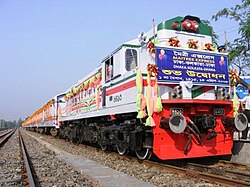 WDM-2 is known as Class 6400 in Bangladesh


See also[edit | edit source]
References[edit | edit source]
- ↑ "Report of the expert Committee on Coal Consumption on Railways, 1958". Indian Culture. Retrieved 13 November 2022.
- ↑ "WDM-4 masquerading as a WDM-3!". IRFCA.org. Retrieved 13 November 2022.
- ↑ "WDM-4 specs for IR" (PDF). Retrieved 13 November 2022.
- ↑ "[IRFCA] What do the designations such as 'WDM-2', 'WAP-4' mean". www.irfca.org. Retrieved 13 November 2022.
- ↑ "Four decades of service: The early workhorses of India's diesel age - National Rail Museum". Google Arts & Culture. Retrieved 13 November 2022.
- ↑ 6.0 6.1 "Diesel Locomotive Roster – The WDM (ALCO) Series". 24 Coaches. 30 October 2013. Retrieved 13 November 2022.
- ↑ "WDM-2 18040 - IRFCA Locomotive Database". www.irfca.org. Retrieved 13 November 2022.
- ↑ Historical Railway Images (31 December 2019). "India Railways - Indian Government Railways Class WDM2 (DL560C) diesel locomotive Nr. 18041 (Alco 84199 / 1962)". Retrieved 13 November 2022.
- ↑ 9.0 9.1 "[IRFCA] Indian Railways FAQ - Broad Gauge Diesel Locomotives". www.irfca.org. Retrieved 13 November 2022.
- ↑ "WDM-2 18233 - IRFCA Locomotive Database". www.irfca.org. Retrieved 13 November 2022.
- ↑ "[IRFCA] Indian Railways FAQ - Production Units & Workshops". www.irfca.org. Retrieved 13 November 2022.
- ↑ "WDM-2 18299 - IRFCA Locomotive Database". www.irfca.org. Retrieved 13 November 2022.
- ↑ "WDM-3A 16887 - IRFCA Locomotive Database". www.irfca.org. Retrieved 13 November 2022.
- ↑ "History of DLW, Varanasi". Archived from the original on 2 April 2019. Retrieved 13 November 2022.
- ↑ "DMW — About Us" (PDF).
- ↑ "Forced Cooled Roof Mounted DBR Assembly with Short Hood (WDM3D/WDG3A Alco Type Locomotive DU100102004)". Daulat Ram Engineering. Retrieved 13 November 2022.
- ↑ "Katni shed history" (PDF). Retrieved 13 November 2022.
- ↑ Johnson, Lou (1978). "Indian Railways WDM2 17722 with Himagiri Express at Varanasi". Retrieved 13 November 2022.
- ↑ Smith, Roderick (18 January 1977). "Northbound Tamil Nadu (WDM-2 #18321?) at 9.24, overtaking a freight train". www.irfca.org. Retrieved 13 November 2022.
- ↑ Bodas, Atul (1986). "Ratlam WDM2 #18640 and an unknown one leads Rajdhani Express towards Bombay Central through Borivali". www.irfca.org. Retrieved 13 November 2022.
- ↑ Morris, Roger (6 March 1992). "WDM-2A #18425 and 18640 are seen at Bombay Central having brought in the overnight express from Delhi". www.irfca.org. Retrieved 13 November 2022.
- ↑ Chandran, Sheeju (2006). "Interactive Diagram of the WDM-2 Locomotive". IRFCA. Archived from the original on 21 June 2019. Retrieved 13 November 2022.
- ↑ "Railway Website Mechanical Engineering Traction Circulars". Retrieved 13 November 2022.
- ↑ "Indian Railways Maintenance Manual for Diesel Locomotives" (PDF). December 2013. Retrieved 13 November 2022.
- ↑ "Maintenance Handbook on Roller Bearing fitted on WDM2 Diesel Locomotive" (PDF). July 2003. Retrieved 13 November 2022.
- ↑ "[IRFCA] Brake systems used by IR". www.irfca.org. Retrieved 13 November 2022.
- ↑ "WDM-2 17890 - IRFCA Locomotive Database". www.irfca.org. Retrieved 13 November 2022.
- ↑ "[IRFCA] WDM-2 'Jumbo' locos". www.irfca.org. 1998. Retrieved 13 November 2022.
- ↑ "WDM-2 17722 - IRFCA Locomotive Database". www.irfca.org. Retrieved 13 November 2022.
- ↑ "WDM-2 17748 - IRFCA Locomotive Database". www.irfca.org. Retrieved 13 November 2022.
- ↑ Kumar, Nitin (13 September 2014). "WDM2 17722 'JUMBO' at Dildarnagar Junction". Retrieved 13 November 2022.
- ↑ Nanda, Shashanka (20 September 2004). "Kazipet WDM2 #018210 hauls a departmental flat car rake carrying finished track sections". www.irfca.org. Retrieved 13 November 2022.
- ↑ 33.0 33.1 Bharaj, Ankit (13 July 2008). "SSB (Shakurbasti) WDM-2S #17217 just outside Ludhiana diesel shed onboard Sindhu Exp". www.irfca.org. Retrieved 13 November 2022.
- ↑ "Class M8". 18 September 2012. Retrieved 13 November 2022.
- ↑ "Diesel Locomotives of Sri Lanka Locomotive classification". www.srilankanlocos.com. Archived from the original on 2 May 2007. Retrieved 13 November 2022.
- ↑ "෴M8 දුම්රිය එන්ජිම - අපේ අසල්වැසි රට වන ඉන්දියාවේ නිෂ්පාදනයක්෴". Loco Lanka. 6 February 2011. Retrieved 13 November 2022.
- ↑ "SLR Locomotive data". www.srilankanlocos.com. Archived from the original on 2 May 2007. Retrieved 13 November 2022.
- ↑ "[IRFCA] Indian Railways FAQ: Diesel and Electric Locomotive Specifications". www.irfca.org. Archived from the original on 4 June 2020. Retrieved 13 November 2022.
- ↑ Rayaguru, Kamal (27 May 2006). "WDM-2 18068 hauls the Ratnagiri–Dadar passenger". www.irfca.org. Retrieved 13 November 2022.
- ↑ "WDM-2 18068 - IRFCA Locomotive Database". www.irfca.org. Retrieved 13 November 2022.
- ↑ Garg, Anil Kumar. "Original Alco built WDM-2/S #18068 rests with WCAM3 #21954". indiarailinfo.com. Retrieved 13 November 2022.
- ↑ "WDM-2 18236 - IRFCA Locomotive Database". www.irfca.org. Retrieved 13 November 2022.
- ↑ "WDM-2 18473 - IRFCA Locomotive Database". www.irfca.org. Retrieved 13 November 2022.
- ↑ "Listing All Locos - IRFCA Locomotive Database". www.irfca.org. Retrieved 13 November 2022.
- ↑ "Heritage Directorate, Railway Board, Ministry of Railways". www.indianrailways.gov.in. Retrieved 13 November 2022.
- ↑ "Heritage Inventory for Website". Retrieved 13 November 2022.
- ↑ "WDM-3A 16000 - IRFCA Locomotive Database". Retrieved 13 November 2022.
- ↑ "WDM-2 17307 - IRFCA Locomotive Database". www.irfca.org. Retrieved 13 November 2022.
- ↑ "WDM-2 17445 - IRFCA Locomotive Database". www.irfca.org. Retrieved 13 November 2022.
- ↑ "WDM-3A 17754 - IRFCA Locomotive Database". www.irfca.org. Retrieved 13 November 2022.
- ↑ "WDM-2 18040 - IRFCA Locomotive Database". www.irfca.org. Retrieved 13 November 2022.
- ↑ Vicky (24 October 2004). "WDM-2#18040, which has just been moved to the NRM". Retrieved 13 November 2022.
- ↑ "WDM-2 18113 - IRFCA Locomotive Database". www.irfca.org. Retrieved 13 November 2022.
- ↑ "WDM-2 18119 - IRFCA Locomotive Database". www.irfca.org. Retrieved 13 November 2022.
- ↑ "WDM-2 18160 - IRFCA Locomotive Database". www.irfca.org. Retrieved 13 November 2022.
- ↑ "WDM-2 18233 - IRFCA Locomotive Database". www.irfca.org. Retrieved 13 November 2022.
- ↑ "WDM-2 18575 - IRFCA Locomotive Database". www.irfca.org. Retrieved 13 November 2022.
- ↑ "WDM-3A 18599 - IRFCA Locomotive Database". www.irfca.org. Retrieved 13 November 2022.


Notes[edit | edit source]
Bibliography[edit | edit source]
| Steam |
|      | ||||||||
|---|---|---|---|---|---|---|---|---|---|---|
| Diesel |
| |||||||||
| DC electric |
| |||||||||
| AC electric |
| |||||||||
| Dual (AC and DC) electric |
| |||||||||
| Dual mode |
| |||||||||