






m Movebot moved page Talk:Bodhi tree to Bodhi tree without leaving a redirect: BP:MOVE |
No edit summary |
||
| Line 1: | Line 1: | ||
# | {{short description|Sacred fig tree in Bodh Gaya, Bihar, India}} | ||
{{About|an [[List of individual trees|individual tree]]|the species|Ficus religiosa}} | |||
{{coord|24|41|45.29|N|84|59|29.29|E|display=title}} | |||
{{More citations needed|date=January 2025}} | |||
{{Use Indian English|date=December 2022}} | |||
{{Use dmy dates|date=October 2025}} | |||
[[File:Bodhgaya 3639641913 f4c5f73689 t.jpg|thumb|The Mahabodhi tree at the [[Mahabodhi Temple]] in Bodh Gaya]] | |||
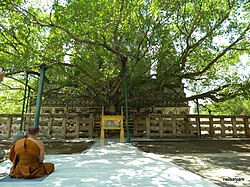
[[File:Bodhi Tree Distant View - panoramio.jpg|thumb|A Buddhist monk in front of the [[Mahabodhi tree]]]] | |||
[[File:Bodhgaya 3640455476 ece9eaf386 t.jpg|thumb|The [[Diamond throne]], or ''Vajrashila'', at the spot where the Buddha is said to have sat under the Bodhi Tree in Bodh Gaya]] | |||
The '''Bodhi Tree''' (Sanskrit and Pāli: ''Bodhi'' meaning "awakening" or "enlightenment"<ref name="britannicaBo" />) is the specific [[Bo tree]] (from the [[Sinhala language|Sinhala]] ''bo'', derived from ''bodhi''<ref name="britannicaBo">{{cite encyclopedia |title=Bo tree |encyclopedia=Encyclopaedia Britannica |url=https://www.britannica.com/plant/Bo-tree |access-date=20 October 2025}}</ref>)—a sacred fig (''Ficus religiosa'')<ref name="britannicaBo" /><ref name="sharma2007">{{cite book |last=Sharma |first=Arvind |title=A Guide to Buddhism |publisher=Cambridge University Press |year=2007 |page=42}}</ref>—located within the Buddhist [[Mahabodhi Temple]], a [[UNESCO World Heritage Site]], in Bodh Gaya, Bihar, India.<ref name="unescoBG">{{cite web |title=Mahabodhi Temple Complex at Bodh Gaya |url=https://whc.unesco.org/en/list/1056 |publisher=UNESCO World Heritage Centre |access-date=20 October 2025}}</ref> According to Buddhist tradition, it was under a Bo tree located at this site that [[The Buddha|Siddhartha Gautama]], the spiritual teacher who later became known as [[The Buddha|Gautama Buddha]], or simply the Buddha, attained [[Enlightenment in Buddhism|enlightenment]], or [[Buddhahood]], around the 5th century BCE.<ref name="buswell2013">{{cite book |last=Buswell Jr. |first=Robert E. |author2=Lopez Jr., Donald S. |title=The Princeton Dictionary of Buddhism |publisher=Princeton University Press |year=2013 |page=118}}</ref> In Buddhist art and iconography, the Bodhi Tree is commonly depicted with its characteristic heart-shaped leaves, a feature of ''Ficus religiosa'' that has come to symbolize wisdom and spiritual awakening.<ref name="britannicaBo" /><ref name="sharma2007" /> | |||
The original tree no longer survives, but its descendants have been venerated for more than two millennia. Over the centuries, the tree and its successors have undergone many episodes of destruction and renewal. Notable recorded incidents include its felling during the reign of [[Ashoka|Emperor Aśoka]] ({{circa|268–232 BCE}}), its destruction by Queen [[Tishyaraksha|Tissarakkhā]] around 254 BCE, its damage or destruction during the persecution of Buddhism under [[Pushyamitra Shunga|King Puṣyamitra Śuṅga]] in the 2nd century BCE, and its later cutting down by [[Shashanka|King Śaśāṅka of Gauda]] around 600 CE. Yet each time, it was replanted from surviving saplings.<ref>{{Cite web |title=Buddhist Studies: Bodhi Tree |url=https://www.buddhanet.net/e-learning/dharmadata/fdd23/ |access-date=21 October 2025 |website=buddhanet.net}}</ref><ref>{{Cite book |last=Benimadhab Barua |url=http://archive.org/details/gayaandbuddhagay035500mbp |title=Gaya and Buddha Gaya Volume I |publisher=Stis Chandra Seal Calcutta |others=BRAOU, Digital Library of India}}</ref><ref name="davids1903">{{cite book |last=Rhys Davids |first=T. W. |url=https://archive.org/details/in.ernet.dli.2015.213183 |title=Buddhist India |publisher=T. Fisher Unwin |year=1903 |pages=44–46 |access-date=20 October 2025}}</ref><ref name="mahavamsa">{{cite book |url=https://archive.org/details/in.ernet.dli.2015.188996 |title=The Mahāvaṃsa: The Great Chronicle of Sri Lanka |publisher=Oxford University Press |year=1912 |editor-last=Geiger |editor-first=Wilhelm |chapter=18–20}}</ref><ref name="cunningham1892" /> | |||
A [[sapling]] from the original Bodhi Tree was sent to Sri Lanka by Emperor Aśoka, with his daughter [[Sanghamitta|Sanghamittā Therī]], in 288 BCE, and planted at [[Anuradhapura]], where it survives today as the [[Jaya Sri Maha Bodhi]]—regarded as the oldest living human-planted tree with a known date.<ref name="carrithers1983">{{cite book |last=Carrithers |first=Michael |title=The Buddha |publisher=Oxford University Press |year=1983 |page=14}}</ref><ref name="unescoSL">{{cite web |title=Sacred City of Anuradhapura |url=https://whc.unesco.org/en/list/200 |publisher=UNESCO World Heritage Centre |access-date=20 October 2025}}</ref><ref name="mahavamsa" /> The current Bodhi Tree at Bodh Gaya, planted in 1881 by British archaeologist [[Alexander Cunningham]] from a cutting of the Sri Lankan tree, continues to be one of the most revered pilgrimage sites in Buddhism.<ref name="cunningham1892">{{cite book |last=Cunningham |first=Alexander |url=https://archive.org/details/cu31924008747788/page/n59/mode/2up |title=Mahâbodhi; or, The Great Buddhist Temple under the Bodhi Tree at Buddha-Gaya |publisher=The Archaeological Survey of India |year=1892 |pages=25–30 |access-date=20 October 2025}}</ref> | |||
==Origin and descendants== | |||
<!--"Buddhist devotion#Symbols" links here. If this section should ever be renamed or removed, please adjust the corresponding wikilink. Thank you.--> | |||
===Bodh Gaya=== | |||
{{main|Mahabodhi Temple}} | |||
[[File:A small temple beneath the Bodhi tree, Bodh Gaya, c. 1810.jpg|thumb|left|1810 picture of a small temple beneath the Mahabodhi tree, [[Bodh Gaya]]<ref>[http://www.bl.uk/onlinegallery/onlineex/apac/addorimss/a/019addor0003269u00000000.html A small Hindu temple beneath a banyan tree, Bodhgaya] British Library.</ref>]] | |||
[[File:Maha Bodhi tree 2.jpg|thumb|The Mahabodhi tree at Bodh Gaya in 2015]] | |||
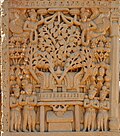
[[File:Pipal tree temple of Bodh Gaya depicted in Sanchi Stupa 1 Eastern Gateway.jpg|thumb|Illustration of the temple commissioned by [[Asoka]] at Bodh Gaya around the Bodhi Tree. Sculpture of the [[Satavahana]] period at [[Sanchi]], 1st century CE.]] | |||
[[File:Bodhi Tree Marking - panoramio.jpg|thumb|Bodhi Tree sign, 2013]] | |||
The Bodhi Tree at the [[Mahabodhi Temple]]—revered as the ''Sri Maha Bodhi''—marks the sacred site where [[Gautama Buddha]] is said to have attained enlightenment (''bodhi'') while meditating beneath its branches. According to [[Buddhist texts]], around 528 BCE, Gautama seated himself beneath a ''Ficus religiosa'' at Uruvela (present-day [[Bodh Gaya]], India). Resolving not to rise until he had realized the ultimate truth, he entered a state of profound meditation. After that night, he attained [[Enlightenment in Buddhism|Sambodhi]] (full enlightenment), thereby becoming the Buddha—the "Awakened One".<ref>{{Cite book |url=https://books.google.com/books?id=x8ObMQ1GGsUC&dq=%22Animisalocana+cetiya%22&pg=PA320 |title=Dictionary of Pali Proper Names |first=G. P. |last=Malalasekera |date=14 September 2003 |publisher=Asian Educational Services |isbn=978-81-206-1823-7 |via=Google Books}}</ref> | |||
The spot was used as a shrine even during the Buddha's lifetime. Emperor [[Ashoka]], a devoted patron of Buddhism, visited Bodh Gaya about two centuries later and built a stone [[balustrade]] and temple complex around the sacred tree, establishing the Mahabodhi Temple that stands there today.<ref name="Mahavamsa">{{cite web|publisher=Mahavamsa, chap. 17, 17.|url= http://lakdiva.org/mahavamsa/chap017.html|title= CHAPTER XVII_The Arrival of the Relics}}</ref> His queen, [[Tishyaraksha|Tissarakkhā]], was jealous of the tree, and three years after she became queen (in the nineteenth year of Ashoka's reign), she ordered it to be killed.<ref>{{cite web|publisher= Mahavamsa, chap. 20, 4f.|url= http://lakdiva.org/mahavamsa/chap020.html|title=CHAPTER XX_The Nibbana of the Thera}}</ref> Every time the tree was destroyed, however, a new one was planted in the same place,<ref>{{cite book|first1=Melton|last1= J. Gordon|first2= Baumann|last2=Martin|year=2010|url=https://books.google.com/books?id=v2yiyLLOj88C|title=Religions of the World: A Comprehensive Encyclopedia of Beliefs and Practices|edition=Second|publisher=[[ABC-CLIO]], Santa Barbara|isbn=978-1-59884-204-3|page=358}}</ref> and a monastery was constructed at the [[Vajrasana, Bodh Gaya|Enlightenment Throne of the Buddha]].<ref>{{cite web|publisher=Mahavamsa, chap. 29, 41.|url= http://lakdiva.org/mahavamsa/chap029.html|title=Chapter XXIX: The Beginning of the Great Thupa}}</ref> The monastery was called ''Bodhimanda Vihara'' (''[[bodhimaṇḍa]]'' refers to a "seat of awakening", while ''[[vihāra]]'' is a Buddhist temple). | |||
In 1862, the British archaeologist [[Alexander Cunningham]] wrote of the site as the first entry in the first volume published by the [[Archaeological Survey of India]]: | |||
<blockquote>The celebrated Bodhi tree still exists, but is very much decayed; one large stem, with three branches to the westward, is still green, but the other branches are barkless and rotten. The green branch perhaps belongs to some younger tree, as there are numerous stems of apparently different trees clustered together. The tree must have been renewed frequently, as the present [[Ficus religiosa|Pipal]] is standing on a terrace at least 30 feet above the level of the surrounding country. It was in full vigour in 1811, when seen by [[Francis Buchanan-Hamilton|Dr. Buchanan (Hamilton)]], who describes it as in all probability not exceeding 100 years of age.<ref>[https://archive.org/details/cu31924008747788 Archaeological Survey of India], Volume 1, Four Reports Made During the Years 1862-63-64-66</ref></blockquote> | |||
However, the tree decayed further, and in 1876, what remained of it was destroyed in a storm. Cunningham wrote that the young scion of the parent tree was already in existence to take its place.<ref name="buddhanet.net">{{cite web|url=http://www.buddhanet.net/e-learning/dharmadata/fdd23.htm |title=Buddhist Studies: Bodhi Tree |publisher=Buddhanet.net |access-date=1 August 2013}}</ref><ref>[https://archive.org/stream/cu31924008747788#page/n45/mode/1up Mahâbodhi, or the great Buddhist temple under the Bodhi tree at Buddha-Gaya], Alexander Cunningham, 1892: "I next saw the Tree in 1871, and again in 1875, when it had become completely decayed, and shortly afterwards, in 1876, the only remaining portion of the Tree fell over the west wall during a storm, and the Old Pipal Tree was gone. Many seeds, however, had been collected, and young scions of the parent tree were already in existence to take its place."</ref> | |||
Since 2007, the [[Forest Research Institute (India)|Forest Research Institute of India]] has assisted in the upkeep of the Mahabodhi tree.<ref>{{Cite news |last=Kazmi |first=S M A <!-- this was previously cited as '|last=Kazmi |first=S M A' (https://en.wikipedia.org/w/index.php?title=Bodhi_tree&diff=1081484452&oldid=1081309284), but the webpage as of 2025-09-29 says "Written by Smakazmi Dehradun" (though for some reason, it has a bit of code "to check and load script when jQuery is ready" and a line break in between the two parts of the name), and the HTML code has stuff like '<meta itemprop="author" content="smakazmi">', '"author":[{"@type":"Person","name":"Smakazmi","url":false}]'; however, https://citizenmatters.in/author/smakazmi/ and https://theaidem.com/author/smakazmi/ say "[S M A / SMA] Kazmi is a senior journalist who has worked in Chandigarh, Amritsar, J&K and Uttarakhand for the past three decades with 'The Indian Express' and' The Tribune' newspapers. He is based at Dehradun since 1998.", so I'm guessing that the Indian Express screwed up when converting between systems or something --> |date=7 August 2007 |title=Forest institute suggests methods to save Bodhi tree |url=https://indianexpress.com/article/news-archive/forest-institute-suggests-methods-to-save-bodhi-tree/ |url-access=subscription |work=The Indian Express}}</ref><ref>{{Cite web |last=Qadir |first=Abdul |date=31 August 2017 |title=Two Forest Research Institute scientists examine Bodhi tree, collect sample |url=https://timesofindia.indiatimes.com/city/gaya/two-fri-scientists-examine-bodhi-tree-collect-sample/articleshow/60297030.cms |access-date=7 April 2022 |website=The Times of India}}</ref><ref>{{Cite web |last=Sahay |first=Anand Mohan |date=25 October 2007 |title=Branch of bodhi tree was cut 3 years ago: Report |url=https://www.rediff.com/news/2007/oct/25bodhi.htm |access-date=7 April 2022 |website=rediff.com}}</ref> Various measures have been taken to protect the health of the tree,<ref>{{Cite web |last=Kalam |first=Farhana |date=8 November 2018 |title=Steps taken to protect sacred Bodhi tree |url=https://www.telegraphindia.com/bihar/steps-taken-to-protect-sacred-bodhi-tree/cid/1674397 |website=Telegraph India}}</ref><ref>{{Cite web |last=Kalam |first=Farhana |date=1 December 2018 |title=Pruning to help Bodhi tree shed weight |url=https://www.telegraphindia.com/bihar/pruning-to-help-bodhi-tree-shed-weight/cid/1677300 |website=Telegraph India}}</ref><ref>{{Cite web |last=Khan |first=Zeyad Masroor |date=4 May 2018 |title=The Bodhi Tree the Buddha Sat Under is Dead. Meet the scientist who keeps its sacred descendant alive. |url=https://www.vice.com/en/article/the-bodhi-tree-the-buddha-sat-under-is-dead/ |website=Vice}}</ref> and cloning was considered in 2008.<ref name=":0">{{Cite news |last=Bedi |first=Rahul |date=9 April 2008 |title=Scientists turn to cloning in attempt to save Buddhism's holiest tree for posterity |url=https://www.irishtimes.com/news/scientists-turn-to-cloning-in-attempt-to-save-buddhism-s-holiest-tree-for-posterity-1.911257 |access-date=7 April 2022 |newspaper=The Irish Times}}</ref> | |||
===Jetavana, Uttar Pradesh=== | |||
{{More citations needed|section|date=January 2025}} | |||
[[File:Adoration_of_the_Diamond_Throne_and_the_Bodhi_Tree_Bharhut_relief.jpg|thumb|Ashoka's [[Mahabodhi Temple]] and [[Diamond throne]] in Bodh Gaya, built circa 250 BCE. The inscription between the ''chaitya'' arches reads: "Bhagavato Sakamunino/ bodho", meaning "the building round the Bodhi tree of the Holy [[Shakyamuni|Sakamuni]]".<ref>{{cite book |last1=Luders |first1=Heinrich |title=Corpus Inscriptionum Indicarum Vol.2 Pt.2 Bharhut Inscriptions |date=1963 |page=95 |url=https://archive.org/stream/in.ernet.dli.2015.107897/2015.107897.Corpus-Inscriptionum-Indicarum-Vol2-Pt2-Bharhut-Inscriptions#page/n145}}</ref> [[Bharhut]] frieze (circa 100 BCE).]] | |||
It is said that in the ancient Buddhist texts,<ref>{{cite web | url=http://www.buddhisma2z.com/content.php?id=45 | title=Guide to Buddhism A to Z }}</ref> in order for people to make offerings in the name of the Buddha when he was away on pilgrimage, the Buddha sanctioned the planting of a seed from the Bodhi tree in Bodh Gaya in front of the gateway of [[Jetavana|Jetavana Monastery]], near Sravasti. For this purpose, [[Maudgalyayana|Moggallana]] took a fruit from the tree as it dropped from its stalk, before it reached the ground. It was planted in a golden jar by [[Anathapindika]], with great pomp and ceremony. A sapling immediately sprouted forth, fifty [[cubit]]s high, and in order to consecrate it, the Buddha spent one night under it in meditation. This tree, because it was planted under the direction of [[Ananda]], came to be known as the Ananda Bodhi. | |||
===Anuradhapura, Sri Lanka=== | |||
{{More citations needed|section|date=January 2025}} | |||
King Ashoka's daughter [[Sanghamitta|Sanghamittā Theri]] brought a piece of the tree with her to [[Sri Lanka|Ceylon]], where it continues to grow in the island's ancient capital of [[Anuradhapura]].<ref name="buddhanet.net"/> It is named [[Jaya Sri Maha Bodhi]].<ref>{{cite web|url=http://srimahabodhi.org/rain-maker2.htm |title=Rain-makers: The Sacred Bodhi Tree Part 2 |publisher=Srimahabodhi.org |date=24 April 2003 |access-date=1 August 2013}}</ref><ref>{{cite web|author=K.H.J. Wijayadasa |url=http://srimahabodhi.org/index.htm |title=Śrī Maha Bodhi |publisher=Srimahabodhi.org |access-date=1 August 2013}}</ref> According to the ''[[Mahāvaṃsa]]'', Jaya Sri Maha Bodhi was planted in 288 BCE, making it the oldest verified specimen of any [[angiosperm]]. In this year (the twelfth year of King Ashoka's reign), the right branch of the Bodhi Tree was brought by Sanghamittā to Anurādhapura and placed by the left foot of [[Devanampiya Tissa]]. The Buddha, on his deathbed, had resolved five things, one being that the branch to be taken to Ceylon should detach itself.<ref name="Mahavamsa" /> From Bodh Gayā, the branch was taken to [[Pātaliputta]] and thence to [[Tamralipta|Tāmalittī]], where it was placed on a ship and taken across the sea. It finally arrived at Anuradhapura, staying on the way at [[Tivakka]]. | |||
===Honolulu, Hawaii=== | |||
In 1913, [[Anagarika Dharmapala]] took a sapling of Jaya Sri Maha Bodhi to Hawaii, where he presented it to his benefactor, [[Mary E. Foster]], who had funded much Buddhist missionary work. She planted it in the grounds of her house in [[Honolulu]], by the Nuʻuanu stream. On her death, she left her house and its grounds to the people of Honolulu, and it became the [[Foster Botanical Garden]].<ref>[https://www.waikikioutdoorcircle.org/uploads/3/7/9/7/37971713/derussy_walk_v4f.pdf Waikiki's "Central Park" – Fort DeRussy Armed Forces Reserve] waikikioutdoorcircle.org</ref> | |||
===Chennai, India=== | |||
[[File:Bodhi tree in Theosophical Society.jpg|thumb|Sapling of the Maha bodhi tree planted in the year 1950 at the [[Theosophical Society Adyar]]]] | |||
In 1950, [[Jinarajadasa]] took three saplings of the Sri Maha Bodhi to plant two in [[Chennai]], India: one near the Buddhist temple at the [[Theosophical Society Adyar|Theosophical Society]] and the other at the riverside of [[Adyar Creek]]. The third sapling was planted near a meditation center in Sri Lanka.<ref>{{cite web|last1=Madhavan|first1=Chitra|title=Buddhist shrine in Adyar|url=http://madrasmusings.com/Vol%2023%20No%206/buddhist-shrine-in-adyar.html|website=Madras Musings|access-date=14 November 2015|ref=(ARCHIVE) VOL. XXIII NO. 6, 1–15 July 2013}}</ref><ref>{{Cite news |last=Krishnan |first=D. |date=3 April 2017 |title=Under the Bodhi tree |work=The Hindu |url=https://www.thehindu.com/society/chennai-and-the-bodhi-tree/article17771583.ece |issn=0971-751X |url-access=subscription}}</ref> | |||
===Trấn Quốc, Hanoi, Vietnam=== | |||
In 1959, to mark a visit to Vietnam by the first president of India, [[Rajendra Prasad]], a cutting of the original tree in Bodh Gaya was gifted, and it presently stands on the grounds of [[Trấn Quốc Pagoda]] in Hanoi.<ref>{{Cite web |title=Statement by the President of India, Shri Pranab Mukherjee to the media on board the special aircraft on his way back from his state visit to the socialist republic of Vietnam |url=https://pib.gov.in/newsite/PrintRelease.aspx?relid=109775 |access-date=22 December 2022 |website=pib.gov.in}}</ref> | |||
===Thousand Oaks, California=== | |||
In 2012, the Bangladeshi philanthropist Brahmanda Pratap Barua took a sapling of the Bodhi Tree from Bodh Gaya, to [[Thousand Oaks, California]], where he presented it to his benefactor, Anagarika Glenn Hughes, who had funded much Buddhist work and teaches Buddhism in the United States.<ref>See "Navel in Buddha" on Academia.edu https://www.academia.edu/43042460/Navel_in_Buddha. Text is quoted verbatim. Multiple internet sites show the same text, but only this one appears to be a more reliable source.</ref> | |||
===Nihon-ji, Japan=== | |||
In 1989, the government of India presented the temple of [[Nihon-ji]] with a sapling from the Bodhi Tree as a gesture of world peace.{{citation needed|date=March 2021}} | |||
===Deekshabhoomi, Nagpur, India=== | |||
{{Unreferenced section|date=January 2025}} | |||
A Bodhi tree was planted at the [[Deekshabhoomi]] Buddhist monument in Nagpur, India, from three branches of the Bodhi Tree at Anuradhapura in Sri Lanka. [[Bhadant Anand Kausalyayan]] brought the branches from Sri Lanka as a memorial of Buddha's enlightenment. The site is holy to [[Navayana Buddhism]], as it is the place where the Indian political leader [[B. R. Ambedkar]] converted to Buddhism, along with 600,000 followers, on 14 October 1956, during the [[Dhammachakra Pravartan Din]] festival. | |||
===Quezon City, Philippines=== | |||
A sapling of the Bodhi Tree from Anuradhapura was planted on 15 May 2011 at Wisdom Park in [[Mariana, Quezon City|New Manila]], Quezon City, Philippines, by [[D. M. Jayaratne]], Prime Minister of Sri Lanka, and Mariano S. Yupitun, founder of Universal Wisdom Foundation Inc.{{Citation needed|date=January 2025}} | |||
===Bendigo, Victoria, Australia=== | |||
A sapling of the Jaya Sri Maha Bodhi tree was sent in 2022 to the [[Great Stupa of Universal Compassion]], the largest stupa in the Western world, near [[Bendigo]] in central Victoria, Australia.<ref>{{Cite web |last=Lam |first=Raymond |date=31 August 2021 |title=Sacred Bodhi Sapling in Australian Quarantine to Be Released in May 2022 |url=https://www.buddhistdoor.net/news/sacred-bodhi-sapling-in-australian-quarantine-to-be-released-in-may-2022/ |website=Buddhistdoor Global}}</ref> | |||
===Brisbane, Queensland, Australia=== | |||
A sapling of the Bodhi tree from Anuradhapura was planted in April 2008 at Kurilpa Point, the site of the [[Queensland Art Gallery and Gallery of Modern Art]], by the artist [[Lee Mingwei]], as the centerpiece to his "Bhodi Tree Project".<ref>{{cite web|title=Lee Mingwei 'Bodhi Tree Project' |url=https://www.qagoma.qld.gov.au/stories/lee-mingwei-bodhi-tree-project-queensland-australia |website=qagoma.qld.gov.au |date=4 December 2022 |access-date=9 January 2025}}</ref> | |||
===Brazil=== | |||
There are two descendants of the Bodhi Tree in Brazil: one in the Busshinji temple, the head temple of [[Sōtō]] in Latin America, in [[São Paulo]], and another in the Sōtō temple Daissenji, in [[Florianópolis]].<ref>{{cite web|title=As Raízes Culturais da Comemoração do Despertar (Rohatsu) |url=https://www.budismohoje.org.br/as-raizes-culturais-da-comemoracao-do-despertar-rohatsu/ |website=budismohoje.org.br |date=4 December 2021 |access-date=9 January 2025 |language=pt |trans-title=The Cultural Roots of the Awakening Celebration (Rohatsu)}}</ref> | |||
===South Korea=== | |||
A sapling from the Mahabodhi tree in Bodh Gaya was given to South Korea in 2022 as a symbol of friendship between the two countries. It was planned to eventually be planted at a Buddhist temple.<ref>{{Cite news |date=8 March 2022 |agency=Indo-Asian News Service |title=India's gift to South Korea: A sacred Bodhi Tree sapling |url=https://www.ndtv.com/india-news/indias-gift-to-south-korea-a-sacred-bodhi-tree-sapling-553262 |work=NDTV}}</ref> | |||
===Mahabodhi trees of other Buddhas=== | |||
Following is a list of the various Mahabodhi trees under which all of the Buddhas known to [[Theravada]] Buddhism attained [[buddhahood]]:<ref name=GCB1P2>{{cite book|editor-last=Sayadaw|editor-first=Mingun|editor-link=Mingun Sayadaw|title=The Great Chronicle of Buddhas|volume=1, Part 2|chapter=Appendix: List of the Mahabodhi Trees of 24 Buddhas|pages=316–317, 322|publisher=Ti=Ni Press|location=Yangon, Myanmar|year=1992|url=}}</ref> | |||
{| class="wikitable sortable" | |||
|- | |||
! Buddha (Pāli name) | |||
! ''Bodhirukka'' (tree of enlightenment; Pāli name) | |||
! [[Binomial nomenclature|binomial name]] | |||
|- | |||
|[[Taṇhaṅkara]] | |||
|''rukkaththana'' | |||
|''[[Alstonia scholaris]]'' | |||
|- | |||
|[[Medhaṅkara Buddha|Medhaṅkara]] | |||
|''kaela'' | |||
|''[[Butea monosperma]]'' | |||
|- | |||
|[[Saraṇaṅkara Buddha|Saraṇaṅkara]] | |||
|''pulila'' | |||
|''[[Dolichandrone spathacea]]'' | |||
|- | |||
|[[Dīpankara Buddha|Dīpaṃkara]] | |||
|''pipphali'' | |||
|''[[Ficus obtusifolia]]'' | |||
|- | |||
|[[Kaundinya Buddha|Koṇḍañña]] | |||
|''salakalyanīka'' | |||
|''[[Oroxylum indicum]]'' | |||
|- | |||
|[[Maṅgala Buddha|Maṅgala]] | |||
|''nāga'' | |||
|''[[Mesua ferrea]]'' | |||
|- | |||
|[[Sumana Buddha|Sumana]] | |||
|''nāga'' | |||
|''[[Mesua ferrea]]'' | |||
|- | |||
|[[Revata Buddha|Revata]] | |||
|''nāga'' | |||
|''[[Mesua ferrea]]'' | |||
|- | |||
|[[Sobhita Buddha|Sobhita]] | |||
|''nāga'' | |||
|''[[Mesua ferrea]]'' | |||
|- | |||
|[[Anomadassi Buddha|Anomadassi]] | |||
|''ajjuna'' | |||
|''[[Terminalia arjuna]]'' | |||
|- | |||
|[[Paduma Buddha|Paduma]] | |||
|''mahāsona'' | |||
|''[[Oroxylum indicum]]'' | |||
|- | |||
|[[Nārada Buddha|Nārada]] | |||
|''mahāsona'' | |||
|''[[Oroxylum indicum]]'' | |||
|- | |||
|[[Padumuttara Buddha|Padumuttara]] | |||
|''salala'' | |||
|''[[Pinus roxburghii]]'' | |||
|- | |||
|[[Sumedha Buddha|Sumedha]] | |||
|''mahanīpa'' | |||
|''[[Neolamarckia cadamba]]'' | |||
|- | |||
|[[Sujāta Buddha|Sujāta]] | |||
|''mahavelu'' | |||
|''[[Bambusa bambos]]'' | |||
|- | |||
|[[Piyadassi Buddha|Piyadassi]] | |||
|''kakudha'' | |||
|''[[Crateva religiosa]]'' | |||
|- | |||
|[[Atthadassi Buddha|Atthadassi]] | |||
|''campaka'' | |||
|''[[Magnolia champaca]]'' | |||
|- | |||
|[[Dhammadassī Buddha|Dhammadassī]] | |||
|''bimbijala'' | |||
|''[[Pavetta indica]]'' | |||
|- | |||
|[[Siddhattha Buddha|Siddhattha]] | |||
|''kanikara'' | |||
|''[[Pterospermum acerifolium]]'' | |||
|- | |||
|[[Tissa Buddha|Tissa]] | |||
|''asana'' | |||
|''[[Terminalia elliptica]]'' | |||
|- | |||
|[[Phussa]] | |||
|''amakala'' | |||
|''[[Phyllanthus emblica]]'' | |||
|- | |||
|[[Vipassī Buddha|Vipassī]] | |||
|''pāṭalī'' | |||
|''[[Stereospermum chelonoides]]'' | |||
|- | |||
|[[Sikhī Buddha|Sikhī]] | |||
|''puṇḍarīka'' | |||
|''[[Mangifera indica]]'' | |||
|- | |||
|[[Vessabhū Buddha|Vessabhū]] | |||
|''sāla'' | |||
|''[[Shorea robusta]]'' | |||
|- | |||
|[[Kakusandha Buddha|Kakusandha]] | |||
|''sirīsa'' | |||
|''[[Albizia lebbeck]]'' | |||
|- | |||
|[[Koṇāgamana Buddha|Koṇāgamana]] | |||
|''uḍumbara'' | |||
|''[[Ficus racemosa]]'' | |||
|- | |||
|[[Kassapa Buddha|Kassapa]] | |||
|''nigrodha'' | |||
|''[[Ficus benghalensis]]'' | |||
|- | |||
|[[The Buddha|Gautama Buddha]] (present Buddha) | |||
|''[[Ashvattha|assattha]]'' | |||
|''[[Ficus religiosa]]'' | |||
|- | |||
|[[Metteyya]] (future Buddha)<ref>{{cite web|url=https://www.accesstoinsight.org/tipitaka/dn/dn.26.0.than.html|title=Cakkavatti Sutta: The wheel-turning Emperor|website=accesstoinsight.org}}</ref> | |||
|''nāga'' | |||
|''[[Mesua ferrea]]'' | |||
|} | |||
==Bodhi Day== | |||
On 8 December, [[Bodhi Day]] celebrates Buddha's enlightenment underneath the Bodhi Tree. Those who follow the [[Dharma (Buddhism)|Dharma]] greet each other by saying, "Budu saranai!", which translates to "may the peace of the Buddha be yours".<ref>{{Cite news |last=Self |first=David |date=2 December 2005 |title=Dates for Assembly |work=The Times Educational Supplement |publisher=TES Global Limited |page=7 |issue=4663 |id=[[Nexis Uni]] [https://advance.lexis.com/api/document?collection=news&id=urn%3acontentItem%3a4HPS-4VC0-00X7-T39V-00000-00 {{small|4HPS-4VC0-00X7-T39V-00000-00}}].}}</ref> It is generally seen as a religious holiday, much like Christmas in the Christian West, in which special meals are served, especially cookies shaped like hearts (referencing the heart-shaped leaves of the Bodhi) and [[kheer]], the Buddha's first meal ending his six-year [[asceticism]].<ref name="prasoon07">{{cite book |last1=Prasoon |first1=Shrikant |url=https://books.google.com/books?id=Us9wbjmvXfgC&pg=PT32 |title=Knowing Buddha: [life and teachings] |date=2007 |publisher=Hindoology Books |isbn=978-81-223-0963-8 |location=[Delhi]}}</ref> | |||
==Bodhi Tree and Bihar emblem== | |||
The Bodhi tree is the main part of the [[Emblem of Bihar|Bihar state emblem]]. During [[British Raj|British rule]], the State Reorganisation Act of 1935 adopted the Bodhi Tree as the state emblem, following a recommendation to that effect being forwarded to the [[Royal Society]].<ref>{{Cite web |title=All the State Emblems and Their Meaning – NLC Bharat |url=https://www.nlcbharat.org/emblems/ |access-date=4 February 2024 |website=National Legislators Conference}}</ref><ref>{{Cite web |date=22 March 2010 |title=Bihar digging into history to discover roots of its emblem |url=https://www.hindustantimes.com/patna/bihar-digging-into-history-to-discover-roots-of-its-emblem/story-6cjRG9Ba4pI9W79TlG5yII.html |access-date=4 February 2024 |website=Hindustan Times}}</ref> | |||
==''Bodhi puja''== | |||
{{Unreferenced section|date=January 2025}} | |||
''Bodhi puja'', meaning "veneration of the Bodhi tree", is a ritual to worship the Bodhi Tree and the deity residing in it (Pali: ''rukkhadevata''; Sanskrit: ''vrikshadevata''). | |||
==Gallery== | |||
<gallery mode="packed"> | |||
The Bodhi Tree.jpg|A Bodhi tree leaf with a raindrop | |||
028 Bodhi Tree and Meditators (9222132890).jpg|Meditators at the Mahabodhi tree, Bodh Gaya | |||
Maha Bodhi tree.jpg|Mahabodhi tree, Bodh Gaya | |||
Sacred Tree of Bouddha - Jami al-Tawarikh - Folio 36 Verso.png|"The sacred tree of Buddha". A photo from the ''[[Jami' al-tawarikh]]'' by Rasheed al-Din Al-Hamazani, Folio 47 Recto. Collection of the Royal Asian Society in [[London]]. Rab-i-Rashidi 1314. | |||
Stamp of India - 1997 - Colnect 163602 - Bodhi Tree.jpeg|Indian stamp, 1997 – Colnect 163602 – Bodhi Tree | |||
A small temple beneath the Bodhi tree, Bodh Gaya, c. 1810.jpg|A small temple beneath the Bodhi Tree, Bodh Gaya, {{circa|1810}} | |||
102 Bodhi Tree, 15c, Ayutthaya (35122816611).jpg|Bodhi tree photograph from the [[Bangkok National Museum]], Thailand | |||
Jaya Sri Maha Bodhi - Anuradhapura 2.jpg|[[Jaya Sri Maha Bodhi]], Anuradhapura, Sri Lanka | |||
</gallery> | |||
==See also== | |||
* [[List of individual trees]] | |||
* [[Buchanania latifolia|Rājāyatana tree]] | |||
* [[Sacred tree]] | |||
* [[Sahabi Tree]] | |||
==References== | |||
{{reflist}} | |||
==Further reading== | |||
{{commonscat}} | |||
{{Buddhism topics}} | |||
{{Gautama Buddha}} | |||
{{Worship in Hinduism}} | |||
{{Tourist sites in Bihar}} | |||
{{Tourism in India}} | |||
[[Category:Bodh Gaya]] | |||
[[Category:Individual trees in India]] | |||
[[Category:Buddhist pilgrimage sites in India]] | |||
[[Category:Trees in Buddhism]] | |||
[[Category:Individual fig trees]] | |||
[[Category:Gautama Buddha]] | |||
Latest revision as of 04:45, 18 February 2026
24°41′45.29″N 84°59′29.29″E / 24.6959139°N 84.9914694°E
 | This article needs more citations. (January 2025) |


The Bodhi Tree (Sanskrit and Pāli: Bodhi meaning "awakening" or "enlightenment"[1]) is the specific Bo tree (from the Sinhala bo, derived from bodhi[1])—a sacred fig (Ficus religiosa)[1][2]—located within the Buddhist Mahabodhi Temple, a UNESCO World Heritage Site, in Bodh Gaya, Bihar, India.[3] According to Buddhist tradition, it was under a Bo tree located at this site that Siddhartha Gautama, the spiritual teacher who later became known as Gautama Buddha, or simply the Buddha, attained enlightenment, or Buddhahood, around the 5th century BCE.[4] In Buddhist art and iconography, the Bodhi Tree is commonly depicted with its characteristic heart-shaped leaves, a feature of Ficus religiosa that has come to symbolize wisdom and spiritual awakening.[1][2]
The original tree no longer survives, but its descendants have been venerated for more than two millennia. Over the centuries, the tree and its successors have undergone many episodes of destruction and renewal. Notable recorded incidents include its felling during the reign of Emperor Aśoka (c. 268–232 BCE), its destruction by Queen Tissarakkhā around 254 BCE, its damage or destruction during the persecution of Buddhism under King Puṣyamitra Śuṅga in the 2nd century BCE, and its later cutting down by King Śaśāṅka of Gauda around 600 CE. Yet each time, it was replanted from surviving saplings.[5][6][7][8][9]
A sapling from the original Bodhi Tree was sent to Sri Lanka by Emperor Aśoka, with his daughter Sanghamittā Therī, in 288 BCE, and planted at Anuradhapura, where it survives today as the Jaya Sri Maha Bodhi—regarded as the oldest living human-planted tree with a known date.[10][11][8] The current Bodhi Tree at Bodh Gaya, planted in 1881 by British archaeologist Alexander Cunningham from a cutting of the Sri Lankan tree, continues to be one of the most revered pilgrimage sites in Buddhism.[9]
Origin and descendants[edit | edit source]
Bodh Gaya[edit | edit source]


The Bodhi Tree at the Mahabodhi Temple—revered as the Sri Maha Bodhi—marks the sacred site where Gautama Buddha is said to have attained enlightenment (bodhi) while meditating beneath its branches. According to Buddhist texts, around 528 BCE, Gautama seated himself beneath a Ficus religiosa at Uruvela (present-day Bodh Gaya, India). Resolving not to rise until he had realized the ultimate truth, he entered a state of profound meditation. After that night, he attained Sambodhi (full enlightenment), thereby becoming the Buddha—the "Awakened One".[13]
The spot was used as a shrine even during the Buddha's lifetime. Emperor Ashoka, a devoted patron of Buddhism, visited Bodh Gaya about two centuries later and built a stone balustrade and temple complex around the sacred tree, establishing the Mahabodhi Temple that stands there today.[14] His queen, Tissarakkhā, was jealous of the tree, and three years after she became queen (in the nineteenth year of Ashoka's reign), she ordered it to be killed.[15] Every time the tree was destroyed, however, a new one was planted in the same place,[16] and a monastery was constructed at the Enlightenment Throne of the Buddha.[17] The monastery was called Bodhimanda Vihara (bodhimaṇḍa refers to a "seat of awakening", while vihāra is a Buddhist temple).
In 1862, the British archaeologist Alexander Cunningham wrote of the site as the first entry in the first volume published by the Archaeological Survey of India:
The celebrated Bodhi tree still exists, but is very much decayed; one large stem, with three branches to the westward, is still green, but the other branches are barkless and rotten. The green branch perhaps belongs to some younger tree, as there are numerous stems of apparently different trees clustered together. The tree must have been renewed frequently, as the present Pipal is standing on a terrace at least 30 feet above the level of the surrounding country. It was in full vigour in 1811, when seen by Dr. Buchanan (Hamilton), who describes it as in all probability not exceeding 100 years of age.[18]
However, the tree decayed further, and in 1876, what remained of it was destroyed in a storm. Cunningham wrote that the young scion of the parent tree was already in existence to take its place.[19][20]
Since 2007, the Forest Research Institute of India has assisted in the upkeep of the Mahabodhi tree.[21][22][23] Various measures have been taken to protect the health of the tree,[24][25][26] and cloning was considered in 2008.[27]
Jetavana, Uttar Pradesh[edit | edit source]
| This section needs more citations. (January 2025) |

It is said that in the ancient Buddhist texts,[29] in order for people to make offerings in the name of the Buddha when he was away on pilgrimage, the Buddha sanctioned the planting of a seed from the Bodhi tree in Bodh Gaya in front of the gateway of Jetavana Monastery, near Sravasti. For this purpose, Moggallana took a fruit from the tree as it dropped from its stalk, before it reached the ground. It was planted in a golden jar by Anathapindika, with great pomp and ceremony. A sapling immediately sprouted forth, fifty cubits high, and in order to consecrate it, the Buddha spent one night under it in meditation. This tree, because it was planted under the direction of Ananda, came to be known as the Ananda Bodhi.
Anuradhapura, Sri Lanka[edit | edit source]
| This section needs more citations. (January 2025) |
King Ashoka's daughter Sanghamittā Theri brought a piece of the tree with her to Ceylon, where it continues to grow in the island's ancient capital of Anuradhapura.[19] It is named Jaya Sri Maha Bodhi.[30][31] According to the Mahāvaṃsa, Jaya Sri Maha Bodhi was planted in 288 BCE, making it the oldest verified specimen of any angiosperm. In this year (the twelfth year of King Ashoka's reign), the right branch of the Bodhi Tree was brought by Sanghamittā to Anurādhapura and placed by the left foot of Devanampiya Tissa. The Buddha, on his deathbed, had resolved five things, one being that the branch to be taken to Ceylon should detach itself.[14] From Bodh Gayā, the branch was taken to Pātaliputta and thence to Tāmalittī, where it was placed on a ship and taken across the sea. It finally arrived at Anuradhapura, staying on the way at Tivakka.
Honolulu, Hawaii[edit | edit source]
In 1913, Anagarika Dharmapala took a sapling of Jaya Sri Maha Bodhi to Hawaii, where he presented it to his benefactor, Mary E. Foster, who had funded much Buddhist missionary work. She planted it in the grounds of her house in Honolulu, by the Nuʻuanu stream. On her death, she left her house and its grounds to the people of Honolulu, and it became the Foster Botanical Garden.[32]
Chennai, India[edit | edit source]

In 1950, Jinarajadasa took three saplings of the Sri Maha Bodhi to plant two in Chennai, India: one near the Buddhist temple at the Theosophical Society and the other at the riverside of Adyar Creek. The third sapling was planted near a meditation center in Sri Lanka.[33][34]
Trấn Quốc, Hanoi, Vietnam[edit | edit source]
In 1959, to mark a visit to Vietnam by the first president of India, Rajendra Prasad, a cutting of the original tree in Bodh Gaya was gifted, and it presently stands on the grounds of Trấn Quốc Pagoda in Hanoi.[35]
Thousand Oaks, California[edit | edit source]
In 2012, the Bangladeshi philanthropist Brahmanda Pratap Barua took a sapling of the Bodhi Tree from Bodh Gaya, to Thousand Oaks, California, where he presented it to his benefactor, Anagarika Glenn Hughes, who had funded much Buddhist work and teaches Buddhism in the United States.[36]
Nihon-ji, Japan[edit | edit source]
In 1989, the government of India presented the temple of Nihon-ji with a sapling from the Bodhi Tree as a gesture of world peace.[citation needed]
Deekshabhoomi, Nagpur, India[edit | edit source]
|
A Bodhi tree was planted at the Deekshabhoomi Buddhist monument in Nagpur, India, from three branches of the Bodhi Tree at Anuradhapura in Sri Lanka. Bhadant Anand Kausalyayan brought the branches from Sri Lanka as a memorial of Buddha's enlightenment. The site is holy to Navayana Buddhism, as it is the place where the Indian political leader B. R. Ambedkar converted to Buddhism, along with 600,000 followers, on 14 October 1956, during the Dhammachakra Pravartan Din festival.
Quezon City, Philippines[edit | edit source]
A sapling of the Bodhi Tree from Anuradhapura was planted on 15 May 2011 at Wisdom Park in New Manila, Quezon City, Philippines, by D. M. Jayaratne, Prime Minister of Sri Lanka, and Mariano S. Yupitun, founder of Universal Wisdom Foundation Inc.[citation needed]
Bendigo, Victoria, Australia[edit | edit source]
A sapling of the Jaya Sri Maha Bodhi tree was sent in 2022 to the Great Stupa of Universal Compassion, the largest stupa in the Western world, near Bendigo in central Victoria, Australia.[37]
Brisbane, Queensland, Australia[edit | edit source]
A sapling of the Bodhi tree from Anuradhapura was planted in April 2008 at Kurilpa Point, the site of the Queensland Art Gallery and Gallery of Modern Art, by the artist Lee Mingwei, as the centerpiece to his "Bhodi Tree Project".[38]
Brazil[edit | edit source]
There are two descendants of the Bodhi Tree in Brazil: one in the Busshinji temple, the head temple of Sōtō in Latin America, in São Paulo, and another in the Sōtō temple Daissenji, in Florianópolis.[39]
South Korea[edit | edit source]
A sapling from the Mahabodhi tree in Bodh Gaya was given to South Korea in 2022 as a symbol of friendship between the two countries. It was planned to eventually be planted at a Buddhist temple.[40]
Mahabodhi trees of other Buddhas[edit | edit source]
Following is a list of the various Mahabodhi trees under which all of the Buddhas known to Theravada Buddhism attained buddhahood:[41]
Bodhi Day[edit | edit source]
On 8 December, Bodhi Day celebrates Buddha's enlightenment underneath the Bodhi Tree. Those who follow the Dharma greet each other by saying, "Budu saranai!", which translates to "may the peace of the Buddha be yours".[43] It is generally seen as a religious holiday, much like Christmas in the Christian West, in which special meals are served, especially cookies shaped like hearts (referencing the heart-shaped leaves of the Bodhi) and kheer, the Buddha's first meal ending his six-year asceticism.[44]
Bodhi Tree and Bihar emblem[edit | edit source]
The Bodhi tree is the main part of the Bihar state emblem. During British rule, the State Reorganisation Act of 1935 adopted the Bodhi Tree as the state emblem, following a recommendation to that effect being forwarded to the Royal Society.[45][46]
Bodhi puja[edit | edit source]
|
Bodhi puja, meaning "veneration of the Bodhi tree", is a ritual to worship the Bodhi Tree and the deity residing in it (Pali: rukkhadevata; Sanskrit: vrikshadevata).
Gallery[edit | edit source]
-
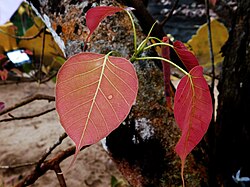 A Bodhi tree leaf with a raindrop
 -
 Meditators at the Mahabodhi tree, Bodh Gaya
 -
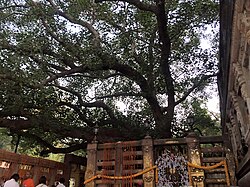 Mahabodhi tree, Bodh Gaya
 -
 "The sacred tree of Buddha". A photo from the Jami' al-tawarikh by Rasheed al-Din Al-Hamazani, Folio 47 Recto. Collection of the Royal Asian Society in London. Rab-i-Rashidi 1314.
 -
 Indian stamp, 1997 – Colnect 163602 – Bodhi Tree
 -
 A small temple beneath the Bodhi Tree, Bodh Gaya, c. 1810
 -
 Bodhi tree photograph from the Bangkok National Museum, Thailand
 -
 Jaya Sri Maha Bodhi, Anuradhapura, Sri Lanka

.jpg)


.jpg)

See also[edit | edit source]
References[edit | edit source]
- ↑ 1.0 1.1 1.2 1.3 "Bo tree". Encyclopaedia Britannica. Retrieved 20 October 2025.
- ↑ 2.0 2.1 Sharma, Arvind (2007). A Guide to Buddhism. Cambridge University Press. p. 42.
- ↑ "Mahabodhi Temple Complex at Bodh Gaya". UNESCO World Heritage Centre. Retrieved 20 October 2025.
- ↑ Buswell Jr., Robert E.; Lopez Jr., Donald S. (2013). The Princeton Dictionary of Buddhism. Princeton University Press. p. 118.
- ↑ "Buddhist Studies: Bodhi Tree". buddhanet.net. Retrieved 21 October 2025.
- ↑ Benimadhab Barua. Gaya and Buddha Gaya Volume I. BRAOU, Digital Library of India. Stis Chandra Seal Calcutta.
- ↑ Rhys Davids, T. W. (1903). Buddhist India. T. Fisher Unwin. pp. 44–46. Retrieved 20 October 2025.
- ↑ 8.0 8.1 Geiger, Wilhelm, ed. (1912). "18–20". The Mahāvaṃsa: The Great Chronicle of Sri Lanka. Oxford University Press.
- ↑ 9.0 9.1 Cunningham, Alexander (1892). Mahâbodhi; or, The Great Buddhist Temple under the Bodhi Tree at Buddha-Gaya. The Archaeological Survey of India. pp. 25–30. Retrieved 20 October 2025.
- ↑ Carrithers, Michael (1983). The Buddha. Oxford University Press. p. 14.
- ↑ "Sacred City of Anuradhapura". UNESCO World Heritage Centre. Retrieved 20 October 2025.
- ↑ A small Hindu temple beneath a banyan tree, Bodhgaya British Library.
- ↑ Malalasekera, G. P. (14 September 2003). Dictionary of Pali Proper Names. Asian Educational Services. ISBN 978-81-206-1823-7 – via Google Books.
- ↑ 14.0 14.1 "CHAPTER XVII_The Arrival of the Relics". Mahavamsa, chap. 17, 17.
- ↑ "CHAPTER XX_The Nibbana of the Thera". Mahavamsa, chap. 20, 4f.
- ↑ J. Gordon, Melton; Martin, Baumann (2010). Religions of the World: A Comprehensive Encyclopedia of Beliefs and Practices (Second ed.). ABC-CLIO, Santa Barbara. p. 358. ISBN 978-1-59884-204-3.
- ↑ "Chapter XXIX: The Beginning of the Great Thupa". Mahavamsa, chap. 29, 41.
- ↑ Archaeological Survey of India, Volume 1, Four Reports Made During the Years 1862-63-64-66
- ↑ 19.0 19.1 "Buddhist Studies: Bodhi Tree". Buddhanet.net. Retrieved 1 August 2013.
- ↑ Mahâbodhi, or the great Buddhist temple under the Bodhi tree at Buddha-Gaya, Alexander Cunningham, 1892: "I next saw the Tree in 1871, and again in 1875, when it had become completely decayed, and shortly afterwards, in 1876, the only remaining portion of the Tree fell over the west wall during a storm, and the Old Pipal Tree was gone. Many seeds, however, had been collected, and young scions of the parent tree were already in existence to take its place."
- ↑ Kazmi, S M A (7 August 2007). "Forest institute suggests methods to save Bodhi tree". The Indian Express.
- ↑ Qadir, Abdul (31 August 2017). "Two Forest Research Institute scientists examine Bodhi tree, collect sample". The Times of India. Retrieved 7 April 2022.
- ↑ Sahay, Anand Mohan (25 October 2007). "Branch of bodhi tree was cut 3 years ago: Report". rediff.com. Retrieved 7 April 2022.
- ↑ Kalam, Farhana (8 November 2018). "Steps taken to protect sacred Bodhi tree". Telegraph India.
- ↑ Kalam, Farhana (1 December 2018). "Pruning to help Bodhi tree shed weight". Telegraph India.
- ↑ Khan, Zeyad Masroor (4 May 2018). "The Bodhi Tree the Buddha Sat Under is Dead. Meet the scientist who keeps its sacred descendant alive". Vice.
- ↑ Bedi, Rahul (9 April 2008). "Scientists turn to cloning in attempt to save Buddhism's holiest tree for posterity". The Irish Times. Retrieved 7 April 2022.
- ↑ Luders, Heinrich (1963). Corpus Inscriptionum Indicarum Vol.2 Pt.2 Bharhut Inscriptions. p. 95.
- ↑ "Guide to Buddhism A to Z".
- ↑ "Rain-makers: The Sacred Bodhi Tree Part 2". Srimahabodhi.org. 24 April 2003. Retrieved 1 August 2013.
- ↑ K.H.J. Wijayadasa. "Śrī Maha Bodhi". Srimahabodhi.org. Retrieved 1 August 2013.
- ↑ Waikiki's "Central Park" – Fort DeRussy Armed Forces Reserve waikikioutdoorcircle.org
- ↑ Madhavan, Chitra. "Buddhist shrine in Adyar". Madras Musings. Retrieved 14 November 2015.
- ↑ Krishnan, D. (3 April 2017). "Under the Bodhi tree". The Hindu. ISSN 0971-751X.
- ↑ "Statement by the President of India, Shri Pranab Mukherjee to the media on board the special aircraft on his way back from his state visit to the socialist republic of Vietnam". pib.gov.in. Retrieved 22 December 2022.
- ↑ See "Navel in Buddha" on Academia.edu https://www.academia.edu/43042460/Navel_in_Buddha. Text is quoted verbatim. Multiple internet sites show the same text, but only this one appears to be a more reliable source.
- ↑ Lam, Raymond (31 August 2021). "Sacred Bodhi Sapling in Australian Quarantine to Be Released in May 2022". Buddhistdoor Global.
- ↑ "Lee Mingwei 'Bodhi Tree Project'". qagoma.qld.gov.au. 4 December 2022. Retrieved 9 January 2025.
- ↑ "As Raízes Culturais da Comemoração do Despertar (Rohatsu)" [The Cultural Roots of the Awakening Celebration (Rohatsu)]. budismohoje.org.br (in português). 4 December 2021. Retrieved 9 January 2025.
- ↑ "India's gift to South Korea: A sacred Bodhi Tree sapling". NDTV. Indo-Asian News Service. 8 March 2022.
- ↑ Sayadaw, Mingun, ed. (1992). "Appendix: List of the Mahabodhi Trees of 24 Buddhas". The Great Chronicle of Buddhas. Vol. 1, Part 2. Yangon, Myanmar: Ti=Ni Press. pp. 316–317, 322.
- ↑ "Cakkavatti Sutta: The wheel-turning Emperor". accesstoinsight.org.
- ↑ Self, David (2 December 2005). "Dates for Assembly". The Times Educational Supplement. No. 4663. TES Global Limited. p. 7. Nexis Uni [https://advance.lexis.com/api/document?collection=news&id=urn%3acontentItem%3a4HPS-4VC0-00X7-T39V-00000-00
4HPS-4VC0-00X7-T39V-00000-00].
{{cite news}}: line feed character in|id=at position 123 (help) - ↑ Prasoon, Shrikant (2007). Knowing Buddha: [life and teachings]. [Delhi]: Hindoology Books. ISBN 978-81-223-0963-8.
- ↑ "All the State Emblems and Their Meaning – NLC Bharat". National Legislators Conference. Retrieved 4 February 2024.
- ↑ "Bihar digging into history to discover roots of its emblem". Hindustan Times. 22 March 2010. Retrieved 4 February 2024.


