


m robot: Update article (please report if you notice any mistake or error in this edit) |
fixes |
||
| Line 1: | Line 1: | ||
{{Short description| | {{Short description|Character in Tamil epic of Cilappatikāram}} | ||
{{About| | {{About|the character from Tamil literature|other uses|Kannagi (disambiguation)}} | ||
{{Use dmy dates|date=March 2016}} | {{Use dmy dates|date=March 2016}} | ||
{{Use Indian English|date=March 2016}} | {{Use Indian English|date=March 2016}} | ||
{{Infobox character | {{Infobox character | ||
| name = Kannagi | |||
| image = Statue of Kannagi.jpg | | image = Statue of Kannagi.jpg | ||
| alt = Kannagi | | alt = Kannagi | ||
| caption = Kannagi | | caption = Statue of Kannagi in [[Chennai]] | ||
| creator = | |||
| first = [[Naṟṟiṇai]] | |||
| gender = Female | |||
| spouses = [[Kovalan]] | |||
| home = [[Poompuhar|Puhar]], [[Early Cholas|Early Chola Kingdom]] | |||
}} | }} | ||
'''Kannagi''', sometimes spelled '''Kannaki''', | '''Kannagi''', sometimes spelled '''Kannaki''', is the titual character of the Tamil in [[Ilango Adigal|Ilango Adigal's]] ''[[Cilappatikaram]]'', one of the [[Five Great Epics]] in [[Tamil literature]]. She is described as a chaste woman who stays with her husband [[Kovalan]] despite his [[adultery]]. The epic further describes the couple's attempt to rebuild their marriage after her unrepentant husband had lost everything, how he is framed for a crime that he did not commit, and Kannagi's quest for justice. She later curses the entire [[Pandyas|Pandya]] city of [[Madurai]], which is burnt to the ground as a consequence of her curse. In Tamil folklore, Kannagi has been deified as the symbol of chastity, and she is worshipped as a goddess in certain regions in [[South India]] and Sri Lanka. | ||
==Literature== | |||
Kannagi appears in the [[Sangam era]] poem ''[[Naṟṟiṇai]]''.{{sfn|Kamil Zvelebil|1973|pp=51–52}} A more extended version of her character appears in the ''[[Cilappatikāram]]''.{{sfn|Pandian|1977|p=56}} ''Cilappatikāram'' ("the Tale of an Anklet"), is the one of the [[Five Great Epics]]s in [[Tamil literature]].{{sfn|Parthasarathy|2004|p=1-3}} It is attributed to a [[Ilango Adigal]], a [[Chera]] prince turned monk, and was probably composed between 2nd to 6th centuries CE.{{sfn|Sastri|2002|p=397}}{{sfn|Alain Danielou|1965|p=viii}} The epic consists of 5,730 lines,{{sfn|Parthasarathy|2004|p=5-6}} and narrates the tragic story of Kannagi and her husband [[Kovalan]].{{sfn|Zvelebil|1973|p=174–175}}{{sfn|Pollock|2003|p=296–298}} | |||
== | ==Legend== | ||
[[File: | [[File:Puhar-Kannagi-Kovalan.jpg|thumb|upright=0.8|Statues of Kannagi and [[Kovalan]] at [[Poombuhar]]]] | ||
The Kannagi | |||
Kannagi is the daughter of the merchant and ship captain Manayakan from [[Poompuhar|Puhar]]. She marries [[Kovalan]], the son of a wealthy merchant Macattuvan.{{sfn|Huskin|Meij|2013|p=119}} While their married life initially appears happy, Kovalan later becomes attracted to the [[courtesan]] and dancer [[Madhavi (Silappatikaram)|Madhavi]]. He becomes captivated by her beauty, and enters into an extra marital relationship with her. He spends most of his wealth on her, and the relationship creates tensions with Kannagi.{{sfn|Parthasarathy|1993|p=73–86}} | |||
Kovalan has a misunderstanding with Madhavi, and after losing most of his wealth, he realises his mistake and returns to his wife Kannagi. Kannagi forgives him despite his earlier betrayal, and the couple decides to leave Puhar and travel to the [[Pandyas|Padnya]] capital of [[Madurai]] to start a new life.{{sfn|Parthasarathy|1993|p=87–90}} | |||
At Madhurai, Kovalan attempts to sell one of the two [[silambu|anklets]] of Kannagi to raise money. The royal goldsmith, who had earlier stolen an anklet belonging to the queen [[Kopperundevi]], finds the that anklets are similar, and falsely accuses Kovalan of stealing the queen’s anklet. Enraged by the act, the king [[Neduncheziyan]] orders Kovalan’s arrest and execution without a fair trial.{{sfn|Dikshitar|1939|p=217–221}}{{Sfn|Bhanu|1997|p=7-9}} | |||
After Kovalan is executed, Kannagi appears in the royal court, trying to prove her husband’s innocence and demanding justice. She breaks open her remaining anklet to reveal that her anklet contained [[rubies]] whereas queen Kopperundevi's missing anklet contained [[pearl]]s. When the king realised the truth and his mistake, he kills himself due to remorse. The queen, Kopperundevi, unable to bear the grief and shame caused by the unjust execution, also dies soon afterward.{{sfn|Dikshitar|1939|p=247–251}} | |||
Kannagi later cursed the city of Madurai, and the entire city was burnt to ground. However, she was calmed by the goddess [[Meenakshi]], and later attained salvation.{{sfn|Bhanu|1997|p=16-19}} | |||
==Iconography and worship== | |||
Kannagi is eulogised as the epitome of chastity and is worshiped as a goddess in select regions in [[South India]] and Sri Lanka.{{sfn|Jones|2019|p=154}} Various sculptures and reliefs of Kannagi are found in [[Hindu temples]], which mostly depict her holding an anklet in her hand.{{sfn|Pandian|1977|p=56-61}}{{sfn|Parthasarathy|1993|p=318–327}} She is worshipped as Kannagi [[Amman]] by the [[Tamils]],{{sfn|Jones|2019|p=154}} as [[Attukal Temple|Bhagavati]] in [[Kerala]],{{sfn|Rajarajan|2016|p=412}} and as [[Pattini]] in [[Buddhism in Sri Lanka|Sinhalese Buddhism]].{{sfn|Rajarajan|2016|p=401-414}} | |||
=== South India === | |||
[[File:Kodungallur-RD-11Nov11.jpg|thumb|[[Kodungallur Bhagavathy Temple]]]] | |||
The ''Cilappatikāram'', and its sequel ''[[Maṇimēkalai]]'', offer evidence that Kannagi was praised as a goddess during the lifetime of Maṇimekalai, the daughter of Kovalan and Madhavi.{{sfn|Danielou|1989|p=41-44}}{{sfn|Parthasarathy|1993|p=251–267}} ''Cilappatikāram'' describes that Chera king [[Senguttuvan]] deifying Kannagi and dedicating a temple for her.{{sfn|Parthasarathy|1993|p=251–267}} It also describes that the Pandya king Vetrivel Cheliyan prayed to Kanangi, for relieving his lands from the drought and curse of Kannagi.{{sfn|Dikshitar|1939|p=289–293}} However, Kannagi was deified in the ancient [[Tamilakam]], it does not have a significant presence in modern religious practice and insitutional practice in Tamil Nadu, whereas the cult became prominent in Sri Lanka and parts of Kerala.{{sfn|Parthasarathy|1993|p=16–18}}{{sfn|Zvelebil|1975|p=176–178}}{{sfn|Selby|Peterson|2008|p=148-152}} Kannagi's worship in Tamil Nadu might have been assimilated in the more common worship of the [[Dravidian folk religion|Dravidian]] goddess [[Mariamman]].{{sfn|Menon|2000|p=229}} As per ''Cilappatikāram'', the city of Madurai was destroyed on a Friday in the month of [[Aadi (month)|Aadi]],{{sfn|Parthasarathy|1993|p=257–259}}{{sfn|Dikshitar|1939|p=247–251}} and Fridays in the month are often associated with the cult of Mariamman.{{sfn|Hansen|1992|p=102–105}}{{sfn|Clothey|1978|p=211–213}} | |||
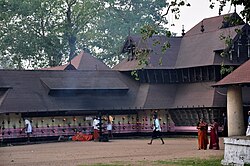
The Kannaki cult initiated by the Cheras, is still preserved in the form of the Bhagavati cult in Kerala.{{sfn|Spuler|1975|p=111}} The [[Kodungallur Bhagavathy Temple|Bhagavati Temple]] at [[Kodungallur]], which was the former capital of Cheras, mentions the Kannaki cult in its [[Sthala purana]].{{sfn|Choondal|1980|p=37}} Though the deity of the temple is still observed as [[Bhadrakali]], Kannagi is believed to be an incarnation of the goddess, and reached Kodungallur to attain salvation at the location of the temple.<ref>{{cite web |author=Shankar Radhakrishnan |url=http://www.thehindubusinessline.com/life/2004/03/15/stories/2004031500160300.htm |title=Bubbling over with devotion |work=[[The Hindu]] |date=15 March 2004 |access-date=1 June 2010}}</ref> [[Attukal Temple]], [[Mangala Devi Kannagi Temple]], and [[Thirupuraikkal Temple]] are some of the Bhagavati temples in Kerala, that are associated with the Kannagi cult, and are believed to have been located on the places visited by Kannagi on her journey to Chera Nadu after the burning of Madurai.{{sfn|Mathew|2013|p=50-62}} | |||
== | === Sri Lanka === | ||
[[File: | [[File:Thambiluvil Amman.jpg|thumb|upright=0.8|Kannagi's idol in [[Thambiluvil]]]] | ||
According to Sri Lankan folklore, after the burning of Madurai, Kannagi traveled to Kerala and eventually arrived at the island of Pungudutheevu, near the ancient Manipallavam, now known as [[Nainativu]].{{sfn|Spuler|1975|p=111}}{{sfn|Choondal|1980|p=37}} She is said to have visited approximately 25 sites in Sri Lanka, mainly along the east coast, and before she reached [[Vattappalai]]. Disguised as an old woman, she requested food from some herders, and they offered her [[Pongal (dish)|pongal]] made from buffalo [[milk]]. She later asked for a lamp lit with sea water. Fearing that she was a witch, the boys sought help from the villagers. When the villagers arrived, Kannagi revealed her divine form, displaying 1,000 eyes on her head, declaring herself as Kannagi of Poompuhar, and then ascended to heaven. The villagers light lamps, and offer pongal to her during the annual festival celebrated during the month of [[Vaikasi]].{{sfn|Choondal|1980|p=37}} Historical sources suggest that king [[Gajabahu I]] later recognised Kannagi as Pattini, establishing her as a guardian deity of Sri Lanka.{{sfn|Spuler|1975|p=111}} | |||
Kannagi | Kannagi is revered as Kannakai Amman, particularly among the | ||
[[Sri Lankan Tamils]] of [[Eastern Province, Sri Lanka|Eastern Sri Lankan]] and [[Vanni (Sri Lanka)|Vanni]] regions. ''[[Yalpana Vaipava Malai]]'', which gives a historical account of the [[Jaffna Kingdom]], attests to the widespread popularity of Kannagi worship during the rule of the [[Aryacakravarti dynasty]] (1215–1624) in [[Northern Province, Sri Lanka|Northern Sri Lanka]]. The Sri Lankan epic ''Kannaki Vaḻakkurai'', recited in Kannaki Amman temples, is believed to have been authored by king [[Jeyaveera Cinkaiariyan]] (1380–1410), and mirrors the narrative of the Cilappatikāram.{{sfn|Danielou|1989|p=120–125}}{{sfn|Zvelebil|1973|p=176–178}} The Kannagi cult was particularly strong among coastal communities, who regarded Kannagi as a guardian deity due to her association with sea during her upbringing. During the [[Portuguese Ceylon|Portuguese rule]], many of these coastal populations converted to [[Catholicism]], and numerous Kannagi shrines were converted into churches.{{sfn|Ragupathy|1987|p=217}} In the 19th century, some of the remaining temples of Kannagi were transformed in the 19th century into [[Tripura Sundari|Raja Rajeshwari]] and [[Bhuvaneshvari]] temples by activists from the [[Jaffna]]-based [[Shaivism]] movement, under the leadership of [[Arumuka Navalar]], who actively fought against veneration of Kannagi, whom he considered to be a [[Jainism|Jain]] merchantess.{{sfn|Pfaffenberger|1968|p=88}} | |||
[[File:Marble statue of Goddess Pattini.jpg|thumb|Marble statue of [[Pattini]]]] | |||
Kannagi | In modern practice, Kannagi is chiefly venerated once a year during the Catangu or Katavu Tirattal festival, majorly celebrated in the [[Ampara District|Ampara]] and [[Batticaloa district]]s. The festival celebrated over a period of seven days, includes rituals such as ''kalyana kāl naduthal'' (planting wedding pillar), ''valakkurai paaduthal'' (reciting the verses of ''Kannaki Vaḻkkurai''), kulirthi paaduthal (singing cooling verses). At the conclusion of the festival, the sanctum of the temple is closed and remains so until the next festival begins.{{sfn|Spuler|1975|p=111}}{{sfn|Hansen|1992|p=102-105}} | ||
The [[Sinhalese people|Sinhalese]] Buddhists worship Kannagi as Pattini. The story of Kannagi differs from ''Cilappatikāram'' and she is revered as an avatar of [[Gautama Buddha]].{{sfn|Gombrich|Obeyesekere|1988|p=30-31}} Kannagi was born in the garden of the Pandyan king, and as she was neglected by him, she grew up at the port of Chola country. She eventually slew the evil Pandyan king, and was later anointed as a guardian god by the Buddha.{{sfn|Obeyesekere|1990|p=28, 46, 129}} The [[Esala Perahera]] festival was initially dedicated to Kannaki, [[Murugan|Kataragama]], [[Aiyanar|Natha]], and [[Vishnu]], which later incorporated the procession of holy tooth relic of Buddha during the 18th century.<ref>{{cite book|title=Journal of the Royal Asiatic Society of Sri Lanka|year=2004|volume=47-48|page=86}}</ref> ''Polkeliya'' (coconut fight), ''Gammaduwa'' (village rituals), and ''ankeliya'' (horn play) are three main aspects of the Pattini cult.{{sfn|Spuler|1975|p=111}}{{sfn|Choondal|1980|p=37}} | |||
[[ | |||
{{ | |||
Kannagi | |||
==In popular culture== | ==In popular culture== | ||
[[ | [[Tamil cinema|Tamil films]] ''[[Kannagi (1942 film)|Kannagi]]'' (1942), directed by R. S. Mani and ''[[Poompuhar (film)|Poompuhar]]'' (1964) were based on Kannagi's story. [[Malayalam cinema|Malayalam]] film ''[[Kodungallooramma]]'' directed by [[Kunchacko]] was released in 1968. [[Cinema of Sri Lanka|Sinhala film]] ''[[Paththini (2016 film)|Paththini]]'' was released on 5 May 2016 in which the role of Kannagi was played by [[Pooja Umashankar]].<ref>{{cite web | url=http://www.sandeshaya.org/pathini-sinhala-film-by-sunil-ariyaratne/ | title=Pathini Sinhala Film by Sunil Ariyaratne | publisher=Sandeshaya | access-date=2 May 2016}}</ref> | ||
A [[ | A [[Kannagi statue|statue of Kannagi]] holding her anklet, depicting a scene from ''Cilappatikaram'', was installed on [[Marina Beach]], [[Chennai]]. It was removed in December 2001 citing reasons that it hindered traffic,<ref>{{cite news|title=Presidency College ground ideal for Kannagi statue: panel|work=[[The Hindu]]|date=16 June 2002|url=http://hindu.com/2002/06/16/stories/2002061603490400.htm|access-date=9 October 2011}}{{dead link|date=March 2026}}</ref><ref>{{cite news|title=Kannagi statue to be reinstalled on Jun 3: Governor|work=[[One India]]|publisher=OneIndiaNews.com|date=24 May 2006|url=https://www.oneindia.com/2006/05/24/kannagi-statue-to-be-reinstalled-on-jun-3-governor-1148454269.html|access-date=9 October 2011}}</ref> and was reinstalled in 2006.<ref>{{cite news|last=Menon|first=Jaya|title=On Marina Beach, Karunanidhi keeps date with Kannagi|work=[[The Indian Express]]|date=16 May 2006|url=http://www.indianexpress.com/news/on-marina-beach-karunanidhi-keeps-date-with-kannagi/4509/0|access-date=9 October 2011}}</ref><ref>{{cite news|last=Tiwari|first=Binita|title=Kannagi's statue adorned Marina Beach|work=Newstrack India|date=23 August 2007|url=http://www.newstrackindia.com/newsdetails/735|access-date=9 October 2011}}</ref> | ||
==See also== | ==See also== | ||
* [[Lady Meng Jiang]] | * [[Lady Meng Jiang]] | ||
| Line 83: | Line 67: | ||
{{Reflist}} | {{Reflist}} | ||
=== Bibliography === | |||
* {{cite book| | {{refbegin}} | ||
* {{cite book|first=Sharada|last=Bhanu|title=Myths and Legends from India – Great Women|publisher=[[Macmillan Publishers]]|year=1997|location=Chennai|isbn=0-333-93076-2|pages=7–9}} | |||
* {{cite book|first=Chummar|last=Choondal|title=Kerala Folk Literature|publisher=Kerala Folklore Academy|year=1980}} | |||
* {{cite book|first=Fred W.|last=Clothey|title=The Many Faces of Murukan: The History and Meaning of a South Indian God|publisher=Walter de Gruyter|year=1978|isbn=978-9-027-97632-1}} | |||
* {{cite book|first=Alain|last=Danielou|title=Shilappadikaram (The Ankle Bracelet) by Iḷaṅkōvaṭikaḷ|url=https://books.google.com/books?id=Uu3QelRpmsgC|year=1965|publisher=[[New Directions Publishing]]|isbn=978-0-8112-0001-1}} | |||
* {{cite book|first=Alain|last=Danielou|title=Manimekalai: The Dancer with the Magic Bowl|publisher=[[New Directions Publishing]]|year=1989|isbn=978-0-811-21088-1}} | |||
* {{cite book|first=R.|last=Dikshitar|title=The Silappadikaram|year=2025|orig-year=1st pub. 1939|publisher=[[Oxford University Press]]|url=https://archive.org/details/in.ernet.dli.2015.201802/page/n5|isbn=978-9-390-03592-2|ref={{SfnRef|Dikshitar|1939}} }} | |||
* {{cite book|first1=Richard Francis|last1=Gombrich|first2=Gananath|last2=Obeyesekere|year=1988|title=Buddhism Transformed: Religious Change in Sri Lanka|publisher=[[Princeton University Press]]|isbn=978-0-691-01901-7}} | |||
* {{cite book|first=Frans|last=Husken|first2=Dick van der|last2=Meij|title=Reading Asia: New Research in Asian Studies|publisher=[[Routledge]]|year=2013|isbn=978-1-136-84384-6}} | |||
* {{cite book|first=Demelza|last=Jones|title=Superdiverse Diaspora: Everyday Identifications of Tamil Migrants in Britain|publisher=[[Springer Publishing]]|year=2019|isbn=978-3-030-28388-9}} | |||
* {{cite book|first=Co Na|last=Kantacami|title=Buddhism as Expounded in Manimekalai|publisher=[[Annamalai University]]|year=1978}} | |||
* {{cite book|first=Kathryn|last=Hansen|title=Stages of Faith: Religion and Gender in South India|publisher=[[Oxford University Press]]|year=1992|isbn=978-1-848-85427-7}} | |||
* {{cite book|first=Biju|last=Mathew|title=Pilgrimage to Temple Heritage|publisher=[[Notion Press]]|year=2013}} | |||
* {{cite book|first=Madhava|last=Menon|title=A Handbook of Kerala|year=2000|publisher=International School of Dravidian Linguistics}} | |||
* {{cite book|first=Gananath|last=Obeyesekere|year=1990|title=The Work of Culture: Symbolic Transformation in Psychoanalysis and Anthropology|publisher=[[University of Chicago Press]]|isbn=978-0-226-61598-1}} | |||
* {{cite book|first=E.T.Jacob|last=Pandian|editor=K. Ishwaran|title=Contributions to Asian Studies: 1977|year=1977|publisher=[[Brill Publishers]]|isbn=90-04-04926-6}} | |||
* {{cite book|first=R.|last=Parthasarathy|title=The Cilappatikaram of Ilanko Atikal: An Epic of South India|publisher=[[Columbia University Press]]|year=1993|isbn=0-231-07849-8}} | |||
* {{cite book|first=R.|last=Parthasarathy|title=The Cilappatikāram: The Tale of an Anklet (Iḷaṅkōvaṭikaḷ)|url=https://books.google.com/books?id=HWPg7EvPirgC|year=2004|publisher=[[Penguin Books]]|isbn=978-0-14-303196-3}} | |||
* {{cite journal|last=Pfaffenberger|first=Bryan|title=The Political Construction of Defensive Nationalism: The 1968 Temple-Entry Crisis in Northern Sri Lanka|journal=[[The Journal of Asian Studies]]|volume=49|issue=1|date=1990}} | |||
* {{cite book|first=Sheldon|last=Pollock|title=Literary cultures in history: reconstructions from South Asia|publisher=[[University of California Press]]|year=2003|isbn=0-520-22821-9|url=https://books.google.com/books?id=ak9csfpY2WoC}} | |||
* {{cite book|title=Early Settlements in Jaffna: An Archaeological Survey|last=Ragupathy|first=Ponnampalam|date=1987|publisher=[[University of Jaffna]]}} | |||
* {{cite book|first=R.K.K.|last=Rajarajan|chapter=Dance of Ardhanārī: A Historiographical Retrospection|editor1=Tiziana Lorenzetti|editor2=Fabio Scialpi|title=Glimpses of Indian History and Art: Reflections on the Past, Perspectives for the Future|publisher=Sapienza Università Editrice|year=2012|pages=233–270|isbn=978-8-895-81485-8|chapter-url=https://www.academia.edu/3740760/Dance_of_Ardhan%C4%81r%C4%AB._A_Historiographical_Retrospection}} | |||
* {{cite book|first=R.K.K.|last=Rajarajan|title=Masterpieces of Indian Literature and Art – Tears of Kaṇṇaki: Annals and Iconology of the Silappatikāram|publisher=Sharada Publishing House|year=2016|isbn=978-9-383-22114-1|url=https://www.academia.edu/30222114/Masterpieces_of_Indian_Literature_and_Art_-_Tears_of_Ka%E1%B9%87%E1%B9%87aki_Annals_and_Iconology_of_the_Cilappatik%C4%81ram_}} | |||
* {{cite book|first=Nilakanta|last=Sastri|title=A History of South India|orig-year=1955|publisher=[[Oxford University Press]]|location=New Delhi|edition=Reprinted|year=2002}} | |||
* {{cite book|first1=Martha Ann|last1=Selby|first2=Indira Viswanathan|last2=Peterson|title=Tamil Geographies: Cultural Constructions of Space and Place in South India|publisher=[[SUNY Press]]|year=2008|isbn=978-0-791-47242-2}} | |||
* {{cite book|first=Bertold|last=Spuler|title=Handbook of Oriental Studies, Part 2|year=1975|publisher=[[Brill Publishers]]|isbn=978-9-004-04190-5}} | |||
* {{cite book|first=Kamil|last=Zvelebil|title=The Smile of Murugan: On Tamil Literature of South India|url=https://books.google.com/books?id=degUAAAAIAAJ|year=1973|publisher=[[Brill Publishers]]|isbn=90-04-03591-5}} | |||
* {{cite book|first=Kamil|last=Zvelebil|title=Tamil Literature|series=Handbuch der Orientalistik|publisher=[[Brill Publishers]]|year=1975|isbn=978-9-004-04190-5|pages=176–178}} | |||
{{refend}} | |||
==External links== | ==External links== | ||
{{Commons category|Kannagi}} | {{Commons category|Kannagi}} | ||
{{Cilappatikaram}} | {{Cilappatikaram}} | ||
{{HinduMythology}} | {{HinduMythology}} | ||
| Line 95: | Line 106: | ||
[[Category:Characters in Silappatikaram]] | [[Category:Characters in Silappatikaram]] | ||
[[Category:Deified Indian women]] | |||
[[Category:Fictional Tamil people]] | |||
[[Category:Hindu goddesses]] | [[Category:Hindu goddesses]] | ||
[[Category:Tamil deities]] | [[Category:Tamil deities]] | ||
Latest revision as of 13:35, 7 March 2026
| Kannagi | |
|---|---|
 Statue of Kannagi in Chennai | |
| First appearance | Naṟṟiṇai |
| In-universe information | |
| Gender | Female |
| Spouses | Kovalan |
| Home | Puhar, Early Chola Kingdom |
Kannagi, sometimes spelled Kannaki, is the titual character of the Tamil in Ilango Adigal's Cilappatikaram, one of the Five Great Epics in Tamil literature. She is described as a chaste woman who stays with her husband Kovalan despite his adultery. The epic further describes the couple's attempt to rebuild their marriage after her unrepentant husband had lost everything, how he is framed for a crime that he did not commit, and Kannagi's quest for justice. She later curses the entire Pandya city of Madurai, which is burnt to the ground as a consequence of her curse. In Tamil folklore, Kannagi has been deified as the symbol of chastity, and she is worshipped as a goddess in certain regions in South India and Sri Lanka.
Literature[edit | edit source]
Kannagi appears in the Sangam era poem Naṟṟiṇai.[1] A more extended version of her character appears in the Cilappatikāram.[2] Cilappatikāram ("the Tale of an Anklet"), is the one of the Five Great Epicss in Tamil literature.[3] It is attributed to a Ilango Adigal, a Chera prince turned monk, and was probably composed between 2nd to 6th centuries CE.[4][5] The epic consists of 5,730 lines,[6] and narrates the tragic story of Kannagi and her husband Kovalan.[7][8]
Legend[edit | edit source]

Kannagi is the daughter of the merchant and ship captain Manayakan from Puhar. She marries Kovalan, the son of a wealthy merchant Macattuvan.[9] While their married life initially appears happy, Kovalan later becomes attracted to the courtesan and dancer Madhavi. He becomes captivated by her beauty, and enters into an extra marital relationship with her. He spends most of his wealth on her, and the relationship creates tensions with Kannagi.[10]
Kovalan has a misunderstanding with Madhavi, and after losing most of his wealth, he realises his mistake and returns to his wife Kannagi. Kannagi forgives him despite his earlier betrayal, and the couple decides to leave Puhar and travel to the Padnya capital of Madurai to start a new life.[11]
At Madhurai, Kovalan attempts to sell one of the two anklets of Kannagi to raise money. The royal goldsmith, who had earlier stolen an anklet belonging to the queen Kopperundevi, finds the that anklets are similar, and falsely accuses Kovalan of stealing the queen’s anklet. Enraged by the act, the king Neduncheziyan orders Kovalan’s arrest and execution without a fair trial.[12][13]
After Kovalan is executed, Kannagi appears in the royal court, trying to prove her husband’s innocence and demanding justice. She breaks open her remaining anklet to reveal that her anklet contained rubies whereas queen Kopperundevi's missing anklet contained pearls. When the king realised the truth and his mistake, he kills himself due to remorse. The queen, Kopperundevi, unable to bear the grief and shame caused by the unjust execution, also dies soon afterward.[14]
Kannagi later cursed the city of Madurai, and the entire city was burnt to ground. However, she was calmed by the goddess Meenakshi, and later attained salvation.[15]
Iconography and worship[edit | edit source]
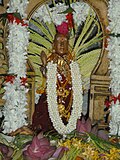
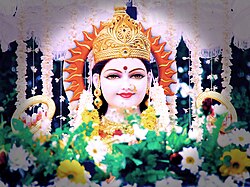
Kannagi is eulogised as the epitome of chastity and is worshiped as a goddess in select regions in South India and Sri Lanka.[16] Various sculptures and reliefs of Kannagi are found in Hindu temples, which mostly depict her holding an anklet in her hand.[17][18] She is worshipped as Kannagi Amman by the Tamils,[16] as Bhagavati in Kerala,[19] and as Pattini in Sinhalese Buddhism.[20]
South India[edit | edit source]

The Cilappatikāram, and its sequel Maṇimēkalai, offer evidence that Kannagi was praised as a goddess during the lifetime of Maṇimekalai, the daughter of Kovalan and Madhavi.[21][22] Cilappatikāram describes that Chera king Senguttuvan deifying Kannagi and dedicating a temple for her.[22] It also describes that the Pandya king Vetrivel Cheliyan prayed to Kanangi, for relieving his lands from the drought and curse of Kannagi.[23] However, Kannagi was deified in the ancient Tamilakam, it does not have a significant presence in modern religious practice and insitutional practice in Tamil Nadu, whereas the cult became prominent in Sri Lanka and parts of Kerala.[24][25][26] Kannagi's worship in Tamil Nadu might have been assimilated in the more common worship of the Dravidian goddess Mariamman.[27] As per Cilappatikāram, the city of Madurai was destroyed on a Friday in the month of Aadi,[28][14] and Fridays in the month are often associated with the cult of Mariamman.[29][30]
The Kannaki cult initiated by the Cheras, is still preserved in the form of the Bhagavati cult in Kerala.[31] The Bhagavati Temple at Kodungallur, which was the former capital of Cheras, mentions the Kannaki cult in its Sthala purana.[32] Though the deity of the temple is still observed as Bhadrakali, Kannagi is believed to be an incarnation of the goddess, and reached Kodungallur to attain salvation at the location of the temple.[33] Attukal Temple, Mangala Devi Kannagi Temple, and Thirupuraikkal Temple are some of the Bhagavati temples in Kerala, that are associated with the Kannagi cult, and are believed to have been located on the places visited by Kannagi on her journey to Chera Nadu after the burning of Madurai.[34]
Sri Lanka[edit | edit source]

According to Sri Lankan folklore, after the burning of Madurai, Kannagi traveled to Kerala and eventually arrived at the island of Pungudutheevu, near the ancient Manipallavam, now known as Nainativu.[31][32] She is said to have visited approximately 25 sites in Sri Lanka, mainly along the east coast, and before she reached Vattappalai. Disguised as an old woman, she requested food from some herders, and they offered her pongal made from buffalo milk. She later asked for a lamp lit with sea water. Fearing that she was a witch, the boys sought help from the villagers. When the villagers arrived, Kannagi revealed her divine form, displaying 1,000 eyes on her head, declaring herself as Kannagi of Poompuhar, and then ascended to heaven. The villagers light lamps, and offer pongal to her during the annual festival celebrated during the month of Vaikasi.[32] Historical sources suggest that king Gajabahu I later recognised Kannagi as Pattini, establishing her as a guardian deity of Sri Lanka.[31]
Kannagi is revered as Kannakai Amman, particularly among the Sri Lankan Tamils of Eastern Sri Lankan and Vanni regions. Yalpana Vaipava Malai, which gives a historical account of the Jaffna Kingdom, attests to the widespread popularity of Kannagi worship during the rule of the Aryacakravarti dynasty (1215–1624) in Northern Sri Lanka. The Sri Lankan epic Kannaki Vaḻakkurai, recited in Kannaki Amman temples, is believed to have been authored by king Jeyaveera Cinkaiariyan (1380–1410), and mirrors the narrative of the Cilappatikāram.[35][36] The Kannagi cult was particularly strong among coastal communities, who regarded Kannagi as a guardian deity due to her association with sea during her upbringing. During the Portuguese rule, many of these coastal populations converted to Catholicism, and numerous Kannagi shrines were converted into churches.[37] In the 19th century, some of the remaining temples of Kannagi were transformed in the 19th century into Raja Rajeshwari and Bhuvaneshvari temples by activists from the Jaffna-based Shaivism movement, under the leadership of Arumuka Navalar, who actively fought against veneration of Kannagi, whom he considered to be a Jain merchantess.[38]

In modern practice, Kannagi is chiefly venerated once a year during the Catangu or Katavu Tirattal festival, majorly celebrated in the Ampara and Batticaloa districts. The festival celebrated over a period of seven days, includes rituals such as kalyana kāl naduthal (planting wedding pillar), valakkurai paaduthal (reciting the verses of Kannaki Vaḻkkurai), kulirthi paaduthal (singing cooling verses). At the conclusion of the festival, the sanctum of the temple is closed and remains so until the next festival begins.[31][39]
The Sinhalese Buddhists worship Kannagi as Pattini. The story of Kannagi differs from Cilappatikāram and she is revered as an avatar of Gautama Buddha.[40] Kannagi was born in the garden of the Pandyan king, and as she was neglected by him, she grew up at the port of Chola country. She eventually slew the evil Pandyan king, and was later anointed as a guardian god by the Buddha.[41] The Esala Perahera festival was initially dedicated to Kannaki, Kataragama, Natha, and Vishnu, which later incorporated the procession of holy tooth relic of Buddha during the 18th century.[42] Polkeliya (coconut fight), Gammaduwa (village rituals), and ankeliya (horn play) are three main aspects of the Pattini cult.[31][32]
In popular culture[edit | edit source]
Tamil films Kannagi (1942), directed by R. S. Mani and Poompuhar (1964) were based on Kannagi's story. Malayalam film Kodungallooramma directed by Kunchacko was released in 1968. Sinhala film Paththini was released on 5 May 2016 in which the role of Kannagi was played by Pooja Umashankar.[43]
A statue of Kannagi holding her anklet, depicting a scene from Cilappatikaram, was installed on Marina Beach, Chennai. It was removed in December 2001 citing reasons that it hindered traffic,[44][45] and was reinstalled in 2006.[46][47]
See also[edit | edit source]
References[edit | edit source]
- ↑ Kamil Zvelebil 1973, pp. 51–52.
- ↑ Pandian 1977, p. 56.
- ↑ Parthasarathy 2004, p. 1-3.
- ↑ Sastri 2002, p. 397.
- ↑ Alain Danielou 1965, p. viii.
- ↑ Parthasarathy 2004, p. 5-6.
- ↑ Zvelebil 1973, p. 174–175.
- ↑ Pollock 2003, p. 296–298.
- ↑ Huskin & Meij 2013, p. 119.
- ↑ Parthasarathy 1993, p. 73–86.
- ↑ Parthasarathy 1993, p. 87–90.
- ↑ Dikshitar 1939, p. 217–221.
- ↑ Bhanu 1997, p. 7-9.
- ↑ 14.0 14.1 Dikshitar 1939, p. 247–251.
- ↑ Bhanu 1997, p. 16-19.
- ↑ 16.0 16.1 Jones 2019, p. 154.
- ↑ Pandian 1977, p. 56-61.
- ↑ Parthasarathy 1993, p. 318–327.
- ↑ Rajarajan 2016, p. 412.
- ↑ Rajarajan 2016, p. 401-414.
- ↑ Danielou 1989, p. 41-44.
- ↑ 22.0 22.1 Parthasarathy 1993, p. 251–267.
- ↑ Dikshitar 1939, p. 289–293.
- ↑ Parthasarathy 1993, p. 16–18.
- ↑ Zvelebil 1975, p. 176–178.
- ↑ Selby & Peterson 2008, p. 148-152.
- ↑ Menon 2000, p. 229.
- ↑ Parthasarathy 1993, p. 257–259.
- ↑ Hansen 1992, p. 102–105.
- ↑ Clothey 1978, p. 211–213.
- ↑ 31.0 31.1 31.2 31.3 31.4 Spuler 1975, p. 111.
- ↑ 32.0 32.1 32.2 32.3 Choondal 1980, p. 37.
- ↑ Shankar Radhakrishnan (15 March 2004). "Bubbling over with devotion". The Hindu. Retrieved 1 June 2010.
- ↑ Mathew 2013, p. 50-62.
- ↑ Danielou 1989, p. 120–125.
- ↑ Zvelebil 1973, p. 176–178.
- ↑ Ragupathy 1987, p. 217.
- ↑ Pfaffenberger 1968, p. 88.
- ↑ Hansen 1992, p. 102-105.
- ↑ Gombrich & Obeyesekere 1988, p. 30-31.
- ↑ Obeyesekere 1990, p. 28, 46, 129.
- ↑ Journal of the Royal Asiatic Society of Sri Lanka. Vol. 47–48. 2004. p. 86.
- ↑ "Pathini Sinhala Film by Sunil Ariyaratne". Sandeshaya. Retrieved 2 May 2016.
- ↑ "Presidency College ground ideal for Kannagi statue: panel". The Hindu. 16 June 2002. Retrieved 9 October 2011.[dead link]
- ↑ "Kannagi statue to be reinstalled on Jun 3: Governor". One India. OneIndiaNews.com. 24 May 2006. Retrieved 9 October 2011.
- ↑ Menon, Jaya (16 May 2006). "On Marina Beach, Karunanidhi keeps date with Kannagi". The Indian Express. Retrieved 9 October 2011.
- ↑ Tiwari, Binita (23 August 2007). "Kannagi's statue adorned Marina Beach". Newstrack India. Retrieved 9 October 2011.
Bibliography[edit | edit source]
- Bhanu, Sharada (1997). Myths and Legends from India – Great Women. Chennai: Macmillan Publishers. pp. 7–9. ISBN 0-333-93076-2.
- Choondal, Chummar (1980). Kerala Folk Literature. Kerala Folklore Academy.
- Clothey, Fred W. (1978). The Many Faces of Murukan: The History and Meaning of a South Indian God. Walter de Gruyter. ISBN 978-9-027-97632-1.
- Danielou, Alain (1965). Shilappadikaram (The Ankle Bracelet) by Iḷaṅkōvaṭikaḷ. New Directions Publishing. ISBN 978-0-8112-0001-1.
- Danielou, Alain (1989). Manimekalai: The Dancer with the Magic Bowl. New Directions Publishing. ISBN 978-0-811-21088-1.
- Dikshitar, R. (2025) [1st pub. 1939]. The Silappadikaram. Oxford University Press. ISBN 978-9-390-03592-2.
- Gombrich, Richard Francis; Obeyesekere, Gananath (1988). Buddhism Transformed: Religious Change in Sri Lanka. Princeton University Press. ISBN 978-0-691-01901-7.
- Husken, Frans; Meij, Dick van der (2013). Reading Asia: New Research in Asian Studies. Routledge. ISBN 978-1-136-84384-6.
- Jones, Demelza (2019). Superdiverse Diaspora: Everyday Identifications of Tamil Migrants in Britain. Springer Publishing. ISBN 978-3-030-28388-9.
- Kantacami, Co Na (1978). Buddhism as Expounded in Manimekalai. Annamalai University.
- Hansen, Kathryn (1992). Stages of Faith: Religion and Gender in South India. Oxford University Press. ISBN 978-1-848-85427-7.
- Mathew, Biju (2013). Pilgrimage to Temple Heritage. Notion Press.
- Menon, Madhava (2000). A Handbook of Kerala. International School of Dravidian Linguistics.
- Obeyesekere, Gananath (1990). The Work of Culture: Symbolic Transformation in Psychoanalysis and Anthropology. University of Chicago Press. ISBN 978-0-226-61598-1.
- Pandian, E.T.Jacob (1977). K. Ishwaran (ed.). Contributions to Asian Studies: 1977. Brill Publishers. ISBN 90-04-04926-6.
- Parthasarathy, R. (1993). The Cilappatikaram of Ilanko Atikal: An Epic of South India. Columbia University Press. ISBN 0-231-07849-8.
- Parthasarathy, R. (2004). The Cilappatikāram: The Tale of an Anklet (Iḷaṅkōvaṭikaḷ). Penguin Books. ISBN 978-0-14-303196-3.
- Pfaffenberger, Bryan (1990). "The Political Construction of Defensive Nationalism: The 1968 Temple-Entry Crisis in Northern Sri Lanka". The Journal of Asian Studies. 49 (1).
- Pollock, Sheldon (2003). Literary cultures in history: reconstructions from South Asia. University of California Press. ISBN 0-520-22821-9.
- Ragupathy, Ponnampalam (1987). Early Settlements in Jaffna: An Archaeological Survey. University of Jaffna.
- Rajarajan, R.K.K. (2012). "Dance of Ardhanārī: A Historiographical Retrospection". In Tiziana Lorenzetti; Fabio Scialpi (eds.). Glimpses of Indian History and Art: Reflections on the Past, Perspectives for the Future. Sapienza Università Editrice. pp. 233–270. ISBN 978-8-895-81485-8.
- Rajarajan, R.K.K. (2016). Masterpieces of Indian Literature and Art – Tears of Kaṇṇaki: Annals and Iconology of the Silappatikāram. Sharada Publishing House. ISBN 978-9-383-22114-1.
- Sastri, Nilakanta (2002) [1955]. A History of South India (Reprinted ed.). New Delhi: Oxford University Press.
- Selby, Martha Ann; Peterson, Indira Viswanathan (2008). Tamil Geographies: Cultural Constructions of Space and Place in South India. SUNY Press. ISBN 978-0-791-47242-2.
- Spuler, Bertold (1975). Handbook of Oriental Studies, Part 2. Brill Publishers. ISBN 978-9-004-04190-5.
- Zvelebil, Kamil (1973). The Smile of Murugan: On Tamil Literature of South India. Brill Publishers. ISBN 90-04-03591-5.
- Zvelebil, Kamil (1975). Tamil Literature. Handbuch der Orientalistik. Brill Publishers. pp. 176–178. ISBN 978-9-004-04190-5.
External links[edit | edit source]
Hindu deities and texts | ||
|---|---|---|
| Gods |  | |
| Goddesses | ||
| Other deities | ||
| Texts | ||