

robot: Update article (please report if you notice any mistake or error in this edit) |
mNo edit summary |
||
| Line 1: | Line 1: | ||
{{Short description| Genus of spiders}} | {{Short description|Genus of spiders}} | ||
{{Automatic taxobox | {{Automatic taxobox | ||
| name = | |||
| image = Tetragnatha.extensa.female.jpg | |||
| image_caption = female ''T. extensa'' | |||
| image2 = | |||
| image2_caption = | |||
| fossil_range = {{Fossil range| Palaeogene| Present}} | | fossil_range = {{Fossil range| Palaeogene| Present}} | ||
| taxon = Tetragnatha | | taxon = Tetragnatha | ||
| authority = [[Pierre André Latreille|Latreille]], 1804<ref name=wsc /> | |||
| authority = [[Pierre André Latreille|Latreille]], 1804<ref name= | |||
| type_species = ''[[Tetragnatha extensa|T. extensa]]'' | | type_species = ''[[Tetragnatha extensa|T. extensa]]'' | ||
| type_species_authority = ([[Carl Linnaeus|Linnaeus]], [[10th edition of Systema Naturae|1758]]) | | type_species_authority = ([[Carl Linnaeus|Linnaeus]], [[10th edition of Systema Naturae|1758]]) | ||
| subdivision = | | subdivision = > 300, [[#Species|see text]] | ||
| synonyms = | | synonyms = | ||
| synonyms_ref = <ref name=wsc /> | |||
| synonyms_ref = <ref name= | |||
}} | }} | ||
'''''Tetragnatha''''' is a [[genus]] of [[Tetragnathidae|long-jawed orb-weavers]] found all over the world. It was first described by [[Pierre André Latreille]] in 1804,<ref name=Latr1804 | '''''Tetragnatha''''' is a [[genus]] of [[Tetragnathidae|long-jawed orb-weavers]] found all over the world. It was first described by [[Pierre André Latreille]] in 1804,<ref name=Latr1804 /> and contains hundreds of species. Most occur in the tropics and subtropics, and many can run over water. They are commonly called '''stretch spiders''' in reference to their elongated body form and their ability to hide on blades of grass or similar elongated substrates by stretching their front legs forward and the others behind them. | ||
== Cursorial | ==Distribution== | ||
The Tetragnatha spiders found on the Hawaiian archipelago are believed to have no more than three colonization events, two from web building species and one from cursorial species. This is because a species of mainland Tetragnatha spider was found to be more closely related to web building spiders on the Hawaiian islands than the cursorial species.<ref name=":0" /> This means that the divergence of web building and cursorial spiders must have occurred off the islands. There have been many events of cursorial evolution in various spider species around the world,<ref | Species in this genus are found worldwide, including [[Greenland]].<ref name=wsc /> | ||
==Habitat and ecology== | |||
[[File:LogJawed SilverSiders.webm|thumb|left|thumbtime=141|Pair of [[Tetragnatha laboriosa|silver long-jawed orb weaver spider]]s ]] | |||
''Tetragnatha'' species occupy the tall herb and tree layer. They construct [[orb web]]s, usually in vegetation near or above streams and ponds. Several studies have reported that they build their webs near slow-flowing streams in sunlit areas. Without access to a humid habitat, these spiders suffer from dehydration. The webs are short-lived, being taken down and digested daily or even more frequently. Webs are usually horizontally inclined and consist of an open hub with 30 to 40 viscid spirals. The spider hangs underneath the central hub of the web with its long front legs directed forward.<ref name="dippenaar2023" /> | |||
These spiders are capable of walking over water surfaces at a very fast pace, with legs I and II moving alternately in a diagonal rhythm while legs III and IV are dragged behind. When at rest on vegetation, the body is pressed against the substrate with the long front legs stretched forward.<ref name="dippenaar2023" /> | |||
One of the biggest and most common species is ''[[Tetragnatha extensa|T. extensa]]'', which has a [[holarctic]] distribution. It can be found near lakes, river banks or swamps.<ref name="Habitate" /> Large numbers of individuals can often be found in reeds, tall grass, and around minor trees and shrubs. | |||
== Cursorial species found on Hawaiian archipelago == | |||
Evolution to cursorial behavior occurred long ago in a few different species, the most studied being those found on the Hawaiian islands.<ref name=":0" /> | |||
The Tetragnatha spiders found on the Hawaiian archipelago are believed to have no more than three colonization events, two from web building species and one from cursorial species. This is because a species of mainland Tetragnatha spider was found to be more closely related to web building spiders on the Hawaiian islands than the cursorial species.<ref name=":0" /> This means that the divergence of web building and cursorial spiders must have occurred off the islands. There have been many events of cursorial evolution in various spider species around the world,<ref name="fix2" /> including a few Tetragnatha species, although many species have not been thoroughly studied. The factors leading to this change of behavior is not well understood, although study of the Hawaiian Tetragnatha species can lead to some suggestions. Environmental factors, such as landscape<ref name="fix3" /> and prey diversity play an important role in influencing the structure of webs in web building spiders.<ref name="fix4" /> This could be a reasonable explanation for the loss of web function and evolving to a cursorial behavior. | |||
===Morphology=== | |||
[[File:Tetragnatha eye group.svg|thumb|left|Eye arrangement of ''Tetragnatha'']] | |||
The general coloration ranges from fawn to dull brown or grey with silvery markings. The [[carapace]] is longer than wide, and the sternum is longer than wide with a pointed posterior end. Eight eyes are arranged in two rows, with lateral eyes slightly apart.<ref name="dippenaar2023" /> | |||
The [[chelicerae]] are notably variable, being long and well developed, featuring rows of large teeth and strong projecting spurs that are markedly elongated in males. The endites are parallel. The legs bear three claws and are long and slender, with or without spines.<ref name="dippenaar2023" /> | |||
The [[opisthosoma|abdomen]] is elongated and cylindrical in some species, extending posteriorly beyond the [[spinneret]]s. The spinnerets are unmodified, with anterior and posterior pairs similar in size.<ref name="dippenaar2023" /> | |||
In females, the [[epigyne]] has genital openings located at the posterior end of the procurved epigastric furrow, with the genital plate not sclerotized. Males possess a separate and movable paracymbium with a coiled [[embolus]] and conductor at the distal tip.<ref name="dippenaar2023" /> | |||
==Species distinction== | |||
''Tetragnatha'' species are hard to separate from each other without a microscope to scrutinize the genitalia of a mature individual.<ref name="NASP" /> Hawaiian ''Tetragnatha'' appear to distinguish each other via | |||
highly specific chemical compounds in their silk. These chemical differences are especially prominent amongst [[sympatric]] and closely related species. This may constitute a form of chemical [[species recognition]].<ref name="fix1" /> | |||
==Name== | |||
The name ''Tetragnatha'' is derived from Greek, ''tetra-'' a numerical prefix referring to four and ''gnatha'' meaning jaw. | |||
==Species== | ==Species== | ||
<gallery mode=packed> | |||
Green Longjawed Orbweaver -2- (Tetragnatha Alberta and Saskatchewan).jpg|''Tetragnatha'' sp. | |||
{{as of| | Tetragnatha resting jewelweed.jpg|resting on ''[[Impatiens]]'' | ||
Tetragnatha mating, Botevgrad, Bulgaria 02.jpg|mating | |||
Tetragnatha sp. juvenile.jpg| | |||
</gallery> | |||
{{as of|2025|10}}, this genus includes 309 species and nine subspecies.<ref name="wsc" /> | |||
Species with articles on Wikipedia: | |||
{{Div col}} | |||
* ''[[Tetragnatha armata]]'' <small>[[Ferdinand Karsch|Karsch]], 1892</small> – [[Sri Lanka]] | |||
* ''[[Tetragnatha bogotensis]]'' <small>[[Eugen von Keyserling|Keyserling]], 1865</small> – Mexico to Paraguay, Caribbean. Introduced to [[Spain]], [[Italy]] (Sardinia), Africa, [[Seychelles]], [[Yemen]], India, [[Nepal]], Bangladesh, China | |||
* ''[[Tetragnatha caffra]]'' <small>(Strand, 1909)</small> – [[South Africa]] | |||
* ''[[Tetragnatha caudata]]'' <small>[[James Henry Emerton|Emerton]], 1884</small> – North, Central America, [[Cuba]], [[Jamaica]], Uruguay, Argentina | |||
* ''[[Tetragnatha ceylonica]]'' <small>[[Octavius Pickard-Cambridge|O. Pickard-Cambridge]], 1869</small> – [[Mozambique]], South Africa, Seychelles, India, [[Thailand]], [[Philippines]], New Guinea, Japan (Ryukyu Is.) | |||
* ''[[Tetragnatha demissa]]'' <small>L. Koch, 1872</small> – Australia. Introduced to [[Cyprus]], Tanzania, South Africa, Seychelles, [[Tonga]] | |||
* ''[[Tetragnatha determinata]]'' <small>Karsch, 1892</small> – Sri Lanka | |||
* ''[[Tetragnatha elongata]]'' <small>Walckenaer, 1841</small> – Canada to Argentina, Caribbean | |||
* ''[[Tetragnatha extensa]]'' <small>([[Carl Linnaeus|Linnaeus]], 1758)</small> – North America, [[Greenland]], Europe, [[Turkey]], Caucasus, Russia (Europe to Far East), [[Iraq]], [[Iran]], [[Kazakhstan]], Central Asia, China, Korea, Japan (type species) | |||
* ''[[Tetragnatha flavida]]'' <small>Urquhart, 1891</small> – [[New Zealand]] | |||
* ''[[Tetragnatha foveata]]'' <small>Karsch, 1892</small> – Sri Lanka, Laccadive Is. Maldive Is. | |||
* ''[[Tetragnatha geniculata]]'' <small>Karsch, 1892</small> – India, Sri Lanka, China, Myanmar, Thailand, Vietnam | |||
* ''[[Tetragnatha guatemalensis]]'' <small>O. Pickard-Cambridge, 1889</small> – North and Central America, Cuba, Jamaica, Brazil, [[Paraguay]] | |||
* ''[[Tetragnatha hasselti]]'' <small>Thorell, 1890</small> – India to China, Indonesia (Sulawesi) | |||
* ''[[Tetragnatha isidis]]'' <small>(Simon, 1880)</small> – Southern Europe, [[Libya]], Egypt, [[Sudan]], [[Uganda]], South Africa, Iran, India | |||
* ''[[Tetragnatha jaculator]]'' <small>[[Albert Tullgren|Tullgren]], 1910</small> – Africa to China and India, New Guinea (Indonesia, Papua New Guinea). Introduced to the Caribbean and South America | |||
* ''[[Tetragnatha keyserlingi]]'' <small>Simon, 1890</small> – Central America, Caribbean, Brazil, Africa, Korea, China, India to Philippines, New Hebrides, Polynesia | |||
* ''[[Tetragnatha laboriosa]]'' <small>[[Nicholas Marcellus Hentz|Hentz]], 1850</small> – Alaska to Chile, Argentina, [[Falkland Is]]. | |||
* ''[[Tetragnatha mandibulata]]'' <small>Walckenaer, 1841</small> – Central America, Caribbean, [[Colombia]], Guyana, Brazil, West Africa, India to Philippines, Australia | |||
* ''[[Tetragnatha montana]]'' <small>Simon, 1874</small> – Europe, Turkey, Caucasus, Russia (Europe to Far East), Kazakhstan, Iran, Central Asia | |||
* ''[[Tetragnatha multipunctata]]'' <small>Urquhart, 1891</small> – New Zealand | |||
* ''[[Tetragnatha nigricans]]'' <small>[[Raymond Comte de Dalmas|Dalmas]], 1917</small> – New Zealand | |||
* ''[[Tetragnatha nitens]]'' <small>(Audouin, 1826)</small> – Tropical and subtropical Asia. Introduced to Americas, [[Macaronesia]], Mediterranean, [[St. Helena]], South Africa, [[Madagascar]], Pacific Is. New Zealand | |||
* ''[[Tetragnatha pallescens]]'' <small>[[Frederick Octavius Pickard-Cambridge|F. O. Pickard-Cambridge]], 1903</small> – North, Central America, Caribbean | |||
* ''[[Tetragnatha planata]]'' <small>Karsch, 1892</small> – Sri Lanka | |||
* ''[[Tetragnatha praedonia]]'' <small>L. Koch, 1878</small> – Russia (Far East), Korea, Japan, China, Taiwan, Laos | |||
* ''[[Tetragnatha squamata]]'' <small>Karsch, 1879</small> – India, China, Taiwan, Russia (Far East), Korea, Japan | |||
* ''[[Tetragnatha straminea]]'' <small>Emerton, 1884</small> – Canada, United States, Cuba | |||
* ''[[Tetragnatha subsquamata]]'' <small>Okuma, 1985</small> – Tanzania, South Africa | |||
* ''[[Tetragnatha taylori]]'' <small>O. Pickard-Cambridge, 1891</small> – South Africa | |||
* ''[[Tetragnatha tenera]]'' <small>Thorell, 1881</small> – Sri Lanka, Australia (Queensland) | |||
* ''[[Tetragnatha torrensis]]'' <small>Schmidt & Piepho, 1994</small> – Cape Verde | |||
* ''[[Tetragnatha unicornis]]'' <small>Tullgren, 1910</small> – Tanzania, [[Botswana]], South Africa | |||
* ''[[Tetragnatha vermiformis]]'' <small>Emerton, 1884</small> – Temperate and tropical Asia. Introduced to North and Central America, Brazil, South Africa | |||
* ''[[Tetragnatha versicolor]]'' <small>Walckenaer, 1841</small> – North, Central America, Cuba | |||
* ''[[Tetragnatha virescens]]'' <small>Okuma, 1979</small> – Bangladesh, Sri Lanka to Indonesia, Philippines | |||
* ''[[Tetragnatha viridis]]'' <small>Walckenaer, 1841</small> – Canada, United States | |||
* ''[[Tetragnatha yesoensis]]'' <small>Saito, 1934</small> – Russia (Far East), China, Korea, Japan | |||
{{Div col end}} | |||
{{Collapse top|List of all described species}} | |||
{{Div col}} | {{Div col}} | ||
* ''[[Tetragnatha acuta]]'' <small>Gillespie, 1992</small> – [[Hawaii]] | |||
* ''[[Tetragnatha aenea]]'' <small>Cantor, 1842</small> – [[China]] | |||
* ''[[Tetragnatha aetherea]]'' <small>([[Eugène Simon|Simon]], 1895)</small> – [[Venezuela]] | |||
* ''[[Tetragnatha albida]]'' <small>Gillespie, 1994</small> – Hawaii | |||
* ''[[Tetragnatha amazonica]]'' <small>Castanheira, Baptista & Oliveira, 2022</small> – Venezuela | |||
* ''[[Tetragnatha amoena]]'' <small>Okuma, 1987</small> – [[New Guinea]] | |||
* ''[[Tetragnatha anamitica]]'' <small>[[Charles Walckenaer|Walckenaer]], 1841</small> – [[Vietnam]] | |||
* ''[[Tetragnatha andamanensis]]'' <small>[[B. K. Tikader|Tikader]], 1977</small> – [[India]] (Andaman Is.), [[Bangladesh]] | |||
* ''[[Tetragnatha andonea]]'' <small>[[Reginald Frederick Lawrence|Lawrence]], 1927</small> – [[Namibia]] | |||
* ''[[Tetragnatha angolaensis]]'' <small>Okuma & [[Ansie Dippenaar-Schoeman|Dippenaar | |||
{{Div col end}} | {{Div col end}} | ||
{{Collapse bottom}} | |||
{{Collapse top|Synonyms}} | |||
{{Div col}} | {{Div col}} | ||
*''T. aduncata'' <small>Wang, 1991</small> = ''Tetragnatha hasselti'' <small>Thorell, 1890</small> | *''T. aduncata'' <small>Wang, 1991</small> = ''Tetragnatha hasselti'' <small>Thorell, 1890</small> | ||
*''T. alba'' <small>F. O. Pickard-Cambridge, 1903</small> = ''Tetragnatha laboriosa'' <small>Hentz, 1850</small> | *''T. alba'' <small>F. O. Pickard-Cambridge, 1903</small> = ''Tetragnatha laboriosa'' <small>Hentz, 1850</small> | ||
*''T. amplidens'' <small>Chamberlin & Ivie, 1936</small> = ''Tetragnatha elongata'' <small>Walckenaer, 1841</small> | *''T. amplidens'' <small>Chamberlin & Ivie, 1936</small> = ''Tetragnatha elongata'' <small>Walckenaer, 1841</small> | ||
*''T. andina'' <small>Taczanowski, 1878</small> = ''Tetragnatha bogotensis'' <small>Keyserling, 1865</small> | *''T. andina'' <small>[[Władysław Taczanowski|Taczanowski]], 1878</small> = ''Tetragnatha bogotensis'' <small>Keyserling, 1865</small> | ||
*''T. anirensis'' <small>Strand, 1915</small> = ''Tetragnatha biseriata'' <small>Thorell, 1881</small> | *''T. anirensis'' <small>Strand, 1915</small> = ''Tetragnatha biseriata'' <small>Thorell, 1881</small> | ||
*''T. antillana'' <small>Simon, 1897</small> = ''Tetragnatha nitens'' <small>(Audouin, 1826)</small> | *''T. antillana'' <small>Simon, 1897</small> = ''Tetragnatha nitens'' <small>(Audouin, 1826)</small> | ||
| Line 375: | Line 443: | ||
*''T. boydi'' <small>O. Pickard-Cambridge, 1898</small> = ''Tetragnatha bogotensis'' <small>Keyserling, 1865</small> | *''T. boydi'' <small>O. Pickard-Cambridge, 1898</small> = ''Tetragnatha bogotensis'' <small>Keyserling, 1865</small> | ||
*''T. boydi'' <small>Tullgren, 1910</small> = ''Tetragnatha bogotensis'' <small>Keyserling, 1865</small> | *''T. boydi'' <small>Tullgren, 1910</small> = ''Tetragnatha bogotensis'' <small>Keyserling, 1865</small> | ||
*''T. caporiaccoi'' <small>Platnick, 1993</small> = ''Tetragnatha nitens'' <small>(Audouin, 1826)</small> | *''T. caporiaccoi'' <small>[[Norman I. Platnick|Platnick]], 1993</small> = ''Tetragnatha nitens'' <small>(Audouin, 1826)</small> | ||
*''T. casula'' <small>Walckenaer, 1841</small> = ''Tetragnatha versicolor'' <small>Walckenaer, 1841</small> | *''T. casula'' <small>Walckenaer, 1841</small> = ''Tetragnatha versicolor'' <small>Walckenaer, 1841</small> | ||
*''T. cliens'' <small>Chamberlin, 1924</small> = ''Tetragnatha nigrita'' <small>Lendl, 1886</small> | *''T. cliens'' <small>Chamberlin, 1924</small> = ''Tetragnatha nigrita'' <small>Lendl, 1886</small> | ||
| Line 393: | Line 461: | ||
*''T. foliifera'' <small>Simon, 1898</small> = ''Tetragnatha demissa'' <small>L. Koch, 1872</small> | *''T. foliifera'' <small>Simon, 1898</small> = ''Tetragnatha demissa'' <small>L. Koch, 1872</small> | ||
*''T. fraterna'' <small>Banks, 1898</small> = ''Tetragnatha guatemalensis'' <small>O. Pickard-Cambridge, 1889</small> | *''T. fraterna'' <small>Banks, 1898</small> = ''Tetragnatha guatemalensis'' <small>O. Pickard-Cambridge, 1889</small> | ||
*''T. fuerteventurensis'' <small>Wunderlich, 1992</small> = ''Tetragnatha nitens'' <small>(Audouin, 1826)</small> | *''T. fuerteventurensis'' <small>[[Jörg Wunderlich|Wunderlich]], 1992</small> = ''Tetragnatha nitens'' <small>(Audouin, 1826)</small> | ||
*''T. galapagoensis'' <small>Banks, 1902</small> = ''Tetragnatha nitens'' <small>(Audouin, 1826)</small> | *''T. galapagoensis'' <small>Banks, 1902</small> = ''Tetragnatha nitens'' <small>(Audouin, 1826)</small> | ||
*''T. graciliventris'' <small>Schenkel, 1963</small> = ''Tetragnatha mandibulata'' <small>Walckenaer, 1841</small> | *''T. graciliventris'' <small>Schenkel, 1963</small> = ''Tetragnatha mandibulata'' <small>Walckenaer, 1841</small> | ||
| Line 403: | Line 471: | ||
*''T. hotingchiehi'' <small>Schenkel, 1963</small> = ''Tetragnatha nitens'' <small>(Audouin, 1826)</small> | *''T. hotingchiehi'' <small>Schenkel, 1963</small> = ''Tetragnatha nitens'' <small>(Audouin, 1826)</small> | ||
*''T. huahinensis'' <small>Berland, 1942</small> = ''Tetragnatha macilenta'' <small>L. Koch, 1872</small> | *''T. huahinensis'' <small>Berland, 1942</small> = ''Tetragnatha macilenta'' <small>L. Koch, 1872</small> | ||
*''T. infuscata'' <small>Benoit, 1978</small> = ''Tetragnatha mandibulata'' <small>Walckenaer, 1841</small> | *''T. infuscata'' <small>[[:species:Pierre L. G. Benoit|Benoit]], 1978</small> = ''Tetragnatha mandibulata'' <small>Walckenaer, 1841</small> | ||
*''T. intermedia'' <small>Banks, 1898</small> = ''Tetragnatha guatemalensis'' <small>O. Pickard-Cambridge, 1889</small> | *''T. intermedia'' <small>Banks, 1898</small> = ''Tetragnatha guatemalensis'' <small>O. Pickard-Cambridge, 1889</small> | ||
*''T. japonica'' <small>Bösenberg & Strand, 1906</small> = ''Tetragnatha keyserlingi'' <small>Simon, 1890</small> | *''T. japonica'' <small>Bösenberg & Strand, 1906</small> = ''Tetragnatha keyserlingi'' <small>Simon, 1890</small> | ||
*''T. kaestneri'' <small>(Crome, 1954)</small> = ''Tetragnatha reimoseri'' <small>(Rosca, 1939)</small> | *''T. kaestneri'' <small>(Crome, 1954)</small> = ''Tetragnatha reimoseri'' <small>(Rosca, 1939)</small> | ||
*''T. kochi'' <small>Thorell, 1895</small> = ''Tetragnatha keyserlingi'' <small>Simon, 1890</small> | *''T. kochi'' <small>Thorell, 1895</small> = ''Tetragnatha keyserlingi'' <small>Simon, 1890</small> | ||
*''T. kovblyuki'' <small>Marusik, 2010</small> = ''Tetragnatha shoshone'' <small>Levi, 1981</small> | *''T. kovblyuki'' <small>[[Yuri M. Marusik|Marusik]], 2010</small> = ''Tetragnatha shoshone'' <small>Levi, 1981</small> | ||
*''T. laudativa'' <small>Gertsch & Mulaik, 1936</small> = ''Tetragnatha guatemalensis'' <small>O. Pickard-Cambridge, 1889</small> | *''T. laudativa'' <small>[[Willis J. Gertsch|Gertsch]] & Mulaik, 1936</small> = ''Tetragnatha guatemalensis'' <small>O. Pickard-Cambridge, 1889</small> | ||
*''T. limnocharis'' <small>Seeley, 1928</small> = ''Tetragnatha versicolor'' <small>Walckenaer, 1841</small> | *''T. limnocharis'' <small>Seeley, 1928</small> = ''Tetragnatha versicolor'' <small>Walckenaer, 1841</small> | ||
*''T. listeri'' <small>Gravely, 1921</small> = ''Tetragnatha keyserlingi'' <small>Simon, 1890</small> | *''T. listeri'' <small>Gravely, 1921</small> = ''Tetragnatha keyserlingi'' <small>Simon, 1890</small> | ||
| Line 416: | Line 484: | ||
*''T. mandibulata'' <small>Gravely, 1921</small> = ''Tetragnatha bogotensis'' <small>Keyserling, 1865</small> | *''T. mandibulata'' <small>Gravely, 1921</small> = ''Tetragnatha bogotensis'' <small>Keyserling, 1865</small> | ||
*''T. manitoba'' <small>Chamberlin & Ivie, 1942</small> = ''Tetragnatha extensa'' <small>([[Carl Linnaeus|Linnaeus]], [[10th edition of Systema Naturae|1758]])</small> | *''T. manitoba'' <small>Chamberlin & Ivie, 1942</small> = ''Tetragnatha extensa'' <small>([[Carl Linnaeus|Linnaeus]], [[10th edition of Systema Naturae|1758]])</small> | ||
*''T. marianna'' <small>Archer, 1940</small> = ''Tetragnatha versicolor'' <small>Walckenaer, 1841</small> | *''T. marianna'' <small>[[Allan Frost Archer|Archer]], 1940</small> = ''Tetragnatha versicolor'' <small>Walckenaer, 1841</small> | ||
*''T. maxillosa'' <small>Thorell, 1895</small> = ''Tetragnatha keyserlingi'' <small>Simon, 1890</small> | *''T. maxillosa'' <small>Thorell, 1895</small> = ''Tetragnatha keyserlingi'' <small>Simon, 1890</small> | ||
*''T. maxillosa'' <small>Strand, 1911</small> = ''Tetragnatha keyserlingi'' <small>Simon, 1890</small> | *''T. maxillosa'' <small>Strand, 1911</small> = ''Tetragnatha keyserlingi'' <small>Simon, 1890</small> | ||
| Line 433: | Line 501: | ||
*''T. pinea'' <small>Seeley, 1928</small> = ''Tetragnatha viridis'' <small>Walckenaer, 1841</small> | *''T. pinea'' <small>Seeley, 1928</small> = ''Tetragnatha viridis'' <small>Walckenaer, 1841</small> | ||
*''T. potanini'' <small>Schenkel, 1963</small> = ''Tetragnatha extensa'' <small>([[Carl Linnaeus|Linnaeus]], [[10th edition of Systema Naturae|1758]])</small> | *''T. potanini'' <small>Schenkel, 1963</small> = ''Tetragnatha extensa'' <small>([[Carl Linnaeus|Linnaeus]], [[10th edition of Systema Naturae|1758]])</small> | ||
*''T. producta'' <small>(Franganillo, 1930)</small> = ''Tetragnatha nitens'' <small>(Audouin, 1826)</small> | *''T. producta'' <small>([[Pelegrin Franganillo-Balboa|Franganillo]], 1930)</small> = ''Tetragnatha nitens'' <small>(Audouin, 1826)</small> | ||
*''T. propioides'' <small>Schenkel, 1936</small> = ''Tetragnatha keyserlingi'' <small>Simon, 1890</small> | *''T. propioides'' <small>Schenkel, 1936</small> = ''Tetragnatha keyserlingi'' <small>Simon, 1890</small> | ||
*''T. punctipes'' <small>Westring, 1874</small> = ''Tetragnatha dearmata'' <small>Thorell, 1873</small> | *''T. punctipes'' <small>Westring, 1874</small> = ''Tetragnatha dearmata'' <small>Thorell, 1873</small> | ||
| Line 454: | Line 522: | ||
*''T. vicina'' <small>Simon, 1897</small> = ''Tetragnatha nitens'' <small>(Audouin, 1826)</small> | *''T. vicina'' <small>Simon, 1897</small> = ''Tetragnatha nitens'' <small>(Audouin, 1826)</small> | ||
{{Div col end}} | {{Div col end}} | ||
{{Collapse end}} | |||
==References== | ==References== | ||
{{Reflist}} | {{Reflist|refs= | ||
<ref name="wsc">{{cite web | url=https://wsc.nmbe.ch/genus/3311 | title=Genus Tetragnatha | publisher=World Spider Catalog | doi=10.24436/2 | accessdate=2025-10-01}}</ref> | |||
{{ | <ref name="dippenaar2023">{{cite book | last1=Dippenaar-Schoeman | first1=A.S. | last2=Haddad | first2=C.R. | last3=Foord | first3=S.H. | last4=Lotz | first4=L.N. | year=2023 | title=The Tetragnathidae of South Africa. Version 2 | publisher=South African National Survey of Arachnida Photo Identification Guide | page=33 | doi=10.5281/zenodo.7513261}}{{Creative Commons text attribution notice|cc=by4}}</ref> | ||
{{ | <ref name=:0>{{Cite journal|last1=Casquet|first1=Juliane|last2=Bourgeois|first2=Yann X. C.|last3=Cruaud|first3=Corinne|last4=Gavory|first4=Frédérick|last5=Gillespie|first5=Rosemary G.|last6=Thébaud|first6=Christophe|date=2015|title=Community assembly on remote islands: a comparison of Hawaiian and Mascarene spiders|url=https://onlinelibrary.wiley.com/doi/abs/10.1111/jbi.12391|journal=Journal of Biogeography|language=en|volume=42|issue=1|pages=39–50|doi=10.1111/jbi.12391|s2cid=83565719 |issn=1365-2699|url-access=subscription}}</ref> | ||
<ref name=fix1>{{cite journal |last1=Adams |first1=Seira A. |last2=Gurajapu |first2=Anjali |last3=Qiang |first3=Albert |last4=Gerbaulet |first4=Moritz |last5=Schulz |first5=Stefan |last6=Tsutsui |first6=Neil D. |last7=Ramirez |first7=Santiago R. |last8=Gillespie |first8=Rosemary G. |title=Chemical species recognition in an adaptive radiation of Hawaiian Tetragnatha spiders (Araneae: Tetragnathidae) |journal=Proceedings of the Royal Society B: Biological Sciences |date=10 April 2024 |volume=291 |issue=2020 |doi=10.1098/rspb.2023.2340|pmc=11003775 }}</ref> | |||
<ref name=fix2>{{Cite journal|last1=Kallal|first1=Robert J.|last2=Kulkarni|first2=Siddharth S.|last3=Dimitrov|first3=Dimitar|last4=Benavides|first4=Ligia R.|last5=Arnedo|first5=Miquel A.|last6=Giribet|first6=Gonzalo|last7=Hormiga|first7=Gustavo|date=2021|title=Converging on the orb: denser taxon sampling elucidates spider phylogeny and new analytical methods support repeated evolution of the orb web|url=https://onlinelibrary.wiley.com/doi/abs/10.1111/cla.12439|journal=Cladistics|language=en|volume=37|issue=3|pages=298–316|doi=10.1111/cla.12439|pmid=34478199 |hdl=11250/2754972 |s2cid=228966334 |issn=1096-0031|hdl-access=free|url-access=subscription}}</ref> | |||
<ref name=fix3>{{Cite journal|last1=Vandergast|first1=Amy G.|last2=Gillespie|first2=Rosemary G.|last3=Roderick|first3=George K.|date=2004-04-27|title=Influence of volcanic activity on the population genetic structure of Hawaiian Tetragnatha spiders: fragmentation, rapid population growth and the potential for accelerated evolution: POPULATION GENETICS OF HAWAIIAN TETRAGNATHA|url=https://onlinelibrary.wiley.com/doi/10.1111/j.1365-294X.2004.02179.x|journal=Molecular Ecology|language=en|volume=13|issue=7|pages=1729–1743|doi=10.1111/j.1365-294X.2004.02179.x|pmid=15189199 |s2cid=10090815 |url-access=subscription}}</ref> | |||
<ref name=fix4>{{Cite journal|last1=Kennedy|first1=Susan|last2=Lim|first2=Jun Ying |last3=Clavel |first3=Joanne |last4=Krehenwinkel |first4=Henrik |last5=Gillespie |first5=Rosemary G. |date=2019 |editor-last=Godoy |editor-first=Oscar |title=Spider webs, stable isotopes and molecular gut content analysis: Multiple lines of evidence support trophic niche differentiation in a community of Hawaiian spiders |url=https://onlinelibrary.wiley.com/doi/10.1111/1365-2435.13361 |journal=Functional Ecology |language=en |volume=33 |issue=9 |pages=1722–1733 |doi=10.1111/1365-2435.13361 |s2cid=182857924 |issn=0269-8463}}</ref> | |||
<ref name="Habitate">{{cite book |last1=Hänggi |first1=Ambros |last2=Stöckli |first2=Edi |last3=Nentwig |first3=Wolfgang |year=1995 |title=Lebensräume Mitteleuropäischer Spinnen |publisher=Miscellanea Faunistica Helvetiae – Centre suisse de cartographie de la faune, Neuchatel |isbn=2-88414-008-5}}</ref> | |||
<ref name=Latr1804>{{cite journal| last=Latreille| first=P. A.| year=1804| title=Tableau methodique des Insectes| journal=Nouveau Dictionnaire d'Histoire Naturelle, Paris| pages=129–295| volume=24| author-link=Pierre_André_Latreille}}</ref> | |||
<ref name=NASP>{{cite web |title=''Tetragnatha montana'' |url=https://www.naturespot.org.uk/species/tetragnatha-montana |website=NatureSpot |access-date=4 February 2024}}</ref> | |||
}} | |||
{{Taxonbar| from=Q1303362}} | {{Taxonbar| from=Q1303362}} | ||
{{Authority control}} | |||
[[Category: | [[Category:Tetragnathidae genera]] | ||
[[Category:Cosmopolitan spiders]] | [[Category:Cosmopolitan spiders]] | ||
[[Category:Taxa named by Pierre André Latreille]] | [[Category:Taxa named by Pierre André Latreille]] | ||
[[Category:Tetragnathidae]] | [[Category:Tetragnathidae]] | ||
Latest revision as of 18:39, 26 January 2026
| Tetragnatha Temporal range: Template:Fossil range
| |
|---|---|

| |
| female T. extensa | |
Scientific classification 
| |
| : | [[Template:Taxonomy/Tetragnatha]] Latreille, 1804[1] |
| Type species | |
| T. extensa | |
|
> 300, see text | |
Tetragnatha is a genus of long-jawed orb-weavers found all over the world. It was first described by Pierre André Latreille in 1804,[2] and contains hundreds of species. Most occur in the tropics and subtropics, and many can run over water. They are commonly called stretch spiders in reference to their elongated body form and their ability to hide on blades of grass or similar elongated substrates by stretching their front legs forward and the others behind them.
Distribution[edit | edit source]
Species in this genus are found worldwide, including Greenland.[1]
Habitat and ecology[edit | edit source]
Tetragnatha species occupy the tall herb and tree layer. They construct orb webs, usually in vegetation near or above streams and ponds. Several studies have reported that they build their webs near slow-flowing streams in sunlit areas. Without access to a humid habitat, these spiders suffer from dehydration. The webs are short-lived, being taken down and digested daily or even more frequently. Webs are usually horizontally inclined and consist of an open hub with 30 to 40 viscid spirals. The spider hangs underneath the central hub of the web with its long front legs directed forward.[3]
These spiders are capable of walking over water surfaces at a very fast pace, with legs I and II moving alternately in a diagonal rhythm while legs III and IV are dragged behind. When at rest on vegetation, the body is pressed against the substrate with the long front legs stretched forward.[3]
One of the biggest and most common species is T. extensa, which has a holarctic distribution. It can be found near lakes, river banks or swamps.[4] Large numbers of individuals can often be found in reeds, tall grass, and around minor trees and shrubs.
Cursorial species found on Hawaiian archipelago[edit | edit source]
Evolution to cursorial behavior occurred long ago in a few different species, the most studied being those found on the Hawaiian islands.[5]
The Tetragnatha spiders found on the Hawaiian archipelago are believed to have no more than three colonization events, two from web building species and one from cursorial species. This is because a species of mainland Tetragnatha spider was found to be more closely related to web building spiders on the Hawaiian islands than the cursorial species.[5] This means that the divergence of web building and cursorial spiders must have occurred off the islands. There have been many events of cursorial evolution in various spider species around the world,[6] including a few Tetragnatha species, although many species have not been thoroughly studied. The factors leading to this change of behavior is not well understood, although study of the Hawaiian Tetragnatha species can lead to some suggestions. Environmental factors, such as landscape[7] and prey diversity play an important role in influencing the structure of webs in web building spiders.[8] This could be a reasonable explanation for the loss of web function and evolving to a cursorial behavior.
Morphology[edit | edit source]

The general coloration ranges from fawn to dull brown or grey with silvery markings. The carapace is longer than wide, and the sternum is longer than wide with a pointed posterior end. Eight eyes are arranged in two rows, with lateral eyes slightly apart.[3]
The chelicerae are notably variable, being long and well developed, featuring rows of large teeth and strong projecting spurs that are markedly elongated in males. The endites are parallel. The legs bear three claws and are long and slender, with or without spines.[3]
The abdomen is elongated and cylindrical in some species, extending posteriorly beyond the spinnerets. The spinnerets are unmodified, with anterior and posterior pairs similar in size.[3]
In females, the epigyne has genital openings located at the posterior end of the procurved epigastric furrow, with the genital plate not sclerotized. Males possess a separate and movable paracymbium with a coiled embolus and conductor at the distal tip.[3]
Species distinction[edit | edit source]
Tetragnatha species are hard to separate from each other without a microscope to scrutinize the genitalia of a mature individual.[9] Hawaiian Tetragnatha appear to distinguish each other via highly specific chemical compounds in their silk. These chemical differences are especially prominent amongst sympatric and closely related species. This may constitute a form of chemical species recognition.[10]
Name[edit | edit source]
The name Tetragnatha is derived from Greek, tetra- a numerical prefix referring to four and gnatha meaning jaw.
Species[edit | edit source]
-
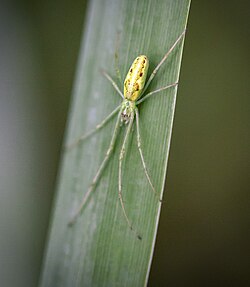 Tetragnatha sp.
 -
 resting on Impatiens
 -
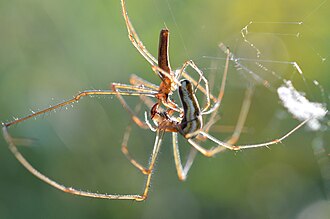 mating
 -
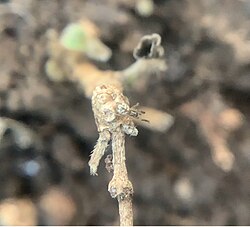
.jpg)


As of October 2025[update], this genus includes 309 species and nine subspecies.[1]
Species with articles on Wikipedia:
- Tetragnatha armata Karsch, 1892 – Sri Lanka
- Tetragnatha bogotensis Keyserling, 1865 – Mexico to Paraguay, Caribbean. Introduced to Spain, Italy (Sardinia), Africa, Seychelles, Yemen, India, Nepal, Bangladesh, China
- Tetragnatha caffra (Strand, 1909) – South Africa
- Tetragnatha caudata Emerton, 1884 – North, Central America, Cuba, Jamaica, Uruguay, Argentina
- Tetragnatha ceylonica O. Pickard-Cambridge, 1869 – Mozambique, South Africa, Seychelles, India, Thailand, Philippines, New Guinea, Japan (Ryukyu Is.)
- Tetragnatha demissa L. Koch, 1872 – Australia. Introduced to Cyprus, Tanzania, South Africa, Seychelles, Tonga
- Tetragnatha determinata Karsch, 1892 – Sri Lanka
- Tetragnatha elongata Walckenaer, 1841 – Canada to Argentina, Caribbean
- Tetragnatha extensa (Linnaeus, 1758) – North America, Greenland, Europe, Turkey, Caucasus, Russia (Europe to Far East), Iraq, Iran, Kazakhstan, Central Asia, China, Korea, Japan (type species)
- Tetragnatha flavida Urquhart, 1891 – New Zealand
- Tetragnatha foveata Karsch, 1892 – Sri Lanka, Laccadive Is. Maldive Is.
- Tetragnatha geniculata Karsch, 1892 – India, Sri Lanka, China, Myanmar, Thailand, Vietnam
- Tetragnatha guatemalensis O. Pickard-Cambridge, 1889 – North and Central America, Cuba, Jamaica, Brazil, Paraguay
- Tetragnatha hasselti Thorell, 1890 – India to China, Indonesia (Sulawesi)
- Tetragnatha isidis (Simon, 1880) – Southern Europe, Libya, Egypt, Sudan, Uganda, South Africa, Iran, India
- Tetragnatha jaculator Tullgren, 1910 – Africa to China and India, New Guinea (Indonesia, Papua New Guinea). Introduced to the Caribbean and South America
- Tetragnatha keyserlingi Simon, 1890 – Central America, Caribbean, Brazil, Africa, Korea, China, India to Philippines, New Hebrides, Polynesia
- Tetragnatha laboriosa Hentz, 1850 – Alaska to Chile, Argentina, Falkland Is.
- Tetragnatha mandibulata Walckenaer, 1841 – Central America, Caribbean, Colombia, Guyana, Brazil, West Africa, India to Philippines, Australia
- Tetragnatha montana Simon, 1874 – Europe, Turkey, Caucasus, Russia (Europe to Far East), Kazakhstan, Iran, Central Asia
- Tetragnatha multipunctata Urquhart, 1891 – New Zealand
- Tetragnatha nigricans Dalmas, 1917 – New Zealand
- Tetragnatha nitens (Audouin, 1826) – Tropical and subtropical Asia. Introduced to Americas, Macaronesia, Mediterranean, St. Helena, South Africa, Madagascar, Pacific Is. New Zealand
- Tetragnatha pallescens F. O. Pickard-Cambridge, 1903 – North, Central America, Caribbean
- Tetragnatha planata Karsch, 1892 – Sri Lanka
- Tetragnatha praedonia L. Koch, 1878 – Russia (Far East), Korea, Japan, China, Taiwan, Laos
- Tetragnatha squamata Karsch, 1879 – India, China, Taiwan, Russia (Far East), Korea, Japan
- Tetragnatha straminea Emerton, 1884 – Canada, United States, Cuba
- Tetragnatha subsquamata Okuma, 1985 – Tanzania, South Africa
- Tetragnatha taylori O. Pickard-Cambridge, 1891 – South Africa
- Tetragnatha tenera Thorell, 1881 – Sri Lanka, Australia (Queensland)
- Tetragnatha torrensis Schmidt & Piepho, 1994 – Cape Verde
- Tetragnatha unicornis Tullgren, 1910 – Tanzania, Botswana, South Africa
- Tetragnatha vermiformis Emerton, 1884 – Temperate and tropical Asia. Introduced to North and Central America, Brazil, South Africa
- Tetragnatha versicolor Walckenaer, 1841 – North, Central America, Cuba
- Tetragnatha virescens Okuma, 1979 – Bangladesh, Sri Lanka to Indonesia, Philippines
- Tetragnatha viridis Walckenaer, 1841 – Canada, United States
- Tetragnatha yesoensis Saito, 1934 – Russia (Far East), China, Korea, Japan
List of all described species
|
|---|
|
Synonyms
|
|---|
|
References[edit | edit source]
- ↑ 1.0 1.1 1.2 1.3 "Genus Tetragnatha". World Spider Catalog. doi:10.24436/2. Retrieved 2025-10-01.
- ↑ Latreille, P. A. (1804). "Tableau methodique des Insectes". Nouveau Dictionnaire d'Histoire Naturelle, Paris. 24: 129–295.
- ↑ 3.0 3.1 3.2 3.3 3.4 3.5 Dippenaar-Schoeman, A.S.; Haddad, C.R.; Foord, S.H.; Lotz, L.N. (2023). The Tetragnathidae of South Africa. Version 2. South African National Survey of Arachnida Photo Identification Guide. p. 33. doi:10.5281/zenodo.7513261.Template:Creative Commons text attribution notice
- ↑ Hänggi, Ambros; Stöckli, Edi; Nentwig, Wolfgang (1995). Lebensräume Mitteleuropäischer Spinnen. Miscellanea Faunistica Helvetiae – Centre suisse de cartographie de la faune, Neuchatel. ISBN 2-88414-008-5.
- ↑ 5.0 5.1 Casquet, Juliane; Bourgeois, Yann X. C.; Cruaud, Corinne; Gavory, Frédérick; Gillespie, Rosemary G.; Thébaud, Christophe (2015). "Community assembly on remote islands: a comparison of Hawaiian and Mascarene spiders". Journal of Biogeography. 42 (1): 39–50. doi:10.1111/jbi.12391. ISSN 1365-2699. S2CID 83565719.
- ↑ Kallal, Robert J.; Kulkarni, Siddharth S.; Dimitrov, Dimitar; Benavides, Ligia R.; Arnedo, Miquel A.; Giribet, Gonzalo; Hormiga, Gustavo (2021). "Converging on the orb: denser taxon sampling elucidates spider phylogeny and new analytical methods support repeated evolution of the orb web". Cladistics. 37 (3): 298–316. doi:10.1111/cla.12439. hdl:11250/2754972. ISSN 1096-0031. PMID 34478199. S2CID 228966334.
- ↑ Vandergast, Amy G.; Gillespie, Rosemary G.; Roderick, George K. (2004-04-27). "Influence of volcanic activity on the population genetic structure of Hawaiian Tetragnatha spiders: fragmentation, rapid population growth and the potential for accelerated evolution: POPULATION GENETICS OF HAWAIIAN TETRAGNATHA". Molecular Ecology. 13 (7): 1729–1743. doi:10.1111/j.1365-294X.2004.02179.x. PMID 15189199. S2CID 10090815.
- ↑ Kennedy, Susan; Lim, Jun Ying; Clavel, Joanne; Krehenwinkel, Henrik; Gillespie, Rosemary G. (2019). Godoy, Oscar (ed.). "Spider webs, stable isotopes and molecular gut content analysis: Multiple lines of evidence support trophic niche differentiation in a community of Hawaiian spiders". Functional Ecology. 33 (9): 1722–1733. doi:10.1111/1365-2435.13361. ISSN 0269-8463. S2CID 182857924.
- ↑ "Tetragnatha montana". NatureSpot. Retrieved 4 February 2024.
- ↑ Adams, Seira A.; Gurajapu, Anjali; Qiang, Albert; Gerbaulet, Moritz; Schulz, Stefan; Tsutsui, Neil D.; Ramirez, Santiago R.; Gillespie, Rosemary G. (10 April 2024). "Chemical species recognition in an adaptive radiation of Hawaiian Tetragnatha spiders (Araneae: Tetragnathidae)". Proceedings of the Royal Society B: Biological Sciences. 291 (2020). doi:10.1098/rspb.2023.2340. PMC 11003775.