


No edit summary |
Yaxisdelhi (talk | contribs) No edit summary |
||
| Line 1: | Line 1: | ||
{{Short description|Public university | {{Short description|Public university in Dhaka, Bangladesh}} | ||
{{Use dmy dates|date= | {{Use dmy dates|date=September 2024}} | ||
{{Infobox university | {{Infobox university | ||
| name = University of Dhaka | | name = University of Dhaka | ||
| native_name = ঢাকা বিশ্ববিদ্যালয় | | native_name = ঢাকা বিশ্ববিদ্যালয় | ||
| image = | | image = Dhaka University logo.svg | ||
| image_size = | | image_size = 150px | ||
| caption = [[Crest (heraldry)|Crest]] of DU | |||
| caption = [[Crest (heraldry)|Crest]] of | | former_name = University of Dacca (1921–1982) | ||
| motto = | | latin_name = | ||
| motto_lang = bn | | motto = শিক্ষাই আলো | ||
| mottoeng = Education is light | | motto_lang = bn | ||
| established = {{start date and age|df=yes|1921}} | | mottoeng = Education is light (Latin: {{lang|la|Educere Est Lux}}) | ||
| affiliation = [[University Grants Commission (Bangladesh)| | | established = {{start date and age|df=yes|1921}} | ||
| | | founder = [[Khwaja Salimullah|Nawab Sir Khwaja Salimullah Bahadur]]<br />[[Syed Nawab Ali Chowdhury]] | ||
| type = | | affiliation = | ||
| chancellor = [[President of Bangladesh]] | | accreditation = {{ubl|[[University Grants Commission (Bangladesh)|UGC]], [[Pharmacy Council of Bangladesh|PCB]], [[Bangladesh Bar Council|Bar Council]], [[Association of Commonwealth Universities|ACU]]}} | ||
| vice_chancellor = [[ | | type = Public research university | ||
| academic_staff = 2,156+<ref name="ar2015p132" /> | | chancellor = [[President of Bangladesh]] | ||
| administrative_staff = 3,887<ref>{{cite web |url=http://www.ugc.gov.bd/uploads/2015/annualreport/Part-1-2.zip |script-title=bn:৪১তম বার্ষিক প্রতিবেদন |trans-title=41st Annual Report |website=University Grants Commission |language=bn |archive-url=https://web.archive.org/web/20160305103342/http://www.ugc.gov.bd/uploads/2015/annualreport/Part-1-2.zip |archive-date=5 March 2016}}</ref> | | vice_chancellor = [[A B M Obaidul Islam|A.B.M. Obaidul Islam]] | ||
| students = | | academic_staff = 2,156+<ref name="ar2015p132">{{cite web |url=http://www.ugc.gov.bd/uploads/2015/annualreport/Part-1-2.zip |title=Annual Report 2015 |page=132 |website=University of Dhaka |access-date=26 February 2016 |archive-date=12 March 2016 |archive-url=https://web.archive.org/web/20160312114322/http://www.ugc.gov.bd/uploads/2015/annualreport/Part-1-2.zip |url-status=live }}</ref> | ||
| undergrad = | | administrative_staff = 3,887<ref>{{cite web |url=http://www.ugc.gov.bd/uploads/2015/annualreport/Part-1-2.zip |script-title=bn:৪১তম বার্ষিক প্রতিবেদন |trans-title=41st Annual Report |website=University Grants Commission |language=bn |archive-url=https://web.archive.org/web/20160305103342/http://www.ugc.gov.bd/uploads/2015/annualreport/Part-1-2.zip |archive-date=5 March 2016}}</ref> | ||
| postgrad = | | students = 44,895 (2023)<ref>{{Cite web |date=15 October 2023 |title=102th Annual Report 2022-2023 University of Dhaka |url=https://www.du.ac.bd/fontView/assets/AR_2022_2023.pdf |url-status=live |archive-url=https://web.archive.org/web/20241128041508/http://www.du.ac.bd/fontView/assets/AR_2022_2023.pdf |archive-date=28 November 2024 |access-date=14 January 2024 |website=du.ac.bd |page=593}}</ref> | ||
| doctoral = | | undergrad = 30,000+<ref name="ar2015p95">{{cite web |url=http://www.ugc.gov.bd/uploads/2015/annualreport/Part-1-2.zip |title=Annual Report 2015 |page=95 |website=University of Dhaka |access-date=26 February 2016 |archive-date=12 March 2016 |archive-url=https://web.archive.org/web/20160312114322/http://www.ugc.gov.bd/uploads/2015/annualreport/Part-1-2.zip |url-status=live }}</ref> | ||
| other = 269+<ref name="ar2015p95"/> | | budget = {{BDTConvert|1035.45|c|1k=yes}} (2025–26) | ||
| city = [[Dhaka]] | | postgrad = 9,362+<ref name="ar2015p95"/> | ||
| postalcode = [[Postal codes in Bangladesh|1000]] | | doctoral = 974+<ref name="ar2015p95"/> | ||
| country = Bangladesh | | other = 269+<ref name="ar2015p95"/> | ||
| coordinates = {{coord|23|43|59|N|90|23|28|E|region:BD_type:edu|display=inline,title}} | | address = [[Shahbag]] | ||
| campus = | | city = [[Dhaka]] | ||
| campus_size = {{convert| | | postalcode = [[Postal codes in Bangladesh|1000]] | ||
| website = {{URL|https://www. | | country = Bangladesh | ||
| | | coordinates = {{coord|23|43|59|N|90|23|28|E|region:BD_type:edu|display=inline,title}} | ||
| | | campus = Urban | ||
| campus_size = {{convert|275.083|acre}} | |||
| colors = {{Color box|#000080|border=darkgray}} {{Color box|#FF0000|border=darkgray}}<br /> Navy Blue and Red | |||
| other_name = {{hlist|Dhaka University|DU}} | |||
| website = {{official URL}} | |||
| logo = University of Dhaka logo.png | |||
| logo_size = 248px | |||
}} | |||
{{Infobox university rankings | |||
| ARWU_W = | ARWU_W_year = | ARWU_W_ref = | |||
| CWTS_W = | CWTS_W_year = | CWTS_W_ref = | |||
| THE_W = 801-1000 | THE_W_year = 2026 | THE_W_ref = <ref>{{Cite web |url=https://www.timeshighereducation.com/world-university-rankings/latest/world-ranking#!/length/25/locations/BGD/sort_by/rank/sort_order/asc/cols/stats |title=University of Dhaka |website=Times Higher Education |date=12 October 2022 |access-date=19 January 2016 |archive-date=25 February 2016 |archive-url=https://web.archive.org/web/20160225171858/https://www.timeshighereducation.com/world-university-rankings/university-dhaka |url-status=live }}</ref> | |||
| USNWR_W = 604 | USNWR_W_year = 2025 | USNWR_W_ref = <ref name="usnews" /> | |||
| QS_W = =584 | QS_W_year = 2026 | QS_W_ref = <ref name=":QSW2026">{{Cite web|url=https://www.topuniversities.com/world-university-rankings|title=QS World University Rankings}}</ref> | |||
| QS_Asia = 132 | QS_Asia_year = 2026 | QS_Asia_ref =<ref>{{cite web |url=https://www.topuniversities.com/universities/university-dhaka|website=QS World University Rankings |access-date=4 November 2025|title=University of Dhaka}}</ref> | |||
| THE_Asia = 401–500 | |||
| THE_Asia_ref = <ref>{{Cite web|url=https://www.timeshighereducation.com/world-university-rankings/2025/regional-ranking|title=Asia University Rankings|date=16 April 2025|website=Times Higher Education (THE)}}</ref> | |||
| THE_Asia_year = 2025 | |||
| THE_W_Business = 501–600 | |||
| THE_W_Business_ref = <ref name="auto">{{Cite web|url=https://www.timeshighereducation.com/world-university-rankings/university-dhaka|title=University of Dhaka|date=27 November 2024|website=Times Higher Education (THE)}}</ref> | |||
| THE_W_Business_year = 2026 | |||
| THE_W_Health = 301–400 | |||
| THE_W_Health_ref = <ref name="auto"/> | |||
| THE_W_Health_year = 2026 | |||
| THE_W_CS = 601–800 | |||
| THE_W_CS_ref = <ref name="auto"/> | |||
| THE_W_CS_year = 2026 | |||
| THE_W_Education_ref = <ref name="auto"/> | |||
| THE_W_Education_year = 2026 | |||
| THE_W_Education = 301–400 | |||
| THE_W_Eng = 501–600 | |||
| THE_W_Eng_ref = <ref name="auto"/> | |||
| THE_W_Eng_year = 2026 | |||
| THE_W_Life = 601–800 | |||
| THE_W_Life_ref = <ref name="auto"/> | |||
| THE_W_Life_year = 2026 | |||
| THE_W_Physical = 601–800 | |||
| THE_W_Physical_ref = <ref name="auto"/> | |||
| THE_W_Physical_year = 2026 | |||
| THE_W_Social = 601–800 | |||
| THE_W_Social_ref = <ref name="auto"/> | |||
| THE_W_Social_year = 2026 | |||
}} | }} | ||
The '''University of Dhaka''' (also known as '''Dhaka University''' | The '''University of Dhaka''' ({{langx|bn|ঢাকা বিশ্ববিদ্যালয়}}), also known as '''Dhaka University''' ('''DU'''), is a [[public university|public]] [[research university]] located in [[Dhaka]], Bangladesh. Established in 1921, it is the oldest active university in the country.<ref>{{Cite web |title=Bangladesh: Dhaka University listed among 350 top universities of Asia |url=https://www.indiablooms.com/world-details/SA/14115/bangladesh-dhaka-university-listed-among-350-top-universities-of-asia.html |access-date=29 May 2023 |website=Indiablooms.com |language=en |archive-date=29 May 2023 |archive-url=https://web.archive.org/web/20230529113700/https://www.indiablooms.com/world-details/SA/14115/bangladesh-dhaka-university-listed-among-350-top-universities-of-asia.html |url-status=live |author1=Indiablooms}}</ref><ref name="usnews">{{Cite web |title=University of Dhaka |url=https://www.usnews.com/education/best-global-universities/university-of-dhaka-529474 |access-date=29 May 2023 |website=U.S. News & World Report |archive-date=14 July 2023 |archive-url=https://web.archive.org/web/20230714173754/https://www.usnews.com/education/best-global-universities/university-of-dhaka-529474 |url-status=live}}</ref> | ||
The University of Dhaka was founded in 1921 under the Dacca University Act 1920 of the [[Indian Legislative Council]].<ref>{{Cite web |title=Dacca University Act |url=https://old.du.ac.bd/ |access-date=29 May 2023 |website=old.du.ac.bd |language=en |archive-date=29 May 2023 |archive-url=https://web.archive.org/web/20230529113707/https://old.du.ac.bd/ |url-status=live}}</ref> The establishment of the university in Dhaka began with 600 acres of land requisitioned by the British government in 1905 following the formation of the new province of [[East Bengal]] and [[Assam]] with Dhaka as its capital. Part of the land requisitioned belonged to the estate of [[Khwaja Salimullah|Nawab Bahadur Sir Khwaja Salimullah]].<ref>{{cite web |last1=জান্নাতুল তানভী |script-title=bn:ঢাকা বিশ্ববিদ্যালয় প্রতিষ্ঠায় যেভাবে জমি আর টাকার ব্যবস্থা হয়েছিল |url=https://www.bbc.com/bengali/articles/cpd9znnzr5go |website=BBC Bangla |date=July 2024 |access-date=23 August 2024}}</ref><ref name="Worldh" /><ref>{{Cite news |last=হৃদয় |first=আমজাদ হোসেন |date=30 June 2024 |script-title=bn:নবাব স্যার খাজা সলিমুল্লাহর ৬০০ একর জমি দান নিয়ে বিতর্ক |trans-title=The controversy over Nawab Sir Khwaja Salimullah's donation of 600 acres of land. |url=https://www.deshrupantor.com/519723/%E0%A6%A8%E0%A6%AC%E0%A6%BE%E0%A6%AC-%E0%A6%B8%E0%A7%8D%E0%A6%AF%E0%A6%BE%E0%A6%B0-%E0%A6%96%E0%A6%BE%E0%A6%9C%E0%A6%BE-%E0%A6%B8%E0%A6%B2%E0%A6%BF%E0%A6%AE%E0%A7%81%E0%A6%B2%E0%A7%8D%E0%A6%B2%E0%A6%BE%E0%A6%B9%E0%A6%B0-%E0%A7%AC%E0%A7%A6%E0%A7%A6-%E0%A6%8F%E0%A6%95%E0%A6%B0-%E0%A6%9C%E0%A6%AE%E0%A6%BF-%E0%A6%A6%E0%A6%BE%E0%A6%A8-%E0%A6%A8%E0%A6%BF%E0%A7%9F%E0%A7%87 |access-date=27 January 2025 |work=[[Desh Rupantor]] |language=bn}}</ref> It is modeled after [[British Universities|British universities]].<ref name="DU Day">{{cite news |title=DU Day |work=Banglanews24.com |url=http://www.banglanews24.com/English/detailsnews.php?nssl=0ce2ffd21fc958d9ef0ee9ba5336e357&nttl=010720101265 |url-status=dead |access-date=26 November 2013 |archive-url=https://web.archive.org/web/20131203023135/http://www.banglanews24.com/English/detailsnews.php?nssl=0ce2ffd21fc958d9ef0ee9ba5336e357&nttl=010720101265 |archive-date=3 December 2013 |df=dmy-all}}</ref> It is the largest [[public university|public research university]] in Bangladesh, with a student body of 46,150 and a faculty of 1,992. | |||
It has made significant contributions to the modern history of [[Bangladesh]].<ref name="DU Day" /><ref name="The Economic Times">{{cite news |title=Mukherjee 'emotional' while receiving degree in Dhaka |work=[[The Economic Times]] |url=http://articles.economictimes.indiatimes.com/2013-03-04/news/37437048_1_president-pranab-mukherjee-shuvra-narail |access-date=4 January 2014 |archive-date=4 January 2014 |archive-url=https://web.archive.org/web/20140104205232/http://articles.economictimes.indiatimes.com/2013-03-04/news/37437048_1_president-pranab-mukherjee-shuvra-narail |url-status=dead }}</ref><ref name="worldfolio.co.uk">{{cite web |title=In Loving Memory of Samson H. Chowdhury, one of the greatest entrepreneurs the world has ever known |url=http://www.worldfolio.co.uk/region/asia/bangladesh/samson-h-chowdhury-bangladesh-n1817 |access-date=4 January 2014 |website=Worldfolio – AFA PRESS |archive-date=7 January 2019 |archive-url=https://web.archive.org/web/20190107004737/http://www.theworldfolio.com/region/asia/bangladesh/samson-h-chowdhury-bangladesh-n1817%20?url=samson-h-chowdhury-bangladesh-n1817 |url-status=usurped }}</ref><ref>{{cite news |url=http://www.newstoday.com.bd/?option=details&news_id=2350471&date=2013-07-11 |title=Nawab Ali Chowdhury National Award, 2013 |work=The News Today |access-date=4 January 2014 |archive-date=7 January 2019 |archive-url=https://web.archive.org/web/20190107004739/http://www.newstoday.com.bd/?option=details&news_id=2350471&date=2013-07-11%20 |url-status=dead }}</ref> After the [[Partition of India]], it became the focal point of [[Progressivism|progressive]] and [[democratic movement]]s in [[Pakistan]]. Its students and teachers played a central role in the rise of [[Bengali nationalism]] and the [[Bangladesh Liberation War|independence of Bangladesh]] in 1971.<ref>{{Cite news |last=Alam |first=Fakrul |date=3 July 2021 |title=The University of Dhaka and the Birth of Bangladesh |url=https://www.thedailystar.net/literature/news/the-university-dhaka-and-the-birth-bangladesh-2122246 |access-date=29 April 2024 |work=The Daily Star |language=en}}</ref> | |||
Notable [[List of University of Dhaka alumni|alumni]] include physicist [[Satyendra Nath Bose]], known for [[Bose–Einstein statistics]] and the theory of [[Bose–Einstein condensate]]; [[Muhammad Yunus]], winner of the 2006 [[Nobel Peace Prize]] and pioneer of [[microcredit]]; [[Muhammad Shahidullah]]; ''[[Natyaguru]]'' [[Nurul Momen]], pioneer of cultural, sports and theatrical activities of the university (he was both a student and later a teacher at the university); [[Serajul Islam Choudhury]]; physicist [[Mohammad Ataul Karim]]; 20th-century Bengali poet [[Buddhadeb Bose]]; and [[Sheikh Mujibur Rahman]], the country's founding president. | |||
It is one of the highest-ranked university in Bangladesh according to QS World University Ranking.<ref>{{Cite web |date=21 July 2025 |title=QS World University Rankings 2026: Top global universities |url=https://www.topuniversities.com/world-university-rankings |access-date=26 July 2025 |website=Top Universities |language=en}}</ref> | |||
== History == | |||
{{main|History of the University of Dhaka}} | {{main|History of the University of Dhaka}} | ||
[[File:Curzon Hall old photo.jpg|thumb|[[Curzon Hall]], the first institute of the University of Dhaka in 1949]] | |||
{{multiple image | {{multiple image | ||
| align | | align = right | ||
| image1 | | image1 = Salimullah.jpg | ||
| caption1 = | | caption1 = [[Nawab|Nawab Bahadur]] Sir [[Khwaja Salimullah]] played a pioneering role in establishing the University of Dhaka and donated 600 acres of land from his estate for this purpose. | ||
| width1 | | width1 = 150 | ||
| image2 | | image2 = Syed Nawab Ali Chowdhury.JPG | ||
| caption2 = | | caption2 = After Nawab Salimullah's death, [[Syed Nawab Ali Chowdhury]] continued efforts to set up the university, mortgaging a part of his zamindari estate, donating 35,000 takas for the University of Dhaka and 16,000 takas for scholarships for its students. | ||
| width2 | | width2 = 150 | ||
}} | }} | ||
Before Dhaka University was established, near its grounds were the former buildings of [[Dhaka College]] affiliated | [[File:Sir Jadunath Sarkar, Sarat Chandra Chattopadhyay, Sir John Anderson , Acharya Prafulla Chandra Roy, Sir A F Rahman.jpg|thumb |DU Convocation of 1936, (from left) Sir [[Jadunath Sarkar]] (historian), [[Sarat Chandra Chattopadhyay]] (writer), Sir [[John Anderson, 1st Viscount Waverley|John Anderson]] (Chancellor and Governor of Bengal), [[Acharya Prafulla Chandra Roy]] (chemist), Sir [[Ahmad Fazlur Rahman|A F Rahman]] (Vice-Chancellor)]] | ||
Before Dhaka University was established, near its grounds were the former buildings of [[Dhaka College]], affiliated with the [[University of Calcutta]]. In 1873, the college was relocated to [[Bahadur Shah Park]]. Later it shifted to [[Curzon Hall]], which would become the first institute of the university.<ref name="Banglapedia">{{cite book |year=2012 |edition=Second |first=Sajahan |last=Miah |chapter=University of Dhaka |chapter-url=http://en.banglapedia.org/index.php?title=University_of_Dhaka |title=Banglapedia: National Encyclopedia of Bangladesh |editor=Sirajul Islam and Ahmed A. Jamal |publisher=[[Asiatic Society of Bangladesh]] |access-date=5 August 2015 |archive-date=1 July 2015 |archive-url=https://web.archive.org/web/20150701184400/http://en.banglapedia.org/index.php?title=University_of_Dhaka |url-status=live }}</ref> | |||
The establishment of the university was compensation for the annulment of the [[Partition of Bengal (1905)|1905 Partition of Bengal]]. The partition had established the Muslim majority [[Eastern Bengal and Assam]] as a separate province, with Dhaka as its capital. All India Muslim League, newly formed in Dhaka, wholeheartedly supported the move. | The establishment of the university was compensation for the annulment of the [[Partition of Bengal (1905)|1905 Partition of Bengal]]. The partition had established the Muslim-majority [[Eastern Bengal and Assam]] as a separate province, with Dhaka as its capital. The [[All-India Muslim League]], newly formed in Dhaka, wholeheartedly supported the move. | ||
However, the partition was abolished in 1911 due to severe opposition from [[Indian National Congress]] and Bengali Hindus. Deeply hurt by the decision of annulment of Bengal | However, the partition was abolished in 1911 due to severe opposition from the [[Indian National Congress]] and Bengali Hindus.<ref>{{cite news |last1=ফারহানা পারভীন |script-title=bn:ঢাকা বিশ্ববিদ্যালয় প্রতিষ্ঠায় বিরোধিতা করেছিলেন যারা |url=https://www.bbc.com/bengali/news-44609891 |work=[[BBC Bangla]] |archive-url=https://web.archive.org/web/20240823141748/https://www.bbc.com/bengali/news-44609891 |access-date=23 August 2024 |archive-date=23 August 2024 |language=bn}}</ref> Deeply hurt by the decision of the annulment of the partition of Bengal, a Muslim delegation led by [[Khwaja Salimullah|Nawab Sir Khwaja Salimullah Bahadur]], the then [[Nawab of Dhaka]], demanded a university be set up in Dhaka. To appease the majority [[Muslims|Muslim]] masses of [[East Bengal]], [[George Curzon, 1st Marquess Curzon of Kedleston|Lord Curzon]] agreed and declared that a university as a centre of excellence would be established in Dhaka. Nawab Sir Salimullah, who pioneered the university in Dhaka, 600 acres of land from his estate was acquired for this purpose.<ref>{{cite web |last1=জান্নাতুল তানভী |script-title=bn:ঢাকা বিশ্ববিদ্যালয় প্রতিষ্ঠায় যেভাবে জমি আর টাকার ব্যবস্থা হয়েছিল |url=https://www.bbc.com/bengali/articles/cpd9znnzr5go |website=[[BBC Bangla]] |date=July 2024 |archive-url=https://web.archive.org/web/20240823142115/https://www.bbc.com/bengali/articles/cpd9znnzr5go |access-date=23 August 2024 |archive-date=23 August 2024}}</ref><ref name="Worldh">{{cite web |url=http://www.bdlifeline.com/khwaja-salimullah/ |title=Khwaja Salimullah |publisher=World History |access-date=14 May 2015 |archive-date=18 August 2019 |archive-url=https://web.archive.org/web/20190818143223/http://hostinfo.cafe24.com/serviceExpire/servicestop.html |url-status=dead}}</ref> | ||
In 1913, public opinion was invited before the university scheme was given its final shape. The | In 1913, public opinion was invited before the university scheme was given its final shape. The Secretary of State approved it in December 1913.<ref name=Banglapedia/> The first vice-chancellor of the university, [[Philip Joseph Hartog]], formerly the academic registrar of the University of London for 17 years, was appointed.<ref>{{cite web |url=http://www.bangla2000.com/education/study_in_bangladesh/universities/History_DU.shtm |title=History of the Formation of Dhaka University |url-status=live |archive-url=https://web.archive.org/web/20150731074803/http://www.bangla2000.com/Education/Study_in_Bangladesh/Universities/History_DU.shtm |archive-date=31 July 2015 |access-date=10 February 2016}}</ref> | ||
Established in 1921 under the [[Dacca University]] Act 1920 of the [[Indian Legislative Council]], it is modelled after British universities.{{ | Established in 1921 under the [[Dacca University]] Act 1920 of the [[Indian Legislative Council]], it is modelled after British universities.<ref name="jstor.online">{{Cite web |date=28 June 2025 |title=The University of Dhaka: Research Profile and Its Top Scientists - JSTOR ONLINE |url=https://jstor.online/university/the-university-of-dhaka-research-profile-and-its-top-scientists/ |access-date=28 June 2025 |language=en-US}}</ref> Lord [[Lawrence John Lumley Dundas, 2nd Marquess of Zetland|Ronaldshay]], [[Governor of Bengal]] between 1917 and 1922, was its first chancellor. He designated [[Nawaab Syed Shamsul Huda]] a life member of the university. On Huda's recommendation, Lord Ronaldshay appointed [[Ahmad Fazlur Rahman]] as a provost.<ref>{{cite book |last=Khan |first=Muhammad Mojlum |author-link=Muhammad Mojlum Khan |year=2013 |title=The Muslim Heritage of Bengal |url=https://books.google.com/books?id=-2s9BAAAQBAJ&pg=PA252 |publisher=Kube Publishing Ltd. |page=252 |isbn=978-1-84774-059-5 |access-date=5 October 2018 |archive-date=18 August 2019 |archive-url=https://web.archive.org/web/20190818143221/https://books.google.com/books?id=-2s9BAAAQBAJ&pg=PA252 |url-status=live }}</ref> | ||
Academic activities started on 1 July | Academic activities started on 1 July 1921 with 847 students<ref>{{citation |url=http://epaper.thedailystar.net/index.php?opt=view&page=39&date=2017-07-06 |title=University Of Dhaka marks 96 years of glory |work=The Daily Star |access-date=6 July 2017 |archive-date=9 July 2017 |archive-url=https://web.archive.org/web/20170709134051/http://epaper.thedailystar.net/index.php?opt=view&page=39&date=2017-07-06 |url-status=live}}</ref> along with three faculties: Arts, Science and Law; 12 departments: [[Sanskrit literature|Sanskrit]] and [[Bengali language|Bengali]], English, Education, History, [[Islamic Studies|Arabic and Islamic Studies]], [[Persian language|Persian]] and [[Urdu]], Philosophy, Economics and [[Political science|Politics]], [[Physics]], [[Chemistry]], Mathematics, and Law; and three dormitories for students: [[Salimullah Muslim Hall]], [[Dacca Hall]] and [[Jagannath Hall]].<ref>{{cite web |url=http://www.du.ac.bd/DownLoads/DU-Prospectus-2008.pdf |title=Prospectus of University of Dhaka 2008 |website=University of Dhaka |url-status=dead |archive-url=https://web.archive.org/web/20121114084947/http://www.du.ac.bd/DownLoads/DU-Prospectus-2008.pdf |archive-date=14 November 2012 |access-date=16 July 2016}}</ref> | ||
In 1936, the | In 1936, the university awarded honorary doctorate degrees to [[Jagadish Chandra Bose]], [[Jadunath Sarkar]], [[Sarat Chandra Chattopadhyay]], [[Allama Iqbal]] and [[Rabindranath Tagore]].<ref>{{Cite news |url=http://www.thedailystar.net/news-detail-199342 |title=Prof. Razzak: Anti-hero, mentor |date=20 August 2011 |work=The Daily Star |access-date=19 November 2017 |language=en |archive-date=7 November 2017 |archive-url=https://web.archive.org/web/20171107113030/http://www.thedailystar.net/news-detail-199342 |url-status=live }}</ref> | ||
The university played a significant role in the [[Bengali | The university played a significant role in the [[Bengali language movement]] when Bengalis united to fight against Urdu being the sole official [[language]] in [[East Pakistan]]. | ||
Dhaka University was the main place where the movement started with | Dhaka University was the main place where the movement started, with students joining and protesting against the [[Pakistan Government]]. Later, several students were killed at the site where the [[Shaheed Minar, Dhaka|Shaheed Minar]] stands today. After the incident, Bengali was restored as the official language.<ref>{{cite encyclopedia |url=http://en.banglapedia.org/index.php?title=Language_Movement |title=Language Movement |encyclopedia=Banglapedia – The National Encyclopedia of Bangladesh |publisher=Asiatic Society of Bangladesh |access-date=10 February 2016 |url-status=dead |archive-url=https://web.archive.org/web/20160307033428/http://en.banglapedia.org/index.php?title=Language_Movement |archive-date=7 March 2016 |df=dmy-all}}</ref> | ||
The Dacca University Order, 1973 (President's Order No. 11 of 1973), reconstituted and reorganised the University of Dhaka to improve its teaching, research, and administration following the 1971 War of Independence. Throughout this order, the word ''[[Dhaka]]'' was substituted for the word ''Dacca'' by section 2 of the University Laws (Amendment) Act, 1987 (Act No. XXXVI of 1987).<ref>{{Cite web |title=The Dhaka University Order, 1973 (President's Order). |url=http://bdlaws.minlaw.gov.bd/act-447.html |access-date=6 June 2023 |website=bdlaws.minlaw.gov.bd |archive-date=6 June 2023 |archive-url=https://web.archive.org/web/20230606180104/http://bdlaws.minlaw.gov.bd/act-447.html |url-status=live }}</ref> | |||
President's Order No. 11 of 1973 | |||
On 18 July 2024, authorities at the University of Dhaka announced an indefinite closure of the institution after [[2024 Bangladesh quota reform movement|protests demanding reforms in]] [[Quota system of Bangladesh Civil Service|the quota system in government jobs]] turned violent, leaving at least six people, including three students, dead across the country.<ref>{{cite news |title=Dhaka University closed indefinitely; students asked to vacate dorms amid violence over job quota |url=https://www.telegraphindia.com/world/dhaka-university-closed-indefinitely-students-asked-to-vacate-dorms-amid-violence-over-job-quota/cid/2034313 |work=The Telegraph |date=17 July 2024}}</ref><ref>{{cite news |title=Dhaka University closed indefinitely; students asked to vacate dorms |url=https://www.business-standard.com/world-news/dhaka-university-closed-indefinitely-students-asked-to-vacate-dorms-124071700405_1.html |work=[[Business Standard]] |date=17 July 2024}}</ref> However, the university reopened after the [[Resignation of Sheikh Hasina|resignation]] of Prime Minister [[Sheikh Hasina]] amidst a [[Non-cooperation movement (2024)|mass uprising]].<ref>{{cite news |url=https://www.news18.com/world/how-dhaka-university-founded-when-bangladesh-was-part-of-india-played-a-part-in-sheikh-hasinas-resignation-8994241.html |title=How Dhaka University, Founded When Bangladesh Was Part of India, Played A Part In Sheikh Hasina's Resignation |date=8 August 2024 |work=[[News18]]}}</ref> | |||
==Campus== | ==Campus== | ||
===Residential facilities=== | ===Residential facilities=== | ||
There are 23 residence halls for | There are 23 residence halls for students and dormitories for teachers and university officials.<ref name="halls">{{cite news |url=http://www.theindependentbd.com/printversion/details/10469 |title=Halls of Dhaka University |work=[[The Independent (Bangladesh newspaper)]] |location=Dhaka |date=6 August 2015 |url-status=live |archive-url=https://web.archive.org/web/20151009143644/http://www.theindependentbd.com/printversion/details/10469 |archive-date=9 October 2015 |access-date=10 February 2016}}</ref> | ||
==== Residential halls and hostels ==== | |||
The following list is based on the information provided on the official website of the University of Dhaka.<ref name="duHalls">{{cite web |url=https://www.du.ac.bd/students/HallsResidence |title=Halls of Residence |website="University of Dhaka" |access-date=28 November 2025}}</ref> | |||
'''Halls''' | |||
{{columns-list|colwidth=20em| | |||
# [[Salimullah Muslim Hall]] | |||
# [[Jagannath Hall]] | |||
# [[Dr. Muhammad Shahidullah Hall]] | |||
# [[Fazlul Huq Muslim Hall]] | |||
# Shahid Sergeant Zahurul Haq Hall | |||
# Ruquyyah Hall | |||
# Masterda Surja Sen Hall | |||
# Sir P. J Hartog International Hall | |||
# Haji Muhammad Mohsin Hall | |||
# Shamsun Nahar Hall | |||
# Kabi Jasimuddin Hall | |||
# Sir A. F Rahman Hall | |||
# Muktijoddha Ziaur Rahman Hall | |||
# Bangladesh-Kuwait Maitree Hall | |||
# Amar Ekushey Hall | |||
# Begum Fazilatun Nesa Mujib Hall | |||
# Kabi Sufia Kamal Hall | |||
# Bijoy Ekattor Hall | |||
# Shahid Osman Hadi Hall | |||
}} | |||
'''Hostels''' | |||
{{columns-list|colwidth=20em| | |||
# Nabab Foyzunnessa Chowdhurani Chhatrinibash | |||
# IBA Hostel | |||
# Dr. Qudrat-E-Khuda Hostel | |||
# Shahid Athlete Sultana Kamal Hostel | |||
}} | |||
===Libraries=== | ===Libraries=== | ||
{{main|Dhaka University Library}} | {{main|Dhaka University Library}} | ||
The Dhaka University Library comprises three buildings: | [[File:Dhaka University Central Library.jpg|thumb|Dhaka University Library]] | ||
The University Library, housed in three separate buildings, is the largest in Bangladesh. The library holds a collection of more than 617,000 volumes, including bound volumes of periodicals. In addition, it has a collection of over 30,000 manuscripts in other languages and a large number of microfilms, microfiche, and CDs. It subscribes to over 300 foreign journals.<ref>{{cite book |last1=Wedgeworth |first1=Robert |author-link=Robert Wedgeworth |url=https://books.google.com/books?id=HSFu99FCJwQC&q=dhaka+university+central+library&pg=PA102 |title=World Encyclopedia of Library and Information Services |publisher=American Library Association |year=1993 |url-status=live |archive-url=https://web.archive.org/web/20170217124457/https://books.google.com/books?id=HSFu99FCJwQC&pg=PA102&lpg=PA102&dq=dhaka+university+central+library&source=bl&ots=SSBHPVMQAW&sig=JZEl0U1VZiWnv2N1lRKNPXz0ChA&hl=bn&sa=X&redir_esc=y |archive-date=17 February 2017 |page=102 |isbn=9780838906095 |access-date=10 February 2016}}</ref> | |||
The Dhaka University Library comprises three buildings: the administrative building, the main library building, and the science library building. The administrative building has administrative offices, a book acquisition section, a book processing section, a reprographic section, a bookbinding section, a manuscript section, and a seminar section.<ref>{{cite web |url=http://www.yogsutra.com/dhaka-university.html |title=Dhaka University a Top Educational Institution in Bangladesh |work=yogsutra |date=28 August 2015 |url-status=live |archive-url=https://web.archive.org/web/20160210141904/http://www.yogsutra.com/dhaka-university.html |archive-date=10 February 2016 |access-date=10 February 2016}}</ref> | |||
Additionally, the Faculty of Business Studies has an e-library which is the largest of its kind in Asia.<ref name="tribune library">{{cite news |title=Asia's largest e-Library opens at Dhaka University |url=http://www.dhakatribune.com/bangladesh/2015/aug/11/asias-largest-e-library-opens-dhaka-university |newspaper=[[Dhaka Tribune]] |date=11 August 2015 |access-date=13 September 2015 |archive-date=15 August 2015 |archive-url=https://web.archive.org/web/20150815002735/http://www.dhakatribune.com/bangladesh/2015/aug/11/asias-largest-e-library-opens-dhaka-university |url-status=live }}</ref> This advanced-level e-library is connected with 35 internationally renowned libraries and publication houses in the world. Teachers, students, and researchers can read all journals, books, research papers, and articles of these leading libraries, including the [[University of Oxford]] and [[University of Cambridge]] libraries, by using the e-library facilities.<ref name="jstor.online"/> | |||
This e-library was built in collaboration with Robi Axiata Limited in August 2015. It can accommodate around | This e-library was built in collaboration with Robi Axiata Limited in August 2015. It can accommodate around 1,400 students. The {{convert|12000|sqft}} library has three sections: a computer section, a silent zone, and a discussion zone. Some 7,000 students and 208 teachers of the faculty are directly benefiting from the facility.<ref name="tribune library" /> | ||
===Health services=== | ===Health services=== | ||
The Medical | The Medical Centre of the University of Dhaka, near the Science Annex Building, offers free medical services and free pathological examinations to students, teachers, staff, and their family members. The centre provides service round-the-clock, seven days a week, with 30 doctors working in shifts. The centre has a dental unit, an eye unit, an X-ray department, and two ambulances.<ref>{{cite web |url=http://www.du.ac.bd/home/office_and_admin/mdc |title=Dhaka University Medical Center |url-status=live |archive-url=https://web.archive.org/web/20160210143035/http://www.du.ac.bd/home/office_and_admin/mdc |archive-date=10 February 2016 |access-date=10 February 2016}}</ref> | ||
===Cafeteria=== | ===Cafeteria=== | ||
There are cafeterias on campus, some of which hold historical and architectural interest. In 1971 Pakistani soldiers killed the owner of the [[Madhur Canteen]].<ref name="The Legacy of | There are cafeterias on campus, some of which hold historical and architectural interest. In 1971, Pakistani soldiers killed the owner of the [[Madhur Canteen]].<ref name="The Legacy of Madhu's Canteen">{{cite news |last1=Yusuf |first1=Ananta |title=The Legacy of Madhu's Canteen |url=http://archive.thedailystar.net/beta2/news/the-legacy-of-madhus-canteen/ |newspaper=The Daily Star |access-date=12 July 2015 |archive-date=28 January 2016 |archive-url=https://web.archive.org/web/20160128005334/http://archive.thedailystar.net/beta2/news/the-legacy-of-madhus-canteen/ |url-status=live }}</ref> | ||
The [[Teacher-Student Centre|Teacher-Student Centre | The [[Teacher-Student Centre, University of Dhaka|Teacher-Student Centre]] (TSC) has its own cafeteria, while another cafeteria stands on the Dhaka University Snacks (DUS) Chattar. The Science cafeteria was situated behind Curzon Hall but was demolished to construct a new 20-storey building. There is also another snack and lunch place named DU Hut in front of the Department of Sociology. The Faculty of Business Studies has a modern food court for its students.<ref>{{cite news |title=Mojo Establishes Food Court at Dhaka University |url=http://archive.thedailystar.net/beta2/news/mojo-establishes-food-court-at-dhaka-university/ |newspaper=[[The Daily Star (Bangladesh)|The Daily Star]] |date=26 November 2013 |access-date=13 September 2015 |archive-date=2 February 2016 |archive-url=https://web.archive.org/web/20160202135317/http://archive.thedailystar.net/beta2/news/mojo-establishes-food-court-at-dhaka-university/ |url-status=live }}</ref> | ||
== | ===Fuller Road=== | ||
{{Infobox street | |||
| name = Fuller Road | |||
| marker_image = | |||
| other_name = Sir Syed Ahmed Road | |||
| image = | |||
| image_size = | |||
| caption = | |||
| map_type = | |||
| coordinates = | |||
| map_caption = | |||
| native_name = | |||
| former_names = | |||
| part_of = | |||
| namesake = [[Bampfylde Fuller]] | |||
| type = [[Street]] | |||
| maint = [[Dhaka South City Corporation]] | |||
| length_mi = | |||
| length_km = 0.95 | |||
| country = Bangladesh | |||
| location = [[Dhaka]] | |||
| postal_code = 1000 | |||
| terminus_a = Nilkhet Road | |||
| direction_a = North | |||
| terminus_b = Shahid Minar Road | |||
| direction_b = South | |||
| known_for = | |||
| website = | |||
}} | |||
Fuller Road is a road in [[Shahbag]], Dhaka. The road was named after [[Bampfylde Fuller]], the first lieutenant governor of [[Eastern Bengal and Assam]].<ref>{{Cite news |last=Alam |first=Fakrul |author-link=Fakrul Alam |date=7 July 2018 |title=A Short, Winding and Legendary Dhaka Road |url=https://www.thedailystar.net/literature/short-winding-and-legendary-dhaka-road-1601140 |access-date=20 October 2024 |work=The Daily Star |language=en}}</ref> In 1967, Dhaka Municipality renamed it Sir Syed Ahmed Road, but it is still widely known as Fuller Road.<ref name="Ahmed2012">{{cite encyclopedia |last=Ahmed |first=Sharif Uddin |year=2012 |script-title=bn:ফুলার রোড |trans-title=Fuller Road |script-encyclopedia=bn:ঢাকা কোষ |trans-encyclopedia=Encyclopedia of Dhaka |publisher=Asiatic Society of Bangladesh |isbn=978-9-84-512019-7 |pages=262–263}}</ref> The road starts from VC Square, where it junctions with Nilkhet Road, and ends at Shadhinota Sangram Monument Square, where it meets Shahid Minar Road. | |||
[[ | |||
Landmarks include: | |||
* Vice-Chancellor of the University of Dhaka's residence<ref name="Ahmed2012" /> | |||
* [[British Council Bangladesh]]<ref name="Ahmed2012" /> | |||
* [[Udayan Higher Secondary School]]<ref name="Ahmed2012" /> | |||
* [[Salimullah Muslim Hall]]<ref name="Ahmed2012" /> | |||
* [[Jagannath Hall]]<ref name="Ahmed2012" /> | |||
==Faculties and departments== | |||
The university consists of 13 faculties and 83 departments.<ref>{{Cite web |url=http://www.du.ac.bd/main_menu/the_university/about |title=About University of Dhaka |access-date=24 January 2019 |archive-date=2 May 2017 |archive-url=https://web.archive.org/web/20170502030816/http://www.du.ac.bd/main_menu/the_university/about |url-status=live }}</ref> | |||
=== Faculty of Arts === | |||
* Department of Bangla | |||
* Department of English | |||
* Department of Arabic | |||
* Department of Persian Language and Literature | |||
* Department of Urdu | |||
* Department of Sanskrit | |||
* Department of Pali | |||
* Department of Buddhist Studies | |||
* Department of Linguistics | |||
* Department of Philosophy | |||
* Department of History | |||
* Department of Islamic Studies | |||
* Department of Islamic History and Culture | |||
* Department of Information Science and Library Management | |||
* Department of World Religions and Culture | |||
* Department of Theatre and Performance Studies | |||
* Department of Music | |||
* Department of Dance | |||
=== Faculty of Social Sciences === | |||
* | * Economics | ||
* | * Political Science | ||
* | * [[International Relations]] | ||
* | * [[Anthropology]] | ||
* | * [[Public Administration]] | ||
* | * [[Journalism Studies|Mass Communication and Journalism]] | ||
* | * [[Communication disorder|Communication Disorders]] | ||
* | * Printing and Publication Studies | ||
* | * [[Media studies|Television, Film and Photography]] | ||
* [[Sociology]] | |||
* [[Development Studies]] | |||
* [[Criminology]] | |||
* [[Japanese Studies]] | |||
* [[Women's studies|Women and Gender Studies]] | |||
* [[Peace and Conflict Studies]] | |||
=== Faculty of Law === | |||
* Department of | * Department of Law | ||
=== Faculty of Fine Arts === | |||
* | * [[Ceramics]] | ||
* | * [[Craft]] | ||
* | * [[Drawing|Drawing and Painting]] | ||
* | * [[Graphic Design]] | ||
* | * Oriental Art | ||
* [[Printmaking]] | |||
* [[Sculpture]] | |||
* [[History of Art]] | |||
=== Faculty of Business Studies === | |||
The Faculty of Business Studies (FBS) was established in 1970 as the [[Faculty (division)|Faculty]] of Commerce. It began its journey with two departments: the Department of Accounting and the Department of Management. Two more departments were created in 1974, and the authority introduced the semester system from the 1977–1978 session. The names of the [[Bachelor of Commerce|B.Com]] and [[Master of Commerce|M.Com]] degrees were changed to [[Bachelor of Business Administration|BBA]] and MBA, respectively, during the 1994–1995 session.<ref name="du.ac.bd">{{cite web |url=http://www.du.ac.bd/main_menu/academic/facbusns |title=Head of Office: Prof. Shibli Rubayat Ul Islam |date=15 April 2018 |website=University of Dhaka |access-date=22 June 2018 |archive-date=22 June 2018 |archive-url=https://web.archive.org/web/20180622165235/http://www.du.ac.bd/main_menu/academic/facbusns |url-status=live}}</ref> Following its rebranding as the Faculty of Business Studies, four other departments were added to this faculty over the course of the next 13 years. In 1995, the Faculty of Commerce took its current name and became the Faculty of Business Studies.<ref>{{cite web |url=http://www.dumarketing.ac.bd/?p=67 |title=Faculty of Business Studies |date=10 November 2013 |website=Department of Marketing |access-date=22 June 2018 |archive-date=22 June 2018 |archive-url=https://web.archive.org/web/20180622165434/http://www.dumarketing.ac.bd/?p=67 |url-status=live}}</ref> | |||
Muhammad Abdul Moyeen became the acting dean of the Faculty of Business Studies in May 2020.<ref>{{Cite web |title=University of Dhaka |url=https://www.du.ac.bd/latest_news/single_news/2690 |access-date=13 June 2020 |website=University of Dhaka |archive-date=13 June 2020 |archive-url=https://web.archive.org/web/20200613152027/https://www.du.ac.bd/latest_news/single_news/2690 |url-status=live }}</ref> | |||
Currently, there are nearly 153 teachers, 10 officers, 58 employees, and nearly 6,100 students under the faculty. The departments are as follows:<ref name="du.ac.bd"/> | |||
* | * Accounting and Information Systems | ||
* | * Management | ||
* | * Marketing | ||
* | * Finance | ||
* Banking and Insurance | |||
* Management Information Systems | |||
* Tourism and Hospitality Management | |||
* International Business | |||
* Organization Strategy and Leadership | |||
=== Faculty of Science === | |||
* | * [[Mathematics]] | ||
* | * [[Applied mathematics|Applied Mathematics]] | ||
* | * [[Physics]] | ||
* | * [[Chemistry]] | ||
* | * [[Statistics]] | ||
* | * [[Medical Physics|Biomedical Physics and Biomedical Technology]] | ||
* | * [[Theoretical Physics]] | ||
* | * [[Theoretical chemistry|Theoretical Chemistry]] | ||
* [[Computational chemistry|Computational Chemistry]] | |||
=== Faculty of Pharmacy === | |||
* [[Pharmacy]] | |||
* [[Clinical Pharmacy]] and [[Pharmacology]] | |||
* Pharmaceutical Chemistry | |||
* Pharmaceutical Technology | |||
* | [[File:Botanical Garden, Department of Botani, University of Dhaka..jpg|thumb|Botanical Garden, Department of Botany]] | ||
* | |||
* | |||
* | |||
=== Faculty of Biological Sciences === | |||
* | * [[Botany]] | ||
* | * [[Zoology]] | ||
* | * [[Biochemistry]] and [[Molecular biology|Molecular Biology]] | ||
* | * [[Microbiology]] | ||
* | * [[Psychology]] | ||
* [[Medical psychology|Clinical Psychology]] | |||
* [[Educational psychology]] | |||
* [[Genetic engineering|Genetic Engineering]] and [[Biotechnology]] | |||
* [[Soil]], [[Water]] and Environment | |||
* [[Fisheries]] | |||
=== Faculty of Earth and Environmental Sciences === | |||
* [[Geography|Geography and Environment]] | |||
* [[Geology]] | |||
* [[Oceanography]] | |||
* Disaster Science and Climate Resilience | |||
* [[Meteorology]] | |||
=== Faculty of Engineering and Technology === | |||
* [[Electrical and Electronic Engineering]] | |||
* [[Chemical engineering|Applied Chemistry and Chemical Engineering]] | |||
* [[Computer Science & Engineering|Computer Science and Engineering]] | |||
* [[Nuclear Engineering]] | |||
* [[Robotics|Robotics and Mechatronics Engineering]] | |||
=== Faculty of Education === | |||
* Department of Mechanical Engineering | |||
=== Faculty of Medicine === | |||
* Department of [[Bachelor of Medicine, Bachelor of Surgery|Medicine and Surgery]] | |||
=== Faculty of Postgraduate Medical Sciences and Research === | |||
* Department of [[Virology]] | |||
== Research and development facilities == | |||
==Institutes== | ===Institutes of Dhaka University=== | ||
[[File:Institute of Statistical Research and Training (ISRT), University of Dhaka.jpg|thumb|right| | [[File:Institute of Statistical Research and Training (ISRT), University of Dhaka.jpg|thumb|right|Institute of Statistical Research and Training (ISRT)]] | ||
# [[Institute of Education and Research]] | {{columns-list|colwidth=12em| | ||
# [[Institute of Statistical Research and Training]] | # [[Institute of Education and Research, University of Dhaka|Education and Research]] | ||
# [[Institute of Business Administration, University of Dhaka| | # [[Institute of Statistical Research and Training, University of Dhaka|Statistical Research and Training]] | ||
# [[Institute of Social Welfare and Research | # [[Institute of Business Administration, University of Dhaka|Business Administration]] | ||
# [[Institute of Modern Languages | # [[Institute of Social Welfare and Research, University of Dhaka|Social Welfare and Research]] | ||
# [[Institute of Information Technology, University of Dhaka| | # [[Institute of Modern Languages, University of Dhaka|Modern Languages]] | ||
# | # [[Institute of Information Technology, University of Dhaka|Information Technology]] | ||
# | # Energy | ||
# | # Disaster Management and Vulnerability Studies | ||
# [[Institute of Leather Engineering and Technology, University of Dhaka| | # Nutrition and Food Science | ||
# Health Economics<ref>{{cite web |url=http://ihe.ac.bd/ |title=About IHE |website=Institute of Health Economics |access-date=27 December 2018 |archive-date=27 December 2018 |archive-url=https://web.archive.org/web/20181227133153/http://ihe.ac.bd/ |url-status=live}}</ref> | |||
# [[Institute of Leather Engineering and Technology, University of Dhaka|Leather Engineering and Technology]] | |||
}} | |||
=== Research centres === | |||
# Bureau of Economic Research | # Bureau of Economic Research | ||
# Bureau of Business Research | # Bureau of Business Research | ||
# Bose | # Bose Centre for Advanced Study and Research in Natural Sciences | ||
# [[Renewable Energy Research Centre]] | # [[Renewable Energy Research Centre]] | ||
# [[Delta Research Centre]] | # [[Delta Research Centre]] | ||
# Material Chemistry Research Lab | |||
== | == ''Dhaka Viswavidyalay Patrika'' == | ||
{{Infobox magazine | |||
| italic title = no | |||
| title = Dhaka Viswavidyalay Patrika | |||
| image_file = | |||
| image_size = | |||
| image_caption = | |||
| editor = [[Serajul Islam Choudhury]]<br />(1973–1988)<ref name="nrk" /> | |||
| editor_title = Editor | |||
| category = [[Research]] | |||
| frequency = Quarterly | |||
| circulation = | |||
| publisher = University of Dhaka | |||
| firstdate = December 1973 | |||
| company = Dhaka University Press | |||
| country = [[Bangladesh]] | |||
| based = Dhaka | |||
| language = [[Bengali language|Bangla]] | |||
| website = [https://dujournal.org/ official website] | |||
| issn = 2411-9059 | |||
| eissn = 3006-3078 | |||
}} | |||
'''''Dhaka Viswavidyalay Patrika''''' ({{langx|bn|ঢাকা বিশ্ববিদ্যালয় পত্রিকা}}; alternate spelling: '''''Dhaka Bishwabiddyaloy Patrika''''') is an open-access peer-reviewed [[Academic journal|academic research journal]] published since 1973 and funded by the University of Dhaka. The scholarly journal publishes research articles written in Bengali on [[literature]], [[history]], [[religion]], [[philosophy]], [[fine art]]s, [[music]], [[business]], [[law]], [[science]], [[social science]], [[biology]], [[economics]], and [[politics]]. [[Serajul Islam Choudhury]] was the founding editor of this journal.<ref name="nrk">{{Cite web |last=Khan |first=Nurur Rahman |date=22 September 2021 |title=Dhaka Viswavidyalay Patrika |url=https://en.banglapedia.org/index.php?title=Dhaka_Viswavidyalay_Patrika |access-date=12 October 2024 |website=[[Banglapedia]]}}</ref> | |||
=== Publication history === | |||
The first issue was published in December 1973. From 1973 to 1976, it was published once a year as an annual publication. From 1977 to 1983, it was published twice a year as a semi-annual. It was published twice in 1984, as June and October issues. Since 1985, the journal has been published regularly in February, June, and October.<ref name="nrk" /> | |||
=== Review system === | |||
Researchers are invited to submit two copies of [[manuscript]]s on different subjects. In addition to the chief editor, an editorial board selects manuscripts for publication. Selected articles are sent to relevant subject experts for review and, based on their opinion, are published. After its establishment, the paper used to publish the research articles of Dhaka University teachers, researchers, and affiliated college teachers; since 1997, the writings of researchers outside the university have been accepted and published.<ref name="nrk" /> | |||
==Student life== | ==Student life== | ||
[[File: | [[File:Students Adda - Teacher-Student Center - University of Dhaka - Dhaka 2015-05-31 2446.JPG|thumb|Students gossiping at the [[Teacher-Student Centre, University of Dhaka|Teacher-Student Centre]] (TSC)]] | ||
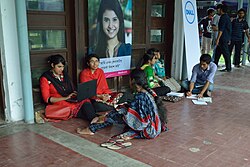
The | The University of Dhaka organises sports and other extracurricular and recreational activities. The Office of the Director of Physical Education provides three types of programmes:<ref>{{cite web |title=Physical-Education |url=https://web3.du.ac.bd/students/PhysicalEducation|website=web.du.ac.bd |archive-url=https://web.archive.org/web/20240827202953/https://web3.du.ac.bd/students/PhysicalEducation |access-date=27 August 2024 |archive-date=27 August 2024 |language=en}}</ref> | ||
* Compulsory Physical Education | * Compulsory Physical Education; | ||
* Certificate course in coaching major games and sports | * Certificate course in coaching major games and sports; and | ||
* Intramural and extramural | * Intramural and extramural programmes. | ||
University of Dhaka | The University of Dhaka Ground is the official stadium of the University of Dhaka. It hosts many inter-collegiate and intra-collegiate sports tournaments at inter-city and national levels. | ||
===Intramural and extramural | ===Intramural and extramural programmes=== | ||
The directorate organises and conducts inter-departmental and inter-hall tournaments, individual hall athletics, Dhaka University athletics, and inter-university games and sports. Students participate in national championships in games and sports for which prior training and coaching are offered. | |||
=== Dhaka University Central Students' Union === | === Dhaka University Central Students' Union === | ||
{{Main|Dhaka University Central Students' Union}} | {{Main|Dhaka University Central Students' Union}} | ||
[[File:Dhaka University Central Student's Union (DUCSU) building, University of Dhaka (2).jpg|thumb|DUCSU HQ]] | |||
The Dhaka University Central Students' Union is the official [[students' union]] of the University of Dhaka. It is better known in Bangladesh as DUCSU. It exists to represent Dhaka University students in the university's decision-making, to act as the voice for students in the national higher education policy debate, and to provide direct services to the student body.<ref>{{Cite news |url=https://www.thedailystar.net/opinion/perspective/the-ducsu-conundrum-1473472 |title=The DUCSU conundrum |date=9 October 2017 |work=The Daily Star |type=Opinion |language=en |access-date=29 January 2019 |archive-date=30 January 2019 |archive-url=https://web.archive.org/web/20190130001729/https://www.thedailystar.net/opinion/perspective/the-ducsu-conundrum-1473472 |url-status=live }}</ref><ref>{{Cite news |url=https://www.thedailystar.net/editorial/news/make-ducsu-centre-all-campus-activities-1687936 |title=Make Ducsu centre of all campus activities |date=16 January 2019 |work=The Daily Star |language=en |access-date=29 January 2019 |archive-date=30 January 2019 |archive-url=https://web.archive.org/web/20190130000306/https://www.thedailystar.net/editorial/news/make-ducsu-centre-all-campus-activities-1687936 |url-status=live }}</ref><ref>{{Cite news |url=https://www.ittefaq.com.bd/2016/%E0%A6%AA%E0%A6%BE%E0%A6%A8%E0%A6%BF-%E0%A6%85%E0%A6%AA%E0%A6%B8%E0%A6%BE%E0%A6%B0%E0%A6%A3%E0%A7%87-%E0%A6%AA%E0%A7%8D%E0%A6%B0%E0%A6%A7%E0%A6%BE%E0%A6%A8-%E0%A6%85%E0%A6%A8%E0%A7%8D%E0%A6%A4%E0%A6%B0%E0%A6%BE%E0%A7%9F-%E0%A6%95%E0%A6%9A%E0%A7%81%E0%A6%B0%E0%A6%BF%E0%A6%AA%E0%A6%BE%E0%A6%A8%E0%A6%BE-%E0%A6%93-%E0%A6%AD%E0%A7%87%E0%A6%B8%E0%A6%BE%E0%A6%B2-%E0%A6%9C%E0%A6%BE%E0%A6%B2|script-title=bn:পানি অপসারণে প্রধান অন্তরায় কচুরিপানা ও ভেসাল জাল|work=The Daily Ittefaq|access-date=5 December 2023|archive-date=28 September 2023|archive-url=https://web.archive.org/web/20230928141754/https://www.ittefaq.com.bd/2016/%E0%A6%AA%E0%A6%BE%E0%A6%A8%E0%A6%BF-%E0%A6%85%E0%A6%AA%E0%A6%B8%E0%A6%BE%E0%A6%B0%E0%A6%A3%E0%A7%87-%E0%A6%AA%E0%A7%8D%E0%A6%B0%E0%A6%A7%E0%A6%BE%E0%A6%A8-%E0%A6%85%E0%A6%A8%E0%A7%8D%E0%A6%A4%E0%A6%B0%E0%A6%BE%E0%A7%9F-%E0%A6%95%E0%A6%9A%E0%A7%81%E0%A6%B0%E0%A6%BF%E0%A6%AA%E0%A6%BE%E0%A6%A8%E0%A6%BE-%E0%A6%93-%E0%A6%AD%E0%A7%87%E0%A6%B8%E0%A6%BE%E0%A6%B2-%E0%A6%9C%E0%A6%BE%E0%A6%B2|url-status=live}}</ref> It was established in the academic year of 1922–23 as the Dhaka University Student Union. Its first constitution was drafted in its general assembly on 30 October 1925. In 1953, its constitution was amended, and the union was renamed the Dhaka University Central Students' Union. In 2019, the last DUCSU election took place after 29 years. Since then, DUCSU has been working for the welfare of the students. | |||
==Rankings== | ==Rankings== | ||
===International rankings=== | ===International rankings=== | ||
In 2011–12, the University of Dhaka | In 2011–12, the University of Dhaka was included in the list of 'Top World Universities' by QS World University Rankings. Out of over 30,000 universities around the world, DU was placed at 551.<ref>{{cite web |url=http://www.university-list.net/rank/univ-110025.html |title=QS World University Rankings 2011 (501–600) -Top Universities |website=University-list.net |access-date=8 October 2013 |archive-date=12 September 2013 |archive-url=https://web.archive.org/web/20130912020945/http://www.university-list.net/rank/univ-110025.html |url-status=live }}</ref> In 2014–15, the University of Dhaka was ranked 701st by [[QS World University Rankings]] (formerly [[Times Higher Education–QS World University Rankings]]).<ref name="University of Dhaka">{{cite web |url=http://www.topuniversities.com/universities/university-dhaka/undergrad |title=University of Dhaka |publisher=University-list.net |access-date=28 July 2015 |archive-date=28 July 2015 |archive-url=https://web.archive.org/web/20150728094320/http://www.topuniversities.com/universities/university-dhaka/undergrad |url-status=live }}</ref> In 2015–16, [[Times Higher Education]] partnering with [[Elsevier]] ranked the university at 654th position among the top 800 globally reputed universities.<ref>{{cite web |url=https://www.timeshighereducation.com/world-university-rankings/university-dhaka?ranking-dataset=133819 |title=World University Rankings 2016:University of Dhaka |year=2016 |website=timeshighereducation.com |access-date=19 January 2016 |archive-date=29 January 2016 |archive-url=https://web.archive.org/web/20160129221839/https://www.timeshighereducation.com/world-university-rankings/university-dhaka?ranking-dataset=133819 |url-status=live }}</ref> In September 2015, QS World University Rankings published their 2015 edition of World University Rankings of 2015/16 and ranked DU at 126th position in Asia and in the 701–750 band in the world.<ref>{{cite web |url=http://www.topuniversities.com/universities/university-dhaka |title=QS Top University Rankings 2015/16:University of Dhaka |year=2016 |publisher=QS Intelligence Unit |access-date=21 January 2016 |archive-date=27 January 2016 |archive-url=https://web.archive.org/web/20160127070653/http://www.topuniversities.com/universities/university-dhaka |url-status=live }}</ref> In the Times Higher Education 2018 Global University Ranking, the University of Dhaka was placed in the 1001+ position among world universities.<ref>{{cite web |url=https://www.timeshighereducation.com/world-university-rankings/university-dhaka#ranking-dataset/629337 |title=University of Dhaka |website=Times Higher Education |access-date=14 September 2017 |archive-date=15 September 2017 |archive-url=https://web.archive.org/web/20170915024208/https://www.timeshighereducation.com/world-university-rankings/university-dhaka#ranking-dataset/629337 |url-status=live }}</ref> | ||
===Asian level rankings=== | ===Asian level rankings=== | ||
In | In the 2026 [[QS Asia University Rankings]], the University of Dhaka was ranked 132nd in Asia.<ref>{{Cite web |date=5 November 2025 |title=Where did Bangladeshi universities rank in the 2026 QS Asia University Rankings? |url=https://www.thedailystar.net/campus/education/news/where-did-bangladeshi-universities-rank-the-2026-qs-asia-university-rankings-4027876 |access-date=9 November 2025 |website=The Daily Star |language=en}}</ref> ''Times Higher Education'' ranked the University of Dhaka in the 191–200 band in the 2016 Asia University Ranking.<ref>{{cite web |url=https://www.timeshighereducation.com/world-university-rankings/university-dhaka#ranking-dataset/583359 |title=University of Dhaka |publisher=The World University Rankings |access-date=31 January 2020 |archive-date=18 August 2019 |archive-url=https://web.archive.org/web/20190818143220/https://www.timeshighereducation.com/world-university-rankings/university-dhaka#ranking-dataset/583359 |url-status=live }}</ref> | ||
In the Best Asian (and Australian) Universities ranking, ''Asiaweek'' ranked the University of Dhaka 37th in 1999<ref>{{cite web |url=http://cgi.cnn.com/ASIANOW/asiaweek/universities/schools/rbc_bangladesh.html |title=ASIANOW | The Rankings – Bangladesh |date=15 April 1999 |publisher=CNN |archive-url=https://web.archive.org/web/20010217135119/http://cgi.cnn.com/ASIANOW/asiaweek/universities/schools/rbc_bangladesh.html |archive-date=17 February 2001 |url-status=dead |access-date=14 November 2013}}</ref> and 64th (overall and multi-disciplinary category) out of 77 ranked universities in 2000.<ref>{{cite web |url=http://cgi.cnn.com/ASIANOW/asiaweek/features/universities2000/schools/multi.overall.html |title=Asiaweek.com | Asia's Best Universities 2000 | Overall Ranking |date=22 June 2000 |publisher=CNN |archive-url=https://web.archive.org/web/20160202135316/http://cgi.cnn.com/ASIANOW/asiaweek/features/universities2000/schools/multi.overall.html |archive-date=2 February 2016 |url-status=dead |access-date=8 October 2013}}</ref> | |||
In 2000, the university received a comparatively higher rank in student selectivity (23rd) while receiving lower rankings in academic reputation (74th), faculty resources (59th), research (65th), and financial resources (74th).<ref>{{cite web |url=http://cgi.cnn.com/ASIANOW/asiaweek/features/universities2000/multi/64.html |title=Asiaweek.com | Asia's Best Universities 2000 | University of Dhaka |date=22 June 2000 |publisher=CNN |archive-url=https://web.archive.org/web/20010429220705/http://cgi.cnn.com/ASIANOW/asiaweek/features/universities2000/multi/64.html |archive-date=29 April 2001 |url-status=dead |access-date=14 November 2013}}</ref> | |||
According to the subject-specific ranking by the QS World University Rankings by Subject 2015 – English Language & Literature, only two South Asian universities, including the University of Dhaka (ranked 251–300), were included in the rankings.<ref>{{cite web |url=https://www.topuniversities.com/university-rankings/university-subject-rankings/2015/english-language-literature |title=QS World University Rankings by Subject 2015 – English Language & Literature |website=QS World University Rankings |access-date=13 March 2017 |archive-date=14 March 2017 |archive-url=https://web.archive.org/web/20170314070225/https://www.topuniversities.com/university-rankings/university-subject-rankings/2015/english-language-literature |url-status=live }}</ref> | |||
==Administration== | |||
===Vice-chancellors=== | |||
{{main list|List of vice-chancellors of the University of Dhaka | |||
}} | |||
The first vice-chancellor of the university was [[Philip Hartog]].<ref>{{cite book |last=Khan |first=Muazzam Hussain |year=2012 |chapter=Hartog, Sir Philip Joseph |chapter-url=http://en.banglapedia.org/index.php?title=Hartog,_Sir_Philip_Joseph |editor1-last=Islam |editor1-first=Sirajul |editor1-link=Sirajul Islam |editor2-last=Jamal |editor2-first=Ahmed A. |title=Banglapedia: National Encyclopedia of Bangladesh |edition=Second |publisher=[[Asiatic Society of Bangladesh]] |access-date=5 August 2015 |archive-date=13 January 2016 |archive-url=https://web.archive.org/web/20160113051508/http://en.banglapedia.org/index.php?title=Hartog,_Sir_Philip_Joseph |url-status=live }}</ref> There have been 30 vice-chancellors of the University of Dhaka. The current vice-chancellor is [[A B M Obaidul Islam]].<ref>{{Web citation |date=2026-03-16 |title=Obaidul Islam new VC of Dhaka University, Mamun Ahmed Chairman of UGC |url=https://www.prothomalo.com/education/higher-education/ctjzkam0kg |access-date=2026-03-16 |website=Prothom Alo |language=en}}</ref> | |||
== | ===Pro-vice-chancellors=== | ||
* [[Sayema Haque Bidisha]]<ref>{{Cite news |date=August 2024 |script-title=bn:ঢাবিতে দুই প্রো ভিসি নিয়োগ |url=https://www.kalerkantho.com/online/campus-online/2024/08/26/1419034 |access-date=27 August 2024 |website=[[Kaler Kantho]] |language=bn}}</ref><ref>{{Cite web |script-title=bn:প্রজ্ঞাপনঃ মাধ্যমিক ও উচ্চ শিক্ষা বিভাগ |url=https://shed.gov.bd/sites/default/files/files/shed.portal.gov.bd/notices/ae8bbb02_a490_415a_b35f_45ce2e935276/260.pdf |language=bn}}</ref> | |||
===Treasurer=== | |||
* | * M. Jahangir Alam Chowdhury<ref>{{Cite news |script-title=bn:ঢাবির উপাচার্য নিয়াজ, ট্রেজারার জাহাঙ্গীর, প্রজ্ঞাপন জারি |url=https://www.dailyjanakantha.com/education/news/731221 |access-date=30 August 2024 |website=[[Daily Janakantha]] |language=en}}</ref><ref>{{Cite web |script-title=bn:প্রজ্ঞাপনঃ মাধ্যমিক ও উচ্চ শিক্ষা বিভাগ |url=https://shed.gov.bd/sites/default/files/files/shed.portal.gov.bd/notices/7f873b3a_6316_4f7b_8882_073c01a3cdb1/251.pdf |language=bn}}</ref> | ||
==Notable alumni and faculty members== | ==Notable alumni and faculty members== | ||
{{main| | {{main|List of University of Dhaka alumni and faculty members}} | ||
== | ==Affiliated colleges and institutes== | ||
{{ | {{Main|List of Constituent Colleges and Institutes under the University of Dhaka}} | ||
== See also == | |||
* [[List of Islamic educational institutions]] | |||
* [[List of universities in Bangladesh]] | |||
* [[Association of Commonwealth Universities]] | |||
* [[Jahangirnagar University]] (JU) | |||
* [[University of Rajshahi]] (RU) | |||
* [[University of Chittagong]] (CU) | |||
==References== | ==References== | ||
| Line 334: | Line 459: | ||
==External links== | ==External links== | ||
{{ | {{Sister project links|c=Category: University of Dhaka|d=yes|q=yes|s=yes|b=no|v=no|m=no|mw=no|wikt=no|species=no}} | ||
* | {{Scholia|organization}} | ||
* {{official website|https://www.du.ac.bd/}} | |||
{{DEFAULTSORT:Dhaka, University Of}} | {{DEFAULTSORT:Dhaka, University Of}} | ||
[[Category:Multidisciplinary academic journals]] | |||
[[Category:Open-access journals]] | |||
[[Category:Academic journals established in 1973]] | |||
[[Category:Bengali-language journals]] | |||
[[Category:University of Dhaka| ]] | [[Category:University of Dhaka| ]] | ||
[[Category:Universities and colleges in Dhaka]] | [[Category:Universities and colleges in Dhaka]] | ||
[[Category:Public universities | [[Category:Public universities in Bangladesh]] | ||
[[Category: | [[Category:Universities and colleges established in 1921]] | ||
[[Category:1921 establishments in British India]] | [[Category:1921 establishments in British India]] | ||
[[Category:Recipients of the Independence Award]] | |||
[[Category:Recipients of the Independence | |||
Latest revision as of 22:52, 16 March 2026
ঢাকা বিশ্ববিদ্যালয় | |
 Crest of DU | |
Other name |
|
|---|---|
Former name | University of Dacca (1921–1982) |
| Motto | শিক্ষাই আলো |
Motto in English | Education is light (Latin: Educere Est Lux) |
| Type | Public research university |
| Established | 1921 |
| Founder | Nawab Sir Khwaja Salimullah Bahadur Syed Nawab Ali Chowdhury |
| Budget | Template:BDTConvert (2025–26) |
| Chancellor | President of Bangladesh |
| Vice-Chancellor | A.B.M. Obaidul Islam |
Academic staff | 2,156+[1] |
Administrative staff | 3,887[2] |
| Students | 44,895 (2023)[3] |
| Undergraduates | 30,000+[4] |
| Postgraduates | 9,362+[4] |
| 974+[4] | |
Other students | 269+[4] |
| Address | , , , Bangladesh 23°43′59″N 90°23′28″E / 23.73306°N 90.39111°E |
| Campus | Urban |
| Colors | Navy Blue and Red |
| Website | {{URL|example.com|optional display text}} |
| File:University of Dhaka logo.png | |

| University rankings | |
|---|---|
| Global – Overall | |
| QS World[5] | =584 (2026) |
| THE World[6] | 801-1000 (2026) |
| USNWR Global[7] | 604 (2025) |
| Global – Business and economics | |
| THE Business and Economics[8] | 501–600 (2026) |
| Global – Education | |
| THE Education[8] | 301–400 (2026) |
| Global – Liberal arts | |
| THE Social Sciences[8] | 601–800 (2026) |
| Global – Life sciences and medicine | |
| THE Clinical and Health[8] | 301–400 (2026) |
| THE Life Sciences[8] | 601–800 (2026) |
| Global – Science and engineering | |
| THE Computer Science[8] | 601–800 (2026) |
| THE Engineering[8] | 501–600 (2026) |
| THE Physical Sciences[8] | 601–800 (2026) |
| Regional – Overall | |
| QS Asia[9] | 132 (2026) |
| THE Asia[10] | 401–500 (2025) |
The University of Dhaka (Bengali: ঢাকা বিশ্ববিদ্যালয়), also known as Dhaka University (DU), is a public research university located in Dhaka, Bangladesh. Established in 1921, it is the oldest active university in the country.[11][7]
The University of Dhaka was founded in 1921 under the Dacca University Act 1920 of the Indian Legislative Council.[12] The establishment of the university in Dhaka began with 600 acres of land requisitioned by the British government in 1905 following the formation of the new province of East Bengal and Assam with Dhaka as its capital. Part of the land requisitioned belonged to the estate of Nawab Bahadur Sir Khwaja Salimullah.[13][14][15] It is modeled after British universities.[16] It is the largest public research university in Bangladesh, with a student body of 46,150 and a faculty of 1,992.
It has made significant contributions to the modern history of Bangladesh.[16][17][18][19] After the Partition of India, it became the focal point of progressive and democratic movements in Pakistan. Its students and teachers played a central role in the rise of Bengali nationalism and the independence of Bangladesh in 1971.[20]
Notable alumni include physicist Satyendra Nath Bose, known for Bose–Einstein statistics and the theory of Bose–Einstein condensate; Muhammad Yunus, winner of the 2006 Nobel Peace Prize and pioneer of microcredit; Muhammad Shahidullah; Natyaguru Nurul Momen, pioneer of cultural, sports and theatrical activities of the university (he was both a student and later a teacher at the university); Serajul Islam Choudhury; physicist Mohammad Ataul Karim; 20th-century Bengali poet Buddhadeb Bose; and Sheikh Mujibur Rahman, the country's founding president.
It is one of the highest-ranked university in Bangladesh according to QS World University Ranking.[21]
History[edit | edit source]


Before Dhaka University was established, near its grounds were the former buildings of Dhaka College, affiliated with the University of Calcutta. In 1873, the college was relocated to Bahadur Shah Park. Later it shifted to Curzon Hall, which would become the first institute of the university.[22]
The establishment of the university was compensation for the annulment of the 1905 Partition of Bengal. The partition had established the Muslim-majority Eastern Bengal and Assam as a separate province, with Dhaka as its capital. The All-India Muslim League, newly formed in Dhaka, wholeheartedly supported the move.
However, the partition was abolished in 1911 due to severe opposition from the Indian National Congress and Bengali Hindus.[23] Deeply hurt by the decision of the annulment of the partition of Bengal, a Muslim delegation led by Nawab Sir Khwaja Salimullah Bahadur, the then Nawab of Dhaka, demanded a university be set up in Dhaka. To appease the majority Muslim masses of East Bengal, Lord Curzon agreed and declared that a university as a centre of excellence would be established in Dhaka. Nawab Sir Salimullah, who pioneered the university in Dhaka, 600 acres of land from his estate was acquired for this purpose.[24][14]
In 1913, public opinion was invited before the university scheme was given its final shape. The Secretary of State approved it in December 1913.[22] The first vice-chancellor of the university, Philip Joseph Hartog, formerly the academic registrar of the University of London for 17 years, was appointed.[25]
Established in 1921 under the Dacca University Act 1920 of the Indian Legislative Council, it is modelled after British universities.[26] Lord Ronaldshay, Governor of Bengal between 1917 and 1922, was its first chancellor. He designated Nawaab Syed Shamsul Huda a life member of the university. On Huda's recommendation, Lord Ronaldshay appointed Ahmad Fazlur Rahman as a provost.[27]
Academic activities started on 1 July 1921 with 847 students[28] along with three faculties: Arts, Science and Law; 12 departments: Sanskrit and Bengali, English, Education, History, Arabic and Islamic Studies, Persian and Urdu, Philosophy, Economics and Politics, Physics, Chemistry, Mathematics, and Law; and three dormitories for students: Salimullah Muslim Hall, Dacca Hall and Jagannath Hall.[29]
In 1936, the university awarded honorary doctorate degrees to Jagadish Chandra Bose, Jadunath Sarkar, Sarat Chandra Chattopadhyay, Allama Iqbal and Rabindranath Tagore.[30]
The university played a significant role in the Bengali language movement when Bengalis united to fight against Urdu being the sole official language in East Pakistan.
Dhaka University was the main place where the movement started, with students joining and protesting against the Pakistan Government. Later, several students were killed at the site where the Shaheed Minar stands today. After the incident, Bengali was restored as the official language.[31]
The Dacca University Order, 1973 (President's Order No. 11 of 1973), reconstituted and reorganised the University of Dhaka to improve its teaching, research, and administration following the 1971 War of Independence. Throughout this order, the word Dhaka was substituted for the word Dacca by section 2 of the University Laws (Amendment) Act, 1987 (Act No. XXXVI of 1987).[32]
On 18 July 2024, authorities at the University of Dhaka announced an indefinite closure of the institution after protests demanding reforms in the quota system in government jobs turned violent, leaving at least six people, including three students, dead across the country.[33][34] However, the university reopened after the resignation of Prime Minister Sheikh Hasina amidst a mass uprising.[35]
Campus[edit | edit source]
Residential facilities[edit | edit source]
There are 23 residence halls for students and dormitories for teachers and university officials.[36]
Residential halls and hostels[edit | edit source]
The following list is based on the information provided on the official website of the University of Dhaka.[37]
Halls
- Salimullah Muslim Hall
- Jagannath Hall
- Dr. Muhammad Shahidullah Hall
- Fazlul Huq Muslim Hall
- Shahid Sergeant Zahurul Haq Hall
- Ruquyyah Hall
- Masterda Surja Sen Hall
- Sir P. J Hartog International Hall
- Haji Muhammad Mohsin Hall
- Shamsun Nahar Hall
- Kabi Jasimuddin Hall
- Sir A. F Rahman Hall
- Muktijoddha Ziaur Rahman Hall
- Bangladesh-Kuwait Maitree Hall
- Amar Ekushey Hall
- Begum Fazilatun Nesa Mujib Hall
- Kabi Sufia Kamal Hall
- Bijoy Ekattor Hall
- Shahid Osman Hadi Hall
Hostels
- Nabab Foyzunnessa Chowdhurani Chhatrinibash
- IBA Hostel
- Dr. Qudrat-E-Khuda Hostel
- Shahid Athlete Sultana Kamal Hostel
Libraries[edit | edit source]

The University Library, housed in three separate buildings, is the largest in Bangladesh. The library holds a collection of more than 617,000 volumes, including bound volumes of periodicals. In addition, it has a collection of over 30,000 manuscripts in other languages and a large number of microfilms, microfiche, and CDs. It subscribes to over 300 foreign journals.[38]
The Dhaka University Library comprises three buildings: the administrative building, the main library building, and the science library building. The administrative building has administrative offices, a book acquisition section, a book processing section, a reprographic section, a bookbinding section, a manuscript section, and a seminar section.[39]
Additionally, the Faculty of Business Studies has an e-library which is the largest of its kind in Asia.[40] This advanced-level e-library is connected with 35 internationally renowned libraries and publication houses in the world. Teachers, students, and researchers can read all journals, books, research papers, and articles of these leading libraries, including the University of Oxford and University of Cambridge libraries, by using the e-library facilities.[26]
This e-library was built in collaboration with Robi Axiata Limited in August 2015. It can accommodate around 1,400 students. The 12,000 square feet (1,100 m2) library has three sections: a computer section, a silent zone, and a discussion zone. Some 7,000 students and 208 teachers of the faculty are directly benefiting from the facility.[40]
Health services[edit | edit source]
The Medical Centre of the University of Dhaka, near the Science Annex Building, offers free medical services and free pathological examinations to students, teachers, staff, and their family members. The centre provides service round-the-clock, seven days a week, with 30 doctors working in shifts. The centre has a dental unit, an eye unit, an X-ray department, and two ambulances.[41]
Cafeteria[edit | edit source]
There are cafeterias on campus, some of which hold historical and architectural interest. In 1971, Pakistani soldiers killed the owner of the Madhur Canteen.[42]
The Teacher-Student Centre (TSC) has its own cafeteria, while another cafeteria stands on the Dhaka University Snacks (DUS) Chattar. The Science cafeteria was situated behind Curzon Hall but was demolished to construct a new 20-storey building. There is also another snack and lunch place named DU Hut in front of the Department of Sociology. The Faculty of Business Studies has a modern food court for its students.[43]
Fuller Road[edit | edit source]
| Sir Syed Ahmed Road | |
| Namesake | Bampfylde Fuller |
|---|---|
| Type | Street |
| Maintained by | Dhaka South City Corporation |
| Length | Template:Infobox street/meta/length |
| Location | Dhaka |
| Postal code | 1000 |
| North end | Nilkhet Road |
| South end | Shahid Minar Road |
Fuller Road is a road in Shahbag, Dhaka. The road was named after Bampfylde Fuller, the first lieutenant governor of Eastern Bengal and Assam.[44] In 1967, Dhaka Municipality renamed it Sir Syed Ahmed Road, but it is still widely known as Fuller Road.[45] The road starts from VC Square, where it junctions with Nilkhet Road, and ends at Shadhinota Sangram Monument Square, where it meets Shahid Minar Road.
Landmarks include:
- Vice-Chancellor of the University of Dhaka's residence[45]
- British Council Bangladesh[45]
- Udayan Higher Secondary School[45]
- Salimullah Muslim Hall[45]
- Jagannath Hall[45]
Faculties and departments[edit | edit source]
The university consists of 13 faculties and 83 departments.[46]
Faculty of Arts[edit | edit source]
- Department of Bangla
- Department of English
- Department of Arabic
- Department of Persian Language and Literature
- Department of Urdu
- Department of Sanskrit
- Department of Pali
- Department of Buddhist Studies
- Department of Linguistics
- Department of Philosophy
- Department of History
- Department of Islamic Studies
- Department of Islamic History and Culture
- Department of Information Science and Library Management
- Department of World Religions and Culture
- Department of Theatre and Performance Studies
- Department of Music
- Department of Dance
Faculty of Social Sciences[edit | edit source]
- Economics
- Political Science
- International Relations
- Anthropology
- Public Administration
- Mass Communication and Journalism
- Communication Disorders
- Printing and Publication Studies
- Television, Film and Photography
- Sociology
- Development Studies
- Criminology
- Japanese Studies
- Women and Gender Studies
- Peace and Conflict Studies
Faculty of Law[edit | edit source]
- Department of Law
Faculty of Fine Arts[edit | edit source]
- Ceramics
- Craft
- Drawing and Painting
- Graphic Design
- Oriental Art
- Printmaking
- Sculpture
- History of Art
Faculty of Business Studies[edit | edit source]
The Faculty of Business Studies (FBS) was established in 1970 as the Faculty of Commerce. It began its journey with two departments: the Department of Accounting and the Department of Management. Two more departments were created in 1974, and the authority introduced the semester system from the 1977–1978 session. The names of the B.Com and M.Com degrees were changed to BBA and MBA, respectively, during the 1994–1995 session.[47] Following its rebranding as the Faculty of Business Studies, four other departments were added to this faculty over the course of the next 13 years. In 1995, the Faculty of Commerce took its current name and became the Faculty of Business Studies.[48]
Muhammad Abdul Moyeen became the acting dean of the Faculty of Business Studies in May 2020.[49]
Currently, there are nearly 153 teachers, 10 officers, 58 employees, and nearly 6,100 students under the faculty. The departments are as follows:[47]
- Accounting and Information Systems
- Management
- Marketing
- Finance
- Banking and Insurance
- Management Information Systems
- Tourism and Hospitality Management
- International Business
- Organization Strategy and Leadership
Faculty of Science[edit | edit source]
- Mathematics
- Applied Mathematics
- Physics
- Chemistry
- Statistics
- Biomedical Physics and Biomedical Technology
- Theoretical Physics
- Theoretical Chemistry
- Computational Chemistry
Faculty of Pharmacy[edit | edit source]
- Pharmacy
- Clinical Pharmacy and Pharmacology
- Pharmaceutical Chemistry
- Pharmaceutical Technology

Faculty of Biological Sciences[edit | edit source]
- Botany
- Zoology
- Biochemistry and Molecular Biology
- Microbiology
- Psychology
- Clinical Psychology
- Educational psychology
- Genetic Engineering and Biotechnology
- Soil, Water and Environment
- Fisheries
Faculty of Earth and Environmental Sciences[edit | edit source]
- Geography and Environment
- Geology
- Oceanography
- Disaster Science and Climate Resilience
- Meteorology
Faculty of Engineering and Technology[edit | edit source]
- Electrical and Electronic Engineering
- Applied Chemistry and Chemical Engineering
- Computer Science and Engineering
- Nuclear Engineering
- Robotics and Mechatronics Engineering
Faculty of Education[edit | edit source]
- Department of Mechanical Engineering
Faculty of Medicine[edit | edit source]
- Department of Medicine and Surgery
Faculty of Postgraduate Medical Sciences and Research[edit | edit source]
- Department of Virology
Research and development facilities[edit | edit source]
Institutes of Dhaka University[edit | edit source]
,_University_of_Dhaka.jpg)
- Education and Research
- Statistical Research and Training
- Business Administration
- Social Welfare and Research
- Modern Languages
- Information Technology
- Energy
- Disaster Management and Vulnerability Studies
- Nutrition and Food Science
- Health Economics[50]
- Leather Engineering and Technology
Research centres[edit | edit source]
- Bureau of Economic Research
- Bureau of Business Research
- Bose Centre for Advanced Study and Research in Natural Sciences
- Renewable Energy Research Centre
- Delta Research Centre
- Material Chemistry Research Lab
Dhaka Viswavidyalay Patrika[edit | edit source]
| Editor | Serajul Islam Choudhury (1973–1988)[51] |
|---|---|
| Categories | Research |
| Frequency | Quarterly |
| Publisher | University of Dhaka |
| First issue | December 1973 |
| Company | Dhaka University Press |
| Country | Bangladesh |
| Based in | Dhaka |
| Language | Bangla |
| Website | official website |
| ISSN | 2411-9059 (print) 3006-3078 (web) |
Dhaka Viswavidyalay Patrika (Bengali: ঢাকা বিশ্ববিদ্যালয় পত্রিকা; alternate spelling: Dhaka Bishwabiddyaloy Patrika) is an open-access peer-reviewed academic research journal published since 1973 and funded by the University of Dhaka. The scholarly journal publishes research articles written in Bengali on literature, history, religion, philosophy, fine arts, music, business, law, science, social science, biology, economics, and politics. Serajul Islam Choudhury was the founding editor of this journal.[51]
Publication history[edit | edit source]
The first issue was published in December 1973. From 1973 to 1976, it was published once a year as an annual publication. From 1977 to 1983, it was published twice a year as a semi-annual. It was published twice in 1984, as June and October issues. Since 1985, the journal has been published regularly in February, June, and October.[51]
Review system[edit | edit source]
Researchers are invited to submit two copies of manuscripts on different subjects. In addition to the chief editor, an editorial board selects manuscripts for publication. Selected articles are sent to relevant subject experts for review and, based on their opinion, are published. After its establishment, the paper used to publish the research articles of Dhaka University teachers, researchers, and affiliated college teachers; since 1997, the writings of researchers outside the university have been accepted and published.[51]
Student life[edit | edit source]

The University of Dhaka organises sports and other extracurricular and recreational activities. The Office of the Director of Physical Education provides three types of programmes:[52]
- Compulsory Physical Education;
- Certificate course in coaching major games and sports; and
- Intramural and extramural programmes.
The University of Dhaka Ground is the official stadium of the University of Dhaka. It hosts many inter-collegiate and intra-collegiate sports tournaments at inter-city and national levels.
Intramural and extramural programmes[edit | edit source]
The directorate organises and conducts inter-departmental and inter-hall tournaments, individual hall athletics, Dhaka University athletics, and inter-university games and sports. Students participate in national championships in games and sports for which prior training and coaching are offered.
Dhaka University Central Students' Union[edit | edit source]
_building,_University_of_Dhaka_(2).jpg)
The Dhaka University Central Students' Union is the official students' union of the University of Dhaka. It is better known in Bangladesh as DUCSU. It exists to represent Dhaka University students in the university's decision-making, to act as the voice for students in the national higher education policy debate, and to provide direct services to the student body.[53][54][55] It was established in the academic year of 1922–23 as the Dhaka University Student Union. Its first constitution was drafted in its general assembly on 30 October 1925. In 1953, its constitution was amended, and the union was renamed the Dhaka University Central Students' Union. In 2019, the last DUCSU election took place after 29 years. Since then, DUCSU has been working for the welfare of the students.
Rankings[edit | edit source]
International rankings[edit | edit source]
In 2011–12, the University of Dhaka was included in the list of 'Top World Universities' by QS World University Rankings. Out of over 30,000 universities around the world, DU was placed at 551.[56] In 2014–15, the University of Dhaka was ranked 701st by QS World University Rankings (formerly Times Higher Education–QS World University Rankings).[57] In 2015–16, Times Higher Education partnering with Elsevier ranked the university at 654th position among the top 800 globally reputed universities.[58] In September 2015, QS World University Rankings published their 2015 edition of World University Rankings of 2015/16 and ranked DU at 126th position in Asia and in the 701–750 band in the world.[59] In the Times Higher Education 2018 Global University Ranking, the University of Dhaka was placed in the 1001+ position among world universities.[60]
Asian level rankings[edit | edit source]
In the 2026 QS Asia University Rankings, the University of Dhaka was ranked 132nd in Asia.[61] Times Higher Education ranked the University of Dhaka in the 191–200 band in the 2016 Asia University Ranking.[62]
In the Best Asian (and Australian) Universities ranking, Asiaweek ranked the University of Dhaka 37th in 1999[63] and 64th (overall and multi-disciplinary category) out of 77 ranked universities in 2000.[64]
In 2000, the university received a comparatively higher rank in student selectivity (23rd) while receiving lower rankings in academic reputation (74th), faculty resources (59th), research (65th), and financial resources (74th).[65]
According to the subject-specific ranking by the QS World University Rankings by Subject 2015 – English Language & Literature, only two South Asian universities, including the University of Dhaka (ranked 251–300), were included in the rankings.[66]
Administration[edit | edit source]
Vice-chancellors[edit | edit source]
The first vice-chancellor of the university was Philip Hartog.[67] There have been 30 vice-chancellors of the University of Dhaka. The current vice-chancellor is A B M Obaidul Islam.[68]
Pro-vice-chancellors[edit | edit source]
Treasurer[edit | edit source]
Notable alumni and faculty members[edit | edit source]
Affiliated colleges and institutes[edit | edit source]
See also[edit | edit source]
- List of Islamic educational institutions
- List of universities in Bangladesh
- Association of Commonwealth Universities
- Jahangirnagar University (JU)
- University of Rajshahi (RU)
- University of Chittagong (CU)
References[edit | edit source]
- ↑ "Annual Report 2015". University of Dhaka. p. 132. Archived from the original on 12 March 2016. Retrieved 26 February 2016.
- ↑ ৪১তম বার্ষিক প্রতিবেদন [41st Annual Report]. University Grants Commission (in Bengali). Archived from the original on 5 March 2016.
- ↑ "102th Annual Report 2022-2023 University of Dhaka" (PDF). du.ac.bd. 15 October 2023. p. 593. Archived (PDF) from the original on 28 November 2024. Retrieved 14 January 2024.
- ↑ 4.0 4.1 4.2 4.3 "Annual Report 2015". University of Dhaka. p. 95. Archived from the original on 12 March 2016. Retrieved 26 February 2016.
- ↑ "QS World University Rankings".
- ↑ "University of Dhaka". Times Higher Education. 12 October 2022. Archived from the original on 25 February 2016. Retrieved 19 January 2016.
- ↑ 7.0 7.1 "University of Dhaka". U.S. News & World Report. Archived from the original on 14 July 2023. Retrieved 29 May 2023.
- ↑ 8.0 8.1 8.2 8.3 8.4 8.5 8.6 8.7 "University of Dhaka". Times Higher Education (THE). 27 November 2024.
- ↑ "University of Dhaka". QS World University Rankings. Retrieved 4 November 2025.
- ↑ "Asia University Rankings". Times Higher Education (THE). 16 April 2025.
- ↑ Indiablooms. "Bangladesh: Dhaka University listed among 350 top universities of Asia". Indiablooms.com. Archived from the original on 29 May 2023. Retrieved 29 May 2023.
- ↑ "Dacca University Act". old.du.ac.bd. Archived from the original on 29 May 2023. Retrieved 29 May 2023.
- ↑ জান্নাতুল তানভী (July 2024). ঢাকা বিশ্ববিদ্যালয় প্রতিষ্ঠায় যেভাবে জমি আর টাকার ব্যবস্থা হয়েছিল. BBC Bangla. Retrieved 23 August 2024.
- ↑ 14.0 14.1 "Khwaja Salimullah". World History. Archived from the original on 18 August 2019. Retrieved 14 May 2015.
- ↑ হৃদয়, আমজাদ হোসেন (30 June 2024). নবাব স্যার খাজা সলিমুল্লাহর ৬০০ একর জমি দান নিয়ে বিতর্ক [The controversy over Nawab Sir Khwaja Salimullah's donation of 600 acres of land.]. Desh Rupantor (in Bengali). Retrieved 27 January 2025.
- ↑ 16.0 16.1 "DU Day". Banglanews24.com. Archived from the original on 3 December 2013. Retrieved 26 November 2013.
- ↑ "Mukherjee 'emotional' while receiving degree in Dhaka". The Economic Times. Archived from the original on 4 January 2014. Retrieved 4 January 2014.
- ↑ "In Loving Memory of Samson H. Chowdhury, one of the greatest entrepreneurs the world has ever known". Worldfolio – AFA PRESS. Archived from the original on 7 January 2019. Retrieved 4 January 2014.
- ↑ "Nawab Ali Chowdhury National Award, 2013". The News Today. Archived from the original on 7 January 2019. Retrieved 4 January 2014.
- ↑ Alam, Fakrul (3 July 2021). "The University of Dhaka and the Birth of Bangladesh". The Daily Star. Retrieved 29 April 2024.
- ↑ "QS World University Rankings 2026: Top global universities". Top Universities. 21 July 2025. Retrieved 26 July 2025.
- ↑ 22.0 22.1 Miah, Sajahan (2012). "University of Dhaka". In Sirajul Islam and Ahmed A. Jamal (ed.). Banglapedia: National Encyclopedia of Bangladesh (Second ed.). Asiatic Society of Bangladesh. Archived from the original on 1 July 2015. Retrieved 5 August 2015.
- ↑ ফারহানা পারভীন. ঢাকা বিশ্ববিদ্যালয় প্রতিষ্ঠায় বিরোধিতা করেছিলেন যারা. BBC Bangla (in Bengali). Archived from the original on 23 August 2024. Retrieved 23 August 2024.
- ↑ জান্নাতুল তানভী (July 2024). ঢাকা বিশ্ববিদ্যালয় প্রতিষ্ঠায় যেভাবে জমি আর টাকার ব্যবস্থা হয়েছিল. BBC Bangla. Archived from the original on 23 August 2024. Retrieved 23 August 2024.
- ↑ "History of the Formation of Dhaka University". Archived from the original on 31 July 2015. Retrieved 10 February 2016.
- ↑ 26.0 26.1 "The University of Dhaka: Research Profile and Its Top Scientists - JSTOR ONLINE". 28 June 2025. Retrieved 28 June 2025.
- ↑ Khan, Muhammad Mojlum (2013). The Muslim Heritage of Bengal. Kube Publishing Ltd. p. 252. ISBN 978-1-84774-059-5. Archived from the original on 18 August 2019. Retrieved 5 October 2018.
- ↑ "University Of Dhaka marks 96 years of glory", The Daily Star, archived from the original on 9 July 2017, retrieved 6 July 2017
- ↑ "Prospectus of University of Dhaka 2008" (PDF). University of Dhaka. Archived from the original (PDF) on 14 November 2012. Retrieved 16 July 2016.
- ↑ "Prof. Razzak: Anti-hero, mentor". The Daily Star. 20 August 2011. Archived from the original on 7 November 2017. Retrieved 19 November 2017.
- ↑ "Language Movement". Banglapedia – The National Encyclopedia of Bangladesh. Asiatic Society of Bangladesh. Archived from the original on 7 March 2016. Retrieved 10 February 2016.
- ↑ "The Dhaka University Order, 1973 (President's Order)". bdlaws.minlaw.gov.bd. Archived from the original on 6 June 2023. Retrieved 6 June 2023.
- ↑ "Dhaka University closed indefinitely; students asked to vacate dorms amid violence over job quota". The Telegraph. 17 July 2024.
- ↑ "Dhaka University closed indefinitely; students asked to vacate dorms". Business Standard. 17 July 2024.
- ↑ "How Dhaka University, Founded When Bangladesh Was Part of India, Played A Part In Sheikh Hasina's Resignation". News18. 8 August 2024.
- ↑ "Halls of Dhaka University". The Independent (Bangladesh newspaper). Dhaka. 6 August 2015. Archived from the original on 9 October 2015. Retrieved 10 February 2016.
- ↑ "Halls of Residence". "University of Dhaka". Retrieved 28 November 2025.
- ↑ Wedgeworth, Robert (1993). World Encyclopedia of Library and Information Services. American Library Association. p. 102. ISBN 9780838906095. Archived from the original on 17 February 2017. Retrieved 10 February 2016.
- ↑ "Dhaka University a Top Educational Institution in Bangladesh". yogsutra. 28 August 2015. Archived from the original on 10 February 2016. Retrieved 10 February 2016.
- ↑ 40.0 40.1 "Asia's largest e-Library opens at Dhaka University". Dhaka Tribune. 11 August 2015. Archived from the original on 15 August 2015. Retrieved 13 September 2015.
- ↑ "Dhaka University Medical Center". Archived from the original on 10 February 2016. Retrieved 10 February 2016.
- ↑ Yusuf, Ananta. "The Legacy of Madhu's Canteen". The Daily Star. Archived from the original on 28 January 2016. Retrieved 12 July 2015.
- ↑ "Mojo Establishes Food Court at Dhaka University". The Daily Star. 26 November 2013. Archived from the original on 2 February 2016. Retrieved 13 September 2015.
- ↑ Alam, Fakrul (7 July 2018). "A Short, Winding and Legendary Dhaka Road". The Daily Star. Retrieved 20 October 2024.
- ↑ 45.0 45.1 45.2 45.3 45.4 45.5 Ahmed, Sharif Uddin (2012). ফুলার রোড [Fuller Road]. Asiatic Society of Bangladesh. pp. 262–263. ISBN 978-9-84-512019-7.
{{cite encyclopedia}}: Unknown parameter|script-encyclopedia=ignored (help); Unknown parameter|trans-encyclopedia=ignored (help) - ↑ "About University of Dhaka". Archived from the original on 2 May 2017. Retrieved 24 January 2019.
- ↑ 47.0 47.1 "Head of Office: Prof. Shibli Rubayat Ul Islam". University of Dhaka. 15 April 2018. Archived from the original on 22 June 2018. Retrieved 22 June 2018.
- ↑ "Faculty of Business Studies". Department of Marketing. 10 November 2013. Archived from the original on 22 June 2018. Retrieved 22 June 2018.
- ↑ "University of Dhaka". University of Dhaka. Archived from the original on 13 June 2020. Retrieved 13 June 2020.
- ↑ "About IHE". Institute of Health Economics. Archived from the original on 27 December 2018. Retrieved 27 December 2018.
- ↑ 51.0 51.1 51.2 51.3 Khan, Nurur Rahman (22 September 2021). "Dhaka Viswavidyalay Patrika". Banglapedia. Retrieved 12 October 2024.
- ↑ "Physical-Education". web.du.ac.bd. Archived from the original on 27 August 2024. Retrieved 27 August 2024.
- ↑ "The DUCSU conundrum". The Daily Star (Opinion). 9 October 2017. Archived from the original on 30 January 2019. Retrieved 29 January 2019.
- ↑ "Make Ducsu centre of all campus activities". The Daily Star. 16 January 2019. Archived from the original on 30 January 2019. Retrieved 29 January 2019.
- ↑ পানি অপসারণে প্রধান অন্তরায় কচুরিপানা ও ভেসাল জাল. The Daily Ittefaq. Archived from the original on 28 September 2023. Retrieved 5 December 2023.
- ↑ "QS World University Rankings 2011 (501–600) -Top Universities". University-list.net. Archived from the original on 12 September 2013. Retrieved 8 October 2013.
- ↑ "University of Dhaka". University-list.net. Archived from the original on 28 July 2015. Retrieved 28 July 2015.
- ↑ "World University Rankings 2016:University of Dhaka". timeshighereducation.com. 2016. Archived from the original on 29 January 2016. Retrieved 19 January 2016.
- ↑ "QS Top University Rankings 2015/16:University of Dhaka". QS Intelligence Unit. 2016. Archived from the original on 27 January 2016. Retrieved 21 January 2016.
- ↑ "University of Dhaka". Times Higher Education. Archived from the original on 15 September 2017. Retrieved 14 September 2017.
- ↑ "Where did Bangladeshi universities rank in the 2026 QS Asia University Rankings?". The Daily Star. 5 November 2025. Retrieved 9 November 2025.
- ↑ "University of Dhaka". The World University Rankings. Archived from the original on 18 August 2019. Retrieved 31 January 2020.
- ↑ "ASIANOW | The Rankings – Bangladesh". CNN. 15 April 1999. Archived from the original on 17 February 2001. Retrieved 14 November 2013.
- ↑ "Asiaweek.com | Asia's Best Universities 2000 | Overall Ranking". CNN. 22 June 2000. Archived from the original on 2 February 2016. Retrieved 8 October 2013.
- ↑ "Asiaweek.com | Asia's Best Universities 2000 | University of Dhaka". CNN. 22 June 2000. Archived from the original on 29 April 2001. Retrieved 14 November 2013.
- ↑ "QS World University Rankings by Subject 2015 – English Language & Literature". QS World University Rankings. Archived from the original on 14 March 2017. Retrieved 13 March 2017.
- ↑ Khan, Muazzam Hussain (2012). "Hartog, Sir Philip Joseph". In Islam, Sirajul; Jamal, Ahmed A. (eds.). Banglapedia: National Encyclopedia of Bangladesh (Second ed.). Asiatic Society of Bangladesh. Archived from the original on 13 January 2016. Retrieved 5 August 2015.
- ↑ Template:Web citation
- ↑ ঢাবিতে দুই প্রো ভিসি নিয়োগ. Kaler Kantho (in Bengali). August 2024. Retrieved 27 August 2024.
- ↑ প্রজ্ঞাপনঃ মাধ্যমিক ও উচ্চ শিক্ষা বিভাগ (PDF) (in Bengali).
- ↑ ঢাবির উপাচার্য নিয়াজ, ট্রেজারার জাহাঙ্গীর, প্রজ্ঞাপন জারি. Daily Janakantha. Retrieved 30 August 2024.
- ↑ প্রজ্ঞাপনঃ মাধ্যমিক ও উচ্চ শিক্ষা বিভাগ (PDF) (in Bengali).
External links[edit | edit source]
- Pages using the JsonConfig extension
- Instances of Infobox university using image size
- Multidisciplinary academic journals
- Open-access journals
- Academic journals established in 1973
- Bengali-language journals
- University of Dhaka
- Universities and colleges in Dhaka
- Public universities in Bangladesh
- Universities and colleges established in 1921
- 1921 establishments in British India
- Recipients of the Independence Award