

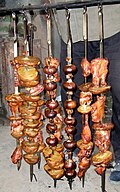
robot: Update article |
Tumita7029 (talk | contribs) expand lead for clarity and added references |
||
| Line 1: | Line 1: | ||
{{short description|Cylindrical clay | {{short description|Cylindrical clay oven used in South Asian cooking}} | ||
{{For|the web series|Tandoor (web series)}} | {{For|the web series|Tandoor (web series)}} | ||
{{Distinguish|Tabun oven}} | {{Distinguish|Tabun oven}} | ||
[[File:Luxury tandoor.png| | {{Use dmy dates|date=December 2021}} | ||
[[File:Luxury tandoor.png|upright=1.2|thumb|Modern ceramic wood-fired tandoors]] | |||
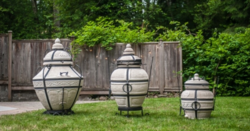
A '''tandoor''' ({{IPAc-en|t|æ|n|ˈ|d|ʊər}} or {{IPAc-en|t|ɑ:|n|ˈ|d|ʊər}}) | A '''tandoor''' ({{IPAc-en|t|æ|n|ˈ|d|ʊər}} or {{IPAc-en|t|ɑ:|n|ˈ|d|ʊər}}) is a large vase-shaped [[oven]], usually made of [[clay]]. Since antiquity, tandoors have been used to bake unleavened [[flatbreads]], such as [[roti]] and traditional [[lavash]], as well as leavened ones, such as [[naan]] and [[tandoor bread]] or [[matnakash]]. It is also used to roast meat and vegetables. Tandoors are predominantly used in [[South Asia]], [[West Asia|Western Asia]], [[Central Asia]], and the [[Horn of Africa]]. | ||
The | The standard heating element of a tandoor is an internal [[charcoal]] or wood fire, which cooks food with direct heat and smoke. Tandoors can be fully above ground, or partially buried below ground, often reaching over a meter in height/depth. Temperatures in a tandoor can reach {{convert|480|C|F K|-1}}, and they are routinely kept lit for extended periods. Therefore, traditional tandoors are usually found in restaurant kitchens. Modern tandoors are often made of metal. Variations, such as tandoors with gas or electric heating elements, are more common for at-home use. | ||
Temperatures in a tandoor can | |||
==Etymology== | ==Etymology== | ||
The English word comes from [[Hindustani language| | The English word comes from the [[Hindustani language|Hindustani]] ''tandūr'', which came from [[Persian language|Persian]] {{transliteration|fa|tanūr}} ({{Wikt-lang|fa|تنور}}) and ultimately from the [[Akkadian language|Akkadian]] word {{transliteration|akk|tinūru}} (𒋾𒂟), which consists of the parts {{transliteration|akk|tin}} {{gloss|mud}} and {{transliteration|akk|nuro}}/{{transliteration|akk|nura}} {{gloss|fire}} and is mentioned as early as in the ''[[Epic of Gilgamesh]]'', cf. or [[Avestan]] {{transliteration|ae|tanûra}} and [[Middle Persian]] {{transliteration|pal|tanûr}}. In [[Sanskrit]], the tandoor was named {{transliteration|sa|kandu}}.<ref name="AutoO0-1"/><ref name="AutoO0-2"/> | ||
== Operation == | |||
The first time a tandoor is used, the temperature must be gradually increased to condition the oven's interior. This step is crucial in ensuring the longevity of the tandoor. Conditioning can be done by starting a very small fire and slowly adding fuel to increase the amount of heat inside the tandoor gradually. Hairline cracks might form during conditioning; this is normal and will not interfere with the performance of the tandoor oven. When the oven cools off, the hairline cracks may barely be noticeable. They are essential in allowing the clay body of the tandoor to breathe (i.e. [[Thermal expansion|thermal expansion and contraction]]). The slower the temperature inside the tandoor increases during its first use, the fewer hairline cracks it will develop.<ref name="AutoO0-4"/> | |||
<gallery class=center mode=nolines widths=180 heights=180 caption="Modern tandoors"> | |||
File:Charcoal Fired S.Steel Body Tandoor, with ash tray & temp. meter.JPG|Charcoal-fired stainless-steel tandoor, with ash tray and thermometer | |||
File:Coal fired Drum Tandoor.jpg|A coal-fired tandoor with a [[mild steel]] drum | |||
File:200612 Yemen-212 (354275379).jpg|[[Yemen]]i modern ''tannour'' making ''[[Malawach|Mulawah]]'' flatbread | |||
</gallery> | |||
==Types== | ==Types== | ||
===Arab world: tannour / tannur=== | ===Arab world: tannour / tannur=== | ||
=== | {{further|Clay oven#Tannour / Tannur|tabun oven}} | ||
==== | |||
The | ===West Asia and South Asia=== | ||
====Armenian tonir==== | |||
[[File:Ավանդական հացի պատրաստումը 01.jpg|thumb|Armenian ''tonir'' oven]] | |||
In [[Armenia]], the oven is called ''tonir'' ({{Langx|hy|Թոնիր}}). In [[Ancient Armenia|ancient times]], it was worshipped by the Armenians as a symbol of the sun in the ground. Pagan Armenians made ''tonirs'' resembling the setting [[sun]] "going into the ground" (the [[Solar deity|Sun]] being the main deity). The underground ''tonir'', made of clay and stone, is one of the first tools in Armenian cuisine as an oven and thermal treatment tool. Therefore, the ''tonir'' used to be placed in the middle of most ancient Armenian households. Armenians are said to have invented underground ''tonirs''.<ref name=":0">{{Cite web |title=Armenian Tonir BBQ: The Sun in the Ground |url=https://phoenixtour.org/blog/armenian-tonir-bbq/ |website=Phoenix Tour}}</ref><ref>{{cite web |title=Armenian tonir as the symbol of the sun |url=https://www.arevogi.com/post/armenian-tonir-as-a-symbol-of-the-sun |website=Arevogi}}</ref> | |||
Multiple [[Armenian cuisine|Armenian dishes]] are prepared using the ''tonir''. Most of the dishes prepared by using a ''tonir'' are either breads, meats, or vegetables. The most popular bread dishes to be cooked by using a ''tonir'' are [[lavash]], [[matnakash]] and [[Tandoor bread|tonir bread]], also known as ''tonri hats'' ({{Langx|hy|թոնիր հաց}}). Lavash is a very thin flatbread used for wrapping meat, vegetables and other ingredients, while matnakash is thicker and used on the side. Matnakash is said to have a [[Focaccia|foccacia]]-like texture. ''Tonri hats'' is similar to matnakash, but what differentiates it from matnakash is its round shape and soft texture that resembles [[bhatura]] in a way. Some also use the ''tonir'' to bake filled sweet breads, like [[Gata (food)|gata]]. The bread is baked by sticking it on the walls of the ''tonir'', where it is evenly cooked. Armenian bread (especially ''tonri hats'') is mainly flavored with [[black pepper]], [[mahleb]], [[Sesame|sesame seeds]], [[Nigella sativa|nigella seeds]], [[cumin]], and sometimes [[cinnamon]], or [[anise]].<ref name="unesco">{{cite web |title=Lavash, the preparation, meaning and appearance of traditional bread as an expression of culture in Armenia, ''Inscribed in 2014 (9.COM) on the Representative List of the Intangible Cultural Heritage of Humanity''. Country(ies): Armenia |url=http://www.unesco.org/culture/ich/en/decisions/9.COM/10.3 |archive-url=https://web.archive.org/web/20160317141436/http://www.unesco.org/culture/ich/en/decisions/9.COM/10.3 |archive-date=March 17, 2016 |access-date=16 March 2016 |website=unesco.org}}</ref><ref>{{Cite web |title=Bread in the life of Armenians |url=https://www.armgeo.am/en/armenian-lavash/ |website=Armenian Geographic}}</ref><ref>{{Cite web |title=Demystifying the Breads of Armenia |url=https://www.saveur.com/story/food/demystifying-breads-of-armenia/ |website=Saveur}}</ref><ref>{{Cite web |title=Gata making master class |url=https://hyurservice.com/de/attractions-activities-armenia/gata-making-master-class |website=Hyur Service}}</ref> | |||
''[[Khorovats]]'', ''khashlama'', fish like the [[sevan trout]], and ''[[Khash (dish)|khash]]'' are the most popular meat-dishes that are prepared by using a ''tonir''. ''Khorovats'' is made by stacking seasoned meat (traditionally [[pork]], but [[Lamb and mutton|lamb]] and [[chicken]] are also common) and other ingredients like [[potato]]es and [[onion]]s on a skewer, before cooking them inside the ''tonir''. Wet cloth is put on the opening of the ''tonir'' to cook the meat more efficiently and to create a smoky flavor. Armenian "tonir meats" are mostly spiced with black pepper, [[paprika]], [[garlic]], [[sumac]], onions and in some regions, [[fenugreek]].<ref>{{Cite web |title=Armenian khorovats in tonir |url=https://artisantandoors.com.au/armenian-khorovats/ |website=Artisan}}</ref><ref>{{Cite web |title=Khashlama: Armenian Stew |url=https://www.jidlonacestach.cz/en/khashlama/ |website=Food on the Move}}</ref><ref>{{Cite web |title=Traditional Armenian Dishes You Must Try When Visiting Armenia |url=https://halaarmenia.com/en/traditional-armenian-dishes-food-cuisine-en/ |website=Hala Armenia}}</ref><ref name="Armenian Food">{{cite book |last1=Petrosian |first1=Irina |title=Armenian Food: Fact, Fiction & Folklore |last2=Underwood |first2=David |publisher=Yerkir Publishing |year=2006 |isbn=978-1-4116-9865-9 |location=Bloomington, Indiana |page=[https://books.google.com/books?id=0oXYX9Qzx9oC&dq=Khorovats&pg=PA74 76]}}</ref> | |||
Sometimes, Armenians only use vegetables to be cooked inside ''tonirs''. In that case [[eggplant]]s, [[tomato]]es, [[bell pepper]]s, [[onion]]s, [[potato]]es and other local Armenian vegetables are cooked just like meat is cooked inside ''tonirs''.<ref name=":0"/> | |||
<gallery class=center mode=nolines widths=180 heights=180 caption="Baking in the Armenian ''tonir''"> | |||
File:20160604 025 Zwischenstopps-Armenien-011a.jpg|Armenian ''tonri'' hats | |||
File:Ավանդական հացի պատրաստումը 03.jpg|''[[Lavash]]'' flatbread | |||
File:Tonir Zuchau 1.jpg|''[[Khorovats]]'' kebabs | |||
File:Թոնրի բանջարեղէն.jpg|Baked vegetables | |||
</gallery> | |||
====Turkmen ''tamdyr''==== | |||
The baking of a traditional, white bread called {{lang|tk|çörek}} in [[Turkmen language|Turkmen]] is a medieval practice in [[Turkmenistan]], using a clay {{lang|tk|tamdyr}} oven.<ref name="Nuriev">{{cite journal |last1=Nuriev |first1=Ahmetjan |title=Bread baking is an ancient ritual in Turkmenistan |journal=Turkmenistan, the Analytic Illustrated Magazine |date=2005 |pages=80–83}}</ref> | |||
Most [[Turkmens|Turkmen families]] living in the rural area have tamdyrs in their households. Occasionally, housewives get together and bake {{lang|tk|çörek}} for several families. One of the most famous kinds of {{lang|tk|çörek}} baked in the Turkmen tamdyr is {{lang|tk|etli çörek}} (bread with meat), made during [[public holidays in Turkmenistan|holidays in Turkmenistan]]. Turkmens bake not only bread in the tamdyr but also several dishes, the most famous of which is ''somsa'', a folded [[pie]] like a [[samosa]] or [[pasty]] with a filling, usually beef. Various [[spice]]s can be added to the Turkmen bread: [[cumin]], [[cinnamon]], [[olive]]s, [[mustard seed]]s, [[sunflower seed]]s, and other flavoring ingredients.<ref name="orient.tm">{{cite web |last1=Zarembo |first1=Vladimir |title=Tamdyr in the yard - peace on Earth (in Russian) |url=https://orient.tm/tamdyr-vo-dvore-mir-na-zemle/ |website=Orient |access-date=14 September 2020 |archive-date=2 January 2020 |archive-url=https://web.archive.org/web/20200102054048/https://orient.tm/tamdyr-vo-dvore-mir-na-zemle/ |url-status=dead }}</ref> To prepare the ''tamdyr'' for baking; first the fire is made directly inside the ''tamdyr'', usually using dried cotton stalks. The bread maker then watches the color of the ''tamdyr''{{'s}} inner walls. When they turn white, the ashes are shoveled into the center of the oven, and the lower ash-pit is closed.<ref name="Nuriev"/> The bread must be thrown into the oven carefully but deftly so that it does not lose shape and neatly sticks to the wall.<ref name="orient.tm"/> | |||
<gallery class=center mode=nolines widths=180 heights=180 caption="Baking in the Turkmen tamdyr"> | |||
File:Turkmenistan bread baking.jpg|Baking çörek and [[Samosa|somsa]] | |||
File:Tamdyr6.jpg|Baking {{lang|tk|çörek}} in a Turkmen tamdyr | |||
</gallery> | |||
====Punjabi tandoor==== | ====Punjabi tandoor==== | ||
[[File:Tandoori Chicken with oven.jpg|thumb|[[Tandoori chicken]] cooked inside a tandoor]] | |||
The [[Punjabi tandoor]] from [[South Asia]] is traditionally made of clay and is a bell-shaped oven, which can either be set into the earth or rest above the ground and is fired with wood or charcoal, reaching temperatures of about {{convert|480|C|F K|-1}}.<ref name="AutoO0-5"/> Tandoor cooking is a traditional aspect of [[Punjabi cuisine]] in undivided [[Punjab]].<ref name="apnaorg.com"/> | |||
==== | In [[India]] and [[Pakistan]], tandoori cooking was traditionally associated with the [[Punjab region|Punjab]],<ref>{{Cite book |last=Jacobs |first=Daniel |url=https://books.google.com/books?id=IcAGtDUWtYEC&dq=tandoor+rajasthan&pg=PA47 |title=The Rough Guide to Rajasthan, Delhi & Agra |last2=Thomas |first2=Gavin |date=October 2010 |publisher=Rough Guides Limited |isbn=978-1-84836-555-1 |language=en}}</ref> as Punjabis embraced the tandoor on a regional level,<ref name="AutoO0-7"/> and became popular in the mainstream after the 1947 partition when Punjabi Sikhs and Hindus resettled in places such as Delhi.<ref name="AutoO0-8"/> In rural Punjab, it was common to have communal tandoors.<ref name="apnaorg.com"/> Some villages<ref name="AutoO0-9"/> still have a communal tandoor, a common sight before 1947.<ref name="AutoO0-10"/> | ||
====Azerbaijani tandir==== | ====Azerbaijani tandir==== | ||
[[File:Tandoor in Boyuk Bahmanly, Fuzuli of Azerbaijan 04.jpg|thumb|Azerbaijani tandir]] | |||
In medieval times, the people that used to live where [[Azerbaijan]] is situated today ([[lezgins]], [[Tat people (Caucasus)|Tat Iranians]] and later [[Turkic peoples|Turks]]) used to cook bread and other dishes inside the tandir.<ref name="AutoO0-13"/> | |||
Tandir bread (təndir çörəyi) is a widespread bread type in [[Azerbaijan]]. Tandir bread is baked from the heat of the tandir's walls, which ensures very fast baking.<ref name="AutoO0-14"/><ref name="AutoO0-15"/> | |||
One of the world's biggest tandoors was built in Azerbaijan's southern city of [[Astara, Azerbaijan|Astara]] in 2015. The height of the tandoor is {{convert|6.5|m|ft|abbr=in}} and the diameter is {{convert|12|m|ft|abbr=in}}. The tandoor consists of 3 parts.<ref name="AutoO0-16"/> | |||
The | ====Georgian tone==== | ||
The outside of the Georgian ''tone'' is made of a mixture of clay and quartz sand which is wrapped in linen and eventually hardens into a hard fireproof surface. Georgian bakers stick bread to the interior walls of the tone to let it bake, which is lined with fireproof bricks.<ref name="AutoO0-11"/> | |||
== Dishes == | == Dishes == | ||
{{further|Tandoor bread|Tandoori chicken}} | |||
'' | [[File:Թոնրի խորոված 3.jpg|thumb|upright=0.6|Chicken [[khorovats]], onions and potato slices with pork fat, roasted in an Armenian ''tonir'' ]] | ||
'' | A tandoor may be used to bake many [[Tandoor bread|types of flatbread]]. Some of the most common are [[lavash]], [[tandoori roti]], [[tandoori naan]], tandoori laccha [[paratha]], missi roti, [[laffa]], and tandoori [[kulcha]]. [[Armenian cuisine|Armenian]] dishes prepared using a ''tonir'' are varied. There are bread dishes like tonri hats, [[matnakash]] and a sweet filled bread named [[Gata (food)|gata]], while there also are meat dishes like [[khorovats]], khashlama, the meat of [[Khash (dish)|khash]] and fish like [[sevan trout]], as well as vegetables that are cooked using a ''tonir''.<ref name="Armenian Food"/> | ||
[[Tandoori chicken]] is a roasted chicken [[delicacy]] that originated in [[Punjab]] region of South Asia.<ref name="AutoO0- | [[Tandoori chicken]] is a roasted chicken [[delicacy]] that originated in [[Punjab]] region of South Asia.<ref name="AutoO0-17"/><ref name="AutoO0-18"/> The chicken is marinated in yogurt seasoned with [[garam masala]], [[garlic]], [[ginger]], [[cumin]], [[cayenne pepper]], and other spices depending on the recipe. In hot versions of the dish, cayenne, red chili powder, or other spices give the typical red color; in milder versions, [[food coloring]] is used.<ref name="AutoO0-19"/> | ||
[[Chicken tikka]] is a dish | [[Chicken tikka]] is a dish that originated in the [[Punjab]] region. It is made by grilling small pieces of boneless chicken which have been [[marinate]]d in [[spices]] and [[yogurt]]. It is traditionally cooked on skewers in a tandoor and is usually boneless.<ref name=Curryclub>{{cite book |last=Chapman |first=Pat |author-link=Pat Chapman (food writer) |title=Curry Club Tandoori and Tikka Dishes |year=1993 |publisher=[[Judy Piatkus|Piatkus]] |location=London |isbn=0-7499-1283-9 |pages= }}</ref> It is used in preparing the British curry [[chicken tikka masala]].<ref>{{cite web |url=https://www.deccanchronicle.com/videos/food-dining/chicken-tikka-recipes.html |title=Chicken Tikka Recipes |date=12 January 2019 |website=[[Deccan Chronicle]] |access-date=24 January 2019 |archive-date=24 January 2019 |archive-url=https://web.archive.org/web/20190124102333/https://www.deccanchronicle.com/videos/food-dining/chicken-tikka-recipes.html |url-status=dead }}</ref> | ||
[[ | A [[samosa]] is a fried or baked pastry shell with a savory filling, which may include spiced potatoes and vegetables, or ground lamb or chicken. In [[Central Asia]] , samosas are typically baked in a tandoor, while they are usually fried elsewhere.<ref name="Davidson">{{cite book |last=Davidson |first=Alan |year=2014 |chapter=Samosa |pages=709–710 |title=The Oxford Companion to Food |publisher=[[Oxford University Press]] |isbn=0-19-211579-0 |url=https://books.google.com/books?id=RL6LAwAAQBAJ&pg=PA709 |access-date=29 February 2020 |archive-date=4 September 2024 |archive-url=https://web.archive.org/web/20240904032000/https://books.google.com/books?id=RL6LAwAAQBAJ&pg=PA709#v=onepage&q&f=false |url-status=live}}</ref> | ||
== See also == | |||
* {{annotated link|Kamado}} | * {{annotated link|Kamado}} | ||
* {{annotated link|List of cooking appliances}} | * {{annotated link|List of cooking appliances}} | ||
| Line 86: | Line 104: | ||
* {{annotated link|Primitive clay oven}} | * {{annotated link|Primitive clay oven}} | ||
* {{annotated link|Tabun oven}} | * {{annotated link|Tabun oven}} | ||
== References == | == References == | ||
{{reflist|30em|refs= | {{reflist|30em|refs= | ||
<ref name="AutoO0-1">{{Cite book|url=https://archive.org/details/1872sanskriten00moniuoft|page=[https://archive.org/details/1872sanskriten00moniuoft/page/201 201]|title=A Sanskrit-English Dictionary: ...with Special Reference to Greek, Latin, Gothic, German, Anglo-Saxon...|last=Monier-Williams|first=Monier|date=1872|publisher=Clarendon}}</ref> | |||
<ref name="AutoO0-2">{{Cite book|url=https://books.google.com/books?id=-cFcH2ZHWLcC|title=Indian Food Tradition A Historical Companion|author=Achaya K. T.|year=1994|publisher=Oxford University Press |isbn=978-0-19-562845-6|access-date=6 February 2019}}</ref> | |||
<ref name="AutoO0-1">{{Cite book|url=https://archive.org/details/1872sanskriten00moniuoft|page=[https://archive.org/details/1872sanskriten00moniuoft/page/201 201]|title=A Sanskrit-English Dictionary: ...with Special Reference to Greek, Latin, Gothic, German, Anglo- | <ref name="AutoO0-4">{{cite web|url=https://luxury-tandoors.com/customer-care/user-guide/|title=User Guide|work=luxury-tandoors.com}}</ref> | ||
<ref name="AutoO0-2">{{Cite book|url=https://books.google.com/books?id=-cFcH2ZHWLcC|title=Indian Food Tradition A Historical Companion|author=Achaya K. T.|year=1994|isbn=978-0-19-562845-6|access-date=6 February 2019}}</ref> | |||
<ref name="AutoO0-4">{{cite web|url=https://luxury-tandoors.com/customer-care/user-guide/|title= | |||
<ref name="AutoO0-5">{{cite web|url=http://www.vahrehvah.com/indianfood/tandoori-chicken/|title=Tandoori Chicken|work=vahrehvah.com}}</ref> | <ref name="AutoO0-5">{{cite web|url=http://www.vahrehvah.com/indianfood/tandoori-chicken/|title=Tandoori Chicken|work=vahrehvah.com}}</ref> | ||
<ref name="apnaorg.com">{{Cite web|url=http://apnaorg.com/books/gurmukhi/kehal-1/book.php?fldr=book|title=Gurmukhi Book - Alop Ho Reha Virsa; Pure|website=apnaorg.com}}</ref> | <ref name="apnaorg.com">{{Cite web|url=http://apnaorg.com/books/gurmukhi/kehal-1/book.php?fldr=book|title=Gurmukhi Book - Alop Ho Reha Virsa; Pure|website=apnaorg.com}}</ref> | ||
<ref name="AutoO0-7">{{cite web|url=http://www.indiacurry.com/faqhistory/mughalcuisine.htm|title=What is Mughalai Cuisine?|url-status=dead|archive-url=https://web.archive.org/web/20131010004646/http://www.indiacurry.com/faqhistory/mughalcuisine.htm|archive-date=10 October 2013}}</ref> | <ref name="AutoO0-7">{{cite web|url=http://www.indiacurry.com/faqhistory/mughalcuisine.htm|title=What is Mughalai Cuisine?|url-status=dead|archive-url=https://web.archive.org/web/20131010004646/http://www.indiacurry.com/faqhistory/mughalcuisine.htm|archive-date=10 October 2013}}</ref> | ||
<ref name="AutoO0-8">{{cite news|last=Raichlen|first=Steven|title=A Tandoor Oven Brings India's Heat to the Backyard|url=https://www.nytimes.com/2011/05/11/dining/a-tandoor-oven-brings-indias-heat-to-the-backyard.html?pagewanted=all&_r=0|access-date=17 January 2015|work=The New York Times|date=10 May 2011}}</ref> | <ref name="AutoO0-8">{{cite news|last=Raichlen|first=Steven|title=A Tandoor Oven Brings India's Heat to the Backyard|url=https://www.nytimes.com/2011/05/11/dining/a-tandoor-oven-brings-indias-heat-to-the-backyard.html?pagewanted=all&_r=0|access-date=17 January 2015|work=The New York Times|date=10 May 2011}}</ref> | ||
<ref name="AutoO0-9">Pind Diyan Gallian PTC Channel - Bilga (Jalandhar) has a communal Tandoor also known as tadoor in Punjabi</ref> | <ref name="AutoO0-9">Pind Diyan Gallian PTC Channel - Bilga (Jalandhar) has a communal Tandoor also known as tadoor in Punjabi</ref> | ||
<ref name="AutoO0-10">{{cite web|url=http://www.shvoong.com/medicine-and-health/nutrition/1866706-specialities-punjabi-cuisine/|title=specialities Punjabi cuisine|work=shvoong.com|access-date=18 July 2015}}</ref> | <ref name="AutoO0-10">{{cite web|url=http://www.shvoong.com/medicine-and-health/nutrition/1866706-specialities-punjabi-cuisine/|title=specialities Punjabi cuisine|work=shvoong.com|access-date=18 July 2015|archive-date=14 September 2016|archive-url=https://web.archive.org/web/20160914172944/http://www.shvoong.com/medicine-and-health/nutrition/1866706-specialities-punjabi-cuisine|url-status=dead}}</ref> | ||
<ref name="AutoO0-11">{{cite web | <ref name="AutoO0-11">{{cite web|url=https://georgiaabout.com/2012/06/07/about-food-georgian-bread-part-1/|title=About Food – Georgian Bread (Part 1)|work=Georgia About}}</ref> | ||
<ref name="AutoO0- | <ref name="AutoO0-13">{{cite web|url=http://www.bbc.com/travel/story/20170620-life-on-earths-biggest-pressure-cooker|title=Life on Earth's biggest pressure cooker|date=25 February 2022 |publisher=BBC}}</ref> | ||
<ref name="AutoO0- | <ref name="AutoO0-14">{{cite web|url=http://www.travelphotoreport.com/2012/03/27/tandyr-bake-bread-baku-azerbaijan/|title=What is Tandyr or how traditional bread is baked in Baku|date=27 March 2012|work=travelphotoreport.com|access-date=20 September 2017|archive-date=3 February 2020|archive-url=https://web.archive.org/web/20200203144338/http://www.travelphotoreport.com/2012/03/27/tandyr-bake-bread-baku-azerbaijan/|url-status=dead}}</ref> | ||
<ref name="AutoO0- | <ref name="AutoO0-15">{{cite web|url=http://www.geniuskitchen.com/recipe/tendir-choreyi-azerbaijan-471885|title=Tendir Choreyi Azerbaijan Recipe|work=geniuskitchen.com}}</ref> | ||
<ref name="AutoO0- | <ref name="AutoO0-16">{{Cite web|url=https://en.azvision.az/news/16919/news.html|title=Azerbaijan to build the world's biggest tandoor|website=en.azvision.az|language=en|access-date=2 September 2019}}</ref> | ||
<ref name="AutoO0- | <ref name="AutoO0-17">{{cite news|url=http://www.hindu.com/mp/2008/11/24/stories/2008112450160200.htm |archive-url=https://web.archive.org/web/20110629015351/http://www.hindu.com/mp/2008/11/24/stories/2008112450160200.htm |url-status=dead |archive-date=29 June 2011 |title=Metro Plus Delhi / Food : A plateful of grain |date=24 November 2008 |access-date=7 May 2009 |work=[[The Hindu]] |location=Chennai, India}}</ref> | ||
<ref name="AutoO0- | <ref name="AutoO0-18">{{cite web|url=http://blogs.hindustantimes.com/rude-hotels/2009/02/01/where-does-biryani-come-from/|title=Where does biryani come from?|work=Hindustan Times|url-status=dead|archive-url=https://web.archive.org/web/20160624141257/http://blogs.hindustantimes.com/rude-hotels/2009/02/01/where-does-biryani-come-from/|archive-date=24 June 2016}}</ref> | ||
<ref name="AutoO0- | <ref name="AutoO0-19">For instance, see the recipe in [[Madhur Jaffrey]]'s ''Indian Cookery'' pp66-69</ref> | ||
}} | }} | ||
== | == Further reading == | ||
{{commons category}} | {{commons category}} | ||
{{refbegin}} | {{refbegin}} | ||
* ''Curry Club Tandoori and Tikka Dishes'', Piatkus, London — {{ISBN|0-7499-1283-9}} (1993) | * ''Curry Club Tandoori and Tikka Dishes'', Piatkus, London — {{ISBN|0-7499-1283-9}} (1993) | ||
| Line 119: | Line 136: | ||
* ''India: Food & Cooking'', New Holland, London — {{ISBN|978-1-84537-619-2}} (2007) | * ''India: Food & Cooking'', New Holland, London — {{ISBN|978-1-84537-619-2}} (2007) | ||
{{refend}} | {{refend}} | ||
{{Cooking Techniques}} | {{Cooking Techniques}} | ||
{{Cuisine of India}} | {{Cuisine of India}} | ||
{{ | {{Curry in the United Kingdom}} | ||
{{Armenian cuisine}} | |||
[[Category:Fireplaces]] | [[Category:Fireplaces]] | ||
| Line 131: | Line 150: | ||
[[Category:Azerbaijani cuisine]] | [[Category:Azerbaijani cuisine]] | ||
[[Category:Bengali cuisine]] | [[Category:Bengali cuisine]] | ||
[[Category: | [[Category:Georgian cuisine]] | ||
[[Category:Indian cuisine]] | [[Category:Indian cuisine]] | ||
[[Category:Israeli cuisine]] | [[Category:Israeli cuisine]] | ||
[[Category:Iraqi cuisine]] | [[Category:Iraqi cuisine]] | ||
[[Category: | [[Category:Kazakh cuisine]] | ||
[[Category:Kyrgyz cuisine]] | [[Category:Kyrgyz cuisine]] | ||
[[Category:Pakistani cuisine]] | [[Category:Pakistani cuisine]] | ||
| Line 143: | Line 162: | ||
[[Category:Tajik cuisine]] | [[Category:Tajik cuisine]] | ||
[[Category:Turkish cuisine]] | [[Category:Turkish cuisine]] | ||
[[Category: | [[Category:Turkmen cuisine]] | ||
[[Category:Uzbekistani cuisine]] | [[Category:Uzbekistani cuisine]] | ||
[[Category:Firing techniques]] | [[Category:Firing techniques]] | ||
[[Category:Indian food preparation utensils]] | |||
Latest revision as of 17:08, 27 January 2026

A tandoor (/tænˈdʊər/ or /tɑːnˈdʊər/) is a large vase-shaped oven, usually made of clay. Since antiquity, tandoors have been used to bake unleavened flatbreads, such as roti and traditional lavash, as well as leavened ones, such as naan and tandoor bread or matnakash. It is also used to roast meat and vegetables. Tandoors are predominantly used in South Asia, Western Asia, Central Asia, and the Horn of Africa.
The standard heating element of a tandoor is an internal charcoal or wood fire, which cooks food with direct heat and smoke. Tandoors can be fully above ground, or partially buried below ground, often reaching over a meter in height/depth. Temperatures in a tandoor can reach 480 °C (900 °F; 750 K), and they are routinely kept lit for extended periods. Therefore, traditional tandoors are usually found in restaurant kitchens. Modern tandoors are often made of metal. Variations, such as tandoors with gas or electric heating elements, are more common for at-home use.
Etymology[edit | edit source]
The English word comes from the Hindustani tandūr, which came from Persian tanūr (تنور) and ultimately from the Akkadian word tinūru (𒋾𒂟), which consists of the parts tin Template:Gloss and nuro/nura Template:Gloss and is mentioned as early as in the Epic of Gilgamesh, cf. or Avestan tanûra and Middle Persian tanûr. In Sanskrit, the tandoor was named kandu.[1][2]
Operation[edit | edit source]
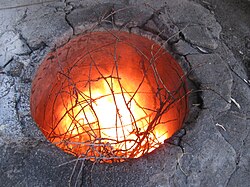
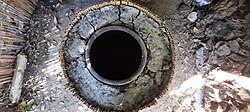
The first time a tandoor is used, the temperature must be gradually increased to condition the oven's interior. This step is crucial in ensuring the longevity of the tandoor. Conditioning can be done by starting a very small fire and slowly adding fuel to increase the amount of heat inside the tandoor gradually. Hairline cracks might form during conditioning; this is normal and will not interfere with the performance of the tandoor oven. When the oven cools off, the hairline cracks may barely be noticeable. They are essential in allowing the clay body of the tandoor to breathe (i.e. thermal expansion and contraction). The slower the temperature inside the tandoor increases during its first use, the fewer hairline cracks it will develop.[3]
- Modern tandoors
-
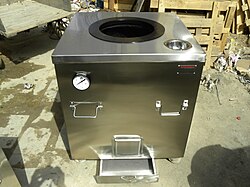 Charcoal-fired stainless-steel tandoor, with ash tray and thermometer
 -
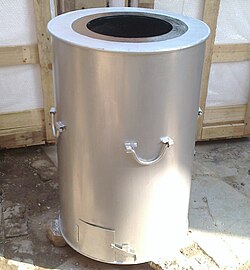 A coal-fired tandoor with a mild steel drum
 -
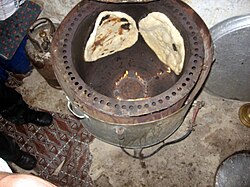


.jpg)
Types[edit | edit source]
Arab world: tannour / tannur[edit | edit source]
West Asia and South Asia[edit | edit source]
Armenian tonir[edit | edit source]

In Armenia, the oven is called tonir (Armenian: Թոնիր). In ancient times, it was worshipped by the Armenians as a symbol of the sun in the ground. Pagan Armenians made tonirs resembling the setting sun "going into the ground" (the Sun being the main deity). The underground tonir, made of clay and stone, is one of the first tools in Armenian cuisine as an oven and thermal treatment tool. Therefore, the tonir used to be placed in the middle of most ancient Armenian households. Armenians are said to have invented underground tonirs.[4][5]
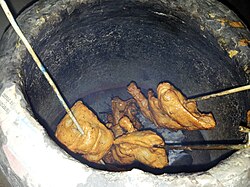
Multiple Armenian dishes are prepared using the tonir. Most of the dishes prepared by using a tonir are either breads, meats, or vegetables. The most popular bread dishes to be cooked by using a tonir are lavash, matnakash and tonir bread, also known as tonri hats (Armenian: թոնիր հաց). Lavash is a very thin flatbread used for wrapping meat, vegetables and other ingredients, while matnakash is thicker and used on the side. Matnakash is said to have a foccacia-like texture. Tonri hats is similar to matnakash, but what differentiates it from matnakash is its round shape and soft texture that resembles bhatura in a way. Some also use the tonir to bake filled sweet breads, like gata. The bread is baked by sticking it on the walls of the tonir, where it is evenly cooked. Armenian bread (especially tonri hats) is mainly flavored with black pepper, mahleb, sesame seeds, nigella seeds, cumin, and sometimes cinnamon, or anise.[6][7][8][9]
Khorovats, khashlama, fish like the sevan trout, and khash are the most popular meat-dishes that are prepared by using a tonir. Khorovats is made by stacking seasoned meat (traditionally pork, but lamb and chicken are also common) and other ingredients like potatoes and onions on a skewer, before cooking them inside the tonir. Wet cloth is put on the opening of the tonir to cook the meat more efficiently and to create a smoky flavor. Armenian "tonir meats" are mostly spiced with black pepper, paprika, garlic, sumac, onions and in some regions, fenugreek.[10][11][12][13]
Sometimes, Armenians only use vegetables to be cooked inside tonirs. In that case eggplants, tomatoes, bell peppers, onions, potatoes and other local Armenian vegetables are cooked just like meat is cooked inside tonirs.[4]


Turkmen tamdyr[edit | edit source]
The baking of a traditional, white bread called çörek in Turkmen is a medieval practice in Turkmenistan, using a clay tamdyr oven.[14]
Most Turkmen families living in the rural area have tamdyrs in their households. Occasionally, housewives get together and bake çörek for several families. One of the most famous kinds of çörek baked in the Turkmen tamdyr is etli çörek (bread with meat), made during holidays in Turkmenistan. Turkmens bake not only bread in the tamdyr but also several dishes, the most famous of which is somsa, a folded pie like a samosa or pasty with a filling, usually beef. Various spices can be added to the Turkmen bread: cumin, cinnamon, olives, mustard seeds, sunflower seeds, and other flavoring ingredients.[15] To prepare the tamdyr for baking; first the fire is made directly inside the tamdyr, usually using dried cotton stalks. The bread maker then watches the color of the tamdyr's inner walls. When they turn white, the ashes are shoveled into the center of the oven, and the lower ash-pit is closed.[14] The bread must be thrown into the oven carefully but deftly so that it does not lose shape and neatly sticks to the wall.[15]
- Baking in the Turkmen tamdyr
-
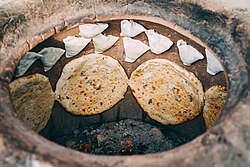 Baking çörek and somsa
 -
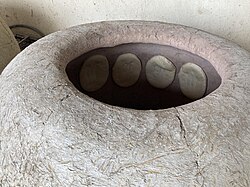 Baking çörek in a Turkmen tamdyr


Punjabi tandoor[edit | edit source]

The Punjabi tandoor from South Asia is traditionally made of clay and is a bell-shaped oven, which can either be set into the earth or rest above the ground and is fired with wood or charcoal, reaching temperatures of about 480 °C (900 °F; 750 K).[16] Tandoor cooking is a traditional aspect of Punjabi cuisine in undivided Punjab.[17]
In India and Pakistan, tandoori cooking was traditionally associated with the Punjab,[18] as Punjabis embraced the tandoor on a regional level,[19] and became popular in the mainstream after the 1947 partition when Punjabi Sikhs and Hindus resettled in places such as Delhi.[20] In rural Punjab, it was common to have communal tandoors.[17] Some villages[21] still have a communal tandoor, a common sight before 1947.[22]
Azerbaijani tandir[edit | edit source]

In medieval times, the people that used to live where Azerbaijan is situated today (lezgins, Tat Iranians and later Turks) used to cook bread and other dishes inside the tandir.[23]
Tandir bread (təndir çörəyi) is a widespread bread type in Azerbaijan. Tandir bread is baked from the heat of the tandir's walls, which ensures very fast baking.[24][25]
One of the world's biggest tandoors was built in Azerbaijan's southern city of Astara in 2015. The height of the tandoor is 6.5 m (21 feet) and the diameter is 12 m (39 feet). The tandoor consists of 3 parts.[26]
Georgian tone[edit | edit source]
The outside of the Georgian tone is made of a mixture of clay and quartz sand which is wrapped in linen and eventually hardens into a hard fireproof surface. Georgian bakers stick bread to the interior walls of the tone to let it bake, which is lined with fireproof bricks.[27]
Dishes[edit | edit source]

A tandoor may be used to bake many types of flatbread. Some of the most common are lavash, tandoori roti, tandoori naan, tandoori laccha paratha, missi roti, laffa, and tandoori kulcha. Armenian dishes prepared using a tonir are varied. There are bread dishes like tonri hats, matnakash and a sweet filled bread named gata, while there also are meat dishes like khorovats, khashlama, the meat of khash and fish like sevan trout, as well as vegetables that are cooked using a tonir.[13]
Tandoori chicken is a roasted chicken delicacy that originated in Punjab region of South Asia.[28][29] The chicken is marinated in yogurt seasoned with garam masala, garlic, ginger, cumin, cayenne pepper, and other spices depending on the recipe. In hot versions of the dish, cayenne, red chili powder, or other spices give the typical red color; in milder versions, food coloring is used.[30]
Chicken tikka is a dish that originated in the Punjab region. It is made by grilling small pieces of boneless chicken which have been marinated in spices and yogurt. It is traditionally cooked on skewers in a tandoor and is usually boneless.[31] It is used in preparing the British curry chicken tikka masala.[32]
A samosa is a fried or baked pastry shell with a savory filling, which may include spiced potatoes and vegetables, or ground lamb or chicken. In Central Asia , samosas are typically baked in a tandoor, while they are usually fried elsewhere.[33]
See also[edit | edit source]
References[edit | edit source]
- ↑ Monier-Williams, Monier (1872). A Sanskrit-English Dictionary: ...with Special Reference to Greek, Latin, Gothic, German, Anglo-Saxon... Clarendon. p. 201.
- ↑ Achaya K. T. (1994). Indian Food Tradition A Historical Companion. Oxford University Press. ISBN 978-0-19-562845-6. Retrieved 6 February 2019.
- ↑ "User Guide". luxury-tandoors.com.
- ↑ 4.0 4.1 "Armenian Tonir BBQ: The Sun in the Ground". Phoenix Tour.
- ↑ "Armenian tonir as the symbol of the sun". Arevogi.
- ↑ "Lavash, the preparation, meaning and appearance of traditional bread as an expression of culture in Armenia, Inscribed in 2014 (9.COM) on the Representative List of the Intangible Cultural Heritage of Humanity. Country(ies): Armenia". unesco.org. Archived from the original on 17 March 2016. Retrieved 16 March 2016.
- ↑ "Bread in the life of Armenians". Armenian Geographic.
- ↑ "Demystifying the Breads of Armenia". Saveur.
- ↑ "Gata making master class". Hyur Service.
- ↑ "Armenian khorovats in tonir". Artisan.
- ↑ "Khashlama: Armenian Stew". Food on the Move.
- ↑ "Traditional Armenian Dishes You Must Try When Visiting Armenia". Hala Armenia.
- ↑ 13.0 13.1 Petrosian, Irina; Underwood, David (2006). Armenian Food: Fact, Fiction & Folklore. Bloomington, Indiana: Yerkir Publishing. p. 76. ISBN 978-1-4116-9865-9.
- ↑ 14.0 14.1 Nuriev, Ahmetjan (2005). "Bread baking is an ancient ritual in Turkmenistan". Turkmenistan, the Analytic Illustrated Magazine: 80–83.
- ↑ 15.0 15.1 Zarembo, Vladimir. "Tamdyr in the yard - peace on Earth (in Russian)". Orient. Archived from the original on 2 January 2020. Retrieved 14 September 2020.
- ↑ "Tandoori Chicken". vahrehvah.com.
- ↑ 17.0 17.1 "Gurmukhi Book - Alop Ho Reha Virsa; Pure". apnaorg.com.
- ↑ Jacobs, Daniel; Thomas, Gavin (October 2010). The Rough Guide to Rajasthan, Delhi & Agra. Rough Guides Limited. ISBN 978-1-84836-555-1.
- ↑ "What is Mughalai Cuisine?". Archived from the original on 10 October 2013.
- ↑ Raichlen, Steven (10 May 2011). "A Tandoor Oven Brings India's Heat to the Backyard". The New York Times. Retrieved 17 January 2015.
- ↑ Pind Diyan Gallian PTC Channel - Bilga (Jalandhar) has a communal Tandoor also known as tadoor in Punjabi
- ↑ "specialities Punjabi cuisine". shvoong.com. Archived from the original on 14 September 2016. Retrieved 18 July 2015.
- ↑ "Life on Earth's biggest pressure cooker". BBC. 25 February 2022.
- ↑ "What is Tandyr or how traditional bread is baked in Baku". travelphotoreport.com. 27 March 2012. Archived from the original on 3 February 2020. Retrieved 20 September 2017.
- ↑ "Tendir Choreyi Azerbaijan Recipe". geniuskitchen.com.
- ↑ "Azerbaijan to build the world's biggest tandoor". en.azvision.az. Retrieved 2 September 2019.
- ↑ "About Food – Georgian Bread (Part 1)". Georgia About.
- ↑ "Metro Plus Delhi / Food : A plateful of grain". The Hindu. Chennai, India. 24 November 2008. Archived from the original on 29 June 2011. Retrieved 7 May 2009.
- ↑ "Where does biryani come from?". Hindustan Times. Archived from the original on 24 June 2016.
- ↑ For instance, see the recipe in Madhur Jaffrey's Indian Cookery pp66-69
- ↑ Chapman, Pat (1993). Curry Club Tandoori and Tikka Dishes. London: Piatkus. ISBN 0-7499-1283-9.
- ↑ "Chicken Tikka Recipes". Deccan Chronicle. 12 January 2019. Archived from the original on 24 January 2019. Retrieved 24 January 2019.
- ↑ Davidson, Alan (2014). "Samosa". The Oxford Companion to Food. Oxford University Press. pp. 709–710. ISBN 0-19-211579-0. Archived from the original on 4 September 2024. Retrieved 29 February 2020.
Further reading[edit | edit source]
- Curry Club Tandoori and Tikka Dishes, Piatkus, London — ISBN 0-7499-1283-9 (1993)
- Curry Club 100 Favourite Tandoori Recipes, Piatkus, London — ISBN 0-7499-1491-2 & ISBN 0-7499-1741-5 (1995)
- India: Food & Cooking, New Holland, London — ISBN 978-1-84537-619-2 (2007)
| Regional cuisines |
| ||||||||||
|---|---|---|---|---|---|---|---|---|---|---|---|
| Ingredients / types of food | |||||||||||
| Preparation and cooking | |||||||||||
| Related cuisines | |||||||||||
| See also | |||||||||||


Template:Curry in the United Kingdom Template:Armenian cuisine
- Pages using the JsonConfig extension
- Fireplaces
- Cooking appliances
- Barbecue
- Earth oven
- Arab cuisine
- Armenian cuisine
- Azerbaijani cuisine
- Bengali cuisine
- Georgian cuisine
- Indian cuisine
- Israeli cuisine
- Iraqi cuisine
- Kazakh cuisine
- Kyrgyz cuisine
- Pakistani cuisine
- Palestinian cuisine
- Punjabi cuisine
- Syrian cuisine
- Tajik cuisine
- Turkish cuisine
- Turkmen cuisine
- Uzbekistani cuisine
- Firing techniques
- Indian food preparation utensils