|
|
| Line 1: |
Line 1: |
| {{Short description|Country in South Asia}}
| |
| {{Distinguish|Bataan|Bohtan|Butuan}}
| |
| {{pp-move-vandalism|small=yes}}
| |
| {{pp-move-indef}}
| |
| {{coord|27.417|90.435|region:BT|format=dms|display=title}}
| |
| {{Use dmy dates|date=May 2020}}
| |
| {{Infobox country | | {{Infobox country |
| | conventional_long_name = Kingdom of Bhutan
| | | native_name=<big style="font-size: 120%;>འབྲུག་རྒྱལ་ཁབ་</big><br /><br />'' 'Brug Rgyal-khab'' <small>([[Wylie transliteration|Wylie]])</small><br />''Dru Gäkhap'' |
| | common_name = Bhutan
| | | conventional_long_name=Kingdom of Bhutan |
| | native_name = {{ubl|{{native name|dz|འབྲུག་རྒྱལ་ཁབ་|italic=no}}|{{transliteration|dz|Druk Gyal Khap}}}} | | | common_name=Bhutan |
| | image_flag = Flag of Bhutan.svg | | | image_flag=Flag of Bhutan.svg |
| | image_coat = Emblem of Bhutan.svg | | | alt_flag= |
| | symbol_type = Emblem | | | image_coat=Bhutan emblem.svg |
| | national_anthem = {{native name|dz-Latn|[[Druk tsendhen]]}}<br />"The Thunder Dragon Kingdom" | | | alt_coat= |
| {{Center|[[File:Druk Tsendhen (Instrumental) - Bhutan.ogg|Druk Tsendhen (Instrumental) - Bhutan]]}}
| | | symbol_type=Emblem |
| | image_map = Bhutan (orthographic projection).svg | | | national_anthem=''[[Druk tsendhen|Druk Tsendhen]]'' |
| | alt_map = | | | image_map=Bhutan (orthographic projection).svg |
| | map_caption = | | | alt_map= |
| | image_map2 =
| | | map_caption= |
| | alt_map2 =
| | | capital=[[Thimphu]] |
| | capital = [[Thimphu]] | | | coordinates = {{Coord|27|28.0|N|89|38.5|E|type:city}} |
| | coordinates = {{Coord|27|28.0|N|89|38.5|E|type:city}} | | | largest_city=capital |
| | largest_city = capital | | | official_languages=[[Dzongkha language|Dzongkha]] |
| | official_languages = [[Dzongkha]] | | | national_languages= |
| | demonym = Bhutanese | | * None {{small|(de facto)}} |
| | government_type = [[Unitary state|Unitary]] [[parliamentary system|parliamentary]] [[semi-constitutional monarchy]] | | * [[English language|English]] {{small|(de jure)}} |
| | leader_title1 = [[Druk Gyalpo]] | | * [[Nepali language|Nepali]] {{small|(de jure)}} |
| | leader_name1 = [[Jigme Khesar Namgyel Wangchuck]] | | | demonym=Bhutanese |
| | leader_title2 = [[List of Prime Ministers of Bhutan|Prime Minister]]
| | | government_type=[[Unitary state|Unitary]] [[parliamentary democracy]] and [[Constitutional monarchy]] |
| | leader_name2 = [[Lotay Tshering]]
| | | leader_title1=[[King of Bhutan|King]] |
| | legislature = [[Parliament of Bhutan|Parliament]] | | | leader_name1=[[Jigme Khesar Namgyel Wangchuck]]<ref name="DM">{{cite web|last=Stern|first=Carly|title=He's getting so big! Dragon King and Queen of Bhutan take the six-month-old Prince out for official royal visit to his mother's ancestral home Read more: www.dailymail.co.uk/femail/article-3734754/Dragon-King-Queen-Bhutan-six-month-old-Prince-official-royal-visit-mother-s-ancestral-home.html#ixzz4OYCDysSi Follow us: @MailOnline on Twitter |url=http://www.dailymail.co.uk/femail/article-3734754/Dragon-King-Queen-Bhutan-six-month-old-Prince-official-royal-visit-mother-s-ancestral-home.html |publisher= Daily Mail |accessdate=30 October 2016 |date= 11 August 2016}}</ref> |
| | upper_house = [[National Council (Bhutan)|National Council]] | | | leader_title2=[[Prime Minister of Bhutan|Prime Minister]] |
| | lower_house = [[National Assembly (Bhutan)|National Assembly]]
| | | leader_name2=[[Lotay Tshering]] |
| | sovereignty_type = [[History of Bhutan|Formation]] | | | sovereignty_type=[[History of Bhutan|Formation]] |
| | established_event1 = Unification of Bhutan
| | | sovereignty_note=Early 17th century |
| | established_date1 = 1616–1634
| | | established_event1=Wangchuk Dynasty |
| | established_event2 = [[Wangchuck family]]
| | | established_date1=17 December 1907 |
| | established_date2 = 17 December 1907
| | | established_event2=[[Constitutional Monarchy]] |
| | established_event5 = [[Bhutan–India relations|Indo-Bhutan Treaty]]
| | | established_date2=2007 |
| | established_date5 = 8 August 1949 | | | area_rank=135th |
| | established_event6 = [[United Nations|UN membership]]
| | | area_km2=38,394 |
| | established_date6 = 21 September 1971 | | | area_sq_mi=14,824 <!--38,394 km2--> |
| | established_event7 = [[Constitution of Bhutan|Constitutional monarchy]] | | | area_footnote= |
| | established_date7 = 18 July 2008 | | | percent_water=1.1 |
| | area_km2 = 38,394 | | | population_estimate=708,427{{sfn|CIA—The World Factbook}} |
| | area_footnote = <ref name="FYP9">{{cite web |url = http://www.gnhc.gov.bt/wp-content/uploads/2011/04/5yp09_main.pdf |title = 9th Five Year Plan (2002–2007) |publisher = Royal Government of Bhutan |year = 2002 |access-date = 22 August 2011 |archive-url = https://web.archive.org/web/20120320060614/http://www.gnhc.gov.bt/wp-content/uploads/2011/04/5yp09_main.pdf |archive-date = 20 March 2012 |url-status=dead |df = dmy-all }}</ref><ref name="official">{{cite web |url = http://www.bhutan.gov.bt/government/aboutbhutan.php |archive-url = https://web.archive.org/web/20120423102833/http://www.bhutan.gov.bt/government/aboutbhutan.php |archive-date = 23 April 2012 |title = National Portal of Bhutan |publisher = Department of Information Technology, Bhutan |access-date = 22 August 2011 }}</ref> | | | population_estimate_rank=165th |
| | area_rank = 133rd | | | population_estimate_year=2011 |
| | area_sq_mi = 14,824 <!--38,394 km2--> | | | population_census=634,982<ref name=census>{{cite web|url=http://unstats.un.org/unsd/demographic/meetings/wshops/Thailand_15Oct07/docs/Countries_presentations/Bhutan_Results.ppt |title=Population and Housing Census of Bhutan — 2005 |format=PPT |publisher=[[UN]] |year=2005|accessdate=2010-01-05}}</ref> |
| | percent_water = 1.1 | | | population_census_year=2005 |
| | population_estimate = {{UN_Population|Bhutan}}{{UN_Population|ref}}
| | | population_density_km2=18.0 <!--691141 / 38394--> |
| | population_estimate_rank = 165th
| | | population_density_sq_mi=46.6 <!--691141 / 14824--><!--Do not remove per [[WP:MOSNUM]]--> |
| | population_estimate_year = {{UN_Population|Year}}
| | | population_density_rank=154th |
| | population_density_km2 = 19.3<!--754388 / 38394-->
| | | GDP_PPP=$3.875 billion<ref name=imf2>{{cite web|url=http://www.imf.org/external/pubs/ft/weo/2011/01/weodata/weorept.aspx?pr.x=66&pr.y=17&sy=2008&ey=2011&scsm=1&ssd=1&sort=country&ds=.&br=1&c=514&s=NGDPD%2CNGDPDPC%2CPPPGDP%2CPPPPC%2CLP&grp=0&a= |title=Bhutan |publisher=International Monetary Fund |accessdate=2011-04-20}}</ref> |
| | population_density_sq_mi = 53.0<!--754388 / 14824-->
| | | GDP_PPP_rank= |
| | population_density_rank = 162nd
| | | GDP_PPP_year=2010 |
| | population_census = 727,145<ref>{{cite web |title=Bhutan |url=https://www.citypopulation.de/Bhutan.html |website=City Population |access-date=7 May 2019}}</ref>
| | | GDP_PPP_per_capita=$5,429<ref name=imf2 /> |
| | population_census_year = 2022
| | | GDP_PPP_per_capita_rank= |
| | GDP_PPP = $9.853 billion<ref
| | | GDP_nominal=$1.412 billion<ref name=imf2 /> |
| name=imf2>{{cite web |url = https://www.imf.org/external/pubs/ft/weo/2018/01/weodata/weorept.aspx?pr.x=47&pr.y=10&sy=2018&ey=2020&scsm=1&ssd=1&sort=country&ds=.&br=1&c=514&s=NGDPD%2CNGDPDPC%2CPPPGDP%2CPPPPC%2CLP&grp=0&a=|title = Butan|publisher = International Monetary Fund }}</ref>
| | | GDP_nominal_rank= |
| | GDP_PPP_year = 2022 | | | GDP_nominal_year=2010 |
| | GDP_PPP_rank = 166th | | | GDP_nominal_per_capita=$1,978<ref name=imf2 /> |
| | GDP_PPP_per_capita = $12,967<ref name=imf2/>
| | | GDP_nominal_per_capita_rank= |
| | GDP_PPP_per_capita_rank = 134th | | | HDI = 0.619 |
| | GDP_nominal = $2.653 billion<ref name=imf2/> | | | HDI_change = increase |
| | GDP_nominal_year = 2022 | | | HDI_ref =<ref name=UN>{{cite web|url=http://hdr.undp.org/en/media/HDR_2009_EN_Complete.pdf| title=Human Development Report 2009. Human development index trends: Table G |publisher=[[United Nations]]|year=2009 |accessdate=2009-10-05}}</ref> |
| | GDP_nominal_rank = 178th | | | HDI_rank=132nd |
| | GDP_nominal_per_capita = $3,491<ref name=imf2/>
| | | HDI_year=2007 <!-- Please use the year in which the HDI data refers to and not the publication year --> |
| | GDP_nominal_per_capita_rank = 153th | | | currency=[[Ngultrum]]<sup>2</sup> |
| | Gini = 37.4 <!--number only--> | | | currency_code=BTN |
| | Gini_year = 2017 | | | time_zone=[[Bhutan Time|BTT]] |
| | Gini_change = <!--increase/decrease/steady-->
| | | utc_offset=+6 |
| | Gini_ref = <ref name="wb-gini">{{cite web |url = http://data.worldbank.org/indicator/SI.POV.GINI/ |title = Gini Index |publisher = World Bank |access-date = 22 September 2019 |archive-url = https://web.archive.org/web/20140608054636/http://data.worldbank.org/indicator/SI.POV.GINI |archive-date = 8 June 2014 |url-status=live }}</ref> | | | time_zone_DST=not observed |
| | Gini_rank = | | | utc_offset_DST=+6 |
| | HDI = 0.654 <!--number only, between 0 and 1-->
| | | drives_on=left |
| | HDI_year = 2019 <!--Please use the year to which the HDI data refers and not the publication year-->
| | | cctld=[[.bt]] |
| | HDI_change = increase<!--increase/decrease/steady--> | | | calling_code=975 |
| | HDI_ref = <ref name="UNHDR">{{cite book|title=Human Development Report 2020 The Next Frontier: Human Development and the Anthropocene|date=15 December 2020|publisher=United Nations Development Programme|isbn=978-92-1-126442-5|pages=343–346|url=http://hdr.undp.org/sites/default/files/hdr2020.pdf|access-date=16 December 2020}}</ref> | | | footnote1=The population of Bhutan had been estimated based on the reported figure of about 1 million in the 1970s when the country had joined the United Nations and precise statistics were lacking.<ref>{{cite web|url=http://www.unhchr.ch/tbs/doc.nsf/0/073f330f9a61c6b0c1256aca004f2ea8?OpenDocument|title=Treaty Bodies Database – Document – Summary Record – Bhutan|publisher=[[Office of the United Nations High Commissioner for Human Rights]] (UNHCHR)|date=2001-06-05|accessdate=2009-04-23}}</ref> Thus using the annual increase rate of 2–3%, the most population estimates were around 2 million in the year 2000. A national census was carried out in 2005 and it turned out that, 672,425 people lived there. Consequently, United Nations Population Division had down-estimated the country's population in the 2006 revision<ref>{{cite web|url=http://esa.un.org/unpp|title=World Population Prospects|publisher=[[United Nations]]|year=2008|accessdate=2009-12-04|archive-date=2007-12-16|archive-url=https://web.archive.org/web/20071216015214/http://esa.un.org/unpp|url-status=dead}}</ref> for the whole period from 1950 to 2050. |
| | HDI_rank = 129th | | | footnote2=The [[Indian rupee]] is also legal tender. |
| | currency = [[Bhutanese ngultrum|Ngultrum]] (BTN)<br /> [[Indian rupee]] (₹) (INR)
| |
| | currency_code =
| |
| | time_zone = [[Bhutan Time|BTT]] | |
| | utc_offset = +06
| |
| | date_format = YYYY-MM-DD
| |
| | drives_on = left | |
| | calling_code = [[Telephone numbers in Bhutan|+975]]
| |
| | cctld = [[.bt]]
| |
| | footnote_a = The population of Bhutan had been estimated based on the reported figure of about 1 million in the 1970s when the country had joined the United Nations and precise statistics were lacking.<big><ref>{{cite web |url = http://www.unhchr.ch/tbs/doc.nsf/0/073f330f9a61c6b0c1256aca004f2ea8?OpenDocument |title = Treaty Bodies Database – Document – Summary Record – Bhutan |publisher = [[Office of the United Nations High Commissioner for Human Rights]] (UNHCHR) |date = 5 June 2001 |access-date = 23 April 2009 |archive-url = https://web.archive.org/web/20090110224443/http://www.unhchr.ch/tbs/doc.nsf/0/073f330f9a61c6b0c1256aca004f2ea8?OpenDocument |archive-date = 10 January 2009 |url-status=live }}</ref></big> Thus, using the annual increase rate of 2–3%, the most population estimates were around 2 million in 2000. A national census was carried out in 2005 and it turned out that the population was 672,425. Consequently, [[United Nations Population Division]] reduced its estimation of the country's population in the 2006 revision<big><ref>{{cite web|url=http://esa.un.org/unpp |title=World Population Prospects |publisher=[[United Nations]] |year=2008 |access-date=4 December 2009 |archive-url=https://web.archive.org/web/20100107202521/http://esa.un.org/unpp/ |archive-date=7 January 2010 |url-status=dead }}</ref></big> for the whole period from 1950 to 2000. | |
| | religion = {{plainlist|
| |
| * 74.8% [[Buddhism in Bhutan|Buddhism]] ([[State religion|official]])
| |
| * 22.6% [[Hinduism in Bhutan|Hinduism]]
| |
| * 1.9% [[Bon in Bhutan|Bon or Folk]]
| |
| * 0.4% [[Christianity in Bhutan|Christianity]]
| |
| * 0.1% [[Islam in Bhutan|Islam]]
| |
| * 0.1% [[Religion in Bhutan|Other]]
| |
| }} | | }} |
| | religion_year = 2010
| | '''Bhutan''' (officially called '''Kingdom of Bhutan''') is a small [[landlocked country]] in the [[Himalaya]] mountains of [[South Asia]]. It is ruled by King [[Jigme Khesar Namgyel Wangchuck]], who has been [[king]] since 2006. Bhutan was founded in 1644 by [[Shabdrung Ngawang Namgyel]]. The [[Bhutanese people]] are proud that they have always been an [[independent]] [[country]]. Bhutan's capital city is [[Thimphu]]. The official [[language]] is [[Dzongkha]]. |
| | religion_ref = <ref name="pew2010">{{Cite web|url=http://www.pewforum.org/files/2012/12/globalReligion-tables.pdf|archive-url=https://web.archive.org/web/20161213072625/http://www.pewforum.org/files/2012/12/globalReligion-tables.pdf|url-status=dead|title=Pew Research Center – Global Religious Landscape 2010 – religious composition by country|archive-date=13 December 2016}}</ref>
| |
| | today =
| |
| }}
| |
| {{Contains special characters|Tibetan}}
| |
|
| |
|
| '''Bhutan''' ({{IPAc-en|audio=En-Bhutan-pronunciation.ogg|b|uː|ˈ|t|ɑː|n}}; {{lang-dz|འབྲུག་ཡུལ་|Druk Yul}} {{IPA-dz|ʈuk̚˩.yː˩|}}), officially known as the '''Kingdom of Bhutan''' ({{lang-dz|འབྲུག་རྒྱལ་ཁབ་|Druk Gyal Khap}}),<ref name=Driem478>{{cite book |last1=Driem |first1=George van |title=Dzongkha {{=}} Rdoṅ-kha |date=1998 |publisher=Research School, CNWS |location=Leiden |isbn=978-90-5789-002-4 |page=478}}</ref> is a [[landlocked country]] in the [[Eastern Himalaya]]s, located between [[China]] and [[India]]. Bhutan is known as "Druk Yul," or "Land of the Thunder Dragon". [[Nepal]] and [[Bangladesh]] are located near Bhutan but do not share a land border. The country has a population of over 754,000<ref>{{Cite web|title=World Population Prospects - Population Division - United Nations|url=https://population.un.org/wpp/|access-date=2021-01-02|website=population.un.org}}</ref> and territory of {{convert|38394|km2|mi2|sp=us}} which ranks [[List of countries and dependencies by area|133rd]] in terms of land area and [[List of countries and dependencies by population|160th]] in population. Bhutan is a [[constitutional monarchy]] with [[Vajrayana Buddhism]] as the [[state religion]].
| | About 700,000 people live in Bhutan. The people and [[government]] of Bhutan are proud of their [[culture]] which is based on [[Tibetan Buddhism]]. 97% of Bhutan's people are Buddhist. |
|
| |
|
| The [[subalpine]] Himalayan mountains in the north rise from the country's lush [[subtropical]] plains in the south.<ref name="Bhutan">{{cite web|title=Bhutan|url=https://www.britannica.com/place/Bhutan|access-date=October 15, 2020|newspaper=Encyclopedia Britannica}}</ref> In the [[Mountains of Bhutan|Bhutanese Himalayas]], there are peaks higher than {{nowrap|{{convert|7000|m|sp=us}}}} above [[sea level]]. [[Gangkhar Puensum]] is Bhutan's highest peak and is the highest unclimbed mountain in the world. The [[wildlife of Bhutan]] is notable for its diversity,<ref>{{Cite web|title=Flora and Fauna of Bhutan - Rich Biodiversity of the Himalayan Kingdom|url=https://www.holidify.com/pages/flora-and-fauna-of-bhutan-1234.html|access-date=2021-05-18|website=www.holidify.com}}</ref> including the Himalayan [[takin]]. The capital and largest city is [[Thimphu]]. | | Until 1974, Bhutan was closed to the outside world. Now people can visit the country, but only in small numbers. The only [[airport]] is in [[Paro District]]. The country is bordered on the south by the [[Republic of India]] and on the north by [[China]]. The Indian state of [[Sikkim]] separates Bhutan and [[Nepal]]. The main export of Bhutan is [[hydroelectricity]] which is sold to India. The [[economy]] of Bhutan is very small but is growing quickly. The currency is the [[Ngultrum]], which is pegged at par with the Indian [[rupee]]. |
|
| |
|
| Bhutan and neighboring [[Tibet]] experienced the [[spread of Buddhism]] which originated in the [[Indian subcontinent]] during the lifetime of [[Gautama Buddha]]. In the first millennium, the [[Vajrayana]] school of Buddhism spread to Bhutan from the southern [[Pala Empire]] of Bengal. Tibet, Bhutan, [[Sikkim]] and parts of Nepal became the vestiges of the Mahayana schools amid the [[decline of Buddhism in India]]. Bhutan also came under the influence of the [[Tibetan Empire]]. During the 16th century, [[Ngawang Namgyal]] unified the [[valleys of Bhutan]] into a single state. Namgyal defeated three Tibetan invasions, subjugated rival religious schools, codified the ''[[Tsa Yig]]'' legal system, and established a government of theocratic and civil administrators. Namgyal became the first [[Zhabdrung Rinpoche]] and his successors acted as the spiritual leaders of Bhutan like the [[Dalai Lama]] in Tibet. During the 17th century, Bhutan controlled large parts of [[northeast India]], Sikkim and Nepal; it also wielded significant influence in [[Cooch Behar State]].<ref>{{Cite web|url=https://www.dnaindia.com/analysis/column-the-brief-supremacy-of-a-mountain-kingdom-2549548|title=The brief supremacy of a mountain kingdom|first=Ananth|last=Karthikeyan|date=1 October 2017|website=DNA India}}</ref> Bhutan ceded the [[Bengal Duars]] to [[British India]] during the [[Bhutan War]] in the 19th century. The [[House of Wangchuck]] emerged as the monarchy and pursued closer ties with the [[British Empire|British]] in the subcontinent. In 1910, a [[Treaty of Punakha|treaty]] guaranteed British advice in [[Foreign relations of Bhutan|foreign policy]] in exchange for internal autonomy in Bhutan. The arrangement continued under a new treaty with India in 1949 in which both countries recognized each other's sovereignty. Bhutan joined the [[United Nations]] in 1971. It has since expanded relations with 55 countries, including [[Bangladesh]],<ref>{{Cite web|date=2014-12-09|title=Bhutan was first to recognise Bangladesh|url=https://www.thedailystar.net/bhutan-was-first-to-recognise-bangladesh-54336|access-date=2021-01-02|website=The Daily Star|language=en}}</ref> Israel,<ref>{{Cite news|title=Israel establishes diplomatic relations with Bhutan|url=https://www.haaretz.com/israel-news/.premium-israel-establishes-diplomatic-relations-with-bhutan-1.9367355|access-date=2021-01-02|newspaper=Haaretz|language=en}}</ref> [[Kuwait]],<ref>{{Cite web|title="Bhutan and Kuwait have gained the trust and respect of the entire world" – Kuensel Online|url=https://kuenselonline.com/bhutan-and-kuwait-have-gained-the-trust-and-respect-of-the-entire-world/|access-date=2021-01-02|website=kuenselonline.com}}</ref> Brazil,<ref>{{cite web |url=https://www.mfa.gov.bt/?p=244#:~:text=Brazil%20is%20the%20only%20country,Bhutan%20has%20established%20diplomatic%20relations.&text=In%20total%2C%20Bhutan%20now%20has,on%20areas%20of%20mutual%20cooperation |title=Bhutan establishes diplomatic relations with Brazil |publisher=Ministry of Foreign Affairs Royal Government of Bhutan |date=23 September 2009 |access-date=23 August 2021 }}</ref> Japan,<ref>{{Cite web|last=NEWS|first=KYODO|title=Abe hails Japan's close ties with Bhutan, other royal families|url=https://english.kyodonews.net/news/2019/10/a679fbe651bb-abe-stresses-close-bonds-in-meetings-with-belgian-malaysian-kings.html|access-date=2021-01-02|website=Kyodo News+}}</ref> [[Thailand]],<ref>{{Cite news|last=Limited|first=Bangkok Post Public Company|title=King, Queen of Bhutan arrive|work=Bangkok Post|url=https://www.bangkokpost.com/thailand/general/1348902/king-queen-of-bhutan-arrive|access-date=2021-01-02}}</ref> and Turkey;<ref>{{Cite web|title=From Rep. of Turkey Ministry of Foreign Affairs|url=http://www.mfa.gov.tr/turkey-bhutan-relations.en.mfa#:~:text=Turkey%20recognized%20Bhutan%20long%20ago,Bhutan%20in%20New%20York%20in|access-date=2021-01-02|website=Republic of Turkey Ministry of Foreign Affairs}}</ref> as well as the [[European Union]]. While dependent on the [[Indian Military Training Team|Indian military]], Bhutan maintains its own [[Royal Bhutan Army|military units]]. | | Bhutan is the only carbon-neutral and carbon-negative country in the entire world. |
|
| |
|
| The [[Constitution of Bhutan|2008 Constitution]] establishes a parliamentary government with an elected [[National Assembly of Bhutan|National Assembly]] and a [[National Council of Bhutan|National Council]]. Bhutan is a founding member of the [[South Asian Association for Regional Cooperation]] (SAARC). In 2020, Bhutan ranked third in South Asia after [[Sri Lanka]] and the [[Maldives]] in the [[Human Development Index]].<ref>{{Cite web|date=2020-12-21|title=Human Development Index: Bangladesh moves 2 notches up, remains 5th in South Asia.|url=https://www.dhakatribune.com/bangladesh/development/2020/12/21/human-development-index-bangladesh-moves-2-notches-up-remains-5th-in-south-asia|access-date=2021-01-02|website=Dhaka Tribune}}</ref> Bhutan is also a member of the [[Climate Vulnerable Forum]], the [[Non-Aligned Movement]], [[BIMSTEC]], the [[International Monetary Fund|IMF]], the [[World Bank]], [[UNESCO]] and the [[World Health Organization]] (WHO). Bhutan ranked first in SAARC in [[Index of Economic Freedom|economic freedom]], [[Ease of doing business index|ease of doing business]], [[Global Peace Index|peace]] and [[Corruption Perceptions Index|lack of corruption]] in 2016. Bhutan has one of the largest water reserves for [[hydropower]] in the world.<ref>{{Cite web|title=Bhutan|url=https://www.hydropower.org/country-profiles/bhutan |url-access=subscription |access-date=2021-01-02|website=International Hydropower Association|language=en}}</ref><ref>{{cite web |url=https://www.un.org/esa/sustdev/sdissues/energy/op/hydro_tsheringbhutan.pdf |title=Hydropower - Key to sustainable, socio-economic development of Bhutan |last1=Tshering |first1=Sonam |last2=Tamang |first2=Bharat |publisher=United Nations |access-date=23 August 2021}}</ref> [[Melting glacier]]s caused by [[climate change]] are a growing concern in Bhutan.<ref>{{Cite web|title=Bhutan |website=UNDP Climate Change Adaptation|url=https://www.adaptation-undp.org/explore/bhutan|access-date=2021-04-13 |language=en}}</ref>
| | == National symbols of Bhutan == |
| | | <gallery> |
| ==Etymology==
| | File:Corvus corax (NPS).jpg|National bird of Bhutan |
| The precise etymology of "Bhutan" is unknown, although it is likely to derive from the [[Old Tibetan|Tibetan]] [[endonym]] "Böd" for [[Tibet]]. Traditionally, it is taken to be a transcription of the [[Sanskrit]] ''Bhoṭa-anta'' ({{lang|sa|भोट-अन्त}}) "end of [[Tibet]]", a reference to Bhutan's position as the southern extremity of the Tibetan plateau and culture.<ref>{{cite book |title = A Cultural History of Bhutan |volume = 1 |first = Balaram |last = Chakravarti |publisher = Hilltop |year = 1979 |page = 7 |url = https://books.google.com/books?id=6VxuAAAAMAAJ |access-date = 18 October 2015 }}</ref><ref name="Names&Histories">{{cite book|last=Taylor|first=Isaac|url=https://archive.org/details/namesandtheirhi00taylgoog|title=Names and Their Histories: A Handbook of Historical Geography and Topographical Nomenclature|publisher=Gale Research Co.|year=1898|page=[https://archive.org/details/namesandtheirhi00taylgoog/page/n83 69]}}</ref><ref name="lcweb2.loc.gov">{{Cite book|url=https://www.loc.gov/item/93012226/|title=Nepal and Bhutan: Country Studies|date=1993|publisher=[[Federal Research Division]], [[Library of Congress]]|isbn=0-8444-0777-1|editor-last=Savada|editor-first=Andrea Matles|edition=3rd|location=Washington, D.C.|chapter=Origins and Early Settlement, A.D. 600–1600|oclc=27429416}} {{PD-notice}}</ref>
| | File:CupressusCashmerianaSochi.JPG|National tree of Bhutan |
| | | File:Blue Poppy Meconopsis sp Pair 1000px.jpg|National flower of Bhutan |
| Since the 17th century, Bhutan's official name has been ''Druk yul'' (literally, "country of the [[Drukpa Lineage]]" or "the Land of the Thunder Dragon," a reference to the country's dominant Buddhist sect); "Bhutan" appears only in English-language official correspondence.<ref name="lcweb2.loc.gov"/> The terms for the Kings of Bhutan, ''Druk Gyalpo'' ("Dragon King"), and the Bhutanese [[endonym]] ''Drukpa'', "Dragon people," are similarly derived.<ref>{{cite web |url=https://www.britannica.com/place/Bhutan/Government-and-society |title=Bhutan - Government and society |newspaper=Encyclopedia Britannica|access-date= October 15, 2020}}</ref>
| | </gallery> |
| | |
| Names similar to Bhutan—including Bohtan, Buhtan, Bottanthis, Bottan and Bottanter—began to appear in Europe around the 1580s. [[Jean-Baptiste Tavernier]]'s 1676 ''Six Voyages'' is the first to record the name ''Boutan''. However, these names seem to have referred not to modern Bhutan but to the [[Tibet (1912–51)|Kingdom of Tibet]]. The modern distinction between the two did not begin until well into the Scottish explorer [[George Bogle (diplomat)|George Bogle]]'s 1774 expedition. Realizing the differences between the two regions, cultures, and states, his final report to the [[East India Company]] formally proposed calling the [[Druk Desi]]'s kingdom "Boutan" and the [[Panchen Lama]]'s kingdom "Tibet". The EIC's surveyor general [[James Rennell]] first [[anglicized]] the French name as "Bootan," and then popularized the distinction between it and [[Greater Tibet]].<ref name="Kuensel">[https://web.archive.org/web/20120216090138/http://www.keystobhutan.com/bhutan/bhutan_history_europe.php "History of Bhutan: How Europe heard about Bhutan"]. ''Kuensel''. 24 August 2003. Retrieved 28 September 2011.</ref>
| |
| | |
| The first time a separate Kingdom of Bhutan appeared on a western map, it did so under its local name "Broukpa".<ref name="Kuensel"/> Others include ''Lho Mon'' ("Dark Southland"), ''Lho Tsendenjong'' ("Southland of the [[Cypress]]"), ''Lhomen Khazhi'' ("Southland of the Four Approaches") and ''Lho Menjong'' ("Southland of the [[medicinal herb|Herbs]]").<ref>{{cite book |title = Beneath Blossom Rain: Discovering Bhutan on the Toughest Trek in the World |series = Outdoor Lives |first = Kevin |last = Grange |publisher = University of Nebraska Press |year = 2011 |isbn = 978-0-8032-3433-8 |url = https://archive.org/details/isbn_9780803234338 |url-access = registration |access-date = 18 October 2015 }}</ref><ref>{{cite book |url = https://books.google.com/books?id=ZvrWAAAAMAAJ |title = The Greenwood Encyclopedia of World Folklore and Folklife |volume = 2 |series = The Greenwood Encyclopedia of World Folklore and Folklife: Southeast Asia and India, Central and East Asia, Middle East |first = William M. |last = Clements |publisher = Greenwood Press |year = 2006 |isbn = 978-0-313-32849-7 |page = 105 |access-date = 18 October 2015 }}</ref>
| |
| | |
| ==History==
| |
| {{Main|History of Bhutan|Timeline of Bhutanese history}}
| |
| [[File:A map of the countries between Constantinople and Calcutta including Turkey in Asia, Persia, Afghanistan and Turkestan.tif|thumb|left|Bhutan, shaded in green in the center of three Himalayan regions, shown on a 1912 map of Western Asia]]
| |
| Stone tools, weapons, elephants, and remnants of large stone structures provide evidence that Bhutan was inhabited as early as 2000 BC, although there are no existing records from that time. Historians have theorized that the state of ''Lhomon'' (literally, "southern darkness"), or ''Monyul'' ("Dark Land", a reference to the [[Monpa people|Monpa]], an ethnic group in Bhutan & Arunachal Pradesh) may have existed between 500 BC and AD 600. The names ''Lhomon Tsendenjong'' ([[Sandalwood]] Country), and ''Lhomon Khashi'', or Southern Mon (country of four approaches), have been found in ancient Bhutanese and Tibetan chronicles.<ref name="WIAS">{{cite web |url = http://www.worldinstituteforasianstudies.org/buthan.html |title = Bhutan |publisher = World Institute for Asian Studies |date = 21 August 2006 |access-date = 23 April 2009 |url-status=dead |archive-url = https://web.archive.org/web/20090801085158/http://www.worldinstituteforasianstudies.org/buthan.html |archive-date = 1 August 2009 }}</ref><ref name="CS0">{{Country study|country=Bhutan|abbr=bt|editor=Savada, Andrea Matles|year=1991|section=Origins and Early Settlement, A.D. 600–1600|author=Worden, Robert L|pd=yes}}</ref>
| |
| [[File:Cloud-hidden, whereabouts unknown (Paro, Bhutan).jpg|thumb|upright=1.15|The [[dzong architecture|dzong]] in the [[Paro valley]], built in 1646.]]
| |
| | |
| [[Buddhism]] was first introduced to Bhutan in the 7th century AD. The Tibetan king [[Songtsän Gampo]]<ref name=Padel>{{cite book |title = Tigers in Red Weather: a Quest for the Last Wild Tigers |first = Ruth |last = Padel |publisher = Bloomsbury Publishing USA |year = 2006 |isbn = 978-0-8027-1544-9 |pages = 139–40 |url = https://books.google.com/books?id=zYLJp0X04mUC |access-date = 18 October 2015 }}</ref> (reigned 627–649), a Buddhist convert, extended the Tibetan Empire into Sikkim and Bhutan<ref>Sailen Debnath, Essays on Cultural History of North Bengal, {{ISBN|978-81-86860-42-7}}; & Sailen Debnath, The Dooars in Historical Transition, {{ISBN|978-81-86860-44-1}}</ref>. He ordered the construction of two Buddhist temples, [[Bumthang (town)|Bumthang]] in central Bhutan and at Kyichu (near [[Paro, Bhutan|Paro]]) in the [[Paro Valley]].<ref name=CS1>{{Country study|country=Bhutan|abbr=bt|editor=Savada, Andrea Matles|year=1991|section=Arrival of Buddhism|author=Worden, Robert L|pd=yes}}</ref> Buddhism was propagated in earnest<ref name=Padel/> in 746<ref name=Hattaway>{{cite book |title = Peoples of the Buddhist World: a Christian Prayer Diary |first = Paul |last = Hattaway |publisher = William Carey Library |year = 2004 |isbn = 978-0-87808-361-9 |url = https://books.google.com/books?id=OzEOKNPsv2EC |page = 30 |access-date = 18 October 2015 }}</ref> under King Sindhu Rāja (''also'' Künjom;<ref name=Rennie>{{cite book |url = https://books.google.com/books?id=sHAnAtNrUQoC |title = Bhutan: Ways of Knowing |first1 = Frank |last1 = Rennie |first2 = Robin |last2 = Mason |publisher = IAP |pages = 18, 58 |year = 2008 |isbn = 978-1-59311-734-4 |access-date = 18 October 2015 }}</ref> Sendha Gyab; Chakhar Gyalpo), an exiled [[Indian people|Indian]] king who had established a government in Bumthang at Chakhar Gutho Palace.<ref name=HBB>{{cite book |url = https://books.google.com/books?id=yA9uAAAAMAAJ |title = History of Bhutan Based on Buddhism |first = C. T. |last = Dorji |publisher = Sangay Xam, Prominent Publishers |year = 1994 |isbn = 978-81-86239-01-8 |access-date = 18 October 2015 }}</ref>{{rp|35}}<ref name=Harding>{{cite book |url = https://books.google.com/books?id=rlxdncBwpbgC |title = The Life and Revelations of Pema Lingpa |first = Sarah |last = Harding |publisher = Snow Lion Publications |year = 2003 |isbn = 978-1-55939-194-8 |access-date = 18 October 2015 }}</ref>{{rp|13}}
| |
| [[File:Tashigang Dzong 111120.jpg|thumb|upright=1.15|[[Trashigang Dzong]], built in 1659.]]
| |
| Much of early Bhutanese history is unclear because most of the records were destroyed when fire ravaged the ancient capital, [[Punakha]], in 1827. By the 10th century, Bhutan's political development was heavily influenced by its religious history. Various subsects of Buddhism emerged that were patronized by the various [[Mongols|Mongol]] warlords.
| |
| | |
| Bhutan may have been influenced by the [[Yuan dynasty]] with which it shares various cultural and religious similarities.
| |
| | |
| After the decline of the [[Yuan dynasty]] in the 14th century, these subsects vied with each other for supremacy in the political and religious landscape, eventually leading to the ascendancy of the [[Drukpa Lineage]] by the 16th century.<ref name=CS1/><ref name=CS4>{{country study |country=Bhutan |abbr=bt |editor=Savada, Andrea Matles |year=1991 |section=Rivalry among the Sects |author=Worden, Robert L |pd=yes}}</ref>
| |
| [[File:Wangdue Zam, Samuel Davis, 1783.jpg|thumb|Sketch of Bhutan's interior, 1783]]
| |
| [[File:View of Choka.jpg|thumb|Painting of Bhutan, 1813]]
| |
| [[File:Durbar of Ugyen Wangchuck, receiving the order of the Knight Commander of the Indian Empire, KCIE, at Punakha, Bhutan, 1905.jpg|thumb|left|British envoys in Bhutan's royal court in 1905]]
| |
| [[File:Thrikheb.jpg|thumb|upright=1.15|A ''thrikhep'' (throne cover) from the 19th century. Throne covers were placed atop the temple cushions used by high [[lama]]s. The central circular swirling symbol is the [[gankyil]] in its mode as the "Four Joys".]]
| |
| Locally, Bhutan has been known by many names. The earliest Western record of Bhutan, the 1627 ''Relação'' of the [[Kingdom of Portugal|Portuguese]] [[Jesuit]]s [[Estêvão Cacella]] and [[João Cabral]],<ref>{{Cite web|title=Bengala e o Reino do Dragão – 37|url=https://www.oclarim.com.mo/todas/bengala-e-o-reino-do-dragao-37/|website=O clarim|date=20 July 2018}}</ref> records its name variously as ''Cambirasi'' (among the [[Cooch Behar State|Koch Bihar]]is<ref>Cacella, Estêvão. Trans. by Baillie, Luiza Maria. [http://www.thlib.org/static/reprints/jbs/JBS_01_01_01.pdf "Report which Father Estevao Cacella of the Society of Jesus Sent to Father Alberto Laercio, Provincial of the Province of Malabar of East India, about His Journey to Cathay, until He Came to the Kingdom of Bhotanta"] {{Webarchive|url=https://web.archive.org/web/20120125134942/http://www.thlib.org/static/reprints/jbs/JBS_01_01_01.pdf|date=25 January 2012}} (1627). Retrieved 28 September 2011.</ref>), ''Potente'', and ''Mon'' (an endonym for southern Tibet).<ref name="Kuensel" /> Until the early 17th century, Bhutan existed as a patchwork of minor warring [[fiefdom]]s, when the area was unified by the Tibetan lama and military leader [[Ngawang Namgyal]], who had fled religious persecution in Tibet. To defend the country against intermittent Tibetan forays, Namgyal built a network of impregnable ''[[dzong architecture|dzongs]]'' or fortresses, and [[promulgation|promulgated]] the [[Tsa Yig]], a code of law that helped to bring local lords under centralized control. Many such ''dzong'' still exist and are active centers of religion and district administration. [[Portuguese people|Portuguese]] [[Society of Jesus|Jesuits]] [[Estêvão Cacella]] and [[João Cabral]] were the first recorded Europeans to visit Bhutan in 1627,<ref>{{cite book |title=The History of Bhutan |author=Karma Phuntsho| year= 2013 | publisher = Random House India | isbn=9788184003116 | pages=224–227}}</ref> on their way to Tibet. They met Zhabdrung Ngawang Namgyal, presented him with firearms, gunpowder and a telescope, and offered him their services in the war against Tibet, but the Zhabdrung declined the offer. After a stay of nearly eight months Cacella wrote a long letter from the [[Chagri Monastery]] reporting on his travels. This is a rare extant report of the Zhabdrung.<ref name=LP>{{cite book |title = Bhutan |series = Country Guides |first1 = Lindsay |last1 = Brown |first2 = Stan |last2 = Armington |edition = 3 |publisher = [[Lonely Planet]] |year = 2007 |pages = 26, 36 |isbn = 978-1-74059-529-2 |url = https://books.google.com/books?id=s-L8NUlW_QgC |access-date = 18 October 2015 }}</ref><ref>{{cite book |title = Jesuit on the Roof of the World: Ippolito Desideri's Mission to Eighteenth-Century Tibet |first = Trent |last = Pomplun |publisher = Oxford University Press |year = 2009 |isbn = 978-0-19-537786-6 |page = [https://archive.org/details/jesuitonroofofwo0000pomp/page/49 49] |url = https://archive.org/details/jesuitonroofofwo0000pomp |url-access = registration |access-date = 18 October 2015 }}</ref>
| |
|
| |
|
| When Ngawang Namgyal died in 1651, his passing was kept secret for 54 years. After a period of consolidation, Bhutan lapsed into internal conflict. In 1711 Bhutan went to war against the [[Raja]] of the kingdom of [[Cooch Behar State|Koch Bihar]] in the south. During the chaos that followed, the Tibetans unsuccessfully attacked Bhutan in 1714.<ref name=CS3>{{Country study|country=Bhutan|abbr=bt|editor=Savada, Andrea Matles|year=1991|section=Administrative Integration and Conflict with Tibet, 1651–1728|author=Worden, Robert L|pd=yes}}</ref>
| | == Landscape == |
| | | <gallery> |
| In the 18th century, the Bhutanese invaded and occupied the kingdom of Koch Bihar. In 1772, the [[Maharaja]] of Koch Bihar appealed to the British [[East India Company]] which assisted by ousting the Bhutanese and later attacking Bhutan itself in 1774. A peace treaty was signed in which Bhutan agreed to retreat to its pre-1730 borders. However, the peace was tenuous, and border skirmishes with the [[British India|British]] were to continue for the next hundred years. The skirmishes eventually led to the [[Duar War]] (1864–65), a confrontation for control of the [[Bengal]] [[Duars]]. After Bhutan lost the war, the [[Treaty of Sinchula]] was signed between [[British India]] and Bhutan. As part of the [[war reparations]], the Duars were ceded to the [[United Kingdom of Great Britain and Ireland|United Kingdom]] in exchange for a rent of Rs. 50,000. The treaty ended all hostilities between British India and Bhutan.
| | File:082 - Gangkar Puensum - 7,570m (Dochula pass) (4677022812).jpg|[[Gangkhar Puensum]], the highest mountain in Bhutan |
| | | File:Himalayan Landscape.jpg|The [[Subalpine zone|Subalpine]] landscape common in Bhutan |
| During the 1870s, power struggles between the rival valleys of [[Paro, Bhutan|Paro]] and [[Tongsa]] led to civil war in Bhutan, eventually leading to the ascendancy of [[Ugyen Wangchuck]], the ''[[Penlop of Trongsa|penlop]]'' (governor) of [[Trongsa District|Trongsa]]. From his power base in central Bhutan, Ugyen Wangchuck defeated his political enemies and united the country following several civil wars and rebellions during 1882–85.<ref name=CS2>{{Country study|country=Bhutan|abbr=bt|editor=Savada, Andrea Matles|year=1991|section=British Intrusion, 1772–1907|author=Worden, Robert L|pd=yes}}</ref>
| | File:Himalayan peak from Bumthang.jpg|A Himalayan mountain seen from the town of Bumthang |
| | |
| In 1907, an epochal year for the country, Ugyen Wangchuck was unanimously chosen as the hereditary king of the country by the Lhengye Tshog of leading Buddhist monks, government officials, and heads of important families, with the firm petition made by ''Gongzim'' [[Ugyen Dorji]]. [[John Claude White]], British Political Agent in Bhutan, took photographs of the ceremony.<ref>{{cite book|first1=John|last1=Hannavy|title=Encyclopedia of Nineteenth-Century Photography|url=https://books.google.com/books?id=Kd5cAgAAQBAJ|year=2013|publisher=Routledge|isbn=978-1-135-87327-1|page=1496|access-date=18 October 2015}}</ref> The British government promptly recognized the new monarchy, and in 1910 Bhutan signed the [[Treaty of Punakha]], a [[subsidiary alliance]] which gave the British control of Bhutan's foreign affairs and meant that Bhutan was treated as an Indian [[princely state]]. This had little real effect, given Bhutan's historical reticence, and also did not appear to affect Bhutan's traditional relations with Tibet. After the new [[Dominion of India|Union of India]] gained [[Independence of India|independence]] from the United Kingdom on 15 August 1947, Bhutan became one of the first countries to recognize India's independence. On 8 August 1949, a treaty similar to that of 1910, in which Britain had gained power over Bhutan's foreign relations, was signed with the newly independent India.<ref name=WIAS/>
| |
| | |
| In 1953, King [[Jigme Dorji Wangchuck]] established the country's legislature – a 130-member [[National Assembly]] – to promote a more democratic form of governance. In 1965, he set up a Royal Advisory Council, and in 1968 he formed a Cabinet. In 1971, Bhutan was admitted to the [[United Nations]], having held observer status for three years. In July 1972, Jigme Singye Wangchuck ascended to the throne at the age of sixteen after the death of his father, Dorji Wangchuck.
| |
| [[File:Manmohan Singh along with other Head of State and Government of SAARC Countries witnessed the Lha-dhar Hoisting (Hoisting of Traditional Large Flag), on the sidelines of the 16th SAARC Summit, in Thimphu, Bhutan.jpg|thumb|Leaders of Afghanistan, Bhutan, Bangladesh, India, Pakistan, Sri Lanka, Maldives and Nepal at the 16th SAARC Summit in Thimphu, 2010]]
| |
| Bhutan's sixth Five-Year Plan (1987–92) included a policy of 'one nation, one people' and introduced a code of traditional Drukpa dress and etiquette called ''Driglam Namzhag''. The dress element of this code required all citizens to wear the ''gho'' (a knee-length robe for men) and the ''kira'' (an ankle-length dress for women).<ref name="academic.oup.com">{{cite journal |last1=Hutt |first1=Michael |title=Ethnic Nationalism, Refugees and Bhutan |journal=Journal of Refugee Studies |date=December 1996 |volume=9 |issue=4 |pages=397–420 |doi=10.1093/jrs/9.4.397 |url=https://academic.oup.com/jrs/article-abstract/9/4/397/1546497?redirectedFrom=fulltext |access-date=20 October 2020}}</ref> A central plank of the Bhutanese government's policy since the late 1960s has been to modernize the use of [[Dzongkha]] language. This began with abandoning the use of [[Hindi]] in 1964; a language that was adopted to help start formal secular education in the country. [https://www.researchgate.net/profile/George-Van-Driem/publication/316659138_Language_policy_in_Bhutan/links/590b01830f7e9b1d0826a372/Language-policy-in-Bhutan.pdf] As a result, at the beginning of the school year in March 1990 the teaching of Nepali language (which share similarities with Hindi) spoken by ethnic [[Lhotshampas]] in southern Bhutan was discontinued and all Nepali curricular materials discontinued from Bhutanese schools.<ref name="academic.oup.com"/>
| |
| | |
| In 1988, Bhutan conducted a census in southern Bhutan to guard against illegal immigration, a constant threat in the south where borders with India are porous.<ref>{{Cite journal|last=Hutt|first=Michael|date=1996|title=Ethnic Nationalism, Refugees and Bhutan|url=https://scihubtw.tw/10.1093/jrs/9.4.397|access-date=2021-04-19|journal=Journal of Refugee Studies|volume=9|issue=4|pages=397–420|doi=10.1093/jrs/9.4.397}}</ref> Each family was required to present census workers with a tax receipt from the year 1958—no earlier, no later—or with a certificate of origin, which had to be obtained from one's place of birth, to prove that they were indeed Bhutanese citizens. Previously issued citizenship cards were no longer accepted as proof of citizenship. Alarmed by these measures, many began to protest for civil and cultural rights and demanded a total change to be brought to the political system that existed since 1907. As protests and related violence swept across southern Bhutan, the government in turn increased its resistance. People present at protests were labeled "anti-national terrorists".<ref name="hdl.handle.net">{{cite thesis |last1=Minkow |first1=Anna |title=An Analysis of Bhutanese Refugees' Experiences in the United States: Understanding the Differences between Urban and Rural Resettlement |journal=BDoctoral Dissertation, Boston College. College of Arts and Sciences |date=April 2011 |hdl=2345/1956 |url=http://hdl.handle.net/2345/1956 |access-date=20 October 2020}}</ref> After the demonstrations, the Bhutanese army and police began the task of identifying participants and supporters engaged in the violence against the state and people. They were arrested and held for months without trial.<ref name="academic.oup.com" /> Soon the Bhutanese government arbitrarily reported that its census operations had detected the presence in southern Bhutan of over 100,000 "illegal immigrants" although this number is often debated. The census operations, thus, were used as a tool for the identification, eviction and banishment of dissidents who were involved in the uprising against the state. Military and other security forces were deployed for forceful deportations of between 80,000 and 100,000 [[Lhotshampas]] and were accused of using widespread violence, torture, rape and killing.<ref>{{cite journal |last1=Hutt |first1=Michael |title=THE BHUTANESE REFUGEES: BETWEEN VERIFICATION, REPATRIATION AND ROYAL REALPOLITIK |journal=Peace and Democracy in South Asia |date=January 2005 |volume=1 |issue=1 |pages=44–55 |url=https://www.repository.cam.ac.uk/bitstream/handle/1810/229195/pdsa_01_01_05.pdf?sequence=2 |access-date=20 October 2020}}</ref><ref>{{cite book |last1=Pulla |first1=Venkat |editor1-last=Pulla |editor1-first=Venkat |title=The Lhotsampa People of Bhutan |date=January 2016 |publisher=Palgrave Macmillan, New York |location=New York |isbn=978-1-137-55142-9 |page=1 |edition=In: Pulla V. (eds) The Lhotsampa People of Bhutan. Palgrave Macmillan, New York. |url=https://link.springer.com/chapter/10.1057%2F9781137551429_1 |access-date=20 October 2020 |chapter=Who Are the Lhotsampa? What Caused Their Flight from Bhutan?|doi=10.1057/9781137551429_1 }}</ref><ref>{{cite web |last1=United States Department of State |title=BHUTAN 2019 HUMAN RIGHTS REPORT |url=https://www.state.gov/wp-content/uploads/2020/02/BHUTAN-2019-HUMAN-RIGHTS-REPORT.pdf |website=state.gov/ |publisher=Country Reports on Human Rights Practices for 2019 United States Department of State • Bureau of Democracy, Human Rights and Labor |access-date=20 October 2020}}</ref> The evicted [[Lhotshampas]] became refugees in camps in southern Nepal. Since 2008, many Western countries, such as Canada, Norway, the United Kingdom, Australia, and the United States, have allowed resettlement of the majority of the [[Lhotshampa]] refugees.<ref name="hdl.handle.net" />
| |
| | |
| ===Political reform and modernization===
| |
| {{further|Law of Bhutan|Bhutanese democracy}}
| |
| Bhutan's political system has recently changed from an [[absolute monarchy]] to a [[constitutional monarchy]]. King [[Jigme Singye Wangchuck]] transferred most of his administrative powers to the Council of Cabinet Ministers and allowed for [[impeachment]] of the King by a two-thirds majority of the National Assembly.<ref name="auto">{{cite web |url = http://www.democracy-international.org/fileadmin/di/pdf/papers/di-bhutan.pdf |archive-url = https://web.archive.org/web/20110610012322/http://www.democracy-international.org/fileadmin/di/pdf/papers/di-bhutan.pdf |archive-date = 10 June 2011 |last = Hoffman |first = Klus |title = Democratization from Above: The Case of Bhutan |date = 1 April 2006 |access-date = 24 April 2010 }}</ref>
| |
| | |
| In 1999, the government lifted a ban on television and internet, making Bhutan one of the last countries to introduce television. In his speech, the King said that television was a critical step to the modernization of Bhutan as well as a major contributor to the country's [[gross national happiness]],<ref name="GNH">{{cite journal |last = Larmer |first = Brook |date = March 2008 |title = Bhutan's Enlightened Experiment |journal = National Geographic |issn = 0027-9358 |url = http://ngm.nationalgeographic.com/2008/03/bhutan/larmer-text/2 |access-date = 19 June 2010 |archive-url = https://web.archive.org/web/20110511073652/http://ngm.nationalgeographic.com/2008/03/bhutan/larmer-text/2 |archive-date = 11 May 2011 |url-status=live }}</ref> but warned that the "misuse" of this new technology could erode traditional Bhutanese values.<ref>{{cite web |first1 = Cathy |last1 = Scott-Clark |first2 = Adrian |last2 = Levy |url = https://www.theguardian.com/weekend/story/0,3605,975769,00.html |title = Fast Forward into Trouble |website = The Guardian |date = 14 June 2003 |access-date = 1 September 2011 }}</ref>
| |
| | |
| A new constitution was presented in early 2005. In December 2005, Wangchuck announced that he would abdicate the throne in his son's favor in 2008. On 9 December 2006, he announced that he would be abdicating immediately. This was followed by the first national [[Elections in Bhutan|parliamentary elections]] in [[Bhutanese National Council election, 2007–2008|December 2007]] and [[2008 Bhutanese general election|March 2008]].
| |
| | |
| On 6 November 2008, 28-year-old [[Jigme Khesar Namgyel Wangchuck]] was crowned king.<ref>{{cite news |first = Nitasha |last = Kaul |title = Bhutan Crowns a Jewel |work = UPI Asia |agency = United Press International |url = http://www.upiasia.com/Politics/2008/11/10/bhutan_crowns_a_jewel/1962 |date = 10 November 2008 |access-date = 19 June 2011 |archive-url = https://web.archive.org/web/20110615005027/http://www.upiasia.com/Politics/2008/11/10/bhutan_crowns_a_jewel/1962 |archive-date = 15 June 2011 |url-status=live }}</ref>
| |
| | |
| In July 2021 during the [[COVID-19 pandemic]], Bhutan became the first world-leading nation in its role of vaccinating 470,000 out of 770,000 people with a two-dose shot of [[AstraZeneca]] vaccines.
| |
| | |
| ==Geography==
| |
| {{more citations needed|section|date=December 2017}}<!--3 paragraphs have no citations-->
| |
| {{Main|Geography of Bhutan}}
| |
| [[File:Bhutan topo en.jpg|thumb|upright=1.6|A topographic map of Bhutan.]]
| |
| Bhutan is on the southern slopes of the eastern [[Himalayas]], landlocked between the [[Tibet Autonomous Region]] of China to the north and the Indian states of [[Sikkim]], [[West Bengal]], [[Assam]] to west and south and the Indian state of [[Arunachal Pradesh]] to the east. It lies between latitudes [[26th parallel north|26°N]] and [[29th parallel north|29°N]], and longitudes [[88th meridian east|88°E]] and [[93rd meridian east|93°E]]. The land consists mostly of steep and high [[mountains of Bhutan|mountains]] crisscrossed by a network of swift rivers that form deep valleys before draining into the Indian plains. Elevation rises from {{convert|200|m|abbr=on}} in the southern foothills to more than {{convert|7000|m|abbr=on}}. This great geographical diversity combined with equally diverse climate conditions contributes to Bhutan's outstanding range of biodiversity and ecosystems.<ref name=official/>
| |
| [[File:Tashichödzong Thimphu-2008-01-23.jpg|thumb|left|Snowfall in Bhutan]]
| |
| Bhutan's northern region consists of an arc of [[Eastern Himalayan alpine shrub and meadows]] reaching up to glaciated mountain peaks with an extremely cold climate at the highest elevations. Most peaks in the north are over {{convert|7000|m|abbr=on}} above sea level; the highest point is {{convert|7570|m|adj=on|sp=us}}-tall [[Gangkhar Puensum]], which has the distinction of being the [[highest unclimbed mountain]] in the world.<ref name=CIA>{{cite web |url = https://www.cia.gov/the-world-factbook/countries/bhutan/ |title = Bhutan – The World Factbook |publisher = [[Central Intelligence Agency]] |access-date = 1 February 2008 }}</ref> The lowest point, at {{convert|98|m|abbr=on}}, is in the valley of [[Drangme Chhu]], where the river crosses the border with India.<ref name=CIA/> Watered by snow-fed rivers, alpine valleys in this region provide pasture for livestock, tended by a sparse population of migratory shepherds.
| |
| | |
| The [[Black Mountains (Bhutan)|Black Mountains]] in Bhutan's central region form a watershed between two major river systems: the [[Mo Chhu]] and the Drangme Chhu. Peaks in the Black Mountains range between {{convert|1500|and|4925|m|abbr=on}} above sea level, and fast-flowing rivers have carved out deep gorges in the lower mountain areas. The forests of the central Bhutan mountains consist of [[Eastern Himalayan subalpine conifer forests]] in higher elevations and [[Eastern Himalayan broadleaf forests]] in lower elevations. The Woodlands of the central region provide most of Bhutan's forest production. The [[Torsa River|Torsa]], [[Raidak]], [[Sankosh]], and [[Manas River|Manas]] are Bhutan's main rivers, flowing through this region. Most of the population lives in the central highlands.
| |
| | |
| In the south, the [[Shiwalik Hills]] are covered with dense [[Himalayan subtropical broadleaf forests]], alluvial lowland river valleys, and mountains up to around {{convert|1500|m|abbr=on}} above sea level. The foothills descend into the subtropical [[Duars]] Plain, which is the eponymous gateway to strategic mountain passes (also known as dwars or dooars; literally, "doors" in [[Assamese language|Assamese]], [[Bengali language|Bengali]], [[Maithili language|Maithili]], [[Bhojpuri language|Bhojpuri]], and [[Magahi language|Magahi]] languages.).<ref name="Bhutan"/><ref>[http://www.westbengaltourism.gov.in/web/guest/dooars-main West Bengal Tourism] {{webarchive |url=https://web.archive.org/web/20130806220511/http://www.westbengaltourism.gov.in/web/guest/dooars-main |date=2013}}</ref> Most of the Duars is in India, but a {{convert|10|to|15|km|mi|abbr=on}}-wide strip extends into Bhutan. The Bhutan Duars is divided into two parts, the northern and southern Duars.
| |
| | |
| The northern Duars, which abut the Himalayan foothills, have rugged, sloping terrain and dry, porous soil with dense vegetation and abundant wildlife. The southern Duars have moderately fertile soil, heavy [[savanna]] grass, dense, mixed jungle, and freshwater springs. Mountain rivers, fed by melting snow or monsoon rains, empty into the [[Brahmaputra River]] in India. Data released by the Ministry of Agriculture showed that the country had a forest cover of 64% as of October 2005.
| |
| <gallery mode="packed" caption="Landscape of Bhutan"> | |
| File:082 - Gangkar Puensum - 7,570m (Dochula pass) (4677022812).jpg|[[Gangkar Puensum]], the highest mountain in Bhutan | |
| File:Himalayan Landscape.jpg|Sub-alpine Himalayan landscape | |
| File:Himalayan peak from Bumthang.jpg|A Himalayan peak from [[Bumthang (town)|Bumthang]] | |
| File:Jigme Dorji National Park, Bhutan.JPG|[[Jigme Dorji National Park]] | | File:Jigme Dorji National Park, Bhutan.JPG|[[Jigme Dorji National Park]] |
| File:HaaValley.jpg|The [[Haa District|Haa Valley]] in Western Bhutan | | File:HaaValley.jpg|The [[Haa District|Haa Valley]] in Western Bhutan |
| </gallery> | | </gallery> |
|
| |
|
| === Climate === | | == Military == |
| {{See also|Thimphu#Geography and climate}}
| | The Royal Bhutan Army is Bhutan's [[military]] service. It includes the Royal Bodyguard and the Royal Bhutan Police. Membership is voluntary, and the minimum age for recruitment is 18. The standing [[army]] numbers about 16,000 and is trained by the [[Indian Army]].<ref>{{cite web|first=Arun|last=Bhattacharjee|url=http://www.atimes.com/atimes/South_Asia/EL19Df04.html|title=Bhutan Army Sees Action at Last|publisher=Atimes.com|date=2003-12-19|accessdate=2009-04-23|archive-date=2016-11-21|archive-url=https://web.archive.org/web/20161121042613/http://www.atimes.com/atimes/South_Asia/EL19Df04.html|url-status=dead}}</ref> Being a landlocked country, Bhutan has no [[navy]]. It also has no [[air force]] or [[army aviation corps]]. The Army relies on [[Eastern Air Command]] of the [[Indian Air Force]] for air assistance. |
| Bhutan's climate varies with elevation, from subtropical in the south to [[temperate climate|temperate]] in the highlands and [[polar climate|polar-type]] climate with year-round snow in the north. Bhutan experiences five distinct seasons: summer, [[monsoon]], autumn, winter and spring. Western Bhutan has the heavier monsoon rains; southern Bhutan has hot humid summers and cool winters; central and eastern Bhutan are temperate and drier than the west with warm summers and cool winters.<!--Library of Congress|Geography-->
| |
| | |
| ===Biodiversity===
| |
| {{See also|List of mammals of Bhutan|Wildlife of Bhutan}}
| |
| [[File:Takin, Thimphu mini-zoo.jpg|thumb|The [[takin]] is Bhutan's [[national animal]].]]
| |
| Bhutan signed the Rio [[Convention on Biological Diversity]] on 11 June 1992, and became a party to the convention on 25 August 1995.<ref>{{cite web |url = http://www.cbd.int/convention/parties/list/ |title = List of Parties |access-date = 8 December 2012 |archive-url = https://web.archive.org/web/20110124005746/http://www.cbd.int/convention/parties/list/ |archive-date = 24 January 2011 |url-status=live }}</ref> It has subsequently produced a [[Biodiversity Action Plan|National Biodiversity Strategy and Action Plan]], with two revisions, the most recent of which was received by the convention on 4 February 2010.<ref name=nbsap3>{{cite web |url = http://www.cbd.int/doc/world/bt/bt-nbsap-v3-en.pdf |title = Biodiversity Action Plan 2009 |access-date = 9 December 2012 |archive-url = https://web.archive.org/web/20130507094323/http://www.cbd.int/doc/world/bt/bt-nbsap-v3-en.pdf |archive-date = 7 May 2013 |url-status=live }}</ref>
| |
| | |
| ====Animals====
| |
| [[File:Himalayan Marmot at Tshophu Lake Bhutan 091007 b.jpg|thumb|Himalayan Marmot at Tshophu Lake, Bhutan]]
| |
| Bhutan has a rich primate life, with rare species such as the [[golden langur]].<ref>{{cite journal |last = Choudhury |first = A.U. |year = 1990 |title = Primates in Bhutan |journal = Oryx |volume = 24 |issue = 3 |page = 125 |doi = 10.1017/S0030605300033834 |doi-access = free }}</ref><ref>{{cite journal |last = Choudhury |first = A.U. |year = 1992 |title = Golden langur – Distribution Confusion |journal = Oryx |volume = 26 |pages = 172–173 |doi = 10.1017/S0030605300023619 |issue = 3 |doi-access = free }}</ref> A variant Assamese macaque has also been recorded, which is regarded by some authorities as a new species, ''Macaca munzala''.<ref>{{cite journal |last = Choudhury |first = A.U. |year = 2008 |title = Primates of Bhutan and Observations of Hybrid Langurs |journal = Primate Conservation |volume = 23 |pages = 65–73 |doi = 10.1896/052.023.0107 |s2cid = 85925043 }}</ref>
| |
| | |
| The [[Bengal tiger]], [[clouded leopard]], [[hispid hare]] and the [[sloth bear]] live in the tropical lowland and hardwood forests in the south. In the temperate zone, [[grey langur]], tiger, [[goral]] and [[serow]] are found in mixed conifer, broadleaf and pine forests. Fruit-bearing trees and bamboo provide habitat for the [[Himalayan black bear]], [[red panda]], [[squirrel]], [[sambar (deer)|sambar]], [[Sus (genus)|wild pig]] and [[barking deer]]. The alpine habitats of the great Himalayan range in the north are home to the [[snow leopard]], [[blue sheep]], [[marmot]], [[Tibetan wolf]], [[antelope]], [[Himalayan musk deer]] and the [[takin]], Bhutan's [[national animal]]. The endangered wild water buffalo occurs in southern Bhutan, although in small numbers.<ref>{{cite book |last = Choudhury |first = A.U. |year = 2010 |title = The Vanishing Herds: Wild Water Buffalo |publisher = Gibbon Books & The Rhino Foundation for Nature in North East India |location = Guwahati, India |isbn = 978-9380652009 }}</ref>
| |
| | |
| More than 770 species of bird have been recorded in Bhutan. The globally endangered [[white-winged duck]] has been added recently in 2006 to Bhutan's bird list.<ref>{{cite journal |last = Choudhury |first = A.U. |year = 2007 |title = White-winged duck ''Cairina (=Asarcornis) scutulata'' and Blue-tailed Bee-eater ''Merops philippinus'': two new country records for Bhutan |journal = Forktail |volume = 23 |pages = 153–155 |url = http://orientalbirdclub.org/wp-content/uploads/2012/09/Choudhury-Bhutan.pdf |access-date = 13 June 2014 |archive-url = https://web.archive.org/web/20140715000724/http://orientalbirdclub.org/wp-content/uploads/2012/09/Choudhury-Bhutan.pdf |archive-date = 15 July 2014 |url-status=live }}</ref>
| |
| | |
| ====Plants====
| |
| More than 5,400 species of plants are found in Bhutan,<ref>{{cite book|title=International Encyclopaedia Of Himalayas (5 Vols. Set)|url=https://books.google.com/books?id=XWblUfYqGK4C&pg=PA54|page=54|first=Ramesh Chandra|last=Bisht|publisher=Mittal Publications|year=2008|isbn=9788183242653|access-date=16 February 2015}}</ref> including ''[[Pedicularis cacuminidenta]]''. Fungi form a key part of Bhutanese ecosystems, with [[mycorrhizal]] species providing forest trees with mineral nutrients necessary for growth, and with wood decay and litter decomposing species playing an important role in natural recycling.
| |
| | |
| ====Conservation====
| |
| {{Main|List of protected areas of Bhutan}}
| |
| {{Annotated image
| |
| |float = left
| |
| |caption = [[Protected areas of Bhutan]] in lavender; [[Wildlife corridor|biological corridors]] in green.
| |
| |width=290
| |
| |imagemap=<imagemap>
| |
| File:Bhutan protected areas location map.png|300px
| |
| default [[File:Bhutan protected areas location map.png]]
| |
| desc none
| |
| </imagemap>
| |
| |annotations=
| |
| {{Annotation|63|57|<small>[[Jigme Dorji National Park|JDNP]]</small>}}
| |
| {{Annotation|75|80|<small>''[[Motithang Takin Preserve|Motithang]]''</small>}}
| |
| {{Annotation|116|50|<small>[[Wangchuck Centennial National Park|WCNP]]</small>}}
| |
| {{Annotation|220|65|<small>[[Bumdeling Wildlife Sanctuary|BWS]]</small>}}
| |
| {{Annotation|150|90|<small>[[Phrumsengla National Park|PNP]]</small>}}
| |
| {{Annotation|264|138|<small>[[Jomotsangkha Wildlife Sanctuary|JWS]]</small>}}
| |
| {{Annotation|20|100|<small>[[Jigme Khesar Strict Nature Reserve|JKSNR]]</small>}}
| |
| {{Annotation|115|110|<small>[[Jigme Singye Wangchuck National Park|JSWNP]]</small>}}
| |
| {{Annotation|75|145|<small>[[Phibsoo Wildlife Sanctuary|PWS]]</small>}}
| |
| {{Annotation|150|140|<small>[[Royal Manas National Park|RMNP]]</small>}}
| |
| {{Annotation|250|100|<small>[[Sakteng Wildlife Sanctuary|SWS]]</small>}}
| |
| }}
| |
| The Eastern [[Himalayas]] has been identified as a global [[biodiversity]] hotspot and counted among the 234 globally outstanding [[ecoregion]]s of the world in a comprehensive analysis of global biodiversity undertaken by [[World Wide Fund for Nature|WWF]] between 1995 and 1997.
| |
| | |
| According to the Swiss-based [[International Union for Conservation of Nature]], Bhutan is viewed as a model for proactive [[Conservation movement|conservation]] initiatives. The Kingdom has received international acclaim for its commitment to the maintenance of its biodiversity.<ref name="IUCN-1/2012">{{cite web|title=New IUCN State Members|url=http://www.iucn.org/about/union/members/resources/newsletters/jan_2012_en.cfm|publisher=IUCN Newsletter|access-date=7 July 2014|location=Switzerland|date=Jan 2012|url-status=dead|archive-url=https://web.archive.org/web/20140714145336/http://www.iucn.org/about/union/members/resources/newsletters/jan_2012_en.cfm|archive-date=14 July 2014}}</ref> This is reflected in the decision to maintain at least sixty percent of the land area under [[forest]] cover, to designate more than 40%<ref name=BTF1>{{cite web|url=http://www.bhutantrustfund.bt/parks-of-bhutan |title=Parks of Bhutan |website=Bhutan Trust Fund for Environmental Conservation online |publisher=Bhutan Trust Fund |access-date=26 March 2011 |url-status=dead |archive-url=https://web.archive.org/web/20110702041330/http://www.bhutantrustfund.bt/parks-of-bhutan |archive-date=2 July 2011 }}</ref><ref name=BTF2>{{cite web |url = http://www.bhutantrustfund.bt/about-bhutan-trust-fund/the-organisation |archive-url = https://web.archive.org/web/20100329063448/http://www.bhutantrustfund.bt/about-bhutan-trust-fund/the-organisation |archive-date = 29 March 2010 |title = The Organisation |website = Bhutan Trust Fund for Environmental Conservation online |publisher = Bhutan Trust Fund |access-date = 26 March 2011 }}</ref> of its territory as national parks, reserves and other protected areas, and most recently to identify a further nine percent of land area as biodiversity corridors linking the protected areas. All of Bhutan's protected land is connected to one another through a vast network of biological corridors, allowing animals to migrate freely throughout the country.<ref name=":1">{{cite web|url=https://www.ted.com/talks/tshering_tobgay_this_country_isn_t_just_carbon_neutral_it_s_carbon_negative/transcript|title=Transcript of "This country isn't just carbon neutral – it's carbon negative"|access-date=13 April 2016|archive-url=https://web.archive.org/web/20160422090550/http://www.ted.com/talks/tshering_tobgay_this_country_isn_t_just_carbon_neutral_it_s_carbon_negative/transcript|archive-date=22 April 2016|url-status=live}}</ref> Environmental conservation has been placed at the core of the nation's development strategy, the middle path. It is not treated as a sector but rather as a set of concerns that must be mainstreamed in Bhutan's overall approach to development planning and to be buttressed by the force of law. The country's constitution mentions environmental standards in multiple sections.<ref name=":2">Kingdom of Bhutan. Royal Government of Bhutan. National Environment Commission. Communication of INDC of the Kingdom of Bhutan. By Yeshay Dorji. Thimphu: NEC, 2015. Print.</ref>
| |
| | |
| ====Environmental issues====
| |
| {{further|Environmental issues in Bhutan}}
| |
| [[File:Asian Black Bear Ursus thibetanus by Dr. Raju Kasambe 04.jpg|thumb|[[Himalayan black bear]]]]
| |
| Although Bhutan's natural heritage is still largely intact, the government has said that it cannot be taken for granted and that conservation of the natural environment must be considered one of the challenges that will need to be addressed in the years ahead.<ref>{{cite web|url =http://www.undp.org/content/dam/bhutan/docs/Energy_environment/Env-publications/2009-Biodiversity%20Action%20Plan.pdf|title =Bhutan-Biodiversity Action Plan 2009|archive-url =https://web.archive.org/web/20151222080426/http://www.undp.org/content/dam/bhutan/docs/Energy_environment/Env-publications/2009-Biodiversity%20Action%20Plan.pdf|archive-date =22 December 2015|url-status=live}}</ref> Nearly 56.3% of all Bhutanese are involved with agriculture, forestry or conservation.<ref name=":2"/> The government aims to promote conservation as part of its plan to target Gross National Happiness. It currently has net negative<ref name=":1"/> greenhouse gas emissions because the small amount of pollution it creates is absorbed by the forests that cover most of the country.<ref name=":0">{{cite web|title = Bhutan: climate lessons from a Himalayan kingdom|url = http://www.climatechangenews.com/2015/08/05/bhutan-climate-lessons-from-a-himalayan-kingdom/|website = Climate Home – climate change news|access-date = 17 December 2015|last = Pashley|first = Alex|date = 5 August 2015|archive-url = https://web.archive.org/web/20151218154808/http://www.climatechangenews.com/2015/08/05/bhutan-climate-lessons-from-a-himalayan-kingdom/|archive-date = 18 December 2015|url-status=live}}</ref> While the entire country collectively produces {{convert|2200000|t|sp=us}} of carbon dioxide a year, the immense forest covering 72% of the country acts as a [[carbon sink]], absorbing more than four million tons of carbon dioxide every year.<ref name=":1"/> Bhutan had a 2018 [[Forest Landscape Integrity Index]] mean score of 8.85/10, ranking it 16th globally out of 172 countries.<ref name="FLII-Supplementary">{{cite journal|last1=Grantham|first1=H. S.|last2=Duncan|first2=A.|last3=Evans|first3=T. D.|last4=Jones|first4=K. R.|last5=Beyer|first5=H. L.|last6=Schuster|first6=R.|last7=Walston|first7=J.|last8=Ray|first8=J. C.|last9=Robinson|first9=J. G.|last10=Callow|first10=M.|last11=Clements|first11=T.|last12=Costa|first12=H. M.|last13=DeGemmis|first13=A.|last14=Elsen|first14=P. R.|last15=Ervin|first15=J.|last16=Franco|first16=P.|last17=Goldman|first17=E.|last18=Goetz|first18=S.|last19=Hansen|first19=A.|last20=Hofsvang|first20=E.|last21=Jantz|first21=P.|last22=Jupiter|first22=S.|last23=Kang|first23=A.|last24=Langhammer|first24=P.|last25=Laurance|first25=W. F.|last26=Lieberman|first26=S.|last27=Linkie|first27=M.|last28=Malhi|first28=Y.|last29=Maxwell|first29=S.|last30=Mendez|first30=M.|last31=Mittermeier|first31=R.|last32=Murray|first32=N. J.|last33=Possingham|first33=H.|last34=Radachowsky|first34=J.|last35=Saatchi|first35=S.|last36=Samper|first36=C.|last37=Silverman|first37=J.|last38=Shapiro|first38=A.|last39=Strassburg|first39=B.|last40=Stevens|first40=T.|last41=Stokes|first41=E.|last42=Taylor|first42=R.|last43=Tear|first43=T.|last44=Tizard|first44=R.|last45=Venter|first45=O.|last46=Visconti|first46=P.|last47=Wang|first47=S.|last48=Watson|first48=J. E. M.|title=Anthropogenic modification of forests means only 40% of remaining forests have high ecosystem integrity - Supplementary Material|journal=Nature Communications|volume=11|issue=1|year=2020|page=5978|issn=2041-1723|doi=10.1038/s41467-020-19493-3|pmid=33293507|pmc=7723057}}</ref>
| |
| | |
| Bhutan has a number of progressive environmental policies that have caused the head of the [[United Nations Framework Convention on Climate Change|UNFCCC]] to call it an "inspiration and role model for the world on how economies and different countries can address climate change while at the same time improving the life of the citizen."<ref>{{cite web|title = Bhutan must consider long term measure on climate change: UNFCCC's head – BBS|url = http://www.bbs.bt/news/?p=39604|website = BBS|date = 2 May 2014|access-date = 17 December 2015|language = en-US|archive-url = https://web.archive.org/web/20151222122704/http://www.bbs.bt/news/?p=39604|archive-date = 22 December 2015|url-status=live}}</ref> For example, electric cars have been pushed in the country and {{As of|2014|lc=y}} make up a tenth of all cars. Because the country gets most of its energy from [[hydroelectricity|hydroelectric power]], it does not emit significant greenhouse gases for energy production.<ref name=":0"/> | |
| | |
| In practice, the overlap of these extensive protected lands with populated areas has led to mutual habitat encroachment. Protected wildlife has entered agricultural areas, trampling crops and killing livestock. In response, Bhutan has implemented an insurance scheme, begun constructing solar powered alarm fences, watch towers, and search lights, and has provided fodder and salt licks outside human settlement areas to encourage animals to stay away.<ref>{{cite web |url = http://www.bhutanobserver.bt/addressing-human-wildlife-conflict/ |archive-url = https://web.archive.org/web/20110901021127/http://www.bhutanobserver.bt/addressing-human-wildlife-conflict/ |archive-date = 1 September 2011 |title = Addressing Human-Wildlife Conflict |first = Jigme |last = Wangchuk |publisher = [[Bhutan Observer]] online |date = 8 July 2011 |access-date = 13 July 2011 }}</ref>
| |
| | |
| The huge market value of the ''[[Ophiocordyceps sinensis]]'' fungus crop collected from the wild has also resulted in unsustainable exploitation which is proving very difficult to regulate.<ref>{{cite journal |author1=Cannon, P.F. |author2=Hywel-Jones, N.L. |author3=Maczey, N. |author4=Norbu, L. |author5=Tshitila |author6=Samdup, T. |author7=Lhendup, P. |name-list-style=amp |title = Steps towards sustainable harvest of Ophiocordyceps sinensis in Bhutan |journal = Biodivers. Conserv. |volume = 18 |pages = 2263–2281 |year = 2009 |doi = 10.1007/s10531-009-9587-5 |issue = 9 |s2cid=38146891 }}</ref>
| |
| | |
| Bhutan has enforced a plastic ban rule from 1 April 2019, where plastic bags were replaced by alternative bags made of jute and other biodegradable material.<ref>{{cite news |date=12 February 2019|title=Plastic Ban Is Back|url=https://www.businessbhutan.bt/2019/02/12/plastic-ban-is-back/|newspaper=Business Bhutan}}</ref>
| |
| | |
| ==Government and politics==
| |
| {{Main|Politics of Bhutan}}
| |
| [[File:BhutanroyalvisitNovember 21, 2011 -4.jpg|thumb|[[King of Bhutan|King]] [[Jigme Khesar Namgyel Wangchuck]] and [[Druk Gyaltsuen|Queen consort]] [[Jetsun Pema]] of Bhutan with the then [[Emperor of Japan]] [[Akihito]]]] | |
| Bhutan is a [[constitutional monarchy]] with a [[parliamentary]] form of government. The reigning monarch is [[Jigme Khesar Namgyel Wangchuck]]. The current [[Prime Minister of Bhutan]] is [[Lotay Tshering]], leader of the [[Druk Nyamrup Tshogpa]] Party. Bhutan's democratic transition in 2008 is seen as an evolution of its social contract with the monarchy since 1907.<ref name="auto2">{{cite web |url=https://www.brookings.edu/blog/up-front/2020/07/08/bhutans-democratic-transition-and-ties-to-india/ |title=Bhutan's democratic transition and ties to India |last=Xavier |first=Constantino |work=Brookings |date=8 July 2020 |access-date=23 August 2021}}</ref> In 2019, Bhutan was classified in the [[Democracy Index]] as a [[hybrid regime]] alongside regional neighbors Nepal and Bangladesh. Minorities are increasingly represented in Bhutan's government since 2008, including in the cabinet, parliament and local government.<ref name="auto2"/>
| |
| | |
| The ''[[Druk Gyalpo]]'' (''Dragon King'') is the [[head of state]].<ref>{{cite web|title=Bhutan 2008|url=https://www.constituteproject.org/constitution/Bhutan_2008?lang=en|website=Constitute|access-date=30 March 2015|archive-url=https://web.archive.org/web/20150402100434/https://www.constituteproject.org/constitution/Bhutan_2008?lang=en|archive-date=2 April 2015|url-status=live}}</ref> The political system grants [[universal suffrage]]. It consists of the [[National Council (Bhutan)|National Council]], an upper house with 25 elected members; and the [[National Assembly (Bhutan)|National Assembly]] with 47 elected lawmakers from [[List of political parties in Bhutan|political parties]].
| |
| | |
| Executive power is exercised by the [[Council of Ministers (Bhutan)|Council of Ministers]] led by the [[Prime Minister of Bhutan|Prime Minister]]. Legislative power is vested in both the government and the [[National Assembly (Bhutan)|National Assembly]]. Judicial power is vested in the courts. The legal system originates from the semi-theocratic [[Tsa Yig]] code, and was influenced by [[English common law]] during the 20th century. The [[chief justice]] is the administrative head of the judiciary.
| |
| | |
| ===Political culture===
| |
| The first [[2008 Bhutanese general election|general elections]] for the [[National Assembly (Bhutan)|National Assembly]] were held on 24 March 2008. The chief contestants were the [[Bhutan Peace and Prosperity Party]] (DPT) led by [[Jigme Thinley]] and the [[People's Democratic Party (Bhutan)|People's Democratic Party]] (PDP) led by [[Sangay Ngedup]]. The DPT won the elections, taking 45 out of 47 seats.<ref>{{cite web|first=Aradhana |last=Sharma |url=http://www.ndtv.com/convergence/ndtv/story.aspx?id=NEWEN20080044949&ch=3/25/2008%2012:28:00%20AM |archive-url=https://web.archive.org/web/20130731200031/http://www.ndtv.com/convergence/ndtv/story.aspx?id=NEWEN20080044949&ch=3%2F25%2F2008%2012%3A28%3A00%20AM |url-status=dead |archive-date=31 July 2013 |title=Royalist Party Wins Election in Bhutan |publisher=NDTV.com |date=25 March 2008 |access-date=1 September 2011 }}</ref> [[Jigme Thinley]] served as Prime Minister from 2008 to 2013.
| |
| | |
| The [[People's Democratic Party (Bhutan)|People's Democratic Party]] came to power in the [[2013 Bhutanese National Assembly election|2013 elections]]. It won 32 seats and 54.88% of the vote. PDP leader [[Tshering Tobgay]] served as Prime Minister from 2013 to 2018.
| |
| | |
| [[Druk Nyamrup Tshogpa]] won the largest number of seats in the [[2018 Bhutanese National Assembly election|2018 National Assembly Election]], bringing [[Lotay Tshering]] to premiership and [[Druk Nyamrup Tshogpa]] into the government for the first time.<ref>{{cite web|url=https://timesofindia.indiatimes.com/world/south-asia/bhutan-chooses-new-party-to-form-government/articleshow/66281779.cms|title=Bhutan chooses new party to form government|publisher=Times of India|access-date=18 November 2018|archive-url=https://web.archive.org/web/20181102203557/https://timesofindia.indiatimes.com/world/south-asia/bhutan-chooses-new-party-to-form-government/articleshow/66281779.cms|archive-date=2 November 2018|url-status=live}}</ref>
| |
| | |
| ===Foreign relations===
| |
| {{Main|Foreign relations of Bhutan}}
| |
| [[File:Bhutan Mission in New York.jpg|thumb|left|upright|The permanent mission of Bhutan to the United Nations in [[New York City]]]]
| |
| [[File:Secretary Kerry shakes hands with Bhutanese Prime Minister Tobgay before bilateral meeting at Vibrant.jpg|thumb|upright=1.2|[[Prime Minister of Bhutan]] [[Tshering Tobgay]] with [[U.S. Secretary of State]] [[John Kerry]] in 2015.<ref>[https://www.bbc.com/news/world-south-asia-12641778 Bhutan profile – Timeline – BBC News] {{Webarchive|url=https://web.archive.org/web/20180715123141/https://www.bbc.com/news/world-south-asia-12641778|date=15 July 2018}}. Bbc.com (20 May 2015). Retrieved on 4 December 2015.</ref>]]
| |
| In the early 20th century, Bhutan became a ''de facto'' protectorate of the [[British Empire]] under the [[Treaty of Punakha]] in 1910. British protection guarded Bhutan from an [[Tibet (1912-1951)|independent Tibet]] and [[Qing China]]. In the aftermath of the [[Chinese Communist Revolution]], Bhutan signed a friendship treaty with the newly independent [[Dominion of India]] in 1949. Its concerns were exacerbated after the [[Incorporation of Tibet into the People's Republic of China|Chinese incorporation of Tibet]].<ref name="bhutanstudies.org.bt"/>
| |
| | |
| Relations with [[Nepal]] remained strained due to [[Bhutanese refugees]]. Bhutan joined the United Nations in 1971. It was the first country to recognize Bangladesh's [[Provisional Government of Bangladesh|independence]] in 1971. It became a founding member of the [[South Asian Association for Regional Cooperation]] ([[SAARC]]) in 1985.<ref>{{Cite web |last=Delek |first=Tashi |title=Bhutan's Role in Promoting Regional Peace and Prosperity in South Asia |url=https://asiasociety.org/bhutans-role-promoting-regional-peace-and-prosperity-south-asia |url-status=live |access-date=8 April 2022 |website=[[Asia Society]]}}</ref> The country is a member of 150 international organizations,<ref name="bhutanstudies.org.bt">{{cite journal|url=http://www.bhutanstudies.org.bt/publicationFiles/JBS/JBS_Vol10/v10-8.pdf|title=International Politics of Bhutan|author=Galay, Karma|volume=10|pages=90–107|journal=Journal of Bhutan Studies|access-date=10 February 2015|archive-url=https://web.archive.org/web/20150210121931/http://www.bhutanstudies.org.bt/publicationFiles/JBS/JBS_Vol10/v10-8.pdf|archive-date=10 February 2015|url-status=live}}</ref> including the [[Bay of Bengal Initiative]], [[BBIN]], [[World Bank]], the [[International Monetary Fund]] and the [[Group of 77]].
| |
|
| |
|
| Bhutan maintains strong economic, strategic, and military relations with India.<ref>[http://www.ndtv.com/video/player/exclusive/bhutan-pm-india-is-closest-ally/33779 Bhutan PM: India is closest ally] {{Webarchive|url=https://web.archive.org/web/20130424080751/http://www.ndtv.com/video/player/exclusive/bhutan-pm-india-is-closest-ally/33779|date=24 April 2013}}, NDTV, 16 July 2008.</ref><ref>Tshewang, Yeshey (12 July 2012) [https://web.archive.org/web/20130423175349/http://www.thebhutanese.bt/pm-stresses-on-importance-of-foreign-relations/ PM stresses on importance of foreign relations], ''The Bhutanese''.</ref> In February 2007, the Indo-Bhutan Friendship Treaty was substantially revised, clarifying Bhutan's full control of its foreign relations, as well as its independence and sovereignty. Whereas the Treaty of 1949, Article 2 stated: "The Government of India undertakes to exercise no interference in the internal administration of Bhutan. On its part the Government of Bhutan agrees to be guided by the advice of the Government of India in regard to its external relations," the revised treaty now states "In keeping with the abiding ties of close friendship and cooperation between Bhutan and India, the Government of the Kingdom of Bhutan and the Government of the Republic of India shall cooperate closely with each other on issues relating to their national interests. Neither government shall allow the use of its territory for activities harmful to the national security and interest of the other." The revised treaty also includes this preamble: "Reaffirming their respect for each other's independence, sovereignty and territorial integrity", an element absent in the earlier version. By long-standing agreement, Indian and Bhutanese citizens may travel to each other's countries without a [[Bhutanese passport|passport]] or visa, but must still have their national identity cards. Bhutanese citizens may also work in India without legal restrictions. | | == Wildlife == |
| | [[File:Takin, Thimphu mini-zoo.jpg|thumb|The [[Takin]] is Bhutan's [[national animal]].]] |
| | More than 770 species of bird and 5,400 species of plants are known to occur throughout the kingdom. Bhutan has a rich primate life with rare species such as the [[golden langur]].<ref>{{cite journal|last=Choudhury|first=A.U.|year=1990|title=Primates in Bhutan |url=https://archive.org/details/sim_oryx_1990-07_24_3/page/125|journal=Oryx |volume=24 |page=125}}</ref><ref>{{cite journal|last=Choudhury|first=A.U.|year=1992|title=Golden langur – Distribution Confusion|url=https://archive.org/details/sim_oryx_1992-07_26_3/page/172|journal=Oryx|volume=26|issue=3|pages=172–173|doi=10.1017/S0030605300023619}}</ref> |
|
| |
|
| Bhutan does not have formal diplomatic ties with China, but exchanges of visits at various levels between them have significantly increased in recent times. The first bilateral agreement between China and Bhutan was signed in 1998 and Bhutan has also set up honorary consulates in the [[Special administrative regions of the People's Republic of China|Special Administrative Regions]] of [[Hong Kong]] and [[Macau]].<ref>[https://books.google.com/books?id=KQkVAgAAQBAJ&pg=PA74&dq=bhutan+consulate+macau+-ibp#v=onepage&q=bhutan%20consulate%20macau%20-ibp Bhutan: Cautiously Cultivated Positive Perception], Caroline Brassard in ''A Resurgent China: South Asian Perspectives'', S. D. Muni, Tan Tai Yong, page 74</ref> | | == Administrative divisions == |
| | Bhutan is divided into 20 districts. Locally these are named ''dzongkhags''. The districts are: |
| | {{col-begin|width=auto}} |
| | {{col-5}} |
| | *[[Bumthang District|Bumthang]] |
| | *[[Chhukha District|Chhukha]] |
| | *[[Dagana District|Dagana]] |
| | *[[Gasa District|Gasa]] |
| | *[[Haa District|Haa]] |
| | *[[Lhuentse District|Lhuentse]] |
| | *[[Mongar District|Mongar]] |
| | *[[Paro District|Paro]] |
| | *[[Pema Gatshel District|Pema Gatshel]] |
| | *[[Punakha District|Punakha]] |
| | {{col-5}} |
| | *[[Samdrup Jongkhar District|Samdrup Jongkhar]] |
| | *[[Samtse District|Samtse]] |
| | *[[Sarpang District|Sarpang]] |
| | *[[Thimphu District|Thimphu]] |
| | *[[Trashigang District|Trashigang]] |
| | *[[Trashi Yangtse District|Trashi Yangtse]] |
| | *[[Trongsa District|Trongsa]] |
| | *[[Tsirang District|Tsirang]] |
| | *[[Wangdue Phodrang District|Wangdue Phodrang]] |
| | *[[Zhemgang District|Zhemgang]] |
| | {{col-end}} |
|
| |
|
| Bhutan's border with China is not mutually demarcated in some areas because China lays claims to those places. In 2021, after more than 35 years of border negotiations, China signed a memorandum of understanding with Bhutan to expedite those talks.<ref>{{cite web|url=https://www.mfa.gov.bt/?p=11456 |title=Ministry of Foreign Affairs, Royal Government of Bhutan; |date=14 October 2021 |access-date=23 January 2022}}</ref> Approximately {{convert|269|km2|sp=us}} remain under discussion between China and Bhutan.<ref>{{cite web|last=Wangchuk|first=Samten|date=13 December 2006|title=Indo-Bhutan Border Finalised|url=http://www.kuenselonline.com/modules.php?name=News&file=article&sid=7833|url-status=dead|archive-url=https://web.archive.org/web/20110515153402/http://www.kuenselonline.com/modules.php?name=News&file=article&sid=7833|archive-date=15 May 2011|access-date=23 April 2009|work=Kuensel online}}</ref> On 13 November 2005, Chinese soldiers crossed into the disputed territories between China and Bhutan and began building roads and bridges.<ref name="dispcb">{{cite web|last=Giri|first=Pramod|date=28 October 2005|title=Alarm over Chinese Incursion|url=http://www.hindustantimes.com/news/7598_1583871,000500020006.htm|url-status=dead|archive-url=https://web.archive.org/web/20060824075647/http://www.hindustantimes.com/news/7598_1583871%2C000500020006.htm|archive-date=24 August 2006|access-date=23 April 2009}}</ref> Bhutanese Foreign Minister [[Khandu Wangchuk]] took up the matter with Chinese authorities after the issue was raised in the Bhutanese parliament. In response, Foreign Ministry spokesman Qin Gang of the People's Republic of China said that the border remains in dispute and that the two sides are continuing to work for a peaceful and cordial resolution of the dispute, denying that the presence of soldiers in the area was an attempt to forcibly occupy it.<ref>{{cite web|date=1 December 2005|script-title=zh:中国不丹同意平等友好协商早日解决边界问题|trans-title=China and Bhutan Agree to Equal and Amicable Talks in Order to Resolve the Border Issue Quickly|url=http://news.china.com/zh_cn/domestic/945/20051201/12906175.html|url-status=dead|archive-url=https://web.archive.org/web/20090925120828/http://news.china.com/zh_cn/domestic/945/20051201/12906175.html|archive-date=25 September 2009|access-date=23 April 2009|publisher=News.china.com|language=zh}}</ref> An Indian intelligence officer said that a Chinese delegation in Bhutan told the Bhutanese they were "overreacting". The Bhutanese newspaper ''[[Kuensel]]'' said that China might use the roads to further Chinese claims along the border.<ref name="dispcb" />
| | ===Cities=== |
| | The major cities of Bhutan are: |
| | * [[Thimphu]], the largest city and capital of Bhutan |
| | * [[Damphu, Tsirang|Damphu]], the administrative headquarters of [[Tsirang District]] |
| | * [[Jakar]], the administrative headquarters of [[Bumthang District]] and the place where Buddhism entered Bhutan |
| | * [[Mongar]], the eastern commercial hub of the country |
| | * [[Paro, Bhutan|Paro]], site of the [[Paro Airport|international airport]] |
| | * [[Phuentsholing]], Bhutan's commercial hub |
| | * [[Punakha]], the old capital |
| | * [[Samdrup Jongkhar]] The south eastern town on the border with India |
| | * [[Trashigang]], administrative headquarters of [[Trashigang District]] the most populous district in the country |
| | * [[Trongsa]], in central Bhutan which has the largest and the most magnificent of all the [[dzong]]s in Bhutan |
|
| |
|
| Bhutan has very warm relations with Japan, which provides significant development assistance. The Bhutanese royals were hosted by the Japanese imperial family during a [[state visit]] in 2011. Japan is also helping Bhutan cope with glacial floods through developing an early warning system. Bhutan enjoys strong political and diplomatic relations with Bangladesh. The Bhutanese king was the guest of honor during celebrations of the 40th anniversary of Bangladesh's independence.<ref>[http://bdnews24.com/bangladesh/2013/02/14/bhutan-king-arrives-in-dhaka Bhutan king arrives in Dhaka] {{Webarchive|url=https://web.archive.org/web/20151119014450/http://bdnews24.com/bangladesh/2013/02/14/bhutan-king-arrives-in-dhaka|date=19 November 2015}}. bdnews24.com (14 February 2013). Retrieved on 4 December 2015.</ref> A 2014 joint statement by the prime ministers of both countries announced cooperation in areas of hydropower, river management and climate change mitigation.<ref>[http://www.thedailystar.net/sites/default/files/upload-2014/gallery/pdf/bangladesh-bhutan-joint-statement.pdf Bangladesh–Bhutan joint statement] {{Webarchive|url=https://web.archive.org/web/20151118170513/http://www.thedailystar.net/sites/default/files/upload-2014/gallery/pdf/bangladesh-bhutan-joint-statement.pdf|date=18 November 2015}}. thedailystar.net (8 December 2014)</ref> Bangladesh and Bhutan signed a preferential trade agreement in 2020 with provisions for [[free trade]].<ref>{{cite web|url=https://www.dhakatribune.com/bangladesh/2020/12/06/bangladesh-signs-preferential-trade-agreement-with-bhutan|title=Bangladesh signs preferential trade agreement with Bhutan|date=6 December 2020|work=Dhaka Tribune}}</ref> | | == Sports == |
| | [[File:Bhutan archery.jpg|thumb|250px|[[Changlimithang Stadium]], during a parade.]] |
| | Bhutan's national sport is [[archery]]. Competitions are held regularly in most villages. [[Cricket]] has gained popularity in Bhutan, particularly since the introduction of television channels from India. The [[Bhutan national cricket team]] is one of the more successful affiliate nations in the region. [[Association Football|Football]] is also an increasingly popular sport. |
|
| |
|
| Bhutan has diplomatic relations with 53 countries and the European Union and has missions in India, Bangladesh, Thailand, Kuwait and Belgium. It has two UN missions, one in New York and one in [[Geneva]]. Only India, Bangladesh and Kuwait have residential embassies in Bhutan. Other countries maintain informal diplomatic contact via their embassies in [[New Delhi]] and [[Dhaka]]. Bhutan maintains formal [[foreign relations of Bhutan|diplomatic relations]] with several Asian and European nations, Canada, and Brazil. Other countries, [[Bhutan–United States relations|such as the United States]] and the United Kingdom, have no formal diplomatic relations with Bhutan but maintain informal contact through their respective embassies in [[New Delhi]] and with the United States through Bhutan's permanent mission to the United Nations. The United Kingdom has an honorary consul resident in Thimphu. The latest country Bhutan has established diplomatic relations with is Israel, on [[Bhutan–Israel relations|12 December 2020]].<ref>{{cite web|url=http://www.kuenselonline.com/2010/modules.php?name=News&file=article&sid=18408|title=Bhutan establishes ties with Spain|first=Gyalsten K|last=Dorji|work=Kuensel|date=15 February 2011|access-date=29 March 2011}}{{Dead link|date=June 2019|bot=InternetArchiveBot|fix-attempted=yes}}</ref><ref>{{cite web|url=http://www.embassiesabroad.com/embassies-of/Bhutan#18596|title=Overseas Embassies and Consulates of Bhutan|work=Go Abroad.com|access-date =29 March 2011|archive-url=https://web.archive.org/web/20090309070142/http://www.embassiesabroad.com/embassies-of/Bhutan#18596|archive-date=9 March 2009}}</ref><ref name=state>{{cite web|url=https://travel.state.gov/travel/cis_pa_tw/cis/cis_1068.html|title=Bhutan Country Specific Information|work=United States Department of State|access-date=24 March 2008|archive-url=https://web.archive.org/web/20080328065136/http://travel.state.gov/travel/cis_pa_tw/cis/cis_1068.html|archive-date=28 March 2008|url-status=dead}}</ref>
| | == Related pages == |
| | | *[[Bhutan at the Olympics]] |
| [[File:Bhutan CIA WFB 2010 map.png|thumb|upright=1.2|A map of Bhutan showing its borders with China and India {{As of|2015|lc=y}}.]]Bhutan opposed the Russian annexation of Crimea in [[United Nations General Assembly Resolution 68/262]].
| | *[[Bhutan national football team]] |
| | | *[[List of rivers of Bhutan]] |
| === Military ===
| |
| {{Further|Military of Bhutan}}
| |
| [[File:Bodyguard (far right) detail, from- Sir Ugyen Wangchuck, with his bodyguards, Tongsa Dzong in Bhutan, 1905 (cropped).jpg|thumb|A royal guard of Bhutan in 1905]]
| |
| [[File:Maj. General Batoo Tshering, Chief Operations Officer (Army Chief), of Royal Bhutan Army and Indian Army Chief, General J.J. Singh saluting at Amar Jyoti at India Gate, in New Delhi on August 11, 2006.jpg|thumb|left|The [[Royal Bhutan Army]] Chief of Staff (left) and [[Indian Army]] Chief of Staff (right) in 2006]]
| |
| The [[Royal Bhutan Army]] is Bhutan's military service and is one of the weakest armed forces in the world, according to the Global Firepower survey. It includes the [[Royal Bodyguard of Bhutan|royal bodyguard]] and the [[Royal Bhutan Police]]. Membership is voluntary and the minimum age for recruitment is 18. The standing army numbers about 16,000 and is trained by the [[Indian Army]].<ref>{{cite web |first = Arun |last = Bhattacharjee |url = http://www.atimes.com/atimes/South_Asia/EL19Df04.html |title = Bhutan Army Sees Action at Last |website = Asia Times |date = 19 December 2003 |access-date = 23 April 2009 |archive-url = https://web.archive.org/web/20090917165056/http://www.atimes.com/atimes/South_Asia/EL19Df04.html |archive-date = 17 September 2009 |url-status=unfit }}</ref> It has an annual budget of about US$13.7 million (1.8 percent of [[Gross domestic product|GDP]]). As a [[landlocked country]], Bhutan has no navy. It also has no air force or army aviation corps. The Army relies on the [[Eastern Air Command (India)|Eastern Air Command]] of the [[Indian Air Force]] for air assistance.
| |
| | |
| ===Human rights===
| |
| {{Main|Human rights in Bhutan}}
| |
| {{See also|LGBT rights in Bhutan}}
| |
| [[File:Jakar tshechu, dancers (15222929514).jpg|thumb|Women of Bhutan]]
| |
| Bhutan is ranked as "Partly Free" by [[Freedom House]].<ref>{{Cite web|title=Bhutan|url=https://freedomhouse.org/country/bhutan|access-date=2021-01-02|website=Freedom House|language=en}}</ref> Bhutan's parliament decriminalized homosexuality in 2020.<ref>{{Cite web|last=Reuters|first=Story by|title=Bhutan parliament decriminalizes homosexuality, to delight of activists|url=https://www.cnn.com/2020/12/10/asia/bhutan-decriminalizes-homosexuality-intl-hnk/index.html|access-date=2021-01-02|website=CNN}}</ref>
| |
| | |
| Women in Bhutan tend to be less active in politics than men due to customs and aspects of Bhutan's culture that dictate a woman's role in the household.<ref name=":02">{{cite news|url=https://www.theguardian.com/public-leaders-network/2015/apr/12/bhutan-first-female-minister-dorji-choden|title=Bhutan's First Female Minister: Engineer, Equality Warrior, Former Civil Servant|last1=Dudman|first1=Jane|publisher=Guardian News and Media|access-date=27 January 2019|archive-url=https://web.archive.org/web/20181216031719/https://www.theguardian.com/public-leaders-network/2015/apr/12/bhutan-first-female-minister-dorji-choden|archive-date=16 December 2018|url-status=live}}</ref> This leads to a limitation of their voices in government. Bhutan has made steps toward gender equality by enrolling more girls in school as well as creating the "National Commission for Women and Children" (NCWC) in 2004.<ref name=":13">{{cite web|url=http://blogs.worldbank.org/endpovertyinsouthasia/moving-towards-gender-equality-bhutan|title=Moving towards Gender Equality in Bhutan|last=Lhaden|first=Tenzin|archive-url=https://web.archive.org/web/20181215221942/http://blogs.worldbank.org/endpovertyinsouthasia/moving-towards-gender-equality-bhutan|archive-date=15 December 2018|url-status=live}}</ref> This program was created to promote and protect women's and children's rights. Bhutan also elected its first female ''Dzongda'', equivalent to a District Attorney, in 2012, and its first female minister in 2013.<ref name=":13"/> Minister Dorji Choden, chair for the National Commission for Women and Children, believes that the aforementioned program can be used to "promote women into more leadership roles" which can then lead women to take on more active roles in their society.<ref name=":02"/> Overall there has also been a gradual increase in women in power with a 68% increase in women representation from 2011 to 2016.<ref name=":13"/>
| |
| | |
| ====1990s refugee crisis ====
| |
| Starting in the 1980s, a part of Bhutan's minority population groups of [[Nepali language|Nepali]] speakers ("[[Lhotshampa]]"), in Southern Bhutan, fell victim to perceived political persecution by the Bhutanese government as part of what the Nepali-speaking population viewed as Bhutanization (termed One Nation, One People) policy which was aimed to nationalize the country.<ref name="ReferenceA">{{cite web |last1=Human Rights Watch |title=History of the Bhutanese Refugee Situation in Nepal |url=https://www.hrw.org/legacy/backgrounder/wrd/refugees/3.htm#_ftn12 |website=hrw.org |access-date=16 October 2020}}</ref><ref name=Sinha>{{cite book|title=Himalayan kingdom Bhutan: tradition, transition, and transformation |first=Awadhesh Coomar |last=Sinha |publisher=Indus Publishing |year=2001 |isbn=81-7387-119-1 |pages=25, 183, 215, 220–221 |url=https://books.google.com/books?id=rDxx_ibIwZ0C}}</ref> In 1977 followed by in 1985, Bhutan's government enacted legislations which impacted the Lhotshampa ethnic minority. The review of the national citizenship criteria and provisions for denationalization of illegally present population in the country ensued.<ref name="seattletimes.com"/><ref name="History of the Bhutanese Refugee Si"/> The government enforced uniformity in dress, culture, tradition, language and literature to create a national identity which was aligned with the majority [[Ngalop people|Drukpa]] culture of the country.<ref name="ReferenceA"/><ref name=theweek11>{{cite web |archive-url = https://web.archive.org/web/20110511104731/http://theweek.myrepublica.com/details.php?news_id=30312 |archive-date = 11 May 2011 |url = http://theweek.myrepublica.com/details.php?news_id=30312 |title = Family Portrait of Bhutan Nepalis in USA |publisher = The Week Republica |date = 15 April 2011 |access-date = 19 April 2011 }}</ref><ref name=CIDCM/><ref name=unhcr08/> The Lhotshampas started demonstrations in protest of such discriminatory laws, voicing for a change to be brought to the existing political system toward a preferred multi-party democracy and to forcefully gain political control for the Nepali Ethnic minority, most probably incited by the similar political uprising against the established monarchy political system as seen in the neighboring country of Nepal.<ref>{{Cite web |date=31 July 1994 |title=Bhutan: forcible exile |url=https://www.amnesty.org/en/documents/asa14/004/1994/en/ |url-status=live |website=[[Amnesty International]]}}</ref> These demonstrations turned into violence when some ethnic Nepalese representatives were attacked by the government officials (armed forces) when schools in the southern districts were burned by the demonstrators.<ref>{{Cite web|website=Amnesty International|date=1992|title=Bhutan: Human rights violations against the Nepali-speaking population in the south|url=https://www.amnesty.org/en/documents/document/?indexNumber=asa14%2f004%2f1992&language=en|access-date=2021-04-19|language=en}}</ref> Consequently, in response to such violent protests, Bhutanese armed forces were immediately mobilized; the members of Bhutanese police and army forces allegedly imprisoned some Nepali descendent ethnic minority who were suspected to be politically active in these demonstrations, under a command of then king Jigme Singye Wangchuck and home minister Dago Tshering to keep peace and open a line of communication.<ref>{{cite web |last1=Human Rights Watch |title=History of the Bhutanese Refugee Situation in Nepal |url=https://www.hrw.org/legacy/backgrounder/wrd/refugees/3.htm#_ftn12 |website=hrw.org |publisher=HUman Rights Watch |access-date=16 October 2020}}</ref> Bhutan Armed forces were alleged to have targeted the Nepali ethnic southerners by burn down the houses, livestocks, and forced hundreds and thousands to be expelled from the country with their property being confiscated where no compensation were reported to be granted to anyone, however, claims to these were neither proved nor documented.<ref name="hrw.org">Frelick, Bill (3 March 2011) [https://www.hrw.org/news/2011/03/30/bhutan-s-refugees-there-s-no-place-home For Bhutan's Refugees, There's no Place Like Home] {{Webarchive|url=https://web.archive.org/web/20150614131243/http://www.hrw.org/news/2011/03/30/bhutan-s-refugees-there-s-no-place-home |date=14 June 2015 }}. Human Rights Watch.</ref>
| |
| | |
| This escalated up until the early 1990s, and was followed by the forceful expulsion of [[Nepali people|Nepali]] ethnic minority citizens from the southern part of Bhutan. The main purpose of this was the fear that revolt mirrored images of the [[Gorkhaland movement]] stirring up in the neighboring state of West Bengal, and fueled fears of a fate similar to the [[Kingdom of Sikkim]] where the immigrant Nepalis population had overwhelmed the small native population of the kingdom, leading to its demise as an independent nation.<ref>{{Cite journal|last=Hutt|first=Michael|date=1996|title=Ethnic Nationalism, Refugees and Bhutan|journal=Journal of Refugee Studies|volume=9|issue=4|pages=397–420|doi=10.1093/jrs/9.4.397|url=https://doi.org/10.1093/jrs/9.4.397}}</ref> The Bhutanese security forces were accused of human rights violations including torture and rape of political demonstrators, and some Lhotshampas were accused of staging a violent revolt against the state.<ref name="History of the Bhutanese Refugee Si"/> According to the [[UNHCR]], an estimate of 107,000 [[Bhutanese refugees]] living in seven camps in eastern Nepal have been documented {{As of|2008|lc=y}}.<ref name=unhcr08>{{cite web |url = http://www.unhcr.org/cgi-bin/texis/vtx/search?page=search&docid=47a30dc82&query=bhutan |title = Refugees from Bhutan Poised for New Start |publisher = UNHCR |date = 1 February 2008 |access-date = 19 April 2011 |archive-url = https://web.archive.org/web/20110510005625/http://www.unhcr.org/cgi-bin/texis/vtx/search?page=search&docid=47a30dc82&query=bhutan |archive-date = 10 May 2011 |url-status=live }}</ref> After many years in refugee camps, many inhabitants moved to other host nations such as Canada, Norway, the UK, Australia, and the US as refugees. The US admitted 60,773 refugees from fiscal years 2008 to 2012.<ref name=":4">[http://www.acf.hhs.gov/programs/orr/data/refugee_arrival_data.htm Refugee Arrival Data] {{Webarchive|url=https://web.archive.org/web/20111207045007/http://www.acf.hhs.gov/programs/orr/data/refugee_arrival_data.htm |date=7 December 2011 }}. US Department of Health and Human Services, Office of Refugee Resettlement. 17 July 2012. Web. 25 December 2013.</ref>
| |
| | |
| The [[Government of Nepal|Nepalese government]] refused to assimilate the Bhutanese refugees (Lhotshampas) and did not allow a legal path to citizenship, so they were left stateless.<ref name=hrr/> Careful scrutiny has been used to review the status of the refugee's relatives in the country, and citizenship identity cards and voting rights for these reviewed people are restricted.<ref name=hrr/> Bhutan does not recognize political parties associated with these refugees and see them as a threat to the well-being of the country.<ref name=hrr/> [[Human rights group|Human rights group']]s rhetoric that the government interfered with individual rights by requiring all citizens, including ethnic minority members, to wear the traditional dress of the ethnic majority in public places was used as a political tool for the demonstrations. The Bhutanese government since then enforced the law of national attire to be worn in Buddhist religious buildings, government offices, schools, official functions, and public ceremonies aimed toward preserving and promoting the national identity of Bhutan.<ref name=hrr>[https://2009-2017.state.gov/j/drl/rls/hrrpt/2009/sca/136086.htm 2009 Human Rights Report: Bhutan], U.S. Department of State, 25 February 2009</ref>
| |
| [[File:Lotshampa refugees in Beldangi Camp.jpg|thumb|Ethnic Nepalese ("[[Lhotshampa]]") migrants that were forcefully expelled from Bhutan, and arrived in Nepal in the early 1990s.]]The kingdom has been accused of [[Freedom of religion in Bhutan|banning religious proselytizing]],<ref>{{cite web |url=https://2001-2009.state.gov/g/drl/rls/irf/2007/90227.htm |title=Bhutan |newspaper=U.S. Department of State |date=14 September 2007 |access-date= October 15, 2020}}</ref> which critics deem as a violation of [[freedom of religion]]<ref>{{cite web |url=https://www.worldwatchmonitor.org/2016/04/bhutan-a-happy-place-but-not-for-all/ |title=Bhutan – a 'happy' place, but not for all |newspaper=World Watch Monitor |date=14 April 2016 |access-date= October 15, 2020}}</ref> and a policy of ethnic cleansing.<ref name="Bhutan's ethnic cleansing">{{cite news |last1=Frelick |first1=Bill |title=Bhutan's ethnic cleansing |url=https://www.hrw.org/news/2008/02/01/bhutans-ethnic-cleansing# |access-date=16 October 2020 |agency=Human Rights Watch |publisher=New Statesman |date=February 1, 2008}}</ref> Starting in the 1980s, Bhutan adopted a policy of "One Nation One People" to create a unified sense of national identity. This was interpreted as cultural (in language, dress and religion) and political dominance of the majority [[Ngalop people|Drukpa]] people by the Nepali-speaking people.<ref name="Bhutan Is No Shangri-La">{{cite news |last1=Mishra |first1=Vidhyapati |title=Bhutan Is No Shangri-La |url=https://www.nytimes.com/2013/06/29/opinion/bhutan-is-no-shangri-la.html |access-date=16 October 2020 |work=The New York times |date=June 28, 2013}}</ref> Inspired by the [[Gorkhaland movement|Gorkhaland Movement]] and fueled by a sense of injustice, some Lhotshampas began organizing demonstrations against the Bhutanese state. Furthermore, the removal of [[Nepali language|Nepali]] language in school curriculum to adopt a more centralized language in [[Dzongkha]] coupled with the denial of citizenship to those who were not able to prove officially issued land holding title prior to 1950<ref name="The Seattle Times">{{cite news |last1=Schultz |first1=Erika |title=Bhutanese refugee crisis: a brief history |url=https://www.seattletimes.com/seattle-news/bhutanese-refugee-crisis-a-brief-history/ |access-date=16 October 2020 |work=[[The Seattle Times]] staff photographer |publisher=The Seattle Times |date=October 15, 2016}}</ref> was perceived as specifically targeting Lhotshampa population estimated to be one-third of the population at the time.<ref name="The Bhutan insurgencies">{{cite web |url=https://www.pri.org/stories/2009-08-25/bhutan-insurgencies |title=The Bhutan insurgencies |newspaper=Public Radio International |access-date= October 15, 2020}}</ref> This resulted in widespread unrest and political demonstrations.<ref name="seattletimes.com">{{cite news |last1=Schultz |first1=Erika |title=Bhutanese refugee crisis: a brief history |url=https://www.seattletimes.com/seattle-news/bhutanese-refugee-crisis-a-brief-history/ |access-date=16 October 2020 |agency=Seattle Times staff photographer |publisher=The Seattle Times |date=October 15, 2016}}</ref><ref name="mar.umd.edu">{{cite web |url=http://www.mar.umd.edu/assessment.asp?groupId=76001 |title=MAR |newspaper=Mar.umd.edu |access-date= October 15, 2020}}</ref> In response to this threat, in 1988, the Bhutanese authorities carried out a special census<ref name="nytimes.com">{{cite news |last1=Mishra |first1=Vidhyapati |title=Bhutan Is No Shangri-La |url=https://www.nytimes.com/2013/06/29/opinion/bhutan-is-no-shangri-la.html |access-date=16 October 2020 |work=The New York Times |date=June 28, 2013}}</ref> in southern Bhutan to review the status of legal residents from illegal immigrants. This region with high Lhotshampa population had to be legally verified, and the following census led to the deportation these Lhotshampas, estimated to be one-sixth of the total population at the time.<ref name="Human Rights Watch">{{cite web |last1=Human Rights Watch |title=History of the Bhutanese Refugee Situation in Nepal |url=https://www.hrw.org/legacy/backgrounder/wrd/refugees/3.htm |website=hrw.org |publisher=Human Rights Watch |access-date=16 October 2020}}</ref><ref name="auto"/><ref name="Director, Refugee and Migrant Right">{{cite web |last1=Frelick |first1=Bill |title=Director, Refugee and Migrant Rights Division |url=https://www.hrw.org/news/2008/02/01/bhutans-ethnic-cleansing |website=Human Rights Watch |date=February 2008 |access-date=10 October 2020}}</ref> People who had been granted citizenship by the Bhutanese [[Bhutanese Citizenship Act 1958|1958 Nationality Law]] were also stripped of their citizenship. The state intervened after violence was instigated by some Nepali-speaking citizens in radical form of attacking government officials and burning of schools.<ref>{{Cite web|website=Amnesty International|date=1994|title=Bhutan: Human rights violations against the Nepali-speaking population in the south|url=https://www.amnesty.org/en/documents/document/?indexNumber=asa14%2f004%2f1992&language=en}}</ref> Members of Bhutanese police and army were accused of burning Lhotshampa houses, land confiscation and other widespread human rights abuses including arrest, torture and rape of Lhotshampas involved in political protests and violence.<ref name="History of the Bhutanese Refugee Si">{{cite web |last1=Human Rights Watch |title=History of the Bhutanese Refugee Situation in Nepal |url=https://www.hrw.org/legacy/backgrounder/wrd/refugees/3.htm#_ftn12 |website=hrw.org |publisher=Human Rights Watch |access-date=16 October 2020}}</ref><ref name="auto1">{{cite web |url=https://www.refworld.org/pdfid/4a924e53d.pdf |title=Treatment by authorities of ethnic Nepali's in Bhutan |newspaper=Refworld |author=[[Office of the United Nations High Commissioner for Human Rights]] (UNHCHR) |access-date= October 15, 2020}}</ref> Following forcible deportation from Bhutan, Lhotshampas spent almost two decades in refugee camps in [[Nepal]] and were resettled in various western countries such as the United States between 2007 and 2012.<ref name="Lhotshampas">{{cite web |last1=Group |first1=Minority Rights |title=Lhotshampas |url=https://minorityrights.org/minorities/lhotshampas/ |website=Minority Rights |publisher=Minority Rights group |access-date=10 October 2020}}</ref>
| |
| | |
| ===Political divisions===<!--Linked from Template:Bhutan topics-->
| |
| {{Main|Districts of Bhutan|Gewogs of Bhutan|Local Government Act of Bhutan 2009}}
| |
| Bhutan is divided into twenty ''[[Dzongkhag]]'' (districts), administered by a body called the Dzongkhag Tshogdu. In certain ''[[thromde]]s'' (urban municipalities), a further municipal administration is directly subordinate to the Dzongkhag administration. In the vast majority of constituencies, rural ''[[Gewogs of Bhutan|geog]]'' (village blocks) are administered by bodies called the Geog Tshogde.<ref name=LGA09>{{cite web|url=http://www.nab.gov.bt/downloadsact/Dzo74.pdf |title=Local Government Act of Bhutan 2009 |publisher=[[Government of Bhutan]] |date=11 September 2009 |url-status=dead |archive-url=https://web.archive.org/web/20110706162642/http://www.nab.gov.bt/downloadsact/Dzo74.pdf |archive-date=6 July 2011 }}</ref>
| |
| | |
| Thromdes (municipalities) elect Thrompons to lead administration, who in turn represent the Thromde in the Dzongkhag Tshogdu. Likewise, ''geog'' elect headmen called ''gup''s, vice-headmen called ''mangmis'', who also sit on the Dzongkhag Tshogdu, as well as other members of the Geog Tshogde. The basis of electoral constituencies in Bhutan is the ''[[chiwog]]'', a subdivision of gewogs delineated by the Election Commission.<ref name=LGA09/>
| |
| | |
| {{Annotated image
| |
| |caption = [[Districts of Bhutan]]<ref>{{cite web |url = http://www.election-bhutan.org.bt/index.php?option=com_content&id=132&Itemid=84 |title = Delimitation |publisher = Election Commission, [[Government of Bhutan]] |year = 2011 |access-date = 31 July 2011 |archive-url = https://web.archive.org/web/20110720105402/http://www.election-bhutan.org.bt/index.php?option=com_content&id=132&Itemid=84 |archive-date = 20 July 2011 |url-status=dead }}</ref>
| |
| |width=310 |height=200 |float=right
| |
| |imagemap=<imagemap>
| |
| File:Bhutan location map.svg|320px
| |
| default [[File:Bhutan location map.svg]]
| |
| desc none
| |
| #
| |
| </imagemap>
| |
| |annotations=
| |
| {{Annotation|160|65|<small>[[Bumthang District|Bumthang]]</small>}}
| |
| {{Annotation|63|145|<small>[[Chukha District|Chukha]]</small>}}
| |
| {{Annotation|90|130|<small>[[Dagana District|Dagana]]</small>}}
| |
| {{Annotation|95|45|<small>[[Gasa District|Gasa]]</small>}}
| |
| {{Annotation|40|110|<small>[[Haa District|Haa]]</small>}}
| |
| {{Annotation|200|55|<small>[[Lhuntse District|Lhuntse]]</small>}}
| |
| {{Annotation|207|120|<small>[[Mongar District|Mongar]]</small>}}
| |
| {{Annotation|50|82|<small>[[Paro District|Paro]]</small>}}
| |
| {{Annotation|215|135|<small>[[Pemagatshel District|Pema-<br />gatshel]]</small>}}
| |
| {{Annotation|87|73|<small>[[Punakha District|Punakha]]</small>}}
| |
| {{Annotation|260|145|<small>[[Samdrup Jongkhar District|Samdrup Jongkhar]]</small>}}
| |
| {{Annotation|15|140|<small>[[Samtse District|Samtse]]</small>}}
| |
| {{Annotation|135|155|<small>[[Sarpang District|Sarpang]]</small>}}
| |
| {{Annotation|40|60|<small>[[Thimphu District|Thimphu]]</small>}}
| |
| {{Annotation|250|110|<small>[[Trashigang District|Trashigang]]</small>}}
| |
| {{Annotation|240|80|<small>[[Trashiyangtse District|Trashiyangtse]]</small>}}
| |
| {{Annotation|145|100|<small>[[Trongsa District|Trongsa]]</small>}}
| |
| {{Annotation|125|140|<small>[[Tsirang District|Tsirang]]</small>}}
| |
| {{Annotation|105|90|<small>[[Wangdue Phodrang District|Wangdue<br />Phodrang]]</small>}}
| |
| {{Annotation|160|130|<small>[[Zhemgang District|Zhemgang]]</small>}}
| |
| }}
| |
| | |
| {| class="toc" border="0" style="width:65%; font-size:90%"
| |
| |-
| |
| ! colspan="4" style="background:#629BAB; color:white; font-weight:bold" | ''[[Dzongkhag]]s'' of the Kingdom of Bhutan
| |
| |- style="text-align:left; font-weight:bold;"
| |
| ! style="background:lavender; width:10%" | [[Districts of Bhutan|District]]
| |
| ! style="background:lavender; width:10%" | [[Dzongkha]] name
| |
| ! style="background:lavender; width:10%" | [[Districts of Bhutan|District]]
| |
| ! style="background:lavender; width:10%" | [[Dzongkha]] name
| |
| |- align=left
| |
| |1. [[Bumthang District|Bumthang]]
| |
| | {{bo-textonly|བུམ་ཐང་རྫོང་ཁག་}}
| |
| |11. [[Samdrup Jongkhar District|Samdrup Jongkhar]]
| |
| | {{bo-textonly|བསམ་གྲུབ་ལྗོངས་མཁར་རྫོང་ཁག་}}
| |
| |- align=left
| |
| | style="background:#f0f0f0" |2. [[Chukha District|Chukha]]
| |
| | style="background:#f0f0f0" | {{bo-textonly|ཆུ་ཁ་རྫོང་ཁག་}}
| |
| | style="background:#f0f0f0" |12. [[Samtse District|Samtse]]
| |
| | style="background:#f0f0f0" | {{bo-textonly|བསམ་རྩེ་རྫོང་ཁག་}}
| |
| |- align=left
| |
| |3. [[Dagana District|Dagana]]
| |
| | {{bo-textonly|དར་དཀར་ན་རྫོང་ཁག་}}
| |
| |13. [[Sarpang District|Sarpang]]
| |
| | {{bo-textonly|གསར་སྤང་རྫོང་ཁག་}}
| |
| |- align=left
| |
| | style="background:#f0f0f0" |4. [[Gasa District|Gasa]]
| |
| | style="background:#f0f0f0" | {{bo-textonly|མགར་ས་རྫོང་ཁག་}}
| |
| | style="background:#f0f0f0" |14. [[Thimphu District|Thimphu]]
| |
| | style="background:#f0f0f0" | {{bo-textonly|ཐིམ་ཕུ་རྫོང་ཁག་}}
| |
| |- align=left
| |
| |5. [[Haa District|Haa]]
| |
| | {{bo-textonly|ཧཱ་རྫོང་ཁག་}}
| |
| |15. [[Trashigang District|Trashigang]]
| |
| | {{bo-textonly|བཀྲ་ཤིས་སྒང་རྫོང་ཁག་}}
| |
| |- align=left
| |
| | style="background:#f0f0f0" |6. [[Lhuntse District|Lhuntse]]
| |
| | style="background:#f0f0f0" | {{bo-textonly|ལྷུན་རྩེ་རྫོང་ཁག་}}
| |
| | style="background:#f0f0f0" |16. [[Trashiyangtse District|Trashiyangtse]]
| |
| | style="background:#f0f0f0" | {{bo-textonly|བཀྲ་ཤིས་གཡང་རྩེ་རྫོང་ཁག་}}
| |
| |- align=left
| |
| |7. [[Mongar District|Mongar]]
| |
| | {{bo-textonly|མོང་སྒར་རྫོང་ཁག་}}
| |
| |17. [[Trongsa District|Trongsa]]
| |
| | {{bo-textonly|ཀྲོང་གསར་རྫོང་ཁག་}}
| |
| |- align=left
| |
| | style="background:#f0f0f0" |8. [[Paro District|Paro]]
| |
| | style="background:#f0f0f0" | {{bo-textonly|སྤ་རོ་རྫོང་ཁག་}}
| |
| | style="background:#f0f0f0" |18. [[Tsirang District|Tsirang]]
| |
| | style="background:#f0f0f0" | {{bo-textonly|རྩི་རང་རྫོང་ཁག་}}
| |
| |- align=left
| |
| |9. [[Pemagatshel District|Pemagatshel]]
| |
| | {{bo-textonly|པད་མ་དགའ་ཚལ་རྫོང་ཁག་}}
| |
| |19. [[Wangdue Phodrang District|Wangdue Phodrang]]
| |
| | {{bo-textonly|དབང་འདུས་ཕོ་བྲང་རྫོང་ཁག་}}
| |
| |- align=left
| |
| | style="background:#f0f0f0" |10. [[Punakha District|Punakha]]
| |
| | style="background:#f0f0f0" | {{bo-textonly|སྤུ་ན་ཁ་རྫོང་ཁག་}}
| |
| | style="background:#f0f0f0" |20. [[Zhemgang District|Zhemgang]]
| |
| | style="background:#f0f0f0" | {{bo-textonly|གཞམས་སྒང་རྫོང་ཁག་}}
| |
| |}
| |
| | |
| ==Economy==
| |
| [[File:Bhutan Product Exports (2019).svg|upright=1.3|thumb|right|A proportional representation of Bhutan exports, 2019]]
| |
| [[File:Bhutan Power Corporation office Thimphu.jpg|thumb|The Bhutan Power Corporation headquarters in [[Thimphu]]. Bhutan's principal export is [[hydroelectricity]].]]
| |
| {{Main|Economy of Bhutan}}
| |
| Bhutan's currency is the [[ngultrum]], whose value is [[Fixed exchange rate|fixed]] to the [[Indian rupee]]. The Indian rupee is also accepted as [[legal tender]] in the country.
| |
| Though Bhutan's economy is one of the world's smallest,<ref>{{cite web |title = World development indicators |url = http://wdi.worldbank.org/tables |publisher = The World Bank Group |access-date = 28 December 2013 |archive-url = https://web.archive.org/web/20131230233007/http://wdi.worldbank.org/tables |archive-date = 30 December 2013 |url-status=live }}</ref> it has grown rapidly in recent years, by eight percent in 2005 and 14 percent in 2006. In 2007, Bhutan had the second-fastest-growing economy in the world, with an annual economic growth rate of 22.4 percent. This was mainly due to the commissioning of the gigantic [[Tala Hydroelectric Power Station]]. {{As of|2012}}, Bhutan's [[per capita income]] was US$2,420.<ref>{{cite web |title = World development indicators: size of economy |url = http://wdi.worldbank.org/table/1.1 |publisher = The World Bank Group |access-date = 28 December 2013 |archive-url = https://web.archive.org/web/20140116230339/http://wdi.worldbank.org/table/1.1 |archive-date = 16 January 2014 |url-status=live }}</ref>
| |
| | |
| Bhutan's economy is based on agriculture, forestry, tourism and the sale of [[hydroelectric power]] to India. Agriculture provides the main livelihood for 55.4 percent of the population.<ref>{{cite web |title = GNH Survey 2010 |url = http://www.grossnationalhappiness.com/docs/2010_Results/PDF/National.pdf |publisher = The Centre for Bhutan Studies |access-date = 17 October 2013 |archive-url = https://web.archive.org/web/20130318035825/http://www.grossnationalhappiness.com/docs/2010_Results/PDF/National.pdf |archive-date = 18 March 2013 |url-status=live }}</ref> Agrarian practices consist largely of [[subsistence farming]] and [[animal husbandry]]. Handicrafts, particularly weaving and the manufacture of religious art for home altars, are a small [[cottage industry]]. A landscape that varies from hilly to ruggedly mountainous has made the building of roads and other infrastructure difficult and expensive.
| |
| [[File:Bridges at Panbang 2019-12-13.jpg|thumb|left|Modern and traditional bridges over a river in Panbang]]
| |
| This, and a lack of access to the sea, has meant that Bhutan has not been able to benefit from significant trading of its produce. Bhutan has no [[rail transport|railways]], though [[Indian Railways]] plans to link southern Bhutan to its vast network under an agreement signed in January 2005.<ref>{{cite web |url = http://www.tribuneindia.com/2005/20050126/main5.htm |first = Rajeev |last = Sharma |title = MoUs with Bhutan on Rail Links, Power Projects |website = The Tribune |date = 25 January 2011 |access-date = 23 April 2009 |archive-url = https://web.archive.org/web/20090917004511/http://www.tribuneindia.com/2005/20050126/main5.htm |archive-date = 17 September 2009 |url-status=live }}</ref> Bhutan and India signed a 'free trade' accord in 2008, which additionally allowed Bhutanese imports and exports from third markets to transit India without tariffs.<ref>{{cite web |url = http://www.wto.org/english/thewto_e/countries_e/india_e.htm |title = MEMBER INFORMATION: India and the WTO |publisher = [[World Trade Organization]] (WTO) |access-date = 23 April 2009 |archive-url = https://web.archive.org/web/20090422224717/http://www.wto.org/english/theWTO_e/countries_e/india_e.htm |archive-date = 22 April 2009 |url-status=live }}</ref> Bhutan had trade relations with the [[Tibet Autonomous Region]] of China until 1960, when it closed its border with China after an influx of refugees.<ref>{{cite news |url = http://www.atimes.com/atimes/China/JA12Ad02.html |title = In Bhutan, China and India Collide |first = Mohan |last = Balaji |date = 12 January 2008 |access-date = 3 October 2010 |work = [[Asia Times]] |archive-url = https://web.archive.org/web/20110513085403/http://www.atimes.com/atimes/China/JA12Ad02.html |archive-date = 13 May 2011 |url-status=unfit }}</ref>
| |
| | |
| Access to [[biocapacity]] in Bhutan is much higher than world average. In 2016, Bhutan had 5.0 global hectares <ref name=footprintdata>{{cite web|url=http://data.footprintnetwork.org/#/countryTrends?cn=18&type=BCpc,EFCpc|title=Country Trends|publisher=Global Footprint Network|access-date= 23 June 2020}}</ref> of biocapacity per person within its territory, much more than the world average of 1.6 global hectares per person.<ref>{{Cite journal|last1=Lin|first1=David|last2=Hanscom|first2=Laurel|last3=Murthy|first3=Adeline|last4=Galli|first4=Alessandro|last5=Evans|first5=Mikel|last6=Neill|first6=Evan|last7=Mancini|first7=MariaSerena|last8=Martindill|first8=Jon|last9=Medouar|first9=FatimeZahra|last10=Huang|first10=Shiyu|last11=Wackernagel
| |
| |first11=Mathis|date=2018|title=Ecological Footprint Accounting for Countries: Updates and Results of the National Footprint Accounts, 2012-2018|journal=Resources|language=en|volume=7|issue=3|pages=58|doi=10.3390/resources7030058|doi-access=free}}</ref> In 2016 Bhutan used 4.5 global hectares of biocapacity per person - their [[ecological footprint]] of consumption. This means they use less biocapacity than Bhutan contains. As a result, Bhutan is running a biocapacity reserve.<ref name=footprintdata/>
| |
| | |
| The industrial sector is currently in a nascent stage. Although most production comes from cottage industry, larger industries are being encouraged and some industries such as cement, steel, and [[ferroalloy]] have been set up. Most development projects, such as road construction, rely on [[contract labor]] from neighboring India. Agricultural produce includes rice, chilies, dairy (some yak, mostly cow) products, buckwheat, barley, root crops, apples, and citrus and maize at lower elevations. Industries include cement, wood products, processed fruits, alcoholic beverages and [[calcium carbide]].<!---CIA factbook|CIA-1--->
| |
| | |
| Bhutan has seen recent growth in the technology sector, in areas such as green tech and consumer Internet/e-commerce.<ref>{{cite news |last = Chester |first = Ken |title = A Bhutan tech primer: early signs of startups and e-commerce |url = http://www.techinasia.com/bhutan-tech-startups-ecommerce-primer/ |access-date = 29 September 2013 |newspaper = Tech in Asia |date = 2 September 2013 |archive-url = https://web.archive.org/web/20131009102324/http://www.techinasia.com/bhutan-tech-startups-ecommerce-primer/ |archive-date = 9 October 2013 |url-status=live }}</ref> In May 2012, "Thimphu TechPark" was launched in the capital. It incubates [[startups]] via the "Bhutan Innovation and Technology Center" (BITC).<ref>{{cite web|title=BITC – Business Incubator |url=http://www.thimphutechpark.com/bitc-business-incubator |website=Thimphu TechPark |url-status=dead |archive-url=https://web.archive.org/web/20130321002750/http://www.thimphutechpark.com/bitc-business-incubator |archive-date=21 March 2013 }}</ref>
| |
| [[File:GDP per capita development in Bhutan.svg|thumb|GDP per capita development in Bhutan, since 1990.]]
| |
| Incomes of over [[Ngultrum|Nu]] 100,000 [[per annum]] are taxed, but as Bhutan is currently one of the world's least developed countries, very few wage and salary earners qualify. Bhutan's inflation rate was estimated at three percent in 2003. Bhutan has a [[gross domestic product]] of around US$5.855 billion (adjusted to [[purchasing power parity]]), making it the 158th-largest economy in the world. Per capita income (PPP) is around $7,641,<ref name=CIA/> ranked 144th. Government revenues total $407.1 million, though expenditures amount to $614 million. Twenty-five percent<!---CIA factbook|CIA-economy---> of the budget expenditure, however, is financed by India's Ministry of External Affairs.<ref group=note>India's Ministry of External Affairs provides financial aid to its neighbors as "technical and economic cooperation with other countries and advances to foreign governments."</ref><ref>{{cite web |url = http://www.tribuneindia.com/2002/20020301/budget.htm |title = BUDGET |publisher = The Tribune (India) online |access-date = 1 September 2011 |archive-url = https://web.archive.org/web/20050722073624/http://www.tribuneindia.com/2002/20020301/budget.htm |archive-date = 22 July 2005 |url-status=live }}</ref>
| |
| | |
| Bhutan's exports, principally electricity, [[cardamom]], [[gypsum]], timber, handicrafts, cement, fruit, precious stones and spices, total €128 million (2000 est.). Imports, however, amount to €164 million, leading to a [[trade deficit]]. Main items imported include fuel and lubricants, grain, machinery, vehicles, fabrics and rice. Bhutan's main export partner is India, accounting for 58.6 percent of its export goods. Hong Kong (30.1 percent) and Bangladesh (7.3 percent) are the other two top export partners.<ref name=CIA/> As its border with Tibet Autonomous Region is closed, trade between Bhutan and China is now almost non-existent. Bhutan's import partners include India (74.5 percent), Japan (7.4 percent) and Sweden (3.2 percent).<!---CIA factbook|CIA-2--->
| |
| | |
| ===Agriculture===
| |
| {{main|Agriculture in Bhutan}}
| |
| [[File:Bhutan Field - IMG 3815.JPG|thumb|Rice terraces in one of Bhutan's fertile valleys.]]
| |
| The share of the agricultural sector in GDP declined from approximately 55% in 1985 to 33% in 2003. In 2013 the government announced the aspiration that Bhutan will become the first country in the world with 100 percent [[organic farming]].<ref>{{cite web |url = https://www.theguardian.com/global-development/poverty-matters/2013/feb/11/bhutan-first-wholly-organic-country |title = Bhutan set to plough lone furrow as world's first wholly organic country |website = The Guardian |date = 11 February 2013 |access-date = 25 January 2013 |archive-url = https://web.archive.org/web/20130809053323/http://www.theguardian.com/global-development/poverty-matters/2013/feb/11/bhutan-first-wholly-organic-country |archive-date = 9 August 2013 |url-status=live }}</ref><ref>Paull, John (2017) [https://www.academia.edu/35179966/Four_New_Strategies_to_Grow_the_Organic_Agriculture_Sector "Four New Strategies to Grow the Organic Agriculture Sector"] {{Webarchive|url=https://web.archive.org/web/20180304181540/http://www.academia.edu/35179966/Four_New_Strategies_to_Grow_the_Organic_Agriculture_Sector |date=4 March 2018 }}, Agrofor International Journal, 2(3):61–70.</ref> [[Bhutanese red rice]] is the country's most widely known agricultural export, enjoying a market in North America and Europe. Bangladesh is the largest market of Bhutanese [[apple]]s and [[Orange (fruit)|oranges]].<ref>{{cite web|url=http://www.kuenselonline.com/bangladesh-wants-to-expand-trade-with-bhutan/|title=Bangladesh wants to expand trade with Bhutan|access-date=17 January 2017|archive-url=https://web.archive.org/web/20170118054500/http://www.kuenselonline.com/bangladesh-wants-to-expand-trade-with-bhutan/|archive-date=18 January 2017|url-status=live}}</ref>
| |
| | |
| [[Fishing in Bhutan]] is mainly centered on [[trout]] and [[carp]].
| |
| [[File:BDFC-SDF Bulding Thimphu.jpg|thumb|Office of the [[SAARC]] Development Fund in Thimphu]]
| |
| | |
| ===Industry===
| |
| The industrial sector accounts for 22% of the economy. The key manufacturing sectors in Bhutan include production of [[ferroalloy]], cement, metal poles, iron and nonalloy steel products, processed [[graphite]], [[copper conductor]]s, alcoholic and carbonated [[beverage]]s, processed fruits, carpets, wood products and furniture.<ref>{{cite news|url=https://economictimes.indiatimes.com/news/politics-and-nation/demonetisation-impacts-indias-border-trade-with-bhutan/articleshow/55717058.cms|title=Demonetisation impacts India's border trade with Bhutan|first=Dipanjan Roy|last=Chaudhury|date=1 December 2016|newspaper=The Economic Times|access-date=23 September 2018|archive-url=https://web.archive.org/web/20180704124903/https://economictimes.indiatimes.com/news/politics-and-nation/demonetisation-impacts-indias-border-trade-with-bhutan/articleshow/55717058.cms|archive-date=4 July 2018|url-status=live}}</ref> The production of ferrosilicon was pioneered by [[Damchae Dem]], CEO of Pelden Group.<ref name=":04">{{Cite web |title=Women rocking international trade - Damchae Dem |url=https://www.gtpalliance.com/trends-transforming-trade/women-rocking-international-trade-damchae-dem |access-date=2022-03-17 |website=www.gtpalliance.com}}</ref>
| |
| | |
| ===Mining===
| |
| {{Main|Mining in Bhutan}}
| |
| Bhutan has deposits of numerous minerals. Commercial production includes [[coal]], [[Dolomite (rock)|dolomite]], [[gypsum]], and [[limestone]]. The country has proven reserves of [[beryl]], [[copper]], graphite, [[lead]], [[mica]], [[pyrite]], [[tin]], [[tungsten]], and [[zinc]]. However, the country's mineral deposits remain untapped, as it prefers to conserve the environment, rather than to exploit and destroy it for money.<ref>{{cite web|url=http://www.ambotravels.com/bhutan/gross-national-happiness/|title=Gross National Happiness - an introduction|last=Ads|first=Ambo Digital|website=Ambo Travels|language=en|access-date=10 December 2019}}</ref>
| |
| | |
| ===Energy===
| |
| [[File:Bhutan electricity production.svg|thumb|left|Bhutan electricity production by year]]
| |
| {{main|Energy in Bhutan}}
| |
| Bhutan's largest export is hydroelectricity. {{As of|2015}}, it generates about 2,000 [[watt|MW]] of hydropower from [[Himalaya]]n river valleys.<ref name="en.prothom-alo.com">[http://www.en.prothom-alo.com/economy/news/84575/Bhutan-offers-Bangladesh-cheaper-hydel Bhutan offers Bangladesh cheaper hydel] {{Webarchive|url=https://web.archive.org/web/20151119203741/http://www.en.prothom-alo.com/economy/news/84575/Bhutan-offers-Bangladesh-cheaper-hydel |date=19 November 2015 }}. En.prothom-alo.com (1 November 2015). Retrieved on 4 December 2015.</ref> The country has a potential to generate 30,000 MW of hydropower.<ref name="en.prothom-alo.com"/> Power is supplied to various states in India. Future projects are being planned with Bangladesh.<ref name="en.prothom-alo.com"/> Hydropower has been the primary focus for the country's [[Five-Year Plans of Bhutan|five-year plans]]. {{As of|2015}}, the [[Tala Hydroelectric Power Station]] is its largest power plant, with an installed capacity of 1,020 MW. It has received assistance from India, Austria and the [[Asian Development Bank]] in developing hydroelectric projects.
| |
| | |
| Besides hydropower, it is also endowed with significant renewable energy resources such as solar, wind and bioenergy. Technically viable solar energy generation capacity is around 12,000 MW and wind around 760 MW. More than 70% of its land is under forest cover, which is an immense source of bioenergy in the country.<ref>{{Cite web |last=Siebert |first=Stephen |last2=Belsky |first2=Jill |date=6 February 2014 |title=Managed fuelwood harvesting for energy, income and conservation: An opportunity for Bhutan |url=http://www.cas.umt.edu/facultydatabase/FILES_Faculty/1121/Siebert_Belsky_(2015)_Bhutan_fuelwood.pdf |url-status=live |access-date=8 April 2022 |website=[[ScienceDirect]]}}</ref>
| |
| | |
| ===Financial sector===
| |
| [[File:Le Meridien Hotel, Thimphu (c).jpg|thumb|The [[Le Méridien]] [[Thimphu]] is part of Bhutan's burgeoning [[Tourism in Bhutan|tourism industry]].]]
| |
| {{see also|Banking in Bhutan}}
| |
| | |
| There are Five Commercial Banks in the country and two largest banks are the Bank of Bhutan and the Bhutan National Bank which are based in Thimphu. Other commercial banks are Bhutan Development Bank, T-Bank and Druk Punjab National Bank. The country's financial sector is also supported by other non-banking Financial Institutions. They are Royal Insurance Corporation of Bhutan (RICB), National Pension and Provident Fund (NPPF), and Bhutan Insurance Limited (BIL). The central bank of the country is the Royal Monetary Authority of Bhutan (RMA). The [[Royal Securities Exchange of Bhutan]] is the main [[stock exchange]].
| |
| | |
| The [[SAARC]] Development Fund is based in Thimphu.<ref>[http://www.sdfsec.org/?q=governing-council Governing Council | SAARC Development Fund Secretariat] {{Webarchive|url=https://web.archive.org/web/20151121070601/http://www.sdfsec.org/?q=governing-council |date=21 November 2015 }}. Sdfsec.org (2 November 2010). Retrieved on 4 December 2015.</ref>
| |
| | |
| ===Tourism===
| |
| {{main|Tourism in Bhutan}}
| |
| | |
| In 2014, Bhutan welcomed 133,480 foreign visitors.<ref>[http://tcb.cms.ebizity.net/attachments/tcb_062415_bhutan-tourism-monitor-2014.pdf BHUTAN TOURISM MONITOR. ANNUAL REPORT] {{webarchive |url=https://web.archive.org/web/20150814111649/http://tcb.cms.ebizity.net/attachments/tcb_062415_bhutan-tourism-monitor-2014.pdf |date=14 August 2015 }}. Tourism Council of Bhutan (2014).</ref> Seeking to become a high-value destination, it imposes a daily fee of anywhere between US$180 to US$290 per day (or more) on tourists that covers touring and hotel accommodation.<ref>{{cite web|url=https://bhutantraveloperator.com/how-to-get-bhutan-tourist-visa-cost-and-requirement/ |title=How to get Bhutan tourist visa cost and requirement |publisher=Bhutantraveloperator.com |access-date=2020-05-26}}</ref><ref>{{cite news |last1=Ledesma |first1=Lester V. |date=30 November 2017 |title=5 reasons Bhutan is worth the US$250 daily fee |url=https://www.cnn.com/travel/article/visiting-bhutan/index.html |work=CNN }}</ref> The industry employs 21,000 people and accounts for 1.8% of GDP.<ref>{{cite web |title=Bhutan: A model for sustainable tourism development |date=1 July 2011 |url=http://www.tradeforum.org/article/Bhutan-A-model-for-sustainable-tourism-development/ |website=International Trade Forum }}</ref>
| |
| | |
| The country currently has no [[UNESCO World Heritage Sites]], but it has eight declared tentative sites for UNESCO inclusion since 2012. These sites include: Ancient Ruin of [[Drukgyel Dzong]],<ref>[https://whc.unesco.org/en/tentativelists/5694/ Ancient Ruin of Drukgyel Dzong – UNESCO World Heritage Centre] {{Webarchive|url=https://web.archive.org/web/20151208131058/https://whc.unesco.org/en/tentativelists/5694/ |date=8 December 2015 }}. Whc.unesco.org (9 July 2015). Retrieved on 4 December 2015.</ref> [[Bumdelling Wildlife Sanctuary]],<ref>[https://whc.unesco.org/en/tentativelists/5700/ Bumdeling Wildlife Sanctuary – UNESCO World Heritage Centre] {{Webarchive|url=https://web.archive.org/web/20151208143923/https://whc.unesco.org/en/tentativelists/5700/ |date=8 December 2015 }}. Whc.unesco.org (9 July 2015). Retrieved on 4 December 2015.</ref> [[Dzongs]]: the center of temporal and religious authorities ([[Punakha Dzong]], [[Wangdue Phodrang Dzong]], [[Paro Dzong]], [[Trongsa Dzong]] and Dagana Dzong),<ref>[https://whc.unesco.org/en/tentativelists/5695/ Dzongs: the center of temporal and religious authorities (Punakha Dzong, Wangdue Phodrang Dzong, Paro Dzong, Trongsa Dzong and Dagana Dzong) – UNESCO World Heritage Centre] {{Webarchive|url=https://web.archive.org/web/20151208104755/https://whc.unesco.org/en/tentativelists/5695/ |date=8 December 2015 }}. Whc.unesco.org (9 July 2015). Retrieved on 4 December 2015.</ref> [[Jigme Dorji National Park]] (JDNP),<ref>[https://whc.unesco.org/en/tentativelists/5699/ Jigme Dorji National Park (JDNP) – UNESCO World Heritage Centre] {{Webarchive|url=https://web.archive.org/web/20151208133011/https://whc.unesco.org/en/tentativelists/5699/ |date=8 December 2015 }}. Whc.unesco.org (9 July 2015). Retrieved on 4 December 2015.</ref> [[Royal Manas National Park]] (RMNP),<ref>[https://whc.unesco.org/en/tentativelists/5698/ Royal Manas National Park (RMNP) – UNESCO World Heritage Centre] {{Webarchive|url=https://web.archive.org/web/20151208153848/https://whc.unesco.org/en/tentativelists/5698/ |date=8 December 2015 }}. Whc.unesco.org (9 July 2015). Retrieved on 4 December 2015.</ref> Sacred Sites associated with [[Phajo Drugom Zhigpo]] and his descendants,<ref>[https://whc.unesco.org/en/tentativelists/5696/ Sacred Sites associated with Phajo Drugom Zhigpo and his descendants – UNESCO World Heritage Centre] {{Webarchive|url=https://web.archive.org/web/20151208153856/https://whc.unesco.org/en/tentativelists/5696/ |date=8 December 2015 }}. Whc.unesco.org (9 July 2015). Retrieved on 4 December 2015.</ref> [[Sakteng Wildlife Sanctuary]] (SWS),<ref>[https://whc.unesco.org/en/tentativelists/5701/ Sakteng Wildlife Sanctuary (SWS) – UNESCO World Heritage Centre] {{Webarchive|url=https://web.archive.org/web/20151208164140/https://whc.unesco.org/en/tentativelists/5701/ |date=8 December 2015 }}. Whc.unesco.org (9 July 2015). Retrieved on 4 December 2015.</ref> and [[Tamzhing Monastery]].<ref>[https://whc.unesco.org/en/tentativelists/5697/ Tamzhing Monastery – UNESCO World Heritage Centre] {{Webarchive|url=https://web.archive.org/web/20151208133248/https://whc.unesco.org/en/tentativelists/5697/ |date=8 December 2015 }}. Whc.unesco.org (9 July 2015). Retrieved on 4 December 2015.</ref> Bhutan also has numerous tourist sites that are not included in its UNESCO tentative list. Bhutan has one element, the ''Mask dance of the drums from Drametse'', registered in the UNESCO Intangible Cultural Heritage List.<ref>[http://www.unesco.org/culture/ich/en/RL/mask-dance-of-the-drums-from-drametse-00161 Mask dance of the drums from Drametse – intangible heritage – Culture Sector] {{Webarchive|url=https://web.archive.org/web/20151209102717/http://www.unesco.org/culture/ich/en/RL/mask-dance-of-the-drums-from-drametse-00161 |date=9 December 2015 }}. UNESCO. Retrieved on 4 December 2015.</ref>
| |
| | |
| == Transport ==
| |
| {{main|Transport in Bhutan}}
| |
| [[File:Paro day 1-58 (8202279871).jpg|thumb|A [[Druk Air]] [[Airbus A319]] in [[Paro Airport]]]]
| |
| | |
| ===Air===
| |
| [[Paro Airport]] is the only international airport in Bhutan. [[Yongphulla Airport]] in [[Trashigang]] is a small domestic airport that underwent upgrades through 2010.<ref>{{cite web|url=http://www.kuenselonline.com/modules.php?name=News&file=article&sid=13325 |title=Domestic Air Service to Take Wing Soon |first=Tshering |last=Palden |publisher=[[Kuensel]] online |date=1 September 2009 |access-date=10 August 2011 |url-status=dead |archive-url=https://web.archive.org/web/20120305053444/http://www.kuenselonline.com/modules.php?name=News&file=article&sid=13325 |archive-date=5 March 2012 }}</ref> Yongphulla Domestic Airport was scheduled for completion in January 2010 but {{as of|2015|January|lc=y}}, the airport remains closed due to ongoing runway repair.<ref>{{cite web |url = http://www.kuenselonline.com/modules.php?name=News&file=article&sid=16565 |title = DYT Approves Quarry Without Community Clearance |first = Tshering |last = Palden |publisher = [[Kuensel]] online |date = 30 August 2010 |access-date = 10 August 2011 |archive-url = https://web.archive.org/web/20120305053831/http://www.kuenselonline.com/modules.php?name=News&file=article&sid=16565 |archive-date = 5 March 2012 |url-status=dead }}</ref> National carrier Druk Air operates flights between Paro Airport and airports in [[Jakar]] (Bumthang Dzongkhag) and [[Gelephu]] (Sarpang Dzongkhag) on a weekly basis.<ref>{{cite web |url = http://www.kuenselonline.com/drukair-to-launch-scheduled-operations-to-gelephu/ |title = Drukair to launch scheduled operations to Gelephu |first = Gyalsten K |last = Dorji |publisher = [[Kuensel]] online |date = 2 December 2015 |access-date = 11 February 2016 |archive-url = https://web.archive.org/web/20160216150035/http://www.kuenselonline.com/drukair-to-launch-scheduled-operations-to-gelephu/ |archive-date = 16 February 2016 |url-status=live }}</ref>
| |
| | |
| ===Road===
| |
| The [[Lateral Road]] is Bhutan's primary east–west corridor, connecting the towns of [[Phuentsholing]] in the southwest to [[Trashigang]] in the east. Notable settlements that the Lateral Road runs through directly are [[Wangdue Phodrang]] and [[Trongsa]]. The Lateral Road also has spurs connecting to the capital [[Thimphu]] and other [[population center]]s such as [[Paro, Bhutan|Paro]] and [[Punakha]]. As with other roads in Bhutan, the Lateral Road presents serious safety concerns due to pavement conditions, sheer drops, hairpin turns, weather, and landslides.<ref>{{cite book |title = Beyond the Sky and the Earth: A Journey into Bhutan |first = Jamie |last = Zeppa |publisher = [[Penguin Books|Penguin]] |year = 2000 |isbn = 978-1-57322-815-2 |url = https://books.google.com/books?id=383rWqWgga8C |access-date = 18 October 2015 }}</ref><ref>{{cite web |url = http://www.kuenselonline.com/modules.php?name=News&file=article&sid=4775 |title = Icy Roads Claim Lives |publisher = [[Kuensel]] online |date = 4 December 2004 |access-date = 10 August 2011 |archive-url = https://web.archive.org/web/20120319025945/http://www.kuenselonline.com/modules.php?name=News&file=article&sid=4775 |archive-date = 19 March 2012 |url-status=dead }}</ref><ref>{{cite web |url = http://www.kuenselonline.com/modules.php?name=News&file=article&sid=16502 |title = Landslide at Dzong Viewpoint |first = Samten |last = Yeshi |publisher = [[Kuensel]] online |date = 24 August 2010 |access-date = 25 July 2011 |archive-url = https://web.archive.org/web/20120319025950/http://www.kuenselonline.com/modules.php?name=News&file=article&sid=16502 |archive-date = 19 March 2012 |url-status=dead }}</ref>
| |
| | |
| Since 2014, road widening has been a priority across Bhutan, in particular for the north-east–west highway from Trashigang to Dochula. The widening project is expected to be completed by the end of 2017 and will make road travel across the country substantially faster and more efficient. In addition, it is projected that the improved road conditions will encourage more tourism in the more inaccessible eastern region of Bhutan.<ref>{{cite web|title=North-East-West highway widening progressing under pre-financing|url=http://www.kuenselonline.com/north-east-highway-widening-progressing-under-pre-financing/|website=KuenselOnline|access-date=30 June 2017|archive-url=https://web.archive.org/web/20170510235526/http://www.kuenselonline.com/north-east-highway-widening-progressing-under-pre-financing/|archive-date=10 May 2017|url-status=live}}</ref><ref>{{cite web|title=Welcome to Embassy of India Thimphu, Bhutan|url=https://www.indianembassythimphu.bt/pages.php?id=111|website=indianembassythimphu.bt|access-date=30 June 2017|archive-url=https://web.archive.org/web/20170510110800/https://www.indianembassythimphu.bt/pages.php?id=111|archive-date=10 May 2017|url-status=dead}}</ref><ref>{{cite web|title=East-West highway widening on track|url=http://www.kuenselonline.com/east-west-highway-widening-on-track/|website=KuenselOnline|access-date=30 June 2017|archive-url=https://web.archive.org/web/20170510235519/http://www.kuenselonline.com/east-west-highway-widening-on-track/|archive-date=10 May 2017|url-status=live}}</ref> Currently, the road conditions appear to be deterring tourists from visiting Bhutan due to the increased instances of road blocks, landslides, and dust disruption caused by the widening project.<ref>{{cite news |title=International tourists bemoan bad road conditions in Bhutan |work=Asia News Network|url=http://www.asianews.network/content/international-tourists-bemoan-bad-road-conditions-bhutan-18438|access-date=30 June 2017|date=31 May 2016|url-status=bot: unknown|archive-url=https://web.archive.org/web/20160708150611/http://www.asianews.network/content/international-tourists-bemoan-bad-road-conditions-bhutan-18438|archive-date=8 July 2016}}</ref>
| |
| | |
| ===Rail===
| |
| Although Bhutan currently has no railways, it has entered into an agreement with India to link southern Bhutan to India's vast network by constructing an {{convert|18|km|mi|adj=mid|-long|sp=us}}, {{Track gauge|5ft6in|lk=on}} [[broad gauge]] rail link between [[Hashimara]] in [[West Bengal]] and Toribari in Bhutan. The construction of the railway via Satali, Bharna Bari and Dalsingpara by [[Indian Railways]] will be funded by India.<ref name="times2009">{{cite news |url = http://www.timesonline.co.uk/tol/news/world/asia/article6970997.ece |work = The Times |date = 30 December 2009 |title = Isolated Buddhist kingdom of Bhutan to get its first railway link |first = Jeremy |last = Page |access-date = 10 June 2011 }}</ref> Bhutan's nearest railway station is Hasimara.
| |
| | |
| ==Demographics==
| |
| {{Main|Demographics of Bhutan}}
| |
| {{Historical populations
| |
| |footnote= Source:<ref>{{cite web|url=http://esa.un.org/unpd/wpp/unpp/panel_population.htm|title=Population panel|website=UNPP}}</ref>
| |
| |1960 |224000
| |
| |1980 |413000
| |
| |1990 |536000
| |
| |1995 |509000
| |
| |2005 |650000
| |
| }}Bhutan had a population of {{UN_Population|Bhutan}} people in {{UN_Population|Year}}.{{UN_Population|ref}} Bhutan has a median age of 24.8 years.<ref name=CIA/> There are 1,070 males to every 1,000 females.<!---CIA factbook|CIA-4---> The literacy rate in Bhutan is 59.5 percent.<ref>{{cite web |url = http://devdata.worldbank.org/external/CPProfile.asp?PTYPE=CP&CCODE=BTN |title = Report: Data Profile |publisher = World Bank |year = 2008 |access-date = 23 April 2009 |archive-url = https://web.archive.org/web/20080428172651/http://devdata.worldbank.org/external/CPProfile.asp?PTYPE=CP&CCODE=BTN|archive-date=28 April 2008 }}</ref>
| |
| | |
| === Ethnic groups ===
| |
| {{main|Ethnic groups in Bhutan}}
| |
| [[File:Bhutanese people.jpg|thumb|Bhutanese people in national dress at the [[Wangdue Phodrang|Wangdi Phodrang festival]].|left|233x233px]]Bhutanese people primarily consist of the [[Ngalop]]s and [[Sharchop people|Sharchops]], called the Western Bhutanese and Eastern Bhutanese respectively. Although the [[Sharchops]] are slightly larger in demographic size, the Ngalops dominate the political sphere, as the King and the political elite belong to this group.<ref name=growup3>{{cite web |author=GROWup - Geographical Research On War, Unified Platform |title=Ethnicity in Bhutan |url=https://growup.ethz.ch/atlas/Bhutan |publisher=ETH Zurich |access-date=24 October 2018 |archive-url=https://web.archive.org/web/20181024152724/https://growup.ethz.ch/atlas/Bhutan |archive-date=24 October 2018 |url-status=live }}</ref> The Ngalops primarily consist of Bhutanese living in the western part of the country. Their culture is closely related to that of Tibet. Much the same could be said of the Sharchops, the largest group, who traditionally follow the [[Nyingmapa]] rather than the official [[Drukpa Kagyu]] form of [[Tibetan Buddhism]]. In modern times, with improved transportation infrastructure, there has been much intermarriage between these groups.
| |
| | |
| The [[Lhotshampa]], meaning "southerner Bhutanese", are a heterogeneous group of mostly [[People of Nepal|Nepalese]] ancestry who have sought political and cultural recognition including equality in right to abode, language, and dress. Unofficial estimates claimed that they constituted 45% of the population in the 1988 census.<ref name="bns">{{cite web |url = http://www.bhutannewsservice.com/people-population/ |title = People & Population |publisher = Bhutan News Service |access-date = 10 June 2013 |archive-url = https://web.archive.org/web/20111116201719/http://www.bhutannewsservice.com/people-population/ |archive-date = 16 November 2011 |url-status=live }}</ref> Starting in the 1980s, Bhutan adopted a policy of "One Nation One People" to exert cultural (in language, dress and religion) and political dominance of the majority Drukpa people.<ref name="Bhutan Is No Shangri-La"/> The policy manifested in banning of teaching of [[Nepali language|Nepali]] language in schools and denial of citizenship to those who were not able to prove officially issued land holding title prior to 1950<ref name="The Seattle Times"/> specifically targeting ethnic Nepali-speaking minority groups ("[[Lhotshampa]]"), representing one-third of the population at the time.<ref name="The Bhutan insurgencies"/> This resulted in widespread unrest and political demonstrations.<ref name="seattletimes.com"/><ref name="mar.umd.edu"/> In 1988, the Bhutanese authorities carried out a special census<ref name="nytimes.com"/> in southern Bhutan, region of high [[Lhotshampa]] population, resulting in mass denationalization of [[Lhotshampas]], followed by forcible deportation of 107,000 [[Lhotshampas]], approximately one-sixth of the total population at the time.<ref name="Human Rights Watch"/><ref name="auto"/><ref name="Director, Refugee and Migrant Right"/> Those who had been granted citizenship by the [[Bhutanese Citizenship Act 1958|1958 Nationality Law]] were stripped of their citizenship. Members of Bhutanese police and army were involved in burning of [[Lhotshampa]] houses, land confiscation and other widespread human rights abuses including arrest, torture and rape of [[Lhotshampas]] involved in political protests.<ref name="History of the Bhutanese Refugee Si"/><ref name="auto1"/> Following forcible deportation from Bhutan, [[Lhotshampas]] spent almost two decades in refugee camps in [[Nepal]] and were resettled in various western countries such as the United States between 2007 and 2012.<ref name="Lhotshampas"/>
| |
| | |
| ===Cities and towns===
| |
| {{main|List of cities in Bhutan}}
| |
| * [[Thimphu]], the largest city and capital of Bhutan.
| |
| * [[Damphu, Tsirang|Damphu]], the administrative headquarters of [[Tsirang District]].
| |
| * [[Jakar]], the administrative headquarters of [[Bumthang District]] and the place where Buddhism entered Bhutan.
| |
| * [[Mongar]], the eastern commercial hub of the country.
| |
| * [[Paro, Bhutan|Paro]], site of the [[Paro Airport|international airport]].
| |
| * [[Phuentsholing]], Bhutan's commercial hub.
| |
| * [[Punakha]], the old capital.
| |
| * [[Samdrup Jongkhar]], the southeastern town on the border with India.
| |
| * [[Trashigang]], administrative headquarters of [[Trashigang District]], the most populous district in the country.
| |
| * [[Trongsa]], in central Bhutan, which has the largest and the most magnificent of all the [[dzongs]] in Bhutan. | |
| {{Largest cities
| |
| | country = Bhutan
| |
| | stat_ref = According to the 2017 Census<ref>{{cite web |url=https://www.citypopulation.de/Bhutan.html |title=Bhutan |website=City Population.de |access-date=23 August 2021}}</ref>
| |
| | list_by_pop =
| |
| | div_name = District
| |
| | div_link =
| |
| | |
| |city_1 = Thimphu
| |
| |div_1 = Thimphu District{{!}}Thimphu
| |
| |pop_1 = 114,551
| |
| |img_1 = Thimpu Bazar 19.JPG
| |
| | |
| |city_2 = Phuntsholing
| |
| |div_2 = Chukha District{{!}}Chukha
| |
| |pop_2 = 27,658
| |
| |img_2 = Phuentsoling-051215.JPG
| |
| | |
| |city_3 = Paro, Bhutan{{!}}Paro
| |
| |div_3 = Paro District{{!}}Paro
| |
| |pop_3 = 11,448
| |
| |img_3 = Paro, Bhutan - panoramio (1).jpg
| |
| | |
| |city_4 = Gelephu
| |
| |div_4 = Sarpang District{{!}}Sarpang
| |
| |pop_4 = 9,858
| |
| |img_4 =
| |
| | |
| |city_5 = Samdrup Jongkhar
| |
| |div_5 = Samdrup Jongkhar District{{!}}Samdrup Jongkhar
| |
| |pop_5 = 9,325
| |
| | |
| |city_6 = Wangdue Phodrang{{!}}Wangdue Phodrang
| |
| |div_6 = Wangdue Phodrang District{{!}}Wangdue Phodrang
| |
| |pop_6 = 8,954
| |
| | |
| |city_7 = Punakha
| |
| |div_7 = Punakha District{{!}}Punakha
| |
| |pop_7 = 6,626
| |
| | |
| |city_8 = Jakar
| |
| |div_8 = Bumthang District{{!}}Bumthang
| |
| |pop_8 = 6,243
| |
| | |
| |city_9 = Nganglam
| |
| |div_9 = Pemagatshel District{{!}}Pemagatshel
| |
| |pop_9 = 5,418
| |
| | |
| |city_10 = Samtse
| |
| |div_10 = Samtse District{{!}}Samtse
| |
| |pop_10 = 5,396
| |
| | |
| }}
| |
| | |
| ===Religion===
| |
| {{Pie chart
| |
| |thumb = right
| |
| |caption = [[Religion in Bhutan]]
| |
| (Pew 2010)<ref name="pew2010" />
| |
| |label1 = [[Buddhism in Bhutan|Buddhism]] ([[State religion]])
| |
| |value1 = 74.8
| |
| |color1 = Yellow
| |
| |label2 = [[Hinduism in Bhutan|Hinduism]]
| |
| |value2 = 22.6
| |
| |color2 = Orange
| |
| |label3 = [[Bon]] and other indigenous faith
| |
| |value3 = 1.9
| |
| |color3 = GreenYellow
| |
| |label4 = [[Christianity in Bhutan|Christianity]]
| |
| |value4 = 0.4
| |
| |color4 = DodgerBlue
| |
| |label5 = [[Islam in Bhutan|Islam]]
| |
| |value5 = 0.1
| |
| |color5 = Green
| |
| |label6 = Other or none
| |
| |value6 = 0.1
| |
| |color6 = Magenta
| |
| }}
| |
| {{main|Religion in Bhutan}}
| |
| It is estimated that between two-thirds and three-quarters of the Bhutanese population follow [[Vajrayana Buddhism]], which is also the [[state religion]]. About one-quarter to one-third are followers of [[Hinduism]]. Other religions account for less than 1% of the population.<ref name=USDOS>{{cite web |title = International Religious Freedom Report 2007–Bhutan |publisher = [[United States Department of State|U.S. Department of State]] |date = 14 September 2007 |url = https://2001-2009.state.gov/g/drl/rls/irf/2007/90227.htm |access-date = 6 January 2008 }}</ref> The current legal framework, in principle guarantees [[freedom of religion]]; [[proselytism]], however, is forbidden by a royal government decision<ref name=USDOS/> and by judicial interpretation of the [[Constitution of Bhutan|Constitution]].<ref>{{cite web |url = http://www.bhutannewsservice.com/main-news/pastor-sentenced-to-3-yrs-in-prison |title = Pastor Sentenced to Three Years in Prison |website = Bhutan News Service online |publisher = Bhutan News Service |date = 12 December 2010 |access-date = 25 January 2011 |archive-url = https://web.archive.org/web/20101216034352/http://www.bhutannewsservice.com/main-news/pastor-sentenced-to-3-yrs-in-prison/ |archive-date = 16 December 2010 |url-status=live }}</ref>
| |
| | |
| Buddhism was introduced to Bhutan in the 7th century AD. Tibetan king [[Songtsän Gampo]] (reigned 627–649), a convert to Buddhism, ordered the construction of two Buddhist temples, at [[Bumthang (town)|Bumthang]] in central Bhutan and at Kyichu Lhakhang (near [[Paro, Bhutan|Paro]]) in the [[Paro Valley]].<ref name="CS1"/>
| |
| | |
| ===Languages===
| |
| {{main|Languages of Bhutan}}
| |
| {{Annotated image
| |
| |float=left
| |
| |caption=[[Languages of Bhutan]]
| |
| |width=350 |image-bg-color=#F4E2BA
| |
| |imagemap=<imagemap>
| |
| File:Languages of Bhutan.svg|350px
| |
| default [[File:Languages of Bhutan with labels.svg]]
| |
| desc none
| |
| # Dots and long names in small, Dzongkha in big
| |
| </imagemap>
| |
| |annotations=
| |
| {{Annotation|50|65|'''[[Dzongkha]]'''}}
| |
| {{Annotation|149|73|<small>'''[[Bumthang language|Bumthang]]'''</small>}}
| |
| {{Annotation|174|16|<small>[[Kurtöp language|Kurtöp]]</small>}}
| |
| {{Annotation|204|42|<small>[[Dzala language|Dzala]]</small>}}
| |
| {{Annotation|231|28|<small>[[Khams Tibetan language|Khampa Tibetan]]</small>}}
| |
| {{Annotation|122|42|<small>[[Lakha language|Lakha]]</small>}}
| |
| {{Annotation|100|81|<small>[[Nyenkha]]</small>}}
| |
| {{Annotation|136|91|<small>[['Olekha|'Olekha (Monpa)]]</small>}}
| |
| {{Annotation|165|56|<small>[[Brokkat language|Brokkat]]</small>}}
| |
| {{Annotation|207|61|<small>[[Chocangacakha]]</small>}}
| |
| {{Annotation|213|90|<small>[[Chali language|Chali]]</small>}}
| |
| {{Annotation|222|80|<small>[[Dakpa language|Dakpa]]</small>}}
| |
| {{Annotation|275|75|<small>[[Brokpa language|Brokpa]]</small>}}
| |
| {{Annotation|264|138|'''[[Nepali language|Nepali]]'''}}
| |
| {{Annotation|10|118|'''[[Nepali language|Nepali]]'''}}
| |
| {{Annotation|120|123|'''[[Nepali language|Nepali]]'''}}
| |
| {{Annotation|53|113|<small>[[Lepcha language|Lepcha]]</small>}}
| |
| {{Annotation|58|126|<small>[[Lhokpu language|Lhokpu]]</small>}}
| |
| {{Annotation|165|111|<small>[[Kheng language|Kheng]]</small>}}
| |
| {{Annotation|192|119|<small>[[Gongduk language|Gongduk]]</small>}}
| |
| {{Annotation|228|100|<small>'''[[Tshangla language|Tshangla]]<br />[[Tshangla language|(Sharchopkha)]]'''</small>}}
| |
| }}
| |
| The national language is [[Dzongkha]] (Bhutanese), one of 53 languages in the [[Tibetic languages|Tibetan language]] family. The script, locally called ''Chhokey'' (literally, "Dharma language"), is identical to classical Tibetan. In Bhutan's education system, English is the medium of instruction, while Dzongkha is taught as the national language. ''[[Ethnologue]]'' lists 24 languages currently spoken in Bhutan, all of them in the [[Tibeto-Burman]] family, except [[Nepali language|Nepali]], an [[Indo-Aryan languages|Indo-Aryan language]].<ref name=CIDCM/>
| |
| | |
| Until the 1980s, the government sponsored the teaching of Nepali in schools in southern Bhutan. With the adoption of the ''[[Driglam Namzhag]]'' (Bhutanese code of etiquette) and its expansion into the idea of strengthening the role of Dzongkha, Nepali was dropped from the curriculum. The languages of Bhutan are still not well characterized, and several have yet to be recorded in an in-depth academic grammar. Before the 1980s, the [[Lhotshampa]] (Nepali-speaking community), mainly based in southern Bhutan, constituted approximately 30% of the population.<ref name=CIDCM>{{cite web |title = Assessment for Lhotshampas in Bhutan |url = http://www.cidcm.umd.edu/mar/assessment.asp?groupId=76001 |website = Database |publisher = Center for International Development and Conflict Management, [[University of Maryland]] |access-date = 9 August 2011 |url-status=dead |archive-url = https://web.archive.org/web/20120622213816/http://www.cidcm.umd.edu/mar/assessment.asp?groupId=76001 |archive-date = 22 June 2012 }}</ref> However, after a purge of Lhotshaampas from 1990 to 1992 this number might not accurately reflect the current population.
| |
| | |
| Dzongkha is partially intelligible with [[Sikkimese language|Sikkimese]] and spoken natively by 25% of the population. [[Tshangla language|Tshangla]], the language of the Sharchop and the principal pre-Tibetan language of Bhutan, is spoken by a greater number of people. It is not easily classified and may constitute an independent branch of Tibeto-Burman. [[Nepali language|Nepali]] speakers constituted some 40% of the population {{As of|2006|lc=y}}. The larger minority languages are [[Dzala language|Dzala]] (11%), [[Limbu language|Limbu]] (10%), [[Kheng language|Kheng]] (8%), and [[Bantawa language|Rai]] (8%). There are no reliable sources for the ethnic or linguistic composition of Bhutan, so these numbers do not add up to 100%.
| |
| | |
| === Health ===
| |
| {{main|Health in Bhutan}}
| |
| | |
| Bhutan has a [[life expectancy]] of 70.2 years (69.9 for males and 70.5 for females) according to the latest data for 2016 from the [[World Bank]].<ref>{{cite web|url=https://data.worldbank.org/indicator/SP.DYN.LE00.IN?locations=BT&year_high_desc=true|title=Life expectancy at birth, total (years) |website=Worldbank |language=en-us|access-date=25 August 2018|archive-url=https://web.archive.org/web/20180826005034/https://data.worldbank.org/indicator/SP.DYN.LE00.IN?locations=BT&year_high_desc=true|archive-date=26 August 2018|url-status=live}}</ref><ref>{{cite web|title=World Population Prospects – Population Division – United Nations|url=https://esa.un.org/unpd/wpp/DataQuery/|access-date=15 July 2017|archive-url=https://web.archive.org/web/20160919061238/https://esa.un.org/unpd/wpp/DataQuery/|archive-date=19 September 2016|url-status=live}}</ref>
| |
| | |
| Basic healthcare in Bhutan is free, as provided by the Constitution of Bhutan.<ref name=CoBE>{{cite web |url=http://www.constitution.bt/TsaThrim%20Eng%20(A5).pdf |title=The Constitution of the Kingdom of Bhutan |date=2008-07-18 |publisher=[[Government of Bhutan]] |access-date=2011-03-02 |url-status=dead |archive-url=https://web.archive.org/web/20120904194200/http://www.constitution.bt/TsaThrim%20Eng%20(A5).pdf |archive-date=2012-09-04 }}</ref>
| |
| | |
| ===Education===
| |
| {{Main|Education in Bhutan}}
| |
| [[File:ILCS Campus Tagse Bhutan.jpg|thumb|The ILCS Campus Taktse Bhutan.]]
| |
| Historically, education in Bhutan was [[Monasticism|monastic]], with [[Secularity|secular]] school education for the general population introduced in the 1960s.<ref name=":5">{{Cite journal|last1=Wangdi|first1=Sonam|last2=LeGrand|first2=Cathleen|last3=Norbu|first3=Phuntsho|last4=Rinzin|first4=Sonam|date=2020-01-01|title=What's past is prologue: history, current status and future prospects of library development in Bhutan|journal=Global Knowledge, Memory and Communication|volume=ahead-of-print|issue=ahead-of-print|pages=339–354|doi=10.1108/GKMC-12-2019-0153|s2cid=225114548|issn=2514-9342}} [http://eprints.whiterose.ac.uk/167092/ Alt URL]</ref> The mountainous landscape poses barriers to integrated educational services.<ref name=":5" />
| |
| | |
| Today, Bhutan has two decentralized universities with eleven constituent colleges spread across the kingdom. These are the [[Royal University of Bhutan]] and [[Khesar Gyalpo University of Medical Sciences]], respectively. The first [[Five-Year Plans of Bhutan|five-year plan]] provided for a central education authority—in the form of a director of education appointed in 1961—and an organized, modern school system with free and universal primary education.
| |
| | |
| [[Education program]]s were given a boost in 1990, when the [[Asian Development Bank]] (see Glossary) granted a US$7.13 million loan for staff training and development, specialist services, equipment and furniture purchases, salaries and other recurrent costs, and facility rehabilitation and construction at [[Royal Bhutan Polytechnic]].
| |
| | |
| Since the beginning of modern education in Bhutan, teachers from India—especially [[Kerala]]—have served in some of the most remote villages of Bhutan. Thus, 43 retired teachers who had served for the longest length of time were personally invited to [[Thimphu]], Bhutan during the Teachers' Day celebrations in 2018, where they were honored and individually thanked by His Majesty [[Jigme Khesar Namgyel Wangchuck]]. To celebrate 50 years of diplomatic relations between Bhutan and India, Bhutan's Education Minister, [[Jai Bir Rai]] honored 80 retired teachers who served in Bhutan at a special ceremony organized at [[Kolkata]], India on 6 January 2019.<ref>{{cite web|url=http://www.bbs.bt/news/?p=109304|title=Indian teachers who served in Bhutan honoured|date=8 January 2019|access-date=11 January 2019|archive-url=https://web.archive.org/web/20190111175724/http://www.bbs.bt/news/?p=109304|archive-date=11 January 2019|url-status=live}}</ref> Currently, there are 121 teachers from India placed in schools across Bhutan.
| |
| | |
| ==Culture==
| |
| {{Main|Culture of Bhutan}}
| |
| [[File:Bhutanese thanka of Mt. Meru and the Buddhist Universe.jpg|thumb|upright|Bhutanese ''[[thanka]]'' of [[Mount Meru (mythology)|Mt. Meru]] and the Buddhist universe (19th century, [[Trongsa|Trongsa Dzong]], Trongsa, Bhutan)]]
| |
| | |
| Bhutan has a rich and unique cultural heritage that has largely remained intact because of its isolation from the rest of the world until the mid-20th century. One of the main attractions for tourists is the country's culture and traditions. Bhutanese tradition is deeply steeped in its Buddhist heritage.<ref>{{cite journal |author = Kharat, Rajesh |title = Bhutan's Security Scenario |journal = Contemporary South Asia |volume = 13 |issue = 2 |year = 200 |pages = 171–185 |doi = 10.1080/0958493042000242954 |s2cid = 154802295 }}</ref><ref>Martin Regg, Cohn. "Lost horizon." ''Toronto Star'' (Canada) n.d.: Newspaper Source Plus. Web. 8 December 2011.</ref> [[Hinduism]] is the second most dominant religion in Bhutan, being most prevalent in the southern regions.<ref>{{cite journal |last1=Zurick |first1=David |title=Gross National Happiness and Environmental Status in Bhutan |journal=Geographical Review |date=4 November 2019 |volume=96 |issue=4 |pages=657–681 |doi=10.1111/j.1931-0846.2006.tb00521.x |s2cid=145412639 }}</ref> The government is increasingly making efforts to preserve and sustain the current culture and traditions of the country. Because of its largely unspoiled natural environment and cultural heritage, Bhutan has been referred to as ''The Last [[Shangri-La]]''.<ref>{{cite web |url = https://www.pbs.org/edens/bhutan |title = Bhutan – the Last Shangri La |publisher = PBS online |access-date = 1 September 2011 |archive-url = https://web.archive.org/web/20110824223102/http://www.pbs.org/edens/bhutan/ |archive-date = 24 August 2011 |url-status=live }}</ref>
| |
| | |
| While Bhutanese citizens are free to travel abroad, Bhutan is viewed as inaccessible by many foreigners. Another reason for it being an unpopular destination is the cost, which is high for tourists on tighter budgets. Entry is free for citizens of India, Bangladesh, and the Maldives, but all other foreigners are required to sign up with a Bhutanese tour operator and pay around US$250 per day that they stay in the country, though this fee covers most travel, lodging and meal expenses.<ref>{{cite web|url=http://www.tourism.gov.bt/plan-your-trip/travel-requirements |title=Travel Requirements |publisher=Tourism Council of Bhutan |access-date=1 June 2011 |url-status=dead |archive-url=https://web.archive.org/web/20101120162648/http://www.tourism.gov.bt/plan-your-trip/travel-requirements |archive-date=20 November 2010 }}</ref> Bhutan received 37,482 visitor arrivals in 2011, of which 25% were for meetings, incentives, conferencing, and exhibitions.<ref>{{cite web |title = New MICE hardware on the cards for Bhutan |url = http://www.ttgmice.com/magazine/?term_id&issues&ID=23596 |publisher = TTGmice |access-date = 16 March 2013 |url-status=dead |archive-url = https://web.archive.org/web/20130605131337/http://www.ttgmice.com/magazine/?term_id&issues&ID=23596 |archive-date = 5 June 2013 }}</ref>
| |
| | |
| Bhutan was the [[List of smoking bans#Bhutan|first nation in the world]] to ban [[tobacco]]. It was illegal to smoke in public or sell tobacco, according to [[Tobacco Control Act of Bhutan 2010]]. Violators are fined the equivalent of $232—a month's salary in Bhutan. In 2021, this was reversed with the new Tobacco Control Act 2021 to allow for the import and sale of tobacco products to stamp out cross-border smuggling of tobacco products during the pandemic.<ref>{{cite web |title = Selling and buying of tobacco products are no longer illegal in Bhutan |url = https://www.dailybhutan.com/article/selling-and-buying-of-tobacco-products-are-no-longer-illegal-in-bhutan |publisher = DailyBhutan |access-date = 6 December 2021}}</ref>
| |
| | |
| ===Dress===
| |
| The national dress for Bhutanese men is the ''[[gho]]'', a knee-length robe tied at the waist by a cloth belt known as the ''kera''. Women wear an ankle-length dress, the ''[[kira (dress)|kira]]'', which is clipped at the shoulders with two identical brooches called the ''koma'' and tied at the waist with kera. An accompaniment to the kira is a long-sleeved blouse, the "''wonju''," which is worn underneath the kira. A long-sleeved, jacket-like garment called the "''toego''" is worn over the kira. The sleeves of the wonju and the tego are folded together at the cuffs, inside out. Social status and class determine the textures, colors, and decorations that embellish the garments.<ref>{{Cite book|last=Rizal|first=Dhurba|url=https://www.google.ca/books/edition/The_Royal_Semi_Authoritarian_Democracy_o/4M1_CgAAQBAJ?hl=en&gbpv=0|title=The Royal Semi-Authoritarian Democracy of Bhutan|publisher=Lexington Books|year=2015|isbn=9781498507486|pages=11}}</ref>
| |
| | |
| [[Jewelry]] is commonly worn by women, especially during religious festivals ("[[tsechu]]s") and public gatherings. To strengthen Bhutan's identity as an independent country, Bhutanese law requires all Bhutanese government employees to wear the national dress at work and all citizens to wear the national dress while visiting schools and other government offices though many citizens, particularly adults, choose to wear the customary dress as formal attire.
| |
| | |
| Varicolored scarves, known as ''rachu'' for women and ''[[kabney]]'' for men, are important indicators of social standing, as Bhutan has traditionally been a [[feudal]] society; in particular, red is the most common color worn by women. The "Bura Maap" (Red Scarf) is one of highest honors a Bhutanese civilian can receive. It, as well as the title of [[Dasho]], comes from the throne in recognition of an individual's outstanding service to the nation.<ref>{{cite web |url=http://www.bbs.bt/news/?p=21155 |title=Four individuals conferred Bura Maap - BBS |newspaper=Bbs.bt |access-date= October 16, 2020}}</ref> On previous occasions, the King himself conferred Bura Maaps to outstanding individuals such as the Director General of Department Hydropower and Power System, Yeshi Wangdi, the Deputy Chairperson of National Council, Dasho Dr. Sonam Kinga, and former National Assembly Speaker, Dasho Ugyen Dorji.<ref name="MyUser_Bbs.bt_October_15_2020c">{{cite web |url=http://www.bbs.bt/news/?p=8105 |title=His Majesty awards red scarf and medals - BBS |newspaper=Bbs.bt |access-date= October 15, 2020}}</ref>
| |
| | |
| ===Architecture===
| |
| [[File:National Library-Thimphu-Bhutan-2008 01 23.jpg|thumb|The National Library of Bhutan during snowfall]]
| |
| {{Main|Architecture of Bhutan}}
| |
| [[Bhutanese architecture]] remains distinctively traditional, employing [[rammed earth]] and [[wattle and daub]] construction methods, stone masonry, and intricate woodwork around windows and roofs. Traditional architecture uses no nails or iron bars in construction.<ref name=LP/><ref>{{cite book |title = Earth Architecture |first = Ronald |last = Rael |publisher = Princeton Architectural Press |year = 2008 |isbn = 978-1-56898-767-5 |url = https://books.google.com/books?id=BsLAeifqe4EC |page = 92 |access-date = 18 October 2015 }}</ref><ref name=bbc98>{{cite news |url = http://news.bbc.co.uk/2/hi/country_profile/54627.stm |title = Country profile – Bhutan: a land frozen in time |date = 9 February 1998 |work = BBC News |access-date = 1 October 2010 |archive-url = https://web.archive.org/web/20101111083203/http://news.bbc.co.uk/2/hi/country_profile/54627.stm |archive-date = 11 November 2010 |url-status=live }}</ref> Characteristic of the region is a type of castle fortress known as the [[dzong architecture|dzong]]. Since ancient times, the dzongs have served as the religious and secular [[administrative center]]s for their respective districts.<ref>{{cite journal |last = Amundsen |first = Ingun B |url = http://www.thlib.org/static/reprints/jbs/JBS_05_02.pdf |title = On Bhutanese and Tibetan Dzongs |journal = Journal of Bhutan Studies |volume = 5 |edition = Winter |year = 2001 |pages = 8–41 |access-date = 19 October 2011 |archive-url = https://web.archive.org/web/20111005194330/http://www.thlib.org/static/reprints/jbs/JBS_05_02.pdf |archive-date = 5 October 2011 |url-status=live }} ([http://www.digitalhimalaya.com/collections/journals/jbs/ JBS] {{Webarchive|url=https://web.archive.org/web/20110927075315/http://www.digitalhimalaya.com/collections/journals/jbs/ |date=27 September 2011 }})</ref> The [[University of Texas at El Paso]] in the United States has adopted Bhutanese architecture for its buildings on campus, as have the nearby Hilton Garden Inn and other buildings in the city of El Paso.<ref>{{cite web|website=UTEP Handbook of Operations |title=1.1 University History |url=http://admin.utep.edu/Default.aspx?PageContentMode=1&tabid=30289 |publisher=University of Texas, El Paso |access-date=1 September 2011 |archive-url=https://web.archive.org/web/20120210043029/http://admin.utep.edu/Default.aspx?PageContentMode=1&tabid=30289 |archive-date=10 February 2012 |url-status=dead }}</ref>
| |
| | |
| ===Public holidays===
| |
| Bhutan has [[public holidays in Bhutan|numerous public holidays]], most of which coincide with traditional, seasonal, secular or religious festivals. They include the winter solstice (around 1 January, depending on the [[lunar calendar]]),<ref>{{cite web|url=http://www.marktheday.com/nationholidaydates/btn_wintersolstice.aspx|title=Bhutan Winter Solstice Reminders for Winter Solstice . Get reminders for Winter Solstice – MarkTheDay.com|website=marktheday.com|access-date=16 December 2016|archive-url=https://web.archive.org/web/20120325070027/http://www.marktheday.com/nationholidaydates/btn_wintersolstice.aspx|archive-date=25 March 2012|url-status=live}}</ref> Lunar New Year (February or March),<ref>{{Cite news|url=http://www.imnepal.com/losar-festival-nepal-tamu-sherpa-gyalpo/|title=Losar Festival Nepal: Tamu, Sherpa, Tibetan, Gyalpo Lhosar|date=13 January 2014|newspaper=ImNepal.com|access-date=16 December 2016|archive-url=https://web.archive.org/web/20161231064243/http://www.imnepal.com/losar-festival-nepal-tamu-sherpa-gyalpo/|archive-date=31 December 2016|url-status=live}}</ref> the King's birthday and the anniversary of his coronation, the official end of [[monsoon]] season (22 September),<ref name=RCSC>{{cite web|url=http://www.rcsc.gov.bt/tmpfolder/CalendarOfEvent/holiday.htm|archive-url=https://web.archive.org/web/20120328055612/http://www.rcsc.gov.bt/tmpfolder/CalendarOfEvent/holiday.htm |archive-date=28 March 2012 |title=Public Holidays for the year 2011 |publisher=Royal Civil Service Commission, [[Government of Bhutan]] |date=26 April 2011 |access-date=26 July 2011}}</ref> National Day (17 December),<ref>{{Cite news|url=https://2009-2017.state.gov/secretary/remarks/2015/12/250752.htm|title=Bhutan National Day|newspaper=U.S. Department of State|access-date=16 December 2016}}</ref> and various [[Buddhist]] and [[Hindu]] celebrations.
| |
| | |
| ===Film industry===
| |
| {{Main|Cinema of Bhutan}}
| |
| | |
| ===Music and dance===
| |
| [[File:Bhutan-masked-dance.jpg|thumb|upright|''Chaam'', sacred masked dances, are annually performed during religious festivals.]]
| |
| {{Main|Music of Bhutan}}
| |
| Dance dramas and masked dances such as the [[Cham dance]] are common traditional features at festivals, usually accompanied by traditional music. At these events, dancers depict heroes, demons, [[Daemon (classical mythology)|dæmons]], death heads, animals, gods, and caricatures of common people by wearing colorful wooden or composition face masks and stylized costumes. The dancers enjoy royal patronage, and preserve ancient folk and religious customs and perpetuate the ancient lore and art of mask-making.
| |
| | |
| The [[music of Bhutan]] can generally be divided into traditional and modern varieties; traditional music comprises religious and folk genres, the latter including ''[[zhungdra]]'' and ''[[boedra]]''.<ref name=Greenwood>{{cite book |title = The Greenwood Encyclopedia of World Folklore and Folklife: Southeast Asia and India, Central and East Asia, Middle East |volume = 2 |first = William M. |last = Clements |publisher = Greenwood Press |year = 2006 |isbn = 978-0-313-32849-7 |pages = 106–110 |url = https://books.google.com/books?id=ZvrWAAAAMAAJ |access-date = 18 October 2015 }}</ref> The modern ''[[rigsar]]'' is played on a mix of traditional instruments and electronic keyboards, and dates back to the early 1990s; it shows the influence of Indian popular music, a hybrid form of traditional and Western popular influences.<ref name=k1>{{cite web |access-date = 16 October 2011 |url = http://www.kuenselonline.com/modules.php?name=News&file=article&sid=2420 |first = Ugyen |last = Penjor |title = From Ngesem Ngesem to Khu Khu Khu ... Rigsar music woos local music fans |date = 19 January 2003 |publisher = [[Kuensel]] online |archive-url = https://web.archive.org/web/20110819154929/http://kuenselonline.com/modules.php?name=News |archive-date = 19 August 2011 |url-status=dead }}</ref><ref>{{cite web |access-date = 16 October 2011 |url = http://www.raonline.ch/pages/bt/visin/bt_music01a.html |title = Rigsar Dranyen |website = RAOnline |date = 17 June 2011 |archive-url = https://web.archive.org/web/20120717012409/http://www.raonline.ch/pages/bt/visin/bt_music01a.html |archive-date = 17 July 2012 |url-status=live }}</ref>
| |
| | |
| ===Family structure===
| |
| In Bhutanese families, inheritance generally passes [[matrilineally]] through the female rather than the male line. Daughters will inherit their parents' house. A man is expected to make his own way in the world and often moves to his wife's home. [[Love marriage]]s are more common in urban areas, but the tradition of [[arranged marriage]]s among acquainted families is still prevalent in most of the rural areas. Although uncommon, [[polygamy]] is accepted, often being a device to keep property in a contained family unit rather than dispersing it.<ref>{{cite book |title = Sikkim and Bhutan |publisher = Vikas Publications, Indian Council for Cultural Relations |first = V.H. |last = Coelho |year = 1970 |url = https://books.google.com/books?id=KD0KAQAAIAAJ |page = 82 |access-date = 18 October 2015 }}</ref> The previous king, [[Jigme Singye Wangchuck]], who abdicated in 2006, had four queens, all of whom are sisters. The current king, [[Jigme Khesar Namgyel Wangchuck]], wed [[Jetsun Pema (born 1990)|Jetsun Pema]], then 21, a commoner and daughter of a pilot, on 13 October 2011.
| |
| | |
| ===Cuisine===
| |
| {{Main|Bhutanese cuisine}}
| |
| [[File:Bhutanese red rice with chicken and spinach.jpg|thumb|Traditional dish with lemon glazed chicken, sauteed spinach and steamed Bhutanese red rice]]
| |
| | |
| [[Rice]] ([[Bhutanese red rice|red rice]]), [[buckwheat]], and increasingly [[maize]], are the staples of [[Bhutanese cuisine]]. The local diet also includes pork, beef, [[yak]] meat, chicken, and lamb. Soups and stews of meat and dried vegetables spiced with chilies and cheese are prepared. ''[[Ema datshi]]'', made very spicy with cheese and chilies, might be called the national dish for its ubiquity and the pride that Bhutanese have for it. Dairy foods, particularly butter and cheese from yaks and cows, are also popular, and indeed almost all milk is turned into butter and cheese. Popular beverages include [[butter tea]], black tea, locally brewed ''[[ara (drink)|ara]]'' ([[rice wine]]), and beer.<ref name=LP/>
| |
| | |
| ===Sports===
| |
| {{Main|Sports in Bhutan}}
| |
| [[File:Bhutan archery.jpg|thumb|[[Changlimithang Stadium]] during a parade.]]
| |
| [[File:Taekwondo YOG 2018 Girls 49kg BHU-VIE 05.jpg|thumb|[[Taekwondo]] between Bhutan and Vietnam]]
| |
| [[File:Bhutanese Archers.JPG|thumb|A Bhutanese archery competition]]
| |
| Bhutan's national and most popular sport is [[archery]].<ref name="impress BHUTAN">{{cite web |url=http://www.impressbhutan.com/sports.html |title=Bhutan at Play |publisher=Impress BHUTAN Travel |access-date=21 November 2015 |archive-url=https://web.archive.org/web/20151121183235/http://www.impressbhutan.com/sports.html |archive-date=21 November 2015 |url-status=live }}</ref> Competitions are held regularly in most villages. It differs from [[Olympic Games|Olympic]] standards in technical details such as the placement of the targets and atmosphere. Two targets are placed over {{convert|100|m|sp=us}} apart, and teams shoot from one end of the field to the other. Each member of the team shoots two arrows per round. Traditional Bhutanese archery is a social event, and competitions are organized between villages, towns, and amateur teams. There is usually plenty of food and drink complete with singing and dancing. Attempts to distract an opponent include standing around the target and making fun of the shooter's ability. [[Darts]] (''khuru'') is an equally popular outdoor team sport, in which heavy wooden darts pointed with a 10 cm nail are thrown at a paperback-sized target {{convert|10|to|20|m|sp=us}} away.
| |
| | |
| Another traditional sport is the ''[[Digor (sports)|Digor]]'', which resembles the [[shot put]] and [[Horseshoes|horseshoe throwing]].
| |
| | |
| Another popular sport is [[basketball]].<ref name="impress BHUTAN"/> In 2002, Bhutan's [[Bhutan national football team|national football team]] played [[Montserrat national football team|Montserrat]], in what was billed as [[The Other Final]]; the match took place on the same day Brazil played Germany in the [[2002 FIFA World Cup Final|World Cup final]], but at the time Bhutan and Montserrat were the world's two lowest ranked teams. The match was held in Thimphu's [[Changlimithang Stadium|Changlimithang National Stadium]], and Bhutan won 4–0. A documentary of the match was made by the Dutch filmmaker Johan Kramer. Bhutan won its first two FIFA World Cup Qualifying matches, beating [[Sri Lanka national football team|Sri Lanka]] 1–0 in Sri Lanka and 2–1 in Bhutan, taking the aggregate at 3–1.<ref>[http://screamer.deadspin.com/bhutan-wins-again-a-match-report-from-a-deadspin-reade-1692295717 "Bhutan Wins Again! A Match Report from a Deadspin Reader in Bhutan"] {{Webarchive|url=https://web.archive.org/web/20150320213421/http://screamer.deadspin.com/bhutan-wins-again-a-match-report-from-a-deadspin-reade-1692295717 |date=20 March 2015 }}. Screamer.deadspin.com. Retrieved on 4 December 2015.</ref> [[Cricket]] has also gained popularity in Bhutan, particularly since the introduction of television channels from India. The [[Bhutan national cricket team]] is one of the most successful affiliate nations in the region.
| |
| | |
| === Women in the workforce ===
| |
| Women have begun to participate more in the work force and their participation is one of the highest in the region.<ref name=":13"/> However, the unemployment rates among women are still higher than those of men and women are in more unsecure work fields, such as agriculture.<ref name=":3">{{cite web|url=https://www.adb.org/news/bhutan-gains-ground-gender-equality-challenges-remain-key-areas|title=Bhutan Gains Ground on Gender Equality But Challenges Remain in Key Areas|date=25 August 2014|publisher=The Asian Development Bank|archive-url=https://web.archive.org/web/20181215223339/https://www.adb.org/news/bhutan-gains-ground-gender-equality-challenges-remain-key-areas|archive-date=15 December 2018|url-status=live}}</ref> Most of the work that women do outside of the home is in family-based agriculture which is insecure and is one of the reasons why women are falling behind men when it comes to income.<ref name=":13"/> Women also, in general, work lower-quality jobs than men and only earn 75% of men's earnings.<ref name=":03">{{Cite web|url=https://www.scribd.com/doc/316309530/Bhutan-Gender-Policy-Note|title=Bhutan Gender Policy Note | Gender Pay Gap | Gender Role|website=Scribd}}</ref>
| |
| | |
| === Women in the household ===
| |
| Rooted deep in Bhutan culture is the idea of selflessness and the women of Bhutan take on this role in the context of the household.<ref>{{cite journal |last1=Dayaram |first1=Kandy |last2=Pick |first2=David |title=Entangled between tradition and modernity: the experiences of Bhutanese working women |journal=Society and Business Review |date=22 June 2012 |volume=7 |issue=2 |pages=134–148 |doi=10.1108/17465681211237600 }}</ref> Bhutan culture has shown a tolerance for domestic violence with nearly 1/4 of all women having had experienced some form of violence from their husband or partner.<ref name=":3"/> Some Bhutanese communities have what is referred to as matrilineal communities, where the eldest daughter receives the largest share of the land.<ref name=":03"/> This is due to the belief that she will stay and take care of her parents while the son will move out and work to get his own land and for his own family.<ref name=":03"/> Importantly, land ownership does not necessarily equate to economic benefits - despite the eldest daughter having control of the house, it is the husband that is in charge of making decisions.<ref name=":03"/> However, the younger generation has stepped away from this belief, in splitting the land evenly between the children instead of the eldest daughter inheriting the most land.<ref name=":03"/>
| |
| | |
| === Women's health ===
| |
| Throughout Bhutan, there has been an improvement in reproductive health services that has led to a drastic drop in maternal mortality rate, dropping from 1,000 in 1990 to 180 in 2010.<ref name=":03"/> There has also been an increase in contraceptive use from less than 1/3 in 2003 to 2/3 in 2010.<ref name=":03"/>
| |
| | |
| ==See also==
| |
| * [[Index of Bhutan-related articles]] | |
| * [[Outline of Bhutan]]
| |
| {{Portal bar|Geography|Asia}}
| |
| | |
| ==Notes==
| |
| {{Reflist|group=note}}
| |
| {{clear}}
| |
|
| |
|
| == References == | | == References == |
| {{reflist}} | | {{Reflist}} |
| | |
| ==Further reading==
| |
| {{refbegin|35em}}
| |
| | |
| ===General===
| |
| * {{cite book |author = A.P. Agarwala |title = Sikkim and Bhutan |publisher = Nest and Wings |year = 2003 |url = https://books.google.com/books?id=Xnw-2sU1KMoC |isbn = 978-81-7824-008-4 }}
| |
| * Aris, Michael. ''Bhutan: the early history of a Himalayan Kingdom'' (Aris & Phillips, 1979).
| |
| * {{cite journal |last1=Bothe |first1=Winnie |title=In the name of king, country, and people on the Westminster model and Bhutan's constitutional transition |journal=Democratization |date=28 January 2015 |volume=22 |issue=7 |pages=1338–1361 |doi=10.1080/13510347.2014.959437 |s2cid=143529082 }}
| |
| * {{cite journal |last1=Givel |first1=Michael |title=Mahayana Buddhism and Gross National Happiness in Bhutan |journal=International Journal of Wellbeing |date=21 June 2015 |volume=5 |issue=2 |pages=14–27 |doi=10.5502/ijw.v5i2.2 |url=https://www.internationaljournalofwellbeing.org/index.php/ijow/article/view/434 |doi-access=free }}
| |
| * {{cite book |last1=Osmani |first1=Siddiqur R. |last2=Bajracharya |first2=B. B. |last3=Tenzing |first3=S. |last4=Wangyal |first4=T. |title=Macroeconomics of Poverty Reduction: The Case Study of Bhutan |date=2007 |page=302 |url=http://www.bt.undp.org/assets/files/publication/Macroeco_cs_for_Bhutan.pdf |archive-url=https://web.archive.org/web/20110728143237/http://www.bt.undp.org/assets/files/publication/Macroeco_cs_for_Bhutan.pdf |archive-date=28 July 2011 |isbn=978-955-1416-00-3 }}
| |
| * {{cite book |author = Karma Phuntsho |title = The History of Bhutan |publisher = Random House India |year = 2013 |location = Nodia |isbn = 9788184003116 }}
| |
| * Rizal, Dhurba. ''The Royal Semi-authoritarian Democracy of Bhutan'' (Lexington Books, 2015).
| |
| * Robles, Chelsea M. ''Education and Society in Bhutan: Tradition and Modernisation'' (Routledge, 2016).
| |
| * {{cite book |author = Rose, Leo |title = The Nepali Ethnic Community in the Northeast of the Subcontinent |publisher = University of California, Berkeley }}
| |
| * Rose, Leo E. ''The politics of Bhutan'' (Cornell University Press, 1977).
| |
| * Sinha, Awadhesh Coomar. ''Himalayan kingdom Bhutan: tradition, transition, and transformation'' (Indus Publishing, 2001).
| |
| * {{cite book |last = Wangchhuk |first = Lily |title = Facts About Bhutan: The Land of the Thunder Dragon |publisher = Absolute Bhutan Books |year = 2008 |location = Thimphu |isbn = 978-99936-760-0-3 }}
| |
| * {{cite news |title = A New Measure of Well-Being From a Happy Little Kingdom |work = The New York Times |url = https://www.nytimes.com/2005/10/04/science/04happ.html |access-date = 4 October 2005 |first = Andrew C. |last = Revkin |date = 4 October 2005 }}
| |
| * {{cite web |title = Border tension pushes MEA allocation |website = The Tribune, Chandigarh |url = http://www.tribuneindia.com/2002/20020301/budget.htm |access-date = 8 September 2005 |archive-url = https://web.archive.org/web/20050722073624/http://www.tribuneindia.com/2002/20020301/budget.htm |archive-date = 22 July 2005 |url-status=live }}
| |
| * {{cite encyclopedia|title=Bhutan |publisher=MSN Encarta |url=http://encarta.msn.com/encyclopedia_761568123/Bhutan.html |access-date=8 September 2005 |archive-url=https://web.archive.org/web/20091028031131/http://encarta.msn.com/encyclopedia_761568123/Bhutan.html |archive-date=28 October 2009 |url-status=dead }}
| |
| * {{cite web |title = BTI 2008 — Bhutan Country Report |location = Gütersloh |publisher = Bertelsmann Stiftung |year = 2007 |url = http://www.bertelsmann-transformation-index.de/index.php?id=1393&tt_news=&type=98&L=1 |archive-url = https://web.archive.org/web/20120224045249/http://www.bertelsmann-transformation-index.de/index.php?id=1393&tt_news=&type=98&L=1 |archive-date = 24 February 2012 |access-date = 11 December 2008 }}
| |
| * {{cite book |last = Datta-Ray |first = Sunanda K. |author-link = Sunanda K. Datta-Ray |title = Smash and Grab: The Annexation of Sikkim |publisher = Vikas |year = 1984 |isbn = 978-0-7069-2509-8 |url = https://books.google.com/books?id=RCMuAAAAMAAJ }}
| |
| * {{cite book |author = Foning, A.R. |title = Lepcha, My Vanishing Tribe |publisher = Sterling Publishers |year = 1987 |isbn = 978-81-207-0685-9 }}
| |
| * {{cite book |author = Napoli, Lisa |title = Radio Shangri-La: What I Learned in Bhutan, the Happiest Kingdom on Earth |publisher = Crown |year = 2011 |isbn = 978-0-307-45302-0 |url-access = registration |url = https://archive.org/details/radioshangrilawh0000napo }}
| |
| * {{cite book |first1=Ingeborg |last1=Niestroy |first2=Armando García |last2=Schmidt |first3=Andreas |last3=Esche |year=2013 |chapter=Bhutan: Paradigms Matter |pages=55–80 |editor1-first=Bertelsmann |editor1-last=Stiftung |title=Winning Strategies for a Sustainable Future |chapter-url=https://www.bertelsmann-stiftung.de/fileadmin/files/BSt/Publikationen/imported/leseprobe/LP_978-3-86793-554-8_1.pdf |isbn=978-3-86793-491-6 }}
| |
| * {{cite book|last=Jordans|first=Bart|title=Bhutan: A Trekker's Guide|url=https://books.google.com/books?id=WccyXOY2uecC|date=9 September 2010|publisher=Cicerone Press Limited|isbn=978-1-84965-189-9}}
| |
| * {{cite book|last1=Rennie|first1=Frank|last2=Mason|first2=Robin|title=Bhutan: Ways of Knowing|url=https://books.google.com/books?id=sHAnAtNrUQoC|year=2008|publisher=IAP|isbn=978-1-59311-734-4}}
| |
| * {{cite book|author1=Ramakant|last2=Misra|first2=Ramesh Chandra|title=Bhutan: Society and Polity|url=https://books.google.com/books?id=m8U94l6xHlYC|date=1 January 1996|publisher=Indus Publishing|isbn=978-81-7387-044-6}}
| |
| * {{cite book|last=Zeppa|first=Jamie|title=Beyond the Sky and the Earth: A Journey into Bhutan|url=https://books.google.com/books?id=383rWqWgga8C|date=1 May 2000|publisher=Penguin Publishing Group|isbn=978-1-101-17420-3}}
| |
| * {{cite book|last1=Ardussi|first1=John A.|last2=Pommaret |first2=Françoise|title=Bhutan: Traditions and Changes|url=https://books.google.com/books?id=HNm2AZ0cOSoC|year=2007|publisher=BRILL|isbn=978-90-04-15551-0}}
| |
| * {{cite book|last1=Karan|first1=Pradyumna Prasad|last2=Iijima|first2=Shigeru|last3=Pauer|first3=Gyula|title=Bhutan: development amid environmental and cultural preservation|url=https://books.google.com/books?id=VubsAAAAMAAJ|year=1987|publisher=Institute for the Study of Languages and Cultures of Asia and Africa}}
| |
| * {{cite book|last=Hutt|first=Michael|title=Bhutan: Perspectives on Conflict and Dissent|url=https://books.google.com/books?id=bhxuAAAAMAAJ|year=1994|publisher=Strachan-Kiscadale|isbn=978-1-870838-02-3}}
| |
| * {{cite book|last1=Zürcher|first1=Dieter|last2=Choden|first2=Kunzang|title=Bhutan: Land of Spirituality and Modernization: Role of Water in Daily Life|url=https://books.google.com/books?id=yDjbAAAAMAAJ|year=2004|publisher=New Dawn Press, Incorporated|isbn=978-1-932705-43-0}}
| |
| * {{cite book|last1=Carpenter|first1=Russell B.|last2=Carpenter|first2=Blyth C.|title=The Blessings of Bhutan|url=https://books.google.com/books?id=Liipc-cZpkkC|date=1 January 2002|publisher=University of Hawaii Press|isbn=978-0-8248-2679-6}}
| |
| * {{cite book|last=Sinha|first=Awadhesh Coomar|title=Himalayan Kingdom Bhutan: Tradition, Transition, and Transformation|url=https://books.google.com/books?id=rDxx_ibIwZ0C|year=2001|publisher=Indus Publishing|isbn=978-81-7387-119-1}}
| |
| * {{cite book|last1=Dhakal|first1=D. N. S.|last2=Strawn|first2=Christopher|title=Bhutan: A Movement in Exile|url=https://books.google.com/books?id=dg9uAAAAMAAJ|date=1 January 1994|publisher=Nirala Publications|isbn=978-81-85693-41-5}}
| |
| * {{cite book|last=Foote|first=Daisy|title=Bhutan|url=https://books.google.com/books?id=J7sBzZghqbYC|year=2007|publisher=Dramatists Play Service|isbn=978-0-8222-2212-5}}
| |
| * {{cite book|last=Rustomji|first=Nari|title=Bhutan: the dragon kingdom in crisis|url=https://books.google.com/books?id=CjcFAAAAYAAJ|year=1978|publisher=Oxford University Press|isbn=9780195610628}}
| |
| * {{cite book|last=Rose|first=Leo E.|title=The Politics of Bhutan|url=https://books.google.com/books?id=ICNuAAAAMAAJ|date=1 January 1977|publisher=Cornell University Press|isbn=978-0-8014-0909-7}}
| |
| * {{cite book|last1=Mayhew|first1=Bradley|last2=Whitecross|first2=Richard W|title=Bhutan. Ediz. Inglese|url=https://books.google.com/books?id=s-L8NUlW_QgC&pg=PA34|year=2007|publisher=Lonely Planet|isbn=978-1-74220-314-0}}
| |
| * {{cite book|last=Hellum|first=A. K.|title=A Painter's Year in the Forests of Bhutan|url=https://books.google.com/books?id=xdZ6AA4rFcQC|date=1 January 2001|publisher=University of Alberta|isbn=978-0-88864-323-0}}
| |
| * {{cite book|last=Scott|first=Gregory J.|title=Marketing Bhutan's Potatoes: Present Patterns and Future Prospects|url=https://books.google.com/books?id=Nl8YQ2sjyu8C&pg=PA55|year=1983|publisher=[[International Potato Center]]|id=GGKEY:HEATQBL56TG}}
| |
| * {{cite book|last=Sinha|first=Awadhesh Coomar|title=Bhutan: Ethnic Identity and National Dilemma|url=https://books.google.com/books?id=nFUbug1e2w8C|date=1 January 1998|publisher=Reliance Publishing House|isbn=978-81-7510-059-6}}
| |
| * {{cite book|last=Khandu|first=Tshoki|title=Causes of Rural Urban Migration in Bhutan|url=https://books.google.com/books?id=3F5EAAAAYAAJ|year=2006|publisher=Cornell University}}
| |
| * {{cite book|last=Dorji|first=Jaġar|title=Quality of Education in Bhutan: A Personal Perspective on the Development and Changes in Bhutanese Education System Since 1961|url=https://books.google.com/books?id=eCmcAAAAMAAJ|year=2003|publisher=KMT Publisher|isbn=978-99936-10-60-1}}
| |
| * {{cite book|title=Bhutan 2020: A Vision for Peace, Prosperity and Happiness|url=https://books.google.com/books?id=xu2wAAAAIAAJ|year=1999|publisher=Planning Commission, Royal Government of Bhutan}}
| |
| * {{cite book|last=Choden|first=Kunzang|title=Folktales of Bhutan|url=https://books.google.com/books?id=_uqAAAAAMAAJ|year=1994|publisher=White Lotus|isbn=978-974-8495-96-5}}
| |
| | |
| ===History===
| |
| * {{cite book|last=Aris|first=Michael|title=Views of Medieval Bhutan: The Diary and Drawings of Samuel Davis, 1783|isbn=0906026105|publisher=Serinda Publications|date=1982}}
| |
| * {{cite book|last=Aris|first=Michael|title=Bhutan: The Early History of a Himalayan Kingdom|isbn=0-85668-082-6|publisher=Aris & Phillips Ltd.|year=1979|series=Central Asian Studies}}
| |
| * {{cite book|last=Das|first=Nirmala|title=The Dragon Country: The General History of Bhutan|publisher=Orient Longman|year=1974|isbn=0861250451}}
| |
| * {{cite book|last=Hasrat|first=Bikrama Jit|title=History of Bhutan: Land of the Peaceful Dragon|year=1980|publisher=Education Department|oclc=9829078}}
| |
| * {{cite book|author=Karma Phuntsho|title=The History of Bhutan|url=https://books.google.com/books?id=aUDAAAAAQBAJ|publisher=Random House India|isbn=978-81-8400-411-3|date=2013-04-23}}
| |
| * {{cite book|last=White|first=J. Claude|title=Sikhim & Bhutan: Twenty-one Years on the North-East Frontier, 1887-1908|url=https://books.google.com/books?id=yOxI0aac7LEC&pg=PA1|year=1909|publisher=Asian Educational Services|isbn=978-81-206-1183-2}}
| |
| | |
| ===Geography===
| |
| *{{cite book|last1=Fraser|first1=Neil|first2=Anima|last2=Bhattacharya|first3=Bimalendu|last3=Bhattacharya|title=Geography of a Himalayan Kingdom: Bhutan|date=2001|publisher=Concept Publishing|isbn=8170228875}}
| |
| *{{cite book|first=Augusto|last=Gansser|title=Geology of the Bhutan Himalaya|date=1983|publisher=Birkhäuser Verlag|isbn=3764313714}}
| |
| {{refend}}
| |
| | |
| ==External links==
| |
| {{Sister project links|voy=Bhutan|d=Q917}}
| |
| * [http://www.bhutan.gov.bt/ Bhutan.gov.bt] {{Webarchive|url=https://web.archive.org/web/20051230224419/http://www.bhutan.gov.bt/ |date=30 December 2005 }} – Official Government Web Portal of Bhutan
| |
| * [https://www.cia.gov/the-world-factbook/countries/bhutan/ Bhutan]. ''[[The World Factbook]]''. [[Central Intelligence Agency]].
| |
| * [http://www.library.gov.bt/misc/bhutan-links.html Bhutan Links] at the [[National Library of Bhutan]].
| |
| * [https://www.bbc.co.uk/news/world-south-asia-12480707 Bhutan profile], [[BBC News]].
| |
| * [https://web.archive.org/web/20120829213752/http://ucblibraries.colorado.edu/govpubs/for/bhutan.htm Bhutan] from ''UCB Libraries GovPubs''.
| |
| * [http://www.britannica.com/EBchecked/topic/64215/Bhutan Bhutan], ''Encyclopædia Britannica'' entry.
| |
| * {{cite EB1911|wstitle=Bhutan |volume= 03 | pages = 846-848 |short=x}}
| |
| * {{Curlie|Regional/Asia/Bhutan}}
| |
| * {{Wikiatlas|Bhutan}}
| |
| * [http://www.ifs.du.edu/ifs/frm_CountryProfile.aspx?Country=BT Key Development Forecasts for Bhutan] from [[International Futures]].
| |
|
| |
|
| {{Bhutan topics}}
| | == External links == |
| {{Countries of Asia}} | | * {{commonscat-inline}} |
| {{BIMSTEC}} | | * {{wikivoyage-inline}} |
| {{South Asian Association for Regional Cooperation}} | | {{Asia}} |
| {{Monarchies}}
| |
|
| |
|
| {{Authority control}} | | {{Authority control}} |
|
| |
| [[Category:Bhutan| ]] | | [[Category:Bhutan| ]] |
| [[Category:Landlocked countries]] | | [[Category:Current monarchies]] |
| | [[Category:Monarchies of Asia]] |
| [[Category:Least developed countries]] | | [[Category:Least developed countries]] |
| [[Category:Member states of the South Asian Association for Regional Cooperation]]
| |
| [[Category:Member states of the United Nations]]
| |
| [[Category:South Asian countries]]
| |
| [[Category:States and territories established in 1907]]
| |
| [[Category:Countries in Asia]]
| |
| [[Category:Tibetan Buddhist places]]
| |
| [[Category:Geographical articles missing image alternative text]]
| |


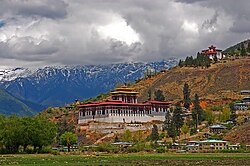
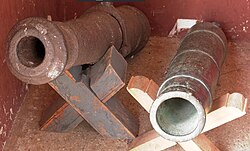
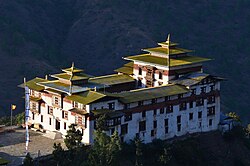
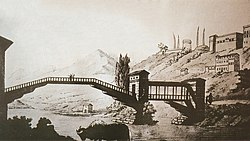
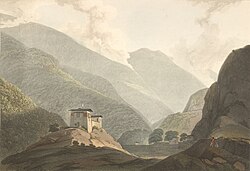

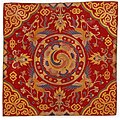
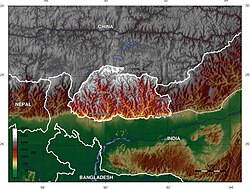
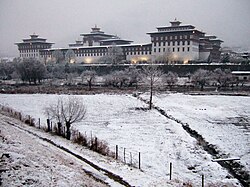
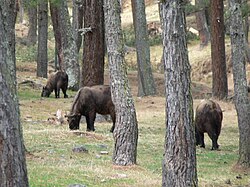


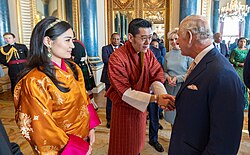
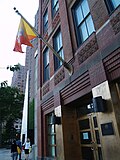


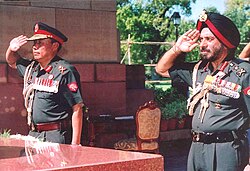
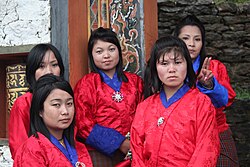

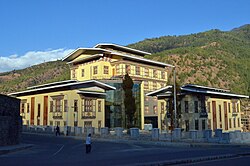
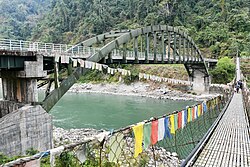
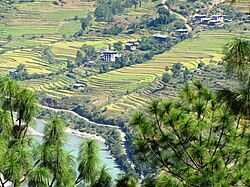
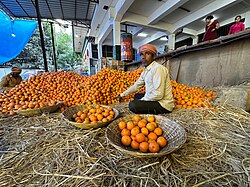
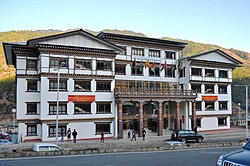


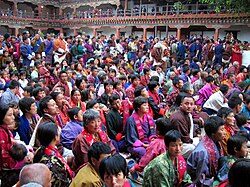
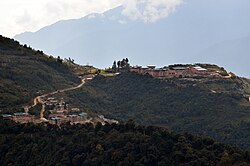
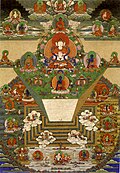
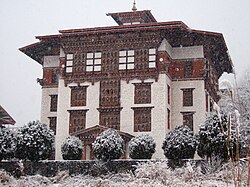
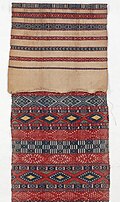
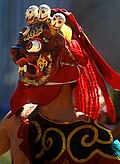

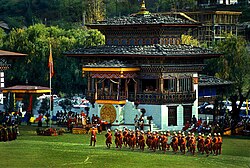

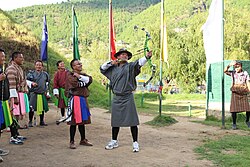

.svg)
 0.619[5]
 National bird of Bhutan
 National tree of Bhutan
 National flower of Bhutan
.jpg)


 Gangkhar Puensum, the highest mountain in Bhutan
 The Subalpine landscape common in Bhutan
 A Himalayan mountain seen from the town of Bumthang
 The Haa Valley in Western Bhutan
_(4677022812).jpg)


.svg)

