



No edit summary Tags: Mobile edit Mobile web edit |
WikiDwarfBOT (talk | contribs) Cleanup: Information added. |
||
| Line 1: | Line 1: | ||
{{short description|Indian politician (1903–1975)}} | {{short description|Indian politician (1903–1975)}} | ||
{{Redirect|Kamaraj|the 2004 Indian film|Kamaraj (film)}} | |||
{{Use Indian English|date=January 2020}} | {{Use Indian English|date=January 2020}} | ||
{{Use dmy dates|date= | {{Use dmy dates|date=March 2022}} | ||
{{Indian name|Kamaraj|Kumarasami}} | |||
{{Infobox officeholder | {{Infobox officeholder | ||
| name = K. Kamaraj | | name = K. Kamaraj | ||
| image = | | image = K Kamaraj 1976 stamp of India.jpg | ||
| caption = | | caption = Kamaraj on a 1976 commemorative stamp | ||
| office = | | office = 3rd [[List of Chief Ministers of Tamil Nadu|Chief Minister of Madras State]] | ||
| term_start = 13 April 1954 | | term_start = 13 April 1954 | ||
| term_end = 2 October 1963 | | term_end = 2 October 1963 | ||
| Line 44: | Line 45: | ||
| predecessor4 = [[Neelam Sanjiva Reddy]] | | predecessor4 = [[Neelam Sanjiva Reddy]] | ||
| successor4 = [[S. Nijalingappa]] | | successor4 = [[S. Nijalingappa]] | ||
| office5 = President of the [[Tamil Nadu Congress Committee|Madras Provincial Congress Committee]] | | office5 = President of the [[Tamil Nadu Congress Committee|Madras Provincial and Madras State Congress Committee]] | ||
| term_start5 = 1946 | | term_start5 = 1946 | ||
| term_end5 = 1952 | | term_end5 = 1952 | ||
| Line 52: | Line 53: | ||
| term_start6 = 6 August 1954 | | term_start6 = 6 August 1954 | ||
| term_end6 = 28 February 1967 | | term_end6 = 28 February 1967 | ||
| constituency6 = [[Gudiyatham (state assembly constituency)|Gudiyatham]] (1954–1957) <br/> [[Sattur (state assembly constituency)|Sattur]] (1957–1967) | | constituency6 = [[Gudiyatham (state assembly constituency)|Gudiyatham]] (1954–1957) <br /> [[Sattur (state assembly constituency)|Sattur]] (1957–1967) | ||
| birth_name = Kumaraswami Kamaraj | | birth_name = Kumaraswami Kamaraj | ||
| birth_date = {{Birth date|df=yes|1903|07|15}} | | birth_date = {{Birth date|df=yes|1903|07|15}} | ||
| birth_place = [[Virudhunagar]], [[Madras Presidency]], [[British India]]<br/>(present-day [[Virudhunagar district | | birth_place = [[Virudhunagar]], [[Madras Presidency]], [[British India]]<br />(present-day [[Virudhunagar district, Tamil Nadu]], India) | ||
| death_date = {{Death date and age|df=yes|1975|10|02|1903|07|15}} | | death_date = {{Death date and age|df=yes|1975|10|02|1903|07|15}} | ||
| death_place = [[Madras]] (present-day [[Chennai | | death_place = [[Madras]] (present-day [[Chennai, Tamil Nadu]], India) | ||
| resting_place = Perunthalaivar Kamarajar Ninaivagam | | resting_place = Perunthalaivar Kamarajar Ninaivagam | ||
| party = [[Indian National Congress (Organisation)|Indian National Congress (O)]] (1969-1975) | | party = [[Indian National Congress (Organisation)|Indian National Congress (O)]] (1969-1975) | ||
| otherparty = [[Indian National Congress]] (until 1969) | | otherparty = [[Indian National Congress]] (until 1969) | ||
| spouse = | |||
| spouse = | | children = | ||
| children = | | residence = Kamarajar Illam<br />1/10, [[Thyagaraya Nagar, Chennai, Tamil Nadu]], India | ||
| residence = Kamarajar Illam<br/>1/10, [[Thyagaraya Nagar | | profession = {{Hlist|[[Freedom fighter]] | [[activist]] |politician}} | ||
| profession = {{Hlist|[[Freedom fighter]] | [[ | |||
| awards = * [[Bharat Ratna]] (1976) (posthumously) | | awards = * [[Bharat Ratna]] (1976) (posthumously) | ||
* Copper Bond Award (1972) | * Copper Bond Award (1972) | ||
| signature = Signature of K. Kamraj.svg | | signature = Signature of K. Kamraj.svg | ||
| nickname = {{Hlist|Karmaveerar|Perunthalaivar|Kingmaker}} | | nickname = {{Hlist|Karmaveerar|Perunthalaivar|Kingmaker}} | ||
}} | }} | ||
'''Kumaraswami Kamaraj''' (15 July 1903<ref name="hindu1">{{cite news |url=http://www.hindu.com/2009/07/08/stories/2009070859180300.htm |title=Revised edition of book on Kamaraj to be launched |archive-url=https://web.archive.org/web/20110510083123/http://www.hindu.com/2009/07/08/stories/2009070859180300.htm |archive-date=10 May 2011 |first=T |last=Ramakrishnan|date=8 July 2009 |url-status=dead |work=[[The Hindu]] |access-date=11 March 2021}}</ref> – 2 October 1975<ref name="frontline1">{{usurped|[https://web.archive.org/web/20080915160945/http://www.hinduonnet.com/fline/fl1819/18191180.htm Crusading Congressman, Frontline Magazine]}}, hinduonnet.com. 15–28 September 2001</ref>), popularly known as '''Kamarajar''' was an Indian independence activist and politician who served as the [[chief minister of Tamil Nadu|Chief Minister of Madras State (Tamil Nadu)]] from 13 April 1954 to 2 October 1963. He was the founder and the president of the [[Indian National Congress (Organisation)]], widely acknowledged as the "[[Kingmaker]]" in Indian politics during the 1960s. He also served as the president of the [[Indian National Congress]] for two terms i.e. four years between 1964–1967 and was responsible for the elevation of [[Lal Bahadur Shastri]] to the position of [[Prime Minister of India]] after [[Jawaharlal | '''Kumaraswami Kamaraj''' (15 July 1903<ref name="hindu1">{{cite news |url=http://www.hindu.com/2009/07/08/stories/2009070859180300.htm |title=Revised edition of book on Kamaraj to be launched |archive-url=https://web.archive.org/web/20110510083123/http://www.hindu.com/2009/07/08/stories/2009070859180300.htm |archive-date=10 May 2011 |first=T |last=Ramakrishnan|date=8 July 2009 |url-status=dead |work=[[The Hindu]] |access-date=11 March 2021}}</ref> – 2 October 1975<ref name="frontline1">{{usurped|[https://web.archive.org/web/20080915160945/http://www.hinduonnet.com/fline/fl1819/18191180.htm Crusading Congressman, Frontline Magazine]}}, hinduonnet.com. 15–28 September 2001</ref>), popularly known as '''Kamarajar''' was an Indian independence activist and politician who served as the [[chief minister of Tamil Nadu|Chief Minister of Madras State (Tamil Nadu)]] from 13 April 1954 to 2 October 1963. He was the founder and the president of the [[Indian National Congress (Organisation)]], widely acknowledged as the "[[Kingmaker]]" in Indian politics during the 1960s. He also served as the president of the [[Indian National Congress]] for two terms i.e. four years between 1964–1967 and was responsible for the elevation of [[Lal Bahadur Shastri]] to the position of [[Prime Minister of India]] after [[Jawaharlal Nehru]]'s death and [[Indira Gandhi]] after Shastri's death. He was the [[Member of Parliament, Lok Sabha]] during 1952–1954<ref>{{cite book |title=LOK SABHA DEBATES |publisher=Government of India |page=22 |url=https://eparlib.nic.in/bitstream/123456789/55615/1/lsd_01_07_23-08-1954.pdf |access-date=8 April 2020}}</ref> and 1969–1975. He was known for his simplicity and integrity. He played a major role in developing the infrastructure of the [[Madras State|Madras state]] and worked to improve the quality of life of the needy and the disadvantaged.<ref name="hindu1"/><ref name="hindu2">[https://web.archive.org/web/20080718234945/http://www.hindu.com/2008/07/16/stories/2008071660450700.htm He raised the bar with simplicity]. ''The Hindu''. 16 July 2008</ref> | ||
As the [[Indian National Congress|president of the INC]],<ref name="frontline2">{{usurped|[https://web.archive.org/web/20110728031218/http://www.hinduonnet.com/fline/fl1917/19170840.htm The commonsense politician, Frontline Magazine, 17–30 August 2002]}}</ref> he was instrumental in steering the party after the death of [[Jawaharlal Nehru]]. As the [[Chief Minister of Madras|chief minister of Madras]], he was responsible for bringing free education to the disadvantaged and introduced the [[Midday Meal Scheme|free Midday Meal Scheme]] while he himself did not complete schooling. He was awarded with India's [[Bharat Ratna|highest civilian honour]], the [[Bharat Ratna]], [[Posthumous recognition|posthumous]]ly in 1976.<ref>{{cite web|title=Padma Awards Directory (1954–2007)|url=http://www.mha.nic.in/pdfs/PadmaAwards1954-2007.pdf|publisher=Ministry of Home Affairs |access-date=7 December 2010 |archive-url=https://web.archive.org/web/20090304070427/http://mha.nic.in/pdfs/PadmaAwards1954-2007.pdf |archive-date=4 March 2009}}</ref> US Vice- | As the [[Indian National Congress|president of the INC]],<ref name="frontline2">{{usurped|[https://web.archive.org/web/20110728031218/http://www.hinduonnet.com/fline/fl1917/19170840.htm The commonsense politician, Frontline Magazine, 17–30 August 2002]}}</ref> he was instrumental in steering the party after the death of [[Jawaharlal Nehru]]. As the [[Chief Minister of Madras|chief minister of Madras]], he was responsible for bringing free education to the disadvantaged and introduced the [[Midday Meal Scheme|free Midday Meal Scheme]] while he himself did not complete schooling. He was awarded with India's [[Bharat Ratna|highest civilian honour]], the [[Bharat Ratna]], [[Posthumous recognition|posthumous]]ly in 1976.<ref>{{cite web|title=Padma Awards Directory (1954–2007)|url=http://www.mha.nic.in/pdfs/PadmaAwards1954-2007.pdf|publisher=Ministry of Home Affairs |access-date=7 December 2010 |archive-url=https://web.archive.org/web/20090304070427/http://mha.nic.in/pdfs/PadmaAwards1954-2007.pdf |archive-date=4 March 2009}}</ref> US Vice-president [[Hubert Humphrey]], referred to Kamaraj as "one of the greatest political leaders in all the countries of the free world" in January 1966.<ref>{{cite news |url=https://theprint.in/politics/k-kamaraj-the-southern-stalwart-who-gave-india-two-pms/127890/ |title=K. Kamaraj: The southern stalwart who gave India two PMs |work=The Print |first=Maneesh |last=Chhibber |date=2 October 2018 |access-date=11 March 2021}}</ref> | ||
==Early life== | ==Early life== | ||
Kamaraj was born on 15 July 1903 in [[Virudhunagar]], [[Tamil Nadu]], to Kumaraswami and Sivakami Ammal. His name was originally Kamatchi, later changed to Kamarajar. His father Kumaraswami was a merchant. Kamaraj had a younger sister named Nagammal.<ref>{{Cite web|url= | Kamaraj was born on 15 July 1903 in [[Virudhunagar]], [[Tamil Nadu]], to Kumaraswami Nadar and Sivakami Ammal.<ref name="Bio"/><ref name="kapur"/> His name was originally Kamatchi, later changed to Kamarajar. His father Kumaraswami Nadar was a merchant. Kamaraj had a younger sister named Nagammal.<ref name="Bio">{{Cite web|url=https://shodhganga.inflibnet.ac.in/bitstream/10603/30267/7/chapter1.pdf|title=A Brief Personal and Political Biography of Kamaraj Early Life|website=Shodganga|access-date=13 March 2022}}</ref><ref name=":1">{{Cite news|first=C D S|last=Mani |date=23 October 2013|url=https://timesofindia.indiatimes.com/city/chennai/In-dire-straits-Kamaraj-kin-get-Congress-aid-for-education/articleshow/24563144.cms|title=In dire straits, Kamaraj kin get Congress aid for education|work=The Times of India|access-date=19 January 2019}}</ref> Kamaraj was first enrolled in a traditional school in 1907 and in 1908 he was admitted to Yenadhi Narayana Vidhya Salai. In 1909 Kamaraj was admitted in Virudupatti High School. Kamaraj's father died when he was six years old, his mother was forced to support the family. In 1914 Kamaraj dropped out of school to support his mother.<ref name="kapur">{{cite book |first=Raghu Pati |last=Kapur |year=1966 |title=Kamaraj, the iron man |publisher=Deepak Associates |page=12 |url=https://books.google.com/books?id=RoVHAAAAIAAJ |url-status=live |archive-url=https://web.archive.org/web/20141116082111/http://books.google.com/books?id=RoVHAAAAIAAJ |archive-date=16 November 2014 }}</ref> | ||
==Politics== | ==Politics== | ||
As a young boy, Kamaraj worked in his uncle's provision shop and during that time he began to attend public meetings and processions about the [[Indian Home Rule movement]]. Kamaraj developed an interest in prevailing political conditions by reading newspapers daily. The [[Jallianwala Bagh massacre]] was the decisive turning point in his life - he decided to fight for national freedom and to bring an end to foreign rule.<ref name=b1/> In 1920, when he was | As a young boy, Kamaraj worked in his uncle's provision shop and during that time he began to attend public meetings and processions about the [[Indian Home Rule movement]]. Kamaraj developed an interest in prevailing political conditions by reading newspapers daily. The [[Jallianwala Bagh massacre]] was the decisive turning point in his life - he decided to fight for national freedom and to bring an end to foreign rule.<ref name=b1/> In 1920, when he was 17, he became active in politics. He joined Congress as a full-time political worker.{{citation needed|date=December 2021}} In 1921 Kamaraj organised public meetings at Virudhunagar for Congress leaders. He was eager to meet Gandhi, and when Gandhi visited Madurai on 21 September 1921, Kamaraj attended the public meeting and met Gandhi for the first time. He visited villages carrying Congress propaganda.<ref name=b1>{{cite book|title=Early Life of K. Kamaraj|url=https://books.google.com/books?id=bOjT3qffnMkC|publisher=Concept Publishing Company|pages=24–25}}</ref> | ||
In 1922 Congress boycotted the visit of the Prince of Wales as part of the [[Non-Cooperation Movement]]. He came to Madras and took part in the event.<ref>[https://www.indialegacy.website/2019/04/India-State-Andhra-Pradesh.html] | In 1922 Congress boycotted the visit of the Prince of Wales as part of the [[Non-Cooperation Movement]]. He came to Madras and took part in the event.<ref>[https://www.indialegacy.website/2019/04/India-State-Andhra-Pradesh.html] {{cbignore|bot=medic}}</ref> In 1923–25 Kamaraj participated in the [[Flag Satyagraha|Nagpur Flag Satyagraha]].<ref>[http://www.virudhunagar.nic.in/kamaraj.htm K.Kamaraj]. virudhunagar.nic.in {{webarchive|url=https://web.archive.org/web/20141007061812/http://www.virudhunagar.nic.in/kamaraj.htm |date=7 October 2014 }}</ref> In 1927, Kamaraj started the Sword Satyagraha in Madras and was chosen to lead the [[Neil Statue Satyagraha]], but this was given up later in view of the [[Simon Commission]] boycott.<ref>{{cite book |url=https://books.google.com/books?id=bOjT3qffnMkC |title=The Political Career of K. Kamaraj |first=P. |last=Kandaswamy |publisher=Concept Publishing Company |year=2001 |page=30 }}</ref> | ||
Kamaraj went to jail for two years in June 1930 for participating in the [[Vedaranyam march|"Salt Satyagraha"]].<ref name="asiantribune" /> led by Rajagopalachari at Vedaranyam; he was released before he served the two-year sentence as a result of 1931 [[Gandhi–Irwin Pact]].{{citation needed|date=October 2013}} In 1932, [[Unlawful assembly|Section 144]] was imposed in Madras prohibiting the holding of meetings and organisation of processions against the arrest of Gandhi in Bombay. In Virdhunagar, under Kamaraj's leadership, processions and demonstrations happened every day. Kamaraj was arrested again in January 1932 and sentenced to one year's imprisonment.<ref>[http://www.isrj.net/publisharticles/1100.pdf Freedom Movement In Madras Presidency With Special Reference To The Role Of Kamaraj (1920–1945), Page 3]</ref> In 1933 Kamaraj was falsely charged in the Virudhunagar bomb case. Varadarajulu Naidu and George Joseph argued on Kamaraj's behalf and proved the charges to be baseless.<ref>[http://www.thehindu.com/todays-paper/tp-features/tp-editorialfeatures/article2248765.ece?css=print George Joseph, a true champion of subaltern] {{webarchive|url=https://web.archive.org/web/20160126004730/http://www.thehindu.com/todays-paper/tp-features/tp-editorialfeatures/article2248765.ece?css=print |date=26 January 2016 }}</ref> At the age of 34, Kamaraj entered the Assembly winning the [[Sattur]] seat in the 1937 election.<ref name="DH_Kingmaker">{{Cite news|title=K Kamaraj 116th birth anniv: Rare pics of 'Kingmaker'|url=https://www.deccanherald.com/national/south/k-kamaraj-116th-birth-anniv-rare-pics-of-kingmaker-747273.html|date=15 July 2019|work=Deccan Herald|language=en|access-date=22 May 2020}}</ref> | Kamaraj went to jail for two years in June 1930 for participating in the [[Vedaranyam march|"Salt Satyagraha"]].<ref name="asiantribune" /> led by Rajagopalachari at Vedaranyam; he was released before he served the two-year sentence as a result of 1931 [[Gandhi–Irwin Pact]].{{citation needed|date=October 2013}} In 1932, [[Unlawful assembly|Section 144]] was imposed in Madras prohibiting the holding of meetings and organisation of processions against the arrest of Gandhi in Bombay. In Virdhunagar, under Kamaraj's leadership, processions and demonstrations happened every day. Kamaraj was arrested again in January 1932 and sentenced to one year's imprisonment.<ref>[http://www.isrj.net/publisharticles/1100.pdf Freedom Movement In Madras Presidency With Special Reference To The Role Of Kamaraj (1920–1945), Page 3]</ref> In 1933 Kamaraj was falsely charged in the Virudhunagar bomb case. Varadarajulu Naidu and George Joseph argued on Kamaraj's behalf and proved the charges to be baseless.<ref>[http://www.thehindu.com/todays-paper/tp-features/tp-editorialfeatures/article2248765.ece?css=print George Joseph, a true champion of subaltern] {{webarchive|url=https://web.archive.org/web/20160126004730/http://www.thehindu.com/todays-paper/tp-features/tp-editorialfeatures/article2248765.ece?css=print |date=26 January 2016 }}</ref> At the age of 34, Kamaraj entered the Assembly winning the [[Sattur]] seat in the 1937 election.<ref name="DH_Kingmaker">{{Cite news|title=K Kamaraj 116th birth anniv: Rare pics of 'Kingmaker'|url=https://www.deccanherald.com/national/south/k-kamaraj-116th-birth-anniv-rare-pics-of-kingmaker-747273.html|date=15 July 2019|work=Deccan Herald|language=en|access-date=22 May 2020}}</ref> | ||
Kamaraj conducted a vigorous campaign throughout the state asked people not to contribute to war funds when [[Arthur Hope, 2nd Baron Rankeillour| | Kamaraj conducted a vigorous campaign throughout the state asked people not to contribute to war funds when [[Arthur Hope, 2nd Baron Rankeillour|Arthur Hope]], the Madras Governor, was collecting contributions to fund for the Second World War. In December 1940 he was arrested again at Guntur, under the Defence of India rules for speeches that opposed contributions to the war fund, and sent to Vellore Central Prison while he was on his way to Wardha to get Gandhi's approval for a list of Satyagrahis. While in jail, he was elected as Municipal Councillor of Virudhunagar. He was released nine months later in November 1941 and resigned from this post as he thought he had greater responsibility for the nation.<ref name="Remembering Our Leaders, Page 146">{{cite book|title=Remembering Our Leaders|url=https://books.google.com/books?id=epPiG7IytcUC|year=1989|publisher=Children's Book Trust|isbn=978-81-7011-767-4|page=146}}</ref><ref>{{cite book|title=Encyclopedia of Bharat Ratnas|url=https://books.google.com/books?id=HkF3avvFvb4C|publisher=Pitambar Publishing|isbn=978-81-209-1307-3 |page=88}}</ref> His principle was "One should not accept any post to which one could not do full justice".<ref>{{Cite book|last=Sain|first=Pravina Bhim|url=https://books.google.com/books?id=epPiG7IytcUC&pg=PA146|title=Remembering our leaders.|year=1989|isbn=81-7011-545-0|location=New Delhi|pages=146|oclc=422855040}}</ref> | ||
In 1942, Kamaraj attended the All-India Congress Committee in [[Bombay]] and returned to spread propaganda material for the Quit India Movement. The police issued orders to all the leaders who attended this Bombay session. Kamaraj did not want to be arrested before he took the message to all district and local leaders. finishing his work and sent a message to the local police that he was ready to be arrested. He was arrested in August 1942. He was under detention for three years and was released in June 1945. This was his last prison term.<ref name="asiantribune">{{cite news |url=http://www.asiantribune.com/news/2009/10/13/tributes-kamaraj|date=13 October 2009 |title=Tributes To Kamaraj |publisher=Asian Tribune |first=R. K. |last=Bhatnagar |access-date=3 February 2014 |url-status=live |archive-url=https://web.archive.org/web/20140221044857/http://www.asiantribune.com/news/2009/10/13/tributes-kamaraj |archive-date=21 February 2014 }}</ref><ref name="Remembering Our Leaders, Page 146"/><ref>{{cite book|title=Encyclopedia of Bharat Ratnas|url=https://books.google.com/books?id=HkF3avvFvb4C|publisher=Pitambar Publishing|isbn=978-81-209-1307-3|page=89 }}</ref> Kamaraj was imprisoned six times by the British for his pro-Independence activities, that added up to more than 3,000 days in jail.<ref>{{cite book |url=https://books.google.com/books?id=kGUuOdeCiXQC |title=Crafting State-Nations: India and Other Multinational Democracies |first1=Alfred |last1=Stepan |first2=Juan J. |last2=Linz |first3=Yogendra |last3=Yadav |publisher=JHU Press |year=2011 |isbn=9780801897238 |page=124 }}</ref> | In 1942, Kamaraj attended the All-India Congress Committee in [[Bombay]] and returned to spread propaganda material for the Quit India Movement. The police issued orders to all the leaders who attended this Bombay session. Kamaraj did not want to be arrested before he took the message to all district and local leaders. finishing his work and sent a message to the local police that he was ready to be arrested. He was arrested in August 1942. He was under detention for three years and was released in June 1945. This was his last prison term.<ref name="asiantribune">{{cite news |url=http://www.asiantribune.com/news/2009/10/13/tributes-kamaraj|date=13 October 2009 |title=Tributes To Kamaraj |publisher=Asian Tribune |first=R. K. |last=Bhatnagar |access-date=3 February 2014 |url-status=live |archive-url=https://web.archive.org/web/20140221044857/http://www.asiantribune.com/news/2009/10/13/tributes-kamaraj |archive-date=21 February 2014 }}</ref><ref name="Remembering Our Leaders, Page 146"/><ref>{{cite book|title=Encyclopedia of Bharat Ratnas|url=https://books.google.com/books?id=HkF3avvFvb4C|publisher=Pitambar Publishing|isbn=978-81-209-1307-3|page=89 }}</ref> Kamaraj was imprisoned six times by the British for his pro-Independence activities, that added up to more than 3,000 days in jail.<ref>{{cite book |url=https://books.google.com/books?id=kGUuOdeCiXQC |title=Crafting State-Nations: India and Other Multinational Democracies |first1=Alfred |last1=Stepan |first2=Juan J. |last2=Linz |first3=Yogendra |last3=Yadav |publisher=JHU Press |year=2011 |isbn=9780801897238 |page=124 }}</ref> | ||
During the [[1966 anti-cow slaughter agitation|anti-cow slaughter agitation in 1966]], Kamaraj's house near the parliament was burnt down by [[Hindutva]] groups. The agitation was incited by [[Bharatiya Jana Sangh]], the political arm of the [[Rashtriya Swayamsevak Sangh]] (RSS). They also surrounded his house with an intent to attack him.<ref>{{Cite book|last=Chandra|first=Bipan|url=https://books.google.com/books?id=Ipwpbhd6sQUC&pg=PT237|title=India Since Independence|date=11 February 2008|publisher=Penguin UK|isbn=978-81-8475-053-9|language=en}}</ref> Kamaraj had a narrow escape. | During the [[1966 anti-cow slaughter agitation|anti-cow slaughter agitation in 1966]], Kamaraj's house near the parliament was burnt down by [[Hindutva]] groups. The agitation was incited by [[Bharatiya Jana Sangh]], the political arm of the [[Rashtriya Swayamsevak Sangh]] (RSS).<ref>{{Cite web|title=RSS Chief's Call for National Cow Protection Law Echoes a Familiar Pattern|url=https://thewire.in/politics/mohan-bhagwat-cow-protection-law-bjp-rss|access-date=11 October 2020|website=The Wire}}</ref><ref name="Bipan" /><ref>{{cite web | last=Marvel | first=Ishan | title=Fifty Years Ago, Hindutva Groups Led the First Attack on the Indian Parliament | website=The Caravan | url=https://caravanmagazine.in/vantage/hindutva-groups-first-attack-indian-parliament-50-years | access-date=2022-11-23}}</ref> They also surrounded his house with an intent to attack him.<ref name="Bipan">{{Cite book|last=Chandra|first=Bipan|url=https://books.google.com/books?id=Ipwpbhd6sQUC&pg=PT237|title=India Since Independence|date=11 February 2008|publisher=Penguin UK|isbn=978-81-8475-053-9|language=en}}</ref> Kamaraj had a narrow escape.<ref>{{Cite news|last=Ramesh|first=Jairam|date=9 November 2016|title=The very first attack on Parliament|language=en-IN|work=The Hindu|url=https://www.thehindu.com/opinion/op-ed/The-very-first-attack-on-Parliament/article16440305.ece|access-date=11 October 2020|issn=0971-751X}}</ref> | ||
==Chief Minister== | ==Chief Minister== | ||
{{main|Kamaraj ministry}} | {{main|Kamaraj ministry}} | ||
On 13 April 1954, Kamaraj became the [[Chief Minister]] of [[Madras Province]]. To everyone's surprise, Kamaraj nominated [[C. Subramaniam | On 13 April 1954, Kamaraj became the [[Chief Minister]] of [[Madras Province]]. To everyone's surprise, Kamaraj nominated [[C. Subramaniam]] , who had contested his leadership, to the [[Kamaraj ministry|newly formed cabinet]]. | ||
As [[Chief Minister]], Kamaraj removed the family vocation based [[ | As [[Chief Minister]], Kamaraj removed the family vocation based [[Modified Scheme of Elementary education 1953]] introduced by [[Rajaji]]. He reopened 6000 schools closed in the previous government by [[C. Rajagopalachari]] citing financial reasons and reopened 12,000 more schools. The State made immense strides in education and trade. New schools were opened, so that poor rural students had to walk no more than three kilometres to their nearest school. Better facilities were added to existing ones. No village remained without a primary school and no panchayat without a high school. Kamaraj strove to eradicate illiteracy by introducing free and compulsory education up to the eleventh standard. He introduced the [[Midday Meal Scheme]] to provide at least one meal per day to the lakhs of poor school children.<ref>{{Cite book|last=Muthiah|first=S.|url=https://books.google.com/books?id=tbR_LLkqdI8C&pg=PA354|title=Madras, Chennai: A 400-year Record of the First City of Modern India|date=2008|publisher=Palaniappa Brothers|isbn=978-81-8379-468-8|language=en|pages=354}}</ref> He introduced free school uniforms to weed out caste, creed and class distinctions among young minds.<ref>{{Cite book|last=Sinha|first=Dipa|url=https://books.google.com/books?id=hyYFDAAAQBAJ&q=kamaraj+free+school+uniform&pg=PT119|title=Women, Health and Public Services in India: Why are states different?|date=20 April 2016|publisher=Routledge|isbn=978-1-317-23525-5|language=en}}</ref> | ||
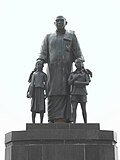
[[File:Statue of Kamarajar.jpg|right|thumb|Kamaraj Statue in [[Marina Beach]], [[Chennai]] depicting his contribution to education in the state]] | [[File:Statue of Kamarajar.jpg|right|thumb|Kamaraj Statue in [[Marina Beach]], [[Chennai]] depicting his contribution to education in the state]] | ||
[[File:KAMARAJAR Statue infront of KAP Kalyana Mandabam, Hosur.jpg|thumb |Perunthalaivar Kamarajar Statue in Kamaraj Colony, [[Hosur]]]] | [[File:KAMARAJAR Statue infront of KAP Kalyana Mandabam, Hosur.jpg|thumb |Perunthalaivar Kamarajar Statue in Kamaraj Colony, [[Hosur]]]] | ||
During the [[British Raj|colonial era]], the local education rate was at 7%; after Kamaraj's reforms, it reached 37%. Apart from increasing the number of schools, steps were taken to improve standards of education. To improve standards, the number of working days was increased from 180 to 200; unnecessary holidays were reduced; and syllabi were prepared to give opportunity to various abilities. Kamaraj and Bishnuram Medhi (Governor) took efforts to establish [[IIT Madras]] in 1959.<ref name="DH_Kingmaker"/> | During the [[British Raj|colonial era]], the local education rate was at 7%; after Kamaraj's reforms, it reached 37%. Apart from increasing the number of schools, steps were taken to improve standards of education. To improve standards, the number of working days was increased from 180 to 200; unnecessary holidays were reduced; and syllabi were prepared to give opportunity to various abilities. Kamaraj and [[Bishnuram Medhi]] (Governor) took efforts to establish [[IIT Madras]] in 1959.<ref name="DH_Kingmaker"/> | ||
Major irrigation schemes were planned in Kamaraj's period. Dams and irrigation canals were built across higher [[Bhavanisagar Dam|Bhavani]], [[Manimuthar Dam|Mani Muthar]], [[Arani, Tiruvannamalai|Aarani]], [[Vaigai Dam|Vaigai]], [[Amaravathi Dam|Amaravathi]], [[Sathanur Reservoir|Sathanur]], [[Krishnagiri Dam|Krishnagiri]], [[Pullambadi]], [[Parambikulam River|Parambikulam]] and [[Neyyar (river)|Neyyaru]] among others. The Lower Bhavani Dam in Erode district brought {{convert|207000|acre|km2}} of land under cultivation. {{convert|45000|acre|km2}} of land benefited from canals constructed from the [[Mettur Dam]]. The Vaigai and Sathanur systems facilitated cultivation across thousands of acres of lands in Madurai and North Arcot districts respectively. Rs 30 crores were planned to be spent for Parambikulam River scheme, and 150 lakhs of acres of lands were brought under cultivation; one third of this (i.e. 56 lakhs of acres of land) received a permanent irrigation facility. In 1957–61 1,628 tanks were de-silted under the Small Irrigation Scheme, and 2,000 wells were dug with outlets. Long-term loans with 25% subsidy were given to farmers. In addition farmers who had dry lands were given oil engines and electric pump sets on an instalment basis. | Major irrigation schemes were planned in Kamaraj's period. Dams and irrigation canals were built across higher [[Bhavanisagar Dam|Bhavani]], [[Manimuthar Dam|Mani Muthar]], [[Arani, Tiruvannamalai|Aarani]], [[Vaigai Dam|Vaigai]], [[Amaravathi Dam|Amaravathi]], [[Sathanur Reservoir|Sathanur]], [[Krishnagiri Dam|Krishnagiri]], [[Pullambadi]], [[Parambikulam River|Parambikulam]] and [[Neyyar (river)|Neyyaru]] among others. The Lower Bhavani Dam in Erode district brought {{convert|207000|acre|km2}} of land under cultivation. {{convert|45000|acre|km2}} of land benefited from canals constructed from the [[Mettur Dam]]. The Vaigai and Sathanur systems facilitated cultivation across thousands of acres of lands in Madurai and North Arcot districts respectively. Rs 30 crores were planned to be spent for Parambikulam River scheme, and 150 lakhs of acres of lands were brought under cultivation; one third of this (i.e. 56 lakhs of acres of land) received a permanent irrigation facility. In 1957–61 1,628 tanks were de-silted under the Small Irrigation Scheme, and 2,000 wells were dug with outlets. Long-term loans with 25% subsidy were given to farmers. In addition farmers who had dry lands were given oil engines and electric pump sets on an instalment basis. | ||
Industries with huge investments in crores of Rupees were started in his period: [[Neyveli Lignite Corporation]], [[BHEL]] at Trichy, [[Manali Refinery]], Hindustan raw photo film factory at Ooty, surgical instruments factory at Chennai, and a railway coach factory at Chennai were established. Industries such as paper, sugar, chemicals and cement took off during the period. | Industries with huge investments in crores of Rupees were started in his period: [[Neyveli Lignite Corporation]], [[Bharat Heavy Electricals Limited|BHEL]] at Trichy, [[Manali Refinery]], Hindustan raw photo film factory at Ooty, surgical instruments factory at Chennai, and a railway coach factory at Chennai were established. Industries such as paper, sugar, chemicals and cement took off during the period. | ||
===Kamaraj Plan=== | ===Kamaraj Plan=== | ||
| Line 111: | Line 110: | ||
On [[Gandhi Jayanti]] day 2 October 1963, he resigned from the post of the Chief Minister. He proposed that all senior Congress leaders should resign from their posts and devote all their energy to the re-vitalization of the Congress. | On [[Gandhi Jayanti]] day 2 October 1963, he resigned from the post of the Chief Minister. He proposed that all senior Congress leaders should resign from their posts and devote all their energy to the re-vitalization of the Congress. | ||
In 1963 he suggested to Nehru that senior Congress leaders should leave ministerial posts to take up organisational work. This suggestion came to be known as the '''Kamaraj Plan''', which was designed primarily to dispel from the minds of Congressmen the lure of power, creating in its place a dedicated attachment to the objectives and policies of the organisation. Six Union Ministers and six [[Chief Minister (India)|Chief Ministers]] including [[Lal Bahadur Shastri]], [[Jagjivan Ram]], [[Morarji Desai]], [[Biju Patnaik]] and [[S.K. Patil]] followed suit and resigned from their posts. Impressed by Kamaraj's achievements and acumen, Prime Minister [[Jawaharlal Nehru]] felt that his services were needed more at the national level.{{citation needed|date=April 2020}} In a swift move he brought Kamaraj to Delhi as the President of the Indian National Congress. Nehru realised that in addition to wide learning and vision, Kamaraj possessed enormous common sense and pragmatism. Kamaraj was elected the President of Indian National Congress on 9 October 1963.<ref>[http://www.dpcc.co.in/inc/history/presidents/k_kamaraj.php K Kamaraj]. dpcc.co.in {{webarchive |url=https://web.archive.org/web/20120518025825/http://www.dpcc.co.in/inc/history/presidents/k_kamaraj.php |date=18 May 2012 }}</ref> | In 1963 he suggested to Nehru that senior Congress leaders should leave ministerial posts to take up organisational work. This suggestion came to be known as the '''Kamaraj Plan''', which was designed primarily to dispel from the minds of Congressmen the lure of power, creating in its place a dedicated attachment to the objectives and policies of the organisation. Six Union Ministers and six [[Chief Minister (India)|Chief Ministers]] including [[Lal Bahadur Shastri]], [[Jagjivan Ram]], [[Morarji Desai]], [[Biju Patnaik]] and [[S.K. Patil]] followed suit and resigned from their posts.<ref>{{Cite book |last=Awana |first=Ram Singh |url=https://books.google.com/books?id=5Xs5f7RbB4AC&pg=PA105 |title=Pressure Politics in Congress Party: A Study of the Congress Forum for Socialist Action |publisher=Northern Book Centre |year=1988 |isbn=9788185119434 |location=New Delhi |pages=105 |access-date=10 July 2022}}</ref> Impressed by Kamaraj's achievements and acumen, Prime Minister [[Jawaharlal Nehru]] felt that his services were needed more at the national level.{{citation needed|date=April 2020}} In a swift move he brought Kamaraj to Delhi as the President of the Indian National Congress. Nehru realised that in addition to wide learning and vision, Kamaraj possessed enormous common sense and pragmatism. Kamaraj was elected the President of Indian National Congress on 9 October 1963.<ref>[http://www.dpcc.co.in/inc/history/presidents/k_kamaraj.php K Kamaraj]. dpcc.co.in {{webarchive |url=https://web.archive.org/web/20120518025825/http://www.dpcc.co.in/inc/history/presidents/k_kamaraj.php |date=18 May 2012 }}</ref> | ||
==National politics== | ==National politics== | ||
After Nehru's death in 1964, Kamaraj successfully navigated the party through turbulent times. As the president of INC, he refused to become the next Prime Minister himself and was instrumental in bringing to power two Prime Ministers, [[Lal Bahadur Shastri]] in 1964 and Nehru's daughter [[Indira Gandhi]] | After Nehru's death in 1964, Kamaraj successfully navigated the party through turbulent times. As the president of INC, he refused to become the next Prime Minister himself and was instrumental in bringing to power two Prime Ministers, [[Lal Bahadur Shastri]] in 1964 and Nehru's daughter [[Indira Gandhi]] 1966.<ref>{{cite web|url=http://scroll.in/article/822847/will-mamata-banerjees-hindi-handicap-hurt-her-national-ambition|title=Will Mamata Banerjee's Hindi handicap hurt her ambition to be prime minister?|url-status=live|archive-url=https://web.archive.org/web/20161202020139/http://scroll.in/article/822847/will-mamata-banerjees-hindi-handicap-hurt-her-national-ambition|archive-date=2 December 2016}}</ref> For this role, he was widely acclaimed as the "kingmaker" during the 1960s.<ref>{{Cite book|last=Khan|first=Farhat Basir|url=https://books.google.com/books?id=u6KoDwAAQBAJ&q=kingmaker+kamaraj+1960&pg=PT76|title=The Game of Votes: Visual Media Politics and Elections in the Digital Era|date=16 September 2019|publisher=SAGE Publishing India|isbn=978-93-5328-693-4|pages=76|language=en}}</ref> | ||
When the Congress split in 1969, Kamaraj became the leader of the [[Indian National Congress (Organisation)]] (INC(O)) in Tamil Nadu. The party fared poorly in the [[1971 Indian general election|1971 elections]] amid allegations of fraud by the opposition parties. He remained the leader of INC(O) until his death in 1975.<ref>{{cite book|title=India through the ages|url=https://archive.org/details/indiathroughages00mada|last=Gopal|first=Madan|year= 1990| page= [https://archive.org/details/indiathroughages00mada/page/164 164]|editor=K.S. Gautam|publisher=Publication Division, Ministry of Information and Broadcasting, Government of India}}</ref> | When the Congress split in 1969, Kamaraj became the leader of the [[Indian National Congress (Organisation)]] (INC(O)) in Tamil Nadu. The party fared poorly in the [[1971 Indian general election|1971 elections]] amid allegations of fraud by the opposition parties. He remained the leader of INC(O) until his death in 1975.<ref>{{cite book|title=India through the ages|url=https://archive.org/details/indiathroughages00mada|last=Gopal|first=Madan|year= 1990| page= [https://archive.org/details/indiathroughages00mada/page/164 164]|editor=K.S. Gautam|publisher=Publication Division, Ministry of Information and Broadcasting, Government of India}}</ref> | ||
| Line 135: | Line 134: | ||
| 1962 || MLA ||[[Sattur (State Assembly Constituency)|Sattur]] ||INC||P. Ramamoorthy || [[1962 Madras legislative assembly election]] || Won | | 1962 || MLA ||[[Sattur (State Assembly Constituency)|Sattur]] ||INC||P. Ramamoorthy || [[1962 Madras legislative assembly election]] || Won | ||
|- | |- | ||
| 1967 || MLA ||[[Virudhunagar (State Assembly Constituency)|Virudhunagar]] ||INC||[[P. Seenivasan]] || [[1967 Tamil Nadu state assembly election]] || Lost{{ | | 1967 || MLA ||[[Virudhunagar (State Assembly Constituency)|Virudhunagar]] ||INC||[[P. Seenivasan]] || [[1967 Tamil Nadu state assembly election]] || Lost<ref>{{Cite web| last = Election Commission of India|url=http://eci.nic.in/eci_main/StatisticalReports/SE_1967/Statistical%20Report%20Madras%201967.pdf|title= Statistical Report on General Election 1967|archive-url=https://web.archive.org/web/20120320175222/http://eci.nic.in/eci_main/StatisticalReports/SE_1967/Statistical%20Report%20Madras%201967.pdf|archive-date=20 March 2012|access-date= 19 April 2009}}</ref> | ||
|- | |- | ||
| 1969|| MP ||[[Nagercoil (Lok Sabha constituency)|Nagercoil]] ||INC||M. Mathias || By Election || Won | | 1969|| MP ||[[Nagercoil (Lok Sabha constituency)|Nagercoil]] ||INC||M. Mathias || By Election || Won | ||
| Line 141: | Line 140: | ||
| 1971 || MP ||[[Nagercoil (Lok Sabha constituency)|Nagercoil]] ||INC(O)||[[M. C. Balan]]||[[Indian general election in Tamil Nadu, 1971|Indian General Elections, 1971]] || Won | | 1971 || MP ||[[Nagercoil (Lok Sabha constituency)|Nagercoil]] ||INC(O)||[[M. C. Balan]]||[[Indian general election in Tamil Nadu, 1971|Indian General Elections, 1971]] || Won | ||
|- | |- | ||
|} | |} | ||
===Nagercoil by-election victory=== | |||
The death of [[A. Nesamony]] in 1968 led to the by-election in [[Nagercoil Lok Sabha constituency]]. Realising the popularity of [[Kamaraj]] in this constituency and the potential danger posed by Kamaraj's election after the [[Indian National Congress]] party's debacle in [[1967 Tamil Nadu state assembly election|1967 election]], [[C. Rajagopalachari]] wrote in ''Swarajya'', the magazine of the [[Swatantra Party]], about the need to defeat him and appealed to [[C. N. Annadurai]] to support [[M. Mathias]], the Swatantra Party candidate. Annadurai deputed [[M. Karunanidhi]], the then Minister for Public Works, to Nagercoil to work in support of Mathias. Despite the efforts, Kamaraj won decisively with a 1,28,201-vote margin on 8 January 1969.<ref>{{Cite book| last = P. Kandaswamy| title = The political career of K. Kamraj| publisher = Concept Publishing Company| location = New Delhi| pages = 122–124| url = https://books.google.com/books?id=bOjT3qffnMkC&dq=1967+tamil+nadu+elections+rice&pg=PA118}}</ref> | |||
==Personal life== | ==Personal life== | ||
During his tenure as Chief Minister, when the municipality of Virudhunagar provided a direct water connection to his house in his hometown, Kamarajar ordered it to be disconnected immediately as he did not want any special privileges. He refused to use the Z-level security that was provided to him as the CM of Tamil Nadu and instead travelled with just one police patrol vehicle. He did not marry, did not own any property and was never tempted by power.<ref name=":1" /> When he died, he left behind | During his tenure as Chief Minister, when the municipality of Virudhunagar provided a direct water connection to his house in his hometown, Kamarajar ordered it to be disconnected immediately as he did not want any special privileges. He refused to use the Z-level security that was provided to him as the CM of Tamil Nadu and instead travelled with just one police patrol vehicle. He did not marry, did not own any property and was never tempted by power.<ref name=":1" /> When he died, he left behind ₹130, 2 pairs of sandals, 4 shirts, 4 [[dhoti]]s and a few books.<ref>{{Cite web|title=To regain lost glory, Congress needs a Kamaraj as its leader|url=https://www.dailypioneer.com/2019/state-editions/to-regain-lost-glory--congress-needs-a-kamaraj-as-its-leader.html|last=Pioneer|first=The|website=The Pioneer|language=en}}</ref> | ||
==Death== | ==Death== | ||
| Line 165: | Line 166: | ||
==References== | ==References== | ||
{{ | {{reflist}} | ||
==External links== | ==External links== | ||
* [https://puthiyathagaval.com/kamarajar-life-history-in-tamil/ kamarajar life history] | |||
* [https://dheivegam.com/kamarajar-biography-tamil/ Complete history about Kamarajar] | * [https://dheivegam.com/kamarajar-biography-tamil/ Complete history about Kamarajar] | ||
* [https://archive.org/details/kamaraj_201907/ On the Footsteps of Kamarajar] | * [https://archive.org/details/kamaraj_201907/ On the Footsteps of Kamarajar] | ||
| Line 175: | Line 177: | ||
{{Indian National Congress Presidents}} | {{Indian National Congress Presidents}} | ||
{{Bharat Ratna}} | {{Bharat Ratna}} | ||
{{Authority control}} | |||
{{Authority control|state=expanded}} | |||
{{DEFAULTSORT:Kamaraj, K.}} | {{DEFAULTSORT:Kamaraj, K.}} | ||
[[Category:1903 births]] | [[Category:1903 births]] | ||
[[Category:1975 deaths]] | [[Category:1975 deaths]] | ||
[[Category: | [[Category:India MPs 1952–1957]] | ||
[[Category: | [[Category:India MPs 1967–1970]] | ||
[[Category: | [[Category:India MPs 1971–1977]] | ||
[[Category:Chief ministers from Indian National Congress]] | [[Category:Chief ministers from Indian National Congress]] | ||
[[Category:Chief Ministers of Tamil Nadu]] | [[Category:Chief Ministers of Tamil Nadu]] | ||
| Line 196: | Line 199: | ||
[[Category:Indian tax resisters]] | [[Category:Indian tax resisters]] | ||
[[Category:Lok Sabha members from Tamil Nadu]] | [[Category:Lok Sabha members from Tamil Nadu]] | ||
[[Category: | [[Category:Madras MLAs 1957–1962]] | ||
[[Category:People from Virudhunagar district]] | [[Category:People from Virudhunagar district]] | ||
[[Category:Presidents of the Indian National Congress]] | [[Category:Presidents of the Indian National Congress]] | ||
[[Category:Prisoners and detainees of British India]] | [[Category:Prisoners and detainees of British India]] | ||
[[Category:Recipients of the Bharat Ratna]] | [[Category:Recipients of the Bharat Ratna]] | ||
[[Category: | [[Category:Madras MLAs 1962–1967]] | ||
Latest revision as of 13:06, 22 July 2023
K. Kamaraj | |
|---|---|
 Kamaraj on a 1976 commemorative stamp | |
| 3rd Chief Minister of Madras State | |
| In office 13 April 1954 – 2 October 1963 | |
| Governor | |
| Preceded by | C. Rajagopalachari |
| Succeeded by | M. Bhaktavatsalam |
| Constituency | Gudiyatham (1954–1957) and Sattur (1957–1963) |
| Member of Parliament, Lok Sabha | |
| In office 9 January 1969 – 2 October 1975 | |
| Prime Minister | Indira Gandhi |
| Preceded by | A. Nesamony |
| Succeeded by | Kumari Ananthan |
| Constituency | Nagercoil |
| In office 13 May 1952 – 12 April 1954 | |
| Prime Minister | Jawaharlal Nehru |
| Preceded by | position established |
| Succeeded by | U. Muthuramalingam Thevar |
| Constituency | Srivilliputhur |
| President of the Indian National Congress (Organisation) | |
| In office 12 November 1969 – 2 October 1975 | |
| Preceded by | position established |
| Succeeded by | Morarji Desai |
| President of the Indian National Congress | |
| In office 1964–1967 | |
| Preceded by | Neelam Sanjiva Reddy |
| Succeeded by | S. Nijalingappa |
| President of the Madras Provincial and Madras State Congress Committee | |
| In office 1946–1952 | |
| Succeeded by | P. Subbarayan |
| Member of the Madras State Legislative Assembly | |
| In office 6 August 1954 – 28 February 1967 | |
| Constituency | Gudiyatham (1954–1957) Sattur (1957–1967) |
| Personal details | |
| Born | Kumaraswami Kamaraj 15 July 1903 Virudhunagar, Madras Presidency, British India (present-day Virudhunagar district, Tamil Nadu, India) |
| Died | 2 October 1975 (aged 72) Madras (present-day Chennai, Tamil Nadu, India) |
| Resting place | Perunthalaivar Kamarajar Ninaivagam |
| Political party | Indian National Congress (O) (1969-1975) |
| Other political affiliations | Indian National Congress (until 1969) |
| Residence | Kamarajar Illam 1/10, Thyagaraya Nagar, Chennai, Tamil Nadu, India |
| Profession |
|
| Awards |
|
| Signature |  |
| Nickname(s) |
|
Kumaraswami Kamaraj (15 July 1903[1] – 2 October 1975[2]), popularly known as Kamarajar was an Indian independence activist and politician who served as the Chief Minister of Madras State (Tamil Nadu) from 13 April 1954 to 2 October 1963. He was the founder and the president of the Indian National Congress (Organisation), widely acknowledged as the "Kingmaker" in Indian politics during the 1960s. He also served as the president of the Indian National Congress for two terms i.e. four years between 1964–1967 and was responsible for the elevation of Lal Bahadur Shastri to the position of Prime Minister of India after Jawaharlal Nehru's death and Indira Gandhi after Shastri's death. He was the Member of Parliament, Lok Sabha during 1952–1954[3] and 1969–1975. He was known for his simplicity and integrity. He played a major role in developing the infrastructure of the Madras state and worked to improve the quality of life of the needy and the disadvantaged.[1][4]
As the president of the INC,[5] he was instrumental in steering the party after the death of Jawaharlal Nehru. As the chief minister of Madras, he was responsible for bringing free education to the disadvantaged and introduced the free Midday Meal Scheme while he himself did not complete schooling. He was awarded with India's highest civilian honour, the Bharat Ratna, posthumously in 1976.[6] US Vice-president Hubert Humphrey, referred to Kamaraj as "one of the greatest political leaders in all the countries of the free world" in January 1966.[7]
Early life[edit | edit source]
Kamaraj was born on 15 July 1903 in Virudhunagar, Tamil Nadu, to Kumaraswami Nadar and Sivakami Ammal.[8][9] His name was originally Kamatchi, later changed to Kamarajar. His father Kumaraswami Nadar was a merchant. Kamaraj had a younger sister named Nagammal.[8][10] Kamaraj was first enrolled in a traditional school in 1907 and in 1908 he was admitted to Yenadhi Narayana Vidhya Salai. In 1909 Kamaraj was admitted in Virudupatti High School. Kamaraj's father died when he was six years old, his mother was forced to support the family. In 1914 Kamaraj dropped out of school to support his mother.[9]
Politics[edit | edit source]
As a young boy, Kamaraj worked in his uncle's provision shop and during that time he began to attend public meetings and processions about the Indian Home Rule movement. Kamaraj developed an interest in prevailing political conditions by reading newspapers daily. The Jallianwala Bagh massacre was the decisive turning point in his life - he decided to fight for national freedom and to bring an end to foreign rule.[11] In 1920, when he was 17, he became active in politics. He joined Congress as a full-time political worker.[citation needed] In 1921 Kamaraj organised public meetings at Virudhunagar for Congress leaders. He was eager to meet Gandhi, and when Gandhi visited Madurai on 21 September 1921, Kamaraj attended the public meeting and met Gandhi for the first time. He visited villages carrying Congress propaganda.[11]
In 1922 Congress boycotted the visit of the Prince of Wales as part of the Non-Cooperation Movement. He came to Madras and took part in the event.[12] In 1923–25 Kamaraj participated in the Nagpur Flag Satyagraha.[13] In 1927, Kamaraj started the Sword Satyagraha in Madras and was chosen to lead the Neil Statue Satyagraha, but this was given up later in view of the Simon Commission boycott.[14]
Kamaraj went to jail for two years in June 1930 for participating in the "Salt Satyagraha".[15] led by Rajagopalachari at Vedaranyam; he was released before he served the two-year sentence as a result of 1931 Gandhi–Irwin Pact.[citation needed] In 1932, Section 144 was imposed in Madras prohibiting the holding of meetings and organisation of processions against the arrest of Gandhi in Bombay. In Virdhunagar, under Kamaraj's leadership, processions and demonstrations happened every day. Kamaraj was arrested again in January 1932 and sentenced to one year's imprisonment.[16] In 1933 Kamaraj was falsely charged in the Virudhunagar bomb case. Varadarajulu Naidu and George Joseph argued on Kamaraj's behalf and proved the charges to be baseless.[17] At the age of 34, Kamaraj entered the Assembly winning the Sattur seat in the 1937 election.[18]
Kamaraj conducted a vigorous campaign throughout the state asked people not to contribute to war funds when Arthur Hope, the Madras Governor, was collecting contributions to fund for the Second World War. In December 1940 he was arrested again at Guntur, under the Defence of India rules for speeches that opposed contributions to the war fund, and sent to Vellore Central Prison while he was on his way to Wardha to get Gandhi's approval for a list of Satyagrahis. While in jail, he was elected as Municipal Councillor of Virudhunagar. He was released nine months later in November 1941 and resigned from this post as he thought he had greater responsibility for the nation.[19][20] His principle was "One should not accept any post to which one could not do full justice".[21]
In 1942, Kamaraj attended the All-India Congress Committee in Bombay and returned to spread propaganda material for the Quit India Movement. The police issued orders to all the leaders who attended this Bombay session. Kamaraj did not want to be arrested before he took the message to all district and local leaders. finishing his work and sent a message to the local police that he was ready to be arrested. He was arrested in August 1942. He was under detention for three years and was released in June 1945. This was his last prison term.[15][19][22] Kamaraj was imprisoned six times by the British for his pro-Independence activities, that added up to more than 3,000 days in jail.[23]
During the anti-cow slaughter agitation in 1966, Kamaraj's house near the parliament was burnt down by Hindutva groups. The agitation was incited by Bharatiya Jana Sangh, the political arm of the Rashtriya Swayamsevak Sangh (RSS).[24][25][26] They also surrounded his house with an intent to attack him.[25] Kamaraj had a narrow escape.[27]
Chief Minister[edit | edit source]
On 13 April 1954, Kamaraj became the Chief Minister of Madras Province. To everyone's surprise, Kamaraj nominated C. Subramaniam , who had contested his leadership, to the newly formed cabinet.
As Chief Minister, Kamaraj removed the family vocation based Modified Scheme of Elementary education 1953 introduced by Rajaji. He reopened 6000 schools closed in the previous government by C. Rajagopalachari citing financial reasons and reopened 12,000 more schools. The State made immense strides in education and trade. New schools were opened, so that poor rural students had to walk no more than three kilometres to their nearest school. Better facilities were added to existing ones. No village remained without a primary school and no panchayat without a high school. Kamaraj strove to eradicate illiteracy by introducing free and compulsory education up to the eleventh standard. He introduced the Midday Meal Scheme to provide at least one meal per day to the lakhs of poor school children.[28] He introduced free school uniforms to weed out caste, creed and class distinctions among young minds.[29]


During the colonial era, the local education rate was at 7%; after Kamaraj's reforms, it reached 37%. Apart from increasing the number of schools, steps were taken to improve standards of education. To improve standards, the number of working days was increased from 180 to 200; unnecessary holidays were reduced; and syllabi were prepared to give opportunity to various abilities. Kamaraj and Bishnuram Medhi (Governor) took efforts to establish IIT Madras in 1959.[18]
Major irrigation schemes were planned in Kamaraj's period. Dams and irrigation canals were built across higher Bhavani, Mani Muthar, Aarani, Vaigai, Amaravathi, Sathanur, Krishnagiri, Pullambadi, Parambikulam and Neyyaru among others. The Lower Bhavani Dam in Erode district brought 207,000 acres (840 km2) of land under cultivation. 45,000 acres (180 km2) of land benefited from canals constructed from the Mettur Dam. The Vaigai and Sathanur systems facilitated cultivation across thousands of acres of lands in Madurai and North Arcot districts respectively. Rs 30 crores were planned to be spent for Parambikulam River scheme, and 150 lakhs of acres of lands were brought under cultivation; one third of this (i.e. 56 lakhs of acres of land) received a permanent irrigation facility. In 1957–61 1,628 tanks were de-silted under the Small Irrigation Scheme, and 2,000 wells were dug with outlets. Long-term loans with 25% subsidy were given to farmers. In addition farmers who had dry lands were given oil engines and electric pump sets on an instalment basis.
Industries with huge investments in crores of Rupees were started in his period: Neyveli Lignite Corporation, BHEL at Trichy, Manali Refinery, Hindustan raw photo film factory at Ooty, surgical instruments factory at Chennai, and a railway coach factory at Chennai were established. Industries such as paper, sugar, chemicals and cement took off during the period.
Kamaraj Plan[edit | edit source]
Kamaraj remained Chief Minister for three consecutive terms, winning elections in 1957 and 1962. Kamaraj noticed that the Congress party was slowly losing its vigour.

On Gandhi Jayanti day 2 October 1963, he resigned from the post of the Chief Minister. He proposed that all senior Congress leaders should resign from their posts and devote all their energy to the re-vitalization of the Congress.
In 1963 he suggested to Nehru that senior Congress leaders should leave ministerial posts to take up organisational work. This suggestion came to be known as the Kamaraj Plan, which was designed primarily to dispel from the minds of Congressmen the lure of power, creating in its place a dedicated attachment to the objectives and policies of the organisation. Six Union Ministers and six Chief Ministers including Lal Bahadur Shastri, Jagjivan Ram, Morarji Desai, Biju Patnaik and S.K. Patil followed suit and resigned from their posts.[30] Impressed by Kamaraj's achievements and acumen, Prime Minister Jawaharlal Nehru felt that his services were needed more at the national level.[citation needed] In a swift move he brought Kamaraj to Delhi as the President of the Indian National Congress. Nehru realised that in addition to wide learning and vision, Kamaraj possessed enormous common sense and pragmatism. Kamaraj was elected the President of Indian National Congress on 9 October 1963.[31]
National politics[edit | edit source]
After Nehru's death in 1964, Kamaraj successfully navigated the party through turbulent times. As the president of INC, he refused to become the next Prime Minister himself and was instrumental in bringing to power two Prime Ministers, Lal Bahadur Shastri in 1964 and Nehru's daughter Indira Gandhi 1966.[32] For this role, he was widely acclaimed as the "kingmaker" during the 1960s.[33]
When the Congress split in 1969, Kamaraj became the leader of the Indian National Congress (Organisation) (INC(O)) in Tamil Nadu. The party fared poorly in the 1971 elections amid allegations of fraud by the opposition parties. He remained the leader of INC(O) until his death in 1975.[34]
Electoral history[edit | edit source]
| Year | Post | Constituency | Party | Opponent | Election | Result |
|---|---|---|---|---|---|---|
| 1937 | MLA | Sattur | INC | Unopposed | 1937 elections | Won |
| 1946 | MLA | Sattur-Aruppukottai | INC | Unopposed | 1946 elections | Won |
| 1952 | MP | Srivilliputhur | INC | G. D. Naidu | Indian General Elections, 1951 | Won |
| 1954 | MLA | Gudiyatham | INC | V. K. Kothandaraman | By Election | Won |
| 1957 | MLA | Sattur | INC | Jayarama Reddiar | 1957 Madras legislative assembly election | Won |
| 1962 | MLA | Sattur | INC | P. Ramamoorthy | 1962 Madras legislative assembly election | Won |
| 1967 | MLA | Virudhunagar | INC | P. Seenivasan | 1967 Tamil Nadu state assembly election | Lost[35] |
| 1969 | MP | Nagercoil | INC | M. Mathias | By Election | Won |
| 1971 | MP | Nagercoil | INC(O) | M. C. Balan | Indian General Elections, 1971 | Won |
Nagercoil by-election victory[edit | edit source]
The death of A. Nesamony in 1968 led to the by-election in Nagercoil Lok Sabha constituency. Realising the popularity of Kamaraj in this constituency and the potential danger posed by Kamaraj's election after the Indian National Congress party's debacle in 1967 election, C. Rajagopalachari wrote in Swarajya, the magazine of the Swatantra Party, about the need to defeat him and appealed to C. N. Annadurai to support M. Mathias, the Swatantra Party candidate. Annadurai deputed M. Karunanidhi, the then Minister for Public Works, to Nagercoil to work in support of Mathias. Despite the efforts, Kamaraj won decisively with a 1,28,201-vote margin on 8 January 1969.[36]
Personal life[edit | edit source]
During his tenure as Chief Minister, when the municipality of Virudhunagar provided a direct water connection to his house in his hometown, Kamarajar ordered it to be disconnected immediately as he did not want any special privileges. He refused to use the Z-level security that was provided to him as the CM of Tamil Nadu and instead travelled with just one police patrol vehicle. He did not marry, did not own any property and was never tempted by power.[10] When he died, he left behind ₹130, 2 pairs of sandals, 4 shirts, 4 dhotis and a few books.[37]
Death[edit | edit source]

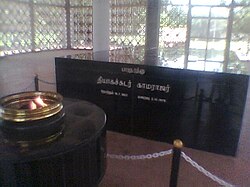
Kamaraj died at his home, on Gandhi Jayanti day (2 October 1975), which also was the 12th anniversary of his resignation. He was aged 72 and died in his sleep due to a heart attack.[38]
Legacy[edit | edit source]
- In 1976, he was posthumously awarded Bharat Ratna, India's highest civilian honor.
- In 2004, the Government of India issued a commemorative coin of ₹ 100 and ₹ 5 denomination to mark the centenary celebrations of him.
- Terminal-1 of Chennai International Airport is named "Kamaraj Terminal".
- Ennore Port in Chennai was renamed to Kamarajar Port Limited.
- Maraimalai Nagar Railway Station also named after him as Maraimalai Nagar Kamarajar Railway Station.
- His statue was erected in Parliament of India and Marina Beach to honor him.
- Madurai University is renamed as Madurai Kamaraj University in his honor.[4][39]
- North Parade Road in Bengaluru and Parliament Road in New Delhi were named as "Kamaraj Road".
- Marina Beach Road in Chennai and Ettayapuram Road in Thoothukudi were named as "Kamarajar Salai".
Popular culture[edit | edit source]
In 2004 a Tamil-language film titled Kamaraj was made based on the life history of Kamaraj.[40] The English version of the film was released on DVD in 2007.
References[edit | edit source]
- ↑ 1.0 1.1 Ramakrishnan, T (8 July 2009). "Revised edition of book on Kamaraj to be launched". The Hindu. Archived from the original on 10 May 2011. Retrieved 11 March 2021.
- ↑ Crusading Congressman, Frontline Magazine[usurped], hinduonnet.com. 15–28 September 2001
- ↑ LOK SABHA DEBATES (PDF). Government of India. p. 22. Retrieved 8 April 2020.
- ↑ 4.0 4.1 He raised the bar with simplicity. The Hindu. 16 July 2008
- ↑ The commonsense politician, Frontline Magazine, 17–30 August 2002[usurped]
- ↑ "Padma Awards Directory (1954–2007)" (PDF). Ministry of Home Affairs. Archived from the original (PDF) on 4 March 2009. Retrieved 7 December 2010.
- ↑ Chhibber, Maneesh (2 October 2018). "K. Kamaraj: The southern stalwart who gave India two PMs". The Print. Retrieved 11 March 2021.
- ↑ 8.0 8.1 "A Brief Personal and Political Biography of Kamaraj Early Life" (PDF). Shodganga. Retrieved 13 March 2022.
- ↑ 9.0 9.1 Kapur, Raghu Pati (1966). Kamaraj, the iron man. Deepak Associates. p. 12. Archived from the original on 16 November 2014.
- ↑ 10.0 10.1 Mani, C D S (23 October 2013). "In dire straits, Kamaraj kin get Congress aid for education". The Times of India. Retrieved 19 January 2019.
- ↑ 11.0 11.1 Early Life of K. Kamaraj. Concept Publishing Company. pp. 24–25.
- ↑ [1]
- ↑ K.Kamaraj. virudhunagar.nic.in Archived 7 October 2014 at the Wayback Machine
- ↑ Kandaswamy, P. (2001). The Political Career of K. Kamaraj. Concept Publishing Company. p. 30.
- ↑ 15.0 15.1 Bhatnagar, R. K. (13 October 2009). "Tributes To Kamaraj". Asian Tribune. Archived from the original on 21 February 2014. Retrieved 3 February 2014.
- ↑ Freedom Movement In Madras Presidency With Special Reference To The Role Of Kamaraj (1920–1945), Page 3
- ↑ George Joseph, a true champion of subaltern Archived 26 January 2016 at the Wayback Machine
- ↑ 18.0 18.1 "K Kamaraj 116th birth anniv: Rare pics of 'Kingmaker'". Deccan Herald. 15 July 2019. Retrieved 22 May 2020.
- ↑ 19.0 19.1 Remembering Our Leaders. Children's Book Trust. 1989. p. 146. ISBN 978-81-7011-767-4.
- ↑ Encyclopedia of Bharat Ratnas. Pitambar Publishing. p. 88. ISBN 978-81-209-1307-3.
- ↑ Sain, Pravina Bhim (1989). Remembering our leaders. New Delhi. p. 146. ISBN 81-7011-545-0. OCLC 422855040.
{{cite book}}: CS1 maint: location missing publisher (link) - ↑ Encyclopedia of Bharat Ratnas. Pitambar Publishing. p. 89. ISBN 978-81-209-1307-3.
- ↑ Stepan, Alfred; Linz, Juan J.; Yadav, Yogendra (2011). Crafting State-Nations: India and Other Multinational Democracies. JHU Press. p. 124. ISBN 9780801897238.
- ↑ "RSS Chief's Call for National Cow Protection Law Echoes a Familiar Pattern". The Wire. Retrieved 11 October 2020.
- ↑ 25.0 25.1 Chandra, Bipan (11 February 2008). India Since Independence. Penguin UK. ISBN 978-81-8475-053-9.
- ↑ Marvel, Ishan. "Fifty Years Ago, Hindutva Groups Led the First Attack on the Indian Parliament". The Caravan. Retrieved 23 November 2022.
- ↑ Ramesh, Jairam (9 November 2016). "The very first attack on Parliament". The Hindu. ISSN 0971-751X. Retrieved 11 October 2020.
- ↑ Muthiah, S. (2008). Madras, Chennai: A 400-year Record of the First City of Modern India. Palaniappa Brothers. p. 354. ISBN 978-81-8379-468-8.
- ↑ Sinha, Dipa (20 April 2016). Women, Health and Public Services in India: Why are states different?. Routledge. ISBN 978-1-317-23525-5.
- ↑ Awana, Ram Singh (1988). Pressure Politics in Congress Party: A Study of the Congress Forum for Socialist Action. New Delhi: Northern Book Centre. p. 105. ISBN 9788185119434. Retrieved 10 July 2022.
- ↑ K Kamaraj. dpcc.co.in Archived 18 May 2012 at the Wayback Machine
- ↑ "Will Mamata Banerjee's Hindi handicap hurt her ambition to be prime minister?". Archived from the original on 2 December 2016.
- ↑ Khan, Farhat Basir (16 September 2019). The Game of Votes: Visual Media Politics and Elections in the Digital Era. SAGE Publishing India. p. 76. ISBN 978-93-5328-693-4.
- ↑ Gopal, Madan (1990). K.S. Gautam (ed.). India through the ages. Publication Division, Ministry of Information and Broadcasting, Government of India. p. 164.
- ↑ Election Commission of India. "Statistical Report on General Election 1967" (PDF). Archived from the original (PDF) on 20 March 2012. Retrieved 19 April 2009.
- ↑ P. Kandaswamy. The political career of K. Kamraj. New Delhi: Concept Publishing Company. pp. 122–124.
- ↑ Pioneer, The. "To regain lost glory, Congress needs a Kamaraj as its leader". The Pioneer.
- ↑ Times, Kashturi Rangan Special to The New York (3 October 1975). "Kumaraswami Kamaraj Dead; Power Broker in Indian Politics". The New York Times. ISSN 0362-4331. Retrieved 28 April 2020.
- ↑ Man of the people Archived 6 September 2008 at the Wayback Machine, The Tribune, 4 October 1975
- ↑ "Film on former CM Kamaraj to be re-released with additional content' - Times of India". The Times of India. 16 January 2017. Retrieved 24 March 2020.
External links[edit | edit source]

Bharat Ratna laureates | ||
|---|---|---|
| 1954–1960 |
|  |
| 1961–1980 |
| |
| 1981–2000 |
| |
| 2001–2019 |
| |
- Pages using the JsonConfig extension
- 1903 births
- 1975 deaths
- India MPs 1952–1957
- India MPs 1967–1970
- India MPs 1971–1977
- Chief ministers from Indian National Congress
- Chief Ministers of Tamil Nadu
- Indian Hindus
- Indian independence activists
- Indian independence activists from Tamil Nadu
- Indian National Congress (Organisation) politicians
- Indian National Congress politicians from Tamil Nadu
- Indian nationalists
- Indian political party founders
- Indian socialists
- Indian Tamil politicians
- Indian tax resisters
- Lok Sabha members from Tamil Nadu
- Madras MLAs 1957–1962
- People from Virudhunagar district
- Presidents of the Indian National Congress
- Prisoners and detainees of British India
- Recipients of the Bharat Ratna
- Madras MLAs 1962–1967