



robot: Update article |
fixed issues |
||
| (One intermediate revision by one other user not shown) | |||
| Line 1: | Line 1: | ||
{{Short description| | {{Short description|Ethnic wrap garment worn by men in the Indian subcontinent}} | ||
{{for|the far western | {{for|the far western area of the [[Nepal]]ese region|Doti}} | ||
[[ | {{Use British English|date=March 2024}} | ||
{{Use dmy dates|date=March 2024}} | |||
'''{{ | [[File:An_Indian_dancer_in_dhoti,_wrapped_around_his_waist.jpg|thumb|right|A [[Dogras|Dogra]] dancer wears a dhoti, at a [[theatre]] in [[Jammu]].]] | ||
The '''dhoti''' is an [[ankle]]-length breechcloth,<ref>{{cite book | url=https://books.google.com/books?id=MVqgAAAAMAAJ&q=dhoti+breeching+cloth | title=Reversing the Gaze: Amar Singh's Diary, a Colonial Subject's Narrative of Imperial India | isbn=978-0-19-565869-9 | last1=Singh | first1=Amar | last2=Rudolph | first2=Lloyd I. | last3=Kanota | first3=Mohan Singh | date=2001 | publisher=Oxford University Press }}</ref> wrapped around the waist and the legs, in resemblance to the shape of [[trousers]].<ref>{{Cite book|url=https://books.google.com/books?id=afYNAQAAIAAJ|title=Life in Other Lands|publisher=Fideler|year=1960|page=78|quote=It is arranged to look like a pair of baggy trousers. This garment is called a dhoti and is usually made of cotton.|access-date=3 January 2021}}</ref><ref>{{Cite book|last=Bhandari|first=Vandana|url=https://books.google.com/books?id=nckSAQAAIAAJ|title=Costume, Textiles and Jewellery [i.e. Jewelry] of India: Traditions in Rajasthan|publisher=Mercury Books|year=2005|isbn=9781904668893|page=105|quote=One of the reasons for the dhoti's enduring popularity is its loose trouser - like form, which is convenient and extremely well - suited to the tropical Indian climate .|access-date=3 January 2021}}</ref><ref>{{Cite book|last=K Parker|first=Lewis|url=https://books.google.com/books?id=0uIZaaoSKGYC|title=India|publisher=Rourke Book Company|year=1994|isbn=9781559160056|page=14|quote=Boys and men often wear a ''dhoti''. This is a piece of white cloth wound around the waist. Dhotis look like comfortable, baggy pants.|access-date=3 January 2021}}</ref> The dhoti is a [[garment]] of [[ethnic wear]] for men in the [[Indian subcontinent]].<ref>{{Cite web|title=Indian Dhoti|url=https://www.indianmirror.com/culture/clothing/dhoti.html|url-status=live|archive-url=https://web.archive.org/web/20200729202155/https://www.indianmirror.com/culture/clothing/dhoti.html|archive-date=29 July 2020|access-date=3 January 2021|website=Indian Mirror}}</ref><ref>{{Cite news |last=Nayar |first=K P |date=2 May 1999 |title=Nepal Wakes Up to Dhoti Power |url=https://www.telegraphindia.com/india/nepal-wakes-up-to-dhoti-power/cid/922708 |access-date=16 August 2024 |work=The Telegraph (India)}}</ref> The dhoti is fashioned out of a rectangular piece of unstitched cloth, of usually around {{convert|4|yd}} in length.<ref>{{cite web | url=https://timesofindia.indiatimes.com/home/sunday-times/why-a-sari-is-both-hot-and-cool/articleshow/46570229.cms | title=Why a sari is both hot, and cool | work=The Times of India | date=15 March 2015 }}</ref><ref>{{cite book | url=https://books.google.com/books?id=xe1nBwAAQBAJ&dq=dhoti+breeching+cloth&pg=PT180 | title=World Clothing and Fashion: An Encyclopedia of History, Culture, and Social Influence | isbn=978-1-317-45166-2 | last1=Snodgrass | first1=Mary Ellen | date=17 March 2015 | publisher=Routledge }}</ref> | |||
[[File:Anonymous_-_Four_Recruits_in_White_Dhotis,_page_from_the_Fraser_Album_-_1981.247_-_Art_Institute_of_Chicago.jpg|thumb|An [[illustration]] of dhoti-clad recruits in the [[British Indian Army]].]] | |||
The | The dhoti is the male counterpart of the [[sari]], worn by females to [[Religion in India|religious]] and [[secularism in India|secular]] ceremonies ([[function hall|functions]]).<ref>{{cite book | url=https://books.google.com/books?id=paPeAwAAQBAJ&dq=sakaccha+dhoti&pg=PA155 | title=Philosophy, Religion and Politics: Essays in Honour of Very Rev. Fr. Moses Orshio Adasu | isbn=978-1-300-01966-4 | last1=Phd | first1=Alloy S Ihuah | date=2 August 2012 | publisher=Lulu.com }}</ref><ref name="The Times of India">{{cite web | url=https://timesofindia.indiatimes.com/city/hyderabad/city-women-get-talking-about-dresscode-in-temples/articleshow/55751537.cms | archive-url=https://web.archive.org/web/20250114032654/https://timesofindia.indiatimes.com/city/hyderabad/city-women-get-talking-about-dresscode-in-temples/articleshow/55751537.cms | archive-date=14 January 2025 | title=City women get talking about dresscode in temples | work=The Times of India | date=3 December 2016 }}</ref><ref name="Avasthi">{{Cite news|last=Avasthi|first=Vivek|date=14 January 2020|title=Sarees for women, dhoti for men: Officer's dress code for Kashi temple irks minister|language=English|work=The Federal|url=https://thefederal.com/news/sarees-for-women-dhoti-for-men-officers-dress-code-for-kashi-temple-irks-minister/|url-status=live|access-date=3 January 2021|archive-url=https://web.archive.org/web/20200805184620/https://thefederal.com/news/sarees-for-women-dhoti-for-men-officers-dress-code-for-kashi-temple-irks-minister/|archive-date=5 August 2020}}</ref> A {{Transliteration|hi|'''pitambar'''}} is a yellow silk dhoti worn on auspicious occasions.<ref>{{Cite book|last=Henry|first=Baden Powell|url=https://books.google.com/books?id=r4wCfSUgjQQC&q=Pitambar+silk+cloth|title=Hand-book of the Economic Products of the Punjab (etc.): Forming ... to the hand-book of the economic products of the Punjab|date=1872|publisher=Engineering College Press|pages=65, 67|language=en}}</ref><ref>{{Cite book|last=Birdwood|first=George Christopher Molesworth|url=https://books.google.com/books?id=5XLdX1yTDh8C&dq=Mashru+was+permitted&pg=PA345|title=The Industrial Arts of India|date=1884|publisher=Chapman and Hall|pages=363|language=en}}</ref> Dhotis must not be confused with "readymade panchakachams"<ref>{{cite web | url=https://www.newindianexpress.com/cities/chennai/2011/Jun/22/madisars-made-to-fit-just-right-265113.html | archive-url=https://web.archive.org/web/20240825090133/https://www.newindianexpress.com/cities/chennai/2011/Jun/22/madisars-made-to-fit-just-right-265113.html | archive-date=25 August 2024 | title=Madisars made to fit just right | date=16 May 2012 }}</ref> or "dhoti pants", which are a new [[ready to wear]] trend, popular among women and typical of children.<ref>{{cite web | url=https://www.carrieschronicles.com/blog/2018/11/12/doting-upon-the-return-of-dhoti-pants | archive-url=https://web.archive.org/web/20220707084524/https://www.carrieschronicles.com/blog/2018/11/12/doting-upon-the-return-of-dhoti-pants | archive-date=7 July 2022 | title=Doting Upon the Return of Dhoti Pants | date=12 November 2018 }}</ref><ref>{{cite web | url=https://www.fayonkids.com/blogs/kidswear/dhoti-kurta-for-girls-latest-fashion-trends-and-styles | archive-url=https://web.archive.org/web/20220606054655/https://www.fayonkids.com/blogs/kidswear/dhoti-kurta-for-girls-latest-fashion-trends-and-styles | archive-date=6 June 2022 | title=Latest Fashion, Trends and Style for Dhoti Kurta for Girls – FayonKids | date=16 May 2022 }}</ref><ref>{{cite web | url=https://www.glamcheck.com/fashion/2010/04/07/what-are-dhoti-pants | archive-url=https://web.archive.org/web/20101104105432/https://www.glamcheck.com/fashion/2010/04/07/what-are-dhoti-pants | archive-date=4 November 2010 | title=What are dhoti pants }}</ref> Although the terms ''[[mundu]]'' or ''[[veshti]]'' are used interchangeably with "dhoti",<ref>{{Cite web |date=2020 |title=What is Veshti |url=https://www.rhythmdhotis.com/what-is-veshti/ |website=Rhythm Dhotis}}</ref> they are different from the dhoti, which is "looped" or wrapped around the legs, in the form of trousers or pants.<ref>{{cite news | url=https://m.economictimes.com/cocktail-conversations-veshti-vs-dhoti/articleshow/8324642.cms | archive-url=https://web.archive.org/web/20211112051459/https://m.economictimes.com/cocktail-conversations-veshti-vs-dhoti/articleshow/8324642.cms | archive-date=12 November 2021 | title=Cocktail Conversations: Veshti Vs Dhoti | newspaper=The Economic Times | date=15 May 2011 | last1=Dasgupta | first1=Reshmi R. }}</ref> The dhoti is better known as '''panchakacham''' in [[South India]], which may even be worn while doing dances such as the [[moonwalk (dance)|moonwalk]].<ref>{{cite web | url=https://www.thehindu.com/features/metroplus/fashion/dhoti-dynamics/article7354043.ece | archive-url=https://web.archive.org/web/20241010071306/https://www.thehindu.com/features/metroplus/fashion/dhoti-dynamics/article7354043.ece | archive-date=10 October 2024 | title=Dhoti dynamics | work=The Hindu | date=25 June 2015 }}</ref> | ||
== | ==Etymology== | ||
[[ | The unstitched dhoti is also referred to as "dhautra" ([[International Phonetic Alphabet|IPA]]: /dʱɑwtrɐ/) in Sanskrit, which means rope or cord. It evolved from the ancient ''[[antriya]]'', which was passed in between the legs, tucked at the back and covered the legs loosely, then flowed into long pleats at front of the legs, the same way it is worn today as formal dhoti.<ref name="Ghurye">Govind Sadashiv Ghurye (1951) ''Indian Costume''</ref>{{rp|130}} While a casual and short dhoti wraps around both legs firmly, in this style the back side of the dhoti is pulled to the front and tucked at the waist, before tucking the two loose ends at back, creating firmly fitted trouser-like dhoti that wraps around both legs. This style is more commonly worn by farmers and martial artists.<ref>Indian Costume by [[G. S. Ghurye|Govind Sadashiv Ghurye]] 1966</ref><ref>Ancient Indian Costume By Roshen Alkazi 1996</ref> Stitched garments became popular in the Indian subcontinent, with the coming of [[Persians]], [[Greeks]], and "[[barbarian]]s"; nonetheless, the dhoti prevailed in ''sakaccha'' as well as ''vikaccha'' forms.<ref>{{cite book | url=https://books.google.com/books?id=6zj3DwAAQBAJ&dq=barbarians+vikaccha&pg=PA305 | title=Hindu World: An Encyclopedic Survey of Hinduism. In Two Volumes. Volume I A-L | isbn=978-0-429-62465-0 | last1=Walker | first1=Benjamin | date=9 April 2019 | publisher=Routledge }}</ref> | ||
[[ | |||
The garment is known by various names, such as: | ==History== | ||
[[File:Indian Relief of Ashoka, circa 1st century BC, from the Amaravathi village, Guntur district, Andhra Pradesh (India), in the Guimet Museum (Paris).jpg|thumb| [[Ashoka]] of the [[Mauryan Empire]] depicted on the [[Amaravati Stupa]], 1st century CE.]] | |||
The dhoti originated from the ancient [[antariya]], which was passed in between the legs, tucked at the back and covered the legs loosely, then flowed into long pleats at front of the legs, the same way it is worn today as formal dhoti.<ref name=":0">{{Cite book |last=Ghurye |first=Govind |title=Indian Costume |date=1951 |pages=130}}</ref> A l and short dhoti wraps around both legs firmly, in this style the back side of the dhoti is pulled to the front and tucked at the waist, before tucking the two loose ends at back, creating firmly fitted trouser-like dhoti that wraps around both legs. According to [[G. S. Ghurye]], this style is more commonly worn by farmers and martial artists.<ref name=":0" /><ref>{{Cite journal |last=Meister |first=Michael W. |last2=Alkazi |first2=Roshen |date=October 1985 |title=Ancient Indian Costume |url=https://doi.org/10.2307/602804 |journal=Journal of the American Oriental Society |volume=105 |issue=4 |pages=806 |doi=10.2307/602804 |issn=0003-0279|url-access=subscription }}</ref> | |||
The earliest epigraphical depictions of the Dhoti were during the [[Mauryan Empire]]. In the [[Sunga period]], there were two broad modes of wearing the dhoti, the ''sakaccha'' and the ''vikaccha''.<ref>{{cite book | url=https://books.google.com/books?id=G9eHPXL6UE0C&dq=vikaccha+sakaccha&pg=PA63 | title=Costumes and Ornaments as Depicted in the Sculptures of Gwalior Museum | isbn=978-81-7099-002-4 | last1=Ayyar | first1=Sulochana | date=1987 | publisher=Mittal Publications }}</ref> Stitched garments became popular in the Indian subcontinent, with the coming of Persians, Greeks, and "barbarians"; nonetheless, the dhoti prevailed in sakaccha as well as vikaccha forms.<ref>{{Cite book |last=Walker |first=Benjamin |title=Hindu World: An Encyclopedic Survey of Hinduism. in Two Volumes. Volume I A-L |date=2019 |publisher=Routledge |isbn=978-0-429-62465-0 |series=Routledge Library Editions: Hinduism Ser |location=Milton}}</ref> In the ''sakaccha'' way, the cloth passed between the legs and was tucked at the back; ''vikaccha'' meant wearing the dhoti similar to a [[lungi]].<ref>{{cite web | url=https://archive.org/stream/StylisticChangesInTheCostumesAndJewelleryInIndianArt/Stylistic+changes+in+the+costumes+and+jewellery+in+Indian+art_djvu.txt | title=Stylistic Changes in the Costumes and Jewellery in Indian Art }}</ref> | |||
[[File:Gandhi_Salt_March.jpg|right|thumb|M K Gandhi in 1935]] | |||
During British rule in [[colonial India]], the dhoti remained a [[national symbol]] of resistance and cultural identity when worn without a shirt.<ref>{{cite web | url=https://www.nytimes.com/1986/10/19/opinion/l-half-naked-fakir-meets-overdressed-king-052586.html | archive-url=https://web.archive.org/web/20150524192136/https://www.nytimes.com/1986/10/19/opinion/l-half-naked-fakir-meets-overdressed-king-052586.html | archive-date=24 May 2015 | title=Opinion | Half-Naked Fakir Meets Overdressed King | work=The New York Times | date=19 October 1986 }}</ref><ref>{{cite web | url=https://www.hindustantimes.com/art-and-culture/gandhi-jayanti-when-mahatma-gandhi-turned-half-naked-fakir-in-tamil-nadu/story-MoII4MJJiSe0aPjuPIUpqO.html | archive-url=https://web.archive.org/web/20191003022411/https://www.hindustantimes.com/art-and-culture/gandhi-jayanti-when-mahatma-gandhi-turned-half-naked-fakir-in-tamil-nadu/story-MoII4MJJiSe0aPjuPIUpqO.html | archive-date=3 October 2019 | title=Gandhi Jayanti: When Mahatma Gandhi turned 'half-naked fakir' in Tamil Nadu | art and culture | Hindustan Times | work=Hindustan Times | date=2 October 2019 }}</ref><ref>{{cite web | url=https://www.mkgandhi.org/articles/half-naked-fakir.php | archive-url=https://web.archive.org/web/20240810010403/https://www.mkgandhi.org/articles/half-naked-fakir.php | archive-date=10 August 2024 | title=Half Naked Fakir | About Gandhi | Articles on and by Gandhi }}</ref> At the height of the [[Indian Independence Movement]], weaving ''[[khadi]]'' was a symbol of the ''[[swadeshi movement]]''.<ref>{{Cite web|url=https://www.ministerwhite.com/blogs/blogs/gandhi-weaving-a-nation-together/|title=Gandhi - Weaving a nation together|last=Sankaralingam|first=Sathrukkan|date=2 September 2020|website=Minister White Blog|language=en-US|access-date=2 September 2020|archive-date=11 October 2020|archive-url=https://web.archive.org/web/20201011005702/https://www.ministerwhite.com/blogs/blogs/gandhi-weaving-a-nation-together|url-status=dead}}</ref> In 1921, [[Mahatma Gandhi|Gandhi]] championed the dhoti, often topless (without a kurta or shirt), to promote and identify with the [[handicraft]]s produced by the rural and the poor of his [[homeland]].<ref>{{Cite web|title=What made Gandhiji wear only Loincloth or Dhoti|url=https://pib.gov.in/newsite/printrelease.aspx?relid=149833|access-date=7 October 2021|website=pib.gov.in}}</ref><ref>{{Cite web|title=Importance of Veshties in Tamil Culture|url=https://ramrajcotton.in/blogs/news/importance-of-veshties-in-tamil-culture|website=Ramraj Cotton|access-date=13 July 2022}}</ref> | |||
== Names== | |||
[[File:In Welcome of Buddha - ACCN 34-2542 - Government Museum - Mathura 2013-02-24 5941.JPG|thumb|200px|Relief depicting men in anatariya and [[uttariya]], 1st century CE]] | |||
[[File:A Manipuri Dancer in traditional Krishna attire.jpg|thumb|200px|A [[Manipur]]i dancer dressed as [[Krishna]] in yellow dhoti]] | |||
[[File:Shad Suk Mysiem.JPG|thumb|right|[[Khasi people|Khasi]] folk dancers wearing "Jaiñboh" dhotis and other ethnic garb]] | |||
The garment is known by various names based on language, such as: | |||
{| class="wikitable" | {| class="wikitable" | ||
! | |+ | ||
!Native script | |||
!Transliteration | |||
!Language or region | |||
|- | |||
|চুৰিয়া, ধুতি | |||
|''Suriya,'' ''Dhuti'' | |||
|[[Assamese language|Assamese]] | |||
|- | |||
|ধুতি | |||
|''Dhuti'' | |||
|[[Bengali language|Bengali]] | |||
|- | |||
|ધૉતિયુ | |||
|''Dhotiyu'' | |||
|[[Gujarati language|Gujarati]] | |||
|- | |||
|धोती | |||
|''Dhotī'' | |||
|[[Hindi]], [[Maithili language|Maithili]], [[Nepali language|Nepali]] and [[Pali]] | |||
|- | |||
|मर्दानी | |||
|''Mardānī'' | |||
|Hindi | |||
|- | |||
|ಧೋತ್ರ <br /> ಕಚ್ಚೆ ಪಂಚೆ | |||
|''Dhotra''<br />''Kachche Panche'' | |||
|[[Kannada language|Kannada]] | |||
|- | |||
|धोंतर,<br />आंगोस्तर,<br />आड नेसचे,<br />पुडवे <br /> | |||
|''Dhontar,''<br />''Āṅgostara,''<br />''Āḍa nesace''<br />''Puḍave'' | |||
|[[Konkani language|Konkani]] | |||
|- | |||
|മുണ്ട് | |||
|''Muṇṭ'' | |||
|[[Malayalam language|Malayalam]] | |||
|- | |||
|धोतर | |||
|''Dhotar'' {{sup|a}} | |||
|[[Marathi language|Marathi]] | |||
|- | |||
|ଧୋତି | |||
|''Dhotī'' | |||
|[[Odia language|Odia]] | |||
|- | |||
|ਚਾਦਰਾ | |||
|''Chaadar'' | |||
|[[Punjabi language|Punjabi]] | |||
|- | |- | ||
| | |வேட்டி | ||
|''Vaetti'' | |||
|[[Tamil language|Tamil]] | |||
|- | |||
|పంచె, ధోవతి | |||
| | |{{transliteration|hi|ISO|Pañce}} | ||
| | |[[Telugu language|Telugu]] | ||
| | |- | ||
|{{lang|ur|{{nq|دھوتی}}}} | |||
|''Dhoti'' | |||
|[[Urdu language|Urdu]] | |||
| | |||
| {{lang|ur|{{nq|دھوتی}}}} | |||
|- | |- | ||
|colspan="3" | | colspan="3" |{{small|{{sup|a}} In Marathi, a ''dhotar'' is not the same as a ''pancha'' (plural ''panche'').<br />While the former is worn around the waist, the latter is normally a [[towel]] used after [[bathing]] (compare [[#Extra cloth|below]]).}} | ||
|} | |} | ||
== Custom and usage == | == Custom and usage == | ||
{{multiple images | |||
{{multiple | | align = left | ||
| align | | caption_align = center | ||
| | | image1 = Didarganj_Yakshi_statue_in_the_Bihar_Museum.jpg | ||
| width2 = 112 | |||
| caption2 = The [[Didarganj Yakshi]] depicting the ''dhoti wrap'' | |||
| | |||
| width2 | |||
| caption2 = | |||
}} | }} | ||
[[ | The ''pancha'' is worn by many conservative [[Jain]] men when they visit ''[[derasar]]s'' or ''basadi''s for [[puja (Jainism)|puja]], as unstitched clothing is believed to be "less permeable to pollution" and therefore more appropriate for religious rituals than other garments.<ref name=Cort>{{cite book |last=Cort |first=John E |date=2001 |title=Jains in the World: Religious Values and Ideology in India |url=http://www.oxfordscholarship.com/view/10.1093/†0195132343.001.0001‡↓↓/acprof-9780195132342 |publisher=Oxford University Press |page=221 |doi=10.1093/0195132343.001.0001 |isbn=9780195132342}}</ref> They also wear a loose and unstitched cloth, shorter than the ''pancha'' on top. | ||
[[File:Water pump, Varanasi (15563170660) Cropped.jpg|thumb|right|A [[Benares]]i man in dhoti with a Central Asian [[kurta]], in [[Uttar Pradesh]].]] | |||
The [[International Society for Krishna Consciousness (ISKCON)]], known for its distinctive dress code, prompts Western adherents to wear ''pancha'', usually of [[saffron]] or white cloth folded in ethnic [[bengali culture|Bengali]] style. [[Maharishi Mahesh Yogi]] was known for wearing a white silk dhoti.<ref name="Koppel">{{cite news |title=Maharishi Mahesh Yogi, a Guide On the Beatles' Spiritual Path, Dies |first=Lily |last=Koppel |work=New York Times |date=6 February 2008 |page=C.10 |url=https://www.nytimes.com/2008/02/06/world/asia/06maharishi-1.html?_r=1}}</ref> Traditionally, men wear the dhoti [[barechested|topless]] (without upper garments) while entering certain ''[[mandir]]s'' (Hindu temples) in [[South India]], as stitched garments supposedly counter the [[Energy (esotericism)|energy]] of the idol.<ref>{{cite web | url=https://timesofindia.indiatimes.com/city/hyderabad/city-women-get-talking-about-dresscode-in-temples/articleshow/55751537.cms | archive-url=https://web.archive.org/web/20250122061219/https://timesofindia.indiatimes.com/city/hyderabad/city-women-get-talking-about-dresscode-in-temples/amp_articleshow/55751537.cms | archive-date=22 January 2025 | title=City women get talking about dresscode in temples | work=The Times of India }}</ref><ref>{{cite web | url=https://timesofindia.indiatimes.com/city/bengaluru/karnataka-rigid-dress-code-put-in-place-at-mahabaleshwar-temple/articleshow/66274918.cms | archive-url=https://web.archive.org/web/20250122060859/https://timesofindia.indiatimes.com/city/bengaluru/karnataka-rigid-dress-code-put-in-place-at-mahabaleshwar-temple/amp_articleshow/66274918.cms | archive-date=22 January 2025 | title=Karnataka: Rigid dress code put in place at Mahabaleshwar temple | work=The Times of India }}</ref><ref>{{cite web | url=https://www.deccanherald.com/opinion/sartorial-quirkiness-995426.html | title=Sartorial quirkiness }}</ref><ref>{{cite web | url=https://timesofindia.indiatimes.com/home/sunday-times/deep-focus/who-says-god-likes-topless-men-but-not-jeans/articleshow/50513608.cms | archive-url=https://web.archive.org/web/20210301125348/https://timesofindia.indiatimes.com/home/sunday-times/deep-focus/who-says-god-likes-topless-men-but-not-jeans/articleshow/50513608.cms | archive-date=1 March 2021 | title=Who says god likes topless men but not jeans? | work=The Times of India | date=10 January 2016 }}</ref> The dhoti is often worn with a [[shirt]] in other places.<ref>{{cite web | url=https://books.google.com/books?id=FkY3vxzzWdcC&dq=some+women+wear+a+long+blouse+with+saree&pg=PA36-IA32 | title=Census of India, 1961 | date=1962 }}</ref> | |||
The dhoti was also worn by [[Sikhs]] in the [[Punjab region]] etc. Wearing Dhotis was discouraged during the [[Punjab Subah Movement]] due to the inter-communal tensions prevalent at the time.<ref>{{cite book | url=https://books.google.com/books?id=UUdYFH9skIkC&dq=sikh+dhoti&pg=PA333 | title=East of Indus: My Memories of Old Punjab | isbn=9788170103608 | last1=Brard | first1=Gurnam Singh Sidhu | year=2007 | publisher=Hemkunt Press }}</ref><ref>{{cite book | url=https://books.google.com/books?id=aSzbGKyLqicC&dq=sikh+dhoti&pg=PA140 | title=Dynamics of Punjabi Suba Movement | isbn=9788176291293 | last1=Lamba | first1=Krishan Gopal | year=1999 | publisher=Deep & Deep Publications }}</ref> The ''dhothi'' was also worn by [[South Canarese Christian]] men to their [[pre-nup]]tial ceremonies, [[church wedding]]s & [[wedding reception|receptions]] until the 1960s;<ref>{{cite journal | url=https://www.jstor.org/stable/1177555 | jstor=1177555 | title=The Marriage Customs of the Christians in South Canara, India | last1=Silva | first1=Severine | last2=Fuchs | first2=Stephen | journal=Asian Folklore Studies | year=1965 | volume=24 | issue=2 | pages=1–52 | doi=10.2307/1177555 | url-access=subscription }}</ref> after which they fell out of favour, since then, [[groom]]s have been styling the black [[suit and tie]] instead. | |||
[[File:A Rajasthani farmer in dhoti and traditional head dress.jpg|thumb|right|A man in dhoti paired with a [[kurti top|short kurta]] in [[Rajasthan]]]] | |||
There is a distinction between the dhoti and the [[lungi]], a similar garment often worn by people at their homes. The lungi is more casual and comfortable, while the dhoti is considered formal and is sometimes worn by politicians.<ref>{{Cite web|url=https://blogs.wsj.com/indiarealtime/2014/07/23/no-dhotis-please-were-indian/|title=No Dhotis Please, We're Indian|last=McLain|first=Sean|date=23 July 2014|website=Wall Street Journal|language=en-US|access-date=3 November 2017}}</ref> | |||
==Decline== | |||
The use of the dhoti an as article of clothing, has declined in comparison to its historical prominence in the Indian subcontinent. However, it is still used in some secular functions and especially in religious settings.<ref name="The Times of India"/><ref name="Avasthi"/> While the [[sari]] is still draped by many women as [[daily wear]], few men know how to wrap the dhoti and use it every day.<ref>{{cite web | url=https://theprint.in/opinion/sabyasachi-exercised-self-entitled-authority-remind-indian-women-values/35306/ | archive-url=https://web.archive.org/web/20220810045556/https://theprint.in/opinion/sabyasachi-exercised-self-entitled-authority-remind-indian-women-values/35306/ | archive-date=10 August 2022 | title=Why is Sabyasachi shaming women who can't drape sarees but not men who can't tie dhotis? | website=[[ThePrint]] | date=13 February 2018 }}</ref><ref name=":1">{{Cite book |last=Desai |url=https://books.google.com/books?id=GkVaSD4DV8AC&pg=PA70&dq=dhoti+rural&hl=en&newbks=1&newbks_redir=0&source=gb_mobile_search&sa=X&ved=2ahUKEwif36qbuvOQAxXHElkFHf8BCbAQ6AF6BAgHEAM#v=onepage&q&f=false |title=The Emerging Youth |date=1967 |publisher=Popular Prakashan |isbn=978-81-7154-422-6 |language=en}}</ref> The dhoti has been displaced by the [[British fashion|English clothes]] of the [[British India|British]], in urban areas such as [[Bombay (Mumbai)]].<ref>{{cite web | url=https://www.thenewsminute.com/blog/i-m-24-year-old-gandhian-and-i-m-not-ashamed-wear-dhoti-everyday-37741 | archive-url=https://web.archive.org/web/20240828070505/https://www.thenewsminute.com/amp/story/blog/i-m-24-year-old-gandhian-and-i-m-not-ashamed-wear-dhoti-everyday-37741 | archive-date=28 August 2024 | title=I'm a 24-year-old Gandhian and I'm not ashamed to wear a dhoti everyday | date=4 January 2016 }}</ref> Historically, there were variations in the styles of wrapping the dhoti [[Hindu caste based discrimination|based on castes]], as in the case of Bombay's [[Daivajna|Sonars]] and the [[Peshva]] Brahmins. Therefore, English attire has been described as "caste neutral".<ref>{{cite book | url=https://books.google.com/books?id=v3UyEQAAQBAJ&dq=dhoti+caste&pg=PT35 | title=Destruction of Caste | isbn=978-93-6318-452-7 | last1=Ambedkar | first1=Bhimrao | date=20 November 2024 | publisher=Diamond Pocket Books Pvt }}</ref><ref>{{Cite book |last=George |first=Rosemary Marangoly |title=Indian English and the fiction of national literature |date=2016 |publisher=Cambridge university press |isbn=978-1-107-04000-7 |location=Cambridge New York}}</ref><ref>{{Cite book |last=Ambedkar |first=B. R. |url=https://books.google.com/books/about/Annihilation_of_Caste.html?id=omznDwAAQBAJ&printsec=frontcover&source=kp_read_button&hl=en&newbks=1&newbks_redir=0&gboemv=1#v=onepage&q&f=false |title=Annihilation of Caste: The Annotated Critical Edition |date=2014-10-07 |publisher=Verso Books |isbn=978-1-78168-830-4 |language=en}}</ref> Dhotis are still worn more in rural areas of India.<ref name=":1" /> In urban areas, men in dhotis are often perceived as "poor" and discriminated against in places such as shopping malls.<ref>{{Cite news |last=Misra |first=Shubhangi |date=2024-07-18 |title=Indians look down on men in dhotis. It's a by-product of colonialism and disdain for the poor |url=https://theprint.in/opinion/pov/indians-look-down-on-men-in-dhotis-its-a-by-product-of-colonialism-and-disdain-for-the-poor/2179980/ |archive-url=https://web.archive.org/web/20240718171055/https://theprint.in/opinion/pov/indians-look-down-on-men-in-dhotis-its-a-by-product-of-colonialism-and-disdain-for-the-poor/2179980/ |archive-date=2024-07-18 |access-date=2025-09-20 |work=ThePrint |language=en-US}}</ref> Additionally, with the introduction of kurta-pyjama sets from [[Central Asia]], during the [[Moghal Empire]], pyjamas are often worn instead of dhotis as ethnic menswear.<ref>{{Cite news |last=Patel |first=Nirmal |date=2023-08-27 |title=Dynamics Evolution of Men's Ethnic Wear in Style & Comfort - KALKI Fashion Blog |url=https://www.kalkifashion.com/blogs/evolution-of-mens-ethnic-wear-to-change-the-dynamics-of-style-comfort/ |archive-url=https://web.archive.org/web/20250302155714/https://www.kalkifashion.com/blogs/evolution-of-mens-ethnic-wear-to-change-the-dynamics-of-style-comfort/ |archive-date=2025-03-02 |access-date=2025-09-20 |work=Kalki Fashion Blog – Latest Fashion Trends, Bridal Fashion, Style Tips, News and Many More |language=en-US}}</ref><ref>{{Cite news |last=Bijolia |first=Disha |title=Tracing The Origins Of The Indian Kurta |url=https://homegrown.co.in/homegrown-voices/tracing-the-origins-of-the-indian-kurta |archive-url=https://web.archive.org/web/20230131071624/https://homegrown.co.in/homegrown-voices/tracing-the-origins-of-the-indian-kurta |archive-date=2023-01-31 |access-date=2025-09-20 |work=Homegrown |language=en}}</ref> | |||
==Gallery== | |||
[[File:Vellattam_of_the_Bali_theyyam_03.jpg|thumb|center|Mundu (dhoti) wearing spectators of ''[[theyyam]]''.]] | |||
[[File:Kalari_Pattu.jpg|thumb|center|[[Kalaripayattu]] martial artists wearing the ''kalari dhoti''.]] | |||
[[File:Mundu_black_shirt.jpg|thumb|center|A white mundu paired with a black shirt.]] | |||
[[File:ANBU TAMIL INDIAN COSTUME IN VENICE ITALY 1.jpg|thumb|center|A veshti worn with shirt.]] | |||
{{clear}} | {{clear}} | ||
== See also == | == See also == | ||
{{div col|colwidth=18em}} | {{div col|colwidth=18em}} | ||
* [[Dhaut Pariksha]] | |||
* [[Dhoti Lota Aur Chowpatty]] | |||
* [[Harem pants]] | |||
*[[History of clothing in the Indian subcontinent]] | |||
* [[Khadi]] | * [[Khadi]] | ||
* [[ | * [[Kaupinam]] | ||
* [[Longyi]] | * [[Longyi]] | ||
* [[ | * [[Pathin]] | ||
* [[ | * [[Sarong]] | ||
* [[Sompot Chong Kben]] | * [[Sompot Chong Kben]] | ||
* [[ | * [[Sinh (clothing)]] | ||
* [[ | *[[Wrapper (clothing)]] | ||
{{div col end}} | {{div col end}} | ||
| Line 87: | Line 149: | ||
[[Category:Indian clothing]] | [[Category:Indian clothing]] | ||
[[Category:Pakistani clothing]] | [[Category:Pakistani clothing]] | ||
[[Category:Folk costumes]] | |||
[[Category:Skirts]] | [[Category:Skirts]] | ||
Latest revision as of 02:10, 12 December 2025

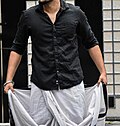
The dhoti is an ankle-length breechcloth,[1] wrapped around the waist and the legs, in resemblance to the shape of trousers.[2][3][4] The dhoti is a garment of ethnic wear for men in the Indian subcontinent.[5][6] The dhoti is fashioned out of a rectangular piece of unstitched cloth, of usually around 4 yards (3.7 m) in length.[7][8]

The dhoti is the male counterpart of the sari, worn by females to religious and secular ceremonies (functions).[9][10][11] A pitambar is a yellow silk dhoti worn on auspicious occasions.[12][13] Dhotis must not be confused with "readymade panchakachams"[14] or "dhoti pants", which are a new ready to wear trend, popular among women and typical of children.[15][16][17] Although the terms mundu or veshti are used interchangeably with "dhoti",[18] they are different from the dhoti, which is "looped" or wrapped around the legs, in the form of trousers or pants.[19] The dhoti is better known as panchakacham in South India, which may even be worn while doing dances such as the moonwalk.[20]
Etymology[edit | edit source]
The unstitched dhoti is also referred to as "dhautra" (IPA: /dʱɑwtrɐ/) in Sanskrit, which means rope or cord. It evolved from the ancient antriya, which was passed in between the legs, tucked at the back and covered the legs loosely, then flowed into long pleats at front of the legs, the same way it is worn today as formal dhoti.[21]:130 While a casual and short dhoti wraps around both legs firmly, in this style the back side of the dhoti is pulled to the front and tucked at the waist, before tucking the two loose ends at back, creating firmly fitted trouser-like dhoti that wraps around both legs. This style is more commonly worn by farmers and martial artists.[22][23] Stitched garments became popular in the Indian subcontinent, with the coming of Persians, Greeks, and "barbarians"; nonetheless, the dhoti prevailed in sakaccha as well as vikaccha forms.[24]
History[edit | edit source]
,_in_the_Guimet_Museum_(Paris).jpg)
The dhoti originated from the ancient antariya, which was passed in between the legs, tucked at the back and covered the legs loosely, then flowed into long pleats at front of the legs, the same way it is worn today as formal dhoti.[25] A l and short dhoti wraps around both legs firmly, in this style the back side of the dhoti is pulled to the front and tucked at the waist, before tucking the two loose ends at back, creating firmly fitted trouser-like dhoti that wraps around both legs. According to G. S. Ghurye, this style is more commonly worn by farmers and martial artists.[25][26]
The earliest epigraphical depictions of the Dhoti were during the Mauryan Empire. In the Sunga period, there were two broad modes of wearing the dhoti, the sakaccha and the vikaccha.[27] Stitched garments became popular in the Indian subcontinent, with the coming of Persians, Greeks, and "barbarians"; nonetheless, the dhoti prevailed in sakaccha as well as vikaccha forms.[28] In the sakaccha way, the cloth passed between the legs and was tucked at the back; vikaccha meant wearing the dhoti similar to a lungi.[29]

During British rule in colonial India, the dhoti remained a national symbol of resistance and cultural identity when worn without a shirt.[30][31][32] At the height of the Indian Independence Movement, weaving khadi was a symbol of the swadeshi movement.[33] In 1921, Gandhi championed the dhoti, often topless (without a kurta or shirt), to promote and identify with the handicrafts produced by the rural and the poor of his homeland.[34][35]
Names[edit | edit source]


The garment is known by various names based on language, such as:
| Native script | Transliteration | Language or region |
|---|---|---|
| চুৰিয়া, ধুতি | Suriya, Dhuti | Assamese |
| ধুতি | Dhuti | Bengali |
| ધૉતિયુ | Dhotiyu | Gujarati |
| धोती | Dhotī | Hindi, Maithili, Nepali and Pali |
| मर्दानी | Mardānī | Hindi |
| ಧೋತ್ರ ಕಚ್ಚೆ ಪಂಚೆ |
Dhotra Kachche Panche |
Kannada |
| धोंतर, आंगोस्तर, आड नेसचे, पुडवे |
Dhontar, Āṅgostara, Āḍa nesace Puḍave |
Konkani |
| മുണ്ട് | Muṇṭ | Malayalam |
| धोतर | Dhotar a | Marathi |
| ଧୋତି | Dhotī | Odia |
| ਚਾਦਰਾ | Chaadar | Punjabi |
| வேட்டி | Vaetti | Tamil |
| పంచె, ధోవతి | Pañce | Telugu |
| دھوتی | Dhoti | Urdu |
|
a In Marathi, a dhotar is not the same as a pancha (plural panche). | ||
Custom and usage[edit | edit source]

The pancha is worn by many conservative Jain men when they visit derasars or basadis for puja, as unstitched clothing is believed to be "less permeable to pollution" and therefore more appropriate for religious rituals than other garments.[36] They also wear a loose and unstitched cloth, shorter than the pancha on top.
_Cropped.jpg)
The International Society for Krishna Consciousness (ISKCON), known for its distinctive dress code, prompts Western adherents to wear pancha, usually of saffron or white cloth folded in ethnic Bengali style. Maharishi Mahesh Yogi was known for wearing a white silk dhoti.[37] Traditionally, men wear the dhoti topless (without upper garments) while entering certain mandirs (Hindu temples) in South India, as stitched garments supposedly counter the energy of the idol.[38][39][40][41] The dhoti is often worn with a shirt in other places.[42]
The dhoti was also worn by Sikhs in the Punjab region etc. Wearing Dhotis was discouraged during the Punjab Subah Movement due to the inter-communal tensions prevalent at the time.[43][44] The dhothi was also worn by South Canarese Christian men to their pre-nuptial ceremonies, church weddings & receptions until the 1960s;[45] after which they fell out of favour, since then, grooms have been styling the black suit and tie instead.

There is a distinction between the dhoti and the lungi, a similar garment often worn by people at their homes. The lungi is more casual and comfortable, while the dhoti is considered formal and is sometimes worn by politicians.[46]
Decline[edit | edit source]
The use of the dhoti an as article of clothing, has declined in comparison to its historical prominence in the Indian subcontinent. However, it is still used in some secular functions and especially in religious settings.[10][11] While the sari is still draped by many women as daily wear, few men know how to wrap the dhoti and use it every day.[47][48] The dhoti has been displaced by the English clothes of the British, in urban areas such as Bombay (Mumbai).[49] Historically, there were variations in the styles of wrapping the dhoti based on castes, as in the case of Bombay's Sonars and the Peshva Brahmins. Therefore, English attire has been described as "caste neutral".[50][51][52] Dhotis are still worn more in rural areas of India.[48] In urban areas, men in dhotis are often perceived as "poor" and discriminated against in places such as shopping malls.[53] Additionally, with the introduction of kurta-pyjama sets from Central Asia, during the Moghal Empire, pyjamas are often worn instead of dhotis as ethnic menswear.[54][55]
Gallery[edit | edit source]


See also[edit | edit source]
References[edit | edit source]
- ↑ Singh, Amar; Rudolph, Lloyd I.; Kanota, Mohan Singh (2001). Reversing the Gaze: Amar Singh's Diary, a Colonial Subject's Narrative of Imperial India. Oxford University Press. ISBN 978-0-19-565869-9.
- ↑ Life in Other Lands. Fideler. 1960. p. 78. Retrieved 3 January 2021.
It is arranged to look like a pair of baggy trousers. This garment is called a dhoti and is usually made of cotton.
- ↑ Bhandari, Vandana (2005). Costume, Textiles and Jewellery [i.e. Jewelry] of India: Traditions in Rajasthan. Mercury Books. p. 105. ISBN 9781904668893. Retrieved 3 January 2021.
One of the reasons for the dhoti's enduring popularity is its loose trouser - like form, which is convenient and extremely well - suited to the tropical Indian climate .
- ↑ K Parker, Lewis (1994). India. Rourke Book Company. p. 14. ISBN 9781559160056. Retrieved 3 January 2021.
Boys and men often wear a dhoti. This is a piece of white cloth wound around the waist. Dhotis look like comfortable, baggy pants.
- ↑ "Indian Dhoti". Indian Mirror. Archived from the original on 29 July 2020. Retrieved 3 January 2021.
- ↑ Nayar, K P (2 May 1999). "Nepal Wakes Up to Dhoti Power". The Telegraph (India). Retrieved 16 August 2024.
- ↑ "Why a sari is both hot, and cool". The Times of India. 15 March 2015.
- ↑ Snodgrass, Mary Ellen (17 March 2015). World Clothing and Fashion: An Encyclopedia of History, Culture, and Social Influence. Routledge. ISBN 978-1-317-45166-2.
- ↑ Phd, Alloy S Ihuah (2 August 2012). Philosophy, Religion and Politics: Essays in Honour of Very Rev. Fr. Moses Orshio Adasu. Lulu.com. ISBN 978-1-300-01966-4.
- ↑ 10.0 10.1 "City women get talking about dresscode in temples". The Times of India. 3 December 2016. Archived from the original on 14 January 2025.
- ↑ 11.0 11.1 Avasthi, Vivek (14 January 2020). "Sarees for women, dhoti for men: Officer's dress code for Kashi temple irks minister". The Federal. Archived from the original on 5 August 2020. Retrieved 3 January 2021.
- ↑ Henry, Baden Powell (1872). Hand-book of the Economic Products of the Punjab (etc.): Forming ... to the hand-book of the economic products of the Punjab. Engineering College Press. pp. 65, 67.
- ↑ Birdwood, George Christopher Molesworth (1884). The Industrial Arts of India. Chapman and Hall. p. 363.
- ↑ "Madisars made to fit just right". 16 May 2012. Archived from the original on 25 August 2024.
- ↑ "Doting Upon the Return of Dhoti Pants". 12 November 2018. Archived from the original on 7 July 2022.
- ↑ "Latest Fashion, Trends and Style for Dhoti Kurta for Girls – FayonKids". 16 May 2022. Archived from the original on 6 June 2022.
- ↑ "What are dhoti pants". Archived from the original on 4 November 2010.
- ↑ "What is Veshti". Rhythm Dhotis. 2020.
- ↑ Dasgupta, Reshmi R. (15 May 2011). "Cocktail Conversations: Veshti Vs Dhoti". The Economic Times. Archived from the original on 12 November 2021.
- ↑ "Dhoti dynamics". The Hindu. 25 June 2015. Archived from the original on 10 October 2024.
- ↑ Govind Sadashiv Ghurye (1951) Indian Costume
- ↑ Indian Costume by Govind Sadashiv Ghurye 1966
- ↑ Ancient Indian Costume By Roshen Alkazi 1996
- ↑ Walker, Benjamin (9 April 2019). Hindu World: An Encyclopedic Survey of Hinduism. In Two Volumes. Volume I A-L. Routledge. ISBN 978-0-429-62465-0.
- ↑ 25.0 25.1 Ghurye, Govind (1951). Indian Costume. p. 130.
- ↑ Meister, Michael W.; Alkazi, Roshen (October 1985). "Ancient Indian Costume". Journal of the American Oriental Society. 105 (4): 806. doi:10.2307/602804. ISSN 0003-0279.
- ↑ Ayyar, Sulochana (1987). Costumes and Ornaments as Depicted in the Sculptures of Gwalior Museum. Mittal Publications. ISBN 978-81-7099-002-4.
- ↑ Walker, Benjamin (2019). Hindu World: An Encyclopedic Survey of Hinduism. in Two Volumes. Volume I A-L. Routledge Library Editions: Hinduism Ser. Milton: Routledge. ISBN 978-0-429-62465-0.
- ↑ "Stylistic Changes in the Costumes and Jewellery in Indian Art".
- ↑ "Opinion | Half-Naked Fakir Meets Overdressed King". The New York Times. 19 October 1986. Archived from the original on 24 May 2015.
- ↑ "Gandhi Jayanti: When Mahatma Gandhi turned 'half-naked fakir' in Tamil Nadu | art and culture | Hindustan Times". Hindustan Times. 2 October 2019. Archived from the original on 3 October 2019.
- ↑ "Half Naked Fakir | About Gandhi | Articles on and by Gandhi". Archived from the original on 10 August 2024.
- ↑ Sankaralingam, Sathrukkan (2 September 2020). "Gandhi - Weaving a nation together". Minister White Blog. Archived from the original on 11 October 2020. Retrieved 2 September 2020.
- ↑ "What made Gandhiji wear only Loincloth or Dhoti". pib.gov.in. Retrieved 7 October 2021.
- ↑ "Importance of Veshties in Tamil Culture". Ramraj Cotton. Retrieved 13 July 2022.
- ↑ Cort, John E (2001). Jains in the World: Religious Values and Ideology in India. Oxford University Press. p. 221. doi:10.1093/0195132343.001.0001. ISBN 9780195132342.
- ↑ Koppel, Lily (6 February 2008). "Maharishi Mahesh Yogi, a Guide On the Beatles' Spiritual Path, Dies". New York Times. p. C.10.
- ↑ "City women get talking about dresscode in temples". The Times of India. Archived from the original on 22 January 2025.
- ↑ "Karnataka: Rigid dress code put in place at Mahabaleshwar temple". The Times of India. Archived from the original on 22 January 2025.
- ↑ "Sartorial quirkiness".
- ↑ "Who says god likes topless men but not jeans?". The Times of India. 10 January 2016. Archived from the original on 1 March 2021.
- ↑ "Census of India, 1961". 1962.
- ↑ Brard, Gurnam Singh Sidhu (2007). East of Indus: My Memories of Old Punjab. Hemkunt Press. ISBN 9788170103608.
- ↑ Lamba, Krishan Gopal (1999). Dynamics of Punjabi Suba Movement. Deep & Deep Publications. ISBN 9788176291293.
- ↑ Silva, Severine; Fuchs, Stephen (1965). "The Marriage Customs of the Christians in South Canara, India". Asian Folklore Studies. 24 (2): 1–52. doi:10.2307/1177555. JSTOR 1177555.
- ↑ McLain, Sean (23 July 2014). "No Dhotis Please, We're Indian". Wall Street Journal. Retrieved 3 November 2017.
- ↑ "Why is Sabyasachi shaming women who can't drape sarees but not men who can't tie dhotis?". ThePrint. 13 February 2018. Archived from the original on 10 August 2022.
- ↑ 48.0 48.1 Desai (1967). The Emerging Youth. Popular Prakashan. ISBN 978-81-7154-422-6.
- ↑ "I'm a 24-year-old Gandhian and I'm not ashamed to wear a dhoti everyday". 4 January 2016. Archived from the original on 28 August 2024.
- ↑ Ambedkar, Bhimrao (20 November 2024). Destruction of Caste. Diamond Pocket Books Pvt. ISBN 978-93-6318-452-7.
- ↑ George, Rosemary Marangoly (2016). Indian English and the fiction of national literature. Cambridge New York: Cambridge university press. ISBN 978-1-107-04000-7.
- ↑ Ambedkar, B. R. (7 October 2014). Annihilation of Caste: The Annotated Critical Edition. Verso Books. ISBN 978-1-78168-830-4.
- ↑ Misra, Shubhangi (18 July 2024). "Indians look down on men in dhotis. It's a by-product of colonialism and disdain for the poor". ThePrint. Archived from the original on 18 July 2024. Retrieved 20 September 2025.
- ↑ Patel, Nirmal (27 August 2023). "Dynamics Evolution of Men's Ethnic Wear in Style & Comfort - KALKI Fashion Blog". Kalki Fashion Blog – Latest Fashion Trends, Bridal Fashion, Style Tips, News and Many More. Archived from the original on 2 March 2025. Retrieved 20 September 2025.
- ↑ Bijolia, Disha. "Tracing The Origins Of The Indian Kurta". Homegrown. Archived from the original on 31 January 2023. Retrieved 20 September 2025.