






CleanupBot (talk | contribs) m →top: clean up, removed: {{pp-move-indef}} |
cleaned up details additionally and improved wording |
||
| (7 intermediate revisions by 2 users not shown) | |||
| Line 1: | Line 1: | ||
{{ | {{Short description|Country in Northeast Africa and Southwest Asia}} | ||
{{About|the country}} | |||
{{Pp-move}} | |||
{{ | {{Pp-extended|small=yes}} | ||
{{Use dmy dates|date= | {{Cleanup|reason=Article should use [[British English]] spelling, but many parts do not|date=December 2025}} | ||
{{ | {{Use dmy dates|date=October 2025}} | ||
{{Use British English|date=December 2024}} | |||
{{Infobox country | {{Infobox country | ||
| conventional_long_name = Arab Republic of Egypt | | conventional_long_name = Arab Republic of Egypt | ||
| name = {{ | | name = {{native name|ar|جمهورية مصر العربية}}<br />{{transliteration|engvar=gb|ar|Jumhūriyyat Miṣr al-ʻArabiyyah}} | ||
| common_name = Egypt | |||
| image_flag = Flag of Egypt.svg | |||
| image_coat = Coat of arms of Egypt (Official).svg | |||
| coa_size = 75 | |||
| image_map = EGY orthographic.svg | |||
| map_caption = | |||
| national_anthem = {{ubl|''[[Bilady, Bilady, Bilady]]''|{{lang|ar|"بلادي، بلادي، بلادي"}}|({{Langx|en|italic=yes|My country, my country, my country}})|[[File:Bilady, Bilady, Bilady.ogg]]}} | |||
| | | official_languages = [[Modern Standard Arabic|Arabic]]<ref name="CoARE"/> | ||
| | | languages_type = [[National language]] | ||
| | | languages = [[Egyptian Arabic]]{{efn|[[Modern Standard Arabic|Literary Arabic]] is the sole official language.<ref name="Provisional Constitution">{{cite web |url=http://www.sis.gov.eg/En/LastPage.aspx?Category_ID=1155 |title=Constitutional Declaration: A New Stage in the History of the Great Egyptian People |date=30 March 2011 |publisher=Egypt State Information Service |access-date=15 April 2011 |archive-url=https://web.archive.org/web/20110427083143/http://www.sis.gov.eg/En/LastPage.aspx?Category_ID=1155 |archive-date=27 April 2011 |url-status=live }}</ref> [[Egyptian Arabic]] is the [[spoken language]]. Other [[Languages of Egypt|dialects and minority languages]] are spoken regionally.|name=lang}} | ||
| | | religion = See ''[[Religion in Egypt]]''{{efn|While [[Islam]] is the majority and official religion of the country, the size of the country's historic [[Christianity in Egypt|Christian minority]] is highly controversial and disputed by various entities and groups. Estimates range from as low as 5% to as high as 20%. Since 2006, religion has been omitted from censuses after widespread claims that the figures had been distorted.<ref name=":0">{{Cite news|url=http://www.pewresearch.org/2011/02/16/how-many-christians-are-there-in-egypt/|title=How many Christians are there in Egypt?|date=16 February 2011|work=Pew Research Center|access-date=19 March 2018|archive-date=2 October 2019|archive-url=https://web.archive.org/web/20191002004401/https://www.pewresearch.org/2011/02/16/how-many-christians-are-there-in-egypt/|url-status=live}}</ref><ref name="churches-deleg"/><ref>{{Cite web|url=http://english.ahram.org.eg/NewsContent/1/64/53839/Egypt/Politics-/Egyptian-Copts-reject-population-estimate.aspx|title=Egyptian Copts reject population estimate – Politics|website=english.ahram.org.eg|access-date=28 February 2018|archive-date=29 October 2020|archive-url=https://web.archive.org/web/20201029011854/http://english.ahram.org.eg/NewsContent/1/64/53839/Egypt/Politics-/Egyptian-Copts-reject-population-estimate.aspx|url-status=live}}</ref>|name=relig}} | ||
| demonym = Egyptian | |||
| capital = [[Cairo]] | |||
| coordinates = {{Coord|30|2|N|31|13|E|type:city}} | |||
| | | largest_city = capital | ||
| government_type = Unitary [[semi-presidential republic]] under an [[Authoritarianism|authoritarian]] government{{refn|<ref name="Truex & Tavana 2019">{{cite journal |last1=Truex |first1=Rory |last2=Tavana |first2=Daniel L. |title=Implicit Attitudes toward an Authoritarian Regime |journal=The Journal of Politics |date=July 2019 |volume=81 |issue=3 |pages=1014–1027 |doi=10.1086/703209 }}</ref><ref name="foreignpolicy">{{Cite web |url=https://foreignpolicy.com/2015/05/22/egypts-sisi-is-getting-pretty-good-at-being-a-dictator/ |title=Egypt's Sisi Is Getting Pretty Good ... at Being a Dictator |last1=Cambanis |first1=Thanassis |date=22 May 2015 |website=Foreign Policy |access-date=25 July 2017 |archive-date=10 February 2021 |archive-url=https://web.archive.org/web/20210210231855/https://foreignpolicy.com/2015/05/22/egypts-sisi-is-getting-pretty-good-at-being-a-dictator/ |url-status=live }}</ref><ref name=":1">{{Cite web|title=Egypt: A Move to Enhance Authoritarian Rule|url=https://www.hrw.org/news/2019/02/12/egypt-move-enhance-authoritarian-rule|date=2019|website=Human Rights Watch|access-date=4 January 2024|archive-date=13 July 2019|archive-url=https://web.archive.org/web/20190713152806/https://www.hrw.org/news/2019/02/12/egypt-move-enhance-authoritarian-rule|url-status=live}}</ref><ref>{{Cite news|date=9 July 2020|access-date=22 November 2022|title=Egypt tries to silence its critics in the United States by jailing their relatives|newspaper=The Washington Post|first=Sudarsan|last=Raghavan|url=https://www.washingtonpost.com/world/middle_east/egypt-tries-to-silence-its-critics-in-the-united-states-by-jailing-their-relatives/2020/07/08/c93a809e-c053-11ea-864a-0dd31b9d6917_story.html|archive-date=9 January 2021|archive-url=https://web.archive.org/web/20210109023939/https://www.washingtonpost.com/world/middle_east/egypt-tries-to-silence-its-critics-in-the-united-states-by-jailing-their-relatives/2020/07/08/c93a809e-c053-11ea-864a-0dd31b9d6917_story.html|url-status=live}}</ref><ref>{{Cite web|last=Al-Arian|first=Abdullah|date=27 February 2020|title=Hosni Mubarak's legacy is Abdel Fattah el-Sisi|url=https://www.aljazeera.com/opinions/2020/2/27/hosni-mubaraks-legacy-is-abdel-fattah-el-sisi|url-status=live|access-date=2 November 2021|website=Al Jazeera|language=en|archive-url = https://web.archive.org/web/20201019213139/https://www.aljazeera.com/opinions/2020/2/27/hosni-mubaraks-legacy-is-abdel-fattah-el-sisi/ |archive-date = 19 October 2020 }}</ref>}} | |||
| leader_title1 = [[President of Egypt|President]] | |||
| | | leader_name1 = [[Abdel Fattah el-Sisi]] | ||
| | | leader_title2 = [[Prime Minister of Egypt|Prime Minister]] | ||
| leader_name2 = [[Mostafa Madbouly]] | |||
| leader_title3 = | |||
| leader_name3 = | |||
| | | legislature = [[Parliament of Egypt|Parliament]] | ||
| | | upper_house = [[Senate (Egypt)|Senate]] | ||
| | | lower_house = [[House of Representatives (Egypt)|House of Representatives]] | ||
| | | sovereignty_type = [[History of Egypt|History]] | ||
| | | established_event1 = Unification of [[Upper and Lower Egypt]]<ref name="goldschmidt_oldest_nation">{{cite book |last1=Goldschmidt |first1=Arthur |title=Modern Egypt: The Formation of a Nation-State |url=https://books.google.com/books?id=YmZyAAAAMAAJ&q=nation-state |year=1988 |publisher=Westview Press |location=Boulder, CO |isbn=978-0-86531-182-4 |page=5 |quote=Among the peoples of the ancient Near East, only the Egyptians have stayed where they were and remained what they were, although they have changed their language once and their religion twice. In a sense, they constitute the world's oldest nation. For most of their history, Egypt has been a state, but only in recent years has it been truly a nation-state, with a government claiming the allegiance of its subjects on the basis of a common identity. |access-date=20 June 2015 |archive-url=https://web.archive.org/web/20201217150902/https://www.google.com/books/edition/Modern_Egypt/YmZyAAAAMAAJ?hl=en&gbpv=1&bsq=nation-state |archive-date=17 December 2020 |url-status=live }}</ref><ref>{{cite web |url=https://2009-2017.state.gov/r/pa/ei/bgn/5309.htm |title=Background Note: Egypt |date=10 November 2010 |publisher=United States Department of State [[Bureau of Near Eastern Affairs]] |access-date=5 March 2011 |archive-date=4 June 2019 |archive-url=https://web.archive.org/web/20190604183905/https://2009-2017.state.gov/r/pa/ei/bgn/5309.htm |url-status=live }}</ref><!--end nowrap:--> | ||
| established_date1 = {{circa}} 3150 BC | |||
| established_event2 = [[Fatimid Caliphate]] | |||
| established_date2 = {{circa}} 973 | |||
| established_event3 = [[Ayyubid dynasty]] inaugurated | |||
| established_date3 = {{circa}} 1171 | |||
| | | established_event4 = [[Mamluk Egypt]] | ||
| | | established_date4 = {{circa}} 1261 | ||
| | | established_event5 = [[Muhammad Ali dynasty|Alawiyya dynasty]] inaugurated | ||
| | | established_date5 = 9 July 1805<ref>{{cite book |last=Crabitès |first=Pierre |year=2013 |orig-year=1935 |title=Ibrahim of Egypt |url=https://books.google.com/books?id=1NbCRckI3EoC&pg=PA1 |archive-url=https://web.archive.org/web/20130509064900/http://books.google.com/books?id=1NbCRckI3EoC&pg=PA1 |archive-date=9 May 2013 |url-status=live |volume=8 |publisher=Routledge |page=1 |isbn=978-0-415-81121-7 |access-date=10 February 2013 |quote=... on July 9, 1805, Constantinople conferred upon Muhammad Ali the pashalik of Cairo ... |doi=10.4324/9780203069387 }}</ref> | ||
| | | established_event6 = [[Unilateral Declaration of Egyptian Independence|Declaration of Independence]] | ||
| established_date6 = 28 February 1922 | |||
| | | established_event7 = [[1952 Egyptian revolution|Revolution Day]] | ||
| established_date7 = 23 July 1952 | |||
| established_event8 = [[Declaration of the Republic|Republic declared]] | |||
| established_date8 = 18 June 1953 | |||
| | | established_event9 = [[Constitution of Egypt|Current constitution]] | ||
| established_date9 = 18 January 2014 | |||
| | | area_rank = 29th | ||
| | | area_km2 = 1,010,408<ref>{{cite web|url=https://www.capmas.gov.eg/Pages/StaticPages.aspx?page_id=5035|title=Density By Governorate 1/7/2020 – Area km2 (Theme: Population – pg.14)|publisher=Capmas.gov.eg|access-date=8 July 2021|archive-date=2 November 2018|archive-url=https://web.archive.org/web/20181102023819/https://www.capmas.gov.eg/Pages/StaticPages.aspx?page_id=5035|url-status=live}}</ref><ref>{{cite web |url=http://www.capmas.gov.eg/pdf/EgyptinFigures2015/EgyptinFigures/Tables/PDF/1-%20%D8%A7%D9%84%D8%B3%D9%83%D8%A7%D9%86/pop.pdf |title=Total area km2, pg.15 |publisher=Capmas.Gov – Arab Republic of Egypt |access-date=8 May 2015 |url-status=dead |archive-url=https://web.archive.org/web/20150321110107/http://capmas.gov.eg/pdf/EgyptinFigures2015/EgyptinFigures/Tables/PDF/1-%20%D8%A7%D9%84%D8%B3%D9%83%D8%A7%D9%86/pop.pdf |archive-date=21 March 2015 }}</ref> | ||
| | | area_sq_mi = 387,048 | ||
| percent_water = 0.632 | |||
| population_census = {{IncreaseNeutral}} 94,798,827<ref>{{cite web|title=الجهاز المركزي للتعبئة العامة والإحصاء|url=http://www.capmas.gov.eg/Pages/ShowPDF.aspx?page_id=%20/Admin/Pages%20Files/2017109143840cns.pdf|website=www.capmas.gov.eg|access-date=13 October 2017|archive-date=13 October 2017|archive-url=https://web.archive.org/web/20171013224804/http://www.capmas.gov.eg/Pages/ShowPDF.aspx?page_id=%20%2FAdmin%2FPages%20Files%2F2017109143840cns.pdf|url-status=live}}</ref> | |||
| population_census_year = 2017 | |||
| population_estimate = {{IncreaseNeutral}} 107,868,296<ref>{{cite web |url=https://www.capmas.gov.eg/publications/150 |title=Population estimates by Sex & Governorate |publisher=[[Central Agency for Public Mobilization and Statistics (Egypt)|CAPMAS]] |website=www.capmas.gov.eg |access-date=27 January 2026}}</ref> | |||
| population_estimate_year = July 2025 | |||
| population_estimate_rank = 15th | | population_estimate_rank = 15th | ||
| | | population_density_km2 = 106.8 | ||
| population_density_sq_mi = 276.6 | |||
| population_density_rank = 102nd | |||
| GDP_PPP = {{increase}} $2.372 trillion<ref name="IMFAPR2025">{{cite web |title=Report for Selected Countries and Subjects |url=https://www.imf.org/en/Publications/WEO/weo-database/2025/april/weo-report?c=469,&s=NGDP_R,NGDP_RPCH,NGDP,NGDPD,PPPGDP,NGDP_D,NGDPRPC,NGDPRPPPPC,NGDPPC,NGDPDPC,PPPPC,PPPSH,PPPEX,NID_NGDP,NGSD_NGDP,PCPI,PCPIPCH,PCPIE,PCPIEPCH,TM_RPCH,TMG_RPCH,TX_RPCH,TXG_RPCH,LUR,LP,GGR,GGR_NGDP,GGX,GGX_NGDP,GGXCNL,GGXCNL_NGDP,GGSB,GGSB_NPGDP,GGXONLB,GGXONLB_NGDP,GGXWDN,GGXWDN_NGDP,GGXWDG,GGXWDG_NGDP,NGDP_FY,BCA,BCA_NGDPD,&sy=2025&ey=2025&ssm=0&scsm=1&scc=0&ssd=1&ssc=0&sic=0&sort=country&ds=.&br=1 |website=IMF |access-date=3 May 2025 |language=en}}</ref> | |||
| population_density_sq_mi = | | GDP_PPP_year = 2025 | ||
| population_density_rank = | | GDP_PPP_rank = 18th | ||
| GDP_PPP_per_capita = {{increase}} $21,668<ref name="IMFAPR2025" /> | |||
| GDP_PPP = {{increase}} $ | | GDP_PPP_per_capita_rank = 87th | ||
| GDP_PPP_rank = | | GDP_nominal = {{decrease}} $347.342 billion<ref name="IMFAPR2025" /> | ||
| GDP_PPP_per_capita = {{increase}} $ | | GDP_nominal_year = 2025 | ||
| GDP_PPP_per_capita_rank = | | GDP_nominal_rank = 44th | ||
| GDP_nominal = {{ | | GDP_nominal_per_capita = {{decrease}} $3,174<ref name="IMFAPR2025" /> | ||
| | | GDP_nominal_per_capita_rank = 138th | ||
| | | Gini_year = 2021 | ||
| GDP_nominal_per_capita = {{ | | Gini_change = decrease <!--increase/decrease/steady--> | ||
| GDP_nominal_per_capita_rank = | | Gini = 28.5 <!--number only--> | ||
| Gini_year = | | Gini_ref = <ref>{{cite web|url=https://www.cia.gov/the-world-factbook/field/gini-index-coefficient-distribution-of-family-income/country-comparison/ |title=Gini Index coefficient|publisher=[[The World Factbook]]|access-date=28 December 2025|archive-url=https://web.archive.org/web/20251214092912/https://www.cia.gov/the-world-factbook/field/gini-index-coefficient-distribution-of-family-income/country-comparison/|archive-date=2025-12-14|url-status=dead}}</ref> | ||
| Gini_change = decrease<!--increase/decrease/steady--> | | HDI_year = 2023 <!-- Please use the year to which the data refers, not the publication year--> | ||
| Gini = | | HDI_change = increase<!--increase/decrease/steady--> | ||
| Gini_ref = <ref>{{cite web |url= | | HDI = 0.754 <!--number only--> | ||
| HDI_ref = <ref name="UNHDR">{{Cite web |date=6 May 2025 |title=Human Development Report 2025 |url=https://hdr.undp.org/system/files/documents/global-report-document/hdr2025reporten.pdf|url-status=live |archive-url=https://web.archive.org/web/20250506051232/https://hdr.undp.org/system/files/documents/global-report-document/hdr2025reporten.pdf |archive-date=6 May 2025 |access-date=6 May 2025 |publisher=[[United Nations Development Programme]]}}</ref> | |||
| HDI_year = | | HDI_rank = 100th | ||
| HDI_change = increase<!--increase/decrease/steady--> | | currency = [[Egyptian pound]] (LE/E£/£E) | ||
| HDI = 0. | | currency_code = EGP | ||
| HDI_ref = <ref name=" | | time_zone = [[Eastern European Time|EET]]{{efn|Known locally as [[Egypt Standard Time]] (EGY) ({{Langx|ar|توقيت مصر القياسي}} ''Tawqīt Miṣr al-qiyāsiyy'')|name=UTCoff2}} | ||
| HDI_rank = | | utc_offset = +2 | ||
| currency = [[Egyptian pound]] (E£) | | time_zone_DST = [[Eastern European Summer Time|EEST]]{{efn|See [[Daylight saving time in Egypt]].|name=UTCoff}} | ||
| currency_code = EGP | | utc_offset_DST = +3 | ||
| time_zone = [[Egypt Standard Time | | drives_on = right | ||
| utc_offset = +2{{ | | calling_code = [[+20]] | ||
| cctld = {{unbulleted list |[[.eg]] |{{lang|ar|[[مصر.]]}}}} | |||
| utc_offset_DST = | | footnote_a = | ||
| drives_on = right | | footnote_b = | ||
| calling_code = [[+20]] | | footnote_c = | ||
| cctld = {{unbulleted list |[[.eg]] |{{lang|ar|[[مصر.]]}}}} | | footnote_d = | ||
| footnote_a = | |||
| footnote_b = | |||
| | |||
}} | }} | ||
'''Egypt''' | '''Egypt''',{{efn|{{langx|ar|مصر|Miṣr|engvar=gb}}, {{IPA|ar|mɪsˤr|pron|audio=Ar-Misr2.oga}}, {{IPA|arz|mɑsˤr|lang|link=yes}}}} officially the '''Arab Republic of Egypt''', is a country spanning the [[Northeast Africa|northeast corner of Africa]] and [[Western Asia|southwest corner of Asia]] via the [[Sinai Peninsula]]. It is bordered by the [[Mediterranean Sea]] to [[northern coast of Egypt|the north]], [[Palestine]] and [[Israel]] to [[Egypt–Israel barrier|the northeast]], the [[Red Sea]] to the east, [[Sudan]] and the [[Sahara]] to [[Egypt–Sudan border|the south]], and [[Libya]] to [[Egypt–Libya border|the west]]. The [[Gulf of Aqaba]] in the northeast separates Egypt from [[Jordan]] and [[Saudi Arabia]]. [[Cairo]] is the capital, [[list of cities and towns in Egypt|largest city]], and leading cultural centre, while [[Alexandria]] is the second-largest city and an important hub of industry and tourism.<ref name=gov>{{Cite web|url=https://www.egy-map.com/|title=محافظة الأسكندرية |website=Egypt's Projects Map |access-date=13 May 2022|archive-date=25 May 2023|archive-url=https://web.archive.org/web/20230525194517/https://www.egy-map.com/|url-status=live}}</ref> With over 107 million inhabitants, Egypt is [[List of Arab League countries by population|the most populous]] country in the [[Arab world]], [[List of African countries by population|third-most populous]] country in Africa, and [[List of countries and dependencies by population|15th-most populated in the world]]. | ||
| audio = | |||
}} {{ | |||
Egypt has one of the longest histories of any country, tracing its heritage along the [[Nile Delta]] back to the 6th–4th millennia BCE. Considered a [[cradle of civilisation]], [[Ancient Egypt]] saw some of the earliest developments of writing, agriculture, urbanisation, organised religion and central government.<ref>{{Cite book|title=The Prehistory of Egypt: From the First Egyptians to the First Kings|last=Midant-Reynes|first=Béatrix|publisher=Blackwell Publishers|location=Oxford}}</ref> | Egypt has one of the longest histories of any country, tracing its heritage along the [[Nile Delta]] back to the 6th–4th millennia BCE. Considered a [[cradle of civilisation]], [[Ancient Egypt]] saw some of the earliest developments of writing, agriculture, urbanisation, organised religion and central government.<ref>{{Cite book|title=The Prehistory of Egypt: From the First Egyptians to the First Kings|last=Midant-Reynes|first=Béatrix|publisher=Blackwell Publishers|location=Oxford}}</ref> Egypt was an early and important [[Christianity in Egypt|centre of Christianity]], later [[Islamization of Egypt|adopting Islam]] from the seventh century onwards. [[Alexandria]], Egypt's former capital and currently second largest city, was a hub of global knowledge through its [[Library of Alexandria|Library]]. Cairo became the capital of the [[Fatimid Caliphate]] in the tenth century and of the subsequent [[Mamluk Sultanate]] in the 13th century. Egypt then became part of the [[Ottoman Empire]] in 1517, until its local ruler [[Muhammad Ali of Egypt|Muhammad Ali]] established modern Egypt as an autonomous [[Khedivate of Egypt|Khedivate]] in 1867. The country was then [[History of Egypt under the British|occupied]] by the [[British Empire]] along with [[British Sudan|Sudan]] and gained independence in 1922 as [[Muhammad Ali dynasty|a monarchy]]. | ||
Following the [[1952 Egyptian revolution|1952 revolution]], Egypt declared itself a [[Republic of Egypt (1953–58)|republic]]. Between 1958 and 1961, Egypt [[Second Syrian Republic|merged with Syria]] to form the [[United Arab Republic]]. Egypt fought [[Arab–Israeli conflict|several armed conflicts]] with Israel in [[1948 Arab–Israeli War|1948]], [[Suez Crisis|1956]], [[Six-Day War|1967]] and [[Yom Kippur War|1973]], and [[Occupation of the Gaza Strip by the United Arab Republic|occupied]] the [[Gaza Strip]] intermittently until 1967. In 1978, Egypt signed the [[Camp David Accords]], which [[Egypt–Israel peace treaty|recognised Israel]] in exchange for its withdrawal from the occupied Sinai. After the [[Arab Spring]], which led to the [[2011 Egyptian revolution]] and overthrow of [[Hosni Mubarak]], the country faced a [[Egyptian Crisis (2011–2014)|protracted period of political unrest]]; its first [[2012 Egyptian presidential election|democratic election in 2012]] resulted in the short-lived, [[Muslim Brotherhood]]-aligned government of [[Mohamed Morsi]], which was [[2013 Egyptian coup d'etat|overthrown]] by the military after [[June 2013 Egyptian protests|mass protests in 2013]]. The current government is a [[semi-presidential republic]] led by [[Abdel Fattah el-Sisi]], who was [[2014 Egyptian presidential election|elected in 2014]] but is widely regarded as [[authoritarian]].<ref name="dictator">Sources that categorise Sisi as a dictator: | |||
{{bulleted list|{{Cite news |title=Egypt's rushed election shows Abdel-Fattah al-Sisi is nervous |url=https://www.economist.com/middle-east-and-africa/2023/10/03/egypts-rushed-election-shows-abdel-fattah-al-sisi-is-nervous |access-date=27 December 2024 |newspaper=The Economist |quote="Last month Abdel-Fattah al-Sisi, Egypt's military dictator..." |url-access=subscription |archive-url=https://archive.today/20231006190405/https://www.economist.com/middle-east-and-africa/2023/10/03/egypts-rushed-election-shows-abdel-fattah-al-sisi-is-nervous |archive-date=6 October 2023|url-status=live}}|{{Cite web |last=Dunne |first=Michele |date=8 April 2019 |title=Why Is Trump Helping Egypt's Dictator Entrench His Power? |url=https://www.politico.com/magazine/story/2019/04/08/donald-trump-abdel-fattah-al-sisi-egypt-226579/ |access-date=27 December 2024 |website=POLITICO Magazine |language=en}}|{{Cite web |title=President Trump, Condemn This Sham Egyptian Election |url=https://www.washingtoninstitute.org/policy-analysis/president-trump-condemn-sham-egyptian-election |access-date=27 December 2024 |website= The Washington Institute |quote="...issued a statement praising the Egyptian dictator's magnificent work for the country"}}|{{Cite news |title=A Blank Check for Egypt's Dictator |url=https://www.bloomberg.com/news/articles/2014-06-26/u-dot-s-dot-gives-egypts-dictator-a-blank-check?embedded-checkout=false |access-date=27 December 2024 |work=Bloomberg.com |language=en}}|{{Cite web |last=Toosi |first=Nahal |date=12 July 2021 |title=In D.C. visit, Egypt spy boss claims U.S. agreed—in writing—to jail American activist |url=https://www.politico.com/news/2021/07/12/egypt-spy-boss-jail-american-498983 |access-date=27 December 2024 |website=POLITICO |language=en |quote="...Abdel Fattah El-Sisi, the Egyptian dictator who has imprisoned tens of thousands of dissidents."}}{{Cite web |last=Lawler |first=Dave |date=23 April 2019 |title=Egypt's President Abdel Fattah el-Sisi could rule until 2030 after winning referendum |url=https://www.axios.com/2019/04/23/sisi-referendum-rule-egypt-2030-constitution |access-date=27 December 2024 |website=Axios |language=en |quote="He has now cemented his status as Egypt's dictator without losing his position as a U.S. ally."}}|{{Cite web |last=Greenwald |first=Glenn |date=31 March 2015 |title=Obama Personally Tells the Egyptian Dictator That U.S. Will Again Send Weapons (and Cash) to His Regime |url=https://theintercept.com/2015/03/31/obama-lifts-freeze-weapons-transfer-egyptian-dictator/ |access-date=27 December 2024 |website=The Intercept |language=en-US}}|{{Cite web |last=Williams |first=Jennifer |date=3 April 2017 |title=Egypt's president is a bloodthirsty dictator. Trump thinks he's done a "fantastic job." |url=https://www.vox.com/world/2017/4/3/15160358/trump-egypt-abdel-fattah-el-sisi-white-house |access-date=27 December 2024 |website=Vox |language=en-US}}|{{Cite news |date=1 December 2020 |title=Egypt President Abdul Fattah al-Sisi: Ruler with an iron grip |url=https://www.bbc.com/news/world-middle-east-19256730 |access-date=22 November 2024 |work=BBC News |language=en-GB}}|{{Cite news |title=Egypt is again under military rule, but Sisi lacks Nasser's appeal |url=https://www.economist.com/special-report/2021/08/24/egypt-is-again-under-military-rule-but-sisi-lacks-nassers-appeal |access-date=25 November 2024 |url-access=subscription|newspaper=The Economist |archive-url=https://archive.today/20210826144020/https://www.economist.com/special-report/2021/08/24/egypt-is-again-under-military-rule-but-sisi-lacks-nassers-appeal|archive-date=26 August 2021|url-status=live}}|{{cite book |last1=Grewal |first1=Sharan |title=Soldiers of Democracy? |chapter=Egypt: A Coup against Democracy |date=2023 |pages=136–176 |doi=10.1093/oso/9780192873910.003.0007 |isbn=978-0-19-287391-0 }}|{{Cite web |date=15 March 2024 |title=EU Deal with Egypt Rewards Authoritarianism, Betrays 'EU Values' {{!}} Human Rights Watch |url=https://www.hrw.org/news/2024/03/15/eu-deal-egypt-rewards-authoritarianism-betrays-eu-values |access-date=14 December 2024 |language=en}}}}</ref> | |||
Egypt is considered to be a [[regional power]] in | Egypt is a [[developing country]] with the [[List of African countries by GDP (nominal)|second-largest economy in Africa]]. It is considered to be a [[regional power]] in the Middle East, North Africa and the [[Muslim world]], and a [[middle power]] worldwide. [[Islam]] is the [[State religion|official religion]] and [[Arabic]] its official language. Egypt is a founding member of the United Nations, the [[Non-Aligned Movement]], the [[Arab League]], the [[African Union]], [[Organisation of Islamic Cooperation]], [[World Youth Forum]], and a member of [[BRICS]].<ref name="CoARE">{{cite web |title=Constitution of The Arab Republic of Egypt 2014 |url=http://www.sis.gov.eg/Newvr/Dustor-en001.pdf |url-status=live |archive-url=https://web.archive.org/web/20150718052913/http://www.sis.gov.eg/Newvr/Dustor-en001.pdf |archive-date=18 July 2015 |access-date=13 April 2017 |website=sis.gov.eg}}</ref><ref>{{cite journal |last1=Cooper |first1=Andrew F. |last2=Antkiewicz |first2=Agata |last3=Shaw |first3=Timothy M. |title=Lessons from/for BRICSAM about South-North Relations at the Start of the 21st Century: Economic Size Trumps All Else?: Economic Size Trumps All Else? |journal=International Studies Review |date=10 December 2007 |volume=9 |issue=4 |pages=673–689 |doi=10.1111/j.1468-2486.2007.00730.x |jstor=4621867 }}</ref><ref name="IMFOCT2024">{{cite web |title=Report for Selected Countries and Subjects |url=https://www.imf.org/en/Publications/WEO/weo-database/2024/October/weo-report?c=469,&s=NGDP_R,NGDP_RPCH,NGDP,NGDPD,PPPGDP,NGDP_D,NGDPRPC,NGDPRPPPPC,NGDPPC,NGDPDPC,PPPPC,PPPSH,PPPEX,NID_NGDP,NGSD_NGDP,PCPI,PCPIPCH,PCPIE,PCPIEPCH,TM_RPCH,TMG_RPCH,TX_RPCH,TXG_RPCH,LUR,LP,GGR,GGR_NGDP,GGX,GGX_NGDP,GGXCNL,GGXCNL_NGDP,GGSB,GGSB_NPGDP,GGXONLB,GGXONLB_NGDP,GGXWDN,GGXWDN_NGDP,GGXWDG,GGXWDG_NGDP,NGDP_FY,BCA,BCA_NGDPD,&sy=2023&ey=2024&ssm=0&scsm=1&scc=0&ssd=1&ssc=0&sic=0&sort=country&ds=.&br=1 |website=IMF |access-date=24 October 2024 |language=en}}</ref> | ||
==Names==<!--linked--> | == Names ==<!--linked--> | ||
<!--Needs to be recycled--> | <!--Needs to be recycled--> | ||
< | [[Ancient Egypt]] had several names; one of them was <small>([[wikt:Special:Search/𓆎|𓆎]] [[wikt:Special:Search/𓅓|𓅓]] [[wikt:Special:Search/𓏏|𓏏]]𓊖)</small> {{transliteration|engvar=gb|egy|km.t}}, which is formed from <small>[[wiktionary:km#Egyptian|𓆎 𓅓]]</small>, meaning black.<ref>{{citation|title=Ancient Egypt Etymology|url=http://www.griffith.ox.ac.uk/gri/9kemet.html|access-date=9 January 2026}}</ref> This likely refers to the [[Soil fertility|fertile]] black soils of the [[Nile flood|Nile floodplains]], distinct from the ''deshret'' {{angbr|{{transliteration|engvar=gb|egy|dšṛt}}}}, or "red land" of the [[desert]].<ref>{{cite book|author=Rosalie, David |title=Pyramid Builders of Ancient Egypt: A Modern Investigation of Pharaoh's Workforce |publisher=Routledge |year=1997 |page=18}}</ref><ref>{{cite book |url=https://books.google.com/books?id=gZWuVAL2GooC&pg=PA43 |title=Ancient Civilizations of Africa |author=Muḥammad Jamāl al-Dīn Mukhtār |page=43 |access-date=28 May 2016 |archive-url=https://web.archive.org/web/20170131155854/https://books.google.com/books?id=gZWuVAL2GooC&pg=PA43 |archive-date=31 January 2017 |url-status=live |isbn=978-0-85255-092-2 |year=1990 |publisher=Currey }}</ref> This name is commonly vocalised as ''Kemet'' {{IPA|[kɛmɛt]}}, but was pronounced differently in Ancient Egyptian.<ref>Antonio Loprieno, "Egyptian and Coptic Phonology", in ''Phonologies of Asia and Africa (including the Caucasus). Vol 1 of 2.'' Ed: Alan S Kaye. Winona Lake, Indiana: Eisenbrauns, 1997: p. 449</ref> Scholars reconstruct its [[Old Egyptian]] pronunciation as {{IPA|[ˈkuːmat]}},<ref>{{Cite book |last=Loprieno |first=Antonio |url=http://archive.org/details/ancientegyptianl0000lopr |title=Ancient Egyptian : a linguistic introduction |date=1995 |publisher=Cambridge ; New York : Cambridge University Press |others=Internet Archive |isbn=978-0-521-44384-5}}</ref> its [[Middle Egyptian]] pronunciation as {{IPA|[ˈkuːmaʔ]}}, and its [[Late Egyptian]] pronunication as {{IPA|[ˈkeːmə]}}.<ref>{{Cite book |last=Loprieno |first=Antonio |title=Language Typology and Language Universals |year=2001}}</ref> The name is realised as ''{{transliteration|engvar=gb|cop|K(h)ēmə}}'' ({{Langx|cop|ⲭⲏⲙⲓ|label=[[Coptic language#Dialects|Bohairic]]}}, {{Langx|cop|ⲕⲏⲙⲉ|label=[[Coptic language#Dialects|Sahidic]]}}) in [[Coptic language|Egyptian Coptic]], and appeared in [[Greek language|Early Greek]] as {{lang|grc|Χημία}} (''{{transliteration|engvar=gb|grc|Khēmía}}'').<ref>{{Cite web |title=Henry George Liddell, Robert Scott, A Greek-English Lexicon, Χ χ, χεσι^φωνέω, Χημία |url=http://www.perseus.tufts.edu/hopper/text?doc=Perseus:text:1999.04.0057:alphabetic+letter=*x:entry+group=20:entry=*xhmi/a |access-date=9 April 2023 |website=www.perseus.tufts.edu |archive-date=19 April 2023 |archive-url=https://web.archive.org/web/20230419212900/http://www.perseus.tufts.edu/hopper/text?doc=Perseus:text:1999.04.0057:alphabetic+letter=*x:entry+group=20:entry=*xhmi/a |url-status=live }}</ref><ref>{{cite web|url=http://www.chm.bris.ac.uk/webprojects2002/crabb/history.html|title=A Brief History of Alchemy|publisher=University of Bristol School of Chemistry|access-date=21 August 2008|archive-url=https://web.archive.org/web/20081005180735/http://www.chm.bris.ac.uk/webprojects2002/crabb/history.html|archive-date=5 October 2008|url-status=live}}</ref> Another name was {{angbr|{{transliteration|engvar=gb|egy|tꜣ-mry}}}} "land of the riverbank".<ref>{{cite book|title=Ancient Records of Egypt |last=Breasted |first=James Henry |author2=Peter A. Piccione |year=2001 |publisher=University of Illinois Press|isbn=978-0-252-06975-8 |pages=76, 40|url=https://books.google.com/books?id=bT0q7nt1-gUC}}</ref> | ||
The names of [[Upper and Lower Egypt]] were ''Ta-Sheme'aw'' ({{angbr|{{transliteration|engvar=gb|egy|tꜣ-šmꜥw}}}}) "[[Sedge|sedgeland]]" and ''Ta-Mehew'' ({{angbr|{{transliteration|engvar=gb|egy|tꜣ mḥw}}}}) "northland", respectively. They were also collectively called "tꜣwy" (tāwy), meaning [[Upper and Lower Egypt#Structure|The Two Lands]], referring to both Lower Egypt and Upper Egypt after unification.<ref name="TaWy">{{citation|last1=Sleim |first1=Ahmed |url=https://www.academia.edu/97245539|website=academia.edu|title=tAwy The Two Lands: The North and the South or the East and the West?|date=January 2020 |access-date=9 January 2026}}</ref> | |||
The English name "Egypt" is derived from the [[Ancient Greek]] "{{transliteration|engvar=gb|grc|Aígyptos}}" ("{{lang|grc|Αἴγυπτος}}"), via [[Middle French]] "Egypte" and [[Latin]] "{{lang|la|Aegyptus}}". It is reflected in early Greek [[Linear B]] tablets as "a-ku-pi-ti-yo".<ref>Breyer, Fr. A. K. "[https://books.google.com/books?id=JpNY7VPn1WUC&dq=%22a-ku-pi-ti-yo%22&pg=PA381 Morgenländische Wörter im Deutschen: Die ägyptischen Lehnwörter] {{Webarchive|url=https://web.archive.org/web/20240409180842/https://books.google.com/books?id=JpNY7VPn1WUC&dq=%22a-ku-pi-ti-yo%22&pg=PA381 |date=9 April 2024 }}". In: W. Raunig/St. Wenig. ''Afrikas Horn: Akten der Ersten Internatio-nalen Littmann-Konferenz 2. bis 5. Mai 2002 in München''. Meroitica 22. Wiesbaden: Otto Harrassowitz Verlag, 2005. p. 381. {{ISBN|9783447051750}}.</ref> The [[Ancient Greece|ancient Greek]] [[geographer]] [[Strabo]] provided a [[folk etymology]] stating that "''{{lang|grc|Αἴγυπτος}}''" (Aigýptios) had originally evolved as a [[Compound (linguistics)|compound]] from "''{{lang|grc|Aἰγαίου ὑπτίως}}''" ({{transliteration|engvar=gb|grc|Aegaeou huptiōs}}), meaning "[[Aegean Sea|Below the Aegean]]".<ref name="Engsheden">{{cite journal |last1=Engsheden |first1=Åke |title=An etymological safari to Aigyptos |journal=Studien zur Altägyptischen Kultur |date=2018 |volume=47 |pages=1–30 |jstor=26863322 }}</ref> Another tradition claims that it was named after the legendary king [[Aegyptus]].<ref name="Jerome-Chronicon">[https://topostext.org/work/530#B1479 St. Jerome, Chronicon (Hier.+Chron.), B1479]</ref> The actual derivation is thought to be from ''[[wikt:ḥwt-kꜣ-ptḥ|ḥwt-kꜣ-ptḥ]]'' (''Hutkaptah'', [[Late Egyptian]] pronunciation {{IPA|egy|ħəjˌkojpəˈtaħ|}}), "[[Egyptian temple|Temple]] of the [[Ancient Egyptian conception of the soul#Ka (vital essence)|''Ka'']] of [[Ptah]]," a term for the city of [[Memphis, Egypt|Memphis]].<ref>{{Cite web|url=https://pleiades.stoa.org/places/736963/hwt-ka723-pth|title=ḥwt-kꜣ-Ptḥ: a Pleiades name resource|first1=B.|last1=Siewert-Mayer|first2=W.|last2=Röllig|first3=H.|last3=Kopp|date=21 March 2025|website=Pleiades: a gazetteer of past places}}</ref><ref>{{Cite web|url=https://www.behindthename.com/name/egypt|title=Meaning, origin and history of the name Egypt|first=Mike|last=Campbell|website=Behind the Name}}</ref> | |||
Greco-Roman writers report that Egypt was sometimes called Aeria (Ἀερία).<ref>[https://www.perseus.tufts.edu/hopper/text?doc=Perseus%3Atext%3A2007.01.0072%3Abook%3D14%3Achapter%3D6 Aulus Gellius, Attic Nights, 14.6]</ref><ref name="Jerome-Chronicon"/><ref name="Stephanus of Byzantium-Aeria">[https://archive.org/details/STEPHANUSBYZANTIUSETHNICAvol.AALPHAGAMMA2006ByMargaretheBillerbeck/page/60/mode/2up Stephanus of Byzantium, Ethnica, p.61, 70]</ref><ref name="George W. Mooney">[https://www.perseus.tufts.edu/hopper/text?doc=Perseus%3Atext%3A1999.04.0068%3Atext%3Dcomm%3Abook%3D4%3Acommline%3D267 George W. Mooney, Commentary on Apollonius: Argonautica]</ref> [[Stephanus of Byzantium]] derives the name from aer (ἀήρ, "air"), explaining that Egypt was a "misty land". From this name, the ethnic form Aerioi (Ἀέριοι) is also recorded for its inhabitants.<ref name="Stephanus of Byzantium-Aeria"/> [[Thomas George Tucker]] suggested that Aeria could derive not only from "misty" or "hazy air", but also be understood in the sense of "far-off" or "dimly seen".<ref name="George W. Mooney"/> | |||
"{{transliteration|engvar=gb|ar|Miṣr}}" ({{IPA|ar|misˤɾ}}; "{{lang|ar|مِصر}}") is the [[Classical Arabic|Classical Quranic Arabic]] and modern official name of Egypt, while "{{transliteration|engvar=gb|arz|Maṣr}}" ({{IPA|arz|mɑsˤɾ}}; {{lang|arz|مَصر}}) is the local pronunciation in [[Egyptian Arabic]].<ref>{{cite journal|journal=Il-Malti |last=Z. |first=T. |date=1928 |volume=2 |issue=1 |language=mt |publisher=Il-Ghaqda tal-Kittieba tal-Malti |title=Il-Belt (Valletta) |edition=2 |url=http://melitensiawth.com/incoming/Index/Il-Malti/Il-Malti.%20004(1928)2/01.pdf |archive-url=https://web.archive.org/web/20160417234107/http://melitensiawth.com/incoming/Index/Il-Malti/Il-Malti.%20004%281928%292/01.pdf |archive-date=17 April 2016 |page=35 |url-status=usurped }}</ref> The current name of Egypt, Misr/Misir/Misru, stems from the [[Ancient Semitic-speaking peoples|Ancient]] [[Semitic languages|Semitic]] name for it. The term originally connoted "[[Civilization|Civilisation]]" or "[[Metropolis]]".<ref name="AncientCivils">{{Citation|title=Civilizations and World Order|isbn = 9780739186077|url=https://books.google.com/books?id=5QeqBAAAQBAJ&q=misr+means+civilization&pg=PA87|last1 = Dallmayr|first1 = Fred|last2 = Akif Kayapınar|first2 = M.|last3 = Yaylacı|first3 = İsmail| date=24 September 2014 | publisher=Lexington Books|access-date=31 July 2024}}</ref> [[Classical Arabic]] ''{{transliteration|engvar=gb|ar|Miṣr}}'' (Egyptian Arabic ''{{transliteration|engvar=gb|arz|Maṣr}}'') is directly cognate with the [[Biblical Hebrew language|Biblical Hebrew]] ''Miṣráyīm'' (מִצְרַיִם / מִצְרָיִם), meaning "the two straits", a reference to the predynastic separation of [[Upper and Lower Egypt]]. Also mentioned in several Semitic languages as ''Mesru'', ''Misir'' and ''Masar''.<ref name="AncientCivils"/> The oldest attestation of this name for Egypt is the [[Akkadian language|Akkadian]] "mi-iṣ-ru" ("miṣru")<ref>The ending of the Hebrew form is either a [[Dual (grammatical number)|dual]] or an ending identical to the dual in form (perhaps a [[locative]]), and this has sometimes been taken as referring to the two kingdoms of Upper and Lower Egypt. However, the application of the (possibly) "dual" ending to some toponyms and other words, a development peculiar to Hebrew, does not in fact imply any "two-ness" about the place. The ending is found, for example, in the Hebrew words for such single entities as "water" ("מַיִם"), "noon" ("צָהֳרַיִם"), "sky/heaven" ("שָׁמַיִם"), and in the ''[[Qere and Ketiv|qere]]'' – but not the original "ketiv" – of "Jerusalem" ("ירושל[י]ם"). It should also be noted that the dual ending – which may or may not be what the ''-áyim'' in "Mitzráyim" actually represents – was available to other Semitic languages, such as Arabic, but was not applied to Egypt. See ''inter alia'' Aaron Demsky ("Hebrew Names in the Dual Form and the Toponym Yerushalayim" in Demsky (ed.) ''These Are the Names: Studies in Jewish Onomastics'', Vol. 3 (Ramat Gan, 2002), pp. 11–20), [{{GBurl|p1AMBAAAQBAJ|p=128}} Page 128] in {{cite book |last1=Hurvitz |first1=Avi |title=A Concise Lexicon of Late Biblical Hebrew |chapter=List of Abbreviations and Sigla |date=2014 |pages=18–243 |doi=10.1163/9789004266438_004 |isbn=978-90-04-26643-8 }} and {{cite journal |last1=Na'aman |first1=Nadav |title=Shaaraim – The Gateway To The Kingdom Of Judah |journal=The Journal of Hebrew Scriptures |date=31 December 2008 |volume=8 |doi=10.5508/jhs.2008.v8.a24 }}</ref><ref>{{cite journal |last1=Izre'el |first1=Shlomo |title=On the So-Called Ventive Morpheme in the Akkadian Texts of Amurru |journal=Ugarit-Forschungen |volume=16 |date=1984 |pages=83–92 }}</ref> related to ''miṣru/miṣirru/miṣaru'', meaning "border" or "frontier".<ref name="akkadian">{{cite book|title = A Concise Dictionary of Akkadian|url = https://books.google.com/books?id=-qIuVCsRb98C&pg=PA212|publisher = Otto Harrassowitz Verlag|year= 2000|isbn = 978-3-447-04264-2|first1 = Jeremy A.|last1 = Black|first2 = Andrew|last2 = George|first3 = J.N.|last3 = Postgate}}</ref> The [[Neo-Assyrian Empire]] used the derived term [[File:Rassam cylinder Mu-s,ur.jpg|60px]], ''Mu-ṣur''.<ref>As in inscriptions such as the [[Rassam cylinder]] of [[Ashurbanipal]]. For transcription, the word being written Mu-s,ur [https://cdli.ucla.edu/search/archival_view.php?ObjectID=P421807] {{Webarchive|url=https://web.archive.org/web/20200613113247/https://cdli.ucla.edu/search/archival_view.php?ObjectID=P421807|date=13 June 2020}}</ref> | |||
== History == | == History == | ||
{{Main|History of Egypt}} | {{Main|History of Egypt}} | ||
=== | === Prehistoric Egypt === | ||
{{Main|Prehistoric | {{Main|Prehistoric Egypt}} | ||
[[File: | |||
[[File:Predynastic collage.png|thumb|'''Clockwise''': a [[Badarian culture|Badarian]] mortuary figurine, a [[Naqada culture|Naqada]] jar, a [[Naqada culture|Naqada]] statuette of the goddess [[Bat (goddess)|Bat]], the [[Cosmetic palette|Four dogs palette]], the [[Gebel el-Arak Knife]], and a [[Naqada culture|Naqada]] diorite vase.]] | |||
Evidence of [[rock carvings]] along the [[Nile]] and in surrounding oases indicates early habitation. In the [[10th millennium BCE]], a culture of [[hunter-gatherer]]s and [[fishing|fishers]] was replaced by a [[cereal|grain]]-grinding culture. Climate changes or [[overgrazing]] around 8000 [[before common era|BCE]] began to desiccate the pastoral lands of Egypt, forming the [[Sahara]]. Early [[tribal people]]s migrated to the Nile River where they developed a settled agricultural [[Economic system|economy]] and more centralised society.<ref>Midant-Reynes, Béatrix. ''The Prehistory of Egypt: From the First Egyptians to the First Kings''. Oxford: Blackwell Publishers.</ref> | |||
By about 6000 BCE, a [[Neolithic]] culture took root in the Nile Valley.<ref>{{cite web|url=http://www.worldtimelines.org.uk/world/africa/nile_valley/6000-4000BC |title=The Nile Valley 6000–4000 BCE Neolithic |publisher=The British Museum |year=2005 |access-date=21 August 2008 |url-status=dead |archive-url=https://web.archive.org/web/20090214084636/http://www.worldtimelines.org.uk/world/africa/nile_valley/6000-4000BC |archive-date=14 February 2009 }}</ref> During the Neolithic era, several predynastic cultures developed independently in [[Upper and Lower Egypt]]. The [[Badarian]] culture and the successor [[Naqada]] series are generally regarded as precursors to [[Ancient Egypt|dynastic Egypt]]. The earliest known Lower Egyptian site, Merimda, predates the Badarian by about seven hundred years. Contemporaneous Lower Egyptian communities coexisted with their southern counterparts for more than two thousand years, remaining culturally distinct, but maintaining frequent contact through trade. The earliest known evidence of [[Egyptian hieroglyphs|Egyptian hieroglyphic]] inscriptions appeared during the predynastic period on Naqada III pottery vessels, dated to about 3200 BCE.<ref>{{Cite book|editor-last=Shaw|editor-first=Ian|title=The Oxford History of Ancient Egypt|location=Oxford|publisher=Oxford University Press|year=2003|isbn=0-19-280458-8|page=[https://archive.org/details/oxfordhistoryofa00shaw/page/69 69]|url=https://archive.org/details/oxfordhistoryofa00shaw/page/69}}</ref> | |||
===Ancient Egypt (3150 BCE–305 BCE)=== | |||
{{Main|Ancient Egypt}} | |||
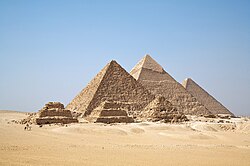
[[File:All Gizah Pyramids.jpg|thumb|right|The [[Giza Necropolis]] is the oldest of the [[Seven Wonders of the Ancient World|ancient Wonders]] and the only one still in existence.]] | |||
Around {{circa|3150}} BCE, King [[Menes]] unified Egypt, establishing a succession of [[List of Egyptian dynasties|dynasties]] that ruled for three millennia. [[Culture of Egypt|Egyptian civilisation]] thrived with distinctive achievements in [[Ancient Egyptian religion|religion]], [[Art of Ancient Egypt|art]], and [[Egyptian language|writing]]. The [[Old Kingdom]] ({{circa|2700–2200}} BCE) saw the construction of the [[Egyptian pyramids|pyramids]], including those at [[Giza Necropolis|Giza]]. A brief [[First Intermediate Period of Egypt|interregnum]] followed, succeeded by the [[Middle Kingdom of Egypt|Middle Kingdom]] ({{circa|2040}} BCE), a phase of renewed stability and prosperity under rulers such as [[Amenemhat III]].<ref>{{cite web |url=https://www.bbc.co.uk/history/ancient/egyptians/apocalypse_egypt_01.shtml|title=The Fall of the Egyptian Old Kingdom |publisher=BBC |date=17 February 2011 |access-date=3 November 2011 |archive-url=https://web.archive.org/web/20111117133705/http://www.bbc.co.uk/history/ancient/egyptians/apocalypse_egypt_01.shtml|archive-date=17 November 2011 |url-status=live }}</ref> | |||
After the [[Second Intermediate Period of Egypt|Second Intermediate Period]] and the [[Hyksos]] occupation, Egypt was reunified by [[Ahmose I]], founder of the [[Eighteenth dynasty of Egypt|Eighteenth Dynasty]] and the [[New Kingdom of Egypt|New Kingdom]] ({{circa|1550–1070}} BCE). This era marked Egypt's height as a major power in the region, extending influence into [[Nubia]] and the [[Levant]]. It produced many of Egypt's most renowned [[Pharaoh]]s, [[Hatshepsut]], [[Thutmose III]], [[Akhenaten]], [[Tutankhamun]], and [[Ramesses II]], and witnessed the rise of [[Atenism]], one of the earliest forms of [[monotheism]]. Despite later invasions by [[Ancient Libya|Libyans]], [[Kingdom of Kush|Nubians]], and [[Assyria]]ns, native dynasties eventually reasserted control.<ref>{{cite web |url=http://www.ancientsudan.org/history_06_nubconegypt.htm |title=The Kushite Conquest of Egypt |publisher=Ancientsudan.org |access-date=25 August 2010 |url-status=usurped |archive-url=https://web.archive.org/web/20110201014554/http://www.ancientsudan.org/history_06_nubconegypt.htm|archive-date=1 February 2011}}</ref> | |||
[[File:BD Weighing of the Heart.jpg|thumb|The Weighing of the Heart from the ''[[Papyrus of Ani|Book of the Dead of Ani]]'']] | |||
In 525 BCE, [[Cambyses II of Persia]] conquered Egypt, beginning the [[Achaemenid Empire|Achaemenid]] [[satrapy]] period (the [[Twenty-seventh Dynasty of Egypt|Twenty-seventh Dynasty]]). Although several revolts occurred, Egypt remained under Persian control until briefly regaining independence before falling again in 343 BCE.<ref>{{Cite book|editor-last=Shaw|editor-first=Ian|title=The Oxford History of Ancient Egypt|publisher=Oxford University Press|year=2003|location=Oxford|isbn=0-19-280458-8|page=[https://archive.org/details/oxfordhistoryofa00shaw/page/383 383]|url=https://archive.org/details/oxfordhistoryofa00shaw/page/383}} | |||
</ref> The [[Thirtieth dynasty of Egypt|Thirtieth Dynasty]] was the last native royal house. Following renewed Persian domination, [[Alexander the Great]] conquered Egypt in 332 BCE, after which his general [[Ptolemy I Soter]] established the [[Ptolemaic dynasty]].<ref>{{cite book|last=Jones|first=Prudence J.|title=Cleopatra: A Sourcebook|url=https://archive.org/details/cleopatrasourceb0000jone|url-access=registration|page=[https://archive.org/details/cleopatrasourceb0000jone/page/14 14]|location=Norman|publisher=University of Oklahoma Press|year=2006|isbn=978-0806137414|quote=They were members of the Ptolemaic dynasty of Macedonian Greeks, who ruled Egypt after the death of its conqueror, Alexander the Great.}}</ref> | |||
===Ptolemaic and Roman Egypt (305 BCE–641 CE)=== | |||
{{Main|Ptolemaic Kingdom|Roman Egypt}} | |||
[[File:Denderah3 Cleopatra Cesarion.jpg|thumb|upright=0.75|The Ptolemaic Queen [[Cleopatra VII]] and her son by Julius Caesar, [[Caesarion]], at the [[Dendera Temple complex|Temple of Dendera]]]] | |||
[[File: | |||
The [[ | The [[Ptolemaic Kingdom]] was a [[Hellenistic civilization|Hellenistic]] state from southern Syria to [[Cyrene, Libya|Cyrene]] and south to Nubia, with [[Alexandria]] as its capital and a centre of [[Greeks|Greek]] culture and trade. The Ptolemies adopted pharaonic traditions to legitimise their rule, appearing on monuments in Egyptian style and participating in local religious life.<ref>{{cite book |last=Bowman |first=Alan K |title= Egypt after the Pharaohs 332 BC – AD 642 |publisher=University of California Press |location=Berkeley |year=1996 |edition=2nd |pages=25–26 |isbn=0-520-20531-6}}</ref><ref>{{cite book |last=Stanwick |first=Paul Edmond |title= Portraits of the Ptolemies: Greek kings as Egyptian pharaohs |publisher=[[University of Texas Press]] |location=Austin |year=2003 |isbn=0-292-77772-8}}{{pn|date=January 2026}}</ref> The [[Lighthouse of Alexandria]], built c. 280 BCE, was one of the [[Seven Wonders of the Ancient World]], later destroyed by earthquakes. The last ruler, [[Cleopatra VII]], committed suicide after [[Octavian]] captured Alexandria, ending the dynasty and paving the way for Roman annexation. Native rebellions and dynastic disputes weakened the kingdom, facilitating its annexation by Rome. | ||
=== Ptolemaic and Roman Egypt === | Egypt was a wealthy imperial province of the [[Roman Empire]], supplying grain and hosting the major city of Alexandria.<ref>{{Cite web |date=31 March 2025 |title=Ancient Egypt - Roman, Byzantine, 30 BCE-642 CE |url=https://www.britannica.com/place/ancient-Egypt/Roman-and-Byzantine-Egypt-30-bce-642-ce |access-date=26 April 2025 |website=www.britannica.com |language=en}}</ref> Governed with Roman administration and Hellenistic culture, its population primarily spoke [[Koine Greek|Greek]] in major cities and [[Coptic language|Coptic Egyptian]] in rural areas.<ref>{{cite book |last1=Bowman |first1=Alan |title=Settlement, Urbanization, and Population |chapter=Ptolemaic and Roman Egypt |date=2011 |pages=317–358 |doi=10.1093/acprof:oso/9780199602353.003.0011 |isbn=978-0-19-960235-3 }}</ref><ref name="pop">{{cite web |last1=Janzen |first1=Mark |title=Ancient Egypt Population Estimates: Slaves and Citizens |url=https://thetorah.com/ancient-egypt-population-estimates-slaves-and-citizens/ |website=TheTorah.com |access-date=18 August 2019 |date=2017}}</ref> Christianity reached Egypt in the 1st century, brought by [[Saint Mark the Evangelist]].<ref name=georgetown/> During [[Diocletian]]'s reign (284–305 CE), the [[New Testament]] had been translated into Egyptian and many Egyptian Christians were persecuted. By CE 451, a distinct [[Coptic Orthodox Church of Alexandria|Coptic Church]] was firmly established.<ref>Kamil, Jill. ''Coptic Egypt: History and Guide''. Cairo: American University in Cairo, 1997. p. 39</ref> | ||
{{ | |||
=== Middle Ages (641–1517) === | |||
{{Main|Egypt in the Middle Ages}} | |||
{{multiple image | |||
| width = 200 | |||
| image1 = C9B5617-Pano.jpg | |||
| image2 = ساحة مسجد احمد بن طولون.jpg | |||
| image3 = مسـجد الحاكم بأمر الله 06.jpg | |||
| footer = The [[Al-Hakim Mosque]] in Cairo, of [[Al-Hakim bi-Amr Allah]], the sixth [[Fatimid]] caliph | |||
| caption2 = The [[Ibn Tulun Mosque]] in Cairo, of [[Ahmad Ibn Tulun]] | |||
| caption1 = The [[Amr ibn al-As]] mosque in Cairo, recognised as the oldest in Africa | |||
| direction = vertical | |||
| align = right | |||
| alt2 = The [[Ibn Tulun Mosque]] in Cairo, of [[Ahmad Ibn Tulun]] | |||
The | | alt1 = | ||
}} | |||
The Byzantines regained control of Egypt after a brief [[Sasanian Empire|Sasanid Persian]] invasion early in the 7th century, until 639–42, when the country was conquered by Arab Muslim forces under [[Amr ibn al-As]] during the [[Early Muslim conquests]]. The Arabs defeated the Byzantine armies, bringing [[Islam]] to Egypt. Alexandria briefly returned to Byzantine control in 645 but fell again to the Arabs in 646. In 654, an invasion fleet sent by [[Constans II]] was repulsed.<ref name=georgetown>{{cite web|url=http://berkleycenter.georgetown.edu/resources/countries/egypt |title=Egypt |publisher=[[Berkley Center for Religion, Peace, and World Affairs]] |access-date=14 December 2011 |archive-url=https://web.archive.org/web/20111220145046/http://berkleycenter.georgetown.edu/resources/countries/egypt |archive-date=20 December 2011 |url-status=dead }}</ref> The Arabs founded [[Fustat]], later replaced by Cairo in 969. | |||
Under the [[Abbasid]] caliphate, Egypt was governed through deputies residing in Baghdad. Revolts occurred frequently, including the Egyptian revolt of 828 and the uprising of 831 when Copts joined Muslims against the government. Semi-independent dynasties arose, including the [[Tulunid dynasty]] (868–905) and [[Ikhshidid dynasty]] (935–969), which maintained Abbasid allegiance while exercising local authority. | |||
The [[Fatimid Caliphate]] ruled Egypt from the 10th century, with [[Cairo]] as their capital. After the Fatimids, the [[Ayyubid dynasty]] governed until 1250, when the [[Mamluk]]s, a military caste of [[Turkic people|Turco]]-[[Circassians|Circassian]] origin, took control. The Mamluks ruled Egypt for the next three centuries and maintained control over parts of the Levant. By the late 13th century, Egypt linked trade routes connecting the Red Sea with India, Malaya, and the East Indies.<ref name="Abu-Lughod">{{cite book|last=Abu-Lughod|first=Janet L.|author-link=Janet Abu-Lughod|title=Before European Hegemony: The World System A.D. 1250–1350|location=New York|publisher=Oxford University Press|year=1991|orig-year=1989|pages=[https://archive.org/details/beforeeuropeanhe00abul_1/page/243 243–244]|isbn=978-0-19-506774-3|chapter=The Mideast Heartland|chapter-url=https://books.google.com/books?id=rYlgGU2SLiQC&pg=PA244|url=https://archive.org/details/beforeeuropeanhe00abul_1/page/243}}</ref> The mid-14th century [[Black Death]] killed about 40% of Egypt's population.<ref>{{cite web |url=http://countrystudies.us/egypt/57.htm|title=Egypt – Major Cities |publisher=Countrystudies.us |access-date=8 February 2013|archive-url=https://web.archive.org/web/20130117011718/http://countrystudies.us/egypt/57.htm |archive-date=17 January 2013 |url-status=live }}</ref> | |||
=== | === Ottoman Egypt (1517–1867) === | ||
{{Main|Egypt | {{Main|Egypt Eyalet|History of Egypt under the Muhammad Ali dynasty}} | ||
[[ | {{multiple image | ||
The | | image1 = ModernEgypt, Muhammad Ali by Auguste Couder, BAP 17996.jpg | ||
[[ | | image2 = Egypt under Muhammad Ali Dynasty map en.png | ||
| footer = [[Muhammad Ali of Egypt|Muhammad Ali]], founder of the [[Muhammad Ali dynasty]], and the extent of their realm. | |||
| direction = vertical | |||
| align = right | |||
}} | |||
Egypt was conquered by the [[Ottoman Turks]] in 1517, following the defeat of the [[Mamluk Sultanate]], and became a province of the [[Ottoman Empire]]. The Mamluks, who had dominated Egypt's military and political life for centuries, retained influence under Ottoman rule, creating a semi-autonomous power structure. The Ottomans faced repeated challenges in maintaining control, while plagues and famines weakened the economy and civil society. Between 1687 and 1731, Egypt experienced six major famines, including the 1784 famine that killed roughly one-sixth of the population.<ref name="Abu-Lughod"/><ref>{{cite web |url=https://www.sciencedaily.com/releases/2006/11/061121232204.htm |title=Icelandic Volcano Caused Historic Famine In Egypt, Study Shows |website=ScienceDaily |date=22 November 2006 |access-date=8 February 2013 |archive-url=https://web.archive.org/web/20130117013900/http://www.sciencedaily.com/releases/2006/11/061121232204.htm |archive-date=17 January 2013 |url-status=live }}</ref> | |||
In 1798, [[Napoleon Bonaparte]] invaded Egypt, defeating the Mamluks at the [[Battle of the Pyramids]]. The French occupation was short-lived, but it destabilised the region and set the stage for Muhammad Ali Pasha's rise. After the French were expelled, power struggles ensued between the Ottomans, the Mamluks, and Albanian mercenaries in Ottoman service, leaving Egypt politically fragmented. | |||
In 1805, [[Muhammad Ali of Egypt|Muhammad Ali Pasha]] seized power, massacring the remaining Mamluks and establishing a dynasty that would rule Egypt until 1952. He reorganised the army along European lines, introduced conscription, and developed a centralised administration. At the same time, he promoted cash-crop agriculture, especially long-staple cotton, to integrate Egypt into global markets.<ref name="Nejla M. Abu Izzeddin 1973, p 2">{{cite book|title=Nasser of the Arabs: an Arab assessment|last=Izzeddin|first=Nejla M. Abu|publisher=Third World Centre for Research and Publishing|year=1981|isbn=978-0-86199-012-2|page=2}}</ref> His successors, including [[Ibrahim Pasha of Egypt|Ibrahim Pasha]], [[Abbas I of Egypt|Abbas I]], [[Sa'id of Egypt|Sa'id]], and [[Isma'il Pasha of Egypt|Isma'il Pasha]], continued reforms in agriculture, science, and industry, and abolished slavery. | |||
Muhammad Ali expanded Egypt's control over [[Northern Sudan]] (1820–1824), [[Syria]] (1833), and parts of [[Arabia]] and [[Anatolia]], but European powers intervened in 1841, forcing him to relinquish most of his conquests. He modernised Egypt's infrastructure, built factories and irrigation networks, and strengthened the military, while broader education remained largely limited to military and technical training.<ref name="auto">{{cite book|author=Baten, Jörg |title=A History of the Global Economy. From 1500 to the Present.|date=2016|publisher=Cambridge University Press|page=217|isbn=978-1-107-50718-0}}</ref> The centralisation of power and focus on military and economic modernisation laid the foundation for Egypt's transformation into a regional power. | |||
=== Monarchical Egypt (1867–1952) === | |||
{{Main|Khedivate of Egypt {{!}} Khedivate of Egypt (1867–1914)|Sultanate of Egypt {{!}} Sultanate of Egypt (1914–1922)|Kingdom of Egypt (1922–1953)}} | |||
In 1867, Egypt was formally granted autonomous status as a [[Khedivate of Egypt|vassal state]] of the Ottoman Empire. The [[Suez Canal]], completed in 1869 with French assistance, became a key strategic and commercial asset. Financial mismanagement and mounting debts led Isma'il Pasha to sell Egypt's shares in the canal to Britain in 1875, increasing European influence. Rising discontent culminated in the [[Urabi revolt]], after which Britain occupied Egypt in 1882, establishing a de facto protectorate while maintaining nominal Ottoman sovereignty.<ref>Nejla M. Abu Izzeddin, ''Nasser of the Arabs'', p. 2.</ref><ref>Anglo French motivation: Derek Hopwood, ''Egypt: Politics and Society 1945–1981''. London, 1982, George Allen & Unwin. p. 11.</ref><ref>De facto protectorate: Joan Wucher King, ''Historical Dictionary of Egypt''. Metuchen, NJ; 1984; Scarecrow. p. 17.</ref> The Anglo-Egyptian Condominium Agreement of 1899 placed Sudan under joint Egyptian and British administration, though Britain retained real control. Incidents such as the [[Denshawai incident]] in 1906 intensified nationalist sentiment, laying the groundwork for political movements that challenged both Ottoman and European dominance. | |||
[[File:Cairo-Demonstrations1919.jpg|thumb|upright=0.75|Female nationalists demonstrating in [[Cairo]] during the [[1919 revolution]], 1919]] | |||
In 1914, as the [[Ottoman Empire]] joined World War I alongside the Central Powers, Khedive [[Abbas II of Egypt|Abbas II]] declared support for the Ottoman side. In response, the British deposed him and installed his brother [[Hussein Kamel of Egypt|Hussein Kamel]], who assumed the title of [[Sultanate of Egypt|Sultan of Egypt]]. Egypt was formally declared independent from the Ottoman Empire but remained under British protection.<ref>{{cite book|last=Jankowski|first=James|title=Egypt, A Short History|page=111}}</ref><ref>{{Cite web|url=https://wwi.lib.byu.edu/index.php/Treaty_of_Lausanne|title=Treaty of Lausanne – World War I Document Archive|website=wwi.lib.byu.edu|access-date=29 January 2020|archive-date=13 June 2018|archive-url=https://web.archive.org/web/20180613183950/https://wwi.lib.byu.edu/index.php/Treaty_of_Lausanne|url-status=live}}</ref> | |||
After [[World War I]], nationalist sentiments surged. [[Saad Zaghlul]] and the [[Wafd Party]] secured popular support, but the British exiled Zaghlul and his colleagues to Malta on 8 March 1919, prompting the [[Egyptian revolution of 1919|first modern revolution]]. This uprising pressured the UK to issue a [[Unilateral Declaration of Egyptian Independence|declaration of independence]] on 22 February 1922.<ref name=jankowski-112>{{cite book|last=Jankowski|first=James|title=Egypt, A Short History|page=112}}</ref> Sultan [[Fuad I of Egypt|Fuad I]] then assumed the title of King of Egypt. Despite nominal independence, Britain retained military presence and political influence.<ref name=jankowski-112/> | |||
In 1923, a new constitution established a [[Parliamentary system|parliamentary]] government. The Wafd Party won a decisive victory in the 1923–24 elections, with [[Saad Zaghloul]] becoming prime minister. The [[Anglo-Egyptian Treaty of 1936|1936 treaty]] led to British troop withdrawal from most of Egypt, except the Suez Canal. The treaty left the status of [[Anglo-Egyptian Sudan|Sudan]] unresolved, as real control remained with Britain.<ref name="ModernSudan">{{Cite book|url=https://books.google.com/books?id=-zpShVWIxwIC&q=%22Anglo-Egyptian+Condominium+Agreement%22+%221899%22&pg=PA33|title=A History of Modern Sudan|last1=Collins|first1=Robert O.|last2=Collins|first2=Professor of History Robert O.|date=29 May 2008|publisher=Cambridge University Press|isbn=978-0-521-85820-5|language=en|access-date=10 November 2020|archive-date=18 May 2024|archive-url=https://web.archive.org/web/20240518175515/https://books.google.com/books?id=-zpShVWIxwIC&q=%22Anglo-Egyptian+Condominium+Agreement%22+%221899%22&pg=PA33|url-status=live}}</ref> | |||
[[File:Fuad I of Egypt, Edward VIII, & Mohamed Sa'id Paşa.jpg|thumb|[[Fuad I of Egypt]] with [[Edward VIII|Edward, Prince of Wales]], 1932|left|223x223px]] | |||
During [[World War II]], Egypt served as a strategic base for [[Allies of World War II|Allied]] operations, particularly in [[North Africa]]. Although Egypt declared martial law and severed diplomatic relations with [[Axis powers]], the Egyptian army did not engage directly. Political tensions persisted, highlighted by the 1942 [[Abdeen Palace Incident of 1942|Abdeen Palace Incident]], in which British forces pressured King Farouk to install a Wafd-coalition government.<ref name= Britro>{{cite web | title=British troops in Egypt. | url=https://www.britishmilitaryhistory.co.uk/wp-content/uploads/sites/124/2020/07/British-Troops-Egypt-History-Personnel.pdf | access-date=29 July 2025}}</ref> | |||
After the war, nationalist and anti-British sentiments intensified. British troops largely withdrew in 1947, leaving a residual presence around the Suez Canal. Egypt's defeat in the [[First Arab-Israeli War]] fuelled anti-monarchy feeling. The Wafd Party's 1950 election victory forced King Farouk to appoint [[Mostafa El-Nahas]] as prime minister. In 1951, Egypt unilaterally renounced the [[Anglo-Egyptian treaty of 1936|1936 treaty]] and demanded British troop withdrawal. The situation around the Suez Canal escalated, culminating in violent confrontations that led to the killing of 43 Egyptian policemen in 1952 by British troops. The Ismailia incident outraged Egypt and led to the subsequent [[Cairo fire|Black Saturday]] anti-British riots, which saw widespread destruction in Cairo.<ref name="factbook-his">{{cite web|title=Egypt|url=https://www.cia.gov/the-world-factbook/countries/egypt/|work=The World Factbook|publisher=CIA|access-date=2 February 2011|archive-date=9 October 2021|archive-url=https://web.archive.org/web/20211009073315/https://www.cia.gov/the-world-factbook/countries/egypt/|url-status=dead}}</ref> | |||
These events precipitated the [[Egyptian Revolution of 1952|Free Officers Movement coup]] on 22–23 July 1952, led by [[Muhammad Naguib]] and [[Gamal Abdel Nasser]]. King Farouk abdicated in favour of his infant son, [[Fuad II of Egypt|Fuad II]], but real power rested with the [[Egyptian Revolutionary Command Council]]. By 18 June 1953, the monarchy was formally abolished, the 1923 constitution suspended, and Egypt was declared a republic, with Naguib as president and Nasser as prime minister.<ref name="factbook-his"/> | |||
=== Republican Egypt under Nasser (1952–1970) === | |||
{{Main|History of republican Egypt|History of Egypt under Gamal Abdel Nasser}} | |||
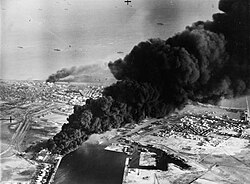
[[File:Port Said from air.jpg|thumb|Smoke rises from oil tanks beside the [[Suez Canal]] hit during the initial [[Suez Crisis|Anglo-French assault]] on Egypt, 5 November 1956.]] | |||
Following the [[Egyptian revolution of 1952|1952 Revolution]] led by the [[Free Officers Movement (Egypt)|Free Officers Movement]], Egypt came under military control, and all political parties were banned. On 18 June 1953, the [[Republic of Egypt (1953–1958)|Republic of Egypt]] was officially declared, with [[Muhammad Naguib]] serving as the first President. His presidency lasted less than a year and a half, as [[Gamal Abdel Nasser]], a [[Pan-Arabist]] and the principal architect of the 1952 movement, gradually consolidated power. Naguib was forced to resign in 1954 and placed under [[house arrest]]. The presidency remained vacant until Nasser was formally elected in 1956.<ref>{{cite web|url=http://modernegypt.bibalex.org/Types/Persons/Details.aspx?type=ruler&ID=ieiMjZc32OCIOCRsXII4PA==|title=ذاكرة مصر المعاصر – السيرة الذاتية|website=modernegypt.bibalex.org|access-date=24 September 2018|archive-date=26 December 2018|archive-url=https://web.archive.org/web/20181226053316/http://modernegypt.bibalex.org/Types/Persons/Details.aspx?type=ruler&ID=ieiMjZc32OCIOCRsXII4PA==|url-status=live}}</ref> | |||
In October 1954, Egypt and the United Kingdom agreed to end the [[Anglo-Egyptian Sudan|Anglo-Egyptian Condominium Agreement]] of 1899, granting Sudan full independence, which came into effect on 1 January 1956. In June 1956, Nasser assumed the presidency and immediately became the central figure in Egypt's domestic and foreign policy. British forces completed their withdrawal from the Suez Canal Zone on 13 June 1956. Later that year, on 26 July, Nasser [[nationalised]] the Suez Canal, provoking the [[Suez Crisis]] when Israel, with support from France and the United Kingdom, invaded the Sinai Peninsula and targeted the Canal. The conflict ended following diplomatic pressure from the United States and the Soviet Union, restoring the pre-war status quo.<ref>{{Cite web|url=https://www.britannica.com/event/Suez-Crisis|title=Suez Crisis | Definition, Summary, Location, History, Dates, Significance, & Facts | Britannica|date=22 October 2025|website=www.britannica.com|accessdate=20 November 2025}}</ref> | |||
[[File:Nasser in Mansoura, 1960.jpg|thumb|Egyptian President [[Gamal Abdel Nasser]] in [[Mansoura, Egypt|Mansoura]], 1960]] | |||
In 1958, Egypt formed a political union with Syria, creating the [[United Arab Republic]]. The union, also loosely connected with [[Mutawakkilite Kingdom of Yemen|North Yemen]] in the [[United Arab States]], was short-lived; Syria seceded in 1961. During this period, Egypt became heavily involved in the [[North Yemen Civil War]], with military interventions and peace conferences ultimately leading to a prolonged stalemate.<ref>{{cite thesis |last1=Orkaby |first1=Asher Aviad |title=The International History of the Yemen Civil War, 1962-1968 |date=2014 |url=http://nrs.harvard.edu/urn-3:HUL.InstRepos:12269828 }}{{pn|date=January 2026}}</ref> | |||
In May 1967, tensions with Israel escalated after warnings from the Soviet Union, deployment of Egyptian forces to Sinai, expulsion of UN peacekeepers, and closure of the [[Straits of Tiran]]. These measures precipitated the [[Third Arab-Israeli War|Six-Day War]], during which Israel captured the [[Sinai Peninsula]] and the [[Gaza Strip]]. In response to the conflict, an [[Emergency law in Egypt|Emergency Law]] was enacted, greatly expanding police powers, restricting constitutional rights, and legalising censorship; it remained in force until 2012, except for a brief break in 1980–81.<ref>{{cite web|title=The Emergency Law in Egypt|url=http://www.fidh.org/THE-EMERGENCY-LAW-IN-EGYPT|work=International Federation for Human Rights|access-date=2 February 2011|archive-url=https://web.archive.org/web/20110201210318/http://fidh.org/THE-EMERGENCY-LAW-IN-EGYPT|archive-date=1 February 2011|url-status=live}}</ref> | |||
Socially and economically, Nasser's policies transformed Egypt. At the time of the monarchy's fall, less than half a million Egyptians were considered upper class, four million were middle class, and seventeen million were lower class or poor.<ref name="Tarek Osman 2010, p. 120">''Egypt on the Brink'' by Tarek Osman, Yale University Press, 2010, p. 120</ref> Education was expanded, with school enrolment more than doubling from 1953 to 1966. Land reforms, industrial support, and growth in public-sector employment created a larger middle class, including doctors, engineers, teachers, lawyers, and journalists. However, by the late 1960s, the Egyptian economy faced stagnation, political freedoms had declined, and Nasser's personal popularity began to wane.<ref name="Tarek Osman 2010, p. 120"/><ref>{{cite book|author=Jesse Ferris|title=Nasser's Gamble: How Intervention in Yemen Caused the Six-Day War and the Decline of Egyptian Power|url=https://books.google.com/books?id=UC4_aVRh7MgC&pg=PA172|year=2013|publisher=Princeton University Press|isbn=978-0-691-15514-2|page=2|access-date=20 June 2015|archive-url=https://web.archive.org/web/20150906085333/https://books.google.com/books?id=UC4_aVRh7MgC&pg=PA172|archive-date=6 September 2015|url-status=live}}</ref> | |||
=== | === Egypt under Sadat and Mubarak (1971–2011) === | ||
{{ | {{Main|History of Egypt under Anwar Sadat|History of Egypt under Hosni Mubarak}} | ||
[[File: | [[File:Egyptian Armor.jpg|thumb|Egyptian tanks advancing in the Sinai desert during the [[Yom Kippur War]], 1973]] | ||
After the death of [[Gamal Abdel Nasser]] in 1970, [[Anwar Sadat]] assumed the presidency of Egypt. Sadat consolidated his power by marginalising Nasserist and leftist factions, while controlling opposition both secular and religious. He shifted Egypt's Cold War alignment from the Soviet Union to the United States, expelling Soviet advisors in 1972, and renamed the country the Arab Republic of Egypt in 1971. Sadat launched the [[Infitah]] ("open door") economic reforms.<ref>{{cite book |last1=Amin |first1=Galal A. |title=Egypt's Economic Predicament |date=1995 |doi=10.1163/9789004491175 |isbn=978-90-04-49117-5 }}{{pn|date=January 2026}}</ref> Some measures of this economic liberalisation caused social tensions, most notably the removal of food subsidies in 1977 which sparked widespread [[1977 Egyptian bread riots|bread riots]]. | |||
=== | In 1973, Sadat coordinated with Syria in the [[Fourth Arab-Israeli War]] to reclaim the [[Sinai Peninsula]] from Israeli occupation. Though militarily mixed, the war restored Arab morale and strengthened Sadat's domestic legitimacy. His historic 1977 visit to Jerusalem led to the 1979 [[Egypt–Israel peace treaty|Egypt-Israel peace treaty]], with Israel withdrawing from Sinai and Egypt recognising Israel as a sovereign state. This initiative provoked widespread controversy across the Arab world, resulting in Egypt's temporary expulsion from the [[Arab League]], but remained popular domestically.<ref>{{cite book|last=Vatikiotis|first=P. J.|title=The History of Modern Egypt: From Muhammad Ali to Mubarak|year=1991|publisher=Weidenfeld and Nicolson|location=London|isbn=978-0-297-82034-5|page=443|edition=4.}}</ref> Sadat was assassinated in 1981 by an Islamic extremist opposed to his domestic policies and peace initiative. | ||
[[File: | [[File:Hosni Mubarak - Official Photo.JPG|left|thumb|222x222px|[[Hosni Mubarak]], president of Egypt from 1981 to 2011]] | ||
[[Hosni Mubarak]] succeeded Sadat in a 1981 referendum in which he was the sole candidate.<ref name="nytimes.com">{{cite news |last=Cambanis |first=Thanassis |url=https://www.nytimes.com/2010/09/12/world/middleeast/12egypt.html | |||
|title=Succession Gives Army a Stiff Test in Egypt |location=Egypt |work=The New York Times |date=11 September 2010 |access-date=3 November 2011 |archive-url=https://web.archive.org/web/20111027041857/http://www.nytimes.com/2010/09/12/world/middleeast/12egypt.html | |||
|archive-date=27 October 2011 |url-status=live }}</ref> He maintained Egypt's peace treaty with Israel and improved relations with Arab neighbours. Domestically, he faced widespread poverty, high unemployment, and urban overcrowding. The 1986 Security Police riots, sparked by reports of extended military service, led to violent protests, destruction of businesses, and 107 deaths.<ref>Middle East International No. 270, 7 March 1986, Publishers [[Christopher Mayhew|Lord Mayhew]], [[Dennis Walters]]. Simon Ingram p. 8, [[Per Gahrton]] p. 20</ref> | |||
Terrorist attacks, particularly by Islamist groups like [[Al-Gama'a al-Islamiyya]], targeted government officials, foreigners, and Christian [[Copts]], devastating tourism, Egypt's primary source of hard currency.<ref>Murphy, Caryle ''Passion for Islam: Shaping the Modern Middle East: the Egyptian Experience'', Scribner, 2002, p. 4</ref><ref>{{Cite web |url=http://weekly.ahram.org.eg/2005/741/eg1.htm |title=Al-Ahram Weekly | Egypt | Fearing the worst |access-date=13 August 2013 |archive-date=24 September 2013 |archive-url=https://web.archive.org/web/20130924131816/http://weekly.ahram.org.eg/2005/741/eg1.htm |url-status=bot: unknown }}</ref> The political scene was dominated by the [[National Democratic Party (Egypt)|NDP]], which curtailed freedoms of association, expression, and political participation through laws such as the 1993 Syndicates Law, 1995 Press Law, and 1999 NGOs Law.<ref>{{cite report |last1=Dunne |first1=Michele |title=Evaluating Egyptian Reform |date=2006 |publisher=Carnegie Endowment for International Peace |jstor=resrep12830 |url=https://carnegieendowment.org/files/CP66.Dunne.FINAL.pdf }}</ref> | |||
[[File:Cairo north.JPG|thumb|Cairo grew into a [[metropolitan area]] with a population of over 22 million.<ref name="citypopulation2025">{{cite web |title=Major Agglomerations of the World - Population Statistics and Maps |url=http://citypopulation.de/en/world/agglomerations/ |website=citypopulation.de |access-date=3 May 2025}}</ref>]] | |||
In 1997, the [[Luxor massacre]] left 62 dead, mostly tourists, highlighting the continuing threat to security and the economy. In 2005, limited reforms allowed multi-candidate presidential elections, but restrictions on candidates and alleged government interference ensured Mubarak's easy reelection. Voter turnout was less than 25%, and opposition leader [[Ayman Nour]] was subsequently imprisoned.<ref>{{cite web|url=http://www.america.gov/st/washfile-english/2005/December/20051224115656retnuhategdirb0.6396906.html | |||
|title=United States 'Deeply Troubled' by Sentencing of Egypt's Nour |publisher=U.S. Department of State |date=24 December 2005 |access-date=8 February 2013 |url-status=dead |archive-url=https://web.archive.org/web/20111021051128/http://www.america.gov/st/washfile-english/2005/December/20051224115656retnuhategdirb0.6396906.html | |||
|archive-date=21 October 2011 }}</ref> | |||
[[Human Rights Watch]] and [[Amnesty International]] reported widespread human rights abuses, including torture, arbitrary detention, and the use of Egypt as an international "torture hub" in the context of the [[war on terror]].<ref name="HRW">{{cite book |chapter-url=http://hrw.org/english/docs/2006/01/18/egypt12212.htm | |||
|title=Egypt: Overview of human rights issues in Egypt |chapter=Egypt: Events of 2005 |date=5 January 2006 |publisher=Human Rights Watch |access-date=8 February 2013 |archive-url=https://web.archive.org/web/20081114115428/http://hrw.org/english/docs/2006/01/18/egypt12212.htm | |||
|archive-date=14 November 2008 |url-status=live }}</ref><ref>{{cite news |url=http://news.bbc.co.uk/2/hi/middle_east/6544149.stm | |||
|title=Egypt torture centre, report says |publisher=BBC News |date=11 April 2007 |access-date=3 November 2011 |archive-url=https://web.archive.org/web/20111126031108/http://news.bbc.co.uk/2/hi/middle_east/6544149.stm | |||
|archive-date=26 November 2011 |url-status=live }}</ref> Constitutional changes in 2007 further expanded presidential powers, restricted religious parties, and broadened police authority. Egypt remained under strong military influence, described by officials as a "pharaonic" system, with democracy as a distant aspiration.<ref>{{cite news |url=http://news.bbc.co.uk/2/hi/middle_east/6472031.stm | |||
|title=Anger over Egypt vote timetable |work=BBC News |date=20 March 2007 |access-date=3 November 2011 |archive-url=https://web.archive.org/web/20111129222423/http://news.bbc.co.uk/2/hi/middle_east/6472031.stm | |||
|archive-date=29 November 2011 |url-status=live }}</ref> | |||
=== Contemporary (2011–present) === | |||
{{Main|2011 Egyptian revolution||Egyptian Crisis (2011–2014)||2013 Egyptian protests|2013 Egyptian coup d'état}} | |||
{{multiple image | |||
{{ | | width = 200 | ||
| direction = vertical | |||
| footer = '''Top:''' Celebrations in [[Tahrir Square]] after the announcement of [[Hosni Mubarak]]'s resignation, 2011.<br />'''Bottom:''' Protests in Tahrir Square against [[Mohamed Morsi|Morsi]], 2012. | |||
| image1 = Tahrir Square on February11.png | |||
| image2 = TahrirSquareAgainstMorsi.jpg | |||
}} | |||
On 25 January 2011, [[2011 Egyptian revolution|widespread protests]] erupted against President Hosni Mubarak's government, triggered by demands for political freedom, social justice, and the end of long-standing corruption. Demonstrations rapidly spread across major cities, particularly in [[Cairo]]'s [[Tahrir Square]], capturing global attention.<ref>{{cite news |url=https://huffingtonpost.com/2011/02/11/mubarak-red-sea-egypt_n_821812.html | |||
|title=Mubarak Resigns As Egypt's President, Armed Forces To Take Control |work=Huffington Post |date=11 February 2011 |access-date=8 February 2013 |archive-url=https://web.archive.org/web/20130322095317/http://www.huffingtonpost.com/2011/02/11/mubarak-red-sea-egypt_n_821812.html | |||
|archive-date=22 March 2013 |url-status=live }}</ref> After 18 days of escalating unrest, Mubarak resigned on 11 February 2011 and fled Cairo. The [[Egyptian military]] assumed control, with [[Mohamed Hussein Tantawi]], chairman of the [[Supreme Council of the Armed Forces]], acting as interim head of state.<ref>{{cite news|url=https://www.nytimes.com/2011/02/12/world/middleeast/12egypt.html |title=Mubarak Steps Down, Ceding Power to Military |work=The New York Times |date=11 February 2010 |access-date=11 February 2011 |first=David D. |last=Kirkpatrick |archive-url=https://web.archive.org/web/20110211081712/http://www.nytimes.com/2011/02/12/world/middleeast/12egypt.html | |||
|archive-date=11 February 2011 |url-status=live }}</ref><ref>{{cite news |url=https://www.bbc.co.uk/news/world-middle-east-12433045 |title=Egypt crisis: President Hosni Mubarak resigns as leader |publisher=BBC |date=11 February 2010 |access-date=11 February 2011 |archive-url=https://web.archive.org/web/20110211192204/http://www.bbc.co.uk/news/world-middle-east-12433045 | |||
|archive-date=11 February 2011 |url-status=live }}</ref> On 13 February, the military dissolved parliament and suspended the constitution.<ref>{{cite news|url=https://www.bbc.co.uk/news/world-middle-east-12443678|title=Egyptian Parliament dissolved, constitution suspended|publisher=BBC|date=13 February 2011|access-date=13 February 2011|archive-url=https://web.archive.org/web/20110214045727/http://www.bbc.co.uk/news/world-middle-east-12443678|archive-date=14 February 2011|url-status=live}}</ref> A constitutional referendum followed on 19 March 2011.<ref>{{cite web |last1=Harris |first1=Marty |title=The Egyptian constitutional referendum of March 2011 a new beginning|url=https://www.aph.gov.au/About_Parliament/Parliamentary_Departments/Parliamentary_Library/FlagPost/2011/March/The_Egyptian_constitutional_referendum_of_March_2011_a_new_beginning |website=www.aph.gov.au |language=en-AU |access-date=21 November 2022 |archive-date=21 November 2022 |archive-url=https://web.archive.org/web/20221121104622/https://www.aph.gov.au/About_Parliament/Parliamentary_Departments/Parliamentary_Library/FlagPost/2011/March/The_Egyptian_constitutional_referendum_of_March_2011_a_new_beginning |url-status=live }}</ref> Later that year, Egypt held its first parliamentary elections since the previous regime, with high voter turnout and no major reported irregularities.<ref>{{cite news |last=Memmott|first=Mark|url=https://www.npr.org/blogs/thetwo-way/2011/11/28/142840895/egypts-historic-day-begins-peacefully-turnout-high-for-elections |title=Egypt's Historic Day Proceeds Peacefully, Turnout High For Elections |newspaper=NPR |publisher=Npr.org |date=28 November 2011 |access-date=8 February 2013 |archive-url=https://web.archive.org/web/20121202183307/http://www.npr.org/blogs/thetwo-way/2011/11/28/142840895/egypts-historic-day-begins-peacefully-turnout-high-for-elections |archive-date=2 December 2012 |url-status=live }}</ref> | |||
[[Mohamed Morsi]], affiliated with the [[Muslim Brotherhood]], won the [[2012 Egyptian presidential election|presidency]] on 24 June 2012 and was sworn in on 30 June.<ref>{{cite news|title=Egypt's new president moves into his offices, begins choosing a Cabinet|url=https://edition.cnn.com/2012/06/25/world/africa/egypt-politics|publisher=CNN|access-date=13 February 2013|date=25 June 2012|archive-url=https://web.archive.org/web/20130512224527/http://edition.cnn.com/2012/06/25/world/africa/egypt-politics/|archive-date=12 May 2013|url-status=live}}</ref><ref>{{cite news |title=Mohamed Morsi sworn in as Egypt's president|url=https://www.aljazeera.com/news/2012/7/1/mohamed-morsi-sworn-in-as-egypts-president |work=www.aljazeera.com|language=en |access-date=2 September 2023 |archive-date=20 August 2023 |archive-url=https://web.archive.org/web/20230820031904/https://www.aljazeera.com/news/2012/7/1/mohamed-morsi-sworn-in-as-egypts-president | |||
|url-status=live }}</ref> His cabinet, announced in August 2012, included significant representation from the Muslim Brotherhood, prompting liberal and secular groups to withdraw from the [[Constituent Assembly of Egypt]] over concerns of imposing strict Islamic law.<ref>{{cite news|title= Egypt unveils new cabinet, Tantawi keeps defence post |date= 3 August 2012}}</ref> In November 2012, Morsi issued a decree granting immunity to his decisions and protecting the constituent assembly's work, sparking [[2012–2013 Egyptian protests|mass protests and violent clashes]] across the country.<ref>{{cite news|url=https://www.bbc.co.uk/news/world-middle-east-20451208 |title=Egypt's President Mursi assumes sweeping powers |work=BBC News |date=22 November 2012 |access-date=23 November 2012 |archive-url=https://web.archive.org/web/20121122182256/http://www.bbc.co.uk/news/world-middle-east-20451208 |archive-date=22 November 2012 |url-status=live}}</ref> Tensions escalated, with the largest confrontations between Islamist supporters and opponents since the 2011 revolution occurring on 5 December 2012.<ref>{{cite news |url=https://www.wsj.com/articles/SB10001424127887324640104578160902530961768 |title=Egypt Sees Largest Clash Since Revolution |newspaper=Wall Street Journal |date=6 December 2012 |access-date=8 December 2012 |archive-url=https://web.archive.org/web/20150421184804/http://www.wsj.com/articles/SB10001424127887324640104578160902530961768 | |||
|archive-date=21 April 2015 |url-status=live }}</ref> Morsi refused to cancel the December 2012 [[2012 Egyptian constitutional referendum|constitutional referendum]].<ref>{{cite news|url=https://latimes.com/news/nationworld/world/la-fg-egypt-morsi-20121207,0,2119116.story|title=Morsi refuses to cancel Egypt's vote on constitution|newspaper=Los Angeles Times|date=6 December 2012|access-date=8 December 2012|first=Jeffrey|last=Fleishman|archive-url=https://web.archive.org/web/20121208041127/http://www.latimes.com/news/nationworld/world/la-fg-egypt-morsi-20121207,0,2119116.story|archive-date=8 December 2012|url-status=live}}</ref> | |||
Following growing public discontent, the [[2013 Egyptian coup d'état|military removed Morsi]] on 3 July 2013, dissolved the [[Senate (Egypt)|Shura Council]], and installed [[Adly Mansour]], chief justice of the [[Supreme Constitutional Court (Egypt)|Supreme Constitutional Court]], as interim president.<ref>{{cite news |last1=Holpuch |first1=Amanda |last2=Siddique |first2=Haroon |last3=Weaver |first3=Matthew |title=Egypt's interim president sworn in - Thursday 4 July|url=https://www.theguardian.com/world/2013/jul/04/egypt-revolution-new-president-live-updates |work=The Guardian |date=4 July 2013 |access-date=21 November 2022 |archive-date=18 May 2024 |archive-url=https://web.archive.org/web/20240518175613/https://www.theguardian.com/world/2013/jul/04/egypt-revolution-new-president-live-updates |url-status=live }}</ref> Authorities cracked down on the Muslim Brotherhood, jailing thousands and conducting mass trials. Violence during [[Rabaa massacre|dispersals of pro-Morsi camps]] left hundreds dead.<ref>{{cite news|title=Egypt protests: Hundreds killed after police storm pro-Morsi camps|newspaper=ABC News|url=http://www.abc.net.au/news/2013-08-15/hundreds-killed-in-cairo-as-security-forces-move-in-on-proteste/4887954|publisher=Australian Broadcasting Corporation|date=15 August 2013|access-date=29 July 2014|archive-url=https://web.archive.org/web/20140804050054/http://www.abc.net.au/news/2013-08-15/hundreds-killed-in-cairo-as-security-forces-move-in-on-proteste/4887954|archive-date=4 August 2014|url-status=live}}</ref><ref>{{cite news|title=Abuse claims rife as Egypt admits jailing 16,000 Islamists in eight months|url=https://www.independent.co.uk/news/world/africa/abuse-claims-rife-as-egypt-admits-jailing-16000-islamists-in-eight-months-9195824.html|newspaper=The Independent|date=16 March 2014|access-date=29 July 2014|archive-url=https://web.archive.org/web/20140904163847/http://www.independent.co.uk/news/world/africa/abuse-claims-rife-as-egypt-admits-jailing-16000-islamists-in-eight-months-9195824.html|archive-date=4 September 2014|url-status=live}}</ref> A new [[Constitution of Egypt|constitution]] was approved by referendum on 18 January 2014 with 98.1% voting in favour.<ref>{{cite web|title=Egypt constitution 'approved by 98.1 percent'|url=http://www.aljazeera.com/news/middleeast/2014/01/egypt-constitution-approved-981-percent-201411816326470532.html|publisher=Al Jazeera English|date=18 January 2014|access-date=18 January 2014|archive-url=https://web.archive.org/web/20140119234504/http://www.aljazeera.com/news/middleeast/2014/01/egypt-constitution-approved-981-percent-201411816326470532.html|archive-date=19 January 2014|url-status=live}}</ref><ref>{{Cite web |date=18 January 2014 |title=Egypt's new constitution gets 98% 'yes' vote |url=http://www.theguardian.com/world/2014/jan/18/egypt-constitution-yes-vote-mohamed-morsi |access-date=25 November 2022 |website=the Guardian |language=en |archive-date=18 May 2024 |archive-url=https://web.archive.org/web/20240518175646/https://www.theguardian.com/world/2014/jan/18/egypt-constitution-yes-vote-mohamed-morsi |url-status=live }}</ref> | |||
[[Abdel Fattah el-Sisi]] won the [[2014 Egyptian presidential election|presidential elections]] in June 2014 with 96.1% of the vote and was sworn in on 8 June. Under his rule, Egypt intensified security on the Gaza border, dismantled tunnels between Sinai and Gaza, and consolidated political power. Presidential terms were extended to six years in 2019, allowing El-Sisi to run for a third term in 2024. Parliamentary elections in 2020 confirmed a pro-El-Sisi majority for the [[Nation's Future Party|Mostaqbal Watan Party]]. The constitutional reforms and strengthened military authority under El-Sisi have been described as a return to authoritarianism.<ref>{{cite news |last1=Mehmood |first1=Ashna |date=31 March 2021 |title=Egypt's Return to Authoritarianism |url=https://moderndiplomacy.eu/2021/03/31/egypts-return-to-authoritarianism/ |work=Modern Diplomacy}}</ref><ref>{{cite news |date=23 April 2019 |title=Sisi wins snap Egyptian referendum amid vote-buying claims |url=https://www.theguardian.com/world/2019/apr/23/sisi-wins-snap-egyptian-referendum-amid-vote-buying-claims |work=the Guardian |language=en}}</ref> In December 2023, El-Sisi won the elections that gave him a third six-year term.<ref>{{cite web | title=Egypt election: President Sisi wins third term | website=BBC Home | date=2023-12-18 | url=https://www.bbc.com/news/world-middle-east-67751459 | access-date=2026-01-09}}</ref> | |||
== Geography == | |||
{{Main|Geography of Egypt}} | |||
[[File:Egypt Topography.png|thumb|Egypt's topography]] | |||
Egypt lies primarily between latitudes [[22nd parallel north|22°]] and [[32nd parallel north|32°N]], and longitudes [[25th meridian east|25°]] and [[35th meridian east|35°E]]. At {{convert|1001450|km2|-1}}, it is the world's 29th largest country.<ref>{{cite web |url=https://www.cia.gov/library/publications/the-world-factbook/rankorder/2147rank.html |title=World Factbook area rank order |publisher=Cia.gov |access-date=1 February 2011 |archive-url=https://web.archive.org/web/20140209041128/https://www.cia.gov/library/publications/the-world-factbook/rankorder/2147rank.html |archive-date=9 February 2014 |url-status=dead }}</ref> Due to the extreme aridity of Egypt's climate, population centres are concentrated along the narrow Nile Valley and Delta, meaning that about 99% of the population uses about 5.5% of the total land area.<ref>{{cite web |url=http://iodeweb1.vliz.be/odin/bitstream/1834/383/1/Hamza.pdf |title=Land use and Coastal Management in the Third Countries: Egypt as a case |access-date=3 November 2011 |archive-url=https://web.archive.org/web/20090324233515/http://iodeweb1.vliz.be/odin/bitstream/1834/383/1/Hamza.pdf |archive-date=24 March 2009 |url-status=live }}</ref> 98% of Egyptians live on 3% of the territory.<ref>{{cite book|last1=Fouberg|first1=Erin H.|last2=Murphy|first2=Alexander B.|author3=de Blij|title=Human Geography: People, Place, and Culture|url=https://books.google.com/books?id=ThFncGxOrzEC&pg=PT91|access-date=10 February 2013|year=2009|publisher=John Wiley & Sons|isbn=978-0-470-57647-2|page=91|archive-url=https://web.archive.org/web/20130509151021/http://books.google.com/books?id=ThFncGxOrzEC&pg=PT91|archive-date=9 May 2013|url-status=live}}</ref> | |||
[[File:Sand Dunes (Qattara Depression).jpg|thumb|The [[Qattara Depression]] in Egypt's north west]] | |||
Egypt is bordered by Libya to the west, the Sudan to the south, and the Gaza Strip and Israel to the east. A [[transcontinental nation]], it possesses a land bridge (the Isthmus of Suez) between Africa and Asia, traversed by a navigable waterway (the [[Suez Canal]]) that [[Indo-Mediterranean|connects the Mediterranean Sea with the Indian Ocean]] by way of the Red Sea. | |||
Apart from the Nile Valley, the majority of Egypt's landscape is desert, with a few [[oasis|oases]] scattered about. Winds create prolific [[Dune|sand dunes]] that peak at more than {{convert|100|ft|m|order=flip|-1}} high. Egypt includes parts of the [[Sahara]] desert and of the [[Libyan Desert]]. | |||
Sinai peninsula hosts the highest mountain in Egypt, [[Mount Catherine]] at 2,642 metres. The [[Red Sea Riviera]], on the east of the peninsula, is renowned for its wealth of coral reefs and marine life. | |||
[[ | |||
Towns and cities include [[Alexandria]], the second largest city; [[Aswan]]; [[Asyut]]; [[Cairo]], the modern Egyptian capital and largest city; [[El Mahalla El Kubra]]; [[Giza]], the site of the Pyramid of Khufu; [[Hurghada]]; [[Luxor]]; [[Kom Ombo]]; [[Port Safaga]]; [[Port Said]]; [[Sharm El Sheikh]]; [[Suez]], where the south end of the Suez Canal is located; [[Zagazig]]; and [[Minya, Egypt|Minya]]. [[Oasis|Oases]] include [[Bahariya Oasis|Bahariya]], [[Dakhla Oasis|Dakhla]], [[Farafra, Egypt|Farafra]], [[Kharga Oasis|Kharga]] and [[Siwa Oasis|Siwa]]. [[Protectorates]] include Ras Mohamed National Park, Zaranik Protectorate and Siwa. | |||
On 13 March 2015, plans for a [[proposed new capital of Egypt]] were announced.<ref>{{cite news|title=Egypt to build new administrative and business capital|url=https://www.bbc.co.uk/news/business-31874886|work=BBC News|date=13 March 2015|access-date=20 June 2018|archive-url=https://web.archive.org/web/20181216003921/https://www.bbc.co.uk/news/business-31874886|archive-date=16 December 2018|url-status=live}}</ref> | |||
=== Climate === | |||
{{Main|Climate of Egypt}} | |||
[[File:Snow in St. Katherine, Sinai Egypt - March 1, 2009.jpg|thumb|Snow in [[Saint Catherine, Egypt|Saint Catherine]], [[Sinai Peninsula]]]] | |||
Most of Egypt's rain falls in the winter months.<ref>{{cite journal |last1=Soliman |first1=K. H. |title=Rainfall over Egypt |journal=Quarterly Journal of the Royal Meteorological Society |date=July 1953 |volume=79 |issue=341 |pages=389–397 |doi=10.1002/qj.49707934106 |bibcode=1953QJRMS..79..389S }}</ref> South of Cairo, rainfall averages only around {{convert|2|to|5|mm|in|1|abbr=on}} per year and at intervals of many years. On a very thin strip of the northern coast the rainfall can be as high as {{convert|410|mm|abbr=on|sigfig=3}},<ref>{{cite web |url=http://www.weatherbase.com/weather/weather.php3?s=60326&refer= |title=Marsa Matruh, Egypt |publisher=Weatherbase.com |access-date=3 November 2011 |archive-url=https://web.archive.org/web/20111104040540/http://www.weatherbase.com/weather/weather.php3?s=60326&refer= |archive-date=4 November 2011 |url-status=live }}</ref> mostly between October and March. Snow falls on Sinai's mountains and some of the north coastal cities such as [[Damietta]], [[Baltim]] and [[Sidi Barrani]], and rarely in Alexandria. A very small amount of snow fell on Cairo on 13 December 2013, the first time in many decades.<ref>{{cite news |title= Biblical snowstorm: Rare flakes in Cairo, Jerusalem paralyzed by over a foot |first= Jason |last= Samenow |newspaper= The Washington Post |date= 13 December 2013 |url= https://www.washingtonpost.com/blogs/capital-weather-gang/wp/2013/12/13/rare-snow-in-cairo-jerusalem-paralyzed-in-historic-snow/ |access-date= 26 August 2017 |archive-url= https://web.archive.org/web/20150903233952/http://www.washingtonpost.com/blogs/capital-weather-gang/wp/2013/12/13/rare-snow-in-cairo-jerusalem-paralyzed-in-historic-snow/ |archive-date= 3 September 2015 |url-status=live |df= dmy-all }}</ref> [[Frost]] is also known in mid-Sinai and mid-Egypt. | |||
Egypt has a very hot, sunny and dry climate. Average temperature highs are very high to extremely high throughout most of the country. The exception to this is the northern part of the country, which, although still hot, has its temperatures moderated by the cool Mediterranean winds consistently blowing in over the sea coast, especially at the height of summer. The [[Khamaseen]] is a hot, dry wind that originates from the vast deserts in the south and blows in the spring or in the early summer. It brings scorching sand and dust particles, and usually brings daytime temperatures over {{convert|40|°C}} and sometimes over {{convert|50|°C}} in the interior, while the relative humidity can drop to 5% or even less. | |||
Prior to the construction of the [[Aswan Dam]], the Nile flooded annually, replenishing Egypt's soil. This gave Egypt a consistent harvest throughout the years. | |||
Egypt's hot and arid climate is increasingly strained by climate change, leading to extreme temperatures, droughts, floods, and rising sea levels.<ref>{{Cite web |title=Climate Resilience for Energy Transition in Egypt – Analysis |url=https://www.iea.org/reports/climate-resilience-for-energy-transition-in-egypt |access-date=29 October 2023 |website=IEA |date=3 July 2023 |language=en-GB}}</ref> As a highly vulnerable nation, these environmental shifts threaten food security, water availability, public health, and economic stability.<ref>{{Cite web |last=USAID |date=1 November 2024 |title=Egypt Climate Change Country Profile {{!}} Fact Sheet |url=https://www.usaid.gov/climate/country-profiles/egypt |archive-url=https://web.archive.org/web/20231204143712/https://www.usaid.gov/climate/country-profiles/egypt |url-status=dead |archive-date=4 December 2023 |access-date=14 January 2025 |website=U.S. Agency for International Development |language=en}}</ref><ref>{{Cite web |last=UNDP Climate Change Adaptation |title=Egypt |url=https://www.adaptation-undp.org/explore/arab-states/egypt |access-date=14 January 2025 |website=www.adaptation-undp.org |date=25 April 2024 |language=en}}</ref> | |||
=== | === Biodiversity === | ||
{{Main| | {{Main|Wildlife of Egypt}} | ||
[[File:Eastern Imperial Eagle cr.jpg|thumb|The [[Eastern Imperial Eagle]] is the national animal of Egypt.]] | |||
Egypt signed the Rio [[Convention on Biological Diversity]] on 9 June 1992, and became a party to the convention on 2 June 1994.<ref>{{cite web |url=http://www.cbd.int/convention/parties/list/ |title=List of Parties |access-date=8 December 2012 |archive-url=https://web.archive.org/web/20110124005746/http://www.cbd.int/convention/parties/list/ |archive-date=24 January 2011 |url-status=live }}</ref> It has subsequently produced a [[Biodiversity Action Plan|National Biodiversity Strategy and Action Plan]], which was received by the convention on 31 July 1998.<ref>{{cite web |url=http://www.cbd.int/doc/world/eg/eg-nbsap-01-en.pdf |title=Egypt: National Strategy and Action Plan for Biodiversity Conservation |access-date=9 December 2012 |archive-url=https://web.archive.org/web/20130117012234/http://www.cbd.int/doc/world/eg/eg-nbsap-01-en.pdf |archive-date=17 January 2013 |url-status=live }}</ref> Where many [[Center for Biological Diversity|CBD]] [[Biodiversity Action Plan|National Biodiversity Strategy and Action Plans]] neglect biological kingdoms apart from animals and plants,<ref>{{cite web |url=http://www.fungal-conservation.org/micheli.htm |title=The Micheli Guide to Fungal Conservation |access-date=9 December 2012 |archive-url=https://web.archive.org/web/20150219063643/http://www.fungal-conservation.org/micheli.htm |archive-date=19 February 2015 |url-status=live }}</ref> | |||
The plan stated that the following numbers of species of different groups had been recorded from Egypt: algae (1483 species), animals (about 15,000 species of which more than 10,000 were insects), fungi (more than 627 species), monera (319 species), plants (2426 species), protozoans (371 species). For some major groups, for example lichen-forming fungi and nematode worms, the number was not known. Apart from small and well-studied groups like amphibians, birds, fish, mammals and reptiles, the many of those numbers are likely to increase as further species are recorded from Egypt. For the fungi, including lichen-forming species, for example, subsequent work has shown that over 2200 species have been recorded from Egypt, and the final figure of all fungi actually occurring in the country is expected to be much higher.<ref>A.M. Abdel-Azeem, ''The History, Fungal Biodiversity, Conservation, and Future Perspectives for Mycology in Egypt'' IMA Fungus 1 (2): 123–142 (2010).</ref> For the grasses, 284 native and naturalised species have been identified and recorded in Egypt.<ref>{{cite book|last1=Ibrahim|first1=Kamal M.|last2=Hosni|first2=Hasnaa A.|last3=Peterson|first3=Paul M.|title=Grasses of Egypt|date=2016|publisher=Smithsonian Institution Scholarly Press|location=Washington, D.C.|url=https://purl.fdlp.gov/GPO/gpo67060|access-date=16 April 2016|archive-date=18 May 2024|archive-url=https://web.archive.org/web/20240518190122/https://www.govinfo.gov/app/details/GOVPUB-SI-PURL-gpo67060|url-status=live}}</ref> | |||
== | == Government == | ||
{{Main| | {{Main|Politics of Egypt}} | ||
{{multiple image | |||
| total_width = 340 | |||
| image1 = AbdelFattah Elsisi (cropped).jpg | |||
| caption1 = [[Abdel Fattah el-Sisi]]<br /><small>[[President of Egypt|President]] </small> | |||
| image2 = Mostafa Madbouly (cropped).jpg | |||
| caption2 = [[Mostafa Madbouly]]<br /><small>[[Prime Minister of Egypt|Prime Minister]] </small> | |||
| caption_align = center | |||
}} | |||
The [[House of Representatives (Egypt)|House of Representatives]], whose members are elected to serve five-year terms, specialises in legislation. [[Elections in Egypt|Elections]] were held between [[2011–12 Egyptian parliamentary election|November 2011 and January 2012]], which were later dissolved. | |||
After a wave of public discontent with the [[Muslim Brotherhood]] government of President [[Mohamed Morsi]],<ref name="morsi-think-again">{{cite web|url=https://foreignpolicy.com/2013/01/28/think-again-the-muslim-brotherhood/|title=Think Again: The Muslim Brotherhood|publisher=Al-Monitor|date=28 January 2013|access-date=7 December 2016|archive-url=https://web.archive.org/web/20170202110236/http://foreignpolicy.com/2013/01/28/think-again-the-muslim-brotherhood/|archive-date=2 February 2017|url-status=live}}</ref> on 3 July 2013 then-[[Egyptian Army ranks|General]] [[Abdel Fattah el-Sisi]] announced the removal of Morsi from office and the suspension of the [[Egyptian Constitution of 2012|constitution]]. A 50-member constitution committee was formed for modifying [[Egyptian Constitution of 2014|the constitution]], which was later published for [[Egyptian constitutional referendum, 2014|public voting]] and was adopted on 18 January 2014.<ref>{{cite news|url=http://english.ahram.org.eg/News/80519.aspx|title=Who's Who: Members of Egypt's 50-member constitution committee|newspaper=Al-Ahram|access-date=1 September 2013|archive-url=https://web.archive.org/web/20130903224524/http://english.ahram.org.eg/News/80519.aspx|archive-date=3 September 2013|url-status=live}}</ref> | |||
[[Egyptian parliamentary election, 2015|The next parliamentary election]] was announced to be held within 6 months of the constitution's ratification on 18 January 2014, and were held in two phases, from 17 October to 2 December 2015.<ref name="ao30aug">{{Cite news |date=30 August 2015 |title=Timetable for Egypt's parliamentary elections announced; voting to start 17 Oct |url=http://english.ahram.org.eg/NewsContent/1/64/139288/Egypt/Politics-/Egypt-parliamentary-elections-to-start--October---.aspx |url-status=live |archive-url=https://web.archive.org/web/20150904023424/http://english.ahram.org.eg/NewsContent/1/64/139288/Egypt/Politics-/Egypt-parliamentary-elections-to-start--October---.aspx |archive-date=4 September 2015 |access-date=11 September 2015 |agency=Ahram Online}}</ref> Originally, the parliament was to be formed before the president was elected, but interim president [[Adly Mansour]] pushed the date.<ref>{{cite web |date=26 January 2014 |title=Egypt to Hold Presidential Polls First: Interim President |url=http://english.ahram.org.eg/News/92617.aspx |url-status=live |archive-url=https://web.archive.org/web/20140407072629/http://english.ahram.org.eg/News/92617.aspx |archive-date=7 April 2014 |access-date=2 April 2014 |publisher=Ahram Online}}</ref> The [[2014 Egyptian presidential election]] took place on 26–28 May. Official figures showed a turnout of 25,578,233 or 47.5%, with [[Abdel Fattah el-Sisi]] winning with 23.78 million votes, or 96.9% compared to 757,511 (3.1%) for [[Hamdeen Sabahi]].<ref>{{cite web |title=El-Sisi wins Egypt's presidential race with 96.91% |url=http://english.ahram.org.eg/NewsContent/1/64/102841/Egypt/Politics-/BREAKING-PEC-officially-announces-AbdelFattah-ElSi.aspx |url-status=live |archive-url=https://web.archive.org/web/20140731100838/http://english.ahram.org.eg/NewsContent/1/64/102841/Egypt/Politics-/BREAKING-PEC-officially-announces-AbdelFattah-ElSi.aspx |archive-date=31 July 2014 |access-date=28 July 2014 |website=English.Ahram.org |publisher=Ahram Online}}</ref> | |||
In 2024, as part of its [[Freedom in the World]] report, [[Freedom House]] rated [[political rights]] in Egypt at 6 (with 40 representing the most free and 0 the least), and [[civil liberties]] at 12 (with 60 being the highest score and 0 the lowest), which gave it the freedom rating of "Not Free".<ref>{{cite web|title=Egypt|url=https://freedomhouse.org/country/egypt/freedom-world/2024|work=Freedom in the World 2024|publisher=Freedom House|access-date=3 March 2024|archive-date=2 March 2024|archive-url=https://web.archive.org/web/20240302233711/https://freedomhouse.org/country/egypt/freedom-world/2024|url-status=live}}</ref> According to the 2023 [[V-Dem Democracy indices]] Egypt is the eighth least [[democracy in Africa|democratic country in Africa]].<ref name="vdem_dataset">{{cite web |last=V-Dem Institute |date=2023 |title=The V-Dem Dataset |url=https://www.v-dem.net/data/the-v-dem-dataset/ |access-date=14 October 2023 |archive-date=8 December 2022 |archive-url=https://web.archive.org/web/20221208183458/https://www.v-dem.net/data/the-v-dem-dataset/ |url-status=live }}</ref> The 2023 edition of [[The Economist Democracy Index]] categorises Egypt as an "authoritarian regime", with a score of 2.93.<ref>{{Cite web |date=2024 |title=Democracy Index 2023: Age of conflict |url=https://pages.eiu.com/rs/753-RIQ-438/images/Democracy-Index-2023-Final-report.pdf |website=[[Economist Intelligence Unit]] |page=3 |language=en-GB |access-date=3 March 2024 |archive-date=20 March 2024 |archive-url=https://web.archive.org/web/20240320115317/http://pages.eiu.com/rs/753-RIQ-438/images/Democracy-Index-2023-Final-report.pdf |url-status=live }}</ref> | |||
Egypt has the oldest continuous parliamentary tradition in the Arab world.<ref name="pogar" /> The first popular assembly was established in 1866. It was disbanded as a result of the British occupation of 1882, and the British allowed only a consultative body to sit. In 1923, however, after the country's independence was declared, a new constitution provided for a parliamentary monarchy.<ref name="pogar">{{cite web|last=Brown|first=Nathan J.|title=Mechanisms of Accountability in Arab Governance: The Present and Future of Judiciaries and Parliaments in the Arab World|url=http://www.undp-pogar.org/publications/governance/nbrown/potential.html#foot1|publisher=Programme on Governance in the Arab Region|url-status=usurped|archive-url=https://web.archive.org/web/20120605005203/http://www.undp-pogar.org/publications/governance/nbrown/potential.html#foot1|archive-date=5 June 2012}}</ref> | |||
=== Foreign relations === | |||
{{Main|Foreign relations of Egypt}} | |||
=== | {{multiple image | ||
| width1 = 185 | |||
| width2 = 185 | |||
| direction = vertical | |||
| footer = Top: Former President [[Hosni Mubarak]] with former US President [[George W. Bush]] at Camp David in 2002.<br />Bottom: President [[Abdel Fattah el-Sisi]] and Russian President [[Vladimir Putin]] in Sochi, August 2014. | |||
| image1 = Hosni Mubarak with George W. Bush.jpg | |||
| image2 = Sisi and Putin meeting on 16 August 2014 (1).jpg | |||
}} | |||
Egypt's foreign policy is shaped by its strategic geographical position, historical legacy, and diplomatic influence in Africa, the Mediterranean, and Southwest Asia. As a founding member of the [[Non-Aligned Movement]] and the United Nations, Egypt has maintained a non-aligned stance while playing a pivotal role in regional diplomacy. Cairo, historically a crossroads of commerce and culture, remains a centre of intellectual and political influence in the region. | |||
The [[Egypt–United States relations|United States]] has been a key partner, providing Egypt with US$1.3 billion in annual military assistance as of 2015.<ref>{{cite web |url=https://www.theguardian.com/us-news/2015/mar/31/obama-restores-us-military-aid-to-egypt |title=Obama restores US military aid to Egypt over Islamic State concerns |date=31 March 2015 |work=[[The Guardian]] |access-date=14 December 2016 |archive-url=https://web.archive.org/web/20161214044811/https://www.theguardian.com/us-news/2015/mar/31/obama-restores-us-military-aid-to-egypt |archive-date=14 December 2016 |url-status=live }}</ref> In 1989, Egypt was designated a [[major non-NATO ally]], but relations soured following the [[2013 Egyptian coup d'état]], as the [[Obama administration]] criticised Egypt's crackdown on the [[Muslim Brotherhood]] and suspended joint military exercises.<ref>{{cite news |url=https://www.reuters.com/article/us-egypt-protests-obama-idUSBRE97E0N020130816 |title=Obama cancels military exercises, condemns violence in Egypt |work=Reuters |date=15 August 2013 |access-date=8 October 2014 |author1=Holland, Steve |author2=Mason, Jeff |archive-url=https://web.archive.org/web/20141014033253/http://www.reuters.com/article/2013/08/16/us-egypt-protests-obama-idUSBRE97E0N020130816 |archive-date=14 October 2014 |url-status=live }}</ref> Under President [[Donald Trump]], relations improved, with [[Abdel Fattah el-Sisi]]'s 2017 visit to the White House marking the first by an Egyptian president in eight years.<ref>{{Cite news|url=https://www.nytimes.com/2017/04/03/world/middleeast/-egypt-sisi-trump-white-house.html|title=Trump Shifts Course on Egypt, Praising Its Authoritarian Leader|last1=Baker|first1=Peter|date=3 April 2017|work=The New York Times|access-date=10 February 2019|last2=Walsh|first2=Declan|language=en-US |archive-url=https://web.archive.org/web/20190215120743/https://www.nytimes.com/2017/04/03/world/middleeast/-egypt-sisi-trump-white-house.html|archive-date=15 February 2019|url-status=live}}</ref> | |||
Relations with [[Egypt–Russia relations|Russia]] strengthened after Morsi's removal, with both nations expanding military cooperation<ref>{{cite news |url=https://www.reuters.com/article/us-russia-egypt-arms-idUSKBN0HC19T20140917 |title=Russia, Egypt seal preliminary arms deal worth $3.5 billion: agency |work=Reuters |date=17 September 2014 |access-date=8 October 2014 |archive-url=https://web.archive.org/web/20141014032747/http://www.reuters.com/article/2014/09/17/us-russia-egypt-arms-idUSKBN0HC19T20140917 |archive-date=14 October 2014 |url-status=live }}</ref> and trade relations.<ref>{{cite news |url=https://news.yahoo.com/russia-boost-wheat-supplies-egypt-mulls-free-trade-144820576--sector.html |title=Russia to boost trade with Egypt after Western food ban |work=Yahoo News |date=12 August 2014 |access-date=8 October 2014 |author=Anishchuk, Alexei |archive-url=https://web.archive.org/web/20141014204101/http://news.yahoo.com/russia-boost-wheat-supplies-egypt-mulls-free-trade-144820576--sector.html |archive-date=14 October 2014 |url-status=live }}</ref> Similarly, [[China–Egypt relations|relations with China]] have deepened, culminating in the establishment of a "comprehensive strategic partnership" in 2014.<ref>"[https://thediplomat.com/2014/12/chinas-egypt-opportunity/ China's Egypt Opportunity] {{Webarchive|url=https://web.archive.org/web/20150927040951/https://thediplomat.com/2014/12/chinas-egypt-opportunity/ |date=27 September 2015 }}". ''[[The Diplomat (magazine)|The Diplomat]]''. 24 December 2014</ref> | |||
In 2024, Egypt and the [[European Union]] elevated their relationship to a "strategic and comprehensive partnership", emphasising political cooperation, and economic collaboration. Additionally, both sides are working on deepening trade relations under the Association Agreement, supporting Egypt's economic stability, and strengthening counterterrorism efforts.<ref>{{cite web |url=https://enlargement.ec.europa.eu/news/joint-declaration-strategic-and-comprehensive-partnership-between-arab-republic-egypt-and-european-2024-03-17_en |title=Joint Declaration on the Strategic and Comprehensive Partnership between the Arab Republic of Egypt and the European Union |publisher=European Commission |date=17 March 2024 |access-date=3 March 2025}}</ref> | |||
=== | Egypt remains an influential mediator in Middle Eastern conflicts, particularly in brokering ceasefires in Gaza and facilitating the [[Israeli–Palestinian peace process]].<ref>{{cite book |last1=Maddy-weitzman |first1=Bruce |title=Middle East Contemporary Survey: Volume XIX, 1995 |date=1997 |publisher=The Moshe Dayan Center |isbn=978-0-8133-3411-0 |url={{GBurl|E6H6GAzdrXcC|p=265}} |page=265 }}</ref> It is also a Member State of the [[African Union]] and the [[Arab League]], hosting the Arab League headquarters in Cairo. The Arab League temporarily moved to Tunis in 1978 in protest of the [[Egypt–Israel peace treaty]], but returned to Cairo in 1989. Egypt has also cultivated strong economic ties with Gulf nations such as [[Egypt–Saudi Arabia relations|Saudi Arabia]] and the [[United Arab Emirates]], both of which have provided billions of dollars in financial assistance.<ref>{{cite web |url=http://www.ibtimes.co.uk/saudi-arabia-uae-prop-egypt-5bn-aid-boost-1469781 |title=Saudi Arabia and UAE to Prop Up Egypt With $5bn Aid Boost |website=International Business Times |date=13 October 2014 |access-date=17 October 2014 |author=Wilson, Nigel |archive-url=https://web.archive.org/web/20141019104420/http://www.ibtimes.co.uk/saudi-arabia-uae-prop-egypt-5bn-aid-boost-1469781 |archive-date=19 October 2014 |url-status=live }}</ref> | ||
=== Military === | |||
{{Main|Egyptian Armed Forces}} | |||
{{Further|Military industry of Egypt}} | |||
[[File:Defense.gov photo essay 090421-N-0696M-106.jpg|thumb|[[Egyptian Republican Guard|Egyptian honour guard soldiers]] in 2009]] | |||
The [[Egyptian Armed Forces]] constitute Egypt's military establishment, comprising the [[Egyptian Army]], [[Egyptian Navy|Navy]], [[Egyptian Air Force|Air Force]], and [[Egyptian Air Defence Forces|Air Defense Forces]] under the direct supervision of the Chief of Staff,<ref>{{Cite news|url=http://www.cnn.com/2011/WORLD/africa/02/14/egypt.military.facts/index.html|title=Egypt's military: Key facts|access-date=12 April 2017|language=en}}</ref> with their headquarters at the [[The Octagon (Egypt)|State Strategic Command Center]], commonly known as the Octagon, in the [[New Administrative Capital]]. The military primarily oversees external defence but also plays a domestic role, assisting police in protecting vital infrastructure during emergencies and counterterrorism operations.<ref name="NYT 2011" /> They also participate in foreign peacekeeping missions and engage in bilateral and multinational military exercises.<ref name=CIA-military>{{Cite CIA World Factbook|country=Egypt|section=Military and Security |access-date=3 March 2025}}</ref> | |||
The military wields significant political influence, operating autonomously and remaining exempt from many civilian laws.<ref name="NYT 2011">{{cite news|last=Cambanis|first=Thanassis|title=Succession Gives Army a Stiff Test in Egypt|url=https://www.nytimes.com/2010/09/12/world/middleeast/12egypt.html?_r=1&ref=global-home&pagewanted=all|access-date=11 September 2010|newspaper=[[The New York Times]]|date=11 September 2010}}</ref> A significant amount of military information is not made publicly available, including budget information, the names of the general officers and the military's size (which is considered a state secret).<ref name="NYT 2011" /> In addition, the military is a major driver of Egypt's economic landscape, engaging in infrastructure development, consumer goods production, and real estate holdings through the [[National Service Products Organization|National Service Projects Organization]]. | |||
With an active personnel strength of 438,500 and 479,000 reservists,<ref>{{cite web |url=http://carnegie-mec.org/2015/04/15/egyptian-armed-forces-and-remaking-of-economic-empire |title=The Egyptian Armed Forces and the Remaking of an Economic Empire |publisher=[[Carnegie Endowment for International Peace]] |date=15 April 2015 |access-date=23 June 2015 |author=Marshall, Shana |work=Carnegie Middle East Center |archive-url=https://web.archive.org/web/20150709153851/http://carnegie-mec.org/2015/04/15/egyptian-armed-forces-and-remaking-of-economic-empire |archive-date=9 July 2015 |url-status=live }}</ref> it is one of the largest and best-equipped militaries in the region.<ref name=CIA-military/> Conscription is mandatory for men aged 18–30, with service obligations ranging from 14 to 36 months, depending on educational level, followed by a nine-year reserve duty. Voluntary enlistment is possible from age 16 for men and 17 for women.<ref name=CIA-military/> | |||
The military operates a diverse arsenal sourced primarily from China, France, Germany, Italy, Russia, and the United States. Recent efforts have focused on modernisation and procurement of advanced weaponry.<ref name=CIA-military/> The domestic defence industry is also well-established, manufacturing small arms, armoured vehicles, and naval vessels, while maintaining licensed production agreements with countries such as [[Germany]] and the [[United States]].<ref name=CIA-military/> | |||
Egypt is one of few countries in the region to possess spy satellites, launching [[EgyptSat 1]] in 2007,<ref>{{cite news |last=Katz |first=Yaacov|url=https://www.jpost.com/MiddleEast/Article.aspx?id=48099|title=Egypt to launch first spy satellite|newspaper=The Jerusalem Post|date=15 January 2007}}</ref> followed by [[EgyptSat 2]] in 2014.<ref>{{cite news |url=http://spaceflightnow.com/news/n1404/16egyptsat2/ |title=Egyptian reconnaissance satellite launched by Soyuz |author=Stephen Clark |publisher=Spaceflight Now |date=16 April 2014 |access-date=18 April 2014 |archive-url=https://web.archive.org/web/20140419013018/http://spaceflightnow.com/news/n1404/16egyptsat2/ |archive-date=19 April 2014 |url-status=live }}</ref> In 2019, Egypt launched MisrSat-A, an observation satellite,<ref>{{cite web |url=https://space.skyrocket.de/doc_sdat/egyptsat-a.htm |title=EgyptSat-A |website=Gunter's Space Page |access-date=5 April 2025}}</ref> followed later that year by Tiba-1, a civilian and military communications satellite.<ref>{{cite web |url=https://spaceinafrica.com/2019/11/27/egypt-launches-tiba-1-communications-satellite-on-board-ariane-5-rocket/ |title=Egypt Launches Tiba-1 Communications Satellite on Board Ariane 5 Rocket |website=Space in Africa |date=27 November 2019 |access-date=5 April 2025}}</ref><ref>{{cite web |url=https://space.skyrocket.de/doc_sdat/tiba-1.htm |title=Tiba-1 |website=Gunter's Space Page |access-date=5 April 2025}}</ref> In 2023, Egypt launched Horus-1 and Horus-2, about a month apart. The country also placed MisrSat-2 into orbit later that year. All three of them are high-resolution observation satellites.<ref>{{cite web |url=https://www.atalayar.com/en/articulo/new-technologies-innovation/egypt-already-has-its-fourth-spy-satellite-orbit-and-emirates-its-second-astronaut/20230304094404182042.html |title=Egypt already has its fourth spy satellite in orbit, and the Emirates its second astronaut |date=4 March 2023 |publisher=Atalayar |access-date=10 March 2025}}</ref><ref>{{cite web |url=https://spaceinafrica.com/2023/12/04/egypt-launches-misrsat-2/ |title=Egypt Launches MisrSat-2 |date=4 December 2023 |publisher=Space in Africa |access-date=3 March 2025}}</ref><ref>{{cite web |url=https://space.skyrocket.de/doc_sdat/horus-1.htm |title=Horus-1 |website=Gunter's Space Page |access-date=5 April 2025}}</ref> In 2024, two months after MisrSat-2's launch, the country successfully completed the initial operational phase of NEXSAT-1, its first experimental Earth observation satellite, achieving milestones such as developing indigenous onboard software, advanced attitude-control systems, and independently capturing and processing satellite imagery, all of which marked a major step forward in Egypt's national space capabilities.<ref>{{cite web |url=https://spaceinafrica.com/2024/07/31/egypt-marks-milestone-with-its-experimental-satellite-nexsat-1/ |title=Egypt Marks Milestone With Its Experimental Satellite Nexsat-1 |website=Space in Africa |date=31 July 2024 |access-date=5 April 2025}}</ref> | |||
=== | === Law === | ||
{{Main|Egyptian Civil Code}} | |||
[[File:Egyptian High Court of Justice.jpg|thumb|upright=1.25|The High Court of Justice in [[Downtown Cairo]]]] | |||
The legal system is based on [[Sharia law|Islamic]] and civil law (particularly the [[Napoleonic Code]]); and judicial review by a Supreme Court, which accepts compulsory [[International Court of Justice]] jurisdiction only with reservations.<ref name="factbook-his" /> The highest judicial authority of Egypt is the [[Supreme Constitutional Court (Egypt)|Supreme Constitutional Court]], located in the [[Maadi]] district of Cairo. | |||
Islamic jurisprudence is the principal source of legislation. Sharia courts and qadis are run and licensed by the [[Ministry of Justice (Egypt)|Ministry of Justice]].<ref>{{cite news |url=http://news.bbc.co.uk/2/hi/7235357.stm |title=Incorporating Sharia into legal systems |work=BBC News |date=8 February 2008 |access-date=18 February 2013 |archive-url=https://web.archive.org/web/20130425031043/http://news.bbc.co.uk/2/hi/7235357.stm |archive-date=25 April 2013 |url-status=live }}</ref> The personal status law that regulates matters such as marriage, divorce and child custody is governed by Sharia. In a family court, a woman's testimony is worth half of a man's testimony.<ref>{{cite web|title=Egypt Gender Equality Profile|url=http://www.unicef.org/gender/files/Egypt-Gender-Eqaulity-Profile-2011.pdf|publisher=UNICEF|access-date=20 February 2013|archive-url=https://web.archive.org/web/20181019172446/https://www.unicef.org/gender/files/Egypt-Gender-Eqaulity-Profile-2011.pdf|archive-date=19 October 2018|url-status=live}}</ref> | |||
On 26 December 2012, the Muslim Brotherhood attempted to institutionalise a controversial new constitution. It was approved by the public in a [[Egyptian constitutional referendum, 2012|referendum]] held 15–22 December 2012 with 64% support, but with only 33% electorate participation.<ref>{{Cite news|title=Egyptian constitution 'approved' in referendum|url=https://www.bbc.co.uk/news/world-middle-east-20829911|work=BBC News|date=23 December 2012|access-date=23 December 2012|archive-url=https://web.archive.org/web/20121223022054/http://www.bbc.co.uk/news/world-middle-east-20829911|archive-date=23 December 2012|url-status=live}}</ref> It replaced the [[2011 Provisional Constitution of Egypt]], adopted following the revolution. | |||
The Penal code was unique as it contains a "[[Blasphemy law in Egypt|Blasphemy Law]]".<ref>{{cite web |url=http://www.lexadin.nl/wlg/legis/nofr/oeur/lxweegy.htm |title=Legislation Egypt |publisher=Lexadin.nl |access-date=8 February 2013 |archive-url=https://web.archive.org/web/20130117012239/http://www.lexadin.nl/wlg/legis/nofr/oeur/lxweegy.htm |archive-date=17 January 2013 |url-status=live }}</ref> The present court system allows a death penalty including against an absent individual [[tried in absentia|tried ''in absentia'']]. Several Americans and Canadians were sentenced to death in 2012.<ref>{{cite news |title=7 Egyptian Christians, Florida pastor sentenced to death for anti-Islam film |url=https://www.foxnews.com/world/7-egyptian-christians-florida-pastor-sentenced-to-death-for-anti-islam-film |publisher=Fox News |date=28 November 2012 |access-date=8 February 2013 |archive-url=https://web.archive.org/web/20181105210156/https://www.foxnews.com/world/7-egyptian-christians-florida-pastor-sentenced-to-death-for-anti-islam-film |archive-date=5 November 2018 |url-status=live }}</ref> | |||
[[ | On 18 January 2014, the interim government successfully institutionalised a more [[Egyptian Constitution of 2014|secular constitution]].<ref name="BBC">{{cite news |url=https://www.bbc.co.uk/news/world-middle-east-25796110 |title=BBC News – Egypt referendum: '98% back new constitution' |last=BBC |date=18 January 2014 |work=[[BBC Online]] |access-date=19 January 2014 |archive-url=https://web.archive.org/web/20140118203701/http://www.bbc.co.uk/news/world-middle-east-25796110|archive-date=18 January 2014 |url-status=live }}</ref> The president is elected to a four-year term and may serve 2 terms.<ref name="BBC" /> The parliament may impeach the president.<ref name="BBC" /> Under the constitution, there is a guarantee of gender equality and absolute [[Freedom of Religion|freedom of thought]].<ref name="BBC" /> The military retains the ability to appoint the national Minister of Defence for the next two full presidential terms since the constitution took effect.<ref name="BBC" /> Under the constitution, political parties may not be based on "religion, race, gender or geography".<ref name="BBC" /> | ||
==== Human rights ==== | |||
{{Main|Human rights in Egypt}} | |||
{{See also|August 2013 Rabaa massacre|Persecution of Copts}} | |||
[[File:Neither Morsi nor the military - Egypt's Third Square Movement seeks an alternative vision for the future.jpg|thumb|Protesters from the Third Square movement, which supported neither the former Morsi government nor the Armed Forces, 31 July 2013]] | |||
The [[National Council for Human Rights]] was established in 2003, but it has faced criticism from activists who argue it serves as a government propaganda tool to justify human rights violations and repressive laws such as the Emergency Law.<ref>{{cite web|url=http://www.nchregypt.org/en/index.php?option=com_content&view=category&layout=blog&id=1&Itemid=3 |title=Law No. 94 of 2003 Promulgating The National Council for Human Rights |publisher=Nchregypt.org |date=16 February 2010 |access-date=8 February 2013 |url-status=dead |archive-url=https://web.archive.org/web/20130117012238/http://www.nchregypt.org/en/index.php?option=com_content&view=category&layout=blog&id=1&Itemid=3 |archive-date=17 January 2013 }}</ref><ref>{{cite web|url=http://www.eohr.org/PRESS/2003/6-3.HTM |archive-url=https://web.archive.org/web/20030701015847/http://www.eohr.org/PRESS/2003/6-3.HTM |archive-date=1 July 2003 |title=Egyptian National Council for Human Rights Against Human Rights NGOs |publisher=EOHR |date=3 June 2003 |access-date=8 February 2013}}</ref><ref>{{cite web |url=http://anhri.net/en/discussion/2004/ehrc.shtml |title=The Egyptian Human Rights Council: The Apple Falls Close to the Tree |publisher=ANHRI |access-date=8 February 2013 |archive-url=https://web.archive.org/web/20150105202323/http://www.anhri.net/en/discussion/2004/ehrc.shtml |archive-date=5 January 2015 |url-status=live }}</ref> | |||
Egypt has been ranked among the worst countries for religious freedom, with widespread discrimination against minorities such as [[Coptic Christians]], [[Baháʼís]], and other Muslim sects. A 2009 report by [[Pew Forum on Religion & Public Life]] ranked Egypt fifth worst globally for religious freedom,<ref>{{cite web |url=http://www.ipsnorthamerica.net/news.php?idnews=2748 |title=Religion: Few States Enjoy Freedom of Faith, Report Says |publisher=Ipsnews.net |date=17 December 2009 |access-date=1 February 2011 |archive-url=https://web.archive.org/web/20120112201851/http://www.ipsnorthamerica.net/news.php?idnews=2748 |archive-date=12 January 2012 |url-status=dead }}</ref> while the [[United States Commission on International Religious Freedom]] has placed Egypt on its watch list due to state-tolerated violations.<ref>{{cite web |url=http://www.uscirf.gov/index.php?option=com_content&task=view&id=1457&Itemid=1 |title=USCIRF Watch List – USCIRF |publisher=Uscirf.gov |access-date=1 February 2011 |archive-url=https://web.archive.org/web/20101114131553/http://www.uscirf.gov/index.php?option=com_content&task=view&id=1457&Itemid=1 |archive-date=14 November 2010 |url-status=live }}</ref> A 2010 [[Pew Research Center|Pew]] survey found that 84% of Egyptians supported the death penalty for [[Apostasy in Islam|apostasy]], 77% backed amputations for theft, and 82% endorsed stoning for [[adultery]].<ref>{{cite web|title=Muslim Publics Divided on Hamas and Hezbollah|date=2 December 2010|url=http://www.pewglobal.org/2010/12/02/muslims-around-the-world-divided-on-hamas-and-hezbollah/|publisher=Pew Global Attitudes Project|access-date=8 February 2013|archive-url=https://web.archive.org/web/20130513123330/http://www.pewglobal.org/2010/12/02/muslims-around-the-world-divided-on-hamas-and-hezbollah/|archive-date=13 May 2013|url-status=live}}</ref> | |||
Since the [[2013 Egyptian coup d'état]], political repression has intensified, with mass arrests and harsh crackdowns on dissent. During the [[August 2013 Egyptian raids|August 2013 sit-in dispersal]], 595 protesters were killed, making 14 August 2013 the deadliest day in Egypt's modern history.<ref>{{Cite news|author=Mohsen, Manar |url=http://www.dailynewsegypt.com/2013/08/16/health-ministry-raises-death-toll-of-wednesdays-clashes-to-638/ |title=Health Ministry raises death toll of Wednesday's clashes to 638 |newspaper=Daily News Egypt |date=16 August 2013 |access-date=19 August 2013 |archive-url=https://web.archive.org/web/20130821044205/http://www.dailynewsegypt.com/2013/08/16/health-ministry-raises-death-toll-of-wednesdays-clashes-to-638/ |archive-date=21 August 2013 |url-status=dead }}</ref><ref>"[https://www.nytimes.com/2013/11/14/world/middleeast/memory-egypt-mass-killing.html Memory of a Mass Killing Becomes Another Casualty of Egyptian Protests] {{Webarchive|url=https://web.archive.org/web/20170325055057/http://www.nytimes.com/2013/11/14/world/middleeast/memory-egypt-mass-killing.html |date=25 March 2017 }}". ''The New York Times.'' 13 November 2013.</ref> Since then, an estimated 60,000 [[political prisoners in Egypt|political prisoners]] remain behind bars.<ref>{{cite news |title=My brother is one of Egypt's 60,000 political prisoners – and Trump is happy to let him rot in jail |url=https://www.independent.co.uk/voices/moustafa-kassem-abdel-fattah-el-sisi-trump-egypt-us-prisoner-a9288401.html |work=The Independent |date=17 January 2020 |access-date=5 December 2020 |archive-date=27 November 2020 |archive-url=https://web.archive.org/web/20201127171138/https://www.independent.co.uk//voices/moustafa-kassem-abdel-fattah-el-sisi-trump-egypt-us-prisoner-a9288401.html |url-status=live }}</ref> | |||
==== | Egypt has also drawn international condemnation for mass death sentences, including a 2014 ruling sentencing 529 people to death in a single hearing.<ref>{{cite news|title=Egyptian court sentences nearly 530 to death|url=https://www.washingtonpost.com/world/middle_east/egypt-sentences-529-morsi-supporters-to-death/2014/03/24/46b21f46-b32c-11e3-bab2-b9602293021d_story.html|archive-url=https://web.archive.org/web/20140325150616/http://www.washingtonpost.com/world/middle_east/egypt-sentences-529-morsi-supporters-to-death/2014/03/24/46b21f46-b32c-11e3-bab2-b9602293021d_story.html|archive-date=25 March 2014|newspaper=Washington Post|date=24 March 2014|url-status=dead}}</ref> The [[United Nations]] and human rights groups have condemned these trials as gross violations of [[international law]].<ref>{{cite news |url=https://www.nytimes.com/2014/03/26/world/middleeast/un-expresses-alarm-over-egyptian-death-sentences.html |work=The New York Times |first=Nick |last=Cumming-Bruce |title=U.N. Expresses Alarm Over Egyptian Death Sentences |date=25 March 2014 |access-date=24 February 2017 |archive-url=https://web.archive.org/web/20170718152729/https://www.nytimes.com/2014/03/26/world/middleeast/un-expresses-alarm-over-egyptian-death-sentences.html |archive-date=18 July 2017 |url-status=live }}</ref> | ||
{{ | |||
}} | |||
[[LGBT rights in Egypt|Homosexuality]] remains [[de facto]] criminalised, with 95% of Egyptians opposing its acceptance, according to a 2013 [[Pew Research Center|Pew]] survey.<ref name="pewglobal.org">[http://www.pewglobal.org/2013/06/04/the-global-divide-on-homosexuality/ "The Global Divide on Homosexuality."] {{Webarchive|url=https://web.archive.org/web/20131103034522/http://www.pewglobal.org/2013/06/04/the-global-divide-on-homosexuality/ |date=3 November 2013 }} ''pewglobal''. 4 June 2013.</ref> A poll by the [[Thomson Reuters Foundation]], based on assessments from specialists in women's rights, ranked Cairo as the worst megacity for women, evaluating cities on sexual harassment, healthcare access, harmful cultural practices, and economic opportunities.<ref>{{Cite news|url=http://poll2017.trust.org/|publisher=Thomson Reuters Foundation|title=The world's most dangerous megacities for women 2017|work=poll2017.trust.org|access-date=24 October 2017|archive-url=https://web.archive.org/web/20171025024053/http://poll2017.trust.org/ |archive-date=25 October 2017}}</ref> | |||
==== Freedom of the press ==== | |||
[[Reporters Without Borders]] ranked Egypt in their 2017 [[Press Freedom Index|World Press Freedom Index]] at {{abbr|No.|Number}} 160 out of 180 nations. At least 18 journalists were imprisoned in Egypt, {{as of|2015|August|lc=y}}. A new anti-terror law was enacted in August 2015 that threatens members of the media with fines ranging from about US$25,000 to $60,000 for the distribution of wrong information on acts of terror inside the country "that differ from official declarations of the Egyptian Department of Defence".<ref>Gehlen, M. (2015) [http://www.zeit.de/politik/ausland/2015-08/aegypten-al-dschasira-journalisten-haft Al-Dschasira-Journalisten zu drei Jahren Haft verurteilt] {{Webarchive|url=https://web.archive.org/web/20150830030511/http://www.zeit.de/politik/ausland/2015-08/aegypten-al-dschasira-journalisten-haft |date=30 August 2015 }}, Zeit Online, 29 August 2015</ref> | |||
=== | === Administrative divisions === | ||
{{Main|Subdivisions of Egypt}} | |||
Egypt is divided into 27 governorates. The governorates are further divided into regions. The regions contain towns and villages. Each governorate has a capital, sometimes carrying the same name as the governorate.<ref name="Beckouche2017">{{cite book|author=Pierre Beckouche|title=Europe's Mediterranean Neighbourhood|url=https://books.google.com/books?id=tHpHDgAAQBAJ&pg=PA121|year=2017|publisher=Edward Elgar Publishing|isbn=978-1-78643-149-3|page=121}}</ref> | |||
[[File:Egypt - Administrative Divisions - Nmbrs - colored.png|center|thumb|upright=2|Governorates of Egypt: | |||
{{divcol|colwidth=17em|style=column-count:2}} | |||
{{ordered list | |||
| | |||
[[Matrouh Governorate|Matrouh]] [[File:Matrouh Governorate-logo.PNG|frameless|upright=0.12|link=Matrouh Governorate]] | |||
| | |||
[[Alexandria Governorate|Alexandria]] [[File:Flag of Alexandria.svg|frameless|upright=0.12|link=Alexandria Governorate]] | |||
| | |||
[[Beheira Governorate|Beheira]] [[File:Flag of Behira Govenorate.svg|frameless|upright=0.12|link=Beheira Governorate]] | |||
| | |||
[[Kafr El Sheikh Governorate|Kafr El Sheikh]] [[File:Flag of Kafr El-Sheikh Governorate.svg|frameless|upright=0.12|link=Kafr El Sheikh Governorate]] | |||
| | |||
[[Dakahlia Governorate|Dakahlia]] [[File:Dakahlya Governorate Flag - Egypt.svg|frameless|upright=0.12|link=Dakahlia Governorate]] | |||
| | |||
[[Damietta Governorate|Damietta]] [[File:Flag of Damietta Governorate.svg|frameless|upright=0.12|link=Damietta Governorate]] | |||
| | |||
[[Port Said Governorate|Port Said]] [[File:Port Said Flag Version 2.svg|frameless|upright=0.12|link=Port Said Governorate]] | |||
| | |||
[[North Sinai Governorate|North Sinai]] [[File:North Sinai (New Flag).svg|frameless|upright=0.12|link=North Sinai Governorate]] | |||
| | |||
[[Gharbia Governorate|Gharbia]] [[File:Flag of Gharbia Governorate.svg|frameless|upright=0.12|link=Gharbia Governorate]] | |||
| | |||
[[Monufia Governorate|Monufia]] [[File:Flag of Menoufia Governorate.PNG|frameless|upright=0.12|link=Monufia Governorate]] | |||
| | |||
[[Qalyubia Governorate|Qalyubia]] [[File:Governadorat de Qalyubiya.png|frameless|upright=0.12|link=Qalyubia Governorate]] | |||
| | |||
[[Sharqia Governorate|Sharqia]] [[File:Flag Of Sharkia Governorate.svg|frameless|upright=0.12|link=Sharqia Governorate]] | |||
| | |||
[[Ismailia Governorate|Ismailia]] [[File:Governadorat d'Ismailiya.png|frameless|upright=0.12|link=Ismailia Governorate]] | |||
| | |||
[[Giza Governorate|Giza]] [[File:Flag of Giza Governorate.png|frameless|upright=0.12|link=Giza Governorate]] | |||
| | |||
[[Faiyum Governorate|Faiyum]] [[File:Governadorat de Faium.png|frameless|upright=0.12|link=Faiyum Governorate]] | |||
| | |||
[[Cairo Governorate|Cairo]] [[File:Flag Cairo Governorate.png|frameless|upright=0.12|link=Cairo Governorate]] | |||
| | |||
[[Suez Governorate|Suez]] [[File:Flag of the governorate of suez.png|frameless|upright=0.12|link=Suez Governorate]] | |||
| | |||
[[South Sinai Governorate|South Sinai]] [[File:Flag of the South Sinai Governorate.svg|frameless|border|upright=0.12|link=South Sinai Governorate]] | |||
| | |||
[[Beni Suef Governorate|Beni Suef]] [[File:Beni Suef Governorate New Flag.svg|frameless|border|upright=0.12|link=Beni Suef Governorate]] | |||
| | |||
[[Minya Governorate|Minya]] [[File:Flag of Minya Governorate.jpg|frameless|upright=0.12|link=Minya Governorate]] | |||
| | |||
[[New Valley Governorate|New Valley]] [[File:Flag of New Valley Governorate.png|frameless|border|upright=0.12|link=New Valley Governorate]] | |||
| | |||
[[Asyut Governorate|Asyut]] [[File:Flag of Assiut Governorate.png|frameless|upright=0.12|link=Asyut Governorate]] | |||
| | |||
[[Red Sea Governorate|Red Sea]] [[File:Red sea governorate flag.png|frameless|upright=0.12|link=Red Sea Governorate]] | |||
| | |||
[[Sohag Governorate|Sohag]] [[File:Governadorat de Suhaj.png|frameless|upright=0.12|link=Sohag Governorate]] | |||
| | |||
[[Qena Governorate|Qena]] [[File:Flag of Qena Governorate.png|frameless|border|upright=0.12|link=Qena Governorate]] | |||
| | |||
[[Luxor Governorate|Luxor]] [[File:Eg luxor1.png|frameless|border|upright=0.12|link=Luxor Governorate]] | |||
| | |||
[[Aswan Governorate|Aswan]] [[File:Flag of Aswan Governorate.png|frameless|upright=0.12|link=Aswan Governorate]] | |||
}} | |||
{{divcolend}}]] | |||
== | == Economy == | ||
{{Main| | {{Main|Economy of Egypt}} | ||
[[File:GDP per capita development of Egypt.svg|thumb|Change in per capita GDP of Egypt, 1820–2018. Figures are inflation-adjusted to 2011 International dollars.|right]] | |||
The economy of Egypt is the second-largest in [[Africa]] and ranks [[List of countries by GDP (nominal)|44th worldwide]] as of 2025.<ref name="IMFAPR2025" /> It is a major [[emerging market]] economy, marked by its membership in organisations like the [[African Union]], [[Arab League]], [[BRICS]], and its participation in the [[African Continental Free Trade Area]] (AfCFTA).<ref name=intro1>{{cite news | url=https://www.bloomberg.com/news/newsletters/2024-03-11/egypt-stocks-rally-saudi-aramco-s-dividend-biden-warns-israel | title=Egypt Stocks Rally, Saudi Aramco's Dividend, Biden Warns Israel | date=11 March 2024 | access-date=27 February 2025 }}</ref> The Egyptian economy has evolved significantly since the early 2000s, transitioning toward a market-oriented system through fiscal and monetary reforms, privatisation efforts, and foreign investment incentives. These measures have contributed to macroeconomic stability and improved unemployment and poverty rates.<ref name=":2">{{Cite web|title=Egypt's Unemployment Falls to Lowest Levels in 14 Years|url=https://english.aawsat.com/home/article/2794696/egypt%E2%80%99s-unemployment-falls-lowest-levels-14-years|access-date=3 March 2021|website=Asharq AL-awsat|language=en}}</ref><ref>{{Cite web|title=Egypt's poverty rate declines to 29.7%: CAPMAS - Economy - Business|url=http://english.ahram.org.eg/NewsContent/3/12/396107/Business/Economy/Egypt%E2%80%99s-poverty-rate-declines-to--CAPMAS.aspx|access-date=3 March 2021|website=Ahram Online|language=en|archive-date=13 March 2021|archive-url=https://web.archive.org/web/20210313123200/https://english.ahram.org.eg/NewsContent/3/12/396107/Business/Economy/Egypt%E2%80%99s-poverty-rate-declines-to--CAPMAS.aspx|url-status=dead}}</ref> | |||
Despite waves of privatisation and fiscal reforms, the government remains one of the country's largest employers, and state contracts continue to stimulate activity in other sectors of the still partly [[Socialist economics|socialised economy]].<ref name=britannica-economy>{{cite web |title=Egypt: The service sector |url=https://www.britannica.com/place/Egypt/The-service-sector |website=Encyclopaedia Britannica |access-date=6 October 2025 }}</ref> Construction, particularly large-scale [[public works]], has remained a major source of employment and public expenditure.<ref name=britannica-economy/> However, as part of an $8 billion [[International Monetary Fund]] programme launched in 2024, Egypt has committed to rationalising such spending.<ref>{{cite news|title=Egypt is promising change – do investors believe it? |work=Euromoney |date=25 November 2024|url=https://www.euromoney.com/article/2e2er5lw9n9fknd84jdog/sponsored-content/egypt-is-promising-change-do-investors-believe-it |access-date=6 October 2025 |publisher=Euromoney Limited}}</ref> As a result, private investments rose to 47.5% of total executed investments in FY 2024/25, up from 39.6%, while public investment fell to 43.3%. This marks the highest private share in five years and represents a clear shift in Egypt's investment landscape.<ref>{{cite news |title=Egypt private investment hits 5-year high in FY24/25 |url=https://english.ahram.org.eg/News/554176.aspx |work=Ahram Online |date=1 October 2025 |access-date=6 October 2025 |author=Doaa A. Moneim}}</ref> | |||
[[File:Central business district 2, New Administrative Capital.jpg|thumb|300px|left|The central business district in Egypt's [[New Administrative Capital|new capital]]]] | |||
Egypt is among the world's top five recipients of [[remittances]],<ref name=remittances-dne>{{cite news | url=https://www.dailynewsegypt.com/2024/12/24/egypts-remittances-hit-23-7bn-in-10m-2024-marking-45-3-growth/ | title=Egypt's Remittances Hit $23.7bn in 10M 2024, Marking 45.3% Growth | work=Daily News Egypt | date=24 December 2024 | access-date=28 February 2025 }}</ref> which have more than doubled over the past decade, rising from $17.1 billion in FY 2015/2016 to a record $36.5 billion in FY 2024/2025, according to data from the [[Central Bank of Egypt]].<ref>{{cite web |title=Egyptian Remittances Double in Ten Years and Surge 66% in One Year |url=https://weetracker.com/2025/10/02/egyptian-remittances-double-in-ten-years-and-surge-66-in-one-year/ |website=WeeTracker |publisher=Wee Media |author=Staff Reporter |date=2 October 2025 |access-date=4 October 2025}}</ref> These inflows are crucial for Egypt's foreign reserves and household incomes.<ref name="egypt.iom.int">{{cite web |title=Migration and Development in Egypt |url=http://www.egypt.iom.int/Doc/IOM%20Migration%20and%20Development%20in%20Egypt%20Facts%20and%20Figures%20(English).pdf |url-status=dead |archive-url=https://web.archive.org/web/20110205011709/http://www.egypt.iom.int/Doc/IOM%20Migration%20and%20Development%20in%20Egypt%20Facts%20and%20Figures%20(English).pdf |archive-date=5 February 2011 |access-date=2 December 2015 |publisher=International Organization for Migration Cairo}}</ref> | |||
International trade is a key component of Egypt's economy, accounting for 40% of GDP according to the [[World Bank]]. The country has pursued broader economic integration through free trade agreements, including the EU-Egypt Association Agreement and [[African Continental Free Trade Area|AfCFTA]].<ref name=trade-lloyd>{{cite web | url=https://www.lloydsbanktrade.com/en/market-potential/egypt/trade-profile#:~:text=In%202022%2C%20Egypt's%20main%20export,4.2%25%20%2D%20data%20Comtrade). | title=Egypt - Trade Profile | publisher=Lloyds Bank Trade | access-date=28 February 2025 }}</ref> Egypt's exports have seen significant growth in the past years,<ref name="OEC2023">{{cite web |title=Egypt (EGY) Exports, Imports, and Trade Partners {{!}} OEC |url=https://oec.world/en/profile/country/egy?yearSelector1=2023|website=OEC - The Observatory of Economic Complexity |access-date=27 February 2025 |language=en}}</ref> and the government aims to raise them to $145 billion by 2030.<ref>{{cite news | url=https://english.ahram.org.eg/NewsContent/50/1202/538582/AlAhram-Weekly/Economy/New-support-for-exports.aspx | title=New support for exports | date=11 March 2024 | access-date=27 February 2025 }}</ref> | |||
Since 1979, Egypt has received substantial [[United States foreign aid]], averaging $1.5 billion annually, with approximately $200 million allocated to economic assistance and the remainder directed toward military aid for procuring weapon systems from American suppliers. | |||
===Manufacturing=== | |||
{{See also|Automotive industry in Egypt}} | |||
[[File:MCV C127 EV, Busworld Europe 2023, Brussels (P1140238).jpg|thumb|The fully electric [[Manufacturing Commercial Vehicles|MCV]] C127 EV, made in Egypt for the German market]] | |||
Egypt has the largest manufacturing sector in Africa, accounting for approximately 22% of the continent's total manufacturing value.<ref>{{cite book |title=Production Transformation Policy Review of Egypt |series=OECD Development Pathways |date=2023 |doi=10.1787/3ac95e0c-en |isbn=978-92-64-53990-7 }}{{pn|date=January 2026}}</ref> Under [[Egypt Vision 2030]] and its related development plans, the country has relied on [[industrial parks]], [[Free-trade zone|free zones]] and [[special economic zones]] to boost industrialisation and manufacturing.<ref>{{cite web |title=Egypt shifts towards technology-intensive manufacturing |url=https://oxfordbusinessgroup.com/reports/egypt/2022-report/economy/focus-on-local-higher-value-added-activities-targeted-as-emphasis-shifts-towards-more-sustainable-technology-intensive-manufacturing | |||
|website=Oxford Business Group |access-date=6 October 2025 |year=2022 }}</ref> | |||
The industrial base is diverse, spanning [[Chemical products|chemicals]], [[electronics]], [[steel]], [[automotive manufacturing]], [[pharmaceuticals]], and [[textiles]]. The chemical industry, one of the largest, includes [[plastics]], [[rubber]], [[detergents]], [[fertilizers|fertilisers]], and [[glass]], with [[petrochemicals]] alone contributing about 12% of industrial output, while total sector exports are projected to reach $9 billion in 2024.<ref>{{cite web |url=https://www.investinegypt.gov.eg/english/pages/exploremap.aspx?secId=105| title=Investment Map of Egypt | publisher=Invest in Egypt | access-date=27 February 2025 }}</ref><ref>{{cite web | url=https://www.arabfinance.com/News/newdetails/14935 | title=Chemical Industry: Transforming Egypt's Economy | publisher=Arab Finance | access-date=27 February 2025 | archive-date=16 July 2025 | archive-url=https://web.archive.org/web/20250716144944/https://www.arabfinance.com/News/newdetails/14935 | url-status=dead }}</ref> | |||
[[ | |||
[[ | |||
Egypt | Light manufacturing is a pillar of Egypt's industrial base, with several government-led programmes aiming to accelerate its growth.<ref>{{cite web |last=Ebatamehi |first=Sebastiane |title=Top 10 Light Manufacturing Hubs in Africa in 2025 |website=The African Exponent |url=https://www.africanexponent.com/top-10-light-manufacturing-hubs-in-africa-in-2025/ |date=15 August 2025 |access-date=6 October 2025}}</ref> The ''Egypt Makes Electronics'' initiative has attracted factories from international firms, including [[Vivo (technology company)|Vivo]], [[Infinix]], [[Oppo]], [[Xiaomi]], [[Nokia]], [[Electrolux]], [[Samsung]], [[Hisense]], [[Beko]], and [[Haier]], contributing to Egypt's emergence as a regional hub for electronics and home appliance production.<ref>{{cite web |title=Egypt's Handset Market Set to Double by 2031 on Local Assembly Push |url=https://techafricanews.com/2025/08/29/egypts-handset-market-set-to-double-by-2031-on-local-assembly-push/ |website=TechAfrica News |publisher=TechAfrica Media |author=Akim Benamara |date=29 August 2025 |access-date=4 October 2025}}</ref><ref name=electronics>{{cite web |title=Where we stand on Egypt's plans to localize electronics manufacturing |url=https://enterprise.press/industries/where-we-stand-on-egypts-plans-to-localize-electronics-manufacturing/|website=Enterprise |access-date=27 February 2025}}</ref><ref name=appliances>{{cite web |title=International investment heats up Egypt's home appliances sector |url=https://enterprise.news/egypt/en/news/story/38b5c5b6-12da-4675-8d04-d24da127f663/international-investment-heats-up-egypt%25e2%2580%2599s-home-appliances-sector |website=Enterprise |date=21 April 2024 |access-date=27 February 2025}}</ref> The [[textile industry]] is also a cornerstone of Egypt's economy, contributing around 12% of export earnings and employing 2.5 million people. It spans the entire production chain from cotton cultivation to finished garments and is globally recognised for its premium [[Gossypium barbadense#Egyptian|Giza cotton]].<ref>{{cite web |title=The textile industry of Egypt |url=https://www.egypt-business.com/paper/details/2303-the-textile-industry-of-egypt/425541 |website=Egypt Business Directory |date=23 January 2023 |access-date=22 April 2025}}</ref><ref>{{cite web |title=Textile Sector in Egypt – Dec 2023 |url=https://elsewedydevelopment.com/case-studies/textile-sector-in-egypt-dec-2023/ |website=Elsewedy Industrial Development |access-date=21 April 2025}}</ref> | ||
In addition to light manufacturing, heavy industry plays a major role. Egypt is Africa's leading [[steel]] producer and ranks 20th globally, with 9.8 million tons in 2022.<ref name=steel>{{Cite web |title=Egypt's steel: a flourishing industry with future potential |url=https://www.zawya.com/en/economy/north-africa/egypts-steel-a-flourishing-industry-with-future-potential-cmlch9kw |access-date=27 February 2025 |website=Zawya}}</ref> Egyptian steel company [[EZDK]] is the largest in the region, ranked 77th globally in 2020.<ref>{{Cite web |title=Top Producers |url=https://worldsteel.org/steel-by-topic/statistics/top-producers/ | |||
|access-date=12 April 2022 |website=worldsteel.org |language=en-US}}</ref> The country's [[Automotive industry in Egypt|automotive industry]], led by [[El Nasr Automotive Manufacturing Company|Nasr]], [[Ghabbour Group|Ghabbour]], and [[Manufacturing Commercial Vehicles|MCV]], is expanding through partnerships with global manufacturers under the government's ''2024–2030 National Automotive Industry Development Strategy'', which targets 500,000 vehicles annually and promotes local [[electric vehicle]] production.<ref name=automobiles>{{cite web | url=https://english.ahram.org.eg/News/537157.aspx| title=All eyes on the car industry | publisher=Ahram Online | date=18 December 2024 | access-date=27 February 2025 }}</ref> | |||
===Retail and services=== | |||
[[File:National Bank of Egypt-2020.jpg|thumb|The [[National Bank of Egypt]] towers in [[Cairo]]]] | |||
Egypt's retail and services sector has expanded steadily in recent years, driven by population growth, rising incomes, and urbanisation.<ref name="oxford-retail" /> As of 2020 the country's retail market, encompassing shopping malls, supermarkets, convenience stores, and e-commerce platforms, was worth around $200 billion.<ref name=oxford-retail>{{cite web |title=Diverse approach: A mix of legislation, private investment and consumer spending is spurring steady growth in the retail market|url=https://oxfordbusinessgroup.com/reports/egypt/2022-report/economy/diverse-approach-a-mix-of-legislation-private-investment-and-consumer-spending-is-spurring-steady-growth-in-the-retail-market |website=Oxford Business Group |date=2022 |access-date=6 October 2025}}</ref> | |||
The retail food and grocery sector is still largely dominated by traditional, family-run stores and [[wet markets]], although supermarket and convenience store chains expanded in both size and popularity between 2015 and 2020.<ref name=oxford-retail/> [[Hypermarkets]] and [[Discount store|wholesale discounters]] recorded the highest growth rates over this period, at 153% and 162% respectively, accounting for 26% of the sector's sales.<ref name=oxford-retail/> | |||
The country has also seen significant growth in [[shopping malls]]. With over 20 operating malls, [[Cairo]] has the highest number in the country, while smaller cities such as [[Mansoura, Egypt|Mansoura]] and [[Tanta]] have seen the opening of their first commercial malls in recent years.<ref name=oxford-retail/> | |||
[[ | The Egyptian government plays a major role in the telecommunications sector through its majority ownership of [[Telecom Egypt]].<ref>{{cite news |title=Government sells 9.5% of state-controlled Telecom Egypt |url=https://www.aljazeera.com/news/2023/5/14/government-sells-9-5-of-state-controlled-telecom-egypt|work=Al Jazeera |date=14 May 2023 |access-date=6 October 2025}}</ref> Between 2019 and 2022, mobile internet subscriptions in Egypt grew 77.9%, from 39 million to 69.4 million, with total mobile subscriptions reaching 106.2 million by December 2023.<ref>{{cite news | url=https://english.ahram.org.eg/News/519378.aspx | title=Mobile and internet subscriptions in Egypt increased by 6 million in 2023| publisher=Ahram Online| date=13 March 2024 | access-date=28 February 2025 }}</ref> Internet penetration reached 72.2% in early 2024, with 82 million users.<ref>{{cite web | url=https://www.statista.com/statistics/462957/internet-users-egypt/| title=Number of Internet Users in Egypt | publisher=Statista | access-date=28 February 2025 }}</ref> Since 2022 Egypt has the fastest internet speeds in Africa.<ref name=digitalegy>{{cite web |url=https://we.hse.ru/en/irs/cas/passeg | title=Egypt's Digital Transformation and ICT Growth | publisher=Higher School of Economics | access-date=28 February 2025 }}</ref> | ||
Egyptian banks are among the largest and most dynamic in the region. Most Egyptian lenders are adopting new technologies to expand into nonbanking financial services.<ref>{{cite web |last=Domat |first=Chloe |title=Egypt's Cautious Comeback: IMF Support and Rising FDI Fuel Growth |website=Global Finance Magazine |date=6 October 2025 |url=https://gfmag.com/banking/egypts-cautious-comeback-imf-support-and-rising-fdi-fuel-growth/ |access-date=16 October 2025}}</ref> The [[fintech]] sector has grown 5.5-fold since 2020, with 177 startups, ranking Egypt 10th among emerging markets.<ref name=fintech>{{cite news | url=https://english.ahram.org.eg/News/541157.aspx | title=Egypt's Fintech Sector Expands Fivefold in Five Years | date=27 February 2025 | access-date=27 February 2025 }}</ref> The banking sector is dominated by four state-owned commercial banks, the [[National Bank of Egypt]], [[Banque Misr]], [[Banque du Caire]], and [[Bank of Alexandria]], which together account for about 55% of total banking assets.<ref>{{cite journal |last=Gebba |first=Tarek Roshdy Abdel Halem |title=Corporate Governance of Egyptian State-Owned Banks |journal=International Journal of Applied Business and Economic Research |volume=15 |issue=21 |year=2017 |publisher=Serials Publications Pvt. Ltd.|url=http://www.serialsjournal.com/abstract/13487_ch_23_f_-_ijaber-04.pdf |access-date=6 October 2025}}{{dead link|date=January 2026}}{{predatory}}</ref> [[Commercial International Bank|CIB]] is the country's largest private bank and the third-largest overall.<ref>{{cite report |title=Commercial International Bank (Egypt) S.A.E |publisher=Fitch Ratings |date=27 November 2024 |url=https://www.fitchratings.com/research/banks/commercial-international-bank-egypt-sae-27-11-2024 |access-date=6 October 2025}}</ref> | |||
===Hydrocarbons and mining=== | |||
{{Main|Mining industry of Egypt|Energy in Egypt}} | |||
[[File:Darfeel plat.png|thumb|An offshore platform in the Darfeel Gas Field]] | |||
Egypt's oil production is concentrated in the Western Desert, the [[Gulf of Suez]], and the Nile Delta, with peak crude oil output reaching approximately {{convert|941000|oilbbl/d|m3/d|abbr=on}} in 1993 before declining to {{convert|630000|oilbbl/d|abbr=on}} by 2008.<ref name="The World Factbook">{{Cite CIA World Factbook|country=Egypt|access-date=4 March 2015}}</ref> This decline transformed Egypt into a net oil importer by 2008–2009, prompting a strategic shift toward natural gas. | |||
Egypt | |||
The | Natural gas has since become central to Egypt's economy, drawing major foreign investment.<ref name="The World Factbook"/> The [[Zohr gas field]], discovered by [[Eni]] in 2015, is the Mediterranean's largest reserve, containing about 30 trillion cubic feet of gas. Production began in 2017 and reached 2.7 billion cubic feet per day (bcf/d) by 2019,<ref>{{cite web|url=https://www.eni.com/en-IT/actions/global-activities/egypt/zohr.html|title=Zohr Gas Field – Egypt|publisher=Eni|access-date=28 February 2025}}</ref> greatly enhancing Egypt's energy outlook, though recent technical issues have reduced output; new drilling is planned to restore capacity.<ref>{{cite news | url=https://english.ahram.org.eg/NewsContent/50/1202/541105/AlAhram-Weekly/Economy/Tightening-the-deficit-on-gas.aspx | title=Tightening the Deficit on Gas | publisher=Al-Ahram Weekly | date=22 February 2024 | access-date=28 February 2025 }}</ref> [[BP]] has made major investments, including a $12 billion commitment in 2015 to the West Nile Delta project, along with other developments such as Atoll, North Damietta, and Qattameya, which began production in 2020.<ref>{{Cite news|url=https://www.nytimes.com/2015/03/07/business/international/bp-signs-12-billion-deal-to-develop-natural-gas-in-egypt.html|archive-url=https://ghostarchive.org/archive/20220101/https://www.nytimes.com/2015/03/07/business/international/bp-signs-12-billion-deal-to-develop-natural-gas-in-egypt.html|archive-date=1 January 2022|title=BP Signs $12 Billion Deal to Develop Natural Gas in Egypt|first=Stanley|last=Reed|newspaper=The New York Times|date=6 March 2015}}{{cbignore}}</ref><ref>{{cite web|url=https://www.bp.com/en/global/corporate/what-we-do/bp-worldwide/bp-in-egypt.html|title=BP in Egypt|publisher=BP|access-date=28 February 2025}}</ref> | ||
Egypt possesses substantial mineral wealth, with deposits of [[gold]], [[copper]], [[iron ore]], [[phosphate]], [[uranium]], [[tantalum]], [[manganese]], [[chromium]], [[coal]], [[zinc]], [[lead]], [[tin]], and black sand minerals such as [[ilmenite]], [[zircon]], [[rutile]], and [[magnetite]].<ref name=minerals>{{cite news |url=https://www.intellinews.com/egypt-s-mineral-wealth-shifting-away-from-oil-and-gas-dependence-321266/ |title=Egypt's mineral wealth: shifting away from oil and gas dependence |date=23 April 2024 |work=bne IntelliNews |access-date=22 April 2025}}</ref> It also produces abundant industrial materials like [[granite]], [[marble]], [[limestone]], white sand, [[kaolin]], and [[feldspar]].<ref name=minerals/> The [[gold mining]] sector has grown rapidly following investment reforms and exploration bids involving [[AngloGold Ashanti]] and [[Alexander Nubia International]].<ref>{{cite news|last=Mariaan|first=Webb|title=AngloGold and JV partner to accelerate exploration in Egypt|url=http://www.miningweekly.com/article/anglogold-and-jv-partner-to-accelerate-exploration-in-egypt-2011-04-20|access-date=7 September 2012|newspaper=Mining Weekly|date=20 April 2011|archive-date=28 December 2011|archive-url=https://web.archive.org/web/20111228033911/http://www.miningweekly.com/article/anglogold-and-jv-partner-to-accelerate-exploration-in-egypt-2011-04-20|url-status=dead}}</ref> The [[Sukari mine]] remains the core operation, with the sector's GDP share expected to reach 5–6% by 2030.<ref>{{cite news | url=https://www.miningmagazine.com/africa/news-analysis/4401327/egypt-goes-gold | title=Egypt Goes Gold: Mining Sector Reforms | publisher=Mining Magazine | date=22 February 2024 | access-date=28 February 2025 }}</ref> Gold exports doubled to $2.17 billion in 2024, with Egypt aiming to join the world's top ten exporters by 2027.<ref name=gold-xin>{{cite news | url=https://english.news.cn/20241217/f6a7cbe3c21d4d99893d6572e10c5f8e/c.html| title=Egypt's Gold Industry Sees Strong Growth in Exports | publisher=Xinhua | date=17 December 2024 | access-date=28 February 2025 }}{{Dead link|date=August 2025 |bot=InternetArchiveBot |fix-attempted=yes }}</ref> | |||
[[ | |||
===Agriculture=== | |||
[[File:Egyptian Countryside R02.jpg|thumb|Farmland in the Egyptian countryside]] | |||
Egypt's agricultural sector remains essential to its economy, though its share of GDP and employment has declined over time. Egypt produces substantial quantities of [[wheat]], [[maize]], [[sugarcane]], [[fruits]], [[vegetables]], [[fodder]], and [[rice]], yet remains reliant on wheat and maize imports, primarily from Ukraine and Russia, despite yield improvements since 1970.<ref name="IbrahimIbrahim2003">{{cite book|first1=Fouad N.|last1=Ibrahim|first2=Barbara|last2=Ibrahim|title=Egypt: An Economic Geography|url=https://books.google.com/books?id=rdyv_lA95aUC&pg=PA133|date=5 December 2003|publisher=I.B.Tauris|isbn=978-1-86064-548-8|pages=133–}}</ref><ref>{{Cite web |title=Egypt: main crops by production volume 2021 |url=https://www.statista.com/statistics/1063560/egypt-main-crops-by-production-volume/ |access-date=28 June 2024 |website=Statista |language=en}}</ref> This dependency stems from high domestic demand, driven by subsidies and a [[Egyptian cuisine#Bread|culinary preference for bread]], as well as Egypt's limited arable land and its emphasis on high-value export crops.<ref name="IbrahimIbrahim2003"/> In 2024, Egypt exported $4.1 billion in agricultural goods<ref>{{cite web |last=Bower |first=Edmund |title=Egypt's food exports grow by a third |website=Arabian Gulf Business Insight|date=8 November 2024 |url=https://www.agbi.com/agriculture/2024/11/egypt-food-exports-grow-by-a-third-this-year/ |access-date=25 October 2025}}</ref> and roughly $6.1 billion in food industry products.<ref>{{cite web |url=https://www.dailynewsegypt.com/2025/05/14/egypts-food-exports-surge-21-in-2024/ |title=Egypt's food exports surge 21% in 2024 |work=Daily News Egypt |date=14 May 2025 |access-date=6 October 2025}}</ref> | |||
The country has achieved self-sufficiency in several key agricultural products, including [[vegetables]], [[fruits]], [[poultry]], [[dairy]], [[Eggs as food|eggs]], and [[rice]], while nearing full self-sufficiency in [[sugar]] and [[fish]], with production reaching approximately 90% of demand.<ref>{{cite web |url=https://see.news/egypt-achieved-self-sufficiency-in-7-agricultural-crops-minister |title=Egypt Achieved Self-sufficiency in 7 Agricultural Crops: Minister |publisher=Sada Elbalad |date=1 October 2023 |access-date=6 October 2025}}</ref> Self-sufficiency ratios are lower for [[red meat]] (60%),<ref>{{cite web |url=https://www.foodbusinessmea.com/egypt-is-producing-60-of-red-meat-nears-full-poultry-self-sufficiency-ministry-of-agriculture-and-land-reclamation/ |title=Egypt is producing 60% of red meat, nears full poultry self-sufficiency – Ministry of Agriculture and Land Reclamation |publisher=Food Business Middle East & Africa |date=18 September 2025 |access-date=6 October 2025}}</ref> [[cereals]] (58%), [[vegetable oils]] (26%), and [[food oil|oil crops]] (35%). Consequently, Egypt relies on imports for roughly 45% of its domestic food demand.<ref>{{cite web |url=https://www.siani.se/news-story/egypts-food-system/ |title=Egypt's Food System Under a Perfect Storm |publisher=SIANI |date=10 March 2023 |access-date=6 October 2025}}</ref> | |||
[[ | The [[Aswan High Dam]], completed in 1971, significantly improved irrigation stability.<ref>{{Cite web |last=Ross |first=Michael |date=26 December 1987 |title=Parched Egypt Watches Anxiously as Waters Behind Aswan Dam Recede |url=https://www.latimes.com/archives/la-xpm-1987-12-26-mn-7439-story.html |access-date=8 February 2025 |website=Los Angeles Times |language=en-US}}</ref> In 2010, 3.6 million hectares were cultivated, with the government targeting 4.8 million hectares by 2030.<ref name=faoun>{{cite web |title=Country profile – Egypt (Version 2016) |url=http://www.fao.org/3/i9729en/I9729EN.pdf |publisher=Food and Agriculture Organization of the United Nations |access-date=6 June 2018}}</ref> Major initiatives include the New Delta and [[Toshka Project]], designed to convert desert areas into farmland using advanced irrigation techniques, [[wastewater treatment]], [[groundwater]] and water [[desalination]].<ref>{{cite news | url=https://english.ahram.org.eg/NewsContent/3/12/482357/Business/Economy/Egypt-expands-land-reclamation-projects-to-boost-f.aspx | title=Egypt expands land reclamation projects to boost food security | date=20 December 2023 | access-date=3 March 2025 }}</ref> Efforts to deregulate agriculture have improved price alignment with global markets, but climate change and water scarcity continue to pose long-term challenges. | ||
=== Tourism === | |||
{{Main|Tourism in Egypt}} | |||
[[File:Camel and the pyramids.jpg|thumb|Tourists riding a [[Arabian camel|camel]] in front of [[Pyramid of Khafre]]. The [[Giza Necropolis]] is one of Egypt's main tourist attractions.]] | |||
Tourism is one of the most important sectors in Egypt's economy. 2024 saw a record 15.7 million tourists, surpassing 14.9 million in 2023. This growth, driven by government efforts to enhance security and tourism support, reflects a strong recovery from the pandemic-induced decline of 2020. Tourism revenues have also surged, reaching $14.1 billion, reflecting steady improvement over previous years.<ref name=tourism>{{cite web |url=https://sis.gov.eg/Story/204112/A-record-15.7-million-tourists-visited-Egypt-in-2024?lang=en-us |title=A record 15.7 million tourists visited Egypt in 2024 |publisher=State Information Service |date=2024 |access-date=27 February 2025 }}{{Dead link|date=March 2026 |bot=InternetArchiveBot }}</ref> | |||
Egypt's tourism strategy aims to attract 30 million tourists by 2028, with a focus on infrastructure improvements, high-profile projects like the [[Grand Egyptian Museum]], and enhancing visitor experiences. In 2024, the country's top tourism markets included Germany, Russia, and Saudi Arabia.<ref name=tourism/> | |||
The [[Giza Necropolis]] is one of Egypt's best-known tourist attractions; it is the only one of the [[Seven Wonders of the Ancient World]] still in existence. | |||
Egypt's beaches on the Mediterranean and the Red Sea, which extend to over {{convert|3,000|km|abbr=off}}, are also popular tourist destinations; the [[Gulf of Aqaba]] beaches, [[Safaga]], [[Sharm el-Sheikh]], [[Hurghada]], [[Luxor]], [[Dahab]], [[Ras Sidr]] and [[Marsa Alam]] are popular sites. | |||
==Infrastructure== | |||
=== Energy === | |||
{{Main|Energy in Egypt|Electricity sector in Egypt}} | |||
[[File:Aswan Dam.jpg|thumb|Power plant of the [[Aswan High Dam]], with the dam itself in the background]] | |||
Egypt's electricity sector has shifted from full state control to a more diversified energy mix that includes [[Fossil fuel power station|natural gas]], [[Renewable energy|renewables]], and [[nuclear power]], with growing private sector participation and regional interconnections. [[Fossil fuels]] still dominate, generating 88% of electricity in 2023, while hydropower provides 7% and wind and solar together 5%, up from 1% in 2015 but still below the global average of 13% and Africa's 6%.<ref name="Egypt">{{cite web |url=https://ember-energy.org/countries-and-regions/egypt/ |title=Egypt |publisher=Ember Energy |access-date=3 March 2025}}</ref> Egypt remains Africa's largest producer of gas-fired electricity, accounting for 45% of the continent's total in 2022, yet its per capita carbon emissions remain below the global average.<ref name="Egypt"/> | |||
The | The government undertook a series of rapid reforms in response to [[Power outage|blackouts]] during the summer of 2014 that lasted for up to six hours per day, cutting energy subsidies, and quickly developing the [[Zohr gas field]] in the Mediterranean, which was discovered in 2015. The country now has an oversupply of electricity and aims to source 20% of its electricity from [[Renewable energy|renewables]] by 2022 and 55% by 2050.<ref>{{Cite web|date=2 March 2021|title=France's Coface favours Egypt to lead Africa's economic recovery|url=https://www.theafricareport.com/69219/frances-coface-favours-egypt-to-lead-africas-economic-recovery/|access-date=7 March 2021|website=The Africa Report.com|language=en-US}}</ref> As part of its renewable energy strategy, Egypt has undertaken large-scale projects like the [[Benban Solar Park]] and the Gabal El Zeit wind farm. Benban, located near Aswan, has a total capacity of 1650 MW and generates about 3.8 TWh annually, making it the fourth-largest solar power plant globally.<ref name="One">{{cite web |access-date=23 April 2018 |location=Beijing |author=Forum on China-Africa Cooperation |url=http://allafrica.com/stories/201804120269.html |title=Egypt: China's Green Energy Company Starts Construction of Biggest Solar Plant in Egypt |date=11 April 2018 |publisher=Forum on China-Africa Cooperation via [[AllAfrica.com]] |archive-date=24 April 2018 |archive-url=https://web.archive.org/web/20180424072329/http://allafrica.com/stories/201804120269.html |url-status=live }}</ref> Additionally, the Gabal El Zeit wind farm, costing €340 million, spans 100 square kilometres with 300 turbines, generating 580 MW of electricity.<ref>{{cite web|url=https://www.evwind.es/2018/07/23/middle-easts-largest-wind-farm-in-jabal-al-zeit/64021|title=Middle East's largest wind farm in Jabal al-Zeit, Egypt - REVE News of the wind sector in Spain and in the world|date=23 July 2018 |publisher=}}</ref><ref>{{Cite web|title=The Egyptian winds, a clean energy source {{!}} EU Neighbours|url=https://www.euneighbours.eu/en/south/eu-in-action/stories/egyptian-winds-clean-energy-source|access-date=14 November 2021|website=www.euneighbours.eu|language=en}}</ref> Egypt is currently constructing its first nuclear power facility, the [[El Dabaa Nuclear Power Plant]], in the northern coastal region.<ref>{{cite web|title=Russia to lend Egypt $25 billion to build nuclear power plant|work=Reuters|url=https://www.reuters.com/article/us-egypt-russia-nuclear-idUSKCN0YA1G5|date=19 May 2016|access-date=1 July 2017|archive-url=https://web.archive.org/web/20170516193807/http://www.reuters.com/article/us-egypt-russia-nuclear-idUSKCN0YA1G5|archive-date=16 May 2017|url-status=live}}</ref> | ||
Egypt and [[Cyprus]] are considering implementing the proposed [[EuroAfrica Interconnector]] project.<ref name="EA">{{Cite web|url=https://www.euroafrica-interconnector.com/|title=EuroAfrica Interconnector|website=www.euroafrica-interconnector.com|access-date=30 November 2020|archive-date=18 April 2019|archive-url=https://web.archive.org/web/20190418180827/https://www.euroafrica-interconnector.com/|url-status=dead}}</ref> This consists of laying a 2 GW [[high-voltage direct current|HVDC]] [[submarine power cable|undersea power cable]] between them and between Cyprus and Greece, thus connecting Egypt to the greater European power grid.<ref>{{Cite web|date=8 February 2017|title=ENERGY: EuroAfrica 2,000MW cable boosts Egypt-Cyprus ties|url=https://www.financialmirror.com/2017/02/08/energy-euroafrica-2000mw-cable-boosts-egypt-cyprus-ties/}}</ref> The interconnector will make Egypt an electricity hub between Europe and Africa.<ref>{{Cite news|date=8 February 2017|title=Electricity Cable Aims to Link Cyprus, Egypt, Greece|newspaper=Bloomberg.com |url=https://www.bloomberg.com/news/articles/2017-02-08/electricity-cable-aims-to-link-cyprus-egypt-greece|via=www.bloomberg.com}}</ref> The president of Egypt and the prime minister of Cyprus met in [[Nicosia]] on 21 November 2017 and showed their full support for the EuroAfrica Interconnector pointing out its importance for their energy security.<ref>{{Cite web|url=http://www.cyprus.gov.cy/moi/pio/pio2013.nsf/All/D5A706294139C3B3C22581DF004E38D7?Opendocument&L=E|title=Joint Declaration following the 5th Cyprus – Egypt – Greece Trilateral Summit, PIO Cyprus, Nicosia, 21 November 2017|access-date=5 February 2018|archive-date=4 February 2018|archive-url=https://web.archive.org/web/20180204123922/http://www.cyprus.gov.cy/moi/pio/pio2013.nsf/All/D5A706294139C3B3C22581DF004E38D7?Opendocument&L=E|url-status=dead}}</ref><ref>{{Cite web|title=Egypt President El-Sisi fully endorses EuroAfrica Interconnector "electricity corridor" in historic meeting, Press release|url=http://www.euroafrica-interconnector.com/20171120_press.html|url-status=dead|archive-url=https://web.archive.org/web/20180204000429/http://www.euroafrica-interconnector.com/20171120_press.html|archive-date=4 February 2018|access-date=5 February 2018}}</ref> | |||
=== Transport === | |||
{{Main|Transport in Egypt}} | |||
Egypt is | [[File:المترو من جهة اخرى.jpg|thumb|right|The [[Cairo Metro Line 3]]]] | ||
Transport in Egypt is primarily concentrated around Cairo, following the Nile River's settlement patterns. The country's {{convert|4800|km|mi|adj=on}} railway network is operated by [[Egyptian National Railways]], with its main line running from [[Alexandria]] to [[Aswan]]. In 2021, Egypt launched a $4.5 billion [[High-speed rail in Egypt|high-speed rail project]] to connect [[Ain Sokhna]], [[Mersa Matruh]], and [[Alexandria]], later expanding to include routes linking [[Greater Cairo]] to [[Aswan]] and [[Luxor]] to [[Hurghada]] and [[Safaga]].<ref>{{Cite web |title=High-speed train El Ain El Sokhna - Marsa Matrouh |url=http://www.nat.gov.eg/LocationActivity.aspx?id=2082 |access-date=18 August 2022 |website=National Authority for Tunnels}}</ref><ref name="2022-05-30-rt">{{cite news |title=Siemens Mobility secures high-speed rail contract in Egypt |url=https://www.railway-technology.com/news/siemens-mobility-rail-contract/ |access-date=30 May 2022 |work=Railway Technology |date=30 May 2022}}</ref> | |||
The [[Cairo Metro]] operates three lines, with a fourth line under construction and plans for additional expansions in the future. Meanwhile, two [[Cairo Monorail|monorail lines]] are also being built in the city, along with a [[Alexandria Metro|metro system]] in [[Alexandria]].<ref>{{cite web |url=https://www.egypttoday.com/Article/1/138743/Phase-1-of-Alexandria-Metro-Construction-Ongoing-Says-Ministry-of |title=Phase 1 of Alexandria Metro Construction Ongoing, Says Ministry of Transport |date=28 February 2025 |publisher=Egypt Today |access-date=3 March 2025}}</ref> | |||
Egypt has undertaken major road infrastructure expansion through the [[National Roads Project]], increasing the total length of main roads by nearly 30% from 23,500 km in 2014 to 30,500 km in 2024. Alongside constructing new highways, thousands of kilometres of roads have been upgraded, leading to improvements in Egypt's Road Quality Index, which rose from 118th place in 2015 to 18th place in 2024.<ref>{{cite web |url=https://lca.logcluster.org/23-egypt-road-network |title=Egypt Road Network |publisher=Logistics Capacity Assessment |access-date=3 March 2025}}</ref> | |||
[[ | |||
Egypt's aviation sector is led by [[EgyptAir]], the country's [[flag carrier]] and largest airline, founded in 1932 by [[Talaat Harb]]. Now state-owned, EgyptAir operates from its [[Cairo International Airport]] hub, with scheduled passenger and cargo services to over 75 destinations across the Middle East, Europe, Africa, Asia, and the Americas. The airline's current fleet consists of 80 aircraft. | |||
The [[Suez Canal]], an artificial sea-level waterway, connects the Mediterranean Sea and the Red Sea, enabling direct shipping between Europe and Asia without navigating around Africa. In 2023 it generated a record $9.4 billion in revenue for Egypt.<ref>{{Cite news |date=21 June 2023 |title=Suez Canal annual revenue hits record $9.4 billion, chairman says |language=en |work=Reuters |url=https://www.reuters.com/world/africa/suez-canal-annual-revenue-hits-record-94-bln-chairman-2023-06-21/ |access-date=15 August 2023}}</ref> Opened in November 1869, the {{convert|193.30|km|mi|frac=8|abbr=on}} canal runs from [[Port Said]] in the north to [[Port Tawfiq]] in the south, with [[Ismailia]] situated {{convert|3|km|mi|frac=8|abbr=off}} west of its midpoint.<ref name="SuezExpansion"/> | |||
[[File:Capesize bulk carrier at Suez Canal Bridge.JPG|thumb|The [[Suez Canal Bridge]]]] | |||
The canal is {{convert|24|m|ft|abbr=off}} deep and {{convert|205|m|ft|abbr=on}} wide {{As of|2010|lc=y}}, consisting of a {{convert|22|km|mi|0|abbr=on}} northern access channel, a {{convert|162.25|km|mi|frac=8|abbr=on}} main section, and a {{convert|9|km|mi|frac=2|abbr=on}} southern access channel. The Ballah By-Pass and the Great Bitter Lake provide passing points along the canal, which operates without locks, allowing seawater to flow freely. [[New Suez Canal|Expansions]] completed in 2015 increased its daily capacity from 49 to 97 ships, reducing transit times and boosting global maritime trade.<ref name="SuezExpansion">{{cite news |title=New Suez Canal project proposed by Egypt to boost trade |url=http://www.caironews.net/index.php/sid/224460353 |access-date=7 August 2014 |publisher=Cairo News |archive-date=29 November 2014 |archive-url=https://web.archive.org/web/20141129022814/http://www.caironews.net/index.php/sid/224460353|url-status=live}}</ref><ref>{{cite web|title=Egypt Says Work Finished on New Suez Canal|url=https://www.voanews.com/a/egypt-says-work-is-finished-on-new-suez-canal/2883548.html|publisher=Voice of America|date=29 July 2015|access-date=24 August 2015|archive-url=https://web.archive.org/web/20150803133542/http://www.voanews.com/content/egypt-says-work-is-finished-on-new-suez-canal/2883548.html|archive-date=3 August 2015|url-status=live}}</ref><ref>{{cite news|url=https://www.bbc.com/news/world-middle-east-33800076|title=Egypt launches Suez Canal expansion|date=6 August 2015|access-date=6 August 2015|agency=BBC News|archive-url=https://web.archive.org/web/20150806152649/http://www.bbc.com/news/world-middle-east-33800076|archive-date=6 August 2015|url-status=live}}</ref> | |||
=== Water supply and sanitation === | |||
{{Main|Water supply and sanitation in Egypt}} | |||
[[File:Egypt sat.png|thumb|Green irrigated land along the Nile amidst the desert and in the [[Nile Delta]]]] | |||
Egypt's [[water supply]] is heavily dependent on the [[Nile River]], which provides approximately 90% of the country's total water resources, with an annual share of 55 billion cubic metres, unchanged since 1954. An additional 0.5 billion cubic metres comes from non-renewable groundwater sources. However, national demand exceeds 90 billion cubic metres annually, creating a persistent water deficit. As a result, Egypt's per capita water share fell to 570 cubic metres in 2018, well below the 1,000 cubic metre international water scarcity threshold. To address this, the government has prioritised efficient water management, particularly in response to population growth and agricultural expansion.<ref name=sanitation>{{cite web |url=https://sdgs.un.org/basic-page/egypt-34124#:~:text=The%20country%20highlights%20the%20following,soap%20and%20water%20increased%20from |title=Egypt |publisher=United Nations Sustainable Development Goals |access-date=3 March 2025}}</ref> | |||
[[ | Despite these challenges, water access has significantly improved. Between 1990 and 2010, piped water coverage rose from 89% to 100% in urban areas and from 39% to 93% in rural areas, eliminating [[open defecation]] in rural regions and achieving near-universal access to an [[improved water source]]. By 2015, 90% of the population had access to safely managed drinking water, increasing to 96.9% by 2019. Similarly, proper sanitation coverage expanded from 50% in 2015 to 66.2% in 2019, while the percentage of treated wastewater relative to total wastewater rose from 50% to 68.7% in the same period, reaching 74% in 2022.<ref>{{cite web |url=https://www.sdg6data.org/en/country-or-area/Egypt |title=Egypt - SDG 6 Data |publisher=United Nations SDG 6 Data Portal |access-date=3 March 2025}}</ref> However, gaps in sanitation infrastructure have historically led to health concerns, with a 2007 report estimating 17,000 child deaths annually from diarrhoeal diseases linked to poor sanitation.<ref name="IDRC">National Water Research Center, Ministry of Water Resources and Irrigation (2007): [https://web.archive.org/web/20160118112500/http://web.idrc.ca/en/ev-127200-201-1-DO_TOPIC.html Actualizing the Right to Water: An Egyptian Perspective for an Action Plan], Shaden Abdel-Gawad. Retrieved 30 April 2012.</ref> | ||
< | Egypt has made significant investments in wastewater treatment infrastructure as part of its broader water management strategy. In 2021, the Bahr El Baqar Wastewater Treatment Plant was completed, becoming the largest in the world at the time, with a capacity of 5 million cubic metres per day. The treated water from this facility is allocated to irrigating 342,000 acres under the Sinai Peninsula Development Plan.<ref name=sanitation/> In 2023, Egypt inaugurated the [[New Delta Wastewater Treatment Plant]], surpassing Bahr El Baqar as the largest wastewater facility globally, with a capacity of 7.5 million cubic metres per day.<ref name=treatmentplant>{{cite news | url=https://www.metito.com/news-detail/egypts-new-delta-treatment-plant-sets-four-guinness-world-records-revolutionizing-and-setting-unprecedented-agriculture-and-environmental-preservation-standards/ | title=Egypt's New Delta Treatment Plant Sets Four Guinness World Records | date=29 March 2023 | access-date=1 March 2025 | archive-date=1 March 2025 | archive-url=https://web.archive.org/web/20250301124322/https://www.metito.com/news-detail/egypts-new-delta-treatment-plant-sets-four-guinness-world-records-revolutionizing-and-setting-unprecedented-agriculture-and-environmental-preservation-standards/ | url-status=dead }}</ref> A key component of Egypt's agricultural expansion strategy, the plant supports the New Delta reclamation project while also reducing pollution in [[Lake Mariout]] and the [[Mediterranean Sea]].<ref name=treatmentplant/> | ||
[[ | |||
Given Egypt's arid climate and lack of appreciable rainfall, agriculture is entirely dependent on irrigation. The Nile River, regulated by the [[Aswan High Dam]], releases an annual average of 55 billion cubic metres, of which 46 billion cubic metres are diverted into irrigation canals.<ref name="ewup">Egyptian Water Use Management Project (EWUP), 1984. Improving Egypt's Irrigation System in the Old Lands, Final Report. Colorado State University and Ministry of Public Works and Water Resources.</ref> This irrigation sustains 33,600 square kilometres (13,000 square miles) of agricultural land in the Nile Valley and Nile Delta, producing an average of 1.8 crops per year.<ref name="ewup" /> | |||
== Demographics == | |||
{{Main|Demographics of Egypt|Egyptians}} | |||
[[File:Egypt 2010 population density1.png|thumb|Egypt's population density (people per km<sup>2</sup>)]] | |||
[[ | Egypt is the most populated country in the Arab world and the third most populous on the [[African continent]], with about 95 million inhabitants {{As of|2017|lc=y}}.<ref name="popclock">{{cite web |url=http://www.capmas.gov.eg/?lang=2 |title=Population Clock |date=27 April 2013 |publisher=[[Central Agency for Public Mobilization and Statistics]] |access-date=27 April 2013 |archive-url=https://web.archive.org/web/20130117121826/http://capmas.gov.eg/?lang=2 |archive-date=17 January 2013 |url-status=live }}</ref> Its population grew rapidly from 1970 to 2010 due to [[History of medicine#Late modern medicine|medical advances]] and increases in agricultural productivity<ref>{{cite news |url=http://news.bbc.co.uk/2/hi/in_depth/6496585.stm |title=The limits of a Green Revolution? |work=BBC News |date=29 March 2007 |access-date=25 August 2010 |archive-url=https://web.archive.org/web/20110728055441/http://news.bbc.co.uk/2/hi/in_depth/6496585.stm |archive-date=28 July 2011 |url-status=live }}</ref> enabled by the [[Green Revolution]].<ref>{{cite web|author=admin |url=http://www.foodfirst.org/media/opeds/2000/4-greenrev.html |title=Food First/Institute for Food and Development Policy |publisher=Foodfirst.org |date=8 April 2000 |access-date=25 August 2010 |url-status=dead |archive-url=https://web.archive.org/web/20090714215036/http://www.foodfirst.org/media/opeds/2000/4-greenrev.html |archive-date=14 July 2009 }}</ref> Egypt's population was estimated at 3 million when [[Napoleon I of France|Napoleon]] invaded the country in 1798.<ref>{{cite web |url=http://countrystudies.us/egypt/55.htm |title=Egypt – Population |publisher=Countrystudies.us |access-date=8 February 2013 |archive-url=https://web.archive.org/web/20130117011712/http://countrystudies.us/egypt/55.htm |archive-date=17 January 2013 |url-status=live }}</ref> The great majority of its people live near the banks of the [[Nile]] River, an area of about {{convert|40000|km2|-3}}, where the only [[arable land]] is found. The large regions of the [[Sahara]] desert, which constitute most of Egypt's territory, are sparsely inhabited. About 43% of Egypt's residents live across the country's urban areas,<ref>{{cite web |title=Urban population (% of total population) - Egypt, Arab Rep. |url=https://data.worldbank.org/indicator/SP.URB.TOTL.IN.ZS?locations=EG |url-status=live |archive-url=https://web.archive.org/web/20240314193242/https://data.worldbank.org/indicator/SP.URB.TOTL.IN.ZS?locations=EG |archive-date=14 March 2024 |access-date=1 August 2022 |work=[[World Bank]]}}</ref> with most spread across the densely populated centres of greater Cairo, Alexandria and other major cities in the Nile Delta. | ||
Egypt's people are highly urbanised, being concentrated along the Nile (notably Cairo and Alexandria), in the Delta and near the Suez Canal. Egyptians are divided demographically into those who live in the major urban centres and the [[fellah]]in, or farmers, that reside in rural villages. The total inhabited area constitutes [http://citypopulation.de/Egypt-Cities.html only 77,041 km<sup>2</sup>], putting the [[physiological density]] at over 1,200 people per km<sup>2</sup>, similar to Bangladesh. | |||
==== | While emigration was restricted under Nasser, thousands of Egyptian professionals were dispatched abroad in the context of the [[Arab Cold War]].<ref>{{cite journal |last1=Tsourapas |first1=Gerasimos |title=Nasser's Educators and Agitators across al-Watan al-'Arabi : Tracing the Foreign Policy Importance of Egyptian Regional Migration, 1952-1967 |journal=British Journal of Middle Eastern Studies |date=2 July 2016 |volume=43 |issue=3 |pages=324–341 |doi=10.1080/13530194.2015.1102708 }}</ref> Egyptian emigration was liberalised in 1971, under President Sadat, reaching record numbers after the 1973 oil crisis.<ref>{{cite journal |last1=Tsourapas |first1=Gerasimos |title=Why Do States Develop Multi-tier Emigrant Policies? Evidence from Egypt |journal=Journal of Ethnic and Migration Studies |date=10 November 2015 |volume=41 |issue=13 |pages=2192–2214 |doi=10.1080/1369183X.2015.1049940 }}</ref> An estimated 2.7 million Egyptians live abroad. Approximately 70% of Egyptian migrants live in Arab countries (923,600 in Saudi Arabia, 332,600 in Libya, 226,850 in Jordan, 190,550 in Kuwait with the rest elsewhere in the region) and the remaining 30% reside mostly in Europe and North America (318,000 in the United States, 110,000 in Canada and 90,000 in Italy).<ref name="IOMEgypt">{{cite web|url=http://www.egypt.iom.int/Doc/IOM%20Migration%20and%20Development%20in%20Egypt%20Facts%20and%20Figures%20(English).pdf|publisher=International Organization for Migration|title=Migration and Development in Egypt: Facts and Figures|year=2010|access-date=21 July 2010|archive-url=https://web.archive.org/web/20110205011709/http://www.egypt.iom.int/Doc/IOM%20Migration%20and%20Development%20in%20Egypt%20Facts%20and%20Figures%20(English).pdf|archive-date=5 February 2011}}</ref> The process of emigrating to non-Arab states has been ongoing since the 1950s.<ref>{{Cite book|title=From Egypt to Europe: globalisation and migration across the Mediterranean|last=Talani |first=Leila Simona |date=1 January 2010|publisher=Tauris Academic Studies|oclc=650606660}}</ref> | ||
=== Ethnic groups === | |||
Ethnic [[Egyptians]] are by far the largest ethnic group in the country, constituting 99.7% of the total population.<ref name="factbook-his" /> Ethnic minorities include the [[Abaza people|Abazas]], [[Turkish people|Turks]], [[Greeks]], [[Bedouin]] Arab tribes living in the eastern deserts and the [[Sinai Peninsula]], the [[Berber language|Berber]]-speaking [[Siwis]] ([[Berber people|Amazigh]]) of the [[Siwa Oasis]], and the [[Nubian people|Nubian]] communities clustered along the Nile. There are also tribal [[Beja people|Beja]] communities concentrated in the southeasternmost corner of the country, and a number of [[Dom people|Dom]] clans mostly in the Nile Delta and [[Faiyum]] who are progressively becoming assimilated as urbanisation increases. | |||
Egypt hosts a migrant population of over 9 million, constituting 8.7% of the country's total population, according to the International Organization for Migration. These migrants originate from 133 countries, with the largest groups being [[Sudanese]] (4 million), [[Syrians]] (1.5 million), [[Yemenis]] (1 million), and [[Libyans]] (1 million), collectively making up 80% of all international migrants in Egypt.<ref>{{cite web |url=https://egypt.iom.int/news/iom-egypt-estimates-current-number-international-migrants-living-egypt-9-million-people-originating-133-countries |title=IOM Egypt estimates the current number of international migrants living in Egypt at 9 million people originating from 133 countries |publisher=International Organization for Migration |access-date=3 March 2025}}</ref> | |||
{{ | |||
=== Languages === | |||
{{Main|Languages of Egypt}} | |||
The [[official language]] of Egypt is [[Modern Standard Arabic|Literary Arabic]].<ref>{{cite web|title=Constitutional Declaration 2011|url=http://www.egypt.gov.eg/english/laws/constitution/|website=Egyptian Government Services|access-date=1 December 2017|archive-url=https://web.archive.org/web/20171201095854/http://www.egypt.gov.eg/english/laws/constitution/|archive-date=1 December 2017|url-status=live}}</ref> The [[spoken language]]s are: [[Egyptian Arabic]] (68%), [[Sa'idi Arabic]] (29%), [[Bedawi Arabic|Eastern Egyptian Bedawi Arabic]]<!--don't reduce the name, there are many similar named dialects--> (1.6%), [[Sudanese Arabic]] (0.6%), [[Domari language|Domari]] (0.3%), [[Nobiin language|Nobiin]] (0.3%),<ref>{{cite web | last=Sawe | first=Benjamin Elisha | title=Languages Spoken In Egypt | website=WorldAtlas | date=2016-09-23 | url=https://www.worldatlas.com/articles/languages-spoken-in-egypt.html | access-date=2025-12-08}}</ref> [[Beja language|Beja]] (0.1%), [[Siwi language|Siwi]] and others.{{citation needed|date=October 2020}} Additionally, Greek, [[Armenian language|Armenian]] and Italian, and more recently, African languages like [[Amharic language|Amharic]] and [[Tigrinya language|Tigrigna]] are the main languages of immigrants. | |||
! | |||
| | |||
| | |||
The | The main foreign languages taught in schools, by order of popularity, are English, French, German and Italian. | ||
Historically [[Egyptian language|Egyptian]] was spoken, the latest stage of which is [[Coptic language|Coptic Egyptian]]. Spoken Coptic was mostly extinct by the 17th century but may have survived in isolated pockets in [[Upper Egypt]] as late as the 19th century. It remains in use as the liturgical language of the [[Coptic Orthodox Church of Alexandria]].<ref name=extinct>The language may have survived in isolated pockets in [[Upper Egypt]] as late as the 19th century, according to {{cite news |last1=Quibell |first1=J. E. |date=1901 |title=Wann starb das Kobtische aus? |trans-title=When did Coptic become extinct? |language=de |page=87 |hdl=2027/hvd.32044098373418?urlappend=%3Bseq=107 |hdl-access=free }} in {{cite journal |title=Miscellen |journal=Zeitschrift für Ägyptische Sprache und Altertumskunde |date=1901 |volume=39 |pages=83–88 |doi=10.1524/zaes.1901.39.jg.83 }}</ref><ref name="Daily Star Egypt">{{Cite web|url=http://www.dailystaregypt.com/article.aspx?ArticleID=106|title=Daily News Egypt – Full Article|date=21 July 2011|archive-url=https://web.archive.org/web/20110721071828/http://www.dailystaregypt.com/article.aspx?ArticleID=106|archive-date=21 July 2011}}</ref> It forms a separate branch among the family of [[Afroasiatic languages]]. | |||
=== Religion === | |||
{{Main|Religion in Egypt}} | |||
[[File: | [[File:Mosque-Madrassa of Sultan Hassan (4).jpg|thumb|upright|[[Mosque-Madrassa of Sultan Hassan|Madrasa-Mosque of Sultan Hassan]]]] | ||
Islam is the [[state religion]] of Egypt. Egypt has the largest Muslim population in the [[Arab world]] and the world's [[Islam by country|sixth largest Muslim population]], accounting for five percent of all Muslims worldwide.<ref name="PewDec2012">{{cite web|url=http://www.pewforum.org/2012/12/18/global-religious-landscape-exec/|title=The Global Religious Landscape|date=December 2012|publisher=Pew Research Center|access-date=5 November 2018|archive-date=17 January 2018|archive-url=https://web.archive.org/web/20180117084054/http://www.pewforum.org/2012/12/18/global-religious-landscape-exec/|url-status=live}}</ref> Egypt also has the [[Christianity in the Middle East|largest Christian population]] in the [[Middle East and North Africa]].<ref name="Global Christianity">{{cite web |author=Analysis |url=http://www.pewforum.org/Christian/Global-Christianity-exec.aspx |title=Global Christianity |publisher=Pew Research Center |date=19 December 2011 |access-date=17 August 2012 |archive-date=26 December 2018 |archive-url=https://web.archive.org/web/20181226061838/http://www.pewforum.org/christian/global-christianity-exec.aspx |url-status=dead }}</ref> Official data about religion is lacking due to social and political sensitivities.<ref>{{Cite web |last=Hackett |first=Conrad |date=16 February 2011 |title=How many Christians are there in Egypt? |url=https://www.pewresearch.org/religion/2011/02/16/how-many-christians-are-there-in-egypt/ |access-date=7 July 2024 |website=Pew Research Center |language=en-US}}</ref> An estimated 85–90% are identified as Muslim, 10–15% as [[Coptic Christians]], and 1% as other Christian denominations; other estimates place the Christian population as high as 15–20%.{{efn|The population of Egypt is estimated as being 90% Muslim, 9% Coptic Christian and 1% other Christian, though estimates vary.<ref>{{cite web|url=https://2009-2017.state.gov/outofdate/bgn/egypt/180843.htm|title=Background Note: Egypt|date=10 November 2010|publisher=US Department of State|access-date=5 March 2011|archive-date=22 July 2019|archive-url=https://web.archive.org/web/20190722024956/https://2009-2017.state.gov/outofdate/bgn/egypt/180843.htm|url-status=live}}</ref><ref>{{cite web|url=https://www.cia.gov/the-world-factbook/countries/egypt/|title=Egypt|date=4 September 2008|publisher=CIA|access-date=15 May 2007|archive-date=9 October 2021|archive-url=https://web.archive.org/web/20211009073315/https://www.cia.gov/the-world-factbook/countries/egypt/|url-status=dead}}</ref><ref>{{cite web|url=http://www.fco.gov.uk/en/about-the-fco/country-profiles/middle-east-north-africa/egypt|title=Egypt|date=27 January 2008|publisher=UK Foreign and Commonwealth Office|archive-url=http://webarchive.nationalarchives.gov.uk/20121212135632/http://www.fco.gov.uk/en/about-the-fco/country-profiles/middle-east-north-africa/egypt|archive-date=12 December 2012|url-status=dead|access-date=16 February 2016}}</ref> Microsoft Encarta Online similarly estimates the Sunni population at 90% of the total.<ref>{{cite encyclopedia|title=Egypt|publisher=Microsoft Encarta Online|url=http://encarta.msn.com/text_761557408___0/Egypt.html|date=30 September 2008|archive-url=https://web.archive.org/web/20091021003619/http://encarta.msn.com/text_761557408___0/Egypt.html|archive-date=21 October 2009}}</ref> The [[Pew Research Center|Pew Forum on Religion and Public Life]] gave a higher estimate of the Muslim population, at 94.6%.<ref>{{cite web|url=http://pewforum.org/newassets/images/reports/Muslimpopulation/Muslimpopulation.pdf|title=Mapping The Global Muslim Population|publisher=Pew Forum on Religion and Public Life|page=8|archive-url=https://web.archive.org/web/20091010050756/http://pewforum.org/newassets/images/reports/Muslimpopulation/Muslimpopulation.pdf|archive-date=10 October 2009|url-status=dead|access-date=25 July 2011}}</ref> In 2017, the government-owned newspaper ''[[Al Ahram]]'' estimated the percentage of Christians at 10 to 15%.<ref name="churches-deleg">{{cite news|url=http://english.ahram.org.eg/NewsContent/1/64/281789/Egypt/Politics-/Egypts-Sisi-meets-world-Evangelical-churches-deleg.aspx|title=Egypt's Sisi meets world Evangelical churches delegation in Cairo|work=Al Ahram|date=19 November 2017|author=Alhram Online|access-date=26 April 2018|archive-url=https://web.archive.org/web/20180504020907/http://english.ahram.org.eg/NewsContent/1/64/281789/Egypt/Politics-/Egypts-Sisi-meets-world-Evangelical-churches-deleg.aspx|archive-date=4 May 2018|url-status=live}}</ref>}} | |||
[[ | Egypt was an early and leading centre of Christianity into [[late antiquity]]. The [[Coptic Orthodox Church of Alexandria]] was founded in the first century and remains the largest church in Egypt. With the arrival of Islam in the seventh century, Egypt was gradually Islamised into a majority-Muslim country.<ref>{{Cite web|title = Encyclopedia Coptica: The Christian Coptic Orthodox Church Of Egypt|url = http://www.coptic.net/EncyclopediaCoptica/|website = www.coptic.net|access-date = 6 January 2016|archive-url = https://web.archive.org/web/20050831164722/http://www.coptic.net/EncyclopediaCoptica/|archive-date = 31 August 2005|url-status=live|df = dmy-all}}</ref><ref>{{Cite book|title = The Arab Conquest of Egypt|last = Butler|first = Alfred J.|publisher = Oxford University Press |year = 1978|isbn = 978-0-19-821678-0}}{{pn|date=January 2026}}</ref> It is unknown when Muslims reached a majority, variously estimated from {{Circa|1000 CE}} to as late as the 14th century. Egypt emerged as a centre of politics and culture in the [[Muslim world]]. Under [[Anwar Sadat]], Islam became the official [[state religion]] and [[Sharia]] the main source of law.<ref name="georgetown"/> | ||
[[File:StMarkCathAlex.jpg|thumb|left|upright=0.75|[[Saint Mark's Coptic Orthodox Cathedral (Alexandria)|St. Mark Coptic Cathedral in Alexandria]]]] | |||
[[ | The majority of Egyptian Muslims adhere to the [[Sunni Islam|Sunni branch of Islam]]. [[Non-denominational Muslims|Nondenominational Muslims]] form roughly 12% of the population.<ref name="churches-deleg" /><ref>[http://www.pewforum.org/2012/08/09/the-worlds-muslims-unity-and-diversity-1-religious-affiliation/#identity Chapter 1: Religious Affiliation] {{Webarchive|url=https://web.archive.org/web/20161226113158/http://www.pewforum.org/2012/08/09/the-worlds-muslims-unity-and-diversity-1-religious-affiliation/#identity|date=26 December 2016}} retrieved 4 September 2013</ref> There is also a [[Shi'a]] minority. The [[Jerusalem Center for Public Affairs|Jerusalem Centre for Public Affairs]] estimates the Shia population at 1 to 2.2 million<ref>{{cite web |author=Col. (ret.) Jacques Neriah |url=http://jcpa.org/article/egypts-shiite-minority-between-the-egyptian-hammer-and-the-iranian-anvil/ |title=Egypt's Shiite Minority: Between the Egyptian Hammer and the Iranian Anvil |publisher=[[Jerusalem Center for Public Affairs]] |date=23 September 2012 |access-date=6 July 2013 |archive-url=https://web.archive.org/web/20130909234700/http://jcpa.org/article/egypts-shiite-minority-between-the-egyptian-hammer-and-the-iranian-anvil/ |archive-date=9 September 2013 |url-status=live }}</ref> and could measure as much as 3 million.<ref>{{cite web |url=http://news.sky.com/story/1107961/egypt-attack-on-shia-comes-at-dangerous-time |title=Egypt: Attack On Shia Comes At Dangerous Time |author=Tim Marshall |publisher=Sky News |date=25 June 2013 |access-date=6 July 2013 |archive-url=https://web.archive.org/web/20130630001649/http://news.sky.com/story/1107961/egypt-attack-on-shia-comes-at-dangerous-time |archive-date=30 June 2013 |url-status=live }}</ref> The [[Ahmadiyya]] population is estimated at less than 50,000,<ref>{{cite book|url=https://books.google.com/books?id=PmgkD3Hel5IC&pg=PA297|title=Between Heaven and Hell: Islam, Salvation, and the Fate of Others|author=Mohammad Hassan Khalil|date=2013|page=297 |publisher=Oxford University Press|isbn=978-0-19-994541-2}}</ref> whereas the [[Salafi]] (ultra-conservative Sunni) population is estimated at five to six million.<ref>{{cite web |url=http://www.theweek.co.uk/politics/6073/what-salafism-and-should-we-be-worried |title=What is Salafism and should we be worried? |author=Venetia Rainey |publisher=Theweek.co.uk |date=20 April 2011 |access-date=6 July 2013 |archive-url=https://web.archive.org/web/20130711010603/http://www.theweek.co.uk/politics/6073/what-salafism-and-should-we-be-worried |archive-date=11 July 2013 |url-status=live }}</ref> | ||
Egypt's | |||
[[Cairo]] is famous for its numerous mosque [[minaret]]s and has been dubbed "The City of 1,000 Minarets".<ref>{{cite news|title= Cairo: Welcome to the city of 1,000 minarets|url= https://www.independent.co.uk/travel/africa/cairo-welcome-to-the-city-of-1000-minarets-692635.html|work= [[The Independent]]|location= London|author= Robin Barton|date= 19 February 2001|access-date= 26 August 2017|archive-url= https://web.archive.org/web/20150925234721/http://www.independent.co.uk/travel/africa/cairo-welcome-to-the-city-of-1000-minarets-692635.html|archive-date= 25 September 2015|url-status=live|df= dmy-all}}</ref> The city also hosts [[Al-Azhar University]], which is considered the preeminent institution of Islamic higher learning and jurisprudence.<ref>{{Cite web |date=6 July 2024 |title=Egypt - Arabic, Coptic, Nubian {{!}} Britannica |url=https://www.britannica.com/place/Egypt/Languages |access-date=7 July 2024 |website=www.britannica.com |language=en}}</ref> Founded in the late tenth century, it is by some measures the second oldest continuously operating university in the world.<ref>Indira Falk Gesink, ''Islamic Reform and Conservatism: Al-Azhar and the Evolution of Modern Sunni Islam'' (I.B.Tauris, 2014), p. 2.</ref> | |||
It is estimated that 15 million Egyptians follow native Sufi [[Tariqah|orders]],<ref>{{cite web |author=Kristin Deasy |date=October 2012 |title=The Sufis' Choice: Egypt's Political Wild Card |url=http://www.worldaffairsjournal.org/article/sufis%E2%80%99-choice-egypt%E2%80%99s-political-wild-card |url-status=usurped |archive-url=https://web.archive.org/web/20130724235845/http://www.worldaffairsjournal.org/article/sufis%E2%80%99-choice-egypt%E2%80%99s-political-wild-card |archive-date=24 July 2013 |access-date=6 July 2013 |publisher=World Affairs Journal}}</ref><ref name="HuffPost15Million">{{cite news |author=Hassan Ammar |date=14 June 2013 |title=Sufis In Egypt Thrive With More Than 15 Million Despite Attacks By Islamist Hardliners |url=https://huffingtonpost.com/2013/06/14/sufis-in-egypt_n_3441037.html |url-status=live |archive-url=https://web.archive.org/web/20130708021321/http://www.huffingtonpost.com/2013/06/14/sufis-in-egypt_n_3441037.html |archive-date=8 July 2013 |access-date=6 July 2013 |work=Huffington Post}}</ref><ref>{{cite book |last=Hoffman |first=Valerie J. |title=Sufism, Mystics, and Saints in Modern Egypt |publisher=University of South Carolina Press |year=1995}}</ref> with [[Sufism|Sufi]] leadership asserting that the numbers are much greater, as many Egyptian Sufis are not officially registered with a Sufi order.<ref name="HuffPost15Million" /> At least 305 people were killed during a [[2017 Sinai mosque attack|November 2017 attack]] on a Sufi mosque in Sinai.<ref>Walsh, Declan, and Youssef, Nour, ''[https://www.nytimes.com/2017/11/24/world/middleeast/mosque-attack-egypt.html Militants Kill 305 at Sufi Mosque in Egypt's Deadliest Terrorist Attack] {{Webarchive|url=https://web.archive.org/web/20171126223759/https://www.nytimes.com/2017/11/24/world/middleeast/mosque-attack-egypt.html|date=26 November 2017}}'', The New York Times, 24 November 2017</ref> | |||
Of the [[Christianity in Egypt|Christian population in Egypt]] over 90% belong to the native Coptic Orthodox Church of Alexandria, an [[Oriental Orthodox]] Christian Church.<ref>{{cite book|url=https://books.google.com/books?id=xrGL7o69KBIC&pg=PA145|title=Who are the Christians in the Middle East?|year=2009|publisher=Betty Jane Bailey |isbn=978-0-8028-1020-5}}</ref> Other native Egyptian Christians are adherents of the [[Coptic Catholic Church]], the [[Evangelical Church of Egypt (Synod of the Nile)|Evangelical Church of Egypt]] and various other [[Protestant]] denominations. Non-native Christian communities are largely found in the urban regions of Cairo and Alexandria, such as the [[Syro-Lebanese in Egypt|Syro-Lebanese]], who belong to [[Melkite Greek Catholic Church|Greek Catholic]], [[Greek Orthodox]], and [[Maronite Catholic]] denominations.<ref>{{cite magazine|title=Catholics in Egypt Reflect Church's Rich and Varied Traditions|magazine=L'Osservatore Romano|date=1 March 2000|pages=6–7|url=http://www.ewtn.com/library/CHISTORY/EGPTCATH.HTM|access-date=23 May 2013|archive-url=https://web.archive.org/web/20140125104510/http://www.ewtn.com/library/CHISTORY/EGPTCATH.HTM|archive-date=25 January 2014|url-status=dead}}</ref> | |||
The Egyptian government recognises only three religions: Islam, Christianity, and Judaism. Other faiths and minority Muslim sects, such as the small [[Baháʼí Faith]] and [[Ahmadiyya]] communities, are not recognised by the state and face persecution by the government, which labels these groups a threat to Egypt's national security.<ref>{{cite news |last =al-Shahat |first =Abdel Moneim |title =Shahat: Baha'is threaten Egypt's national security |newspaper =Egypt Independent |date =18 February 2012 |url =http://www.egyptindependent.com/node/666371 |access-date =25 February 2012 |archive-url =https://web.archive.org/web/20120220192155/http://www.egyptindependent.com/node/666371 |archive-date =20 February 2012 |url-status=live |df =dmy-all }}</ref><ref>{{cite news |url=https://www.persecutionofahmadis.org/egypt-ahmadis-detained-under-emergency-law-rights-group/ |title=Egypt Ahmadis detained under emergency law: rights group |date=14 May 2010 |access-date=4 June 2014 |archive-url=https://web.archive.org/web/20140606215554/https://www.persecutionofahmadis.org/egypt-ahmadis-detained-under-emergency-law-rights-group/ |archive-date=6 June 2014 |url-status=live }}</ref> Individuals, particularly Baháʼís and atheists, wishing to include their religion (or lack thereof) on their mandatory state issued identification cards [[Egyptian identification card controversy|are denied this ability]], and were put in the position of either not obtaining required identification or lying about their faith. A 2008 court ruling allowed members of unrecognised faiths to obtain identification and leave the religion field blank.<ref name="International Religious Freedom Report 2008">{{cite web|url= https://2001-2009.state.gov/g/drl/rls/irf/2008/108481.htm|title= Egypt, International Religious Freedom Report 2008|date= 19 September 2008|publisher= [[Bureau of Democracy, Human Rights, and Labor]]|access-date= 24 June 2017|df= dmy-all|archive-date= 16 April 2016|archive-url= https://web.archive.org/web/20160416000126/http://2001-2009.state.gov/g/drl/rls/irf/2008/108481.htm|url-status= live}}</ref><ref name="reuters">{{cite news|first=Cynthia |last=Johnston |title= Egypt Baha'is win court fight over identity papers|url=http://africa.reuters.com/wire/news/usnL29677385.html|archive-url=https://web.archive.org/web/20080215133731/http://africa.reuters.com/wire/news/usnL29677385.html|archive-date=15 February 2008 |work=Reuters |date=29 January 2008 |url-status=dead |access-date=30 January 2008}}</ref> | |||
=== Education === | |||
{{Main|Education in Egypt}} | |||
[[File:UIS Literacy Rate Egypt population plus15 1980 2015.png|thumb|Egyptian literacy rate among the population aged 15 years and older by UNESCO Institute of Statistics]] | |||
[[File: | |||
Egypt | In 2022, Egypt's adult literacy rate was 74.5%, compared to 71.1% in 2017.<ref>{{Cite web |title=Egypt - Literacy rate 2022 |url=https://www.statista.com/statistics/572680/literacy-rate-in-egypt/ |access-date=7 July 2024 |website=Statista |language=en}}</ref> Literacy is lowest among those over 65 years of age, at 32.9% in 2021,<ref>{{cite web |title=GAL Country Profile — Egypt |url=https://www.uil.unesco.org/sites/default/files/medias/files/2022/03/GAL%20Country%20profile%20-%20Egypt.pdf |website=UNESCO Institute for Lifelong Learning |publisher=UNESCO |date=December 2021 |access-date=8 October 2025 }}</ref> and highest among youth between 15 and 24 years of age, at 92.2% in 2022.<ref>{{Cite web |title=Egypt: youth literacy rate |url=https://www.statista.com/statistics/1253111/youth-literacy-rate-in-egypt/ |access-date=7 July 2024 |website=Statista |language=en}}</ref> | ||
[[File:CairoUniv.jpg|thumb|[[Cairo University]]]] | |||
A European-style education system was first introduced in Egypt by the Ottomans in the early 19th century to nurture a class of loyal bureaucrats and army officers.<ref name="edu-chatham" /> Under British occupation, investment in education was curbed drastically, and | |||
secular public schools, which had previously been free, began to charge fees.<ref name="edu-chatham" /> | |||
=== | In the 1950s, President Nasser phased in free education for all Egyptians.<ref name=edu-chatham /> The Egyptian curriculum influenced other Arab education systems, which often employed Egyptian-trained teachers.<ref name=edu-chatham /> Demand soon outstripped the level of available state resources, causing the quality of public education to deteriorate.<ref name=edu-chatham /> Today this trend has culminated in poor teacher–student ratios (often around one to fifty) and persistent gender inequality.<ref name=edu-chatham>{{cite web|title=Education in Egypt: Key Challenges|url=http://www.chathamhouse.org/sites/default/files/public/Research/Middle%20East/0312egyptedu_background.pdf|publisher=Chatham House|date=March 2012|url-status=dead|archive-url=https://web.archive.org/web/20121224022844/http://www.chathamhouse.org/sites/default/files/public/Research/Middle%20East/0312egyptedu_background.pdf|archive-date=24 December 2012}}</ref> | ||
{{ | |||
Basic education, which includes six years of primary and three years of preparatory school, is a right for Egyptian children from the age of six.<ref name=oecd-edu>{{cite book |title=Reviews of National Policies for Education: Higher Education in Egypt 2010 |date=2010 |doi=10.1787/9789264084346-en |isbn=978-92-64-07723-2 }}{{page needed|date=January 2026}}</ref> After grade 9, students are tracked into one of two strands of secondary education: general or technical schools. General secondary education prepares students for further education, and graduates of this track normally join higher education institutes based on the results of the [[Thanaweya Amma]], the leaving exam.<ref name=oecd-edu /> In 2025 Egypt introduced a new Baccalaureate Certificate System which will replace the [[Thanaweya Amma]] starting 2026.<ref>{{cite web |url=https://egyptianstreets.com/2025/01/09/egypt-introduces-baccalaureate-certificate-system-as-alternative-to-thanaweya-amma/ |title=Egypt Introduces Baccalaureate Certificate System as Alternative to Thanaweya Amma |publisher=Egyptian Streets |date=9 January 2025 |access-date=3 March 2025}}</ref> | |||
Technical secondary education has two strands, one lasting three years and a more advanced education lasting five. Graduates of these schools may have access to higher education based on their results on the final exam, but this is generally uncommon.<ref name=oecd-edu /> | |||
[[ | The [[QS World University Rankings]] 2025 includes 15 Egyptian universities, with [[Cairo University]] ranked highest among them. The [[American University in Cairo]] follows, improving its position to 410th place. Several Egyptian universities have advanced in rankings compared to the previous year, reflecting ongoing improvements in higher education.<ref>{{cite web |url=https://english.ahram.org.eg/NewsContent/1/2/524891/Egypt/Society/Cairo-University-ranked--in-QS-World-Rankings-.aspx |title=Cairo University ranked in QS World Rankings 2025 |publisher=Ahram Online |date=3 March 2025 |access-date=3 March 2025}}</ref> | ||
The country is currently opening new research institutes with the aim of modernising scientific research and development; the most recent example is [[Zewail City of Science and Technology]]. Egypt was ranked 86th in the [[Global Innovation Index]] in 2025.<ref>{{Cite web |title=GII Innovation Ecosystems & Data Explorer 2025 |url=https://www.wipo.int/gii-ranking/en/egypt |access-date=2025-10-16 |website=WIPO}}</ref><ref>{{cite book |last1=World Intellectual Property Organization |title=Global Innovation Index 2025 |date=2025 |publisher=World Intellectual Property Organization |doi=10.34667/tind.58864 |doi-access=free |page=19 }}</ref> | |||
The | |||
=== Health === | |||
{{Main|Health in Egypt|Healthcare in Egypt}} | |||
[[File:مستشفى سرطان الاطفال 57357.jpg|thumb|[[Children's Cancer Hospital Egypt|Egypt's children cancer hospital]] known as '' 57357 hospital'']] | |||
As of 2024, Egypt's average life expectancy stands at 75 years, with 73.8 years for males and 76.2 years for females.<ref name=cia-health>{{Cite CIA World Factbook|country=Egypt|access-date=3 March 2025}}</ref> Healthcare access has significantly improved in both urban and rural areas, with immunisation programmes now covering 98% of the population. Life expectancy has risen from 45 years in the 1960s to its current level, reflecting advancements in medical services and disease prevention. The infant mortality rate has also declined sharply, dropping from 101 to 132 deaths per 1,000 live births in the 1970s and 1980s to 50–60 per 1,000 in 2000, and further to 16–18 per 1,000 in 2024.<ref>{{cite web|url=http://www.globalsurance.com/health-insurance/egypt/|title=Egypt Health Insurance|work=globalsurance.com|access-date=25 August 2015|archive-url=https://web.archive.org/web/20150905232826/http://www.globalsurance.com/health-insurance/egypt/|archive-date=5 September 2015|url-status=live}}</ref><ref name=cia-health/> | |||
{{ | |||
The [[Ministry of Health and Population (Egypt)|Ministry of Health and Population]] oversees most public hospitals, while the [[Ministry of Higher Education and Scientific Research (Egypt)|Ministry of Higher Education and Scientific Research]] manages university hospitals, offering free medical services. Other ministries operate hospitals for employees, and the [[Ministry of Defence (Egypt)|Ministry of Defence]] and [[Ministry of Interior (Egypt)|Ministry of Interior]] run facilities that require out-of-pocket payments for non-service members.<ref name=healthcare1>{{cite journal |last1=Shokr |first1=Hisham |last2=Rishworth |first2=Andrea |last3=Wilson |first3=Kathi |title=Access to emergency care in Egypt: Tiered health care and manifestations of inequity |journal=Social Science & Medicine |date=November 2023 |volume=336 |article-number=116212 |doi=10.1016/j.socscimed.2023.116212 |pmid=37783622 }}</ref> | |||
The private sector provides about 60% of healthcare services, including for-profit and nonprofit organisations, private hospitals, pharmacies, and independent practitioners. Numerous [[nongovernmental organizations|nongovernmental organisations]] also offer healthcare, including religious and charitable institutions. As of 2021, Egypt had 1,145 private hospitals, a 23.69% increase since 2011.<ref>{{cite web |url=https://www.statista.com/statistics/1389898/number-private-hospitals-egypt/ |title=Number of private hospitals in Egypt |publisher=Statista |access-date=3 March 2025}}</ref> Private healthcare facilities in Egypt are generally of high quality.<ref>{{cite web |url=https://www.allianzcare.com/en/support/health-and-wellness/national-healthcare-systems/healthcare-in-egypt.html#:~:text=Private%20healthcare%20in%20Egypt,facilities%20for%20more%20specialised%20care. |title=Healthcare in Egypt |publisher=Allianz Care |access-date=3 March 2025}}</ref> | |||
Egypt grants refugees and asylum-seekers access to public healthcare on equal terms with citizens, allowing them to receive care at primary health facilities either free or at low cost.<ref>{{cite web |url=https://help.unhcr.org/egypt/en/health-services/health-2/ |title=Health Services in Egypt |publisher=UNHCR |access-date=3 March 2025}}</ref> | |||
== | A 2008 report by the [[World Health Organization|World Health Organisation]] estimated that 91.1% of Egypt's girls and women aged 15 to 49 have been subjected to [[Female genital mutilation|genital mutilation]]. Government measures have reduced the practice among younger generations. By 2014, rates had dropped to 10.4% in urban areas and 15.9% in rural areas among girls aged 1–14. In June 2025 the [[Ministry of Social Solidarity|Minister of Social Solidarity]] announced that the percentage of girls aged 15 to 17 who had undergone the practice dropped to 37 percent in 2021, compared to 61 percent in 2014. Public support for FGM has also fallen, with the proportion of women endorsing the practice decreasing from 75 percent in 2000 to 30 percent in 2021. | ||
{{ | Legislative reforms, awareness campaigns, and stricter law enforcement contributed to this decline. In 2016, penalties for performing the practice were increased, with prison sentences of up to 15 years for practitioners and up to 3 years for [[Legal guardian#Guardianship for minors|guardians]] who facilitate the procedure.<ref>{{cite web |last=Samir |first=Farah |title=FGM Rate Among Egyptian Teenage Girls Drops to 37%, Says Social Solidarity Minister |url=https://egyptianstreets.com/2025/06/22/fgm-rate-among-egyptian-teenage-girls-drops-to-37-says-social-solidarity-minister/ |website=Egyptian Streets |date=22 June 2025 |access-date=6 September 2025}}</ref><ref>{{cite web |url=https://www.fgmcri.org/country/egypt/ |title=Egypt - Country Profile on FGM |publisher=FGM Country Risk Index |access-date=3 March 2025}}</ref><ref>{{cite news|title=Egypt's parliament passes bill designating FGM a felony, imposes stricter penalties|url=http://english.ahram.org.eg/NewsContent/1/64/242112/Egypt/Politics-/Egypts-parliament-passes-bill-designating-FGM-a-fe.aspx|access-date=1 December 2016|agency=Ahram Online|archive-url=https://web.archive.org/web/20161202101139/http://english.ahram.org.eg/NewsContent/1/64/242112/Egypt/Politics-/Egypts-parliament-passes-bill-designating-FGM-a-fe.aspx|archive-date=2 December 2016|url-status=live}}</ref> | ||
=== Largest cities === | |||
{{See also|List of cities and towns in Egypt}} | |||
{{Largest cities | |||
| | | country = Egypt | ||
| | | stat_ref = [http://citypopulation.de/Egypt-Cities.html 2023 estimate] | ||
| list_by_pop = List of cities and towns in Egypt | |||
| div_name = Governorate | |||
| div_link = | |||
| city_1 = Cairo | |||
| div_1 = Cairo Governorate{{!}}Cairo | |||
| pop_1 = 9,801,536 | |||
| city_2 = Alexandria | |||
| div_2 = Alexandria Governorate{{!}}Alexandria | |||
| pop_2 = 5,362,517 | |||
== | | city_3 = Giza | ||
| div_3 = Giza Governorate{{!}}Giza | |||
| pop_3 = 4,458,135 | |||
| city_4 = Shubra El Kheima | |||
| div_4 = Qalyubia Governorate{{!}}Qalyubia | |||
| pop_4 = 1,275,700 | |||
| city_5 = Port Said | |||
| div_5 = Port Said Governorate{{!}}Port Said | |||
| pop_5 = 791,749 | |||
| city_6 = Suez | |||
| div_6 = Suez Governorate{{!}}Suez | |||
| pop_6 = 716,458 | |||
== | | city_7 = Mansoura | ||
{{ | | div_7 = Dakahlia Governorate{{!}}Dakahlia | ||
| pop_7 = 632,330 | |||
| city_8 = El Mahalla El Kubra | |||
| div_8 = Gharbia Governorate{{!}}Gharbia | |||
| pop_8 = 614,202 | |||
| city_9 = Tanta | |||
| div_9 = Gharbia Governorate{{!}}Gharbia | |||
| pop_9 = 597,694 | |||
= | | city_10 = Asyut | ||
| div_10 = Asyut Governorate{{!}}Asyut | |||
| pop_10 = 562,061 | |||
| city_11 = Faiyum | |||
| div_11 = Faiyum Governorate{{!}}Faiyum | |||
| pop_11 = 531,861 | |||
| city_12 = Khusus | |||
| div_12 = Qalyubia Governorate{{!}}Qalyubia | |||
| pop_12 = 502,864 | |||
| city_13 = Zagazig | |||
| div_13 = Sharqia Governorate{{!}} Sharqia | |||
| pop_13 = 460,501 | |||
| city_14 = Ismailia | |||
| div_14 = Ismailia Governorate{{!}}Ismailia | |||
| pop_14 = 450,388 | |||
| city_15 = Aswan | |||
| div_15 = Aswan Governorate{{!}}Aswan | |||
| pop_15 = 401,890 | |||
| city_16 = 6th of October (city){{!}} 6th of October | |||
| div_16 = Giza Governorate{{!}}Giza | |||
| pop_16 = 376,302 | |||
| city_17 = Damanhur | |||
| div_17 = Beheira Governorate{{!}}Beheira | |||
| pop_17 = 329,572 | |||
| city_18 = New Cairo | |||
| div_18 = Cairo Governorate{{!}}Cairo | |||
| pop_18 = 319,488 | |||
| city_19 = Damietta | |||
| div_19 = Damietta Governorate{{!}}Damietta | |||
| pop_19 = 312,863 | |||
= | | city_20 = Minya, Egypt{{!}}Minya | ||
{{ | | div_20 = Minya Governorate{{!}}Minya | ||
{{ | | pop_20 = 298,021 | ||
}} | |||
== Culture == | == Culture == | ||
{{Main|Culture of Egypt}} | {{Main|Culture of Egypt}} | ||
Egypt is a recognised cultural | Egypt is a recognised cultural trendsetter of the Arabic-speaking world. Contemporary Arabic and Middle-Eastern culture is heavily influenced by Egyptian literature, music, film and television. Egypt gained a regional leadership role during the 1950s and 1960s, giving a further enduring boost to the standing of Egyptian culture in the Arabic-speaking world.<ref>{{cite web|url=http://www.ipsnews.net/news.asp?idnews=49061 |title=Mideast: Egypt Makes Cultural Clout Count (IPS, Oct. 29, 2009) |publisher=Ipsnews.net |date=29 October 2009 |access-date=25 August 2010 |url-status=dead |archive-url=https://web.archive.org/web/20110427044804/http://www.ipsnews.net/news.asp?idnews=49061 |archive-date=27 April 2011 }}</ref> | ||
[[File:حديقة الأزهر ومسجد محمد على.jpg| | |||
Egyptian identity evolved in the span of a long period of occupation to accommodate [[Islam]], | [[File:حديقة الأزهر ومسجد محمد على.jpg|thumb|[[Al-Azhar Park]] is listed as one of the world's sixty great public spaces by the [[Project for Public Spaces]].]] | ||
Egyptian identity evolved in the span of a long period of occupation to accommodate [[Islam]], Christianity and Judaism; and a new language, [[Arabic language|Arabic]], and its spoken descendant, [[Egyptian Arabic]], which has a significant [[Coptic language|Coptic-Egyptian]] [[Stratum (linguistics)|substrate]].<ref>{{cite web|url=http://www.youregypt.com/issue3/topic.htm|title=The Egyptian Identity: Pharaohs, Moslems, Arabs, Africans, Middle Easterners or Mediterranean People?|author=Raymon Kondos|date=15 February 2004|access-date=21 August 2008|archive-url=https://web.archive.org/web/20080829005958/http://www.youregypt.com/issue3/topic.htm|archive-date=29 August 2008|url-status=live}}</ref> | |||
The work of early 19th century scholar [[Rifa'a al-Tahtawi]] renewed interest in [[Ancient Egypt|Egyptian antiquity]] and exposed Egyptian society to [[Age of Enlightenment|Enlightenment]] principles. Tahtawi co-founded with education reformer [[Ali Mubarak]] a native [[Egyptology]] school that looked for inspiration to medieval Egyptian scholars, such as [[Suyuti]] and [[Maqrizi]], who themselves studied the [[History of ancient Egypt|history]], [[Egyptian language|language]] and [[Ancient Egyptian architecture|antiquities]] of Egypt.<ref>{{cite book|last=El-Daly|first=Okasha|title=Egyptology: The Missing Millennium|year=2005|publisher=UCL Press|location=London|page=29}}</ref> | The work of early 19th century scholar [[Rifa'a al-Tahtawi]] renewed interest in [[Ancient Egypt|Egyptian antiquity]] and exposed Egyptian society to [[Age of Enlightenment|Enlightenment]] principles. Tahtawi co-founded with education reformer [[Ali Mubarak]] a native [[Egyptology]] school that looked for inspiration to medieval Egyptian scholars, such as [[Suyuti]] and [[Maqrizi]], who themselves studied the [[History of ancient Egypt|history]], [[Egyptian language|language]] and [[Ancient Egyptian architecture|antiquities]] of Egypt.<ref>{{cite book|last=El-Daly|first=Okasha|title=Egyptology: The Missing Millennium|year=2005|publisher=UCL Press|location=London|page=29}}</ref> | ||
Egypt's renaissance peaked in the late 19th and early 20th centuries through the work of people like [[Muhammad Abduh]], [[Ahmed Lutfi el-Sayed]], [[Muhammad Loutfi Goumah]], [[Tawfiq el-Hakim]], [[Louis Awad]], [[Qasim Amin]], [[Salama Moussa]], [[Taha Hussein]] and [[Mahmoud Mokhtar]]. They forged a | Egypt's renaissance peaked in the late 19th and early 20th centuries through the work of people like [[Muhammad Abduh]], [[Ahmed Lutfi el-Sayed]], [[Muhammad Loutfi Goumah]], [[Tawfiq el-Hakim]], [[Louis Awad]], [[Qasim Amin]], [[Salama Moussa]], [[Taha Hussein]] and [[Mahmoud Mokhtar]]. They forged a liberal path for Egypt expressed as a commitment to personal freedom, [[secularism]] and faith in science to bring progress.<ref>{{cite book|last=Jankowski|first=James|title=Egypt, A Short History|page=130}}</ref> | ||
=== Arts === | === Arts === | ||
[[File:The judgement of the dead in the presence of Osiris.jpg|thumb|upright=1.25|The weighing of the heart scene from the ''[[Book of the Dead]]'' | {{Main|Contemporary art in Egypt|Art of ancient Egypt}} | ||
The Egyptians were one of the first major civilisations to codify design elements in art and [[Ancient Egyptian architecture|architecture]]. [[Egyptian blue]], also known as calcium copper silicate is a pigment used by Egyptians for thousands of years. It is considered to be the first synthetic pigment. The wall paintings done in the service of the [[Pharaoh]]s followed a rigid code of visual rules and meanings. Egyptian civilisation is renowned for its colossal [[Egyptian pyramids|pyramids]], [[Egyptian temple|temples]] and monumental tombs. | |||
{{See also|Architecture of Egypt}} | |||
[[File:The judgement of the dead in the presence of Osiris.jpg|thumb|upright=1.25|The "weighing of the heart" scene from the ''[[Book of the Dead]]'']] | |||
The Egyptians were one of the first major civilisations to codify design elements in art and [[Ancient Egyptian architecture|architecture]]. [[Egyptian blue]], also known as calcium copper silicate, is a pigment used by Egyptians for thousands of years. It is considered to be the first synthetic pigment. The wall paintings done in the service of the [[Pharaoh]]s followed a rigid code of visual rules and meanings. Egyptian civilisation is renowned for its colossal [[Egyptian pyramids|pyramids]], [[Egyptian temple|temples]] and monumental tombs. Well-known examples are the [[Pyramid of Djoser]] designed by ancient architect and engineer [[Imhotep]], the [[Sphinx]], and the temple of [[Abu Simbel]]. | |||
Modern and contemporary Egyptian art spans a wide range of disciplines, ranging from the vernacular architecture of [[Hassan Fathy]] and [[Ramses Wissa Wassef]] to the iconic sculptures of [[Mahmoud Mokhtar]] and the distinctive [[Coptic art|Coptic iconography]] of [[Isaac Fanous]]. Its development in the twentieth century reflected a complex dialogue between national identity, global artistic trends, and social change. Early modern Egyptian artists sought to reconnect with their national heritage through Neo-Pharaonic styles in architecture, sculpture, and painting, with artists such as [[Mahmoud Mokhtar]] and [[Mahmoud Sa'id]] incorporating symbolic references to ancient Egypt and rural life.<ref name=met-mikdadi>{{cite web |last=Mikdadi |first=Salwa |title=Egyptian Modern Art |url=https://www.metmuseum.org/essays/egyptian-modern-art |website=The Metropolitan Museum of Art |date=October 2004 |access-date=1 October 2025}}</ref><ref name="Engelstad">{{cite web|last=Engelstad|first=Svein|title=Historical Themes in Modern Egyptian Art|url=http://folk.uio.no/sveinen/egypt/egypt-art-lund01.pdf|publisher=Oslo University|access-date=18 April 2013|archive-url=https://web.archive.org/web/20140727160612/http://folk.uio.no/sveinen/egypt/egypt-art-lund01.pdf|archive-date=27 July 2014|url-status=dead}}</ref> | |||
Later generations embraced international movements like [[Surrealism]], [[Cubism]], [[Dadaism]], and [[Abstract art|abstraction]], while the [[Art et Liberté]] group, including [[Ramses Younan]], promoted individual expression and antifascist ideals.<ref name=met-mikdadi/> The Contemporary Art Group, with artists such as [[Gazbia Sirry]] and [[Abdel Hadi Al Gazzar]], explored social realism and the quest for the Egyptian soul, while experimental painters and sculptors like Munir Canaan and Salah Abdel Kerim explored [[Abstract Expressionism]] and [[Assemblage (art)|assemblage]].<ref name=met-mikdadi/> In the latter half of the century, artists responded to political and cultural shifts with Islamic-inspired calligraphy and geometric abstraction, exemplified by the Calligraphic School of Art.<ref name=met-mikdadi/> Other notable artists from this era include [[Inji Efflatoun]] and [[Kamal Amin]]. | |||
The launch of institutions such as the [[Townhouse Gallery]] in 1998 democratised art access and introduced new media forms like video and installation art,<ref>{{cite web|last=Rocha|first=Sean|title=Vision of Cairo|work=Travel + Leisure |url=http://www.travelandleisure.com/articles/visions-of-cairo/1|publisher=Travel and Leisure|access-date=18 April 2013}}</ref> providing a platform for younger artists such as [[Fathi Hassan]], [[Ghada Amer]], Medhat Shafik, [[Moataz Nasr]], and Mona Marzouk to experiment with installation, video, and photography.<ref name=met-mikdadi/> The [[2011 Egyptian revolution]] ushered in a new era of politically and socially engaged art. [[Graffiti]] emerged as a prominent medium to document protests and communicate revolutionary messages,<ref>{{cite journal |last1=Naguib |first1=Saphinaz Amal |title=Engaged Ephemeral Art: Street Art and the Egyptian Arab Spring |journal=Transcultural Studies |date=7 April 2017 |volume=7 |issue=2 |pages=53–88 |doi=10.17885/HEIUP.TS.2016.2.23590 }}</ref> with artists like [[Bahia Shehab]], [[Alaa Awad]], [[Aya Tarek]], and [[Ganzeer]] creating works that memorialised martyrs, critiqued political figures, and reclaimed public spaces.<ref>{{cite web|last=Morayef|first=Soraya|title=Street Art and The City|url=http://www.thearabreview.org/cairo-street-art-revolution/|access-date=16 April 2013}}</ref> | |||
{{multiple image | |||
| width = 120 | |||
| image1 = Khayamiya-7.jpg | |||
| image2 = Khayamiya-3.jpg | |||
| footer = ''Khayamiya'' design motives. | |||
}} | |||
[[Khayamiya]] is a traditional Egyptian appliqué textile art primarily made in Cairo's historic ''ShareʿEl Khayamiya'' ({{langx|ar|شارع الخيامية|lit=Street of the Tentmakers|translit=Shāriʿ al-Khayāmiyya|engvar=gb}}), also known as the Tentmakers Market. The craft, thought to date back to [[ancient Egypt]], involves a labour-intensive hand-stitching process that can take weeks to complete, with designs ranging from geometric motifs to scenes drawn from Egyptian history and folklore. It was originally associated with decorated tents, but today it is also used for quilts, cushion covers, and wall hangings.<ref>{{cite web |last=Vermillion |first=Stephanie |title=This Ancient Egyptian Textile Is Hanging By a Thread |url=https://www.atlasobscura.com/articles/egyptian-traditional-textile-artisan-cairo |website=Atlas Obscura |date=26 September 2019 |access-date=3 October 2025}}</ref> | |||
The [[Cairo Opera House]] is Egypt's main performing arts venue, with the [[Alexandria Opera House|Sayed Darwish Theatre]] in [[Alexandria]] and the [[Port Said Opera House]] in [[Port Said]] serving their respective cities. In 2012 the [[Downtown Contemporary Arts Festival]] (D-CAF) was launched to revitalise Cairo's cultural scene and to provide an inclusive platform for contemporary arts. It is an annual arts festival held in Cairo, Egypt, presenting a range of performances, exhibitions, and workshops in theatre, dance, and visual arts.<ref>{{Cite web |title=Downtown Contemporary Arts Festival: How Cairo's arts scene has become more inclusive than ever before |url=https://www.thenationalnews.com/arts-culture/downtown-contemporary-arts-festival-how-cairo-s-arts-scene-has-become-more-inclusive-than-ever-before-1.849437 |website=The National |date=16 April 2019 |access-date=30 September 2025}}</ref> | |||
=== Literature === | === Literature === | ||
{{Main|Egyptian literature}} | {{Main|Egyptian literature}} | ||
The literary tradition of Egypt began in [[ancient Egypt]], making it among the earliest in human history. Writing was first used by Egyptians to record texts on materials such as papyrus and carved inscriptions.<ref>{{Citation |last=Edwards |first=Amelia |title=The literature and religion of ancient egypt. |url=http://digital.library.upenn.edu/women/edwards/pharaohs/pharaohs-6.html | |||
|access-date=30 September 2007 |archive-date=20 October 2007 |archive-url=https://web.archive.org/web/20071020082547/http://digital.library.upenn.edu/women/edwards/pharaohs/pharaohs-6.html | |||
|url-status=dead }}</ref> The ''[[Story of Sinuhe]]'' is perhaps its best-known work;<ref>{{Citation |last= Lichtheim |first=Miriam|author-link=Miriam Lichtheim |title=Ancient Egyptian Literature, vol 1|publisher=University of California Press|year=1975|location=London, England|isbn=0-520-02899-6|page=11}}</ref> and the autobiography has been called the earliest form of Egyptian literature.<ref>{{Citation|title=Ancient Egyptian Stories, Biographies, and Myths|url=http://www.eternalegypt.org/EternalEgyptWebsiteWeb/HomeServlet?ee_website_action_key=action.display.module&module_id=254&language_id=1&story_id=38|access-date=30 September 2007|url-status=dead|archive-url=https://web.archive.org/web/20110726042715/http://www.eternalegypt.org/EternalEgyptWebsiteWeb/HomeServlet?ee_website_action_key=action.display.module&module_id=254&language_id=1&story_id=38|archive-date=26 July 2011}} | |||
</ref> By the eighth century Egypt became part of the Muslim Arab world. Literature and libraries thrived under the new order, papyrus was replaced by paper, and calligraphy became central.<ref>{{Citation |title=Groups of books and book production in Islamic Egypt |url=http://www.digitalegypt.ucl.ac.uk/writing/library/islamic.html | |||
|access-date=30 September 2007}}</ref> In the 13th century, [[Ibn al-Nafis]] wrote ''[[Theologus Autodidactus]]'', a theological novel with proto-science fiction elements.<ref name=Roubi>Dr. Abu Shadi Al-Roubi (1982), "Ibn al-Nafis as a philosopher", ''Symposium on Ibn al-Nafis'', Second International Conference on Islamic Medicine: Islamic Medical Organization, Kuwait ([[cf.]] [http://www.islamset.com/isc/nafis/drroubi.html Ibnul-Nafees As a Philosopher] {{webarchive |url=https://web.archive.org/web/20080206072116/http://www.islamset.com/isc/nafis/drroubi.html | |||
|date=6 February 2008 }}, ''Encyclopedia of Islamic World'').</ref> Literary practices such as the ''taqriz'' (commendatory blurbs) appeared in 14th-century Egypt,<ref>{{cite journal |last1=Rosenthal |first1=Franz |title='Blurbs' (taqrîẓ) from Fourteenth-Century Egypt |journal=Oriens |date=1981 |volume=27/28 |pages=177–196 |doi=10.2307/1580566 |jstor=1580566 }}</ref> and Egyptian folklore contributed to ''[[One Thousand and One Nights]]''.<ref name=Burton-1991>Zipes, Jack David; [[Richard Francis Burton|Burton, Richard Francis]] (1991). ''The Arabian Nights: The Marvels and Wonders of the Thousand and One Nights '' pg 585. Signet Classic</ref> | |||
In the late 19th and early 20th centuries, Egypt was central to the ''[[Nahda]]'', the Arab cultural renaissance.<ref>{{Citation|title=MSN Encarta entry on Egypt |url=http://encarta.msn.com/text_761557408___17/Egypt.html|access-date=30 September 2007 |archive-url=https://web.archive.org/web/20031113050122/http://encarta.msn.com/text_761557408___17/Egypt.html|archive-date=13 November 2003 |url-status=dead |publisher=[[Encarta]] }}</ref> [[Muhammad Abduh]], a leading figure of Islamic modernism,<ref name="Meisami 1998">{{Cite book|url=https://books.google.com/books?id=sx1bqgibKhQC&pg=PA305|title=Encyclopedia of Arabic Literature|last1=Meisami|first1=Julie Scott|last2=Starkey|first2=Paul|date=1998|publisher=Taylor & Francis|isbn=978-0-415-18571-4|language=en}}</ref> co-founded the revolutionary journal ''[[Al-Urwah al-Wuthqa]]'' with [[Jamal al-Din al-Afghani]] in 1884; though quickly banned by the British, it circulated widely across the Arab world.<ref>{{Cite web|url=http://www.oxfordislamicstudies.com/article/opr/t125/e2440|archive-url=https://web.archive.org/web/20140426215503/http://www.oxfordislamicstudies.com/article/opr/t125/e2440|url-status=dead|archive-date=26 April 2014|title=Urwat al-Wuthqa, al- - Oxford Islamic Studies Online|website=www.oxfordislamicstudies.com|access-date=12 November 2019 | |||
}}</ref><ref name=":02">{{Cite web|url=http://www.alkhaleej.ae/studiesandopinions/page/3f1e120f-f5db-417f-b9ab-3b798a609b1c|title="العروة الوثقى" عبر الهند|website=www.alkhaleej.ae|access-date=7 December 2019}}</ref><ref>{{Cite web|url=https://archive.islamonline.net/?p=9729|website=archive.islamonline.net|access-date=12 November 2019 |title=الرياضة في تاريخ المسلمين }}</ref><ref>{{Cite web|url=https://www.encyclopedia.com/humanities/encyclopedias-almanacs-transcripts-and-maps/urwa-al-wuthqa-al|title=Urwa al-Wuthqa, al- {{!}} Encyclopedia.com|website=www.encyclopedia.com|access-date=7 December 2019 | |||
}}</ref> [[Ahmad Shawqi]] pioneered the expansion of the classical [[qasida]] form, though his work remained firmly rooted in neo-classical style. Following him, poets such as [[Hafez Ibrahim]] began addressing themes of [[anti-imperialism|anticolonialism]] alongside traditional poetic subjects.<ref name=ansari-literature>{{Cite book |title=Thoughts and Ideologies of Mikhail Nu'aima, the Mahjar Poet in the development of Modern Arabic Poetry; A critical study |last=Ansari |first=Abdul Latif |publisher=Shodhganja |year=2010 |hdl=10603/116505 |at=Chapter 1}}</ref> [[Muhammad Husayn Haykal]]'s ''[[Zaynab (novel)|Zaynab]]'' is considered the first modern Egyptian novel.<ref>{{cite book|last=Vatikiotis|first=P.J.|title=The history of modern Egypt: from Muhammad Ali to Mubarak|year=1991|publisher=Weidenfeld and Nicolson|location=London|isbn=978-0-297-82034-5|page=486|edition=4}}</ref> This novel started a movement of modernising Arabic fiction.<ref name=ansari-literature/> Poetry remained vibrant, with figures such as [[Aziz Pasha Abaza]] contributing classical-style verse with [[Pan-Arabism]] themes. The Abaza family produced several notable literary figures, including [[Fekry Pasha Abaza]], [[Tharwat Abaza]], and Desouky Pasha Abaza.<ref>{{Cite web |title=مكتبة البوابة: أهم 10 كتب للأديب المصري ثروت أباظة {{!}} البوابة |url=https://article.albawaba.net/ar/%D8%A3%D8%AF%D8%A8-%D9%88%D8%AB%D9%82%D8%A7%D9%81%D8%A9/%D9%85%D9%83%D8%AA%D8%A8%D8%A9-%D8%A7%D9%84%D8%A8%D9%88%D8%A7%D8%A8%D8%A9-%D8%A3%D9%87%D9%85-10-%D9%83%D8%AA%D8%A8-%D9%84%D9%84%D8%A3%D8%AF%D9%8A%D8%A8-%D8%A7%D9%84%D9%85%D8%B5%D8%B1%D9%8A-%D8%AB%D8%B1%D9%88%D8%AA-%D8%A3%D8%A8%D8%A7%D8%B8%D8%A9-1462416 | |||
|access-date=14 May 2024 |website=article.albawaba.net |language=ar}}</ref><ref>{{Cite web |last=سمير |first=رانيا |date=3 January 2024 |title=عائلة أباظة: تاريخ طويل وأثر عميق في مصر |url=https://sqawoa.com/archives/47555 | |||
|access-date=14 May 2024 |website=صوت القبائل العربية والعائلات المصرية |language=ar}}</ref> | |||
[[File:Nagib Mahfouz.jpg|thumb|[[Naguib Mahfouz]], the first Arabic-language writer to win the Nobel Prize in Literature|180px]] | |||
In the 20th century, modernist movements shaped Egyptian literature. ''[[Al-Madrasa al-Ḥadītha]]'' focused on the short story,<ref>{{Cite web |title=مجلة الكلمة - المدرسة الحديثة.. جيل ما بعد الريادة |url=http://www.alkalimah.net/Articles/Read/5532 | |||
|access-date=29 September 2022 |website=www.alkalimah.net}}</ref> while two of the most prominent figures were [[Taha Hussein]] and [[Naguib Mahfouz]], the latter the first Egyptian and Arabic-language writer to receive the [[Nobel Prize in Literature]]. Avant-garde literary activity emerged through magazines like ''[[Galerie 68]]'', founded by [[Edwar al-Kharrat]], giving voice to Egypt's 1960s generation.<ref>{{Cite web|url=https://www.aljazeera.net/encyclopedia/icons/2015/12/1/الخراط-رحيل-صاحب-الزمن-الآخر|title=الخراط.. رحيل صاحب "الزمن الآخر"|website=www.aljazeera.net|access-date=3 December 2019}}</ref> | |||
In the 1990s, Egyptian literature responded to socio-economic changes such as urbanisation and rising living costs, focusing on isolated individuals in a changing society, exemplified by Mustafa Zikri, [[Nura Amin]], and [[May Telmissany]].<ref name="Safez">{{cite journal|last=Safez|first=Sabry|title=The New Egyptian Novel|journal=New Left Review |date=August 2010 |issue=64|pages=46–62 |url=http://newleftreview.org/II/64/sabry-hafez-the-new-egyptian-novel}}</ref> This era also saw the rise of women writers, often called ''kitabat al-banat'' ("girls' writing"), with shorter, first-person narratives.<ref>{{cite book|last=Elsadda|first=Hoda|title=Gender, Nation, and the Arabic Novel|date=2012|pages=146, 147, 151}}</ref><ref>{{cite book|last=Mehrez|first=Samia|title=Egypt's Culture Wars: Politics and Practice|url=https://archive.org/details/egyptsculturewar00mehr|url-access=limited|date=2008|publisher=Routledge|pages=https://archive.org/details/egyptsculturewar00mehr/page/n142 126]}}</ref> | |||
Egyptians constitute the largest share of shortlisted authors for the [[International Prize for Arabic Fiction]], with [[Bahaa Taher]]'s ''Sunset Oasis'' winning the inaugural edition in 2008, followed the next year by [[Youssef Ziedan]]'s ''Azazeel''.<ref>{{cite web|title=Will Tarek Emam become the youngest Egyptian writer to receive the International Prize for Arabic Fiction?|url=https://www.egypttoday.com/Article/4/116080/Will-Tarek-Emam-become-the-youngest-Egyptian-writer-to-receive|website=Egypt Today|date=22 May 2022|access-date=3 October 2025}}</ref> Other notable contemporary authors include [[Radwa Ashour]], acclaimed for the ''[[Granada (Trilogy)|Granada]]'' trilogy; [[Ahdaf Soueif]], whose English-language novel ''The Map of Love'' was shortlisted for the [[Booker Prize]] in 1999; [[Ahmed Khaled Tawfik]], who introduced horror and science fiction to Egyptian literature with his ''Ma Waraa al-Tabiaa'' series; and [[Ahmed Mourad]], known for bestselling novels such as ''Vertigo'' and ''[[The Blue Elephant (novel)|The Blue Elephant]]''.<ref>{{cite web |last=Aravanis |first=Mary |date=19 February 2020 |title=Seven Contemporary Egyptian Writers Shedding Light on Egyptian Culture & Beyond |website=Egyptian Streets |url=https://egyptianstreets.com/2020/02/19/seven-contemporary-egyptian-writers-shedding-light-on-egyptian-culture-beyond/ |access-date=3 October 2025}}</ref> Feminist themes are explored by [[Nawal El Saadawi]] and [[Alifa Rifaat]], while vernacular poetry is represented by [[Ahmed Fouad Negm]], [[Salah Jaheen]], and [[Abdel Rahman el-Abnudi]].<ref>{{Cite web |title=Culture of Egypt |url=http://www.chinadaily.com.cn/hellochina/egyptambassador09/2009-08/24/content_8607968.htm |access-date=9 May 2022|website=www.chinadaily.com.cn}}</ref> | |||
=== Media === | === Media === | ||
{{Main|Media of Egypt}} | {{Main|Media of Egypt}} | ||
{{See also|List of radio stations in Egypt}} | |||
{{ | |||
[[ | [[File:الصادرة الاولى الوقائع المصرية.jpg|thumb|left|230px|The first issue of [[Al-Waqa'i' al-Misriyya]], printed in 1828 by the [[Bulaq Press|Amiriya Press]]. It and its predecessor [[Jurnal al-Khidiw]] are the oldest Arabic-language newspapers.]] | ||
Egypt is a major regional media hub, with its press among the most influential in the Arab world. The [[printing press]] was first introduced to Egypt by [[Napoleon|Napoleon Bonaparte]] during his [[French Campaign in Egypt and Syria]].<ref name="Cole 2007 148">{{cite book|last=Cole|first=Juan|title=Napoleon's Egypt: Invading the Middle East|url=https://archive.org/details/napoleonsegyptin00cole_945|url-access=limited|year=2007|publisher=[[Palgrave Macmillan]]|page=[https://archive.org/details/napoleonsegyptin00cole_945/page/n162 148]}}</ref> [[Alexandria]] was the centre of Egyptian journalism for much of the 1800s,<ref name="kendallp339">Kendall, p. 339</ref> with many literary journals starting there before moving to [[Cairo]].<ref>Kendall, p. 338</ref> By the 1890s, Cairo had become dominant, hosting 65% of publications, while Alexandria accounted for 28%.<ref name="kendallp339" /> The written press in Egypt today is highly diverse, with more than 600 newspapers, journals, and magazines.<ref>{{cite report |title=Freedom of the Press 2007: A Global Survey of Media Independence |editor1=Karin Deutsch Karlekar |editor2=Eleanor Marchant |publisher=Freedom House / Rowman & Littlefield Publishers |location=New York / Lanham |year=2007 |url=https://freedomhouse.org/sites/default/files/FOTP%202007%20Full%20Report.pdf |access-date=30 September 2025 |language=en}}</ref> The three leading state-owned press institutions are ''[[Al-Ahram]]'', [[Al-Akhbar (Egypt)|''Al-Akhbar'']] and ''Dar Al-Tahrir,<ref name="arabmediasoc">{{cite web |last=El Shaer |first=Gamal |date=15 February 2015 |title=Mapping Egypt's Media: State Influence in a Transforming Landscape |url=https://www.arabmediasociety.com/mapping-egypts-media-state-influence-in-a-transforming-landscape/ |access-date=3 October 2025 |website=Arab Media & Society}}</ref>'' the latter being a major publishing house that issues a wide range of newspapers and magazines in different languages, including ''[[Al Gomhuria|Al-Gomhuria]]'', ''[[The Egyptian Gazette]]'', ''[[Le Progrès Egyptien]],'' among others.<ref>{{cite web |date=25 January 2019 |title=Dar El Tahrir for Printing and Publishing |url=https://egypt.mom-rsf.org/en/owners/companies/detail/company/company/show/dar-el-tahrir-for-printing-and-publishing/ |access-date=3 October 2025 |website=Media Ownership Monitor Egypt |publisher=Reporters Without Borders (RSF) & Global Media Registry}}</ref> | |||
=== | Egypt was the first country in the region to introduce radio broadcasts to a wide population in 1926, initially through private short-wave stations with limited range, primarily located between [[Cairo]] and [[Alexandria]].<ref name=ahram-radio>{{cite web |date=31 May 2024 |title=Here is Cairo: Egyptian Radio celebrates 90th anniversary |url=https://english.ahram.org.eg/News/524570.aspx |access-date=3 October 2025 |publisher=Ahram Online}}</ref> The official Egyptian radio service launched on 31 May 1934, with the first broadcast featuring [[Muhammad Rifat]], a Quran reciter.<ref name=ahram-radio/> Following the [[1952 Egyptian Revolution]], radio became a central tool of state communication and regional influence. Under President [[Gamal Abdel Nasser]], Egypt developed the [[Voice of the Arabs]] ({{langx|ar|صوت العرب|translit=Sawt El Arab|engvar=gb}}) service, launched in the 1950s as one of the most prominent Arabic-language broadcasts of its time.<ref name="Boyd1975">{{cite journal |last=Boyd |first=Douglas A. |title=Development of Egypt's Radio: 'Voice of the Arabs' under Nasser |journal=Journalism Quarterly |volume=52 |issue=4 |year=1975 |pages=645–653 |doi=10.1177/107769907505200406 }}</ref> Initially modest in size, Egypt's radio system was rapidly expanded by the revolutionary government. It was used to promote Arab unity, strengthen Egypt's leadership role in the region, often calling for solidarity and revolutionary action, particularly during the 1950s and 1960s.<ref name="Boyd1975" /> Contemporary radio in Egypt is largely operated by the [[Egyptian Radio and Television Union]] (ERTU), established in 1970, which manages multiple national and local stations. Private FM stations also exist, but state radio remains the most widespread. Programming includes news, cultural content, educational programmes.<ref name=arabmediasoc/> | ||
{{ | [[File:Maspiro building (cropped).jpg|thumb|The [[Maspero television building|Maspero building]] in [[Cairo]], headquarters of the [[Egyptian Radio and Television Union]]|230x230px]] | ||
Egyptian television began in 1960 when Channel 1 launched with [[Quran]] readings and a speech by President [[Gamal Abdel Nasser|Nasser]], followed by Channel 2 in 1961 offering cultural, informational, and instructional programmes. Over the following decades, additional channels were launched regionally.<ref name=arabmediasoc/> In the 21st century, Egypt's television and film industry continue to supply much of the region through Cairo's [[Egyptian Media Production City|Media Production City]]. Television remains the most popular medium in the country, with [[Egyptian Radio and Television Union|ERTU]] operating two national terrestrial channels, six local terrestrial channels covering all 27 governorates, three satellite channels, and over ten specialised channels, including news, sport, culture, education, and entertainment.<ref name=arabmediasoc/> In addition, numerous private satellite television channels operate alongside the state networks.<ref name=arabmediasoc/> Egypt is a major force in satellite broadcasting, being the first Arab country to launch its own satellite, [[Nilesat]]. | |||
=== Cinema === | |||
{{Main|Cinema of Egypt}} | |||
{{Multiple image | |||
| direction = horizontal | |||
| total_width = 230 | |||
| image1 = Suad Husni.jpg | |||
| caption1 = [[Soad Hosny]] | |||
| image2 = Faten Hamama actress.jpg | |||
| caption2 = [[Faten Hamama]] | |||
| image3 = Omar Sharif 1963.JPG | |||
| caption3 = [[Omar Sharif]] | |||
| image4 = Ahmed Zaki (1979).jpg | |||
| caption4 = [[Ahmed Zaki (actor)|Ahmed Zaki]] | |||
| perrow = 2 | |||
| caption_align = center | |||
}} | |||
[[Egyptian cinema]], the oldest in Africa and the Arab world, began in 1896 with film screenings in [[Alexandria]], [[Cairo]], and [[Port Said]]. Early production started in 1907 with short documentaries, and the first feature films appeared in 1917, directed by [[Mohammed Karim]]. By the 1920s and 1930s, the country's film scene expanded with productions such as [[Laila (1927 film)|Layla]] and [[Sons of Aristocrats]], the first Egyptian talkie.<ref name=chamber-cinema>{{Cite web |title=History of Egyptian Cinema |website=Chamber of Cinema Industry |date=17 March 2024 |url=https://cci.org.eg/en/%D8%AA%D8%A7%D8%B1%D9%8A%D8%AE-%D8%A7%D9%84%D8%B3%D9%8A%D9%86%D9%85%D8%A7-%D8%A7%D9%84%D9%85%D8%B5%D8%B1%D9%8A%D8%A9/ |access-date=5 October 2025}}</ref> In 1936, [[Studio Misr]], financed by industrialist [[Talaat Pasha Harb|Talaat Harb]], emerged as the leading Egyptian studio, a role the company retained for three decades.<ref>{{cite book|last=Darwish|first=Mustafa|title=Dream Makers on the Nile: A Portrait of Egyptian Cinema|publisher=American University in Cairo Press|location=Cairo|pages=12–13|year=1998}}</ref> For over 100 years, more than 4,000 films have been produced in Egypt, three quarters of the total Arab production.<ref>{{Cite web|last=Houissa|first=Ali|title=LibGuides: Middle Eastern & North African Cinema & Film: Egyptian Cinema & Film|url=https://guides.library.cornell.edu/MidEastCinema/Egypt|access-date=4 October 2021|website=guides.library.cornell.edu|language=en}}</ref><ref>{{cite journal |last1=Dajani |first1=Karen Finlon |title=Cairo: the Hollywood of the Arab World |journal=Gazette |date=May 1980 |volume=26 |issue=2 |pages=89–98 |doi=10.1177/001654928002600202 }}</ref> | |||
[[ | |||
=== | The industry has been a dominant cultural force in the Arab world since its inception, earning the nickname "Arab Hollywood" and "Hollywood of the East".<ref name=meer-cinema>{{Cite web |last=El Abbassi |first=Mariem |date=14 June 2023 |title=The influence of Egyptian cinema in the Arab World |website=Meer |url=https://www.meer.com/en/73865-the-influence-of-egyptian-cinema-in-the-arab-world |access-date=5 October 2025}}</ref><ref>{{Cite web|title=The golden age of Egyptian cinema - Focus|url=https://english.ahram.org.eg/NewsContent/50/1209/366778/AlAhram-Weekly/Focus/The-golden-age-of--Egyptian-cinema-.aspx|access-date=4 February 2022|website=Ahram Online}}</ref><ref name=chamber-cinema/> Its golden age, spanning the 1940s to the 1960s, saw Egypt become the world's third-largest film producer, with hundreds of films across genres achieving widespread regional popularity.<ref name=meer-cinema/> Iconic filmmakers such as [[Youssef Chahine]] and [[Henry Barakat]], and celebrated actors including [[Faten Hamama]], helped establish Egyptian cinema as a major influence on Arab cultural identity. Today, Egyptian films continue to reach audiences across the Arab world and beyond, maintaining the country's historic role as a central hub for Arabic-language cinema.<ref name=meer-cinema/> | ||
[[ | Egypt hosts several film festivals, which have become important platforms for both local and international filmmakers. The [[Cairo International Film Festival]], established in 1976, showcases a range of films from dramas to experimental works and attracts filmmakers and audiences from around the world.<ref name=film-festivals>{{cite web |last=Nawar |first=Belal |title=Lights, Camera, Egypt! Unveiling the Glamour of Egypt's Most Celebrated Film Festivals |url=https://egyptianstreets.com/2023/12/07/lights-camera-egypt-unveiling-the-glamour-of-egypts-most-celebrated-film-festivals/ |website=Egyptian Streets |date=7 December 2023 |access-date=30 September 2025}}</ref> It is listed by the [[FIAPF|International Federation of Film Producers' Associations]] as one of the 11 competitive film festivals in the world.<ref>{{cite web |url=http://azam.net/ukhotmovies/film-festivals/cairo-film-festival/ |title=Cairo International Film Festival information |work=UKHotMovies |date=1 December 2005 |access-date=17 February 2018 |archive-url=https://web.archive.org/web/20200105193710/http://azam.net/ukhotmovies/film-festivals/cairo-film-festival/ |archive-date=5 January 2020 |url-status=live }}</ref> The [[Luxor African Film Festival]] highlights African cinema, while the [[El Gouna Film Festival]] presents Arabic and international films. Other notable events include the Ismailia International Film Festival, which focuses on social and environmental themes, and the Alexandria Short Film Festival, which features narrative, documentary, and animated short films.<ref name=film-festivals/> | ||
The | The number of cinemas increased with the emergence of [[talking film]]s, and reached 395 in 1958. This number began to decline after the establishment of television in 1960 and the establishment of the public sector in cinemas in 1962. The cinema count fell to 297 in 1965, then to 141 in 1995, due to the circulation of films through video equipment though the boom of the film industry in this period. Due to laws and procedures that encouraged investment in the establishment of private cinemas, they increased again, especially in commercial centres. Their number reached 200 in 2001 and 400 in 2009.<ref>{{Cite book|last=سعد|first=عبدالمنعم|url=https://books.google.com/books?id=PJaOQgAACAAJ&q=%D8%AA%D8%A7%D8%B1%D9%8A%D8%AE+%D8%A7%D9%84%D8%B3%D9%8A%D9%86%D9%85%D8%A7+%D8%A7%D9%84%D9%85%D8%B5%D8%B1%D9%8A%D8%A9|title=موجز تاريخ السينما المصرية|date=1976|publisher=مطابع الأهرام التجارية|language=ar}}</ref><ref>{{Cite book|last=Shafik|first=Viola|url=https://books.google.com/books?id=QusdDAAAQBAJ&q=egyptian+cinema+history|title=Popular Egyptian Cinema: Gender, Class, and Nation|date=2007|publisher=Oxford University Press|isbn=978-977-416-053-0|language=en}}{{pn|date=January 2026}}</ref> | ||
=== Music === | |||
{{Main|Music of Egypt}} | |||
= | [[File:Ancient Egyptians playing music.png|alt=Ancient Egyptians playing music|thumb|An ancient Egyptian mural of people playing music.|left]] | ||
Egypt | [[Music of Egypt|Egyptian music]] is a rich mixture of indigenous, Mediterranean, African and Western elements. It has been an integral part of [[culture of Egypt|Egyptian culture]] since antiquity. The ancient [[Egyptians]] credited one of their gods [[Hathor]] with the invention of music, which [[Osiris]] in turn used as part of his effort to civilise the world. Egyptians used music instruments since then.<ref>[http://www.umich.edu/~kelseydb/Exhibits/MIRE/Introduction/AncientEgypt/AncientEgypt.html Music of Ancient Egypt] {{webarchive |url=https://web.archive.org/web/20151013114158/http://www.umich.edu/~kelseydb/Exhibits/MIRE/Introduction/AncientEgypt/AncientEgypt.html |date=13 October 2015}}, [[Kelsey Museum of Archaeology]], [[University of Michigan]].</ref> | ||
Contemporary Egyptian music has its roots in the work of early artists such as [[Abdu al-Hamuli]], Almaz, and Mahmoud Osman, whose contributions shaped and inspired later generations. It was recorded as early as the 1910s, with a thriving classical tradition developing in Cairo by the 1930s, blending indigenous folk influences with Western elements and producing iconic 20th-century stars such as [[Sayed Darwish]], [[Umm Kulthum]], [[Mohammed Abdel Wahab]], [[Abdel Halim Hafez]], and [[Baligh Hamdi]], many of whom became central to both popular culture and national identity. | |||
[[File:Umm Kulthum 1969.jpg|thumb|[[Umm Kulthum]], an icon of Egyptian music, often referred to as "Egypt's [[Giza pyramid complex|Fourth Pyramid]]".<ref>{{cite news |url=http://weekly.ahram.org.eg/Archive/2008/903/special.htm |title=Umm Kulthoum, the fourth pyramid |year=2008}}</ref> In 2023, ''[[Rolling Stone]]'' ranked Umm Kulthum at number 61 on its list of the 200 Greatest Singers of All Time.<ref>{{citation|title=Rolling Stone Magazine named iconic singer Umm Kulthum among the greatest 200 singers of all time.|date=8 January 2023 |url=https://www.egypttoday.com/Article/4/121771/Rolling-Stone-Magazine-named-iconic-singer-Umm-Kulthum-among-the}}</ref><ref>{{Cite magazine|date=1 January 2023|title=The 200 Greatest Singers of All Time|url=https://www.rollingstone.com/music/music-lists/best-singers-all-time-1234642307/umm-kulthum-1234643089/|access-date=15 August 2023|magazine=Rolling Stone|language=en-US}}</ref>|230x230px]] | |||
The music scene evolved from the golden age of mid-20th century [[Music of Egypt#Modern Egyptian classical and pop music|modern Egyptian classical]] heavyweights, to the rise of [[Arabic pop|Egyptian pop]] in the 1980s–90s with artists such as [[Amr Diab]], [[Hisham Abbas]], and [[Mostafa Amar]].<ref name="aravanis-music">{{cite web |last=Aravanis |first=Mary |title=A Closer Look at Contemporary Egyptian Music Trends |url=https://egyptianstreets.com/2020/01/18/a-closer-look-at-contemporary-egyptian-music-trends/ |website=Egyptian Streets |date=18 January 2020 |access-date=30 September 2025 |language=en}}</ref> At the same time, [[Omar Khairat]] emerged as a leading composer and pianist, blending [[Western classical music]] with distinctive Egyptian influences. He has written numerous acclaimed film scores and symphonic works which has made him one of Egypt's most internationally respected contemporary musicians.<ref>{{cite web |last=Al-Haggar |first=Kadry |title=I am proud of my success in Egypt more than any other place in world: Composer Omar Khairat |website=Daily News Egypt |date=8 March 2022 |url=https://www.dailynewsegypt.com/2022/03/08/i-am-proud-of-my-success-in-egypt-more-than-any-other-place-in-world-composer-omar-khairat/ |access-date=4 October 2025}}</ref> | |||
In the 21st century, globalisation and the [[2011 Egyptian revolution|2011 revolution]] spurred diverse underground movements, with musicians and bands like [[Ramy Essam]] and [[Cairokee]] addressing identity and political themes.<ref name="aravanis-music"/> [[Mahraganat]] emerged from working-class communities to become mainstream, developing out of [[shaabi]] music, which has been part of Egyptian culture since the 1970s with pioneers such as [[Ahmed Adaweya]]. Meanwhile, Egyptian [[rap]], [[Trap music|trap]], and [[techno]] gained prominence through artists like Abyusif, [[Marwan Pablo]], and [[Wegz]].<ref name="aravanis-music"/> | |||
[[ | |||
In recent years, Egypt's music scene has seen a generational shift, with new artists emerging as leading figures alongside established icons. According to [[Spotify Wrapped]] 2024, seven of the ten most-streamed songs in Egypt came from newer performers experimenting with [[rap]], [[R&B]], [[Electronic music|electronic fusions]], and [[underground music|street music]] alongside traditional influences. Rising artists such as Eslam Kabonga, Shehab, [[TUL8TE]], Mahmoud El Leithy, and Essam Sasa gained significant popularity, while established acts like Marwan Pablo, [[Sherine]], [[Cairokee]], and [[Tamer Ashour]] also remained highly streamed. The trend coincided with an 85 percent rise in local music consumption, underscoring the growing dominance of homegrown talent.<ref>{{cite web |last=K. |first=Mirna |title=2024: The Rise of Gen Z and Egyptian Local Talent on Spotify |url=https://egyptianstreets.com/2024/12/08/2024-the-rise-of-gen-z-and-egyptian-local-talent-on-spotify/ |website=Egyptian Streets |date=8 December 2024 |access-date=30 September 2025 |language=en}}</ref> Egypt's music industry has seen rapid international growth through streaming platforms, with [[Spotify]] reporting a fivefold rise in royalties since 2022, over 90 percent of earnings going to independent artists, and more than 80 percent of revenue coming from listeners outside Egypt.<ref>{{cite web |title=Egypt's Music Scene Goes Global — Thanks To Streaming Powerhouses |url=https://news.broadcastmediaafrica.com/2025/06/23/egypts-music-scene-goes-global-thanks-to-streaming-powerhouses/ |website=Broadcast Media Africa |date=23 June 2025 |access-date=30 September 2025 |language=en}}</ref> | |||
=== | === Dances === | ||
Egypt has a rich tradition of folk dances that reflect the country's regional and cultural diversity. In [[Lower Egypt]], dances such as ''[[Ghawazi|ghawazi el sonbat]]'' ({{lang|arz|غوازي سنباط}}), ''raqs el hagala'' ({{lang|arz|رقص الحجلة}}), and ''welad el sayala'' ({{lang|arz|أولاد السيالة}}) incorporate colourful costumes and props to tell a story. For example, ''welad el sayala'', performed in [[Alexandria]], uses pocket knives and chairs to represent the lives and celebrations of fishermen and their communities.<ref name=nadine-khaled>{{cite web |last=Khaled |first=Nadine |title=5 Iconic Dances that Capture Egypt's Passion for Folk |url=https://egyptianstreets.com/2021/10/06/5-iconic-dances-that-capture-egypts-passion-for-folk/ |website=Egyptian Streets |date=6 October 2021 |access-date=30 September 2025}}</ref> In [[Upper Egypt]], dances include stick dances such as ''raqs el assaya'' ({{lang|arz|رقص العصا}}) and ''[[tahtib]]'' ({{lang|arz|تحطيب}}), which are traditionally performed by men at weddings and festive occasions. These dances often symbolise strength and skill, with tahtib in particular originating from ancient martial arts traditions.<ref name=nadine-khaled/> Nubian dance, originating in [[Nubians|Nubian communities]] in Egypt's south, are characterised by rhythmic arm movements and upbeat tempos, often accompanied by the tambourine duff.<ref name=nadine-khaled/> | |||
[[ | [[File:Tanoura Dancing.jpg|thumb|A [[Tanoura (dance)|tanoura]] dancer performing|230x230px]] | ||
Egypt is often considered the home of [[belly dance]]. Egyptian [[belly dance]] has two main styles: ''[[raqs baladi]]'' ({{lang|arz|رقص بلدي}}) and ''[[raqs sharqi]]'' ({{lang|arz|رقص شرقي}}). There are also numerous folkloric and character dances that may be part of an Egyptian-style belly dancer's repertoire, as well as the modern ''shaabi'' dance ({{lang|arz|رقص شعبي }}), which shares some elements with [[raqs baladi]]. Belly dancing emphasises fluid movements of the hips, belly, and arms, often performed to the rhythm of the tabla drum, and is closely associated with femininity and performance in cinema and theatre.<ref name=nadine-khaled/> | |||
Other prominent forms of Egyptian dance include Sufi ''[[Tanoura (dance)|tanoura]]'' ({{lang|arz|رقص التنورة}}) dancing, which involves multilayered skirts and is performed both as a spiritual practice to achieve trance-like states and as a cultural performance at festivals and tourist sites.<ref name=nadine-khaled/> | |||
=== Museums === | |||
{{Main|List of museums in Egypt}} | |||
[[File:Egyptian Museum in Cairo in May 2015.JPG|thumb|229x229px|The [[Egyptian Museum]] in Cairo]] | |||
Egypt is home to one of the world's oldest civilisations. It has engaged with numerous cultures and nations throughout its history and has experienced a vast array of eras, from the prehistoric age to modern times, encompassing periods such as [[ancient Egypt]], [[Ptolemaic Kingdom|Ptolemaic]], [[Roman Egypt|Roman]], [[Medieval Egypt|Medieval]], [[Ottoman Egypt|Ottoman]], and the [[History of Egypt under the Muhammad Ali dynasty|Alawiyya dynasty]]. | |||
[[File:CairoEgMuseumTaaMaskMostlyPhotographed.jpg|thumb|212x212px|Tutankhamun's burial mask is one of the major attractions of the [[Egyptian Museum]].|left]] | |||
Notable museums in Egypt include the [[Egyptian Museum]] in Cairo, which houses over 120,000 items and is one of the world's largest museums as well as the first national museum in the Middle East, opened in 1902;<ref>{{Cite web |title=History of the Egyptian Museum – The Egyptian Museum in Cairo |url=https://www.egyptianmuseumcairo.com/egyptian-museum-cairo/history-of-the-egyptian-museum/ |access-date=15 February 2023 |language=en-US |archive-date=27 January 2023 |archive-url=https://web.archive.org/web/20230127183044/https://www.egyptianmuseumcairo.com/egyptian-museum-cairo/history-of-the-egyptian-museum/ |url-status=dead }}</ref> the [[National Museum of Egyptian Civilization]], home to 50,000 artefacts from various eras and the resting place of 22 ancient Egyptian kings and queens relocated there in 2021 during the [[Pharaohs' Golden Parade]]; and the [[Abdeen Palace Museum]], one of Egypt's most famous royal palaces, which contains five museums showcasing arms, royal belongings, silverware, historical documents, and presidential gifts.<ref>{{cite web |title=Abdeen Palace Museum |url=https://cairo.gov.eg/en/Culture/Pages/Cairo-Museums-details.aspx?ID=13 |website=Cairo Governorate |publisher=Official Portal of Cairo Governorate |access-date=27 September 2025}}</ref> | |||
[[ | The [[Grand Egyptian Museum]] is an under construction museum that will house the largest collection of ancient Egyptian artefacts in the world, it has been described as the world's largest archaeological museum.<ref>{{cite web|url=http://marketplace.publicradio.org/shows/2006/07/25/AM200607251.html |title=Marketplace: Egypt's next big thing |author=Nancy Farghalli |work=Marketplace |publisher=American Public Media |date=25 July 2006 |access-date=31 May 2011 |url-status=dead |archive-url=https://web.archive.org/web/20080515221138/http://marketplace.publicradio.org/shows/2006/07/25/AM200607251.html |archive-date=15 May 2008 }}</ref> The museum is sited on {{convert|50|ha|acre}} of land approximately {{convert|2|km|mi|spell=in|abbr=off}} from the Giza Necropolis and is part of a new master plan for the plateau.<ref>{{cite web |url=https://ftnnews.com/travel-news/tours/the-grand-egyptian-museum-finally-opens-in-2025/ |title=The Grand Egyptian Museum Finally Opens in 2025 |publisher=FTN News |access-date=3 March 2025}}</ref> It features a six-storey atrium with the 82-ton [[Statue of Ramesses II]] and a grand staircase, while its galleries display artefacts spanning ancient Egypt's history. The Tutankhamun exhibition will showcase 5,600 objects from his tomb, including his gold mask and royal regalia. It is arranged around three central themes, life, death, and the afterlife, and features two opposing pathways: a chronological journey through his life and reign, and a forensic exploration of his tomb and excavation. The museum is set to open on 1 November 2025.<ref>{{cite web |title=Tutankhamun has a new stage in Egypt. Meet the architect behind its creation |url=https://monocle.com/magazine/issues/187/tutankhamun-has-a-new-stage-in-egypt/ | ||
|website=Monocle |date=20 September 2025 |access-date=30 September 2025}}</ref> | |||
Egypt | === Festivals === | ||
[[File:مولد شارع المعز.jpg|thumb|200px|Moulid celebrations in [[Muizz Street]], Cairo]] | |||
Egypt observes several religious Muslim and Christian festivals as public holidays. These include [[Christmas|Coptic Christmas]], [[Eid al-Fitr]], [[Eid al-Adha]], [[Islamic New Year]], the [[Day of Arafah]], and [[Mawlid|Moulid al-Nabawi]].<ref>{{cite web |title=National Holidays |url=https://www.presidency.eg/en/%D9%85%D8%B5%D8%B1/%D8%A7%D9%84%D8%B9%D8%B7%D9%84%D8%A7%D8%AA-%D8%A7%D9%84%D8%B1%D8%B3%D9%85%D9%8A%D8%A9/|website=Presidency of the Arab Republic of Egypt |access-date=30 September 2025}}</ref> | |||
''[[Sham Ennessim]]'' ({{lang|ar|شم النسيم}}) is an annual [[festival]] in Egypt marking the beginning of spring, celebrated by Egyptians of all religions and recognised as an official [[public holiday]].<ref name="asante">Asante, Molefi Kete (2002). ''[[iarchive:culturecustomsof00mole/page/75/mode/2up|Culture and Customs of Egypt]]''. Greenwood Press. p. 75. {{ISBN|0-313-31740-2}}.</ref> It is observed on [[Easter Monday]], the day after [[Easter]],<ref name=":3-shamenessim">Celebrations of the Feast of Shamm Al-Nassim in Egypt: The Past and the Present], Annals of Ain Shams Literature 42, 323-350, 2014 [French]</ref> typically between the [[Egyptian calendar|Egyptian months]] of [[Paremoude]] (April) and [[Pashons]] (May). The festival is traditionally celebrated outdoors, with picnics in public gardens, along the [[Nile]], or at the zoo. Typical foods include ''[[fesikh]]'', lettuce, [[scallion|green onions]], and [[lupin bean]]s. Boiled eggs are often coloured and eaten or exchanged as gifts.<ref name="asante" /> it is generally held that Sham Ennessim is a continuation of early forms of springtime festivities dating back over 4,500 years.<ref name="asante" /> | |||
{{ | |||
=== | [[Mawlid#Other uses|Moulids]], or saint's festivals, are a long-standing tradition throughout Egypt, celebrating both Islamic and Christian saints. The majority are Islamic and typically feature [[dhikr]], the ritual chanting and recitation of prayers, as well as performances by Sufi groups, including music and spiritual gatherings.<ref name=googlearts-moulid>{{Cite web |title=Celebrating Saints: Egyptian Moulids |url=https://artsandculture.google.com/story/celebrating-saints-egyptian-moulids-american-research-center-in-egypt/wQXRQhO-lFCL1g?hl=en |website=Google Arts & Culture |publisher=American Research Center in Egypt |access-date=30 September 2025}}</ref> Christian moulids follow comparable festive patterns. These events blend religious devotion with communal celebration, often centring on a shrine or mosque where pilgrims seek blessings through prayer, recitation of religious texts, circumambulation, and other acts of veneration.<ref name=googlearts-moulid/> They are also social and cultural occasions, with food, games, rides, and temporary stalls set up in the surrounding streets.<ref name=googlearts-moulid/> Major festivals, such as the ''[[Abu Haggag Mosque#Mawlid celebration|Moulid Abu El Haggag]]'' ({{lang|ar| مولد أبو الحجاج}}) in [[Luxor]], attract thousands of participants. It features boats and shrines paraded through the city in his honour, a tradition with origins dating back to [[ancient Egypt]].<ref name=googlearts-moulid/> The procession closely resembles the rituals of the [[Opet Festival]].<ref>{{Cite web |title= Sufis celebrate birthday of Sheikh Abu El-Haggag at Luxor mosque|url= https://www.arabnews.com/node/2266696/middle-east|website=Arab News|date= 11 March 2023|language=en}}</ref> | ||
{{ | |||
[[ | |||
=== | === Cuisine === | ||
{{Main|Egyptian cuisine}} | |||
[[File:Egyptian food Koshary.jpg|thumb|[[Koshary]], one of Egypt's national dishes]] | |||
[[File: | |||
[[Egyptian cuisine]] is deeply rooted in the agricultural traditions of the [[Nile Valley]] and [[Nile Delta|Delta]], making heavy use of poultry, legumes, vegetables, and fruits. Staple dishes include ''[[Dolma|mahshi]]'', rice-stuffed vegetables and grape leaves, ''[[falafel]]'', mainly known locally as ''ta'ameya'', ''[[shawarma]]'', ''[[Kebab#Egypt|kabab]]'', and ''[[koftet el hati|kofta]]''. Traditional Egyptian specialties include ''[[ful medames]]'', mashed fava beans; ''[[feteer]]'', flaky, layered pie with various fillings;<ref name=Marzouk>{{cite news |last=Marzouk |first=Sarah |title=A Brief History of Fiteer, Egypt's Pizza-Like Pastry |url=https://theculturetrip.com/africa/egypt/articles/a-brief-history-of-fiteer-egypts-pizza-like-pastry/ |access-date=26 June 2018 |work=The Culture Trip |date=12 February 2017 |archive-date=30 March 2019 |archive-url=https://web.archive.org/web/20190330083849/https://theculturetrip.com/africa/egypt/articles/a-brief-history-of-fiteer-egypts-pizza-like-pastry/ |url-status=dead }}</ref> ''[[hawawshi]]'', spiced minced meat baked inside bread;<ref>{{Cite web |last=Bassel |first=Mona |title=Exploring the History of the Egyptian Burger: Hawawshi |url=https://egyptianstreets.com/2021/10/01/exploring-the-history-of-the-egyptian-burger-hawawshi/|website=Egyptian Streets |date=1 October 2021 |access-date=5 October 2025}}</ref> ''[[molokhiya]]'', a jute leaf stew; and ''[[koshary]]'', a mix of lentils, rice, and pasta. Many Egyptian dishes are traditionally prepared hands on at home, often slow-cooked, based on the culinary practices of rural kitchens passed down through generations,<ref>{{Cite web |last=K. |first=Mirna |date=23 May 2024 |title=How Egyptian Cuisine Can Follow Lebanese Footsteps on the Global Stage |url=https://egyptianstreets.com/2024/05/23/how-egyptian-cuisine-can-follow-lebanese-footsteps-on-the-global-stage/ |website=Egyptian Streets |access-date=5 October 2025}}</ref> including stews such as ''[[bamia]]'', okra stew; ''[[qolqas]]'', taro root stew; and baked dishes, such as ''[[rozz me'ammar]]'', a baked rice dish made with milk, butter, and [[qeshta|eshta]]; as well as ''[[macarona bil-bechamel]]'', a pasta bake with [[penne]], spiced meat sauce, and [[bechamel sauce|béchamel]]. | |||
Bread holds a central place in Egyptian cuisine and dining traditions, with more than 60 different types found across the country.<ref name=rawigivinglife>{{cite journal |last1=Barakat |first1=Hala |title=Giving Life: Bread in Egypt |journal=Rawi |issue=10 |url=https://rawi-publishing.com/articles/giving-life | |||
|access-date=21 March 2025}}</ref> ''[[Eish baladi]]'', a round, whole-wheat flatbread, is a staple of nearly every meal and is commonly used as an edible utensil for dipping and scooping rather than simply accompanying dishes.<ref>{{cite web |last=Bassel |first=Mona |title=Soaking Up the Flavor: Dipping Culture in Egyptian Cuisine |url=https://egyptianstreets.com/2021/10/16/soaking-up-the-flavor-dipping-culture-in-egyptian-cuisine/|website=Egyptian Streets |date=16 October 2021 |access-date=5 October 2025}}</ref><ref name="Basan2007">{{cite book |author=Ghillie Basan |title=Middle Eastern Kitchen |url=https://books.google.com/books?id=-7wnpIi3VRwC&pg=PA33 |year=2007 |publisher=Hippocrene Books |isbn=978-0-7818-1190-3 |pages=33–}}</ref> Cheesemaking in Egypt dates back to the [[First Dynasty of Egypt|First Dynasty]],<ref name="LucasHarris2012">{{cite book|author1=A. Lucas|author2=J. Harris|title=Ancient Egyptian Materials and Industries|url=https://books.google.com/books?id=wWHvAgAAQBAJ|date=30 April 2012|publisher=Courier Corporation|isbn=978-0-486-14494-8}}{{pn|date=January 2026}}</ref> with ''[[Domiati cheese]]'' being the most widely consumed today.<ref>{{cite book|title=The Oxford Companion to Cheese|url=https://books.google.com/books?id=fRnGDQAAQBAJ&pg=PA248|date=25 October 2016|publisher=Oxford University Press|isbn=978-0-19-933089-8|pages=248–}}</ref><ref name="RobinsonTamime1996">{{cite book |author1=Robinson, R. K. |author2=Tamime, A. Y. |title=Feta & Related Cheeses |url=https://books.google.com/books?id=1zs4NzrRWhQC |date=12 May 1996|publisher=CRC Press |isbn=978-0-7476-0077-0|pages=160, 183}}</ref> Meat plays an important role in Egyptian cuisine, with poultry such as [[squab]],<ref name="newly translated cookbook">{{cite web |last1=Perreault |first1=Abbey |title=Exploring a 'Treasure Trove' of Medieval Egyptian Recipes |url=https://www.atlasobscura.com/articles/egyptian-recipes |website=Atlas Obscura |date=4 September 2018 |access-date=6 September 2018}}</ref> chicken, duck, [[quail]], and goose being common, alongside lamb and beef for grilling and stews.<ref>{{Cite web|url=https://www.lonelyplanet.com/egypt/in-location/eating/a/nar/16eb6f4b-d335-4778-889e-23ce4647576d/355224|title=Eating in Egypt|first=Lonely|last=Planet|website=Lonely Planet}}</ref> Cured meats such as ''[[bastirma]]'' and ''[[sogoq]]'' are traditionally consumed. Egyptian ''bastirma'' is made from salted, spiced, and air-dried beef or water buffalo,<ref name=gagaoua>{{cite journal |last1=Gagaoua |first1=Mohammed |last2=Boudechicha |first2=Hiba-Ryma |title=Ethnic meat products of the North African and Mediterranean countries: An overview |journal=Journal of Ethnic Foods |date=June 2018 |volume=5 |issue=2 |pages=83–98 |doi=10.1016/j.jef.2018.02.004 }}</ref><ref>{{cite web |title=Basturma (Pastirma or Just Bastirma?) |url=https://amiraspantry.com/basturma-pastirma-or-just-bastirma/ | |||
|website=Amira's Pantry |date=12 June 2020 | |||
|access-date=17 March 2025}}</ref> and ''sogoq'', a spicy sausage of ground beef stuffed into thin casings and left to dry and ferment.<ref>{{cite web |title=طريقة عمل السجق الشرقي في المنزل.. اعرف سر المطاعم والجزارة|url=https://www.elwatannews.com/news/details/7562559 | |||
|website=El Watan News |date=18 September 2024 | |||
|language=ar |access-date=17 March 2025}}</ref><ref>{{cite web |title=Egyptian Sausage |url=https://artsandculture.google.com/asset/egyptian-sausage/NwEZcjTHbojDNg?hl=en | |||
|website=Google Arts & Culture |access-date=17 March 2025}}</ref> Fish, especially [[tilapia]] and [[Mullet (fish)|mullet]], are widely consumed, with seafood in general being particularly prevalent in coastal cities like [[Alexandria]], [[Suez]], and [[Port Said]]. A large portion of Egyptian cuisine is vegetarian due to limited grazing land, historical agricultural practices, and the religious customs of [[Coptic Christians]], who periodically observe a [[Lent|vegan diet]].<ref>{{cite journal |last1=El Dorry |first1=Mennat-Allah |title=Fasting and Feasting: The Diet of the Desert Fathers |journal=Rawi |issue=10 |url=https://rawi-publishing.com/articles/fasting-and-feasting |access-date=21 March 2025}}</ref> | |||
The cuisine commonly features an assortment of spices and aromatics such as [[cumin]], [[coriander]], [[cardamom]], [[chili pepper|chilli]], [[aniseed]], [[bay leaves]], [[dill]], [[parsley]], [[garlic]], [[ginger]], [[cinnamon]], [[Lamiaceae|mint]], and [[cloves]], with [[cumin]] being the most commonly used.<ref>{{cite web|title=Spices of the Egyptian Cuisine|url=http://www.nilevalley.nl/spices-of-the-egyptian-cuisine/|website=Nile Valley Hotel|access-date=5 June 2017|archive-date=16 July 2017|archive-url=https://web.archive.org/web/20170716134505/http://www.nilevalley.nl/spices-of-the-egyptian-cuisine/|url-status=dead}} | |||
</ref> Popular desserts include [[baqlawa]], [[basbousa]], [[kunafa]], and [[qatayef]], often featuring dates, honey, syrup, nuts and [[semolina]]. Tea is the national drink, while coffee is also common and is traditionally prepared in the [[Turkish coffee|Turkish style]]. Other popular beverages in Egypt include ''[[karkadeh]]'', hibiscus tea; ''[[Sugarcane juice|'asir asab]]'', sugarcane juice; ''{{'}}[[erq sous]]'', liquorice juice; ''[[kharob]]'', carob juice; ''[[qamar al-din|amar eddin]]'', apricot drink; and ''[[sobia]]'', sweet coconut milk drink. [[Beer in Egypt|Beer]] is the most popular alcoholic beverage,<ref>{{cite news|last1=Rios|first1=Lorena|title=Drinking Alcohol Is Always an Open Secret in Egypt|url=https://www.vice.com/en/article/drinking-alcohol-is-always-an-open-secret-in-egypt/|access-date=13 December 2016|agency=Munchies}}</ref> including traditional types like ''[[Bouza (beer)|bouza]]'', made from [[barley]] and bread and consumed since the [[Prehistoric Egypt|Predynastic era]].<ref>{{cite book|last1=Caballero|first1=Benjamin|last2=Finglas|first2=Paul|last3=Toldrá|first3=Fidel|title=Encyclopedia of Food and Health|publisher=Academic Press|page=348}}</ref> | |||
=== Sports === | |||
{{Main|Sport in Egypt}} | |||
[[File:Crowd in Cairo Stadium.jpg|thumb|A crowd at Cairo Stadium watching the [[Egypt national football team]]]] | |||
[[ | [[Association football|Football]] is the most popular [[national sport]] of Egypt. The [[Cairo Derby]] is one of the fiercest derbies in Africa, and the BBC picked it as one of the 7 toughest derbies in the world.<ref>{{cite news |url=http://news.bbc.co.uk/sportacademy/hi/sa/football/features/newsid_2299000/2299305.stm |title=BBC Sport Academy | Al-Ahly v Zamalek |publisher=BBC News |date=5 August 2002 |access-date=25 August 2010 |archive-url=https://web.archive.org/web/20110511124932/http://news.bbc.co.uk/sportacademy/hi/sa/football/features/newsid_2299000/2299305.stm |archive-date=11 May 2011 |url-status=live }}</ref> [[Al Ahly SC|Al Ahly]] is the most successful club of the 20th century in the African continent according to CAF, closely followed by their rivals [[Zamalek SC]]. They are known as the "[[CAF Clubs of the 20th Century|African Club of the Century]]". With twenty titles, Al Ahly is currently the world's most successful club in terms of international trophies, surpassing Italy's [[A.C. Milan]] and Argentina's [[Boca Juniors]], both having eighteen.<ref>{{cite news |url=http://www.dailynewsegypt.com/2014/12/11/al-ahly-master-world/ |title=Al-Ahly – master of the world |newspaper=Daily News Egypt |date=11 December 2014 |access-date=22 December 2014 |archive-url=https://web.archive.org/web/20141211115406/http://www.dailynewsegypt.com/2014/12/11/al-ahly-master-world/ |archive-date=11 December 2014 |url-status=live }}</ref> | ||
== | The [[Egypt national football team|Egyptian national football team]], known as the Pharaohs, won the [[African Cup of Nations]] seven times, including three times in a row in 2006, 2008, and 2010. Considered the most successful African national team and one which has reached the top 10 of the FIFA world rankings, Egypt has qualified for the [[FIFA World Cup]] three times. Two goals from star player [[Mohamed Salah]] in their last qualifying game took Egypt through to the [[2018 FIFA World Cup]].<ref>{{cite news|url=https://www.theguardian.com/football/2017/oct/08/world-cup-round-up-egypt-poland-qualify|title=Mo Salah's late penalty gives Egypt first World Cup qualification since 1990|date=8 October 2017|work=The Guardian|access-date=22 March 2018|archive-url=https://web.archive.org/web/20171206052043/https://www.theguardian.com/football/2017/oct/08/world-cup-round-up-egypt-poland-qualify|archive-date=6 December 2017|url-status=live}}</ref> The Egyptian Youth National team Young Pharaohs won the Bronze Medal of the [[2001 FIFA World Youth Championship|2001 FIFA youth world cup]] in Argentina. Egypt was 4th place in the football tournament in the [[1928 Summer Olympics|1928]] and the [[1964 Summer Olympics|1964]] Olympics. | ||
[[ | |||
Egyptian | [[Squash (sport)|Squash]] and tennis are other popular sports in Egypt. The Egyptian squash team has been competitive in international championships since the 1930s. [[Amr Shabana]], [[Ali Farag]] and [[Ramy Ashour]] are Egypt's best players and all were ranked the world's number one squash player. Egypt has won the Squash World Championships five times, with the last title being in [[2019 Men's World Team Squash Championships|2019]]. | ||
In 1999, Egypt [[1999 World Men's Handball Championship|hosted]] the [[IHF World Men's Handball Championship]], and hosted it again in [[2021 World Men's Handball Championship|2021]]. In 2001, the [[Egypt men's national handball team|national handball team]] achieved its best result in the tournament by reaching fourth place. Egypt has won in the [[African Men's Handball Championship]] five times, being the best team in Africa. Egypt won the [[Egypt at the 2013 Mediterranean Games|Mediterranean Games]] in [[Handball at the 2013 Mediterranean Games|2013]], the [[Beach Handball World Championships]] in [[2004 Beach Handball World Championships|2004]] and the [[Egypt at the 2010 Summer Youth Olympics|Summer Youth Olympics]] in [[Handball at the 2010 Summer Youth Olympics – Boys' tournament|2010]]. Among all African nations, the [[Egypt national basketball team]] holds the record for best performance at the [[FIBA Basketball World Cup|Basketball World Cup]] and at the [[Basketball at the Summer Olympics|Summer Olympics]].<ref>{{cite web |url=https://archive.fiba.com/pages/eng/fa/event/p/cid//sid/2902/_/1950_FIBA_World_Championship_for_Men/index.html |title=1950 World Championship for Men |publisher=FIBA |date=9 June 2012 |access-date=9 June 2012 |archive-url=https://web.archive.org/web/20121113212042/http://archive.fiba.com/pages/eng/fa/event/p/cid//sid/2902/_/1950_FIBA_World_Championship_for_Men/index.html |archive-date=13 November 2012 |url-status=dead }}</ref><ref>{{cite web |url=https://archive.fiba.com/pages/eng/fa/team/p/sid/2933/tid/276/_/1952_Olympic_Games_Tournament_for_Men/index.html |title=Egypt – 1952 Olympic Games; Tournament for Men |publisher=FIBA |date=9 June 2012 |access-date=9 June 2012 |archive-url=https://web.archive.org/web/20120811212844/http://archive.fiba.com/pages/eng/fa/team/p/sid/2933/tid/276/_/1952_Olympic_Games_Tournament_for_Men/index.html |archive-date=11 August 2012 |url-status=dead }}</ref> Further, the team has won a record number of 16 medals at the [[FIBA Africa Championship|African Championship]]. | |||
[[Egypt at the Olympics|Egypt has taken part]] in the [[Summer Olympic Games]] since 1912 and has hosted [[:Category:International sports competitions hosted by Egypt|several other international competitions]] including [[1951 Mediterranean Games|the first Mediterranean Games]] in 1951, the [[1991 All-Africa Games]], the [[2009 FIFA U-20 World Cup]] and the [[1953 Pan Arab Games|1953]], [[1965 Pan Arab Games|1965]] and [[2007 Pan Arab Games|2007]] editions of the [[Pan Arab Games]]. | |||
== See also == | == See also == | ||
* [[Outline of ancient Egypt]] | * [[Outline of ancient Egypt]] | ||
* [[Outline of Egypt]] | * [[Outline of Egypt]] | ||
== Notes == | == Notes == | ||
{{ | {{notelist}} | ||
== References == | == References == | ||
| Line 796: | Line 929: | ||
== External links == | == External links == | ||
{{ | {{Library resources box}} | ||
* [https://www.ifs.du.edu/ifs/frm_CountryProfile.aspx?Country=EG Key Development Forecasts for Egypt] from [[International Futures]] | |||
* [https | |||
=== Government === | |||
* [ | * [https://www.eip.gov.eg/ Information Portal] – Official Egypt Information Portal | ||
* [https://www. | * [http://www.idsc.gov.eg/ Information and Decision] – Egypt Information and Decision Support Center | ||
* [https:// | * [https://www.sis.gov.eg/ Information Services] – official website of Egypt State Information Services | ||
* [https://www.presidency.eg/en/ Presidency] – official website of the president of Egypt | |||
* [http://www. | * [https://www.cabinet.gov.eg/ Prime Minister] – official website of the prime minister of Egypt | ||
* | * [http://www.parliament.gov.eg House of Representatives] – official website of Egypt House of Representatives | ||
* | * [https://senate.eg Senate] – official website of the Senate of Egypt | ||
* [https://sccourt.gov.eg Supreme Constitutional Court] – official website of the Supreme Constitutional Court of Egypt | |||
* [https://www.capmas.gov.eg Mobilization and Statistics] – official website of Central Agency for Public Mobilization and Statistics | |||
* [ | |||
=== History === | |||
* [ | * [https://www.sis.gov.eg/section/0/701?lang=en-us "History"] – Egyptian history at Egypt Information Portal | ||
* [https://descegy.bibalex.org/en "Description de l'Egypte"] – Ancient, modern and natural history of Egypt at The [[Bibliotheca Alexandrina]] | |||
* [https://modernegypt.bibalex.org/ "Modern Egypt"] – website from the Bibliotheca Alexandrina | |||
=== Tourism === | |||
* | * [https://www.experienceegypt.eg/ Experience Egypt] – Egypt's official tourism portal | ||
* | === Maps === | ||
* | * {{Wikiatlas}} | ||
* {{OSM relation|1473947}} | |||
{{Egypt topics}} | {{Egypt topics}} | ||
| Line 828: | Line 959: | ||
|title = Related articles | |title = Related articles | ||
|list = | |list = | ||
{{Countries and territories of North Africa}} | {{Countries and territories of North Africa}} | ||
{{Countries and territories of the Middle East}} | {{Countries and territories of the Middle East}} | ||
| Line 837: | Line 967: | ||
{{Arab League}} | {{Arab League}} | ||
{{Non-Aligned Movement}} | {{Non-Aligned Movement}} | ||
{{G15 nations}} | {{G15 nations}} | ||
{{Community of Sahel–Saharan States}} | {{Community of Sahel–Saharan States}} | ||
{{Shanghai Cooperation Organization}} | |||
{{Organization of the Islamic Conference (OIC)|state=collapsed}} | {{Organization of the Islamic Conference (OIC)|state=collapsed}} | ||
{{D-8 Organization for Economic Cooperation}} | |||
{{La Francophonie|state=collapsed}} | {{La Francophonie|state=collapsed}} | ||
}} | }} | ||
{{Authority control}} | {{Subject bar|Egypt|Africa|Asia|Middle East|Countries|auto=yes|voy=Egypt}} | ||
{{Authority control}}{{Coord|26|N|30|E|dim:1000km_type:country_region:EG|format=dms|display=title}} | |||
[[Category:Egypt| ]] | [[Category:Egypt| ]] | ||
[[Category: | [[Category:1922 establishments in Africa]] | ||
[[Category: | [[Category:1922 establishments in Asia]] | ||
[[Category: | [[Category:1922 establishments in Egypt]] | ||
[[Category: | [[Category:Arab republics]] | ||
[[Category:BRICS nations]] | |||
[[Category:Countries and territories where Arabic is an official language]] | |||
[[Category:Countries in Africa]] | |||
[[Category:Countries in Asia]] | |||
[[Category:Developing 8 Countries member states]] | [[Category:Developing 8 Countries member states]] | ||
[[Category:Eastern Mediterranean]] | [[Category:Eastern Mediterranean]] | ||
| Line 859: | Line 995: | ||
[[Category:Member states of the Union for the Mediterranean]] | [[Category:Member states of the Union for the Mediterranean]] | ||
[[Category:Member states of the United Nations]] | [[Category:Member states of the United Nations]] | ||
[[Category: | [[Category:Countries in North Africa]] | ||
[[Category: | [[Category:Saharan countries]] | ||
[[Category:States and territories established in 1922]] | [[Category:States and territories established in 1922]] | ||
[[Category:Countries in West Asia]] | |||
[[Category:Countries in Asia | |||
Latest revision as of 19:17, 29 March 2026
 | This article may require cleanup to meet Bharatpedia's quality standards. The specific problem is: Article should use British English spelling, but many parts do not (December 2025) |
Arab Republic of Egypt | |
|---|---|
 Flag
.svg) Coat of arms
| |
Anthem:
| |
 | |
| Capital and largest city | Cairo 30°2′N 31°13′E / 30.033°N 31.217°E |
| Official languages | Arabic[1] |
| National language | Egyptian Arabic[lower-alpha 1] |
| Religion | See Religion in Egypt[lower-alpha 2] |
| Demonym | Egyptian |
| Government | Unitary semi-presidential republic under an authoritarian government[11] |
| Abdel Fattah el-Sisi | |
| Mostafa Madbouly | |
| Legislature | Parliament |
| Senate | |
| House of Representatives | |
| History | |
| c. 3150 BC | |
| c. 973 | |
• Ayyubid dynasty inaugurated | c. 1171 |
| c. 1261 | |
• Alawiyya dynasty inaugurated | 9 July 1805[14] |
| 28 February 1922 | |
| 23 July 1952 | |
| 18 June 1953 | |
| 18 January 2014 | |
| Area | |
• Total | 1,010,408[15][16] km2 (390,121 sq mi) (29th) |
• Water (%) | 0.632 |
| Population | |
• July 2025 estimate |  107,868,296[17] (15th) 107,868,296[17] (15th) |
• 2017 census | 94,798,827[18] |
• Density | 106.8/km2 (276.6/sq mi) (102nd) |
| GDP (PPP) | 2025 estimate |
• Total |  $2.372 trillion[19] (18th) $2.372 trillion[19] (18th) |
• Per capita | $21,668[19] (87th) |
| GDP (nominal) | 2025 estimate |
• Total |  $347.342 billion[19] (44th) $347.342 billion[19] (44th) |
• Per capita | $3,174[19] (138th) |
| Gini (2021) |  28.5[20] 28.5[20]low inequality |
| HDI (2023) | 0.754[21] high (100th) |
| Currency | Egyptian pound (LE/E£/£E) (EGP) |
| Time zone | UTC+2 (EET[lower-alpha 3]) |
• Summer (DST) | UTC+3 (EEST[lower-alpha 4]) |
| Calling code | +20 |
| ISO 3166 code | EG |
| Internet TLD | |
Egypt,[lower-alpha 5] officially the Arab Republic of Egypt, is a country spanning the northeast corner of Africa and southwest corner of Asia via the Sinai Peninsula. It is bordered by the Mediterranean Sea to the north, Palestine and Israel to the northeast, the Red Sea to the east, Sudan and the Sahara to the south, and Libya to the west. The Gulf of Aqaba in the northeast separates Egypt from Jordan and Saudi Arabia. Cairo is the capital, largest city, and leading cultural centre, while Alexandria is the second-largest city and an important hub of industry and tourism.[22] With over 107 million inhabitants, Egypt is the most populous country in the Arab world, third-most populous country in Africa, and 15th-most populated in the world.
Egypt has one of the longest histories of any country, tracing its heritage along the Nile Delta back to the 6th–4th millennia BCE. Considered a cradle of civilisation, Ancient Egypt saw some of the earliest developments of writing, agriculture, urbanisation, organised religion and central government.[23] Egypt was an early and important centre of Christianity, later adopting Islam from the seventh century onwards. Alexandria, Egypt's former capital and currently second largest city, was a hub of global knowledge through its Library. Cairo became the capital of the Fatimid Caliphate in the tenth century and of the subsequent Mamluk Sultanate in the 13th century. Egypt then became part of the Ottoman Empire in 1517, until its local ruler Muhammad Ali established modern Egypt as an autonomous Khedivate in 1867. The country was then occupied by the British Empire along with Sudan and gained independence in 1922 as a monarchy.
Following the 1952 revolution, Egypt declared itself a republic. Between 1958 and 1961, Egypt merged with Syria to form the United Arab Republic. Egypt fought several armed conflicts with Israel in 1948, 1956, 1967 and 1973, and occupied the Gaza Strip intermittently until 1967. In 1978, Egypt signed the Camp David Accords, which recognised Israel in exchange for its withdrawal from the occupied Sinai. After the Arab Spring, which led to the 2011 Egyptian revolution and overthrow of Hosni Mubarak, the country faced a protracted period of political unrest; its first democratic election in 2012 resulted in the short-lived, Muslim Brotherhood-aligned government of Mohamed Morsi, which was overthrown by the military after mass protests in 2013. The current government is a semi-presidential republic led by Abdel Fattah el-Sisi, who was elected in 2014 but is widely regarded as authoritarian.[24]
Egypt is a developing country with the second-largest economy in Africa. It is considered to be a regional power in the Middle East, North Africa and the Muslim world, and a middle power worldwide. Islam is the official religion and Arabic its official language. Egypt is a founding member of the United Nations, the Non-Aligned Movement, the Arab League, the African Union, Organisation of Islamic Cooperation, World Youth Forum, and a member of BRICS.[1][25][26]
Names[edit | edit source]
Ancient Egypt had several names; one of them was (𓆎 𓅓 𓏏𓊖) km.t, which is formed from 𓆎 𓅓, meaning black.[27] This likely refers to the fertile black soils of the Nile floodplains, distinct from the deshret ⟨dšṛt⟩, or "red land" of the desert.[28][29] This name is commonly vocalised as Kemet [kɛmɛt], but was pronounced differently in Ancient Egyptian.[30] Scholars reconstruct its Old Egyptian pronunciation as [ˈkuːmat],[31] its Middle Egyptian pronunciation as [ˈkuːmaʔ], and its Late Egyptian pronunication as [ˈkeːmə].[32] The name is realised as K(h)ēmə (Bohairic: ⲭⲏⲙⲓ, Sahidic: ⲕⲏⲙⲉ) in Egyptian Coptic, and appeared in Early Greek as Χημία (Khēmía).[33][34] Another name was ⟨tꜣ-mry⟩ "land of the riverbank".[35]
The names of Upper and Lower Egypt were Ta-Sheme'aw (⟨tꜣ-šmꜥw⟩) "sedgeland" and Ta-Mehew (⟨tꜣ mḥw⟩) "northland", respectively. They were also collectively called "tꜣwy" (tāwy), meaning The Two Lands, referring to both Lower Egypt and Upper Egypt after unification.[36]
The English name "Egypt" is derived from the Ancient Greek "Aígyptos" ("Αἴγυπτος"), via Middle French "Egypte" and Latin "Aegyptus". It is reflected in early Greek Linear B tablets as "a-ku-pi-ti-yo".[37] The ancient Greek geographer Strabo provided a folk etymology stating that "Αἴγυπτος" (Aigýptios) had originally evolved as a compound from "Aἰγαίου ὑπτίως" (Aegaeou huptiōs), meaning "Below the Aegean".[38] Another tradition claims that it was named after the legendary king Aegyptus.[39] The actual derivation is thought to be from ḥwt-kꜣ-ptḥ (Hutkaptah, Late Egyptian pronunciation [ħəjˌkojpəˈtaħ]), "Temple of the Ka of Ptah," a term for the city of Memphis.[40][41]
Greco-Roman writers report that Egypt was sometimes called Aeria (Ἀερία).[42][39][43][44] Stephanus of Byzantium derives the name from aer (ἀήρ, "air"), explaining that Egypt was a "misty land". From this name, the ethnic form Aerioi (Ἀέριοι) is also recorded for its inhabitants.[43] Thomas George Tucker suggested that Aeria could derive not only from "misty" or "hazy air", but also be understood in the sense of "far-off" or "dimly seen".[44]
"Miṣr" (Arabic pronunciation: [misˤɾ]; "مِصر") is the Classical Quranic Arabic and modern official name of Egypt, while "Maṣr" (Egyptian Arabic pronunciation: [mɑsˤɾ]; مَصر) is the local pronunciation in Egyptian Arabic.[45] The current name of Egypt, Misr/Misir/Misru, stems from the Ancient Semitic name for it. The term originally connoted "Civilisation" or "Metropolis".[46] Classical Arabic Miṣr (Egyptian Arabic Maṣr) is directly cognate with the Biblical Hebrew Miṣráyīm (מִצְרַיִם / מִצְרָיִם), meaning "the two straits", a reference to the predynastic separation of Upper and Lower Egypt. Also mentioned in several Semitic languages as Mesru, Misir and Masar.[46] The oldest attestation of this name for Egypt is the Akkadian "mi-iṣ-ru" ("miṣru")[47][48] related to miṣru/miṣirru/miṣaru, meaning "border" or "frontier".[49] The Neo-Assyrian Empire used the derived term  , Mu-ṣur.[50]
History[edit | edit source]
Prehistoric Egypt[edit | edit source]

Evidence of rock carvings along the Nile and in surrounding oases indicates early habitation. In the 10th millennium BCE, a culture of hunter-gatherers and fishers was replaced by a grain-grinding culture. Climate changes or overgrazing around 8000 BCE began to desiccate the pastoral lands of Egypt, forming the Sahara. Early tribal peoples migrated to the Nile River where they developed a settled agricultural economy and more centralised society.[51]
By about 6000 BCE, a Neolithic culture took root in the Nile Valley.[52] During the Neolithic era, several predynastic cultures developed independently in Upper and Lower Egypt. The Badarian culture and the successor Naqada series are generally regarded as precursors to dynastic Egypt. The earliest known Lower Egyptian site, Merimda, predates the Badarian by about seven hundred years. Contemporaneous Lower Egyptian communities coexisted with their southern counterparts for more than two thousand years, remaining culturally distinct, but maintaining frequent contact through trade. The earliest known evidence of Egyptian hieroglyphic inscriptions appeared during the predynastic period on Naqada III pottery vessels, dated to about 3200 BCE.[53]
Ancient Egypt (3150 BCE–305 BCE)[edit | edit source]

Around c. 3150 BCE, King Menes unified Egypt, establishing a succession of dynasties that ruled for three millennia. Egyptian civilisation thrived with distinctive achievements in religion, art, and writing. The Old Kingdom (c. 2700–2200 BCE) saw the construction of the pyramids, including those at Giza. A brief interregnum followed, succeeded by the Middle Kingdom (c. 2040 BCE), a phase of renewed stability and prosperity under rulers such as Amenemhat III.[54]
After the Second Intermediate Period and the Hyksos occupation, Egypt was reunified by Ahmose I, founder of the Eighteenth Dynasty and the New Kingdom (c. 1550–1070 BCE). This era marked Egypt's height as a major power in the region, extending influence into Nubia and the Levant. It produced many of Egypt's most renowned Pharaohs, Hatshepsut, Thutmose III, Akhenaten, Tutankhamun, and Ramesses II, and witnessed the rise of Atenism, one of the earliest forms of monotheism. Despite later invasions by Libyans, Nubians, and Assyrians, native dynasties eventually reasserted control.[55]

In 525 BCE, Cambyses II of Persia conquered Egypt, beginning the Achaemenid satrapy period (the Twenty-seventh Dynasty). Although several revolts occurred, Egypt remained under Persian control until briefly regaining independence before falling again in 343 BCE.[56] The Thirtieth Dynasty was the last native royal house. Following renewed Persian domination, Alexander the Great conquered Egypt in 332 BCE, after which his general Ptolemy I Soter established the Ptolemaic dynasty.[57]
Ptolemaic and Roman Egypt (305 BCE–641 CE)[edit | edit source]

The Ptolemaic Kingdom was a Hellenistic state from southern Syria to Cyrene and south to Nubia, with Alexandria as its capital and a centre of Greek culture and trade. The Ptolemies adopted pharaonic traditions to legitimise their rule, appearing on monuments in Egyptian style and participating in local religious life.[58][59] The Lighthouse of Alexandria, built c. 280 BCE, was one of the Seven Wonders of the Ancient World, later destroyed by earthquakes. The last ruler, Cleopatra VII, committed suicide after Octavian captured Alexandria, ending the dynasty and paving the way for Roman annexation. Native rebellions and dynastic disputes weakened the kingdom, facilitating its annexation by Rome.
Egypt was a wealthy imperial province of the Roman Empire, supplying grain and hosting the major city of Alexandria.[60] Governed with Roman administration and Hellenistic culture, its population primarily spoke Greek in major cities and Coptic Egyptian in rural areas.[61][62] Christianity reached Egypt in the 1st century, brought by Saint Mark the Evangelist.[63] During Diocletian's reign (284–305 CE), the New Testament had been translated into Egyptian and many Egyptian Christians were persecuted. By CE 451, a distinct Coptic Church was firmly established.[64]
Middle Ages (641–1517)[edit | edit source]


The Byzantines regained control of Egypt after a brief Sasanid Persian invasion early in the 7th century, until 639–42, when the country was conquered by Arab Muslim forces under Amr ibn al-As during the Early Muslim conquests. The Arabs defeated the Byzantine armies, bringing Islam to Egypt. Alexandria briefly returned to Byzantine control in 645 but fell again to the Arabs in 646. In 654, an invasion fleet sent by Constans II was repulsed.[63] The Arabs founded Fustat, later replaced by Cairo in 969.
Under the Abbasid caliphate, Egypt was governed through deputies residing in Baghdad. Revolts occurred frequently, including the Egyptian revolt of 828 and the uprising of 831 when Copts joined Muslims against the government. Semi-independent dynasties arose, including the Tulunid dynasty (868–905) and Ikhshidid dynasty (935–969), which maintained Abbasid allegiance while exercising local authority.
The Fatimid Caliphate ruled Egypt from the 10th century, with Cairo as their capital. After the Fatimids, the Ayyubid dynasty governed until 1250, when the Mamluks, a military caste of Turco-Circassian origin, took control. The Mamluks ruled Egypt for the next three centuries and maintained control over parts of the Levant. By the late 13th century, Egypt linked trade routes connecting the Red Sea with India, Malaya, and the East Indies.[65] The mid-14th century Black Death killed about 40% of Egypt's population.[66]
Ottoman Egypt (1517–1867)[edit | edit source]


Egypt was conquered by the Ottoman Turks in 1517, following the defeat of the Mamluk Sultanate, and became a province of the Ottoman Empire. The Mamluks, who had dominated Egypt's military and political life for centuries, retained influence under Ottoman rule, creating a semi-autonomous power structure. The Ottomans faced repeated challenges in maintaining control, while plagues and famines weakened the economy and civil society. Between 1687 and 1731, Egypt experienced six major famines, including the 1784 famine that killed roughly one-sixth of the population.[65][67]
In 1798, Napoleon Bonaparte invaded Egypt, defeating the Mamluks at the Battle of the Pyramids. The French occupation was short-lived, but it destabilised the region and set the stage for Muhammad Ali Pasha's rise. After the French were expelled, power struggles ensued between the Ottomans, the Mamluks, and Albanian mercenaries in Ottoman service, leaving Egypt politically fragmented.
In 1805, Muhammad Ali Pasha seized power, massacring the remaining Mamluks and establishing a dynasty that would rule Egypt until 1952. He reorganised the army along European lines, introduced conscription, and developed a centralised administration. At the same time, he promoted cash-crop agriculture, especially long-staple cotton, to integrate Egypt into global markets.[68] His successors, including Ibrahim Pasha, Abbas I, Sa'id, and Isma'il Pasha, continued reforms in agriculture, science, and industry, and abolished slavery.
Muhammad Ali expanded Egypt's control over Northern Sudan (1820–1824), Syria (1833), and parts of Arabia and Anatolia, but European powers intervened in 1841, forcing him to relinquish most of his conquests. He modernised Egypt's infrastructure, built factories and irrigation networks, and strengthened the military, while broader education remained largely limited to military and technical training.[69] The centralisation of power and focus on military and economic modernisation laid the foundation for Egypt's transformation into a regional power.
Monarchical Egypt (1867–1952)[edit | edit source]
In 1867, Egypt was formally granted autonomous status as a vassal state of the Ottoman Empire. The Suez Canal, completed in 1869 with French assistance, became a key strategic and commercial asset. Financial mismanagement and mounting debts led Isma'il Pasha to sell Egypt's shares in the canal to Britain in 1875, increasing European influence. Rising discontent culminated in the Urabi revolt, after which Britain occupied Egypt in 1882, establishing a de facto protectorate while maintaining nominal Ottoman sovereignty.[70][71][72] The Anglo-Egyptian Condominium Agreement of 1899 placed Sudan under joint Egyptian and British administration, though Britain retained real control. Incidents such as the Denshawai incident in 1906 intensified nationalist sentiment, laying the groundwork for political movements that challenged both Ottoman and European dominance.

In 1914, as the Ottoman Empire joined World War I alongside the Central Powers, Khedive Abbas II declared support for the Ottoman side. In response, the British deposed him and installed his brother Hussein Kamel, who assumed the title of Sultan of Egypt. Egypt was formally declared independent from the Ottoman Empire but remained under British protection.[73][74]
After World War I, nationalist sentiments surged. Saad Zaghlul and the Wafd Party secured popular support, but the British exiled Zaghlul and his colleagues to Malta on 8 March 1919, prompting the first modern revolution. This uprising pressured the UK to issue a declaration of independence on 22 February 1922.[75] Sultan Fuad I then assumed the title of King of Egypt. Despite nominal independence, Britain retained military presence and political influence.[75]
In 1923, a new constitution established a parliamentary government. The Wafd Party won a decisive victory in the 1923–24 elections, with Saad Zaghloul becoming prime minister. The 1936 treaty led to British troop withdrawal from most of Egypt, except the Suez Canal. The treaty left the status of Sudan unresolved, as real control remained with Britain.[76]

During World War II, Egypt served as a strategic base for Allied operations, particularly in North Africa. Although Egypt declared martial law and severed diplomatic relations with Axis powers, the Egyptian army did not engage directly. Political tensions persisted, highlighted by the 1942 Abdeen Palace Incident, in which British forces pressured King Farouk to install a Wafd-coalition government.[77]
After the war, nationalist and anti-British sentiments intensified. British troops largely withdrew in 1947, leaving a residual presence around the Suez Canal. Egypt's defeat in the First Arab-Israeli War fuelled anti-monarchy feeling. The Wafd Party's 1950 election victory forced King Farouk to appoint Mostafa El-Nahas as prime minister. In 1951, Egypt unilaterally renounced the 1936 treaty and demanded British troop withdrawal. The situation around the Suez Canal escalated, culminating in violent confrontations that led to the killing of 43 Egyptian policemen in 1952 by British troops. The Ismailia incident outraged Egypt and led to the subsequent Black Saturday anti-British riots, which saw widespread destruction in Cairo.[78]
These events precipitated the Free Officers Movement coup on 22–23 July 1952, led by Muhammad Naguib and Gamal Abdel Nasser. King Farouk abdicated in favour of his infant son, Fuad II, but real power rested with the Egyptian Revolutionary Command Council. By 18 June 1953, the monarchy was formally abolished, the 1923 constitution suspended, and Egypt was declared a republic, with Naguib as president and Nasser as prime minister.[78]
Republican Egypt under Nasser (1952–1970)[edit | edit source]

Following the 1952 Revolution led by the Free Officers Movement, Egypt came under military control, and all political parties were banned. On 18 June 1953, the Republic of Egypt was officially declared, with Muhammad Naguib serving as the first President. His presidency lasted less than a year and a half, as Gamal Abdel Nasser, a Pan-Arabist and the principal architect of the 1952 movement, gradually consolidated power. Naguib was forced to resign in 1954 and placed under house arrest. The presidency remained vacant until Nasser was formally elected in 1956.[79]
In October 1954, Egypt and the United Kingdom agreed to end the Anglo-Egyptian Condominium Agreement of 1899, granting Sudan full independence, which came into effect on 1 January 1956. In June 1956, Nasser assumed the presidency and immediately became the central figure in Egypt's domestic and foreign policy. British forces completed their withdrawal from the Suez Canal Zone on 13 June 1956. Later that year, on 26 July, Nasser nationalised the Suez Canal, provoking the Suez Crisis when Israel, with support from France and the United Kingdom, invaded the Sinai Peninsula and targeted the Canal. The conflict ended following diplomatic pressure from the United States and the Soviet Union, restoring the pre-war status quo.[80]

In 1958, Egypt formed a political union with Syria, creating the United Arab Republic. The union, also loosely connected with North Yemen in the United Arab States, was short-lived; Syria seceded in 1961. During this period, Egypt became heavily involved in the North Yemen Civil War, with military interventions and peace conferences ultimately leading to a prolonged stalemate.[81] In May 1967, tensions with Israel escalated after warnings from the Soviet Union, deployment of Egyptian forces to Sinai, expulsion of UN peacekeepers, and closure of the Straits of Tiran. These measures precipitated the Six-Day War, during which Israel captured the Sinai Peninsula and the Gaza Strip. In response to the conflict, an Emergency Law was enacted, greatly expanding police powers, restricting constitutional rights, and legalising censorship; it remained in force until 2012, except for a brief break in 1980–81.[82]
Socially and economically, Nasser's policies transformed Egypt. At the time of the monarchy's fall, less than half a million Egyptians were considered upper class, four million were middle class, and seventeen million were lower class or poor.[83] Education was expanded, with school enrolment more than doubling from 1953 to 1966. Land reforms, industrial support, and growth in public-sector employment created a larger middle class, including doctors, engineers, teachers, lawyers, and journalists. However, by the late 1960s, the Egyptian economy faced stagnation, political freedoms had declined, and Nasser's personal popularity began to wane.[83][84]
Egypt under Sadat and Mubarak (1971–2011)[edit | edit source]

After the death of Gamal Abdel Nasser in 1970, Anwar Sadat assumed the presidency of Egypt. Sadat consolidated his power by marginalising Nasserist and leftist factions, while controlling opposition both secular and religious. He shifted Egypt's Cold War alignment from the Soviet Union to the United States, expelling Soviet advisors in 1972, and renamed the country the Arab Republic of Egypt in 1971. Sadat launched the Infitah ("open door") economic reforms.[85] Some measures of this economic liberalisation caused social tensions, most notably the removal of food subsidies in 1977 which sparked widespread bread riots.
In 1973, Sadat coordinated with Syria in the Fourth Arab-Israeli War to reclaim the Sinai Peninsula from Israeli occupation. Though militarily mixed, the war restored Arab morale and strengthened Sadat's domestic legitimacy. His historic 1977 visit to Jerusalem led to the 1979 Egypt-Israel peace treaty, with Israel withdrawing from Sinai and Egypt recognising Israel as a sovereign state. This initiative provoked widespread controversy across the Arab world, resulting in Egypt's temporary expulsion from the Arab League, but remained popular domestically.[86] Sadat was assassinated in 1981 by an Islamic extremist opposed to his domestic policies and peace initiative.

Hosni Mubarak succeeded Sadat in a 1981 referendum in which he was the sole candidate.[87] He maintained Egypt's peace treaty with Israel and improved relations with Arab neighbours. Domestically, he faced widespread poverty, high unemployment, and urban overcrowding. The 1986 Security Police riots, sparked by reports of extended military service, led to violent protests, destruction of businesses, and 107 deaths.[88]
Terrorist attacks, particularly by Islamist groups like Al-Gama'a al-Islamiyya, targeted government officials, foreigners, and Christian Copts, devastating tourism, Egypt's primary source of hard currency.[89][90] The political scene was dominated by the NDP, which curtailed freedoms of association, expression, and political participation through laws such as the 1993 Syndicates Law, 1995 Press Law, and 1999 NGOs Law.[91]

In 1997, the Luxor massacre left 62 dead, mostly tourists, highlighting the continuing threat to security and the economy. In 2005, limited reforms allowed multi-candidate presidential elections, but restrictions on candidates and alleged government interference ensured Mubarak's easy reelection. Voter turnout was less than 25%, and opposition leader Ayman Nour was subsequently imprisoned.[93]
Human Rights Watch and Amnesty International reported widespread human rights abuses, including torture, arbitrary detention, and the use of Egypt as an international "torture hub" in the context of the war on terror.[94][95] Constitutional changes in 2007 further expanded presidential powers, restricted religious parties, and broadened police authority. Egypt remained under strong military influence, described by officials as a "pharaonic" system, with democracy as a distant aspiration.[96]
Contemporary (2011–present)[edit | edit source]


Bottom: Protests in Tahrir Square against Morsi, 2012.
On 25 January 2011, widespread protests erupted against President Hosni Mubarak's government, triggered by demands for political freedom, social justice, and the end of long-standing corruption. Demonstrations rapidly spread across major cities, particularly in Cairo's Tahrir Square, capturing global attention.[97] After 18 days of escalating unrest, Mubarak resigned on 11 February 2011 and fled Cairo. The Egyptian military assumed control, with Mohamed Hussein Tantawi, chairman of the Supreme Council of the Armed Forces, acting as interim head of state.[98][99] On 13 February, the military dissolved parliament and suspended the constitution.[100] A constitutional referendum followed on 19 March 2011.[101] Later that year, Egypt held its first parliamentary elections since the previous regime, with high voter turnout and no major reported irregularities.[102]
Mohamed Morsi, affiliated with the Muslim Brotherhood, won the presidency on 24 June 2012 and was sworn in on 30 June.[103][104] His cabinet, announced in August 2012, included significant representation from the Muslim Brotherhood, prompting liberal and secular groups to withdraw from the Constituent Assembly of Egypt over concerns of imposing strict Islamic law.[105] In November 2012, Morsi issued a decree granting immunity to his decisions and protecting the constituent assembly's work, sparking mass protests and violent clashes across the country.[106] Tensions escalated, with the largest confrontations between Islamist supporters and opponents since the 2011 revolution occurring on 5 December 2012.[107] Morsi refused to cancel the December 2012 constitutional referendum.[108]
Following growing public discontent, the military removed Morsi on 3 July 2013, dissolved the Shura Council, and installed Adly Mansour, chief justice of the Supreme Constitutional Court, as interim president.[109] Authorities cracked down on the Muslim Brotherhood, jailing thousands and conducting mass trials. Violence during dispersals of pro-Morsi camps left hundreds dead.[110][111] A new constitution was approved by referendum on 18 January 2014 with 98.1% voting in favour.[112][113]
Abdel Fattah el-Sisi won the presidential elections in June 2014 with 96.1% of the vote and was sworn in on 8 June. Under his rule, Egypt intensified security on the Gaza border, dismantled tunnels between Sinai and Gaza, and consolidated political power. Presidential terms were extended to six years in 2019, allowing El-Sisi to run for a third term in 2024. Parliamentary elections in 2020 confirmed a pro-El-Sisi majority for the Mostaqbal Watan Party. The constitutional reforms and strengthened military authority under El-Sisi have been described as a return to authoritarianism.[114][115] In December 2023, El-Sisi won the elections that gave him a third six-year term.[116]
Geography[edit | edit source]

Egypt lies primarily between latitudes 22° and 32°N, and longitudes 25° and 35°E. At 1,001,450 square kilometres (386,660 sq mi), it is the world's 29th largest country.[117] Due to the extreme aridity of Egypt's climate, population centres are concentrated along the narrow Nile Valley and Delta, meaning that about 99% of the population uses about 5.5% of the total land area.[118] 98% of Egyptians live on 3% of the territory.[119]
.jpg)
Egypt is bordered by Libya to the west, the Sudan to the south, and the Gaza Strip and Israel to the east. A transcontinental nation, it possesses a land bridge (the Isthmus of Suez) between Africa and Asia, traversed by a navigable waterway (the Suez Canal) that connects the Mediterranean Sea with the Indian Ocean by way of the Red Sea.
Apart from the Nile Valley, the majority of Egypt's landscape is desert, with a few oases scattered about. Winds create prolific sand dunes that peak at more than 30 metres (100 ft) high. Egypt includes parts of the Sahara desert and of the Libyan Desert.
Sinai peninsula hosts the highest mountain in Egypt, Mount Catherine at 2,642 metres. The Red Sea Riviera, on the east of the peninsula, is renowned for its wealth of coral reefs and marine life.
Towns and cities include Alexandria, the second largest city; Aswan; Asyut; Cairo, the modern Egyptian capital and largest city; El Mahalla El Kubra; Giza, the site of the Pyramid of Khufu; Hurghada; Luxor; Kom Ombo; Port Safaga; Port Said; Sharm El Sheikh; Suez, where the south end of the Suez Canal is located; Zagazig; and Minya. Oases include Bahariya, Dakhla, Farafra, Kharga and Siwa. Protectorates include Ras Mohamed National Park, Zaranik Protectorate and Siwa.
On 13 March 2015, plans for a proposed new capital of Egypt were announced.[120]
Climate[edit | edit source]

Most of Egypt's rain falls in the winter months.[121] South of Cairo, rainfall averages only around 2 to 5 mm (0.1 to 0.2 in) per year and at intervals of many years. On a very thin strip of the northern coast the rainfall can be as high as 410 mm (16.1 in),[122] mostly between October and March. Snow falls on Sinai's mountains and some of the north coastal cities such as Damietta, Baltim and Sidi Barrani, and rarely in Alexandria. A very small amount of snow fell on Cairo on 13 December 2013, the first time in many decades.[123] Frost is also known in mid-Sinai and mid-Egypt.
Egypt has a very hot, sunny and dry climate. Average temperature highs are very high to extremely high throughout most of the country. The exception to this is the northern part of the country, which, although still hot, has its temperatures moderated by the cool Mediterranean winds consistently blowing in over the sea coast, especially at the height of summer. The Khamaseen is a hot, dry wind that originates from the vast deserts in the south and blows in the spring or in the early summer. It brings scorching sand and dust particles, and usually brings daytime temperatures over 40 °C (104 °F) and sometimes over 50 °C (122 °F) in the interior, while the relative humidity can drop to 5% or even less.
Prior to the construction of the Aswan Dam, the Nile flooded annually, replenishing Egypt's soil. This gave Egypt a consistent harvest throughout the years.
Egypt's hot and arid climate is increasingly strained by climate change, leading to extreme temperatures, droughts, floods, and rising sea levels.[124] As a highly vulnerable nation, these environmental shifts threaten food security, water availability, public health, and economic stability.[125][126]
Biodiversity[edit | edit source]

Egypt signed the Rio Convention on Biological Diversity on 9 June 1992, and became a party to the convention on 2 June 1994.[127] It has subsequently produced a National Biodiversity Strategy and Action Plan, which was received by the convention on 31 July 1998.[128] Where many CBD National Biodiversity Strategy and Action Plans neglect biological kingdoms apart from animals and plants,[129]
The plan stated that the following numbers of species of different groups had been recorded from Egypt: algae (1483 species), animals (about 15,000 species of which more than 10,000 were insects), fungi (more than 627 species), monera (319 species), plants (2426 species), protozoans (371 species). For some major groups, for example lichen-forming fungi and nematode worms, the number was not known. Apart from small and well-studied groups like amphibians, birds, fish, mammals and reptiles, the many of those numbers are likely to increase as further species are recorded from Egypt. For the fungi, including lichen-forming species, for example, subsequent work has shown that over 2200 species have been recorded from Egypt, and the final figure of all fungi actually occurring in the country is expected to be much higher.[130] For the grasses, 284 native and naturalised species have been identified and recorded in Egypt.[131]
Government[edit | edit source]
.jpg)
.jpg)
The House of Representatives, whose members are elected to serve five-year terms, specialises in legislation. Elections were held between November 2011 and January 2012, which were later dissolved.
After a wave of public discontent with the Muslim Brotherhood government of President Mohamed Morsi,[132] on 3 July 2013 then-General Abdel Fattah el-Sisi announced the removal of Morsi from office and the suspension of the constitution. A 50-member constitution committee was formed for modifying the constitution, which was later published for public voting and was adopted on 18 January 2014.[133]
The next parliamentary election was announced to be held within 6 months of the constitution's ratification on 18 January 2014, and were held in two phases, from 17 October to 2 December 2015.[134] Originally, the parliament was to be formed before the president was elected, but interim president Adly Mansour pushed the date.[135] The 2014 Egyptian presidential election took place on 26–28 May. Official figures showed a turnout of 25,578,233 or 47.5%, with Abdel Fattah el-Sisi winning with 23.78 million votes, or 96.9% compared to 757,511 (3.1%) for Hamdeen Sabahi.[136]
In 2024, as part of its Freedom in the World report, Freedom House rated political rights in Egypt at 6 (with 40 representing the most free and 0 the least), and civil liberties at 12 (with 60 being the highest score and 0 the lowest), which gave it the freedom rating of "Not Free".[137] According to the 2023 V-Dem Democracy indices Egypt is the eighth least democratic country in Africa.[138] The 2023 edition of The Economist Democracy Index categorises Egypt as an "authoritarian regime", with a score of 2.93.[139]
Egypt has the oldest continuous parliamentary tradition in the Arab world.[140] The first popular assembly was established in 1866. It was disbanded as a result of the British occupation of 1882, and the British allowed only a consultative body to sit. In 1923, however, after the country's independence was declared, a new constitution provided for a parliamentary monarchy.[140]
Foreign relations[edit | edit source]

.jpg)
Bottom: President Abdel Fattah el-Sisi and Russian President Vladimir Putin in Sochi, August 2014.
Egypt's foreign policy is shaped by its strategic geographical position, historical legacy, and diplomatic influence in Africa, the Mediterranean, and Southwest Asia. As a founding member of the Non-Aligned Movement and the United Nations, Egypt has maintained a non-aligned stance while playing a pivotal role in regional diplomacy. Cairo, historically a crossroads of commerce and culture, remains a centre of intellectual and political influence in the region.
The United States has been a key partner, providing Egypt with US$1.3 billion in annual military assistance as of 2015.[141] In 1989, Egypt was designated a major non-NATO ally, but relations soured following the 2013 Egyptian coup d'état, as the Obama administration criticised Egypt's crackdown on the Muslim Brotherhood and suspended joint military exercises.[142] Under President Donald Trump, relations improved, with Abdel Fattah el-Sisi's 2017 visit to the White House marking the first by an Egyptian president in eight years.[143]
Relations with Russia strengthened after Morsi's removal, with both nations expanding military cooperation[144] and trade relations.[145] Similarly, relations with China have deepened, culminating in the establishment of a "comprehensive strategic partnership" in 2014.[146]
In 2024, Egypt and the European Union elevated their relationship to a "strategic and comprehensive partnership", emphasising political cooperation, and economic collaboration. Additionally, both sides are working on deepening trade relations under the Association Agreement, supporting Egypt's economic stability, and strengthening counterterrorism efforts.[147]
Egypt remains an influential mediator in Middle Eastern conflicts, particularly in brokering ceasefires in Gaza and facilitating the Israeli–Palestinian peace process.[148] It is also a Member State of the African Union and the Arab League, hosting the Arab League headquarters in Cairo. The Arab League temporarily moved to Tunis in 1978 in protest of the Egypt–Israel peace treaty, but returned to Cairo in 1989. Egypt has also cultivated strong economic ties with Gulf nations such as Saudi Arabia and the United Arab Emirates, both of which have provided billions of dollars in financial assistance.[149]
Military[edit | edit source]

The Egyptian Armed Forces constitute Egypt's military establishment, comprising the Egyptian Army, Navy, Air Force, and Air Defense Forces under the direct supervision of the Chief of Staff,[150] with their headquarters at the State Strategic Command Center, commonly known as the Octagon, in the New Administrative Capital. The military primarily oversees external defence but also plays a domestic role, assisting police in protecting vital infrastructure during emergencies and counterterrorism operations.[151] They also participate in foreign peacekeeping missions and engage in bilateral and multinational military exercises.[152]
The military wields significant political influence, operating autonomously and remaining exempt from many civilian laws.[151] A significant amount of military information is not made publicly available, including budget information, the names of the general officers and the military's size (which is considered a state secret).[151] In addition, the military is a major driver of Egypt's economic landscape, engaging in infrastructure development, consumer goods production, and real estate holdings through the National Service Projects Organization.
With an active personnel strength of 438,500 and 479,000 reservists,[153] it is one of the largest and best-equipped militaries in the region.[152] Conscription is mandatory for men aged 18–30, with service obligations ranging from 14 to 36 months, depending on educational level, followed by a nine-year reserve duty. Voluntary enlistment is possible from age 16 for men and 17 for women.[152]
The military operates a diverse arsenal sourced primarily from China, France, Germany, Italy, Russia, and the United States. Recent efforts have focused on modernisation and procurement of advanced weaponry.[152] The domestic defence industry is also well-established, manufacturing small arms, armoured vehicles, and naval vessels, while maintaining licensed production agreements with countries such as Germany and the United States.[152]
Egypt is one of few countries in the region to possess spy satellites, launching EgyptSat 1 in 2007,[154] followed by EgyptSat 2 in 2014.[155] In 2019, Egypt launched MisrSat-A, an observation satellite,[156] followed later that year by Tiba-1, a civilian and military communications satellite.[157][158] In 2023, Egypt launched Horus-1 and Horus-2, about a month apart. The country also placed MisrSat-2 into orbit later that year. All three of them are high-resolution observation satellites.[159][160][161] In 2024, two months after MisrSat-2's launch, the country successfully completed the initial operational phase of NEXSAT-1, its first experimental Earth observation satellite, achieving milestones such as developing indigenous onboard software, advanced attitude-control systems, and independently capturing and processing satellite imagery, all of which marked a major step forward in Egypt's national space capabilities.[162]
Law[edit | edit source]

The legal system is based on Islamic and civil law (particularly the Napoleonic Code); and judicial review by a Supreme Court, which accepts compulsory International Court of Justice jurisdiction only with reservations.[78] The highest judicial authority of Egypt is the Supreme Constitutional Court, located in the Maadi district of Cairo.
Islamic jurisprudence is the principal source of legislation. Sharia courts and qadis are run and licensed by the Ministry of Justice.[163] The personal status law that regulates matters such as marriage, divorce and child custody is governed by Sharia. In a family court, a woman's testimony is worth half of a man's testimony.[164]
On 26 December 2012, the Muslim Brotherhood attempted to institutionalise a controversial new constitution. It was approved by the public in a referendum held 15–22 December 2012 with 64% support, but with only 33% electorate participation.[165] It replaced the 2011 Provisional Constitution of Egypt, adopted following the revolution.
The Penal code was unique as it contains a "Blasphemy Law".[166] The present court system allows a death penalty including against an absent individual tried in absentia. Several Americans and Canadians were sentenced to death in 2012.[167]
On 18 January 2014, the interim government successfully institutionalised a more secular constitution.[168] The president is elected to a four-year term and may serve 2 terms.[168] The parliament may impeach the president.[168] Under the constitution, there is a guarantee of gender equality and absolute freedom of thought.[168] The military retains the ability to appoint the national Minister of Defence for the next two full presidential terms since the constitution took effect.[168] Under the constitution, political parties may not be based on "religion, race, gender or geography".[168]
Human rights[edit | edit source]

The National Council for Human Rights was established in 2003, but it has faced criticism from activists who argue it serves as a government propaganda tool to justify human rights violations and repressive laws such as the Emergency Law.[169][170][171]
Egypt has been ranked among the worst countries for religious freedom, with widespread discrimination against minorities such as Coptic Christians, Baháʼís, and other Muslim sects. A 2009 report by Pew Forum on Religion & Public Life ranked Egypt fifth worst globally for religious freedom,[172] while the United States Commission on International Religious Freedom has placed Egypt on its watch list due to state-tolerated violations.[173] A 2010 Pew survey found that 84% of Egyptians supported the death penalty for apostasy, 77% backed amputations for theft, and 82% endorsed stoning for adultery.[174]
Since the 2013 Egyptian coup d'état, political repression has intensified, with mass arrests and harsh crackdowns on dissent. During the August 2013 sit-in dispersal, 595 protesters were killed, making 14 August 2013 the deadliest day in Egypt's modern history.[175][176] Since then, an estimated 60,000 political prisoners remain behind bars.[177]
Egypt has also drawn international condemnation for mass death sentences, including a 2014 ruling sentencing 529 people to death in a single hearing.[178] The United Nations and human rights groups have condemned these trials as gross violations of international law.[179]
Homosexuality remains de facto criminalised, with 95% of Egyptians opposing its acceptance, according to a 2013 Pew survey.[180] A poll by the Thomson Reuters Foundation, based on assessments from specialists in women's rights, ranked Cairo as the worst megacity for women, evaluating cities on sexual harassment, healthcare access, harmful cultural practices, and economic opportunities.[181]
Freedom of the press[edit | edit source]
Reporters Without Borders ranked Egypt in their 2017 World Press Freedom Index at No. 160 out of 180 nations. At least 18 journalists were imprisoned in Egypt, as of August 2015[update]. A new anti-terror law was enacted in August 2015 that threatens members of the media with fines ranging from about US$25,000 to $60,000 for the distribution of wrong information on acts of terror inside the country "that differ from official declarations of the Egyptian Department of Defence".[182]
Administrative divisions[edit | edit source]
Egypt is divided into 27 governorates. The governorates are further divided into regions. The regions contain towns and villages. Each governorate has a capital, sometimes carrying the same name as the governorate.[183]


Economy[edit | edit source]

The economy of Egypt is the second-largest in Africa and ranks 44th worldwide as of 2025.[19] It is a major emerging market economy, marked by its membership in organisations like the African Union, Arab League, BRICS, and its participation in the African Continental Free Trade Area (AfCFTA).[184] The Egyptian economy has evolved significantly since the early 2000s, transitioning toward a market-oriented system through fiscal and monetary reforms, privatisation efforts, and foreign investment incentives. These measures have contributed to macroeconomic stability and improved unemployment and poverty rates.[185][186]
Despite waves of privatisation and fiscal reforms, the government remains one of the country's largest employers, and state contracts continue to stimulate activity in other sectors of the still partly socialised economy.[187] Construction, particularly large-scale public works, has remained a major source of employment and public expenditure.[187] However, as part of an $8 billion International Monetary Fund programme launched in 2024, Egypt has committed to rationalising such spending.[188] As a result, private investments rose to 47.5% of total executed investments in FY 2024/25, up from 39.6%, while public investment fell to 43.3%. This marks the highest private share in five years and represents a clear shift in Egypt's investment landscape.[189]

Egypt is among the world's top five recipients of remittances,[190] which have more than doubled over the past decade, rising from $17.1 billion in FY 2015/2016 to a record $36.5 billion in FY 2024/2025, according to data from the Central Bank of Egypt.[191] These inflows are crucial for Egypt's foreign reserves and household incomes.[192]
International trade is a key component of Egypt's economy, accounting for 40% of GDP according to the World Bank. The country has pursued broader economic integration through free trade agreements, including the EU-Egypt Association Agreement and AfCFTA.[193] Egypt's exports have seen significant growth in the past years,[194] and the government aims to raise them to $145 billion by 2030.[195]
Since 1979, Egypt has received substantial United States foreign aid, averaging $1.5 billion annually, with approximately $200 million allocated to economic assistance and the remainder directed toward military aid for procuring weapon systems from American suppliers.
Manufacturing[edit | edit source]
.jpg)
Egypt has the largest manufacturing sector in Africa, accounting for approximately 22% of the continent's total manufacturing value.[196] Under Egypt Vision 2030 and its related development plans, the country has relied on industrial parks, free zones and special economic zones to boost industrialisation and manufacturing.[197]
The industrial base is diverse, spanning chemicals, electronics, steel, automotive manufacturing, pharmaceuticals, and textiles. The chemical industry, one of the largest, includes plastics, rubber, detergents, fertilisers, and glass, with petrochemicals alone contributing about 12% of industrial output, while total sector exports are projected to reach $9 billion in 2024.[198][199]
Light manufacturing is a pillar of Egypt's industrial base, with several government-led programmes aiming to accelerate its growth.[200] The Egypt Makes Electronics initiative has attracted factories from international firms, including Vivo, Infinix, Oppo, Xiaomi, Nokia, Electrolux, Samsung, Hisense, Beko, and Haier, contributing to Egypt's emergence as a regional hub for electronics and home appliance production.[201][202][203] The textile industry is also a cornerstone of Egypt's economy, contributing around 12% of export earnings and employing 2.5 million people. It spans the entire production chain from cotton cultivation to finished garments and is globally recognised for its premium Giza cotton.[204][205]
In addition to light manufacturing, heavy industry plays a major role. Egypt is Africa's leading steel producer and ranks 20th globally, with 9.8 million tons in 2022.[206] Egyptian steel company EZDK is the largest in the region, ranked 77th globally in 2020.[207] The country's automotive industry, led by Nasr, Ghabbour, and MCV, is expanding through partnerships with global manufacturers under the government's 2024–2030 National Automotive Industry Development Strategy, which targets 500,000 vehicles annually and promotes local electric vehicle production.[208]
Retail and services[edit | edit source]

Egypt's retail and services sector has expanded steadily in recent years, driven by population growth, rising incomes, and urbanisation.[209] As of 2020 the country's retail market, encompassing shopping malls, supermarkets, convenience stores, and e-commerce platforms, was worth around $200 billion.[209]
The retail food and grocery sector is still largely dominated by traditional, family-run stores and wet markets, although supermarket and convenience store chains expanded in both size and popularity between 2015 and 2020.[209] Hypermarkets and wholesale discounters recorded the highest growth rates over this period, at 153% and 162% respectively, accounting for 26% of the sector's sales.[209]
The country has also seen significant growth in shopping malls. With over 20 operating malls, Cairo has the highest number in the country, while smaller cities such as Mansoura and Tanta have seen the opening of their first commercial malls in recent years.[209]
The Egyptian government plays a major role in the telecommunications sector through its majority ownership of Telecom Egypt.[210] Between 2019 and 2022, mobile internet subscriptions in Egypt grew 77.9%, from 39 million to 69.4 million, with total mobile subscriptions reaching 106.2 million by December 2023.[211] Internet penetration reached 72.2% in early 2024, with 82 million users.[212] Since 2022 Egypt has the fastest internet speeds in Africa.[213]
Egyptian banks are among the largest and most dynamic in the region. Most Egyptian lenders are adopting new technologies to expand into nonbanking financial services.[214] The fintech sector has grown 5.5-fold since 2020, with 177 startups, ranking Egypt 10th among emerging markets.[215] The banking sector is dominated by four state-owned commercial banks, the National Bank of Egypt, Banque Misr, Banque du Caire, and Bank of Alexandria, which together account for about 55% of total banking assets.[216] CIB is the country's largest private bank and the third-largest overall.[217]
Hydrocarbons and mining[edit | edit source]

Egypt's oil production is concentrated in the Western Desert, the Gulf of Suez, and the Nile Delta, with peak crude oil output reaching approximately 941,000 bbl/d (149,600 m3/d) in 1993 before declining to 630,000 bbl/d (100,000 m3/d) by 2008.[218] This decline transformed Egypt into a net oil importer by 2008–2009, prompting a strategic shift toward natural gas.
Natural gas has since become central to Egypt's economy, drawing major foreign investment.[218] The Zohr gas field, discovered by Eni in 2015, is the Mediterranean's largest reserve, containing about 30 trillion cubic feet of gas. Production began in 2017 and reached 2.7 billion cubic feet per day (bcf/d) by 2019,[219] greatly enhancing Egypt's energy outlook, though recent technical issues have reduced output; new drilling is planned to restore capacity.[220] BP has made major investments, including a $12 billion commitment in 2015 to the West Nile Delta project, along with other developments such as Atoll, North Damietta, and Qattameya, which began production in 2020.[221][222]
Egypt possesses substantial mineral wealth, with deposits of gold, copper, iron ore, phosphate, uranium, tantalum, manganese, chromium, coal, zinc, lead, tin, and black sand minerals such as ilmenite, zircon, rutile, and magnetite.[223] It also produces abundant industrial materials like granite, marble, limestone, white sand, kaolin, and feldspar.[223] The gold mining sector has grown rapidly following investment reforms and exploration bids involving AngloGold Ashanti and Alexander Nubia International.[224] The Sukari mine remains the core operation, with the sector's GDP share expected to reach 5–6% by 2030.[225] Gold exports doubled to $2.17 billion in 2024, with Egypt aiming to join the world's top ten exporters by 2027.[226]
Agriculture[edit | edit source]

Egypt's agricultural sector remains essential to its economy, though its share of GDP and employment has declined over time. Egypt produces substantial quantities of wheat, maize, sugarcane, fruits, vegetables, fodder, and rice, yet remains reliant on wheat and maize imports, primarily from Ukraine and Russia, despite yield improvements since 1970.[227][228] This dependency stems from high domestic demand, driven by subsidies and a culinary preference for bread, as well as Egypt's limited arable land and its emphasis on high-value export crops.[227] In 2024, Egypt exported $4.1 billion in agricultural goods[229] and roughly $6.1 billion in food industry products.[230]
The country has achieved self-sufficiency in several key agricultural products, including vegetables, fruits, poultry, dairy, eggs, and rice, while nearing full self-sufficiency in sugar and fish, with production reaching approximately 90% of demand.[231] Self-sufficiency ratios are lower for red meat (60%),[232] cereals (58%), vegetable oils (26%), and oil crops (35%). Consequently, Egypt relies on imports for roughly 45% of its domestic food demand.[233]
The Aswan High Dam, completed in 1971, significantly improved irrigation stability.[234] In 2010, 3.6 million hectares were cultivated, with the government targeting 4.8 million hectares by 2030.[235] Major initiatives include the New Delta and Toshka Project, designed to convert desert areas into farmland using advanced irrigation techniques, wastewater treatment, groundwater and water desalination.[236] Efforts to deregulate agriculture have improved price alignment with global markets, but climate change and water scarcity continue to pose long-term challenges.
Tourism[edit | edit source]

Tourism is one of the most important sectors in Egypt's economy. 2024 saw a record 15.7 million tourists, surpassing 14.9 million in 2023. This growth, driven by government efforts to enhance security and tourism support, reflects a strong recovery from the pandemic-induced decline of 2020. Tourism revenues have also surged, reaching $14.1 billion, reflecting steady improvement over previous years.[237]
Egypt's tourism strategy aims to attract 30 million tourists by 2028, with a focus on infrastructure improvements, high-profile projects like the Grand Egyptian Museum, and enhancing visitor experiences. In 2024, the country's top tourism markets included Germany, Russia, and Saudi Arabia.[237] The Giza Necropolis is one of Egypt's best-known tourist attractions; it is the only one of the Seven Wonders of the Ancient World still in existence.
Egypt's beaches on the Mediterranean and the Red Sea, which extend to over 3,000 kilometres (1,900 miles), are also popular tourist destinations; the Gulf of Aqaba beaches, Safaga, Sharm el-Sheikh, Hurghada, Luxor, Dahab, Ras Sidr and Marsa Alam are popular sites.
Infrastructure[edit | edit source]
Energy[edit | edit source]

Egypt's electricity sector has shifted from full state control to a more diversified energy mix that includes natural gas, renewables, and nuclear power, with growing private sector participation and regional interconnections. Fossil fuels still dominate, generating 88% of electricity in 2023, while hydropower provides 7% and wind and solar together 5%, up from 1% in 2015 but still below the global average of 13% and Africa's 6%.[238] Egypt remains Africa's largest producer of gas-fired electricity, accounting for 45% of the continent's total in 2022, yet its per capita carbon emissions remain below the global average.[238]
The government undertook a series of rapid reforms in response to blackouts during the summer of 2014 that lasted for up to six hours per day, cutting energy subsidies, and quickly developing the Zohr gas field in the Mediterranean, which was discovered in 2015. The country now has an oversupply of electricity and aims to source 20% of its electricity from renewables by 2022 and 55% by 2050.[239] As part of its renewable energy strategy, Egypt has undertaken large-scale projects like the Benban Solar Park and the Gabal El Zeit wind farm. Benban, located near Aswan, has a total capacity of 1650 MW and generates about 3.8 TWh annually, making it the fourth-largest solar power plant globally.[240] Additionally, the Gabal El Zeit wind farm, costing €340 million, spans 100 square kilometres with 300 turbines, generating 580 MW of electricity.[241][242] Egypt is currently constructing its first nuclear power facility, the El Dabaa Nuclear Power Plant, in the northern coastal region.[243]
Egypt and Cyprus are considering implementing the proposed EuroAfrica Interconnector project.[244] This consists of laying a 2 GW HVDC undersea power cable between them and between Cyprus and Greece, thus connecting Egypt to the greater European power grid.[245] The interconnector will make Egypt an electricity hub between Europe and Africa.[246] The president of Egypt and the prime minister of Cyprus met in Nicosia on 21 November 2017 and showed their full support for the EuroAfrica Interconnector pointing out its importance for their energy security.[247][248]
Transport[edit | edit source]

Transport in Egypt is primarily concentrated around Cairo, following the Nile River's settlement patterns. The country's 4,800-kilometre (3,000 mi) railway network is operated by Egyptian National Railways, with its main line running from Alexandria to Aswan. In 2021, Egypt launched a $4.5 billion high-speed rail project to connect Ain Sokhna, Mersa Matruh, and Alexandria, later expanding to include routes linking Greater Cairo to Aswan and Luxor to Hurghada and Safaga.[249][250]
The Cairo Metro operates three lines, with a fourth line under construction and plans for additional expansions in the future. Meanwhile, two monorail lines are also being built in the city, along with a metro system in Alexandria.[251]
Egypt has undertaken major road infrastructure expansion through the National Roads Project, increasing the total length of main roads by nearly 30% from 23,500 km in 2014 to 30,500 km in 2024. Alongside constructing new highways, thousands of kilometres of roads have been upgraded, leading to improvements in Egypt's Road Quality Index, which rose from 118th place in 2015 to 18th place in 2024.[252]
Egypt's aviation sector is led by EgyptAir, the country's flag carrier and largest airline, founded in 1932 by Talaat Harb. Now state-owned, EgyptAir operates from its Cairo International Airport hub, with scheduled passenger and cargo services to over 75 destinations across the Middle East, Europe, Africa, Asia, and the Americas. The airline's current fleet consists of 80 aircraft.
The Suez Canal, an artificial sea-level waterway, connects the Mediterranean Sea and the Red Sea, enabling direct shipping between Europe and Asia without navigating around Africa. In 2023 it generated a record $9.4 billion in revenue for Egypt.[253] Opened in November 1869, the 193.30 km (120+1⁄8 mi) canal runs from Port Said in the north to Port Tawfiq in the south, with Ismailia situated 3 kilometres (1+7⁄8 miles) west of its midpoint.[254]

The canal is 24 metres (79 feet) deep and 205 m (673 ft) wide as of 2010[update], consisting of a 22 km (14 mi) northern access channel, a 162.25 km (100+7⁄8 mi) main section, and a 9 km (5+1⁄2 mi) southern access channel. The Ballah By-Pass and the Great Bitter Lake provide passing points along the canal, which operates without locks, allowing seawater to flow freely. Expansions completed in 2015 increased its daily capacity from 49 to 97 ships, reducing transit times and boosting global maritime trade.[254][255][256]
Water supply and sanitation[edit | edit source]

Egypt's water supply is heavily dependent on the Nile River, which provides approximately 90% of the country's total water resources, with an annual share of 55 billion cubic metres, unchanged since 1954. An additional 0.5 billion cubic metres comes from non-renewable groundwater sources. However, national demand exceeds 90 billion cubic metres annually, creating a persistent water deficit. As a result, Egypt's per capita water share fell to 570 cubic metres in 2018, well below the 1,000 cubic metre international water scarcity threshold. To address this, the government has prioritised efficient water management, particularly in response to population growth and agricultural expansion.[257]
Despite these challenges, water access has significantly improved. Between 1990 and 2010, piped water coverage rose from 89% to 100% in urban areas and from 39% to 93% in rural areas, eliminating open defecation in rural regions and achieving near-universal access to an improved water source. By 2015, 90% of the population had access to safely managed drinking water, increasing to 96.9% by 2019. Similarly, proper sanitation coverage expanded from 50% in 2015 to 66.2% in 2019, while the percentage of treated wastewater relative to total wastewater rose from 50% to 68.7% in the same period, reaching 74% in 2022.[258] However, gaps in sanitation infrastructure have historically led to health concerns, with a 2007 report estimating 17,000 child deaths annually from diarrhoeal diseases linked to poor sanitation.[259]
Egypt has made significant investments in wastewater treatment infrastructure as part of its broader water management strategy. In 2021, the Bahr El Baqar Wastewater Treatment Plant was completed, becoming the largest in the world at the time, with a capacity of 5 million cubic metres per day. The treated water from this facility is allocated to irrigating 342,000 acres under the Sinai Peninsula Development Plan.[257] In 2023, Egypt inaugurated the New Delta Wastewater Treatment Plant, surpassing Bahr El Baqar as the largest wastewater facility globally, with a capacity of 7.5 million cubic metres per day.[260] A key component of Egypt's agricultural expansion strategy, the plant supports the New Delta reclamation project while also reducing pollution in Lake Mariout and the Mediterranean Sea.[260]
Given Egypt's arid climate and lack of appreciable rainfall, agriculture is entirely dependent on irrigation. The Nile River, regulated by the Aswan High Dam, releases an annual average of 55 billion cubic metres, of which 46 billion cubic metres are diverted into irrigation canals.[261] This irrigation sustains 33,600 square kilometres (13,000 square miles) of agricultural land in the Nile Valley and Nile Delta, producing an average of 1.8 crops per year.[261]
Demographics[edit | edit source]

Egypt is the most populated country in the Arab world and the third most populous on the African continent, with about 95 million inhabitants as of 2017[update].[262] Its population grew rapidly from 1970 to 2010 due to medical advances and increases in agricultural productivity[263] enabled by the Green Revolution.[264] Egypt's population was estimated at 3 million when Napoleon invaded the country in 1798.[265] The great majority of its people live near the banks of the Nile River, an area of about 40,000 square kilometres (15,000 sq mi), where the only arable land is found. The large regions of the Sahara desert, which constitute most of Egypt's territory, are sparsely inhabited. About 43% of Egypt's residents live across the country's urban areas,[266] with most spread across the densely populated centres of greater Cairo, Alexandria and other major cities in the Nile Delta.
Egypt's people are highly urbanised, being concentrated along the Nile (notably Cairo and Alexandria), in the Delta and near the Suez Canal. Egyptians are divided demographically into those who live in the major urban centres and the fellahin, or farmers, that reside in rural villages. The total inhabited area constitutes only 77,041 km2, putting the physiological density at over 1,200 people per km2, similar to Bangladesh.
While emigration was restricted under Nasser, thousands of Egyptian professionals were dispatched abroad in the context of the Arab Cold War.[267] Egyptian emigration was liberalised in 1971, under President Sadat, reaching record numbers after the 1973 oil crisis.[268] An estimated 2.7 million Egyptians live abroad. Approximately 70% of Egyptian migrants live in Arab countries (923,600 in Saudi Arabia, 332,600 in Libya, 226,850 in Jordan, 190,550 in Kuwait with the rest elsewhere in the region) and the remaining 30% reside mostly in Europe and North America (318,000 in the United States, 110,000 in Canada and 90,000 in Italy).[269] The process of emigrating to non-Arab states has been ongoing since the 1950s.[270]
Ethnic groups[edit | edit source]
Ethnic Egyptians are by far the largest ethnic group in the country, constituting 99.7% of the total population.[78] Ethnic minorities include the Abazas, Turks, Greeks, Bedouin Arab tribes living in the eastern deserts and the Sinai Peninsula, the Berber-speaking Siwis (Amazigh) of the Siwa Oasis, and the Nubian communities clustered along the Nile. There are also tribal Beja communities concentrated in the southeasternmost corner of the country, and a number of Dom clans mostly in the Nile Delta and Faiyum who are progressively becoming assimilated as urbanisation increases.
Egypt hosts a migrant population of over 9 million, constituting 8.7% of the country's total population, according to the International Organization for Migration. These migrants originate from 133 countries, with the largest groups being Sudanese (4 million), Syrians (1.5 million), Yemenis (1 million), and Libyans (1 million), collectively making up 80% of all international migrants in Egypt.[271]
Languages[edit | edit source]
The official language of Egypt is Literary Arabic.[272] The spoken languages are: Egyptian Arabic (68%), Sa'idi Arabic (29%), Eastern Egyptian Bedawi Arabic (1.6%), Sudanese Arabic (0.6%), Domari (0.3%), Nobiin (0.3%),[273] Beja (0.1%), Siwi and others.[citation needed] Additionally, Greek, Armenian and Italian, and more recently, African languages like Amharic and Tigrigna are the main languages of immigrants.
The main foreign languages taught in schools, by order of popularity, are English, French, German and Italian.
Historically Egyptian was spoken, the latest stage of which is Coptic Egyptian. Spoken Coptic was mostly extinct by the 17th century but may have survived in isolated pockets in Upper Egypt as late as the 19th century. It remains in use as the liturgical language of the Coptic Orthodox Church of Alexandria.[274][275] It forms a separate branch among the family of Afroasiatic languages.
Religion[edit | edit source]
.jpg)
Islam is the state religion of Egypt. Egypt has the largest Muslim population in the Arab world and the world's sixth largest Muslim population, accounting for five percent of all Muslims worldwide.[276] Egypt also has the largest Christian population in the Middle East and North Africa.[277] Official data about religion is lacking due to social and political sensitivities.[278] An estimated 85–90% are identified as Muslim, 10–15% as Coptic Christians, and 1% as other Christian denominations; other estimates place the Christian population as high as 15–20%.[lower-alpha 6]
Egypt was an early and leading centre of Christianity into late antiquity. The Coptic Orthodox Church of Alexandria was founded in the first century and remains the largest church in Egypt. With the arrival of Islam in the seventh century, Egypt was gradually Islamised into a majority-Muslim country.[284][285] It is unknown when Muslims reached a majority, variously estimated from c. 1000 CE to as late as the 14th century. Egypt emerged as a centre of politics and culture in the Muslim world. Under Anwar Sadat, Islam became the official state religion and Sharia the main source of law.[63]

The majority of Egyptian Muslims adhere to the Sunni branch of Islam. Nondenominational Muslims form roughly 12% of the population.[4][286] There is also a Shi'a minority. The Jerusalem Centre for Public Affairs estimates the Shia population at 1 to 2.2 million[287] and could measure as much as 3 million.[288] The Ahmadiyya population is estimated at less than 50,000,[289] whereas the Salafi (ultra-conservative Sunni) population is estimated at five to six million.[290]
Cairo is famous for its numerous mosque minarets and has been dubbed "The City of 1,000 Minarets".[291] The city also hosts Al-Azhar University, which is considered the preeminent institution of Islamic higher learning and jurisprudence.[292] Founded in the late tenth century, it is by some measures the second oldest continuously operating university in the world.[293]
It is estimated that 15 million Egyptians follow native Sufi orders,[294][295][296] with Sufi leadership asserting that the numbers are much greater, as many Egyptian Sufis are not officially registered with a Sufi order.[295] At least 305 people were killed during a November 2017 attack on a Sufi mosque in Sinai.[297]
Of the Christian population in Egypt over 90% belong to the native Coptic Orthodox Church of Alexandria, an Oriental Orthodox Christian Church.[298] Other native Egyptian Christians are adherents of the Coptic Catholic Church, the Evangelical Church of Egypt and various other Protestant denominations. Non-native Christian communities are largely found in the urban regions of Cairo and Alexandria, such as the Syro-Lebanese, who belong to Greek Catholic, Greek Orthodox, and Maronite Catholic denominations.[299]
The Egyptian government recognises only three religions: Islam, Christianity, and Judaism. Other faiths and minority Muslim sects, such as the small Baháʼí Faith and Ahmadiyya communities, are not recognised by the state and face persecution by the government, which labels these groups a threat to Egypt's national security.[300][301] Individuals, particularly Baháʼís and atheists, wishing to include their religion (or lack thereof) on their mandatory state issued identification cards are denied this ability, and were put in the position of either not obtaining required identification or lying about their faith. A 2008 court ruling allowed members of unrecognised faiths to obtain identification and leave the religion field blank.[302][303]
Education[edit | edit source]

In 2022, Egypt's adult literacy rate was 74.5%, compared to 71.1% in 2017.[304] Literacy is lowest among those over 65 years of age, at 32.9% in 2021,[305] and highest among youth between 15 and 24 years of age, at 92.2% in 2022.[306]

A European-style education system was first introduced in Egypt by the Ottomans in the early 19th century to nurture a class of loyal bureaucrats and army officers.[307] Under British occupation, investment in education was curbed drastically, and secular public schools, which had previously been free, began to charge fees.[307]
In the 1950s, President Nasser phased in free education for all Egyptians.[307] The Egyptian curriculum influenced other Arab education systems, which often employed Egyptian-trained teachers.[307] Demand soon outstripped the level of available state resources, causing the quality of public education to deteriorate.[307] Today this trend has culminated in poor teacher–student ratios (often around one to fifty) and persistent gender inequality.[307]
Basic education, which includes six years of primary and three years of preparatory school, is a right for Egyptian children from the age of six.[308] After grade 9, students are tracked into one of two strands of secondary education: general or technical schools. General secondary education prepares students for further education, and graduates of this track normally join higher education institutes based on the results of the Thanaweya Amma, the leaving exam.[308] In 2025 Egypt introduced a new Baccalaureate Certificate System which will replace the Thanaweya Amma starting 2026.[309]
Technical secondary education has two strands, one lasting three years and a more advanced education lasting five. Graduates of these schools may have access to higher education based on their results on the final exam, but this is generally uncommon.[308]
The QS World University Rankings 2025 includes 15 Egyptian universities, with Cairo University ranked highest among them. The American University in Cairo follows, improving its position to 410th place. Several Egyptian universities have advanced in rankings compared to the previous year, reflecting ongoing improvements in higher education.[310]
The country is currently opening new research institutes with the aim of modernising scientific research and development; the most recent example is Zewail City of Science and Technology. Egypt was ranked 86th in the Global Innovation Index in 2025.[311][312]
Health[edit | edit source]

As of 2024, Egypt's average life expectancy stands at 75 years, with 73.8 years for males and 76.2 years for females.[313] Healthcare access has significantly improved in both urban and rural areas, with immunisation programmes now covering 98% of the population. Life expectancy has risen from 45 years in the 1960s to its current level, reflecting advancements in medical services and disease prevention. The infant mortality rate has also declined sharply, dropping from 101 to 132 deaths per 1,000 live births in the 1970s and 1980s to 50–60 per 1,000 in 2000, and further to 16–18 per 1,000 in 2024.[314][313]
The Ministry of Health and Population oversees most public hospitals, while the Ministry of Higher Education and Scientific Research manages university hospitals, offering free medical services. Other ministries operate hospitals for employees, and the Ministry of Defence and Ministry of Interior run facilities that require out-of-pocket payments for non-service members.[315]
The private sector provides about 60% of healthcare services, including for-profit and nonprofit organisations, private hospitals, pharmacies, and independent practitioners. Numerous nongovernmental organisations also offer healthcare, including religious and charitable institutions. As of 2021, Egypt had 1,145 private hospitals, a 23.69% increase since 2011.[316] Private healthcare facilities in Egypt are generally of high quality.[317]
Egypt grants refugees and asylum-seekers access to public healthcare on equal terms with citizens, allowing them to receive care at primary health facilities either free or at low cost.[318]
A 2008 report by the World Health Organisation estimated that 91.1% of Egypt's girls and women aged 15 to 49 have been subjected to genital mutilation. Government measures have reduced the practice among younger generations. By 2014, rates had dropped to 10.4% in urban areas and 15.9% in rural areas among girls aged 1–14. In June 2025 the Minister of Social Solidarity announced that the percentage of girls aged 15 to 17 who had undergone the practice dropped to 37 percent in 2021, compared to 61 percent in 2014. Public support for FGM has also fallen, with the proportion of women endorsing the practice decreasing from 75 percent in 2000 to 30 percent in 2021. Legislative reforms, awareness campaigns, and stricter law enforcement contributed to this decline. In 2016, penalties for performing the practice were increased, with prison sentences of up to 15 years for practitioners and up to 3 years for guardians who facilitate the procedure.[319][320][321]
Largest cities[edit | edit source]
| Rank | Governorate | Pop. | Rank | Governorate | Pop. | ||||
|---|---|---|---|---|---|---|---|---|---|
| 1 | Cairo | Cairo | 9,801,536 | 11 | Faiyum | Faiyum | 531,861 | ||
| 2 | Alexandria | Alexandria | 5,362,517 | 12 | Khusus | Qalyubia | 502,864 | ||
| 3 | Giza | Giza | 4,458,135 | 13 | Zagazig | Sharqia | 460,501 | ||
| 4 | Shubra El Kheima | Qalyubia | 1,275,700 | 14 | Ismailia | Ismailia | 450,388 | ||
| 5 | Port Said | Port Said | 791,749 | 15 | Aswan | Aswan | 401,890 | ||
| 6 | Suez | Suez | 716,458 | 16 | 6th of October | Giza | 376,302 | ||
| 7 | Mansoura | Dakahlia | 632,330 | 17 | Damanhur | Beheira | 329,572 | ||
| 8 | El Mahalla El Kubra | Gharbia | 614,202 | 18 | New Cairo | Cairo | 319,488 | ||
| 9 | Tanta | Gharbia | 597,694 | 19 | Damietta | Damietta | 312,863 | ||
| 10 | Asyut | Asyut | 562,061 | 20 | Minya | Minya | 298,021 | ||
Culture[edit | edit source]
Egypt is a recognised cultural trendsetter of the Arabic-speaking world. Contemporary Arabic and Middle-Eastern culture is heavily influenced by Egyptian literature, music, film and television. Egypt gained a regional leadership role during the 1950s and 1960s, giving a further enduring boost to the standing of Egyptian culture in the Arabic-speaking world.[322]

Egyptian identity evolved in the span of a long period of occupation to accommodate Islam, Christianity and Judaism; and a new language, Arabic, and its spoken descendant, Egyptian Arabic, which has a significant Coptic-Egyptian substrate.[323]
The work of early 19th century scholar Rifa'a al-Tahtawi renewed interest in Egyptian antiquity and exposed Egyptian society to Enlightenment principles. Tahtawi co-founded with education reformer Ali Mubarak a native Egyptology school that looked for inspiration to medieval Egyptian scholars, such as Suyuti and Maqrizi, who themselves studied the history, language and antiquities of Egypt.[324]
Egypt's renaissance peaked in the late 19th and early 20th centuries through the work of people like Muhammad Abduh, Ahmed Lutfi el-Sayed, Muhammad Loutfi Goumah, Tawfiq el-Hakim, Louis Awad, Qasim Amin, Salama Moussa, Taha Hussein and Mahmoud Mokhtar. They forged a liberal path for Egypt expressed as a commitment to personal freedom, secularism and faith in science to bring progress.[325]
Arts[edit | edit source]

The Egyptians were one of the first major civilisations to codify design elements in art and architecture. Egyptian blue, also known as calcium copper silicate, is a pigment used by Egyptians for thousands of years. It is considered to be the first synthetic pigment. The wall paintings done in the service of the Pharaohs followed a rigid code of visual rules and meanings. Egyptian civilisation is renowned for its colossal pyramids, temples and monumental tombs. Well-known examples are the Pyramid of Djoser designed by ancient architect and engineer Imhotep, the Sphinx, and the temple of Abu Simbel.
Modern and contemporary Egyptian art spans a wide range of disciplines, ranging from the vernacular architecture of Hassan Fathy and Ramses Wissa Wassef to the iconic sculptures of Mahmoud Mokhtar and the distinctive Coptic iconography of Isaac Fanous. Its development in the twentieth century reflected a complex dialogue between national identity, global artistic trends, and social change. Early modern Egyptian artists sought to reconnect with their national heritage through Neo-Pharaonic styles in architecture, sculpture, and painting, with artists such as Mahmoud Mokhtar and Mahmoud Sa'id incorporating symbolic references to ancient Egypt and rural life.[326][327]
Later generations embraced international movements like Surrealism, Cubism, Dadaism, and abstraction, while the Art et Liberté group, including Ramses Younan, promoted individual expression and antifascist ideals.[326] The Contemporary Art Group, with artists such as Gazbia Sirry and Abdel Hadi Al Gazzar, explored social realism and the quest for the Egyptian soul, while experimental painters and sculptors like Munir Canaan and Salah Abdel Kerim explored Abstract Expressionism and assemblage.[326] In the latter half of the century, artists responded to political and cultural shifts with Islamic-inspired calligraphy and geometric abstraction, exemplified by the Calligraphic School of Art.[326] Other notable artists from this era include Inji Efflatoun and Kamal Amin.
The launch of institutions such as the Townhouse Gallery in 1998 democratised art access and introduced new media forms like video and installation art,[328] providing a platform for younger artists such as Fathi Hassan, Ghada Amer, Medhat Shafik, Moataz Nasr, and Mona Marzouk to experiment with installation, video, and photography.[326] The 2011 Egyptian revolution ushered in a new era of politically and socially engaged art. Graffiti emerged as a prominent medium to document protests and communicate revolutionary messages,[329] with artists like Bahia Shehab, Alaa Awad, Aya Tarek, and Ganzeer creating works that memorialised martyrs, critiqued political figures, and reclaimed public spaces.[330]


Khayamiya is a traditional Egyptian appliqué textile art primarily made in Cairo's historic ShareʿEl Khayamiya (Arabic: شارع الخيامية, romanised: Shāriʿ al-Khayāmiyya, lit. 'Street of the Tentmakers'), also known as the Tentmakers Market. The craft, thought to date back to ancient Egypt, involves a labour-intensive hand-stitching process that can take weeks to complete, with designs ranging from geometric motifs to scenes drawn from Egyptian history and folklore. It was originally associated with decorated tents, but today it is also used for quilts, cushion covers, and wall hangings.[331]
The Cairo Opera House is Egypt's main performing arts venue, with the Sayed Darwish Theatre in Alexandria and the Port Said Opera House in Port Said serving their respective cities. In 2012 the Downtown Contemporary Arts Festival (D-CAF) was launched to revitalise Cairo's cultural scene and to provide an inclusive platform for contemporary arts. It is an annual arts festival held in Cairo, Egypt, presenting a range of performances, exhibitions, and workshops in theatre, dance, and visual arts.[332]
Literature[edit | edit source]
The literary tradition of Egypt began in ancient Egypt, making it among the earliest in human history. Writing was first used by Egyptians to record texts on materials such as papyrus and carved inscriptions.[333] The Story of Sinuhe is perhaps its best-known work;[334] and the autobiography has been called the earliest form of Egyptian literature.[335] By the eighth century Egypt became part of the Muslim Arab world. Literature and libraries thrived under the new order, papyrus was replaced by paper, and calligraphy became central.[336] In the 13th century, Ibn al-Nafis wrote Theologus Autodidactus, a theological novel with proto-science fiction elements.[337] Literary practices such as the taqriz (commendatory blurbs) appeared in 14th-century Egypt,[338] and Egyptian folklore contributed to One Thousand and One Nights.[339]
In the late 19th and early 20th centuries, Egypt was central to the Nahda, the Arab cultural renaissance.[340] Muhammad Abduh, a leading figure of Islamic modernism,[341] co-founded the revolutionary journal Al-Urwah al-Wuthqa with Jamal al-Din al-Afghani in 1884; though quickly banned by the British, it circulated widely across the Arab world.[342][343][344][345] Ahmad Shawqi pioneered the expansion of the classical qasida form, though his work remained firmly rooted in neo-classical style. Following him, poets such as Hafez Ibrahim began addressing themes of anticolonialism alongside traditional poetic subjects.[346] Muhammad Husayn Haykal's Zaynab is considered the first modern Egyptian novel.[347] This novel started a movement of modernising Arabic fiction.[346] Poetry remained vibrant, with figures such as Aziz Pasha Abaza contributing classical-style verse with Pan-Arabism themes. The Abaza family produced several notable literary figures, including Fekry Pasha Abaza, Tharwat Abaza, and Desouky Pasha Abaza.[348][349]

In the 20th century, modernist movements shaped Egyptian literature. Al-Madrasa al-Ḥadītha focused on the short story,[350] while two of the most prominent figures were Taha Hussein and Naguib Mahfouz, the latter the first Egyptian and Arabic-language writer to receive the Nobel Prize in Literature. Avant-garde literary activity emerged through magazines like Galerie 68, founded by Edwar al-Kharrat, giving voice to Egypt's 1960s generation.[351]
In the 1990s, Egyptian literature responded to socio-economic changes such as urbanisation and rising living costs, focusing on isolated individuals in a changing society, exemplified by Mustafa Zikri, Nura Amin, and May Telmissany.[352] This era also saw the rise of women writers, often called kitabat al-banat ("girls' writing"), with shorter, first-person narratives.[353][354]
Egyptians constitute the largest share of shortlisted authors for the International Prize for Arabic Fiction, with Bahaa Taher's Sunset Oasis winning the inaugural edition in 2008, followed the next year by Youssef Ziedan's Azazeel.[355] Other notable contemporary authors include Radwa Ashour, acclaimed for the Granada trilogy; Ahdaf Soueif, whose English-language novel The Map of Love was shortlisted for the Booker Prize in 1999; Ahmed Khaled Tawfik, who introduced horror and science fiction to Egyptian literature with his Ma Waraa al-Tabiaa series; and Ahmed Mourad, known for bestselling novels such as Vertigo and The Blue Elephant.[356] Feminist themes are explored by Nawal El Saadawi and Alifa Rifaat, while vernacular poetry is represented by Ahmed Fouad Negm, Salah Jaheen, and Abdel Rahman el-Abnudi.[357]
Media[edit | edit source]

Egypt is a major regional media hub, with its press among the most influential in the Arab world. The printing press was first introduced to Egypt by Napoleon Bonaparte during his French Campaign in Egypt and Syria.[358] Alexandria was the centre of Egyptian journalism for much of the 1800s,[359] with many literary journals starting there before moving to Cairo.[360] By the 1890s, Cairo had become dominant, hosting 65% of publications, while Alexandria accounted for 28%.[359] The written press in Egypt today is highly diverse, with more than 600 newspapers, journals, and magazines.[361] The three leading state-owned press institutions are Al-Ahram, Al-Akhbar and Dar Al-Tahrir,[362] the latter being a major publishing house that issues a wide range of newspapers and magazines in different languages, including Al-Gomhuria, The Egyptian Gazette, Le Progrès Egyptien, among others.[363]
Egypt was the first country in the region to introduce radio broadcasts to a wide population in 1926, initially through private short-wave stations with limited range, primarily located between Cairo and Alexandria.[364] The official Egyptian radio service launched on 31 May 1934, with the first broadcast featuring Muhammad Rifat, a Quran reciter.[364] Following the 1952 Egyptian Revolution, radio became a central tool of state communication and regional influence. Under President Gamal Abdel Nasser, Egypt developed the Voice of the Arabs (Arabic: صوت العرب, romanised: Sawt El Arab) service, launched in the 1950s as one of the most prominent Arabic-language broadcasts of its time.[365] Initially modest in size, Egypt's radio system was rapidly expanded by the revolutionary government. It was used to promote Arab unity, strengthen Egypt's leadership role in the region, often calling for solidarity and revolutionary action, particularly during the 1950s and 1960s.[365] Contemporary radio in Egypt is largely operated by the Egyptian Radio and Television Union (ERTU), established in 1970, which manages multiple national and local stations. Private FM stations also exist, but state radio remains the most widespread. Programming includes news, cultural content, educational programmes.[362]
.jpg)
Egyptian television began in 1960 when Channel 1 launched with Quran readings and a speech by President Nasser, followed by Channel 2 in 1961 offering cultural, informational, and instructional programmes. Over the following decades, additional channels were launched regionally.[362] In the 21st century, Egypt's television and film industry continue to supply much of the region through Cairo's Media Production City. Television remains the most popular medium in the country, with ERTU operating two national terrestrial channels, six local terrestrial channels covering all 27 governorates, three satellite channels, and over ten specialised channels, including news, sport, culture, education, and entertainment.[362] In addition, numerous private satellite television channels operate alongside the state networks.[362] Egypt is a major force in satellite broadcasting, being the first Arab country to launch its own satellite, Nilesat.
Cinema[edit | edit source]


.jpg)
Egyptian cinema, the oldest in Africa and the Arab world, began in 1896 with film screenings in Alexandria, Cairo, and Port Said. Early production started in 1907 with short documentaries, and the first feature films appeared in 1917, directed by Mohammed Karim. By the 1920s and 1930s, the country's film scene expanded with productions such as Layla and Sons of Aristocrats, the first Egyptian talkie.[366] In 1936, Studio Misr, financed by industrialist Talaat Harb, emerged as the leading Egyptian studio, a role the company retained for three decades.[367] For over 100 years, more than 4,000 films have been produced in Egypt, three quarters of the total Arab production.[368][369]
The industry has been a dominant cultural force in the Arab world since its inception, earning the nickname "Arab Hollywood" and "Hollywood of the East".[370][371][366] Its golden age, spanning the 1940s to the 1960s, saw Egypt become the world's third-largest film producer, with hundreds of films across genres achieving widespread regional popularity.[370] Iconic filmmakers such as Youssef Chahine and Henry Barakat, and celebrated actors including Faten Hamama, helped establish Egyptian cinema as a major influence on Arab cultural identity. Today, Egyptian films continue to reach audiences across the Arab world and beyond, maintaining the country's historic role as a central hub for Arabic-language cinema.[370]
Egypt hosts several film festivals, which have become important platforms for both local and international filmmakers. The Cairo International Film Festival, established in 1976, showcases a range of films from dramas to experimental works and attracts filmmakers and audiences from around the world.[372] It is listed by the International Federation of Film Producers' Associations as one of the 11 competitive film festivals in the world.[373] The Luxor African Film Festival highlights African cinema, while the El Gouna Film Festival presents Arabic and international films. Other notable events include the Ismailia International Film Festival, which focuses on social and environmental themes, and the Alexandria Short Film Festival, which features narrative, documentary, and animated short films.[372]
The number of cinemas increased with the emergence of talking films, and reached 395 in 1958. This number began to decline after the establishment of television in 1960 and the establishment of the public sector in cinemas in 1962. The cinema count fell to 297 in 1965, then to 141 in 1995, due to the circulation of films through video equipment though the boom of the film industry in this period. Due to laws and procedures that encouraged investment in the establishment of private cinemas, they increased again, especially in commercial centres. Their number reached 200 in 2001 and 400 in 2009.[374][375]
Music[edit | edit source]

Egyptian music is a rich mixture of indigenous, Mediterranean, African and Western elements. It has been an integral part of Egyptian culture since antiquity. The ancient Egyptians credited one of their gods Hathor with the invention of music, which Osiris in turn used as part of his effort to civilise the world. Egyptians used music instruments since then.[376]
Contemporary Egyptian music has its roots in the work of early artists such as Abdu al-Hamuli, Almaz, and Mahmoud Osman, whose contributions shaped and inspired later generations. It was recorded as early as the 1910s, with a thriving classical tradition developing in Cairo by the 1930s, blending indigenous folk influences with Western elements and producing iconic 20th-century stars such as Sayed Darwish, Umm Kulthum, Mohammed Abdel Wahab, Abdel Halim Hafez, and Baligh Hamdi, many of whom became central to both popular culture and national identity.

The music scene evolved from the golden age of mid-20th century modern Egyptian classical heavyweights, to the rise of Egyptian pop in the 1980s–90s with artists such as Amr Diab, Hisham Abbas, and Mostafa Amar.[380] At the same time, Omar Khairat emerged as a leading composer and pianist, blending Western classical music with distinctive Egyptian influences. He has written numerous acclaimed film scores and symphonic works which has made him one of Egypt's most internationally respected contemporary musicians.[381]
In the 21st century, globalisation and the 2011 revolution spurred diverse underground movements, with musicians and bands like Ramy Essam and Cairokee addressing identity and political themes.[380] Mahraganat emerged from working-class communities to become mainstream, developing out of shaabi music, which has been part of Egyptian culture since the 1970s with pioneers such as Ahmed Adaweya. Meanwhile, Egyptian rap, trap, and techno gained prominence through artists like Abyusif, Marwan Pablo, and Wegz.[380]
In recent years, Egypt's music scene has seen a generational shift, with new artists emerging as leading figures alongside established icons. According to Spotify Wrapped 2024, seven of the ten most-streamed songs in Egypt came from newer performers experimenting with rap, R&B, electronic fusions, and street music alongside traditional influences. Rising artists such as Eslam Kabonga, Shehab, TUL8TE, Mahmoud El Leithy, and Essam Sasa gained significant popularity, while established acts like Marwan Pablo, Sherine, Cairokee, and Tamer Ashour also remained highly streamed. The trend coincided with an 85 percent rise in local music consumption, underscoring the growing dominance of homegrown talent.[382] Egypt's music industry has seen rapid international growth through streaming platforms, with Spotify reporting a fivefold rise in royalties since 2022, over 90 percent of earnings going to independent artists, and more than 80 percent of revenue coming from listeners outside Egypt.[383]
Dances[edit | edit source]
Egypt has a rich tradition of folk dances that reflect the country's regional and cultural diversity. In Lower Egypt, dances such as ghawazi el sonbat (غوازي سنباط), raqs el hagala (رقص الحجلة), and welad el sayala (أولاد السيالة) incorporate colourful costumes and props to tell a story. For example, welad el sayala, performed in Alexandria, uses pocket knives and chairs to represent the lives and celebrations of fishermen and their communities.[384] In Upper Egypt, dances include stick dances such as raqs el assaya (رقص العصا) and tahtib (تحطيب), which are traditionally performed by men at weddings and festive occasions. These dances often symbolise strength and skill, with tahtib in particular originating from ancient martial arts traditions.[384] Nubian dance, originating in Nubian communities in Egypt's south, are characterised by rhythmic arm movements and upbeat tempos, often accompanied by the tambourine duff.[384]

Egypt is often considered the home of belly dance. Egyptian belly dance has two main styles: raqs baladi (رقص بلدي) and raqs sharqi (رقص شرقي). There are also numerous folkloric and character dances that may be part of an Egyptian-style belly dancer's repertoire, as well as the modern shaabi dance (رقص شعبي), which shares some elements with raqs baladi. Belly dancing emphasises fluid movements of the hips, belly, and arms, often performed to the rhythm of the tabla drum, and is closely associated with femininity and performance in cinema and theatre.[384]
Other prominent forms of Egyptian dance include Sufi tanoura (رقص التنورة) dancing, which involves multilayered skirts and is performed both as a spiritual practice to achieve trance-like states and as a cultural performance at festivals and tourist sites.[384]
Museums[edit | edit source]

Egypt is home to one of the world's oldest civilisations. It has engaged with numerous cultures and nations throughout its history and has experienced a vast array of eras, from the prehistoric age to modern times, encompassing periods such as ancient Egypt, Ptolemaic, Roman, Medieval, Ottoman, and the Alawiyya dynasty.

Notable museums in Egypt include the Egyptian Museum in Cairo, which houses over 120,000 items and is one of the world's largest museums as well as the first national museum in the Middle East, opened in 1902;[385] the National Museum of Egyptian Civilization, home to 50,000 artefacts from various eras and the resting place of 22 ancient Egyptian kings and queens relocated there in 2021 during the Pharaohs' Golden Parade; and the Abdeen Palace Museum, one of Egypt's most famous royal palaces, which contains five museums showcasing arms, royal belongings, silverware, historical documents, and presidential gifts.[386]
The Grand Egyptian Museum is an under construction museum that will house the largest collection of ancient Egyptian artefacts in the world, it has been described as the world's largest archaeological museum.[387] The museum is sited on 50 hectares (120 acres) of land approximately 2 kilometres (1.2 miles)* from the Giza Necropolis and is part of a new master plan for the plateau.[388] It features a six-storey atrium with the 82-ton Statue of Ramesses II and a grand staircase, while its galleries display artefacts spanning ancient Egypt's history. The Tutankhamun exhibition will showcase 5,600 objects from his tomb, including his gold mask and royal regalia. It is arranged around three central themes, life, death, and the afterlife, and features two opposing pathways: a chronological journey through his life and reign, and a forensic exploration of his tomb and excavation. The museum is set to open on 1 November 2025.[389]
Festivals[edit | edit source]

Egypt observes several religious Muslim and Christian festivals as public holidays. These include Coptic Christmas, Eid al-Fitr, Eid al-Adha, Islamic New Year, the Day of Arafah, and Moulid al-Nabawi.[390]
Sham Ennessim (شم النسيم) is an annual festival in Egypt marking the beginning of spring, celebrated by Egyptians of all religions and recognised as an official public holiday.[391] It is observed on Easter Monday, the day after Easter,[392] typically between the Egyptian months of Paremoude (April) and Pashons (May). The festival is traditionally celebrated outdoors, with picnics in public gardens, along the Nile, or at the zoo. Typical foods include fesikh, lettuce, green onions, and lupin beans. Boiled eggs are often coloured and eaten or exchanged as gifts.[391] it is generally held that Sham Ennessim is a continuation of early forms of springtime festivities dating back over 4,500 years.[391]
Moulids, or saint's festivals, are a long-standing tradition throughout Egypt, celebrating both Islamic and Christian saints. The majority are Islamic and typically feature dhikr, the ritual chanting and recitation of prayers, as well as performances by Sufi groups, including music and spiritual gatherings.[393] Christian moulids follow comparable festive patterns. These events blend religious devotion with communal celebration, often centring on a shrine or mosque where pilgrims seek blessings through prayer, recitation of religious texts, circumambulation, and other acts of veneration.[393] They are also social and cultural occasions, with food, games, rides, and temporary stalls set up in the surrounding streets.[393] Major festivals, such as the Moulid Abu El Haggag (مولد أبو الحجاج) in Luxor, attract thousands of participants. It features boats and shrines paraded through the city in his honour, a tradition with origins dating back to ancient Egypt.[393] The procession closely resembles the rituals of the Opet Festival.[394]
Cuisine[edit | edit source]

Egyptian cuisine is deeply rooted in the agricultural traditions of the Nile Valley and Delta, making heavy use of poultry, legumes, vegetables, and fruits. Staple dishes include mahshi, rice-stuffed vegetables and grape leaves, falafel, mainly known locally as ta'ameya, shawarma, kabab, and kofta. Traditional Egyptian specialties include ful medames, mashed fava beans; feteer, flaky, layered pie with various fillings;[395] hawawshi, spiced minced meat baked inside bread;[396] molokhiya, a jute leaf stew; and koshary, a mix of lentils, rice, and pasta. Many Egyptian dishes are traditionally prepared hands on at home, often slow-cooked, based on the culinary practices of rural kitchens passed down through generations,[397] including stews such as bamia, okra stew; qolqas, taro root stew; and baked dishes, such as rozz me'ammar, a baked rice dish made with milk, butter, and eshta; as well as macarona bil-bechamel, a pasta bake with penne, spiced meat sauce, and béchamel.
Bread holds a central place in Egyptian cuisine and dining traditions, with more than 60 different types found across the country.[398] Eish baladi, a round, whole-wheat flatbread, is a staple of nearly every meal and is commonly used as an edible utensil for dipping and scooping rather than simply accompanying dishes.[399][400] Cheesemaking in Egypt dates back to the First Dynasty,[401] with Domiati cheese being the most widely consumed today.[402][403] Meat plays an important role in Egyptian cuisine, with poultry such as squab,[404] chicken, duck, quail, and goose being common, alongside lamb and beef for grilling and stews.[405] Cured meats such as bastirma and sogoq are traditionally consumed. Egyptian bastirma is made from salted, spiced, and air-dried beef or water buffalo,[406][407] and sogoq, a spicy sausage of ground beef stuffed into thin casings and left to dry and ferment.[408][409] Fish, especially tilapia and mullet, are widely consumed, with seafood in general being particularly prevalent in coastal cities like Alexandria, Suez, and Port Said. A large portion of Egyptian cuisine is vegetarian due to limited grazing land, historical agricultural practices, and the religious customs of Coptic Christians, who periodically observe a vegan diet.[410]
The cuisine commonly features an assortment of spices and aromatics such as cumin, coriander, cardamom, chilli, aniseed, bay leaves, dill, parsley, garlic, ginger, cinnamon, mint, and cloves, with cumin being the most commonly used.[411] Popular desserts include baqlawa, basbousa, kunafa, and qatayef, often featuring dates, honey, syrup, nuts and semolina. Tea is the national drink, while coffee is also common and is traditionally prepared in the Turkish style. Other popular beverages in Egypt include karkadeh, hibiscus tea; 'asir asab, sugarcane juice; 'erq sous, liquorice juice; kharob, carob juice; amar eddin, apricot drink; and sobia, sweet coconut milk drink. Beer is the most popular alcoholic beverage,[412] including traditional types like bouza, made from barley and bread and consumed since the Predynastic era.[413]
Sports[edit | edit source]

Football is the most popular national sport of Egypt. The Cairo Derby is one of the fiercest derbies in Africa, and the BBC picked it as one of the 7 toughest derbies in the world.[414] Al Ahly is the most successful club of the 20th century in the African continent according to CAF, closely followed by their rivals Zamalek SC. They are known as the "African Club of the Century". With twenty titles, Al Ahly is currently the world's most successful club in terms of international trophies, surpassing Italy's A.C. Milan and Argentina's Boca Juniors, both having eighteen.[415]
The Egyptian national football team, known as the Pharaohs, won the African Cup of Nations seven times, including three times in a row in 2006, 2008, and 2010. Considered the most successful African national team and one which has reached the top 10 of the FIFA world rankings, Egypt has qualified for the FIFA World Cup three times. Two goals from star player Mohamed Salah in their last qualifying game took Egypt through to the 2018 FIFA World Cup.[416] The Egyptian Youth National team Young Pharaohs won the Bronze Medal of the 2001 FIFA youth world cup in Argentina. Egypt was 4th place in the football tournament in the 1928 and the 1964 Olympics.
Squash and tennis are other popular sports in Egypt. The Egyptian squash team has been competitive in international championships since the 1930s. Amr Shabana, Ali Farag and Ramy Ashour are Egypt's best players and all were ranked the world's number one squash player. Egypt has won the Squash World Championships five times, with the last title being in 2019.
In 1999, Egypt hosted the IHF World Men's Handball Championship, and hosted it again in 2021. In 2001, the national handball team achieved its best result in the tournament by reaching fourth place. Egypt has won in the African Men's Handball Championship five times, being the best team in Africa. Egypt won the Mediterranean Games in 2013, the Beach Handball World Championships in 2004 and the Summer Youth Olympics in 2010. Among all African nations, the Egypt national basketball team holds the record for best performance at the Basketball World Cup and at the Summer Olympics.[417][418] Further, the team has won a record number of 16 medals at the African Championship.
Egypt has taken part in the Summer Olympic Games since 1912 and has hosted several other international competitions including the first Mediterranean Games in 1951, the 1991 All-Africa Games, the 2009 FIFA U-20 World Cup and the 1953, 1965 and 2007 editions of the Pan Arab Games.
See also[edit | edit source]
Notes[edit | edit source]
- ↑ Literary Arabic is the sole official language.[2] Egyptian Arabic is the spoken language. Other dialects and minority languages are spoken regionally.
- ↑ While Islam is the majority and official religion of the country, the size of the country's historic Christian minority is highly controversial and disputed by various entities and groups. Estimates range from as low as 5% to as high as 20%. Since 2006, religion has been omitted from censuses after widespread claims that the figures had been distorted.[3][4][5]
- ↑ Known locally as Egypt Standard Time (EGY) (Arabic: توقيت مصر القياسي Tawqīt Miṣr al-qiyāsiyy)
- ↑ See Daylight saving time in Egypt.
- ↑ Arabic: مصر, romanised: Miṣr, pronounced [mɪsˤr]
 [[:Media:Ar-Misr2.oga|]] (help·info), Egyptian Arabic: [mɑsˤr]
- ↑ The population of Egypt is estimated as being 90% Muslim, 9% Coptic Christian and 1% other Christian, though estimates vary.[279][280][281] Microsoft Encarta Online similarly estimates the Sunni population at 90% of the total.[282] The Pew Forum on Religion and Public Life gave a higher estimate of the Muslim population, at 94.6%.[283] In 2017, the government-owned newspaper Al Ahram estimated the percentage of Christians at 10 to 15%.[4]
References[edit | edit source]
- ↑ 1.0 1.1 "Constitution of The Arab Republic of Egypt 2014" (PDF). sis.gov.eg. Archived (PDF) from the original on 18 July 2015. Retrieved 13 April 2017.
- ↑ "Constitutional Declaration: A New Stage in the History of the Great Egyptian People". Egypt State Information Service. 30 March 2011. Archived from the original on 27 April 2011. Retrieved 15 April 2011.
- ↑ "How many Christians are there in Egypt?". Pew Research Center. 16 February 2011. Archived from the original on 2 October 2019. Retrieved 19 March 2018.
- ↑ 4.0 4.1 4.2 Alhram Online (19 November 2017). "Egypt's Sisi meets world Evangelical churches delegation in Cairo". Al Ahram. Archived from the original on 4 May 2018. Retrieved 26 April 2018.
- ↑ "Egyptian Copts reject population estimate – Politics". english.ahram.org.eg. Archived from the original on 29 October 2020. Retrieved 28 February 2018.
- ↑ Truex, Rory; Tavana, Daniel L. (July 2019). "Implicit Attitudes toward an Authoritarian Regime". The Journal of Politics. 81 (3): 1014–1027. doi:10.1086/703209.
- ↑ Cambanis, Thanassis (22 May 2015). "Egypt's Sisi Is Getting Pretty Good ... at Being a Dictator". Foreign Policy. Archived from the original on 10 February 2021. Retrieved 25 July 2017.
- ↑ "Egypt: A Move to Enhance Authoritarian Rule". Human Rights Watch. 2019. Archived from the original on 13 July 2019. Retrieved 4 January 2024.
- ↑ Raghavan, Sudarsan (9 July 2020). "Egypt tries to silence its critics in the United States by jailing their relatives". The Washington Post. Archived from the original on 9 January 2021. Retrieved 22 November 2022.
- ↑ Al-Arian, Abdullah (27 February 2020). "Hosni Mubarak's legacy is Abdel Fattah el-Sisi". Al Jazeera. Archived from the original on 19 October 2020. Retrieved 2 November 2021.
- ↑ [6][7][8][9][10]
- ↑ Goldschmidt, Arthur (1988). Modern Egypt: The Formation of a Nation-State. Boulder, CO: Westview Press. p. 5. ISBN 978-0-86531-182-4. Archived from the original on 17 December 2020. Retrieved 20 June 2015.
Among the peoples of the ancient Near East, only the Egyptians have stayed where they were and remained what they were, although they have changed their language once and their religion twice. In a sense, they constitute the world's oldest nation. For most of their history, Egypt has been a state, but only in recent years has it been truly a nation-state, with a government claiming the allegiance of its subjects on the basis of a common identity.
- ↑ "Background Note: Egypt". United States Department of State Bureau of Near Eastern Affairs. 10 November 2010. Archived from the original on 4 June 2019. Retrieved 5 March 2011.
- ↑ Crabitès, Pierre (2013) [1935]. Ibrahim of Egypt. Vol. 8. Routledge. p. 1. doi:10.4324/9780203069387. ISBN 978-0-415-81121-7. Archived from the original on 9 May 2013. Retrieved 10 February 2013.
... on July 9, 1805, Constantinople conferred upon Muhammad Ali the pashalik of Cairo ...
- ↑ "Density By Governorate 1/7/2020 – Area km2 (Theme: Population – pg.14)". Capmas.gov.eg. Archived from the original on 2 November 2018. Retrieved 8 July 2021.
- ↑ "Total area km2, pg.15" (PDF). Capmas.Gov – Arab Republic of Egypt. Archived from the original (PDF) on 21 March 2015. Retrieved 8 May 2015.
- ↑ "Population estimates by Sex & Governorate". www.capmas.gov.eg. CAPMAS. Retrieved 27 January 2026.
- ↑ "الجهاز المركزي للتعبئة العامة والإحصاء" (PDF). www.capmas.gov.eg. Archived (PDF) from the original on 13 October 2017. Retrieved 13 October 2017.
- ↑ 19.0 19.1 19.2 19.3 19.4 "Report for Selected Countries and Subjects". IMF. Retrieved 3 May 2025.
- ↑ "Gini Index coefficient". The World Factbook. Archived from the original on 14 December 2025. Retrieved 28 December 2025.
- ↑ "Human Development Report 2025" (PDF). United Nations Development Programme. 6 May 2025. Archived (PDF) from the original on 6 May 2025. Retrieved 6 May 2025.
- ↑ "محافظة الأسكندرية". Egypt's Projects Map. Archived from the original on 25 May 2023. Retrieved 13 May 2022.
- ↑ Midant-Reynes, Béatrix. The Prehistory of Egypt: From the First Egyptians to the First Kings. Oxford: Blackwell Publishers.
- ↑ Sources that categorise Sisi as a dictator:
- "Egypt's rushed election shows Abdel-Fattah al-Sisi is nervous". The Economist. Retrieved 27 December 2024.
Last month Abdel-Fattah al-Sisi, Egypt's military dictator...
{{cite news}}: CS1 maint: deprecated archival service (link) - Dunne, Michele (8 April 2019). "Why Is Trump Helping Egypt's Dictator Entrench His Power?". POLITICO Magazine. Retrieved 27 December 2024.
- "President Trump, Condemn This Sham Egyptian Election". The Washington Institute. Retrieved 27 December 2024.
...issued a statement praising the Egyptian dictator's magnificent work for the country
- "A Blank Check for Egypt's Dictator". Bloomberg.com. Retrieved 27 December 2024.
- Toosi, Nahal (12 July 2021). "In D.C. visit, Egypt spy boss claims U.S. agreed—in writing—to jail American activist". POLITICO. Retrieved 27 December 2024.
...Abdel Fattah El-Sisi, the Egyptian dictator who has imprisoned tens of thousands of dissidents.
Lawler, Dave (23 April 2019). "Egypt's President Abdel Fattah el-Sisi could rule until 2030 after winning referendum". Axios. Retrieved 27 December 2024.He has now cemented his status as Egypt's dictator without losing his position as a U.S. ally.
- Greenwald, Glenn (31 March 2015). "Obama Personally Tells the Egyptian Dictator That U.S. Will Again Send Weapons (and Cash) to His Regime". The Intercept. Retrieved 27 December 2024.
- Williams, Jennifer (3 April 2017). "Egypt's president is a bloodthirsty dictator. Trump thinks he's done a "fantastic job."". Vox. Retrieved 27 December 2024.
- "Egypt President Abdul Fattah al-Sisi: Ruler with an iron grip". BBC News. 1 December 2020. Retrieved 22 November 2024.
- "Egypt is again under military rule, but Sisi lacks Nasser's appeal". The Economist. Retrieved 25 November 2024.
{{cite news}}: CS1 maint: deprecated archival service (link) - Grewal, Sharan (2023). "Egypt: A Coup against Democracy". Soldiers of Democracy?. pp. 136–176. doi:10.1093/oso/9780192873910.003.0007. ISBN 978-0-19-287391-0.
- "EU Deal with Egypt Rewards Authoritarianism, Betrays 'EU Values' | Human Rights Watch". 15 March 2024. Retrieved 14 December 2024.
- "Egypt's rushed election shows Abdel-Fattah al-Sisi is nervous". The Economist. Retrieved 27 December 2024.
- ↑ Cooper, Andrew F.; Antkiewicz, Agata; Shaw, Timothy M. (10 December 2007). "Lessons from/for BRICSAM about South-North Relations at the Start of the 21st Century: Economic Size Trumps All Else?: Economic Size Trumps All Else?". International Studies Review. 9 (4): 673–689. doi:10.1111/j.1468-2486.2007.00730.x. JSTOR 4621867.
- ↑ "Report for Selected Countries and Subjects". IMF. Retrieved 24 October 2024.
- ↑ Ancient Egypt Etymology, retrieved 9 January 2026
- ↑ Rosalie, David (1997). Pyramid Builders of Ancient Egypt: A Modern Investigation of Pharaoh's Workforce. Routledge. p. 18.
- ↑ Muḥammad Jamāl al-Dīn Mukhtār (1990). Ancient Civilizations of Africa. Currey. p. 43. ISBN 978-0-85255-092-2. Archived from the original on 31 January 2017. Retrieved 28 May 2016.
- ↑ Antonio Loprieno, "Egyptian and Coptic Phonology", in Phonologies of Asia and Africa (including the Caucasus). Vol 1 of 2. Ed: Alan S Kaye. Winona Lake, Indiana: Eisenbrauns, 1997: p. 449
- ↑ Loprieno, Antonio (1995). Ancient Egyptian : a linguistic introduction. Internet Archive. Cambridge ; New York : Cambridge University Press. ISBN 978-0-521-44384-5.
- ↑ Loprieno, Antonio (2001). Language Typology and Language Universals.
- ↑ "Henry George Liddell, Robert Scott, A Greek-English Lexicon, Χ χ, χεσι^φωνέω, Χημία". www.perseus.tufts.edu. Archived from the original on 19 April 2023. Retrieved 9 April 2023.
- ↑ "A Brief History of Alchemy". University of Bristol School of Chemistry. Archived from the original on 5 October 2008. Retrieved 21 August 2008.
- ↑ Breasted, James Henry; Peter A. Piccione (2001). Ancient Records of Egypt. University of Illinois Press. pp. 76, 40. ISBN 978-0-252-06975-8.
- ↑ Sleim, Ahmed (January 2020), "tAwy The Two Lands: The North and the South or the East and the West?", academia.edu, retrieved 9 January 2026
- ↑ Breyer, Fr. A. K. "Morgenländische Wörter im Deutschen: Die ägyptischen Lehnwörter Archived 9 April 2024 at the Wayback Machine". In: W. Raunig/St. Wenig. Afrikas Horn: Akten der Ersten Internatio-nalen Littmann-Konferenz 2. bis 5. Mai 2002 in München. Meroitica 22. Wiesbaden: Otto Harrassowitz Verlag, 2005. p. 381. ISBN 9783447051750.
- ↑ Engsheden, Åke (2018). "An etymological safari to Aigyptos". Studien zur Altägyptischen Kultur. 47: 1–30. JSTOR 26863322.
- ↑ 39.0 39.1 St. Jerome, Chronicon (Hier.+Chron.), B1479
- ↑ Siewert-Mayer, B.; Röllig, W.; Kopp, H. (21 March 2025). "ḥwt-kꜣ-Ptḥ: a Pleiades name resource". Pleiades: a gazetteer of past places.
- ↑ Campbell, Mike. "Meaning, origin and history of the name Egypt". Behind the Name.
- ↑ Aulus Gellius, Attic Nights, 14.6
- ↑ 43.0 43.1 Stephanus of Byzantium, Ethnica, p.61, 70
- ↑ 44.0 44.1 George W. Mooney, Commentary on Apollonius: Argonautica
- ↑ Z., T. (1928). "Il-Belt (Valletta)" (PDF). Il-Malti (in Malti). 2 (1) (2 ed.). Il-Ghaqda tal-Kittieba tal-Malti: 35. Archived from the original on 17 April 2016.
- ↑ 46.0 46.1 Dallmayr, Fred; Akif Kayapınar, M.; Yaylacı, İsmail (24 September 2014), Civilizations and World Order, Lexington Books, ISBN 9780739186077, retrieved 31 July 2024
- ↑ The ending of the Hebrew form is either a dual or an ending identical to the dual in form (perhaps a locative), and this has sometimes been taken as referring to the two kingdoms of Upper and Lower Egypt. However, the application of the (possibly) "dual" ending to some toponyms and other words, a development peculiar to Hebrew, does not in fact imply any "two-ness" about the place. The ending is found, for example, in the Hebrew words for such single entities as "water" ("מַיִם"), "noon" ("צָהֳרַיִם"), "sky/heaven" ("שָׁמַיִם"), and in the qere – but not the original "ketiv" – of "Jerusalem" ("ירושל[י]ם"). It should also be noted that the dual ending – which may or may not be what the -áyim in "Mitzráyim" actually represents – was available to other Semitic languages, such as Arabic, but was not applied to Egypt. See inter alia Aaron Demsky ("Hebrew Names in the Dual Form and the Toponym Yerushalayim" in Demsky (ed.) These Are the Names: Studies in Jewish Onomastics, Vol. 3 (Ramat Gan, 2002), pp. 11–20), Page 128 in Hurvitz, Avi (2014). "List of Abbreviations and Sigla". A Concise Lexicon of Late Biblical Hebrew. pp. 18–243. doi:10.1163/9789004266438_004. ISBN 978-90-04-26643-8. and Na'aman, Nadav (31 December 2008). "Shaaraim – The Gateway To The Kingdom Of Judah". The Journal of Hebrew Scriptures. 8. doi:10.5508/jhs.2008.v8.a24.
- ↑ Izre'el, Shlomo (1984). "On the So-Called Ventive Morpheme in the Akkadian Texts of Amurru". Ugarit-Forschungen. 16: 83–92.
- ↑ Black, Jeremy A.; George, Andrew; Postgate, J.N. (2000). A Concise Dictionary of Akkadian. Otto Harrassowitz Verlag. ISBN 978-3-447-04264-2.
- ↑ As in inscriptions such as the Rassam cylinder of Ashurbanipal. For transcription, the word being written Mu-s,ur [1] Archived 13 June 2020 at the Wayback Machine
- ↑ Midant-Reynes, Béatrix. The Prehistory of Egypt: From the First Egyptians to the First Kings. Oxford: Blackwell Publishers.
- ↑ "The Nile Valley 6000–4000 BCE Neolithic". The British Museum. 2005. Archived from the original on 14 February 2009. Retrieved 21 August 2008.
- ↑ Shaw, Ian, ed. (2003). The Oxford History of Ancient Egypt. Oxford: Oxford University Press. p. 69. ISBN 0-19-280458-8.
- ↑ "The Fall of the Egyptian Old Kingdom". BBC. 17 February 2011. Archived from the original on 17 November 2011. Retrieved 3 November 2011.
- ↑ "The Kushite Conquest of Egypt". Ancientsudan.org. Archived from the original on 1 February 2011. Retrieved 25 August 2010.
- ↑ Shaw, Ian, ed. (2003). The Oxford History of Ancient Egypt. Oxford: Oxford University Press. p. 383. ISBN 0-19-280458-8.
- ↑ Jones, Prudence J. (2006). Cleopatra: A Sourcebook. Norman: University of Oklahoma Press. p. 14. ISBN 978-0806137414.
They were members of the Ptolemaic dynasty of Macedonian Greeks, who ruled Egypt after the death of its conqueror, Alexander the Great.
- ↑ Bowman, Alan K (1996). Egypt after the Pharaohs 332 BC – AD 642 (2nd ed.). Berkeley: University of California Press. pp. 25–26. ISBN 0-520-20531-6.
- ↑ Stanwick, Paul Edmond (2003). Portraits of the Ptolemies: Greek kings as Egyptian pharaohs. Austin: University of Texas Press. ISBN 0-292-77772-8.[page needed]
- ↑ "Ancient Egypt - Roman, Byzantine, 30 BCE-642 CE". www.britannica.com. 31 March 2025. Retrieved 26 April 2025.
- ↑ Bowman, Alan (2011). "Ptolemaic and Roman Egypt". Settlement, Urbanization, and Population. pp. 317–358. doi:10.1093/acprof:oso/9780199602353.003.0011. ISBN 978-0-19-960235-3.
- ↑ Janzen, Mark (2017). "Ancient Egypt Population Estimates: Slaves and Citizens". TheTorah.com. Retrieved 18 August 2019.
- ↑ 63.0 63.1 63.2 "Egypt". Berkley Center for Religion, Peace, and World Affairs. Archived from the original on 20 December 2011. Retrieved 14 December 2011.
- ↑ Kamil, Jill. Coptic Egypt: History and Guide. Cairo: American University in Cairo, 1997. p. 39
- ↑ 65.0 65.1 Abu-Lughod, Janet L. (1991) [1989]. "The Mideast Heartland". Before European Hegemony: The World System A.D. 1250–1350. New York: Oxford University Press. pp. 243–244. ISBN 978-0-19-506774-3.
- ↑ "Egypt – Major Cities". Countrystudies.us. Archived from the original on 17 January 2013. Retrieved 8 February 2013.
- ↑ "Icelandic Volcano Caused Historic Famine In Egypt, Study Shows". ScienceDaily. 22 November 2006. Archived from the original on 17 January 2013. Retrieved 8 February 2013.
- ↑ Izzeddin, Nejla M. Abu (1981). Nasser of the Arabs: an Arab assessment. Third World Centre for Research and Publishing. p. 2. ISBN 978-0-86199-012-2.
- ↑ Baten, Jörg (2016). A History of the Global Economy. From 1500 to the Present. Cambridge University Press. p. 217. ISBN 978-1-107-50718-0.
- ↑ Nejla M. Abu Izzeddin, Nasser of the Arabs, p. 2.
- ↑ Anglo French motivation: Derek Hopwood, Egypt: Politics and Society 1945–1981. London, 1982, George Allen & Unwin. p. 11.
- ↑ De facto protectorate: Joan Wucher King, Historical Dictionary of Egypt. Metuchen, NJ; 1984; Scarecrow. p. 17.
- ↑ Jankowski, James. Egypt, A Short History. p. 111.
- ↑ "Treaty of Lausanne – World War I Document Archive". wwi.lib.byu.edu. Archived from the original on 13 June 2018. Retrieved 29 January 2020.
- ↑ 75.0 75.1 Jankowski, James. Egypt, A Short History. p. 112.
- ↑ Collins, Robert O.; Collins, Professor of History Robert O. (29 May 2008). A History of Modern Sudan. Cambridge University Press. ISBN 978-0-521-85820-5. Archived from the original on 18 May 2024. Retrieved 10 November 2020.
- ↑ "British troops in Egypt" (PDF). Retrieved 29 July 2025.
- ↑ 78.0 78.1 78.2 78.3 "Egypt". The World Factbook. CIA. Archived from the original on 9 October 2021. Retrieved 2 February 2011.
- ↑ "ذاكرة مصر المعاصر – السيرة الذاتية". modernegypt.bibalex.org. Archived from the original on 26 December 2018. Retrieved 24 September 2018.
- ↑ "Suez Crisis | Definition, Summary, Location, History, Dates, Significance, & Facts | Britannica". www.britannica.com. 22 October 2025. Retrieved 20 November 2025.
- ↑ Orkaby, Asher Aviad (2014). The International History of the Yemen Civil War, 1962-1968 (Thesis).[page needed]
- ↑ "The Emergency Law in Egypt". International Federation for Human Rights. Archived from the original on 1 February 2011. Retrieved 2 February 2011.
- ↑ 83.0 83.1 Egypt on the Brink by Tarek Osman, Yale University Press, 2010, p. 120
- ↑ Jesse Ferris (2013). Nasser's Gamble: How Intervention in Yemen Caused the Six-Day War and the Decline of Egyptian Power. Princeton University Press. p. 2. ISBN 978-0-691-15514-2. Archived from the original on 6 September 2015. Retrieved 20 June 2015.
- ↑ Amin, Galal A. (1995). Egypt's Economic Predicament. doi:10.1163/9789004491175. ISBN 978-90-04-49117-5.[page needed]
- ↑ Vatikiotis, P. J. (1991). The History of Modern Egypt: From Muhammad Ali to Mubarak (4. ed.). London: Weidenfeld and Nicolson. p. 443. ISBN 978-0-297-82034-5.
- ↑ Cambanis, Thanassis (11 September 2010). "Succession Gives Army a Stiff Test in Egypt". The New York Times. Egypt. Archived from the original on 27 October 2011. Retrieved 3 November 2011.
- ↑ Middle East International No. 270, 7 March 1986, Publishers Lord Mayhew, Dennis Walters. Simon Ingram p. 8, Per Gahrton p. 20
- ↑ Murphy, Caryle Passion for Islam: Shaping the Modern Middle East: the Egyptian Experience, Scribner, 2002, p. 4
- ↑ "Al-Ahram Weekly | Egypt | Fearing the worst". Archived from the original on 24 September 2013. Retrieved 13 August 2013.
{{cite web}}: CS1 maint: bot: original URL status unknown (link) - ↑ Dunne, Michele (2006). Evaluating Egyptian Reform (PDF) (Report). Carnegie Endowment for International Peace. JSTOR resrep12830.
- ↑ "Major Agglomerations of the World - Population Statistics and Maps". citypopulation.de. Retrieved 3 May 2025.
- ↑ "United States 'Deeply Troubled' by Sentencing of Egypt's Nour". U.S. Department of State. 24 December 2005. Archived from the original on 21 October 2011. Retrieved 8 February 2013.
- ↑ "Egypt: Events of 2005". Egypt: Overview of human rights issues in Egypt. Human Rights Watch. 5 January 2006. Archived from the original on 14 November 2008. Retrieved 8 February 2013.
- ↑ "Egypt torture centre, report says". BBC News. 11 April 2007. Archived from the original on 26 November 2011. Retrieved 3 November 2011.
- ↑ "Anger over Egypt vote timetable". BBC News. 20 March 2007. Archived from the original on 29 November 2011. Retrieved 3 November 2011.
- ↑ "Mubarak Resigns As Egypt's President, Armed Forces To Take Control". Huffington Post. 11 February 2011. Archived from the original on 22 March 2013. Retrieved 8 February 2013.
- ↑ Kirkpatrick, David D. (11 February 2010). "Mubarak Steps Down, Ceding Power to Military". The New York Times. Archived from the original on 11 February 2011. Retrieved 11 February 2011.
- ↑ "Egypt crisis: President Hosni Mubarak resigns as leader". BBC. 11 February 2010. Archived from the original on 11 February 2011. Retrieved 11 February 2011.
- ↑ "Egyptian Parliament dissolved, constitution suspended". BBC. 13 February 2011. Archived from the original on 14 February 2011. Retrieved 13 February 2011.
- ↑ Harris, Marty. "The Egyptian constitutional referendum of March 2011 a new beginning". www.aph.gov.au. Archived from the original on 21 November 2022. Retrieved 21 November 2022.
- ↑ Memmott, Mark (28 November 2011). "Egypt's Historic Day Proceeds Peacefully, Turnout High For Elections". NPR. Npr.org. Archived from the original on 2 December 2012. Retrieved 8 February 2013.
- ↑ "Egypt's new president moves into his offices, begins choosing a Cabinet". CNN. 25 June 2012. Archived from the original on 12 May 2013. Retrieved 13 February 2013.
- ↑ "Mohamed Morsi sworn in as Egypt's president". www.aljazeera.com. Archived from the original on 20 August 2023. Retrieved 2 September 2023.
- ↑ "Egypt unveils new cabinet, Tantawi keeps defence post". 3 August 2012.
- ↑ "Egypt's President Mursi assumes sweeping powers". BBC News. 22 November 2012. Archived from the original on 22 November 2012. Retrieved 23 November 2012.
- ↑ "Egypt Sees Largest Clash Since Revolution". Wall Street Journal. 6 December 2012. Archived from the original on 21 April 2015. Retrieved 8 December 2012.
- ↑ Fleishman, Jeffrey (6 December 2012). "Morsi refuses to cancel Egypt's vote on constitution". Los Angeles Times. Archived from the original on 8 December 2012. Retrieved 8 December 2012.
- ↑ Holpuch, Amanda; Siddique, Haroon; Weaver, Matthew (4 July 2013). "Egypt's interim president sworn in - Thursday 4 July". The Guardian. Archived from the original on 18 May 2024. Retrieved 21 November 2022.
- ↑ "Egypt protests: Hundreds killed after police storm pro-Morsi camps". ABC News. Australian Broadcasting Corporation. 15 August 2013. Archived from the original on 4 August 2014. Retrieved 29 July 2014.
- ↑ "Abuse claims rife as Egypt admits jailing 16,000 Islamists in eight months". The Independent. 16 March 2014. Archived from the original on 4 September 2014. Retrieved 29 July 2014.
- ↑ "Egypt constitution 'approved by 98.1 percent'". Al Jazeera English. 18 January 2014. Archived from the original on 19 January 2014. Retrieved 18 January 2014.
- ↑ "Egypt's new constitution gets 98% 'yes' vote". the Guardian. 18 January 2014. Archived from the original on 18 May 2024. Retrieved 25 November 2022.
- ↑ Mehmood, Ashna (31 March 2021). "Egypt's Return to Authoritarianism". Modern Diplomacy.
- ↑ "Sisi wins snap Egyptian referendum amid vote-buying claims". the Guardian. 23 April 2019.
- ↑ "Egypt election: President Sisi wins third term". BBC Home. 18 December 2023. Retrieved 9 January 2026.
- ↑ "World Factbook area rank order". Cia.gov. Archived from the original on 9 February 2014. Retrieved 1 February 2011.
- ↑ "Land use and Coastal Management in the Third Countries: Egypt as a case" (PDF). Archived (PDF) from the original on 24 March 2009. Retrieved 3 November 2011.
- ↑ Fouberg, Erin H.; Murphy, Alexander B.; de Blij (2009). Human Geography: People, Place, and Culture. John Wiley & Sons. p. 91. ISBN 978-0-470-57647-2. Archived from the original on 9 May 2013. Retrieved 10 February 2013.
- ↑ "Egypt to build new administrative and business capital". BBC News. 13 March 2015. Archived from the original on 16 December 2018. Retrieved 20 June 2018.
- ↑ Soliman, K. H. (July 1953). "Rainfall over Egypt". Quarterly Journal of the Royal Meteorological Society. 79 (341): 389–397. Bibcode:1953QJRMS..79..389S. doi:10.1002/qj.49707934106.
- ↑ "Marsa Matruh, Egypt". Weatherbase.com. Archived from the original on 4 November 2011. Retrieved 3 November 2011.
- ↑ Samenow, Jason (13 December 2013). "Biblical snowstorm: Rare flakes in Cairo, Jerusalem paralyzed by over a foot". The Washington Post. Archived from the original on 3 September 2015. Retrieved 26 August 2017.
- ↑ "Climate Resilience for Energy Transition in Egypt – Analysis". IEA. 3 July 2023. Retrieved 29 October 2023.
- ↑ USAID (1 November 2024). "Egypt Climate Change Country Profile | Fact Sheet". U.S. Agency for International Development. Archived from the original on 4 December 2023. Retrieved 14 January 2025.
- ↑ UNDP Climate Change Adaptation (25 April 2024). "Egypt". www.adaptation-undp.org. Retrieved 14 January 2025.
- ↑ "List of Parties". Archived from the original on 24 January 2011. Retrieved 8 December 2012.
- ↑ "Egypt: National Strategy and Action Plan for Biodiversity Conservation" (PDF). Archived (PDF) from the original on 17 January 2013. Retrieved 9 December 2012.
- ↑ "The Micheli Guide to Fungal Conservation". Archived from the original on 19 February 2015. Retrieved 9 December 2012.
- ↑ A.M. Abdel-Azeem, The History, Fungal Biodiversity, Conservation, and Future Perspectives for Mycology in Egypt IMA Fungus 1 (2): 123–142 (2010).
- ↑ Ibrahim, Kamal M.; Hosni, Hasnaa A.; Peterson, Paul M. (2016). Grasses of Egypt. Washington, D.C.: Smithsonian Institution Scholarly Press. Archived from the original on 18 May 2024. Retrieved 16 April 2016.
- ↑ "Think Again: The Muslim Brotherhood". Al-Monitor. 28 January 2013. Archived from the original on 2 February 2017. Retrieved 7 December 2016.
- ↑ "Who's Who: Members of Egypt's 50-member constitution committee". Al-Ahram. Archived from the original on 3 September 2013. Retrieved 1 September 2013.
- ↑ "Timetable for Egypt's parliamentary elections announced; voting to start 17 Oct". Ahram Online. 30 August 2015. Archived from the original on 4 September 2015. Retrieved 11 September 2015.
- ↑ "Egypt to Hold Presidential Polls First: Interim President". Ahram Online. 26 January 2014. Archived from the original on 7 April 2014. Retrieved 2 April 2014.
- ↑ "El-Sisi wins Egypt's presidential race with 96.91%". English.Ahram.org. Ahram Online. Archived from the original on 31 July 2014. Retrieved 28 July 2014.
- ↑ "Egypt". Freedom in the World 2024. Freedom House. Archived from the original on 2 March 2024. Retrieved 3 March 2024.
- ↑ V-Dem Institute (2023). "The V-Dem Dataset". Archived from the original on 8 December 2022. Retrieved 14 October 2023.
- ↑ "Democracy Index 2023: Age of conflict" (PDF). Economist Intelligence Unit. 2024. p. 3. Archived (PDF) from the original on 20 March 2024. Retrieved 3 March 2024.
- ↑ 140.0 140.1 Brown, Nathan J. "Mechanisms of Accountability in Arab Governance: The Present and Future of Judiciaries and Parliaments in the Arab World". Programme on Governance in the Arab Region. Archived from the original on 5 June 2012.
- ↑ "Obama restores US military aid to Egypt over Islamic State concerns". The Guardian. 31 March 2015. Archived from the original on 14 December 2016. Retrieved 14 December 2016.
- ↑ Holland, Steve; Mason, Jeff (15 August 2013). "Obama cancels military exercises, condemns violence in Egypt". Reuters. Archived from the original on 14 October 2014. Retrieved 8 October 2014.
- ↑ Baker, Peter; Walsh, Declan (3 April 2017). "Trump Shifts Course on Egypt, Praising Its Authoritarian Leader". The New York Times. Archived from the original on 15 February 2019. Retrieved 10 February 2019.
- ↑ "Russia, Egypt seal preliminary arms deal worth $3.5 billion: agency". Reuters. 17 September 2014. Archived from the original on 14 October 2014. Retrieved 8 October 2014.
- ↑ Anishchuk, Alexei (12 August 2014). "Russia to boost trade with Egypt after Western food ban". Yahoo News. Archived from the original on 14 October 2014. Retrieved 8 October 2014.
- ↑ "China's Egypt Opportunity Archived 27 September 2015 at the Wayback Machine". The Diplomat. 24 December 2014
- ↑ "Joint Declaration on the Strategic and Comprehensive Partnership between the Arab Republic of Egypt and the European Union". European Commission. 17 March 2024. Retrieved 3 March 2025.
- ↑ Maddy-weitzman, Bruce (1997). Middle East Contemporary Survey: Volume XIX, 1995. The Moshe Dayan Center. p. 265. ISBN 978-0-8133-3411-0.
- ↑ Wilson, Nigel (13 October 2014). "Saudi Arabia and UAE to Prop Up Egypt With $5bn Aid Boost". International Business Times. Archived from the original on 19 October 2014. Retrieved 17 October 2014.
- ↑ "Egypt's military: Key facts". Retrieved 12 April 2017.
- ↑ 151.0 151.1 151.2 Cambanis, Thanassis (11 September 2010). "Succession Gives Army a Stiff Test in Egypt". The New York Times. Retrieved 11 September 2010.
- ↑ 152.0 152.1 152.2 152.3 152.4 "Egypt § Military and Security". The World Factbook (2025 ed.). Central Intelligence Agency. Retrieved 3 March 2025.
- ↑ Marshall, Shana (15 April 2015). "The Egyptian Armed Forces and the Remaking of an Economic Empire". Carnegie Middle East Center. Carnegie Endowment for International Peace. Archived from the original on 9 July 2015. Retrieved 23 June 2015.
- ↑ Katz, Yaacov (15 January 2007). "Egypt to launch first spy satellite". The Jerusalem Post.
- ↑ Stephen Clark (16 April 2014). "Egyptian reconnaissance satellite launched by Soyuz". Spaceflight Now. Archived from the original on 19 April 2014. Retrieved 18 April 2014.
- ↑ "EgyptSat-A". Gunter's Space Page. Retrieved 5 April 2025.
- ↑ "Egypt Launches Tiba-1 Communications Satellite on Board Ariane 5 Rocket". Space in Africa. 27 November 2019. Retrieved 5 April 2025.
- ↑ "Tiba-1". Gunter's Space Page. Retrieved 5 April 2025.
- ↑ "Egypt already has its fourth spy satellite in orbit, and the Emirates its second astronaut". Atalayar. 4 March 2023. Retrieved 10 March 2025.
- ↑ "Egypt Launches MisrSat-2". Space in Africa. 4 December 2023. Retrieved 3 March 2025.
- ↑ "Horus-1". Gunter's Space Page. Retrieved 5 April 2025.
- ↑ "Egypt Marks Milestone With Its Experimental Satellite Nexsat-1". Space in Africa. 31 July 2024. Retrieved 5 April 2025.
- ↑ "Incorporating Sharia into legal systems". BBC News. 8 February 2008. Archived from the original on 25 April 2013. Retrieved 18 February 2013.
- ↑ "Egypt Gender Equality Profile" (PDF). UNICEF. Archived (PDF) from the original on 19 October 2018. Retrieved 20 February 2013.
- ↑ "Egyptian constitution 'approved' in referendum". BBC News. 23 December 2012. Archived from the original on 23 December 2012. Retrieved 23 December 2012.
- ↑ "Legislation Egypt". Lexadin.nl. Archived from the original on 17 January 2013. Retrieved 8 February 2013.
- ↑ "7 Egyptian Christians, Florida pastor sentenced to death for anti-Islam film". Fox News. 28 November 2012. Archived from the original on 5 November 2018. Retrieved 8 February 2013.
- ↑ 168.0 168.1 168.2 168.3 168.4 168.5 BBC (18 January 2014). "BBC News – Egypt referendum: '98% back new constitution'". BBC Online. Archived from the original on 18 January 2014. Retrieved 19 January 2014.
- ↑ "Law No. 94 of 2003 Promulgating The National Council for Human Rights". Nchregypt.org. 16 February 2010. Archived from the original on 17 January 2013. Retrieved 8 February 2013.
- ↑ "Egyptian National Council for Human Rights Against Human Rights NGOs". EOHR. 3 June 2003. Archived from the original on 1 July 2003. Retrieved 8 February 2013.
- ↑ "The Egyptian Human Rights Council: The Apple Falls Close to the Tree". ANHRI. Archived from the original on 5 January 2015. Retrieved 8 February 2013.
- ↑ "Religion: Few States Enjoy Freedom of Faith, Report Says". Ipsnews.net. 17 December 2009. Archived from the original on 12 January 2012. Retrieved 1 February 2011.
- ↑ "USCIRF Watch List – USCIRF". Uscirf.gov. Archived from the original on 14 November 2010. Retrieved 1 February 2011.
- ↑ "Muslim Publics Divided on Hamas and Hezbollah". Pew Global Attitudes Project. 2 December 2010. Archived from the original on 13 May 2013. Retrieved 8 February 2013.
- ↑ Mohsen, Manar (16 August 2013). "Health Ministry raises death toll of Wednesday's clashes to 638". Daily News Egypt. Archived from the original on 21 August 2013. Retrieved 19 August 2013.
- ↑ "Memory of a Mass Killing Becomes Another Casualty of Egyptian Protests Archived 25 March 2017 at the Wayback Machine". The New York Times. 13 November 2013.
- ↑ "My brother is one of Egypt's 60,000 political prisoners – and Trump is happy to let him rot in jail". The Independent. 17 January 2020. Archived from the original on 27 November 2020. Retrieved 5 December 2020.
- ↑ "Egyptian court sentences nearly 530 to death". Washington Post. 24 March 2014. Archived from the original on 25 March 2014.
- ↑ Cumming-Bruce, Nick (25 March 2014). "U.N. Expresses Alarm Over Egyptian Death Sentences". The New York Times. Archived from the original on 18 July 2017. Retrieved 24 February 2017.
- ↑ "The Global Divide on Homosexuality." Archived 3 November 2013 at the Wayback Machine pewglobal. 4 June 2013.
- ↑ "The world's most dangerous megacities for women 2017". poll2017.trust.org. Thomson Reuters Foundation. Archived from the original on 25 October 2017. Retrieved 24 October 2017.
- ↑ Gehlen, M. (2015) Al-Dschasira-Journalisten zu drei Jahren Haft verurteilt Archived 30 August 2015 at the Wayback Machine, Zeit Online, 29 August 2015
- ↑ Pierre Beckouche (2017). Europe's Mediterranean Neighbourhood. Edward Elgar Publishing. p. 121. ISBN 978-1-78643-149-3.
- ↑ "Egypt Stocks Rally, Saudi Aramco's Dividend, Biden Warns Israel". 11 March 2024. Retrieved 27 February 2025.
- ↑ "Egypt's Unemployment Falls to Lowest Levels in 14 Years". Asharq AL-awsat. Retrieved 3 March 2021.
- ↑ "Egypt's poverty rate declines to 29.7%: CAPMAS - Economy - Business". Ahram Online. Archived from the original on 13 March 2021. Retrieved 3 March 2021.
- ↑ 187.0 187.1 "Egypt: The service sector". Encyclopaedia Britannica. Retrieved 6 October 2025.
- ↑ "Egypt is promising change – do investors believe it?". Euromoney. Euromoney Limited. 25 November 2024. Retrieved 6 October 2025.
- ↑ Doaa A. Moneim (1 October 2025). "Egypt private investment hits 5-year high in FY24/25". Ahram Online. Retrieved 6 October 2025.
- ↑ "Egypt's Remittances Hit $23.7bn in 10M 2024, Marking 45.3% Growth". Daily News Egypt. 24 December 2024. Retrieved 28 February 2025.
- ↑ Staff Reporter (2 October 2025). "Egyptian Remittances Double in Ten Years and Surge 66% in One Year". WeeTracker. Wee Media. Retrieved 4 October 2025.
- ↑ "Migration and Development in Egypt" (PDF). International Organization for Migration Cairo. Archived from the original (PDF) on 5 February 2011. Retrieved 2 December 2015.
- ↑ "Egypt - Trade Profile". Lloyds Bank Trade. Retrieved 28 February 2025.
- ↑ "Egypt (EGY) Exports, Imports, and Trade Partners | OEC". OEC - The Observatory of Economic Complexity. Retrieved 27 February 2025.
- ↑ "New support for exports". 11 March 2024. Retrieved 27 February 2025.
- ↑ Production Transformation Policy Review of Egypt. OECD Development Pathways. 2023. doi:10.1787/3ac95e0c-en. ISBN 978-92-64-53990-7.[page needed]
- ↑ "Egypt shifts towards technology-intensive manufacturing". Oxford Business Group. 2022. Retrieved 6 October 2025.
- ↑ "Investment Map of Egypt". Invest in Egypt. Retrieved 27 February 2025.
- ↑ "Chemical Industry: Transforming Egypt's Economy". Arab Finance. Archived from the original on 16 July 2025. Retrieved 27 February 2025.
- ↑ Ebatamehi, Sebastiane (15 August 2025). "Top 10 Light Manufacturing Hubs in Africa in 2025". The African Exponent. Retrieved 6 October 2025.
- ↑ Akim Benamara (29 August 2025). "Egypt's Handset Market Set to Double by 2031 on Local Assembly Push". TechAfrica News. TechAfrica Media. Retrieved 4 October 2025.
- ↑ "Where we stand on Egypt's plans to localize electronics manufacturing". Enterprise. Retrieved 27 February 2025.
- ↑ "International investment heats up Egypt's home appliances sector". Enterprise. 21 April 2024. Retrieved 27 February 2025.
- ↑ "The textile industry of Egypt". Egypt Business Directory. 23 January 2023. Retrieved 22 April 2025.
- ↑ "Textile Sector in Egypt – Dec 2023". Elsewedy Industrial Development. Retrieved 21 April 2025.
- ↑ "Egypt's steel: a flourishing industry with future potential". Zawya. Retrieved 27 February 2025.
- ↑ "Top Producers". worldsteel.org. Retrieved 12 April 2022.
- ↑ "All eyes on the car industry". Ahram Online. 18 December 2024. Retrieved 27 February 2025.
- ↑ 209.0 209.1 209.2 209.3 209.4 "Diverse approach: A mix of legislation, private investment and consumer spending is spurring steady growth in the retail market". Oxford Business Group. 2022. Retrieved 6 October 2025.
- ↑ "Government sells 9.5% of state-controlled Telecom Egypt". Al Jazeera. 14 May 2023. Retrieved 6 October 2025.
- ↑ "Mobile and internet subscriptions in Egypt increased by 6 million in 2023". Ahram Online. 13 March 2024. Retrieved 28 February 2025.
- ↑ "Number of Internet Users in Egypt". Statista. Retrieved 28 February 2025.
- ↑ "Egypt's Digital Transformation and ICT Growth". Higher School of Economics. Retrieved 28 February 2025.
- ↑ Domat, Chloe (6 October 2025). "Egypt's Cautious Comeback: IMF Support and Rising FDI Fuel Growth". Global Finance Magazine. Retrieved 16 October 2025.
- ↑ "Egypt's Fintech Sector Expands Fivefold in Five Years". 27 February 2025. Retrieved 27 February 2025.
- ↑ Gebba, Tarek Roshdy Abdel Halem (2017). "Corporate Governance of Egyptian State-Owned Banks" (PDF). International Journal of Applied Business and Economic Research. 15 (21). Serials Publications Pvt. Ltd. Retrieved 6 October 2025.[dead link]Template:Predatory
- ↑ Commercial International Bank (Egypt) S.A.E (Report). Fitch Ratings. 27 November 2024. Retrieved 6 October 2025.
- ↑ 218.0 218.1 "Egypt". The World Factbook (2015 ed.). Central Intelligence Agency. Retrieved 4 March 2015.
- ↑ "Zohr Gas Field – Egypt". Eni. Retrieved 28 February 2025.
- ↑ "Tightening the Deficit on Gas". Al-Ahram Weekly. 22 February 2024. Retrieved 28 February 2025.
- ↑ Reed, Stanley (6 March 2015). "BP Signs $12 Billion Deal to Develop Natural Gas in Egypt". The New York Times. Archived from the original on 1 January 2022.
- ↑ "BP in Egypt". BP. Retrieved 28 February 2025.
- ↑ 223.0 223.1 "Egypt's mineral wealth: shifting away from oil and gas dependence". bne IntelliNews. 23 April 2024. Retrieved 22 April 2025.
- ↑ Mariaan, Webb (20 April 2011). "AngloGold and JV partner to accelerate exploration in Egypt". Mining Weekly. Archived from the original on 28 December 2011. Retrieved 7 September 2012.
- ↑ "Egypt Goes Gold: Mining Sector Reforms". Mining Magazine. 22 February 2024. Retrieved 28 February 2025.
- ↑ "Egypt's Gold Industry Sees Strong Growth in Exports". Xinhua. 17 December 2024. Retrieved 28 February 2025.[permanent dead link]
- ↑ 227.0 227.1 Ibrahim, Fouad N.; Ibrahim, Barbara (5 December 2003). Egypt: An Economic Geography. I.B.Tauris. pp. 133–. ISBN 978-1-86064-548-8.
- ↑ "Egypt: main crops by production volume 2021". Statista. Retrieved 28 June 2024.
- ↑ Bower, Edmund (8 November 2024). "Egypt's food exports grow by a third". Arabian Gulf Business Insight. Retrieved 25 October 2025.
- ↑ "Egypt's food exports surge 21% in 2024". Daily News Egypt. 14 May 2025. Retrieved 6 October 2025.
- ↑ "Egypt Achieved Self-sufficiency in 7 Agricultural Crops: Minister". Sada Elbalad. 1 October 2023. Retrieved 6 October 2025.
- ↑ "Egypt is producing 60% of red meat, nears full poultry self-sufficiency – Ministry of Agriculture and Land Reclamation". Food Business Middle East & Africa. 18 September 2025. Retrieved 6 October 2025.
- ↑ "Egypt's Food System Under a Perfect Storm". SIANI. 10 March 2023. Retrieved 6 October 2025.
- ↑ Ross, Michael (26 December 1987). "Parched Egypt Watches Anxiously as Waters Behind Aswan Dam Recede". Los Angeles Times. Retrieved 8 February 2025.
- ↑ "Country profile – Egypt (Version 2016)" (PDF). Food and Agriculture Organization of the United Nations. Retrieved 6 June 2018.
- ↑ "Egypt expands land reclamation projects to boost food security". 20 December 2023. Retrieved 3 March 2025.
- ↑ 237.0 237.1 "A record 15.7 million tourists visited Egypt in 2024". State Information Service. 2024. Retrieved 27 February 2025.[dead link]
- ↑ 238.0 238.1 "Egypt". Ember Energy. Retrieved 3 March 2025.
- ↑ "France's Coface favours Egypt to lead Africa's economic recovery". The Africa Report.com. 2 March 2021. Retrieved 7 March 2021.
- ↑ Forum on China-Africa Cooperation (11 April 2018). "Egypt: China's Green Energy Company Starts Construction of Biggest Solar Plant in Egypt". Beijing: Forum on China-Africa Cooperation via AllAfrica.com. Archived from the original on 24 April 2018. Retrieved 23 April 2018.
- ↑ "Middle East's largest wind farm in Jabal al-Zeit, Egypt - REVE News of the wind sector in Spain and in the world". 23 July 2018.
- ↑ "The Egyptian winds, a clean energy source | EU Neighbours". www.euneighbours.eu. Retrieved 14 November 2021.
- ↑ "Russia to lend Egypt $25 billion to build nuclear power plant". Reuters. 19 May 2016. Archived from the original on 16 May 2017. Retrieved 1 July 2017.
- ↑ "EuroAfrica Interconnector". www.euroafrica-interconnector.com. Archived from the original on 18 April 2019. Retrieved 30 November 2020.
- ↑ "ENERGY: EuroAfrica 2,000MW cable boosts Egypt-Cyprus ties". 8 February 2017.
- ↑ "Electricity Cable Aims to Link Cyprus, Egypt, Greece". Bloomberg.com. 8 February 2017 – via www.bloomberg.com.
- ↑ "Joint Declaration following the 5th Cyprus – Egypt – Greece Trilateral Summit, PIO Cyprus, Nicosia, 21 November 2017". Archived from the original on 4 February 2018. Retrieved 5 February 2018.
- ↑ "Egypt President El-Sisi fully endorses EuroAfrica Interconnector "electricity corridor" in historic meeting, Press release". Archived from the original on 4 February 2018. Retrieved 5 February 2018.
- ↑ "High-speed train El Ain El Sokhna - Marsa Matrouh". National Authority for Tunnels. Retrieved 18 August 2022.
- ↑ "Siemens Mobility secures high-speed rail contract in Egypt". Railway Technology. 30 May 2022. Retrieved 30 May 2022.
- ↑ "Phase 1 of Alexandria Metro Construction Ongoing, Says Ministry of Transport". Egypt Today. 28 February 2025. Retrieved 3 March 2025.
- ↑ "Egypt Road Network". Logistics Capacity Assessment. Retrieved 3 March 2025.
- ↑ "Suez Canal annual revenue hits record $9.4 billion, chairman says". Reuters. 21 June 2023. Retrieved 15 August 2023.
- ↑ 254.0 254.1 "New Suez Canal project proposed by Egypt to boost trade". Cairo News. Archived from the original on 29 November 2014. Retrieved 7 August 2014.
- ↑ "Egypt Says Work Finished on New Suez Canal". Voice of America. 29 July 2015. Archived from the original on 3 August 2015. Retrieved 24 August 2015.
- ↑ "Egypt launches Suez Canal expansion". BBC News. 6 August 2015. Archived from the original on 6 August 2015. Retrieved 6 August 2015.
- ↑ 257.0 257.1 "Egypt". United Nations Sustainable Development Goals. Retrieved 3 March 2025.
- ↑ "Egypt - SDG 6 Data". United Nations SDG 6 Data Portal. Retrieved 3 March 2025.
- ↑ National Water Research Center, Ministry of Water Resources and Irrigation (2007): Actualizing the Right to Water: An Egyptian Perspective for an Action Plan, Shaden Abdel-Gawad. Retrieved 30 April 2012.
- ↑ 260.0 260.1 "Egypt's New Delta Treatment Plant Sets Four Guinness World Records". 29 March 2023. Archived from the original on 1 March 2025. Retrieved 1 March 2025.
- ↑ 261.0 261.1 Egyptian Water Use Management Project (EWUP), 1984. Improving Egypt's Irrigation System in the Old Lands, Final Report. Colorado State University and Ministry of Public Works and Water Resources.
- ↑ "Population Clock". Central Agency for Public Mobilization and Statistics. 27 April 2013. Archived from the original on 17 January 2013. Retrieved 27 April 2013.
- ↑ "The limits of a Green Revolution?". BBC News. 29 March 2007. Archived from the original on 28 July 2011. Retrieved 25 August 2010.
- ↑ admin (8 April 2000). "Food First/Institute for Food and Development Policy". Foodfirst.org. Archived from the original on 14 July 2009. Retrieved 25 August 2010.
- ↑ "Egypt – Population". Countrystudies.us. Archived from the original on 17 January 2013. Retrieved 8 February 2013.
- ↑ "Urban population (% of total population) - Egypt, Arab Rep". World Bank. Archived from the original on 14 March 2024. Retrieved 1 August 2022.
- ↑ Tsourapas, Gerasimos (2 July 2016). "Nasser's Educators and Agitators across al-Watan al-'Arabi : Tracing the Foreign Policy Importance of Egyptian Regional Migration, 1952-1967". British Journal of Middle Eastern Studies. 43 (3): 324–341. doi:10.1080/13530194.2015.1102708.
- ↑ Tsourapas, Gerasimos (10 November 2015). "Why Do States Develop Multi-tier Emigrant Policies? Evidence from Egypt". Journal of Ethnic and Migration Studies. 41 (13): 2192–2214. doi:10.1080/1369183X.2015.1049940.
- ↑ "Migration and Development in Egypt: Facts and Figures" (PDF). International Organization for Migration. 2010. Archived from the original (PDF) on 5 February 2011. Retrieved 21 July 2010.
- ↑ Talani, Leila Simona (1 January 2010). From Egypt to Europe: globalisation and migration across the Mediterranean. Tauris Academic Studies. OCLC 650606660.
- ↑ "IOM Egypt estimates the current number of international migrants living in Egypt at 9 million people originating from 133 countries". International Organization for Migration. Retrieved 3 March 2025.
- ↑ "Constitutional Declaration 2011". Egyptian Government Services. Archived from the original on 1 December 2017. Retrieved 1 December 2017.
- ↑ Sawe, Benjamin Elisha (23 September 2016). "Languages Spoken In Egypt". WorldAtlas. Retrieved 8 December 2025.
- ↑ The language may have survived in isolated pockets in Upper Egypt as late as the 19th century, according to Quibell, J. E. (1901). "Wann starb das Kobtische aus?" [When did Coptic become extinct?] (in Deutsch). p. 87. hdl:2027/hvd.32044098373418. in "Miscellen". Zeitschrift für Ägyptische Sprache und Altertumskunde. 39: 83–88. 1901. doi:10.1524/zaes.1901.39.jg.83.
- ↑ "Daily News Egypt – Full Article". 21 July 2011. Archived from the original on 21 July 2011.
- ↑ "The Global Religious Landscape". Pew Research Center. December 2012. Archived from the original on 17 January 2018. Retrieved 5 November 2018.
- ↑ Analysis (19 December 2011). "Global Christianity". Pew Research Center. Archived from the original on 26 December 2018. Retrieved 17 August 2012.
- ↑ Hackett, Conrad (16 February 2011). "How many Christians are there in Egypt?". Pew Research Center. Retrieved 7 July 2024.
- ↑ "Background Note: Egypt". US Department of State. 10 November 2010. Archived from the original on 22 July 2019. Retrieved 5 March 2011.
- ↑ "Egypt". CIA. 4 September 2008. Archived from the original on 9 October 2021. Retrieved 15 May 2007.
- ↑ "Egypt". UK Foreign and Commonwealth Office. 27 January 2008. Archived from the original on 12 December 2012. Retrieved 16 February 2016.
- ↑ Egypt. Microsoft Encarta Online. 30 September 2008. Archived from the original on 21 October 2009.
- ↑ "Mapping The Global Muslim Population" (PDF). Pew Forum on Religion and Public Life. p. 8. Archived from the original (PDF) on 10 October 2009. Retrieved 25 July 2011.
- ↑ "Encyclopedia Coptica: The Christian Coptic Orthodox Church Of Egypt". www.coptic.net. Archived from the original on 31 August 2005. Retrieved 6 January 2016.
- ↑ Butler, Alfred J. (1978). The Arab Conquest of Egypt. Oxford University Press. ISBN 978-0-19-821678-0.[page needed]
- ↑ Chapter 1: Religious Affiliation Archived 26 December 2016 at the Wayback Machine retrieved 4 September 2013
- ↑ Col. (ret.) Jacques Neriah (23 September 2012). "Egypt's Shiite Minority: Between the Egyptian Hammer and the Iranian Anvil". Jerusalem Center for Public Affairs. Archived from the original on 9 September 2013. Retrieved 6 July 2013.
- ↑ Tim Marshall (25 June 2013). "Egypt: Attack On Shia Comes At Dangerous Time". Sky News. Archived from the original on 30 June 2013. Retrieved 6 July 2013.
- ↑ Mohammad Hassan Khalil (2013). Between Heaven and Hell: Islam, Salvation, and the Fate of Others. Oxford University Press. p. 297. ISBN 978-0-19-994541-2.
- ↑ Venetia Rainey (20 April 2011). "What is Salafism and should we be worried?". Theweek.co.uk. Archived from the original on 11 July 2013. Retrieved 6 July 2013.
- ↑ Robin Barton (19 February 2001). "Cairo: Welcome to the city of 1,000 minarets". The Independent. London. Archived from the original on 25 September 2015. Retrieved 26 August 2017.
- ↑ "Egypt - Arabic, Coptic, Nubian | Britannica". www.britannica.com. 6 July 2024. Retrieved 7 July 2024.
- ↑ Indira Falk Gesink, Islamic Reform and Conservatism: Al-Azhar and the Evolution of Modern Sunni Islam (I.B.Tauris, 2014), p. 2.
- ↑ Kristin Deasy (October 2012). "The Sufis' Choice: Egypt's Political Wild Card". World Affairs Journal. Archived from the original on 24 July 2013. Retrieved 6 July 2013.
- ↑ 295.0 295.1 Hassan Ammar (14 June 2013). "Sufis In Egypt Thrive With More Than 15 Million Despite Attacks By Islamist Hardliners". Huffington Post. Archived from the original on 8 July 2013. Retrieved 6 July 2013.
- ↑ Hoffman, Valerie J. (1995). Sufism, Mystics, and Saints in Modern Egypt. University of South Carolina Press.
- ↑ Walsh, Declan, and Youssef, Nour, Militants Kill 305 at Sufi Mosque in Egypt's Deadliest Terrorist Attack Archived 26 November 2017 at the Wayback Machine, The New York Times, 24 November 2017
- ↑ Who are the Christians in the Middle East?. Betty Jane Bailey. 2009. ISBN 978-0-8028-1020-5.
- ↑ "Catholics in Egypt Reflect Church's Rich and Varied Traditions". L'Osservatore Romano. 1 March 2000. pp. 6–7. Archived from the original on 25 January 2014. Retrieved 23 May 2013.
- ↑ al-Shahat, Abdel Moneim (18 February 2012). "Shahat: Baha'is threaten Egypt's national security". Egypt Independent. Archived from the original on 20 February 2012. Retrieved 25 February 2012.
- ↑ "Egypt Ahmadis detained under emergency law: rights group". 14 May 2010. Archived from the original on 6 June 2014. Retrieved 4 June 2014.
- ↑ "Egypt, International Religious Freedom Report 2008". Bureau of Democracy, Human Rights, and Labor. 19 September 2008. Archived from the original on 16 April 2016. Retrieved 24 June 2017.
- ↑ Johnston, Cynthia (29 January 2008). "Egypt Baha'is win court fight over identity papers". Reuters. Archived from the original on 15 February 2008. Retrieved 30 January 2008.
- ↑ "Egypt - Literacy rate 2022". Statista. Retrieved 7 July 2024.
- ↑ "GAL Country Profile — Egypt" (PDF). UNESCO Institute for Lifelong Learning. UNESCO. December 2021. Retrieved 8 October 2025.
- ↑ "Egypt: youth literacy rate". Statista. Retrieved 7 July 2024.
- ↑ 307.0 307.1 307.2 307.3 307.4 307.5 "Education in Egypt: Key Challenges" (PDF). Chatham House. March 2012. Archived from the original (PDF) on 24 December 2012.
- ↑ 308.0 308.1 308.2 Reviews of National Policies for Education: Higher Education in Egypt 2010. 2010. doi:10.1787/9789264084346-en. ISBN 978-92-64-07723-2.[page needed]
- ↑ "Egypt Introduces Baccalaureate Certificate System as Alternative to Thanaweya Amma". Egyptian Streets. 9 January 2025. Retrieved 3 March 2025.
- ↑ "Cairo University ranked in QS World Rankings 2025". Ahram Online. 3 March 2025. Retrieved 3 March 2025.
- ↑ "GII Innovation Ecosystems & Data Explorer 2025". WIPO. Retrieved 16 October 2025.
- ↑ World Intellectual Property Organization (2025). Global Innovation Index 2025. World Intellectual Property Organization. p. 19. doi:10.34667/tind.58864.
- ↑ 313.0 313.1 "Egypt". The World Factbook (2025 ed.). Central Intelligence Agency. Retrieved 3 March 2025.
- ↑ "Egypt Health Insurance". globalsurance.com. Archived from the original on 5 September 2015. Retrieved 25 August 2015.
- ↑ Shokr, Hisham; Rishworth, Andrea; Wilson, Kathi (November 2023). "Access to emergency care in Egypt: Tiered health care and manifestations of inequity". Social Science & Medicine. 336 116212. doi:10.1016/j.socscimed.2023.116212. PMID 37783622.
- ↑ "Number of private hospitals in Egypt". Statista. Retrieved 3 March 2025.
- ↑ "Healthcare in Egypt". Allianz Care. Retrieved 3 March 2025.
- ↑ "Health Services in Egypt". UNHCR. Retrieved 3 March 2025.
- ↑ Samir, Farah (22 June 2025). "FGM Rate Among Egyptian Teenage Girls Drops to 37%, Says Social Solidarity Minister". Egyptian Streets. Retrieved 6 September 2025.
- ↑ "Egypt - Country Profile on FGM". FGM Country Risk Index. Retrieved 3 March 2025.
- ↑ "Egypt's parliament passes bill designating FGM a felony, imposes stricter penalties". Ahram Online. Archived from the original on 2 December 2016. Retrieved 1 December 2016.
- ↑ "Mideast: Egypt Makes Cultural Clout Count (IPS, Oct. 29, 2009)". Ipsnews.net. 29 October 2009. Archived from the original on 27 April 2011. Retrieved 25 August 2010.
- ↑ Raymon Kondos (15 February 2004). "The Egyptian Identity: Pharaohs, Moslems, Arabs, Africans, Middle Easterners or Mediterranean People?". Archived from the original on 29 August 2008. Retrieved 21 August 2008.
- ↑ El-Daly, Okasha (2005). Egyptology: The Missing Millennium. London: UCL Press. p. 29.
- ↑ Jankowski, James. Egypt, A Short History. p. 130.
- ↑ 326.0 326.1 326.2 326.3 326.4 Mikdadi, Salwa (October 2004). "Egyptian Modern Art". The Metropolitan Museum of Art. Retrieved 1 October 2025.
- ↑ Engelstad, Svein. "Historical Themes in Modern Egyptian Art" (PDF). Oslo University. Archived from the original (PDF) on 27 July 2014. Retrieved 18 April 2013.
- ↑ Rocha, Sean. "Vision of Cairo". Travel + Leisure. Travel and Leisure. Retrieved 18 April 2013.
- ↑ Naguib, Saphinaz Amal (7 April 2017). "Engaged Ephemeral Art: Street Art and the Egyptian Arab Spring". Transcultural Studies. 7 (2): 53–88. doi:10.17885/HEIUP.TS.2016.2.23590.
- ↑ Morayef, Soraya. "Street Art and The City". Retrieved 16 April 2013.
- ↑ Vermillion, Stephanie (26 September 2019). "This Ancient Egyptian Textile Is Hanging By a Thread". Atlas Obscura. Retrieved 3 October 2025.
- ↑ "Downtown Contemporary Arts Festival: How Cairo's arts scene has become more inclusive than ever before". The National. 16 April 2019. Retrieved 30 September 2025.
- ↑ Edwards, Amelia, The literature and religion of ancient egypt., archived from the original on 20 October 2007, retrieved 30 September 2007
- ↑ Lichtheim, Miriam (1975), Ancient Egyptian Literature, vol 1, London, England: University of California Press, p. 11, ISBN 0-520-02899-6
- ↑ Ancient Egyptian Stories, Biographies, and Myths, archived from the original on 26 July 2011, retrieved 30 September 2007
- ↑ Groups of books and book production in Islamic Egypt, retrieved 30 September 2007
- ↑ Dr. Abu Shadi Al-Roubi (1982), "Ibn al-Nafis as a philosopher", Symposium on Ibn al-Nafis, Second International Conference on Islamic Medicine: Islamic Medical Organization, Kuwait (cf. Ibnul-Nafees As a Philosopher Archived 6 February 2008 at the Wayback Machine, Encyclopedia of Islamic World).
- ↑ Rosenthal, Franz (1981). "'Blurbs' (taqrîẓ) from Fourteenth-Century Egypt". Oriens. 27/28: 177–196. doi:10.2307/1580566. JSTOR 1580566.
- ↑ Zipes, Jack David; Burton, Richard Francis (1991). The Arabian Nights: The Marvels and Wonders of the Thousand and One Nights pg 585. Signet Classic
- ↑ MSN Encarta entry on Egypt, Encarta, archived from the original on 13 November 2003, retrieved 30 September 2007
- ↑ Meisami, Julie Scott; Starkey, Paul (1998). Encyclopedia of Arabic Literature. Taylor & Francis. ISBN 978-0-415-18571-4.
- ↑ "Urwat al-Wuthqa, al- - Oxford Islamic Studies Online". www.oxfordislamicstudies.com. Archived from the original on 26 April 2014. Retrieved 12 November 2019.
- ↑ ""العروة الوثقى" عبر الهند". www.alkhaleej.ae. Retrieved 7 December 2019.
- ↑ "الرياضة في تاريخ المسلمين". archive.islamonline.net. Retrieved 12 November 2019.
- ↑ "Urwa al-Wuthqa, al- | Encyclopedia.com". www.encyclopedia.com. Retrieved 7 December 2019.
- ↑ 346.0 346.1 Ansari, Abdul Latif (2010). Thoughts and Ideologies of Mikhail Nu'aima, the Mahjar Poet in the development of Modern Arabic Poetry; A critical study. Shodhganja. Chapter 1. hdl:10603/116505.
- ↑ Vatikiotis, P.J. (1991). The history of modern Egypt: from Muhammad Ali to Mubarak (4 ed.). London: Weidenfeld and Nicolson. p. 486. ISBN 978-0-297-82034-5.
- ↑ "مكتبة البوابة: أهم 10 كتب للأديب المصري ثروت أباظة | البوابة". article.albawaba.net (in العربية). Retrieved 14 May 2024.
- ↑ سمير, رانيا (3 January 2024). "عائلة أباظة: تاريخ طويل وأثر عميق في مصر". صوت القبائل العربية والعائلات المصرية (in العربية). Retrieved 14 May 2024.
- ↑ "مجلة الكلمة - المدرسة الحديثة.. جيل ما بعد الريادة". www.alkalimah.net. Retrieved 29 September 2022.
- ↑ "الخراط.. رحيل صاحب "الزمن الآخر"". www.aljazeera.net. Retrieved 3 December 2019.
- ↑ Safez, Sabry (August 2010). "The New Egyptian Novel". New Left Review (64): 46–62.
- ↑ Elsadda, Hoda (2012). Gender, Nation, and the Arabic Novel. pp. 146, 147, 151.
- ↑ Mehrez, Samia (2008). Egypt's Culture Wars: Politics and Practice. Routledge. pp. https://archive.org/details/egyptsculturewar00mehr/page/n142 126].
- ↑ "Will Tarek Emam become the youngest Egyptian writer to receive the International Prize for Arabic Fiction?". Egypt Today. 22 May 2022. Retrieved 3 October 2025.
- ↑ Aravanis, Mary (19 February 2020). "Seven Contemporary Egyptian Writers Shedding Light on Egyptian Culture & Beyond". Egyptian Streets. Retrieved 3 October 2025.
- ↑ "Culture of Egypt". www.chinadaily.com.cn. Retrieved 9 May 2022.
- ↑ Cole, Juan (2007). Napoleon's Egypt: Invading the Middle East. Palgrave Macmillan. p. 148.
- ↑ 359.0 359.1 Kendall, p. 339
- ↑ Kendall, p. 338
- ↑ Karin Deutsch Karlekar; Eleanor Marchant, eds. (2007). Freedom of the Press 2007: A Global Survey of Media Independence (PDF) (Report). New York / Lanham: Freedom House / Rowman & Littlefield Publishers. Retrieved 30 September 2025.
- ↑ 362.0 362.1 362.2 362.3 362.4 El Shaer, Gamal (15 February 2015). "Mapping Egypt's Media: State Influence in a Transforming Landscape". Arab Media & Society. Retrieved 3 October 2025.
- ↑ "Dar El Tahrir for Printing and Publishing". Media Ownership Monitor Egypt. Reporters Without Borders (RSF) & Global Media Registry. 25 January 2019. Retrieved 3 October 2025.
- ↑ 364.0 364.1 "Here is Cairo: Egyptian Radio celebrates 90th anniversary". Ahram Online. 31 May 2024. Retrieved 3 October 2025.
- ↑ 365.0 365.1 Boyd, Douglas A. (1975). "Development of Egypt's Radio: 'Voice of the Arabs' under Nasser". Journalism Quarterly. 52 (4): 645–653. doi:10.1177/107769907505200406.
- ↑ 366.0 366.1 "History of Egyptian Cinema". Chamber of Cinema Industry. 17 March 2024. Retrieved 5 October 2025.
- ↑ Darwish, Mustafa (1998). Dream Makers on the Nile: A Portrait of Egyptian Cinema. Cairo: American University in Cairo Press. pp. 12–13.
- ↑ Houissa, Ali. "LibGuides: Middle Eastern & North African Cinema & Film: Egyptian Cinema & Film". guides.library.cornell.edu. Retrieved 4 October 2021.
- ↑ Dajani, Karen Finlon (May 1980). "Cairo: the Hollywood of the Arab World". Gazette. 26 (2): 89–98. doi:10.1177/001654928002600202.
- ↑ 370.0 370.1 370.2 El Abbassi, Mariem (14 June 2023). "The influence of Egyptian cinema in the Arab World". Meer. Retrieved 5 October 2025.
- ↑ "The golden age of Egyptian cinema - Focus". Ahram Online. Retrieved 4 February 2022.
- ↑ 372.0 372.1 Nawar, Belal (7 December 2023). "Lights, Camera, Egypt! Unveiling the Glamour of Egypt's Most Celebrated Film Festivals". Egyptian Streets. Retrieved 30 September 2025.
- ↑ "Cairo International Film Festival information". UKHotMovies. 1 December 2005. Archived from the original on 5 January 2020. Retrieved 17 February 2018.
- ↑ سعد, عبدالمنعم (1976). موجز تاريخ السينما المصرية (in العربية). مطابع الأهرام التجارية.
- ↑ Shafik, Viola (2007). Popular Egyptian Cinema: Gender, Class, and Nation. Oxford University Press. ISBN 978-977-416-053-0.[page needed]
- ↑ Music of Ancient Egypt Archived 13 October 2015 at the Wayback Machine, Kelsey Museum of Archaeology, University of Michigan.
- ↑ "Umm Kulthoum, the fourth pyramid". 2008.
- ↑ Rolling Stone Magazine named iconic singer Umm Kulthum among the greatest 200 singers of all time., 8 January 2023
- ↑ "The 200 Greatest Singers of All Time". Rolling Stone. 1 January 2023. Retrieved 15 August 2023.
- ↑ 380.0 380.1 380.2 Aravanis, Mary (18 January 2020). "A Closer Look at Contemporary Egyptian Music Trends". Egyptian Streets. Retrieved 30 September 2025.
- ↑ Al-Haggar, Kadry (8 March 2022). "I am proud of my success in Egypt more than any other place in world: Composer Omar Khairat". Daily News Egypt. Retrieved 4 October 2025.
- ↑ K., Mirna (8 December 2024). "2024: The Rise of Gen Z and Egyptian Local Talent on Spotify". Egyptian Streets. Retrieved 30 September 2025.
- ↑ "Egypt's Music Scene Goes Global — Thanks To Streaming Powerhouses". Broadcast Media Africa. 23 June 2025. Retrieved 30 September 2025.
- ↑ 384.0 384.1 384.2 384.3 384.4 Khaled, Nadine (6 October 2021). "5 Iconic Dances that Capture Egypt's Passion for Folk". Egyptian Streets. Retrieved 30 September 2025.
- ↑ "History of the Egyptian Museum – The Egyptian Museum in Cairo". Archived from the original on 27 January 2023. Retrieved 15 February 2023.
- ↑ "Abdeen Palace Museum". Cairo Governorate. Official Portal of Cairo Governorate. Retrieved 27 September 2025.
- ↑ Nancy Farghalli (25 July 2006). "Marketplace: Egypt's next big thing". Marketplace. American Public Media. Archived from the original on 15 May 2008. Retrieved 31 May 2011.
- ↑ "The Grand Egyptian Museum Finally Opens in 2025". FTN News. Retrieved 3 March 2025.
- ↑ "Tutankhamun has a new stage in Egypt. Meet the architect behind its creation". Monocle. 20 September 2025. Retrieved 30 September 2025.
- ↑ "National Holidays". Presidency of the Arab Republic of Egypt. Retrieved 30 September 2025.
- ↑ 391.0 391.1 391.2 Asante, Molefi Kete (2002). Culture and Customs of Egypt. Greenwood Press. p. 75. ISBN 0-313-31740-2.
- ↑ Celebrations of the Feast of Shamm Al-Nassim in Egypt: The Past and the Present], Annals of Ain Shams Literature 42, 323-350, 2014 [French]
- ↑ 393.0 393.1 393.2 393.3 "Celebrating Saints: Egyptian Moulids". Google Arts & Culture. American Research Center in Egypt. Retrieved 30 September 2025.
- ↑ "Sufis celebrate birthday of Sheikh Abu El-Haggag at Luxor mosque". Arab News. 11 March 2023.
- ↑ Marzouk, Sarah (12 February 2017). "A Brief History of Fiteer, Egypt's Pizza-Like Pastry". The Culture Trip. Archived from the original on 30 March 2019. Retrieved 26 June 2018.
- ↑ Bassel, Mona (1 October 2021). "Exploring the History of the Egyptian Burger: Hawawshi". Egyptian Streets. Retrieved 5 October 2025.
- ↑ K., Mirna (23 May 2024). "How Egyptian Cuisine Can Follow Lebanese Footsteps on the Global Stage". Egyptian Streets. Retrieved 5 October 2025.
- ↑ Barakat, Hala. "Giving Life: Bread in Egypt". Rawi (10). Retrieved 21 March 2025.
- ↑ Bassel, Mona (16 October 2021). "Soaking Up the Flavor: Dipping Culture in Egyptian Cuisine". Egyptian Streets. Retrieved 5 October 2025.
- ↑ Ghillie Basan (2007). Middle Eastern Kitchen. Hippocrene Books. pp. 33–. ISBN 978-0-7818-1190-3.
- ↑ A. Lucas; J. Harris (30 April 2012). Ancient Egyptian Materials and Industries. Courier Corporation. ISBN 978-0-486-14494-8.[page needed]
- ↑ The Oxford Companion to Cheese. Oxford University Press. 25 October 2016. pp. 248–. ISBN 978-0-19-933089-8.
- ↑ Robinson, R. K.; Tamime, A. Y. (12 May 1996). Feta & Related Cheeses. CRC Press. pp. 160, 183. ISBN 978-0-7476-0077-0.
- ↑ Perreault, Abbey (4 September 2018). "Exploring a 'Treasure Trove' of Medieval Egyptian Recipes". Atlas Obscura. Retrieved 6 September 2018.
- ↑ Planet, Lonely. "Eating in Egypt". Lonely Planet.
- ↑ Gagaoua, Mohammed; Boudechicha, Hiba-Ryma (June 2018). "Ethnic meat products of the North African and Mediterranean countries: An overview". Journal of Ethnic Foods. 5 (2): 83–98. doi:10.1016/j.jef.2018.02.004.
- ↑ "Basturma (Pastirma or Just Bastirma?)". Amira's Pantry. 12 June 2020. Retrieved 17 March 2025.
- ↑ "طريقة عمل السجق الشرقي في المنزل.. اعرف سر المطاعم والجزارة". El Watan News (in العربية). 18 September 2024. Retrieved 17 March 2025.
- ↑ "Egyptian Sausage". Google Arts & Culture. Retrieved 17 March 2025.
- ↑ El Dorry, Mennat-Allah. "Fasting and Feasting: The Diet of the Desert Fathers". Rawi (10). Retrieved 21 March 2025.
- ↑ "Spices of the Egyptian Cuisine". Nile Valley Hotel. Archived from the original on 16 July 2017. Retrieved 5 June 2017.
- ↑ Rios, Lorena. "Drinking Alcohol Is Always an Open Secret in Egypt". Munchies. Retrieved 13 December 2016.
- ↑ Caballero, Benjamin; Finglas, Paul; Toldrá, Fidel. Encyclopedia of Food and Health. Academic Press. p. 348.
- ↑ "BBC Sport Academy | Al-Ahly v Zamalek". BBC News. 5 August 2002. Archived from the original on 11 May 2011. Retrieved 25 August 2010.
- ↑ "Al-Ahly – master of the world". Daily News Egypt. 11 December 2014. Archived from the original on 11 December 2014. Retrieved 22 December 2014.
- ↑ "Mo Salah's late penalty gives Egypt first World Cup qualification since 1990". The Guardian. 8 October 2017. Archived from the original on 6 December 2017. Retrieved 22 March 2018.
- ↑ "1950 World Championship for Men". FIBA. 9 June 2012. Archived from the original on 13 November 2012. Retrieved 9 June 2012.
- ↑ "Egypt – 1952 Olympic Games; Tournament for Men". FIBA. 9 June 2012. Archived from the original on 11 August 2012. Retrieved 9 June 2012.
External links[edit | edit source]
| Library resources about Egypt |
Government[edit | edit source]
- Information Portal – Official Egypt Information Portal
- Information and Decision – Egypt Information and Decision Support Center
- Information Services – official website of Egypt State Information Services
- Presidency – official website of the president of Egypt
- Prime Minister – official website of the prime minister of Egypt
- House of Representatives – official website of Egypt House of Representatives
- Senate – official website of the Senate of Egypt
- Supreme Constitutional Court – official website of the Supreme Constitutional Court of Egypt
- Mobilization and Statistics – official website of Central Agency for Public Mobilization and Statistics
History[edit | edit source]
- "History" – Egyptian history at Egypt Information Portal
- "Description de l'Egypte" – Ancient, modern and natural history of Egypt at The Bibliotheca Alexandrina
- "Modern Egypt" – website from the Bibliotheca Alexandrina
Tourism[edit | edit source]
- Experience Egypt – Egypt's official tourism portal
Maps[edit | edit source]
 Wikimedia Atlas of Egypt
 Geographic data related to Egypt at OpenStreetMap
.svg)


Lua error in Module:Sister_project_links at line 463: attempt to index field 'wikibase' (a nil value). 26°N 30°E / 26°N 30°E
- Pages with Arabic IPA
- Pages with Egyptian Arabic IPA
- Pages using the JsonConfig extension
- Pages with plain IPA
- Articles containing Coptic-language text
- Articles containing Ancient Greek (to 1453)-language text
- Pages with Ancient Egyptian IPA
- Convert invalid options
- Egypt
- 1922 establishments in Africa
- 1922 establishments in Asia
- 1922 establishments in Egypt
- Arab republics
- BRICS nations
- Countries and territories where Arabic is an official language
- Countries in Africa
- Countries in Asia
- Developing 8 Countries member states
- Eastern Mediterranean
- G15 nations
- Member states of the African Union
- Member states of the Arab League
- Member states of the Organisation internationale de la Francophonie
- Member states of the Organisation of Islamic Cooperation
- Member states of the Union for the Mediterranean
- Member states of the United Nations
- Countries in North Africa
- Saharan countries
- States and territories established in 1922
- Countries in West Asia