




Shared an engaging guide. |
rework page to improve readability |
||
| Line 1: | Line 1: | ||
{{Short description|Political philosophy in support of | {{Short description|Political philosophy in support of progress and reform}} | ||
{{ | {{other uses}} | ||
{{Use dmy dates}} | {{Use dmy dates|date=May 2016}} | ||
{{Use Oxford spelling}} | {{Use Oxford spelling|date=April 2016}} | ||
{{progressivism}} | {{progressivism}} | ||
'''Progressivism''' | '''Progressivism''' is a [[political philosophy]] and [[reform]] [[political movement|movement]] that seeks to [[progress]] the [[human condition]] through [[Reformism (historical)|reforms]].<ref>{{cite web|url=https://en.oxforddictionaries.com/definition/progressivism|title=Progressivism in English|work=Oxford English Dictionary|access-date=2 May 2017|archive-url=https://web.archive.org/web/20190321174257/https://en.oxforddictionaries.com/definition/progressivism|archive-date=21 March 2019|url-status=dead}}</ref> Adherents endeavor to spread this idea to human societies everywhere throughout the globe. Progressivism arose during the [[Age of Enlightenment]] out of the belief that [[civility]] in Europe was improving due to the application of new [[Empirical evidence|empirical knowledge]].<ref name="Harold Mah 1914. p157">Harold Mah. [https://books.google.com/books?id=WVlGIelNNNcC ''Enlightenment Phantasies: Cultural Identity in France and Germany, 1750–1914'']. Cornell University. (2003). p. 157.</ref> | ||
Cultural progressivism is associated with [[social liberalism]],<ref>{{cite book |editor=Klaus P. Fischer |title=America in White, Black, and Gray: A History of the Stormy 1960s |date=2007 |page=39 |publisher=Bloomsbury Publishing USA }}</ref><ref>{{cite book |editor=Great Courses |title=The Modern Political Tradition: Episode 17: Progressivism and New Liberalism |date=2014 |publisher=Great Courses }}{{ISBN?}}</ref><ref>{{cite book |editor=Helen Hardacre |editor2=Timothy S. George |editor3=Keigo Komamura |editor4=Franziska Seraphim |title=Japanese Constitutional Revisionism and Civic Activism |date=2021 |pages=136, 162 |publisher=Rowman & Littlefield }}{{ISBN?}}</ref> a left-leaning type of liberalism, and [[social democracy]].<ref name="auto1">{{cite book |last=Gerstle |first=Gary |author-link=Gary Gerstle |date=2022 |title=The Rise and Fall of the Neoliberal Order: America and the World in the Free Market Era |url=https://global.oup.com/academic/product/the-rise-and-fall-of-the-neoliberal-order-9780197519646?cc=us&lang=en& |publisher=[[Oxford University Press]] |quote=The most sweeping account of how neoliberalism came to dominate American politics for nearly a half century before crashing against the forces of Trumpism on the right and a new progressivism on the left. |isbn=978-0197519646 |access-date=August 1, 2024 |archive-date=June 26, 2022 |archive-url=https://web.archive.org/web/20220626220259/https://global.oup.com/academic/product/the-rise-and-fall-of-the-neoliberal-order-9780197519646?cc=us&lang=en& |url-status=live }}</ref><ref>{{cite web|url=https://foreignpolicy.com/2021/05/07/america-is-becoming-a-social-democracy/|title=America Is Becoming a Social Democracy|date=7 May 2021|website=[[Foreign Policy]]|access-date=24 October 2024}}</ref> | |||
== | Within [[economic progressivism]], there is some ideological variation. Illustrative examples of this include some [[Christian democracy]] and conservative-leaning [[Communitarianism|communitarian]] movements.<ref name="catholicnewsagency">{{cite news|work=Catholic News Agency|title=Did you know there's a third party based on Catholic teaching?|url=https://www.catholicnewsagency.com/news/34726/did-you-know-theres-a-third-party-based-on-catholic-teaching|date=12 October 2016|access-date=24 December 2021|quote=Politically, we would be considered center-right on social issues}}</ref><ref name="auto">{{cite web|url=https://cruxnow.com/interviews/2018/11/new-political-party-says-its-roots-are-in-catholic-social-teaching/|title=New political party says its roots are in Catholic Social Teaching|date=26 November 2018 |quote=I was working on my doctoral dissertation largely concerning difficulties and opportunities for socially conservative, economically progressive movements, and desired to get involved in such movements ... and was glad to see that ASP was interested in applying such ways of thinking to contemporary issues. |access-date=17 November 2021}}</ref> While many ideologies can fall under the banner of progressivism, all eras of the movement are characterized by a critique of unregulated capitalism and a call for a more active [[Democracy|democratic]] government to safeguard [[human rights]], promote [[Cultural evolution|cultural development]], and serve as a [[Separation of powers|check-and-balance]] on corporate [[monopolies]].<ref name="auto1"/><ref name="auto2"/> | ||
Other types of progressivism include [[techno-progressivism]]. | |||
== Early history == | |||
=== From the Enlightenment to the Industrial Revolution === | === From the Enlightenment to the Industrial Revolution === | ||
[[File:Kant | {{main|Industrial Revolution|Modernity|Social justice}} | ||
[[Immanuel Kant]] identified progress as being a movement away from [[Barbarian|barbarism]] toward [[civilization]].<ref>{{cite web |last1=Kant |first1=Immanuel |last2=Reiss |first2=Hans Siegbert |title=Kant: political writings |url=https://archive.org/details/kantpoliticalwri00kant/page/41/mode/2up |publisher=Cambridge [England]; New York: Cambridge University Press }}</ref> 18th-century philosopher and political scientist [[Marquis de Condorcet]] predicted that political progress would involve the disappearance of [[slavery]], the rise of [[literacy]], the lessening of [[sex inequality]], [[prison reform]] | {{see also|History of liberalism|Reformism}} | ||
[[File:Immanuel Kant - Gemaelde 1.jpg|thumb|left|upright|[[Immanuel Kant]], German philosopher]] | |||
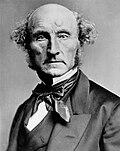
[[File:John Stuart Mill by London Stereoscopic Company, c1870.jpg|thumb|left|upright|[[John Stuart Mill]], English philosopher]] | |||
[[Immanuel Kant]] identified progress as being a movement away from [[Barbarian|barbarism]] toward [[civilization]].<ref>{{cite web |last1=Kant |first1=Immanuel |last2=Reiss |first2=Hans Siegbert |title=Kant: political writings |url=https://archive.org/details/kantpoliticalwri00kant/page/41/mode/2up |publisher=Cambridge [England]; New York: Cambridge University Press |date=1991}}</ref> 18th-century philosopher and political scientist [[Marquis de Condorcet]] predicted that political progress would involve the disappearance of [[slavery]], the rise of [[literacy]], the lessening of [[sex inequality]], [[prison reform|reform of prisons]], which at the time were harsh, and the decline of poverty.<ref>Nisbet, Robert (1980). ''History of the Idea of Progress''. New York: Basic Books. ch 5</ref> | |||
[[Modernity]] or modernisation was a key form of the idea of progress as promoted by [[classical liberals]] in the 19th and 20th centuries, who called for the rapid modernisation of the economy and society to remove the traditional hindrances to [[free market]]s and the [[Freedom of movement|free movements]] of people.<ref>{{cite book |author1=Joyce Appleby |author2=Lynn Hunt |author3=Margaret Jacob |name-list-style=amp |title=Telling the Truth about History |year=1995 |page=78 |publisher=W. W. Norton & Company |url=https://books.google.com/books?id=O0aCcnVcbZcC&pg=78|isbn=9780393078916 }}</ref> | |||
In the late 19th century, a political view rose in popularity in the [[Western world]] that progress was being stifled by vast [[economic inequality]] between the rich and the poor, minimally regulated ''[[laissez-faire]]'' capitalism with out-of-control monopolistic [[corporation]]s, intense and often violent conflict between capitalists and workers, with a need for measures to address these problems.<ref>{{cite book |title=Progressivism: A Very Short Introduction|publisher=Oxford University Press|author=Nugent, Walter|year=2010|isbn=9780195311068|page=2}}</ref> Progressivism has influenced various political movements. [[Social liberalism]] was influenced by British [[Liberalism|liberal]] philosopher [[John Stuart Mill]]'s conception of people being "progressive beings."<ref>Alan Ryan. ''The Making of Modern Liberalism''. p. 25.</ref> British Prime Minister [[Benjamin Disraeli]] developed [[progressive conservatism]] under [[One-nation conservatism|one-nation]] [[Toryism]].<ref>Patrick Dunleavy, Paul Joseph Kelly, Michael Moran. ''British Political Science: Fifty Years of Political Studies''. Oxford, England; Malden, Massachusetts: Wiley-Blackwell, 2000. pp. 107–108. {{ISBN?}}</ref><ref>Robert Blake. ''Disraeli''. Second Edition. London: Eyre & Spottiswoode (Publishers) Ltd, 1967. p. 524.{{ISBN?}}</ref> | |||
The first modern socialists of the 19th century followed [[utopian socialism]],<ref name="Markham1930">{{cite book|author=Sydney Frank Markham|title=A History of Socialism|url=https://books.google.com/books?id=tq4VAAAAMAAJ|year=1930|publisher=A. & C. Black, Limited|pages=20–21}}</ref> and experienced pushback from [[progressive socialism]]. This reformist approach was reflected in a readiness to question revolutionary tenets of Marxist orthodoxy, as well as challenges to sections of scientific socialism. G.A. Kleene, a 19th-century economist, defined progressive socialism as [[Eduard Bernstein]]'s stand against "'Old-School' [[Marxism]]."<ref>{{Cite book |title=Socialism - The Handbook Series |quote=Within the past few years, however, Marxism, as a theory and a political method, has entered upon a crisis that perhaps indicates its dissolution, while in the movement represented by Bernstein, the editor and biographer of Lassalle, but long known as a Marxist, there has come to the front a Socialism that bears closer resemblance to that of Lassalle than to that of Marx. Lassalle is not invoked as its leader; the cry ‘Back to Lassalle’ has not been raised, but there is, nevertheless, a turning from Marxian materialism to idealism, from marxian dislike of patriotism and the national spirit to an acknowledgment of the importance of national interests, from Marxian hatred of the present state to a recognition of what governments, as organized today, have done and can do for the laboring class. |author=G.A. Kleene |editor1=Edwin Clyde Robbins |date=1915 |orig-date=November, 1901 |publisher=H.W. Wilson Company |location=[[New York, NY]] |page=107 |url=https://www.google.com/books/edition/Socialism/0RANAAAAYAAJ?hl=en&gbpv=0 |access-date=2025-12-25}}</ref> Progressive socialism has historically been associated with reformist openness to question scientific socialism, such as by criticizing the [[Immiseration thesis|law of growing misery]].<ref>{{cite book |author=[[James Edward Le Rossignol]] |date=1921 |title=What is Socialism? An Explanation and Criticism of the Doctrines and Proposals of "scientific Socialism" |url=https://www.google.com/books/edition/What_is_Socialism/GjUmAAAAMAAJ?hl=en&gbpv=0 |location=[[New York, NY]] |publisher=Thomas Y. Crowley Company |quote=[[Karl Kautsky|Kautsky]] said at the Lübeck Congress of 1901: ‘Increasing misery is to be understood only as a tendency, and not as an unconditional truth.’ In reply to him, [[Eduard David|Dr. David]], a progressive socialist, said: ‘If one alters one’s opinion one should have the courage and strength to say, ‘We made a mistake.' |page=98 |access-date=December 25, 2025}}</ref> | |||
In France, the space between [[social revolution]] and the [[socially conservative]] ''laissez-faire'' [[centre-right]] was filled with the emergence of [[Radicalism (historical)|radicalism]] which thought that [[social progress]] required [[anti-clericalism]], [[humanism]], and [[republicanism]]. Especially anti-clericalism was the dominant influence on the [[centre-left]] in many French- and Romance-speaking countries until the mid-20th century. In [[Imperial Germany]], Chancellor [[Otto von Bismarck]] enacted various progressive [[social welfare]] measures out of [[paternalistic conservative]] motivations to distance workers from the [[socialist movement]] of the time and as humane ways to assist in maintaining the [[Industrial Revolution]].<ref>'' Union Contributions to Labor Welfare Policy and Practice: Past, Present, and Future''. Routledge, 16, 2013. p. 172. {{ISBN?}}</ref> | |||
In 1891, the [[Roman Catholic Church]] encyclical ''[[Rerum novarum]]'' issued by [[Pope Leo XIII]] condemned the [[exploitation of labor]] and urged support for [[labor unions]] and [[government regulation]] of businesses in the interests of [[social justice]] while upholding the [[property right]] and criticising socialism.<ref>Faith Jaycox. ''The Progressive Era''. New York: Infobase Publishing, 2005. p. 85.</ref> A progressive [[Protestant]] outlook called the [[Social Gospel]] emerged in North America that focused on challenging economic exploitation and poverty and, by the mid-1890s, was common in many Protestant theological seminaries in the United States.<ref>Charles Howard Hopkins, ''The Rise of the Social Gospel in American Protestantism, 1865–1915'' (1940). {{page needed|date=May 2022}}{{ISBN?}}</ref> | |||
=== 20th century: U.S. Progressive Era, New Deal and post-war consensus === | |||
{{main|Progressive Era|New Deal coalition}} | |||
{{see also|Progressivism in the United States}} | |||
{{multiple image | |||
| align = left | |||
| direction = horizontal | |||
| width = 130 | |||
| header = Progressive Era | |||
| image1 = Theodore Roosevelt by the Pach Bros (cropped 3x4).jpg | |||
| class1 = bg-transparent | |||
| caption1 = [[Theodore Roosevelt]], 26th [[President of the United States|U.S. President]], [[Progressive conservatism|progressive conservative]] | |||
| image2 = Thomas Woodrow Wilson, Harris & Ewing bw photo portrait, 1919 (cropped 3x4).jpg | |||
| caption2 = [[Woodrow Wilson]], 28th [[President of the United States|U.S. President]], [[Social liberalism|progressive liberal]] | |||
}} | |||
Early 20th-century progressivism included support for American engagement in [[World War I]] and the creation of and participation in the [[League of Nations]],<ref>{{cite book|date=2005|last=Freeden|first=Michael|author-link=Michael Freeden|title=Liberal Languages: Ideological Imaginations and Twentieth-Century Progressive Thought|pages=144–165|publisher=[[Princeton University Press]]|location=[[Princeton, New Jersey|Princeton]]|url=https://books.google.com/books?id=1Lpu8wwvA1AC&pg=144|isbn=9780691116778}}</ref><ref>{{cite journal |last1=Ambrosius |first1=Lloyd E. |title=Woodrow Wilson, Alliances, and the League of Nations |journal=The Journal of the Gilded Age and Progressive Era |date=April 2006 |volume=5 |issue=2 |pages=139–165 |doi=10.1017/S153778140000298X|s2cid=162853992 }}</ref> [[compulsory sterilisation]] in Scandinavia,<ref>{{cite journal|jstor=4026900|title=Geneticists and the Eugenics Movement in Scandinavia|last=Roll-Hansen|first=Nils|journal=[[The British Journal for the History of Science]]|volume=22|issue=3|pages=335–346|date=1989|doi=10.1017/S0007087400026194|pmid=11621984|s2cid=44566095}}</ref> and [[eugenics]] in Great Britain,<ref>{{cite journal |title=Retrospectives: Eugenics and Economics in the Progressive Era |journal=Journal of Economic Perspectives |year=2005 |last=Leonard |first=Thomas |volume=19 |issue=4 |pages=207–224 |doi=10.1257/089533005775196642 |url=https://www.princeton.edu/~tleonard/papers/retrospectives.pdf |access-date=2017-10-22 |url-status=live |archive-url=https://web.archive.org/web/20170820132528/https://www.princeton.edu/~tleonard/papers/retrospectives.pdf |archive-date=20 August 2017 |df=dmy-all |doi-access=free }}</ref> and the [[temperance movement]].<ref>James H. Timberlake, ''Prohibition and the Progressive Movement, 1900–1920'' (1970){{page needed|date=May 2022}}{{ISBN?}}</ref><ref>{{cite web |url=https://www.loc.gov/teachers/classroommaterials/presentationsandactivities/presentations/timeline/progress/prohib/ |title=Prohibition: A Case Study of Progressive Reform |publisher=[[Library of Congress]] |access-date=2017-10-04 }}</ref> Progressives believed that [[progress]] was stifled by [[economic inequality]], inadequately regulated [[monopolistic]] corporations, and conflict between workers and elites, arguing that corrective measures were needed.<ref>{{cite book|title=Progressivism: A Very Short Introduction|publisher=Oxford University Press|author=Nugent, Walter|year=2010|isbn=9780195311068| pages=2}}</ref> | |||
In the United States, progressivism began as an intellectual rebellion against the political philosophy of [[Constitutionalism]]<ref>{{Cite book|url=https://plato.stanford.edu/archives/spr2018/entries/constitutionalism/|title=The Stanford Encyclopedia of Philosophy|first=Wil|last=Waluchow|chapter=Constitutionalism |editor-first=Edward N.|editor-last=Zalta|date=17 August 2018|publisher=Metaphysics Research Lab, Stanford University|via=Stanford Encyclopedia of Philosophy}}</ref> as expressed by [[John Locke]] and the [[Founding Fathers of the United States|Founding Fathers of the American Republic]], whereby the authority of government depends on observing limitations on its just powers.<ref>{{cite book | last = Watson | first = Bradley | title = Progressivism : the strange history of a radical idea | page = 11 | publisher = University of Notre Dame Press | location = Notre Dame, Indiana | year = 2020 | isbn = 9780268106973 }}</ref> What began as a [[social movement]] in the 1890s grew into a popular [[political movement]] referred to as the [[Progressive Era]]; in the [[1912 United States presidential election]], all three U.S. presidential candidates claimed to be progressives. While the term ''progressivism'' represents a range of diverse [[political pressure group]]s, not always united, progressives rejected [[social Darwinism]], believing that the problems society faced, such as [[class warfare]], [[greed]], [[poverty]], [[racism]] and [[violence]], could best be addressed by providing good education, a safe environment, and an efficient workplace. Progressives lived mainly in the cities, were college educated, and believed in a strong central government.<ref>[http://www.gwu.edu/~erpapers/teachinger/glossary/progressive-era.cfm "The Progressive Era (1890–1920)"]. The Eleanor Roosevelt Papers Project. {{webarchive|url=https://web.archive.org/web/20200120210506/https://www2.gwu.edu/~erpapers/teachinger/glossary/progressive-era.cfm|date=20 January 2020}}. Retrieved 31 September 2014.</ref> President [[Theodore Roosevelt]] of the [[Republican Party (United States)|Republican Party]] and later the [[Progressive Party (United States, 1912)|Progressive Party]] declared that he "always believed that wise progressivism and wise conservatism go hand in hand."<ref>{{cite book | first=Jonathan | last=Lurie | title=William Howard Taft: The Travails of a Progressive Conservative | location=New York | publisher=Cambridge University Press | year=2012 | page=196}}</ref> | |||
President [[Woodrow Wilson]] was also a member of the American progressive movement within the [[Democratic Party (United States)|Democratic Party]]. Progressive stances have evolved. [[Imperialism]] was a controversial issue within progressivism in the late 19th and early 20th centuries, particularly in the United States, where some progressives supported [[American imperialism]] while others opposed it.<ref name="Nugent">{{cite book|title=Progressivism: A Very Short Introduction|publisher=Oxford University Press|author=Nugent, Walter|year=2010|isbn=9780195311068|pages=33}}</ref> In response to [[World War I]], President [[Woodrow Wilson]]'s [[Fourteen Points]] established the concept of national [[self-determination]] and criticised imperialist competition and colonial injustices. [[Anti-imperialists]] supported these views in areas resisting imperial rule.<ref>'' Reconsidering Woodrow Wilson: Progressivism, Internationalism, War, and Peace''. p. 309. {{ISBN?}}</ref> | |||
{{multiple image | |||
| align = right | |||
| direction = horizontal | |||
| width = 130 | |||
| header = New Deal and Post-war consensus | |||
| image1 = FDR-1944-Campaign-Portrait (3x4 retouched, cropped).jpg | |||
| class1 = bg-transparent | |||
| caption1 = [[Franklin D. Roosevelt]], 32nd [[President of the United States|U.S. President]], [[Social liberalism|progressive liberal]] | |||
| image2 = Lyndon Johnson.jpg | |||
| caption2 = [[Lyndon B. Johnson]], 36th [[President of the United States|U.S. President]], [[Social liberalism|progressive liberal]] | |||
| image3 = Rab Butler in 1963 (3x4 cropped).jpg | |||
| class3 = bg-transparent | |||
| caption3 = [[Rab Butler]], a [[Deputy Prime Minister of the United Kingdom|Deputy Prime Minister]] and [[First Secretary of State|U.K. First Secretary of State]], [[Progressive conservatism|progressive conservative]] | |||
}} | |||
During the period of acceptance of economic [[Keynesianism]] (the 1930s–1970s), there was widespread acceptance in many nations of a large role for [[state intervention]] in the economy. The "progressive" brand was frequently identified with supporters of the New Deal by the year 1936.<ref>{{cite journal |last1=Tugwell |first1=R. G. |title=The New Deal: The Progressive Tradition |journal=The Western Political Quarterly |date=September 1950 |volume=3 |issue=3 |pages=390–427 |doi=10.2307/443352|jstor=443352 }}</ref> While the more progressive [[Second New Deal]] was more controversial in the public, the progressive consensus of the New Deal was strong, and even future moderate Republican presidents like [[Dwight D. Eisenhower]] and [[Richard Nixon]] worked to preserve it. The New Deal provided the context for future expansive progressive programs, especially the [[Great Society]] measures of [[Lyndon B. Johnson|Lyndon Johnson's]] administration. With the rise of [[neoliberalism]] and challenges to state [[Interventionism (politics)|interventionist]] policies in the 1970s and 1980s, [[centre-left]] progressive movements responded by adopting the [[Third Way]], which emphasised a major role for the [[market economy]].<ref>Jane Lewis, Rebecca Surender. ''Welfare State Change: Towards a Third Way?''. [[Oxford University Press]], 2004. pp. 3–4, 16. {{ISBN?}}</ref> There have been [[social democrats]] who have called for the social-democratic movement to move past Third Way.<ref>'' After the Third Way: The Future of Social Democracy in Europe''. I.B. Taurus, 2012. p. 47. {{ISBN?}}</ref> Prominent [[Progressive conservatism|progressive conservative]] elements in the British [[Conservative Party (UK)|Conservative Party]], such as from the likes of [[Rab Butler]],<ref>{{cite book|last=Campbell|first=John|author-link = John Campbell (biographer)|year=2010|title=Pistols at Dawn: Two Hundred Years of Political Rivalry from Pitt and Fox to Blair and Brown|location= p. 255.|publisher=Vintage|isbn=978-1-845-95091-0}}</ref> promoted the [[post-war consensus]], and others have criticised neoliberalism.<ref>Hugh Bochel. ''The Conservative Party and Social Policy''. The Policy Press, 2011. p. 108. {{ISBN?}}</ref> | |||
== Into the 21st century and social democratic turn== | |||
{{see also|Social democracy#Analysis}} | |||
[[File:Progressive Alliance.svg|thumb|right|200px|[[Progressive Alliance]]]] | |||
=== International organizing === | |||
{{main|Progressive Alliance|Progressive International}} | |||
Founded in Leipzig, Germany, on May 22, 2013, the Progressive Alliance is an international political organization made up primarily of social democratic political parties and organizations.<ref>{{cite book|author=Jean-Jacques Lambin|title=Rethinking the Market Economy: New Challenges, New Ideas, New Opportunities|url=https://books.google.com/books?id=y4CEAwAAQBAJ&pg=PA269|year=2014|publisher=Palgrave Macmillan|isbn=978-1-137-39291-6|page=269}}</ref> The organization was established as a substitute for the already-existing [[Socialist International]], of which many of its constituent parties are either present or previous members.<ref>{{cite book|editor-first=Peter |editor-last=Lamb |title=Historical Dictionary of Socialism |url=https://books.google.com/books?id=vSHuCgAAQBAJ&pg=PA436|year=2015 |publisher=Rowman & Littlefield |isbn=978-1-4422-5827-3 |page=436}}</ref><ref>{{cite book|author=Talbot C. Imlay|title=The Practice of Socialist Internationalism: European Socialists and International Politics, 1914–1960|url=https://books.google.com/books?id=5fU-DwAAQBAJ&pg=PA465|year=2018|publisher=Oxford University Press|isbn=978-0-19-964104-8|page=465}}</ref><ref name="Quimpo2020">{{cite book|author=Nathan Gilbert Quimpo|chapter=The Post-war Rise and Decline of the Left|editor1= Toby Carroll|editor2=Shahar Hameiri|editor3=Lee Jones|title=The Political Economy of Southeast Asia: Politics and Uneven Development Under Hyperglobalisation|chapter-url=https://books.google.com/books?id=B1TUDwAAQBAJ&pg=PA150|year=2020|publisher= Springer Nature|isbn=978-3-03-028255-4|page=150}}</ref><ref>{{cite web|url=http://www.thelocal.de/politics/20130522-49847.html |title=Social Democrats Seek Revival on 150th b-day |publisher=The Local |date= 22 May 2013|access-date=23 May 2013}}</ref><ref>{{cite web|url=https://www.l-iz.de/politik/leipzig/2013/05/Sozialistisch-war-gestern-progressiv-ist-heute-SPD-48198 |title=Sozialistisch war gestern, progressiv ist heute: SPD lädt zur Gründung eines internationalen Parteiennetzwerkes nach Leipzig |work=Leipziger Zeitung |first=Gernot |last=Borriss |date=10 May 2013 |access-date=12 March 2021}}</ref><ref>{{cite web|author=Von Aert van Riel |url=http://www.neues-deutschland.de/artikel/820762.spd-spaltet-internationale.html |title=07.05.2013: SPD spaltet Internationale |work=Neues Deutschland |date=16 April 2013 |access-date=23 May 2013}}</ref> In January 2012, [[Sigmar Gabriel]], then chairman of the [[Social Democratic Party of Germany]] (SPD), decided to terminate the SPD's annual membership fee of £100,000 to the Socialist International. Gabriel criticized Socialist International for admitting and maintaining undemocratic political movements, leading to the establishment of the Progressive Alliance.<ref>{{Cite news|url=http://www.spiegel.de/spiegel/vorab/a-810543.html |title=SPD will Sozialistischer Internationale den Geldhahn zudrehen und den Mitgliedsbeitrag nicht zahlen |journal=Der Spiegel |date=22 January 2012 |access-date=23 May 2013}}</ref><ref>{{cite web|author=Sigmar Gabriel |url=http://www.fr-online.de/meinung/keine-kumpanei-mit-despoten,1472602,7705378.html |title=Gastbeitrag: Keine Kumpanei mit Despoten |work=Frankfurter Rundschau |language=de |date=3 February 2011 |access-date=23 May 2013}}</ref><ref name="Salm2016">{{cite book|author=Christian Salm|title=Transnational Socialist Networks in the 1970s: European Community Development Aid and Southern Enlargement|year=2016|publisher=Palgrave Macmillan UK|isbn=978-1-137-55120-7|page=xiv}}</ref> The organization has a stated goal to become the worldwide network of "the progressive, democratic, [[Social democracy|social-democratic]], [[Socialism|socialist]], and [[Labour movement|labour]] movement."<ref>{{cite web|url=http://progressive-alliance.info/basic-document/ |title=Basic document |publisher=Progressive Alliance |access-date=23 May 2013}}</ref><ref>{{Cite web|url=http://www.spd.de/scalableImageBlob/84620/data/20121217_progressive_alliance_abschlussstatement-data.pdf|title=A Progressive Network for the 21st Century|publisher=Sozialdemokratische Partei Deutschlands (SPD) |url-status=dead|archive-url=https://web.archive.org/web/20140304064047/http://www.spd.de/scalableImageBlob/84620/data/20121217_progressive_alliance_abschlussstatement-data.pdf|archive-date=4 March 2014}}</ref> | |||
{{multiple image | |||
| align = left | |||
| direction = horizontal | |||
| width = 130 | |||
| header = [[Progressive International]] | |||
| image1 = Sanders presidential campaign kickoff, May 2015 Bernie Sanders (24580227849).jpg | |||
| class1 = bg-transparent | |||
| caption1 = [[Bernie Sanders]], [[United States Senator]] from [[Vermont]] | |||
| image2 = Yanis Varoufakis at press conference, Athens 2019 3.jpg | |||
| caption2 = [[Yanis Varoufakis]], former [[Greece|Greek]] [[Ministry of National Economy and Finance (Greece)|Minister of Finance]] | |||
}} | |||
[[File:PI-Logo-Stack.svg|thumb|right|200px|[[Progressive International|PI]] logo]] | |||
In May 2020, [[Progressive International]] was formally founded and launched on 11 May 2020, responding to a 2018 open call by the Democracy in Europe Movement and the [[Sanders Institute]] for united progressive forces around the globe.<ref>{{cite web|last1=Adler|first1=David|last2=Varoufakis|first2=Yanis|author-link2=Yanis Varoufakis|date=1 December 2018|title=We shouldn't rush to save the liberal order. We should remake it.|url=https://www.theguardian.com/commentisfree/2018/dec/01/liberal-world-order-new-international-yanis-varoufakis-david-adler|access-date=2 December 2018|work=[[The Guardian]]}}</ref><ref>{{cite web|date=30 November 2018|title=An Open Call to All Progressive Forces|url=https://www.progressive-international.org/open-call/|url-status=dead|archive-url=https://web.archive.org/web/20181202003335/https://www.progressive-international.org/open-call/|archive-date=December 2, 2018|access-date=2 December 2018|website=Progressive International}}</ref><ref>{{Cite web|last=Moraga|first=Enrique Gomáriz|date=2022-02-17|title=The Progressive Internationals in Latin America|url=https://latinoamerica21.com/en/the-progressive-internationals-in-latin-america/|access-date=2024-11-05|website=Latinoamérica 21|language=en-US}}</ref> The open call was echoing two twinned appeals published in 2018 by U.S. Senator [[Bernie Sanders]] and [[Yanis Varoufakis]], who is a Greek economist and self-described [[libertarian Marxist]],<ref>{{cite web|url=https://www.ted.com/speakers/yanis_varoufakis|title=Yanis Varoufakis thinks we need a radically new way of thinking about the economy, finance and capitalism|last=Varoufakis|first=Yanis|publisher=Ted|access-date=14 April 2019|quote=Yanis Varoufakis describes himself as a "libertarian Marxist",{{nbsp}}...}}</ref> to form an international movement to combat the rise of [[Far-right politics|hard right]] [[authoritarianism]] and potential [[Neo-fascism|neofascist]] global influence represented by U.S. president [[Donald Trump]].<ref>{{cite web |last1=Varoufakis |first1=Yanis |date=November 5, 2020 |title=Progressive International: Today we began organising the world’s progressives. Join us! |url=https://www.yanisvaroufakis.eu/2020/05/11/progressive-international-today-we-began-organising-the-worlds-progressives-join-us |access-date=December 24, 2025|website=www.YanisVaroufakis.eu |language=en-US}}</ref> PI's founding was supported by a group of 40 advisors including [[Ece Temelkuran]],<ref>{{Cite web|title=Progressive International will launch to unite, organize, and mobilize progressive forces of the world|url=https://hedep.org.tr/en/the-progressive-international-will-launch-with-a-mission-to-unite-organize-and-mobilize-progressive-forces-around-the-world/14235|access-date=2024-07-30|website=hedep.org.tr|language=tr}}</ref> [[Katrín Jakobsdóttir]], [[Yanis Varoufakis]],<ref>{{Cite web|last=Varoufakis|first=Yanis|date=2020-05-11|title=Progressive International: Today we began organising the world's progressives. Join us!|url=https://www.yanisvaroufakis.eu/2020/05/11/progressive-international-today-we-began-organising-the-worlds-progressives-join-us/|access-date=2024-07-30|website=Yanis Varoufakis|language=en-GB}}</ref> [[Carola Rackete]], [[Nick Estes]], [[Vanessa Nakate]], [[Noam Chomsky]],<ref name="auto2">{{Cite web|last=Leier|first=Elizabeth|title=Introducing Progressive International—a global left-wing solidarity movement|url=https://canadiandimension.com/articles/view/introducing-progressive-internationala-global-left-wing-solidarity-movement|date=2020-09-24|access-date=2024-07-30|website=[[Canadian Dimension]]|language=en}}</ref> [[Arundhati Roy]], [[Naomi Klein]],<ref name="call">{{Cite web|date=2020-05-11|title=The Progressive International: an open call to all progressive forces|url=https://diem25.org/the-progressive-international-an-open-call-to-all-progressive-forces/|access-date=2024-07-30|website=[[Democracy in Europe Movement 2025|DiEM25]]|language=en-GB}}</ref> [[Niki Ashton]],<ref name="auto2"/> [[Rafael Correa]], [[Fernando Haddad]], [[Celso Amorim]], and [[Álvaro García Linera|Alvaro Garcia Linera]].<ref name="p4">{{Cite web|title=The Progressive International: Leadership|last=Stilson|first=Robert|url=https://capitalresearch.org/article/the-progressive-international-part-4/|access-date=2024-11-05|website=[[Capital Research Center]]}}</ref> PI seeks to combat [[authoritarian]] [[nationalism]] around the world and is opposed to what it describes as [[disaster capitalism]].<ref>{{Cite web|title=Announcing the Progressive International|url=https://www.opendemocracy.net/en/oureconomy/announcing-progressive-international/|last=Adler|first=David|website=[[openDemocracy]]|language=en|access-date=14 May 2020}}</ref> | |||
=== Europe === | |||
{{main|Blairism|Labour Party leadership of Jeremy Corbyn}} | |||
[[File: | ==== United Kingdom ==== | ||
[[File:Green Party protestors 2011.jpg|thumb|left|250px|[[Green Party (UK)|Greens]] taking part in the 2011 London anti-cuts protest in the [[United Kingdom]]]] | |||
20th century progressivism in the [[United Kingdom]] highlights enduring tension and [[Political faction|factionalism]] between more avowedly left-wing progressives and those who incorporate more [[Syncretism|syncretic]] politics into their progressivism. Groups like the [[Institute for Public Policy Research]], the [[Fabian Society]], and [[Progressive Britain]] are organizations represent a wide variety of U.K. progressive thought. Progressivism in the United Kingdom has seen shifts from [[New Labour]]'s early dominance to the rise of [[cultural liberalism]], environmentalism from the [[Green Party of England and Wales|Green Party]], and grassroots movements with a variety of focuses, including [[Palestinian nationalism|pro-Palestine]] [[Anti-war movement|anti-war]] causes, [[radical democracy]], and [[universal basic income]].<ref>{{Cite news |last=Ay |first=Adem |date=October 24, 2025 |title=Inside the fight for radical democracy in Britain’s new left party |work=Waging Nonviolence |url=https://wagingnonviolence.org/2025/10/inside-fight-assemble-your-party-britain-new-left-party |url-status=live}}</ref><ref>{{Cite news |last=Kellner |first=Peter |date=January 9, 2025 |title=How progressive is the British public? |work=[[Prospect (magazine)|Prospect]] |url=https://www.prospectmagazine.co.uk/politics/68999/how-progressive-is-the-british-public |url-status=live}}</ref><ref>{{Cite news |last=Carnegie |first=Megan |date=August 8, 2022 |title=Gen Z: How young people are changing activism |work=[[BBC]] |url=https://www.bbc.com/worklife/article/20220803-gen-z-how-young-people-are-changing-activism |url-status=live}}</ref> [[Tony Blair]]'s government represented a significant period of progressive growth, although his politics were more centrist than previous progressive movements that leaned further left, and his government faced criticisms for its [[Third Way]] market-oriented policies and emphasis on deregulation.<ref>{{cite book |last=Giddens |first=Anthony |author-link=Anthony Giddens |title=The Third Way: The Renewal of Social Democracy |publisher=[[Polity Press]] |year=1998 |pages=148–149 |isbn=978-0745622675}}</ref> The [[Blairism|Blairite]] consensus was dominant within U.K. progressivism from the mid-1990s and through the end of Blair’s premiership, which ended in 2007. [[New Labour]] continued to evolve with the subsequent Labour leadership of [[Gordon Brown]] and was formally abandoned by his successor, [[Ed Miliband]], for [[One Nation Labour]] in 2010.<ref>{{cite web |url=https://www.institutmontaigne.org/en/expressions/kinship-daggers-drawn-tony-blair-and-gordon-brown |date=May 7, 2022 |last1= Murphy |first1= Colm |title=Kinship to Daggers Drawn: Tony Blair and Gordon Brown |quote=As the New Labour era progressed, it became clear that Blair and Brown had different understandings of what they thought "modernization" should mean. Blair latched onto controversial public service reforms that, he believed, would 'break up the monoliths' and empower the individual. He attempted to introduce market mechanisms, internal competition, and autonomy from Westminster into public services, exemplified in the creation of 'foundation hospitals' and the introduction of university tuition fees. Brown, meanwhile, was warier of marketizing reforms and less likely than Blair to assume that private was better than public. |work=[[Institut Montaigne]]|access-date=January 12, 2026 |url-status=live}}</ref><ref name="Dunt">{{cite web|last=Dunt|first=Ian|url=http://www.politics.co.uk/features/opinion-former-index/legal-and-constitutional/comment-ed-miliband-is-more-dangerous-than-they-think-$21384250.htm|title=Ed Miliband is more dangerous than they think |publisher=Politics|date=25 September 2010|access-date=15 July 2011|archive-date=28 September 2010|archive-url=https://web.archive.org/web/20100928111107/http://www.politics.co.uk/features/opinion-former-index/legal-and-constitutional/comment-ed-miliband-is-more-dangerous-than-they-think-$21384250.htm|url-status=live}}</ref> | |||
[[File:Launching the 2019 General Election campaign (49013243026).jpg|thumb|right|250px|[[Jeremy Corbyn]] (right), [[Leader of the Labour Party (UK)|U.K. Labour]] leader from 2015 to 2020, and [[Keir Starmer]] (left), [[Prime Minister of the United Kingdom|U.K. Prime Minister]] since July 5, 2024]] | |||
[[Jeremy Corbyn]] represented a staunch return of the Labour party platform to [[History of the Labour Party (UK)#Moving left in 1930s|its more historic democratic socialism]] with a focus on [[nationalization]],<ref>{{Cite news |date=August 11, 2015 |title=Jeremy Corbyn backs greater public ownership for Labour |work=[[BBC]] |url=https://www.bbc.com/news/uk-politics-33839819 |url-status=live}}</ref> robust public spending,<ref>{{Cite news |date=March 27, 2020 |title=Coronavirus: Jeremy Corbyn says he was proved 'right' on public spending |work=[[BBC]] |url=https://www.bbc.com/news/uk-politics-52048213 |url-status=live}}</ref> and both anti-austerity and anti-war stances.<ref>{{Cite news |date=September 14, 2015 |last1=Goodman |first1=Amy |title=In Upset, Socialist Jeremy Corbyn Elected as U.K. Labour Leader on Antiwar, Pro-Refugee Platform |work=[[Democracy Now!|Democracy Now]] |url= https://www.democracynow.org/2015/9/14/in_upset_socialist_jeremy_corbyn_elected |url-status=live}}</ref> Corbyn appealed to a progressive left base disillusioned with previous Labour governments, but he was a controversial figure in the party who oscillated between a loyal base of support and electability concerns.<ref>{{Cite news |date=June 27, 2016 |last1=Frances |first1=Ryan |title=Whether Jeremy Corbyn goes or not, Britain’s progressives need to stick together |quote=‘I’d leave if Corbyn’s ousted,’ is currently a common statement on social media. ‘If Corbyn goes, it’s all gone,’ a friend told me (perhaps as a symbol of Labour’s problem, I’ve also had friends tell me that they’ll leave the party if Corbyn stays). Even before the events of the past 24 hours – indeed, straight after the referendum result – there were Labour members announcing similar intentions. As one signatory on the petition of confidence in Corbyn put it: ‘Force him out and I will personally organise a burning of membership cards outside [Labour] HQ.’ |work=[[The Guardian]] |url= https://www.theguardian.com/commentisfree/2016/jun/27/jeremy-corbyn-britain-labour-hard-right |url-status=live}}</ref> Subsequent leader and eventual prime minister [[Keir Starmer]] shifted Labour toward pragmatic, economically cautious centrism, striving for electability by striking a balance between broad public appeal, traditional Labour beliefs, and Starmer's own conviction that economic changes made previous more left-wing economic positions untenable.<ref>{{cite news |date=9 February 2024 |title=Keir Starmer: The politics of a U-turn |url=https://www.bbc.co.uk/news/uk-politics-68247994 |access-date=25 September 2024 |work=BBC News |language=en-GB}}</ref><ref>{{cite web |date=8 February 2024 |title=All Keir Starmer's Labour U-turns in one place |url=https://www.politico.eu/article/keir-starmer-labour-party-uk-election-u-turns/ |access-date=25 September 2024 |website=POLITICO |language=en-GB}}</ref><ref>{{cite web |last=Barradale |first=Greg |date=16 May 2024 |title=All of Keir Starmer's screeching U-turns and abandoned policy pledges |url=https://www.bigissue.com/news/politics/keir-starmer-broken-promises-tuition-fees-nationalisation-u-turn/ |access-date=25 September 2024 |website=Big Issue |language=en-US}}</ref><ref>{{cite web |date=2 May 2023 |title=How many of Sir Keir Starmer's 10 pledges still stand? |url=https://www.independent.co.uk/news/uk/rachel-reeves-jonathan-ashworth-lisa-nandy-steve-reed-government-b2330892.html |access-date=25 September 2024 |website=The Independent}}</ref> The animosity between Corbyn and Starmer intensified with [[Antisemitism in the British Labour Party#2020|Starmer's suspension of Corbyn from Labour in 2020, accusing Corbyn of an inadequate response to antisemitism]]. Corbyn was supported against these accusations by [[Progressive International]].<ref>{{cite web |url=https://progressive.international/wire/2020-10-31-we-stand-with-jeremy-corbyn/en |date=March 28, 2023 |author=[[Progressive International]] |title=We Stand with Jeremy Corbyn |work=[[Progressive International]] |access-date=January 12, 2026 |url-status=live}}</ref> Starmer said in 2023 that "the very best of progressive politics is found in our determination to push Britain forward," but "there are precious things – in our way of life, in our environment, in our communities – that it is our responsibility to protect and preserve and to pass on to future generations. If that sounds [[Conservative Party (UK)|Conservative]], then let me tell you: I don't care."<ref>{{cite web |last=Duggan |first=Joe |date=13 May 2023 |title='I don't care' if Labour's priorities sound conservative, says Keir Starmer |url=https://inews.co.uk/news/keir-starmer-dont-care-labours-priorities-conservative-2338849 |url-status=live |archive-url=https://web.archive.org/web/20230515165512/https://inews.co.uk/news/keir-starmer-dont-care-labours-priorities-conservative-2338849 |archive-date=15 May 2023 |access-date=17 June 2024 |work=[[The Independent]]}}</ref> Corbyn supported the foundation of the socialist [[Your Party (UK)|Your Party]] in 2025 with [[Zarah Sultana]] in a further schism for U.K. left-leaning progressive politics. Facing challenges from [[Brexit]] and [[Right-wing populism#United Kingdom|increased right-wing presence]], contemporary progressivism in the United Kingdom can be characterized by increasing cultural liberalism<ref>{{cite web|last1=Butler|first1=Patrick|date=September 21, 2023|title=Britain is much more liberal-minded than it was 40 years ago, study finds|url=https://www.theguardian.com/society/2023/sep/21/britain-is-much-more-liberal-minded-than-is-was-40-years-ago-study-finds|access-date=January 12, 2026|work=[[The Guardian]]}}</ref> and factionalism surrounding the role of capitalism in society. | |||
=== Latin America === | |||
{{main|Lulism|Kirchnerism|Presidency of Andrés Manuel López Obrador| Morena (political party)}} | |||
==== Argentina ==== | |||
[[File:Nestor y Cristina at Luna Park 2010.jpg|thumb|right|200px|[[Néstor Kirchner]], 55th [[President of Argentina]], and [[Cristina Fernández de Kirchner]], 56th President, in September of 2010–one of their last public appearances before Néstor's death]] | |||
[[Kirchnerism]] in [[Argentina]] refers to the political strategies of [[Néstor Kirchner]] and [[Cristina Fernández de Kirchner]], who were successive [[Presidents of Argentina]]. In favor of his wife, Néstor Kirchner chose not to run for reelection in 2007 after taking office on May 25, 2003. After [[Isabel Perón]], Cristina Fernández de Kirchner was the first woman to be elected directly to the presidency of Argentina. Cristina Kirchner has led the [[Justicialist Party]] since 2024.<ref name="telamcfk">{{cite web|url=https://buenosairesherald.com/politics/justicialista-party-declares-cristina-kirchner-party-president|work=[[Buenos Aires Herald]]|title=Justicialista Party declares Cristina Kirchner party president|date=7 November 2024|access-date=7 November 2024}}</ref><ref>{{cite news |date=5 November 2024 |title=La Junta Electoral del PJ proclamó a Cristina como presidenta y asumirá el 17 de noviembre |url=https://www.lapoliticaonline.com/politica/la-junta-electoral-del-pj-proclamo-a-cristina-como-presidenta-y-asumira-el-17-de-noviembre |language=es |work=La Política Online |access-date=14 November 2024}}</ref> Kirchnerist policies are labeled [[Peronist]], progressive, and left-wing.<ref>{{cite news |date=18 April 2006 |title=Analysis: Latin America's new left axis |url=https://news.bbc.co.uk/2/hi/americas/4916270.stm |archive-url=https://web.archive.org/web/20131104093446/http://news.bbc.co.uk/2/hi/americas/4916270.stm |archive-date=4 November 2013 |url-status=live |access-date=13 February 2021}}</ref> Social services were sponsored by Kirchnerist administrations, which were perceived as blatantly anti-neoliberal. Some political scientists propose the term "Pink Tide neopopulism" to characterize movements that are regarded as a response and a counter to neoliberalism. This is in contrast to the neoliberal populism that was prevalent in the 1990s. Kirchnerism is seen as a response and a counter to neoliberalism.<ref>{{cite book |title=A Post-Neoliberal Era in Latin America? Revisiting Cultural Paradigms |first1=Daniel |last1=Nehring |first2=Magdalena |last2=López |first3=Gerardo Gómez |last3=Michel |year=2019 |publisher=Bristol University Press |isbn=978-1-5292-0131-4 |page=7}}</ref> Healthcare and income transfers were greatly increased, most notably by giving 15 million people—roughly 41% of the country's total population—free prescription drugs.<ref>{{cite thesis |url=https://services.phaidra.univie.ac.at/api/object/o:1391441/get |title=The Pink Tide and the Left Behind: The Rise and Fall of the Latin American Left |location=Vienna |year=2020 |first=Giovanni |last=Grisendi |degree=Master of Advanced International Studies (M.A.I.S.) |publisher=University of Vienna |pages=42-62}}</ref> Kirchnerists also adopted the traditional Peronist strategy of endorsing wage hikes and participating in labor battles. Argentina's period without widespread strikes during the Kirchnerist governments was only surpassed by the 1946–1955 era of Perón’s government.<ref>{{cite book |url=https://eva.fcs.udelar.edu.uy/pluginfile.php/88730/mod_resource/content/0/Silva%20y%20Rossi.2018.pdf |title=Reshaping the Political Arena in Latin America: From Resisting Neoliberalism to the Second Incorporation |editor1=John Charles Chasteen |editor2=Catherine M. Conaghan |editor3=Eduardo Silva |editor4=Federico M. Rossi |publisher=University of Pittsburgh Press |year=2018 |pages=197–198 |isbn=978-0-8229-6512-1}}</ref> | |||
=== | ==== Brazil ==== | ||
[[File: | [[File:02.06.2023 - Cerimônia de inauguração do Bloco Zeta da UFABC (52946826457).jpg|thumb|left|200px|[[Luiz Inácio Lula da Silva]], 35th and 39th [[President of Brazil]], taking pictures with supporters at [[São Bernardo do Campo]]]] | ||
[[Lulism]] in [[Brazil]] demonstrates the broad [[coalition]]al and [[Reformism|reformist]] nature of contemporary progressivism. [[Luiz Inácio Lula da Silva|Luiz Inácio Lula da Silva's]] [[Lula da Silva 2022 presidential campaign|2022 presidential comeback campaign]] was a progressive resurgence narrative focused on the working class and [[anti-corruption]], running against incumbent [[Right-wing populism|right-wing populist]] President [[Jair Bolsonaro]].<ref name="Valor2021-05-20a">{{cite web|url=https://valorinveste.globo.com/mercados/brasil-e-politica/noticia/2021/05/20/lula-reitera-candidatura-presidencial-contra-bolsonaro-em-2022.ghtml|author=Cristiane Agostine|title=Lula reitera candidatura presidencial contra Bolsonaro em 2022|website=Valor|date=20 May 2021|access-date=5 August 2021|archive-date=5 August 2021|archive-url=https://web.archive.org/web/20210805163619/https://valorinveste.globo.com/mercados/brasil-e-politica/noticia/2021/05/20/lula-reitera-candidatura-presidencial-contra-bolsonaro-em-2022.ghtml|url-status=live}}</ref><ref name="AmQuarterly2021-07-07a">{{cite web|url=https://www.americasquarterly.org/article/lula-is-back-but-which-lula|title=Lula Is Back. But Which Lula?|website=Americas Quarterly|date=7 July 2021|access-date=5 August 2021|archive-date=5 August 2021|archive-url=https://web.archive.org/web/20210805163623/https://www.americasquarterly.org/article/lula-is-back-but-which-lula/|url-status=live}}</ref><ref name="Guardian2021-07-30a">{{cite web|url=https://www.theguardian.com/world/2021/jul/30/lula-2022-brazil-poised-for-sensational-political-comeback|title=Lula 2022? Brazil poised for sensational political comeback|website=The Guardian|date=30 July 2021|access-date=5 August 2021|archive-date=5 August 2021|archive-url=https://web.archive.org/web/20210805163617/https://www.theguardian.com/world/2021/jul/30/lula-2022-brazil-poised-for-sensational-political-comeback|url-status=live|quote=With former president's political rights restored, polls suggest he would thrash Jair Bolsonaro if he stands for election}}</ref> Lula was 17% ahead of Bolsonaro in a poll in January 2022 in what was seen as an early sign of shifting progressive sentiment in the voting population against [[Far-right politics in Brazil|far-right politics of the Bolsonaro government.]]<ref name="Nasdaq2022-01-14a">{{cite web|author=Anthony Boadle|agency=Reuters|title=Brazil poll shows Lula gaining over Bolsonaro, third candidate 'embryonic'|url=https://www.nasdaq.com/articles/brazil-poll-shows-lula-gaining-over-bolsonaro-third-candidate-embryonic|publisher=[[Nasdaq]]|access-date=19 January 2022|date=18 January 2022|quote=Brazil's former leftist President Luiz Inacio Lula da Silva increased his lead to 17 percentage points over far-right President Jair Bolsonaro in a new survey of voter preferences ahead of an October election.|archive-date=13 July 2022|archive-url=https://web.archive.org/web/20220713085825/https://www.nasdaq.com/articles/brazil-poll-shows-lula-gaining-over-bolsonaro-third-candidate-embryonic|url-status=live}}</ref> In the first round of the presidential election, Lula was in first place with 48% of the electorate, qualifying for the second round with Bolsonaro, who received 43% of the votes. Lula was elected in the second round on 30 October with 50.89% of the vote, the smallest margin in the history of Brazil's presidential elections.<ref>{{Cite web|url=https://english.elpais.com/international/2022-10-31/lula-defeats-bolsonaro-in-the-closest-election-in-brazils-history.html|title=Lula defeats Bolsonaro in the closest election in Brazil's history|first=Naiara Galarraga|last=Gortázar|date=31 October 2022|website=EL PAÍS English|access-date=27 February 2024|archive-date=7 September 2024|archive-url=https://web.archive.org/web/20240907112952/https://english.elpais.com/international/2022-10-31/lula-defeats-bolsonaro-in-the-closest-election-in-brazils-history.html|url-status=live}}</ref><ref>{{Cite web|url=https://spec.hamilton.edu/brazilian-democracy-is-in-danger-aca8036f9cc1|title=Brazilian democracy is in danger|date=3 November 2022|website=Medium|access-date=27 February 2024|archive-date=7 September 2024|archive-url=https://web.archive.org/web/20240907112954/https://spec.hamilton.edu/brazilian-democracy-is-in-danger-aca8036f9cc1?gi=2d9985d8b534|url-status=live}}</ref> Lulism features an overlaps in political parties, including the Workers' Party founded by Lula.<ref>{{cite web|url=http://www.sul21.com.br/jornal/em-30-anos-de-pt-lula-se-tornou-maior-do-que-o-partido/|title=Em 30 anos de PT, Lula se tornou maior do que o partido|last=Duarte|first=Rachel|publisher=Sul 21|language=Portuguese|date=7 October 2010|access-date=24 October 2010|archive-date=16 January 2023|archive-url=https://web.archive.org/web/20230116081525/https://www.sul21.com.br/jornal/em-30-anos-de-pt-lula-se-tornou-maior-do-que-o-partido/|url-status=dead}}</ref> While seeing a [[Democratic socialism|democratic socialist]] society as the ultimate goal, Lula has called for a [[Reformism|reformist]] "[[social liberal]]" approach to begin resolving [[Income inequality in Brazil|poverty gap]] while acknowledging the reality of existing market structures.<ref>{{cite book|editor=Alejandro M. Peña |title=Transnational Governance and South American Politics: The Political Economy of Norms |url=https://books.google.com/books?id=M990DQAAQBAJ&pg=PA240 |quote= In this manner, while the social liberalism of Lulismo favored the agenda of the local actors advancing sustainability and CSR projects in Brazil, and further tilted the discursive field in favor of the transnational sustainability ... |date=2016 |page=240 |publisher=[[Springer Science+Business Media|Springer]]|isbn=9781137538635 }}</ref><ref>{{cite book|editor=Richard Sandbrook |title=Reinventing the Left in the Global South: The Politics of the Possible |quote= ... President Luiz Inácio (Lula) de Silva during his first term (2003–6) followed social-liberal policies ... |date=2014 |page=155 |publisher=Cambridge University Press }}</ref><ref name="Boadle">{{Cite news |last=Boadle |first=Anthony |date=31 October 2022 |title=Brazil leftist Lula wins third presidential term to redeem tarnished legacy |work=Reuters |url=https://www.reuters.com/world/americas/brazil-leftist-lula-wins-third-presidential-term-redeem-tarnished-legacy-2022-10-31/ |access-date=1 November 2022 |archive-date=2 November 2022 |archive-url=https://web.archive.org/web/20221102070459/https://www.reuters.com/world/americas/brazil-leftist-lula-wins-third-presidential-term-redeem-tarnished-legacy-2022-10-31/ |url-status=live}}</ref> | |||
[[File: | ==== Mexico ==== | ||
[[File:Ciudad segura CSP 03.jpg|thumb|right|300px|[[Andrés Manuel López Obrador]] (right), 65th [[President of Mexico]], and [[Claudia Sheinbaum]] (left), then [[List of heads of government of Mexico City|Head of Government of Mexico City]] and eventual 66th Mexican president, in June 2019]] | |||
Described as a [[Social democracy|social democratic]] progressive and [[Left-wing populism|left-wing populist]],<ref>{{Cite web|title=Lopez Obrador Progressive|url=https://alborada.net/lopez-obrador-mexico-election-left/|website=Apboroda|access-date=20 May 2020|archive-date=25 September 2020|archive-url=https://web.archive.org/web/20200925225120/https://alborada.net/lopez-obrador-mexico-election-left/|url-status=live}}</ref> [[Andrés Manuel López Obrador]], or AMLO, was a national politician for over three decades, and ultimately elected [[President of Mexico]] [[2018 Mexican general election|following a 2018 landslide victory]].<ref name="economistPopulist">{{cite news|title=Mexico's populist would-be president|url=https://www.economist.com/news/americas/21718906-mexico-city-we-have-problem-mexicos-populist-would-be-president|newspaper=[[The Economist]]|date=16 March 2017|access-date=5 April 2018|quote=A figure of national consequence for more than 20 years...|language=en|archive-date=12 August 2017|archive-url=https://web.archive.org/web/20170812070614/https://www.economist.com/news/americas/21718906-mexico-city-we-have-problem-mexicos-populist-would-be-president|url-status=live}}</ref> López Obrador has been characterized as the "ideological twin" of Bernie Sanders and Jeremy Corbyn, and Corbyn invited López Obrador to the [[Parliament of the United Kingdom]].<ref>{{cite web|url=http://www.excelsior.com.mx/nacional/2017/09/06/1186639|title=AMLO se reúne con Jeremy Corbin en el parlamento inglés|work=Excélsior |date=6 September 2017|access-date=21 May 2018|archive-date=22 May 2018|archive-url=https://web.archive.org/web/20180522042003/http://www.excelsior.com.mx/nacional/2017/09/06/1186639|url-status=live}}</ref><ref>{{cite news|url=https://www.thetimes.com/article/corbyns-twin-lopez-obrador-for-power-in-mexico-zfl7ppwnm|title='Corbyn's twin' Lopez Obrador poised for power in Mexico|author=Matthew Campbell|date=13 May 2018|via=www.thetimes.co.uk|access-date=21 May 2018|archive-date=22 May 2018|archive-url=https://web.archive.org/web/20180522042543/https://www.thetimes.co.uk/article/corbyns-twin-lopez-obrador-for-power-in-mexico-zfl7ppwnm|url-status=live}}</ref><ref>{{cite web|url=https://www.theguardian.com/world/2018/may/07/who-is-amlo-mexico-andres-manuel-lopez-obrador-election|title='Amlo': the veteran leftwinger who could be Mexico's next president|first1=David|last1=Agren|first2=Tom|last2=Phillips|date=7 May 2018|website=[[The Guardian]]|access-date=21 May 2018|archive-date=21 May 2018|archive-url=https://web.archive.org/web/20180521172040/https://www.theguardian.com/world/2018/may/07/who-is-amlo-mexico-andres-manuel-lopez-obrador-election|url-status=live}}</ref><ref>{{cite web|url=https://www.theguardian.com/world/2017/jun/25/jeremy-corbyn-wife-laura-alvarez-mexico-uk-relations|title=Corbyn surge raises hopes that Mexico might soon have a friend in No 10|first=Duncan|last=Tucker|date=25 June 2017|website=[[The Guardian]]|access-date=21 May 2018|archive-date=25 June 2017|archive-url=https://web.archive.org/web/20170625092530/https://www.theguardian.com/world/2017/jun/25/jeremy-corbyn-wife-laura-alvarez-mexico-uk-relations|url-status=live}}</ref> After winning the 2019 election in Argentina, López Obrador formed a "progressive alliance"<ref name=FernandezAMLO>{{cite news |last1=Manetto |first1=Francesco |title=México y Argentina sellan un nuevo eje progresista en América Latina |trans-title=Mexico and Argentina seal a new progressive axis in Latin America |url=https://elpais.com/mexico/2021-02-24/mexico-y-argentina-sellan-un-nuevo-eje-progresista-en-america-latina.html |access-date=25 January 2022 |work=[[El País]] |date=23 February 2021 |language=es |archive-date=25 January 2022 |archive-url=https://web.archive.org/web/20220125124039/https://elpais.com/mexico/2021-02-24/mexico-y-argentina-sellan-un-nuevo-eje-progresista-en-america-latina.html |url-status=live }}</ref> with President [[Alberto Fernández]], as reported by ''[[El País]]'', marking one of López Obrador's first official trips abroad to Mexico.<ref name=FernandezAMLO/> During [[Presidency of Andrés Manuel López Obrador|his presidency]], López Obrador commenced a number of progressive social reforms and encouraged public investment in industries that had been liberalized by earlier administrations. His supporters commended him for reorienting the nation's neoliberal consensus toward bettering the working class's situation and for fostering institutional rejuvenation following decades of extreme inequality and corruption.<ref>{{Cite news|last=Romero|first=Luis Gómez|orig-date=February 8, 2019|title=López Obrador Takes on Corruption and Poverty in Mexico Through Austerity|url=https://psmag.com/economics/combatting-corruption-in-mexico-through-austerity|date=2019-02-08|access-date=2022-02-19|website=Pacific Standard|language=en|archive-date=19 February 2022|archive-url=https://web.archive.org/web/20220219223937/https://psmag.com/economics/combatting-corruption-in-mexico-through-austerity|url-status=live}}</ref> While credited and praised by supporters for progressive reforms, López Obrador has also received criticism for [[Illiberal democracy|illiberality]] and contributing to [[democratic backsliding]].<ref>{{Cite web |last=García Magos |first=Alejandro |date=May 26, 2023 |title=Democratic backsliding in Mexico: Lessons for opponents of authoritarian populism |url=https://www.wilsoncenter.org/article/democratic-backsliding-mexico-lessons-opponents-authoritarian-populism |work=[[Wilson Center]] |access-date=August 31, 2025}}</ref><ref>{{Cite web |last1=Berg |first1=Ryan C. |last2=Moraveg |first2=Leonardo |date=May 31, 2024 |title=An Uncertain Future: Democratic Backsliding through Executive Aggrandizement under AMLO |url=https://www.csis.org/analysis/uncertain-future-democratic-backsliding-through-executive-aggrandizement-under-amlo |work=[[Center for Strategic and International Studies]] |access-date=August 31, 2025}}</ref> | |||
One of López Obrador's first measures was to raise the minimum wage from MXN $88.36 to MXN $102.68, representing a 16.2% increase—the biggest since 1996. This revision had an immediate impact on average worker salaries, which increased by 5.7%.<ref>{{Cite web |last=Forbes |first=Invitado |date=2019-07-16 |title=El aumento al salario mínimo que realizó AMLO desmiente varios mitos |url=https://www.forbes.com.mx/el-aumento-al-salario-minimo-que-realizo-amlo-desmiente-varios-mitos/#:~:text=Tomando%20en%20cuenta%20el%20MIR,se%20duplic%C3%B3%20a%20176.72%20pesos. |access-date=2024-08-28 |website=Forbes México |language=es}}</ref> López Obrador executed his promised "Republican Austerity" upon taking office as well, which aimed to cut spending on political privileges and non-essential government products and services.<ref>{{Cite journal |last=Casas |first=Jesús Rivero |date=2019 |title=La política de austeridad como instrumento para el bienestar y el crecimiento económico en el gobierno de la "cuarta transformación": lógica y problemas de implementación |url=https://www.redalyc.org/journal/5696/569660565002/html/ |journal=Buen Gobierno |language=es |issue=27 |pages=1–18}}</ref> He canceled presidential pensions and imposed a pay cap for government personnel, ensuring that no one could earn more than the president.<ref>{{Cite web |last=Staff |first=Forbes |date=2018-11-05 |title=Ahora sí: ley pone fin a pensiones de expresidentes y recorta salarios |url=https://www.forbes.com.mx/ahora-si-adios-a-las-pensiones-de-expresidentes-y-recorte-a-altos-salarios-de-funcionarios/ |access-date=2024-08-28 |website=Forbes México |language=es}}</ref> López Obrador reduced his own compensation by 60% and chose not to live in [[Los Pinos]], the expensive presidential complex with upkeep costs totaling around MXN $30 billion over the last two administrations.<ref>{{Cite web |date=2018-12-01 |title=La buena vida de Calderón y Peña en Los Pinos le costó a mexicanos más de 30 mil millones de pesos |url=https://www.sinembargo.mx/30-11-2018/3504880 |access-date=2024-08-27 |website=SinEmbargo MX |language=es}}</ref><ref>{{Cite news |last=Sieff |first=Kevin |date=2018-12-02 |title=Mexico’s president has turned the presidential mansion into a museum |url=https://www.washingtonpost.com/world/2018/12/01/mexicos-president-has-turned-presidential-mansion-into-museum/ |access-date=2024-08-27 |work=Washington Post |language=en-US |issn=0190-8286}}</ref> López Obrador auctioned away several government planes and helicopters<ref>{{Cite web |date=2021-03-05 |title=Esta es la lujosa flota de aeronaves del Gobierno que puso en venta AMLO |url=https://www.infobae.com/america/mexico/2021/03/05/esta-es-la-lujosa-flota-de-aeronaves-del-gobierno-que-puso-en-venta-amlo/ |access-date=2024-08-28 |website=infobae |language=es-ES}}</ref> including the presidential plane "José María Morelos y Pavón",<ref>{{Cite web |date=2018-12-03 |title=Comienza el proceso de venta del avión presidencial de México |url=https://www.france24.com/es/20181203-venta-avion-presidencial-mexico-amlo |access-date=2024-08-27 |website=France 24}}</ref> for roughly MXN $1.658 billion.<ref>{{Cite web |last=Arista |first=Lidia |date=2023-04-21 |title=Avión presidencial tiene nuevo dueño; México celebra contrato con Tayikistán |url=https://politica.expansion.mx/presidencia/2023/04/20/amlo-informa-la-venta-del-avion-presidencial |access-date=2024-08-27 |website=ADNPolítico |language=es}}</ref> The auction revenues supported hospitals in Tlapa, Guerrero, and [[Tuxtepec, Oaxaca]].<ref>{{Cite web |last=Soto |first=Dulce |date=2023-12-01 |title=El Gobierno de AMLO construye apenas dos hospitales con el dinero del avión presidencial |url=https://politica.expansion.mx/mexico/2023/11/30/amlo-construye-apenas-dos-hospitales-avion-presidencial |access-date=2024-08-27 |website=ADNPolítico |language=es}}</ref> | |||
In the 21st century, progressives continue to favor [[public policy]] that they theorize will reduce or lessen the harmful effects of [[economic inequality]] | The AMLO presidency also aimed to streamline the bureaucratic structure of the Mexican government, which López Obrador characterized as benefiting elites and mismanaging public finances.<ref name=":3">{{Cite web |title=How Morena Turned Anti-Corruption Politics Into Class Politics |url=https://jacobin.com/2024/06/morena-amlo-anti-corruption-class-politics |access-date=2024-08-28 |website=jacobin.com |language=en-US}}</ref> The AMLO budgets often included spending cuts to various government agencies, including prosecutors and the public health system, leading to layoffs, salary reductions, and poorer services.<ref>{{Cite web |last=Moy |first=Valeria |last2= |date=2019-05-29 |title=AMLO’s False Sense of Austerity |url=https://www.americasquarterly.org/article/amlos-false-sense-of-austerity/ |access-date=2024-08-28 |website=Americas Quarterly |language=en-US}}</ref><ref>{{Cite news |last=Sheridan |first=Mary Beth |date=2019-07-15 |title=López Obrador’s cost-cutting spree is transforming Mexico — and drawing blowback from bureaucrats |url=https://www.washingtonpost.com/world/the_americas/lopez-obradors-cost-cutting-spree-is-transforming-mexico--and-drawing-blowback-from-bureaucrats/2019/07/14/5e187b5e-66c2-11e9-a698-2a8f808c9cfb_story.html |access-date=2024-08-28 |work=Washington Post |language=en-US |issn=0190-8286}}</ref> To centralize operations and address the reduced workforce, López Obrador often utilized the military for infrastructure projects.<ref name=":3" /><ref>{{Cite web |date=2021-11-10 |title=Cómo la austeridad y la militarización están desmantelando la administración pública en México |url=https://redaccion.nexos.com.mx/como-la-austeridad-y-la-militarizacion-estan-desmantelando-la-administracion-publica-en-mexico/ |access-date=2024-08-28 |website=redaccion.nexos.com.mx |language=es}}</ref> López Obrador called for the removal of independent government bodies in February 2024, saying that they duplicated the work of some cabinet ministries, suggesting that their duties be taken over by the Mexican cabinet to save funds and promote government efficiency.<ref>{{Cite web |date=2024-07-30 |title=Dictamen del ‘Plan C’: ¿qué órganos autónomos propone eliminar Morena y cómo lo justifica? |url=https://animalpolitico.com/verificacion-de-hechos/te-explico/dictamen-eliminar-organos-autonomos |access-date=2024-08-28 |website=Animal Politico |language=en}}</ref><ref>{{Cite web |last=Carrasco |first=Por Carolina |date=2024-08-24 |title=Estos son los 7 órganos autónomos que desaparecen con reforma propuesta por AMLO y las Secretarías que absorberán sus funciones |url=https://www.infobae.com/mexico/2024/08/24/estos-son-los-7-organos-autonomos-que-desaparecen-con-reforma-propuesta-por-amlo-y-las-secretarias-que-absorberan-sus-funciones/ |access-date=2024-08-28 |website=infobae |language=es-ES}}</ref> The proposal faced widespread condemnation, including from opposition members who criticized it as retribution against autonomous agencies.<ref>{{Cite web |title=Avanza en Cámara de Diputados desaparición de órganos autónomos |url=https://aristeguinoticias.com/2308/mexico/avanza-en-camara-de-diputados-desaparicion-de-organos-autonomos/ |access-date=2024-08-28 |website=Aristegui Noticias |language=es}}</ref> In the same month, López Obrador successfully proposed a constitutional amendment requiring the minimum wage to consistently rise above the rate of inflation.<ref>{{Cite web |date=2024-02-06 |title=AMLO propone reforma al salario mínimo sobre la inflación: ¿En qué consiste? |url=https://www.elfinanciero.com.mx/economia/2024/02/05/amlo-reforma-salario-minimo-aumento-con-base-en-inflacion-mejora-salarial-maestros-y-policias/ |access-date=2024-08-28 |website=El Financiero |language=es}}</ref> | ||
[[Claudia Sheinbaum]], a member of the left-wing political party Morena, was widely perceived by her party as the frontrunner to succeed López Obrador, and she eventually received the candidacy of the ruling coalition, [[Sigamos Haciendo Historia]].<ref>{{Cite web |url=https://www.france24.com/en/americas/20240603-sheinbaum-set-to-win-mexico-election-becoming-first-female-president |title=Ruling leftist party candidate Sheinbaum elected Mexico's first female president |date=3 June 2024 |access-date=3 June 2024 |archive-date=3 June 2024 |archive-url=https://web.archive.org/web/20240603063457/https://www.france24.com/en/americas/20240603-sheinbaum-set-to-win-mexico-election-becoming-first-female-president |url-status=live}}</ref> [[Xóchitl Gálvez]] emerged as the opposition frontrunner in [[Fuerza y Corazón por México]].<ref>{{Cite web |date=20 July 2023 |title=As a child, she sold street tamales; a senator now, she's shaking up Mexico's presidential race. |url=https://apnews.com/article/mexico-politics-xochitl-galvez-andres-manuel-lopez-obrador-present-politics-30ed04316ff56de326754d13b8cef1dd |access-date=29 February 2024 |website=AP News |language=en |archive-date=29 February 2024 |archive-url=https://web.archive.org/web/20240229152735/https://apnews.com/article/mexico-politics-xochitl-galvez-andres-manuel-lopez-obrador-present-politics-30ed04316ff56de326754d13b8cef1dd |url-status=live}}</ref> On October 1, 2024, Sheinbaum was sworn in as president, becoming the first woman and person of Jewish origin to assume the office.{{efn|[[Carlos Salinas de Gortari]], president of Mexico from 1988 to 1994, is of partial colonial-era Sephardic Jewish descent.<ref>{{cite web |title=Salinas de Gortari obtuvo nacionalidad española por origen judío sefaradí |url=https://www.enlacejudio.com/2022/10/30/salinas-de-gortari-obtuvo-nacionalidad-espanola-por-origen-judio-sefaradi/ |website=Enlace Judío |access-date=4 June 2024 |language=es-MX |date=30 October 2022 |archive-date=5 June 2024 |archive-url=https://web.archive.org/web/20240605025836/https://www.enlacejudio.com/2022/10/30/salinas-de-gortari-obtuvo-nacionalidad-espanola-por-origen-judio-sefaradi/ |url-status=live}}</ref>}}<ref>{{cite news|url=https://www.nbcnews.com/news/latino/claudia-sheinbaum-inauguration-mexico-first-female-president-rcna173325|title=Claudia Sheinbaum sworn in as Mexico's first female president in historic inauguration|first=Nicole|last=Acevedo|publisher=NBC News|date=1 October 2024|access-date=1 October 2024}}</ref><ref>{{cite news|url=https://www.reuters.com/world/americas/sheinbaum-sworn-mexicos-first-woman-president-2024-10-01/|title=Sheinbaum sworn in as Mexico's first woman president|publisher=Reuters|date=1 October 2024|access-date=1 October 2024}}</ref><ref>{{cite news |last1=Buschschlüter |first1=Vanessa |date=3 June 2024 |title=Mexico elects Claudia Sheinbaum as first female president |url=https://www.bbc.com/news/articles/cp4475gwny1o |url-status=live |archive-url=https://web.archive.org/web/20240619035325/https://www.bbc.com/news/articles/cp4475gwny1o |archive-date=19 June 2024 |access-date=20 June 2024 |agency=BBC News}}</ref> [[Ifigenia Martínez]], president of the Congress of the Union and a noted figure for the Mexican left, awarded her the presidential sash.<ref>{{Cite web |last=García |first=Diana |title=¿Qué significa la Banda Presidencial? Simbolismo de la toma de protesta de Sheinbaum |url=https://www.azcentral.com/story/mexico/2024/10/01/quien-le-entregara-la-banda-presidencial-a-claudia-sheinbaum/75465038007/ |access-date=1 October 2024 |website=The Arizona Republic |language=en-US}}</ref><ref>{{Cite web |last=Ledezma |first=Aram |date=1 October 2024 |title=¿Quién es Ifigenia Martinez, pionera de la izquierda y encargada de poner la Banda Presidencial a Claudia Sheinbaum? |url=https://mexico.as.com/actualidad/quien-es-ifigenia-martinez-pionera-de-la-izquierda-y-encargada-de-poner-la-banda-presidencial-a-claudia-sheinbaum-n/ |access-date=1 October 2024 |website=Diario AS |language=es-mx}}</ref> The Federal Telecommunications Institute (IFT), the Federal Economic Competition Commission (COFECE), the National Institute of Transparency for Access to Information and Personal Data Protection (INAI), the Energy Regulatory Commission (CRE), the National Hydrocarbons Commission (CNH), the [[National Council for the Evaluation of Social Development Policy]] (CONEVAL), the National Institute for the Evaluation of Education (MejorEdu), and the [[Comisión Federal de Competencia Económica|Federal Economic Competition Commission]] were among the seven autonomous agencies that Sheinbaum consolidated into executive authority.<ref>{{Cite web |last=Marsan |first=Eduardo |date=24 December 2024 |title=Desaparición de los organismos autónomos; comenzó con AMLO y culminó con Sheinbaum |url=https://www.infobae.com/mexico/2024/12/24/desaparicion-de-los-organismos-autonomos-comenzo-con-amlo-y-culmino-con-sheinbaum/ |access-date=8 January 2025 |website=infobae |language=es}}</ref> Critics claimed that the measure compromised openness, regulatory independence, and limits on executive power.<ref>{{Cite web |title=Statement Regarding the Elimination of Independent Agencies in Mexico |url=https://www.nycbar.org/reports/statement-regarding-the-elimination-of-independent-agencies-in-mexico/ |access-date=5 October 2025 |website=New York City Bar Association |language=en-US}}</ref><ref>{{Cite news |last=Oré |first=Diego |date=21 November 2024 |title=Mexico's lower house votes to abolish autonomous bodies |url=https://www.reuters.com/world/americas/mexicos-lower-house-votes-abolish-autonomous-bodies-2024-11-21/ |access-date=5 October 2025 |work=Reuters |language=en}}</ref> On 5 February 2025, Sheinbaum offered a constitutional reform to Congress prohibiting immediate reelection and barring family members of sitting officeholders from campaigning for the same public offices.<ref>{{Cite web |last=Escobar |first=Dalila |date=5 February 2025 |title=Sheinbaum anunció dos reformas constitucionales: no reelección y contra el nepotismo |url=https://www.proceso.com.mx/nacional/2025/2/5/sheinbaum-anuncio-dos-reformas-constitucionales-no-reeleccion-contra-el-nepotismo-345033.html |access-date=22 June 2025 |website=Proceso |language=es}}</ref> The Senate delayed implementation of the reform until 2030.<ref>{{Cite web |last=Rojas |first=Arturo |date=26 February 2025 |title=Sheinbaum respalda aplicación en 2030 de la reforma contra el nepotismo |url=https://www.eleconomista.com.mx/politica/sheinbaum-respalda-aplicacion-2030-reforma-nepotismo-20250226-748040.html |access-date=22 June 2025 |website=El Economista |language=es}}</ref> The bill was published on 1 April.<ref>{{Cite web |last1=Jornada |first1=La |last2=Redacción |first2=La |date=1 April 2025 |title=Publican en DOF decretos sobre soberanía, nepotismo electoral y no relección |url=https://www.jornada.com.mx/noticia/2025/04/01/politica/publica-dof-decretos-sobre-soberania-nacional-nepotismo-electoral-y-no-releccion |access-date=22 June 2025 |website=La Jornada |language=es}}</ref> | |||
=== North America === | |||
==== Canada ==== | |||
{{main|Premiership of Justin Trudeau}} | |||
[[File:Justin Trudeau (52463741473).jpg|thumb|left|150px|[[Justin Trudeau]], 23rd [[Prime Minister of Canada]], at a 2022 protest in [[Ottawa]]]] | |||
While not a member of the [[Progressive Alliance]] like the further-left [[New Democratic Party]],<ref>{{cite web |title=Parties & Organisations of the Progressive Alliance |url=https://progressive-alliance.info/parties-and-organisations |website=[[Progressive Alliance]] |access-date=January 10, 2026}}</ref> [[Canada]]'s [[Liberal Party (Canada)|Liberal Party]] experienced progressive inclination in the 21st century from the premiership of [[Justin Trudeau]], who was a self-described [[Social liberalism|progressive liberal]].<ref>{{cite web|url=https://www.cgai.ca/prime_minister_justin_trudeau_a_foreign_policy_assessment_2015_2019#:~:text=Justin%20Trudeau%20is%20an%20internationalist%20and%20progressive,a%20seat%20on%20the%20UN%20Security%20Council**|title=Prime Minister Justin Trudeau: A Foreign Policy Assessment 2015-2019 |work=[[Canadian Global Affairs Institute]] |first=Colin |last=Robertson |date=January 2020 |access-date=January 10, 2026}}</ref> The Trudeau government's economic vision was initially based on greater tax collections to compensate for increased government spending. While the government has not balanced the budget, it has cut Canada's [[debt-to-GDP ratio]] annually until 2020, when the [[COVID-19 pandemic in Canada|COVID-19 pandemic]] struck.<ref>{{Cite web |last=Bonokoski |first=Mark |date=September 17, 2020 |title=BONOKOSKI: Liberals' favourite debt-to-GDP tool now totally useless |url=https://torontosun.com/opinion/columnists/bonokoski-liberals-favourite-debt-to-gdp-tool-now-totally-useless |access-date=November 17, 2020 |website=torontosun |language=en-CA |archive-date=January 30, 2022 |archive-url=https://web.archive.org/web/20220130233107/https://torontosun.com/opinion/columnists/bonokoski-liberals-favourite-debt-to-gdp-tool-now-totally-useless |url-status=live }}</ref><ref>{{Cite news |last=Leuprecht |first=Christian |date=December 1, 2020 |title=Liberal government is placing a daring fiscal bet with its massive deficit spending plan |work=[[CBC News]] |url=https://www.cbc.ca/news/opinion/opinion-deficit-debt-spending-pandemic-canada-1.5813479 |access-date=May 31, 2021 |archive-date=April 14, 2023 |archive-url=https://web.archive.org/web/20230414062506/https://www.cbc.ca/news/opinion/opinion-deficit-debt-spending-pandemic-canada-1.5813479 |url-status=live }}</ref> Trudeau self-described his cultural policy as staunchly [[Feminism|feminist]] and progressive, and his government advocated for the advancement of abortion rights,<ref>{{Cite news |last=Saul |first=Heather |date=October 20, 2015 |title=Justin Trudeau: The rise of the feminist and pro-choice Canadian Prime Minister who wants to legalise marijuana 'right away' |work=[[The Independent]] |url=https://www.independent.co.uk/news/people/justin-trudeau-the-self-declared-feminist-and-pro-choice-prime-minister-of-canada-who-wants-to-a6700976.html |url-status=live |archive-url=https://web.archive.org/web/20151117033911/http://www.independent.co.uk/news/people/justin-trudeau-the-self-declared-feminist-and-pro-choice-prime-minister-of-canada-who-wants-to-a6700976.html |archive-date=November 17, 2015}}</ref> introduced the bill that made Canadian [[conversion therapies]] illegal,<ref>{{Cite news |last=Keith |first=Morgan |date=January 8, 2022 |title=Following unanimous parliamentary approval in 2021, conversion therapy is now illegal in Canada |publisher=Business Insider |url=https://www.msn.com/en-us/money/other/following-unanimous-parliamentary-approval-in-2021-conversion-therapy-is-now-illegal-in-canada/ar-AASyFoT |access-date=January 18, 2022 |archive-date=January 18, 2022 |archive-url=https://web.archive.org/web/20220118224735/https://www.msn.com/en-us/money/other/following-unanimous-parliamentary-approval-in-2021-conversion-therapy-is-now-illegal-in-canada/ar-AASyFoT |url-status=live }}</ref> established the right to [[voluntary euthanasia|medically-assisted death]],<ref>{{cite news |last1=Harris |first1=Kathleen |date=April 14, 2016 |title=Doctor-assisted dying bill restricted to adults facing 'foreseeable' death |url=http://www.cbc.ca/news/politics/canada-physician-assisted-death-law-1.3535193 |url-status=live |archive-url=https://web.archive.org/web/20170530013742/http://www.cbc.ca/news/politics/canada-physician-assisted-death-law-1.3535193 |archive-date=May 30, 2017 |access-date=November 3, 2019 |work=[[CBC News]]}}</ref> and [[Cannabis in Canada|legalized cannabis for recreational use]].<ref>{{Cite news |last=Tasker |first=John Paul |date=June 20, 2018 |title=Trudeau says pot will be legal as of Oct. 17, 2018 |url=https://www.cbc.ca/news/politics/cannabis-pot-legalization-bill-1.4713839 |url-status=live |archive-url=https://web.archive.org/web/20180621014418/http://www.cbc.ca/news/politics/cannabis-pot-legalization-bill-1.4713839 |archive-date=June 21, 2018 |access-date=October 24, 2018 |work=[[CBC News]]}}</ref> Trudeau made the announcement in 2021 that a national strategy for child care would be developed with the objective of lowering the cost of day care at a rate of ten dollars per day for each child during a period of five years.<ref>{{Cite web |last=Ljunggren |first=David |date=April 19, 2021 |title=Canada to put up C$30 billion for long-awaited national childcare program |url=https://www.reuters.com/world/americas/canada-put-up-c30-bln-long-awaited-national-childcare-program-2021-04-19/ |url-status=live |archive-url=https://web.archive.org/web/20230414065147/https://www.reuters.com/world/americas/canada-put-up-c30-bln-long-awaited-national-childcare-program-2021-04-19/ |archive-date=April 14, 2023 |access-date=August 17, 2021 |website=[[Reuters]]}}</ref> The Trudeau administration supported [[green politics]] through new pledges to reduce greenhouse gas emissions by 30% by 2030 and to achieve net-zero emissions by 2050<ref>{{cite news |last1=Powers |first1=Lucas |date=September 25, 2019 |title=Trudeau's claim that Canada is 'on track' to meet 2030 climate target is misleading |url=https://www.cbc.ca/news/politics/trudeau-climate-change-2030-fact-check-1.5295961 |url-status=live |archive-url=https://web.archive.org/web/20230506181210/https://www.cbc.ca/news/politics/trudeau-climate-change-2030-fact-check-1.5295961 |archive-date=May 6, 2023 |access-date=November 17, 2020 |work=[[CBC News]]}}</ref> via a federal [[Carbon pricing in Canada|carbon pricing]] policy.<ref>{{Cite news |date=July 17, 2019 |title=Innovation Energy: Canada leads the way in carbon capture as more governments put a price on CO<sub>2</sub> |url=https://business.financialpost.com/technology/innovation-energy-canada-leads-the-way-in-carbon-capture-as-more-governments-put-a-price-on-co2 |url-status=live |archive-url=https://web.archive.org/web/20230127022604/https://business.financialpost.com/technology/innovation-energy-canada-leads-the-way-in-carbon-capture-as-more-governments-put-a-price-on-co2 |archive-date=January 27, 2023 |access-date=November 17, 2020 |publisher=Financial Post, a division of Postmedia Network Inc}}</ref> Additionally, legislation for marine protection was passed by Trudeau's parliament<ref>{{Cite web |last=Lake |first=Holly |date=November 9, 2018 |title=Environment and economy face off in battle over marine-protection bill |url=https://ipolitics.ca/2018/11/09/environment-and-economy-face-off-in-battle-over-marine-protection-bill/ |url-status=live |archive-url=https://web.archive.org/web/20190601171527/https://ipolitics.ca/2018/11/09/environment-and-economy-face-off-in-battle-over-marine-protection-bill/ |archive-date=June 1, 2019 |access-date=May 31, 2019 |publisher=[[iPolitics]]}}</ref> as well as banning six common [[single-use plastic]] products<ref>{{cite web |last1=Rodriguez |first1=Jeremiah |date=June 25, 2019 |title='Pile of hypocrisy': Trudeau called out for single-use plastic forks in photo |url=https://www.ctvnews.ca/canada/article/pile-of-hypocrisy-trudeau-called-out-for-single-use-plastic-forks-in-photo/ |url-status=live |archive-url=https://web.archive.org/web/20230418140602/https://www.ctvnews.ca/canada/pile-of-hypocrisy-trudeau-called-out-for-single-use-plastic-forks-in-photo-1.4481728 |archive-date=April 18, 2023 |access-date=July 3, 2020 |website=[[CTVNews]] |language=en}}</ref> and improving evaluations of environmental impact.<ref>{{Cite news |last=Josh K. |first=Elliott |date=June 21, 2019 |title=Why critics fear Bill C-69 will be a 'pipeline killer' |url=https://globalnews.ca/news/5416659/what-is-bill-c69-pipelines/ |url-status=live |archive-url=https://web.archive.org/web/20230418101247/https://globalnews.ca/news/5416659/what-is-bill-c69-pipelines/ |archive-date=April 18, 2023 |access-date=November 17, 2020 |work=Global News}}</ref> Despite a generally green stance, Trudeau supported oil and gas pipelines to bring Canadian fossil fuel resources to foreign markets, which was met with opposition from environmental activists.<ref>{{cite news |last1=McKibben |first1=Bill |date=April 17, 2017 |title=Stop swooning over Justin Trudeau. The man is a disaster for the planet – Bill McKibben |url=https://www.theguardian.com/commentisfree/2017/apr/17/stop-swooning-justin-trudeau-man-disaster-planet |url-status=live |archive-url=https://web.archive.org/web/20230418101247/https://www.theguardian.com/commentisfree/2017/apr/17/stop-swooning-justin-trudeau-man-disaster-planet |archive-date=April 18, 2023 |access-date=January 31, 2019 |newspaper=[[The Guardian]]}}</ref> | |||
In March 2022, the NDP agreed on a [[confidence and supply]] arrangement with the Liberal Party, including policies such as establishing a national [[Canadian Dental Care Plan|dental care program]] for low-income Canadians, progress toward a national [[pharmacare]] program, labor reforms for federally regulated workers, and additional taxes on financial institutions.<ref>{{Cite web |date=March 22, 2022 |title=Liberals' deal with NDP will keep Trudeau minority in power for 3 more years |url=https://www.ctvnews.ca/politics/article/liberals-deal-with-ndp-will-keep-trudeau-minority-in-power-for-3-more-years/ |access-date=March 1, 2024 |website=CTVNews |language=en |archive-date=March 1, 2024 |archive-url=https://web.archive.org/web/20240301060047/https://www.ctvnews.ca/politics/liberals-deal-with-ndp-will-keep-trudeau-minority-in-power-for-3-more-years-1.5829116 |url-status=live }}</ref> The NDP and the Liberal Party terminated their confidence and supply agreement in September 2024. The agreement had been in place since March 2022, however it was terminated nine months ahead of schedule.<ref>{{Cite web|last=Zimonjic|first=Peter|access-date=September 4, 2024|title=The NDP is ending its governance agreement with the Liberals|url=https://www.cbc.ca/news/politics/jagmeet-singh-ndp-ending-agreement-1.7312910|website=[[CBC News]]}}</ref> On January 6, 2025, during a [[2024–2025 Canadian political crisis|political crisis]], Trudeau announced he would resign as Liberal leader and Prime Minister by 24 March 2025 upon the [[2025 Liberal Party of Canada leadership election|election of a new party leader]], attributing his decision to intraparty [[dissent]].<ref>{{Cite news |last1=Tunney |first1=Catharine |last2=Cochrane |first2=David |date=January 6, 2025 |title=Trudeau to resign as prime minister after Liberal leadership race |url=https://www.cbc.ca/news/politics/trudeau-news-conference-1.7423680 |access-date=January 6, 2025 |work=[[CBC News]]}}</ref> The Liberal Party moved further from its more progressive stances toward the [[Centrism|center]] under new leadership from [[Mark Carney]],<ref>{{Cite web |last=Taylor-Vaisey |first=Nick |date=April 29, 2025 |title=The unlikely election of Prime Minister Mark Carney |url=https://www.politico.com/news/2025/04/29/the-unlikely-election-of-prime-minister-mark-carney-00314555 |access-date=April 30, 2025 |website=Politico |archive-date=April 29, 2025 |archive-url=https://web.archive.org/web/20250429084429/https://www.politico.com/news/2025/04/29/the-unlikely-election-of-prime-minister-mark-carney-00314555 |url-status=live}}</ref><ref>{{Cite web |title=ANALYSIS: Mark Carney is part of the global elite. Canadians don't seem to mind {{!}} TVO Today |url=https://www.tvo.org/article/analysis-mark-carney-is-part-of-the-global-elite-canadians-dont-seem-to-mind |access-date=April 30, 2025 |website=www.tvo.org|archive-date=April 5, 2025 |archive-url=https://web.archive.org/web/20250405232159/https://www.tvo.org/article/analysis-mark-carney-is-part-of-the-global-elite-canadians-dont-seem-to-mind |url-status=live}}</ref><ref>{{Cite web |title='It's the tariffs, stupid': The hand of Trump behind Mark Carney becoming Canada's new Prime Minister – The Economic Times |url=https://m.economictimes.com/news/international/global-trends/canada-elections-its-the-tariffs-stupid-the-hand-of-trump-behind-mark-carney-becoming-canadas-new-prime-minister/articleshow/120718726.cms |access-date=April 30, 2025 |website=The Economic Times |date=April 29, 2025 |archive-date=April 30, 2025 |archive-url=https://web.archive.org/web/20250430030726/https://m.economictimes.com/news/international/global-trends/canada-elections-its-the-tariffs-stupid-the-hand-of-trump-behind-mark-carney-becoming-canadas-new-prime-minister/amp_articleshow/120718726.cms |url-status=live }}</ref> who became the first prime minister in Canadian history never to have held elected office. Carney would lead the Liberals to a minority government in late 2025 after advising the [[Governor General of Canada|Governor General]] to [[Dissolution of parliament|dissolve Parliament]] and trigger a [[2025 Canadian federal election|federal election]]. | |||
==== United States ==== | |||
{{main|Progressivism in the United States|Sandersism}} | |||
[[File:Nomination of Richard Cordray.jpg|thumb|left|200px|President [[Barack Obama|Obama]] (center) nominating [[Richard Cordray]] (right) as the first director of the [[Consumer Financial Protection Bureau|CFPB]]. [[Elizabeth Warren]] (left) conceived of the CFPB and was both its inaugural interim director and special advisor]] | |||
[[File:Alexandria Ocasio-Cortez & Bernie Sanders (54401274152).jpg|thumb|left|200px|Senator Sanders and [[United States Representative|Representative]] [[Alexandria Ocasio-Cortez]], [[History of democratic socialism#Americas|democratic]] [[Reformism#Socialism|progressive socialists]] in the U.S.]] | |||
In the [[United States]], both the [[Progressive Era]] and the modern movement are rooted in the notion that free markets lead to economic inequalities that can be fixed through government action and protect the working class.<ref>{{Cite web|url=https://www.theamericanconservative.com/articles/the-dark-heart-of-progressivism/|title='The Dark Heart of Progressivism' by Matthew Harwood (Interview with Princeton economics professor)|last=Thomas C.|first=Leonard|date=29 September 2016|website=The American Conservative|language=en-US|access-date=2019-06-18}}</ref> In the 21st century, progressives continue to favor [[public policy]] that they theorize will reduce or lessen the harmful effects of [[economic inequality]] and additionally are focused on ending systemic [[discrimination]] such as [[institutional racism]]; to advocate for [[social safety net]]s and [[workers' rights]]; and to oppose [[corporate]] influence on the democratic process. The unifying theme is to call attention to the negative impacts of current institutions or ways of doing things and to advocate for [[social progress]], i.e., for positive change as defined by any of several standards such as the expansion of [[democracy]], increased [[egalitarianism]] in the form of [[Economic egalitarianism|economic]] and [[social equality]] as well as improved well-being of a population. Proponents of social democracy have identified themselves as promoting the progressive cause.<ref>Henning Meyer, Jonathan Rutherford. ''The Future of European Social Democracy: Building the Good Society''. Palgrave Macmillan, 2012. p. 108. {{ISBN?}}</ref> Landmark developments in progressive governance include the [[Consumer Financial Protection Bureau]], which was originally proposed in 2007 by [[Elizabeth Warren]], a self-described [[Progressive capitalism|progressive capitalist]]<ref>{{cite web |last=Foer |first=Franklin |title=Elizabeth Warren’s Theory of Capitalism |website=[[The Atlantic]] |date=August 28, 2018 |url=https://www.theatlantic.com/politics/archive/2018/08/elizabeth-warrens-theory-of-capitalism/568573 |access-date=January 13, 2026}}</ref> who played a key role in its institutional creation.<ref>{{cite web |title=Elizabeth Warren, a crusader for fairness, will shape the new Bureau of Consumer Financial Protection |website=Harvard Law School |date=2010-12-07 |url=https://hls.harvard.edu/today/elizabeth-warren-a-crusader-for-fairness-will-shape-the-new-bureau-of-consumer-financial-protection-video/ |access-date=2025-02-26}}</ref><ref>{{cite web |last=Puzzanghera |first=Jim |title='Are you ready to say no to Elon Musk?' Elizabeth Warren created the CFPB. Now she's trying to save it from Trump. |website=BostonGlobe.com |date=2025-02-10 |url=https://www.bostonglobe.com/2025/02/10/nation/cfpb-elizabeth-warren-trump-elon-musk/ |access-date=2025-02-26}}</ref> In reaction to the [[2008 financial crisis]] and the ensuing [[Great Recession]], the [[Dodd–Frank Wall Street Reform and Consumer Protection Act]], which was passed in 2010, established the Consumer Financial Protection Bureau<ref>{{cite web |last=Eaglesham |first=Jean |date=February 9, 2011 |title=Warning Shot On Financial Protection |url=https://www.wsj.com/articles/SB10001424052748703507804576130370862263258?mod=googlenews_wsj |access-date=February 10, 2011 |work=[[The Wall Street Journal]]}}{{subscription required}}</ref> as an independent bureau within the [[Federal Reserve]].<ref>{{Cite web |title=Consumer Financial Protection Bureau |url=https://www.federalregister.gov/agencies/consumer-financial-protection-bureau |access-date=2023-02-28 |website=Federal Register}}</ref> | |||
[[File:Congressional Progressive Caucus Logo.svg|thumb|right|150px|U.S. [[Congressional Progressive Caucus]] [[Political action committee|PAC]] emblem]] | |||
The [[Bernie Sanders 2016 presidential campaign]] road a wave of left-wing populist and [[Progressivism in the United States|progressive]] sentiment coming out of the [[2008 financial crisis]] and the [[Occupy Wall Street]] movement. The campaign and Sanders himself praised [[social democracy|social democratic]] programs in Europe and supported [[workplace democracy]] via [[union democracy]], [[worker cooperative]]s, and [[workers' management]] of [[public enterprise]]s.<ref>{{cite web |last=Sanders |first=Bernie |date=May 26, 2013 |title=What Can We Learn From Denmark? |url=https://www.huffpost.com/entry/what-can-we-learn-from-de_b_3339736 |access-date=August 19, 2013 |website=[[HuffPost]]}}</ref><ref>{{cite web |last1=Topaz |first1=Jonathan |last2=Schreckinger |first2=Ben |date=July 6, 2015 |title=The socialist surge |url=https://www.politico.com/story/2015/07/bernie-sanders-socialist-surge-119785 |access-date=August 18, 2015 |website=[[Politico]] |quote={{nnbsp}}'I believe that, in the long run, major industries in this state and nation should be publicly owned and controlled by the workers themselves,' he wrote in 1976.}}</ref> | |||
<ref>{{Cite news |last=Stein |first=Jeff |date=May 28, 2019 |title=Bernie Sanders backs 2 policies to dramatically shift corporate power to U.S. workers |newspaper=[[The Washington Post]] |url=https://www.washingtonpost.com/us-policy/2019/05/28/bernie-sanders-backs-policies-dramatically-shift-corporate-power-us-workers/ |access-date=March 9, 2023}}</ref><ref>{{Cite book |last=Sanders |first=Bernie |title=Our Revolution: A Future to Believe In |date=November 15, 2016 |publisher=Thomas Dunne Books |isbn=978-1-250-13292-5 |location=New York}}</ref><ref name="angry about"/> This continued into his [[Bernie Sanders 2020 presidential campaign|2020 presidential campaign]] and the [[Fighting Oligarchy tour]] with [[Alexandria Ocasio-Cortez|Alexandria Ocasio Cortez]], sharply critiquing [[Neoliberalism|neoliberal]] capitalism.<ref>{{cite news |last=Al-Sheikh |first=Yaseen |date=February 23, 2023 |title=Eight Lessons From Bernie Sanders's New Book |url=https://jacobin.com/2023/02/bernie-sanders-book-capitalism-workers-medicare-for-all |work=[[Jacobin (magazine)|Jacobin]] |access-date=February 28, 2023}}</ref><ref>{{cite web |url=https://www.smh.com.au/culture/books/unnerving-short-stories-an-irish-romcom-and-a-journey-into-the-past-20230220-p5clvb.html |title=Unnerving short stories, an Irish romcom and a journey into the past |first1=Cameron |last1=Woodhead |first2=Steven |last2=Carroll |work=The Sydney Morning Herald |date=February 24, 2023 |accessdate=February 28, 2023}}</ref><ref name="angry about">{{cite book |last=Sanders |first=Bernie |author-link=Bernie Sanders |date=2023 |title=It's OK to Be Angry About Capitalism |publisher=[[Crown Publishing Group]] |page=9 |isbn=978-0593238714 |title-link=It's OK to Be Angry About Capitalism}}</ref><ref>{{Cite web |last=Reiff |first=Jamie |date=2025-02-23 |title=Overflow Omaha Crowd Launches U.S. Sen. Bernie Sanders' 'Fighting Oligarchy' Tour |url=https://sourcenm.com/2025/02/23/overflow-omaha-crowd-launches-u-s-sen-bernie-sanders-fighting-oligarchy-tour/ |access-date=2025-04-12 |website=[[Source New Mexico]] |language=en-US}}</ref> Sanders and broader coalitions like the [[Congressional Progressive Caucus]] have called for [[universal healthcare|universal]], [[single-payer healthcare]], [[living wage]] laws, reductions in military expenditure, increased corporate regulation, ending mass [[Incarceration in the United States|incarceration]], and strong [[Climate change mitigation|measures to reverse climate change.]]<ref name="cpcpromise">{{cite web |title=The Progressive Promise |url=https://cpc-grijalva.house.gov/the-progressive-promise/ |access-date=December 18, 2020 |publisher=Congressional Progressive Caucus}}</ref> Some socialists and major socialist organizations have described Sanders as a democratic socialist, [[Market socialism|market socialist]], or [[Reformist socialism|reformist socialist]],<ref name=":10">{{Cite web |last=Gruenberg |first=Mark |date=May 30, 2019 |title=Bernie Sanders: Workers should control the means of production |url=https://www.peoplesworld.org/article/bernie-sanders-workers-should-control-the-means-of-production/ |access-date=March 9, 2023 |website=People's World}}</ref><ref>{{Cite web |title=History |url=https://www.dsausa.org/about-us/history/ |access-date=June 4, 2023 |website=Democratic Socialists of America (DSA) |language=en-US}}</ref><ref>{{Cite web |last=Koritz |first=Joshua |date=February 28, 2020 |title=Bernie Sanders: The Socialist Feminist Choice |url=https://www.socialistalternative.org/2020/02/28/bernie-sanders-the-socialist-feminist-choice/ |access-date=June 4, 2023 |website=Socialist Alternative |language=en-US}}</ref><ref>{{Cite web |first=Branko |last=Marcetic |title=How Bernie Sanders, an Open Socialist, Won Burlington's Mayoral Election |date=March 3, 2021 |url=https://jacobin.com/2021/03/bernie-sanders-burlington-vermont-mayoral-election-open-socialist/ |access-date=June 4, 2023 |website=jacobin.com |language=en-US}}</ref> while others have called him a reformist social democrat.<ref>{{cite news |url=http://www.thedailybeast.com/articles/2015/10/13/real-socialists-think-bernie-s-a-sellout.html |title=Real socialists think Bernie is a sellout |last=Murphy |first=Patricia |date=October 10, 2015 |website=[[The Daily Beast]] |archive-url=https://web.archive.org/web/20151014141615/http://www.thedailybeast.com/articles/2015/10/13/real-socialists-think-bernie-s-a-sellout.html |access-date=February 3, 2016 |archive-date=October 14, 2015}}</ref><ref>{{Cite web |last=Smolarek |first=Walter |title=The Bernie Sanders campaign and building the movement for socialism in the US |work=Liberation News |url=https://www.liberationnews.org/the-bernie-sanders-campaign-and-building-the-movement-for-socialism-in-the-us/ |date=February 4, 2020 |access-date=June 4, 2023 |language=en-US}}</ref> Throughout the mid-2020s, progressive politics in the United States are continually moving toward [[Left-wing populism|left-populist]] economic policies, as seen in the insurgent campaigns of [[Zohran Mamdani]] (who was successfully elected the 111th mayor of [[New York City]] in 2025),<ref>{{Cite web |last=Basu |first=Zachary |date=June 21, 2025 |title=Zohran Mamdani taps progressive playbook for electrifying Gen Z |url=https://www.axios.com/2025/06/21/zohran-mamdani-gen-z-playbook-new-york-mayor |access-date=November 17, 2025 |website=[[Axios (website)|Axios]] |language=en}}</ref><ref>{{Cite news |last=López |first=Álvaro |date=November 6, 2025 |title=The Left Is About to Take Power. The Stakes Could Not Be Higher. |url=https://www.thenation.com/article/politics/democratic-socialists-new-york-zohran-mamdani-government/ |access-date=November 17, 2025 |language=en-US |issn=0027-8378 |archive-url=https://web.archive.org/web/20251107041414/https://www.thenation.com/article/politics/democratic-socialists-new-york-zohran-mamdani-government/|archive-date=November 7, 2025|url-status=live}}</ref><ref>{{Cite news |last=Kozul-Wright |first=Alex |date=November 5, 2025 |title=Zohran Mamdani wins: Who are the Democratic Socialists of America? |url=https://www.aljazeera.com/news/2025/11/5/zohran-mamdani-wins-who-are-the-democratic-socialists-of-america |access-date=November 6, 2025 |work=[[Al Jazeera English|Al Jazeera]] |language=en |quote=Zohran Mamdani, 34, has been elected the 111th mayor of New York City. The left-wing state assemblyman has pledged to reshape the global financial capital by making the city more affordable for its working-class residents and pushing back against the policies of President Donald Trump. In the mayoral election, Democrat Mamdani stood as the candidate for both the Democratic Party and the Working Families Party. He has also been a member of the Democratic Socialists of America since 2017 and describes himself as a democratic socialist.}}</ref> and [[United States Senate|Senate]] candidate for [[Maine]] [[Graham Platner]].<ref>{{Cite web |date=2025-12-05 |title=Graham Platner Really Might Be Doomed. Pay Attention to Him Anyway. |url=https://www.politico.com/news/magazine/2025/12/05/graham-platner-maine-senate-collins-00677731 |access-date=2025-12-10 |website=POLITICO |language=en}}</ref><ref>{{Cite news |last=Rugenberg |first=Aaron |date=August 26, 2025 |title=Graham Platner Is the Real Deal |url=https://www.thenation.com/article/politics/graham-platner-maine-senate/ |access-date=August 29, 2025 |work=[[The Nation]] |archive-date=August 28, 2025 |archive-url=https://web.archive.org/web/20250828083342/https://www.thenation.com/article/politics/graham-platner-maine-senate/ |url-status=live }}</ref> As a candidate and as mayor, Mamdani has called for New York City to raise the local [[minimum wage]] to $30 by 2030,<ref>{{Cite web |last=Donaldson |first=Sahalie |date=February 13, 2025 |title=Mamdani unveils '$30 by '30' minimum wage push as part of mayoral campaign |url=https://www.cityandstateny.com/policy/2025/02/mamdani-unveils-30-30-minimum-wage-push-part-mayoral-campaign/403015/ |access-date=February 26, 2025 |website=City & State |language=en|archive-url=https://web.archive.org/web/20250214001959/https://www.cityandstateny.com/policy/2025/02/mamdani-unveils-30-30-minimum-wage-push-part-mayoral-campaign/403015/|archive-date=February 14, 2025|url-status=live}}</ref> implementing higher taxes on corporations and high-income earners to fund free tuition at [[CUNY]] and [[SUNY]], [[universal childcare]], [[city-owned grocery stores]], and [[free public transit]], while cutting taxes for [[Boroughs of New York City#Background|outer-borough]] homeowners and reforming [[Property tax in the United States|New York's property tax system]].{{efn|Attributed to multiple references:<ref>{{Cite web |last1=Kim |first1=Elizabeth |last2=Campbell |first2=Jon |date=October 22, 2024 |title=State Assemblymember Zohran Mamdani joins Adams' challengers for NYC mayor |url=https://gothamist.com/news/zohran-mamdani-running-mayor-eric-adams |access-date=June 5, 2025 |website=[[Gothamist]] |archive-url=https://web.archive.org/web/20241022190440/https://gothamist.com/news/zohran-mamdani-running-mayor-eric-adams |archive-date=October 22, 2024 |url-status=live}}</ref><ref>{{Cite web |last=Richardson |first=Kemberly |date=June 19, 2025 |title=NYC Mayoral candidate Zohran Mamdani talks political policies, including tax proposal, rent freezes |url=https://abc7ny.com/post/nyc-mayor-candidates-2025-zohran-mamdani-polls-cuomo-primary-election/16736334/ |access-date=June 21, 2025 |publisher=[[WABC-TV]] |archive-url=https://web.archive.org/web/20250620071119/https://abc7ny.com/post/nyc-mayor-candidates-2025-zohran-mamdani-polls-cuomo-primary-election/16736334/|archive-date=June 20, 2025 |url-status=live}}</ref><ref>{{cite news |last1=Helmore |first1=Edward |date=June 29, 2025 |title=Trump threatens to cut off New York City funds if Mamdani 'doesn't behave' |url=https://www.theguardian.com/us-news/2025/jun/29/trump-zohran-mamdani-nyc-funds |access-date=July 10, 2025 |work=The Guardian|archive-url=https://web.archive.org/web/20250629174800/https://www.theguardian.com/us-news/2025/jun/29/trump-zohran-mamdani-nyc-funds|archive-date=June 29, 2025 |url-status=live}}</ref><ref>{{cite news |last1=Yousif |first1=Nadine |date=June 29, 2025 |title=NYC mayoral frontrunner Mamdani: 'I don't think we should have billionaires' |url=https://www.bbc.com/news/articles/cvge57k5p4yo |access-date=July 10, 2025 |work=[[BBC News]] |ref=June 30, 2025|archive-url=https://web.archive.org/web/20250629234305/https://www.bbc.com/news/articles/cvge57k5p4yo|archive-date=June 29, 2025|url-status=live}}</ref><ref>{{cite news |last1=Henderson |first1=Cameron |date=June 27, 2025 |title=Socialist New York mayor would raise taxes on 'white neighbourhoods' |url=https://www.telegraph.co.uk/us/politics/2025/06/27/zohran-mamdani-plan-tax-white-neighbourhoods-new-york/ |access-date=July 10, 2025 |work=[[The Daily Telegraph]]}}</ref>}} | |||
== Types == | == Types == | ||
{{liberalism sidebar}} | |||
=== Cultural progressivism === | === Cultural progressivism === | ||
{{main|Cultural liberalism}} | |||
The term ''[[cultural liberalism]]'' is used in a substantially similar context and can be said to be a synonym for '''cultural progressivism''', deriving from the concept of [[moral progress]] and viewing liberalism as central to the development of culture.<ref>{{cite book|editor=Nancy L. Cohen |title=Delirium: The Politics of Sex in America |url=https://books.google.com/books?id=J90REAAAQBAJ&dq=%22Cultural+liberal%22+Cultural+progressive&pg=PT145 |quote= When the going got tough, the economic progressives got going back to the Reagan days when the cultural progressives were to blame. Clinton's presidential campaign had "signaled cultural moderation and articulated the pocketbook frustrations of ordinary people," Robert Kuttner, editor of ''The American Prospect'' ventured. "But in office, he seemed a cultural liberal who failed to produce on economics." |date=2012 |publisher=Catapult |isbn=9781619020962 }}</ref><ref>{{cite news|url=https://archive.nytimes.com/campaignstops.blogs.nytimes.com/2012/04/07/cultural-liberalism-is-not-enough |title=Cultural Liberalism Is Not Enough |quote=The United States has undoubtedly become a fairer, more open and less oppressive society thanks largely to the political and cultural struggles waged by liberals during the past half century. The progress in securing basic human and civil rights for women, African-Americans, gay men and lesbians, immigrants and their children, Americans with disabilities and so many others is a testament to liberal courage in the face of adversity and oppression. |author=[[Eric Alterman]] |work=[[New York Times]] |date=7 April 2012 }}</ref> Cultural progressives may be economically [[centrist]], [[Fiscal conservatism|conservative]], or [[Economic progressivism|progressive]]. For example, [[Libertarianism in the United States|American libertarians]], who are a prominent strain of [[neoclassical liberalism]], are often characterized by their fiscal conservatism and cultural progressivism. The [[Czech Pirate Party]] is classified as a culturally progressive party,<ref name="politicalcritique.org 8 January 2018"/> and it calls itself "[[Mixed economy|economically]] centrist and [[Cultural liberalism|socially liberal]]."<ref>[https://ct24.ceskatelevize.cz/domaci/2710052-pirati-se-schazeji-v-tabore-sest-se-jich-se-utka-o-vedeni-kandidatky-do-evropskeho "Piráti chtějí vést liberální politický střed a v květnu získat 20 procent, zaznělo na fóru v Táboře"] (in Czech). [[ČT24]]. 19 January 2019.</ref> Economist [[Emily Chamlee-Wright]] has written that cultural liberalism is one of the "Four Corners of Liberalism" (the other three being [[Economic liberalism|economic]], [[Pluralism (political philosophy)|epistemic]], and [[Liberal democracy|political]]), describing cultural liberalism as "encourag[ing] us to experiment with different ways of living. It allows us to learn that peaceful coexistence in a pluralistic society is possible. And it helps to ensure that minority communities are considered full-fledged participants in the social order." Chamlee-Wright noted a special interchange between [[Liberal democracy|political liberality]] and cultural progressivism, pointing to [[Jonathan Rauch]]'s contention that "the legalization of [[Same-sex marriage in the United States|gay marriage]] would not have happened without free speech, which drove cultural progress. But that cultural progress arguably accelerated change that favored a politically liberal outcome."<ref>{{Cite web |author=Emily Chamlee-Wright |title=The Four Corners of Liberalism: Mapping Out a Common Ground |url=https://profectusmag.com/the-four-corners-of-liberalism-mapping-out-a-common-ground |date=January 31, 2022 |access-date=February 7, 2026 |website=The Archbridge Institute |language=en}}</ref> [[Civil libertarianism]] is considered a more [[Radical politics|radical]] variant of cultural liberalism or cultural progressivism.<ref>{{Cite web |last1=Boaz |first1=David |title=Libertarianism - Definition, Philosophy, Examples, History, & Facts |url=https://www.britannica.com/topic/libertarianism-politics |date=December 2, 2025 |access-date=January 16, 2026 |website=[[Encyclopædia Britannica]] |language=en}}</ref> | |||
=== Economic progressivism === | === Economic progressivism === | ||
{{social democracy sidebar}} | |||
{{main|Economic progressivism}} | {{main|Economic progressivism}} | ||
''Economic progressivism''—also ''New Progressive Economics''<ref name=vox20241004>{{cite news |url=https://www.vox.com/2024-elections/377170/kamala-harris-economic-policy-new-progressive-economics |title=The rise — and fall? — of the New Progressive Economics |last=Prokop|first=Andrew |work=[[Vox Media|Vox]] |date=4 October 2024 }}</ref>—is a term used to distinguish it from ''progressivism'' in cultural fields. Economic progressives may draw from a variety of economic traditions, including [[democratic capitalism]], [[democratic socialism]], [[social democracy]], and [[social liberalism]]. Overall, economic progressives' views are rooted in the concept of [[social justice]] and the [[common good]], and aim to improve the human condition through [[government regulation]], [[social protection]]s and the maintenance of [[Public good (economics)|public goods]].<ref>[https://www.americanprogress.org/issues/democracy/reports/2011/03/14/9311/the-origins-and-evolution-of-progressive-economics/ "The Origins and Evolution of Progressive Economics"].</ref> Some economic progressives may show [[Centre-right politics|centre-right]] views on cultural issues. These movements are related to [[Communitarianism|communitarian]] conservative movements such as [[Christian democracy]] and [[one-nation conservatism]].<ref name="catholicnewsagency"/><ref name="auto"/> | |||
=== Techno progressivism === | === Techno progressivism === | ||
{{main|Techno-progressivism}} | {{main|Techno-progressivism}} | ||
An early mention of ''techno-progressivism'' appeared in 1999 as the removal of "all political, cultural, biological, and psychological limits to self-actualization and self-realization".<ref>{{cite book |last1=Sikora |first1=Tomasz |title=The Cultural Dimension of Waste: a Critique of the Ethos of Technology. Economic and Environmental Studies |date=2003 |pages=103–112 |url=https://czasopisma.uni.opole.pl/index.php/ees/article/download/2816/2272}}</ref> According to techno-progressivism, scientific and technical aspects of progress are linked to ethical and social developments in society. Therefore, according to the majority of techno-progressive viewpoints, advancements in science and technology will not be considered proper progress until and unless they are accompanied by a fair distribution of the costs, risks, and rewards of these new capabilities. Many techno-progressive critics and supporters believe that while improved democracy, increased justice, decreased violence, and a broader culture of rights are all desirable, they are insufficient on their own to address the problems of modern technological societies unless and until they are accompanied by scientific and technological advancements that uphold and apply these ideals.<ref name="Carrico 2004">{{cite web |first=Dale |last=Carrico |title=The Trouble with "Transhumanism": Part Two |date=2004 |url=http://ieet.org/index.php/IEET/more/carrico20041222/ |access-date=2007-01-28 |authorlink=Dale Carrico |journal= |archive-date=2016-09-08 |archive-url=https://web.archive.org/web/20160908070459/http://ieet.org/index.php/IEET/more/carrico20041222 |url-status=dead }}</ref><ref name="Carrico 2005">{{cite web |first=Dale |last=Carrico |authorlink=Dale Carrico |title=Technoprogressivism Beyond Technophilia and Technophobia |date=2005 |url=http://ieet.org/index.php/IEET/more/carrico20060812/ |access-date=2007-01-28 |journal= |archive-date=2016-09-08 |archive-url=https://web.archive.org/web/20160908070510/http://ieet.org/index.php/IEET/more/carrico20060812 |url-status=dead }}</ref>{{Self-published inline|date=September 2022}} | |||
== Progressive parties or parties with progressive factions == | == Progressive parties or parties with progressive factions == | ||
| Line 58: | Line 166: | ||
=== Current parties === | === Current parties === | ||
{{div col|colwidth=33em}} | {{div col|colwidth=33em}} | ||
* {{flag|Argentina}}: [[ | * {{flag|Islamic Republic of Afghanistan}}: [[Solidarity Party of Afghanistan]] | ||
* {{flag|Australia}}: [[Australian Greens]],<ref name=Interview>{{cite web|url=https://www.jacobinmag.com/2021/09/australia-greens-green-new-deal-gnd-elections|title=Australian Greens Are Building a Movement to End Neoliberalism|website=Jacobin|last1=Lopez|first1=Daniel|last2=Bandt|first2=Adam|author-link2=Adam Bandt|access-date=19 October 2021}}</ref> [[ | * {{flag|Argentina}}: [[Union for the Homeland]] (factions)<ref>{{cite news |url=https://www.clarin.com/politica/llamativa-definicion-politica-alberto-fernandez-rama-liberalismo-progresista-peronista_0_Ym3yLMfHX.html |title=La llamativa definición política de Alberto Fernández: "Soy de la rama del liberalismo progresista peronista" |access-date=6 November 2019 |date=19 July 2019 |newspaper=Clarín |archive-url=https://web.archive.org/web/20191106143309/https://www.clarin.com/politica/llamativa-definicion-politica-alberto-fernandez-rama-liberalismo-progresista-peronista_0_Ym3yLMfHX.html |archive-date=6 November 2019}}</ref><ref>{{cite web|url=https://www.perfil.com/noticias/politica/juan-grabois-lanza-el-frente-patria-grande-que-liderara-cristina-fernandez.phtml|title=Juan Grabois lanza el Frente Patria Grande que lideraría Cristina Kirchner|work=[[Perfil]]|date=27 October 2018|access-date=27 April 2020|language=es}}</ref><ref>{{Cite web|url=https://www.perfil.com/noticias/periodismopuro/alberto-fernandez-soy-mas-hijo-de-la-cultura-hippie-que-de-las-veinte-verdades-peronistas.phtml|title = Alberto Fernández: "Soy más hijo de la cultura hippie que de las veinte verdades peronistas"|date = 12 April 2020}}</ref> | ||
* {{flag|Brazil}}: [[Workers' Party (Brazil)|Workers' Party]],<ref>{{cite book|editor=Liisa L. North, Timothy D. Clark |title=Dominant Elites in Latin America: From Neo-Liberalism to the 'Pink Tide' |url=https://books.google.com/books?id=WNsxDwAAQBAJ&dq=Brazil+%22progressive+Workers%27+Party%22&pg=PA212 |quote= In Brazil, as Simone Bohn makes straightforward (Chap. 3), the progressive Workers' Party (Partido dos Trabalhadores, PT) governments did not threaten the power of the national elite or landlord class; ...|page=212 |publisher=[[Springer Science+Business Media|Springer]]|isbn=9783319532554 }}</ref> [[Brazilian Socialist Party]] (factions),<ref>{{citation |title= A trajetória do PSB, o Partido que quer lançar Joaquim Barbosa à Presidência |newspaper=BBC News Brasil |url=https://www.bbc.com/portuguese/brasil-43887498 }}</ref> [[Democratic Labour Party (Brazil)|Democratic Labour Party]],<ref>{{citation |title= O Que é ser progressist? |newspaper=BBC News Brasil |url=https://www.bbc.com/portuguese/brasil-62491258 }}</ref> [[Socialism and Liberty Party]]<ref>{{citation |title= O que pensam os partidos progressistas sobre o "Efeito Lula"|url=https://www.brasildefato.com.br/2021/03/17/o-que-pensam-os-partidos-progressistas-sobre-o-efeito-lula }}</ref> | * {{flag|Australia}}: [[Australian Greens]],<ref name=Interview>{{cite web|url=https://www.jacobinmag.com/2021/09/australia-greens-green-new-deal-gnd-elections|title=Australian Greens Are Building a Movement to End Neoliberalism|website=Jacobin|last1=Lopez|first1=Daniel|last2=Bandt|first2=Adam|author-link2=Adam Bandt|date=3 September 2021|access-date=19 October 2021}}</ref> [[Fusion Party (Australia)|Fusion Party]], [[Australian Labor Party]] (factions) | ||
* {{flag|Canada}}: [[Liberal Party of Canada]] | *{{flag|Barbados}}: [[United Progressive Party (Barbados)|United Progressive Party]] | ||
* {{flag|Chile}}: [[ | * {{flag|Brazil}}: [[Workers' Party (Brazil)|Workers' Party]],<ref>{{cite book|editor=Liisa L. North, Timothy D. Clark |title=Dominant Elites in Latin America: From Neo-Liberalism to the 'Pink Tide' |url=https://books.google.com/books?id=WNsxDwAAQBAJ&dq=Brazil+%22progressive+Workers%27+Party%22&pg=PA212 |quote= In Brazil, as Simone Bohn makes straightforward (Chap. 3), the progressive Workers' Party (Partido dos Trabalhadores, PT) governments did not threaten the power of the national elite or landlord class; ...|date=2017 |page=212 |publisher=[[Springer Science+Business Media|Springer]]|isbn=9783319532554 }}</ref> [[Brazilian Socialist Party]] (factions),<ref>{{citation |title= A trajetória do PSB, o Partido que quer lançar Joaquim Barbosa à Presidência |newspaper=BBC News Brasil |url=https://www.bbc.com/portuguese/brasil-43887498 }}</ref> [[Democratic Labour Party (Brazil)|Democratic Labour Party]],<ref>{{citation |title= O Que é ser progressist? |newspaper=BBC News Brasil |url=https://www.bbc.com/portuguese/brasil-62491258 }}</ref> [[Socialism and Liberty Party]]<ref>{{citation |title= O que pensam os partidos progressistas sobre o "Efeito Lula"|date=17 March 2021 |url=https://www.brasildefato.com.br/2021/03/17/o-que-pensam-os-partidos-progressistas-sobre-o-efeito-lula }}</ref> | ||
* {{flag|Canada}}: [[Liberal Party of Canada]],<ref>{{cite book |author=Alvin Finkel |date=2012 |title=Our Lives: Canada after 1945: Second Edition |page=5 |quote=... capitalism and a wise federal bureaucracy presided over by a progressive Liberal party with intelligent leaders. |publisher=James Lorimer & Company}}</ref><ref>{{cite book |author=Robert Harris |date=2018 |title=Song of a Nation: The Untold Story of Canada's National Anthem |publisher=McClelland & Stewart}}</ref><ref>{{cite web|url=https://www.cbc.ca/news/politics/hall-election-2021-analysis-1.6183615 |title=Trudeau made pushing his agenda more complicated with a failed bid for majority |work=CBC|date=21 September 2021 |access-date=2 October 2022}}</ref><ref>{{cite book |author=Emmett Macfarlane |date=2021 |title=Dilemmas of Free Expression |page=317 |publisher=University of Toronto Press}}</ref> [[New Democratic Party]], [[Canadian Future Party]] | |||
* {{flag|Chile}}: [[Broad Front (Chilean political party)|Broad Front]], [[Liberal Party of Chile (2013)|Liberal Party of Chile]] | |||
* {{flag|Colombia}}: [[Humane Colombia]] | * {{flag|Colombia}}: [[Humane Colombia]] | ||
* {{flag|Croatia}}: [[Social Democratic Party of Croatia|Social Democratic Party]]<ref>{{cite web|url=https://www.expatincroatia.com/croatia-largest-political-parties/|title=Croatia's Largest Political Parties|website=Expat in Croatia|last=Gladoic|first=Andrea|date=14 June 2018|accessdate=12 October 2018}}</ref> | |||
* {{flag|Czech Republic}}: [[Czech Pirate Party]]<ref name="politicalcritique.org 8 January 2018">Slawek Blitch. [http://politicalcritique.org/cee/czech-republic/2018/finally-a-healthy-dose-of-anti-establishment/ Finally, a healthy dose of anti-establishment]. politicalcritique.org. 8 January 2018.</ref><ref name="balkaninsight.com 21 May 2019">Katerina Safarikova. [https://balkaninsight.com/2019/05/21/czechs-eye-symbolic-pirate-breakthrough-in-europe/ "Czechs Eye 'Symbolic' Pirate Breakthrough in Europe"]. /balkaninsight.com. 21 May 2019.</ref> | * {{flag|Czech Republic}}: [[Czech Pirate Party]]<ref name="politicalcritique.org 8 January 2018">Slawek Blitch. [http://politicalcritique.org/cee/czech-republic/2018/finally-a-healthy-dose-of-anti-establishment/ Finally, a healthy dose of anti-establishment]. politicalcritique.org. 8 January 2018.</ref><ref name="balkaninsight.com 21 May 2019">Katerina Safarikova. [https://balkaninsight.com/2019/05/21/czechs-eye-symbolic-pirate-breakthrough-in-europe/ "Czechs Eye 'Symbolic' Pirate Breakthrough in Europe"]. /balkaninsight.com. 21 May 2019.</ref> | ||
* {{flag|France}}: [[Radical Party of the Left]], [[New Deal (France)|New Deal]]<ref>{{cite web|url=https://www.nouvelledonne.fr/nos-valeurs/|title=Notre charte fondatrice|website=nouvelledonne.fr|language=fr}}</ref> | * {{flag|France}}: [[Radical Party of the Left]], [[New Deal (France)|New Deal]]<ref>{{cite web|url=https://www.nouvelledonne.fr/nos-valeurs/|title=Notre charte fondatrice|website=nouvelledonne.fr|language=fr}}</ref> | ||
* {{flag|Germany}}: [[Alliance 90/The Greens]] | * {{flag|Germany}}: [[Volt Germany]],<ref>{{cite web|url=https://voltdeutschland.org/programm/programme/themen|title=Volt Germany |website=voltdeutschland.org|language=de}}</ref> [[Alliance 90/The Greens]], [[Party of Humanists]] | ||
* {{flag|Greece}}: [[Syriza]]<ref name="Podemos">{{cite book |editor=Gregor Fitzi |editor2=Juergen Mackert |editor3=Bryan S. Turner |title=Populism and the Crisis of Democracy: Volume 3: Migration, Gender, and Religion |url=https://books.google.com/books?id=nGNwDwAAQBAJ&dq=progressive+SYRIZA&pg=PT44 |quote= Progressive groups such as Syriza and Podemos6 tend, on the contrary, to show solidarity towards migrants and refugees, as in general being the weakest components of the society. The Five Star Movement that defines itself as neither ... |publisher=[[Routledge]] |isbn=9781351608916 }}</ref><ref>{{cite book|editor=Christopher Chase-Dunn, Paul Almeida |title=Global Struggles and Social Change: From Prehistory to World Revolution in the Twenty-First Century |url=https://books.google.com/books?id=nbD5DwAAQBAJ&dq=progressive+Syriza&pg=PA133 |quote= The Arab Spring, the Latin American Pink Tide, the Indignados in Spain, the Occupy movement, the rise of progressive social movement– based parties in Spain (Podemos) and in Greece (Syriza), and the spike in mass protests in 2011 and ... |page=133 |publisher=JHU Press|isbn=9781421438634 }}</ref><ref>{{cite book|editor=Prebble Q. Ramswell |title=Euroscepticism and the Rising Threat from the Left and Right: The Concept of Millennial Fascism |url=https://books.google.com/books?id=_wNBDwAAQBAJ&dq=progressive+Syriza&pg=PA86 |quote= SYRIZA massively scooped up the votes of leftist, progressive, socially liberal young people, as well as the trade union voters, not specifically aligned with the Communist Party, to gain 52 seats. |page=86 |publisher=Lexington Books |isbn=9781498546041 }}</ref><ref>{{cite book|editor=Ken McMullen, Martin McQuillan |title=Oxi: An Act of Resistance: The Screenplay and Commentary, Including interviews with Derrida, Cixous, Balibar, and Negri |url=https://books.google.com/books?id=XOHaDwAAQBAJ&dq=progressive+SYRIZA&pg=PA12 |quote= The choice to be made for Syriza is between fidelity to a progressive social agenda and retaining Greece's place within a community of nations tied together by a commitment to a neoliberal global economy. The skill with which they ... |page=12 |publisher=Lexington Books |isbn=9781783482702 }}</ref> | * {{flag|Greece}}: [[Syriza]],<ref name="Podemos">{{cite book |editor=Gregor Fitzi |editor2=Juergen Mackert |editor3=Bryan S. Turner |title=Populism and the Crisis of Democracy: Volume 3: Migration, Gender, and Religion |url=https://books.google.com/books?id=nGNwDwAAQBAJ&dq=progressive+SYRIZA&pg=PT44 |quote= Progressive groups such as Syriza and Podemos6 tend, on the contrary, to show solidarity towards migrants and refugees, as in general being the weakest components of the society. The Five Star Movement that defines itself as neither ... |date=2018 |publisher=[[Routledge]] |isbn=9781351608916 }}</ref><ref>{{cite book|editor=Christopher Chase-Dunn, Paul Almeida |title=Global Struggles and Social Change: From Prehistory to World Revolution in the Twenty-First Century |url=https://books.google.com/books?id=nbD5DwAAQBAJ&dq=progressive+Syriza&pg=PA133 |quote= The Arab Spring, the Latin American Pink Tide, the Indignados in Spain, the Occupy movement, the rise of progressive social movement– based parties in Spain (Podemos) and in Greece (Syriza), and the spike in mass protests in 2011 and ... |date=2020 |page=133 |publisher=JHU Press|isbn=9781421438634 }}</ref><ref>{{cite book|editor=Prebble Q. Ramswell |title=Euroscepticism and the Rising Threat from the Left and Right: The Concept of Millennial Fascism |url=https://books.google.com/books?id=_wNBDwAAQBAJ&dq=progressive+Syriza&pg=PA86 |quote= SYRIZA massively scooped up the votes of leftist, progressive, socially liberal young people, as well as the trade union voters, not specifically aligned with the Communist Party, to gain 52 seats. |date=2017 |page=86 |publisher=Lexington Books |isbn=9781498546041 }}</ref><ref>{{cite book|editor=Ken McMullen, Martin McQuillan |title=Oxi: An Act of Resistance: The Screenplay and Commentary, Including interviews with Derrida, Cixous, Balibar, and Negri |url=https://books.google.com/books?id=XOHaDwAAQBAJ&dq=progressive+SYRIZA&pg=PA12 |quote= The choice to be made for Syriza is between fidelity to a progressive social agenda and retaining Greece's place within a community of nations tied together by a commitment to a neoliberal global economy. The skill with which they ... |date=2015 |page=12 |publisher=Lexington Books |isbn=9781783482702 }}</ref> [[Course of Freedom]] | ||
* {{flag|Hungary}}: [[Democratic Coalition (Hungary)|Democratic Coalition]] | * {{flag|Hungary}}: [[Democratic Coalition (Hungary)|Democratic Coalition]] | ||
* {{flag|Italy}}: [[Possible (political party)|Possible]], [[Green Europe]] | * {{flag|Italy}}: [[Possible (political party)|Possible]], [[Green Europe]] | ||
* {{flag|Indonesia}}: | * {{flag|Indonesia}}: [[Green Party of Indonesia]]<ref>{{cite web|url=https://mojok.co/kotak-suara/mengenal-partai-hijau-indonesia-suarakan-isu-lingkungan-anti-mengultuskan-pemimpin/ |title=Mengenal Partai Hijau Indonesia: Suarakan Isu Lingkungan, Anti Mengultuskan Pemimpin |language=id |website=mojok.co |date=8 February 2023 |access-date=2023-06-24}}</ref> | ||
* {{flag|Japan}}: [[Social Democratic Party (Japan)|Social Democratic Party]], [[Japanese Communist Party]],<ref>{{cite book|editor=Matthew Allen, Rumi Sakamoto |title=Popular Culture, Globalization and Japan |quote= ... capturing 295 seats in the Diet. Progressive parties like the Japanese Communist Party and Social Democratic Party, ... |publisher=Routledge }}</ref><ref>{{cite book|editor=Willy Jou, Masahisa Endo |title=EGenerational Gap in Japanese Politics: A Longitudinal Study of Political Attitudes and Behaviour |url=https://books.google.com/books?id=BDelDAAAQBAJ&dq=progressive+%22Japanese+Communist+Party%22&pg=PA29 |quote=Conventional wisdom, still dominant in media and academic circles, holds that the Liberal Democratic Party (LDP) and the Japanese Communist Party (JCP) occupy the conservative and progressive ends of the ideological spectrum, ... |page=29 |publisher=[[Springer Science+Business Media|Springer]] |isbn=9781137503428 }}</ref><ref>{{cite news|url=https://www.edaily.co.kr/news/Read?newsId=01439926629245392&mediaCodeNo=257 |title="선제공격 능력 갖추자" 日정부 주장에…"시대착오적" 비판 |quote= ... {{lang|ko|개헌에 반대해 온 진보 성향의 일본공산당은 "적 기지에 대한 공격력을 갖추더라도 상대국의 지하나 이동발사대 등 미사일 위치를 모두 파악하고 파괴하는 것은 불가능하다"며}} ... |trans-quote=... The progressive position Japanese Communist Party, which has opposed the constitutional amendment, said, "Even if it has offensive power against enemy bases, it is impossible to identify and destroy all missile locations such as underground or mobile launchers of the other country" ... |work=Edaily |date=13 November 2021 |access-date=3 December 2021}}</ref> [[Reiwa Shinsengumi]]<ref name="Brasor">{{cite news |last= Brasor |first= Philip |title= Citizen campaigns seek to increase voter turnout in Upper House election |url= https://www.japantimes.co.jp/news/2019/07/20/national/media-national/citizen-campaigns-seek-increase-voter-turnout-upper-house-election/ |newspaper= The Japan Times |access-date= 24 July 2019}}</ref> | * {{flag|Japan}}: [[Social Democratic Party (Japan)|Social Democratic Party]], [[Japanese Communist Party]],<ref>{{cite book|editor=Matthew Allen, Rumi Sakamoto |title=Popular Culture, Globalization and Japan |quote= ... capturing 295 seats in the Diet. Progressive parties like the Japanese Communist Party and Social Democratic Party, ... |date=2007 |publisher=Routledge }}</ref><ref>{{cite book|editor=Willy Jou, Masahisa Endo |title=EGenerational Gap in Japanese Politics: A Longitudinal Study of Political Attitudes and Behaviour |url=https://books.google.com/books?id=BDelDAAAQBAJ&dq=progressive+%22Japanese+Communist+Party%22&pg=PA29 |quote=Conventional wisdom, still dominant in media and academic circles, holds that the Liberal Democratic Party (LDP) and the Japanese Communist Party (JCP) occupy the conservative and progressive ends of the ideological spectrum, ... |date=2016 |page=29 |publisher=[[Springer Science+Business Media|Springer]] |isbn=9781137503428 }}</ref><ref>{{cite news|url=https://www.edaily.co.kr/news/Read?newsId=01439926629245392&mediaCodeNo=257 |title="선제공격 능력 갖추자" 日정부 주장에…"시대착오적" 비판 |quote= ... {{lang|ko|개헌에 반대해 온 진보 성향의 일본공산당은 "적 기지에 대한 공격력을 갖추더라도 상대국의 지하나 이동발사대 등 미사일 위치를 모두 파악하고 파괴하는 것은 불가능하다"며}} ... |trans-quote=... The progressive position Japanese Communist Party, which has opposed the constitutional amendment, said, "Even if it has offensive power against enemy bases, it is impossible to identify and destroy all missile locations such as underground or mobile launchers of the other country" ... |work=Edaily |date=13 November 2021 |access-date=3 December 2021}}</ref> [[Reiwa Shinsengumi]]<ref name="Brasor">{{cite news |last= Brasor |first= Philip |date= 20 July 2019 |title= Citizen campaigns seek to increase voter turnout in Upper House election |url= https://www.japantimes.co.jp/news/2019/07/20/national/media-national/citizen-campaigns-seek-increase-voter-turnout-upper-house-election/ |newspaper= The Japan Times |access-date= 24 July 2019}}</ref> | ||
* {{flag|Kosovo}}: [[Vetëvendosje]] | * {{flag|Kosovo}}: [[Vetëvendosje]] | ||
* {{flag|Kuwait}}: [[Kuwaiti Progressive Movement]] | |||
* {{flag|Mexico}}: [[Morena (political party)|Morena]], [[Party of the Democratic Revolution]], [[Citizens' Movement (Mexico)|Citizens' Movement]] | |||
* {{flag|Netherlands}}: [[Democrats 66]], [[GroenLinks]],<ref>{{Cite web |title=GroenLinks (GL) |url=https://www.parlement.com/id/vh8lnhrouwy1/groenlinks_gl |access-date=2023-06-04 |website=www.parlement.com |language=nl}}</ref><ref name=":GLPVDA1">{{Cite web |last=GroenLinks |title=EEN PROGRESSIEF OPPOSITIEAKKOORD |url=https://groenlinks.nl/een-progressief-oppositieakkoord}}</ref><ref name=":GLPVDA2">{{Cite web |last=GroenLinks |title=PVDA EN GROENLINKS SLUITEN PROGRESSIEF OPPOSITIEAKKOORD |url=https://groenlinks.nl/nieuws/pvda-en-groenlinks-sluiten-progressief-oppositieakkoord}}</ref><ref name=":GLPVDA3">{{Cite web |last=ProDemos NL |title=Indeling van partijen |url=https://prodemos.nl/kennis/informatie-over-politiek/politieke-partijen/indeling-van-partijen/}}</ref><ref name=":GLPVDA4">{{Cite web |title=Progressief Oppositieakkoord |url=https://www.pvda.nl/progressief-oppositieakkoord/ |access-date=2023-06-04 |website=PvdA |language=nl}}</ref> [[Labour Party (Netherlands)|PvdA]]<ref name=":GLPVDA1" /><ref name=":GLPVDA2" /><ref name=":GLPVDA3" /><ref name=":GLPVDA4" /><ref>{{Cite web |title=Partij van de Arbeid (PvdA) |url=https://www.parlement.com/id/vh8lnhrouwxn/partij_van_de_arbeid_pvda |access-date=2023-06-04 |website=www.parlement.com |language=nl}}</ref> | * {{flag|Netherlands}}: [[Democrats 66]], [[GroenLinks]],<ref>{{Cite web |title=GroenLinks (GL) |url=https://www.parlement.com/id/vh8lnhrouwy1/groenlinks_gl |access-date=2023-06-04 |website=www.parlement.com |language=nl}}</ref><ref name=":GLPVDA1">{{Cite web |last=GroenLinks |title=EEN PROGRESSIEF OPPOSITIEAKKOORD |url=https://groenlinks.nl/een-progressief-oppositieakkoord}}</ref><ref name=":GLPVDA2">{{Cite web |last=GroenLinks |title=PVDA EN GROENLINKS SLUITEN PROGRESSIEF OPPOSITIEAKKOORD |url=https://groenlinks.nl/nieuws/pvda-en-groenlinks-sluiten-progressief-oppositieakkoord}}</ref><ref name=":GLPVDA3">{{Cite web |last=ProDemos NL |title=Indeling van partijen |url=https://prodemos.nl/kennis/informatie-over-politiek/politieke-partijen/indeling-van-partijen/}}</ref><ref name=":GLPVDA4">{{Cite web |title=Progressief Oppositieakkoord |url=https://www.pvda.nl/progressief-oppositieakkoord/ |access-date=2023-06-04 |website=PvdA |language=nl}}</ref> [[Labour Party (Netherlands)|PvdA]]<ref name=":GLPVDA1" /><ref name=":GLPVDA2" /><ref name=":GLPVDA3" /><ref name=":GLPVDA4" /><ref>{{Cite web |title=Partij van de Arbeid (PvdA) |url=https://www.parlement.com/id/vh8lnhrouwxn/partij_van_de_arbeid_pvda |access-date=2023-06-04 |website=www.parlement.com |language=nl}}</ref> | ||
* {{flag|Pakistan}}: [[Pakistan Peoples Party]] | * {{flag|Pakistan}}: [[Pakistan Peoples Party]] | ||
* {{flag|Peru}}: [[ | * {{flag|Peru}}: [[New Peru for Good Living]] | ||
* {{flag|Philippines}}: [[Akbayan]]<ref name=":0">{{cite web|url=https://akbayan.org.ph/who-we-are|title=About Akbayan – Akbayan Party List|website=akbayan.org.ph|language=en-gb|access-date=2018-07-27|archive-url=https://web.archive.org/web/20180727181156/https://akbayan.org.ph/who-we-are|archive-date=27 July 2018|url-status=dead}}</ref> | * {{flag|Philippines}}: [[Akbayan]]<ref name=":0">{{cite web|url=https://akbayan.org.ph/who-we-are|title=About Akbayan – Akbayan Party List|website=akbayan.org.ph|language=en-gb|access-date=2018-07-27|archive-url=https://web.archive.org/web/20180727181156/https://akbayan.org.ph/who-we-are|archive-date=27 July 2018|url-status=dead}}</ref> | ||
* {{flag|Poland}}: [[Polish Initiative]], [[ | * {{flag|Poland}}: [[Polish Initiative]], [[New Left (Poland)|New Left]], [[Left Together]], [[Polish Socialist Party]], [[The Greens (Poland)|The Greens]], [[Civic Platform]] (faction) | ||
* {{flag|Portugal}}: [[Socialist Party (Portugal)|Socialist Party]], [[Left Bloc (Portugal)|Left Bloc]], [[People Animals Nature]],<ref>{{citation |title= The politics of Portugal – who are the parties? | * {{flag|Portugal}}: [[Socialist Party (Portugal)|Socialist Party]], [[Left Bloc (Portugal)|Left Bloc]], [[People Animals Nature]],<ref>{{citation |title= The politics of Portugal – who are the parties? | ||
|url=https://www.theportugalnews.com/news/2022-01-25/the-politics-of-portugal-who-are-the-parties/64840}}</ref> | |url=https://www.theportugalnews.com/news/2022-01-25/the-politics-of-portugal-who-are-the-parties/64840}}</ref> [[LIVRE]], [[Volt Portugal]] | ||
* {{flag|Romania}}: [[Save Romania Union]], [[Democracy and Solidarity Party]], [[Volt Romania]], [[ | * {{flag|Romania}}: [[Save Romania Union]], [[Democracy and Solidarity Party]], [[Volt Romania]], [[Health Education Nature Sustainability Party]] | ||
* {{flag|Russia}}: [[Yabloko]]<ref>{{cite book|url=https://books.google.com/books?id=jyQ3nR6Jls8C&q=progressivism+yabloko+russia&pg=PA160|title=Party Development and Democratic Change in Post-Communist Europe: The First Decade|first=Paul G.|last=Lewis|year=2018|publisher=Taylor & Francis US|via=Google Books|isbn=9780714681740}}</ref> | * {{flag|Russia}}: [[Yabloko]]<ref>{{cite book|url=https://books.google.com/books?id=jyQ3nR6Jls8C&q=progressivism+yabloko+russia&pg=PA160|title=Party Development and Democratic Change in Post-Communist Europe: The First Decade|first=Paul G.|last=Lewis|year=2018|publisher=Taylor & Francis US|via=Google Books|isbn=9780714681740}}</ref> | ||
* {{flag|Serbia}}: [[Party of the Radical Left]] | * {{flag|Serbia}}: [[Party of the Radical Left]] | ||
* {{flag| | * {{flag|Singapore}}: [[Progress Singapore Party]]<ref>{{cite web | url=https://www.ricemedia.co/current-affairs-features-progress-singapore-party-psp-tan-cheng-bock/ | title=The Progress Singapore Party Offers A 'Progressive' Vision for Singapore | date=18 June 2020 }}</ref> | ||
* {{flag|Slovakia}}: [[Progressive Slovakia]] | |||
* {{flag|South Korea}}: [[Justice Party (South Korea)|Justice Party]], [[Progressive Party (South Korea, 2017)|Progressive Party]],<ref>{{cite web|url=https://en.yna.co.kr/view/PYH20200518227800320 |title=Minjung Party press conference |quote= Members of the progressive Minjung Party hold a press conference in front of former President Chun Doo-hwan's home in Seoul on May 18, 2020. |work=[[Yonhap News Agency]] |access-date=16 June 2020 |date=11 October 2018}}</ref><ref>{{cite web|url=https://www.nytimes.com/2018/10/11/world/asia/south-korea-north-sanctions-trump.html|title=South Korea Backtracks on Easing Sanctions After Trump Comment|quote="The dog barks, but the caravan moves on," Lee Eun-Hae, a spokeswoman at the minor progressive Minjung Party, said in a statement about Mr. Trump and closer relations with North Korea.|work=[[The New York Times]]|date=11 October 2018}}</ref> [[Mirae Party]] | |||
* {{flag|Spain}}: [[Spanish Socialist Worker's Party]],<ref name="Podemos"/><ref>{{cite book|editor=Sebastián Royo |title=Why Banks Fail: The Political Roots of Banking Crises in Spain |url=https://books.google.com/books?id=iM7tDwAAQBAJ&dq=progressive+%22Unidas+Podemos%22&pg=PA298 |quote= As of January 2020 (the time of writing), a new leftist government coalition between the Socialist Party and the leftist populist Unidas Podemos that emerged from the November 2019 election is coming to power with a progressive agenda ... |date=2020 |page=298 |publisher=Springer Nature |isbn=9781137532282 }}</ref> [[Más Madrid]],<ref>{{cite news |agency=EFE |date=24 May 2019 |title=Errejón pide a Gabilondo centrarse en lo importante, una mayoría progresista |url=https://www.lavanguardia.com/politica/20190524/462432376624/errejon-pide-a-gabilondo-centrarse-en-lo-importante-una-mayoria-progresista.html |language=Spanish |newspaper=[[La Vanguardia]] |location=Madrid |access-date=24 May 2019}}</ref><ref>{{cite web|url=https://www.thenation.com/article/world/spain-madrid-elections/|title=The Center Cannot Hold in Spain, but Can the Left Take Advantage?|date=3 May 2021|publisher=The Nation|website=thenation.com}}</ref> [[Sumar (electoral platform)|Sumar]], [[Republican Left of Catalonia]] | |||
* {{flag|Taiwan}}: [[Democratic Progressive Party]],<ref>{{cite web|url=https://www.taiwannews.com.tw/en/news/3855810|title=Democracy prevails in Taiwan|date=12 January 2020|access-date=7 July 2020|publisher=[[Taiwan News]]|archive-url=https://web.archive.org/web/20200114142120/https://www.taiwannews.com.tw/en/news/3855810|archive-date=14 January 2020|url-status=dead}}</ref><ref>{{cite book |editor=Kuo, Yu-Ying |title=Policy Analysis in Taiwan |quote= The Democratic Progressive Party, founded in 1986, is a progressive and liberal political party in Taiwan. |date=2018 |publisher=Policy Press}}</ref> [[New Power Party]], [[Taiwan People's Party]] (factions) | |||
* {{Flag|Thailand}}: [[Thai Liberal Party]],<ref name="prachatai">{{cite news|url=https://prachatai.com/english/node/7737|title=Nidhi Eoseewong: An open letter to Pheu Thai|author=Nidhi Eoseewong |work=prachatai|date=2018-05-08}}</ref> [[People's Party (Thailand, 2024)|People's Party]] | |||
* {{flag|Turkey}}: [[Republican People's Party]] (factions), [[Peoples' Equality and Democracy Party]] | |||
* {{flag|United Kingdom}}: [[Green Party of England and Wales]],<ref>{{cite web |title=Green Party of England and Wales elects new leaders |url=https://europeangreens.eu/news/green-party-england-and-wales-elects-new-leaders |website=europeangreens.edu |publisher=European Green Party |access-date=31 March 2017 |archive-url=https://web.archive.org/web/20170401060206/https://europeangreens.eu/news/green-party-england-and-wales-elects-new-leaders |archive-date=1 April 2017 |url-status=dead }}</ref> [[Labour Party (UK)|Labour Party]] (factions), [[Liberal Democrats (UK)|Liberal Democrats]] (factions), [[Scottish National Party]], [[Plaid Cymru]], [[Social Democratic and Labour Party]], [[Transform (political party)|Transform]] | |||
* {{flag|United States}}: [[Democratic Party (United States)|Democratic Party]] (factions),<ref name="Ball">{{Cite web |last=Ball |first=Molly |title=The Battle Within the Democratic Party |url=https://www.theatlantic.com/politics/archive/2013/12/the-battle-within-the-democratic-party/282235/ |url-status=dead |archive-url=https://web.archive.org/web/20180612142340/https://www.theatlantic.com/politics/archive/2013/12/the-battle-within-the-democratic-party/282235/ |archive-date=12 June 2018 |access-date=28 January 2017 |website=The Atlantic}}</ref><ref>{{cite book|editor=Joseph M. Hoeffel |title=Fighting for the Progressive Center in the Age of Trump |date=2014 |publisher=ABC-CLIO }}</ref><ref>{{cite magazine |last1=Chotiner |first1=Isaac |title=How Socialist Is Bernie Sanders? |url=https://www.newyorker.com/news/q-and-a/how-socialist-is-bernie-sanders |magazine=[[The New Yorker]] |access-date=14 February 2021 |language=en-us |date=2 March 2020}}</ref> [[Working Families Party]],<ref>{{cite web|url=https://spectrumlocalnews.com/nys/central-ny/ny-state-of-politics/2021/08/11/progressives-contemplate-post-cuomo-politics|title=Progressives contemplate post-Cuomo politics|publisher=Spectrum News|date=11 August 2021|access-date=October 22, 2021|archive-date=October 22, 2021|archive-url=https://web.archive.org/web/20211022133950/https://spectrumlocalnews.com/nys/central-ny/ny-state-of-politics/2021/08/11/progressives-contemplate-post-cuomo-politics|url-status=live}}</ref> [[Green Party of the United States]]<ref>{{cite book|editor=Denisha Jones, Jesse Hagopian |title=Black Lives Matter at School: An Uprising for Educational Justice |url=https://books.google.com/books?id=x_8FEAAAQBAJ&dq=%22progressive+Green+Party%22+United+States&pg=PT99 |quote= She later ran as a New York State lieutenant gubernatorial candidate on a progressive Green Party platform |date=2020 |publisher=[[Haymarket Books]] |isbn=9781642595307 }}</ref> | |||
* {{flag|Venezuela}}: [[Popular Will]] | * {{flag|Venezuela}}: [[Popular Will]] | ||
{{div col end}} | {{div col end}} | ||
=== Former parties === | === Former parties === | ||
{{div col|colwidth=33em}} | {{div col|colwidth=33em}} | ||
* {{flag|Argentina}}: [[Front for Victory]]<ref>{{cite book|editor=Daniel K. Lewis |title=The History of Argentina, 2nd Edition |url=https://books.google.com/books?id=lZLgBQAAQBAJ&dq=progressive++FpV+Argentina&pg=PA193 |quote= Progressive decrees, exemplified by the government's legalization of same-sex marriage in July, depicted the FPV as progressive. Behind the scenes, Kirchner promoted 'La Campora," and Peronist youth organization. |page=193 |publisher=[[ABC-CLIO]] |isbn=9781610698610 }}</ref> | * {{flag|Argentina}}: [[Front for Victory]]<ref>{{cite book|editor=Daniel K. Lewis |title=The History of Argentina, 2nd Edition |url=https://books.google.com/books?id=lZLgBQAAQBAJ&dq=progressive++FpV+Argentina&pg=PA193 |quote= Progressive decrees, exemplified by the government's legalization of same-sex marriage in July, depicted the FPV as progressive. Behind the scenes, Kirchner promoted 'La Campora," and Peronist youth organization. |date=2014 |page=193 |publisher=[[ABC-CLIO]] |isbn=9781610698610 }}</ref> | ||
* {{flag|Australia}}: [[Reason Party (Australia)|Reason Party]] | |||
* {{flag|Canada}}: [[Progressive Party of Canada]] | * {{flag|Canada}}: [[Progressive Party of Canada]] | ||
* {{flag|France}}: [[Movement Party (France)|Movement Party]],<ref name="france">{{cite book|last=Rémond|first=René|title=The Right Wing in France: From 1815 to de Gaulle|editor=University of Pennsylvania Press}}</ref> [[Opportunist Republicans]] | * {{flag|Chile}}: [[Social Convergence]]<ref>{{Cite web|url=https://www.ambito.com/mundo/chile/el-pinochetista-kast-y-el-progresista-boric-definiran-la-presidencia-el-19-diciembre-elecciones-n5321694|title = El pinochetista Kast y el progresista Boric definirán la presidencia el 19 de diciembre elecciones en Chile}}</ref> | ||
* {{flag|France}}: [[Movement Party (France)|Movement Party]],<ref name="france">{{cite book|last=Rémond|first=René|title=The Right Wing in France: From 1815 to de Gaulle|editor=University of Pennsylvania Press|date=1966}}</ref> [[Opportunist Republicans]] | |||
* {{flag|Hong Kong}}: [[Demosisto]] | * {{flag|Hong Kong}}: [[Demosisto]] | ||
* {{flag|Japan}}: [[Japan Socialist Party]] | * {{flag|Iran}}: [[Society for the Progress of Iran]] | ||
* {{Flag|Israel}}: [[Meretz]] | |||
*{{flag|Japan}}: [[Japan Socialist Party]] | |||
* {{flag|Netherlands}}: [[Free-thinking Democratic League]]<ref name="Broughton1999">{{cite book|author=David Broughton|title=Changing Party Systems in Western Europe|url=https://books.google.com/books?id=NkDNoNiBEjUC&pg=PA166|access-date=20 August 2012|year=1999|publisher=Continuum International Publishing Group|isbn=9781855673281|pages=166–}}</ref> | * {{flag|Netherlands}}: [[Free-thinking Democratic League]]<ref name="Broughton1999">{{cite book|author=David Broughton|title=Changing Party Systems in Western Europe|url=https://books.google.com/books?id=NkDNoNiBEjUC&pg=PA166|access-date=20 August 2012|year=1999|publisher=Continuum International Publishing Group|isbn=9781855673281|pages=166–}}</ref> | ||
* {{flag|New Zealand}}: [[Jim Anderton's Progressive Party]] | * {{flag|New Zealand}}: [[Jim Anderton's Progressive Party]] | ||
* {{flag|Poland}}: [[Spring (political party)|Spring]] | * {{flag|Pakistan}}: [[Sindh National Front]] | ||
* {{flag|Poland}}: [[Spring (political party)|Spring]], [[Your Movement]] | |||
* {{flag|Romania}}: [[Romanian Social Party]], [[National Union for the Progress of Romania]] | * {{flag|Romania}}: [[Romanian Social Party]], [[National Union for the Progress of Romania]] | ||
* {{flag|South Korea}}: [[Progressive Party (South Korea, 1956)|Progressive Party (1956)]], [[Democratic Labor Party (South Korea)|Democratic Labor Party]],<ref>{{Citation |first=Sunhyuk |last=Kim |title=Civil society and democratization in Korea |work=Korean Society |publisher=Taylor & Francis |year=2007 |page=65 |isbn=9780203966648 |url=https://books.google.com/books?id=BQ5uA3KW1ewC&q=%22Democratic+Labor+Party%22+korea+progressive&pg=PA65}}</ref><ref>{{Citation |first=Yun-Shik |last=Chang |title=Left and right in South Korean politics |work=Korea Confronts Globalization |publisher=Taylor & Francis |year=2008 |page=176 |isbn=9780203931141 |url=https://books.google.com/books?id=3-HxKjWqMEMC&q=%22Democratic+Labor+Party%22+korea+progressive&pg=PA176}}</ref> [[New Progressive Party (South Korea)|New Progressive Party]], [[Unified Progressive Party]] | * {{flag|South Korea}}: [[Progressive Party (South Korea, 1956)|Progressive Party (1956)]], [[Democratic Labor Party (South Korea)|Democratic Labor Party]],<ref>{{Citation |first=Sunhyuk |last=Kim |title=Civil society and democratization in Korea |work=Korean Society |publisher=Taylor & Francis |year=2007 |page=65 |isbn=9780203966648 |url=https://books.google.com/books?id=BQ5uA3KW1ewC&q=%22Democratic+Labor+Party%22+korea+progressive&pg=PA65}}</ref><ref>{{Citation |first=Yun-Shik |last=Chang |title=Left and right in South Korean politics |work=Korea Confronts Globalization |publisher=Taylor & Francis |year=2008 |page=176 |isbn=9780203931141 |url=https://books.google.com/books?id=3-HxKjWqMEMC&q=%22Democratic+Labor+Party%22+korea+progressive&pg=PA176}}</ref> [[New Progressive Party (South Korea)|New Progressive Party]], [[Unified Progressive Party]] | ||
* {{flag|United States}}: [[Progressive Party (United States, 1912)|Progressive Party (1912)]], [[Progressive Party (United States, 1924)|Progressive Party (1924)]], [[Progressive Party (United States, 1948)|Progressive Party (1948)]] | * {{flag|Spain}}: [[Unidas Podemos]] | ||
* {{flag|Thailand}}: [[Move Forward Party]] | |||
* {{flag|United States}}: [[Progressive Party (United States, 1912)|Progressive Party (1912)]], [[Progressive Party (United States, 1924)|Progressive Party (1924)]], [[National Progressives of America]]/([[Wisconsin Progressive Party|Wisconsin]]), [[Progressive Party (United States, 1948)|Progressive Party (1948)]] | |||
{{div col end}} | {{div col end}} | ||
| Line 113: | Line 235: | ||
{{cols|colwidth=32em}} | {{cols|colwidth=32em}} | ||
* [[Affirmative action]] | * [[Affirmative action]] | ||
* [[Democracy]] | * [[Democracy]] | ||
* [[Democratic socialism]] | ** [[Democratic socialism]] | ||
* [[Economic progressivism]] | * [[Economic progressivism]] | ||
* [[Egalitarianism]] | * [[Egalitarianism]] | ||
* [[Left-wing politics]] | * [[Left-wing politics]] | ||
* [[Left-wing populism]] | ** [[Green politics]] | ||
* [[Liberal socialism]] | ** [[Left-libertarianism]] | ||
** [[Left-wing nationalism]] | |||
** [[Left-wing populism]] | |||
** [[Liberal socialism]] | |||
* [[Liberalism]] | * [[Liberalism]] | ||
* [[ | ** [[Modern liberalism in the United States]] | ||
* [[Managerial state]] | * [[Managerial state]] | ||
* [[Progressive Era]] | * [[Progressive Era]] | ||
* [[Progressive Party (disambiguation)|Progressive Party]] | ** [[Progressive conservatism]] | ||
* [[Progressive tax | ** [[Progressive Party (disambiguation)|Progressive Party]] | ||
** [[Progressive tax]] | |||
* [[Radicalism (historical)]] | * [[Radicalism (historical)]] | ||
* [[Reformist party (Japan)]] | * [[Reformist party (Japan)]] | ||
* [[Revisionism (Marxism)]] | * [[Revisionism (Marxism)]] | ||
* [[Secularism]] | * [[Secularism]] | ||
* | ** [[Secular liberalism]] | ||
* [[ | |||
* [[Transhumanism]] | * [[Transhumanism]] | ||
* [[Transhumanist politics]] | ** [[New eugenics]] | ||
** [[Techno-progressivism]] | |||
** [[Transhumanist politics]] | |||
{{colend}} | {{colend}} | ||
== References == | ==Notes== | ||
{{notelist}} | |||
==References== | |||
=== Citations === | === Citations === | ||
{{Reflist}} | {{Reflist}} | ||
| Line 154: | Line 272: | ||
=== Sources === | === Sources === | ||
{{refbegin}} | {{refbegin}} | ||
* [[ | * Dudley, Larkin Sims. "Enduring narratives from progressivism." ''International Journal of Organization Theory & Behavior'' 7.3 (2003): 315–340. | ||
* Eisenach, Eldon J., ed. ''Social and Political Thought of American Progressivism.'' (Hackett Publishing, 2006). | |||
* Frohman, Larry. "The Break-Up of the Poor Laws—German Style: Progressivism and the Origins of the Welfare State, 1900–1918." ''Comparative Studies in Society and History'' 50.4 (2008): 981–1009. | |||
* Jackson, Ben. "Equality and the British Left: A study in progressive political thought, 1900-64." in ''Equality and the British Left'' (2013) | |||
* [[James T. Kloppenberg|Kloppenberg, James T.]] ''Uncertain Victory: Social Democracy and Progressivism in European and American Thought, 1870–1920''. Oxford University Press, US, 1988. {{ISBN|0195053044}}. | |||
* [[George Lakoff|Lakoff, George]]. ''Don't Think of an Elephant: Know Your Values and Frame the Debate''. Chelsea Green Publishing, 2004. {{ISBN|1931498717}}. | * [[George Lakoff|Lakoff, George]]. ''Don't Think of an Elephant: Know Your Values and Frame the Debate''. Chelsea Green Publishing, 2004. {{ISBN|1931498717}}. | ||
* [[Arthur S. Link|Link, Arthur S.]] and [[Richard L. McCormick|McCormick, Richard L.]] ''Progressivism (American History Series)''. Harlan Davidson, 1983. {{ISBN|0882958143}}. | * [[Arthur S. Link|Link, Arthur S.]] and [[Richard L. McCormick|McCormick, Richard L.]] ''Progressivism (American History Series)''. Harlan Davidson, 1983. {{ISBN|0882958143}}. | ||
* [[Michael McGerr|McGerr, Michael]]. ''A Fierce Discontent: The Rise and Fall of the Progressive Movement in America, 1870–1920''. 2003. {{ | * [[Michael McGerr|McGerr, Michael]]. ''A Fierce Discontent: The Rise and Fall of the Progressive Movement in America, 1870–1920''. 2003. | ||
* Nugent, Walter. ''Progressivism: A very short introduction'' (Oxford University Press, 2009). | |||
* Petrow, Stefan. "Progressivism in Australia: the case of John Daniel Fitzgerald, 1900-1922." ''Journal of the Royal Australian Historical Society'' 90.1 (2004): 53–74. | |||
* Sawyer, Stephen, and William J. Novak. "Emancipation and the creation of modern liberal states in America and France." ''Journal of the civil war era'' 3.4 (2013): 467–500. [https://www.academia.edu/download/36921796/Sawyer_and_Novak__Modern_Liberal_State.pdf online]{{Dead link|date=December 2023 |bot=InternetArchiveBot |fix-attempted=yes }} | |||
* Schutz, Aaron. [http://www.educationaction.org/ ''Social Class, Social Action, and Education: The Failure of Progressive Democracy'']. Palgrave, Macmillan, 2010. {{ISBN|9780230105911}}. | * Schutz, Aaron. [http://www.educationaction.org/ ''Social Class, Social Action, and Education: The Failure of Progressive Democracy'']. Palgrave, Macmillan, 2010. {{ISBN|9780230105911}}. | ||
* Tröhler, Daniel. [https://www.researchgate.net/publication/316660070_Progressivism ''Progressivism'']. In: ''Oxford Research Encyclopedia of Education''. Oxford University Press, 2017. | * Tröhler, Daniel. [https://www.researchgate.net/publication/316660070_Progressivism ''Progressivism'']. In: ''Oxford Research Encyclopedia of Education''. Oxford University Press, 2017. | ||
| Line 165: | Line 289: | ||
== External links == | == External links == | ||
{{Commons category}} | |||
{{Wikiquote}} | |||
* [https://www.britannica.com/topic/progressivism Progressivism] – entry at the ''[[Encyclopædia Britannica]]'' | * [https://www.britannica.com/topic/progressivism Progressivism] – entry at the ''[[Encyclopædia Britannica]]'' | ||
{{Government}} | {{Government}} | ||
{{ | {{Social democracy}} | ||
{{Liberalism}} | |||
{{Green politics}} | {{Green politics}} | ||
{{ | {{Political ideologies}} | ||
{{Authority control}} | |||
[[Category:Progressivism| ]] | [[Category:Progressivism| ]] | ||
[[Category:Centre-left ideologies]] | [[Category:Centre-left ideologies]] | ||
[[Category:Democratic socialism]] | [[Category:Democratic socialism]] | ||
[[Category:Green politics]] | [[Category:Green politics]] | ||
| Line 186: | Line 310: | ||
[[Category:Political ideologies]] | [[Category:Political ideologies]] | ||
[[Category:Political movements]] | [[Category:Political movements]] | ||
[[Category:Social change]] | [[Category:Social change]] | ||
[[Category:Social democracy]] | [[Category:Social democracy]] | ||
Latest revision as of 06:13, 29 March 2026
| Part of a series on |
| Progressivism |
|---|
|
|
Progressivism is a political philosophy and reform movement that seeks to progress the human condition through reforms.[1] Adherents endeavor to spread this idea to human societies everywhere throughout the globe. Progressivism arose during the Age of Enlightenment out of the belief that civility in Europe was improving due to the application of new empirical knowledge.[2]
Cultural progressivism is associated with social liberalism,[3][4][5] a left-leaning type of liberalism, and social democracy.[6][7]
Within economic progressivism, there is some ideological variation. Illustrative examples of this include some Christian democracy and conservative-leaning communitarian movements.[8][9] While many ideologies can fall under the banner of progressivism, all eras of the movement are characterized by a critique of unregulated capitalism and a call for a more active democratic government to safeguard human rights, promote cultural development, and serve as a check-and-balance on corporate monopolies.[6][10]
Other types of progressivism include techno-progressivism.
Early history[edit | edit source]
From the Enlightenment to the Industrial Revolution[edit | edit source]


Immanuel Kant identified progress as being a movement away from barbarism toward civilization.[11] 18th-century philosopher and political scientist Marquis de Condorcet predicted that political progress would involve the disappearance of slavery, the rise of literacy, the lessening of sex inequality, reform of prisons, which at the time were harsh, and the decline of poverty.[12]
Modernity or modernisation was a key form of the idea of progress as promoted by classical liberals in the 19th and 20th centuries, who called for the rapid modernisation of the economy and society to remove the traditional hindrances to free markets and the free movements of people.[13]
In the late 19th century, a political view rose in popularity in the Western world that progress was being stifled by vast economic inequality between the rich and the poor, minimally regulated laissez-faire capitalism with out-of-control monopolistic corporations, intense and often violent conflict between capitalists and workers, with a need for measures to address these problems.[14] Progressivism has influenced various political movements. Social liberalism was influenced by British liberal philosopher John Stuart Mill's conception of people being "progressive beings."[15] British Prime Minister Benjamin Disraeli developed progressive conservatism under one-nation Toryism.[16][17]
The first modern socialists of the 19th century followed utopian socialism,[18] and experienced pushback from progressive socialism. This reformist approach was reflected in a readiness to question revolutionary tenets of Marxist orthodoxy, as well as challenges to sections of scientific socialism. G.A. Kleene, a 19th-century economist, defined progressive socialism as Eduard Bernstein's stand against "'Old-School' Marxism."[19] Progressive socialism has historically been associated with reformist openness to question scientific socialism, such as by criticizing the law of growing misery.[20]
In France, the space between social revolution and the socially conservative laissez-faire centre-right was filled with the emergence of radicalism which thought that social progress required anti-clericalism, humanism, and republicanism. Especially anti-clericalism was the dominant influence on the centre-left in many French- and Romance-speaking countries until the mid-20th century. In Imperial Germany, Chancellor Otto von Bismarck enacted various progressive social welfare measures out of paternalistic conservative motivations to distance workers from the socialist movement of the time and as humane ways to assist in maintaining the Industrial Revolution.[21]
In 1891, the Roman Catholic Church encyclical Rerum novarum issued by Pope Leo XIII condemned the exploitation of labor and urged support for labor unions and government regulation of businesses in the interests of social justice while upholding the property right and criticising socialism.[22] A progressive Protestant outlook called the Social Gospel emerged in North America that focused on challenging economic exploitation and poverty and, by the mid-1890s, was common in many Protestant theological seminaries in the United States.[23]
20th century: U.S. Progressive Era, New Deal and post-war consensus[edit | edit source]
.jpg)
.jpg)
Early 20th-century progressivism included support for American engagement in World War I and the creation of and participation in the League of Nations,[24][25] compulsory sterilisation in Scandinavia,[26] and eugenics in Great Britain,[27] and the temperance movement.[28][29] Progressives believed that progress was stifled by economic inequality, inadequately regulated monopolistic corporations, and conflict between workers and elites, arguing that corrective measures were needed.[30]
In the United States, progressivism began as an intellectual rebellion against the political philosophy of Constitutionalism[31] as expressed by John Locke and the Founding Fathers of the American Republic, whereby the authority of government depends on observing limitations on its just powers.[32] What began as a social movement in the 1890s grew into a popular political movement referred to as the Progressive Era; in the 1912 United States presidential election, all three U.S. presidential candidates claimed to be progressives. While the term progressivism represents a range of diverse political pressure groups, not always united, progressives rejected social Darwinism, believing that the problems society faced, such as class warfare, greed, poverty, racism and violence, could best be addressed by providing good education, a safe environment, and an efficient workplace. Progressives lived mainly in the cities, were college educated, and believed in a strong central government.[33] President Theodore Roosevelt of the Republican Party and later the Progressive Party declared that he "always believed that wise progressivism and wise conservatism go hand in hand."[34]
President Woodrow Wilson was also a member of the American progressive movement within the Democratic Party. Progressive stances have evolved. Imperialism was a controversial issue within progressivism in the late 19th and early 20th centuries, particularly in the United States, where some progressives supported American imperialism while others opposed it.[35] In response to World War I, President Woodrow Wilson's Fourteen Points established the concept of national self-determination and criticised imperialist competition and colonial injustices. Anti-imperialists supported these views in areas resisting imperial rule.[36]
.jpg)

.jpg)
During the period of acceptance of economic Keynesianism (the 1930s–1970s), there was widespread acceptance in many nations of a large role for state intervention in the economy. The "progressive" brand was frequently identified with supporters of the New Deal by the year 1936.[37] While the more progressive Second New Deal was more controversial in the public, the progressive consensus of the New Deal was strong, and even future moderate Republican presidents like Dwight D. Eisenhower and Richard Nixon worked to preserve it. The New Deal provided the context for future expansive progressive programs, especially the Great Society measures of Lyndon Johnson's administration. With the rise of neoliberalism and challenges to state interventionist policies in the 1970s and 1980s, centre-left progressive movements responded by adopting the Third Way, which emphasised a major role for the market economy.[38] There have been social democrats who have called for the social-democratic movement to move past Third Way.[39] Prominent progressive conservative elements in the British Conservative Party, such as from the likes of Rab Butler,[40] promoted the post-war consensus, and others have criticised neoliberalism.[41]
Into the 21st century and social democratic turn[edit | edit source]

International organizing[edit | edit source]
Founded in Leipzig, Germany, on May 22, 2013, the Progressive Alliance is an international political organization made up primarily of social democratic political parties and organizations.[42] The organization was established as a substitute for the already-existing Socialist International, of which many of its constituent parties are either present or previous members.[43][44][45][46][47][48] In January 2012, Sigmar Gabriel, then chairman of the Social Democratic Party of Germany (SPD), decided to terminate the SPD's annual membership fee of £100,000 to the Socialist International. Gabriel criticized Socialist International for admitting and maintaining undemocratic political movements, leading to the establishment of the Progressive Alliance.[49][50][51] The organization has a stated goal to become the worldwide network of "the progressive, democratic, social-democratic, socialist, and labour movement."[52][53]
.jpg)


In May 2020, Progressive International was formally founded and launched on 11 May 2020, responding to a 2018 open call by the Democracy in Europe Movement and the Sanders Institute for united progressive forces around the globe.[54][55][56] The open call was echoing two twinned appeals published in 2018 by U.S. Senator Bernie Sanders and Yanis Varoufakis, who is a Greek economist and self-described libertarian Marxist,[57] to form an international movement to combat the rise of hard right authoritarianism and potential neofascist global influence represented by U.S. president Donald Trump.[58] PI's founding was supported by a group of 40 advisors including Ece Temelkuran,[59] Katrín Jakobsdóttir, Yanis Varoufakis,[60] Carola Rackete, Nick Estes, Vanessa Nakate, Noam Chomsky,[10] Arundhati Roy, Naomi Klein,[61] Niki Ashton,[10] Rafael Correa, Fernando Haddad, Celso Amorim, and Alvaro Garcia Linera.[62] PI seeks to combat authoritarian nationalism around the world and is opposed to what it describes as disaster capitalism.[63]
Europe[edit | edit source]
United Kingdom[edit | edit source]

20th century progressivism in the United Kingdom highlights enduring tension and factionalism between more avowedly left-wing progressives and those who incorporate more syncretic politics into their progressivism. Groups like the Institute for Public Policy Research, the Fabian Society, and Progressive Britain are organizations represent a wide variety of U.K. progressive thought. Progressivism in the United Kingdom has seen shifts from New Labour's early dominance to the rise of cultural liberalism, environmentalism from the Green Party, and grassroots movements with a variety of focuses, including pro-Palestine anti-war causes, radical democracy, and universal basic income.[64][65][66] Tony Blair's government represented a significant period of progressive growth, although his politics were more centrist than previous progressive movements that leaned further left, and his government faced criticisms for its Third Way market-oriented policies and emphasis on deregulation.[67] The Blairite consensus was dominant within U.K. progressivism from the mid-1990s and through the end of Blair’s premiership, which ended in 2007. New Labour continued to evolve with the subsequent Labour leadership of Gordon Brown and was formally abandoned by his successor, Ed Miliband, for One Nation Labour in 2010.[68][69]
.jpg)
Jeremy Corbyn represented a staunch return of the Labour party platform to its more historic democratic socialism with a focus on nationalization,[70] robust public spending,[71] and both anti-austerity and anti-war stances.[72] Corbyn appealed to a progressive left base disillusioned with previous Labour governments, but he was a controversial figure in the party who oscillated between a loyal base of support and electability concerns.[73] Subsequent leader and eventual prime minister Keir Starmer shifted Labour toward pragmatic, economically cautious centrism, striving for electability by striking a balance between broad public appeal, traditional Labour beliefs, and Starmer's own conviction that economic changes made previous more left-wing economic positions untenable.[74][75][76][77] The animosity between Corbyn and Starmer intensified with Starmer's suspension of Corbyn from Labour in 2020, accusing Corbyn of an inadequate response to antisemitism. Corbyn was supported against these accusations by Progressive International.[78] Starmer said in 2023 that "the very best of progressive politics is found in our determination to push Britain forward," but "there are precious things – in our way of life, in our environment, in our communities – that it is our responsibility to protect and preserve and to pass on to future generations. If that sounds Conservative, then let me tell you: I don't care."[79] Corbyn supported the foundation of the socialist Your Party in 2025 with Zarah Sultana in a further schism for U.K. left-leaning progressive politics. Facing challenges from Brexit and increased right-wing presence, contemporary progressivism in the United Kingdom can be characterized by increasing cultural liberalism[80] and factionalism surrounding the role of capitalism in society.
Latin America[edit | edit source]
Argentina[edit | edit source]

Kirchnerism in Argentina refers to the political strategies of Néstor Kirchner and Cristina Fernández de Kirchner, who were successive Presidents of Argentina. In favor of his wife, Néstor Kirchner chose not to run for reelection in 2007 after taking office on May 25, 2003. After Isabel Perón, Cristina Fernández de Kirchner was the first woman to be elected directly to the presidency of Argentina. Cristina Kirchner has led the Justicialist Party since 2024.[81][82] Kirchnerist policies are labeled Peronist, progressive, and left-wing.[83] Social services were sponsored by Kirchnerist administrations, which were perceived as blatantly anti-neoliberal. Some political scientists propose the term "Pink Tide neopopulism" to characterize movements that are regarded as a response and a counter to neoliberalism. This is in contrast to the neoliberal populism that was prevalent in the 1990s. Kirchnerism is seen as a response and a counter to neoliberalism.[84] Healthcare and income transfers were greatly increased, most notably by giving 15 million people—roughly 41% of the country's total population—free prescription drugs.[85] Kirchnerists also adopted the traditional Peronist strategy of endorsing wage hikes and participating in labor battles. Argentina's period without widespread strikes during the Kirchnerist governments was only surpassed by the 1946–1955 era of Perón’s government.[86]
Brazil[edit | edit source]
.jpg)
Lulism in Brazil demonstrates the broad coalitional and reformist nature of contemporary progressivism. Luiz Inácio Lula da Silva's 2022 presidential comeback campaign was a progressive resurgence narrative focused on the working class and anti-corruption, running against incumbent right-wing populist President Jair Bolsonaro.[87][88][89] Lula was 17% ahead of Bolsonaro in a poll in January 2022 in what was seen as an early sign of shifting progressive sentiment in the voting population against far-right politics of the Bolsonaro government.[90] In the first round of the presidential election, Lula was in first place with 48% of the electorate, qualifying for the second round with Bolsonaro, who received 43% of the votes. Lula was elected in the second round on 30 October with 50.89% of the vote, the smallest margin in the history of Brazil's presidential elections.[91][92] Lulism features an overlaps in political parties, including the Workers' Party founded by Lula.[93] While seeing a democratic socialist society as the ultimate goal, Lula has called for a reformist "social liberal" approach to begin resolving poverty gap while acknowledging the reality of existing market structures.[94][95][96]
Mexico[edit | edit source]

Described as a social democratic progressive and left-wing populist,[97] Andrés Manuel López Obrador, or AMLO, was a national politician for over three decades, and ultimately elected President of Mexico following a 2018 landslide victory.[98] López Obrador has been characterized as the "ideological twin" of Bernie Sanders and Jeremy Corbyn, and Corbyn invited López Obrador to the Parliament of the United Kingdom.[99][100][101][102] After winning the 2019 election in Argentina, López Obrador formed a "progressive alliance"[103] with President Alberto Fernández, as reported by El País, marking one of López Obrador's first official trips abroad to Mexico.[103] During his presidency, López Obrador commenced a number of progressive social reforms and encouraged public investment in industries that had been liberalized by earlier administrations. His supporters commended him for reorienting the nation's neoliberal consensus toward bettering the working class's situation and for fostering institutional rejuvenation following decades of extreme inequality and corruption.[104] While credited and praised by supporters for progressive reforms, López Obrador has also received criticism for illiberality and contributing to democratic backsliding.[105][106]
One of López Obrador's first measures was to raise the minimum wage from MXN $88.36 to MXN $102.68, representing a 16.2% increase—the biggest since 1996. This revision had an immediate impact on average worker salaries, which increased by 5.7%.[107] López Obrador executed his promised "Republican Austerity" upon taking office as well, which aimed to cut spending on political privileges and non-essential government products and services.[108] He canceled presidential pensions and imposed a pay cap for government personnel, ensuring that no one could earn more than the president.[109] López Obrador reduced his own compensation by 60% and chose not to live in Los Pinos, the expensive presidential complex with upkeep costs totaling around MXN $30 billion over the last two administrations.[110][111] López Obrador auctioned away several government planes and helicopters[112] including the presidential plane "José María Morelos y Pavón",[113] for roughly MXN $1.658 billion.[114] The auction revenues supported hospitals in Tlapa, Guerrero, and Tuxtepec, Oaxaca.[115]
The AMLO presidency also aimed to streamline the bureaucratic structure of the Mexican government, which López Obrador characterized as benefiting elites and mismanaging public finances.[116] The AMLO budgets often included spending cuts to various government agencies, including prosecutors and the public health system, leading to layoffs, salary reductions, and poorer services.[117][118] To centralize operations and address the reduced workforce, López Obrador often utilized the military for infrastructure projects.[116][119] López Obrador called for the removal of independent government bodies in February 2024, saying that they duplicated the work of some cabinet ministries, suggesting that their duties be taken over by the Mexican cabinet to save funds and promote government efficiency.[120][121] The proposal faced widespread condemnation, including from opposition members who criticized it as retribution against autonomous agencies.[122] In the same month, López Obrador successfully proposed a constitutional amendment requiring the minimum wage to consistently rise above the rate of inflation.[123]
Claudia Sheinbaum, a member of the left-wing political party Morena, was widely perceived by her party as the frontrunner to succeed López Obrador, and she eventually received the candidacy of the ruling coalition, Sigamos Haciendo Historia.[124] Xóchitl Gálvez emerged as the opposition frontrunner in Fuerza y Corazón por México.[125] On October 1, 2024, Sheinbaum was sworn in as president, becoming the first woman and person of Jewish origin to assume the office.[lower-alpha 1][127][128][129] Ifigenia Martínez, president of the Congress of the Union and a noted figure for the Mexican left, awarded her the presidential sash.[130][131] The Federal Telecommunications Institute (IFT), the Federal Economic Competition Commission (COFECE), the National Institute of Transparency for Access to Information and Personal Data Protection (INAI), the Energy Regulatory Commission (CRE), the National Hydrocarbons Commission (CNH), the National Council for the Evaluation of Social Development Policy (CONEVAL), the National Institute for the Evaluation of Education (MejorEdu), and the Federal Economic Competition Commission were among the seven autonomous agencies that Sheinbaum consolidated into executive authority.[132] Critics claimed that the measure compromised openness, regulatory independence, and limits on executive power.[133][134] On 5 February 2025, Sheinbaum offered a constitutional reform to Congress prohibiting immediate reelection and barring family members of sitting officeholders from campaigning for the same public offices.[135] The Senate delayed implementation of the reform until 2030.[136] The bill was published on 1 April.[137]
North America[edit | edit source]
Canada[edit | edit source]
.jpg)
While not a member of the Progressive Alliance like the further-left New Democratic Party,[138] Canada's Liberal Party experienced progressive inclination in the 21st century from the premiership of Justin Trudeau, who was a self-described progressive liberal.[139] The Trudeau government's economic vision was initially based on greater tax collections to compensate for increased government spending. While the government has not balanced the budget, it has cut Canada's debt-to-GDP ratio annually until 2020, when the COVID-19 pandemic struck.[140][141] Trudeau self-described his cultural policy as staunchly feminist and progressive, and his government advocated for the advancement of abortion rights,[142] introduced the bill that made Canadian conversion therapies illegal,[143] established the right to medically-assisted death,[144] and legalized cannabis for recreational use.[145] Trudeau made the announcement in 2021 that a national strategy for child care would be developed with the objective of lowering the cost of day care at a rate of ten dollars per day for each child during a period of five years.[146] The Trudeau administration supported green politics through new pledges to reduce greenhouse gas emissions by 30% by 2030 and to achieve net-zero emissions by 2050[147] via a federal carbon pricing policy.[148] Additionally, legislation for marine protection was passed by Trudeau's parliament[149] as well as banning six common single-use plastic products[150] and improving evaluations of environmental impact.[151] Despite a generally green stance, Trudeau supported oil and gas pipelines to bring Canadian fossil fuel resources to foreign markets, which was met with opposition from environmental activists.[152]
In March 2022, the NDP agreed on a confidence and supply arrangement with the Liberal Party, including policies such as establishing a national dental care program for low-income Canadians, progress toward a national pharmacare program, labor reforms for federally regulated workers, and additional taxes on financial institutions.[153] The NDP and the Liberal Party terminated their confidence and supply agreement in September 2024. The agreement had been in place since March 2022, however it was terminated nine months ahead of schedule.[154] On January 6, 2025, during a political crisis, Trudeau announced he would resign as Liberal leader and Prime Minister by 24 March 2025 upon the election of a new party leader, attributing his decision to intraparty dissent.[155] The Liberal Party moved further from its more progressive stances toward the center under new leadership from Mark Carney,[156][157][158] who became the first prime minister in Canadian history never to have held elected office. Carney would lead the Liberals to a minority government in late 2025 after advising the Governor General to dissolve Parliament and trigger a federal election.
United States[edit | edit source]

.jpg)
In the United States, both the Progressive Era and the modern movement are rooted in the notion that free markets lead to economic inequalities that can be fixed through government action and protect the working class.[159] In the 21st century, progressives continue to favor public policy that they theorize will reduce or lessen the harmful effects of economic inequality and additionally are focused on ending systemic discrimination such as institutional racism; to advocate for social safety nets and workers' rights; and to oppose corporate influence on the democratic process. The unifying theme is to call attention to the negative impacts of current institutions or ways of doing things and to advocate for social progress, i.e., for positive change as defined by any of several standards such as the expansion of democracy, increased egalitarianism in the form of economic and social equality as well as improved well-being of a population. Proponents of social democracy have identified themselves as promoting the progressive cause.[160] Landmark developments in progressive governance include the Consumer Financial Protection Bureau, which was originally proposed in 2007 by Elizabeth Warren, a self-described progressive capitalist[161] who played a key role in its institutional creation.[162][163] In reaction to the 2008 financial crisis and the ensuing Great Recession, the Dodd–Frank Wall Street Reform and Consumer Protection Act, which was passed in 2010, established the Consumer Financial Protection Bureau[164] as an independent bureau within the Federal Reserve.[165]

The Bernie Sanders 2016 presidential campaign road a wave of left-wing populist and progressive sentiment coming out of the 2008 financial crisis and the Occupy Wall Street movement. The campaign and Sanders himself praised social democratic programs in Europe and supported workplace democracy via union democracy, worker cooperatives, and workers' management of public enterprises.[166][167] [168][169][170] This continued into his 2020 presidential campaign and the Fighting Oligarchy tour with Alexandria Ocasio Cortez, sharply critiquing neoliberal capitalism.[171][172][170][173] Sanders and broader coalitions like the Congressional Progressive Caucus have called for universal, single-payer healthcare, living wage laws, reductions in military expenditure, increased corporate regulation, ending mass incarceration, and strong measures to reverse climate change.[174] Some socialists and major socialist organizations have described Sanders as a democratic socialist, market socialist, or reformist socialist,[175][176][177][178] while others have called him a reformist social democrat.[179][180] Throughout the mid-2020s, progressive politics in the United States are continually moving toward left-populist economic policies, as seen in the insurgent campaigns of Zohran Mamdani (who was successfully elected the 111th mayor of New York City in 2025),[181][182][183] and Senate candidate for Maine Graham Platner.[184][185] As a candidate and as mayor, Mamdani has called for New York City to raise the local minimum wage to $30 by 2030,[186] implementing higher taxes on corporations and high-income earners to fund free tuition at CUNY and SUNY, universal childcare, city-owned grocery stores, and free public transit, while cutting taxes for outer-borough homeowners and reforming New York's property tax system.[lower-alpha 2]
Types[edit | edit source]
Cultural progressivism[edit | edit source]
The term cultural liberalism is used in a substantially similar context and can be said to be a synonym for cultural progressivism, deriving from the concept of moral progress and viewing liberalism as central to the development of culture.[192][193] Cultural progressives may be economically centrist, conservative, or progressive. For example, American libertarians, who are a prominent strain of neoclassical liberalism, are often characterized by their fiscal conservatism and cultural progressivism. The Czech Pirate Party is classified as a culturally progressive party,[194] and it calls itself "economically centrist and socially liberal."[195] Economist Emily Chamlee-Wright has written that cultural liberalism is one of the "Four Corners of Liberalism" (the other three being economic, epistemic, and political), describing cultural liberalism as "encourag[ing] us to experiment with different ways of living. It allows us to learn that peaceful coexistence in a pluralistic society is possible. And it helps to ensure that minority communities are considered full-fledged participants in the social order." Chamlee-Wright noted a special interchange between political liberality and cultural progressivism, pointing to Jonathan Rauch's contention that "the legalization of gay marriage would not have happened without free speech, which drove cultural progress. But that cultural progress arguably accelerated change that favored a politically liberal outcome."[196] Civil libertarianism is considered a more radical variant of cultural liberalism or cultural progressivism.[197]
Economic progressivism[edit | edit source]
Template:Social democracy sidebar
Economic progressivism—also New Progressive Economics[198]—is a term used to distinguish it from progressivism in cultural fields. Economic progressives may draw from a variety of economic traditions, including democratic capitalism, democratic socialism, social democracy, and social liberalism. Overall, economic progressives' views are rooted in the concept of social justice and the common good, and aim to improve the human condition through government regulation, social protections and the maintenance of public goods.[199] Some economic progressives may show centre-right views on cultural issues. These movements are related to communitarian conservative movements such as Christian democracy and one-nation conservatism.[8][9]
Techno progressivism[edit | edit source]
An early mention of techno-progressivism appeared in 1999 as the removal of "all political, cultural, biological, and psychological limits to self-actualization and self-realization".[200] According to techno-progressivism, scientific and technical aspects of progress are linked to ethical and social developments in society. Therefore, according to the majority of techno-progressive viewpoints, advancements in science and technology will not be considered proper progress until and unless they are accompanied by a fair distribution of the costs, risks, and rewards of these new capabilities. Many techno-progressive critics and supporters believe that while improved democracy, increased justice, decreased violence, and a broader culture of rights are all desirable, they are insufficient on their own to address the problems of modern technological societies unless and until they are accompanied by scientific and technological advancements that uphold and apply these ideals.[201][202][self-published source?]
Progressive parties or parties with progressive factions[edit | edit source]
Current parties[edit | edit source]
- File:Flag of Afghanistan (2004–2021).svg Islamic Republic of Afghanistan: Solidarity Party of Afghanistan
 Argentina: Union for the Homeland (factions)[203][204][205]
 Australia: Australian Greens,[206] Fusion Party, Australian Labor Party (factions)
 Barbados: United Progressive Party
 Brazil: Workers' Party,[207] Brazilian Socialist Party (factions),[208] Democratic Labour Party,[209] Socialism and Liberty Party[210]
 Canada: Liberal Party of Canada,[211][212][213][214] New Democratic Party, Canadian Future Party
 Chile: Broad Front, Liberal Party of Chile
 Colombia: Humane Colombia
 Croatia: Social Democratic Party[215]
 Czech Republic: Czech Pirate Party[194][216]
 France: Radical Party of the Left, New Deal[217]
 Germany: Volt Germany,[218] Alliance 90/The Greens, Party of Humanists
 Greece: Syriza,[219][220][221][222] Course of Freedom
 Hungary: Democratic Coalition
 Italy: Possible, Green Europe
 Indonesia: Green Party of Indonesia[223]
 Japan: Social Democratic Party, Japanese Communist Party,[224][225][226] Reiwa Shinsengumi[227]
 Kosovo: Vetëvendosje
 Kuwait: Kuwaiti Progressive Movement
 Mexico: Morena, Party of the Democratic Revolution, Citizens' Movement
 Netherlands: Democrats 66, GroenLinks,[228][229][230][231][232] PvdA[229][230][231][232][233]
 Pakistan: Pakistan Peoples Party
 Peru: New Peru for Good Living
 Philippines: Akbayan[234]
 Poland: Polish Initiative, New Left, Left Together, Polish Socialist Party, The Greens, Civic Platform (faction)
 Portugal: Socialist Party, Left Bloc, People Animals Nature,[235] LIVRE, Volt Portugal
 Romania: Save Romania Union, Democracy and Solidarity Party, Volt Romania, Health Education Nature Sustainability Party
 Russia: Yabloko[236]
 Serbia: Party of the Radical Left
 Singapore: Progress Singapore Party[237]
 Slovakia: Progressive Slovakia
 South Korea: Justice Party, Progressive Party,[238][239] Mirae Party
 Spain: Spanish Socialist Worker's Party,[219][240] Más Madrid,[241][242] Sumar, Republican Left of Catalonia
 Taiwan: Democratic Progressive Party,[243][244] New Power Party, Taiwan People's Party (factions)
 Thailand: Thai Liberal Party,[245] People's Party
 Turkey: Republican People's Party (factions), Peoples' Equality and Democracy Party
 United Kingdom: Green Party of England and Wales,[246] Labour Party (factions), Liberal Democrats (factions), Scottish National Party, Plaid Cymru, Social Democratic and Labour Party, Transform
 United States: Democratic Party (factions),[247][248][249] Working Families Party,[250] Green Party of the United States[251]
 Venezuela: Popular Will
.svg)
Former parties[edit | edit source]
- Argentina: Front for Victory[252]
- Australia: Reason Party
- Canada: Progressive Party of Canada
- Chile: Social Convergence[253]
- France: Movement Party,[254] Opportunist Republicans
 Hong Kong: Demosisto
 Iran: Society for the Progress of Iran
 Israel: Meretz
- Japan: Japan Socialist Party
- Netherlands: Free-thinking Democratic League[255]
 New Zealand: Jim Anderton's Progressive Party
- Pakistan: Sindh National Front
- Poland: Spring, Your Movement
- Romania: Romanian Social Party, National Union for the Progress of Romania
- South Korea: Progressive Party (1956), Democratic Labor Party,[256][257] New Progressive Party, Unified Progressive Party
- Spain: Unidas Podemos
- Thailand: Move Forward Party
- United States: Progressive Party (1912), Progressive Party (1924), National Progressives of America/(Wisconsin), Progressive Party (1948)
See also[edit | edit source]
Notes[edit | edit source]
References[edit | edit source]
Citations[edit | edit source]
- ↑ "Progressivism in English". Oxford English Dictionary. Archived from the original on 21 March 2019. Retrieved 2 May 2017.
- ↑ Harold Mah. Enlightenment Phantasies: Cultural Identity in France and Germany, 1750–1914. Cornell University. (2003). p. 157.
- ↑ Klaus P. Fischer, ed. (2007). America in White, Black, and Gray: A History of the Stormy 1960s. Bloomsbury Publishing USA. p. 39.
- ↑ Great Courses, ed. (2014). The Modern Political Tradition: Episode 17: Progressivism and New Liberalism. Great Courses.[ISBN missing]
- ↑ Helen Hardacre; Timothy S. George; Keigo Komamura; Franziska Seraphim, eds. (2021). Japanese Constitutional Revisionism and Civic Activism. Rowman & Littlefield. pp. 136, 162.[ISBN missing]
- ↑ 6.0 6.1 Gerstle, Gary (2022). The Rise and Fall of the Neoliberal Order: America and the World in the Free Market Era. Oxford University Press. ISBN 978-0197519646. Archived from the original on 26 June 2022. Retrieved 1 August 2024.
The most sweeping account of how neoliberalism came to dominate American politics for nearly a half century before crashing against the forces of Trumpism on the right and a new progressivism on the left.
- ↑ "America Is Becoming a Social Democracy". Foreign Policy. 7 May 2021. Retrieved 24 October 2024.
- ↑ 8.0 8.1 "Did you know there's a third party based on Catholic teaching?". Catholic News Agency. 12 October 2016. Retrieved 24 December 2021.
Politically, we would be considered center-right on social issues
- ↑ 9.0 9.1 "New political party says its roots are in Catholic Social Teaching". 26 November 2018. Retrieved 17 November 2021.
I was working on my doctoral dissertation largely concerning difficulties and opportunities for socially conservative, economically progressive movements, and desired to get involved in such movements ... and was glad to see that ASP was interested in applying such ways of thinking to contemporary issues.
- ↑ 10.0 10.1 10.2 Leier, Elizabeth (24 September 2020). "Introducing Progressive International—a global left-wing solidarity movement". Canadian Dimension. Retrieved 30 July 2024.
- ↑ Kant, Immanuel; Reiss, Hans Siegbert (1991). "Kant: political writings". Cambridge [England]; New York: Cambridge University Press.
- ↑ Nisbet, Robert (1980). History of the Idea of Progress. New York: Basic Books. ch 5
- ↑ Joyce Appleby; Lynn Hunt & Margaret Jacob (1995). Telling the Truth about History. W. W. Norton & Company. p. 78. ISBN 9780393078916.
- ↑ Nugent, Walter (2010). Progressivism: A Very Short Introduction. Oxford University Press. p. 2. ISBN 9780195311068.
- ↑ Alan Ryan. The Making of Modern Liberalism. p. 25.
- ↑ Patrick Dunleavy, Paul Joseph Kelly, Michael Moran. British Political Science: Fifty Years of Political Studies. Oxford, England; Malden, Massachusetts: Wiley-Blackwell, 2000. pp. 107–108. [ISBN missing]
- ↑ Robert Blake. Disraeli. Second Edition. London: Eyre & Spottiswoode (Publishers) Ltd, 1967. p. 524.[ISBN missing]
- ↑ Sydney Frank Markham (1930). A History of Socialism. A. & C. Black, Limited. pp. 20–21.
- ↑ G.A. Kleene (1915) [November, 1901]. Edwin Clyde Robbins (ed.). Socialism - The Handbook Series. New York, NY: H.W. Wilson Company. p. 107. Retrieved 25 December 2025.
Within the past few years, however, Marxism, as a theory and a political method, has entered upon a crisis that perhaps indicates its dissolution, while in the movement represented by Bernstein, the editor and biographer of Lassalle, but long known as a Marxist, there has come to the front a Socialism that bears closer resemblance to that of Lassalle than to that of Marx. Lassalle is not invoked as its leader; the cry 'Back to Lassalle' has not been raised, but there is, nevertheless, a turning from Marxian materialism to idealism, from marxian dislike of patriotism and the national spirit to an acknowledgment of the importance of national interests, from Marxian hatred of the present state to a recognition of what governments, as organized today, have done and can do for the laboring class.
- ↑ James Edward Le Rossignol (1921). What is Socialism? An Explanation and Criticism of the Doctrines and Proposals of "scientific Socialism". New York, NY: Thomas Y. Crowley Company. p. 98. Retrieved 25 December 2025.
Kautsky said at the Lübeck Congress of 1901: 'Increasing misery is to be understood only as a tendency, and not as an unconditional truth.' In reply to him, Dr. David, a progressive socialist, said: 'If one alters one's opinion one should have the courage and strength to say, 'We made a mistake.'
- ↑ Union Contributions to Labor Welfare Policy and Practice: Past, Present, and Future. Routledge, 16, 2013. p. 172. [ISBN missing]
- ↑ Faith Jaycox. The Progressive Era. New York: Infobase Publishing, 2005. p. 85.
- ↑ Charles Howard Hopkins, The Rise of the Social Gospel in American Protestantism, 1865–1915 (1940). [page needed][ISBN missing]
- ↑ Freeden, Michael (2005). Liberal Languages: Ideological Imaginations and Twentieth-Century Progressive Thought. Princeton: Princeton University Press. pp. 144–165. ISBN 9780691116778.
- ↑ Ambrosius, Lloyd E. (April 2006). "Woodrow Wilson, Alliances, and the League of Nations". The Journal of the Gilded Age and Progressive Era. 5 (2): 139–165. doi:10.1017/S153778140000298X. S2CID 162853992.
- ↑ Roll-Hansen, Nils (1989). "Geneticists and the Eugenics Movement in Scandinavia". The British Journal for the History of Science. 22 (3): 335–346. doi:10.1017/S0007087400026194. JSTOR 4026900. PMID 11621984. S2CID 44566095.
- ↑ Leonard, Thomas (2005). "Retrospectives: Eugenics and Economics in the Progressive Era" (PDF). Journal of Economic Perspectives. 19 (4): 207–224. doi:10.1257/089533005775196642. Archived (PDF) from the original on 20 August 2017. Retrieved 22 October 2017.
- ↑ James H. Timberlake, Prohibition and the Progressive Movement, 1900–1920 (1970)[page needed][ISBN missing]
- ↑ "Prohibition: A Case Study of Progressive Reform". Library of Congress. Retrieved 4 October 2017.
- ↑ Nugent, Walter (2010). Progressivism: A Very Short Introduction. Oxford University Press. p. 2. ISBN 9780195311068.
- ↑ Waluchow, Wil (17 August 2018). "Constitutionalism". In Zalta, Edward N. (ed.). The Stanford Encyclopedia of Philosophy. Metaphysics Research Lab, Stanford University – via Stanford Encyclopedia of Philosophy.
- ↑ Watson, Bradley (2020). Progressivism : the strange history of a radical idea. Notre Dame, Indiana: University of Notre Dame Press. p. 11. ISBN 9780268106973.
- ↑ "The Progressive Era (1890–1920)". The Eleanor Roosevelt Papers Project. Archived 20 January 2020 at the Wayback Machine. Retrieved 31 September 2014.
- ↑ Lurie, Jonathan (2012). William Howard Taft: The Travails of a Progressive Conservative. New York: Cambridge University Press. p. 196.
- ↑ Nugent, Walter (2010). Progressivism: A Very Short Introduction. Oxford University Press. p. 33. ISBN 9780195311068.
- ↑ Reconsidering Woodrow Wilson: Progressivism, Internationalism, War, and Peace. p. 309. [ISBN missing]
- ↑ Tugwell, R. G. (September 1950). "The New Deal: The Progressive Tradition". The Western Political Quarterly. 3 (3): 390–427. doi:10.2307/443352. JSTOR 443352.
- ↑ Jane Lewis, Rebecca Surender. Welfare State Change: Towards a Third Way?. Oxford University Press, 2004. pp. 3–4, 16. [ISBN missing]
- ↑ After the Third Way: The Future of Social Democracy in Europe. I.B. Taurus, 2012. p. 47. [ISBN missing]
- ↑ Campbell, John (2010). Pistols at Dawn: Two Hundred Years of Political Rivalry from Pitt and Fox to Blair and Brown. p. 255.: Vintage. ISBN 978-1-845-95091-0.
{{cite book}}: CS1 maint: location (link) - ↑ Hugh Bochel. The Conservative Party and Social Policy. The Policy Press, 2011. p. 108. [ISBN missing]
- ↑ Jean-Jacques Lambin (2014). Rethinking the Market Economy: New Challenges, New Ideas, New Opportunities. Palgrave Macmillan. p. 269. ISBN 978-1-137-39291-6.
- ↑ Lamb, Peter, ed. (2015). Historical Dictionary of Socialism. Rowman & Littlefield. p. 436. ISBN 978-1-4422-5827-3.
- ↑ Talbot C. Imlay (2018). The Practice of Socialist Internationalism: European Socialists and International Politics, 1914–1960. Oxford University Press. p. 465. ISBN 978-0-19-964104-8.
- ↑ Nathan Gilbert Quimpo (2020). "The Post-war Rise and Decline of the Left". In Toby Carroll; Shahar Hameiri; Lee Jones (eds.). The Political Economy of Southeast Asia: Politics and Uneven Development Under Hyperglobalisation. Springer Nature. p. 150. ISBN 978-3-03-028255-4.
- ↑ "Social Democrats Seek Revival on 150th b-day". The Local. 22 May 2013. Retrieved 23 May 2013.
- ↑ Borriss, Gernot (10 May 2013). "Sozialistisch war gestern, progressiv ist heute: SPD lädt zur Gründung eines internationalen Parteiennetzwerkes nach Leipzig". Leipziger Zeitung. Retrieved 12 March 2021.
- ↑ Von Aert van Riel (16 April 2013). "07.05.2013: SPD spaltet Internationale". Neues Deutschland. Retrieved 23 May 2013.
- ↑ "SPD will Sozialistischer Internationale den Geldhahn zudrehen und den Mitgliedsbeitrag nicht zahlen". Der Spiegel. 22 January 2012. Retrieved 23 May 2013.
- ↑ Sigmar Gabriel (3 February 2011). "Gastbeitrag: Keine Kumpanei mit Despoten". Frankfurter Rundschau (in Deutsch). Retrieved 23 May 2013.
- ↑ Christian Salm (2016). Transnational Socialist Networks in the 1970s: European Community Development Aid and Southern Enlargement. Palgrave Macmillan UK. p. xiv. ISBN 978-1-137-55120-7.
- ↑ "Basic document". Progressive Alliance. Retrieved 23 May 2013.
- ↑ "A Progressive Network for the 21st Century" (PDF). Sozialdemokratische Partei Deutschlands (SPD). Archived from the original (PDF) on 4 March 2014.
- ↑ Adler, David; Varoufakis, Yanis (1 December 2018). "We shouldn't rush to save the liberal order. We should remake it". The Guardian. Retrieved 2 December 2018.
- ↑ "An Open Call to All Progressive Forces". Progressive International. 30 November 2018. Archived from the original on 2 December 2018. Retrieved 2 December 2018.
- ↑ Moraga, Enrique Gomáriz (17 February 2022). "The Progressive Internationals in Latin America". Latinoamérica 21. Retrieved 5 November 2024.
- ↑ Varoufakis, Yanis. "Yanis Varoufakis thinks we need a radically new way of thinking about the economy, finance and capitalism". Ted. Retrieved 14 April 2019.
Yanis Varoufakis describes himself as a "libertarian Marxist", ...
- ↑ Varoufakis, Yanis (5 November 2020). "Progressive International: Today we began organising the world's progressives. Join us!". www.YanisVaroufakis.eu. Retrieved 24 December 2025.
- ↑ "Progressive International will launch to unite, organize, and mobilize progressive forces of the world". hedep.org.tr (in Türkçe). Retrieved 30 July 2024.
- ↑ Varoufakis, Yanis (11 May 2020). "Progressive International: Today we began organising the world's progressives. Join us!". Yanis Varoufakis. Retrieved 30 July 2024.
- ↑ "The Progressive International: an open call to all progressive forces". DiEM25. 11 May 2020. Retrieved 30 July 2024.
- ↑ Stilson, Robert. "The Progressive International: Leadership". Capital Research Center. Retrieved 5 November 2024.
- ↑ Adler, David. "Announcing the Progressive International". openDemocracy. Retrieved 14 May 2020.
- ↑ Ay, Adem (24 October 2025). "Inside the fight for radical democracy in Britain's new left party". Waging Nonviolence.
{{cite news}}: CS1 maint: url-status (link) - ↑ Kellner, Peter (9 January 2025). "How progressive is the British public?". Prospect.
{{cite news}}: CS1 maint: url-status (link) - ↑ Carnegie, Megan (8 August 2022). "Gen Z: How young people are changing activism". BBC.
{{cite news}}: CS1 maint: url-status (link) - ↑ Giddens, Anthony (1998). The Third Way: The Renewal of Social Democracy. Polity Press. pp. 148–149. ISBN 978-0745622675.
- ↑ Murphy, Colm (7 May 2022). "Kinship to Daggers Drawn: Tony Blair and Gordon Brown". Institut Montaigne. Retrieved 12 January 2026.
As the New Labour era progressed, it became clear that Blair and Brown had different understandings of what they thought "modernization" should mean. Blair latched onto controversial public service reforms that, he believed, would 'break up the monoliths' and empower the individual. He attempted to introduce market mechanisms, internal competition, and autonomy from Westminster into public services, exemplified in the creation of 'foundation hospitals' and the introduction of university tuition fees. Brown, meanwhile, was warier of marketizing reforms and less likely than Blair to assume that private was better than public.
{{cite web}}: CS1 maint: url-status (link) - ↑ Dunt, Ian (25 September 2010). "Ed Miliband is more dangerous than they think". Politics. Archived from the original on 28 September 2010. Retrieved 15 July 2011.
- ↑ "Jeremy Corbyn backs greater public ownership for Labour". BBC. 11 August 2015.
{{cite news}}: CS1 maint: url-status (link) - ↑ "Coronavirus: Jeremy Corbyn says he was proved 'right' on public spending". BBC. 27 March 2020.
{{cite news}}: CS1 maint: url-status (link) - ↑ Goodman, Amy (14 September 2015). "In Upset, Socialist Jeremy Corbyn Elected as U.K. Labour Leader on Antiwar, Pro-Refugee Platform". Democracy Now.
{{cite news}}: CS1 maint: url-status (link) - ↑ Frances, Ryan (27 June 2016). "Whether Jeremy Corbyn goes or not, Britain's progressives need to stick together". The Guardian.
'I'd leave if Corbyn's ousted,' is currently a common statement on social media. 'If Corbyn goes, it's all gone,' a friend told me (perhaps as a symbol of Labour's problem, I've also had friends tell me that they'll leave the party if Corbyn stays). Even before the events of the past 24 hours – indeed, straight after the referendum result – there were Labour members announcing similar intentions. As one signatory on the petition of confidence in Corbyn put it: 'Force him out and I will personally organise a burning of membership cards outside [Labour] HQ.'
{{cite news}}: CS1 maint: url-status (link) - ↑ "Keir Starmer: The politics of a U-turn". BBC News. 9 February 2024. Retrieved 25 September 2024.
- ↑ "All Keir Starmer's Labour U-turns in one place". POLITICO. 8 February 2024. Retrieved 25 September 2024.
- ↑ Barradale, Greg (16 May 2024). "All of Keir Starmer's screeching U-turns and abandoned policy pledges". Big Issue. Retrieved 25 September 2024.
- ↑ "How many of Sir Keir Starmer's 10 pledges still stand?". The Independent. 2 May 2023. Retrieved 25 September 2024.
- ↑ Progressive International (28 March 2023). "We Stand with Jeremy Corbyn". Progressive International. Retrieved 12 January 2026.
{{cite web}}: CS1 maint: url-status (link) - ↑ Duggan, Joe (13 May 2023). "'I don't care' if Labour's priorities sound conservative, says Keir Starmer". The Independent. Archived from the original on 15 May 2023. Retrieved 17 June 2024.
- ↑ Butler, Patrick (21 September 2023). "Britain is much more liberal-minded than it was 40 years ago, study finds". The Guardian. Retrieved 12 January 2026.
- ↑ "Justicialista Party declares Cristina Kirchner party president". Buenos Aires Herald. 7 November 2024. Retrieved 7 November 2024.
- ↑ "La Junta Electoral del PJ proclamó a Cristina como presidenta y asumirá el 17 de noviembre". La Política Online (in español). 5 November 2024. Retrieved 14 November 2024.
- ↑ "Analysis: Latin America's new left axis". 18 April 2006. Archived from the original on 4 November 2013. Retrieved 13 February 2021.
- ↑ Nehring, Daniel; López, Magdalena; Michel, Gerardo Gómez (2019). A Post-Neoliberal Era in Latin America? Revisiting Cultural Paradigms. Bristol University Press. p. 7. ISBN 978-1-5292-0131-4.
- ↑ Grisendi, Giovanni (2020). The Pink Tide and the Left Behind: The Rise and Fall of the Latin American Left (Master of Advanced International Studies (M.A.I.S.) thesis). Vienna: University of Vienna. pp. 42–62.
- ↑ John Charles Chasteen; Catherine M. Conaghan; Eduardo Silva; Federico M. Rossi, eds. (2018). Reshaping the Political Arena in Latin America: From Resisting Neoliberalism to the Second Incorporation (PDF). University of Pittsburgh Press. pp. 197–198. ISBN 978-0-8229-6512-1.
- ↑ Cristiane Agostine (20 May 2021). "Lula reitera candidatura presidencial contra Bolsonaro em 2022". Valor. Archived from the original on 5 August 2021. Retrieved 5 August 2021.
- ↑ "Lula Is Back. But Which Lula?". Americas Quarterly. 7 July 2021. Archived from the original on 5 August 2021. Retrieved 5 August 2021.
- ↑ "Lula 2022? Brazil poised for sensational political comeback". The Guardian. 30 July 2021. Archived from the original on 5 August 2021. Retrieved 5 August 2021.
With former president's political rights restored, polls suggest he would thrash Jair Bolsonaro if he stands for election
- ↑ Anthony Boadle (18 January 2022). "Brazil poll shows Lula gaining over Bolsonaro, third candidate 'embryonic'". Nasdaq. Reuters. Archived from the original on 13 July 2022. Retrieved 19 January 2022.
Brazil's former leftist President Luiz Inacio Lula da Silva increased his lead to 17 percentage points over far-right President Jair Bolsonaro in a new survey of voter preferences ahead of an October election.
- ↑ Gortázar, Naiara Galarraga (31 October 2022). "Lula defeats Bolsonaro in the closest election in Brazil's history". EL PAÍS English. Archived from the original on 7 September 2024. Retrieved 27 February 2024.
- ↑ "Brazilian democracy is in danger". Medium. 3 November 2022. Archived from the original on 7 September 2024. Retrieved 27 February 2024.
- ↑ Duarte, Rachel (7 October 2010). "Em 30 anos de PT, Lula se tornou maior do que o partido" (in Portuguese). Sul 21. Archived from the original on 16 January 2023. Retrieved 24 October 2010.
{{cite web}}: CS1 maint: unrecognized language (link) - ↑ Alejandro M. Peña, ed. (2016). Transnational Governance and South American Politics: The Political Economy of Norms. Springer. p. 240. ISBN 9781137538635.
In this manner, while the social liberalism of Lulismo favored the agenda of the local actors advancing sustainability and CSR projects in Brazil, and further tilted the discursive field in favor of the transnational sustainability ...
- ↑ Richard Sandbrook, ed. (2014). Reinventing the Left in the Global South: The Politics of the Possible. Cambridge University Press. p. 155.
... President Luiz Inácio (Lula) de Silva during his first term (2003–6) followed social-liberal policies ...
- ↑ Boadle, Anthony (31 October 2022). "Brazil leftist Lula wins third presidential term to redeem tarnished legacy". Reuters. Archived from the original on 2 November 2022. Retrieved 1 November 2022.
- ↑ "Lopez Obrador Progressive". Apboroda. Archived from the original on 25 September 2020. Retrieved 20 May 2020.
- ↑ "Mexico's populist would-be president". The Economist. 16 March 2017. Archived from the original on 12 August 2017. Retrieved 5 April 2018.
A figure of national consequence for more than 20 years...
- ↑ "AMLO se reúne con Jeremy Corbin en el parlamento inglés". Excélsior. 6 September 2017. Archived from the original on 22 May 2018. Retrieved 21 May 2018.
- ↑ Matthew Campbell (13 May 2018). "'Corbyn's twin' Lopez Obrador poised for power in Mexico". Archived from the original on 22 May 2018. Retrieved 21 May 2018 – via www.thetimes.co.uk.
- ↑ Agren, David; Phillips, Tom (7 May 2018). "'Amlo': the veteran leftwinger who could be Mexico's next president". The Guardian. Archived from the original on 21 May 2018. Retrieved 21 May 2018.
- ↑ Tucker, Duncan (25 June 2017). "Corbyn surge raises hopes that Mexico might soon have a friend in No 10". The Guardian. Archived from the original on 25 June 2017. Retrieved 21 May 2018.
- ↑ 103.0 103.1 Manetto, Francesco (23 February 2021). "México y Argentina sellan un nuevo eje progresista en América Latina" [Mexico and Argentina seal a new progressive axis in Latin America]. El País (in español). Archived from the original on 25 January 2022. Retrieved 25 January 2022.
- ↑ Romero, Luis Gómez (8 February 2019) [February 8, 2019]. "López Obrador Takes on Corruption and Poverty in Mexico Through Austerity". Pacific Standard. Archived from the original on 19 February 2022. Retrieved 19 February 2022.
- ↑ García Magos, Alejandro (26 May 2023). "Democratic backsliding in Mexico: Lessons for opponents of authoritarian populism". Wilson Center. Retrieved 31 August 2025.
- ↑ Berg, Ryan C.; Moraveg, Leonardo (31 May 2024). "An Uncertain Future: Democratic Backsliding through Executive Aggrandizement under AMLO". Center for Strategic and International Studies. Retrieved 31 August 2025.
- ↑ Forbes, Invitado (16 July 2019). "El aumento al salario mínimo que realizó AMLO desmiente varios mitos". Forbes México (in español). Retrieved 28 August 2024.
- ↑ Casas, Jesús Rivero (2019). "La política de austeridad como instrumento para el bienestar y el crecimiento económico en el gobierno de la "cuarta transformación": lógica y problemas de implementación". Buen Gobierno (in español) (27): 1–18.
- ↑ Staff, Forbes (5 November 2018). "Ahora sí: ley pone fin a pensiones de expresidentes y recorta salarios". Forbes México (in español). Retrieved 28 August 2024.
- ↑ "La buena vida de Calderón y Peña en Los Pinos le costó a mexicanos más de 30 mil millones de pesos". SinEmbargo MX (in español). 1 December 2018. Retrieved 27 August 2024.
- ↑ Sieff, Kevin (2 December 2018). "Mexico's president has turned the presidential mansion into a museum". Washington Post. ISSN 0190-8286. Retrieved 27 August 2024.
- ↑ "Esta es la lujosa flota de aeronaves del Gobierno que puso en venta AMLO". infobae (in español). 5 March 2021. Retrieved 28 August 2024.
- ↑ "Comienza el proceso de venta del avión presidencial de México". France 24. 3 December 2018. Retrieved 27 August 2024.
- ↑ Arista, Lidia (21 April 2023). "Avión presidencial tiene nuevo dueño; México celebra contrato con Tayikistán". ADNPolítico (in español). Retrieved 27 August 2024.
- ↑ Soto, Dulce (1 December 2023). "El Gobierno de AMLO construye apenas dos hospitales con el dinero del avión presidencial". ADNPolítico (in español). Retrieved 27 August 2024.
- ↑ 116.0 116.1 "How Morena Turned Anti-Corruption Politics Into Class Politics". jacobin.com. Retrieved 28 August 2024.
- ↑ Moy, Valeria (29 May 2019). "AMLO's False Sense of Austerity". Americas Quarterly. Retrieved 28 August 2024.
- ↑ Sheridan, Mary Beth (15 July 2019). "López Obrador's cost-cutting spree is transforming Mexico — and drawing blowback from bureaucrats". Washington Post. ISSN 0190-8286. Retrieved 28 August 2024.
- ↑ "Cómo la austeridad y la militarización están desmantelando la administración pública en México". redaccion.nexos.com.mx (in español). 10 November 2021. Retrieved 28 August 2024.
- ↑ "Dictamen del 'Plan C': ¿qué órganos autónomos propone eliminar Morena y cómo lo justifica?". Animal Politico. 30 July 2024. Retrieved 28 August 2024.
- ↑ Carrasco, Por Carolina (24 August 2024). "Estos son los 7 órganos autónomos que desaparecen con reforma propuesta por AMLO y las Secretarías que absorberán sus funciones". infobae (in español). Retrieved 28 August 2024.
- ↑ "Avanza en Cámara de Diputados desaparición de órganos autónomos". Aristegui Noticias (in español). Retrieved 28 August 2024.
- ↑ "AMLO propone reforma al salario mínimo sobre la inflación: ¿En qué consiste?". El Financiero (in español). 6 February 2024. Retrieved 28 August 2024.
- ↑ "Ruling leftist party candidate Sheinbaum elected Mexico's first female president". 3 June 2024. Archived from the original on 3 June 2024. Retrieved 3 June 2024.
- ↑ "As a child, she sold street tamales; a senator now, she's shaking up Mexico's presidential race". AP News. 20 July 2023. Archived from the original on 29 February 2024. Retrieved 29 February 2024.
- ↑ "Salinas de Gortari obtuvo nacionalidad española por origen judío sefaradí". Enlace Judío (in español). 30 October 2022. Archived from the original on 5 June 2024. Retrieved 4 June 2024.
- ↑ Acevedo, Nicole (1 October 2024). "Claudia Sheinbaum sworn in as Mexico's first female president in historic inauguration". NBC News. Retrieved 1 October 2024.
- ↑ "Sheinbaum sworn in as Mexico's first woman president". Reuters. 1 October 2024. Retrieved 1 October 2024.
- ↑ Buschschlüter, Vanessa (3 June 2024). "Mexico elects Claudia Sheinbaum as first female president". BBC News. Archived from the original on 19 June 2024. Retrieved 20 June 2024.
- ↑ García, Diana. "¿Qué significa la Banda Presidencial? Simbolismo de la toma de protesta de Sheinbaum". The Arizona Republic. Retrieved 1 October 2024.
- ↑ Ledezma, Aram (1 October 2024). "¿Quién es Ifigenia Martinez, pionera de la izquierda y encargada de poner la Banda Presidencial a Claudia Sheinbaum?". Diario AS (in español). Retrieved 1 October 2024.
- ↑ Marsan, Eduardo (24 December 2024). "Desaparición de los organismos autónomos; comenzó con AMLO y culminó con Sheinbaum". infobae (in español). Retrieved 8 January 2025.
- ↑ "Statement Regarding the Elimination of Independent Agencies in Mexico". New York City Bar Association. Retrieved 5 October 2025.
- ↑ Oré, Diego (21 November 2024). "Mexico's lower house votes to abolish autonomous bodies". Reuters. Retrieved 5 October 2025.
- ↑ Escobar, Dalila (5 February 2025). "Sheinbaum anunció dos reformas constitucionales: no reelección y contra el nepotismo". Proceso (in español). Retrieved 22 June 2025.
- ↑ Rojas, Arturo (26 February 2025). "Sheinbaum respalda aplicación en 2030 de la reforma contra el nepotismo". El Economista (in español). Retrieved 22 June 2025.
- ↑ Jornada, La; Redacción, La (1 April 2025). "Publican en DOF decretos sobre soberanía, nepotismo electoral y no relección". La Jornada (in español). Retrieved 22 June 2025.
- ↑ "Parties & Organisations of the Progressive Alliance". Progressive Alliance. Retrieved 10 January 2026.
- ↑ Robertson, Colin (January 2020). "Prime Minister Justin Trudeau: A Foreign Policy Assessment 2015-2019". Canadian Global Affairs Institute. Retrieved 10 January 2026.
- ↑ Bonokoski, Mark (17 September 2020). "BONOKOSKI: Liberals' favourite debt-to-GDP tool now totally useless". torontosun. Archived from the original on 30 January 2022. Retrieved 17 November 2020.
- ↑ Leuprecht, Christian (1 December 2020). "Liberal government is placing a daring fiscal bet with its massive deficit spending plan". CBC News. Archived from the original on 14 April 2023. Retrieved 31 May 2021.
- ↑ Saul, Heather (20 October 2015). "Justin Trudeau: The rise of the feminist and pro-choice Canadian Prime Minister who wants to legalise marijuana 'right away'". The Independent. Archived from the original on 17 November 2015.
- ↑ Keith, Morgan (8 January 2022). "Following unanimous parliamentary approval in 2021, conversion therapy is now illegal in Canada". Business Insider. Archived from the original on 18 January 2022. Retrieved 18 January 2022.
- ↑ Harris, Kathleen (14 April 2016). "Doctor-assisted dying bill restricted to adults facing 'foreseeable' death". CBC News. Archived from the original on 30 May 2017. Retrieved 3 November 2019.
- ↑ Tasker, John Paul (20 June 2018). "Trudeau says pot will be legal as of Oct. 17, 2018". CBC News. Archived from the original on 21 June 2018. Retrieved 24 October 2018.
- ↑ Ljunggren, David (19 April 2021). "Canada to put up C$30 billion for long-awaited national childcare program". Reuters. Archived from the original on 14 April 2023. Retrieved 17 August 2021.
- ↑ Powers, Lucas (25 September 2019). "Trudeau's claim that Canada is 'on track' to meet 2030 climate target is misleading". CBC News. Archived from the original on 6 May 2023. Retrieved 17 November 2020.
- ↑ "Innovation Energy: Canada leads the way in carbon capture as more governments put a price on CO2". Financial Post, a division of Postmedia Network Inc. 17 July 2019. Archived from the original on 27 January 2023. Retrieved 17 November 2020.
- ↑ Lake, Holly (9 November 2018). "Environment and economy face off in battle over marine-protection bill". iPolitics. Archived from the original on 1 June 2019. Retrieved 31 May 2019.
- ↑ Rodriguez, Jeremiah (25 June 2019). "'Pile of hypocrisy': Trudeau called out for single-use plastic forks in photo". CTVNews. Archived from the original on 18 April 2023. Retrieved 3 July 2020.
- ↑ Josh K., Elliott (21 June 2019). "Why critics fear Bill C-69 will be a 'pipeline killer'". Global News. Archived from the original on 18 April 2023. Retrieved 17 November 2020.
- ↑ McKibben, Bill (17 April 2017). "Stop swooning over Justin Trudeau. The man is a disaster for the planet – Bill McKibben". The Guardian. Archived from the original on 18 April 2023. Retrieved 31 January 2019.
- ↑ "Liberals' deal with NDP will keep Trudeau minority in power for 3 more years". CTVNews. 22 March 2022. Archived from the original on 1 March 2024. Retrieved 1 March 2024.
- ↑ Zimonjic, Peter. "The NDP is ending its governance agreement with the Liberals". CBC News. Retrieved 4 September 2024.
- ↑ Tunney, Catharine; Cochrane, David (6 January 2025). "Trudeau to resign as prime minister after Liberal leadership race". CBC News. Retrieved 6 January 2025.
- ↑ Taylor-Vaisey, Nick (29 April 2025). "The unlikely election of Prime Minister Mark Carney". Politico. Archived from the original on 29 April 2025. Retrieved 30 April 2025.
- ↑ "ANALYSIS: Mark Carney is part of the global elite. Canadians don't seem to mind | TVO Today". www.tvo.org. Archived from the original on 5 April 2025. Retrieved 30 April 2025.
- ↑ "'It's the tariffs, stupid': The hand of Trump behind Mark Carney becoming Canada's new Prime Minister – The Economic Times". The Economic Times. 29 April 2025. Archived from the original on 30 April 2025. Retrieved 30 April 2025.
- ↑ Thomas C., Leonard (29 September 2016). "'The Dark Heart of Progressivism' by Matthew Harwood (Interview with Princeton economics professor)". The American Conservative. Retrieved 18 June 2019.
- ↑ Henning Meyer, Jonathan Rutherford. The Future of European Social Democracy: Building the Good Society. Palgrave Macmillan, 2012. p. 108. [ISBN missing]
- ↑ Foer, Franklin (28 August 2018). "Elizabeth Warren's Theory of Capitalism". The Atlantic. Retrieved 13 January 2026.
- ↑ "Elizabeth Warren, a crusader for fairness, will shape the new Bureau of Consumer Financial Protection". Harvard Law School. 7 December 2010. Retrieved 26 February 2025.
- ↑ Puzzanghera, Jim (10 February 2025). "'Are you ready to say no to Elon Musk?' Elizabeth Warren created the CFPB. Now she's trying to save it from Trump". BostonGlobe.com. Retrieved 26 February 2025.
- ↑ Eaglesham, Jean (9 February 2011). "Warning Shot On Financial Protection". The Wall Street Journal. Retrieved 10 February 2011.(subscription required)
- ↑ "Consumer Financial Protection Bureau". Federal Register. Retrieved 28 February 2023.
- ↑ Sanders, Bernie (26 May 2013). "What Can We Learn From Denmark?". HuffPost. Retrieved 19 August 2013.
- ↑ Topaz, Jonathan; Schreckinger, Ben (6 July 2015). "The socialist surge". Politico. Retrieved 18 August 2015.
#REDIRECT Template:Narrow no-break space
'I believe that, in the long run, major industries in this state and nation should be publicly owned and controlled by the workers themselves,' he wrote in 1976.- From a page move: This is a redirect from a page that has been moved (renamed) or is the result of a page move. One reason this page was kept as a redirect is to avoid breaking links, both internal and external, that may have been made to the old page name. Any redirect with a page move logged on its history page should be tagged with this rcat template.
{{cite web}}: line feed character in|quote=at position 45 (help) - ↑ Stein, Jeff (28 May 2019). "Bernie Sanders backs 2 policies to dramatically shift corporate power to U.S. workers". The Washington Post. Retrieved 9 March 2023.
- ↑ Sanders, Bernie (15 November 2016). Our Revolution: A Future to Believe In. New York: Thomas Dunne Books. ISBN 978-1-250-13292-5.
- ↑ 170.0 170.1 Sanders, Bernie (2023). It's OK to Be Angry About Capitalism. Crown Publishing Group. p. 9. ISBN 978-0593238714.
- ↑ Al-Sheikh, Yaseen (23 February 2023). "Eight Lessons From Bernie Sanders's New Book". Jacobin. Retrieved 28 February 2023.
- ↑ Woodhead, Cameron; Carroll, Steven (24 February 2023). "Unnerving short stories, an Irish romcom and a journey into the past". The Sydney Morning Herald. Retrieved 28 February 2023.
- ↑ Reiff, Jamie (23 February 2025). "Overflow Omaha Crowd Launches U.S. Sen. Bernie Sanders' 'Fighting Oligarchy' Tour". Source New Mexico. Retrieved 12 April 2025.
- ↑ "The Progressive Promise". Congressional Progressive Caucus. Retrieved 18 December 2020.
- ↑ Gruenberg, Mark (30 May 2019). "Bernie Sanders: Workers should control the means of production". People's World. Retrieved 9 March 2023.
- ↑ "History". Democratic Socialists of America (DSA). Retrieved 4 June 2023.
- ↑ Koritz, Joshua (28 February 2020). "Bernie Sanders: The Socialist Feminist Choice". Socialist Alternative. Retrieved 4 June 2023.
- ↑ Marcetic, Branko (3 March 2021). "How Bernie Sanders, an Open Socialist, Won Burlington's Mayoral Election". jacobin.com. Retrieved 4 June 2023.
- ↑ Murphy, Patricia (10 October 2015). "Real socialists think Bernie is a sellout". The Daily Beast. Archived from the original on 14 October 2015. Retrieved 3 February 2016.
- ↑ Smolarek, Walter (4 February 2020). "The Bernie Sanders campaign and building the movement for socialism in the US". Liberation News. Retrieved 4 June 2023.
- ↑ Basu, Zachary (21 June 2025). "Zohran Mamdani taps progressive playbook for electrifying Gen Z". Axios. Retrieved 17 November 2025.
- ↑ López, Álvaro (6 November 2025). "The Left Is About to Take Power. The Stakes Could Not Be Higher". ISSN 0027-8378. Archived from the original on 7 November 2025. Retrieved 17 November 2025.
- ↑ Kozul-Wright, Alex (5 November 2025). "Zohran Mamdani wins: Who are the Democratic Socialists of America?". Al Jazeera. Retrieved 6 November 2025.
Zohran Mamdani, 34, has been elected the 111th mayor of New York City. The left-wing state assemblyman has pledged to reshape the global financial capital by making the city more affordable for its working-class residents and pushing back against the policies of President Donald Trump. In the mayoral election, Democrat Mamdani stood as the candidate for both the Democratic Party and the Working Families Party. He has also been a member of the Democratic Socialists of America since 2017 and describes himself as a democratic socialist.
- ↑ "Graham Platner Really Might Be Doomed. Pay Attention to Him Anyway". POLITICO. 5 December 2025. Retrieved 10 December 2025.
- ↑ Rugenberg, Aaron (26 August 2025). "Graham Platner Is the Real Deal". The Nation. Archived from the original on 28 August 2025. Retrieved 29 August 2025.
- ↑ Donaldson, Sahalie (13 February 2025). "Mamdani unveils '$30 by '30' minimum wage push as part of mayoral campaign". City & State. Archived from the original on 14 February 2025. Retrieved 26 February 2025.
- ↑ Kim, Elizabeth; Campbell, Jon (22 October 2024). "State Assemblymember Zohran Mamdani joins Adams' challengers for NYC mayor". Gothamist. Archived from the original on 22 October 2024. Retrieved 5 June 2025.
- ↑ Richardson, Kemberly (19 June 2025). "NYC Mayoral candidate Zohran Mamdani talks political policies, including tax proposal, rent freezes". WABC-TV. Archived from the original on 20 June 2025. Retrieved 21 June 2025.
- ↑ Helmore, Edward (29 June 2025). "Trump threatens to cut off New York City funds if Mamdani 'doesn't behave'". The Guardian. Archived from the original on 29 June 2025. Retrieved 10 July 2025.
- ↑ Yousif, Nadine (29 June 2025). "NYC mayoral frontrunner Mamdani: 'I don't think we should have billionaires'". BBC News. Archived from the original on 29 June 2025. Retrieved 10 July 2025.
- ↑ Henderson, Cameron (27 June 2025). "Socialist New York mayor would raise taxes on 'white neighbourhoods'". The Daily Telegraph. Retrieved 10 July 2025.
- ↑ Nancy L. Cohen, ed. (2012). Delirium: The Politics of Sex in America. Catapult. ISBN 9781619020962.
When the going got tough, the economic progressives got going back to the Reagan days when the cultural progressives were to blame. Clinton's presidential campaign had "signaled cultural moderation and articulated the pocketbook frustrations of ordinary people," Robert Kuttner, editor of The American Prospect ventured. "But in office, he seemed a cultural liberal who failed to produce on economics."
- ↑ Eric Alterman (7 April 2012). "Cultural Liberalism Is Not Enough". New York Times.
The United States has undoubtedly become a fairer, more open and less oppressive society thanks largely to the political and cultural struggles waged by liberals during the past half century. The progress in securing basic human and civil rights for women, African-Americans, gay men and lesbians, immigrants and their children, Americans with disabilities and so many others is a testament to liberal courage in the face of adversity and oppression.
- ↑ 194.0 194.1 Slawek Blitch. Finally, a healthy dose of anti-establishment. politicalcritique.org. 8 January 2018.
- ↑ "Piráti chtějí vést liberální politický střed a v květnu získat 20 procent, zaznělo na fóru v Táboře" (in Czech). ČT24. 19 January 2019.
- ↑ Emily Chamlee-Wright (31 January 2022). "The Four Corners of Liberalism: Mapping Out a Common Ground". The Archbridge Institute. Retrieved 7 February 2026.
- ↑ Boaz, David (2 December 2025). "Libertarianism - Definition, Philosophy, Examples, History, & Facts". Encyclopædia Britannica. Retrieved 16 January 2026.
- ↑ Prokop, Andrew (4 October 2024). "The rise — and fall? — of the New Progressive Economics". Vox.
- ↑ "The Origins and Evolution of Progressive Economics".
- ↑ Sikora, Tomasz (2003). The Cultural Dimension of Waste: a Critique of the Ethos of Technology. Economic and Environmental Studies. pp. 103–112.
- ↑ Carrico, Dale (2004). "The Trouble with "Transhumanism": Part Two". Archived from the original on 8 September 2016. Retrieved 28 January 2007.
- ↑ Carrico, Dale (2005). "Technoprogressivism Beyond Technophilia and Technophobia". Archived from the original on 8 September 2016. Retrieved 28 January 2007.
- ↑ "La llamativa definición política de Alberto Fernández: "Soy de la rama del liberalismo progresista peronista"". Clarín. 19 July 2019. Archived from the original on 6 November 2019. Retrieved 6 November 2019.
- ↑ "Juan Grabois lanza el Frente Patria Grande que lideraría Cristina Kirchner". Perfil (in español). 27 October 2018. Retrieved 27 April 2020.
- ↑ "Alberto Fernández: "Soy más hijo de la cultura hippie que de las veinte verdades peronistas"". 12 April 2020.
- ↑ Lopez, Daniel; Bandt, Adam (3 September 2021). "Australian Greens Are Building a Movement to End Neoliberalism". Jacobin. Retrieved 19 October 2021.
- ↑ Liisa L. North, Timothy D. Clark, ed. (2017). Dominant Elites in Latin America: From Neo-Liberalism to the 'Pink Tide'. Springer. p. 212. ISBN 9783319532554.
In Brazil, as Simone Bohn makes straightforward (Chap. 3), the progressive Workers' Party (Partido dos Trabalhadores, PT) governments did not threaten the power of the national elite or landlord class; ...
- ↑ "A trajetória do PSB, o Partido que quer lançar Joaquim Barbosa à Presidência", BBC News Brasil
- ↑ "O Que é ser progressist?", BBC News Brasil
- ↑ O que pensam os partidos progressistas sobre o "Efeito Lula", 17 March 2021
- ↑ Alvin Finkel (2012). Our Lives: Canada after 1945: Second Edition. James Lorimer & Company. p. 5.
... capitalism and a wise federal bureaucracy presided over by a progressive Liberal party with intelligent leaders.
- ↑ Robert Harris (2018). Song of a Nation: The Untold Story of Canada's National Anthem. McClelland & Stewart.
- ↑ "Trudeau made pushing his agenda more complicated with a failed bid for majority". CBC. 21 September 2021. Retrieved 2 October 2022.
- ↑ Emmett Macfarlane (2021). Dilemmas of Free Expression. University of Toronto Press. p. 317.
- ↑ Gladoic, Andrea (14 June 2018). "Croatia's Largest Political Parties". Expat in Croatia. Retrieved 12 October 2018.
- ↑ Katerina Safarikova. "Czechs Eye 'Symbolic' Pirate Breakthrough in Europe". /balkaninsight.com. 21 May 2019.
- ↑ "Notre charte fondatrice". nouvelledonne.fr (in français).
- ↑ "Volt Germany". voltdeutschland.org (in Deutsch).
- ↑ 219.0 219.1 Gregor Fitzi; Juergen Mackert; Bryan S. Turner, eds. (2018). Populism and the Crisis of Democracy: Volume 3: Migration, Gender, and Religion. Routledge. ISBN 9781351608916.
Progressive groups such as Syriza and Podemos6 tend, on the contrary, to show solidarity towards migrants and refugees, as in general being the weakest components of the society. The Five Star Movement that defines itself as neither ...
- ↑ Christopher Chase-Dunn, Paul Almeida, ed. (2020). Global Struggles and Social Change: From Prehistory to World Revolution in the Twenty-First Century. JHU Press. p. 133. ISBN 9781421438634.
The Arab Spring, the Latin American Pink Tide, the Indignados in Spain, the Occupy movement, the rise of progressive social movement– based parties in Spain (Podemos) and in Greece (Syriza), and the spike in mass protests in 2011 and ...
- ↑ Prebble Q. Ramswell, ed. (2017). Euroscepticism and the Rising Threat from the Left and Right: The Concept of Millennial Fascism. Lexington Books. p. 86. ISBN 9781498546041.
SYRIZA massively scooped up the votes of leftist, progressive, socially liberal young people, as well as the trade union voters, not specifically aligned with the Communist Party, to gain 52 seats.
- ↑ Ken McMullen, Martin McQuillan, ed. (2015). Oxi: An Act of Resistance: The Screenplay and Commentary, Including interviews with Derrida, Cixous, Balibar, and Negri. Lexington Books. p. 12. ISBN 9781783482702.
The choice to be made for Syriza is between fidelity to a progressive social agenda and retaining Greece's place within a community of nations tied together by a commitment to a neoliberal global economy. The skill with which they ...
- ↑ "Mengenal Partai Hijau Indonesia: Suarakan Isu Lingkungan, Anti Mengultuskan Pemimpin". mojok.co (in Bahasa Indonesia). 8 February 2023. Retrieved 24 June 2023.
- ↑ Matthew Allen, Rumi Sakamoto, ed. (2007). Popular Culture, Globalization and Japan. Routledge.
... capturing 295 seats in the Diet. Progressive parties like the Japanese Communist Party and Social Democratic Party, ...
- ↑ Willy Jou, Masahisa Endo, ed. (2016). EGenerational Gap in Japanese Politics: A Longitudinal Study of Political Attitudes and Behaviour. Springer. p. 29. ISBN 9781137503428.
Conventional wisdom, still dominant in media and academic circles, holds that the Liberal Democratic Party (LDP) and the Japanese Communist Party (JCP) occupy the conservative and progressive ends of the ideological spectrum, ...
- ↑ ""선제공격 능력 갖추자" 日정부 주장에…"시대착오적" 비판". Edaily. 13 November 2021. Retrieved 3 December 2021.
... 개헌에 반대해 온 진보 성향의 일본공산당은 "적 기지에 대한 공격력을 갖추더라도 상대국의 지하나 이동발사대 등 미사일 위치를 모두 파악하고 파괴하는 것은 불가능하다"며 ...
[... The progressive position Japanese Communist Party, which has opposed the constitutional amendment, said, "Even if it has offensive power against enemy bases, it is impossible to identify and destroy all missile locations such as underground or mobile launchers of the other country" ...] - ↑ Brasor, Philip (20 July 2019). "Citizen campaigns seek to increase voter turnout in Upper House election". The Japan Times. Retrieved 24 July 2019.
- ↑ "GroenLinks (GL)". www.parlement.com (in Nederlands). Retrieved 4 June 2023.
- ↑ 229.0 229.1 GroenLinks. "EEN PROGRESSIEF OPPOSITIEAKKOORD".
- ↑ 230.0 230.1 GroenLinks. "PVDA EN GROENLINKS SLUITEN PROGRESSIEF OPPOSITIEAKKOORD".
- ↑ 231.0 231.1 ProDemos NL. "Indeling van partijen".
- ↑ 232.0 232.1 "Progressief Oppositieakkoord". PvdA (in Nederlands). Retrieved 4 June 2023.
- ↑ "Partij van de Arbeid (PvdA)". www.parlement.com (in Nederlands). Retrieved 4 June 2023.
- ↑ "About Akbayan – Akbayan Party List". akbayan.org.ph. Archived from the original on 27 July 2018. Retrieved 27 July 2018.
- ↑ The politics of Portugal – who are the parties?
- ↑ Lewis, Paul G. (2018). Party Development and Democratic Change in Post-Communist Europe: The First Decade. Taylor & Francis US. ISBN 9780714681740 – via Google Books.
- ↑ "The Progress Singapore Party Offers A 'Progressive' Vision for Singapore". 18 June 2020.
- ↑ "Minjung Party press conference". Yonhap News Agency. 11 October 2018. Retrieved 16 June 2020.
Members of the progressive Minjung Party hold a press conference in front of former President Chun Doo-hwan's home in Seoul on May 18, 2020.
- ↑ "South Korea Backtracks on Easing Sanctions After Trump Comment". The New York Times. 11 October 2018.
"The dog barks, but the caravan moves on," Lee Eun-Hae, a spokeswoman at the minor progressive Minjung Party, said in a statement about Mr. Trump and closer relations with North Korea.
- ↑ Sebastián Royo, ed. (2020). Why Banks Fail: The Political Roots of Banking Crises in Spain. Springer Nature. p. 298. ISBN 9781137532282.
As of January 2020 (the time of writing), a new leftist government coalition between the Socialist Party and the leftist populist Unidas Podemos that emerged from the November 2019 election is coming to power with a progressive agenda ...
- ↑ "Errejón pide a Gabilondo centrarse en lo importante, una mayoría progresista". La Vanguardia (in Spanish). Madrid. EFE. 24 May 2019. Retrieved 24 May 2019.
{{cite news}}: CS1 maint: unrecognized language (link) - ↑ "The Center Cannot Hold in Spain, but Can the Left Take Advantage?". thenation.com. The Nation. 3 May 2021.
- ↑ "Democracy prevails in Taiwan". Taiwan News. 12 January 2020. Archived from the original on 14 January 2020. Retrieved 7 July 2020.
- ↑ Kuo, Yu-Ying, ed. (2018). Policy Analysis in Taiwan. Policy Press.
The Democratic Progressive Party, founded in 1986, is a progressive and liberal political party in Taiwan.
- ↑ Nidhi Eoseewong (8 May 2018). "Nidhi Eoseewong: An open letter to Pheu Thai". prachatai.
- ↑ "Green Party of England and Wales elects new leaders". europeangreens.edu. European Green Party. Archived from the original on 1 April 2017. Retrieved 31 March 2017.
- ↑ Ball, Molly. "The Battle Within the Democratic Party". The Atlantic. Archived from the original on 12 June 2018. Retrieved 28 January 2017.
- ↑ Joseph M. Hoeffel, ed. (2014). Fighting for the Progressive Center in the Age of Trump. ABC-CLIO.
- ↑ Chotiner, Isaac (2 March 2020). "How Socialist Is Bernie Sanders?". The New Yorker. Retrieved 14 February 2021.
- ↑ "Progressives contemplate post-Cuomo politics". Spectrum News. 11 August 2021. Archived from the original on 22 October 2021. Retrieved 22 October 2021.
- ↑ Denisha Jones, Jesse Hagopian, ed. (2020). Black Lives Matter at School: An Uprising for Educational Justice. Haymarket Books. ISBN 9781642595307.
She later ran as a New York State lieutenant gubernatorial candidate on a progressive Green Party platform
- ↑ Daniel K. Lewis, ed. (2014). The History of Argentina, 2nd Edition. ABC-CLIO. p. 193. ISBN 9781610698610.
Progressive decrees, exemplified by the government's legalization of same-sex marriage in July, depicted the FPV as progressive. Behind the scenes, Kirchner promoted 'La Campora," and Peronist youth organization.
- ↑ "El pinochetista Kast y el progresista Boric definirán la presidencia el 19 de diciembre elecciones en Chile".
- ↑ Rémond, René (1966). University of Pennsylvania Press (ed.). The Right Wing in France: From 1815 to de Gaulle.
- ↑ David Broughton (1999). Changing Party Systems in Western Europe. Continuum International Publishing Group. pp. 166–. ISBN 9781855673281. Retrieved 20 August 2012.
- ↑ Kim, Sunhyuk (2007), "Civil society and democratization in Korea", Korean Society, Taylor & Francis, p. 65, ISBN 9780203966648
{{citation}}: CS1 maint: work parameter with ISBN (link) - ↑ Chang, Yun-Shik (2008), "Left and right in South Korean politics", Korea Confronts Globalization, Taylor & Francis, p. 176, ISBN 9780203931141
{{citation}}: CS1 maint: work parameter with ISBN (link)
Sources[edit | edit source]
- Dudley, Larkin Sims. "Enduring narratives from progressivism." International Journal of Organization Theory & Behavior 7.3 (2003): 315–340.
- Eisenach, Eldon J., ed. Social and Political Thought of American Progressivism. (Hackett Publishing, 2006).
- Frohman, Larry. "The Break-Up of the Poor Laws—German Style: Progressivism and the Origins of the Welfare State, 1900–1918." Comparative Studies in Society and History 50.4 (2008): 981–1009.
- Jackson, Ben. "Equality and the British Left: A study in progressive political thought, 1900-64." in Equality and the British Left (2013)
- Kloppenberg, James T. Uncertain Victory: Social Democracy and Progressivism in European and American Thought, 1870–1920. Oxford University Press, US, 1988. ISBN 0195053044.
- Lakoff, George. Don't Think of an Elephant: Know Your Values and Frame the Debate. Chelsea Green Publishing, 2004. ISBN 1931498717.
- Link, Arthur S. and McCormick, Richard L. Progressivism (American History Series). Harlan Davidson, 1983. ISBN 0882958143.
- McGerr, Michael. A Fierce Discontent: The Rise and Fall of the Progressive Movement in America, 1870–1920. 2003.
- Nugent, Walter. Progressivism: A very short introduction (Oxford University Press, 2009).
- Petrow, Stefan. "Progressivism in Australia: the case of John Daniel Fitzgerald, 1900-1922." Journal of the Royal Australian Historical Society 90.1 (2004): 53–74.
- Sawyer, Stephen, and William J. Novak. "Emancipation and the creation of modern liberal states in America and France." Journal of the civil war era 3.4 (2013): 467–500. online[permanent dead link]
- Schutz, Aaron. Social Class, Social Action, and Education: The Failure of Progressive Democracy. Palgrave, Macmillan, 2010. ISBN 9780230105911.
- Tröhler, Daniel. Progressivism. In: Oxford Research Encyclopedia of Education. Oxford University Press, 2017.
External links[edit | edit source]
- Progressivism – entry at the Encyclopædia Britannica
Template:Government Template:Social democracy Template:Liberalism Template:Green politics