






Created page with "{{Taxobox | name = Saffron crocus | image = Saffran crocus sativus moist.jpg | image_width = 250px | image_caption = A saffron crocus flower with red stigma. | regnum = Plantae | divisio = Magnoliophyta | classis = Liliopsida | ordo = Asparagales | familia = Iridaceae | subfamilia = Crocoideae | genus = ''[[Crocus]..." |
AmiePesina (talk | contribs) slightly add references for clarity and cleaned formatting |
||
| (One intermediate revision by one other user not shown) | |||
| Line 1: | Line 1: | ||
{{ | {{short description|Spice made from crocus flowers}} | ||
| name | {{cs1 config|name-list-style=vanc|display-authors=3}} | ||
| | {{other uses}} | ||
| | {{EngvarB|date=August 2015}} | ||
| | {{use dmy dates|date=August 2021}} | ||
| | [[File:Saffron - premium spice.jpg|alt=Saffron|thumb|Saffron crocus, ''Crocus sativus'', with its vivid crimson stigmas and styles]] | ||
| | |||
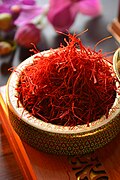
| | '''Saffron''' ({{IPAc-en|ˈ|s|æ|f|r|ə|n|,_|-|r|ɒ|n}} <ref>{{cite Merriam-Webster|saffron|access-date=2012-11-21}}</ref> , [[Persian language|Persian]]: زعفران) is a [[spice]] derived from the flower of ''[[Crocus sativus]]'', commonly known as the "saffron [[crocus]]". The vivid crimson [[stigma (botany)|stigma]] and [[style (botany)|styles]], called threads, are collected and dried for use mainly as a [[seasoning]] and [[Food coloring|colouring agent]] in food. Saffron crocus was slowly propagated throughout much of Eurasia and later brought to parts of North Africa, North America, and [[Oceania]]. | ||
Saffron's taste and [[iodoform]]-like or [[hay]]-like fragrance result from the [[phytochemical]]s [[picrocrocin]] and [[safranal]].{{Sfn|McGee|2004|p=423}}<ref name="Katzer2010">{{cite web |last=Katzer |first=G. |date=2010 |title=Saffron (''Crocus sativus'' L.) |work=Gernot Katzer's Spice Pages |url=http://gernot-katzers-spice-pages.com//engl/Croc_sat.html |access-date=1 December 2012}}</ref> It also contains a [[carotenoid]] pigment, [[crocin]], which imparts a rich golden-yellow hue to dishes and textiles. Its quality is graded by the proportion of red stigma to yellow style, varying by region and affecting both potency and value. As of 2024, [[Iran]] produced some 90% of the world's saffron.<ref name="menia">{{cite journal |vauthors=Menia M, Iqbal S, Zahida R, Tahir S, Kanth RH, Saad AA, Hussian A |title=Production technology of saffron for enhancing productivity (see PDF)|journal=Journal of Pharmacognosy and Phytochemistry |date=2018 |volume=7 |issue=1 |pages=1033–1039 |url=https://www.phytojournal.com/archives?year=2018&vol=7&issue=1&ArticleId=2634 |language=en |issn=2349-8234}}</ref><ref name="hooker">{{Cite news|url=https://www.bbc.com/news/business-41110151|title=The problem for the world's most expensive spice|last=Hooker|first=Lucy|publisher=bbc.co.uk|date=13 September 2017|access-date=12 January 2020|language=en-GB}}</ref><ref>{{cite web|url=https://www.tehrantimes.com/news/56456/Iran-Produces-90-of-World-s-Saffron|title=Iran Produces 90% of World's Saffron |date=3 January 2001 }}</ref> At US$5,000 per [[Kilogram|kg]] or higher, saffron has long been the world's costliest spice by weight,{{Sfn|Rau|1969|p=53}}{{Sfn|Hill|2004|p=272}}<ref>{{cite web|url=http://www.rediff.com/news/slide-show/slide-show-1-pics-world-s-costliest-spice-blooms-in-kashmir/20121109.htm|title=World's COSTLIEST spice blooms in Kashmir|publisher=[[rediff]]|access-date=7 January 2013}}</ref> for which it is often dubbed "red gold".<ref>{{Cite news |title=Red gold: Afghanistan saffron production grows |url=https://phys.org/news/2018-12-red-gold-afghanistan-saffron-production.html |archive-url=http://web.archive.org/web/20250720132714/https://phys.org/news/2018-12-red-gold-afghanistan-saffron-production.html |archive-date=2025-07-20 |access-date=2026-03-26 |language=en}}</ref><ref>{{Cite web |title=Can 'red gold' saffron replace poppy in Afghanistan? |url=https://www.dw.com/en/can-red-gold-saffron-replace-poppy-in-afghanistan/video-51516930 |access-date=2026-03-26 |website=dw.com |language=en}}</ref> | |||
| | The [[English language|English]] word saffron likely originates from the [[Old French]] ''safran'', which traces back through [[Latin]] and [[Persian language|Persian]] to the word ''zarparān'', meaning "gold strung". It is a [[Sterility (physiology)|sterile]], human-propagated, [[autumn]]-flowering plant descended from wild relatives in the eastern [[Mediterranean Sea|Mediterranean]], cultivated for its fragrant purple [[Flower|flowers]] and valuable red stigmas in sunny, [[temperate climates]]. Saffron is primarily used as a culinary [[spice]] and natural [[colourant]], with additional historical uses in [[traditional medicine]], [[dyeing]], [[Perfume|perfumery]], and [[Ritual|religious rituals]]. | ||
| | |||
| | Saffron originated in [[Iran]] especially in the [[Khorasan]] region and later spread to [[Kashmir]], the [[Mediterranean basin|Mediterranean region]], and [[Asia Minor]]. It has been cultivated and traded for over 3,500 years across [[Eurasia]], spreading through [[Asia]] via [[Cultural diplomacy|cultural exchange]] and [[conquest]]. [[History of saffron|Its recorded history]] is attested in a 7th-century BC [[Assyria]]n botanical treatise.{{Sfn|Russo|Dreher|Mathre|2003|p=6}} Saffron is an essential ingredient in [[Iranian cuisine|Persian cuisine]], used in dishes such as chelow and [[tahdig]], stews like khoresh-e [[Fesenjān|fesenjan]], and desserts including [[Sholezard|sholeh-zard]] and [[Bastani|bastani sonnati]]. | ||
| | |||
}} | ==Etymology== | ||
'''Saffron''' ({{ | {{Further|History of saffron}} | ||
The English word ''saffron'' is a borrowing from French, first found in a [[Middle English]] text written around 1200 as ''saffran''.<ref name="OED">{{Cite OED|last1=OED |date=2025 |Saffron, N. & Adj. |1177171640 }}</ref> It derives from the 12th-century [[Old French]] term ''safran'', which comes from the [[Medieval Latin]] word {{Lang|la|safranum}}, and from the [[Persian language|Persian]] (زعفران, ''Zaferan'').<ref name=":2">{{Cite book |last=Kumari |first=Leena |title=Saffron (Crocus sativus L.) Analysis |publisher=Spices Production to Products |year=2025 |pages=23}}</ref><ref name=":4">{{Cite journal |last=Nawab |first=Khalid |date=2022 |title=SAFFRON PRODUCTION IN AFGHANISTAN |journal=Journal of Xi'an Shiyou University, Natural Science Edition |volume=18 |issue=10 |pages=744–757}}</ref> which itself originated from an older [[Persian language|Persian]] word “زرپران, Zarparan” <ref name=":2" /><ref name=":4" /><ref>{{Cite journal |last=Asgari |first=Motahareh |date=2022 |title=Survey of the History and Applications of Saffron |url=https://journals.lww.com/cmc/fulltext/2022/03000/survey_of_the_history_and_applications_of_saffron.5.aspx |journal=Chinese Medicine and Culture |volume=5 |issue=1 |pages=31–38 |doi=10.1097/MC9.0000000000000006 |doi-access=free }}</ref><ref>{{Cite journal |last=Ganaie |first=Daawar Bashir |date=2019 |title=Saffron in Jammu & Kashmir |journal=International Journal of Research in Geography (IJRG) |volume=5 |issue=2 |pages=1–12}}</ref><ref>{{Cite journal |last=Fotovati |first=Mohsen |date=2023 |title=Isolating valuable ingredients of saffron using extraction and preparative chromatography |url=https://pure.mpg.de/rest/items/item_3596377/component/file_3610136/content |journal=Diss. Otto-von-Guericke-Universität Magdeburg |pages=161 pages}}</ref><ref>{{Cite journal |last=Ganaie |first=Daawar Bashir |date=2019 |title=Cultivation Practices and Waning Production of Saffron in Jammu & Kashmir |url=https://www.researchgate.net/publication/363917143 |journal=Agricultural Research & Technology |volume=20 |issue=3 |pages=148–153}}</ref> meaning “gold-strung” a reference to the flower’s golden filaments or the rich golden hue it imparts as a spice. | |||
==Species== | |||
{{Main|Crocus sativus}} | |||
===Description=== | |||
[[File:860808-Saffronfarm-01-IMG 7707-2.jpg|alt=Saffron Flowers|thumb|Crocus flowers which yield red saffron stigmas]] | |||
[[File:Saffron onions-IMG 7549-2.jpg|alt=Saffron onions|thumb|Corms]] | |||
<!-- Deleted image removed: [[File:Saffron-62-1160x773.jpg|alt=Saffron harvest|thumb|Several women in traditional clothes are collecting saffron in one of the farms of [[Torbat-e Heydarieh|Torbat Heydarieh]] city of Khorasan Razavi]] --> | |||
The domesticated saffron crocus, ''Crocus sativus'', is an autumn-[[flowering plant|flowering]] [[perennial plant]] unknown in the wild. It possibly descends from the eastern Mediterranean autumn-flowering ''[[Crocus cartwrightianus]]'' which is also known as "wild saffron"{{Sfn|Kafi et al.|2006|p=24}} and is native to [[mainland Greece]], [[Euboea]], [[Crete]], [[Skyros]] and some islands of the [[Cyclades]].<ref name="Atticasaffron">{{cite journal |last1=Jacobsen |first1=Niels |last2=Ørgaard |first2=Marian |title=Crocus cartwrightianus on the Attica Peninsula |journal=[[ISHS Acta Horticulturae]] |date=2004 |volume=650 |issue=6 |pages=65–69 |doi=10.17660/ActaHortic.2004.650.6 |url=https://safranerio.fr/wp-content/uploads/2017/04/650_6.pdf |access-date=6 April 2024 |ref=Cartwright}}</ref> The similar species ''[[Crocus thomasii|C. thomasii]]'' and ''[[Crocus pallasii|C. pallasii]]'' were considered as other possible ancestors.{{Sfn|Grilli Caiola|2003|p=1}}{{Sfn|Negbi|1999|p=28}} As a genetically monomorphic clone incapable of seed production, it was slowly propagated by humans throughout much of [[Eurasia]].{{Sfn|Rubio-Moraga|Castillo-López|Gómez-Gómez|Ahrazem|2009}} Various origins have been suggested for saffron, including [[Iran]],<ref name="Ghorbani et al.">{{Cite book |first1=R. |last1=Ghorbani |first2=A. |last2=Koocheki |s2cid=28214061 |chapter=Sustainable Cultivation of Saffron in Iran |chapter-url=https://books.google.com/books?id=cdksDwAAQBAJ&pg=PA170 |title=Sustainable Agriculture Reviews |editor-last=Lichtfouse |editor-first=Eric |year=2017 |publisher=Springer |isbn=978-3-319-58679-3 |doi=10.1007/978-3-319-58679-3 |pages=170–171|url=https://hal.inrae.fr/hal-02801642/file/Sustainable%20Agriculture%20Reviews%2014%20-%20Front%20Matter_1.pdf }}</ref> [[Mesopotamia]],<ref name="Ghorbani et al." /> [[Kashmir]]<ref name="auto">{{Cite book |title=Saffron: science, technology and health |date=2020|page=16 |vauthors=Koocheki A, Khajeh-Hosseini M|isbn=9780128187401 |location=Duxford, United Kingdom |oclc=1140113593|url=https://books.google.com/books?id=q8i2DwAAQBAJ|publisher=Woodhead Publishing, Elsevier}}</ref> and [[Greece]].<ref name="Gresta et al.">{{Cite journal |last1=Gresta |first1=F. |last2=Lombardo |first2=G. M. |last3=Siracusa |first3=L. |last4=Ruberto |first4=G. |year=2008 |title=Saffron, an alternative crop for sustainable agricultural systems. A review |url=https://hal.archives-ouvertes.fr/hal-00886393/document |journal=[[Agronomy for Sustainable Development]] |volume=28 |issue=1 |pages=95–112 |bibcode=2008AgSD...28...95G |doi=10.1051/agro:2007030 |s2cid=44054590}}</ref> | |||
It is a sterile [[polyploidy|triploid]] form, which means that three homologous sets of [[chromosome]]s make up each specimen's genetic complement; ''C. sativus'' bears eight chromosomal bodies per set, making for 24 in total.{{Sfn|Kafi et al.|2006|p=23}} Being sterile, the purple flowers of ''C. sativus'' fail to produce viable seeds; reproduction hinges on human assistance: clusters of [[corm]]s, underground, bulb-like, starch-storing organs, must be dug up, divided, and replanted. A corm survives for one season, producing via vegetative division up to ten "cormlets" that can grow into new plants in the next season.{{Sfn|Deo|2003|p=1}} The compact corms are small, brown globules that can measure as large as {{Convert|5|cm|in|0|abbr=on}} in diameter, have a flat base, and are shrouded in a dense mat of parallel fibres; this coat is referred to as the "corm tunic". Corms also bear vertical fibres, thin and net-like, that grow up to {{Convert|5|cm|in|0|abbr=on}} above the plant's neck.{{Sfn|Kafi et al.|2006|p=23}} | |||
The plant sprouts 5–11 white and non-[[photosynthesis|photosynthetic]] leaves known as [[cataphyll]]s. These membrane-like structures cover and protect 5 to 11 true leaves as they bud and develop on the crocus flower. The latter are thin, straight, and blade-like green foliage leaves, which are {{Convert|1|–|3|mm|in|frac=32|abbr=on}}, in diameter, which either expand after the flowers have opened ("hysteranthous") or do so simultaneously with their blooming ("synanthous"). ''C. sativus'' cataphylls are suspected by some to manifest prior to blooming when the plant is irrigated relatively early in the growing season. Its floral axes, or flower-bearing structures, bear [[bract]]eoles, or specialised leaves, that sprout from the flower stems; the latter are known as [[pedicel (botany)|pedicels]].{{Sfn|Kafi et al.|2006|p=23}} After [[Aestivation (botany)|aestivating]] in spring, the plant sends up its true leaves, each up to {{Convert|40|cm|in|0|abbr=on}} in length. Only in October, after most other flowering plants have released their seeds, do its brilliantly hued flowers develop; they range from a light pastel shade of lilac to a darker and more striated mauve.{{Sfn|Willard|2002|p=3}} The flowers possess a sweet, honey-like fragrance. Upon flowering, the plants are {{Convert|20|–|30|cm|in|0|abbr=on}} in height and bear up to four flowers. A three-pronged [[style (botany)|style]] {{Convert|25|–|30|mm|in|frac=16|abbr=on}} in length, emerges from each flower. Each prong terminates with a vivid crimson [[stigma (botany)|stigma]], which is the distal end of a [[carpel]].{{Sfn|Deo|2003|p=1}}{{Sfn|Kafi et al.|2006|p=23}} | |||
===Cultivation=== | |||
The saffron crocus, unknown in the wild, probably descends from ''[[Crocus cartwrightianus]]''. It is a [[polyploid|triploid]] that is "self-incompatible" and male sterile; it undergoes aberrant [[meiosis]] and is hence incapable of independent sexual reproduction—all propagation is by [[vegetative reproduction|vegetative multiplication]] via manual "divide-and-set" of a starter clone or by interspecific hybridisation.{{Sfn|Negbi|1999|p=30–31}}{{Sfn|Grilli Caiola|2003|p=1}} | |||
''Crocus sativus'' thrives in the Mediterranean [[Maquis shrubland|maquis]], an ecotype superficially resembling the North American [[chaparral]], and similar climates where hot and dry summer breezes sweep semi-arid lands. It can nonetheless survive cold winters, tolerating frosts as low as {{Convert|−10|C|0}} and short periods of snow cover.{{Sfn|Deo|2003|p=1}}{{Sfn|Willard|2002|pp=2–3}} Some reports suggest saffron can tolerate an air temperature range from −22 to 40 °C.<ref>{{Citation |last=Rezvani-Moghaddam |first=Parviz |title=Chapter 8. Ecophysiology of saffron |date=2020-01-01 |url=https://www.sciencedirect.com/science/article/pii/B9780128186381000083 |work=Saffron |pages=119–137 |editor-last=Koocheki |editor-first=Alireza |access-date=2023-02-22 |series=Woodhead Publishing Series in Food Science, Technology and Nutrition |publisher=Woodhead Publishing |language=en |isbn=978-0-12-818638-1 |editor2-last=Khajeh-Hosseini |editor2-first=Mohammad}}</ref> Irrigation is required if grown outside of moist environments such as Kashmir, where annual rainfall averages {{Convert|1000|–|1500|mm|in|sigfig=1|abbr=on}}; saffron-growing regions in Greece ({{Convert|500|mm|in|abbr=on|disp=or}} annually) and Spain ({{Convert|400|mm|in|abbr=on|disp=or}}) are far drier than the main cultivating Iranian regions. What makes this possible is the timing of the local wet seasons; generous spring rains and drier summers are optimal. Rain immediately preceding flowering boosts saffron yields; rainy or cold weather during flowering promotes disease and reduces yields. Persistently damp and hot conditions harm the crops,{{Sfn|Deo|2003|p=2}} and rabbits, rats, and birds cause damage by digging up corms. [[Nematode]]s, leaf [[rust (fungus)|rusts]], and corm rot pose other threats. Yet ''[[Bacillus subtilis]]'' inoculation may provide some benefit to growers by speeding corm growth and increasing stigma biomass yield.{{Sfn|Sharaf-Eldin|Elkholy|Fernández|Junge|2008}} | |||
The plants fare poorly in shady conditions; they grow best in full sunlight. Fields that slope towards the sunlight are optimal (i.e., south-sloping in the Northern Hemisphere). Planting is mostly done in June in the Northern Hemisphere, where corms are lodged {{Convert|7|–|15|cm|in|0|abbr=on}} deep; its roots, stems, and leaves can develop between October and February.{{Sfn|Kafi et al.|2006|p=23}} Planting depth and corm spacing, in concert with climate, are critical factors in determining yields. Mother corms planted deeper yield higher-quality saffron, though they form fewer flower buds and daughter corms. Italian growers optimise thread yield by planting {{Convert|15|cm|in|0|abbr=on}} deep and in rows {{Convert|2|–|3|cm|in|frac=4|abbr=on}} apart; depths of {{Convert|8|–|10|cm|in|0|abbr=on}} optimise flower and corm production. Greek, Moroccan, and Spanish growers employ distinct depths and spacings that suit their locales. | |||
''C. sativus'' prefers friable, loose, low-density, well-watered, and well-drained clay-[[calcareous]] soils with high organic content. Traditional raised beds promote good drainage. Soil organic content was historically boosted via application of some {{Convert|20|–|30|t/ha|ST/acre|0|abbr=off}} of manure. Afterwards, and with no further manure application, corms were planted.{{Sfn|Deo|2003|p=3}} After a period of dormancy through the summer, the corms send up their narrow leaves and begin to bud in early autumn. Only in mid-autumn do they flower. Harvests are by necessity a speedy affair: after blossoming at dawn, flowers quickly wilt as the day passes.{{Sfn|Willard|2002|pp=3–4}} All plants bloom within a window of one or two weeks.{{Sfn|Willard|2002|p=4}} Stigmas are dried quickly upon extraction and (preferably) sealed in airtight containers.{{Sfn|Negbi|1999|p=8}} | |||
===Harvesting=== | |||
[[File:Saffron-sargol-zafaranic.jpg|thumb|Sargol saffron, the strongest Iranian grade]] | |||
The high retail value of saffron is maintained on world markets because of labour-intensive harvesting methods, which require some {{convert|200000|/lb|/kg|order=flip|disp=preunit|stigmas|hand-picked saffron stigmas }} – equivalently, {{convert|70000|/lb|/kg|order=flip|disp=preunit|flowers|crocus flowers }}.<ref name=hooker/><ref name="cnn">{{cite news |last=Monks |first=Keiron |date=3 September 2015 |title=Iran's homegrown treasure: the spice that costs more than gold |url=https://edition.cnn.com/2015/06/03/middleeast/iran-saffron-red-gold/ |newspaper=CNN |access-date=22 January 2016}}</ref>{{Sfn|Hill|2004|p=273}}{{Sfn|Rau|1969|p=35}} Forty hours of labour are needed to pick 150,000 flowers.<ref>{{cite news|last=Lak |first=Daniel |date=11 November 1998 |title=Kashmiris pin hopes on saffron |work=[[BBC News]] |url=http://news.bbc.co.uk/1/hi/world/south_asia/212491.stm |access-date=11 September 2011}}</ref> | |||
One freshly picked crocus flower yields on average 30 mg of fresh saffron or 7 mg dried; roughly 150 flowers yield {{Convert|1|g|oz|frac=32|abbr=on}} of dry saffron threads; to produce {{Convert|12|g|oz|frac=16|abbr=on}} of dried saffron, {{Convert|1|lb|g|order=flip|sigfig=2|abbr=on}} of flowers are needed; the yield of dried spice from fresh saffron is only {{convert|0.2|oz/lb|g/kg|order=flip|abbr=on}}.{{Sfn|Deo|2003|p=3}} | |||
==Spice== | |||
== | ===Phytochemistry and sensory properties=== | ||
{| | [[File:Picrocrocin.svg|thumb|Structure of [[picrocrocin]]:{{Sfn|Deo|2003|p=4}} | ||
| | {| | ||
| | |- | ||
| | |{{Legend|#AEAEFF|[[Anomer|β]]–[[Monosaccharide#Isomerism|D]]-glucopyranose derivative}} | ||
| | |- | ||
|- | |{{Legend|#F5D76C|safranal moiety}} | ||
| | |} | ||
|- | ]] | ||
| | [[File:Crocetin safranal esterification.png|thumb|[[Esterification]] reaction between [[crocetin]] and [[gentiobiose]]. Components of α–crocin:<ref name=dhar/> | ||
{| | |||
| | |- | ||
|{{Legend|#A6CAF0|[[Anomer|β]]–[[Monosaccharide#Isomerism|D]]-gentiobiose}}||{{Legend|#000000|crocetin}} | |||
|} | |} | ||
]] | |||
Saffron contains some 28 [[Volatile organic compound|volatile and aroma-yielding compounds]], dominated by [[ketone]]s and [[aldehyde]]s.<ref name="Amanpour">{{cite journal | last1=Amanpour | first1=Asghar | last2=Sonmezdag | first2=A. Salih | last3=Kelebek | first3=Hasim | last4=Selli | first4=Serkan | title=GC–MS–olfactometric characterization of the most aroma-active components in a representative aromatic extract from Iranian saffron (''Crocus sativus'' L.) | journal=Food Chemistry| volume=182 | year=2015 | issn=0308-8146 | doi=10.1016/j.foodchem.2015.03.005 | pages=251–256|pmid=25842335}}</ref> Its main aroma-active compounds are [[safranal]] – the main compound responsible for saffron aroma – 4-ketoisophorone, and dihydrooxophorone.<ref name="dhar">{{cite journal | last1=Dhar | first1=Manoj K | last2=Sharma | first2=Munish | last3=Bhat | first3=Archana | last4=Chrungoo | first4=Nikhil K | last5=Kaul | first5=Sanjana | title=Functional genomics of apocarotenoids in saffron: insights from chemistry, molecular biology and therapeutic applications (Review)| journal=[[Briefings in Functional Genomics]] | volume=16 | issue=6 | date=28 March 2017 | issn=2041-2649 | doi=10.1093/bfgp/elx003 | pages=336–347|pmid=28369196}}</ref><ref name=Amanpour/> Saffron also contains nonvolatile [[phytochemical]]s,{{Sfn|Abdullaev|2002|p=1}} including the [[carotenoid]]s [[zeaxanthin]], [[lycopene]], various α- and β-[[carotene]]s, as well as [[crocetin]] and its [[glycoside]] crocein, which are the most biologically active components.<ref name=dhar/><ref name="pmid29134501">{{cite journal | vauthors=Hosseini A, Razavi BM, Hosseinzadeh H | title=Pharmacokinetic Properties of Saffron and its Active Components | journal=European Journal of Drug Metabolism and Pharmacokinetics | volume=43 | issue=4 | pages=383–390 | year=2018 | url=https://www.sciencedirect.com/science/article/pii/S0890623820302926 | doi=10.1007/s13318-017-0449-3 | pmid=29134501| s2cid=23836415 | url-access=subscription }}</ref> Because crocetin is smaller and more water-soluble than the other carotenoids, it is more rapidly absorbed.<ref name="pmid29134501" /> | |||
The yellow-orange colour of saffron is primarily the result of α-crocin.<ref name=dhar/> This [[crocin]] is trans-[[crocetin]] di-(β-D-[[gentiobiose|gentiobiosyl]]) [[ester]]; it bears the [[IUPAC nomenclature|systematic (IUPAC) name]] 8,8-diapo-8,8-carotenoic acid. This means that the crocin underlying saffron's aroma is a digentiobiose ester of the carotenoid crocetin.{{Sfn|Abdullaev|2002|p=1}} Crocins themselves are a series of [[hydrophile|hydrophilic]] carotenoids that are either [[glycosyl|monoglycosyl]] or diglycosyl [[polyene]] esters of crocetin.{{Sfn|Abdullaev|2002|p=1}} Crocetin is a [[conjugated system|conjugated]] polyene [[carboxylic acid|dicarboxylic acid]] that is [[Hydrophobe|hydrophobic]], and thus oil-soluble. When crocetin is [[esterification|esterified]] with two water-soluble gentiobioses, which are [[carbohydrate|sugars]], a product results that is itself water-soluble. The resultant α-crocin is a carotenoid pigment that may make up more than 10% of dry saffron's mass. The two esterified gentiobioses make α-crocin ideal for colouring water-based and non-fatty foods such as rice dishes.{{Sfn|McGee|2004|p=422}} | |||
The bitter [[glucoside]] [[picrocrocin]] is responsible for saffron's [[pungency|pungent flavour]].<ref name=dhar/> Picrocrocin ([[chemical formula]]: {{Chem2|C16H26O7}}; systematic name: 4-(β-D-glucopyranosyloxy)-2,6,6-trimethylcyclohex-1-ene-1-carbaldehyde) is a union of an [[aldehyde]] sub-molecule known as [[safranal]] (systematic name: 2,6,6-trimethylcyclohexa-1,3-diene-1-carbaldehyde) and a carbohydrate. It has insecticidal and pesticidal properties, and may comprise up to 4% of dry saffron. Picrocrocin is a truncated version of the carotenoid [[zeaxanthin]] that is produced via [[redox|oxidative]] cleavage, and is the [[glycoside]] of the [[terpene]] [[aldehyde]] safranal.{{Sfn|Leffingwell}} | |||
When saffron is dried after its harvest, the heat, combined with enzymatic action, splits picrocrocin to yield [[Monosaccharide#Isomerism|D]]–[[glucose]] and a free safranal molecule.{{Sfn|Deo|2003|p=4}} Safranal, a [[essential oil|volatile]] oil, gives saffron much of its distinctive aroma.{{Sfn|McGee|2004|p=423}}{{Sfn|Dharmananda|2005}} Safranal is less bitter than picrocrocin and may comprise up to 70% of dry saffron's volatile fraction in some samples.{{Sfn|Leffingwell}} A second molecule underlying saffron's aroma is [[Lanierone|2-hydroxy-4,4,6-trimethyl-2,5-cyclohexadien-1-one]], which produces a scent described as saffron, dried hay-like.{{Sfn|Leffingwell}} Chemists find this is the most powerful contributor to saffron's fragrance, despite its presence in a lesser quantity than safranal.{{Sfn|Leffingwell}} Dry saffron is highly sensitive to fluctuating [[pH]] levels, and rapidly breaks down chemically in the presence of light and [[redox|oxidising]] agents. It must, therefore, be stored in air-tight containers to minimise contact with atmospheric oxygen. Saffron is somewhat more resistant to heat. | |||
===Grades and ISO 3632 categories=== | |||
[[File:Iran saffron threads.jpg|thumb|left|upright|Red threads and yellow styles from Iran]] | |||
[[File:Safran-Weinviertel Niederreiter 2 Gramm 8285.jpg|thumb|left|upright|High quality red threads from Austrian saffron]] | |||
[[File:Pure Kashmiri saffron pack 08.jpg|thumb|left|upright|[[Kashmir]]i saffron package]] | |||
Saffron is not all of the same quality and strength. Strength is related to several factors, including age and the amount of yellow style picked relative to red stigma, as colour and flavour are concentrated in the latter. | |||
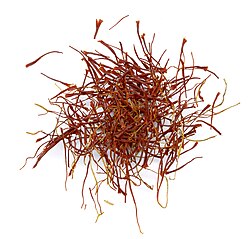
Saffron from [[Iran]], [[Spain]], and [[Kashmir]] is classified into various grades according to the proportion of stigma to style it contains. Grades of Iranian saffron are: ''sargol'' ({{langx|fa|سرگل}}, red stigma tips only, strongest grade), ''pushal'' or ''pushali'' (red stigmas plus some yellow style, lower strength), "bunch" saffron (red stigmas plus large amount of yellow style, presented in a tiny bundle like a miniature wheatsheaf) and ''konge'' (yellow style only, claimed to have aroma but with very little, if any, colouring potential). Grades of Spanish saffron are ''coupé'' (the strongest grade, like Iranian sargol), ''mancha'' (like Iranian pushal), and in order of further decreasing strength ''rio'', ''standard'' and ''sierra'' saffron. The word ''mancha'' in the Spanish classification can have two meanings: a general grade of saffron or a very high quality Spanish-grown saffron from a specific geographical origin. Real Spanish-grown La Mancha saffron has [[Geographical indications and traditional specialities in the European Union#Protected designation of origin (PDO)|PDO]] protected status, which is displayed on the product packaging. Spanish growers fought hard for Protected Status because they felt that imports of Iranian saffron re-packaged in Spain and sold as "Spanish Mancha saffron" were undermining the genuine La Mancha brand. {{Citation needed|date=August 2023}} Similar was the case in Kashmir where imported Iranian saffron is mixed with local saffron and sold as "Kashmir brand" at a higher price.<ref name="husaini">{{Citation|title=Sustainable Saffron (''Crocus sativus'' Kashmirianus) Production: Technological and Policy Interventions for Kashmir |author1=Amjad Masood Husaini |author2=Azra N. Kamili |author3=M. H. Wani |author4=Jaime A. Teixeira da Silva |author5=G. N. Bhat |editor-last=Husaini |editor-first=Amjad M. |journal=Functional Plant Science & Biotechnology|issn=1749-0472 |volume=4 |issue=2 |publisher=Global Science Books |year=2010 |url=https://www.researchgate.net/publication/232607451_Sustainable_Saffron_Crocus_sativus_Kashmirianus_Production_Technological_and_Policy_Interventions_for_Kashmir|location=UK |page=118}}</ref> In Kashmir, saffron is mostly classified into two main categories called ''mongra'' (stigma alone) and ''lachha'' (stigmas attached with parts of the style).<ref name=husaini/> Countries producing less saffron do not have specialised words for different grades and may only produce one grade. Artisan producers in Europe and New Zealand have offset their higher labour charges for saffron harvesting by targeting quality, only offering extremely high-grade saffron. | |||
In addition to descriptions based on how the saffron is picked, saffron may be categorised under the international standard [[International Organization for Standardization|ISO]] 3632 after laboratory measurement of crocin (responsible for saffron's colour), picrocrocin (taste), and safranal (fragrance or aroma) content.{{Sfn|Verma|Middha|2010|p=1–2}} However, often there is no clear grading information on the product packaging and little of the saffron readily available in the UK is labelled with ISO category. This lack of information makes it hard for customers to make informed choices when comparing prices and buying saffron. | |||
Under ISO 3632, determination of non-stigma content ("floral waste content") and other extraneous matter such as inorganic material ("[[Ash (analytical chemistry)|ash]]") are also key. Grading standards are set by the [[International Organization for Standardization]], a federation of national standards bodies. ISO 3632 deals exclusively with saffron and establishes three categories: III (poorest quality), II, and I (finest quality). Formerly there was also category IV, which was below category III. Samples are assigned categories by gauging the spice's crocin and picrocrocin content, revealed by measurements of specific spectrophotometric [[absorbance]]. Safranal is treated slightly differently and rather than there being threshold levels for each category, samples must give a reading of 20–50 for all categories. | |||
These data are measured through [[spectrophotometry]] reports at certified testing laboratories worldwide. Higher absorbances imply greater levels of crocin, picrocrocin and safranal, and thus a greater colouring potential and therefore strength per gram. The absorbance reading of crocin is known as the "colouring strength" of that saffron. Saffron's colouring strength can range from lower than 80 (for all category IV saffron) up to 200 or greater (for category I). The world's finest samples (the selected, most red-maroon, tips of stigmas picked from the finest flowers) receive colouring strengths in excess of 250, making such saffron over three times more powerful than category IV saffron. Market prices for saffron types follow directly from these ISO categories. Sargol and coupé saffron would typically fall into ISO 3632 category I. Pushal and Mancha would probably be assigned to category II. On many saffron packaging labels, neither the ISO 3632 category nor the colouring strength (the measurement of crocin content) is displayed. | |||
However, many growers, traders, and consumers reject such lab test numbers. Some people prefer a more holistic method of sampling batches of threads for taste, aroma, pliability, and other traits in a fashion similar to that practised by experienced [[wine]] tasters.{{Sfn|Hill|2004|p=274}} | |||
===Adulteration=== | |||
Despite attempts at quality control and standardisation, an extensive history of saffron [[adulteration]], particularly among the cheapest grades, continues into modern times. Adulteration was first documented in Europe's Middle Ages, when those found selling adulterated saffron in [[Nuremberg]] were executed under the ''Safranschou'' code.{{Sfn|Willard|2002|pp=102–104}} Typical methods include mixing in extraneous substances like [[beetroot]], [[pomegranate]] fibres, red-dyed silk fibres, or the saffron crocus's tasteless and odourless yellow stamens. Other methods included dousing saffron fibres with viscid substances like [[honey]] or vegetable oil to increase their weight. Powdered saffron is more prone to adulteration, with [[turmeric]], [[paprika]], and other powders used as diluting fillers. Adulteration can also consist of selling mislabelled mixes of different saffron grades. Thus, high-grade Kashmiri saffron is often sold and mixed with cheaper Iranian imports; these mixes are then marketed as pure Kashmiri saffron.<ref>{{Cite web|url=https://www.firstpost.com/long-reads/kashmirs-saffron-harvest-sees-sharp-decline-4216123.html|title=Kashmir's saffron harvest sees sharp decline |website=Firstpost|date=18 November 2017 |access-date=1 January 2019}}</ref><ref>{{Cite web|last=Rashid|first=Afshan|date=22 September 2018|title=From 35kgs earlier to 1kg yield now, 'successful' Saffron Mission paves way for apples in Pampore|url=https://freepresskashmir.news/2018/09/22/from-35kgs-earlier-to-1kg-yield-now-successful-saffron-mission-paves-way-for-apples-in-pampore/|access-date=1 January 2019|website=Free Press Kashmir|language=en-GB}}</ref><ref>{{cite news |date=4 November 2003 |title=Kashmiri Saffron Producers See Red over Iranian Imports |publisher=[[ABC News (Australia)|Australian Broadcasting Corp.]] |url=http://www.abc.net.au/news/1504154 |access-date=29 September 2011}}</ref><ref>{{cite news |last=Hussain |first=A. |date=28 January 2005 |title=Saffron Industry in Deep Distress |work=BBC News |location=London |url=http://news.bbc.co.uk/2/hi/south_asia/4216493.stm |access-date=15 September 2011}}</ref> [[Safflower]] is a common substitute sometimes sold as saffron. The spice is reportedly counterfeited with [[horse hair]], [[corn silk]], or shredded paper. [[Tartrazine]] or [[sunset yellow]] dyes have been used to colour counterfeit powdered saffron.<ref name=hooker/> | |||
In recent years, saffron adulterated with the colouring extract of [[gardenia]] fruits has been detected in the European market. This form of fraud is difficult to detect due to the presence of [[flavonoids]] and [[crocin]]es in the gardenia-extracts similar to those naturally occurring in saffron. Detection methods have been developed by using [[HPLC]] and [[mass spectrometry]] to determine the presence of [[geniposide]], a compound present in the fruits of gardenia, but not in saffron.<ref>{{cite journal |last1=Guijarro-Díez |first1=Miguel |last2=Castro-Puyana |first2=María |last3=Crego |first3=Antonio Luis |last4=Marina |first4=María Luisa |title=Detection of saffron adulteration with gardenia extracts through the determination of geniposide by liquid chromatography-mass spectrometry |journal=[[Journal of Food Composition and Analysis]] |date=1 January 2017 |volume=55 |pages=30–37 |doi=10.1016/j.jfca.2016.11.004 }}</ref> | |||
===Types=== | |||
== | The various saffron crocus cultivars give rise to thread types that are often regionally distributed and characteristically distinct. Varieties (not varieties in the botanical sense) from Spain, including the tradenames "Spanish Superior" and "Creme", are generally mellower in colour, flavour, and aroma; they are graded by government-imposed standards. Italian varieties are slightly more potent than Spanish. Greek saffron produced in the town of [[Krokos]] is [[Protected designation of origin|PDO]] protected due to its particularly high-quality colour and strong flavour.<ref>{{Cite web|url=https://ec.europa.eu/info/food-farming-fisheries/food-safety-and-quality/certification/quality-labels/eu-quality-food-and-drink/krokos-kozanis|title=Krokos Kozanis PDO |last=Bishop |first=Stephen|date=26 April 2018|website=[[European Commission]]|access-date=16 November 2018 |archive-url= https://web.archive.org/web/20181117024010/https://ec.europa.eu/info/food-farming-fisheries/food-safety-and-quality/certification/quality-labels/eu-quality-food-and-drink/krokos-kozanis |archive-date= Nov 17, 2018 }}</ref> Various "boutique" crops are available from New Zealand, France, Switzerland, England, the United States, and other countries—some of them organically grown. In the US, Pennsylvania Dutch saffron—known for its "earthy" notes—is produced in small quantities.{{Sfn|Willard|2002|p=143}}{{Sfn|Willard|2002|p=201}} | ||
|- | Consumers may regard certain cultivars as "premium" quality. The "Aquila" saffron, or ''zafferano dell'Aquila'', is defined by high safranal and crocin content, distinctive thread shape, unusually pungent aroma, and intense colour; it is grown exclusively on eight hectares in the Navelli Valley of Italy's [[Abruzzo]] region, near [[L'Aquila]].<ref>{{Cite news |last=Wright |first=Susan |date=2020-05-12 |title=An Intimate Look at Italy’s Saffron Harvest |url=https://www.nytimes.com/2020/05/12/travel/italy-saffron.html |access-date=2026-03-26 |work=The New York Times |language=en-US |issn=0362-4331}}</ref> It was first introduced to Italy by a Dominican friar from inquisition-era Spain.{{when|date=October 2016}} But the biggest saffron cultivation in Italy is in [[San Gavino Monreale]], Sardinia, where it is grown on 40 hectares, representing 60% of Italian production; it too has unusually high crocin, picrocrocin, and safranal content. | ||
| | |||
|- | Another is the "Mongra" or "Lacha" saffron of Kashmir (''Crocus sativus'' 'Cashmirianus'), which is among the most difficult for consumers to obtain.<ref>{{cite journal |last1=Vlahova |first1=Veselka |title=Saffron (''Crocus Sativus'') as an Alternative Crop in Sustainable Agricultural Systems. a Review |journal=Scientific Papers Series Management, Economic Engineering in Agriculture and Rural Development|date=2022 |volume=22 |issue=2 |page=778 |url=https://managementjournal.usamv.ro/pdf/vol.22_2/Art91.pdf |access-date=22 September 2022 |url-status=live |archive-url=https://web.archive.org/web/20220922221935/https://managementjournal.usamv.ro/pdf/vol.22_2/Art91.pdf |archive-date=22 September 2022 }}</ref> Repeated droughts, blights, and crop failures in Kashmir combined with an Indian export ban, contribute to its prohibitive overseas prices. Kashmiri saffron is recognizable by its dark maroon-purple hue, making it among the world's darkest.<ref>{{Cite web |last=Hassan |first=Firdous |date=2020-02-19 |title=Farmers Pitch For GI Tag For Kashmiri Saffron, World's Most Expensive Spice |url=https://www.indiaspend.com/farmers-pitch-for-gi-tag-for-kashmiri-saffron-worlds-most-expensive-spice/ |access-date=2022-03-11 |website=IndiaSpend |language=en}}</ref> In 2020, [[Kashmir Valley]] saffron was certified with a [[geographical indication]] from the Government of India.<ref>{{Cite web|date=25 July 2020|title=Kashmir's saffron gets GI tag|url=https://www.hindustantimes.com/india-news/kashmir-s-saffron-gets-gi-tag/story-N7VfEu6mG5vlti0lHr6MpN.html|access-date=27 July 2020|website=Hindustan Times|language=en}}</ref> | ||
| | |||
==World production== | |||
[[File:SaffMHD.jpg|thumb|Saffron market in [[Mashad]], [[Iran]]]] | |||
|- | |||
|[[ | Almost all saffron grows in a belt stretching from [[Spain]] in the west to [[India]] in the east. [[Iran]] is responsible for around 88% of global production,<ref name="menia" /> and in 2024 was the largest producer, followed by [[Afghanistan]].<ref name="islami">{{Cite news |title=Afghanistan bets on 'red gold' for global market presence |last=Islami |first=Modaser |url=https://www.arabnews.com/node/2580482/amp |date=23 November 2024 |access-date=13 February 2025 |work=[[Arab News]] |language=en}}</ref> Saffron is cultivated in 26 of Afghanistan's 34 [[provinces of Afghanistan|provinces]], with most production concentrated in [[Herat Province|Herat]].<ref>{{cite news |url=https://tolonews.com/business-197393 |title=Herat Saffron Named World's Best for 10th Consecutive Year |last=Salehi |first=Naseer Ahmad |publisher=TOLOnews |date=8 January 2026 |access-date=2026-02-04}}</ref><ref>{{cite news |url=https://www.arabnews.com/node/1602281/world |title=Afghanistan's red gold 'saffron' termed world's best |last=Salahuddin|first=Sayed |publisher=Arab News |date=22 December 2019 |access-date=13 February 2025}}</ref> | ||
|- | |||
[[Greece]] is the third largest producer, followed by [[Spain]], which was once the largest producer in the 19th century.<ref>{{Cite news |last=Jones |first=Sam |date=2023-01-22 |title=Climate crisis and neglect threaten Spain’s saffron crop |url=https://www.theguardian.com/world/2023/jan/22/climate-crisis-and-neglect-threaten-spains-saffron-crop |access-date=2026-03-26 |work=The Guardian |language=en-GB |issn=0261-3077}}</ref> Other producers include the [[United Arab Emirates]], the [[Indian subcontinent]] (particularly [[Kashmir]]),<ref>{{Cite web |date=2026-01-15 |title=The uncertain future of the world's most expensive spice |url=https://www.nationalgeographic.com/environment/article/kashmir-saffron-spice-harvest-climate |access-date=2026-03-26 |website=Environment |language=en}}</ref> and [[Morocco]].<ref name=menia/><ref>{{cite news |title=Moroccan saffron farmers battle knockoff spices |url=https://www.arabnews.com/node/1421946/offbeat |date=December 17, 2018 |publisher=Arab News |location=Saudi Arabia}}</ref> | |||
|- | |||
|[[ | ===Trade=== | ||
|- | {{Main|Saffron trade}} | ||
|[[Morocco]]|| | |||
|- | Saffron prices at wholesale and retail rates range from {{cvt|500-5000|$/lb|$/kg|order=flip|abbr=on}}. In Western countries, the average retail price in 1974 was {{cvt|1000|$/lb|$/kg|order=flip|abbr=on}}.{{Sfn|Hill|2004|p=272}} In February 2013, a retail bottle containing {{cvt|1.7|g|oz|frac=64|abbr=on}} could be purchased for $16.26 or the equivalent of {{cvt|4336|$/lb|$/kg|order=flip|abbr=on}}, or as little as about {{cvt|2000|$/lb|$/kg|order=flip|abbr=on}} in larger quantities. There are between {{cvt|70000|and|200,000|/lb|/kg|order=flip|disp=preunit|threads|threads }}. Vivid crimson colouring, slight moistness, elasticity, and lack of broken-off thread debris are all traits of fresh saffron.{{cn|date=February 2025}} | ||
| | |||
| | ==Uses== | ||
| | {{Main|Use of saffron}} | ||
|} | [[File:Saffron soak.jpg|thumb|Saffron threads soaked in hot water prior to use in food preparation]] | ||
The primary use of saffron is in food and drink preparation. Saffron has a long history of use in [[traditional medicine]].<ref>{{cite journal |last1=Mousavi |first1=S. Z. |last2=Bathaie |first2=S. Z. |title=Historical uses of saffron: Identifying potential new avenues for modern research |journal=Avicenna Journal of Phytomedicine |volume=1 |issue=2 |pages=27–66 |year=2011 |url=http://ajp.mums.ac.ir/pdf_122_fa0adab83a39198419c20125f89ee8bf.html |access-date=27 July 2014 |archive-date=4 March 2016 |archive-url=https://web.archive.org/web/20160304055609/http://ajp.mums.ac.ir/pdf_122_fa0adab83a39198419c20125f89ee8bf.html }}</ref><ref>{{cite journal |last1=Basker |first1=D |last2=Negbi |first2=M |s2cid=40880131 |title=Uses of saffron |journal=Journal of Economic Botany |volume=37 |issue=2 |pages=228–236 |year=1983 |doi=10.1007/BF02858789 |jstor=4254486 |bibcode=1983EcBot..37..228B }}</ref> Saffron has also been used as a fabric [[dye]], particularly in China and India, and in perfumery.{{Sfn|Dalby|2002|p=138}} It is used for religious purposes in India.<ref>{{Cite journal|last1=Mousavi|first1=Z.M.|last2=Bathaie, S.|date=Autumn 2011|title=Historical uses of saffron: Identifying potential new avenues for modern research |url=http://ajp.mums.ac.ir/article_122_fa0adab83a39198419c20125f89ee8bf.pdf| journal=Avicenna Journal of Phytomedicine|volume=1|page=63}}</ref> | |||
<span class="anchor" id="E164"></span>In the European [[E number]] categorisation for food elements and additives, Saffron is coded as '''E164'''. | |||
{{Infobox nutritional value | |||
| name = Dried saffron | |||
| serving_size = {{tbspUS|1}} (2.1 g) | |||
| kJ = 27 | |||
| carbs = 1.37 g | |||
| fibre = 0.10 g | |||
| fat = 0.12 g | |||
| satfat = 0.03 g | |||
| transfat = 0.00 g | |||
| monofat = 0.01 g | |||
| polyfat = 0.04 g | |||
| protein = 0.24 g | |||
| water = 0.25 g | |||
| vitA_iu = 11 | |||
| thiamin_mg = 0 | |||
| riboflavin_mg = 0.01 | |||
| niacin_mg = 0.03 | |||
| vitB6_mg = 0.02 | |||
| folate_ug = 2 | |||
| vitB12_ug = 0 | |||
| vitC_mg = 1.7 | |||
| vitD_ug = 0 | |||
| vitD_iu = 0 | |||
| calcium_mg = 2 | |||
| copper_mg = 0.01 | |||
| iron_mg = 0.23 | |||
| magnesium_mg = 6 | |||
| manganese_mg = 0.6 | |||
| phosphorus_mg = 5 | |||
| potassium_mg = 36 | |||
| selenium_ug = 0.1 | |||
| sodium_mg = 3 | |||
| zinc_mg = 0.02 | |||
| note = [https://fdc.nal.usda.gov/food-details/170934/nutrients Full Link to USDA database entry] | |||
}} | |||
===Nutrition=== | |||
Dried saffron is 65% [[carbohydrates]], 6% fat, 11% [[protein (nutrient)|protein]] (table) and 12% water. In one [[tablespoon]] (2 grams; a quantity much larger than is likely to be ingested in normal use) [[manganese in biology|manganese]] is present as 29% of the [[Daily Value]], while other [[micronutrient]]s have negligible content (table). | |||
===Consumption=== | |||
Saffron's aroma is often described by connoisseurs as reminiscent of metallic honey with grassy or hay-like notes, while its taste has also been noted as hay-like and sweet. Saffron also contributes a luminous yellow-orange colouring to foods. Saffron is widely used in Persian,<ref>{{cite book|last=Simmons|first=Shirin|title=A Treasury of Persian Cuisine|url=https://books.google.com/books?id=87KOW40HThAC&pg=PT37|date=October 2007|publisher=Stamford House Publishing|isbn=978-1-904985-56-3|pages=37–38}}</ref> Indian, European, and Arab cuisines. Confectioneries and liquors also often include saffron. Saffron is used in dishes ranging from the jewelled rice and ''[[khoresh]]'' of Iran,<ref>{{cite web |url=http://www.thepersianfusion.com/persian-jewelled-rice-with-lamb-gheymeh-nesar/ |date=11 July 2017 |title=Persian Jewelled Rice with Lamb (Gheymeh Nesar)}}</ref><ref>{{cite web |url=http://www.thepersianfusion.com/chicken-aubergine-stew-bademjan-ghooreh-mosama/ |date=20 August 2017 |title=Persian Chicken & Aubergine Stew (Bademjan-Ghooreh Mosama)}}</ref> the Milanese ''[[risotto]]'' of Italy, the ''[[paella]]'' of Spain, the ''[[bouillabaisse]]'' of France, to the ''[[biryani]]'' with various meat accompaniments in South Asia. Saffron is also used in the preparation of the ''Golden Ham'', a precious dry-cured [[ham]] made with saffron from [[San Gimignano]] in Tuscany.{{cn|date=January 2024}} Common saffron substitutes include [[safflower]] (''Carthamus tinctorius'', which is often sold as "Portuguese saffron" or "açafrão"), [[annatto]], and [[turmeric]] (''Curcuma longa'').<!-- Saffron is identified as "E164" under the European Union [[E number]] food additive code system. --> In [[Middle Ages|Medieval Europe]], turmeric was also known as "Indian saffron" because of its yellow-orange colour.<ref>{{cite book |editor1-last=Prance |editor1-first=Ghillean |editor2-last=Nesbitt |editor2-first=Mark |last1=Pickersgill |first1=Barbara |author-link=Barbara Pickersgill |date=2005 |title=The Cultural History of Plants |publisher=Routledge|page=170 |isbn=0-415-92746-3}}</ref> | |||
===Toxicity=== | |||
Ingesting less than {{convert|1.5|g|oz|frac=32|abbr=on}} of saffron is not toxic for humans, but doses greater than {{convert|5|g|oz|frac=16|abbr=on}} can become increasingly toxic.<ref name="pmid24848002">{{cite journal | vauthors=Moshiri M, Vahabzadeh M, Hosseinzadeh H | title=Clinical Applications of Saffron (''Crocus sativus'') and its Constituents: A Review | journal=Drug Research| volume=56 | issue=6 | pages=287–295 | year=2015 | doi=10.1055/s-0034-1375681 | pmid=24848002| doi-access=free }}</ref> Mild toxicity includes dizziness, nausea, vomiting, and diarrhea, whereas at higher doses there can be reduced [[platelet]] count and spontaneous bleeding.<ref name="pmid24848002" /> | |||
== | ===Research=== | ||
Saffron is under preliminary research to assess its potential effect on [[depression (mood)|depression]] and anxiety.<ref name=":1">{{Cite journal|last1=Marx|first1=Wolfgang|last2=Lane|first2=Melissa|last3=Rocks|first3=Tetyana|last4=Ruusunen|first4=Anu|last5=Loughman|first5=Amy|last6=Lopresti|first6=Adrian|last7=Marshall|first7=Skye|last8=Berk|first8=Michael|last9=Jacka|first9=Felice|last10=Dean|first10=Olivia M|display-authors=3|date=1 August 2019|title=Effect of saffron supplementation on symptoms of depression and anxiety: a systematic review and meta-analysis|language=en|volume=77|issue=8 |pages=557–571|doi=10.1093/nutrit/nuz023 |url=https://academic.oup.com/nutritionreviews/article/77/8/557/5499264|journal=Nutrition Reviews|pmid=31135916|issn=0029-6643}}</ref><ref>{{Cite journal|last1=Dai|first1=Lili |last2=Chen |first2=Lingyan|last3=Wang|first3=Wenjing|date=2020|title=Safety and Efficacy of Saffron (''Crocus sativus'' L.) for Treating Mild to Moderate Depression: A Systematic Review and Meta-analysis |journal=The Journal of Nervous and Mental Disease|language=en|volume=208|issue=4|pages=269–276|doi=10.1097/NMD.0000000000001118|pmid=32221179 |s2cid=210119504}}</ref><ref>{{Cite journal |last1=Tóth |first1=Barbara |last2=Hegyi |first2=Péter |last3=Lantos |first3=Tamás |last4=Szakács |first4=Zsolt |last5=Kerémi |first5=Beáta |last6=Varga |first6=Gábor |last7=Tenk |first7=Judit |last8=Pétervári |first8=Erika |last9=Balaskó |first9=Márta |last10=Rumbus |first10=Zoltán |last11=Rakonczay |first11=Zoltán |last12=Bálint |first12=Emese Réka |last13=Kiss |first13=Tivadar |last14=Csupor |first14=Dezső|display-authors=3|date=2019 |title=The Efficacy of Saffron in the Treatment of Mild to Moderate Depression: A Meta-analysis |journal=Planta Medica |volume=85 |issue=1 |pages=24–31 |doi=10.1055/a-0660-9565 |issn=1439-0221 |pmid=30036891 |bibcode=2019PlMed..85...24T |doi-access=free }}</ref><ref>{{Cite journal |last1=Shafiee |first1=Arman |last2=Jafarabady |first2=Kyana |last3=Seighali |first3=Niloofar |last4=Mohammadi |first4=Ida |last5=Rajai Firouz Abadi |first5=Shahryar |last6=Abhari |first6=Faeze Soltani |last7=Bakhtiyari |first7=Mahmood|display-authors=3 |date=2025-03-01 |title=Effect of Saffron Versus Selective Serotonin Reuptake Inhibitors (SSRIs) in Treatment of Depression and Anxiety: A Meta-analysis of Randomized Controlled Trials |journal=Nutrition Reviews |volume=83 |issue=3 |pages=e751–e761 |doi=10.1093/nutrit/nuae076 |issn=1753-4887 |pmid=38913392}}</ref> | |||
A 2024 review reported that consuming saffron supplements for 8-12 weeks was associated with lowering of some [[Metabolic syndrome|cardiometabolic]] markers, such as [[fasting blood glucose]], [[glycated hemoglobin]], and [[blood lipids]], in overweight [[Diabetes|diabetic]] or [[Prediabetes|prediabetic]] people.<ref>{{Cite journal |last1=Karim |first1=Mehdi |last2=Pirzad |first2=Samira |last3=Shirsalimi |first3=Niyousha |last4=Hosseini |first4=Mohammad Hossein |last5=Ebrahimi |first5=Pouya |last6=khoshdooz |first6=Sara |last7=Rashidian |first7=Pegah|display-authors=3 |date=2024-11-27 |title=Effects of saffron (''Crocus sativus'' L.) supplementation on cardiometabolic indices in diabetic and prediabetic overweight patients: a systematic review and meta-analysis of RCTs |journal=Diabetology & Metabolic Syndrome |volume=16 |issue=1 |page=286 |doi=10.1186/s13098-024-01530-6 |doi-access=free |issn=1758-5996 |pmc=11600967 |pmid=39593185 |url=https://link.springer.com/article/10.1186/s13098-024-01530-6}}</ref> | |||
==History== | |||
{{Main|History of saffron}} | |||
[[File:Cueilleuse de safran, fresque, Akrotiri, Grèce.jpg|thumb|left|upright=1.1|A detail from the "Saffron Gatherers" fresco of the "Xeste 3" building in the Bronze Age settlement of [[Akrotiri (prehistoric city)|Akrotiri]] on the Aegean island of Santorini. It is one of many depicting saffron preserved at the excavation site]] | |||
Saffron likely originated in Iran,<ref>{{Cite book |last=Koocheki |first=Alireza |url=https://books.google.fr/books?id=q8i2DwAAQBAJ&printsec=frontcover&hl=fr&source=gbs_ge_summary_r&cad=0#v=onepage&q&f=false |title=Saffron: Science, Technology and Health |last2=Khajeh-Hosseini |first2=Mohammad |date=2020-01-16 |publisher=Woodhead Publishing |isbn=978-0-12-818740-1 |language=en|page=23}}</ref><ref name="Ghorbani et al." /> Greece,<ref name="Gresta et al." /> Mesopotamia,<ref name="Ghorbani et al." /> or Kashmir.<ref name="auto"/> Harold McGee<ref>Harold McGee. On Food and Cooking, 2004 edition, pg 422. Scribner, New York, NY,</ref> states that it was domesticated in or near Greece during the Bronze Age. ''C. sativus'' is probably a [[triploid]] form of ''[[Crocus cartwrightianus]]'',{{Sfn|Grilli Caiola|2003|p=1}}<ref name="Schmidt et al.">{{Cite journal|last1=Schmidt|first1=Thomas|last2=Heitkam|first2=Tony|last3=Liedtke|first3=Susan|last4=Schubert|first4=Veit|last5=Menzel|first5=Gerhard|title=Adding color to a century-old enigma: multi-color chromosome identification unravels the autotriploid nature of saffron (''Crocus sativus'') as a hybrid of wild ''Crocus cartwrightianus'' cytotypes|journal=New Phytologist|volume=222|issue=4|pages=1965–1980|doi=10.1111/nph.15715|issn=1469-8137|pmid=30690735|year=2019|bibcode=2019NewPh.222.1965S |doi-access=free}}</ref><ref name="Harpke et al.">{{Cite journal|last1=Harpke|first1=Dörte|last2=Meng|first2=Shuchun|last3=Rutten|first3=Twan|last4=Kerndorff|first4=Helmut|last5=Blattner|first5=Frank R.|date=1 March 2013|title=Phylogeny of ''Crocus'' (Iridaceae) based on one chloroplast and two nuclear loci: Ancient hybridization and chromosome number evolution|journal=Molecular Phylogenetics and Evolution|volume=66|issue=3|pages=617–627|doi=10.1016/j.ympev.2012.10.007|pmid=23123733|bibcode=2013MolPE..66..617H |issn=1055-7903}}</ref><ref name="Attica saffron">{{cite journal |last1=Nemati |first1=Zahra |last2=Harpke |first2=Dörte |last3=Gemicioglu |first3=Almila |last4=Kerndorff |first4=Helmut |last5=Blattner |first5=Frank R. |title=Saffron (Crocus sativus) is an autotriploid that evolved in Attica (Greece) from wild Crocus cartwrightianus |journal=Molecular Phylogenetics and Evolution |date=2019 |volume=136 |pages=14–20 |doi=10.1016/j.ympev.2019.03.022 |pmid=30946897 |bibcode=2019MolPE.136...14N |ref=Atticsaff|doi-access=free }}</ref> which is also known as "wild saffron".{{Sfn|Kafi et al.|2006|p=24}} Saffron crocus was slowly propagated by humans throughout much of [[Eurasia]] and was later brought to parts of North Africa, North America, and Oceania. | |||
Several wild species of ''Crocus'' similar to the commercial plant are known to have been harvested in recent times for use as saffron. ''[[Crocus ancyrensis]]'' was used to make saffron in Sivas in Central Turkey, the corms were also eaten. ''Crocus cartwrightianus'' was harvested on Andros in the islands of the Cyclades, for medicinal purposes and the stigmas for making a pigment called Zafran. ''[[Crocus longiflorus]]'' stigmas were used for saffron in Sicily. ''Crocus thomasii'' stigmas were used to flavour dishes around Taranto, South Italy. In Syria the stigmas of an unknown wild species were collected by women and children, sun-dried and pressed into small tablets which were sold in the Bazaars.<ref name="Maw Saffron">{{cite book |last1=Maw |first1=George |title=A Monograph of the Genus Crocus |date=1886 |publisher=Dulau and Co. |location=Soho Square, London |pages=87, 164, 207, 250 |url=https://www.biodiversitylibrary.org/item/52656#page/101/mode/1up |access-date=6 April 2024 |ref=Maw Saffron}}</ref> Not all ancient depictions or descriptions of saffron spice or flowers are certain to be the same species as the modern commercial species used for spice.<ref name="Ancient Saffron">{{cite journal |last1=Kazemi-Shahandashti |first1=Seyyedeh-Sanam |last2=Mann |first2=Ludwig |last3=El-nagish |first3=Abdullah |last4=Harpke |first4=Dörte |last5=Nemati |first5=Zahra |last6=Usadel |first6=Björn |last7=Heitkam |first7=Tony |title=Ancient Artworks and Crocus Genetics Both Support Saffron's Origin in Early Greece |journal=Frontiers in Plant Science |date=2022 |volume=13 |article-number=834416 |doi=10.3389/fpls.2022.834416 |doi-access=free |pmid=35283878 |ref=Ancient Saffron|pmc=8913524 |bibcode=2022FrPS...1334416K }}</ref> | |||
===West Asia=== | |||
Documentation of saffron's use over the span of 3,500 years has been uncovered.<ref name=Honan2004>{{cite news |last=Honan |first=W. H. |date=2 March 2004 |title=Researchers Rewrite First Chapter for the History of Medicine |newspaper=The New York Times |url=https://www.nytimes.com/2004/03/02/science/02MEDI.html?ex=1393563600 |access-date=13 September 2011}}</ref> Saffron-based pigments have indeed been found in 50,000-year-old depictions of prehistoric places in northwest Iran.{{Sfn|Willard|2002|p=2}}{{Sfn|Humphries|1998|p=20}} The Sumerians later used wild-growing saffron in their remedies and magical potions.{{Sfn|Willard|2002|p=12}} It was also known in [[ancient Egypt]], as indicated by a 2000 BC [[papyrus]].<ref name=":12">{{Citation |last=Walton |first=Joshua AU - Santini, Lauren M. |title=Spices, Herbs, and Sweeteners |date=2022 |work=T&T Clark Handbook of Food in the Hebrew Bible and Ancient Israel |pages=163–164 |editor-last=Fu |editor-first=Janling |url=https://www.bloomsburyfoodlibrary.com/encyclopedia-chapter?docid=b-9780567679826&tocid=b-9780567679826-chapter9 |access-date=2025-07-28 |series=T&T Clark Handbooks |edition=1 |place=London |publisher=T&T Clark |language=en |isbn=978-0-567-67982-6 |editor2-last=Shafer-Elliott |editor2-first=Cynthia |editor3-last=Meyers |editor3-first=Carol}}</ref> Saffron was an article of long-distance trade before the [[Minoan palace]] culture's 2nd millennium BC peak. Ancient Persians cultivated Persian saffron (''Crocus sativus'' var. ''haussknechtii'' now called ''[[Crocus haussknechtii]]'' by botanists) in [[Derbent]], [[Isfahan]], and [[Greater Khorasan|Khorasan]] by the 10th century BC. At such sites, saffron threads were woven into textiles,{{Sfn|Willard|2002|p=2}} ritually offered to divinities, and used in dyes, perfumes, medicines, and body washes.{{Sfn|Willard|2002|pp=17–18}} Saffron threads would thus be scattered across beds and mixed into hot teas as a curative for bouts of melancholy. Non-Persians also feared the Persians' usage of saffron as a drugging agent and aphrodisiac.{{Sfn|Willard|2002|p=41}} | |||
Saffron is featured in trade lists from [[Mari, Syria]],<ref name=":12" /> is described in a 7th-century BC Assyrian botanical reference compiled under [[Ashurbanipal]],{{Sfn|Russo|Dreher|Mathre|2003|p=6}} and is listed among other aromatic plants in the [[Hebrew Bible]], in [[Song of Songs 4|''Song of Songs'' 4]]:14.<ref name=":12" /> During his Asian campaigns, [[Alexander the Great]] used Persian saffron in his infusions, rice, and baths as a curative for battle wounds. Alexander's troops imitated the practice from the Persians and brought saffron-bathing to Greece.{{Sfn|Willard|2002|pp=54–55}} | |||
== | === South Asia === | ||
[[File: | [[File:Maitreya Bodhisattva and Monks Singapore.jpeg|thumb|right|Buddhist adepts wearing saffron-coloured robes, pray in the Hundred Dragons Hall, [[Buddha Tooth Relic Temple and Museum]], Singapore.]] | ||
Conflicting theories explain saffron's arrival in South Asia. Kashmiri and Chinese accounts date its arrival anywhere between 2500 and 900 years ago.<ref>{{cite news |last=Lak |first=D. |date=23 November 1998 |title=Gathering Kashmir's Saffron |work=[[BBC News]] |url=http://news.bbc.co.uk/1/hi/programmes/from_our_own_correspondent/213043.stm |access-date=12 September 2011}}</ref><ref>{{cite journal |last=Fotedar |first=S. |date=1999 |title=Cultural Heritage of India: The Kashmiri Pandit Contribution |periodical=Vitasta |publisher=Kashmir Sabha of Kolkata |volume=32 |issue=1 |page=128 |url=http://vitasta.org/1999/index.html |access-date=15 September 2011 |archive-url=https://web.archive.org/web/20110929225731/http://vitasta.org/1999/index.html |archive-date=29 September 2011 }}</ref>{{Sfn|Dalby|2002|p=95}} Historians studying ancient Persian records date the arrival to sometime prior to 500 BC,{{Sfn|McGee|2004|p=422}} attributing it to a Persian transplantation of saffron corms to stock new gardens and parks.{{Sfn|Dalby|2003|p=256}} Phoenicians then marketed Kashmiri saffron as a dye and a treatment for melancholy. Its use in foods and dyes subsequently spread throughout South Asia. Buddhist monks wear saffron-coloured robes; however, the robes are not dyed with costly saffron but [[turmeric]], a less expensive dye, or [[jackfruit]].{{Sfn|Finlay|2003|p=224}} Monks' robes are dyed the same colour to show equality with each other, and turmeric or ochre were the cheapest, most readily available dyes. [[Gamboge]] is also used to dye the robes.{{Sfn|Hanelt|2001|p=1352}}{{clear left}} | |||
{| | |||
| | |||
| | |||
| | |||
| | |||
=== East Asia === | |||
Some historians believe that saffron came to China with Mongol invaders from Persia.{{Sfn|Fletcher|2005|p=11}} Yet it is mentioned in ancient Chinese medical texts, including the forty-volume ''[[Shennong Bencaojing]]'', a pharmacopoeia written around 300–200 BC. Traditionally credited to the legendary [[Yan Emperor]] and the deity [[Shennong]], it discusses 252 plant-based medical treatments for various disorders.{{Sfn|Hayes|2001|p=6}} Nevertheless, around the 3rd century AD, the Chinese were referring to it as having a Kashmiri provenance. According to the herbalist Wan Zhen, "the habitat of saffron is in Kashmir, where people grow it principally to offer it to the Buddha". Wan also reflected on how it was used in his time: "The flower withers after a few days, and then the saffron is obtained. It is valued for its uniform yellow colour. It can be used to aromatise wine."{{Sfn|Dalby|2002|p=95}} | |||
== | ===South East Mediterranean=== | ||
[[ | Minoan depictions of saffron are now considered to be ''[[Crocus cartwrightianus]]''.<ref name="Ancient Saffron"/> The [[Minoan civilization|Minoans]] portrayed saffron in their palace frescoes by 1600–1500 BC; they hint at its possible use as a therapeutic drug.<ref name=Honan2004/>{{Sfn|Ferrence|Bendersky|2004|p=1}} Ancient Greek legends told of sea voyages to [[Cilicia]], where adventurers sought what they believed were the world's most valuable threads.{{Sfn|Willard|2002|pp=2–3}} Another legend tells of Crocus and Smilax, whereby Crocus is bewitched and transformed into the first saffron crocus.{{Sfn|Willard|2002|p=2}} Ancient perfumers in Egypt, physicians in [[Gaza City|Gaza]], townspeople in [[Rhodes]],{{Sfn|Willard|2002|p=58}} and the Greek ''[[hetaerae]]'' courtesans used saffron in their [[scented water]]s, perfumes and potpourris, mascaras and ointments, divine offerings, and medical treatments.{{Sfn|Willard|2002|p=41}} | ||
In late [[Ptolemaic dynasty|Ptolemaic Egypt]], [[Cleopatra VII of Egypt|Cleopatra]] used saffron in her baths so that lovemaking would be more pleasurable.{{Sfn|Willard|2002|p=55}} Egyptian healers used saffron as a treatment for all varieties of gastrointestinal ailments.{{Sfn|Willard|2002|pp=34–35}} Saffron was also used as a fabric dye in such [[Levant]]ine cities as [[Sidon]] and [[Tyre (Lebanon)|Tyre]] in Lebanon.{{Sfn|Willard|2002|p=59}} [[Aulus Cornelius Celsus]] prescribes saffron in medicines for wounds, cough, colic, and scabies, and in the [[mithridatium]].{{Sfn|Celsus|1989}} | |||
[[File: | ===Western Europe=== | ||
[[File:Crocus sativus 003.jpg|thumb|right|upright|Preserved "Safran", Staatliches Museum für Naturkunde, Karlsruhe, Germany]] | |||
Saffron was a notable ingredient in certain Roman recipes such as [[jusselle]] and [[conditum]].<ref name="Way 1843 p. 268">{{cite book | last=Way | first=A. | title=Promptorium parvulorum sive clericorum, lexicon Anglo-Latinum princeps, recens. A. Way | series=Camden soc | issue=v. 1 | year=1843 | url=https://books.google.com/books?id=G_0UAAAAQAAJ&pg=PA268 | access-date=18 May 2016 | page=268}}</ref><ref name="Pratt 1855 p. 180">{{cite book | last=Pratt | first=A. | title=The Flowering Plants of Great Britain | publisher=Society for Promoting Christian Knowledge | issue=v. 3 | year=1855 | url=https://books.google.com/books?id=Ji8OAAAAQAAJ&pg=PA180 | access-date=18 May 2016 | page=180}}</ref><ref name="Napier 1882 p. 104">{{cite book | editor-last=Napier | editor-first=R. | title=A Noble Boke Off Cookry Ffor a Prynce Houssolde Or Eny Other Estately Houssholde | publisher=Elliot Stock | year=1882 | url=https://books.google.com/books?id=XPspAAAAYAAJ&pg=PA104 | access-date=18 May 2016 | pages=104–105}} (Reprinted verbatim from a rare manuscript in the Holkham Collection.)</ref><ref>{{cite web |url=http://www.klassischearchaeologie.phil.uni-erlangen.de/realia/essen/rezepte/conditum.html |title=Conditum Paradoxum – Würzwein |translator-first=R. |translator-last=Maier |year=1991 |language=de |trans-title=Conditum Paradoxum – Spiced Wine |access-date=3 February 2012 |archive-date=8 March 2018 |archive-url=https://web.archive.org/web/20180308040216/http://www.klassischearchaeologie.phil.uni-erlangen.de/realia/essen/rezepte/conditum.html }}</ref> Such was the Romans' love of saffron that Roman colonists took it with them when they settled in southern [[Gaul]], where it was extensively cultivated until Rome's fall. With this fall, European saffron cultivation plummeted. Competing theories state that saffron only returned to France with 8th-century AD Moors or with the [[Avignon]] papacy in the 14th century AD.{{Sfn|Willard|2002|p=63}} Similarly, the spread of Islamic civilisation may have helped reintroduce the crop to Spain and Italy.{{Sfn|Willard|2002|p=70}} | |||
The 14th-century [[Black Death]] caused demand for saffron-based [[medicament]]s to peak, and Europe imported large quantities of threads via Venetian and Genoan ships from southern and Mediterranean lands such as Rhodes. The theft of one such shipment by noblemen sparked the fourteen-week-long [[Saffron War]].{{Sfn|Willard|2002|p=99}} The conflict and resulting fear of rampant saffron piracy spurred corm cultivation in [[Basel]]; it thereby grew prosperous.{{Sfn|Willard|2002|p=101}} The crop then spread to [[Nuremberg]], where endemic and insalubrious adulteration brought on the ''Safranschou'' code—whereby culprits were variously fined, imprisoned, and executed.{{Sfn|Willard|2002|pp=103–104}} Meanwhile, cultivation continued in southern France, Italy, and Spain.{{Sfn|Willard|2002|p=133}} | |||
== | Direct archaeological evidence of mediaeval saffron consumption in Scandinavia comes from the wreck of the royal Danish-Norwegian flagship, [[Gribshunden]]. The ship sank in 1495 while on a diplomatic mission to Sweden. Excavations in 2021 revealed concentrations of saffron threads and small "pucks" of compressed saffron powder, along with fresh ginger, cloves, and pepper. Surprisingly, the saffron retained its distinctive odour even after more than 500 years of submersion in the Baltic Sea.<ref>{{Cite journal |last1=Larsson |first1=Mikael |last2=Foley |first2=Brendan |date=2023-01-26 |title=The king's spice cabinet–Plant remains from Gribshunden, a 15th century royal shipwreck in the Baltic Sea |journal=PLOS ONE |language=en |volume=18 |issue=1 |article-number=e0281010 |doi=10.1371/journal.pone.0281010 |doi-access=free |issn=1932-6203 |pmc=9879437 |pmid=36701280|bibcode=2023PLoSO..1881010L }}</ref> | ||
The [[Essex]] town of [[Saffron Walden]], named for its new specialty crop, emerged as a prime saffron growing and trading centre in the 16th and 17th centuries but cultivation there was abandoned; saffron was re-introduced around 2013 as well as other parts of the UK (Cheshire).<ref name=BBCessex2014>{{cite news|last1=Granleese|first1=Bob|title=Interview: Meet the saffron producer: 'It seemed ridiculous that the UK didn't grow it' |url=https://www.theguardian.com/lifeandstyle/2013/nov/16/meet-the-saffron-producer-uk |work=The Guardian|date=16 November 2013}}</ref><ref name=":0">{{cite news|title=Saffron spice returns to Essex after 200 years |url=https://www.bbc.com/news/uk-england-essex-29943720 |work=BBC News|date=7 November 2014}}</ref> | |||
| | |||
| | |||
| | |||
| | |||
===The Americas=== | |||
Europeans introduced saffron to the Americas when immigrant members of the [[Schwenkfelder Church]] left Europe with a trunk containing its corms. Church members had grown it widely in Europe.{{Sfn|Willard|2002|p=143}} By 1730, the [[Pennsylvania Dutch]] cultivated saffron throughout eastern Pennsylvania. Spanish colonies in the Caribbean bought large amounts of this new American saffron, and high demand ensured that saffron's list price on the Philadelphia commodities exchange was equal to gold.{{Sfn|Willard|2002|p=138}} Trade with the Caribbean later collapsed in the aftermath of the War of 1812, when many saffron-bearing merchant vessels were destroyed.{{Sfn|Willard|2002|pp=138–139}} Yet the Pennsylvania Dutch continued to grow lesser amounts of saffron for local trade and use in their cakes, noodles, and chicken or trout dishes.{{Sfn|Willard|2002|pp=142–146}} American saffron cultivation survives into modern times, mainly in [[Lancaster County, Pennsylvania]].{{Sfn|Willard|2002|p=143}} | |||
{| | === Afghanistan === | ||
|- | Saffron has a long history in [[Afghanistan]], with cultivation believed to date back to before [[Alexander the Great]]'s conquest of the Persian Empire.<ref>{{Cite web |title=Saffron in History: A Deep-Rooted Heritage of Persia and Its Cultural |url=https://saffronice.com/blogs/saffron-value-heritage/saffron-in-history-a-deep-rooted-heritage-of-persia-and-its-cultural-footprint?srsltid=AfmBOorR03CFen8AzsuA0amCITsrAq21xoH9SxnhielibibFkb0G05bf |access-date=2025-02-11 |website=Saffronice |language=en}}</ref> Due to prolonged droughts, conflict, and shifts in agricultural focus, saffron farming declined for centuries. Cultivation resumed in the early 2000s as an alternative to [[Papaver somniferum|opium poppy]] farming,<ref>{{cite AV media |url=https://www.npr.org/2016/07/06/484894669/afghan-governor-wants-government-to-control-poppy-crop |title=Afghan Governor Wants Government To Control Poppy Crop |date=6 July 2016 |medium=Radio broadcast |publisher=NPR |time=0:10 |access-date=11 February 2025 |quote=Afghanistan's poppy production… accounts for more than 91 percent of the world's heroin. |people=David Greene (host, Morning Edition), Hayatullah Hayat (Governor of Helmand Province, Afghanistan), Tom Bowman (reporter), Dianne Feinstein (U.S. Senator, Chair of the Caucus on International Narcotics Control)}}</ref><ref name=":3">{{Cite web |title=Saffron Manual for Afghanistan |url=http://www.icarda.org/RALFweb/PDFs/SaffronManualForAfghanistan.pdf |archive-url=https://web.archive.org/web/20110909224926/http://www.icarda.org/RALFweb/PDFs/SaffronManualForAfghanistan.pdf |archive-date=2011-09-09 }}</ref> supported by international organizations and the Afghan government.<ref name=":3" /><ref>{{Cite journal |date=2024-05-23 |title=Afghanistan Saffron and Potential for the Economy: An Overview of International Trade and Domestic Well Being |url=https://arccjournals.com/journal/agricultural-reviews/RF-290 |journal=Agricultural Reviews |language=en |volume=45 |issue=2 |pages=297–303 |issn=0253-1496}}</ref> According to Afghanistan's [[Ministry of Agriculture, Irrigation and Livestock|Ministry of Agriculture, Irrigation, and Livestock]], production increased from 20 metric tons in 2022 to 46 metric tons in 2024.<ref>{{Cite web |title=Afghan Saffron Attracts Global Buyers, Secures Million-Dollar Deal |url=https://tolonews.com/business-191530#:~:text=Akhundzada%20Abdul%20Salam%20Jawad,%20spokesperson,valued%20at%20over%20$36%20million. |access-date=2025-02-11 |website=TOLOnews |language=en}}</ref><ref>{{Cite web |title=Afghanistan's Saffron on Media {{!}} AfGOV |url=https://www.mail.gov.af/en/afghanistan%E2%80%99s-saffron-media |access-date=2025-02-11 |website=www.mail.gov.af}}</ref><ref name=":5">{{Cite web |title=Saffron in Afghanistan |url=https://oec.world/en/profile/bilateral-product/saffron/reporter/afg |access-date=2025-02-11 |website=The Observatory of Economic Complexity |language=en}}</ref> Key export markets include India, Europe, and the United States, where Afghan saffron is prized for its high quality.<ref>{{Cite web |date=2024-12-20 |title=ITC - Trade Impact for Good |url=https://www.intracen.org/ |access-date=2025-02-11 |website=www.intracen.org |language=en}}</ref><ref name=":6">{{Cite web |title=Quality saffron poised to spice up Afghanistan's exports (en) {{!}} ITC |url=https://www.intracen.org/es/noticias-y-eventos/noticias/quality-saffron-poised-to-spice-up-afghanistans-exports-en |access-date=2025-02-11 |website=www.intracen.org |language=es}}</ref> | ||
|- | |||
| | |||
|- | |||
| | |||
| | |||
| | |||
| | |||
| | |||
|- | |||
| | |||
| | |||
Saffron cultivation contributes significantly to Afghanistan's economy, supporting thousands of farmers, particularly women. Over 80% of the saffron workforce consists of women, who primarily handle harvesting and processing. The sector has provided employment opportunities for over 40,000 people, playing a role in agricultural sustainability and rural development.<ref>{{Cite web |title=Saffron Production Rises in Afghanistan |url=https://tolonews.com/business-192377 |access-date=2025-02-11 |website=TOLOnews |language=en}}</ref><ref>{{Cite web |last=EFE |first=Agencia |date=2024-06-12 |title=Harvesting Gold: Afghan women cultivate hope from saffron strands - EFE |url=https://efe.com/en/other-news/2024-06-12/harvesting-gold-afghan-women-cultivate-hope-from-saffron-strands/ |access-date=2025-02-11 |website=EFE Noticias |language=en-US}}</ref> | |||
Afghan saffron is known for its deep red color, strong aroma, and high crocin content, a compound that determines color intensity.<ref name=":3" /> It has been ranked among the highest quality saffron varieties in recent years with a 310 Crocin color quality based on ISO 3632.2 standards.<ref name=":6" /><ref>{{Cite web |last=EFE |first=Agencia |date=2024-06-12 |title=Harvesting Gold: Afghan women cultivate hope from saffron strands - EFE |url=https://efe.com/en/other-news/2024-06-12/harvesting-gold-afghan-women-cultivate-hope-from-saffron-strands/ |access-date=2025-02-11 |website=EFE Noticias |language=en-US}}</ref> | |||
== Gallery == | == Gallery == | ||
<gallery> | <gallery class="center"> | ||
| | File:860808-Saffronfarm-04-IMG 7840-2.jpg|Crocus flowers, early bloom | ||
File:Crocus | File:Saffronfarm-860808.jpg|Crocus farming | ||
File: | File:860808-Saffronfarm-10-IMG 8033-2.jpg|Saffron Flowers, [[Torbat-e Heydarieh County|Torbat-e Heydarieh]] | ||
File:860808-Saffronfarm-09-IMG 8077-2.jpg|Saffron Flowers, [[Torbat-e Heydarieh County|Torbat-e Heydarieh]] | |||
File:860808-Saffronfarm-06-IMG 7879-2.jpg|Saffron Flowers | |||
File:860808-Saffronfarm-08-IMG 7959-2.jpg|Saffron Honey | |||
File:860808-Saffronfarm-07-IMG 7888-2.jpg|Saffron Farm, Harvest time | |||
File:860808-Saffronfarm-02-IMG 7674-2.jpg|Saffron Flowers, [[Torbat-e Heydarieh County|Torbat-e Heydarieh]] | |||
</gallery> | </gallery> | ||
== Notes == | ==References== | ||
{{ | {{Reflist}} | ||
== Bibliography == | |||
{{Refbegin}} | |||
* {{Citation|last=Abdullaev|first=F. I.|year=2002|title=Cancer Chemopreventive and Tumoricidal Properties of Saffron (''Crocus sativus'' L.)|periodical=Experimental Biology and Medicine|volume=227|issue=1|pmid=11788779|url=http://www.ebmonline.org/cgi/content/full/227/1/20|access-date=11 September 2011|pages=20–5|doi=10.1177/153537020222700104|bibcode=2002ExpBM.227...20A |s2cid=40798771|archive-date=3 December 2008 |archive-url=https://web.archive.org/web/20081203181241/http://www.ebmonline.org/cgi/content/full/227/1/20|url-status=live|url-access=subscription}} | |||
* {{Citation|last=Celsus|first=Aulus Cornelius|translator-last=Spencer|translator-first=W. G.|year=1989|title=De Medicina|series=[[Loeb Classical Library]]|volume=L292|issue=1–4|publisher=[[Harvard University Press]]|isbn=978-0-674-99322-8<!--0674993225-->|url=https://penelope.uchicago.edu/Thayer/E/Roman/Texts/Celsus/home.html|access-date=15 September 2011}} | |||
* {{Citation|last=Dalby|first=A.|author-link=Andrew Dalby|year=2002|title=Dangerous Tastes: The Story of Spices|edition=1st|publisher=University of California Press|isbn=978-0-520-23674-5<!--0520236742-->|url=https://books.google.com/books?id=7IHcZ21dyjwC}} | |||
* {{Citation|last=Dalby|first=A.|author-link=Andrew Dalby|year=2003|title=Food in the Ancient World from A to Z|publisher=Routledge|isbn=978-0-415-23259-3<!--0415232597-->}} | |||
* {{Citation|last=Dharmananda|first=S.|year=2005|title=Saffron: An Anti-Depressant Herb|periodical=Institute for Traditional Medicine |url=http://www.itmonline.org/arts/saffron.htm|access-date=10 January 2006|archive-url=https://web.archive.org/web/20060926130959/http://www.itmonline.org/arts/saffron.htm|archive-date=26 September 2006}} | |||
* {{Citation|last=Deo |first=B.|year=2003|title=Growing Saffron—The World's Most Expensive Spice|periodical=Crop and Food Research|issue=20|publisher=New Zealand Institute for Crop and Food Research|url=http://www.crop.cri.nz/home/products-services/publications/broadsheets/020Saffron.pdf|access-date=10 January 2006|archive-url=https://web.archive.org/web/20051227004245/http://www.crop.cri.nz/home/products-services/publications/broadsheets/020Saffron.pdf|archive-date=27 December 2005}} | |||
* {{Citation|last1=Ferrence |first1=S. C.|last2=Bendersky|first2=G.|year=2004|title=Therapy with Saffron and the Goddess at Thera|periodical=Perspectives in Biology and Medicine|volume=47|issue=2|pmid=15259204|pages=199–226|doi=10.1353/pbm.2004.0026|s2cid=32711986}} | |||
* {{Citation|last=Finlay|first=V.|year=2003|title=Colour: A Natural History of the Palette|publisher=Random House|isbn=978-0-8129-7142-2<!--0812971426-->}} | |||
* {{Citation|last=Fletcher|first=N.|year=2005|title=Charlemagne's Tablecloth: A Piquant History of Feasting|edition=1st|publisher=Saint Martin's Press|isbn=978-0-312-34068-1<!--0312340680-->}} | |||
* {{Citation|last=Francis|first=S.|year=2011|title=Saffron: The Story of England's Red Gold, With Delicious Saffron Recipes that Family and Friends will Love|publisher=Norfolk Saffron|isbn=978-0-9550466-7-4<!--1580080243-->}} | |||
* {{Citation|last=Grigg|first=D. B.|year=1974|title=The Agricultural Systems of the World|edition=1st|publisher=Cambridge University Press|isbn=978-0-521-09843-4<!--0521098432-->}} | |||
* {{citation |last=Grilli Caiola|first=M.|s2cid=89990377|year=2003|title=Saffron Reproductive Biology |journal=Acta Horticulturae |publisher=ISHS |volume=650| issue=650 |pages=25–37 |doi=10.17660/ActaHortic.2004.650.1}} | |||
* {{Citation|editor-last=Hanelt|editor-first=P.|year=2001|title=Mansfeld's Encyclopedia of Agricultural and Horticultural Crops|edition=1st|publisher=Springer|isbn=978-3-540-41017-1<!--3540410171-->|url=https://books.google.com/books?id=10IMFSavIMsC}} | |||
* {{Citation|last=Hayes|first=A. W.|year=2001|title=Principles and Methods of Toxicology|edition=4th|publisher=Taylor and Francis|isbn=978-1-56032-814-8<!--1560328142-->}} | |||
* {{Citation|last=Hill|first=T.|year=2004|title=The Contemporary Encyclopedia of Herbs and Spices: Seasonings for the Global Kitchen|edition=1st|publisher=Wiley|isbn=978-0-471-21423-6<!--047121423X-->}} | |||
* {{Citation|last=Humphries|first=J.|year=1998|title=The Essential Saffron Companion|publisher=Ten Speed Press|isbn=978-1-58008-024-8<!--1580080243-->}} | |||
* {{Citation|editor1-last=Kafi|editor1-first=M.|editor2-last=Koocheki|editor2-first=A. |editor3-last=Rashed|editor3-first=M. H. |editor4-last=Nassiri|editor4-first=M.|year=2006|title=Saffron (''Crocus sativus'') Production and Processing|edition=1st|publisher=Science Publishers|isbn=978-1-57808-427-2<!--157808427X-->|url=https://books.google.com/books?id=kO8prjfiiCEC|ref={{Sfnref|Kafi et al.|2006}}}} | |||
* {{citation |last=Leffingwell |first=John C. |title=Saffron |website=leffingwell.com |url=http://www.leffingwell.com/saffron.htm}} | |||
* {{Citation|last=McGee|first=H.|author-link=Harold McGee|year=2004|title=On Food and Cooking: The Science and Lore of the Kitchen|publisher=Scribner|isbn=978-0-684-80001-1<!--0684800012-->|url=https://books.google.com/books?id=iX05JaZXRz0C}} | |||
* {{Citation|editor-last=Negbi|editor-first=M.|year=1999|title=Saffron: ''Crocus sativus'' L.|publisher=CRC Press|isbn=978-90-5702-394-1<!--9057023946-->|url=https://books.google.com/books?id=l-QJaUp31T4C}} | |||
* {{Citation|last=Rau|first=S. R.|year=1969|title=The Cooking of India|series=Foods of the World|publisher=[[Time-Life]] Books|isbn=978-0-8094-0069-0<!--0809400693-->}} | |||
* {{Citation|last1=Rubio-Moraga |first1=A.|last2=Castillo-López|first2=R.|last3=Gómez-Gómez |first3=L. |last4=Ahrazem |first4=O. |year=2009 |title=Saffron Is a Monomorphic Species as Revealed by RAPD, ISSR, and Microsatellite Analyses |periodical=BMC Research Notes |volume=2 |article-number=189 |pmc=2758891 |doi=10.1186/1756-0500-2-189 |pmid=19772674 |doi-access=free }} | |||
* {{Citation|last1=Russo|first1=E.|last2=Dreher|first2=M. C.|last3=Mathre|first3=M. L.|year=2003|title=Women and Cannabis: Medicine, Science, and Sociology|edition=1st|publisher=Psychology Press|isbn=978-0-7890-2101-4<!--0789021013-->}} | |||
* {{citation | vauthors = Sharaf-Eldin M, Elkholy S, Fernández JA, Junge H, Cheetham R, Guardiola J, Weathers P | title = Bacillus subtilis FZB24 affects flower quantity and quality of saffron (Crocus sativus) | journal = Planta Medica | volume = 74 | issue = 10 | pages = 1316–20 | date = August 2008 | pmid = 18622904 | pmc = 3947403 | doi = 10.1055/s-2008-1081293 | bibcode = 2008PlMed..74.1316S }} | |||
* {{citation |last1=Verma |first1=Ranjit Singh |last2=Middha |first2=Deepak |date=2010 |title=Analysis of Saffron (Crocus sativus L. Stigma) Components by LC–MS–MS |journal=Chromatographia |volume=71 |issue=1–2 |pages=117–123 |doi=10.1365/S10337-009-1398-Z|s2cid=97327822 }} | |||
* {{Citation|last=Willard|first=P.|year=2002|title=Secrets of Saffron: The Vagabond Life of the World's Most Seductive Spice|publisher=Beacon Press|isbn=978-0-8070-5009-5<!--0807050083-->|url=https://books.google.com/books?id=WsUaFT7l3QsC}} | |||
{{Refend}} | |||
==External links== | |||
<!--BLOGS AND COMMERCIAL SITES WILL BE REMOVED. SEE [[BP:EL]].--> | |||
{{Cookbook}} | |||
{{Americana Poster}} | |||
* {{Citation|title=Saffron|work=Darling Biomedical Library|publisher=[[University of California, Los Angeles|UCLA]]|url=http://unitproj.library.ucla.edu/biomed/spice/index.cfm?displayID=22}} | |||
* {{Citation|title=''Crocus sativus''|work=Germplasm Resources Information Network|publisher=[[United States Department of Agriculture|USDA]]|url=http://sun.ars-grin.gov:8080/npgspub/xsql/duke/plantdisp.xsql?taxon=318|archive-url=https://web.archive.org/web/20041110054340/http://sun.ars-grin.gov:8080/npgspub/xsql/duke/plantdisp.xsql?taxon=318|archive-date=10 November 2004}} | |||
{{Navboxes | |||
| title = Related articles | |||
| list = | |||
{{Dyeing}} | |||
{{Culinary herbs and spices}} | |||
| | |||
| | |||
}} | |||
}} | |||
}} | }} | ||
{{Navboxes | |||
| | | title = [[Pharmacodynamics]] | ||
| | | titlestyle = background:#ccccff | ||
| | | list1 = | ||
{{Ionotropic glutamate receptor modulators}} | |||
{{Glutamate receptor modulators}}<!-- | |||
{{Monoamine reuptake inhibitors}}--> | |||
{{Sigma receptor modulators}} | |||
}} | {{Greek cuisine}} | ||
{{Iranian cuisine}} | |||
{{Cuisine of Morocco}} | |||
{{Albanian cuisine}} | |||
{{Indian drinks}} | |||
}} | |||
}} | |||
}} | |||
}} | }} | ||
{{ | {{Authority control}} | ||
[[Category: | [[Category:Saffron| ]] | ||
[[Category:Crocus|Saffron]] | |||
[[Category:Food colorings]] | |||
[[Category:Incense material]] | |||
[[Category:Arab spices]] | |||
[[Category:Greek cuisine]] | |||
[[Category:Indian spices]] | |||
[[Category:Iranian cuisine]] | |||
[[Category:Iraqi cuisine]] | |||
[[Category:Spices]] | [[Category:Spices]] | ||
[[Category:Spanish cuisine]] | |||
[[Category:Romani cuisine]] | |||
[[Category:Catalan cuisine]] | |||
Latest revision as of 10:57, 26 March 2026

Saffron (/ˈsæfrən, -rɒn/ [1] , Persian: زعفران) is a spice derived from the flower of Crocus sativus, commonly known as the "saffron crocus". The vivid crimson stigma and styles, called threads, are collected and dried for use mainly as a seasoning and colouring agent in food. Saffron crocus was slowly propagated throughout much of Eurasia and later brought to parts of North Africa, North America, and Oceania.
Saffron's taste and iodoform-like or hay-like fragrance result from the phytochemicals picrocrocin and safranal.[2][3] It also contains a carotenoid pigment, crocin, which imparts a rich golden-yellow hue to dishes and textiles. Its quality is graded by the proportion of red stigma to yellow style, varying by region and affecting both potency and value. As of 2024, Iran produced some 90% of the world's saffron.[4][5][6] At US$5,000 per kg or higher, saffron has long been the world's costliest spice by weight,[7][8][9] for which it is often dubbed "red gold".[10][11]
The English word saffron likely originates from the Old French safran, which traces back through Latin and Persian to the word zarparān, meaning "gold strung". It is a sterile, human-propagated, autumn-flowering plant descended from wild relatives in the eastern Mediterranean, cultivated for its fragrant purple flowers and valuable red stigmas in sunny, temperate climates. Saffron is primarily used as a culinary spice and natural colourant, with additional historical uses in traditional medicine, dyeing, perfumery, and religious rituals.
Saffron originated in Iran especially in the Khorasan region and later spread to Kashmir, the Mediterranean region, and Asia Minor. It has been cultivated and traded for over 3,500 years across Eurasia, spreading through Asia via cultural exchange and conquest. Its recorded history is attested in a 7th-century BC Assyrian botanical treatise.[12] Saffron is an essential ingredient in Persian cuisine, used in dishes such as chelow and tahdig, stews like khoresh-e fesenjan, and desserts including sholeh-zard and bastani sonnati.
Etymology[edit | edit source]
The English word saffron is a borrowing from French, first found in a Middle English text written around 1200 as saffran.[13] It derives from the 12th-century Old French term safran, which comes from the Medieval Latin word safranum, and from the Persian (زعفران, Zaferan).[14][15] which itself originated from an older Persian word “زرپران, Zarparan” [14][15][16][17][18][19] meaning “gold-strung” a reference to the flower’s golden filaments or the rich golden hue it imparts as a spice.
Species[edit | edit source]
Description[edit | edit source]


The domesticated saffron crocus, Crocus sativus, is an autumn-flowering perennial plant unknown in the wild. It possibly descends from the eastern Mediterranean autumn-flowering Crocus cartwrightianus which is also known as "wild saffron"[20] and is native to mainland Greece, Euboea, Crete, Skyros and some islands of the Cyclades.[21] The similar species C. thomasii and C. pallasii were considered as other possible ancestors.[22][23] As a genetically monomorphic clone incapable of seed production, it was slowly propagated by humans throughout much of Eurasia.[24] Various origins have been suggested for saffron, including Iran,[25] Mesopotamia,[25] Kashmir[26] and Greece.[27]
It is a sterile triploid form, which means that three homologous sets of chromosomes make up each specimen's genetic complement; C. sativus bears eight chromosomal bodies per set, making for 24 in total.[28] Being sterile, the purple flowers of C. sativus fail to produce viable seeds; reproduction hinges on human assistance: clusters of corms, underground, bulb-like, starch-storing organs, must be dug up, divided, and replanted. A corm survives for one season, producing via vegetative division up to ten "cormlets" that can grow into new plants in the next season.[29] The compact corms are small, brown globules that can measure as large as 5 cm (2 in) in diameter, have a flat base, and are shrouded in a dense mat of parallel fibres; this coat is referred to as the "corm tunic". Corms also bear vertical fibres, thin and net-like, that grow up to 5 cm (2 in) above the plant's neck.[28]
The plant sprouts 5–11 white and non-photosynthetic leaves known as cataphylls. These membrane-like structures cover and protect 5 to 11 true leaves as they bud and develop on the crocus flower. The latter are thin, straight, and blade-like green foliage leaves, which are 1–3 mm (1⁄32–1⁄8 in), in diameter, which either expand after the flowers have opened ("hysteranthous") or do so simultaneously with their blooming ("synanthous"). C. sativus cataphylls are suspected by some to manifest prior to blooming when the plant is irrigated relatively early in the growing season. Its floral axes, or flower-bearing structures, bear bracteoles, or specialised leaves, that sprout from the flower stems; the latter are known as pedicels.[28] After aestivating in spring, the plant sends up its true leaves, each up to 40 cm (16 in) in length. Only in October, after most other flowering plants have released their seeds, do its brilliantly hued flowers develop; they range from a light pastel shade of lilac to a darker and more striated mauve.[30] The flowers possess a sweet, honey-like fragrance. Upon flowering, the plants are 20–30 cm (8–12 in) in height and bear up to four flowers. A three-pronged style 25–30 mm (1–1+3⁄16 in) in length, emerges from each flower. Each prong terminates with a vivid crimson stigma, which is the distal end of a carpel.[29][28]
Cultivation[edit | edit source]
The saffron crocus, unknown in the wild, probably descends from Crocus cartwrightianus. It is a triploid that is "self-incompatible" and male sterile; it undergoes aberrant meiosis and is hence incapable of independent sexual reproduction—all propagation is by vegetative multiplication via manual "divide-and-set" of a starter clone or by interspecific hybridisation.[31][22]
Crocus sativus thrives in the Mediterranean maquis, an ecotype superficially resembling the North American chaparral, and similar climates where hot and dry summer breezes sweep semi-arid lands. It can nonetheless survive cold winters, tolerating frosts as low as −10 °C (14 °F) and short periods of snow cover.[29][32] Some reports suggest saffron can tolerate an air temperature range from −22 to 40 °C.[33] Irrigation is required if grown outside of moist environments such as Kashmir, where annual rainfall averages 1,000–1,500 mm (40–60 in); saffron-growing regions in Greece (500 mm or 20 in annually) and Spain (400 mm or 16 in) are far drier than the main cultivating Iranian regions. What makes this possible is the timing of the local wet seasons; generous spring rains and drier summers are optimal. Rain immediately preceding flowering boosts saffron yields; rainy or cold weather during flowering promotes disease and reduces yields. Persistently damp and hot conditions harm the crops,[34] and rabbits, rats, and birds cause damage by digging up corms. Nematodes, leaf rusts, and corm rot pose other threats. Yet Bacillus subtilis inoculation may provide some benefit to growers by speeding corm growth and increasing stigma biomass yield.[35]
The plants fare poorly in shady conditions; they grow best in full sunlight. Fields that slope towards the sunlight are optimal (i.e., south-sloping in the Northern Hemisphere). Planting is mostly done in June in the Northern Hemisphere, where corms are lodged 7–15 cm (3–6 in) deep; its roots, stems, and leaves can develop between October and February.[28] Planting depth and corm spacing, in concert with climate, are critical factors in determining yields. Mother corms planted deeper yield higher-quality saffron, though they form fewer flower buds and daughter corms. Italian growers optimise thread yield by planting 15 cm (6 in) deep and in rows 2–3 cm (3⁄4–1+1⁄4 in) apart; depths of 8–10 cm (3–4 in) optimise flower and corm production. Greek, Moroccan, and Spanish growers employ distinct depths and spacings that suit their locales.
C. sativus prefers friable, loose, low-density, well-watered, and well-drained clay-calcareous soils with high organic content. Traditional raised beds promote good drainage. Soil organic content was historically boosted via application of some 20–30 tonnes per hectare (9–13 short tons per acre) of manure. Afterwards, and with no further manure application, corms were planted.[36] After a period of dormancy through the summer, the corms send up their narrow leaves and begin to bud in early autumn. Only in mid-autumn do they flower. Harvests are by necessity a speedy affair: after blossoming at dawn, flowers quickly wilt as the day passes.[37] All plants bloom within a window of one or two weeks.[38] Stigmas are dried quickly upon extraction and (preferably) sealed in airtight containers.[39]
Harvesting[edit | edit source]

The high retail value of saffron is maintained on world markets because of labour-intensive harvesting methods, which require some 440,000 hand-picked saffron stigmas per kilogram (200,000 stigmas/lb) – equivalently, 150,000 crocus flowers per kilogram (70,000 flowers/lb).[5][40][41][42] Forty hours of labour are needed to pick 150,000 flowers.[43]
One freshly picked crocus flower yields on average 30 mg of fresh saffron or 7 mg dried; roughly 150 flowers yield 1 g (1⁄32 oz) of dry saffron threads; to produce 12 g (7⁄16 oz) of dried saffron, 450 g (1 lb) of flowers are needed; the yield of dried spice from fresh saffron is only 13 g/kg (0.2 oz/lb).[36]
Spice[edit | edit source]
Phytochemistry and sensory properties[edit | edit source]

safranal moiety |

crocetin |
Saffron contains some 28 volatile and aroma-yielding compounds, dominated by ketones and aldehydes.[46] Its main aroma-active compounds are safranal – the main compound responsible for saffron aroma – 4-ketoisophorone, and dihydrooxophorone.[45][46] Saffron also contains nonvolatile phytochemicals,[47] including the carotenoids zeaxanthin, lycopene, various α- and β-carotenes, as well as crocetin and its glycoside crocein, which are the most biologically active components.[45][48] Because crocetin is smaller and more water-soluble than the other carotenoids, it is more rapidly absorbed.[48]
The yellow-orange colour of saffron is primarily the result of α-crocin.[45] This crocin is trans-crocetin di-(β-D-gentiobiosyl) ester; it bears the systematic (IUPAC) name 8,8-diapo-8,8-carotenoic acid. This means that the crocin underlying saffron's aroma is a digentiobiose ester of the carotenoid crocetin.[47] Crocins themselves are a series of hydrophilic carotenoids that are either monoglycosyl or diglycosyl polyene esters of crocetin.[47] Crocetin is a conjugated polyene dicarboxylic acid that is hydrophobic, and thus oil-soluble. When crocetin is esterified with two water-soluble gentiobioses, which are sugars, a product results that is itself water-soluble. The resultant α-crocin is a carotenoid pigment that may make up more than 10% of dry saffron's mass. The two esterified gentiobioses make α-crocin ideal for colouring water-based and non-fatty foods such as rice dishes.[49]
The bitter glucoside picrocrocin is responsible for saffron's pungent flavour.[45] Picrocrocin (chemical formula: C
16H
26O
7; systematic name: 4-(β-D-glucopyranosyloxy)-2,6,6-trimethylcyclohex-1-ene-1-carbaldehyde) is a union of an aldehyde sub-molecule known as safranal (systematic name: 2,6,6-trimethylcyclohexa-1,3-diene-1-carbaldehyde) and a carbohydrate. It has insecticidal and pesticidal properties, and may comprise up to 4% of dry saffron. Picrocrocin is a truncated version of the carotenoid zeaxanthin that is produced via oxidative cleavage, and is the glycoside of the terpene aldehyde safranal.[50]
When saffron is dried after its harvest, the heat, combined with enzymatic action, splits picrocrocin to yield D–glucose and a free safranal molecule.[44] Safranal, a volatile oil, gives saffron much of its distinctive aroma.[2][51] Safranal is less bitter than picrocrocin and may comprise up to 70% of dry saffron's volatile fraction in some samples.[50] A second molecule underlying saffron's aroma is 2-hydroxy-4,4,6-trimethyl-2,5-cyclohexadien-1-one, which produces a scent described as saffron, dried hay-like.[50] Chemists find this is the most powerful contributor to saffron's fragrance, despite its presence in a lesser quantity than safranal.[50] Dry saffron is highly sensitive to fluctuating pH levels, and rapidly breaks down chemically in the presence of light and oxidising agents. It must, therefore, be stored in air-tight containers to minimise contact with atmospheric oxygen. Saffron is somewhat more resistant to heat.
Grades and ISO 3632 categories[edit | edit source]


Saffron is not all of the same quality and strength. Strength is related to several factors, including age and the amount of yellow style picked relative to red stigma, as colour and flavour are concentrated in the latter.
Saffron from Iran, Spain, and Kashmir is classified into various grades according to the proportion of stigma to style it contains. Grades of Iranian saffron are: sargol (Persian: سرگل, red stigma tips only, strongest grade), pushal or pushali (red stigmas plus some yellow style, lower strength), "bunch" saffron (red stigmas plus large amount of yellow style, presented in a tiny bundle like a miniature wheatsheaf) and konge (yellow style only, claimed to have aroma but with very little, if any, colouring potential). Grades of Spanish saffron are coupé (the strongest grade, like Iranian sargol), mancha (like Iranian pushal), and in order of further decreasing strength rio, standard and sierra saffron. The word mancha in the Spanish classification can have two meanings: a general grade of saffron or a very high quality Spanish-grown saffron from a specific geographical origin. Real Spanish-grown La Mancha saffron has PDO protected status, which is displayed on the product packaging. Spanish growers fought hard for Protected Status because they felt that imports of Iranian saffron re-packaged in Spain and sold as "Spanish Mancha saffron" were undermining the genuine La Mancha brand. [citation needed] Similar was the case in Kashmir where imported Iranian saffron is mixed with local saffron and sold as "Kashmir brand" at a higher price.[52] In Kashmir, saffron is mostly classified into two main categories called mongra (stigma alone) and lachha (stigmas attached with parts of the style).[52] Countries producing less saffron do not have specialised words for different grades and may only produce one grade. Artisan producers in Europe and New Zealand have offset their higher labour charges for saffron harvesting by targeting quality, only offering extremely high-grade saffron.
In addition to descriptions based on how the saffron is picked, saffron may be categorised under the international standard ISO 3632 after laboratory measurement of crocin (responsible for saffron's colour), picrocrocin (taste), and safranal (fragrance or aroma) content.[53] However, often there is no clear grading information on the product packaging and little of the saffron readily available in the UK is labelled with ISO category. This lack of information makes it hard for customers to make informed choices when comparing prices and buying saffron.
Under ISO 3632, determination of non-stigma content ("floral waste content") and other extraneous matter such as inorganic material ("ash") are also key. Grading standards are set by the International Organization for Standardization, a federation of national standards bodies. ISO 3632 deals exclusively with saffron and establishes three categories: III (poorest quality), II, and I (finest quality). Formerly there was also category IV, which was below category III. Samples are assigned categories by gauging the spice's crocin and picrocrocin content, revealed by measurements of specific spectrophotometric absorbance. Safranal is treated slightly differently and rather than there being threshold levels for each category, samples must give a reading of 20–50 for all categories.
These data are measured through spectrophotometry reports at certified testing laboratories worldwide. Higher absorbances imply greater levels of crocin, picrocrocin and safranal, and thus a greater colouring potential and therefore strength per gram. The absorbance reading of crocin is known as the "colouring strength" of that saffron. Saffron's colouring strength can range from lower than 80 (for all category IV saffron) up to 200 or greater (for category I). The world's finest samples (the selected, most red-maroon, tips of stigmas picked from the finest flowers) receive colouring strengths in excess of 250, making such saffron over three times more powerful than category IV saffron. Market prices for saffron types follow directly from these ISO categories. Sargol and coupé saffron would typically fall into ISO 3632 category I. Pushal and Mancha would probably be assigned to category II. On many saffron packaging labels, neither the ISO 3632 category nor the colouring strength (the measurement of crocin content) is displayed.
However, many growers, traders, and consumers reject such lab test numbers. Some people prefer a more holistic method of sampling batches of threads for taste, aroma, pliability, and other traits in a fashion similar to that practised by experienced wine tasters.[54]
Adulteration[edit | edit source]
Despite attempts at quality control and standardisation, an extensive history of saffron adulteration, particularly among the cheapest grades, continues into modern times. Adulteration was first documented in Europe's Middle Ages, when those found selling adulterated saffron in Nuremberg were executed under the Safranschou code.[55] Typical methods include mixing in extraneous substances like beetroot, pomegranate fibres, red-dyed silk fibres, or the saffron crocus's tasteless and odourless yellow stamens. Other methods included dousing saffron fibres with viscid substances like honey or vegetable oil to increase their weight. Powdered saffron is more prone to adulteration, with turmeric, paprika, and other powders used as diluting fillers. Adulteration can also consist of selling mislabelled mixes of different saffron grades. Thus, high-grade Kashmiri saffron is often sold and mixed with cheaper Iranian imports; these mixes are then marketed as pure Kashmiri saffron.[56][57][58][59] Safflower is a common substitute sometimes sold as saffron. The spice is reportedly counterfeited with horse hair, corn silk, or shredded paper. Tartrazine or sunset yellow dyes have been used to colour counterfeit powdered saffron.[5]
In recent years, saffron adulterated with the colouring extract of gardenia fruits has been detected in the European market. This form of fraud is difficult to detect due to the presence of flavonoids and crocines in the gardenia-extracts similar to those naturally occurring in saffron. Detection methods have been developed by using HPLC and mass spectrometry to determine the presence of geniposide, a compound present in the fruits of gardenia, but not in saffron.[60]
Types[edit | edit source]
The various saffron crocus cultivars give rise to thread types that are often regionally distributed and characteristically distinct. Varieties (not varieties in the botanical sense) from Spain, including the tradenames "Spanish Superior" and "Creme", are generally mellower in colour, flavour, and aroma; they are graded by government-imposed standards. Italian varieties are slightly more potent than Spanish. Greek saffron produced in the town of Krokos is PDO protected due to its particularly high-quality colour and strong flavour.[61] Various "boutique" crops are available from New Zealand, France, Switzerland, England, the United States, and other countries—some of them organically grown. In the US, Pennsylvania Dutch saffron—known for its "earthy" notes—is produced in small quantities.[62][63]
Consumers may regard certain cultivars as "premium" quality. The "Aquila" saffron, or zafferano dell'Aquila, is defined by high safranal and crocin content, distinctive thread shape, unusually pungent aroma, and intense colour; it is grown exclusively on eight hectares in the Navelli Valley of Italy's Abruzzo region, near L'Aquila.[64] It was first introduced to Italy by a Dominican friar from inquisition-era Spain.[when?] But the biggest saffron cultivation in Italy is in San Gavino Monreale, Sardinia, where it is grown on 40 hectares, representing 60% of Italian production; it too has unusually high crocin, picrocrocin, and safranal content.
Another is the "Mongra" or "Lacha" saffron of Kashmir (Crocus sativus 'Cashmirianus'), which is among the most difficult for consumers to obtain.[65] Repeated droughts, blights, and crop failures in Kashmir combined with an Indian export ban, contribute to its prohibitive overseas prices. Kashmiri saffron is recognizable by its dark maroon-purple hue, making it among the world's darkest.[66] In 2020, Kashmir Valley saffron was certified with a geographical indication from the Government of India.[67]
World production[edit | edit source]

Almost all saffron grows in a belt stretching from Spain in the west to India in the east. Iran is responsible for around 88% of global production,[4] and in 2024 was the largest producer, followed by Afghanistan.[68] Saffron is cultivated in 26 of Afghanistan's 34 provinces, with most production concentrated in Herat.[69][70]
Greece is the third largest producer, followed by Spain, which was once the largest producer in the 19th century.[71] Other producers include the United Arab Emirates, the Indian subcontinent (particularly Kashmir),[72] and Morocco.[4][73]
Trade[edit | edit source]
Saffron prices at wholesale and retail rates range from $1,100–$11,000/kg ($500–$5,000/lb). In Western countries, the average retail price in 1974 was $2,200/kg ($1,000/lb).[8] In February 2013, a retail bottle containing 1.7 g (1⁄16 oz) could be purchased for $16.26 or the equivalent of $9,560/kg ($4,336/lb), or as little as about $4,400/kg ($2,000/lb) in larger quantities. There are between 150,000 and 440,000 threads /kg (70,000 and 200,000 threads/lb). Vivid crimson colouring, slight moistness, elasticity, and lack of broken-off thread debris are all traits of fresh saffron.[citation needed]
Uses[edit | edit source]

The primary use of saffron is in food and drink preparation. Saffron has a long history of use in traditional medicine.[74][75] Saffron has also been used as a fabric dye, particularly in China and India, and in perfumery.[76] It is used for religious purposes in India.[77]
In the European E number categorisation for food elements and additives, Saffron is coded as E164.
| Nutritional value per Template:TbspUS (2.1 g) | |||||||||||||||||||||||||||||||||||||||||||||||||||||
|---|---|---|---|---|---|---|---|---|---|---|---|---|---|---|---|---|---|---|---|---|---|---|---|---|---|---|---|---|---|---|---|---|---|---|---|---|---|---|---|---|---|---|---|---|---|---|---|---|---|---|---|---|---|
| Energy | 27 kJ (6.5 kcal) | ||||||||||||||||||||||||||||||||||||||||||||||||||||
1.37 g | |||||||||||||||||||||||||||||||||||||||||||||||||||||
| Dietary fibre | 0.10 g | ||||||||||||||||||||||||||||||||||||||||||||||||||||
0.12 g | |||||||||||||||||||||||||||||||||||||||||||||||||||||
| Saturated | 0.03 g | ||||||||||||||||||||||||||||||||||||||||||||||||||||
| Trans | 0.00 g | ||||||||||||||||||||||||||||||||||||||||||||||||||||
| Monounsaturated | 0.01 g | ||||||||||||||||||||||||||||||||||||||||||||||||||||
| Polyunsaturated | 0.04 g | ||||||||||||||||||||||||||||||||||||||||||||||||||||
0.24 g | |||||||||||||||||||||||||||||||||||||||||||||||||||||
| |||||||||||||||||||||||||||||||||||||||||||||||||||||
| Other constituents | Quantity | ||||||||||||||||||||||||||||||||||||||||||||||||||||
| Water | 0.25 g | ||||||||||||||||||||||||||||||||||||||||||||||||||||
| †Percentages estimated using US recommendations for adults,[78] except for potassium, which is estimated based on expert recommendation from the National Academies.[79] | |||||||||||||||||||||||||||||||||||||||||||||||||||||
Nutrition[edit | edit source]
Dried saffron is 65% carbohydrates, 6% fat, 11% protein (table) and 12% water. In one tablespoon (2 grams; a quantity much larger than is likely to be ingested in normal use) manganese is present as 29% of the Daily Value, while other micronutrients have negligible content (table).
Consumption[edit | edit source]
Saffron's aroma is often described by connoisseurs as reminiscent of metallic honey with grassy or hay-like notes, while its taste has also been noted as hay-like and sweet. Saffron also contributes a luminous yellow-orange colouring to foods. Saffron is widely used in Persian,[80] Indian, European, and Arab cuisines. Confectioneries and liquors also often include saffron. Saffron is used in dishes ranging from the jewelled rice and khoresh of Iran,[81][82] the Milanese risotto of Italy, the paella of Spain, the bouillabaisse of France, to the biryani with various meat accompaniments in South Asia. Saffron is also used in the preparation of the Golden Ham, a precious dry-cured ham made with saffron from San Gimignano in Tuscany.[citation needed] Common saffron substitutes include safflower (Carthamus tinctorius, which is often sold as "Portuguese saffron" or "açafrão"), annatto, and turmeric (Curcuma longa). In Medieval Europe, turmeric was also known as "Indian saffron" because of its yellow-orange colour.[83]
Toxicity[edit | edit source]
Ingesting less than 1.5 g (1⁄16 oz) of saffron is not toxic for humans, but doses greater than 5 g (3⁄16 oz) can become increasingly toxic.[84] Mild toxicity includes dizziness, nausea, vomiting, and diarrhea, whereas at higher doses there can be reduced platelet count and spontaneous bleeding.[84]
Research[edit | edit source]
Saffron is under preliminary research to assess its potential effect on depression and anxiety.[85][86][87][88]
A 2024 review reported that consuming saffron supplements for 8-12 weeks was associated with lowering of some cardiometabolic markers, such as fasting blood glucose, glycated hemoglobin, and blood lipids, in overweight diabetic or prediabetic people.[89]
History[edit | edit source]

Saffron likely originated in Iran,[90][25] Greece,[27] Mesopotamia,[25] or Kashmir.[26] Harold McGee[91] states that it was domesticated in or near Greece during the Bronze Age. C. sativus is probably a triploid form of Crocus cartwrightianus,[22][92][93][94] which is also known as "wild saffron".[20] Saffron crocus was slowly propagated by humans throughout much of Eurasia and was later brought to parts of North Africa, North America, and Oceania.
Several wild species of Crocus similar to the commercial plant are known to have been harvested in recent times for use as saffron. Crocus ancyrensis was used to make saffron in Sivas in Central Turkey, the corms were also eaten. Crocus cartwrightianus was harvested on Andros in the islands of the Cyclades, for medicinal purposes and the stigmas for making a pigment called Zafran. Crocus longiflorus stigmas were used for saffron in Sicily. Crocus thomasii stigmas were used to flavour dishes around Taranto, South Italy. In Syria the stigmas of an unknown wild species were collected by women and children, sun-dried and pressed into small tablets which were sold in the Bazaars.[95] Not all ancient depictions or descriptions of saffron spice or flowers are certain to be the same species as the modern commercial species used for spice.[96]
West Asia[edit | edit source]
Documentation of saffron's use over the span of 3,500 years has been uncovered.[97] Saffron-based pigments have indeed been found in 50,000-year-old depictions of prehistoric places in northwest Iran.[98][99] The Sumerians later used wild-growing saffron in their remedies and magical potions.[100] It was also known in ancient Egypt, as indicated by a 2000 BC papyrus.[101] Saffron was an article of long-distance trade before the Minoan palace culture's 2nd millennium BC peak. Ancient Persians cultivated Persian saffron (Crocus sativus var. haussknechtii now called Crocus haussknechtii by botanists) in Derbent, Isfahan, and Khorasan by the 10th century BC. At such sites, saffron threads were woven into textiles,[98] ritually offered to divinities, and used in dyes, perfumes, medicines, and body washes.[102] Saffron threads would thus be scattered across beds and mixed into hot teas as a curative for bouts of melancholy. Non-Persians also feared the Persians' usage of saffron as a drugging agent and aphrodisiac.[103]
Saffron is featured in trade lists from Mari, Syria,[101] is described in a 7th-century BC Assyrian botanical reference compiled under Ashurbanipal,[12] and is listed among other aromatic plants in the Hebrew Bible, in Song of Songs 4:14.[101] During his Asian campaigns, Alexander the Great used Persian saffron in his infusions, rice, and baths as a curative for battle wounds. Alexander's troops imitated the practice from the Persians and brought saffron-bathing to Greece.[104]
South Asia[edit | edit source]

Conflicting theories explain saffron's arrival in South Asia. Kashmiri and Chinese accounts date its arrival anywhere between 2500 and 900 years ago.[105][106][107] Historians studying ancient Persian records date the arrival to sometime prior to 500 BC,[49] attributing it to a Persian transplantation of saffron corms to stock new gardens and parks.[108] Phoenicians then marketed Kashmiri saffron as a dye and a treatment for melancholy. Its use in foods and dyes subsequently spread throughout South Asia. Buddhist monks wear saffron-coloured robes; however, the robes are not dyed with costly saffron but turmeric, a less expensive dye, or jackfruit.[109] Monks' robes are dyed the same colour to show equality with each other, and turmeric or ochre were the cheapest, most readily available dyes. Gamboge is also used to dye the robes.[110]
East Asia[edit | edit source]
Some historians believe that saffron came to China with Mongol invaders from Persia.[111] Yet it is mentioned in ancient Chinese medical texts, including the forty-volume Shennong Bencaojing, a pharmacopoeia written around 300–200 BC. Traditionally credited to the legendary Yan Emperor and the deity Shennong, it discusses 252 plant-based medical treatments for various disorders.[112] Nevertheless, around the 3rd century AD, the Chinese were referring to it as having a Kashmiri provenance. According to the herbalist Wan Zhen, "the habitat of saffron is in Kashmir, where people grow it principally to offer it to the Buddha". Wan also reflected on how it was used in his time: "The flower withers after a few days, and then the saffron is obtained. It is valued for its uniform yellow colour. It can be used to aromatise wine."[107]
South East Mediterranean[edit | edit source]
Minoan depictions of saffron are now considered to be Crocus cartwrightianus.[96] The Minoans portrayed saffron in their palace frescoes by 1600–1500 BC; they hint at its possible use as a therapeutic drug.[97][113] Ancient Greek legends told of sea voyages to Cilicia, where adventurers sought what they believed were the world's most valuable threads.[32] Another legend tells of Crocus and Smilax, whereby Crocus is bewitched and transformed into the first saffron crocus.[98] Ancient perfumers in Egypt, physicians in Gaza, townspeople in Rhodes,[114] and the Greek hetaerae courtesans used saffron in their scented waters, perfumes and potpourris, mascaras and ointments, divine offerings, and medical treatments.[103]
In late Ptolemaic Egypt, Cleopatra used saffron in her baths so that lovemaking would be more pleasurable.[115] Egyptian healers used saffron as a treatment for all varieties of gastrointestinal ailments.[116] Saffron was also used as a fabric dye in such Levantine cities as Sidon and Tyre in Lebanon.[117] Aulus Cornelius Celsus prescribes saffron in medicines for wounds, cough, colic, and scabies, and in the mithridatium.[118]
Western Europe[edit | edit source]

Saffron was a notable ingredient in certain Roman recipes such as jusselle and conditum.[119][120][121][122] Such was the Romans' love of saffron that Roman colonists took it with them when they settled in southern Gaul, where it was extensively cultivated until Rome's fall. With this fall, European saffron cultivation plummeted. Competing theories state that saffron only returned to France with 8th-century AD Moors or with the Avignon papacy in the 14th century AD.[123] Similarly, the spread of Islamic civilisation may have helped reintroduce the crop to Spain and Italy.[124]
The 14th-century Black Death caused demand for saffron-based medicaments to peak, and Europe imported large quantities of threads via Venetian and Genoan ships from southern and Mediterranean lands such as Rhodes. The theft of one such shipment by noblemen sparked the fourteen-week-long Saffron War.[125] The conflict and resulting fear of rampant saffron piracy spurred corm cultivation in Basel; it thereby grew prosperous.[126] The crop then spread to Nuremberg, where endemic and insalubrious adulteration brought on the Safranschou code—whereby culprits were variously fined, imprisoned, and executed.[127] Meanwhile, cultivation continued in southern France, Italy, and Spain.[128]
Direct archaeological evidence of mediaeval saffron consumption in Scandinavia comes from the wreck of the royal Danish-Norwegian flagship, Gribshunden. The ship sank in 1495 while on a diplomatic mission to Sweden. Excavations in 2021 revealed concentrations of saffron threads and small "pucks" of compressed saffron powder, along with fresh ginger, cloves, and pepper. Surprisingly, the saffron retained its distinctive odour even after more than 500 years of submersion in the Baltic Sea.[129]
The Essex town of Saffron Walden, named for its new specialty crop, emerged as a prime saffron growing and trading centre in the 16th and 17th centuries but cultivation there was abandoned; saffron was re-introduced around 2013 as well as other parts of the UK (Cheshire).[130][131]
The Americas[edit | edit source]
Europeans introduced saffron to the Americas when immigrant members of the Schwenkfelder Church left Europe with a trunk containing its corms. Church members had grown it widely in Europe.[62] By 1730, the Pennsylvania Dutch cultivated saffron throughout eastern Pennsylvania. Spanish colonies in the Caribbean bought large amounts of this new American saffron, and high demand ensured that saffron's list price on the Philadelphia commodities exchange was equal to gold.[132] Trade with the Caribbean later collapsed in the aftermath of the War of 1812, when many saffron-bearing merchant vessels were destroyed.[133] Yet the Pennsylvania Dutch continued to grow lesser amounts of saffron for local trade and use in their cakes, noodles, and chicken or trout dishes.[134] American saffron cultivation survives into modern times, mainly in Lancaster County, Pennsylvania.[62]
Afghanistan[edit | edit source]
Saffron has a long history in Afghanistan, with cultivation believed to date back to before Alexander the Great's conquest of the Persian Empire.[135] Due to prolonged droughts, conflict, and shifts in agricultural focus, saffron farming declined for centuries. Cultivation resumed in the early 2000s as an alternative to opium poppy farming,[136][137] supported by international organizations and the Afghan government.[137][138] According to Afghanistan's Ministry of Agriculture, Irrigation, and Livestock, production increased from 20 metric tons in 2022 to 46 metric tons in 2024.[139][140][141] Key export markets include India, Europe, and the United States, where Afghan saffron is prized for its high quality.[142][143]
Saffron cultivation contributes significantly to Afghanistan's economy, supporting thousands of farmers, particularly women. Over 80% of the saffron workforce consists of women, who primarily handle harvesting and processing. The sector has provided employment opportunities for over 40,000 people, playing a role in agricultural sustainability and rural development.[144][145]
Afghan saffron is known for its deep red color, strong aroma, and high crocin content, a compound that determines color intensity.[137] It has been ranked among the highest quality saffron varieties in recent years with a 310 Crocin color quality based on ISO 3632.2 standards.[143][146]
Gallery[edit | edit source]
-
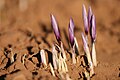 Crocus flowers, early bloom
 -
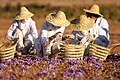 Crocus farming
 -
 Saffron Flowers, Torbat-e Heydarieh
 -
 Saffron Flowers, Torbat-e Heydarieh
 -
 Saffron Flowers
 -
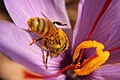 Saffron Honey
 -
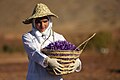 Saffron Farm, Harvest time
 -
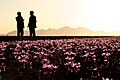 Saffron Flowers, Torbat-e Heydarieh


References[edit | edit source]
- ↑ "saffron". Merriam-Webster.com Dictionary. Merriam-Webster. OCLC 1032680871. Retrieved 21 November 2012.
- ↑ 2.0 2.1 McGee 2004, p. 423.
- ↑ Katzer G (2010). "Saffron (Crocus sativus L.)". Gernot Katzer's Spice Pages. Retrieved 1 December 2012.
- ↑ 4.0 4.1 4.2 Menia M, Iqbal S, Zahida R, et al. (2018). "Production technology of saffron for enhancing productivity (see PDF)". Journal of Pharmacognosy and Phytochemistry. 7 (1): 1033–1039. ISSN 2349-8234.
- ↑ 5.0 5.1 5.2 Hooker L (13 September 2017). "The problem for the world's most expensive spice". bbc.co.uk. Retrieved 12 January 2020.
- ↑ "Iran Produces 90% of World's Saffron". 3 January 2001.
- ↑ Rau 1969, p. 53.
- ↑ 8.0 8.1 Hill 2004, p. 272.
- ↑ "World's COSTLIEST spice blooms in Kashmir". rediff. Retrieved 7 January 2013.
- ↑ "Red gold: Afghanistan saffron production grows". Archived from the original on 20 July 2025. Retrieved 26 March 2026.
- ↑ "Can 'red gold' saffron replace poppy in Afghanistan?". dw.com. Retrieved 26 March 2026.
- ↑ 12.0 12.1 Russo, Dreher & Mathre 2003, p. 6.
- ↑ OED (2025). "Saffron, N. & Adj.". Oxford English Dictionary (Online ed.). Oxford University Press. Template:OEDsub
- ↑ 14.0 14.1 Kumari L (2025). Saffron (Crocus sativus L.) Analysis. Spices Production to Products. p. 23.
- ↑ 15.0 15.1 Nawab K (2022). "SAFFRON PRODUCTION IN AFGHANISTAN". Journal of Xi'an Shiyou University, Natural Science Edition. 18 (10): 744–757.
- ↑ Asgari M (2022). "Survey of the History and Applications of Saffron". Chinese Medicine and Culture. 5 (1): 31–38. doi:10.1097/MC9.0000000000000006.
- ↑ Ganaie DB (2019). "Saffron in Jammu & Kashmir". International Journal of Research in Geography (IJRG). 5 (2): 1–12.
- ↑ Fotovati M (2023). "Isolating valuable ingredients of saffron using extraction and preparative chromatography". Diss. Otto-von-Guericke-Universität Magdeburg: 161 pages.
- ↑ Ganaie DB (2019). "Cultivation Practices and Waning Production of Saffron in Jammu & Kashmir". Agricultural Research & Technology. 20 (3): 148–153.
- ↑ 20.0 20.1 Kafi et al. 2006, p. 24.
- ↑ Jacobsen N, Ørgaard M (2004). "Crocus cartwrightianus on the Attica Peninsula" (PDF). ISHS Acta Horticulturae. 650 (6): 65–69. doi:10.17660/ActaHortic.2004.650.6. Retrieved 6 April 2024.
- ↑ 22.0 22.1 22.2 Grilli Caiola 2003, p. 1.
- ↑ Negbi 1999, p. 28.
- ↑ Rubio-Moraga et al. 2009.
- ↑ 25.0 25.1 25.2 25.3 Ghorbani R, Koocheki A (2017). "Sustainable Cultivation of Saffron in Iran". In Lichtfouse E (ed.). Sustainable Agriculture Reviews (PDF). Springer. pp. 170–171. doi:10.1007/978-3-319-58679-3. ISBN 978-3-319-58679-3. S2CID 28214061.
- ↑ 26.0 26.1 Koocheki A, Khajeh-Hosseini M (2020). Saffron: science, technology and health. Duxford, United Kingdom: Woodhead Publishing, Elsevier. p. 16. ISBN 9780128187401. OCLC 1140113593.
- ↑ 27.0 27.1 Gresta F, Lombardo GM, Siracusa L, et al. (2008). "Saffron, an alternative crop for sustainable agricultural systems. A review". Agronomy for Sustainable Development. 28 (1): 95–112. Bibcode:2008AgSD...28...95G. doi:10.1051/agro:2007030. S2CID 44054590.
- ↑ 28.0 28.1 28.2 28.3 28.4 Kafi et al. 2006, p. 23.
- ↑ 29.0 29.1 29.2 Deo 2003, p. 1.
- ↑ Willard 2002, p. 3.
- ↑ Negbi 1999, p. 30–31.
- ↑ 32.0 32.1 Willard 2002, pp. 2–3.
- ↑ Rezvani-Moghaddam P (1 January 2020), Koocheki A, Khajeh-Hosseini M (eds.), "Chapter 8. Ecophysiology of saffron", Saffron, Woodhead Publishing Series in Food Science, Technology and Nutrition, Woodhead Publishing, pp. 119–137, ISBN 978-0-12-818638-1, retrieved 22 February 2023
{{citation}}: CS1 maint: work parameter with ISBN (link) - ↑ Deo 2003, p. 2.
- ↑ Sharaf-Eldin et al. 2008.
- ↑ 36.0 36.1 Deo 2003, p. 3.
- ↑ Willard 2002, pp. 3–4.
- ↑ Willard 2002, p. 4.
- ↑ Negbi 1999, p. 8.
- ↑ Monks K (3 September 2015). "Iran's homegrown treasure: the spice that costs more than gold". CNN. Retrieved 22 January 2016.
- ↑ Hill 2004, p. 273.
- ↑ Rau 1969, p. 35.
- ↑ Lak D (11 November 1998). "Kashmiris pin hopes on saffron". BBC News. Retrieved 11 September 2011.
- ↑ 44.0 44.1 Deo 2003, p. 4.
- ↑ 45.0 45.1 45.2 45.3 45.4 Dhar MK, Sharma M, Bhat A, et al. (28 March 2017). "Functional genomics of apocarotenoids in saffron: insights from chemistry, molecular biology and therapeutic applications (Review)". Briefings in Functional Genomics. 16 (6): 336–347. doi:10.1093/bfgp/elx003. ISSN 2041-2649. PMID 28369196.
- ↑ 46.0 46.1 Amanpour A, Sonmezdag AS, Kelebek H, et al. (2015). "GC–MS–olfactometric characterization of the most aroma-active components in a representative aromatic extract from Iranian saffron (Crocus sativus L.)". Food Chemistry. 182: 251–256. doi:10.1016/j.foodchem.2015.03.005. ISSN 0308-8146. PMID 25842335.
- ↑ 47.0 47.1 47.2 Abdullaev 2002, p. 1.
- ↑ 48.0 48.1 Hosseini A, Razavi BM, Hosseinzadeh H (2018). "Pharmacokinetic Properties of Saffron and its Active Components". European Journal of Drug Metabolism and Pharmacokinetics. 43 (4): 383–390. doi:10.1007/s13318-017-0449-3. PMID 29134501. S2CID 23836415.
- ↑ 49.0 49.1 McGee 2004, p. 422.
- ↑ 50.0 50.1 50.2 50.3 Leffingwell.
- ↑ Dharmananda 2005.
- ↑ 52.0 52.1 Amjad Masood Husaini, Azra N. Kamili, M. H. Wani, et al. (2010), Husaini AM (ed.), "Sustainable Saffron (Crocus sativus Kashmirianus) Production: Technological and Policy Interventions for Kashmir", Functional Plant Science & Biotechnology, 4 (2), UK: Global Science Books: 118, ISSN 1749-0472
- ↑ Verma & Middha 2010, p. 1–2.
- ↑ Hill 2004, p. 274.
- ↑ Willard 2002, pp. 102–104.
- ↑ "Kashmir's saffron harvest sees sharp decline". Firstpost. 18 November 2017. Retrieved 1 January 2019.
- ↑ Rashid A (22 September 2018). "From 35kgs earlier to 1kg yield now, 'successful' Saffron Mission paves way for apples in Pampore". Free Press Kashmir. Retrieved 1 January 2019.
- ↑ "Kashmiri Saffron Producers See Red over Iranian Imports". Australian Broadcasting Corp. 4 November 2003. Retrieved 29 September 2011.
- ↑ Hussain A (28 January 2005). "Saffron Industry in Deep Distress". BBC News. London. Retrieved 15 September 2011.
- ↑ Guijarro-Díez M, Castro-Puyana M, Crego AL, et al. (1 January 2017). "Detection of saffron adulteration with gardenia extracts through the determination of geniposide by liquid chromatography-mass spectrometry". Journal of Food Composition and Analysis. 55: 30–37. doi:10.1016/j.jfca.2016.11.004.
- ↑ Bishop S (26 April 2018). "Krokos Kozanis PDO". European Commission. Archived from the original on 17 November 2018. Retrieved 16 November 2018.
- ↑ 62.0 62.1 62.2 Willard 2002, p. 143.
- ↑ Willard 2002, p. 201.
- ↑ Wright S (12 May 2020). "An Intimate Look at Italy's Saffron Harvest". The New York Times. ISSN 0362-4331. Retrieved 26 March 2026.
- ↑ Vlahova V (2022). "Saffron (Crocus Sativus) as an Alternative Crop in Sustainable Agricultural Systems. a Review" (PDF). Scientific Papers Series Management, Economic Engineering in Agriculture and Rural Development. 22 (2): 778. Archived (PDF) from the original on 22 September 2022. Retrieved 22 September 2022.
- ↑ Hassan F (19 February 2020). "Farmers Pitch For GI Tag For Kashmiri Saffron, World's Most Expensive Spice". IndiaSpend. Retrieved 11 March 2022.
- ↑ "Kashmir's saffron gets GI tag". Hindustan Times. 25 July 2020. Retrieved 27 July 2020.
- ↑ Islami M (23 November 2024). "Afghanistan bets on 'red gold' for global market presence". Arab News. Retrieved 13 February 2025.
- ↑ Salehi NA (8 January 2026). "Herat Saffron Named World's Best for 10th Consecutive Year". TOLOnews. Retrieved 4 February 2026.
- ↑ Salahuddin S (22 December 2019). "Afghanistan's red gold 'saffron' termed world's best". Arab News. Retrieved 13 February 2025.
- ↑ Jones S (22 January 2023). "Climate crisis and neglect threaten Spain's saffron crop". The Guardian. ISSN 0261-3077. Retrieved 26 March 2026.
- ↑ "The uncertain future of the world's most expensive spice". Environment. 15 January 2026. Retrieved 26 March 2026.
- ↑ "Moroccan saffron farmers battle knockoff spices". Saudi Arabia: Arab News. 17 December 2018.
- ↑ Mousavi SZ, Bathaie SZ (2011). "Historical uses of saffron: Identifying potential new avenues for modern research". Avicenna Journal of Phytomedicine. 1 (2): 27–66. Archived from the original on 4 March 2016. Retrieved 27 July 2014.
- ↑ Basker D, Negbi M (1983). "Uses of saffron". Journal of Economic Botany. 37 (2): 228–236. Bibcode:1983EcBot..37..228B. doi:10.1007/BF02858789. JSTOR 4254486. S2CID 40880131.
- ↑ Dalby 2002, p. 138.
- ↑ Mousavi Z, Bathaie, S. (Autumn 2011). "Historical uses of saffron: Identifying potential new avenues for modern research" (PDF). Avicenna Journal of Phytomedicine. 1: 63.
- ↑ United States Food and Drug Administration (2024). "Daily Value on the Nutrition and Supplement Facts Labels". FDA. Archived from the original on 27 March 2024. Retrieved 28 March 2024.
- ↑ "TABLE 4-7 Comparison of Potassium Adequate Intakes Established in This Report to Potassium Adequate Intakes Established in the 2005 DRI Report". p. 120. In: Stallings VA, Harrison M, Oria M, eds. (2019). "Potassium: Dietary Reference Intakes for Adequacy". Dietary Reference Intakes for Sodium and Potassium. pp. 101–124. doi:10.17226/25353. ISBN 978-0-309-48834-1. PMID 30844154. NCBI NBK545428.
- ↑ Simmons S (October 2007). A Treasury of Persian Cuisine. Stamford House Publishing. pp. 37–38. ISBN 978-1-904985-56-3.
- ↑ "Persian Jewelled Rice with Lamb (Gheymeh Nesar)". 11 July 2017.
- ↑ "Persian Chicken & Aubergine Stew (Bademjan-Ghooreh Mosama)". 20 August 2017.
- ↑ Pickersgill B (2005). Prance G, Nesbitt M (eds.). The Cultural History of Plants. Routledge. p. 170. ISBN 0-415-92746-3.
- ↑ 84.0 84.1 Moshiri M, Vahabzadeh M, Hosseinzadeh H (2015). "Clinical Applications of Saffron (Crocus sativus) and its Constituents: A Review". Drug Research. 56 (6): 287–295. doi:10.1055/s-0034-1375681. PMID 24848002.
- ↑ Marx W, Lane M, Rocks T, et al. (1 August 2019). "Effect of saffron supplementation on symptoms of depression and anxiety: a systematic review and meta-analysis". Nutrition Reviews. 77 (8): 557–571. doi:10.1093/nutrit/nuz023. ISSN 0029-6643. PMID 31135916.
{{cite journal}}: CS1 maint: overridden setting (link) - ↑ Dai L, Chen L, Wang W (2020). "Safety and Efficacy of Saffron (Crocus sativus L.) for Treating Mild to Moderate Depression: A Systematic Review and Meta-analysis". The Journal of Nervous and Mental Disease. 208 (4): 269–276. doi:10.1097/NMD.0000000000001118. PMID 32221179. S2CID 210119504.
- ↑ Tóth B, Hegyi P, Lantos T, et al. (2019). "The Efficacy of Saffron in the Treatment of Mild to Moderate Depression: A Meta-analysis". Planta Medica. 85 (1): 24–31. Bibcode:2019PlMed..85...24T. doi:10.1055/a-0660-9565. ISSN 1439-0221. PMID 30036891.
{{cite journal}}: CS1 maint: overridden setting (link) - ↑ Shafiee A, Jafarabady K, Seighali N, et al. (1 March 2025). "Effect of Saffron Versus Selective Serotonin Reuptake Inhibitors (SSRIs) in Treatment of Depression and Anxiety: A Meta-analysis of Randomized Controlled Trials". Nutrition Reviews. 83 (3): e751–e761. doi:10.1093/nutrit/nuae076. ISSN 1753-4887. PMID 38913392.
{{cite journal}}: CS1 maint: overridden setting (link) - ↑ Karim M, Pirzad S, Shirsalimi N, et al. (27 November 2024). "Effects of saffron (Crocus sativus L.) supplementation on cardiometabolic indices in diabetic and prediabetic overweight patients: a systematic review and meta-analysis of RCTs". Diabetology & Metabolic Syndrome. 16 (1): 286. doi:10.1186/s13098-024-01530-6. ISSN 1758-5996. PMC 11600967. PMID 39593185.
{{cite journal}}: CS1 maint: overridden setting (link) - ↑ Koocheki A, Khajeh-Hosseini M (16 January 2020). Saffron: Science, Technology and Health. Woodhead Publishing. p. 23. ISBN 978-0-12-818740-1.
- ↑ Harold McGee. On Food and Cooking, 2004 edition, pg 422. Scribner, New York, NY,
- ↑ Schmidt T, Heitkam T, Liedtke S, et al. (2019). "Adding color to a century-old enigma: multi-color chromosome identification unravels the autotriploid nature of saffron (Crocus sativus) as a hybrid of wild Crocus cartwrightianus cytotypes". New Phytologist. 222 (4): 1965–1980. Bibcode:2019NewPh.222.1965S. doi:10.1111/nph.15715. ISSN 1469-8137. PMID 30690735.
- ↑ Harpke D, Meng S, Rutten T, et al. (1 March 2013). "Phylogeny of Crocus (Iridaceae) based on one chloroplast and two nuclear loci: Ancient hybridization and chromosome number evolution". Molecular Phylogenetics and Evolution. 66 (3): 617–627. Bibcode:2013MolPE..66..617H. doi:10.1016/j.ympev.2012.10.007. ISSN 1055-7903. PMID 23123733.
- ↑ Nemati Z, Harpke D, Gemicioglu A, et al. (2019). "Saffron (Crocus sativus) is an autotriploid that evolved in Attica (Greece) from wild Crocus cartwrightianus". Molecular Phylogenetics and Evolution. 136: 14–20. Bibcode:2019MolPE.136...14N. doi:10.1016/j.ympev.2019.03.022. PMID 30946897.
- ↑ Maw G (1886). A Monograph of the Genus Crocus. Soho Square, London: Dulau and Co. pp. 87, 164, 207, 250. Retrieved 6 April 2024.
- ↑ 96.0 96.1 Kazemi-Shahandashti SS, Mann L, El-nagish A, et al. (2022). "Ancient Artworks and Crocus Genetics Both Support Saffron's Origin in Early Greece". Frontiers in Plant Science. 13 834416. Bibcode:2022FrPS...1334416K. doi:10.3389/fpls.2022.834416. PMC 8913524. PMID 35283878.
- ↑ 97.0 97.1 Honan WH (2 March 2004). "Researchers Rewrite First Chapter for the History of Medicine". The New York Times. Retrieved 13 September 2011.
- ↑ 98.0 98.1 98.2 Willard 2002, p. 2.
- ↑ Humphries 1998, p. 20.
- ↑ Willard 2002, p. 12.
- ↑ 101.0 101.1 101.2 Walton Joshua AU - Santini, Lauren M. (2022), Fu J, Shafer-Elliott C, Meyers C (eds.), "Spices, Herbs, and Sweeteners", T&T Clark Handbook of Food in the Hebrew Bible and Ancient Israel, T&T Clark Handbooks (1 ed.), London: T&T Clark, pp. 163–164, ISBN 978-0-567-67982-6, retrieved 28 July 2025
{{citation}}: CS1 maint: multiple names: authors list (link) CS1 maint: work parameter with ISBN (link) - ↑ Willard 2002, pp. 17–18.
- ↑ 103.0 103.1 Willard 2002, p. 41.
- ↑ Willard 2002, pp. 54–55.
- ↑ Lak D (23 November 1998). "Gathering Kashmir's Saffron". BBC News. Retrieved 12 September 2011.
- ↑ Fotedar S (1999). "Cultural Heritage of India: The Kashmiri Pandit Contribution". Vitasta. 32 (1). Kashmir Sabha of Kolkata: 128. Archived from the original on 29 September 2011. Retrieved 15 September 2011.
- ↑ 107.0 107.1 Dalby 2002, p. 95.
- ↑ Dalby 2003, p. 256.
- ↑ Finlay 2003, p. 224.
- ↑ Hanelt 2001, p. 1352.
- ↑ Fletcher 2005, p. 11.
- ↑ Hayes 2001, p. 6.
- ↑ Ferrence & Bendersky 2004, p. 1.
- ↑ Willard 2002, p. 58.
- ↑ Willard 2002, p. 55.
- ↑ Willard 2002, pp. 34–35.
- ↑ Willard 2002, p. 59.
- ↑ Celsus 1989.
- ↑ Way A (1843). Promptorium parvulorum sive clericorum, lexicon Anglo-Latinum princeps, recens. A. Way. Camden soc. p. 268. Retrieved 18 May 2016.
- ↑ Pratt A (1855). The Flowering Plants of Great Britain. Society for Promoting Christian Knowledge. p. 180. Retrieved 18 May 2016.
- ↑ Napier R, ed. (1882). A Noble Boke Off Cookry Ffor a Prynce Houssolde Or Eny Other Estately Houssholde. Elliot Stock. pp. 104–105. Retrieved 18 May 2016. (Reprinted verbatim from a rare manuscript in the Holkham Collection.)
- ↑ "Conditum Paradoxum – Würzwein" [Conditum Paradoxum – Spiced Wine] (in Deutsch). Translated by Maier R. 1991. Archived from the original on 8 March 2018. Retrieved 3 February 2012.
- ↑ Willard 2002, p. 63.
- ↑ Willard 2002, p. 70.
- ↑ Willard 2002, p. 99.
- ↑ Willard 2002, p. 101.
- ↑ Willard 2002, pp. 103–104.
- ↑ Willard 2002, p. 133.
- ↑ Larsson M, Foley B (26 January 2023). "The king's spice cabinet–Plant remains from Gribshunden, a 15th century royal shipwreck in the Baltic Sea". PLOS ONE. 18 (1) e0281010. Bibcode:2023PLoSO..1881010L. doi:10.1371/journal.pone.0281010. ISSN 1932-6203. PMC 9879437. PMID 36701280.
- ↑ Granleese B (16 November 2013). "Interview: Meet the saffron producer: 'It seemed ridiculous that the UK didn't grow it'". The Guardian.
- ↑ "Saffron spice returns to Essex after 200 years". BBC News. 7 November 2014.
- ↑ Willard 2002, p. 138.
- ↑ Willard 2002, pp. 138–139.
- ↑ Willard 2002, pp. 142–146.
- ↑ "Saffron in History: A Deep-Rooted Heritage of Persia and Its Cultural". Saffronice. Retrieved 11 February 2025.
- ↑ David Greene (host, Morning Edition), Hayatullah Hayat (Governor of Helmand Province, Afghanistan), Tom Bowman (reporter), Dianne Feinstein (U.S. Senator, Chair of the Caucus on International Narcotics Control) (6 July 2016). Afghan Governor Wants Government To Control Poppy Crop (Radio broadcast). NPR. Event occurs at 0:10. Retrieved 11 February 2025.
Afghanistan's poppy production… accounts for more than 91 percent of the world's heroin.
- ↑ 137.0 137.1 137.2 "Saffron Manual for Afghanistan" (PDF). Archived from the original (PDF) on 9 September 2011.
- ↑ "Afghanistan Saffron and Potential for the Economy: An Overview of International Trade and Domestic Well Being". Agricultural Reviews. 45 (2): 297–303. 23 May 2024. ISSN 0253-1496.
- ↑ "Afghan Saffron Attracts Global Buyers, Secures Million-Dollar Deal". TOLOnews. Retrieved 11 February 2025.
- ↑ "Afghanistan's Saffron on Media | AfGOV". www.mail.gov.af. Retrieved 11 February 2025.
- ↑ "Saffron in Afghanistan". The Observatory of Economic Complexity. Retrieved 11 February 2025.
- ↑ "ITC - Trade Impact for Good". www.intracen.org. 20 December 2024. Retrieved 11 February 2025.
- ↑ 143.0 143.1 "Quality saffron poised to spice up Afghanistan's exports (en) | ITC". www.intracen.org (in español). Retrieved 11 February 2025.
- ↑ "Saffron Production Rises in Afghanistan". TOLOnews. Retrieved 11 February 2025.
- ↑ EFE A (12 June 2024). "Harvesting Gold: Afghan women cultivate hope from saffron strands - EFE". EFE Noticias. Retrieved 11 February 2025.
- ↑ EFE A (12 June 2024). "Harvesting Gold: Afghan women cultivate hope from saffron strands - EFE". EFE Noticias. Retrieved 11 February 2025.
Bibliography[edit | edit source]
- Abdullaev FI (2002), "Cancer Chemopreventive and Tumoricidal Properties of Saffron (Crocus sativus L.)", Experimental Biology and Medicine, vol. 227, no. 1, pp. 20–5, Bibcode:2002ExpBM.227...20A, doi:10.1177/153537020222700104, PMID 11788779, S2CID 40798771, archived from the original on 3 December 2008, retrieved 11 September 2011
- Celsus AC (1989), De Medicina, Loeb Classical Library, vol. L292, translated by Spencer WG, Harvard University Press, ISBN 978-0-674-99322-8, retrieved 15 September 2011
- Dalby A (2002), Dangerous Tastes: The Story of Spices (1st ed.), University of California Press, ISBN 978-0-520-23674-5
- Dalby A (2003), Food in the Ancient World from A to Z, Routledge, ISBN 978-0-415-23259-3
- Dharmananda S (2005), "Saffron: An Anti-Depressant Herb", Institute for Traditional Medicine, archived from the original on 26 September 2006, retrieved 10 January 2006
- Deo B (2003), "Growing Saffron—The World's Most Expensive Spice" (PDF), Crop and Food Research, no. 20, New Zealand Institute for Crop and Food Research, archived from the original (PDF) on 27 December 2005, retrieved 10 January 2006
- Ferrence SC, Bendersky G (2004), "Therapy with Saffron and the Goddess at Thera", Perspectives in Biology and Medicine, vol. 47, no. 2, pp. 199–226, doi:10.1353/pbm.2004.0026, PMID 15259204, S2CID 32711986
- Finlay V (2003), Colour: A Natural History of the Palette, Random House, ISBN 978-0-8129-7142-2
- Fletcher N (2005), Charlemagne's Tablecloth: A Piquant History of Feasting (1st ed.), Saint Martin's Press, ISBN 978-0-312-34068-1
- Francis S (2011), Saffron: The Story of England's Red Gold, With Delicious Saffron Recipes that Family and Friends will Love, Norfolk Saffron, ISBN 978-0-9550466-7-4
- Grigg DB (1974), The Agricultural Systems of the World (1st ed.), Cambridge University Press, ISBN 978-0-521-09843-4
- Grilli Caiola M (2003), "Saffron Reproductive Biology", Acta Horticulturae, 650 (650), ISHS: 25–37, doi:10.17660/ActaHortic.2004.650.1, S2CID 89990377
- Hanelt P, ed. (2001), Mansfeld's Encyclopedia of Agricultural and Horticultural Crops (1st ed.), Springer, ISBN 978-3-540-41017-1
- Hayes AW (2001), Principles and Methods of Toxicology (4th ed.), Taylor and Francis, ISBN 978-1-56032-814-8
- Hill T (2004), The Contemporary Encyclopedia of Herbs and Spices: Seasonings for the Global Kitchen (1st ed.), Wiley, ISBN 978-0-471-21423-6
- Humphries J (1998), The Essential Saffron Companion, Ten Speed Press, ISBN 978-1-58008-024-8
- Kafi M, Koocheki A, Rashed MH, Nassiri M, eds. (2006), Saffron (Crocus sativus) Production and Processing (1st ed.), Science Publishers, ISBN 978-1-57808-427-2
- Leffingwell JC, "Saffron", leffingwell.com
- McGee H (2004), On Food and Cooking: The Science and Lore of the Kitchen, Scribner, ISBN 978-0-684-80001-1
- Negbi M, ed. (1999), Saffron: Crocus sativus L., CRC Press, ISBN 978-90-5702-394-1
- Rau SR (1969), The Cooking of India, Foods of the World, Time-Life Books, ISBN 978-0-8094-0069-0
- Rubio-Moraga A, Castillo-López R, Gómez-Gómez L, et al. (2009), "Saffron Is a Monomorphic Species as Revealed by RAPD, ISSR, and Microsatellite Analyses", BMC Research Notes, vol. 2, doi:10.1186/1756-0500-2-189, PMC 2758891, PMID 19772674
- Russo E, Dreher MC, Mathre ML (2003), Women and Cannabis: Medicine, Science, and Sociology (1st ed.), Psychology Press, ISBN 978-0-7890-2101-4
- Sharaf-Eldin M, Elkholy S, Fernández JA, et al. (August 2008), "Bacillus subtilis FZB24 affects flower quantity and quality of saffron (Crocus sativus)", Planta Medica, 74 (10): 1316–20, Bibcode:2008PlMed..74.1316S, doi:10.1055/s-2008-1081293, PMC 3947403, PMID 18622904
- Verma RS, Middha D (2010), "Analysis of Saffron (Crocus sativus L. Stigma) Components by LC–MS–MS", Chromatographia, 71 (1–2): 117–123, doi:10.1365/S10337-009-1398-Z, S2CID 97327822
- Willard P (2002), Secrets of Saffron: The Vagabond Life of the World's Most Seductive Spice, Beacon Press, ISBN 978-0-8070-5009-5
External links[edit | edit source]
- "Saffron", Darling Biomedical Library, UCLA
- "Crocus sativus", Germplasm Resources Information Network, USDA, archived from the original on 10 November 2004

