

Ajay Kumar (talk | contribs) Created a new article |
basic fix article to improve readability also and added references |
||
| Line 2: | Line 2: | ||
{{Use dmy dates|date=August 2020}} | {{Use dmy dates|date=August 2020}} | ||
{{more citations needed|date=January 2017}} | {{more citations needed|date=January 2017}} | ||
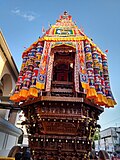
[[File: | [[File:28apr1.jpg|thumb|Temple car procession during Thanjavur Chariot festival, Tamil Nadu.]] | ||
'''Temple cars'''<ref>{{Cite journal|last1=Rajarajan|first1=R. K. K.|last2=Rajukalidoss|first2=Parthiban|title=Nāyaka Chefs-d'oeuvre: Structure and Iconography of the Śrīvilliputtūr Tēr|url=https://www.academia.edu/43392779|journal=Acta Orientalia|language=en}}</ref><ref>{{Cite journal|last=Rajarajan|first=R. K. K.|title=Iconographic Programme in Temple Cars: A Case Study of Kūṭal Alakar tēr|url=https://www.academia.edu/3308656|journal=East and West, Istituto Italiano per l'Africa e l'Oriente (IsIAO), Rome|language=en}}</ref> or Temple chariots are used to carry representations of [[Hindu deities]] around the streets of the temple on festival days. These chariots are generally manually pulled by the devotees of the deity. | |||
As of 2004, the [[India|Indian]] state [[Tamil Nadu]] had 515 wooden carts, 79 of which needed repairs.<ref>{{cite web |title=Government of Tamil Nadu Welcomes You |url=http://www.tn.gov.in/policynotes/archives/policy2003-04/hrce2003-04-3.htm |website=tn.gov.in |archive-url=https://archive.today/20121219065440/http://www.tn.gov.in/policynotes/archives/policy2003-04/hrce2003-04-3.htm |archive-date=19 December 2012}}</ref> [[Annamalaiyar Temple]], [[Tiruvannamalai]], [[Chidambaram]] Natarajar Temple are among the temples that possess these huge wooden chariots for regular processions. | |||
The Natarajar Temple celebrates the chariot festival twice a year; once in the summer (Aani Thirumanjanam, which takes place between June and July) and another in winter (Marghazhi Thiruvaadhirai, which takes place between December and January). Lord Krishna of Udupi has five temple cars, namely ''Brahma ratha'' (the largest), ''Madya ratha'' (medium), ''kinyo'' (small), and the silver and gold rathas. | The Natarajar Temple celebrates the chariot festival twice a year; once in the summer (Aani Thirumanjanam, which takes place between June and July) and another in winter (Marghazhi Thiruvaadhirai, which takes place between December and January). Lord Krishna of Udupi has five temple cars, namely ''Brahma ratha'' (the largest), ''Madya ratha'' (medium), ''kinyo'' (small), and the silver and gold rathas. | ||
| Line 12: | Line 11: | ||
The size of the largest temple cars inspired the [[List of English words of Hindi or Urdu origin|Anglo-Indian]] term [[Juggernaut]] (from [[Jagannath]]), signifying a tremendous, virtually unstoppable force or phenomenon. | The size of the largest temple cars inspired the [[List of English words of Hindi or Urdu origin|Anglo-Indian]] term [[Juggernaut]] (from [[Jagannath]]), signifying a tremendous, virtually unstoppable force or phenomenon. | ||
== | ==History== | ||
{{Further information|Ratha Yatra}} | |||
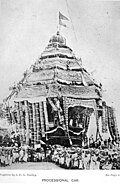
[[File:15Tiruvadmarudur Processional Car.jpg|thumb|Tiruvadmarudur Temple chariot in 1913.]] | |||
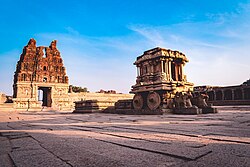
[[File:Stone Chariot Vittala Temple.jpg|thumb|Stone temple car in the Vitthala Temple built during [[Vijayanagara Empire]], India.]] | |||
Temple cars are used during festivals called ''Ratha Yatra'', a procession in a chariot accompanied by the public. It typically refers to a procession (journey) of deities, people dressed like deities, or simply religious saints and political leaders.<ref name="Michaels1996p270">{{cite book|author1=Michaels|author2=Cornelia Vogelsanger|author3=Annette Wilke|title=Wild Goddesses in India and Nepal: Proceedings of an International Symposium, Berne and Zurich, November 1994|url=https://books.google.com/books?id=1wbXAAAAMAAJ|year=1996|publisher=P. Lang|isbn=978-3-906756-04-2|pages=270–285}}</ref> The term appears in medieval texts of India such as the [[Puranas]], which mention the Ratha Yatra of [[Surya]] (Sun god), of [[Devi]] (Mother goddess), and of [[Vishnu]]. These chariot journeys have elaborate celebrations where the individuals or the deities come out of a temple accompanied by the public journeying with them through the ''Ksetra'' (region, streets) to another temple or to the river or the sea. Sometimes the festivities include returning to the sacrosanctum of the temple.<ref name="Michaels1996p270"/><ref name="Banglapedia">{{cite book|last=Mandai|first=Paresh Chandra|title=Banglapedia: National Encyclopedia of Bangladesh|publisher=[[Asiatic Society of Bangladesh]]|year=2012|editor1-last=Islam|editor1-first=Sirajul|editor1-link=Sirajul Islam|edition=Second|chapter=Rathajatra|editor2-last=Jamal|editor2-first=Ahmed A.|chapter-url=http://en.banglapedia.org/index.php?title=Rathajatra}}{{Dead link|date=June 2023 |bot=InternetArchiveBot |fix-attempted=yes }}</ref> | |||
Traveler [[Faxian|Fa-Hien]] who visited India during 400 CE notes the way temple car festivals were celebrated in India. | |||
{{Quote|The cities and towns of this country [Magadha] are the greatest of all in the Middle Kingdom [Mathura through Deccan]. The inhabitants are rich and prosperous, and vie with one another in the practice of benevolence and righteousness. Every year on the eighth day of the second month they celebrate a procession of images. They make a four-wheeled car, and on it erect a structure of four storeys by means of bamboos tied together. This is supported by a king-post, with poles and lances slanting from it, and is rather more than twenty cubits high, having the shape of a tope. White and silk-like cloth of hair is wrapped all round it, which is then painted in various colours. They make figures of devas, with gold, silver, and lapis lazuli grandly blended and having silken streamers and canopies hung out over them. On the four sides are niches, with a Buddha seated in each, and a Bodhisattva standing in attendance on him. There may be twenty cars, all grand and imposing, but each one different from the others. On the day mentioned, the monks and laity within the borders all come together; they have singers and skillful musicians; they pay their devotion with flowers and incense. The Brahmans come and invite the Buddhas to enter the city. These do so in order, and remain two nights in it. All through the night they keep lamps burning, have skillful music, and present offerings. This is the practice in all the other kingdoms as well. The Heads of the Vaisya families in them establish in the cities houses for dispensing charity and medicines. All the poor and destitute in the country, orphans, widowers, and childless men, maimed people and cripples, and all who are diseased, go to those houses, and are provided with every kind of help, and doctors examine their diseases. They get the food and medicines which their cases require, and are made to feel at ease; and when they are better, they go away of themselves.|Faxian, c. 415 CE<ref>{{Cite web|url=http://www.gutenberg.org/files/2124/2124-h/2124-h.htm |title=''A Record of Buddhistic Kingdoms'' (Chapter XXVII: Pataliputra or Patna, In Magadha)|website=gutenberg.org |author=Fa-Hien|publication-date=415 |year=1875 |version=Translated}} {{PD-notice}}</ref>}} | |||
==Early photographs and lithography of temple chariots== | |||
<gallery mode="packed" heights=220px style="text-align:left" caption="Vintage Temple chariot procession pictures"> | <gallery mode="packed" heights=220px style="text-align:left" caption="Vintage Temple chariot procession pictures"> | ||
File:Car Procession In Bangalore.jpg|Someshwara Temple chariot in 1918. | |||
File:Ratha Jatra optocht met versierde wagens ter ere van Jagannath in Madurai, RP-F-F80205.jpg|Chariot procession in Madurai in 1872. | File:Ratha Jatra optocht met versierde wagens ter ere van Jagannath in Madurai, RP-F-F80205.jpg|Chariot procession in Madurai in 1872. | ||
File:Banashankari Car.jpg|Banashankari Temple (Badami) chariot in 1855. | File:Banashankari Car.jpg|Banashankari Temple (Badami) chariot in 1855. | ||
File:Kurt boeck indien nepal 076B.jpg|Srirangam Temple chariot in the 1890s. | File:Kurt boeck indien nepal 076B.jpg|Srirangam Temple chariot in the 1890s. | ||
File: | File:Juggernaut Car, Madras MET DT6337.jpg|Juggernaut Car, Madras, 1850. | ||
File:The Kumari jatra. Three temple cars outside the Hanuman Dhoka, or Old Palace, Kathmandu - Oldfield collection (1850-1863) - BL WD 3279.jpg|Three temple cars outside the Hanuman Dhoka, or Old Palace, Kathmandu - Oldfield collection (1850-1863) | |||
File:Juggernaut.jpeg|The Car of Juggernaut, as depicted in the 1851 ''Illustrated London Reading Book'' | |||
File:Juggernaut kar in het Ulsoor tempelcomplex te Bangalore in India, KITLV 92036.tiff|Temple car in Bangalore, 1870 | |||
</gallery> | |||
==Largest temple chariot== | ==Largest temple chariot== | ||
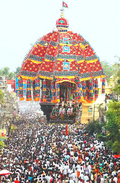
[[File:Thiruvarur Ther.png|thumb|Asia's Largest Temple car "Aazhi Ther (Big Chariot)" in [[Thiruvarur]], [[Tamil Nadu]].]] | [[File:Thiruvarur Ther.png|thumb|Asia's Largest Temple car "Aazhi Ther (Big Chariot)" in [[Thiruvarur]], [[Tamil Nadu]].]] | ||
| Line 33: | Line 41: | ||
== Gallery == | == Gallery == | ||
<gallery mode="packed" style="font-size:88%; line-height:130%; border-bottom:1px #aaa solid;" heights="210"> | <gallery mode="packed" style="font-size:88%; line-height:130%; border-bottom:1px #aaa solid;" heights="210"> | ||
File:Taladhwaja, Darpadalana and Nandighosha in 2021 Ratha Jatra.jpg|Taladhwaja, Darpadalana and Nandighosha in 2021 Ratha Jatra, Odisha, India. | |||
File:Chidambaram festival.jpg|Temple festival in [[Chidambaram]], Tamil Nadu, India. | |||
Tiruvarur temple car festival 2010.jpg|[[Tiruvarur]] temple car, the largest (chariot) temple car in the world, it weighing {{convert|300|t|0}} with a height of {{convert|90|ft|m|2}}. | Tiruvarur temple car festival 2010.jpg|[[Tiruvarur]] temple car, the largest (chariot) temple car in the world, it weighing {{convert|300|t|0}} with a height of {{convert|90|ft|m|2}}. | ||
Theru.JPG|Type of temple car called ''Theru'' from the [[Chettikulangara Kumbha Bharani]], [[Kerala]] | Theru.JPG|Type of temple car called ''Theru'' from the [[Chettikulangara Kumbha Bharani]], [[Kerala]] | ||
Kuthira.JPG|Type of temple car called ''Kuthira'' from the [[Chettikulangara Kumbha Bharani]], [[Kerala]] | Kuthira.JPG|Type of temple car called ''Kuthira'' from the [[Chettikulangara Kumbha Bharani]], [[Kerala]] | ||
Decorated chariot, Udupi, India.jpg|Temple car (decorated), [[Udupi]], Karnataka, [[India]]. | Decorated chariot, Udupi, India.jpg|Temple car (decorated), [[Udupi]], Karnataka, [[India]]. | ||
File:Bisket Jatra Chariot Bhaktapur.jpg|Bisket Jatra Chariot Bhaktapur, Nepal. | |||
Nellaiappar Temple Golden Car Nov 2 2009.jpg|Picture of [[Tirunelveli]] Nellaiappar Temple Golden car. | Nellaiappar Temple Golden Car Nov 2 2009.jpg|Picture of [[Tirunelveli]] Nellaiappar Temple Golden car. | ||
தேர்.jpg|Picture of [[Alwarkurichi]] People pulling Sivasailanathaswamy Temple car. | தேர்.jpg|Picture of [[Alwarkurichi]] People pulling Sivasailanathaswamy Temple car. | ||
File:Taladhwaja, Darpadalana and Nandighosha in 2021 Ratha Jatra Taladhwaja, Darpadalana and Nandighosha Ratha in fornt of Jagananth temple in 2021 Ratha Jatra.jpg|Temple cars in front of Jagananth temple, 2021 | |||
</gallery> | </gallery> | ||
| Line 51: | Line 59: | ||
====Tamil Nadu==== | ====Tamil Nadu==== | ||
* [[Alagar Kovil]] (Kallazhagar Temple) | |||
* [[Alwarkurichi]], Tenkasi | * [[Alwarkurichi]], Tenkasi | ||
* [[Aragalur]] | * [[Aragalur]] | ||
* [[Avinashi]] (Sri Avanashiappar Temple) | * [[Avinashi]] (Sri Avanashiappar Temple) | ||
* [[Bhavani Sangameswarar Temple|Bhavani Kooduthoorai]], [[Tamil Nadu]] (4 chariots) | * [[Bhavani Sangameswarar Temple|Bhavani Kooduthoorai]], [[Tamil Nadu]] (4 chariots) | ||
* [[Coimbatore | * [[Coimbatore]] (Koniamman Temple) | ||
* [[Chidambaram | * [[Chidambaram]] (Nataraja Temple) | ||
* [[Dindigul]] (Abiramiyamman Kovil) | * [[Dindigul]] (Abiramiyamman Kovil) | ||
* [[Denkanikottai]] (Betarayaswamy Kovil) | * [[Denkanikottai]] (Betarayaswamy Kovil) | ||
* [[Erode]] ([[Chennimalai]], Sivagiri, Sivanmalai) | * [[Erode]] ([[Chennimalai]], Sivagiri, Sivanmalai, [[Vijayamangalam]]) | ||
* [[Gobichettipalayam]] (Sri Kondathukalaimman Temple, Sri Balamurugan Temple and others) | * [[Gobichettipalayam]] (Sri Kondathukalaimman Temple, Sri Balamurugan Temple and others) | ||
* [[Hosur]] (Chandra Choodeswarar Temple) | |||
* [[Kadayanallur]] | * [[Kadayanallur]] | ||
* [[Kalaiyar Kovil]] (Swarna Kaleeswarar Temple) | |||
* [[Kallal Town]] (Somasundareswarer Kovil) | * [[Kallal Town]] (Somasundareswarer Kovil) | ||
* [[Kanchipuram]] ( | * [[Kanchipuram]] (Varadharaja Perumal Temple, Ekambareswarar Temple and others) | ||
* [https:// | * [https://www.google.com/maps/place/Shri+karuvalur+Mariyamman+Temple,karuvalur/@11.2092286,77.1837294,16z/data=!4m5!3m4!1s0x3ba8fd64adee6081:0xd5bd7602e7c1fbee!8m2!3d11.2104588!4d77.1905395 Karuvalur] (Shri Mariamman Kovil) | ||
* [[Karamadai]] ( | * [[Karamadai]] (Ranganathaswamy temple) | ||
* [[Kumbakonam]] (Sri Saarangapani Temple and others) | * [[Kumbakonam]] (Sri Saarangapani Temple, Adi Kumbeswarar Temple and others) | ||
* [[Lalgudi]] ( | * [[Lalgudi]] (Saptharishishwarar Temple, Lalgudi) | ||
* [[Madurai]] (Sri Meenakshi Amman Temple and others) | * [[Madurai]] (Sri Meenakshi Amman Temple and others) | ||
* [[Mannargudi]] (Sri vidhya Rajagopalaswamy temple) | * [[Mannargudi]] (Sri vidhya Rajagopalaswamy temple) | ||
* [[Minjur]] (Sri | * [[Minjur]] (Sri Ekambaranathar temple) | ||
* [[Mylapore]], [[Chennai]] (Kapaleeshwarar Temple) | * [[Mylapore]], [[Chennai]] (Sri Kapaleeshwarar Temple) | ||
* [[Nanguneri]] (Vanamamalai Perumal Temple) | |||
* [[Athur, Thoothukudi|North Authoor]] (Sri Somanathar Somasundari Temple) | * [[Athur, Thoothukudi|North Authoor]] (Sri Somanathar Somasundari Temple) | ||
* [[Palani]] | * [[Palani]] (Sri Dhandayudhapani Temple) | ||
* [[Perur]] (Patteewarar Temple) | * [[Perur]] (Sri Patteewarar Temple) | ||
* [[Karpaka Vinayakar Temple|Pillaiyarpatti]] (Sri Karpaga Vinayagar Temple) | |||
* [[Rameswaram]] (Ramanathaswamy Temple) | |||
* [[Sakkottai]], Karaikudi | * [[Sakkottai]], Karaikudi | ||
* [[ | * [[Mariamman Temple, Samayapuram|Samayapuram]] (Maariamman Temple) | ||
* [[Srivaikuntam]] ( | * [[Sankarankovil]] (Sankara Narayanasamy Temple) | ||
* [[Suchindram]] ( | * [[Srivaikuntam]] (Srivaikuntanathan Permual Temple) – (Fourth largest temple car in Tamil Nadu) | ||
* [[Srivilliputtur]] ( | * [[Suchindram]] (Thanumalayan Temple) | ||
* [[Srivilliputtur]] (Srivilliputhur Andal Temple) - (Second largest temple car in Tamil Nadu) | |||
* [[Salem, Tamil Nadu|Salem]] ([[Elampillai]], Aranagalur, [[Rasipuram]]) | * [[Salem, Tamil Nadu|Salem]] ([[Elampillai]], Aranagalur, [[Rasipuram]]) | ||
* Sholinghur Sri Lakshmi Narasimha Swamy | * [[Sholinghur]] (Sri Lakshmi Narasimha Swamy Temple) | ||
* [[Srimushnam]] ( | * [[Srimushnam]] (Bhu Varaha Swamy Temple) - Second largest temple car in [[Tamilnadu]]{{citation needed|date=April 2023}}) | ||
* [[ | * [[Srirangam]] (Sri Ranganatha Swamy Temple) | ||
* [[ | * [[Tenkasi]] (Kasi Viswanathar Temple, Tenkasi) | ||
* Thiruvanthipuram, | * [[Tiruchendur]] (Sri Subramanya Swami temple) | ||
* [[Tirunelveli]] (Sri | * [[Tiruchirappalli]] (Thayumanavar Temple) | ||
* [[Tiruchengode]] (Sri Arthanareeswarar Temple - Fourth largest temple car in Tamil Nadu) | * [[Thanjavur]] (Brihadeeswara Temple) | ||
* [[Tiruvannamalai]] (Annamalaiyar | * [[Thirukkadaiyur]] (Amritaghateswarar-Abirami Temple) | ||
* [[Thirukkurungudi]] (Thirukkurungudi Vaishnava Nambi Temple) | |||
* [[Thirukoshtiyur]] (Sri Sowmiya Narayana Perumal Temple) | |||
* [[Thirunageswaram]] (Oppiliappan Temple) | |||
* [[Thirunallar]] (Dharbaranyeswarar Temple) | |||
* [[Thiruparankundram]] (Subramaniya Swamy Temple) | |||
* [[Thirupathiripuliyur]] (Padaleeswarar temple) | |||
* [[Thiruthangal]] (Ninra Narayana Perumal Temple) | |||
* [[Thiruvanaikaval]] (Jambukeswarar Temple) | |||
* [[Thiruvanthipuram]], (Devanathaswamy temple) | |||
* [[Thiruvarur]] (Thiyagarajar Temple) - (First largest temple car in Asia){{citation needed|date=April 2023}} | |||
* [[Tirunelveli]] (Sri Nellaiappar Temple) – (Third largest temple car in Tamil Nadu) | |||
* [[Tiruchengode]] (Sri Arthanareeswarar Temple) - (Fourth largest temple car in Tamil Nadu) | |||
* [[Tiruvannamalai]] (Annamalaiyar Temple, 5 Chariots) | |||
* [[Tirupattur]] (Aruilmigu Muthukumara Swamy Thirukkovil, God Shiva chariot) | * [[Tirupattur]] (Aruilmigu Muthukumara Swamy Thirukkovil, God Shiva chariot) | ||
* [[Thirthahalli]] | * [[Thirthahalli]] | ||
* [[Tiruvallur]] | * [[Tiruvallur]] (Veeraraghava Swamy Temple) | ||
* [[Tiruvidaimarudur]] (Mahalinga Swamy) | * [[Tiruvidaimarudur]] (Mahalinga Swamy Temple) Chariots | ||
* [[Triplicane]], [[Chennai]] (Sri Parthasarathy Temple) | |||
* [[Thungapuram]] (Ariyalur-Perambalur) | * [[Thungapuram]] (Ariyalur-Perambalur) | ||
* [[ | * [[Vaitheeswaran Koil]] (vaidyanatha Swamy Temple) | ||
* [[ | * [[Vedaranyam]] (Vedaranyeswarar Temple) | ||
* [[Vikramasingapuram|Vickramasingapuram]] (Sivanthiappar Kovil) | * [[Vikramasingapuram|Vickramasingapuram]] (Sivanthiappar Kovil) | ||
* [[Virudhunagar]] | * [[Virudhunagar]] | ||
| Line 121: | Line 149: | ||
* [[Suratkal]] | * [[Suratkal]] | ||
* [[Udupi]] | * [[Udupi]] | ||
* Idagunji (Mahaganapathi Temple) | |||
====Odisha==== | ====Odisha==== | ||
| Line 128: | Line 157: | ||
====Kerala==== | ====Kerala==== | ||
* [[Chettikulangara]] | * [[Chettikulangara]] ([[Chettikulangara Devi Temple]]) | ||
* [[Cherai]] | * [[Cherai]] | ||
* [[Palakkad]], [[Kerala]] (Many temples in settlements of Palakkad) | * [[Palakkad]], [[Kerala]] (Many temples in settlements of Palakkad) | ||
| Line 134: | Line 163: | ||
* [[Kadiri]] (Sri Khadri Lakshmi Narasimha Swami Temple) | * [[Kadiri]] (Sri Khadri Lakshmi Narasimha Swami Temple) | ||
* [[Koduru, Krishna district|Koduru]] | * [[Koduru, Krishna district|Koduru]] | ||
* [[Mangalagiri]] (Sri Panakaala Lakshmi Narasimha Swami Temple) | |||
* [[Srikalahasti]] (Sri Kalahastheeswara Temple) | |||
* [[Tirumala]] (Sri Venkateshwara Temple) | |||
*(Sri Bala Tripura sundare sametha sangamesara swami temple sangam jagarala mudi) | |||
====Others==== | ====Others==== | ||
| Line 142: | Line 176: | ||
* [[George Town, Penang|George Town]] (Nattukkottai Chettiar Temple) | * [[George Town, Penang|George Town]] (Nattukkottai Chettiar Temple) | ||
* [[Kuala | * [[Kuala Lumpur]] (Seri Maha Mariamman Temple Devasthanam) | ||
* [[Teluk Intan]] (Nagarathaar Sri Thendayuthapani) | * [[Teluk Intan]] (Nagarathaar Sri Thendayuthapani | ||
* [[Bukit Mertajam penang]] (Shri Maha Mangalanayagi Amman Devasthanam, Bukit Mertajam) | |||
===Sri Lanka=== | ===Sri Lanka=== | ||
| Line 151: | Line 186: | ||
===Germany=== | ===Germany=== | ||
* [[Hamm]], [[Germany]] (Sri Kamadchi Ampal Temple) | * [[Hamm, North Rhine-Westphalia|Hamm]], [[Germany]] (Sri Kamadchi Ampal Temple) | ||
== List of places with golden Temple cars == | == List of places with golden Temple cars == | ||
| Line 216: | Line 251: | ||
* [[Ratha]] | * [[Ratha]] | ||
* [[Carroccio]] | * [[Carroccio]] | ||
* [[Carriage | * [[Carriage]] | ||
== References == | == References == | ||
Latest revision as of 14:22, 6 March 2026
 | This article needs more citations. (January 2017) |

Temple cars[1][2] or Temple chariots are used to carry representations of Hindu deities around the streets of the temple on festival days. These chariots are generally manually pulled by the devotees of the deity.
As of 2004, the Indian state Tamil Nadu had 515 wooden carts, 79 of which needed repairs.[3] Annamalaiyar Temple, Tiruvannamalai, Chidambaram Natarajar Temple are among the temples that possess these huge wooden chariots for regular processions.
The Natarajar Temple celebrates the chariot festival twice a year; once in the summer (Aani Thirumanjanam, which takes place between June and July) and another in winter (Marghazhi Thiruvaadhirai, which takes place between December and January). Lord Krishna of Udupi has five temple cars, namely Brahma ratha (the largest), Madya ratha (medium), kinyo (small), and the silver and gold rathas.
The size of the largest temple cars inspired the Anglo-Indian term Juggernaut (from Jagannath), signifying a tremendous, virtually unstoppable force or phenomenon.
History[edit | edit source]


Temple cars are used during festivals called Ratha Yatra, a procession in a chariot accompanied by the public. It typically refers to a procession (journey) of deities, people dressed like deities, or simply religious saints and political leaders.[4] The term appears in medieval texts of India such as the Puranas, which mention the Ratha Yatra of Surya (Sun god), of Devi (Mother goddess), and of Vishnu. These chariot journeys have elaborate celebrations where the individuals or the deities come out of a temple accompanied by the public journeying with them through the Ksetra (region, streets) to another temple or to the river or the sea. Sometimes the festivities include returning to the sacrosanctum of the temple.[4][5]
Traveler Fa-Hien who visited India during 400 CE notes the way temple car festivals were celebrated in India.
The cities and towns of this country [Magadha] are the greatest of all in the Middle Kingdom [Mathura through Deccan]. The inhabitants are rich and prosperous, and vie with one another in the practice of benevolence and righteousness. Every year on the eighth day of the second month they celebrate a procession of images. They make a four-wheeled car, and on it erect a structure of four storeys by means of bamboos tied together. This is supported by a king-post, with poles and lances slanting from it, and is rather more than twenty cubits high, having the shape of a tope. White and silk-like cloth of hair is wrapped all round it, which is then painted in various colours. They make figures of devas, with gold, silver, and lapis lazuli grandly blended and having silken streamers and canopies hung out over them. On the four sides are niches, with a Buddha seated in each, and a Bodhisattva standing in attendance on him. There may be twenty cars, all grand and imposing, but each one different from the others. On the day mentioned, the monks and laity within the borders all come together; they have singers and skillful musicians; they pay their devotion with flowers and incense. The Brahmans come and invite the Buddhas to enter the city. These do so in order, and remain two nights in it. All through the night they keep lamps burning, have skillful music, and present offerings. This is the practice in all the other kingdoms as well. The Heads of the Vaisya families in them establish in the cities houses for dispensing charity and medicines. All the poor and destitute in the country, orphans, widowers, and childless men, maimed people and cripples, and all who are diseased, go to those houses, and are provided with every kind of help, and doctors examine their diseases. They get the food and medicines which their cases require, and are made to feel at ease; and when they are better, they go away of themselves.
— Faxian, c. 415 CE[6]
Early photographs and lithography of temple chariots[edit | edit source]
- Vintage Temple chariot procession pictures
-
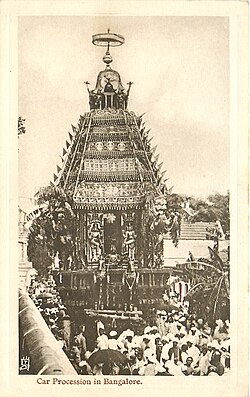 Someshwara Temple chariot in 1918.
 -
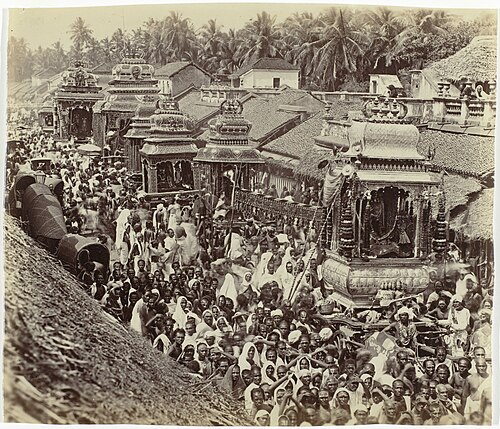 Chariot procession in Madurai in 1872.
 -
 Banashankari Temple (Badami) chariot in 1855.
 -
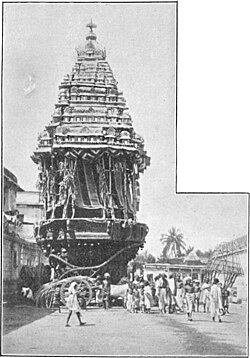 Srirangam Temple chariot in the 1890s.
 -
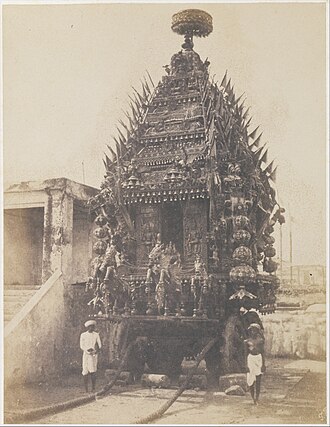 Juggernaut Car, Madras, 1850.
 -
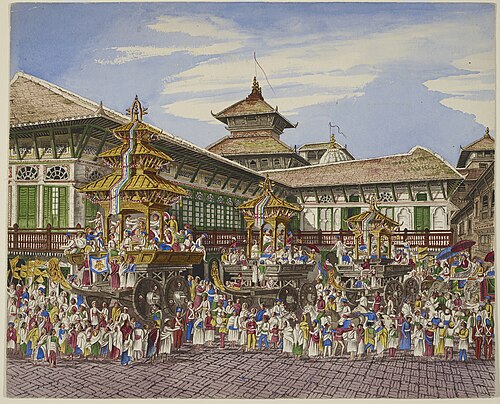 Three temple cars outside the Hanuman Dhoka, or Old Palace, Kathmandu - Oldfield collection (1850-1863)
 -
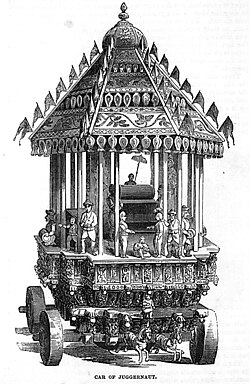 The Car of Juggernaut, as depicted in the 1851 Illustrated London Reading Book
 -
Temple car in Bangalore, 1870


_-_BL_WD_3279.jpg)

Largest temple chariot[edit | edit source]

The procession of the Asia's largest and greatest temple car of Thiruvarur Thiyagarajar Temple in Tamil Nadu features prominently in an ancient festival held in the town.[7] The annual chariot festival of the Thygarajaswamy temple is celebrated during April – May, corresponding to the Tamil month of Chitrai. The chariot is the largest of its kind in Asia and India weighing 300 tons with a height of 90 feet. The chariot comes around the four main streets surrounding the temple during the festival. The event is attended by lakhs of people from all over Tamil Nadu.[8]
The Aazhi Ther is the biggest temple chariot in Tamil Nadu. The 30-foot tall temple car, which originally weighed 220 tons, is raised to 96 feet with bamboo sticks and decorative clothes, taking its total weight to 350 tons. Mounted on the fully decorated temple car, the presiding deity – Lord Shiva – went around the four streets with the devotees pulling it using huge ropes. Two bulldozers were engaged to provide the required thrust so that devotees could move the chariot.[9]
Gallery[edit | edit source]
-
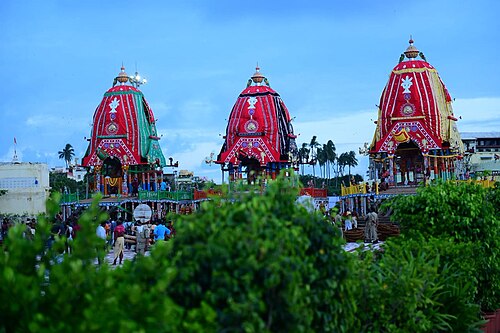 Taladhwaja, Darpadalana and Nandighosha in 2021 Ratha Jatra, Odisha, India.
 -
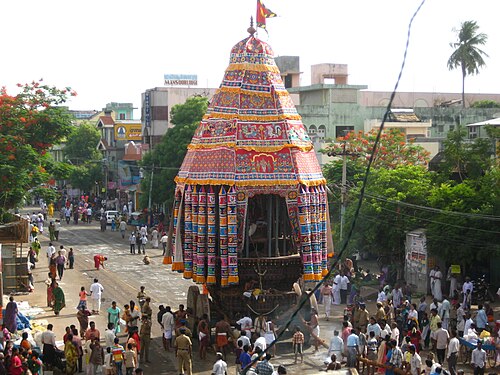 Temple festival in Chidambaram, Tamil Nadu, India.
 -
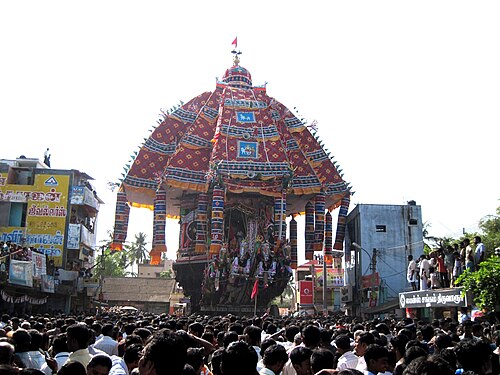 Tiruvarur temple car, the largest (chariot) temple car in the world, it weighing 300 tonnes (295 long tons; 331 short tons) with a height of 90 feet (27.43 m).
 -
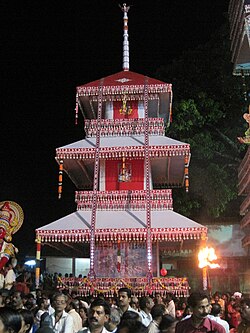 Type of temple car called Theru from the Chettikulangara Kumbha Bharani, Kerala
 -
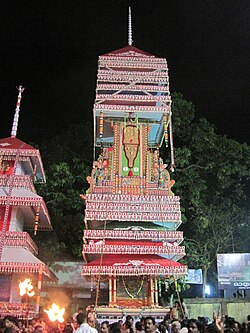 Type of temple car called Kuthira from the Chettikulangara Kumbha Bharani, Kerala
 -
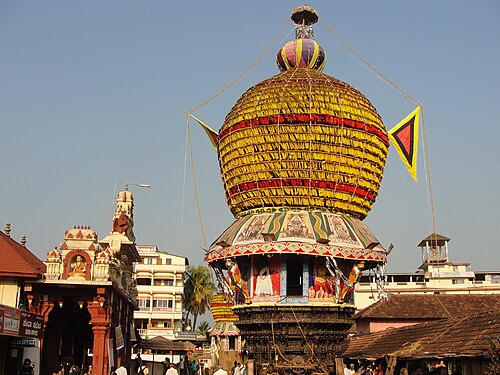
-
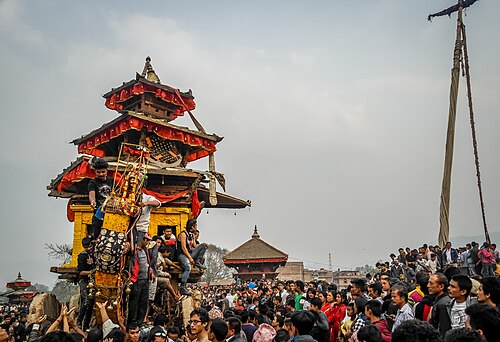 Bisket Jatra Chariot Bhaktapur, Nepal.
 -
 Picture of Tirunelveli Nellaiappar Temple Golden car.
 -
 Picture of Alwarkurichi People pulling Sivasailanathaswamy Temple car.
 -
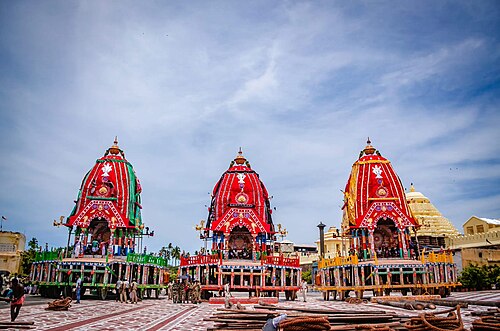 Temple cars in front of Jagananth temple, 2021


List of places with traditional Temple cars[edit | edit source]
India[edit | edit source]
Tamil Nadu[edit | edit source]
- Alagar Kovil (Kallazhagar Temple)
- Alwarkurichi, Tenkasi
- Aragalur
- Avinashi (Sri Avanashiappar Temple)
- Bhavani Kooduthoorai, Tamil Nadu (4 chariots)
- Coimbatore (Koniamman Temple)
- Chidambaram (Nataraja Temple)
- Dindigul (Abiramiyamman Kovil)
- Denkanikottai (Betarayaswamy Kovil)
- Erode (Chennimalai, Sivagiri, Sivanmalai, Vijayamangalam)
- Gobichettipalayam (Sri Kondathukalaimman Temple, Sri Balamurugan Temple and others)
- Hosur (Chandra Choodeswarar Temple)
- Kadayanallur
- Kalaiyar Kovil (Swarna Kaleeswarar Temple)
- Kallal Town (Somasundareswarer Kovil)
- Kanchipuram (Varadharaja Perumal Temple, Ekambareswarar Temple and others)
- Karuvalur (Shri Mariamman Kovil)
- Karamadai (Ranganathaswamy temple)
- Kumbakonam (Sri Saarangapani Temple, Adi Kumbeswarar Temple and others)
- Lalgudi (Saptharishishwarar Temple, Lalgudi)
- Madurai (Sri Meenakshi Amman Temple and others)
- Mannargudi (Sri vidhya Rajagopalaswamy temple)
- Minjur (Sri Ekambaranathar temple)
- Mylapore, Chennai (Sri Kapaleeshwarar Temple)
- Nanguneri (Vanamamalai Perumal Temple)
- North Authoor (Sri Somanathar Somasundari Temple)
- Palani (Sri Dhandayudhapani Temple)
- Perur (Sri Patteewarar Temple)
- Pillaiyarpatti (Sri Karpaga Vinayagar Temple)
- Rameswaram (Ramanathaswamy Temple)
- Sakkottai, Karaikudi
- Samayapuram (Maariamman Temple)
- Sankarankovil (Sankara Narayanasamy Temple)
- Srivaikuntam (Srivaikuntanathan Permual Temple) – (Fourth largest temple car in Tamil Nadu)
- Suchindram (Thanumalayan Temple)
- Srivilliputtur (Srivilliputhur Andal Temple) - (Second largest temple car in Tamil Nadu)
- Salem (Elampillai, Aranagalur, Rasipuram)
- Sholinghur (Sri Lakshmi Narasimha Swamy Temple)
- Srimushnam (Bhu Varaha Swamy Temple) - Second largest temple car in Tamilnadu[citation needed])
- Srirangam (Sri Ranganatha Swamy Temple)
- Tenkasi (Kasi Viswanathar Temple, Tenkasi)
- Tiruchendur (Sri Subramanya Swami temple)
- Tiruchirappalli (Thayumanavar Temple)
- Thanjavur (Brihadeeswara Temple)
- Thirukkadaiyur (Amritaghateswarar-Abirami Temple)
- Thirukkurungudi (Thirukkurungudi Vaishnava Nambi Temple)
- Thirukoshtiyur (Sri Sowmiya Narayana Perumal Temple)
- Thirunageswaram (Oppiliappan Temple)
- Thirunallar (Dharbaranyeswarar Temple)
- Thiruparankundram (Subramaniya Swamy Temple)
- Thirupathiripuliyur (Padaleeswarar temple)
- Thiruthangal (Ninra Narayana Perumal Temple)
- Thiruvanaikaval (Jambukeswarar Temple)
- Thiruvanthipuram, (Devanathaswamy temple)
- Thiruvarur (Thiyagarajar Temple) - (First largest temple car in Asia)[citation needed]
- Tirunelveli (Sri Nellaiappar Temple) – (Third largest temple car in Tamil Nadu)
- Tiruchengode (Sri Arthanareeswarar Temple) - (Fourth largest temple car in Tamil Nadu)
- Tiruvannamalai (Annamalaiyar Temple, 5 Chariots)
- Tirupattur (Aruilmigu Muthukumara Swamy Thirukkovil, God Shiva chariot)
- Thirthahalli
- Tiruvallur (Veeraraghava Swamy Temple)
- Tiruvidaimarudur (Mahalinga Swamy Temple) Chariots
- Triplicane, Chennai (Sri Parthasarathy Temple)
- Thungapuram (Ariyalur-Perambalur)
- Vaitheeswaran Koil (vaidyanatha Swamy Temple)
- Vedaranyam (Vedaranyeswarar Temple)
- Vickramasingapuram (Sivanthiappar Kovil)
- Virudhunagar
- Vasudevanallur (Sri Cinthamani Nathar temple (arthanathiswarar temple)
Karnataka[edit | edit source]
- Bantwal
- Gokarna (Sri Mahabaleshwara Temple)
- Hampi (Immovable stone chariot built by Vijayanagara Kings)
- Karinjeshwara
- Kateel (Shri Durga Parameshwari Temple)
- Kollur, Udupi (Mookambika Temple)
- Mangalore (Shri Venkataraman temple)
- Nanjangud (Srikanteshwara Temple)
- Mulki (Shree Venkataramana Temple)
- Mulki (Shree Kalikamba Temple)
- Mulki (Shri Bappanadu Temple)
- Mysuru (Chamundeshwari Temple)
- Puttur, (Shri Maha Lingeshsara Temple)
- Suratkal
- Udupi
- Idagunji (Mahaganapathi Temple)
Odisha[edit | edit source]
Kerala[edit | edit source]
- Chettikulangara (Chettikulangara Devi Temple)
- Cherai
- Palakkad, Kerala (Many temples in settlements of Palakkad)
Andhra Pradesh[edit | edit source]
- Kadiri (Sri Khadri Lakshmi Narasimha Swami Temple)
- Koduru
- Mangalagiri (Sri Panakaala Lakshmi Narasimha Swami Temple)
- Srikalahasti (Sri Kalahastheeswara Temple)
- Tirumala (Sri Venkateshwara Temple)
- (Sri Bala Tripura sundare sametha sangamesara swami temple sangam jagarala mudi)
Others[edit | edit source]
- Manali New Town (Aiyya Temple)
- Yanam
Malaysia[edit | edit source]
- George Town (Nattukkottai Chettiar Temple)
- Kuala Lumpur (Seri Maha Mariamman Temple Devasthanam)
- Teluk Intan (Nagarathaar Sri Thendayuthapani
- Bukit Mertajam penang (Shri Maha Mangalanayagi Amman Devasthanam, Bukit Mertajam)
Sri Lanka[edit | edit source]
Germany[edit | edit source]
List of places with golden Temple cars[edit | edit source]
Andhra Pradesh[edit | edit source]
- Lord Shiva temple
- Narasimhaswami temple and tirumala Sri vari ratham
Karnataka[edit | edit source]
- Gokarna (Shri Mahabaleshwar temple)
- Kateel (Shri Durga Parameshwari temple)
- Kollur (Mookambika Temple)
- Konchady, Mangalore (Mahalasa Narayani Temple)
- Udupi (Sri Krishna matha)
Puducherry[edit | edit source]
- Sri Arulmigu Manakula Vinayagar, Pondicherry, Puducherry
Tamil Nadu[edit | edit source]
- Arulmigu Maruntheeswar, Thiruvanmiyur, Chennai
- Arulmigu Devi Karumariamman, Thiruverkadu, Chennai
- Arulmigu Vadapalani Andavar, Vadapalani, Chennai
- Arulmigu Kamatchiamman, Mangadu, Chennai
- Arulmigu Kanthaswamy, Parktown, Chennai
- Arulmigu Mundakakanniamman, Mylapore, Chennai
- Arulmigu Kapaleeswarar, Mylapore, Chennai
- Maruthamalai, Coimbatore (Subramanya Swamy Temple)
- Coimbatore (Eachanari Vinayagar Temple)
- Coimbatore (Thandu Mariamman Temple)
- Arulmigu MeenakshiSundareswarar, Madurai
- Arulmigu Solaimalai Murugan, Pazhamudircholai, Alagarkovil Madurai
- Arulmigu Jambukeswarar, Thiruvanaikkaval, Trichy
- Arulmigu Nellaiappar Temple, Tirunelveli
- Arulmigu Ramanathaswamy, Rameswaram
- Arulmigu Subramaniaswamy, Thiruchendur
- Arulmigu Kamatchiamman, Kanchipuram
- Arulmigu Dandayuthapaniswamy, Palani
- Arulmigu Swaminathaswamy, Swamimalai
- Arulmigu Subramanyaswamy, Thiruttani
- Arulmigu Anjaneyaswamy, Namakkal
- Arulmigu Pachaimalai Murugan, Gobichettipalayam
- Arulmigu Pariyur Kondathu Kaliamman, Gobichettipalayam
- Arulmigu Mariamman, Bannari, Erode
- Arulmigu Velayuthaswamy, Thindalmalai, Erode
- Arulmigu Arthanareeswarar, Tiruchengode
- Arulmigu Subramaniyaswamy, Sivanmalai, Tirupur
- Arulmigu Kottaimariamman, Dindigul
- Arulmigu Arunachaleswarar, Thiruvannamalai
- Arulmigu Vaidhyanathaswamy, Vaitheeswaran Kovil
- Arulmigu Mahalinga Swamy Temple, Thiruvidaimarudur (SILVER CHARIOT)
- Arulmigu SankaraNarayanaswamy, Sankarankovil
- Nanguneri (Arulmigu Vanamamalai Perumal)
- Arulmigu Balamurugan, Raththinagiri
- Arulmigu Mariamman, Samayapuram
- Arulmigu Masaniamman, Anamalai
- Arulmigu Mathurakaliyamman, Siruvachur, Perambalur District
- Arulmigu Angalaparameshwari Amman, Melmalayanur, Villupuram District
- Arulmigu Natarajar Temple, Chidambaram, Cuddalore District - the chariot for Pichandavar on the eighth day of 10-day long festival
- Arulmigu Yoga Lakshmi Narasimar temple, Sholinghur, Ranipet district.
- Arulmigu Vijayapuri Amman temple, Vijayamangalam,Erode
See also[edit | edit source]
References[edit | edit source]
- ↑ Rajarajan, R. K. K.; Rajukalidoss, Parthiban. "Nāyaka Chefs-d'oeuvre: Structure and Iconography of the Śrīvilliputtūr Tēr". Acta Orientalia.
- ↑ Rajarajan, R. K. K. "Iconographic Programme in Temple Cars: A Case Study of Kūṭal Alakar tēr". East and West, Istituto Italiano per l'Africa e l'Oriente (IsIAO), Rome.
- ↑ "Government of Tamil Nadu Welcomes You". tn.gov.in.
{{cite web}}: CS1 maint: deprecated archival service (link) - ↑ 4.0 4.1 Michaels; Cornelia Vogelsanger; Annette Wilke (1996). Wild Goddesses in India and Nepal: Proceedings of an International Symposium, Berne and Zurich, November 1994. P. Lang. pp. 270–285. ISBN 978-3-906756-04-2.
- ↑ Mandai, Paresh Chandra (2012). "Rathajatra". In Islam, Sirajul; Jamal, Ahmed A. (eds.). Banglapedia: National Encyclopedia of Bangladesh (Second ed.). Asiatic Society of Bangladesh.[permanent dead link]
- ↑ Fa-Hien (1875). "A Record of Buddhistic Kingdoms (Chapter XXVII: Pataliputra or Patna, In Magadha)". gutenberg.org. Translated (published 415).
 This article incorporates text from this source, which is in the public domain.
- ↑ "Official Website of Arulmigu Thiyagaraja Swamy Temple,Tiruvarur - Festival". thiyagarajaswamytemple.tnhrce.in. Retrieved 10 March 2021.
- ↑ "Festivals, Culture & Heritage | Tiruvarur District, Government of Tamil Nadu | India". Retrieved 9 March 2021.
- ↑ Kumar, K. Sambath (16 June 2016). "Car festival held at Tiruvarur Thyagaraja Swamy Temple after a gap of six years". The Times of India. Retrieved 9 March 2021.