


imported>JFG →top: Rephrase according to what's actually in the text |
CleanupBot (talk | contribs) m Robot: Replacing encoded entity with character |
||
| (2 intermediate revisions by 2 users not shown) | |||
| Line 1: | Line 1: | ||
{{Short description|Hindu god}} | {{Short description|Hindu god}} | ||
{{Other uses|Shasta (disambiguation){{!}}Shasta}} | {{Other uses|Shasta (disambiguation){{!}}Shasta}} | ||
{{ | {{More citations needed|date=September 2017}} | ||
{{Use dmy dates|date=August 2020}} | {{Use dmy dates|date=August 2020}} | ||
{{Use Indian English|date=August 2020}} | {{Use Indian English|date=August 2020}} | ||
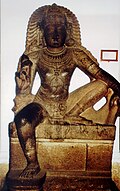
[[File:MADRAS11.JPG|thumbnail|right|Statue of Shasta, [[Chola]] Dynasty, Government Museum, [[Chennai]], [[Tamil Nadu]], India]] | [[File:MADRAS11.JPG|thumbnail|right|Statue of Shasta, [[Chola]] Dynasty, Government Museum, [[Chennai]], [[Tamil Nadu]], India]] | ||
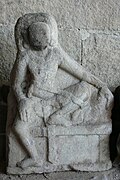
[[File:Shasta god.JPG|thumb|Shasta from Kudumiyanmalai, Tamil Nadu.]] | [[File:Shasta god.JPG|thumb|Shasta from Kudumiyanmalai, Tamil Nadu]] | ||
[[File:Isurumuniya_Man_and_the_Horse_Head.jpg|thumb|Pre-Buddhist [[Ayyanayake]] with horse from [[Isurumuniya]], Sri Lanka]] | |||
'''Shasta''' ([[IAST]] Śāstā) is a [[Hinduism|Hindu]] deity, | '''Shasta''' ([[IAST]] Śāstā) is a [[Hinduism|Hindu]] deity,<ref>{{Cite book |last=Chakravarti |first=Balaram |url=https://books.google.com/books?id=rf0vAQAAIAAJ&q=shasta+Dravidian |title=The Indians and the Amerindians |date=1997 |publisher=Self-Employment Bureau Publication |language=en}}</ref> described as the son of the deities [[Shiva]] and [[Mohini]], [[Vishnu]]'s female [[avatar]].<ref>{{Cite book |last1=Jones |first1=Constance |url=https://books.google.com/books?id=OgMmceadQ3gC&dq=shasta+ayyappa&pg=PA198 |title=Encyclopedia of Hinduism |last2=Ryan |first2=James D. |date=2006 |publisher=Infobase Publishing |isbn=978-0-8160-7564-5 |language=en}}</ref> In [[South India]], he is identified with the [[Aiyanar|Ayyanar]], Nattarayan or Sattan in [[Tamil Nadu]], as [[Ayyanayake]] in Sinhala and the [[Ayyappan]] in [[Kerala]].<ref>{{Cite book |last=Leviton |first=Richard |url=https://books.google.com/books?id=L6duRdH6qZAC&dq=shasta+Tamil&pg=PT493 |title=Walking in Albion: Adventures in the Christed Initiation in the Buddha Body |date=2010-04-22 |publisher=iUniverse |isbn=978-1-4502-2343-0 |language=en}}</ref> His principal function is to act as a [[kuladevata]] of a given clan, as well as act as a guardian of a village's boundaries.<ref>{{Cite book |last=Fuller |first=C. J. |url=https://books.google.com/books?id=E_9ZDwAAQBAJ&dq=shasta+god&pg=PA53 |title=The Camphor Flame: Popular Hinduism and Society in India - Revised and Expanded Edition |date=2018-06-05 |publisher=Princeton University Press |isbn=978-0-691-18641-2 |language=en}}</ref> | ||
==Significance== | ==Significance== | ||
''Shasta'' is a generic term that means "Teacher, Guide, Lord, Ruler" in Sanskrit.<ref>{{cite book|author1=Johannes Bronkhorst|author2=Madhav Deshpande|title=Aryan and non-Aryan in South Asia: evidence, interpretation, and ideology; proceedings of the International Seminar on Aryan and Non-Aryan in South Asia|url=https://books.google.com/books?id=EOdtAAAAMAAJ|year=1999|publisher=Harvard University, Dept. of Sanskrit and Indian Studies|isbn=978-1-888789-04-1|pages=177–178}}</ref> In South India, a number of deities are associated with Shasta. The Tamil song ''Shasta Varavu'' states that there are eight important incarnations and forms of Shasta. This is also present in the agamic work ''Dyana Ratnavali''. The ''Ashta-Shasta'' (eight Shastas) are ''Aadhi Maha Shasta'', ''Dharma Shasta'' ([[Ayyappan]]), ''Gnana Shasta'', ''Kalyana Varadha Shasta'', ''Sammohana Shasta'', ''Santhana Prapti Shasta'', ''Veda Shasta'' and ''Veera Shasta''.<ref>{{cite | ''Shasta'' is a generic term that means "Teacher, Guide, Lord, Ruler" in Sanskrit.<ref>{{cite book|author1=Johannes Bronkhorst|author2=Madhav Deshpande|title=Aryan and non-Aryan in South Asia: evidence, interpretation, and ideology; proceedings of the International Seminar on Aryan and Non-Aryan in South Asia|url=https://books.google.com/books?id=EOdtAAAAMAAJ|year=1999|publisher=Harvard University, Dept. of Sanskrit and Indian Studies|isbn=978-1-888789-04-1|pages=177–178}}</ref> In South India, a number of deities are associated with Shasta. The Tamil song ''Shasta Varavu'' states that there are eight important incarnations and forms of Shasta. This is also present in the agamic work ''Dyana Ratnavali''. The ''Ashta-Shasta'' (eight Shastas) are ''Aadhi Maha Shasta'', ''Dharma Shasta'' ([[Ayyappan]]), ''Gnana Shasta'', ''Kalyana Varadha Shasta'', ''Sammohana Shasta'', ''Santhana Prapti Shasta'', ''Veda Shasta'' and ''Veera Shasta''.<ref>{{cite news|url=http://www.thehindu.com/features/friday-review/history-and-culture/shrines-for-sastha-in-eight-forms/article5425348.ece|title=Shrines for Sastha, in eight forms|work=[[The Hindu]]|date=5 December 2013 |access-date=4 September 2017}}</ref> ''Brahma Shasta'' is another term associated with [[Kartikeya]].<ref>{{cite book|title=The Many Faces of Murukan̲: The History and Meaning of a South Indian God|url=https://books.google.com/books?id=0AevljBmCRQC&pg=PA244|author=Fred W. Clothey|page=244|year=1978| publisher=Walter de Gruyter |isbn=9027976325}}</ref> | ||
===Tamil Nadu=== | ===Tamil Nadu=== | ||
In Tamil Nadu, [[Aiyanar]] is used as | In Tamil Nadu, [[Aiyanar]] is used as the regional name of the deity ''Shasta''. The earliest reference to ''Aiynar-Shasta'' is from the [[Arcot|Arcot district]] in Tamil Nadu. The stones are dated to the 3rd century CE. They read "Ayanappa; a shrine to Cattan." This is followed by another inscription in [[Uraiyur]] near [[Tiruchirapalli]] which is dated to the 4th century CE.<ref name=Kala67>Williams, J., ''Kaladarsana'', p.67</ref> | ||
Literary references to ''Aiyanar-Cattan'' are found in [[Silappatikaram]], a [[Tamil language|Tamil]] | Literary references to ''Aiyanar-Cattan'' are found in [[Silappatikaram]], a [[Tamil language|Tamil]] work dated to the 4th to 5th centuries CE. The Tamil [[Sangam literature|Sangam]] classics [[Purananuru]], Akananuru etc. refer to Ayyanar and "Cattan" in many poems. There are several numerous references to Shasta in Sangam works. Some Tamil inscriptions of the Sangam period and a few of the later Pallava and Chola period coming in from various parts of the kingdoms refer to him as Sevugan and Mahasasta. | ||
There are references in the [[Puranas]] that narrate as to how Shasta during his tenure on earth long ago conducted discourses on Vedas and {{Transliteration|hi|italic=no|Vedantas}} to a galaxy of gods and sages. | |||
The hymns of some [[Alvars]] like [[Thirumangai Alvar|Tirumangai Alvar]] and [[Nammalvar]] in temples like Tirumogur near Madurai refer to Shasta.<ref name=Kala66>Williams, J., ''Kaladarsana'', p.66</ref> A Sanskrit work dated prior to the 7th century known as the [[Brahmanda Purana]] mentions ''Shasta'' as Harihara suta, or the son of Shiva and Narayana (Vishnu), the oppressor of the [[asura]]s.<ref>{{Cite book |last=Books |first=Kausiki |url=https://books.google.com/books?id=TTxKEAAAQBAJ&dq=shasta+purana&pg=PT115 |title=Brahmanda Purana: 4 Lalithopakhayana : English Translation only without Slokas |date=2021-07-12 |publisher=Kausiki Books |language=en}}</ref> | |||
Later on, the [[Saivite]] revivalist [[Appar]] sang about ''Shasta'' as the progeny of [[Shiva]] and [[Perumal (deity)|Tirumal]] (Vishnu) in one of his [[Tevaram]]s in the 7th century. The saint [[Sambandar]], in one of his songs, praises Ayyanar as a celibate god, invincible and terrible in warfare, taking his abode alongside the bhootaganas of Shiva.<ref>{{Cite book |last=General |first=India Office of the Registrar |url=https://books.google.com/books?id=5f4cAQAAMAAJ&q=Ayyanar+sambandar+appar |title=Census of India, 1961 |date=1966 |publisher=Manager of Publications |language=en}}</ref> The place sanctity and history document, or [[sthala purana]] of Tiruvanaikkaval, a Shaivite temple near Tiruchi, which was first documented by the sage Kashyapa, informs us that Shasta once served Shiva at that site and after being blessed with a vision was instructed by God to take his abode in the outer sanctorum. It says that Shasta continues to worship him during the day of tiruvadirai. Adi Sankara also has referred to Ayyanar in sivanandalahari in one verse. Some ancient hagiographies have accounted that Sankara was a ''deivamsam'' (divine soul portion) of Shasta (''sevugan''), the same way that Sambandar was a divine portion of Skanda and Sundarar a divine portion of Alagasundarar. He is also known to have composed verses praising the deity but the same are not available to us as of today. From the [[Chola]] period (9th century CE) onwards the popularity of ''Aiyanar-Shasta'' became even more pronounced as is attested by epigraphy and imagery.<ref name="Kala62">Williams, J., ''Kaladarsana'', p.62</ref> | |||
===Kerala=== | ===Kerala=== | ||
The Shasta religious tradition is particularly well developed in the state of [[Kerala]]. The earliest inscription to ''Shasta'' was made in 855 | The Shasta religious tradition is particularly well developed in the state of [[Kerala]]. The earliest inscription to ''Shasta'' was made in 855 CE by an [[Velirs|Ay]] King at the [[Padmanabhapuram]] Sivan temple. Independent temples to ''Shasta'' are known from the 11th century CE. Prior to that, ''Shasta'' veneration took place in the temples of [[Shiva]] and [[Vishnu]], the premier gods of the Hindu pantheon. Since late medieval times, the warrior deity [[Ayyappa]]'s following has become very popular in the 20th century.{{citation needed|date=November 2020}} | ||
==Notes== | ==Notes== | ||
| Line 24: | Line 31: | ||
==See also== | ==See also== | ||
[[Nurani]], a village in [[Palakkad]], Kerala, noted for its Sastha devotion. | |||
* [[Nurani]], a village in [[Palakkad]], Kerala, noted for its Sastha devotion. | |||
==References== | ==References== | ||
| Line 31: | Line 39: | ||
==External links== | ==External links== | ||
{{ | {{Commons category}} | ||
*[http://www.nuranivillage.org/home.html Nurani, a village with a strong Sastha devotion.] | *[http://www.nuranivillage.org/home.html Nurani, a village with a strong Sastha devotion.] | ||
*[http://pulivahanan.wetpaint.com/page/Sastha+Temple+Kuthiran?t=anon Kuthiran Shasta temple] | *[http://pulivahanan.wetpaint.com/page/Sastha+Temple+Kuthiran?t=anon Kuthiran Shasta temple] | ||
| Line 37: | Line 45: | ||
*[https://web.archive.org/web/20111230051237/http://sabash.org/ Sastha Ayyanar and Ayyappan] | *[https://web.archive.org/web/20111230051237/http://sabash.org/ Sastha Ayyanar and Ayyappan] | ||
*[http://www.ashtasastha.org Ashta Sastha Temple] | *[http://www.ashtasastha.org Ashta Sastha Temple] | ||
*[ | *[https://shanmatha.blogspot.com/2011/05/108-sasthalayangal.html List of 108 Ancient Sastha Temples] | ||
*[https://web.archive.org/web/20110704190911/http://www.hindu.com/2009/01/25/stories/2009012558470200.htm Authoring the first purana on Shasta] | *[https://web.archive.org/web/20110704190911/http://www.hindu.com/2009/01/25/stories/2009012558470200.htm Authoring the first purana on Shasta] | ||
{{HinduMythology|fold}} | {{HinduMythology|fold}} | ||
| Line 43: | Line 51: | ||
[[Category:Regional Hindu gods]] | [[Category:Regional Hindu gods]] | ||
[[Category:Tamil deities]] | [[Category:Tamil deities]] | ||
[[Category:Children of Shiva]] | |||
Latest revision as of 12:26, 22 March 2026
 | This article needs more citations. (September 2017) |


Shasta (IAST Śāstā) is a Hindu deity,[1] described as the son of the deities Shiva and Mohini, Vishnu's female avatar.[2] In South India, he is identified with the Ayyanar, Nattarayan or Sattan in Tamil Nadu, as Ayyanayake in Sinhala and the Ayyappan in Kerala.[3] His principal function is to act as a kuladevata of a given clan, as well as act as a guardian of a village's boundaries.[4]
Significance[edit | edit source]
Shasta is a generic term that means "Teacher, Guide, Lord, Ruler" in Sanskrit.[5] In South India, a number of deities are associated with Shasta. The Tamil song Shasta Varavu states that there are eight important incarnations and forms of Shasta. This is also present in the agamic work Dyana Ratnavali. The Ashta-Shasta (eight Shastas) are Aadhi Maha Shasta, Dharma Shasta (Ayyappan), Gnana Shasta, Kalyana Varadha Shasta, Sammohana Shasta, Santhana Prapti Shasta, Veda Shasta and Veera Shasta.[6] Brahma Shasta is another term associated with Kartikeya.[7]
Tamil Nadu[edit | edit source]
In Tamil Nadu, Aiyanar is used as the regional name of the deity Shasta. The earliest reference to Aiynar-Shasta is from the Arcot district in Tamil Nadu. The stones are dated to the 3rd century CE. They read "Ayanappa; a shrine to Cattan." This is followed by another inscription in Uraiyur near Tiruchirapalli which is dated to the 4th century CE.[8]
Literary references to Aiyanar-Cattan are found in Silappatikaram, a Tamil work dated to the 4th to 5th centuries CE. The Tamil Sangam classics Purananuru, Akananuru etc. refer to Ayyanar and "Cattan" in many poems. There are several numerous references to Shasta in Sangam works. Some Tamil inscriptions of the Sangam period and a few of the later Pallava and Chola period coming in from various parts of the kingdoms refer to him as Sevugan and Mahasasta.
There are references in the Puranas that narrate as to how Shasta during his tenure on earth long ago conducted discourses on Vedas and Vedantas to a galaxy of gods and sages.
The hymns of some Alvars like Tirumangai Alvar and Nammalvar in temples like Tirumogur near Madurai refer to Shasta.[9] A Sanskrit work dated prior to the 7th century known as the Brahmanda Purana mentions Shasta as Harihara suta, or the son of Shiva and Narayana (Vishnu), the oppressor of the asuras.[10]
Later on, the Saivite revivalist Appar sang about Shasta as the progeny of Shiva and Tirumal (Vishnu) in one of his Tevarams in the 7th century. The saint Sambandar, in one of his songs, praises Ayyanar as a celibate god, invincible and terrible in warfare, taking his abode alongside the bhootaganas of Shiva.[11] The place sanctity and history document, or sthala purana of Tiruvanaikkaval, a Shaivite temple near Tiruchi, which was first documented by the sage Kashyapa, informs us that Shasta once served Shiva at that site and after being blessed with a vision was instructed by God to take his abode in the outer sanctorum. It says that Shasta continues to worship him during the day of tiruvadirai. Adi Sankara also has referred to Ayyanar in sivanandalahari in one verse. Some ancient hagiographies have accounted that Sankara was a deivamsam (divine soul portion) of Shasta (sevugan), the same way that Sambandar was a divine portion of Skanda and Sundarar a divine portion of Alagasundarar. He is also known to have composed verses praising the deity but the same are not available to us as of today. From the Chola period (9th century CE) onwards the popularity of Aiyanar-Shasta became even more pronounced as is attested by epigraphy and imagery.[12]
Kerala[edit | edit source]
The Shasta religious tradition is particularly well developed in the state of Kerala. The earliest inscription to Shasta was made in 855 CE by an Ay King at the Padmanabhapuram Sivan temple. Independent temples to Shasta are known from the 11th century CE. Prior to that, Shasta veneration took place in the temples of Shiva and Vishnu, the premier gods of the Hindu pantheon. Since late medieval times, the warrior deity Ayyappa's following has become very popular in the 20th century.[citation needed]
Notes[edit | edit source]
- ↑ Chakravarti, Balaram (1997). The Indians and the Amerindians. Self-Employment Bureau Publication.
- ↑ Jones, Constance; Ryan, James D. (2006). Encyclopedia of Hinduism. Infobase Publishing. ISBN 978-0-8160-7564-5.
- ↑ Leviton, Richard (22 April 2010). Walking in Albion: Adventures in the Christed Initiation in the Buddha Body. iUniverse. ISBN 978-1-4502-2343-0.
- ↑ Fuller, C. J. (5 June 2018). The Camphor Flame: Popular Hinduism and Society in India - Revised and Expanded Edition. Princeton University Press. ISBN 978-0-691-18641-2.
- ↑ Johannes Bronkhorst; Madhav Deshpande (1999). Aryan and non-Aryan in South Asia: evidence, interpretation, and ideology; proceedings of the International Seminar on Aryan and Non-Aryan in South Asia. Harvard University, Dept. of Sanskrit and Indian Studies. pp. 177–178. ISBN 978-1-888789-04-1.
- ↑ "Shrines for Sastha, in eight forms". The Hindu. 5 December 2013. Retrieved 4 September 2017.
- ↑ Fred W. Clothey (1978). The Many Faces of Murukan̲: The History and Meaning of a South Indian God. Walter de Gruyter. p. 244. ISBN 9027976325.
- ↑ Williams, J., Kaladarsana, p.67
- ↑ Williams, J., Kaladarsana, p.66
- ↑ Books, Kausiki (12 July 2021). Brahmanda Purana: 4 Lalithopakhayana : English Translation only without Slokas. Kausiki Books.
- ↑ General, India Office of the Registrar (1966). Census of India, 1961. Manager of Publications.
- ↑ Williams, J., Kaladarsana, p.62
See also[edit | edit source]
References[edit | edit source]
- Smith, B. L. (1978). Legitimation of Power in South Asia. Brill Academic Publishers. ISBN 90-04-05674-2.
- Williams, Joanna (1981). Kaladarsana: American studies in the art of India. E.J. Brill. ISBN 90-04-06498-2.
External links[edit | edit source]
- Nurani, a village with a strong Sastha devotion.
- Kuthiran Shasta temple
- List of Shasta temples in Kerala
- Sastha Ayyanar and Ayyappan
- Ashta Sastha Temple
- List of 108 Ancient Sastha Temples
- Authoring the first purana on Shasta
Hindu deities and texts | ||
|---|---|---|
| Gods |  | |
| Goddesses | ||
| Other deities | ||
| Texts | ||