







m robot: Create/update articles. If there is a mistake please report on my talk page. |
minor edit |
||
| (One intermediate revision by one other user not shown) | |||
| Line 1: | Line 1: | ||
{{short description|First Sultan and de facto ruler of the Kingdom of Mysore (c. 1720–1782)}} | |||
{{short description|First Sultan and de facto ruler of the Kingdom of Mysore}} | {{Other people|King Hyder Ali|Haider Ali (disambiguation){{!}}Haider Ali}} | ||
{{ | |||
{{EngvarB|date=March 2014}} | {{EngvarB|date=March 2014}} | ||
{{Use dmy dates|date=March 2014}} | {{Use dmy dates|date=March 2014}} | ||
{{Infobox royalty | {{Infobox royalty | ||
| name = Hyder Ali | | name = Hyder Ali | ||
| title = Nawab of Mysore <br | | title = Nawab of Mysore<br>Sarvadhikari of Mysore<br>Dalavayi of Mysore<br>Shams-ul-Mulk<br>Amir-ud-Daulah | ||
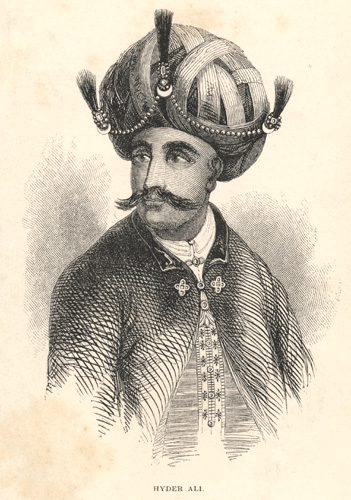
| image = "Hyder Ali," a steel engraving from the 1790's (with modern hand coloring).jpg | | image = "Hyder Ali," a steel engraving from the 1790's (with modern hand coloring).jpg | ||
| caption = A 1790's steel engraving of Hyder Ali | | caption = A 1790's steel engraving of King Hyder Ali | ||
| reign = | | reign = July 1761<ref name="y654">{{cite web | title=History Of Mysore Vol. 2 | last=Rao | first=C. Hayavadana | website=Internet Archive | date=22 September 2015 | url=https://archive.org/details/in.ernet.dli.2015.460113/ | access-date=30 December 2025}}</ref> – 7 December 1782 | ||
| predecessor = [[Krishnaraja Wodeyar II]] <br | | predecessor = [[Krishnaraja Wodeyar II]]<br><small>(as [[Maharaja of Mysore|Maharaja]])</small> | ||
| successor = [[Tipu Sultan]] | | successor = [[Tipu Sultan]] | ||
| birth_date = {{Circa}}1720 | | birth_date = {{Circa}}1720 | ||
| birth_place = [[Budikote]], [[Kingdom of Mysore]] | | birth_place = [[Budikote]], [[Kingdom of Mysore]]<br>(present-day [[Kolar district|Kolar]], [[Karnataka]], [[India]]) | ||
<br | | death_date = {{Death date|1782|12|7|df=yes}}<ref>{{cite book|last=Hasan|first=Mohibbul|title=History of Tipu Sultan|url=https://books.google.com/books?id=hkbJ6xA1_jEC|access-date=19 January 2013|year=2005|publisher=Aakar Books|isbn=8187879572|page=21|archive-date=26 January 2024|archive-url=https://web.archive.org/web/20240126144337/https://books.google.com/books?id=hkbJ6xA1_jEC|url-status=live}}</ref> (aged 62) | ||
| death_date = {{Death date|1782|12|7|df=yes}}<ref>{{cite book |last=Hasan|first=Mohibbul|title=History of Tipu Sultan|url=https://books.google.com/books?id=hkbJ6xA1_jEC |access-date=19 January 2013|year=2005|publisher=Aakar Books|isbn=8187879572 |page=21 }}</ref> (aged 62) | | death_place = [[Chittoor]], [[Sultanate of Mysore]]<br>(present-day [[Andhra Pradesh]], [[India]]) | ||
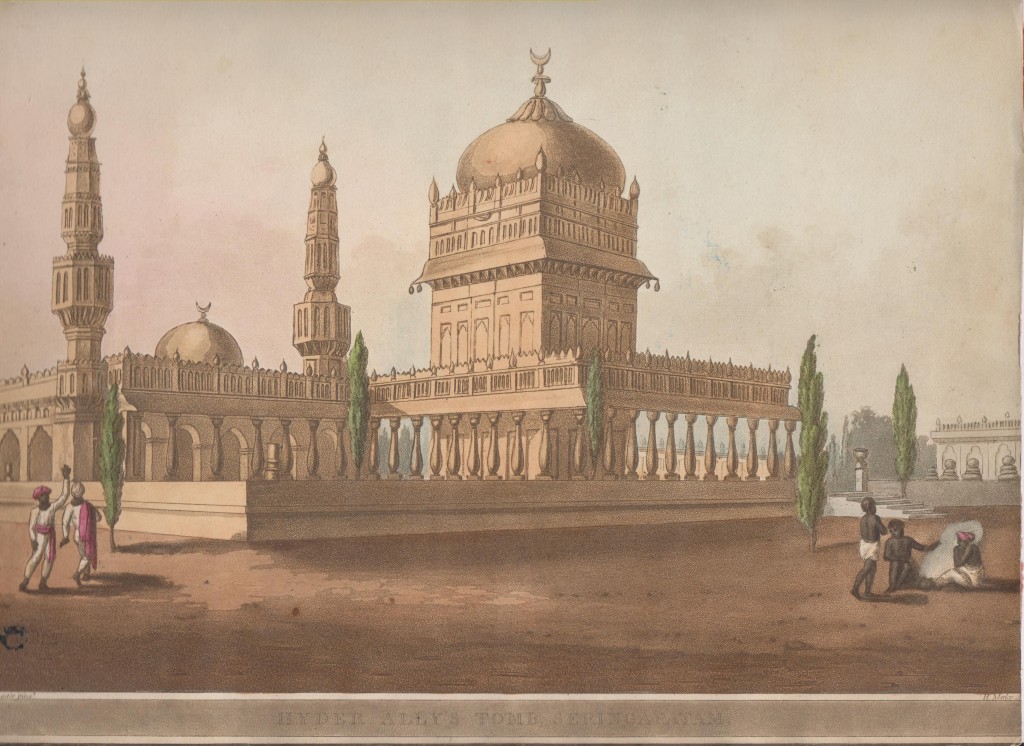
| death_place = [[Chittoor]], [[Sultanate of Mysore]] <br | | burial_place = [[Srirangapatna]], Karnataka<br>{{coord|12|24|36|N|76|42|50|E|display=inline,title}} | ||
| burial_place = [[Srirangapatna]], Karnataka<br | |||
| spouse = Fathima Fakhr-un-Nisa | | spouse = Fathima Fakhr-un-Nisa | ||
| full name = | |||
| full name = | |||
| father = [[Fath Muhammad]] | | father = [[Fath Muhammad]] | ||
| mother = | | mother = Razia Bibi | ||
| religion = [[Islam]] | | religion = [[Sunni Islam]]<ref>{{cite book |last1= H. Davis |first1= Richard |title=Lives of Indian Images | chapter= |year =1999 |publisher=Princeton University Press | location= Chichester, West Sussex, UK |isbn=0-691-00520-6 |page=149 | quote="Both Haidar 'Ali and Tipu Sultan were parvenu Sunni Muslim rulers..."}}</ref> | ||
| royal house = [[Mysore]] | | royal house = [[Mysore]] | ||
| module = {{Infobox military person | | module = {{Infobox military person | ||
| embed = yes | | embed = yes | ||
| allegiance = | | allegiance = {{Flagicon image|Flag of the State of Hyderabad (18th century-1900).svg|border=}} [[Hyderabad State]]<br>{{Flagicon image|Flag of Nawab.svg|border=}} [[Carnatic Sultanate]]<br>{{Flagicon image|Flag of Kingdom of Mysore.svg|border=}} [[Kingdom of Mysore]]<br>{{Flagicon image|Flag of Mysore Hyder Ali & TipuSultan.png|border=}} [[Sultanate of Mysore]] | ||
| branch = {{flagicon image|Flag of Mysore Hyder Ali & TipuSultan.png|border=}} [[Kingdom of Mysore|Mysore Army]] | |||
| | | commands = {{Collapsible list | ||
| rank = | | [[Dindigul]] | ||
| [[Bangalore]] | |||
| battles = [[Mughal-Maratha Wars]] | | [[Srirangapatna]] | ||
| [[Mysore]]}} | |||
| rank = [[Sultan]]<br>[[Nawab]] (formerly)<br>[[Ispahsalar]] (formerly)<br>[[Naik (military rank)|Nayak]] (formerly)<br>[[Sepoy|Sipahi]] (formerly) | |||
| battles = {{Collapsible list | |||
| [[Mughal-Maratha Wars]] | |||
| [[Carnatic Wars]] | |||
| [[Seven Years' War]] | |||
| [[Mysore's campaigns against the states of Malabar (1757)]] | |||
| [[Mysorean invasion of Kerala]] | |||
| [[Maratha–Mysore War]] | |||
| [[Battle of Jadi Hanwati]] | |||
| [[First Anglo-Mysore War]] | |||
| [[Battle of Ooscota]] | |||
| [[Second Anglo-Mysore War]] | |||
| [[Mysore invasion of Chirakkal]] | |||
| [[Siege of Nargund (1778)|Siege of Nargund]] | |||
| Siege of Channapatna | |||
| [[Battle of Rattihalli]] | |||
| Capture of Kabbaldurga | |||
}} | |||
| religion = | | religion = | ||
}} | }} | ||
| succession = | | succession = [[Kingdom of Mysore#History#Under Hyder Ali and Tipu Sultan|Sultan of Mysore]] | ||
}} | }} | ||
'''Hyder Ali''' ( | '''Hyder Ali''' (''Haidar'alī''; {{Lang|ur|{{Nastaliq|حيدرعلى}}}}; {{IPA|kn|hɐi̯d̪ɐr ɐliː|lang}} {{c.}} 1720 – 7 December 1782) was the [[Sultan]] and ''de facto'' ruler of the [[Kingdom of Mysore]] in [[southern India]]. He distinguished himself as a soldier, eventually drawing the attention of Mysore's rulers. Rising to the post of [[Dalavayi]] ([[commander-in-chief]]) to [[Krishnaraja Wodeyar II]], he came to dominate the titular monarch and the Mysore government. He became the ''de facto'' ruler of the Kingdom of Mysore as [[Sarvadhikari]] (Chief Minister) by 1761,<ref name="Robson">{{cite book |last1=Robson |first1=Francis |title=The Life Of Hyder Ally: With an Account of His Usurpation of the Kingdom of Mysore |date=1786 |publisher=S Hooper, High Holborn |location=London |url=https://archive.org/details/in.ernet.dli.2015.514522/page/n3/mode/2up |access-date=24 January 2022}}</ref> and served as the country's primary military leader in intermittent conflicts against the [[East India Company]] during the [[First Anglo-Mysore War|First]] and [[Second Anglo-Mysore War|Second]] [[Anglo–Mysore Wars]]. | ||
He concluded [[Franco-Indian alliances|an alliance]] with the [[Kingdom of France|French]], and used the services of French workmen in raising his artillery and arsenal. His rule of Mysore was characterised by frequent warfare with his neighbours and rebellion within his territories. This was not unusual for the time, as much of the [[Indian subcontinent]] was then in turmoil. He left his eldest son, [[Tipu Sultan]], an extensive kingdom bordered by the [[Krishna River]] in the north, the [[Eastern Ghats]] in the east and the [[Arabian Sea]] in the west.<ref>{{cite book|last=Hasan|first=Mohibbul|title=History of Tipu Sultan|url=https://books.google.com/books?id=hkbJ6xA1_jEC|access-date=19 January 2013|year=2005|publisher=Aakar Books|isbn=8187879572|page=24|archive-date=26 January 2024|archive-url=https://web.archive.org/web/20240126144337/https://books.google.com/books?id=hkbJ6xA1_jEC|url-status=live}}</ref> | |||
He was known to [[Benjamin Franklin]] for his bravery.<ref>{{Cite web |last=Ahmed |first=Ameen |date=2020-08-17 |title=How Tipu Sultan and Haidar Ali inspired America's founding fathers in their quest for freedom |url=https://scroll.in/global/970265/how-tipu-sultan-and-haidar-ali-inspired-americas-founding-fathers-in-their-quest-for-freedom |access-date=2025-07-05 |website=Scroll.in |language=en}}</ref> | |||
==Ancestry== | |||
According to some historians, Hyder Ali is thought to be of [[Arab]] ancestry.<ref name=nadwi/><ref name=Wink>{{Cite book |last=Wink |first=André |url=https://books.google.com/books?id=uPXvDwAAQBAJ&dq=tipu+sultan+quraysh&pg=PA209 |title=The Making of the Indo-Islamic World |date=2020 |publisher=[[Cambridge University Press]] |language=en |page=209 |isbn=9781108417747 |quote=...the renowned Muslim dynasty claimed Quraysh origins, and consequently from the same tribe as the Prophet Muhammad, but was otherwise almost entirely undistinguished and parvenu... |access-date=30 October 2023 |archive-date=23 November 2023 |archive-url=https://web.archive.org/web/20231123030807/https://books.google.com/books?id=uPXvDwAAQBAJ&dq=tipu+sultan+quraysh&pg=PA209 |url-status=live }}</ref> According to this tradition, his ancestors were [[Nawayath|Nawayath Arab]] from the [[Quraysh]] tribe,<ref name=brittle>{{Cite book |last=Brittlebank |first=Kate |url=https://books.google.com/books?id=1F9jEAAAQBAJ&dq=tipu+ancestry+arab&pg=PT16 |title=Tiger: The Life of Tipu Sultan |date=9 March 2022 |publisher=Claritas Books |isbn=9781905837878 |language=en |quote=Tipu's ancestry was predominantly Arab, specifically Navayat |access-date=19 March 2023 |archive-date=21 June 2023 |archive-url=https://web.archive.org/web/20230621045137/https://books.google.com/books?id=1F9jEAAAQBAJ&dq=tipu+ancestry+arab&pg=PT16 |url-status=live }}</ref> who arrived in India by sea and later came to South India from [[Delhi]] during the reign of [[Mohammed Adil Shah, Sultan of Bijapur|Muhammad Adil Shah]],<ref>{{Cite book |last=Hasan |first=Mohibbul |url=https://books.google.com/books?id=hkbJ6xA1_jEC&dq=tipu+sultan+ancestry&pg=PA1 |title=History of Tipu Sultan |date=2005 |publisher=Aakar Books |isbn=978-81-87879-57-2 |language=en |page=3 |quote=...his ancestors arrived in India through sea, instead of following usual land route through northwest...came to Gulbarga from Delhi with his son Muhammad Ali during the reign of Muhammad Adil Shah. |access-date=22 February 2023 |archive-date=13 March 2023 |archive-url=https://web.archive.org/web/20230313123129/https://books.google.com/books?id=hkbJ6xA1_jEC&dq=tipu+sultan+ancestry&pg=PA1 |url-status=live }}</ref> or was settled in [[Punjab]] before moving to South India.<ref name=nadwi>{{Cite book|last1=Nadvi|first1=Muhammad Ilyas|url=https://books.google.com/books?id=gB1uAAAAMAAJ&q=arab+Punjab|title=Tipu Sultan, A life History|year=2004|language=en|pages=29–30|quote=As per the research conducted by the Encyclopaedia of Islam, Tipu belonged to the Arab race, more particularly the Quraish clan. On the contrary, Mahmood with reference to an English historian, Willex has written that his forefathers had links with Punjab. In this respect, many historians call him Punjabi too.|access-date=26 August 2023|archive-date=8 July 2023|archive-url=https://web.archive.org/web/20230708133801/https://books.google.com/books?id=gB1uAAAAMAAJ&q=arab+Punjab|url-status=live}}</ref> | |||
According to another school of historians, Hyder Ali was of [[Punjabi Muslim|Punjabi]] descent,<ref name="nadwi" /> and was a Punjabi adventurer in the army of Mysore.{{sfn|Olson|Shadle|1996|loc=p. 773: Hyder Ali was originally a Punjabi adventurer in the army of the Hindu king of Mysore}} As per this tradition, he was descended from a Sufi mystic [[Shaikh Bahlol Daryai|Shah Bahlol]] through Muhammad Ali, the father of [[Fath Muhammad]].{{sfn|Forrest|1970|pp= 9–10}}{{sfn|Mirza|1991|pp= 20–21}} Contemporary [[British Raj]] sources mentioning Hyder Ali describe him as a Punjabi.{{sfn|Dalrymple|2019|loc=p. 264: The second power was a new force, which in the 1770s was just emerging and beginning to flex its military muscles: the Mysore Sultanate of Haidar Ali and his formidable warrior son, Tipu Sultan. Haidar, who was of Punjabi origin, had risen in the ranks of the Mysore army, where he introduced many of the innovations he had learned from observing French troops at work in the Carnatic Wars}}{{sfn|Moon|1989|loc=p. 137: Haidar Ali, a Punjabi by origin and unable to read or write, had risen from the ranks in the Mysore army to the position of Commander-in-Chief and had then made himself complete master of this Hindu kingdom}}{{sfn|Gott|2022|loc=p. 47: Haidar Ali was an illiterate Punjabi who rose from the ranks of the Mysore army to become its commander}} | |||
==Early life== | ==Early life== | ||
[[File:Knave_(Hyder_Ali_from_Mysore)_from_Court_Game_of_Geography_MET_DP862917.jpg|thumb|Hyder Ali as a young soldier.]] | [[File:Knave_(Hyder_Ali_from_Mysore)_from_Court_Game_of_Geography_MET_DP862917.jpg|thumb|Hyder Ali as a young soldier ([[Sepoy]]).]] | ||
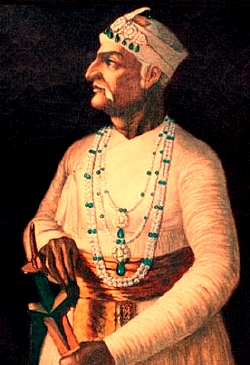
[[File:HyderAli.jpg|thumb|Realistic portrait of Hyder Ali]] | |||
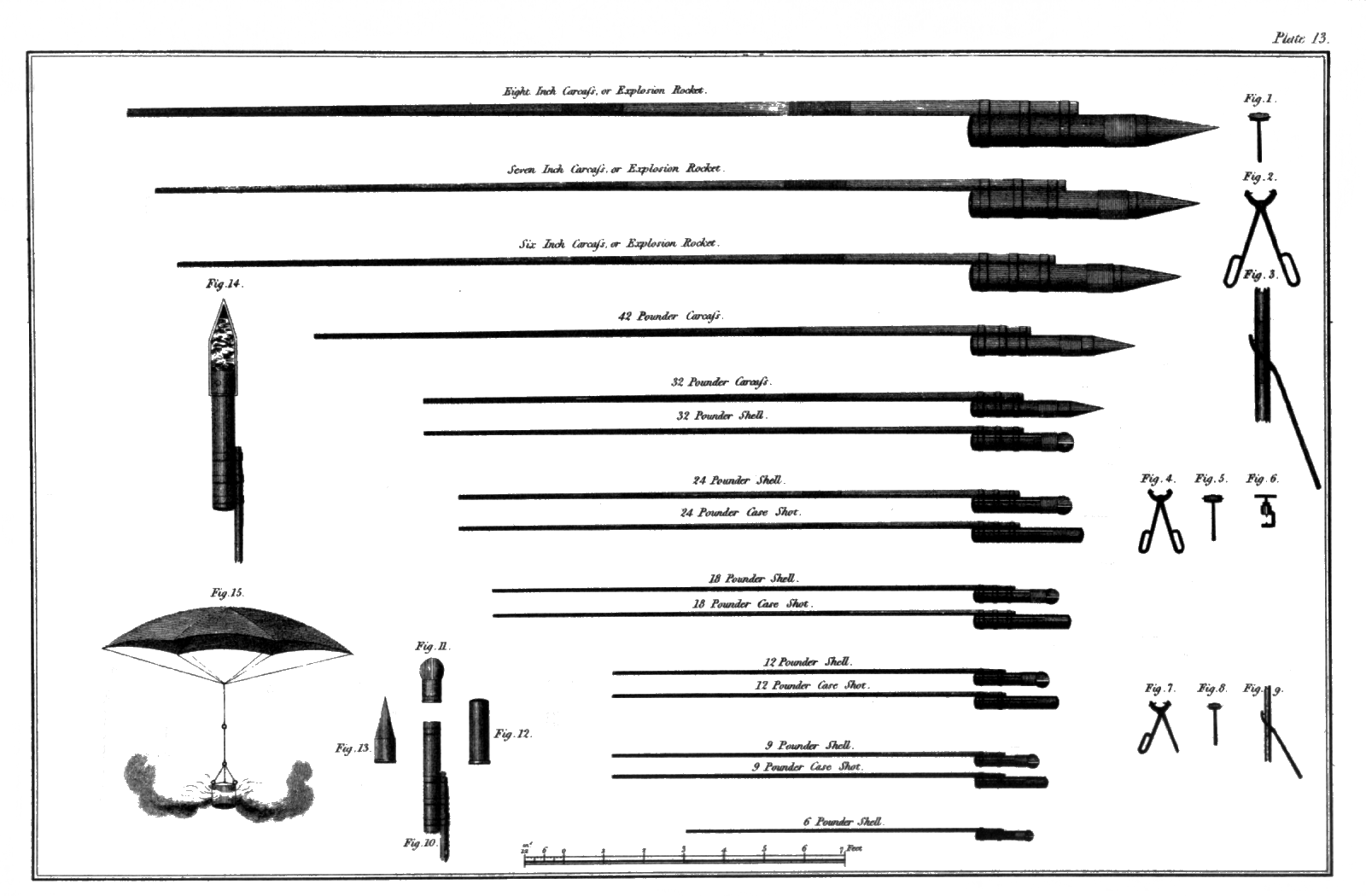
The exact date of Hyder Ali's birth is not known with certainty. He was born to [[Fath Muhammad]]. Various historical sources provide dates ranging between 1717 and 1722 for his birth.<ref name=B13>Bowring, p. 13 | The exact date of Hyder Ali's birth is not known with certainty. He was born to [[Fath Muhammad]]. Various historical sources provide dates ranging between 1717 and 1722 for his birth.<ref name=B13>Bowring, p. 13</ref> His father, Fath Muhammad, was born in [[Kolar, Karnataka|Kolar]], and served as a commander of 50 men in the [[bamboo]] [[rocket artillery]] (mainly used for signalling) in the army of the [[Carnatic Sultanate|Nawab of Carnatic]].<ref name=Narasimha120/> Fath Muhammad eventually entered the service of the [[Wodeyar]] [[Raja]]s of the [[Kingdom of Mysore]], where he rose to become a powerful military commander. The Wodeyars awarded him [[Budikote]] as a [[jagir]] (land grant), where he then served as [[Nayak (title)|naik]] (Lord).<ref name=B13/> | ||
Hyder Ali was born in Budikote, Kolar district; he was [[Fath Muhammad]]'s fifth child, and the second by his third wife.<ref name=B13/> His early years are not well documented; he entered military service along with his brother Shahbaz after their father died in combat.<ref>Rao Punganuri, p. 1</ref> After serving for a number of years under the rulers of [[Arcot]], they came to [[Srirangapatna]], where Hyder's uncle served. He introduced them to Devaraja, the ''dalwai'' (chief minister, military leader, and | Hyder Ali was born in [[Budikote]], modern day [[Kolar district]], [[Karnataka]]; he was [[Fath Muhammad]]'s fifth child, and the second by his third wife Razia Bibi, a sister of [[Sufism|sufi]] [[Pir (Sufism)|pir]] Ibrahim Saheb(Ibrahim saheb had two sons and a daughter Benki Nawab Mir Miran Mohammed Raza Ali Sha Shuttari, Mir Bakshi Nawab Mohammed Gafoor Ali Sha Shuttari and Zainab Begum Saheba) whose ancestors were Arab [[Nawayath]].<ref name=B13/> His early years are not well documented; he entered military service along with his brother Shahbaz after their father died in combat.<ref>Rao Punganuri, p. 1</ref> Although Hyder Ali was from Mysore, his early loyalties were to the [[Nizam of Hyderabad]], through whom Hyder Ali and his companions became [[Sepoy]]s in the Deccan with partial investiture from the "Great Moghul" of that period{{citation needed|date=January 2023}}. After serving for a number of years under the rulers of [[Arcot]], they came to [[Srirangapatna]], where Hyder's uncle served. He introduced them to Devaraja, the ''[[Dalavayi|dalwai]]'' (chief minister, military leader, and [[Commander-in-chief]]) of [[Krishnaraja Wodeyar II]], and Nanjaraja, Devaraja's brother, who also held important ministerial posts including [[sarvadhikari]] .<ref>Brittlebank, p. 18</ref> Hyder and his brother were both given commands in the Mysorean army; Hyder served under Shahbaz, commanding 100 cavalry and 2,000 infantry.<ref name=Rao2>Rao Punganuri, p. 2</ref> | ||
==Rise to power== | ==Rise to power== | ||
| Line 55: | Line 78: | ||
===Carnatic Wars=== | ===Carnatic Wars=== | ||
In 1748, [[Qamar-ud-din Khan, Asaf Jah I]], the longtime [[Nizam of Hyderabad]], died. The struggle to succeed him is known as the [[Second Carnatic War]], and | In 1748, [[Qamar-ud-din Khan, Asaf Jah I]], the longtime [[Nizam of Hyderabad]], died. The struggle to succeed him is known as the [[Second Carnatic War]]. On one side was [[Nasir Jung]], the Nizam and his protege Muhammad Ali, supported by the British, and on the other was [[Chanda Sahib]] and Nasir Jung's nephew [[Muzaffar Jung]], supported by the French, vying to become the Nawab of [[Arcot]]. Both sides were supported by other local leaders. | ||
Devaraja had started vesting more military authority in his brother, and in 1749 Nanjaraja marched the Mysorean army in support of Nasir Jung. The army went to [[Devanhalli]], where the Mysoreans participated in the Siege of Devanahalli Fort. The fort was held by Muzaffar Jung's forces and the siege was conducted by the [[Marquis de Bussy-Castelnau|Marquis de Bussy]].<ref>Bowring, p. 23</ref> During the successful eight-month siege, Hyder Ali and his brother distinguished themselves, and were rewarded by Devaraja with enlarged commands.<ref name="Rao2" /> | |||
In the wars against Hyder Ali in 1751 and during the siege of [[Tiruchirappalli]] in 1752, [[Thondaman dynasty|Thondaiman]] sent 400 cavalry and 3000 [[Kallar (caste)|Kallar]] infantry to [[Tiruchirappalli]] to support the British and the Nawab of Arcot.<ref>{{cite book |title= The Hollow Crown Ethnohistory of an Indian Kingdom|date=1993 |publisher=University of Michigan Press|isbn=978-0-472-08187-5 |url=https://books.google.com/books?id=cegr6zH9PFEC&dq=hyder+ali+kallar&pg=PA193}}</ref> | |||
By 1755, Hyder Ali commanded 3,000 infantry and 1,500 cavalry, and was reported to be enriching himself on campaigns by plunder.<ref>Bowring, p. 26</ref> In that year, he was also appointed [[Faujdar]] (military commander) of [[Dindigul]].<ref>Bowring, p. 27</ref> In this position, he first retained French advisers to organise and train his artillery companies. He is also known to have personally served alongside de Bussy, and is believed to have met both [[Muzaffar Jung]] and [[Chanda Shahib]].<ref name=Bri22>Brittlebank, p. 22</ref> | |||
In these early wars he also came to dislike and mistrust [[Muhammed Ali Khan Wallajah]], the [[Nawab of the Carnatic]]. In fact, Muhammed Ali Khan Wallajah and the Mysorean leaders were long at odds with each other, seeking territorial gains at the other's expense.<ref>Ramaswami, p. 183</ref> Muhammad Ali Khan Wallajah had by then formed an alliance with the British, and he was accused by Hyder Ali in later years of effectively preventing him from making any sort of long-lasting alliances or agreements with the British.<ref>Ramaswami, pp. 182,204–209</ref> | |||
Throughout the [[Carnatic Wars]], Hyder Ali and his Mysore battalions served alongside French commanders such as [[Joseph Francois Dupleix]], [[Thomas Arthur, comte de Lally|Count de Lally]] and de Bussy; he also assisted [[Chanda Sahib]] on various occasions. Hyder Ali supported the claims of [[Muzaffar Jung]] and later sided with [[Salabat Jung]]{{citation needed|date=January 2023}}. | |||
Throughout the [[Carnatic Wars]], Hyder Ali and his Mysore battalions served alongside French commanders such as [[Joseph Francois Dupleix]], [[Thomas Arthur, comte de Lally|Count de Lally]] and de Bussy | |||
===Skills=== | ===Skills=== | ||
Early in his career, Hyder Ali retained as one of his chief financial assistants a Brahmin named Khande Rao. Hyder Ali, who was illiterate, was reported to be blessed with a prodigious memory and numerical acumen. | Early in his career, Hyder Ali retained, as one of his chief financial assistants, a Brahmin named Khande Rao{{citation needed|date=January 2023}}. Hyder Ali, who was illiterate, was reported to be blessed with a prodigious memory and numerical acumen. | ||
Hyder Ali could rival or outperform expert accountants with his great arithmetic skills and worked to develop a system, with Rao, that included checks and balances so | Hyder Ali could rival or outperform expert accountants with his great arithmetic skills and worked to develop a system, with Rao, that included checks and balances, so that all manner of income, including plunder of physical goods of all types, could be accounted for with little possibility of fraud or embezzlement.<ref name="Wilks, pp. 217–218">Wilks, pp. 217–218</ref> | ||
This financial management may have played a role in Hyder Ali's rise in power.<ref name="Wilks, pp. 217–218"/> | This financial management may have played a role in Hyder Ali's rise in power.<ref name="Wilks, pp. 217–218"/> | ||
| Line 80: | Line 99: | ||
===Control of Srirangapatna=== | ===Control of Srirangapatna=== | ||
In 1757 Hyder Ali was called to Srirangapatna to support Devaraja against threats from Hyderabad and the [[Maratha | In 1757, Hyder Ali was called to Srirangapatna to support Devaraja against threats from Hyderabad and the [[Maratha Confederacy|Marathas]]. Upon his arrival, he found the Mysorean army in disarray and near mutiny over pay. While Devaraja bought his way out of the threats to Srirangapatna, Hyder Ali arranged for the army to be paid and arrested the ringleaders of the mutiny.<ref name=Bow29/> | ||
===Campaigns against Calicut=== | ===Campaigns against Calicut=== | ||
{{Main|Mysorean invasion of Malabar|Mysore's campaigns against the states of Malabar (1757)|Mysore invasion of Chirakkal}} | |||
In 1757, to resist the invasion of the [[Zamorin of Calicut]], the [[Palakkad]] Raja sought the help of Hyder Ali.<ref name="KrishnaIyer2">{{cite book | In 1757, to resist the invasion of the [[Zamorin|Zamorin of Calicut]] – an [[East India Company]] ally at the time, the [[Palakkad]] Raja sought the help of Hyder Ali.<ref name="KrishnaIyer2">{{cite book | ||
| author = K. V. Krishna Iyer | | author = K. V. Krishna Iyer | ||
| title = Zamorins of Calicut: From the earliest times to AD 1806 | | title = Zamorins of Calicut: From the earliest times to AD 1806 | ||
| publisher = Norman Printing Bureau, Kozhikode | | publisher = Norman Printing Bureau, Kozhikode | ||
| url = https://archive.org/details/in.gov.ignca.3379 | | url = https://archive.org/details/in.gov.ignca.3379 | ||
| year = 1938}}</ref> Hyder Ali then led campaigns against the [[Zamorin]] of [[Calicut (kingdom)|Calicut]] in the [[Malabar Coast]] of India.<ref name=RP5>Rao Punganuri, p.5</ref> In 1766, Hyder Ali defeated the Zamorin of Kozhikode | | year = 1938}}</ref> Hyder Ali then led campaigns against the [[Zamorin]] of [[Calicut (kingdom)|Calicut]] in the [[Malabar Coast]] of India.<ref name=RP5>Rao Punganuri, p.5</ref> In 1766, Hyder Ali defeated the Zamorin of Kozhikode and absorbed Kozhikode into his state.<ref name="KrishnaIyer2"/> The smaller princely states in northern and north-central parts of modern-day state of [[Kerala]] ([[Malabar District|Malabar region]]) including [[Kolathunadu]], [[Kingdom of Kottayam|Kottayam]], [[Kadathanadu]], [[Zamorin of Calicut|Kozhikode]], [[Kingdom of Tanur|Tanur]], [[Kingdom of Valluvanad|Valluvanad]], and [[Palakkad]] were unified under the rulers of Mysore and were made a part of the larger [[Kingdom of Mysore]].<ref name="Rai">{{cite book |author=Raghunath Rai |title=History |url=https://books.google.com/books?id=Z4-8Z0gqBkoC&pg=PA14 |access-date=18 November 2012 |publisher=FK Publications |isbn=978-8187139690 |pages=14–}}</ref> For his role in these activities, Hyder Ali was rewarded by Devaraja with the [[jaghir]] (regional governorship) of [[Bangalore]].<ref name=Bri19>Brittlebank, p. 19</ref> | ||
=== | ===Capture of Bangalore (1758)=== | ||
In 1758, Hyder Ali successfully forced the Marathas to lift a siege of Bangalore. Hyder Ali's forces entered the city, thus capturing it. | |||
By 1759, Hyder Ali was in command of the entire Mysorean army.<ref name=Bow29>Bowring, p. 29</ref> | |||
===Siege of Channapatna (1759)=== | |||
In the year 1759, [[Balaji Baji Rao]] launched a military expedition against Bangalore and Channapatna, with Gopal Hari and Anand Rao leading the forces. However, Hyder Ali managed to defeat the much larger Maratha army with a smaller force. As a result, Channapatna and the surrounding districts were incorporated into the Mysore territory. | |||
===Nawab of Mysore (1759)=== | ===Nawab of Mysore (1759)=== | ||
The young King of Mysore [[Krishnaraja Wadiyar II|Krishnaraja Wodeyar II]] rewarded Hyder Ali's performance by granting him the title of ''Fath Hyder Bahadur'' or ''Nawab Hyder Ali Khan''.<ref>Bowring, p. 30</ref><ref name=RP6>Rao Punganuri, p. 6</ref> Hyder Ali is also known to be the first ruler of Mysore to be granted the title of Nawab, | The young King of Mysore, [[Krishnaraja Wadiyar II|Krishnaraja Wodeyar II]], rewarded Hyder Ali's performance by granting him the title of ''Fath Hyder Bahadur'' or ''Nawab Hyder Ali Khan''.<ref>Bowring, p. 30</ref><ref name=RP6>Rao Punganuri, p. 6</ref> Hyder Ali is also known to be the first ruler of Mysore to be granted the title of Nawab; thus, it can be said that he was briefly the "Nawab of Mysore" by 1759. | ||
Because of the ongoing conflicts with the Marathas the Mysorean treasury was virtually bankrupted, prompting the queen mother to force into exile Nanjaraj, who had assumed the position of dalwai upon his brother's death in 1758.<ref name=RP5/><ref name=Bri19/> Hyder Ali was a beneficiary of this action, rising in influence in the court.<ref name=Bri19/> | Because of the ongoing conflicts with the Marathas, the Mysorean treasury was virtually bankrupted, prompting the queen mother to force into exile Nanjaraj, who had assumed the position of dalwai upon his brother's death in 1758.<ref name=RP5/><ref name=Bri19/> Hyder Ali was a beneficiary of this action, rising in influence in the court.<ref name=Bri19/> | ||
===Deposition of Khande Rao=== | ===Deposition of Khande Rao=== | ||
In 1760 the queen mother conspired with Khande Rao, who had gone into the raja's service, to oust Hyder Ali. He was precipitously forced out of Seringapatam, leaving his family, including his son [[Tipu Sultan]], under house arrest.<ref name=Bri19/><ref name=RP8>Rao Punganuri, p. 8</ref> | In 1760, the queen mother conspired with Khande Rao, who had gone into the raja's service, to oust Hyder Ali. He was precipitously forced out of Seringapatam, leaving his family, including his son [[Tipu Sultan]], under house arrest.<ref name=Bri19/><ref name=RP8>Rao Punganuri, p. 8</ref> | ||
The sudden departure left Hyder Ali with few resources. He may have been fortuitously aided at this time by the faraway [[Third Battle of Panipat]], in which the Marathas suffered a major defeat | The sudden departure left Hyder Ali with few resources. He may have been fortuitously aided at this time by the faraway [[Third Battle of Panipat]], in which the Marathas suffered a major defeat on 14 January 1761. Because of this loss, the Marathas withdrew forces from Mysore and Hyder Ali's brother-in-law Makdum Ali chased them into Bidnur and Sunda.<ref>[http://www.san.beck.org/2-10-Marathas1707-1800.html Marathas and the English Company 1707–1818 by Sanderson Beck] {{Webarchive|url=https://web.archive.org/web/20181225084030/http://www.san.beck.org/2-10-Marathas1707-1800.html%20 |date=25 December 2018 }}. San.beck.org. Retrieved on 4 March 2012.</ref><ref name=Bow32>Bowring, p. 32</ref> | ||
Hyder Ali soon consolidated his strength by placing Mirza Sahib as the commander of Sira, Ibrahim Ali | Hyder Ali soon consolidated his strength by placing Mirza Sahib as the commander of Sira, a Sufi Pir Ibrahim Sahib (maternal uncle of Hyder Ali) in [[Bangalore]] and Amin Sahib, his cousin in Basnagar. Soon afterward, Hyder Ali marched alongside Makdum Ali's forces, which numbered about 6,000, along with the 3,000 men from his garrison at [[Bangalore]], toward Seringapatam.<ref name=RP8/> | ||
They clashed with Khande Rao's forces before reaching the capital. Khande Rao, with 11,000 men, won the battle, and Hyder Ali was forced to apply to the exiled Nanjaraj for support. Nanjaraj gave | They clashed with Khande Rao's forces before reaching the capital. Khande Rao, with 11,000 men, won the battle, and Hyder Ali was forced to apply to the exiled Nanjaraj for support. Nanjaraj gave Hyder Ali command of his army and the title of Dalwai.<ref name=Bow32/><ref name=RP9>Rao Punganuri, p. 9</ref> | ||
With this force Hyder Ali again moved out against Khande Rao | With this force, Hyder Ali again moved out against Khande Rao. Hyder Ali sent letters appearing to be from Nanjaraj to some of Khande Rao's commanders, confirming their agreement to hand Khande Rao over to Hyder Ali{{Fact|date=October 2024}}. Fearing a conspiracy, Khande Rao fled into Seringapatam. | ||
After a minor battle against the now-leaderless army, Hyder Ali took over most of its remnants and surrounded Seringapatam.<ref name=Bow33>Bowring, p. 33</ref> The ensuing negotiations left Hyder Ali in nearly complete military control of Mysore. Concessions that he extracted included the surrender of Khande Rao, who Hyder Ali imprisoned in Bangalore.<ref name=RP10>Rao Punganuri, p. 10</ref> | After a minor battle against the now-leaderless army, Hyder Ali took over most of its remnants and surrounded Seringapatam.<ref name=Bow33>Bowring, p. 33</ref> The ensuing negotiations left Hyder Ali in nearly complete military control of Mysore. Concessions that he extracted included the surrender of Khande Rao, who Hyder Ali imprisoned in Bangalore.<ref name=RP10>Rao Punganuri, p. 10</ref> | ||
| Line 119: | Line 141: | ||
==Ruler of Mysore== | ==Ruler of Mysore== | ||
Hyder Ali became king of Mysore in 1761 after overthrowing the prime minister and making the king, Krishnaraja Wodeyar II, a prisoner in his own palace.<ref>{{Cite web |title=Hyder Ali {{!}} emperor of India {{!}} Britannica |url=https://www.britannica.com/biography/Hyder-Ali |access-date=2022-05-08 |website=www.britannica.com |language=en}}</ref> | Hyder Ali became king of Mysore in 1761 after overthrowing the prime minister and making the king, Krishnaraja Wodeyar II, a prisoner in his own palace.<ref>{{Cite web |title=Hyder Ali {{!}} emperor of India {{!}} Britannica |url=https://www.britannica.com/biography/Hyder-Ali |access-date=2022-05-08 |website=www.britannica.com |language=en |archive-date=15 May 2022 |archive-url=https://web.archive.org/web/20220515053136/https://www.britannica.com/biography/Hyder-Ali |url-status=live }}</ref> | ||
Hyder Ali formally styled himself ''[[Sultan]] Hyder Ali Khan'' in his correspondence with the Mughal Emperor [[Shah Alam II]]. Hyder Ali retained his title during the first [[Anglo-Mysore War]] that raged in 1766, and onwards. | Hyder Ali formally styled himself ''[[Sultan]] Hyder Ali Khan'' in his correspondence with the Mughal Emperor [[Shah Alam II]]. Hyder Ali retained his title during the first [[Anglo-Mysore War]] that raged in 1766, and onwards. | ||
| Line 127: | Line 147: | ||
He was very cautious in his diplomacy with the [[Nizam of Hyderabad]], who was, according to an official Mughal ''[[firman]]'', the sovereign of all Muslim-ruled territories in southern India.<ref>Rao Punganuri, p. 47</ref> | He was very cautious in his diplomacy with the [[Nizam of Hyderabad]], who was, according to an official Mughal ''[[firman]]'', the sovereign of all Muslim-ruled territories in southern India.<ref>Rao Punganuri, p. 47</ref> | ||
The English and the [[Maratha | The English and the [[Maratha Empire|Marathas]] continued to refer to Hyder Ali and later his son Tipu Sultan as "[[Nawab|nabobs]]". | ||
<gallery> | <gallery> | ||
| Line 145: | Line 165: | ||
|title= Christianity in Mangalore | |title= Christianity in Mangalore | ||
|access-date=30 July 2008 | |access-date=30 July 2008 | ||
|publisher=[[Roman Catholic Diocese of Mangalore|Diocese of Mangalore]]|archive-url = https://web.archive.org/web/20080622155343/http://www.dioceseofmangalore.org/history.asp |archive-date = 22 June 2008}}</ref> | |publisher=[[Roman Catholic Diocese of Mangalore|Diocese of Mangalore]]|url-status=usurped | ||
|archive-url = https://web.archive.org/web/20080622155343/http://www.dioceseofmangalore.org/history.asp |archive-date = 22 June 2008}}</ref> | |||
==Hyder Ali attacks the Maratha Confederacy== | ==Hyder Ali attacks the Maratha Confederacy== | ||
{{Main|Maratha–Mysore War}} | {{Main|Maratha–Mysore War|}} | ||
[[File:Hyder Ali.jpg|thumb|right|Hyder Ali in 1762, incorrectly described as the ''head of his army in the war against the British in India''. (French painting)]] | [[File:Hyder Ali.jpg|thumb|right|Hyder Ali in 1762, incorrectly described as the ''head of his army in the war against the British in India''. (French painting)]] | ||
| Line 154: | Line 175: | ||
The Maratha Confederacy had just been routed at the [[Third Battle of Panipat]] by [[Ahmad Shah Durrani]] and the [[Mughal Empire|Mughals]] had been restored in the year 1761. | The Maratha Confederacy had just been routed at the [[Third Battle of Panipat]] by [[Ahmad Shah Durrani]] and the [[Mughal Empire|Mughals]] had been restored in the year 1761. | ||
The Maratha Empire was | The Maratha Empire was very vulnerable and feeble to any attack and the [[Peshwa]]'s power had been almost eliminated in all of Northern India. | ||
At this point in his life Hyder Ali decided to go to war with the Marathas and put an end to the threat they posed to his power. | At this point in his life Hyder Ali decided to go to war with the Marathas and put an end to the threat they posed to his power. | ||
He therefore attacked the Maratha aligned Rani of Bednore. She had appealed to the [[Nawab of Savanur]] for assistance when Hyder invaded. Hyder consequently threatened the Nawab, attempting to extort tribute from him.<ref>Chitnis, pp. 53–55</ref> Failing in this, he overran that territory, reaching as far as [[Dharwad]], north of the [[Tungabhadra River]].<ref name=Bow41/> | He therefore attacked the Maratha-aligned Rani of Bednore. She had appealed to the [[Nawab of Savanur]] for assistance when Hyder invaded. Hyder consequently threatened the Nawab, attempting to extort tribute from him.<ref>Chitnis, pp. 53–55</ref> Failing in this, he overran that territory, reaching as far as [[Dharwad]], north of the [[Tungabhadra River]].<ref name=Bow41/> | ||
Since Savanur was a tributary of the Marathas, the [[ | Since Savanur was a tributary of the Marathas, the Peshwa, [[Madhavrao I]], countered with a strong force and defeated Hyder near [[Rattihalli]] and in decisive [[Battle of Jadi Hanwati]] . Following the victory the Marathas restored their power under the reign of Madhavrao Peshwa. The Maratha victory forced Hyder to retreat; he had to abandon Bednore, although he was able to remove its treasures to Seringapatam. Hyder paid 35 lakhs rupees in tribute to end the war, and returned most of his gains, although he did retain Sira.<ref name=Bow41>Bowring, p. 41</ref><ref>Rao Punganuri, p. 15</ref> | ||
In 1766 Hyder Ali [[Mysore invasion of Kerala#Invasion by Hyder Ali|returned to the Malabar]], this time at the invitation of the raja of [[Arakkal Kingdom|Cannanore]], who sought independence from the [[Zamorin]], the ruler of [[History of Kozhikode|Calicut]] who held sway over Cannanore. Hyder also claimed a debt of tribute from the Zamorin, who had supported Hyder's opponents in [[Zamorin - Palakkad War ( | In 1766 Hyder Ali [[Mysore invasion of Kerala#Invasion by Hyder Ali|returned to the Malabar]], this time at the invitation of the raja of [[Arakkal Kingdom|Cannanore]], who sought independence from the [[Zamorin]], the ruler of [[History of Kozhikode|Calicut]] who held sway over Cannanore. Hyder also claimed a debt of tribute from the Zamorin, who had supported Hyder's opponents in [[Zamorin - Palakkad War (1756–1757)|earlier campaigns]]. After a difficult campaign, Hyder reached Calicut, where the Zamorin, after promising to make payment, failed to deliver. Hyder placed the Zamorin under house arrest and had his finance minister tortured. Fearing similar treatment, the Zamorin set fire to his palace and perished in the flames, ending [[Eradi]] dynastic rule of Calicut.<ref name=Bow44_6/><ref>Lethbridge, p. 94</ref> After establishing control of Calicut, Hyder departed, but was forced to return several months later when the Nairs rebelled against the rule of his lieutenant, Reza Sahib. Hyder's response was harsh: after putting down the rebellion, many rebels were executed, and thousands of others were [[Captivity of Nairs at Seringapatam|forcibly relocated]] to the Mysorean highlands.<ref name=Bow44_6>Bowring, pp. 44–46</ref> | ||
[[File:IGI1908India1765a.jpg|thumb|Map of [[India]] in [[1765]] showing territories | [[File:IGI1908India1765a.jpg|thumb|Map of [[India]] in [[1765]] showing Hindu territories allied with the [[Maratha Empire|Marathas]] in ''(yellow)''; and the Muslim territories, which includes Mysore allied to the [[Mughal Empire|Mughal]] in ''(green)''.]] | ||
Mysore's titular ruler Krishnaraja died in April 1766, while Hyder was in Malabar. Hyder had left orders that Krishnaraja's son [[Nanjaraja Wodeyar]] be invested should that happen, and he only later came to formally pay his respects to the new rajah. He took advantage of this opportunity to engage in a sort of house cleaning: the raja's palace was plundered, and its staff reduced to the point where virtually everyone employed there was also a spy for Hyder Ali.<ref>Wilks, p. 294</ref> | Mysore's titular ruler Krishnaraja died in April 1766, while Hyder was in Malabar. Hyder had left orders that Krishnaraja's son [[Nanjaraja Wodeyar]] be invested should that happen, and he only later came to formally pay his respects to the new rajah. He took advantage of this opportunity to engage in a sort of house cleaning: the raja's palace was plundered, and its staff reduced to the point where virtually everyone employed there was also a spy for Hyder Ali.<ref>Wilks, p. 294</ref> | ||
| Line 171: | Line 192: | ||
[[File:Kistnagherry Krishnagiri.jpg|thumb|left|[[Krishnagiri Fort]] was besieged in the first Anglo-Mysore war in 1768, and finally surrendered to the English, who held it briefly]] | [[File:Kistnagherry Krishnagiri.jpg|thumb|left|[[Krishnagiri Fort]] was besieged in the first Anglo-Mysore war in 1768, and finally surrendered to the English, who held it briefly]] | ||
After the [[Battle of Buxar]] the British led by [[Hector Munro, 8th laird of Novar|Hector Monro]] decided to support the Maratha Confederacy against the [[Shah Alam II]], the [[Nawab]]s and Mysore. | After the [[Battle of Buxar]], the British, led by [[Hector Munro, 8th laird of Novar|Hector Monro]], decided to support the Maratha Confederacy against the [[Shah Alam II]], the [[Nawab]]s and Mysore. | ||
As the power struggle between Mysore and the [[Peshwa]] continued it soon began to involve the British and other European trading companies.{{ | As the power struggle between Mysore and the [[Peshwa]] continued it soon began to involve the British and other European trading companies.{{citation needed|date=January 2021}} | ||
Being himself a former ally of the French, Hyder Ali expected the support of the British against the Marathas, but such support never materialized. | Being himself a former ally of the French, Hyder Ali expected the support of the British against the Marathas, but such support never materialized. | ||
In 1766 Mysore began to become drawn into territorial and diplomatic disputes between the Nizam of Hyderabad and the [[East India Company]], which had by then become the dominant European power on the Eastern Indian coast. The Nizam, seeking to deflect the | In 1766 Mysore began to become drawn into territorial and diplomatic disputes between the Nizam of Hyderabad and the [[East India Company]], which had by then become the dominant European power on the Eastern Indian coast. The Nizam, seeking to deflect the company from their attempts to gain control of the [[Northern Circars]], made overtures to Hyder Ali to launch an invasion of the [[Carnatic (region)|Carnatic]]. Company representatives also appealed to Hyder Ali, but he rebuffed to them.<ref>Duff, p. 652</ref> The Nizam then ostensibly struck a deal with the Company administration in the [[Madras Presidency]] for their support, but apparently did so with the expectation that when Hyder Ali was prepared for war, the deal with the British would be broken. This diplomatic manoeuvring resulted in the start of the [[First Anglo-Mysore War]] in August 1767 when a company outpost at Changama was attacked by a combined Mysore-Hyderabad army under Hyder Ali's command.<ref name=B49/><ref name="Wilks, p. 312">Wilks, p. 312</ref> Despite significantly outnumbering the [[Presidency armies|British force]] (British estimates place the allied army size at 70,000 to the British 7,000), the allies were repulsed with heavy losses. Hyder Ali moved on to capture [[Kaveripattinam]] after two days of siege, while the British commander at Changama, Colonel Joseph Smith, eventually retreated to [[Tiruvannamalai]] for supplies and reinforcements.<ref name=B49>Bowring, p. 49</ref><ref>Wilks, p. 311</ref> There Hyder Ali was [[Battle of Tiruvannamalai|decisively repulsed]] on 26 September 1767.<ref>Bowring, p. 50</ref> With the onset of the monsoon season, Hyder Ali opted to continue campaigning rather than adopting the usual practice of suspending operations because of the difficult conditions the weather created for armies.<ref>Wilks, p. 322</ref> After over-running a few lesser outposts, he [[Siege of Ambur|besieged Ambur]] in November 1767, forcing the British to resume campaigning.<ref>Wilks, p. 323</ref> The British garrison commander refused large bribes offered by Hyder Ali in exchange for surrender, and the arrival of a relief column in early December forced Hyder Ali to lift the siege.<ref>Wilks, p. 324</ref> He retreated northward, covering the movements of the Nizam's forces, but was disheartened when an entire corps of European cavalry deserted to the British.<ref>Wilks, p. 326</ref> The failures of this campaign, combined with successful British advances in the Northern Circars and secret negotiations between the British and the Nizam [[Ali Khan Asaf Jah II|Asaf Jah II]], led to a split between Hyder Ali and the Nizam. The latter withdrew back to Hyderabad and eventually negotiated a new treaty with the British company in 1768. Hyder Ali, apparently seeking an end to the conflict, made peace overtures to the British, but was rebuffed.<ref>Wilks, pp. 328–329</ref> | ||
In early 1768, the [[Bombay Presidency]] in [[Mumbai|Bombay]] organised an expedition to Mysore's Malabar coast territories. Hyder Ali's fleet, which the British reported as numbering about ten ships, deserted en masse, apparently because the captains were unhappy with the oustering of their British admirals and some even demanded the return of [[Arakkal kingdom|Ali Raja Kunhi Amsa II]], but Hyder Ali chose a cavalry commander Lutf Ali Beg as fleet commander.<ref>Sen, pp. 147–148</ref> Owing to a British bluff, Lutf Ali Beg also withdrew much of the Mangalore garrison to move on what he perceived to be the British target, [[Honnavar|Onore]]. The British consequently captured Mangalore with minimal opposition in February.<ref name=Wil331>Wilks, p. 331</ref> This activity, combined with the loss of the Nizam as an ally, prompted Hyder Ali to withdraw from the Carnatic, and move with speed to Malabar. Dispatching his son Tipu with an advance force, Hyder Ali followed, and eventually re-took Mangalore and the other ports held by the over-extended British forces.<ref name=Wil331/><ref name=Bow51/> He also levied additional taxes as punishment against local malabari Nair chieftains which were then stripped of rights and authority.<ref name=Bow51>Bowring, p. 51</ref> | In early 1768, the [[Bombay Presidency]] in [[Mumbai|Bombay]] organised an expedition to Mysore's Malabar coast territories. Hyder Ali's fleet, which the British reported as numbering about ten ships, deserted en masse, apparently because the captains were unhappy with the oustering of their British admirals and some even demanded the return of [[Arakkal kingdom|Ali Raja Kunhi Amsa II]], but Hyder Ali chose a cavalry commander Lutf Ali Beg as fleet commander.<ref>Sen, pp. 147–148</ref> Owing to a British bluff, Lutf Ali Beg also withdrew much of the Mangalore garrison to move on what he perceived to be the British target, [[Honnavar|Onore]]. The British consequently captured Mangalore with minimal opposition in February.<ref name=Wil331>Wilks, p. 331</ref> This activity, combined with the loss of the Nizam as an ally, prompted Hyder Ali to withdraw from the Carnatic, and move with speed to Malabar. Dispatching his son Tipu with an advance force, Hyder Ali followed, and eventually re-took Mangalore and the other ports held by the over-extended British forces.<ref name=Wil331/><ref name=Bow51/> He also levied additional taxes as punishment against local malabari Nair chieftains which were then stripped of rights and authority.<ref name=Bow51>Bowring, p. 51</ref> | ||
[[File:Mir Nizam Ali Khan.jpg|thumb|[[Ali Khan Asaf Jah II|Asaf Jah II]] opposed the [[East India Company]] in 1766,<ref>Regani, p. 130</ref> and initially allied himself with Hyder Ali during the [[First Anglo-Mysore War]], particularly during the [[Battle of Chengam]],<ref name=B49/><ref name="Wilks, p. 312"/> then | [[File:Mir Nizam Ali Khan.jpg|thumb|[[Ali Khan Asaf Jah II|Asaf Jah II]] opposed the [[East India Company]] in 1766,<ref>Regani, p. 130</ref> and initially allied himself with Hyder Ali during the [[First Anglo-Mysore War]], particularly during the [[Battle of Chengam]],<ref name=B49/><ref name="Wilks, p. 312"/> then Battle of Rakshasbhuvan,<ref>{{cite web|url=http://www.maharashtra.gov.in/english/gazetteer/Nasik/005%20History/003%20MarathaPeriod.htm|title=HISTORY – MARATHA PERIOD|publisher=Nasik District Gazetteer|access-date=4 September 2010| archive-url= https://web.archive.org/web/20100831113626/http://www.maharashtra.gov.in/english/gazetteer/Nasik/005%20History/003%20MarathaPeriod.htm| archive-date= 31 August 2010 | url-status= live}}</ref> but later abandoned (in 1768) and later intervened in favor of Mysore during the [[Battle of Kharda]] in 1795.]] | ||
After his reconquest, Hyder Ali learned that the Mangalorean Catholics had helped the British in their conquest of Mangalore, behaviour he considered treasonous.<ref>Silva, p. 90</ref> He summoned a Portuguese officer and several Christian priests from Mangalore to suggest an appropriate punishment to impose on the Mangalorean Catholics for their treachery. The Portuguese officer suggested the death penalty for those Catholics who helped the British as a typical punishment for the betrayal of one's sovereign in Catholic nations. But Hyder Ali exhibited a diplomatic stance and instead imprisoned those Christians who were condemned for treachery.<ref>de la Tour, p. 236</ref> He afterwards opened negotiations with the Portuguese, and reached an agreement with them that removed suspicion from the clergy and other Christians.<ref>Silva, pp. 103–104</ref> The Mangalorean Catholic community flourished during the rest of Hyder Ali's reign.<ref>Silva, p. 105</ref> | After his reconquest, Hyder Ali learned that the Mangalorean Catholics had helped the British in their conquest of Mangalore, behaviour he considered treasonous.<ref>Silva, p. 90</ref> He summoned a Portuguese officer and several Christian priests from Mangalore to suggest an appropriate punishment to impose on the Mangalorean Catholics for their treachery. The Portuguese officer suggested the death penalty for those Catholics who helped the British as a typical punishment for the betrayal of one's sovereign in Catholic nations. But Hyder Ali exhibited a diplomatic stance and instead imprisoned those Christians who were condemned for treachery.<ref>de la Tour, p. 236</ref> He afterwards opened negotiations with the Portuguese, and reached an agreement with them that removed suspicion from the clergy and other Christians.<ref>Silva, pp. 103–104</ref> The Mangalorean Catholic community flourished during the rest of Hyder Ali's reign.<ref>Silva, p. 105</ref> | ||
| Line 187: | Line 208: | ||
During Hyder Ali's absence from the Carnatic, the British recovered many places that Hyder Ali had taken and only weakly garrisoned, and advanced as far south as [[Dindigul]].<ref name=Bow52>Bowring, p. 52</ref> They also convinced the Marathas to enter the conflict, and a large force of theirs, under the command of Morari Rao, joined with Colonel Smith at [[Hoskote|Ooscota]] in early August 1768.<ref>Wilks, p. 340</ref> This army then began preparations to besiege Bangalore, but Hyder Ali returned to Bangalore from Malabar on 9 August, in time to harass the allies before the siege could begin.<ref>Wilks, pp. 341–342</ref> On 22 August, Hyder Ali and his Mysore forces attacked the Maratha camp during the [[Battle of Ooscota]], but was repulsed when faced with the large Maratha reinforcements.<ref>Wilks, p. 342</ref> Hyder Ali was then foiled in an attempt to prevent the arrival of a second British column at the allied camp; the strength of these combined forces convinced him to retreat from Bangalore toward [[Gurramkonda]], where he was reinforced by his brother in law.<ref name=Bow53>Bowring, p. 53</ref> He also attempted diplomatic measures to prevent a siege of Bangalore, offering to pay ten lakhs rupees and grant other land concessions in exchange for peace. The Company administration countered with a list of demands that included payments of tribute to the Nizam and several land concessions to the [[Company rule in India|East India Company]]. Hyder Ali specifically refused to deal with [[Muhammed Ali Khan Wallajah]], his nemesis in the Carnatic. The negotiations failed to reach common ground.<ref name=Bow53/> | During Hyder Ali's absence from the Carnatic, the British recovered many places that Hyder Ali had taken and only weakly garrisoned, and advanced as far south as [[Dindigul]].<ref name=Bow52>Bowring, p. 52</ref> They also convinced the Marathas to enter the conflict, and a large force of theirs, under the command of Morari Rao, joined with Colonel Smith at [[Hoskote|Ooscota]] in early August 1768.<ref>Wilks, p. 340</ref> This army then began preparations to besiege Bangalore, but Hyder Ali returned to Bangalore from Malabar on 9 August, in time to harass the allies before the siege could begin.<ref>Wilks, pp. 341–342</ref> On 22 August, Hyder Ali and his Mysore forces attacked the Maratha camp during the [[Battle of Ooscota]], but was repulsed when faced with the large Maratha reinforcements.<ref>Wilks, p. 342</ref> Hyder Ali was then foiled in an attempt to prevent the arrival of a second British column at the allied camp; the strength of these combined forces convinced him to retreat from Bangalore toward [[Gurramkonda]], where he was reinforced by his brother in law.<ref name=Bow53>Bowring, p. 53</ref> He also attempted diplomatic measures to prevent a siege of Bangalore, offering to pay ten lakhs rupees and grant other land concessions in exchange for peace. The Company administration countered with a list of demands that included payments of tribute to the Nizam and several land concessions to the [[Company rule in India|East India Company]]. Hyder Ali specifically refused to deal with [[Muhammed Ali Khan Wallajah]], his nemesis in the Carnatic. The negotiations failed to reach common ground.<ref name=Bow53/> | ||
On 3 October, Hyder Ali, while moving his army from Guuramkonda back toward Bangalore, surprised a small garrison of [[Muhammed Ali Khan Wallajah]]'s men at a rock fort call Mulwagal, near Ooscota. British reinforcements were sent, and Colonel Wood was able to recover the lower fort but not the upper. The next day he went out with a few companies of men to investigate movements that might have been cover for enemy reinforcements. This small force, numbering four companies, was surrounded by Hyder Ali's entire army in the [[Battle of Mulwagal]].<ref>Wilks, p. 346</ref> A | On 3 October, Hyder Ali, while moving his army from Guuramkonda back toward Bangalore, surprised a small garrison of [[Muhammed Ali Khan Wallajah]]'s men at a rock fort call Mulwagal, near Ooscota. British reinforcements were sent, and Colonel Wood was able to recover the lower fort but not the upper. The next day he went out with a few companies of men to investigate movements that might have been cover for enemy reinforcements. This small force, numbering four companies, was surrounded by Hyder Ali's entire army in the [[Battle of Mulwagal]].<ref>Wilks, p. 346</ref> A stratagem by another officer, Colonel Brooks, prevented the loss of this detachment; Colonel Brooks and another two companies dragged two cannons to the top of a nearby rise, and Brooks called out "Smith! Smith!" while firing the cannons.<ref name=Wil347>Wilks, p. 347</ref> Both sides interpreted this to mean that Colonel Smith was arriving in force, and Hyder's troops began to retreat. This enabled Colonel Wood to join with Brooks and other reinforcements from Mulwagal before Hyder Ali realised his tactical error.<ref name=Wil347/> Hyder Ali renewed his attack, but was eventually repulsed with heavy losses: he was estimated to lose 1,000 men while the British lost about 200.<ref>Wilks, p. 348</ref> The severity of the conflict convinced Colonel Smith that he would be unable to effectively besiege Bangalore without first inflicting a major defeat on Hyder Ali in open battle.<ref>Bowring, p. 54</ref> Company officials blamed Smith for the failure to decisively defeat Hyder Ali, and recalled him to Madras. Hyder Ali took the opportunity to besiege [[Hosur]], and Colonel Wood marched in relief of the town. As Wood approached, Hyder Ali raised the siege, sneaked around Wood's column, and attacked his baggage train in [[Battle of Bagalur|a battle]] near [[Bagalur, Krishnagiri district|Bagalur]]. Hyder Ali successfully captured supplies and arms, and drove Wood in disgrace toward [[Venkatagiri]].<ref>Bowring, p. 55</ref> Wood was consequently recalled and replaced by Colonel Lang.<ref name=Bow56>Bowring, p. 56</ref> | ||
Hyder Ali then raised additional forces in Mysore and went on the offensive. In November 1768 he split his army into two, and crossed the ghats into the Carnatic, regaining control of many minor posts held by the British. En route to [[Erode]] Hyder Ali overwhelmed one contingent of British, who were sent as prisoners to Seringapatam when it was established that one of its officers was serving in violation of a parole agreement. After rapidly establishing control over much of the southern Carnatic, his march approached Madras.<ref name=Bow56/> This prompted the British to send an envoy to discuss peace; because of Hyder Ali's insistence that the Nawab of the Carnatic be excluded from the negotiations, they went nowhere. Hyder Ali then surprised Company authorities by taking a picked force of 6,000 cavalry and a small number of infantry, and made in three days a forced march of {{convert|130|mi|km}} to the gates of Madras.<ref name=Bow57>Bowring, p. 57</ref> | Hyder Ali then raised additional forces in Mysore and went on the offensive. In November 1768 he split his army into two, and crossed the ghats into the Carnatic, regaining control of many minor posts held by the British. En route to [[Erode]] Hyder Ali overwhelmed one contingent of British, who were sent as prisoners to Seringapatam when it was established that one of its officers was serving in violation of a parole agreement. After rapidly establishing control over much of the southern Carnatic, his march approached Madras.<ref name=Bow56/> This prompted the British to send an envoy to discuss peace; because of Hyder Ali's insistence that the Nawab of the Carnatic be excluded from the negotiations, they went nowhere. Hyder Ali then surprised Company authorities by taking a picked force of 6,000 cavalry and a small number of infantry, and made in three days a forced march of {{convert|130|mi|km}} to the gates of Madras.<ref name=Bow57>Bowring, p. 57</ref> | ||
This show of force compelled the | This show of force compelled the company to negotiate further. Hyder Ali, who was seeking diplomatic leverage against the Marathas, wanted an alliance of mutual defence and offence.<ref name=D668>Duff, p. 668</ref> The Company refused to accede to an offensive military treaty; the treaty signed at Madras on 29 March 1769, restored the ''[[status quo ante bellum]]'', except for Mysore's acquisition of [[Karur district|Karur]], and also included language that each side would help the other defend its territory. In summarising Hyder Ali's conduct of the war, biographer Lewin Bowring notes that he "evinced high qualities as a tactician and the sagacity of a born diplomatist."<ref>Bowring, p. 58</ref> | ||
==Arab, Persian and Turkish relations== | ==Arab, Persian and Turkish relations== | ||
| Line 204: | Line 225: | ||
==Second war with the Maratha Confederacy== | ==Second war with the Maratha Confederacy== | ||
{{See also|Maratha-Mysore War| | {{See also|Maratha-Mysore War||}}Hyder, believing he would be supported by the British in conflict with the Marathas, began demanding tribute payments from smaller states on the frontiers between Maratha and Mysore territories, and refused to pay tributes demanded by the Marathas. The Marathas responded in November 1770 with an invasion by an army of 35,000 men.<ref name=D669>Duff, p. 669</ref> Pursuant to their treaty, Hyder requested British assistance. The Company refused, and Hyder retreated, slashing and burning as he went to deny the bounty of the land to the Marathas.<ref>Duff, p. 670</ref> The Marathas captured much of north-eastern Mysore, and consolidated their gains during the monsoon season. Hyder offered to pay some of the tribute demanded, but his offer was rejected as insufficient, and the Marathas renewed the offensive after the monsoons.<ref>Duff, p. 671</ref> They advanced to the vicinity of Seringapatam, and then feinted a withdrawal to the north. When Hyder followed, they turned in force, and claimed to inflict serious casualties on Hyder's army, and captured most of its baggage.<ref>Duff, p. 672</ref> They then fruitlessly besieged Seringapatam for five weeks, before abandoning the effort and instead took Bangalore. Hyder again appealed to the British for help, but their pre-conditions and proposed terms were unacceptable to him, and an attempt by Hyder to get them to go on the offensive scuttled the negotiations.<ref>Duff, p. 673</ref> In 1772 Hyder finally sued for peace. He agreed to pay 3.6 million rupees in tribute arrears, and 1.4 million rupees in annual tribute, and ceded territory all the way to Bangalore.<ref>Duff, p. 674</ref> Upon his return to Seringapatam after the peace was concluded, Hyder learned that Nanjaraja, the titular ruler of Mysore, had been engaged in secret communications with the Marathas. Hyder ordered Nanjaraja strangled, and placed his brother Chamaraja on the throne.<ref>Bowring, p. 63</ref> | ||
[[File:Hyder Ali at Conjeveram.jpg|thumb|Hyder Ali's melee forces in battle.]] | [[File:Hyder Ali at Conjeveram.jpg|thumb|Hyder Ali's melee forces in battle.]] | ||
The peace with the Marathas was short-lived. The Peshwa [[Madhavrao I]] died late in 1772, beginning a struggle for his succession. In 1773, Hyder used this opportunity to send Tipu with an army to recover territories lost to the Marathas to the north, while he descended into [[Coorg]], which provided a more secure route to the Malabar territories he wanted to recover from the Marathas.<ref>Bowring, p. 64</ref> A claimant to the Coorg throne had asked for Hyder's assistance in 1770 when he was pre-occupied with the Marathas.<ref>Bowring, p. 65</ref> He quickly captured Coorg's capital, [[Merkara]], imprisoning Raja Vira Rajendra. He installed a [[Brahmin]] as Governor to collect revenues before continuing to Malabar, where by the end of 1774 he had recovered all his lost territory.<ref>Bowring, pp. 66,68</ref> The Coorgs rose in rebellion against his Governor, upon which Hyder returned to Coorg, crushed the rebellion, and hanged most of the ring-leaders.<ref name=Bow68>Bowring, p. 68</ref> This did not stop the restive Coorgs from becoming a continuing problem for Hyder, and for, Tipu after his death.<ref>''Journal of the United Service Institution'', p. 165</ref> | The peace with the Marathas was short-lived. The Peshwa [[Madhavrao I]] died late in 1772, beginning a struggle for his succession. In 1773, Hyder used this opportunity to send Tipu with an army to recover territories lost to the Marathas to the north, while he descended into [[Coorg]], which provided a more secure route to the Malabar territories he wanted to recover from the Marathas.<ref>Bowring, p. 64</ref> A claimant to the Coorg throne had asked for Hyder's assistance in 1770 when he was pre-occupied with the Marathas.<ref>Bowring, p. 65</ref> He quickly captured Coorg's capital, [[Merkara]], imprisoning Raja Vira Rajendra. He installed a [[Brahmin]] as Governor to collect revenues before continuing to Malabar, where by the end of 1774 he had recovered all his lost territory.<ref>Bowring, pp. 66,68</ref> The Coorgs rose in rebellion against his Governor, upon which Hyder returned to Coorg, crushed the rebellion, and hanged most of the ring-leaders.<ref name=Bow68>Bowring, p. 68</ref> This did not stop the restive Coorgs from becoming a continuing problem for Hyder, and for, Tipu after his death.<ref>''Journal of the United Service Institution'', p. 165</ref> | ||
In 1776 the young Raja [[Chamaraja Wodeyar VIII]] died. To choose a successor, Hyder had all of the children of the royal family brought together, and watched them play. A child, also named [[Chamaraja Wodeyar IX]], chose to play with a jewelled dagger, and was supposedly selected on that basis as the new Raja of Mysore. | In 1776 the young Raja [[Chamaraja Wodeyar VIII]] died. To choose a successor, Hyder had all of the children of the royal family brought together, and watched them play. A child, also named [[Chamaraja Wodeyar IX]], chose to play with a jewelled dagger, and was supposedly selected on that basis as the new Raja of Mysore.<ref name=Bow68/> | ||
By March 1775, the leadership situation at [[Poona]], the Maratha capital, had stabilised, and the Marathas joined an alliance with the Nizam of Hyderabad to oppose Hyder. The Maratha army was routed by one of Hyder's Generals in 1776, and Hyder either bribed or sufficiently threatened the Nizam's military leaders so that they withdrew from the campaign.<ref>Bowring, pp. 69–71</ref> This only temporarily halted the conflict, which was fought with renewed vigor until 1779. Hyder successfully extended his domain to the [[Krishna River]] after a lengthy siege of [[Dharwad]]. In a controversial action, Hyder in 1779, dealt harshly with [[Madakari Nayaka]], the ruler of [[Chitradurga]]. Madakari had supported Hyder in earlier conflicts, but in 1777 had changed allegiance to the Marathas. After seizing Chitradurga, Hyder sent Madakari Nayaka to Seringapatam as a prisoner, where he died. Hyder further sent 20,000 of Madakari's followers to Seringapatam, where the boys among them were allegedly forcibly converted to [[Islam]] and formed into so-called ''chela'' battalions in the Mysorean army.<ref>Bowring, pp. 72–75</ref> | By March 1775, the leadership situation at [[Poona]], the Maratha capital, had stabilised, and the Marathas joined an alliance with the Nizam of Hyderabad to oppose Hyder. The Maratha army was routed by one of Hyder's Generals in 1776, and Hyder either bribed or sufficiently threatened the Nizam's military leaders so that they withdrew from the campaign.<ref>Bowring, pp. 69–71</ref> This only temporarily halted the conflict, which was fought with renewed vigor until 1779. Hyder successfully extended his domain to the [[Krishna River]] after a lengthy siege of [[Dharwad]]. In a controversial action, Hyder in 1779, dealt harshly with [[Madakari Nayaka]], the ruler of [[Chitradurga]]. Madakari had supported Hyder in earlier conflicts, but in 1777 had changed allegiance to the Marathas. After seizing Chitradurga, Hyder sent Madakari Nayaka to Seringapatam as a prisoner, where he died. Hyder further sent 20,000 of Madakari's followers to Seringapatam, where the boys among them were allegedly forcibly converted to [[Islam]] and formed into so-called ''chela'' battalions in the Mysorean army.<ref>Bowring, pp. 72–75</ref> | ||
| Line 215: | Line 236: | ||
==Second Anglo-Mysore War== | ==Second Anglo-Mysore War== | ||
{{main|Second Anglo-Mysore War}} | {{main|Second Anglo-Mysore War}} | ||
[[File:Anglo-Mysore War 1 and 2.png|thumb|Theater map for the [[First Anglo-Mysore War|First]] and the Second Anglo-Mysore Wars]] | [[File:Anglo-Mysore War 1 and 2.png|thumb|Theater map for the [[First Anglo-Mysore War|First]] and the Second Anglo-Mysore Wars]] | ||
During the lengthy conflict with the Marathas, Hyder had several times requested the assistance of the East India Company, and it had each time been refused, in part due to the influence at Madras, of Hyder's enemy, the Nawab of Arcot.<ref>Bowring, p. 82</ref> The British had also angered the Marathas by repudiating treaties, with whom they [[First Anglo-Maratha War|were at war]] for much of the 1770s,<ref name="Bowring, p. 80">Bowring, p. 80</ref> and they had also upset the [[Nizam of Hyderabad]] [[Ali Khan Asaf Jah II|Asaf Jah II]] over their occupation of [[Guntur district|Guntur]].<ref>Bowring, p. 81</ref> | During the lengthy conflict with the Marathas, Hyder had several times requested the assistance of the East India Company, and it had each time been refused, in part due to the influence at Madras, of Hyder's enemy, the Nawab of Arcot.<ref>Bowring, p. 82</ref> The British had also angered the Marathas by repudiating treaties, with whom they [[First Anglo-Maratha War|were at war]] for much of the 1770s,<ref name="Bowring, p. 80">Bowring, p. 80</ref> and they had also upset the [[Nizam of Hyderabad]] [[Ali Khan Asaf Jah II|Asaf Jah II]] over their occupation of [[Guntur district|Guntur]].<ref>Bowring, p. 81</ref> | ||
In 1771, Maratha envoys had approached Hyder with a proposal to ally against the | In 1771, Maratha envoys had approached Hyder with a proposal to ally against the company, with the goal of wresting control of eastern India from [[Company rule in India|their rule]]. Since Hyder was at the time still attempting alliance with the British, he informed them of this offer, noting that he thought the Marathas would gain too much power and even threaten his own position under those circumstances.<ref name=Bow83>Bowring, p. 83</ref> The Marathas, still at war with the British, renewed an offer of alliance in 1779. In this case, the alliance was to include the Nizam.<ref name="Bowring, p. 80"/> His decision to join this alliance was prompted by two British actions. The first was the British capture by capitulation of the west-coast port of [[Mahé, India|Mahé]], part of a concerted effort by the British to capture all French outposts after the 1778 French entry into the [[American Revolutionary War]]. Hyder received much of his French-supplied equipment through this French-controlled port, and had provided troops for its defence.<ref>Bowring, p. 84</ref> Furthermore, the action had provoked the Nairs on the Malabar coast to rise in rebellion again, although Hyder had quickly put this down. The second offence was the movement of British troops through territory under his control (and also other territory controlled by the Nizam) from Madras to Guntur. There was a skirmish in the hills, and the British detachment ended up retreating to Madras.<ref>Bowring, p. 85</ref> | ||
Hyder Ali began rebuilding his navy in 1778. Employing Joze Azelars, a Dutchman, he had built eight [[ketch]]es with masts and 40 [[cannons]] and eight smaller [[dhow]]s. When the war broke out in 1779, Azelars noted that the [[Brahman]]s and their allies made every possible effort to halt progress of the newly rebuilt navy based at [[Bhatkal]].<ref>Kaushik Roy. ''War, Culture, Society in Early Modern South Asia, 1740–1849'', [https://books.google.com/books?id=zp0FbTniNaYC&pg=PA22 pg. 22] Retrieved on 4 March 2012.</ref> | Hyder Ali began rebuilding his navy in 1778. Employing Joze Azelars, a Dutchman, he had built eight [[ketch]]es with masts and 40 [[cannons]] and eight smaller [[dhow]]s. When the war broke out in 1779, Azelars noted that the [[Brahman]]s and their allies made every possible effort to halt progress of the newly rebuilt navy based at [[Bhatkal]].<ref>Kaushik Roy. ''War, Culture, Society in Early Modern South Asia, 1740–1849'', [https://books.google.com/books?id=zp0FbTniNaYC&pg=PA22 pg. 22] Retrieved on 4 March 2012.</ref> | ||
| Line 225: | Line 247: | ||
The alliance planned to make virtually simultaneous attacks on British holdings all throughout India, while the Marathas agreed to honour Hyder's claims to territories he currently held north of the Tungabhadra River and reduced the amount of tribute he was required to pay under earlier agreements. Hyder expected to receive assistance from the French, especially in the Carnatic, the territory he sought to conquer.<ref>Bowring, p. 87</ref> However, diplomatic actions by Governor [[Warren Hastings]] and the Company successfully convinced both the Nizam and the Marathas not to take up arms, and Hyder ended up fighting the war on his own.<ref name=Bow100>Bowring, p. 100</ref> | The alliance planned to make virtually simultaneous attacks on British holdings all throughout India, while the Marathas agreed to honour Hyder's claims to territories he currently held north of the Tungabhadra River and reduced the amount of tribute he was required to pay under earlier agreements. Hyder expected to receive assistance from the French, especially in the Carnatic, the territory he sought to conquer.<ref>Bowring, p. 87</ref> However, diplomatic actions by Governor [[Warren Hastings]] and the Company successfully convinced both the Nizam and the Marathas not to take up arms, and Hyder ended up fighting the war on his own.<ref name=Bow100>Bowring, p. 100</ref> | ||
He successfully gained alliances with [[Ali Raja|Ali Raja Bibi Junumabe II]] of Cannanore [[Arakkal Kingdom]] and the Muslim [[Mappila]] community and later even met with Muslim [[Malays (ethnic group)|Malays]] from [[Malacca]], who were in [[Dutch Republic|Dutch]] service. | He successfully gained alliances with [[Ali Raja|Ali Raja Bibi Junumabe II]] of Cannanore [[Arakkal Kingdom]] and the Muslim [[Malabar Muslims|Mappila]] community and later even met with Muslim [[Malays (ethnic group)|Malays]] from [[Malacca]], who were in [[Dutch Republic|Dutch]] service. | ||
<gallery> | <gallery> | ||
File:SiegeOfCuddalore1783.jpg|A [[Kingdom of Great Britain|British]] illustration of Sayed Sahib leading Hyder Ali's forces during the [[Siege of Cuddalore]]. | File:SiegeOfCuddalore1783 (cropped).jpg|A [[Kingdom of Great Britain|British]] illustration of Sayed Sahib leading Hyder Ali's forces during the [[Siege of Cuddalore]]. | ||
File:Rocket warfare.jpg|The [[Battle of Pollilur]], where the forces of Hyder Ali effectively used [[Mysorean rockets]] and [[Rocket artillery]] against closely massed East India Company troops. | File:Rocket warfare.jpg|The [[Battle of Pollilur]], where the forces of Hyder Ali effectively used [[Mysorean rockets]] and [[Rocket artillery]] against closely massed East India Company troops. | ||
File:Admiral Suffrein gravure anglaise.jpeg|[[Pierre André de Suffren]] ally of Hyder Ali. | File:Admiral Suffrein gravure anglaise.jpeg|[[Pierre André de Suffren]] ally of Hyder Ali. | ||
| Line 243: | Line 265: | ||
[[File:Surrender of Baillie to Hyder Ali.jpg|thumb|left|Baillie surrenders to Hyder Ali.]] | [[File:Surrender of Baillie to Hyder Ali.jpg|thumb|left|Baillie surrenders to Hyder Ali.]] | ||
Hyder had in the mean-time descended into [[Tanjore]], with severe consequences. After extracting the allegiance of the Maratha king [[Thuljaji]], Hyder plundered the country, destroying cattle and crops.<ref name="Subramanianp64">Subramanian, p. 64</ref> The economic output of Tanjore is estimated to have fallen by 90% between 1780 and 1782.<ref name="Subramanianp65">Subramanian, p. 65</ref> | Hyder had in the mean-time descended into [[Tanjore]], with severe consequences. After extracting the allegiance of the Maratha king [[Thuljaji]], Hyder plundered the country, destroying cattle and crops.<ref name="Subramanianp64">Subramanian, p. 64</ref> The economic output of Tanjore is estimated to have fallen by 90% between 1780 and 1782.<ref name="Subramanianp65">Subramanian, p. 65</ref> The economic devastation wrought by these attacks was so severe that Tanjore's economy did not recover until the start of the 19th century; the era is referred to in local folklore as the ''Hyderakalam''.<ref name="Subramanianp64"/> | ||
With General Coote at Cuddalore, Hyder then made a forced march to interpose his army between Chidambram and Cuddalore, cutting Coote's supply line. Coote marched to face him, and won a decisive victory in the [[Battle of Porto Novo]] on 1 July 1781; Coote estimated that Hyder lost 10,000 men in the battle.<ref>Bowring, pp. 94–95</ref> Hyder then dispatched Tipu in an attempt to prevent the junction of Coote's army with reinforcements from Bengal.<ref>Wilks, p. 482</ref> This failed, and in late August the two armies [[Battle of Pollilur (1781)|met again at Pollilur]], chosen by Hyder as a place to make a stand, because it was the site of his victory over Baillie the previous year.<ref>Bowring, p. 96</ref> Hyder was defeated this time, although the battle was not decisive.<ref>Wilks, pp. 488</ref> While Coote re-grouped and searched for provisions, Hyder took the opportunity to besiege [[Vellore]].<ref>Bowring, p. 97</ref> Madras authorities convinced the ageing Coote to put off his retirement and relieve the fortress there.<ref>Wilks, pp. 489–490</ref> Hyder and Coote [[Battle of Sholinghur|met in battle]] at [[Sholinghur]], near Vellore. Hyder's artillery was ineffective, and the re-provisioned Vellore, which had been on the brink of surrender.<ref>Bowring, pp. 97–98</ref> | With General Coote at Cuddalore, Hyder then made a forced march to interpose his army between Chidambram and Cuddalore, cutting Coote's supply line. Coote marched to face him, and won a decisive victory in the [[Battle of Porto Novo]] on 1 July 1781; Coote estimated that Hyder lost 10,000 men in the battle.<ref>Bowring, pp. 94–95</ref> Hyder then dispatched Tipu in an attempt to prevent the junction of Coote's army with reinforcements from Bengal.<ref>Wilks, p. 482</ref> This failed, and in late August the two armies [[Battle of Pollilur (1781)|met again at Pollilur]], chosen by Hyder as a place to make a stand, because it was the site of his victory over Baillie the previous year.<ref>Bowring, p. 96</ref> Hyder was defeated this time, although the battle was not decisive.<ref>Wilks, pp. 488</ref> While Coote re-grouped and searched for provisions, Hyder took the opportunity to besiege [[Vellore]].<ref>Bowring, p. 97</ref> Madras authorities convinced the ageing Coote to put off his retirement and relieve the fortress there.<ref>Wilks, pp. 489–490</ref> Hyder and Coote [[Battle of Sholinghur|met in battle]] at [[Sholinghur]], near Vellore. Hyder's artillery was ineffective, and the re-provisioned Vellore, which had been on the brink of surrender.<ref>Bowring, pp. 97–98</ref> | ||
[[George Macartney, 1st Earl Macartney|Lord Macartney]], who had recently arrived to take the Governorship of Madras, also brought news that [[Fourth Anglo-Dutch War|Britain was at war with the Dutch]].<ref>Bowring, p. 99</ref> Consequent to this, the | [[George Macartney, 1st Earl Macartney|Lord Macartney]], who had recently arrived to take the Governorship of Madras, also brought news that [[Fourth Anglo-Dutch War|Britain was at war with the Dutch]].<ref>Bowring, p. 99</ref> Consequent to this, the company was instructed to seize Dutch holdings in India, and Macartney had ordered a detachment from Tanjore, under Colonel Braithwaite, to capture the main Dutch post at [[Negapatam]]. Hyder made an agreement with the Dutch to provide troops for its defence, but was himself forced away from Negapatam by Braithwaite.<ref>Wilks, p. 501</ref> The British took Negapatam after a [[Siege of Negapatam|three-week siege]] in October and November 1781.<ref>Wilks, pp. 501–502</ref> This setback forced Hyder to withdraw from most of Tanjore.<ref>Wilks, p. 502</ref> | ||
In January 1782, General Coote, his health failing, again set out to re-provision Vellore. Hyder did not prevent the re-supply, but shadowed the British back toward [[Tirupati (city)|Tripassore]], offering battle near Sholinghur. Coote successfully manoeuvred away from Hyder without battle.<ref>Wilks, p. 504</ref> In February, Hyder detached Tipu with a sizeable force to recover Tanjore. Intelligence failures led the main British garrison to become surrounded by this superior force; Colonel Brathwaite and 2,000 men surrendered. Hyder was also pre-occupied by bad news from the west. A Mysorean force that had been besieging [[Tellicherry]] was broken, with its commander and his siege guns captured, and Coorg and Malabar were also descending into open rebellion. Hyder consequently sent forces west to deal with these matters, and was preparing to follow himself when word arrived on 10 March that a French force had landed at Porto Novo. Hyder immediately sent Tipu from Tanjore to meet with them, and followed himself from Arcot. At this time he had a celebrated meeting with the French Admiral [[Pierre André de Suffren de Saint Tropez|Suffren]], and the allies agreed on a plan to establish Cuddalore as a French base. Cuddalore was occupied without resistance on 8 April, and Hyder's army, joined by the French, marched toward Permacoil, which fell in May. Coote responded by marching toward [[Arani, Tiruvannamalai District|Arni]], where Hyder had a major supply depot. Hyder and the French had been considering an assault on Wandiwash, but abandoned that idea and marched to face Coote. They [[Battle of Arni|skirmished there]] on 2 June. In August the British landed a force on the Malabar coast, to which Hyder responded by sending additional troops under Tipu to the west. The onset of the monsoon season then suspended most military activity on the eastern plain, and Hyder established his camp near [[Chittoor]].<ref name="Bowring">{{cite book |last1=Bowring |first1=Lewin Bentham |title=Haidar Ali and Tipu Sultan and the struggle with the Musalman powers of the South |date=1893 |publisher=Clarendon Press |location=Oxford |url=https://archive.org/details/haidaralitipusul00bowriala/page/n5/mode/2up |access-date=24 January 2022}}</ref> | In January 1782, General Coote, his health failing, again set out to re-provision Vellore. Hyder did not prevent the re-supply, but shadowed the British back toward [[Tirupati (city)|Tripassore]], offering battle near Sholinghur. Coote successfully manoeuvred away from Hyder without battle.<ref>Wilks, p. 504</ref> In February, Hyder detached Tipu with a sizeable force to recover Tanjore. Intelligence failures led the main British garrison to become surrounded by this superior force; Colonel Brathwaite and 2,000 men surrendered. Hyder was also pre-occupied by bad news from the west. A Mysorean force that had been besieging [[Tellicherry]] was broken, with its commander and his siege guns captured, and Coorg and Malabar were also descending into open rebellion. Hyder consequently sent forces west to deal with these matters, and was preparing to follow himself when word arrived on 10 March that a French force had landed at Porto Novo. Hyder immediately sent Tipu from Tanjore to meet with them, and followed himself from Arcot. At this time he had a celebrated meeting with the French Admiral [[Pierre André de Suffren de Saint Tropez|Suffren]], and the allies agreed on a plan to establish Cuddalore as a French base. Cuddalore was occupied without resistance on 8 April, and Hyder's army, joined by the French, marched toward Permacoil, which fell in May. Coote responded by marching toward [[Arani, Tiruvannamalai District|Arni]], where Hyder had a major supply depot. Hyder and the French had been considering an assault on Wandiwash, but abandoned that idea and marched to face Coote. They [[Battle of Arni|skirmished there]] on 2 June. In August the British landed a force on the Malabar coast, to which Hyder responded by sending additional troops under Tipu to the west. The onset of the monsoon season then suspended most military activity on the eastern plain, and Hyder established his camp near [[Chittoor]].<ref name="Bowring">{{cite book |last1=Bowring |first1=Lewin Bentham |title=Haidar Ali and Tipu Sultan and the struggle with the Musalman powers of the South |date=1893 |publisher=Clarendon Press |location=Oxford |url=https://archive.org/details/haidaralitipusul00bowriala/page/n5/mode/2up |access-date=24 January 2022}}</ref> | ||
==Death== | ==Death== | ||
{{quote box|width=25%|quote=''He was a bold, an original, and an enterprising commander, skilful in tactics and fertile in resources, full of energy and never desponding in defeat. He was singularly faithful to his engagements and straightforward in his policy towards the British...his name is always mentioned in Mysore with respect, if not with admiration.''|source='''Bowring''',<ref>[https://books.google.com/books?id=Z4-8Z0gqBkoC& | {{quote box|width=25%|quote=''He was a bold, an original, and an enterprising commander, skilful in tactics and fertile in resources, full of energy and never desponding in defeat. He was singularly faithful to his engagements and straightforward in his policy towards the British...his name is always mentioned in Mysore with respect, if not with admiration.''|source='''Bowring''',<ref>[https://books.google.com/books?id=Z4-8Z0gqBkoC&q=hyder+ali+was+a+bold%2C+an+original+and+an+enterprising+commander%2C&pg=PA11 History – Raghunath Rai – Google Books]{{Dead link|date=August 2024 |bot=InternetArchiveBot |fix-attempted=yes }}. Books.google.com.pk. Retrieved on 4 March 2012.</ref> | ||
}} | }} | ||
[[File:Hyder Ally's Tomb.jpg|thumb|left|Tomb of Hyder Ali.]] | [[File:Hyder Ally's Tomb.jpg|thumb|left|Tomb of Hyder Ali.]] | ||
Hyder, who had suffered from a cancerous growth on his back, died in his camp on 6 December 1782. Some other accounts record it as 7 December 1782 and some historical accounts in the Persian language record the death in dates ranging from Hijri 1 Moharram 1197 to Hijri 4 Moharram 1197 in the Islamic calendar. The differences in recorded dates may be due to the [[lunar calendar]] and the differences in moon sightings in the surrounding kingdoms. | Hyder Ali, who had suffered from a cancerous growth on his back, died in his camp on 6 December 1782. Some other accounts record it as 7 December 1782 and some historical accounts in the Persian language record the death in dates ranging from Hijri 1 Moharram 1197 to Hijri 4 Moharram 1197 in the Islamic calendar. The differences in recorded dates may be due to the [[lunar calendar]] and the differences in moon sightings in the surrounding kingdoms. | ||
Hyder's advisers tried to keep his death a secret until Tipu could be recalled from the Malabar coast. Upon learning of his father's death Tipu immediately returned to Chittoor to assume the reins of power. His accession was not without problems: he had to put down an attempt by an uncle to place Tipu's brother Abdul Karim on the throne.<ref name=Bri22/> The British learned of his death within 48 hours of its occurrence, but the dilatory attitude of Coote's replacement, [[James Stuart (d. 1793)|James Stuart]], meant that they were unable to capitalise on it militarily. | Hyder's advisers tried to keep his death a secret until Tipu could be recalled from the Malabar coast. Upon learning of his father's death Tipu immediately returned to Chittoor to assume the reins of power. His accession was not without problems: he had to put down an attempt by an uncle to place Tipu's brother Abdul Karim on the throne.<ref name=Bri22/> The British learned of his death within 48 hours of its occurrence, but the dilatory attitude of Coote's replacement, [[James Stuart (d. 1793)|James Stuart]], meant that they were unable to capitalise on it militarily. | ||
Hyder Ali was buried at the [[Gumbaz, Seringapatam|Gumbaz in Seringapatam]], the mausoleum raised by his son Tipu Sultan in 1782–84.<ref name=Baiju>{{cite web|last1=Joseph|first1=Baiju|title=Gumbaz – The Burial Chamber of Tipu Sultan, the Tiger of Mysore|url=http://blog.baijujoseph.com/2012/07/gumbaz-burial-chamber-of-tipu-sultan.html|website=The Home of Nostalgic Moments A Photographic Journey & Book Mark of Memories|access-date=21 September 2015|date=21 July 2012}}</ref> | Hyder Ali was buried at the [[Gumbaz, Seringapatam|Gumbaz in Seringapatam]], the mausoleum raised by his son Tipu Sultan in 1782–84.<ref name=Baiju>{{cite web|last1=Joseph|first1=Baiju|title=Gumbaz – The Burial Chamber of Tipu Sultan, the Tiger of Mysore|url=http://blog.baijujoseph.com/2012/07/gumbaz-burial-chamber-of-tipu-sultan.html|website=The Home of Nostalgic Moments A Photographic Journey & Book Mark of Memories|access-date=21 September 2015|date=21 July 2012|archive-date=18 November 2015|archive-url=https://web.archive.org/web/20151118182321/http://blog.baijujoseph.com/2012/07/gumbaz-burial-chamber-of-tipu-sultan.html|url-status=live}}</ref> | ||
==Mysore Navy== | ==Mysore Navy== | ||
| Line 268: | Line 290: | ||
Ali Raja returned to Mysore to pay homage to Hyder Ali, presenting him the captured and blinded [[Sultan of the Maldives]] [[Hasan 'Izz ud-din]]. Outraged at this excess, Hyder Ali stripped Ali Raja of the command of his fleet.<ref>de la Tour, p. 64</ref> | Ali Raja returned to Mysore to pay homage to Hyder Ali, presenting him the captured and blinded [[Sultan of the Maldives]] [[Hasan 'Izz ud-din]]. Outraged at this excess, Hyder Ali stripped Ali Raja of the command of his fleet.<ref>de la Tour, p. 64</ref> | ||
Hyder Ali, like his son [[Tipu Sultan]] protected foreign merchant ships, and the Mysore navy is even known to have protected and convoyed [[China|Chinese]] merchant ships in the region.<ref name="google">{{cite web|url=https://www.google.com.pk/search?q=Foreign+merchants+were+granted+protection%2C+and+the+Mysore+navy+protected+the+Chinese+merchants+ships+from+piracy.&oq=Foreign+merchants+were+granted+protection%2C+and+the+Mysore+navy+protected+the+Chinese+merchants+ships+from+piracy.&aqs=chrome..69i57.1767j0j7&sourceid=chrome&es_sm=93&ie=UTF-8#q=Foreign+merchants+were+granted+protection,+and+the+Mysore+navy+protected+the+Chinese+merchants+ships+from+piracy.&tbm=bks|title=Foreign merchants were granted protection, and the Mysore navy protected the Chinese merchants ships from piracy. - Google Search|access-date=3 February 2017}}</ref><ref name="google2">{{cite book|title=Studies in history of the Deccan: medieval and modern : Professor A.R. Kulkarni felicitation volume|author1=Nayeem, M.A.|author2=Ray, A.|author3=Mathew, K.S.|author4=Kulakarṇī, A.R.|date=2002|publisher=Pragati Publications|isbn=9788173070754|url=https://books.google.com/books?id=OT9uAAAAMAAJ|access-date=3 February 2017}}</ref><ref name="google3">{{cite web|url=https://www.google.com.pk/search?q=Foreign+merchants+were+granted+protection%2C+and+the+Mysore+navy+protected+the+Chinese+merchants+ships+from+piracy.&oq=Foreign+merchants+were+granted+protection%2C+and+the+Mysore+navy+protected+the+Chinese+merchants+ships+from+piracy.&aqs=chrome..69i57.1767j0j7&sourceid=chrome&es_sm=93&ie=UTF-8#tbm=bks&q=Mysore+navy+Chinese|title=Foreign merchants were granted protection, and the Mysore navy protected the Chinese merchants ships from piracy. - Google Search|access-date=3 February 2017}}</ref> | Hyder Ali, like his son [[Tipu Sultan]] protected foreign merchant ships, and the Mysore navy is even known to have protected and convoyed [[China|Chinese]] merchant ships in the region.<ref name="google">{{cite web|url=https://www.google.com.pk/search?q=Foreign+merchants+were+granted+protection%2C+and+the+Mysore+navy+protected+the+Chinese+merchants+ships+from+piracy.&oq=Foreign+merchants+were+granted+protection%2C+and+the+Mysore+navy+protected+the+Chinese+merchants+ships+from+piracy.&aqs=chrome..69i57.1767j0j7&sourceid=chrome&es_sm=93&ie=UTF-8#q=Foreign+merchants+were+granted+protection,+and+the+Mysore+navy+protected+the+Chinese+merchants+ships+from+piracy.&tbm=bks|title=Foreign merchants were granted protection, and the Mysore navy protected the Chinese merchants ships from piracy. - Google Search|access-date=3 February 2017|archive-date=11 April 2019|archive-url=https://web.archive.org/web/20190411164106/https://www.google.com.pk/search?q=Foreign+merchants+were+granted+protection%2C+and+the+Mysore+navy+protected+the+Chinese+merchants+ships+from+piracy.&oq=Foreign+merchants+were+granted+protection%2C+and+the+Mysore+navy+protected+the+Chinese+merchants+ships+from+piracy.&aqs=chrome..69i57.1767j0j7&sourceid=chrome&es_sm=93&ie=UTF-8#q=Foreign+merchants+were+granted+protection,+and+the+Mysore+navy+protected+the+Chinese+merchants+ships+from+piracy.&tbm=bks|url-status=live}}</ref><ref name="google2">{{cite book|title=Studies in history of the Deccan: medieval and modern : Professor A.R. Kulkarni felicitation volume|author1=Nayeem, M.A.|author2=Ray, A.|author3=Mathew, K.S.|author4=Kulakarṇī, A.R.|date=2002|publisher=Pragati Publications|isbn=9788173070754|url=https://books.google.com/books?id=OT9uAAAAMAAJ|access-date=3 February 2017}}</ref><ref name="google3">{{cite web|url=https://www.google.com.pk/search?q=Foreign+merchants+were+granted+protection%2C+and+the+Mysore+navy+protected+the+Chinese+merchants+ships+from+piracy.&oq=Foreign+merchants+were+granted+protection%2C+and+the+Mysore+navy+protected+the+Chinese+merchants+ships+from+piracy.&aqs=chrome..69i57.1767j0j7&sourceid=chrome&es_sm=93&ie=UTF-8#tbm=bks&q=Mysore+navy+Chinese|title=Foreign merchants were granted protection, and the Mysore navy protected the Chinese merchants ships from piracy. - Google Search|access-date=3 February 2017|archive-date=11 April 2019|archive-url=https://web.archive.org/web/20190411164106/https://www.google.com.pk/search?q=Foreign+merchants+were+granted+protection%2C+and+the+Mysore+navy+protected+the+Chinese+merchants+ships+from+piracy.&oq=Foreign+merchants+were+granted+protection%2C+and+the+Mysore+navy+protected+the+Chinese+merchants+ships+from+piracy.&aqs=chrome..69i57.1767j0j7&sourceid=chrome&es_sm=93&ie=UTF-8#tbm=bks&q=Mysore+navy+Chinese|url-status=live}}</ref> | ||
In 1768, Hyder Ali lost two [[Grab (ship)|grabs]] and 10 [[Gallivat (boat)|gavilats]] in a naval skirmish with forces of the [[East India Company]]. He was left with eight garbs and ten galivats, most of them damaged beyond repair.<ref name="books.google.com.pk">{{cite book|title=War, Culture and Society in Early Modern South Asia, 1740-1849|author=Roy, K.|date=2011|publisher=Taylor & Francis|isbn=9781136790874|url=https://books.google.com/books?id=zp0FbTniNaYC&pg=PA21|page=21|access-date=3 February 2017}}</ref> | In 1768, Hyder Ali lost two [[Grab (ship)|grabs]] and 10 [[Gallivat (boat)|gavilats]] in a naval skirmish with forces of the [[East India Company]]. He was left with eight garbs and ten galivats, most of them damaged beyond repair.<ref name="books.google.com.pk">{{cite book|title=War, Culture and Society in Early Modern South Asia, 1740-1849|author=Roy, K.|date=2011|publisher=Taylor & Francis|isbn=9781136790874|url=https://books.google.com/books?id=zp0FbTniNaYC&pg=PA21|page=21|access-date=3 February 2017|archive-date=26 January 2024|archive-url=https://web.archive.org/web/20240126144818/https://books.google.com/books?id=zp0FbTniNaYC&pg=PA21#v=onepage&q&f=false|url-status=live}}</ref> | ||
On 19 February 1775, two of Hyder Ali's ketches attacked {{HMS|Seahorse|1748|6}}, which drove them off after a brief exchange of fire. | On 19 February 1775, two of Hyder Ali's ketches attacked {{HMS|Seahorse|1748|6}}, which drove them off after a brief exchange of fire. | ||
On 8 December 1780 [[Edward Hughes (Royal Navy officer)|Edward Hughes]] attacked Hyder Ali's fleet causing considerable damage once again. Mysore is known to have lost some of the best ships it ever constructed in that naval-battle at [[Mangalore]].<ref name="google4">{{cite book|title=War in the Eighteenth-Century World|author=Black, J.|date=2012|publisher=Palgrave Macmillan|isbn=9780230370005|url=https://books.google.com/books?id=zcEcBQAAQBAJ&pg=PA169|page=169|access-date=3 February 2017}}</ref> But the British were unable to stop [[Pierre André de Suffren de Saint Tropez|Suffren]]'s fleet in 1781.<ref name="books.google.com.pk"/> | On 8 December 1780 [[Edward Hughes (Royal Navy officer)|Edward Hughes]] attacked Hyder Ali's fleet causing considerable damage once again. Mysore is known to have lost some of the best ships it ever constructed in that naval-battle at [[Mangalore]].<ref name="google4">{{cite book|title=War in the Eighteenth-Century World|author=Black, J.|date=2012|publisher=Palgrave Macmillan|isbn=9780230370005|url=https://books.google.com/books?id=zcEcBQAAQBAJ&pg=PA169|page=169|access-date=3 February 2017}}{{Dead link|date=January 2024 |bot=InternetArchiveBot |fix-attempted=yes }}</ref> But the British were unable to stop [[Pierre André de Suffren de Saint Tropez|Suffren]]'s fleet in 1781.<ref name="books.google.com.pk"/> | ||
==Military rocket innovations== | ==Military rocket innovations== | ||
{{main|Mysorean rockets}} | {{main|Mysorean rockets}} | ||
[[File:Congreve rockets.gif|175px|thumb|The Mysore rockets utilised effectively during the [[Anglo-Mysore Wars]], and were later updated by the British into the [[Congreve rocket]]s, which were successively employed during the [[Napoleonic Wars]] and the [[War of 1812]].]] | [[File:Congreve rockets.gif|175px|thumb|The Mysore rockets utilised effectively during the [[Anglo-Mysore Wars]], and were later updated by the British into the [[Congreve rocket]]s, which were successively employed during the [[Napoleonic Wars]] and the [[War of 1812]].]] | ||
| Line 286: | Line 309: | ||
==Economic policy== | ==Economic policy== | ||
{{Main|Economy of the Kingdom of Mysore}} | {{Main|Economy of the Kingdom of Mysore}} | ||
[[File:Waverley_novels_(1900)_(14761659876).jpg|thumb|125px|Hyder Ali as 'The Pretended Fakir' (1894), from ''[[Chronicles of the Canongate#The Surgeon's Daughter|The Surgeon's Daughter]]'' by [[Sir Walter Scott]] (1827).]] | [[File:Waverley_novels_(1900)_(14761659876).jpg|thumb|125px|Hyder Ali as 'The Pretended Fakir' (1894), from ''[[Chronicles of the Canongate#The Surgeon's Daughter|The Surgeon's Daughter]]'' by [[Sir Walter Scott]] (1827).]] | ||
| Line 292: | Line 316: | ||
==Family== | ==Family== | ||
Details are sketchy on Hyder's personal life. He had at least two wives. His second wife was Fatima, the mother of Tipu, his brother Karim, and a daughter.<ref name=Bow77>Bowring, p. 77</ref><ref name=Rao3>Punganuri Rao, p. 3</ref> He may have also married the sister of Abdul Hakim Khan, the [[Nawab of Savanur]]; Bowring describes it as a marriage, but Punganuri Rao's translator, citing Wilks, claims this was a "concubine marriage".<ref name=Bow77/><ref name=Rao28>Punganuri Rao, p. 28</ref> Karim and the daughter were both married to Abdul Hakim's children to cement an alliance in 1779.<ref name=Rao28/> | Details are sketchy on Hyder's personal life. He had at least two wives. His second wife was Fatima, the mother of Tipu, his brother Karim, and a daughter.<ref name=Bow77>Bowring, p. 77</ref><ref name=Rao3>Punganuri Rao, p. 3</ref> He may have also married the sister of Abdul Hakim Khan, the [[Nawab of Savanur]]; Bowring describes it as a marriage, but Punganuri Rao's translator, citing Wilks, claims this was a "concubine marriage".<ref name=Bow77/><ref name=Rao28>Punganuri Rao, p. 28</ref> Karim and the daughter were both married to Abdul Hakim's children to cement an alliance in 1779.<ref name=Rao28/> | ||
==Legacy== | |||
During the [[American Revolution]], Hyder Ali was the subject of fascination and praise by [[Patriot (American Revolution)|Patriots]].<ref name=":0">{{Cite web |title=Why American revolutionaries admired the rebels of Mysore {{!}} Aeon Essays |url=https://aeon.co/essays/why-american-revolutionaries-admired-the-rebels-of-mysore |access-date=2025-07-05 |website=Aeon |language=en}}</ref> In 1781, the [[Pennsylvania Navy|Pennsylvania State Navy]] commissioned a warship named ''Hyder-Ally'', an eccentrically spelled tribute to the sultan.<ref name=":0" /> [[Philip Freneau]], an ally of [[Thomas Jefferson]] and one of the country’s leading poets, wrote a poem in honour of the ''Hyder-Ally'' and its namesake, the sultan of Mysore:<ref name=":0" /> | |||
<blockquote> | |||
From an Eastern prince she takes her name, | |||
Who, smit with freedom’s sacred flame | |||
Usurping Britons brought to shame, | |||
His country’s wrongs avenging. | |||
</blockquote> | |||
In ''Williams vs Cabarrus'' (1793), a lawsuit brought before a circuit court in North Carolina, the two parties disputed a wager made on a horse race. One of the horses was named ‘Hyder Ali’ in tribute to Mysore’s former ruler.<ref name=":0" /> On 21 October 1943, Indian freedom fighter [[Subhas Chandra Bose]] proclaimed the Provisional Government of [[Azad Hind]] (Free India), and the proclamation highlighted the "Warriors" Hyder Ali and his son, [[Tipu Sultan]], for their names are "forever engraved in letters of gold."<ref>{{Cite web |title=Proclamation of the Provisional Government of Azad Hind or Free India |url=https://www.roots.gov.sg/Collection-Landing/listing/1278996 |access-date=2025-07-05 |website=www.roots.gov.sg |language=en}}</ref> | |||
==See also== | ==See also== | ||
*[[Tipu Sultan]] | |||
*[[Husain Ali Khan Bahadur]] | *[[Husain Ali Khan Bahadur]] | ||
*[[Mughal weapons]] | *[[Mughal weapons]] | ||
| Line 304: | Line 346: | ||
==References== | ==References== | ||
{{refbegin|2}} | {{refbegin|2}} | ||
*{{Cite book |last1=Olson |first1=James Stuart |author-link1=James S. Olson |url=https://books.google.com/books?id=f0VnzMelzm8C&dq=hyder+ali+punjabi&pg=PA773 |title=Historical Dictionary of the British Empire |last2=Shadle |first2=Robert |date=1996 |publisher=Greenwood Publishing Group |isbn=978-0-313-27917-1 |language=en |page= |quote= |access-date=13 March 2023 |archive-date=9 April 2023 |archive-url=https://web.archive.org/web/20230409100723/https://books.google.com/books?id=f0VnzMelzm8C&dq=hyder+ali+punjabi&pg=PA773 |url-status=live }} | |||
*{{Cite book |last=Dalrymple |first=William |author-link=William Dalrymple |url=https://books.google.com/books?id=N5IyEAAAQBAJ&q=the+anarchy |title=The Anarchy: The East India Company, Corporate Violence, and the Pillage of an Empire |date=2019 |publisher=Bloomsbury USA |isbn=978-1-63557-395-4 |language=en |quote= |access-date=9 March 2023 |archive-date=11 March 2023 |archive-url=https://web.archive.org/web/20230311142010/https://books.google.com/books?id=N5IyEAAAQBAJ&q=the+anarchy |url-status=live }} | |||
*{{Cite book |last=Moon |first=Penderel |url=https://books.google.com/books?id=2GwDin-jzIUC&q=haidar,+who+was+of+punjabi+origin |title=The British Conquest and Dominion of India |date=1989 |publisher=Duckworth |isbn=978-0-253-33836-5 |language=en |quote= |access-date=9 March 2023 |archive-date=11 March 2023 |archive-url=https://web.archive.org/web/20230311142010/https://books.google.com/books?id=2GwDin-jzIUC&q=haidar,+who+was+of+punjabi+origin |url-status=live }} | |||
*{{Cite book |last=Gott |first=Richard |author-link=Richard Gott |url=https://books.google.com/books?id=guhOEAAAQBAJ&dq=haidar+punjabi&pg=PA47 |title=Britain's Empire: Resistance, Repression and Revolt |date=2022 |publisher=Verso Books |isbn=978-1-83976-422-6 |language=en |access-date=26 December 2023 |archive-date=26 December 2023 |archive-url=https://web.archive.org/web/20231226134346/https://books.google.com.pk/books?id=guhOEAAAQBAJ&pg=PA47&dq=haidar+punjabi&hl=en&newbks=1&newbks_redir=0&source=gb_mobile_search&sa=X&ved=2ahUKEwjJ0fSUlq2DAxXInf0HHYHEDQQQ6AF6BAgHEAM |url-status=live }} | |||
*{{cite book|last=Bowring|first=Lewin|title=Haidar Alí and Tipú Sultán, and the Struggle with the Musalmán Powers of the South|publisher=Clarendon Press|year=1899|location=Oxford|oclc=11827326|url=https://books.google.com/books?id=v80NAAAAIAAJ}} | *{{cite book|last=Bowring|first=Lewin|title=Haidar Alí and Tipú Sultán, and the Struggle with the Musalmán Powers of the South|publisher=Clarendon Press|year=1899|location=Oxford|oclc=11827326|url=https://books.google.com/books?id=v80NAAAAIAAJ}} | ||
*{{cite book|last=Brittlebank|first=Kate|title=Tipu Sultan's Search for Legitimacy|publisher=Oxford University Press|year=1999|location=Delhi|isbn=978-0-19-563977-3|oclc=246448596}} | *{{cite book|last=Brittlebank|first=Kate|title=Tipu Sultan's Search for Legitimacy|publisher=Oxford University Press|year=1999|location=Delhi|isbn=978-0-19-563977-3|oclc=246448596}} | ||
| Line 315: | Line 361: | ||
*{{cite book|last=Narasimha|first=Roddam|author2=Srinivasan, Jagannathan|author3= Biswas, S. K|title=The Dynamics of Technology: Creation and Diffusion of Skills and Knowledge|publisher=Sage Publications|location=New Delhi|year=2003|isbn=978-0-7619-9670-5|oclc=231988745}} | *{{cite book|last=Narasimha|first=Roddam|author2=Srinivasan, Jagannathan|author3= Biswas, S. K|title=The Dynamics of Technology: Creation and Diffusion of Skills and Knowledge|publisher=Sage Publications|location=New Delhi|year=2003|isbn=978-0-7619-9670-5|oclc=231988745}} | ||
*{{cite book|last=Ramaswami|first=N. S|title=Political History of Carnatic Under the Nawabs|publisher=Abhinav Publications|year=1984|isbn=978-0-8364-1262-8|oclc=234299187}} | *{{cite book|last=Ramaswami|first=N. S|title=Political History of Carnatic Under the Nawabs|publisher=Abhinav Publications|year=1984|isbn=978-0-8364-1262-8|oclc=234299187}} | ||
*{{cite book|last=Rao Punganuri|first=Ram Chandra|editor=Brown, Charles Philip |title=Memoirs of Hyder and Tippoo: Rulers of Seringapatam, Written in the Mahratta Language|publisher=Simkins|year=1849|location=Madras|oclc=123942796|url=https://books.google.com/books?id=_7QIAAAAQAAJ&pg=PP5}} Rao Punganuri was, according to Brown, in the employ of both Hyder and Tipu. | *{{cite book|last=Rao Punganuri|first=Ram Chandra|editor=Brown, Charles Philip|title=Memoirs of Hyder and Tippoo: Rulers of Seringapatam, Written in the Mahratta Language|publisher=Simkins|year=1849|location=Madras|oclc=123942796|url=https://books.google.com/books?id=_7QIAAAAQAAJ&pg=PP5}} Rao Punganuri was, according to Brown, in the employ of both Hyder and Tipu. | ||
*{{cite book|last=Sen|first=Surendra Nath|title=Studies in Indian History: Historical Records at Goa|publisher=Asian Educational Services|year=1993|location=New Delhi|isbn=978-81-206-0773-6|oclc=257994044}} | *{{cite book|last=Sen|first=Surendra Nath|title=Studies in Indian History: Historical Records at Goa|publisher=Asian Educational Services|year=1993|location=New Delhi|isbn=978-81-206-0773-6|oclc=257994044}} | ||
*{{cite book|last=Shastry|first=Bhagamandala Seetharama|title=Goa-Kanara Portuguese relations, 1498–1763|publisher=Concept Publishing Company|year=2000|location=New Delhi|isbn=978-81-7022-848-6|oclc=231906384}} | *{{cite book|last=Shastry|first=Bhagamandala Seetharama|title=Goa-Kanara Portuguese relations, 1498–1763|publisher=Concept Publishing Company|year=2000|location=New Delhi|isbn=978-81-7022-848-6|oclc=231906384}} | ||
*{{Cite book|last= Silva|first= Severine|title= History of Christianity in Canara|year= 1957|publisher= Star of Kanara Press|location= [[Kumta]], [[Uttara Kannada]]|oclc=39000665}} | *{{Cite book|last= Silva|first= Severine|title= History of Christianity in Canara|year= 1957|publisher= Star of Kanara Press|location= [[Kumta]], [[Uttara Kannada]]|oclc=39000665}} | ||
* {{Cite book |last=Forrest |first=Denys Mostyn |url=https://books.google.com/books?id=XR1uAAAAMAAJ&source=gbs_book_other_versions_r&redir_esc=y |title=Tiger of Mysore: The Life and Death of Tipu Sultan |date=1970 |publisher=[[Chatto & Windus]] |isbn=978-0-7011-1581-4 |location=London |pages= |language=en |chapter=An Empire and its Heirs}} | |||
*{{cite book|last=Subramanian|first=K. R|title=The Maratha Rajas of Tanjore|publisher=self-published|year=1928|oclc=249773661|location=Mylapore, Madras}} | *{{cite book|last=Subramanian|first=K. R|title=The Maratha Rajas of Tanjore|publisher=self-published|year=1928|oclc=249773661|location=Mylapore, Madras}} | ||
*{{cite book|last=Tour|first=Maistre de la|title=The History of Hyder Shah, Alias Hyder Ali Khan Bahadur|publisher=W. Thacker|location=London|year=1855|author2=Mohammed, Gholam|oclc=65664006|url=https://archive.org/details/afacsimilerepri00sultgoog}} Biography of Hyder and memoir by one of his French officers; coauthor Gholam Mohammed was Tipu Sultan's son. | *{{cite book|last=Tour|first=Maistre de la|title=The History of Hyder Shah, Alias Hyder Ali Khan Bahadur|publisher=W. Thacker|location=London|year=1855|author2=Mohammed, Gholam|oclc=65664006|url=https://archive.org/details/afacsimilerepri00sultgoog}} Biography of Hyder and memoir by one of his French officers; coauthor Gholam Mohammed was Tipu Sultan's son. | ||
*{{cite book|last=Wilks|first=Mark|title=Historical Sketches of the South of India, in an Attempt to Trace the history of Mysoor|publisher=Higginbotham|year=1869|edition=Second|oclc=460735564|location=Madras|url=https://books.google.com/books?id=GrgIAAAAQAAJ&pg=PR1}} | *{{cite book|last=Wilks|first=Mark|title=Historical Sketches of the South of India, in an Attempt to Trace the history of Mysoor|publisher=Higginbotham|year=1869|edition=Second|oclc=460735564|location=Madras|url=https://books.google.com/books?id=GrgIAAAAQAAJ&pg=PR1}} | ||
*{{Cite book |last=Mirza |first=Shafqat Tanveer |url=http://archive.org/details/resistance-themes-in-punjabi-literature |title=Resistance Themes In Punjabi Literature |date=1991 |publisher= Sang-e-Meel Publications|isbn=969-35-0101-2 |location= Lahore|pages=}} | |||
*{{cite book|title=Journal of the United Service Institution of India, Volume 32|publisher=United Service Institution of India|year=1903|location=New Delhi|oclc=1770956}} | *{{cite book|title=Journal of the United Service Institution of India, Volume 32|publisher=United Service Institution of India|year=1903|location=New Delhi|oclc=1770956}} | ||
{{refend}} | {{refend}} | ||
| Line 334: | Line 382: | ||
==Further reading== | ==Further reading== | ||
{{Commons category}} | {{Commons category}} | ||
{{EB1911 poster|Hyder Ali}} | |||
{{refbegin}} | {{refbegin}} | ||
*{{cite book |last=Gidwani |first=Bhagwan S |year=1976 |title=The Sword of Tipu Sultan: A historical novel about the life and legend of Tipu Sultan of India |location=<!--not listed in Google Books or Worldcat--> |publisher=Allied Publishers |oclc=173807200}} | |||
*{{cite book |last= Gidwani |first= Bhagwan S |year= 1976 |title= The Sword of Tipu Sultan: A historical novel about the life and legend of Tipu Sultan of India |location= <!--not listed in Google Books or Worldcat-->|publisher=Allied Publishers |oclc=173807200 }} | |||
{{refend}} | {{refend}} | ||
{{refbegin}} | {{refbegin}} | ||
*{{cite book |last= S |first= Rajendu |year= 2017 |title= Mysore Padayottam, 250 years. a set of six documents written during Hyder Ali's invasion to Malabar|location= <!--not listed in Google Books or Worldcat--> |publisher= Vallathol Vidya Peetham}} | *{{cite book |last=S |first=Rajendu |year=2017 |title=Mysore Padayottam, 250 years. a set of six documents written during Hyder Ali's invasion to Malabar |location=<!--not listed in Google Books or Worldcat--> |publisher=Vallathol Vidya Peetham}} | ||
{{refend}} | {{refend}} | ||
| Line 350: | Line 398: | ||
[[Category:Year of birth unknown]] | [[Category:Year of birth unknown]] | ||
[[Category:1782 deaths]] | [[Category:1782 deaths]] | ||
[[Category:People | [[Category:People from the Kingdom of Mysore]] | ||
[[Category: | [[Category:Indian Sunni Muslims]] | ||
[[Category:1720s births]] | |||
[[Category:Srirangapatna]] | [[Category:Srirangapatna]] | ||
[[Category:Military personnel from Karnataka]] | [[Category:Military personnel from Karnataka]] | ||
[[Category:Kings of Mysore]] | [[Category:Kings of Mysore]] | ||
Latest revision as of 00:22, 7 March 2026
.jpg)


Hyder Ali (Haidar'alī; حيدرعلى; kn c. 1720 – 7 December 1782) was the Sultan and de facto ruler of the Kingdom of Mysore in southern India. He distinguished himself as a soldier, eventually drawing the attention of Mysore's rulers. Rising to the post of Dalavayi (commander-in-chief) to Krishnaraja Wodeyar II, he came to dominate the titular monarch and the Mysore government. He became the de facto ruler of the Kingdom of Mysore as Sarvadhikari (Chief Minister) by 1761,[4] and served as the country's primary military leader in intermittent conflicts against the East India Company during the First and Second Anglo–Mysore Wars.
He concluded an alliance with the French, and used the services of French workmen in raising his artillery and arsenal. His rule of Mysore was characterised by frequent warfare with his neighbours and rebellion within his territories. This was not unusual for the time, as much of the Indian subcontinent was then in turmoil. He left his eldest son, Tipu Sultan, an extensive kingdom bordered by the Krishna River in the north, the Eastern Ghats in the east and the Arabian Sea in the west.[5]
He was known to Benjamin Franklin for his bravery.[6]
Ancestry[edit | edit source]
According to some historians, Hyder Ali is thought to be of Arab ancestry.[7][8] According to this tradition, his ancestors were Nawayath Arab from the Quraysh tribe,[9] who arrived in India by sea and later came to South India from Delhi during the reign of Muhammad Adil Shah,[10] or was settled in Punjab before moving to South India.[7]
According to another school of historians, Hyder Ali was of Punjabi descent,[7] and was a Punjabi adventurer in the army of Mysore.[11] As per this tradition, he was descended from a Sufi mystic Shah Bahlol through Muhammad Ali, the father of Fath Muhammad.[12][13] Contemporary British Raj sources mentioning Hyder Ali describe him as a Punjabi.[14][15][16]
Early life[edit | edit source]
_from_Court_Game_of_Geography_MET_DP862917.jpg)

The exact date of Hyder Ali's birth is not known with certainty. He was born to Fath Muhammad. Various historical sources provide dates ranging between 1717 and 1722 for his birth.[17] His father, Fath Muhammad, was born in Kolar, and served as a commander of 50 men in the bamboo rocket artillery (mainly used for signalling) in the army of the Nawab of Carnatic.[18] Fath Muhammad eventually entered the service of the Wodeyar Rajas of the Kingdom of Mysore, where he rose to become a powerful military commander. The Wodeyars awarded him Budikote as a jagir (land grant), where he then served as naik (Lord).[17]
Hyder Ali was born in Budikote, modern day Kolar district, Karnataka; he was Fath Muhammad's fifth child, and the second by his third wife Razia Bibi, a sister of sufi pir Ibrahim Saheb(Ibrahim saheb had two sons and a daughter Benki Nawab Mir Miran Mohammed Raza Ali Sha Shuttari, Mir Bakshi Nawab Mohammed Gafoor Ali Sha Shuttari and Zainab Begum Saheba) whose ancestors were Arab Nawayath.[17] His early years are not well documented; he entered military service along with his brother Shahbaz after their father died in combat.[19] Although Hyder Ali was from Mysore, his early loyalties were to the Nizam of Hyderabad, through whom Hyder Ali and his companions became Sepoys in the Deccan with partial investiture from the "Great Moghul" of that period[citation needed]. After serving for a number of years under the rulers of Arcot, they came to Srirangapatna, where Hyder's uncle served. He introduced them to Devaraja, the dalwai (chief minister, military leader, and Commander-in-chief) of Krishnaraja Wodeyar II, and Nanjaraja, Devaraja's brother, who also held important ministerial posts including sarvadhikari .[20] Hyder and his brother were both given commands in the Mysorean army; Hyder served under Shahbaz, commanding 100 cavalry and 2,000 infantry.[21]
Rise to power[edit | edit source]

Carnatic Wars[edit | edit source]
In 1748, Qamar-ud-din Khan, Asaf Jah I, the longtime Nizam of Hyderabad, died. The struggle to succeed him is known as the Second Carnatic War. On one side was Nasir Jung, the Nizam and his protege Muhammad Ali, supported by the British, and on the other was Chanda Sahib and Nasir Jung's nephew Muzaffar Jung, supported by the French, vying to become the Nawab of Arcot. Both sides were supported by other local leaders.
Devaraja had started vesting more military authority in his brother, and in 1749 Nanjaraja marched the Mysorean army in support of Nasir Jung. The army went to Devanhalli, where the Mysoreans participated in the Siege of Devanahalli Fort. The fort was held by Muzaffar Jung's forces and the siege was conducted by the Marquis de Bussy.[22] During the successful eight-month siege, Hyder Ali and his brother distinguished themselves, and were rewarded by Devaraja with enlarged commands.[21]
In the wars against Hyder Ali in 1751 and during the siege of Tiruchirappalli in 1752, Thondaiman sent 400 cavalry and 3000 Kallar infantry to Tiruchirappalli to support the British and the Nawab of Arcot.[23]
By 1755, Hyder Ali commanded 3,000 infantry and 1,500 cavalry, and was reported to be enriching himself on campaigns by plunder.[24] In that year, he was also appointed Faujdar (military commander) of Dindigul.[25] In this position, he first retained French advisers to organise and train his artillery companies. He is also known to have personally served alongside de Bussy, and is believed to have met both Muzaffar Jung and Chanda Shahib.[26]
In these early wars he also came to dislike and mistrust Muhammed Ali Khan Wallajah, the Nawab of the Carnatic. In fact, Muhammed Ali Khan Wallajah and the Mysorean leaders were long at odds with each other, seeking territorial gains at the other's expense.[27] Muhammad Ali Khan Wallajah had by then formed an alliance with the British, and he was accused by Hyder Ali in later years of effectively preventing him from making any sort of long-lasting alliances or agreements with the British.[28]
Throughout the Carnatic Wars, Hyder Ali and his Mysore battalions served alongside French commanders such as Joseph Francois Dupleix, Count de Lally and de Bussy; he also assisted Chanda Sahib on various occasions. Hyder Ali supported the claims of Muzaffar Jung and later sided with Salabat Jung[citation needed].
Skills[edit | edit source]
Early in his career, Hyder Ali retained, as one of his chief financial assistants, a Brahmin named Khande Rao[citation needed]. Hyder Ali, who was illiterate, was reported to be blessed with a prodigious memory and numerical acumen.
Hyder Ali could rival or outperform expert accountants with his great arithmetic skills and worked to develop a system, with Rao, that included checks and balances, so that all manner of income, including plunder of physical goods of all types, could be accounted for with little possibility of fraud or embezzlement.[29]
This financial management may have played a role in Hyder Ali's rise in power.[29]
Control of Srirangapatna[edit | edit source]
In 1757, Hyder Ali was called to Srirangapatna to support Devaraja against threats from Hyderabad and the Marathas. Upon his arrival, he found the Mysorean army in disarray and near mutiny over pay. While Devaraja bought his way out of the threats to Srirangapatna, Hyder Ali arranged for the army to be paid and arrested the ringleaders of the mutiny.[30]
Campaigns against Calicut[edit | edit source]
In 1757, to resist the invasion of the Zamorin of Calicut – an East India Company ally at the time, the Palakkad Raja sought the help of Hyder Ali.[31] Hyder Ali then led campaigns against the Zamorin of Calicut in the Malabar Coast of India.[32] In 1766, Hyder Ali defeated the Zamorin of Kozhikode and absorbed Kozhikode into his state.[31] The smaller princely states in northern and north-central parts of modern-day state of Kerala (Malabar region) including Kolathunadu, Kottayam, Kadathanadu, Kozhikode, Tanur, Valluvanad, and Palakkad were unified under the rulers of Mysore and were made a part of the larger Kingdom of Mysore.[33] For his role in these activities, Hyder Ali was rewarded by Devaraja with the jaghir (regional governorship) of Bangalore.[34]
Capture of Bangalore (1758)[edit | edit source]
In 1758, Hyder Ali successfully forced the Marathas to lift a siege of Bangalore. Hyder Ali's forces entered the city, thus capturing it.
By 1759, Hyder Ali was in command of the entire Mysorean army.[30]
Siege of Channapatna (1759)[edit | edit source]
In the year 1759, Balaji Baji Rao launched a military expedition against Bangalore and Channapatna, with Gopal Hari and Anand Rao leading the forces. However, Hyder Ali managed to defeat the much larger Maratha army with a smaller force. As a result, Channapatna and the surrounding districts were incorporated into the Mysore territory.
Nawab of Mysore (1759)[edit | edit source]
The young King of Mysore, Krishnaraja Wodeyar II, rewarded Hyder Ali's performance by granting him the title of Fath Hyder Bahadur or Nawab Hyder Ali Khan.[35][36] Hyder Ali is also known to be the first ruler of Mysore to be granted the title of Nawab; thus, it can be said that he was briefly the "Nawab of Mysore" by 1759.
Because of the ongoing conflicts with the Marathas, the Mysorean treasury was virtually bankrupted, prompting the queen mother to force into exile Nanjaraj, who had assumed the position of dalwai upon his brother's death in 1758.[32][34] Hyder Ali was a beneficiary of this action, rising in influence in the court.[34]
Deposition of Khande Rao[edit | edit source]
In 1760, the queen mother conspired with Khande Rao, who had gone into the raja's service, to oust Hyder Ali. He was precipitously forced out of Seringapatam, leaving his family, including his son Tipu Sultan, under house arrest.[34][37]
The sudden departure left Hyder Ali with few resources. He may have been fortuitously aided at this time by the faraway Third Battle of Panipat, in which the Marathas suffered a major defeat on 14 January 1761. Because of this loss, the Marathas withdrew forces from Mysore and Hyder Ali's brother-in-law Makdum Ali chased them into Bidnur and Sunda.[38][39]
Hyder Ali soon consolidated his strength by placing Mirza Sahib as the commander of Sira, a Sufi Pir Ibrahim Sahib (maternal uncle of Hyder Ali) in Bangalore and Amin Sahib, his cousin in Basnagar. Soon afterward, Hyder Ali marched alongside Makdum Ali's forces, which numbered about 6,000, along with the 3,000 men from his garrison at Bangalore, toward Seringapatam.[37]
They clashed with Khande Rao's forces before reaching the capital. Khande Rao, with 11,000 men, won the battle, and Hyder Ali was forced to apply to the exiled Nanjaraj for support. Nanjaraj gave Hyder Ali command of his army and the title of Dalwai.[39][40]
With this force, Hyder Ali again moved out against Khande Rao. Hyder Ali sent letters appearing to be from Nanjaraj to some of Khande Rao's commanders, confirming their agreement to hand Khande Rao over to Hyder Ali[citation needed]. Fearing a conspiracy, Khande Rao fled into Seringapatam.
After a minor battle against the now-leaderless army, Hyder Ali took over most of its remnants and surrounded Seringapatam.[41] The ensuing negotiations left Hyder Ali in nearly complete military control of Mysore. Concessions that he extracted included the surrender of Khande Rao, who Hyder Ali imprisoned in Bangalore.[42]
Ruler of Mysore[edit | edit source]
Hyder Ali became king of Mysore in 1761 after overthrowing the prime minister and making the king, Krishnaraja Wodeyar II, a prisoner in his own palace.[43]
Hyder Ali formally styled himself Sultan Hyder Ali Khan in his correspondence with the Mughal Emperor Shah Alam II. Hyder Ali retained his title during the first Anglo-Mysore War that raged in 1766, and onwards.
He was very cautious in his diplomacy with the Nizam of Hyderabad, who was, according to an official Mughal firman, the sovereign of all Muslim-ruled territories in southern India.[44]
The English and the Marathas continued to refer to Hyder Ali and later his son Tipu Sultan as "nabobs".
-
 Seal of Mysore.
 -
 The flag of the Sultanate of Mysore at the entrance into the fort of Bangalore.


Expansion and alliances[edit | edit source]

Over the next few years Hyder expanded his territories to the north. Two key acquisitions were Sira, taken from the Marathas, and the kingdom of Bednore, where as a casus belli he agreed to support a claimant to its throne against usurpers.[45] In 1763 he took its capital, Ikkeri, which included a large treasury.[46] He renamed the capital Haidernagar, and began styling himself Hyder Ali Khan Bahadur, a title that had been bestowed on him by Salabat Jung as reward for his taking of Sira.[47] He moved most of his family to Ikkeri, a natural fortress, in the hopes that it would "serve him for a safe refuge".[48] He assumed the trappings of the ruler of Bednore, began issuing coins, and established a system of weights and measures. He made sure his son Tipu received a quality education, "employing learned tutors" and "appointing a suitable hand of attendants" to see to his upbringing.[49] He cultivated a suspicion of foreigners, specifically refusing to allow the East India Company to have a resident at his court.[49] His security, however, was not assured in Bednore: a bout of illness and a widespread conspiracy against him convinced him that it would not make an ideal capital for his domain, and he returned to Mysore.[50]
The taking of Bednore included several ports on the Malabar coast, including Mangalore.[51] Hyder used these ports to establish a small navy. The documentary record on the navy is fragmentary;[52] Portuguese records indicate that the fleet was launched sometime between 1763 and 1765.[53] It was apparently officered by Europeans, and its first admiral was an Englishman;[53] by 1768 its admiral was a Mysorean cavalry officer named Ali Bey (or Lutf Ali Beg),[54] apparently chosen by Hyder because he did not trust the European captains.[53]
Hyder had amicable relations with the Christian population in Mangalore, which had long been under Portuguese influence and had a sizeable Roman Catholic population,[55] and with Christians in general. He had a very close friendship with two Goan Catholic clergymen, Bishop Noronha and Fr. Joachim Miranda,[56] and allowed a Protestant missionary to live at his court.[57] Hyder's army also included Catholic soldiers, and he allowed Christians to build a church at Seringapatam, where French generals used to offer prayers and priests used to visit. Mangalorean historian A. L. P. D'Souza mentions that Hyder also had Christians in his administration. Pursuant to treaties concluded with the Portuguese, he also allowed Portuguese priests to settle disputes among Christians.[58] However, many Mangaloreans (not just Christians) disliked him for the heavy tax burden he imposed on them.[59]
Hyder Ali attacks the Maratha Confederacy[edit | edit source]

The Maratha Confederacy had just been routed at the Third Battle of Panipat by Ahmad Shah Durrani and the Mughals had been restored in the year 1761.
The Maratha Empire was very vulnerable and feeble to any attack and the Peshwa's power had been almost eliminated in all of Northern India.
At this point in his life Hyder Ali decided to go to war with the Marathas and put an end to the threat they posed to his power.
He therefore attacked the Maratha-aligned Rani of Bednore. She had appealed to the Nawab of Savanur for assistance when Hyder invaded. Hyder consequently threatened the Nawab, attempting to extort tribute from him.[60] Failing in this, he overran that territory, reaching as far as Dharwad, north of the Tungabhadra River.[61]
Since Savanur was a tributary of the Marathas, the Peshwa, Madhavrao I, countered with a strong force and defeated Hyder near Rattihalli and in decisive Battle of Jadi Hanwati . Following the victory the Marathas restored their power under the reign of Madhavrao Peshwa. The Maratha victory forced Hyder to retreat; he had to abandon Bednore, although he was able to remove its treasures to Seringapatam. Hyder paid 35 lakhs rupees in tribute to end the war, and returned most of his gains, although he did retain Sira.[61][62]
In 1766 Hyder Ali returned to the Malabar, this time at the invitation of the raja of Cannanore, who sought independence from the Zamorin, the ruler of Calicut who held sway over Cannanore. Hyder also claimed a debt of tribute from the Zamorin, who had supported Hyder's opponents in earlier campaigns. After a difficult campaign, Hyder reached Calicut, where the Zamorin, after promising to make payment, failed to deliver. Hyder placed the Zamorin under house arrest and had his finance minister tortured. Fearing similar treatment, the Zamorin set fire to his palace and perished in the flames, ending Eradi dynastic rule of Calicut.[63][64] After establishing control of Calicut, Hyder departed, but was forced to return several months later when the Nairs rebelled against the rule of his lieutenant, Reza Sahib. Hyder's response was harsh: after putting down the rebellion, many rebels were executed, and thousands of others were forcibly relocated to the Mysorean highlands.[63]

Mysore's titular ruler Krishnaraja died in April 1766, while Hyder was in Malabar. Hyder had left orders that Krishnaraja's son Nanjaraja Wodeyar be invested should that happen, and he only later came to formally pay his respects to the new rajah. He took advantage of this opportunity to engage in a sort of house cleaning: the raja's palace was plundered, and its staff reduced to the point where virtually everyone employed there was also a spy for Hyder Ali.[65]
First Anglo-Mysore War[edit | edit source]

After the Battle of Buxar, the British, led by Hector Monro, decided to support the Maratha Confederacy against the Shah Alam II, the Nawabs and Mysore.
As the power struggle between Mysore and the Peshwa continued it soon began to involve the British and other European trading companies.[citation needed]
Being himself a former ally of the French, Hyder Ali expected the support of the British against the Marathas, but such support never materialized.
In 1766 Mysore began to become drawn into territorial and diplomatic disputes between the Nizam of Hyderabad and the East India Company, which had by then become the dominant European power on the Eastern Indian coast. The Nizam, seeking to deflect the company from their attempts to gain control of the Northern Circars, made overtures to Hyder Ali to launch an invasion of the Carnatic. Company representatives also appealed to Hyder Ali, but he rebuffed to them.[66] The Nizam then ostensibly struck a deal with the Company administration in the Madras Presidency for their support, but apparently did so with the expectation that when Hyder Ali was prepared for war, the deal with the British would be broken. This diplomatic manoeuvring resulted in the start of the First Anglo-Mysore War in August 1767 when a company outpost at Changama was attacked by a combined Mysore-Hyderabad army under Hyder Ali's command.[67][68] Despite significantly outnumbering the British force (British estimates place the allied army size at 70,000 to the British 7,000), the allies were repulsed with heavy losses. Hyder Ali moved on to capture Kaveripattinam after two days of siege, while the British commander at Changama, Colonel Joseph Smith, eventually retreated to Tiruvannamalai for supplies and reinforcements.[67][69] There Hyder Ali was decisively repulsed on 26 September 1767.[70] With the onset of the monsoon season, Hyder Ali opted to continue campaigning rather than adopting the usual practice of suspending operations because of the difficult conditions the weather created for armies.[71] After over-running a few lesser outposts, he besieged Ambur in November 1767, forcing the British to resume campaigning.[72] The British garrison commander refused large bribes offered by Hyder Ali in exchange for surrender, and the arrival of a relief column in early December forced Hyder Ali to lift the siege.[73] He retreated northward, covering the movements of the Nizam's forces, but was disheartened when an entire corps of European cavalry deserted to the British.[74] The failures of this campaign, combined with successful British advances in the Northern Circars and secret negotiations between the British and the Nizam Asaf Jah II, led to a split between Hyder Ali and the Nizam. The latter withdrew back to Hyderabad and eventually negotiated a new treaty with the British company in 1768. Hyder Ali, apparently seeking an end to the conflict, made peace overtures to the British, but was rebuffed.[75]
In early 1768, the Bombay Presidency in Bombay organised an expedition to Mysore's Malabar coast territories. Hyder Ali's fleet, which the British reported as numbering about ten ships, deserted en masse, apparently because the captains were unhappy with the oustering of their British admirals and some even demanded the return of Ali Raja Kunhi Amsa II, but Hyder Ali chose a cavalry commander Lutf Ali Beg as fleet commander.[76] Owing to a British bluff, Lutf Ali Beg also withdrew much of the Mangalore garrison to move on what he perceived to be the British target, Onore. The British consequently captured Mangalore with minimal opposition in February.[77] This activity, combined with the loss of the Nizam as an ally, prompted Hyder Ali to withdraw from the Carnatic, and move with speed to Malabar. Dispatching his son Tipu with an advance force, Hyder Ali followed, and eventually re-took Mangalore and the other ports held by the over-extended British forces.[77][78] He also levied additional taxes as punishment against local malabari Nair chieftains which were then stripped of rights and authority.[78]

After his reconquest, Hyder Ali learned that the Mangalorean Catholics had helped the British in their conquest of Mangalore, behaviour he considered treasonous.[81] He summoned a Portuguese officer and several Christian priests from Mangalore to suggest an appropriate punishment to impose on the Mangalorean Catholics for their treachery. The Portuguese officer suggested the death penalty for those Catholics who helped the British as a typical punishment for the betrayal of one's sovereign in Catholic nations. But Hyder Ali exhibited a diplomatic stance and instead imprisoned those Christians who were condemned for treachery.[82] He afterwards opened negotiations with the Portuguese, and reached an agreement with them that removed suspicion from the clergy and other Christians.[83] The Mangalorean Catholic community flourished during the rest of Hyder Ali's reign.[84]
During Hyder Ali's absence from the Carnatic, the British recovered many places that Hyder Ali had taken and only weakly garrisoned, and advanced as far south as Dindigul.[85] They also convinced the Marathas to enter the conflict, and a large force of theirs, under the command of Morari Rao, joined with Colonel Smith at Ooscota in early August 1768.[86] This army then began preparations to besiege Bangalore, but Hyder Ali returned to Bangalore from Malabar on 9 August, in time to harass the allies before the siege could begin.[87] On 22 August, Hyder Ali and his Mysore forces attacked the Maratha camp during the Battle of Ooscota, but was repulsed when faced with the large Maratha reinforcements.[88] Hyder Ali was then foiled in an attempt to prevent the arrival of a second British column at the allied camp; the strength of these combined forces convinced him to retreat from Bangalore toward Gurramkonda, where he was reinforced by his brother in law.[89] He also attempted diplomatic measures to prevent a siege of Bangalore, offering to pay ten lakhs rupees and grant other land concessions in exchange for peace. The Company administration countered with a list of demands that included payments of tribute to the Nizam and several land concessions to the East India Company. Hyder Ali specifically refused to deal with Muhammed Ali Khan Wallajah, his nemesis in the Carnatic. The negotiations failed to reach common ground.[89]
On 3 October, Hyder Ali, while moving his army from Guuramkonda back toward Bangalore, surprised a small garrison of Muhammed Ali Khan Wallajah's men at a rock fort call Mulwagal, near Ooscota. British reinforcements were sent, and Colonel Wood was able to recover the lower fort but not the upper. The next day he went out with a few companies of men to investigate movements that might have been cover for enemy reinforcements. This small force, numbering four companies, was surrounded by Hyder Ali's entire army in the Battle of Mulwagal.[90] A stratagem by another officer, Colonel Brooks, prevented the loss of this detachment; Colonel Brooks and another two companies dragged two cannons to the top of a nearby rise, and Brooks called out "Smith! Smith!" while firing the cannons.[91] Both sides interpreted this to mean that Colonel Smith was arriving in force, and Hyder's troops began to retreat. This enabled Colonel Wood to join with Brooks and other reinforcements from Mulwagal before Hyder Ali realised his tactical error.[91] Hyder Ali renewed his attack, but was eventually repulsed with heavy losses: he was estimated to lose 1,000 men while the British lost about 200.[92] The severity of the conflict convinced Colonel Smith that he would be unable to effectively besiege Bangalore without first inflicting a major defeat on Hyder Ali in open battle.[93] Company officials blamed Smith for the failure to decisively defeat Hyder Ali, and recalled him to Madras. Hyder Ali took the opportunity to besiege Hosur, and Colonel Wood marched in relief of the town. As Wood approached, Hyder Ali raised the siege, sneaked around Wood's column, and attacked his baggage train in a battle near Bagalur. Hyder Ali successfully captured supplies and arms, and drove Wood in disgrace toward Venkatagiri.[94] Wood was consequently recalled and replaced by Colonel Lang.[95]
Hyder Ali then raised additional forces in Mysore and went on the offensive. In November 1768 he split his army into two, and crossed the ghats into the Carnatic, regaining control of many minor posts held by the British. En route to Erode Hyder Ali overwhelmed one contingent of British, who were sent as prisoners to Seringapatam when it was established that one of its officers was serving in violation of a parole agreement. After rapidly establishing control over much of the southern Carnatic, his march approached Madras.[95] This prompted the British to send an envoy to discuss peace; because of Hyder Ali's insistence that the Nawab of the Carnatic be excluded from the negotiations, they went nowhere. Hyder Ali then surprised Company authorities by taking a picked force of 6,000 cavalry and a small number of infantry, and made in three days a forced march of 130 miles (210 km) to the gates of Madras.[96]
This show of force compelled the company to negotiate further. Hyder Ali, who was seeking diplomatic leverage against the Marathas, wanted an alliance of mutual defence and offence.[97] The Company refused to accede to an offensive military treaty; the treaty signed at Madras on 29 March 1769, restored the status quo ante bellum, except for Mysore's acquisition of Karur, and also included language that each side would help the other defend its territory. In summarising Hyder Ali's conduct of the war, biographer Lewin Bowring notes that he "evinced high qualities as a tactician and the sagacity of a born diplomatist."[98]
Arab, Persian and Turkish relations[edit | edit source]
When Hyder took over the Malabar territories, he took advantage of the coastal access to develop relations with trading partners overseas. To this end he established port tariffs that were biased against European traders and preferential for Mysorean and Arab traders. Beginning in 1770 he sent ambassadors to Abu Hilal Ahmad bin Said in Muscat and Karim Khan in Shiraz, then the capital of Persia, seeking military and economic alliances.
In a 1774 embassy to Karim Khan, the ruler of Persia, he sought to establish a trading post on the Persian Gulf.[citation needed] Karim responded by offering Bandar Abbas, but nothing further seems to have passed between them on the subject.[citation needed] Karim Khan later did send 1,000 troops to Mysore in 1776 in response to another embassy in 1775.[citation needed]
Nursullah Khan, Hyder's ambassador, had more success in Muscat, where a trading house was established in 1776.
During the final years of his reign Hyder Ali also planned to send an embassy to the Ottoman Sultan Mustafa III, but it was his son Tipu Sultan who succeeded in making direct contact with Istanbul.[99]
Second war with the Maratha Confederacy[edit | edit source]
Hyder, believing he would be supported by the British in conflict with the Marathas, began demanding tribute payments from smaller states on the frontiers between Maratha and Mysore territories, and refused to pay tributes demanded by the Marathas. The Marathas responded in November 1770 with an invasion by an army of 35,000 men.[100] Pursuant to their treaty, Hyder requested British assistance. The Company refused, and Hyder retreated, slashing and burning as he went to deny the bounty of the land to the Marathas.[101] The Marathas captured much of north-eastern Mysore, and consolidated their gains during the monsoon season. Hyder offered to pay some of the tribute demanded, but his offer was rejected as insufficient, and the Marathas renewed the offensive after the monsoons.[102] They advanced to the vicinity of Seringapatam, and then feinted a withdrawal to the north. When Hyder followed, they turned in force, and claimed to inflict serious casualties on Hyder's army, and captured most of its baggage.[103] They then fruitlessly besieged Seringapatam for five weeks, before abandoning the effort and instead took Bangalore. Hyder again appealed to the British for help, but their pre-conditions and proposed terms were unacceptable to him, and an attempt by Hyder to get them to go on the offensive scuttled the negotiations.[104] In 1772 Hyder finally sued for peace. He agreed to pay 3.6 million rupees in tribute arrears, and 1.4 million rupees in annual tribute, and ceded territory all the way to Bangalore.[105] Upon his return to Seringapatam after the peace was concluded, Hyder learned that Nanjaraja, the titular ruler of Mysore, had been engaged in secret communications with the Marathas. Hyder ordered Nanjaraja strangled, and placed his brother Chamaraja on the throne.[106]

The peace with the Marathas was short-lived. The Peshwa Madhavrao I died late in 1772, beginning a struggle for his succession. In 1773, Hyder used this opportunity to send Tipu with an army to recover territories lost to the Marathas to the north, while he descended into Coorg, which provided a more secure route to the Malabar territories he wanted to recover from the Marathas.[107] A claimant to the Coorg throne had asked for Hyder's assistance in 1770 when he was pre-occupied with the Marathas.[108] He quickly captured Coorg's capital, Merkara, imprisoning Raja Vira Rajendra. He installed a Brahmin as Governor to collect revenues before continuing to Malabar, where by the end of 1774 he had recovered all his lost territory.[109] The Coorgs rose in rebellion against his Governor, upon which Hyder returned to Coorg, crushed the rebellion, and hanged most of the ring-leaders.[110] This did not stop the restive Coorgs from becoming a continuing problem for Hyder, and for, Tipu after his death.[111]
In 1776 the young Raja Chamaraja Wodeyar VIII died. To choose a successor, Hyder had all of the children of the royal family brought together, and watched them play. A child, also named Chamaraja Wodeyar IX, chose to play with a jewelled dagger, and was supposedly selected on that basis as the new Raja of Mysore.[110]
By March 1775, the leadership situation at Poona, the Maratha capital, had stabilised, and the Marathas joined an alliance with the Nizam of Hyderabad to oppose Hyder. The Maratha army was routed by one of Hyder's Generals in 1776, and Hyder either bribed or sufficiently threatened the Nizam's military leaders so that they withdrew from the campaign.[112] This only temporarily halted the conflict, which was fought with renewed vigor until 1779. Hyder successfully extended his domain to the Krishna River after a lengthy siege of Dharwad. In a controversial action, Hyder in 1779, dealt harshly with Madakari Nayaka, the ruler of Chitradurga. Madakari had supported Hyder in earlier conflicts, but in 1777 had changed allegiance to the Marathas. After seizing Chitradurga, Hyder sent Madakari Nayaka to Seringapatam as a prisoner, where he died. Hyder further sent 20,000 of Madakari's followers to Seringapatam, where the boys among them were allegedly forcibly converted to Islam and formed into so-called chela battalions in the Mysorean army.[113]
Second Anglo-Mysore War[edit | edit source]

During the lengthy conflict with the Marathas, Hyder had several times requested the assistance of the East India Company, and it had each time been refused, in part due to the influence at Madras, of Hyder's enemy, the Nawab of Arcot.[114] The British had also angered the Marathas by repudiating treaties, with whom they were at war for much of the 1770s,[115] and they had also upset the Nizam of Hyderabad Asaf Jah II over their occupation of Guntur.[116]
In 1771, Maratha envoys had approached Hyder with a proposal to ally against the company, with the goal of wresting control of eastern India from their rule. Since Hyder was at the time still attempting alliance with the British, he informed them of this offer, noting that he thought the Marathas would gain too much power and even threaten his own position under those circumstances.[117] The Marathas, still at war with the British, renewed an offer of alliance in 1779. In this case, the alliance was to include the Nizam.[115] His decision to join this alliance was prompted by two British actions. The first was the British capture by capitulation of the west-coast port of Mahé, part of a concerted effort by the British to capture all French outposts after the 1778 French entry into the American Revolutionary War. Hyder received much of his French-supplied equipment through this French-controlled port, and had provided troops for its defence.[118] Furthermore, the action had provoked the Nairs on the Malabar coast to rise in rebellion again, although Hyder had quickly put this down. The second offence was the movement of British troops through territory under his control (and also other territory controlled by the Nizam) from Madras to Guntur. There was a skirmish in the hills, and the British detachment ended up retreating to Madras.[119]
Hyder Ali began rebuilding his navy in 1778. Employing Joze Azelars, a Dutchman, he had built eight ketches with masts and 40 cannons and eight smaller dhows. When the war broke out in 1779, Azelars noted that the Brahmans and their allies made every possible effort to halt progress of the newly rebuilt navy based at Bhatkal.[120]
The alliance planned to make virtually simultaneous attacks on British holdings all throughout India, while the Marathas agreed to honour Hyder's claims to territories he currently held north of the Tungabhadra River and reduced the amount of tribute he was required to pay under earlier agreements. Hyder expected to receive assistance from the French, especially in the Carnatic, the territory he sought to conquer.[121] However, diplomatic actions by Governor Warren Hastings and the Company successfully convinced both the Nizam and the Marathas not to take up arms, and Hyder ended up fighting the war on his own.[122]
He successfully gained alliances with Ali Raja Bibi Junumabe II of Cannanore Arakkal Kingdom and the Muslim Mappila community and later even met with Muslim Malays from Malacca, who were in Dutch service.
-
 A British illustration of Sayed Sahib leading Hyder Ali's forces during the Siege of Cuddalore.
 -
 The Battle of Pollilur, where the forces of Hyder Ali effectively used Mysorean rockets and Rocket artillery against closely massed East India Company troops.
 -
 Pierre André de Suffren ally of Hyder Ali.
 -
 Marquis de Bussy-Castelnau ally of Hyder Ali.
 -
 French Admiral Suffren (with the support of Hyder Ali) comes to the aid of Reynier van Vlissingen's Dutch forces against the Admiral Edward Hughes.
.jpg)


Descent upon the Carnatic[edit | edit source]
The army Hyder assembled was one of the largest seen in southern India, estimated to number 83,000.[123] Carefully co-ordinating the actions of his subordinate commanders, he swept down the Eastern Ghats onto the coastal plain in July 1780, laying waste the countryside.[123] Due to Hyder's secrecy and poor British intelligence, officials in Madras were unaware of his movements until the fires of burning villages just 9 miles (14 km) away were seen in Madras.[124] Hyder himself organised the Siege of Arcot, while detaching his son Karim Khan Sahib to take Porto Novo. The movement in August of Sir Hector Munro with a force of over 5,000 from Madras to Kanchipuram (Conjeevaram) prompted Hyder to lift the siege of Arcot and move to confront him. Word then arrived that Munro was awaiting the arrival of reinforcements from Guntur under Colonel William Baillie, so he sent a detachment under Tipu to intercept them, and eventually followed in strength himself, when Munro sent a force from his army to meet Baillie.[125] Tipu and Hyder surrounded Baillie's force, and compelled the surrender of about 3,000 men in the Battle of Pollilur on 10 September; it was the first effective use of rocket artillery and made a strong impression upon the British.[126] Hyder then renewed the siege of Arcot, which fell in November.[127]
Shortly after the outbreak of hostilities, Governor Hastings had sent General Sir Eyre Coote south from Bengal to take charge of British forces opposing Hyder. He arrived at Madras in November to take command from Munro.[127] Coote marched into the Carnatic, and eventually occupied Cuddalore.[128] After being re-supplied there, he besieged Chidambram, where an assault on the fort was repulsed.[129]

Hyder had in the mean-time descended into Tanjore, with severe consequences. After extracting the allegiance of the Maratha king Thuljaji, Hyder plundered the country, destroying cattle and crops.[130] The economic output of Tanjore is estimated to have fallen by 90% between 1780 and 1782.[131] The economic devastation wrought by these attacks was so severe that Tanjore's economy did not recover until the start of the 19th century; the era is referred to in local folklore as the Hyderakalam.[130]
With General Coote at Cuddalore, Hyder then made a forced march to interpose his army between Chidambram and Cuddalore, cutting Coote's supply line. Coote marched to face him, and won a decisive victory in the Battle of Porto Novo on 1 July 1781; Coote estimated that Hyder lost 10,000 men in the battle.[132] Hyder then dispatched Tipu in an attempt to prevent the junction of Coote's army with reinforcements from Bengal.[133] This failed, and in late August the two armies met again at Pollilur, chosen by Hyder as a place to make a stand, because it was the site of his victory over Baillie the previous year.[134] Hyder was defeated this time, although the battle was not decisive.[135] While Coote re-grouped and searched for provisions, Hyder took the opportunity to besiege Vellore.[136] Madras authorities convinced the ageing Coote to put off his retirement and relieve the fortress there.[137] Hyder and Coote met in battle at Sholinghur, near Vellore. Hyder's artillery was ineffective, and the re-provisioned Vellore, which had been on the brink of surrender.[138]
Lord Macartney, who had recently arrived to take the Governorship of Madras, also brought news that Britain was at war with the Dutch.[139] Consequent to this, the company was instructed to seize Dutch holdings in India, and Macartney had ordered a detachment from Tanjore, under Colonel Braithwaite, to capture the main Dutch post at Negapatam. Hyder made an agreement with the Dutch to provide troops for its defence, but was himself forced away from Negapatam by Braithwaite.[140] The British took Negapatam after a three-week siege in October and November 1781.[141] This setback forced Hyder to withdraw from most of Tanjore.[142]
In January 1782, General Coote, his health failing, again set out to re-provision Vellore. Hyder did not prevent the re-supply, but shadowed the British back toward Tripassore, offering battle near Sholinghur. Coote successfully manoeuvred away from Hyder without battle.[143] In February, Hyder detached Tipu with a sizeable force to recover Tanjore. Intelligence failures led the main British garrison to become surrounded by this superior force; Colonel Brathwaite and 2,000 men surrendered. Hyder was also pre-occupied by bad news from the west. A Mysorean force that had been besieging Tellicherry was broken, with its commander and his siege guns captured, and Coorg and Malabar were also descending into open rebellion. Hyder consequently sent forces west to deal with these matters, and was preparing to follow himself when word arrived on 10 March that a French force had landed at Porto Novo. Hyder immediately sent Tipu from Tanjore to meet with them, and followed himself from Arcot. At this time he had a celebrated meeting with the French Admiral Suffren, and the allies agreed on a plan to establish Cuddalore as a French base. Cuddalore was occupied without resistance on 8 April, and Hyder's army, joined by the French, marched toward Permacoil, which fell in May. Coote responded by marching toward Arni, where Hyder had a major supply depot. Hyder and the French had been considering an assault on Wandiwash, but abandoned that idea and marched to face Coote. They skirmished there on 2 June. In August the British landed a force on the Malabar coast, to which Hyder responded by sending additional troops under Tipu to the west. The onset of the monsoon season then suspended most military activity on the eastern plain, and Hyder established his camp near Chittoor.[144]
Death[edit | edit source]
Bowring,[145]

Hyder Ali, who had suffered from a cancerous growth on his back, died in his camp on 6 December 1782. Some other accounts record it as 7 December 1782 and some historical accounts in the Persian language record the death in dates ranging from Hijri 1 Moharram 1197 to Hijri 4 Moharram 1197 in the Islamic calendar. The differences in recorded dates may be due to the lunar calendar and the differences in moon sightings in the surrounding kingdoms.
Hyder's advisers tried to keep his death a secret until Tipu could be recalled from the Malabar coast. Upon learning of his father's death Tipu immediately returned to Chittoor to assume the reins of power. His accession was not without problems: he had to put down an attempt by an uncle to place Tipu's brother Abdul Karim on the throne.[26] The British learned of his death within 48 hours of its occurrence, but the dilatory attitude of Coote's replacement, James Stuart, meant that they were unable to capitalise on it militarily.
Hyder Ali was buried at the Gumbaz in Seringapatam, the mausoleum raised by his son Tipu Sultan in 1782–84.[146]
[edit | edit source]

In 1763, Hyder Ali and Tipu Sultan established their first naval fleet on the Malabar Coast, under the command of Ali Raja Kunhi Amsa II a large and well armed fleet consisting of 10 dhows and 30 larger ketches in the Indian Ocean, in his attempts to conquer islands that had withstood the Mughal Emperor Aurangzeb.[147] In 1763 his allies, the Ali Rajas, sailed from Lakshadweep and Cannanore carrying on board sepoys and on its pennons the colours and emblems of Hyder Ali, and captured the Maldives.[148]
Ali Raja returned to Mysore to pay homage to Hyder Ali, presenting him the captured and blinded Sultan of the Maldives Hasan 'Izz ud-din. Outraged at this excess, Hyder Ali stripped Ali Raja of the command of his fleet.[149]
Hyder Ali, like his son Tipu Sultan protected foreign merchant ships, and the Mysore navy is even known to have protected and convoyed Chinese merchant ships in the region.[150][151][152]
In 1768, Hyder Ali lost two grabs and 10 gavilats in a naval skirmish with forces of the East India Company. He was left with eight garbs and ten galivats, most of them damaged beyond repair.[153]
On 19 February 1775, two of Hyder Ali's ketches attacked HMS Seahorse, which drove them off after a brief exchange of fire.
On 8 December 1780 Edward Hughes attacked Hyder Ali's fleet causing considerable damage once again. Mysore is known to have lost some of the best ships it ever constructed in that naval-battle at Mangalore.[154] But the British were unable to stop Suffren's fleet in 1781.[153]
Military rocket innovations[edit | edit source]

Hyder Ali was an innovator in the military use of rockets, which were used against positions and territories held by the East India Company during the Anglo-Mysore Wars. Although rocket technology originated in China and had made its way to India and Europe by the 13th century, development of accurate cannons had sidelined rockets as a military technology in Europe.[155] Rocket technology was already in use when Hyder's father served (he commanded a company of 50 rocketmen), but it was Hyder who improved them and significantly expanded their use in the military. Technological innovations included the use of high-quality iron casing (better than was then available in Europe) for the combustion chamber, enabling the use of higher-powered explosive charges. He also organised companies of rocketmen who were experienced in aiming rockets based on the size of the rocket and the distance to the target. Rockets could also be mounted on carts that improved their mobility and made possible the firing of large numbers of them all at once.[18] Rockets developed by Hyder and Tipu led to a renaissance of interest in the technology in Britain, where William Congreve, supplied with rocket cases from Mysore, developed what became known as Congreve rockets in the early 19th century.[156]
In Hyder's time the Mysorean army had a rocket corps of as many as 1,200 men, which Tipu increased to 5,000. At the 1780 Battle of Pollilur, during the second war, Colonel William Baillie's ammunition stores are thought to have been detonated by a hit from one of Hyder's rockets, contributing to the British defeat.[157]
Economic policy[edit | edit source]
_(14761659876).jpg)
The peak of Mysore's economic power was under Hyder Ali and his son Tipu Sultan in the post-Mughal era of the mid-late 18th century. They embarked on an ambitious program of economic development, aiming increase the wealth and revenue of Mysore.[158]
Family[edit | edit source]
Details are sketchy on Hyder's personal life. He had at least two wives. His second wife was Fatima, the mother of Tipu, his brother Karim, and a daughter.[159][160] He may have also married the sister of Abdul Hakim Khan, the Nawab of Savanur; Bowring describes it as a marriage, but Punganuri Rao's translator, citing Wilks, claims this was a "concubine marriage".[159][161] Karim and the daughter were both married to Abdul Hakim's children to cement an alliance in 1779.[161]
Legacy[edit | edit source]
During the American Revolution, Hyder Ali was the subject of fascination and praise by Patriots.[162] In 1781, the Pennsylvania State Navy commissioned a warship named Hyder-Ally, an eccentrically spelled tribute to the sultan.[162] Philip Freneau, an ally of Thomas Jefferson and one of the country’s leading poets, wrote a poem in honour of the Hyder-Ally and its namesake, the sultan of Mysore:[162]
From an Eastern prince she takes her name,
Who, smit with freedom’s sacred flame
Usurping Britons brought to shame,
His country’s wrongs avenging.
In Williams vs Cabarrus (1793), a lawsuit brought before a circuit court in North Carolina, the two parties disputed a wager made on a horse race. One of the horses was named ‘Hyder Ali’ in tribute to Mysore’s former ruler.[162] On 21 October 1943, Indian freedom fighter Subhas Chandra Bose proclaimed the Provisional Government of Azad Hind (Free India), and the proclamation highlighted the "Warriors" Hyder Ali and his son, Tipu Sultan, for their names are "forever engraved in letters of gold."[163]
See also[edit | edit source]
Notes[edit | edit source]
- ↑ Rao, C. Hayavadana (22 September 2015). "History Of Mysore Vol. 2". Internet Archive. Retrieved 30 December 2025.
- ↑ Hasan, Mohibbul (2005). History of Tipu Sultan. Aakar Books. p. 21. ISBN 8187879572. Archived from the original on 26 January 2024. Retrieved 19 January 2013.
- ↑ H. Davis, Richard (1999). Lives of Indian Images. Chichester, West Sussex, UK: Princeton University Press. p. 149. ISBN 0-691-00520-6.
Both Haidar 'Ali and Tipu Sultan were parvenu Sunni Muslim rulers...
- ↑ Robson, Francis (1786). The Life Of Hyder Ally: With an Account of His Usurpation of the Kingdom of Mysore. London: S Hooper, High Holborn. Retrieved 24 January 2022.
- ↑ Hasan, Mohibbul (2005). History of Tipu Sultan. Aakar Books. p. 24. ISBN 8187879572. Archived from the original on 26 January 2024. Retrieved 19 January 2013.
- ↑ Ahmed, Ameen (17 August 2020). "How Tipu Sultan and Haidar Ali inspired America's founding fathers in their quest for freedom". Scroll.in. Retrieved 5 July 2025.
- ↑ 7.0 7.1 7.2 Nadvi, Muhammad Ilyas (2004). Tipu Sultan, A life History. pp. 29–30. Archived from the original on 8 July 2023. Retrieved 26 August 2023.
As per the research conducted by the Encyclopaedia of Islam, Tipu belonged to the Arab race, more particularly the Quraish clan. On the contrary, Mahmood with reference to an English historian, Willex has written that his forefathers had links with Punjab. In this respect, many historians call him Punjabi too.
- ↑ Wink, André (2020). The Making of the Indo-Islamic World. Cambridge University Press. p. 209. ISBN 9781108417747. Archived from the original on 23 November 2023. Retrieved 30 October 2023.
...the renowned Muslim dynasty claimed Quraysh origins, and consequently from the same tribe as the Prophet Muhammad, but was otherwise almost entirely undistinguished and parvenu...
- ↑ Brittlebank, Kate (9 March 2022). Tiger: The Life of Tipu Sultan. Claritas Books. ISBN 9781905837878. Archived from the original on 21 June 2023. Retrieved 19 March 2023.
Tipu's ancestry was predominantly Arab, specifically Navayat
- ↑ Hasan, Mohibbul (2005). History of Tipu Sultan. Aakar Books. p. 3. ISBN 978-81-87879-57-2. Archived from the original on 13 March 2023. Retrieved 22 February 2023.
...his ancestors arrived in India through sea, instead of following usual land route through northwest...came to Gulbarga from Delhi with his son Muhammad Ali during the reign of Muhammad Adil Shah.
- ↑ Olson & Shadle 1996, p. 773: Hyder Ali was originally a Punjabi adventurer in the army of the Hindu king of Mysore.
- ↑ Forrest 1970, pp. 9–10.
- ↑ Mirza 1991, pp. 20–21.
- ↑ Dalrymple 2019, p. 264: The second power was a new force, which in the 1770s was just emerging and beginning to flex its military muscles: the Mysore Sultanate of Haidar Ali and his formidable warrior son, Tipu Sultan. Haidar, who was of Punjabi origin, had risen in the ranks of the Mysore army, where he introduced many of the innovations he had learned from observing French troops at work in the Carnatic Wars.
- ↑ Moon 1989, p. 137: Haidar Ali, a Punjabi by origin and unable to read or write, had risen from the ranks in the Mysore army to the position of Commander-in-Chief and had then made himself complete master of this Hindu kingdom.
- ↑ Gott 2022, p. 47: Haidar Ali was an illiterate Punjabi who rose from the ranks of the Mysore army to become its commander.
- ↑ 17.0 17.1 17.2 Bowring, p. 13
- ↑ 18.0 18.1 Narasimha et al, p. 120
- ↑ Rao Punganuri, p. 1
- ↑ Brittlebank, p. 18
- ↑ 21.0 21.1 Rao Punganuri, p. 2
- ↑ Bowring, p. 23
- ↑ The Hollow Crown Ethnohistory of an Indian Kingdom. University of Michigan Press. 1993. ISBN 978-0-472-08187-5.
- ↑ Bowring, p. 26
- ↑ Bowring, p. 27
- ↑ 26.0 26.1 Brittlebank, p. 22
- ↑ Ramaswami, p. 183
- ↑ Ramaswami, pp. 182,204–209
- ↑ 29.0 29.1 Wilks, pp. 217–218
- ↑ 30.0 30.1 Bowring, p. 29
- ↑ 31.0 31.1 K. V. Krishna Iyer (1938). Zamorins of Calicut: From the earliest times to AD 1806. Norman Printing Bureau, Kozhikode.
- ↑ 32.0 32.1 Rao Punganuri, p.5
- ↑ Raghunath Rai. History. FK Publications. pp. 14–. ISBN 978-8187139690. Retrieved 18 November 2012.
- ↑ 34.0 34.1 34.2 34.3 Brittlebank, p. 19
- ↑ Bowring, p. 30
- ↑ Rao Punganuri, p. 6
- ↑ 37.0 37.1 Rao Punganuri, p. 8
- ↑ Marathas and the English Company 1707–1818 by Sanderson Beck Archived 25 December 2018 at the Wayback Machine. San.beck.org. Retrieved on 4 March 2012.
- ↑ 39.0 39.1 Bowring, p. 32
- ↑ Rao Punganuri, p. 9
- ↑ Bowring, p. 33
- ↑ Rao Punganuri, p. 10
- ↑ "Hyder Ali | emperor of India | Britannica". www.britannica.com. Archived from the original on 15 May 2022. Retrieved 8 May 2022.
- ↑ Rao Punganuri, p. 47
- ↑ Bowring, p. 34
- ↑ Bowring, p. 38
- ↑ Bowring, pp. 34,39
- ↑ Brittlebank, pp. 20–21
- ↑ 49.0 49.1 Brittlebank, p. 21
- ↑ Bowring, p. 39
- ↑ Rao Punganuri, p. 13
- ↑ Sen, p. 147
- ↑ 53.0 53.1 53.2 Sen, p. 149
- ↑ Sen, p. 148
- ↑ Machado, p. 167
- ↑ Farias, p. 65
- ↑ Silva, p. 99
- ↑ D'Souza, p. 28
- ↑ "Christianity in Mangalore". Diocese of Mangalore. Archived from the original on 22 June 2008. Retrieved 30 July 2008.
- ↑ Chitnis, pp. 53–55
- ↑ 61.0 61.1 Bowring, p. 41
- ↑ Rao Punganuri, p. 15
- ↑ 63.0 63.1 Bowring, pp. 44–46
- ↑ Lethbridge, p. 94
- ↑ Wilks, p. 294
- ↑ Duff, p. 652
- ↑ 67.0 67.1 67.2 Bowring, p. 49
- ↑ 68.0 68.1 Wilks, p. 312
- ↑ Wilks, p. 311
- ↑ Bowring, p. 50
- ↑ Wilks, p. 322
- ↑ Wilks, p. 323
- ↑ Wilks, p. 324
- ↑ Wilks, p. 326
- ↑ Wilks, pp. 328–329
- ↑ Sen, pp. 147–148
- ↑ 77.0 77.1 Wilks, p. 331
- ↑ 78.0 78.1 Bowring, p. 51
- ↑ Regani, p. 130
- ↑ "HISTORY – MARATHA PERIOD". Nasik District Gazetteer. Archived from the original on 31 August 2010. Retrieved 4 September 2010.
- ↑ Silva, p. 90
- ↑ de la Tour, p. 236
- ↑ Silva, pp. 103–104
- ↑ Silva, p. 105
- ↑ Bowring, p. 52
- ↑ Wilks, p. 340
- ↑ Wilks, pp. 341–342
- ↑ Wilks, p. 342
- ↑ 89.0 89.1 Bowring, p. 53
- ↑ Wilks, p. 346
- ↑ 91.0 91.1 Wilks, p. 347
- ↑ Wilks, p. 348
- ↑ Bowring, p. 54
- ↑ Bowring, p. 55
- ↑ 95.0 95.1 Bowring, p. 56
- ↑ Bowring, p. 57
- ↑ Duff, p. 668
- ↑ Bowring, p. 58
- ↑ Hasan, pp. 1–14
- ↑ Duff, p. 669
- ↑ Duff, p. 670
- ↑ Duff, p. 671
- ↑ Duff, p. 672
- ↑ Duff, p. 673
- ↑ Duff, p. 674
- ↑ Bowring, p. 63
- ↑ Bowring, p. 64
- ↑ Bowring, p. 65
- ↑ Bowring, pp. 66,68
- ↑ 110.0 110.1 Bowring, p. 68
- ↑ Journal of the United Service Institution, p. 165
- ↑ Bowring, pp. 69–71
- ↑ Bowring, pp. 72–75
- ↑ Bowring, p. 82
- ↑ 115.0 115.1 Bowring, p. 80
- ↑ Bowring, p. 81
- ↑ Bowring, p. 83
- ↑ Bowring, p. 84
- ↑ Bowring, p. 85
- ↑ Kaushik Roy. War, Culture, Society in Early Modern South Asia, 1740–1849, pg. 22 Retrieved on 4 March 2012.
- ↑ Bowring, p. 87
- ↑ Bowring, p. 100
- ↑ 123.0 123.1 Bowring, p. 88
- ↑ Bowring, pp. 88–89
- ↑ Bowring, pp. 90–91
- ↑ Bowring, p. 92
- ↑ 127.0 127.1 Bowring, p. 93
- ↑ Wilks pp. 470–474
- ↑ Wilks, p. 475
- ↑ 130.0 130.1 Subramanian, p. 64
- ↑ Subramanian, p. 65
- ↑ Bowring, pp. 94–95
- ↑ Wilks, p. 482
- ↑ Bowring, p. 96
- ↑ Wilks, pp. 488
- ↑ Bowring, p. 97
- ↑ Wilks, pp. 489–490
- ↑ Bowring, pp. 97–98
- ↑ Bowring, p. 99
- ↑ Wilks, p. 501
- ↑ Wilks, pp. 501–502
- ↑ Wilks, p. 502
- ↑ Wilks, p. 504
- ↑ Bowring, Lewin Bentham (1893). Haidar Ali and Tipu Sultan and the struggle with the Musalman powers of the South. Oxford: Clarendon Press. Retrieved 24 January 2022.
- ↑ History – Raghunath Rai – Google Books[permanent dead link]. Books.google.com.pk. Retrieved on 4 March 2012.
- ↑ Joseph, Baiju (21 July 2012). "Gumbaz – The Burial Chamber of Tipu Sultan, the Tiger of Mysore". The Home of Nostalgic Moments A Photographic Journey & Book Mark of Memories. Archived from the original on 18 November 2015. Retrieved 21 September 2015.
- ↑ de la Tour, p. 63
- ↑ Kuzhippalli Skaria Mathew, Indian Ocean and cultural interaction, A.D. 1400-1800, (Pondicherry University Press, 1996), 196;"The Ali Rajas became the allies of Haider Ali and carried out a successful naval expedition in Maldives in 1763."
- ↑ de la Tour, p. 64
- ↑ "Foreign merchants were granted protection, and the Mysore navy protected the Chinese merchants ships from piracy. - Google Search". Archived from the original on 11 April 2019. Retrieved 3 February 2017.
- ↑ Nayeem, M.A.; Ray, A.; Mathew, K.S.; Kulakarṇī, A.R. (2002). Studies in history of the Deccan: medieval and modern : Professor A.R. Kulkarni felicitation volume. Pragati Publications. ISBN 9788173070754. Retrieved 3 February 2017.
- ↑ "Foreign merchants were granted protection, and the Mysore navy protected the Chinese merchants ships from piracy. - Google Search". Archived from the original on 11 April 2019. Retrieved 3 February 2017.
- ↑ 153.0 153.1 Roy, K. (2011). War, Culture and Society in Early Modern South Asia, 1740-1849. Taylor & Francis. p. 21. ISBN 9781136790874. Archived from the original on 26 January 2024. Retrieved 3 February 2017.
- ↑ Black, J. (2012). War in the Eighteenth-Century World. Palgrave Macmillan. p. 169. ISBN 9780230370005. Retrieved 3 February 2017.[permanent dead link]
- ↑ Narasimha et al, p. 118
- ↑ Narasimha et al, p. 122
- ↑ Narasimha et al, pp. 120–121
- ↑ Parthasarathi, Prasannan (2011), Why Europe Grew Rich and Asia Did Not: Global Economic Divergence, 1600–1850, Cambridge University Press, p. 207, ISBN 978-1-139-49889-0
- ↑ 159.0 159.1 Bowring, p. 77
- ↑ Punganuri Rao, p. 3
- ↑ 161.0 161.1 Punganuri Rao, p. 28
- ↑ 162.0 162.1 162.2 162.3 "Why American revolutionaries admired the rebels of Mysore | Aeon Essays". Aeon. Retrieved 5 July 2025.
- ↑ "Proclamation of the Provisional Government of Azad Hind or Free India". www.roots.gov.sg. Retrieved 5 July 2025.
References[edit | edit source]
- Olson, James Stuart; Shadle, Robert (1996). Historical Dictionary of the British Empire. Greenwood Publishing Group. ISBN 978-0-313-27917-1. Archived from the original on 9 April 2023. Retrieved 13 March 2023.
- Dalrymple, William (2019). The Anarchy: The East India Company, Corporate Violence, and the Pillage of an Empire. Bloomsbury USA. ISBN 978-1-63557-395-4. Archived from the original on 11 March 2023. Retrieved 9 March 2023.
- Moon, Penderel (1989). The British Conquest and Dominion of India. Duckworth. ISBN 978-0-253-33836-5. Archived from the original on 11 March 2023. Retrieved 9 March 2023.
- Gott, Richard (2022). Britain's Empire: Resistance, Repression and Revolt. Verso Books. ISBN 978-1-83976-422-6. Archived from the original on 26 December 2023. Retrieved 26 December 2023.
- Bowring, Lewin (1899). Haidar Alí and Tipú Sultán, and the Struggle with the Musalmán Powers of the South. Oxford: Clarendon Press. OCLC 11827326.
- Brittlebank, Kate (1999). Tipu Sultan's Search for Legitimacy. Delhi: Oxford University Press. ISBN 978-0-19-563977-3. OCLC 246448596.
- Chitnis, Krishnaji Nageshrao (2000). The Nawabs of Savanur. New Delhi: Atlantic Publishers and Distributors. ISBN 978-81-7156-521-4. OCLC 231937582.
- D'Souza, A. L. P (1983). History of the Catholic Community of South Kanara. Mangalore: Desco Publishers. OCLC 11536326.
- Duff, James Grant (1878). History of the Mahrattas, Volume 1. London and Bombay: Times of India. OCLC 23116888.
- Farias, Kranti K (1999). The Christian Impact on South Kanara. Mumbai: Church History Association of India. OCLC 46399552.
- Hasan, Mohibbul (2005). Waqai-i Manazil-i Rum: Tipu Sultan's Mission to Constantinople. New Delhi: Aakar Books. ISBN 978-81-87879-56-5. OCLC 70065314.
- Lethbridge, Sir Roger (1893). The Golden Book of India: A Genealogical and Biographical Dictionary of the Ruling Princes, Chiefs, Nobles, and Other Personages, Titled or Decorated, of the Indian Empire. London and New York: Macmillan. p. 94. OCLC 3104377.
- Machado, Alan (1999). Sarasvati's Children: A History of the Mangalorean Christians. Bangalore: I.J.A. Publications. ISBN 978-81-86778-25-8.
- Narasimha, Roddam; Srinivasan, Jagannathan; Biswas, S. K (2003). The Dynamics of Technology: Creation and Diffusion of Skills and Knowledge. New Delhi: Sage Publications. ISBN 978-0-7619-9670-5. OCLC 231988745.
- Ramaswami, N. S (1984). Political History of Carnatic Under the Nawabs. Abhinav Publications. ISBN 978-0-8364-1262-8. OCLC 234299187.
- Rao Punganuri, Ram Chandra (1849). Brown, Charles Philip (ed.). Memoirs of Hyder and Tippoo: Rulers of Seringapatam, Written in the Mahratta Language. Madras: Simkins. OCLC 123942796. Rao Punganuri was, according to Brown, in the employ of both Hyder and Tipu.
- Sen, Surendra Nath (1993). Studies in Indian History: Historical Records at Goa. New Delhi: Asian Educational Services. ISBN 978-81-206-0773-6. OCLC 257994044.
- Shastry, Bhagamandala Seetharama (2000). Goa-Kanara Portuguese relations, 1498–1763. New Delhi: Concept Publishing Company. ISBN 978-81-7022-848-6. OCLC 231906384.
- Silva, Severine (1957). History of Christianity in Canara. Kumta, Uttara Kannada: Star of Kanara Press. OCLC 39000665.
- Forrest, Denys Mostyn (1970). "An Empire and its Heirs". Tiger of Mysore: The Life and Death of Tipu Sultan. London: Chatto & Windus. ISBN 978-0-7011-1581-4.
- Subramanian, K. R (1928). The Maratha Rajas of Tanjore. Mylapore, Madras: self-published. OCLC 249773661.
- Tour, Maistre de la; Mohammed, Gholam (1855). The History of Hyder Shah, Alias Hyder Ali Khan Bahadur. London: W. Thacker. OCLC 65664006. Biography of Hyder and memoir by one of his French officers; coauthor Gholam Mohammed was Tipu Sultan's son.
- Wilks, Mark (1869). Historical Sketches of the South of India, in an Attempt to Trace the history of Mysoor (Second ed.). Madras: Higginbotham. OCLC 460735564.
- Mirza, Shafqat Tanveer (1991). Resistance Themes In Punjabi Literature. Lahore: Sang-e-Meel Publications. ISBN 969-35-0101-2.
- Journal of the United Service Institution of India, Volume 32. New Delhi: United Service Institution of India. 1903. OCLC 1770956.
Further reading[edit | edit source]
- S, Rajendu (2017). Mysore Padayottam, 250 years. a set of six documents written during Hyder Ali's invasion to Malabar. Vallathol Vidya Peetham.