




CleanupBot (talk | contribs) →External links: Add {{source}} tag |
m Removing protection template from an unprotected page |
||
| (4 intermediate revisions by 4 users not shown) | |||
| Line 1: | Line 1: | ||
{| | {{Short description|Association of Brazil, Russia, India, China, and South Africa}} | ||
| | {{Redirect|Brics|the place|Brics (municipality)||Bric (disambiguation)}} | ||
| | {{Use dmy dates|date=July 2021}} | ||
|[[ | {{Infobox organization | ||
| name = BRICS | |||
| full_name = Brazil, Russia, India, China, and South Africa<hr/> | |||
| image = 2023 BRICS Summit family photographs.jpg | |||
| image_size = 250 | |||
| caption = The BRICS leaders in 2023, from left to right: [[Luiz Inácio Lula da Silva|Lula da Silva]], [[Xi Jinping]], [[Cyril Ramaphosa]], [[Narendra Modi]] and [[Sergey Lavrov]] (representing [[Vladimir Putin|Putin]]). | |||
| logo = | |||
| logo_size = 250 | |||
| logo_alt = | |||
| logo_caption = Logo of the 2021 [[13th BRICS summit]] | |||
| map = Map_of_BRICS_countries.svg | |||
| map_size = | |||
| map_alt = | |||
| map_caption = Member states shown in Dark Blue | |||
| map2 = Map of BRICS countries interested.svg | |||
| map2_size = | |||
| map2_caption = Member states shown in Dark Blue, Countries to join in 2024 in Teal, Applicants shown in Cyan, countries which express their interest to join shown in light cyan<br/> | |||
---- | ---- | ||
'''BRICS''' | '''[[Member states]] and key leaders:''' | ||
----{{Infobox|subbox=yes | |||
| labelstyle = padding-right:1em;text-align:left | |||
| datastyle = text-align:left | |||
| label1 = {{flag|Brazil}} | |||
| data1 = [[President of Brazil|President]] [[Luiz Inácio Lula da Silva|Lula da Silva]] | |||
| label2 = {{flag|Russia}} | |||
| data2 = [[President of Russia|President]] [[Vladimir Putin]] | |||
| label3 = {{flag|India}} | |||
| data3 = [[Prime Minister of India|Prime Minister]] [[Narendra Modi]] | |||
| label4 = {{flag|China}} | |||
| data4 = [[President of the People's Republic of China|President]] [[Xi Jinping]] | |||
| label5 = {{flag|South Africa}} [[15th BRICS summit|(2023 host)]] | |||
| data5 = [[President of South Africa|President]] [[Cyril Ramaphosa]]}}<hr/> | |||
| founding_location = UN [[Headquarters of the United Nations|HQ]], [[NYC]] ([[UNGA]] 61st session)<br/>[[Yekaterinburg]] ([[1st BRIC summit]]) | |||
| abbreviation = BRICS | |||
| predecessor = [[BRIC]] | |||
| named_after = Member states' initials (in English) | |||
| formation = {{Start date and age|September 2006|df=y|p=y}} ([[UNGA]] 61st session)<br/>[[1st BRIC summit]]: {{Start date and age|16 June 2009|df=y|p=y}} | |||
| founder = '''[[UNGA]] 61st session:'''<br/>{{ubl|{{flagicon|Brazil}} [[Celso Amorim]]|{{flagicon|Russia}} [[Sergey Lavrov]]|{{flagicon|India}} [[Manmohan Singh]]|{{flagicon|People's Republic of China}} [[Li Zhaoxing]]|{{flagicon|Russia}} [[Vladimir Putin]]|{{flagicon|China}} [[Hu Jintao]]}}<hr/>'''[[1st BRIC summit]]:'''{{ubl|{{flagicon|Brazil}} [[Lula da Silva]]|{{flagicon|Russia}} [[Dmitry Medvedev]]|{{flagicon|India}} [[Manmohan Singh]]|{{flagicon|China}} [[Hu Jintao]]}} | |||
| type = [[Intergovernmental organization]] | |||
| purpose = Political and economical | |||
| fields = [[International relations|International politics]] | |||
| membership = 5 | |||
| membership_year = 2022 | |||
| funding = Member states | |||
| formerly = [[BRIC]] | |||
| website = https://brics2023.gov.za/ | |||
}} | |||
'''BRICS''' is a grouping of the world economies of [[Brazil]], [[Russia]], [[India]], [[China]], and [[South Africa]] formed by the 2010 addition of South Africa to the predecessor [[BRIC]].<ref>[http://www.southafrica.info/global/brics/brics-080411.htm "New era as South Africa joins BRICS"] {{Webarchive|url=https://web.archive.org/web/20110418004139/http://www.southafrica.info/global/brics/brics-080411.htm|date=18 April 2011}} . SouthAfrica.info. 11 April 2010. Retrieved 2 December 2012. | |||
: [[ | </ref><ref name=":0">{{cite web|access-date=15 April 2011|archive-date=24 February 2011|archive-url=https://web.archive.org/web/20110224221845/http://www.businessworld.in/bw/2011_02_19_S_Africa_Joins_BRIC_Now_BRICS.html|title=S. Africa Joins; BRIC Now BRICS, 13 de abril de 2011|url=http://www.businessworld.in/bw/2011_02_19_S_Africa_Joins_BRIC_Now_BRICS.html}}<!-- auto-translated by Module:CS1 translator --></ref><ref>{{cite journal|access-date=2021-03-27|date=2011-04-12|website=Bloomberg.com|language=en|title=BRICS Gain Global Influence as South Africa Joins, Medvedev Says|url=https://www.bloomberg.com/news/articles/2011-04-12/brics-gain-global-influence-as-south-africa-joins-russia-s-medvedev-says}}<!-- auto-translated by Module:CS1 translator --></ref><ref>{{cite journal|access-date=2021-03-27|date=2011-04-13|first=Owen|issn=0099-9660|journal=Wall Street Journal|language=en-US|last=Fletcher|title=China Seeks Heft for 'BRICS'|url=https://online.wsj.com/article/SB10001424052748703841904576256413453368944.html}}<!-- auto-translated by Module:CS1 translator --></ref> The original acronym "BRIC", or "the BRICs", was coined in 2001 by [[Goldman Sachs]] economist [[Jim O'Neill (economist)|Jim O'Neill]] to describe fast-growing economies that would collectively dominate the global economy by 2050.<ref>{{Cite web |last=Nagashybayeva |first=Gulnar |title=Research Guides: BRICS: Sources of Information: Introduction |url=https://guides.loc.gov/brics/introduction |access-date=2023-07-23 |website=guides.loc.gov |language=en}}</ref> | ||
The BRICS have a combined area of {{convert|39746220|km2||abbr=on}} and an estimated total population of about 3.21 billion,<ref name="UN">{{cite web |date=June 2019 |title=Total Population – Both Sexes |url=https://population.un.org/wpp/Download/Files/1_Indicators%20(Standard)/EXCEL_FILES/1_Population/WPP2019_POP_F01_1_TOTAL_POPULATION_BOTH_SEXES.xlsx |access-date=17 June 2019 |work=World Population Prospects, the 2019 Revision |publisher=United Nations Department of Economic and Social Affairs, Population Division, Population Estimates and Projections Section}}</ref> or about 26.7% of the world's land surface and 41.5% of the global population. [[Brazil]], [[Russia]], [[India]], and [[China]] are among the world's ten [[List of countries by population|largest countries by population]], [[List of countries and dependencies by area|area]], and [[List of countries by GDP (PPP)|GDP (PPP)]], and the latter three are widely considered to be current or [[Potential superpower|emerging superpowers]]. All five states are members of the [[G20]], with a combined [[Gross domestic product|nominal GDP]] of US$28.06 trillion (about 26.6% of the [[gross world product]]), a total [[GDP (PPP)]] of around US$56.65 trillion (32.5% of global GDP PPP), and an estimated US$4.46 trillion in combined foreign reserves (as of 2018).<ref>{{Cite web |title=Report for Selected Countries and Subjects |url=https://www.imf.org/en/Publications/WEO/weo-database/2023/April/weo-report |access-date=17 April 2023 |website=IMF |language=en}}</ref><ref> | |||
[http://www.csmonitor.com/World/Global-Issues/2011/1018/Amid-BRICS-rise-and-Arab-Spring-a-new-global-order-forms "Amid BRICS' rise and 'Arab Spring', a new global order forms"] {{Webarchive|url=https://web.archive.org/web/20111020201828/http://www.csmonitor.com/World/Global-Issues/2011/1018/Amid-BRICS-rise-and-Arab-Spring-a-new-global-order-forms |date=20 October 2011 }} . ''[[The Christian Science Monitor]]''. 18 October 2011. Retrieved 20 October 2011. | |||
</ref> | |||
The BRICS were originally identified for the purpose of highlighting investment opportunities and had not been a formal [[intergovernmental organization]].<ref>{{Cite news |title=Goldman's BRIC Era Ends as Fund Folds After Years of Losses |url=https://www.bloomberg.com/news/articles/2015-11-08/goldman-s-bric-era-ends-as-fund-closes-after-years-of-losses |website=Bloomberg|date=8 November 2015 }}</ref> Since 2009, they have increasingly formed into a more cohesive geopolitical bloc, with their [[government]]s meeting annually at formal summits and coordinating multilateral policies. Bilateral relations among BRICS are conducted mainly on the basis of non-interference, equality, and [[Mutual aid (organization theory)|mutual benefit]].<ref>{{cite web |author=Gutemberg Pacheco Lopes Junior<!--Staff writer(s); no by-line.--> |title=The Sino-Brazilian Principles in a Latin American and BRICS Context: The Case for Comparative Public Budgeting Legal Research; Wisconsin International Law Journal; 13 May 2015 |url=https://uwlaw-omeka.s3.us-east-2.amazonaws.com/original/08e149ff130e80d68a807d83638d111fb4472552.pdf |access-date=7 September 2016 |website=University of Wisconsin Law School}}</ref> | |||
: | |||
In August 2023, at the [[15th BRICS summit|15th BRICS Summit]], South African President [[Cyril Ramaphosa]] announced that [[Argentina]], [[Egypt]], [[Ethiopia]], [[Iran]], [[Saudi Arabia]], and the [[United Arab Emirates]] have been invited to join the bloc.<ref name=":1">{{Cite web |last=Sharma |first=Shweta |date=August 24, 2023 |title=BRICS Countries Agree Historic Expansion as Six New Countries Invited to Join |url=https://www.independent.co.uk/news/world/africa/brics-2023-summit-new-members-saudi-uae-iran-b2398553.html |access-date=August 24, 2023 |website=[[The Independent]]}}</ref> Full membership will take effect on January 1, 2024.<ref name=":2">{{Cite web |date=August 24, 2023 |title=BRICS To Admit Six New Members Next Year |url=https://www.barrons.com/news/brics-to-admit-six-new-members-next-year-ace03810 |access-date=August 24, 2023 |website=[[Agence France-Press]]}}</ref> | |||
BRICS have received both praise and criticism from numerous commentators.{{Who|date=July 2023}}<ref name="BRICS Peace Defender" /><ref name="highwall" /><ref name="USINPAC">{{cite web|title=BRICS – India is the biggest loser|url=http://usinpac.com/blog/admin/brics-india-is-the-biggest-loser/|publisher=USINPAC|date=18 April 2013|access-date=17 June 2013|archive-url=https://web.archive.org/web/20131028210231/http://usinpac.com/blog/admin/brics-india-is-the-biggest-loser/|archive-date=28 October 2013|url-status=dead}}</ref> | |||
{{ | |||
| | |||
{{ | |||
|title= | |||
| | |||
| | |||
| | |||
| | |||
| | |||
| | |||
'' | ==History== | ||
===The BRICS=== | |||
The term BRIC was originally developed in the context of foreign investment strategies. It was introduced in the 2001 publication, ''Building Better Global Economic BRICs'' by then-chairman of [[Goldman Sachs]] Asset Management, [[Jim O'Neill (economist)|Jim O'Neill]];<ref>Jim O'Neill (2009).[http://www.goldmansachs.com/our-thinking/archive/building-better.html "Building Better Global Economic BRICs"] {{Webarchive|url=https://web.archive.org/web/20140714202851/http://www.goldmansachs.com/our-thinking/archive/building-better.html |date=14 July 2014 }} . [[Goldman Sachs]]. Retrieved 12 February 2015. jai shree ram</ref> the term was coined by Roopa Purushothaman, who was a research assistant in the original report.<ref>{{Citation|title=Uday Kotak In Conversation With 'Bridgital Nation' Author N Chandrasekaran|url=https://www.youtube.com/watch?v=5yqL_iBFXzQ|language=en|access-date=1 January 2020}}</ref> | |||
For investing purposes, the list of emerging economies sometimes included South Africa, which expanded the acronym to BRICS or BRICK. | |||
[[ | The [[foreign minister]]s of the initial four BRIC General states (Brazil, Russia, India, and China) met in New York City in September 2006 at the margins of the General Debate of the UN Assembly, beginning a series of high-level meetings.<ref>{{cite web |url=http://brics6.itamaraty.gov.br/about-brics/information-about-brics |title=Information about BRICS |publisher=Brics6.itamaraty.gov.br |date=27 March 2013 |access-date=4 September 2017 |archive-url=https://web.archive.org/web/20150710163822/http://brics6.itamaraty.gov.br/about-brics/information-about-brics |archive-date=10 July 2015 |url-status=dead }}</ref> A full-scale diplomatic meeting was held in [[Yekaterinburg]], Russia, on 16 June 2009.<ref>[http://www.kremlin.ru/eng/articles/bric_1.shtml "Cooperation within BRIC"] {{Webarchive|url=https://web.archive.org/web/20090619032104/http://www.kremlin.ru/eng/articles/bric_1.shtml |date=19 June 2009 }}. [[Kremlin]].ru. Retrieved 16 June 2009.</ref> | ||
== | The BRIC grouping's [[1st BRIC summit|1st formal summit]], also held in Yekaterinburg, commenced on 16 June 2009,<ref name="BBC">{{cite news |title=First summit for emerging giants |work=BBC News |date=16 June 2009 |url=http://news.bbc.co.uk/1/hi/business/8102216.stm |access-date=16 June 2009| archive-url= https://web.archive.org/web/20090618002740/http://news.bbc.co.uk/1/hi/business/8102216.stm| archive-date= 18 June 2009 | url-status= live}}</ref> with [[Luiz Inácio Lula da Silva]], [[Dmitry Medvedev]], [[Manmohan Singh]], and [[Hu Jintao]], the respective leaders of Brazil, Russia, India, and China, all attending.<ref name=reuters>{{cite news |title=BRIC demands more clout, steers clear of dollar talk |publisher=Reuters |date=26 June 2009 |url=https://www.reuters.com/article/marketsNews/idUSLG67435120090616 |access-date=16 June 2009 |first=Gleb |last=Bryanski| archive-url= https://web.archive.org/web/20090619134448/https://www.reuters.com/article/marketsNews/idUSLG67435120090616| archive-date=19 June 2009 | url-status= live}}</ref> The summit's focus was on improving the [[late-2000s recession|global economic situation]] and reforming [[financial institution]]s, and discussed how the four countries could better co-operate in the future.<ref name="BBC" /><ref name=reuters/> There was further discussion of ways that [[developing countries]], such as 3/4 of the BRIC members, could become more involved in global affairs.<ref name=reuters/> | ||
In the aftermath of the Yekaterinburg summit, the BRIC nations announced the need for a new [[World currency|global reserve currency]], which would have to be "diverse, stable and predictable."<ref>{{cite web |title=BRIC wants more influence |date=16 June 2009 |publisher=[[Euronews]] |url=http://www.euronews.net/2009/06/16/bric-wants-more-influence/ |access-date=16 June 2009| archive-url= https://web.archive.org/web/20090621022125/http://www.euronews.net/2009/06/16/bric-wants-more-influence/| archive-date= 21 June 2009 | url-status= live}}</ref> Although the statement that was released did not directly criticize the perceived "dominance" of the [[United States dollar|US dollar]] – something that Russia had criticized in the past – it did spark a fall in the value of the dollar against other major currencies.<ref> | |||
{{cite news |title=Dollar slides after Russia comments, BRIC summit |work=[[Reuters]] |date=16 June 2009 |url=https://www.reuters.com/article/us-markets-forex-idUSTRE5530NQ20090616 |first=Wanfeng |last=Zhou |access-date=6 July 2014 |archive-url=https://web.archive.org/web/20150924142310/http://www.reuters.com/article/2009/06/16/us-markets-forex-idUSTRE5530NQ20090616 |archive-date=24 September 2015 |url-status=live }} | |||
</ref> | |||
</ | |||
===Entry of South Africa=== | |||
In 2010, South Africa began efforts to join the BRIC grouping, and the process for its formal admission began in August of that year.<ref name="foreignpolicyjournal.com"> | |||
{{cite web |last=Smith |first=Jack A. |url=http://www.foreignpolicyjournal.com/2011/01/21/bric-becomes-brics-changes-on-the-geopolitical-chessboard/2/ |title=BRIC Becomes BRICS: Changes on the Geopolitical Chessboard |publisher=Foreign Policy Journal |date=21 January 2011 |access-date=14 April 2011 |archive-url=https://web.archive.org/web/20110126031749/http://www.foreignpolicyjournal.com/2011/01/21/bric-becomes-brics-changes-on-the-geopolitical-chessboard/2/ |archive-date=26 January 2011 |url-status=live }}</ref> South Africa officially became a member nation on 24 December 2010, after being formally invited by China to join<ref>{{Cite news|url=https://www.reuters.com/article/us-bric-safrica-idUSTRE6BN1DZ20101224|title=China invites South Africa to join BRIC: Xinhua|date=24 December 2010|work=Reuters|access-date=9 June 2019|language=en}}</ref> and subsequently accepted by other BRIC countries.<ref name="foreignpolicyjournal.com" /> The group was renamed BRICS – with the "S" standing for South Africa – to reflect the group's expanded membership.<ref>Blanchard, Ben and Zhou Xin (14 April 2011). [https://af.reuters.com/article/southAfricaNews/idAFL3E7FE13B20110414 "UPDATE 1-BRICS discussed global monetary reform, not yuan"] {{Webarchive|url=https://web.archive.org/web/20170620043200/http://af.reuters.com/article/southAfricaNews/idAFL3E7FE13B20110414 |date=20 June 2017 }} . Reuters Africa. Retrieved 26 April 2013.</ref> In April 2011, the [[President of South Africa]], [[Jacob Zuma]], attended the [[2011 BRICS summit]] in [[Sanya]], China, as a full member.<ref name=autogenerated1> | |||
{{cite web |url=http://news.xinhuanet.com/english2010/china/2010-12/24/c_13662138.htm |archive-url=https://web.archive.org/web/20101228032338/http://news.xinhuanet.com/english2010/china/2010-12/24/c_13662138.htm |url-status=dead |archive-date=28 December 2010 |title=South Africa joins BRIC as full member |publisher=Xinhua |date=24 December 2010 |access-date=14 April 2011 }}</ref><ref>{{cite web|url=http://timesofindia.indiatimes.com/india/BRICS-countries-need-to-further-enhance-coordination-Manmohan-Singh/articleshow/7961167.cms |title=BRICS countries need to further enhance coordination: Manmohan Singh |website=[[The Times of India]] |date=12 April 2011 |access-date=14 April 2011}}</ref><ref>{{cite web |url=http://www.indianexpress.com/news/brics-should-coordinate-in-key-areas-of-development-pm/775130/ |title=BRICS should coordinate in key areas of development: PM |website=Indian Express |date=10 April 2011 |access-date=14 April 2011 |archive-url=https://web.archive.org/web/20110415005531/http://www.indianexpress.com/news/brics-should-coordinate-in-key-areas-of-development-pm/775130 |archive-date=15 April 2011 |url-status=live }}</ref> | |||
== | === Potential further expansion === | ||
Since South Africa joined the BRIC grouping (now BRICS) in 2010, numerous other countries have expressed interest in joining the bloc, including [[Argentina]] and [[Iran]]. Both signaled their intent to join BRICS during meetings with senior Chinese officials, the current BRICS chair, over the course of the summer of 2022. Beijing backed Argentina's potential accession<ref name="en.mercopress.com">{{cite web |work=MercoPress |title=China once again backs Argentina joining BRICS |date=7 July 2022 |url=https://en.mercopress.com/2022/07/07/china-once-again-backs-argentina-joining-brics |access-date=1 October 2022}}</ref> following a meeting<ref>{{cite web |last1=People's Republic of China |first1=Ministry of Foreign Affairs of the |title=Wang Yi Attends the G20 Foreign Ministers' Meeting |url=https://www.fmprc.gov.cn/mfa_eng/topics_665678/kjgzbdfyyq/202207/t20220709_10717939.html |access-date=1 October 2022}}</ref> between Argentine Foreign Minister Santiago Cafiero and Chinese State Councilor and Foreign Minister Wang Yi on the margins of the G20 Summit in Indonesia. China once again reiterated support for Argentina's potential application during a subsequent meeting between Cafiero and Yi on the margins of the 77th UN General Assembly.<ref name="en.mercopress.com"/> Likewise, it is understood that Russia, India, and Brazil all support Argentina's application. Iran also submitted an application in June 2022 to Chinese authorities to join the economic association of emerging markets.<ref>{{cite web |last1=Hafezi |first1=Parisa |website=[[Reuters]] | title=Iran applies to join China and Russia in BRICS club | date=June 29, 2022 |url=https://www.reuters.com/world/middle-east/iran-applies-join-brics-group-emerging-countries-2022-06-27/ |access-date=1 October 2022}}</ref> Relations between Iran, China and Russia have warmed in recent months as all three governments seek new allies against increasing Western opposition. There is no formal application process as such to join BRICS, but any hopeful government must receive unanimous backing from all existing BRICS members—Brazil, Russia, India, China, and South Africa—to receive an invitation. | |||
[[ | Ahead of the BRICS summit, South Africa's Foreign Minister [[Naledi Pandor]] said that there are 12 countries interested in joining the initiative. Of the 12, she mentioned 7 countries specifically, namely Saudi Arabia, United Arab Emirates, Egypt, Algeria, Argentina, Mexico and Nigeria. On June 14, 2023 Russia’s ambassador to Egypt announced that Egypt had applied to join BRICS. <ref>{{Cite web |title=Egypt applied to join BRICS, Russian ambassador says |url=https://www.aa.com.tr/en/politics/egypt-applied-to-join-brics-russian-ambassador-says/2922050 |access-date=2023-06-14 |website=www.aa.com.tr}}</ref> | ||
Pandor also said that membership discussions will be dealt with at the upcoming summit.<ref>{{Cite web |last=Welle |first=Deutsche |date=2023-03-27 |title=BRICS nations offer a new world order as alternative to the West |url=https://frontline.thehindu.com/news/brics-nations-offer-a-new-world-order-as-alternative-to-the-west/article66667657.ece |access-date=2023-03-29 |website=frontline.thehindu.com |language=en}}</ref><ref>{{Cite news |date=2023-02-15 |title=BRICS Debates Expansion as Iran, Saudi Arabia Seek Entry |language=en |work=Bloomberg.com |url=https://www.bloomberg.com/news/articles/2023-02-15/brics-debates-expansion-as-iran-saudi-arabia-seek-entry |access-date=2023-03-29}}</ref><ref>{{Cite web |title=South Africa's Foreign Minister Naledi Pandor sees India's G20 leadership as opportunity for Global South |url=https://www.wionews.com/world/south-african-foreign-minister-naledi-pandor-sees-indias-g20-leadership-as-opportunity-for-global-south-568817 |access-date=2023-04-11 |website=WION |language=en-us}}</ref> In spite of South Africa's membership, British politician [[Jim O'Neill, Baron O'Neill of Gatley|Jim O'Neill]] said that new members should have populations of at least 100 million in order to counter the US dollar's dominance.<ref>{{Cite news |date=2023-03-28 |title=O'Neill Urges BRICS Bloc to Expand, Challenge Dollar's Dominance |language=en |work=Bloomberg.com |url=https://www.bloomberg.com/news/articles/2023-03-28/o-neill-urges-brics-bloc-to-expand-challenge-dollar-s-dominance |access-date=2023-03-30}}</ref> | |||
=== | ===Developments=== | ||
[[File:28 06 2019 Reunião Informal do BRICS (48142569851).jpg|thumb|right|Brazilian president [[Jair Bolsonaro]] and Russian president [[Vladimir Putin]] during the BRICS in [[Brasília]], [[Brazil]].]] | |||
The BRICS Forum, an independent international organization encouraging commercial, political, and cultural cooperation among the BRICS nations, was formed in 2011.<ref> | |||
[http://www.bricsforum.org BRICS Forum website] {{Webarchive|url=https://web.archive.org/web/20150717220554/http://www.bricsforum.org/ |date=17 July 2015 }} . Retrieved 29 November 2012.</ref> In June 2012, the BRICS nations pledged $75 billion to boost the lending power of the [[International Monetary Fund]] (IMF). However, this loan was conditional on IMF voting reforms.<ref>{{cite web|url=http://in.reuters.com/article/russia-brics-imf-idINDEE85K04C20120621|publisher=Reuters|title=Russia says BRICS eye joint anti-crisis fund|date=21 June 2012|access-date=5 December 2012|archive-url=https://web.archive.org/web/20130515075723/http://in.reuters.com/article/2012/06/21/russia-brics-imf-idINDEE85K04C20120621|archive-date=15 May 2013|url-status=live}}</ref> In late March 2013, during the fifth BRICS summit in Durban, South Africa, the member countries agreed to create a [[BRICS Development Bank|global financial institution]] intended to cooperate with the western-dominated IMF and World Bank.<ref>jai shree ram | |||
{{cite web|url=https://www.theguardian.com/global-development/2013/mar/28/brics-countries-infrastructure-spending-development-bank|title=Brics eye infrastructure funding through new development bank|website=The Guardian|date=28 March 2013|access-date=29 March 2013|archive-url=https://web.archive.org/web/20131030120601/http://www.theguardian.com/global-development/2013/mar/28/brics-countries-infrastructure-spending-development-bank|archive-date=30 October 2013|url-status=live}}</ref> After the summit, the BRICS stated that they planned to finalize the arrangements for this [[New Development Bank]] by 2014.<ref>{{cite web|url=http://in.reuters.com/article/g20-brics-india-idINDEE93I0DK20130419|title=India sees BRICS development bank agreed by 2014 summit|publisher=Reuters|date=19 April 2013|access-date=10 July 2013|archive-url=https://web.archive.org/web/20130528093058/http://in.reuters.com/article/2013/04/19/g20-brics-india-idINDEE93I0DK20130419|archive-date=28 May 2013|url-status=live}}</ref> However, disputes relating to burden sharing and location slowed down the agreements. | |||
=== | At the BRICS leaders meeting in [[St Petersburg]] in September 2013, China committed $41 billion towards the pool; Brazil, India, and Russia $18 billion each; and South Africa $5 billion. China, who holds the world's largest foreign exchange reserves and contributes the bulk of the currency pool, wants a more significant managing role, said one BRICS official. China also wants to be the location of the reserve. "Brazil and India want the initial capital to be shared equally. We know that China wants more," said a Brazilian official. "However, we are still negotiating, there are no tensions arising yet."<ref> | ||
{{cite news |url=http://in.reuters.com/article/g20-brics-fund-idINL6N0I13N720131011 |title=BRICS may decide on $100 billion fund early 2014 – Russia | Reuters |publisher=In.reuters.com |date=11 October 2013 |access-date=4 September 2017 |archive-url=https://web.archive.org/web/20140201194824/http://in.reuters.com/article/2013/10/11/g20-brics-fund-idINL6N0I13N720131011 |archive-date=1 February 2014 |url-status=live }} | |||
</ref> On 11 October 2013, Russia's Finance Minister [[Anton Siluanov]] said that creating a $100 billion in funds designated to steady currency markets would be taken in early 2014. The Brazilian finance minister, [[Guido Mantega]], stated that the fund would be created by March 2014.<ref> | |||
{{cite news |author1=Silvio Cascione |author2=Patricia Duarte |url=http://in.reuters.com/article/us-brazil-economy-mantega-idINBRE9990WR20131010 |title=Brazil's Mantega urges Fed to communicate tapering 'clearly' | Reuters |publisher=In.reuters.com |date=10 October 2013 |access-date=4 September 2017 |archive-url=https://web.archive.org/web/20140201194821/http://in.reuters.com/article/2013/10/10/us-brazil-economy-mantega-idINBRE9990WR20131010 |archive-date=1 February 2014 |url-status=live }} | |||
</ref> However, by April 2014, the currency reserve pool and development bank had yet to be set up, and the date was rescheduled to 2015.<ref name=rbth1> | |||
{{Cite web |url=http://rbth.com/business/2014/04/14/brics_countries_to_set_up_their_own_imf_35891.html |title=rbth.com: "BRICS countries to set up their own IMF" 14 Apr 2014 |date=14 April 2014 |access-date=15 July 2014 |archive-url=https://web.archive.org/web/20140531200454/http://rbth.com/business/2014/04/14/brics_countries_to_set_up_their_own_imf_35891.html |archive-date=31 May 2014 |url-status=live }} | |||
</ref> One driver for the BRICS development bank is that the existing institutions primarily benefit extra-BRICS corporations, and the political significance is notable because it allows BRICS member states "to promote their interests abroad... and can highlight the strengthening positions of countries whose opinion is frequently ignored by their developed American and European colleagues." | |||
In March 2014, at a meeting on the margins of the [[Nuclear Security Summit]] in The Hague, the BRICS Foreign Ministers issued a communique that "noted with concern, the recent media statement on the forthcoming [[G20]] Summit to be held in [[Brisbane]] in November 2014. The custodianship of the G20 belongs to all Member States equally, and no one Member State can unilaterally determine its nature and character." In light of the tensions surrounding the [[Annexation of Crimea by the Russian Federation|annexation of Ukrainian Crimea by Russia]], the Ministers remarked that "The escalation of hostile language, sanctions and counter-sanctions, and force does not contribute to a sustainable and peaceful solution, according to international law, including the principles and purposes of the United Nations Charter."<ref> | |||
{{Cite web |url=http://www.dfa.gov.za/docs/2014/brics0324.html |title="Chairperson's Statement on the BRICS Foreign Ministers Meeting held on 24 March 2014 in The Hague, Netherlands" 24 Mar 2014 |access-date=15 July 2014 |archive-url=https://web.archive.org/web/20140726223247/http://www.dfa.gov.za/docs/2014/brics0324.html |archive-date=26 July 2014 |url-status=live }} | |||
</ref> This was in response to the statement of the then Australian Foreign Minister [[Julie Bishop]], who had said earlier that Russian President [[Vladimir Putin]] might be barred from attending the G20 Summit in Brisbane.<ref> | |||
{{Cite web |url=http://alethonews.wordpress.com/2014/03/24/brics-at-hague-slam-attempts-to-isolate-putin/ |title="BRICS at Hague slam attempts to isolate Putin" 24 Mar 2014 |date=24 March 2014 |access-date=15 July 2014 |archive-url=https://web.archive.org/web/20140725004933/http://alethonews.wordpress.com/2014/03/24/brics-at-hague-slam-attempts-to-isolate-putin/ |archive-date=25 July 2014 |url-status=live }} | |||
</ref> | |||
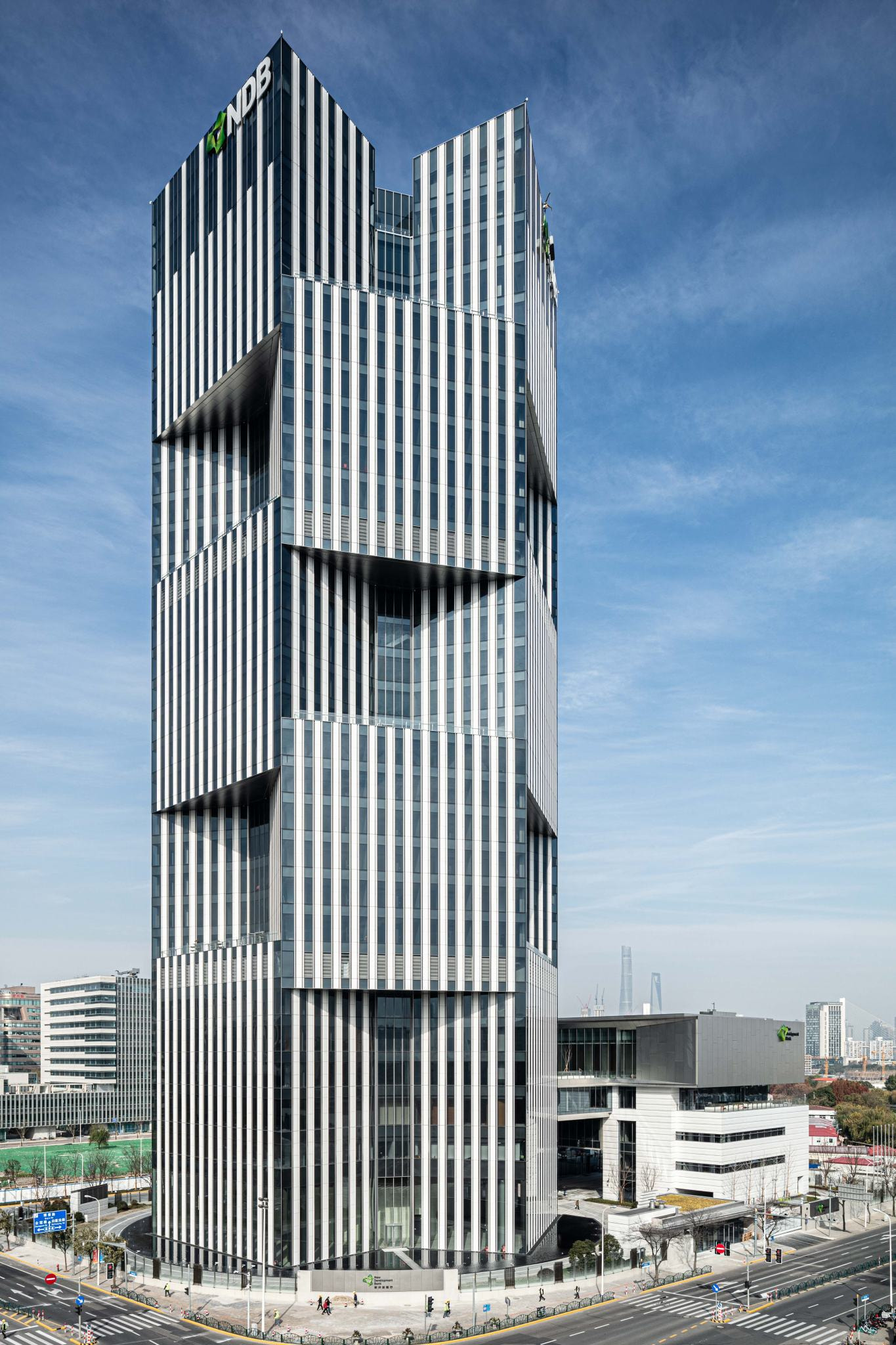
[[File:New Development Bank HQ Shanghai.jpg|thumb|BRICS Tower headquarters in Shanghai]] | |||
Over the weekend of 13 July 2014, when the final game of the [[FIFA World Cup]] was held, and in advance of the BRICS [[Fortaleza]] summit, Putin met fellow leader [[Dilma Rousseff]] to discuss the BRICS development bank, and sign some other bilateral accords on air defense, gas and education. Rousseff said that the BRICS countries "are among the largest in the world and cannot content themselves in the middle of the 21st century with any kind of dependency."<ref> | |||
{{Cite web |url=https://news.yahoo.com/brazil-russia-discuss-creation-brics-bank-182127176.html |title=yahoo.com: "Brazil, Russia discuss creation of BRICS bank" 14 Jul 2014 |access-date=14 January 2017 |archive-url=https://web.archive.org/web/20151207225030/http://news.yahoo.com/brazil-russia-discuss-creation-brics-bank-182127176.html |archive-date=7 December 2015 |url-status=live }} | |||
</ref> The Fortaleza summit was followed by a BRICS meeting with the [[Union of South American Nations]] presidents in [[Brasilia]], where the development bank and the monetary fund were introduced.<ref name=yn11j> | |||
[https://news.yahoo.com/brics-launch-bank-tighten-latin-america-ties-034909760.html "BRICS to launch bank, tighten Latin America ties"] {{Webarchive|url=https://web.archive.org/web/20150712193150/http://news.yahoo.com/brics-launch-bank-tighten-latin-america-ties-034909760.html |date=12 July 2015 }} . Yahoo.com. 11 July 2014. Retrieved 13 February 2015. | |||
</ref> The development bank will have capital of US$50 billion with each country contributing US$10 billion, while the monetary fund will have US$100 billion at its disposal.<ref name=yn11j/> | |||
On 15 July, the first day of the BRICS sixth summit in [[Fortaleza]], Brazil, the group of emerging economies signed the long-anticipated document to create the US$100 billion [[New Development Bank]] (formerly known as the "BRICS Development Bank") and a reserve currency pool worth over another US$100 billion. Documents on cooperation between BRICS export credit agencies and an agreement of cooperation on innovation were also inked.<ref>[https://www.coursehero.com/file/96729068/BRICS-by-sourav-das-05042020pdf/ BRICS in Fortaleza, Brazil]</ref> | |||
At the end of October 2014, Brazil trimmed down its holdings of US government securities to US$261.7 billion; India, US$77.5 billion; China, US$1.25 trillion; South Africa, US$10.3 billion.<ref> | |||
[http://economictimes.indiatimes.com/news/economy/foreign-trade/india-cuts-exposure-to-us-government-securities-at-77-5-billion-in-october/articleshow/45592315.cms "India cuts exposure to US government securities at $77.5 billion in October."] {{Webarchive|url=https://web.archive.org/web/20170910063217/http://economictimes.indiatimes.com/news/economy/foreign-trade/india-cuts-exposure-to-us-government-securities-at-77-5-billion-in-october/articleshow/45592315.cms|date=10 September 2017}} ''[[The Times of India]]''. 21 December 2014. Retrieved 21 December 2014. Alternative link: [http://economictimes.indiatimes.com/articleshow/45592315.cms] {{Webarchive|url=https://web.archive.org/web/20170910063215/http://economictimes.indiatimes.com/articleshow/45592315.cms|date=10 September 2017}} | |||
</ref> | |||
In March 2015, [[Morgan Stanley]] stated that India and Indonesia had escaped from the 'fragile five' (the five major emerging markets with the most fragile currencies) by instituting economic reforms. Previously, in August 2013, Morgan Stanley rated India and Indonesia, together with Brazil, Turkey, and South Africa, as the 'fragile five' due to their vulnerable currencies. But since then, India and Indonesia have reformed their economies, completing 85% and 65% of the necessary adjustments respectively, while Brazil had only achieved 15%, Turkey only 10%, and South Africa even less.<ref> | |||
{{cite web |url=http://www.iol.co.za/business/international/fragile-five-currencies-may-soon-be-three-1.1833400 |title=Fragile Five currencies may soon be three |author=Simon Kennedy |date=18 March 2015 |access-date=21 March 2015 |archive-url=https://web.archive.org/web/20150402152354/http://www.iol.co.za/business/international/fragile-five-currencies-may-soon-be-three-1.1833400 |archive-date=2 April 2015 |url-status=live }} | |||
</ref>[[File:NDB-HQ-LOGO.jpg|thumb|right|New Development Bank's logo.]] | |||
After the 2015 summit, the respective communications ministers, under a Russian proposal, had a first summit for their ministries in Moscow in October where the host minister, [[Nikolai Nikiforov]], proposed an initiative to further tighten their information technology sectors and challenge the monopoly of the United States in the sector.{{citation needed|date=April 2022}} | |||
Since 2012, the BRICS group of countries have been planning an [[optical fibre]] [[Submarine communication cables|submarine communications]] cable system to carry telecommunications between the BRICS countries, known as the [[BRICS Cable]].<ref name="bloomberg">{{cite web|url=https://www.bloomberg.com/apps/news?pid=newsarchive&sid=aDLKQqIM.ZZ0|title=Brics Cable Unveiled for Direct and Cohesive Communications Services between Brazil, Russia, India, China and South Africa|publisher=[[Bloomberg News]]|date=16 April 2012|access-date=5 March 2017|archive-url=https://web.archive.org/web/20151119201528/http://www.bloomberg.com/apps/news?pid=newsarchive&sid=aDLKQqIM.ZZ0|archive-date=19 November 2015|url-status=live}} | |||
</ref> Part of the motivation for the project was the spying of the [[National Security Agency|U.S. National Security Agency]] on all telecommunications that flowed in and out of United States territory.<ref name="diplomat">{{cite web|url=https://thediplomat.com/2015/04/a-fiber-optic-silk-road/|title=A Fiber-Optic Silk Road|publisher=[[The Diplomat]]|date=2 April 2015|first=Nadège|last=Rolland|access-date=19 November 2015|archive-url=https://web.archive.org/web/20151119180928/https://thediplomat.com/2015/04/a-fiber-optic-silk-road/|archive-date=19 November 2015|url-status=live}}</ref> As of 2023, construction of the proposed cable network has not started. | |||
In August 2019, the communications ministers of the BRICS countries signed a letter of intent to cooperate in the Information and Communication Technology sector. This agreement was signed in the fifth edition of meeting of communication ministers of countries member of the group<ref>{{Cite web | url=https://www.telecompaper.com/news/brics-countries-to-cooperate-in-ict-sector--1304946 |title = BRICS countries to cooperate in ICT sector}}</ref> held in [[Brasília]], Brazil. | |||
[[File:9YAN 5350 (52766002359).jpg|thumb|Meeting of BRICS foreign ministers on 22 September 2022]] | |||
The [[New Development Bank]], located in China, plans on giving out $15 billion to member nation to help their struggling economies. Member countries are hoping for a smooth comeback and a continuation of economic trade pre-COVID-19. The [[12th BRICS summit |2020 BRICS summit]] was held virtually in St. Petersburg, Russia and discussed how to handle the COVID-19 pandemic and how to fix the multilateral system via reforms.<ref>{{Cite web|title=BRICS To Allocate $15 Billion For Rebuilding Economies Hit By COVID-19|url=https://www.ndtv.com/india-news/coronavirus-brics-to-allocate-15-billion-for-rebuilding-economies-hit-by-covid-19-2220046|access-date=20 October 2020|website=NDTV.com}}</ref> The COVID-19 vaccine uptake rate was mixed among the BRICS community, with the populations of China, India, and South Africa most willing to take the vaccine and the populations of Brazil and Russia less willing.<ref>{{Cite web|date=20 October 2020|title=What do people in BRICS countries think about a COVID-19 vaccine?|url=https://www.devex.com/news/sponsored/what-do-people-in-brics-countries-think-about-a-covid-19-vaccine-98356|access-date=25 October 2020|website=Devex}}</ref> During the [[13th BRICS summit]], in 2021, Indian Prime Minister [[Narendra Modi]] called for a transparent investigation into the [[origins of COVID-19]] under the [[World Health Organization]] with the full cooperation of "all countries", and Chinese leader Xi Jinping spoke directly afterwards, calling on BRICS countries to "oppose politicisation" of the process.<ref>{{Cite news|url=https://www.thehindu.com/news/national/india-china-avoided-open-clash-over-origins-of-covid-19-virus/article36479981.ece|title=India, China avoided open clash over COVID-19 origins|newspaper=The Hindu|date=15 September 2021|last1=Haidar|first1=Suhasini|last2=Krishnan|first2=Ananth}}</ref> | |||
Since 2011, the National Institutes of Statistics of the BRICS group of countries ([[IBGE]], [[Rosstat]], the [[National Bureau of Statistics of China]], the [[Central Statistics Office (India)]] and [[Statistics South Africa]]) produce an annual joint statistical publication in order to put statistical production in perspective, compare adopted methodologies and statistical results. The publication serves as single data platform for the mutual benefit of participating countries. | |||
In May 2023, South Africa announced that they would be giving [[diplomatic immunity]] to Vladimir Putin and other Russian officials so that they could attend the 15th BRICS Summit despite the [[ICC arrest warrants for Vladimir Putin and Maria Lvova-Belova|ICC arrest warrant for Putin]].<ref>{{Cite web |date=2023-05-30 |title=South Africa moves to let Putin attend BRICS summit despite ICC arrest warrant over Ukraine war |url=https://www.cbsnews.com/news/south-africa-vladimir-putin-icc-arrest-warrant-ukraine-war-brics-immunity/ |website=www.cbsnews.com |language=en-US}}</ref><ref>{{cite news |title=South Africa's diplomatic dilemma with Putin |url=https://www.dw.com/en/south-africas-diplomatic-dilemma-with-putin/a-65804176 |work=Deutsche Welle |date=2 June 2023}}</ref> | |||
In July 2023, the Russian president announced that he will not personally attend the BRICS summit in Johannesburg on August 22-24 despite good relations with the South African nation. Russian news channels noted that Putin will remotely participate online in all BRICS leaders’ sessions, including its Business Forum, and also deliver his remarks virtually.<ref> Bartlett K. (July 19, 2023). [https://www.npr.org/2023/07/19/1188568761/russia-putin-south-africa-brics-summit "Putin won't attend a South Africa summit next month, avoiding possible arrest"] ''NPR.org.'' Accessed 21 July 2023.</ref> | |||
[[ | === 2024 expansion === | ||
In August 2023, at the [[15th BRICS summit|15th BRICS Summit]], South African President [[Cyril Ramaphosa]] announced that 6 emerging market group countries of [[Argentina]], [[Egypt]], [[Ethiopia]], [[Iran]], [[Saudi Arabia]], and the [[United Arab Emirates]] have been invited to join the bloc.<ref name=":1" /> Full membership will take effect on January 1, 2024.<ref name=":2" /> | |||
{| | ==Summits== | ||
| | The grouping has held annual summits since 2009, with member countries taking turns to host. Prior to South Africa's admission, two BRIC summits were held, in 2009 and 2010. The first five-member BRICS summit was held in 2011. The most recent BRICS leaders' summit took place virtually on 23 June 2022 hosted by China.<ref>{{Cite news |title=14th BRICS summit to be held in China: Check date, place and other details |work=The Economic Times |url=https://economictimes.indiatimes.com/news/india/14th-brics-summit-to-be-held-in-china-check-date-place-and-other-details/articleshow/92271827.cms |access-date=2022-07-17}}</ref><ref>{{Cite news |date=2022-06-17 |title=China's Xi to host virtual BRICS leaders summit on June 23 - Xinhua |language=en |work=Reuters |url=https://www.reuters.com/world/china/chinas-xi-host-virtual-brics-leaders-summit-june-23-xinhua-2022-06-17/ |access-date=2022-07-17}}</ref> India has hosted the BRICS 2021 summit at New Delhi & amid tensions with China, [[Paramount leader|Chinese leader]] [[Xi Jinping]] had made a soft move by supporting India's Chairmanship in 2021.<ref name="BRICS Brazil">{{cite web |title=BRICS BRASIL 2019 – Theme and priorities |url=http://brics2019.itamaraty.gov.br/en/2019-brazilian-presidency/theme-and-priorities |website=brics2019.itamaraty.gov.br}}</ref> | ||
{| class="wikitable" | |||
| | |||
|- | |- | ||
! Sr. No. !! Date(s) !! Host country !! Host leader !! Location !! Notes | |||
|- | |- | ||
| | | [[1st BRIC summit|1st]] || 16 June 2009 || {{flag|Russia}} || [[Dmitry Medvedev]] || {{small|[[Yekaterinburg]] (Sevastianov's House)}} ||The summit was to discuss the global recession taking place at the time, future cooperation among states, and trade. Some of the specific topics discussed were food, trade, climate trade, and security for the nations. They called out for a more influential voice and representation for up-and-coming markets. Note at the time South Africa was not yet admitted to the BRICS organization at the time.<ref name="What is BRICS {{!}} Africa Facts">{{Cite web|date=15 October 2018|title=What is BRICS {{!}} Africa Facts|url=https://africa-facts.org/what-is-brics/|access-date=3 November 2020|language=en-US}}</ref> | ||
| | |||
|- | |- | ||
| [[2nd BRIC summit|2nd]] || 15 April 2010 || {{flag|Brazil}} || [[Luiz Inácio Lula da Silva]] || {{small|[[Brasília]] ([[Itamaraty Palace]])}} || {{small|Guests: [[Jacob Zuma]] ([[President of South Africa]]) and [[Riyad al-Maliki]] ([[Foreign Affairs Minister of the Palestinian National Authority|Foreign Minister of the Palestinian National Authority]])}}. The second summit continued on the conversation of the global recession and how to recover. They had a conversation on the IMF, climate change, and more ways to form cooperation among states.<ref name="What is BRICS {{!}} Africa Facts"/> | |||
|- | |- | ||
| [[3rd BRICS summit|3rd]] || 14 April 2011 || {{flag|China}} || [[Hu Jintao]] || {{small|[[Sanya]] (Sheraton Sanya Resort)}} || {{small|First summit to include South Africa alongside the original [[BRIC]] countries.}} The third summit had nations debating on the global and internal economies of countries.<ref name="What is BRICS {{!}} Africa Facts"/> | |||
|- | |- | ||
| [[4th BRICS summit|4th]] || 29 March 2012 || {{flag|India}} || [[Manmohan Singh]] || {{small|[[New Delhi]] (Taj Mahal Hotel)}} || {{small|The [[BRICS Cable]] announced an [[optical fibre]] [[submarine communications cable]] system that carries telecommunications between the BRICS countries.}} The fourth summit discussed how the organization could prosper from the global recession and how they could take advantage of that to help their economies. BRICS had the intention of improving their global power and providing adequate development for their state.<ref name="dx.doi.org">{{Cite book|date=15 March 2011|chapter=How aid for trade could help SVEs integrate in the global economy|chapter-url=http://dx.doi.org/10.14217/9781848591004-6-en|access-date=3 November 2020|website=dx.doi.org|series=Economic Paper|pages=30–37|doi=10.14217/9781848591004-6-en|isbn=9781848591004|title=Effectiveness of Aid for Trade in Small and Vulnerable Economies|publisher=Commonwealth}}</ref> | |||
|- | |- | ||
| [[5th BRICS summit|5th]] || {{nowrap|26–27 March 2013}} || {{nowrap|{{flag|South Africa}}}} || [[Jacob Zuma]] || {{small|[[Durban]] ([[Inkosi Albert Luthuli International Convention Centre|Durban ICC]])}} || The fifth summit discusses the New Development Bank proposition and Contingent Reserve Agreement. BRICS also announced the Business Council and its Think Tank Council.<ref name="dx.doi.org"/> | |||
|- | |- | ||
| | | [[6th BRICS summit|6th]] || 14–17 July 2014 || {{flag|Brazil}} || [[Dilma Rousseff]] || {{small|{{nowrap|[[Fortaleza]] (Centro de Eventos do Ceará)<ref> | ||
{{cite web|url=http://www.postwesternworld.com/2013/07/04/a-cupula-de-durban-e-o-futuro-dos-brics/|title=A Cúpula de Durban e o futuro dos BRICS|publisher=Post-Western World|date=4 July 2013|access-date=7 November 2013|archive-url=https://web.archive.org/web/20130907140905/http://www.postwesternworld.com/2013/07/04/a-cupula-de-durban-e-o-futuro-dos-brics/|archive-date=7 September 2013|url-status=live}} | |||
</ref>}}}} || {{small|BRICS [[New Development Bank]] and [[BRICS Contingent Reserve Arrangement]] agreements signed.}}<br />{{small|Guest: Leaders of [[Union of South American Nations]] (UNASUR)}}<ref name=UNASUR>{{cite web|title=Los líderes del BRICS, Unasur, Cuba, México y Costa Rica se citan en Brasilia|url=http://www.lavanguardia.com/economia/20140715/54411930114/los-lideres-del-brics-unasur-cuba-mexico-y-costa-rica-se-citan-en-brasilia.html|website=LaVanguardia.com|date=15 July 2014|publisher=LaVanguardia|access-date=15 July 2014}}</ref><ref name=invitation2> | |||
{{cite web|title=BRICS summit: PM Modi to leave for Brazil tomorrow, will seek reforms|url=http://www.hindustantimes.com/india-news/pm-narendra-modi-to-leave-for-brazil-tomorrow-for-brics-summit/article1-1239519.aspx|publisher=Hindustan Times|access-date=12 July 2014|date=12 July 2014|archive-url=https://web.archive.org/web/20140713100114/http://www.hindustantimes.com/india-news/pm-narendra-modi-to-leave-for-brazil-tomorrow-for-brics-summit/article1-1239519.aspx|archive-date=13 July 2014|url-status=dead}} | |||
</ref> The members of BRICS conversed with each other about political coordination, development, and economic growth. They established the Fortaleza Declaration and Action Plan.<ref name="africa-facts.org">{{Cite web|date=15 October 2018|title=What is BRICS {{!}} Africa Facts|url=https://africa-facts.org/what-is-brics/|access-date=4 November 2020|language=en-US}}</ref> | |||
|- | |- | ||
| [[7th BRICS summit|7th]] || 8–9 July 2015 || {{flag|Russia}} || [[Vladimir Putin]] || {{small|[[Ufa]] (Congress Hall)<ref>{{cite web|url=http://ufacity.info/eng/press/news/117306.html|title=Ufa to host SCO and BRICS summits in 2015|publisher=UfaCity.info|access-date=7 November 2013|archive-url=https://web.archive.org/web/20140325165310/http://ufacity.info/eng/press/news/117306.html|archive-date=25 March 2014|url-status=dead}}</ref>}} || {{small|Joint summit with [[Shanghai Cooperation Organisation|SCO]]-[[Eurasian Economic Union|EAEU]]}}. The seventh summit discussed global, economic problems, and better ways to foster cooperation among member states.<ref name="africa-facts.org"/> | |||
|- | |- | ||
| [[8th BRICS summit|8th]] || 15–16 October 2016 || {{flag|India}} || [[Narendra Modi]] || {{small|[[Benaulim]] (Taj Exotica)}} || {{small|Joint summit with [[BIMSTEC]]}}. The eighth BRICS summit debated on topics like counter-terrorism, economies, and climate change. BRICS also issued the Goa Declaration and Action Plan, hoping to harden their relationships.<ref name="ReferenceA">{{Cite web|date=15 October 2018|title=What is BRICS {{!}} Africa Facts|url=https://africa-facts.org/what-is-brics/|access-date=5 November 2020|language=en-US}}</ref> | |||
|- | |- | ||
| [[9th BRICS summit|9th]] || 3–5 September 2017 || {{flag|China}} || [[Xi Jinping]] || {{small|[[Xiamen]] (Xiamen International Conference Center)}} || {{small|Joint summit with EMDCD}}. The ninth summit was an event that talked about a bright future for BRICS and what their goals intend to be. They still covered and debated international and regional issues with one another; hopeful to keep moving forward.<ref name="ReferenceA"/> | |||
|- | |- | ||
| [[10th BRICS summit|10th]] || 25–27 July 2018 || {{flag|South Africa}} || [[Cyril Ramaphosa]] || {{small|[[Johannesburg]] (Sandton Convention Centre)}} ||The tenth summit had the members discuss their rising industries. Hoping they can cut a bigger slice of the industry market. | |||
|- | |- | ||
| [[11th BRICS summit|11th]] || 13–14 November 2019 || {{flag|Brazil}} || [[Jair Bolsonaro]] || {{small|[[Brasília]] (Itamaraty Palace)}}<ref name="BRICS Brazil"/> ||The eleventh summit discussed advancements in the BRICS's science and innovation fields. Primarily trying to advance technology and digital currency. They made mutual agreements to help stop drug trafficking and organized crime; both internationally and internally | |||
|- | |- | ||
| | | [[12th BRICS summit|12th]] || 21–23 July 2020 (postponed due to [[COVID-19 pandemic]])<ref>{{Cite web|url=https://eng.brics-russia2020.ru/news/20200527/395729/BRICS-and-the-SCO-summits-postponed.html|title=BRICS and the SCO summits postponed | Official website of the Russian BRICS Chairmanship in 2020|website=eng.brics-russia2020.ru|date=27 May 2020 }}</ref><br /> 17 November 2020 (video conference)<ref>{{cite news |title=BRICS Summit to be held virtually on Nov 17; strengthening cooperation, global stability on agenda |url=https://www.hindustantimes.com/india-news/brics-summit-to-be-held-virtually-on-nov-17-cooperation-strengthening-global-stability-on-agenda/story-Io02j2Xpb81KAx03C13O1M.html |access-date=5 October 2020 |work=Hindustan Times |date=5 October 2020 |language=en}}</ref>|| {{flag|Russia}} || [[Vladimir Putin]] || {{small|[[Saint Petersburg]]}}<ref>{{Cite web |url=https://www.rbc.ru/rbcfreenews/5d3209879a7947184d6b66f9 |title=Путин заявил о переносе саммитов БРИКС и ШОС из Челябинска |date=19 July 2019 |access-date=19 July 2019}}</ref> || {{small|Joint summit with SCO}}. Discussing a mutual agreement on helping BRICS member countries to help foster better living standards and quality of life for each country's people. Plans on focusing on peace, economies, and cultural societal issues.<ref>{{Cite news|last=Chaudhury|first=Dipanjan Roy|title=BRICS Summit to be held virtually on November 17|work=The Economic Times|url=https://economictimes.indiatimes.com/news/politics-and-nation/brics-summit-to-be-held-virtually-on-november-17/articleshow/78495022.cms|access-date=20 October 2020}}</ref> | ||
|- | |- | ||
| [[13th BRICS summit|13th]] || 9 September 2021 (video conference) || {{flag|India}} || [[Narendra Modi]] || {{small|[[New Delhi]]}} || {{small|BRICS Games 2021}}<ref>{{cite news |title=India plans to host BRICS Games during Khelo India Games in 2021 – Sports News, Firstpost |url=https://www.firstpost.com/sports/india-plans-to-host-brics-games-during-khelo-india-games-in-2021-8755221.html |work=Firstpost |date=26 August 2020}}</ref> | |||
|- | |- | ||
| [[14th BRICS summit|14th]] || 23 June 2022 (video conference) || {{flag|China}} || [[Xi Jinping]] || {{small|[[Beijing]]}} ||A major development on the summit was creation of a new, basket type reserve currency. The currency, which is challenging US dollar, combines BRICS currencies and is backed by precious metals. | |||
|- | |- | ||
| [[15th BRICS summit|15th]] || 22-24 August 2023 || {{flag|South Africa}} || [[Cyril Ramaphosa]] || {{small|[[Johannesburg]] (Sandton Convention Centre)}}|| | |||
| | |||
| | |||
|} | |} | ||
==BRICS countries== | |||
{| class="wikitable sortable" style="text-align:center;font-size:90%;" | |||
{| class="wikitable sortable" | !rowspan=2| Country | ||
!rowspan=2| Population<br>(millions)<br>(2023){{UN_Population|ref}} | |||
! | !colspan=2|Total GDP | ||
| | !colspan=2|GDP per capita | ||
| | ! rowspan=2|[[List of countries by real GDP growth rate|GDP growth]]<br />(2023 est.)<ref> | ||
| | {{cite web |url=https://www.imf.org/external/pubs/ft/weo/2019/01/weodata/index.aspx |title=IMF World Economic Outlook (WEO) Update, April 2019 |publisher=Imf.org |access-date= 27 May 2019 }} | ||
| | </ref> | ||
| | !rowspan=2|[[List of countries by foreign-exchange reserves|Foreign<br>Exchange<br>Reserves<br>(2023)]]<ref> | ||
[http://www.investopedia.com/articles/investing/033115/10-countries-biggest-forex-reserves.asp 10 countries with the biggest Forex reserves] {{Webarchive|url=https://web.archive.org/web/20161018204501/http://www.investopedia.com/articles/investing/033115/10-countries-biggest-forex-reserves.asp |date=18 October 2016 }} . [[Investopedia]]. | |||
</ref> | |||
! rowspan=2|[[List of largest consumer markets|{{abbr|HFCE|Household final consumption expenditure}}]]<br>(2018) | |||
! rowspan=2|[[List of government budgets by country|Government<br>spending]] | |||
! rowspan=2|[[List of countries by exports|Exports]]<ref> | |||
{{cite web |url=https://www.cia.gov/library/publications/the-world-factbook/rankorder/2078rank.html |title=The World Factbook — Central Intelligence Agency |publisher=Cia.gov |access-date=4 September 2017 |archive-url=https://web.archive.org/web/20081004073036/https://www.cia.gov/library/publications/the-world-factbook//rankorder/2078rank.html |archive-date=4 October 2008 |url-status=dead }} | |||
</ref> | |||
| | ! rowspan=2|[[List of countries by imports|Imports]]<ref> | ||
{{cite web |url=https://www.cia.gov/library/Publications/the-world-factbook/rankorder/2087rank.html |title=The World Factbook — Central Intelligence Agency |publisher=Cia.gov |access-date=4 September 2017 |archive-url=https://web.archive.org/web/20081004070323/https://www.cia.gov/library/publications/the-world-factbook//rankorder/2087rank.html |archive-date=4 October 2008 |url-status=dead }} | |||
</ref> | |||
| | ! rowspan=2|[[List of countries by literacy rate|Literacy<br>rate]]<ref> | ||
{{cite web|url=https://www.cia.gov/library/publications/the-world-factbook/fields/2103.html|title=Field Listing :: Literacy|website=[[The World Factbook]]|publisher=[[Central Intelligence Agency]]|access-date=6 March 2016|archive-url=https://web.archive.org/web/20161124171442/https://www.cia.gov/library/publications/the-world-factbook/fields/2103.html|archive-date=24 November 2016|url-status=dead}} | |||
</ref> | |||
! rowspan=2|[[List of countries by life expectancy|Life<br>expectancy]]<br>(years, avg.)<ref> | |||
{{cite web |url=http://apps.who.int/iris/bitstream/handle/10665/272596/9789241565585-eng.pdf |title=World Health Statistics 2018 |publisher=Who.int |date=6 June 2018 |access-date=3 January 2019 |archive-url=https://web.archive.org/web/20181206172337/http://apps.who.int/iris/bitstream/handle/10665/272596/9789241565585-eng.pdf |archive-date=6 December 2018 |url-status=live }} | |||
</ref> | |||
!rowspan=2|[[List of countries by Human Development Index|HDI]] (2023)<ref>{{cite web |url= http://hdr.undp.org/sites/default/files/hdr2020.pdf |title= Human Development Report 2020|year=2020|access-date=5 November 2022 |publisher=United Nations Development Programme }}</ref> | |||
| | |||
|- | |||
| | |||
| | |||
| | |||
|- | |||
|- | |||
|- | |||
|- | |- | ||
| | ! [[List of countries by GDP (nominal)|Nominal]]<br>(bil. USD)<br>(2022 est.)<ref name="autogenerated2"> | ||
|- | {{cite web |url=https://www.imf.org/external/pubs/ft/weo/2017/01/weodata/weorept.aspx?sy=2017&ey=2017&scsm=1&ssd=1&sort=country&ds=.&br=1&c=223%2C924%2C922%2C199%2C534&s=NGDPD%2CNGDPDPC%2CPPPGDP%2CPPPPC%2CLP&grp=0&a=&pr.x=46&pr.y=11 |title=Report for Selected Countries and Subjects |publisher=Imf.org |date=14 September 2006 |access-date=4 September 2017 |archive-url=https://web.archive.org/web/20170427003615/https://www.imf.org/external/pubs/ft/weo/2017/01/weodata/weorept.aspx?sy=2017&ey=2017&scsm=1&ssd=1&sort=country&ds=.&br=1&c=223%2C924%2C922%2C199%2C534&s=NGDPD%2CNGDPDPC%2CPPPGDP%2CPPPPC%2CLP&grp=0&a=&pr.x=46&pr.y=11 |archive-date=27 April 2017 |url-status=live }} | ||
| | </ref> | ||
! [[List of countries by GDP (PPP)|PPP]]<br>bln. ID<br>{{clarify|date=August 2023}}<br>(2023 est.)<ref name="autogenerated2"/> | |||
! [[List of countries by GDP (nominal) per capita|Nominal]]<br>USD<br>(2023 est.)<ref name="autogenerated2"/> | |||
! [[List of countries by GDP (PPP) per capita|PPP]]<br>ID<br>(2022 est.)<ref name="autogenerated2"/> | |||
|- style="white-space:nowrap;" | |||
| style="text-align:left;" | '''{{flag|Brazil}}''' || {{increase}} {{val|207.57}}||1,924||4,020||9,673||18,686||{{increase}}1.6%|| {{val|355.6|p=$}} bn || {{val|1194670|p=$}} bln ||$846.6 bn||$487.05 bn||$158.93 bn||94.30%||77.21 yrs||0.754 (high) | |||
|- style="white-space:nowrap;" | |||
| style="text-align:left;" | '''{{flag|Russia}}''' || {{increase}} {{val|150.96}} ||2,215||4,649||14,403||31,967||{{increase}}0.7%|| {{val|600.9|p=$}} bn || {{val|856329|p=$}} bln ||$414.0 bn||$492.31 bn ||$231.55 bn||99.7%||72.9 yrs||0.822 (very high) | |||
|- style="white-space:nowrap;" | |||
| style="text-align:left;" | '''{{flag|India}}''' || {{increase}} {{val|1425.09}}||3,386||11,665||2,601||8,293||{{increase}}5.9%|| {{val|633.9|p=$}} bn || {{val|1729560|p=$}} bln ||$650.0 bn ||$750.89 bn||$598.20 bn||79.1%||71.4 yrs||0.633 (medium) | |||
|- style="white-space:nowrap;" | |||
| style="text-align:left;" | '''{{flag|China}}''' || {{increase}} {{val|1415.04}} ||18,100||30,074||13,721||21,291||{{increase}}5.2%|| {{val|3480.2|p=$}} bn || {{val|5352545|p=$}} bln ||$2,031.0 bn||$3,026.0 bn||$2,055.0 bn||96.4%||77.4 yrs||0.768 (high) | |||
|- style="white-space:nowrap;" | |||
| style="text-align:left;" | '''{{nowrap|{{flag|South Africa}}}}''' || {{increase}} {{val|57.40}} ||435.5||990||6,485||15,556||{{increase}}0.1%|| {{val|53.8|p=$}} bn || {{val|211693|p=$}} bln ||$95.27 bn ||$123.73 bn||$68.97 bn||94.3%||64.8 yrs||0.713 (high) | |||
|- style="white-space:nowrap;" | |||
| style="text-align:left;white-space:nowrap;" | '''Average''' || {{increase}} {{val|627.06}} ||3,753.7||8,119.9||8,941||19,041||{{increase}}3.5%|| {{val|987.0|p=$}} bn || {{val|1868956|p=$}} bln ||$800.574 bn ||$970.19 bn ||$711.86 bn ||93%||73.4 yrs||0.739 (high) | |||
|- style="white-space:nowrap;" | |||
| style="text-align:left;white-space:nowrap;" | '''Total''' || {{increase}} {{val|3,245.36}} ||26,060||51,171||–||–||–|| {{val|5,124.4|p=$}} bn || {{val|9,344,797|p=$}} bln ||$4,036.87 bn ||$4,879.98 bn ||$3,112.65 bn ||–||–||– | |||
|} | |} | ||
[[Bangladesh]], [[Egypt]], the [[United Arab Emirates]] and [[Uruguay]] are members of BRICS [[New Development Bank]]. | |||
== | ===Proposals=== | ||
Discussions about the expansion and entry of new member countries were little addressed until the early 2020s, after this date, leaders and top ranking diplomats of the founding nations began discussions for the expansion of the group.<ref name="Silk Road Briefing">{{cite news|url=https://www.silkroadbriefing.com/news/2022/11/09/the-new-candidate-countries-for-brics-expansion/|first=Chris|last=Devonshire-Ellis|title=The New Candidate Countries For BRICS Expansion|work=Silk Road Briefing|date=9 November 2022}}</ref><ref name="BRICS Expansion Dialogue">{{cite news|url=https://www.fmprc.gov.cn/mfa_eng/topics_665678/kjgzbdfyyq/202205/t20220520_10690435.html|title=Wang Yi Chairs Dialogue of Foreign Ministers between BRICS and Emerging Markets and Developing Countries|work=Ministry of Foreign Affairs, the People's Republic of China|date=20 May 2022}}</ref><ref name="Anadolu Agency">{{cite news|url=https://www.aa.com.tr/en/russia-ukraine-war/at-least-a-dozen-countries-interested-in-joining-brics-russian-foreign-minister/2732749|title=At least a dozen countries interested in joining BRICS: Russian foreign minister|last=Teslova|first=Elena|work=Anadolu Agency|date=8 November 2022}}</ref> | |||
In 2023 Iranians applied for membership but Indian prime minister denied Iranian government because it's target of international sanctions.<ref>https://www.reuters.com/world/brics-leaders-weigh-expansion-criteria-with-blocs-future-balance-2023-08-23/</ref> | |||
==Financial architecture== | |||
[[File:Shanghai skyline waterfront pudong 5166168 69 70.jpg|right|thumb|The New Development Bank (NDB) is based in Shanghai.]] | |||
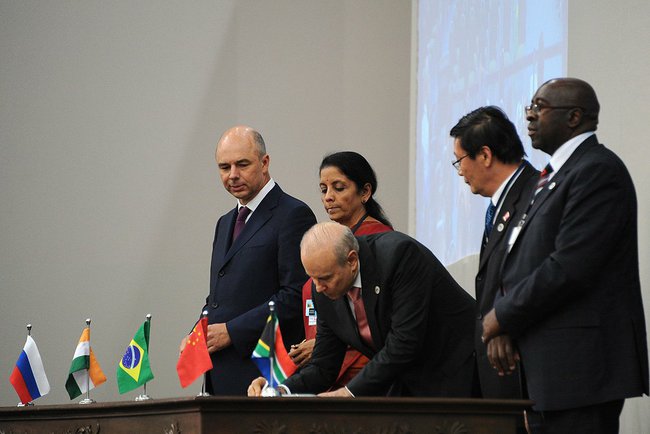
[[File:Signing of documents at 6th BRICS Summit.jpeg|right|thumb|The New Development Bank (NDB) and Contingent Reserve Arrangement (CRA) were signed into treaty at the 2014 BRICS summit in [[Brazil]].]] | |||
[[File:NDB-Chart-BRICS.png|thumb|right|Equal distribution of shares between the shareholders of the NDB.]] | |||
Currently, there are two components that make up the financial architecture of BRICS, namely, the New Development Bank (NDB), or sometimes referred to as the BRICS Development Bank, and the Contingent Reserve Arrangement (CRA). Both of these components were signed into treaty in 2014 and became active in 2015. | |||
===New Development Bank=== | |||
{{Further|New Development Bank}} | |||
The '''New Development Bank (NDB)''', formally referred to as the '''BRICS Development Bank''',<ref name="headq"> | |||
[http://indiasnaps.com/brics-bank-to-be-headquartered-in-shanghai-india-to-hold-presidency/ "BRICS Bank to be headquartered in Shanghai, India to hold presidency"] {{Webarchive|url=https://web.archive.org/web/20140812062235/http://indiasnaps.com/brics-bank-to-be-headquartered-in-shanghai-india-to-hold-presidency/ |date=12 August 2014 }} . Indiasnaps.com. 16 July 2014 | |||
</ref> is a [[multilateral development bank]] operated by the five BRICS [[Sovereign state|states]]. The bank's primary focus of lending will be infrastructure projects<ref name="allabout"> | |||
{{cite news|url=https://www.washingtonpost.com/blogs/monkey-cage/wp/2014/07/17/what-the-new-bank-of-brics-is-all-about/|title=What the new bank of BRICS is all about|date=17 July 2014|newspaper=The Washington Post|access-date=20 July 2014|archive-url=https://web.archive.org/web/20140717190437/http://www.washingtonpost.com/blogs/monkey-cage/wp/2014/07/17/what-the-new-bank-of-brics-is-all-about/|archive-date=17 July 2014|url-status=live}} | |||
</ref><ref name="hpos"> | |||
{{cite news|url=https://www.huffingtonpost.com/parag-khanna/new-brics-bank_b_5600027.html|title=New BRICS Bank a Building Block of Alternative World Order|date=18 July 2014|work=The Huffington Post|access-date=20 July 2014|archive-url=https://web.archive.org/web/20140719184109/http://www.huffingtonpost.com/parag-khanna/new-brics-bank_b_5600027.html|archive-date=19 July 2014|url-status=live}} | |||
</ref> with authorized lending of up to $34 billion annually.<ref name="hpos"/> South Africa will be the African Headquarters of the Bank named the "New Development Bank Africa Regional Centre."<ref name="bill">{{cite news |url = http://in.rbth.com/world/2014/07/16/brics_countries_launch_100_billion_developmental_bank_currency_pool_36733.html |title =BRICS countries launch $100 billion developmental bank, currency pool |date= 16 July 2014 |publisher = Russia & India Report |access-date =20 July 2014}}</ref> The bank will have starting capital of $50 billion, with wealth increased to $100 billion over time.<ref name="ready">{{cite news |url = http://in.rbth.com/economics/2014/07/10/brics_bank_ready_for_launch_-_russian_finance_minister_36599.html |title=BRICS Bank ready for launch – Russian Finance Minister |date= 10 July 2014|publisher= Russia & India Report |access-date=20 July 2014}}</ref> Brazil, Russia, India, China, and South Africa will initially contribute $10 billion each to bring the total to $50 billion.<ref name="bill" /><ref name="ready" /> It has so far 53 projects under way worth around $15 billion.<ref>{{Cite web|title=History|url=https://www.ndb.int/about-us/essence/history/|access-date=9 November 2020|website=New Development Bank|language=en-US}}</ref> | |||
Recently [[Bangladesh]], [[Egypt]], the [[United Arab Emirates]] and [[Uruguay]] were added as new members of BRICS New Development Bank (NDB).<ref>{{Cite news|url=https://www.reuters.com/world/middle-east/brics-development-bank-admits-uae-bangladesh-uruguay-new-members-2021-09-02/|title=BRICS development bank admits UAE, Bangladesh, Uruguay as new members|newspaper=Reuters |date=2 September 2021|via=www.reuters.com}}</ref> | |||
=== | ===BRICS CRA=== | ||
{{Further|BRICS Contingent Reserve Arrangement}} | |||
=== | The '''BRICS Contingent Reserve Arrangement''' ('''CRA''') is a framework for providing protection against global liquidity pressures.<ref name="allabout"/><ref name="ready"/><ref name="rics">{{cite news|url=http://in.rbth.com/world/2014/07/17/brics_currency_fund_to_protect_members_from_volatility_-_russias_top_ba_36767.html|title=BRICS currency fund to protect members from volatility – Russia's top banker|date= 17 July 2014|publisher= Russia & India Report|access-date=20 July 2014}}</ref> This includes currency issues where members' national currencies are being adversely affected by global financial pressures.<ref name="allabout"/><ref name="rics"/> It is found that emerging economies that experienced rapid economic liberalization went through increased economic volatility, bringing an uncertain macroeconomic environment.<ref>{{Cite journal | doi=10.1080/10220461.2015.1069208|title = The rationale for and potential role of the BRICS Contingent Reserve Arrangement| journal=South African Journal of International Affairs| volume=22| issue=3| pages=307–324|year = 2015|last1 = Biziwick|first1 = Mayamiko| last2=Cattaneo| first2=Nicolette| last3=Fryer| first3=David|s2cid = 153695521}}</ref> The CRA is generally seen as a competitor to the [[International Monetary Fund]] (IMF) and along with the [[New Development Bank]] is viewed as an example of increasing South-South cooperation.<ref name="allabout"/> It was established in 2015 by the BRICS countries. The legal basis is formed by the ''Treaty for the Establishment of a BRICS Contingent Reserve Arrangement'', signed at Fortaleza, Brazil on 15 July 2014. With its inaugural meetings of the BRICS CRA Governing Council and Standing Committee, held on 4 September 2015, in Ankara, Turkey<ref> | ||
[http://www.cbr.ru/eng/press/pr.aspx?file=04092015_185039eng2015-09-04T18_46_05.htm On the BRICS Contingent Reserve Arrangement (CRA) Governing Council and Standing Committee inaugural meetings] {{Webarchive|url=https://web.archive.org/web/20161002172250/http://www.cbr.ru/eng/press/pr.aspx?file=04092015_185039eng2015-09-04T18_46_05.htm |date=2 October 2016 }} 4 September 2015. Retrieved 22 September 2016 | |||
</ref> it entered into force upon ratification by all BRICS states, announced at the [[7th BRICS summit]] in July 2015. | |||
===BRICS payment system=== | |||
=== | At the [[7th BRICS summit|2015 BRICS summit]] in the [[Russian Federation]], ministers from BRICS nations initiated consultations for a payment system that would be an alternative to the [[Society for Worldwide Interbank Financial Telecommunication|Society for Worldwide Interbank Financial Telecommunication (SWIFT)]] system. Russian Deputy Foreign Minister Sergey Ryabkov stated in an interview, "The finance ministers and executives of the BRICS [[central bank]]s are negotiating ... setting up payment systems and moving on to settlements in national currencies. SWIFT or not, in any case we’re talking about ... a global multilateral payment system that would provide greater independence, would create a definite guarantee for BRICS."<ref>{{Cite web|url=https://haryana.pscnotes.com/international/dmpq-brics-payment-system/|title=DMPQ- BRICS payment system|date=27 May 2019}}</ref> | ||
The [[Central Bank of Russia]] (CBR) also started consultations with BRICS nations for a payment system that would be an alternative to the SWIFT system. The main benefits highlighted were [[backup]] and redundancy in case there were disruptions to the SWIFT system. The Deputy Governor of the Central Bank of Russia, Olga Skorobogatova, stated in an interview, "The only topic that may be of interest to all of us within BRICS is to consider and talk over the possibility of setting up a system that would apply to the BRICS countries, used as a backup."<ref>{{cite news |url=http://in.rbth.com/economics/2015/06/01/russia_offers_to_discuss_brics_prototype_of_swift_global_system_43421 |title=Russia offers to discuss BRICS prototype of SWIFT global system |work=Russia & India Report |date=1 June 2015 |access-date=26 March 2016}}</ref> | |||
China has also launched the development of their own SWIFT-alternative payment-system, the [[Cross-Border Inter-Bank Payments System|Cross-Border Inter-Bank Payments System (CIPS)]], which would enable [[financial institution]]s worldwide to send and receive information about financial transactions in a secure, standardized, and reliable environment.<ref name="Reuters1"> | |||
{{cite news |url=https://www.reuters.com/article/us-china-yuan-payments-exclusive-idUSKBN0M50BV20150309?irpc=932 |title=Exclusive: China's international payments system ready, could launch by end-2015 – sources |newspaper=Reuters |date=9 March 2015 |access-date=10 March 2015 |archive-url=https://web.archive.org/web/20150924214126/http://www.reuters.com/article/2015/03/09/us-china-yuan-payments-exclusive-idUSKBN0M50BV20150309?irpc=932 |archive-date=24 September 2015 |url-status=live }}</ref> India also has its alternative [[Structured Financial Messaging System|Structured Financial Messaging System (SFMS)]], as do Russia [[SPFS|System for Transfer of Financial Messages (SPFS)]] and Brazil ([[Pix (payment system)|Pix]]). | |||
=== Potential common currency === | |||
BRICS countries will likely discuss the feasibility of a new [[Currency union|common currency]] or similar at the 2023 BRICS summit in South Africa.<ref>{{Cite web |date=2023-05-10 |title=BRICS to discuss common currency plan during the summit, says South African Foreign Minister |url=https://www.cnbctv18.com/market/currency/brics-to-discuss-common-currency-plan-south-african-foreign-minister-china-india-russia-16621991.htm |access-date=2023-05-12 |website=cnbctv18.com |language=en}}</ref> Fair and easier [[international trade]] as well as a major reduction in [[Transaction cost|costs of transactions]] would be some of the reasons why the countries could forge a currency union, according to Mikatekiso Kubayi, a BRICS specialist.<ref>{{Cite web |title=Common Currency on Agenda for South African BRICS Summit |url=https://www.voanews.com/a/common-currency-on-agenda-for-south-african-brics-summit/7090756.html |access-date=2023-05-12 |website=VOA |date=12 May 2023 |language=en}}</ref> Former White House senior advisor Joseph W. Sullivan, writing for American magazine ''[[Foreign Policy]]'', asserted that "a BRICS-issued currency would be different", as it would be comprised by challengers to the Western-led international that "in the order the scale of [[Gross domestic product|GDP]], now collectively outweigh not only the reigning hegemon, the United States, but the entire [[G7|G-7]] weight class put together."<ref>{{Cite web |last=Sullivan |first=Joseph W. |title=A BRICS Currency Could Shake the Dollar's Dominance |url=https://foreignpolicy.com/2023/04/24/brics-currency-end-dollar-dominance-united-states-russia-china/ |access-date=2023-05-12 |website=Foreign Policy |date=24 April 2023 |language=en-US}}</ref> Sullivan maintains that the BRICS would also be poised to achieve a level of [[Self sufficiency|self-sufficiency]] in international trade that has eluded other currency unions, such as the [[Eurozone]], because of the geographic diversity of its members, which enables a broader range of goods and services.<ref>{{Cite web |last=Mott |first=Filip De |title=The dollar's dominance would face a threat unlike any other from a BRICS currency, former White House economist says |url=https://markets.businessinsider.com/news/currencies/de-dollarization-dominance-yuan-china-brics-alternative-currency-sanction-russia-2023-4 |access-date=2023-05-12 |website=Markets Insider |language=en-US}}</ref> | |||
==Reception== | |||
[[File:14 11 2019 Diálogo dos Líderes com o Conselho Empresarial do BRICS e o Novo Banco de Desenvolvimento (49066644892).jpg|thumb|right|The five leaders of BRICS in [[Brasília]], [[Brazil]], in 2019.]] | |||
[[File:14 11 2019 Almoço oferecido aos Líderes do BRICS (49066061897).jpg|thumb|right|Brazilian president [[Jair Bolsonaro]] welcoming the BRICS leaders.]] | |||
In 2012, [[Hu Jintao]], the then [[General Secretary of the Chinese Communist Party]] and [[President of the People's Republic of China|President of China]], described the BRICS countries as defenders and promoters of developing countries and a force for world peace.<ref name="BRICS Peace Defender"> | |||
{{cite web|title=Brics a force for world peace, says China|url=http://www.businessday.co.za/articles/Content.aspx?id=168422|website=[[Business Day (South Africa)|4=Business Day]]|date=8 August 2012|access-date=9 November 2013|archive-url=https://archive.today/20130422020755/http://www.businessday.co.za/articles/Content.aspx?id=168422|archive-date=22 April 2013|url-status=live}} | |||
</ref> Western analysts have highlighted potential divisions and weaknesses in the grouping, including significant economic instabilities,<ref> | |||
{{cite journal|url=http://www.foreignaffairs.com/articles/138219/ruchir-sharma/broken-brics|title=Broken BRICs: Why the Rest Stopped Rising|issue=November/December 2012|journal=[[Foreign Affairs]]|date=November–December 2012|access-date=19 December 2012|archive-url=https://web.archive.org/web/20121220021001/http://www.foreignaffairs.com/articles/138219/ruchir-sharma/broken-brics|archive-date=20 December 2012|url-status=live |last1=Sharma |first1=Ruchir }} | |||
</ref><ref>{{cite web|url=http://mobile.bloomberg.com/news/2013-06-24/china-loses-control-of-its-frankenstein-economy.html |title=China Loses Control of Its Frankenstein Economy |publisher=Bloomberg |date=24 June 2013 |access-date=25 June 2013 |url-status=dead |archive-url=https://web.archive.org/web/20131104194221/http://mobile.bloomberg.com/news/2013-06-24/china-loses-control-of-its-frankenstein-economy.html |archive-date=4 November 2013 }}</ref><ref> | |||
{{cite news|url=http://news.investors.com/investing-international-leaders/062613-661520-brazil-stocks-in-bear-market.htm|title=Brazil Stocks In Bear Market As Economy Struggles|newspaper=Investor's Business Daily|publisher=Investors.com|date=26 June 2013|access-date=29 June 2013|archive-url=https://web.archive.org/web/20131109023642/http://news.investors.com/investing-international-leaders/062613-661520-brazil-stocks-in-bear-market.htm|archive-date=9 November 2013|url-status=live}} | |||
</ref><ref> | |||
{{cite news|url=https://www.economist.com/news/leaders/21582256-emerging-market-slowdown-not-beginning-bust-it-turning-point|title=Emerging economies: The Great Deceleration|newspaper=The Economist|date=27 July 2013|access-date=27 July 2013|archive-url=https://web.archive.org/web/20130726184521/http://www.economist.com/news/leaders/21582256-emerging-market-slowdown-not-beginning-bust-it-turning-point|archive-date=26 July 2013|url-status=live}} | |||
</ref> disagreements among the members over the [[United Nations Security Council|UN Security Council]] reform,<ref> | |||
[https://www.nytimes.com/2012/03/30/world/asia/brics-leaders-fail-to-create-rival-to-world-bank.html?_r=1 "BRICS Leaders Fail to Create Rival to World Bank"] {{Webarchive|url=https://web.archive.org/web/20170904205816/http://www.nytimes.com/2012/03/30/world/asia/brics-leaders-fail-to-create-rival-to-world-bank.html?_r=1 |date=4 September 2017 }} . ''[[The New York Times]]''. 29 March 2012. Retrieved 18 June 2013. | |||
</ref> and India and China's disputes<ref> | |||
{{Cite journal|last=Global|first=IndraStra|title=EXCERPT {{!}} A Test of China–India Cooperative Dynamics within the BRICS Framework|url=http://www.indrastra.com/2017/04/EXCERPT-Test-of-China-India-Cooperative-Dynamics-BRICS-003-04-2017-0005.html|journal=IndraStra|issn=2381-3652|access-date=4 May 2017|archive-url=https://web.archive.org/web/20170424175857/http://www.indrastra.com/2017/04/EXCERPT-Test-of-China-India-Cooperative-Dynamics-BRICS-003-04-2017-0005.html|archive-date=24 April 2017|url-status=live}} | |||
</ref> over territorial issues.<ref name=highwall>{{cite web |url=http://www.atimes.com/atimes/Global_Economy/ND03Dj01.html |title=Brics summit exposes the high wall between India and China |work=Daily Maverick |via=[[Asia Times]] |author=Khadija Patel |date=3 April 2012 |access-date=10 July 2013 |archive-url=https://web.archive.org/web/20120402171026/http://atimes.com/atimes/Global_Economy/ND03Dj01.html |archive-date=2 April 2012 |url-status=unfit}}</ref> | |||
On 9 April 2013, [[Isobel Coleman]] from the [[Council on Foreign Relations]], director of CFR's Civil Society, Markets, and Democracy Program claimed that members of BRICS share a lack of consensus. They uphold drastically different political systems, from a vibrant democracy in Brazil to entrenched [[oligarchy]] in Russia, and their economies are little integrated and are different in size by orders of magnitude. She also claimed that the significant difference in GDP influences the reserves. China taking up over 41% of the contribution, which in turn leads to bigger political say within the association.<ref> | |||
{{cite web|last1=Coleman|first1=Isobel|title=Ten Questions for the New BRICS Bank|url=https://foreignpolicy.com/2013/04/09/ten-questions-for-the-new-brics-bank/|website=Foreign Policy|date=9 April 2013 |access-date=24 September 2016|archive-url=https://web.archive.org/web/20161002050021/http://foreignpolicy.com/2013/04/09/ten-questions-for-the-new-brics-bank/|archive-date=2 October 2016|url-status=live}} | |||
</ref> | |||
Vijay Prashad, author and the [[Edward Said]] Chair at the [[American University of Beirut]], 2014 raised the BRICS limitations as a political and economic "locomotive of the South" because they follow [[Neoliberalism|neoliberal policies]]. They have established neither new counter-balancing institutions nor come up with an alternative ideology. Furthermore, the BRICS project, argues Prashad, has no ability to challenge the primacy of the United States and [[NATO]].<ref>Prashad, Vijay 2014. ''The Poorer Nations: A Possible History of the Global South''. Verso. p10-11</ref> | |||
== BRICS Pro Tempore Presidency== | |||
The group at each summit elects one of the heads of state of the component countries to serve as President Pro Tempore of the BRICS. In 2019, the pro tempore presidency was held by the president of Brazil.<ref>{{Cite web |url=http://brics.itamaraty.gov.br/images/CALENDARIOPRESIDENCIAAFRICANA.pdf |title=Archived copy |access-date=30 July 2018 |archive-url=https://web.archive.org/web/20180730203248/http://brics.itamaraty.gov.br/images/CALENDARIOPRESIDENCIAAFRICANA.pdf |archive-date=30 July 2018 |url-status=dead }}</ref> | |||
The theme of the 11th BRICS summit was "BRICS: economic growth for an innovative future", and the priorities of the Brazilian Pro Tempore Presidency for 2019 are the following – Strengthening of the cooperation in Science, technology and innovation; Enhancement of the cooperation on digital economy; Invigoration of the cooperation on the fight against [[transnational crime]], especially against organized crime, money laundering and drug trafficking; Encouragement to the rapprochement between the New Development Bank (NDB) and the BRICS Business Council.<ref>{{Cite web|url=http://brics2019.itamaraty.gov.br/en/2019-brazilian-presidency/theme-and-priorities|title=BRICS BRASIL 2019 – Theme and priorities|website=brics2019.itamaraty.gov.br}}</ref> Currently the new President Pro Tempore is Russia and their goals are: investing into BRICS countries in order to strengthen everyone's economies, cooperating in the energy and environmental industries, helping with young children and coming up with resolutions on migration and peacekeeping.<ref>{{Cite web|title=BRICS information portal|url=http://infobrics.org/|access-date=26 October 2020|website=BRICS|language=en}}</ref> | |||
==See also== | |||
* [[BRICS Games]] | |||
* [[Emerging and growth-leading economies]] | |||
* [[Emerging power]] | |||
* [[List of BRICS summit attendees]] | |||
* [[List of country groupings]] | |||
* [[List of multilateral free-trade agreements]] | |||
* [[MIKTA]] | |||
* [[Potential superpowers]] | |||
* [[Shanghai Cooperation Organisation]] | |||
== | == References == | ||
{{Reflist}} | |||
==External links== | ==External links== | ||
* | * https://brics2021.gov.in/ | ||
{{BRICS}} | |||
{{ | {{Navboxes | ||
|title = Articles related to BRICS | |||
|list = | |||
{{International power}} | {{International power}} | ||
{{International relations}} | |||
{{South-South}} | |||
{{Foreign relations of Brazil}} | |||
{{Foreign relations of Russia}} | |||
{{Foreign relations of India}} | |||
{{Foreign relations of the People's Republic of China}} | |||
{{Foreign relations of South Africa}} | |||
{{China–India relations}} | |||
{{China–Russia relations}} | |||
}} | |||
{{Authority control}} | |||
[[Category:BRICS| ]] | |||
[[Category:2000s | [[Category:2000s neologisms]] | ||
[[Category: | [[Category:2009 in international relations]] | ||
[[Category: | [[Category:Organizations established in 2009]] | ||
[[Category: | [[Category:Economic country classifications]] | ||
[[Category: | [[Category:International political organizations]] | ||
[[Category: | [[Category:International economic organizations]] | ||
[[Category:Multilateral relations of Brazil]] | |||
[[Category:Multilateral relations of China]] | |||
[[Category:Multilateral relations of India]] | |||
[[Category:Multilateral relations of Russia]] | [[Category:Multilateral relations of Russia]] | ||
[[Category: | [[Category:Multilateral relations of South Africa]] | ||
[[Category:Brazil–China relations]] | |||
[[Category:Brazil–India relations]] | |||
[[Category: | [[Category:Brazil–Russia relations]] | ||
[[Category: | [[Category:Brazil–South Africa relations]] | ||
[[Category: | [[Category:China–India relations]] | ||
[[Category: | [[Category:China–Russia relations]] | ||
[[Category: | [[Category:China–South Africa relations]] | ||
[[Category: | [[Category:India–Russia relations]] | ||
[[Category: | [[Category:India–South Africa relations]] | ||
[[Category: | [[Category:Russia–South Africa relations]] | ||
[[Category: | |||
[[Category: | |||
Latest revision as of 12:24, 28 August 2023
Brazil, Russia, India, China, and South Africa | |||||||||||
 The BRICS leaders in 2023, from left to right: Lula da Silva, Xi Jinping, Cyril Ramaphosa, Narendra Modi and Sergey Lavrov (representing Putin). | |||||||||||
 Member states shown in Dark Blue | |||||||||||
 Member states shown in Dark Blue, Countries to join in 2024 in Teal, Applicants shown in Cyan, countries which express their interest to join shown in light cyan Member states and key leaders:
| |||||||||||
| Abbreviation | BRICS | ||||||||||
|---|---|---|---|---|---|---|---|---|---|---|---|
| Named after | Member states' initials (in English) | ||||||||||
| Predecessor | BRIC | ||||||||||
| Formation | September 2006 (UNGA 61st session) 1st BRIC summit: 16 June 2009 | ||||||||||
| Founder | UNGA 61st session: 1st BRIC summit: | ||||||||||
| Founded at | UN HQ, NYC (UNGA 61st session) Yekaterinburg (1st BRIC summit) | ||||||||||
| Type | Intergovernmental organization | ||||||||||
| Purpose | Political and economical | ||||||||||
| Fields | International politics | ||||||||||
Membership (2022) | 5 | ||||||||||
| Website | https://brics2023.gov.za/ | ||||||||||
Formerly called | BRIC | ||||||||||
BRICS is a grouping of the world economies of Brazil, Russia, India, China, and South Africa formed by the 2010 addition of South Africa to the predecessor BRIC.[1][2][3][4] The original acronym "BRIC", or "the BRICs", was coined in 2001 by Goldman Sachs economist Jim O'Neill to describe fast-growing economies that would collectively dominate the global economy by 2050.[5]
The BRICS have a combined area of 39,746,220 km2 (15,346,100 sq mi) and an estimated total population of about 3.21 billion,[6] or about 26.7% of the world's land surface and 41.5% of the global population. Brazil, Russia, India, and China are among the world's ten largest countries by population, area, and GDP (PPP), and the latter three are widely considered to be current or emerging superpowers. All five states are members of the G20, with a combined nominal GDP of US$28.06 trillion (about 26.6% of the gross world product), a total GDP (PPP) of around US$56.65 trillion (32.5% of global GDP PPP), and an estimated US$4.46 trillion in combined foreign reserves (as of 2018).[7][8]
The BRICS were originally identified for the purpose of highlighting investment opportunities and had not been a formal intergovernmental organization.[9] Since 2009, they have increasingly formed into a more cohesive geopolitical bloc, with their governments meeting annually at formal summits and coordinating multilateral policies. Bilateral relations among BRICS are conducted mainly on the basis of non-interference, equality, and mutual benefit.[10]
In August 2023, at the 15th BRICS Summit, South African President Cyril Ramaphosa announced that Argentina, Egypt, Ethiopia, Iran, Saudi Arabia, and the United Arab Emirates have been invited to join the bloc.[11] Full membership will take effect on January 1, 2024.[12]
BRICS have received both praise and criticism from numerous commentators.[who?][13][14][15]
History[edit | edit source]
The BRICS[edit | edit source]
The term BRIC was originally developed in the context of foreign investment strategies. It was introduced in the 2001 publication, Building Better Global Economic BRICs by then-chairman of Goldman Sachs Asset Management, Jim O'Neill;[16] the term was coined by Roopa Purushothaman, who was a research assistant in the original report.[17]
For investing purposes, the list of emerging economies sometimes included South Africa, which expanded the acronym to BRICS or BRICK.
The foreign ministers of the initial four BRIC General states (Brazil, Russia, India, and China) met in New York City in September 2006 at the margins of the General Debate of the UN Assembly, beginning a series of high-level meetings.[18] A full-scale diplomatic meeting was held in Yekaterinburg, Russia, on 16 June 2009.[19]
The BRIC grouping's 1st formal summit, also held in Yekaterinburg, commenced on 16 June 2009,[20] with Luiz Inácio Lula da Silva, Dmitry Medvedev, Manmohan Singh, and Hu Jintao, the respective leaders of Brazil, Russia, India, and China, all attending.[21] The summit's focus was on improving the global economic situation and reforming financial institutions, and discussed how the four countries could better co-operate in the future.[20][21] There was further discussion of ways that developing countries, such as 3/4 of the BRIC members, could become more involved in global affairs.[21]
In the aftermath of the Yekaterinburg summit, the BRIC nations announced the need for a new global reserve currency, which would have to be "diverse, stable and predictable."[22] Although the statement that was released did not directly criticize the perceived "dominance" of the US dollar – something that Russia had criticized in the past – it did spark a fall in the value of the dollar against other major currencies.[23]
Entry of South Africa[edit | edit source]
In 2010, South Africa began efforts to join the BRIC grouping, and the process for its formal admission began in August of that year.[24] South Africa officially became a member nation on 24 December 2010, after being formally invited by China to join[25] and subsequently accepted by other BRIC countries.[24] The group was renamed BRICS – with the "S" standing for South Africa – to reflect the group's expanded membership.[26] In April 2011, the President of South Africa, Jacob Zuma, attended the 2011 BRICS summit in Sanya, China, as a full member.[27][28][29]
Potential further expansion[edit | edit source]
Since South Africa joined the BRIC grouping (now BRICS) in 2010, numerous other countries have expressed interest in joining the bloc, including Argentina and Iran. Both signaled their intent to join BRICS during meetings with senior Chinese officials, the current BRICS chair, over the course of the summer of 2022. Beijing backed Argentina's potential accession[30] following a meeting[31] between Argentine Foreign Minister Santiago Cafiero and Chinese State Councilor and Foreign Minister Wang Yi on the margins of the G20 Summit in Indonesia. China once again reiterated support for Argentina's potential application during a subsequent meeting between Cafiero and Yi on the margins of the 77th UN General Assembly.[30] Likewise, it is understood that Russia, India, and Brazil all support Argentina's application. Iran also submitted an application in June 2022 to Chinese authorities to join the economic association of emerging markets.[32] Relations between Iran, China and Russia have warmed in recent months as all three governments seek new allies against increasing Western opposition. There is no formal application process as such to join BRICS, but any hopeful government must receive unanimous backing from all existing BRICS members—Brazil, Russia, India, China, and South Africa—to receive an invitation.
Ahead of the BRICS summit, South Africa's Foreign Minister Naledi Pandor said that there are 12 countries interested in joining the initiative. Of the 12, she mentioned 7 countries specifically, namely Saudi Arabia, United Arab Emirates, Egypt, Algeria, Argentina, Mexico and Nigeria. On June 14, 2023 Russia’s ambassador to Egypt announced that Egypt had applied to join BRICS. [33]
Pandor also said that membership discussions will be dealt with at the upcoming summit.[34][35][36] In spite of South Africa's membership, British politician Jim O'Neill said that new members should have populations of at least 100 million in order to counter the US dollar's dominance.[37]
Developments[edit | edit source]
.jpg)
The BRICS Forum, an independent international organization encouraging commercial, political, and cultural cooperation among the BRICS nations, was formed in 2011.[38] In June 2012, the BRICS nations pledged $75 billion to boost the lending power of the International Monetary Fund (IMF). However, this loan was conditional on IMF voting reforms.[39] In late March 2013, during the fifth BRICS summit in Durban, South Africa, the member countries agreed to create a global financial institution intended to cooperate with the western-dominated IMF and World Bank.[40] After the summit, the BRICS stated that they planned to finalize the arrangements for this New Development Bank by 2014.[41] However, disputes relating to burden sharing and location slowed down the agreements.
At the BRICS leaders meeting in St Petersburg in September 2013, China committed $41 billion towards the pool; Brazil, India, and Russia $18 billion each; and South Africa $5 billion. China, who holds the world's largest foreign exchange reserves and contributes the bulk of the currency pool, wants a more significant managing role, said one BRICS official. China also wants to be the location of the reserve. "Brazil and India want the initial capital to be shared equally. We know that China wants more," said a Brazilian official. "However, we are still negotiating, there are no tensions arising yet."[42] On 11 October 2013, Russia's Finance Minister Anton Siluanov said that creating a $100 billion in funds designated to steady currency markets would be taken in early 2014. The Brazilian finance minister, Guido Mantega, stated that the fund would be created by March 2014.[43] However, by April 2014, the currency reserve pool and development bank had yet to be set up, and the date was rescheduled to 2015.[44] One driver for the BRICS development bank is that the existing institutions primarily benefit extra-BRICS corporations, and the political significance is notable because it allows BRICS member states "to promote their interests abroad... and can highlight the strengthening positions of countries whose opinion is frequently ignored by their developed American and European colleagues."
In March 2014, at a meeting on the margins of the Nuclear Security Summit in The Hague, the BRICS Foreign Ministers issued a communique that "noted with concern, the recent media statement on the forthcoming G20 Summit to be held in Brisbane in November 2014. The custodianship of the G20 belongs to all Member States equally, and no one Member State can unilaterally determine its nature and character." In light of the tensions surrounding the annexation of Ukrainian Crimea by Russia, the Ministers remarked that "The escalation of hostile language, sanctions and counter-sanctions, and force does not contribute to a sustainable and peaceful solution, according to international law, including the principles and purposes of the United Nations Charter."[45] This was in response to the statement of the then Australian Foreign Minister Julie Bishop, who had said earlier that Russian President Vladimir Putin might be barred from attending the G20 Summit in Brisbane.[46]

Over the weekend of 13 July 2014, when the final game of the FIFA World Cup was held, and in advance of the BRICS Fortaleza summit, Putin met fellow leader Dilma Rousseff to discuss the BRICS development bank, and sign some other bilateral accords on air defense, gas and education. Rousseff said that the BRICS countries "are among the largest in the world and cannot content themselves in the middle of the 21st century with any kind of dependency."[47] The Fortaleza summit was followed by a BRICS meeting with the Union of South American Nations presidents in Brasilia, where the development bank and the monetary fund were introduced.[48] The development bank will have capital of US$50 billion with each country contributing US$10 billion, while the monetary fund will have US$100 billion at its disposal.[48]
On 15 July, the first day of the BRICS sixth summit in Fortaleza, Brazil, the group of emerging economies signed the long-anticipated document to create the US$100 billion New Development Bank (formerly known as the "BRICS Development Bank") and a reserve currency pool worth over another US$100 billion. Documents on cooperation between BRICS export credit agencies and an agreement of cooperation on innovation were also inked.[49]
At the end of October 2014, Brazil trimmed down its holdings of US government securities to US$261.7 billion; India, US$77.5 billion; China, US$1.25 trillion; South Africa, US$10.3 billion.[50]
In March 2015, Morgan Stanley stated that India and Indonesia had escaped from the 'fragile five' (the five major emerging markets with the most fragile currencies) by instituting economic reforms. Previously, in August 2013, Morgan Stanley rated India and Indonesia, together with Brazil, Turkey, and South Africa, as the 'fragile five' due to their vulnerable currencies. But since then, India and Indonesia have reformed their economies, completing 85% and 65% of the necessary adjustments respectively, while Brazil had only achieved 15%, Turkey only 10%, and South Africa even less.[51]

After the 2015 summit, the respective communications ministers, under a Russian proposal, had a first summit for their ministries in Moscow in October where the host minister, Nikolai Nikiforov, proposed an initiative to further tighten their information technology sectors and challenge the monopoly of the United States in the sector.[citation needed]
Since 2012, the BRICS group of countries have been planning an optical fibre submarine communications cable system to carry telecommunications between the BRICS countries, known as the BRICS Cable.[52] Part of the motivation for the project was the spying of the U.S. National Security Agency on all telecommunications that flowed in and out of United States territory.[53] As of 2023, construction of the proposed cable network has not started.
In August 2019, the communications ministers of the BRICS countries signed a letter of intent to cooperate in the Information and Communication Technology sector. This agreement was signed in the fifth edition of meeting of communication ministers of countries member of the group[54] held in Brasília, Brazil.
.jpg)
The New Development Bank, located in China, plans on giving out $15 billion to member nation to help their struggling economies. Member countries are hoping for a smooth comeback and a continuation of economic trade pre-COVID-19. The 2020 BRICS summit was held virtually in St. Petersburg, Russia and discussed how to handle the COVID-19 pandemic and how to fix the multilateral system via reforms.[55] The COVID-19 vaccine uptake rate was mixed among the BRICS community, with the populations of China, India, and South Africa most willing to take the vaccine and the populations of Brazil and Russia less willing.[56] During the 13th BRICS summit, in 2021, Indian Prime Minister Narendra Modi called for a transparent investigation into the origins of COVID-19 under the World Health Organization with the full cooperation of "all countries", and Chinese leader Xi Jinping spoke directly afterwards, calling on BRICS countries to "oppose politicisation" of the process.[57]
Since 2011, the National Institutes of Statistics of the BRICS group of countries (IBGE, Rosstat, the National Bureau of Statistics of China, the Central Statistics Office (India) and Statistics South Africa) produce an annual joint statistical publication in order to put statistical production in perspective, compare adopted methodologies and statistical results. The publication serves as single data platform for the mutual benefit of participating countries.
In May 2023, South Africa announced that they would be giving diplomatic immunity to Vladimir Putin and other Russian officials so that they could attend the 15th BRICS Summit despite the ICC arrest warrant for Putin.[58][59]
In July 2023, the Russian president announced that he will not personally attend the BRICS summit in Johannesburg on August 22-24 despite good relations with the South African nation. Russian news channels noted that Putin will remotely participate online in all BRICS leaders’ sessions, including its Business Forum, and also deliver his remarks virtually.[60]
2024 expansion[edit | edit source]
In August 2023, at the 15th BRICS Summit, South African President Cyril Ramaphosa announced that 6 emerging market group countries of Argentina, Egypt, Ethiopia, Iran, Saudi Arabia, and the United Arab Emirates have been invited to join the bloc.[11] Full membership will take effect on January 1, 2024.[12]
Summits[edit | edit source]
The grouping has held annual summits since 2009, with member countries taking turns to host. Prior to South Africa's admission, two BRIC summits were held, in 2009 and 2010. The first five-member BRICS summit was held in 2011. The most recent BRICS leaders' summit took place virtually on 23 June 2022 hosted by China.[61][62] India has hosted the BRICS 2021 summit at New Delhi & amid tensions with China, Chinese leader Xi Jinping had made a soft move by supporting India's Chairmanship in 2021.[63]
| Sr. No. | Date(s) | Host country | Host leader | Location | Notes |
|---|---|---|---|---|---|
| 1st | 16 June 2009 |  Russia Russia |
Dmitry Medvedev | Yekaterinburg (Sevastianov's House) | The summit was to discuss the global recession taking place at the time, future cooperation among states, and trade. Some of the specific topics discussed were food, trade, climate trade, and security for the nations. They called out for a more influential voice and representation for up-and-coming markets. Note at the time South Africa was not yet admitted to the BRICS organization at the time.[64] |
| 2nd | 15 April 2010 |  Brazil Brazil |
Luiz Inácio Lula da Silva | Brasília (Itamaraty Palace) | Guests: Jacob Zuma (President of South Africa) and Riyad al-Maliki (Foreign Minister of the Palestinian National Authority). The second summit continued on the conversation of the global recession and how to recover. They had a conversation on the IMF, climate change, and more ways to form cooperation among states.[64] |
| 3rd | 14 April 2011 |  China China |
Hu Jintao | Sanya (Sheraton Sanya Resort) | First summit to include South Africa alongside the original BRIC countries. The third summit had nations debating on the global and internal economies of countries.[64] |
| 4th | 29 March 2012 |  India India |
Manmohan Singh | New Delhi (Taj Mahal Hotel) | The BRICS Cable announced an optical fibre submarine communications cable system that carries telecommunications between the BRICS countries. The fourth summit discussed how the organization could prosper from the global recession and how they could take advantage of that to help their economies. BRICS had the intention of improving their global power and providing adequate development for their state.[65] |
| 5th | 26–27 March 2013 |  South Africa South Africa |
Jacob Zuma | Durban (Durban ICC) | The fifth summit discusses the New Development Bank proposition and Contingent Reserve Agreement. BRICS also announced the Business Council and its Think Tank Council.[65] |
| 6th | 14–17 July 2014 | Brazil |
Dilma Rousseff | Fortaleza (Centro de Eventos do Ceará)[66] | BRICS New Development Bank and BRICS Contingent Reserve Arrangement agreements signed. Guest: Leaders of Union of South American Nations (UNASUR)[67][68] The members of BRICS conversed with each other about political coordination, development, and economic growth. They established the Fortaleza Declaration and Action Plan.[69] |
| 7th | 8–9 July 2015 | Russia |
Vladimir Putin | Ufa (Congress Hall)[70] | Joint summit with SCO-EAEU. The seventh summit discussed global, economic problems, and better ways to foster cooperation among member states.[69] |
| 8th | 15–16 October 2016 | India |
Narendra Modi | Benaulim (Taj Exotica) | Joint summit with BIMSTEC. The eighth BRICS summit debated on topics like counter-terrorism, economies, and climate change. BRICS also issued the Goa Declaration and Action Plan, hoping to harden their relationships.[71] |
| 9th | 3–5 September 2017 | China |
Xi Jinping | Xiamen (Xiamen International Conference Center) | Joint summit with EMDCD. The ninth summit was an event that talked about a bright future for BRICS and what their goals intend to be. They still covered and debated international and regional issues with one another; hopeful to keep moving forward.[71] |
| 10th | 25–27 July 2018 | South Africa |
Cyril Ramaphosa | Johannesburg (Sandton Convention Centre) | The tenth summit had the members discuss their rising industries. Hoping they can cut a bigger slice of the industry market. |
| 11th | 13–14 November 2019 | Brazil |
Jair Bolsonaro | Brasília (Itamaraty Palace)[63] | The eleventh summit discussed advancements in the BRICS's science and innovation fields. Primarily trying to advance technology and digital currency. They made mutual agreements to help stop drug trafficking and organized crime; both internationally and internally |
| 12th | 21–23 July 2020 (postponed due to COVID-19 pandemic)[72] 17 November 2020 (video conference)[73] |
Russia |
Vladimir Putin | Saint Petersburg[74] | Joint summit with SCO. Discussing a mutual agreement on helping BRICS member countries to help foster better living standards and quality of life for each country's people. Plans on focusing on peace, economies, and cultural societal issues.[75] |
| 13th | 9 September 2021 (video conference) | India |
Narendra Modi | New Delhi | BRICS Games 2021[76] |
| 14th | 23 June 2022 (video conference) | China |
Xi Jinping | Beijing | A major development on the summit was creation of a new, basket type reserve currency. The currency, which is challenging US dollar, combines BRICS currencies and is backed by precious metals. |
| 15th | 22-24 August 2023 | South Africa |
Cyril Ramaphosa | Johannesburg (Sandton Convention Centre) |
BRICS countries[edit | edit source]
| Country | Population (millions) (2023)[77][78] |
Total GDP | GDP per capita | GDP growth (2023 est.)[79] |
Foreign Exchange Reserves (2023)[80] |
HFCE (2018) |
Government spending |
Exports[81] | Imports[82] | Literacy rate[83] |
Life expectancy (years, avg.)[84] |
HDI (2023)[85] | ||
|---|---|---|---|---|---|---|---|---|---|---|---|---|---|---|
| Nominal (bil. USD) (2022 est.)[86] |
PPP bln. ID [clarification needed] (2023 est.)[86] |
Nominal USD (2023 est.)[86] |
PPP ID (2022 est.)[86] | |||||||||||
| Brazil |
 207.57 207.57 |
1,924 | 4,020 | 9,673 | 18,686 | 1.6% |
$355.6 bn | $1194670 bln | $846.6 bn | $487.05 bn | $158.93 bn | 94.30% | 77.21 yrs | 0.754 (high) |
| Russia |
150.96 |
2,215 | 4,649 | 14,403 | 31,967 | 0.7% |
$600.9 bn | $856329 bln | $414.0 bn | $492.31 bn | $231.55 bn | 99.7% | 72.9 yrs | 0.822 (very high) |
| India |
1425.09 |
3,386 | 11,665 | 2,601 | 8,293 | 5.9% |
$633.9 bn | $1729560 bln | $650.0 bn | $750.89 bn | $598.20 bn | 79.1% | 71.4 yrs | 0.633 (medium) |
| China |
1415.04 |
18,100 | 30,074 | 13,721 | 21,291 | 5.2% |
$3480.2 bn | $5352545 bln | $2,031.0 bn | $3,026.0 bn | $2,055.0 bn | 96.4% | 77.4 yrs | 0.768 (high) |
| South Africa |
57.40 |
435.5 | 990 | 6,485 | 15,556 | 0.1% |
$53.8 bn | $211693 bln | $95.27 bn | $123.73 bn | $68.97 bn | 94.3% | 64.8 yrs | 0.713 (high) |
| Average | 627.06 |
3,753.7 | 8,119.9 | 8,941 | 19,041 | 3.5% |
$987.0 bn | $1868956 bln | $800.574 bn | $970.19 bn | $711.86 bn | 93% | 73.4 yrs | 0.739 (high) |
| Total | 3245.36 |
26,060 | 51,171 | – | – | – | $5124.4 bn | $9344797 bln | $4,036.87 bn | $4,879.98 bn | $3,112.65 bn | – | – | – |
Bangladesh, Egypt, the United Arab Emirates and Uruguay are members of BRICS New Development Bank.
Proposals[edit | edit source]
Discussions about the expansion and entry of new member countries were little addressed until the early 2020s, after this date, leaders and top ranking diplomats of the founding nations began discussions for the expansion of the group.[87][88][89]
In 2023 Iranians applied for membership but Indian prime minister denied Iranian government because it's target of international sanctions.[90]
Financial architecture[edit | edit source]


Currently, there are two components that make up the financial architecture of BRICS, namely, the New Development Bank (NDB), or sometimes referred to as the BRICS Development Bank, and the Contingent Reserve Arrangement (CRA). Both of these components were signed into treaty in 2014 and became active in 2015.
New Development Bank[edit | edit source]
The New Development Bank (NDB), formally referred to as the BRICS Development Bank,[91] is a multilateral development bank operated by the five BRICS states. The bank's primary focus of lending will be infrastructure projects[92][93] with authorized lending of up to $34 billion annually.[93] South Africa will be the African Headquarters of the Bank named the "New Development Bank Africa Regional Centre."[94] The bank will have starting capital of $50 billion, with wealth increased to $100 billion over time.[95] Brazil, Russia, India, China, and South Africa will initially contribute $10 billion each to bring the total to $50 billion.[94][95] It has so far 53 projects under way worth around $15 billion.[96]
Recently Bangladesh, Egypt, the United Arab Emirates and Uruguay were added as new members of BRICS New Development Bank (NDB).[97]
BRICS CRA[edit | edit source]
The BRICS Contingent Reserve Arrangement (CRA) is a framework for providing protection against global liquidity pressures.[92][95][98] This includes currency issues where members' national currencies are being adversely affected by global financial pressures.[92][98] It is found that emerging economies that experienced rapid economic liberalization went through increased economic volatility, bringing an uncertain macroeconomic environment.[99] The CRA is generally seen as a competitor to the International Monetary Fund (IMF) and along with the New Development Bank is viewed as an example of increasing South-South cooperation.[92] It was established in 2015 by the BRICS countries. The legal basis is formed by the Treaty for the Establishment of a BRICS Contingent Reserve Arrangement, signed at Fortaleza, Brazil on 15 July 2014. With its inaugural meetings of the BRICS CRA Governing Council and Standing Committee, held on 4 September 2015, in Ankara, Turkey[100] it entered into force upon ratification by all BRICS states, announced at the 7th BRICS summit in July 2015.
BRICS payment system[edit | edit source]
At the 2015 BRICS summit in the Russian Federation, ministers from BRICS nations initiated consultations for a payment system that would be an alternative to the Society for Worldwide Interbank Financial Telecommunication (SWIFT) system. Russian Deputy Foreign Minister Sergey Ryabkov stated in an interview, "The finance ministers and executives of the BRICS central banks are negotiating ... setting up payment systems and moving on to settlements in national currencies. SWIFT or not, in any case we’re talking about ... a global multilateral payment system that would provide greater independence, would create a definite guarantee for BRICS."[101]
The Central Bank of Russia (CBR) also started consultations with BRICS nations for a payment system that would be an alternative to the SWIFT system. The main benefits highlighted were backup and redundancy in case there were disruptions to the SWIFT system. The Deputy Governor of the Central Bank of Russia, Olga Skorobogatova, stated in an interview, "The only topic that may be of interest to all of us within BRICS is to consider and talk over the possibility of setting up a system that would apply to the BRICS countries, used as a backup."[102]
China has also launched the development of their own SWIFT-alternative payment-system, the Cross-Border Inter-Bank Payments System (CIPS), which would enable financial institutions worldwide to send and receive information about financial transactions in a secure, standardized, and reliable environment.[103] India also has its alternative Structured Financial Messaging System (SFMS), as do Russia System for Transfer of Financial Messages (SPFS) and Brazil (Pix).
Potential common currency[edit | edit source]
BRICS countries will likely discuss the feasibility of a new common currency or similar at the 2023 BRICS summit in South Africa.[104] Fair and easier international trade as well as a major reduction in costs of transactions would be some of the reasons why the countries could forge a currency union, according to Mikatekiso Kubayi, a BRICS specialist.[105] Former White House senior advisor Joseph W. Sullivan, writing for American magazine Foreign Policy, asserted that "a BRICS-issued currency would be different", as it would be comprised by challengers to the Western-led international that "in the order the scale of GDP, now collectively outweigh not only the reigning hegemon, the United States, but the entire G-7 weight class put together."[106] Sullivan maintains that the BRICS would also be poised to achieve a level of self-sufficiency in international trade that has eluded other currency unions, such as the Eurozone, because of the geographic diversity of its members, which enables a broader range of goods and services.[107]
Reception[edit | edit source]
.jpg)
.jpg)
In 2012, Hu Jintao, the then General Secretary of the Chinese Communist Party and President of China, described the BRICS countries as defenders and promoters of developing countries and a force for world peace.[13] Western analysts have highlighted potential divisions and weaknesses in the grouping, including significant economic instabilities,[108][109][110][111] disagreements among the members over the UN Security Council reform,[112] and India and China's disputes[113] over territorial issues.[14]
On 9 April 2013, Isobel Coleman from the Council on Foreign Relations, director of CFR's Civil Society, Markets, and Democracy Program claimed that members of BRICS share a lack of consensus. They uphold drastically different political systems, from a vibrant democracy in Brazil to entrenched oligarchy in Russia, and their economies are little integrated and are different in size by orders of magnitude. She also claimed that the significant difference in GDP influences the reserves. China taking up over 41% of the contribution, which in turn leads to bigger political say within the association.[114]
Vijay Prashad, author and the Edward Said Chair at the American University of Beirut, 2014 raised the BRICS limitations as a political and economic "locomotive of the South" because they follow neoliberal policies. They have established neither new counter-balancing institutions nor come up with an alternative ideology. Furthermore, the BRICS project, argues Prashad, has no ability to challenge the primacy of the United States and NATO.[115]
BRICS Pro Tempore Presidency[edit | edit source]
The group at each summit elects one of the heads of state of the component countries to serve as President Pro Tempore of the BRICS. In 2019, the pro tempore presidency was held by the president of Brazil.[116]
The theme of the 11th BRICS summit was "BRICS: economic growth for an innovative future", and the priorities of the Brazilian Pro Tempore Presidency for 2019 are the following – Strengthening of the cooperation in Science, technology and innovation; Enhancement of the cooperation on digital economy; Invigoration of the cooperation on the fight against transnational crime, especially against organized crime, money laundering and drug trafficking; Encouragement to the rapprochement between the New Development Bank (NDB) and the BRICS Business Council.[117] Currently the new President Pro Tempore is Russia and their goals are: investing into BRICS countries in order to strengthen everyone's economies, cooperating in the energy and environmental industries, helping with young children and coming up with resolutions on migration and peacekeeping.[118]
See also[edit | edit source]
- BRICS Games
- Emerging and growth-leading economies
- Emerging power
- List of BRICS summit attendees
- List of country groupings
- List of multilateral free-trade agreements
- MIKTA
- Potential superpowers
- Shanghai Cooperation Organisation
References[edit | edit source]
- ↑ "New era as South Africa joins BRICS" Archived 18 April 2011 at the Wayback Machine . SouthAfrica.info. 11 April 2010. Retrieved 2 December 2012.
- ↑ "S. Africa Joins; BRIC Now BRICS, 13 de abril de 2011". Archived from the original on 24 February 2011. Retrieved 15 April 2011.
- ↑ "BRICS Gain Global Influence as South Africa Joins, Medvedev Says". Bloomberg.com. 12 April 2011. Retrieved 27 March 2021.
- ↑ Fletcher, Owen (13 April 2011). "China Seeks Heft for 'BRICS'". Wall Street Journal. ISSN 0099-9660. Retrieved 27 March 2021.
- ↑ Nagashybayeva, Gulnar. "Research Guides: BRICS: Sources of Information: Introduction". guides.loc.gov. Retrieved 23 July 2023.
- ↑ "Total Population – Both Sexes". World Population Prospects, the 2019 Revision. United Nations Department of Economic and Social Affairs, Population Division, Population Estimates and Projections Section. June 2019. Retrieved 17 June 2019.
- ↑ "Report for Selected Countries and Subjects". IMF. Retrieved 17 April 2023.
- ↑ "Amid BRICS' rise and 'Arab Spring', a new global order forms" Archived 20 October 2011 at the Wayback Machine . The Christian Science Monitor. 18 October 2011. Retrieved 20 October 2011.
- ↑ "Goldman's BRIC Era Ends as Fund Folds After Years of Losses". Bloomberg. 8 November 2015.
- ↑ Gutemberg Pacheco Lopes Junior. "The Sino-Brazilian Principles in a Latin American and BRICS Context: The Case for Comparative Public Budgeting Legal Research; Wisconsin International Law Journal; 13 May 2015" (PDF). University of Wisconsin Law School. Retrieved 7 September 2016.
- ↑ 11.0 11.1 Sharma, Shweta (24 August 2023). "BRICS Countries Agree Historic Expansion as Six New Countries Invited to Join". The Independent. Retrieved 24 August 2023.
- ↑ 12.0 12.1 "BRICS To Admit Six New Members Next Year". Agence France-Press. 24 August 2023. Retrieved 24 August 2023.
- ↑ 13.0 13.1
"Brics a force for world peace, says China". 4=Business Day. 8 August 2012. Retrieved 9 November 2013.
{{cite web}}: CS1 maint: deprecated archival service (link) - ↑ 14.0 14.1 Khadija Patel (3 April 2012). "Brics summit exposes the high wall between India and China". Daily Maverick. Archived from the original on 2 April 2012. Retrieved 10 July 2013 – via Asia Times.
- ↑ "BRICS – India is the biggest loser". USINPAC. 18 April 2013. Archived from the original on 28 October 2013. Retrieved 17 June 2013.
- ↑ Jim O'Neill (2009)."Building Better Global Economic BRICs" Archived 14 July 2014 at the Wayback Machine . Goldman Sachs. Retrieved 12 February 2015. jai shree ram
- ↑ Uday Kotak In Conversation With 'Bridgital Nation' Author N Chandrasekaran, retrieved 1 January 2020
- ↑ "Information about BRICS". Brics6.itamaraty.gov.br. 27 March 2013. Archived from the original on 10 July 2015. Retrieved 4 September 2017.
- ↑ "Cooperation within BRIC" Archived 19 June 2009 at the Wayback Machine. Kremlin.ru. Retrieved 16 June 2009.
- ↑ 20.0 20.1 "First summit for emerging giants". BBC News. 16 June 2009. Archived from the original on 18 June 2009. Retrieved 16 June 2009.
- ↑ 21.0 21.1 21.2 Bryanski, Gleb (26 June 2009). "BRIC demands more clout, steers clear of dollar talk". Reuters. Archived from the original on 19 June 2009. Retrieved 16 June 2009.
- ↑ "BRIC wants more influence". Euronews. 16 June 2009. Archived from the original on 21 June 2009. Retrieved 16 June 2009.
- ↑ Zhou, Wanfeng (16 June 2009). "Dollar slides after Russia comments, BRIC summit". Reuters. Archived from the original on 24 September 2015. Retrieved 6 July 2014.
- ↑ 24.0 24.1 Smith, Jack A. (21 January 2011). "BRIC Becomes BRICS: Changes on the Geopolitical Chessboard". Foreign Policy Journal. Archived from the original on 26 January 2011. Retrieved 14 April 2011.
- ↑ "China invites South Africa to join BRIC: Xinhua". Reuters. 24 December 2010. Retrieved 9 June 2019.
- ↑ Blanchard, Ben and Zhou Xin (14 April 2011). "UPDATE 1-BRICS discussed global monetary reform, not yuan" Archived 20 June 2017 at the Wayback Machine . Reuters Africa. Retrieved 26 April 2013.
- ↑ "South Africa joins BRIC as full member". Xinhua. 24 December 2010. Archived from the original on 28 December 2010. Retrieved 14 April 2011.
- ↑ "BRICS countries need to further enhance coordination: Manmohan Singh". The Times of India. 12 April 2011. Retrieved 14 April 2011.
- ↑ "BRICS should coordinate in key areas of development: PM". Indian Express. 10 April 2011. Archived from the original on 15 April 2011. Retrieved 14 April 2011.
- ↑ 30.0 30.1 "China once again backs Argentina joining BRICS". MercoPress. 7 July 2022. Retrieved 1 October 2022.
- ↑ People's Republic of China, Ministry of Foreign Affairs of the. "Wang Yi Attends the G20 Foreign Ministers' Meeting". Retrieved 1 October 2022.
- ↑ Hafezi, Parisa (29 June 2022). "Iran applies to join China and Russia in BRICS club". Reuters. Retrieved 1 October 2022.
- ↑ "Egypt applied to join BRICS, Russian ambassador says". www.aa.com.tr. Retrieved 14 June 2023.
- ↑ Welle, Deutsche (27 March 2023). "BRICS nations offer a new world order as alternative to the West". frontline.thehindu.com. Retrieved 29 March 2023.
- ↑ "BRICS Debates Expansion as Iran, Saudi Arabia Seek Entry". Bloomberg.com. 15 February 2023. Retrieved 29 March 2023.
- ↑ "South Africa's Foreign Minister Naledi Pandor sees India's G20 leadership as opportunity for Global South". WION. Retrieved 11 April 2023.
- ↑ "O'Neill Urges BRICS Bloc to Expand, Challenge Dollar's Dominance". Bloomberg.com. 28 March 2023. Retrieved 30 March 2023.
- ↑ BRICS Forum website Archived 17 July 2015 at the Wayback Machine . Retrieved 29 November 2012.
- ↑ "Russia says BRICS eye joint anti-crisis fund". Reuters. 21 June 2012. Archived from the original on 15 May 2013. Retrieved 5 December 2012.
- ↑ jai shree ram "Brics eye infrastructure funding through new development bank". The Guardian. 28 March 2013. Archived from the original on 30 October 2013. Retrieved 29 March 2013.
- ↑ "India sees BRICS development bank agreed by 2014 summit". Reuters. 19 April 2013. Archived from the original on 28 May 2013. Retrieved 10 July 2013.
- ↑ "BRICS may decide on $100 billion fund early 2014 – Russia | Reuters". In.reuters.com. 11 October 2013. Archived from the original on 1 February 2014. Retrieved 4 September 2017.
- ↑ Silvio Cascione; Patricia Duarte (10 October 2013). "Brazil's Mantega urges Fed to communicate tapering 'clearly' | Reuters". In.reuters.com. Archived from the original on 1 February 2014. Retrieved 4 September 2017.
- ↑ "rbth.com: "BRICS countries to set up their own IMF" 14 Apr 2014". 14 April 2014. Archived from the original on 31 May 2014. Retrieved 15 July 2014.
- ↑ ""Chairperson's Statement on the BRICS Foreign Ministers Meeting held on 24 March 2014 in The Hague, Netherlands" 24 Mar 2014". Archived from the original on 26 July 2014. Retrieved 15 July 2014.
- ↑ ""BRICS at Hague slam attempts to isolate Putin" 24 Mar 2014". 24 March 2014. Archived from the original on 25 July 2014. Retrieved 15 July 2014.
- ↑ "yahoo.com: "Brazil, Russia discuss creation of BRICS bank" 14 Jul 2014". Archived from the original on 7 December 2015. Retrieved 14 January 2017.
- ↑ 48.0 48.1 "BRICS to launch bank, tighten Latin America ties" Archived 12 July 2015 at the Wayback Machine . Yahoo.com. 11 July 2014. Retrieved 13 February 2015.
- ↑ BRICS in Fortaleza, Brazil
- ↑ "India cuts exposure to US government securities at $77.5 billion in October." Archived 10 September 2017 at the Wayback Machine The Times of India. 21 December 2014. Retrieved 21 December 2014. Alternative link: [1] Archived 10 September 2017 at the Wayback Machine
- ↑ Simon Kennedy (18 March 2015). "Fragile Five currencies may soon be three". Archived from the original on 2 April 2015. Retrieved 21 March 2015.
- ↑ "Brics Cable Unveiled for Direct and Cohesive Communications Services between Brazil, Russia, India, China and South Africa". Bloomberg News. 16 April 2012. Archived from the original on 19 November 2015. Retrieved 5 March 2017.
- ↑ Rolland, Nadège (2 April 2015). "A Fiber-Optic Silk Road". The Diplomat. Archived from the original on 19 November 2015. Retrieved 19 November 2015.
- ↑ "BRICS countries to cooperate in ICT sector".
- ↑ "BRICS To Allocate $15 Billion For Rebuilding Economies Hit By COVID-19". NDTV.com. Retrieved 20 October 2020.
- ↑ "What do people in BRICS countries think about a COVID-19 vaccine?". Devex. 20 October 2020. Retrieved 25 October 2020.
- ↑ Haidar, Suhasini; Krishnan, Ananth (15 September 2021). "India, China avoided open clash over COVID-19 origins". The Hindu.
- ↑ "South Africa moves to let Putin attend BRICS summit despite ICC arrest warrant over Ukraine war". www.cbsnews.com. 30 May 2023.
- ↑ "South Africa's diplomatic dilemma with Putin". Deutsche Welle. 2 June 2023.
- ↑ Bartlett K. (July 19, 2023). "Putin won't attend a South Africa summit next month, avoiding possible arrest" NPR.org. Accessed 21 July 2023.
- ↑ "14th BRICS summit to be held in China: Check date, place and other details". The Economic Times. Retrieved 17 July 2022.
- ↑ "China's Xi to host virtual BRICS leaders summit on June 23 - Xinhua". Reuters. 17 June 2022. Retrieved 17 July 2022.
- ↑ 63.0 63.1 "BRICS BRASIL 2019 – Theme and priorities". brics2019.itamaraty.gov.br.
- ↑ 64.0 64.1 64.2 "What is BRICS | Africa Facts". 15 October 2018. Retrieved 3 November 2020.
- ↑ 65.0 65.1 "How aid for trade could help SVEs integrate in the global economy". Effectiveness of Aid for Trade in Small and Vulnerable Economies. Economic Paper. Commonwealth. 15 March 2011. pp. 30–37. doi:10.14217/9781848591004-6-en. ISBN 9781848591004. Retrieved 3 November 2020.
{{cite book}}:|website=ignored (help) - ↑ "A Cúpula de Durban e o futuro dos BRICS". Post-Western World. 4 July 2013. Archived from the original on 7 September 2013. Retrieved 7 November 2013.
- ↑ "Los líderes del BRICS, Unasur, Cuba, México y Costa Rica se citan en Brasilia". LaVanguardia.com. LaVanguardia. 15 July 2014. Retrieved 15 July 2014.
- ↑ "BRICS summit: PM Modi to leave for Brazil tomorrow, will seek reforms". Hindustan Times. 12 July 2014. Archived from the original on 13 July 2014. Retrieved 12 July 2014.
- ↑ 69.0 69.1 "What is BRICS | Africa Facts". 15 October 2018. Retrieved 4 November 2020.
- ↑ "Ufa to host SCO and BRICS summits in 2015". UfaCity.info. Archived from the original on 25 March 2014. Retrieved 7 November 2013.
- ↑ 71.0 71.1 "What is BRICS | Africa Facts". 15 October 2018. Retrieved 5 November 2020.
- ↑ "BRICS and the SCO summits postponed | Official website of the Russian BRICS Chairmanship in 2020". eng.brics-russia2020.ru. 27 May 2020.
- ↑ "BRICS Summit to be held virtually on Nov 17; strengthening cooperation, global stability on agenda". Hindustan Times. 5 October 2020. Retrieved 5 October 2020.
- ↑ "Путин заявил о переносе саммитов БРИКС и ШОС из Челябинска". 19 July 2019. Retrieved 19 July 2019.
- ↑ Chaudhury, Dipanjan Roy. "BRICS Summit to be held virtually on November 17". The Economic Times. Retrieved 20 October 2020.
- ↑ "India plans to host BRICS Games during Khelo India Games in 2021 – Sports News, Firstpost". Firstpost. 26 August 2020.
- ↑ ""World Population prospects – Population division"". population.un.org. United Nations Department of Economic and Social Affairs, Population Division. Retrieved 9 November 2019.
- ↑ ""Overall total population" – World Population Prospects: The 2019 Revision" (xslx). population.un.org (custom data acquired via website). United Nations Department of Economic and Social Affairs, Population Division. Retrieved 9 November 2019.
- ↑ "IMF World Economic Outlook (WEO) Update, April 2019". Imf.org. Retrieved 27 May 2019.
- ↑ 10 countries with the biggest Forex reserves Archived 18 October 2016 at the Wayback Machine . Investopedia.
- ↑ "The World Factbook — Central Intelligence Agency". Cia.gov. Archived from the original on 4 October 2008. Retrieved 4 September 2017.
- ↑ "The World Factbook — Central Intelligence Agency". Cia.gov. Archived from the original on 4 October 2008. Retrieved 4 September 2017.
- ↑ "Field Listing :: Literacy". The World Factbook. Central Intelligence Agency. Archived from the original on 24 November 2016. Retrieved 6 March 2016.
- ↑ "World Health Statistics 2018" (PDF). Who.int. 6 June 2018. Archived (PDF) from the original on 6 December 2018. Retrieved 3 January 2019.
- ↑ "Human Development Report 2020" (PDF). United Nations Development Programme. 2020. Retrieved 5 November 2022.
- ↑ 86.0 86.1 86.2 86.3 "Report for Selected Countries and Subjects". Imf.org. 14 September 2006. Archived from the original on 27 April 2017. Retrieved 4 September 2017.
- ↑ Devonshire-Ellis, Chris (9 November 2022). "The New Candidate Countries For BRICS Expansion". Silk Road Briefing.
- ↑ "Wang Yi Chairs Dialogue of Foreign Ministers between BRICS and Emerging Markets and Developing Countries". Ministry of Foreign Affairs, the People's Republic of China. 20 May 2022.
- ↑ Teslova, Elena (8 November 2022). "At least a dozen countries interested in joining BRICS: Russian foreign minister". Anadolu Agency.
- ↑ https://www.reuters.com/world/brics-leaders-weigh-expansion-criteria-with-blocs-future-balance-2023-08-23/
- ↑ "BRICS Bank to be headquartered in Shanghai, India to hold presidency" Archived 12 August 2014 at the Wayback Machine . Indiasnaps.com. 16 July 2014
- ↑ 92.0 92.1 92.2 92.3 "What the new bank of BRICS is all about". The Washington Post. 17 July 2014. Archived from the original on 17 July 2014. Retrieved 20 July 2014.
- ↑ 93.0 93.1 "New BRICS Bank a Building Block of Alternative World Order". The Huffington Post. 18 July 2014. Archived from the original on 19 July 2014. Retrieved 20 July 2014.
- ↑ 94.0 94.1 "BRICS countries launch $100 billion developmental bank, currency pool". Russia & India Report. 16 July 2014. Retrieved 20 July 2014.
- ↑ 95.0 95.1 95.2 "BRICS Bank ready for launch – Russian Finance Minister". Russia & India Report. 10 July 2014. Retrieved 20 July 2014.
- ↑ "History". New Development Bank. Retrieved 9 November 2020.
- ↑ "BRICS development bank admits UAE, Bangladesh, Uruguay as new members". Reuters. 2 September 2021 – via www.reuters.com.
- ↑ 98.0 98.1 "BRICS currency fund to protect members from volatility – Russia's top banker". Russia & India Report. 17 July 2014. Retrieved 20 July 2014.
- ↑ Biziwick, Mayamiko; Cattaneo, Nicolette; Fryer, David (2015). "The rationale for and potential role of the BRICS Contingent Reserve Arrangement". South African Journal of International Affairs. 22 (3): 307–324. doi:10.1080/10220461.2015.1069208. S2CID 153695521.
- ↑ On the BRICS Contingent Reserve Arrangement (CRA) Governing Council and Standing Committee inaugural meetings Archived 2 October 2016 at the Wayback Machine 4 September 2015. Retrieved 22 September 2016
- ↑ "DMPQ- BRICS payment system". 27 May 2019.
- ↑ "Russia offers to discuss BRICS prototype of SWIFT global system". Russia & India Report. 1 June 2015. Retrieved 26 March 2016.
- ↑ "Exclusive: China's international payments system ready, could launch by end-2015 – sources". Reuters. 9 March 2015. Archived from the original on 24 September 2015. Retrieved 10 March 2015.
- ↑ "BRICS to discuss common currency plan during the summit, says South African Foreign Minister". cnbctv18.com. 10 May 2023. Retrieved 12 May 2023.
- ↑ "Common Currency on Agenda for South African BRICS Summit". VOA. 12 May 2023. Retrieved 12 May 2023.
- ↑ Sullivan, Joseph W. (24 April 2023). "A BRICS Currency Could Shake the Dollar's Dominance". Foreign Policy. Retrieved 12 May 2023.
- ↑ Mott, Filip De. "The dollar's dominance would face a threat unlike any other from a BRICS currency, former White House economist says". Markets Insider. Retrieved 12 May 2023.
- ↑ Sharma, Ruchir (November–December 2012). "Broken BRICs: Why the Rest Stopped Rising". Foreign Affairs (November/December 2012). Archived from the original on 20 December 2012. Retrieved 19 December 2012.
- ↑ "China Loses Control of Its Frankenstein Economy". Bloomberg. 24 June 2013. Archived from the original on 4 November 2013. Retrieved 25 June 2013.
- ↑ "Brazil Stocks In Bear Market As Economy Struggles". Investor's Business Daily. Investors.com. 26 June 2013. Archived from the original on 9 November 2013. Retrieved 29 June 2013.
- ↑ "Emerging economies: The Great Deceleration". The Economist. 27 July 2013. Archived from the original on 26 July 2013. Retrieved 27 July 2013.
- ↑ "BRICS Leaders Fail to Create Rival to World Bank" Archived 4 September 2017 at the Wayback Machine . The New York Times. 29 March 2012. Retrieved 18 June 2013.
- ↑ Global, IndraStra. "EXCERPT | A Test of China–India Cooperative Dynamics within the BRICS Framework". IndraStra. ISSN 2381-3652. Archived from the original on 24 April 2017. Retrieved 4 May 2017.
- ↑ Coleman, Isobel (9 April 2013). "Ten Questions for the New BRICS Bank". Foreign Policy. Archived from the original on 2 October 2016. Retrieved 24 September 2016.
- ↑ Prashad, Vijay 2014. The Poorer Nations: A Possible History of the Global South. Verso. p10-11
- ↑ "Archived copy" (PDF). Archived from the original (PDF) on 30 July 2018. Retrieved 30 July 2018.
{{cite web}}: CS1 maint: archived copy as title (link) - ↑ "BRICS BRASIL 2019 – Theme and priorities". brics2019.itamaraty.gov.br.
- ↑ "BRICS information portal". BRICS. Retrieved 26 October 2020.
External links[edit | edit source]
| Membership | |
|---|---|
| Summits | |
| Bilateral relations | |
| Leaders | |
| Related | |
| BRICS U-17 Football Cup | |
