
imported>Catsmeat No edit summary |
m robot: Create/update articles. If there is a mistake please report on my talk page. |
||
| (2 intermediate revisions by 2 users not shown) | |||
| Line 1: | Line 1: | ||
{{Use dmy dates|date=May 2021}} | {{Use dmy dates|date=May 2021}} | ||
{{Infobox military person | {{Infobox military person | ||
| name = | | honorific_prefix = [[Sir]] | ||
| name = James Outram | |||
| honorific_suffix = 1st Bt., GCB, KCSI | |||
| image = James Outram - Project Gutenberg eText 16528.jpg | | image = James Outram - Project Gutenberg eText 16528.jpg | ||
| image_size = 200 | | image_size = 200 | ||
| Line 29: | Line 31: | ||
| laterwork = [[Resident (title)|Resident Minister]] of [[Lucknow]]<br />Chief Commissioner of [[Oudh]] | | laterwork = [[Resident (title)|Resident Minister]] of [[Lucknow]]<br />Chief Commissioner of [[Oudh]] | ||
}} | }} | ||
[[Lieutenant General (United Kingdom)|Lieutenant-General]] '''Sir James Outram, 1st Baronet | [[Lieutenant General (United Kingdom)|Lieutenant-General]] '''Sir James Outram, 1st Baronet {{post-nominals|country=UK|GCB|KCSI|sep=,}}''' (29 January 1803 – 11 March 1863) was a British general who fought in the [[Indian Rebellion of 1857]]. | ||
==Early life== | ==Early life== | ||
| Line 38: | Line 40: | ||
In 1825, he was sent to [[Khandesh]], where he trained a [[light infantry]] corps, formed of the [[Bhil]]s, a tribe native to the densely forested hills of that region. He gained over them a marvellous personal influence, and employed them with great success in checking outrages and plunder. Their loyalty to him had its principal source in their admiration of his hunting achievements, which in cool daring and hairbreadth escapes have perhaps never been equalled. Originally a puny lad, and for many years after his arrival in [[India]] subject to constant attacks of sickness, Outram seemed to gain strength by every new illness, eventually acquiring a strong constitution and "nerves of steel, shoulders and muscles worthy of a six-foot [[Gaels|Highlander]]."{{sfn|Chisholm|1911}} | In 1825, he was sent to [[Khandesh]], where he trained a [[light infantry]] corps, formed of the [[Bhil]]s, a tribe native to the densely forested hills of that region. He gained over them a marvellous personal influence, and employed them with great success in checking outrages and plunder. Their loyalty to him had its principal source in their admiration of his hunting achievements, which in cool daring and hairbreadth escapes have perhaps never been equalled. Originally a puny lad, and for many years after his arrival in [[India]] subject to constant attacks of sickness, Outram seemed to gain strength by every new illness, eventually acquiring a strong constitution and "nerves of steel, shoulders and muscles worthy of a six-foot [[Gaels|Highlander]]."{{sfn|Chisholm|1911}} | ||
==Gujarat and | ==Gujarat and Sindh campaigns== | ||
In 1835 he was sent to [[Gujarat]] to make a report on the [[Mahi Kantha]] district, and for some time he remained there as political agent. On the outbreak of the [[First Anglo-Afghan War|First Afghan War]] in 1838 he was appointed extra aide-de-camp on the staff of Sir [[John Keane, 1st Baron Keane|John Keane]], and went to [[Afghanistan]], where he conducted various raids against [[Afghan]] tribes and performed an extraordinary exploit in capturing a banner of the enemy before [[Ghazni]]. In 1839, he was promoted to [[Major]] and appointed political agent in Lower Sindh, later being moved to [[Upper Sind Frontier District|Upper Sindh]] (at this time, Gujarat and Sindh were both under the [[Bombay Presidency]]). While in Sindh, he strongly opposed the policy of his superior, Sir [[Charles James Napier|Charles Napier]], which led to the annexation of | In 1835 he was sent to [[Gujarat]] to make a report on the [[Mahi Kantha]] district, and for some time he remained there as political agent. On the outbreak of the [[First Anglo-Afghan War|First Afghan War]] in 1838 he was appointed extra aide-de-camp on the staff of Sir [[John Keane, 1st Baron Keane|John Keane]], and went to [[Afghanistan]], where he conducted various raids against [[Afghans|Afghan]] tribes and performed an extraordinary exploit in capturing a banner of the enemy before [[Ghazni]]. In 1839, he was promoted to [[Major]] and appointed political agent in Lower Sindh, later being moved to [[Upper Sind Frontier District|Upper Sindh]] (at this time, Gujarat and Sindh were both under the [[Bombay Presidency]]). While in Sindh, he strongly opposed the policy of his superior, Sir [[Charles James Napier|Charles Napier]], which led to the annexation of Sindh into British India. However, when war broke out, he heroically defended the residency at [[Hyderabad, Pakistan|Hyderabad]] against 8000 [[Baloch people|Baluchis]], causing Sir Charles Napier to describe him as the "[[Pierre Terrail, seigneur de Bayard|Bayard]] of India." On his return from a short visit to England in 1843, he was, with the rank of brevet lieutenant-colonel, appointed to a command in the [[Maharashtra|Mahratta]] country, and in 1847 he was transferred from [[Satara (city)|Satara]] to [[Baroda]], where he incurred the resentment of the Bombay government by his fearless exposure of corruption.{{sfn|Chisholm|1911}} | ||
==Lucknow - 1854== | ==Lucknow - 1854== | ||
[[File:SirJamesOutram.jpg|thumb]] | [[File:SirJamesOutram.jpg|thumb]] | ||
In 1854 he was appointed resident at [[Lucknow]], in which capacity two years later he carried out the annexation of [[Oudh]] and became the first chief commissioner of that province. Appointed in 1857, with the rank of lieutenant-general, to command an expedition against [[Persia]] during the [[Anglo-Persian War]], he defeated the | In 1854 he was appointed resident at [[Lucknow]], in which capacity two years later he carried out the annexation of [[Oudh]] and became the first chief commissioner of that province. Appointed in 1857, with the rank of lieutenant-general, to command an expedition against [[Persia]] during the [[Anglo-Persian War]], he defeated the Persian forces in February 1857 after an attempted ambush by their commander [[Khanlar Mirza]] at [[Battle_of_Khushab|Khushab]]. Outram conducted the campaign with such rapid decision that peace was concluded by the [[Treaty_of_Paris_(1857)|Treaty of Paris]] in March 1857, his services being rewarded by the grand cross of the Bath.{{sfn|Chisholm|1911}} Later that year, the Governor-General's wife, [[Charlotte_Canning,_Countess_Canning|Lady Canning]] was unimpressed with him when he stayed at Government House in August 1857: she recorded that ‘he is a very common looking little dark Jewish bearded man, with a desponding slow hesitating manner, very unlike descriptions — or rather the idea raised in one’s mind by the old Bombay name the “Bayard of the East” . . . He is not the least my idea of a hero.’<ref>{{cite book |last1=David |first1=Saul |title=The Indian Mutiny : 1857 |date=2002 |publisher=Viking |location=London |isbn=0670911372}}</ref> | ||
From Persia he was summoned in June to India, with the brief explanation "We want all our best men here". It was said of him at this time that a fox is a fool and a lion a coward by the side of Sir J. Outram. Immediately on his arrival in [[Calcutta]] he was appointed to command the two divisions of the Bengal army occupying the country from Calcutta to [[Cawnpore]]; and to the military control was also joined the commissionership of Oudh. Already hostilities had assumed such proportions as to compel [[Henry Havelock]] to fall back on Cawnpore, which he held only with difficulty, although a speedy advance was necessary to save the garrison at Lucknow. On arriving at Cawnpore with reinforcements, Outram, in admiration of the brilliant deeds of General Havelock, conceded to him the glory of relieving Lucknow, and, waiving his rank, tendered his services to him as a volunteer. During the advance he commanded a troop of volunteer cavalry, and performed exploits of great brilliancy at [[Mangalwar]], and in the attack at the [[Alambagh]]; and in the final conflict he led the way, charging through a very tempest of fire. The volunteer cavalry unanimously voted him the [[Victoria Cross]], but he refused the choice on the grounds that he was ineligible as the general under whom they served. Resuming supreme command, he then held the town till the arrival of Sir [[Colin Campbell, 1st Baron Clyde|Colin Campbell]], after which he conducted the evacuation of the residency so as completely to deceive the enemy. In the second capture of Lucknow, on the commander-in-chief's return, Outram was entrusted with the attack on the side of the [[Gomti]], and afterwards, having recrossed the river, he advanced through the [[Chattar Manzil]] to take the residency, thus, in the words of Colin Campbell, putting the finishing stroke on the enemy. After the capture of Lucknow he was gazetted lieutenant-general.{{sfn|Chisholm|1911}} | From Persia he was summoned in June to India, with the brief explanation "We want all our best men here". It was said of him at this time that a fox is a fool and a lion a coward by the side of Sir J. Outram. Immediately on his arrival in [[Calcutta]] he was appointed to command the two divisions of the Bengal army occupying the country from Calcutta to [[Cawnpore]]; and to the military control was also joined the commissionership of Oudh. Already hostilities had assumed such proportions as to compel [[Henry Havelock]] to fall back on Cawnpore, which he held only with difficulty, although a speedy advance was necessary to save the garrison at Lucknow. On arriving at Cawnpore with reinforcements, Outram, in admiration of the brilliant deeds of General Havelock, conceded to him the glory of relieving Lucknow, and, waiving his rank, tendered his services to him as a volunteer. During the advance he commanded a troop of volunteer cavalry, and performed exploits of great brilliancy at [[Mangalwar]], and in the attack at the [[Alambagh]]; and in the final conflict he led the way, charging through a very tempest of fire. The volunteer cavalry unanimously voted him the [[Victoria Cross]], but he refused the choice on the grounds that he was ineligible as the general under whom they served. Resuming supreme command, he then held the town till the arrival of Sir [[Colin Campbell, 1st Baron Clyde|Colin Campbell]], after which he conducted the evacuation of the residency so as completely to deceive the enemy. In the second capture of Lucknow, on the commander-in-chief's return, Outram was entrusted with the attack on the side of the [[Gomti]], and afterwards, having recrossed the river, he advanced through the [[Chattar Manzil]] to take the residency, thus, in the words of Colin Campbell, putting the finishing stroke on the enemy. After the capture of Lucknow he was gazetted lieutenant-general.{{sfn|Chisholm|1911}} | ||
| Line 59: | Line 61: | ||
==Legacy== | ==Legacy== | ||
[[File:Statue of Sir James Outram in Calcutta by Francis Frith.jpg|thumb|left|Statue of Sir James Outram at [[Maidan (Kolkata)|Maidan]], now in garden of [[Victoria Memorial, Kolkata|Victoria Memorial]], Kolkata]] | [[File:Statue of Sir James Outram in Calcutta by Francis Frith.jpg|thumb|left|Statue of Sir James Outram at [[Maidan (Kolkata)|Maidan]], now in garden of [[Victoria Memorial, Kolkata|Victoria Memorial]], Kolkata]] | ||
*[[Autram Ghat]] is in the | |||
*[[Outram Street]] is a street near [[Kings Park, Western Australia|King's Park]] in [[Perth]], Australia, named after Sir James Outram. Two other nearby streets (Colin Street and Havelock Street) are named in honour of Generals concerned in the [[Indian Mutiny]].<ref>{{cite web |url=http://www.australiaforeveryone.com.au/Perth/perth_names_street.htm |title= | |||
A memorial to Outram was erected in [[Westminster Abbey]] in 1863 to the designs of [[Matthew Noble]].<ref>Dictionary of British Sculptors 1660-1851 by Rupert Gunnis p.275</ref> | |||
*[[Autram Ghat]] is in the [[Satmala Range]] in Khandesh, that connects [[Aurangabad]] and [[Chalisgaon]] in [[Maharashtra]]. | |||
*[[Outram Street]] is a street near [[Kings Park, Western Australia|King's Park]] in [[Perth]], Australia, named after Sir James Outram. Two other nearby streets (Colin Street and Havelock Street) are named in honour of Generals concerned in the [[Indian Mutiny]].<ref>{{cite web |url=http://www.australiaforeveryone.com.au/Perth/perth_names_street.htm |title=Perth for Everyone: Perth's City Street Names |access-date=2017-04-04 |url-status=dead |archive-url=https://web.archive.org/web/20140222134749/http://www.australiaforeveryone.com.au/Perth/perth_names_street.htm |archive-date=22 February 2014 }}</ref> | |||
*[[Jamesabad]], [[Pakistan]] is a town in the [[Punjab, Pakistan|Punjab]] province of Pakistan which was named after Sir James Outram during the [[British Raj]]. | *[[Jamesabad]], [[Pakistan]] is a town in the [[Punjab, Pakistan|Punjab]] province of Pakistan which was named after Sir James Outram during the [[British Raj]]. | ||
* [[Outram, Singapore]] is an area of the city of [[Singapore]] named after [[Outram Road]] which was named in Sir James' honour in 1858. The nearby MRT station is [[Outram Park]]. | * [[Outram, Singapore]] is an area of the city of [[Singapore]] named after [[Outram Road]] which was named in Sir James' honour in 1858. The nearby MRT station is [[Outram Park]]. | ||
| Line 68: | Line 74: | ||
* Outram Lines, [[Kingsway Camp]], Delhi, India | * Outram Lines, [[Kingsway Camp]], Delhi, India | ||
* Outram Road in Southsea, Hampshire, United Kingdom is named for Sir James Outram. | * Outram Road in Southsea, Hampshire, United Kingdom is named for Sir James Outram. | ||
* Outram Hall, named after Sir James Outram, is located across from the popular Murrays Bay beach on Auckland's North Shore in New Zealand | * Outram Hall, named after Sir James Outram, is located across from the popular Murrays Bay beach on Auckland's North Shore in New Zealand. | ||
* Outram Street, [[Ripley, Derbyshire]], United Kingdom, is a street in the neighbouring Village to where Sir James Outram was born, named in 1861 to honour his legacy. | |||
==Fictional portrayals== | ==Fictional portrayals== | ||
General James Outrum appears as a character in ''[[Flashman in the Great Game]]''<ref name="Fraser2006">{{cite book|author=George MacDonald Fraser|title=Flashman in the Great Game (the Flashman Papers, Book 8)|quote="No doubt he does," mutters Outram, "but he'll no more pass for a native than my aunt's parrot."|year=2006|publisher=HarperCollins|isbn=978-0-00-721719-9}}</ref> by [[George MacDonald Fraser]]. | General James Outrum appears as a character in ''[[Flashman in the Great Game]]''<ref name="Fraser2006">{{cite book|author=George MacDonald Fraser|title=Flashman in the Great Game (the Flashman Papers, Book 8)|quote="No doubt he does," mutters Outram, "but he'll no more pass for a native than my aunt's parrot."|year=2006|publisher=HarperCollins|isbn=978-0-00-721719-9}}</ref> by [[George MacDonald Fraser]]. | ||
Outram is played by [[Richard Attenborough]] in the 1977 [[Satyajit Ray]] film ''[[The Chess Players (film)|The Chess Players]]''. | Outram is played by [[Richard Attenborough]] in the 1977 [[Satyajit Ray]] film ''[[The Chess Players (film)|The Chess Players]]''. | ||
==Works== | ==Works== | ||
| Line 82: | Line 91: | ||
* {{ cite book | last=Outram | first=James | year=1860 | title=Lieut.-General Sir James Outram's Persian Campaign in 1857 | place=London | publisher=Smith, Elder and Co. | url=https://archive.org/stream/lieutgeneralsir00outrgoog#page/n4/mode/2up }} | * {{ cite book | last=Outram | first=James | year=1860 | title=Lieut.-General Sir James Outram's Persian Campaign in 1857 | place=London | publisher=Smith, Elder and Co. | url=https://archive.org/stream/lieutgeneralsir00outrgoog#page/n4/mode/2up }} | ||
* {{ cite book | last=Outram | first=James | year=1860 | title=Lieut.-General Sir James Outram's campaign in India, 1857-1858 | place=London | publisher=Smith, Elder and Co. | url=https://archive.org/stream/cu31924021026079#page/n5/mode/2up }} | * {{ cite book | last=Outram | first=James | year=1860 | title=Lieut.-General Sir James Outram's campaign in India, 1857-1858 | place=London | publisher=Smith, Elder and Co. | url=https://archive.org/stream/cu31924021026079#page/n5/mode/2up }} | ||
==References== | ==References== | ||
{{Reflist}} | {{Reflist}} | ||
| Line 88: | Line 98: | ||
==Further reading== | ==Further reading== | ||
* {{ cite book | last=Goldsmid | first=Frederic John | author-link=Frederic John Goldsmid | year=1881 | title=James Outram, a Biography | volume= | * {{ cite book | last=Goldsmid | first=Frederic John | author-link=Frederic John Goldsmid | year=1881 | title=James Outram, a Biography | volume=1 | edition=2nd | place=London | publisher=Smith, Elder and Co. | url=https://archive.org/stream/jamesoutrambiogr01gold#page/n9/mode/2up }} | ||
* {{ cite book | last=Goldsmid | first=Frederic John | author-link=Frederic John Goldsmid | year=1881 | title=James Outram, a Biography | volume= | * {{ cite book | last=Goldsmid | first=Frederic John | author-link=Frederic John Goldsmid | year=1881 | title=James Outram, a Biography | volume=2 | edition=2nd | place=London | publisher=Smith, Elder and Co. | url=https://archive.org/stream/jamesoutrambiogr02gold#page/n7/mode/2up }} | ||
*{{ cite book | last=Trotter | first=Lionel J. | year=1903 | title=The Bayard of | *{{ cite book | last=Trotter | first=Lionel J. | year=1903 | title=The Bayard of India: The Life of General Sir James Outram, Bart. GCB. etc | place=Edinburgh and London | publisher=William Blackwood and Sons | url=https://archive.org/stream/bayardofindialif00trot#page/n7/mode/2up }} | ||
* {{cite journal |date= 10 January 1843 |title= Dispatch from Major-General R. England |journal= The London Gazette |issue= 20185 |pages= 82 |publisher= Stationery Office |location=London |url= http://www.gazettes-online.co.uk/ViewPDF.aspx?pdf=20185&geotype=London&gpn=82&type=ArchivedIssuePage |access-date=14 September 2008 |quote=On this occasion also Major Outram gave me his able assistance, as well as in flanking the extremity of the Bolan pass near Kundye, where I had good reason to expect again to meet some hostile tribes, but the total disappointment of the Kakurs on the 3d, and the effectual flanking arrangements made on all occasions by our troops, seem to have prevented any renewal of interruption. }} {{Dead link|date=October 2010|bot=H3llBot}} | * {{cite journal |date= 10 January 1843 |title= Dispatch from Major-General R. England |journal= The London Gazette |issue= 20185 |pages= 82 |publisher= Stationery Office |location=London |url= http://www.gazettes-online.co.uk/ViewPDF.aspx?pdf=20185&geotype=London&gpn=82&type=ArchivedIssuePage |access-date=14 September 2008 |quote=On this occasion also Major Outram gave me his able assistance, as well as in flanking the extremity of the Bolan pass near Kundye, where I had good reason to expect again to meet some hostile tribes, but the total disappointment of the Kakurs on the 3d, and the effectual flanking arrangements made on all occasions by our troops, seem to have prevented any renewal of interruption. }} {{Dead link|date=October 2010|bot=H3llBot}} | ||
Latest revision as of 16:19, 19 November 2022
James Outram 1st Bt., GCB, KCSI | |
|---|---|
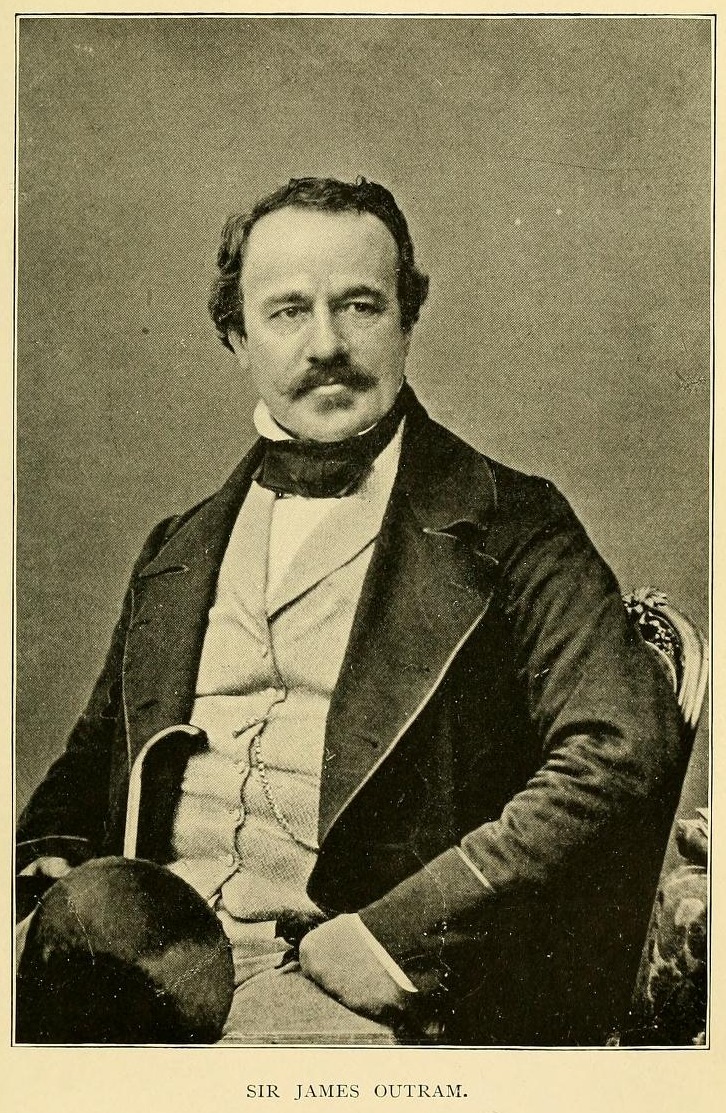
 Sir James Outram | |
| Nickname(s) | The Bayard of India |
| Born | 29 January 1803 Butterley, Derbyshire, England |
| Died | 11 March 1863 (aged 60) Pau, Pyrenees-Atlantiques, France |
| Buried | |
| Allegiance | Error creating thumbnail: File missing United Kingdom Error creating thumbnail: File missing East India Company |
| Service/ | |
| Years of service | 1819–1860 |
| Rank | Lieutenant General |
| Battles/wars | First Anglo-Afghan War |
| Awards | Knight Grand Cross of the Order of the Bath Knight Companion of the Order of the Star of India |
| Alma mater | Marischal College, University of Aberdeen |
| Other work | Resident Minister of Lucknow Chief Commissioner of Oudh |

.svg)
Lieutenant-General Sir James Outram, 1st Baronet Lua error: expandTemplate: template "post-nominals/UK" does not exist. (29 January 1803 – 11 March 1863) was a British general who fought in the Indian Rebellion of 1857.
Early life[edit | edit source]
James Outram was the son of Benjamin Outram of Butterley Hall, Butterley, Derbyshire, a civil engineer, and Margaret Anderson, a daughter of James Anderson of Hermiston a Scottish writer on agriculture. His father died in 1805, and his mother moved to Aberdeenshire in 1810. From Udny school the boy went in 1818 to the Marischal College, Aberdeen and in 1819 an Indian cadetship was given to him. Soon after his arrival at Bombay his remarkable energy attracted notice, and in July 1820 he became acting adjutant to the first battalion of the 12th regiment on its embodiment at Poona, an experience which he found to be of immense advantage to him later in his career.[1]
Khandesh - 1825[edit | edit source]

In 1825, he was sent to Khandesh, where he trained a light infantry corps, formed of the Bhils, a tribe native to the densely forested hills of that region. He gained over them a marvellous personal influence, and employed them with great success in checking outrages and plunder. Their loyalty to him had its principal source in their admiration of his hunting achievements, which in cool daring and hairbreadth escapes have perhaps never been equalled. Originally a puny lad, and for many years after his arrival in India subject to constant attacks of sickness, Outram seemed to gain strength by every new illness, eventually acquiring a strong constitution and "nerves of steel, shoulders and muscles worthy of a six-foot Highlander."[1]
Gujarat and Sindh campaigns[edit | edit source]
In 1835 he was sent to Gujarat to make a report on the Mahi Kantha district, and for some time he remained there as political agent. On the outbreak of the First Afghan War in 1838 he was appointed extra aide-de-camp on the staff of Sir John Keane, and went to Afghanistan, where he conducted various raids against Afghan tribes and performed an extraordinary exploit in capturing a banner of the enemy before Ghazni. In 1839, he was promoted to Major and appointed political agent in Lower Sindh, later being moved to Upper Sindh (at this time, Gujarat and Sindh were both under the Bombay Presidency). While in Sindh, he strongly opposed the policy of his superior, Sir Charles Napier, which led to the annexation of Sindh into British India. However, when war broke out, he heroically defended the residency at Hyderabad against 8000 Baluchis, causing Sir Charles Napier to describe him as the "Bayard of India." On his return from a short visit to England in 1843, he was, with the rank of brevet lieutenant-colonel, appointed to a command in the Mahratta country, and in 1847 he was transferred from Satara to Baroda, where he incurred the resentment of the Bombay government by his fearless exposure of corruption.[1]
Lucknow - 1854[edit | edit source]

In 1854 he was appointed resident at Lucknow, in which capacity two years later he carried out the annexation of Oudh and became the first chief commissioner of that province. Appointed in 1857, with the rank of lieutenant-general, to command an expedition against Persia during the Anglo-Persian War, he defeated the Persian forces in February 1857 after an attempted ambush by their commander Khanlar Mirza at Khushab. Outram conducted the campaign with such rapid decision that peace was concluded by the Treaty of Paris in March 1857, his services being rewarded by the grand cross of the Bath.[1] Later that year, the Governor-General's wife, Lady Canning was unimpressed with him when he stayed at Government House in August 1857: she recorded that ‘he is a very common looking little dark Jewish bearded man, with a desponding slow hesitating manner, very unlike descriptions — or rather the idea raised in one’s mind by the old Bombay name the “Bayard of the East” . . . He is not the least my idea of a hero.’[2]
From Persia he was summoned in June to India, with the brief explanation "We want all our best men here". It was said of him at this time that a fox is a fool and a lion a coward by the side of Sir J. Outram. Immediately on his arrival in Calcutta he was appointed to command the two divisions of the Bengal army occupying the country from Calcutta to Cawnpore; and to the military control was also joined the commissionership of Oudh. Already hostilities had assumed such proportions as to compel Henry Havelock to fall back on Cawnpore, which he held only with difficulty, although a speedy advance was necessary to save the garrison at Lucknow. On arriving at Cawnpore with reinforcements, Outram, in admiration of the brilliant deeds of General Havelock, conceded to him the glory of relieving Lucknow, and, waiving his rank, tendered his services to him as a volunteer. During the advance he commanded a troop of volunteer cavalry, and performed exploits of great brilliancy at Mangalwar, and in the attack at the Alambagh; and in the final conflict he led the way, charging through a very tempest of fire. The volunteer cavalry unanimously voted him the Victoria Cross, but he refused the choice on the grounds that he was ineligible as the general under whom they served. Resuming supreme command, he then held the town till the arrival of Sir Colin Campbell, after which he conducted the evacuation of the residency so as completely to deceive the enemy. In the second capture of Lucknow, on the commander-in-chief's return, Outram was entrusted with the attack on the side of the Gomti, and afterwards, having recrossed the river, he advanced through the Chattar Manzil to take the residency, thus, in the words of Colin Campbell, putting the finishing stroke on the enemy. After the capture of Lucknow he was gazetted lieutenant-general.[1]
Thanks - Bayard of India[edit | edit source]

In February 1858, he received the special thanks of both houses of Parliament, and in the same year the dignity of baronet with an annuity of £1000. When, on account of shattered health, he returned finally to England in 1860, a movement resulted in the presentation of a public testimonial, and the erection of statues in London (by sculptor Matthew Noble) and Calcutta.[1]
He died at Pau in the south of France[3] on 11 March 1863,[4] and was buried on 25 March in the nave of Westminster Abbey, where the marble slab on his grave bears the poignant epitaph The Bayard of India.[3][5]
Family[edit | edit source]
He was married to Margaret Clementine Anderson (1813-1911). She is buried in Dean Cemetery in Edinburgh. The grave is also to the memory of Sir James. Their son Sir Francis Boyd Outram lies with her.[6]
Legacy[edit | edit source]

A memorial to Outram was erected in Westminster Abbey in 1863 to the designs of Matthew Noble.[7]
- Autram Ghat is in the Satmala Range in Khandesh, that connects Aurangabad and Chalisgaon in Maharashtra.
- Outram Street is a street near King's Park in Perth, Australia, named after Sir James Outram. Two other nearby streets (Colin Street and Havelock Street) are named in honour of Generals concerned in the Indian Mutiny.[8]
- Jamesabad, Pakistan is a town in the Punjab province of Pakistan which was named after Sir James Outram during the British Raj.
- Outram, Singapore is an area of the city of Singapore named after Outram Road which was named in Sir James' honour in 1858. The nearby MRT station is Outram Park.
- Outram, New Zealand is a small town near Dunedin. It was named after Sir James by Sir John Richardson.[9]
- Outram Road in Croydon, south London, is named after Outram. The road is near Addiscombe Military Seminary which trained officers for the East India Company.[10]
- The Outram Ghat in Kolkata, West Bengal, India, has been named after General Outram.
- Outram Lines, Kingsway Camp, Delhi, India
- Outram Road in Southsea, Hampshire, United Kingdom is named for Sir James Outram.
- Outram Hall, named after Sir James Outram, is located across from the popular Murrays Bay beach on Auckland's North Shore in New Zealand.
- Outram Street, Ripley, Derbyshire, United Kingdom, is a street in the neighbouring Village to where Sir James Outram was born, named in 1861 to honour his legacy.
Fictional portrayals[edit | edit source]
General James Outrum appears as a character in Flashman in the Great Game[11] by George MacDonald Fraser. Outram is played by Richard Attenborough in the 1977 Satyajit Ray film The Chess Players.
Works[edit | edit source]
- Outram, James (1840). Rough Notes on the Campaign in Sinde and Affganistan in 1838-39. Bombay: American Mission Press.
- Outram, James (1846). The Conquest of Scinde: A Commentary. Vol. Part 1: General Sir Charles Napier's Negotiations with the Amers. Edinburgh and London: William Blackwood and Sons.
- Outram, James (1846). The Conquest of Scinde: A Commentary. Vol. Part 2: Campaign in Scinde and treatment of the Amers. Edinburgh and London: William Blackwood and Sons.
- Outram, James (1853). A Memoir of the Public Services Rendered by Lieut. Colonel Outram, CB. London: Smith, Elder and Co.
- Outram, James (1853). A Few Brief Memoranda of Some of the Public Services Rendered by Lieut.-Colonel Outram, C.B. London: Smith, Elder and Co.
- Outram, James (1853). Baroda Intrigues and Bombay Khutput. London: Smith, Elder and Co.
- Outram, James (1860). Lieut.-General Sir James Outram's Persian Campaign in 1857. London: Smith, Elder and Co.
- Outram, James (1860). Lieut.-General Sir James Outram's campaign in India, 1857-1858. London: Smith, Elder and Co.
References[edit | edit source]
- ↑ 1.0 1.1 1.2 1.3 1.4 1.5 Chisholm 1911.
- ↑ David, Saul (2002). The Indian Mutiny : 1857. London: Viking. ISBN 0670911372.
- ↑ 3.0 3.1 Oxford Dictionary of National Biography, Volume 42. Oxford University Press. 2004. p. 146. ISBN 0-19-861392-X.Article by R H Vetch, revised Ainslie T. Embree.
- ↑ Index of death entry.
- ↑ Sir James Outram, Westminster Abbey.org, accessed February 2011
- ↑ Outram grave Dean Cemetery
- ↑ Dictionary of British Sculptors 1660-1851 by Rupert Gunnis p.275
- ↑ "Perth for Everyone: Perth's City Street Names". Archived from the original on 22 February 2014. Retrieved 4 April 2017.
- ↑ Reed, A.W. Place Names of New Zealand, Wellington, A.H. & A.W. Reed (1975)
- ↑ "The History of Addiscombe and the H.O.M.E Roads". H.O.M.E. Residents' Association. Retrieved 2 February 2015.
- ↑ George MacDonald Fraser (2006). Flashman in the Great Game (the Flashman Papers, Book 8). HarperCollins. ISBN 978-0-00-721719-9.
No doubt he does," mutters Outram, "but he'll no more pass for a native than my aunt's parrot.
- Attribution
Error creating thumbnail: File missing This article incorporates text from a publication now in the public domain: Chisholm, Hugh, ed. (1911). "Outram, Sir James". Encyclopædia Britannica (11th ed.). Cambridge University Press.

Further reading[edit | edit source]
- Goldsmid, Frederic John (1881). James Outram, a Biography. Vol. 1 (2nd ed.). London: Smith, Elder and Co.
- Goldsmid, Frederic John (1881). James Outram, a Biography. Vol. 2 (2nd ed.). London: Smith, Elder and Co.
- Trotter, Lionel J. (1903). The Bayard of India: The Life of General Sir James Outram, Bart. GCB. etc. Edinburgh and London: William Blackwood and Sons.
- "Dispatch from Major-General R. England". The London Gazette (20185). London: Stationery Office: 82. 10 January 1843. Retrieved 14 September 2008.
On this occasion also Major Outram gave me his able assistance, as well as in flanking the extremity of the Bolan pass near Kundye, where I had good reason to expect again to meet some hostile tribes, but the total disappointment of the Kakurs on the 3d, and the effectual flanking arrangements made on all occasions by our troops, seem to have prevented any renewal of interruption.
[dead link]
| Baronetage of the United Kingdom | ||
|---|---|---|
| New creation | Baronet (of Bengal) 1858–1863 |
Succeeded by Francis Boyd Outram |