

| Wallophis | |
|---|---|
_at_Amravati,_Maharashtra.jpg)
| |
| Indian smooth snake at Amravati, Maharashtra | |
Scientific classification 
| |
| : | [[Template:Taxonomy/Wallophis]] Werner, 1929 |
| Species: | Template:Taxonomy/WallophisW. brachyura
|
| Binomial name | |
| Template:Taxonomy/WallophisWallophis brachyura (Günther, 1866)
| |

| |
| Synonyms[2] | |
Günther, 1866
— Boulenger, 1890 | |
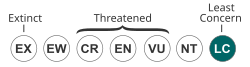
Wallophis brachyura, known commonly as the Indian smooth snake or suvaro saap, is a species of rare harmless snake in the family Colubridae. The species is endemic to India.
Geographic range[edit | edit source]
W. brachyura is found in isolated localities in the state of Maharashtra in western peninsular India.[3]
Habitat[edit | edit source]
The preferred habitat of W. brachyura is dry plains.[3]
Description[edit | edit source]
The following description is based on Malcolm Smith (1943):
Nostril large, between two nasals; internasals 0.3 to 0.5 as long as the prefrontals; frontal nearly as broad as long, in contact with a large preocular; loreal longer than high; 2 postoculars; temporals 2+2; 8 supralabials, 4th and 5th touching the eye; anterior genials larger than the posterior, the latter separated by two or three series of small scales. Scales in 23:23:19 rows; ventrals large, rounded; tail rather short. Ventrals 200–224; Caudals 46–53; Anals 1.
Hemipenis extending to the 13th caudal plate, not forked. The distal half is calyculate, the cups being large and with scalloped edges; the proximal half is spinose, two or three spines at the base being much larger than the others (bad specimen).
Olive-brown above, with indistinct light variegations on the anterior half of the body and head; lower parts whitish. Total length: males 515 mm (20.3 in), tail 75 mm (3.0 in); females 460 mm (18 in), tail 55 mm (2.2 in).
Range. Northern India. Poona district and Visapur, near Bombay; S.E. Berar.
A rare snake.
Diet[edit | edit source]
The diet of W. brachyura is unknown.[3]
Reproduction[edit | edit source]
The manner of reproduction of W. brachyura is unknown.[3]
References[edit | edit source]
- ↑ Vyas, R.; Suraj, M. (2021). "Coronella brachyura". IUCN Red List of Threatened Species. 2021 e.T172590A158461186. doi:10.2305/IUCN.UK.2021-2.RLTS.T172590A158461186.en. Retrieved 10 August 2023.
- ↑ "Wallophis brachyura ". The Reptile Database. www.reptile-database.org.
- ↑ 3.0 3.1 3.2 3.3 Das I (2002). A Photographic Guide to Snakes and other Reptiles of India. Sanibel Island, Florida: Ralph Curtis Books. 144 pp. ISBN 0-88359-056-5. (Coronella brachyura, p. 29).
Further reading[edit | edit source]
- Boulenger GA (1890). The Fauna of British India, Including Ceylon and Burma. Reptilia and Batrachia. London: Secretary of State for India in Council. (Taylor and Francis, printers). xviii + 541 pp. (Coronella brachyura, p. 309).
- Günther A (1866). "Fifth Account of new Species of Snakes in the Collection of the British Museum". Annals and Magazine of Natural History, Third Series 18: 24-29 + Plates VI-VII. (Zamenis brachyurus, new species, p. 27 + Plate VI, figure A).
- Smith MA (1943). The Fauna of British India, Ceylon and Burma, Including the Whole of the Indo-Chinese Sub-region. Reptlia and Amphibia. Vol. III.—Serpentes. London: Secretary of State for India. (Taylor and Francis, printers). xii + 583 pp. (Coronella brachyura, pp. 194–195, Figure 60).
