





| Shivneri Caves | |
|---|---|
 | |
  | |
| Location | Junnar |
| Coordinates | 19°11′56″N 73°51′29″E / 19.1990°N 73.8580°E |
| Geology | Basalt |
The Shivneri Caves are artificial caves dug for Buddhist monks circa the 1st century CE. These are now famous tourist attractions located on Shivneri Hill, about 2 km Southwest of Junnar, India. Other caves around the city of Junnar are: Manmodi Caves, Lenyadri, and the Tulja Caves.
Description
The Shivneri Buddhist caves are located near Shivneri Fort on the top of the hill, where Shivaji Maharaja was born. It is a group of 60 caves that were excavated in the first part of the 1st century CE.<ref name=AHIR>Ahir, D. C. (2003). Buddhist sites and shrines in India : history, art, and architecture (1. ed.). Delhi: Sri Satguru Publ. p. 192. ISBN 8170307740.</ref> At the beginning of the 2nd century CE, these caves were a flourishing center of Buddhist activities.<ref>Brancaccio, Pia (2010). The caves at Aurangabad : Buddhist art in transformation. Leiden: Brill. p. 27. ISBN 978-9004185258.</ref> The caves are essentially made of viharas or small cells, but there are also chaityas.<ref>Te-kʻun, Cheng (1983). Studies in Chinese art. Hong Kong: Chinese University Press. p. 212. ISBN 9622012795.</ref> The caves are scattered on three sides of the west–east-south triangle formed by Shivneri Mountain.<ref name = "BC">Buddhist Cave Temples of India, by RS Mauchope, 1933 Template:P.</ref>
The caves are scattered around the hill, and categorized into several groups: the East group (1, 2 and 3), the West group, and the South group. Among the most important caves, we can mention:
- Cave 26 – a two-story Vihara
- Cave of 45 – Known as "Bara-kotri", it has 12 cells for resident monks.
<gallery widths="200px" heights="200px"> Shivneri_fort1.JPG|Shivneri hill, east side, seen from Junnar. Caves around Junnar.jpg|Location of Buddhist caves, including Shivneri Caves, around the city of Junnar. Shivneri caves East facing group 3.jpg|Shivneri East face, Group 3. Shivneri East facing Group 1.jpg|Shivneri East face, Group 1. </gallery>
South Face: Great Chaitya (Cave 47)
Cave 47 is on the south face of Shivneri (19°11′40″N 73°51′23″E / 19.194535°N 73.856492°E). It is one of the most remarkable Chaityas of the group. Inside are two rounded pillars and tiered capitals, similar to those found in Nasik (Pandavleni Caves). The hall measures 9.9x6.5m, and has a height of 5.8m.<ref name = "BC"/> The cave contains a very beautiful stūpa with a "rail pattern" at the top. It is surmounted by a parasol.<ref name = "BC"/> The ceiling is painted in color, consisting of squares in which are concentric circles of color (orange, brown and white).<ref name = "BC"/>
The chaitya has on its outer face the dedicatory inscription of a merchant:
"A pious gift of charity, designed for the sanctuary, for the good and happiness of all, by Virasenaka, distinguished head of the family, confessor of Dharma"
— Inscription of the great Chaitya.<ref>James Fergusson and James Burgess (1880) The cave temples of India, Template:P.</ref>
<gallery widths="200px" heights="200px"> Shivneri south facing group of caves.jpg|Remains of one of the cells of the south face of Shivneri. Plan and section of the Shivneri Chaitya cave.jpg|Map and section of the Chaitya. Shivneri Chaitya cave no47 dagoba.jpg|Stūpa, cave n ° 47. Shivneri Chaitya cave no47 ceiling paintings.jpg|Ceiling paintings, cave n ° 47. Shivenri Chaitya pillar.jpg|Pillar of the Chaitya cave. Shivneri Chaitya inscription.jpg|The dedicatory inscription of the Chaitya. </gallery>
Inscriptions by Yavanas

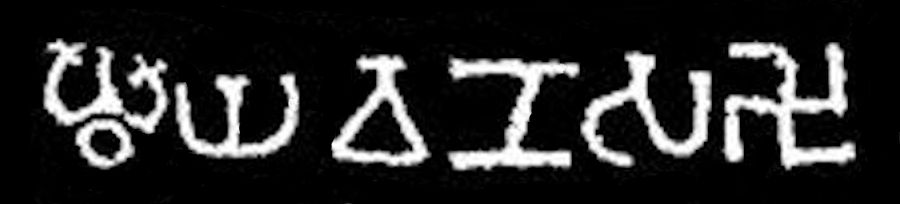
Two Buddhist inscriptions made by Yavanas (Indo-Greeks) were found in Shivneri.<ref name = "Yavanas"/> They suggest the involvement of men of Greek descent with Buddhism in India, as well as the continued presence and gradual acculturation of the Greeks in India in the 1st century CE.<ref name = "Yavanas">The Greek-Indians of Western India: A Study of the Yavana and Yonaka Buddhist Cave Temple Inscriptions, 'The Indian International Journal of Buddhist Studies', NS 1 (1999–2000) Template:P.</ref>
- Yavana inscription of cave 54

Error: No text given for quotation (or equals sign used in the actual argument to an unnamed parameter)
The inscription starts with the Buddhist symbol of the swastika (non-inverted), just before the word "Yavanasa".
- Yavana inscription of cave 67

Error: No text given for quotation (or equals sign used in the actual argument to an unnamed parameter)


 ). Here the "na"
  is written "ṇa" , with the retroflex consonant "ṇ", which is also a common variation of "n".
On this second inscription, the Buddhist symbols of the triratna and of the swastika (reversed) are positioned on both sides of the first word "Yavanasa".
Other similar inscriptions mentioning donations from Yavanas have been found at Karla Caves, Pandavleni Caves, as well as Manmodi Caves.<ref>The Greek-Indians of Western India: A Study of the Yavana and Yonaka Buddhist Cave Temple Inscriptions, The Indian International Journal of Buddhist Studies, NS 1 (1999–2000) pp83-109</ref>
References
Adjacent Buddhist structures | ||||||||||
|---|---|---|---|---|---|---|---|---|---|---|
| ||||||||||




| Pilgrimage to |
| Buddha's Holy Sites |
|---|
 |
| The Four Main Sites |
| Four Additional Sites |
| Other Sites |
| Later Sites |
